FM 7-21.13 THE SOLDIER’S GUIDE (FEBRUARY 2004) - page 4

FM 7-21.13 ____________________________________________________________
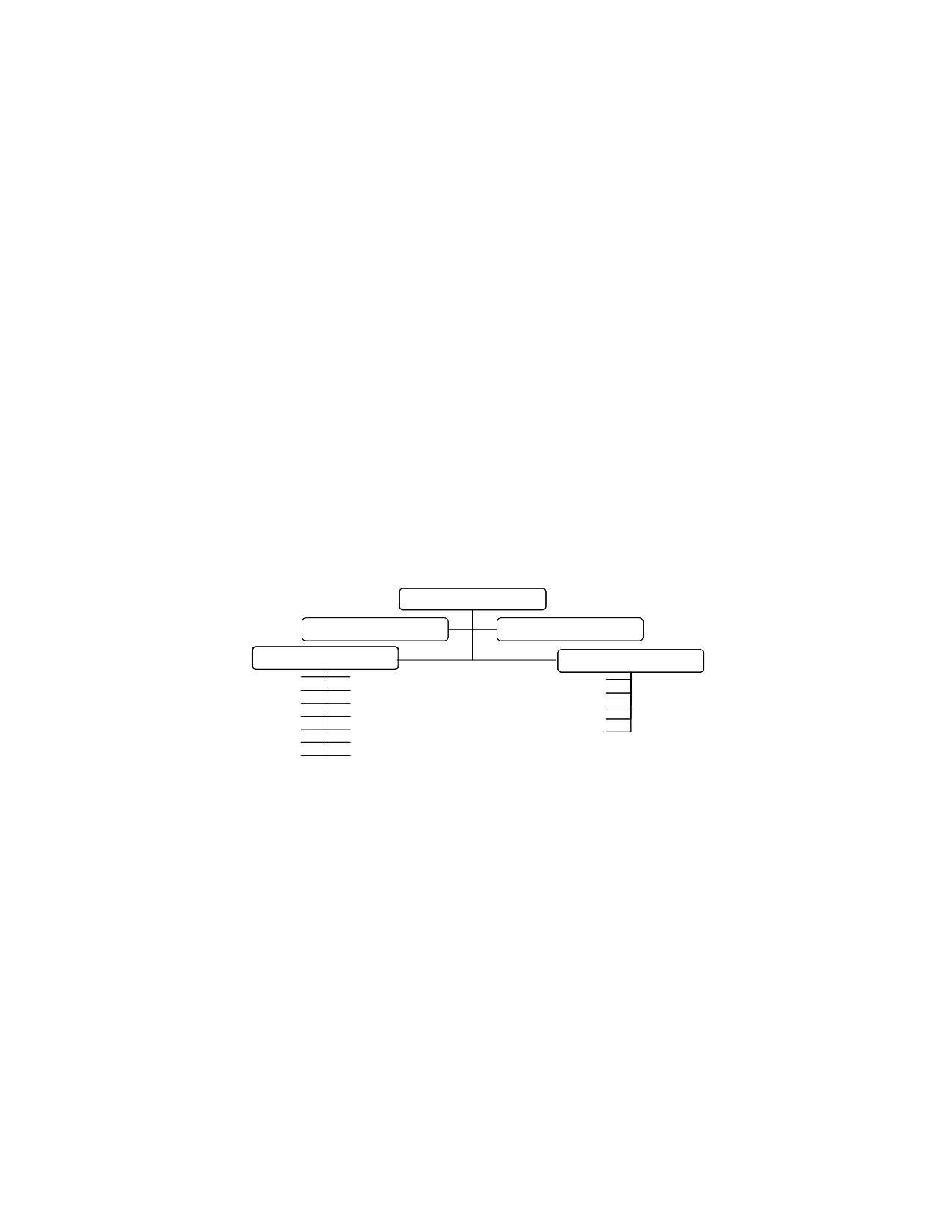
Secretary of Defense
Dept of Homeland Security
Deputy Secretary of Defense
Chairman of the Joint Chiefs of Staff
The Joint Staff
US Coast Guard
Dept of the Air Force
US Central Command
US European Command
Dept of the Army
US Northern Command
US Southern Command
Dept of the Navy
US Pacific Command
US Transportation Cmd
US Marine Corps
US Special Operations Cmd
US Strategic Command
US Joint Forces Command
Figure 2-2. Organization of the Department of Defense
JOINT CHIEFS OF STAFF
2-217. The Joint Chiefs of Staff consist of the Chairman; the Vice
Chairman; the Chief of Staff of the Army; the Chief of Naval Operations;
the Chief of Staff of the Air Force; and the Commandant of the Marine
Corps. The Chairman of the Joint Chiefs of Staff is the principal military
adviser to the President, the National Security Council, and the Secretary
of Defense. The other members of the Joint Chiefs of Staff are military
advisers who may provide additional information upon request from the
President, the National Security Council, or the Secretary of Defense. They
may also submit their advice when it does not agree with that of the
Chairman. Subject to the authority of the President and the Secretary of
Defense, the Chairman of the Joint Chiefs of Staff is responsible for—
• Assisting the President and the Secretary of Defense in providing for
the strategic direction and planning of the Armed Forces and
allocating resources to fulfill strategic plans.
• Making recommendations for the assignment of responsibilities
within the Armed Forces in accordance with and in support of those
logistic and mobility plans.
• Comparing the capabilities of American and allied Armed Forces
with those of potential adversaries.
• Preparing and reviewing contingency plans that conform to policy
guidance from the President and the Secretary of Defense.
• Preparing joint logistic and mobility plans to support contingency
plans.
• Recommending assignment of logistic and mobility responsibilities to
the Armed Forces to fulfill logistic and mobility plans.
2-70
_____________________________________________________________ Chapter 2
UNIFIED COMMANDS
2-218. The Unified Commands are geographically (like Central Command)
or functionally (like Transportation Command) oriented. The commanders
of the unified commands are responsible to the President and the Secretary
of Defense for accomplishing the military missions assigned to them and
exercising command authority over forces assigned to them. The
operational chain of command runs from the President to the Secretary of
Defense to these commanders. The Chairman of the Joint Chiefs of Staff
functions within the chain of command by transmitting the orders of the
President or the Secretary of Defense to the commanders of the unified
commands.
2-219. Within each unified command is an Army component command.
These Army component commands provide command and control to Army
units that are or become part of the Unified Command. Army units may be
assigned to the command; for example, the
35th Supply and Services
Battalion, assigned to the 10th Area Support Group, part of US Army,
Japan and 9th Theater Support Command. US Army, Japan and 9th TSC is
further assigned to US Army, Pacific Command: the Army component of
Pacific Command. Army units may also be temporarily part of a Unified
Command for a specific mission. For example, Army Forces, Central
Command (ARCENT) exerts operational control over Army units deployed
to Iraq supporting Operation Iraqi Freedom.
DEPARTMENT OF THE ARMY
2-220. In our Constitution we read, “We the people… provide for the
common Defence,” that the Congress raises the Army, and that the
President is the Commander-in-Chief. The United States Army exists to
serve the American people, protect enduring national interests, and fulfill
national military responsibilities. The Army performs this by deterring and,
when deterrence fails, by achieving quick, decisive victory anywhere in the
world and under virtually any conditions as part of a joint team.
2-221. The institution of the Army is its essence, traditions, history, and
lineage. It includes leader development, doctrine, training, professionalism,
integrity, and the Army's tradition of responsibility to the nation. The
Army's enduring values flow from the American ideals embodied in the
Constitution and Declaration of Independence. And serve to guide the
actions of soldiers as individuals and groups. Throughout American
military history, these values have provided a firm foundation for military
leaders and soldiers. They provide all soldiers with principles of conduct
and standards of behavior that exemplify those ideals and values.
2-222. The Army maintains a relationship between the institutional Army,
with its enduring values, and the organizational Army, the strategic force
capable of decisive victory. Institutional changes occur slowly through
deliberate evolution and are indistinguishable to the public at large. The
organization changes more rapidly and visibly to meet requirements
presented by national and international realities. In maintaining the
balance between capabilities and requirements in the organization, the
2-71
FM 7-21.13 ____________________________________________________________
institution must not lose its enduring values. They are the foundation
during periods of change and uncertainty. The challenge is to manage
change, increase capability, maintain stability, and foster innovation.
2-223. The objective of Army forces is to dominate land operations by
defeating enemy land forces, seizing and controlling terrain and destroying
the enemy’s will to resist. Supported by the Air Force and Navy, the Army
can forcibly enter an area and conduct land operations anywhere in the
world. The Army also can achieve quick and sustained land dominance
across the spectrum of conflict. Its capabilities help achieve national
political and military objectives.
2-224. The Army tailors forces with unique capabilities to achieve military
objectives during major theater wars or smaller-scale operations. Army
forces are assigned to a joint force commander under the direct command of
an Army component commander or a joint force land component
commander. In a joint force, a single commander exercises command
authority or operational control over elements of two or more services.
Within a joint force, service forces may work under subordinate joint
commands or single service commands. Each military department (Army,
Navy, and Air Force) retains responsibility for administration and logistic
support of those forces it has allocated. You can see the organization of the
Department of the Army in Figure 2-3.
Secretary of The Army
Deputy Secretary of The Army
Inspector General
Chief of Public Affairs
Chief of Staff of The Army
Assistant Secretaries of
The Army
Vice Chief of Staff
Sergeant Major of The Army
Civil Works
Army G1
Army G2
Financial Management & Comptroller
Army G3
Army G4
Installations & Environment
Chief of Engineers
Army G6
Manpower & Reserve Affairs
National Guard Bureau
Chief of The Army Reserve
Acquisition, Logistics, & Technology
Judge Advocate General
Provost Marshal General
Surgeon General
Chief of Chaplains
Army Major Commands
US Army Europe
US Army Forces Command
US Army Materiel Command
US Army Training & Doctrine Command
United States Eighth US Army, Korea
US Army Corps of Engineers
US Army Medical Command
US Army Pacific Command
US Army Space & Missile Defense Command
US Army Special Operations Command
Military Surface Deployment & Distribution Command
US Army Military District of Washington
US Army South
US Army Intelligence & Security Command
US Army Criminal Investigation Command
Figure 2-3. Organization of the Department of the Army
2-225. The Army is composed of two distinct and equally important
components: the active component and the reserve components. The reserve
components are the United States Army Reserve and the Army National
Guard. The active component is a federal force of full-time soldiers and
Department of the Army civilians. They make up the operational and
institutional organizations engaged in the day-to-day missions of the Army.
2-72
_____________________________________________________________ Chapter 2
Congress annually determines the number of soldiers that the Army may
maintain in the active component.
2-226. Department of the Army civilians perform critical technical and
administrative tasks that release soldiers for training and performance of
other operational and institutional missions. In addition, many contractors
work for the Army to support our forces at home and deployed around the
world. While not members of the Army, these contractors provide vital
services that sustain and enhance the Army's service to the Nation.
2-227. The US Army Reserve is the active component's primary federal
reserve force. The US Army Reserve is made up of soldiers in the Selected
Reserve, Individual Ready Reserve (IRR), and Retired Reserve, totaling
over 1,000,000 soldiers. In the Selected Reserve you find soldiers in troop
program units
(TPU), active guard and reserve
(AGR) soldiers, and
Individual Mobilization Augmentees (IMA). The troop program units are
made up of highly trained combat support and combat service support
soldiers that can move on short notice. The US Army Reserve gives the
Army the resources it needs to deploy overseas and sustain combat troops
during wartime, contingencies, or other operations. It is the Army's main
source of transportation, medical, logistic, and other combat support and
combat service support units and it is the Army's only source of trained
individual soldiers readily available to augment headquarters staffs and fill
vacancies in units.
2-228. The Army National Guard has a unique, dual mission that consists
of both federal and state roles. Although its primary mission is to serve as a
federal reserve force, the Guard has an equally important role supporting
the states. Until mobilized for a federal mission, their state executive
(usually the governor) commands Army National Guard units. In the state
role, the Army National Guard must maintain trained and disciplined
forces for domestic emergencies or other missions that state law may
require. In this capacity, they serve as the first military responders within
states during emergencies; in their federal role, Army National Guard units
must maintain trained and ready forces, available for prompt mobilization
for war, national emergency, or other missions.
Our guardsmen, those who live and work within all of our
nation’s communities, are the Army’s greatest link to the
American people.
Former Secretary of the Army Thomas E. White
2-229. Regardless of component, the Army conducts both operational and
institutional missions. The operational Army consists of numbered armies,
corps, divisions, brigades, and battalions that conduct full spectrum
operations around the world. They include the combat arms, combat
support and combat service support units that deploy and operate to
accomplish missions that support the overall objectives of the Nation. Both
active and reserve component units take part in operational missions.
Institutional missions include recruiting and training new soldiers,
2-73
FM 7-21.13 ____________________________________________________________
developing, acquiring and maintaining equipment, and managing the force,
just to name a few. Regardless of where you are, you are part of a team that
has important functions to support the Army’s overall tasks. Your job is
important. You are important to the Army whether you are active or
reserve, combat arms, combat support or combat service support, infantry
division or training brigade.
2-230. The active component of the Army has nearly 480,000 soldiers. The
active component has 10 combat divisions, three cavalry regiments and two
separate maneuver brigades. The Selected Reserve of the US Army Reserve
consists of about 205,000 soldiers. It fields a large portion of the Army’s
support units, especially in civil affairs, engineering, transportation, and
maintenance. The Army National Guard
(ARNG) has approximately
350,000 soldiers. Upon mobilization, the Army National Guard can provide
up to eight combat divisions, two Special Forces groups, and 15 enhanced
Separate Brigades. Figure 2-4 below shows about what percentage of the
Army’s soldiers are in the active component, USAR Selected Reserve (SR),
and ARNG.
The Army of One
USAR
ARNG
(SR)
34%
20%
Active
46%
Figure 2-4. Make up of The Army of One
2-231. The Major Commands of the Army and the Army components of the
Unified commands are in the active component. The Army provides units to
the unified commands for specific purposes and duration. The Army
component commanders of each unified command have command and
control over these units. For example, Central Command normally has no
Army combat units assigned to it. In the case of Operation Enduring
Freedom, since 2001 a number of different divisions and smaller units have
2-74
_____________________________________________________________ Chapter 2
deployed to Southwest Asia (SWA) under US Army Central Command. The
largest Army component is the US Army Forces Command (FORSCOM),
which executes the land defense of the US. It also provides military support
to civil authorities and trains, sustains, mobilizes and protects strategic
land forces worldwide.
2-232. The teams and units of the Army are generally built upon the
squad, the basic unit in the army structure. Squads are made up of 8 to 11
soldiers and are normally led by a staff sergeant. In some types of units, the
crew is the basic element, as in armor units. Crews are made up of the
soldiers who operate a particular weapon system. Tanks, for example, have
a crew of four soldiers usually led by a SSG (though some crews may
include higher ranking soldiers). Squads and crews combine to build nearly
every MTOE unit in the Army, as follows—
• The platoon usually consists of two to four squads or crews. A
lieutenant usually leads platoons, with a sergeant first class as
second in command.
• Company, battery (in the artillery) or troop (in the cavalry) is made
up of three to five platoons and is typically commanded by a captain.
It usually has a first sergeant as the senior noncommissioned officer.
• The battalion or squadron
(cavalry) is composed of four to six
companies/batteries/troops and is commanded by a lieutenant colonel
with a command sergeant major as the senior NCO. The battalion is
tactically and administratively self-sufficient and can conduct
independent operations of a limited scope. A cavalry unit of similar
size to a battalion is called a squadron.
• The brigade, regiment or group is made up of two to five battalions
under the command of a colonel with a command sergeant major as
the senior NCO. Armored cavalry and ranger units of similar size
and organization are called regiments, while Special Forces and some
other units are known as groups.
• The division is typically made up of three maneuver brigades, as well
combat support brigades. A division is commanded by a major
general. The division performs major tactical operations for the corps
and is capable of sustained operations. A command sergeant major is
the senior NCO of the division.
• A corps is made of two or more divisions commanded by a lieutenant
general with a command sergeant major as the senior NCO. Corps
bring additional support assets and can comand and control large
operations over great distances.
• Armies contain corps and other supporting assets. For example, the
Third United States Army (TUSA) is also known as Army Forces,
Central Command (ARCENT) and provides command and control for
Army forces deployed in SWA.
2-233. We look to the past for lessons, we analyze the operational
environment, and we adapt to win our Nation’s wars. We remember that
2-75
FM 7-21.13 ____________________________________________________________
our purpose is to serve the Nation, defend the Constitution, and our way of
life. But throughout all this, the Army—past, present, and future—is
people.
2-234. Soldiers have made the US Army the world’s most respected land
force. That respect is a direct result of the values that soldiers embrace. As
FM 1, The Army points out, “there is no moral comparison between
American Soldiers and their adversaries in wars throughout our history.
Thus, it is easy for Soldiers to believe in what they do.”
2-76
Chapter 3
Duties, Responsibilities, and Authority of the
Soldier
Being an effective part of a team as a soldier means
knowing your role and the rules for that team. This chapter
explains the meaning of duty, responsibility, and authority
and how these apply to every soldier in the Army. You'll find
a quick reference to some of the rules soldiers live by in the
sections on wear, appearance, and fit and standards of
conduct. The discussion of the Uniform Code of Military
Justice (UCMJ) explains some of the procedures in the use
of military justice. This chapter provides brief overviews of
these topics and for additional detailed information refer to
the appropriate manuals.
Section I - Duties, Responsibilities, and Authority
3-3
Duties
3-3
Responsibilities
3-5
Authority
3-8
The Chain Of Command and NCO Support Channel
3-10
Inspections and Corrections
3-12
Section II - Wear and Appearance
3-15
Personal Appearance Policies
3-15
Uniform Appearance and Fit
3-21
Section III - Uniform Code of Military Justice
3-30
Articles Of The Manual for Courts-Martial
3-31
Article 15
3-33
Administrative Tools
3-34
Law of Land Warfare
3-36
Section IV - Standards of Conduct
3-38
Relationships Between Soldiers of Different Rank
3-38
Extremist Organizations and Activities
3-41
Homosexual Conduct
3-42
Hazing
3-42
Code of Conduct
3-43
Gifts and Donations
3-45
Fund-Raising
3-47
Lautenberg Amendment
3-47
3-1
FM 7-21.13 ____________________________________________________________
For more information on duties, responsibilities and authority see AR 600-20, Army
Command Policy, FM 6-0, Command and Control, FM 6-22 (22-100), Army Leadership,
and FM 7-22.7, The Army Noncommissioned Officer Guide.
For more information on the wear and appearance of Army uniforms and insignia, see AR
670-1, Wear and Appearance of Army Uniforms and Insignia.
For more information on the Uniform Code of Military Justice, see FM 1-04.14 (27-14).
Legal Guide for Soldiers, AR 27-10, Military Justice, AR 27-3, The Army Legal Assistance
Program, and the Manual for Courts-Martial.
For more information on the law of land warfare, see FM 1-04.10 (27-10), The Law of
Land Warfare.
For more information on Army standards of conduct, see AR 600-20 and DOD 5500.7-R,
Joint Ethics Regulation (JER).
For more information on the Code of Conduct, see AR 350- 30, Code of Conduct/
Survival, Evasion, Resistance and Escape (SERE) Training and DA Pam 360-512, Code
of the US Fighting Force.
Every soldier has a specific job to do and makes a
unique contribution to the Army. But always
remember you are a soldier first.
3-2
_____________________________________________________________ Chapter 3
SECTION I - DUTIES, RESPONSIBILITIES, AND AUTHORITY
3-1.
Every soldier has certain duties, responsibilities, and most have
some level of authority. You should know what these are and how they
apply to you. One of your obligations as a soldier is to carry out your duties
to standard and the best of your ability. Bear your responsibilities knowing
that you are part of a great team that only works well when each of its
members do their best. If you are in a leadership position, exert authority to
build the team and develop your soldiers. Your fellow soldiers are
depending on you each and every day to make tough decisions based on
your rank and duty position.
Serving my country is the best thing I can do with my life.
1SG Isaac Guest
DUTIES
3-2.
Duties are general requirements to be performed. Duty begins with
everything required of you by law, regulation, and orders; but it includes
much more than that. A duty is a legal or moral obligation. For example,
soldiers have a legal duty to obey the lawful orders of their leaders.
Likewise, all officers and NCOs have a duty to “Take care of their soldiers.”
3-3.
Professionals do their work not just to the minimum standard, but
to the very best of their ability. Soldiers and Department of the Army
civilians (DAC) commit to excellence in all aspects of their professional
responsibility so that when the job is done they can look back and honestly
say, “I have given my all each and every day.” Duty also means being able
to accomplish tasks as part of a team. You must fulfill your obligations as a
part of your unit. That means, for example, voluntarily assuming your
share of the workload, willingly serving as a member of a team, or
assuming a leadership role when appropriate.
3-4.
Commissioned officers are direct representatives of the President.
The President uses commissions as legal instruments to appoint and
exercise direct control over qualified people who act as his legal agents and
help him carry out duties. The Army retains this direct-agent relationship
with the President through its commissioned officers. The commission
serves as the basis for a commissioned officer’s legal authority.
Commissioned officers command, establish policy, and manage Army
resources.
3-5.
Warrant officers are highly specialized, single-track specialty
officers who receive their authority from the Secretary of the Army upon
their initial appointment. However, Title
10 USC authorizes the
commissioning of warrant officers (WO1) upon promotion to chief warrant
officer
(CW2). These commissioned warrant officers are direct
representatives of the President of the United States. They derive their
3-3
FM 7-21.13 ____________________________________________________________
authority from the same source as commissioned officers, but remain
specialists in their field. Warrant officers can and do command
detachments, units, activities, and vessels as well as lead, coach, train and
counsel subordinates. As leaders and technical experts, they provide
valuable skills, guidance, and expertise to commanders and organizations
in their particular field.
3-6.
Noncommissioned officers, the backbone of the Army, train, lead,
and take care of enlisted soldiers. They also provide advice to officers in
every aspect of unit operations. NCOs often represent officers and DAC
leaders in their absence. They ensure their soldiers, along with their
personal equipment, are prepared to function as effective unit and team
members. While commissioned officers command, establish policy, and
manage resources, NCOs conduct the Army’s daily business.
3-7.
Junior enlisted soldiers are where the rubber meets the road. Junior
enlisted soldiers perform their duties to standard AND to the best of their
ability. This means perfroming individual tasks identified by first line
supervisors based on the unit’s mission essential task list (METL). All
soldiers must be able to do those individual tasks to standard because that
is where every successful operation begins—at the individual task level.
Junior enlisted soldiers can seek help from first-line supervisors for
problems they are unable to solve. Like every soldier in the Army, junior
enlisted soldiers have a duty to obey the lawful orders of superiors. Even
junior enlisted soldiers can make on-the-spot corrections—they shouldn’t
walk by a deficiency without tactfully correcting the problem. That’s
professionalism.
3-8.
Department of the Army civilians are members of the executive
branch of the federal government and are a vital part of the Army. DACs
fill positions in staff and base sustaining operations that might otherwise
have to be filled by officers and NCOs. Senior DACs establish policy and
manage Army resources, but they do not have the authority to command.
The complementary relationship and mutual respect between the military
and civilian members of the Army is a long-standing tradition. Since the
Army’s beginning in 1775, military and civilian roles have stayed separate,
yet necessarily related. Taken in combination, traditions, functions, and
laws also help clarify duties of military and civilian members of the Army.
SPECIFIED DUTIES
3-9.
Specified duties are those related to jobs and positions. Directives
such as Army regulations, Department of the Army (DA) general orders,
the Uniform Code of Military Justice (UCMJ), soldier’s manuals, Army
Training and Evaluation Program
(ARTEP) or Mission Training Plan
(MTP) publications, and Military Occupational Specialty
(MOS) job
descriptions specify the duties. They spell out what soldiers must do and
the standards they must meet.
3-4
_____________________________________________________________ Chapter 3
DIRECTED DUTIES
3-10. Directed duties are not specified as part of a job position or MOS or
other directive. A superior gives them orally or in writing. Directed duties
include being in charge of quarters (CQ) or serving as sergeant of the guard,
staff duty officer, company training NCO, and nuclear, biological and
chemical
(NBC) NCO where these duties are not found in the unit’s
organizational charts.
IMPLIED DUTIES
3-11. Implied duties often support specified duties, but in some cases they
may not be related to the military occupational specialty
(MOS) job
position. These duties may not be written but implied in the instructions.
They’re duties that improve the quality of the job and help keep the unit
functioning at an optimum level. In most cases, these duties depend on
individual initiative. They improve the work environment and motivate
soldiers to perform because they want to, not because they have to.
RESPONSIBILITIES
3-12. Responsibility is the legally established and moral obligation a
soldier assumes for his own actions, accomplishments and failures. Leaders
also assume responsibility for the actions, accomplishments, and failures of
their units and decisions. Above all, the leader is responsible for
accomplishing his assigned missions. Then, he is responsible for his
soldiers’ health, welfare, morale, and discipline. The leader is responsible
for maintaining and employing the resources of his force. In most cases,
these responsibilities do not conflict. But sometimes they do. For example,
SPC Hull has requested a three day pass, Friday through Sunday, because
an old friend is visiting for the weekend. But Friday the company is going to
the range to qualify on individual weapons. There is no other range time
scheduled for the next three months. If such a conflict cannot be resolved,
accomplishing the mission must come first. In the example, SPC Hull’s
commander disapproves the pass.
3-13. Related to responsibility is accountability. This is the requirement
to answer to superiors (and ultimately the American people) for mission
accomplishment, for the lives and care of assigned soldiers, and for
effectively and efficiently using Army resources. It also includes an
obligation to answer for properly using delegated authority. Leaders are
accountable for what they do or fail to do. For example, SSG Calhoun must
explain to the platoon leader and platoon sergeant why three tires on one of
her squad’s vehicles are not inflated to the air pressure specified in the
technical manual. Soldiers account for their actions to their fellow soldiers
or organization, their leaders, the Army and the American people.
3-14. Officers, NCOs, and DACs lead other officers, NCOs, junior enlisted
soldiers, and DACs and help them carry out their responsibilities.
Commanders set overall policies and standards, but all leaders guide,
assist, and supervise subordinates, who assist and advise their leaders.
3-5
FM 7-21.13 ____________________________________________________________
Mission accomplishment demands that officers, NCOs and DACs work
together to advise, assist and learn from each other.
Responsibility is a unique concept. It can only reside and
inhere in a single individual. You may share it with others,
but your portion is not diminished… Even if you do not
recognize it or admit its presence, you cannot escape it. If
responsibility is rightfully yours, no evasion, or ignorance, or
passing the blame can shift the burden to someone else.
Admiral Hyman G. Rickover
INDIVIDUAL RESPONSIBILITY
3-15. Every soldier is responsible for performing his duty to the very best
of his ability—and for trying to improve his performance. You are also
responsible for your personal conduct and appearance. You and every other
soldier in the Army assumed this personal responsibility when you took
your enlistment oath or oath as an officer. For example, every soldier is
responsible for his own physical fitness. Commanders set aside time on the
training schedule for physical training (PT), designate soldiers to lead PT
and even ensure all soldiers complete unit runs. But only you can make
yourself physically fit.
3-16. Every soldier is responsible for treating other people with dignity
and respect. You may not engage in nor tolerate sexual, racial or other
types of discrimination or harassment. Such behavior is morally wrong in
both modern society and our Army of values. In addition, it rapidly destroys
unit cohesion and team integrity. That could result in lives unnecessarily
lost in combat or failure to accomplish assigned missions. Neither of these
possible results is acceptable. .
3-17. Soldiers also have unique responsibilities based on rank, duty
position and even geographical location. This manual won’t go into all those
unique jobs soldiers of different MOSs have. The next few paragraphs
describe some of the more general responsibilities of all soldiers. Just
remember this—regardless of rank or MOS or specialty—you are a soldier
first.
3-18. The general roles and responsibilities of the commissioned officer
are as follows:
• Commands, establishes policy, and manages Army resources.
• Integrates collective, leader, and soldier training to accomplish
mission.
• Deals primarily with units and unit operations.
• Concentrates on unit effectiveness and readiness.
3-6
_____________________________________________________________ Chapter 3
3-19. The general roles and responsibilities of the warrant officer are as
follows:
• Provides quality advice, counsels and solutions to support the
command.
• Executes policy and manages the Army’s system.
• Commands special-purpose units and task-organized operational
elements.
• Focuses on collective, leader, and individual training.
• Operates, maintains, administers, and manages the Army’s
equipment, support activities, and technical systems.
• Concentrates on unit effectiveness and readiness.
3-20. The general roles and responsibilities of the noncommissioned
officer are as follows:
• Trains soldiers and conducts the daily business of the Army within
established policy.
• Focuses on individual soldier and small unit collective training.
• Deals primarily with individual soldier training and team leading.
• Ensures that subordinate teams, NCOs, and soldiers are prepared to
function as effective unit and team members.
3-21. The general roles and responsibilities of the junior enlisted soldier
are as follows:
• Obeys the lawful orders of NCOs and officers.
• Completes each task to the very best degree possible and not just to
standard.
• Maintains a military appearance.
• Maintains individual physical fitness standards and readiness.
• Maintains individual equipment and clothing to standard.
3-22. As members of the executive branch of the federal government,
Department of the Army civilians (DAC) are part of the Army team. The
DAC provides unique skills that are essential to victory. The general roles
and responsibilities of the DAC are as follows:
• Fills positions in staff and base sustaining operations that otherwise
would have to be filled by soldiers.
• Provides specialized skills that are difficult to maintain in uniformed
components.
• Provides continuity in organizations where soldiers are not available
or regularly rotate.
3-7
FM 7-21.13 ____________________________________________________________
• Applies technical, conceptual, and interpersonal skills to operate,
maintain, and administer Army equipment and support, research,
and technical activities—in a combat theater, if necessary.
• In addition, the DAC leader also—
Establishes and executes policy, leads other DACs, and manages
programs, projects, and Army systems.
Concentrates on DAC individual and organizational effectiveness
and readiness.
AUTHORITY
3-23. Authority is the legitimate power of leaders to direct subordinates
or to take action within the scope of their position. Military authority
begins with the Constitution, which divides it between Congress and the
President. Congress has the authority to make laws that govern the Army.
The President, as Commander in Chief, commands the Armed Forces,
including the Army. Two types of military authority exist: command and
general military.
COMMAND AUTHORITY
3-24. Command authority originates with the President and may be
supplemented by law or regulation. It is the authority that a leader
exercises over subordinates by virtue of rank and assignment to a position
of leadership. Command authority is exercised when a member of the Army
is assigned to or assumes a position requiring the direction and control of
other members of the Army.
3-25. Command authority is not necessarily limited to commissioned
(including warrant) officers. Any soldier assigned to a leadership position
has the authority inherent in the position to issue orders necessary to
accomplish his mission or for the welfare of his soldiers, unless contrary to
law or regulation. A tank commander, squad leader, section or platoon
sergeant uses this authority to direct and control his soldiers. In these
cases, the authority the leader exercises is restricted to the soldiers and
facilities that make up that leader's unit.
A colonel does not just command 3,000 men, a battalion
commander 1,000, and a captain 250. A colonel commands
three battalions, a battalion commander four companies, a
captain four platoons, and a platoon leader four squads. Let us
not forget that.
Instruct your subordinates directly; do not command their
people. Above all, do not do their jobs, or you will not do yours.
Colonel Louis de Maud’Huy
3-26. Don’t confuse command authority with
“Command.” Except in
emergency situations, only commissioned and warrant officers may
command Army units and installations. Army regulations define
3-8
_____________________________________________________________ Chapter 3
“Command” as a military organization or prescribed territory that is
recognized as a command under official directives. DA civilians may
exercise general supervision over an Army installation or activity, but they
act under the authority of a military supervisor; they do not command.
GENERAL MILITARY AUTHORITY
3-27. General military authority originates in oaths of office and
enlistment, law, rank structure, traditions, and regulations. This broad-
based authority allows leaders to take appropriate corrective actions
whenever a member of any armed service, anywhere, commits an act
involving a breach of good order or discipline. Army Regulation 600-20,
Army Command Policy, states this specifically, giving commissioned,
warrant, and noncommissioned officers authority to “quell all quarrels,
frays, and disorders among persons subject to military law.” The purpose of
this authority is to maintain good order and discipline.
3-28. For NCOs, another source of general military authority stems from
the combination of the chain of command and the NCO support channel.
The chain of command passes orders and policies through the NCO support
channel to provide authority for NCOs to do their job.
DELEGATION OF AUTHORITY
3-29. Just as Congress and the President cannot personally direct every
aspect of Armed Forces operations, commanders at all levels cannot directly
handle every action. To meet the organization’s goals, these officers must
delegate authority to subordinate commissioned and noncommissioned
officers and, when appropriate, to DACs. These subordinate leaders, in
turn, may further delegate that authority.
3-30. Unless restricted by law, regulation, or a superior, leaders may
delegate any or all of their authority to their subordinate leaders. However,
such delegation must fall within the leader’s scope of authority. Leaders
cannot delegate authority they do not have and subordinate leaders may
not assume authority that their superiors do not have, cannot delegate, or
have retained. The task or duty to be performed limits the authority of the
leader to whom it is assigned.
3-31. When a leader assigns a subordinate a task, he delegates the
requisite authority to accomplish the task as well. The subordinate accepts
both the responsibility for accomplishing the task and the authority
necessary to make it happen. The leader, however, always retains overall
responsibility for the task’s outcome, being ready to answer for all actions
or omissions related to the outcome.
3-32. For example, let’s say the first sergeant told the 1st platoon sergeant
to have a detail police an area outside the orderly room, and the platoon
sergeant further assigns the task to SPC Green and two PFCs. The platoon
sergeant delegates to SPC Green the authority to direct the two PFCs. In
this way, SPC Green has the authority to complete the task and is
accountable to the platoon sergeant for accomplishing it to standard.
3-9
FM 7-21.13 ____________________________________________________________
THE CHAIN OF COMMAND AND NCO SUPPORT CHANNEL
3-33. Communication among soldiers, teams, units, and organizations is
essential to efficient and effective mission accomplishment. Two-way
communication is more effective than one-way communication. Mission
accomplishment depends on information passing accurately to and from
subordinates and leaders, up and down the chain of command and NCO
support channel, and laterally among adjacent organizations or activities.
In garrison operations, organizations working on the same mission or
project should be considered “adjacent.”
CHAIN OF COMMAND
3-34. The Army has only one chain of command. Through this chain of
command, leaders issue orders and instructions and convey policies. An
effective chain of command is a two-way communication channel. Its
members do more than transmit orders; they carry information from within
the unit or organization back up to its leader. They furnish information
about how things are developing, notify the leader of problems, and provide
request for clarification and help. Leaders at all levels use the chain of
command—their subordinate leaders—to keep their people informed and
render assistance. They continually facilitate the process of gaining the
necessary clarification and solving problems.
3-35. Beyond conducting their normal duties, NCOs train soldiers and
advises commanders on individual soldier readiness and the training
needed to ensure unit readiness. Officers and DAC leaders should consult
their command sergeant major, first sergeant, or NCOIC, before
implementing policy. Leaders must continually communicate to avoid
duplicating instructions or issuing conflicting orders. Continuous and open
lines of communication enable leaders to freely plan, make decisions, and
program future training and operations.
NONCOMMISSIONED OFFICER SUPPORT CHANNEL
3-36. The NCO support channel parallels and reinforces the chain of
command. NCO leaders work with and support the commissioned and
warrant officers of their chain of command. For the chain of command to
work efficiently, the NCO support channel must operate effectively. At
battalion level and higher, the NCO support channel begins with the
command sergeant major, extends through first sergeants, platoon
sergeants and ends with section chiefs, squad leaders or team leaders.
The NCO support channel…is used for exchanging
information; providing reports; issuing instructions, which are
directive in nature; accomplishing routine but important
activities in accordance with command policies and directives.
Most often, it is used to execute established policies,
procedures, and standards involving the performance,
training, appearance, and conduct of enlisted personnel. Its
power rests with the chain of command.
FM 22-600-20, The Duties, Responsibilities, and Authority of NCOs, 1977
3-10
_____________________________________________________________ Chapter 3
3-37. The connection between the chain of command and the NCO
support channel is the senior NCO. Commanders issue orders through the
chain of command, but senior NCOs must know and understand the orders
to issue effective implementing instructions through the NCO support
channel. Although the first sergeant and command sergeant major are not
part of the formal chain of command, leaders should consult them on all
enlisted soldier matters and individual training.
3-38. Successful leaders have good relationships with their senior NCOs.
Successful commanders have a good leader-NCO relationship with their
first sergeants and command sergeant major. The need for such a
relationship applies to platoon leaders and platoon sergeants as well as to
staff officers and NCOs. Senior NCOs have extensive experience in
successfully completing missions and dealing with enlisted soldier issues.
Also, senior NCOs can monitor organizational activities at all levels, take
corrective action to keep the organization within the boundaries of the
commander’s intent, or report situations that require the attention of the
officer leadership. A positive relationship between officers and NCOs
creates conditions for success.
3-39. The NCO support channel assists the chain of command in
accomplishing the following:
• Transmitting, instilling and ensuring the efficacy of the Army ethic.
• Planning and conducting the day-to-day unit operations within
prescribed policies and directives.
• Training enlisted soldiers in their MOS as well as in the basic skills
and attributes of a soldier.
• Supervising unit physical fitness training and ensuring that soldiers
comply with the height/weight and appearance standards in AR 600-
9, The Army Weight Control Program, and AR 670-1, Wear and
Appearance of Army Uniforms and Insignia.
• Teaching soldiers the history of the Army, to include military
customs, courtesies, and traditions.
• Caring for individual soldiers and their families both on and off duty.
• Teaching soldiers the mission of the unit and developing individual
training programs to support the mission.
• Accounting for and maintaining individual arms and equipment of
enlisted soldiers and unit equipment under their control.
• Administrating and monitoring the NCO professional development
program and other unit training programs.
• Achieving and maintaining Army values.
• Advising the commander on rewards and punishment for enlisted
soldiers.
3-11
FM 7-21.13 ____________________________________________________________
3-40. Soldiers should use the chain of command or the NCO support
channel (as appropriate) to help solve problems, whether small or large.
The chain of command and the NCO support channel are also effective and
efficient means of communication from where the rubber meets the road to
the very highest echelons of the Army. Whether you have a problem,
suggestion, complaint or commendation the chain and the channel are the
means to communicate to the leaders who need to know.
INSPECTIONS AND CORRECTIONS
3-41. Why do we have inspections? From long experience, the Army has
found that some soldiers, if allowed to, will become careless and lax in the
performance of minor barracks, office, and work area maintenance. They
become accustomed to conditions in their immediate surroundings and
overlook minor deficiencies. Should a soldier fall below the Army standard
of performance someone will notice those deficiencies immediately. All
soldiers have the responsibility to uphold the Army standard.
3-42. Your supervisors will order inspections to see that soldiers have all
the equipment and clothing issued to them and that it is serviceable.
Inspections serve this practical purpose; they are not harassment. You will
probably agree that inspections often correct small problems before they
become big problems. Sharp appearance, efficient performance, and
excellent maintenance are important considerations that affect you directly.
They are the visible signs of a good organization in which any soldier would
be a proud member. First-line leaders should inspect their soldiers daily
and should regularly check soldiers’ rooms, common areas, offices and work
areas of their soldiers. First-line leaders should also make arrangements
with soldiers who live in quarters (on or off post) to ensure the soldier
maintains a healthy and safe environment for himself and his family.
TYPES OF INSPECTIONS
3-43. There are two categories of inspections for determining the status of
individual soldiers and their equipment: in-ranks and in-quarters. An in-
ranks inspection is of personnel and equipment in a unit formation. The
leader examines each soldier individually, noticing their general
appearance and the condition of their clothing and equipment. When
inspecting crew-served weapons and vehicles, the soldiers are normally
positioned to the rear of the formation with the operators standing by their
vehicle or weapon. Leaders may conduct an in-quarters
(barracks)
inspection to include personal appearance, individual weapons, field
equipment, displays, maintenance, and sanitary conditions. Organizations
will have inspection programs that will help determine the status and
mission readiness of the unit and its components. These include command
inspections, staff inspections, and Inspector General inspections.
On-the-Spot Corrections
3-44. One of the most effective administrative corrective measures is the
on-the-spot correction. Use this tool for making the quickest and often most
3-12
_____________________________________________________________ Chapter 3
effective corrections to deficiencies in training or standards. Generally, a
soldier requires an on-the-spot correction for one of two reasons. Either the
soldier you are correcting does not know what the standard is or does not
care what the standard is. If the soldier was aware of the standard but
chose not to adhere to it, this may indicate a larger problem that his chain
of command should address. In such a situation you might follow up an on-
the-spot correction with a call to the soldier’s first sergeant or commander.
Figure 3-1 shows the steps in properly making an on-the-spot correction.
Correct the soldier.
Attack the performance, never the person.
Give one correction at a time. Do not dump.
Don’t keep bringing it up. When the correction is over, it is over.
Figure 3-1. On-the-Spot Correction Steps
3-45. Keeping a soldier on track is the key element in solving performance
problems. Motivated soldiers keep the group functioning and training
productive. Ultimately soldiers accomplish the training objectives, and most
importantly, the mission. Some leaders believe that soldiers work as
expected simply because that is their job. That may be true, but soldiers
and leaders also need a simple pat-on-the-back once in a while, for a job
well done. Good leaders praise their soldiers and care about the job they are
doing. Soldiers not performing to standard need correction.
Making an On-the-Spot Correction
PFC Bucher returned to the battery area after PT and got out of his car
to go to formation. He noticed CPL Mays had arrived and waited for him
to walk up to the unit together. CPL Mays locked his car and said hello
to PFC Bucher but still hadn’t put his beret on. PFC Bucher was unsure
what to do but knew that he wasn’t supposed to walk by a deficiency.
PFC Bucher said, “Good morning, CPL Mays.” He looked around to
ensure no one could hear him and went on, “You really should put your
headgear on, Corporal. An impressionable young troop like me might
get the wrong idea and think it’s okay to walk around without cover.”
CPL Mays wasn’t amused but took the hint. “Thanks, Bucher, I forgot,”
he said, pulling his beret out of his cargo pocket. “And thanks for not
making a big deal out of it. Let’s go to formation before we’re late.”
3-46. Often the on-the-spot correction is the best tool to get soldiers back
on track. But even after making an on-the-spot correction, additional
training may be necessary. Figure
3-2 shows the guidelines in using
corrective training.
3-13
FM 7-21.13 ____________________________________________________________
The training, instruction or correction given to a soldier to correct
deficiencies must be directly related to the deficiency.
Orient the corrective action to improving the soldier’s performance in
their problem area.
You may take corrective measures after normal duty hours. Such
measures assume the nature of the training or instruction, not
punishment.
Corrective training should continue only until the training deficiency is
overcome.
All levels of command should take care to ensure that training and
instruction are not used in an oppressive manner to evade the
procedural safeguards in imposing nonjudical punishment.
Do not make notes in soldiers’ official records of deficiencies
satisfactorily corrected by means of training and instruction.
Figure 3-2. Corrective Training Guidelines
3-47. More often than not, soldiers do good things that deserve some
recognition. In the same way as on-the-spot corrections (but obviously for
different reasons), leaders praise soldiers’ good work by telling them the
specific action or result observed and why it was good. This will tend to
encourage soldiers to continue doing those good things and motivate other
soldiers to reach that standard, too.
3-48. Making an informal, unscheduled check of equipment, soldiers, or
quarters is called an on-the-spot inspection. Stopping to check the tag on a
fire extinguisher as you walk through a maintenance bay is an example of
an on-the-spot inspection. Another example is checking the condition of the
trash dumpster area in back of the orderly room. For any inspection, the
steps are the same: preparation, conduct, and follow-up.
PCCs / PCIs
3-49. Pre-combat checks (PCCs), Pre-combat inspections (PCIs) and Pre-
execution checks are key to ensuring leaders, trainers, and soldiers are
adequately prepared to execute operations and training to Army standard.
PCC/PCIs are the bridge between pre-execution checks and execution of
training. They are also detailed final checks that all units conduct before
and during execution of training and combat operations. Conduct PCC/PCIs
at the beginning of each event or exercise as part of troop leading
procedures to check soldiers, equipment, vehicles, and mission knowledge.
3-50. The chain of command is responsible for developing, validating, and
verifying all PCC/PCIs. Pre-execution checks ensure that all planning and
prerequisite training (soldier, leader, and collective) are complete prior to
the execution of training. They systematically prepare soldiers, trainers,
3-14
_____________________________________________________________ Chapter 3
and resources to ensure training execution starts properly. Pre-execution
checks provide the attention to detail needed to use resources efficiently.
In no other profession are the penalties for employing
untrained personnel so appalling or so irrevocable as in the
military.
General of the Army Douglas MacArthur
SECTION II - WEAR AND APPEARANCE
3-51. This section provides an overview of Army Regulation 670-1, Wear
and Appearance of Army Uniforms and Insignia. It is a quick reference to
personal appearance policies and uniform appearance and fit. For details
refer to the regulation.
PERSONAL APPEARANCE POLICIES
3-52. In the Army discipline is judged, in part, by the manner in which a
soldier wears the uniform, as well as by the soldier’s personal appearance.
Therefore, a neat and well-groomed appearance by all soldiers is
fundamental to the Army and contributes to building the pride and esprit
essential to an effective military force. A part of the Army’s strength and
military effectiveness is the pride and self-discipline that American soldiers
display in their appearance.
3-53. Commanders ensure that military personnel under their command
present a neat and soldierly appearance. In the absence of specific
procedures or guidelines, commanders must determine a soldier’s
appearance complies with standards in AR 670-1. Soldiers must take pride
in their appearance at all times, in or out of uniform, on and off duty. Pride
in appearance includes soldiers’ physical fitness and adherence to
acceptable weight standards in accordance with AR
600-9, The Army
Weight Control Program.
RELIGIOUS ITEMS
3-54. Soldiers may wear religious apparel, articles, or jewelry subject to
some limitations based on mission or other requirements. The term
“religious apparel” applies to articles of clothing worn as part of the
observance of the religious faith practiced by the soldier. These religious
articles include, but are not limited to, medallions, small booklets, pictures,
or copies of religious symbols or writing carried by the individual in wallets
or pockets. See AR 600-20, Army Command Policy, paragraph 5-6g for more
information on accommodating religious practices.
3-55. Soldiers may wear religious apparel, articles, or jewelry with the
uniform, to include the physical fitness uniform, if they are neat,
conservative, and discreet.
“Neat, conservative, and discreet” means it
meets the uniform criteria of AR 670-1. In other words, when religious
3-15
FM 7-21.13 ____________________________________________________________
jewelry is worn, the uniform must meet the same standards of wear as if
the religious jewelry were not worn. For example, a religious item worn on
a chain may not be visible when worn with the utility, service, dress or
mess uniforms. When worn with the physical fitness uniform, the item
should be no more visible than identification (ID) tags would be in the same
uniform. The width of chains worn with religious items should be
approximately the same size as the width of the ID tag chain.
3-56. Soldiers may not wear these items when doing so would interfere
with the performance of their duties or cause a safety problem. Soldiers
may not be prohibited, however, from wearing religious apparel, articles or
jewelry meeting the criteria of AR 670-1 simply because they are religious
in nature if wear is permitted of similar items of a nonreligious nature. A
specific example would be wearing a ring with a religious symbol. If the
ring meets the uniform standards for jewelry and is not worn in a work
area where rings are prohibited because of safety concerns, then wear is
allowed and may not be prohibited simply because the ring bears a religious
symbol.
3-57. During a worship service, rite, or ritual, soldiers may wear visible or
apparent religious articles, symbols, jewelry, and apparel that do not meet
normal uniform standards. Commanders, however, may place reasonable
limits on the wear of non-subdued items of religious apparel during worship
services, rites, or rituals conducted in the field for operational or safety
reasons. When soldiers in uniform wear visible religious articles on such
occasions, they must ensure that these articles are not permanently affixed
or appended to any prescribed article of the uniform.
3-58. Chaplains may wear religious attire as described in AR 670-1, CTA
50-909, Field and Garrison Furnishings and Equipment, and AR 165-1,
Chaplain Activities in the United States Army, in the performance of
religious services and other official duties, as required. Commanders may
not prohibit chaplains from wearing religious symbols that are part of the
chaplain’s duty uniform.
3-59. Soldiers may wear religious headgear while in uniform if the
headgear meets the following criteria:
• It must be subdued in color (black, brown, green, dark or navy blue,
or a combination of these colors).
• It must be of a style and size that can be completely covered by
standard military headgear and it cannot interfere with the proper
wear or functioning of protective clothing or equipment.
• The headgear cannot bear any writing, symbols or pictures.
• Soldiers will not wear religious headgear in place of military
headgear when military headgear is required (outdoors or indoors
when required for duties or ceremonies).
HAIR STANDARDS
3-60. Army Regulation 670-1 governs hair and grooming practices or
accommodations based on religious practices. Exceptions based on religious
3-16
_____________________________________________________________ Chapter 3
practices that were given to soldiers in accordance with AR 600-20 on or
prior to 1 January 1986 remain in effect as long as the soldier remains
otherwise qualified for retention.
3-61. The requirement for hair grooming standards is necessary to
maintain uniformity within a military population. Many hairstyles are
acceptable, as long as they are neat and conservative. It is not possible to
address every acceptable hairstyle, or what constitutes eccentric or
conservative grooming. It is the responsibility of leaders at all levels to
exercise good judgment in the enforcement of Army policy. All soldiers will
comply with the hair, fingernail, and grooming policies while in any
military uniform or while in civilian clothes on duty.
3-62. Leaders judge the appropriateness of a particular hairstyle by the
appearance of headgear when worn. Soldiers will wear headgear as
described in the applicable chapters of AR 670-1. Headgear will fit snugly
and comfortably, without distorted or excessive gaps. Soldiers may not wear
hairstyles that do not allow proper wear of headgear, or that interfere with
the proper wear of the protective mask or other protective equipment.
3-63. Extreme, eccentric, or trendy haircuts or hairstyles are not
authorized. If soldiers use dyes, tints, or bleaches, they must choose those
that result in natural hair colors. Colors that detract from a professional
military appearance are prohibited. Soldiers should avoid using colors that
result in an extreme appearance. Applied hair colors that are prohibited
include, but are not limited to purple, blue, pink, green, orange, bright (fire-
engine) red, and fluorescent or neon colors. It is the responsibility of leaders
to use good judgment in determining if applied colors are acceptable, based
upon the overall effect on the soldier’s appearance.
3-64. Soldiers who have a texture of hair that does not part naturally may
cut a part into the hair. The part will be one straight line, not slanted or
curved, and will fall in the area where the soldier would normally part the
hair. Soldiers will not cut designs into their hair or scalp.
3-65. Soldiers may not wear hairnets unless they are required for health,
safety, or duty performance (such as a cook). No other type of hair covering
is authorized in lieu of the hairnet. The commander will provide the hairnet
to the soldier at no cost.
Male Hair Standards
3-66. Male haircuts will conform to certain standards. The hair on top of
the head must be neatly groomed. The length and bulk of the hair may not
be excessive or present a ragged, unkempt, or extreme appearance. The
hair must present a tapered appearance. A tapered appearance is one
where the outline of the soldier’s hair conforms to the shape of the head,
curving inward to the natural termination point at the base of the neck.
The hair will not fall over the ears or eyebrows, or touch the collar, except
for the closely cut hair at the back of the neck. The block-cut fullness in the
back is permitted to a moderate degree, as long as the tapered look is
maintained.
3-17
FM 7-21.13 ____________________________________________________________
3-67. In all cases, the bulk or length of hair may not interfere with the
normal wear of headgear, protective masks, or equipment. Males are not
authorized to wear braids, cornrows, or dreadlocks
(unkempt, twisted,
matted, individual parts of hair) while in uniform or in civilian clothes on
duty. Hair that is clipped closely or shaved to the scalp is authorized.
3-68. Males will keep sideburns neatly trimmed. Sideburns may not be
flared; the base of the sideburn will be a clean-shaven, horizontal line.
Sideburns will not extend below the lowest part of the exterior ear opening.
3-69. Males will keep their face clean-shaven when in uniform or in
civilian clothes on duty. Mustaches are permitted. If mustaches are worn,
they will be neatly trimmed, tapered, and tidy. Mustaches will not present
a chopped off or bushy appearance, and no portion of the mustache will
cover the upper lip line or extend sideways beyond a vertical line drawn
upward from the corners of the mouth. Handlebar mustaches, goatees, and
beards are not authorized. If appropriate medical authority prescribes
beard growth, the length required for treatment must be specified. For
example, “The length of the beard will not exceed ¼ inch.” Soldiers will
keep the growth trimmed to the level specified by appropriate medical
authority, but they are not authorized to shape the growth into goatees, or
“Fu Manchu” or handlebar mustaches.
3-70. Males are prohibited from wearing wigs or hairpieces while in
uniform or in civilian clothes on duty, except to cover natural baldness or
physical disfiguration caused by accident or medical procedure. When worn,
wigs or hairpieces will conform to the standard haircut criteria.
Female Hair Standards
3-71. Female soldiers will ensure their hair is neatly groomed, that the
length and bulk of the hair are not excessive, and that the hair does not
present a ragged, unkempt, or extreme appearance. Likewise, trendy styles
that result in shaved portions of the scalp (other than the neckline) or
designs cut into the hair are prohibited. Females may wear braids and
cornrows as long as the braided style is conservative, the braids and
cornrows lie snugly on the head, and any holding devices comply with the
standards. Dreadlocks (unkempt, twisted, matted individual parts of hair)
are prohibited in uniform or in civilian clothes on duty. Hair will not fall
over the eyebrows or extend below the bottom edge of the collar at any time
during normal activity or when standing in formation. Long hair that falls
naturally below the bottom edge of the collar, to include braids, will be
neatly and inconspicuously fastened or pinned, so no free-hanging hair is
visible. This includes styles worn with the improved physical fitness
uniform (IPFU).
3-72. Styles that are lopsided or distinctly unbalanced are prohibited.
Ponytails, pigtails, or braids that are not secured to the head (allowing hair
to hang freely), widely spaced individual hanging locks, and other extreme
styles that protrude from the head are prohibited. Extensions, weaves,
wigs, and hairpieces are authorized only if these additions have the same
3-18
_____________________________________________________________ Chapter 3
general appearance as the individual’s natural hair. Additionally, any wigs,
extensions, hairpieces, or weaves must comply with grooming policies.
3-73. Females will ensure that hairstyles do not interfere with proper
wear of military headgear, protective masks, or equipment at any time.
When headgear is worn, the hair will not extend below the bottom edge of
the front of the headgear or below the bottom edge of the collar.
3-74. Hair-holding devices may be used only for securing the hair.
Soldiers will not place hair-holding devices in the hair for decorative
purposes. All hair-holding devices must be plain and of a color as close to
the soldier’s hair as is possible or clear. Authorized devices include, but are
not limited to, small, plain scrunchies (elastic hair bands covered with
material), barrettes, combs, pins, clips, rubber bands, and hair bands.
Devices that are conspicuous, excessive or decorative are prohibited. Some
examples of prohibited devices include, but are not limited to, large, lacy
scrunchies; beads, bows, or claw clips; clips, pins, or barrettes with
butterflies, flowers, sparkles, gems, or scalloped edges; and bows made from
hairpieces.
COSMETICS
3-75. As with hairstyles, the requirement for standards regarding
cosmetics is necessary to maintain uniformity and to avoid an extreme or
unmilitary appearance. Males are prohibited from wearing cosmetics, to
include nail polish. Females are authorized to wear cosmetics with all
uniforms, provided they are applied conservatively and in good taste and
complement the uniform. Leaders at all levels must exercise good judgment
in the enforcement of this policy.
3-76. Females may wear cosmetics if they are conservative and
complement the uniform and their complexion. Eccentric, exaggerated, or
trendy cosmetic styles and colors, to include makeup covering tattoos, are
inappropriate with the uniform and are prohibited. Permanent makeup,
such as eyebrow or eyeliner, is authorized if it conforms to standards.
3-77. Females will not wear shades of lipstick and nail polish that
contrast with their complexion, detract from the uniform, or that are
extreme. Some examples of extreme colors include, but are not limited to,
purple, gold, blue, black, white, bright (fire-engine) red, khaki, camouflage
colors and fluorescent colors. Soldiers will not apply designs to nails or
apply two-tone colors to nails. Females will comply with the cosmetics
policy while in any military uniform or while in civilian clothes on duty.
FINGERNAILS
3-78. All soldiers will keep fingernails clean and neatly trimmed. Males
will keep nails trimmed so as not to extend beyond the fingertip. Females
will not exceed a nail length of ¼ inch, as measured from the tip of the
finger. Females will trim nails shorter if the commander determines that
the longer length detracts from the military image, presents a safety
concern, or interferes with the performance of duties.
3-19
FM 7-21.13 ____________________________________________________________
HYGIENE AND BODY GROOMING
3-79. Soldiers will maintain good personal hygiene and grooming on a
daily basis. Not only is this an indicator of a disciplined soldier, but also
demonstrates respect for others and for the uniform.
TATTOOS
3-80. Tattoos or brands that are visible in a class A uniform (worn with
slacks/trousers) are prohibited (see exception in paragraph 3-84 below).
Tattoos or brands that are extremist, indecent, sexist or racist are
prohibited, regardless of location on the body, as they are prejudicial to
good order and discipline within units. Extremist tattoos or brands are
those affiliated with, depicting, or symbolizing extremist philosophies,
organizations or activities.
3-81. Indecent tattoos or brands are those that are grossly offensive to
modesty, decency, or propriety; shock the moral sense because of their
vulgar, filthy, or disgusting nature or tendency to incite lustful thought; or
tend reasonably to corrupt morals or incite libidinous thoughts. Sexist
tattoos or brands are those that advocate a philosophy that degrades or
demeans a person based on race, ethnicity, or national origin. Racist tattoos
or brands are those that advocate a philosophy that degrades or demeans a
person based on race, ethnicity, or national origin.
3-82. Commanders must ensure soldiers understand the tattoo policy. For
soldiers who are not in compliance, commanders may not order the removal
of a tattoo or brand. However, the commander must counsel soldiers, and
afford them the opportunity to seek medical advice about removal or
alteration of the tattoo or brand.
3-83. If soldiers are not in compliance with the policy, and refuse to
remove or alter the tattoos or brands, commanders—
• Ensure the soldier understands the policy.
• Ensure the soldier has been afforded the opportunity to seek medical
advice about the removal or alteration.
• Counsel the soldier in writing. The counseling form will state that
the soldier’s refusal to remove extremist, indecent, sexist, or racist
tattoos or brands anywhere on the body, or refusal to remove any
type of tattoo or brand visible in the class A uniform (worn with
slacks/trousers) will result in discharge.
• Existing tattoos or brands on the hands that are not extremist,
indecent, sexist, or racist, but are visible in the class A uniform are
authorized for soldiers who entered the Army before 1 July 2002.
Soldiers who entered the Army 1 July 2002 and later may not have
tattoos that are visible in the Class A uniform.
• Soldiers may not cover tattoos or brands in order to comply with the
tattoo policy.
3-84. Unit commanders or executive officers make determinations on the
appropriateness of tattoos for soldiers currently on active duty. This
3-20
_____________________________________________________________ Chapter 3
authority cannot be further delegated. Any such determination must be
fully documented in writing and include a description of existing tattoos or
brands and their location on the body. The soldier will receive a copy of the
determination.
UNIFORM APPEARANCE AND FIT
3-85. All soldiers must maintain a high standard of dress and
appearance. Uniforms will fit properly; trousers, pants, or skirts should not
fit tightly; and soldiers must keep uniforms clean and serviceable and press
them as necessary.
APPEARANCE
3-86. Soldiers must project a military image that leaves no doubt that
they live by a common military standard and are responsible to military
order and discipline. Soldiers will ensure that articles carried in pockets do
not protrude from the pocket or present a bulky appearance.
That uniform stood for something to me—and it still does,
something pretty grand and fine.
SGT Henry Giles
3-87. When required and prescribed by the commander, soldiers may
attach keys or key chains to the uniform when performing duties such as
charge of quarters, armorer, duty officer/NCO, or other duties as prescribed
by the commander. Keys or key chains will be attached to the uniform on
the belt, belt loops, or waistband.
3-88. At the discretion of the commander and when required in the
performance of duties soldiers may wear an electronic device on the belt,
belt loops, or waistband of the uniform. Only one electronic device may be
worn. It may be either a pager or a cell phone. The body of the device may
not exceed 4x2x1 inches, and the device and carrying case must be black; no
other colors are authorized. If security cords or chains are attached to the
device, soldiers will conceal the cord or chain from view. Other types of
electronic devices are not authorized for wear on the uniform. If the
commander issues and requires the use of other electronic devices in the
performance of duties, the soldier will carry them in the hand, pocket,
briefcase, purse, bag, or in some other carrying container.
3-89. Soldiers will not wear keys, key chains, or electronic devices on the
uniform when the commander determines such wear is inappropriate, such
as in formation, or during parades or ceremonies. Soldiers will not wear
items or devices on the uniform when not performing required duties.
3-90. While in uniform, soldiers will not place their hands in their
pockets, except momentarily to place or retrieve objects. Soldiers will keep
uniforms buttoned, zipped, and snapped. They will ensure metallic devices
such as metal insignia, belt buckles, and belt tips are free of scratches and
corrosion and are in proper luster or remain properly subdued, as
3-21
FM 7-21.13 ____________________________________________________________
applicable; and that all medals and ribbons are clean and not frayed.
Soldiers will keep shoes and boots cleaned and shined. Soldiers will replace
the rank insignia, name and US Army distinguishing tapes (nametapes),
nameplates, unit patches, and combat and skill badges when unserviceable
or no longer conform to standards.
3-91. Lapels and sleeves of service, dress, and mess coats and jackets will
be roll-pressed, without creasing. Skirts will not be creased. Trousers,
slacks, and the sleeves of shirts and blouses will be creased. Soldiers may
add military creases to the AG shade 415 shirt and the battle dress uniform
(BDU) coat (not the field jacket). Soldiers will center the front creases on
each side of the shirt, centered on the pockets, for those garments that have
front pockets. Soldiers may press a horizontal crease across the upper back
of the shirt or coat (not necessary on the male shirt due to the yoke seam),
and they may press three equally spaced vertical creases down the back,
beginning at the yoke seam or horizontal crease. Additionally, soldiers may
crease the sleeves of the BDU coat. Soldiers are not authorized to sew
military creases into the uniform.
3-92. Although some uniform items are made of wash-and-wear materials
or are treated with a permanent-press finish, soldiers may need to press
these items to maintain a neat, military appearance. However, before
pressing uniform items, soldiers should read and comply with care
instruction labels attached to the items. Soldiers may starch BDUs and the
maternity work uniform, at their option. Commanders will not require
soldiers to starch these uniforms, and soldiers will not receive an increase
in their clothing replacement allowance to compensate for potential
premature wear that may be caused by starching uniforms.
THE BERET
3-93. The beret is the basic headgear for utility uniforms in garrison
environments. The beret is not worn in the field, in training environments,
or in environments where the wear of the beret is impractical, as
determined by the commander. Additionally, the beret is not worn on
deployments unless authorized by the commander. Soldiers being
transferred from one organization to another may continue to wear the
beret and flash of the former unit until they report for duty at the new
organization.
3-22
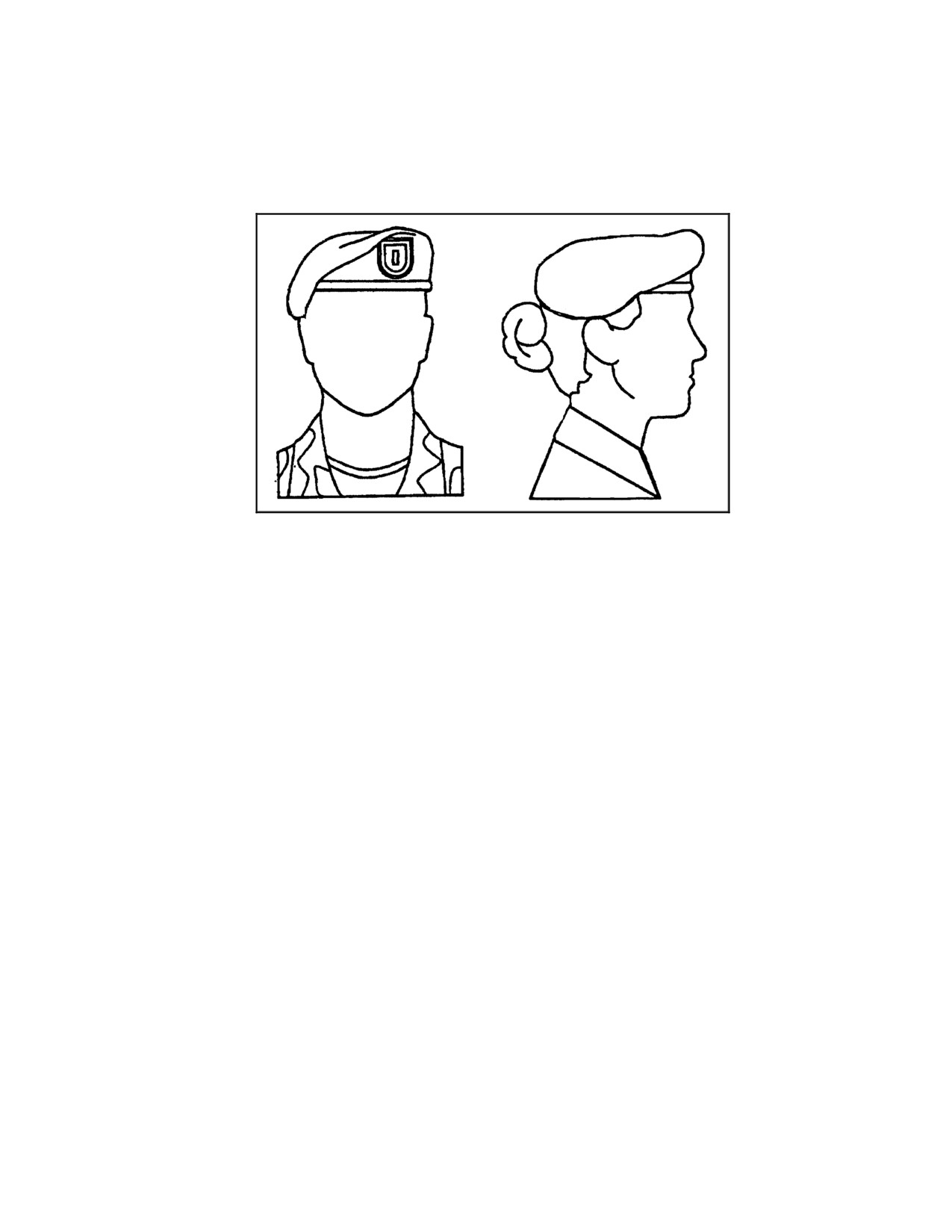
_____________________________________________________________ Chapter 3
Figure 3-3. Wear of the Beret, Male and Female
3-94. The beret is worn so that the headband (edge binding) is straight
across the forehead, one (1) inch above the eyebrows. The flash is positioned
over the left eye, and the excess material is draped over to the right ear,
extending to at least the top of the ear, and no lower than the middle of the
ear. Soldiers will cut off the ends of the adjusting ribbon and secure the
ribbon knot inside the edge binding at the back of the beret. When worn
properly, the beret is formed to the shape of the head; therefore, soldiers
may not wear hairstyles that cause distortion of the beret. See Figure 3-3,
Wear of the Beret, Male and Female.
3-95. Soldiers who are not assigned to units or positions authorized wear
of the tan, green, or maroon berets will wear the black beret. This includes
senior and junior Reserve Officer Training Corps
(ROTC) instructors,
unless otherwise indicated. Soldiers are issued the black beret upon
assignment to their first permanent duty assignment after the completion
of initial entry training or officer/warrant officer basic courses. Cadets and
officer/warrant officer candidates will not wear the black beret. Split-option
soldiers or soldiers in the simultaneous membership program will wear the
black beret only when performing duties with their units, and they will
wear the patrol cap with the BDU, when in a cadet or trainee status.
3-96. Soldiers who have not been issued or who do not wear the black
beret will wear the patrol cap with the BDU. In those cases where beret
sustainment levels are not sufficient for turn-in and reissue of
unserviceable berets, the commander can authorize the temporary wear of
the patrol cap until the beret can be replaced. The Army flash is the only
flash authorized for wear on the black beret, unless authorization for
another flash was granted before the implementation of the black beret as
the standard Army headgear (for example, Opposing Forces elements).
3-23
FM 7-21.13 ____________________________________________________________
Ranger Tan Beret
3-97. Soldiers assigned to the following units are authorized wear of the
Ranger tan beret. Soldiers will wear the approved flash of the unit to which
they are assigned:
• 75th Ranger Regiment.
• Ranger Training Brigade.
• Ranger-qualified soldiers in the following units or positions, if they
previously served in the 75th Ranger Regiment.
US Special Operations Command.
US Army Special Operations Command.
US Special Operations Command Joint Task Force.
Theater Special Operations Command.
Green Beret
3-98. If approved by local commanders, all Special Forces-qualified
soldiers (those carrying the Special Forces MOSs of 18A or 180A, CMF 18,
and CSMs reclassified from 18Z to 00Z) are authorized to wear the Green
Beret. This includes ROTC instructors and those attending training at an
Army service school in a student status. Special Forces (SF) soldiers will
wear the approved flash of the unit to which they are assigned. Special
Forces soldiers who are assigned to an organization without an approved
flash will wear the generic SF flash
(the flash approved for soldiers
assigned to SF positions, but not assigned to SF units).
Maroon Beret
3-99. All soldiers assigned to airborne units whose primary missions are
airborne operations wear the maroon beret. The airborne designation for a
unit is found in the unit modification table of organization and equipment
(MTOE). Other soldiers authorized to wear the maroon beret are as follows:
• Active Army advisors to reserve airborne units on jump status.
• Soldiers assigned to the airborne departments of the US Army
Infantry School and the US Army Quartermaster School.
• Soldiers assigned to long-range surveillance detachments designated
as airborne.
• Soldiers assigned to the airborne/airlift action office.
• Recruiters of the Special Operations Recruiting Company (SORC),
US Army Recruiting Command, will wear the USASOC flash.
• Soldiers assigned to the airborne procurement team.
• Soldiers assigned to 55th Signal Company Airborne Combat Camera
Documentation Team.
• Soldiers assigned to 982d Combat Signal Company airborne platoons.
• Soldiers assigned to rigger detachments.
3-24
_____________________________________________________________ Chapter 3
FIT
3-100. Fitting instructions and alterations of uniforms will be made in
accordance with AR 700-84, Issue and Sale of Personal Clothing, and TM
10-227, Fitting of Army Uniforms and Footwear. The following is a
summary of general fitting guidelines:
• Black all-weather coat. The length of the sleeves of the all-weather
coat will be ½ inch longer than the service coat.
Males. The bottom of the black all-weather coat will reach to a
point 1 ½ inches below the center of the knee.
Females. The bottom of the coat will reach a point at least 1 inch
below the skirt hem, but not less than 1-½ inches below the center
of the knee.
• Uniform coats and jackets (male and female). The sleeve length will
be 1 inch below the bottom of the wrist bone.
• Trousers will be fitted and worn with the lower edge of the waistband
at the top of the hipbone, plus or minus ½ inch. The front crease of
the trousers will reach the top of the instep, touching the top of the
shoe at the shoelaces.
• Trousers will be cut on a diagonal line to reach a point approximately
midway between the top of the heel and the top of the standard shoe
in the back. The trousers may have a slight break in the front.
• Knee-length skirts. Skirts lengths will be no more than 1 inch above
or 2 inches below the center of the knee.
• Long-sleeved shirts. The sleeve length will extend to the center of the
wrist bone.
• Soldiers will wear appropriate undergarments with all uniforms.
WHEN THE WEAR OF THE ARMY UNIFORM IS REQUIRED OR
PROHIBITED
3-101. All soldiers will wear the Army uniform when on duty, unless
granted an exception to wear civilian clothes. The following personnel may
grant exceptions:
• Commanders of major Army commands (MACOMs).
• Assistant Secretaries, the Secretary of Defense or his designee, or
Secretary of the Army.
• Heads of Department of Defense agencies.
• Heads of Department of the Army Staff agencies.
3-102. Soldiers traveling on Air Mobility Command (AMC) and non-AMC
flights on permanent change of station (PCS) orders, temporary duty (TDY),
emergency leave, or space-available flights, are authorized to wear civilian
clothes. Soldiers must ensure clothing worn is appropriate for the occasion
and reflects positively on the Army. Travel to certain countries requires
wear of civilian clothing. For up-to-date information concerning mandatory
3-25
FM 7-21.13 ____________________________________________________________
wear of civilian clothing in foreign countries, see DOD 4500.54G, The
Department of Defense Foreign Clearance Guide
(available online at
http://www.fcg.pentagon.mil/fcg/fcg.htm). The individual’s travel orders will
reflect information authorizing the wear of civilian clothing.
3-103. Soldiers may wear the BDU when deploying as part of a unit move
and the mode of transportation is for the exclusive use of the military.
Embarkation and debarkation points will be in military-controlled areas.
3-104. Army National Guard technicians who are also members of the
Army National Guard will wear the appropriate Army duty uniform while
engaged in their civil service status.
3-105. Wearing Army uniforms is prohibited in the following situations:
• In connection with the furtherance of any political or commercial
interest, or when engaged in off duty civilian employment.
• When participating in public speeches, interviews, picket lines,
marches, rallies, or public demonstrations, except as authorized by
competent authority.
• When attending any meeting or event that is a function of, or is
sponsored by, an extremist organization.
• When wearing the uniform would bring discredit upon the Army.
• When specifically prohibited by Army regulations.
3-106. Soldiers will wear headgear with the Army uniform, except under
the following circumstances:
• Headgear is not required if it would interfere with the safe operation
of military vehicles.
• The wear of military headgear is not required while in or on a
privately owned vehicle (POV), a commercial vehicle, or on public
conveyance (such as a subway, train, plane or bus).
• Soldiers will not wear headgear indoors unless under arms in an
official capacity or when directed by the commander, such as for
indoor ceremonial activities.
• Soldiers will carry their headgear, when it is not worn, in their hand
while wearing service, dress, and mess uniforms.
• Soldiers are not required to wear headgear to evening social events
(after Retreat) when wearing the Army blue and white uniforms, the
enlisted green dress uniform, the Army green maternity dress
uniform, or the mess and evening mess uniforms.
• Soldiers are authorized storage of the headgear, when it is not worn,
in the BDU cargo pockets. Soldiers must fold the headgear neatly as
not to present a bulky appearance.
• Soldiers will not attach the headgear to the uniform, or hang it from
the belt.
3-26
_____________________________________________________________ Chapter 3
3-107. Soldiers may continue to wear uniform items changed in design or
material as long as the item remains in serviceable condition, unless
specifically prohibited. See Appendix D, “Mandatory Possession and Wear-
out Dates,” of AR 670-1.
WEAR OF MILITARY AND CIVILIAN ITEMS
3-108. Generally speaking, the wear of a combination of civilian and
military clothing is prohibited. However, when local commanders have
authorized it, some uniform items, like the IPFU and the Army black all-
weather coat may be worn with civilian clothing (provided rank insignia is
removed). Wear of other items such as black oxford shoes (low quarters),
combat boots, belts or gloves with civilian clothing are also allowed.
Civilian Bags
3-109. Soldiers may carry civilian gym bags, civilian rucksacks, or other
similar civilian bags while in uniform. Soldiers may carry these bags by
hand, on one shoulder using a shoulder strap, or over both shoulders using
both shoulder straps. If the soldier opts to carry a bag over one shoulder,
the bag must be carried on the same side of the body as the shoulder strap.
Soldiers may not carry the bag slung across the body with the strap over
the opposite shoulder.
3-110. If soldiers choose to carry a shoulder bag while in uniform, the bag
must be black with no other colors and may not have any logos. The
contents of the bag may not be visible; therefore, see-through plastic or
mesh bags are not authorized. There is no restriction on the color of civilian
bags carried in the hand. Commanders govern the wear of organizational
issue rucksacks in garrison and field environments.
Handbags
3-111. Female soldiers may carry black handbags in the hand or over one
shoulder. Soldiers may not wear the shoulder bag in such a manner that
the strap is draped diagonally across the body with the purse resting on the
hip opposite the shoulder holding the strap.
3-112. Civilian clothing is considered appropriate attire for individuals
who are participating in civilian outdoor activities such as hikes or
volksmarches, orienteering, or similar activities. Soldiers who are
spectators at these activities may wear utility or field uniforms. However,
commanders of participating units that provide support personnel, such as
medical and traffic control personnel, may prescribe appropriate uniforms,
to include utility or organizational uniforms, if warranted by the occasion,
weather conditions, or activity.
3-113. Soldiers may wear experimental uniform items while actively
engaged in an experimental uniform test program approved by HQ, US
Army training and Doctrine Command (TRADOC), HQ, US Army Materiel
Command (AMC), or the Army Uniform Board, HQDA. Soldiers will not
wear experimental items after completion of the test unless such wear is
approved by HQDA.
3-27
FM 7-21.13 ____________________________________________________________
UNIFORMITY OF MATERIAL
3-114. When soldiers exercise their option to choose among various fabrics
authorized for uniforms, they must ensure that all garments
(coats,
trousers, skirts and slacks) are made of the same material. When gold lace
(sleeve or trouser ornamentation) or gold bullion is prescribed for wear with
uniforms, soldiers may substitute gold-colored nylon, rayon, or synthetic
metallic gold. If trouser and sleeve ornamentation is gold bullion, the cap
ornamentation and shoulder strap insignia must also be gold bullion.
Anodized aluminum white-gold colored buttons are not authorized for wear.
WEAR OF JEWELRY AND ACCESSORIES
3-115. Soldiers may wear a wristwatch, a wrist identification bracelet, and
a total of two rings (a wedding set is considered one ring) with Army
uniforms, unless prohibited by the commander for safety or health reasons.
Any jewelry soldiers wear must be conservative and in good taste.
Identification bracelets are limited to medical alert bracelets and missing in
action/prisoner of war (MIA/POW) bracelets. Soldiers may wear only one
item on each wrist.
3-116. No other jewelry will appear exposed while wearing the uniform;
this includes watch chains or similar items, pens, and pencils. The only
authorized exceptions are religious items described at the beginning of this
section. Other exceptions are a conservative tie tack or tie clasp that male
soldiers may wear with the black four-in-hand necktie and a pen or pencil
that may appear exposed on the hospital duty, food service, combat vehicle
crewman (CVC), or flight uniforms.
Body Piercing
3-117. When on any Army installation or other places under Army control,
soldiers may not attach, affix, or display objects, articles, jewelry, or
ornamentation to or through the skin while they are in uniform, in civilian
clothes on duty, or in civilian clothes off duty (this includes earrings for
male soldiers). The only exception is for female soldiers as follows (the term
“skin” is not confined to external skin, but includes the tongue, lips, inside
the mouth, and other surfaces of the body not readily visible):
• Females are authorized to wear prescribed earrings with the service,
dress, and mess uniforms, or while on duty in civilian attire.
• Earrings may be screw-on, clip-on, or post-type earrings, in gold,
silver, white pearl, or diamond. The earrings will not exceed six-mm
or ¼ inch in diameter, and they must be unadorned and spherical.
• When worn, the earrings will fit snugly against the ear. Females may
wear earrings only as a matched pair, with only one earring per ear.
• Females are not authorized to wear earrings with any Class C
(utility) uniform (BDU, hospital duty, food service, physical fitness,
and field or organizational).
• When females are off duty, there are no restrictions on the wear of
earrings.
3-28
_____________________________________________________________ Chapter 3
3-118. Ankle bracelets, necklaces, faddish
(trendy) devices, medallions,
amulets, and personal talismans or icons are not authorized for wear in any
military uniform, or in civilian clothes on duty. Soldiers may not wear these
items when doing so would interfere with the performance of their duties or
present a safety concern. Soldiers may not be prohibited, however, from
wearing religious apparel, articles, or jewelry meeting the criteria of AR
670-1 simply because they are religious in nature, if wear is permitted of
similar items of a nonreligious nature. A specific example would be wearing
a ring with a religious symbol. If the ring meets the uniform standards for
jewelry and is not worn in a work area where rings are prohibited because
of safety concerns, then wear is allowed and may not be prohibited simply
because the ring bears a religious symbol.
Eyeglasses and Sunglasses
3-119. Soldiers may wear conservative civilian prescription eyeglasses with
all uniforms. Conservative prescription and nonprescription sunglasses are
authorized for wear when in a garrison environment, except when in
formation and while indoors. Individuals who are required by medical
authority to wear sunglasses for medical reasons other than refractive error
may wear them, except when health or safety considerations apply. Soldiers
may not wear sunglasses in the field unless required by the commander for
safety reasons in high-glare field environments.
3-120. Eyeglasses or sunglasses that are trendy, or have lenses or frames
with initials, designs, or other adornments are not authorized for wear.
Soldiers may not wear lenses with extreme or trendy colors, which include
but are not limited to red, yellow, blue, purple, bright green, or orange.
Lens colors must be traditional gray, brown, or dark green shades. Soldiers
will not wear lenses or frames that are so large or so small that they detract
from the appearance of the uniform. Soldiers will not attach chains, bands,
or ribbons to eyeglasses. Eyeglass restraints are authorized only when
required for safety purposes. Soldiers will not hang eyeglasses or eyeglass
cases on the uniform, and may not let glasses hang from eyeglass restraints
down the front of the uniform.
Contact Lenses
3-121. Tinted or colored contact lenses are not authorized for wear with the
uniform. The only exception is for opaque lenses medically prescribed for
eye injuries. Additionally, clear lenses that have designs on them that
change the contour of the iris are not authorized for wear with the uniform.
IDENTIFICATION TAGS AND SECURITY BADGES
3-122. Soldiers will wear ID tags at all times when in a field environment,
while traveling in aircraft, and when outside the continental United States
(OCONUS). Soldiers will wear ID tags around the neck, except when safety
considerations apply. See AR 600-8-14, Identification Cards for Members of
the Uniformed Services, Their Family Members, and Other Eligible
Personnel, for more information on the wear of ID tags.
3-29
FM 7-21.13 ____________________________________________________________
3-123. In restricted areas, commanders may prescribe the wear of security
identification badges, in accordance with AR 600-8-14 and other applicable
regulations. Soldiers will not wear security identification badges outside the
area for which they are required. Soldiers will not hang other items from
the security badge(s). The manner of wear will be determined by the
organization that requires wear of the badges.
WEAR OF PERSONAL PROTECTIVE OR REFLECTIVE CLOTHING
3-124. Soldiers are authorized to wear commercially designed, protective
headgear with the uniform when operating motorcycles, bicycles or other
like vehicles, and are required to do so when installation regulations
mandate such wear. Soldiers will remove protective headgear and don
authorized Army headgear upon dismounting from the vehicle.
3-125. Soldiers may wear protective/reflective outer garments with
uniforms when safety considerations make it appropriate and when
authorized by the commander. When safety considerations apply,
commanders may require the wear of organizational protective or reflective
items, or other occupational health or safety equipment with the uniform
(such as during physical fitness training). If required, commanders will
furnish protective or reflective clothing to soldiers at no cost.
WEAR OF CIVILIAN CLOTHING
3-126. Civilian clothing is authorized for wear when off duty, unless the
wear is prohibited by the installation commander in the continental United
States (CONUS) or by the Major Army Command (MACOM) commander
OCONUS. Commanders down to unit level may restrict the wear of civilian
clothes by those soldiers who have had their pass privileges revoked under
the provisions of AR 600-8-10, Leaves and Passes. When on duty in civilian
clothes, soldiers will conform to the appearance standards in AR 670-1
unless exempted by the commander for specific mission requirements.
SECTION III - UNIFORM CODE OF MILITARY JUSTICE
3-127. This section provides an overview of selected chapters and articles
from the Uniform Code of Military Justice (UCMJ). Military law or military
justice is the branch of the law that regulates military activity. It is
generally penal or disciplinary in nature and in the US, includes and is
comparable to civilian criminal law. Its sources are many and varied, with
some considerably pre-dating the US and its Constitution. However, since it
is through the Constitution that our Public Law began to exist, the
Constitution can properly be considered the primary source of the law
governing our military.
American military justice is the best in the world and includes
open trials, right to counsel, and judicial review.
Senator Patrick Leahy
3-30
_____________________________________________________________ Chapter 3
3-128. The source of military law comes from two provisions of the US
Constitution, those vesting certain powers in the legislative branch and
those granting certain authority to the executive branch. In addition, the
Fifth Amendment recognizes that offenses in the Armed Forces are dealt
with in accordance with military law.
3-129. Along with the Constitution, there are other sources, both written
and unwritten, that govern the military. International law and numerous
treaties affecting the military have contributed to define the law of war.
Congress contributed the UCMJ and other statutes; Executive orders,
including the Manual for Courts-Martial (MCM); service regulations; and
usages and customs of the Armed Forces form the foundation of military
law. The civilian and military court systems have contributed decisions to
clarify the gray areas. The UCMJ is federal law, enacted by Congress. The
law authorizes the Commander-in-Chief (President of the United States) to
implement the provisions of the UCMJ. The President does this via an
executive order known as the Manual for Courts-Martial.
3-130. Military discipline is founded upon self-discipline, respect for
authority, and the embracing of the professional Army ethic with its
supporting individual values. Military discipline is developed through
individual and group training to create a mental attitude that will result in
proper conduct and prompt obedience to lawful military authority. Soldiers
demonstrate their discipline in many ways, including the prompt and
correct execution of orders and compliance with regulations.
When soldiers get into trouble, they need firm but constructive
support and guidance for correcting the problem at hand; they
are not seeking sympathy or self-pity. Soldiers expect to see a
role model, someone with knowledge of what needs to be done,
the physical conditioning to lead by example, the self-
discipline to set standards, and the maturity to recognize,
acknowledge, and reward success.
GEN Colin L. Powell and CSM Robert F. Beach
3-131. It is your duty to abide by law and regulation, 24 hours a day, seven
days a week, for as long as you’re in the Army. Soldiers obey and promptly
execute the legal orders of their lawful superiors. Laws and regulations are
part of everyday life. The UCMJ gives us judicial authority, which is
essential to the Army’s ability to accomplish its mission. The UCMJ is the
statute that defines criminal offenses for soldiers.
ARTICLES OF THE MANUAL FOR COURTS-MARTIAL
3-132. The Manual for Courts-Martial (MCM) is a pretty big book. It
contains the Uniform Code of Military Justice and instructs military
lawyers and judges on how to conduct courts-martial. It is also where
nonjudicial punishment (Article 15) is found. There are a total of 140
articles in the MCM. The MCM explains what conduct is in violation of the
3-31
FM 7-21.13 ____________________________________________________________
UCMJ, sets forth rules of evidence, contains a list of maximum
punishments for each offense and explains types of court-martials. Articles
1 through 146 are in the following categories:
• General Provisions—Articles 1 through 6.
• Apprehension and Restraint—Articles 7 through 14.
• Nonjudicial Punishment—Article 15
• Court-Martial Jurisdiction—Articles 16 through 21.
• Composition of Courts-Martial—Articles 22 through 29.
• Courts-Martial Procedures and Sentences—Articles 30 through 58.
• Post-Trial Procedures and Review of Courts-Martial—Articles
59
through 76.
• Punitive Articles—Articles
77 through
133. Also known as the
“punitive offenses,” these describe specific offenses that can result in
punishment by court-martial or nonjudicial punishment.
• Article 134 is a “catch-all” that covers any offenses not specifically
named in Articles 77-133.
• Miscellaneous Provisions—Articles 135 through 146.
3-133. Soldiers have rights under the UCMJ. In some ways, the USMJ
provides even greater protections of soldiers’ rights than under strictly
civilian jurisdiction. A soldier has the following rights:
• The right to remain silent.
• The right to counsel.
• The right to demand trial.
• Under Article 15, the right to present his case, in the presence of the
imposing commander.
• The right to call witnesses (if they are reasonably available).
• The right to present evidence.
• Under Article 15, the right to request a spokesperson (but not an
attorney at the hearing).
• The right to request an open hearing.
• The right to examine all evidence.
3-134. Most courts-martial are preceded by an Article 32 investigation.
This is an investigation by an officer, probably from the same installation,
that tries to determine if there is enough evidence to go to a court-martial.
It can be thought of as a little like a grand jury in the civilian legal system.
The Article 32 investigation will also consider if the charges are correct and
how to proceed with the case, whether by court-martial, nonjudicial
punishment, administrative action, or even no action at all.
3-32
_____________________________________________________________ Chapter 3
3-135. Refer to AR 27-10, Military Justice, the Manual for Courts-Martial
(MCM), United States, or visit your installation legal office for additional
information. Also see Chapter
7 for information on the effects of the
character of discharge on benefits after separation. Making the right
decision is critical for the soldier receiving the punishment as well as the
individual administering punishment under the UCMJ.
ARTICLE 15
3-136. Within the UCMJ is a provision for punishing misconduct through
judicial proceedings like a court-martial. The UCMJ also gives commanders
the authority to impose nonjudicial punishment, described in the UCMJ
under Article 15. Article
15 provides commanders an essential tool in
maintaining discipline. The Article allows commanders to impose
punishment for relatively minor infractions. Only commanders may impose
punishment under Article 15. A commander is any warrant officer or
commissioned officer that is in command of a unit and has been given
authority under AR 600-20, either orally or in writing, to administer
nonjudical punishment.
3-137. When reviewing the circumstances surrounding an incident of
misconduct, the commander will ensure that prior to processing an Article
15, an actual offense under the UCMJ was committed. He ensures the
alleged offense violated the UCMJ, Army Regulations, Army Policy, a
lawful order, local laws or some other rule the soldier had a duty to obey.
3-138. The soldier is informed that the commander has started nonjudicial
punishment (Article 15) procedures against him. Once the commander has
conducted the hearing and if he decides that the accused is (a) guilty and (b)
needs to be punished, he will prescribe punishment that fits the offense(s).
Soldiers may present evidence at Article 15 hearings. Evidence would be
something that shows a soldier is not guilty of the alleged offense(s). A
soldier may also present matters in extenuation and mitigation, which are
reasons why he should be punished less or not at all.
3-139. The level of proof is the same at both an Article 15 hearing and a
court-martial; the imposing commander must be convinced of the accused
soldier’s guilt by the evidence presented before the soldier can be found
guilty. Whatever the outcome of the hearing, an Article 15 is not considered
a conviction and will not appear in your civilian record. On the other hand,
if you demand a trial by court-martial and are convicted, this would be a
federal conviction that would stay with you even after you leave the Army.
No lawyers are involved in the Article 15 hearing however, the soldier has
the right to speak with an attorney prior to accepting proceedings under
Article 15. There is also no prosecutor at an Article 15 hearing. At a court-
martial, a military lawyer may represent the accused at no cost to the
soldier, and there would also be a prosecutor present.
3-140. If a soldier thinks he has been punished excessively, or evidence
was not properly considered, he may appeal to the next level of command
within five days. The soldier is not entitled to a personal appearance in
3-33