FM 3-22.9 RIFLE MARKSMANSHIP M16-/M4-SERIES WEAPONS (August 2008) - page 8

Appendix A
Table A-1. Laser marksmanship training strategy parts list (continued).
PART
INCLUDES
System software
330A system
360 system
Mini-range system
Instruction booklets
110 system
330A system
360 system
Laser transmitter rods
LTA-1200 Type B 12-gauge
LTA-190 Type B Cal .177
LTA-220 Type B Cal .22
LTA-240 Type B Cal .25
LTA-310-2 Type A Cal .30, 2” barrel
LTA-380 Type A Cal .38 and .357
LTA-380-2 Type A Cal .38 and .357, 2” barrel
LTA-410 Type A Cal .40 and .41
LTA-440 Type A Cal .44
LTA-450-2 Type A Cal .45, 2” barrel
LTA-500 Type A Cal .50
LTA-556C Cal 5.56-mm (special order)
LTA-762C Cal 7.62-mm (special order)
Mask sets for TR-700 targets
Various E-type silhouettes; military mask set to simulate 300 m, 450 m,
and 600 m for training conducted at 25 m
System components and accessories
Training vest for TR-700 target
Sound and Recoil Replicator Consumable—5.56-mm, 7.62-mm, and
9-mm
Notebook computer
Safety rod
CO2 4 oz., 7.5 oz., and 20 lbs.
AC-600 100v adapter for TR-700 target
AC-610 220v adapter for TR-700 target
AC-910 110v adapter for TR-900 target
AC-920 220v adapter for TR-900 target
RC-260 remote cable
BL-265 daisy chain cable
BL-640 long cable
BL-654 daisy chain cable
RS-232 15-m cable extension
CB-440 control boxTR-700 RF control (E-tag)
Mini-range transceiver unit (tag-receiver)
Carrying cases
110 system, 330A system, and 360 system (per 3 targets)
M16/M4 sound and recoil replicator
Borelight kit
MARKSMANSHIP TRAINING
A-18. For initial skill development
(for example, IET), Exercises
1 through 4 should be conducted
sequentially. After grouping and zeroing standards, the Soldier moves to the LMTS alternate course C
target where the course of fire replicates the live-fire course, except that the ammunition is a laser beam.
Failure to meet the standards for this course of fire identifies the Soldier as a candidate for remedial
training.
A-6
FM 3-22.9
12 August 2008
Training Aids, Devices, and Exercises
REMEDIAL TRAINING
A-19. Failure to achieve the standards set forth in this manual identifies the Soldier as a candidate for
remedial training. Using the LMTS technology, trainers can quickly identify and correct problems,
significantly raising qualification rates after subsequent attempts at qualification. After remedial training,
the Soldier moves to the LMTS alternate course C target where the course of fire replicates that of the live-
fire course, except that the ammunition is a laser beam.
SUSTAINMENT TRAINING
A-20. The training model in the exercises provides commanders and unit trainers with a sustainment
training system that can be employed year-round, ideally as integrated concurrent training to cause the least
disruption to other planned training.
A-21. Soldiers are administered a skill test at a regular frequency (current training guidance recommends
quarterly). The results of this test allow commanders to focus training efforts on those Soldiers least able to
demonstrate the minimum skills required.
A-22. For quarterly sustainment training, Soldiers should be pretested to determine the extent of training
required. The pretest should begin with the grouping exercise (from Exercise 3) followed by the electronic
alternate course C or mini-RETS (Exercise 4). Soldiers unable to meet pretest standards are given refresher
training in the four fundamentals of rifle marksmanship, followed by completion of Exercises 1 through 4.
EXERCISES
A-23. LMTS exercises define procedures for using LMTS equipment to train and sustain basic
marksmanship fundamentals. They may be conducted as independent stations or combined on a single
station as appropriate for the training scenario. Trainers should employ LMTS equipment in a manner that
accounts for:
z
Space and time available at the training site.
z
Unit size and composition.
z
Remedial training requirements.
z
Equipment availability.
NOTE: Check the LMTS operator’s manual for specific information about equipment setup and
operation.
A-24. Training in Exercises 1 through 3 should be conducted using the Soldier’s own service rifle in the
dry-fire mode. Exercise 4 may be conducted in the dry-fire mode, but an optional sound and recoil
replicator should be employed for added realism.
NOTE: Sound and recoil replicators provide nearly 100 percent of the recoil felt with full rifle
function. They require the Soldier to properly load magazines and enable the trainer to cause the
rifle to misfeed or misfire to verify a Soldier’s ability to perform immediate action procedures to
reduce a stoppage.
A-25. If LMTS training immediately precedes a live-fire grouping and zeroing exercise and time permits,
trainers may wish to use the system's prezeroing capability during Exercise 3 by using calibrated or “spun”
lasers Using the calibrated lasers, Soldiers make adjustments to their own rifle sights during Exercise 3,
resulting in a savings of time and ammunition on the grouping and zeroing range. All LMTS-based zeros
must be confirmed by live-fire. If no live-firing is planned, calibrated lasers need not be used, and
adjustments are made to the laser in Exercise 3.
NOTE: See the LMTS operator’s manual for a description of the laser calibration process.
12 August 2008
FM 3-22.9
A-7
Appendix A
EXERCISE 1: REFLECTIVE TARGET EXERCISE
Table A-2. Action, conditions, and standards for a reflective target exercise.
ACTION
Demonstrate the four fundamentals of rifle marksmanship while using the LMTS reflective zeroing target.
CONDITIONS
Given an M16-/M4-series weapon, laser transmitter with mandrel, and reflective target.
STANDARDS
Demonstrate the four fundamentals of marksmanship by:
•
Achieving a good steady position.
•
Applying the proper sight alignment and sight picture.
•
Applying proper breath control.
•
Applying proper trigger squeeze.
A-26. Exercise 1 introduces Soldiers to the four fundamentals of marksmanship, outlines how to diagnose
and correct firer problems, and reinforces proper application of the fundamentals.
A-27. This exercise requires a high degree of instructor involvement, but one instructor may effectively
train up to 20 lanes. Decreased trainer/firer ratio will result in decreased efficiency and effectiveness. One
trainer per 10 lanes is the optimum ratio.
A-28. The exercise requires little time to complete; to retain group integrity, it should be combined with
Exercise 2 to allow more advanced firers to progress while problem firers receive remedial training.
A-29. A reflective zeroing target with MP400 laser/mandrel provides a simple but effective tool for
remedial training during LFXs. Problem firers should be sent to a remedial station for a quick check of the
application of the fundamentals and remedial training.
Exercise Performance
A-30. To perform Exercise 1, use the following procedures:
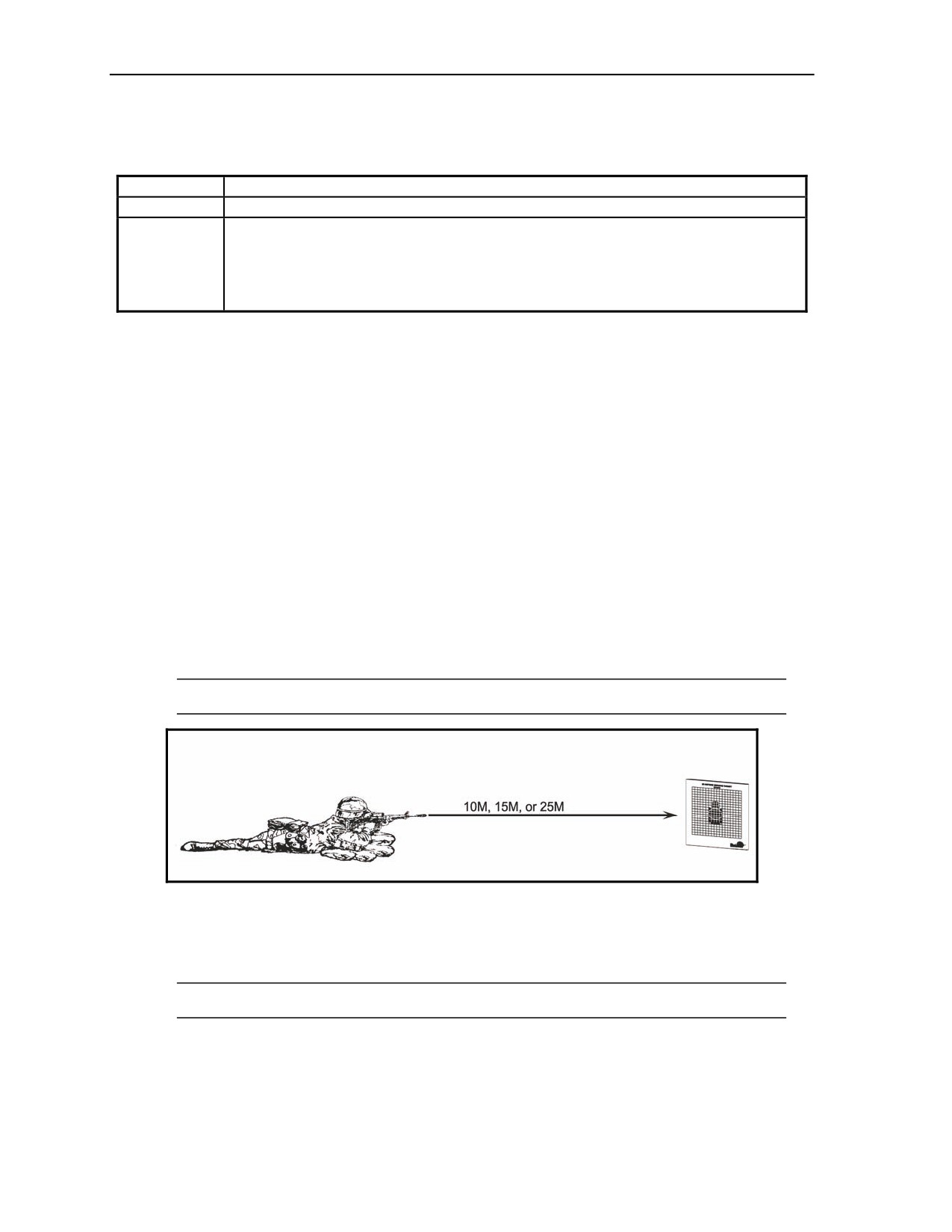
(1) The Soldier assumes a proper supported position using sandbags. The trainer inserts the MP-
400/LTA-556C assembly into the rifle barrel and uses laser windage and elevation adjustments
to achieve a bold sight adjustment with laser spot on front sight (Figure A-2). Then, the Soldier
turns the laser to the ON position.
NOTE: Soldiers should become familiar with both supported and unsupported firing positions.
Figure A-2. Exercise 1.
(2) Under trainer supervision, the Soldier establishes a proper sight alignment and sight picture on a
reflective zeroing target set at 10 meters, 15 meters, or 25 meters. With the MP-400 laser turned
to ON, the trainer or coach blocks the beam with his finger.
NOTE: Use the appropriate target with the corresponding distance.
(3) When the Soldier is confident with the sight alignment and picture, the trainer removes his finger
and observes the location of the red laser dot on the target.
A-8
FM 3-22.9
12 August 2008
Training Aids, Devices, and Exercises
(4) If the laser dot is in the 4-centimeter circle, proceed to Step 5. If the laser dot is outside of the
4-centimeter circle, the trainer instructs the Soldier regarding correct aiming techniques to bring
the dot inside the circle, and repeats Step 2.
NOTE: If the trainer is reasonably certain that the laser and sights are aligned, the visible laser
dot may be used to help the firer understand correct sight picture and alignment. The firer should
be instructed to bring the laser dot to the target silhouette's center of mass, and then observe the
relationship of the front and rear sights to the target.
(5) With the MP-400 in constant ON mode, the trainer or coach uses the red dot trace to confirm
steady hold and proper breathing and trigger control.
NOTE: This trace can also be used to show the effects of improper steady position breath
control and trigger control, and reinforce proper techniques.
(6) The trainer or coach turns the MP-400 to the training (TRN) mode and instructs the Soldier to
fire six shots into the target's center of mass. The trainer or coach observes the laser hits to
confirm proper application of the four fundamentals of rifle marksmanship.
NOTE: Failure to achieve this standard provides an early indication of the need for more intense
instruction in the fundamentals of marksmanship or remedial training.
EXERCISE 2: INTERACTIVE DRY-FIRE EXERCISE
Table A-3. Action, conditions, and standards for an interactive dry-fire exercise.
ACTION
Demonstrate the integrated act of firing while using the LMTS 130-target system.
CONDITIONS
Given an M16-/M4-series weapon, laser transmitter with mandrel, and TR-700 targets with military
masks.
STANDARDS
•
Achieve
8 hits out of
10 shots two times on an open-faced target from the prone
unsupported position.
•
Achieve 8 hits out of 10 shots two times on a 300-meter masked target from the supported
position.
A-31. This exercise provides Soldiers with an opportunity for practicing the four fundamentals of rifle
marksmanship in the integrated act of firing and may easily be conducted concurrently with Exercise 1 on
the same station. TR-700 targets may be used both indoors and outdoors in various environments and
arrangements to meet the training requirement.
Exercise Performance
A-32. To perform Exercise 2, use the following procedures:
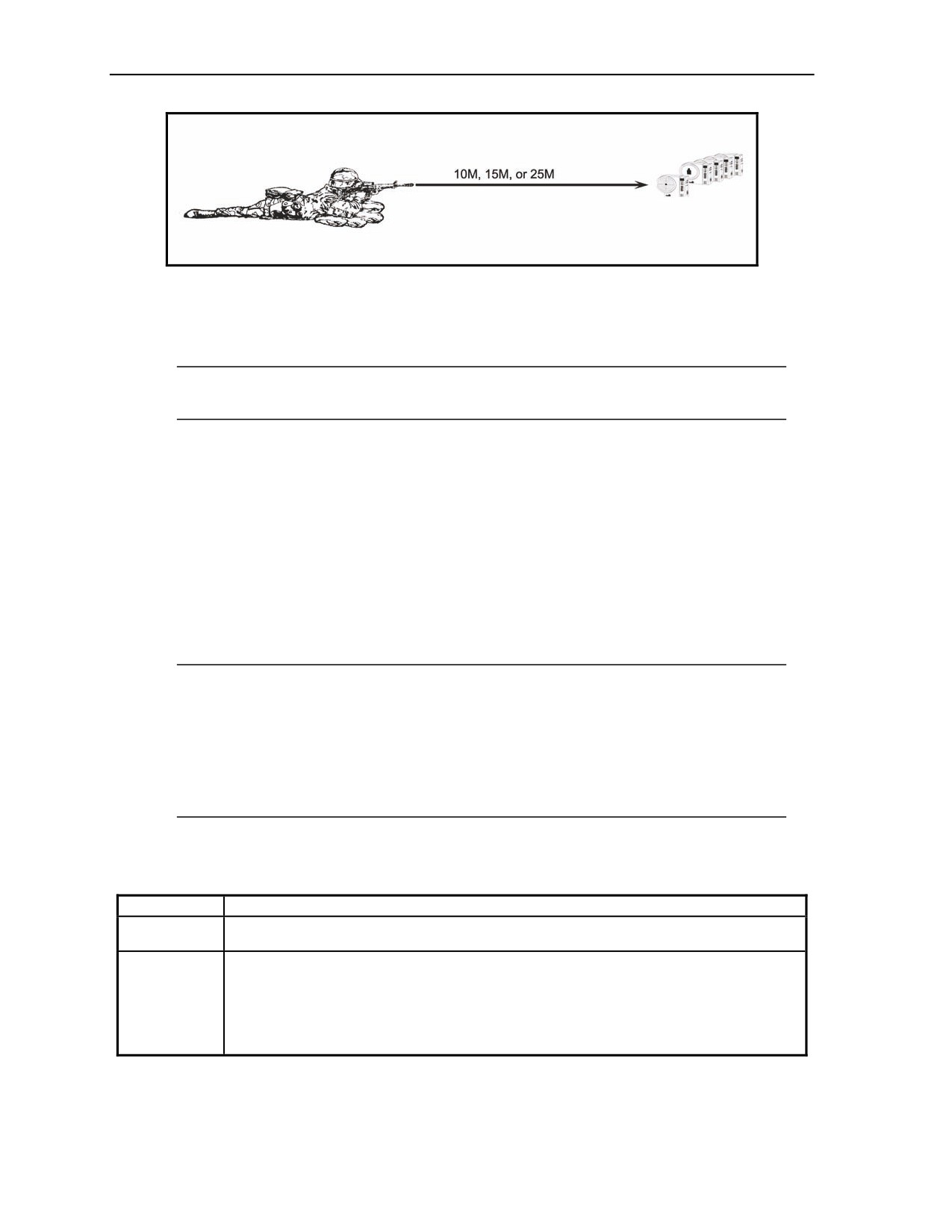
(1) The Soldier assumes a proper firing position using sandbags for a supported position
(Figure A-3).
NOTE: Sleeping mats should be used on hard floors.
12 August 2008
FM 3-22.9
A-9
Appendix A
Figure A-3. Exercise 2.
(2) The Soldier applies the four fundamentals of marksmanship to engage a TR-700 open-faced
target with 10 shots from the prone unsupported position. The Soldier cocks the rifle after each
shot, forcing a break and reestablishing a proper stock weld to build muscle memory.
NOTE: The TR-700 open-faced target at 25 meters equals a doublewide E-silhouette target at
300 meters.
(3) The trainer inspects the target score for the number of hits. If the number is less than eight, the
trainer should perform a visual laser/sight alignment check. If the laser/sight alignment is
correct, the trainer reconfirms the Soldier’s understanding of the four fundamentals of
marksmanship and directs the Soldier to repeat Step 2. If the number of hits is less than eight
after several tries, the Soldier reports for remedial training. If the number of hits is eight or more,
the Soldier repeats Step 2 to confirm, and then proceeds to Step 4.
(4) After the Soldier completes Step 3, a 300-meter scaled E-silhouette mask is installed over the
face of a TR-700 target. The Soldier repeats Step 2 from the supported position and repeats Step
4 to confirm.
(5) OPTIONAL: As time allows, the Soldier increases the number of shots to 20 and/or installs
smaller masks for an additional skill challenge. Additional firing positions may also be
reinforced, if needed.
NOTES:
1. The largest mask presents a 300-meter E-target size scaled for 25 meters.
2. The middle mask presents a 300-meter E-target size scaled for 15 meters or a
450-meter E-target size scaled for 25 meters.
3. The smallest mask presents a 300-meter E-target size scaled for 10 meters, a
450-meter E-target size scaled for 15 meters, or a 600-meter E-target size scaled
for 25 meters.
EXERCISE 3: GROUPING AND ZEROING EXERCISE
Table A-4. Action, conditions, and standards for a grouping and zeroing exercise.
ACTION
Group and zero an M16-/M4-series weapon using the TR-900 target system with military mask.
CONDITIONS
Given an M16-/M4-series weapon, laser transmitter with mandrel, and TR-900 target system with
military mask.
STANDARDS
From the supported firing position—
•
Grouping. Fire up to
27 shots (dry-fire) in three-round shot groups and achieve two
consecutive shot groups within a 4-centimeter circle
(25 meters),
2.4-centimeter circle
(15 meters), or 1.6-centimeter circle (10 meters).
•
Battlesight Zero. Adjust the sights so that five out of six rounds in two consecutive shot
groups strike within the zeroing circle in the silhouette on the zeroing target.
A-10
FM 3-22.9
12 August 2008
Training Aids, Devices, and Exercises
A-33. This exercise evaluates a Soldier’s ability to apply the four fundamentals of rifle marksmanship in
the integrated act of firing through shot grouping. The exercise is conducted in the same manner as live-fire
grouping and zeroing exercises and can make those exercises more efficient and effective. All normal range
commands should be used to reinforce training in proper range procedures. Up to 10 targets may be
grouped together for scoring on one computer. This exercise is most efficient with one trainer to run the
control and scoring console, plus one trainer for every five lanes. Training distance must correspond to the
distance used in Exercise 4.
NOTE: Whenever this exercise is conducted prior to an LFX, calibrated lasers should be used to
support prezeroing. Adjustments to the rear sight of an M16A2/A3/A4 or M4-series weapon,
associated optics, and the front sight of an M16A1 must be made when training at 10 meters or
15 meters to compensate for parallax error. See the LMTS operator’s manual for a detailed
description of these adjustments.
Exercise Performance
A-34. To perform Exercise 3, use the following procedures:
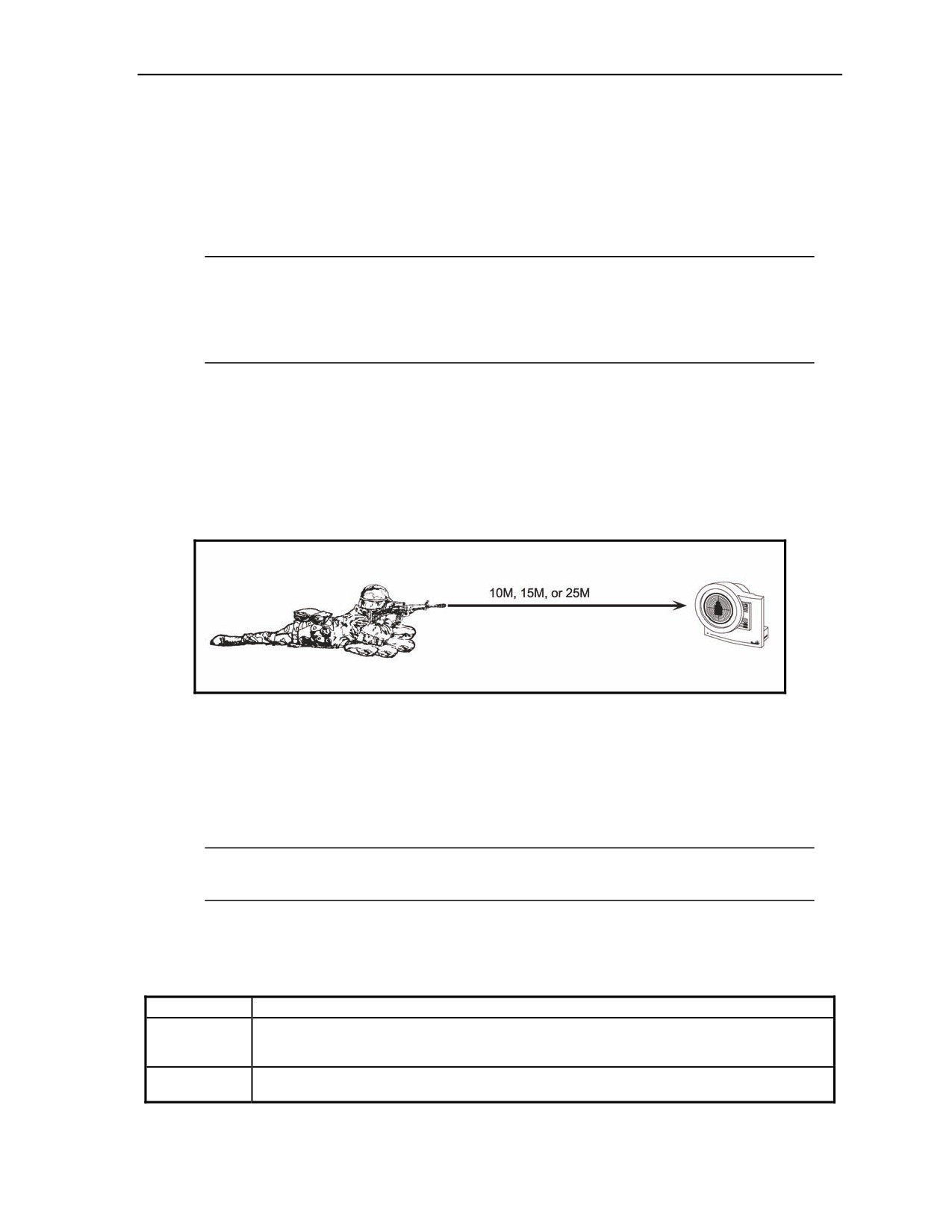
(1) From the supported firing position (Figure A-4), the Soldier fires three-round shot groups at the
target overlay's center of mass, continuing until two consecutive groups fall within a
4-
centimeter circle anywhere on the target (maximum 27 shots). Trainers should provide feedback
to the Soldier between each shot group. If the Soldier is unable to achieve the standard within 27
shots, the trainer attempts remedial actions or sends the Soldier to the remedial training station.
Figure A-4. Exercise 3.
(2) When the grouping standard is met, the Soldier makes appropriate sight changes as instructed by
the trainer, who begins a new session for the zeroing process. The Soldier continues to fire three-
round shot groups, adjusting the sights as instructed by the trainer to bring the shot groups
(maximum 18 shots) within the zeroing circle on the target silhouette. When a shot group falls
within the zeroing circle, the Soldier fires an additional shot group for confirmation. Five of six
shots must fall within the zeroing circle.
NOTE: Failure to achieve the standard identifies the Soldier as a candidate for remedial
training. The Soldier should not progress to Exercise 4 until the standard is met.
EXERCISE 4: LASER MARKSMANSHIP TRAINING STRATEGY PREQUALIFICATION EXERCISE
Table A-5. Action, conditions, and standards for a laser
marksmanship training strategy prequalification exercise.
ACTION
Engage 10-, 15-, or 25-meter alternate course C scaled silhouettes with an M16-/M4-series weapon.
CONDITIONS
Given an M16-/M4-series weapon, laser transmitter with mandrel, and electronic alternate C target
system with ten 10-, 15-, or 25-meter scaled silhouettes. Engage each silhouette with two shots from
the supported position and two shots from the prone unsupported position.
STANDARDS
Without assistance, the Soldier engages 10 target silhouettes using the M16-/M4-series weapon with
laser transmitter and achieves a minimum of 30 hits out of 40 shots.
12 August 2008
FM 3-22.9
A-11
Appendix A
A-35. Exercise 4 is used as a skill test to determine the need for training or the results of training, and
serves as an accurate predictor of live-fire alternate course C performance.
NOTE: Soldiers failing to meet the standards of this exercise should receive remedial training
prior to live-fire qualification.
A-36. The exercise may be conducted in the dry-fire mode, with Soldiers recocking the rifle between shots.
When performing the dry-fire method, Soldiers should use a magazine with the follower and spring
removed. Another option for the dry-fire mode involves removing the charging handle and attaching a
piece of cord (looped on both ends with the free end about 3 inches from the end of the stock) to the bolt.
The coach can recock the rifle between shots by pulling the cord directly to the rear.
A-37. The sound and recoil replicator options include the M16A2 Blazer and the alternate laser-mounting
bracket used with a standard blank firing attachment (BFA). Both options offer added realism by providing
full rifle function, sound, and recoil. When using the special safe Blazer blanks, the Blazer option may be
employed indoors without hearing protection. Standard M200 blanks may only be used with the BFA while
outdoors and while wearing hearing protection. When available, the LMTS mini-RETS range should be
employed for added training realism and to prepare Soldiers for firing on pop-up targets.
Exercise Performance
A-38. To perform Exercise 4, use the following procedures:
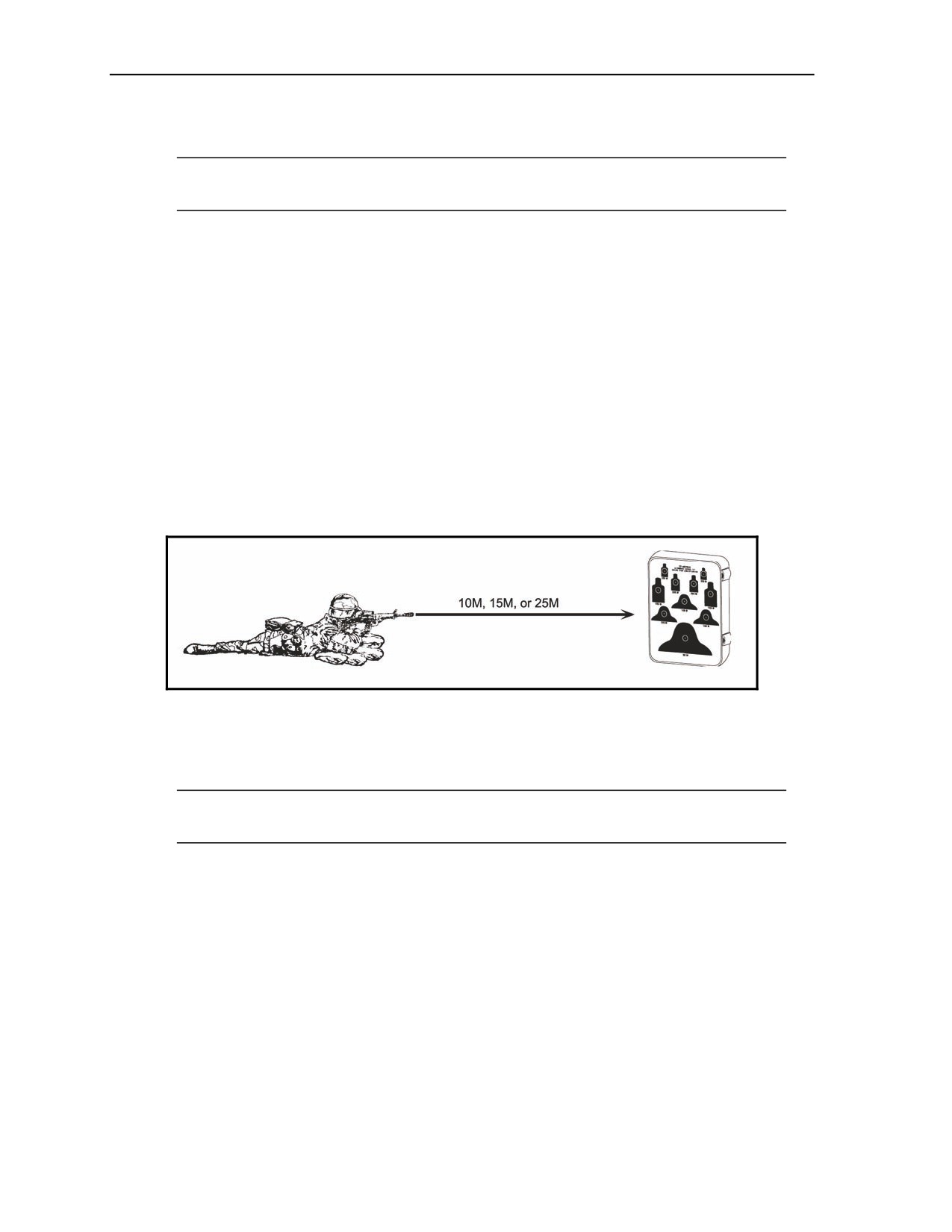
(1) The Soldier assumes the proper supported firing position using sandbags (Figure A-5).
Figure A-5. Exercise 4.
(2) The trainer prepares the electronic 25-meter alternate C target and computer control station for
the prequalification skill test. The course may be conducted at 25 meters, 15 meters, or 10
meters using the appropriate target overlay.
NOTE: The trainer should use appropriate range commands and enforce all range safety
procedures.
(3) To fire the alternate course C, the Soldier applies the four fundamentals of rifle marksmanship
using the service rifle (laser-zeroed) during Exercise 3.
(4) The computer automatically times the test and can print a score sheet.
SOUND AND RECOIL REPLICATOR
A-39. To add realism to the training, a special upper receiver sound and recoil replicator provides full live-
fire functionality (without the projectile). It supplies nearly 100 percent of the recoil with 50 percent of the
noise using a specially-designed nontoxic theatrical blank.
A-12
FM 3-22.9
12 August 2008

Training Aids, Devices, and Exercises
SECTION III. OTHER TRAINING DEVICES AND EXERCISES
This section provides the classification and nomenclature for training aids, devices, and targets.
TRAINING SUPPORT CENTERS
A-40. Training support centers (TSCs) are located throughout the world to provide training aids and
devices. Each TSC provides training aid services to customers (for example, active Army units and schools,
reserve components, and ROTC units) in their geographic area of support.
NOTE: For more information concerning TSC operations, write:
Commander
United States Army Training Support Center
ATTN: ATIC-DM
Fort Eustis, VA 23604
SELECTION OF TRAINING AIDS AND DEVICES
A-41. After training requirements have been established, appropriate training aids and devices can be
selected from the TSC. Table A-6 lists many of those aids and devices available and their identification
numbers.
Table A-6. Training aids and devices.
TYPE/NOMENCLATURE
IDENTIFICATION
NUMBER
Rifle Marksmanship Trainer (Weaponeer)
DVC 07-57/DVC 07/57B
M15A2 Blank Firing Attachment
Supply Item (see TM)
Chamber Block (M16A1/A2)
TAD-0001
M16 Sighting Device (A1 0r A2) (Left and Right)
DVC-T 7-84
Target Box Paddle
DVC-T 7-86
Riddle Device
DVC-T 7-87
M16 Rifle Brass Deflector
DVC-T 23-30
M15A1 Aiming Card
DVC-T 07-26
M16A1 Display Mat (canvas)
TAD-0034 (locally)
Rifle Rest (for target box exercise)
TAD-12 (locally)
Front and Rear Sight, M16 Rifle
TAD-26 (locally)
Front and Rear Sight, M16A2 Rifle
TAD-0026A
Graphic Training Aids (GTA)
M16A1 Disassembly Mat (paper)
GTA 09-06-43
Rifle, 5.56-mm, M16A1 Mechanical
GTA 7-1-26
Rifle, M16 Disassembly (M16A1)
GTA 9-6-43
M16A1 Rifle Malfunction
GTA 9-6-44
M16A1 Rifle Maintenance Card
GTA 21-1-3
Training Films
*Rifle, M16A1 Part I, Care, Cleaning, Lubrication
TF 21-3907
*Rifle, M16A1 Part II Field Expedients
TF 21-3908
*Also available in videotape.
Videotapes
Engagement of Moving Personnel Targets with the M16A1 Rifle Team from the Foxhole Position
2E/010-071-1271-B
Cycle of Functioning M16A1 Rifle
2E/010-071-0444-B
Overview of BRM Training
2E/010-071-0086-B
TVT 7-13 (Feb 87)
2E/010-071-0725-B
TVT 7-1 Teaching Rifle Marksmanship: Part I
TVT 7-2 Teaching Rifle Marksmanship: Part II
12 August 2008
FM 3-22.9
A-13

Appendix A
TARGET ORDERING NUMBERS
A-42. Table A-7 lists the description and NSN to use when ordering marksmanship targets.
Table A-7. Target ordering numbers.
DESIGNATION
DESCRIPTION
NSN
D Prone
Full-length face with V through two
6920-00-922-7450
scoring areas
D Prone
Repair center with V through two scoring
6920-00-922-7451
areas
E-Silhouette
Full-length face, solid color paper
6920-00-600-6874
E-Silhouette
Full-length, pop-up, solid color plastic
6920-00-071-4780
E-Silhouette
Full-length face, cardboard, kneeling
6920-00-079-1806
F-Silhouette
Short-length face, solid color paper
6920-00-610-9086
F-Silhouette
Short-length, pop-up, solid color plastic
6920-00-071-4589
F-Silhouette
Short-length face, pasteboard
6920-00-795-1807
25-Meter Alternate Course Scaled Qualification Target
50- to 300-meter scaled silhouette target
6920-01-167-1398
15-Meter Battlesight Zeroing Target (.22 Caliber RFA)
250-meter scaled silhouette target (50-
6920-01-167-1393
foot indoor range)
15-Meter Alternate Course C (.22 Caliber RFA)
50- to 300-meter scaled silhouette target
6920-01-167-1396
(50-foot indoor range)
25-Meter M16A1 Zeroing Target
250-meter scaled silhouette target
6920-01-167-1392
25-Meter M16A2 Zeroing Target
300-meter scaled silhouette target
6920-01-253-4005
25-Meter M16A1 Slow Fire Target
75- to 300-meter scaled silhouette target
6920-01-167-1391
25-Meter M16A1 Timed Fire Target
50- to 300-meter scaled silhouette target
6920-01-167-1397
75-Meter M16A1 Feedback Target
75-meter scaled F-type silhouette
6920-01-169-6921
75-Meter M16A2 Feedback Target
75-meter scaled F-type silhouette
6920-01-253-4006
175-Meter M16A1 Feedback Target
175-meter scaled E-type silhouette
6920-01-167-1395
175-Meter M16A2 Feedback Target
175-meter scaled E-type silhouette
6920-01-167-1395
Pasters, Black
6920-00-165-6354
Pasters, Buff
6920-00-172-3572
Landscape target
6920-00-713-8253
Spindle, Target Spotter, Wood
6920-00-713-8257
Spotters, 1 1/2 inches in diameter
6920-00-789-0869
Spotters, 3 inches in diameter
6920-00-713-8255
Spotters, 5 inches in diameter
6920-00-713-8254
Thermal Blankets
6920-01-516-9912
TRAINING DEVICES
A-43. Several marksmanship training devices are available to aid in PMI and sustainment training. They
are beneficial when ammunition is limited for training or during practice exercises, such as field firing on
the EST 2000 or zeroing and qualifying with short-range training ammunition (SRTA). Some training
devices are complex, costly, and in limited supply, while others are relatively simple, cheap, and in large
supply. Individuals or squads can sustain and practice basic marksmanship skills and fundamentals using
devices and aids alone or in combinations.
A-14
FM 3-22.9
12 August 2008
Training Aids, Devices, and Exercises
AIMING CARD
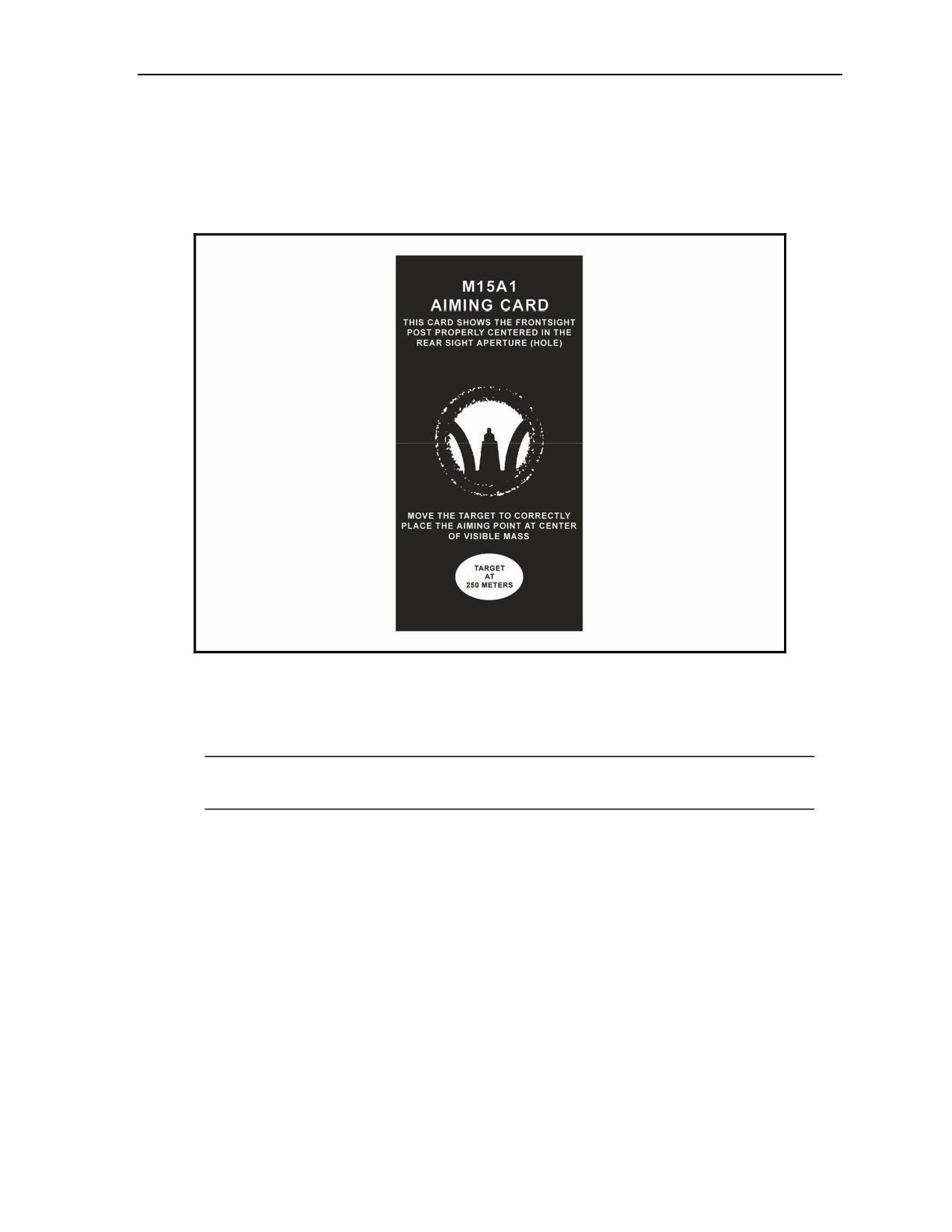
A-44. The M15A1 aiming card (Figure A-6) determines if the Soldier understands how to aim at a target's
center of mass, how to adjust the point of aim, how to allow for gravity, and how to engage a moving
target.
Figure A-6. M15A1 aiming card.
A-45. To use the aiming card—
(1) The card is misaligned, the Soldier is instructed to establish the correct point of aim, and a
trainer checks it. Each Soldier demonstrates six out of six of the points of aim.
NOTE: The sight/target relationship on the card is the same visual perception that the Soldier
should have when he is zeroing on a standard silhouette target.
(2) The Soldier shows the side alignment technique three times—place the front sightpost on the left
or right edge of the target and bring the front sightpost to the target's center of mass.
(3) The Soldier shows the bottom-up alignment technique—place the front sightpost at the bottom
of the target and bring the front sightpost to target's center of mass.
12 August 2008
FM 3-22.9
A-15
Appendix A
RIDDLE SIGHTING DEVICE
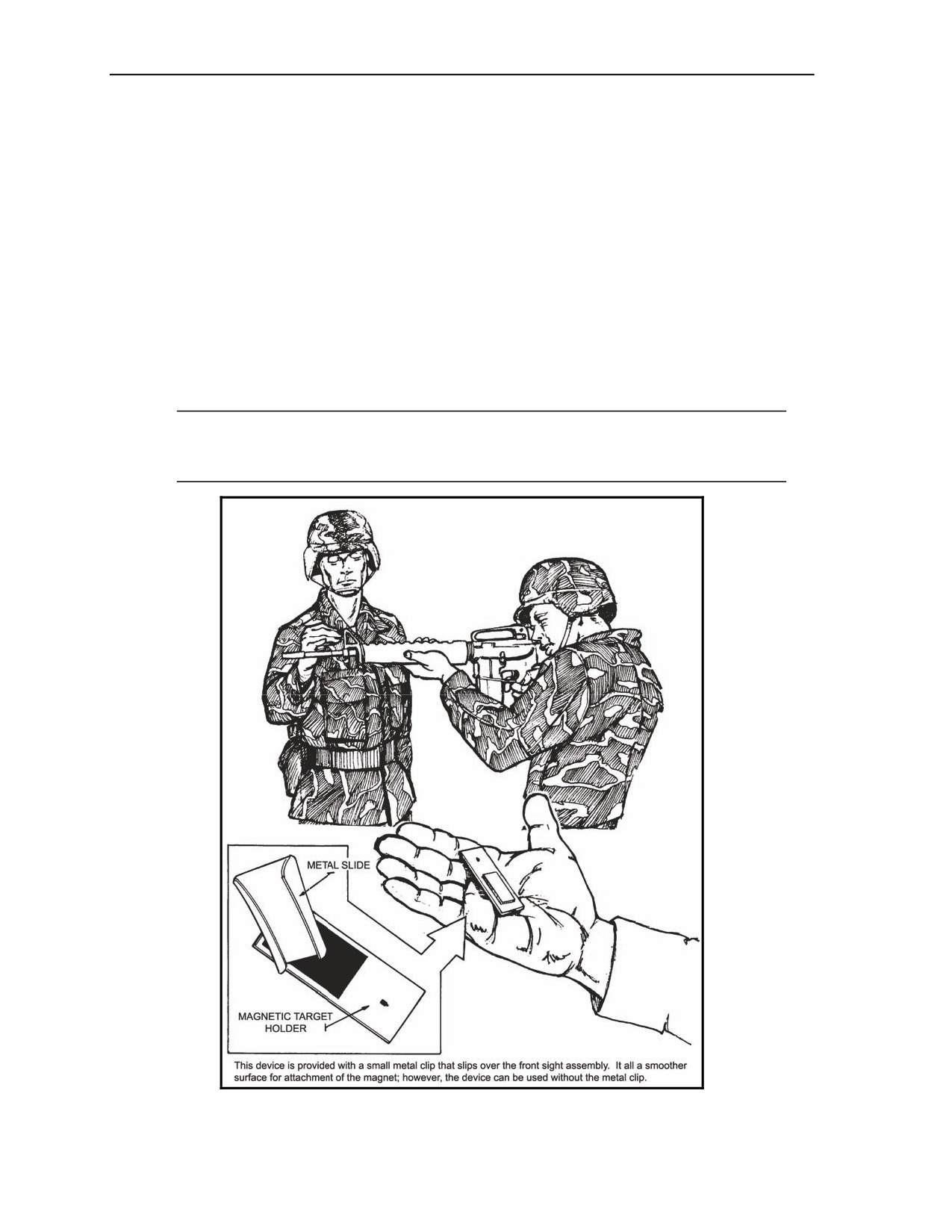
A-46. The Riddle sighting device (Figure A-7) indicates if the Soldier understands the aiming process while
using the rifle. It is a small plastic plate with a magnet and a drawing of an E-type silhouette target. A two-
man team is required for its use.
A-47. To use the Riddle sighting device—
(1) The Soldier assumes a supported or prone firing position. The assistant places the Riddle device
on the front sight assembly and adjusts the plastic plate in the direction of the firer until he
reports the proper sight picture.
(2) Without disturbing the plastic plate, the trainer or coach aims through the sights to determine if
the Soldier has aligned the target and sight properly.
A-48. Many sightings are conducted, and the trainer may include variations to ensure that the Soldier
understands the process. Each Soldier demonstrates six out of six points of aim, starting with the plastic
plate offset to the front sightpost.
NOTE: This device has a small metal clip that slips over the front sight assembly to allow a
smooth surface for attachment of the magnet. The device may also be used without the metal
clip.
Figure A-7. Riddle sighting device.
A-16
FM 3-22.9
12 August 2008
Training Aids, Devices, and Exercises
M16 SIGHTING DEVICE
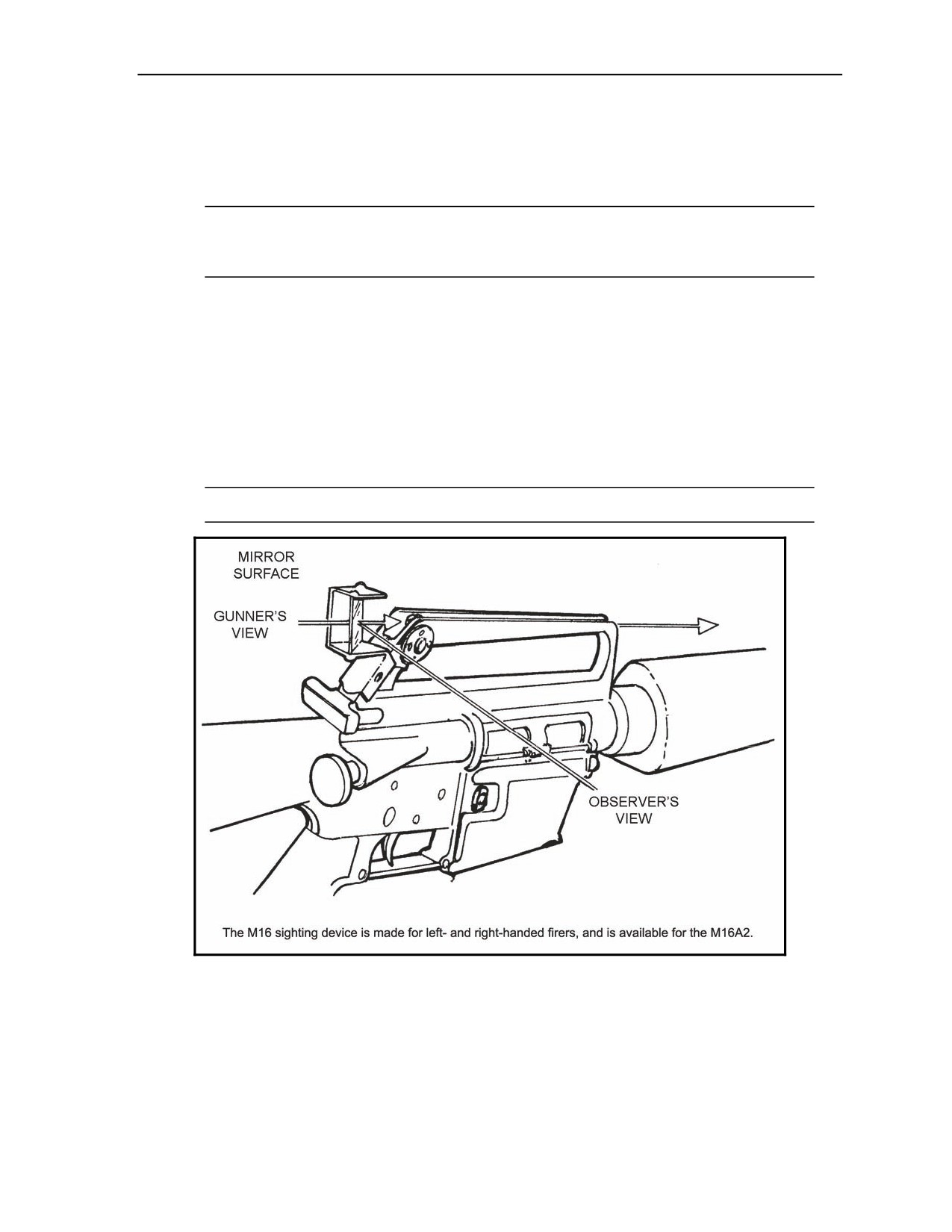
A-49. The M16 sighting device (Figure A-8) is made of metal, with a tinted square of glass placed at an
angle. When the device is attached to the rear of the M16A1 carrying handle, an observer can look through
the sight to see what the firer sees.
NOTE: The M16 sighting device can be mounted on the M16A2 rifle, but the charging handle
must be pulled to the rear first. Then, the M16 sighting device is mounted on the rear of the
carrying handle, and the charging handle is returned forward.
A-50. When using the M16 sighting device, observe the following recommendations:
z
The M16 sighting device can be used in a dry-fire or live-fire environment, but a brass cartridge
deflector must be used during live-fire.
z
The observer must practice with the sight to be effective. For example, if the observer looks at a
reflected image and the Soldier is aiming to the right, it appears left to the observer.
z
The device must be precisely positioned on the rifle (it may need to be bent to stay on).
z
The observer’s position must remain constant.
z
The observer must talk with the firer to ensure a correct analysis of the aiming procedures.
A-51. The Soldier must achieve six out of six proper sight alignment drills.
NOTE: The M16 sighting device is made for left- and right-handed firers.
Figure A-8. M16 sighting device.
12 August 2008
FM 3-22.9
A-17
Appendix A
M15A2/M23 BLANK FIRING ATTACHMENT
A-52. The M15A2/M23 BFA (Figure A-9) attaches to the muzzle of M16-/M4-series weapons. It is
designed to keep sufficient gas in the weapon's barrel to allow for semiautomatic, automatic, or burst firing
with blank ammunition (M200 only).
A-53. When using the M15A2/M23 BFA, observe the following recommendations:
z
After firing 50 rounds, check the attachment for a tight fit.
z
Continuous blank firing results in a carbon buildup in the bore, gas tube, and carrier key. If this
occurs, follow the cleaning procedures outlined in TM 9-1005-249-10.
NOTE: The M15A2 is painted red and is used on the M16-series weapons. The M23 is painted
yellow and is used on the M4-series weapons. For identification, the M23 is stamped “M4
Carbine Only.”
Figure A-9. Blank firing attachment.
CAUTION
Hand tighten the M15A2/M23 only.
LOCATION OF MISS-AND-HIT SYSTEM
A-54. The LOMAH system is a range aid used during downrange feedback exercises. The device uses
acoustical triangulation to compute the exact location of a supersonic bullet as it passes through a target.
The bullet impact is displayed instantly on a video monitor at the firing line. More importantly, it shows the
location of a bullet miss, allowing the firer to make either a sight adjustment or a hold-off for subsequent
shots.
NOTE: LOMAH, like other devices, is only an aid. When the Soldier uses LOMAH, he must
understand the weapon and firing techniques and have a coach/instructor.
A-55. LOMAH ranges have been fielded in USAREUR and Korea. In locations where KD ranges are not
available and restrictions prohibit walking downrange, the LOMAH system is a practical alternative to
essential downrange feedback.
A-18
FM 3-22.9
12 August 2008
Training Aids, Devices, and Exercises
NOTE: Requests for LOMAH devices should be sent to:
Commander
US Army Training Support Center
ATIC-DM
Fort Eustis, VA 23604.
M261 .22-CALIBER RIMFIRE ADAPTER
A-56. The
.22-caliber RFA can contribute to a unit’s marksmanship program when
5.56-millimeter ammunition is not available or when ranges that allow firing 5.56-millimeter ammunition
are not available. The RFA can be useful for marksmanship training such as night fire, quick fire, and
assault fire, but is not recommended for primary marksmanship training.
Training Considerations
A-57. When service ammunition is in short supply, the RFA can be used to complement a unit’s training
program.
Rifle Performance
A-58. The RFA cannot be depended on to fire in the same place as 5.56-millimeter ammunition. The RFA
and its .22-caliber ammunition cannot replicate the exact ballistics of the 5.56-millimeter ammunition, but
efforts to match RFAs with specific rifles can result in reasonable replication.
NOTE: Under ideal training conditions, the RFA should be used with dedicated rifles. It is not
necessary for the Soldier to use his own weapon during RFA training.
A-59. Finding the right match of RFA and rifle can eliminate some variability. A trial-and-error technique
can match RFAs to rifles, which results in weapons that fire well.
Rifle Zero
A-60. RFA ammunition differs from 5.56-millimeter ammunition in the following ways:
z
RFA ammunition will not usually group in the same location as 5.56-millimeter ammunition at
25 meters and cannot be used for weapon zero.
z
RFA ammunition normally fires a slightly larger shot group than 5.56-millimeter ammunition.
A-61. When a Soldier uses an RFA in his rifle, he must be careful not to lose his 5.56-millimeter zero. This
can be accomplished by using hold-off while firing .22-caliber ammunition or keeping a record of sight
changes so the sights can be moved back.
NOTES:
1. The .22-caliber round approximates the 5.56-millimeter trajectory out to 25
meters.
2. The correct zeroing target or appropriate scaled-silhouette targets can be used
for practice firing exercises at 15 meters (50 feet) or 25 meters.
Advantages and Disadvantages
A-62. If the RFA is used as a training aid, the advantages and disadvantages must be considered during
training.
12 August 2008
FM 3-22.9
A-19
Appendix A
Advantages
A-63. The .22-caliber ammunition is cheaper and may be available in larger quantities than 5.56-millimeter
ammunition. It can be fired on all approved indoor ranges and in other close-in ranges where
5.56-millimeter ammunition is prohibited. RFA training can be used to sustain marksmanship skills during
periods when full-caliber 5.56-millimeter ammunition training cannot be conducted.
Disadvantages
A-64. Some negative training aspects exist because of differences in the weapon’s functioning when using
the RFA. These differences include—
z
The forward assist does not work.
z
The bolt does not lock to the rear after the last round is fired.
z
More malfunctions can occur with the RFA than with 5.56-millimeter ammunition.
z
Immediate action procedures are different.
SHORT-RANGE TRAINING AMMUNITION
A-65. SRTA is a plastic practice cartridge (M862) that enables a unit to conduct realistic firing training at
shorter distances with reduced danger areas. The M862 has a maximum range of 250 meters. The blue
plastic projectile reduces the risk of overpenetration and ricochet, which makes it ideal for UO training.
A-66. To fire the M862 SRTA from an M16-/M4-series weapon, the standard bolt and bolt carrier must be
replaced by the M2 practice bolt. The M2 practice bolt consists of a bolt carrier, which is a fixed bolt. The
practice bolt changes the weapon from a gas-operated action to a blow-back action that permits cyclic fire
with the lower-powered M862.
NOTES:
1. Because of the design of the M2 practice bolt, standard 5.56-millimeter rounds
cannot be fired from the weapon while it is installed.
2.
See TM 9-6920-746-12&P for more information on the M862 SRTA and the
M2 practice bolt.
WEAPONEER
A-67. The Weaponeer is an effective rifle marksmanship training device that simulates the live-firing of the
M16-series rifle. The system can be used for developing and sustaining marksmanship skills, diagnosing
and correcting problems, and assessing basic skills.
NOTE: The EST 2000 has replaced the Weaponeer, but some units still use the Weaponeer.
Operation
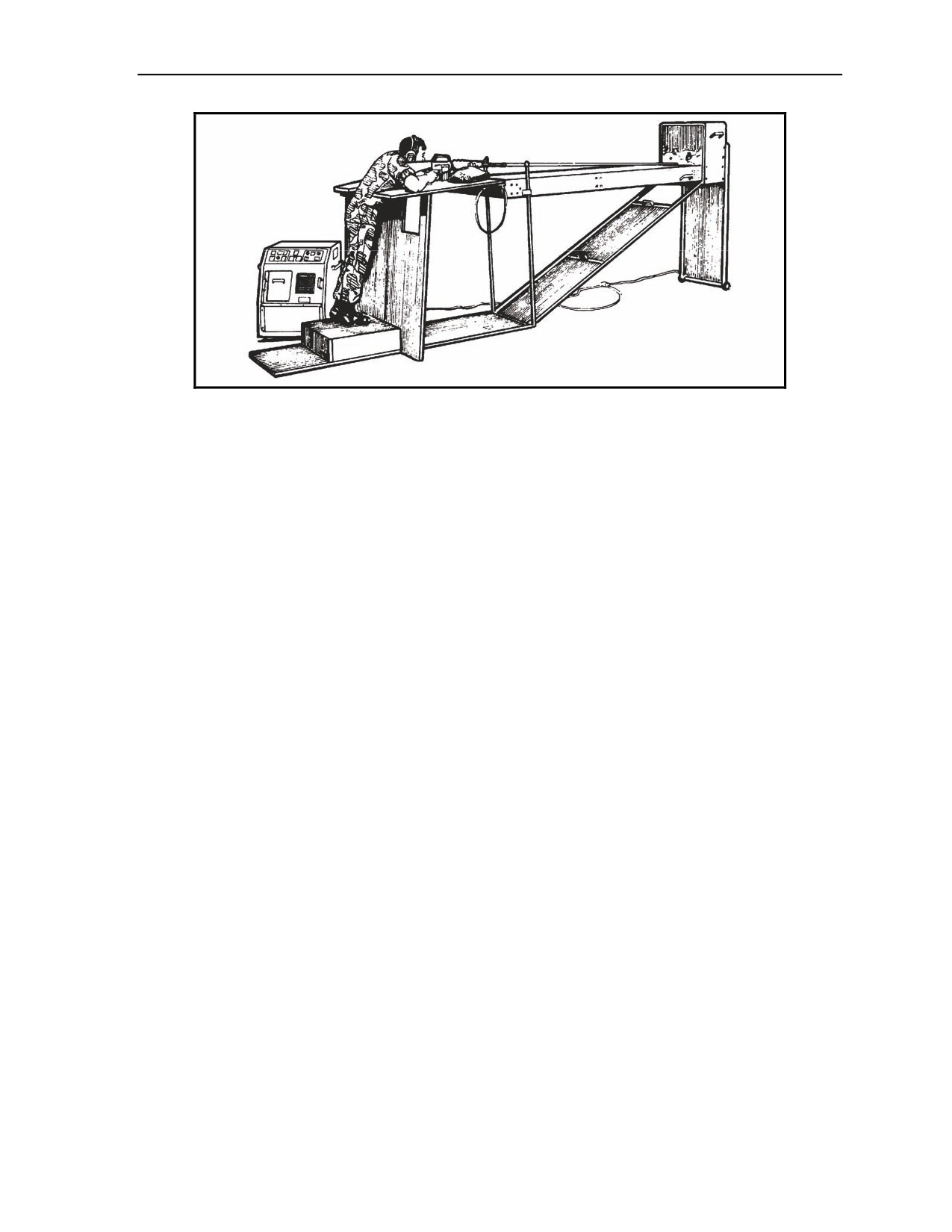
A-68. Figure A-10 shows the Weaponeer in the standing supported firing position. With the exception of
smoke and cartridge ejection, the rifle operates normally and has the same weight and balance as the
standard weapon. An IR aiming sensor simulates round trajectory and hit point to an accuracy of better than
one MOA. The recoil rod that attaches at the rifle's muzzle end simulates recoil.
NOTE: Recoil is provided in both semiautomatic and automatic modes of fire and is adjustable
from no-net force to 30 percent more than that of a live M16.
A-69. Sound is provided through headphones and is adjustable from
115 to
135 decibels. Special
magazines are used. One magazine simulates a continuous load; the other is used to train rapid magazine
change and can be loaded with 1 to 30 simulated rounds. Selectable misfire can be used to detect gun-
shyness and drill immediate action. The front and rear sights are zeroed the same as standard rifles.
A-20
FM 3-22.9
12 August 2008
Training Aids, Devices, and Exercises
Figure A-10. Weaponeer set up in the standing supported position.
A-70. The Weaponeer range can be raised or lowered to accommodate all firing positions. The target
assembly contains four targets: a scaled 25-meter zeroing target and three pop-up targets. E-type and F-type
silhouettes at ranges from 75 meters can be used on the Weaponeer. Known distance and various other
types of targets displayed in fixed or random sequences can be used. Target exposure times may be set to
unlimited or from 1 to 30 seconds. The fall-when-hit mode can be selected with the KILL button.
A-71. The operator’s console contains the system control buttons, graphics printer, and video feedback
monitor. The back of the console has counters that total rounds and hours, and a storage bin for storing
magazines, printer paper and ribbon, headphones, two wrenches for assembling the Weaponeer, and a small
hex-head wrench for aligning the rifle sensor. A remote control, which attaches to the back of the console,
enables a trainer or firer to operate select functions away from the console.
Feedback
A-72. The Weaponeer provides feedback to help trainers to teach and Soldiers to learn marksmanship
skills. The tools used for feedback include—
z
Fall-when-hit mode.
z
Real-time aiming point display.
z
Immediate shot impact display.
z
Replay.
z
Shot groups.
z
Printer.
Fall-When-Hit Mode
A-73. Lighting the KILL button enables the fall-when-hit mode. When the button is activated, targets fall
when hit. This feedback provides the same hit-or-miss information as a train-fire (RETS) range.
Real-Time Aiming Point Display
A-74. When a firer aims on or near a target, his aiming point relative to the target is continuously displayed
on the video screen. The aiming point display allows the trainer to teach and verify aiming techniques, and
to continuously monitor the firer’s steadiness, techniques, time on target, trigger squeeze, and recovery
from recoil.
Immediate Shot Impact Display
A-75. When a shot is fired, its impact relative to the target is immediately displayed on the video screen as
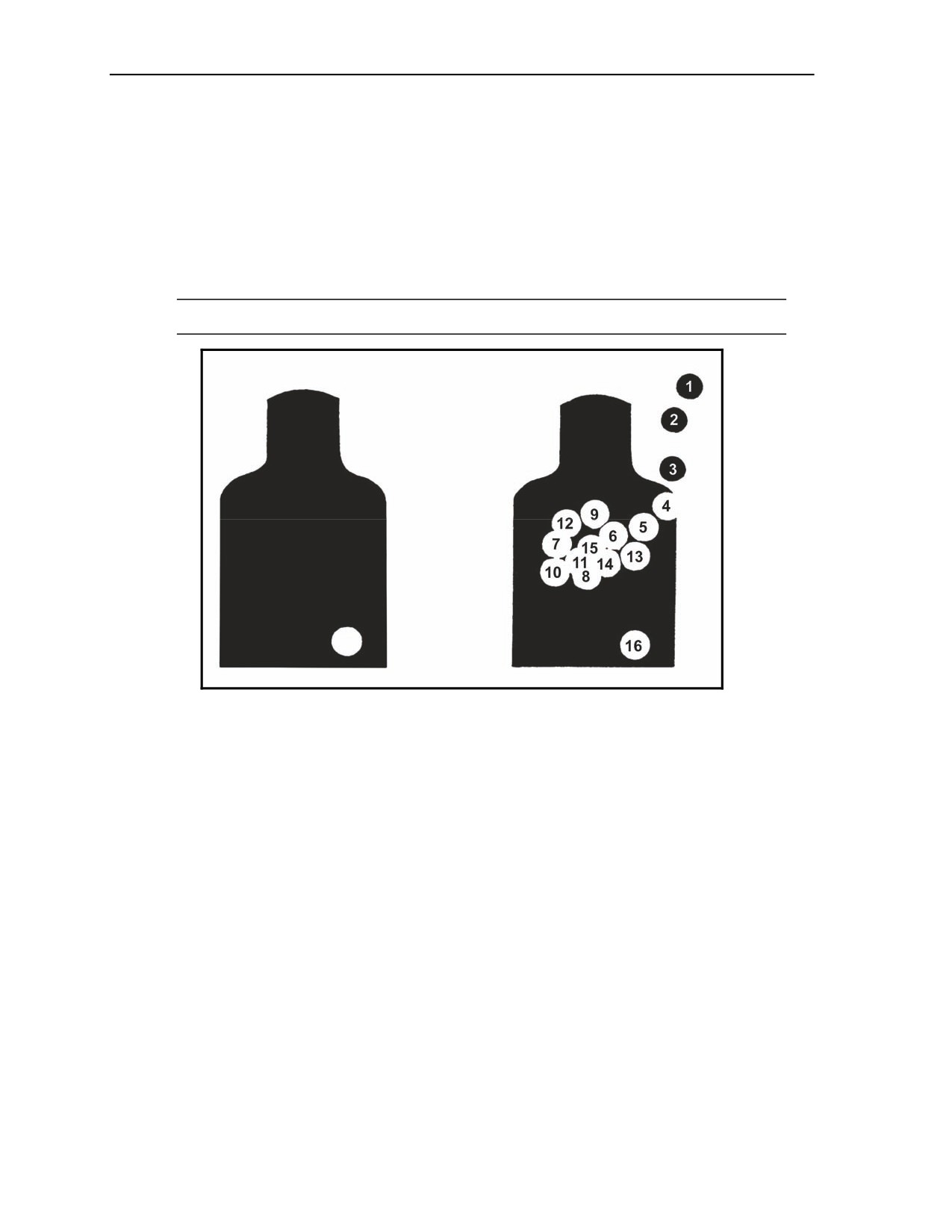
a blinking white dot (Figure A-11, left target).
12 August 2008
FM 3-22.9
A-21
Appendix A
Replay
A-76. After a shot is fired, a real-rate display of how the firer engaged the target can be replayed on the
video screen.
A-77. The target to the right in Figure A-11 shows the type of information that can be replayed on the video
screen after a series of shots are fired. To show the sequence, the dots have been numbered.
A-78. To show a replay, the firer—
(1) Selects the shot he wishes to replay by operating the EACH SHOT button.
(2) Presses the REPLAY button.
NOTE: Some Weaponeers record and store replays for only the first three shots.
Figure A-11. Replay of shot.
Shot Groups
A-79. The impact location of up to 32 shots is automatically stored in the Weaponeer's memory and
displayed on the video screen. Each impact is indicated by a white dot, and the last shot blinks for
indication. All 32 shots can be fired and displayed on a single target or split among a combination of
targets. The CLEAR button erases all shots from the Weaponeer's memory.
Printer
A-80. A hard copy printer is provided for postfiring analysis, for firer progress tracking, and for record
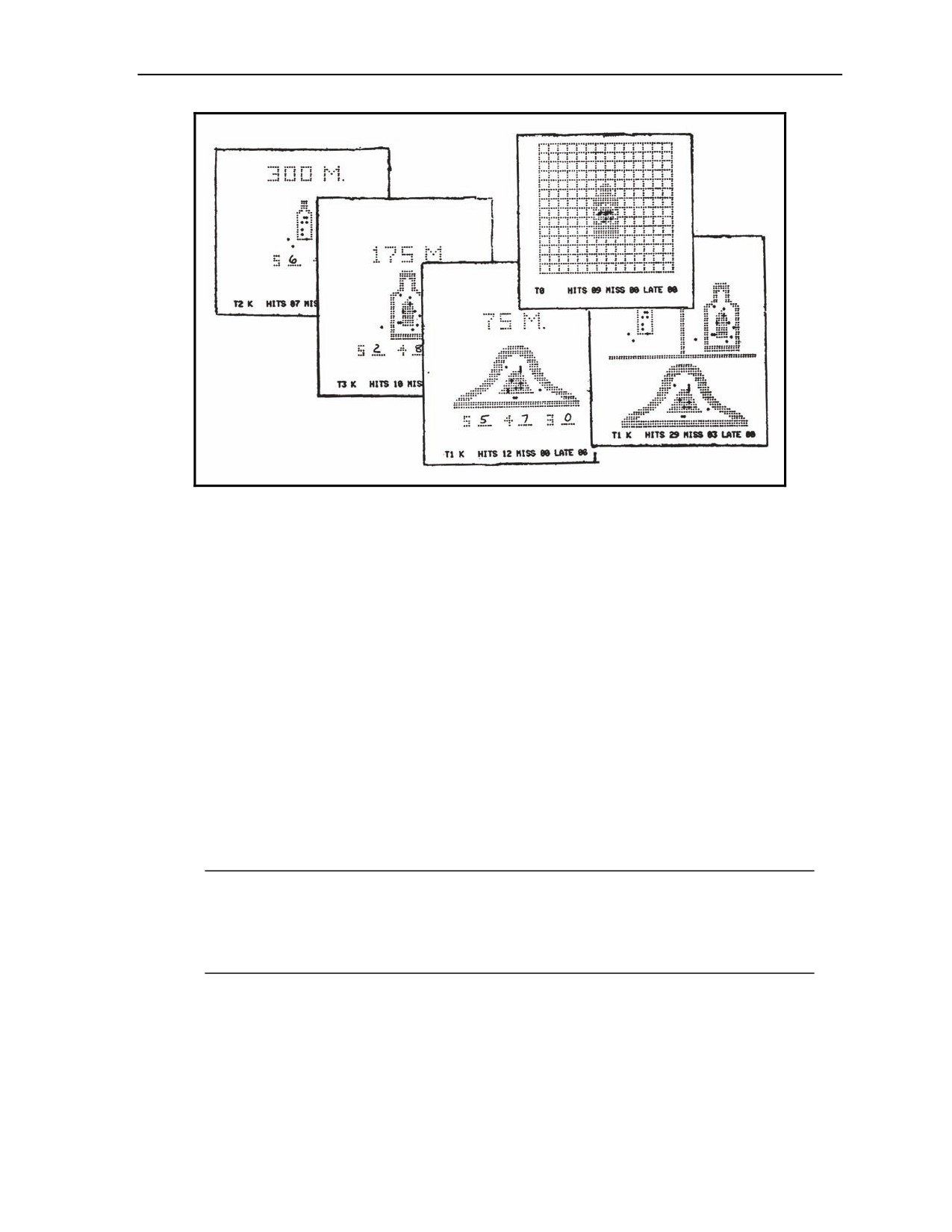
keeping. Pressing the PRINT button causes the target displayed on the video to print (Figure A-12). Some
Weaponeers can print the three pop-up targets at the same time by holding in the REPLAY button and
pressing the PRINT button.
A-22
FM 3-22.9
12 August 2008
Training Aids, Devices, and Exercises
Figure A-12. Weaponeer printouts.
Use of the Weaponeer
A-81. The Weaponeer is used to evaluate the firer’s ability to apply the four fundamentals. It is used
throughout the program to help diagnose and remediate problems. In the unit, the Weaponeer should be
used much like it is used in BRM.
A-82. When training Soldiers on the Weaponeer—
z
Proceed at a relaxed pace, and emphasize accuracy before speed.
z
If possible, train with small groups, allowing each Soldier several 10- to 15-minute turns on the
device.
z
For remedial training, try to relax the Soldier. A nervous Soldier will have trouble learning and
gaining confidence in his marksmanship skills. For sustainment training, encourage competition
between individuals or units.
Diagnosis of Firing Problems
A-83. The Weaponeer assists in the diagnosis of firing problems. The seven-step program is recommended
as a guide. These seven steps are designed to diagnose and show the Soldier his firing errors. This could be
enough to correct the error.
NOTES:
1. Diagnosis needs to be followed up with remedial exercises with the Weaponeer,
target box exercise, or dime/washer exercise.
2. Depending on the extent of the firer’s problems and time constraints, the number
of shots may be increased.
A-84. To diagnose firing problems—
(1) Tell the Soldier to assume a good firing position, aim at a target, and hold steady (supported and
prone unsupported positions).
(2) Visually check the firer’s position and correct any gross errors.
12 August 2008
FM 3-22.9
A-23
Appendix A
(3) Observe the video screen. If there is no aiming dot on the video screen or if the aiming dot is far
from the target's center, teach sight picture to the firer. If the light dot shows excessive
movement, check and correct the techniques of the steady position and natural point of aim.
(4) Tell the Soldier to fire a three-round shot group aimed at the target’s center of mass. Watch the
video screen and Soldier as he fires. Note violations of the four fundamentals.
(5) Replay each shot to show the firer his aim, steadiness, and trigger squeeze. In Figure A-11, the
target on the right shows a numbered series of 16 shots. Dots 1 through 4 indicate that the firer
approached the target from the high right. Dots 5 through 15 show that he is aiming near the
target's center, but does not have a steady position. The sudden shift from dot 15 to 16 (dot 16 is
the hit point of the shot) indicates that gun-shyness or improper trigger squeeze caused the firer
to pull his point of aim down and to the right just before firing. Replay helps the firer understand
and correct his firing errors.
(6) Confirm and refine the diagnosis by allowing the Soldier to fire additional three-round shot
groups. Use replay to show the firer his faults.
(7) Summarize and record the Soldier’s basic firing problems.
TRAINING EXERCISES
A-85. Marksmanship training exercises are designed to aid in PMI and sustainment training. They are
beneficial when ammunition is limited for training. Training exercises can be used alone or in
combinations.
TARGET BOX EXERCISE
A-86. The target box exercise checks the consistency of aiming and placement of three-round shot groups
in a dry-fire environment.
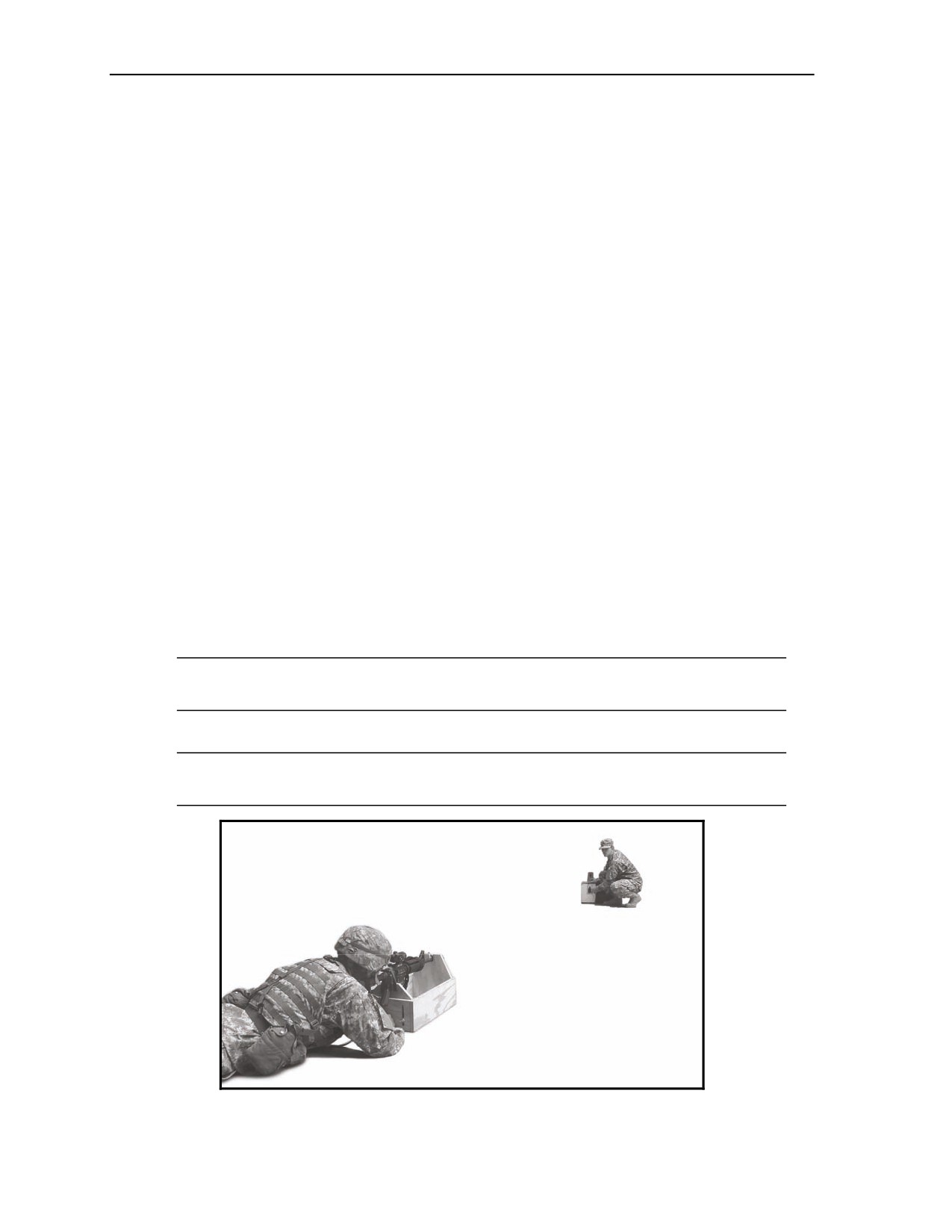
A-87. To conduct the exercise (Figure A-13)—
(1) The target man places the silhouette anywhere on the plain sheet of paper and moves the
silhouette target as directed by the firer.
NOTE: The two positions (separated by 15 yards or 25 meters) must have already been
established so the rifle is pointed at some place on the paper.
(2) When the firer establishes proper aiming, he signals the target man to “Mark.”
NOTE: Only hand signals are used since voice commands would be impractical when training
several pairs of Soldiers at one time.
Figure A-13. Target box exercise.
A-24
FM 3-22.9
12 August 2008
Training Aids, Devices, and Exercises
(3) The target man places the pencil through the hole in the silhouette target and makes a dot on the
paper. Then, he moves the silhouette to another spot on the paper and indicates to the firer that
he is ready for another shot.
(4) When the three shots are completed, the target man triangulates the three shots and labels it
"Shot Group 1." The firer and instructor view the shot group.
(5) The Soldier fires several shot groups. After two or three shot groups are completed in one
location, the rifle, paper holder, or paper is moved so shots fall on a clean section of the paper.
NOTE: Any movement of the rifle or paper between the first and third shots of a group voids
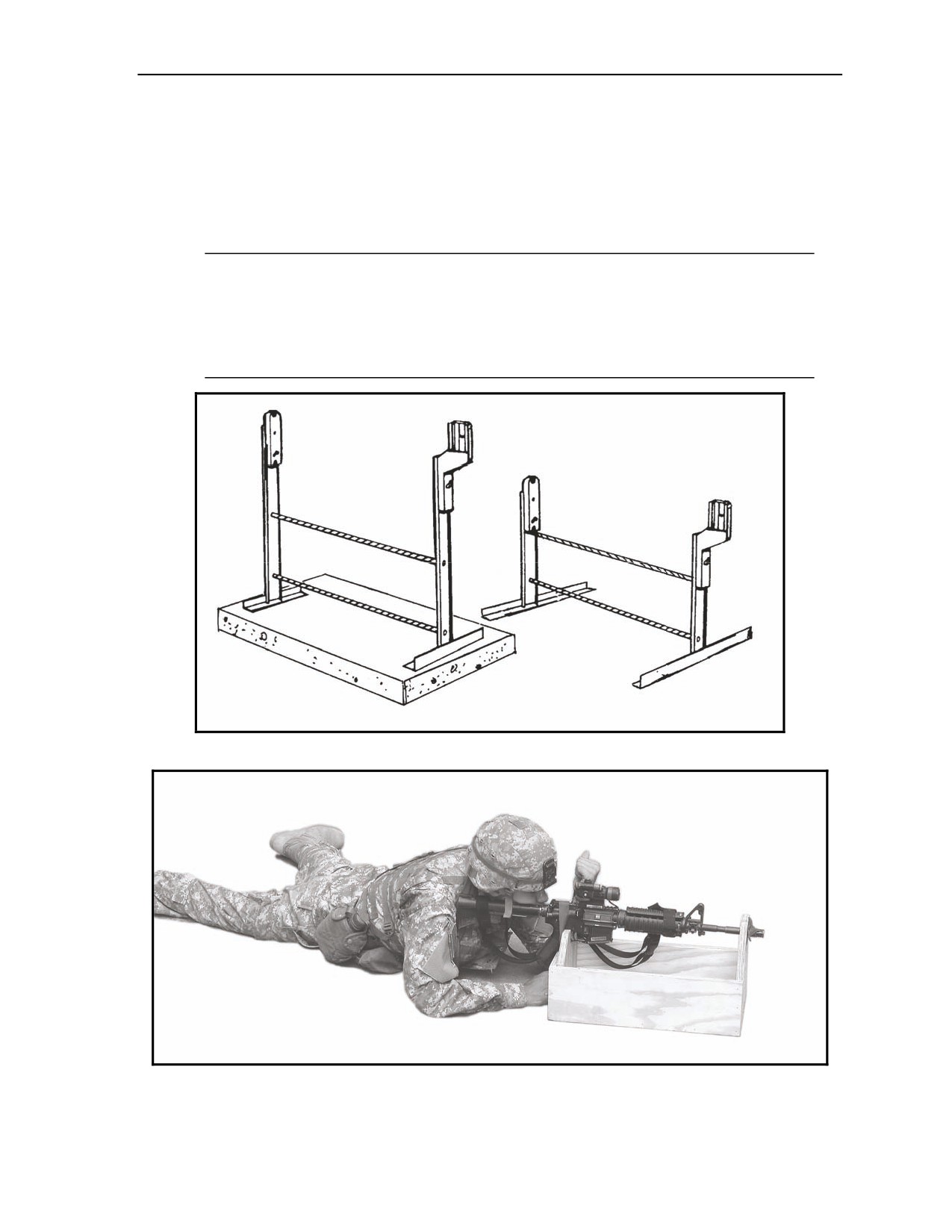
the exercise. Two devices are available to hold the rifle. Rifle-holding devices (Figures A-14 and
A-15) are positioned on level ground, or are secured by sandbags or stakes to ensure the rifle
does not move during the firing of the three shots. Movement of the paper is eased by using a
solid backing (Figure A-16). Any movement of either is reflected in the size of the shot group.
Several varieties of wooden target boxes have been locally fabricated.
Figure A-14. Rifle-holding device (TA-G-12A).
Figure A-15. Staked rifle holding box.
12 August 2008
FM 3-22.9
A-25
Appendix A
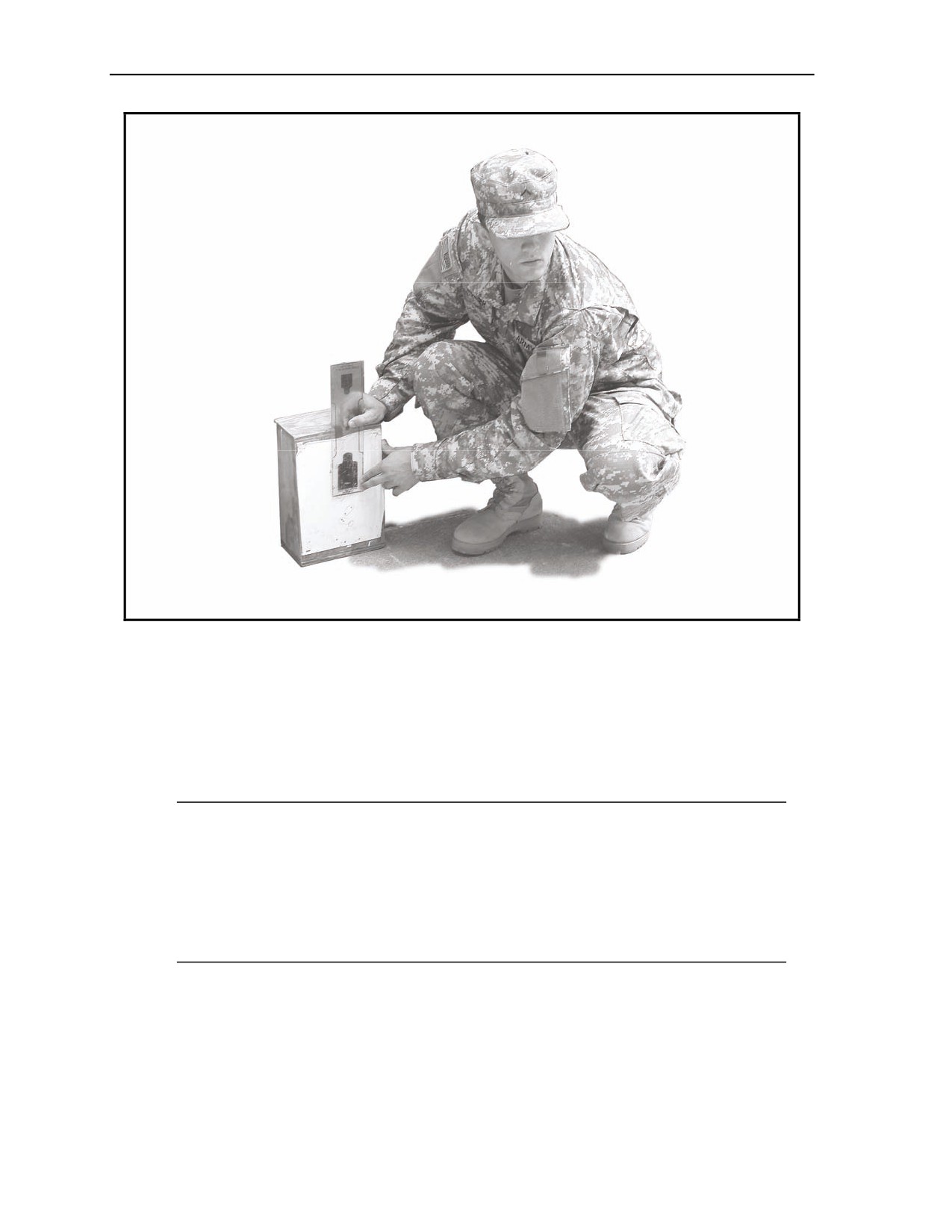
Figure A-16. Paper being placed on a stationary object.
A-88. Each Soldier dry-fires the exercise until he has demonstrated six out of six of the points of aim within
the plastic target box paddle’s 4-centimeter template. The exercise should be repeated as many times as
necessary to achieve two consecutive shot groups that will fit into the same 2-centimeter circle.
A-89. A simulated shot group covered with a 1-centimeter (diameter) circle indicates consistent aiming.
Since no rifle or ammunition variability is involved and since there is no requirement to place the shot
group in a certain location, a 1-centimeter standard may be compared to obtaining a 4-centimeter shot
group on the 25-meter live-fire zero range.
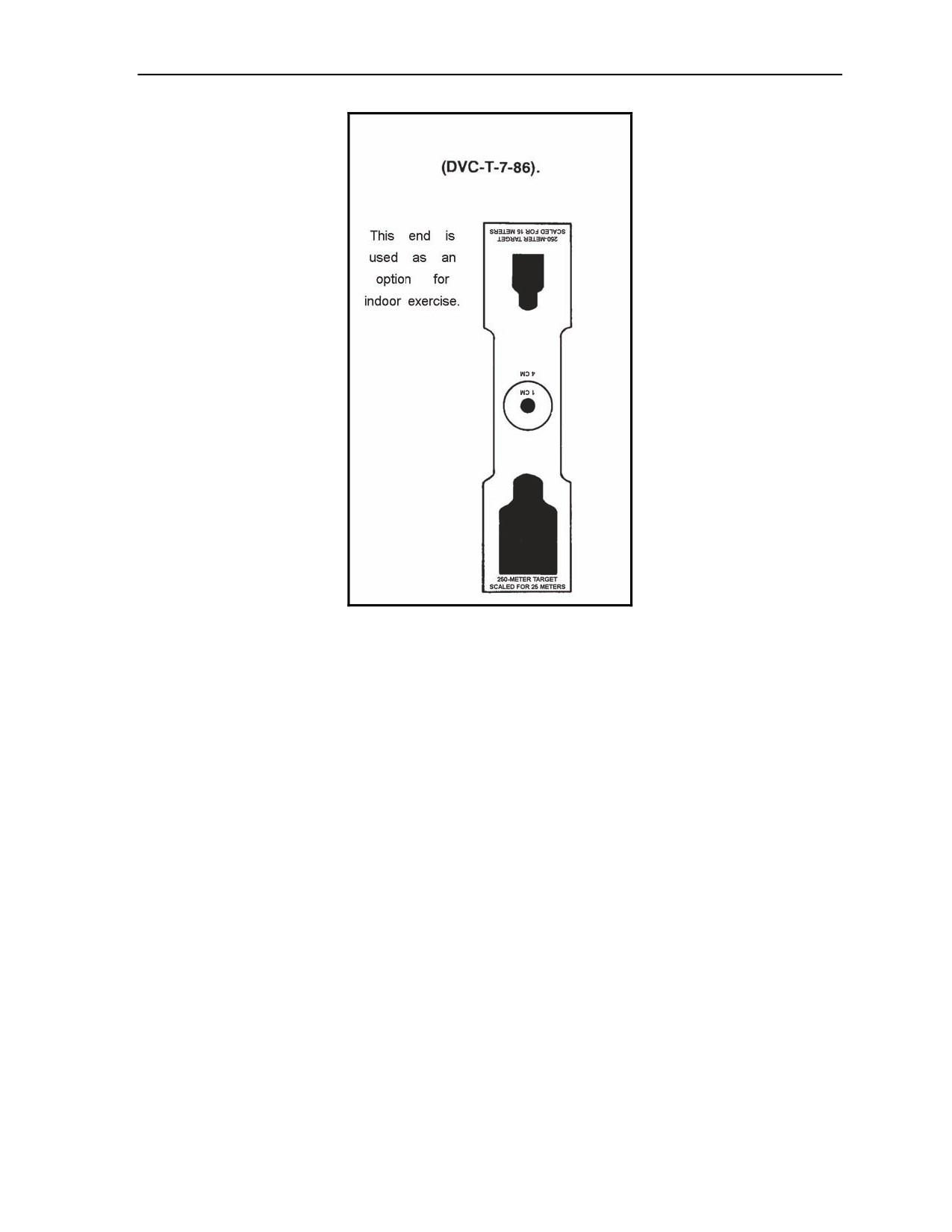
NOTE: The silhouettes on the plastic paddle (Figure A-17) are scaled to represent an E-type
silhouette target at 250 meters. The visual perception during the target box exercise is similar to
what a Soldier sees while zeroing on a standard zeroing target. The small E-type silhouette is the
same scale at 15 yards as the larger silhouette is at the 25-meter range (some training areas are
set up at 15 yards; others are set up at 25 meters). While there are some benefits to representing a
250-meter target, the main benefit of this exercise can be obtained at any distance. In place of
the paddle, a standard zeroing target can be used at 25 meters by placing a small hole in the
center (dot), moving the target sheet over the paper, and marking as previously outlined.
A-26
FM 3-22.9
12 August 2008
Training Aids, Devices, and Exercises
Figure A-17. Target box paddle (DVC-T-7-86).
A-90. The shot group exercise provides a chance for the trainer to critique the Soldier on his aiming
procedures, aiming consistency, and placement of shot groups. Assuming the rifle and paper remain
stationary and the target man properly marks the three shots, the only factor to cause separation of the dots
on the paper is error in the Soldier’s aiming procedure. When the Soldier can consistently direct the target
into alignment with the sights on this exercise, he should be able to aim at the same point on the zero range
or on targets at actual range.
BALL AND DUMMY EXERCISE
A-91. This exercise is conducted on a live-fire range and is used to detect if the firer is anticipating the shot
or using improper trigger squeeze.
A-92. To perform this exercise—
(1) The coach or designated assistant inserts a dummy round into a magazine of live rounds. The
firer must not know when a dummy round is in the magazine.
(2) When the hammer falls on a dummy round (which the firer thought was live), the firer and his
coach may see movement. The firer anticipating the shot or using improper trigger squeeze
causes this. Proper trigger squeeze results in no movement when the hammer falls.
A-93. The Soldier demonstrates the ability to properly utilize the fundamentals of marksmanship six
consecutive times.
DIME/WASHER EXERCISE
A-94. This dry-fire technique is used to teach or evaluate the skill of trigger squeeze and is effective when
conducted from an unsupported position. To perform this exercise—
(1) The Soldier cocks the weapon.
12 August 2008
FM 3-22.9
A-27
Appendix A
(2) The Soldier assumes an unsupported prone firing position.
(3) The Soldier aims at the target. An assistant places a dime or washer on the rifle’s barrel between
the flash suppressor and front sightpost assembly.
(4) The Soldier tries to squeeze the trigger naturally without causing the dime or washer to fall off.
A-95. Several repetitions of this exercise must be conducted to determine if the Soldier has problems with
trigger squeeze. The Soldier is a GO if he can dry-fire six of six consecutive shots without causing the dime
or washer to fall.
NOTES:
1. If the dime or washer is allowed to touch the sight assembly or flash suppressor,
it may fall off due to the jolt of the hammer. The strength of the hammer spring
on some rifles can make this a difficult exercise to perform.
2. When using the M16A2 rifle, the dime/washer exercise is conducted the same,
except that a locally fabricated device must be attached to the weapon. A piece
of 3/4-inch bonding material is folded into a clothespin shape and inserted in the
weapon's flash suppressor and the dime or washer is placed on top of it.
A-28
FM 3-22.9
12 August 2008
Appendix B
Scorecards
During live-fire events, a Soldier’s hit-and-miss performance is recorded to facilitate
the instructor/trainer’s critiques or to indicate where more training is needed. The
following are examples of completed scorecards.
EXAMPLES OF COMPLETED SCORECARDS
B-1.
*Figures B-1 through B-9 show examples of completed scorecards.
REPRODUCIBLE FORMS
B-2. Blank copies of the following can be found at the end of this publication:
z
DA Form 3595-R (Record Fire Scorecard).
z
DA Form 3601-R (Single Target—Field Fire I Scorecard).
z
DA Form 5239-R (100-, 200-, and 300-Meter Downrange Feedback Scorecard).
z
DA Form 5241-R (Single and Multiple Targets—Field Fire II Scorecard).
z
DA Form 5789-R (Record Fire Scorecard—Known-Distance Course).
z
DA Form 5790-R (Record Fire Scorecard—Scaled Target Alternate Course).
z
DA Form 7489-R (Record Night Fire Scorecard).
z
DA Form 7649-R (Squad Designated Marksman—Record Fire I and II).
z
DA Form 7650-R (Squad Designated Marksman—Position Evaluation).
z
*DA Form 7682-R (Combat Field Fire Scorecard).
NOTE: These forms, scorecards, and position evaluation sheets are not available through the
normal supply channels. You may reproduce them locally on 8 1/2- x 11-inch paper or download
them from the Army Publishing Directorate at http://www.apd.army.mil/.
10 February 2011
FM 3-22.9, C1
B-1
Appendix C
Night Fighting
With the Army’s emphasis on night operations, commanders must be sure that
riflemen are lethal at night as well as during the day. That lethality depends largely on
whether riflemen can fire effectively with today’s technology: NVGs, aiming lights,
and TWSs.
This appendix provides a better understanding of how eyes adapt to the night, as well
as information about night devices. The information has been provided through
continuous observation during operational testing, the Army Research Institute, and
lessons learned by individual Soldiers across the Army. Be it with the naked eye or
with night devices, Soldiers must learn to increase their ability not only to see better
at night, but their ability to “own the night.”
SECTION I. UNAIDED NIGHT VISION
Although operating at night has definite advantages, it is also difficult. Eyes do not work as well as they do
during the day, yet they are crucial to effective performance; 80 percent of sensory input comes through them.
Soldiers need to be aware of the constraints that their eyes place upon them at night. These constraints
include—
z
Reduced ability to see crisp and clear images (visual acuity).
z
Inability to distinguish colors under certain conditions.
z
Reduced depth perception.
z
Difficulty in seeing objects at certain distances due to the night blind spot.
z
Lost dark adaptation due to exposure to light.
z
Confusion (your eyes may seem to play tricks on you).
NORMAL BLIND SPOTS
C-1. The normal blind spot is always present, day and night. It is caused by the lack of light receptors
where the optic nerve inserts into the back of the eye.
C-2. The normal blind spot occurs when you use just one eye. When you close the other eye, objects 12 to
15 degrees away from where you are looking will disappear. When you uncover your eye, the objects will
reappear.
NIGHT BLIND SPOTS AND VIEWING TECHNIQUES
C-3. When you stare at an object under starlight or lower levels of illumination, it can disappear or fade
away. This is a result of the night blind spot. The night blind spot affects both eyes at the same time and
occurs when using the central vision of both eyes. Consequently, when looking directly at an object,
Soldiers miss larger objects as the distances increase. A hand grenade 2 meters away might not be seen; an
enemy Soldier at 50 meters may be missed. An M1 tank at 300 meters can even be missed.
12 August 2008
FM 3-22.9
C-1
Appendix C
AVOIDING NIGHT BLIND SPOTS
C-4. To avoid night blind spots—
z
Look to all sides of objects you are trying to find or follow.
z
DO NOT STARE.
C-5. Diamond viewing, a technique similar to the off-center vision technique taught in rifle
marksmanship, is a good technique for peripheral viewing. To use the diamond viewing technique—
z
Move your eyes just slightly, a few degrees, in a diamond pattern around the object you wish to
see.
z
Do not move your head; use your peripheral vision.
DARK ADAPTATION
C-6. In order for your visual system to work efficiently at night, you need to dark-adapt, or get your eyes
used to seeing things under low light conditions. Dark adaptation is similar to walking into a movie theater
when it’s very dark; you can’t see things at first, but as your eyes gradually adapt, you can see better.
C-7. It takes about 30 to 45 minutes to fully dark-adapt when going from a brightly lighted area into the
dark. However, people dark-adapt at varying rates. People who are older, people who smoke, or people
who are not in great physical shape will take longer to dark-adapt.
C-8. There are three stages of dark adaptation:
z
Daylight vision.
z
Twilight vision.
z
Night vision.
DAYLIGHT VISION
C-9. Daylight vision occurs under maximum lighting conditions, such as when the sun is shining or in a
well-lit room. Under these conditions, Soldiers have—
z
Optimal visual acuity. In daylight conditions, Soldiers use both their central and peripheral
vision, which provides optimal visual acuity—20/10, 20/15, and 20/20 vision.
z
Optimal color vision. Colors look most vivid under daylight conditions.
z
Quickest reaction time.
TWILIGHT VISION
C-10. Twilight vision occurs during many military night operations and when driving around in a car at
night. It occurs at dawn and dusk, down to full moonlight; when there is artificial illumination; and when
snow is on the ground at night. It can occur in the daytime with several layers of jungle canopy. Under
these conditions, Soldiers have—
z
Poorer visual acuity. Visual acuity can be as poor as 20/100. Under twilight conditions, optimal
visual acuity is between 20/50 and 20/100.
z
Poorer color vision. Colors will not be as vivid.
z
Slower reaction times.
C-2
FM 3-22.9
12 August 2008
Night Fighting
NIGHT VISION
C-11. Night vision occurs under starlight, as well as on moonless and cloudy nights when there are no stars
or cultural lighting. Remember, there is a night blind spot, as discussed earlier. Under these conditions,
Soldiers have—
z
The worst visual acuity—from 20/200 to 20/400 and possibly much worse. Soldiers can
recognize silhouettes, but not details of the objects. This is why knowing the silhouettes of
vehicles and critical natural and man-made objects is important.
z
Poor color vision. Soldiers cannot see colors, only various shades of gray. The longer
wavelengths of light, such as the reds and oranges, are hard to see and appear dark. Unless a
dark color is bordered by two lighter colors, it becomes totally invisible. On the other hand,
greens and blues appear brighter, but Soldiers may not be able to determine their color.
NOTE: Reds are almost invisible at night. Red crosses are on white backgrounds on tents or
vehicles so they can be seen more easily at night.
PROTECTING (BEFORE OPERATION)
C-12. Soldiers must protect their eyes before night operations so they can dark-adapt in an efficient
manner. To efficiently dark-adapt, use the following suggestions:
z
Don’t smoke before night operations. Not smoking four to six hours before night operations will
aid in dark adaptation.
z
Wear sunglasses if you plan to spend time in the sun. Without sunglasses, it will take longer to
dark-adapt.
z
Watch what you eat. Maintain adequate levels of Vitamin A.
z
Use dim white lighting or red lighting before night operations.
PROTECTING (DURING OPERATION)
C-13. Once a Soldier has dark-adapted, it is important to maintain that dark adaptation. To maintain dark
adaptation, use the following suggestions:
z
Minimize your use of unnecessary lighting.
z
Close one eye before being flashed by flares and other bright lights.
ILLUSION (APPARENT MOVEMENT OF LIGHT)
C-14. The illusion of movement, which a static light exhibits when stared at in the dark, is related to the
loss of surrounding visual references that normally serve to stabilize visual perceptions. Consequently, very
small eye movements are perceived by the brain as movement of the light. To avoid illusions of
movement—
z
Begin a scan pattern, and control the eye movement.
z
Use large movements, and scan.
z
Try to find another light, and shift your gaze back and forth between the lights.
12 August 2008
FM 3-22.9
C-3
Appendix C
SECTION II. AIDED NIGHT VISION
There are three devices available to dismounted Soldiers that will help increase their lethality at night: night
observation devices (NODs), aiming lasers, and TWSs. Each provides the dismounted Soldier with different
views of the IR spectrum. Before Soldiers can fully operate these devices, they must receive training on how the
systems work within the IR range and the electromagnetic (light) spectrum. Soldiers must also know what
constraints and advantages each piece of equipment provides so that they can determine when to employ each
device.
ELECTROMAGNETIC (LIGHT) SPECTRUM
C-15. To understand why some night devices cannot be used in conjunction with others, Soldiers must
understand the electromagnetic spectrum. The electromagnetic spectrum is a spectrum of energy (light)
containing x-rays, gamma rays, radio waves, cosmic rays, and ultraviolet rays. Also within this spectrum is
visible light, light visible with the naked eye. Just beyond red visible light is IR light. IR light is broken
down into three different ranges: near IR, middle IR, and far IR.
C-16. Two types of night devices will increase the Soldier's vision into the IR range:
z
Image-intensification devices.
z
Thermal sight.
IMAGE-INTENSIFICATION DEVICES
C-17. Image-intensification devices rely on ambient light and energy within the near IR range, such as light
emitted from natural and artificial sources (for example, moonlight or starlight). Image-intensification
devices include the AN/PVS-4, PVS-5, PVS-7A/B/C/D, and PVS-14s. The Army also has aiming devices
that emit near IR energy in a colliminated beam, such as the AN/PAQ-4B/C and the AN/PEQ-2A/B. Since
image-intensification devices and aiming lasers work within the same range of near IR energy, they can be
used in conjunction with each other.
THERMAL WEAPON SIGHT
C-18. In the past, thermal technology has been solely reserved for tanks, fighting vehicles, and antiarmor
specialists (for example, TOW and Dragon gunners). These devices were bulky, heavy, and impractical for
the dismounted Soldier. Now, the Army has a thermal device that can be mounted on a dismounted
Soldier's weapon or handheld. The TWS operates within the middle/far IR range. It can detect IR light
emitted from friction, combustion, or objects radiating natural thermal energy. Since the TWS and other
thermal devices operate within the middle/far IR range, they cannot be used in conjunction with image
intensifiers or other image-intensification devices.
IMAGE-INTENSIFICATION DEVICES
C-19. As the name implies, image-intensification devices are designed to amplify light. To be effective,
some degree of light must be available. When light enters the image-intensification tube, the light releases
electrons, which the tube accelerates until the light is much brighter. Under optimal conditions, second-
generation devices, such as the PVS-5-series, intensify ambient light up to about 1,500 times. Third-
generation devices, such as the PVS-7/14-series NODs, double that level of intensification.
ADJUSTMENTS
C-20. To acquire and engage a target at night, image-intensification devices must be adjusted properly.
C-4
FM 3-22.9
12 August 2008
Night Fighting
NOTE: Soldiers will not be able to obtain the acuity level that they have during the day. Under
optimal night conditions, a Soldier with 20/20 daytime vision can expect no better than 20/50
vision with second-generation NODs and 20/40 vision with third-generation NODs. To approach
these levels of acuity, you must be able to adjust your NOD for optimal clarity.
C-21. To adjust the NOD—
(1) Mount the NOD. Mount the head mount or helmet mount IAW the appropriate TM. If using the
helmet mount, ensure that the tilt is adjusted until you have a comfortable viewing angle. Use the
nape strap to maintain proper acuity with the NODs.
NOTE: If the mounting bracket is permanently attached to the helmet, ensure that the nape strap
rear bracket is also permanently attached. (See TM 11-5855-306-10 for more information about
attaching the nape strap rear bracket.) Use of the nape strap will prevent the NOD's weight from
pulling the helmet downward, causing the NOD to rest on the bridge of your nose. The nape
strap allows for proper acuity of the sight and allows you to engage targets with more ease and
accuracy.
(2) Set the eye-relief. Move the goggles so that the eyecups cover the eye, but not so close that the
eyepiece touches your eyelashes or glasses.
(3) Turn the goggles on.
(4) Set the inner-pupillary distance (AN/PVS-7 series). Move each eyepiece until they are centered
over each eye. Close one eye, and make adjustments until the eye that is open is viewing a
complete circle and not an oval. Continue to make adjustments to the other eye.
(5) Adjust the diopter focus ring. Close one eye, and with the eye that is open, turn the diopter focus
ring in one direction until the diopter is totally out of focus. Then, turn the diopter focus ring the
opposite direction until the display is focused to your eye. Follow the same procedures for the
other eye if using the AN/PVS-7 series. No further adjustments should have to be made to the
diopter focus ring.
NOTE: Adjust the diopter focus ring before adjusting the objective focus ring. The diopter focus
ring focuses the display lens to your eye, while the objective focus ring focuses the target. You
cannot focus the sight to the target without your eye being focused to the display first.
(6) Adjust the objective focus ring. While looking at an object, turn the objective focus ring until the
objective lens is out of focus and then slowly turn the objective focus ring in the opposite
direction until the object becomes as clear as possible.
NOTE: Adjustments will have to be made for targets at different ranges using the objective
focus ring.
(7) Adjust the variable gain control (AN/PVS-14 only). Turn the variable gain control to the point
that both eyes are almost receiving the same amount of light.
NOTE: The AN/PVS-14 has a variable gain control that controls the illumination input to the
eye. Keeping the variable gain turned up will cause your brain to form two separate images, one
darker and one very bright. With the variable gain turned down to the point that both eyes are
almost receiving the same amount of light, the brain will produce one image, making it seem like
both eyes are looking through the same sight.
12 August 2008
FM 3-22.9
C-5
Appendix C
AIMING LASERS
C-22. AN/PAQ-4-series and the AN/PEQ-2A/B aiming lasers operate within the electromagnetic spectrum,
specifically near the IR range, and are seen through image-intensification devices. Aiming lasers emit a
highly colliminated beam of IR energy that allows for quick “point and shoot” capability at night. Even
though aiming lasers provide a quick and easy means of engaging the enemy at night, special attention
must be given to the following:
z
Proper adjustments to the image intensifiers.
z
10-meter boresighting procedures or 25-meter zeroing procedures.
z
Scanning.
z
Walking.
z
IR discipline.
SCANNING
C-23. NVDs have a 40-degree field of view, leaving the average firer to miss easy targets of opportunity,
more commonly targets 50 meters left or right.
C-24. Soldiers must train to aggressively scan their sectors of fire for targets. Training must reinforce
regular blinking during scanning, which relieves some of the eyestrain from spotting far targets. After
Soldiers master the art of scanning, they find that targets are easier to detect by acknowledging the flicker
or movement of a target.
WALKING
C-25. Once a Soldier has located a target, he must be aware of the placement of the aiming laser. If he
activates his laser while it is pointing over the target and into the sky, he wastes valuable time trying to
locate exactly where the laser is pointing and increases his chances of being detected and fired upon by the
enemy. Walking the laser to the target is a quick and operationally secure means of engaging the enemy
with the aiming laser. To walk the laser to a target—
(1) Aim the laser at the ground just in front of the target.
(2) Walk the aiming laser along the ground and up to the target's center of mass.
(3) Engage the target.
INFRARED DISCIPLINE
C-26. To exercise proper IR discipline—
z
While on the range, actively scan for targets with the laser off.
z
Once a target is located, walk the laser to the target, and engage.
z
Once a target has been located and engaged with the aiming laser, deactivate the laser.
THERMAL WEAPON SIGHT
C-27. To understand how the TWS is able to convert energy into an image suitable for viewing, Soldiers
must understand the electromagnetic spectrum and the range of IR light in which the TWS operates. The
TWS absorbs all available light into the lens, and then filters out all light except for middle/far IR (thermal)
light. Then, the TWS converts the thermal light into an image and creates a video that is displayed on the
raster.
C-28. The TWS can convert thermal energy that is reflected, radiated, or generated from an object. All
objects, such as trees, metal, plastic, and living creatures, display a quality that allows them to be seen with
thermal technology. How well the objects display these qualities will determine how well they are seen.
C-6
FM 3-22.9
12 August 2008
Night Fighting
ABSORPTION
C-29. During the day, all inanimate objects absorb thermal energy from the sun to varying degrees. Metal
objects have a much higher rate of absorption than wood, leaves, or grass; therefore, a metal object sitting
in the sun will stand out more than the grass surrounding it when viewed through the TWS.
EXPOSURE
C-30. The amount of time an object is exposed to thermal energy determines how well that object will be
seen. Naturally, an object with a long exposure time will have absorbed more thermal energy than an object
exposed to the same thermal energy for a shorter period of time.
EMISSIVITY
C-31. Emissivity is the rate at which an object emits the thermal energy it has absorbed or generates.
Usually, objects with a high absorption rate will have a high emissivity factor. Although the human body
does not have a high absorption rate, it has a high emissivity factor due to the fact that it generates a high
amount of thermal energy. An object that has a high emissivity factor will be much hotter, and, therefore,
when seen through the TWS, much easier to see and recognize.
REFLECTION
C-32. Items such as glass and water have virtually no absorption rate. Instead, they reflect thermal energy,
which makes it very difficult to see objects through glass and water.
C-33. Snow and ice have the same effect, especially during the day with no clouds present. Snow and ice
reflect most of the thermal energy from the sun, so it is difficult to acquire a good thermal image on objects
that are close to the ground.
DIURNAL CYCLE
C-34. There are two times during the day when motionless objects that do not generate their own thermal
energy, such as trees, rocks, and man-made objects, become the same temperature as the surrounding air:
once in the morning and once in the evening. This is known as the diurnal cycle. The specific times that
this cycle will take effect are based on the time of year, but it usually occurs shortly after sunrise and
shortly after sunset.
C-35. The diurnal cycle contains crossover points. During the day, a motionless object will absorb thermal
energy from the sun; the crossover point is the time when that object stops absorbing thermal energy (day)
and starts radiating thermal energy (night). As the night goes on, that same object will come to a point
where it stops radiating thermal energy and will once again start absorbing thermal energy (day).
ADJUSTMENTS
C-36. Rain, snow, fog, smoke, and the diurnal cycle are just a few environmental or combat situations that
may affect your thermal image. These conditions may cause objects to be difficult to see, so adjustments
must be made to the TWS in order to refine the thermal image.
C-37. To allow Soldiers to maximize the capability of the sight, the TWS is equipped with—
z
A diopter focus ring.
z
Two FOVs.
z
An objective focus ring.
z
A brightness knob.
z
An auto and manual contrast switch.
z
A polarity switch.
12 August 2008
FM 3-22.9
C-7
Appendix C
Diopter Focus Ring
C-38. When making adjustments to the sight, Soldiers begin with the diopter focus ring. The diopter focus
ring focuses the display screen (raster) to the eye. To adjust the diopter focus ring, adjust the diopter focus
ring until everything on the display screen is clear and easily read.
NOTE: This is best done with the objective lens cover closed.
C-39. Once you have adjusted the diopter focus to your eye, no other adjustments to the diopter focus ring
should be necessary.
Fields of View
C-40. The TWS has two operating FOVs—wide and narrow. The Soldier should be allowed to select the
FOV that suits him best. Through use, Soldiers learn to use the appropriate FOV under different combat
situations.
NOTE: When selecting an FOV, make sure that the FOV ring is turned completely to the left or
to the right. If the FOV ring is turned only halfway, you will not be able to see through the sight.
Wide Field of View
C-41. The WFOV has the least magnification, but a greater FOV and is great for scanning.
Narrow Field of View
C-42. The NFOV has greater magnification, but less degrees of FOV.
Objective Focus Ring
C-43. The objective focus ring focuses the sight to the target. Adjustments to the objective focus ring are
based on the range of the object being viewed.
NOTES:
1. Over-adjustment to the objective focus ring will lock the FOV ring to the point
that the FOV cannot be changed.
2. Make adjustments to the objective focus ring only after focusing the diopter
focus ring.
Brightness Knob
C-44. The dual-function brightness knob is used to turn on the TWS, adjust the brightness of the raster, and
refine the thermal image. Used in conjunction with the contrast knob, it helps to combat the effects of the
diurnal cycle and other conditions that might require fine-tuned adjustment to the thermal image.
Contrast Switch
C-45. The dual-function contrast switch has automatic and manual contrast modes. Used in conjunction
with the brightness knob, the contrast switch allows Soldiers to obtain the best possible thermal image.
Automatic Contrast Mode
C-46. The automatic contrast mode is used under normal operating conditions.
C-8
FM 3-22.9
12 August 2008
Night Fighting
Manual Contrast Mode
C-47. The manual contrast is used under conditions other than normal (for example, during 10-meter
boresighting or 25-meter zeroing; during rain, fog, smoke, or snow; during the diurnal cycle; or when
trying to obtain as much detail of a target as possible).
Polarity Switch
C-48. The polarity switch has two modes: white hot or black hot. Use of the polarity switch is a user's
preference. Through continued use, Soldiers decide which polarity setting works best under different
combat or environmental conditions.
White Hot Mode
C-49. When in the white hot mode, hotter objects appear white, while cooler objects have shades of gray to
black.
Black Hot Mode
C-50. When using the black hot mode, hotter objects appear black, while the cooler objects are shades of
gray to white.
12 August 2008
FM 3-22.9
C-9
Appendix D
Range Safety and Risk Management
All personnel training on a rifle range should be briefed on the safety and local
requirements for that range. This briefing fulfills the minimum requirements for a
rifle range safety briefing. Information may be added to conform to local
requirements and safety regulations. ARs 385-10 and 385-63 and DA Pam 385-63
should be reviewed by all range personnel before operating any range.
RECOMMENDED BRIEFING
D-1. The first priority on any range is training, but safety must be at the forefront of the training program.
The safety program prescribes the safety precautions necessary to minimize accidents when firing and
using ammunition during training and range operations. The safety program should identify—
z
Surface danger zones (SDZs), as described in AR 385-63.
z
The location of medical personnel.
z
Left and right limits of the range. Firers never fire outside of these limits.
z
The designated smoking area (if applicable).
D-2.
Further, the safety program should include the following information:
z
Inspect for objects located near the weapon's muzzle before firing, especially during unassisted
night fire.
z
When not on the firing line, ensure that the weapon's selector lever is on SAFE and the bolt is
locked to the rear.
z
Ensure that firers enter and exit the firing line at the entry or exit point.
z
Before occupying a firing position, inspect it for wildlife or obstructions.
z
Always keep the weapon's muzzle pointed downrange when on the firing line, and keep the
finger outside of the trigger housing area.
z
Never touch a weapon while personnel are downrange or in front of the firing line.
z
Load the weapon only on command from the tower or control point.
z
Never fire without using hearing protection.
z
Ensure that left-handed firers attach left-handed brass deflectors to their weapon before firing.
z
When entering or exiting the firing line, clear the weapon with a cleaning rod.
z
Consider the rifle loaded at all times, even in break areas. Never point the weapon at anyone.
z
Anyone observing an unsafe act will immediately call “CEASE FIRE,” place the weapon on
SAFE, place it in the V-notched stake or lay it on the sandbags, and give the verbal and visual
command of cease fire.
z
Once cleared off of the firing line, firers report to the ammunition point and turn in all brass and
ammunition.
z
No one will leave the range until they have been inspected for live ammunition and brass.
z
In case of an electrical storm, personnel will be directed to lock and clear all weapons, ground
their equipment (except wet weather gear), and disperse into a predetermined area.
z
Eating and drinking are not permitted on the firing line unless the tower operator permits
drinking from the canteen.
NOTE: Drink water often to prevent heat injuries.
12 August 2008
FM 3-22.9
D-1
Appendix D
PERSONNEL AND DUTIES
D-3. To provide a safe and efficient range operation and effective instruction, certain duties may be
required of personnel. The personnel may include—
z
OIC.
z
RSO.
z
NCOIC.
z
Ammunition detail.
z
Unit armorer.
z
Assistant instructor.
z
Medical personnel.
z
Control tower operators.
z
Maintenance detail.
OFFICER IN CHARGE
D-4. The OIC is responsible for the overall operation of the range before, during, and after live-firing.
RANGE SAFETY OFFICER
D-5. The RSO—
z
Is responsible for the safe operation of the range.
z
Conducts a safety orientation before each scheduled LFX.
z
Ensures that a brass and ammunition check is made before the unit leaves the range.
z
Ensures that all personnel comply with the safety regulations and procedures prescribed for the
conduct of an LFX.
z
Ensures that all left-handed firers use left-handed firing devices.
NOTE: This officer should not be assigned duties other than those of the safety officer.
NONCOMMISSIONED OFFICER IN CHARGE
D-6. The NCOIC assists the OIC and safety officer by performing duties as required; for example, he
might supervise enlisted personnel who are supporting the LFX.
AMMUNITION DETAIL
D-7. This detail is composed of one or more ammunition handlers. The ammunition detail—
z
Breaks down, issues, receives, accounts for, and safeguards live ammunition.
z
Collects expended ammunition casings and other residue.
UNIT ARMORER
D-8. The unit armorer—
z
Repairs rifles.
z
Replaces parts.
ASSISTANT INSTRUCTOR
D-9. One assistant instructor is assigned for each one to ten firing points. Each assistant instructor—
z
Ensures that all firers observe safety regulations and procedures.
z
Assists firers having problems.
D-2
FM 3-22.9
12 August 2008
Range Safety and Risk Management
MEDICAL PERSONNEL
D-10. Medical personnel provide medical support, as required by regulations governing LFXs.
CONTROL TOWER OPERATORS
D-11. Control tower operators—
z
Raise and lower the targets.
z
Time the exposures.
z
Sound the audible signal.
z
Give the fire commands.
NOTE: If possible, two men should be chosen to perform these functions.
MAINTENANCE DETAIL
D-12. This detail should be composed of two segments: one to conduct small arms repair and one to
perform minor maintenance on the target-holding mechanisms.
AMMUNITION POSITIONING AND ISSUANCE
D-13. To provide a safe and operational range, the following are recommended procedures for handling
ammunition:
z
Locate all ammunition for the weapons involved at firing sites outside of the backblast area
(when applicable). Store ammunition at a position that minimizes the potential for ignition,
explosion, or rapid burning.
z
Issue ammunition to firing units immediately before scheduled training exercises. Distribute
small arms ammunition to troops only when they are on the ready line or firing line.
z
Cover all ammunition to protect it from the elements and direct rays of the sun. For proper
ventilation, provide air circulation between the ammunition and cover.
z
Limit the unpacking of ammunition at the firing line to the minimum number of rounds needed.
Retain packaging material until firing is complete. Units do not burn wooden containers or
indiscriminately fire ammunition to preclude return to a storage site.
COMPOSITE RISK MANAGEMENT
D-14. Composite risk management (CRM) is a decision-making process used to mitigate risks associated
with all hazards that have the potential to injure or kill personnel, damage or destroy equipment, or
otherwise impact mission effectiveness. The guiding principles of CRM are as follows:
z
Integrate CRM into all phases of the mission and operations.
z
Make risk decisions at the appropriate level.
z
Accept no unnecessary risk.
z
Apply the process cyclically and continuously.
z
Do not be risk averse.
D-15. CRM is a five-step process:
(1) Identify hazards.
(2) Assess hazards to determine risk.
(3) Develop controls, and make risk decisions.
(4) Implement controls.
(5) Supervise and evaluate.
NOTE: Steps 1 and 2 are assessment steps; Steps 3 through 5 are management steps.
12 August 2008
FM 3-22.9
D-3

Appendix D
STEP 1-IDENTIFY HAZARDS
D-16. Hazards may arise from any number of areas. They can be associated with enemy activity, accident
potential, weather or environmental conditions, health, sanitation, behavior, and/or materiel or equipment.
Mission, enemy, terrain and weather, troops and support available, time available, civil considerations
(METT-TC) factors serve as a standard format for identifying hazards, on- or off-duty.
D-17. CRM does not differentiate between the sources of the hazard. The loss of personnel, equipment, or
materiel due to any hazard has the same disruptive impact on readiness or mission capabilities, no matter
what the source.
STEP 2-ASSESS HAZARDS TO DETERMINE RISK
D-18. During mission analysis, course of action (COA) development, or analysis, rehearsal, and execution
steps of the military decision-making process (MDMP), commanders assess hazards and assign risk in
terms of probability and severity of adverse impact. During their assessment, they must consider both
mission- and non-mission-related aspects that may have an impact. The end result of this assessment is an
initial estimate of risk for each identified hazard as determined from the standardized application of the risk
assessment matrix.
D-19. There are three substeps in this step:
(1) Assess the probability of an event or occurrence.
(2) Estimate the expected result or severity of an event or occurrence.
(3) Determine the level of risk using the standard risk assessment matrix.
Assess the Probability of an Event or Occurrence
D-20. Probability is the likelihood an event will occur based on prior experience. The probability levels
estimated for each hazard are based on the mission, COA, or frequency of a similar event. There are five
levels of probability (Table D-1):
z
Frequent.
z
Likely.
z
Occasional.
z
Seldom.
z
Unlikely.
Table D-1. Five levels of probability.
LEVEL OF PROBABILITY
EXPLANATION
Frequent
Occurs very often, known to happen regularly.
Likely
Occurs several times, a common occurrence.
Occasional
Occurs sporadically, but is not common.
Seldom
Remotely possible, could occur at some time.
Unlikely
Can assume will not occur, but not impossible.
Estimate the Expected Result or Severity of an Event or Occurrence
D-21. Severity is the degree to which an incident will impact combat power, mission capability, or
readiness. The degree of severity estimated for each hazard is based on the results of similar events.
Severity is addressed in the four levels used on the risk assessment worksheet (Table D-2):
z
Catastrophic.
z
Critical.
z
Marginal.
z
Negligible.
D-4
FM 3-22.9
12 August 2008

Range Safety and Risk Management
Table D-2. Four levels of severity.
LEVEL OF SEVERITY
EXPLANATION
Catastrophic
•
Complete mission failure or loss of ability to accomplish a mission.
•
Death or permanent total disability.
•
Loss of major or mission-critical systems or equipment.
•
Major property or facility damage.
•
Severe environmental damage.
•
Mission-critical security failure.
•
Unacceptable collateral damage.
Critical
•
Severely degraded mission capability or unit readiness.
•
Permanent partial disability or temporary total disability exceeding three months time.
•
Extensive major damage to equipment or systems.
•
Significant damage to property or the environment.
•
Security failure.
•
Significant collateral damage.
Marginal
•
Degraded mission capability or unit readiness.
•
Minor damage to equipment or systems, property, or the environment.
•
Lost days due to injury or illness, not exceeding three months.
• Minor damage to property or the environment.
Negligible
•
Little or no adverse impact on mission capability.
•
First aid or minor medical treatment.
•
Slight equipment or system damage, but fully functional or serviceable.
• Little or no property or environmental damage.
Determine the Level of Risk Using the Standard Risk Assessment Matrix
D-22. Using the standard risk assessment matrix (Table D-3), commanders convert probability and severity
for each identified hazard into a specified level of risk. All accepted residual risk must be approved at the
appropriate level of command.
NOTE: This assessment is an estimate, not an absolute. It may or may not be indicative of the
relative danger of a given operation, activity, or event.
Table D-3. Risk assessment matrix.
RISK ASSESSMENT MATRIX
Severity
Probability
Frequent
Likely
Occasional
Seldom
Unlikely
A
B
C
D
E
Catastrophic
I
E
E
H
H
M
Critical
II
E
H
H
M
L
Marginal
III
H
M
M
L
L
Negligible
IV
M
L
L
L
L
E - Extremely High
H - High
M - Moderate
L - Low
D-23. Risk is addressed in the four levels listed in the lower left corner of the matrix (Table D-4):
z
Extremely high risk.
z
High risk.
z
Moderate risk.
z
Low risk.
12 August 2008
FM 3-22.9
D-5

Appendix D
Table D-4. Four levels of risk.
LEVEL OF RISK
EXPLANATION
Extremely High Risk
Loss of ability to accomplish the mission if hazards occur. In the example noted in Table D-3, a
frequent or likely probability of catastrophic loss (IA or IB) or a frequent probability of critical loss (IIA)
exists. This implies that the risk associated with this mission, activity, or event may have severe
consequences. The decision to continue must be weighed carefully against the potential gain to be
achieved by continuing this COA.
High Risk
Significant degradation of mission capabilities (in terms of the required mission standard), inability to
accomplish all parts of the mission, or inability to complete the mission to standard will result if
hazards occur during the mission. Occasional to seldom probability of catastrophic loss (IC or ID)
exists. A likely to occasional probability of a critical loss (IIB or IIC) exists. Frequent probability of
marginal losses (IIIA) exists. This implies that if a hazardous event occurs, serious consequences will
occur. The decision to continue must be weighed carefully against the potential gain to be achieved
by continuing this COA.
Moderate Risk
Expected degraded mission capabilities (in terms of the required mission standard) will result if
hazards occur during the mission. An unlikely probability of catastrophic loss (IE) exists. The
probability of a critical loss is seldom (IID). Marginal losses occur with a likely or occasional
probability (IIIB or IIIC). A frequent probability of negligible (IVA) losses exists.
Low Risk
Expected losses have little or no impact on accomplishing the mission. The probability of critical loss
is unlikely (IIE), while that of marginal loss is seldom (IIID) or unlikely (IIIE). The probability of a
negligible loss is likely or less (IVB through (IVE). Expected losses have little or no impact on
accomplishing the mission. Injury, damage, or illness are not expected, or may be minor and have no
long-term impact or effect.
STEP 3 - DEVELOP CONTROLS, AND MAKE RISK DECISIONS
D-24. In this step, commanders develop and apply controls, reassess the hazard to determine a residual risk,
and make risk decisions. This process continues until an acceptable level of risk is achieved or until all
risks are reduced to a level where benefits outweigh the potential cost. This step is accomplished during the
COA development, COA analysis, COA comparison, and COA approval of the MDMP.
STEP 4 - IMPLEMENT CONTROLS
D-25. Leaders and staffs ensure that controls are integrated into SOPs, written and verbal orders, mission
briefings, and staff estimates. The critical check for this step is to ensure that controls are converted into
clear and simple execution orders. This step includes coordination and communication with—
z
Appropriate superior, adjacent, and subordinate units, organizations, and individuals.
z
Logistics Civil Augmentation Program (LOGCAP) organizations and civilian agencies that are
part of the force or may be impacted by the activity, hazard, or its control.
z
The media and nongovernmental organizations (NGO) when their presence impacts or is
impacted by the force.
STEP 5 - SUPERVISE AND EVALUATE
D-26. This step involves implementing risk controls and enforcing them to standard, and validating the
adequacy of selected control measures in supporting the objectives and desired outcomes. This continuous
process provides the ability to identify weaknesses and to change or adjust controls based on performance,
changing situations, conditions, or events.
RESPONSIBILITIES
D-27. CRM responsibilities are spread across three levels:
z
Commander.
z
Leaders.
z
Individual.
D-6
FM 3-22.9
12 August 2008
Range Safety and Risk Management
COMMANDER
D-28. During implementation of the CRM process, the commander—
z
Ensures that warfighting functions (WFF) are performed to standard to minimize human error,
materiel failure, and environmental effects.
z
Establishes a force protection policy and publishes a safety philosophy with realistic safety
goals, objectives, and priorities.
z
Ensures that his training assessment considers the WFF's ability to protect the force. Selects
long-, short-, and near-term control actions and ensures implementation to improve force
protection.
z
Ensures that his staff integrates risk management into the planning and execution of training and
operational missions.
z
Makes risk decisions. Selects, monitors, and enforces implementation of controls for hazards
most likely to result in loss of combat power. After implementing controls, if risk remains above
the tolerance level established by higher command, he must elevate the risk decision to the
appropriate command level.
z
Ensures that the CRM process is evaluated during all AARs.
z
Determines if unit performance meets force protection guidance. Determines effectiveness of
hazard controls and necessary changes to guidance and controls. Ensures that these changes are
fed back into the training management cycle and guidance for operational missions, including
unit SOPs.
LEADERS
D-29. During implementation of the CRM process, leaders—
z
Enforce METL task performance to standard. Adopt the crawl—walk—run approach in planning
and executing training.
z
Make use of automated on- and off-duty CRM tools and surveys available from the United
States Army Combat Readiness Center (USACRC).
z
Execute risk reduction controls selected by the commander by developing and implementing
supporting leader level controls. Apply risk management procedures to each.
INDIVIDUAL
D-30. All Soldiers must understand how to use the CRM process to enhance mission success and to reduce
or eliminate loss.
D-31. During implementation of the CRM process, Soldiers—
z
Support commanders and leaders in the rapid identification and communication of hazards and
associated risks that may impact on the mission.
z
Provide immediate feedback to the leader as the mission progresses and hazards are encountered.
Use short written messages, hand and arm signals, or radio transmissions to communicate first-
hand information to leaders.
z
In extreme situations, act alone or make risk decisions within the context of orders.
DA FORM 7566 (COMPOSITE RISK MANAGEMENT WORKSHEET)
D-32. DA Form 7566 (Composite Risk Management Worksheet, Figure D-1a and D-1b) provides a starting
point to logically track the CRM process. It can be used to document risk management steps taken during
planning, preparation, and execution of training and combat missions.
NOTE: For detailed CRM procedures, see FM 5-19.
12 August 2008
FM 3-22.9
D-7