FM 3-22.9 RIFLE MARKSMANSHIP M16-/M4-SERIES WEAPONS (August 2008) - page 9

Appendix D
D-33. See Table D-5 for instructions on completing DA Form 7566.
Table D-5. Worksheet instructions
ITEM
INSTRUCTION
1 through 4
Self-explanatory.
5
Subtask relating to the mission or task in Block 1.
6
Hazards-Identify hazards by reviewing METT-TC factors for the mission or task. Additional factors
include historical lessons learned, experience, judgment, equipment characteristics and warnings,
and environmental considerations.
7
Initial Risk Level-Factors include historical lessons learned, intuitive analyses, experience,
judgment, equipment characteristics and warnings, and environmental considerations. Determine
the initial risk for each hazard by applying the risk assessment matrix. Enter the risk level for each
hazard.
8
Controls- For each hazard, develop one or more controls that will eliminate the hazard or reduce
the risk of a hazardous incident. Specify who, what, where, why, when, and how for each control.
Enter controls.
9
Residual Risk Level-Determine the residual risk for each hazard by applying the risk assessment
matrix. Enter the residual risk level for each hazard.
10
How to Implement-Decide how each control will be put into effect or communicated to the personnel
who will make it happen (written or verbal instruction; tactical, safety, garrison SOPs; rehearsals).
Enter controls.
11
How to Supervise (Who)-Plan how each control will be monitored for implementation (continuous
supervision, spot-checks) and reassess hazards as the situation changes. Determine if the controls
worked and if they can be improved. Pass on lessons learned.
12
Was Control Effective-Indicate “Yes” or “No.” Review during AAR.
13
Overall Risk Level-Select the highest residual risk level and circle it. This becomes the overall
mission or task risk level. The commander decides whether the controls are sufficient to accept the
level of residual risk. If the risk is too great to continue the mission or task, the commander directs
development of additional controls or modifies, changes, or rejects the COA.
14
Risk Decision Authority-Signed by the appropriate level of command.
D-10
FM 3-22.9
12 August 2008
Appendix E
Range Procedures and
Range Operations Checklist
This appendix contains the procedures used to conduct live-fire training exercises.
These procedures support Army regulations
(TCs
7-9 and
25-1), local range
regulations, and established unit training SOPs. Conduct of the training exercise
should clearly define and establish details and equipment needed to open and operate
the range so that these actions do not adversely impact Soldiers' training time. The
procedures outlined in this appendix should be followed in order to open the range
and conduct effective training.
RANGE PROCEDURES
E-1. Before beginning an LFX, all personnel must receive an orientation on range operations. The
orientation should outline the procedures for conducting the exercise, to include the duties of the nonfiring
orders.
PERSONNEL AND DUTIES
D-2. To provide a safe and efficient range operation and effective instruction, certain duties may be
required of personnel. The personnel may include—
z
OIC.
z
RSO.
z
NCOIC.
z
Ammunition detail.
z
Unit armorer.
z
Assistant instructor.
z
Medical personnel.
z
Control tower operators.
z
Maintenance detail.
OFFICER IN CHARGE
D-3. The OIC is responsible for the overall operation of the range before, during, and after live-firing.
RANGE SAFETY OFFICER
D-4. The RSO—
z
Is responsible for the safe operation of the range.
z
Conducts a safety orientation before each scheduled LFX.
z
Ensures that a brass and ammunition check is made before the unit leaves the range.
z
Ensures that all personnel comply with the safety regulations and procedures prescribed for the
conduct of an LFX.
z
Ensures that all left-handed firers use left-handed firing devices.
NOTE: This officer should not be assigned duties other than those of the safety officer.
12 August 2008
FM 3-22.9
E-1
Appendix E
NONCOMMISSIONED OFFICER IN CHARGE
D-5. The NCOIC assists the OIC and safety officer by performing duties as required; for example, he
might supervise enlisted personnel who are supporting the LFX.
AMMUNITION DETAIL
D-6. This detail is composed of one or more ammunition handlers. The ammunition detail—
z
Breaks down, issues, receives, accounts for, and safeguards live ammunition.
z
Collects expended ammunition casings and other residue.
UNIT ARMORER
D-7. The unit armorer—
z
Repairs rifles.
z
Replaces parts.
ASSISTANT INSTRUCTOR
D-8. One assistant instructor is assigned for each one to ten firing points. Each assistant instructor—
z
Ensures that all firers observe safety regulations and procedures.
z
Assists firers having problems.
MEDICAL PERSONNEL
D-9. Medical personnel provide medical support, as required by regulations governing LFXs.
CONTROL TOWER OPERATORS
D-10. Control tower operators—
z
Raise and lower the targets.
z
Time the exposures.
z
Sound the audible signal.
z
Give the fire commands.
NOTE: If possible, two men should be chosen to perform these functions.
MAINTENANCE DETAIL
D-11. This detail should be composed of two segments: one to conduct small arms repair and one to
perform minor maintenance on the target-holding mechanisms.
FIRING ORDER LINEUP
E-12. After the range cadre have given the safety and range briefings, they assemble the Soldiers in firing
orders in correlation with the number of firing points on that range. After the firing order has been
determined, firers have their weapons rodded, move to the firing line, and proceed to their assigned firing
points, keeping their weapons pointed up and downrange at all times.
TOWER COMMANDS
E-13. Simple, standard fire commands are needed to avoid confusion and misunderstanding during LFXs.
E-2
FM 3-22.9
12 August 2008
Range Procedures and Range Operations Checklist
GENERAL COMMANDS
E-14. The following general commands may be altered when necessary:
z
“Firers, assume the ________ position.”
z
“Issue the firer ________ rounds of ammunition.”
z
“Coach, secure ________ rounds of ammunition.”
z
“Lock one round. Load.”
z
“Ready on the right?”
z
“Ready on the left?”
z
“Ready on the firing line?”
z
“Commence firing when your targets appear.”
z
“Cease firing. Lock and clear all weapons.”
Grouping Commands
E-15. Grouping commands include the following:
z
“Firers, assume a good supported prone position.”
z
“Lock one of three single rounds. Load.”
z
“Ready on the right?”
z
“Ready on the left?”
z
“The firing line is ready.”
z
“Place your selector lever on SEMIAUTOMATIC.”
z
“Commence firing.”
z
“Cease fire. Lock and clear your weapons.”
z
“Clear on the right?”
z
“Clear on the left?”
z
“The firing line is clear.”
z
“Move down to your targets, and triangulate your shot group.”
z
“After all personnel have triangulated their targets, move back to the firing line.”
z
“At this time, make adjustments to your sights.”
z
“Repeat all firing commands until grouping standards are met.”
ZERO COMMANDS
E-16. Tower commands are the same as grouping commands. Repeat all firing commands until zeroing
standards are met.
Field Firing Exercises
E-17. Simple, standard fire commands are needed to avoid confusion during field firing exercises.
Commands for exercises from stationary positions are as follows:
z
“Firers, assume a good ________ position.”
z
“Lock one magazine of ________ rounds. Load.”
z
“Ready on the right?”
z
“Ready on the left?”
z
“The firing line is ready.”
z
“Place your selector lever on SEMIAUTOMATIC.”
z
“Scan your sector.”
z
“Cease fire. Lock and clear your weapon.” (Place the selector lever in the SAFE position.)
E-18. The range officer relays his commands to the pit NCOIC by radio or telephone so he can keep
abreast of the conduct of fire. Before each firing exercise, the range officer informs the pit NCOIC of the
12 August 2008
FM 3-22.9
E-3
Appendix E
next exercise and any special instructions for target operation (for example, “The next firing will be for
zero. Mark targets after each three-round shot group,” or for slow fire, “The next firing will be ten rounds.
Slow fire. Mark targets after each shot.”).
E-19. Radio telephone operators (RTOs) relay commands to the pit and pass on special instructions to
target operators as requested by assistant instructors.
NOTES:
1. Radio telephone operators never identify a firer on a particular firing point.
2. The command “MARK TARGET NUMBER ________” indicates that the
target has been fired upon but has not withdrawn for marking.
PRACTICE RECORD FIRE AND RECORD FIRE
E-20. Simple, standard fire commands are needed to avoid confusion and misunderstanding during practice
record fire and record fire.
Practice Record Fire
E-21. Practice record fire commands include the following:
z
“Firers, assume a good supported (prone unsupported) position.”
z
“Scorers, point out the limits of your lane.”
z
“Firers, lock your first magazine. Load.”
z
“Scan your sector.”
z
“Cease fire.”
z
“Lock and clear all weapons.”
Record Fire
E-22. Record fire commands include the following:
z
“Firers, assume a good supported (prone unsupported) position.”
z
“Scorers, point out the limits of your sector.”
z
“Firers, lock your first 20-round magazine. Load.”
z
“Scan your sector.”
z
“Cease fire.”
z
“Lock and clear all weapons.”
Rapid Fire Exercises
E-23. The following commands are used for rapid fire exercises:
z
“Lock and clear all weapons.”
z
“Clear on the right?”
z
“Clear on the left?”
z
“The firing line is clear.”
z
“Firers, assume the ________ position.”
z
“Assistants, secure two magazines of five rounds each.” (“Issue the firer one magazine of five
rounds.”)
z
“Lock one magazine. Load.”
z
“Ready on the right?”
z
“Ready on the left?”
z
“Ready on the firing line?”
z
“Watch your targets.” (“Firers, assume the appropriate firing position and commence firing
when the targets are presented.”)
E-4
FM 3-22.9
12 August 2008
Range Procedures and Range Operations Checklist
E-24. When all of the targets are withdrawn, the range officer checks for slow firers or malfunctions and
then allows them to fire.
E-25. The pit NCOIC organizes, orients, and provides safety for the pit detail.
E-26. The success of KD firing depends on efficient operation of the targets and the close coordination
between the pit NCOIC and range officer. All operators must know the proper procedure for operating and
marking the target.
Marking Targets for Zeroing and Slow Fire
E-27. Targets are marked quickly after each shot or group of shots without command. During slow fire, the
firer has a time limit of one minute for each shot. Twenty seconds is considered the maximum time limit
for marking. A marker (spotter) is placed in the hit regardless of its location on the target. Each time the
target is marked, the marker is removed from the previous hit, and the hole is pasted.
NOTE: 3-inch markers are used for 100, 200, and 300 meters; 5-inch markers are used for 500
meters.
Using Disk Markers
E-28. The target markers are painted black on one side and white on the opposite side. They are available
in three dimensions:
z
1 1/2 inches (NSN 6920-00789-0864).
z
3 inches (NSN 6920-00-713-8255).
z
5 inches (NSN 6920-00-713-8254).
E-29. The disk spindle (NSN 6920-00-7138257) may also be procured through the supply channels.
RANGE OPERATIONS CHECKLIST
E-30. This checklist consists of nine sections, each covering a topic relating to range operations:
z
Mission analysis.
z
Double check.
z
Become an expert.
z
Determine requirements.
z
Determine available resources.
z
Foolproof.
z
Occupy the range and conduct training.
z
Close the range.
z
KD range.
NOTE: The checklist should be modified to include local policy changes to regulations or
SOPs.
E-31. The person responsible for the training must answer the questions in each section. To answer these
questions, he should use the following procedures:
z
Ask each question in order.
z
Record a “Yes” answer by checking the GO column.
z
Record a “No” or “Don’t know” answer by checking the NO GO column.
12 August 2008
FM 3-22.9
E-5

Appendix E
z
Refer to the checklist to find the GO and NO GO columns.
z
After all of the questions in a section are answered, analyze the NO GOs.
Contact the people who reported them and ask if they have corrected each problem. If so,
change the answer to GO.
If any NO GO remains, analyze it and implement a countermeasure for the shortfall.
Afterward, check to ensure that the countermeasures work.
Before range operations start, be sure that a workable countermeasure is implemented for
each safety hazard presented by a NO GO answer.
MISSION ANALYSIS
E-32. Mission analysis includes identifying the following:
z
Who will be firing on the range? ________
z
Number of personnel________ Units________
z
What weapons and course will be used? Weapons________ Course________
z
Where will the training be conducted? Range________
z
When is the range scheduled for operations? Date________ Opens________ Closes________
DOUBLE CHECK
GO
NO GO
REMARKS
1. Has sufficient ammunition been requested for the
number of personnel?
2. Are the range facilities adequate for the type of
training to be conducted?
3. Has enough time been scheduled to complete the
training?
4. Have conflicts that surfaced been resolved?
BECOME AN EXPERT
GO
NO GO
REMARKS
1. Review TMs and FMs on the weapons to be fired.
2. Talk with the armorer and other personnel
experienced with the weapons to be fired.
3. Review AR 385-63.
4. Visit range control and read the installation's range
instructions.
5. Reconnoiter the range (preferably while it is in use).
6. Check ARTEPs to see if training tasks can be
integrated into the range training plan.
E-33. Determining the requirements involves identifying the equipment and personnel necessary to conduct
the training.
Personnel
E-34. The following personnel are required for range operations:
z
OIC.
z
Safety officer.
z
Assistant safety officer.
z
NCOIC.
z
Ammunition NCO.
E-6
FM 3-22.9
12 August 2008
Range Procedures and Range Operations Checklist
z
Ammunition personnel (determined by type of range).
z
Target detail and target operators.
z
Tower operator.
z
Concurrent training instructors.
z
Assistant instructors.
z
Radio telephone operators.
z
Guards (range requirements).
z
Medic(s).
z
Air guard.
z
Armorer.
z
Truck driver (range personnel and equipment).
z
Mechanic for vehicles.
E-35. Further, the following must be checked:
z
Have you overstaffed your range?
Equipment
E-36. The following equipment is required for range operations:
z
Range packet and clearance form.
z
Safety fan and diagram (if applicable).
z
Other safety equipment (for example, aiming circle, compass).
z
Publications pertaining to the training that will be conducted.
z
Lesson plans, status reports, and reporting folder.
z
Range flag and light (night firing).
z
Radios.
z
Field telephone and wire.
z
292 antenna (if necessary).
z
PA set with backup bullhorn(s).
z
Concurrent training markers.
z
Training aids for concurrent training stations.
z
Sandbags.
z
Tentage (briefing tent, warm-up tent).
z
Space heaters (if needed).
z
Colored helmets for control personnel.
z
Safety paddles and vehicle flag sets or lights.
z
Ambulance or designated vehicle.
z
Earplugs.
z
Water for drinking and cleaning.
z
Scorecards.
z
Master score sheet.
z
Armorer's tools and cleaning equipment for weapons.
z
Brooms, shovels, and other cleaning supplies and equipment.
z
Tables and chairs (if needed).
z
Target accessories.
z
Fire extinguishers.
z
Tarp, stakes, and rope to cover the ammunition.
z
Toilet paper.
z
Spare weapons and repair parts (as needed).
12 August 2008
FM 3-22.9
E-7
Appendix E
z
Tow bar and slave cables for vehicles.
z
Fuel and oil for vehicles and target mechanisms.
DETERMINE AVAILABLE RESOURCES
E-37. Determining available resources involves the following:
z
Fill personnel spaces.
z
Keep unit integrity.
z
Utilize NCOs.
z
Coordinate with supporting organizations:
Ammunition.
Transportation.
Training aids.
Medics.
Weapons.
Other equipment.
FOOLPROOF
E-38. To foolproof range operations—
z
Write an overall lesson plan for the range.
z
Organize a plan for firing:
Determine the range organization.
Outline courses of fire to be used.
Have fire commands typed for use on the range.
Set the rotation of stations.
z
Rehearse concurrent training instructors and assistants.
z
Brief the RTO on unique range control radio procedures.
z
Brief and rehearse the reporting NCO on range operation and all of his duties.
z
Collect and concentrate equipment for use on the range in one location.
z
Obtain training aids.
z
Pick up targets from the range warehouse (if required).
z
Report to range control for a safety briefing (if required) and sign for any special items.
z
Publish the LOI:
Uniform of range and firing personnel (helmets and earplugs).
Mode of transportation, departure times, and places.
Methods of messing to be used.
Any special requirements being placed on units.
OCCUPY THE RANGE AND CONDUCT TRAINING
E-39. Certain actions must be performed to properly occupy the range and conduct training.
Occupy the Range
E-40. When occupying the range, perform the following actions:
z
Request permission to occupy the range.
z
Establish good communications.
z
Have designated areas prepared:
Parking.
Ammunition point.
E-8
FM 3-22.9
12 August 2008
Range Procedures and Range Operations Checklist
Medical station.
Water point.
Concurrent training.
Mess.
Helipad.
Armorer.
z
Inspect the range for operational condition.
z
Raise the flag when occupying or firing according to the local SOP.
z
Check the ammunition to ensure that it is the correct type and quantity.
z
Ensure that range personnel are in the proper uniform and the equipment is in position.
z
Receive firing units.
z
Conduct safety checks on weapons.
z
Check for clean, fully operational weapons.
z
Conduct a safety briefing (to include administrative personnel on the range).
z
Organize personnel into firing orders (keep unit integrity, if possible).
z
Request permission to commence firing from range control.
Conduct of Firing
E-41. When conducting firing, the following must be checked:
z
Are communications to range control satisfactory?
z
Are commands from the tower clear and concise?
z
Are range areas policed?
z
Is ammunition accountability maintained?
z
Is the master score sheet updated?
z
Is personnel accountability maintained?
z
Are vehicles parked in the appropriate areas?
z
Is the air guard on duty and alert?
z
Are personnel in proper uniform?
z
Are earplugs in use?
z
Are troops responding properly to commands?
z
Are on-the-spot corrections being made when troops use poor techniques or fail to hit the target?
z
Is conservation of ammunition being enforced?
z
Are weapons cleared before they are taken from the firing line?
z
Are personnel checked for brass or ammunition before they leave the range?
z
Is anyone standing around not involved in training or support?
CLOSE THE RANGE
E-42. To properly close the range, the following must be performed:
z
Close downrange according to the local SOP.
z
Remove all equipment and ammunition from the range.
z
Police the range.
z
Repaste and resurface targets as required by range instructions.
z
Perform other maintenance tasks as required by the local SOP.
z
Request a range inspector from range control when ready to be cleared.
z
Submit an after-action report to headquarters.
z
Report any noted safety hazards to the proper authorities.
12 August 2008
FM 3-22.9
E-9

Appendix E
KNOWN DISTANCE RANGE
E-43. Events held on the KD range require additional personnel and equipment.
Personnel
E-44. In addition to the personnel previously identified, the KD range requires—
z
NCOIC of pit detail.
z
Assistant safety officer for the pit area.
Equipment
E-45. In addition to the equipment previously identified, the KD range requires—
z
A sound set for the pit area.
z
Positive communication from the firing line to the pit area.
z
Pasters.
z
Glue and brushes for resurfacing targets.
z
Lubricant for target frames.
z
Proper targets mounted in target frames.
z
Briefing on how to operate a KD range.
z
Procedure for marking targets.
z
Procedure for pit safety.
COMPUTER CONTROLLED RANGES
E-46. Modern computer-controlled ranges allow trainers to develop scenarios and control targets and
battlefield simulation devices. This permits Soldiers and units to practice mission-essential tasks in a
stressful environment. Computerized systems also provide performance feedback. Using data recorded
during training, the computer generates AARs. This accurate feedback allows commander to assess the
unit’s performance and leaders to assess their unit's mission status and design training programs to
overcome the identified shortcomings. The performance feedback highlights positive actions to reinforce
correct procedures and to foster Soldiers’ confidence, enabling Soldiers and leaders to recognize and
correct their shortcomings.
RANGE SELECTION
E-47. This section identifies primary and alternate ranges used for training and qualification, with specific
weapon systems and weapons based on applicable FMs. The following table lists primary and alternate
ranges to satisfy weapon system training events.
Table E-1. Primary/alternate range selection.
WEAPON SYSTEM
TRAINING EVENT
RANGE
PRIMARY
ALTERNATE
Zero
25-m range
AFF/ARF/MRF with 25m boots
Sustainment/Record
AFF/ARF/MRF
25-m range
M16-Series and M4
Qualification
ARF/MRF/QTR
25-m range
Night
AFF/ARF/MRF Night
25-m range
CBRN Conditions
AFF/ARF/MRF
25-m range
AFF:
Automated Field Fire Range
ARF:
Automated Record Fire Range
MRF:
Modified Record Fire Range
QTR:
Qualification Training Range
E-10
FM 3-22.9
12 August 2008
Range Procedures and Range Operations Checklist
Rifle/Machine Gun Zero Range (17801)
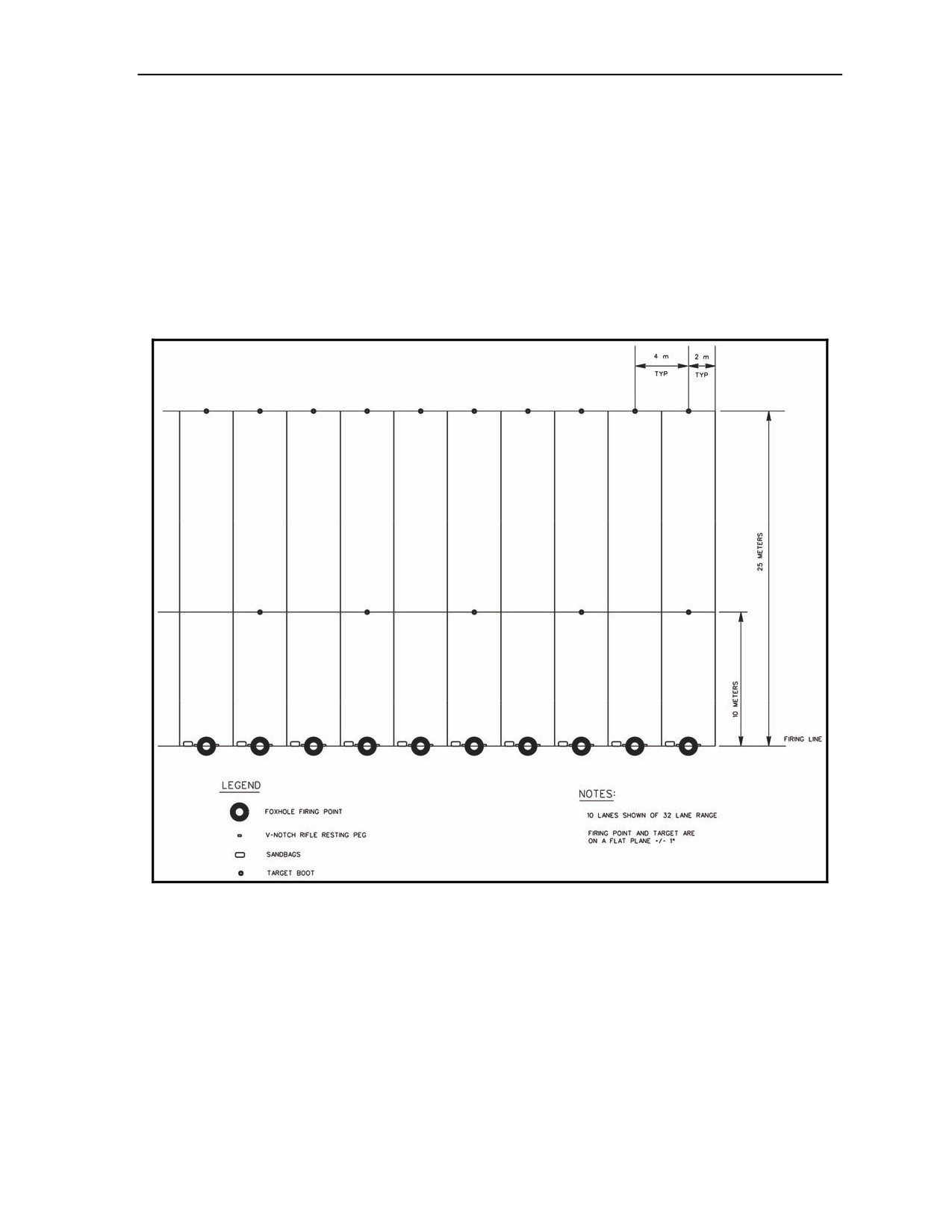
E-48. This range (Figure E-1) is used to train individual Soldiers on the skills necessary to align the sights
and practice basic marksmanship techniques against stationary targets. The range is designed for
conducting shot-grouping and zeroing exercises with the M16- and M4-series weapons, as well as crew-
served machine guns. Its primary features include—
z
32 target frames at 25 meters.
z
16 target frames at 10 meters.
z
32 foxholes.
E-49. This range requires no automation. All targets are fixed at 25 meters from the firing line for M16-
and M4-series weapons and 10 meters for machine gun.
Figure E-1. Rifle/machine gun zero range (17801).
12 August 2008
FM 3-22.9
E-11
Appendix E
Automated Field Fire Range (17803)
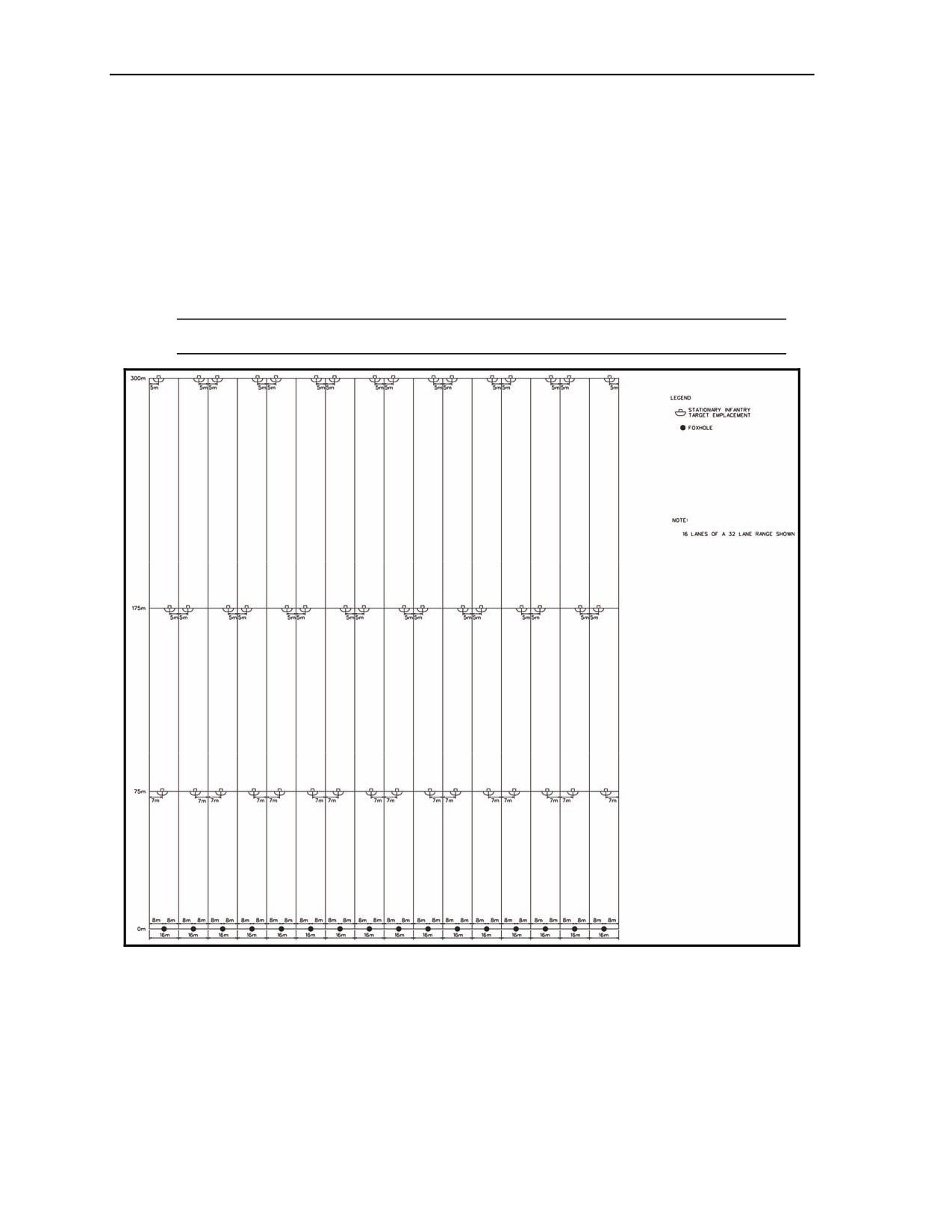
E-50. The AFF range (Figure E-2) is used to train and familiarize Soldiers on the skills necessary to
identify, engage, and hit stationary Infantry targets with M16- and M4-series weapons. Its primary features
include—
z
96 stationary Infantry targets.
z
32 foxhole positions.
E-51. All targets are fully automated, and the event-specific target scenario is computer-driven and scored
from the range operations center. The range operating system is fully capable of providing immediate
performance feedback to the participants.
NOTE: This range can be used for automatic rifle practice.
Figure E-2. Automated field fire range (17803).
E-12
FM 3-22.9
12 August 2008
Range Procedures and Range Operations Checklist
Automated Record Fire Range (17805)
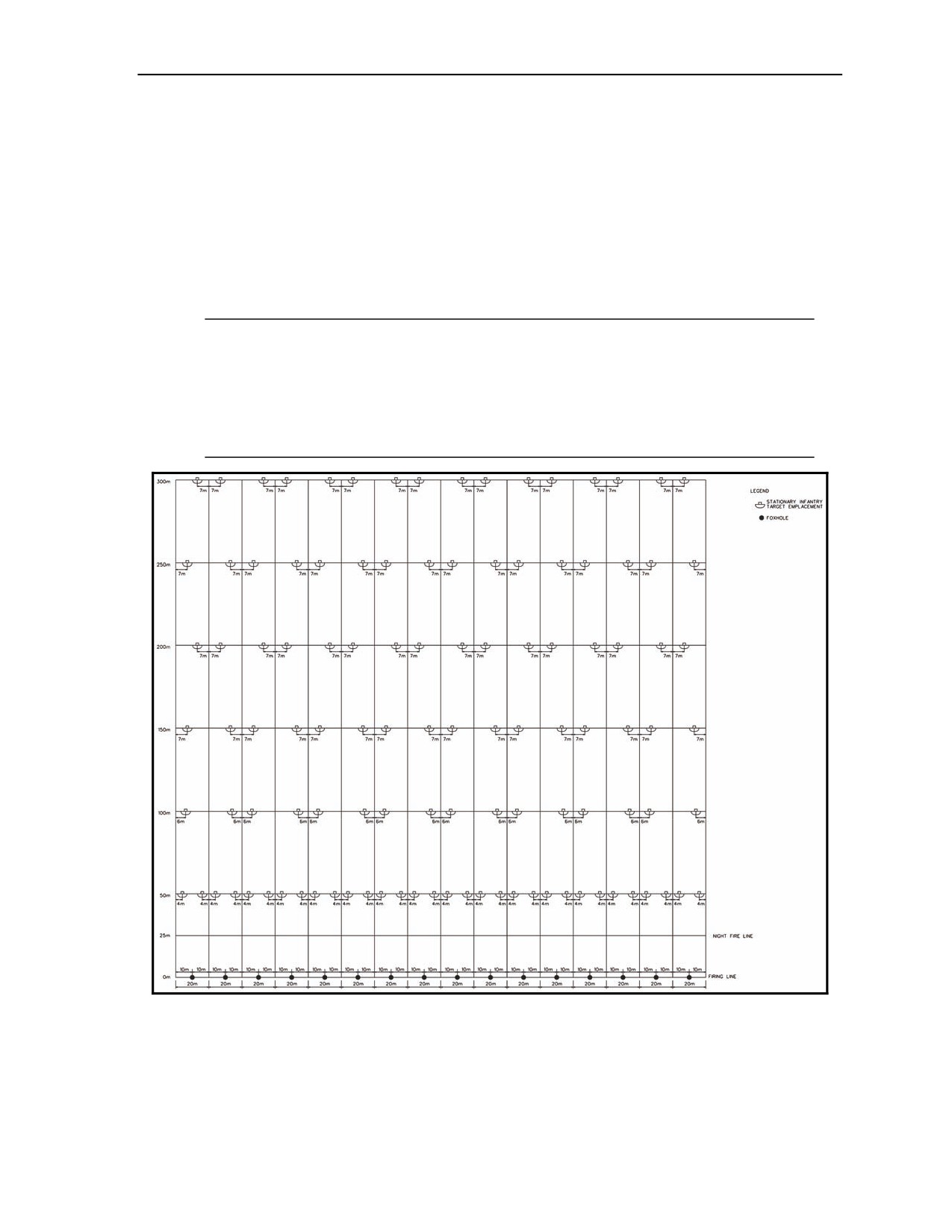
E-52. The ARF range (Figure E-3) is used to train and test individual Soldiers on the skills necessary to
identify, engage, and defeat stationary Infantry targets for day/night qualification requirements with M16-
and M4-series weapons. Its primary features include—
z
112 stationary Infantry targets.
z
16 foxholes.
E-53. All targets are fully automated, and the event-specific target scenario is computer-driven and scored
from the range operations center. The range operating system is fully capable of providing immediate
performance feedback to the participants.
NOTE: 1. To perform night fire, Soldiers fire at 50-meter targets from the night-fire line and
baseline.
2. Range Set-up: Replace one of the
50m F-type silhouettes with an E- type
silhouette. Low light illumination capability is required in both of the 50-meter
target emplacements. Engage the F- type from the 25-meter night-firing line, and
the E- type from the baseline.
Figure E-3. Automated record fire range (17805).
12 August 2008
FM 3-22.9
E-13
Appendix E
Modified Record Fire Range (17806)
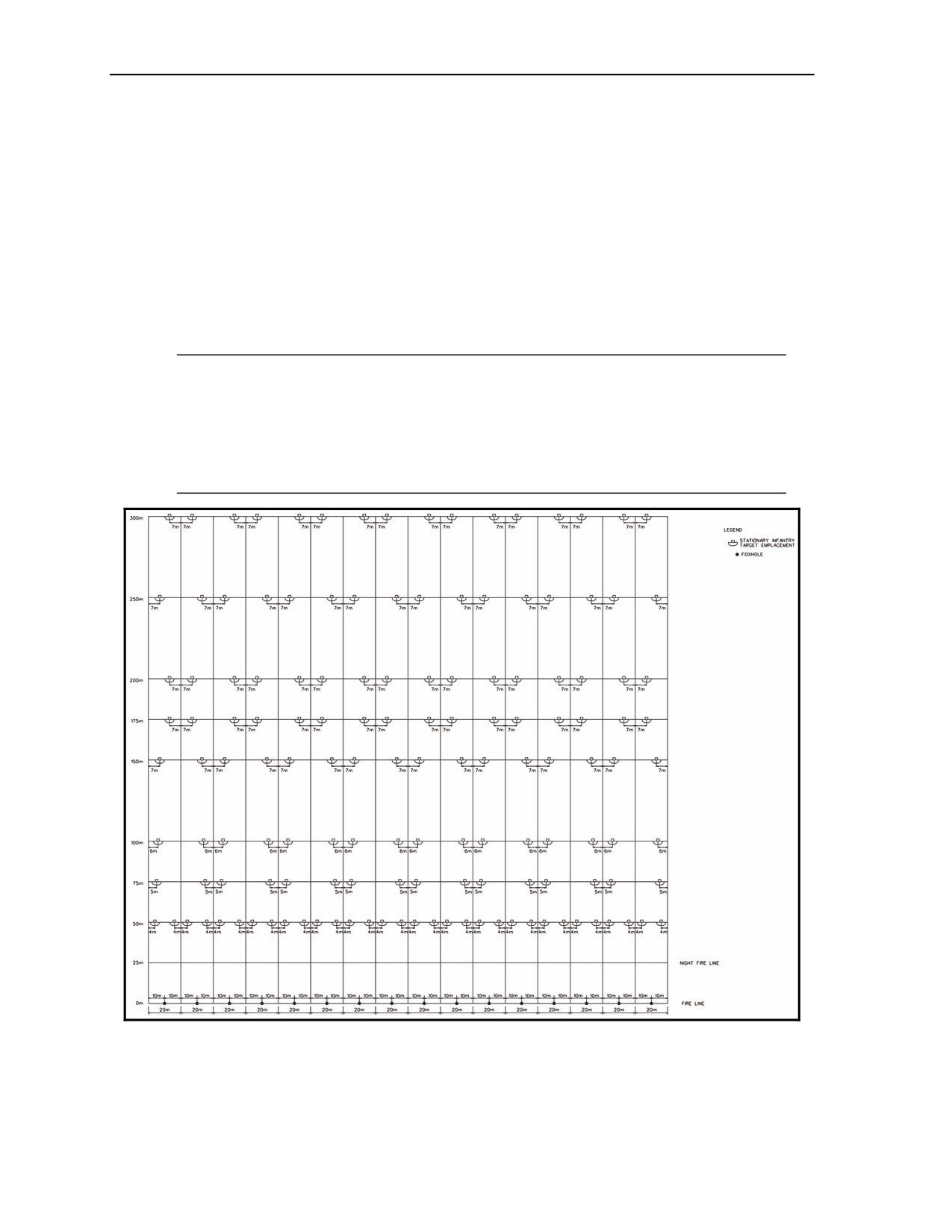
E-54. The modified record fire (MRF) range (Figure E-4) is used to train and test individual Soldiers on the
skills necessary to identify, engage, and defeat stationary Infantry targets for day/night qualification
requirements with M16- and M4-series weapons. This range combines the capabilities of the AFF (17803),
ARF (17805), and automated night fire (17808) ranges to reduce land and maintenance requirements and
increase efficiencies. Its primary features include—
z
144 stationary Infantry targets.
z
16 foxholes
E-55. All targets are fully automated, and the event-specific target scenario is computer-driven and scored
from the range operations center. The range operating system is fully capable of providing immediate
performance feedback to the participants.
NOTE: 1. To perform night fire, Soldiers fire at 50-meter targets from the night-fire line and
baseline.
2. Range Set-up: Replace one of the
50m F-type silhouettes with an E- type
silhouette. Low light illumination capability is required in both of the 50-meter
target emplacements. Engage the F- type from the 25-meter night-firing line, and
the E- type from the baseline.
Figure E-4. Modified record fire range (17806).
E-14
FM 3-22.9
12 August 2008
Range Procedures and Range Operations Checklist
Qualification Training Range (17809)
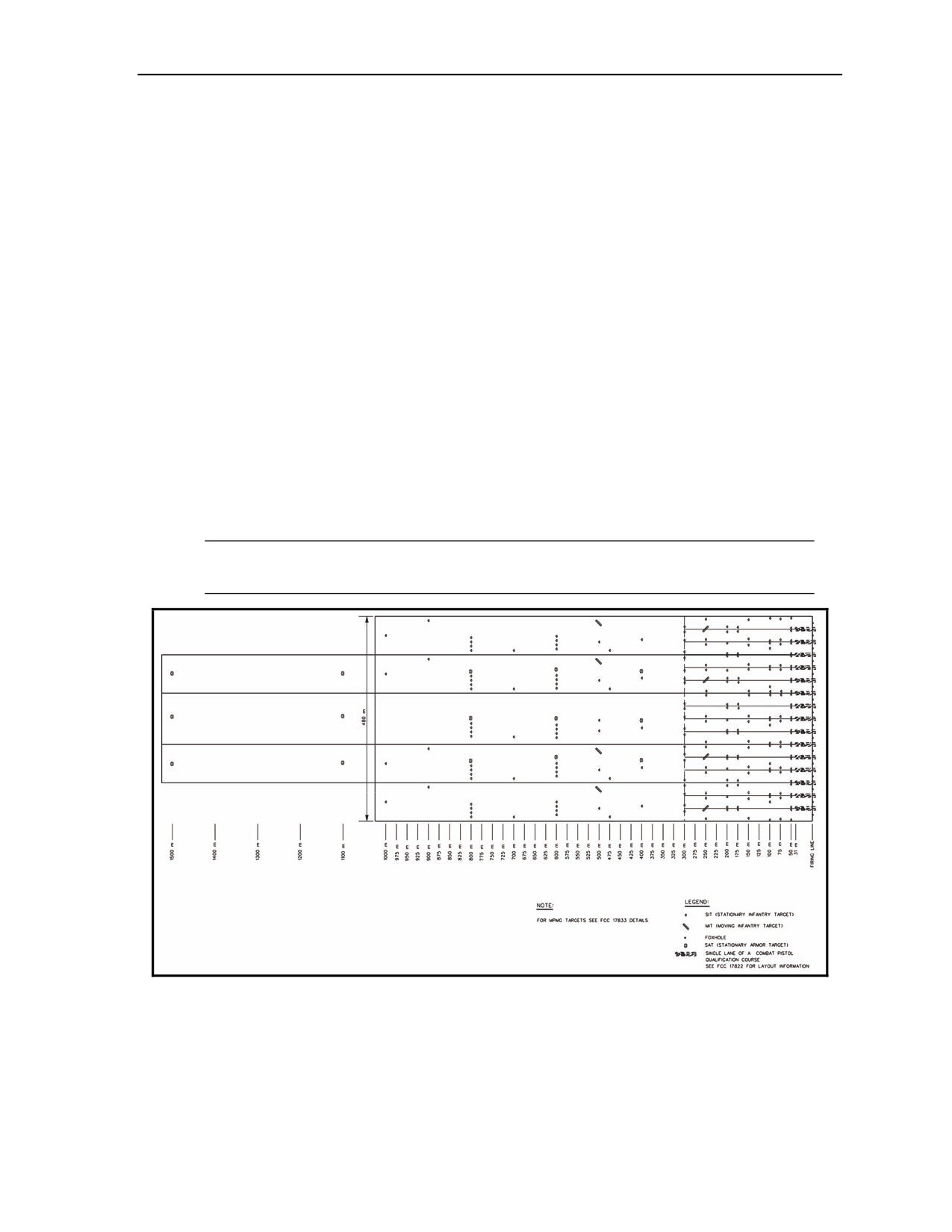
E-56. The qualification training (QTR) range (Figure E-5) is used to train and test Soldiers on the skills
necessary to detect, identify, engage, and defeat stationary and moving Infantry targets in a tactical array
with their prescribed weapons. This range combines the capabilities of the MRF range (17806), automated
sniper field fire range (17812), combat pistol/military police firearms qualification course (17822), and
multipurpose machine gun range (17833) to centralize training and reduce land, maintenance, and unit
overhead requirements. Its primary features include—
z
429 stationary Infantry targets.
z
20 stationary armor targets.
z
20 moving Infantry targets.
z
10 stationary Infantry emplacements.
z
32 lanes rifle/machine gun zero.
z
15 lanes combat pistol qualification.
z
10 lanes sniper field fire.
z
16 lanes modified record fire.
z
10 lanes multipurpose machine gun.
z
2 target mechanisms each (400-meter and 700-meter).
E-57. All targets are fully automated, and the event-specific target scenario is computer-driven and scored
from the range operations center. The range operating system is fully capable of providing immediate
performance feedback to the participants.
NOTE: This range enhances throughput capability for units with multiple weapon densities by
consolidating unit efforts to operate one training facility.
Figure E-5. Qualification training range (17809).
12 August 2008
FM 3-22.9
E-15
This page intentionally left blank.
Appendix F
10-Meter Target Offsets and 25-Meter Zero Offsets
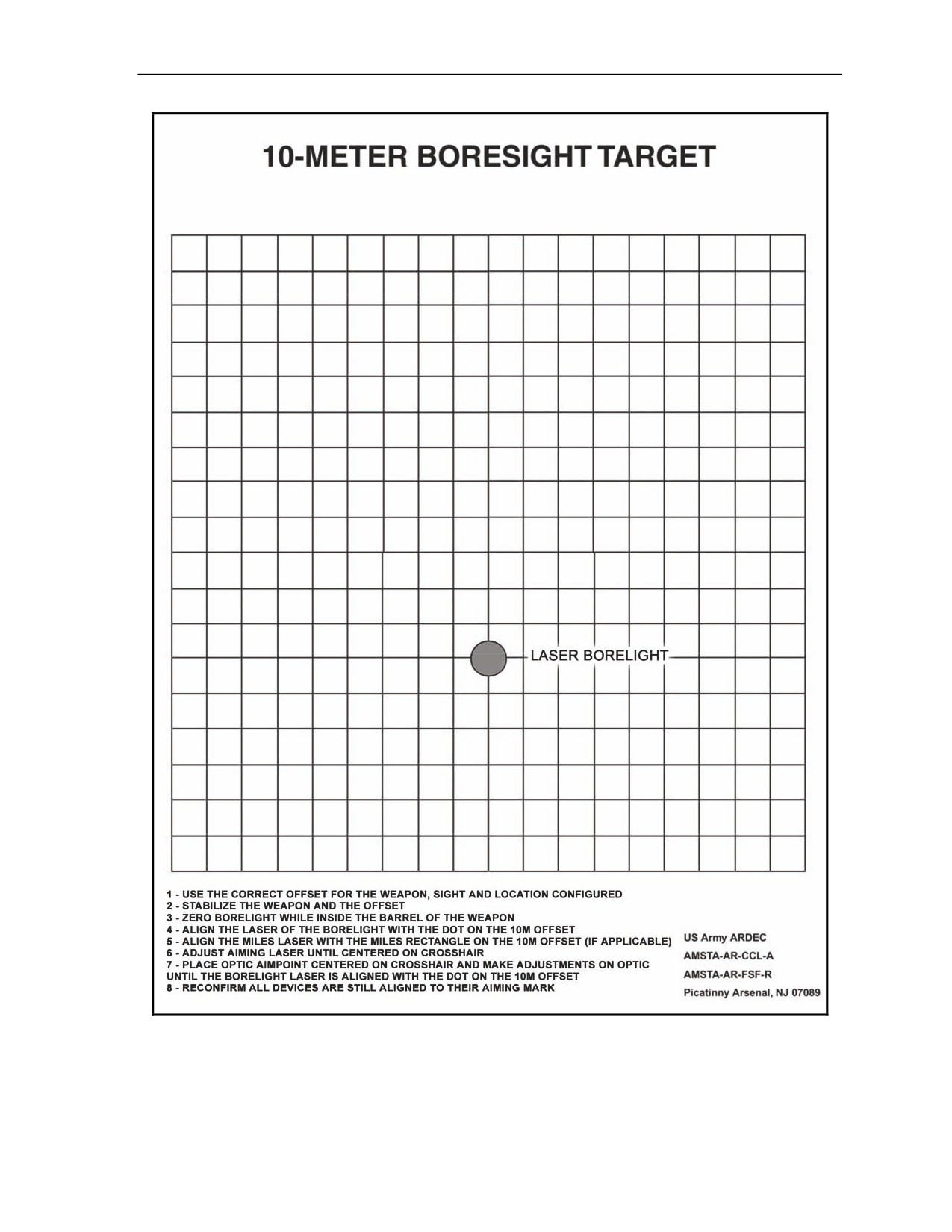
*This section provides the 10-meter target offsets and the 25-meter zero offsets for
M16- and M4-series weapons mounted with iron sights, optics, MILES, or aiming
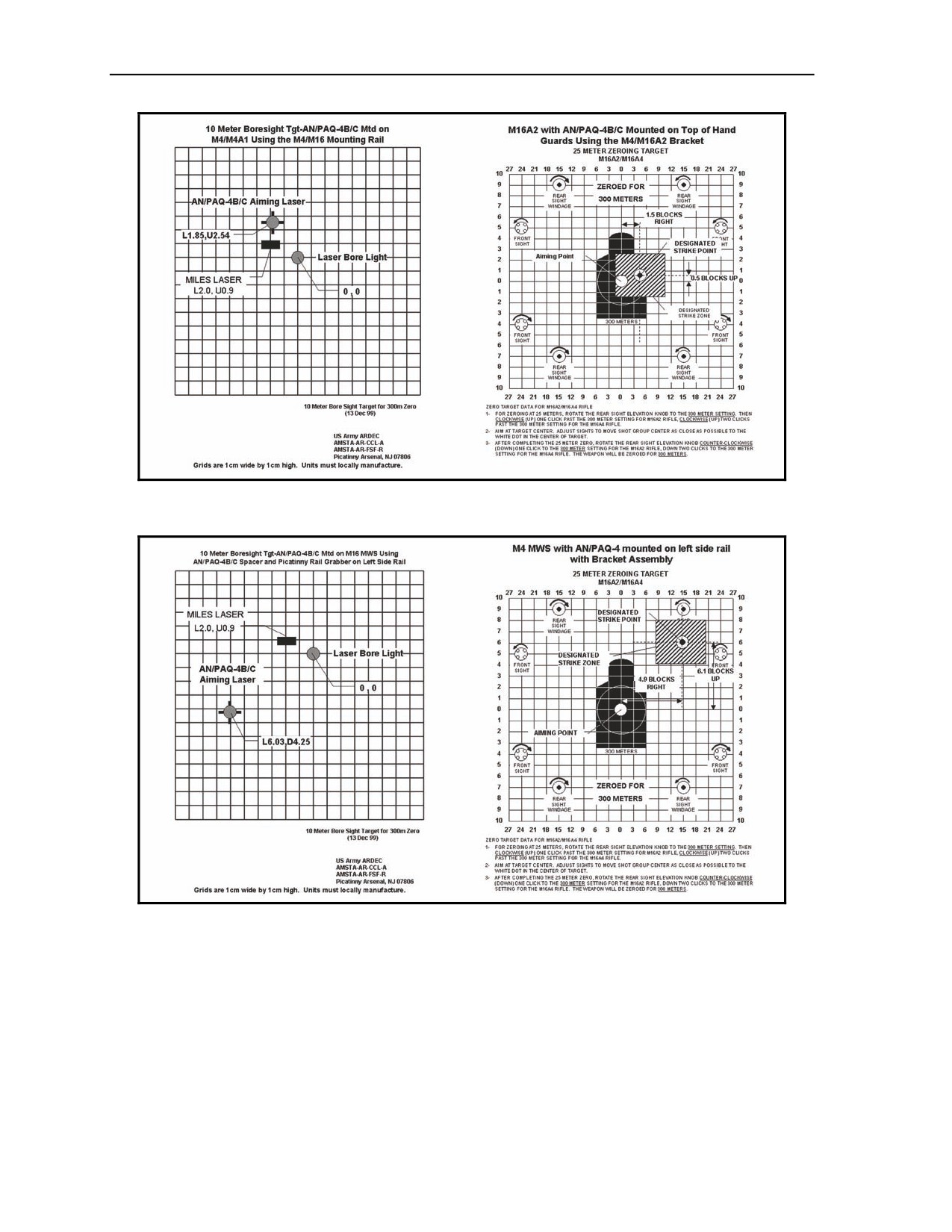
lasers. A blank, reproducible 10-meter target offset (Figure F-2) and an example of
each weapon configuration (Figures F-3 through F-6) are provided. The M16A2
300-meter zeroing target is used for 25-meter zeroing with all weapon configurations,
except when zeroing with iron sights. 200-meter supplemental zero 10- and 25-meter
offsets are also shown in Figures F-7 through F-10.
MARKING 10-METER TARGET OFFSETS
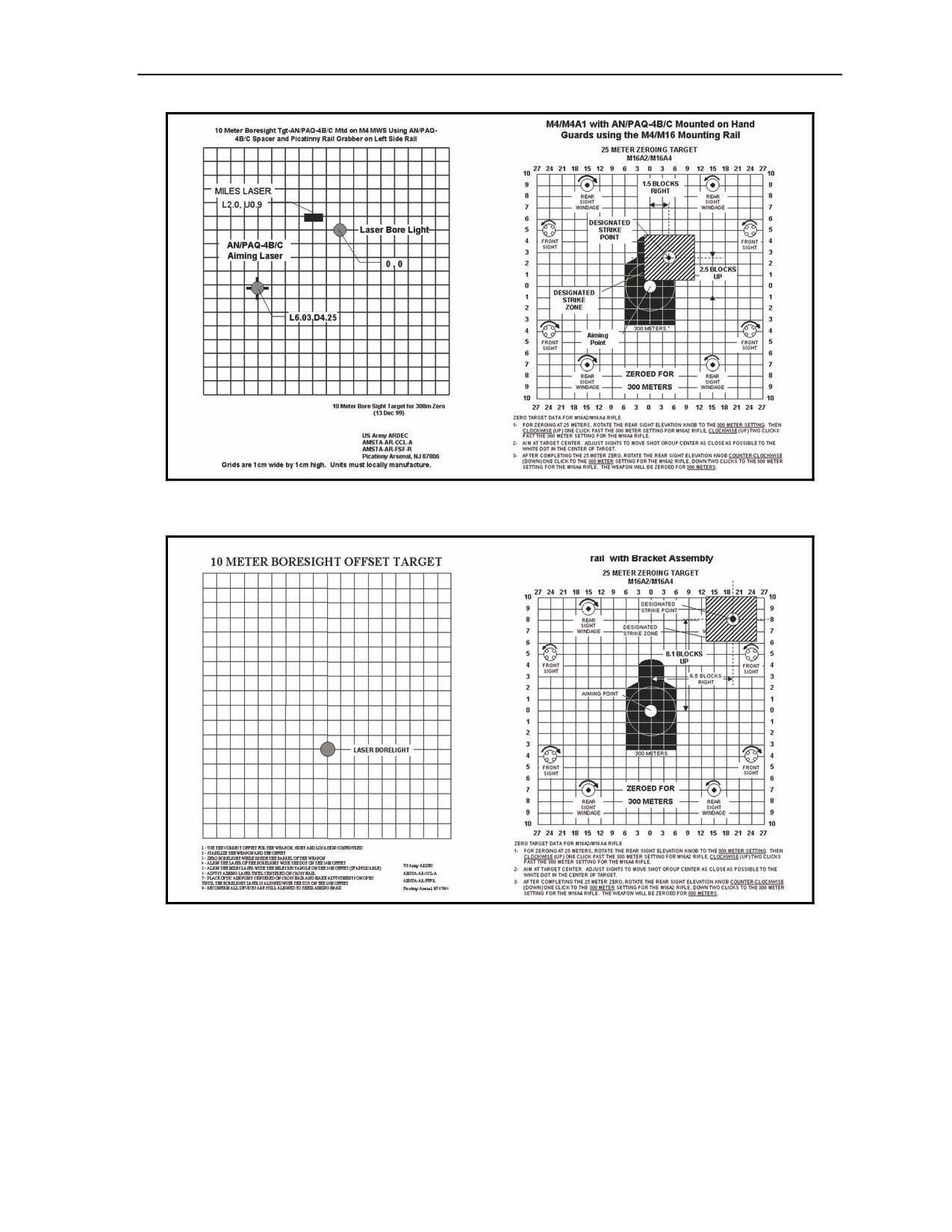
F-1. To mark the proper 10-meter target offsets—
(1) Find the correct template for the weapon configuration.
(2) Starting from the center of the borelight circle on the offset, count the number of squares to the
desired point of aim.
EXAMPLE
L2.0, U2.4
Starting from the center of the borelight circle (0.0, 0.0), move left 2 squares and up
2.4 squares.
NOTE: Each template also provides a number formula for the proper offset.
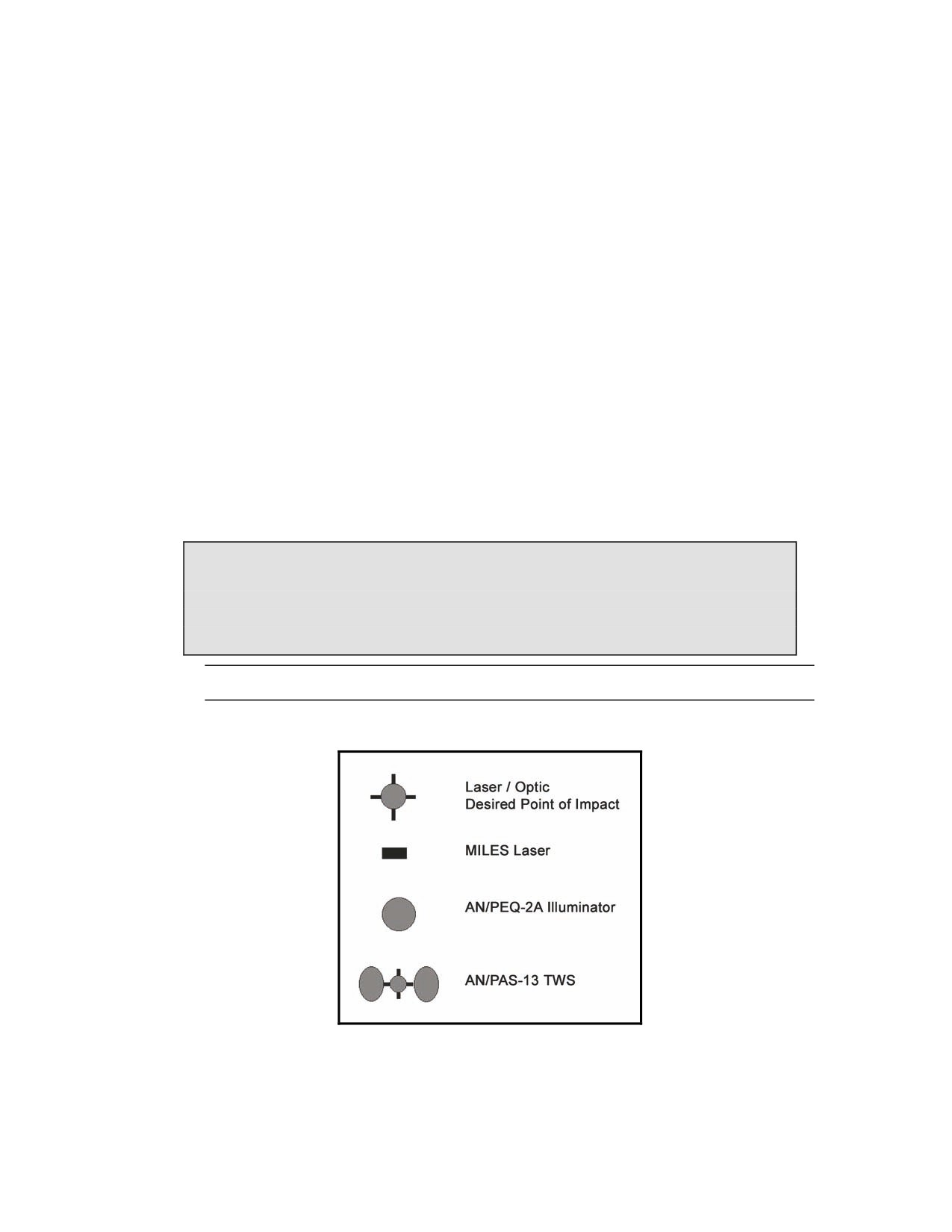
(3) Place the appropriate symbol or mark (Figure F-1).
Figure F-1. 10-meter target offset symbols.
10 February 2011
FM 3-22.9, C1
F-1
Appendix F
MARKING 25-METER ZERO OFFSETS
F-2. To mark the proper 25-meter zero offsets—
(1) Use only a M16A2 300-meter zeroing target.
(2) Find the correct target template for the weapon configuration.
(3) Count the number of squares, starting from the center of the 300-meter zeroing silhouette.
(4) Mark the designated strike point by drawing a small circle at the appropriate number of squares
from the center of the 300-meter zeroing silhouette.
(5) Draw a 4- by 4-centimeter square, keeping the designated strike point at the center.
NOTES:
1. To reproduce the 10-meter target offset, copy the blank 10-meter target offset
and place the example of the weapon being used on the back. This reproducible
copy can be laminated and used repeatedly.
2. Table F-1 provides offset mounting information for various weapon
configurations.
F-2
FM 3-22.9, C1
10 February 2011
10-Meter Target Offsets and 25-Meter Zero Offsets
Figure F-2. Blank 10-meter target offset.
10 February 2011
FM 3-22.9, C1
F-3
Appendix F
Figure F-3. M16A2 10-meter boresighting target/25-meter zeroing target offsets.
Figure F-4. M4 MWS 10-meter boresighting target/25-meter zeroing target offsets.
F-4
FM 3-22.9, C1
10 February 2011
10-Meter Target Offsets and 25-Meter Zero Offsets
Figure F-5. M4/M4A1 10-meter boresighting target/25-meter zeroing target offsets.
Figure F-6. M16A4 MWS 10-meter boresighting target/25-meter zeroing target offsets.
10 February 2011
FM 3-22.9, C1
F-5

Appendix F
Table F-1. Offset mounting.
WEAPON
ACCESSORY
RAIL
MOUNT
LOCATION
RANGE
ZERO
BORESIGHT
MILES
GRABBER
TO
OFFSET
TARGET
OFFSET
ZERO
M16A2
Iron sight
N/A
N/A
N/A
300 m
0.0
0.0
0.0 4.2U
2.0L 0.9U
M68
0.0
1.4
Carrying
M16A2
M68
N/A
gooseneck
300 m
cm DN
0.0 5.2U
2.0L 2.4U
handle
bracket
TWS
Carrying
0.0 10D
0.0 13.4U
2.0L 2.4U
M16A2
LTWS
TWS
bracket
handle
300 m
assembly
TWS
Carrying
0.0 8.1D
0.0 11.5U
2.0L 2.4U
M16A2
TWS
N/A
bracket
handle
300 m
assembly
AN/PVS-4
Carrying
0.0 7.0D
0.0 9.4U
2.0L 0.9U
M16A2
AN/PVS-4
N/A
mounting
handle
300 m
knob
M4/M16
Hand
1.5R
1.85L 2.54U
2.0L 0.9U
M16A2
AN/PAQ-4B/C
N/A
300 m
bracket
guards
0.5U
M4/M16
Hand
1.5L 0.5U
1.8R 2.4U
2.0L 0.9U
M16A2
AN/PEQ-2A/B
N/A
300 m
bracket
guards
Spacer
and
Carrying
1.85R
M16/M203
AN/PAQ-4B/C
N/A
AN/PVS-4
300 m
1.85L 8.6U
2.0L 3.9U
handle
2.6D
mounting
knob
AN/PVS-4
mounting
Carrying
4.2R
M16/M203
AN/PVS-4
N/A
300 m
TBD
2.0L 0.9U
bracket
handle
9.8D
assembly
Upper
0.0
0.0
0.0 4.01U
2.0L 0.9U
M4/M4A1
BUIS
N/A
N/A
300 m
receiver
M4/M16
Hand
1.5R
1.85L 2.54U
2.0L 0.9U
M4/M4A1
AN/PAQ-4B/C
N/A
300 m
bracket
guards
2.5U
Upper
0.0 4.5D
0.0 7.9U
M4/M4A1
LTWS
TWS
N/A
300 m
TBD
receiver
TWS
Upper
0.0 5.7D
0.0 9.4U
2.0L 2.4U
spacer
receiver
M4/M4A1
TWS
Picatinny
300 m
and rail
grabber
M4/M16
Hand
1.0L 0.3U
1.8R 2.4U
2.0L 0.9U
M4/M4A1
AN/PEQ-2A/B
N/A
300 m
bracket
guards
Spacer
Upper
0.0 3.4D
0.0 7.6U
2.0L 0.9U
M4/M4A1
AN/PVS-4
Picatinny
and rail
receiver
300 m
grabber
Half-moon
Upper
0.0
1.4
M4/M4A1
M68
M68
300 m
0.0 5.63U
2.0L 2.4U
spacer
receiver
cm DN
Upper
0.0
0.0
0.0 6.01U
2.0L 0.9U
M4/M203
BUIS
N/A
N/A
300 m
receiver
Spacer
and
Carrying
1.3R
M4/M203
AN/PAQ-4B/C
N/A
AN/PVS-4
300 m
1.85L 8.6U
2.0L 0.9U
handle
1.9D
mounting
knob
Spacer
Upper
0.0 3.4D
0.0 9.6U
2.0L 3.9U
M4/M203
AN/PVS-4
Picatinny
and rail
receiver
300 m
grabber
NOTE: Target offsets not yet developed are indicated by TBD (to be developed).
F-6
FM 3-22.9, C1
10 February 2011

10-Meter Target Offsets and 25-Meter Zero Offsets
*Table F-1. Offset mounting (continued).
WEAPON
ACCESSORY
RAIL
MOUNT
LOCATION
RANGE
ZERO
BORESIGHT
MILES
GRABBER
TO
OFFSET
TARGET
OFFSET
ZERO
Upper
0.0
0.0
0.0 4.01U
2.0L 0.9U
M4 MWS
BUIS
N/A
N/A
300 m
receiver
Spacer
Upper
0.0 3.4D
0.0 7.6U
2.0L 0.9U
M4 MWS
AN/PVS-4
Picatinny
and rail
receiver
300 m
grabber
Rail
Upper
0.0
1.4
M4 MWS
M68
M68
300 m
0.0 5.63U
2.0L 2.4U
grabber
receiver
cm DN
Upper
0.0 4.5D
0.0 7.9U
2.0L 2.4U
M4 MWS
LTWS
TWS
N/A
300 m
receiver
Upper
0.0 5.7D
0.0 9.4U
2.0L 2.4U
M4 MWS
TWS
TWS
Spacer
300 m
receiver
M4 MWS
ANPEQ-2A
Insight
N/A
Left
300 m
TBD
4.5L 1.0D
2.0L 0.9U
M4 MWS
AN/PEQ-2A/B
Insight
N/A
Right
300 m
N/A
5.5R 5.4D
2.0L 0.9U
M4 MWS
AN/PEQ-2A/B
Insight
N/A
Top
300 m
1.5L 0.5D
2.9R 2.3U
2.0L 0.9U
M4 MWS
AN/PEQ-2A/B
Picatinny
Spacer
Top
300 m
N/A
1.95R 4.1U
2.0L 0.9U
M4 MWS
AN/PEQ-2A/B
Picatinny
Spacer
Right
300 m
N/A
6.35R 4.4D
2.0L 0.9U
M4 MWS
AN/PEQ-2A/B
Picatinny
Spacer
Left
300 m
6.9R 2.0U
6.2L 0.60D
2.0L 0.9U
Training
2.0L 1.5D
2.0L 0.9U
M4MWS
AN/PEQ-2A/B
Insight
Top
300 m
N/A
adapter
AN/PAQ-
4.9R 6.1U
1.75L 3.9U
2.0L 0.9U
4B/C
M4 MWS
AN/PAQ-4B/C
Picatinny
Top
300 m
bracket
adapter
AN/PAQ-
4B/C
M4 MWS
AN/PAQ-4B/C
Picatinny
bracket
Right
300 m
N/A
6.9R 0.9D
2.0L 0.9U
adapter
(spacer)
M4 MWS
AN/PAQ-4B/C
Insight
N/A
Top
300 m
N/A
1.75L 2.15U
2.0L 0.9U
M4MWS
AN/PAQ-4B/C
Insight
N/A
Right
300 m
N/A
4.35R 0.65D
2.0L 0.9U
M4MWS
AN/PAQ-4B/C
Insight
N/A
Left
300 m
N/A
4.30L 4.25D
2.0L 0.9U
M4 MWS
Upper
0.0
0.0
0.0 6.01U
2.0L 0.9U
BUIS
N/A
N/A
300 m
M203
receiver
M4 MWS
Bracket
4.9R 6.1U
6.0L 4.0D
2.0L 3.9U
M203
AN/PAQ-4B/C
Picatinny
adapter
Left
300 m
(spacer
M4 MWS
Upper
0.0 3.4D
0.0 9.6U
2.0L 3.9U
AN/PVS-4
Picatinny
Spacer
300 m
M203
receiver
M16A4
Upper
0.0
0.0
0.0 4.01U
2.0L 0.9U
BUIS
N/A
N/A
300 m
MWS
receiver
AN/PAQ-
4B/C
M16A4
AN/PAQ-4B/C
Picatinny
bracket
Left
300 m
6.5R 8.1U
6.03L 4.25D
2.0L 0.9U
MWS
adapter
(spacer)
M16A4
Upper
0.0 6.0D
0.0 9.4U
2.0L 2.4U
TWS
TWs
Spacer
300 m
MWS
receiver
M16A4
Upper
0.0
1.4
0.0 5.63U
2.0L 2.4U
M68
M68
N/A
300 m
MWS
receiver
cm DN
M16A4
3.0R 3.0U
4.5L 1.0D
2.0L 0.9U
AN/PEQ-2A/B
Insight
N/A
Left
300 m
MWS
M16A4
Upper
0.0 4.6D
0.0 7.6U
2.0L 0.9U
AN/PVS-4
Picatinny
Spacer
300 m
MWS
receiver
NOTE: Target offsets not yet developed are indicated by TBD (to be developed).
10 February 2011
FM 3-22.9, C1
F-7

Appendix F
Table F-1. Offset mounting (continued).
WEAPON
ACCESSORY
RAIL
MOUNT
LOCATION
RANGE
ZERO
BORESIGHT
MILES
GRABBER
TO
OFFSET
TARGET
OFFSET
ZERO
M16A4
Upper
0.0
0.0
0.0 6.01U
2.0L 0.9U
MWS
BUIS
N/A
N/A
receiver
300 m
M203
AN/PAQ-
M16A4
4B/C
MWS
AN/PAQ-4B/C
Picatinny
bracket
Left
300 m
6.5R 8.1U
6.0L 4.0D
2.0L 3.9U
M203
adapter
(spacer
M16A4
Upper
0.0 4.6D
0.0 9.6U
2.0L 3.9U
MWS
AN/PVS-4
Picatinny
Spacer
receiver
300 m
M203
M16A4
Spacer
6.0R 2.0U
6.2L 0.60D
2.0L 0.9U
AN/PEQ-2A/B
Picatinny
Left
300 m
MWS
M16A4
Spacer
6.35R 4.4D
2.0L 0.9U
AN/PEQ-2A/B
Picatinny
Right
300 m
TBD
MWS
M16A4
Spacer
1.95R 4.1U
2.0L 0.9U
AN/PEQ-2A/B
Picatinny
Top
300 m
TBD
MWS
M16A4
5.5R 5.4 D
2.0L 0.9U
AN/PEQ-2A/B
Insight
N/A
Right
300 m
TBD
MWS
M16A4
1.5L 0.5D
2.0R 2.3U
2.0L 0.9U
AN/PEQ-2A/B
Insight
N/A
Top
300 m
MWS
M16A4
Training
2.0L 1.5D
2.0L 0.9D
AN/PEQ-2A/B
Insight
Top
300 m
TBD
MWS
adapter
AN/PAQ-
4.9R 6.1U
1.75L 3.9U
2.0L 0.9U
M16A4
4B/C
AN/PAQ-4B/C
Picatinny
Top
300 m
MWS
bracket
adapter
AN/PAC-
6.0R 0.9D
2.0L 0.9U
M16A4
4B/C
AN/PAQ-4B/C
Picatinny
Right
300 m
N/A
MWS
bracket
adapter
M16A4
1.75L 2.15U
2.0L 0.9U
AN/PAQ-4B/C
Insight
N/A
Top
300 m
N/A
MWS
M16A4
4.35R 0.65D
2.0L 0.9U
AN/PAQ-4B/C
Insight
N/A
Right
300 m
N/A
MWS
M16A4
4.30L 4.25D
2.0L 0.9U
AN/PAQ-4B/C
Insight
N/A
Left
300 m
N/A
MWS
NOTE: Target offsets not yet developed are indicated by TBD (to be developed).
F-8
FM 3-22.9, C1
10 February 2011
10-Meter Target Offsets and 25-Meter Zero Offsets
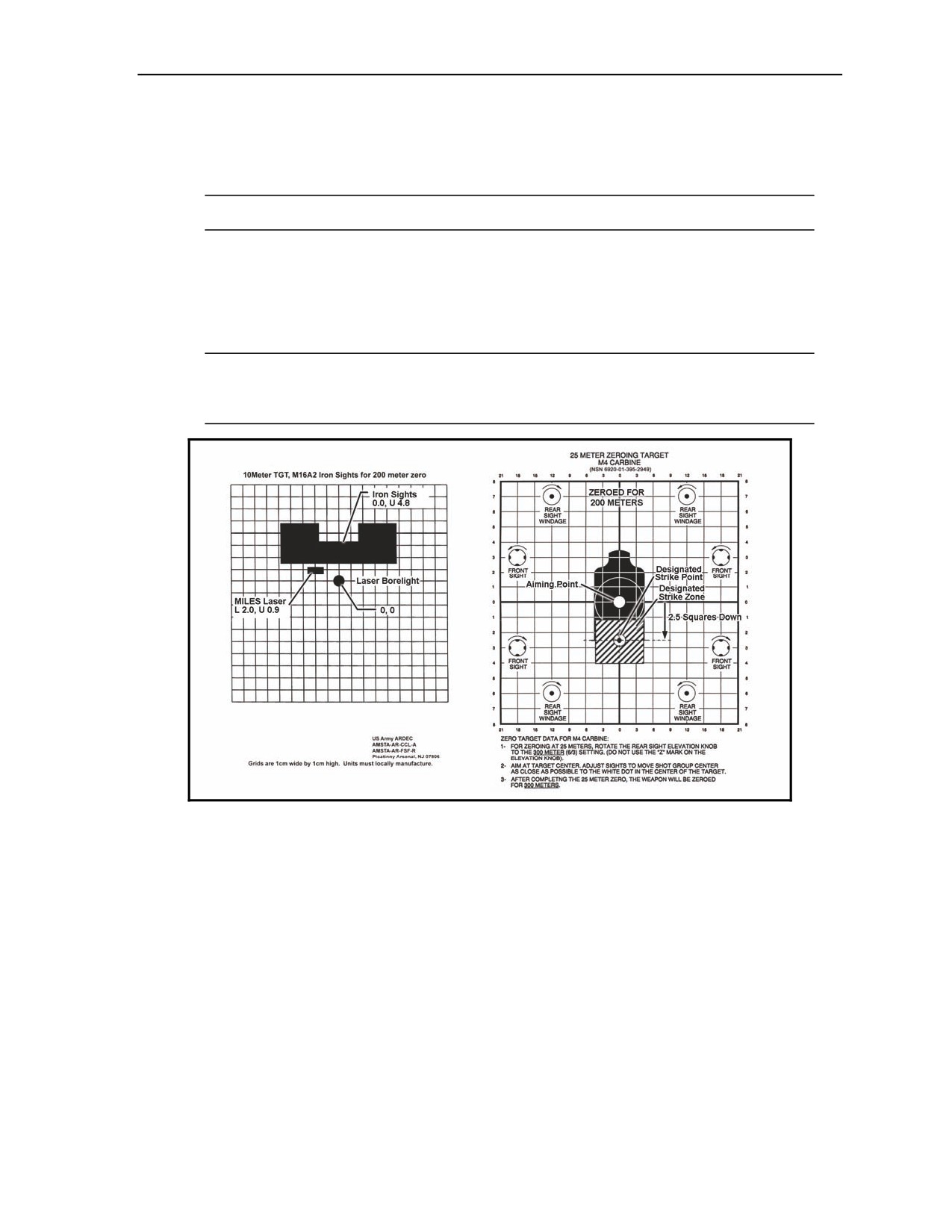
*MARKING 25-METER ZERO OFFSETS FOR 200 METERS
F-3. To mark the proper 25-meter zero offsets for 200 meters (Figures F-7 through F-10)—
(1) Use an M16A2 300-meter zeroing target.
NOTE: If zeroing iron sights, use the target appropriate to the weapon being zeroed.
(2) Find the correct target template for the weapon configuration.
(3) Count the number of squares, starting from the center of the 300-meter zeroing silhouette.
(4) Mark the designated strike point by drawing a small circle at the appropriate number of squares
from the center of the 300-meter zeroing silhouette.
(5) Draw a 4- by 4-centimeter square, keeping the designated strike point at the center.
NOTE: For zeroing at 25 meters with the BUIS (Figure F-7), place the elevation knob on the
200-meter setting. The point of impact for the rounds will be a 4- by 4-centimeter square, with
the center of the square 2.5 centimeters down from the target’s center of mass.
*Figure F-7. 200-meter zero of the back-up iron sights for M4 carbine.
10 February 2011
FM 3-22.9, C1
F-9
Appendix F
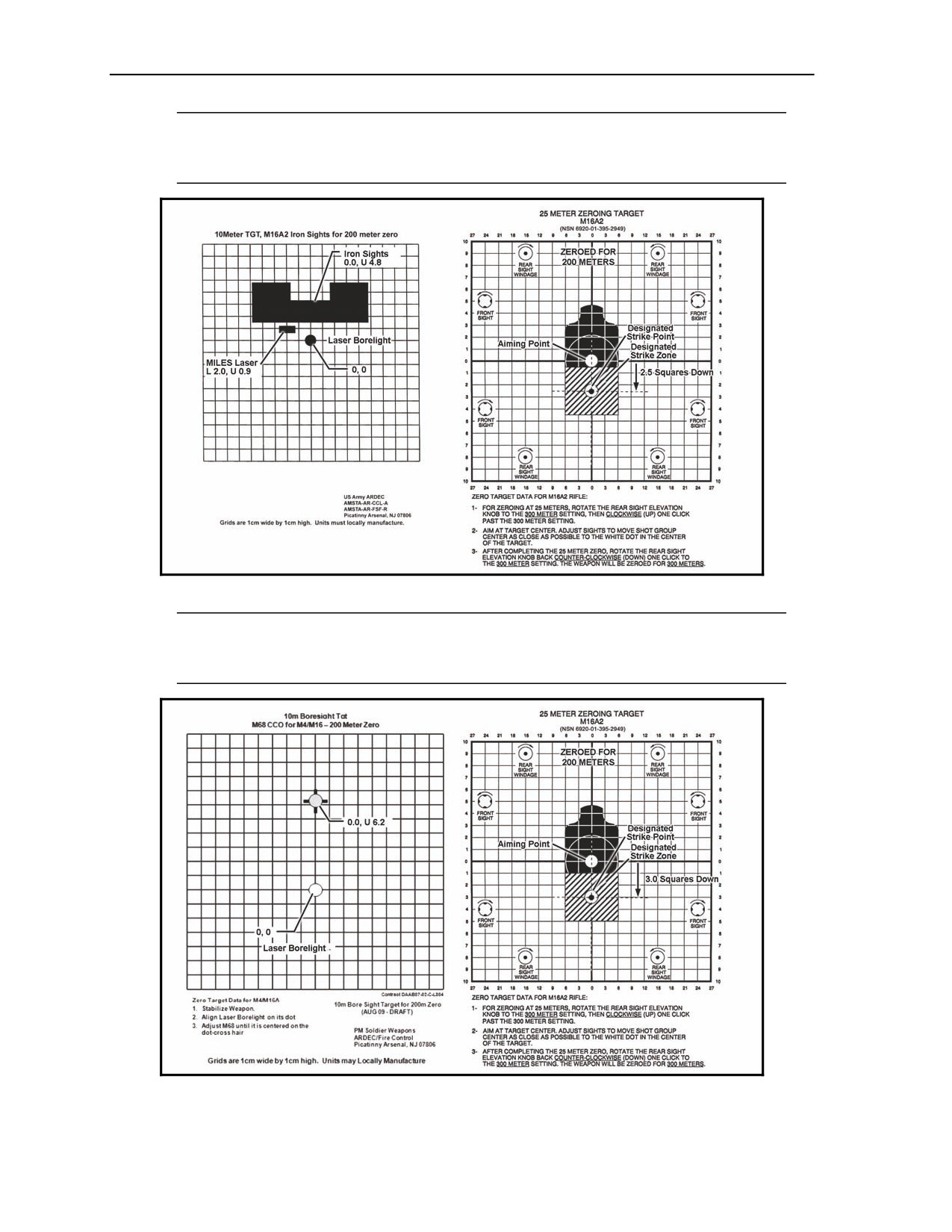
NOTE: For zeroing at 25 meters with the BUIS (Figure F-8), place the elevation knob on the
200-meter setting. The point of impact for the rounds will be a 4- by 4-centimeter square, with the
center of the square 2.5 centimeters down from the target’s center of mass.
*Figure F-8. 200-meter zero of the back-up iron sights for M16-series weapons.
NOTE: For zeroing at 25 meters with the CCO (Figure F-9), place the dot at the target’s center
of mass. The point of impact for the rounds will be a 4- by 4-centimeter square, with the center
of the square three centimeters down from the target’s center of mass.
*Figure F-9. 200-meter zero of the close combat optic for M16-series weapons.
F-10
FM 3-22.9, C1
10 February 2011
10-Meter Target Offsets and 25-Meter Zero Offsets
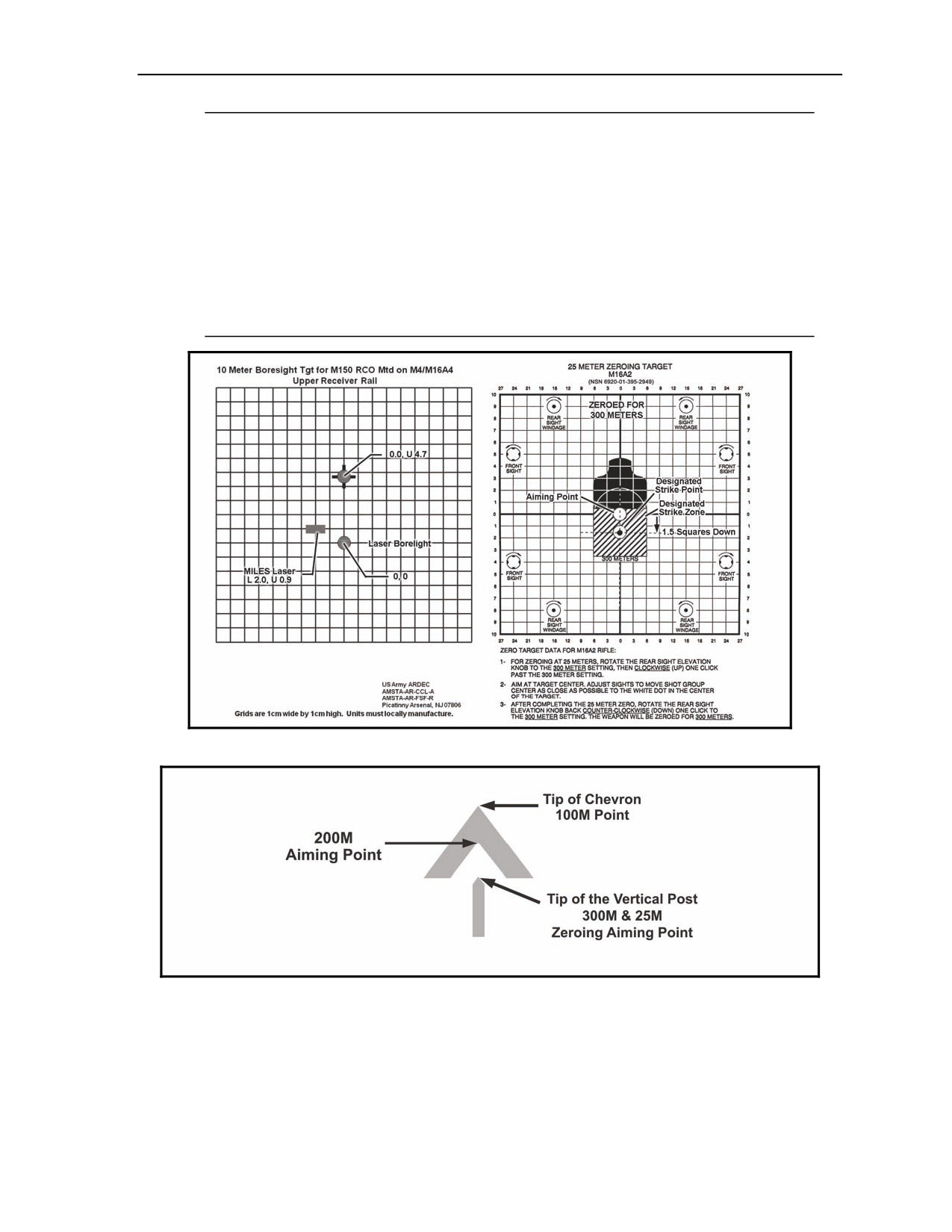
NOTES: 1. When zeroing the ACOG (Figure F-10), a 100-meter true zero is preferred. When
engaging targets at 200 meters with the ACOG, use the 200-meter aiming point tip
(tip at the inside of the chevron), if time allows (Figure F-11).
2. For the ACOG 25-meter zero, Soldiers should use the 300-meter point of aim (tip
of the
300-meter post at the target’s center of mass) and point of impact
(a 4- by 4-centimeter square drawn 1.5 centimeters down from the target’s center
of mass).
3. The 10-meter boresight offset shown in Figure F-10 is for use with the M150 rifle
combat optic. Soldiers equipped with earlier versions of the ACOG should use the
M68 CCO 10-meter boresight offset for 300 meters.
*Figure F-10. 300-meter zero of the advanced combat optical gunsight.
*Figure F-11. Advanced combat optical gunsight points of aim (100 to 300 meters).
10 February 2011
FM 3-22.9, C1
F-11
This page intentionally left blank.
Glossary
SECTION I - ACRONYMS AND ABBREVIATIONS
AAR
after-action review
ACH
Army combat helmet
ACOG
advanced combat optical gunsight
AFF
automated field fire
AMU
Army Marksmanship Unit
AP
armor-piercing
AR
Army regulation
ARF
automated record fire
ARM
advanced rifle marksmanship
ARS
adapter rail system
ATC
Army training center
ATPIAL
advanced target pointer/illuminator aiming light
BDC
bullet drop compensated
BFA
blank firing attachment
BOLC
Basic Officer Leaders Course
BRM
basic rifle marksmanship
BUIS
backup iron sight
CBRN
chemical, biological, radiological, and nuclear
CCO
close combat optic
COA
course of action
cm
centimeter or centimeters
CRM
composite risk management
DA Pam
Department of the Army pamphlet
EST
Engagement Skills Trainer
FM
field manual
FOV
field of view
fps
feet per second
ft
foot or feet
HWTS
heavy weapon thermal sight
I2
image-intensifier
IBA
interceptor body armor
IET
initial entry training
in
inch or inches
IR
infrared
KD
known distance
lb
pound or pounds
LBE
load-bearing equipment
LFX
live-fire exercise
LMTS
Laser Marksmanship Training System
LOGCAP
Logistics Civil Augmentation Program
LOMAH
location of misses and hits
12 August 2008
FM 3-22.9
Glossary-1
Glossary
LWTS
light weapon thermal sight
m
meter or meters
MDMP
military decision-making process
METL
mission-essential task list
METT-TC
mission, enemy, terrain and weather, troops and support available, time available, civil
considerations
min
minute or minutes
mm
millimeter or millimeters
MOA
minute of angle
MOPP
mission-oriented protective posture
mph
miles per hour
MRF
modified record fire
MWS
modular weapon system
NCOES
Noncommissioned Officers Education System
NCOIC
noncommissioned officer in charge
NFOV
narrow field of view
NGO
nongovernmental organizations
NOD
night observation devices
NSN
national stock number
NVD
night vision device
OIC
officer in charge
OSUT
one-station unit training
OTV
outer tactical vest
PASGT
personnel armor system for ground troops
PH
probability of hit
PMCS
preventive maintenance checks and services
PMI
preliminary marksmanship instruction
POI
program of instruction
QTR
qualification training
RETS
Remote Electronic Target System
RFA
rimfire adapter
RSO
range safety officer
RTO
radio telephone operator
SAPI
small arms protective insert
SAW
squad automatic weapon
SDM
squad designated marksman
SDZ
surface danger zone
sec
second or seconds
SRC
short-range combat
SRM
short-range marksmanship
SRT
special reaction team
SRTA
short-range training ammunition
STRAC
Standards in Training Commission (DA Pam 350-38)
STX
situation training exercise
TADSS
training aids, devices, simulators, and simulations
TC
training circular
TSC
training support centers
TM
technical manual
Glossary-2
FM 3-22.9
12 August 2008
Glossary
TPIAL
target pointer illuminator/aiming light
TWS
thermal weapon sight
UO
urban operations
USACRC
United States Army Combat Readiness Center
WFF
warfighting functions
WFOV
wide field of view
SECTION II - TERMS
Active Army: All Regular Army (RA) forces in the Active Army.
adjusted aiming point: An aiming point that allows for gravity, wind, target movement, zero changes, and
MOPP firing.
advanced marksmanship: Normally refers to marksmanship skills taught during ARM.
advanced rifle marksmanship: Normally refers to the formal marksmanship instruction received by
infantrymen upon completion of BRM during OSUT.
aiming: A marksmanship fundamental; refers to the precise alignment of the rifle sights with the target.
aiming card: The M15A1 aiming card is a cardboard sleeve with a moveable insert. The rear sight aperture,
front sight post, and target are pictured. This training device is used in conjunction with aiming instructions.
aiming point: A place on a target in which the rifle sights are aligned normally the target center of mass.
alibi target: A target or additional target a soldier is allowed to engage during qualification firing when unable
to complete a record fire scenario due to circumstances beyond his control; for example, a target mechanism,
weapon, or ammunition malfunction.
alternate course: Alternatives to standard qualification courses.
ammunition lot: A quantity of cartridges, each of which is made by one manufacturer under uniform
conditions and is expected to work in a uniform manner.
ammunition lot number: Code number that identifies a particular quantity of ammunition from one
manufacturer.
aperture: The hole in the rear sight.
armorer: One who services and makes repairs on small arms and performs similar duties to keep small arms
ready for use.
Army Training and Evaluation Program: A guide for the training and evaluation of critical unit combat
missions - crew/squad through battalion/task force echelon.
Army Training Center: Conducts OSUT and BRM. Locations are Fort Benning, GA; Fort Jackson, SC; Fort
Knox, KY.
artificial illumination: Any light from a man-made source.
assault course: An area of ground used for training soldiers in attacking an enemy in close combat.
12 August 2008
FM 3-22.9
Glossary-3
Glossary
automatic fire: A firing mode that causes the weapon to continue firing as long as the trigger is held or until all
ammunition has been expended.
ball: The projectile; the bullet.
ball ammunition: General-purpose standard service ammunition with a solid core bullet.
ball and dummy: An exercise that substitutes a dummy round for a live round without the firer knowing it. An
excellent exercise for identifying and correcting trigger jerks.
ballistics: A science that deals with the motion and flight characteristics of projectiles.
barrel erosion: Wearing away of the surface of the bore due to the combined effects of gas washing, coring,
and mechanical abrasion.
basic marksmanship: Fundamental marksmanship skills taught in BRM during IET and OSUT.
basic rifle marksmanship: The formal course of marksmanship instruction received by all soldiers.
battlesight zero: A sight setting that soldiers keep on their weapons. It provides the highest probability of
hitting most high-priority combat targets with minimum adjustment to the aiming point, a 250 meter sight
setting as on the M16A1 rifle, and a 300 meter sight setting as on the M16A2 rifle.
blank ammunition: A complete cartridge without the bullet used to simulate weapon firing.
blank firing adapter: A device that fits in the muzzle of the rifle; used only with blank ammunition.
brass: An alloy of copper and zinc used to make cartridge cases and bullet jackets. Also, a common name for
expended cases.
breath control: The third marksmanship fundamental; refers to the control of breathing to help keep the rifle
steady during firing.
bullet: The projectile or ball; the part that goes downrange. It may also be used to refer to the complete
cartridge.
bull’s-eye target: Any target with a round black circle and scoring rings. Normally used in competitive
marksmanship training.
buttplate: Metal or rubber covering of the end of the stock on the rifle.
cadre coach: A trainer with expertise and knowledge exceeding that of the firer.
caliber: Diameter of the bore; for example, the M16-series rifle bore is 5.56mm (.223 inch).
cartridge: A complete round of ammunition.
center of mass: A point that is horizontally (left and right) and vertically (up and down) at the center of the
target.
chambering: The step in the cycle of operation that refers too fully seating the round in the chamber of the
rifle.
chamber plug: A range safety device that is a small plastic plug designed to fit into the chamber of the M16. A
handle extends out the ejection port so safety personnel can see at a glance that the rifle is clear of ammunition.
Glossary-4
FM 3-22.9
12 August 2008
Glossary
clock method: Method of calling shots by referring to the figures on an ordinary clock dial assumed to have the
target at its center. Also a method of determining the strength and direction of wind.
coach: Any individual who assists firers on the firing line.
coach-and-pupil method: Method of training in which pairs of pupils take turns practicing a procedure
explained by the instructor/trainer.
cocking: The step in the cycle of operation that refers to the rearward movement of the bolt riding over the
hammer, resetting the weapon for subsequent firing.
collective firing proficiency: Units delivering effective fire in a tactical setting. It requires individual skill plus
command and control to engage all targets within an assigned sector.
concurrent training: Training that occurs at the same time that other unit members are using the primary
training facilities.
cookoff: A round that fires as a result of a hot chamber without the trigger being pulled. It can occur any time
until the weapon is cooled.
crack and thump: A method to determine the general direction and distance to an enemy firer who is shooting
at you.
cradle: A vise-like mechanism that holds a weapon in a secure position for test firing.
cross dominance: A soldier with a dominant hand and a dominant eye that are not the same; for example, a
right-hander firer with a dominant left eye.
cycle of operation: The eight steps involved in firing a round of ammunition: feeding, chambering, locking,
firing, unlocking, extracting, ejecting, and cocking.
cyclic rate of fire: The maximum rate at which a weapon will fire in the automatic mode.
dime-washer exercise: A dry-fire exercise used to practice trigger squeeze.
downrange feedback: Used to describe any training technique that provides precise knowledge of bullet strike
(whether hit or miss).
dry fire: A technique used to simulate the firing of a live round with an empty weapon. Any application of the
fundamentals of marksmanship without live ammunition may be referred to as dry fire.
dry-fire moving target trainer: A small-motorized scaled target device used to teach the engagement of
moving personnel targets.
dummy ammunition: A cartridge without a primer or powder. Primarily used for ball-and-dummy exercises on
the live-fire line.
effective wind: The average of all the varying winds encountered.
ejection: The step in the cycle of operation that removes the expended cartridge from the weapon out of the
ejection port.
elevation adjustment: Rotating the front sight post to cause the bullet to strike higher or lower on the target.
expert: The highest qualification rating.
12 August 2008
FM 3-22.9
Glossary-5
Glossary
external ballistics: What happens to the bullet between the time it leaves the rifle and the time it arrives at the
target.
extraction: The step in the cycle of operation that pulls the round from the chamber.
eye relief: The distance from the firing eye to the rear sight. Eye relief is a function of stock weld.
feedback: Obtaining knowledge of performance.
feedback target: Targets designed for use at 75, 175, or 300 meters; includes an overprinted grid similar to a
zero target.
feeding: The step in the cycle of operation that is the forward movement of the bolt, stripping the top round
from the magazine and moving it toward the chamber.
field firing: Training on the standard field firing range with target banks at 75, 175, and 300 meters.
firing: The step in the cycle of operation that refers to pulling the trigger, releasing the hammer to strike the
firing pin, which strikes the primer. The primer ignites and, in turn, ignites the powder charge within the
cartridge case.
firing hand: The right hand of a right-handed firer. The left hand of a left-handed firer.
firing pin: Plunger in the bolt of a rifle that strikes the primer.
fleeting target: A moving target remains within observing or firing distance for such a short period that it
affords little time for deliberate adjustment and fire against it.
functioning: (See cycle of operation.)
fundamentals of rifle marksmanship: The four essential elements needed to hit targets: steady position,
aiming, breath control, and trigger squeeze.
gravity: The natural pull of all objects to the center of the earth.
grouping: A live-fire exercise with the objective of shooting tight shoot groups.
gun bore line: A reference line established by the linear extension of the bore axis of a gun.
headspace: The distance between the face of the bolt(fully closed) and the face of a fully chambered cartridge.
hold-off: (See adjusted aiming point.)
horizontal dispersion: The left-to-right displacement of bullets on a target.
immediate action: procedures applied to rapidly reduce any rifle stoppage without determining its cause.
individual firing proficiency: Individual firing skills; for example, an individual’s performance on the record
fire course.
Infantry Remoted Target System (IRETS): (See RETS.)
infrared aiming light: A unique night sighting system that uses infrared light to assist in the aiming process.
initial entry training: Indicates the first training received by a new soldier, includes the MOS-producing
portion of his training such a one-station unit training (OSUT).
Glossary-6
FM 3-22.9
12 August 2008
Glossary
initial pressure: The applications of about half of the total trigger pressure it takes to fire a rifle.
instructor-trainer ratio: The number of soldiers for which each instructor/trainer is responsible.
internal ballistics: What happens to the bullet before it leaves the muzzle of the rifle.
known distance: Describes the older range complexes with large target frames behind a large berm and firing
lines at 100 yards or 100-meter increments. (See FM 25-7.)
laser: Light amplification by simulated emission of radiation.
lead: Distance ahead of a moving target that a rifle must be aimed to hit the target.
lead rule: Provides the soldier guidance on how to adjust his aiming point to hit moving targets.
line of sight: A line between the rifle and the aiming point, extending from the firing eye through the center of
the rear aperture, across the tip of the front sight post, and onto the target.
location of misses and hits : A projectile location system that provides immediate and precise information to
the firer concerning bullet strike (hit or miss).
locking: The step in the cycle of operation that is a counterclockwise rotation of the bolt, securing it into the
barrel locking lugs.
long-range sight: The aperture marked L on the M16A1 rifle equipped with standard sights; provides for a zero
at 375 meters. The M16A1 rifle equipped with LLLSS has an aperture marked L, but it is a regular sight.
Low-Light Level Sight System (LLLSS): A sighting system for low visibility firing that replaces the standard
front and rear sights on the M16A1 rifle.
marksman: The designation given to the lowest qualification rating.
maximum effective range: The greatest distance at which a soldier may be expected to deliver a target hit.
maximum effective rate of fire: The highest rates of fire that can be maintained and still achieve target hits.
maximum range: The longest distance a projectile will travel when fired from a weapon held at the optimum
angle.
minute of angle: A angle that would cover 1 inch at a distance of 100 yards, 2 inches at 200 yards, and so on.
Each click of sight adjustment on the M16A1 rifle with standard sights is equal to one minute of angle.
Multiple Integrated Laser Engagement System (MILES): A tactile shooting device that uses a low-powered
laser to activate detectors placed on people and vehicles.
muzzle velocity: The speed of a projectile as it leaves the muzzle of the weapon.
natural point of aim: The direction of the body/rifle combination is oriented while in a stable, relaxed firing
position.
natural respiratory pause: The temporary cessation of breathing between an exhale and inhale.
night firing: Firing performed under all conditions of limited visibility.
nonfiring hand: The opposite of the firing hand.
12 August 2008
FM 3-22.9
Glossary-7
Glossary
optical sight: Sight with lenses, prisms, or mirrors used in lieu of iron sights.
Paige sighting device: A device with a small-scaled target that fits into the muzzle of the weapon, allowing the
soldier to practice aiming.
pasters: Small white or black gum-backed paper used for covering bullet holes.
peep sight: The rear sight; a sight with a small aperture (hole).
peer coach: A soldier with shooting experience and knowledge equal to that of the firer he is coaching.
pit: The target area behind the large berm of a KD range.
plastic practice ammunition: Ammunition with a plastic projectile, high-muzzle velocity (the light weight
causes it to lose velocity rapidly with a maximum range of 250 meters or less) designed for use in close-in
training areas; frangible bullet.
point of aim: The exact spot on a target the rifle sights are aligned with.
point of impact: The point that a bullet strikes; usually considered in relation to point of aim.
pop, no kick: A firing condition when the primer ignites and the powder charge does not. This normally results
in lodging the bullet inside the barrel.
pop-up target: A silhouette target that is activated remotely so it can suddenly appear and fall when struck by a
bullet.
practice record: Firing conducted on a qualification course for practice.
predetermined fire: A technique of aligning the rifle during good visibility so the rifle can be aligned and fired
on designated areas when they cannot be seen due to darkness, smoke, or fog.
preparatory marksmanship training: All marksmanship training that takes place before live fire.
primer: A small explosive device in the center base of the cartridge case that is struck by the firing pin to fire
the round.
probability of hit: Ranging from 0 to 1.0, it refers to the odds of a given round hitting the target at a given
range.
qualification firing: Firing on any authorized course that results in meeting qualification requirements; may
also be called record fire. (See record fire.)
quick fire: A technique of fire used to engage surprise targets at close range.
range card: Small chart on which ranges and directions to various targets and other important points in the area
under fire are recorded.
rapid semiautomatic fire: A firing procedure that results in an accurate shot being fired every one or two
seconds.
receiver: That portion of a firearm that holds the barrel and houses the bolt and firing mechanism.
recoil: The rearward motion or kick of a gun upon firing.
Glossary-8
FM 3-22.9
12 August 2008
Glossary
record fire: Any course of fire used to determine if qualification standards are met. The standard record fire
course consists of 40 target exposures at ranges between 50 and 300 meters. The standard course requires 23
hits to qualify as marksman, 30 for sharpshooter, and 36 for expert.
reduced range ammunition: Ammunition that is designed to be a ballistic match with service ammunition to
an appropriate range for training (may be less than maximum effective range) and a reduced maximum range.
regular rear sight: The M16A1 rifle rear sight that is zeroed for 250 meters (the unmarked aperture on rifles
with standard sights and the aperture marked L on rifles equipped with LLLSS).
reinforcement training: Training conducted that is over and above scheduled training.
remedial action: A procedure applied after immediate action has failed to correct a malfunction, which
determines the cause of the malfunction.
remedial training: Additional training presented to soldiers who have demonstrated special shooting problems.
Remote Electronic Target System: Range complexes. Some ranges include moving targets.
Reserve Components: Includes Army National Guard and Army Reserve forces.
ricochet fire: Fire in which the projectile glances from a surface after impact.
Riddle sighting device: A small magnetic device with a scaled target that attaches to the front sight assembly,
allowing the soldier to practice aiming.
rifle cant: Any leaning of the rifle to the left or right from a vertical position during firing.
rim-fire adapter: The caliber .22-rim fire adapter (M261) consists of a bolt and a magazine insert, which
allows standard .22 caliber ammunition to be fired in the M16 rifle.
round: May refer to a complete cartridge or to a bullet.
scaled-silhouette target: Any target that is reduced in size. When it is observed from 25 meters, it looks the
same size as though at a greater range.
sector of fire: An area assigned to an individual, weapon, or unit to be covered by fire.
semiautomatic fire: A mode of fire that allows one round to be fired each time the trigger is pulled.
serviceability checks: A technical inspection of the rifle to determine if it is safe to fire and in working
condition. (May not ensure accuracy.)
service ammunition: Standard ammunition used by the military. Ammunition designed for combat.
service rifle: The primary rifle of a military force.
service school: Branch schools such as the US Army Infantry School at Fort Benning, Ga. and the Armor
School at Fort Knox, Ky.
sharpshooter: The middle rating of qualification.
shot group: A number of shots fired using the same aiming point, which accounts for rifle, ammunition, and
firer variability. Three shots are enough, but any number of rounds may be fired in a group.
shot group analysis: A procedure for analyzing the size of shot groups on a target to determine firer error.
12 August 2008
FM 3-22.9
Glossary-9
Glossary
sight alignment: Placing the center tip of the front sight post in the exact center of the rear aperture.
sighter rounds: Rounds fired that allow the bullet strike to be observed in relation to the aiming point.
sight picture: Placing correct sight alignment on a selected aiming point on a target.
sight radius: The distance from the front sight post to the rear sight aperture of a rifle.
sighting device (M16): A small metal device with a tinted square of glass that is placed on the carrying handle,
allowing a coach to see what the firer sees through the sights.
silhouette target: A target that represents the outline of a man.
spotters: A round cardboard disk placed in bullet holes with a small wooden peg so the bullet strike can be
observed from the firing line.
squad automatic weapon: A lightweight, one-man, 5.56mm machine gun.
starlight scope: A weapon scope that amplifies ambient light so targets can be seen and effectively engaged
during darkness. The AN/PVS-2 and AN/PVS-4 are used on the M16 rifle.
steady position: The first marksmanship fundamental, which refers to the establishment of a position that
allows the weapon to be held still while it is being fired.
stock weld: The contact of the cheek with the stock of the weapon.
supported position: Any position that uses something other than the body to steady the weapon (artificial
support).
suppressive fire: Any engagement that does not have a definite or visible target. Firing in the general direction
of known or suspected enemy location.
sustained rate of fire: Rate of fire that a weapon can continue to deliver for an indefinite period without
overheating.
terminal ballistics: What happens to the bullet when it comes in contact with the target.
tight shot group: A shot group with all bullet holes close together.
tracer ammunition: Ammunition with a substance at the rear of the bullet that ignites soon after firing. It burns
brightly so the trajectory of the bullet can be seen.
tracking: Engaging moving targets where the lead is established and maintained; moving with the target as the
trigger is squeezed.
train the trainer: Describes any training that is designed to train marksmanship instructors or coaches.
trainfire: A marksmanship program using pop-up targets in a realistic environment.
trajectory: The flight path the bullet takes from the rifle to the target.
trapping: A technique for engaging moving targets. The aiming point is established forward of the target. The
rifle is held stationary and fired as the target approaches the aiming point.
Glossary-10
FM 3-22.9
12 August 2008
Glossary
trigger squeeze: The fourth fundamental; squeezing the trigger so that the movement of firing is a surprise, the
lay of the weapon is not disturbed, and a large target hit can be expected.
unit marksmanship: All marksmanship training that is conducted by units.
unlocking: The step in the cycle of operation that refers to the clockwise rotation of the bolt after firing, freeing
the bolt from the barrel locking lugs.
unsupported position: Any position that requires the firer to hold the weapon steady using only his body (bone
support).
vertical dispersion: The up-and-down displacement of bullets on a target.
Weaponeer: A training device that simulates the firing of the M16 rifle to provide performance feedback.
windage adjustment: Moving the rear sight aperture to cause the bullet to strike left or right on the target.
wind value: The effect the wind will have on the trajectory of the bullet.
wobble area: The natural movement of the weapon/sight on and around an aiming point when the weapon is
being held in a steady position.
zero criterion: The standard or requirement for zeroing; 4cm or smaller group at 25 meters.
zeroing: Adjusting the rifle sights so bullets hit the aiming point at a given range.
zero target: A scaled-silhouette target with a superimposed grid for use at 25 meters.
12 August 2008
FM 3-22.9
Glossary-11