FM 3-22.9 RIFLE MARKSMANSHIP M16-/M4-SERIES WEAPONS (August 2008) - page 7

Chapter 7
*7-283. Once the Soldier has an understanding of range estimation and sight manipulation, he can begin
the live-fire training exercise (Table 7-32). The Soldier will be given 20 rounds in which to engage 20
targets at ranges from 100 to 500 meters using mechanical sight adjustments.
*Table 7-30. Elevation knob, M16A2/3 and front sightpost, M16A4.
DISTANCE (m)
DISTANCE ONE CLICK WILL ADJUST THE POINT OF IMPACT
FRONT SIGHTPOST
WINDAGE KNOB
ELEVATION WHEEL
25
.83 cm (3/8 in)
.33 cm (1/8 in)
.5 cm (1/4 in)
50
1.50 cm (5/8 in)
.5 cm (1/4 in)
1.5 cm (1/2 in)
75
2.50 cm (1 in)
1.0 cm (3/8 in)
2.0 cm (3/4 in)
100
3.50 cm (1 3/8 in)
1.5 cm (1/2 in)
2.75 cm (1 in)
150
5.00 cm (2 in)
2.0 cm (3/4 in)
4.0 cm (1 1/2 in)
175
6.00 cm (2 3/8 in)
2.25 cm (7/8 in)
5.0 cm (2.0 in)
200
6.50 cm (2 5/8 in)
2.5 cm (1 in)
5.5 cm (2 1/4 in)
250
8.50 cm (3 3/8 in)
3.5 cm (1 1/4 in)
7.0 cm (2 3/4 in)
300
10.0 cm (4 in)
4.0 cm (1 1/2 in)
8.5 cm (3 1/4 in)
400
13.5 cm (5 3/8 in)
5.5 cm (2 1/4 in)
11.0 cm (4 1/2 in)
500
17.0 cm
6.5 cm (2 1/2 in)
14.0 cm (5 1/2 in)
600
20.5 cm
8.0 cm (3 1/8 in)
16. 75 cm (6 1/2 in)
700
24.0 cm
9.0 cm (3 5/8 in)
19.5 cm (7 1/2 in)
800
27.5 cm
10.5 cm (4 1/8 in)
22.5 cm (8 3/4 in)
NOTE: All values were rounded off.
*Table 7-31. Elevation knob, M4/M4A1 and windage, M16A4.
DISTANCE (m)
DISTANCE ONE CLICK WILL ADJUST THE POINT OF IMPACT
FRONT SIGHTPOST
WINDAGE KNOB
ELEVATION WHEEL
25
1.2 cm (1/2 in)
.5 cm (1/4 in)
.5 cm (1/4 in)
50
2.4 cm (1 in)
1.5 cm (1/2 in)
1.5 cm (1/2 in)
75
3.6 cm (1 1/2 in)
2.0 cm (3/4 in)
2.0 cm (3/4 in)
100
4.8 cm (1 7/8 in)
2.75 cm (1 in)
2.75 cm (1 in)
150
7.2 cm (2 7/8 in)
4.0 cm (1 1/2 in)
4.0 cm (1 1/2 in)
175
8.4 cm (3 3/8 in)
5.0 cm (2.0 in)
5.0 cm (2.0 in)
200
9.6 cm (3 3/4 in)
5.5 cm (2 1/4 in)
5.5 cm (2 1/4 in)
250
12.0 cm (4 3/4 in)
7.0 cm (2 3/4 in)
7.0 cm (2 3/4 in)
300
14.4 cm (5 3/4 in)
8.5 cm (3 1/4 in)
8.5 cm (3 1/4 in)
400
19.2 cm (7 1/2 in)
11.0 cm (4 1/2 in)
11.0 cm (4 1/2 in)
500
24.0 cm (9 1/2 in)
14.0 cm (5 1/2 in)
14.0 cm (5 1/2 in)
600
28.8 cm (11 1/4 in)
16. 75 cm (6 1/2 in)
16.75 cm (6 1/2 in)
NOTE: All values were rounded off.
*Table 7-32. Known distance (mech. adj.) firing event.
FIRING EVENT
ROUNDS
TARGET RANGE (m)
Known Distance (Mech. Adj.)
20
100 to 500
PHASE IV—HOLD-OFF 100 TO 500 METERS
*7-284. To engage targets at ranges other than that of the current zero or when firing at targets in varying
wind conditions, Soldiers may use hold-offs.
NOTE: The windage knob should not be used to make adjustments for wind.
7-70
FM 3-22.9, C1
10 February 2011
Advanced Rifle Marksmanship
7-285. Prior to this phase of training, trainers ensure that the—
z
Weapon is cleared and that no ammunition is loaded prior to training.
z
Weapon is zeroed prior to training.
z
Soldier knows how to adjust for wind and gravity.
z
Soldier can manipulate the rear sight for different ranges.
Elevation
7-286. When a Soldier aims directly at a target at ranges greater than the set range, his bullet will hit
below the point of aim. At lesser ranges, his bullet will hit higher than the point of aim. If the SDM
understands this and knows about trajectory and bullet drop, he will be able to hit the target at ranges other
than that for which the weapon was adjusted.
7-287. For example, the SDM adjusts the weapon for a target located 500 meters downrange, and another
target appears at a range of 600 meters. The hold-off would be 25 inches; that is, the SDM should hold off
25 inches above the center of visible mass in order to hit the center of mass of that particular target. If
another target were to appear at 400 meters, the SDM would aim 14 inches below the center of visible mass
in order to hit the center of mass.
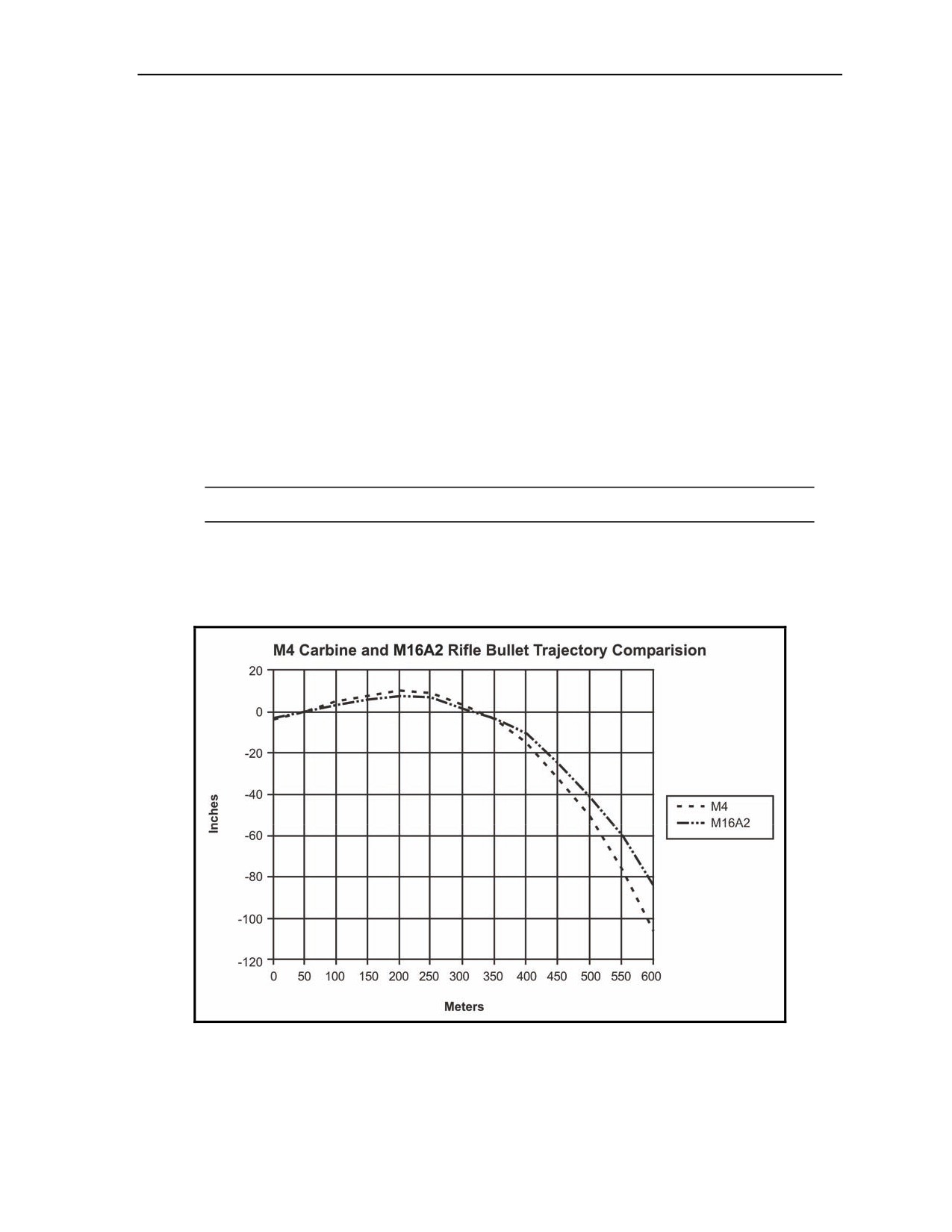
*7-288. The chart in Figure 7-35 shows the projectile’s trajectory when fired from the M4 carbine and the
M16A2 rifle. This demonstrates the drop of the round at various ranges.
NOTE: This diagram will assist the trainer in teaching vertical hold-off during this phase.
*7-289. As the chart in Figure 7-35 shows, the hold-off at 400 meters is about half the height of the
standard E-type silhouette; to hold-off at 400 meters, the firer aims half the height of the target over the
target to hit it. The drop at 500 meters is considerably larger, so holding off will not be practical. The firer
will have to adjust his rear elevation knob to get the proper point of aim for that distance.
*Figure 7-35. Bullet trajectory comparison.
10 February 2011
FM 3-22.9, C1
7-71
Chapter 7
Windage
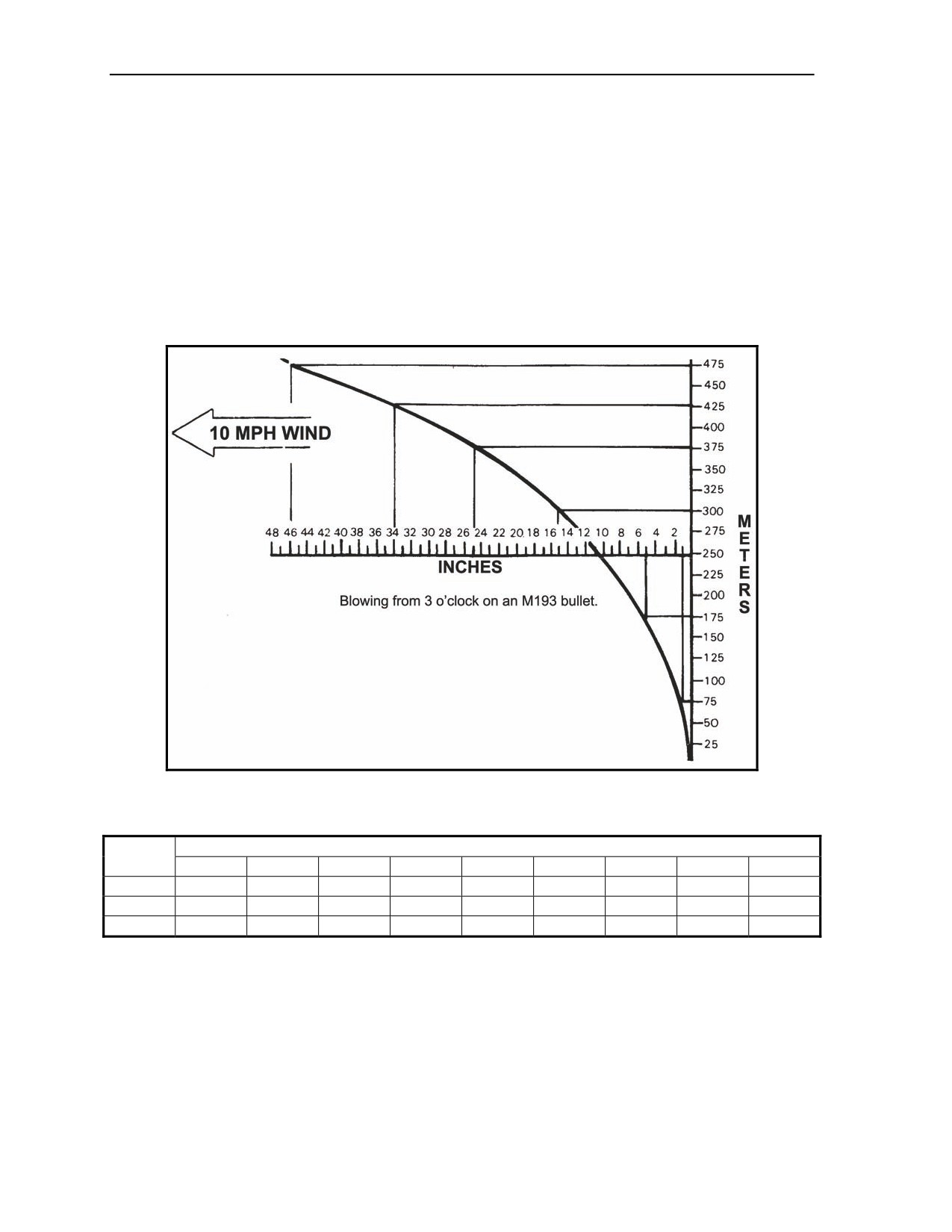
*7-290. When firing during windy conditions, the SDM must use hold-off to adjust for windage (Figure
7-36).
z
When holding off, the SDM aims into the wind. If the wind is moving from the right to left, his
point of aim is to the right. If the wind is moving from left to right, his point of aim is to the left.
z
If the SDM misses the target and the point of impact of the round is observed, he notes the
lateral distance of his error and refires, holding off that distance in the opposite direction.
*7-291. Table 7-33 shows calculated adjusted points of aim based on wind speed.
*7-292. Table 7-34 shows the drift for a 10-mph wind using 5.56-millimeter M855 ball ammunition fired
in a M16A2 rifle with a 300-meter battlesight zero.
*Figure 7-36. Windage effects of a 10-mph crosswind.
*Table 7-33. Calculated adjusted point of aim based on wind speed (full value).
WIND
RANGE (m)
SPEED
25
50
75
100
150
175
200
250
300
5 mph
1/4 in
3/8 in
1/2 in
1 in
2 in
2.5 in
3.5 in
5 in
7.5 in
10 mph
1/2 in
3/4 in
1 in.
2 in
4 in
5 in
7 in
10 in
15 in
15 mph
3/4 in
1 1/8 in
1.5 in
3 in
6 in
7.5 in
10.5 in
15 in
22.5 in
7-72
FM 3-22.9, C1
10 February 2011

Advanced Rifle Marksmanship
*Table 7-34. Drift for 10-mph wind using M855 ammunition when
fired from M16A2 rifle with 300-meter battlesight zero.
RANGE (m)
VELOCITY (fps)
TRAJECTORY (in)
DROP (in)
DRIFT (in)
0
3,100
-2.5
0.0
0.0
100
2,751
4.4
-2.3
1.1
200
2,420
5.8
-10.2
4.9
300
2,115
0.0
-25.3
11.8
400
1,833
-15.0
-49.5
22.4
500
1,569
-42.9
-86.7
38.0
600
1,323
-88.2
141.3
59.5
700
1,106
-156.1
-220.9
88.4
800
1,010
-267.7
-339.2
124.9
7-293. Firers use the M15 sighting device to demonstrate that they understand holding off. To do so, the
firer aligns the sights on the silhouette on the proper adjusted point of aim.
NOTE: See Appendix A for information about the M15 sighting device.
*7-294. Once the firer has an understanding of elevation and windage hold-off, he can begin the live-fire
training exercise (Table 7-35). The firer will be given 20 rounds in which to engage 20 targets at ranges
from 100 to 500 meters using elevation and windage hold-off.
*Table 7-35. Firing event, known distance (hold off).
FIRING EVENT
ROUNDS
TARGET RANGE (m)
Known Distance (Hold Off)
20
100 to 500
PHASE V—FIELD FIRE 100 TO 500 METERS
*7-295. The field fire events (Table 7-36) will test the individual’s marksmanship, range estimation, and
target detection skills. Field fire will consist of both a Record Fire I and a Record Fire II course. The
Record Fire I course requires the individual to use mechanical elevation and windage adjustments. The
Record Fire II course requires the individual to use elevation and windage hold-off (adjusted points of aim).
Conduct
7-296. To complete this course, Soldiers fire two firing events: Record Fire I and Record Fire II.
*7-297. During each event, each Soldier will engage a total of 20 targets with 20 rounds. Soldiers must
attain a total of 14 hits out of 20 targets on each record fire to pass. Table 7-36 depicts these two events and
provides related information, such as number of rounds that must be fired, position that must be used, and
the distance away from the firer that the target must be placed.
*Table 7-36. Firing event, Record Fire I and II.
FIRING EVENT
POSITION
ROUNDS
NUMBER OF
TARGET RANGE (m)
TARGETS
Foxhole supported or prone
Record Fire I
supported position and the prone
20
20
100 to 500
unsupported firing position
Foxhole supported or prone
Record Fire II
supported position and the prone
20
20
100 to 500
unsupported firing position
NOTE: If the SDM is issued an optic, the Record Fire II course will substitute use of that optic
instead of using adjusted points of aim.
10 February 2011
FM 3-22.9, C1
7-73
Chapter 7
7-298. Prior to training, ensure that—
• The weapon is zeroed prior to training.
• Each Soldier assumes a steady firing position.
• Each Soldier consistently applies the fundamentals of marksmanship.
• Each Soldier knows how to adjust for wind and gravity.
• Each Soldier manipulates the rear sight for different ranges.
NOTE: See Appendix B for a sample completed form and the end of this publication for a
blank, reproducible copy.
CERTIFICATION
7-299. Once the firer has successfully completed the SDM program, he is designated as an SDM and will
be able to perform all duties and responsibilities set forth by these guidelines.
NOTE: SDM skills are highly perishable, and sustainment training should be conducted to
ensure retention of the skills. At a minimum, sustainment training should be conducted
semiannually.
7-74
FM 3-22.9, C1
10 February 2011

Chapter 8
Advanced Optics, Lasers, and Iron Sights
BRM teaches Soldiers how to effectively engage targets with their weapons using the
iron sights. ARM adds other marksmanship situations that a combat Soldier may
encounter. This chapter discusses how to enhance marksmanship skills through
proper training, using the Army’s newest optics and lasers to ensure that Soldiers can
fight as well at night as they can during the day. This chapter implements new night
qualification standards to complement current Army training strategies.
SECTION I. BORELIGHT
The borelight is an accurate means of zeroing weapons and most aided-vision equipment without the use of
ammunition. The time and effort required to ensure a precise boresight will, in turn, save time and ammunition.
Table 8-1 outlines weapon/aided-vision device combinations that can be zeroed using the borelight.
NOTE: See Table 8-2 for the current training program.
Table 8-1. Weapon/aided-vision device combinations.
WEAPON
M16A2
M16A3/A4
M4/MWS
AIDED-
VISION DEVICE
IRON SIGHT
X
N/A
N/A
BUIS
N/A
X
X
AN/PAQ-4B/C
X
X
X
AN/PEQ-2A/B
X
X
X
AN/PAS-13B/C/D
X
X
X
M68 CCO
X
X
X
ACOG
X
X
X
NOTES:
1. Precise boresighting of a laser will allow direct engagement of targets without a
25-meter zero. If a borelight is not available, a 25-meter zero must be conducted
to zero the laser.
2. All optics must be 25-meter zeroed; a borelight only aids in zeroing.
12 August 2008
FM 3-22.9
8-1
Chapter 8
Table 8-2. Borelight training program.
BORELIGHT
Instructional Intent
•
Soldiers align the optic, laser, or iron sight to the bore of the weapon to reduce or eliminate the time and
ammunition it requires to live-fire zero.
Special Instructions
Ensure that Soldiers—
•
Zero the borelight.
•
Use only approved 10-meter boresighting targets from Picatinny Arsenal.
•
Use the proper 10-meter boresighting target for weapon configuration.
•
Boresight 10 meters from the end of the barrel.
•
Stabilize both the weapon and the target (or the boresight will not be accurate).
•
Install filters for aiming lasers to reduce blooming.
Observables
Soldiers confirm that the—
•
Borelight spins on itself when zeroed at 10 meters.
•
Weapon configuration is boresighted using the official and proper targets only.
•
Target and weapon do not move during the boresighting procedure.
•
Borelight is centered on the circle on the target.
•
Aiming device is aiming at the center of the crosshair on the offset.
CONCEPT
8-1. Boresighting is a simple procedure that saves time and ammunition. The visible laser of the borelight
is aligned with the barrel of a designated weapon. Then, using a 10-meter boresighting target, the weapon
can be boresighted with any optic, laser, or iron sight that the Soldier is assigned to fire.
ZEROING THE BORELIGHT
WARNINGS
Before using the borelight, ensure that the weapon is clear and on
SAFE, and that the bolt is locked in the forward position.
When rotating the borelight to zero it, ensure that the mandrel is
turning counterclockwise (from the firer's point of view) to avoid
loosening the borelight from the mandrel.
DANGERS
DO NOT STARE INTO THE VISIBLE LASER BEAM.
DO NOT LOOK INTO THE VISIBLE LASER BEAM THROUGH
BINOCULARS OR TELESCOPES.
DO NOT POINT THE VISIBLE LASER BEAM AT MIRROR-LIKE
SURFACES.
DO NOT SHINE THE VISIBLE LASER BEAM INTO OTHER
INDIVIDUALS’ EYES.
8-2
FM 3-22.9
12 August 2008
Advanced Optics, Lasers, and Iron Sights
8-2. Before boresighting the weapon system, the borelight must first be zeroed to the weapon. To zero the
borelight to the weapon—
(1) Stabilize the weapon by placing it in a rifle box rest or by laying two rucksacks side by side
and placing another rucksack on top of the weapon.
NOTE: The weapon does not have to be perfectly level with the ground when boresighting.
(2) Align the visible laser with the weapon's barrel.
CAUTION
Do not over-adjust the laser. Do not point the laser at Soldiers or
reflective material.
(3) Attach the 5.56-millimeter mandrel to the borelight.
(4) Insert the mandrel into the weapon's muzzle.
NOTE: The borelight is seated properly when the mandrel cannot be moved any further into the
muzzle and the mandrel spins freely.
(5) Measure 10 meters with the 10-meter cord that comes with the borelight, or pace off eleven
paces.
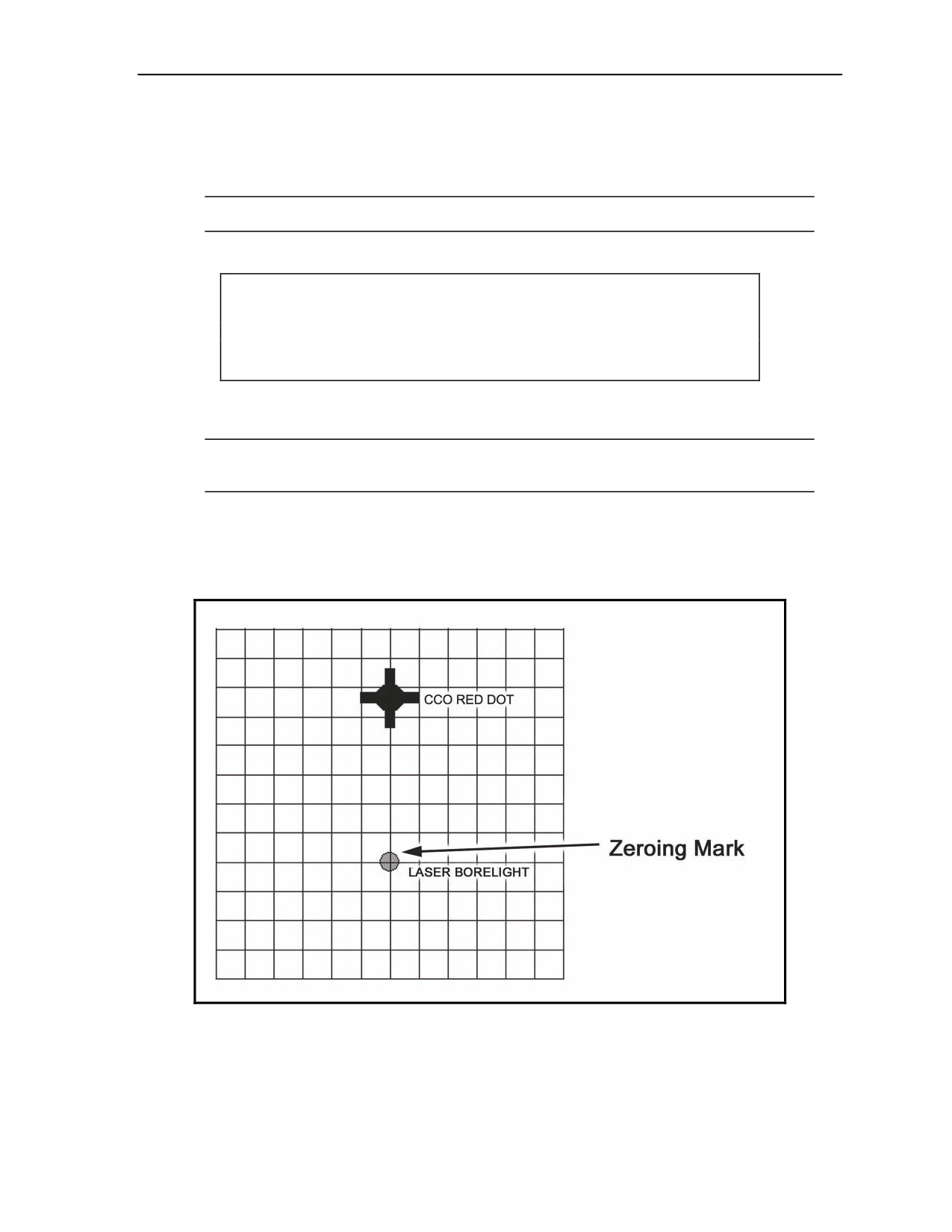
(6) Draw a zeroing mark (small dot) on a piece of paper or tree bark, or use the borelight
reference point on the 10-meter boresighting target (Figure 8-1).
Figure 8-1. Example of a zeroing mark.
12 August 2008
FM 3-22.9
8-3
Chapter 8
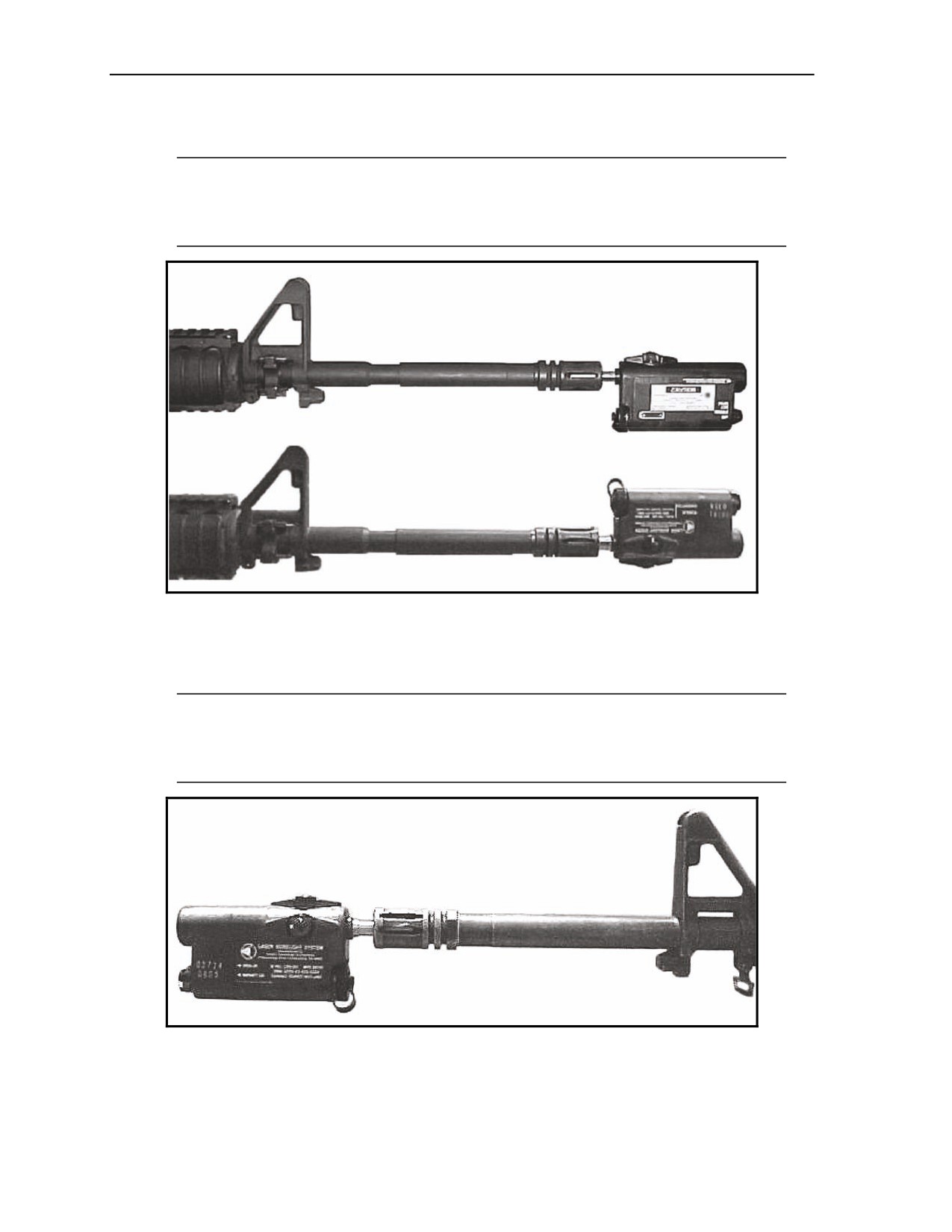
(7) Rotate the borelight until the battery compartment is facing upward and the adjusters are on
the bottom (Figure 8-2).
NOTE: Once the Soldier performs step (7), the borelight's position and the place where the
visible laser is pointing are identified as the start point. The command “START POINT” is given
to ensure clear communication between the Soldier at the weapon and the Soldier at the
boresighting target.
Figure 8-2. Borelight in the START POINT position.
(8) Rotate the borelight until the battery compartment is facing downward and the adjusters are
on top to allow for easy access to the adjusters and help with communication and stabilization
of the weapon (Figure 8-3).
NOTE: Once the Soldier performs step (8), the borelight's position and the place where the
visible laser is pointing are identified as the half-turn position. The command “HALF-TURN” is
given to ensure clear communication between the Soldier at the weapon and the Soldier at the
boresighting target.
Figure 8-3. Borelight in the HALF-TURN position.
8-4
FM 3-22.9
12 August 2008
Advanced Optics, Lasers, and Iron Sights
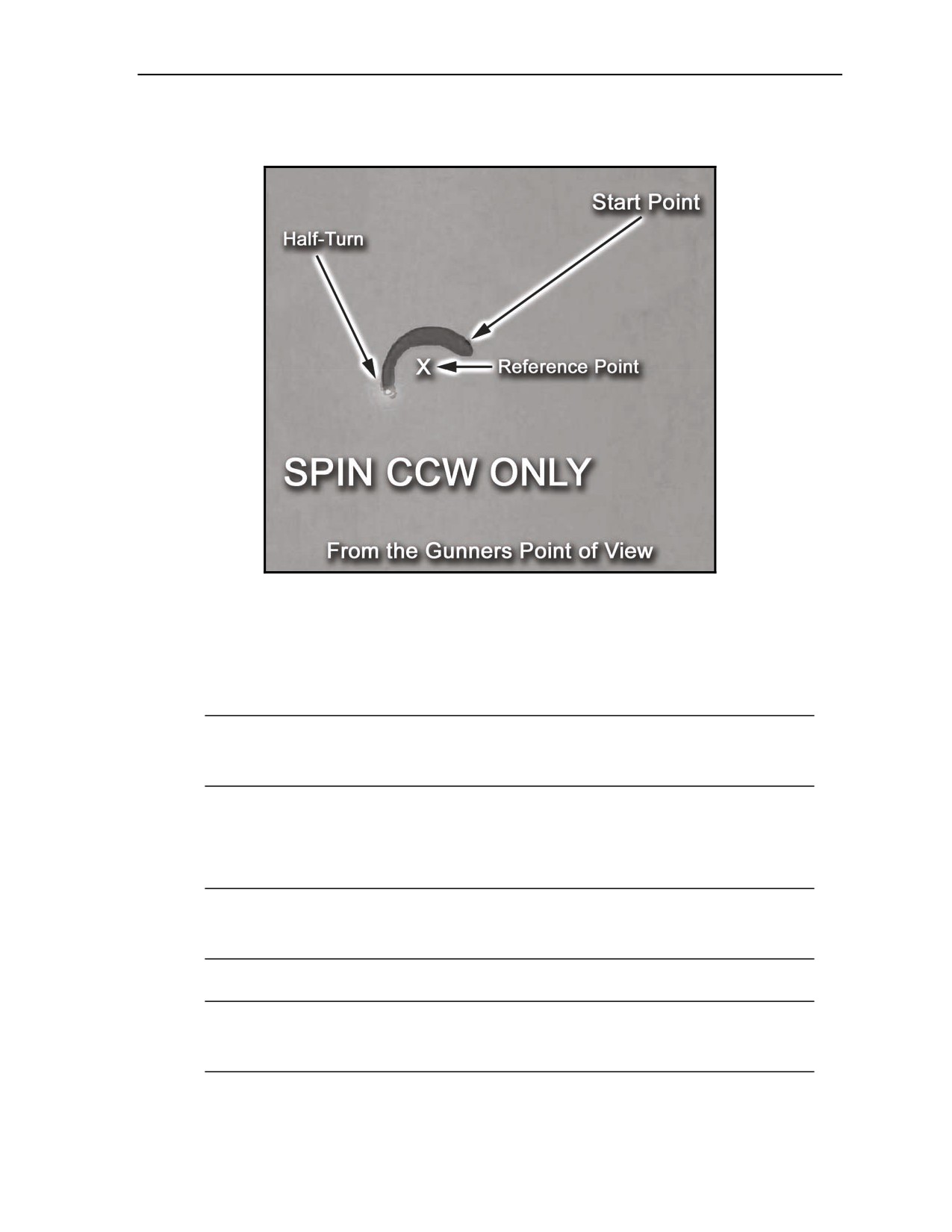
(9) Identify the point approximately halfway between the start point and the half-turn point. This
is the reference point (Figure 8-4).
Figure 8-4. Example of a start point, half-turn, and reference point.
(10) Turn the borelight on and spin it until it is in the start point position.
(11) Place the zeroing mark approximately 10 meters from the end of the barrel so that the visible
laser strikes the zeroing mark.
(12) Slowly rotate the borelight
180 degrees while watching the visible laser made by the
borelight.
NOTE: If the visible laser stops on the zeroing mark, the borelight is zeroed to the weapon. If
the borelight does not stop on the zeroing mark, elevation and windage adjustments must be
made to the borelight.
(13) From the start point, realign the zeroing mark with the visible laser, rotate the borelight 180
degrees to the half-turn position, and identify the reference point.
(14) Using the adjusters on the borelight, move the visible laser to the reference point.
(15) Rotate the borelight back to the start point; move the zeroing mark to the visible laser.
NOTE: If the visible laser cannot be located when the borelight is spun to the half-turn position,
start this procedure at 2 meters instead of 10 meters. When the visible laser is adjusted to the
reference point at 2 meters, restart the procedure at 10 meters.
(16) Repeat steps (13) through (15) until the visible laser spins on itself.
NOTE: Every barrel is different, so steps (10) through (15) must be performed with every
weapon to ensure that the borelight is zeroed to that barrel. If the borelight is zeroed, go directly
to the boresighting procedures.
12 August 2008
FM 3-22.9
8-5
Chapter 8
BORESIGHTING
8-3. Two Soldiers are required to properly boresight a weapon: a firer and a target holder. Their duties are
as follows:
z
The firer’s primary duty is to zero the borelight and make all adjustments on the aided-vision
device being used.
z
The target holder secures the 10-meter boresighting target straight up and down 10 meters
from the borelight and directs the firer in making necessary adjustments to the aiming device.
The target holder must wear night vision goggles when boresighting IR aiming lasers.
NOTE: Appendix F shows the most current 10-meter boresighting target. The 10-meter
boresighting target grids are 1x1-centimeter squares, unlike those on 25-meter zeroing targets.
Contact the proponent of this publication (C Co, 2/29 IN, Fort Benning, GA) for information
about the availability of boresighting targets.
CAUTION
Weapon stability is crucial in boresighting. The weapon should be in
the bolt forward position and must not be canted left or right during
boresighting procedures. If the weapon is boresighted using field-
expedient methods
(for example, sandbags, rucksacks) and the
weapon is laid on its side for stability, ensure that the boresighting
target is also oriented in the same manner.
BORESIGHTING THE WEAPON USING THE BACKUP IRON SIGHTS
8-4. The BUIS can be boresighted to a new user to expedite 25-meter zeroing. To boresight the weapon
using the BUIS—
(1) Align the BUIS with the Canadian bull on the 10-meter boresighting target.
(2) Make adjustments to the windage and elevation of the BUIS until the borelight is centered
with the circle on the boresighting target.
BORESIGHTING THE WEAPON USING THE M68 CLOSE COMBAT OPTIC
NOTES:
1. Before boresighting, ensure that the borelight has been zeroed to the weapon.
The more accurate the boresight of the M68 CCO to the assigned weapon, the
closer to a battlesight zero the weapon will be.
2.
25-meter zeroing must be conducted to ensure that the M68 CCO is properly
zeroed.
3. The M68 CCO is a parallax-free sight beyond 50 meters; boresighting is
conducted at 10 meters. To get a solid boresight, ensure that the red dot is
centered within both the CCO and the target's center of mass.
8-5. To boresight the weapon using the M68 CCO—
(1) Select the proper 10-meter boresighting target for the weapon/M68 configuration.
(2) With the help of an assistant, place the boresighting target 10 meters in front of the weapon.
(3) Turn the M68 CCO to the desired setting by turning it clockwise to position 10, turning it
counterclockwise one click at a time until you can no longer see the dot, and then turning it
clockwise two clicks.
8-6
FM 3-22.9
12 August 2008
Advanced Optics, Lasers, and Iron Sights
NOTE: The desired setting may need to be adjusted throughout the day depending on ambient
light conditions.
(4) Get behind the weapon in a stable supported firing position, and look through the M68 CCO.
(5) Aim the red dot of the M68 CCO on the crosshair located on the 10-meter boresighting target.
(6) Make adjustments to the M68 CCO until the visible laser of the borelight is centered on the
borelight circle on the 10-meter boresighting target.
(7) Turn the borelight off.
(8) Move the weapon off of the crosshair, realign the M68 CCO's red dot on the crosshair, and
turn the borelight back on.
(9) If the borelight is on the circle and the M68 CCO's red dot is on the crosshair, the weapon
system is boresighted.
(10) Turn the laser off, and carefully remove the borelight and the mandrel from the weapon so
that the borelight device is not damaged.
NOTE: If the firer does not get the same sight picture after the second realignment, he more
than likely has a fundamentals problem with his firing position and sight picture. To save time
on the range, a coach should troubleshoot the Soldier before continuing to boresight the M68
CCO.
BORESIGHTING THE ADVANCED COMBAT OPTICAL GUNSIGHT
NOTES:
1. Before boresighting, ensure that the borelight has been zeroed to the weapon.
The more accurate the boresight of the ACOG to the assigned weapon, the
closer to a battlesight zero the weapon will be.
2.
25-meter zeroing must be conducted to ensure that the ACOG is properly
zeroed.
8-6. To boresight the ACOG—
NOTE: Use the 10-meter boresighting target that is used for boresighting the M68 CCO.
(2) With the help of an assistant, place the boresighting target 10 meters in front of the weapon.
(4) Get behind the weapon in a stable supported firing position, and look through the ACOG.
(5) Aim the tip of the 300-meter post on the crosshair located on the 10-meter boresighting target.
(6) Make adjustments to the ACOG until the visible laser of the borelight is centered on the
borelight circle on the boresighting target.
(7) Turn the borelight off.
(8) Move the weapon off of the crosshair, realign the tip of the 300-meter post on the crosshair,
and turn the borelight back on.
(10) If the borelight is on the circle and the tip of the 300-meter post is on the crosshair, the
weapon system is boresighted.
(10) Turn the laser off, and carefully remove the borelight and the mandrel from the weapon so
that the borelight device is not damaged.
12 August 2008
FM 3-22.9
8-7
Chapter 8
BORESIGHTING THE THERMAL WEAPON SIGHT
NOTES:
1. Before boresighting the TWS, ensure that the borelight has been zeroed to the
weapon. The more accurate the boresight of the TWS to the assigned weapon,
the closer to a battlesight zero the weapon will be.
2.
25-meter zeroing must be conducted to ensure that the TWS is properly zeroed.
3. Both the narrow field of view (NFOV) and wide field of view (WFOV) must be
boresighted and zeroed.
8-7.
To boresight the TWS—
(1) Select the proper 10-meter boresighting target for the weapon/TWS configuration.
(2) With the help of an assistant, place the boresighting target 10 meters in front of the weapon.
(3) Ensure that the weapon's reticle is displayed.
(4) Get behind the weapon in a stable supported firing position, and look through the TWS.
(5) Place a finger on each oval on the 10-meter boresighting target.
(6) Aim between the fingers with the 300-meter point of aim.
(7) Make adjustments to the TWS until the visible laser of the borelight is centered on the
borelight circle on the 10-meter boresighting target.
(8) Move off of the aiming block, realign the TWS to the center of the heated block, and then turn
the borelight back on.
(9) If the boresight is properly aligned, the weapon system is boresighted; otherwise, you will
need remedial training on your sight picture.
(10) Change the field of view (FOV) on the sight by rotating the FOV ring, and repeat steps (1)
through (9).
(11) Turn the laser off, and carefully remove the borelight and the mandrel from the weapon so
that the borelight device is not damaged.
BORESIGHTING THE AN/PAQ-4B/C
NOTE: Before boresighting the AN/PAQ-4B/C, make sure that the borelight has been zeroed to
the weapon. The more accurate the boresight of the AN/PAQ-4B/C to the assigned weapon, the
closer to a battlesight zero the weapon will be.
DANGERS
DO NOT STARE INTO THE IR LASER BEAM WITH THE NAKED
EYE OR THROUGH BINOCULARS OR TELESCOPES.
DO NOT POINT THE IR LASER BEAM AT MIRROR-LIKE
SURFACES OR OTHER INDIVIDUALS’ EYES.
ALTHOUGH THIS LASER IS EYE-SAFE, IT IS A SAFE PRACTICE
TO TREAT ALL LASERS AS NOT EYE-SAFE.
3x EXTENDERS MAGNIFY THE LASER AIMING LIGHT. WHEN
USING THE
3x EXTENDERS, THE AN/PAQ-4B/C IS NOT
CONSIDERED EYE-SAFE AT ANY DISTANCE.
DO NOT STORE THE AN/PAQ-4B/C WITH THE BATTERIES INSTALLED.
8-8
FM 3-22.9
12 August 2008
Advanced Optics, Lasers, and Iron Sights
8-8. To boresight the AN/PAQ-4B/C —
(1) Select the proper 10-meter boresighting target for the weapon/AN/PAQ-4B/C configuration.
(2) With the help of an assistant, place the boresighting target 10 meters in front of the weapon.
(3) Install the borelight filter, and turn the AN/PAQ-4B/C on.
(4) Align the 10-meter boresighting target with the visible laser of the borelight.
(5) Adjust the adjusters on the AN/PAQ-4B/C until the IR laser is centered on the crosshair
located on the 10-meter boresighting target.
NOTE: For windage and elevation, one click equals 1 centimeter at 25 meters. A click is
defined as the sound or feel of the positive detent movement.
CAUTION
Do not turn the adjustment screws too much. Over-turning the
adjustment screws will cause them to break.
NOTES:
1. The boresighting target and zeroing mark must be kept stable during the
boresighting procedure.
2. Regardless of the mounting location, the adjuster that is on top or bottom will always
be the elevation adjuster, and the one on the side will always be the windage adjuster.
BORESIGHTING THE AN/PEQ-2A/B
NOTES:
1. Before boresighting the AN/PEQ-2A/B, ensure that the borelight has been
zeroed to the weapon. The more accurate the boresight of the AN/PEQ-2A/B to
the assigned weapon, the closer to a battlesight zero the weapon will be.
2. The boresighting target and zeroing mark must be kept stable during the
boresighting procedure.
DANGERS
THE AN/PEQ-2A/B EMITS INVISIBLE LASER RADIATION. AVOID
DIRECT EXPOSURE TO THE BEAM.
DO NOT STARE INTO THE IR LASER BEAM WITH THE NAKED EYE
OR THROUGH BINOCULARS OR TELESCOPES.
DO NOT POINT THE IR LASER BEAM AT MIRROR-LIKE SURFACES
OR OTHER INDIVIDUALS’ EYES.
EYE DAMAGE CAN OCCUR IF CARELESS HANDLING OF THE
LASER OCCURS. EYE-SAFE DISTANCE IS BEYOND 25 METERS (IN
DUAL LO MODE) IN TRAINING MODE AND BEYOND 220 METERS IN
TACTICAL MODE.
3x EXTENDERS MAGNIFY THE LASER AIMING LIGHT. WHEN USING
THE 3x EXTENDERS, THE AN/PEQ-2A/B IS NOT CONSIDERED EYE-
SAFE AT ANY DISTANCE.
DO NOT STORE THE AN/PEQ-2A/B WITH THE BATTERIES INSTALLED.
12 August 2008
FM 3-22.9
8-9
Chapter 8
8-9. To boresight the AN/PEQ-2A/B—
(1) Select the proper 10-meter boresighting target for the weapon/AN/PEQ-2A/B configuration.
(2) With the help of an assistant, place the boresighting target 10 meters in front of the weapon.
(3) Install the filter on the aiming laser, and turn the AN/PEQ-2A/B on.
(4) Align the 10-meter boresighting target with the visible laser of the borelight.
(5) Adjust the adjusters on the AN/PEQ-2A/B until the IR laser is centered on the crosshair
located on the 10-meter boresighting target.
NOTE: For windage and elevation, one click equals 1 centimeter at 25 meters. A click is
defined as the sound or feel of the positive detent movement.
CAUTION
Do not turn the adjustment screws too much. Over-turning the
adjustment screws will cause them to break.
NOTES:
1. Each click of elevation and windage is 1 centimeter and each square of the
25-meter zeroing target is .9 centimeter. For ease of use, round up to one square
per click of elevation. This will have a negligible effect on the zero unless a
large adjustment is needed.
2. Regardless of the mounting location, the adjuster that is on top or bottom will
always be the elevation adjuster, and the one on the side will always be the
windage adjuster.
(6) Adjust the illuminator in the same manner.
(7) Turn the laser off, and carefully remove the borelight and the mandrel from the weapon so
that the borelight device is not damaged.
BORESIGHTING THE AN/PVS-4
NOTES:
1. Before boresighting, ensure that the borelight has been zeroed to the weapon.
The more accurate the boresight of the AN/PVS-4 to the assigned weapon, the
closer to a battlesight zero the weapon will be.
2.
25-meter zeroing must be conducted to ensure that the AN/PVS-4 is properly
zeroed.
(1) Select the proper 10-meter boresighting target for the weapon/AN/PVS-4 configuration.
(1) With the help of an assistant, place the boresighting target 10 meters in front of the weapon.
(2) Ensure that the M16 reticle is displayed.
(3) Get behind the weapon in a stable supported firing position, and look through the AN/PVS-4.
(4) Turn the borelight laser on.
(5) Align the borelight laser with the circle on the 10-meter target offset.
(6) Keeping the laser in place, adjust the windage and elevation until the reticle of the AN/PVS-4
is aligned with the circular crosshair.
NOTE: If there is not enough ambient light to see the 10-meter target offset circular crosshair,
shine a flashlight indirectly at the target to provide ambient light.
8-10
FM 3-22.9
12 August 2008

Advanced Optics, Lasers, and Iron Sights
(7) Turn the borelight off.
(8) Move the reticle off of the circular crosshair, and then realign on the target.
(9) Turn the borelight laser back on.
(9) If the borelight is in the circle, then the AN/PVS-4 is boresighted.
(10) Turn the laser off, and carefully remove the borelight and mandrel from the weapon so that
the borelight device is not damaged.
SECTION II. TRAINING STRATEGIES AND QUALIFICATION
STANDARDS
Before beginning a night marksmanship program, Soldiers must qualify on their assigned weapons during the
day, as outlined in the previous chapters of this manual. Commanders should follow these training strategies
and abide by the qualification standards set forth. Although some courses of fire may seem redundant or
inappropriate, numerous tests show that these training strategies work, and the qualification standards are
achievable if the strategies are followed.
BACKUP IRON SIGHT
8-10. The BUIS is a semipermanent flip-up sight equipped with a rail-grabbing base. The BUIS provides a
backup capability effective out to at least 600 meters and can be installed on M16A4 rifles and M4
carbines.
NOTE: See Table 8-3 for the current training program.
Table 8-3. Backup iron sights training program.
BACKUP IRON SIGHTS
Instructional Intent
•
Soldiers zero and qualify with the BUIS.
Special Instructions
Ensure that Soldiers—
•
Apply the marksmanship fundamentals.
•
Place the BUIS in the full vertical position and lock them prior to firing.
•
Install the plastic insert in the BUIS during boresighting and zeroing.
Observables
•
Soldiers attain the same day standards for zeroing and qualification as with the standard iron sights (See
Chapter 5).
CONCEPT
8-11. The BUIS is adjusted for a 300-meter battlefield zero to provide backup in the event an optic or laser
device fails to function. The BUIS is zeroed on the M4/M4A1 target on the backside of the M16A2 zeroing
target (NSN 6920-01-395-2949).
NOTE: The 25-meter zeroing procedures are the same as for conventional rear sight assembly
on M16 rifles and M4 carbines.
12 August 2008
FM 3-22.9
8-11
Chapter 8
CONDUCT OF TRAINING
NOTES:
1. The BUIS training strategy is the same as the iron sight training strategy.
2. All procedures for the BUIS are the same as with standard iron sights.
8-12. BUIS equipment training should familiarize the Soldier with the proper operation and characteristics
of the BUIS.
Boresight the Backup Iron Sights
8-13. Optional.
Zero
8-14. The zeroing standards for the BUIS are the same as with iron sights.
z
To zero the BUIS for M4 carbines, set the range selector to 300 meters.
z
To zero the BUIS to an M16A4, place the range selector on the white line below the
300-meter mark.
Target Detection
8-15. Target detection procedures for the BUIS are the same as with standard iron sights.
Practice Qualification
8-16. A practice qualification must always precede an actual qualification. Practice qualification allows the
Soldier to practice and refine the skills needed to succeed during qualification. Practice qualification
standards for the BUIS are the same as with standard iron sights. If the Soldier qualifies during the practice
qualification, it may be counted as the record qualification.
Record Qualification
8-17. Qualification with the BUIS is conducted on a standard record fire range, and the standards for
qualification are the same as the record fire day standards.
M68 CLOSE COMBAT OPTIC
8-18. The M68 CCO is a reflex (nontelescopic) sight. It uses a red aiming reference (collimated dot) and is
designed for the two eyes open method of sighting. The dot follows the horizontal and vertical movement
of the firer’s eye, while remaining fixed on the target. No centering or focusing is required.
NOTE: See Table 8-4 for the current training program.
8-12
FM 3-22.9
12 August 2008

Advanced Optics, Lasers, and Iron Sights
Table 8-4. M68 close combat optic training program.
M68 CLOSE COMBAT OPTIC
Instructional Intent
•
Soldiers qualify with the M68 CCO.
Special Instructions
Ensure that Soldiers—
•
Are proficient with the M68 CCO.
•
Install the half-moon spacer when using the M68 CCO with the M4, M16A4, and MWS.
•
Do not install the half-moon spacer when using the M68 CCO with the M16A1/A2.
•
Use the proper offset during boresighting procedures.
•
Confirm 10-meter boresight with a 25-meter zero.
•
Retighten the rail grabber after the initial 3 rounds are fired.
•
Sets the M68 CCO's dot for best sight picture.
•
Apply the marksmanship fundamentals.
•
Zero and qualify with the same sight picture (one eye or two eyes open method).
•
Zero on the M16A2 25-meter zeroing target.
Ensure that the designated impact zone is 1.4 centimeters down from the center of mass of the 300-meter silhouette on
the 25-meter zeroing target.
Observables
•
Soldiers zero the M68 CCO to the same standards as with iron sights.
•
Rounds impact in the 4x4-centimeter square designated impact zone.
•
Soldiers achieve the same practice qualification and qualification standards as with day record fire.
CONCEPT
8-19. Soldiers must qualify on their assigned weapons during daylight conditions, as outlined in this
manual. The integrated act of firing with the M68 CCO is identical to the iron sights except for the change
in the sight picture.
CONDUCT OF TRAINING
NOTES:
1. The M68 CCO training strategy is the same as the iron sight training strategy.
2. All procedures for the M68 are the same as with standard iron sights.
8-20. M68 equipment training should familiarize the Soldier with the proper operation and characteristics
of the M68 CCO IAW TM 9-1240-413-13&P.
MODIFIED FUNDAMENTALS
8-21. M68 CCO operation requires modifications to the fundamentals of marksmanship:
z
Steady position.
z
Aiming.
z
Breath control.
z
Trigger squeeze.
Steady Position
8-22. When operating the M68 CCO, Soldiers no longer need a good stock weld to get a good sight picture
after the M68 is zeroed at 25 meters. The M68’s reflexive sight allows the Soldier to fire the weapon with
his cheek in a comfortable position, but since the CCO is parallax-free beyond 50 meters only, the Soldier
must zero and fire using the same cheek position.
12 August 2008
FM 3-22.9
8-13
Chapter 8
Aiming
8-23. When using the M68 CCO, the two eyes open method is the preferred method of aiming.
NOTE: The aiming method used to zero must also be used to engage targets. When using the
M68 CCO, the weapon must not be canted during aiming or firing.
Two Eyes Open Method (Preferred)
8-24. This method allows a much greater field of view and makes scanning for targets much easier;
however, getting accustomed to the two eyes open method takes practice. The Soldier must keep the rifle
and M68 in a vertical alignment each time he fires.
8-25. To use the two eyes open method—
(1) Position the head so that one eye can focus on the red dot and the other eye can scan
downrange.
(2) Place the red dot on the target's center of mass, and engage.
One Eye Open Method
8-26. To use the one eye open method—
(1) With the nonfiring-side eye closed, look through the M68 CCO to ensure that the red dot can
be seen clearly.
(2) Place the red dot on the target's center of mass, and engage.
Breath Control
8-27. This fundamental does not change.
Trigger Squeeze
8-28. This fundamental does not change.
ZEROING WITHOUT A BORELIGHT
8-29. To zero without a boresight—
(1) Begin with a securely installed and live-fire zeroed BUIS.
(2) Mount the CCO to the front of the receiver rail or to the top ARS, as preferred.
(3) Adjust windage and elevation on the reflex sight until the center of the aiming dot is at the tip
of the front sightpost when viewed through the BUIS while assuming a normal firing position.
25-METER ZEROING PROCEDURES
NOTE: Conduct zeroing only on the M16A2 25-meter target.
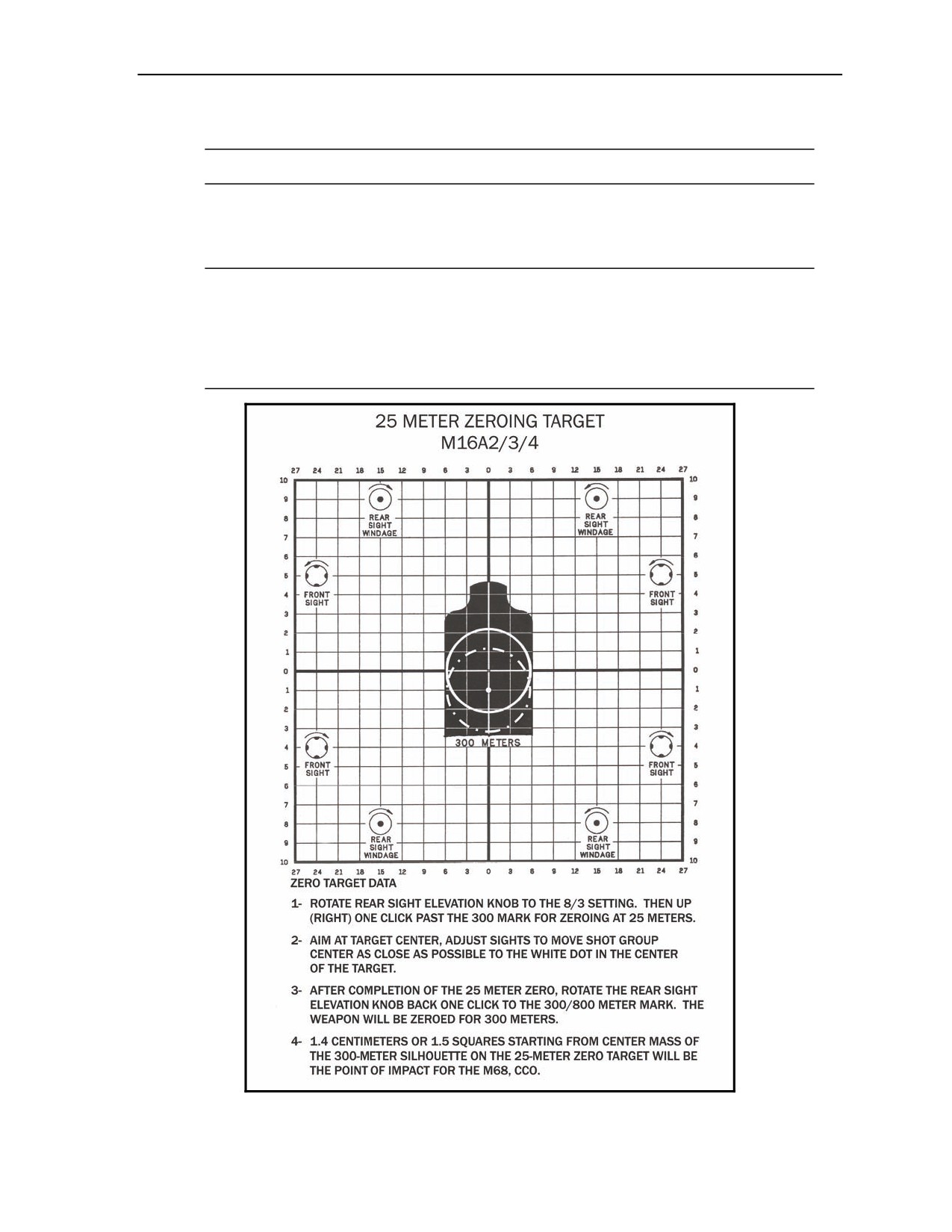
8-30. When zeroing the CCO at 25 meters, a designated point of impact zone must be identified on the
25-meter zeroing target (Figure 8-5). To zero the CCO at 25 meters—
(1) Starting from center of mass of the 300-meter silhouette on the 25-meter zeroing target, count
down 1½ squares or 1.4 centimeters. This is now the point of impact when zeroing the M68
CCO.
(2) Continue to aim at the center of mass of the 300-meter silhouette, and make adjustments to
the M68 CCO so that the rounds impact in the secondary 4x4-centimeter circular box, 1½
squares or 1.4 centimeters down from the point of aim.
8-14
FM 3-22.9
12 August 2008
Advanced Optics, Lasers, and Iron Sights
8-31. Other procedures are the same as standard iron sight procedures:
NOTE: A click is defined as the sound or feel of the positive detent movement.
z
For windage and elevation, two clicks equal 1 centimeter at 25 meters.
z
For elevation, one clockwise click moves the bullet strike down.
z
For windage, one clockwise click moves the bullet strike left.
NOTES:
1. At ranges of
50 meters and beyond, the effects of parallax are minimal.
However, at ranges of 50 meters and closer, parallax exists and the firer must
ensure that the red dot is centered while zeroing.
2. The aiming method (two eyes open or one eye open) used to zero must be used
to engage targets.
Figure 8-5. Close combat optic, 25-meter zeroing target.
12 August 2008
FM 3-22.9
8-15
Chapter 8
TARGET DETECTION
8-32. Target detection procedures for the M68 are the same as with standard iron sights.
WARNING
In Positions 4 and above, the red dot is visible through the front
of the sight. For night vision operations—
• Close the front lens cover before turning the rotary switch
clockwise to Positions 2 and 3.
• Check the light for proper intensity before opening the front
lens cover.
• Close the front lens cover before turning the rotary switch
counterclockwise to the OFF position.
Failure to follow this warning could reveal your position to the
enemy.
PRACTICE QUALIFICATION
8-33. The procedures are the same as standard iron sight procedures.
RECORD QUALIFICATION
8-34. The procedures are the same as standard iron sight procedures.
ADVANCED COMBAT OPTICAL GUNSIGHT
8-35. The ACOG scope is designed to provide enhanced target identification and hit probability for the
M16/M4 series weapons out to 800 meters. It is designed with dual illuminated technology using fiber
optics for daytime illumination and tritium for night and low-light use. The ACOG scope is a lightweight
rugged, fast and accurate 3.5 power optic scope. It is internally adjustable to allow the shock of rough
handling to be carried by the scope body and not the adjustment mechanism.
NOTE: See Table 8-5 for the current training program.
8-16
FM 3-22.9
12 August 2008

Advanced Optics, Lasers, and Iron Sights
Table 8-5. Advanced combat optical gunsight training program.
ADVANCED COMBAT OPTICAL GUNSIGHT
Instructional Intent
•
Soldiers qualify with the ACOG.
Special Instructions
Ensure that Soldiers—
•
Are proficient with the ACOG.
•
Use the proper offset during boresighting procedures.
•
Confirm the 10-meter boresight with 100-meter zero (or 25-meter zero if the 100-meter range is not available).
•
Retighten the rail grabber after the initial 3 rounds are fired.
•
Apply the marksmanship fundamentals.
•
Zero and qualify with the same sight picture.
Ensure that—
•
The point of aim and point of impact are the same at 100 meters.
•
The designated impact zone is 1 centimeter down from the center of mass of the 300-meter silhouette on the
25-meter zeroing target.
Observables
•
Soldiers zero the ACOG to the same standards as with iron sights.
•
Soldiers achieve the same practice qualification and qualification standards as with day record fire.
CONCEPT
8-36. Soldiers must qualify on their assigned weapons during the day, as outlined in this manual. The
integrated act of firing with the ACOG is identical to the iron sights except for the change in sight picture.
CONDUCT OF TRAINING
NOTES:
1. The ACOG training strategy is the same as the iron sight training strategy.
2. All procedures for the ACOG are the same as with standard iron sights.
8-37. ACOG equipment training should familiarize the Soldier with its proper operation and
characteristics.
OPERATION
8-38. The ACOG scope is internally adjustable. Adjustment is made using the adjuster mechanisms located
inside the adjuster caps on the top and right-hand side of the scope. Adjustment can be made with a small
screwdriver, coin, or other hard object that fits the adjustment screws. The caps are very tight to ensure a
waterproof seal with the O-rings inside. The caps should only be off the scope when adjustments are being
made.
CAUTION
The ACOG contains an internal adjustment mechanism to allow
zeroing. Adjustments to the extreme ends of the range can result in
damage to the internal prism assembly. Do not continue to adjust the
windage and elevation mechanisms if you encounter resistance.
8-39. The ACOG scope is shipped with a pre-centered setting. Normally this means that only small
adjustments are necessary. Do not adjust the scope to the extremes. It is possible that over-adjustment will
damage the precise alignment of the prism assembly inside the rifle scope.
12 August 2008
FM 3-22.9
8-17
Chapter 8
8-40. The ACOG scope is adjusted at the factory to be as parallax-free as possible at 100 meters. This in no
way affects the accuracy of the scope.
8-41. The reticle patterns in the scope have been designed to provide many features while retaining
simplicity of operation. The user does not need to make any manual adjustments between shots at different
ranges. Ranging capability is built into the reticle patterns.
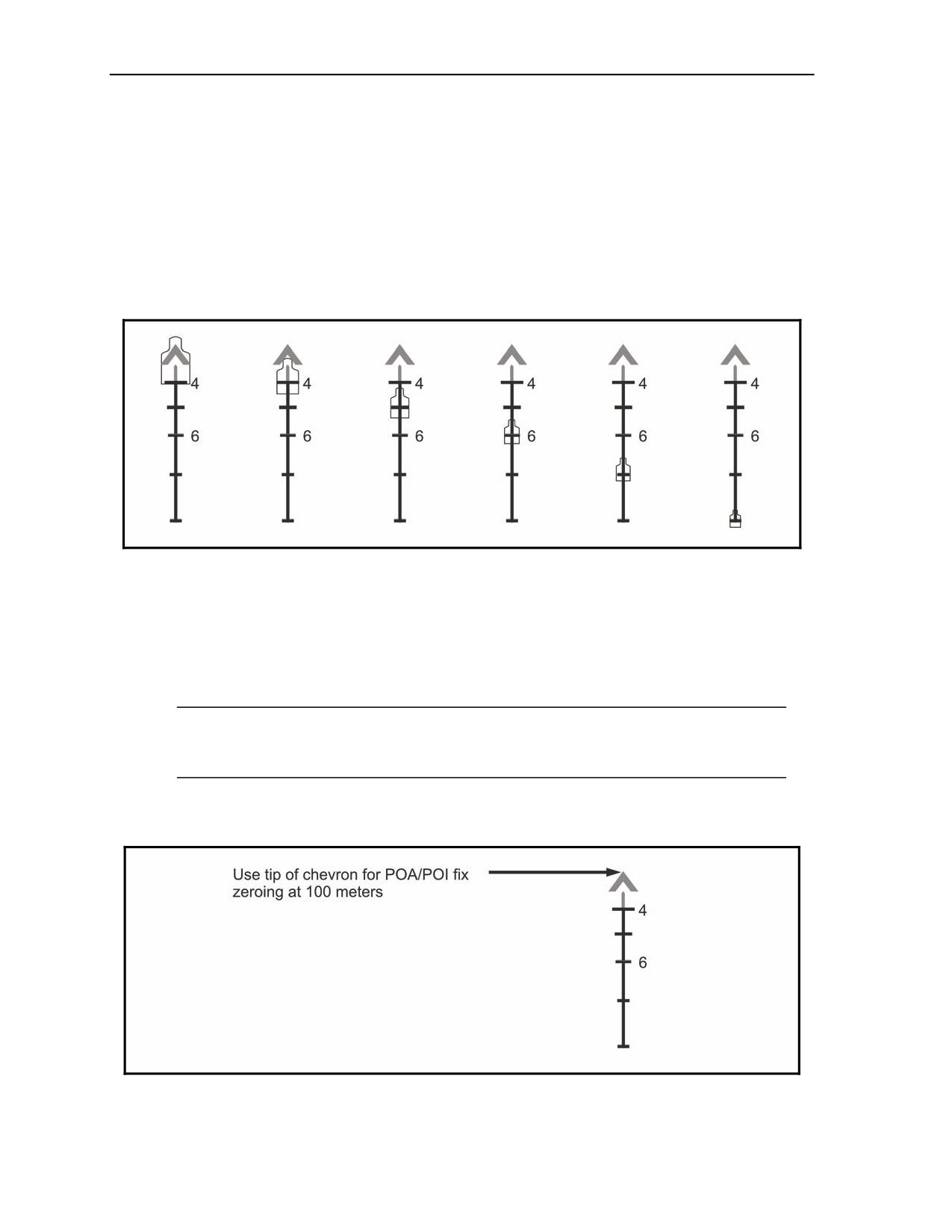
8-42. The outside legs of the chevron reticle in the ACOG correspond to 19 inches (average width of a
man's shoulders) at 300 meters.
8-43. The widths of the horizontal hash marks on the BDC reticles in all ACOG scopes correspond to the
width of a .5 meter (19 inches) silhouette (man-size) at that range (Figure 8-6).
Figure 8-6. Width of horizontal hash marks.
ZEROING THE ADVANCED COMBAT OPTICAL GUNSIGHT
8-44. The adjustment increments for the ACOG are 1/4 inch per click at 100 meters. A click is defined as
the sound or feel of the positive detent movement. This means that 4 clicks are required to move the bullet
approximately one inch on the target at 100 meters. At 25 meters, 16 clicks move the bullet one inch.
Turning the screw in the direction of the arrow moves the bullet impact in the direction marked (up/right).
NOTE: To ensure a consistent zero, tap the scope with the palm of your hand to stabilize the
adjustment mechanism after an adjustment has been made, and then fire a three-shot group on
the target.
8-45. The ACOG scope with chevron reticle is designed to be zeroed at 100 meters, using the tip of the
chevron reticle for POA/POI (Figure 8-7).
Figure 8-7. Advanced combat optical gunsight reticle point of aim at 100 meters.
8-18
FM 3-22.9
12 August 2008
Advanced Optics, Lasers, and Iron Sights
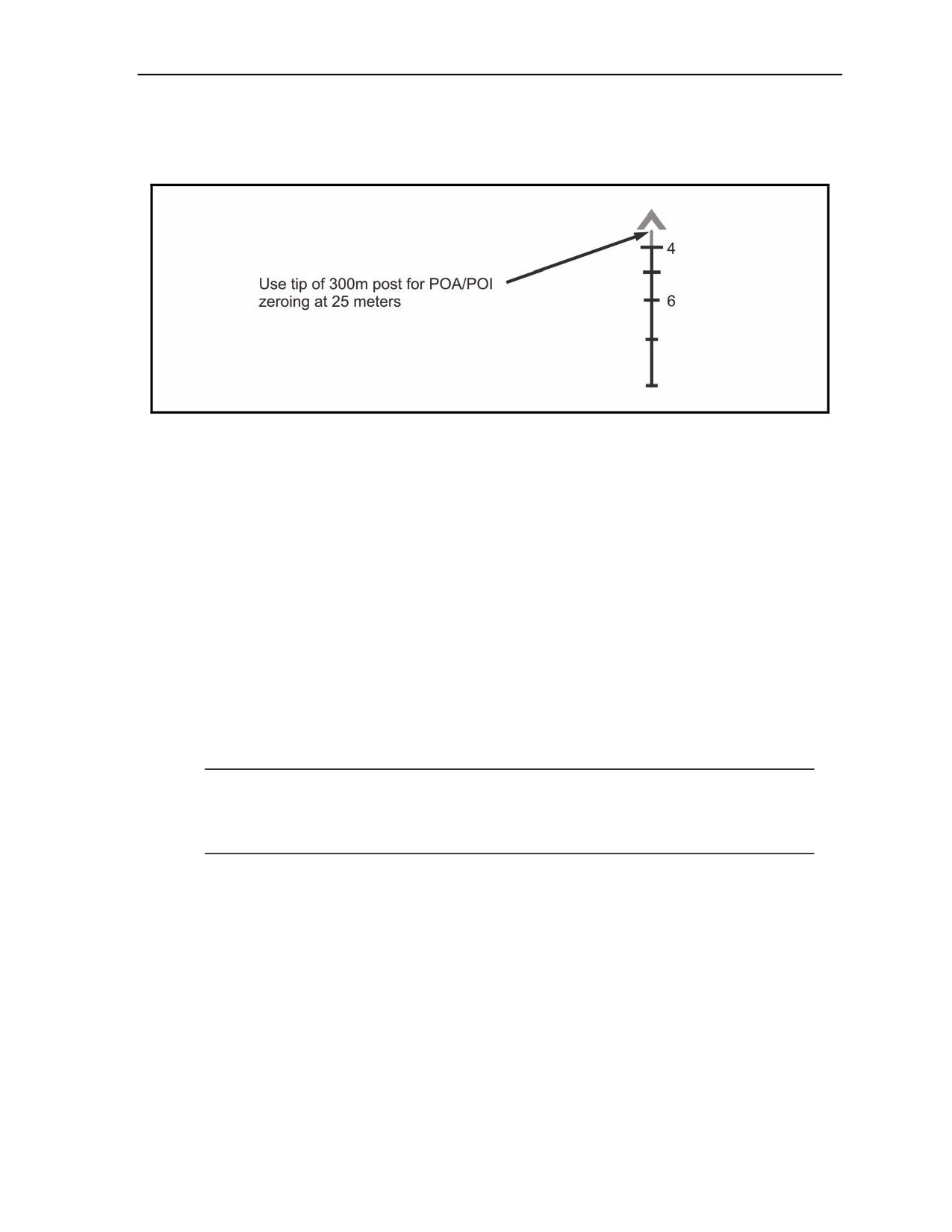
8-46. For a quick combat zero, the scope may be zeroed at 25 meters, using the tip of the 300-meter post as
POA/POI. A 25-meter zero is less precise than a 100-meter zero and should be verified at longer distances
once time and a range is available (Figure 8-8).
Figure 8-8. Advanced combat optical gunsight reticle point of aim at 25 meters.
MODIFIED FUNDAMENTALS
8-47. ACOG operation requires modifications to the following fundamentals of marksmanship:
z
Steady position.
z
Aiming.
z
Breath control.
z
Trigger squeeze.
Steady Position
8-48. This fundamental does not change.
Aiming
8-49. When the TA11F ACOG is attached to the carrying handle of an M16A1/A2/A3 rifle, the BDC
reticle will be off slightly at extended distances. Beginning at
400 meters, the BDC reticle will be
approximately one MOA off to the extent of the BDC reticle, once properly zeroed.
Example: At 500 meters, the impact will be 5 inches high; at 600 meters, the impact will be 6
inches high.
Once the target is ranged beyond 400 meters, hold slightly low.
Breath Control
8-50. This fundamental does not change.
Trigger Squeeze
8-51. This fundamental does not change.
TARGET DETECTION
8-52. Target detection procedures for the ACOG are the same as with standard iron sights.
PRACTICE QUALIFICATION
8-53. The procedures are the same as standard iron sight procedures.
12 August 2008
FM 3-22.9
8-19

Chapter 8
RECORD QUALIFICATION
8-54. The procedures are the same as standard iron sight procedures.
AN/PAS-13B/C/D (V1) LIGHT WEAPON THERMAL SIGHT AND
AN/PAS-13B/C/D (V3) HEAVY WEAPON THERMAL SIGHT
8-55. The AN/PAS-13B/C/D (V1, V3) TWS is an IR imaging sensor used for target acquisition under
conditions of low visibility. IR light is received through the telescope, detected by an IR sensor, converted
to digital data, processed, and displayed for the user.
NOTE: See Table 8-6 for the current training program.
Table 8-6. AN/PAS-13B/C/D thermal weapon sight training program.
AN/PAS-13B/C/D TWS
Instructional Intent
•
Soldiers qualify with the ANPAS-13B/C/D TWS.
Special Instructions
Ensure that Soldiers—
•
Are proficient with the TWS.
•
Use the spacer with the M4, M16A4, and MWS.
•
Use the proper 10-meter boresighting target during boresighting procedures.
•
Boresight both FOVs.
•
Confirm the 10-meter boresight with a 25-meter zero.
•
Use the M16A2 zeroing target with a 4x4-centimeter square cut out of the center of the silhouette.
•
Thermalize the zero range and qualification range (inspect for targets that aren’t thermalized).
•
Use every other lane during zero and qualification.
Observables
•
Soldiers zero the TWS to the same standards as with iron sights.
•
Soldiers achieve the same practice qualification and qualification standards as with day record fire.
WARNING
Ensure that the weapon is not loaded and is on SAFE before
installing the TWS on the weapon. A loaded weapon may
accidentally discharge, causing severe injury or death.
CONCEPT
8-56. The AN/PAS-13B/C/D TWS training strategy is much the same as that of aiming lights. The TWS
does not require the use of NVDs. The course of fire for the TWS is the same scenario as the day
qualification tables, with the same standards of fire as for current day standards. Qualification standards are
the same for day and night.
CONDUCT OF TRAINING
8-57. AN/PAS-13B/C/D equipment training should familiarize the Soldier with the proper operation and
characteristics of the TWS IAW the TM.
8-20
FM 3-22.9
12 August 2008
Advanced Optics, Lasers, and Iron Sights
MODIFIED FUNDAMENTALS
8-58. AN/PAS-13B/C/D TWS operation requires modifications to the fundamentals of marksmanship:
z
Steady position.
z
Aiming.
z
Breath control.
z
Trigger squeeze.
Steady Position
8-59. This fundamental slightly changes due to the height of the sight. Consider the following
modifications:
z
Soldiers must adjust their position so they can properly look through the sight.
z
In most cases, the cheek-to-stock weld no longer exists.
Aiming
8-60. To properly aim with the TWS, Soldiers must ensure that the correct reticle is selected in the sight.
NOTE: Refer to TM 11-5855-312-10 for reticle selection and point of aim for use with the
TWS.
Breath Control
8-61. This fundamental is not affected by night firing conditions when using the TWS.
Trigger Squeeze
8-62. This fundamental of marksmanship does not change during night firing.
25-METER ZEROING PROCEDURES
NOTE: Refer to TM 11-5855-312-10 for target preparation.
8-63. To zero the AN/PAS-13B/C/D TWS at 100 meters, use the same procedures and standards as with
iron sights, along with the following:
z
At the 25-meter range, each incremental adjustment to the azimuth or elevation setting moves
strike of the round as follows:
1 ½ centimeters for LWTS on WFOV.
½ centimeter for LWTS on NFOV.
¾ centimeter for HWTS on WFOV.
¼ centimeter for HWTS on NFOV.
z
Retighten the rail grabber after firing the first three rounds.
z
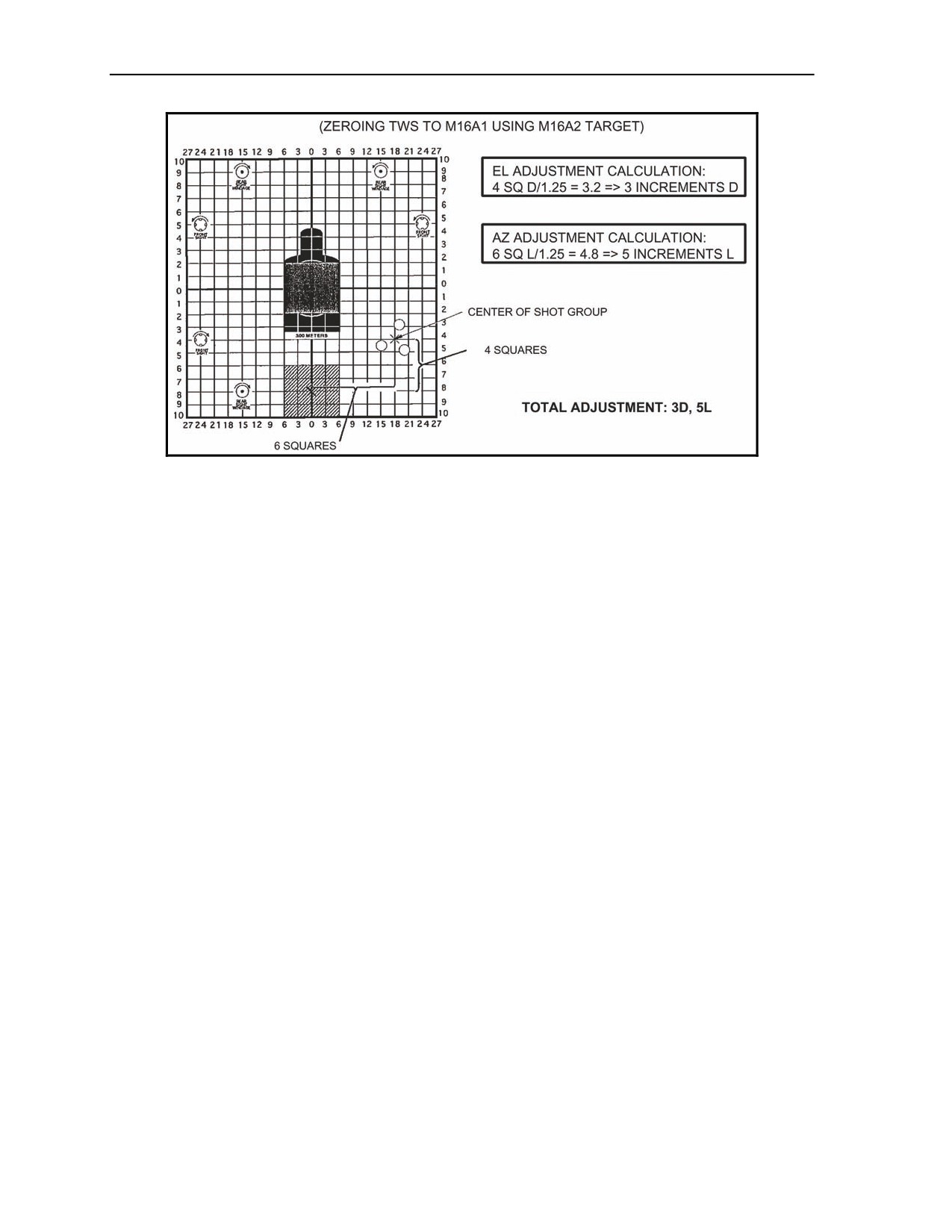
Zero both FOVs (Figure 8-9).
12 August 2008
FM 3-22.9
8-21
Chapter 8
Figure 8-9. Example of thermal weapon sight zeroing adjustments.
TARGET DETECTION
8-64. With NVDs, the field of view is much smaller, scanning becomes much more deliberate, and, with
the TWS, camouflage becomes less of a factor. Even though NVDs greatly enhance the Soldier’s ability to
acquire a target at night, increased awareness of target detection must be trained to allow the Soldier to
recognize the visual cues of IR imagery.
Select Position
8-65. The TWS is a large device; selecting a position that allows for good fields of view, but does not
silhouette the Soldier and his equipment, might be a challenge. Since the TWS detects thermal energy
(heat) emitted from an object, a position near an object emitting a vast amount of thermal energy (for
example, a vehicle with the engine running or a fire) may affect the Soldier’s ability to acquire a target.
Scanning
8-66. With earlier versions of the TWS, scanning too fast causes a stuttering on the screen, which might
cause the Soldier to miss or overlook a target. With these versions, Soldiers must scan slowly in order to
maintain a good thermal image on the screen.
8-67. With the newer version, this stuttering is not as obvious. One advantage of the TWS is its two
FOVs—wide and narrow. Each has advantages and disadvantages:
z
The NFOV increases magnification but decreases the field of view.
z
The WFOV decreases magnification but increases the field of view.
Target Indicators
8-68. While scanning the sector or lane with the TWS, the Soldier should recognize thermal cues that
allow him to detect and identify targets. The engine compartment, exhaust, and tires of a vehicle that has
been moving are all examples of thermal cues. Adjusting the brightness, contrast, and polarity helps
enhance the thermal cues of a target, allowing for quicker detection and identification.
8-22
FM 3-22.9
12 August 2008
Advanced Optics, Lasers, and Iron Sights
Sound
8-69. Use the same techniques outlined in day and night target detection.
Movement
8-70. Thermal cues become much more obvious on a moving object than on an object standing still. A
good example is a vehicle's tires. When the vehicle is not moving, the tires are cold. On a moving vehicle,
the friction between the road and the tires causes the tires to heat up and become prominent when observed
through the TWS. The same is true with the human body—a moving person generates more heat than
someone standing still.
Camouflage
8-71. The TWS allows Soldiers to see thermal signatures not completely masked by camouflage, such as
paint, foliage, and camouflage netting, thereby increasing both day and night target detection abilities.
WARNING
If the TWS is operated with the eyecup removed, light emitting
from the eyepiece may be visible to the enemy’s NVDs.
PRACTICE QUALIFICATION
8-72. Practice qualification with the TWS is the same as day practice qualification with iron sights. Dry-
fire exercises are performed to allow Soldiers to make adjustments to the TWS. Every other firing lane
should be used so that the Soldier engages only the targets in his lane.
RECORD QUALIFICATION
8-73. Record qualification with the TWS is the same as day record qualification with iron sights.
NOTES:
1. Record qualification with the TWS can be done day and or night. Regardless of
the qualification, the standard day record fire for the iron sights will be used.
The standards for qualification with the TWS, either day or night, are 23 out of
40.
2. During practice qualification and qualification, the Soldier chooses his own
polarity and FOV.
AN/PAQ-4B/C AND AN/PEQ-2A/B INFRARED AIMING LASERS
8-74. The newest IR aiming lasers greatly increase the night firing accuracy of all infantry weapons. IR
aiming lasers complete the transition from day optics to night optics. Their effectiveness is limited by the
capability of the image-intensifier (I2) sight with which they are used.
NOTE: See Table 8-7 for the current training program.
12 August 2008
FM 3-22.9
8-23

Chapter 8
Table 8-7. AN/PAQ-4B/C or AN/PEQ-2A/B infrared aiming laser training program.
AN/PAQ-4B/C OR AN/PEQ-2A/B INFRARED AIMING LASERS
Instructional Intent
•
Soldiers qualify with the AN/PAQ-4B/C or AN/PEQ-2A/B IR aiming laser.
Special Instructions
Ensure that Soldiers—
•
Are proficient with the AN/PAQ-4B/C or AN/PEQ-2A/B IR aiming laser.
•
Use the proper 10-meter boresighting target during boresighting procedures.
•
Use the borelight filter.
•
Set the AN/PEQ-2A/B IR aiming laser to AIM LO.
•
Boresight the illuminator on the AN/PEQ-2A/B.
•
Use the M16A2 25-meter zeroing target for 25-meter zero.
Ensure that a 3x3-centimeter hole is cut in the center of the 25-meter zeroing target and E-type silhouette.
Observables
•
Soldiers conduct either 10-meter boresight or a 25-meter zero.
•
Soldiers display good scanning, IR discipline, and IR walking technique.
•
Soldiers achieve at least 17 target hits out of 40 target exposures.
CONCEPT
8-75. Two training strategies have been devised to adequately train Soldiers in the use of AN/PAQ-4B/C
and AN/PEQ-2A/B IR aiming lasers: the night initial training strategy and the night sustainment training
strategy. Units should always review the night initial training strategy prior to the night sustainment
training strategy.
Night Initial Training Strategy
8-76. The night initial training strategy is used for Soldiers who have little or no previous experience with
night vision goggles, or for units beginning a night training program.
Night Sustainment Training Strategy
8-77. The night sustainment training strategy is for Soldiers who are familiar with night vision goggles,
and for units that have already implemented a night training program.
CONDUCT OF TRAINING
8-78. AN/PAQ-4B/C and AN/PEQ-2A/B IR aiming laser equipment training should familiarize Soldiers
with the proper operation and characteristics of AN/PAQ-4B/C and AN/PEQ-2A/B IR aiming lasers IAW
the TM.
MODIFIED FUNDAMENTALS
8-79. NVD operation requires modifications to the fundamentals of marksmanship:
z
Steady position.
z
Aiming.
z
Breath control.
z
Trigger squeeze.
8-24
FM 3-22.9
12 August 2008
Advanced Optics, Lasers, and Iron Sights
Steady Position
8-80. Consider the following modifications:
z
Realize that a good cheek-to-stock weld is not possible with NVGs mounted on the head.
z
Ensure that the weapon's buttstock is firmly pulled into the pocket of the shoulder to prevent
the laser from wobbling.
z
When ready to fire, plant the elbows firmly on the ground to prevent the laser from wobbling
excessively.
Aiming
8-81. Consider the following modifications:
z
Practice raising the head just enough to clear the weapon with the NVGs.
z
Acquire a good sight picture by walking the laser onto the target and then aiming at the center
of mass.
Breath Control
8-82. This fundamental is not modified for night firing conditions.
Trigger Squeeze
8-83. Do not disrupt the laser/target alignment by jerking the trigger.
25-METER ZEROING PROCEDURES
8-84. If the borelight is not available, a 25-meter zero must be conducted. A 25-meter zeroing target is
shown in Figure 8-10.
AN/PAQ-4B/C Infrared Aiming Laser
8-85. The 25-meter zeroing procedures for the AN/PAQ-4B/C IR aiming laser are as follows:
NOTE: The zero standards are the same as with iron sights.
(1) Set the adjusters to their zero preset position.
NOTE: See TM 11-5855-301-12&P for more information about setting the adjusters to their
zero preset position.
(2) Prepare a 25-meter zeroing target by cutting a 3x3-centimeter square out of the center of the
silhouette.
(3) Adjust for windage and elevation.
For windage and elevation, one click equals 1 centimeter at 25 meters.
For elevation, one clockwise click moves the bullet strike up.
For windage, one clockwise click moves the bullet strike left.
(4) Retighten the rail grabber after the first three rounds are fired.
NOTE: When cutting the 3x3-centimeter square out of the target, some of the strike zone may
be cut out. Take care when annotating the impact of the rounds. When the weapon is close to
being zeroed, some of the shots may be lost through the hole in the target.
12 August 2008
FM 3-22.9
8-25
Chapter 8
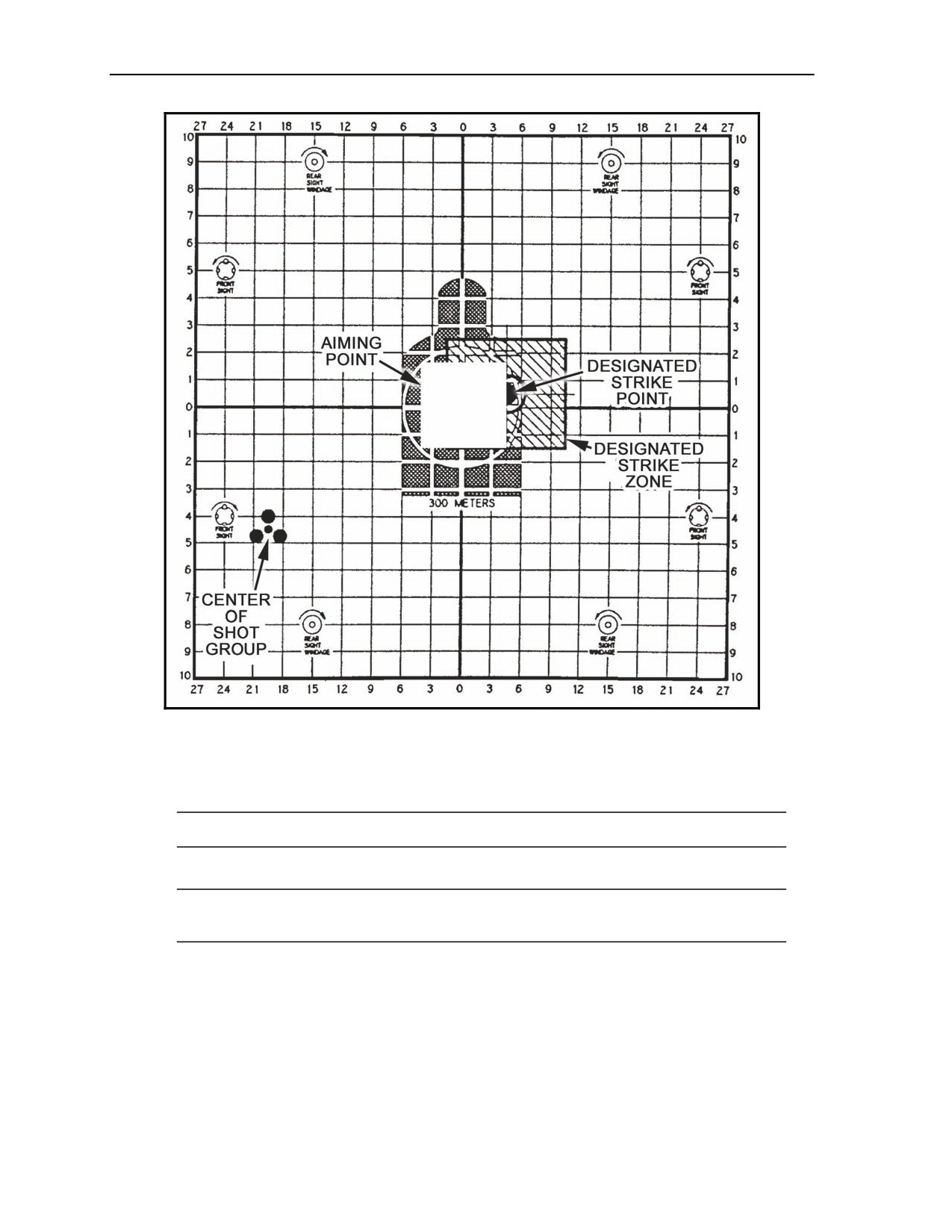
Figure 8-10. Example of shot group adjustment with strike zone.
AN/PEQ-2A/B Infrared Aiming Laser
8-86. The 25-meter zeroing procedures for the AN/PEQ-2A/B IR aiming laser are as follows:
NOTE: The zero standards are the same as with iron sights.
(1) Set the adjusters to their zero preset position.
NOTE: See TM 11-5855-308-12&P for more information about setting the adjusters to their
zero preset position.
(2) Prepare the 25-meter zeroing target by cutting out a 3x3-centimeter square in the center of the
target and E-type silhouette.
(3) Turn the aiming beam on in the low power setting (AIM LO).
(4) Install the aim point filter to eliminate excessive blooming.
(5) Adjust the AN/PEQ-2A/B (top-mounted) aiming point as follows:
For windage and elevation, one click equals 1 centimeter or one square at 25 meters.
For elevation, one clockwise click moves the bullet strike up.
For windage, one clockwise click moves the bullet strike right.
8-26
FM 3-22.9
12 August 2008
Advanced Optics, Lasers, and Iron Sights
(6) Adjust the AN/PEQ-2A/B (top-mounted) target illuminator as follows:
For windage and elevation, one click equals 1 centimeter or one square at 25 meters.
For elevation, one clockwise click moves the bullet strike down.
For windage, one clockwise click moves the bullet strike right.
(7) Retighten the rail grabber and the AN/PEQ-2A/B.
(8) Once the aiming beam is zeroed, rotate the selector knob to the DUAL LO, DUAL LO/HI, or
DUAL HI/HI mode to observe both aiming and illumination beams.
(9) Rotate the illumination beam adjusters to align the illumination beam with the aiming beam.
NOTES:
1. Failure to fully tighten the mounting brackets and AN/PEQ-2A/B thumbscrew
may cause zero retention problems. Confirm that equipment is tight prior to
zeroing.
2. To retain zero, remove the TPIAL and rail grabber as a whole assembly and
place back onto the same notch as removed.
TARGET DETECTION
8-87. Soldiers should receive in-depth instruction on the proper use and fit of night vision goggles, to
include characteristics and capabilities, maintenance, and mounting procedures. Extensive testing has
proven that the average Soldier does not properly use NVDs. Unit leaders must be proficient in the train-
the-trainer strategy. At night, Soldiers should conduct a terrain walk to become more familiar and build
confidence using the night vision goggles.
Scanning for Targets
8-88. NVDs have a 40-degree field of view, which causes the average firer to miss easy targets of
opportunity. Soldiers must be trained to aggressively scan their sectors of fire for targets.
8-89. The art of target detection at night is only as good as the Soldier practices. Regular blinking during
scanning relieves some of the eyestrain that Soldiers experience when trying to spot distant targets. Regular
blinking must be reinforced during training. After Soldiers have mastered the art of scanning, they will find
that targets are more easily detected by acknowledging the flicker or movement of a target.
Infrared Discipline
8-90. Soldiers must be taught that what they can see downrange or on the battlefield through NVGs, the
enemy can also see. Soldiers must train to activate the laser at the base of the target and engage the target as
soon as the target is detected. After the target has been engaged, the laser is deactivated.
8-91. When a Soldier uses proper IR discipline while scanning for targets, he must keep his weapon
oriented within his sector of fire. When the target is detected, the Soldier orients his weapon around the
base of the target, activates his laser, and walks the laser to the target's center of mass for engagement.
FIELD FIRE
8-92. During dry-fire exercises, Soldiers acquire a sight picture on all exposed silhouette targets before
conducting the field fire scenario. This allows Soldiers to focus on the targets at range. The procedures for
field fire include the following:
z
Conduct a dry-fire exercise prior to conducting a live-fire.
z
Conduct Field Fire in the same manner as Field Fire II.
z
Engage targets at 50, 150, and 250 meters.
z
Fire 36 rounds:
18 rounds from the supported firing position.
18 rounds from the prone unsupported firing position.
10 February 2011
FM 3-22.9, C1
8-27

Chapter 8
PRACTICE QUALIFICATION
8-93. The procedures for practice qualification include the following:
z
Conduct a dry-fire exercise.
z
Use coaches.
z
Fire 40 rounds:
20 rounds from the prone supported firing position.
*20 rounds from the unsupported firing position.
z
Engage targets from 50 to 250 meters.
z
Meet the standards (17 hits out of 40 target exposures).
RECORD QUALIFICATION
8-94. The procedures for record qualification include the following:
z
Conduct a dry-fire exercise.
z
Fire 40 rounds:
20 rounds from the prone supported firing position.
*20 rounds from the unsupported firing position.
z
Engage targets from 50 to 250 meters.
z
Meet the standards (17 hits out of 40 target exposures).
AN/PVS-4 NIGHT VISION DEVICE
8-95. The AN/PVS-4 NVD is a portable, battery-operated electro-optical instrument used for observation
and aimed fire of weapons at night. It amplifies reflected light, such as moonlight, starlight, and sky glow,
so that the viewed scene becomes clearly visible to the operator. It can be mounted on the M16A2/A3/A4
rifle and M4/M4 MWS. Mounting brackets are provided for each type of weapon.
NOTE: See Table 8-8 for the current training program.
Table 8-8. AN/PVS-4 night vision device training program.
AN/PVS-4 NIGHT VISION DEVICE
Instructional Intent
•
Soldiers qualify with the AN/PVS-4 NVD.
Special Instructions
Ensure that Soldiers—
•
Are proficient with the AN/PVS-4 NVD.
•
Install the spacer and Picatinny rail grabber when mounting on the MWS.
•
Use the proper 10-meter boresighting target during boresighting procedures.
•
Use the proper reticle.
•
Confirm 10-meter boresight with a 25-meter zero.
Observables
•
Soldiers zero the AN/PVS-4 to the same standard as with the iron sight.
•
Soldiers achieve the same practice and qualification standards as with day record fire.
8-28
FM 3-22.9, C1
10 February 2011
Advanced Optics, Lasers, and Iron Sights
CONCEPT
8-96. Training strategy for the AN/PVS-4 is much the same as that for aiming lights, and the course of fire
and qualifications standards are the same as those for aiming lasers.
CONDUCT OF TRAINING
8-97. This training should familiarize the Soldier with the proper operation and characteristics of the
AN/PVS-4 IAW the TM.
MODIFIED FUNDAMENTALS
8-98. NVD operation requires modifications to the fundamentals of marksmanship:
z
Steady position.
z
Aiming.
z
Breath control.
z
Trigger squeeze.
Steady Position
8-99. This fundamental slightly changes due to the height of the sight. Consider the following
modifications:
z
Adjust your position so you can properly look through the sight.
z
Recognize that, in most cases, the cheek-to-stock weld no longer exists.
Aiming
8-100. Consider the following modifications:
z
To properly aim the AN/PVS-4, ensure that the proper reticle is inserted in the sight.
z
Place the aiming point on the target's center of mass.
NOTE: Refer to TM 11-5855-213-10 for more information about inserting the proper reticle.
Breath Control
8-101. This fundamental of marksmanship does not change during night firing.
Trigger Squeeze
8-102. This fundamental of marksmanship does not change during night firing.
25-METER ZEROING PROCEDURES
8-103. To zero the AN/PVS-4 at 25 meters, use the same procedures and standards as with the iron sights,
along with the following:
z
At 25-meter range, each increment of azimuth or elevation setting moves the strike of the
round .63 centimeters or ¼ mil.
z
Two clicks of the windage or elevation will move the strike of the round approximately one
square on the M16A2 zeroing target.
z
Retighten the thumbscrew on the rail grabber after firing the initial three rounds.
NOTE: If there is not enough ambient light to see the boresight mark at ten meters or the
silhouette on the zeroing target during boresighting or zeroing procedures, shine a flashlight
indirectly at the target to provide ambient light.
12 August 2008
FM 3-22.9
8-29
Chapter 8
TARGET DETECTION
8-104. Target detection with the AN/PVS-4 is very similar to target detection with the night vision
goggles. The AN/PVS-4 has a 14.5-degree field of view, causing the average firer to miss easy targets of
opportunity, more commonly the 50-meter left or right.
8-105. Soldiers must be trained to aggressively scan their sectors of fire for targets. The art of target
detection at night is only as good as the Soldier practices. Regular blinking during scanning relieves some
of the eyestrain that Soldiers experience when trying to spot distant targets. Regular blinking must be
reinforced during training. After Soldiers have mastered the art of scanning, they will find that targets are
more easily detected by acknowledging the flicker or movement of a target.
FIELD FIRE
8-106. During dry-fire exercises, Soldiers acquire a sight picture on all exposed silhouette targets before
conducting the field fire scenario. This allows Soldiers to focus on the targets at range. The procedures for
field fire include the following:
z
Conduct a dry-fire exercise prior to conducting a live-fire.
z
Conduct Field Fire in the same manner as Field Fire II.
z
Engage targets at 50, 150, and 250 meters.
z
Fire 36 rounds:
18 rounds from the supported firing position.
18 rounds from the prone unsupported firing position.
PRACTICE QUALIFICATION
8-107. The procedures for practice qualification include the following:
z
Conduct a dry-fire exercise.
z
Use coaches.
z
Fire 40 rounds:
20 rounds from the prone supported firing position.
10 rounds from the unsupported firing position.
10 rounds from the kneeling firing position.
z
Engage targets from 50 to 250 meters.
z
Meet the standards (17 hits out of 40 target exposures).
RECORD QUALIFICATION
8-108. The procedures for record qualification include the following:
z
Conduct a dry-fire exercise.
z
Fire 40 rounds:
20 rounds from the prone supported firing position.
10 rounds from the unsupported firing position.
10 rounds from the kneeling firing position.
z
Engage targets from 50 to 250 meters.
z
Meet the standards (17 hits out of 40 target exposures).
8-30
FM 3-22.9
12 August 2008
Appendix A
Training Aids, Devices, and Exercises
Training aids and devices must be included in a marksmanship program. This
appendix lists those available and provides information on how to obtain them for
marksmanship training.
SECTION I. ENGAGEMENT SKILLS TRAINER 2000
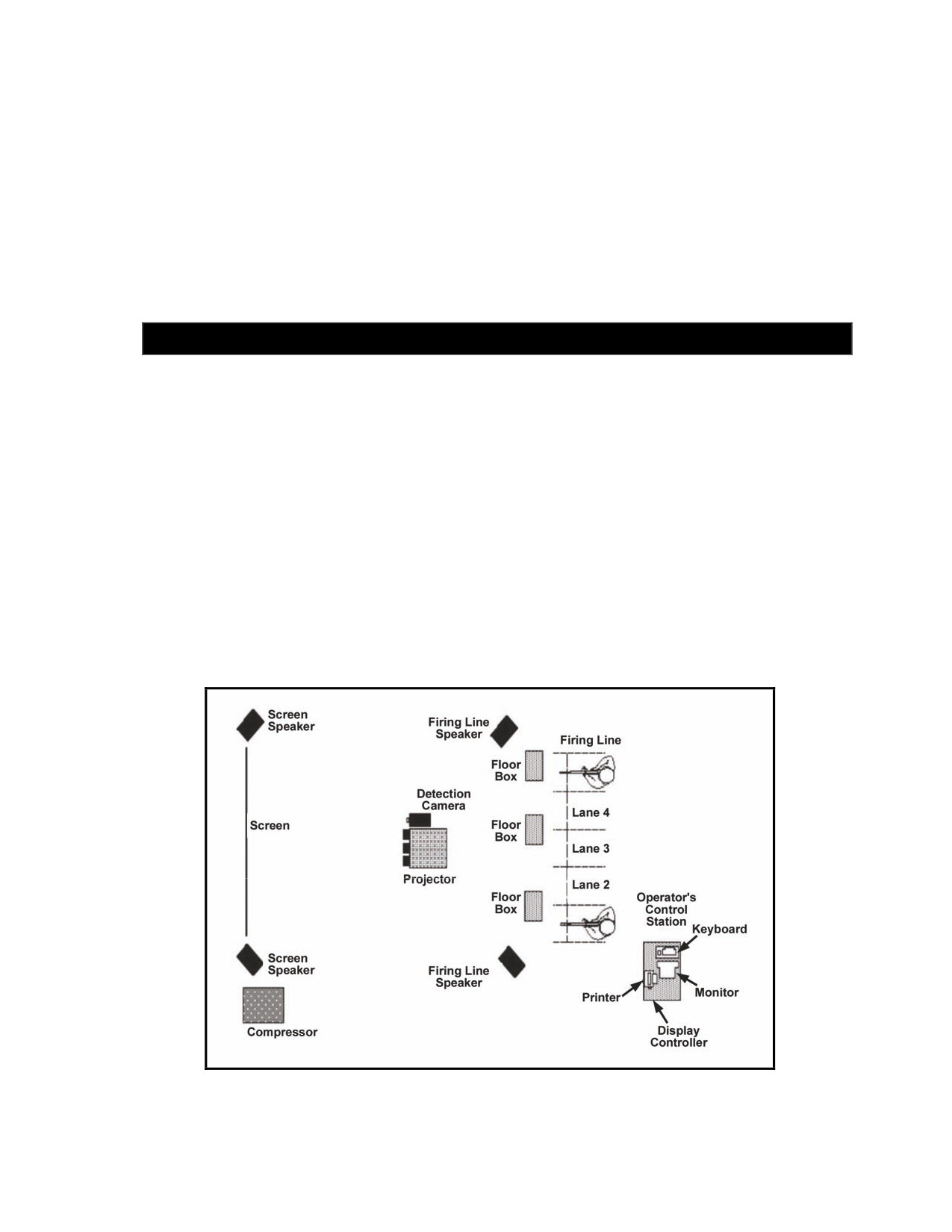
The EST 2000 (Figure A-1) supports realistic and comprehensive gated rifle marksmanship instruction,
identifies Soldiers' needs by requiring them to satisfy gate requirements in order to progress, and facilitates any
necessary remedial training prior to qualification. This unit/institutional, indoor, multipurpose, multilane, small
arms, crew-served, and individual antitank training simulator is used to—
z
Train and evaluate individual marksmanship training for initial entry Soldiers (BCT/OSUT).
z
Provide unit sustainment training for active and reserve components in preparation for
qualification on individual and crew small arms live-fire weapons.
z
Provide unit collective tactical training for static dismounted infantry, scout, engineer, military
police squads, and sustainment elements.
z
Simulate training events which lead to live-fire individual and crew weapon qualification.
z
Simulate training events that contribute to increased weapon, crew, fire team, and squad combat
effectiveness.
z
Simulate squad collective, defensive, ambush, gunnery, and tactical tasks.
z
Train leaders of fire teams and squads in the command, control, and distribution of fires.
z
Save ammunition, travel time, transportation costs, and other range support resources.
z
Support functional gunnery training strategies and standards in weapon training.
Figure A-1. Engagement skills trainer (five-lane configuration).
12 August 2008
FM 3-22.9
A-1
Appendix A
GENERAL CHARACTERISTICS
A-1. The EST 2000 replicates eleven weapons, including the rifle, carbine, pistol, grenade launcher, all
machine guns, MK19, shotgun, and AT4. It has three modes of training:
z
Marksmanship training.
z
Tactical collective training.
z
Shoot/don't shoot rules of engagement training.
A-2. It also includes a scenario editor for generating or tailoring new scenarios.
MARKSMANSHIP TRAINING
A-3. When used in the marksmanship training mode, the EST 2000—
z
Uses Army standard courses of fire for all small arms weapons.
z
Accurately simulates live-fire ranges in daylight and limited visibility conditions using
precision-scaled targets, high-resolution imagery, and the essential weapon's system accuracy to
compensate for errors (drift, parallax).
z
Isolates, captures, and displays shots with replay that highlights firer’s errors in the application
of the fundamentals of marksmanship. Replay of the point of aim trace (before the shot, during
the shot, and after the shot) diagnoses firer problems with aiming, breathing, steady hold, trigger
control, and shot recovery for on-the-spot corrections. Cant sensors visually indicate firer-
induced right or left cant, possibly resulting in missed shots.
Basic Rifle Marksmanship Training
NOTE: The marksmanship core scenarios can be found in the EST 2000 Operator’s Manual,
TD-07-6910-702-10.
A-4. The EST 2000 begins training the fundamentals of marksmanship right from the beginning, before
the Soldier has a chance to develop bad habits. Using EST 2000 technology, Soldiers and units can reduce
their rate of marksmanship failures and increase Soldiers’ confidence in being able to fire their assigned
weapons.
A-5. EST 2000 is particularly useful for teaching BRM, where a gated strategy requires the Soldier to pass
certain gates in the simulation before firing live ammunition. The Soldier does not proceed or pass a gate
scenario until he meets the standard.
A-6. EST 2000 marksmanship training provides basic range firing and qualification and is accomplished
in 5-, 10-, or 15-lane configurations. Each firer is restricted to one firing lane.
Remedial Marksmanship Training
A-7. While the EST 2000 BRM gated strategy often reduces the requirements for remedial live-fire
training, it is highly useful in diagnosing and correcting problems before the Soldier fires live rounds.
Using the EST 2000 technology of rifle cant, trigger pressure, and before-the-shot, during-the-shot, and
after-the-shot AARs, trainers can quickly identify and correct problems, thus raising confidence and first-
time qualifications.
Individual and Unit Sustainment Training
A-8. Sustainment training and prequalification refresher training can be conducted with the EST 2000.
During individual and unit sustainment training, grouping, zeroing, and Field Fire I and II should be
conducted to standard in the EST 2000 prior to live-fire qualification.
NOTE: EST 2000 will not be used in lieu of live-fire qualification except for those outlined in
DA Pam 350-38.
A-2
FM 3-22.9
12 August 2008
Training Aids, Devices, and Exercises
TACTICAL COLLECTIVE TRAINING
A-9. When used in the tactical collective training mode, the EST 2000—
z
Presents tactical collective exercises that train squad, team, and element leaders in fire
distribution and control.
z
Provides fully articulated interactive targets with variable outcomes based on a squad’s action or
inaction.
z
Uses realistic 3D-modeled battlefield terrain and variable environmental effects (for example,
day/night and dawn/dusk, variable weather conditions, and illumination).
z
Uses other special effects, such as a weapon’s effects, explosions, and vehicle damage, to
enhance the static eye point of the battlefield.
z
Allows trainers and units to build scenarios as they would fight.
z
Provides shot-by-shot feedback that is tied to each firer’s lane of fire.
z
Will soon include an entry-level indirect fire capability (product improvement).
NOTE: Tactical collective training core scenarios can be found in the EST 2000 Operator’s
Manual, TD-07-6910-702-10.
A-10. Tactical collective training is conducted on two networked five-lane subsystems. This configuration
can support up to 11 weapons, including tandem weapons.
NOTE: The tandem weapons capability is available in collective training only. This capability
allows the use of an extra weapon connected to the fifth lane (port 6) in the third floor box,
allowing a firer to manage two weapons. For further instructions, refer to the EST 2000
Operator’s Manual.
SHOOT/DON’T SHOOT RULES OF ENGAGEMENT TRAINING
A-11. When used in the shoot/don’t shoot rules of engagement training mode, the EST 2000—
z
Can be configured to enhance special operations and counterterrorism training.
z
Is the premier training simulation for stability and support operations training.
z
Uses video-based graphic overlays with multiple escalation or de-escalation points that require
the firer to justify his actions based on his situational awareness.
NOTE: Shoot/don’t shoot core scenarios can be found in the EST 2000 Operator’s Manual, TD-
07-6910-702-10.
A-12. Shoot/don’t shoot rules of engagement training is conducted on a five-lane subsystem. This training
uses video-based graphic overlays that provide important clues (for example, facial expressions and body
language) for the firer to cue on. Multiple escalation or de-escalation points require the firer to justify his
actions based on his situational awareness.
SCENARIO EDITOR
A-13. The scenarios currently available in the EST 2000 meet 90 percent of a unit’s training requirements.
As a unit’s mission changes, weapons and TTPs are changed, or additional training requirements occur, the
unit can use the scenario editor to generate or tailor new scenarios. The scenario editor can be used to
enhance the individual Soldier’s skills and, collectively, the squad’s ability to engage and destroy an enemy
threat.
NOTE: Detailed instructions on how to create and modify scenarios can be found in the EST
2000 training support package.
12 August 2008
FM 3-22.9
A-3
Appendix A
WEAPON SAFETY
A-14. The following general safety precautions should be adhered to:
z
Fire simulated weapons only if they are pointed downrange.
z
Post warning signs at all entry doors.
z
Do not allow personnel to stand downrange from the firing line.
WARNING
No one should be allowed beyond the firing line.
z
Instruct weapon handlers never to look directly into a barrel.
z
Take the weapon off-line for testing and service at the first indication of malfunction and refer to
the troubleshooting procedures.
DANGER
Each simulated weapon has the same appearance as a fully
functioning weapon, with the exception of the trainer-peculiar
umbilical cable. Under certain circumstances, especially in the
subdued light of a training room, it is possible to mistake a live
firearm for a simulated weapon. This creates the potential for
personal injury or damage to property. To avoid confusion, no
live or blank ammunition and no live weapons should be allowed
in the training room.
Simulated weapons will not accept live or blank ammunition. Any
attempt to chamber a live or blank round may damage the
simulated weapon and create an unsafe situation.
LASER SAFETY
A-15. The lasers used in the simulated weapons meet ANSI Standard Z136.1-1993 Class I Standards for
single laser pulse power. This classification is commonly referred to by the industry rating of “eye-safe.”
However, even eye-safe lasers may be dangerous under extraordinary circumstances. To ensure personnel
safety, weapon handlers should not stare directly down a simulated weapon’s barrel. Serious eye injury
could result if a laser malfunctioned while a user was staring into the weapon’s muzzle.
WARNING
Laser light is used in the operation of this equipment. Injury may
result if personnel fail to observe safety precautions.
Never stare into the laser beam, look down the barrel of the
simulated weapon, or directly view the laser beam with optical
instruments.
Avoid direct eye exposure.
The instructor should ensure that all persons entering the training
room are aware that laser radiation is present.
A-4
FM 3-22.9
12 August 2008

Training Aids, Devices, and Exercises
SECTION II. LASER MARKSMANSHIP TRAINING SYSTEM
The LMTS supports training with a Soldier’s own weapon without the use of live ammunition. It is not
designed to replace live-fire training or to eliminate the need for knowledgeable instructors. Major components
include a battery-powered laser transmitter mounted to a mandrel inserted in the rifle barrel or affixed to the
front sight with a mounting bracket, and a variety of laser-sensitive targets. The exercise is performed in the
same manner as an LFX, except that the ammunition is a laser beam. The target senses shot locations, which are
shown on a laptop screen. Unit commanders should expect and require the following:
z
A training process that focuses on the four fundamentals of marksmanship (steady position, sight
alignment and picture, breath control, and trigger squeeze).
z
Opportunity for experienced marksmen to “test out” and serve as peer trainers or return to other
duties.
z
Real-time feedback.
z
All-season training.
z
Soldiers trained on their assigned weapon throughout the process.
Using LMTS technology, units can consistently reduce the rate of first-time marksmanship failures and increase
new Soldiers' confidence in their ability to fire their basic weapon.
EQUIPMENT
A-16. Software enhancements continue to optimize the training process and minimize computer
requirements by enabling an instructor to control up to 10 targets with only one computer. This feature
reduces overall system costs and provides maximum throughput with a minimum number of instructors.
A-17. Minimum LMTS systems consist of a basic laser transmitter with a rod to fit the weapon and a laser
target. Systems can be expanded to include a variety of components.
NOTE: Table A-1 provides a complete component list.
Table A-1. Laser marksmanship training strategy parts list.
PART
INCLUDES
110 system (110v or 220v)
TR-700 target, LT100C laser, transmitter rod, mask set, AC power
adapter, and user’s manual
330A system (110v or 220v)
TR-900 target, LT100C laser, transmitter rod, cable, software, AC
power adapter, and user’s manual
360 system (available in 3-, 4-, and 5-target array)
TR-900 target, LT100 laser, transmitter rod, cable, software, AC power
adapter, control box, and user’s manual
430 system (110v or 220v)
TR-900 target, MP400 laser, 556C rod, software, AC power adapter,
and user’s manual
Mini-range
TR-700 target, LT100C laser, transmitter rod, transceiver unit with RS-
232 cable, software, E-tat, AC power adapter, and user’s manual
Sound and recoil replicator system
M16A2 upper receiver
M4 upper receiver
CO2-powered weapon simulator (M4 or M16)
Borelight kit
MP400 laser, LTA-556C transmitter rod, and carrying case
Targets
TR-700 electronic
TR-900 electronic
25-m zero reflective (small)
25-m zero reflective (large)
Other reflective targets available
Laser transmitters
LT-100 laser transmitter
LT-500 in-barrel laser transmitter
12 August 2008
FM 3-22.9
A-5