FM 3-22.9 RIFLE MARKSMANSHIP M16-/M4-SERIES WEAPONS (August 2008) - page 6

Chapter 7
SECTION IV. NIGHT FIRE TRAINING
Soldiers should be able to fire their weapons effectively in total darkness, in bright sunlight, and under all
conditions between these two extremes. Scheduled marksmanship training should provide a variety of night and
limited visibility conditions. The battlefield may be illuminated by ground flares, handheld flares, M203 flares,
mortar and artillery illumination, aerial flares, searchlights, exploding rounds, and burning vehicles, or obscured
by smoke, fog, and various environmental conditions. The well-trained Soldier should have experienced a
number of these conditions and be confident that he can effectively employ his weapon when required. This
section provides guidance on training Soldiers to be effective in total darkness without using iron sights and in
limited visibility when using iron sights.
NOTE: See Appendix C for more detailed information about night fighting.
UNASSISTED NIGHT FIRE TRAINING
7-115. All Soldiers must be able to effectively employ their weapons during limited visibility. Soldiers
must experience the various conditions of night combat—from total darkness to the many types of artificial
illumination.
NOTE: See Table 7-10 for the current training program.
Table 7-10. Unassisted night fire training program.
UNASSISTED NIGHT FIRE TRAINING PROGRAM
Instructional Intent
•
Develop the Soldier’s confidence in his ability to hit targets when he cannot see through his weapon sights and
does not have night vision capability.
Special Instructions
Ensure that—
•
The M16A2/A3/A4 rifle's or M4 carbine’s rear sight is set on the 0-2 aperture.
•
The M16A1's rear sight is set on the unmarked aperture.
•
Each Soldier is given two 15-round magazines with 10 rounds of ball ammunition and 5 rounds of tracer
ammunition in each magazine.
•
Each Soldier engages the 50-meter F-type silhouette target from the prone supported or foxhole supported
fighting position with one magazine.
•
Each Soldier engages the 50-meter F-type silhouette target from the prone unsupported fighting position or
kneeling position with the second magazine.
Observables
•
Each Soldier achieves 7 hits out of 30 target exposures.
MODIFICATIONS FOR NIGHT FIRE
7-116. During limited visibility, a firer cannot effectively use his iron sights in most situations, and
without artificial illumination, the sights block his field of vision. Trainers must consider the impact of
limited visibility on the Soldier’s ability to properly apply combat firing skills and the fundamentals of
marksmanship.
7-30
FM 3-22.9
12 August 2008
Advanced Rifle Marksmanship
Operation and Maintenance of the Weapon
7-117. Many actions are affected by nighttime conditions: handling the weapon, performing operation and
function checks, loading and unloading, and maintenance. Consider the following modifications:
z
Because combat conditions and enforcement of noise and light discipline restrict the use of
illumination, Soldiers must be trained to operate, service, and clean their weapons in total
darkness.
z
Movements are slower, tasks take longer to complete, vision is impaired, and equipment is more
easily misplaced or lost.
NOTE: Although initial practice of these tasks should occur during daylight to facilitate control
and error correction, repeated practice during actual nighttime conditions should be integrated
with other training. Only through repeated practice and training can the Soldier be expected to
perform all tasks efficiently.
Immediate Action
7-118. Under normal conditions, a Soldier should clear a stoppage in three to five seconds. After dark,
this task usually takes longer. Identifying the cause of the stoppage may be difficult and frustrating for the
Soldier. A dry-fire practice (applying SPORTS) under these conditions using dummy or blank rounds is
necessary to reduce time and build confidence. Once the Soldier is confident in applying immediate action
in darkness, he can perform such actions rapidly during actual firing.
NOTES:
1. Training should be practiced first during daylight for better control and error
correction by the trainer.
2. To learn the hands-only technique of identifying a stoppage, the firer must
practice applying immediate action with his eyes closed. This is a technique that
Soldiers should be able to master with practice.
Firing Positions
7-119. The firing position recommended for use during limited visibility is the supported firing position.
NOTE: This unassisted night fire supported position differs slightly from the supported position
taught in earlier periods of instruction because the firer cannot use his sights during limited
visibility.
7-120. To effectively engage targets during limited visibility—
(1) Assume a supported firing position.
(2) Establish a raised stock weld (look 2 to 3 inches above the sights, level with the barrel).
(3) Point the weapon at the target.
(4) Fire in the semiautomatic fire mode.
NOTE: To obtain optimum results, keep the eyes open, and move the head, arms, and weapon
as one unit.
Marksmanship Fundamentals
7-121. The four marksmanship fundamentals apply to night firing, but some modifications are needed
depending on the conditions.
12 August 2008
FM 3-22.9
7-31

Chapter 7
Steady Position
7-122. When applying unassisted night fire, the Soldier must change his head position or stock weld,
especially when using weapon/target alignment techniques. Consider the following modifications:
z
Position the head high so that the weapon is aligned on the target.
z
Look just over the iron sights.
z
Keep the cheek in contact with the stock.
7-123. Repeated dry-fire practice, followed by live-fire training, is necessary to learn and refine these
modifications and still achieve the steadiest position.
Aiming
7-124. Modifications to the aiming process vary. Consider these modifications:
z
When firing unassisted, use off-center vision instead of pinpoint focus.
z
Open both eyes to gather the maximum available light.
z
Focus both eyes downrange.
Breathing
7-125. This fundamental is not affected by unassisted night fire conditions.
Trigger Squeeze
7-126. This fundamental is not affected by unassisted night fire conditions. The objective is to not disrupt
weapon's alignment with the target when squeezing the trigger.
Target Detection
7-127. Trying to detect a target during the day is difficult enough, but at night, it becomes even more so.
The firer must detect and engage targets without artificial illumination or NVDs. Consider these
modifications:
z
Scan potential target areas and when a target is detected, engage it using a modified quick fire
position.
z
Take a few seconds to improve weapon/target alignment by pointing slightly low to compensate
for the usual tendency to fire high (Figure 7-14).
z
Apply the three principles of night vision:
Dark adaptation.
Off-center vision.
Scanning.
7-128. Tracer ammunition may provide feedback on the line of trajectory and facilitate any adjustments in
the weapon/target alignment.
Figure 7-14. Lower weapon—target alignment.
7-32
FM 3-22.9
12 August 2008
Advanced Rifle Marksmanship
Dark Adaptation
7-129. This process conditions the eyes to see under low levels of illumination. The eyes of the average
person take about 30 minutes to acquire 98 percent night vision in a completely darkened area. Moving
from illuminated to darker areas will decrease night vision until the eyes have adjusted to the surrounding
area again.
Off-Center Vision
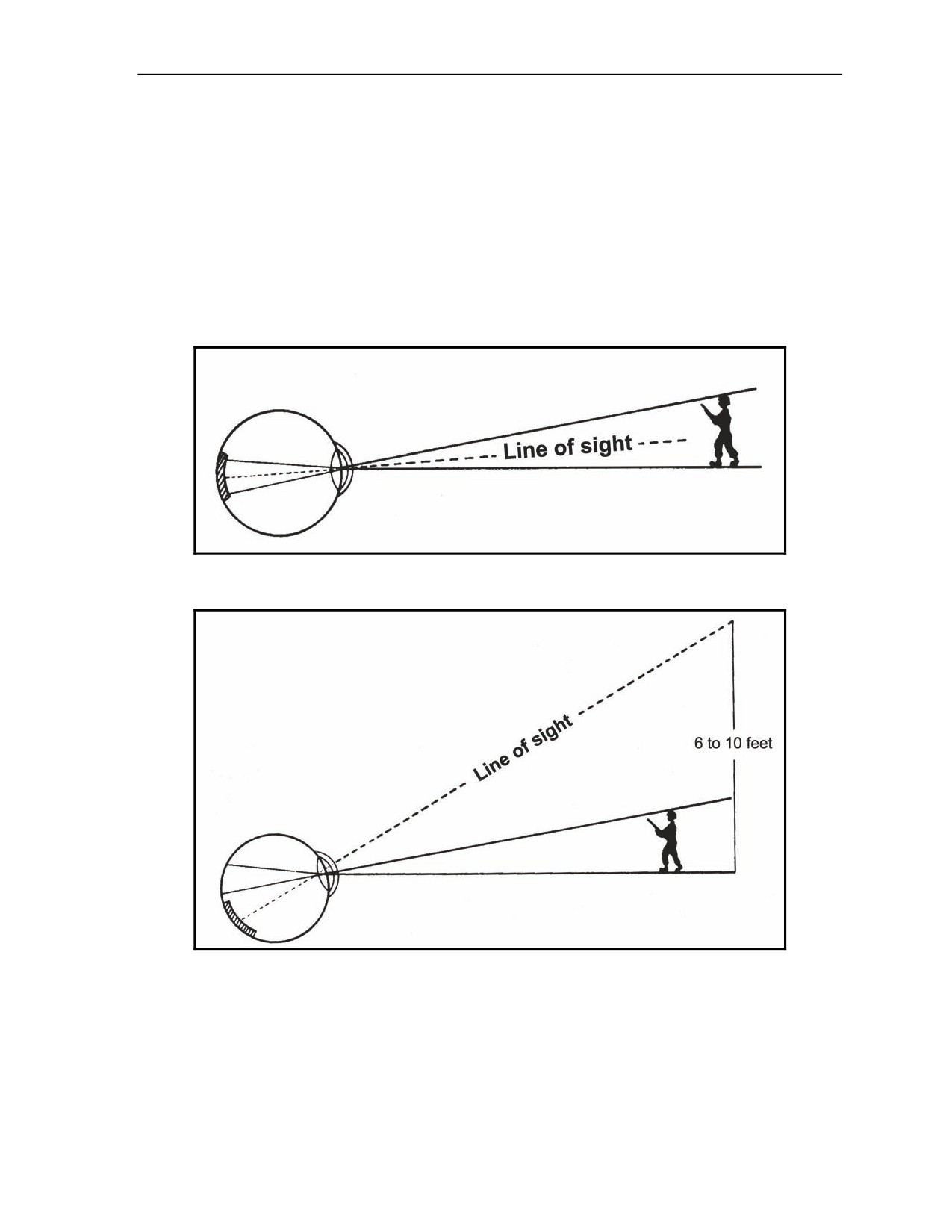
7-130. When an individual looks at an object during the daytime, he looks directly at it. However, if he
did this at night he would only see the object for a few seconds. To see this object for any length of time, he
must look 6 to 10 degrees from this object (Figures 7-15 and 7-16) while concentrating his attention on the
object. This allows the light sensitive area of the eye to detect faint light sources or reflection.
Figure 7-15. Daytime field of view using pinpoint focus.
Figure 7-16. Nighttime field of view using off-center vision.
Scanning
7-131. The act of scanning relates to the short, abrupt, irregular movement of the firer’s eyes every 4 to 10
seconds around an object or area. Be aware that scanning ranges vary according to levels of darkness.
12 August 2008
FM 3-22.9
7-33
Chapter 7
NIGHT FIRE TRAINING
7-132. All units must include basic unassisted night fire training annually in their unit marksmanship
programs.
7-133. Combat units should conduct tactical night fire training at least quarterly. This tactical training
should include MILES, during force-on-force training, as well as live-fire training.
Live-Fire Exercises
7-134. The basic unassisted LFX allows all Soldiers to apply night fire principles and to gain confidence
in their ability to effectively engage targets out to 50 meters. Practice and proficiency firing can be
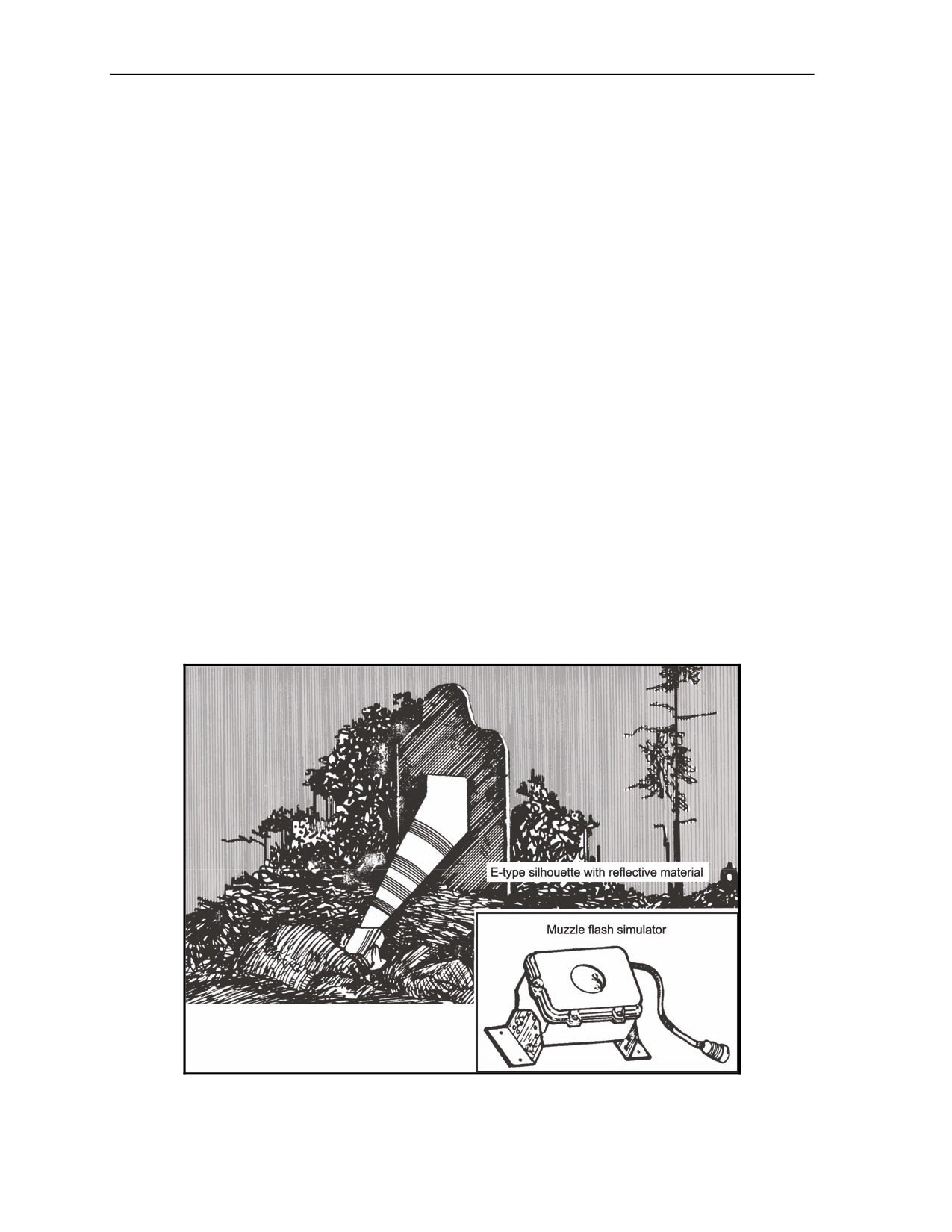
conducted on any range equipped with mechanical lifters and muzzle flash simulators (Figure 7-17). The
muzzle flash simulator provides the firer with a momentary indication that a target is presenting itself for
engagement. When a RETS range is used for this exercise, the two 50-meter mechanisms are used. For the
unassisted night LFX, the Soldier will perform the following scenario:
z
Each Soldier will be issued two 15-round magazines with a tracer and ball combination.
The Soldier engages the F-type silhouette target at 50 meters while in the prone supported
or foxhole supported firing position. The Soldier uses one magazine of 15 rounds (10
rounds ball; 5 rounds tracer). The Soldier will detect and engage 15 target exposures at
50 meters.
The Soldier engages the F-type silhouette target at
50 meters while in the prone
unsupported position or kneeling position. The Soldier uses a second magazine of 15
rounds (10 rounds ball; 5 rounds tracer). The Soldier will detect and engage 15 target
exposures at 50 meters.
z
Each Soldier must achieve 7 hits out of 30 target exposures.
z
When the automated range is used, the Soldier’s performance is recorded in the tower. If
automatic scoring is not available, a coach can observe and score the number of target hits the
firer achieves using NVDs.
Figure 7-17. Night-fire target.
7-34
FM 3-22.9
12 August 2008

Advanced Rifle Marksmanship
ARTIFICIAL ILLUMINATION TRAINING
7-135. Artificial illumination allows for better target detection and long-range accuracy than unassisted
night vision. When the artificial light is gone, time must be spent regaining night vision and adapting. Only
when the level drops enough so that the target cannot be seen through the iron sights should the firer
resume short-range scanning, looking just over the sights.
NOTE: See Table 7-11 for the current training program.
Table 7-11. Artificial illumination training program.
ARTIFICIAL ILLUMINATION TRAINING PROGRAM
Instructional Intent
•
Develop the Soldier’s confidence in his ability to locate, mark, prioritize and engage targets at night using
artificial illumination.
Special Instructions
Ensure that—
•
M16A2/A3/A4 or M4-series weapon’s rear sight is set on the 0-2 aperture.
•
M16A1 rear sight is set on the unmarked aperture.
•
Each Soldier is given two 15-round magazines with 10 rounds of ball and 5 rounds of tracer ammunition.
•
Each Soldier engages 15 target exposures from the foxhole supported fighting position with the first 15-round magazine.
•
Each Soldier engages 15 target exposures from the prone unsupported fighting position with the second 15-
round magazine.
Observables
•
Each Soldier achieves 15 hits out of 30 target exposures.
EFFECTIVENESS AND CONTROL OF ARTIFICIAL ILLUMINATION
7-136. When artificial illumination is used, the eyes lose most of their night adaptation, and off-center
vision is no longer useful. Artificial illumination allows the firer to use the iron sights with the 0-2 rear
sight aperture, as he does during the day.
7-137. To preserve night vision while artificial illumination is being used, the Soldier closes his firing eye and scans
his sector for enemy targets with his nonfiring eye. This allows the Soldier to have night vision in at least one eye to
keep scanning his sector for enemy targets after the artificial illumination has burned out. However, keeping one eye
closed to preserve its night vision results in a drastically altered sense of perception when both eyes are opened.
NOTE: Repeated dry-fire training and target detection practice are the keys to successful
engagement of targets out to 250 meters or more during live-fire under artificial illumination.
LIVE-FIRE EXERCISE
7-138. The unassisted LFX with artificial illumination allows all Soldiers to apply night fire principles
and to gain confidence in their abilities to effectively detect and engage targets 150 meters away and
beyond when using artificial illumination. Soldiers use the night record fire scenario:
z
Each Soldier is issued two 15-round magazines with the appropriate tracer and ball combination.
During the night, each Soldier engages 15 E-type silhouette target exposures from 50 to 250
meters with one magazine of 15 rounds (10 rounds ball, 5 rounds tracer) while in the
foxhole supported or prone supported firing position.
During the night, each Soldier engages 15 E-type silhouette target exposures from 50 to 250
meters with the second magazine of 15 rounds (10 rounds ball, 5 rounds tracer) while in the
prone unsupported or kneeling firing position.
z
Each Soldier must achieve 15 hits out of 30 shots.
12 August 2008
FM 3-22.9
7-35

Chapter 7
SECTION V. MOVING TARGET ENGAGEMENTS
In combat situations, enemy Soldiers do not stand still; they rush from one covered or concealed position to
another. While making the rush, enemy Soldiers present rapidly moving targets. Moving targets are open to
aimed fire at two points in the rush: as the target begins to gain speed (at the beginning) and as it slows down to
a new position.
NOTE: See Table 7-12 for the current training program.
Table 7-12. Moving target engagement training program.
MOVING TARGET ENGAGEMENT TRAINING PROGRAM
Instructional Intent
•
Soldiers learn to detect and engage moving and stationary targets with the M16 rifle or M4 carbine.
Special Instructions
Ensure that—
•
The M16A2/A3/A4 rifle's or M4 carbine’s rear sight is set on the 0-2 aperture.
•
The M16A1's rear sight is set on the unmarked aperture.
•
Soldiers get into a proper semisupported firing position.
•
Soldiers understand and apply lead guidance rules.
•
Each Soldier receives two magazines with 25 rounds each of 5.56-millimeter ball ammunition.
•
Each Soldier engages 34 moving target exposures at ranges from 35 to 185 meters, and 15 stationary target
exposures at ranges from 50 to 300 meters.
Observables
•
Each Soldier achieves 18 hits out of 50 target exposures.
MODIFICATIONS FOR MOVING TARGET ENGAGEMENTS
7-139. Soldiers in combat do not know if their next target will be stationary or moving; they must fire
immediately at whatever target presents itself. Trainers should consider the following when conducting
moving target engagement instruction:
z
More dispersion and erratic shots are expected when Soldiers are trained to hit moving targets.
z
Considering the environment and the variables of the weapon and ammunition, well-trained
Soldiers should be able to hit 300-meter stationary silhouette targets.
z
When the target is moving laterally, well-trained Soldiers may only hit 150-meter targets 7 out
of 10 times. This is considered an acceptable performance.
7-140. Further, trainers should consider modifications to the fundamentals for engaging stationary targets:
z
Steady position.
z
Aiming.
z
Breath control.
z
Trigger squeeze.
STEADY POSITION
7-141. When firing at moving targets, firers should assume the standard supported firing position, but be
flexible so that they can track any target in the sector. When a target is moving directly at the firer, directly
away from the firer, or at a slight angle, the Soldier engages the target without changing his firing position.
Consider the following aspects of firing at moving targets:
z
When targets are moving laterally, only minor changes are needed to allow effective target
engagement.
z
Most moving targets are missed in the horizontal plane (firing in front of or behind the target)
and not in the vertical plane (firing too low or too high).
7-36
FM 3-22.9
12 August 2008
Advanced Rifle Marksmanship
7-142. The Soldier must make other adjustments, as highlighted in Table 7-13.
Table 7-13. Modifications for a steady position when firing at moving targets.
PART OF BODY
MODIFICATION
Nonfiring hand
Grip the weapon more tightly with the nonfiring hand, and apply more pressure to the rear. This
helps to maintain positive control of the weapon and steady it for rapid trigger action.
Nonfiring-side elbow
Lift the nonfiring-side elbow from the support position only to maintain a smooth track.
Firing hand
Apply more rearward pressure to the pistol grip to steady the weapon during trigger squeeze.
Firing-side elbow
Lift the firing-side elbow from support only to help maintain a smooth track.
NOTE: The weapon pocket in the shoulder and the stock weld are the same as for stationary
targets.
AIMING
7-143. When aiming at moving targets, Soldiers must apply precise lead rules, and in turn, Soldiers must
accurately estimate speed, angle, and range to the target to apply precise lead rules. Then, he must apply the
single-lead rule in order to place effective fire on combat targets.
7-144. The procedures used to engage moving targets vary as the angle and speed of the target vary. For
example, when a target is moving directly at the firer, stationary target procedures apply. However, for a
close, fast-moving target at a 90-degree angle, the weapon and firer's entire upper body must be free from
support so the target can be tracked.
Lead Requirements
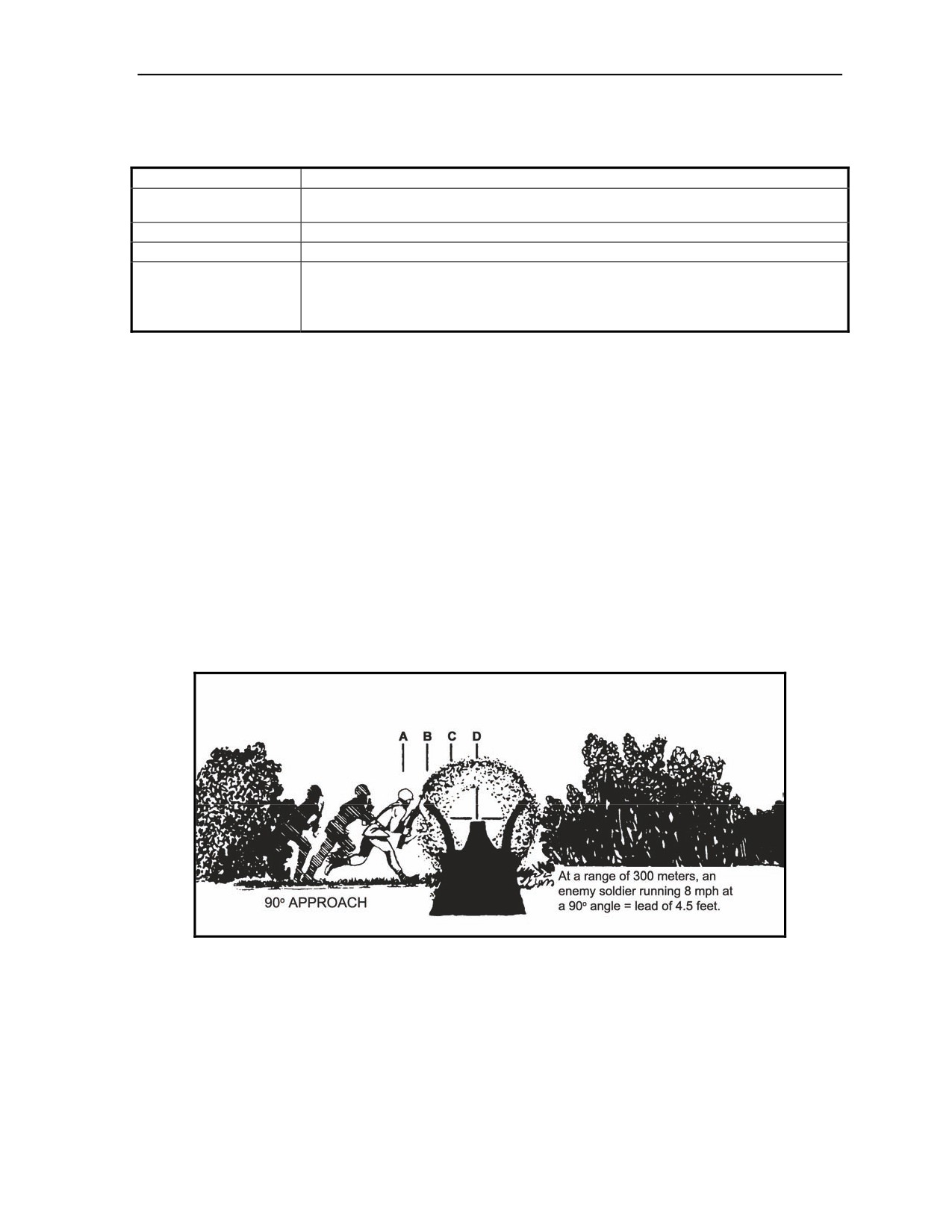
7-145. Aiming directly at a 300-meter target moving 8 miles per hour at a 90-degree angle would result in
missing it; this type of target covers 4 ½ feet while the bullet is traveling toward him. To hit the target, the
Soldier must apply target lead (Figure 7-18) and understand how target lead and bullet speed relate to the
range, angle, and speed of the target. To hit the target depicted, the Soldier must aim and fire at position D
when the target is at position A.
Figure 7-18. Lead requirement based on distance and approach angle.
Single-Lead Rule
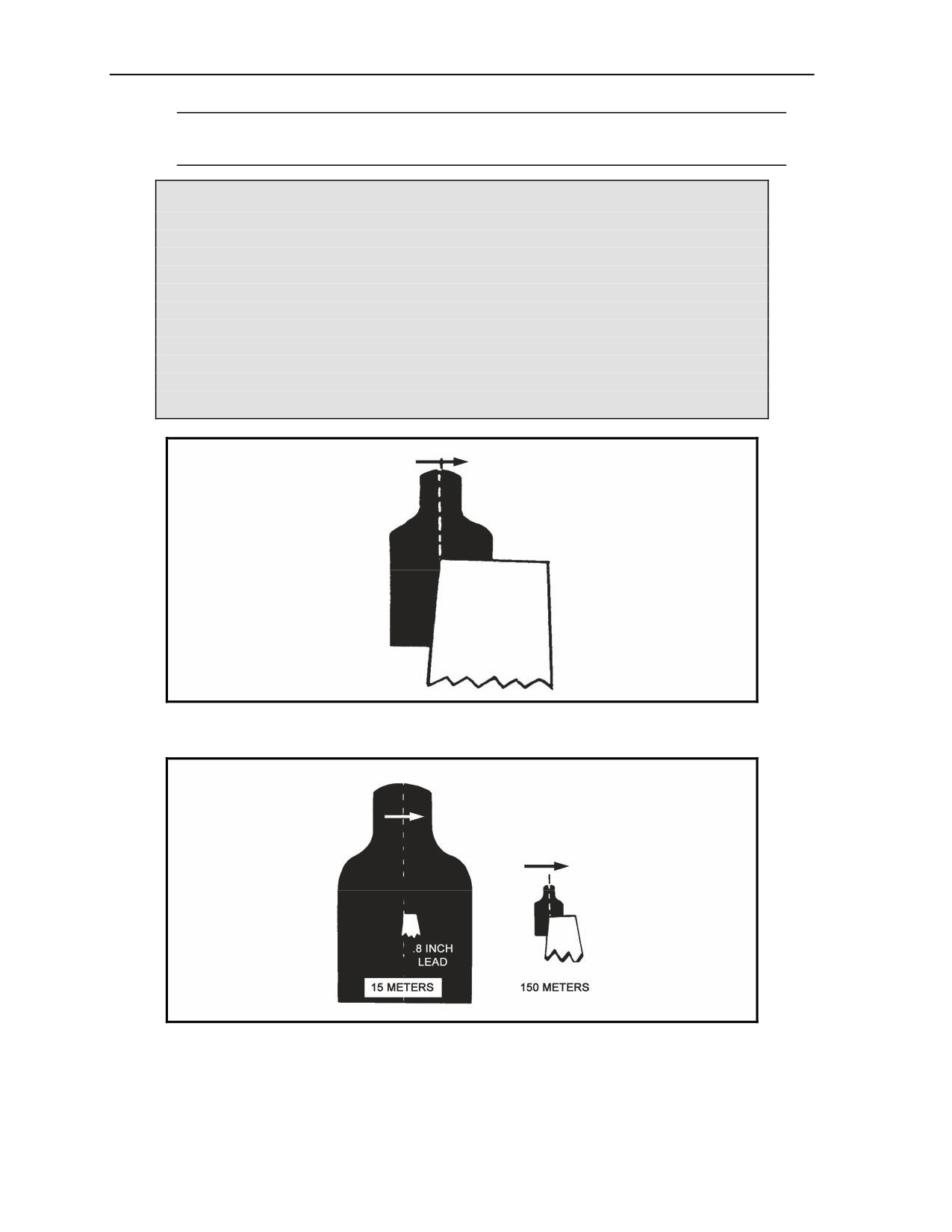
7-146. The single-lead rule says: To hit a target moving laterally, place the trailing edge of the front
sightpost at the target's center (Figure 7-19). This rule also provides that the lead increases as the range to
the target increases (Figure 7-20).
12 August 2008
FM 3-22.9
7-37
Chapter 7
NOTE: At 100 meters, the rule begins to break down for targets moving at slight and large
angles.
EXAMPLE
As Figure 7-20 depicts, the front sightpost covers about 1.6 inches at 15 meters and
about 16 inches at 150 meters. Since the center of the front sightpost is the actual
point of aim, placing the trailing edge of the front sightpost at the target's center
provides a .8-inch lead on a 15-meter target and an 8-inch lead on a target at 150
meters.
This provides a dead-center hit on a 15-meter target moving at 7 miles per hour at a
25-degree angle because the target moves .8 inches between the time that the
weapon is fired and the time that the bullet arrives at the target. A 150-meter target
moving at 7 miles per hour at a 25-degree angle moves 8 inches between the time
the weapon is fired and the bullet arrives.
Figure 7-19. Sight-target relationship for the single-lead rule.
Figure 7-20. Lead increasing at greater ranges.
7-38
FM 3-22.9
12 August 2008
Advanced Rifle Marksmanship
Target Speed
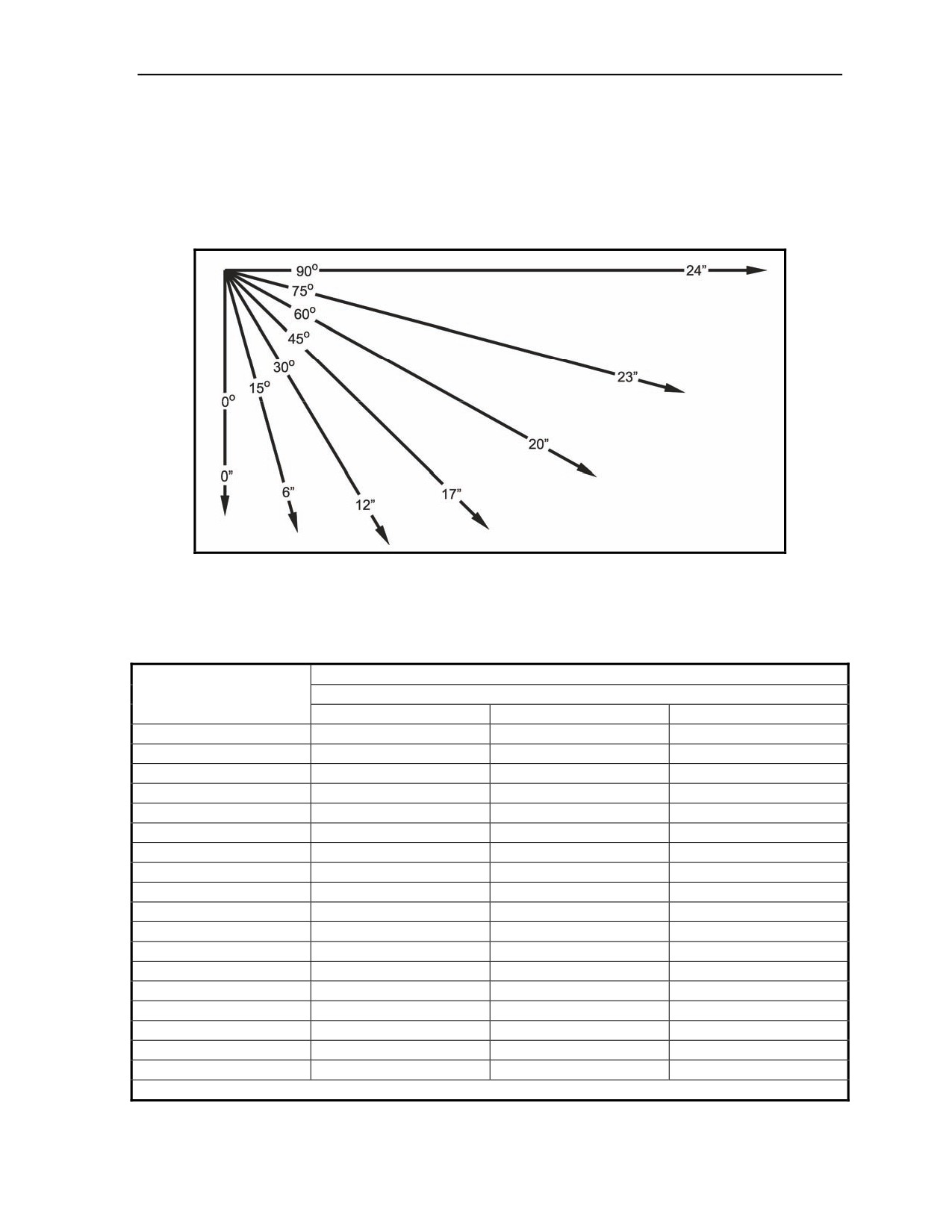
7-147. Figure 7-21 reflects the differences in lateral speeds for various angles of target movement for a
target traveling at 8 miles per hour at a distance of 150 meters from the firer. The angle of target movement
is the angle between the target/firer line and the target’s direction of movement. An 8-mile-per-hour target
moves 24 inches during the bullet’s flight time. If the target is moving on a 15-degree angle, it moves 6
inches (the equivalent of 2 miles per hour).
Figure 7-21. Target movement (distance) at various angles.
7-148. Since the target lead is half the perceived width of the front sightpost, at 100 meters, the standard
sight provides 5.4 inches of lead for M16A1/2/3/4 rifles and M4 carbines (Table 7-14).
Table 7-14. Angle of target movement.
ANGLE OF TARGET
RANGE: 100 m
MOVEMENT (Degrees)
(STANDARD SIGHT) TARGET SPEED
4 mph
6 mph
8 mph
5
+4.9”
+4.5”
+4.3”
10
+4.1”
+3.5”
+2.7”
15
+3.5”
+2.5”
+1.5”
20
+2.8”
+1.5”
+.2”
25
+2.2”
+.7”
-1.0”
30
+1.7”
-.2”
-2.0”
35
+1.1”
-1.1”
-3.2”
40
+.6”
-1.9”
-4.3”
45
0”
-2.7”
-5.4”
50
-.4”
-3.3”
-6.2”
55
-.8”
-4.0”
-7.0”
60
-1.2”
-4.5”
-7.7”
65
-1.5”
-4.9”
-8.4”
70
-1.7”
-5.3”
-8.8”
75
-1.9”
-5.6”
-9.2”
80
-2.0”
-5.9”
-9.6”
85
-2.1”
-5.9”
-9.7”
90
-2.1”
-6.0”
-9.8”
NOTE: Plus (+) indicates bullet strike in the direction of movement; minus (-) indicates bullet strike behind the target's center.
12 August 2008
FM 3-22.9
7-39

Chapter 7
Target Distance
7-149. The front sightpost covers only a small part of close-in targets, providing hits on close targets
moving at any angle and any speed. However, if the lead rule is applied on more distant targets moving at a
slight angle—for example, 5 degrees at 100 meters—the bullet strikes about 4 inches forward of the target's
center. Soldiers must be taught to fire at targets as though they are stationary until lateral movement is
observed (15 degrees).
7-150. The rule provides for many speed/angle combinations that place the bullet within 2 inches of the
target's center (Table 7-14). Since the Soldier is expected to fire a 12-inch group on moving targets at 100
meters, the rule provides for hits on the majority of targets. Even the worst case (a 90-degree target moving
at 8 miles per hour) would result in the shot group's center being located 9.8 inches behind the target's
center. If bullets were evenly distributed in a 12-inch group, this would result in hitting the target 40
percent of the time.
7-151. Soldiers should be taught to increase their lead if they miss the target, which increases their
probability of hitting all targets. For example, if target exhibits much lateral movement and the Soldier
feels that he has missed the target by applying the lead rule and firing fundamentals, he should increase his
lead.
7-152. The training program must be simple and provide Soldiers with information relevant to improving
their performance in combat. It should address the following topics:
z
Soldiers should understand and apply the single-lead rule in the absence of more information.
z
Soldiers should engage moving targets coming toward them or on a slight angle (0 to 15
degrees) as stationary targets.
z
Information should be presented and practice allowed on applying additional lead to targets for
Soldiers who demonstrate this aptitude.
Target Angle
7-153. The single-lead rule does not apply to targets moving at small and large angles (Table 7-15). A
walking enemy Soldier at 250 meters is hit dead center when he is moving at 40 degrees. Hits can be
obtained if he is moving on any angle between 15 and 75 degrees. When he is running, a center hit is
obtained when the target is on an angle of 18 degrees; misses occur when he exceeds an angle of 30 to 35
degrees.
7-154. The information provided in Figure 7-21 and Table 7-15 is designed to enhance instructor
understanding so proper concepts are presented during instruction. For example, a target at 100 meters
moving at 6 miles per hour receives a center hit when moving at 29 degrees. When moving at an angle less
than 29 degrees, the bullet strikes somewhat in front of the target's center. When moving at an angle of
more than 29 degrees, the bullet strikes somewhat behind the target's center.
Table 7-15. Target angle when dead center; hits occur using the single-lead rule.
STANDARD SIGHT
RANGE (m)
4 mph
6 mph
8 mph
25
48°
30°
22°
50
47°
30°
22°
100
45°
29°
21°
150
44°
28°
20°
200
41°
27°
19°
250
40°
26°
18°
300
33°
21°
16°
350
38°
24°
18°
400
35°
22°
17°
450
33°
21°
16°
7-40
FM 3-22.9
12 August 2008
Advanced Rifle Marksmanship
Tracking
7-155. Tracking is a more accurate technique of engaging targets used by experienced firers. It involves
establishing and maintaining a point of aim in relationship to the target and moving with the target to
maintain that sight picture, while squeezing the trigger. As the target moves, this technique puts the firer in
position for a second shot if the first one misses.
Trapping
7-156. Trapping involves setting up a point of aim forward of the target and along the target path. The
trigger is squeezed as the target comes into the sights. This technique works on targets with slow lateral
movement. It does not require tracking skills, but the firer must know precisely when the weapon is going
to fire.
NOTE: Soldiers who can squeeze the trigger without reacting to the weapon firing may fire
better using this technique.
BREATH CONTROL
7-157. This fundamental is unchanged.
TRIGGER SQUEEZE
7-158. To use proper trigger squeeze—
z
Apply rearward pressure on the handguard and pistol grip to hold the weapon steady while
applying pressure to the trigger.
z
Squeeze the trigger quickly (almost a controlled jerk).
z
Apply heavy pressure on the trigger (at least half of the pressure it takes to make the weapon
fire) before squeezing.
MOVING TARGET LIVE-FIRE EXERCISE
7-159. Soldiers engage in a firing scenario once for practice and then for qualification. Soldiers who fail
to qualify on the initial day of qualification receive only one refire on the same day.
SECTION VI. SHORT-RANGE MARKSMANSHIP TRAINING
SRM training allows Soldiers to quickly and effectively engage targets at ranges less than 50 meters. Although
normally associated with UO, SRM techniques are also used during operations in restrictive terrain, such as
clearing a trench line, the final assault across an objective during an attack or raid, or when fighting in dense
vegetation or during periods of limited visibility. SRM instruction consists of four components:
z
Phase I—Reflexive Fire Training (blank-fire day and night).
z
Phase II—Target Discrimination (blank-fire day and night).
z
Phase III—Short-Range Marksmanship Qualification (day and night live-fire) and Barricade
Transition Qualification.
z
Phase IV—Shotgun and Automatic or Burst Firing Familiarization.
CONDUCT OF SHORT-RANGE MARKSMANSHIP TRAINING
7-160. SRM requires individual Soldiers to be trained to standard on reflexive firing, target
discrimination, and all necessary BRM fundamentals prior to semiannual qualification.
NOTE: An explanation of the base level proficiency requirements is provided with each course
of fire.
12 August 2008
FM 3-22.9
7-41

Chapter 7
7-161. At a minimum, Soldiers should be qualified on their individual weapon within the previous six
months. Shotgun and automatic firing is required for annual familiarization only. Reflexive MILES dry-fire
drills are an essential part of the training process and should be conducted by the team leader or squad
leader during troop-leading procedures and before any SRC or SRM training.
NOTE: See Table 7-16 for the current training program.
Table 7-16. Short-range marksmanship training program.
SHORT-RANGE MARKSMANSHIP TRAINING PROGRAM
Instructional Intent
•
Soldiers gain confidence and knowledge in SRM fundamentals.
Special Instructions
Ensure that—
•
The M16A2/A3/A4 rifle's or M4 carbine’s rear sight is set on the 0-2 aperture.
•
The M16A1's rear sight is set on the unmarked aperture.
•
Each Soldier is given one 20-round magazine of 5.56-millimeter ball ammunition for marksmanship qualification.
•
Each Soldier is given one 28-round magazine and three 4-round magazines of 5.56-millimeter ball ammunition
for barricade transition firing.
NOTE: The round must impact within the lethal zone to be scored a hit.
Observables
•
Each Soldier achieves 20 target hits during the day marksmanship qualification.
•
Each Soldier achieves 16 target hits during the night marksmanship qualification.
•
Each Soldier achieves 14 target hits during the day marksmanship qualification while wearing a protective mask.
•
Each Soldier achieves 12 target hits during the night marksmanship qualification while wearing a protective mask.
NOTE: All SRC and SRM training should begin with a review of the principles of safe weapon
handling: Assume the weapon is always loaded, and never point the weapon at anything that you
do not intend to shoot.
FUNDAMENTALS OF SHORT-RANGE MARKSMANSHIP
7-162. During SRC, there is little margin for error. Too slow a shot at the enemy, too fast a shot at a
noncombatant, or inaccurate shots can all be disastrous for the Soldier. Further, the risk of fratricide or
noncombatant casualties is greatest during SRC. To survive and accomplish missions in close quarters,
Soldiers must master four fundamentals of SRM:
z
Firing stance, weapon ready positions, and movement techniques.
z
Aiming technique.
z
Point of aim.
z
Trigger manipulation.
FIRING STANCE, WEAPON READY POSITIONS, AND MOVEMENT TECHNIQUES
7-163. Regardless of the weapon ready position used, Soldiers must always assume the correct firing
stance to ensure stability and accuracy when engaging targets.
Firing Stance
7-164. To assume the correct fighting stance—
z
Keep the feet approximately shoulder-width apart.
z
Point the toes straight to the front (direction of movement).
z
Stagger the firing-side foot slightly to the rear of the nonfiring-side foot.
z
Bend the knees slightly.
7-42
FM 3-22.9
12 August 2008
Advanced Rifle Marksmanship
z
Lean the upper body slightly forward.
z
Square the shoulders and pull them back; don't roll them over or slouch.
z
Keep the head up and both eyes open.
7-165. When engaging targets—
z
Hold the weapon with the buttstock firmly against the shoulder.
z
Hold the firing-side elbow close against the body.
7-166. Although short-range engagements generally take place from the standing position, a Soldier may
be required to engage targets from the kneeling position. The kneeling position is generally used when
correcting a weapon malfunction.
Weapon Ready Positions
7-167. There are two weapon ready positions: high ready and low ready.
High Ready Position
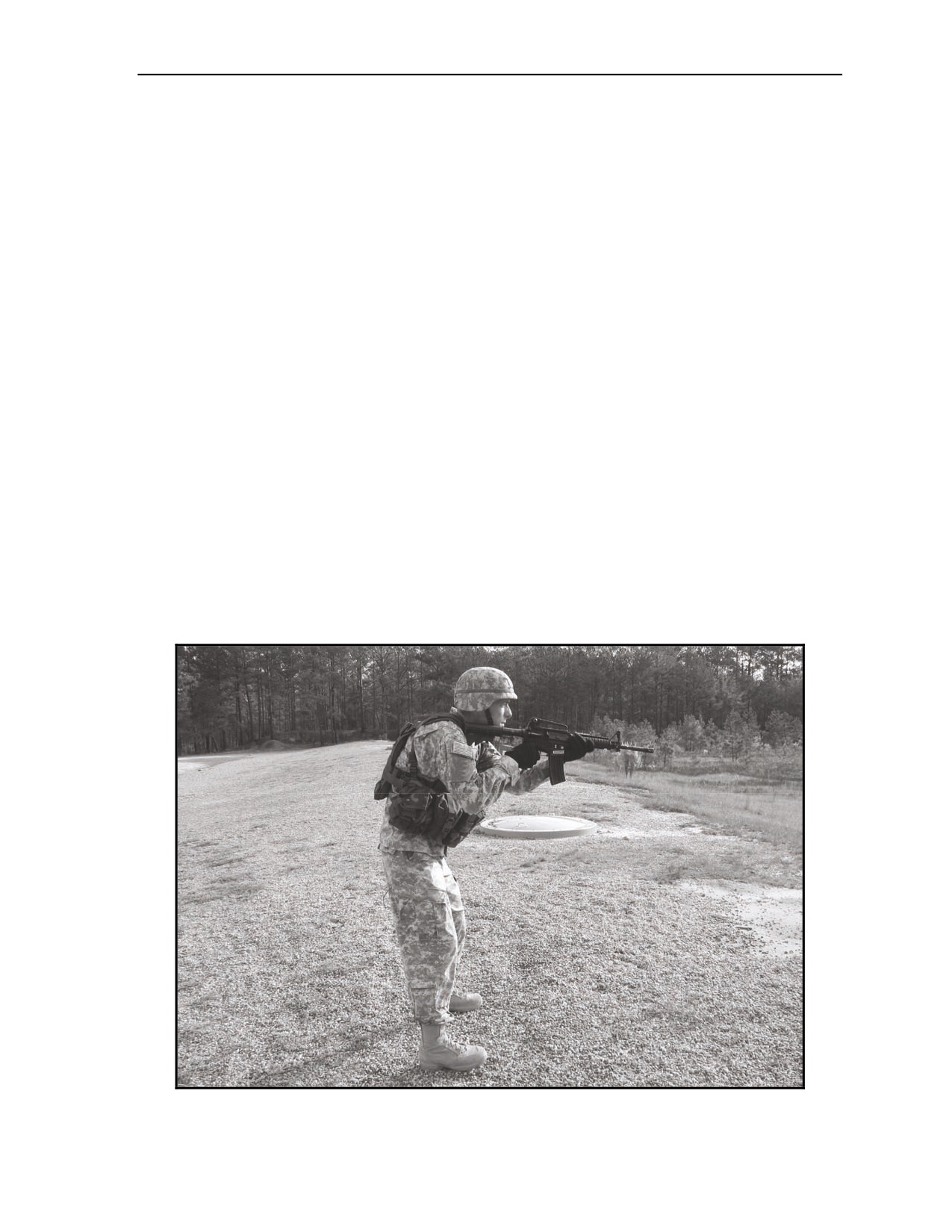
7-168. The high ready position (Figure 7-22) is best suited for the lineup outside of a building, room, or
bunker entrance.
7-169. To hold the weapon in the high ready position—
(1) Hold the weapon's buttstock under the armpit, with the barrel pointed slightly up so that the top
of the front sightpost is just below the line of sight, but still within peripheral vision.
(2) Grasp the handguards toward the front sling swivel with the nonfiring hand. Keep the trigger
finger outside of the trigger well and the thumb of the firing hand on the selector lever.
7-170. To engage a target from the high ready position—
(1) Push the weapon forward, as if to bayonet the target.
(2) Bring the buttstock firmly against the shoulder as it slides up the body.
Figure 7-22. High ready position.
12 August 2008
FM 3-22.9
7-43
Chapter 7
Low Ready Position
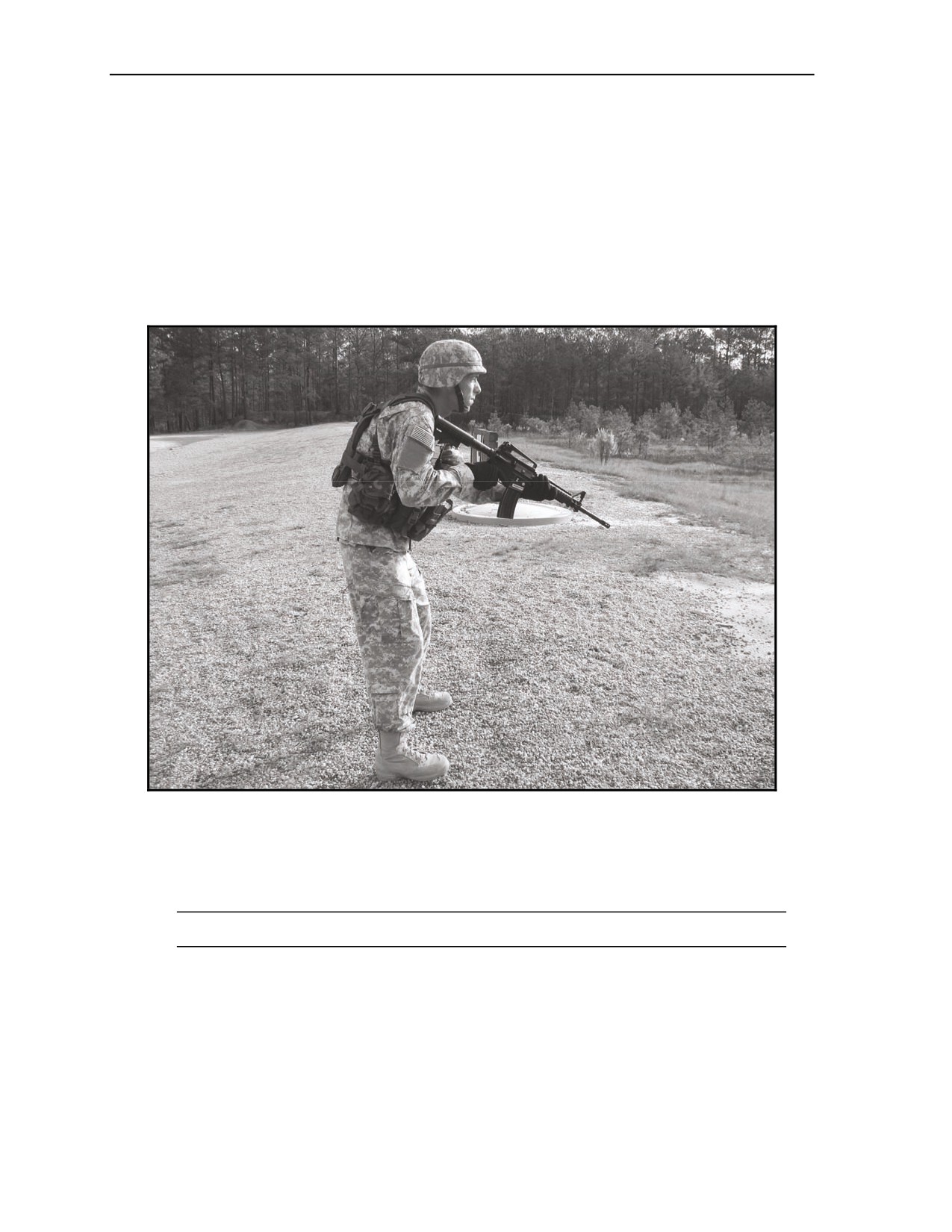
7-171. The low ready position (Figure 7-23) is best suited for movement inside of buildings.
7-172. To hold the weapon in the low ready position—
(1) Place the weapon's buttstock firmly in the pocket of the shoulder, with the barrel pointed down
at a 45-degree angle.
(2) Grasp the handguards toward the front sling swivel. Keep the trigger finger outside of the trigger
well and the thumb of the firing hand on the selector lever.
7-173. To engage a target from the low ready position, bring the weapon up until the proper sight picture
is achieved.
Figure 7-23. Low ready position.
Movement Techniques
7-174. Soldiers must practice moving with their weapons up until they no longer look at the ground, but
concentrate on their sectors of responsibility and move without stumbling over their own feet.
NOTE: The low ready position is the best position to use when moving or turning.
7-175. To engage a target to the left—
(1) Step toward the target with the left foot.
(2) Move the right foot even with the left, assuming a proper standing firing position.
7-176. To engage a target to the right—
(1) Step toward the target with the right foot.
(2) Move the left foot even with the right, assuming a proper standing firing position.
7-44
FM 3-22.9
12 August 2008
Advanced Rifle Marksmanship
7-177. To turn to the rear—
(1) Position the firing-side foot forward.
(2) Place the body weight on the firing-side foot.
(3) Pivot the body, similar to the drill movement "rear march."
AIMING TECHNIQUES
7-178. Four aiming techniques are used during SRC:
z
Slow aimed fire.
z
Rapid aimed fire.
z
Aimed quick kill.
z
Instinctive fire.
7-179. Each has advantages and disadvantages, and the Soldier must understand when, how, and where
to use each technique.
Slow Aimed Fire
7-180. Slow aimed fire is the slowest, but most accurate, technique. When using this technique, Soldiers
take a steady position, properly align the sight picture, and squeeze off rounds. This technique should only
be used to engage targets more than 25 meters away, when good cover and concealment is available, or
when the need for accuracy overrides the need for speed.
Rapid Aimed Fire
7-181. The rapid aimed fire technique utilizes an imperfect sight picture. When using this technique, the
Soldier focuses on the target and raises his weapon until the target is obscured by the front sightpost.
Elevation is less critical than windage when using this technique. This aiming technique is extremely
effective on targets 0 to 15 meters away.
Aimed Quick Kill
7-182. The aimed quick kill technique is the quickest and most accurate method of engaging targets up to
12 meters away. As Soldiers become more experienced at using this technique, they may use it at greater
ranges. When using this technique, the Soldier aims over the rear sight, down the length of the carrying
handle, and places the top ½ to ¾ of an inch of the front sightpost on the target.
Instinctive Fire
7-183. Instinctive fire is the least accurate technique and should only be used in emergencies. It relies on
instinct, experience, and muscle memory. To use this technique, the firer concentrates on the target and
points the weapon in the general direction of the target. While gripping the handguards with the nonfiring
hand, he extends the index finger to the front, automatically aiming the weapon on a line toward the target.
POINT OF AIM
7-184. Most short-range engagements will be decided by who hits his target with the first round. During
this type of engagement, it is more important to put the target down as quickly as possible than it is to kill
him immediately.
7-185. Soldiers must aim at the lethal zone (center of mass) of the body. Although shots to the center of
the body may prove to be eventually fatal, they may not immediately incapacitate the target. A shot that
does not immediately incapacitate the target may be no better than a clean miss. Because of this, and the
possible presence of military equipment or protective vests, Soldiers must also be able to engage targets
with incapacitating shots.
12 August 2008
FM 3-22.9
7-45
Chapter 7
Lethal Shot Placement
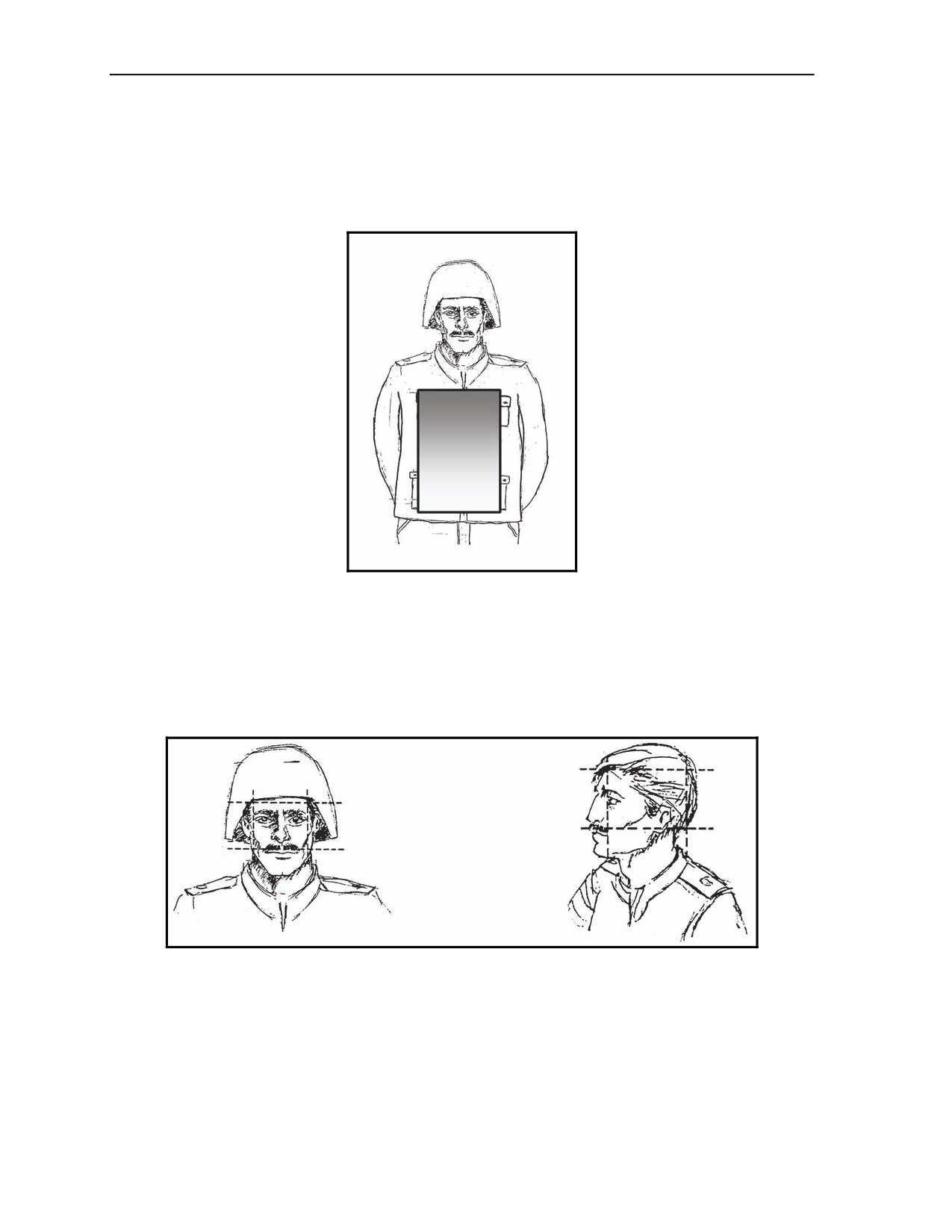
7-186. The target's lethal zone (Figure 7-24) is its center of mass, between the waist and the chest. Shots
in this area maximize the hydrostatic shock of the shot pellets. Due to the nature of SRC, Soldiers must
continue to engage targets until they go down.
Figure 7-24. Lethal zone.
Incapacitating Shot Placement
7-187. Only one shot placement guarantees immediate and total incapacitation: roughly centered in the
face, below the middle of the forehead and the upper lip, and from the eyes in. Shots to the side of the head
should be centered between the crown of the skull and the middle of the ear opening, from the center of the
cheekbones to the middle of the back of the head (Figure 7-25).
Figure 7-25. Incapacitation zone.
7-46
FM 3-22.9
12 August 2008
Advanced Rifle Marksmanship
TRIGGER MANIPULATION
7-188. SRC engagements are usually quick, violent, and deadly. Due to the reduced reaction time,
imperfect sight picture, and requirement to effectively place rounds into targets, Soldiers must fire multiple
rounds during each engagement in order to survive. Multiple shots may be fired either through the use of a
controlled pair or automatic weapon fire.
Controlled Pair
7-189. A controlled pair is two rounds fired in rapid succession. Controlled pairs should be fired at single
targets until they go down. When multiple targets are present the Soldier must fire a controlled pair at each
target, and then reengage any targets left standing. To fire a controlled pair—
(1) Fire the first round, and allow the weapon to move in its natural arc without fighting the recoil.
(2) Rapidly bring the weapon back on target, and fire a second round.
7-190. Soldiers must practice firing the controlled pair until it becomes instinctive.
Automatic Fire
7-191. While rapid, aimed, semiautomatic fire is the most accurate method of engaging targets during
SRC and controlled three-round bursts are better than automatic fire, automatic weapon fire may be
necessary to maximize violence of action or gain fire superiority when gaining a foothold in a room,
building, or trench. When properly trained, Soldiers should be able to fire six rounds (two three-round
bursts) in the same time it takes to fire a controlled pair. With practice, the accuracy of engaging targets can
be equal to that of semiautomatic fire at 10 meters.
NOTE: The key to burst or automatic firing is to squeeze the trigger, not jerk it.
7-192. For the majority of Soldiers, fully automatic fire is rarely effective and can lead to unnecessary
noncombatant casualties or fratricide. Not only is fully automatic fire inaccurate and difficult to control, but
it also rapidly empties ammunition magazines. A Soldier who finds himself out of ammunition with an
armed, uninjured enemy Soldier during SRC will become a casualty unless a fellow Soldier intervenes.
Failure Drill
7-193. To make sure that a target is completely neutralized, Soldiers should be trained to execute the
failure drill. The firer will fire a controlled pair into the lethal zone, followed by a third round placed into
the incapacitation zone. This type of target engagement is particularly useful when engaging targets
wearing body armor.
PRELIMINARY SHORT-RANGE MARKSMANSHIP INSTRUCTION
7-194. As with all other forms of marksmanship training, preliminary SRM instruction must be conducted
to establish a firm foundation. Soldiers must be taught, and must understand, the fundamentals of SRM.
Blank-fire drills are conducted to ensure a thorough understanding of the fundamentals, as well as to
provide the trainers with valuable feedback about each Soldier's level of proficiency.
NOTE: To maximize safety during training and in combat situations, it is important to
emphasize muzzle awareness and selector switch manipulation during preliminary SRM
instruction. The risk of fratricide or noncombatant casualties is greatest during SRC.
7-195. Table 7-17 outlines the tasks that preliminary SRM instruction should include (at a minimum).
12 August 2008
FM 3-22.9
7-47

Chapter 7
Table 7-17. Preliminary SRM tasks and explanation.
TASK
EXPLANATION
Weapon ready positions and firing stance
Ensure that each Soldier understands and can properly carry his weapon.
Magazine changing drills
Have Soldiers perform magazine changes using the two methods:
•
Parallel method.
•
L-shaped method.
NOTE: See the paragraph below for more information about magazine
changing drills.
Moving with a weapon
Ensure that Soldiers can walk, run, and turn left, right, and to the rear, as well
as move from the standing to kneeling firing position and the kneeling back to
the standing firing position.
Weapon malfunction drills
Ensure that Soldiers instinctively drop to the kneeling firing position, clear a
malfunction using SPORTS, and continue to engage targets. This drill can be
performed by issuing each Soldier a magazine loaded with six to eight rounds
of blank ammunition with one expended blank round.
Target engagement drills
Teach Soldiers to move from the weapon ready position to the firing stance,
emphasizing speed and precision. Soldiers must be observed to ensure that
the finger is outside of the trigger well and that the selector switch remains on
SAFE until the weapon is raised to the firing position.
NOTE: This is a force protection issue and must be drilled until all Soldiers can
perform to standard.
MAGAZINE CHANGING DRILLS
NOTE: Before performing magazine changing drills, have Soldiers configure their LBE or
magazine racks to allow for the easiest access for the magazine change. The time limit to
perform any of the magazine changing drills is 8 seconds.
7-196. There are two methods of changing the magazine:
z
Parallel method.
z
L-shaped method.
Parallel Method
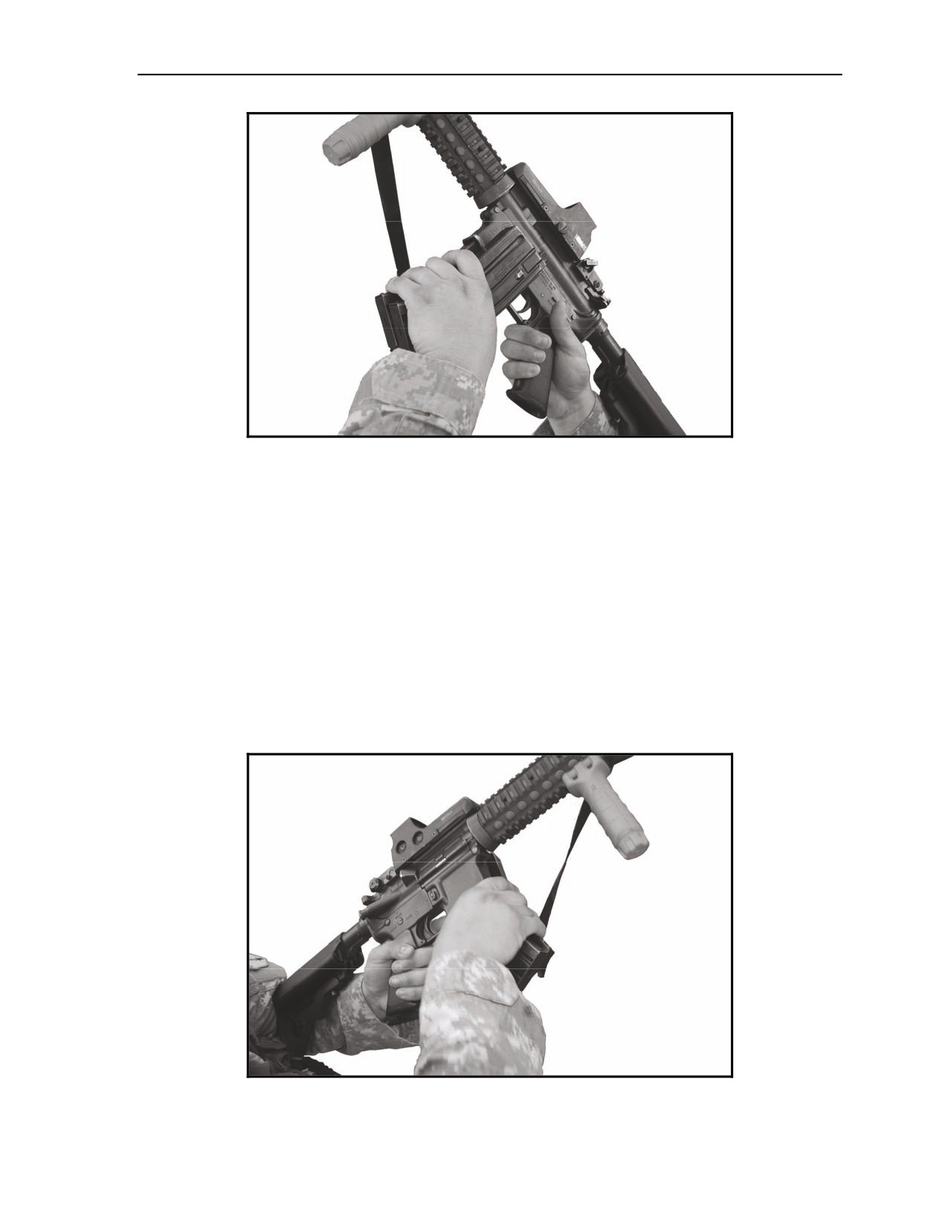
7-197. When shooting from the right side, perform the right-side parallel magazine changing method
(Figure 7-26):
(1) Engage the target until the magazine is empty.
(2) Take a knee.
(3) Place the weapon at a 45-degree angle, with the magazine well facing in, the muzzle pointed in a
safe direction, and the buttstock in the crease of the right elbow.
(4) Slide the nonfiring hand down the handguard to the receiver, and press the magazine release
catch.
(5) Secure a full magazine with two fingers and the thumb of the nonfiring hand.
(6) Bring the full magazine (top of the magazine toward the magazine well) next to and parallel with
the empty magazine.
(7) Slide the empty magazine out with the nonfiring hand and insert the full magazine.
(8) Hit the bolt release.
(9) Stow the empty magazine in the ammunition pouch.
7-48
FM 3-22.9
12 August 2008
Advanced Rifle Marksmanship
Figure 7-26. Right-side parallel magazine changing method.
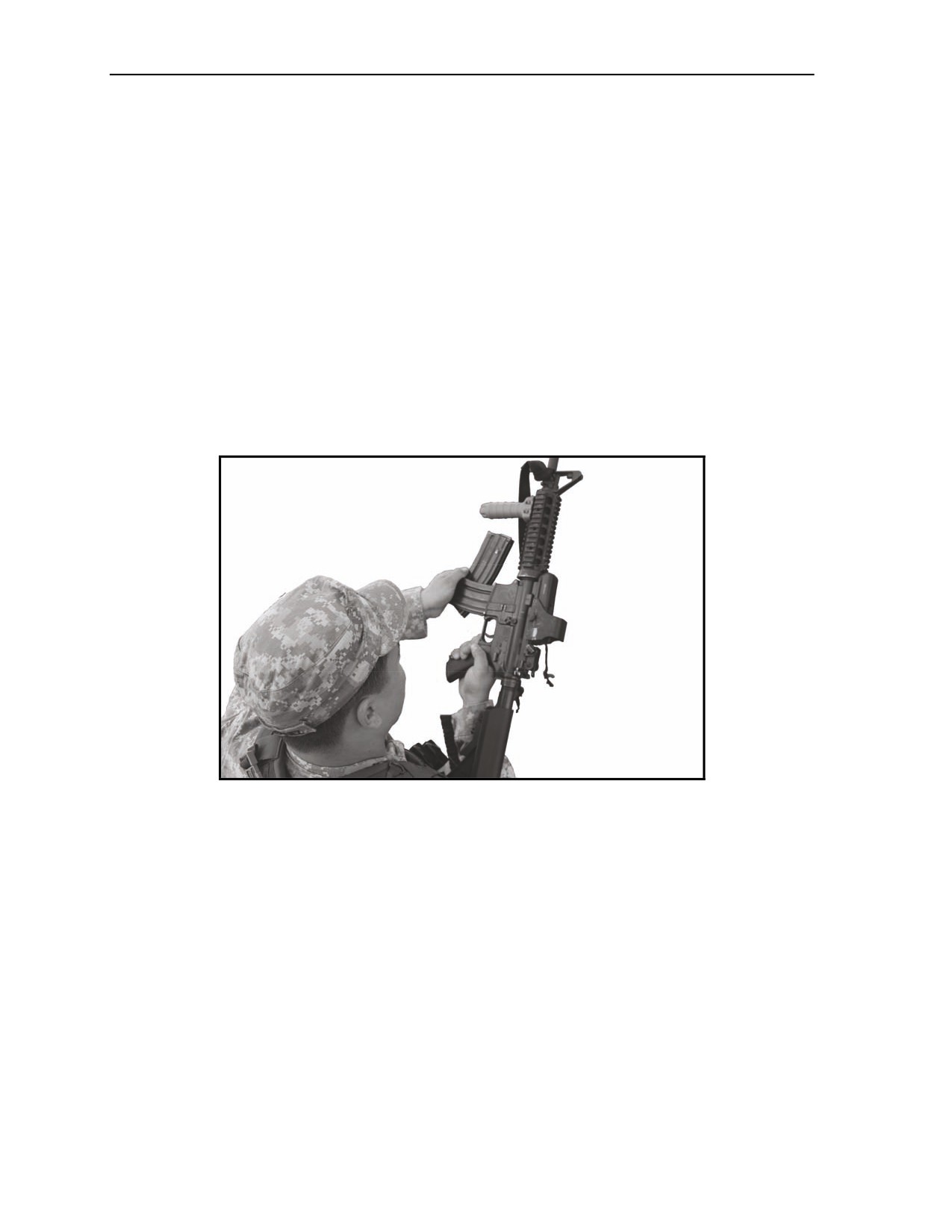
7-198. When shooting from the left side, perform the left-side parallel magazine changing method (Figure
7-27):
(1) Engage the target until the magazine is empty.
(2) Take a knee.
(3) Place the weapon at a 45-degree angle, with the magazine well facing in, the muzzle pointed in a
safe direction, and the buttstock in the crease of the left elbow.
(4) Secure a full magazine with two fingers and the thumb of the nonfiring hand.
(5) Bring the full magazine (top of the magazine toward the magazine well) next to and parallel with
the empty magazine.
(6) Press the magazine release catch with the trigger finger.
(7) Slide the empty magazine out with the nonfiring hand, and insert the full magazine.
(8) Hit the bolt release.
(9) Stow the empty magazine in the ammunition pouch.
Figure 7-27. Left-side parallel magazine changing method.
12 August 2008
FM 3-22.9
7-49
Chapter 7
L-Shaped Method
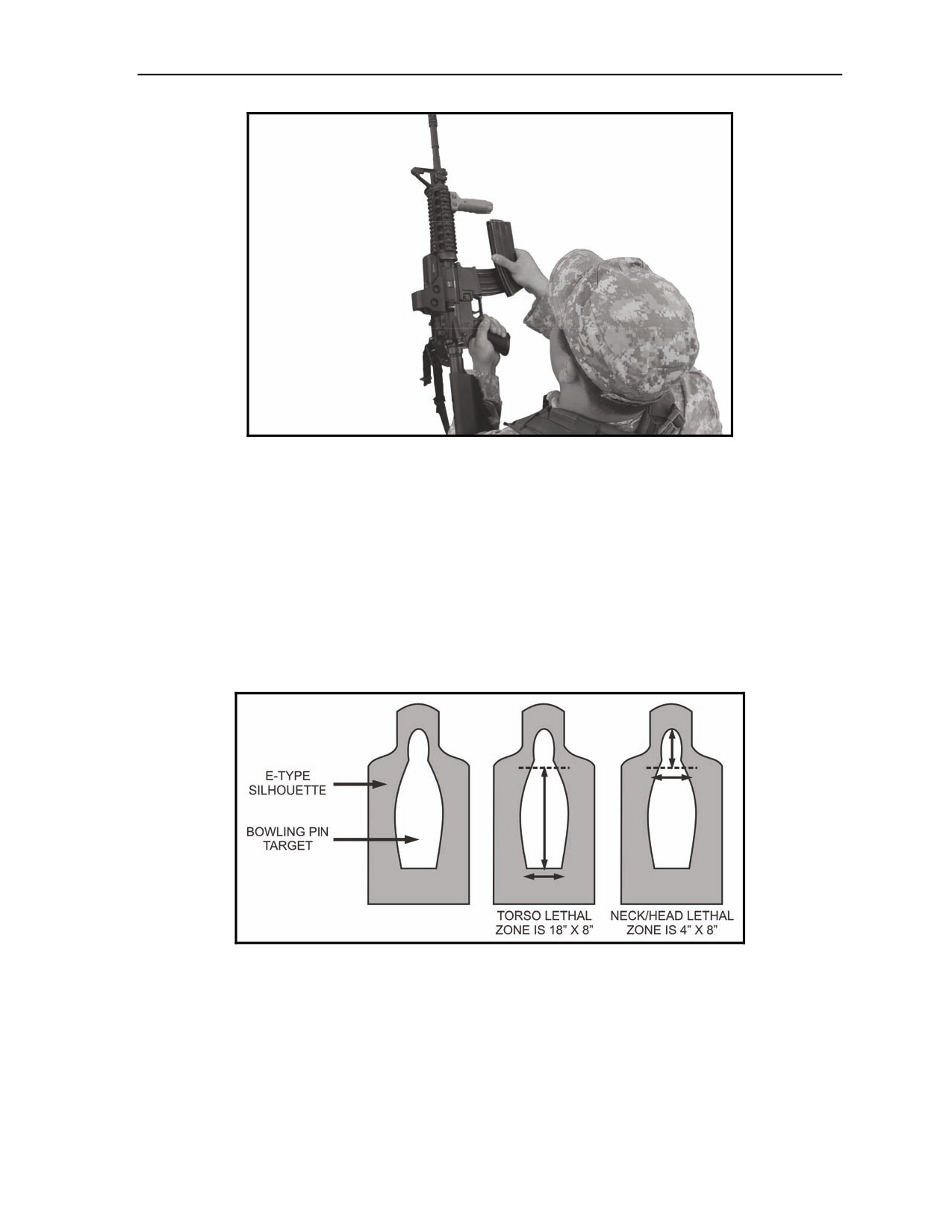
7-199. When shooting from the right side, perform the right-side L-shaped magazine changing method
(Figure 7-28):
(1) Engage the target until the magazine is empty.
(2) Take a knee.
(3) Place the weapon at a 45-degree angle, with the magazine well facing in, the muzzle pointed in a
safe direction, and the buttstock in the crease of the right elbow.
(4) Slide the nonfiring hand down the handguard to the receiver, and press the magazine release
catch.
(5) Secure a full magazine with two fingers and the thumb of the nonfiring hand.
(6) Bring the full magazine (top of the magazine facing to the rear) next to and perpendicular to the
empty magazine, forming an L-shape.
(7) Slide the empty magazine out with the nonfiring hand, rotate the full magazine so the top of the
magazine faces the magazine well, and insert the full magazine.
(8) Hit the bolt release.
(9) Stow the empty magazine in the ammunition pouch.
Figure 7-28. Right-side L-shaped magazine changing method.
7-200. When shooting from the left side, perform the left-side L-shaped magazine changing method
(Figure 7-29):
(1) Engage the target until the magazine is empty.
(2) Take a knee.
(3) Place the weapon at a 45-degree angle, with the magazine well facing in, the muzzle pointed in a
safe direction, and the buttstock in the crease of the left elbow.
(4) Press the magazine release catch with the trigger finger.
(5) Secure a full magazine with two fingers and the thumb of the nonfiring hand.
(6) Bring the full magazine (top of the magazine facing to the rear) next to and perpendicular to the
empty magazine, forming an L-shape.
(7) Slide the empty magazine out with the nonfiring hand, rotate the full magazine so the top of the
magazine faces the magazine well, and insert the full magazine.
(8) Hit the bolt release.
(9) Stow the empty magazine in the ammunition pouch.
7-50
FM 3-22.9
12 August 2008
Advanced Rifle Marksmanship
Figure 7-29. Left-side L-shaped magazine changing method.
PHASE I—REFLEXIVE FIRE TRAINING
7-201. Reflexive fire training involves the practical application of all four of the fundamentals of SRM.
All Soldiers must receive a GO on the task, Conduct Reflexive Firing, before proceeding with training.
This is a perishable skill that must be constantly reinforced, and reflexive fire training should be conducted
frequently as refresher training to ensure that the Soldiers' skills are always at the highest level possible.
REFLEXIVE FIRING TARGETS
7-202. Targets can be purchased locally (FBI style) or manufactured by the unit (bowling pin targets). E-
type silhouettes may be painted as shown in Figure 7-30.
Figure 7-30. Dimensions and placement of bowling pin targets.
12 August 2008
FM 3-22.9
7-51

Chapter 7
RANGE SETUP
7-203. The range must be at least 25 meters in length, with identification marks at the 5-, 10-, 15-, and
25-meter distances. Each lane should be marked in a way that prevents crossfiring between lanes. A lane
safety coach is assigned to each lane to observe and evaluate the Soldiers' performance, as well as ensure
the safe conduct of firing. All firing cues are given by the tower or line safety.
CONDUCT OF TRAINING
NOTE: Unit commanders should conduct training continually to first establish and then sustain
levels of proficiency in reflexive firing.
7-204. Each Soldier conducts a dry-fire exercise and a blank-fire exercise prior to conducting the LFX.
The dry-fire and blank-fire exercises give the Soldier the repetition needed to successfully engage targets
quickly and accurately.
7-205. During the dry-fire exercise, Soldiers identify and engage the proper targets at ranges from 5 to 25
meters from the stationary position, while turning and walking. The tower or line safety gives all firing
cues. All tables are fired at night, with and without protective masks, using automatic fire for
familiarization, and while using NVDs. The dry-fire exercise proceeds as follows:
(1) The Soldier starts at the 25-meter line at the low ready position, facing the targets.
(2) The Soldier is then told the engagement position (for example, facing left, turns right) and, once
in position, is given the cue to fire.
(3) On cue, the Soldier assumes the proper firing position and stance, places the selector lever on
SEMI, uses the correct aiming technique for the target's distance, and engages the target.
(4) After engaging the target, the Soldier continues to cover the target to reinforce firing until the
threat is eliminated.
NOTE: If Soldiers will be engaging targets using lasers, optics, or the protective mask, they
should complete all steps using the same equipment. Do not have Soldiers familiarize with iron
sights and then fire the LFX with optics.
Evaluation
7-206. Soldiers are evaluated on a GO/NO GO basis, based on the standards in the training and evaluation
outline (T&EO) and scoring table. Soldiers must score a GO on the familiarization firing tables (Table 7-18
and Table 7-19) before attempting to qualify. The standard for protective mask firing is 60 percent day and
50 percent night.
7-207. Use the following guidelines for scoring:
z
Rounds fired after the time standard will be scored as a miss.
z
The number of rounds fired after the time standard will be subtracted from the total number of
hits the Soldier has scored.
z
All rounds must impact on the E-type silhouette. Hits are defined as being in the lethal zone
(bowling pin).
Table 7-18. Familiarization (stationary).
POSITION
ROUNDS
DISTANCE
METHOD
TIME
LETHAL ZONE
FIRED
(m)
STANDARD
HIT STANDARD
Straight ahead
4
25
Single shot
None
3
Straight ahead
4
10
Single shot
None
3
Straight ahead
4
25
Controlled pair
None
3
Straight ahead
4
10
Controlled pair
None
3
7-52
FM 3-22.9
12 August 2008

Advanced Rifle Marksmanship
Table 7-19. Familiarization (moving).
POSITION
ROUNDS
DISTANCE
METHOD
TIME
LETHAL ZONE
FIRED
(m)
STANDARD
HIT STANDARD
Facing left; turning right
4
25
Controlled pair
None
3
Facing right; turning left
4
25
Controlled pair
None
3
Straight ahead walking
4
10, start at 15
Controlled pair
None
3
Straight ahead
4
5
Controlled pair
None
3
PHASE II—TARGET DISCRIMINATION TRAINING
7-208. During SRC, there is little or no margin for error. Too slow a shot at the enemy, too fast a shot at a
noncombatant or friendly Soldier, or inaccurate shots can all be disastrous for the Soldier. Target
discrimination is the act of distinguishing between threat and nonthreat targets during SRC. Target
discrimination is an inescapable responsibility and must be stressed in all situations regardless of mission.
NOTE: It is essential that target discrimination training be aimed at instilling fire control and
discipline in Soldiers. The first priority is always the safety of a Soldier.
TARGET DISCRIMINATION TARGETS
7-209. Targets used to conduct target discrimination training include—
(1) Two or more E-type silhouettes with bowling pins painted on each side of the silhouette (for
example, brown side and green side).
(2) Multiple E-type silhouettes with different painted shapes (for example, squares, triangles, and
circles).
(3) A series of 3-inch circles on E-type silhouettes.
(4) Pop-up targets (for example, electrical or pull targets).
(5) Target's hands and center of the uniform.
Two or More E-Type Silhouettes with Bowling Pins Painted on Each Side
7-210. Target discrimination is best taught using two or more E-type silhouettes with bowling pins
painted on each side of the silhouette. To conduct training using this type of target—
(1) The instructor calls out a color for the firer to identify.
(2) On the command “READY, UP” or at the whistle blast, the firer quickly scans all targets for the
color and engages the correct target using a controlled pair.
7-211. This exercise trains Soldiers to accomplish missions under the expected ROE. During force-on-
force training, the OPFOR wears distinctive uniforms; this exercise prepares Soldiers to eliminate threats
based on enemy uniforms and reduces the chances of a Soldier hesitating and becoming a casualty. Using
realistic targets displaying threat and nonthreat personnel is another variation.
Multiple E-Type Silhouettes with Different Painted Shapes
7-212. To conduct training using this type of target—
(1) The instructor calls out a shape for the firers to identify.
(2) On the command “READY, UP” or at a whistle blast, the firers quickly scan all targets,
searching for the shape, and engage the correct target using the controlled pair technique.
7-213. This is repeated until one shape is mastered. Subsequently, a sequence of shapes is announced, and
the firers engage accordingly.
12 August 2008
FM 3-22.9
7-53
Chapter 7
Series of 3-Inch Circles on E-Type Silhouettes
7-214. To conduct training using this type of target—
(1) Instructors call out which circle to engage (for example, top left).
(2) Firers react accordingly.
7-215. Marksmanship is emphasized using this technique.
Target's Hands and Center of the Uniform
7-216. If a target is a threat, the first and most obvious indicator is a weapon in the target’s hands. A good
technique for teaching Soldiers target discrimination is to have them focus on the target’s hands and the
center of the uniform. To conduct this exercise, the Soldier must visualize the entire target because an
armed target could be a fellow Soldier or other friendly. This level of target discrimination should not be
trained until Soldiers are thoroughly proficient in basic SRC and SRM tasks.
RANGE SETUP
7-217. The range must be at least 25 meters in length, and each lane should be at least 5 meters wide.
Each lane should have target holders and should be marked in a way that prevents crossfiring between
lanes. A coach/safety is assigned to each lane to observe and control the Soldier’s performance. The tower,
lane safety, or senior instructor gives all firing commands.
CONDUCT
7-218. Regardless of the type of target used, the exercise proceeds as follows:
NOTE: Each Soldier must complete a dry-fire exercise and a blank-fire exercise before moving
to the live-fire portion.
(1) The Soldier faces away from the target.
NOTE: This action requires the Soldier to identify and discriminate targets, and reinforces skills
used during reflexive firing training.
(2) The Soldier is given a target description.
(3) On the command “READY,” the Soldier begins to scan for the target.
(4) On the command “UP,” voice command, or whistle blast, the Soldier turns toward and engages
the target.
NOTES:
1. Instructors should vary commands and targets so that the Soldier does not fall
into a pattern. Intermixing “NO FIRE” commands will add to realism.
2. The first priority is always the safety of the Soldier.
7-219. All Soldiers must receive a GO on this task before SRM qualification. Targets must be scored and
marked after each firing distance. A Soldier will be scored as a NO GO if he fails to engage a target or
engages a target other than the one called for by the instructor. Soldiers will also receive a NO GO if, at any
time, they point their weapon at another Soldier or they fail to keep their weapon on SAFE before acquiring
and engaging the targets.
NOTE: Initial training and sustainment training may be conducted by changing the uniform in
the standards statement.
7-54
FM 3-22.9
12 August 2008

Advanced Rifle Marksmanship
EVALUATION
7-220. Table 7-18 will be used to score this exercise.
PHASE III—SHORT-RANGE MARKSMANSHIP QUALIFICATION
7-221. Soldiers should conduct SRM qualification semiannually. In addition to qualification, commanders
should conduct familiarization using the same qualification standards while altering the conditions. Firing
the qualification tables in protective masks and during periods of limited visibility should be included;
Soldiers should train as they fight—with all assigned equipment.
NOTE: Although the qualification is intended to be fired with open sights only, iterations using
laser aiming devices, CCOs, and NVDs are highly encouraged.
RECORD AND PRACTICE FIRE
Conduct
NOTES:
1. Soldiers must complete a blank-fire iteration of the qualification tables before
conducting live-fire qualification.
2. Each Soldier will have a coach to ensure that he acquires the target, keeps the
weapon on SAFE until time to engage the target and is then places it back on
SAFE, and maintains muzzle awareness throughout the exercise.
3. If Soldiers will be engaging targets with lasers, optics, or the protective mask,
they should complete all steps using the same equipment. Do not have Soldiers
familiarize with iron sights and fire the exercise while wearing the protective
mask.
7-222. Each Soldier engages the target IAW the firing table (Table 7-20).
Table 7-20. Record and practice fire.
POSITION
ROUNDS
DISTANCE
METHOD
TIME STANDARD
FIRED
(m)
Straight ahead
2
4
Controlled pair
3 sec from command “UP”
Left turn
2
7
Controlled pair
3 sec from command “UP”
Right turn
2
10
Controlled pair
3 sec from command “UP”
Walk straight
2
5, start at 10
Controlled pair
3 sec from command “UP”
Walk straight
2
10, start at 15
Controlled pair
3 sec from command “UP”
Run, stop, and shoot
2
10, start at 20
Controlled pair
3 sec from command “UP”
Straight ahead
2
25
Controlled pair
3 sec from command “UP”
Run, stop, kneel, and shoot
2
15, start at 25
Controlled pair
3 sec from command “UP”
Walk laterally right
2
7
Controlled pair
3 sec from command “UP”
Walk laterally left
2
7
Controlled pair
3 sec from command “UP”
12 August 2008
FM 3-22.9
7-55
Chapter 7
Evaluation
NOTE: For scoring purposes, a hit is a round that impacts within the lethal zone.
7-223. Each Soldier scores 16 hits day and night. The standard when wearing a protective mask is 14 day
and 12 night. In addition to achieving a qualifying score, all 20 rounds must hit the E-type silhouette in
order to qualify.
BARRICADE TRANSITION QUALIFICATION FIRING
Range Setup
7-224. The range must be at least 50 meters in length, with tall barricades at the 35- and 50-meter
distances and short barricades at the 25- and 40-meter distances. Each lane should be marked in a way that
prevents crossfiring between lanes. A lane safety coach is assigned to each lane to observe and evaluate the
Soldier’s performance, as well as ensure that firing is conducted safely. The tower or line safety gives all
firing cues.
Conduct
NOTE: Soldiers must complete a dry-fire and a blank-fire iteration of the qualification tables
before conducting live-fire qualification. The dry-fire and blank-fire exercises gives the Soldier
the repetition needed to successfully engage targets quickly and accurately.
7-225. The exercise proceeds as follows:
(1) The Soldier receives one 28-round and three 4-round magazines.
(2) The Soldier loads one 28-round magazine.
(3) The Soldier assumes the low ready position at the 50-meter line, facing the targets.
(4) The Soldier engages the targets as shown in Table 7-21.
(5) On cue, the Soldier assumes the proper firing position and stance, places the selector lever on
SEMI, uses the correct aiming technique for the target’s distance, and engages the target.
NOTE: If a Soldier is having difficulty during the blank-fire exercise, he must be retrained
before continuing with the qualification.
Evaluation
7-226. Use the following guidelines for scoring:
z
All rounds must impact on the E-type silhouette.
z
Hits are defined as being in the lethal zone (bowling pin).
7-56
FM 3-22.9
12 August 2008

Advanced Rifle Marksmanship
*Table 7-21. Barricade transition fire.
BARRICADE/DISTANCE
POSITION
ROUNDS FIRED
METHOD
Start with 28-round magazine in the open.
Standing
2
Controlled pair
Kneeling
2
Controlled pair
Open/50 m
Prone
2
Controlled pair
Sitting
2
Controlled pair
Left
2
Controlled pair
Tall/50 m
Right
2
Controlled pair
Left
2
Controlled pair
Short/40 m
Top
2
Controlled pair
Right
2
Controlled pair
Left
2
Controlled pair
Tall/35 m
Right
2
Controlled pair
Left
2
Controlled pair
Short/25 m
Top
2
Controlled pair
Right
2
Controlled pair
Transition back to the tall 35-m barricade. Perform parallel or L-shaped magazine change. Insert 4-round magazine.
Left
2
Controlled pair
Tall/35 m
Right
2
Controlled pair
Transition back to short 40-m barricade. Perform parallel or L-shaped magazine change. Insert 4-round magazine.
Left
2
Controlled pair
Short/40 m
Right
2
Controlled pair
Transition back to tall 50-m barricade. Perform parallel or L-shaped magazine change. Insert 4-round magazine.
Left
2
Controlled pair
Tall/50 m
Right
2
Controlled pair
PHASE IV—SHOTGUN AND AUTOMATIC OR BURST FIRING
FAMILIARIZATION
7-227. Shotgun and automatic or burst firing familiarization is no different for SRM than for BRM.
NOTE: Publications for shotgun firing familiarization are currently being developed.
*SECTION VII. COMBAT FIELD FIRE
The objective of combat field fire is to assess and confirm the individual proficiency of firers in performing
combat-related advanced rifle marksmanship skills, such as engaging multiple target arrays, using multiple hits
to neutralize a target, assuming combat relevant firing positions, clearing malfunctions, and performing
magazine changes.
NOTE: See Table 7-22 for the current training program.
*CONCEPT
7-228. Combat field fire should simulate combat conditions by requiring the firer to use single and
multiple shots to engage 15 targets with different exposure times and ranges.
10 February 2011
FM 3-22.9, C1
7-57

Chapter 7
*Table 7-22. Combat field fire training program.
COMBAT FIELD FIRE
Instructional Intent
•
Reinforce advanced rifle marksmanship skills and apply the techniques of target detection by engaging a course of
fire with multiple pop-up targets with different exposure times and required hits.
Special Instructions
Ensure that—
•
The rear sight is on the proper setting (M16A2/3=8/3; M16A4 and M4=6/3 flush; M16A1=the unmarked aperture, short-range).
•
The rear sight aperture is set on 300, not 800.
•
The small aperture is being used.
Observables
•
Soldiers apply all aspects of ARM.
•
Soldiers transition between stations without being prompted.
•
Soldiers perform magazine changes and SPORTS without being prompted.
•
Soldiers must attain a minimum of 16 hits to be considered trained.
•
Soldiers that do not meet the standard receive remedial training before refiring.
*CONDUCT
NOTE: When firing combat field fire, each Soldier must wear the proper uniform: the helmet,
LBE, and IBA with all SAPI plates (if available). No other armor is required.
7-229. Combat field fire is performed on a standard qualification range set up so that 15 targets are
exposed a total of 26 times at ranges from 50 to 300 meters. The target exposures are grouped into firing
tables by position. The three positions associated with combat field fire are—
z
Kneeling unsupported.
z
Barricade supported.
z
Prone unsupported.
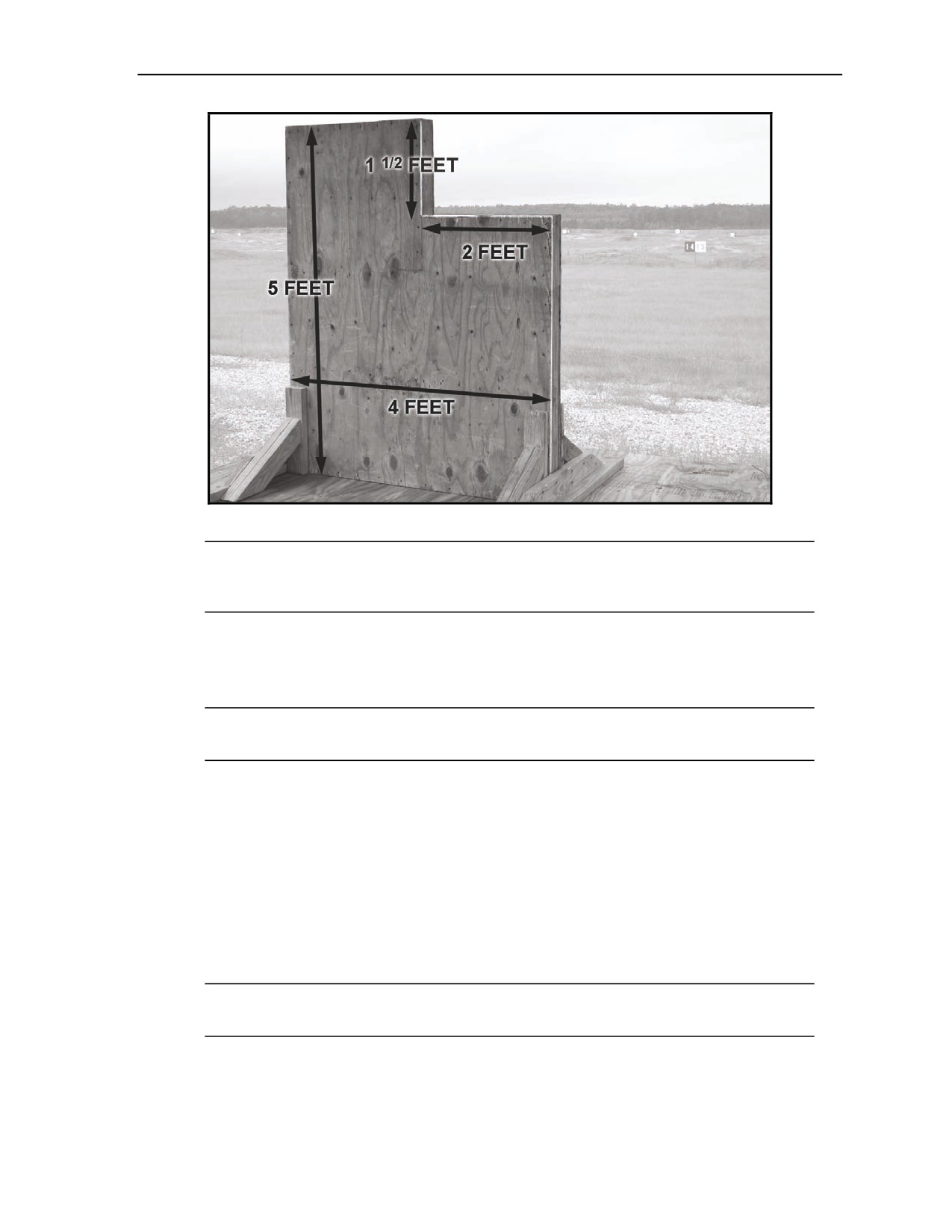
NOTE: Combat field fire requires the use of a barricade (Figure 7-31). The barricade is used for
concealment for the kneeling unsupported and prone unsupported positions, and is used for support
for the barricade supported firing position. Barricade panels can be locally produced using ½- to
¾-inch plywood and 2- by 4-inch lumber. The dimensions are illustrated in Figure 7-31. The panel
must have a base for proper support; however, it can be constructed at the unit’s discretion.
7-230. Each firer receives 30 rounds of 5.56-millimeter ball ammunition (3 magazines containing 10
rounds) and 1 randomly placed dummy round in each magazine. The Soldier assumes a firing position and
engages each target until it falls and stays down. Once a Soldier has completed a table, he transitions to the
next position without prompting, and once he has emptied a magazine, he should change magazines
without prompting. Each Soldier must attain a minimum of 16 hits to be considered trained.
NOTES:
1. Targets will bob between hits.
2. Ten to twenty seconds should elapse between firing tables to allow Soldiers to
transition to the next firing position or to prompt Soldiers to watch the area for
additional targets.
3. A Soldier should not stop firing unless he has completed the firing table and is
transitioning to the next position (making a brief halt in fire necessary), has
completed all firing tables, or is out of ammunition.
4. The dummy round placed in each magazine (1 round for each magazine)
simulates a malfunction. To properly simulate a malfunction, the dummy round
must be randomly placed; it cannot be the first or last round in the magazine.
Soldiers should address this malfunction
(by performing SPORTS) without
prompting.
7-58
FM 3-22.9, C1
10 February 2011
Advanced Rifle Marksmanship
*Figure 7-31. Combat field fire barricade.
NOTE: The positions demonstrated in the following graphics are for a right-handed firer. For a
left-handed firer, turn the barricade to place the L-shaped cutout on the opposite side so that the
firer can engage targets left-handed.
*KNEELING UNSUPPORTED
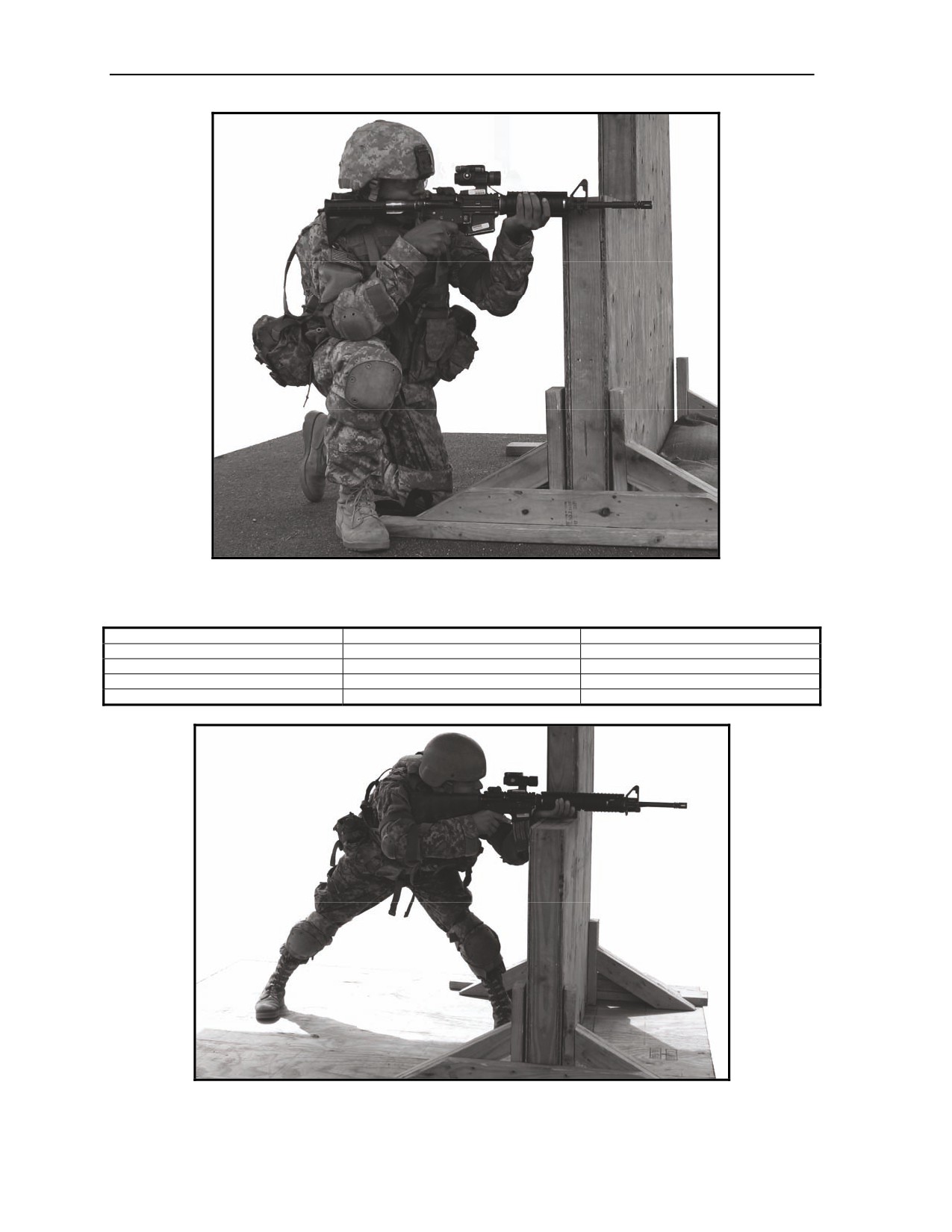
7-231. Soldiers begin combat field fire in a kneeling unsupported position (Figure 7-32) next to a
barricade. On a signal, four targets expose at the same time.
NOTE: Table 7-23 depicts the distance from the firer to the target, the number of hits required,
and the time that a target will be exposed.
7-232. Soldiers fire at each target until it falls and stays down. After 60 seconds have elapsed, the last
target will fall and stay down. Without prompting, Soldiers transition to the barricade supported position.
*BARRICADE SUPPORTED
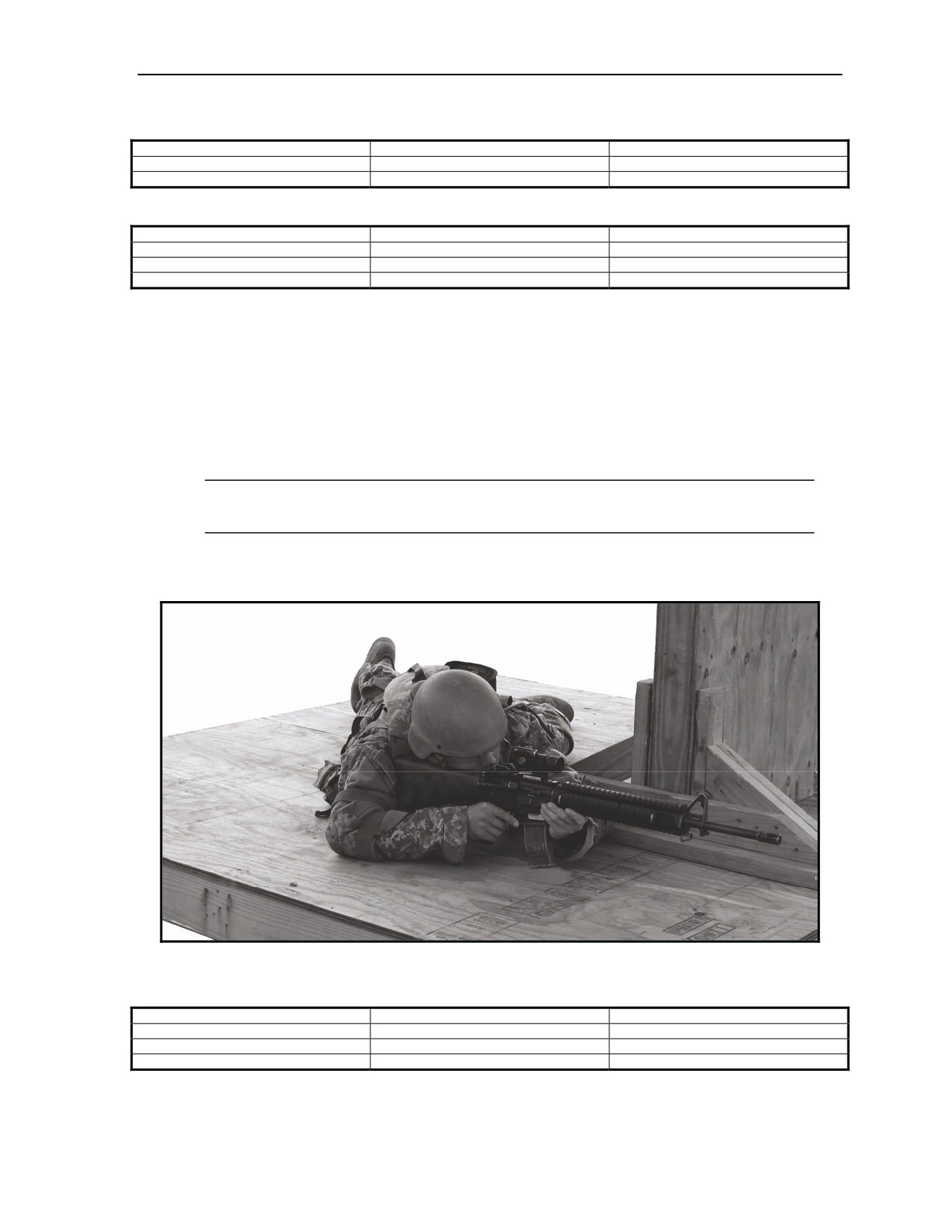
7-233. To assume a barricade supported position (Figure 7-33), Soldiers stand behind the lower portion of
the barricade. When in this position, Soldiers are exposed to two sets of targets:
z
In the first set, two targets expose at the same time. After 40 seconds have elapsed, the last target
will fall and stay down.
z
In the second set, three targets will expose at the same time. After 40 seconds have elapsed, the
last target will fall and stay down.
NOTE: Tables 7-24 and 7-25 depicts the distance from the firer to the target, the number of hits
required, and the time that a target will be exposed.
7-234. Soldiers engage each target until it falls and stays down. Without prompting, Soldiers transition to
the prone unsupported position.
10 February 2011
FM 3-22.9, C1
7-59
Chapter 7
*Figure 7-32. Combat field fire—kneeling unsupported position.
*Table 7-23. Targets fired from the kneeling unsupported position.
RANGE (METERS)
HITS REQUIRED
EXPOSURE TIME (SECONDS)
50 (Left)
2
31
50 (Right)
2
31
100
1
45
150
2
60
*Figure 7-33. Combat field fire—barricade supported position.
7-60
FM 3-22.9, C1
10 February 2011
Advanced Rifle Marksmanship
*Table 7-24. Targets fired from the barricade supported position--Set 1.
RANGE (METERS)
HITS REQUIRED
EXPOSURE TIME (SECONDS)
50 (Left or Right)
3
26
100
2
40
*Table 7-25. Targets fired from the barricade supported position--Set 2.
RANGE (METERS)
HITS REQUIRED
EXPOSURE TIME (SECONDS)
100
1
19
150
2
21
200
1
40
*PRONE UNSUPPORTED
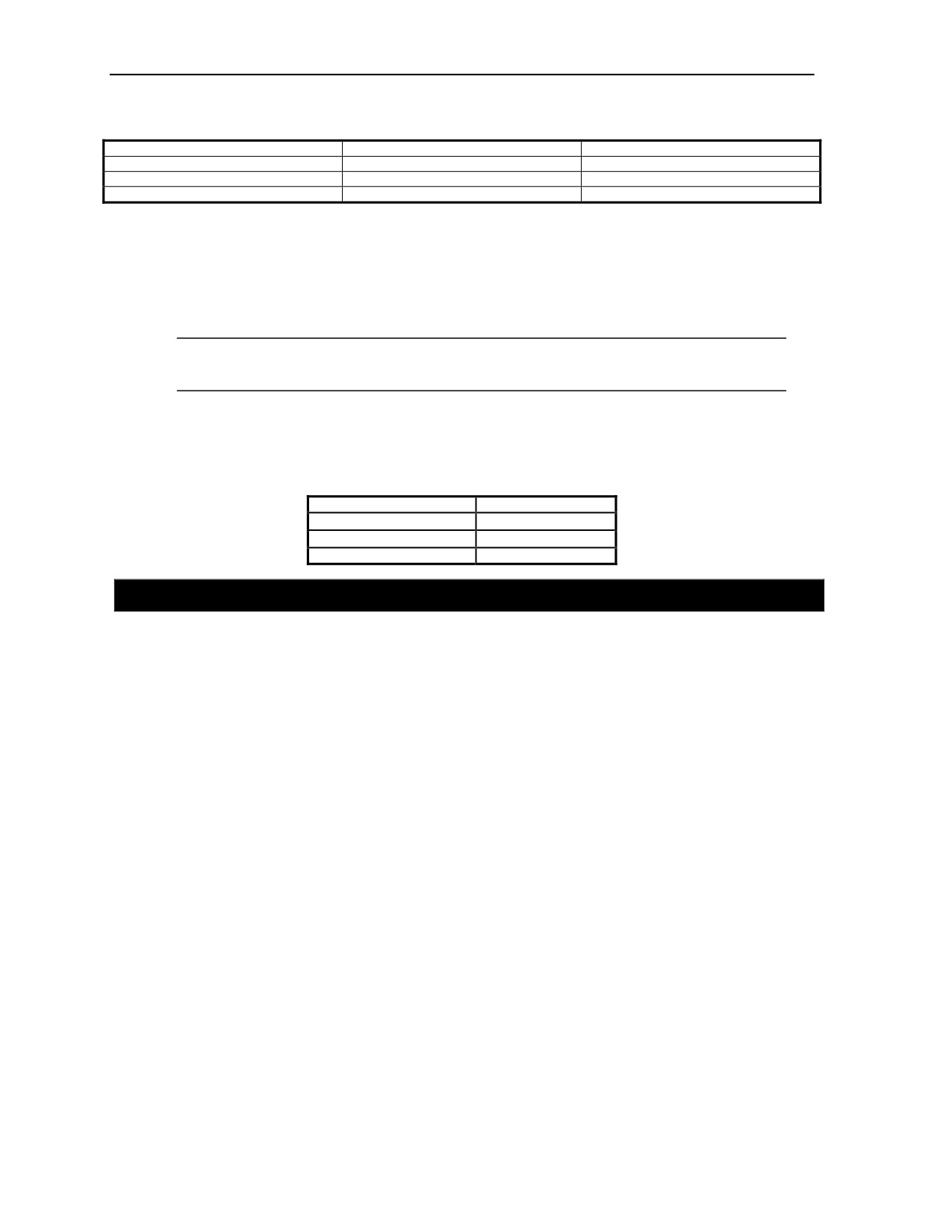
7-235. To assume a prone unsupported position (Figure 7-34), the Soldier positions himself so that he
fires around the edge of the barricade, using it for cover. When in this position, Soldiers engage two sets of
targets:
z
In the first set, three targets expose at the same time. After 50 seconds have elapsed, the last
target will fall and stay down.
z
In the second set, three targets will expose at the same time. After 50 seconds have elapsed, the
last target will fall and stay down.
NOTE: Tables 7-26 and 7-27 depicts the distance from the firer to the target, the number of hits
required, and the time that a target will be exposed.
7-236. Soldiers fire at each target until it falls and stays down. Upon completion of the firing table,
Soldiers should stay in position, clear their weapons, and follow the orders given by the tower operator.
*Figure 7-34. Combat field fire—prone unsupported position.
*Table 7-26. Targets fired from the prone unsupported position--Set 1.
RANGE (METERS)
HITS REQUIRED
EXPOSURE TIME (SECONDS)
100
2
23
200
2
36
250
1
50
10 February 2011
FM 3-22.9, C1
7-61
Chapter 7
*Table 7-27. Targets fired from the prone unsupported position--Set 2.
RANGE (METERS)
HITS REQUIRED
EXPOSURE TIME (SECONDS)
150
2
21
250
2
37
300
1
50
*RECORD OF PERFORMANCE
7-237. Accurate performance data are critical. The firer’s score is manually recorded using DA Form
7682-R (Combat Field Fire Scorecard) or automatically documented using a computer printout provided on
the automated range. Based on the data recorded, an AAR can be performed by range and firing position to
discuss firing performance.
NOTE: See Appendix B for a sample of a completed DA Form 7682-R and the end of this
publication for a blank, reproducible copy.
*RATINGS
7-238. Ratings for combat field fire are shown in Table 7-28.
*Table 7-28. Ratings for combat field fire.
RATINGS
NUMBER OF HITS
Trained
24 to 26
Partially trained
16 to 23
Untrained
15 and below
*SECTION VIII. SQUAD DESIGNATED MARKSMAN TRAINING
Advances in technology have led to the development of weapon systems that are increasingly more accurate and able
to engage targets at much longer ranges. Conversely, today’s rifleman is trained to engage targets only out to 300
meters. This 300-meter limit is well short of the weapon/ammunition combination’s capability. Snipers engage targets
at 600 meters and beyond. The SDM engages targets with direct small arms fire in the gap between the engagement
range of the average combat Soldier and the sniper. Possessing the ability to estimate range, detect targets, and place
effective, well-aimed fire on intermediate range targets, the SDM plays a vital role on the modern battlefield.
MISSION OF THE SQUAD DESIGNATED MARKSMAN
7-239. The SDM program provides the squad with a designated marksman that has been trained to engage
targets from 300 to 500 meters. He will operate and maneuver as a rifleman, but will have the added
responsibility of engaging targets out to 500 meters with effective, well-aimed fires. The SDM is a vital
member of his individual squad, not a squad sniper. The SDM has neither the equipment nor training to
engage targets at extended ranges with precision fires while operating individually or in a small team. He
can also be used to help direct the fires of other squad members into enemy positions. Due to the increased
skill level required for his position, the SDM must maintain a high level of proficiency through continued
training of the required skills. The SDM must possess a thorough understanding and mastery of—
z
The fundamentals of rifle marksmanship.
z
Ballistics.
z
Elevation and windage.
z
Hold-off (adjusted points of aim).
z
Sight manipulation.
z
Range estimation.
7-62
FM 3-22.9, C1
10 February 2011
Advanced Rifle Marksmanship
SELECTION
7-240. The platoon sergeant and squad leaders must take special consideration in selecting the SDM. The
SDM must have—
z
A solid marksmanship performance.
z
A clear understanding of the fundamentals.
z
The ability to apply these fundamentals consistently during dry-fire and live-fire training.
SQUAD DESIGNATED MARKSMAN SKILLS PROGRESSION
7-241. The skills progression program assesses the Soldier’s ability to apply the fundamentals of
marksmanship and trains and assesses the Soldier's proficiency in several key areas. Firing events will
serve to both reinforce and assess these areas.
CONDUCT
7-242. While conducting the skills progression program, instructors-trainers will adhere to the following
guidelines:
z
The skills progression program for the SDM is based on the M16-/M4-series weapon system and
a 98-rounds-per-man ammunition requirement.
z
Soldiers will use their assigned weapon during the training.
z
The firing events will be conducted with the iron sights or BUISs only.
z
The firing events will be conducted on a KD range that enables firing out to 600 meters at a
minimum.
QUALIFICATION
7-243. SDM qualification requires the completion of five phases:
(1) Position evaluation.
(2) Dry-fire training.
(3) Range estimation and sight manipulation.
(4) Hold-off.
(5) Field fire.
7-244. Each phase stresses marksmanship fundamentals and specific skill areas required to perform as an
SDM. To continue training, Soldiers must receive a GO in each phase. Soldiers who fail in any area should
be removed from training.
NOTE: If an optic is issued for use, the phases dealing with hold-off and field record fire will be
removed and relevant optics training and testing will be substituted.
PHASE I—POSITION EVALUATION
7-245. Phase I of the training consists of demonstrating the ability to consistently assume proper firing
positions. The foxhole supported and prone unsupported firing positions will provide the Soldier with the
smallest target exposure to the enemy and will be used during this training cycle. The prone supported
position can be substituted for the foxhole supported position dependent on range configurations. Prior to
this phase of training, trainers ensure that the—
z
Weapon is cleared and that no ammunition is loaded prior to training.
z
Weapon is zeroed prior to training.
z
Soldier is able to assume a steady firing position.
10 February 2011
FM 3-22.9, C1
7-63
Chapter 7
Foxhole Supported
7-246. The Soldier must be able to successfully assume a proper supported position while firing from a
foxhole. The trainer must ensure that the Soldier has a good steady position. After the Soldier has assumed
a good supported position in the foxhole—
(1) The trainer uses DA Form 7650-R (Squad Designated Marksman—Position Evaluation) to
evaluate his position and take notes on all of the following characteristics:
NOTE: See the end of this publication for a blank, reproducible copy of DA Form 7650-R.
Eye relief.
Trigger finger.
Elbows.
Nonfiring hand.
Legs.
NOTE: The main areas that will differ between the foxhole supported and the prone supported
positions are in the placement of the elbows, legs, and nonfiring hand. These body positions will
be similar to those of the prone unsupported position.
(2) After all characteristics have been noted, the trainer has the Soldier lay his weapon down, relax,
and then assume another supported position in the foxhole.
(3) The trainer evaluates this position by comparing his notes from the original supported position. The
Soldier should maintain the same characteristics in the second evaluation as he did in the first.
(4) Once the trainer is satisfied that the Soldier has demonstrated the proper position and is able to
show it in two consecutive attempts, the Soldier moves to the unsupported prone position.
Eye Relief
7-247. To evaluate the Soldier's eye relief, ensure that the Soldier—
z
Demonstrates a consistent eye relief by checking the placement of the Soldier’s cheek on the
weapon's buttstock.
z
*Places his eye the same distance from the rear sight each time he is evaluated.
Trigger Finger
7-248. To evaluate the placement of the Soldier's trigger finger, ensure that the Soldier—
z
Uses his own style; not all Soldiers place their finger on the trigger in the same place.
z
Places his finger on the trigger the same way each time he is evaluated.
Elbows
7-249. To evaluate the placement of the Soldier's elbows, ensure that the Soldier—
z
Places his elbows firmly a comfortable distance apart on the outside edge of the foxhole.
z
Uses a sandbag, and not his arms, to support the weapon's weight.
z
Assumes a stable position each time he is evaluated by slightly nudging him.
Nonfiring Hand
7-250. To evaluate the placement of the Soldier's nonfiring hand, ensure that the Soldier—
z
Places the nonfiring hand in a position that is comfortable and provides the best weapon stability
and support. Show the Soldier different ways this can be done.
z
Is supporting the weapon properly by nudging him after the weapon has been stabilized.
7-64
FM 3-22.9, C1
10 February 2011
Advanced Rifle Marksmanship
Legs
7-251. To evaluate the placement of the Soldier's legs, ensure that the Soldier—
z
Places the legs inside the foxhole while firing.
z
Plants the legs firmly for a stable position while firing. Slightly nudge the Soldier to make sure
that his legs are firmly planted in the foxhole.
Prone Unsupported
7-252. The Soldier must be able to successfully assume a proper unsupported firing position. The trainer
must ensure that the Soldier has a good steady position. After the Soldier has assumed a good unsupported
firing position —
(1) Taking special care to observe the positioning of the elbows, the nonfiring hand, and the legs, the
trainer uses DA Form 7650-R (Squad Designated Marksman—Position Evaluation) to evaluate the
same characteristics as with the supported firing position with the exception of the—
Elbows.
Nonfiring hand.
Legs.
NOTE: See the end of this publication for a blank, reproducible copy of DA Form 7650-R.
(2) Once the trainer has noted the Soldier’s position, he has the Soldier lay his weapon down, stand
up, relax, and then get back down into another unsupported prone position.
(3) The trainer evaluates this position by comparing his notes from the original position. The Soldier
should maintain the same characteristics in the second evaluation as he did in the first
evaluation.
(4) The trainer lets the Soldier hold this firing position for approximately 15 seconds to check for
shaking. If the Soldier starts to shake, have him relax and reposition himself.
(5) Once the trainer is satisfied that the Soldier has demonstrated the proper position and is able to
accomplish it in two consecutive attempts, the Soldier moves on to the next phase of training.
Elbows
7-253. To evaluate the placement of the Soldier's elbows, ensure that the Soldier—
z
Places the elbows a comfortable distance apart on the ground.
z
Uses the bone, not the muscles, to support the weapon's weight. This will prevent any
unnecessary muscle fatigue and will allow for a steadier firing position.
z
Assumes a stable position. Slightly nudge the Soldier to ensure that his position is stable.
Nonfiring Hand
7-254. To evaluate the placement of the Soldier's nonfiring hand, ensure that the Soldier—
z
Places his nonfiring hand in a comfortable position on the handguards.
z
Does not support his nonfiring hand on the ground, sandbag or anything that would create a
supported position.
Legs
7-255. To evaluate the placement of the Soldier's legs, ensure that the Soldier—
z
Positions his legs in such a way that he has a stable position; not all Soldiers position their legs
the same way while shooting from the prone position.
z
Spreads his legs a comfortable distance apart, with the heels on the ground or as close as
possible without causing strain.
10 February 2011
FM 3-22.9, C1
7-65
Chapter 7
Zero Confirmation
*7-256. After completing Phases I and II, the Soldier conducts a firing event (Table 7-29) to zero or
confirm the zero on his weapon and reinforce the fundamentals of marksmanship. This firing event will be
conducted on a 25-meter range. If the Soldier cannot zero within 18 rounds, the trainer recommends
retraining, retesting, or possible removal from the course. After the weapon is zeroed, any additional rounds
will be fired and the coach will observe the Soldier for deficiencies in his marksmanship fundamentals.
*Table 7-29. Zero/zero confirmation firing event.
FIRING EVENT
ROUNDS
TARGET RANGE (m)
Zero/Zero Confirmation
18
25
PHASE II—DRY-FIRE TRAINING
7-257. SDMs must have a solid grasp on the fundamentals to successfully engage targets at longer ranges.
During this phase of training, the Soldier must demonstrate that he can apply the fundamentals of
marksmanship correctly. If the Soldier does not receive a GO in this phase of training, he will be dropped
from the course. The components of this phase of training are—
z
Follow-through.
z
Borelight exercise.
z
Target box exercise.
z
Dime/washer drill.
z
Zero confirmation.
7-258. Prior to this phase of training trainers ensure that the—
z
Weapon is cleared and no ammunition is loaded prior to training.
z
Weapon is zeroed prior to training.
z
Soldier is able to consistently apply the fundamentals of marksmanship.
Follow-Through
7-259. Follow-through involves applying all of the marksmanship fundamentals while and after the
weapon fires. A good follow-through ensures that the weapon is allowed to fire and recoil naturally. The
Soldier/weapon combination reacts as a single unit to such actions. It consists of the following:
z
Keeping the cheek in firm contact with the stock (stock weld).
z
Keeping the finger on the trigger all the way to the rear.
z
Continuing to look through the rear aperture.
z
Keeping muscles relaxed.
z
Avoiding reaction to recoil or noise.
z
Releasing the trigger only after the recoil has stopped.
Borelight Exercise
7-260. The borelight dry-fire exercise provides evaluation of the Soldier throughout the integrated act of
firing.
NOTE: If a borelight is not available, the target box exercise will be used.
7-261. To perform a borelight exercise—
(1) The trainer attaches a 25-meter zero target to a flat surface.
(2) The trainer positions the Soldier 10 meters away, facing the target.
(3)
*The Soldier assumes a good prone supported firing position with the borelight inserted in the
weapon's barrel and with the borelight placed in the dry-fire mode.
7-66
FM 3-22.9, C1
10 February 2011
Advanced Rifle Marksmanship
(4) The trainer uses DA Form 7650-R (Squad Designated Marksman—Position Evaluation) to
evaluate the Soldier’s position:
NOTE: See the end of this publication for a blank, reproducible copy of DA Form 7650-R.
(5) The Soldier aims at the silhouette's center of mass on the 25-meter zero target and squeezes the trigger.
(6) The borelight is activated as the trigger is fired. The laser is seen on the 25-meter zero target.
(7) The trainer marks the 25-meter zero target exactly where the borelight laser hit the target.
(8) The Soldier gets out of position and then back into a prone supported firing position.
7-262. This process will be done until a three-round shot group has been achieved. The Soldier will do the
same from the prone unsupported firing position. To receive a GO, the Soldier must place a three-round
shot group in a 3-centimeter circle from both prone positions.
Target Box Exercise
7-263. The target box exercise checks the consistency of aiming and placement of three-round shot
groups in a dry-fire environment. To conduct the exercise—
(1) The target man places the silhouette on a plain sheet of paper 25 or 15 meters away from the
firer and moves the correct silhouette target as directed by the Soldier.
(2)
*When the Soldier establishes proper aiming, he tells the target man to mark the target.
(3) The target man marks through the silhouette with a pen or pencil at the target's center of mass.
(4) The target man moves the silhouette to another spot on the paper and tells the firer to repeat the
process twice more to obtain a shot group.
NOTE: A simulated shot group covered within a 1/2-centimeter circle indicates consistent aiming.
Dime/Washer Drill
7-264. The dime/washer drill is an effective way of measuring the Soldier’s trigger squeeze. To conduct
the exercise—
(1) The Soldier takes aim and squeezes the trigger.
(2) If the dime or washer remains in place, he has successfully squeezed the trigger.
*7-265. The Soldier must successfully obtain five out of five consecutive shots without allowing the dime
or washer to drop. The trainer evaluates the Soldier’s performance and gives the Soldier a GO or NO GO.
If the Soldier receives a NO GO, the trainer recommends retraining, retesting, or possible removal from the
course.
Zero Confirmation
7-266. Zero confirmation is conducted as shown in Table 7-6.
PHASE III—RANGE ESTIMATION AND SIGHT MANIPULATION 100 TO 500 METERS
7-267. SDMs must use range estimation methods to determine the distance between their position and the
target. Trainers ensure that the—
z
Weapon is cleared and no ammunition is loaded prior to training.
z
Weapon is zeroed prior to training.
z
Soldier knows how to adjust for wind and gravity.
z
Soldier can manipulate the rear sight for different ranges.
7-268. The trainer sets up a range estimation course using E-type silhouettes at ranges from 100 meters to
700 meters. Soldiers practice on this course until they find the method that works best for them.
10 February 2011
FM 3-22.9, C1
7-67
Chapter 7
7-269. Once the Soldiers have had time to practice, trainers test their ability to estimate range. The Soldier
is given six targets. He must estimate the range within 50 meters of the actual range to receive a GO. The
Soldier must estimate range correctly six out of six targets to move on to the next portion of this phase.
Methods of Range Determination
7-270. SDMs can use five different methods of range determination:
z
100-meter unit-of-measure method.
z
Range card method.
z
Front sightpost method.
z
Appearance of objects method.
z
Combination method.
100-Meter Unit-of-Measure Method
7-271. To use this method, the SDM must be able to visualize a distance of 100 meters on the ground.
z
For ranges up to 500 meters, the SDM determines the number of 100-meter increments between
the two objects he wishes to measure.
z
Beyond 500 meters, he must select a point halfway to the object, determine the number of
100-meter increments to the halfway point, and then double the number.
NOTES:
1. See Chapter 6 for more information about this method of range determination.
2. For example, terrain with much dead space limits the accuracy of the 100-meter
method.
Range Card Method
7-272. SDMs use a range card to quickly determine ranges throughout the target area. Once a target is
detected, the SDM determines its location on the card and then reads the proper range to the target.
Front Sightpost Method
7-273. Using the front sightpost as a scale is another method of estimating range. This method can be
used for a quick on-the-spot estimation and engagement.
z
*If a man-sized target is ½ of the width of the front sightpost, he is approximately 300 meters
away.
z
*If a man-sized target is the width of the front sightpost, he is approximately 175 meters away.
NOTE: See Chapter 6 for more information about this method of range determination.
Appearance of Objects Method
7-274. This method of range determination is based on the size and visible characteristics of an object. To use
this method with any degree of accuracy, the SDM must be familiar with the appearance and visible detail of an
object at various ranges. Some common guidelines can be used to determine the range of a human target:
z
At 200 meters, a human target is clear and details can be seen.
z
At 300 meters, the target is still clear, but no details can be seen.
z
At 400 meters, the target’s outline is clear; however, the target itself is blurry.
z
At 500 meters, the body tapers and the head disappears.
z
At 600 meters, the body resembles a wedge shape.
NOTE: See Chapter 6 for more information about this method of range determination.
7-68
FM 3-22.9, C1
10 February 2011
Advanced Rifle Marksmanship
Combination Method
7-275. In a combat environment, perfect conditions rarely exist. Therefore, only one method of range
estimation may not be enough for the SDM’s specific mission. By using a combination of two or more methods
to determine an unknown range, an experienced SDM should arrive at an estimated range close to the true range.
Factors Affecting Range Estimation
7-276. Three factors affect range estimation:
z
Nature of the target
z
Nature of the terrain.
z
Light conditions.
Nature of the Target
7-277. The nature of the target affects its perceived range:
z
An object with a regular outline, such as a house, appears closer than one with an irregular
outline, such as a clump of trees.
z
A target that contrasts with its background appears to be closer than it actually is.
z
A partly exposed target appears more distant than it actually is.
Nature of the Terrain
7-278. The contour of the terrain affects the observer's ability to estimate range:
z
As the observer’s eye follows the contour of the terrain, he tends to overestimate distant targets.
z
Observing over smooth terrain, such as sand, water, or snow, causes the observer to
underestimate distant targets.
z
Looking downhill, the target appears farther away.
z
Looking uphill, the target appears closer.
Light Conditions
7-279. Light conditions affect range estimation:
z
The more clearly a target can be seen, the closer it appears.
z
When the sun is behind the observer, the target appears to be closer.
z
When the sun is behind the target, the target is more difficult to see and appears to be farther away.
Elevation Knob Training
*7-280. Elevation knob training involves nothing more than being able to adjust the rear elevation knob
for the various ranges that the SDM must engage. With this knowledge, he can better determine his range
settings for the different distances between the 100-meter adjustments.
7-281. The rear elevation knob adjusts the point of aim—
z
From 300 to 800 meters on the M16A2.
z
From 300 to 600 meters on the M16A4 and M4.
Conduct
*7-282. During elevation knob training, the Soldier determines the number of adjustments (clicks) between
the different range settings on his rear elevation adjustment knob (Tables 7-30 and 7-31). Once the Soldier
understands how to set the proper point of aim for his target using his rear elevation knob, the
instructor/trainer has him conduct another range estimation course. This time, the instructor/trainer has him
estimate the range and set the rear elevation for the range that he has estimated. The Soldier must estimate
range and set his rear elevation knob properly six out of six times to receive a GO. If the Soldier receives a
NO GO, the trainer recommends retraining, retesting, or possible removal from the course.
10 February 2011
FM 3-22.9, C1
7-69