FM 3-22.9 RIFLE MARKSMANSHIP M16-/M4-SERIES WEAPONS (August 2008) - page 4
Chapter 5
Figure 5-9. Central point of three shot groups.
ACCEPTABLE SHOT GROUPING PERFORMANCE
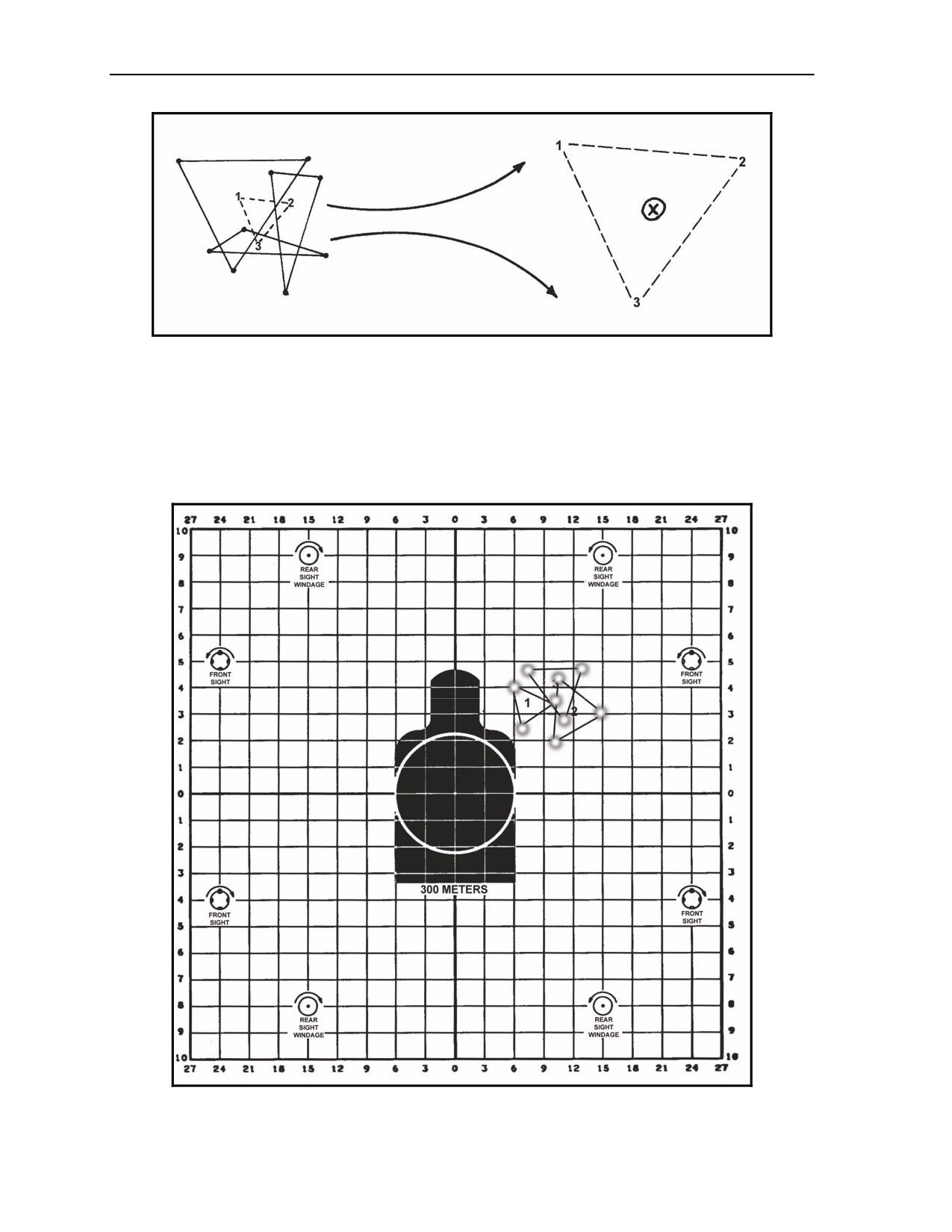
5-27. The shot groups in Figure 5-10 represent acceptable shot groups (4 centimeters or less) in the same
location. The Soldier firing this shot grouping should make a sight change of left 10 and down 4. Any
change should be clearly marked on the target and saved for reference. The Soldier is then ready to zero his
weapon.
Figure 5-10. Acceptable shot grouping performance.
5-8
FM 3-22.9
12 August 2008
Downrange Feedback
NOTES:
1. Location of the shot group on the
25-meter target is not important when
conducting a grouping exercise. The size and dispersion of the shot groups are
the main focus of this exercise.
2. Before the Soldier should be allowed to make any adjustments or start zeroing
procedures, two consecutive shot groups must fall within a 4-centimeter circle
when fired at 25 meters.
SHOT GROUPS WITH INCONSISTENT AIMING
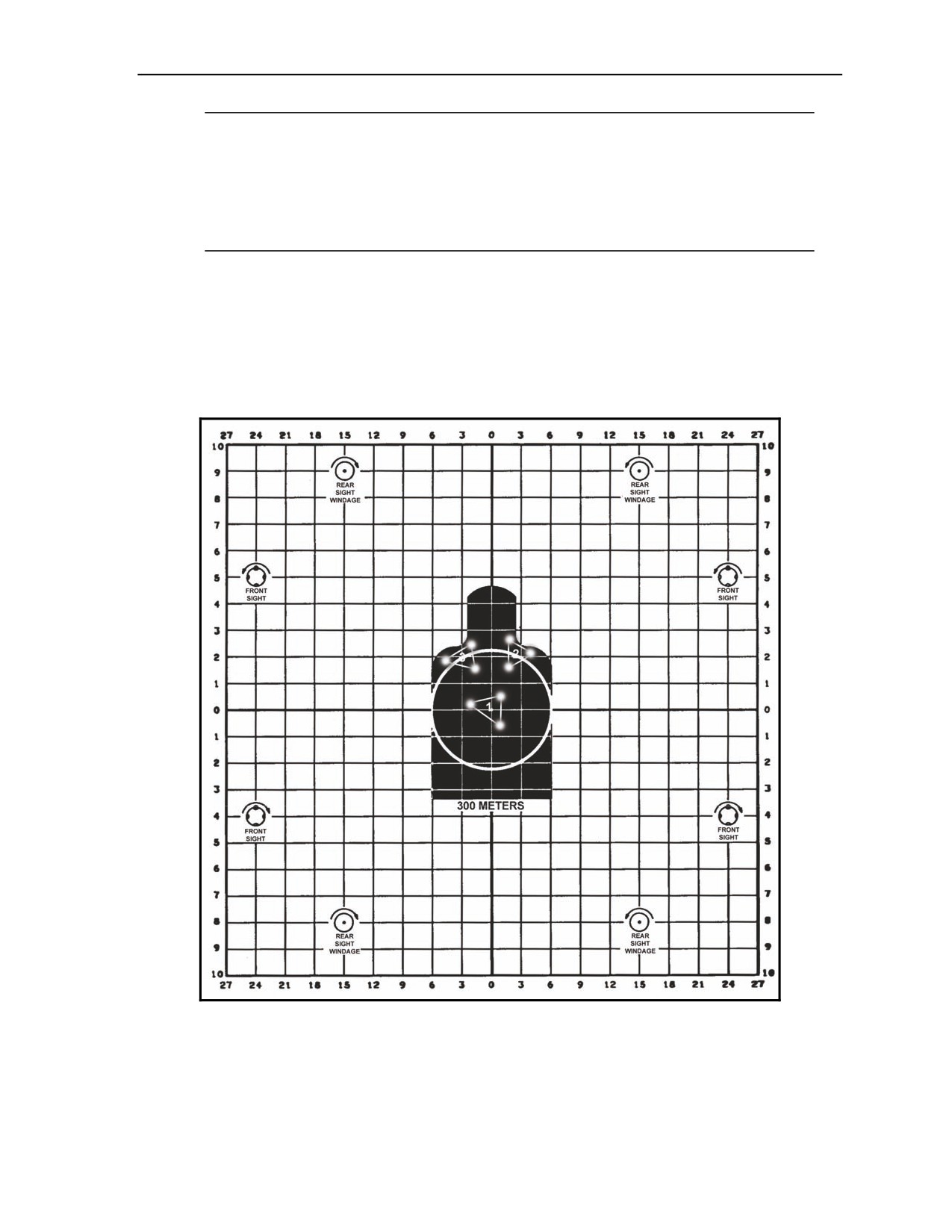
5-28. The groups in Figure 5-11 indicate that the Soldier firing the shot groups is applying proper firing
fundamentals, but is using a different point of aim each time a shot group is fired.
5-29. The instructor/trainer should question the Soldier’s understanding of the aiming process and check
his position for consistency. The instructor/trainer cannot determine which shot group best represents the
firer’s zero.
Figure 5-11. Shot groups with inconsistent aiming.
12 August 2008
FM 3-22.9
5-9
Chapter 5
SHOT GROUPS WITH CONSISTENT AIMING AND MAJOR SHOOTING ERROR
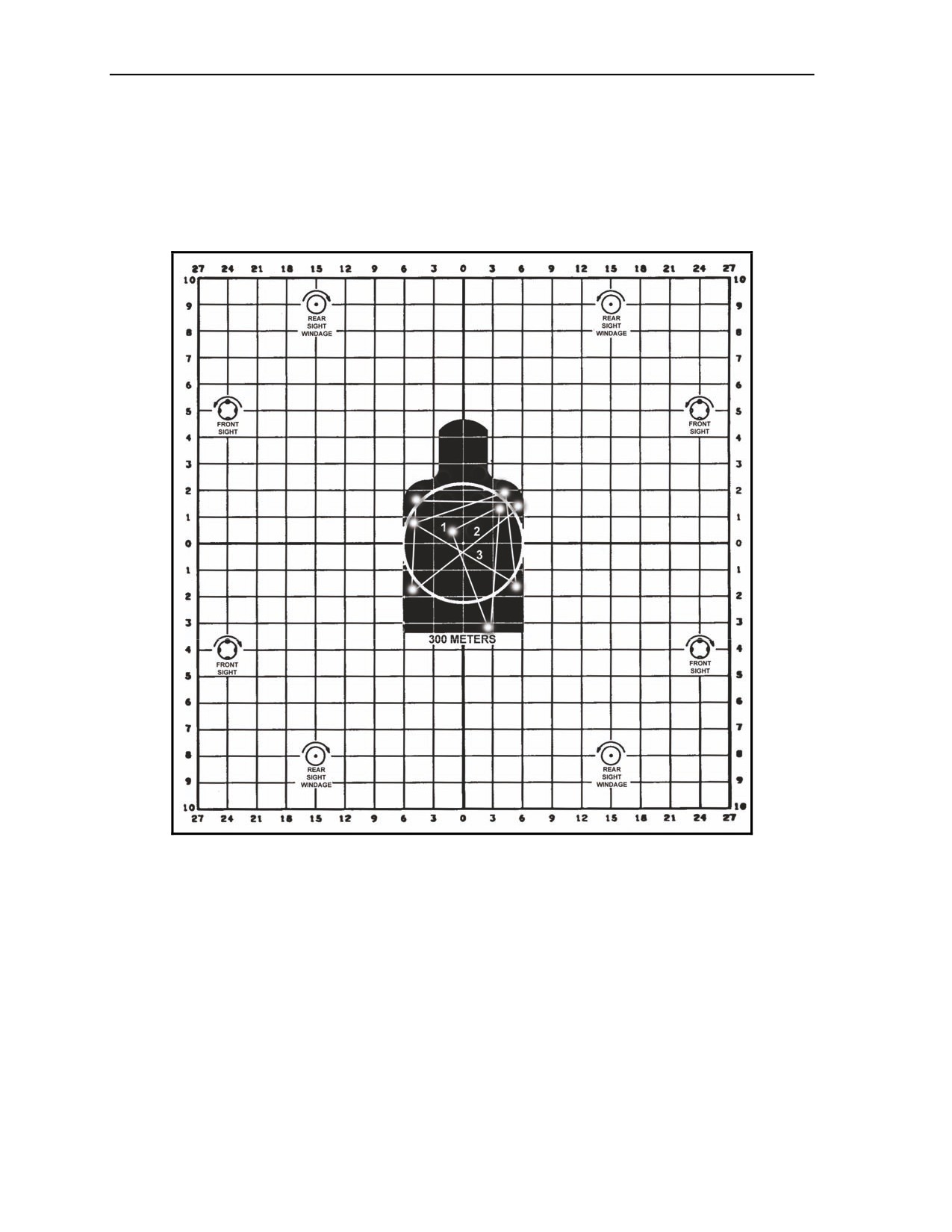
5-30. The groups in Figure 5-12 indicate consistent aiming, but the Soldier is not applying the four
fundamentals properly while firing each shot group.
5-31. The firer should be assigned a coach to troubleshoot his application of the four fundamentals in an
attempt to isolate his firing errors.
Figure 5-12. Shot groups with consistent aiming and major shooting error.
5-10
FM 3-22.9
12 August 2008
Downrange Feedback
SHOT GROUPS WITH INCONSISTENT AIMING AND MAJOR SHOOTING ERROR
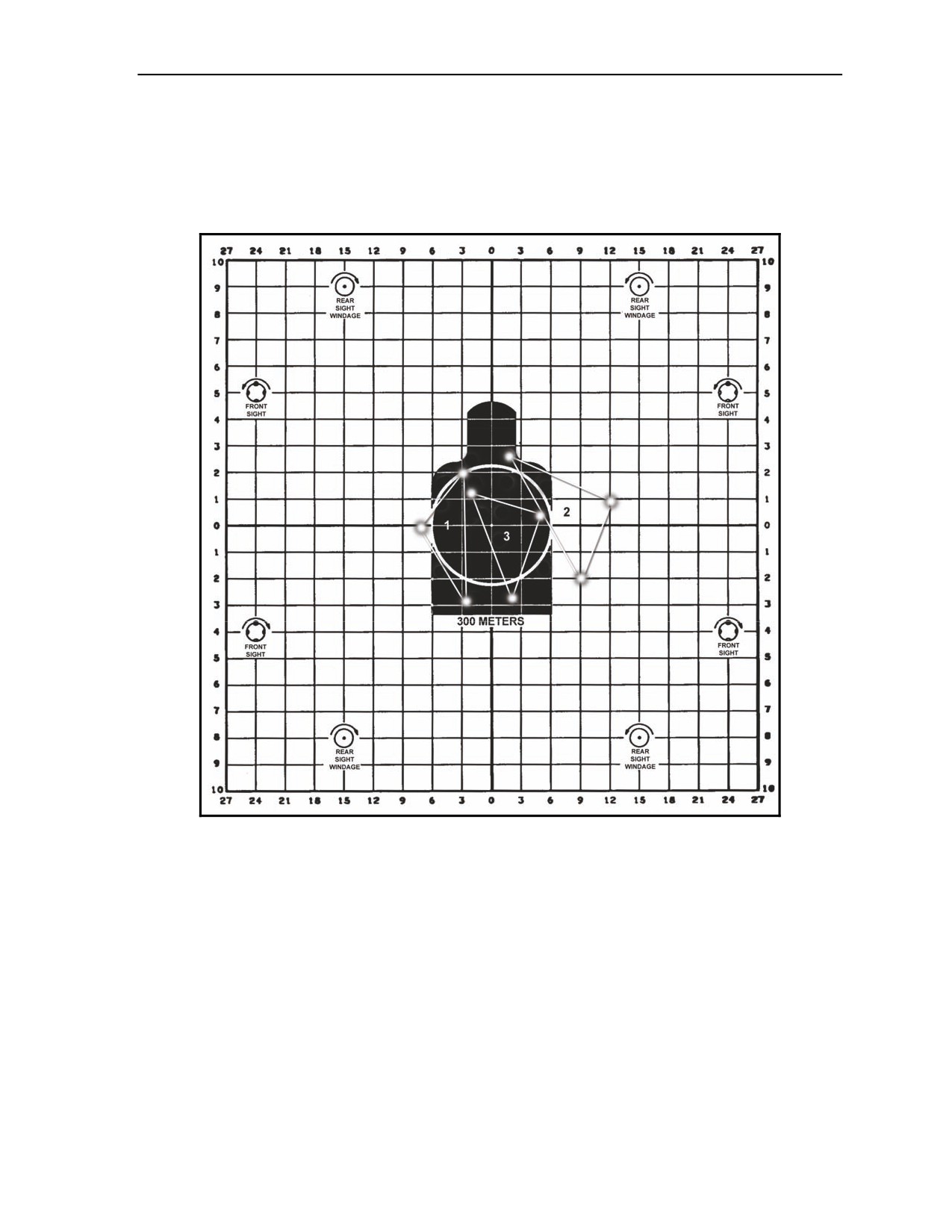
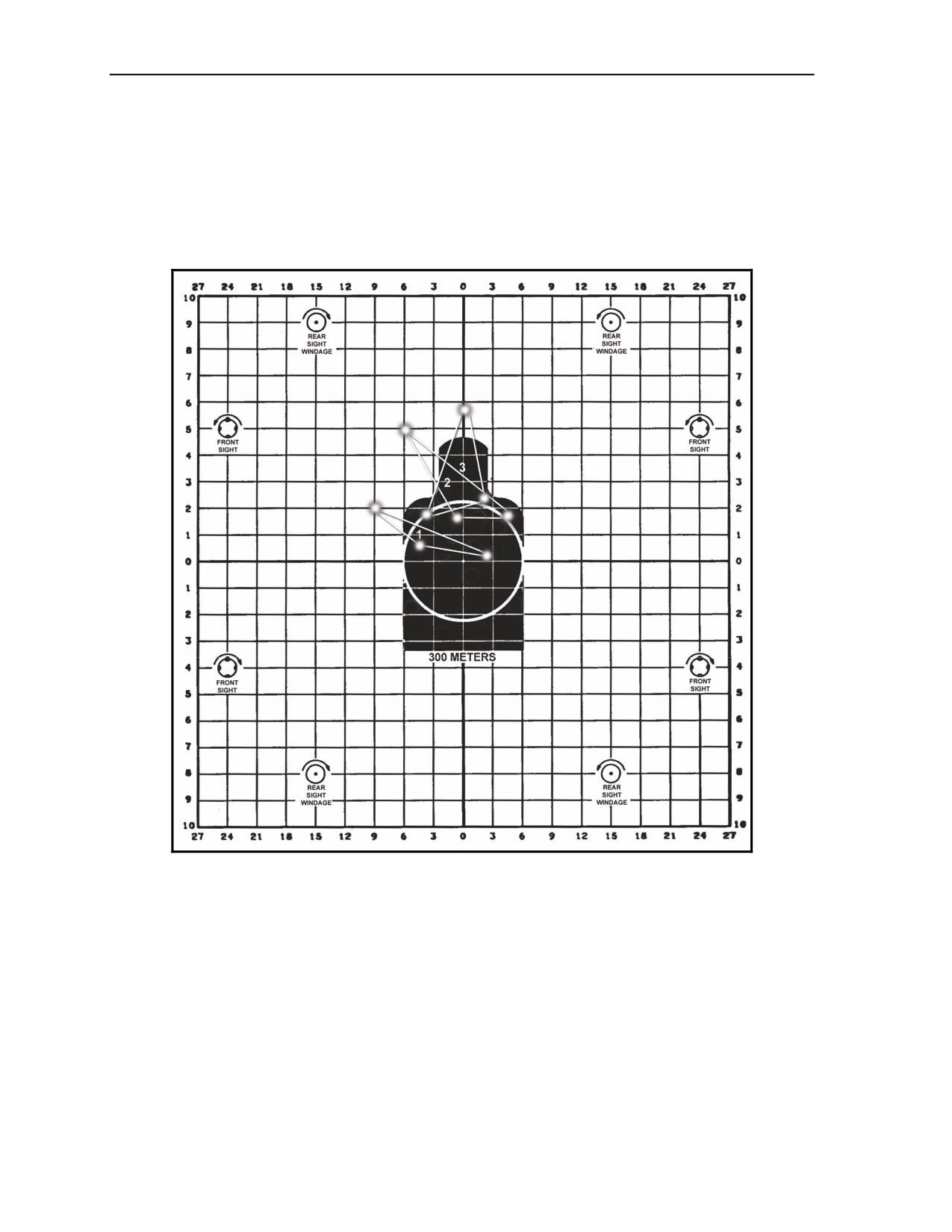
5-32. The groups shown in Figure 5-13 indicate inconsistent aiming and major shooting error.
5-33. The firer should be assigned a coach to troubleshoot his application of the four fundamentals in an
attempt to isolate his firing errors.
Figure 5-13. Shot groups with inconsistent aiming and major shooting error.
12 August 2008
FM 3-22.9
5-11
Chapter 5
SHOT GROUPS WITH IMPROPER VERTICAL PLACEMENT
5-34. When viewed as nine shots, the shot groups shown in Figure 5-14 reflect proper horizontal placement
of shots, but unsatisfactory vertical dispersion. This indicates a failure to vertically aim at the target's center
of mass for each shot.
5-35. The instructor/trainer should check the Soldier’s aiming procedure and adherence to marksmanship
fundamentals.
Figure 5-14. Shot groups with improper vertical placement.
5-12
FM 3-22.9
12 August 2008
Downrange Feedback
IMPROPER SHOT GROUPS ON THE EDGE OF THE TARGET
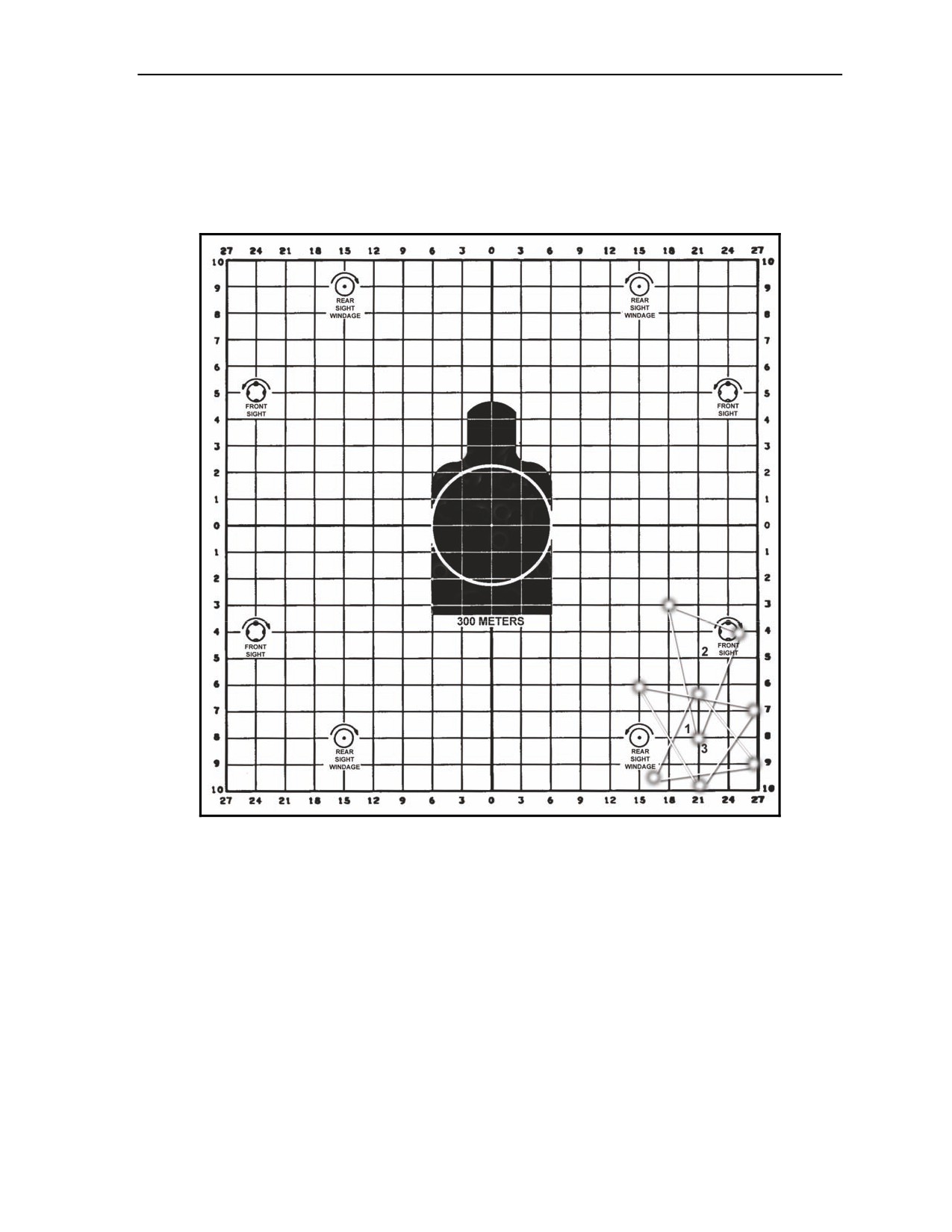
5-36. The shot groups shown in Figure 5-15 are improper groups.
5-37. The Soldier should make a bold sight change to bring the groups closer to the target's center and
ensure that the shot groups remain on the 25-meter zeroing target.
Figure 5-15. Improper shot groups on the edge of the target.
12 August 2008
FM 3-22.9
5-13

Chapter 5
TROUBLESHOOTING THE FUNDAMENTALS
5-38. When troubleshooting the fundamentals, the coach's imagination is the only limiting factor.
Table 5-2 outlines the techniques that can be used to identify errors in Soldiers' application of the fundamentals.
Table 5-2. Techniques used to identify errors in Soldiers' application of the fundamentals.
PROBLEM AREA
TECHNIQUE USED TO IDENTIFY THE PROBLEM AREA
Aiming
Attach the M16 sighting device, and observe the Soldier while he fires.
Breathing
Watch the rise and fall of the firer’s chest for consistency.
Trigger squeeze
Place your finger over the firer’s finger while he fires, feeling for jerking and smooth follow-
through. Watch for jerking of the trigger and smooth follow-through.
Position
Observe the following areas for consistency:
•
Placement of the tip of the nose.
•
Placement of the trigger finger.
•
Placement of the nonfiring hand.
•
Placement of the legs.
•
Cheek-to-stock weld.
• Positioning of equipment.
Other potential problem areas
Ensure that the—
•
Nonfiring-side eye is not shuttering.
•
Equipment is fitted properly.
•
Soldier is not flinching when the trigger is pulled.
•
Soldier is firing with the dominant eye.
•
Soldier is wearing glasses (if applicable).
• Soldier is maximizing use of the supported position.
SECTION II. ZEROING PROCEDURES
This section provides guidelines for the instructor/trainer to zero M16-/M4-series weapons at 25 meters and at
actual range (Table 5-3). It includes concept, organization, mechanical zero, zero recording, 25-meter sight
settings, field fire sight settings, and troubleshooting of the fundamentals.
Table 5-3. Zeroing procedures.
ZEROING PROCEDURES
Instructional Intent
•
Reinforce PMI while adjusting the confirmed shot groups (center of mass of the 4-centimeter circle with 5 out of
6 consecutive rounds at 25 meters).
Special Instructions
Ensure that—
•
The rear sight is on the proper setting (zero; M16A2/3=8/3+1; M16A4=6/3+2; M4=6/3).
•
The rear sight aperture is set on 300+1, not 800+1.
•
The M16A1's rear sight is set on the aperture marked L.
•
The small aperture is being used.
•
Proper and accurate shot group marking is enforced.
•
The firer's name is clearly marked on the target.
•
M16A2/A3/A4s zero on M16A2 zeroing targets.
•
M4s zero on M4 zeroing targets.
•
M16A1s zero on M16A1 zeroing targets.
Observables
•
Coaches analyze the firer’s application of the fundamentals.
•
The majority of the round must be inside of the circle to be counted.
•
Two consecutive 3-round shot groups are shot with 5 of 6 rounds in the 4- centimeter circle.
5-14
FM 3-22.9
12 August 2008
Downrange Feedback
PURPOSE
5-39. The purpose of battlesight zeroing is to align the sights with the weapon’s barrel given standard issue
ammunition. When this is accomplished correctly, the point of aim and point of impact are the same at a
given range (250 meters for the M16A1, 300 meters for the M16A2/A3/A4 and M4-series weapons). This
sight setting provides the highest hit probability for most combat targets with minimum adjustment to the
point of aim.
5-40. When standard zeroing procedures are followed, a properly zeroed weapon for one Soldier is close to
the zero for another Soldier. When a straight line is drawn from the target's center to the tip of the front
sightpost and through the center of the rear aperture, it makes little difference whose eye is looking along
this line. There are many subtle factors that result in differences among individual zeros.
Instructors/trainers should emphasize the similarity of individual zeros instead of the differences.
5-41. Most firers can fire with the same zeroed weapon if they properly apply marksmanship
fundamentals. This information can be useful in three ways:
(1) If a Soldier has difficulty zeroing and the problem cannot be diagnosed, a good firer could zero
the weapon to find the problem and eliminate the weapon as part of the problem.
(2) When a Soldier must fire another Soldier’s weapon without opportunity to verify the zero by
firing for example, picking up another man’s weapon on the battlefield), the weapon will be
closer to actual zero if the sights are left unchanged. This information is useful in deciding initial
sight settings and recording zeros.
(3) All weapons in the arms room, even those not assigned, should have been previously zeroed by
the last Soldier they were assigned to. Zeroing this newly assigned weapon should start with the
sights left where they are.
SIGHT VARIANCE
5-42. There is no relationship between the specific sight settings a Soldier uses on his weapon to the sight
settings he would use to zero another weapon, which makes it essential that each Soldier zeros the weapon
that he is assigned. For example, a Soldier could zero his assigned weapon 10 clicks left of center; when
zeroing another weapon, his adjustments could be 10 clicks right of center. This is due to the manufacturing
difference between the weapons. Therefore, all newly assigned personnel should be required to zero their
weapon as soon as possible after assignment to the unit. The same rule applies anytime a Soldier is
assigned a weapon that is returned from field level or sustainment level maintenance, or when the zero is in
question.
ORGANIZATION OF A 25-METER ZERO RANGE
NOTES:
1. All Soldiers should successfully group prior to zeroing.
2. If the Soldier is proficient at grouping, two shot groups should be fired to
confirm proficiency prior to making any sight adjustments during zeroing
procedures.
5-43. To properly conduct a 25-meter zero range, perform the following actions:
z
Divide the unit into firing orders. The first order fires, while the second order coaches.
z
Reserve firing points to conduct corrective instruction.
z
Provide sandbags at each firing point to accommodate supported firing positions.
CONDUCT OF A 25-METER ZERO FIRING
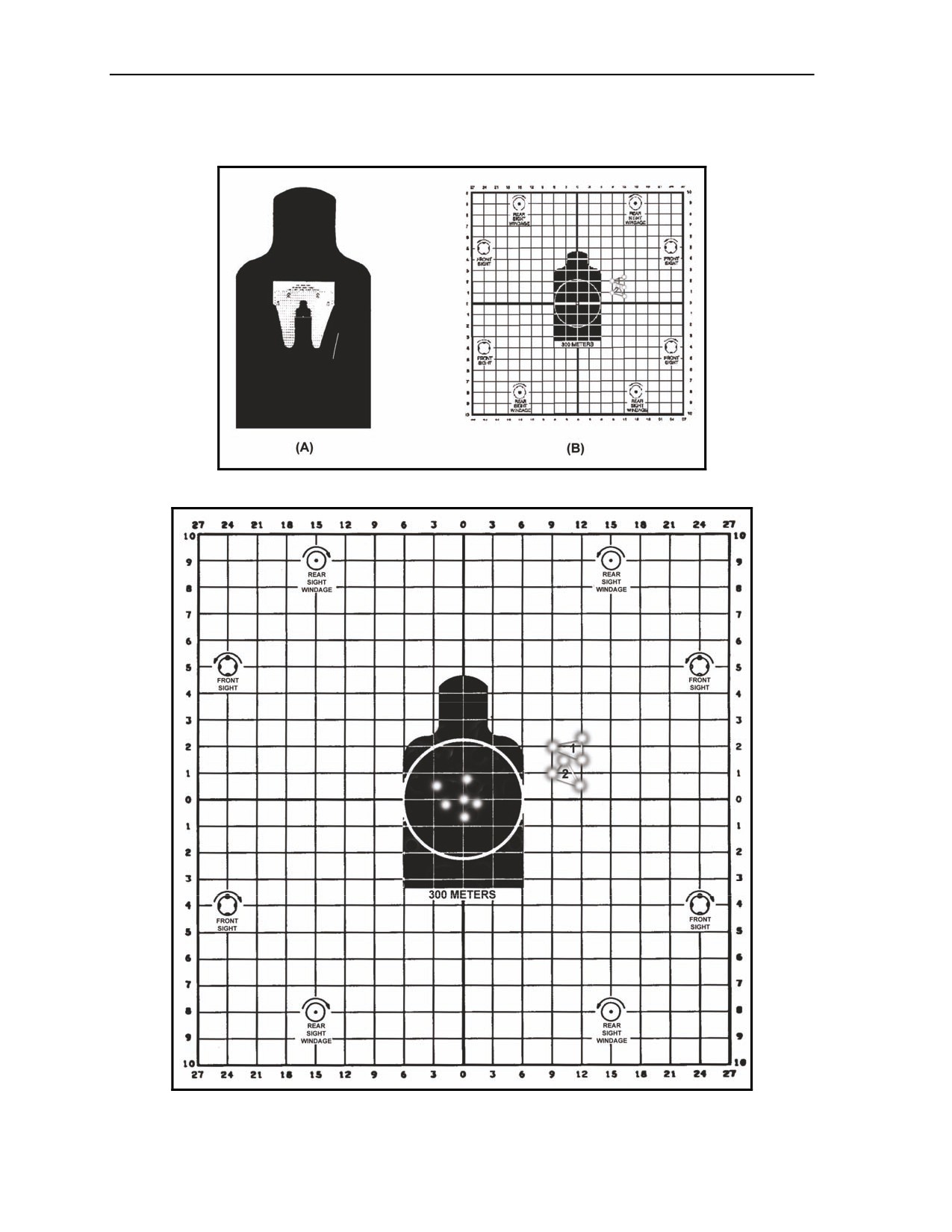
5-44. On the 25-meter zero range, the Soldier applies the fundamentals while consistently aiming at the target's
center of mass (A, Figure 5-16). The Soldier fires two separate three-round shot groups (B, Figure 5-16) and
groups them. Based on the location of these groups, the Soldier makes the appropriate sight adjustments. Then,
12 August 2008
FM 3-22.9
5-15
Chapter 5
the Soldier fires two additional three-round shot groups to confirm that the adjustments have aligned the sights
with the center of the target and that the bullets are in the 4-centimeter circle (Figure 5-17).
Figure 5-16. Correct aiming (A), initial shot group results (B).
Figure 5-17. Final shot group results.
5-16
FM 3-22.9
12 August 2008
Downrange Feedback
5-45. To conduct a 25-meter zero range—
NOTES:
1. Each Soldier ensures that his sights are set for 25-meter zeroing.
2. Soldiers fire each shot from a supported firing position using the same point of
aim (target's center of mass).
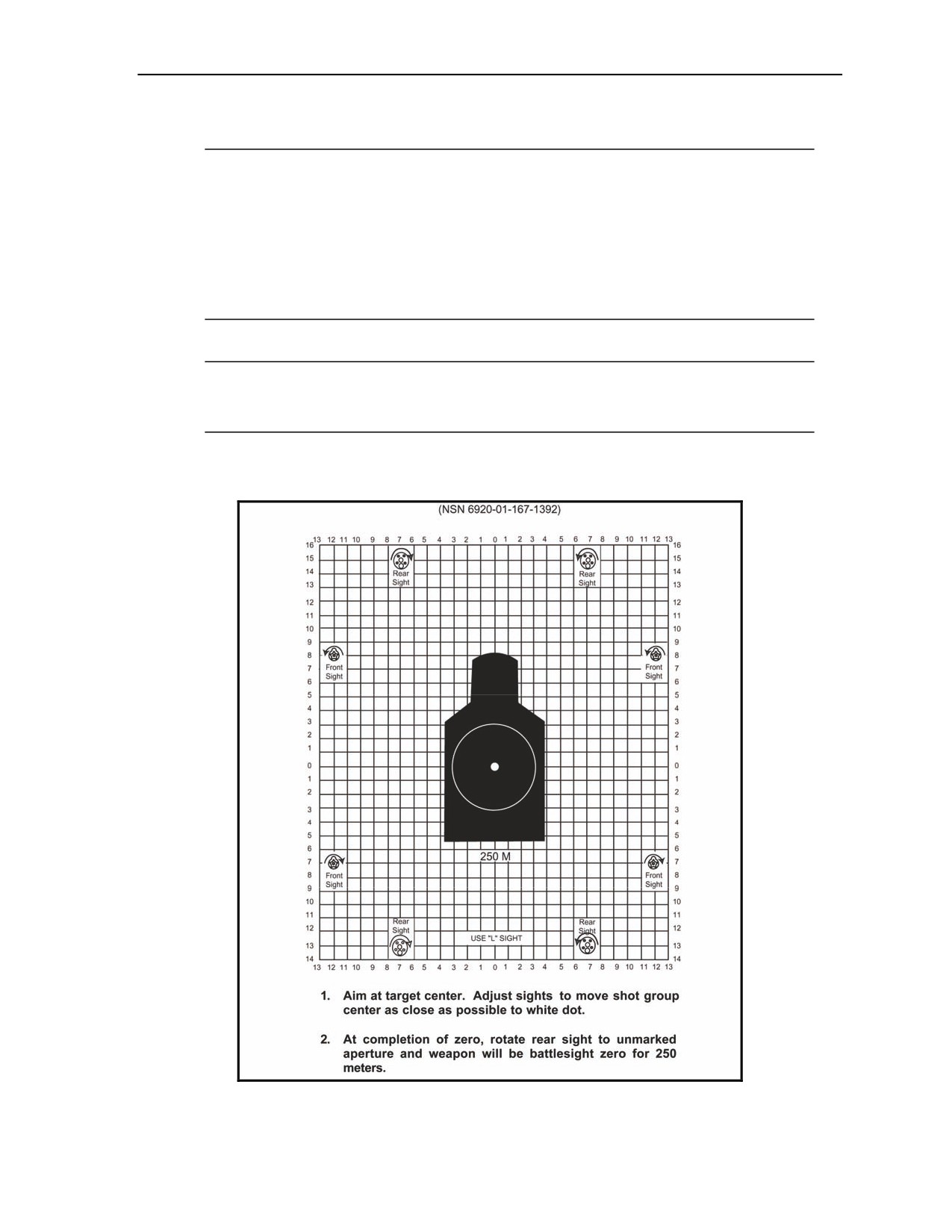
3. Ensure that the correct 25-meter zero target is being used. For M16A1s, use
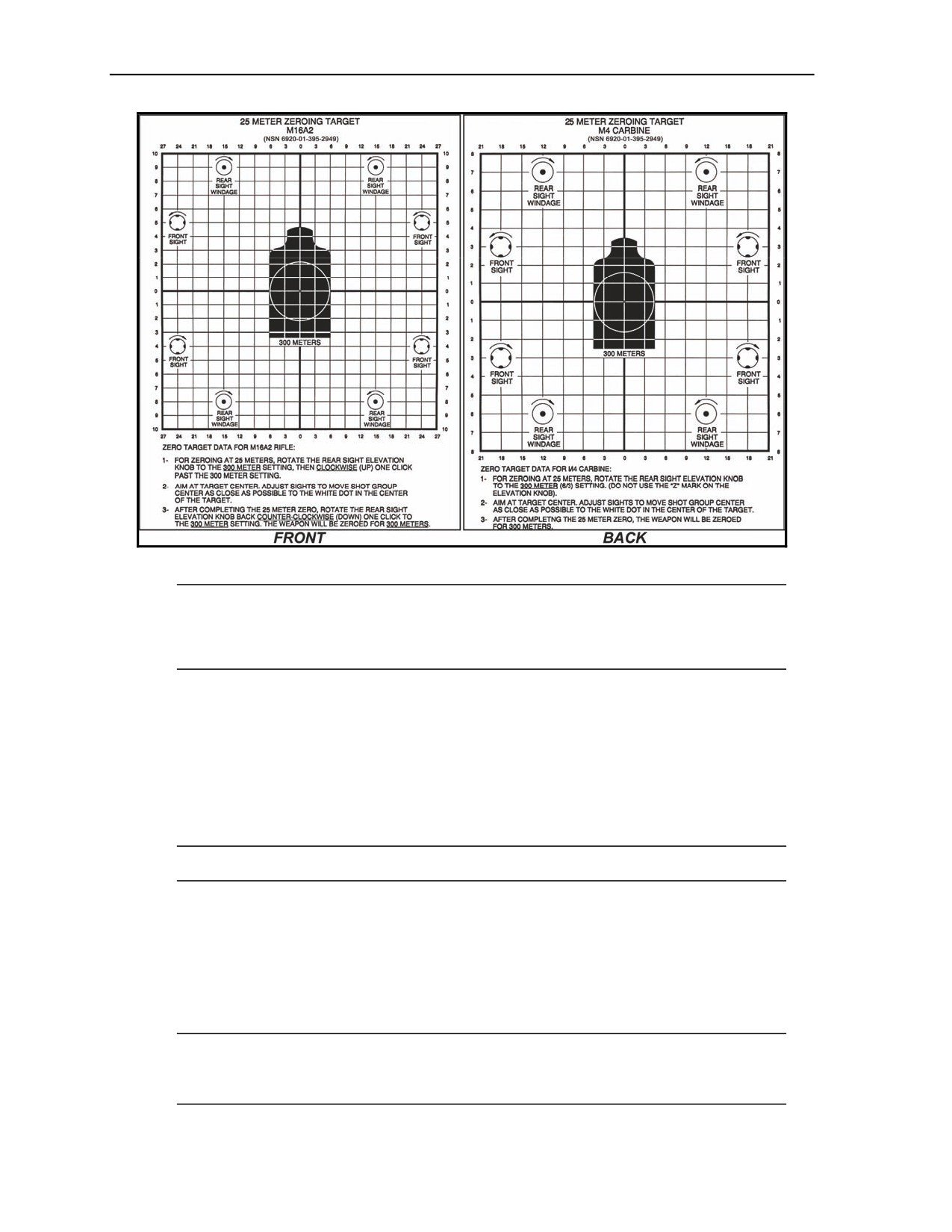
NSN 6920-01-167-1392 (Figure 5-18); for M16A2s, M16A3s, M16A4s, M4s,
and M4As, use NSN 6920-01-395-2949 (Figure 5-19; M16A2/A3 is printed on
one side, and M16A4/M4/M4A is printed on the other).
(1) The Soldier fires a three-round shot group at the 25-meter zeroing target.
*NOTE: During IET, Soldiers fire three 5-round shot groups at the 25-meter zeroing target. To
achieve the standard, 8 out of 10 rounds in two consecutive shot groups must hit within a 4-cm
circle.
(2) The firing line is cleared, and he moves downrange to examine the shot group for fundamental
errors, triangulates the shot group, and puts the number 1 in the center of the shot group.
Figure 5-18. M16A1 25-meter zero target.
10 February 2011
FM 3-22.9, C1
5-17
Chapter 5
Figure 5-19. M16A2 and M4 25-meter zero target.
NOTES:
1. The Soldier fires two individual shot groups before a sight change is considered.
2. If the initial shot group is not on the target paper, the weapon should be
mechanically zeroed before the Soldier fires this weapon again.
*(3) The Soldier returns to the firing line and fires a second shot group.
(4) The firing line is cleared, and the Soldier moves downrange to examine the second shot group,
triangulate, and mark the center of the shot group with the number 2.
(5) The Soldier groups the two shot groups and marks the center of the two shot groups with an X.
(6) If the two shot groups fall within a 4-centimeter circle, the firer determines the sight adjustments
he needs to make, identifies the horizontal and vertical lines closest to the X, and reads the
25-meter zeroing target to determine the proper sight adjustments. If the two shot groups do not
fall within a 4-centimeter circle, the Soldier continues grouping.
NOTE: The majority of the round must be inside of the circle to be counted.
(7) The Soldier annotates any sight adjustments that need to be made to the weapon on the 25-meter
zeroing target and ensures that his name is on the target.
(8) If five out of six rounds fell within the 4-centimeter circle, the Soldier is zeroed and can be removed
from the firing line. If not, the Soldier returns to the firing line and makes sight adjustments.
*5-46. Steps 1 through 8 are repeated until the Soldier places five out of six consecutive rounds inside the
4-centimeter circle. If the Soldier is not zeroed with the rounds allotted, he should be removed from the
firing line and given remedial training before attempting to zero again.
NOTE: Zeroing standard for IET: Zero an M16 Series Rifle/M4 Carbine by achieving 8 out of
10 rounds in two consecutive five-round shot groups inside the 4cm circle on a 25m zero target
within 20 rounds.
5-18
FM 3-22.9, C1
10 February 2011
Downrange Feedback
*5-47. Once firing proficiency has been demonstrated from the supported firing position, zeroing
exercises can be conducted from the unsupported firing position.
CONDUCT OF A 25-METER ZERO FIRING USING THE LOCATION OF MISSES AND HITS
SYSTEM
*5-48. When using the LOMAH system on a KD range, zero confirmation is part of the program and will
be shot as the first scenario. To achieve a 300-meter zero using the LOMAH system, the Soldier shoots six
rounds at the 175-meter/200-yard target while aiming at the target's center of mass. The outcome is
evaluated using the following guidelines:
z
If the shot group falls within the 11-inch circle on the LOMAH monitor, the Soldier continues the
programmed scenario, which is identical to the downrange feedback scenario without LOMAH.
z
If the Soldier shoots a shot group that is 11 inches or smaller but is clearly not zeroed, the
instructor/trainer assists the Soldier in making sight adjustments based upon the data provided on
the LOMAH monitor.
z
If the shot group is not tight (greater than 11 inches), the Soldier should be removed from the firing
line and given remedial training on the four fundamentals of marksmanship.
* CONDUCT OF A 200-METER ZERO FIRING
*5-49. For a unit deployed to an urban area, many engagements happen at 200 meters or closer. Out to
200 meters, a 200-meter zero keeps the point of impact closer to the point of aim than a 300-meter zero.
*5-50. The 200-meter zero is not an alternate to the 300-meter zero; rather, it is a supplemental zero. The
standard 300-meter zero will continue to be used when units are conducting standard rifle qualification or
when units are deploying to an area where most engagements occur at distances greater than 200 meters.
*NOTE: 200-meter zero procedures mirror those of standard zero procedures, with the
exception of the target offsets. See Appendix F for more information about preparing 200-meter
zero target offsets for various sights.
SECTION III. KNOWN DISTANCE RANGE
This section provides guidelines for the instructor/trainer to conduct a KD range and apply the effects of wind
and gravity. This section also addresses three types of KD ranges: the standard KD range, the KD record fire
range, and the modified field fire range.
NOTE: See Table 5-4 for the current training program.
CONCEPT
5-51. A KD range has three primary objectives:
(1) Fire tight shot groups at a known distance.
(2)
*Make sight adjustments at range while experiencing the effects of wind and gravity.
(3) Participate in marksmanship testing.
5-52. KD firing brings the Soldier one step closer to being able to fire during combat. The Soldier is
provided information concerning the precise hit-or-miss location of every bullet fired. KD firing is
conducted with a single, clearly visible target at a known distance, and the Soldier can establish a position
that provides a natural point of aim on that single target. Consider the following:
z
On the standard KD range, Soldiers fire at 100-, 200-, and 300-meter targets without any time
constraints.
10 February 2011
FM 3-22.9, C1
5-19

Chapter 5
Table 5-4. Downrange feedback.
DOWNRANGE FEEDBACK
Instructional Intent
•
Reinforce PMI while shooting from the prone supported and unsupported firing positions.
•
Build the Soldier’s confidence in his ability to hit where he aims while applying the effects of wind and gravity at
range.
Special Instructions
Ensure that—
•
The effects of wind and gravity are thoroughly explained.
•
The rear sight is on the proper setting (M16A2/3=8/3; M16A4 and M4=6/3 flush; M16A1=the unmarked
aperture, short-range).
•
The rear sight aperture is set on 300, not 800.
Observables
•
Spotters provide correct feedback to firers.
•
Soldiers hit 8 of 10 targets at 100 meters.
•
Soldiers hit 14 of 20 targets at 200 meters.
•
Soldiers hit 5 of 10 targets at 300 meters.
z
On the KD record fire range, Soldiers fire at 100-, 200-, and 300-meter targets with time
constraints.
z
On the modified field fire range, Soldiers fire at 100-, 200-, and 300-meter targets on a standard
50- to 300-meter field fire qualification range.
NOTES:
1. If a qualification range is not available, this exercise may be shot on a standard
75- to 300-meter field fire range. Targets and target frames must be set up to
accommodate this training.
2. On ranges that are built in yards instead of meters, the same KD targets will be
used. The difference is so small that it does not need to be considered.
z
The KD range does not require Soldiers to detect targets, estimate ranges to targets, scan sectors of
fire, respond to surprise targets, respond to short-exposure targets, or engage multiple targets.
z
An advantage of a KD range is the ability to see precisely where each bullet hits. To benefit
from this training, Soldiers must clearly see the results of each firing, whether a group, single
shot, or 10-round exercise.
KNOWN DISTANCE TARGET DESCRIPTION
5-53. Downrange feedback training should include detailed explanations of the targets. Consider the
following:
z
KD targets are large enough to capture all bullets fired. Standard E-type and F-type silhouettes
can be used if standard KD targets are not available.
z
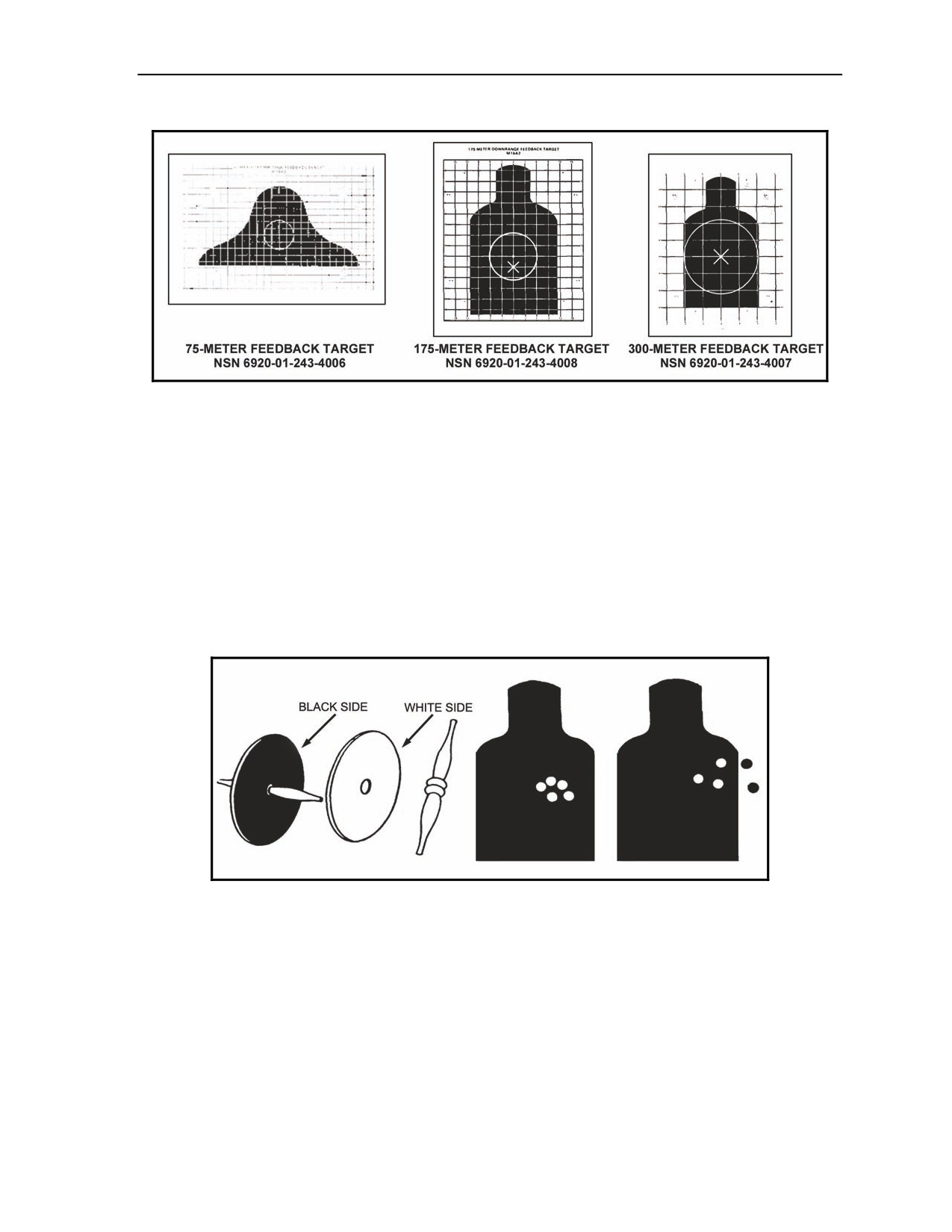
*The 16-centimeter circle on 75-meter targets, the 32-centimeter circle on 175-meter targets, and
the 48-centimeter circle on 300-meter targets equate to the 4-centimeter zeroing target at 25
meters. If the Soldier’s shot group falls within the 4-centimeter circle at 25 meters, it will fall
within the circle on the target being shot. If the round falls outside of the circle, the round will
clearly miss the 300-meter target (Figure 5-20).
z
*An X is located in the bottom portion of the circle to show the firer where to aim to achieve a
center of mass hit when his weapon is zeroed for 300 meters.
z
The grid system on the targets in Figure 5-20 equates to that of the 25-meter zeroing target. For
example, one click on the front sightpost equals one square on the 25-meter zeroing target and
also equals one square on the target being shot. Information similar to that on the zeroing target
has been overprinted to help Soldiers apply sight adjustments.
5-20
FM 3-22.9, C1
10 February 2011
Downrange Feedback
*Figure 5-20. Downrange feedback targets.
MARKING KNOWN DISTANCE RANGE TARGETS
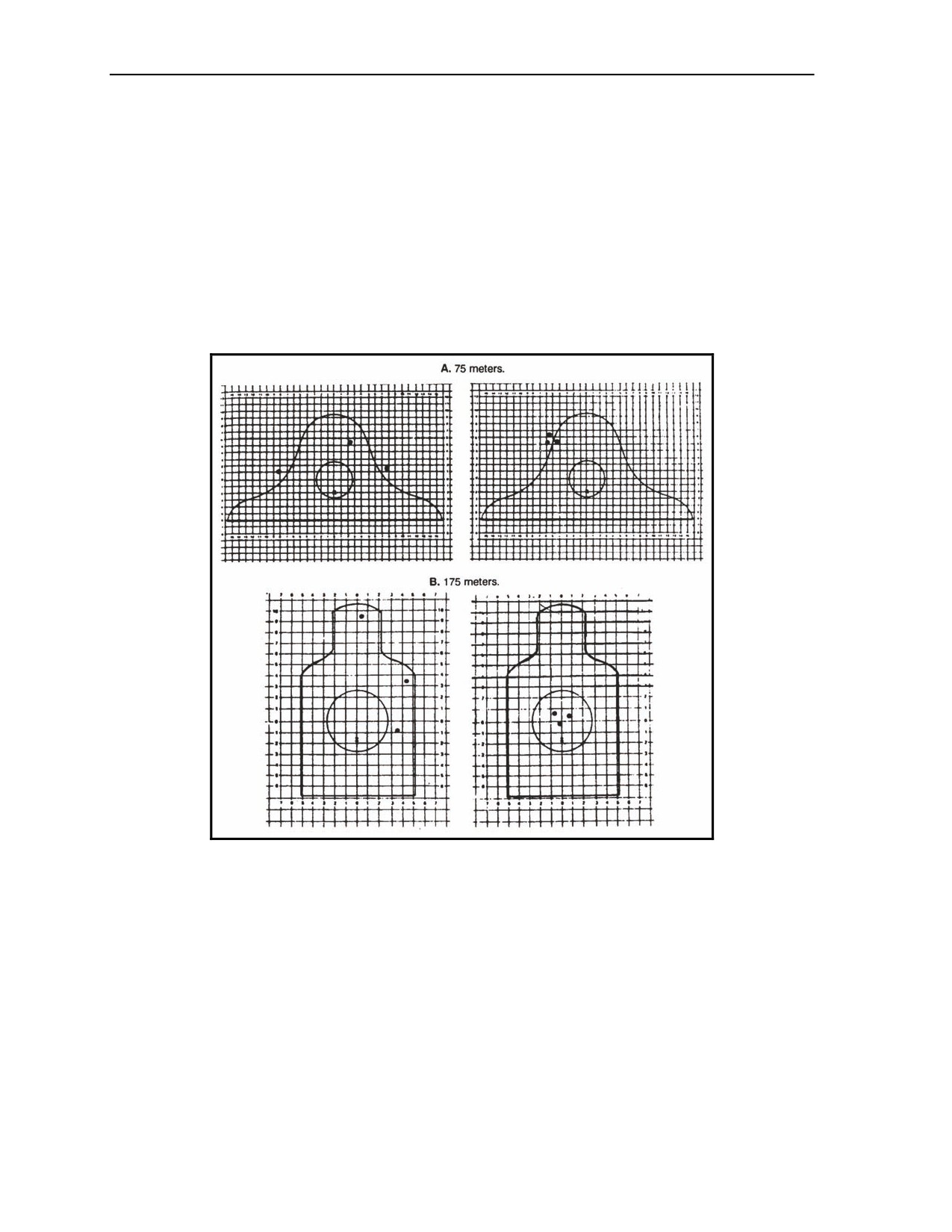
5-54. When the initial shot group is fired, target spotters/markers (Figure 5-21) should be placed in each
bullet hole, placing the white side on the silhouette and the black side off of the silhouette. This procedure
ensures that the firer can see where the rounds impacted and has two benefits:
z
Instructors/trainers can observe the firer’s performance and focus their attention on the Soldiers
having the greatest problems.
z
Soldiers are motivated to fire better since their peers can observe their performance.
*5-55. On the second and subsequent shot groups, the target spotters/markers should be moved and placed
in the holes of the new shot group. The old holes must be pasted using black pasters on black and white
pasters on white. Failure to paste all bullet holes makes it difficult to determine one shot group from another.
Figure 5-21. Target marking with spotters (markers).
10 February 2011
FM 3-22.9, C1
5-21
Chapter 5
KNOWN DISTANCE SHOT GROUPING ANALYSIS
5-56. Figure 5-22 shows two targets that were both shot with three individual rounds (A). On a pop-up
target, these two firing performances would provide the same information to the firing line; each target was
hit once and missed twice. Once the targets are properly marked with spotters, it becomes clear why only
one round hit either target: The firer on the left is failing to properly apply the four fundamentals; the firer
on the right needs to make an adjustment to his iron sights (assuming that wind was not a factor),
triangulate the shot group, and read the appropriate adjustments from the target.
5-57. Figure 5-22 shows another two targets that were both shot with three individual rounds (B). On a
pop-up target, these two firing performances would appear to be the same. Once properly marked with
spotters, it is obvious that the firer on the left needs more training on the four fundamentals.
Figure 5-22. Comparison of firing performance.
5-22
FM 3-22.9, C1
10 February 2011
Downrange Feedback
KNOWN DISTANCE ZEROING
5-58. The 300-meter target can be used to confirm weapon zero or to refine the zero obtained on the
25-meter range. When Soldiers properly compensate for the wind, the zero on this target is more valid than
the zero obtained on the 25-meter range. Soldiers should fire two five-round shot groups to confirm zero or
three-round shot groups to refine their zero. The pit crews should spot targets after each shot group is fired.
If the crosswind exceeds five miles per hour, KD zeroing should not be attempted.
*NOTES: 1. For M16A2/3/4, M4, and M4A1 weapons only: Soldiers should use the
unmarked aperture for zeroing and target engagement at all distances on the KD
range. When engaging targets beyond 300 meters, the elevation wheel should be
adjusted to the range of the target. When zeroed at 300 meters, the numbers on
the elevation wheel correspond to the range of the target (expressed in meters).
For example, the firer would click the elevation wheel to
4 to engage a
400-meter target.
2. For M16A1 rifles only: Soldiers should use the unmarked aperture (short-range)
for refining zero at 300 meters. For target engagements beyond the 300-meter
line, Soldiers should use the long-range aperture (L).
*MINUTE OF ANGLE
*5-59. M16A2/A4 and M4 sights are calibrated in minutes of angle (MOAs). A MOA is a unit of angular
measurement that is used to tell how much a click on the iron sight or scope will move the strike of the
round. One minute of angle is equal to approximately 1 inch per 100 yards or meters. The difference
between yards and meters is minimal; therefore, they are used interchangeably when speaking in MOAs.
Table 5-5 shows the value of clicks in MOAs for iron sights.
*Table 5-5. Value of clicks in minutes of angle for iron sights (for 1 click).
1 CLICK
WEAPON
ELEVATION KNOB
WINDAGE KNOB
FRONT SIGHTPOST
M16A2
1 MOA
½ MOA
1 ¼ MOA
M16A4
½ MOA
½ MOA
1 ¼ MOA
M4
¾ MOA
¾ MOA
1 ½ MOA
CONDUCT OF A STANDARD KNOWN DISTANCE RANGE
NOTE: If the range is equipped with the LOMAH system, a firing order will be used to operate
the LOMAH throughout the period of instruction and will be fired last.
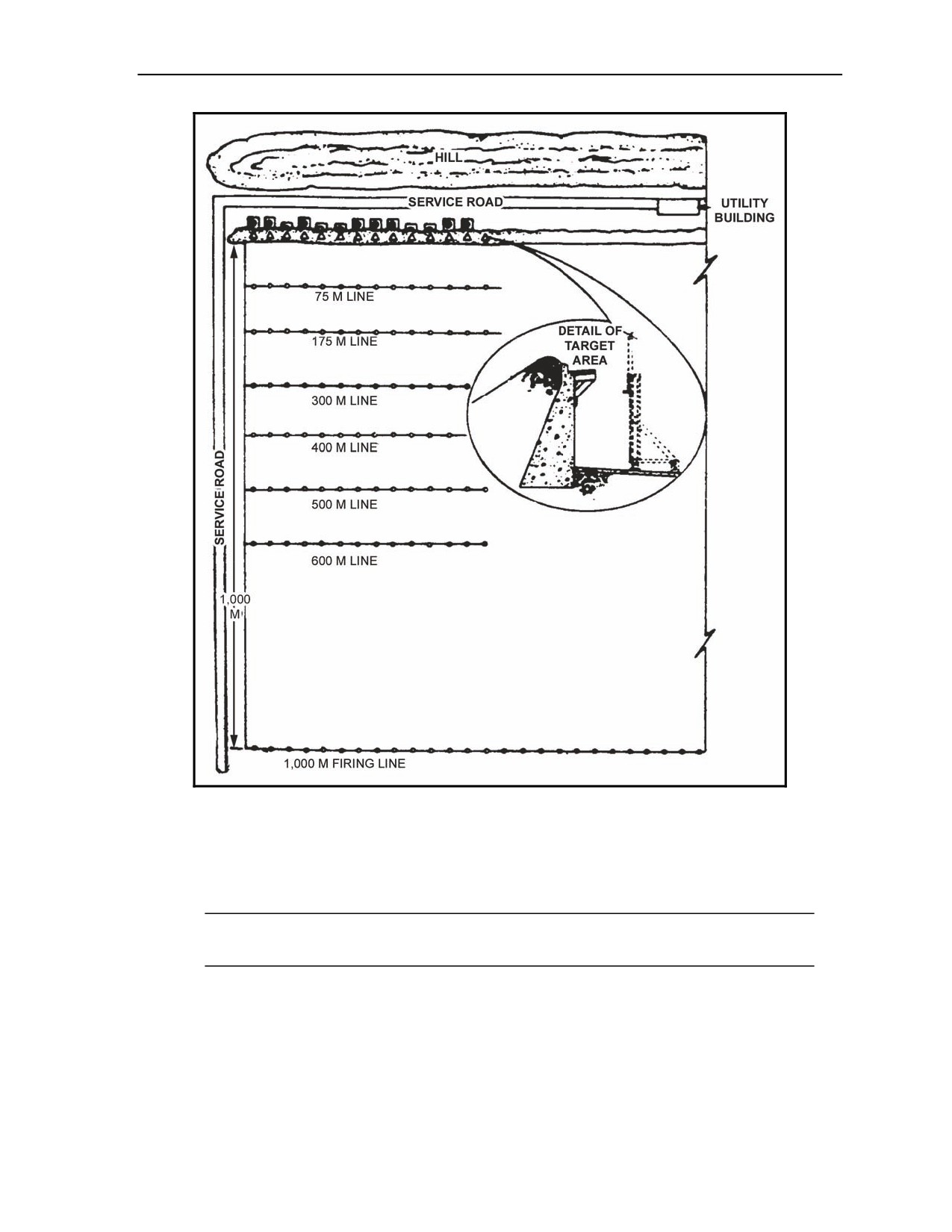
*5-60. Standard KD ranges (Figure 5-23) are conducted using the following considerations:
z
*The standard KD range is conducted with paper targets at 100, 200, and 300 meters to obtain
downrange feedback.
z
Half of the bullets are fired from the supported firing position, and the other half are fired from
the unsupported firing position.
z
The wind speed and direction must be determined before firing, and the firer must know the
distance to the target.
z
*Soldiers mark the targets after firing each shot group. Based on this feedback, Soldiers receive
a critique from their instructor/trainer or coach.
z
The downrange feedback exercise must be conducted within the constraints of time,
ammunition, and available ranges.
z
If 30 rounds of ammunition are available for training, firing three-round shot groups 10 times is
preferable to firing five-round shot groups 6 times.
10 February 2011
FM 3-22.9, C1
5-23
Chapter 5
z
Once the Soldier understands the concept for adjusting the point of aim to compensate for the
effects of wind and gravity, he is ready to apply his knowledge on the field fire range.
*100-METER TARGETS
5-61. Instructors/trainers can provide feedback after each round, each three-round shot group, or each
five-round shot group on the 100-meter feedback targets. No time limit is placed on the firer. Soldiers fire
from the supported firing position and from the unsupported firing position. Then, the targets are marked
and evaluated. Feedback consists of a critique of performance, adjustments to the point of aim, effects of
wind and gravity, and shot placement. Target spotters mark the bullet holes so hits can be viewed from the
firing line.
NOTE: IET Soldiers fire one five-round shot group from the supported firing position and one
five-round shot group from the unsupported firing position. They must hit 8 out of 10 targets.
*200-METER TARGETS
5-62. Firers engage the 200-meter target using the same downrange procedures as when engaging the
100-meter target.
NOTE: IET Soldiers fire 10 rounds from the supported firing position and 10 rounds from the
unsupported firing position. They must hit 14 out of 20 targets.
300-METER TARGETS
5-63. Firers engage the 300-meter target using the same downrange procedures as when engaging the
100-meter target.
NOTE: IET Soldiers fire one five-round shot group from the supported firing position and one
five-round shot group from the unsupported firing position. They must hit 5 out of 10 targets.
KNOWN DISTANCE RECORD FIRE RANGE
NOTE: See paragraphs 6-79 through 6-82 of Chapter 6 for information about the alternate
course KD record fire range.
MODIFIED FIELD FIRE RANGE
5-64. A modified field fire range can be used for downrange feedback. To conduct downrange feedback,
minor changes must be made to a standard field fire range. Target frames, like those used on the 25-meter
range, are placed on a standard qualification range at 100, 200, and 300 meters. The standard KD range or
the KD record fire range can be conducted on the modified field fire range.
NOTE: The firing line must be cleared, moved to the targets for marking, and returned each
time a firing order fires.
5-24
FM 3-22.9, C1
10 February 2011
Downrange Feedback
Figure 5-23. Known distance range.
RECORD OF PERFORMANCE
5-65. During the conduct of downrange feedback, a record of performance should be kept on DA Form
5239-R (100-, 200-, and 300-Meter Downrange Feedback Scorecard) for the AAR.
NOTE: See Appendix B for a sample completed form and the end of this publication for a
blank, reproducible copy.
5-66. As Soldiers complete each phase and achieve the performance standard for that range, they should
receive a critique. Instructors/trainers must ensure that Soldiers do not progress to a greater range until they
become proficient at closer ranges.
10 February 2011
FM 3-22.9, C1
5-25
Chapter 5
25-METER ZERO STANDARD
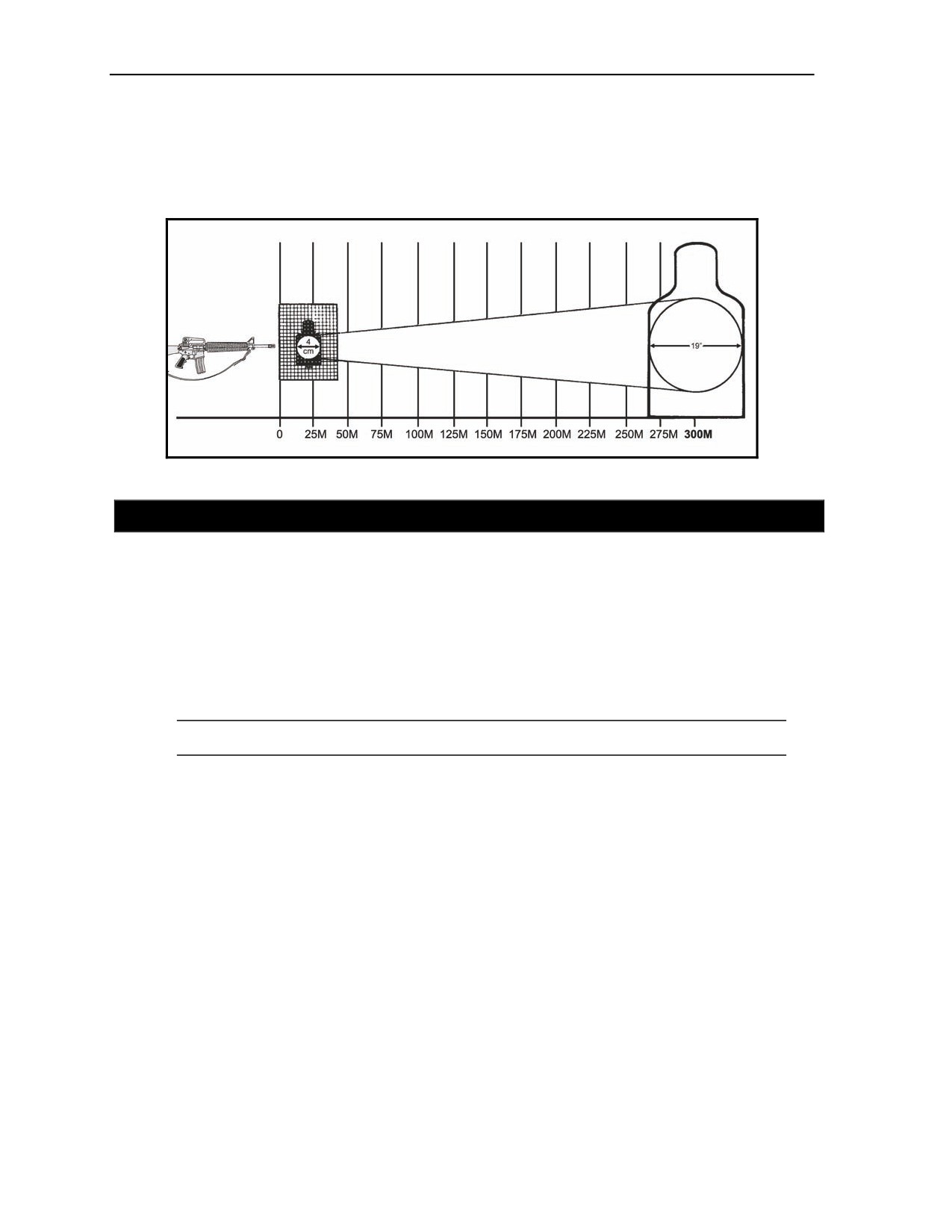
*5-67. A standard E-type silhouette is 48.26 centimeters wide; a cone of fire that is 48.26 centimeters at
300 meters is 4 centimeters at 25 meters. A Soldier who can fire all bullets in a 4-centimeter circle at 25
meters and adjust the sights for zero will hit the target at ranges as far away as 300 meters (Figure 5-24).
Figure 5-24. 25-meter zero standard.
SECTION IV. EFFECTS OF WIND AND GRAVITY
Marksmanship instructors/trainers should know how the effects of wind and gravity influence the flight of the
bullet, and Soldiers should know how to compensate for such bullet displacement. This instruction is
appropriate for all marksmanship training and concurrent training.
EFFECTS OF GRAVITY
5-68. Gases created by gunpowder push each round out of the end of the barrel. The barrel must be
elevated slightly to allow the round to travel farther, creating an arc. The round will travel straight until it
slows down and is gradually pulled to the ground by gravity. Each round fired will be pushed
approximately the same distance and will roughly follow the same path.
NOTE: The farther the round travels, the faster it begins to fall.
5-69. When the firer zeroes his weapon, he aligns his line of sight to cross the path of the round at the distance
at which he wants to zero his weapon. For example, a 300-meter zero means that the line of sight crosses the
path of the round at 300 meters. If the firer engages a target at a distance other than 300 meters (excluding 25
meters), the path of the round hits the target either before or after it crosses the line of sight. If the firer wants
his rounds to impact the center of mass, he must adjust his point of aim up or down to account for gravity.
ADJUSTED POINT OF AIM BASED ON GRAVITY
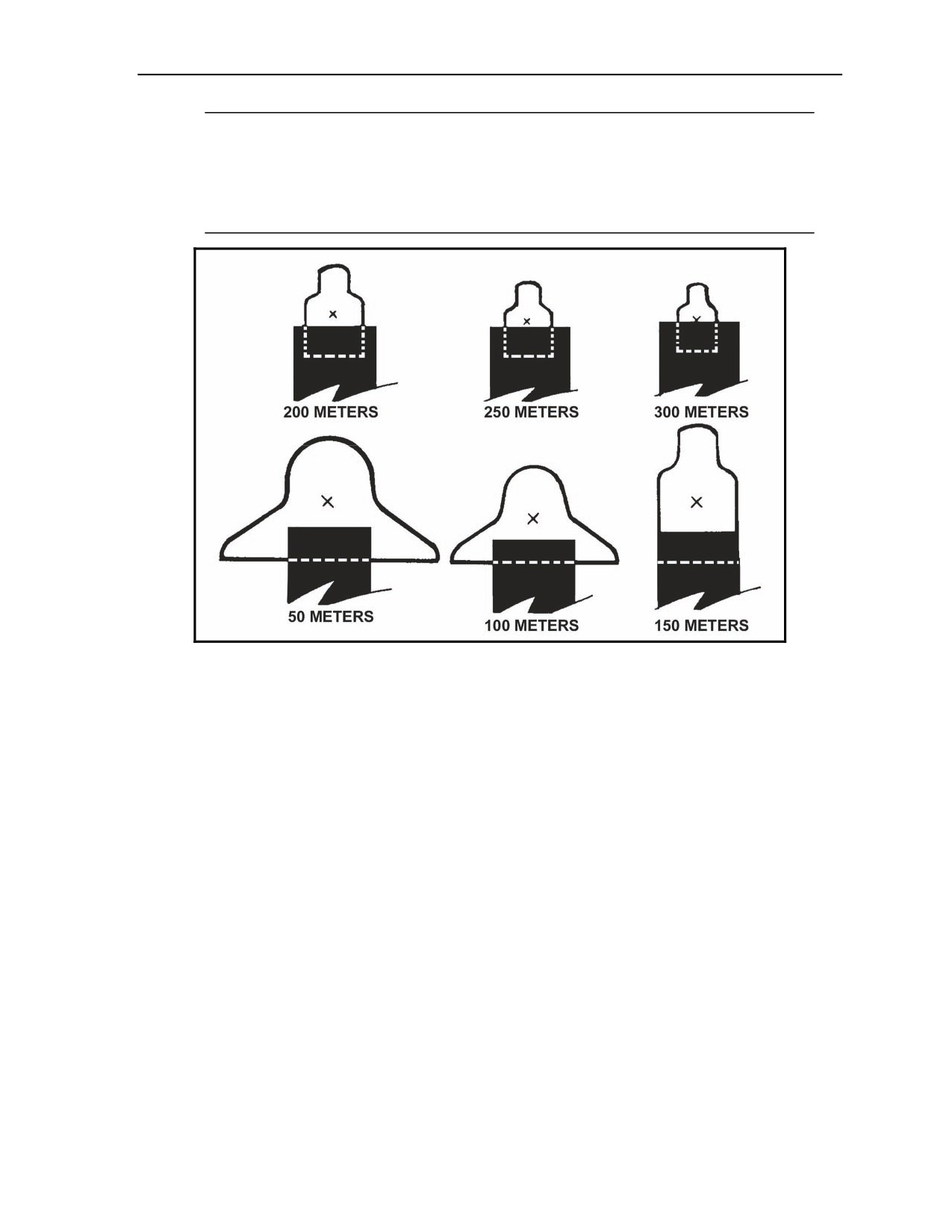
5-70. An adjusted point of aim (Figure 5-25) is intended to increase hit probability when properly presented.
However, Soldiers can become confused, which could result in degraded performance. All Soldiers should be
taught to aim at the target's center of mass unless they are confident that they know the range to the target. If
adjusting the point of aim confuses the Soldier, he should aim at the target's center of mass. These points of aim
place the center of each shot group in the target's center of mass (assuming a perfect zero and no firer error).
5-26
FM 3-22.9, C1
10 February 2011
Downrange Feedback
NOTES:
1. These adjustments are small and should only be applied by competent firers who
wish to improve their firing performance.
2. Because the difference between M16- and M4-series weapons is so small and to
avoid confusion, the same adjusted points of aim should be used regardless of
the weapon being fired.
Figure 5-25. M16-/M4-series weapon aiming points.
EFFECTS OF WIND
5-71. Wind affects the bullet similar to the way gravity does: the farther the round travels, the farther the
wind will push the round in the direction the wind is blowing. The faster the wind is blowing, the farther
the wind will push the bullet.
WIND DIRECTION
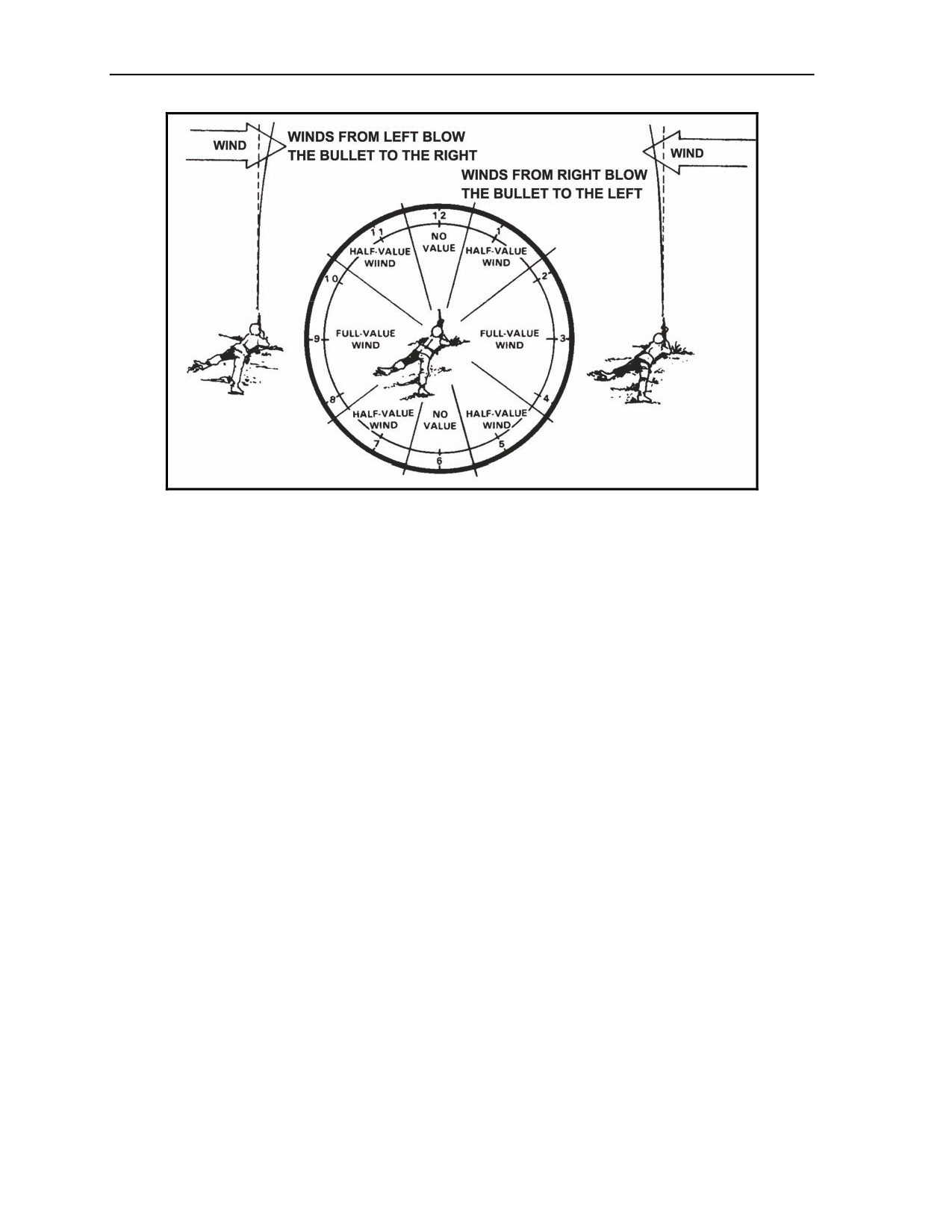
5-72. The effects of wind vary depending on changes in wind speed and direction. Wind is classified by the
direction it is blowing in relationship to the firer/target line. The clock system is used to indicate wind
direction and value (Figure 5-26). This system works as follows:
z
Winds that blow from the left (9 o’clock) or right (3 o’clock) are called full-value winds because
they have the most effect on the bullet.
z
Winds that blow at an angle from the front or rear are called half-value winds because they have
about half the effect on the bullet as full-value winds.
z
Winds that blow straight into the firer’s face or winds that blow straight into the target are
termed no-value winds because they have minimal effect on the bullet.
10 February 2011
FM 3-22.9, C1
5-27
Chapter 5
Figure 5-26. Determine wind value using the clock method.
WIND SPEED
5-73. Wind is variable and sometimes quite different at the firing position than at the target's position.
Consider the following:
z
When wind is blowing hard at the firing line, trees, brush, or terrain could protect the bullet's
path.
z
Wind can vary by several miles per hour between the time a measurement is taken and when the
bullet is fired.
5-74. Therefore, training time should not be wasted trying to teach Soldiers an exact way to measure wind
speed. Soldiers should understand that wind can blow a bullet off course, but they should not
overcompensate and miss targets by applying too much hold-off.
5-75. A wind gauge can be used for precise measurement of wind velocity. When a gauge is not available,
velocity is estimated using one of the following methods:
z
Flag method.
z
Pointing method.
z
Observation method.
5-28
FM 3-22.9, C1
10 February 2011
Downrange Feedback
Flag Method
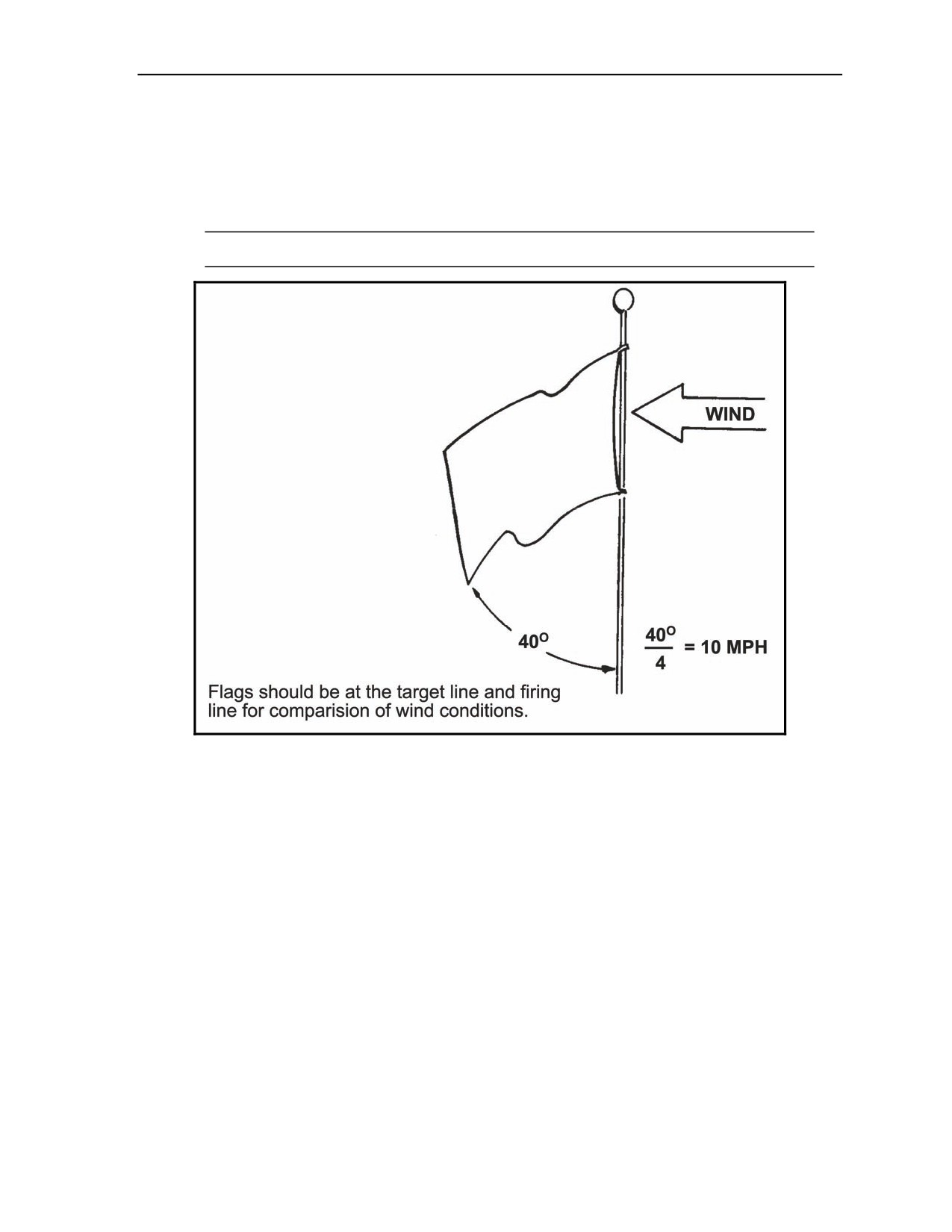
5-76. To perform the flag method (Figure 5-27)—
(1) Observe a flag or any cloth-like material hanging from a pole.
(2) Estimate the angle formed at the juncture of the flag and pole.
(3) Divide this angle by the number 4.
NOTE: The answer is the wind velocity expressed in miles per hour.
Figure 5-27. Determine wind speed using the flag method.
10 February 2011
FM 3-22.9, C1
5-29
Chapter 5
Pointing Method
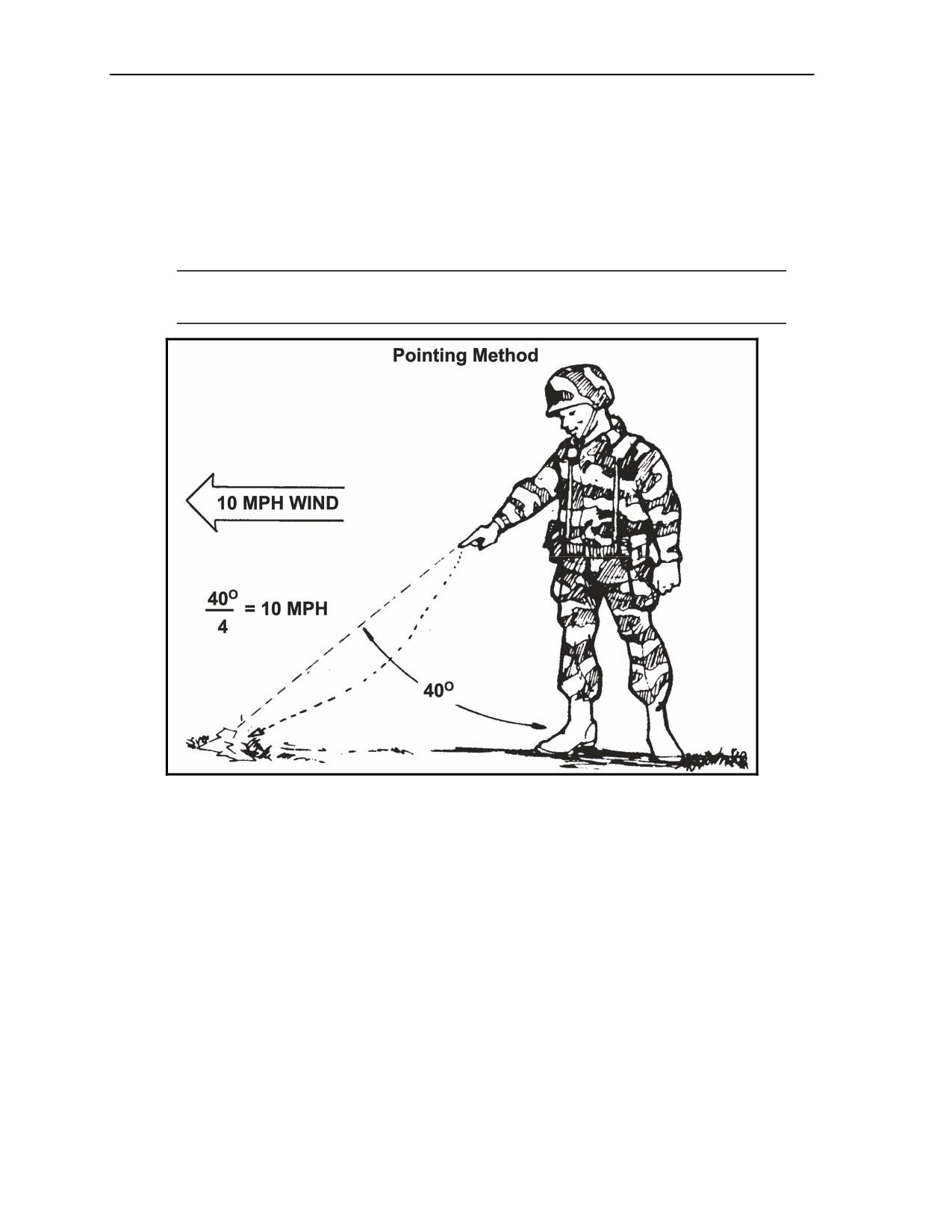
5-77. If a flag is not visible, the firer can use the pointing method. To perform the pointing method (Figure
5-28)—
(1) Drop a piece of paper, leaf, or other light material from the shoulder.
(2) Point directly at the place where it lands.
(3) Estimate the angle created by the pointing arm.
(4) Divide this angle by the number 4.
NOTE: The answer is the approximate wind speed at the firing position expressed in miles per
hour.
Figure 5-28. Determine wind speed using the pointing method.
Observation Method
5-78. If the flag or pointing methods cannot be used, the following information can assist in determining
wind velocities:
z
Winds less than 3 miles per hour can barely be felt by the firer, but the presence of slight wind
can be determined by drifting smoke.
z
Winds of 3 to 5 miles per hour can be felt lightly over the firer’s face.
z
Winds of 5 to 8 miles per hour constantly move the leaves of trees.
z
Winds of 8 to 12 miles per hour raise dust and loose paper.
z
Winds of 12 to 15 miles per hour cause small trees to sway.
5-30
FM 3-22.9, C1
10 February 2011
Downrange Feedback
ADJUSTED POINT OF AIM BASED ON WIND SPEED
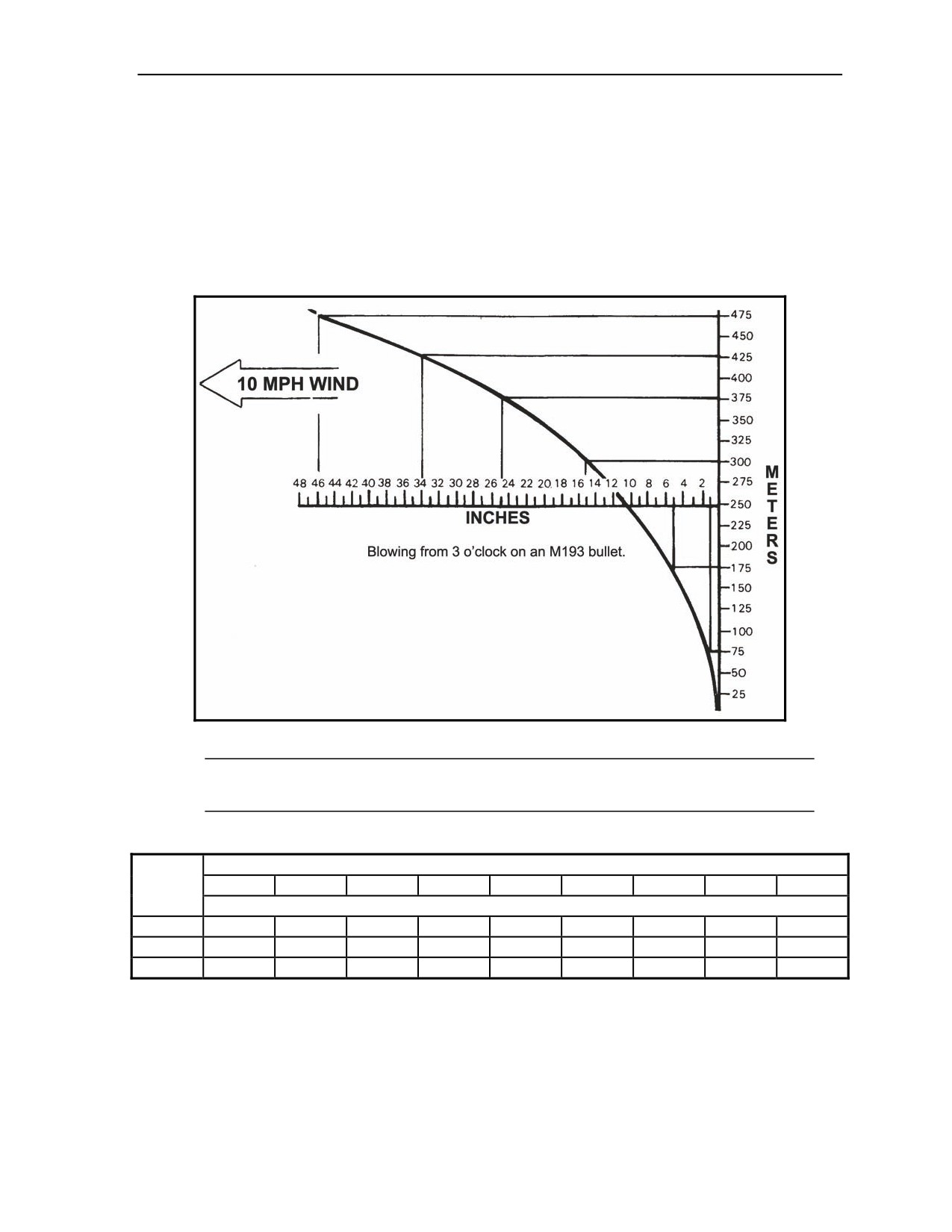
5-79. Figure 5-29 illustrates how the effects of wind on the bullet are similar to the effects of gravity—as
range increases, the effect of wind increases. For example, a 10 mile-per-hour full-value wind moves an
M16A1 (M193) bullet from about ½ of an inch at 25 meters to about 15 inches at 300 meters.
*5-80. Table 5-6 displays the wind effects for all conditions for the M16A1 (M193 ammunition)—a wind
of greater speed increases bullet movement by a uniform amount. For example, a 15 mile-per-hour wind
moves the bullet ¾ of an inch at 25 meters and about 22 ½ inches at 300 meters. A half-value wind moves
the strike of the round in a 10 mile-per-hour wind ¼ of an inch at 25 meters and 7 ½ inches at 300 meters.
Figure 5-29. Calculate the adjusted point of aim based on wind speed.
*NOTE: Table 5-6 can be used to calculate the M193 adjusted point of aim based on wind
speed.
*Table 5-6. M193 calculated adjusted point of aim based on wind speed (full value).
WIND
RANGE (m)
SPEED
25
50
75
100
150
175
200
250
300
(mph)
DISTANCE MOVED (in)
5
1/4
3/8
1/2
1
2
2.5
3.5
5
7.5
10
1/2
3/4
1
2
4
5
7
10
15
15
3/4
1-1/8
1.5
3
6
7.5
10.5
15
22.5
10 February 2011
FM 3-22.9, C1
5-31
Chapter 5
DRIFT FOR A 10 MILE-PER-HOUR WIND USING 5.56-MILLIMETER M855 AMMUNITION
*5-81. Table 5-7 illustrates the drift using M855 5.56-millimeter ball ammunition fired in an M16A2 rifle
with a 300-meter battlesight zero.
*Table 5-7. Drift for 10 mile-per-hour wind using M855 ammunition.
WIND
RANGE (m)
SPEED
0
100
200
300
400
500
600
700
800
(mph)
DISTANCE MOVED (in)
10
0.0
1.1
4.9
11.8
22.4
38.0
59.5
88.4
124.9
ADJUSTED POINT OF AIM BASED ON GRAVITY AND WIND SPEED
5-82. Wind has a minor effect on the M16 bullet (relative to the size of the target) at ranges out to 100
meters. When engaging targets in excess of 150 meters in heavy winds, Soldiers adjust the point of aim for
the wind to increase the probability of a hit. Wind effects are uniform in relation to speed—that is, a 5
mile-per-hour wind has half the effect of a 10 mile-per-hour wind, and a 20 mile-per-hour wind has twice
the effect of a 10 mile-per-hour wind.
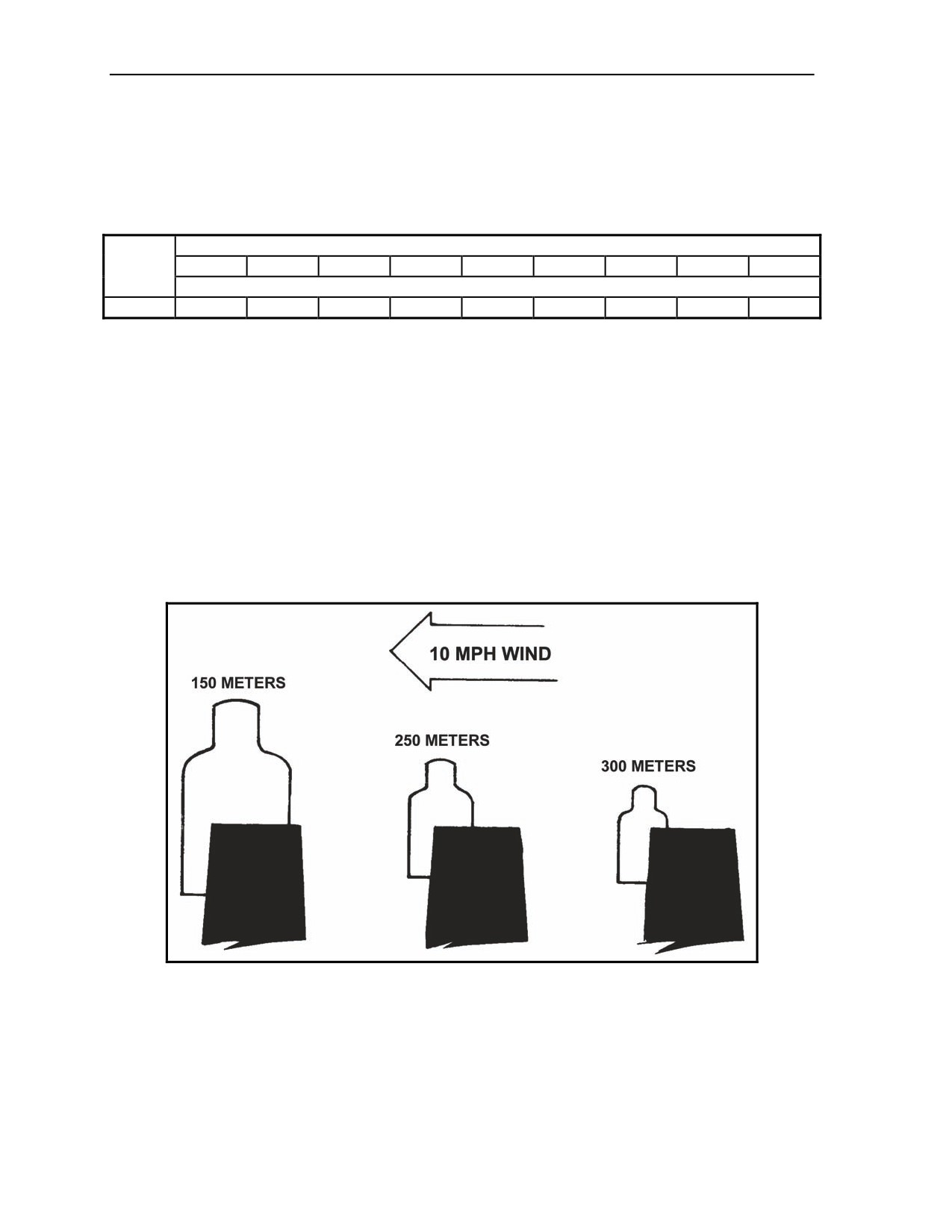
5-83. Firers must adjust their points of aim into the wind to compensate for its effects. If they miss a distant
target and wind is blowing from the right, they should aim to the right for the next shot. A guide for the
initial adjustment is to split the front sightpost on the edge of the target facing the wind (Figure 5-30).
5-84. Newly assigned Soldiers should aim at the target's center of mass for the first shot, and then adjust for
wind when they are confident that wind caused the miss. Experienced firers should apply the appropriate
hold-off for the first shot, but should follow the basic rule—when in doubt, aim at the center of mass.
Figure 5-30. M16-/M4-series weapons adjusted point of aim based on wind speed.
5-32
FM 3-22.9, C1
10 February 2011
Downrange Feedback
SECTION V. BALLISTICS
Commanders and marksmanship trainers must understand some aspects of ballistics to teach the principles of
zeroing and engagement of long-range targets. Ballistics is a science dealing with the motion and flight
characteristics of projectiles. The study of ballistics in rifles and carbines is divided into three categories:
z
Internal ballistics.
z
External ballistics.
z
Terminal ballistics.
INTERNAL BALLISTICS
5-85. Internal ballistics deals with what happens to the bullet before it leaves the weapon's muzzle.
5-86. The overall dimensions of the combat service 5.56-millimeter cartridges are the same, which allows
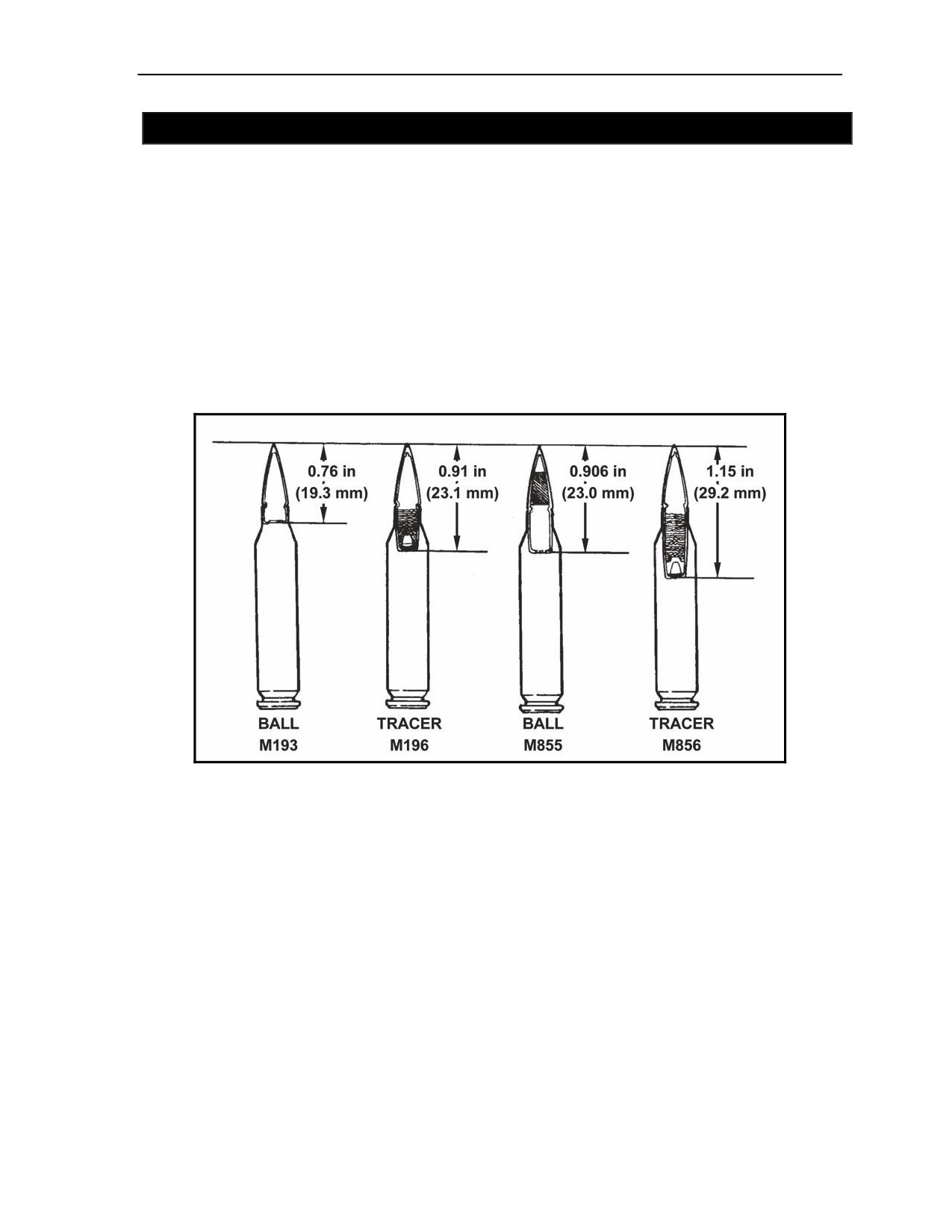
cartridges to be fired safely in M16-series rifles and M4 carbines, but there are internal differences that
affect firing accuracy (Figure 5-31).
*Figure 5-31. Projectile differences.
M855 AND M193 AMMUNITION
5-87. The M855 bullet is longer and wider than the M193 bullet and has a different configuration. These
differences require different twists in the barrels, lands, and grooves to stabilize the bullet in flight. These
differences include the following:
z
The M16A1 has a 1:12 barrel twist (the bullet rotates once for every 12 inches of travel down
the barrel).
z
The M16A2/A3/A4 and the M4 have a 1:7 barrel twist (the bullet rotates once for every 7 inches
of travel down the barrel).
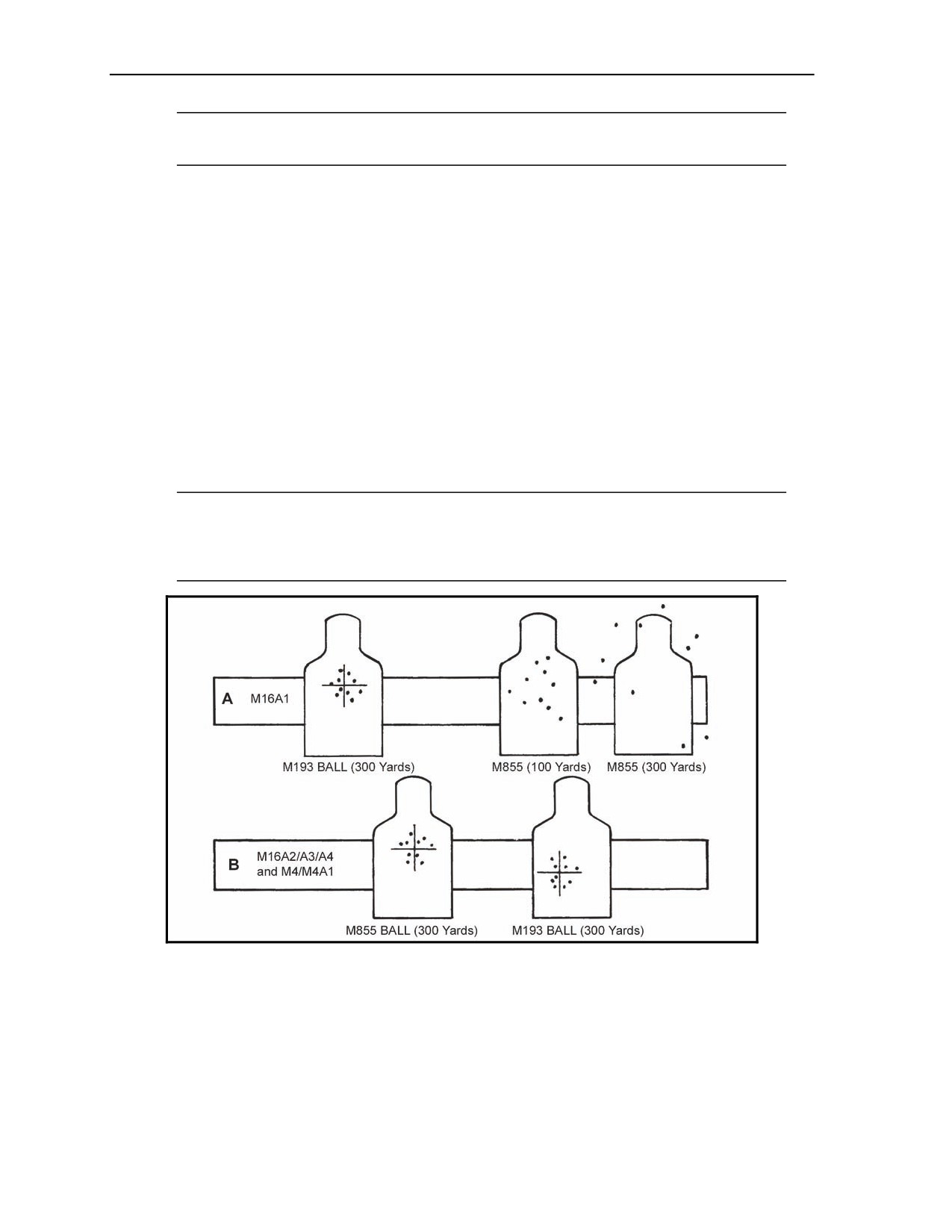
5-88. The M16A1 does not put enough spin on the heavier M855 bullet to stabilize it in flight, causing
erratic performance and inaccuracy (Figure 5-32). The shot groups are—
z
30.48 to 35.56 centimeters (12 to 14 inches) at 91.4 meters (100 yards).
z
182.88 centimeters (72 inches) at 274.2 meters (300 yards).
10 February 2011
FM 3-22.9, C1
5-33
Chapter 5
NOTE: Although firing the M855 cartridge in the M16A1 rifle is safe, it should only be used in
a combat emergency, and then only for close ranges of 91.4 meters (100 yards) or less.
5-89. The M16A2/A3/A4 rifle and M4/M4A1 carbine fire both M193 and M855 ball ammunition with
little difference in accuracy to a range of
500 meters. The M16A2/A3/A4 and M4/M4A1 and their
ammunition are more effective than the M16A1 at ranges out to and beyond 500 meters due to better
stabilization of the round.
5-90. The three 10-round shot groups in Figure 5-32 (A) were fired by a skilled marksman at a distance of
274.2 meters (300 yards) and 91.4 meters (100 yards) using the same M16A1 rifle.
z
At 300 yards, the 25.4-centimeter shot group (shown on the left) was fired (and zeroed) with
M193 ammunition.
z
The 6-foot shot group (shown on the right) was fired with M855 ammunition.
z
At 100 yards, the 35.56-centimeter (14-inch) shot group (shown in the center) was fired with
M855 ammunition.
5-91. Figure
5-32
(B) shows two 25.4-centimeter
(12-inch) shot groups fired by the same skilled
marksman at a distance of 274.2 meters (300 yards) using an M16A2 rifle.
z
The shot group on the left was fired and zeroed with M855 ammunition.
z
The shot group on the right was fired using M193 ammunition.
NOTE: Both M193 and M855 ball ammunition can be used in training and accurately function
in M16A2/3/4 rifles and M4/M4A1 carbines. Due to the different characteristics of each round,
zero with the type of ammunition used for training. Do not switch between the types during
firing. Do not zero with one type, and then fire the other for any type of training.
Figure 5-32. Ammunition impact comparison.
*5-92. A simple rule of thumb that will preclude any problem is to use only the ammunition specifically
designed for each weapon
(M193 ball ammunition for M16A1 rifles; M855 ball ammunition for
M16A2/3/4 rifles and M4 carbines). For M855 and M193 ammunition, the difference in a 300-meter zero is
negligible, and the firer does not need to compensate for it.
5-34
FM 3-22.9, C1
10 February 2011
Downrange Feedback
EXTERNAL BALLISTICS
5-93. External ballistics deals with factors affecting the flight path of the bullet between the weapon's
muzzle and the target.
5-94. Soldiers must understand the basics of external ballistics so they can make necessary scope
adjustments or hold compensations to allow them to hit the target. The external ballistic factors that affect
bullet trajectory are:
z
Gravity.
z
Muzzle velocity.
z
Air resistance (drag).
z
Altitude or air density.
z
Temperature.
z
Trajectory.
z
Wind.
z
Angles.
GRAVITY
*5-95. The force of gravity on a bullet is constant regardless of its weight, shape, or velocity.
*NOTE: See paragraphs 5-68 through 5-70 for more information about the effects of gravity.
MUZZLE VELOCITY
*5-96. Muzzle velocity is the speed of a bullet as it leaves the barrel, measured in feet per second. The
bullet begins to slow down as soon as it exits the barrel.
AIR RESISTANCE (DRAG)
5-97. Air resistance, or drag, immediately produces a slowing effect on a bullet.
ALTITUDE OR AIR DENSITY
5-98. The greater the altitude, the thinner the air and the longer the bullet will travel
(with a
correspondingly flatter trajectory). Each 5,000-foot elevation will raise the strike of the bullet ½ to 1 minute
of angle (MOA).
TEMPERATURE
5-99. Deviation from standard daytime temperature (59 degrees Fahrenheit/15 degrees Celsius) affects
bullet trajectory.
Cold Temperatures
5-100. Cold air is denser than warm air; the bullet must travel through more tightly packed air particles.
This causes the bullet to lose velocity, causing the bullet to impact lower than intended. Cooler air also
causes lower chamber pressure, which reduces the initial velocity.
Hot Temperatures
5-101. Warm or hot temperatures cause the strike of the round to move up.
10 February 2011
FM 3-22.9, C1
5-35
Chapter 5
TRAJECTORY
*5-102. When a projectile exits the barrel, gravity immediately takes effect, causing the bullet to drop from
the line of departure, otherwise known as the line of bore. As the projectile travels downrange, air drag
decreases the velocity. These effects create the projectile’s trajectory.
Line of Sight
5-103. The line of sight is an imaginary straight line extending from the firer’s eye through the telescopic
sight, or rear and front sight, to the target.
Line of Departure
5-104. The line of departure is an imaginary straight line extending from the center of the barrel to
infinity.
Zero Range
5-105. Zero range is where the projectile intersects the line of sight. It occurs twice—once on the way up
and once on the way down.
Apex
5-106. Otherwise known as midrange trajectory, the apex is the point where the projectile is at its highest
in relation to the line of sight.
Bullet Path
5-107. The bullet path is the relationship of a projectile and the line of sight at any given range (normally
expressed in inches).
WIND
5-108. External factors influence the trajectory relative to the point of aim, such as wind, altitude,
temperature, humidity, and barometric pressure. Wind is by far the most significant. Consider the following
effects of wind:
z
Because the bullet is moving through the air, the air moves the bullet. Wind deflection is always
in the same direction the wind is moving. A wind blowing from the left will move the bullet to
the right.
z
Deflection decreases as the angle of the wind to the line of flight decreases.
5-109. Effectively reading and correcting for wind effects takes practice, especially at longer ranges
where accuracy in correcting is more critical. To shoot accurately in the wind, a firer must know the wind
velocity, the wind direction, and the value of deflection at the range at which he is shooting.
*NOTE: See paragraph 5-71 for more information on the effects of wind.
ANGLES
5-110. Firing uphill or downhill normally causes the bullet to hit high relative to a horizontal trajectory. If
the firer is firing on an angle up or down at a slanted range of 100 meters, the point of impact will be higher
than it would be for a level shot of 100 meters. The height depends on the angle.
5-111. Gravity acts on a bullet only during the horizontal component of its flight (the distance from the
firer to the target measured as if they were both at the same level). Since the horizontal component will
always be less than the slanted range, gravity will not pull the bullet down as far as it would if the range
were level.
5-36
FM 3-22.9, C1
10 February 2011
Downrange Feedback
5-112. Firing uphill or downhill causes the wind to affect the shot over the entire slant range. The firer
should aim at the target as if it were 25 meters away and correct for wind as if it were 400 meters away.
The correct method for shooting uphill or downhill is to adjust elevation based on the horizontal range and
correct for wind deflection based on the slanted range.
TERMINAL BALLISTICS
5-113. Terminal ballistics deals with what happens to the bullet when it comes in contact with the target.
5-114. Bullet penetration depends on the range, velocity, bullet characteristics, and target material.
Greater penetration does not always occur at close range with certain materials, since the high velocity of
the 5.56-millimeter bullet causes it to disintegrate soon after impact.
BULLET DISPERSION AT RANGE
5-115. Instructors/trainers must have a working knowledge of the effects of bullet dispersion and accuracy
at various ranges.
MINUTE OF ANGLE
5-116. An MOA is the standard unit of measurement used in adjusting a weapon's sights and other
ballistic-related measurements. It is also used to indicate the accuracy of a weapon.
*5-117. A circle is divided into 360 degrees. Each degree is further divided into 60 minutes. Each minute is
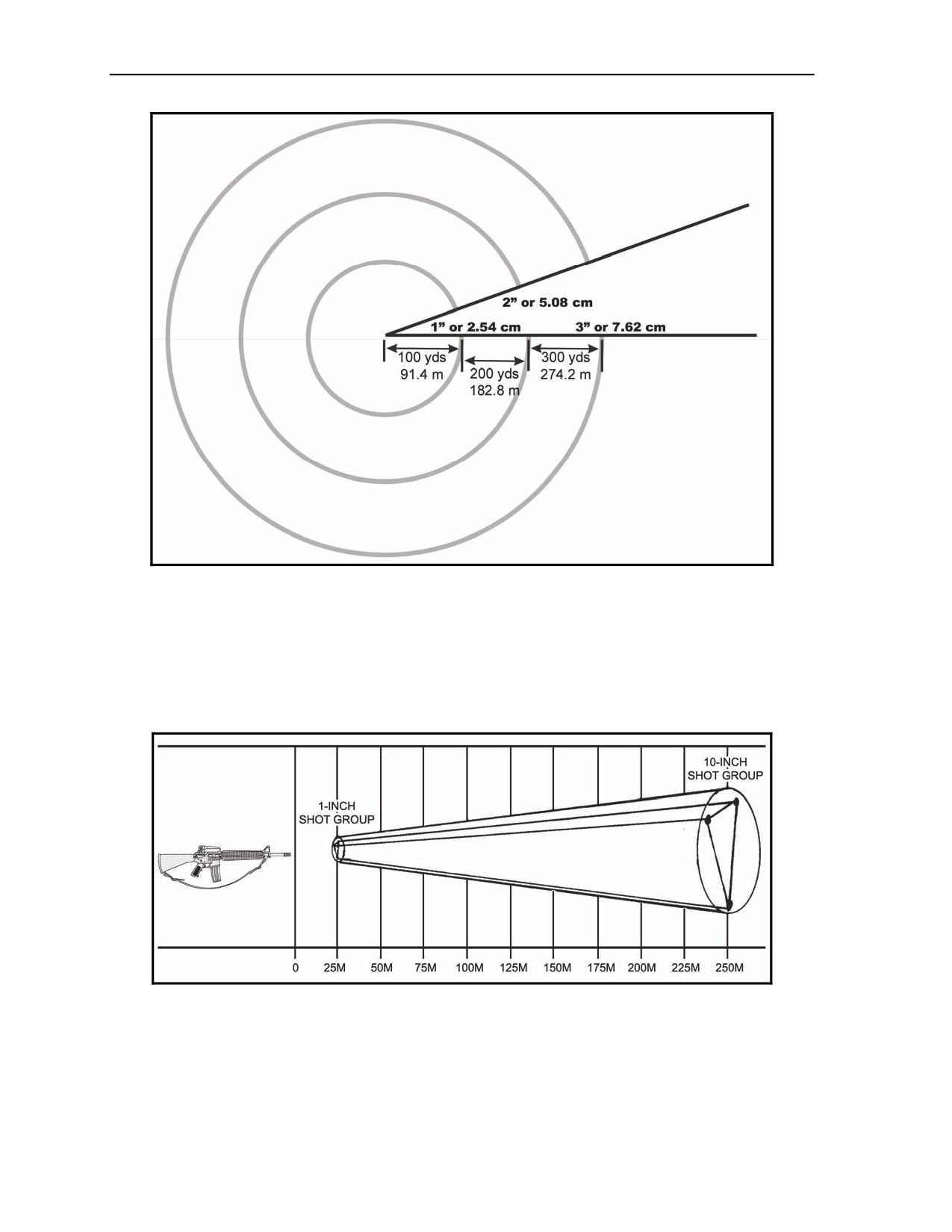
an MOA (1/60 of a degree).
5-118. An MOA is an angle beginning at the muzzle that covers 2.54 centimeters at a distance of 91.4
meters (Figure 5-33). Often, these measurements are expressed as yards; therefore, 1 MOA is 1 inch at 100
yards, 2 inches at 200 yards, and so on. To further simplify the calculation, meters can be substituted for
yards.
10 February 2011
FM 3-22.9, C1
5-37
Chapter 5
*Figure 5-33. Minute of angle.
INCREASE OF SHOT GROUP SIZE
*5-119. Just as the distance covered by an MOA increases each time the range increases, a shot group can
be expected to do the same. If there are 2.54 centimeters between bullets on a 25-meter target, there will be
an additional 2.54 centimeters of dispersion for each additional 25 meters of range. A 2.54-centimeter shot
group at 25 meters (about 3.5 MOA) is equal to a 25.4-centimeter shot group at 250 meters (Figure 5-34).
*Figure 5-34. Increase in shot group size as range increases.
5-38
FM 3-22.9, C1
10 February 2011

Chapter 6
Field Fire
Field firing is part of the continued progression in the development of combat
shooting skills. This begins the Soldier’s critical transition from unstressed firing at
single, known distance targets to targets at various ranges for short exposures. It also
requires the Soldier to practice and refine previously taught skills.
This chapter introduces the techniques for scanning the range for targets, estimating
range, and firing quickly and accurately.
NOTE: See Table 6-1 for the current training program.
Table 6-1. Field Fire I and II training program.
FIELD FIRE I AND II
Instructional Intent
•
Reinforce PMI and downrange feedback by detecting and engaging single and multiple timed targets with the
M16-/M4-series weapon.
Special Instructions
Ensure that—
•
The rear sight is on the proper setting (M16A2/3=8/3; M16A4 and M4=6/3 flush; M16A1=the unmarked
aperture, short-range).
•
The rear sight aperture is set on 300, not 800.
•
The small aperture is being used.
• The range consists of targets at 75, 175, and 300 meters.
Observables
•
Coaches are used to analyze the firer’s adherence to the fundamentals—not as scorers.
•
Soldiers detect and achieve 22 target hits out of 36 timed target exposures (Field Fire I).
•
Soldiers detect and achieve 27 target hits out of 44 timed target exposures (Field Fire II).
•
Soldiers that don’t achieve the standard receive remedial training prior to refiring.
SECTION I. TARGET DETECTION
For most Soldiers, finding the target is a greater problem than hitting it. Target detection is the process of
locating, marking, prioritizing, and determining the range to combat targets. Target detection must be conducted
as part of individual training and tactical exercises, and must be integrated into day and night LFXs.
NOTE: Refer to TC 25-8 for construction of a target detection range.
LOCATING TARGETS
6-1. The ability to locate a combat target depends on the observer’s—
z
Position.
z
Skill in scanning.
z
Ability to observe the area and recognize the type of indicators made by the target.
12 August 2008
FM 3-22.9
6-1
Chapter 6
SELECTION OF A POSITION
6-2. A good position is one that offers maximum visibility of the area, while affording cover and
concealment. In this case, the word “position” refers to both the observer’s location on the ground and the
position of his body at that location.
NOTE: Instructors must continuously refer to and emphasize the importance of the observer’s
position when conducting practical exercises.
6-3. Depending on the situation, the individual Soldier may or may not select his own position.
z
In most defensive situations, the Soldier is told where to prepare his position.
z
Some situations (for example, the attack and reorganization on the objective) require the Soldier
to select his own position.
SCANNING
6-4. To scan the area, Soldiers use three methods of search:
z
Self-preservation method.
z
50-meter overlapping strip method.
z
Maintaining observation of the area.
Self-Preservation Method of Search
6-5. When moving into a new area, Soldiers use the self-preservation method of search. To perform this
method, use the following techniques:
(1) For approximately
30 seconds, quickly scan the area for enemy activity that may be of
immediate danger.
(2) Make quick glances at specific points throughout the area, rather than just sweeping the eyes
across the terrain in one continuous panoramic view.
NOTE: The eyes are sensitive to slight movements that occur within the area the eyes are
focused on; panoramic views do not allow the eyes to detect the slight movements of a
concealed target.
50-Meter Overlapping Strip Method of Search
6-6. If the Soldier fails to locate the enemy during the initial search, he must begin a systematic
examination known as the 50-meter overlapping strip method of search. To perform this method—
(1) Begin the search with the area offering the greatest potential danger, the terrain nearest to your
position.
(2) Beginning at either flank, systematically search the terrain to your front in a 180-degree arc, 50
meters in depth.
NOTE: Become familiar with the terrain as you search it. Take advantage of peripheral vision
by focusing the eyes on specific points as you search from one flank to the other. Make mental
notes of prominent terrain features and areas that may offer cover and concealment to the enemy.
(3) After reaching the opposite flank, search a second 50-meter strip farther out, but overlapping the
first strip by approximately 10 meters.
(4) Continue in this manner until the entire area has been searched.
NOTE: This method should also be used as part of maintaining observation of the area and
when the observer has been distracted from his area of responsibility.
6-2
FM 3-22.9
12 August 2008
Field Fire
Maintaining Observation of the Area
6-7. After completing his detailed search, the Soldier may be required to maintain observation of the area.
To perform this method—
z
Glance quickly at various points throughout the entire area, focusing the eyes on specific
features.
z
Always search the area in the same manner to ensure complete coverage of all terrain.
NOTE: Since this quick search may fail to detect the initial movement of an enemy, the
observer should periodically repeat the procedures outlined in the 50-meter overlapping strip
method of search.
TARGET INDICATORS
6-8. A target indicator is anything that a Soldier (friendly or enemy) does or fails to do that reveals his
position. Since these indicators apply equally to both sides of the battlefield, Soldiers must learn to use
target indicators to locate the enemy and to prevent the enemy from using the same indicators to locate
them. For instructional purposes, these indicators can be grouped into three general areas:
z
Sound.
z
Movement.
z
Improper camouflage.
Sound
6-9. Sounds, such as footsteps, coughing, or equipment noises, provide only a direction and general
location, making it difficult to pinpoint a target by sound alone. However, detection of a sound alerts the
observer, greatly increasing the possibility that he will eventually locate the target through other target
indicators.
Movement
6-10. The degree of difficulty in locating moving targets depends primarily on the speed of movement.
Slow, deliberate movements are much more difficult to notice than those that are quick and jerky.
Improper Camouflage
6-11. The lack or improper use of camouflage or concealment reveals the majority of targets detected on
the battlefield; alert observers easily notice indicators such as light reflecting from shiny surfaces or a
contrast with the background. Three general indicators may reveal a camouflaged or concealed target:
z
Shine.
z
Regularity of outline.
z
Contrast with the background.
Shine
6-12. Metal objects, such as belt buckles, reflect light and act as a beacon to the wearer’s position. This is
as true at night as it is during the day.
12 August 2008
FM 3-22.9
6-3
Chapter 6
Regularity of Outline
6-13. Humans and most types of military equipment cast outlines that are familiar to all Soldiers. The
outlines of rifles, helmets, and vehicles are all easily identified. The reliability of this indicator depends on
the visibility and the experience of the observer. On a clear day, most Soldiers can easily identify enemy
riflemen or equipment if a distinctive outline is presented. At night or during other periods of poor
visibility, seeing outlines is not only more difficult, but inexperienced troops will frequently mistake
stumps and rocks for enemy Soldiers. This is an additional reason for Soldiers to become completely
familiar with the terrain during periods of good visibility.
Contrast with the Background
6-14. If a Soldier wearing a dark uniform moves into a position in front of a snow bank, the contrast
between the white snow and the dark uniform makes him clearly visible. However, if he was wearing a
white or light-colored uniform, he would be more difficult to see.
6-15. Contrast with the background is the most difficult target indicator for a Soldier to avoid. During
operations in which the Soldier is moving, he is usually exposed to numerous background colors. Since no
single type of personal camouflage blends in with all areas, a moving Soldier must be continually aware of
the surrounding terrain and vegetation.
MARKING TARGETS
6-16. A Soldier observes two enemy riflemen moving into completely concealed positions, one behind a
bush and the other into a depression.
z
By selecting a point of aim on the bush, the Soldier should hit the enemy rifleman even though
he can’t see him. If the target cannot be engaged, the point of aim also allows for quick and
accurate engagement once the target is re-exposed.
z
The enemy rifleman who moved into the depression provides no distinguishable point of aim, so
the Soldier must select a nearby feature as a reference point and determine its distance and
general direction from the depression. A reference point provides a general point of aim on a
concealed target.
6-17. Of the two, a point of aim is usually the more effective means of delivering accurate fire. The
difficulty in using reference points to mark targets moving from one location to another depends on the
following factors:
z
Number of targets.
z
Exposure time to target.
z
Spacing of targets.
z
Good and poor points of aim.
NUMBER OF TARGETS
6-18. If several targets appear and disappear at approximately the same time, it is very difficult to note
each target's point of disappearance.
EXPOSURE TIME OF TARGET
6-19. Usually, moving targets are exposed for only a short period of time, so the observer must be alert to
note the point of disappearance for all of the targets. In such situations, the Soldier should mark the location
of as many targets as possible before engaging any of them. By doing so, he will know the location of
several targets and can engage each of them in rapid succession.
6-4
FM 3-22.9
12 August 2008
Field Fire
SPACING OF TARGETS
6-20. The greater the interval between targets, the more difficult it is to note each target's movements.
When there is considerable distance between targets, the observer should accurately locate and mark the
one nearest to his position and note the general area of the others.
GOOD AND POOR POINTS OF AIM
6-21. Good points of aim are easily distinguishable in the surrounding terrain. Targets disappearing behind
good points of aim, such as manmade objects and large terrain features, can be easily marked for future
reference.
6-22. Poor points of aim are not easily distinguishable within the surrounding terrain. Targets disappearing
behind poor points of aim are difficult to mark accurately and are easily lost.
6-23. If two targets offer the same degree of danger to the Soldier, but one disappears behind a good point
of aim and the other behind a poor point of aim, the Soldier should mark the location of the target behind
the good point of aim and engage the other target first.
RANGE DETERMINATION
6-24. Range determination is the process of finding the distance between two points. In most situations,
one of these points will be the Soldier’s own position. The other may be a target or prominent feature.
6-25. To accomplish the mission, combat riflemen must be able to accurately determine range. Not only
does this affect his combat marksmanship proficiency, it is also required to report information and adjust
artillery and mortar fire.
6-26. The methods of range estimation used during this period are—
z
100-meter unit of measure method.
z
Appearance of objects method.
z
Front sightpost method.
100-METER UNIT OF MEASURE METHOD
6-27. To perform this method, the Soldier must be able to visualize a distance of 100 meters on the ground.
z
For ranges up to 500 meters, he determines the number of 100-meter increments between the
two points.
z
Beyond 500 meters, the Soldier selects a point halfway to the target, determines the number of
100-meter increments to the halfway point, and then doubles it to find the range to the target.
6-28. During training exercises, the Soldier must become familiar with the effect that sloping ground has
on the appearance of a 100-meter increment.
z
Ground that slopes upward gives the illusion of greater distance, and observers tend to
underestimate a 100-meter increment.
z
Ground that slopes downward gives the illusion of shorter distance, and observers tend to
overestimate a 100-meter increment.
6-29. Proficiency in the 100-meter unit of measure method requires constant practice. While training this
technique, comparisons should be made continually between the range as determined by the Soldier and the
actual range as determined by pacing or other more accurate means of measurement.
12 August 2008
FM 3-22.9
6-5
Chapter 6
NOTE: The best training technique is to require the Soldier to pace the range after he has
visually determined it. In this way, he discovers the actual range for himself, which makes a
much greater impression than if he is simply told the correct range.
6-30. The greatest limitation of the 100-meter unit of measure method is that its accuracy is directly related
to the amount of terrain visible to the observer. This is particularly true at longer ranges. If a target appears
at a range of 500 meters or more and the observer can see only a portion of the ground between himself and
the target, it becomes very difficult to use the 100-meter unit of measure method with any degree of
accuracy.
APPEARANCE OF OBJECTS METHOD
6-31. The appearance of objects method is a means of determining range by the size and other details of
the object observed. This is a common method of determining distances and is used by most people in their
everyday living. For example, a motorist attempting to pass another car must judge the distance of
oncoming vehicles based on his knowledge of how vehicles appear at various distances. Suppose the
motorist knows that, at a distance of one mile, an oncoming vehicle appears to be 1 inch wide and 2 inches
high. Then, any time he sees other oncoming vehicles that fit these dimensions, he knows they are about
one mile away.
6-32. The rifleman can use this technique to determine ranges on the battlefield. If he knows the
characteristics, size, and detail of personnel and equipment at known ranges, he can compare these
characteristics to similar objects at unknown ranges. When the characteristics match, so do the ranges.
6-33. To use the appearance of objects method with any degree of accuracy, the Soldier must be
thoroughly familiar with the details of objects as they appear at various ranges. For example, the Soldier
should study the appearance of a man standing at a range of 100 meters. He fixes the man’s appearance
firmly in his mind, carefully noting details of size and the characteristics of uniform and equipment. Next,
he studies the same man in a kneeling position and in a prone position. By comparing the appearance of
Soldiers in these positions at known ranges from 100 to 500 meters, the Soldier can establish a series of
mental images that will help him determine range on unfamiliar terrain.
NOTE: Training should also be conducted in the appearance of other familiar objects, such as
weapons or vehicles.
6-34. Because the successful use of this method depends upon visibility, anything that limits visibility (for
example, weather, smoke, or darkness) will limit the effectiveness of this method.
FRONT SIGHTPOST METHOD
6-35. Using the front sightpost as a scale is another method of estimating range. This method can be used
for a quick on-the-spot estimation and engagement.
z
Generally, if a man-sized target is
½ of the width of the front sightpost, the target is
approximately 300 meters away.
z
If the target is ¼ of the width of the front sightpost, the target is approximately 600 meters away.
SECTION II. FIELD FIRE TRAINING
Field fire training provides the transition from unstressed, slow firing at known distances or feedback targets to
engaging pop-up silhouettes 50 to 300 meters away. Two basic types of field firing exercises are single and
multiple target timed engagements, which use 75-, 175-, and 300-meter targets. Pop-up targets are used to add
stress and simulate the short exposure times of combat targets. During field fire training, the firer learns to
quickly detect targets, apply SPORTS, and apply the four fundamentals simultaneously.
6-6
FM 3-22.9
12 August 2008
Field Fire
CONDUCT OF A FIELD FIRE RANGE
6-36. On field fire ranges, Soldiers fire (from the supported and prone unsupported firing positions) at F-
type silhouettes 75 meters away and E-type silhouettes 175 and 300 meters away. Initial training begins
with single exposed targets and increased time for target exposures (Field Fire I). As Soldiers become
proficient, multiple target engagements with shorter exposure times are introduced (Field Fire II).
NOTE: There are two types of electronic pop-up targets used on a field fire range: those that
rise to the upright position from the back and those that rise to the upright position from the side.
When using targets that rise from the side, Soldiers should be instructed to wait until the target is
fully raised before engaging it. If the target is engaged as it is rising, the computer will not
register the hit even though the target may fall.
REMEDIAL TRAINING
6-37. Soldiers who miss most targets should be removed from the firing line for remedial training if their
problem cannot be corrected. A Soldier who fires at a 300-meter target 10 times and misses it 10 times is
not learning, instead he is losing confidence in his ability. The typical Soldier should hit the 300-meter
target at least 7 out of 10 times.
PEER COACHING
6-38. Peer coaches should assist Soldiers in observing the strike of rounds and identifying firing problems.
If the target is missed and the coach cannot observe the bullet strike, the coach should instruct the Soldier
to aim lower for the next shot, expecting to see the strike of the bullet in the ground. With this information,
the coach can instruct the Soldier where to aim to hit the target.
ORGANIZATION
6-39. Live-fire training can be organized in several ways. A unit is divided into two or more firing orders
based on the number of personnel to be trained:
z
The first order is the firer.
z
The second order is the coach.
z
The third order is the scorer (if required).
6-40. At the conclusion of each exercise, positions rotate until all orders have fired. Standard field fire
scenarios have been developed to provide several target exposures. Although they are recommended for
IET, local commanders can develop any variety of more challenging target sequences. Ammunition is
allocated based on one round for each target.
RECORDING
6-41. During live-fire, the Soldier’s hit-and-miss performance is recorded to facilitate the
instructor/trainer’s critiques or to indicate where more training, closer supervision, or remedial training is
needed. Two methods are used to record firing performance:
z
Manually marked scorecards.
z
Automated computer printouts.
Manual Recording
6-42. When manual recording is used, the unit provides Soldiers for recording information on either DA
Form 3601-R (Single Target Field Fire I Scorecard) or DA Form 5241-R (Single and Multiple Targets
Field Fire II Scorecard).
NOTE: See the end of this publication for blank reproducible copies of these forms.
12 August 2008
FM 3-22.9
6-7
Chapter 6
Automated Recording
6-43. When firing exercises are conducted using automated field fire (AFF) ranges, a computer printout is
provided for each firing order. At the conclusion of each firing order, the range noncommissioned officer in
charge (NCOIC) completes the printout and ensures that the Soldier identification is matched with each
firing point. He adds the Soldier’s numbered code to the top of each lane/firing point data column. Based
on a one-round allocation for each target exposure, data should be collected on hits, misses, no-fires, and
repeated shots to assist the instructor/trainer in assessing firing proficiency.
FIELD FIRE I (SINGLE TIMED TARGET)
6-44. Field Fire I is broken down into four firing tables (Table 6-3).
CONCEPT
6-45. Firing Table 1 helps the firer practice shooting skills and develop the sense of timing and rhythm
required to make the transition from KD to field fire. This builds confidence prior to firing the exercises in
Firing Tables 2, 3, and 4, and identifies Soldiers who are having difficulty and need reinforcement.
6-46. When firing the exercises in Firing Tables 2, 3, and 4, each Soldier demonstrates his ability to apply
the fundamentals of marksmanship during the integrated act of firing by successfully detecting and
engaging single timed targets.
CONDUCT
NOTE: When firing record fire, each Soldier must wear the proper uniform: the helmet, LBE,
and IBA with all SAPI plates (if available). No other armor is required.
6-47. Each firer receives 54 rounds of 5.56-millimeter ball ammunition, with two 18-round magazines (one
magazine each for Firing Tables 1 and 2) and two 9-round magazines (one magazine each for Firing Tables
3 and 4). Table 6-2 depicts the number of rounds that must be fired from each position. Each Soldier must
achieve 22 hits out of 36 timed target exposures in Firing Tables 2, 3, and 4. Table 6-3 shows the number
of target exposures, target ranges, and exposure times for each firing table.
Table 6-2. Number of rounds that must be fired from each position during Field Fire I.
POSITION
NUMBER OF ROUNDS FIRED
Supported firing position
18
Supported firing position
18
Unsupported firing position
9
Kneeling
9
6-8
FM 3-22.9
12 August 2008
Field Fire
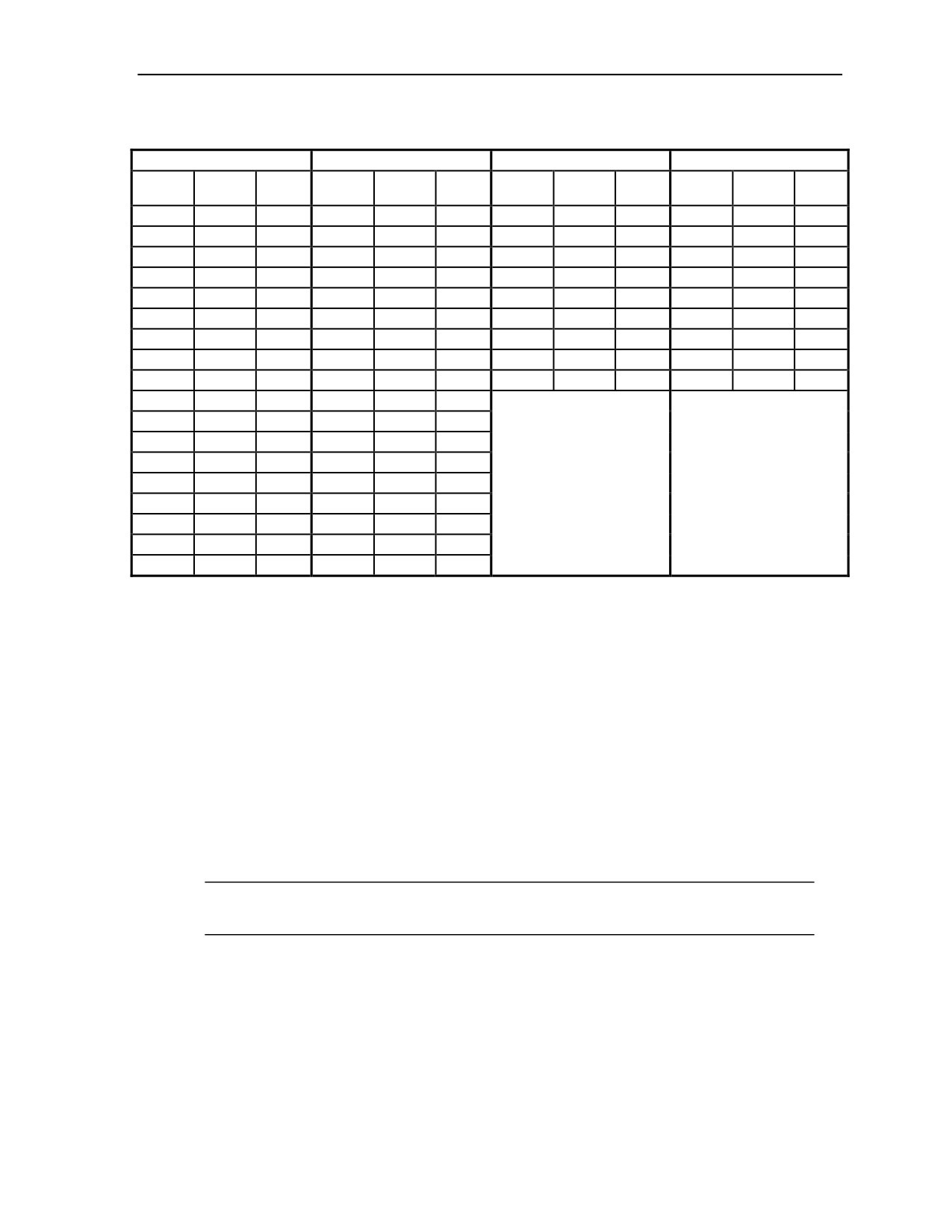
Table 6-3. Field Fire I firing tables.
FIRING TABLE 1
FIRING TABLE 2
FIRING TABLE 3
FIRING TABLE 4
ROUND
RANGE
TIME
ROUND
RANGE
TIME
ROUND
RANGE
TIME
ROUND
RANGE
TIME
(m)
(sec)
(m)
(sec)
(m)
(sec)
(m)
(sec)
1
75
6
1
75
6
1
75
6
1
75
6
2
175
8
2
175
8
2
175
8
2
175
8
3
300
10
3
300
10
3
300
10
3
75
6
4
175
8
4
175
8
4
175
8
4
175
8
5
75
6
5
75
6
5
75
6
5
75
6
6
300
10
6
300
10
6
300
10
6
175
8
7
300
10
7
300
10
7
300
10
7
75
6
8
75
6
8
75
6
8
75
6
8
75
6
9
175
8
9
175
8
9
175
8
9
175
8
10
175
8
10
175
8
11
300
10
11
300
10
12
175
8
12
175
8
13
75
6
13
75
6
14
300
10
14
300
10
15
175
8
15
175
8
16
75
6
16
75
6
17
300
10
17
300
10
18
75
6
18
75
6
FIELD FIRE II (MULTIPLE OR SINGLE TIMED TARGETS)
6-48. Field Fire II consists of three firing tables.
CONCEPT
6-49. Firing Table 1 helps the firer practice shooting skills and develop the sense of timing and rhythm
required to make the transition from single timed targets to multiple or single timed fleeting combat targets.
This builds confidence prior to firing the exercises in Firing Tables 2 and 3, and identifies Soldiers who are
having difficulty and need reinforcement.
6-50. When firing the exercises in Firing Tables 2 and 3, each Soldier demonstrates his ability to apply the
fundamentals of marksmanship during the integrated act of firing by successfully detecting and engaging
multiple and single timed targets.
CONDUCT
NOTE: When firing record fire, each Soldier must wear the proper uniform: the helmet, LBE,
and IBA with all SAPI plates (if available). No other armor is required.
6-51. Every firer receives 54 rounds of 5.56-millimeter ball ammunition, with 10 rounds loaded into one
magazine (for Firing Table 1) and 44 rounds loaded into two separate magazines, with 22 rounds each (for
Firing Tables 2 and 3). Table 6-4 depicts the number of rounds that must be fired from each position. Each
Soldier must achieve 27 hits out of the 44 timed target exposures in Firing Tables 2 and 3. Table 6-5 shows
the number of target exposures, target distance, and exposure times for each firing table.
12 August 2008
FM 3-22.9
6-9