FM 3-22.9 RIFLE MARKSMANSHIP M16-/M4-SERIES WEAPONS (August 2008) - page 3

Chapter 3
FAILURE TO EJECT
3-21. Ejection of a cartridge is an element in the rifle's cycle of functioning, regardless of the mode of fire.
This malfunction occurs when the cartridge is not ejected through the ejection port and either remains
partly in the chamber or becomes jammed in the upper receiver as the bolt closes. When the firer initially
clears the rifle, the cartridge could strike an inside surface of the receiver and bounce back into the path of
the bolt.
Probable Cause
3-22. The cartridge must be extracted before it can eject. Failures to eject can also be caused by a buildup
of carbon or fouling on the extractor or by short recoil. Short recoil is usually due to a buildup of fouling in
the bolt carrier mechanism or gas tube. Resistance caused by a carbon-coated or corroded chamber can
impede the extraction and ejection of a cartridge.
Corrective Action
3-23. While retraction of the charging handle usually frees the cartridge and permits removal, the charging
handle must not be released until the position of the next live round is determined.
3-24. If another live round has been sufficiently stripped from the magazine or remains in the chamber,
remove the magazine and all live rounds before releasing the charging handle.
3-25. If several malfunctions occur and are not corrected by cleaning and lubricating, replace the ejector
spring, extractor spring, and extractor.
OTHER MALFUNCTIONS
3-26. Table 3-1 describes other malfunctions that can occur and the appropriate corrective actions.
Table 3-1. Other malfunctions.
MALFUNCTION
CORRECTIVE ACTION
The bolt fails to lock in the rearward position after the last
Check for a bad magazine or short recoil.
round in the magazine is fired.
The bolt fails to lock in the rearward position when the bolt
Check the bolt catch; turn in the weapon to the unit
catch has been engaged.
armorer.
The weapon fires two or more rounds when the trigger is
This indicates a worn sear, cam, or disconnector. Turn in
pulled and the selection lever is in the SEMI position.
the weapon to the unit armorer so that he can repair and
replace the trigger group parts.
The trigger fails to pull or return after release with the
This indicates that the trigger pin has backed out of the
selector set in a firing position.
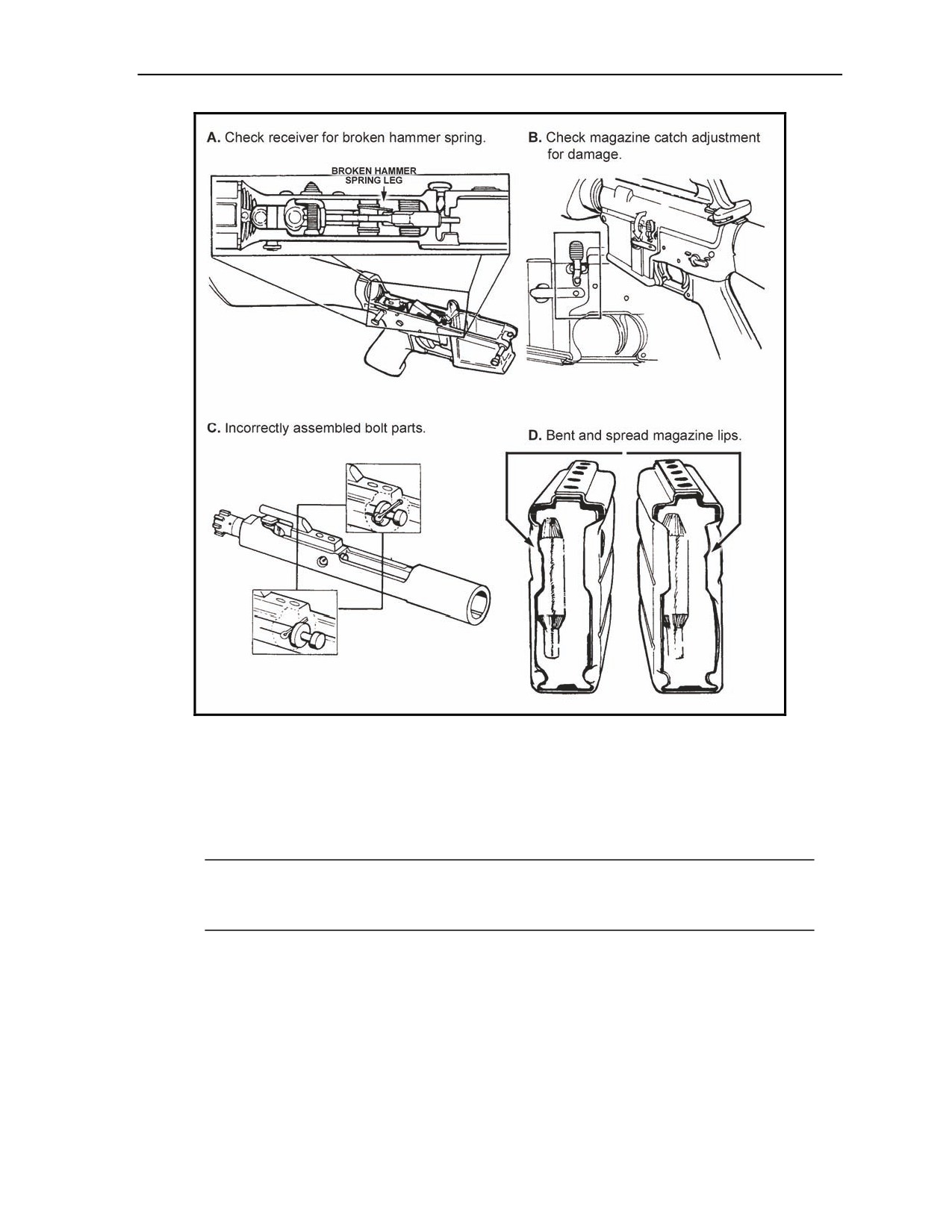
receiver or the hammer spring is broken (A, Figure 3-3).
Turn in the weapon to the unit armorer so that he can
repair and replace it.
The magazine fails to lock into the magazine well.
Check the magazine and magazine catch for damage (B,
Figure 3-3). Turn in to the unit armorer to adjust or replace
the catch.
Any part of the bolt carrier group fails to function.
Check for incorrect assembly of components (C, Figure 3-
3). Correctly clean and assemble the bolt carrier group, or
replace damaged parts.
The ammunition fails to feed from the magazine.
Check for a damaged magazine (D, Figure 3-3). A
damaged magazine could cause repeated feeding failures
and should be turned in to the unit armorer or exchanged.
NOTE: For more information about troubleshooting malfunctions and replacing components,
see organizational and direct support maintenance publications and manuals.
3-6
FM 3-22.9
12 August 2008
Troubleshooting and Destruction
Figure 3-3. Other possible malfunctions.
DESTRUCTION PROCEDURES
3-27. Destruction of any military weapon is authorized only as a last resort to prevent the enemy from
capturing or using it. In combat situations, the commander has the authority to destroy weapons, but he
must report doing so through the proper channels.
NOTE: Certain procedures outlined require the use of explosives and incendiary grenades.
Related principles and the specific conditions under which destruction occurs are command
decisions.
12 August 2008
FM 3-22.9
3-7

Chapter 3
METHODS OF DESTRUCTION
3-28. Equipment may be destroyed using several methods. The commander must use his imagination and
resourcefulness to select the best method of destruction based on the facilities available. Time is usually
critical. Table 3-2 outlines the methods of destruction.
NOTE: If destruction is directed, appropriate safety precautions must be observed.
Table 3-2. Methods of destruction and their applications.
METHOD OF
APPLICATION
DESTRUCTION
Mechanical
Use an axe, pick, mattock, sledgehammer, crowbar, or other heavy implement.
Burning
Use gasoline, oil, incendiary grenades, other flammables, or a welding/cutting torch.
Demolition
Use suitable explosives, ammunition or, as a last resort, hand grenades.
Disposal
Bury essential parts, dump them in streams or marshes, or scatter them so widely that recovering
them would be impossible.
DEGREE OF DAMAGE
3-29. The method of destruction used must damage equipment and essential spare parts to the extent that
they cannot be restored to usable condition (by repair or by cannibalization) in the combat zone.
PRIORITIES OF DESTRUCTION
3-30. When lack of time prevents completely destroying equipment, Soldiers must destroy the same
essential parts on all like equipment. The order in which the parts should be destroyed (priority of
destruction) is as follows:
(1) Bolt carrier group.
(2) Upper receiver group.
(3) Lower receiver group.
3-8
FM 3-22.9
12 August 2008

Chapter 4
Preliminary Marksmanship Instruction
An Infantryman’s basic battlefield tool is his weapon. To effectively employ his
weapon, he must master marksmanship—from the basics of rifle marksmanship to
the advanced stages of target engagement.
Understanding the operation and functions of any machine is vital to becoming an expert with that
machine. The same theory applies to rifle marksmanship. Commanders must keep this in mind when
setting up a training program.
SECTION I. INTRODUCTION TO BASIC RIFLE MARKSMANSHIP AND
MECHANICAL TRAINING
This section covers the mechanical training of M16- and M4-series weapons. With this knowledge, a Soldier is
able to assess and correct any malfunction to keep the weapon operating properly. This training program (Table
4-1) introduces Soldiers to BRM and teaches them how to maintain, operate, and correct malfunctions on M16-
and M4-series weapons. It also teaches peer coaching responsibilities and sight manipulation, while
emphasizing safety.
Table 4-1. Introduction to basic rifle marksmanship and mechanical training.
INTRODUCTION TO BASIC RIFLE MARKSMANSHIP AND MECHANICAL TRAINING
Period 1 (4 hours)
Instructional Intent
•
Introduce the Soldiers to BRM and teach them how to maintain, operate, and correct malfunctions on a
M16-/M4-series weapon.
•
Teach peer coaching responsibilities and sight manipulation, while emphasizing safety.
Observables
Soldiers—
•
Emphasize safety throughout training IAW TM 9-1005-319-10 (refer to this TM for more information).
•
Clear their weapons IAW this manual and TM 9-1005-319-10.
•
Identify all components of their weapon IAW TM 9-1005-319-10 (refer to this TM for more information).
•
Handle and identify 5.56-mm ammunition IAW TM 9-1005-319-10 (refer to this TM for more information).
•
Understand the eight cycles of function IAW this manual.
•
Understand the modes of fire IAW this manual.
•
Disassemble and assemble their weapon IAW TM 9-1005-319-10 (refer to this TM for more information).
•
Perform a function check on their weapon IAW TM 9-1005-319-10 (refer to this TM for more information).
•
Maintain, load, and unload their magazines IAW TM 9-1005-319-10 (refer to this TM for more information).
•
Maintain, load, unload, and clear their weapons IAW TM 9-1005-319-10 (refer to this TM for more information).
•
Perform SPORTS on their weapon within five seconds IAW TM 9-1005-319-10 (refer to this TM for more
information).
•
Correctly manipulate their sights without assistance IAW TM 9-1005-319-10 (refer to this TM for more information).
•
Are taught peer-coaching techniques and responsibilities IAW this manual.
NOTE: Soldiers who do not meet the standard will receive remedial training before continuing
with subsequent instruction.
12 August 2008
FM 3-22.9
4-1
Chapter 4
CLEARING
WARNING
To maintain safety, the weapon must be cleared before
disassembling, cleaning, inspecting, transporting, or storing.
NOTE: Additional mechanical training, including disassembly, maintenance, assembly, loading,
and sight manipulation, is available in TM 9-1005-319-10.
4-1.
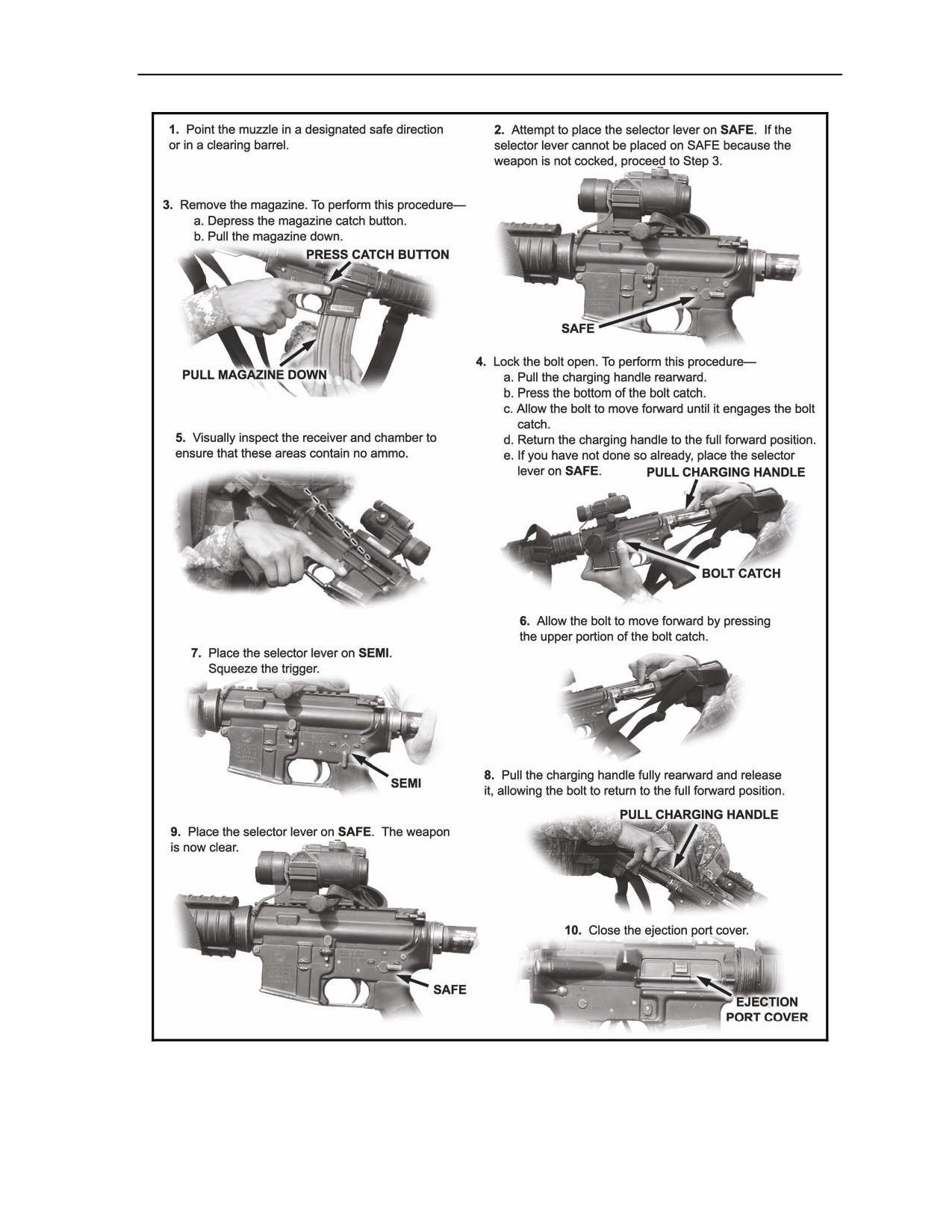
To clear an M16-/M4-series weapon (Figure 4-1), perform the following actions:
(1) Point the muzzle in a designated safe direction or in a clearing barrel.
(2) Attempt to place the selector lever on SAFE. If the selector lever cannot be placed on SAFE
because the weapon is not cocked, proceed to Step 3.
(3) Remove the magazine. To perform this procedure—
Depress the magazine catch button.
Pull the magazine down.
(4) Lock the bolt open. To perform this procedure—
Pull the charging handle rearward.
Press the bottom of the bolt catch.
Allow the bolt to move forward until it engages the bolt catch.
Return the charging handle to the full forward position.
If you have not done so already, place the selector lever on SAFE.
(5) Visually inspect the receiver and chamber to ensure that these areas contain no ammunition.
(6) Allow the bolt to move forward by pressing the upper portion of the bolt catch.
(7) Place the selector lever on SEMI.
(8) Squeeze the trigger.
(9) Pull the charging handle fully rearward and release it, allowing the bolt to return to the full
forward position.
(10) Place the selector lever on SAFE.
NOTE: The weapon is now clear.
(11) Close the ejection port cover.
4-2
FM 3-22.9
12 August 2008
Preliminary Marksmanship Instruction
Figure 4-1. Clearing.
12 August 2008
FM 3-22.9
4-3
Chapter 4
CYCLES OF FUNCTIONING
4-2. Soldiers must understand the rifle components and the mechanical sequence of events during the
firing cycle. After a loaded magazine has been inserted into the weapon, the eight cycles of functioning
begin. They include—
z
Feeding.
z
Chambering.
z
Locking.
z
Firing.
z
Unlocking.
z
Extracting.
z
Ejecting.
z
Cocking.
4-3. The following paragraphs describe the actions that occur during each cycle of functioning.
FEEDING
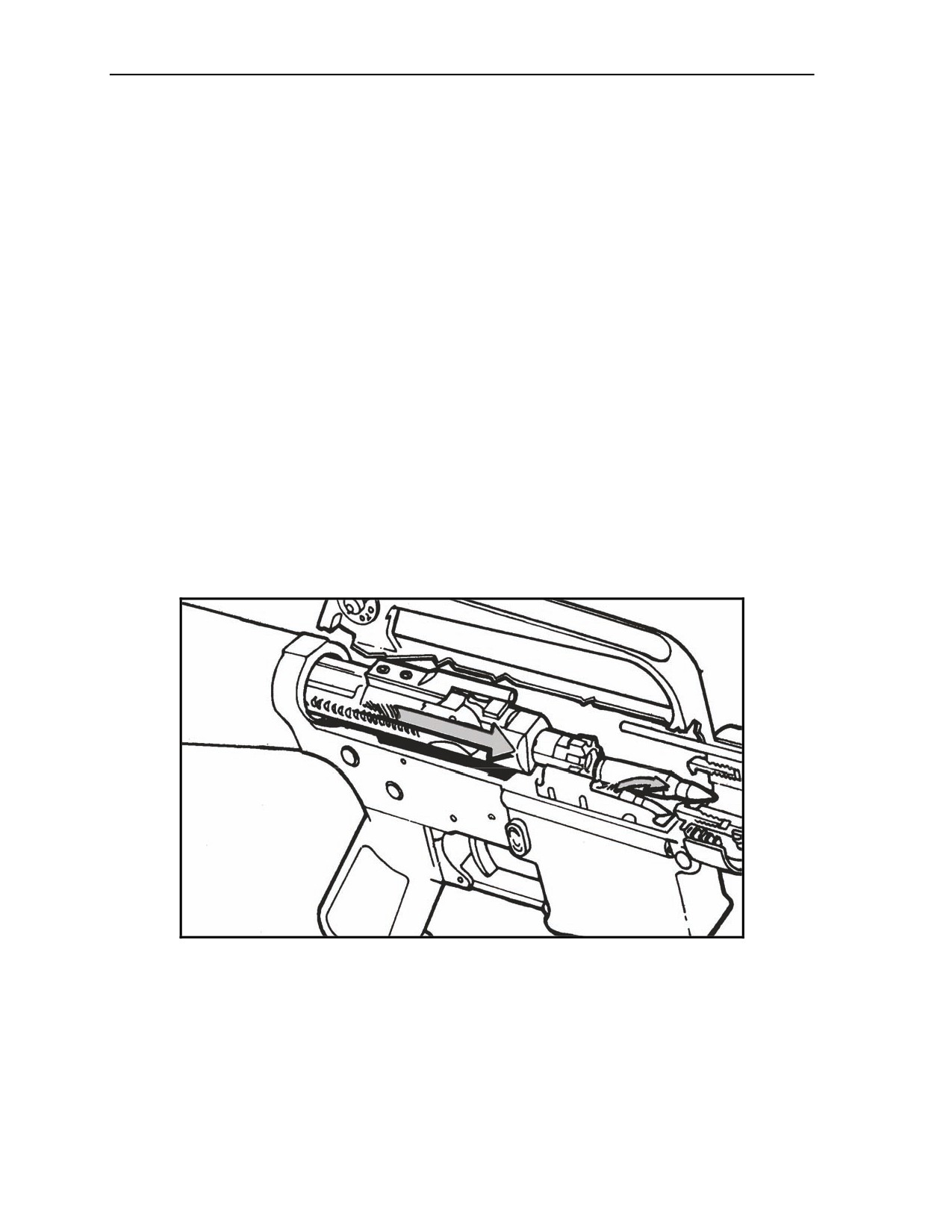
4-4. During feeding, the following actions occur. This process is shown in Figure 4-2.
(1) As the bolt carrier group moves rearward, it engages the buffer assembly and compresses the
action spring into the lower receiver extension.
(2) When the bolt carrier group clears the top of the magazine, the expansion of the magazine spring
forces the follower and a new round into the path of the forward movement of the bolt.
(3) The expansion of the action spring sends the buffer assembly and bolt carrier group forward with
enough force to strip a new round from the magazine.
Figure 4-2. Feeding.
4-4
FM 3-22.9
12 August 2008
Preliminary Marksmanship Instruction
CHAMBERING
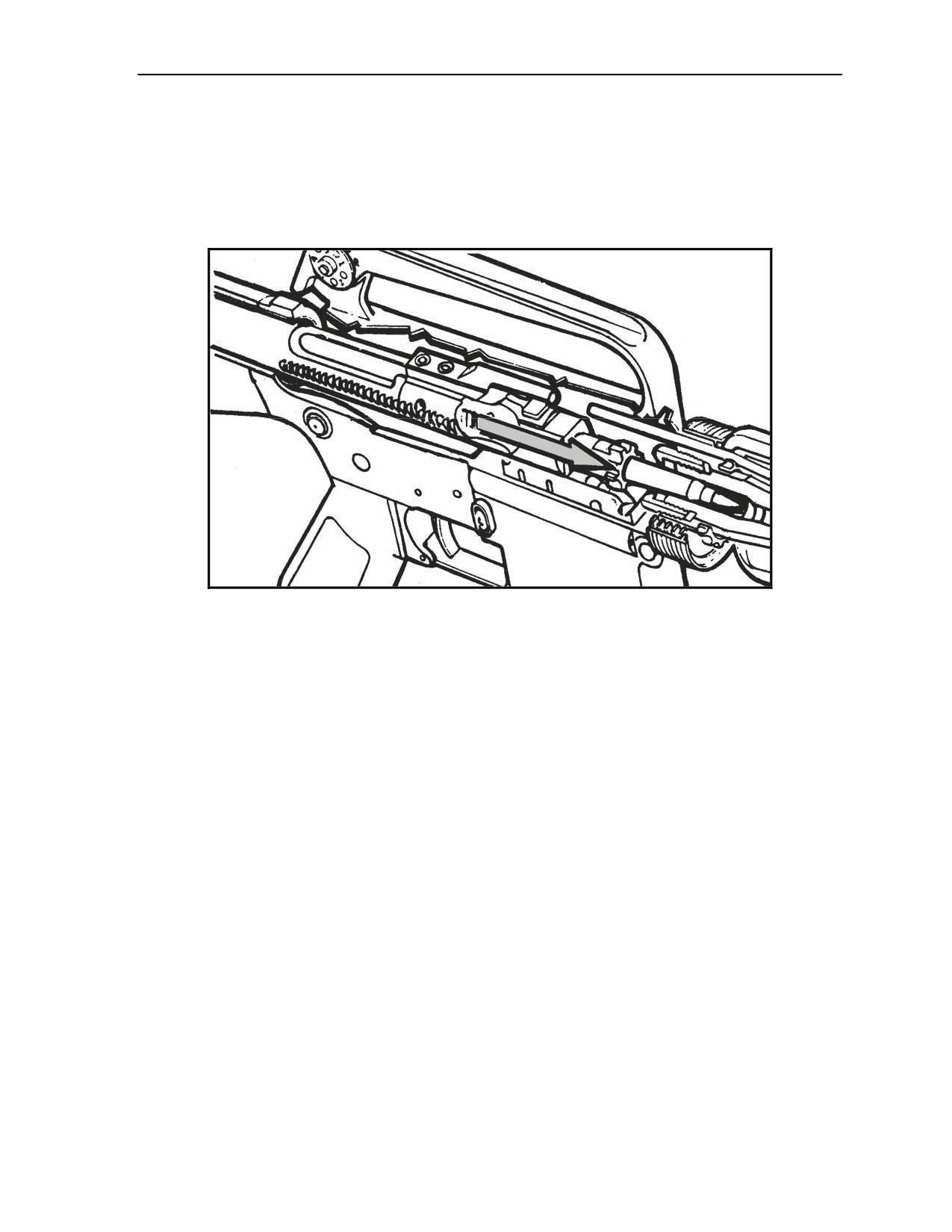
4-5. During chambering, the following actions occur. This process is shown in Figure 4-3.
(1) As the bolt carrier group continues to move forward, the face of the bolt thrusts the new round
into the chamber.
(2) At the same time, the extractor claw grips the rim of the cartridge and the ejector is compressed.
Figure 4-3. Chambering.
12 August 2008
FM 3-22.9
4-5
Chapter 4
LOCKING
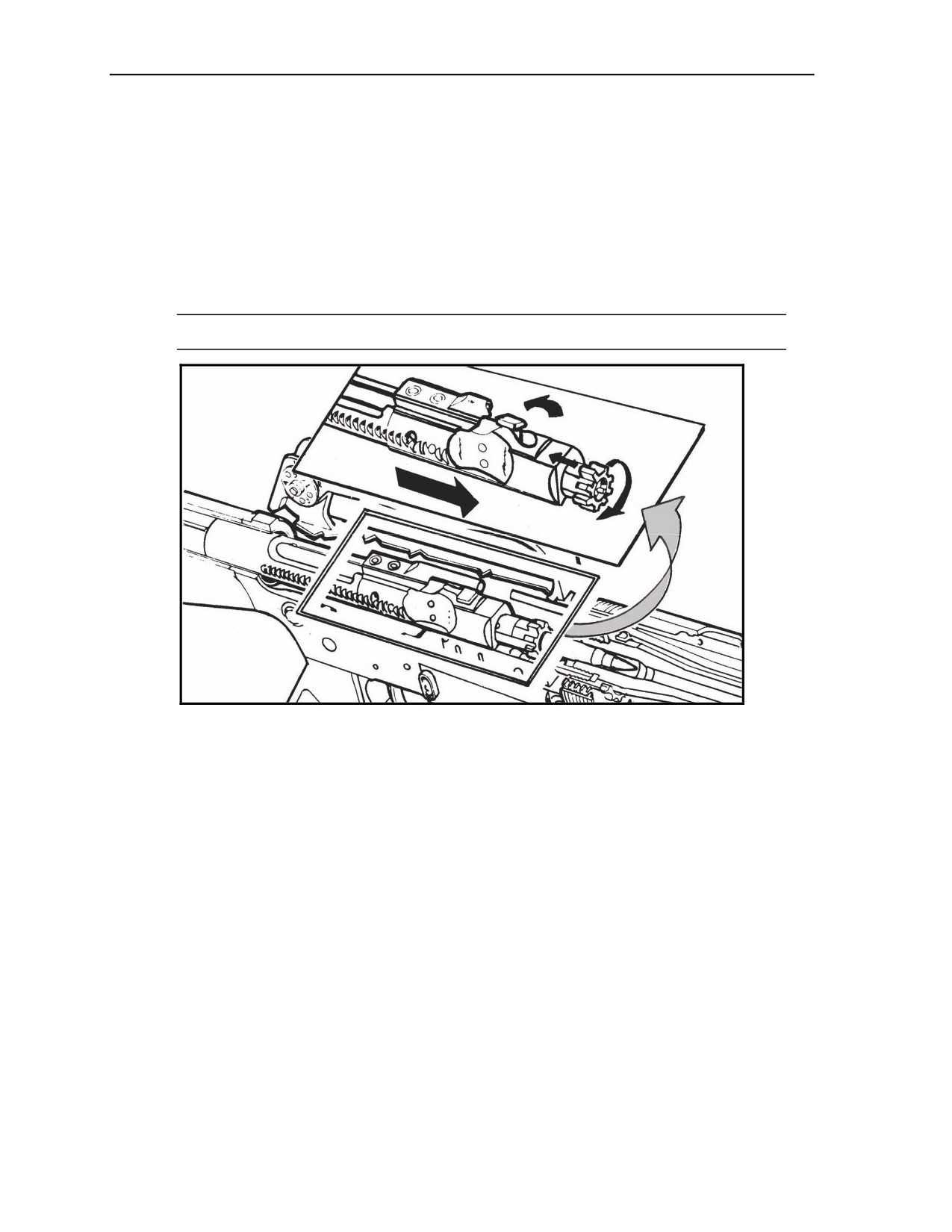
4-6. During locking, the following actions occur. This process is shown in Figure 4-4.
(1) As the bolt carrier group moves forward, the bolt cam pin riding in the guide channel in the
upper receiver keeps the bolt in its most forward position.
(2) Just before the bolt locking lugs make contact with the barrel extension, the bolt cam pin
emerges from the guide channel.
(3) The pressure exerted by the contact of the bolt locking lugs and barrel extension causes the bolt
cam pin to move along the cam track (located in the bolt carrier) in a counterclockwise direction,
rotating the bolt locking lugs in line behind the barrel extension locking lugs.
NOTE: The rifle is ready to fire.
Figure 4-4. Locking.
4-6
FM 3-22.9
12 August 2008
Preliminary Marksmanship Instruction
FIRING
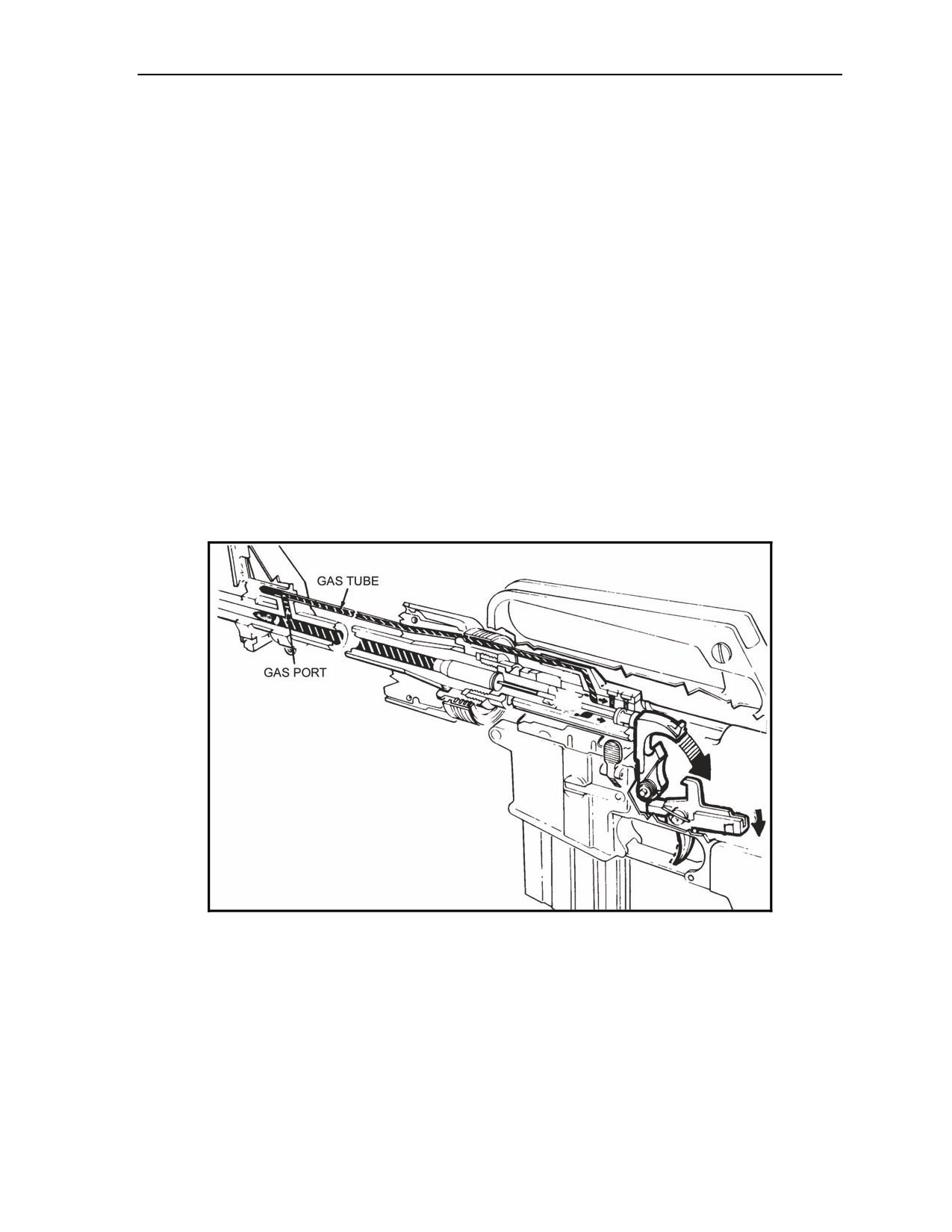
4-7. During firing, the following actions occur. This process is shown in Figure 4-5.
(1) With a round in the chamber, the hammer cocked, and the selector on SEMI, the firer squeezes
the trigger.
(2) The trigger rotates on the trigger pin, depressing the nose of the trigger and disengaging the
notch on the bottom of the hammer.
(3) The hammer spring drives the hammer forward.
(4) The hammer strikes the head of the firing pin, driving the firing pin through the bolt and into the
primer of the round.
(5) The primer ignites, causing the powder in the cartridge to ignite.
(6) The gas generated by the rapid burning of the powder forces the projectile from the cartridge and
propels it through the barrel.
(7) After the projectile has passed the gas port (located on the upper surface of the barrel under the
front sight, as shown in Figure 4-5) and before it leaves the barrel, gas enters the gas port and
moves into the gas tube.
(8) The gas tube directs the gas into the bolt carrier. It passes down through the key and into a space
between the rear of the carrier’s bolt cavity and the rear of the bolt itself.
(9) Then, the gas expands.
(10) The bolt is locked into the barrel extension, unable to move forward; the carrier is forced to the
rear by the expanding gas.
Figure 4-5. Firing.
12 August 2008
FM 3-22.9
4-7
Chapter 4
UNLOCKING
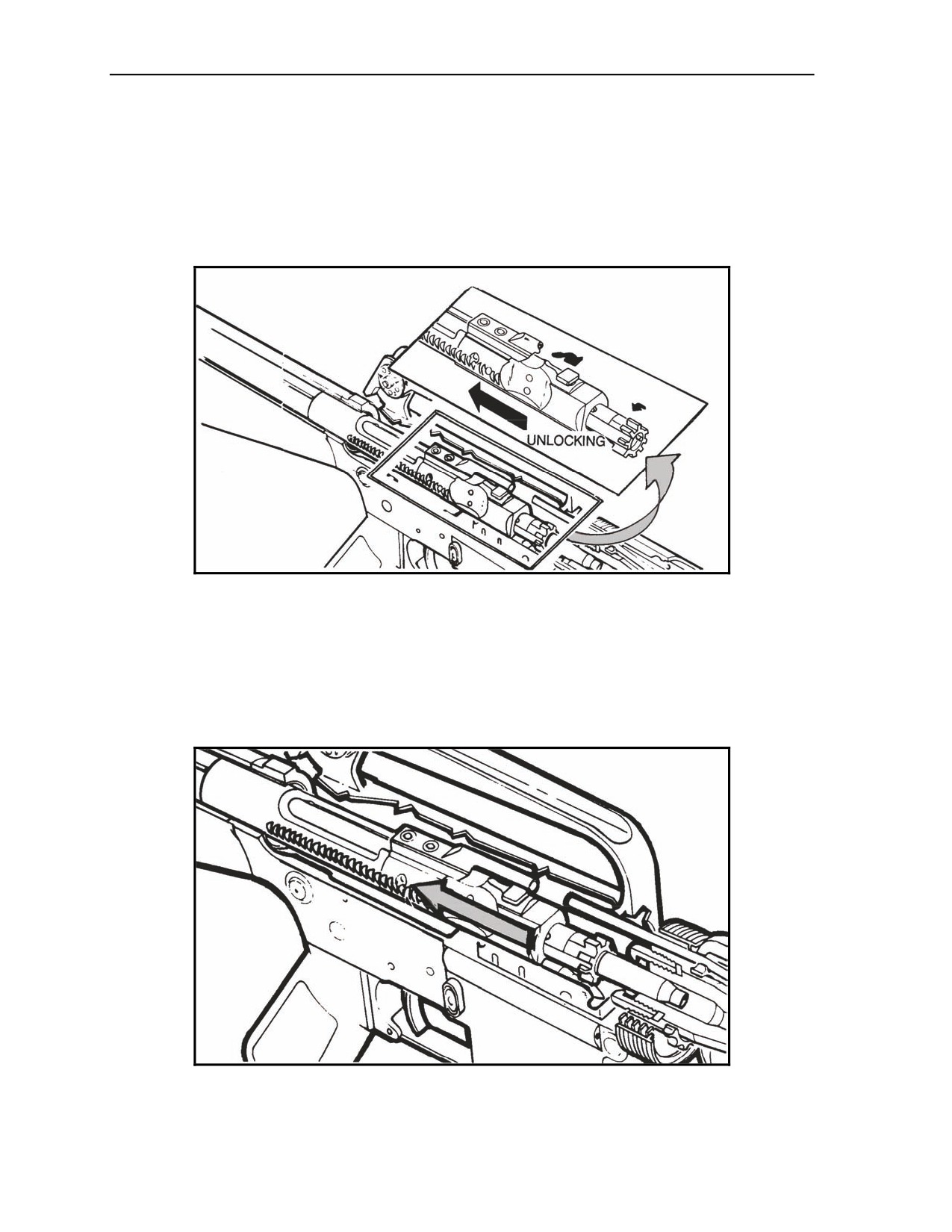
4-8. During unlocking, the following actions occur. This process is shown in Figure 4-6.
(1) As the bolt carrier moves to the rear, the bolt cam pin follows the path of the cam track (located
in the bolt carrier).
(2) The cam pin and bolt assembly rotate simultaneously until the locking lugs of the bolt are no
longer in line behind the locking lugs of the barrel extension.
Figure 4-6. Unlocking.
EXTRACTING
4-9. During extracting, the following actions occur. This process is shown in Figure 4-7.
(1) The bolt carrier group continues to move to the rear.
(2) The extractor (which is attached to the bolt) grips the rim of the cartridge case, holds it firmly
against the face of the bolt, and withdraws the cartridge case from the chamber.
Figure 4-7. Extracting.
4-8
FM 3-22.9
12 August 2008
Preliminary Marksmanship Instruction
EJECTING
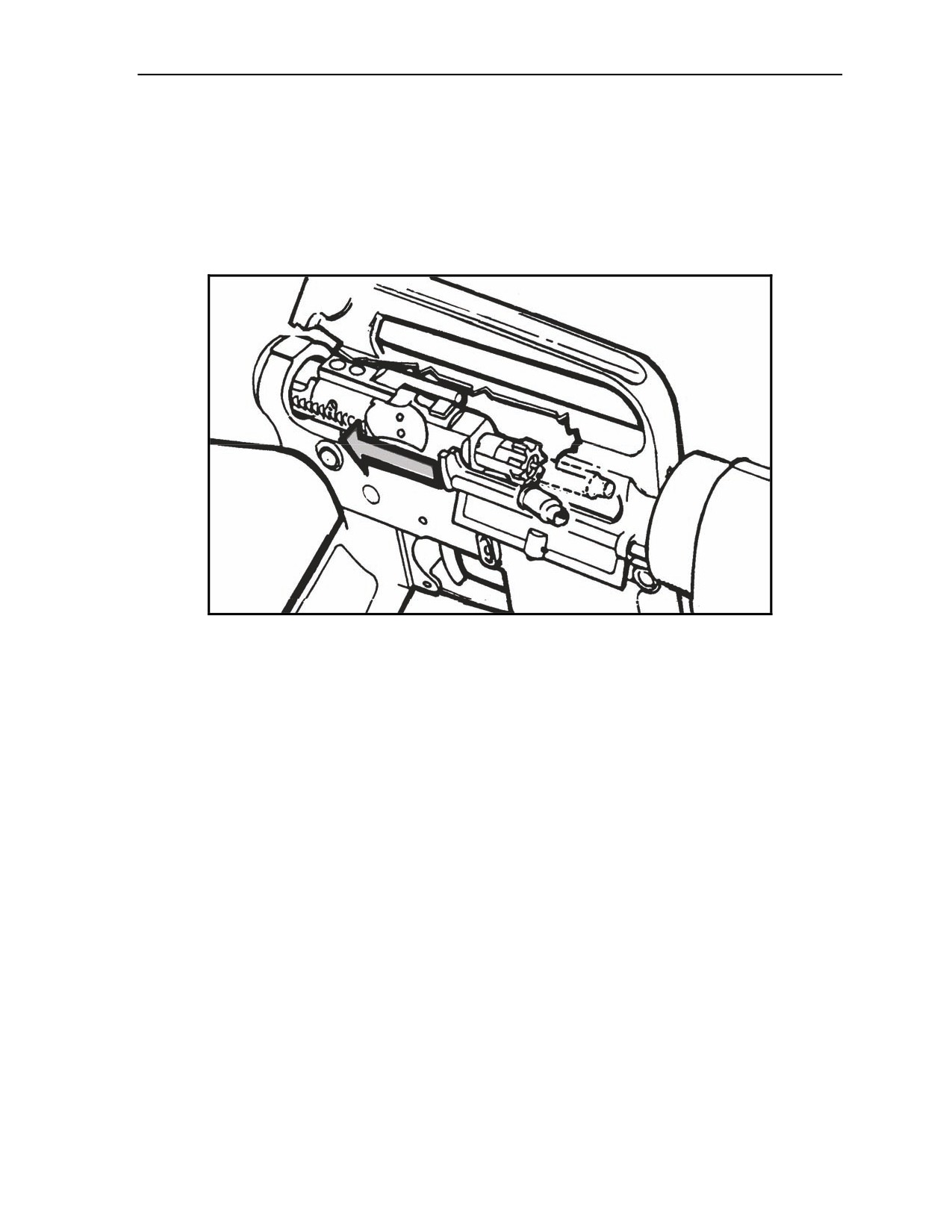
4-10. During ejecting, the following actions occur. This process is shown in Figure 4-8.
(1) With the base of a cartridge case firmly against the face of the bolt, the ejector and ejector spring
are compressed into the bolt body.
(2) As the rearward movement of the bolt carrier group allows the nose of the cartridge case to clear
the front of the ejection port, the cartridge is pushed out by the action of the ejector and ejector
spring.
Figure 4-8. Ejecting.
12 August 2008
FM 3-22.9
4-9
Chapter 4
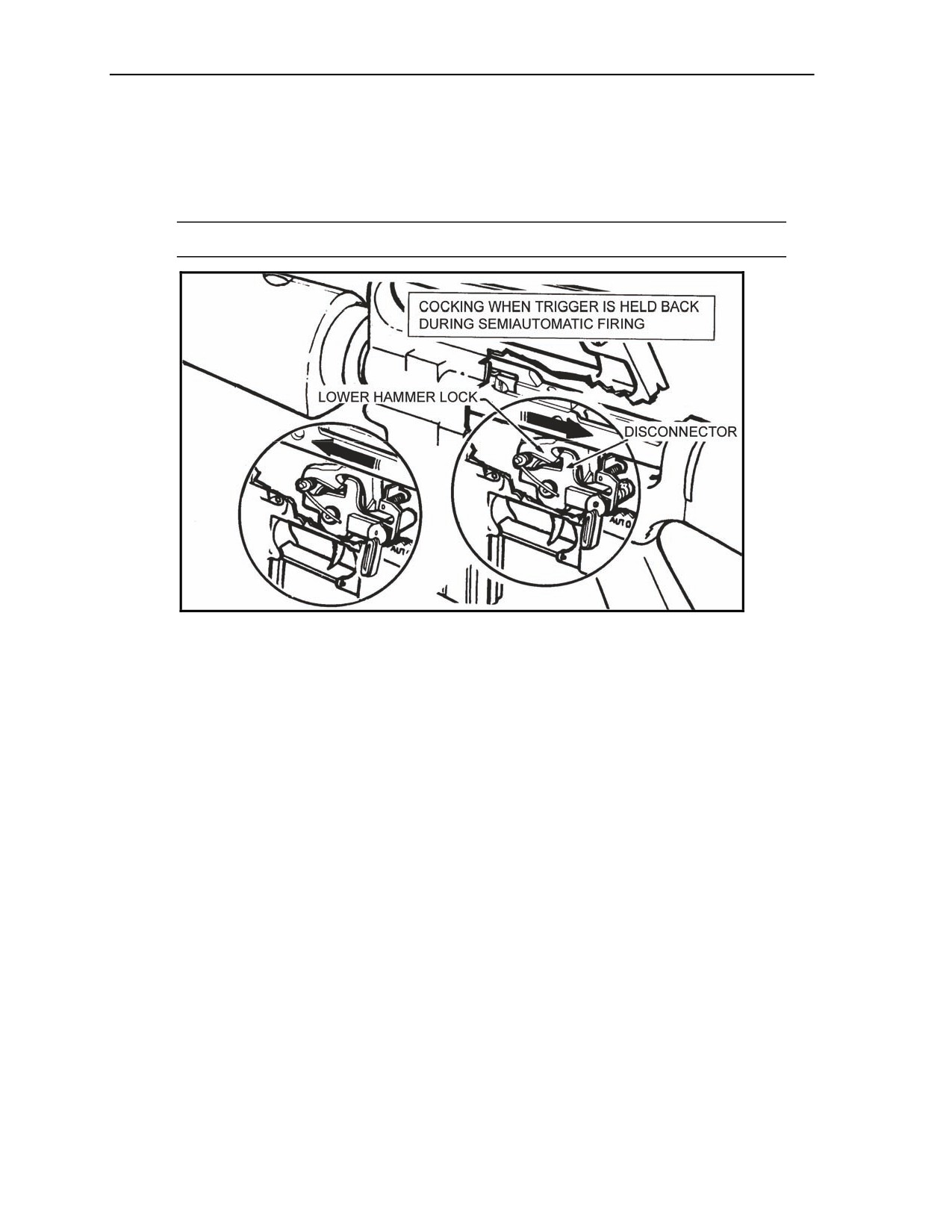
COCKING
4-11. During cocking, the following actions occur. This process is shown in Figure 4-9.
(1) The rearward movement of the bolt carrier overrides the hammer.
(2) The hammer is forced down into the receiver, and the hammer spring is compressed.
NOTE: This action cocks the hammer in the firing position.
Figure 4-9. Cocking.
4-10
FM 3-22.9
12 August 2008
Preliminary Marksmanship Instruction
MODES OF FIRE
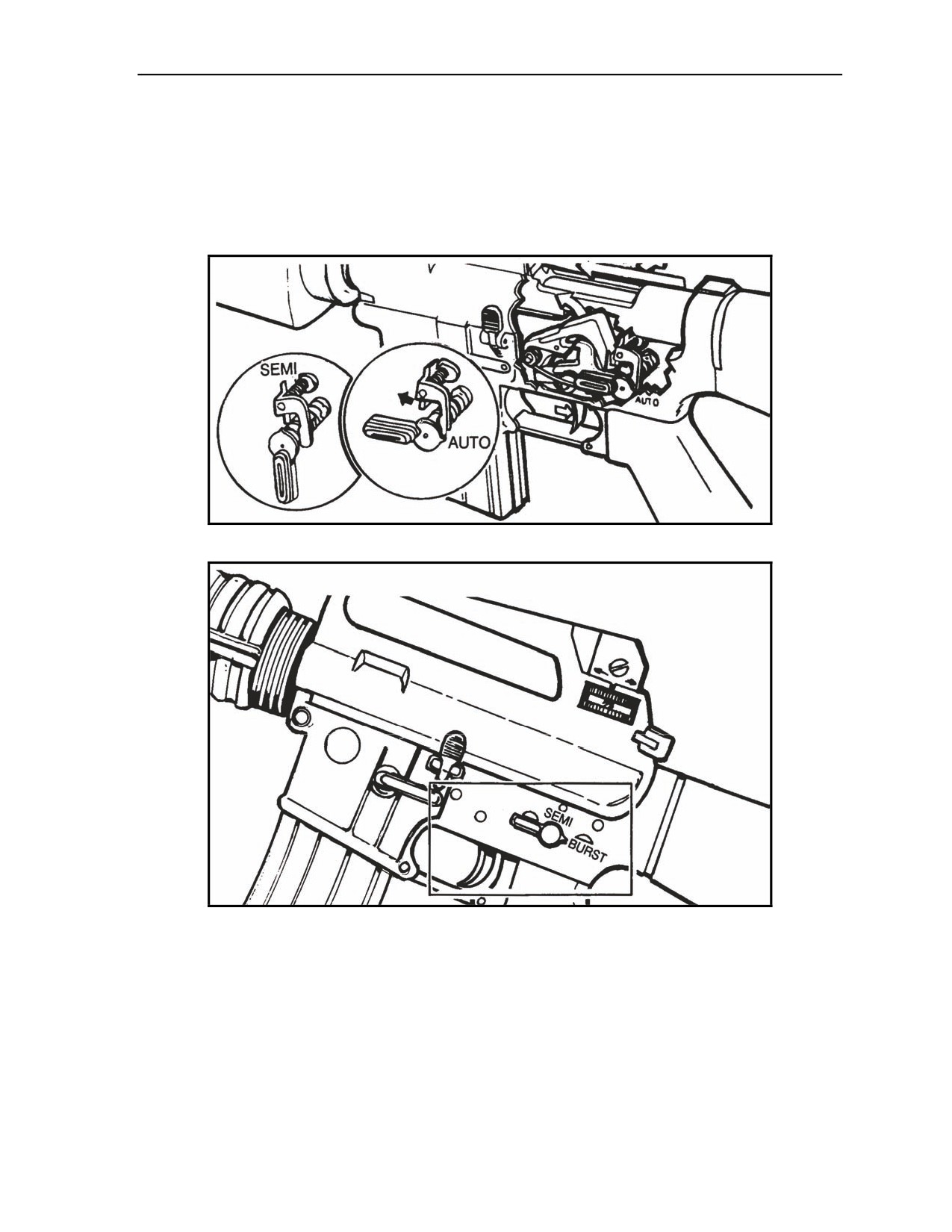
4-12. Weapons may fire using the three modes of fire:
z
Semiautomatic (Figure 4-10).
z
Automatic (Figure 4-10).
z
Burst (Figure 4-11).
Figure 4-10. Semiautomatic and automatic fire mode selector positions.
Figure 4-11. Burst fire mode selector position.
SEMIAUTOMATIC MODE OF FIRE
4-13. Weapons that function in the semiautomatic mode of fire are—
z
M16A1/A2/A3/A4 rifles.
z
M4/M4A1carbines.
4-14. Before a Soldier fires a weapon using the semiautomatic mode of fire, a disconnector (mechanism
installed so the firer can fire single rounds) is attached to the trigger and rotated forward by the action of
the disconnector spring. When the recoil of the bolt carrier cocks the hammer—
12 August 2008
FM 3-22.9
4-11
Chapter 4
(1) The disconnector engages the lower hook of the hammer and holds it until the trigger is
released.
(2) The disconnector rotates to the rear and down, disengaging the hammer and allowing it to rotate
forward until caught by the nose of the trigger (this prevents the hammer from following the bolt
carrier forward and causing multiple firings).
(3) The trigger must be squeezed again before the next round will fire.
AUTOMATIC MODE OF FIRE
4-15. Weapons that function in the automatic mode of fire are—
z
M16A1/A3 rifles.
z
M4A1 carbines.
4-16. When the selector lever is in the AUTO position, the rifle continues to fire as long as the trigger is
held back and ammunition is in the magazine. The functioning of certain parts of the rifle changes when
firing automatically. Once the trigger is squeezed and the round is fired—
(1) The bolt carrier group moves to the rear, and the hammer is cocked.
(2) The center cam of the selector depresses the rear of the disconnector and prevents the nose of the
disconnector from engaging the lower hammer hook.
(3) The bottom part of the automatic sear catches the upper hammer hook and holds it until the bolt
carrier group moves forward.
(4) The bottom part strikes the top of the sear and releases the hammer, causing the rifle to fire
automatically.
(5) If the trigger is released, the hammer moves forward and is caught by the nose of the trigger.
NOTE: This ends the automatic cycle of fire until the trigger is squeezed again.
BURST MODE OF FIRE
4-17. Weapons that function in the burst mode of fire are—
z
M16A2/A4 rifles.
z
M4 carbines.
4-18. When the selector lever is in the BURST position, the rifle fires a three-round burst if the trigger is
held to the rear during the complete cycle. The weapon continues to fire three-round bursts with each
separate trigger pull as long as ammunition is in the magazine.
NOTE: Releasing the trigger or exhausting ammunition at any point in the three-round cycle
interrupts fire, producing one or two shots. Reapplying the trigger only completes the interrupted
cycle; it does not begin a new one. This is not a malfunction.
4-19. The M16A2/4 and M4 disconnectors have a three-cam mechanism that continuously rotates with
each firing cycle. Based on the position of the disconnector cam, the first trigger pull (after initial selection
of the BURST position) can produce one, two, or three firing cycles before the trigger must be pulled again.
The burst cam rotates until it reaches the stop notch.
PEER COACHING
4-20. Peer coaching involves using two Soldiers of equal firing proficiency and experience to assist each
other during marksmanship training.
ADVANTAGES AND DISADVANTAGES
4-21. Some problems exist with peer coaching. If the new Soldier does not have adequate guidance, a
“blind leading the blind” situation may result, leading to negative training and safety violations. However,
4-12
FM 3-22.9
12 August 2008
Preliminary Marksmanship Instruction
when adequate instruction is provided, peer coaching can be helpful even in the IET environment. Since all
Soldiers in units have completed BRM, peer coaching within units should yield better results.
BENEFITS
4-22. The pairing of Soldiers can enhance learning for both participants. The coach learns what to look for
as he provides guidance to the firer, and the firer has a chance to ask simple questions and to discuss areas
that are not understood. Pairing Soldiers who have demonstrated good firing proficiency with those who
have firing problems can improve the performance of problem firers.
DUTIES
4-23. The peer coach—
z
Constantly checks factors that the firer is unable to observe for himself.
z
Prevents the firer from repeating errors.
z
Assists the firer in applying marksmanship fundamentals during firing.
z
Assists the firer in obtaining a good position and in adjusting sandbags.
z
Adds to range safety procedures by helping safety personnel with preliminary rifle checks.
z
Watches the firer—not the target—to ensure that the firer maintains proper position, breath
control, trigger pressure, and trigger squeeze.
NOTE: There are times when the peer coach may be required to observe the target area and not
the firer for example, when field fire targets are being engaged and the firer cannot see where he
is hitting or missing targets).
CHECKLIST FOR THE COACH
4-24. Coaches follow these procedures to determine and eliminate rifle and firer deficiencies:
z
The coach checks to see that the—
Rifle is cleared, and defective parts have been replaced.
Ammunition is clean, and the magazine is properly placed in the pouch.
Sights are blackened and set correctly for long- or short-range firing.
z
The coach observes the firer to see if he—
Uses the correct position and properly applies the steady position elements.
Properly loads the rifle.
Obtains the correct sight alignment (with the aid of an M16 sighting device).
Holds his breath correctly (by watching his back).
Applies proper trigger squeeze (determines whether he flinches or jerks by watching his
head, shoulders, trigger finger, and firing hand and arm).
Is tense and nervous. If the firer is nervous, the coach has the firer breathe deeply several
times to relax.
z
Supervisory personnel and peer coaches correct errors as they are detected. If many common
errors are observed, it is appropriate to call the group together for discussion, demonstration of
proper procedures, and feedback.
POSITION OF THE COACH
4-25. During an exercise, the coach should be positioned where he can best observe the firer as he assumes
position. Then, he moves to various points around the firer (sides and rear) to check the correctness of the
firer’s position. The coach requires the firer to make adjustments until the firer obtains a correct position.
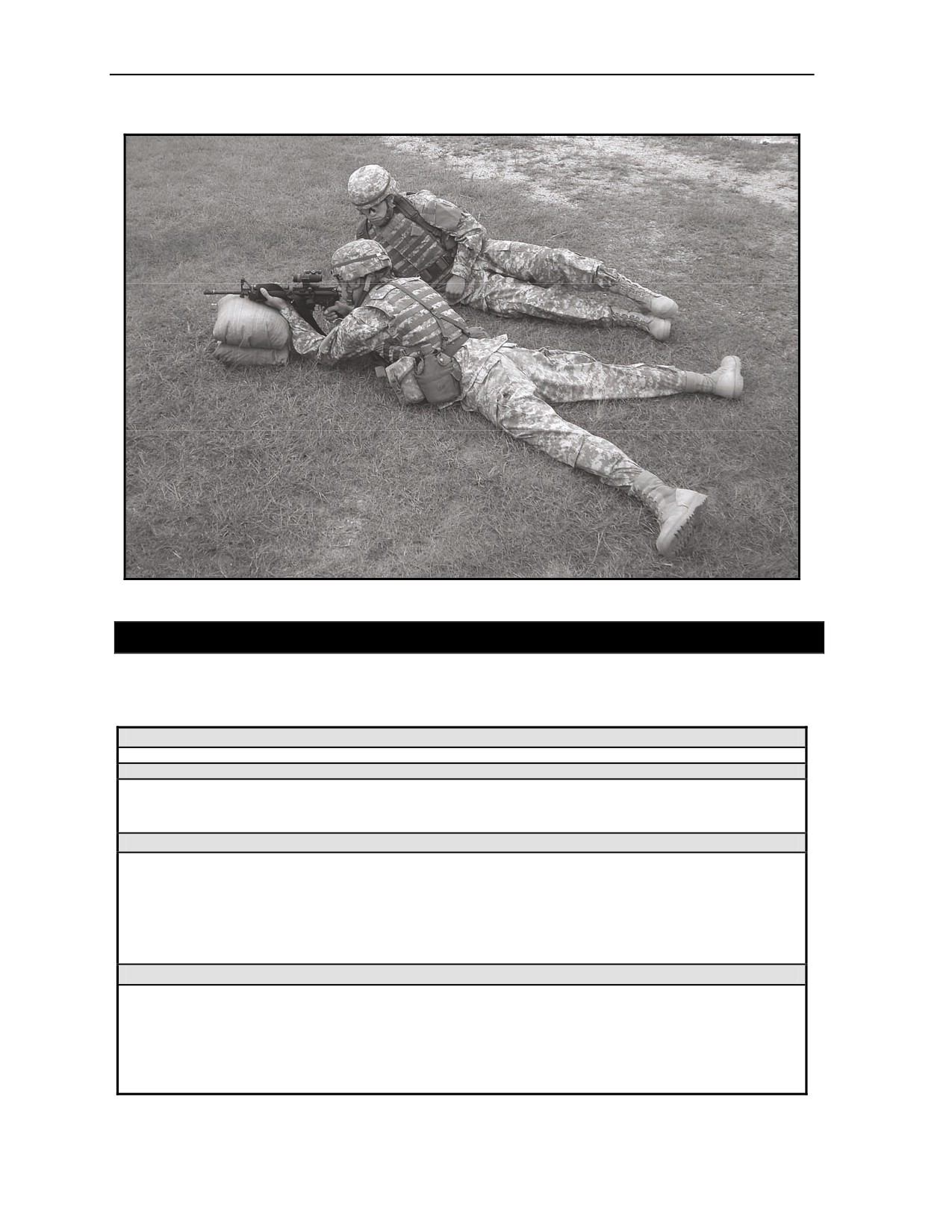
4-26. When the coach is satisfied with the firing position, he assumes a coaching position alongside the
firer. The coach usually assumes a position like that of the firer on the firing side of the firer (Figure 4-12).
12 August 2008
FM 3-22.9
4-13
Chapter 4
Figure 4-12. Prone position of coach (right-handed firer).
SECTION II. MARKSMANSHIP FUNDAMENTALS I
This training program (Table 4-2) reinforces BRM and trains the four fundamentals to standard through dry-
firing and simulation circuit training. It also teaches and reinforces range and safety procedures.
Table 4-2. Marksmanship Fundamentals I training program.
MARKSMANSHIP FUNDAMENTALS I
Period 2 (8 hours)
Instructional Intent
•
Reinforce BRM I, and train the four fundamentals to standard with hands-on training, simulation, and dry-firing
during circuit training with an M16-/M4-series weapon.
•
Teach and reinforce range and safety procedures.
Observables
Ensure that—
•
All equipment (helmet, IBA) is fitted properly to maximize training IAW the local SOP.
•
Live-fire range procedures are replicated and enforced IAW the local SOP.
•
The four fundamentals are being integrated into all exercises IAW this manual.
•
All dry-firing is well-aimed using 25-meter zeroing targets, EST, and LMTS.
•
Peer coaching is being emphasized IAW this manual.
Tasks
•
The four fundamentals (IAW with this manual).
•
Dominant eye training (IAW with this manual).
•
Basic firing positions (IAW with this manual).
•
Range and safety procedures (IAW with the local SOP).
•
Demonstrate the integrated act of shooting during dry-fire exercises utilizing simulators and training devices
(IAW this manual).
4-14
FM 3-22.9
12 August 2008
Preliminary Marksmanship Instruction
NOTES:
1. Simulators and training devices are listed in Appendix A of this manual.
2. Soldiers who do not meet the standard will receive remedial training before
continuing with subsequent instruction.
INTERCEPTOR BODY ARMOR
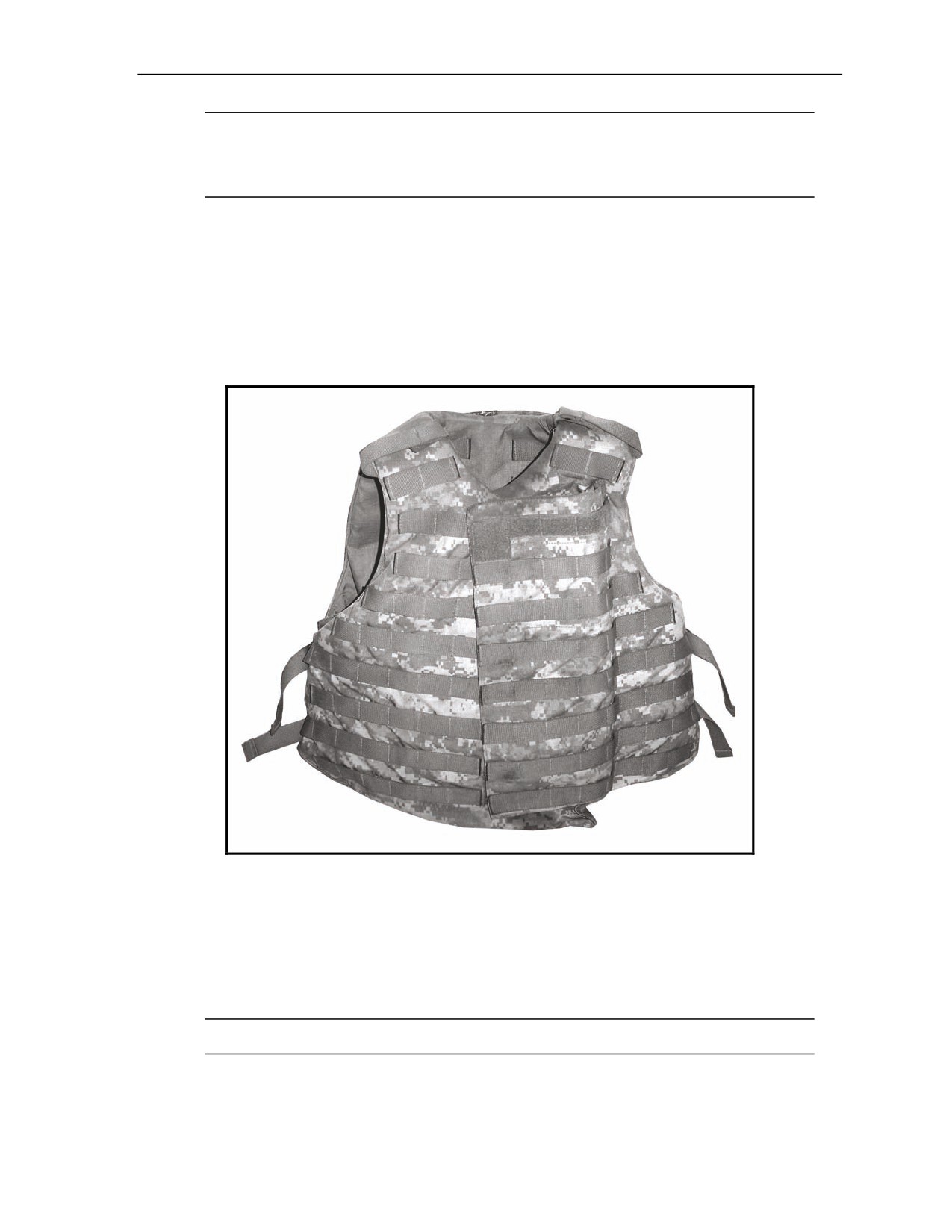
4-27. BRM strategy includes the wearing of interceptor body armor (IBA, shown in Figure 4-13), if it is
available—minus the throat, collar, and groin attachments—during all BRM periods and concurrent
training. Whether or not IBA is worn, marksmanship fundamentals remain the same.
4-28. Prior to BRM training, use an IBA immersion approach so the Soldier can adapt to weight and
movement restrictions. For an easier weight transition, incrementally introduce the outer tactical vest
(OTV) and front and back small arms protective insert (SAPI) plates.
Figure 4-13. Interceptor body armor.
PROPER WEAR AND FIT
4-29. When using IBA, adhere to the following guidelines:
z
Have adequate IBA quantities on hand for all Soldiers.
z
Properly size IBA to the Soldier by conducting deliberate fit procedures to reduce or eliminate
fit and size problems.
NOTE: Improper wear and fit of IBA impedes a Soldier’s marksmanship ability.
z
Ensure that the SAPI plate size corresponds to the OTV.
z
Make sure that nothing else is in the OTV/SAPI compartment.
12 August 2008
FM 3-22.9
4-15
Chapter 4
WEAR OF HELMETS WITH INTERCEPTOR BODY ARMOR
4-30. When using helmets with IBA, adhere to the following guidelines:
z
When in the prone position, the IBA's back plate tends to shove the personnel armor system for
ground troops (PASGT) helmet over Soldiers’ eyes. To minimize the PASGT helmet positioning
problem, make sure that the helmet is properly sized and fitted. Female shooters with long hair
will find that wearing their hair in a bun adds material between the IBA and helmet, further
forcing the helmet down over their eyes. Encourage female Soldiers to wear a short (chin length)
haircut or cornrow hairstyle. If the female Soldier chooses not to wear short hair, allow her to
wear her hair down when firing. Tightening the suspension harness and sweat band (raising the
helmet higher on the head) can lessen interference with the IBA, hair, and helmet.
z
The Army combat helmet (ACH) is lighter than the PASGT helmet, has better weight
distribution, and contains less material that can impede a Soldier’s firing vision when in the
prone position. The ACH does not interfere with the IBA or block a Soldier’s vision while in the
prone position.
ADJUSTMENTS TO FIRING POSITIONS
4-31. When using IBA, adhere to the following guidelines:
z
To increase comfort and stability while wearing IBA in the prone position, scoop sand or dirt
underneath the chest while preparing to fire.
z
To alleviate the pain and pressure on elbows and knees that the added weight of IBA causes, use
elbow and knee pads. If used in the kneeling position, do not rest the elbow pad on the knee pad;
hard plastic on hard plastic is not conducive to a steady position. To help with stability while
firing in the kneeling position, squeeze the rifle buttstock between the SAPI plate and bicep.
Loosen the firing-side straps and tighten the nonfiring-side straps to shift the SAPI plate away
from the firing side.
z
Instead of using load-bearing equipment (LBE), attach canteens, ammunition pouches, or first
aid pouches directly to the IBA to minimize interference with LBE shoulder straps, IBA, and
helmet.
z
Reserve IBA firing with throat, collar, or groin protectors for ARM.
z
To position themselves more comfortably and be able to reach the handguards, Soldiers of
shorter stature may have to increase their body-line-to-rifle axis angle to more of an “L” shape.
z
Soldiers should be in a comfortable firing position to leverage the natural point of aim. The more
the target and rifle are naturally in line (as when in a relaxed position), the less movement is
needed to acquire a proper sight picture.
FOUR FNDAMENTALS
4-32. Before the Soldier approaches the firing line, he must understand and apply the four fundamentals:
z
Steady position.
z
Aiming.
z
Breath control.
z
Trigger squeeze.
4-33. Soldiers apply these four fundamentals rapidly and consistently to perform the integrated act of
firing. These fundamentals should be practiced while the Soldier is wearing all of his equipment, including
his helmet and IBA (if available).
STEADY POSITION
4-34. When the Soldier approaches the firing line, he assumes a comfortable, steady firing position (Figure
4-14). The firer is the best judge of the quality of his position. If he can hold the front sightpost steady
4-16
FM 3-22.9
12 August 2008
Preliminary Marksmanship Instruction
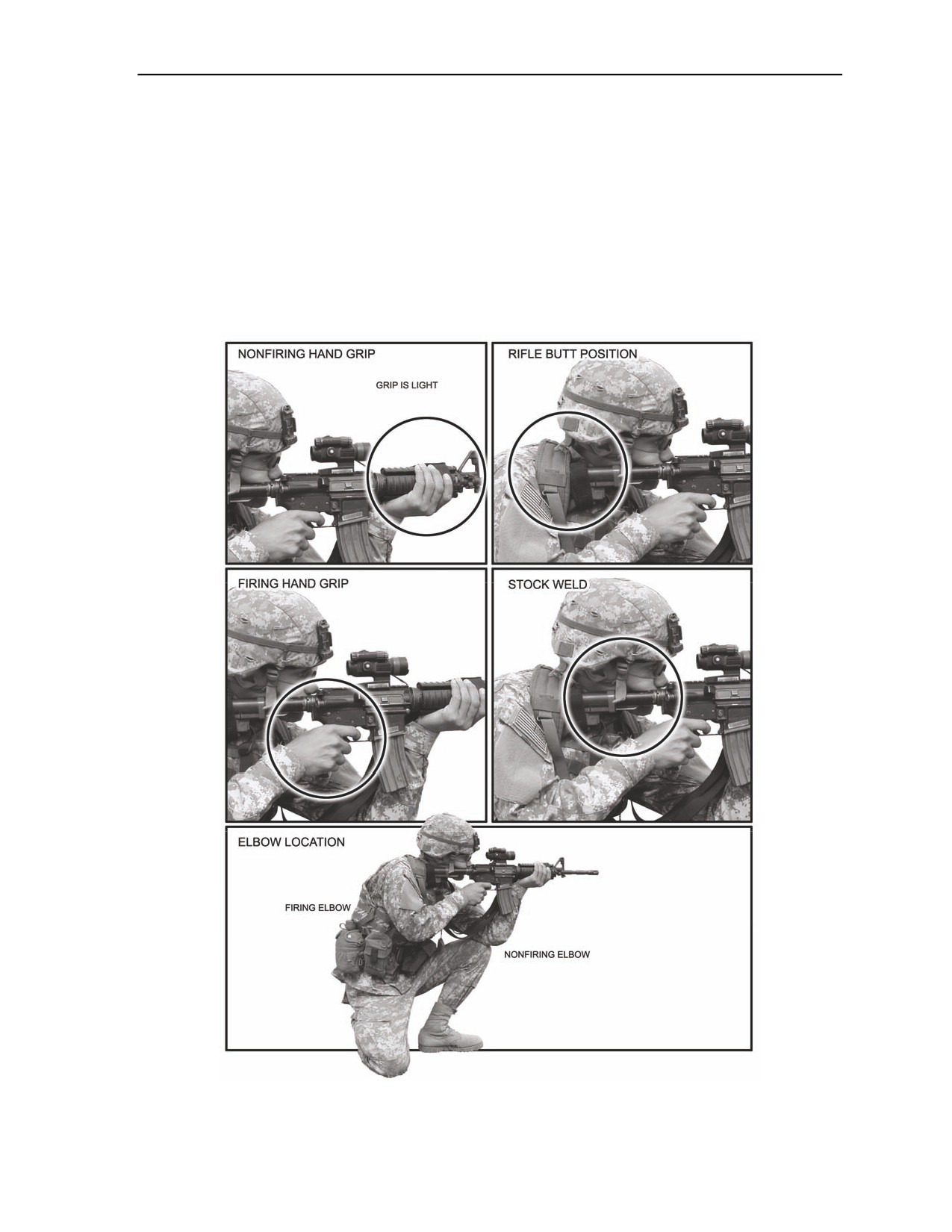
through the fall of the hammer, he has a good position. Steady position incorporates the following
elements:
z
Nonfiring hand grip.
z
Rifle's buttstock position.
z
Firing hand grip.
z
Firing elbow placement.
z
Nonfiring-side elbow placement.
z
Cheek-to-stock weld.
z
Support and muscle relaxation.
z
Natural point of aim.
Figure 4-14. Steady position.
12 August 2008
FM 3-22.9
4-17
Chapter 4
Nonfiring Hand Grip
4-35. The weapon's handguard rests lightly on the heel of the nonfiring hand, in the "V" formed by the
thumb and fingers.
Rifle's Buttstock Position
4-36. Place the weapon's buttstock into the pocket of the firing shoulder. When wearing IBA, place the
weapon's buttstock where the pocket should be; this reduces the effect of recoil and ensures a steady
position.
Firing Hand Grip
4-37. The firing hand grasps the pistol grip so that it fits in the "V" formed by the thumb and forefinger.
The forefinger is placed on the trigger so that the lay of the weapon is not disturbed when the trigger is
squeezed. The remaining three fingers exert a slight rearward pressure to ensure that the buttstock remains
in the pocket of the shoulder.
Firing Elbow Placement
4-38. The firing elbow is important in providing balance. Its exact location depends on the firing or
fighting position used. Placement of the firing elbow should allow the firer’s shoulders to remain level.
Nonfiring-Side Elbow Placement
4-39. The nonfiring-side elbow is positioned firmly under the weapon to allow a comfortable and stable
position. When the Soldier engages a wide sector of fire, moving targets, and targets at various elevations,
his nonfiring-side elbow should remain free from support.
Cheek-to-Stock Weld
4-40. The cheek-to-stock weld should provide a natural line of sight through the center of the rear sight
aperture to the front sightpost and onto the target. The firer’s neck should be relaxed, allowing his cheek to
fall naturally onto the stock.
NOTE: Proper eye relief is obtained when a Soldier establishes a good cheek-to-stock weld. A
small change in eye relief normally occurs each time that the firer assumes a different firing
position.
4-41. Through dry-fire training, the Soldier practices this position until he assumes the same cheek-to-
stock weld each time he assumes a given position, which provides consistency in aiming. To learn to
maintain the same cheek-to-stock weld each time the weapon is aimed, the Soldier should begin by trying
to touch the charging handle with his nose when assuming a firing position. The Soldier should be mindful
of how the nose touches the charging handle and should be consistent when doing so. This position should
be critiqued and reinforced during dry-fire training.
Support and Muscle Relaxation
4-42. When artificial support (for example, sandbags, logs, or stumps) is available, it should be used to
steady the position and support the weapon. If support is used properly, the Soldier should be able to relax
most of his muscles. If artificial support is not available, the bones—not the muscles—in the firer’s upper
body must support the weapon. Using muscles to support the rifle can cause muscle fatigue, which in turn,
causes the weapon to move.
4-18
FM 3-22.9
12 August 2008
Preliminary Marksmanship Instruction
Natural Point of Aim
4-43. When the Soldier first assumes his firing position, he orients his weapon in the general direction of
his target. Then, he adjusts his body to align the weapon and sights with the desired point of aim. When
using proper support and consistent cheek-to-stock weld, the Soldier should have his weapon and sights
naturally aligned on the target.
4-44. If correct body-rifle-target alignment cannot be achieved, the front sightpost must be held on the
target using muscular support and effort. As the weapon fires, muscles tend to relax, causing the front sight
to move away from the target, toward the natural point of aim. Adjusting this natural point of aim to the
target eliminates this movement. When multiple target exposures are expected or a sector of fire must be
covered, the Soldier adjusts his natural point of aim to the center of the expected target exposure area or
sector.
AIMING
4-45. Having mastered the task of holding the rifle steady, the Soldier must align the rifle with the target in
exactly the same way for each firing. The firer is the final judge as to where his eye is focused. The
instructor or trainer emphasizes this point by having the firer focus on the target and then on the front
sightpost. He checks the position of the firing eye to ensure that it is in line with the rear sight aperture. The
elements of aiming training are as follows:
z
Sight alignment.
z
Focus of the eye.
z
Sight picture.
z
Front sightpost.
z
Aiming practice.
Sight Alignment
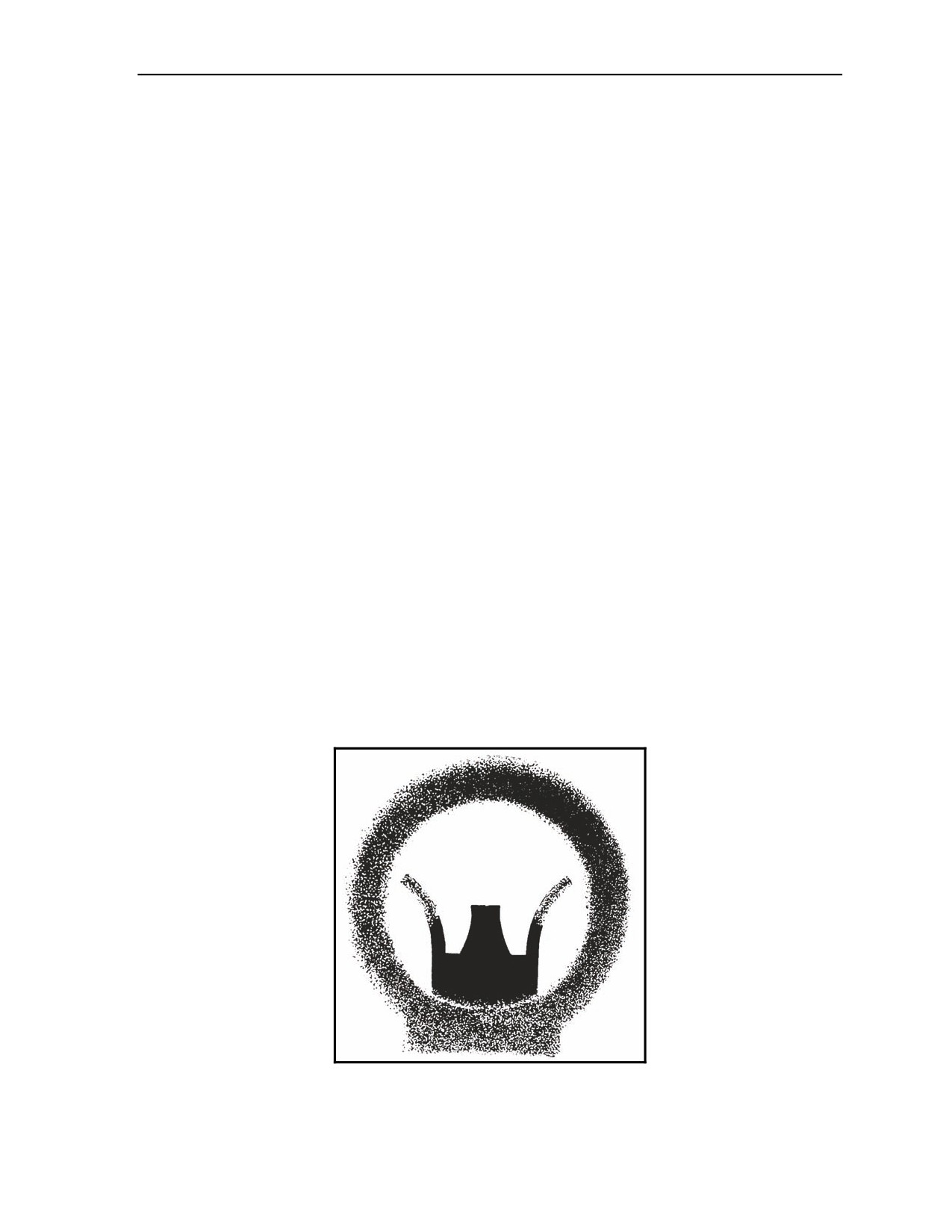
4-46. The weapon must be aligned with the target; to do so, Soldiers place the tip of the front sightpost in
the center of the rear sight aperture (Figure 4-15). Any alignment error between the front and rear sights
repeats itself for every ½ meter the bullet travels. For example, at the 25-meter line, any error in rifle
alignment is multiplied 50 times. If the bullet is misaligned by 1/10 of an inch, it causes a target 300 meters
away to be missed by 5 feet.
Figure 4-15. Correct sight alignment.
12 August 2008
FM 3-22.9
4-19
Chapter 4
Focus of the Eye
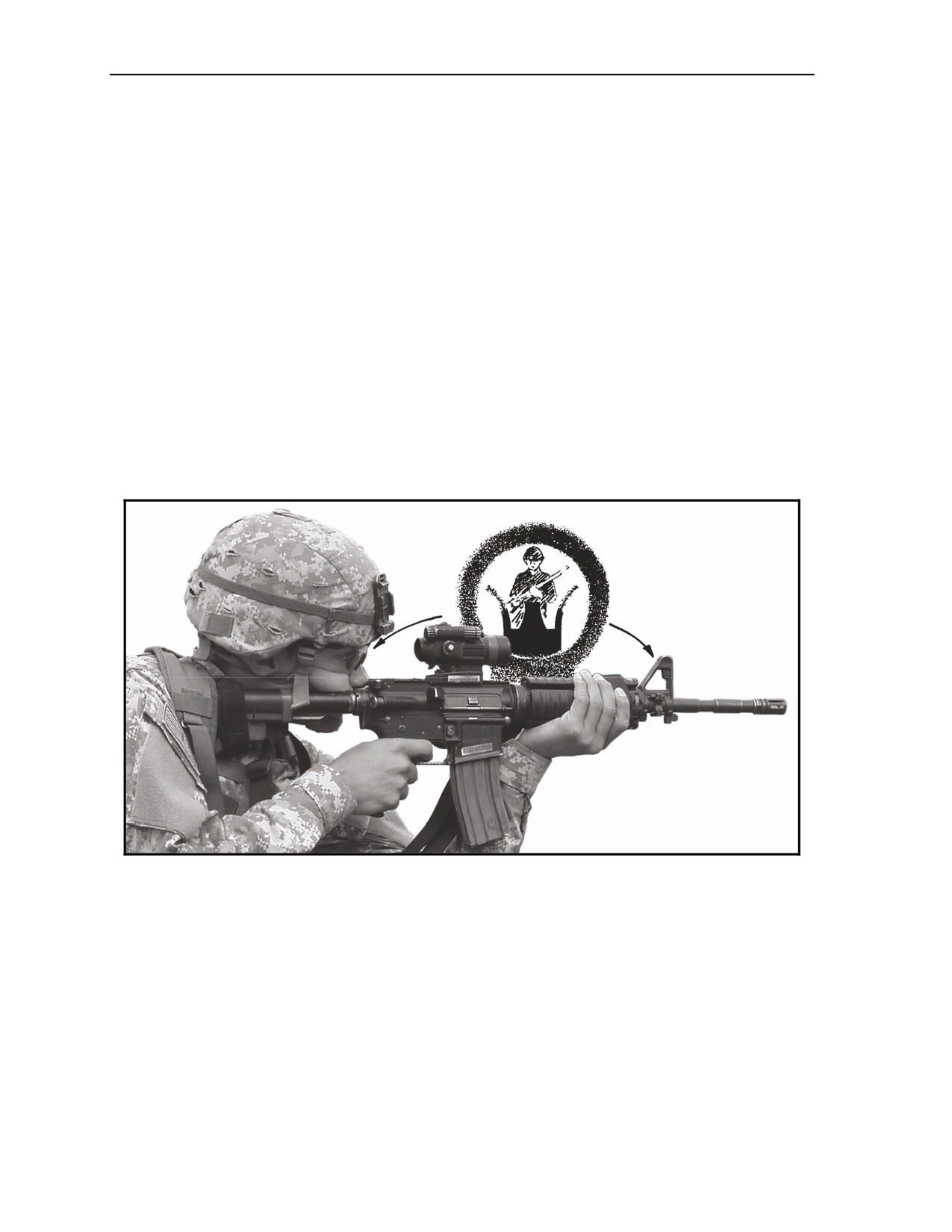
4-47. A proper firing position aligns the eye with the center of the rear sight aperture. When the eye is
focused on the front sightpost, the eye's natural ability to center objects in a circle and to seek the point of
greatest light (center of the aperture) aid in providing correct sight alignment. For the average Soldier firing
at combat-type targets, the eye's natural ability can accurately align the sights. Therefore, the firer can place
the tip of the front sightpost on the point of aim, but the eye must be focused on the tip of the front
sightpost. This causes the target to appear blurry, while the front sightpost is seen clearly. Two reasons for
focusing on the front sightpost are:
(1) Only a minor aiming error should occur, since the error reflects only as much as the Soldier fails
to determine the target's center. A greater aiming error can result if the front sightpost is blurry
due to focusing on the target or other objects.
(2) Focusing on the tip of the front sightpost aids the firer in maintaining proper sight alignment.
Sight Picture
4-48. Once the Soldier can correctly align his sights, he can obtain a correct sight picture. A correct sight
picture has the target, front sightpost, and rear sightpost aligned. The sight picture includes two basic
elements: sight alignment and placement of the point of aim. Placement of the point of aim varies,
depending on the engagement range. For example, Figure 4-16 shows a silhouette at 300 meters where the
point of aim is the center of mass and the sights are aligned for a correct sight picture.
Figure 4-16. Focus of the eye and correct sight picture.
4-20
FM 3-22.9
12 August 2008
Preliminary Marksmanship Instruction
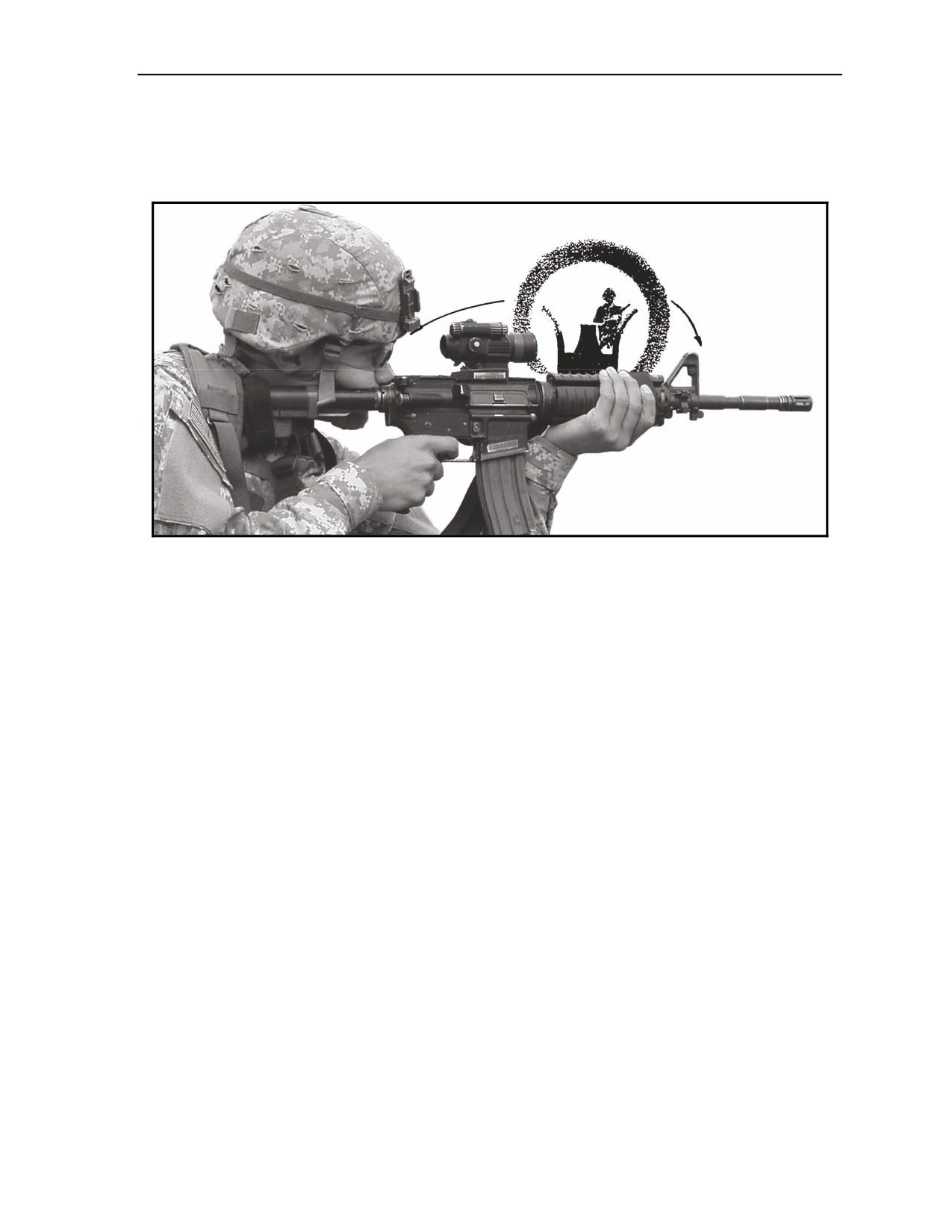
4-49. The side aiming technique can be used to obtain a correct sight picture (Figure 4-17). It involves
positioning the front sightpost to the side of the target in line with the vertical center of mass, keeping the
sights aligned. The front sightpost is moved horizontally until the target is directly centered on the front
sightpost.
Figure 4-17. Side aiming technique.
Front Sightpost
4-50. The front sightpost is vital to proper firing and should be replaced when damaged. The post should
be blackened; when it is shiny, the firer cannot focus precisely on the tip of the front sightpost.
Aiming Practice
4-51. Aiming practice is conducted before firing live rounds. During dry-firing, the Soldier should practice
sight alignment and placement of the point of aim. Training aids, such as the M15A1 aiming card, can be
used to do this.
BREATH CONTROL
4-52. While sighted on a target, the firer must be aware of the rifle’s movement as a result of breathing.
Two breath control techniques are practiced during dry-fire:
z
Breath control for engaging single targets.
z
Breath control for engaging short-exposure targets.
4-53. As the firer’s skills improve and as timed or multiple targets are presented, he must learn to control
his breath at any part of the breathing cycle. The coach/trainer ensures that the firer uses both breathing
techniques and understands them by instructing him to exaggerate his breathing.
12 August 2008
FM 3-22.9
4-21
Chapter 4
Breath Control for Engaging Single Targets
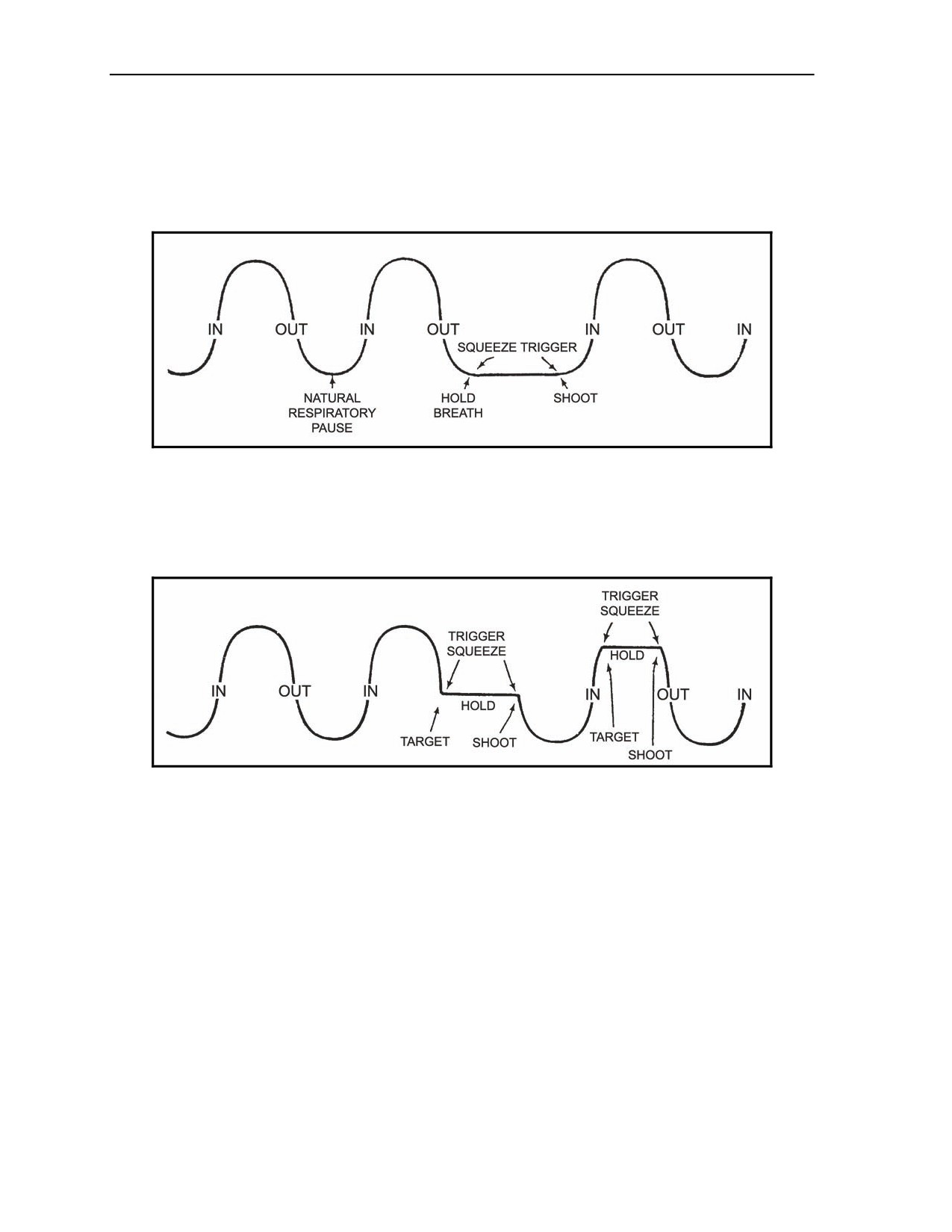
4-54. When zeroing or when time is available to fire a shot, Soldiers fire when there is a natural respiratory
pause, when most of the air has been exhaled from the lungs and before inhaling (Figure 4-18). The shot
must be fired before the Soldier feels any discomfort.
Figure 4-18. Breath control for engaging single targets.
Breath Control for Engaging Short-Exposure Targets
4-55. When employing rapid fire (engaging short-exposure targets), Soldiers stop their breath when they
are about to squeeze the trigger (Figure 4-19).
Figure 4-19. Breath control for engaging short-exposure targets.
TRIGGER SQUEEZE
4-56. A steady position reduces disturbance of the rifle during trigger squeeze. If the trigger is not properly
squeezed, the rifle will be misaligned with the target at the moment of firing. The elements of trigger
squeeze training are as follows:
z
Rifle movement.
z
Trigger finger.
z
Trigger squeeze time.
z
Coaching trigger squeeze.
z
Wobble area.
4-22
FM 3-22.9
12 August 2008
Preliminary Marksmanship Instruction
Rifle Movement
4-57. Trigger squeeze is important for two reasons:
z
Any sudden movement of the finger on the trigger can disturb the lay of the rifle and cause the
shot to miss the target.
z
The precise instant of firing should be a surprise to the Soldier. If a Soldier knows the exact
instant that the rifle will fire, the Soldier will naturally compensate for the weapon's noise and
recoil, causing him to miss the target. Soldiers usually tense their shoulders when expecting the
rifle to fire; it is difficult to detect since the Soldier does not realize that he is flinching.
Trigger Finger
4-58. The Soldier places his trigger finger (index finger on the firing hand) on the trigger between the first
joint and the tip of the finger—not the very end of the finger—and adjusts depending on his hand size and
grip. The trigger finger must squeeze the trigger to the rear so the hammer falls without disturbing the lay
of the rifle.
4-59. When a live round is fired, it is difficult to see the effect that the trigger pull had on the lay of the
rifle. It is important to experiment with many finger positions during dry-fire training to ensure that the
hammer is falling with little disturbance to the aiming process.
Trigger Squeeze Time
4-60. The proper trigger squeeze should start with slight pressure on the trigger during the initial aiming
process. The firer applies more pressure after the front sightpost is steady on the target and he is holding his
breath.
4-61. As the firer’s skills increase with practice, he needs less time spent on trigger squeeze. A novice firer
can take five seconds to perform an adequate trigger squeeze, but as skills improve, he can squeeze the
trigger in a second or less.
Coaching Trigger Squeeze
4-62. The coach/trainer—
z
Observes the trigger squeeze, emphasizes the correct procedure, and checks the firer’s applied
pressure.
z
Places his finger on the trigger and has the firer squeeze the trigger by applying pressure to his
finger.
z
Ensures that the firer squeezes straight to the rear on the trigger, avoiding a left or right twisting
movement.
z
Observes that the firer follows through and holds the trigger to the rear for approximately one
second after the round has been fired.
Wobble Area
4-63. Wobble area is the movement of the front sight around the point of aim when the rifle is in the
steadiest position.
4-64. The position must provide for the smallest possible wobble area.
z
From a supported position, there should be minimal wobble area and little reason to detect
movement. If movement of the rifle causes the front sight to leave the target, more practice is
needed.
z
From an unsupported position, the firer experiences a greater wobble area than from a supported
position. If the front sight strays from the target during the firing process, the firer should hold
constant pressure on the trigger and resume as soon as he corrects the sighting.
12 August 2008
FM 3-22.9
4-23
Chapter 4
NOTE: The firer should never try to quickly squeeze the trigger while the sight is on the target.
The best firing performance results when the trigger is squeezed continuously and the rifle is
fired without disturbing its lay.
DOMINANT EYE TRAINING
4-65. This exercise assists the coach and the firer in determining which eye the firer should use when
engaging targets. The firer’s dominant eye should be identified early in the training process to prevent
unnecessary problems, such as a blurred sight picture or the inability to acquire a tight shot group during
the grouping exercise. To perform dominant eye training—
(1) The trainer cuts a 1-inch circular hole in the center of an 8- by 10-inch piece of material (can be
anything from paper to plywood).
(2) The trainer positions himself approximately 5 feet in front of the Soldier. The trainer closes his
nondominant eye and holds his finger in front of and just below his dominant eye to provide the
Soldier with a point of aim.
(3) The Soldier holds the training aid with both hands at waist level and looks with both eyes open
at the trainer’s open eye. With both eyes focused on the trainer’s open eye and arms fully
extended, the Soldier raises the training aid between himself and the trainer while continuing to
look at the trainer’s eye through the hole in the training aid. The Soldier’s eye that the trainer
sees through the hole in the training aid is the Soldier’s dominant eye.
BASIC FIRING POSITIONS
4-66. Basic firing positions are taught during PMI. Other advanced firing positions are added later in
training to support tactical conditions. The firing positions used during initial training are—
z
Individual foxhole supported.
NOTE: Once the individual foxhole supported fighting position has been mastered, the firer
should practice various unsupported positions to obtain the smallest possible wobble area during
final aiming and hammer fall. The coach/trainer can check the steadiness of the position by
observing movement at the forward part of the rifle, by looking through the Ml6 sighting device,
or by checking to see if support is being used. The objective is to establish a steady position
under various conditions.
z
Prone unsupported firing.
z
Prone supported firing.
z
Kneeling unsupported.
4-67. These firing positions offer a stable platform for firing the rifle. These positions are used during basic
record fire.
4-24
FM 3-22.9
12 August 2008
Preliminary Marksmanship Instruction
INDIVIDUAL FOXHOLE SUPPORTED FIRING POSITION
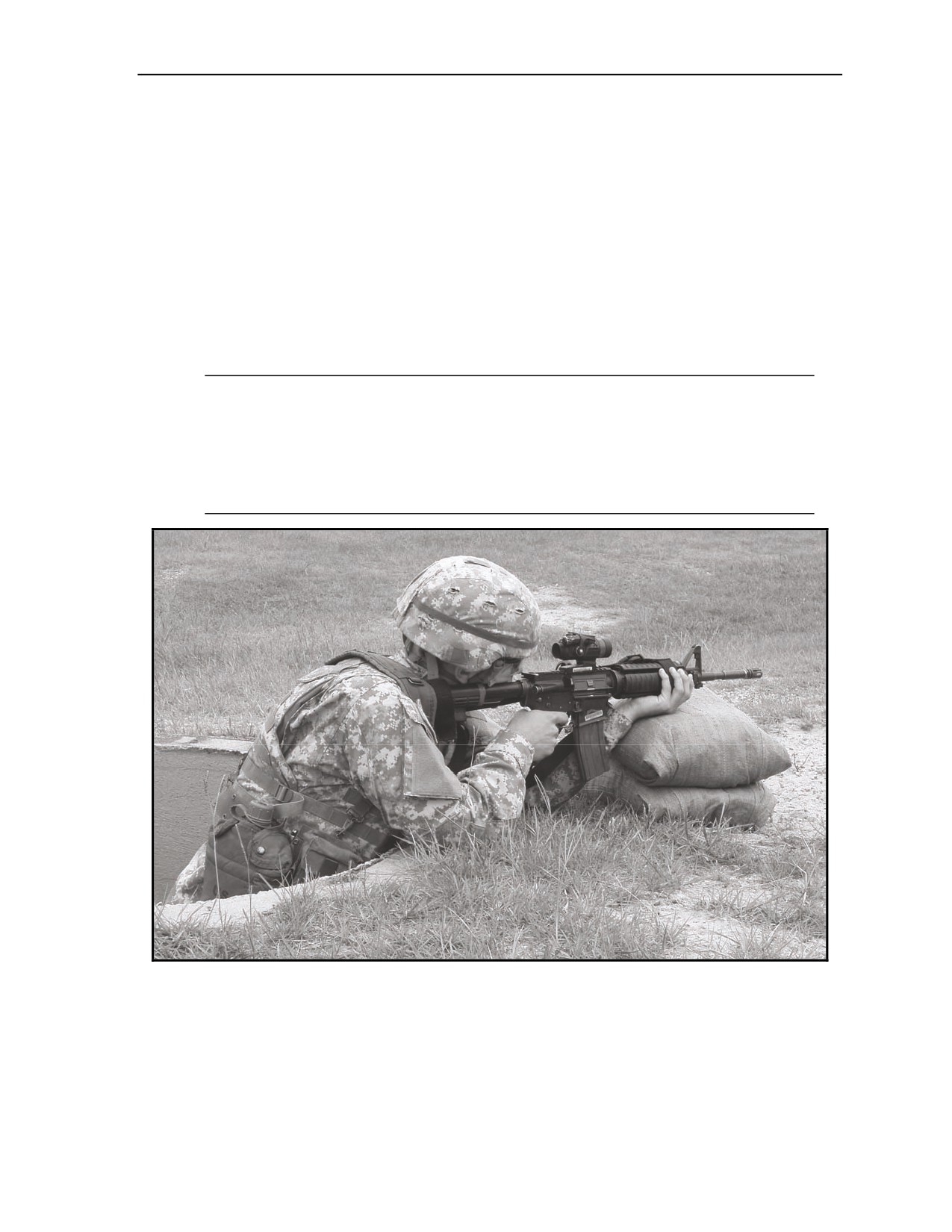
4-68. This position provides the most stable platform for engaging targets. To assume the individual
foxhole supported firing position (Figure 4-20)—
(1) Add or remove dirt, sandbags, or other supports to adjust for your height.
(2) Face the target.
(3) Execute a half-face to the firing side.
(4) Lean forward until the chest is against the firing hand corner of the position.
(5) Place the rifle handguard in the "V" formed by the thumb and fingers of the nonfiring hand.
(6) Rest the nonfiring hand on the material (sandbags or berm) to the front of the position.
(7) Place the weapon's buttstock into the pocket of the firing shoulder.
(8) Rest the firing elbow on the ground outside of the position.
NOTES:
1. When prepared positions are not available, the prone supported position can be
substituted.
2. The objective is to establish a steady position under various conditions. The
ultimate performance of this task is combat. Although the firer must be
positioned high enough to observe all targets, he must remain as low as possible
to provide added protection from enemy fire.
Figure 4-20. Individual foxhole supported firing position.
PRONE UNSUPPORTED FIRING POSITION
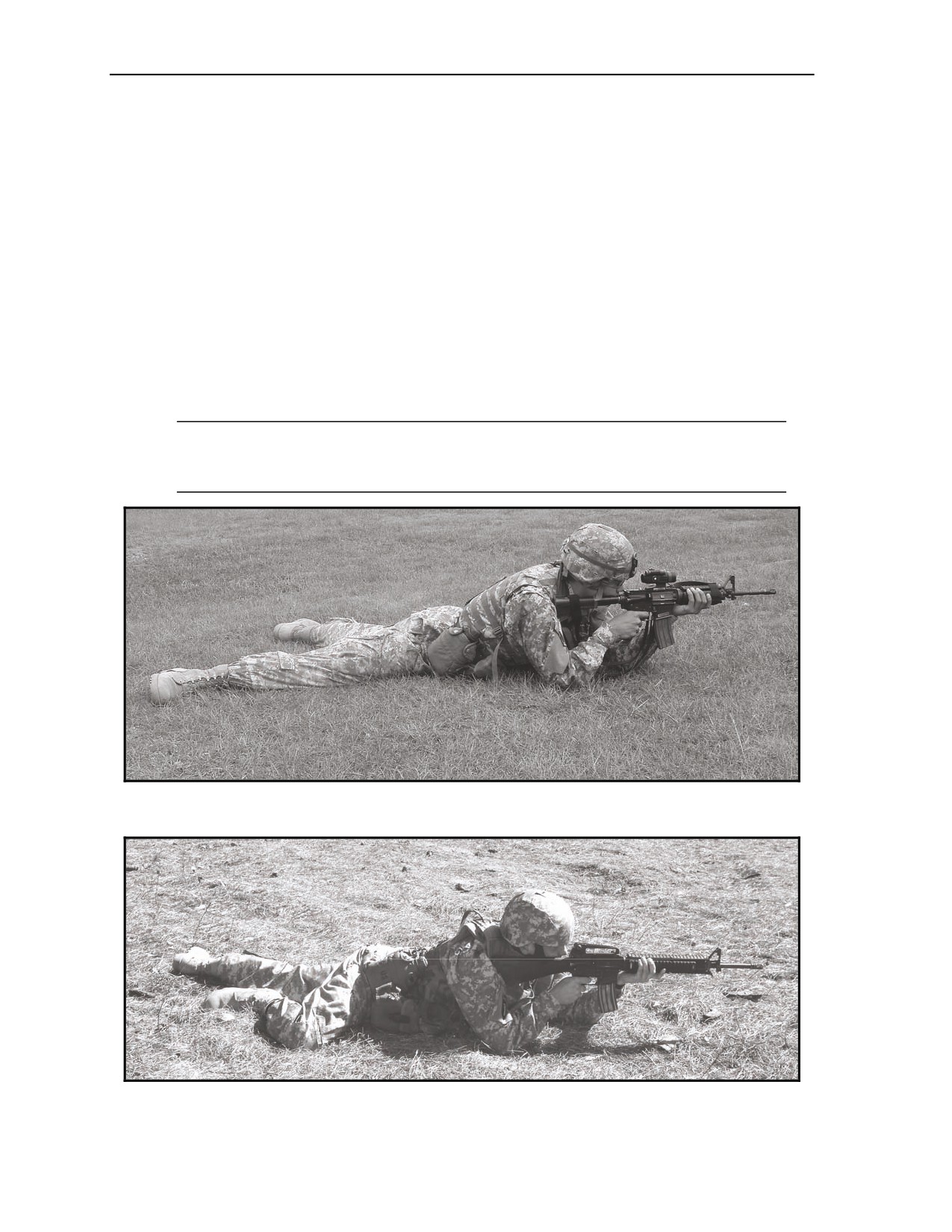
4-69. This firing position offers another stable firing platform for engaging targets. To assume the prone
unsupported firing position—
(1) Face the target.
(2) Spread the feet a comfortable distance apart.
12 August 2008
FM 3-22.9
4-25
Chapter 4
(3) Drop to the knees, breaking the fall with the weapon's buttstock.
(4) Using the rifle's buttstock as a pivot, roll onto the nonfiring side, placing the nonfiring-side
elbow close to the side of the magazine.
(5) For the basic prone unsupported position (Figure 4-21), spread the legs apart, with the inside of
the feet flat on the ground. For the alternate prone unsupported firing position (Figure 4-22),
bend the firing leg to relieve pressure on the lower back.
(6) Place the weapon's buttstock between the SAPI plate and bicep to stabilize the weapon and
absorb recoil.
(7) Grasp the pistol grip with the firing hand.
(8) Lower the firing elbow to the ground.
(9) Place both elbows on the ground to support the upper body.
(10) Rest the rifle in the "V" formed by the thumb and fingers of the nonfiring hand.
(11) Adjust the position of the firing elbow until the shoulders are approximately level.
(12) Pull back firmly on the rifle with both hands.
(13) Obtain a stock weld and relax, keeping the heels close to the ground.
NOTE: To increase comfort and stability while wearing IBA in the prone position, sand or dirt
should be scooped underneath the chest while preparing to fire. Elbow and knee pads can be
worn to relieve IBA-induced pain and pressure.
Figure 4-21. Basic prone unsupported firing position.
Figure 4-22. Alternate prone unsupported firing position.
4-26
FM 3-22.9
12 August 2008
Preliminary Marksmanship Instruction
PRONE SUPPORTED FIRING POSITION
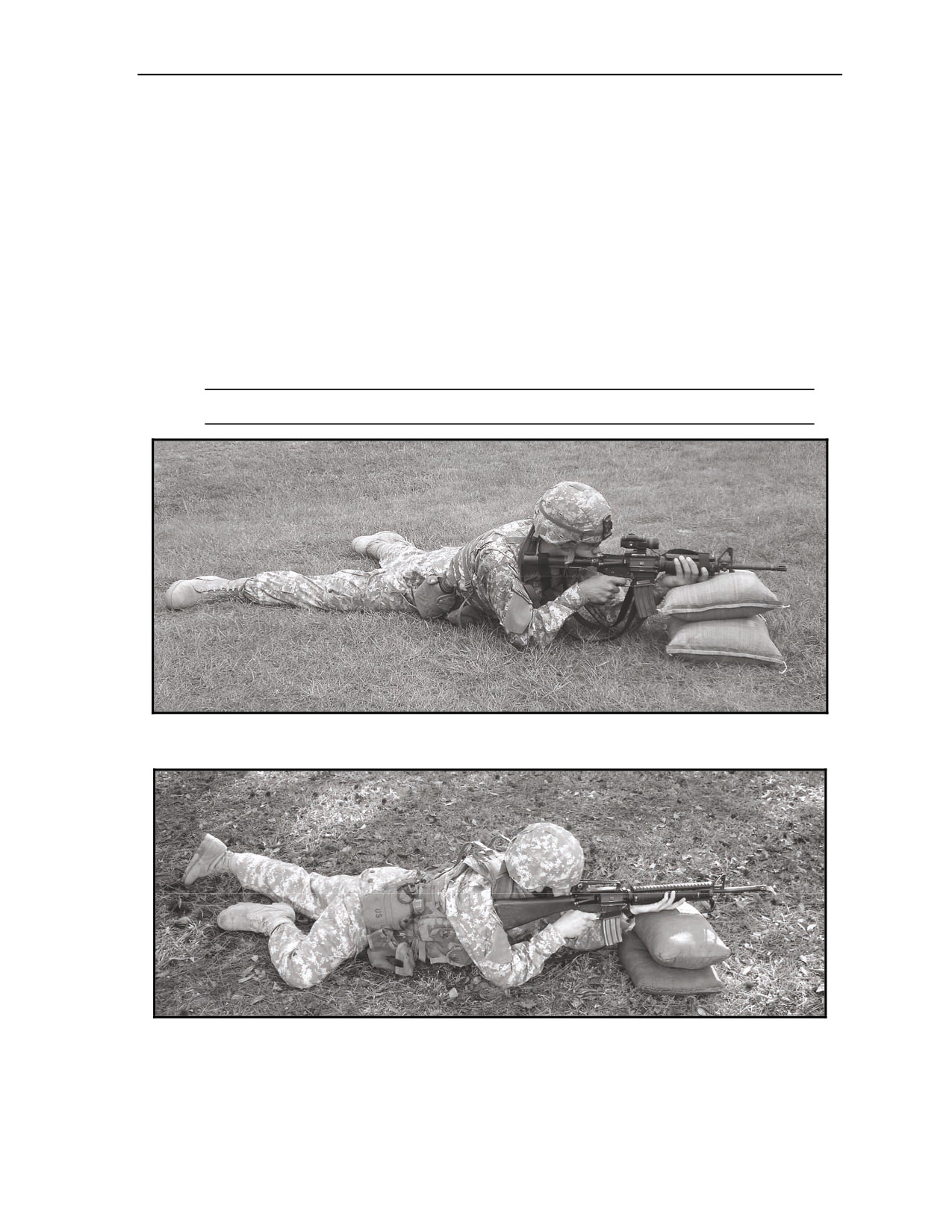
4-70. To assume the prone supported firing position—
(1) Face the target and drop to the ground, breaking the fall with the weapon's buttstock.
(2) For the basic prone supported firing position (Figure 4-23), spread the legs apart, with the inside
of the feet flat on the ground. For the alternate prone supported firing position (Figure 4-24),
bend the firing leg to relieve pressure on the lower back.
(3) Use sandbags or any other suitable object to support the handguard. Keep the nonfiring hand free
for use on any part of the rifle.
(4) Place both elbows on the ground to support the upper body.
(5) Place the firing hand on the pistol grip.
(6) Place the nonfiring hand on the upper handguard.
(7) Place the weapon's buttstock between the SAPI plate and bicep to stabilize the weapon and
absorb recoil.
NOTE: Elbow and knee pads can be worn to relieve IBA-induced pain and pressure.
Figure 4-23. Basic prone supported firing position.
Figure 4-24. Alternate prone supported firing position.
12 August 2008
FM 3-22.9
4-27
Chapter 4
KNEELING UNSUPPORTED FIRING POSITION
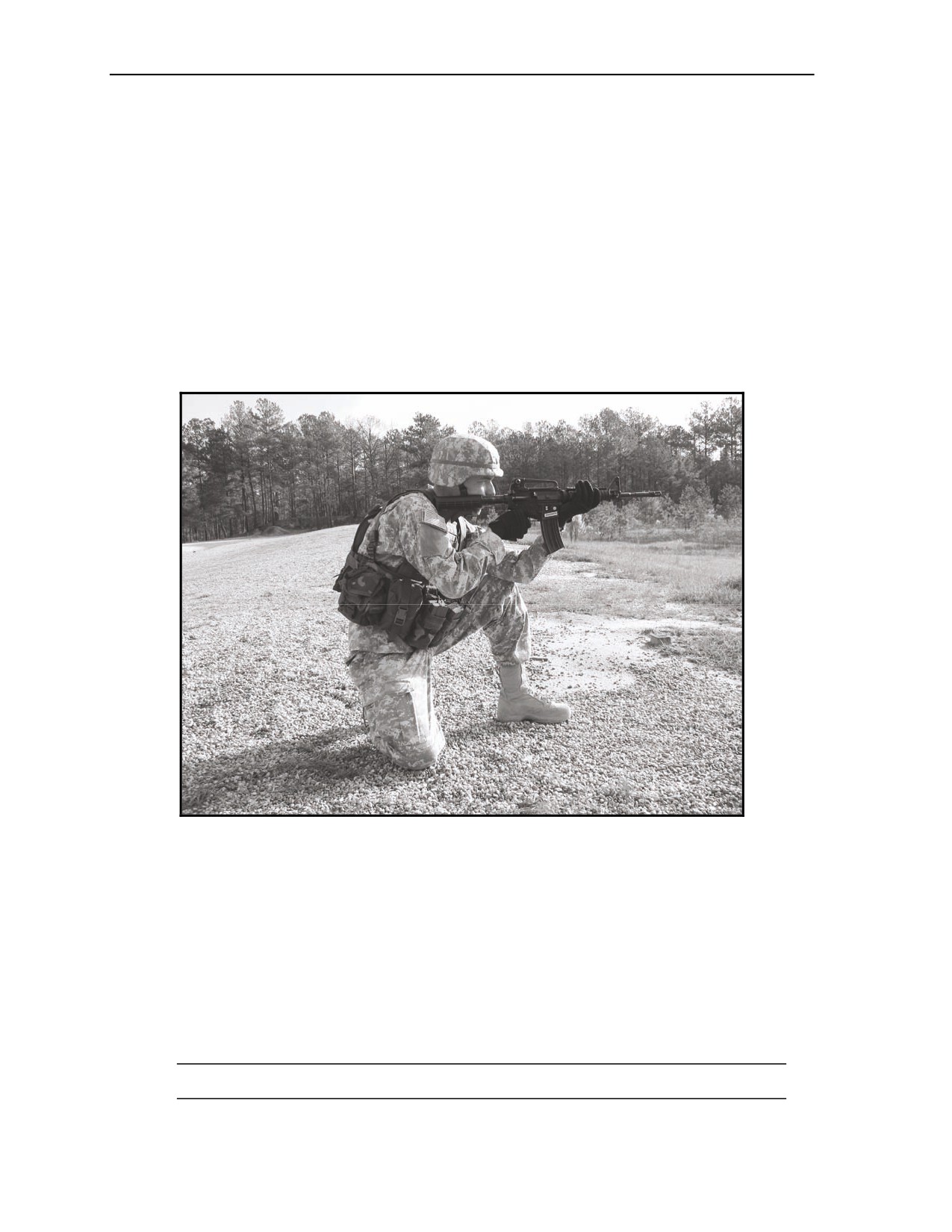
4-71. To assume the kneeling unsupported firing position (Figure 4-25)—
(1) Keep the left foot in place.
(2) Step back with the right foot.
(3) Drop to the right knee.
(4) Place the left nonfiring hand on the upper handguard with the upper arm (triceps) on the left
knee for support.
(5) Place the right firing hand on the pistol grip, with the weapon's buttstock between the SAPI plate
and bicep to stabilize the weapon and absorb recoil.
(6) Rest the ball of the right foot firmly on the ground.
(7) Rest the buttock on the heel.
(8) Relax and lean forward into the position to help absorb recoil.
Figure 4-25. Kneeling unsupported firing position.
TRAINING DEVICES AND EXERCISES
4-72. When used alone or in combinations with the appropriate training strategies, training devices and
aids can be used to help individuals or squads sustain or practice basic marksmanship skills. They are
beneficial when ammunition is limited for training or practice exercises. Some training devices are
complex, costly, and in limited supply, while others are relatively simple, cheap, and in large supply.
M15A1 AIMING CARD
4-73. This exercise measures the firer’s ability to acquire the same sight picture each time he places his
iron sights on a target.
NOTE: Refer to Appendix A for a detailed explanation of training aids and devices.
4-28
FM 3-22.9
12 August 2008

Preliminary Marksmanship Instruction
TARGET BOX AND PADDLE EXERCISE
4-74. This exercise checks the consistency of aiming and placement of three-round shot groups in a dry-
fire environment. It incorporates the Soldier’s position, breathing, and sight picture to simulate a live-fire
25-meter engagement. Further, it reinforces the basic fundamentals, while refining the Soldier’s muscle
memory during the integrated act of dry-firing.
NOTE: Refer to Appendix A for a detailed explanation of the target box and paddle exercise
and training standards.
DIME/WASHER EXERCISE
4-75. The primary purpose of this exercise is to practice trigger control; it is also used to reinforce good
body position and breath control. The Soldier must successfully dry-fire his weapon six consecutive times
without the dime or washer falling to the ground.
NOTE: Refer to Appendix A for a detailed explanation of the dime/washer exercise and training
standards.
SECTION III. MARKSMANSHIP FUNDAMENTALS II
This training program (Table
4-3) reinforces BRM and the four fundamentals, while demonstrating the
integrated act of shooting on the EST 2000 or LMTS.
Table 4-3. Marksmanship Fundamentals II training program.
MARKSMANSHIP FUNDAMENTALS II
Period 3 (8 hours)
Instructional Intent
•
Reinforce BRM I and II and the four fundamentals, while demonstrating the integrated act of shooting on the
EST or LMTS.
Observables
Ensure that—
•
All fundamentals are emphasized and applied on the EST or LMTS.
•
Weapon safety is reinforced on the EST or LMTS.
•
Peer coaching is emphasized during EST or LMTS firing.
•
All Soldiers who fail to hit six out of nine shots at the 300-meter EST target receive remedial training.
Tasks
•
Demonstrate the integrated act of firing while using the EST.
NOTE: Soldiers who do not meet the standard will receive remedial training before continuing
with subsequent instruction.
ENGAGEMENT SKILLS TRAINER 2000
4-76. The EST 2000 is a home station, indoor, multipurpose, multilane, small arms, crew-served, shoulder-
launched munitions gunnery simulator with superior accuracy and state-of-the-art graphics.
4-77. The EST 2000 is used to provide small arms weapon training on—
z
Marksmanship.
z
Squad tactical procedures.
z
Close-range shoot/don’t shoot techniques and skills.
4-78. Commanders should review DA Pam 350-38 for live-fire events that can be executed using the EST
2000.
12 August 2008
FM 3-22.9
4-29
Chapter 4
NOTE: Refer to Appendix A for a detailed explanation of the EST 2000 training simulator.
LASER MARKSMANSHIP TRAINING SYSTEM
4-79. The LMTS helps bridge the existing gap in individual marksmanship training by providing a more
widely available, flexible, transportable, and lightweight means of maintaining marksmanship skills. The
LMTS large-company suite with the warrior kit is a home station or deployed, multipurpose, modular,
scaleable, individual and unit small arms marksmanship sustainment simulator that accommodates the
M16-series rifle and M4 carbine.
4-80. The LMTS supports both IET and unit sustainment training for static mounted and dismounted small
units. When incorporated into BRM and Marksmanship Fundamentals I and II, it greatly improves Soldier
feedback.
NOTES:
1. The LMTS is not intended to replace live-firing, qualification, or the EST 2000.
2. Refer to Appendix A for a detailed explanation of the LMTS.
3. Soldiers failing to maintain a three-centimeter shot group on the LMTS
25-meter target should receive remedial feedback.
4-30
FM 3-22.9
12 August 2008

Chapter 5
Downrange Feedback
Downrange feedback provides precise knowledge of what happens to bullets at
range. It provides for an effective transition between 25-meter firing and firing on the
field fire range. Knowing precisely where all bullets are hitting or missing the target,
a poor firer (with instructor/trainer assistance) can improve his performance, and a
good firer can bring his shots to the target's center.
This chapter contains guidelines for the instructor/trainer to conduct training on
ranges that provide detailed feedback from the targets downrange. This chapter
contains grouping and zeroing procedures and procedures for conducting the three
types of KD ranges.
SECTION I. GROUPING PROCEDURES
This section provides guidelines for conducting a grouping range (Table 5-1). It includes concept, organization,
shot group marking, shot group analysis, multiple shot group analysis, and troubleshooting of the fundamentals.
Table 5-1. Grouping procedures.
GROUPING PROCEDURES
Instructional Intent
•
Reinforce PMI by performing the integrated act of shooting.
•
Shoot two consecutive 3-round shot groups within a 4-centimeter circle at 25 meters.
Special Instructions
Ensure that—
•
The rear sight is on the proper setting (zero; M16A2/3=8/3+1; M16A4=6/3+2; M4=6/3).
•
The rear sight aperture is set on 300+1, not 800+1.
•
The M16A1's rear sight is set on the aperture marked L.
•
The small aperture is being used.
•
Proper and accurate shot group marking is enforced.
•
The firer's name is clearly marked on the target.
Observables
•
Coaches analyze the firer’s fundamentals.
•
Majority of the round must be inside the circle to be counted.
•
Two consecutive 3-round groups are shot with 6 of 6 rounds impacting inside of the 4- centimeter circle.
12 August 2008
FM 3-22.9
5-1
Chapter 5
CONCEPT
5-1. Shot grouping is a form of practice firing with two primary objectives: firing tight shot groups and
consistently placing those groups in the same location. Grouping exercises can be conducted anywhere that
provides precise location of bullet hits and misses, such as a 25-meter live-fire zeroing range, KD range,
EST 2000, LMTS, or location of misses and hits (LOMAH) system.
NOTES:
1. Shot grouping should be conducted between dry-fire training and zeroing.
2. The initial live-fire training should be a grouping exercise with the purpose of
practicing and refining marksmanship fundamentals.
ORGANIZATION OF A 25-METER GROUPING RANGE
5-2. The organization and conduct of a grouping range are based on the availability of ammunition,
number of personnel, and the firing ability of personnel in training.
5-3. To properly conduct a 25-meter grouping range, perform the following actions:
z
Divide the unit into firing orders. The first order fires, while the second order coaches.
z
Reserve ten firing points to conduct corrective instruction.
z
Provide sandbags at each firing point to accommodate supported firing positions.
z
Set up the 25-meter grouping range as depicted in Figure 5-1.
Figure 5-1. 25-meter range.
CONDUCT OF A 25-METER GROUPING FIRING
5-4. Each shot is fired from a supported firing position using the same point of aim (25-meter zeroing
target's center of mass). The objective is to fire tight shot groups and to place those shot groups inside a
4-centimeter circle (the actual location of groups on the target is not important).
5-2
FM 3-22.9
12 August 2008
Downrange Feedback
NOTES:
1. Since this is not a zeroing exercise, few sight adjustments are made unless the
shot group is off of or barely on the 25-meter zeroing target.
2. No sight adjustments should be made until the firer can shoot six consecutive
shots (two shot groups) inside a 4-centimeter circle. Once this is accomplished,
the Soldier is ready to conduct zeroing procedures.
5-5. To conduct a 25-meter grouping firing—
NOTE: Before beginning the 25-meter grouping firing, each Soldier ensures that his sights are
set for 25-meter firing.
(1) The Soldier fires a three-round shot group at the 25-meter zeroing target.
*NOTE: During IET, Soldiers fire three 5-round shot groups at the 25-meter zeroing target. To
achieve the standard, 8 out of 10 rounds in two consecutive shot groups must hit within a 4-cm
circle.
(2) The firing line is cleared, and the Soldier and coach move downrange to examine the shot group
for fundamental errors, triangulate the shot group, and put the number 1 in the center of the shot
group (Figures 5-2 and 5-3).
NOTE: If the shot group is off of the 25-meter zeroing target, the Soldier should mechanically
zero the weapon. If the shot group is barely on the target, the Soldier should make a bold
adjustment.
*(3) The Soldier returns to the firing line and fires a second shot group.
(4) The firing line is cleared, and the Soldier moves downrange to examine the second shot group,
triangulate, and mark the center of the shot group with the number 2.
(5) The Soldier groups the two shot groups and marks the center.
*5-6. The Soldier repeats Steps 1 through 5 until he places six out of six consecutive rounds inside a
4-centimeter circle. If the Soldier has not grouped with the rounds allotted, he should be removed from the
firing line and given remedial training before attempting to group again.
*NOTE: Grouping standard for IET: Group an M16 Series Rifle/M4 Carbine on a 25m zero
target by achieving 8 out of 10 rounds in two consecutive five-round shot groups within a 4cm
circle within 10 rounds.
NOTE: To be counted, the majority of the round must be inside of the circle.
*5-7. Once the Soldier has demonstrated firing proficiency from the supported firing position, grouping
exercises can be conducted from the unsupported firing position.
SHOT GROUP MARKING
5-8. If the Soldier is to benefit from this exercise and if the instructor/trainer (or coach) is to provide
useful guidance, the Soldier must mark each shot group for a clear record of his firing practice. The
instructor/trainer must understand how to analyze shot groups correctly.
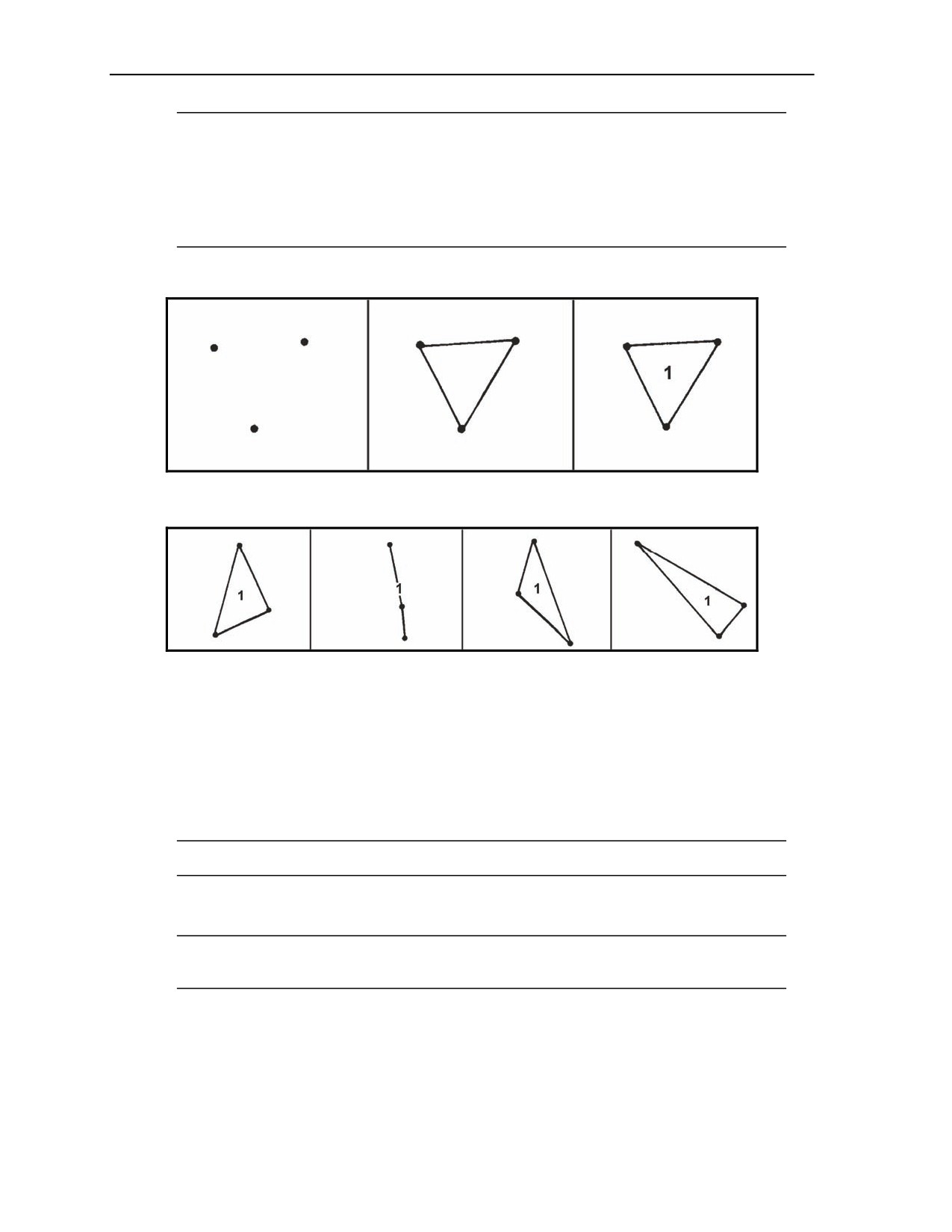
5-9. To properly mark the shot groups (Figure 5-2)—
(1) Connect the three bullet holes on the target with a straight line.
(2) Place a number inside of the shot group.
10 February 2011
FM 3-22.9, C1
5-3
Chapter 5
NOTES:
1. The number represents the center of the three shots.
2. When two shots are near one end of the group and the third shot is toward the
other end, the number is placed closer to the two near shots (Figure 5-3).
3. This is not a precise marking that requires a measurement, but a procedure to
help with shot group analysis.
5-10. The three-round shot group allows the firer’s performance to be evaluated.
Figure 5-2. Shot group marking.
Figure 5-3. Central point of an odd-shaped group.
SINGLE SHOT GROUP ANALYSIS
5-11. The purpose of single shot group analysis is to identify firer errors on the single shots of a shot group
so the Soldier can correct these errors while firing the next shot group.
5-12. Shot group analysis begins with the instructor/trainer observing the Soldier while he fires, looking
for proper position, aim, trigger squeeze, and breathing. Then, the instructor/trainer analyzes the shot group
to confirm problem areas.
NOTE: Coaches should not use shot group analysis without observing the firer.
5-13. The ideal shot group will have all three rounds within a 2-centimeter circle. Three rounds within a
4-centimeter circle is the minimum standard.
NOTE: M16A2 zeroing target squares are .96 centimeter in size, while M4 zeroing target
squares are 1.3 centimeters in size.
5-4
FM 3-22.9, C1
10 February 2011
Downrange Feedback
MATCH-GRADE PERFORMANCE
5-14. The target shown in Figure 5-4 illustrates a match-grade quality weapon/ammunition combination.
This combination places all bullets in almost the same hole and helps detect the firer's slightest errors.
Figure 5-4. 25-meter match grade performance.
2-CENTIMETER SHOT GROUPS
5-15. The variances of standard weapons and ammunition must be considered during shot group analysis.
When firing a standard service weapon/ammunition combination, the dispersion pattern may be up to
2 centimeters apart without human error. The instructor/trainer must ensure the Soldier understands that his
weapon or ammunition may not be capable of placing three rounds within a 1-centimeter square.
NOTE: The dispersion pattern is not considered a firer error.
5-16. The targets shown in Figure 5-5 reflect proper 25-meter shot group performances using standard
weapon/ammunition combinations.
Figure 5-5. Shot groups with no firer error.
12 August 2008
FM 3-22.9
5-5
Chapter 5
3- TO 4-CENTIMETER SHOT GROUPS
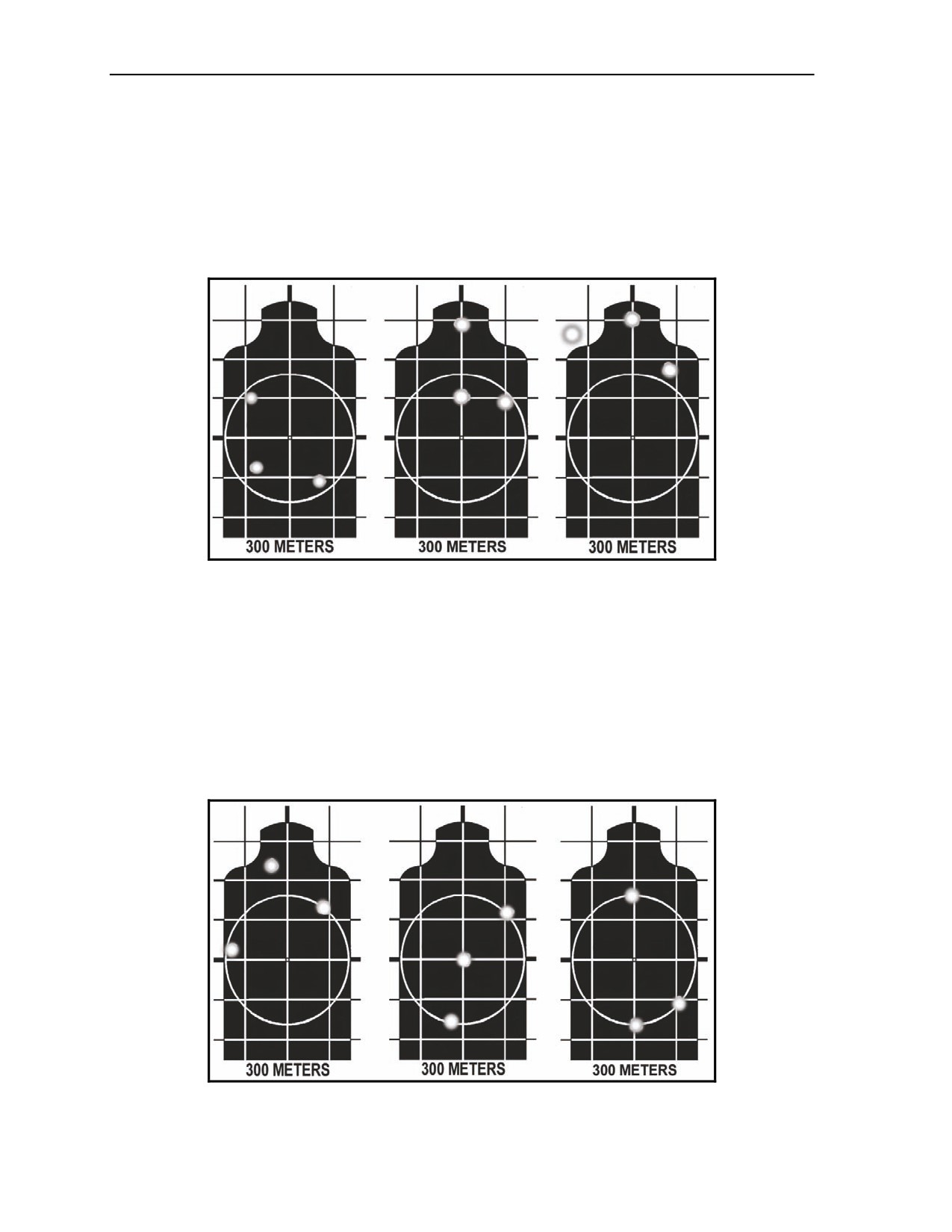
5-17. The targets shown in Figure 5-6 represent minimum acceptable firing performances; a better firing
performance should be expected.
5-18. The instructor/trainer should ensure that the Soldier is properly applying the four marksmanship
fundamentals and explain that this shot group size is due to minor shooting error, not weapon or
ammunition performance. Any of these shot groups could have resulted from a minor change in sight
picture, breathing, trigger squeeze, position, or an erratic round.
Figure 5-6. Shot groups with minor shooting error.
OVER 4- TO 5-CENTIMETER SHOT GROUPS
5-19. The targets shown in Figure 5-7 represent unacceptable firing performance.
5-20. The instructor/trainer should ensure that the Soldier is properly applying the four marksmanship
fundamentals and explain that this shot group size is due to considerable shooting error, not weapon or
ammunition performance. Any of these shot groups could have resulted from a change in position, sight
picture, breathing, trigger squeeze, position, or an erratic round.
5-21. Soldiers who fire these shot groups should receive dry-fire training or remedial training on the EST
2000 or LMTS to help correct firing problems.
Figure 5-7. Shot groups with considerable shooting error.
5-6
FM 3-22.9
12 August 2008
Downrange Feedback
SHOT GROUPS LARGER THAN 5 CENTIMETERS
5-22. The targets shown in Figure
5-8 represent unacceptable firing performance; a better firing
performance should be expected.
5-23. The instructor/trainer should ensure that the Soldier is properly applying the four marksmanship
fundamentals and explain that this shot group size is due to major shooting error, not weapon or
ammunition performance. Any of these shot groups could have resulted from a change in position, sight
picture, breathing, or trigger squeeze, or the firer may have anticipated the shot.
5-24. Soldiers who fire these shot groups should receive extensive dry-fire training or remedial training on
the EST 2000 or LMTS to help correct firing problems.
Figure 5-8. Shot groups with major shooting error.
MULTIPLE SHOT GROUP ANALYSIS
5-25. Multiple shot group analysis involves performing ongoing analysis of individual shot groups, while
comparing them to each other for consistent aiming.
NOTE: If the Soldier is to benefit from this exercise, and if the instructor/trainer (or coach) is to
provide useful guidance, the Soldier must mark each shot group individually and locate the
center of more than one shot group.
5-26. To properly mark the shot groups (Figure 5-9)—
(1) Connect each individual shot group on the target with a straight line.
(2) Place a number inside the shot group.
NOTE: The number represents the center of the three shots.
(3) Connect the numbers, and place an X in the center.
NOTE: The X represents the center of the shot groups.
12 August 2008
FM 3-22.9
5-7