FM 3-22.9 RIFLE MARKSMANSHIP M16-/M4-SERIES WEAPONS (August 2008) - page 1
*FM 3-22.9
Field Manual
Headquarters
No. 3-22.9
Department of the Army
Washington, DC, 12 August 2008
Rifle Marksmanship
M16-/M4-Series Weapons
Contents
Page
PREFACE
xiv
Chapter 1
MARKSMANSHIP TRAINING
1-1
Section I. Training Strategy
1-1
Objectives
1-1
Marksmanship Training Strategy
1-1
Training Phases
1-5
Section II. Unit Marksmanship Training Program
1-8
Mission-Essential Tasks
1-9
Training Assessment
1-9
Trainers
1-11
Trainer Certification Program
1-13
Qualification Training
1-15
Unit Live-Fire Exercises
1-17
Chapter 2
WEAPON CHARACTERISTICS, ACCESSORIES, AND AMMUNITION
2-1
Section I. Rifles and Carbines
2-1
Characteristics of M16-/M4-Series Weapons
2-1
M4-Series Carbine
2-2
M16A2/A3 Rifle
2-5
M16A4 Rifle
2-7
M16A1 Rifle
2-9
Section II. Accessory Mounting
2-10
M4/M5 Adapter Rail System
2-10
Rail Grabbers
2-13
Section III. Accessories
2-16
M68 Close Combat Optic
2-17
AN/PAQ-4B/C Infrared Aiming Light
2-19
AN/PEQ-2A/B Target Pointer/Illuminator/Aiming Light
2-21
AN/PEQ-15 Advanced Target Pointer/Illuminator Aiming Light
2-24
AN/PAS-13B/C/D (V1) Light Weapon Thermal Sight and AN/PAS-13B/C/D
(V3) Heavy Weapon Thermal Sight
2-26
AN/PVS-4 Night Vision Sight
2-28
_________________________________________________________________________________________
DISTRIBUTION RESTRICTION: Approved for public release; distribution is unlimited.
*This publication supercedes FM 3-22.9, 24 April 2003.
10 February 2011
FM 3-22.9, C1
i
Contents
Backup Iron Sight
2-30
Advanced Combat Optical Gunsight
2-31
Section IV. 10-Meter Boresight and 25-Meter Zero Offset
2-33
Borelight
2-33
10-Meter Boresight
2-34
25-Meter Zero Offset
2-34
Section V. Ammunition
2-35
Authorized Ammunition
2-35
Trajectory
2-37
Storage
2-39
Chapter 3
TROUBLESHOOTING AND DESTRUCTION
3-1
Stoppages
3-1
Malfunctions
3-2
Destruction Procedures
3-7
Chapter 4
PRELIMINARY MARKSMANSHIP INSTRUCTION
4-1
Section I. Introduction to Basic Rifle Marksmanship and Mechanical Training
4-1
Clearing
4-2
Cycles of Functioning
4-4
Modes of Fire
4-11
Peer Coaching
4-12
Section II. Marksmanship Fundamentals I
4-14
Interceptor Body Armor
4-15
Four Fundamentals
4-16
Dominant Eye Training
4-24
Basic Firing Positions
4-24
Training Devices and Exercises
4-28
Section III. Marksmanship Fundamentals II
4-29
Engagement Skills Trainer 2000
4-29
Laser Marksmanship Training System
4-30
Chapter 5
DOWNRANGE FEEDBACK
5-1
Section I. Grouping Procedures
5-1
Concept
5-2
Organization of a 25-Meter Grouping Range
5-2
Conduct of a 25-Meter Grouping Firing
5-2
*Shot Group Marking
5-3
Single Shot Group Analysis
5-4
Multiple Shot Group Analysis
5-7
Troubleshooting the Fundamentals
5-14
Section II. Zeroing Procedures
5-14
Purpose
5-15
Sight Variance
5-15
ii
FM 3-22.9, C1
10 February 2011
Contents
Organization of a 25-Meter Zero Range
5-15
Conduct of a 25-Meter Zero Firing
5-15
Section III. Known Distance Range
5-19
Concept
5-19
*Known Distance Target Description
5-20
*Marking Known Distance Range Targets
5-21
Known Distance Shot Grouping Analysis
5-22
*Known Distance Zeroing
5-23
*Conduct of a Standard Known Distance Range
5-23
*Known Distance Record Fire Range
5-24
*Modified Field Fire Range
5-24
*Record of Performance
5-25
*25-Meter Zero Standard
5-26
*Section IV. Effects of Wind and Gravity
5-26
*Effects of Gravity
5-26
*Effects of Wind
5-27
*Section V. Ballistics
5-33
*Internal Ballistics
5-33
*External Ballistics
5-35
*Terminal Ballistics
5-37
*Bullet Dispersion at Range
5-37
Chapter 6
FIELD FIRE
6-1
Section I. Target Detection
6-1
Locating Targets
6-1
Marking Targets
6-4
Range Determination
6-5
Section II. Field Fire Training
6-6
Conduct of a Field Fire Range
6-7
Field Fire I (Single Timed Target)
6-8
Field Fire II (Multiple or Single Timed Targets)
6-9
Section III. Record Qualification
6-10
Practice Record Fire I and II
6-10
Record Fire
6-13
Section IV. Alternate Qualification Courses
6-16
Known Distance Record Fire Range
6-17
25-Meter Scaled Target Alternate Course
6-18
15-Meter Scaled Target Alternate Course
6-20
Chapter 7
ADVANCED RIFLE MARKSMANSHIP
7-1
Section I. Advanced Firing Positions
7-1
Kneeling Supported Firing Position
7-2
Standing Unsupported Firing Position
7-3
Standing Supported Firing Position Around Obstacles
7-4
10 February 2011
FM 3-22.9, C1
iii
Contents
Modified Firing Positions
7-5
Urban Operations Firing Positions
7-6
Section II. Combat Fire Techniques
7-8
Rapid Semiautomatic Fire
7-8
Automatic or Burst Fire
7-12
Suppressive Fire
7-16
Quick Fire
7-19
Section III. Chemical, Biological, Radiological, and Nuclear Firing
7-24
Mission-Oriented Protective Posture Equipment Fire
7-24
Section IV. Night Fire Training
7-30
Unassisted Night Fire Training
7-30
Artificial Illumination Training
7-35
Section V. Moving Target Engagements
7-36
Modifications for Moving Target Engagements
7-36
Moving Target Live-Fire Exercise
7-41
Section VI. Short-Range Marksmanship Training
7-41
Conduct of Short-Range Marksmanship Training
7-41
Fundamentals of Short-Range Marksmanship
7-42
Preliminary Short-Range Marksmanship Instruction
7-47
Phase I—Reflexive Fire Training
7-51
Phase II—Target Discrimination Training
7-53
Phase III—Short-Range Marksmanship Qualification
7-55
Phase IV—Shotgun and Automatic or Burst Firing Familiarization
7-57
*Section VII. Combat field fire
7-57
*Concept
7-57
*Conduct
7-58
*Record of Performance
7-62
*Section VIII. Squad Designated Marksman Training
7-62
*Mission of the Squad Designated Marksman
7-62
*Selection
7-63
*Squad Designated Marksman Skills Progression
7-63
Chapter 8
ADVANCED OPTICS, LASERS, AND IRON SIGHTS
8-1
Section I. Borelight
8-1
Concept
8-2
Zeroing the Borelight
8-2
Boresighting
8-6
Section II. Training Strategies and Qualification Standards
8-11
Backup Iron Sight
8-11
M68 Close Combat Optic
8-12
Advanced Combat Optical Gunsight
8-16
AN/PAS-13B/C/D (V1) Light Weapon Thermal Sight and AN/PAS-13B/C/D
(V3) Heavy Weapon Thermal Sight
8-20
AN/PAQ-4B/C and AN/PEQ-2A/B Infrared Aiming Lasers
8-23
iv
FM 3-22.9, C1
10 February 2011
Contents
AN/PVS-4 Night Vision Device
8-28
*Appendix A TRAINING AIDS, DEVICES, AND EXERCISES
A-1
Appendix B SCORECARDS
B-1
Appendix C NIGHT FIGHTING
C-1
Appendix D RANGE SAFETY AND RISK MANAGEMENT
D-1
Appendix E RANGE PROCEDURES AND RANGE OPERATIONS CHECKLIST
E-1
*Appendix F
10-METER TARGET OFFSETS AND 25-METER ZERO OFFSETS
F-1
*Glossary
Glossary-1
References
References-1
*Index
Index-1
Figures
Figure
1-1. Initial entry training marksmanship training strategy
1-2
Figure
1-2. Unit marksmanship sustainment strategy
1-3
Figure
1-3. Active Army home station marksmanship training strategy
1-4
Figure
1-4. National Guard home station marksmanship training strategy
1-4
Figure
1-5. Army Reserve home station marksmanship training strategy
1-5
Figure
1-6. Deployed unit marksmanship training strategy
1-5
Figure
2-1. M4/M4A1 carbine with accessories
2-2
Figure
2-2. M4 MWS with accessories
2-3
Figure
2-3. M4/M4A1 and M4/M4A1 MWS
2-3
Figure
2-4. M4/M4A1 or M4 MWS mechanical zero
2-4
Figure
2-5. M4/M4A1 or M4 MWS battlesight zero
2-4
Figure
2-6. M16A2/A3 rifle with accessories
2-5
Figure
2-7. M16A2/A3 mechanical zero
2-6
Figure
2-8. M16A2/A3 battlesight zero
2-6
Figure
2-9. M16A4 rifle with accessories
2-7
Figure
2-10. M16A4 mechanical zero
2-8
Figure
2-11. M16A4 battlesight zero
2-8
Figure
2-12. M16A1 rifle
2-9
Figure
2-13. M16A1 mechanical zero
2-9
Figure
2-14. M16A1 battlesight zero
2-10
Figure
2-15. Adapter rail system
2-11
Figure
2-16. M5 rail covers/heat shields
2-11
Figure
2-17. Address markings on the adapter rail system
2-12
Figure
2-18. Vertical pistol grip
2-13
Figure
2-19. Insight rail grabber
2-14
Figure
2-20. Insight rail grabber MILES training extender
2-15
Figure
2-21. Picatinny rail grabber
2-15
Figure
2-22. M68 close combat optic
2-17
10 February 2011
FM 3-22.9, C1
v
Contents
Figure 2-23. Mounting the M68 on an M16A4 rifle or M4-series carbine
2-17
Figure 2-24. Mounting the M68 on an M16A1/A2/A3 rifle
2-18
Figure 2-25. Mounting the M68/AN/PVS-14 combination on an M4 MWS
2-19
Figure 2-26. AN/PAQ-4B/C infrared aiming light
2-19
Figure 2-27. Mounting the AN/PAQ-4B/C on the M4 MWS top or left
2-20
Figure 2-28. Mounting the AN/PAQ-4B/C on the M16A1/A2/A3 rifle and M4 carbine
2-21
Figure 2-29. AN/PEQ-2A/B target pointer/illuminator/aiming light
2-22
Figure 2-30. Mounting the AN/PEQ-2A/B on the M16A4 rifle and M4 MWS
2-22
Figure 2-31. Mounting the AN/PEQ-2A/B on M16A1/A2/A3 rifles and M4 carbines
2-23
Figure 2-32. MILES training extender bracket installation on
M16-/M4-series weapons
2-24
Figure 2-33. AN/PEQ-15 advanced target pointer illuminator aiming light
2-25
Figure 2-34. AN/PEQ-15 mounted on M4 carbine
2-25
Figure 2-35. AN/PAS-13B/C/D (V1) light weapon thermal sight and
AN/PAS-13B/C/D (V3) heavy weapon thermal sight
2-26
Figure
2-36. Mounting the TWS on M16A4 rifle or M4 carbine
2-26
Figure
2-37. Mounting the TWS on an M16A1/A2/A3 rifle
2-27
Figure
2-38. AN/PVS-4 night vision sight
2-28
Figure
2-39. Mounting the AN/PVS-4 on an M4 carbine or M4 MWS
2-28
Figure
2-40. Mounting the AN/PVS-4 on an M16A1/A2/A3 rifle
2-29
Figure
2-41. Backup iron sight
2-30
Figure
2-42. Backup iron sight in the stowed position
2-30
Figure
2-43. Advanced combat optical gunsight
2-31
Figure
2-44. Mounting the ACOG on M16A4 rifle and M4 carbine
2-31
Figure
2-45. Mounting the ACOG on an M16A1/A2/A3 rifle
2-32
Figure
2-46. ACOG locking screw
2-33
Figure
2-47. Borelight with a 5.56-millimeter mandrel
2-33
Figure
2-48. 10-meter boresighting target and 25-meter zero offset
2-34
Figure
2-49. M855 drop during 25-meter zeroing (M16A2 at 8/3+1, M4 at 6/3)
2-37
Figure
2-50. Bullet drop of M855 ammunition with M16A2 (8/3)
2-37
Figure
2-51. Bullet drop of M855 ammunition with M4 (6/3)
2-38
Figure
2-52. M4 carbine and M16A2 rifle bullet trajectory comparison
2-38
Figure
2-53. Bullet drop of M4/M855 during 25-meter zeroing on 6/3
2-39
Figure
3-1. Failure to feed, chamber, or lock
3-2
Figure
3-2. Failure to fire
3-4
Figure
3-3. Other possible malfunctions
3-7
Figure
4-1. Clearing
4-3
Figure
4-2. Feeding
4-4
Figure
4-3. Chambering
4-5
Figure
4-4. Locking
4-6
Figure
4-5. Firing
4-7
Figure
4-6. Unlocking
4-8
vi
FM 3-22.9, C1
10 February 2011
Contents
Figure
4-7. Extracting
4-8
Figure
4-8. Ejecting
4-9
Figure
4-9. Cocking
4-10
Figure
4-10. Semiautomatic and automatic fire mode selector positions
4-11
Figure
4-11. Burst fire mode selector position
4-11
Figure
4-12. Prone position of coach (right-handed firer)
4-14
Figure
4-13. Interceptor body armor
4-15
Figure
4-14. Steady position
4-17
Figure
4-15. Correct sight alignment
4-19
Figure
4-16. Focus of the eye and correct sight picture
4-20
Figure
4-17. Side aiming technique
4-21
Figure
4-18. Breath control for engaging single targets
4-22
Figure
4-19. Breath control for engaging short-exposure targets
4-22
Figure
4-20. Individual foxhole supported firing position
4-25
Figure
4-21. Basic prone unsupported firing position
4-26
Figure
4-22. Alternate prone unsupported firing position
4-26
Figure
4-23. Basic prone supported firing position
4-27
Figure
4-24. Alternate prone supported firing position
4-27
Figure
4-25. Kneeling unsupported firing position
4-28
Figure
5-1. 25-meter range
5-2
Figure
5-2. Shot group marking
5-4
Figure
5-3. Central point of an odd-shaped group
5-4
Figure
5-4. 25-meter match grade performance
5-5
Figure
5-5. Shot groups with no firer error
5-5
Figure
5-6. Shot groups with minor shooting error
5-6
Figure
5-7. Shot groups with considerable shooting error
5-6
Figure
5-8. Shot groups with major shooting error
5-7
Figure
5-9. Central point of three shot groups
5-8
Figure
5-10. Acceptable shot grouping performance
5-8
Figure
5-11. Shot groups with inconsistent aiming
5-9
Figure
5-12. Shot groups with consistent aiming and major shooting error
5-10
Figure
5-13. Shot groups with inconsistent aiming and major shooting error
5-11
Figure
5-14. Shot groups with improper vertical placement
5-12
Figure
5-15. Improper shot groups on the edge of the target
5-13
Figure
5-16. Correct aiming (A), initial shot group results (B)
5-16
Figure
5-17. Final shot group results
5-16
Figure
5-18. M16A1 25-meter zero target
5-17
Figure
5-19. M16A2 and M4 25-meter zero target
5-18
*Figure 5-20. Downrange feedback targets
5-21
Figure 5-21. Target marking with spotters (markers)
5-21
Figure 5-22. Comparison of firing performance
5-22
*Figure 5-23. Known distance range
5-25
10 February 2011
FM 3-22.9, C1
vii
Contents
*Figure 5-24. 25-meter zero standard
5-26
*Figure 5-25. M16-/M4-series weapon aiming points
5-27
*Figure 5-26. Determine wind value using the clock method
5-28
*Figure 5-27. Determine wind speed using the flag method
5-29
*Figure 5-28. Determine wind speed using the pointing method
5-30
*Figure 5-29. Calculate the adjusted point of aim based on wind speed
5-31
*Figure 5-30. M16-/M4-series weapons adjusted point of aim based on wind speed
5-32
*Figure 5-31. Projectile differences
5-33
*Figure 5-32. Ammunition impact comparison
5-34
*Figure 5-33. Minute of angle
5-38
*Figure 5-37. Increase in shot group size as range increases
5-38
Figure 7-1. Kneeling supported firing position
7-2
Figure 7-2. Standing unsupported firing position
7-3
Figure 7-3. Standing supported firing position around obstacles
7-4
Figure 7-4. Modified supported prone firing position
7-5
Figure 7-5. Firing over a rooftop
7-6
Figure 7-6. Firing around an obstacle
7-7
Figure 7-7. Firing from a window
7-8
Figure 7-8. Landscape target
7-18
Figure 7-9. Aimed quick fire
7-20
Figure 7-10. Pointed quick fire
7-21
Figure 7-11. Sight picture when canting the rifle while wearing a protective mask
(75-meter target)
7-26
Figure 7-12. Engagement of 175-meter target
7-27
Figure 7-13. Engagement of 300-meter target
7-27
Figure 7-14. Lower weapon—target alignment
7-32
Figure 7-15. Daytime field of view using pinpoint focus
7-33
Figure 7-16. Nighttime field of view using off-center vision
7-33
Figure 7-17. Night-fire target
7-34
Figure 7-18. Lead requirement based on distance and approach angle
7-37
Figure 7-19. Sight-target relationship for the single-lead rule
7-38
Figure 7-20. Lead increasing at greater ranges
7-38
Figure 7-21. Target movement (distance) at various angles
7-39
Figure 7-22. High ready position
7-43
Figure 7-23. Low ready position
7-44
Figure 7-24. Lethal zone
7-46
Figure 7-25. Incapacitation zone
7-46
Figure 7-26. Right-side parallel magazine changing method
7-49
Figure 7-27. Left-side parallel magazine changing method
7-49
Figure 7-28. Right-side L-shaped magazine changing method
7-50
Figure 7-29. Left-side L-shaped magazine changing method
7-51
Figure 7-30. Dimensions and placement of bowling pin targets
7-51
viii
FM 3-22.9, C1
10 February 2011
Contents
*Figure 7-31. Combat field fire barricade
7-59
*Figure 7-32. Combat field fire—kneeling unsupported position
7-60
*Figure 7-33. Combat field fire—barricade supported position
7-60
*Figure 7-34. Combat field fire—prone unsupported position
7-61
*Figure 7-35. Bullet trajectory comparison
7-71
*Figure 7-36. Windage effects of a 10-mph crosswind
7-72
Figure
8-1. Example of a zeroing mark
8-3
Figure
8-2. Borelight in the START POINT position
8-4
Figure
8-3. Borelight in the HALF-TURN position
8-4
Figure
8-4. Example of a start point, half-turn, and reference point
8-5
Figure
8-5. Close combat optic, 25-meter zeroing target
8-15
Figure
8-6. Width of horizontal hash marks
8-18
Figure
8-7. Advanced combat optical gunsight reticle point of aim at 100 meters
8-18
Figure
8-8. Advanced combat optical gunsight reticle point of aim at 25 meters
8-19
Figure
8-9. Example of thermal weapon sight zeroing adjustments
8-22
Figure
8-10. Example of shot group adjustment with strike zone
8-26
Figure A-1. Engagement skills trainer (five-lane configuration)
A-1
Figure A-2. Exercise 1
A-8
Figure A-3. Exercise 2
A-10
Figure A-4. Exercise 3
A-11
Figure A-5. Exercise 4
A-12
Figure A-6. M15A1 aiming card
A-15
Figure A-7. Riddle sighting device
A-16
Figure A-8. M16 sighting device
A-17
Figure A-9. Blank firing attachment
A-18
Figure A-10. Weaponeer set up in the standing supported position
A-21
Figure A-11. Replay of shot
A-22
Figure A-12. Weaponeer printouts
A-23
Figure A-13. Target box exercise
A-24
Figure A-14. Rifle-holding device (TA-G-12A)
A-25
Figure A-15. Staked rifle holding box
A-25
Figure A-16. Paper being placed on a stationary object
A-26
Figure A-17. Target box paddle (DVC-T-7-86)
A-27
Figure B-1. Example of completed DA Form 5239-R
(100-, 200-, and 300-Meter Downrange Feedback Scorecard)
B-2
Figure B-2. Example of completed DA Form 3601-R (Single Target—Field Fire I Scorecard)
B-2
Figure B-3. Example of completed DA Form 5241-R
(Single and Multiple Targets—Field Fire II Scorecard)
B-3
Figure B-4. Example of completed DA Form 3595-R (Record Fire Scorecard)
B-3
*Figure B-5. Example of DA Form 5789-R (Record Fire Scorecard—
Known Distance Course)
B-4
*Figure B-6. Example of completed DA Form 5790-R
(Record Fire Scorecard—Scaled Target Alternate Course)
B-4
10 February 2011
FM 3-22.9, C1
ix
Contents
Figure B-7. Example of completed DA Form 7489-R (Record Night Fire Scorecard)
B-5
Figure B-8. Example of completed DA Form 7649-R
(Squad Designated Marksman—Record Fire I and II)
B-5
*Figure B-9. Example of completed DA Form 7682-R (Combat Field Fire Scorecard)
B-6
Figure D-1a. Sample DA Form 7566 (Composite Risk Management Worksheet)
D-8
Figure D-1b. Sample DA Form 7566 (Composite Risk Management Worksheet)(page 2)
D-9
Figure E-1. Rifle/machine gun zero range (17801)
E-11
Figure E-2. Automated field fire range (17803)
E-12
Figure E-3. Automated record fire range (17805)
E-13
Figure E-4. Modified record fire range (17806)
E-14
Figure E-5. Qualification training range (17809)
E-15
Figure F-1. 10-meter target offset symbols
F-1
Figure F-2. Blank 10-meter target offset
F-3
Figure F-3. M16A2 10-meter boresighting target/25-meter zeroing target offsets
F-4
Figure F-4. M4 MWS 10-meter boresighting target/25-meter zeroing target offsets
F-4
Figure F-5. M4/M4A1 10-meter boresighting target/25-meter zeroing target offsets
F-5
Figure F-6. M16A4 MWS 10-meter boresighting target/25-meter zeroing target offsets
F-5
*Figure F-7. 200-meter zero of the back-up iron sights for M4 carbine
F-9
*Figure F-8. 200-meter zero of the iron sights/back-up iron sights
for M16-series weapons
F-10
*Figure F-9. 200-meter zero of the close combat optic for M16-series weapons
F-10
*Figure F-10. 300-meter zero of the advanced combat optical gunsight
F-11
*Figure F-11. Advanced combat optical gunsight points of aim (100 to 300 meters)
F-11
Tables
Table 1-1. Training simulators, devices, and exercises
1-17
Table 2-1. Characteristics of M16-/M4-series weapons
2-1
Table 2-2. Point of impact for the M4/M4A1 and M4 MWS
2-5
Table 2-3. Point of impact for the M16A2/A3 rifle
2-7
Table 2-4. Point of impact for the M16A4 rifle
2-9
Table 2-5. Point of impact for the M16A1 rifle
2-10
Table 2-6. Accessory compatibility and mounting
2-16
Table 2-7. Characteristics of various accessories
2-16
Table 2-8. Authorized ammunition
2-35
Table 2-8. Authorized ammunition (continued)
2-36
Table 3-1. Other malfunctions
3-6
Table 3-2. Methods of destruction and their applications
3-8
Table 4-1. Introduction to basic rifle marksmanship and mechanical training
4-1
Table 4-2. Marksmanship Fundamentals I training program
4-14
Table 4-3. Marksmanship Fundamentals II training program
4-29
x
FM 3-22.9, C1
10 February 2011
Contents
Table 5-1. Grouping procedures
5-1
Table 5-2. Techniques used to identify errors in Soldiers' application of the
fundamentals
5-14
Table 5-3. Zeroing procedures
5-14
*Table 5-4. Downrange feedback
5-20
*Table 5-5. M16A2/3 and front sightpost of an M16A4
5-23
*Table 5-6. M4/M4A1 and windage of an M16A4
5-31
*Table 5-7. Drift for 10 mile-per-hour wind using M855 ammunition
5-32
Table 6-1. Field Fire I and II training program
6-1
Table 6-2. Number of rounds that must be fired from each position during Field Fire I
6-8
Table 6-3. Field Fire I firing tables
6-9
Table 6-4. Number of rounds that must be fired from each position during Field Fire II
6-10
Table 6-5. Field Fire II firing tables
6-10
Table 6-6. Practice Record Fire I and II training program
6-11
Table 6-7. Number of rounds that must be fired from each position during Practice
Record Fire I and II
6-11
Table 6-8. Qualification ratings for Practice Record Fire I and II
6-12
Table 6-9. Record Fire training program
6-13
Table 6-10. Probability of hits
6-14
Table 6-11. Results from an adequate unit training program
6-14
Table 6-12. Number of rounds that must be fired from each position during Record Fire
6-14
Table 6-13. Qualification ratings for Record Fire
6-16
Table 6-14. Known distance record fire range firing tables and related information
6-17
Table 6-15. Qualification ratings for the known distance record fire range
6-18
*Table 6-16. 25-meter scaled target alternate course firing tables and related
information
6-19
Table 6-17. Qualification ratings for the 25-meter scaled target alternate course
6-20
Table 7-1. Rapid semiautomatic fire training program
7-11
Table 7-2. Rapid semiautomatic fire training and related information
7-11
Table 7-3. Automatic or burst fire training program
7-15
Table 7-4. Automatic or burst fire training and related information
7-15
Table 7-5. Suppressive fire training program
7-18
Table 7-6. Suppressive fire training and related information
7-19
Table 7-7. Quick fire training program
7-24
Table 7-8. Quick fire training and related information
7-24
Table 7-9. Chemical, Biological, Radiological, and Nuclear fire training program
7-28
Table 7-10. Unassisted night fire training program
7-30
Table 7-11. Artificial illumination training program
7-35
Table 7-12. Moving target engagement training program
7-36
Table 7-13. Modifications for a steady position when firing at moving targets
7-37
Table 7-14. Angle of target movement
7-39
Table 7-15. Target angle when dead center; hits occur using the single-lead rule
7-40
10 February 2011
FM 3-22.9, C1
xi
Contents
Table 7-16. Short-range marksmanship training program
7-42
Table 7-17. Preliminary SRM tasks and explanation
7-48
Table 7-18. Familiarization (stationary)
7-52
Table 7-19. Familiarization (moving)
7-53
Table 7-20. Record and practice fire
7-55
Table 7-21. Barricade transition fire
7-57
*Table 7-22. Combat field fire training program
7-58
*Table 7-23. Targets fired from the kneeling unsupported position
7-60
*Table 7-24. Targets fired from the barricade supported position--Set 1
7-61
*Table 7-25. Targets fired from the barricade supported position--Set 2
7-61
*Table 7-26. Targets fired from the prone unsupported position--Set 1
7-61
*Table 7-27. Targets fired from the prone unsupported position--Set 2
7-62
*Table 7-28. Ratings for combat field fire
7-62
*Table 7-29. Zero/zero confirmation firing event
7-66
*Table 7-30. Elevation knob, M16A2/3 and front sightpost, M16A4
7-70
*Table 7-31. Elevation knob, M4/M4A1 and windage, M16A4
7-70
*Table 7-32. Known distance (mech. adj.) firing event
7-70
*Table 7-33. Calculated adjusted point of aim based on wind speed (full value)
7-72
*Table 7-34. Drift for 10-mph wind using M855 ammunition when fired from M16A2
rifle with 300-meter battlesight zero
7-73
*Table 7-35. Firing event, known distance (hold off)
7-73
*Table 7-36. Firing event, Record Fire I and II
7-73
Table 8-1. Weapon/aided-vision device combinations
8-1
Table 8-2. Borelight training program
8-2
Table 8-3. Backup iron sights training program
8-11
Table 8-4. M68 close combat optic training program
8-13
Table 8-5. Advanced combat optical gunsight training program
8-17
Table 8-6. AN/PAS-13B/C/D thermal weapon sight training program
8-20
Table 8-7. AN/PAQ-4B/C or AN/PEQ-2A/B infrared aiming laser training program
8-24
Table 8-8. AN/PVS-4 night vision device training program
8-28
Table A-1. Laser marksmanship training strategy parts list
A-5
Table A-1. Laser marksmanship training strategy parts list (continued)
A-6
Table A-2. Action, conditions, and standards for a reflective target exercise
A-8
Table A-3. Action, conditions, and standards for an interactive dry-fire exercise
A-9
Table A-4. Action, conditions, and standards for a grouping and zeroing exercise
A-10
Table A-5. Action, conditions, and standards for a laser marksmanship training
strategy prequalification exercise
A-11
Table A-6. Training aids and devices
A-13
Table A-7. Target ordering numbers
A-14
Table D-1. Five levels of probability
D-4
Table D-2. Four levels of severity
D-5
Table D-3. Risk assessment matrix
D-5
xii
FM 3-22.9, C1
10 February 2011
Contents
Table D-4. Four levels of risk
D-6
Table D-5. Worksheet instructions
D-10
Table E-1. Primary/alternate range selection
E-10
Table F-1. Offset mounting
F-6
Table F-1. Offset mounting (continued)
F-7
Table F-1. Offset mounting (continued)
F-8
10 February 2011
FM 3-22.9, C1
xiii
*Summary of Changes
Change 1 of FM 3-22.9, Rifle Marksmanship, M16-/M4-Series Weapons, integrates the new combat field fire
into the advanced rifle marksmanship training strategy. This change outlines the combat field fire portion of the
training program (concept, conduct, and record of performance; found in Section VII of Chapter 7, found on
page 7-59) and introduces its associated scorecard (blank scorecard is located at the end of the publication;
example completed scorecard is located on page B-6).
This change also integrates the supplemental 200-meter zeroing procedures as an alternative to 300-meter
zeroing (found in Section II of Chapter 5). Appendix F includes target offsets for these procedures.
Further, minor changes are made to correct the content of the publication. These include the following:
z
In paragraphs 5-5, 5-6, 5-7, 5-45, 5-46, and 5-47 (pages 5-3, 5-4, 5-17, 5-18, and 5-19), changes were
made to accommodate the five-round shot groups fired in initial entry training (IET).
z
Paragraphs 5-49 and 5-50 (page 5-19) were added to address the conduct of a 200-meter zero firing.
z
In Figure 5-20 (page 5-21), “100-meter” is changed to “75-meter” and “200-meter” is changed
to “175-meter.”
z
In Figure 5-31 (page 5-33), the lengths of the rounds have been corrected.
z
The notes on page 5-35 and 5-36 were modified to indicate new paragraph placement.
z
In Table 6-16 (page 6-19), the Number of Rounds column reflects the following changes:
In the Table 1 row, the column is changed to read “20-round magazine, two rounds for each
silhouette.”
In the Table 3 row, the column is changed to read “10-round magazine, two rounds for each
silhouette at 50 to 100 meters and one round at each 150-meter silhouette.”
z
Paragraph 6-91 (page 6-20) was modified to include additional information about scoring.
z
In paragraph 6-93 (page 6-20), the NSNs have been corrected.
z
In Table 7-21 (page 7-57), “Short/45 m” is changed to read “Short/40 m.”
z
In paragraphs 8-93 and 8-94 (page 8-28), the number of rounds fired from the prone unsupported
position was raised to 20, and the 10 rounds fired from the kneeling firing position was reduced to 0.
z
In Figure B-5 (page B-4), updates reflect the changes in DA Form 5789-R (Record Fire
Scorecard—Known Distance Course).
z
Appendix F has been modified to include 200-meter zero offsets. This impacts the chapter
introduction (page F-1). Also, a portion of the appendix has been added to address marking
25-meter zero offsets for 200 meters (beginning with paragraph F-3 on page F-9).
z
In Table F-1 (page F-7), the zero offset for the M16A4 MWS with the M68 accessory has been
corrected.
z
In DA Form 5789-R, the Range column reflects the following changes:
In Table 2, “300” is changed to “200.”
In Table 3, “300” is changed to “100.”
z
In DA Form 5790-R (Record Firing Scorecard—Scaled Target Alternate Course), the rear of the
scorecard is changed to read—
(3) Table 3—Kneeling Firing Position. The firer is given one 10-round magazine to engage 10
silhouettes on the target sheet. Table 3 includes 2 rounds for each silhouette positioned at 50 and
100 meters and 1 round for each silhouette positioned at 150 meters. Firing must be completed
in 60 seconds. No more than 2 hits are scored for the 50- and 100-meter silhouettes, and 1 hit is
scored for each 150-meter silhouette.
SCORING
The same target sheet is used for every 40-round qualification table that a firer completes. One
hit is awarded for each round that strikes within or touches some part of the silhouette. A
maximum of 40 hits is comprised of 3 hits per target at 200, 250, and 300 meters; 4 hits per
target at 150 meters; and 5 hits per target at 50 and 100 meters.
z
In DA Form 5790-R, the front of the scorecard was changed to remove the following phrase:
“No more than 4 rounds per target.”
xiv
FM 3-22.9, C1
10 February 2011
Preface
This manual provides guidance for planning and executing training on the 5.56-millimeter M16-series rifle
(M16A1/A2/A3/A4) and M4 carbine. It is a guide for commanders, leaders, and instructors to develop training
programs, plans, and lessons that meet the objectives or intent of the United States Army rifle marksmanship
program and FM 7-0.
This manual is organized to lead the trainer through the material needed to conduct training during initial entry
training
(IET) and unit sustainment training. Preliminary subjects include discussion on the weapon's
capabilities, mechanical training, and the fundamentals and principles of rifle marksmanship. Live-fire
applications are scheduled after the Soldier has demonstrated preliminary skills.
This manual was revised to include references to new materiel and systems. This revision includes—
z
The new Army total marksmanship training strategy, to include specific strategies for the United
States Army Reserve (USAR) and the Army National Guard (ARNG).
z
Information about the advanced combat optical gunsight (ACOG), the AN/PEQ-15 advanced
target pointer/illuminator aiming light (ATPIAL), various thermal sights, and the MK 262 round.
z
Information about the alternate qualification record fire courses (known distance [KD] record
fire, 25-meter scaled target alternate course, 15-meter scaled target alternate course).
z
Information about the rapid magazine change and barricade transition fire for short-range
marksmanship (SRM).
z
Changes to all of the scorecards.
z
Updated terminology.
*This publication prescribes DA Form 3595-R (Record Fire Scorecard), DA Form 3601-R (Single Target—
Field Firing Scorecard), DA Form 5239-R (100-, 200-, and 300-Meter Downrange Feedback Scorecard), DA
Form 5241-R (Single and Multiple Targets—Field Firing Scorecard), DA Form 5789-R (Record Firing
Scorecard—Known-Distance Course), DA Form 5790-R (Record Firing Scorecard—Scaled Target Alternate
Course), DA Form 7489-R (Record Night Fire Scorecard), DA Form 7649-R (Squad Designated Marksman—
Record Fire I and II Scorecard), DA Form 7650-R (Squad Designated Marksman—Position Evaluation), and
DA Form 7682-R (Combat Field Fire Scorecard).
This publication applies to the Active Army, the Army National Guard (ARNG)/National Guard of the United
States (ARNGUS), and the US Army Reserve (USAR).
Terms that have joint or Army definitions are identified in both the glossary and the text. Terms for which FM
3-22.9 is the proponent FM are indicated with an asterisk in the glossary.
Uniforms depicted in this manual were drawn without camouflage for clarity of the illustration. Unless this
publication states otherwise, masculine nouns and pronouns refer to both men and women.
The proponent for this publication is the US Army Training and Doctrine Command. The preparing agency is
the Maneuver Center of Excellence (MCoE). You may send comments and recommendations by any means
(US mail, e-mail, fax, or telephone) as long as you use DA Form 2028 (Recommended Changes to Publications
and Blank Forms) or follow its format. Point of contact information is as follows:
E-mail:
benn.29IN.229-S3-DOC-LIT@conus.army.mil
Phone:
Commercial: 706-545-8623
DSN: 835-8623
Fax:
Commercial: 706-545-8600
DSN: 835-8600
US Mail: Commander, MCoE
ATTN: ATSH-INB
6650 Wilkin Drive, Building 74, Room 102
Fort Benning, GA 31905-5593
10 February 2011
FM 3-22.9, C1
xv
This page intentionally left blank.
Chapter 1
Marksmanship Training
An effective marksmanship program can be measured by the unit’s ability to put
effective fire on a target. This chapter provides a proven strategy for establishing and
conducting an effective rifle marksmanship training program. The strategy begins
with the progressive individual training periods taught during initial entry training
(IET) and culminates with advanced rifle marksmanship (ARM) skills. Refresher
training is conducted only when necessary.
A Soldier's marksmanship proficiency depends on proper training and application of
the basic marksmanship fundamentals. During initial marksmanship training,
emphasis is placed on learning the firing fundamentals, which are taught in four
phases—preliminary marksmanship instruction (PMI), downrange feedback, field
firing, and advanced firing exercises. This prepares Soldiers for advanced optic and
laser training for combat-type collective exercises and real-world deployments.
SECTION I. TRAINING STRATEGY
The total Army marksmanship training strategy is the overall concept for integrating resources into a program
designed to train, sustain, and improve the individual and collective skills needed to achieve proficiency in
individual and collective gunnery tasks. Training strategies for rifle marksmanship are implemented in
TRADOC institutions (IET, Noncommissioned Officers Education System [NCOES], Basic Officer Leaders
Course [BOLC]) and in units. The overall training strategy is multifaceted and includes supporting strategies
that use resources such as publications; ranges; ammunition; and training aids, devices, simulators, and
simulations (TADSS). These strategies focus on developing the Soldier and leader skills required for success in
combat.
NOTE: See AR 350-1 for specific requirements pertaining to marksmanship training and DA
Pam 350-38 for live-fire frequency requirements.
OBJECTIVES
1-1. The procedures and techniques for implementing the total Army rifle marksmanship training strategy
are based on the concept that Soldiers must become skilled marksmen. FM 7-0 stresses marksmanship as
the paramount Soldier skill. Further, Soldiers should understand common firing principles and be confident
in applying their firing skills in combat. Unit leaders accomplish proficiency through practice supervised by
qualified instructors/trainers and thorough objective performance assessments.
1-2. The basic firing skills and exercises outlined in this manual must be part of every unit’s
marksmanship training program. Unit commanders must focus their basic and advanced marksmanship
training programs to support their mission-essential task lists (METLs).
MARKSMANSHIP TRAINING STRATEGY
1-3. The following marksmanship training strategy guide contains the tasks that are currently trained in
basic rifle marksmanship (BRM) programs, during basic combat training at Army training centers (ATCs),
and during infantry one-station unit training
(OSUT). It also provides a basis for structuring unit
sustainment programs for active Army, Army National Guard, and United States Army Reserve units. Units
12 August 2008
FM 3-22.9
1-1
Chapter 1
normally perform diagnostic tests of the tasks and only conduct training on specific periods for Soldiers
who must improve their basic firing skills. Unit training is usually conducted in less time than at IET.
1-4. There are two primary components of a marksmanship training strategy: initial training and
sustainment training. Both may include individual and collective tasks and skills. Initial training must be
taught correctly the first time. A task taught correctly and learned well is retained longer, and skills can be
more easily sustained. However, an individual or unit eventually loses skill proficiency if the training is not
reinforced. This learning decay depends on many factors, such as the difficulty and complexity of the task.
Personnel turnover is a main factor in the decay of collective skills, since the loss of critical team members
requires retraining to regain proficiency. If a long period elapses between initial and sustainment sessions
or training doctrine is altered, retraining may be required.
INITIAL ENTRY TRAINING
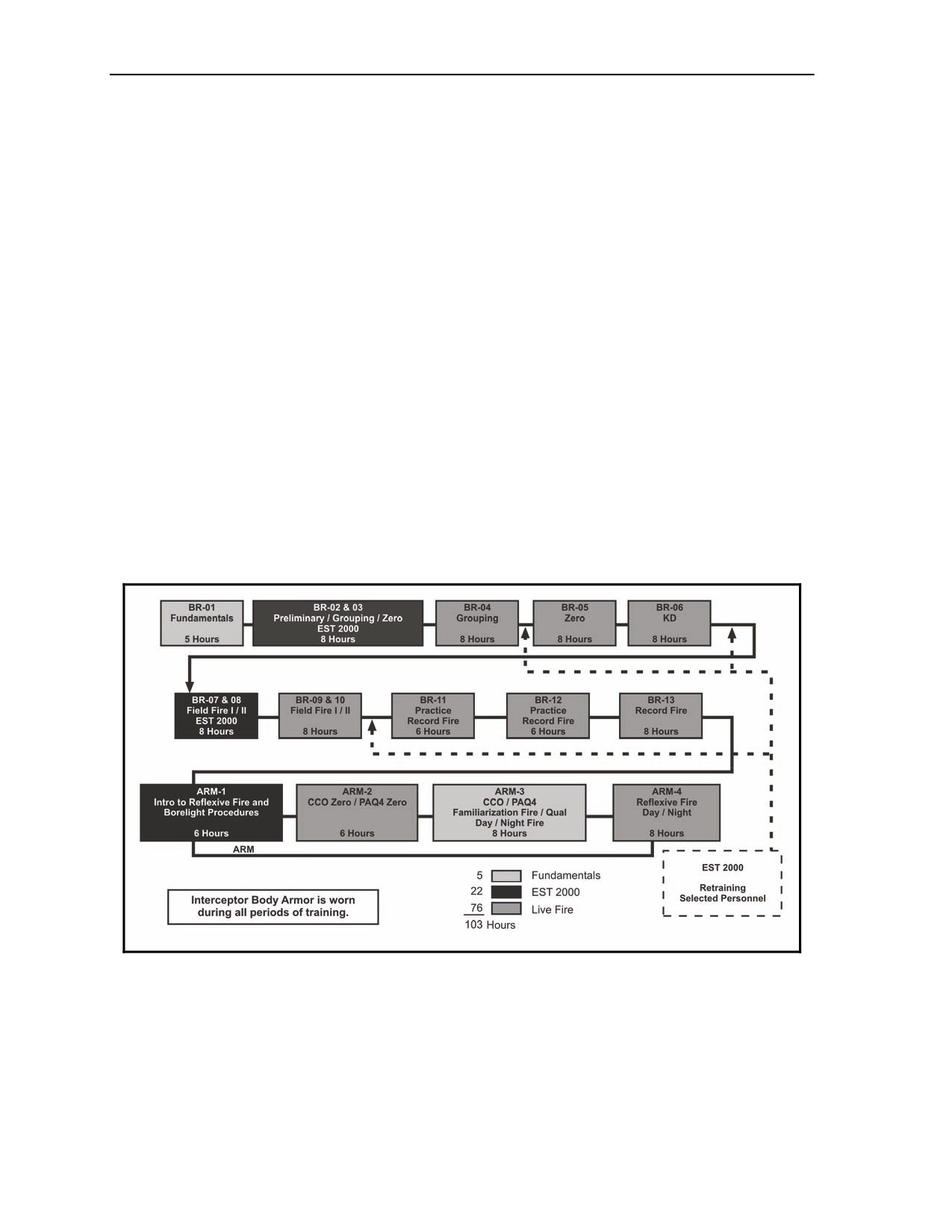
1-5. The training strategy for BRM begins in IET and continues in the unit. Figure 1-1 shows the IET
training strategy.
1-6. In IET, Soldiers learn how to maintain a rifle, hit a point target, and apply the four marksmanship
fundamentals and other skills needed to engage a target. Once Soldiers understand the weapon and have
demonstrated skill in zeroing, additional simulations and live-fire training exercises are conducted to
prepare Soldiers for qualification. During these exercises, Soldiers master target types and scenarios of
increasing difficulty to develop their proficiency.
1-7. IET culminates in the Soldier’s proficiency assessment (which is conducted on the standard record
fire range or approved alternates), followed by instruction on advanced firing techniques (a night-fire
exercise with iron sights [unassisted] or night vision goggles [assisted]). This evaluation allows leaders to
determine the effectiveness of the training.
Figure 1-1. Initial entry training marksmanship training strategy.
SUSTAINMENT TRAINING
1-8. Training continues in active Army, National Guard, and Army Reserve units using the same basic
skills taught in IET. Units must set up a year-round program to sustain skills and have a plan not only for
when they are at their home station, but for when they are deployed as well.
1-2
FM 3-22.9
12 August 2008
Marksmanship Training
1-9. To sustain the basic marksmanship skills taught in IET, periodic PMI is conducted, followed by
instructional and qualification range firing. Key elements include—
z
The training of trainers.
z
Refresher training of nonfiring skills.
z
The use of the Engagement Skills Trainer (EST) 2000, Laser Marksmanship Training System
(LMTS), or other devices.
z
Sustainment training.
z
Remedial training.
NOTE: See Appendix A for more information about TADSS.
1-10. Additional skills trained in the unit include—
z
Semiautomatic and automatic fires.
z
Night fire.
z
Mission-oriented protective posture (MOPP) firing.
z
Firing using aiming devices.
z
Moving target training techniques.
z
Squad designated marksman (SDM) training.
z
Short-range marksmanship (SRM).
1-11. These skills are trained and integrated into collective training exercises, such as platoon and squad
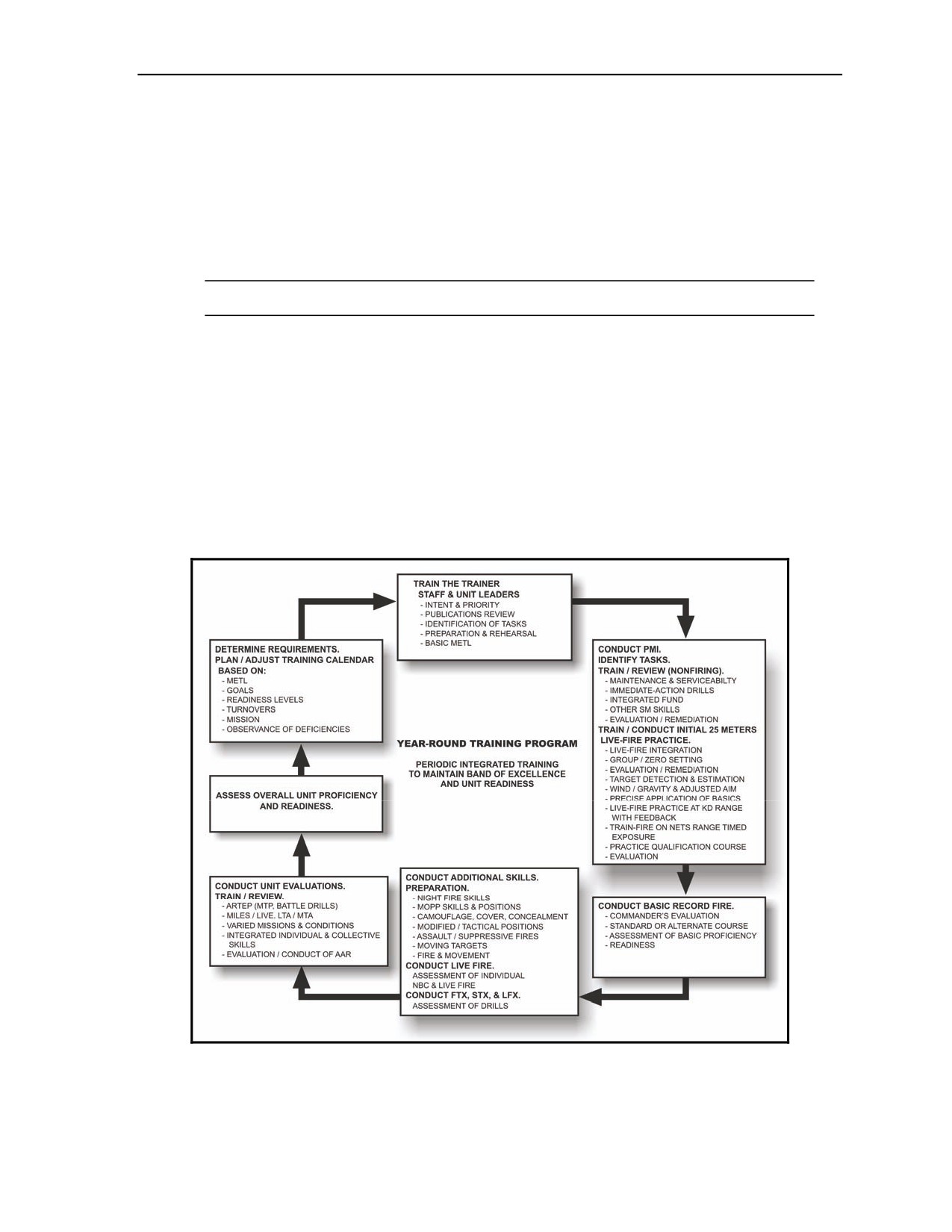
live-fire situation training exercises (STXs). Figure 1-2 shows a year-round training strategy guide.
Figure 1-2. Unit marksmanship sustainment strategy.
1-12. General marksmanship knowledge and weapon proficiency are perishable skills. Most units have a
readiness requirement that all Soldiers must zero their rifles within a certain time after unit assignment.
12 August 2008
FM 3-22.9
1-3
Chapter 1
Soldiers must confirm the battlesight zeros of their assigned rifles before qualifying. Units should conduct
PMI and practice firing throughout the year due to personnel turnover. A year-round marksmanship
sustainment program is needed for the unit to maintain the individual and collective firing proficiency
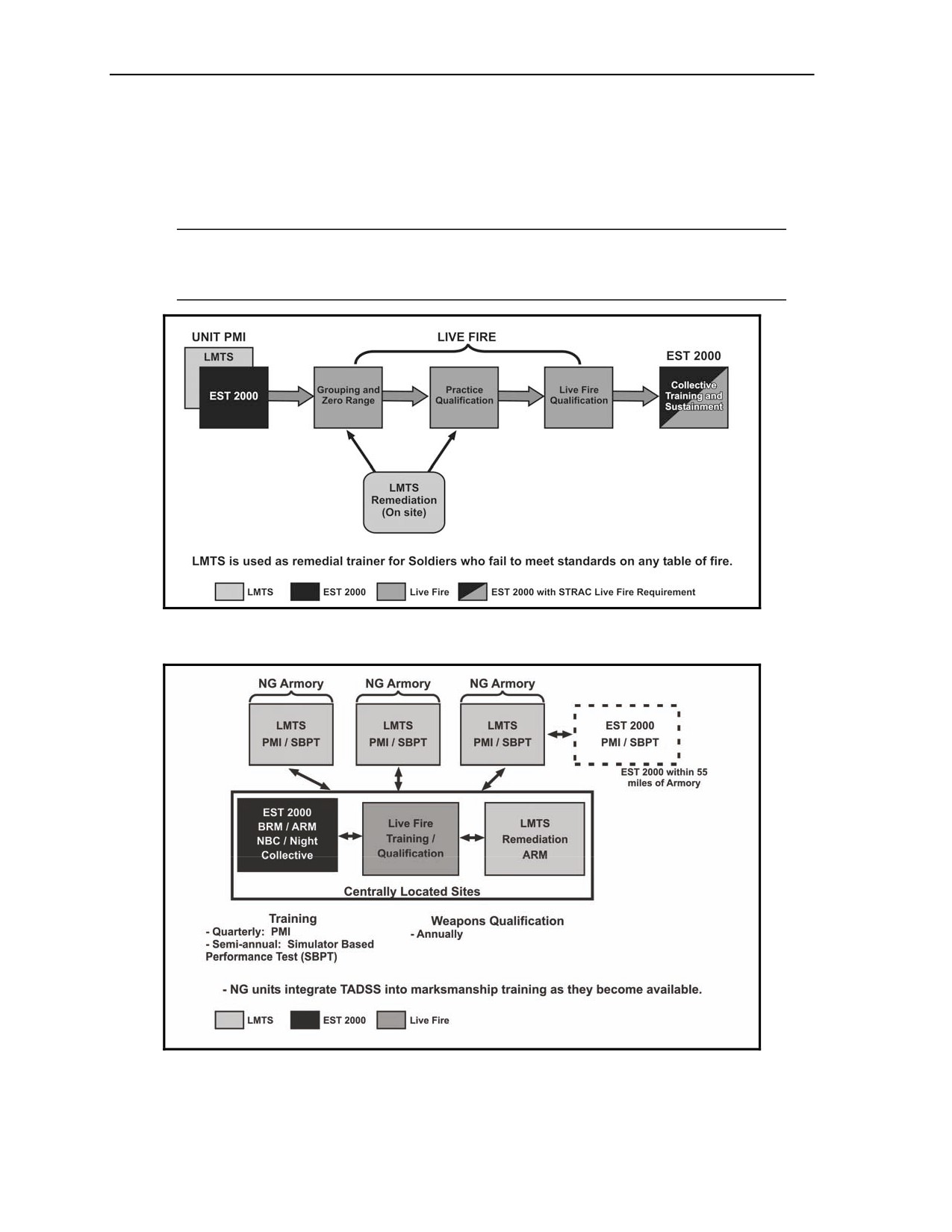
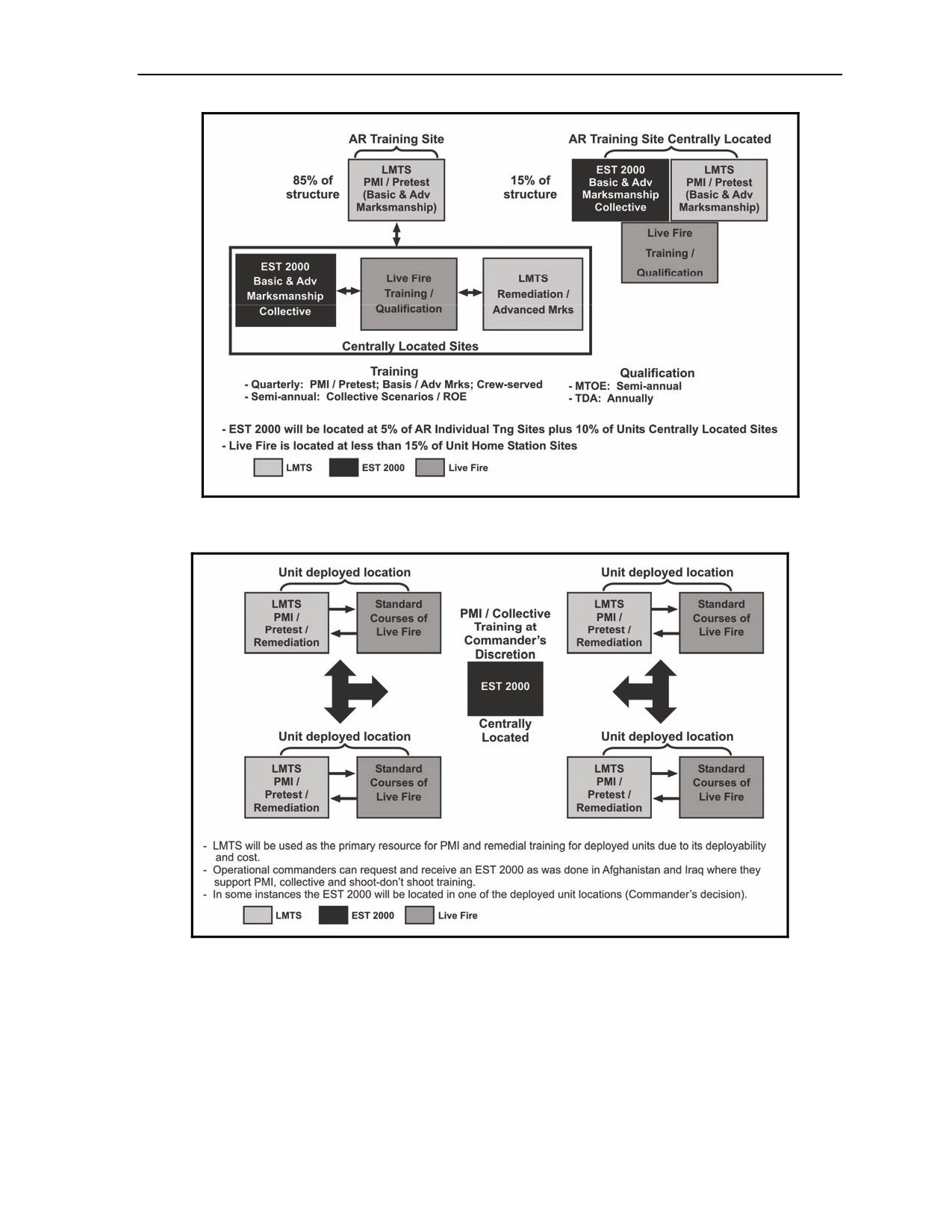
requirements to accomplish its mission. The following figures depict marksmanship training programs for
active Army home station units (Figure 1-3), National Guard home station units (Figure 1-4), Army
Reserve home station units (Figure 1-5), and deployed units (Figure 1-6).
NOTE: While the training strategy depicted in Figures 1-3 through 1-6 is not compulsory, it is strongly
recommended for Army-wide application. The strategy has proven success during IET, producing more
proficient Soldiers while using less ammunition. Commanders are urged to follow this strategy closely.
Figure 1-3. Active Army home station marksmanship training strategy.
Figure 1-4. National Guard home station marksmanship training strategy.
1-4
FM 3-22.9
12 August 2008
Marksmanship Training
Figure 1-5. Army Reserve home station marksmanship training strategy.
Figure 1-6. Deployed unit marksmanship training strategy.
TRAINING PHASES
1-13. Soldiers progress through five phases of rifle marksmanship training:
z
Phase I—Basic Rifle Marksmanship Preliminary Marksmanship Instruction.
z
Phase II—Basic Rifle Marksmanship Downrange Feedback Range Firing.
z
Phase III—Basic Rifle Marksmanship Field Firing.
12 August 2008
FM 3-22.9
1-5
Chapter 1
z
Phase IV—Advanced Rifle Marksmanship.
z
Phase V—Advanced Optics, Lasers, and Iron Sights.
1-14. When Soldiers are trained in all phases of rifle marksmanship, a solid sustainment program is key to
mission readiness.
PHASE I—BASIC RIFLE MARKSMANSHIP PRELIMINARY MARKSMANSHIP INSTRUCTION
1-15. Understanding the operation and functions of any machine is vital to becoming an expert with that
machine. The same theory applies to rifle marksmanship. Soldiers must master weapon maintenance,
function checks, and firing fundamentals before progressing to advanced skills and firing exercises under
tactical conditions. Armed with this knowledge, a Soldier is able to assess and correct any malfunction to
keep the weapon operating properly.
Introduction to Basic Rifle Marksmanship and Mechanical Training
1-16. During this period of instruction, Soldiers are trained to understand the operation and functions of the
weapon. This period of instruction includes the following topics:
z
General safety rules and weapon clearing procedures.
z
Characteristics, components, accessories, and ammunition.
z
Disassembly.
z
Inspection.
z
Lubrication.
z
Assembly.
z
Function check.
z
Loading/unloading the magazine.
z
Loading/unloading the weapon.
z
Immediate and remedial action.
z
Adjusting the front and rear sights.
z
Peer coaching.
z
Eight cycles of function.
z
Troubleshooting.
NOTE: The IET program of instruction (POI) allots four hours for this phase of training.
Marksmanship Fundamentals I
1-17. During this period of instruction, Soldiers are trained to demonstrate the integrated act of shooting
using the EST 2000 or LMTS.
NOTE: EST 2000 will not be used in lieu of live-fire qualification except for those outlined in
DA Pam 350-38.
1-18. This period of instruction includes the following topics:
z
The four fundamentals.
z
Basic firing positions.
z
Range and safety procedures.
z
Dominant eye training.
z
Demonstrating the integrated act of shooting during dry-fire exercises.
NOTE: The IET POI allots six hours for this phase of training.
1-6
FM 3-22.9
12 August 2008
Marksmanship Training
Marksmanship Fundamentals II
1-19. During this period of instruction, Soldiers are trained to demonstrate the integrated act of shooting
using the EST 2000 or LMTS.
NOTES:
1. The IET POI allots six hours for this phase of training.
2. See paragraphs 4-76 through 4-80 and Appendix A for more information about
EST 2000 and LMTS training.
PHASE II—BASIC RIFLE MARKSMANSHIP DOWNRANGE FEEDBACK RANGE FIRING
1-20. During Phase II, instructors/trainers outline grouping and zeroing procedures and demonstrate how to
conduct the three types of known distance (KD) ranges. Downrange feedback provides precise knowledge
of what happens to bullets at a given range and allows Soldiers to transition between 25-meter firing and
firing on the field fire range. Knowing precisely where bullets hit allows poor firers (with the assistance of
instructors/trainers) to improve their performance and good firers to bring their shots to the center of the
target. Firers develop the knowledge and skills required to perform with confidence on the field fire range,
where only hit-or-miss information is available.
Grouping Procedures
1-21. Grouping is a form of practice firing with two primary objectives: firing tight shot groups and
consistently placing those groups in the same location. Frequent use of the EST 2000 or LMTS greatly
reduces live-fire grouping time.
Zeroing Procedures
1-22. Zeroing allows firers to use standard issue ammunition to align the sights with the weapon’s barrel.
When this is accomplished correctly, the aimpoint and the impact point are the same at a given range. For
most combat targets, this sight setting provides the greatest probability of a hit with minimum adjustment to
the aimpoint. When followed, a properly zeroed rifle for one Soldier is close to zero for another Soldier.
Downrange Feedback
1-23. On KD ranges, Soldiers fire tight shot groups at a known distance and make sight adjustments at a
given range while experiencing the effects of wind, gravity, and other environmental factors. The
advantage of a KD range is the ability to see precisely where each bullet hits. KD firing is conducted with a
single, clearly visible target at a known distance, and the Soldier can establish a position that provides a
natural aimpoint on that single target.
NOTES:
1. See Chapter 5 for more information about downrange feedback.
2. See paragraphs 4-76 through 4-80 and Appendix A for more information about
EST 2000 and LMTS training.
PHASE III—BASIC RIFLE MARKSMANSHIP FIELD FIRING
1-24. Field fire begins a critical transition from unstressed firing at single targets at known distances to
requiring the Soldier to refine techniques for scanning the range for targets, estimating range, and firing
quickly and accurately. Phase III includes the following:
z
Field Fire I (single timed targets at 75 meters, 175 meters, and 300 meters).
z
Field Fire II (single and multiple targets at 75 meters, 175 meters, and 300 meters).
z
Practice Record Fire.
z
Practice Record Fire II.
z
Record Fire.
12 August 2008
FM 3-22.9
1-7
Chapter 1
NOTES:
1. See Chapter 6 for more information about BRM field fire.
2. See paragraphs 4-76 through 4-80 and Appendix A for more information about
EST 2000 and LMTS training.
PHASE IV—ADVANCED RIFLE MARKSMANSHIP
1-25. ARM focuses on the techniques and procedures that the Soldier will need to participate in collective
training. This phase addresses the following topics:
z
Alternate firing positions.
z
Burst fire.
z
Quick fire.
z
Chemical, biological, radiological, and nuclear (CBRN) fire.
z
Moving targets.
z
SDM.
z
Unassisted night record fire.
z
M68 close combat optic (CCO).
z
Advanced combat optical gunsight (ACOG).
z
AN/PAQ-4C infrared (IR) aiming laser.
z
Assisted night record fire IR.
z
Assisted night record fire (thermal).
z
SRM.
NOTE: See Chapter 7 for more information about ARM.
PHASE V—ADVANCED OPTICS, LASERS, AND IRON SIGHTS
1-26. BRM teaches Soldiers to effectively engage the enemy with the basic rifle using the iron sights
(primarily during the day). ARM adds additional situations for the firer. To enhance the lethality of night
firing, Soldiers participate in training with optics and lasers. This phase addresses the following topics:
z
Backup iron sight (BUIS).
z
M68 CCO.
z
ACOG.
z
AN/PAQ-4C IR aiming laser.
z
AN/PEQ-2A/B target pointer illuminator/aiming light (TPIAL).
z
Thermal weapon sight (TWS).
z
AN/PVS-4 night vision sight.
NOTE: See Chapter 8 for more information about advanced optics, lasers, and iron sights.
SECTION II. UNIT MARKSMANSHIP TRAINING PROGRAM
An effective unit marksmanship program reflects the priority, emphasis, and interest of commanders and
trainers. This section outlines a rifle marksmanship training program strategy as guidance in establishing and
conducting an effective unit training program. The strategy consists of the individual and leader refresher
training for maintaining the basic skills learned during IET. It progresses to training advanced and collective
skills under near-combat conditions during live-fire STXs.
1-8
FM 3-22.9
12 August 2008
Marksmanship Training
MISSION-ESSENTIAL TASKS
1-27. Marksmanship proficiency is critical to soldiering and is required for any unit deployed to a wartime
theater. All commanders should develop a METL and organize a training program that devotes adequate
time to marksmanship. The unit’s combat mission must be considered when establishing training priorities.
This not only applies to the tasks selected for the unit’s METL, but also to the conditions under which the
tasks are to be performed. If a unit may be employed in an urban environment, the effects of range, gravity,
and wind may not be as important as automatic or burst fire, quick fire, or assault fire. The reverse may be
true of a unit that expects to engage the enemy at long ranges.
TRAINING ASSESSMENT
1-28. To conduct an effective marksmanship program, the unit commander must determine the current
marksmanship proficiency of all assigned personnel. Constant evaluation provides commanders
understanding of where training emphasis is needed. All results are reviewed to determine any areas that
need strengthening, along with any individuals that require special attention. Based on this evaluation,
marksmanship training programs are developed and executed. Commanders continually assess the program
and modify it as required. To develop a training plan and assess the marksmanship program, commanders
should use the following tools:
z
Direct observation of training.
z
Spot checks.
z
Review of past training.
1-29. Based on the commander’s evaluation, goals, and missions, quarterly, semiannual, or annual training
events are identified. Marksmanship programs must be continuous, and to sustain an effective
marksmanship program, resources are required. While the unit may only qualify its Soldiers annually or
semiannually, test results show that sustainment training is required at least quarterly to maintain
marksmanship skills.
DIRECT OBSERVATION OF TRAINING
1-30. Observing and accurately recording performance reveals the status of weapon maintenance, Soldier
zero and qualification results, and each Soldier's ability to hit targets. This also allows the commander to
identify Soldiers who need special assistance to reach required standards and those who exceed these
standards.
SPOT CHECKS
1-31. Spot checks of individual marksmanship performance, such as interviews and evaluations of
Soldiers, provide commanders with valuable information about Soldier proficiency and knowledge of the
marksmanship tasks.
REVIEW OF PAST TRAINING
1-32. Commanders review past training to gain valuable information for developing a training plan. The
assessment should include—
z
The frequency and results of training.
z
The basic and advanced record fire results.
z
The frequency of unit-conducted collective CBRN or night fire training.
COMMANDER’S EVALUATION GUIDE
1-33. The commander's evaluation guide contains three sections:
z
Commander's priorities and intent.
z
Soldier assessment.
z
Trainer assessment.
12 August 2008
FM 3-22.9
1-9
Chapter 1
1-34. The following is an example of a commander’s evaluation guide. Commanders can use this guide not
only to assess their unit’s marksmanship proficiency, but to assess the unit leaders and their ability to
effectively implement a marksmanship program. They can also use it to develop NCOs into subject matter
experts.
Commander’s Priorities and Intent
1-35. When considering their priorities and intent, commanders answer the following questions:
z
Have you clearly stated the priority of rifle (small arms) proficiency in your unit? What is it? Do
the staff and subordinates support this priority? Is it based on your METL and an understanding
of FM 7-0 and FM 7-1?
z
Have you clearly stated the intent of record fire? Are leaders evaluating firing performance
based on accurately recorded data and results?
z
Have you clearly stated that weapon qualification or record fire is one of the commander’s
opportunities to assess several skills relating to small arms readiness?
z
What qualification course will be used to evaluate your unit’s marksmanship readiness (small
arms)?
Is the standard 300-meter, 300-yard KD, or 25-meter scaled target alternate qualification
course used?
How will it be conducted? Will the prescribed procedures be followed?
Who will collect the data?
z
Have you clearly stated the purpose and intent of PMI?
What skills will PMI address?
Will PMI be performance-oriented? Are tasks integrated?
Soldier Assessment
1-36. During Soldier assessment, commanders answer the following questions:
z
Do Soldiers maintain their assigned weapons and magazines IAW the TM? Do they have a
manual?
z
Do Soldiers conduct serviceability checks of weapons and magazines before training? Were
maintenance deficiencies corrected?
z
Do Soldiers demonstrate an understanding of the weapon’s operation, functioning, and
capabilities?
z
Can Soldiers correctly apply immediate action procedures to reduce weapon stoppages and then
continue to fire? Have they demonstrated this during dry-fire exercises?
z
Are Soldiers firing their assigned weapons?
How often are weapons reassigned between individuals?
What is the value of a recorded zero?
z
Can Soldiers precisely and consistently apply the four fundamentals of rifle marksmanship? To
what standard have they demonstrated their mastery?
During a dry-fire exercise?
During a live-fire exercise (LFX)?
When firing on the 25-meter course?
During KD firing?
z
Can Soldiers accurately battlesight zero their assigned rifle to standard?
Do they understand sight adjustment procedures?
Do they record their rifle’s zero? How is it done? Why?
Do they record the date the Soldier last zeroed his rifle? What is the sight setting? Are these
linked? How do you check this?
z
Do Soldiers demonstrate their knowledge of the effects of wind and gravity while firing out to
300 meters? What feedback was provided? How?
1-10
FM 3-22.9
12 August 2008
Marksmanship Training
z
Can Soldiers scan a designated area or sector of fire and detect all targets out to 300 meters? If
not, why?
z
Can Soldiers quickly engage timed single and multiple targets from both supported and
unsupported firing positions out to 300 meters? If not, which targets were not engaged? Which
were missed? Why?
z
During individual and collective training, do Soldiers demonstrate their ability to manage
allocated ammunition and to engage all targets? Do they fire several rounds at one target? Which
targets? Why?
z
Based on an analysis of individual qualification scores, what is the distribution?
Are most Soldiers just meeting the minimum acceptable performance (marksman)?
Are most Soldiers distributed in the upper half of the performance spectrum (sharpshooter,
expert)?
z
What is the hit distribution during collective LFXs?
z
Do Soldiers demonstrate proficiency during night-fire, target detection and acquisition, and night
fire engagement techniques? When using night vision devices (NVDs)?
z
Do Soldiers demonstrate individual marksmanship proficiency during MOPP firing conditions?
During collective exercises?
z
Do Soldiers demonstrate proficiency during moving target engagements? Do they demonstrate
proficiency collectively by hitting moving targets at the multipurpose range complex? If not, is
moving target training conducted?
z
Are marksmanship skills integrated into tactical exercises and unit LFXs? If so, is suppressive
fire, rapid semiautomatic fire, and automatic or burst fire conducted? What tasks in the mission
training plan are evaluated?
z
Based on onsite observations and analysis of training and firing performance, what skills or tasks
show a readiness deficiency?
What skills need training emphasis? Individual emphasis? Leader emphasis?
What are the performance goals?
Trainer Assessment
1-37. During trainer assessment, commanders answer the following questions:
z
Who has trained or will train the trainers?
What is the subject matter expertise of the cadre?
Are they actually training the critical skills?
Have they addressed the nonfiring skills first?
What aids and devices are being used? Are EST 2000 and LMTS being properly used?
z
What administrative constraints or training distracters can you overcome for the junior officer
and NCO? At what level are the resources necessary to train marksmanship controlled (time,
training aids, weapons, ammunition, ranges)? Do the sergeants do the job they are charged with?
TRAINERS
1-38. Knowledgeable instructors or cadre are the key to marksmanship performance. All commanders must
be aware of maintaining expertise in marksmanship instruction/training.
INSTRUCTOR/TRAINER SELECTION
1-39. Institutional and unit instructors/trainers are selected and assigned from the most highly qualified
Soldiers. These Soldiers must demonstrate proficiency in all aspects of rifle marksmanship, be proficient in
applying these fundamentals, know the importance of marksmanship training, and have a competent and
professional attitude. The commander must ensure that selected instructors/trainers can effectively train
other Soldiers. Local instructor/trainer training courses and marksmanship certification programs must be
established to ensure that instructor/trainer skills are developed.
12 August 2008
FM 3-22.9
1-11
Chapter 1
CADRE/TRAINER
1-40. Cadre/trainer refers to a marksmanship instructor/trainer that has more experience and expertise than
the firer does. He trains Soldiers in the effective use of the rifle by maintaining strict discipline on the firing
line, insisting on compliance with range procedures and program objectives, and enforcing safety
regulations. A good cadre/trainer must understand the training phases and techniques for developing
marksmanship skills. Each cadre/trainer must have the following attributes:
z
Knowledge.
z
Patience.
z
Understanding.
z
Consideration.
z
Respect.
z
Encouragement.
Knowledge
1-41. Effective cadre/trainers must possess a thorough knowledge of the rifle, proficiency in firing, and a
complete understanding of this manual and supporting manuals.
Patience
1-42. Effective cadre/trainers relate to the Soldier calmly, persistently, and patiently.
Understanding
1-43. Cadre/trainers enhance success and understanding by emphasizing close observance of rules and
instructions.
Consideration
1-44. Most Soldiers, even those who do not fire well, enjoy firing and begin their training with great
enthusiasm. A cadre/trainer who is considerate of Soldiers' feelings and who encourages them throughout
their training will find training a pleasant and rewarding duty.
Respect
1-45. An experienced cadre is assigned the duties of instructor/trainer, which classifies him as a technical
expert and authority. A good cadre/trainer watches for mistakes and patiently makes needed corrections.
Encouragement
1-46. A cadre/trainer can encourage Soldiers by convincing them to achieve good firing performance
through practice. He imparts his knowledge and helps Soldiers gain the practical experience necessary.
TRAINING THE TRAINER
1-47. Knowledgeable small-unit leaders are key to marksmanship training. This manual and other training
publications provide the unit instructor with the required information for developing a good train-the-
trainer program.
1-48. The goal of a progressive train-the-trainer program is to achieve a high state of combat readiness.
Through the active and aggressive leadership of the chain of command, a perpetual base of expertise is
established and maintained.
1-49. The commander should identify unit personnel who have had assignments as marksmanship
instructors. These individuals should be used to train other unit cadre by conducting PMI and LFXs for
their Soldiers.
1-12
FM 3-22.9
12 August 2008
Marksmanship Training
1-50. Assistance and expertise from outside the unit may also be available, such as the Army
Marksmanship Unit (AMU) at Fort Benning, Georgia. A suggested train-the-trainer program is outlined
below:
z
Conduct marksmanship diagnostic test.
z
Review operation and function of the rifle and ammunition, immediate action, and safety.
z
Conduct PMI; review the four fundamentals.
z
Review coaching techniques and device usage.
z
Establish grouping and zeroing procedures.
z
Review effects of wind and gravity when firing as far away as 300 meters (600 meters for
ARM).
z
Conduct range operations.
z
Conduct qualification/record firing.
z
Diagnose firing problems.
DUTIES OF THE INSTRUCTOR/TRAINER
1-51. The instructor/trainer helps the firer master the fundamentals of rifle marksmanship. He ensures that
the firer consistently applies what he has learned. When training the beginner, the instructor/trainer could
confront problems, such as fear, nervousness, forgetfulness, failure to understand, and a lack of
coordination or determination, which may be compounded by arrogance or carelessness. With all types of
firers, the instructor/trainer must ensure that firers are aware of their firing errors, understand the causes,
and apply remedies. To perform these duties, he—
z
Observes the firer.
z
Questions the firer.
z
Analyzes the shot group.
Observing the Firer
1-52. To pinpoint errors, the instructor/trainer observes the firer during drills and when firing. If there is no
indication of probable error, the firer’s position, breath control, shot anticipation, and trigger squeeze are
closely observed.
Questioning the Firer
1-53. The firer is asked to detect his errors and to explain his firing procedure (position, aiming, breath
control, and trigger squeeze).
Analyzing the Shot Group
1-54. Analyzing the shot group is an important step in detecting and correcting errors. When analyzing a
target, the instructor/trainer correlates observations of the firer to probable errors in performance, according
to the shape and size of shot groups. A poor shot group is usually caused by more than one observable
error.
TRAINER CERTIFICATION PROGRAM
1-55. The certification program sustains the trainers’ expertise and develops methods of training. The
program standardizes procedures for certifying marksmanship trainers. Trainers’ technical expertise must
be continuously refreshed, updated, and closely managed.
TRAINING BASE
1-56. The training base can expect the same personnel changes as any other organization. Soldiers assigned
as marksmanship trainers will have varying degrees of experience and knowledge of training procedures
and methods. Therefore, the trainer certification program must be an ongoing process that is tailored to
12 August 2008
FM 3-22.9
1-13
Chapter 1
address these variables. At a minimum, formal records should document program progression for each
trainer. All marksmanship trainers must complete the four phases of training using the progression steps,
and the records should be updated on a quarterly basis.
CERTIFICATION PROGRAM OUTLINE
1-57. Before certification, all trainers must attend all phases of the train-the-trainer program in the
following order:
z
Phase I—Program Orientation.
z
Phase II—Preliminary Marksmanship Training.
z
Phase III—Basic Marksmanship Training.
z
Phase IV—Advanced Marksmanship Training.
1-58. Then, they conduct all phases to demonstrate their ability to train Soldiers and to diagnose and
correct problems. Trainers who fail to attend or do not pass any phase of the diagnostic examination will be
assigned to subsequent training.
Phase I—Program Orientation
1-59. During this phase, the trainer must accomplish the following tasks and be certified by the chain of
command:
z
Be briefed on the concept of the certification program.
z
Be briefed on the unit marksmanship training strategy.
z
Review the unit marksmanship training outlines.
z
Review issued reference material.
z
Visit training sites and firing ranges.
Phase II—Preliminary Marksmanship Training
1-60. Phase II should be completed no more than two weeks following the conclusion of Phase I. During
Phase II, the trainer demonstrates his ability to master the marksmanship fundamentals, and his
performance is reviewed by the chain of command. The results of this review are recorded and maintained
on the trainer’s progression sheet, which is, in turn, designed IAW the unit SOP.
z
Safety, clearing, and unloading procedures.
z
Characteristics.
z
Capabilities.
z
Accessories.
z
Ammunition.
z
Disassembly.
z
Cleaning, inspection, and lubrication procedures.
z
Assembly.
z
Function check.
z
Loading.
z
Immediate and remedial actions.
z
Four fundamentals.
z
Use of EST 2000, LMTS, and other TADSS.
z
Sight manipulation.
z
Boresighting procedures.
z
Zeroing procedures.
z
Effect of wind, gravity, and other environmental factors.
z
Range determination and estimation.
z
Classes of fire.
1-14
FM 3-22.9
12 August 2008
Marksmanship Training
z
Application of fire.
z
Range operations, courses of fire, conduct of fire, and fire commands.
z
Optics, NVDs, night aiming devices, and thermal devices.
z
Scanning techniques.
Phase III—Basic Marksmanship Training
1-61. During this phase, the trainer demonstrates and reinforces what he has learned during Phase II. The
trainer sets up and conducts firing on the various ranges. He explains the targets and the zeroing and
scoring procedures. The trainer explains the purpose of transition firing, field zeroing procedures, range
layout, and the conduct of training on the transition range. This validates that the trainer has gained the
knowledge necessary to conduct training. The results of this review are recorded and maintained on the
trainer’s progression sheet.
Phase IV—Advanced Marksmanship Training
1-62. The final phase of the train-the-trainer program tests the trainer. During this phase, the trainer sets up
a range and conducts training for at least one person. If ammunition is available, the trainer conducts a
firing exercise. If ammunition is not available, the evaluation is based on the quality of training given.
QUALIFICATION TRAINING
1-63. Although marksmanship is a continuous training requirement, units normally conduct a refresher
program before qualification. Soldiers must be well-versed in marksmanship fundamentals and have
preparatory marksmanship training before qualification. This applies to qualification for the entire unit or
for newly assigned personnel. Trainers must understand that unit rifle marksmanship is not a series of
exercises to be trained in a planned sequence as is done during IET, but trainers can use the exercises and
POI events covered during IET to identify events that the unit can use for a sustainable and effective unit
marksmanship program. The unit must prepare for training by—
z
Issuing Soldiers a serviceable weapon.
z
Maintaining and replacing bad magazines.
z
Issuing and assigning each Soldier his own rifle. Only he will zero and fire the weapon assigned
to him.
z
Considering available or required resources (targets, ranges, ammunition, training aids, devices,
and publications) early in the process.
1-64. Before the Soldier can fire, he must know how to adjust the rifle's sights and should understand
ballistics (for example, the effects of wind and gravity on a bullet strike). A refresher training program
prevents Soldiers from becoming frustrated and losing confidence, and conserves ammunition and training
time. All Soldiers attend this program so they can meet the standards outlined in this manual and
supporting manuals.
NOTE: Many individual marksmanship tasks, such as operation and function checks, immediate
action, target detection, and dry-fire, do not require live-firing. Live and virtual simulators can
be used to reinforce PMI, grouping, zeroing, practice record fire, record fire, CBRN fire, and
assisted and unassisted night fire by simulating the LFXs. Building marksmanship confidence by
repetition can bring consistency to the unit marksmanship training program.
FEEDBACK
1-65. Feedback must be included in all live-fire training. Soldiers must have precise knowledge of a bullet
strike; feedback is not adequate when bullets from previous firings cannot be identified. To provide
accurate feedback, trainers ensure that Soldiers triangulate and clearly mark previous shot groups on a
zeroing target.
12 August 2008
FM 3-22.9
1-15
Chapter 1
GROUPING AND ZEROING
1-66. The initial LFX should be a grouping exercise, during which Soldiers apply marksmanship
fundamentals to obtain tight, consistent shot groups. Following a successful grouping exercise, Soldiers
zero their weapons quickly using only a few rounds.
DOWNRANGE FEEDBACK
1-67. After zeroing, downrange feedback should be conducted. If modified field fire or KD ranges are not
available, a series of scaled silhouette targets can be used for training on the 25-meter range. A timed-fire
scaled silhouette target can add to successful record fire performance, since it represents targets at six
different ranges, requires quick response, and allows precise feedback. It also serves as another way to
confirm zero and requires the application of the four fundamentals.
FIELD FIRE
1-68. Field fire training is a transitional phase that stresses focusing on a certain area. Soldiers must detect
the target as soon as it appears and quickly fire; this is an important combat skill. Soldiers who are exposed
to the field fire range before they have refined their basic firing skills cannot benefit from the exercise, and
feedback from this exercise is hit-or-miss. If most 175- and 300-meter targets are missed, additional
feedback or PMI training should be conducted.
RECORD FIRE
1-69. The intent of record fire is to facilitate the commander’s evaluation of several individual tasks and
integrated marksmanship skill performances, and to provide unit readiness indicators. The qualification
standards are specifically related to a prescribed procedure for the conduct of record fire. Individual
performance must be evaluated IAW three components:
z
What test was used (standard, known distance, or scaled)?
z
How was the test administered?
z
How were individual and unit performances distributed (marksman, sharpshooter, and expert)
and at what target ranges?
REMEDIAL TRAINING
1-70. For firers who need additional training to meet the requirements, remedial training is conducted
using the EST 2000 or LMTS. Soldiers proficient in marksmanship skills can assist in the remedial training
effort.
NOTE: Table 1-1 shows the training devices that a commander may use to assist in remedial
training and sustain weapon proficiency. See Appendix A for more information about these
training devices. The devices replicate, but are not intended to replace, LFXs or qualifications.
Active and reserve component units should consult DA Pam 350-38 for regulatory guidance on
mandatory live-fire training and qualification events.
1-16
FM 3-22.9
12 August 2008

Marksmanship Training
Table 1-1. Training simulators, devices, and exercises.
Engagement
Laser
Location of
Short-Range
Weaponeer
TRAINING
Skills Trainer
Marksmanship
Misses and Hits
Training
DEVICE
(EST 2000)
Training System
(LOMAH)
Ammunition
(LMTS)
(SRTA) and
EXERCISE
M2 Bolt
Zero
X
X
X
X
X
Practice Fire
X
X
X
25 m
X
Simulated Record Fire
X
X
X
25 m
X
CBRN Practice
X
X
X
X
X
Simulated CBRN
X
X
X
X
X
Record
Unassisted Night
X
X
X
50 m
Practice
Unassisted Simulated
X
X
X
50 m
Night Record
NVD Zero
X
X
X
NVD Practice
X
X
X
50 m
NVD Simulated
X
X
X
50 m
Record
Advanced Skills
X
X
X
X
UNIT LIVE-FIRE EXERCISES
1-71. Unit LFXs are planned, prepared, and performed as outlined in the mission training plan for the
infantry platoon and squad. Within the framework of these exercises, Soldiers perform marksmanship tasks
under realistic combat conditions.
FUNDAMENTALS
1-72. During training, the fundamentals must apply to combat, as well as to the range. Too often Soldiers
disregard the fundamentals while under the pressure of combat, so it is imperative that the Soldier receives
feedback regarding his firing results and his use of the fundamentals during collective LFXs. This training
should also discuss target acquisition, area fire, quick fire, assuming firing positions, responding to oral fire
commands, and safety. To learn SOPs and proper procedures, Soldiers must participate in dry-fire or
MILES rehearsals at crawl, walk, and run paces.
EVALUATORS
1-73. During training, enough evaluators must be present to observe each Soldier and provide performance
feedback. Evaluators must know the scenario, the location of targets, the friendly plan, and SOPs. They
must watch each Soldier to determine if he identifies targets in his sector and successfully engages them.
Evaluators must also understand the fundamentals of marksmanship to detect Soldiers’ mistakes and review
them during the after-action review (AAR).
12 August 2008
FM 3-22.9
1-17
This page intentionally left blank.

Chapter 2
Weapon Characteristics, Accessories, and Ammunition
This chapter describes the general components, characteristics, accessories, and
ammunition for M16- and M4-series weapons, and includes a brief explanation of
how to mount the various accessories.
SECTION I. RIFLES AND CARBINES
All M16-/M4-series weapons are magazine-fed, gas-operated, air-cooled, shoulder-fired
5.56-millimeter
weapons. This section describes the general characteristics and components of M16-/M4-series weapons.
CHARACTERISTICS OF M16-/M4-SERIES WEAPONS
2-1. Table 2-1 describes the general characteristics of M16-/M4-series weapons.
Table 2-1. Characteristics of M16-/M4-series weapons.
CHARACTERISTICS
M4-SERIES
M16A2/A3
M16A4
M16A1
WEIGHT (lb)
Without magazine and sling
6.49
7.78
9.08
6.35
With sling and loaded:
20-round magazine
7.19
8.48
9.78
6.75
30-round magazine
7.50
8.79
10.09
8.06
Bayonet knife, M9
1.50
1.50
1.50
1.50
Scabbard
0.30
0.30
0.30
0.30
Sling, M1
0.40
0.40
0.40
0.40
LENGTH (in)
Rifle w/bayonet knife
N/A
44.88
44.88
44.25
Overall rifle length
N/A
39.63
39.63
39.00
Buttstock closed
29.75
N/A
N/A
N/A
Buttstock open
33.0
N/A
N/A
N/A
OPERATIONAL CHARACTERISTICS
Barrel rifling-righthand 1 twist (in)
7
7
7
12
Muzzle velocity (fps)
2,970
3,100
3,100
3,250
Cyclic rate of fire (rounds per min)
700-900
700-900
800
700-800
MAXIMUM EFFECTIVE RATE OF FIRE (rounds per min)
Semiautomatic
45
45
45
45-65
3-round burst
90
90 (A2)
90
N/A
Automatic
150-200 A1
150-200 A3
N/A
150-200
Sustained
12-15
12-15
12-15
12-15
RANGE (m)
Maximum range
3,600
3,600
3,600
2,653
Maximum effective range:
Point target
500
550
550
460
Area target
600
800
600
N/A
12 August 2008
FM 3-22.9
2-1
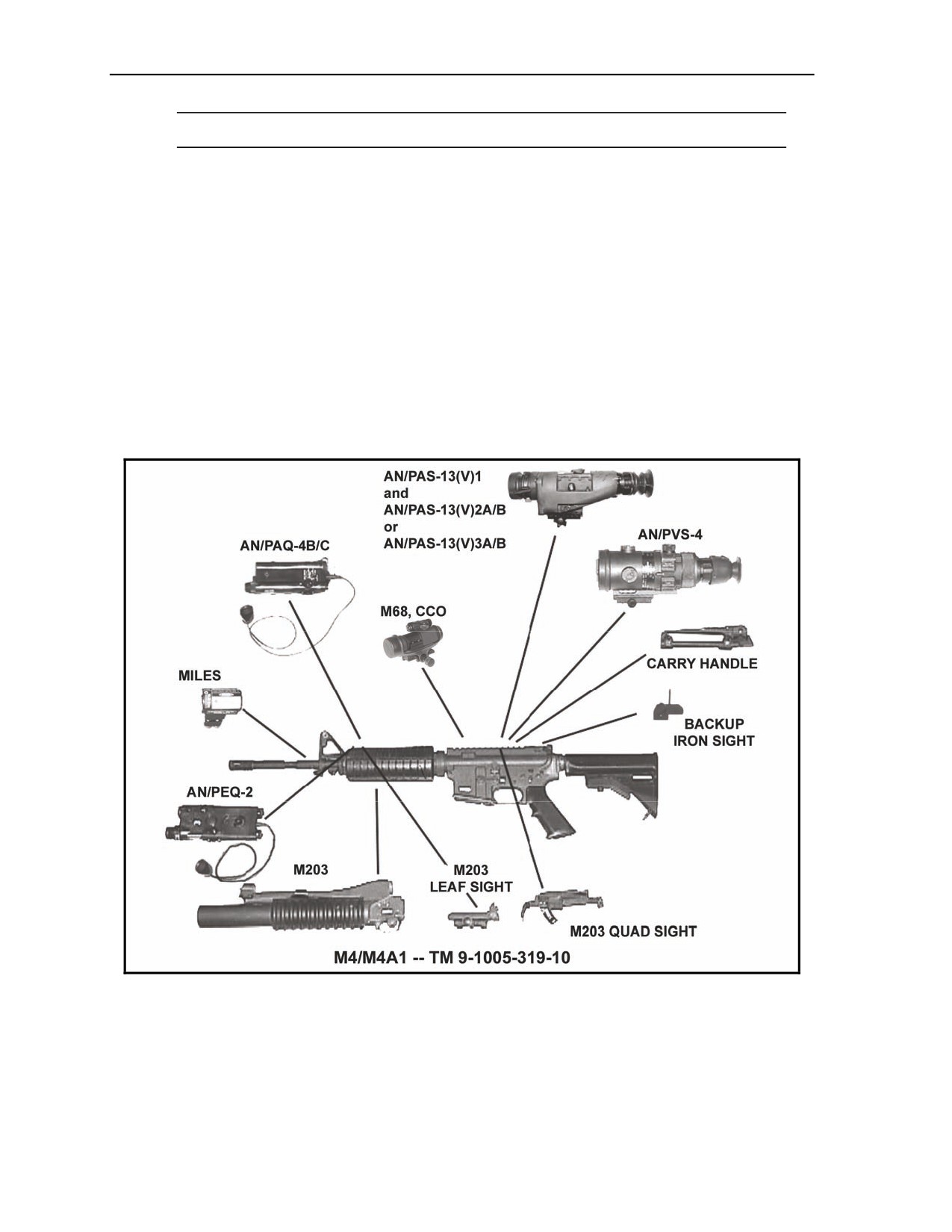
Chapter 2
NOTE: For further technical information, refer to TM 9-1005-319-10 and TM 9-1005-249-10.
M4-SERIES CARBINE
2-2. The M4-series carbine consists of the M4, the M4A1, and the M4 modular weapon system (MWS)
(Figures 2-1 and 2-2) and features several modifications to equip it for close combat operations:
z
The M4-series carbine buttstock has four positions:
Closed.
½ open.
¾ open.
Fully open.
z
The M4 carbine becomes the M4 MWS when the M4 adapter rail system (ARS) is installed
(Figure 2-3).
z
When operating an M4 or M4 MWS, the firer can move the selector lever (SAFE, SEMI, and
BURST) to fire a semiautomatic or a three-round burst.
z
The M4A1 is fully automatic.
Figure 2-1. M4/M4A1 carbine with accessories.
2-2
FM 3-22.9
12 August 2008
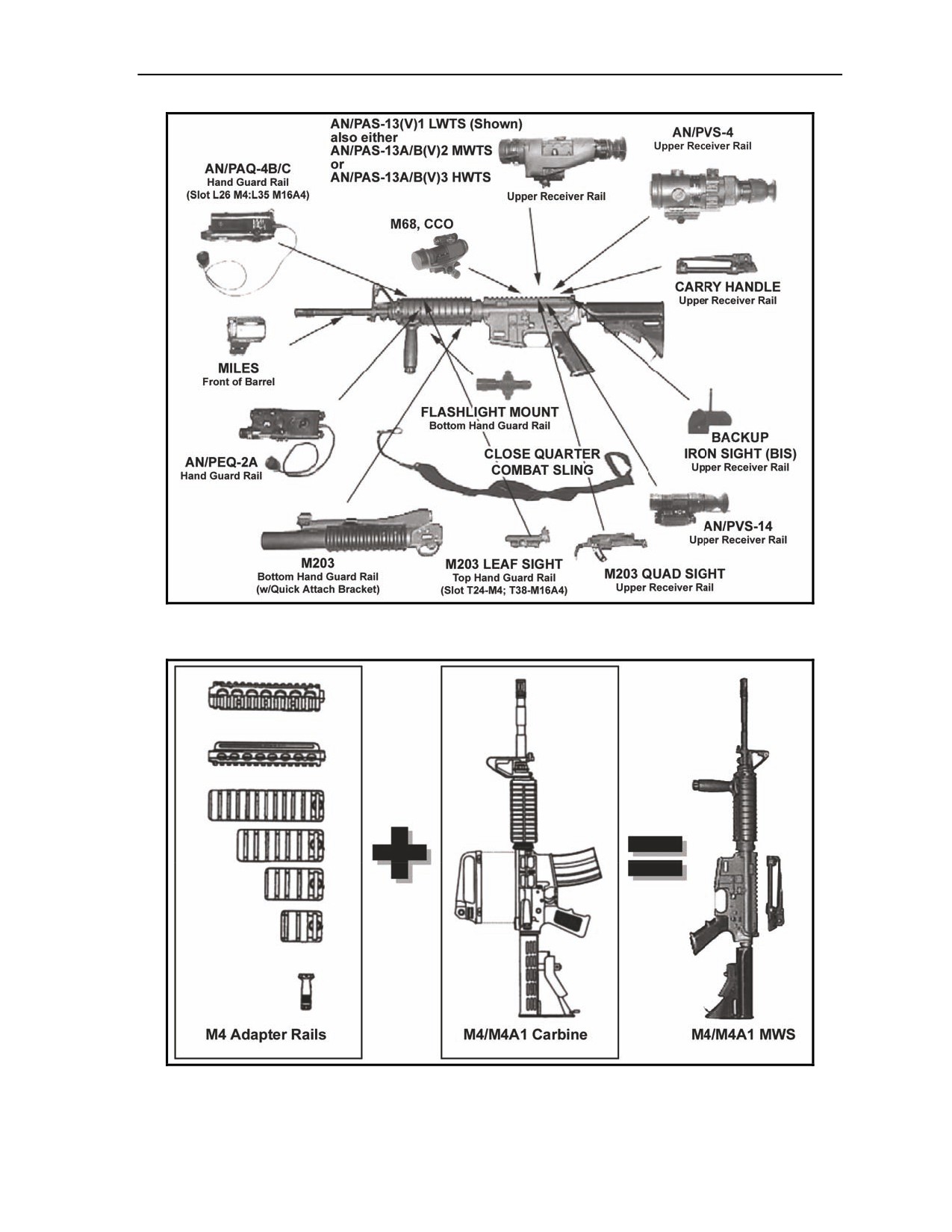
Weapon Characteristics, Accessories, and Ammunition
Figure 2-2. M4 MWS with accessories.
Figure 2-3. M4/M4A1 and M4/M4A1 MWS.
12 August 2008
FM 3-22.9
2-3
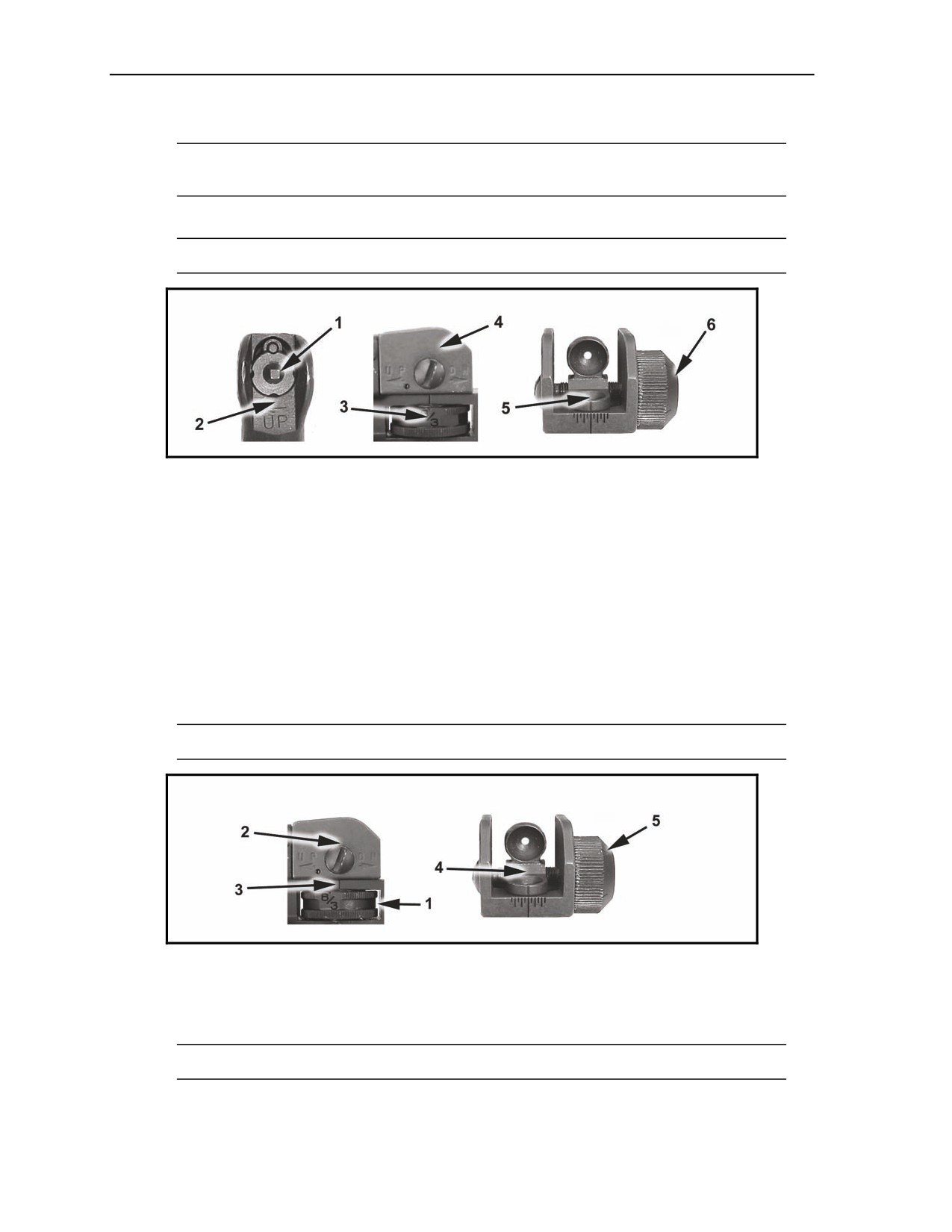
Chapter 2
MECHANICALLY ZEROING THE M4/M4A1 CARBINE OR M4 MWS
NOTE: Mechanically zeroing the weapon is only necessary when the weapon zero is
questionable, the weapon is newly assigned to the unit, or the weapon sights have been serviced.
2-3. To mechanically zero an M4/M4A1 or M4 MWS—
NOTE: Reference the weapon components using the numbers listed in Figure 2-4.
Figure 2-4. M4/M4A1 or M4 MWS mechanical zero.
(1) Adjust the front sightpost (1) until the base of the front sightpost is flush with the front sightpost
housing (2).
(2) Turn the elevation knob (3, shown as viewed from above) counterclockwise until the rear sight
assembly (4) rests flush with the detachable carrying handle and the 6/3 marking is aligned with
the index line (5) on the left side of the carrying handle.
(3) Position the apertures (6) so the unmarked aperture is up and the 0-200 meter aperture is down.
(4) Turn the windage knob (7) to align the index mark (8) on the 0-200 meter aperture with the long
center index line on the rear sight assembly.
BATTLESIGHT ZEROING THE M4/M4A1 CARBINE OR M4 MWS
2-4. To battlesight zero an M4/M4A1 or M4 MWS (Figure 2-5)—
NOTE: Reference the weapon components using the numbers listed in Figure 2-5.
Figure 2-5. M4/M4A1 or M4 MWS battlesight zero.
(1) Turn the elevation knob (1, shown as viewed from above) counterclockwise until the rear sight
assembly (2) rests flush with the detachable carrying handle and the 6/3 marking is aligned with
the index line (3) on the left side of the detachable carrying handle.
NOTE: The elevation knob remains flush.
(2) Position the apertures (4) so the unmarked aperture is up and the 0-200 meter aperture is down.
2-4
FM 3-22.9
12 August 2008
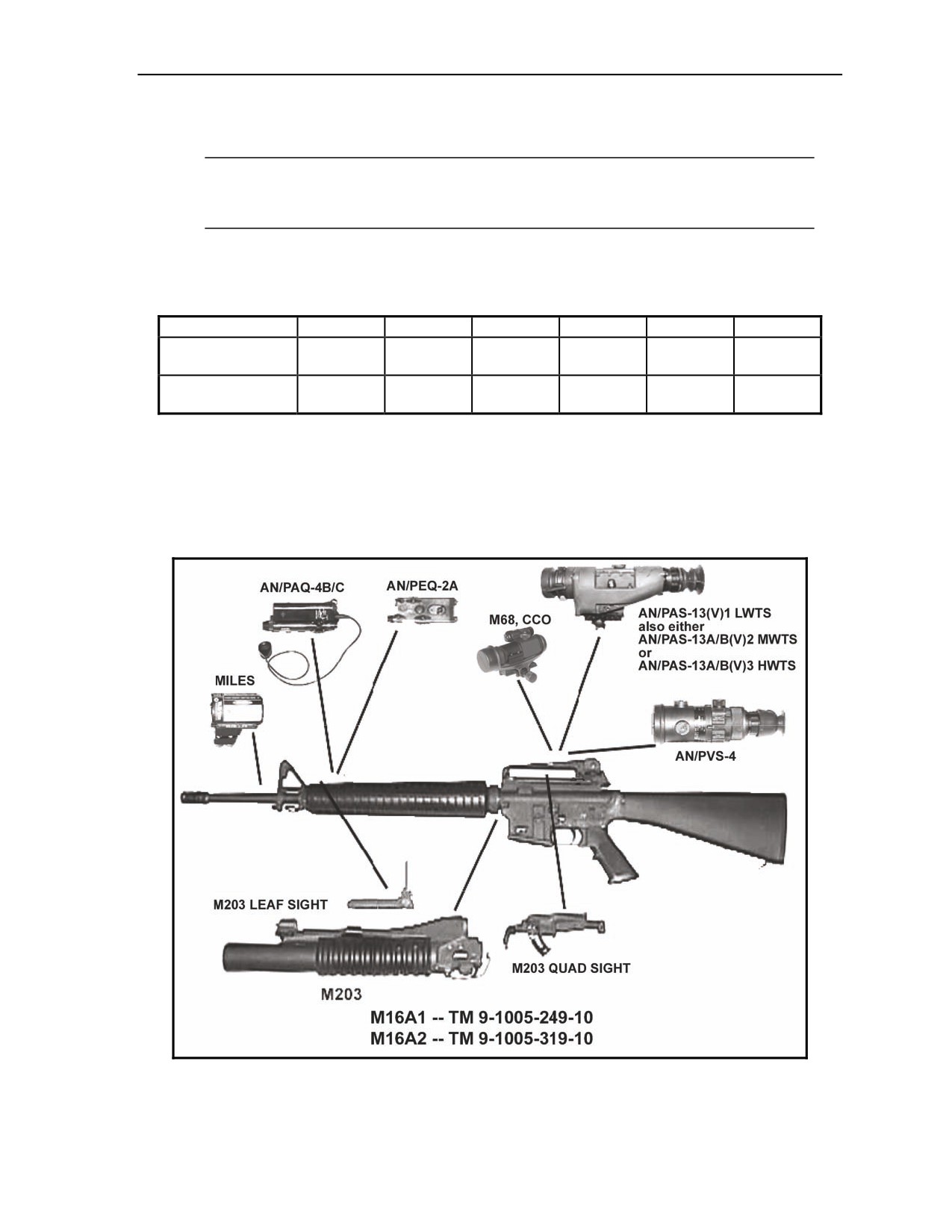
Weapon Characteristics, Accessories, and Ammunition
(3) Turn the windage knob (5) to align the index mark (6) on the 0-200 meter aperture with the long
center index line on the rear sight assembly.
NOTE: The “Z” marking on the elevation knob (employed when using the M4-series weapon's
detachable carrying handle) should be ignored. The “Z” marking is only used when the M16A4
is being zeroed.
2-5. Table 2-2 shows how much one click of elevation or windage will move the strike of the round at
ranges from 25 to 500 meters.
Table 2-2. Point of impact for the M4/M4A1 and M4 MWS.
RANGE (m)
25
100
200
300
400
500
Elevation
3/4 in
1 3/8 in
2 3/4 in
4 1/8 in
5 1/2 in
6 7/8 in
0.9 cm
3.5 cm
7 cm
10.5 cm
14 cm
17.5 cm
Windage
1/8 in
1/2 in
1 in
1 1/2 in
2 in
2 1/2 in
0.3 cm
1.25 cm
2.5 cm
3.8 cm
5 cm
6.3 cm
M16A2/A3 RIFLE
2-6. Figure 2-6 shows the M16A2/A3 rifle. When operating an M16A2 rifle, the firer can move the
selector lever (SAFE, SEMI, and BURST) to fire a semiautomatic or a three-round burst. The M16A3 has
the same characteristics as the M16A2, with the exception of the selector lever (SAFE, SEMI, and AUTO)
and the addition of the automatic mode.
Figure 2-6. M16A2/A3 rifle with accessories.
12 August 2008
FM 3-22.9
2-5
///////////////////////////////////////