FM 3-22.9 RIFLE MARKSMANSHIP M16-/M4-SERIES WEAPONS (August 2008) - page 2
Chapter 2
MECHANICALLY ZEROING THE M16A2/A3 RIFLE
NOTE: Mechanically zeroing the weapon is only necessary when the weapon zero is
questionable, the weapon is newly assigned to the unit, or the weapon sights have been serviced.
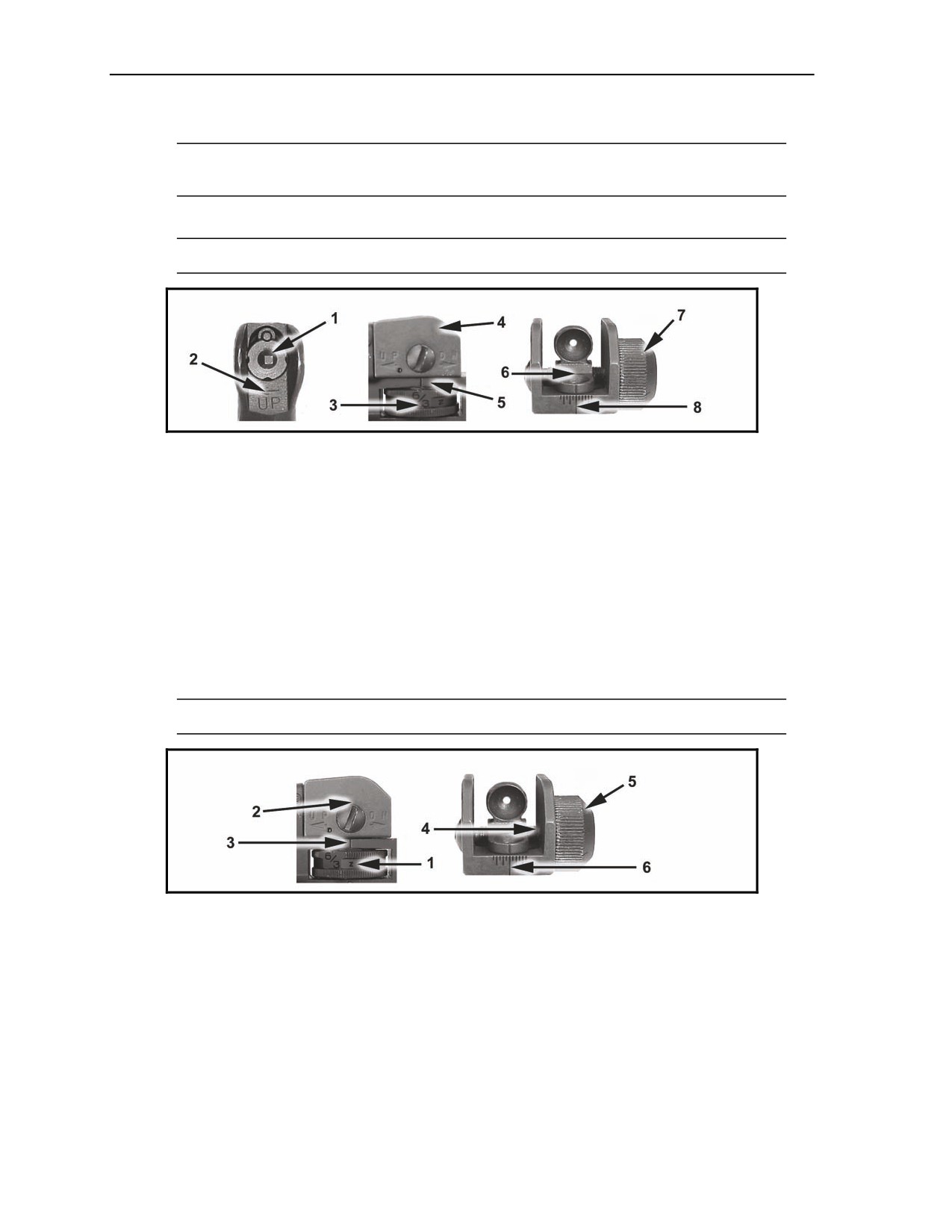
2-7. To mechanically zero an M16A2/A3 rifle—
NOTE: Reference the weapon components using the numbers listed in Figure 2-7.
Figure 2-7. M16A2/A3 mechanical zero.
(1) Adjust the front sightpost (1) until the base of the front sightpost is flush with the front sightpost
housing (2).
(2) Turn the elevation knob (3, shown as viewed from above) counterclockwise until the rear sight
assembly (4) rests flush with the carrying handle and the 8/3 marking is aligned with the index
line on the left side of the carrying handle.
(3) Position the apertures (5) so the unmarked aperture is up and the 0-200 meter aperture is down.
(4) Turn the windage knob (6) to align the index mark on the 0-200 meter aperture with the long
center index line on the rear sight assembly.
BATTLESIGHT ZEROING THE M16A2/A3 RIFLE
2-8. To battlesight zero an M16A2/A3 rifle—
NOTE: Reference the weapon components using the numbers listed in Figure 2-8.
Figure 2-8. M16A2/A3 battlesight zero.
(1) Turn the elevation knob (1, shown as viewed from above) counterclockwise until the rear sight
assembly (2) rests flush with the carrying handle and the 8/3 marking is aligned with the index
line (3) on the left side of the carrying handle.
(2) Turn the elevation knob one more click clockwise.
(3) Position the apertures (4) so the unmarked aperture is up and the 0-200 meter aperture is down.
(4) Turn the windage knob (5) to align the index mark on the 0-200 meter aperture with the long
center index line on the rear sight assembly.
2-9. Table 2-3 shows how much one click of elevation or windage will move the strike of the round at
ranges from 25 to 600 meters.
2-6
FM 3-22.9
12 August 2008
Weapon Characteristics, Accessories, and Ammunition
Table 2-3. Point of impact for the M16A2/A3 rifle.
RANGE (m)
25
100
200
300
400
500
600
Elevation
3/4 in
1 3/8 in
2 3/4 in
4 1/8 in
5 1/2 in
6 7/8 in
8 1/4 in
0.9 cm
3.5 cm
7 cm
10.5 cm
14 cm
17.5 cm
20.9 cm
Windage
1/8 in
1/2 in
1 in
1 1/2 in
2 in
2 1/2 in
3 in
0.3 cm
1.25 cm
2.5 cm
3.8 cm
5 cm
6.3 cm
7.6 cm
M16A4 RIFLE
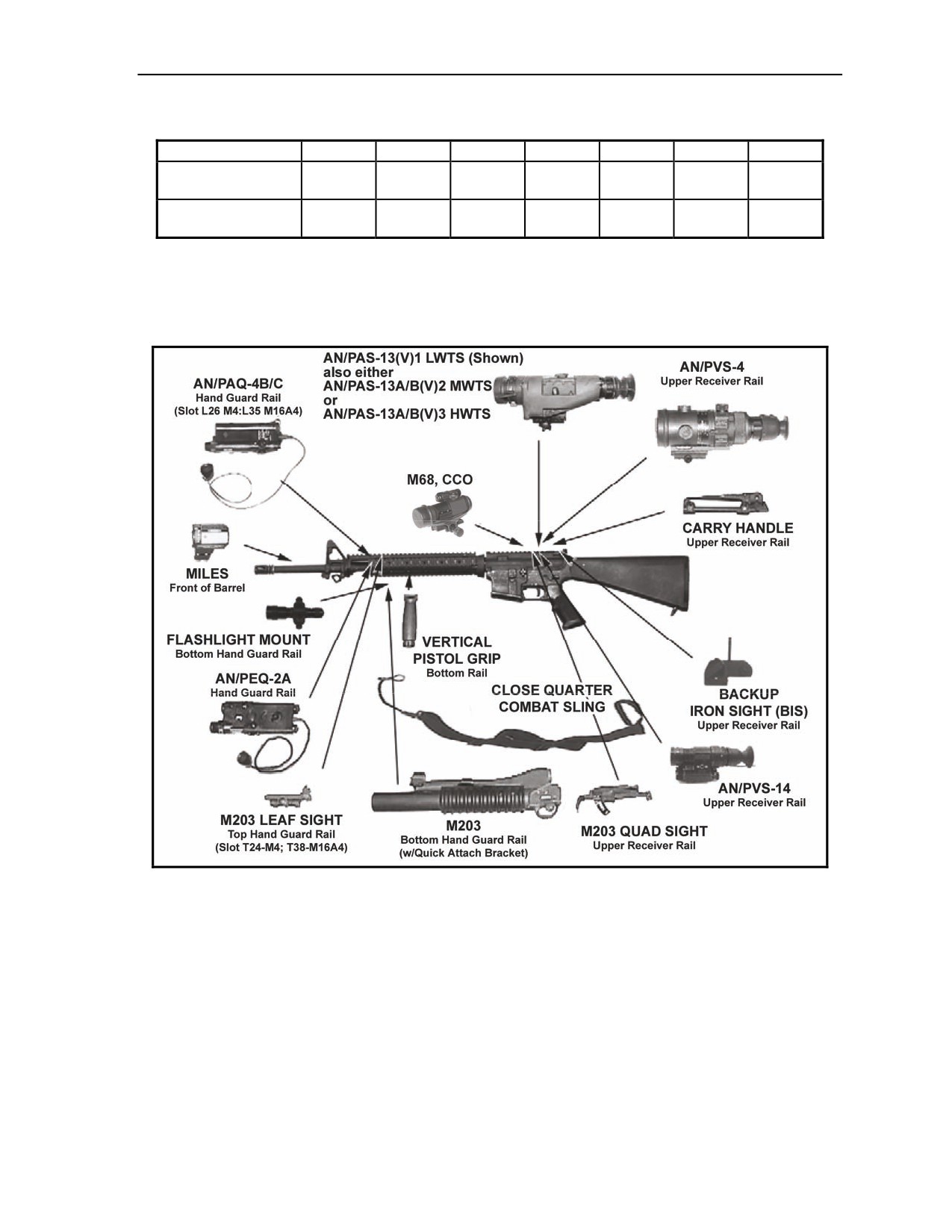
2-10. The M16A4 rifle (Figure 2-9) is the same as the M16A2 rifle, with the addition of a flat top upper
receiver (with an integral rail and detachable carrying handle) and the M5 ARS.
Figure 2-9. M16A4 rifle with accessories.
12 August 2008
FM 3-22.9
2-7
Chapter 2
MECHANICALLY ZEROING THE M16A4 RIFLE
NOTE: Mechanically zeroing the weapon is only necessary when the weapon zero is
questionable, the weapon is newly assigned to the unit, or the weapon sights have been serviced.
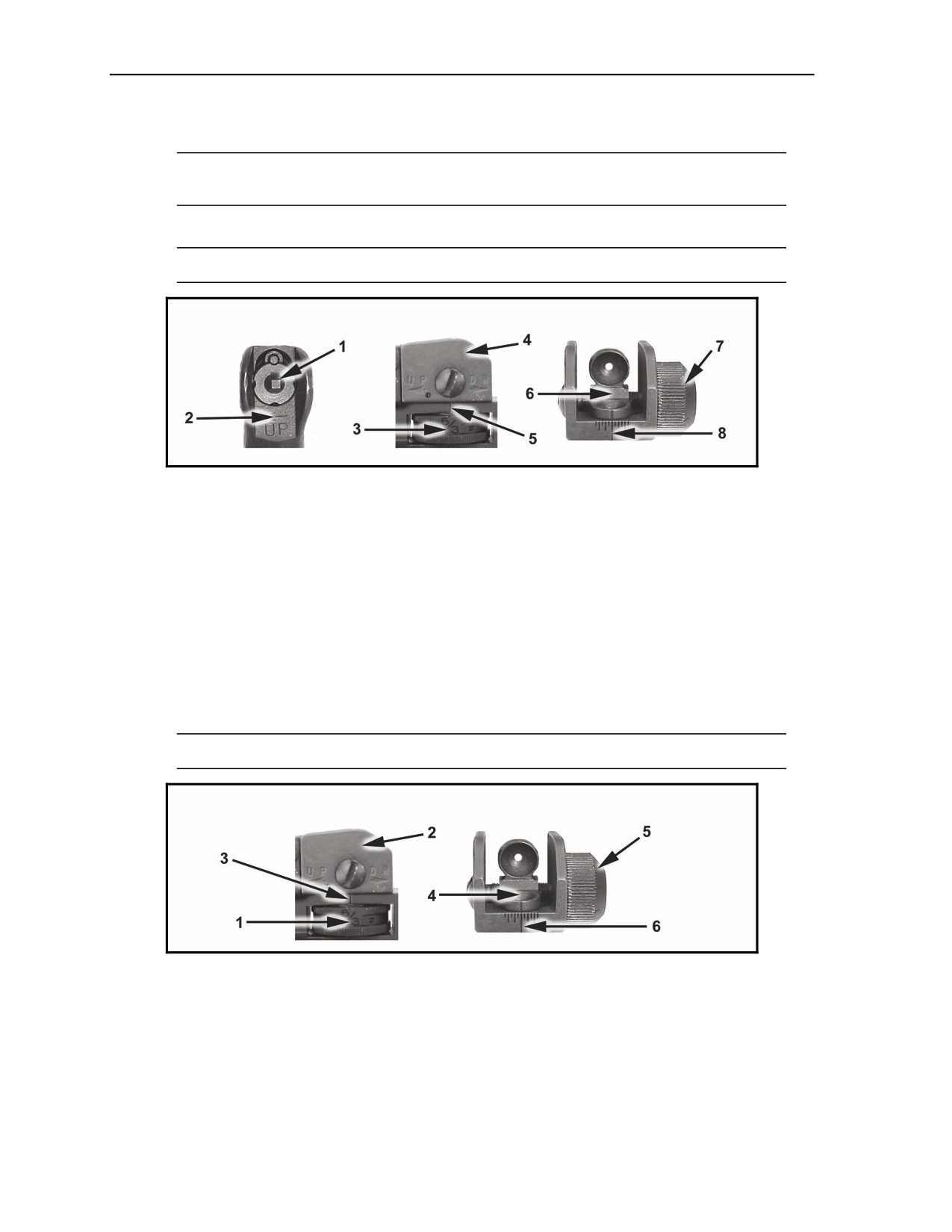
2-11. To mechanically zero an M16A4 rifle—
NOTE: Reference the weapon components using the numbers listed in Figure 2-10.
Figure 2-10. M16A4 mechanical zero.
(1) Adjust the front sightpost (1) until the base of the front sightpost is flush with the front sightpost
housing (2).
(2) Turn the elevation knob (3, shown as viewed from above) counterclockwise until the rear sight
assembly (4) rests flush with the carrying handle and the 6/3 marking is aligned with the index
line (5) on the left side of the carrying handle.
(3) Position the apertures (6) so the unmarked aperture is up and the 0-200 meter aperture is down.
(4) Turn the windage knob (7) to align the index mark on the 0-200 meter aperture with the long
center index line (8) on the rear sight assembly.
BATTLESIGHT ZEROING THE M16A4 RIFLE
2-12. To battlesight zero an M16A4 rifle—
NOTE: Reference the weapon components using the numbers listed in Figure 2-11.
Figure 2-11. M16A4 battlesight zero.
(1) Turn the elevation knob (1, shown as viewed from above) counterclockwise until the rear sight
assembly (2) rests flush with the detachable carrying handle and the 6/3 marking is aligned with
the index line (3) on the left side of the detachable carrying handle.
(2) Turn the elevation knob two clicks clockwise so the index line on the left side of the detachable
carrying handle is aligned with the “Z” on the elevation knob.
(3) Position the apertures (4) so the unmarked aperture is up and the 0-200 meter aperture is down.
2-8
FM 3-22.9
12 August 2008
Weapon Characteristics, Accessories, and Ammunition
(4) Turn the windage knob (5) to align the index mark on the 0-200 meter aperture with the long
center index line (6) on the rear sight assembly.
2-13. Table 2-4 shows how much one click of elevation or windage will move the strike of the round at
ranges of 25 to 600 meters.
Table 2-4. Point of impact for the M16A4 rifle.
RANGE (m)
25
100
200
300
400
500
600
Elevation
3/4 in
1 3/8 in
2 3/4 in
4 1/8 in
5 1/2 in
6 7/8 in
8 1/4 in
0.9 cm
3.5 cm
7 cm
10.5 cm
14 cm
17.5 cm
20.9 cm
Windage
1/8 in
1/2 in
1 in
1 1/2 in
2 in
2 1/2 in
3 in
0.3 cm
1.25 cm
2.5 cm
3.8 cm
5 cm
6.3 cm
7.6 cm
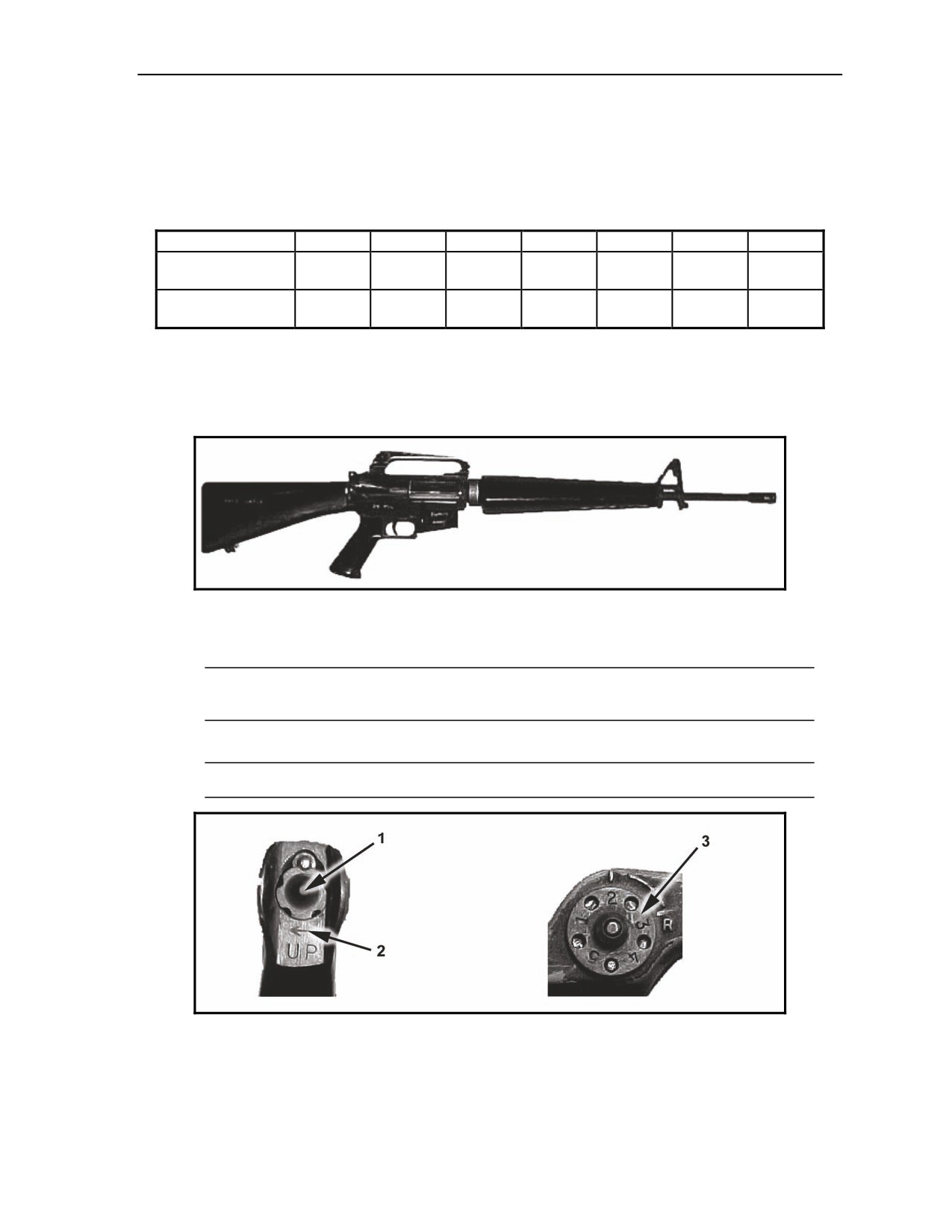
M16A1 RIFLE
2-14. When operating an M16A1 rifle (Figure 2-12), the firer can move the selector lever (SAFE, SEMI,
and AUTO) to fire in the semiautomatic or automatic mode.
Figure 2-12. M16A1 rifle.
MECHANICALLY ZEROING THE M16A1 RIFLE
NOTE: Mechanically zeroing the weapon is only necessary when the weapon zero is
questionable, the weapon is newly assigned to the unit, or the weapon sights have been serviced.
2-15. To mechanically zero an M16A1 rifle—
NOTE: Reference the weapon components using the numbers listed in Figure 2-13.
Figure 2-13. M16A1 mechanical zero.
12 August 2008
FM 3-22.9
2-9
Chapter 2
(1) Adjust the front sightpost (1) until the base of the front sightpost is flush with the front sightpost
housing (2).
(2) Adjust the front sightpost 11 clicks in the direction of UP.
(3) Turn the rear sight windage drum (3) left until it stops.
(4) Turn the windage drum right 17 clicks so the rear sight is approximately centered.
BATTLESIGHT ZEROING THE M16A1 RIFLE
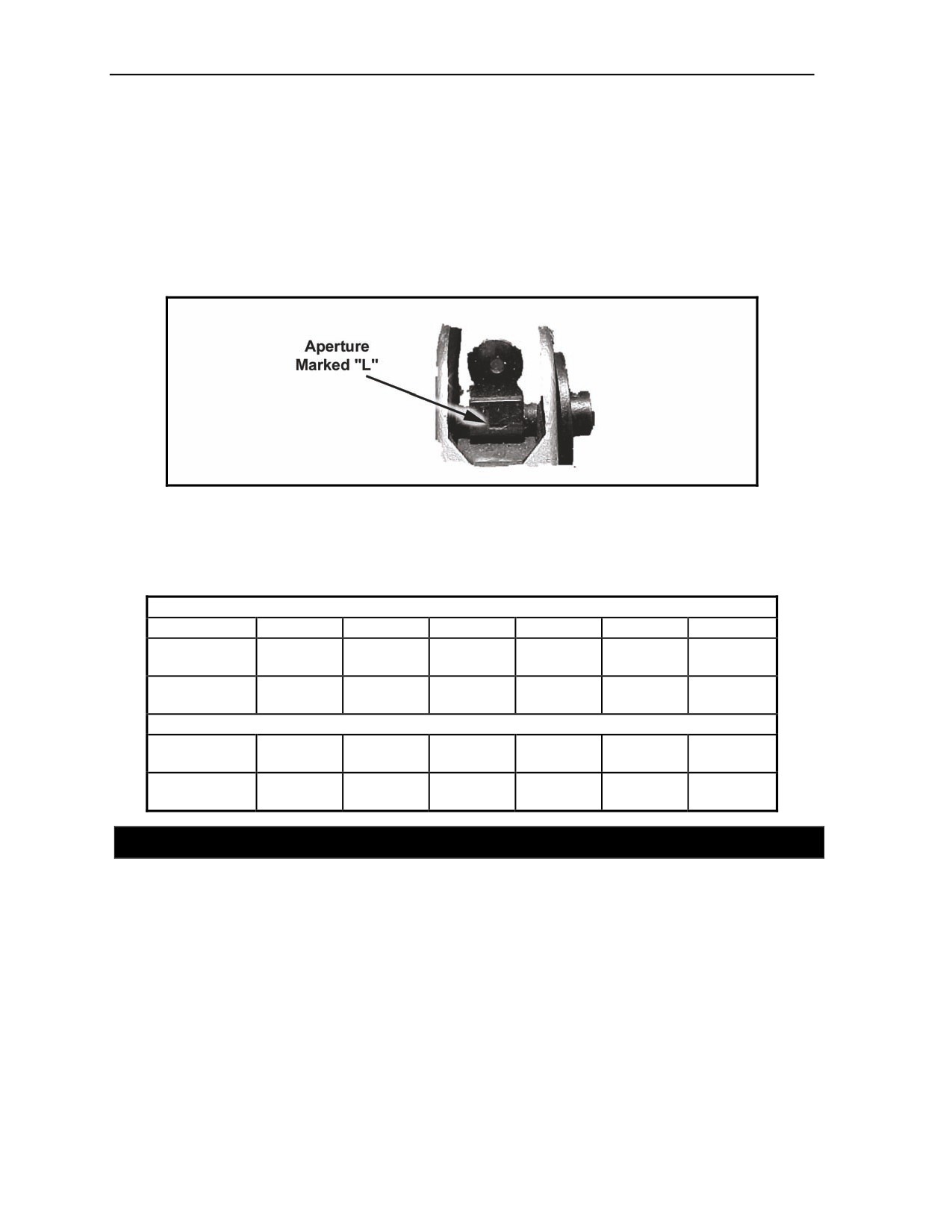
2-16. Soldiers should use the aperture marked “L” (Figure 2-14) to battlesight zero their weapons.
Figure 2-14. M16A1 battlesight zero.
2-17. Table 2-5 shows how much one click of elevation or windage will move the strike of the round at
ranges of 25 to 500 meters using standard sights or the low light level sight system.
Table 2-5. Point of impact for the M16A1 rifle.
STANDARD SIGHTS
Range (m)
25
100
200
300
400
500
Elevation
17/64 in
1 3/32 in
2 13/64 in
3 9/32 in
4 3/8 in
5 15/32 in
0.7 cm
2.8 cm
5.6 cm
8.4 cm
11.2 cm
14 cm
Windage
17/64 in
1 3/32 in
2 13/64 in
3 9/32 in
4 3/8 in
5 15/32 in
0.7 cm
2.8 cm
5.6 cm
8.4 cm
11.2 cm
14 cm
LOW LIGHT LEVEL SIGHT SYSTEM
Elevation
23/64 in
1 3/4 in
2 3/4 in
5 1/4 in
7 in
8 3/4 in
0.9 cm
3.5 cm
7 cm
10.5 cm
17.7 cm
22.2 cm
Windage
17/64 in
1 3/32 in
2 13/64 in
3 9/32 in
4 3/8 in
5 15/32 in
0.7 cm
2.8 cm
5.6 cm
8.4 cm
11.2 cm
14 cm
SECTION II. ACCESSORY MOUNTING
The M4/M5 ARS and rail grabbers are designed to mount accessories on M16- and M4-series weapons.
M4/M5 ADAPTER RAIL SYSTEM
2-18. The ARS provides a secure mounting point for various accessories that may be mounted on the
weapon's top, left, and right. The M4 ARS (Figure 2-15) consists of lightweight sections that replace the
standard handguards on the M4 carbine. The M5 ARS replaces the handguards on the M16A4 rifle.
2-10
FM 3-22.9
12 August 2008
Weapon Characteristics, Accessories, and Ammunition
NOTES:
1. Only the armorer is authorized to remove the ARS from a weapon. However, the
user may remove only the lower assembly to perform preventive maintenance
checks and services (PMCS). If the top section is removed, the accessories
mounted on the rail will lose their zero.
2. To prevent the screw from vibrating loose during firing, apply locking
compound to the original screw or use a new screw when reinstalling the ARS.
3. For optics and lasers to retain zero, the ARS must be properly installed.
Mounted accessories will not retain zero unless proper procedures are followed,
as outlined in TM 9-1005-319-23& P.
4. Accessories may be mounted on the right side of the ARS, but are not currently
supported with zeroing procedures. Further, the bottom rail of the ARS will not
retain zero. Only accessories that do not require zero retention, such as a
flashlight or vertical pistol grip, can be mounted on the bottom rail.
Figure 2-15. Adapter rail system.
RAIL COVERS
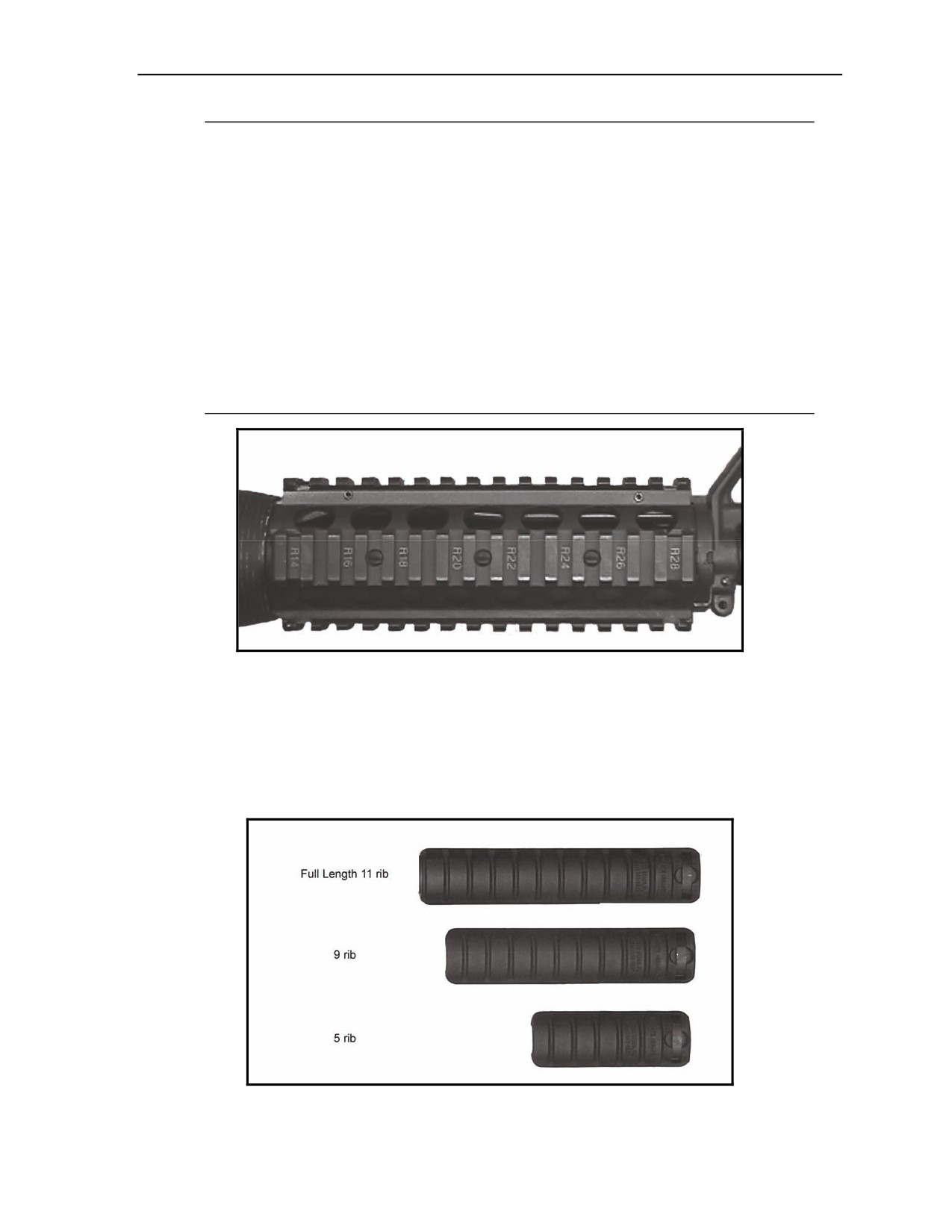
2-19. Rail covers protect the firer’s hands from direct contact with the metal parts of the ARS and protect
the ARS surfaces from excess wear and damage. The rail covers are available in 11-, 9-, 6-, 5-, and 4-rib
sections. For ease of reference, the shorter lengths can be referred to by the number of ribs along their outer
surfaces. 11-, 9-, and 5-rib sections are shown in Figure 2-16.
Figure 2-16. M5 rail covers/heat shields.
12 August 2008
FM 3-22.9
2-11
Chapter 2
2-20. ARS rail covers can be quickly attached and detached from the ARS. A spring latch at one end of
each rail cover automatically engages cutouts at the end of each rail. To slide the rail cover beyond a cutout
or to remove it, apply thumb pressure to the center of the spring latch, and slide it in the desired direction.
NOTES:
1. Keep unused bottom, left, and right rail sections covered with 11-rib rail cover
sections.
2. If any accessories are mounted on a rail, cover the remaining rail surface with an
appropriately-sized rail cover.
3. If a BUIS is installed, permanently remove the top full length rail cover, and
replace it with a shorter rail cover to protect the nonfiring hand when the barrel
is hot.
WARNING
When firing at high rates of sustained fire, the barrel and metal
components of the ARS can become hot enough to inflict serious
burns. Cover exposed metal portions with plastic rail covers. Use
the vertical pistol grip (Figure 2-18) during heavy, sustained fire.
NUMBERED RECOIL GROOVES
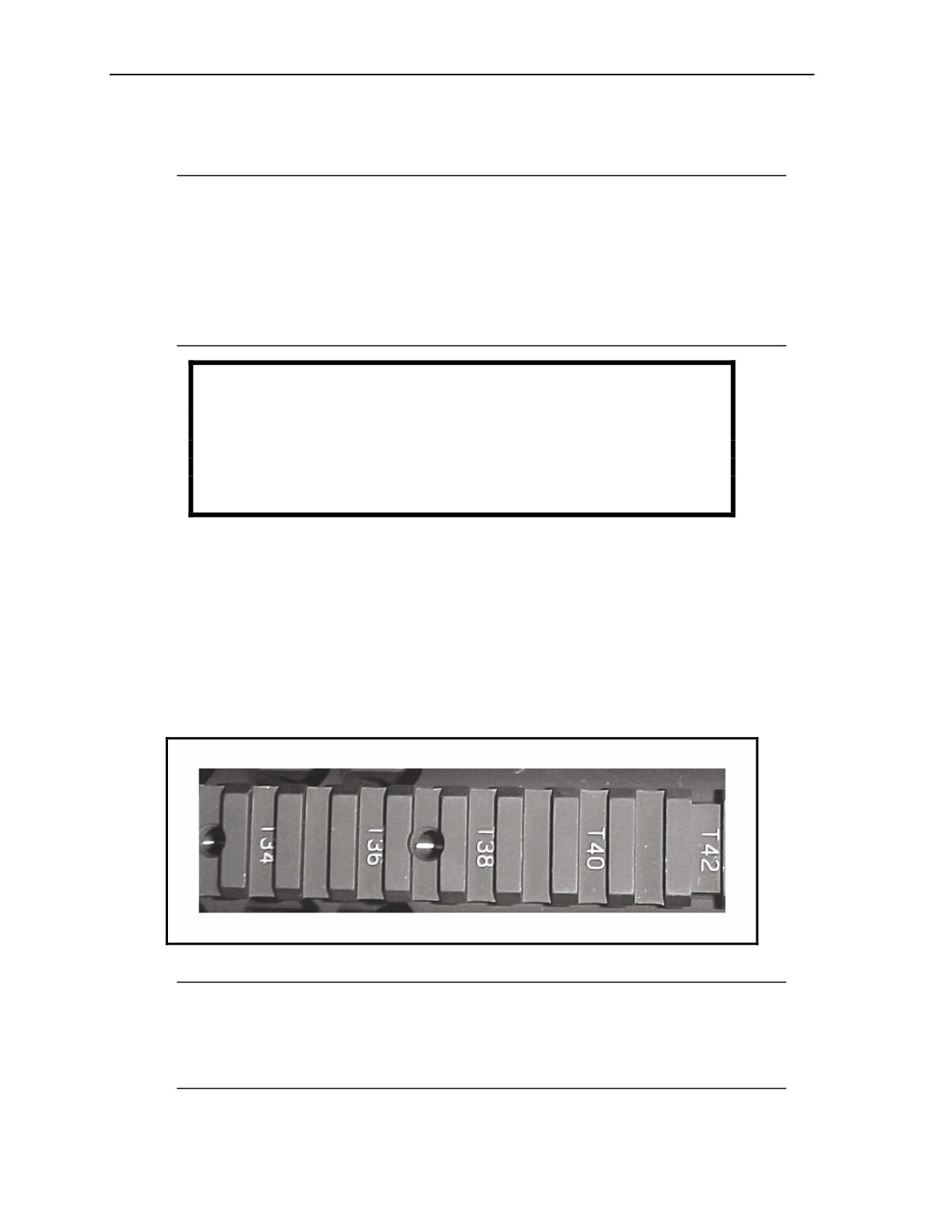
2-21. The even numbered recoil grooves on each rail of the ARS are sequentially numbered within the
recoil grooves themselves (Figure 2-17). Each number is preceded by a letter prefix indicating a specific
slot on the ARS. The numbers on the top rail have a “T” prefix, while those on the bottom have a “B”
prefix. Additionally, the numbers on the rail to the firer’s left have an “L” prefix, while those to the firer’s
right have an “R” prefix. These addresses—
z
Assist the user in remounting an accessory in the same position.
z
Allow standardization in the location of mounted accessories.
z
Identify reference points for discussions on accessory mounting locations.
Figure 2-17. Address markings on the adapter rail system.
NOTE: Within the notches, each ARS also contains holes that are threaded ¼-inch deep, with
20 threads per inch (Figure 2-17). This is the standard thread size for a camera tripod adapter,
which is used to attach standard camera or video accessories. For example, an M4 MWS with an
NVD mounted may be attached to a standard camera tripod for hands-free support during long
periods of surveillance.
2-12
FM 3-22.9
12 August 2008
Weapon Characteristics, Accessories, and Ammunition
VERTICAL PISTOL GRIP
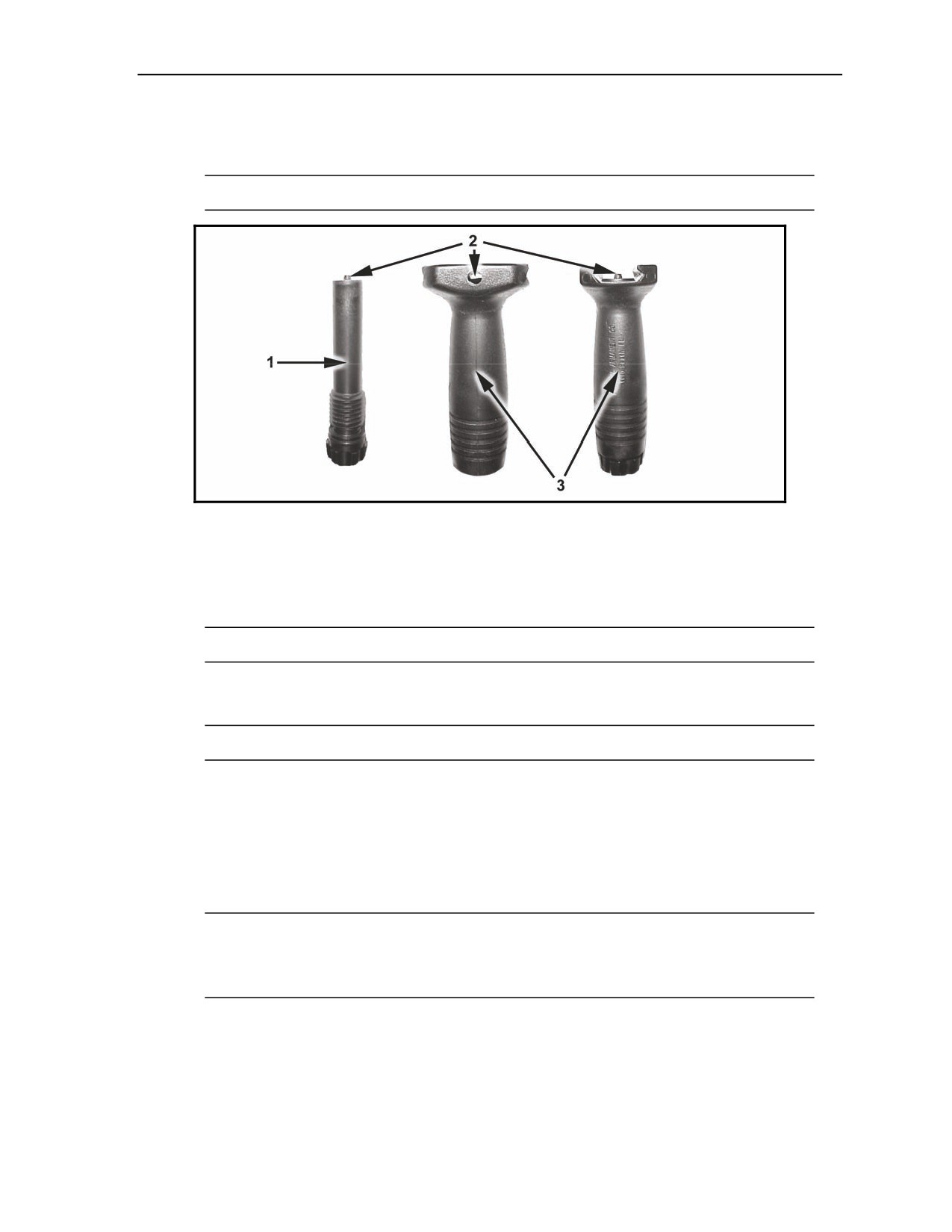
2-22. Each ARS comes with a vertical pistol grip. To install the pistol grip—
NOTE: Reference the weapon components using the numbers listed in Figure 2-18.
Figure 2-18. Vertical pistol grip.
(1) Remove the rail cover.
(2) Unscrew the pistol grip lock (1) until the tip (2) is no longer visible through the hole in the pistol
grip.
(3) Slide the pistol grip (3) onto the ARS.
NOTE: The pistol grip will cover five notches on the ARS.
(4) Align the tip on the top of the pistol grip lock (1) with a notch.
(5) Hand-tighten.
NOTE: For further information about these accessories, refer to TM 9-1005-319-10.
RAIL GRABBERS
2-23. The Insight (Figure 2-19) and Picatinny (Figure 2-21) rail grabbers are designed to mount accessories
onto the M16A4 and M4-series weapons. These rail grabbers enable the user to attach accessories on the
upper receiver and on all four sides of the ARS, while retaining zero (when installed and tightened
properly). Once zeroed, they will retain zero—even when removed from the weapon—as long as the rail
grabber is not separated from the accessory and is remounted on the same notch it was zeroed on.
NOTE:
1. Retighten the rail grabber and accessory after firing the first three rounds to fully
seat both.
2. The bottom rail of the ARS will not retain zero.
12 August 2008
FM 3-22.9
2-13
Chapter 2
INSIGHT RAIL GRABBER
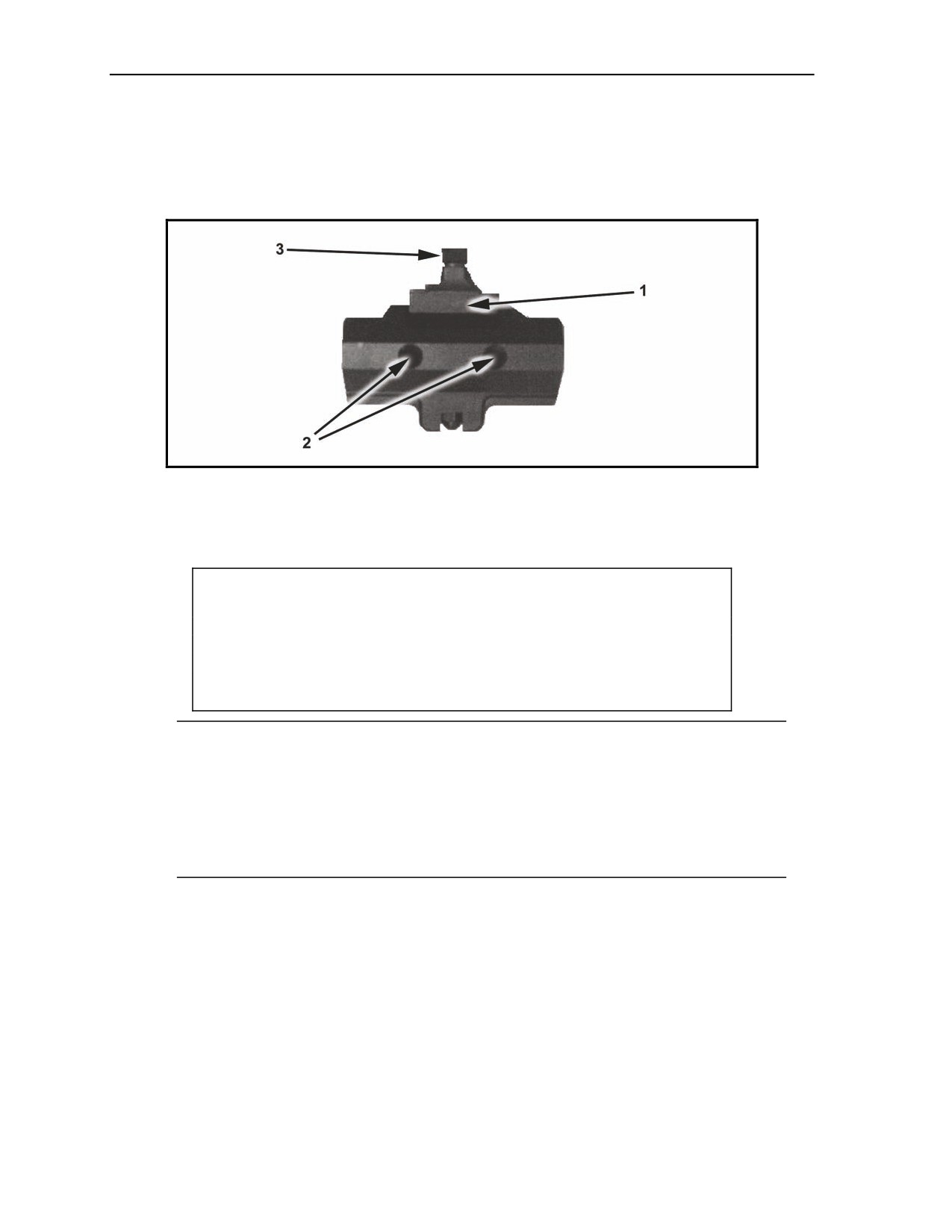
2-24. The Insight rail grabber (Figure 2-19) can be mounted where the tightening screw (3, Figure 2-19) is
on either the left or right side (when top-mounted) or top or bottom (when mounted on the left side) so it
does not interfere with weapon operation.
Figure 2-19. Insight rail grabber.
2-25. Unless command-directed, all devices in a unit do not have to be mounted in the same location as
long as individual users record or mark (with paint markers or grease pencils) the mounting location on
their weapons to avoid unnecessary rezeroing.
CAUTION
Both of the holes (2, Figure 2-19) located in the top of the rail grabber
can be used to mount accessories, but the hole closest to the muzzle
must be used. This ensures that the majority of the rail grabber is
supporting the accessory to prevent damage to the accessory.
NOTES:
1. The Insight rail grabber must fully rest on the ARS in order to retain zero. The
locking clamp (1, Figure 2-19) must grasp the ARS, and the screw that tightens
the rail grabber must be tightened with a field tool, such as a multipurpose tool.
2. Even if the rail grabber is resting entirely on the ARS, accessories should not
make contact with the front sight assembly or the collar of the barrel. The
vibrations that occur during firing will interfere with the rail grabber’s and
accessory’s zero retention capabilities.
MILES Training Extender for the Insight Rail Grabber
2-26. The training extender (Figure 2-20) is used to elevate an accessory above the MILES laser during
force-on-force training. The training extender is only used when the Insight rail grabber is top-mounted.
2-14
FM 3-22.9
12 August 2008
Weapon Characteristics, Accessories, and Ammunition
2-27. To install the extender and accessories—
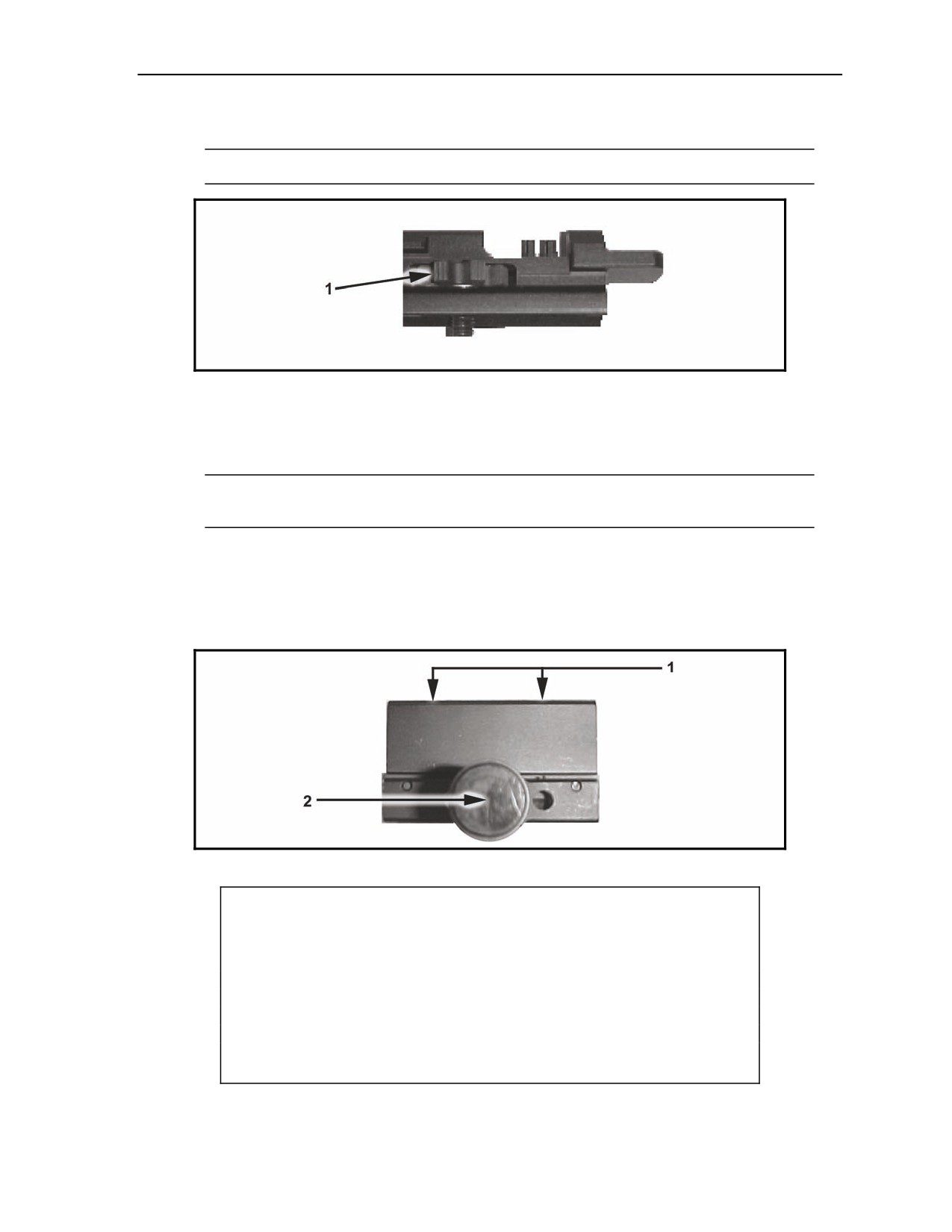
NOTE: Reference the weapon components using the numbers listed in Figure 2-20.
Figure 2-20. Insight rail grabber MILES training extender.
(1) Use the thumbscrew (1) to hand-tighten the extender into the mounting hole closest to the
muzzle on the Insight rail grabber.
(2) Install the accessory on top of the extender and tighten.
NOTE: The AN/PEQ-2A/B and AN/PAQ-4B/C must be zeroed before and after using the
MILES training extender.
PICATINNY RAIL GRABBER
2-28. The Picatinny rail grabber (Figure 2-21) must fully rest on the ARS in order to retain zero. The
locking clamp must grasp the ARS, and the torque-limiting knob (2, Figure 2-21) that tightens the rail
grabber must be hand-tightened until it clicks twice.
Figure 2-21. Picatinny rail grabber.
CAUTION
Both of the holes located in the top of the rail grabber (1, Figure 2-21) can
be used to mount accessories, but the hole closest to the muzzle must be
used for the Picatinny rail grabber. This ensures that the majority of the rail
grabber is supporting the accessory to prevent damage to the accessory.
It also allows the torque-limiting knob to be mounted on either the left or
right side (when top-mounted) or top or bottom (when side-mounted) so
that it will not interfere with weapon operation.
12 August 2008
FM 3-22.9
2-15
Chapter 2
2-29. Unless command-directed, all devices in a unit do not have to be mounted in the same location as
long as individual users record or mark (with paint markers or grease pencils) the mounting location on
their weapons to avoid unnecessary rezeroing.
NOTE: Even if the rail grabber is resting entirely on the ARS, accessories should not make
contact with the front sight assembly or the collar of the barrel. The vibrations that occur during
firing will interfere with the rail grabber’s and accessory’s zero retention capabilities.
SECTION III. ACCESSORIES
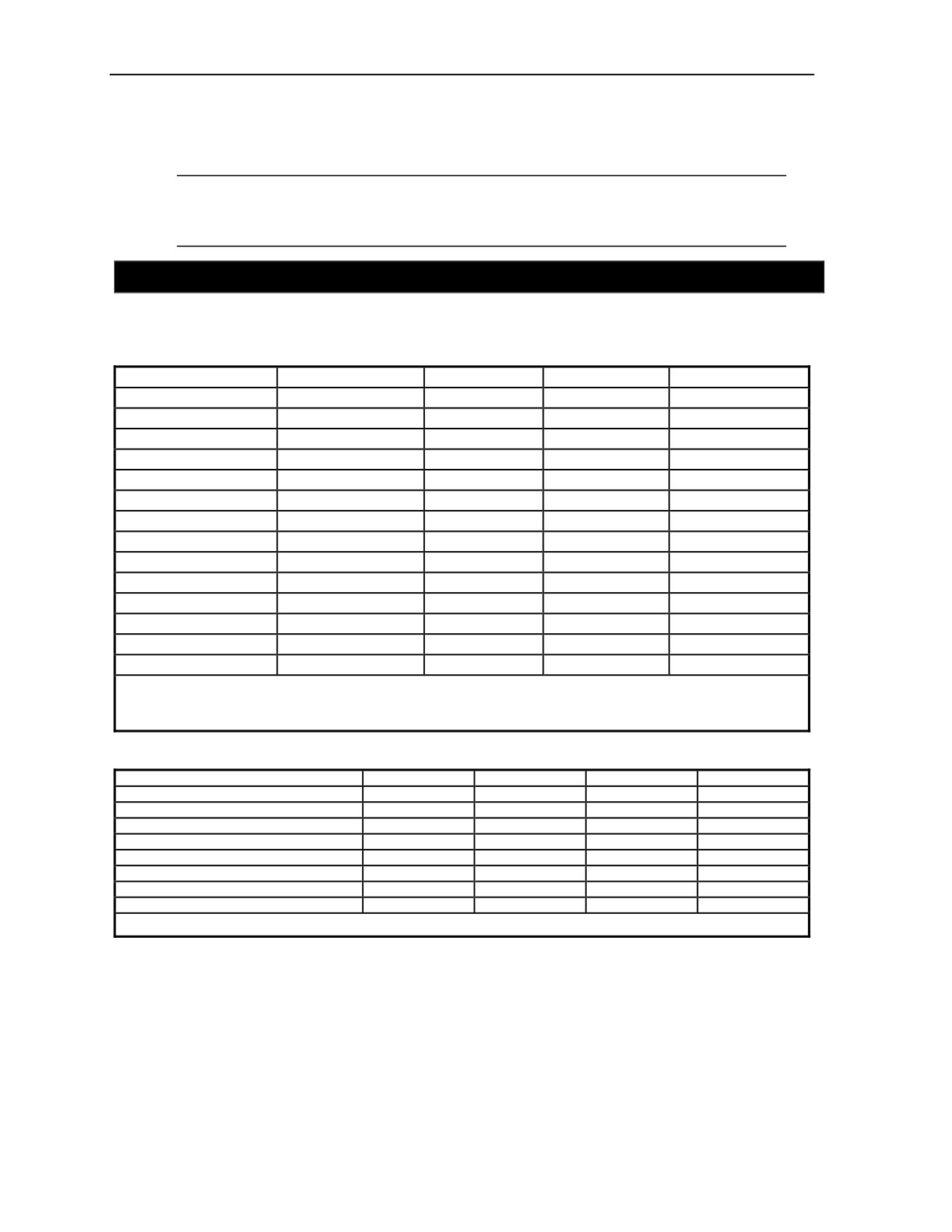
Table 2-6 shows the weapons with which the various accessories are compatible, along with the mounting
device and TM number. Table 2-7 shows select characteristics of the various accessories.
Table 2-6. Accessory compatibility and mounting.
ACCESSORY
TECHNICAL MANUAL
M4 MWS , M16A4
M4/M4A1
M16A1/A2/A3
M68, CCO
TM 9-1240-413-13&P
* Upper receiver
* Upper receiver
M16 mount
AN/PVS-14
TM 11-5855-306-10
***Upper receiver
N/A
N/A
AN/PAC-4C
TM 11-5855-301-12&P
** Rail grabber
Bracket assembly
Bracket assembly
AN/PEQ-2A/B
TM 11-5855-308-12&P
** Rail grabber
Bracket assembly
Bracket assembly
AN/PAQ-4
TM 11-5855-261-10
** Rail grabber
Bracket assembly
Bracket assembly
AN/PAS-13B(V1), LWTS
TM 11-5855-312-10
Upper receiver
Upper receiver
M16 mount
AN/PAS-13B(V3), HWTS
TM 11-5855-312-10
Upper receiver
Upper receiver
M16 mount
AN/PAS-13C(V1), LWTS
TM 11-5855-316-10
Upper receiver
Upper receiver
M16 mount
AN/PAS-13C(V3), HWTS
TM 11-5855-316-10
Upper receiver
Upper receiver
M16 mount
AN/PAS-13D(V1), LWTS
TM 11-5855-317-10
Upper receiver
Upper receiver
M16 mount
AN/PAS-13D(V3), HWTS
TM 11-5855-317-10
Upper receiver
Upper receiver
M16 mount
AN/PVS-4(A)
TM 11-5855-213-10
Upper receiver
Upper receiver
M16 mount
BUIS
Upper receiver
Upper receiver
N/A
ACOG
Upper receiver
Upper receiver
M16 mount
* With a half-moon spacer installed.
** Picatinny or Insight rail grabbers may be used.
*** If used in conjunction with the CCO, the CCO will mount on the top rail of the ARS.
Table 2-7. Characteristics of various accessories.
ACCESSORY
WEIGHT
LENGTH
HEIGHT
RANGE
M68, CCO
6.2 oz
4.9 in
2.5 in
300 m
AN/PVS-14
14.8 oz
4.5 in
2.25 in
AN/PAC-4C
5.78 oz
5.5 in
1.2 in
*600 m +
AN/PEQ-2A/B
7.5 oz
6.4 in
1.2 in
*600 m +
LWTS
4.1 lb
15.5 in
6.25 in
1,600 m +
HWTS
4.5 lb
18 in
6.25 in
1,600 m +
AN/PVS-4
3.8 lb
9.45 in
4.7 in
*600 m
ACOG
15.1 oz
5.8 in
2.17 in
800 m
*Actual range is dependent upon ambient light, NVGs, and background contrast.
2-16
FM 3-22.9
12 August 2008
Weapon Characteristics, Accessories, and Ammunition
M68 CLOSE COMBAT OPTIC
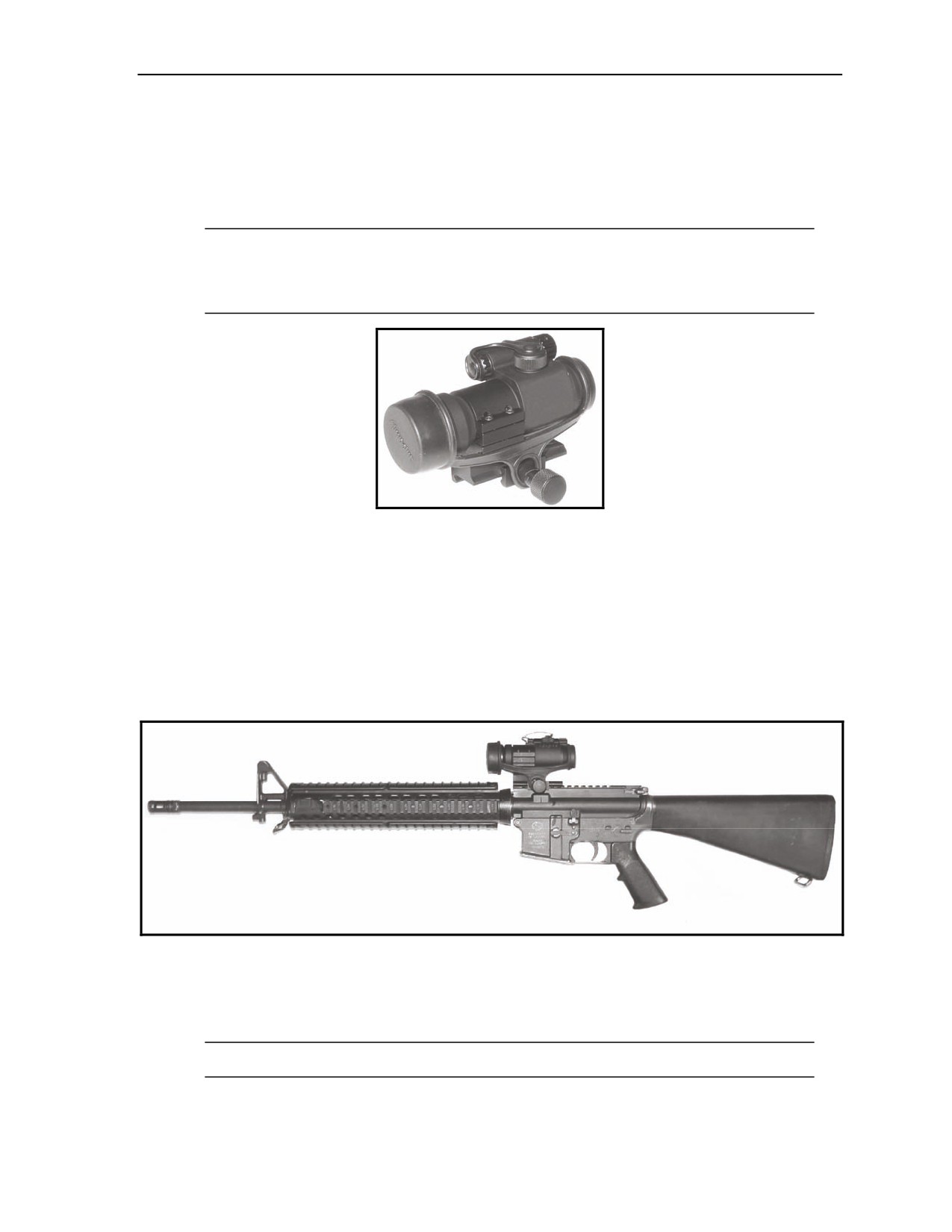
2-30. The M68 CCO (Figure 2-22) is a reflex (nontelescopic) sight that is designed for the “two eyes open”
method of sighting, but can be shot with only one eye open. The red dot aiming point follows the horizontal
and vertical movement of the firer’s eye, while remaining fixed on the target.
NOTES:
1. Retighten the torque-limiting knob after firing the first three rounds to fully seat
the M68.
2. No centering or focusing is required beyond 50 meters.
Figure 2-22. M68 close combat optic.
MOUNTING ON THE M16A4 RIFLE OR M4-SERIES CARBINE
2-31. The M68 mounts directly on the integrated rail on top of M16A4 rifles and M4-series carbines
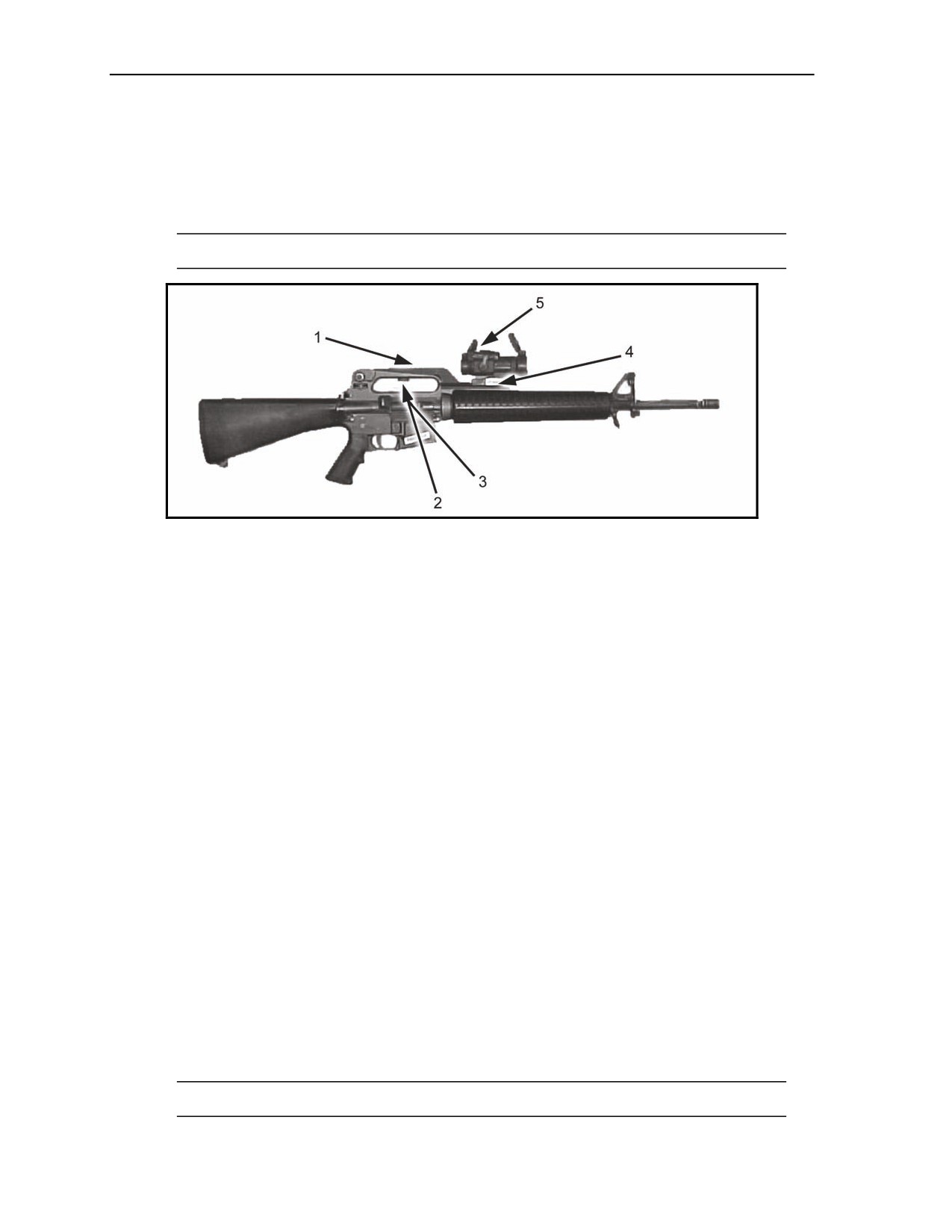
(Figure 2-23). The half-moon spacer (1, Figure 23) must be installed to raise the M68 above the front
sightpost. The Soldier’s preference dictates the notch that the M68 is mounted on. Although any notch is
acceptable, testing has shown that the farther away the M68 is from the Soldier’s eyes, the better his field
of view.
2-32. To mount the M68 on an M16A4 rifle or M4-series carbine (Figure 2-23)—
Figure 2-23. Mounting the M68 on an M16A4 rifle or M4-series carbine.
(1) Remove the carrying handle.
(2) Align the locking bar with a notch.
(3) Tighten the torque-limiting knob until it clicks twice.
NOTE: If the M68 is remounted on the same notch, it will retain zero.
12 August 2008
FM 3-22.9
2-17
Chapter 2
MOUNTING ON THE M16A1/A2/A3 RIFLE
2-33. The M68 mounts on the M16A1 mounting bracket (1, Figure 2-24) that attaches to the carrying
handle on the M16A1/A2/A3 rifle. The half-moon spacer should not be installed, but will not hinder firing
performance.
2-34. To mount the M68 on an M16A1/A2/A3 rifle—
NOTE: Reference the weapon components using the numbers listed in Figure 2-24.
Figure 2-24. Mounting the M68 on an M16A1/A2/A3 rifle.
(1) Firmly hand-tighten the bracket (1), O-ring (2), and machine screw (3).
(2) Align the locking bar (4) under the M68 with the notch in the rail, ensuring that the rotary switch
(5) is facing the firer.
(3) Tighten the torque-limiting knob (not shown here) until it clicks twice.
MOUNTING ON THE M16A4 RIFLE OR M4 MWS
2-35. This combination (Figure 2-25) is an effective means of engaging targets during hours of limited
visibility. The brightness knob on the M68 should be on the lowest setting (2 or 3) that presents the red dot
clearly when viewed through the AN/PVS-14. When employing the AN/PVS-14, Soldiers must consider
the following factors:
z
The AN/PVS-14 should be mounted where the firer can acquire a good sight picture while
performing the integrated act of shooting.
z
The M68 can be mounted and zeroed on any slot forward of the AN/PVS-14 as long as the rail
grabber fully rests on the ARS and the M68 lens does not rest on the front sightpost.
z
The closer the AN/PVS-14 is mounted to the M68, the larger the field of view will be.
z
In order to get a clear sight picture with this configuration, fine adjustments must be made to the
AN/PVS-14's range focus, gain-control, and diopter.
z
The eyecup should be exchanged with the eye guard that is shipped with the AN/PVS-14 to
reduce the light signature from the display when not viewing.
z
The red dots on settings 2 and 3 project a negligible light signature at night, which can only be
seen through an NVD. Settings 4 through 10 project a noticeable signature detectable by
opposing forces using NVDs.
z
The brighter the dot, the larger the blooming effect becomes in the AN/PVS-14. The blooming
effect reduces the Soldier’s field of view and prevents him from seeing targets behind the
blooming.
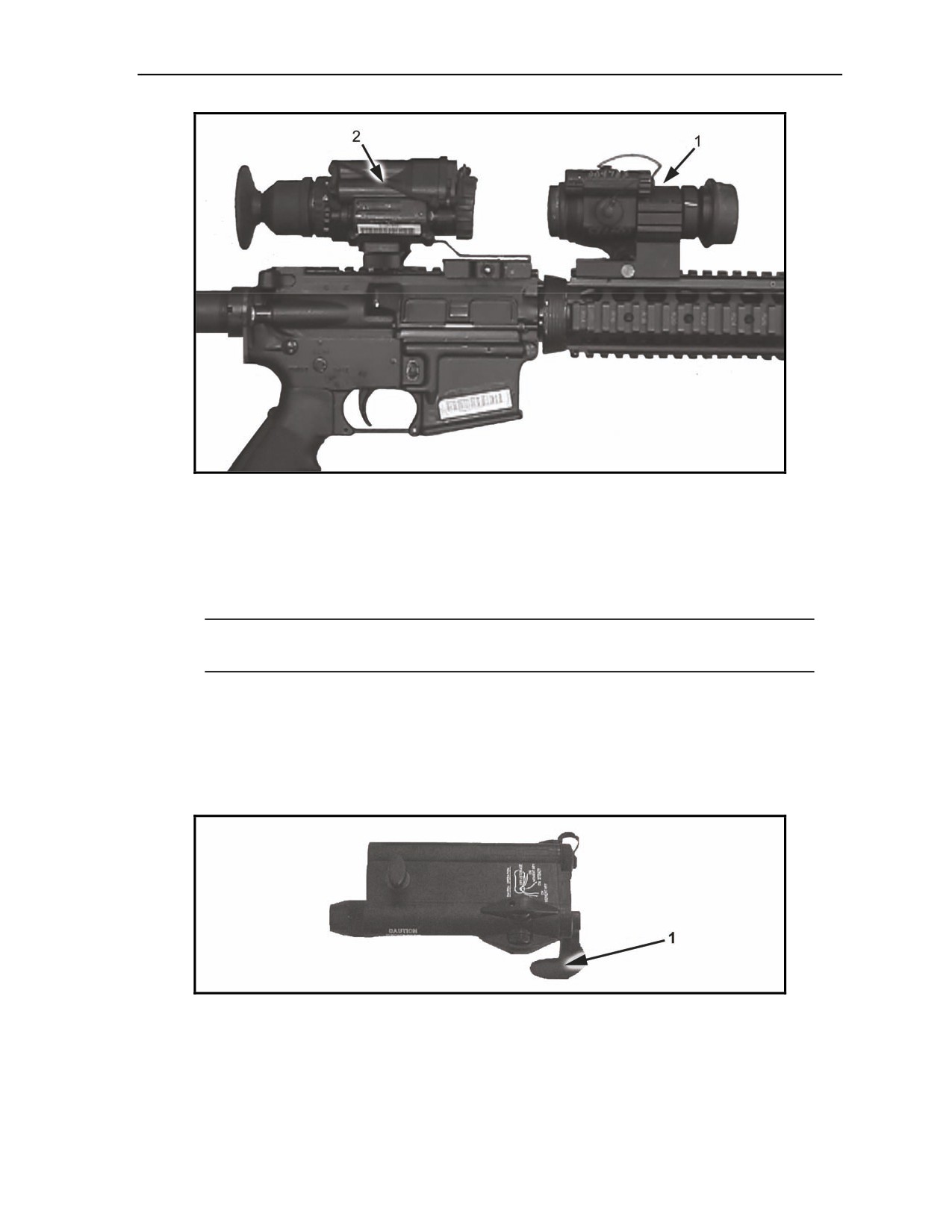
2-36. To mount the M68 and AN/PVS-14 on an M16A4 rifle or M4 MWS—
NOTE: Reference the weapon components using the numbers listed in Figure 2-25.
2-18
FM 3-22.9
12 August 2008
Weapon Characteristics, Accessories, and Ammunition
Figure 2-25. Mounting the M68/AN/PVS-14 combination on an M4 MWS.
(1) Remove the carrying handle.
(2) Mount the M68 (1) by tightening the torque-limiting knob.
(3) Mount the AN/PVS-14 (2) where the best field of view is achieved.
(4) Once the preferred location for the M68 is located, zero the M68 to that notch (if different from
the notch the M68 was previously zeroed on).
NOTE: For more information about the M68, refer to TM 9-1240-413-13&P. For more
information about the AN/PVS-14, refer to TM 11-5855-306-10.
AN/PAQ-4B/C INFRARED AIMING LIGHT
2-37. The AN/PAQ-4B/C IR aiming light (Figure 2-26) projects an IR laser beam that is invisible to the
naked eye, but can be seen with NVDs. This aiming light works with the AN/PVS-7-series goggles and the
AN/PVS-14. The AN/PAQ-4B/C mounts on various M16-/M4-series weapons with mounting brackets or
rail grabbers.
Figure 2-26. AN/PAQ-4B/C infrared aiming light.
12 August 2008
FM 3-22.9
2-19
Chapter 2
MOUNTING ON THE M16A4 RIFLE OR M4 MWS
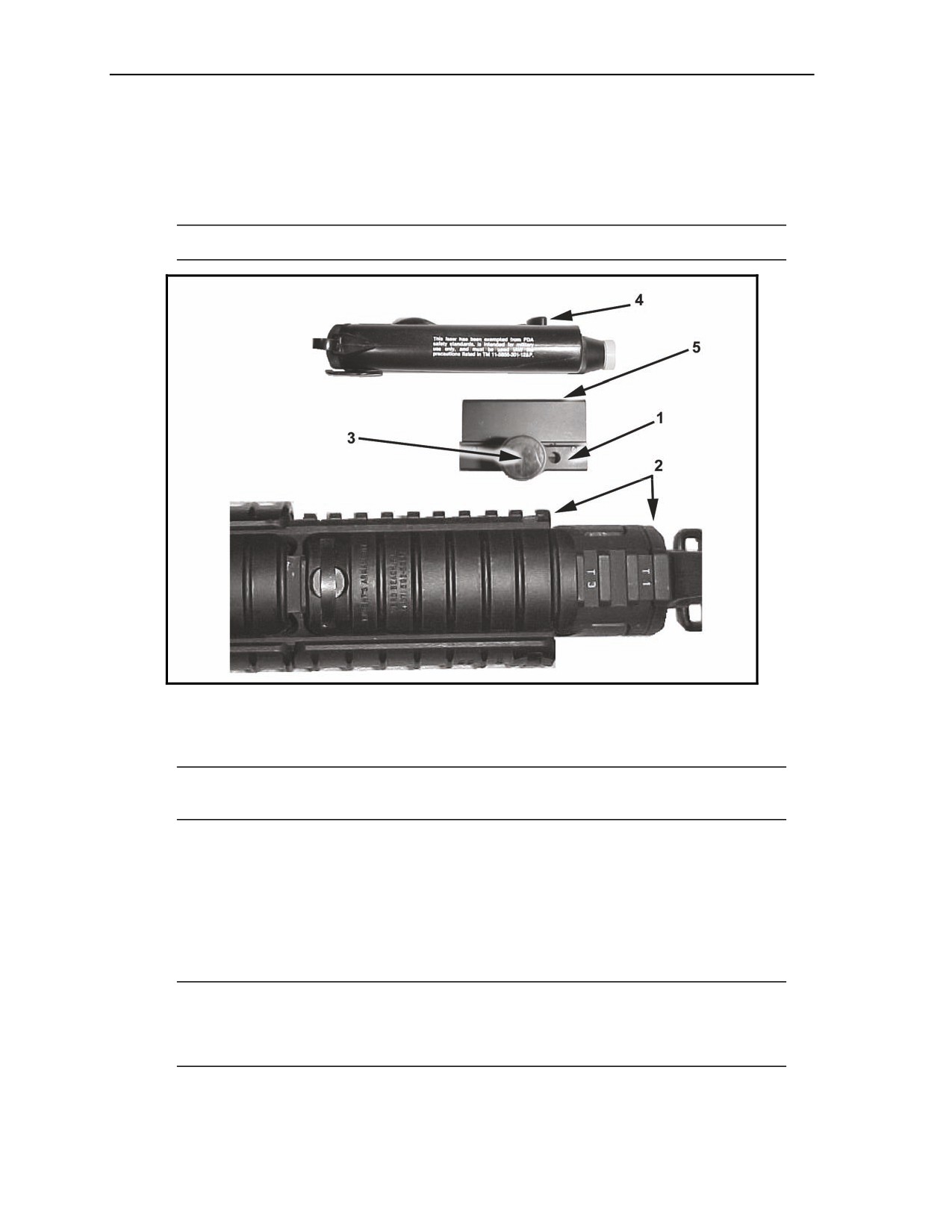
2-38. The Picatinny (1, Figure 2-27) or Insight (5, Figure 2-27) rail grabber is used to mount the AN/PAQ-
4B/C on the ARS.
2-39. To mount the AN/PAQ-4B/C on the ARS—
NOTE: Reference the weapon components using the numbers listed in Figure 2-27.
Figure 2-27. Mounting the AN/PAQ-4B/C on the M4 MWS top or left.
(1) Mount the rail grabber all the way forward on the top or either side of the ARS (2), ensuring that
it does not extend beyond the end of the ARS.
NOTE: The AN/PAQ-4B/C will not retain zero if the rail grabber extends beyond the end of the
integrated rail when mounted.
(2) Tighten the torque-limiting knob (3) until it clicks twice.
(3) Align the thumbscrew (4) on the AN/PAQ-4B/C with the thumbscrew hole in the rail grabber
nearest the muzzle.
2-40. The mounting procedures are identical for the M16A4 rifle and M4 MWS. The remote switch should
be attached to the weapon where it will not interfere with the functioning of the weapon or hinder the firer's
ability to fire the weapon. If the aiming light and rail grabber are removed as a whole unit and mounted
onto the same rail, the system will retain zero.
NOTE:
1. If the rail grabber and AN/PAQ-4B/C are separated, the AN/PAQ-4B/C must be
rezeroed to the weapon.
2. For further information, refer to TM 11-5855-301-12&P.
2-20
FM 3-22.9
12 August 2008
Weapon Characteristics, Accessories, and Ammunition
MOUNTING ON THE M16A1/A2/A3 RIFLE OR M4 CARBINE
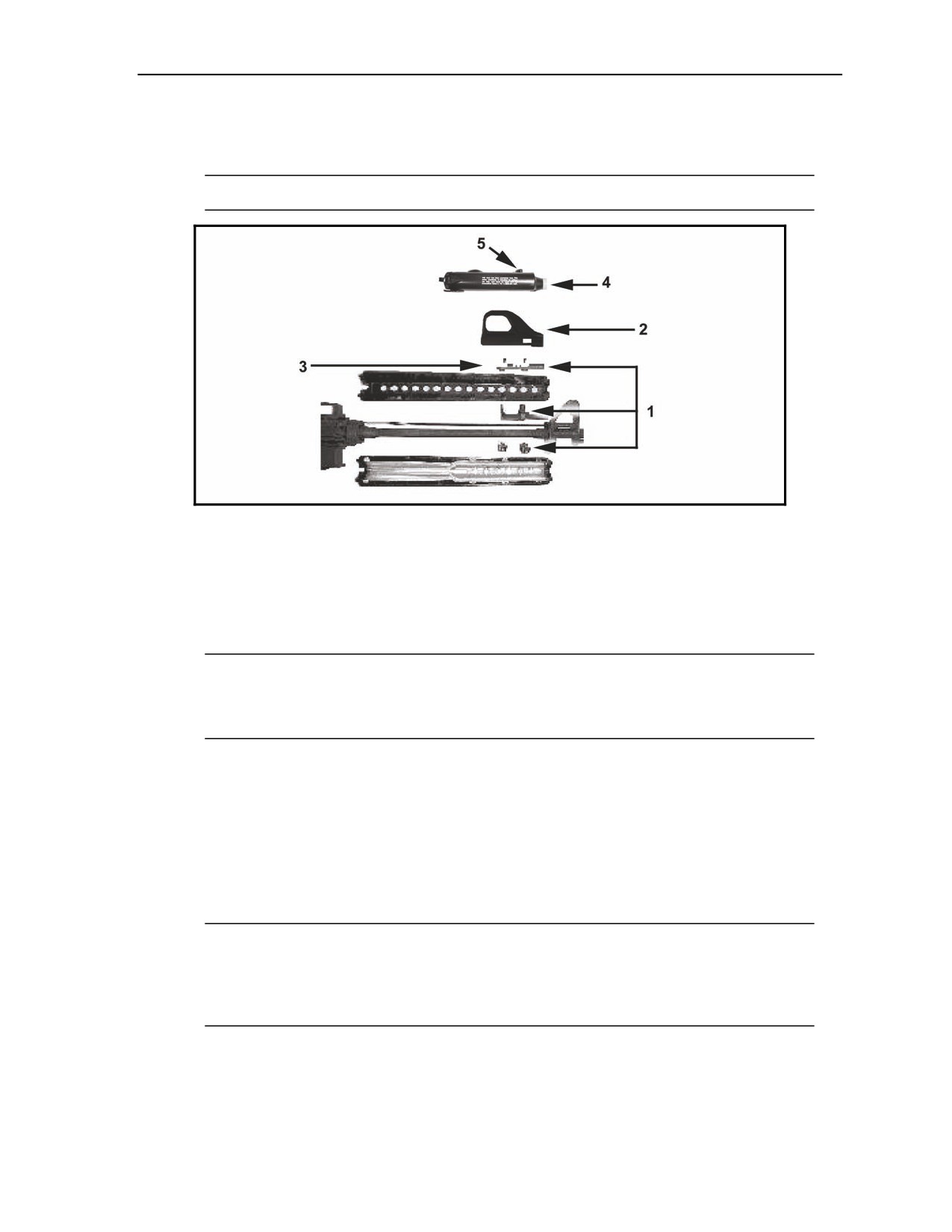
2-41. To mount the AN/PAQ-4B/C on an M16A1/A2/A3 rifle or M4 carbine—
NOTE: Reference the weapon components using the numbers listed in Figure 2-28.
Figure 2-28. Mounting the AN/PAQ-4B/C on the M16A1/A2/A3 rifle and M4 carbine.
(1) Install the bracket assembly (1).
(2) Align the switch lever shroud (2) with the notches on the mounting rail (3).
(3) Lower the ON/OFF switch.
(4) Align the AN/PAQ-4B/C (4) with the notches on the switch lever shroud.
(5) Hand-tighten using the thumbscrew (5).
NOTE:
1. Hand-tighten the plastic thumbscrew to avoid breakage. If the thumbscrew is
metal, tool-tightening is recommended to ensure zero retention.
2. To ensure zero retention, retighten the thumbscrew after firing a few rounds.
2-42. The remote switch should be attached to the weapon where it will not interfere with the functioning
of the weapon or hinder the firer’s ability to fire the weapon.
AN/PEQ-2A/B TARGET POINTER/ILLUMINATOR/AIMING LIGHT
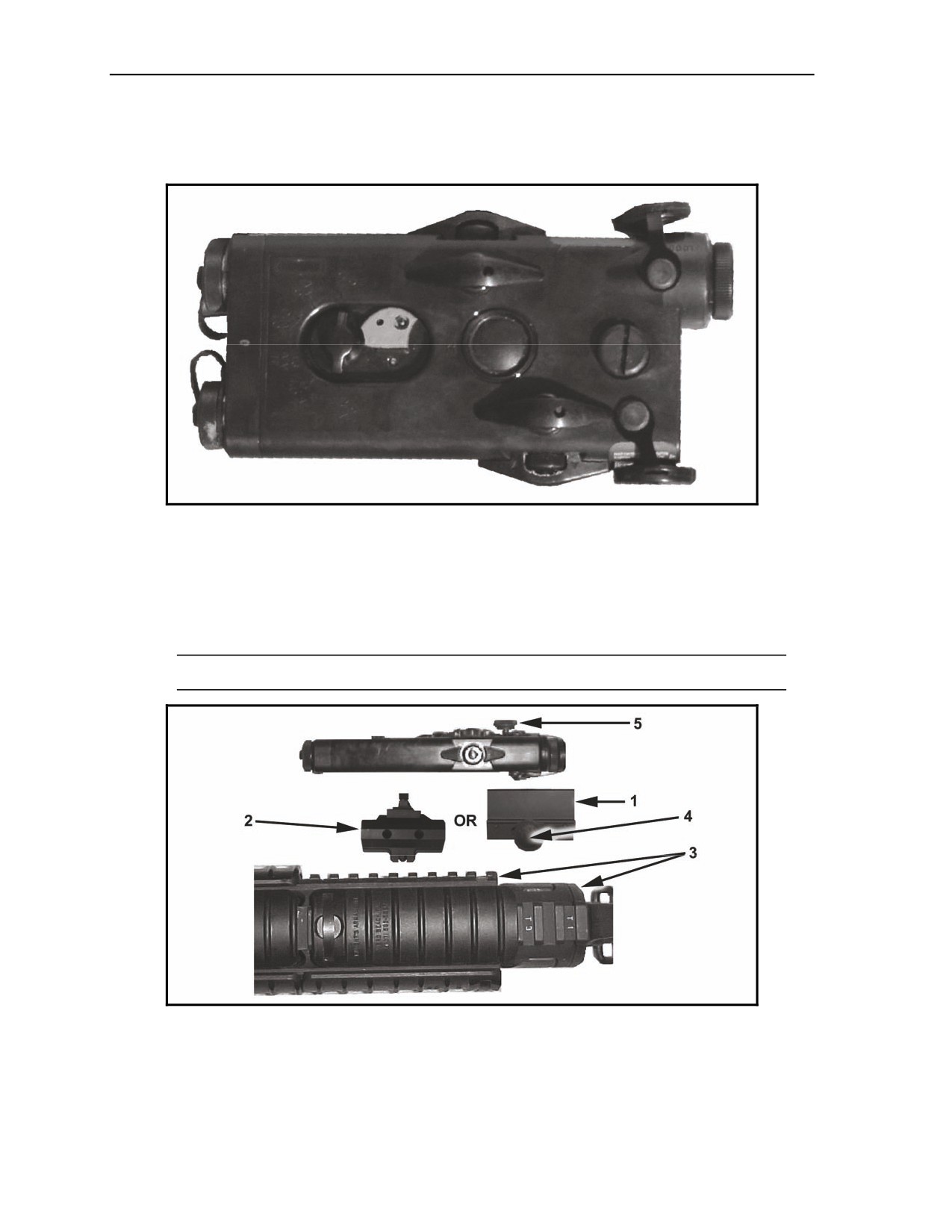
2-43. AN/PEQ-2A and AN/PEQ-2B aiming lights (Figure 2-29) are Class IIIb laser devices that emit a
collimated beam of IR light for precise aiming and a separate IR beam for illumination of the target or
target area. Both beams can be independently zeroed to the weapon and to each other. The beams can be
operated individually or in combination in both high and low power settings.
NOTES:
1. The IR illuminator is equipped with an adjustable bezel to vary the size of the
illumination beam based on the size and distance of the target.
2. A safety block is provided for training purposes to limit the operator from
selecting high power modes of operation.
12 August 2008
FM 3-22.9
2-21
Chapter 2
2-44. The aiming lights are used with NVDs and can be used as handheld illuminators/ pointers or
mounted on the weapon with the included brackets and accessory mounts. In the weapon-mounted mode,
the aiming lights can be used to direct fire and to illuminate and designate targets.
Figure 2-29. AN/PEQ-2A/B target pointer/illuminator/aiming light.
MOUNTING ON THE M16A4 RIFLE OR M4 MWS
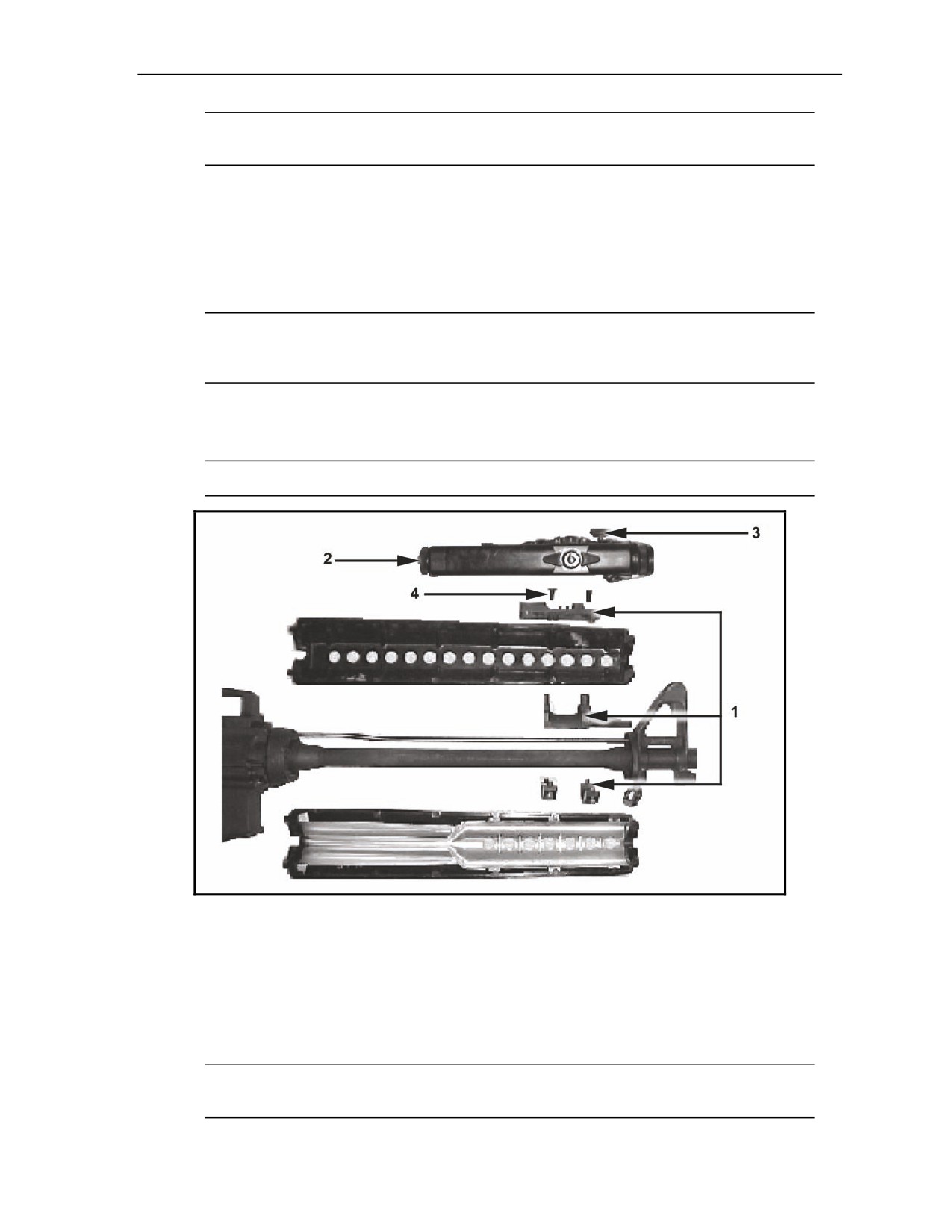
2-45. The Picatinny (1, Figure 2-30) or Insight (2, Figure 2-30) rail grabber may be used to mount the
AN/PEQ-2A/B on the ARS.
2-46. To mount the AN/PEQ-2A/B on the ARS—
NOTE: Reference the weapon components using the numbers listed in Figure 2-30.
Figure 2-30. Mounting the AN/PEQ-2A/B on the M16A4 rifle and M4 MWS.
(1) Mount the rail grabber all the way forward on the top or either side of the ARS, ensuring that it
does not extend beyond the end of the ARS.
2-22
FM 3-22.9
12 August 2008
Weapon Characteristics, Accessories, and Ammunition
NOTE: The AN/PEQ-2A/B will not retain zero if the rail grabber extends beyond the end of the
integrated rail when mounted.
(2) Tighten the torque-limiting knob (4) until it clicks twice.
(3) If installing the AN/PEQ-2A/B with the Insight rail grabber, tool-tighten the AN/PEQ-2A/B and
rail grabber so that it will not come loose.
(4) Align the thumbscrew (5) on the AN/PEQ-2A/B with the hole that is closest to the front sight
assembly located on the top of the rail grabber.
2-47. The mounting procedures are identical for the M16A4 rifle and M4 MWS.
NOTE: If the aiming light and rail grabber are removed as a whole unit and mounted onto the
same rail, the system will retain zero. If the rail grabber and AN/PEQ-2A/B are separated, the
AN/PEQ-2A/B must be rezeroed to the weapon.
MOUNTING ON THE M16A1/A2/A3 RIFLE OR M4 CARBINE
2-48. To mount the AN/PEQ-2A/B on an M16A1/A2/A3 rifle or M4 carbine—
NOTE: Reference the weapon components using the numbers listed in Figure 2-31.
Figure 2-31. Mounting the AN/PEQ-2A/B on M16A1/A2/A3 rifles and M4 carbines.
(1) Install the bracket assembly (1).
(2) Align the AN/PEQ-2A/B (2) thumbscrew (3) with the hole in the mounting rail (4) nearest to the
muzzle.
(3) Tool-tighten.
2-49. The remote switch should be attached to the weapon where it will not interfere with the functioning
of the weapon or hinder the firer’s ability to fire the weapon.
NOTE: To ensure zero retention, retighten the rail grabber and thumbscrew after firing a few
rounds.
12 August 2008
FM 3-22.9
2-23
Chapter 2
USE IN CONJUNCTION WITH MILES
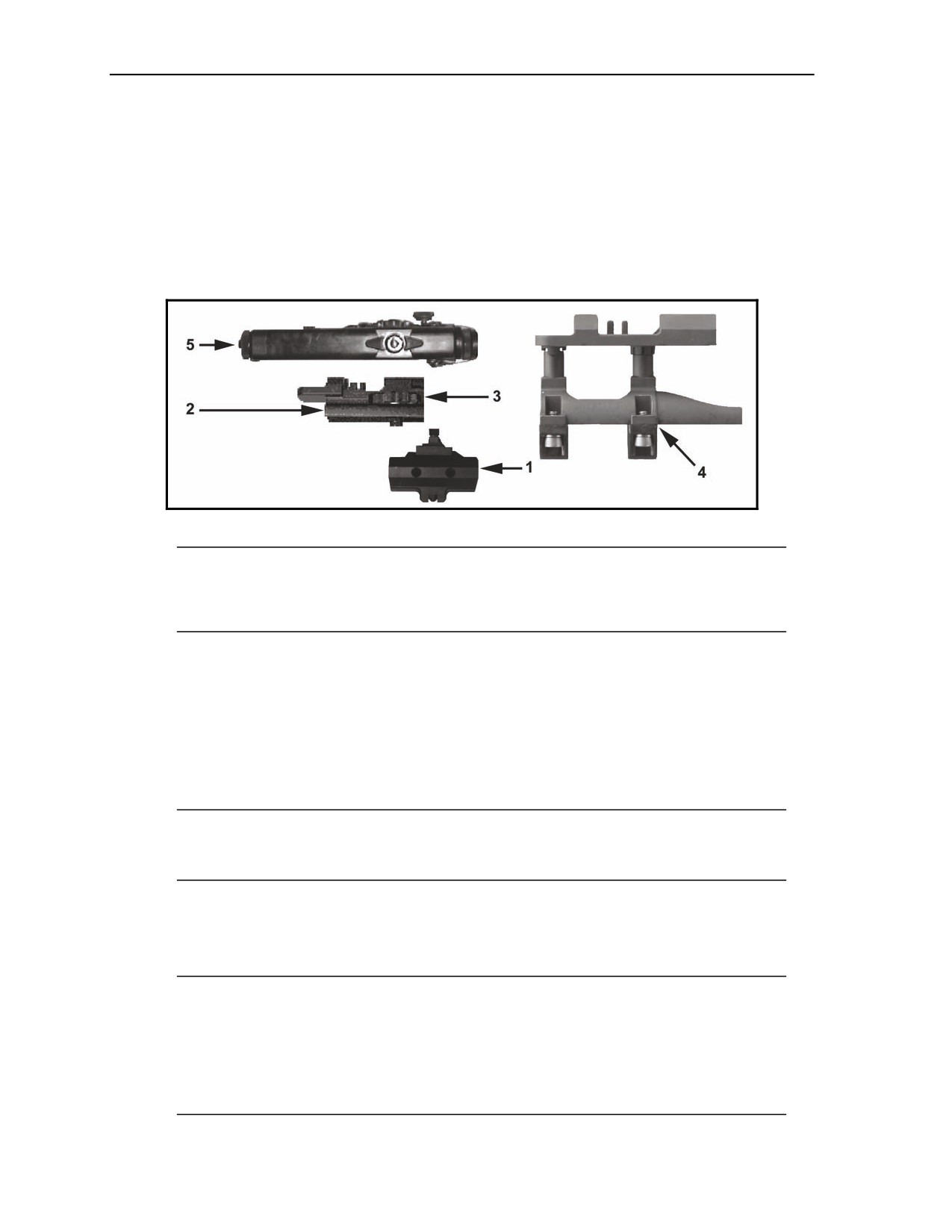
2-50. When conducting MILES training with the Insight rail grabber (1, Figure 2-32) or bracket assembly
(4, Figure 2-32), the AN/PEQ-2A/B is attached to the M16-/M4-series weapon using the training extender
bracket (2, Figure 2-32). The training extender is not required when—
z
Mounting the AN/PEQ-2A/B onto the side of the MWS.
z
Using the Picatinny rail grabber.
2-51. To attach the training extender, hand-tighten it by turning the thumb wheel (3, Figure 2-32) on the
training extender clockwise.
Figure 2-32. MILES training extender bracket installation on M16-/M4-series weapons.
NOTES:
1. The AN/PEQ-2A/B and AN/PAQ-4B/C must be zeroed before and after using
the MILES training extender.
2. For further information, refer to TM 11-5855-308-12&P.
AN/PEQ-15 ADVANCED TARGET POINTER/ILLUMINATOR
AIMING LIGHT
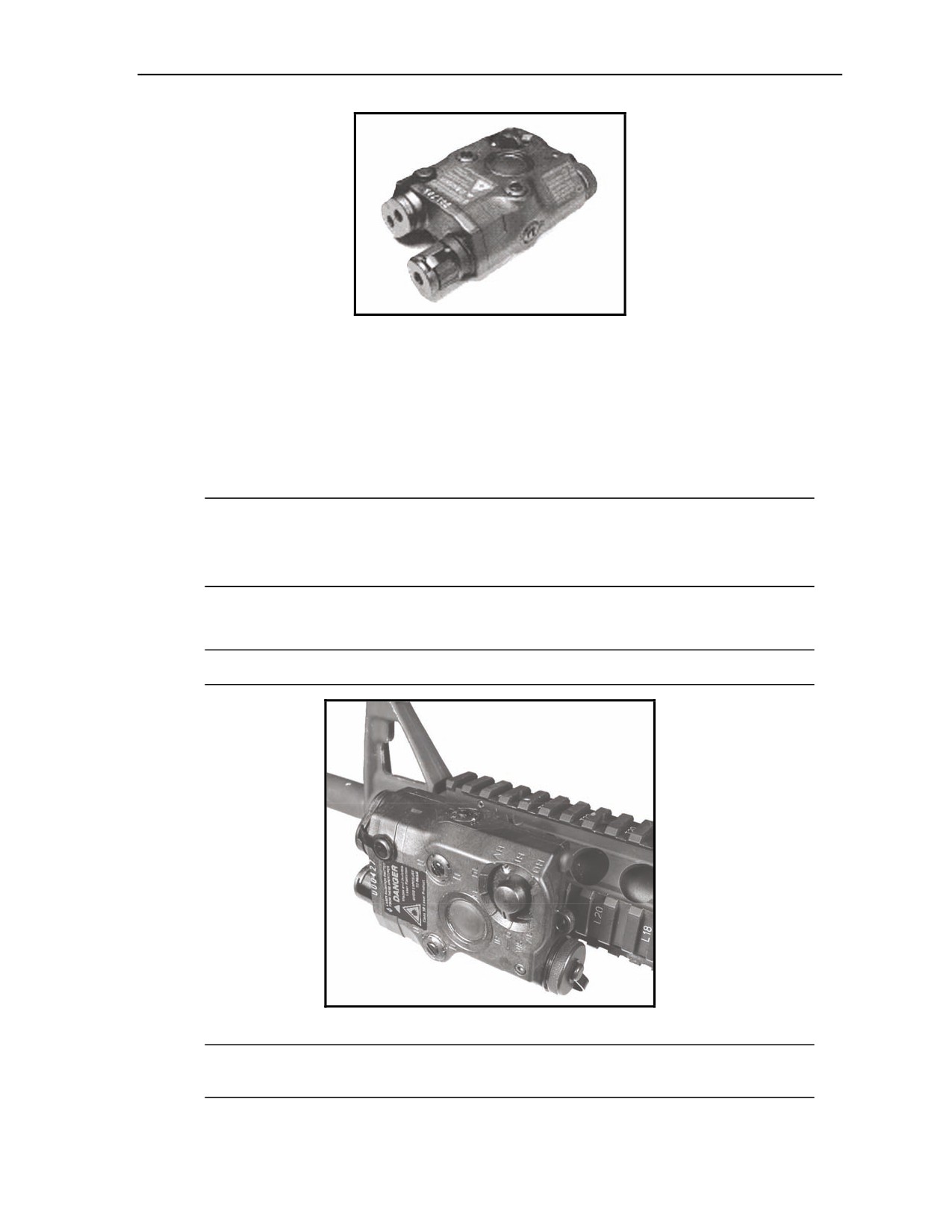
2-52. The AN/PEQ-15 advanced target pointer/illuminator aiming light (ATPIAL, Figure 2-33) is a
multifunctional laser that emits visible or IR light for precise weapon aiming and target/area illumination.
This ruggedized system can be used as a handheld illuminator/pointer or can be mounted to weapons
equipped with a MIL-STD-1913 rail. Unlike the AN/PAQ-4 and AN/PEQ-2A/2B, the AN/PEQ-15 has an
integrated rail grabber molded into the body.
NOTE: The AN/PEQ-15 can be used during force-on-force training in the low power modes
only. High power modes can be used on live-fire ranges exceeding 220 meters only. Refer to
TM 9-5855-1914-13&P for more information.
2-53. The AN/PEQ-15 ATPIAL's visible aiming laser provides for active target acquisition in low light
conditions and close quarters combat situations, and allows users to zero using the borelight without using
NVDs. When used in conjunction with NVDs, its IR aiming and illumination lasers provide for active,
covert target acquisition in low light or complete darkness.
NOTES:
1. The ATPIAL visible and IR aiming lasers are aligned. A single set of adjusters
moves both aiming beams, and the user can boresight/zero using either aiming
laser.
2. In addition to momentary and continuous modes of operation, the IR illuminator
may be programmed to operate at 1, 2, 4, or 8 pulses per second to eliminate
confusion on the battlefield.
2-24
FM 3-22.9
12 August 2008
Weapon Characteristics, Accessories, and Ammunition
Figure 2-33. AN/PEQ-15 advanced target pointer illuminator aiming light.
MOUNTING ON THE M16A4 RIFLE OR M4 MWS
2-54. To mount the AN/PEQ-15 on an M16A4 rifle or M4 MWS (Figure 2-34)—
(1) Loosen the clamping knob on the integral rail grabber bracket until the jaws sufficiently fit over
the MIL-STD-1913 rail.
(2) Position the integral rail grabber bracket on the rail, ensuring that the recoil lug is seated in the
desired recoil groove of the rail.
NOTE: The ATPIAL may be positioned anywhere on the rail where it is most convenient for
the operator; however, ensure that it does not extend beyond the end of the ARS or touch the
collar of the barrel. The AN/PEQ-15 will not retain zero if the rail grabber extends beyond the
end of the integrated rail when mounted.
(3) Turn the clamping knob clockwise to tighten.
(4) Tool-tighten the AN/PEQ-15 onto the MIL-STD-1913 rail to ensure that it does not come loose.
NOTE: Failure to properly secure the AN/PEQ-15 to the rail may lead to zero retention issues.
Figure 2-34. AN/PEQ-15 mounted on M4 carbine.
NOTE: If the ATPIAL is removed from the rail, the operator must note the notch that it was
zeroed on, and return it to the same position to retain zero.
12 August 2008
FM 3-22.9
2-25
Chapter 2
AN/PAS-13B/C/D (V1) LIGHT WEAPON THERMAL SIGHT AND
AN/PAS-13B/C/D (V3) HEAVY WEAPON THERMAL SIGHT
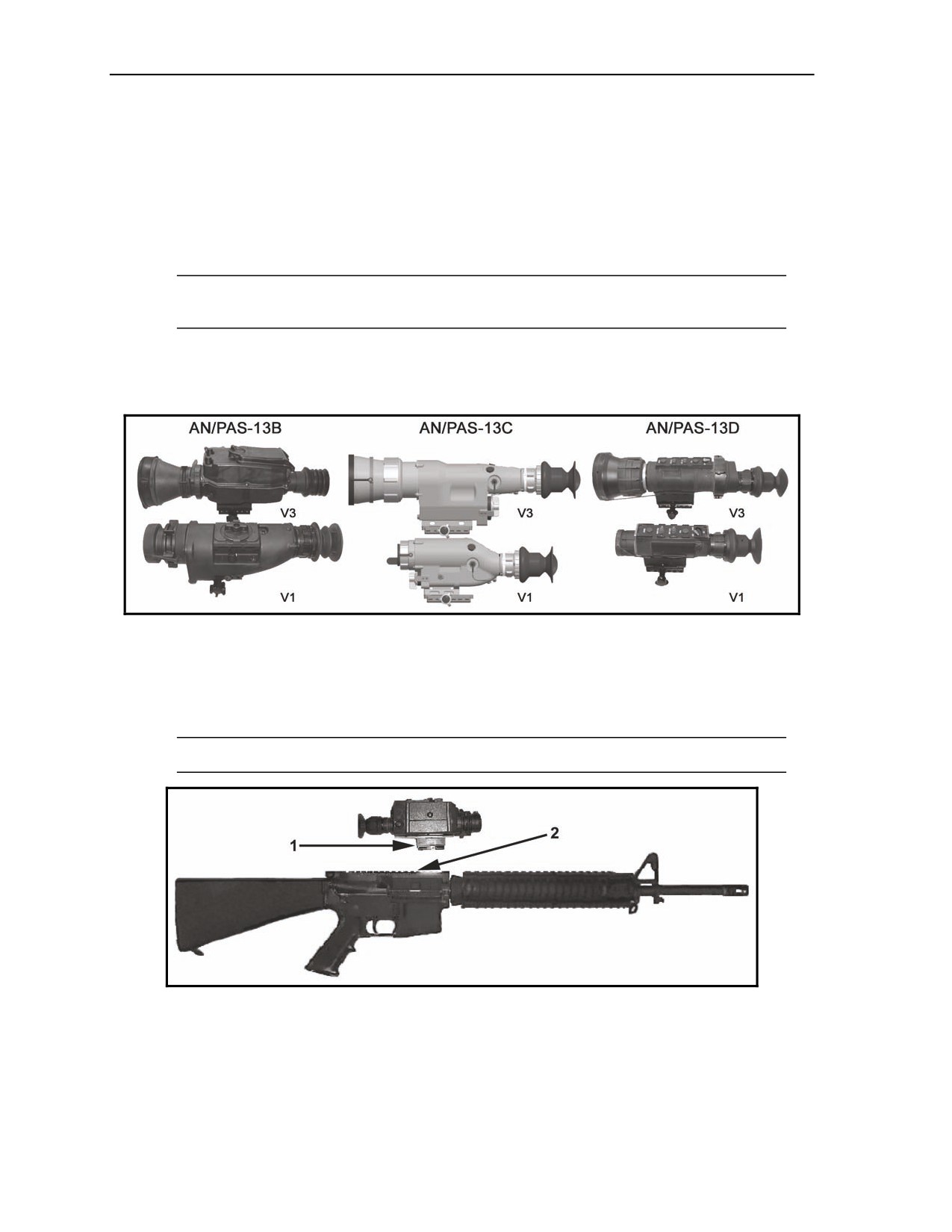
2-55. The AN/PAS-13B/C/D (V1) light weapon thermal sight (LWTS) and the AN/PAS-13B/C/D (V3)
heavy weapon thermal sight (HWTS) (Figure 2-35) are silent, lightweight, compact, and durable battery-
powered IR imaging sensors that operate with low battery consumption. The AN/PAS-13B/C/D (V1) is
used on riflemen's M4s and M16A4s. The AN/PAS-13B/C/D (V3) is used on squad leaders' M4s and
M16A4s only.
NOTE: Both the LWTS and the HWTS are referred to henceforth as a singular TWS. For more
information, refer to TM 11-5855-312-10, TM 11-5855-316-10, and TM 11-5855-317-10.
2-56. The TWS is capable of target acquisition under conditions of limited visibility, such as darkness,
smoke, fog, dust, and haze. The TWS operates effectively both at night and during the day. The TWS is
composed of two functional groups: the telescope and the basic sensor.
Figure 2-35. AN/PAS-13B/C/D (V1) light weapon thermal sight
and AN/PAS-13B/C/D (V3) heavy weapon thermal sight.
MOUNTING THE TWS ON AN M16A4 RIFLE OR M4 CARBINE
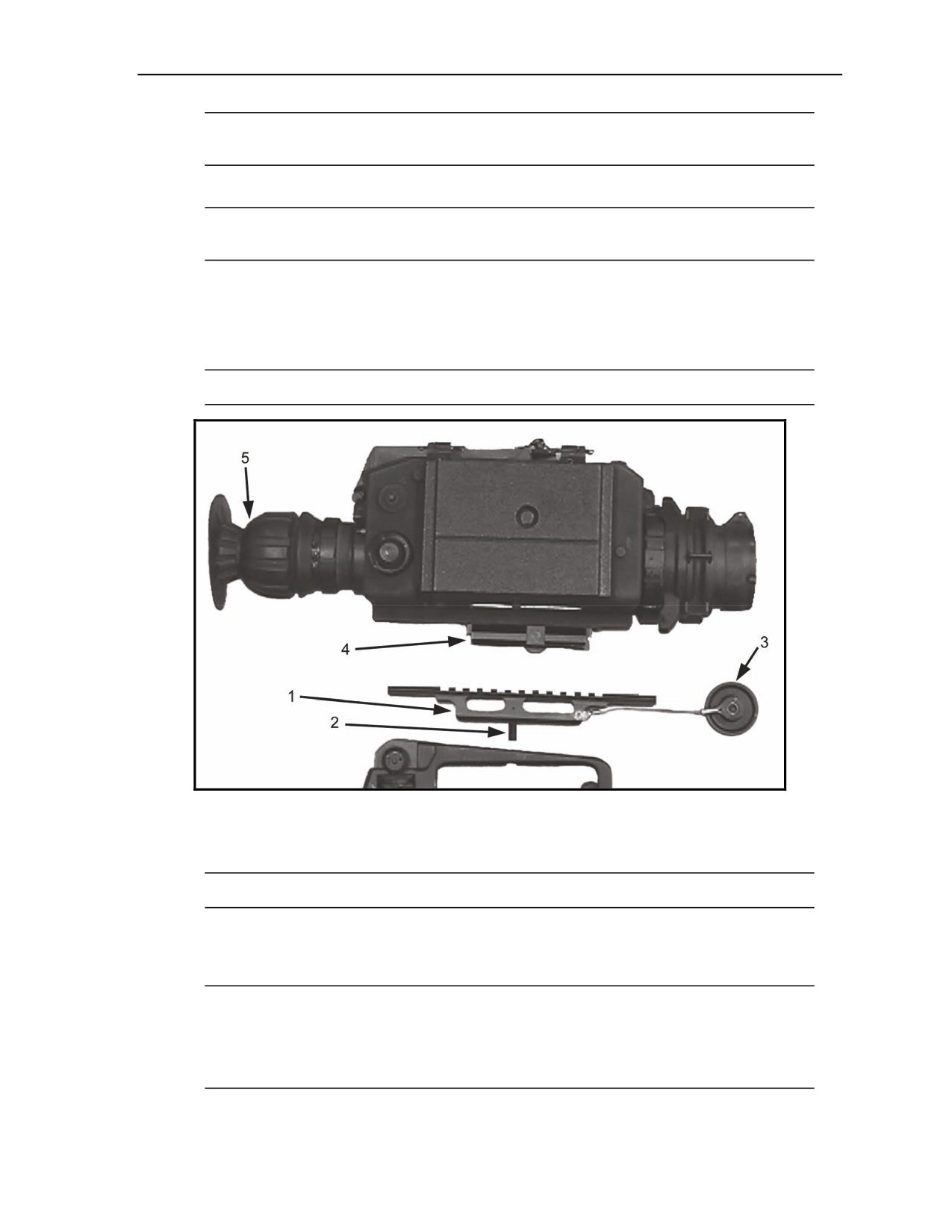
2-57. To mount the TWS on an M16A4 rifle or M4 carbine—
NOTE: Reference the weapon components using the numbers listed in Figure 2-36.
Figure 2-36. Mounting the TWS on M16A4 rifle or M4 carbine.
(1) Align the Picatinny rail grabber with the spacer on the bottom of the TWS with a notch on the
integrated rail of the M16A4 rifle or M4 carbine, ensuring that the TWS is positioned to
accommodate an effective firing position once the eyecup is depressed.
2-26
FM 3-22.9
12 August 2008
Weapon Characteristics, Accessories, and Ammunition
NOTE: The TWS will not retain zero if the rail grabber extends beyond the end of the integrated
rail when mounted.
(2) Tighten the torque-limiting knob clockwise until it clicks twice.
NOTE: Retighten the rail grabber after firing a few rounds to ensure that the sight is fully
seated.
2-58. The mounting procedures are identical for the M16A4 rifle and M4 MWS.
MOUNTING THE TWS ON AN M16A1/A2/A3 RIFLE
2-59. To mount the TWS on an M16A1/A2/A3 rifle—
NOTE: Reference the weapon components using the numbers listed in Figure 2-37.
Figure 2-37. Mounting the TWS on an M16A1/A2/A3 rifle.
(1) Insert the weapon bracket’s threaded rod (2) through the hole in the carrying handle of the
M16A1/A2/A3 rifle, and secure it with the thumb wheel (3).
NOTE: The M16A1/A2/A3 weapon bracket (1) is a standard item in the TWS carrying case.
(2) Align the Picatinny rail grabber (4) on the bottom of the TWS with a notch on the bracket,
ensuring that the TWS is positioned to accommodate an effective firing position once the eyecup
(5) is depressed.
NOTES:
1. Ensure that the rail grabber fully rests on the bracket when mounting the TWS
or the sight will not retain zero.
2. It is not necessary to use a spacer when mounting the HWTS on the
M16A1/A2/A3.
12 August 2008
FM 3-22.9
2-27
Chapter 2
AN/PVS-4 NIGHT VISION SIGHT
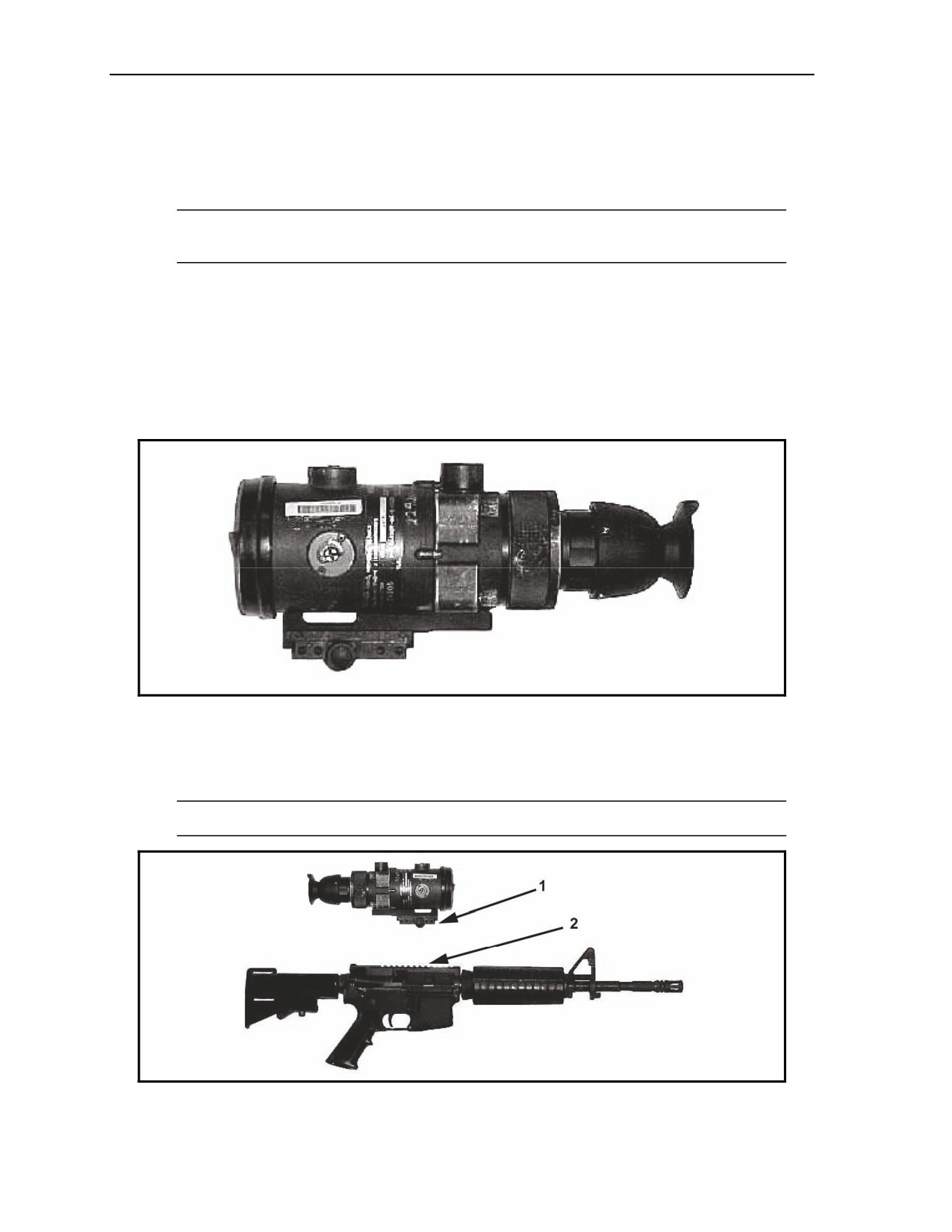
2-60. The AN/PVS-4 (Figure 2-38) is a passive, battery-operated night sight used for observation and
accurate firing of individual-served weapons during nighttime conditions
(for example, moonlight,
starlight, skyglow) against targets as far away as 400 meters.
NOTE: The sight is less effective when viewing into rain, fog, sleet, snow, smoke, shadows, and
other obscurants.
2-61. The sight is portable and mounts to the following weapons:
z
M16A1/A2 and M14 rifles.
z
M203 and M79 grenade launchers.
z
M249 squad automatic weapon (SAW).
z
M60 machine gun.
z
M67 recoilless rifle.
z
M72A1 rocket launcher.
Figure 2-38. AN/PVS-4 night vision sight.
MOUNTING ON THE M16A4 RIFLE OR M4 CARBINE
2-62. To mount the AN/PVS-4 night vision sight on an M16A4 rifle or M4 carbine—
NOTE: Reference the weapon components using the numbers listed in Figure 2-39.
Figure 2-39. Mounting the AN/PVS-4 on an M4 carbine or M4 MWS.
2-28
FM 3-22.9
12 August 2008
Weapon Characteristics, Accessories, and Ammunition
(1) Align the Picatinny rail grabber with a mounting adapter (1) on the bottom of the AN/PVS-4
with a notch on the integrated rail (2) of an M16A4 rifle, M4 carbine, or M4 MWS, ensuring that
the AN/PVS-4 is positioned to accommodate an effective firing position once the eyecup is
depressed.
NOTE: The AN/PVS-4 will not retain zero if the rail grabber extends beyond the end of the
integrated rail when mounted.
(2) Tighten the torque-limiting knob clockwise until it clicks twice.
NOTE: Retighten the rail grabber after firing a few rounds to ensure that the sight is fully
seated.
2-63. The mounting procedures are identical for the M4 carbine and M4 MWS.
MOUNTING ON THE M16A1/A2/A3 RIFLE
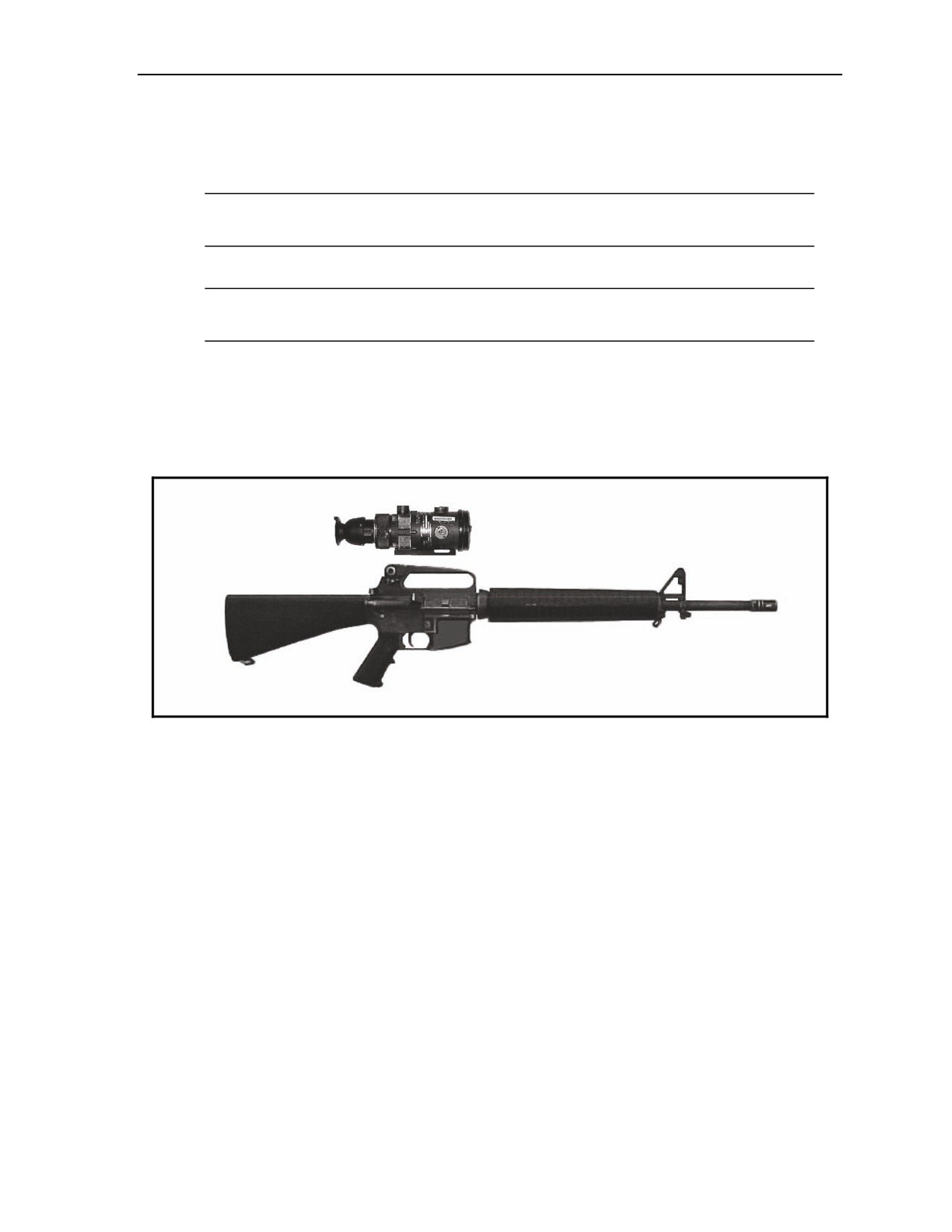
2-64. The AN/PVS-4 is mounted on the carrying handle of the M16A1/A2/A3 rifle (Figure 2-40). To
mount the AN/PVS-4 night vision sight on an M16A1/A2/A3 rifle—
Figure 2-40. Mounting the AN/PVS-4 on an M16A1/A2/A3 rifle.
(1) Position the sight in the groove on the top of the carrying handle.
(2) Align the threaded hole in the base of the sight-mounting adapter over the hole in the handle.
(3) Insert the mounting knob assembly through the hole in the carrying handle, and screw it firmly
clockwise into the sight-mounting adapter.
2-65. If difficulty is encountered—
(1) Turn the sight and the rifle upside down.
(2) Place the rifle handle onto the sight-mounting adapter, lining up the hole in the carrying handle
with the hole in the sight-mounting adapter.
(3) Place the mounting knob assembly through the hole in the carrying handle, and screw it
clockwise.
12 August 2008
FM 3-22.9
2-29
Chapter 2
BACKUP IRON SIGHT
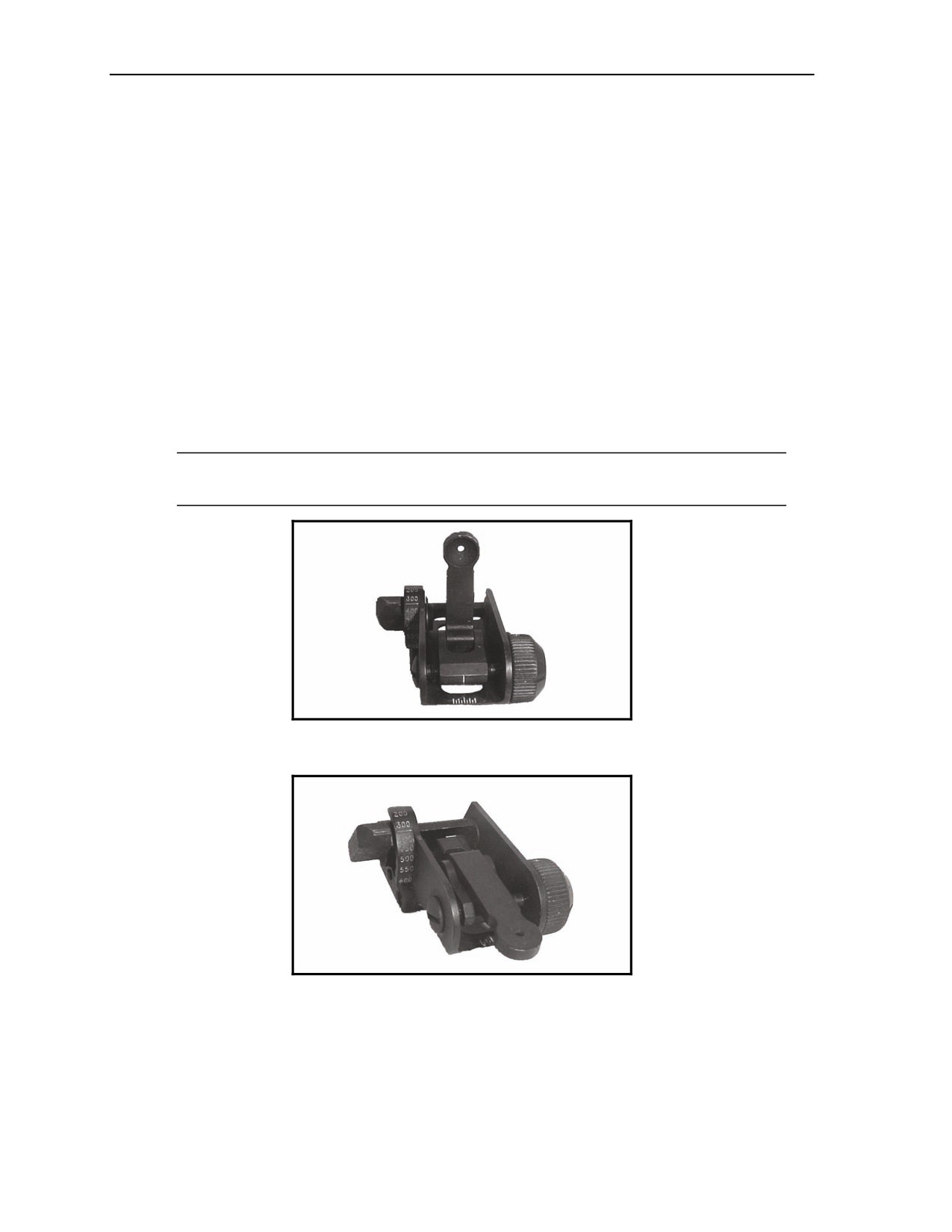
2-66. The BUIS (Figure 2-41) is a semi-permanent flip-up iron sight equipped with a rail-grabbing base. It
is intended to remain on the M4 MWS while the M68 CCO is used as the primary means of day fire
control. If the M68 fails, the prezeroed BUIS can be flipped up and used to continue the mission. The BUIS
provides a backup capability effective when firing 600 meters away and farther and can be installed on the
M16A4 rifle and M4 carbine. It provides a sighting capability when all other accessories have been
removed, and it can be used to establish approximate zeros for other sighting components without requiring
live-fire. Zeros established using this method are only effective to approximately 20 meters and should be
refined by a live-fire zero.
2-67. The armorer installs the BUIS on the first notch of the integrated rail, nearest to the charging handle.
Before the armorer installs the BUIS, he removes all rail covers/heat shields from the top, except one 4-, 5-,
or 6-rib shield. The remaining rail cover/heat shield can be positioned to accommodate accessories and
protect the nonfiring hand when the barrel is hot. Once installed and zeroed, the BUIS should be left in the
stowed position (collapsing toward the firer, as shown in Figure 2-42) for best durability and minimal
interference unless its use is imminent. The BUIS should only be removed by the armorer and remains on
the MWS unless the carrying handle/sight is installed.
NOTE: Failure to install the BUIS on the first notch will lead to an improper zero and
inaccuracy at longer ranges when the range lever is used.
Figure 2-41. Backup iron sight.
Figure 2-42. Backup iron sight in the stowed position.
2-30
FM 3-22.9
12 August 2008
Weapon Characteristics, Accessories, and Ammunition
ADVANCED COMBAT OPTICAL GUNSIGHT
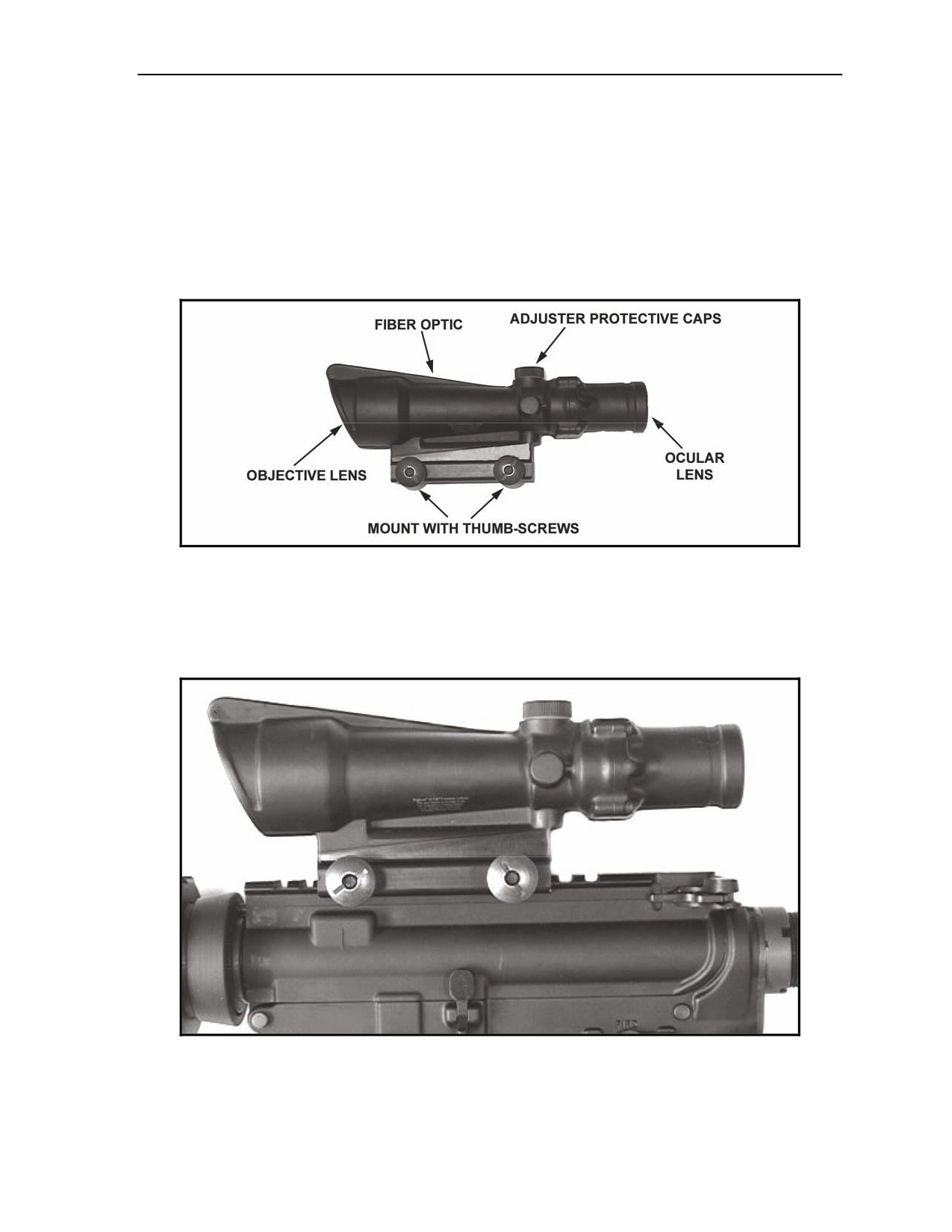
2-68. The ACOG (Figure 2-43) is designed to provide enhanced target identification and hit probability for
the M4A1 or M16-series weapon when firing as far as 800 meters (approximately 870 yards) away. It is
designed with dual illuminated technology, using fiber optics for daytime employment and tritium for
nighttime and low-light use. The ACOG is a lightweight, rugged, fast, and accurate 3.5 power optic scope.
The body is machined from aluminum forgings; both the material and finish are identical to the M4A1. It
is internally adjustable to allow the shock of rough handling to be carried by the scope body instead of the
adjustment mechanism.
Figure 2-43. Advanced combat optical gunsight.
MOUNTING ON THE M16A4 RIFLE OR M4 CARBINE
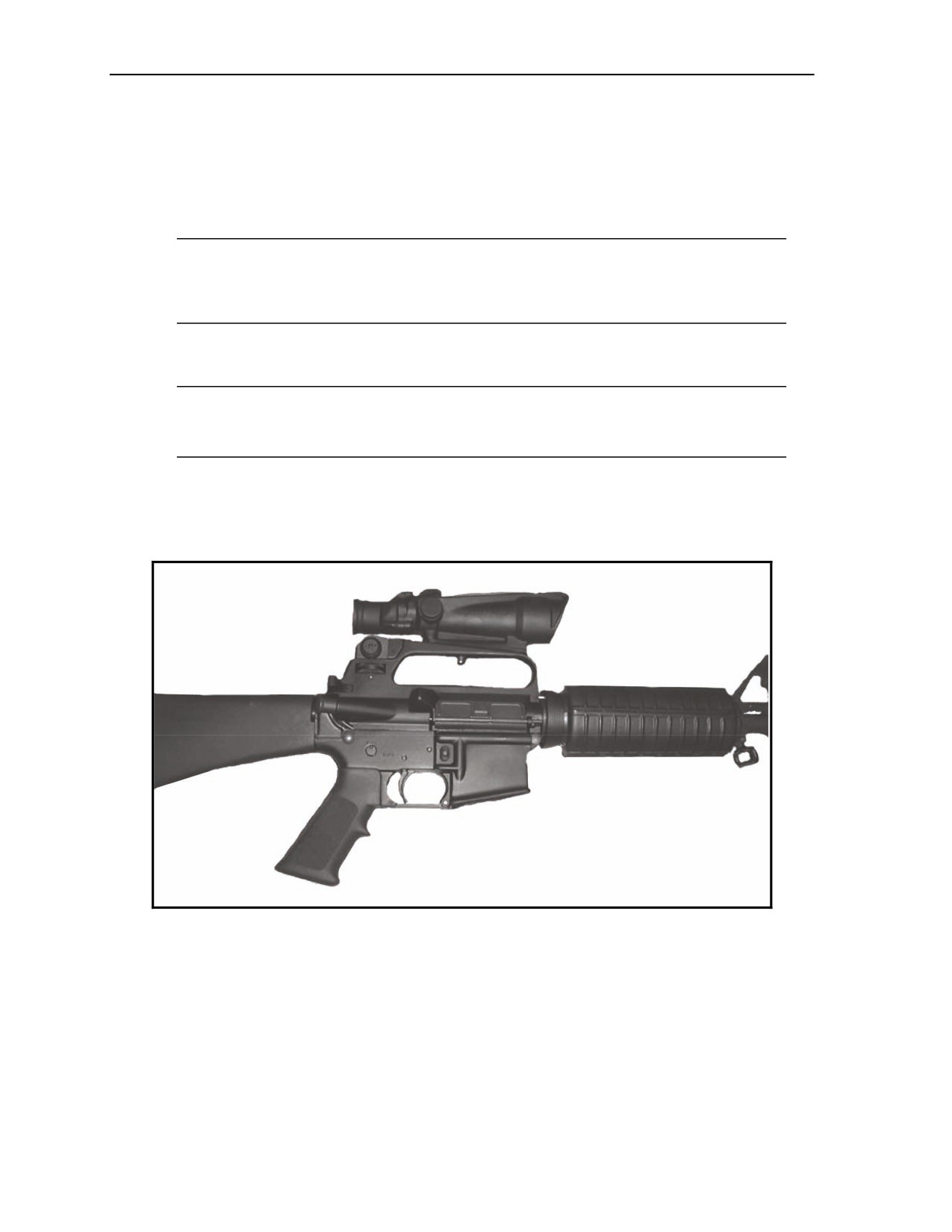
2-69. The ACOG can be attached to the flattop easily using the adapter that comes from the factory (Figure
2-44). To attach the ACOG to the flattop with the adapter—
Figure 2-44. Mounting the ACOG on M16A4 rifle and M4 carbine.
12 August 2008
FM 3-22.9
2-31
Chapter 2
(1) Loosen the thumb screws.
(2) Pull the interface clamp bar back against the knobs.
(3) Place the ACOG onto the flattop upper receiver rail surface. Be sure to engage the interface
studs on the bottom of the adapter with the grooves on the top mounting surface of the upper
receiver.
NOTE:
1. The ACOG can be placed in any of the slots on top of the weapon to allow for
eye relief adjustments.
2. To retain zero, place the ACOG into the same slots during each installation.
(4) Using a finger, tighten the knobs firmly.
(5) Add another ¼ of a turn using a coin or a blade screwdriver.
NOTE: The slots on the knobs are only for removing the ACOG from the weapon if the knobs
have been attached too tightly for hand-removal. If the slots are used to tighten the knobs, the
ACOG will be difficult to remove.
MOUNTING ON THE M16A1/A2/A3 RIFLE
2-70. Although the ACOG is designed for use on the flattop rail of M16A4 rifles and M4 carbines, it can
be attached to the carrying handle (Figure 2-45). To attach the ACOG to the carrying handle—
Figure 2-45. Mounting the ACOG on an M16A1/A2/A3 rifle.
(1) Align the forward-most threaded mounting hole on the bottom of the ACOG with the existing
hole in the M4/M16 carrying handle.
(2) Press down firmly on the optic until it is seated inside the carrying handle rail.
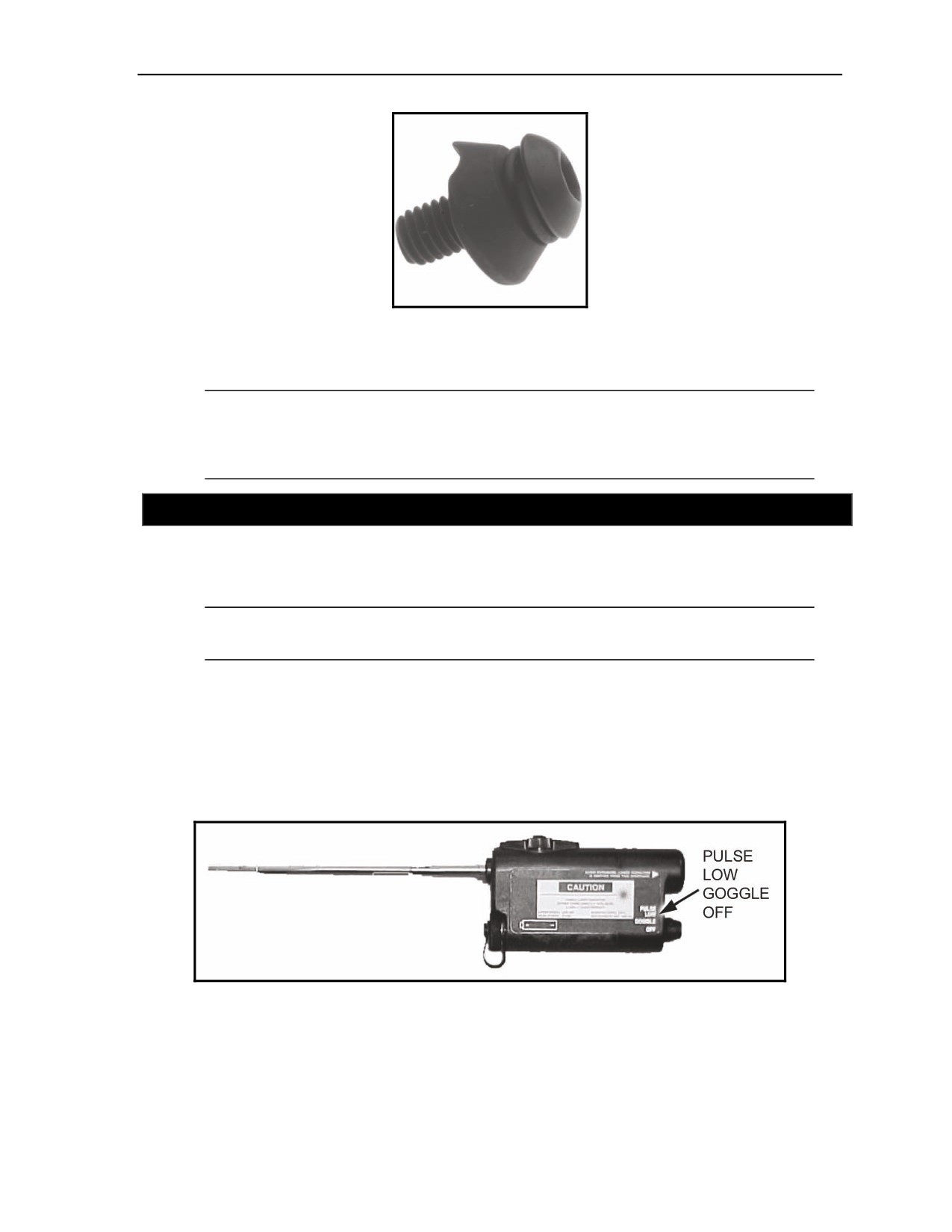
(3) Insert the locking screw and washer set from the bottom of the carrying handle. Ensure that the
locking screw and washer are inserted in the proper order (screw, locking nut, washer), or the
screw will eventually shake itself loose. Figure 2-46 shows the proper assembly of the screw set.
2-32
FM 3-22.9
12 August 2008
Weapon Characteristics, Accessories, and Ammunition
Figure 2-46. ACOG locking screw.
(4) Tighten the locking screw with the factory-supplied ⅛” Allen wrench, and then tighten another
¼ turn.
NOTE: When the ACOG is attached to the carrying handle, the bullet drop compensated (BDC)
reticle will be off slightly at extended distances. For example, at 500 meters, the impact will be
5 inches high; at 600 meters, the impact will be 6 inches high. To compensate for this, aim
slightly low once the target is ranged beyond 400 meters.
SECTION IV. 10-METER BORESIGHT AND 25-METER ZERO OFFSET
Boresighting is conducted at 10 meters with the borelight, weapon, aiming device, and a 10-meter offset. Each
aiming device and weapon combination has a unique 10-meter offset. The 25-meter zero offset target is used
when live-firing at 25 meters. When used properly, these offsets will align the aiming device on the selected
weapon to engage a target's center of mass at 300 meters.
NOTE: See Appendix F for more information about 10-meter offsets for each weapon
combination.
BORELIGHT
2-71. The borelight (Figure 2-47) is an eye-safe laser that is used to zero aiming lasers (such as the
AN/PAQ-4 or AN/PEQ-2) without a 25-meter confirmation. The borelight will also boresight optics and
iron sights to ensure that the first shot group hits the 25-meter zeroing target when zeroing the weapon. The
borelight comes with a
5.56-millimeter,
7.62-millimeter, and .50-caliber mandrel. M203 and MK19
mandrels can be purchased separately.
Figure 2-47. Borelight with a 5.56-millimeter mandrel.
2-72. The borelight has four settings:
z
OFF.
z
GOGGLE.
z
LOW.
z
PULSE.
12 August 2008
FM 3-22.9
2-33
Chapter 2
OFF SETTING
2-73. This setting is used when the borelight is not in use.
GOGGLE SETTING
2-74. This setting is used when the boresight is being used with NVGs in a tactical environment.
LOW SETTING
2-75. This setting is used during normal operations.
PULSE SETTING
2-76. This setting is used during dry-fire training.
10-METER BORESIGHT
2-77. The
10-meter boresighting target is used in conjunction with the borelight. The
10-meter
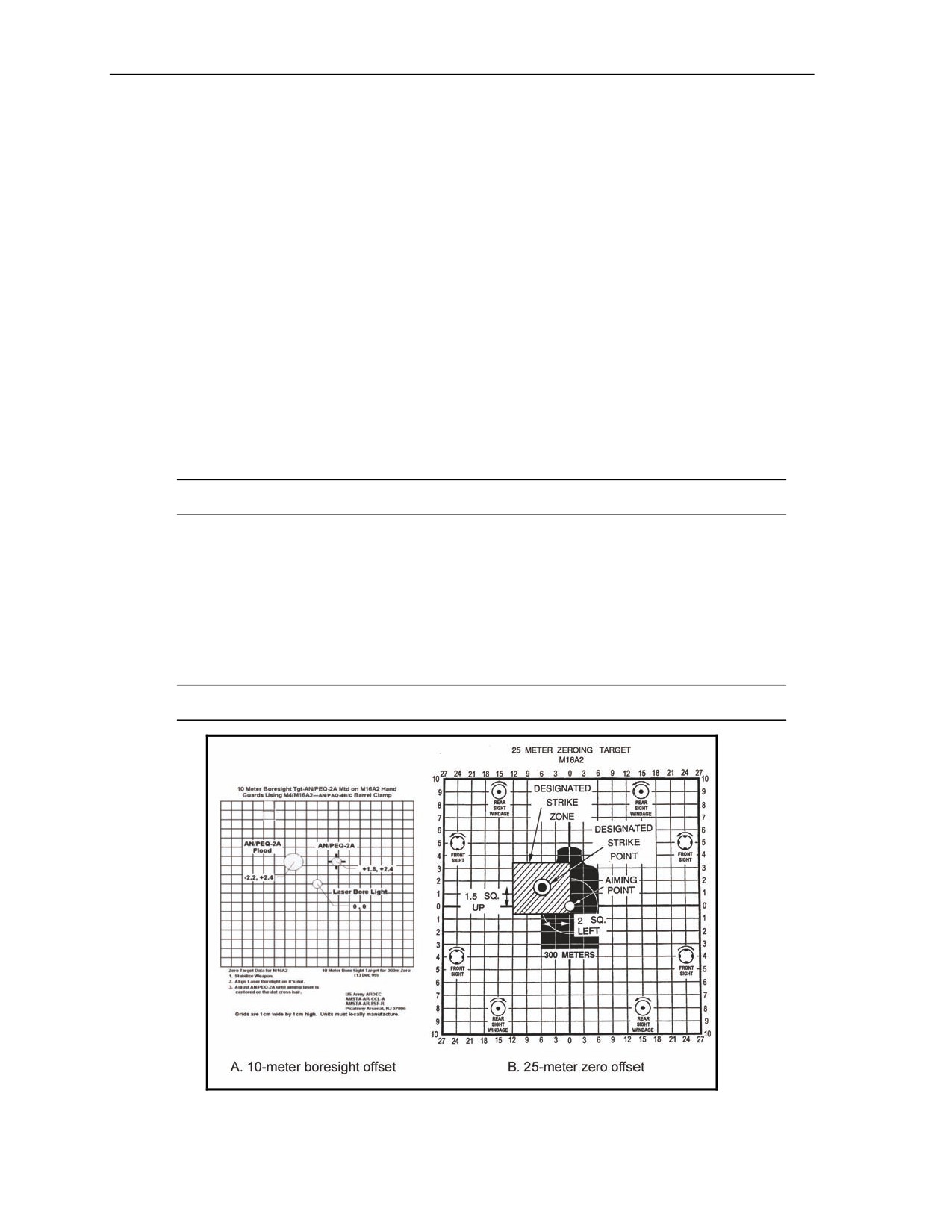
boresighting target is a 1-centimeter grid system with a crosshair and a circle (Figure 2-48A). The crosshair
is the point of aim for the aiming device, and the circle is the point of impact for the borelight.
NOTE: Refer to Chapter 8 for a detailed explanation of boresighting procedures.
25-METER ZERO OFFSET
2-78. The M16A2 25-meter zeroing target is used when live-firing all optics and IR aiming lights at 25
meters, with the appropriate strike zone marked on the target (Figure 2-48B). The M4 zeroing target is only
used when zeroing the iron sights on the M4. The M4 25-meter zeroing target will not allow the placement
of the correct offset due to the size of the squares, which are 13 millimeters high and wide. The point of
aim is always the 300-meter scaled silhouette's center of mass. The designated strike zone is a 4x4 square
designating where the rounds should impact when the firer aims at the center of mass.
NOTE: Refer to Chapter 8 for a detailed explanation of the 25-meter offset zeroing procedures.
Figure 2-48. 10-meter boresighting target and 25-meter zero offset.
2-34
FM 3-22.9
12 August 2008
Weapon Characteristics, Accessories, and Ammunition
SECTION V. AMMUNITION
This section provides information about different types of standard military ammunition used in M16- and M4-
series weapons.
AUTHORIZED AMMUNITION
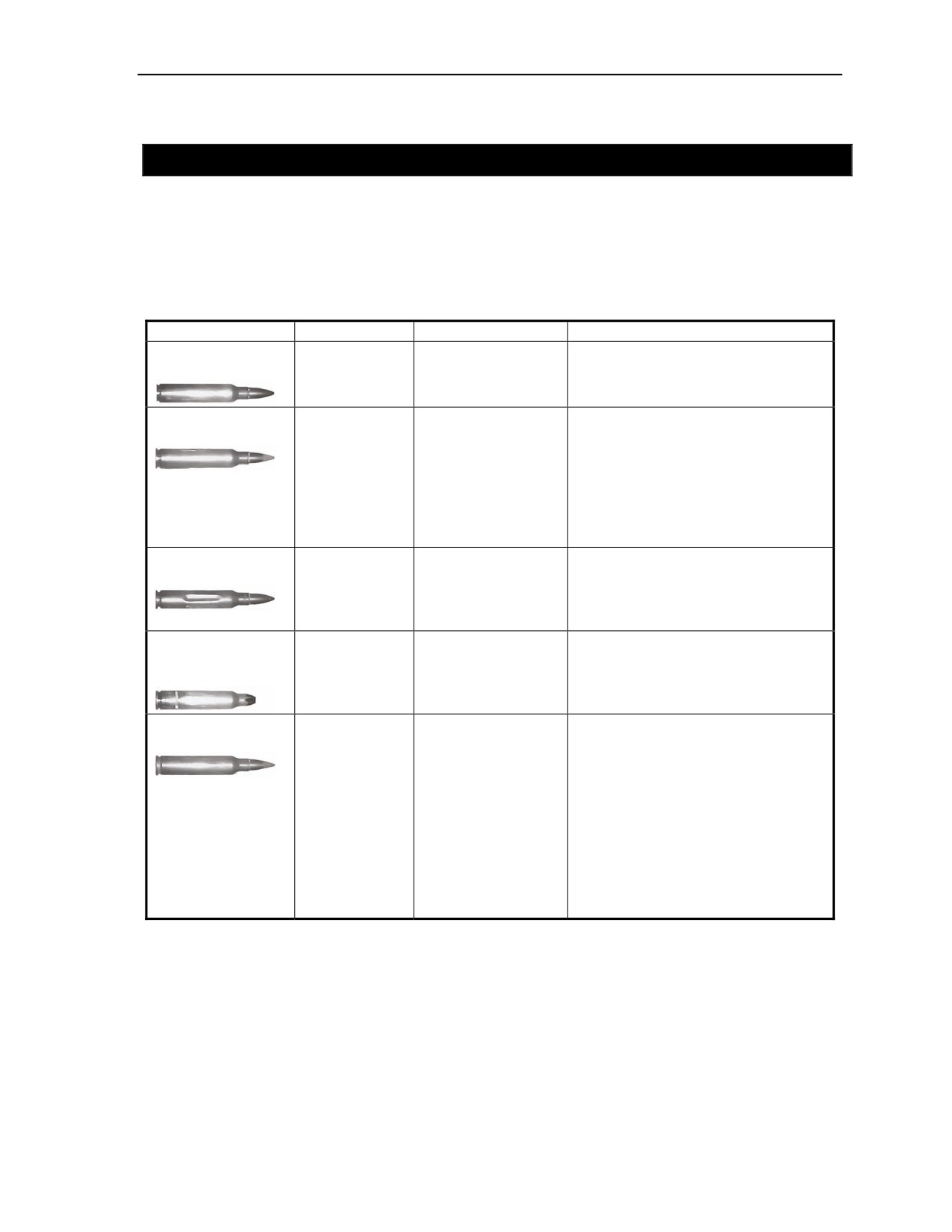
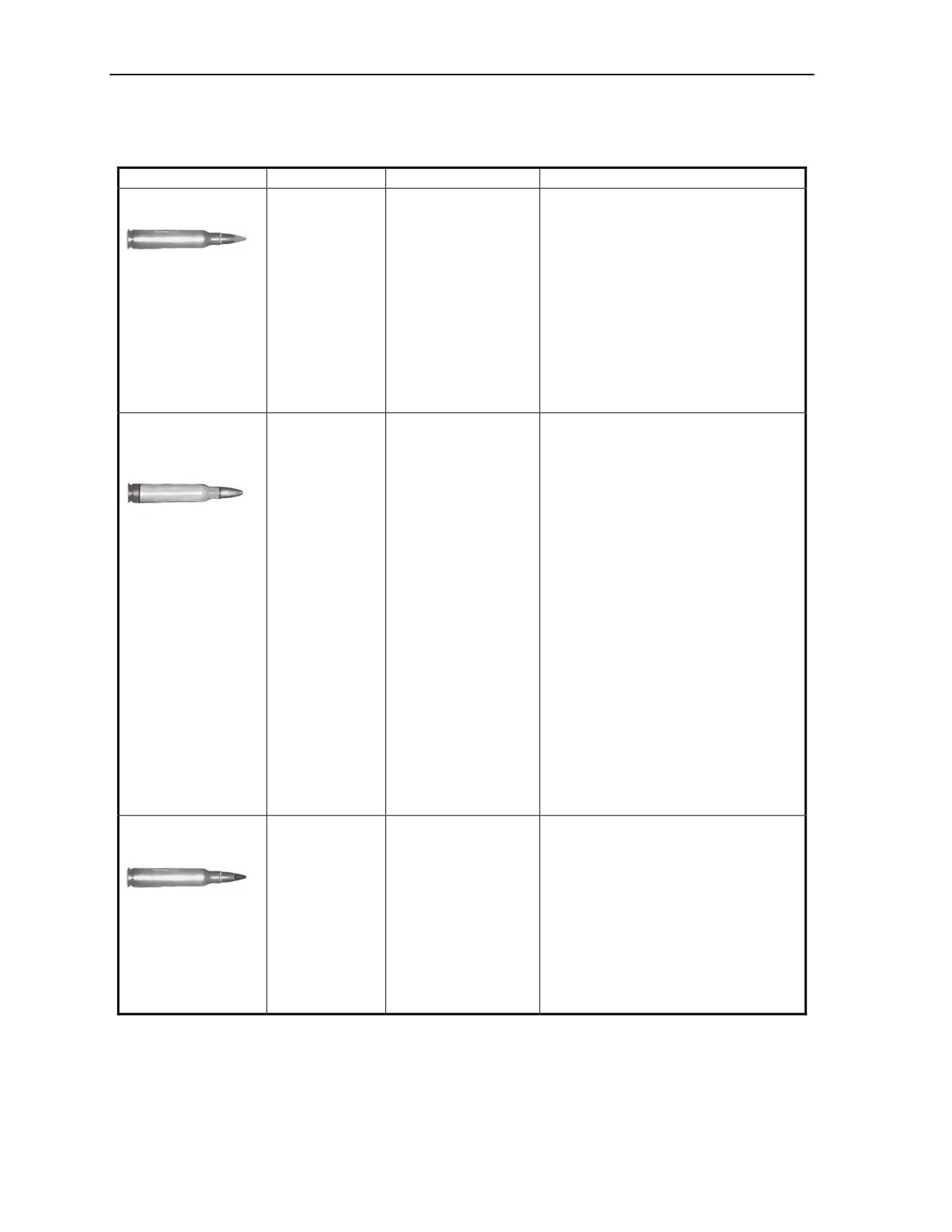
2-79. Use only authorized ammunition manufactured to U.S. and NATO specifications (Table 2-8).
Table 2-8. Authorized ammunition.
CARTRIDGE/ROUND
IDENTIFICATION
USE
ADDITIONAL INFORMATION
M193 cartridge -
Plain tip
The M193 is the
The M193 cartridge is a center-fire cartridge
5.56-mm, ball
standard cartridge for
with a 55-grain, gilded metal-jacketed, lead
field use with the M16A1
alloy core bullet.
rifle.
M196 cartridge -
Red or orange tip
The M196 cartridge is
Soldiers should avoid long-term use of 100
5.56-mm, tracer
used only in the M16A1
percent tracer rounds, which could cause
rifle.
deposits of incendiary material or chemical
compounds that could damage the barrel.
Its main uses are for
observation of fire,
When tracer rounds are fired, they are mixed
incendiary effect, and
with ball ammunition in a ratio of no greater
signaling.
than one-to-one with a preferred ratio of
three or four ball rounds to one tracer round.
M199 cartridge -
Six grooves along
The M199 dummy
This cartridge contains no propellant or
5.56-mm, dummy
the sides of the
cartridge is used in all
primer.
case beginning
M16-/M4-series
about 1/2 inch
weapons during dry-
The primer well is open to prevent damage
from its tip
firing and other training.
to the firing pin.
M200 cartridge -
Case mouth is
The M200 blank
N/A
5.56-mm, blank
closed with a
cartridge is used in all
seven-petal
M16-/M4-series
(no projectile)
rosette crimp,
weapons.
violet tip
M855 cartridge -
Green tip
The M855 cartridge is
The M855 cartridge has a 62-grain, gilded
5.56-mm, ball
used in the M16A2/3/4
metal-jacketed, lead alloy core bullet with a
and in M4-series
steel penetrator.
weapons.
The primer and case are waterproof. This
round is also linked and used in the M249.
NOTE: This ammunition should not be used
in the M16A1 except under emergency
conditions, and only at targets less than 90
meters away. The twist of the M16A1 rifling
is not sufficient to stabilize the length of the
round's projectile.
12 August 2008
FM 3-22.9
2-35
Chapter 2
Table 2-8. Authorized ammunition (continued).
CARTRIDGE/ROUND
IDENTIFICATION
USE
ADDITIONAL INFORMATION
M856 cartridge -
Red tip (orange
The M856 tracer
The M856 tracer cartridge has
5.56-mm, tracer
when linked 4 to 1
cartridge is used in the
characteristics similar to the M196 tracer,
for the M249)
M16A2/3/4 and M4-
with a slightly longer tracer burnout distance.
series weapons.
This cartridge has a 63.7-grain bullet.
The M856 does not have a steel penetrator.
NOTE: This ammunition should not be used
in the M16A1 except under emergency
conditions, and only at targets less than
90 meters away. The twist of the M16A1
rifling is not sufficient to stabilize the length
of the round's projectile.
M862 cartridge -
N/A
The M862 SRTA is used
The M862 SRTA can be used in lieu of
5.56-mm, short-range
in all rifles and is
service ammunition on indoor ranges and by
training ammunition
designed exclusively for
units who have a limited range fan that does
(SRTA)
training.
not allow the firing of service ammunition.
If adequate range facilities are not available
for sustainment training, SRTA can be used
for any firing exercise of 25 meters or less.
This includes the 25-meter scaled silhouette,
25-meter alternate qualification course, and
quick-fire training.
SRTA can also be used for urban operations
(UO) training.
NOTES: 1. See Appendix A for use of SRTA
in training.
2. Although SRTA closely replicates the
trajectory and characteristics of service
ammunition out to 25 meters, the settings
placed on the sights for SRTA could be
different for service ammunition. SRTA
should not be used to battlesight zero
weapons that will fire service ammunition.
3. SRTA ammunition must be used with the
M2 training bolt.
M995 cartridge -
Conventional
The M995 cartridge is
The M995 offers the capability to defeat light
5.56-mm, armor-
brass cartridge
used by the M249
armored targets at ranges two to three times
piercing (AP)
case
(SAW), M16/A2/A3/A4,
that of currently available 5.56-mm
and M4-series weapons.
ammunition.
It is intended for use
Aluminum cup sits
against light armored
at the rear of the
The M995 cartridge consists of a projectile
targets.
projectile (for the
and a propelling charge contained in a brass
purpose of
cartridge case. The projectile is a dense
properly locating
metal penetrator (tungsten carbide) enclosed
the penetrator
by a standard gilded metal jacket. The
within the
cartridge utilizes a double base propellant. A
projectile)
standard rifle cartridge primer is used in the
case to initiate the propelling charge.
2-36
FM 3-22.9
12 August 2008
Weapon Characteristics, Accessories, and Ammunition
TRAJECTORY
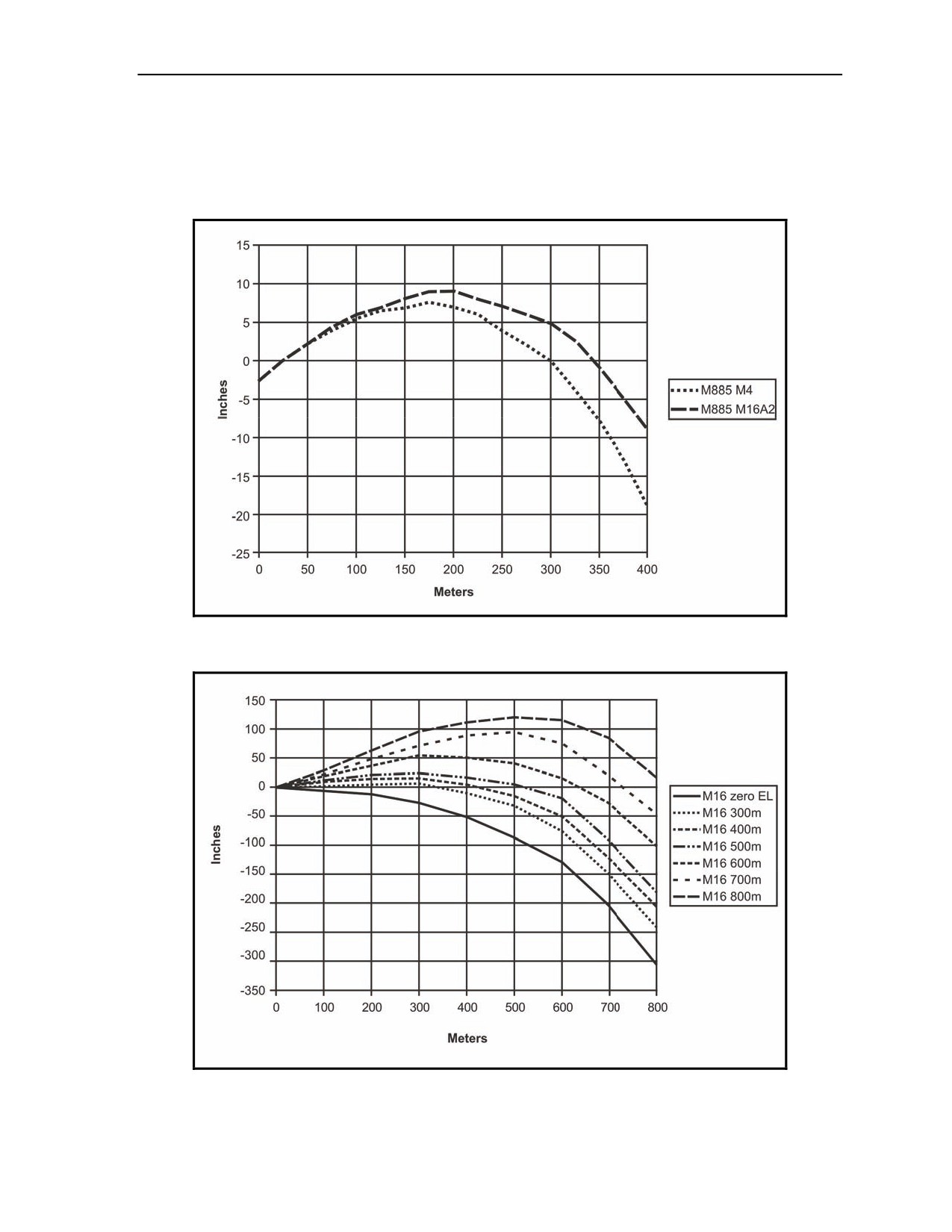
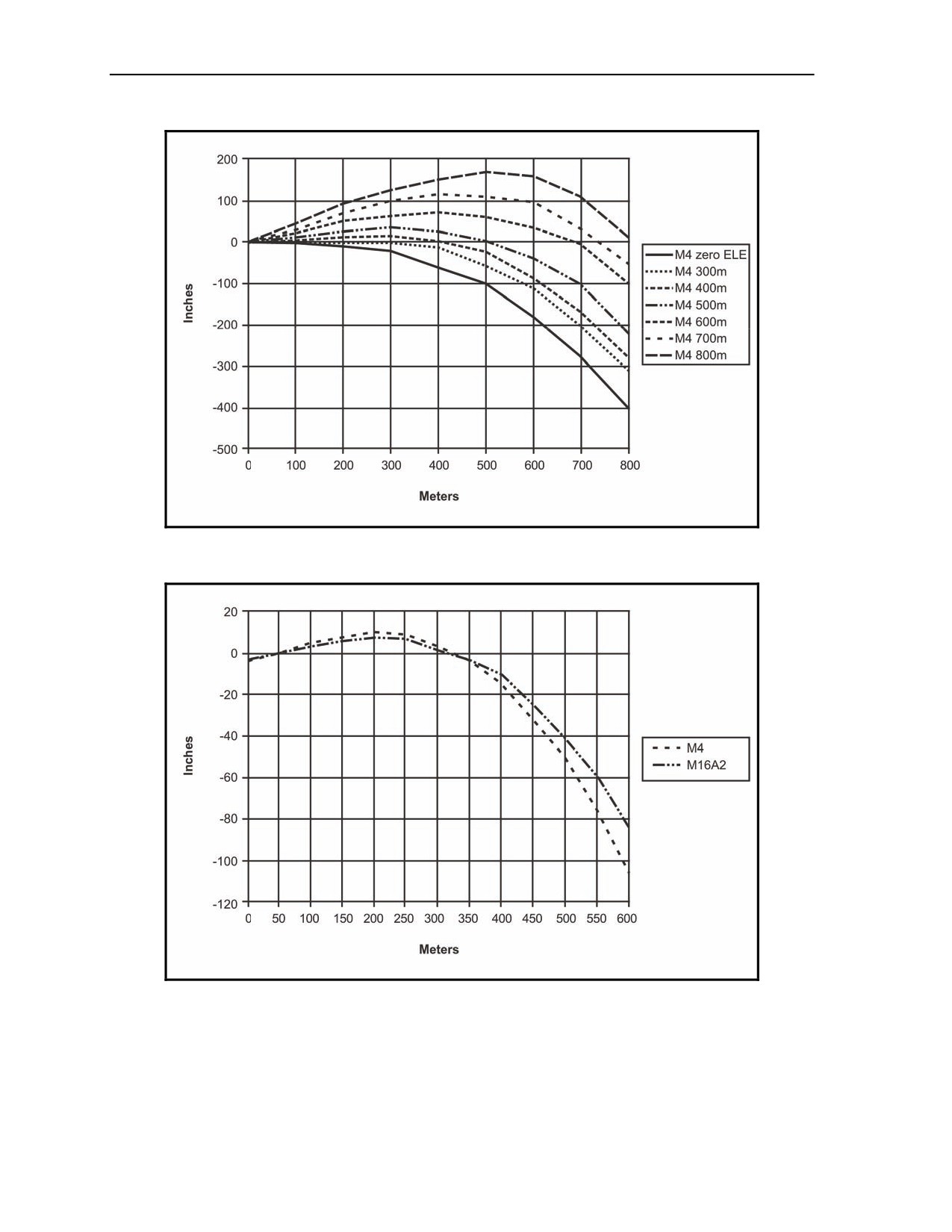
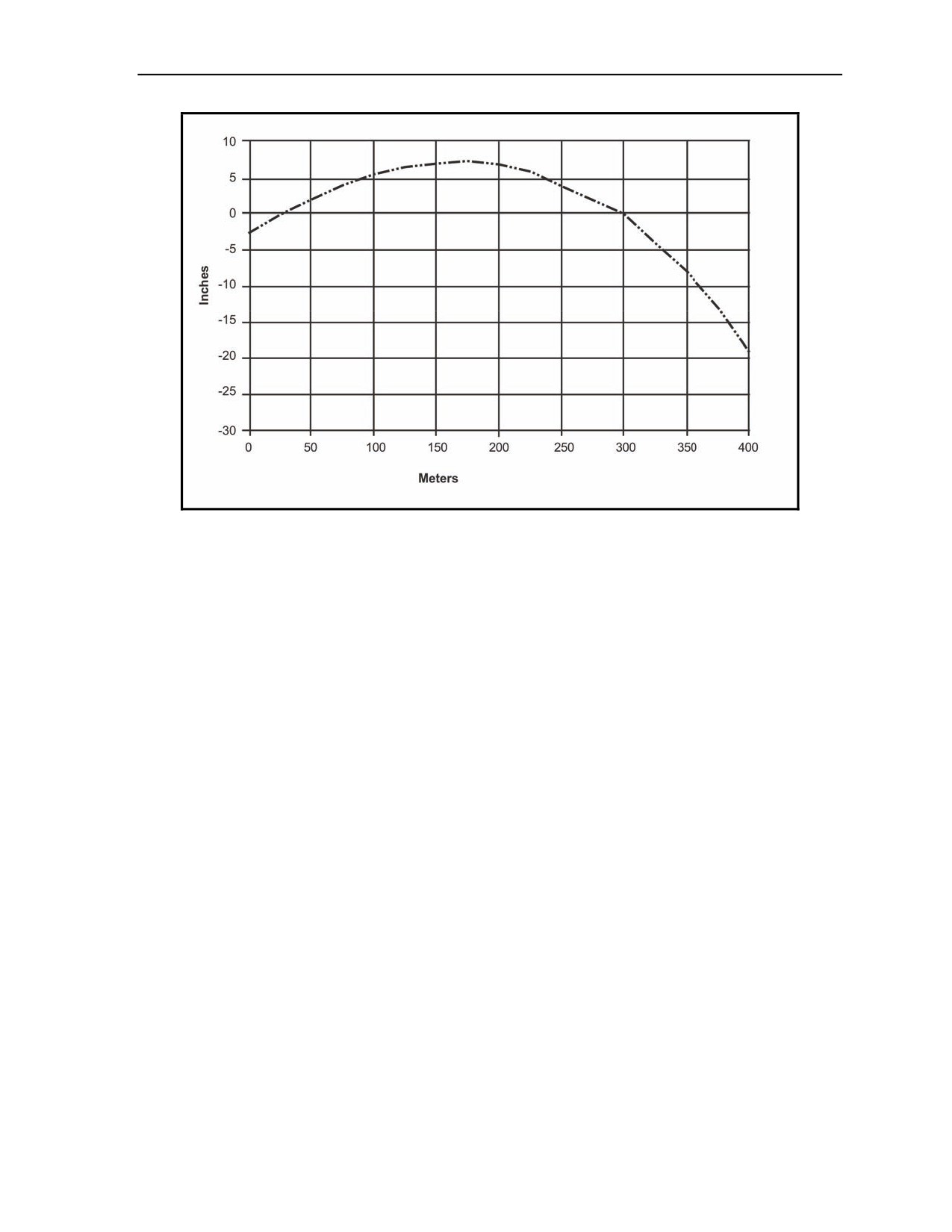
2-80. Figures 2-49 through 2-53 show trajectory data for M855 cartridges when fired from M16A2 rifles
and M4 carbines.
Figure 2-49. M855 drop during 25-meter zeroing (M16A2 at 8/3+1, M4 at 6/3).
Figure 2-50. Bullet drop of M855 ammunition with M16A2 (8/3).
12 August 2008
FM 3-22.9
2-37
Chapter 2
Figure 2-51. Bullet drop of M855 ammunition with M4 (6/3).
Figure 2-52. M4 carbine and M16A2 rifle bullet trajectory comparison.
2-38
FM 3-22.9
12 August 2008
Weapon Characteristics, Accessories, and Ammunition
Figure 2-53. Bullet drop of M4/M855 during 25-meter zeroing on 6/3.
STORAGE
2-81. When storing ammunition in the open is necessary, it must be raised on dunnage at least 6 inches
from the ground and protected with a cover, leaving enough space for air circulation. Since moisture and
high temperatures adversely affect ammunition and explosives, take the following precautions:
z
Do not open ammunition boxes until you are ready to use them.
z
Protect ammunition from high temperatures and the direct rays of the sun.
z
Do not attempt to disassemble ammunition or any of its components.
z
Never use lubricants or grease on ammunition.
12 August 2008
FM 3-22.9
2-39
This page intentionally left blank.
Chapter 3
Troubleshooting and Destruction
Commanders and unit armorers are responsible for the field level maintenance of
weapons and for the destruction of weapons, when necessary. Soldiers are
responsible for keeping their weapons clean and operational at all times—in training
and in combat—therefore, they should be issued an operator’s TM and cleaning
equipment for their assigned weapons.
STOPPAGES
3-1. A stoppage is a failure of an automatic or semiautomatic firearm to complete the cycle of operation.
The firer can apply immediate or remedial action to clear the stoppage. Some stoppages cannot be cleared
by immediate or remedial action and may require weapon repair to correct the problem. A complete
understanding of how the weapon functions is an integral part of applying immediate action procedures.
IMMEDIATE ACTION
3-2. Immediate action involves quickly applying a possible correction to reduce a stoppage without
performing troubleshooting procedures to determine the actual cause. Apply immediate action only once
for a stoppage. If the rifle fails to fire a second time for the same malfunction, inspect the weapon to
determine the cause of the stoppage or malfunction, and take the appropriate remedial action. The key word
SPORTS will help the firer remember the steps for immediate action:
(1) Slap gently upward on the magazine to ensure that it is fully seated and that the magazine
follower is not jammed.
NOTE: When slapping up on the magazine, be careful not to knock a round out of the magazine
into the line of the bolt carrier, causing more problems. Slap only hard enough to ensure that the
magazine is fully seated. Ensure that the magazine is locked into place by quickly pulling down
on the magazine.
(2) Pull the charging handle fully to the rear.
(3) Observe the ejection of a live round or expended cartridge.
NOTE: If the weapon fails to eject a cartridge, perform remedial action.
(4) Release the charging handle; do not ride it forward.
(5) Tap the forward assist assembly to ensure that the bolt is closed.
(6) Squeeze the trigger and try to fire the rifle.
REMEDIAL ACTION
3-3. Remedial action is the continuing effort to determine the cause of a stoppage or malfunction and
attempt to clear the stoppage once it has been identified. To apply the corrective steps for remedial action—
(1) Try to place the weapon on SAFE.
NOTE: A bolt override may not allow the weapon to be placed on SAFE.
(2) Remove the magazine.
12 August 2008
FM 3-22.9
3-1
Chapter 3
(3) Lock the bolt to the rear.
(4) Place the weapon on SAFE (if not already done).
MALFUNCTIONS
3-4. Malfunctions are caused by procedural or mechanical failures of the rifle, magazine, or ammunition.
Prefiring checks and serviceability inspections identify potential problems before they become
malfunctions. This section describes the primary categories of malfunctions.
NOTE: In training, Soldiers must alert other Soldiers and range personnel when experiencing
weapon malfunctions.
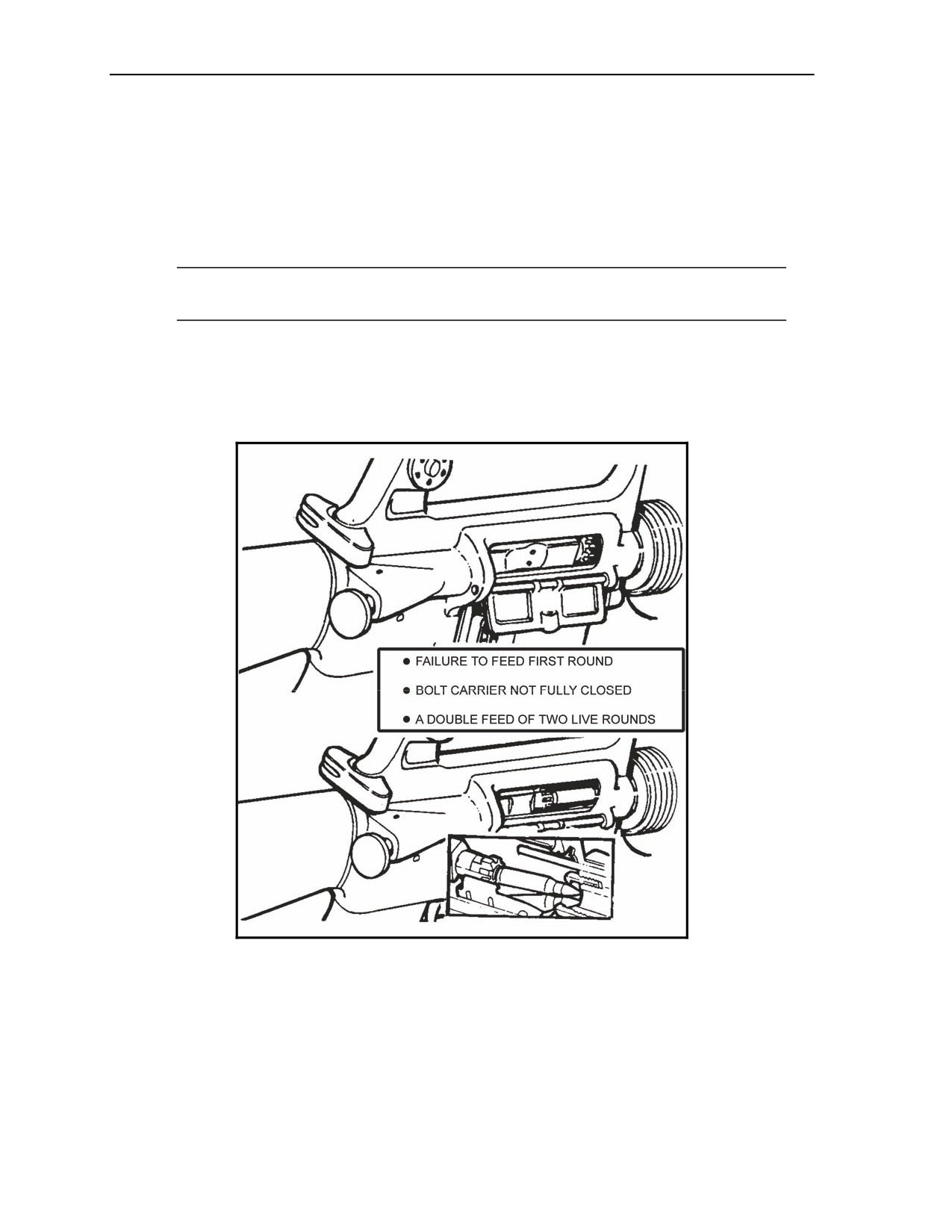
FAILURE TO FEED, CHAMBER, OR LOCK
3-5. This malfunction can occur when loading the rifle or during the cycle of operation. Once the
magazine has been loaded into the rifle, the forward movement of the bolt carrier group could lack enough
force (generated by the expansion of the action spring) to feed, chamber, or lock the bolt (Figure 3-1).
Figure 3-1. Failure to feed, chamber, or lock.
3-2
FM 3-22.9
12 August 2008
Troubleshooting and Destruction
Probable Causes
3-6. The malfunction could be the result of one or more of the following:
z
Excess accumulation of dirt or fouling in and around the bolt and bolt carrier.
z
Defective magazine (dented, bulged, or a weak magazine spring).
z
Improperly loaded magazine.
z
Defective round (projectile forced back into the cartridge case, which could result in a stubbed
round, or the base of the previous cartridge could be separated, leaving the remainder in the
chamber).
z
Damaged or broken action spring.
z
Exterior accumulation of dirt in the lower receiver extension.
z
Fouled gas tube (resulting in short recoil).
z
A magazine resting on the ground or pushed forward (causing an improper lock).
Corrective Action
3-7. Applying immediate action usually corrects the malfunction. To avoid the risk of further jamming,
watch for ejection of a cartridge and ensure that the upper receiver is free of loose rounds.
3-8. If immediate action fails to clear the malfunction, take remedial action.
NOTE: Do not force the bolt carrier.
3-9. If resistance is encountered (which can occur with an unserviceable round)—
(1) Lock the bolt to the rear.
(2) Remove the magazine.
(3) Clear the malfunction.
3-10. For example, to correct a bolt override (a cartridge has wedged itself between the bolt and charging
handle)—
(1) Ensure that the charging handle is pushed forward and locked into place.
(2) Attempt to place the weapon on SAFE.
(3) Secure the rifle, and pull the bolt to the rear until the bolt seats completely into the buffer well.
(4) Turn the rifle upright and allow the overridden cartridge to fall out.
FAILURE TO FIRE CARTRIDGE
3-11. Despite the fact that a round has been chambered, the trigger has been pulled, and the sear has
released the hammer, a cartridge may fail to fire. This occurs when the firing pin fails to strike the primer
with enough force or when the ammunition is defective. The firer must follow unit safety guidelines until
the determining factors of the misfire have been identified and corrected.
Probable Causes
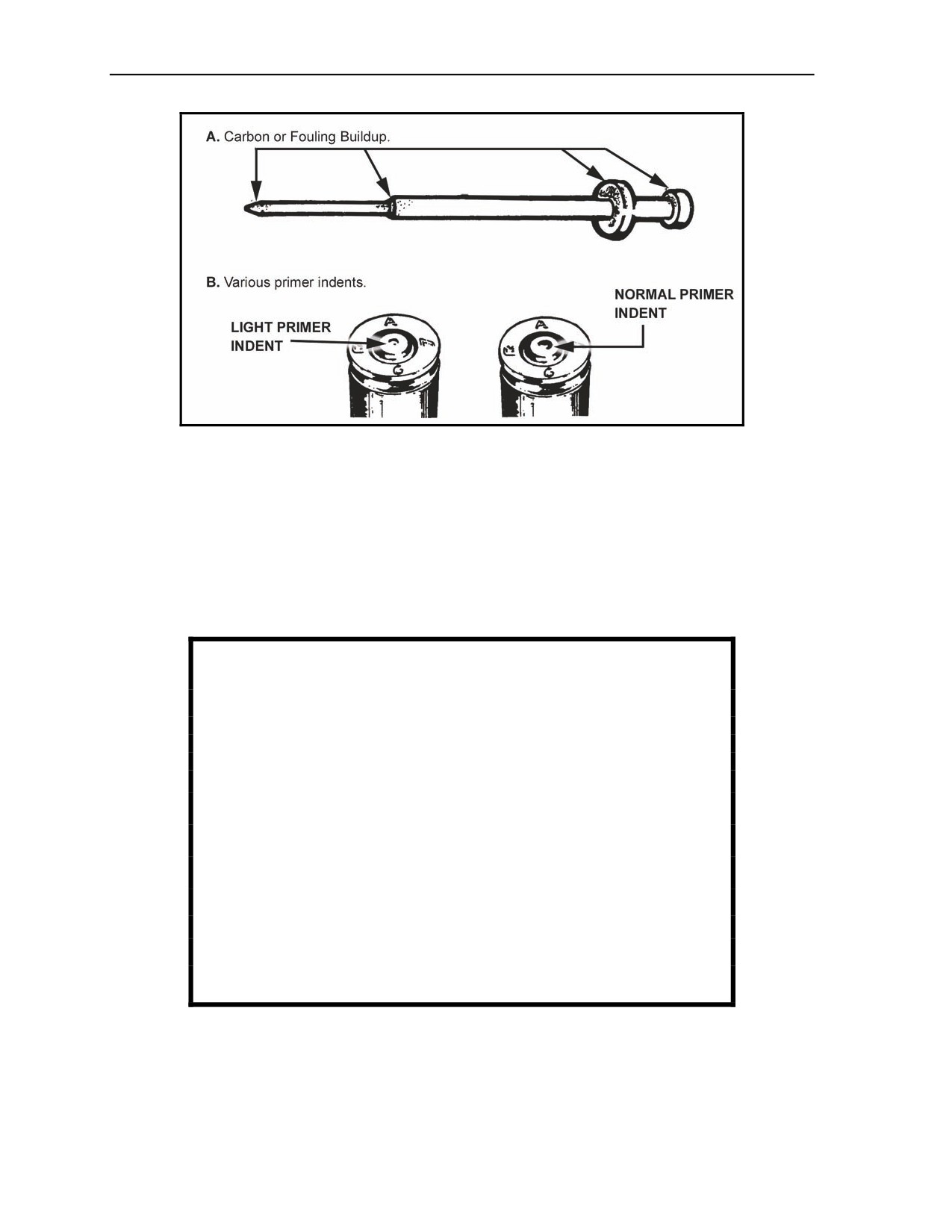
3-12. Excessive carbon buildup on the firing pin (Figure 3-2, A) is often the cause, because the full
forward travel of the firing pin is restricted. A defective or worn firing pin can give the same results.
Inspection of the ammunition could reveal a shallow indentation or no mark on the primer, indicating a
firing pin malfunction (Figure 3-2, B). Cartridges that show a normal indentation on the primer (but did not
fire) indicate faulty ammunition or failure of the cartridge to fully seat in the chamber.
12 August 2008
FM 3-22.9
3-3
Chapter 3
Figure 3-2. Failure to fire.
Corrective Action
3-13. If the malfunction continues—
(1) Inspect the firing pin, bolt, bolt carrier, and locking lug recesses of the barrel extension.
(2) Remove any accumulation of excessive carbon or fouling.
(3) Inspect the firing pin for damage.
3-14. If the round is suspected to be faulty, dispose of it IAW the unit SOP, and ensure that it is reported
and returned to the agency responsible for issuing ammunition.
WARNING
If an audible pop or reduced recoil occurs during firing,
immediately cease fire. This could be the result of a round being
fired without enough force to send the projectile out of the barrel.
Do not apply immediate action. Instead, perform the following
actions:
1. Lock the bolt to the rear.
2. Place the selector lever in the SAFE position.
3. Remove the magazine.
4. Visually inspect the bore to ensure that a projectile is not
lodged in the barrel.
5. If a projectile is lodged in the barrel, do not try to remove it.
Turn the rifle in to the unit armorer.
3-4
FM 3-22.9
12 August 2008
Troubleshooting and Destruction
FAILURE TO EXTRACT
3-15. A failure to extract results when the cartridge case remains in the chamber of the rifle. The bolt and
bolt carrier might move rearward only a short distance, but more commonly, the bolt and bolt carrier recoil
fully to the rear, leaving the cartridge case in the chamber. A live round is then forced into the base of the
cartridge case as the bolt returns in the next feed cycle.
WARNING
A failure to extract is an extremely serious malfunction, requiring
the use of tools to clear. A live round could be left in the chamber
and accidentally discharged. If a second live round is fed into the
primer of the chambered live round, the rifle could explode and
cause personal injury. This malfunction must be properly
identified and reported.
Ejection failures should not be reported as extraction failures.
Probable Cause
3-16. Short recoil cycles and fouled or corroded rifle chambers are the most common causes of failures to
extract. A damaged extractor or a weak or broken extractor spring can also cause this malfunction.
Corrective Action
3-17. This malfunction is one of the hardest to clear; the severity of the failure determines the corrective
action procedures.
NOTE: If the bolt has moved rearward far enough to strip a live round from the magazine in its
forward motion, the bolt and bolt carrier must be locked to the rear.
3-18. With the bolt locked to the rear and the weapon on SAFE, perform the following actions:
(1) Remove the magazine and all loose rounds.
(2) Tap the weapon's buttstock on a hard surface to cause the cartridge to fall out of the chamber.
3-19. However, if the cartridge case is ruptured, it can be seized. When this occurs, perform the following
actions:
(1) Insert a cleaning rod into the bore from the muzzle end.
(2) Force the cartridge case from the chamber by tapping the cleaning rod against the inside base of
the fired cartridge.
3-20. If cleaning and inspecting the mechanism and chamber reveals no defects but failures to extract
persist, the extractor and extractor spring should be replaced. If the chamber surface is damaged, the entire
barrel must be replaced.
12 August 2008
FM 3-22.9
3-5