FM 3-04.303 AIR TRAFFIC SERVICES FACILITY OPERATIONS, TRAINING, MAINTENANCE, AND STANDARDIZATION (DECEMBER 2003) - page 5
Appendix A
Training and Proficiency Records
This appendix explains how to complete and maintain training record
folders, DA Form 3479-R, DA Form 3479-9-R, and DA Form 3479-10-R.
This appendix should be used as a guide; it does not cover every possible
situation.
SECTION I - TRAINING RECORD LABELS
A-1. Training and proficiency record folders shall be labeled in accordance
with AR
25-400-2 and this manual. Figure A-1
(dummy folder) and
figure A-2
(training folder) show the standard labels, facilities, and
maintenance supervisors shall use.
95-2d Controller/Maintainer Training and
Proficiency Records
PA Sys A0095-2dTRADOC-ATC
Transfer with MPRJ or civilian
(TAPED SHUT)
personnel folder, as applicable.
Figure A-1. Standardized ATC Record Dummy Folder
A-1

FM 3-04.303 (FM 1-303) ______________________________________________________________
95-2d Doe, John C. Jr.
249-39-6969
AIR TRAFFIC CONTROL
/MAINTENANCE INDIVIDUAL
TRAINING RECORD FOLDER,
UNITED STATES ARMY
IF FOUND, MAIL TO:
Commander, USAAVNC
ATTN: ATZQ-ATC
Figure A-2. Standardized ATC Record Folder
SECTION II - CONTROLLER TRAINING AND PROFICIENCY RECORD
(DA FORM 3479-R)
A-2. Instructions for completing and maintaining DA Form 3479-R and DA
Form 3479-1-R (Trainee/Controller Evaluation) can be found in chapters 6
and 7. Figure A-3 provides an example of a completed DA Form 3479-R. The
following documents shall be placed on the right side of the folder from
bottom to top:
z DA Form 4186, Medical Recommendation for Flying Duty.
z DA Form 4186 for Grounding. (on top, remove upon receipt of up
slip).
z Tests (separate tactical from installation with divider).
Post trainees name, date, test subject, graders initials, and
SAT/UNSAT grade in bottom right hand corner.
z DA Form 3479-1-R (separate tactical from installation with divider).
Number the DA Form 3479-1-R with the last two digits of the
year and the number of evaluations given that year. (for example,
ninth 1-R given in 2001 will be numbered 01-09.)
Tactical DA Form 3479-1-Rs shall be a “T” in front of the year.
(for example, T01-09).
It is authorized to have both a tactical and installation DA
Form 3479-1-R numbered 02-01, with the “T” being the only
difference. (for example, T02-01.)
In section V of the tactical DA Form 3479-1-R, under the position
column, the type of facility shall be included with the position.
(for example, 71B FD, 7A FD.)
A-2
Appendix B
Publication Reference Files
ATC facilities use two types of reference files to support training and
daily operations. A facility reference file is maintained in the office of the
ATC chief/ATC SR SGT/PSG/ATC facility chief and in the company/
platoon headquarters.
(A single reference file may be used for dual
facilities.) The controller reference file, which is maintained in the ATC
facility, is readily available to the facility operating positions. The facility
and controller reference files are explained in chapter 5. Table B-1 lists
the publications that are required for both types (training and facility) of
reference files. Table B-2 lists the required maintenance publications for
installation and tactical facilities. An X in the reference file columns
indicates that the publication is required.
Table B-1. Required ATC Reference Files
Installation Facilities
Tactical Facilities
Towers and
A2C2
Stagefields
Radar
AIC
All Facilities
Co/Plt
LNOs
Publications
FAC
CON
FAC
CON
FAC
CON
FAC
CON
HQs
Army Regulations
AR 25-50
X
X
X
X
X
AR 25-55
X
X
X
X
AR 25-400-2
X
X
X
X
X
AR 40-8
X
X
X
X
X
X
X
X
AR 40-501
X
X
X
X
X
AR 95-2
X
X
X
X
X
X
X
X
AR 385-10
X
X
X
X
X
AR 385-95
X
X
X
X
X
AR 420-90
X
X
X
X
X
Army Training And Evaluation Program (ARTEP) Manuals
ARTEP 1-425-MTP
X
X
DA Pamphlets
DA Pam 25-50
X
X
X
X
DA Pam 738-750
X
X
X
X
X
DOD FLIPS (for applicable areas)
Low Altitude Instrument
Approach Procedures
X
X
X
X
X
X
X
X
X
X
Charts
X
X
X
X
X
X
X
X
X
X
IFR Supplement
X
X
X
X
X
X
X
X
X
X
VFR Supplement
X
X
X
X
X
X
X
X
X
X
B-1
FM 3-04.303 (FM 1-303) ______________________________________________________________
Table B-1. Required ATC Reference Files
Installation Facilities
Tactical Facilities
Towers and
A2C2
Stagefields
Radar
AIC
All Facilities
Co/Plt
LNOs
Publications
FAC
CON
FAC
CON
FAC
CON
FAC
CON
HQs
FAA Publications
FAAO 7110.65
X
X
X
X
X
X
X
X
X
X
FAAO 7210.3
X
X
X
X
X
FAAO 7220.1
X
X
X
X
X
X
X
X
FAAO 7340.1
X
X
X
X
FAAO 7350.7
X
X
X
X
FAAO 8200.1
X
X
X
X
X
X
FAAO 8260.3
X
X
X
X
X
X
Federal Aviation Regulations CONUS only
FAR Part 65
X
X
X
X
X
FAR Part 105
X
X
X
X
X
Field Manuals
FM 1-100
X
X
FM 1-120
X
X
X
X
X
X
X
X
X
X
FM 3-04.303
X
X
X
X
X
X
X
X
X
X
FM 3-0
X
FM 3-21.38
X
X
FM 3-52
X
X
X
X
FM 3-100.2
X
X
X
FM 7-0*
X
X
X
X
X
FM 100-103-2
X
X
X
FM 101-5
X
X
* Publications required only in those installation facilities with military personnel assigned.
Joint Publications
JP 3-52
X
X
X
ICAO Manual OCONUS only
ICAO Manual 7910
X
X
X
X
X
Technical Manuals
UFC 3-260-01
(TM 5-803-7)
X
X
X
X
X
B-2

________________________________________________________
Publication Reference Files
Table B-2. Required ATC Maintenance Reference Files
Maintenance
Tactical
Publications
Installation
Sections
Army Regulations
AR 25-400-2
X
X
AR 70-1
X
X
AR 95-1
X
X
AR 95-2
X
X
AR 385-10
X
X
AR 385-95
X
X
AR 420-90
X
X
AR 700-138
X
X
AR 710-2
X
X
AR 725-50
X
X
AR 735-5
X
X
AR 750-1
X
X
AR 750-43
X
X
ARTEP Manuals
ARTEP 1-425-MTP
X
DA Pamphlets
DA Pam 25-30
X
X
DA Pam 710-2-1
X
X
DA Pam 710-2-2
X
X
DA Pam 738-750
X
X
DA Pam 750-10
X
X
DA Pam 750-35
X
X
FAA Publications
FAAO 6000.6
X
X
FAAO 6000.15
X
FAAO 6310.19 *
X
FAAO 6360.1 *
X
FAAO 6470.29 *
X
FAAO 6480.6 *
X
FAAO 6670.13 *
X
FAAO 6700.20 *
X
FAAO 6730.2 *
X
FAAO 6740.2 *
X
FAAO 6750.49 *
X
FAAO 6770.2 *
X
FAAO 6820.7 *
X
FAAO 8020.11
X
FAAO 8200.1
X
X
* Required only at sites with systems listed in chapter 8.
B-3

FM 3-04.303 (FM 1-303) ______________________________________________________________
Table B-2. Required ATC Maintenance Reference Files
Maintenance
Tactical
Publications
Installation
Sections
Field Manuals
FM 1-120
X
FM 3.04-303
X
X
FM 9-43-1
X
X
FM 10-27-4
X
X
FM 11-486-23
X
X
FM 11-487-4
X
X
FM 11-490-9
X
X
FM 21-11
X
X
FM 22-100
X
X
FM 24-2
X
X
FM 25-100
X
X
FM 25-101
X
X
Supply Bulletin
SB 11-573
X
X
Technical Bulletins
TB 11-6625-3263-25
X
X
TB 43-0118
X
X
TB 43-0129
X
X
TB 43-0133
X
X
TB 43-0180
X
X
TB 385-4
X
X
TB 750-25
X
X
TB Med 523
X
X
TB Sig 222
X
X
Technical Manuals
TM 5-803-7
X
X
TM 5-811-3
X
X
TM 5-811-5
X
X
TM 5-823-4
X
X
TM 9-6140-200-14
X
X
TM 43-0139
X
X
B-4
Appendix C
Facility Training Manuals
This appendix includes a detailed subject outline for an FTM that each
facility develops and an abbreviated outline for a tactical facility FTM.
These outlines cover indoctrination, equipment, responsibilities, and
emergency equipment and notification procedures. They also cover local
area information, reference material, coordination procedures, and facility
administration and management. Facilities will use only the portions of
these outlines that pertain to that specific facility.
Detailed Outline for an Installation Facility Training Manual
CHAPTER 1
INSTALLATION FACILITY INDOCTRINATION
1-1. MISSION
1-2. ATC FACILITY
a. Operating hours and reporting time.
b. Duty schedule.
c. Preduty Requirements.
(1) Bulletin boards.
(2) Reading file.
(3) Equipment checks.
(4) Briefings.
d. Duty requirements.
(1) Briefings.
(2) Facility cleanup.
e. Training program.
(1) Description.
(2) Type (classroom, hands-on, and so forth).
(3) Written, oral, and practical exams.
(4) Training time limitation (AR 95-2).
(5) Facility training schedule.
f. Controller reference file.
(1) Contents.
(2) Location.
C-1
FM 3-04.303 (FM 1-303) ______________________________________________________________
g. Facility reference file.
(1) Contents.
(2) Location.
1-3. GENERAL DESCRIPTION OF ASSOCIATED FACILITIES
a. Weather.
b. Base operations.
c. Dispatch.
d. Other ATC facilities.
e. Range control.
f. Fire station.
g. Alert sections.
1-2. TRAINING RECORDS
a. Use.
b. Location.
c. Access.
1-5. ELECTRONIC WARFARE TRAINING
a. Threat briefing.
b. Equipment vulnerabilities.
c. Electronic countermeasures.
d. Recognition of electronic countermeasures and appropriate ELectronic counter-
countermeasures.
e. Meaconing, intrusion, jamming, and interference reporting.
1-6. FACILITY FORMS
CHAPTER 2
AIR TRAFFIC CONTROL FACILITY EQUIPMENT
2-1. RADIO COMMUNICATIONS EQUIPMENT
a. Transmitters.
(1) Type.
(2) Location.
b. Receivers.
(1) Type.
(2) Location.
c. Frequencies.
d. Channelization.
e. Standby communications equipment.
f. Secure voice operation.
g. Maintenance and outage.
2-2. LAND-LINE COMMUNICATIONS EQUIPMENT
a. Interphone.
(1) Type.
(2) Location.
(3) Use.
C-2
__________________________________________________________
Facility Training Manuals
(4) Circuit identification.
(5) Maintenance and outage.
b. Telephones.
c. Intercommunications units.
(1) Type.
(2) Location.
(3) Use.
(4) Maintenance and outage.
d. Weather dissemination.
(1) Type.
(2) Location.
(3) Use.
(4) Maintenance.
e. Automation equipment.
(1) Type.
(2) Location.
(3) Use.
(4) Maintenance and outage.
2-3. RECORDING EQUIPMENT
a. Type.
b. Location.
c. Positions/frequencies recorded.
d. Tape change procedures.
e. Playback.
f. Maintenance and outage.
2-4. BRIGHT RADAR INDICATOR TOWER EQUIPMENT
a. Operation and use.
b. Automation procedures.
2-5. AIRFIELD/HELIPORT LIGHTING
a. Control panel.
b. Runway and helipad.
c. Threshold.
d. Boundary.
e. Approach.
f. Taxiway.
g. Rotating beacon.
h. Obstruction.
i. Wind direction indicator.
j. Spotlights.
m. Maintenance and outage.
n. Other.
C-3
FM 3-04.303 (FM 1-303) ______________________________________________________________
2-6. MONITORING EQUIPMENT
a. Equipment monitored.
b. Operational checks.
c. Maintenance checks.
2-7. AUTOMATIC TERMINAL INFORMATION SERVICE
a. Use.
b. Operational procedures.
c. Message content and sequence.
d. Maintenance and outage.
2-8. MISCELLANEOUS EQUIPMENT
a. Light guns.
b. Traffic counters.
c. Binoculars.
d. Wind instruments.
e. Altimeters.
f. Clocks.
(1) Time check.
(2) Setting procedure.
g First aid kits.
h. Fire extinguisher.
i. Fuse boxes.
j. Heating and cooling equipment.
k. Emergency power.
l. Emergency egress system.
m. Night vision devices.
n. Maintenance and outages.
2-9. OPERATOR MAINTENANCE OF FACILITY EQUIPMENT
2-10. NOTICE TO AIRMEN
a. Responsible agency.
b. Equipment outages requiring a NOTAM.
c. Controller action.
CHAPTER 3
RESPONSIBILITIES
3-1. OPERATING POSITIONS
a. Control tower
(1) Flight data.
(2) Ground control.
(3) Local control.
(4) Clearance delivery.
(5) Approach control.
(6) Combined positions.
(7) Others.
C-4
__________________________________________________________
Facility Training Manuals
b. GCA.
(1) Feeder.
(2) Flight data.
(3) Final.
c. ARAC.
(1) Flight data.
(2) Arrival.
(3) Departure.
(4) Precision approach radar.
(5) Other.
d. AIC.
(1) Flight data.
(2) Flight-following control.
(3) Other.
3-2. SUPERVISORS
a. Controller in charge.
b. Shift leader.
c. Training supervisor.
d. Facility chief.
e. ATC chief/ATC AR SGT.
CHAPTER 4
LOCAL AIRPORT/HELIPORT INFORMATION
4-1. AIRPORT/HELIPORT
a. Responsible agency.
b. Layout.
(1) Runways.
(a) Width.
(b) Length.
(c) Weight restrictions.
(d) Preferential runway.
(2) Other landing areas.
(3) Taxiways.
(a) Width.
(b) Weight restrictions.
(4) Ramp area.
(a) Hangar locations.
(b) Parking areas.
(c) Taxi restrictions.
(d) Servicing areas.
(5) Services available.
(6) Airport boundaries.
(7) Crash standby points.
C-5
FM 3-04.303 (FM 1-303) ______________________________________________________________
4-2. TOWER VISIBILITY RESTRICTIONS
4-3. INSTRUMENT LANDING SYSTEM-CRITICAL AREAS
4-4. RADIO BLIND SPOTS
4-5. COMPASS ROSE
4-6. VOR RECEIVER CHECKPOINTS
4-7. AIRPORT/HELIPORT OBSTRUCTIONS
a. Bearing.
b. Height.
c. Distance.
4-8. TRAFFIC PATTERNS
4-9. VISUAL FLIGHT RULES REPORTING POINTS
a. Bearing.
b. Distance.
4-10. SPECIAL VISUAL FLIGHT RULES
a. Minimums.
b. Routes.
c. Reporting points.
4-11. LOCAL AIRPORT/HELIPORT RULES AND REGULATIONS
a. Taxi regulations.
b. Terminal procedures.
(1) Medical evacuation.
(2) Night vision devices.
(3) Very important persons.
(4) Hot refueling.
(5) Aircraft types and call signs.
c. Hazardous cargo.
d. Emergency equipment location.
e. Restricted aircraft movement.
f. Airfield security.
g. Noise abatement.
h. Launch and recovery procedures.
i. Autorotation.
(1) Procedures.
(2) Areas.
4-12. AIRCRAFT OPERATIONS
a. Scheduled air carriers.
b. Nonscheduled operations.
c. Military operations.
d. General aviation operations.
C-6
__________________________________________________________
Facility Training Manuals
4-13. WEATHER REPORTING PROCEDURES
a. Responsible agency.
b. Visibility checkpoints.
(1) Day.
(a) Bearing.
(b) Distance.
(2) Night.
(a) Bearing.
(b) Distance.
c. Nearest weather reporting facilities.
d. Pilot reports.
e. Weather warnings.
f. High-wind plan.
4-14. UNAUTHORIZED PERSONNEL AND VEHICLES
a. Reporting.
b. Recording Incidents.
CHAPTER 5
EMERGENCY EQUIPMENT AND NOTIFICATION PROCEDURES
5-1. AVAILABLE EQUIPMENT
a. Ambulance.
b. Fire fighting equipment.
c. Rescue equipment.
(1) Helicopter.
(2) Other.
5-2. EMERGENCY NOTIFICATION PROCEDURES
a. Controllers.
(1) Position responsibilities.
(2) Closing and opening the airfield.
(3) Foaming runways.
(4) Required reports.
b. Firefighting personnel and equipment.
c. Medical personnel and equipment.
d. Military police.
5-3. INCIDENTS AND ACCIDENTS
a. On-the-Airfield.
b. Off-the-Airfield.
c. Information Sources.
d. Primary Reporting Procedures.
e. Format and Recording of Reports.
C-7
FM 3-04.303 (FM 1-303) ______________________________________________________________
CHAPTER 6
LOCAL AREA INFORMATION
6-1. CLASS ‘C’ AIRSPACE (RADAR)
a. Boundaries.
b. Adjacent areas.
c. Altitudes.
d. Airways.
6-2. CLASS ‘D/E/G’ AIRSPACE
a. Dimensions and description.
b. Adjacent class ‘B/C/D/E’ airspace.
6-3. SURFACE AREA
a. Boundaries.
b. Users.
6-4. NAVIGATIONAL AIDS
a. Type.
b. Location.
c. Identification.
d. Airways.
6-5. PROMINENT OBJECTS AND OBSTRUCTIONS
a. Bearing.
b. Height.
c. Distance.
6-6. SPECIAL USE AIRSPACE
a. Location.
(1) Boundaries.
(2) Altitudes.
(3) Times.
(4) Controlling agency.
b. Use.
c. Remotely piloted vehicles/unmanned aerial vehicles.
(1) Area.
(2) Procedure.
d. Nap-of-the-earth.
e. Night vision devices.
(1) Area.
(2) Procedure.
f. IFR/VFR corridors.
g. Airstrips.
(1) Location.
(2) Use.
C-8
__________________________________________________________
Facility Training Manuals
6-7. VFR TRAINING AREAS
6-8. ADJACENT AIRPORTS/HELIPORTS
6-9. PARACHUTE AREAS
CHAPTER 7
LETTERS, MEMORANDA, REPORTS, AND FORMS
7-1. LETTERS OF AGREEMENT
a. Agencies.
b. General content.
7-2. OPERATIONS LETTERS
a. Agencies.
b. General content.
7-3. FACILITY MEMORANDA
7-4. OPERATIONAL HAZARD REPORTS
a. Preparation.
b. Submission.
CHAPTER 8
FLIGHT PLANS, STRIPS, AND MARKINGS
8-1. FLIGHT PLANS
a. Types.
b. Requirements.
c. Local filing.
d. In-flight filing.
e. Action upon receipt.
(1) IFR.
(2) VFR.
(3) SVFR.
f. Procedures.
(1) Forwarding information.
(2) Flight plan changes (IFR to VFR).
8-2. FLIGHT STRIPS
a. Marking.
b. Retention.
CHAPTER 9
INSTRUMENT FLIGHT RULES AND COORDINATION PROCEDURES
9-1. APPROACH PROCEDURES
a. Initial approach altitudes.
b. Holding patterns.
(1) Location.
(2) Description.
C-9
FM 3-04.303 (FM 1-303) ______________________________________________________________
c. Procedure turn.
d. Final approach altitude and heading.
e. Release points.
f. Missed-approach procedures.
g. Weather minimums.
9-2. DEPARTURE PROCEDURES
a. Routes.
(1) DPs.
(2) Transitions.
b. Altitudes Between Fixes and Intersections.
(1) Normal assigned frequencies.
(2) Minimum en route altitudes.
9-3. COORDINATION PROCEDURES
a. Interposition.
b. Local facilities.
c. ARTCC.
d. Adjacent airports.
9-4. INADVERTANT IMC
9-5. MULTIPLE EMERGENCY HAND-OFF PROCEDURES
a. Frequency Management.
b. Coordination.
c. Abbreviated (short) approaches.
d. Sequencing and separation standards.
CHAPTER 10
SECONDARY RADAR
10-1. COMPONENTS
a. Interrogator.
b. Transponder.
c. Decoder.
10-2. TYPE OF EQUIPMENT (AN/TPX-41 AND ATCBI-3)
10-3. PRESENTATIONS
a. Factors.
(1) Line-of-sight.
(2) Aircraft altitude.
(3) Reflections.
(4) Resolution.
(5) Ring-around.
(6) Slant-range.
b. Interface.
c. Others.
C-10
__________________________________________________________
Facility Training Manuals
10-4. CODE ASSIGNMENTS
a. Facility.
b. Adjacent facilities.
c. Emergency.
CHAPTER 11
RADAR
11-1. EQUIPMENT
a. Type.
b. Display.
c. Alignment and adjustment.
d. Characteristics.
e. Keyboard.
f. Computer.
g. Radar coverage.
h. Simulators.
11-2. MINIMA
a. MVA.
b. MSA.
c. MRA.
d. SVFR.
11-3. USE
Note: This paragraph
was
left
blank
intentionally.
The
ATC chief/ATC
SR
SGT/ATC facility chief may use it to expound on, or refer to, radar use, services,
separation, sequencing, and phraseology contained in FAA Handbook 7110.65.
All Army radar controllers are required to know and use the applicable radar
procedures in the handbook. For purposes of testing, training, proficiency, and
record keeping, FAA Handbook 7110.65, chapter 5 shall be considered an
extension of this manual.
CHAPTER 12
FACILITY ADMINISTRATION
12-1. DAILY ADMINISTRATION
a. Compiling traffic count.
b. Recording traffic count.
c. Maintaining facility forms and records.
d. Filing facility forms and records.
12-2. STORING OF RECORDS
a. Labels.
b. Storage area.
c. Retention.
C-11
FM 3-04.303 (FM 1-303) ______________________________________________________________
12-3. DISSEMINATION OF INFORMATION
a. Accidents and incidents.
b. Numbers and types of aircraft.
c. Types and capabilities of equipment.
d. Personnel.
e. Operations.
f. Others.
CHAPTER 13
ATC MANAGEMENT TRAINING
13-1. ADMINISTRATION
13-2. FACILITY REPORTS
13-3. OPERATIONAL HAZARD REPORTS
13-4. ACCIDENTS OR INCIDENTS
13-5. FLIGHT INSPECTION PROCEDURES
13-6. TRAINING RECORDS AND TRAINING PROGRAMS
13-7. ADMINISTRATION OF FACILITY QUALIFICATION AND RATING PROGRAM
13-8. ARMY REGULATIONS
13-9. OPERATIONS LETTERS, LETTERS OF AGREEMENT, AND FACILITY MEMORANDA
C-12
__________________________________________________________
Facility Training Manuals
Abbreviated Outline For A Tactical Facility Training Manual
CHAPTER 1
TACTICAL FACILITY INDOCTRINATION
1-1. MISSION
1-2. FACILITIES
1-3. GENERAL DESCRIPTION OF ASSOCIATED OR SUPPORTED UNITS
1-4. TRAINING RECORDS
1-5. ELECTRONIC WARFARE TRAINING
1-6. DA FORM 3501-R, DA FORM 3502-R, AND DA FORM 3503-R
CHAPTER 2
AIR TRAFFIC CONTROL FACILITY EQUIPMENT
2-1. RADIO COMMUNICATIONS EQUIPMENT
2-2. LAND-LINE COMMUNICATIONS EQUIPMENT
2-3. POWER GENERATION EQUIPMENT
2-4. NAVIGATIONAL EQUIPMENT
2-5. AIRFIELD/HELIPORT LIGHTING
2-6. MISCELLANEOUS EQUIPMENT
2-7. EQUIPMENT MAINTENANCE
CHAPTER 3
RESPONSIBILITIES
3-1. CONTROL TOWER (7A, 70A, OR AN/MSQ-135)
3-2. TACTICAL TEAM (TTCS)
3-3. GCA TEAM (71B OR ATNAVICS)
3-4. FLIGHT FOLLOWING (61B OR TAIS)
3-5. SUPERVISOR
CHAPTER 4
LOCAL AIRFIELD/HELIPORT AND AREA INFORMATION
4-1. AIRFIELD/HELIPORT LOCATION
4-2. VISIBILITY RESTRICTIONS
4-3. RADIO RESTRICTIONS
4-4. AIRFIELD/HELIPORT OBSTRUCTIONS
4-5. TRAFFIC PATTERNS
4-6. VFR REPORTING POINTS
C-13
FM 3-04.303 (FM 1-303) ______________________________________________________________
4-7. LOCAL RULES AND REGULATIONS
4-8. WEATHER REPORTING PROCEDURES
CHAPTER 5
EMERGENCY EQUIPMENT AND NOTIFICATION PROCEDURES
5-1. AVAILABLE EQUIPMENT
5-2. EMERGENCY NOTIFICATION PROCEDURES
5-3. FACILITY ACTIONS
5-4. INCIDENTS AND ACCIDENTS
CHAPTER 6
LOCAL AREA INFORMATION
6-1. CLASS B/C/D/E AIRSPACE
6-2. ADJACENT CLASS B/C/D/E AIRSPACE
6-3. NAVIGATIONAL AIDS
6-4. PROMINENT OBSTRUCTIONS
6-5. RESTRICTED AND PROHIBITED AREAS
6-6. ADJACENT AIRFIELDS/HELIPORTS
CHAPTER 7
LETTERS, MEMORANDA, REPORTS, AND FORMS
7-1. LETTERS OF AGREEMENT
7-2. OPERATIONS LETTERS
7-3. FACILITY MEMORANDA
7-4. OPERATIONAL HAZARD REPORTS
CHAPTER 8
FLIGHT PLANS, STRIPS, AND MARKINGS
8-1. FLIGHT PLANS
8-2. FLIGHT STRIPS AND MARKINGS
CHAPTER 9
INSTRUMENT FLIGHT RULES AND COORDINATION PROCEDURES
9-1. APPROACH PROCEDURES
9-2. DEPARTURE PROCEDURES
9-3. COORDINATION PROCEDURES
9-4. VERTICAL HELICOPTER IFR RECOVERY PROCEDURES
9-5. MULTIPLE EMERGENCIES HANDOFF PROCEDURES, FREQUENCY MANAGEMENT,
COORDINATION PROCEDURES, ABBREVIATED (SHORT) APPROACHES, AND SEQUENCING
AND SEPARATION STANDARDS.
C-14
__________________________________________________________
Facility Training Manuals
CHAPTER 10
SECONDARY RADAR
10-1. COMPONENTS
10-2. TYPE OF EQUIPMENT
10-3. CODE ASSIGNMENT
CHAPTER 11
RADAR
11-1. EQUIPMENT
11-2. MINIMA
11-3. USE
CHAPTER 12
FACILITY ADMINISTRATION
12-1. FACILITY OPERATING FORMS
12-2. STORING OF RECORDS
12-3. DISSEMINATION OF INFORMATION
CHAPTER 13
ATC MANAGEMENT TRAINING
13-1. ADMINISTRATION
13-2. FACILITY REPORTS
13-3. OPERATIONAL HAZARD REPORTS
13-4. ACCIDENTS AND INCIDENTS
13-5. FLIGHT INSPECTION PROCEDURES
13-6. TRAINING RECORDS AND TRAINING PROGRAMS
13-7. ADMINISTRATION OF FACILITY QUALIFICATION AND RATING PROGRAM
13-8. ARMY REGULATIONS
13-9. OPERATIONS LETTERS, LETTERS OF AGREEMENT, AND FACILITY MENORANDA
13-10. TERPS
C-15
Appendix D
Theodolite Operations
The accuracy of Theodolite measurements depends on the proper care,
setup, and adjustment of the instrument. Personnel must be careful
when removing the Theodolite from its carrying case and mounting it onto
the tripod. This appendix explains the correct procedures for setting up,
leveling, adjusting, positioning, and orienting the Theodolite. It also
includes flight check commissioning factors and preventive maintenance
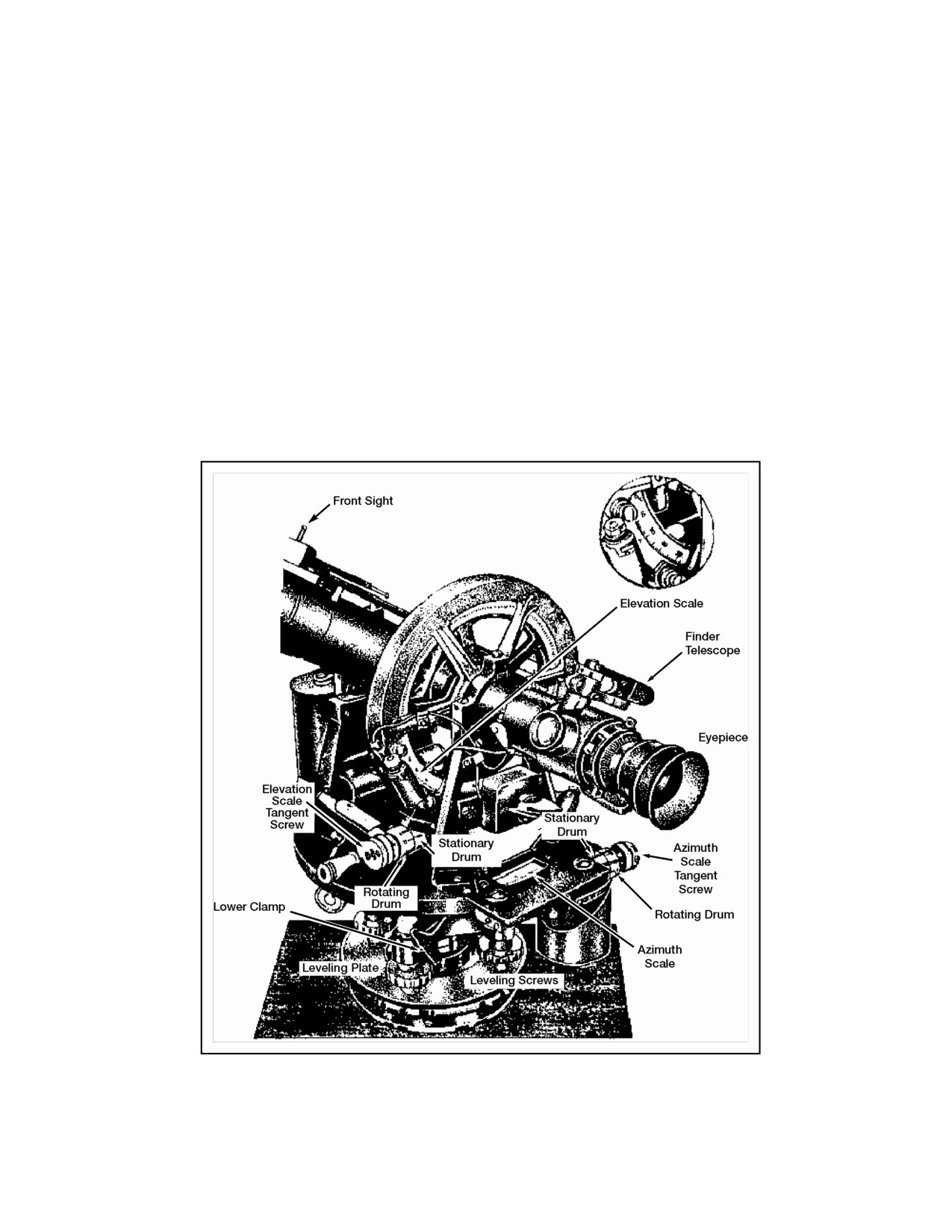
measures. Figure D-1 illustrates the components of the Theodolite
(model 20-8400).
Figure D-1. Theodolite Components
D-1
FM 3-04.303 (FM 1-303) ______________________________________________________________
SETUP
REMOVAL FROM THE CARRYING CASE
D-1. To remove the Theodolite from its carrying case, use the following steps.
(Refer to paragraph D-22 for instructions on replacing the instrument in the
case.)
Step 1. Place both hands under the base plate (the part containing the
azimuth scale), and slide the instrument out of its case.
Step 2. With one hand (reaching from above), grasp the two adjacent leveling
screws at the narrow part of the column and cradle the instrument carefully
against your body with your forearm.
Step 3. With the other hand, unscrew the baseboard.
MOUNTING ONTO THE TRIPOD
Note: When mounting the Theodolite onto the tripod, do not turn the
Theodolite by the upper part when the azimuth tangent screw is engaged;
this may cause damage to the threads.
Step 1. With both hands on the column, carefully screw the instrument onto
the tripod head.
Step 2. Remove the dust cap, and install the sunshade onto the telescope.
Step 3. Screw the tripod cap onto the baseboard, replace the baseboard in the
carrying case, and close the door.
LEVELING
D-2. Preparation for Leveling.
Note: Steps 2 through 4 may be omitted if the Theodolite is not positioned
over a point such as a marker stake or bench marker.
Step 1. If the Theodolite is to be located over a point such as a marker stake,
suspend the plumb bob by its string from the eye accessible through the hole
in the bottom of the leveling plate.
Step 2. Keeping the Theodolite approximately level (as gauged by the eye),
center the plumb bob over the marker by moving tripod legs.
Step 3. Accurately center the plumb bob over the marker by loosening the
two adjacent leveling screws and shifting the instrument laterally by moving
its shifting plate. If this moves the Theodolite too near the edge of the base
plate, reposition the tripod legs.
Step 4. Ensure that the Theodolite is approximately level (as gauged by the
eye).
Step 5. Disengage the elevation scale tangent screw by pushing it down.
Step 6. Point the telescope straight up.
Step 7. Reengage the elevation scale tangent screw by pushing it up.
D-2
____________________________________________________________
Theodolite Operations
Step 8. Lower the battery box to provide a better view of bubble levels.
Step 9. Disengage the azimuth scale tangent screw by pulling it out.
Step 10. Set the horizontal azimuth scale to zero degrees.
Step 11. Reengage the azimuth scale tangent screw by pushing it in.
Step 12. Loosen the lower clamp.
Step 13. Loosen the leveling screws slightly, and slide the instrument until it
is centered or until the plumb bob (if used) is exactly over the marked
observation point; then retighten the leveling screws.
Step
14.
Rotate the instrument so each bubble level is parallel to a
diagonally opposite pair of leveling screws, then retighten the lower clamp.
D-3. Procedures for Leveling.
Note: The proper Theodolite level is indicated when leveling bubbles are
centered and their ends are an equal distance from the corresponding
graduation marks.
Step 1. Using both hands, grasp one pair of diagonally opposite leveling
screws between the thumbs and forefingers.
Step 2. With a smooth and steady motion, turn the screws simultaneously so
your thumbs move either toward or away from each other. This ensures that
the screws are tightened or loosened an equal amount. The bubble will move
in the same direction as your left thumb.
Note: Do not loosen any screw to a point that will allow the instrument to
wobble on the mount.
Step 3. Using the technique in the previous steps 1 and 2, bring one bubble
near the center. Then move to the opposite pair of leveling screws and bring
the other bubble near the center. The bubble levels should now be nearly
centered, and all leveling screws should be fairly snug.
Step 4. To center the bubbles exactly, carefully adjust one screw (of a pair),
alternating pairs until both bubbles are exactly centered. All leveling screws
should be firm and both bubbles centered.
Step
5.
Disengage the azimuth scale tangent screw, and rotate the
instrument to exactly 180 degrees. If the bubbles remain centered, the
instrument is level.
Step 6. If the bubbles are slightly off center, center them again using the
technique in step 4.
Step 7. Rotate the instrument to zero degrees.
Note: If the bubbles are centered, the instrument is level. If the bubbles are
off center, a vertical axis adjustment is required. Refer to paragraph D-12 for
this major adjustment procedure.
D-3
FM 3-04.303 (FM 1-303) ______________________________________________________________
MINOR ADJUSTMENTS
CAUTION
Never sight the Theodolite on the sun without using the
special sun filter. The concentration afforded by the
telescope can easily cause damage to the eye.
Focusing
D-4. If personnel who normally wear eyeglasses can remove them during
Theodolite operations, they will obtain a greater field of view. They should
choose a distant, preferably indistinct, object to make focus comparisons with
and without eyeglasses. They should completely refocus the instrument each
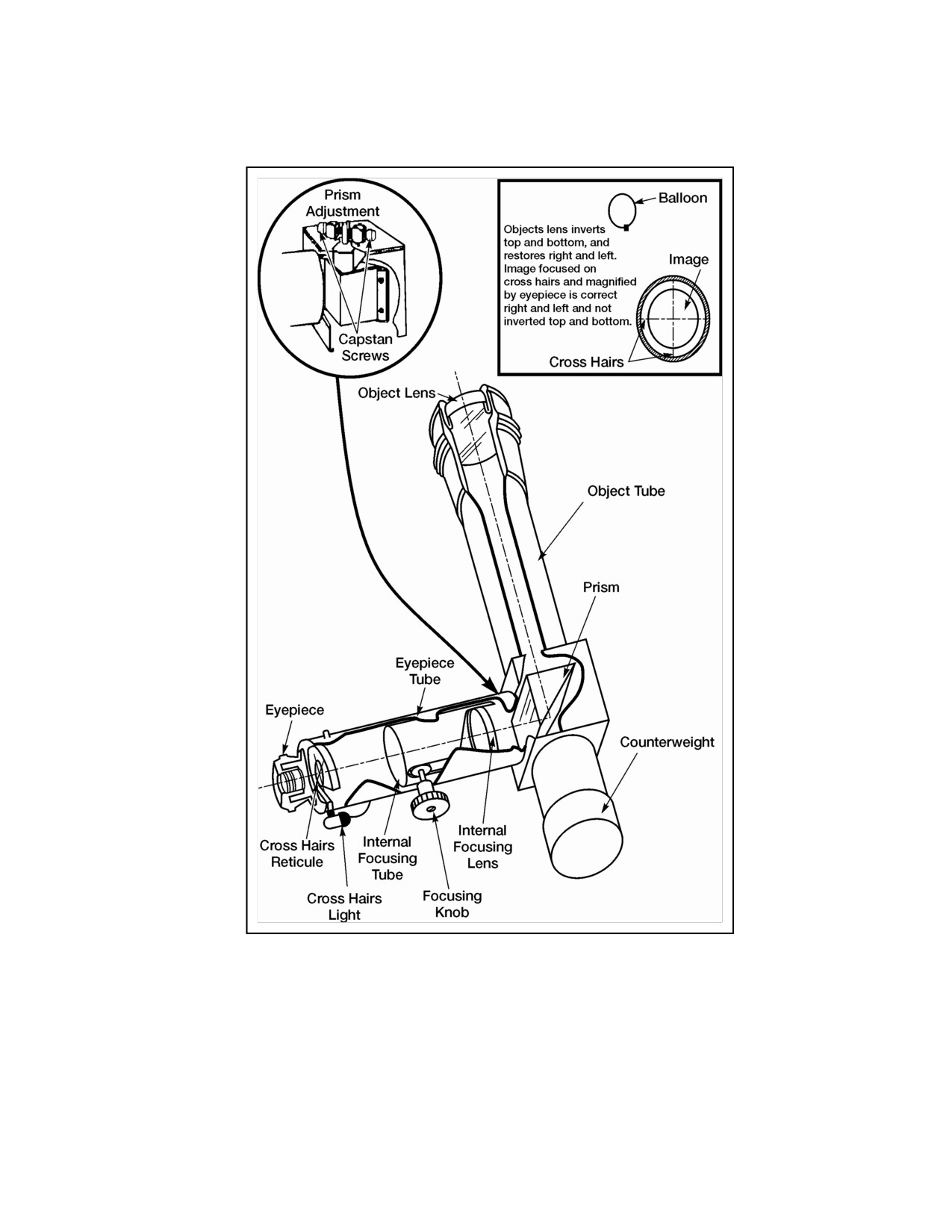
time. Figure D-2 shows a cutaway view of the Theodolite optical system.
D-4
____________________________________________________________
Theodolite Operations
Figure D-2. Cutaway View of the Theodolite Optical System
Cross-Hair Focusing
D-5. Sight through the eyepiece with the telescope pointed toward the sky,
and bring the cross hairs into focus by rotating the eyepiece by hand until the
cross hairs are seen with maximum sharpness.
D-5
FM 3-04.303 (FM 1-303) ______________________________________________________________
Telescope Focusing
D-6. Sight on an object at least 100 feet away, and focus on it by turning the
knurled knob until the object is clear and distinct.
Note: If an aircraft is to be picked up at some distance inbound, focus on a
distant object on the horizon. Check the focus by moving the head slightly
from side to side or up and down, while peering into the eyepiece. Focusing is
correct when the cross hairs do not appear to move across the field of the
telescope.
CHECKING FOR THE CORRECTING BACKLASH
Checking for Backlash
D-7. Sight the cross hairs on a target about 1,500 feet away or farther. With
the tangent screws engaged, rotate the tangent screws slowly back and forth,
one at a time, while looking at the target through the telescope. If a tangent
screw can be rotated without a corresponding movement of the cross hairs on
the target, backlash is present.
Correcting Backlash
D-8. Refer to higher echelon maintenance.
CHECKING FOR AND CORRECTING MESH
Checking for Proper Mesh
D-9. While watching the elevation scale, lift the elevation tangent screw
against the vertical scale ring gear. If mesh is proper, there should be no
movement of the vertical scale. Improper mesh of the azimuth tangent screw
will cause binding and undue wear.
Correcting Improper Mesh
D-10. Refer to higher echelon maintenance.
Note: The tangent screw fiducial marks on the stationary drum should be
visible when your eye is at the eyepiece position. The spacing should be as
close as possible without touching.
ADJUSTING DRUMS
D-11. Refer to higher echelon maintenance.
MAJOR ADJUSTMENTS
Vertical Axis Adjustment
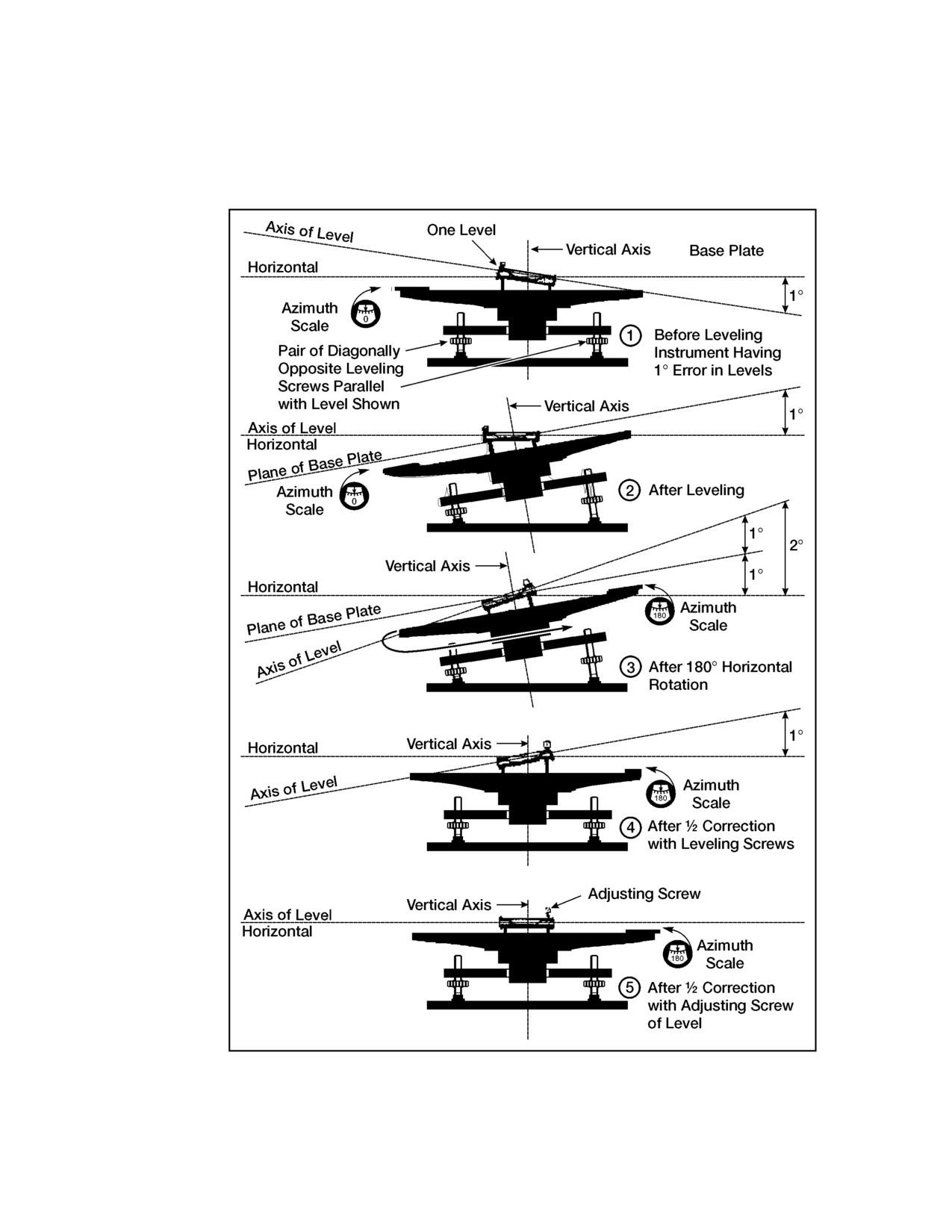
D-12. The vertical axis is the axis of horizontal rotation of the base plate and,
consequently, of the telescope. The purpose of this adjustment is to make the
axis of each bubble level perpendicular to the vertical axis of the Theodolite.
That is, it makes the axis of each level exactly parallel with the plane of the
base plate. When the adjustment has been properly completed, the bubble in
each level will remain centered during a complete horizontal rotation of the
instrument and the axis of that rotation will be vertical. Each time the
D-6
____________________________________________________________
Theodolite Operations
Theodolite is set up, the vertical axis adjustment should be checked and, if
necessary, the adjustment made. Figure D-3 shows the vertical axis
adjustment.
Figure D-3. Vertical Axis Adjustment
D-7
FM 3-04.303 (FM 1-303) ______________________________________________________________
CAUTION
The vertical axis adjustment is a complex procedure that
should be performed only by operators who know how to
correctly make the adjustment.
Step 1. Set the azimuth scale at zero degrees, and leave the tangent screw in
mesh.
Step 2. Level the Theodolite.
Step 3. When both bubbles indicate the instrument is level, disengage the
azimuth scale tangent screw and rotate the azimuth scale exactly
180 degrees. If the bubbles remain centered, the vertical axis adjustment is
correct.
Step 4. If the bubbles are not centered, turn the adjusting screw at the back
of the levels so the bubbles return half-way to the center. If the bubble is
displaced far enough to be against the end of the bubble case, turn the
adjusting screw only until the bubble starts to move. Rotate the screw back
to zero degrees azimuth, and center the bubble with diagonally opposite
leveling screws. Continue this procedure until at 180 degrees azimuth; the
bubble is away from the end of the bubble case.
Step 5. Return the azimuth scale to zero degrees and adjust each pair of
diagonally opposite leveling screws to center the bubbles.
Step 6. Rotate the azimuth scale to 180 degrees. If the bubble in each level
remains centered, the adjustment is satisfactory.
Step 7. If the bubbles again move off center, remove one-half the error by
adjusting the bubble level screws. Return the azimuth scale to zero degrees,
and re-level the instrument. Continue the above procedure until the bubbles
remain centered for all positions of the azimuth scale.
CAUTION
Before making the correction, always re-level the
Theodolite and rotate the azimuth scale 180 degrees. To
avoid confusion, always level at zero degrees and correct
at 180 degrees.
Line of Collimation Adjustment
D-13. The line of collimation is a line through the optical center of the object
lens, the prism, and the cross-hairs intersection of the telescope. The line of
collimation should make a 90-degree angle in the prism. The purpose of this
adjustment is to make the line of sight through the telescope correspond to
the line of collimation. If the vertical cross hair does not fall on the target
after rotating
180 degrees and the apparent error exceeds 0.2 degree, a
correction may be required for precise azimuth readings. However, the
necessity for this adjustment is not as great in flight inspection work as the
elevation scale adjustment in paragraph D-14. The line of collimation error is
D-8
____________________________________________________________
Theodolite Operations
constant throughout, therefore this error is compensated for when the
azimuth scale is aligned to a reference bearing. If the line of collimation
adjustment is deemed necessary, refer to higher echelon maintenance.
Elevation Scale Fiducial Mark Adjustment
D-14. The purpose of this adjustment is to make the elevation scale indicate
zero degrees when the horizontal axis of the Theodolite lies in the horizontal
plane. This adjustment should be checked each time the Theodolite is set up
to measure vertical angles (for example, in glide slope flight checks). The
adjustment should be made if the indicated error, described below, exceeds
0.02 degree. Use the following steps 1 through 11 to measure the error.
Crosshair
Step 1. Set up and level the Theodolite.
Step 2. Set the azimuth scale and the elevation scale at exactly zero degrees,
and leave the tangent screws in mesh.
Step 3. Loosen the lower clamp wing screw and rotate the instrument
horizontally, while looking through the eyepiece, until you select a target
some distance away.
(This target must lie on the horizontal crosshair, be
well defined in the vertical plane, and permit re-identification.)
Step 4. Tighten the wing screw and adjust the slow-motion screw until both
crosshairs lie exactly on the target.
Step 5. Disengage the elevation scale tangent screw and rotate the telescope
180 degrees.
Step 6. Engage the tangent screw and set it exactly to 180 degrees.
Step 7. Disengage the azimuth scale tangent screw and rotate the base plate
to 180 degrees.
Step 8. Engage the tangent screw and set it exactly to 180 degrees. If the
crosshairs again fall exactly on the target, there is no error.
Step 9. If the horizontal cross-hair does not fall exactly on the target, turn
the elevation scale tangent screw until it does.
Step 10. Note the reading of the elevation scale. The deviation from
180 degrees is the apparent error of the fiducial mark and is double the real
error.
Step 11. If the vertical crosshair does not fall on the target, and the apparent
error exceeds 0.02 degree, refer to higher echelon maintenance.
POSITIONING
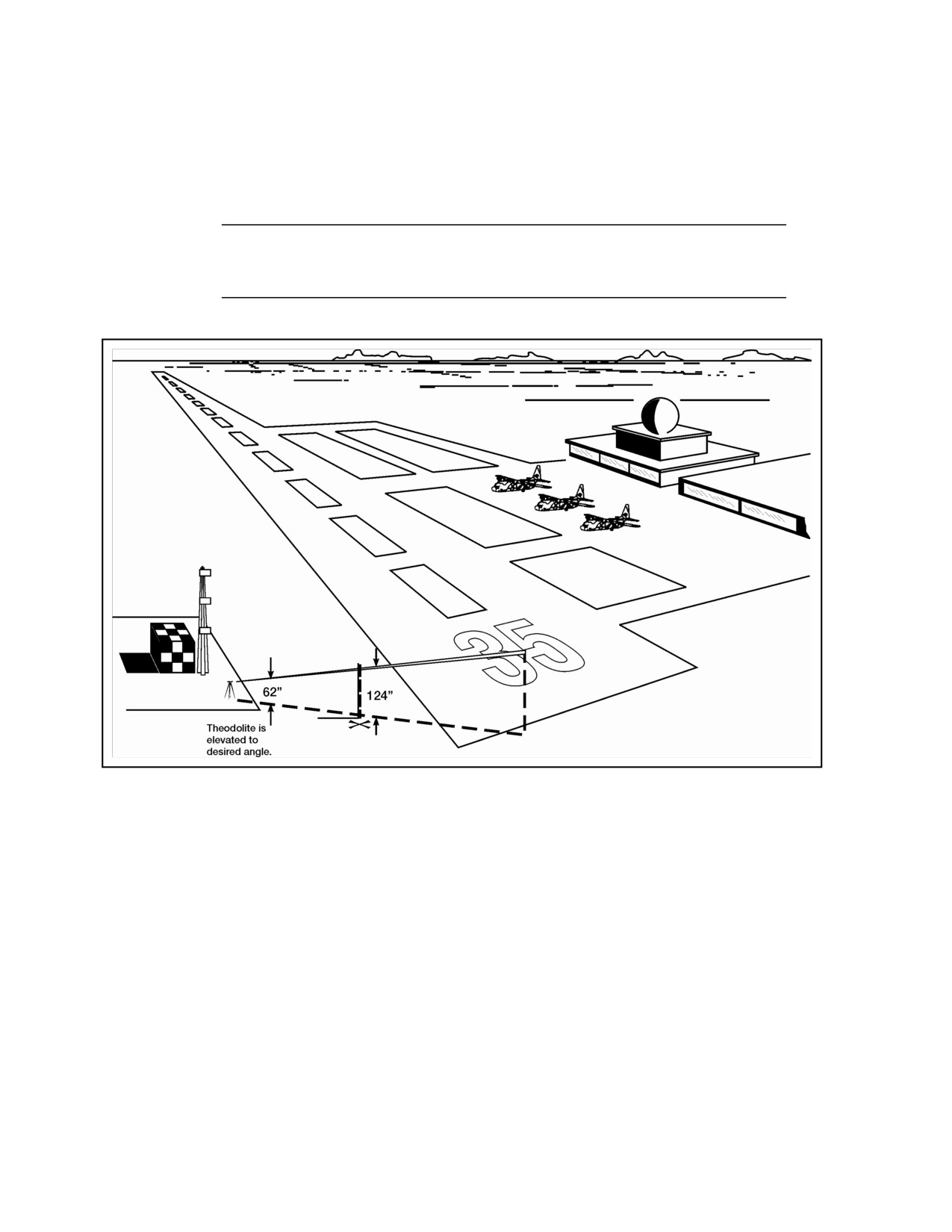
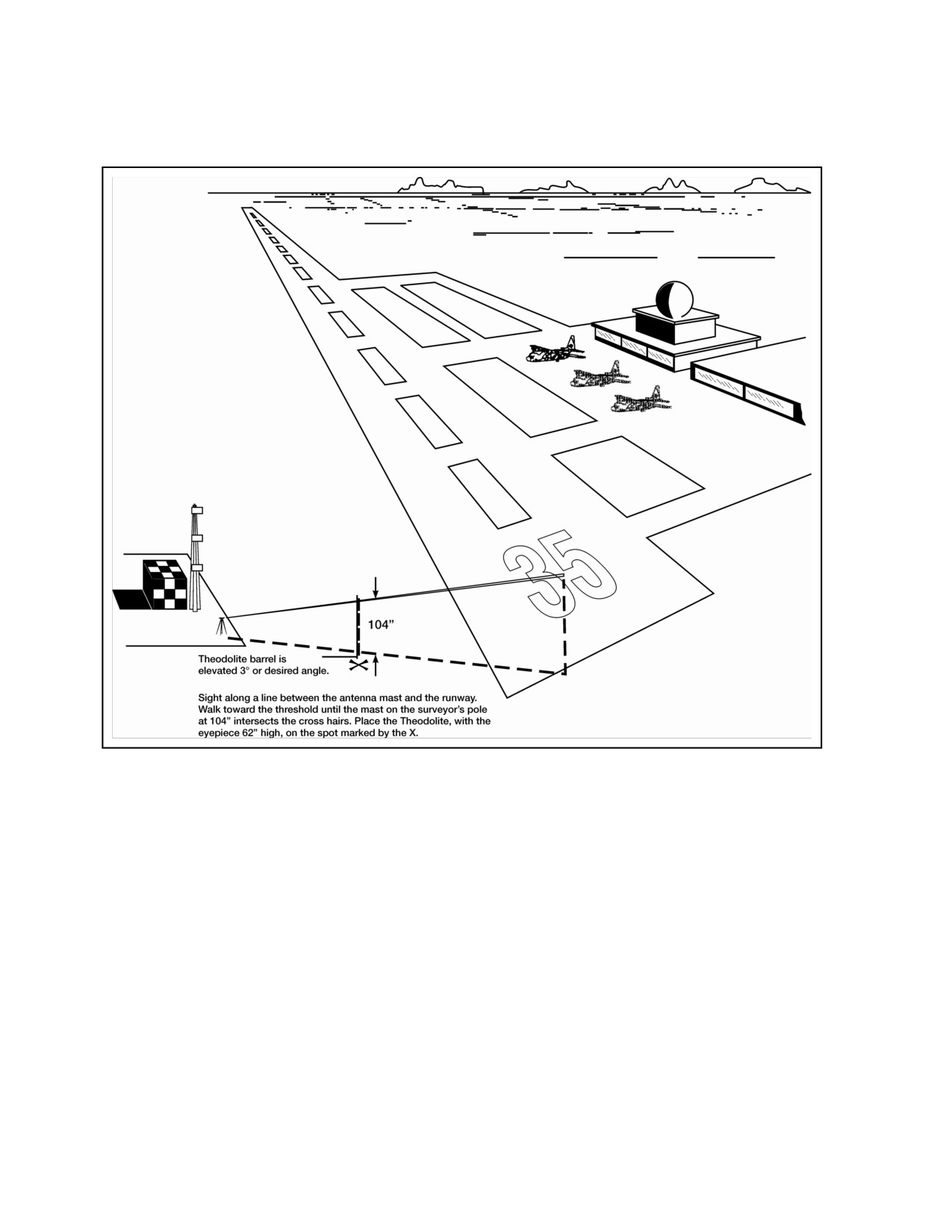
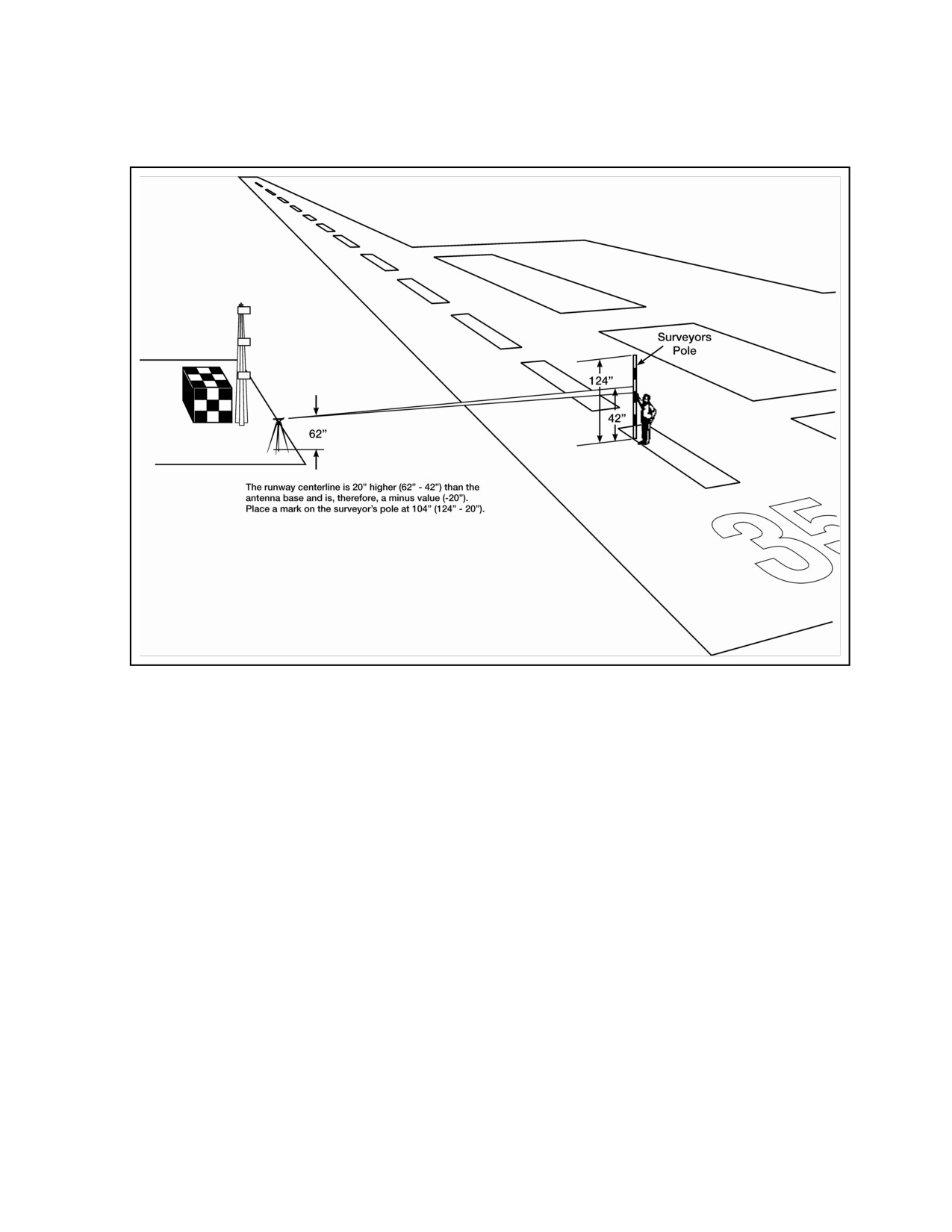
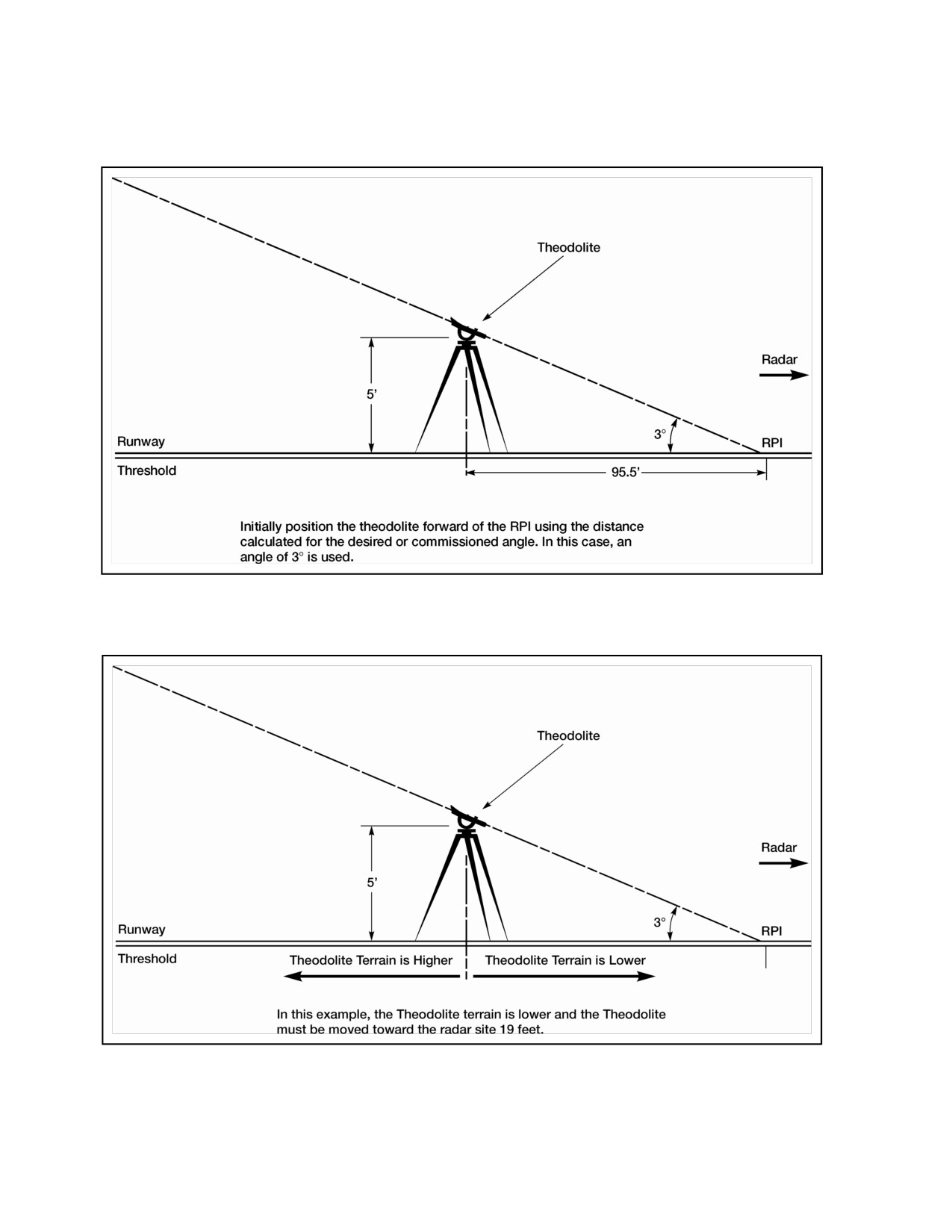
D-15. The Theodolite will be positioned according to the criteria for the
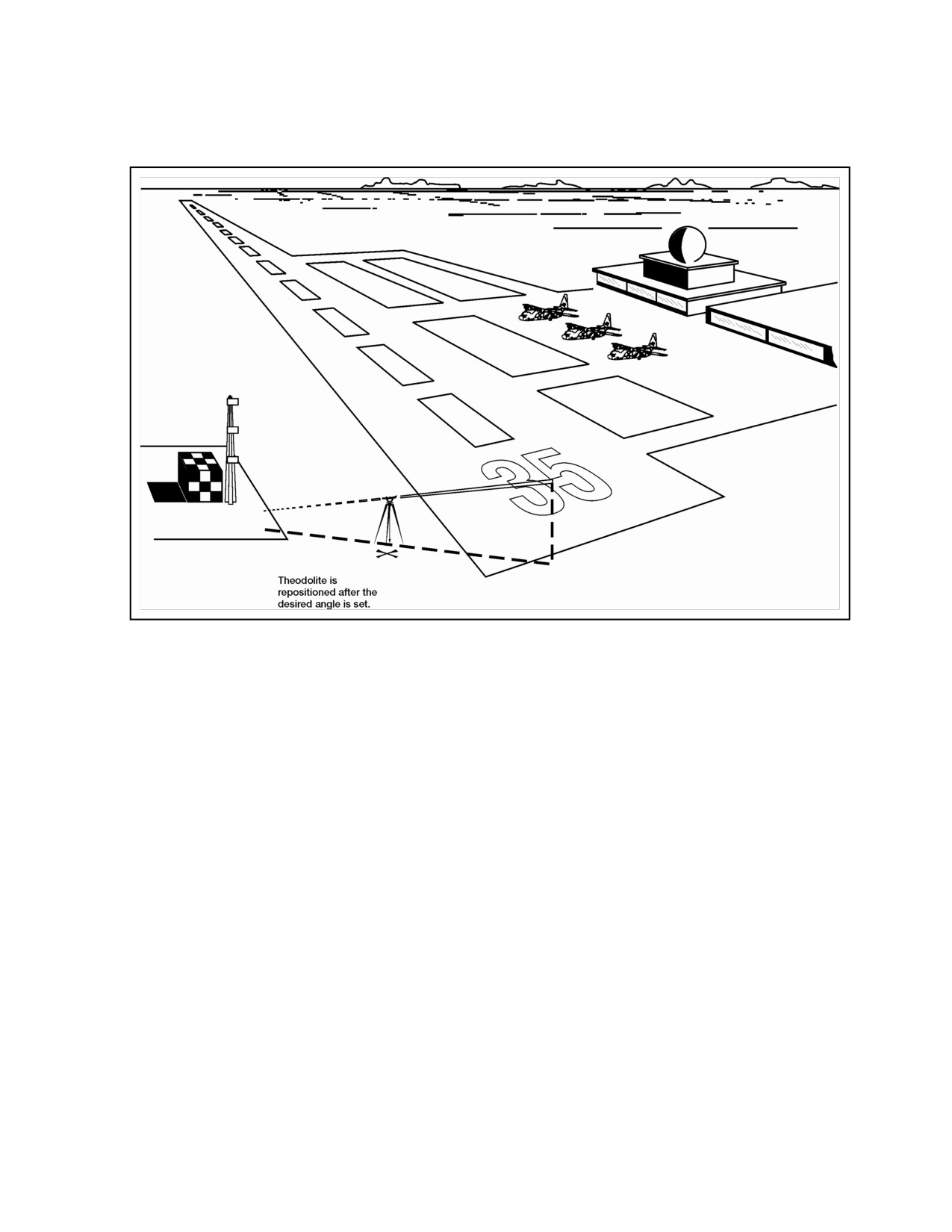
precision approach radar. Figure D-4 through figure D-9 show how to
position and reposition the Theodolite. If an aircraft equipped with the
automatic flight inspection system is not used for the commissioning
inspection, a Theodolite shall be used to determine glide angles including
lower safety limits. For a PAR facility performance evaluation, the
Theodolite is placed as close to the runway as possible. However, it must be
placed forward of the runway point of intercept
(RPI) to minimize or
eliminate the elevation difference between the RPI (touchdown) and the
D-9
FM 3-04.303 (FM 1-303) ______________________________________________________________
Theodolite location; this difference includes the height of the Theodolite
eyepiece. The touchdown reflector is usually abeam the RPI, but not always.
Aircraft operations will dictate how close to the runway the Theodolite can be
located.
Note: The elevation and azimuth scales are graduated in whole degrees,
whereas the elevation and azimuth tangent screws are accurately in degrees
and tenths of a degree.
Figure D-4. Theodolite Positioned
D-10
____________________________________________________________
Theodolite Operations
Figure D-5. Desired Angle Set and Theodolite Repositioned
D-11
FM 3-04.303 (FM 1-303) ______________________________________________________________
Figure D-6. Theodolite Barrel Elevated
D-12
____________________________________________________________
Theodolite Operations
Figure D-7. Adjustment for Height Differences
D-13
FM 3-04.303 (FM 1-303) ______________________________________________________________
Figure D-8. Theodolite Positioned for Zero Elevation Difference
Figure D-9. Theodolite Positioned for Known Elevation Difference
D-14
____________________________________________________________
Theodolite Operations
ORIENTATION
D-16. The Theodolite is oriented on the actual glide slope angle (for example,
2.5 degrees) on the vertical scale when set up on the observation point and
viewing the approach end of the runway. The following steps will orient the
Theodolite properly.
Step 1. With a lensatic compass, select a prominent object; record its hearing
from the observation point.
Step 2. Place the Theodolite at the observation point.
Step 3. Level the Theodolite.
Step 4. Set the azimuth scale and azimuth scale tangent screw to read the
exact azimuth of the established reference point.
Step 5. Loosen the lower clamp and sight the reference point as close to the
vertical crosshair as possible.
Step 6. Retighten the lower clamp, then adjust the slow-motion screw until
the vertical crosshair is exactly on the reference point. Make the final
adjustment by turning the slow-motion screw clockwise.
Note: Because of the prism arrangement in some Theodolite telescopes,
objects viewed through the proper plane may be presented upside down.
When the aircraft appears in the bottom half of the scope, it is high. When it
appears in the top half, it is low.
CHECK COMMISSIONING FACTORS
D-17. Communications with GCA is essential during a PAR flight inspection.
Only on glide path calls shall be recorded. Calls inside of decision height
shall not be recorded. Radar shall be capable of detecting an aircraft a
minimum of 7.5 nautical miles from touchdown and within the azimuth and
elevation sector portrayed on the radar scope.
D-18. The flight check is a team effort; therefore, good communications is
vital. Aircrew members will continuously advise the Theodolite operator of
their intentions. The Theodolite operator should ask questions if there is
doubt, and request assistance if problems arise.
Note: To correctly evaluate the equipment, it is important to record at least
15 to 20 on glide path calls.
D-19. Three approaches for each runway and one lower safe check are
required for commissioning. The lower safe limit is normally 0.5 degree less
than the glide path angle; however, obstacle clearance is all that is required.
D-20. To evaluate bends on the approach, range shall be given at least once
per mile.
D-21. The Theodolite is placed as close to the runway as possible and forward
of the runway point of intercept. The locations of the marked reference
D-15
FM 3-04.303 (FM 1-303) ______________________________________________________________
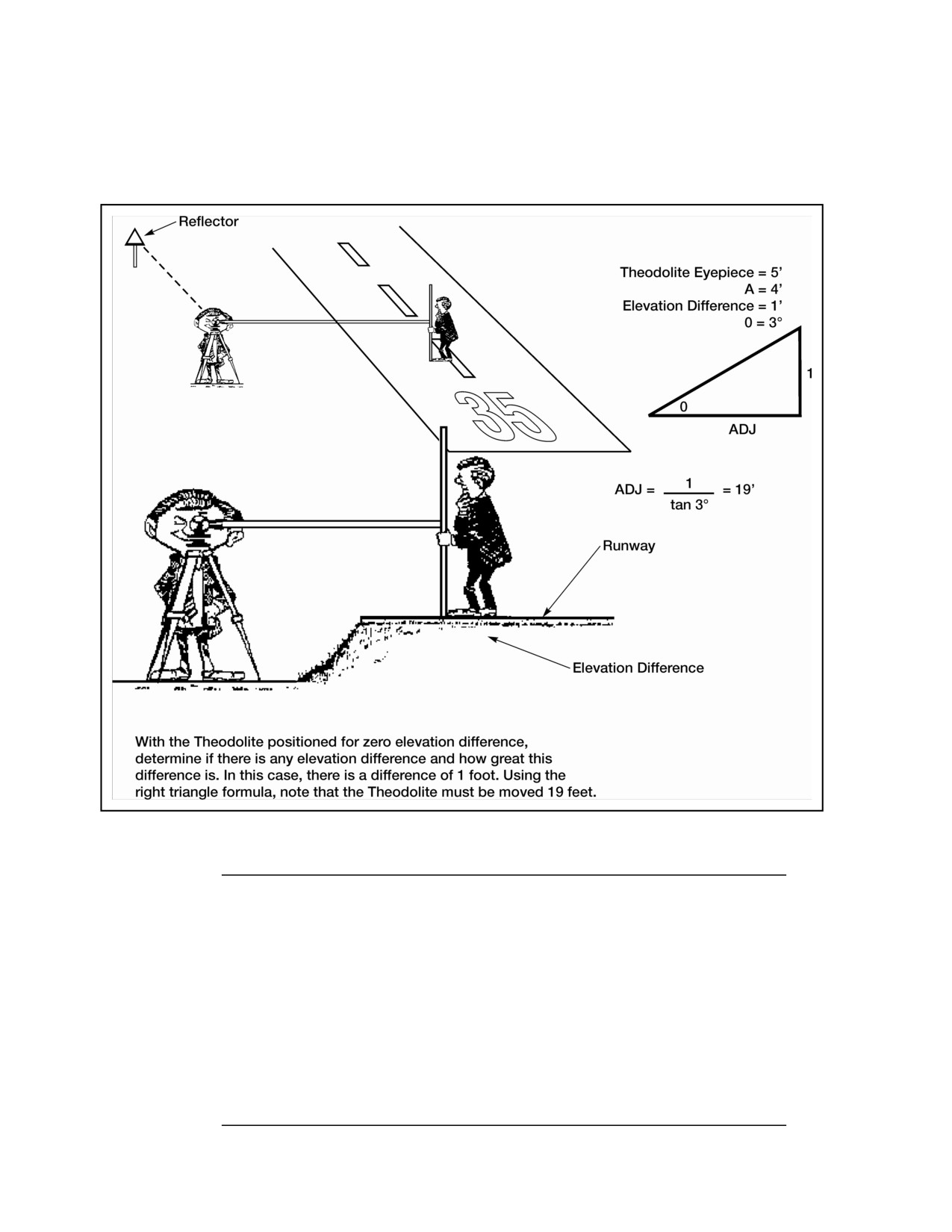
points are calculated using the formulas shown below. Figure D-10 shows
how to determine zero elevation differences.
Figure D-10. Zero Elevation Difference Calculated
Formulas:
Opposite = Adjacent X Tangent; or O = A X T.
Adjacent = Opposite/Tangent; or A = O/T.
Tangent = Opposite/Adjacent; or T = O/A.
Example. A 5-foot/3-degree tangent (.0524078) = 95.4 feet. Therefore, the
Theodolite would be placed 95.4 feet forward of RPI.
Problems and Solutions:
With a 1,200-foot ceiling and a 3-degree angle, what is the distance? The
solution is 1,200/3 degrees (.0524078) = 22897.365/6076.1 = 3.76 nautical
miles. This is not acceptable.
D-16
____________________________________________________________
Theodolite Operations
With a 2,000-foot ceiling and a 3-degree angle, what is the distance? The
solution is 2,000/3 degrees (.0524078) = 38162.275/6076.1 = 6.28 nautical
miles. This is acceptable.
PREVENTIVE MAINTENANCE
D-22. Theodolite operators must keep the instrument clean and protect it
from damage through mishandling or neglect. Listed below are some of the
measures operators should take to keep the Theodolite in good condition.
ROUTINE CARE OF THE INSTRUMENT
z
Protect it from dust and foreign matter by covering it with the canvas
hood while it is left standing unused or by packing it in its carrying
case to transport it.
z
Inspect it for loose or broken parts after it has been used.
z
Take care not to twist off the brass screws when tightening them.
z
Occasionally wipe off the instrument (except for the telescope lens)
with a soft, clean cloth.
z
Clean the telescope lens with a clean, soft-haired brush, then wipe it
clean with special lens tissue.
z
If lens tissue is not available, use either a soft facial tissue or a linen
handkerchief that has been washed several times. Be careful not to
wipe the lens because the lens surface is easily ruined by scratches.
z
If it is necessary to clean the inside surface of the lens, unscrew the
object lens barrel, but do not remove the lens from the barrel.
z
If it is necessary to clean the lens, unscrew the eyepiece but be careful
not to touch the fragile cross hairs that are exposed.
z
If the silvered surfaces of the tangent screw drum scales and the
elevation scale become tarnished from contact with the operator's
hands, remove the oxidation by rubbing the surfaces with bone black
or by applying a few drops of clock oil. Leave the oil on the surfaces
overnight, then wipe the surfaces clean with a soft cloth. Leave a
very thin film of oil on the surfaces to protect them.
(The azimuth
scale is covered and does not require routine cleaning.)
z
Replacement in Carrying Case.
z
Remove the sunshade from the telescope, and place it on the
baseboard with the long side away from the center of the baseboard.
Place the dust cap over the object lens of the telescope. Fold the long
sights flat down.
z
Disengage the elevation tangent screw, and swing the telescope
upside down so the sights are on the bottom of the tube. Do this
carefully so that long rear right does not strike the transverse level.
Point the object lens up at about a 30-degree angle. Leave the
tangent screw disengaged.
z
Disengage the azimuth tangent screw. Unscrew and remove the
Theodolite from the tripod head, keeping one hand on the instrument
at all times. Cradle the instrument against the body with the
forearm while replacing the baseboard on the Theodolite by turning it
clockwise.
D-17
FM 3-04.303 (FM 1-303) ______________________________________________________________
z Rotate the Theodolite until the rear end of the baseboard slides into
the case and the wood blocks face outward. Reposition the telescope
slightly, as necessary, to permit the baseboard to slide all the way in
and the door on the carrying case to shut.
z Replace the screw cap protecting the treads of the tripod heads.
D-18