FM 3-04.303 AIR TRAFFIC SERVICES FACILITY OPERATIONS, TRAINING, MAINTENANCE, AND STANDARDIZATION (DECEMBER 2003) - page 4
____________________________________________________________________
Maintenance
z Major modernization or corrective maintenance to the counterpoise,
such as extension of the counterpoise.
z Change in facility operating frequency.
z Change in output level
(power) for the purpose of increasing or
decreasing service volume.
z Adjustment or replacement of the VOR antennas or components
(including pedestals, loops, baluns, and supporting braces).
z Installation and operation of the TACAN antenna (with no change to
the VOR antenna system).
z Those activities stated in paragraph
8-7, when standard ground-
tracking procedures are not used.
z Replacement or modification of the test generator, if the tolerances
for ground check cannot be met.
z Installation of a modification to improve the RF spectrum for 50 kHz
channel spacing, or to eliminate adjacent channel interference.
8-7. Circumstances not requiring a confirming flight inspection—
z
Replacement of any or all solid-state components.
z
Replacement or repair of equipment components or units.
z
Complete tuning of the transmitter.
z
Measurement and adjustment of all modulation levels.
z
Phasing adjustments.
z
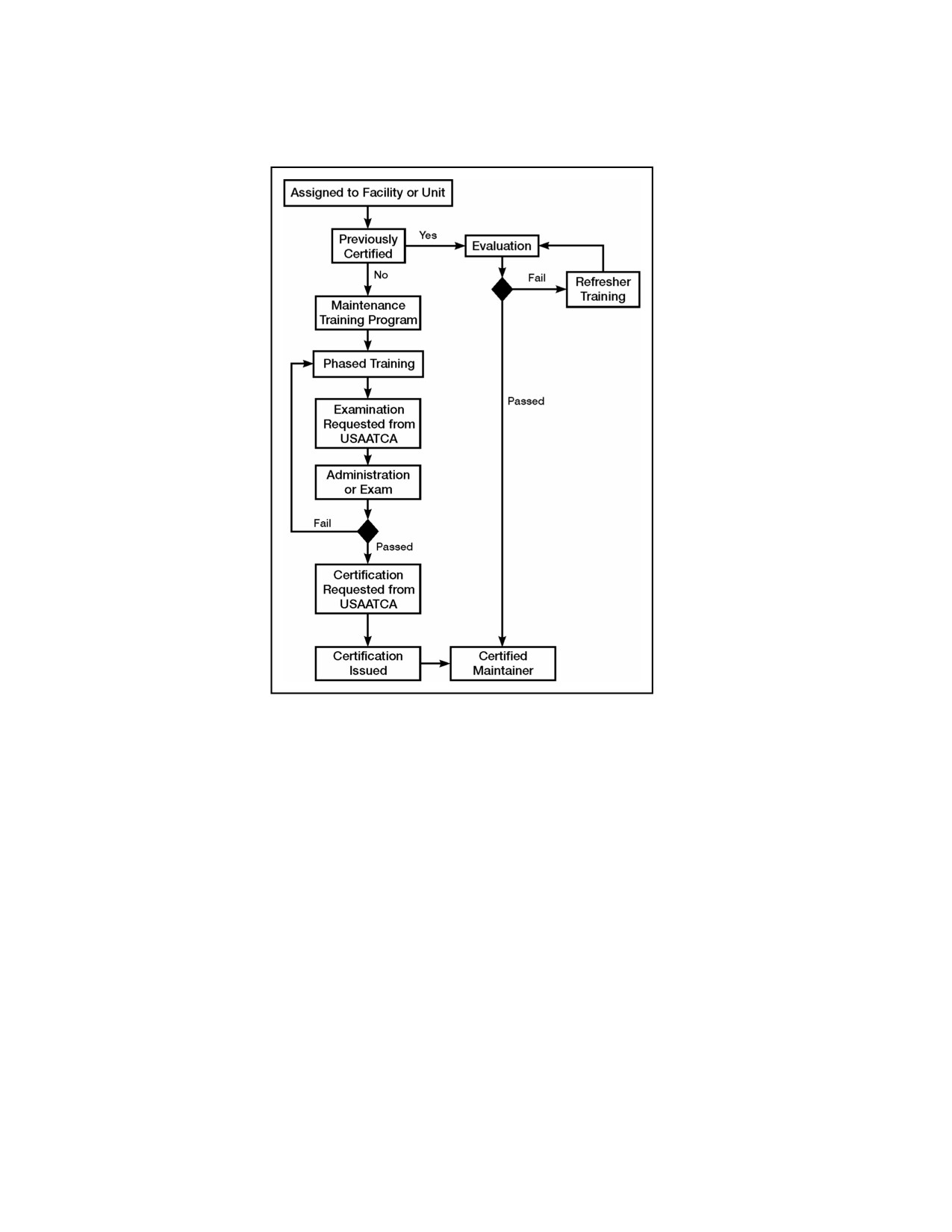
Installation or relocation of the DME mast, the TACAN monitoring
pole, or a remote communication outlet
(RCO) antenna pole (if
accomplished in accordance with current instructions).
z
Replacement of the polarizer when reset to the previous setting, or
readjustment of the polarizer when a portable ground polariscope is
used to optimize the facility for minimum vertical polarization.
z
Installation or replacement of obstruction lights or the painting of the
antenna shelter.
z
Replacement of the RTA-2 upper and lower bearings, spin motor, and
the radome.
z
Other maintenance procedures, such as refurbishment of VOR
counterpoise, wood decking, and/or terneplate, provided conditions
are restored to those that existed at the time of the last flight
inspection (as reflected in facility records) and ground check is within
± 0.2 degrees of the reference ground check.
z
Other maintenance procedures, such as any or all of the following,
provided conditions are restored to those that existed at the time of
the last flight inspection (as reflected in facility records).
Repair, alignment, or replacement of the goniometer.
Repair, replacement, modification, or repositioning of any fixed
field detector used in facility monitoring.
Replacement or modification of any signal element in the
monitors.
Adjustment or replacement of the RF transmission lines
(including feedlines, stubs, positioner, and bridges, either coaxial
or hybrid).
8-3
FM 3-04.303 (FM 1-303) ______________________________________________________________
Replacement, repair, or modification of test equipment.
(For the
VOR, if unable to make before and after measurements, a
confirming flight inspection will not be required if the tolerances
for ground check are met.)
8-8. Refer to FAAO 6820.7B and applicable equipment technical manuals,
Equipment - VOR/DME and VORTAC, for ground inspection procedures.
NDB Inspections
8-9. Circumstances requiring a confirming flight inspection include—
z Major changes in local obstructions, building, and so forth that may
affect signal strength and coverage.
z Changes or modifications to the antenna or ground plane that may
affect facility coverage.
z Change in the antenna current to increase or decrease the service
volume.
z Frequency change.
8-10. Circumstances not requiring a confirming flight inspection.
The
circumstances remain unchanged as stated in the appropriate manuals.
8-11. Installation facilities refer to FAAO 6740.2 and applicable equipment
technical manuals for ground inspection procedures.
8-12. Tactical facilities refer to applicable -10/-20/-30 technical manuals.
ILS Inspections of the Localizer, Glide Slope and 75 MHz Marker Beacons (Installation
Facilities Only)
8-13. Circumstances requiring a confirming flight inspection include—
z Changes to obstructions, buildings, power lines, and so forth that may
affect the radiated signal.
z Construction, runway repairs, and so forth that were performed in
the general localizer or glide slope area, if there is any doubt about
how they affect facility performance.
z Change in the facility assigned operating frequency.
z Replacement of critical ILS components
(such as RF lines and
antenna components, RF bridges, electronic modulators, mechanical
modulator troughs or parts, power dividers) and transmitters as
complete units if they contain any of these critical components.
z Repair or replacement of any of the localizer antennas in the
radiating array.
z Repair, replacement, or repositioning of any of the glide slope
antennas in the radiating array.
z Removal, repair, or reinstallation of any of the glide slope antennas in
the radiating array.
8-14. Circumstances not requiring a confirming flight inspection include all
other maintenance activities that meet the maintenance requirements of
FAAO 6750.49.
8-15. Refer to FAAO 6750.49 and applicable equipment technical manuals for
ground inspection procedures.
8-4
____________________________________________________________________
Maintenance
Primary and Secondary Radar Facility Inspections
8-16. Circumstances requiring a confirming flight inspection include—
z When a reported deficiency is not susceptible to exact measurement
or to verification by ground measurement.
z After an aircraft accident in which the radar facility may have been
involved.
z After an antenna change (ASR/PAR) or antenna tilt change (fixed tilt
surveillance radars only) or when engineering judgment indicates a
probable change in the antenna radiation pattern.
z After a modification or other circumstance that, in the judgment of
the individual in charge, requires facility performance to be
recertified.
z Anytime secondary radar directional output power is reduced below
the minimum output power level or the omni to directional power
ratio is increased above the level previously flight checked.
8-17. When circumstances remain unchanged, no confirming flight inspection
is required as stated in the appropriate manuals.
Periodic Operational Checks of the Radar System
8-18. In addition to the flight commissioning flight inspection, periodic
operational checks of the radar system will be performed by the FAA, Army
flight inspection aircraft, and air traffic controllers. These checks will
supplement the performance assurance obtained from observing the system
during daily operations. These checks include—
z Observing identified targets under control within the sector and
comparing them against data obtained during the commissioning
flight inspection or against minimum performance requirements
developed at the facility. These targets may be flight inspection
aircraft or targets of opportunity.
z Checking the technical performance of the facility against the
established performance date base of the facility.
Note: Installation facilities refer to FAAO 6310.19, ASR-9, and applicable
equipment technical manuals for ground inspection procedures. Installation
facilities refer to FAAO 6360.1 and applicable equipment technical manuals
for ground inspection procedures. Tactical facilities refer to applicable
-10/-20/-30 technical manuals.
COMMUNICATION FACILITIES INSPECTIONS
8-19. En route and terminal area communications are provided by the
various types of air/ground facilities (for example, FCCs, flight service station
[FSSs], and control towers). Facilities consist of air/ground transmitter and
receiving equipment, recording equipment, and necessary control equipment.
8-20. Communications facilities do not require a flight inspection. All
maintenance procedures of the communications facility can be accomplished
and the facility returned to unrestricted operation without recourse to a flight
inspection.
8-5
FM 3-04.303 (FM 1-303) ______________________________________________________________
8-21. Installation communications facilities must meet the standards and
tolerances outlined in FAAO 6470.29, FAAO 6480.6, FAAO 6670.13, and
applicable technical manuals.
8-22. Tactical facilities refer to applicable -10/-20/-30 technical manuals.
Additional Requirements
8-23. Facilities should be visited frequently enough to ensure accurate and
reliable operation according to the criteria established in this guidance. Each
time a facility is visited, the maintenance technician responsible for the
facility shall verify facility performance on the basis of one or more of the
following criteria:
z
Visual and aural. On every visit verify, by visual and aural
observation, whether equipment is operating normally.
This
includes, but is not limited to, meter readings, pilot light indications,
extraneous noises, and excessive heat.
z
Monitoring. On scheduled visits and as required, certify whether the
facility operation is satisfactory by noting local monitoring
information. Monitoring may include a control line check to
determine that control and remote monitor functions are satisfactory.
z
Meter readings. On scheduled visits, if applicable, record meter read-
ings and compare them with those previously recorded on station
records.
z
Performance standards and tolerances. On scheduled visits and as
required, determine whether the facility meets the performance
standards and tolerances established in this guidance, the technical
manuals, or the handbooks.
z
System ground check. On scheduled visits and as required, perform a
ground check and compare the results with the reference ground
check error curve (VOR) and/or with data obtained at the time of the
last flight inspection. Evaluate these data, and determine that
facility performance has not departed appreciably (beyond tolerance)
from the previous system ground check recordings.
z
Flight inspection. On scheduled visits or as requested, determine
whether facility performance is satisfactory based on the flight
inspection evaluation.
Ground check data shall be recorded
immediately following any flight inspection.
Note: An accident inspector may request a flight inspection on any NAVAID
suspected to have been a contributing factor in an accident or a mishap.
SECTION II - ATC MAINTENANCE CERTIFICATION PROGRAM
8-24. This section specifies the procedures for implementing and maintaining
a uniform certification program for U.S. Army ATC maintenance technicians.
This guidance applies to DA civilians, local national (host nation) civilians,
and military personnel (ATC systems and subsystems repair specialists in
MOS 35D) who perform maintenance on Army-owned ATC equipment.
Contractor personnel are prohibited from certifying U.S. Army NAVAIDs.
8-6
____________________________________________________________________
Maintenance
Contractor personnel may repair and verify that the NAVAIDs are operating
properly, but NAVAIDs certification is an inherent governmental function.
PROGRAM OBJECTIVES
8-25. The U.S. Army ATC maintenance certification program establishes the
uniform standards for measuring the technical proficiency of ATC
maintenance technicians. It also ensures the technical competence of all
maintenance personnel having direct responsibility for the safe operation of
systems/subsystems/equipment critical to air navigation and ATC. The
program establishes the procedures for documenting the technicians’
proficiency, granting authority, and assigning certification responsibility.
CERTIFICATION RESPONSIBILITY AND AUTHORITY
8-26. The responsibility for the certification program is shared by the
ATSCOM, the examiners
(facility
maintenance chiefs
and
group/battalion/company 35D personnel), and the various other maintenance
chiefs and supervisors. The following responsibilities are theirs.
U.S. ARMY AIR TRAFFIC CONTROL ACTIVITY
8-27. Only examinations developed or approved by ATSCOM shall be used as
a basis for issuing certification authority. This certification may be used only
for the specified ATC system/subsystem/equipment. The ATSCOM shall—
z Provide overall direction to, and guidance on, the program.
z Identify and specify the theory and performance requirements.
z Standardize and continually evaluate and update all phases of the
program.
z Develop, validate, review, and revise theory and performance
examinations.
z Determine the systems to be added or deleted from the program and
inform the appropriate individuals/elements.
z Print and distribute the examinations and certificates.
z Resolve comments, questions, and disputes about the examinations.
z Maintain database files containing complete verification records.
z Designate examining officials (in writing).
z Determine the acceptability of formal schools.
CERTIFIERS (FACILITY MAINTENANCE CHIEFS AND BATTALION/COMPANY 35D
PERSONNEL)
8-28. Military or DA Civilians that serve as maintenance certifiers shall be
designated, in writing, by the Director, ATSCOM, commanders of an ATS
group, ATS/ATC battalion, and ATC companies that are not aligned with an
ATS group or battalion, and exercise control of the program for the
facility/battalion/company of assignment.
SITE MAINTENANCE CHIEFS, SHIFT MAINTENANCE CHIEFS, AND COMPANY/PLATOON
MAINTENANCE SUPERVISORS.
8-29. These maintenance chiefs/supervisors shall—
8-7
FM 3-04.303 (FM 1-303) ______________________________________________________________
z Maintain files containing complete technician certification and
related training records on each technician.
z Provide the technician with the training materials needed to accom-
plish comprehensive training on the systems/subsystems/equipment.
z Request the theory and performance examinations through the
examiner, from ATSCOM.
z Coordinate with the examiner about administration of the
examination.
z Develop and document on-the-job training (OJT) on the site-specific
systems/subsystems to support the certification program.
z Advise the commander on the status of ATS maintenance
certification.
z Coordinate with the ATC facility maintenance chief for notice to
airmen (NOTAM) if training is required on any in-use operational
system/subsystem/equipment.
z Conduct and record the annual review on DA Form 3479-R.
8-30. The following guidelines shall be used to conduct the annual review of
the technician’s certification records: Ascertain that the technician has
maintained the certification proficiency level and assigned only those
certification responsibilities supported by valid certification authority. This
input is mandatory and shall be documented.
MAINTENANCE TECHNICIAN CERTIFICATION
CERTIFICATION BASED ON FORMAL SCHOOL
8-31. Completion of an accepted course of study offered by FAA, DOD
(excluding initial MOS producing schools), or contractors that meet or exceed
the objectives required to certify the equipment to FAA (NAS) standards
contained in FAAO 8200.1.
CERTIFICATION BASED ON PROGRAM COMPLETION
8-32. The certification program must be administered efficiently to provide
qualified technicians that meet the stringent requirements for properly
maintaining ATC equipment. The technician must satisfy the theory and
performance requirements specified in this chapter to meet qualification
requirements of the assigned position. After completing qualification
requirements, the technician may be assigned the responsibility of certifying
specific systems/subsystems/equipment. The flow chart in figure 7-1 depicts
the ATS maintenance technician certification process, which consists of the
eight steps given below.
Step 1. The technician is assigned to the facility or unit.
Step 2. The technician has prior certification.
Note. If certified on a particular system/subsystem, the maintenance chief
reviews the technician’s training records, evaluates him, then takes the
appropriate steps. If not previously certified, continue with step 3.
8-8
____________________________________________________________________
Maintenance
Step 3. The technician enters the maintenance training program. This step
includes—
z Establishing training records.
z Orientation on equipment.
z Orientation on facilities and their locations.
z Initial counseling on maintenance and shop operations.
z Statement of performance expectations.
z Orientation on safety.
z Overview of classes.
z SOP requirements.
Step 4. The technician enters a phased training program on individual
systems or equipment (for example AN/FSQ-84 and AN/FPN-40). This step
of the certification process consists of the following three phases.
z Phase I. The technician is trained on the theory of operation,
system/subsystem/equipment operational characteristics, power re-
quirements, frequency spectrum, and normal operating standards.
Also covered in this phase are the required reference material, forms
and records, maintenance allocation charts, PMCS and TMDE proce-
dures and requirements, and local SOP requirements.
z Phase II. The technician is trained on alignment systems and
subsystems, sequential and system interface alignment procedures,
and TMDE requirements and settings. This training also includes
reference material and local SOP requirements, forms, and records
completion.
z Phase III. The technician is trained on system and subsystem fault
localization, schematic use, maintenance allocation charts, and major
and minor component installation/removal procedures. This training
also includes tool requirements and usage, safety and quality control
requirements, supply procedures, and reference material and local
SOP requirements.
Step 5. When the technician has satisfactorily completed the three phases
above, the examiner will request the examination from ATSCOM (in writing).
Step 6. The examiner administers the examination to the technician in two
parts as explained below. All theory examinations are “open book.”
z Part 1. The technician completes the comprehensive written
examination, which consists of questions on Phases II, III, and I.
z Part 2. The technician is given the hands-on performance
examination on Phases II and III.
Step 7. The examiner grades the examination and sends it with the answer
sheet to Commander, USAAVNC, ATTN: ATZQ-ATC, Fort Rucker, Alabama
36362-5265. If the technician passes the examination, ATSCOM issues the
certification. If the technician fails the examination, the examiner identifies
the specific areas in which the technician had problems. The technician is re-
entered in the phased training program.
Step
8.
The technician is now certified on the applicable system or
subsystem. The flow process shown in figure 8-1 is continued when the
technician encounters a new system or new equipment.
8-9
FM 3-04.303 (FM 1-303) ______________________________________________________________
Figure 8-1. ATC Maintenance Technician Certification Process
THEORY OF OPERATION AND PERFORMANCE EXAMINATIONS
8-33. All theory and performance examinations used in the certification
program are developed or validated by ATSCOM. These examinations shall
be used to determine whether the examinee knows the theory and practical
techniques required to perform maintenance and diagnose and correct
deficiencies on ATC systems/subsystems/equipment.
Comprehensive
examinations are developed using technical manuals,
field manuals,
handbooks, manufacturer manuals, joint acceptance standards, and senior
maintenance personnel. Equipment examinations are comprehensive in
scope, covering not only the equipment within the system but also the
auxiliary equipment considered to be part of the system.
EXAMINER PREREQUISITES
8-34. The following are prerequisites for theory and performance examiners.
8-35. The examiner shall be designated, in writing, by ATSCOM. The duties
of the theory examiner consist of monitoring only he need not hold
certification authority. The performance examiner must possess certification
for the entire system on which he examines another technician.
8-10
____________________________________________________________________
Maintenance
THEORY (CONCEPTS) WRITTEN EXAMINATIONS
SCOPE OF THEORY EXAMINATIONS
8-36. The written examination will test the technician’s understanding and
knowledge of a wide range of information. The questions will cover system-
oriented theory, operational characteristics, subsystems, power requirements,
frequency spectrum, and normal operating standards. Some questions
require both calculations and analytical reasoning.
Requests for Theory Examinations
8-37. The maintenance supervisor will send written requests for theory
examinations through the examiner to ATSCOM. An examination shall not
be requested unless there is a reasonable expectation that the technician will
pass it. Under no circumstances shall it be used as a screening device.
Administration of Theory Examinations
8-38. When administering the theory examinations, the examiners shall—
z Understand and apply mandatory secure-handling requirements to
protect program integrity.
z Not discuss or disclose the contents of examinations.
z Prepare an appropriate area for administering examinations and give
the examinee required instructions and materials.
z Caution the examinee on the official nature of the examinations and
the penalties involved for disclosure of the contents.
z Allow examinees the use of reference material (personal or supplied)
during the examinations.
z Control and time examinations as prescribed, and process completed
examinations as instructed.
z Store examination papers in a secure file.
Grading of Theory Examinations
8-39. The examiner will grade theory examinations; the examinations with
the results will be mailed to Commander, USAAVNC, ATTN: ATZQ-ATC,
Fort Rucker, Alabama 36362-5265.
8-40. If the technician fails to achieve 70 percent on the examination, the
examiner will define specific weak areas and the technician shall be required
to review all areas on the examination.
Security in Handling Theory Examinations
8-41. Everyone in the examination chain concerned with the certification
process must maintain security in the handling of written examinations.
Compromise of examinations in any form is a serious violation of the rules of
conduct and discipline. Any violation shall require that the appropriate
official take disciplinary action. Any person having personal knowledge of a
compromise on any segment of the written examination shall advise
ATSCOM immediately of the details. The security requirements of theory
examinations include (but are not limited to)—
z Placement of documents in locked storage (secured with a combina-
tion lock or the equivalent).
z Accountability for all examinations after their completion.
8-11
FM 3-04.303 (FM 1-303) ______________________________________________________________
z Refusal to discuss or transfer examination content.
PERFORMANCE EXAMINATIONS
Scope of Performance Examinations
8-42. Performance examinations are used to demonstrate a technician’s
proficiency. These examinations vary in length according to the complexity
and scope of the system/subsystem/equipment. The use of reference material
is encouraged during the examination. The examinee makes the actual
adjustments, alignments, or software program changes; evaluates system
performance; and corrects equipment maladjustments. The examiner
observes the results and verifies the accuracy of the adjustments, alignments,
or changes.
8-43. The examiner may deviate from the printed examination to ensure that
the examinee has the required proficiency. The examinee should be told of
any deviations before taking the examination.
8-44. If there is a published on-the-job-training
(OJT) course, the
performance examination may be incorporated as an integral part of OJT.
When there is no published OJT course, the examination may be used as a
study outline. When the examination is so used, the individual who provides
OJT should not be the examiner.
8-45. The examiner may make only minor changes to the performance
examination to make it compatible with the system used. Operations and
questions other than those given on the performance examination may be
used to assure the examinee’s total system knowledge. When maintenance
procedures or system configurations change, facilities shall recommend that
changes be made to the examinations. Recommendations for changes to
examinations shall be sent to Commander, USAAVNC, ATTN: ATZQ-ATC,
Fort Rucker, Alabama 36362-5265.
Administration of Performance Examinations.
8-46. The distribution of the performance examination prior to the
examination is encouraged. The technician shall be made thoroughly
familiar with the examination requirements and related test equipment
during OJT.
8-47. Except in instances in which two people are required to make a
particular adjustment or alignment, the examinee will complete the
examination unassisted.
Grading of Performance Examinations
8-48. Once the examinee has completed an operation, the examiner grades
the performance. Failure of only one of certain operations constitutes failure
of the entire examination.
Note: Secure handling of the performance examination is not required.
EXAMINATION REVIEW AND EVALUATION
8-49. Certification examinations are constantly reviewed and updated by
ATSCOM. Examinations are combined when redundancy is discovered or
8-12
____________________________________________________________________
Maintenance
revised when found to be obsolete. Examiners may detect questions that are
not correct or administer an examination that is not relevant to the
system/subsystem/equipment for which the technician is being tested. In
either case, examiners should include an appropriate comment with the
examination and send the results to Commander, USAAVNC, ATTN: ATZQ-
ATC, Fort Rucker, Alabama 36362-5265.
EXAMINATION FAILURE POLICY
8-50. If a technician requiring certification authority fails an examination,
the supervisor shall return the technician to the phased training program
(figure 8-1).
The improvement program will be documented in the
technician’s official certification and related training record. The program
will contain the—
z Training for the deficient areas identified.
z Recommended study material.
z Method for measuring progress.
z Time schedule for improvement program completion.
z Name of instructor(s) and method of documenting training.
8-51. If the technician fails the theory examination, he is ineligible to take
the performance examination. If a technician passes the theory examination
but fails the performance examination, he is not required to take another
theory examination. The examiner must notify ATSCOM, in writing, of the
tentative scheduled date for the new performance examination; ATSCOM
will then verify the date.
8-52. The examiner will ensure that he uses a different examination each
time a technician retakes the examination. A technician may not take a
theory or performance examination more than three times in a 12-month
period.
8-53. The ATSCOM must retain examinations, answer sheets, comments,
and any other information pertaining to a failed examination for not less
than two years.
SECTION III - RECORDS FILE, FORMS, AND MAINTENANCE CERTIFICATION
REQUIREMENTS
8-54. This section explains the required files, forms, and records for
administering the maintenance certification program. It explains the
contents of the records folder and how to complete the forms, and lists the
equipment requiring certification authority.
RECORDS FILE
8-55. For each technician assigned to the maintenance section who requires
certification, establish and maintain an official certification and related
training file. This file will be under the control of the facility maintenance
chief/platoon/section. It will be kept in an area that is accessible only to
authorized personnel who have been properly screened, cleared, and trained.
Information in the file shall be protected according to privacy act regulations.
8-13
FM 3-04.303 (FM 1-303) ______________________________________________________________
8-56. Each official training file shall contain documentation substantiating
the technician’s qualifications to possess certification authority or have
responsibility on specific system/subsystems/equipment. The file shall be
used as a complete historical record of the technician’s certification progress.
It shall contain such background data and supporting documents as reports,
certification responsibility assignments/withdrawals, and granting/revocation
of certification authority. This informational file shall contain documentation
to support the program responsibilities assigned to the office maintaining the
file.
8-57. The pertinent records will be kept in a straight cut,
9½-inch by
11¾-inch, heavy-duty Kraft file folder (NSN 7530-00-222-3443). Each folder
will be maintained according to AR 25-400-2. The folders will be filed
alphabetically by the technician’s last name. The following information will
be entered on the front cover of the file folder: Air Traffic Control
Maintenance Qualification and Related Training Records Folder, United
States Army. If found return to: Commander, USAAVNC, ATTN: ATZQ-
ATC, Fort Rucker, Alabama 36362-5265. The folder will contain the—
z Certification and related training received.
z Performance examination sheets.
z Theory (concepts) and performance examination results.
z Grades and certifications obtained through training.
z Other correspondence related to training and certification.
z Responsibility assignment.
8-58. The left side
(foldout portion) of the folder will contain
DA Forms 3479-9-R and DA Form 3479-10-R. No other forms, records, or
papers shall be on this portion of the folder. The right inside (foldout portion)
of the folder shall contain performance examination results as well as other
correspondence related to ATC maintenance training.
8-59. Those forms and records listed in paragraph 8-57 are the only materials
authorized to be kept in the certification and related training records folder.
Such information as reclassification, counseling, and appraisals will not be
retained in this folder. However, pertinent information will be annotated in
the remarks blocks on the forms.
8-60. Upon request, technicians may review the contents of their records
folder. The folders are available for review to—
z ATSCOM representative.
z Commanders.
z FAA authorities.
z Supervisors (training or maintenance).
z Aircraft accident investigators.
z Mobile maintenance contact teams.
z Systems managers and their authorized representatives.
z Examiners who administer theory
(concepts) and performance
examinations.
8-61. When a technician is reassigned to another maintenance facility/shop,
the losing organization shall note the effective reassignment date and
location (if known) on his DA Form 3479-9-R. The ATC facility retains the
8-14

____________________________________________________________________
Maintenance
active paper records until that individual transfers. These paper records are
transferred with the military personnel records jacket or civilian personnel
folder, as appropriate. Automated management information at the primary
location is retained until no longer needed for current operations. AR 5-400-2
explains record retention and disposal procedures.
8-62. When civilian and military personnel retire or separate from federal
service, their records are retired. Civilian personnel records are sent to the
National Personnel Records Center,
111 Winnegbago Street, St Louis,
Missouri
63118; military personnel records are sent to the U.S. Army
Personnel Center and U.S. Army Reserve Components Personnel and
Administration Center, 9700 Page Boulevard, St. Louis, Missouri 63132. The
records are retained for 115 years after the individual’s date of birth. If the
date of birth cannot be ascertained, the records are retained for 60 years after
the date of the earliest document in the folder.
FORMS
8-63. The ATC chief/ATC SR SGT/PSG/facility maintenance chief/company
maintenance chief at all Army ATC facilities and tactical units will maintain
the special forms associated with the ATC maintenance personnel
certification program. The chief will maintain DA Forms 3479-9-R and
DA Form 3479-10-R on each assigned or attached technician (military and
civilian) (see chapter 5). Blank copies of these reproducible forms are at the
back of this manual.
EQUIPMENT CERTIFICATION
8-64. Table 8-1 lists ATC equipment that requires certification. A technician
authorized to make such determinations must perform equipment
certification. ATC equipment is unusable until certified or authorized by the
commander.
Table 8-1. Equipment Certification Listing
Name
Nomenclature
ATC landing control system
AN/TSQ-71B
Radar set
AN/TPN-18A
Radar set
AN/TPN-18
Interrogator set
AN/TPX-44
Air traffic navigation, integration and coordination
AN/TPN-31
system
Tower systems
AN/TSW-7A & C, AN/TSQ-70A,
AN/MSQ-135
Tactical terminal control system
AN/TSQ-198
Tactical airspace integration systems
AN/TSQ-221, AN/TSC-61B
ATS air to ground communications
Tactical radio equipment
Radio beacon set
AN/TRN-30V(1)&(2)
Radar system
AN/FSQ-84
Radar set
AN/FPN-40
8-15

FM 3-04.303 (FM 1-303) ______________________________________________________________
Table 8-1. Equipment Certification Listing
Name
Nomenclature
Interrogator set
AN/TPX-41
Radar system
AN/FPN-67
Radar system
AN/FPN-66
Radar system
ASR-8/9
Digital bright radar indicator tower equipment
DBRITE
VHF omnidirectional range (VOR)
AN/FRN-41(V)
Instrument landing system
Localizer, glideslope, markers
Non-directional beacon systems
NDB
Automation systems
Automated Radar Terminal
System II (ARTS II), IIA, TPX-
42, PIDP, flight data entry and
printout equipment (FDIO)
Analog video mapping systems
AN/GPA-131, FA8970
Tactical air navigation systems
TACAN
ATIS systems
ATIS
Distance measuring equipment
DME
ATS air-to-ground communications
Voice switches, RCE, radios
Recorders
DVRS
SECTION IV - AIR TRAFFIC CONTROL AND NAVAID FACILITY STANDARDS
8-65. This section provides guidance for the standardization of Army ATC
and NAVAID facilities at AAFs and AHPs. Tactical facilities shall refer to
applicable
-10/-20/-30 technical manuals for installation and operational
characteristics of ATS equipment. This section is intended to provide the
user with information on current, standard ATC/NAVAID structures and
equipment. References to specific configurations and quantities of equipment
have been deleted. Information of this nature will be gathered on a case-by-
case basis during ATC/NAVAID requirements surveys and configuration
audits. This chapter includes sections on visual air navigation facilities,
installation flight-following facilities, physical security, and environmental
control of ATC/NAVAID facilities.
8-66. The major consideration in achieving this purpose is the installation of
standard equipment at all ATC and NAVAID facilities in preplanned
configurations.
GENERAL
8-67. This section provides the standards for planning new facilities or
improving existing ones and applies to all active Army commands, Army
National Guard (ARNG), and United States Army Reserve (USAR) units
having requirements for installation ATC/NAVAID facilities.
z AR 95-2 sets guidance for establishing, relocating, altering, and
terminating these facilities.
8-16
____________________________________________________________________
Maintenance
z UFC 3-260-01 provides guidance to assure that AAF/AHP facilities
are properly planned and constructed.
z TM 95-226 sets terminal instrument approach procedures to be used
with all NAVAID planning.
z TM 5-811-5 provides guidance and criteria for planning and building
Army aviation lighting facilities.
z This field manual specifies operational procedures for ATC/NAVAID
facilities.
z FM 11-486-23 provides engineering guidance for ATC/NAVAID
facilities.
Engineering Installation Standards
8-68. Equipment configuration and installation standards for ATC/NAVAID
facilities are contained in FM 11-486-23 and appropriate standard
engineering installation packages (SEIPs). SEIPs contain standard design
criteria, technical data, and guidance for planning and engineering
installation and preparing final detailed engineering installation packages
(EIPs). When SEIPs apply, they will be used for installation of ATC/NAVAID
facilities.
8-69. Equipment configuration and installation standards are contained in
appropriate U.S. Army Information Systems Command (USAISC) SEIP for
ATC/NAVAID facilities. EIPs are technical documents that translate
validated ATC/NAVAID requirements into final engineering packages and
are tailored to the individual sites.
8-70. The ATSCOM shall review all ATC/NAVAID SEIPs or EIPs and
changes thereto to assure adherence to findings of ATC requirement surveys,
established ATC operational requirements, and equipment configurations.
The ATSCOM has final authority on matters that affect ATC operations and
configuration.
8-71. Installation integrity of ATC/NAVAID facility layout and equipment
configuration of AAF or AHP is maintained through a configuration
management (CM) program. Director, ATSCOM will publish CM policies and
procedures to be applied to ATC/NAVAID systems.
8-72. The human engineering factors of military standard (MIL-STD) 1427B,
including voice levels and environmental control of air, shall be applied to the
facilities described in this chapter. Additional criteria are also included in
this chapter pertaining to environmental factors/controls to be applied to
ATC/NAVAID facilities.
8-73. All ATC/NAVAID facilities on or near an Army installation are
required to implement the physical security provisions of AR 190-51 to
prevent or reduce loss or damage from theft, espionage, sabotage, and other
criminal or disruptive activities.
Application
8-74. ATC/NAVAID facilities must be upgraded and modernized per AR 95-2.
An ATC/NAVAID requirements survey is conducted to analyze and evaluate
operational requirements; decide configuration of equipment; and recommend
installation termination, alteration, or relocation of ATC/NAVAID facilities
8-17
FM 3-04.303 (FM 1-303) ______________________________________________________________
required to best support local aviation missions. The engineering site survey
will confirm or determine new site location.
8-75. Existing structures (structures built before the publication date of this
publication) are exempt from these standards if they meet the ATC
operational needs and Office, Chief of Engineer (OCE) requirement for safety,
and conform to the minimum environmental control system criteria specified
in appropriate sections of this chapter. When practical and cost effective,
existing structures shall comply with the provisions of this chapter. Those
structures that must be replaced (cannot be economically rehabilitated) will
have operational requirements validated under AR 95-2.
8-76. Continued use of existing structures or equipment is determined on a
case-by-case basis with consideration for the following:
z Age and condition of the existing equipment and materials.
z Suitability, maintainability, supportability, and reliability (safety) for
continued use.
z Cost of replacement and funding.
z Operational requirements for the AAF or AHP in connection with
functional requirements of the equipment.
z Availability of new equipment and materials.
Backup Power System Requirements
8-77. Backup power systems in support of ATC facilities are a critical
requirement for assuring continuous, reliable operation of these facilities. To
prevent serious ATC facility outages
(because of primary power
interruptions), all ATC facilities
(such as Army radar approach control
[ARAC], ATC towers, ground-controlled approach [GCA], and those NAVAID
facilities) that are published for instrument flight rules
(IFR) use shall
require backup power. Those facilities not published for IFR use may qualify
if located in a geographical area considered sensitive to national security or
having a history of poor climatic conditions and/or excessive power outages.
Training and advisory facilities under certain conditions may also qualify.
The use of uninterrupted power supplies (UPS) is recommended to provide
uninterrupted power to equipment during the transfer from primary to back-
up power sources. Additionally, UPS has filtering networks that reduce the
risk for equipment damage as the result of lightning strikes or power surges.
The decision to provide backup power for facilities not published for IFR use
shall be made on a case-by-case basis and determined during the ATSCOM
requirements survey.
8-78. Backup engine generator facilities requires a fuel storage tank with
adequate capacity for sustained backup power operation depending on
mission requirements and/or availability and dependability of primary power.
The average diesel generator consumes fuel at the approximate rate of one
gallon per hour for each 10 kilowatt (kw) of generated power. Maximum time
required for the generator to assume full load when primary power fails is
15 seconds. Minimum shutdown time for the generator when primary power
is restored is 30 minutes.
8-79. Reliable operation of ATC facilities depends on the communications
equipment room environmental design. Additional requirements, including
8-18
____________________________________________________________________
Maintenance
backup exhaust systems and environmental control guidance are specified
later in this chapter.
8-80. Commissioned NAVAID facilities
(non-directional beacon
[NDB],
instrument landing system [ILS], and terminal VHF omnidirectional range
[TVOR]) shall be monitored using equipment specified. NAVAID facilities
shall be monitored in accordance with this field manual.
8-81. Voice recording of ATC facilities is specified in appropriate sections of
this field manual. The order of recording priority shall be in accordance with
this field manual.
8-82. Grounding, bonding, and shielding techniques, including lightning
protection of ATC/NAVAID facilities, shall be done in accordance with
FM 11-487-4 and MIL-STD-188-124.
8-83. Obstruction lighting for ATC/NAVAID facilities shall be designed in
accordance with TM
5-811-5 and current edition of FAA advisory
circular 70/7460-1.
8-84. Requests for waivers to the criteria contained in this chapter must be
sent through command channels to Commander, USAAVNC, ATTN: ATZQ-
ATC, Fort Rucker, Alabama 36362-5265 for approval.
8-85. Proposed new facilities that violate UFC 3-260-01 require a waiver in
accordance with AR 95-2 before the project is approved.
ARMY RADAR APPROACH CONTROL
8-86. An Army radar approach control (ARAC) is an ATC facility, located at a
U.S. Army installation that uses surveillance radar (normally collocated with
precision approach radar [PAR]) and air/ground communications equipment.
ARAC facilities offer approach control services to aircraft arriving, departing,
or transiting the airspace controlled by the facility. Service is available to
both civil and military airports located within approach control airspace.
Special Provisions
8-87. A remote communications facility (paragraph 8-116) is supplied to
reduce radio interference.
Equipment Guidance
8-88. Table 8-2 lists standard equipment and systems used in ARAC
facilities.
8-89. The order of priority of channels for voice recording is contained in this
field manual. In addition to position recording channels, enough channels
should be available for discrete frequency recording of emergency and pri-
mary frequencies. ARAC facilities require, as a minimum, a 48-channel
recorder.
8-90. The ARAC facility is the primary monitor location for NAVAID
facilities.
Structural Standard
8-91. Standard drawings have not been made by the OCE because of differ-
ences in structural layout at many ARAC facilities. As a minimum, the
following should be included when considering design of an ARAC facility:
8-19

FM 3-04.303 (FM 1-303) ______________________________________________________________
z Operations (IFR) room.
z Equipment room.
z Ready room.
z Maintenance shop and supply room.
z Offices for chief of maintenance and chief of operations.
z Training room.
z Locker room.
z Latrine.
8-92. Design and layout of an ARAC structure should also include a maxi-
mum human engineering effort. ARAC facilities planned for future installa-
tions will make the greatest use of the structure drawings of present ARAC
facilities.
Table 8-2. Major Equipment (ARAC)
Function
Type
Airport surveillance radar
ASR
ATC beacon interrogator
Secondary radar
Automatic radar terminal system
SHAPE Technical Center
Adaptable Radar Simulator
(STARS)
Video mapper
Flight data entry and printout equipment
FDIO
*Precision approach radar
Installation PAR (FBPAR)
Communications control system
AN/FSC-92 or Enhanced
Tower Voice Switch (ETVS)
Console, ARAC modular
FAA type
Recorder reproducer
DVRS, 48 channel
Wind speed and direction indicator
FMQ-13
Receiver-transmitter radio
Single-Channel Ground and
Airborne Radio System
(SINCGARS)
UHF/VHF/AM transceiver B/U
AN/GRC-171/211
VHF/AM transmitter set
GRT/or CM200
UHF/AM transmitter set
GRT/or CM200
VHF/AM receiver
GRR/or CM200
UHF/AM receiver
GRR/or CM200
Modems
Interfacility data
Digital altimeter indicator system
As directed by site survey
Weather information display system
As directed by site survey
8-20
____________________________________________________________________
Maintenance
Table 8-2. Major Equipment (ARAC)
Function
Type
Notes:
When located on the same airfield, PAR scopes are collocated with the ARAC
scopes.
8-93. The communications equipment room environmental conditions shall
be 730 ± 2 degrees Fahrenheit dry bulb for summer and winter with relative
humidity (RH) 450 ± 5 percent. Thermostats shall be set to 730, humidistat
to 45 percent.
8-94. Positive space pressure is required to reduce air infiltration.
8-95. Operational areas shall be designed to make sure sound levels will not
exceed MIL STD-1472D.
Electrical Power Standards
8-96. Minimum needs for full load operation are as follows:
z Power:
60 kilowatt
(does not include power for environmental
control).
z Voltage: 120/208, ± 10 percent, 3 phase, 5 wire.
z Frequency: 60 hertz (Hz) ± 5 percent.
8-97. The ARAC facility, including the ARAC operations and communications
equipment, lights and their independent environmental control systems,
must have backup power with automatic start and load transfer capability if
the primary source fails.
ARMY ATC TOWERS
8-98. ATC towers are terminal facilities that, through the use of air and
ground communications, visual signaling, and other devices, give ATC service
to airborne and surface aircraft operating in the vicinity of an AAF or AHP.
8-99. Towers normally have three functional positions: ground control, local
control, and flight data. In some cases, a supervisory position may be
necessary.
8-100. When space permits and where applicable, towers may also have the
GCA facility located within the tower structure.
8-101. To accommodate the various ATC functions described above and
maintain reasonable flexibility to meet mission needs efficiently and
economically, two types of ATC tower structures have been accepted as
standard by the ATSCOM.
z Type A (High Density). This tower is a permanent structure used
primarily at those locations where the mission needs all the
functional positions listed above, including GCA.
z Type B (Low Density). This tower is a permanent structure primarily
used at those locations where the mission is less than Type A (for
example no GCA).
8-102. Both towers will have a 20-foot by 20-foot cab and finished floors for a
latrine/break area and a mechanical room. The equipment room and GCA, if
8-21

FM 3-04.303 (FM 1-303) ______________________________________________________________
required, may be in a separate collocated building. This and the height of the
tower will be determined by a requirement survey.
Special Provisions
8-103. Remote communications facility (paragraph 8-116) can be supplied
with towers. This depends on frequency compatibility, which is decided after
an electromagnetic compatibility (EMC) study has been done. The decision to
remote receivers, transmitters, or both will be determined at that time.
Equipment Guidance/Facility Specification
8-104. Table 8-3 is a list of the standard equipment used in Type A and
Type B towers.
8-105. The order of priority of channels for voice recording is contained in
this field manual. Besides position recording channels, there should be
enough channels for discrete frequency recording of emergency and primary
frequencies.
Table 8-3. Major Equipment (Type A and Type B Towers)
Function
Type
Receiver-transmitter radio
SINCGARS
UHF/VHF/AM transceiver B/U
AN/GRC-171/211 or equivalent
VHF/AM transmitter set
GRT/or CM200
UHF/AM transmitter set
GRT/or CM200
VHF/AM receiver
GRR/or CM200
UHF/AM receiver
GRR/or CM200
Communications control system
AN/FSC-92 or ETVS or STVS
Recorder/reproducer
DVRS, 16 or 48 channel
Wind speed and direction indicator
FMQ-13
Digital altimeter indicator system
As directed by site survey
Weather information display system
As directed by site survey
8-106. The facility weather information equipment is operated by the U.S.
Air Force weather station. The recommended equipment is a telewriter or a
closed circuit television system. Standard Army ATC equipment has not
been chosen at this time. Purchase, equipment type, and maintenance is a
post responsibility.
8-107. In the absence of an ARAC facility, NAVAID facilities shall be
monitored in the control tower cab.
8-108. The radio communications equipment for the crash rescue net will be
interfaced with the ATC communication system. Purchase, equipment type,
and maintenance of crash net equipment is a post responsibility.
8-109. A standard key system will be part of the new ATC communication
system (STVS/ETVS) when it is installed.
8-22
____________________________________________________________________
Maintenance
Structural Standards
8-110. Standard plans, including specifications, have been prepared by OCE.
These plans generally require site adaptation by the local district or facility
engineer office before building at an approved site. Copies of the design
drawings listed below can be acquired as follows:
Table 8-4. Design Drawings
DRAWING NUMBER
APPLICATION
CODE
DEF 86-06-08
U.S. Army Standard ATC Tower. Type A (I)
COE
DEF 86-06-01
U.S. Army Standard ATC Tower. Type B (II)
COE
8-111. The communications equipment room (including GCA room) design
environmental conditions for Type A and Type B towers shall be 75 ± 30
degrees Fahrenheit dry bulb for summer and winter with relative humidity
less than 50 percent. Thermostats shall be set to the dry-bulb temperature
that is currently recommended based on considerations involving energy
conservation and economics. Thermostats setting for summer cooling shall
be 78 to 80 degrees Fahrenheit; winter heating, 65 to 68 degrees Fahrenheit.
8-112. Positive space pressure is necessary to decrease air infiltration.
8-113. Operational areas (including the GCA room) shall be designed to
make sure sound levels will not exceed provisions of MIL-STD-1472B. To
enhance safety of flight, tower cabs must be designed to decrease the high
ambient noise generated on AAFs and AHPs, to achieve 98 percent sentence
intelligibility with normal noise communication. Maximum ambient cab
voice level should approximate 55 decibel (dB), but it should not exceed
60 decibel (dB).
Electrical Power Standards
8-114. Minimum needs for full load operations (power for environmental
control not included) are as follows:
Table 8-5. Power Standards
Type
Power
Voltage
Frequency
Tower
A & B
15 kw
120/208, ± 10%, 3 phase, 5 wire or 120/240, ±
50 or 60 Hz ± 5%
10%, 1 phase, 4 wire
8-115. The control tower facilities, including the operations and
communications equipment, GCA room, lights, and environmental control
systems require backup power with automatic start and load transfer
capability.
REMOTE COMMUNICATIONS FACILITY
8-116. A remote communications facility includes an equipment building
with associated antenna platform(s). The ground radio equipment used for
communications between air traffic controller and aircraft is installed in the
building. The remote communications facility can either be a separate
transmitter site, receiver site, or both. Transmitter and receiver sites are
8-23

FM 3-04.303 (FM 1-303) ______________________________________________________________
located a minimum of 1/4 mile to 1 mile apart to reduce or eliminate mutual
interference. UHF and VHF multi-couplers and vertically stacked antennas
are used to enhance frequency isolation and reduce total number of antennas
needed.
Special Provisions
8-117. USAISC (or an appropriate engineering agency) will conduct a study
of the EMC to decide adequate separation of transmitting antennas, from
each other and from receiving antennas. Location and height of antenna
masts should not violate airfield obstruction clearance criteria of TM 5-803-4.
Equipment Guidance (Facility Specifications)
8-118. Table 8-6 lists standard equipment used in remote communications
facilities.
Table 8-6. Standard Equipment
FUNCTION
TYPE
VHF/AM transmitter set*
GRT/or CM200
UHF/AM transmitter set*
GRT/or CM200
UHF transmitter**
GRT/or CM200
VHF transmitter**
GRT/or CM200
VHF/AM receiver
GRR/or CM200
UHF/AM receiver
GRR/or CM200
Notes:
*These items include 50-watt amplifiers and require special justification.
**These items require detailed justification for power output of greater than 10
watts.
Structural Standards
8-119. OCE made standard design drawing
38-04-34, including
specifications. These plans generally require the local district or facility
engineer office to adjust the site before it is constructed, at an approved site.
8-120. The communications equipment room design environmental condi-
tions shall be 75 ±
3 degrees Fahrenheit dry bulb for summer and winter
with relative humidity less than 50 percent. Thermostats shall be set to the
dry-bulb temperature that is currently recommended based on considerations
involving energy conservation and economics. Thermostat setting for
summer cooling shall be 78 to 80 degrees Fahrenheit; winter heating, 65 to
68 degrees Fahrenheit. Positive space pressure is necessary to decrease air
infiltration.
8-121. As a backup to the environmental control system, a thermostatically
controlled roof-mounted exhaust unit must be supplied. A motorized damper
shall be slaved to the exhaust unit control, to control airflow through a
filtered, side-wall return-air inlet.
8-24
____________________________________________________________________
Maintenance
INSTRUMENT LANDING SYSTEM
8-122. The ILS facility consists of a precision, three-element system
designed to supply aircraft with alignment, descent, and range data during
approach to the runway under adverse weather conditions and poor visibility.
The ILS uses solid-state transmitters that send signals through a directional
localizer (course), glideslope (rate of descent), marker beacons (approach fix
and range) system, and associated monitor equipment.
Equipment Guidance
8-123. Table 8-7 lists the Mark 20 ILS system and its subsystems.
Table 8-7. Major Equipment - ILS
FUNCTION
TYPE
Instrument Landing System
Mark 20
Note: There is not any standard ILS system in the U.S. Army inventory. The
FAA standard Mark 20 ILS series equipment is recommended for use at AAFs.
Structural Standards
8-124. The ILS shelters are environmentally controlled and form an integral
part of the ILS facility.
Electrical Power Standards
8-125. The localizer and glideslope facility, including the environmental
control system, needs backup power with automatic start and load transfer
capability in the event the primary power source fails.
8-126. Backup power for the marker beacons is part of the system and will
be supplied by a 24-volt battery capable of 165 ampere-hours, sufficient for
continuous operation for one week with transmitter output of 2.5 watts. This
does not include exhaust blower or heater.
GROUND-CONTROLLED APPROACH
8-127. The ground-controlled approach (GCA) is a radar approach system
operated from the ground by ATC personnel transmitting instructions to the
pilot by radio. The approach may be conducted with airport surveillance
radar (ASR), precision approach radar (PAR), or a combination of both.
Equipment Guidance
8-128. Table 8-8 lists standard equipment and (or) systems used in a GCA
facility.
8-25

FM 3-04.303 (FM 1-303) ______________________________________________________________
Table 8-8. Major Equipment - GCA
Function
Type
Radar system
AN/FSQ-84
Radar set
AN/FPN-40
Simulator, GP, radar target
OH-36/GPN
Radar system
FBPAR
Note: The AN/FSQ-84 and AN/FPN-40 will be replaced by the FBPAR,
which comes with a built in simulator. Communication console (ETVS) and
meteorological display console are also included. UHF, VHF, and VHF/FM
radios are collocated with the control tower radios and are the same as
those listed in table 8-2.
Structural Standards
8-129. The radar receiver/transmitter group (R/T) is weatherproof and does
not need a shelter. The interrogator and demultiplex equipment are housed
in a modified shelter. Layout of a concrete R/T group base and shelter base
will be found in FM 11-486-23. GCA indicators are installed in the radar
room.
8-130. The shelter is environmentally equipped with an exhaust blower and
two thermostatically controlled 1,500-watt electric heaters. A removable
panel is supplied for a wall-mounted air conditioner as stated by the
requirements survey.
Electrical Power Standards
8-131. Minimum requirements for full-load operation are as follows:
Table 8-9. Electrical Power Standards
FACILITY
POWER
VOLTAGE
FREQUENCY
Indicator site
2 kw*
120/240, ± 10%, 1 phase,
50 or 60 Hz ±
4 wire
5%
Receiver-
9 kw**
120/240, ± 10%, 1 phase,
50 or 60 Hz ±
Transmitter site
4 wire
5%
Notes:
*Does not include power requirements for environmental control.
**Includes 4 kw for S-70/G shelter environmental equipment and interrogator group.
8-132. The input power requires the following regulation, which generally
needs an external voltage regulator and separate low-pass filter for effective
suppression of ripple voltage.
Table 8-10. Power Conditioning Requirements
Voltage
Ripple Voltage
Harmonics
Regulation
+/- 3 volts
Maximum response time, 100
Maximum 3%
milliseconds
8-26

____________________________________________________________________
Maintenance
8-133. If separate power sources are used to supply the system indicator site
and receiver-transmitter site, the power sources need not be synchronized.
8-134. The GCA facility, including the radar room, lights, and
environmental control systems must have backup power with automatic start
and load transfer capability if primary power fails.
TERMINAL VHF OMNIDIRECTIONAL-RANGE
8-135. A terminal VHF omnidirectional-range (TVOR) facility is a ground-
based electronic NAVAID transmitting VHF navigation signals, 360 degrees
in azimuth, oriented from magnetic north. The facility is used for air
navigation. The TVOR periodically identifies itself by Morse code and may
have an additional voice ID feature. Voice feature may be used by ATC for
transmitting routine information to pilots by way of an automatic terminal
information service (ATIS) recorder.
8-136. The ATIS system (not part of the TVOR facility) is physically located
in the control tower equipment room with a remote control unit in the control
tower cab. Connection to the TVOR or a discrete transmitter is by telephone
lines.
Equipment Guidance
8-137. Table 8-11 lists standard equipment and (or) system.
Table 8-11. Major Equipment - TVOR
Function
Type
TVOR
AN/FRN-41(V)1
AN/FRN-41(V)2
AN/FRN-41(V)T1
ATIS
AN/GSH-45
Notes: The (V)1 configuration is complete with 21-foot shelter
(S-597/FRN-41). The (V)2 configuration is the same as (V)1, less the
shelter. The AN/FRN-41(V)T1 is a trainer configuration, which uses
all of the radio transmitting set AN/FRN-41(V) except for antenna
AN-3323/FRN-41 and radio frequency detector DT-603/FRN-41.
The ATIS is located at designated control towers with voice
transmission by way of the TVOR facility. A TVOR is not required for
an ATIS; it can have a stand-alone transmitter.
Structural Standards
8-138. The TVOR transmitter group is supplied with a 21-foot shelter.
Support construction consists mainly of a concrete base to support the
shelter. The local district or facility engineers will help in design and
construction of the TVOR support base.
8-139. Each shelterized TVOR comes complete with an environmental
control unit. A backup environmental system is not supplied.
8-140. The TVOR shelter design environmental conditions for existing
buildings shall be 75 ± 3 degrees Fahrenheit dry bulb for summer and winter
with relative humidity less the 50 percent. Thermostats shall be set to the
8-27

FM 3-04.303 (FM 1-303) ______________________________________________________________
dry-bulb temperature that is currently recommended based on considerations
involving energy conservation and economics. Summer cooling shall be 78 to
80 degrees Fahrenheit; winter heating, 65 to 68 degrees Fahrenheit.
Electrical Power Standards
8-141. Minimum requirements for full-load operation are as follows:
Table 8-12. Electrical Power Standards
Facility
Power
Voltage
Frequency
TVOR
10 kw
120/240, +/- 10%, 1 phase, 4 wire
50 or 60 Hz ± 5%
8-142. The TVOR facility, including lights and the environmental control,
needs backup power with automatic start and load transfer capability if the
primary power source fails.
NONDIRECTIONAL BEACON
General Provisions
8-143. The nondirectional beacon (NDB) facility transmits a nondirectional
signal whereby the pilot of a suitably equipped aircraft can determine the
bearing to or from the facility. The facility operates in the frequency range of
200 to
535.5 kilohertz
(kHz) and transmits a continuous carrier with
1020 Hertz modulation keyed to give ID.
Equipment Guidance
8-144. Table 8-13 is a list of standard equipment used at NDB facilities.
Table 8-13. Major Equipment - NDB
Function
Type
Nondirectional beacon
FA-9782
Antenna tuning unit
FA-9782
Monitor receiver
R-2176/FRN
Shelter
FAA Mark 1D or FAA-E-2221B equal
Structural Standards
8-145. FAA design shelter, type Mark 1D marker beacon transportable
shelter or equal, will be used as the NDB shelter. Shelter specifications are
in FAA-E-221B.
8-146. The environmental control system will consist of a filtered power
ventilation system with thermostatic control.
Electrical Power Standards
8-147. Minimum requirements for full-load operation are as follows:
8-28

____________________________________________________________________
Maintenance
Table 8-14. Electrical Power Standards
Facility
Power
Voltage
Frequency
NDB
1 kw*
120/240, ± 10%, 1 phase, 4 wire
50 or 60 Hz ± 5%
* Power for environmental control is not included.
8-148. The NDB transmitter will need battery backup power with automatic
load transfer capability if the primary power source fails. Storage batteries
capable of operating the transmitter for a minimum of 12 continuous hours
are essential.
AIRFIELD ADVISORY OR OPERATIONS FACILITY
General Provisions
8-149. Airfield or heliport advisory service consists of giving information to
arriving and departing aircraft concerning wind direction and speed,
preferred runway, altimeter setting, pertinent known traffic and field
conditions, airfield taxi routes and traffic patterns, and authorized
instrument approach procedures. Airfield or heliport advisory service is at an
AAF or AHP not served by a control tower or during hours the control tower
is not operational. When the tower is not operational, control of the
communications radios is transferred to remote control console located in the
airfield or heliport operations room. Advisory facilities at locations not
served by a control tower will have a small multi-channel communication
control unit (CCU).
Special Provisions
8-150. If the control tower is the NAVAID monitoring facility, the advisory
facility shall become the alternate NAVAID monitoring facility during hours
the control tower is not in operation.
Equipment Guidance
8-151. Table 8-15 is a list of standard equipment used in advisory facilities.
Table 8-15. Major Equipment
Function
Type
Remote control communication console
AN/FSC-92, STVS, ETVS
Communication control unit (CCU)
GRM Model TTC-8/800
Wind speed and direction indicator
FMQ-13
*VHF/FM receiver-transmitter radio
SINCGARS
*UHF transmitter
GRT/or CM200
*VHF transmitter
GRT/or CM200
*VHF receiver
GRR/or CM200
*UHF receiver
GRR/or CM200
* Normally, a part of the control tower equipment.
8-29

FM 3-04.303 (FM 1-303) ______________________________________________________________
Structural Standards
8-152. Standard structures do not exist for ATC advisory facilities.
Adequate space for the electronic equipment with consideration toward
maximizing human engineering is necessary.
8-153. Degree of environmental control necessary for a particular site is
decided at the time of the site survey and is based on local conditions and
technical characteristics of equipment involved.
Electrical Power Standards
8-154. Minimum requirements for full-load operation are as follows:
Table 8-16. Electrical Power Standards
Facility
Power
Voltage
Frequency
Airfield advisory or
1 kw*
120/240, +/- 10%, 1 phase, 4 wire
50 or 60 Hz +/- 5%
operations facility
* Power for environmental control is not included. This power requirement provides for
consoles only. Power requirements for remote communications sites are contained in Section
IV of this chapter.
8-155. Backup power is normally not required for an advisory service.
WIND-MEASURING EQUIPMENT
General Provisions
8-156. Wind measuring set, AN/FMQ-13 or equivalent, determines runway
wind velocity in the area where aircraft will be landing or taking off. The
wind sensor is located in an area that allows unobstructed wind flow from all
directions. The site must not be exposed to wind eddies caused by aircraft
(rotorwash, propwash, or jet blast) and must be accessible for inspection and
servicing of the transmitter. Readouts are in the ARAC facility, control tower
cab, GCA room, advisory or operations, and weather facilities. All readouts
must be paralleled to the individual runway sensor they are serving. Some
airfields and/or heliports may require more than one windspeed, direction
sensor, and readout indicator because of the simultaneous use of runways or
helipads or peculiar terrain and distance characteristics.
Equipment Guidance
8-157. Table 8-17 lists the major standard equipment used at wind
measuring facilities.
Table 8-17. Major Equipment
Function
Type
Wind measuring set
AN/FMQ-13
Note: This item is normally supported and maintained by the U.S. Air
Force.
8-30

____________________________________________________________________
Maintenance
Structural Standards
8-158. The wind transmitter is self-contained and needs no external
structure.
Electrical Power Standards
8-159. Minimum requirements for full-load operation are as follows:
Table 8-18. Electrical Power Standards
Facility
Power
Voltage
Frequency
Wind Measuring Set
1 kw
115/230, ± 10%, 1 phase, 4 wire
47-63 Hz
8-160. This set will be in the backup power circuitry when such power is
otherwise supplied at the airfield.
INSTALLATION AIC FACILITIES
General Provisions
8-161. In flight following, the en route progress and/or flight terminations of
an aircraft are determined by aircraft position reporting procedures. This
includes relaying to aircraft data on known factors affecting a flight such as
weather conditions and planned artillery fires and air strikes.
Special Provisions
8-162. A remote communications facility (paragraph 8-116) is provided to
minimize radio interference.
Equipment Guidance
8-163. Table 8-19 lists the major standard equipment used
in
flight-
following facilities.
Table 8-19. Major Equipment - Installation AIC
Function
Type
VHF/FM receiver-transmitter
SINCGARS
UHF/VHF/AM transceiver B/U
AN/GRC-171/211
VHF transmitter set
GRT/or CM200
UHF transmitter set
GRT/or CM200
VHF receiver
GRR/or CM200
UHF receiver
GRR/or CM200
Recorder/reproducer
DVRS (48 channels)
Communications console
AN/FSC-92 or ETVS
Speech security
SINCGARS with integrated
communications security
(ICOM)
Note: 50-watt amplifiers for transmitters will require special justification.
8-31

FM 3-04.303 (FM 1-303) ______________________________________________________________
Structural Standards
8-164. OCE has not established standard drawing requirements for flight-
following facilities. As a minimum, the following floor space requirements
should be included when considering design of a facility:
Table 8-20. Space and Amenity Requirements
Function
Operations Room
Maintenance/Equipment Room
AIC
13’ by 15’
13’ by 15’
Notes:
1.
Each facility shall have a latrine and comfort station.
2. A remote communication site is essential.
8-165. The communications equipment room environmental conditions shall
be 75 ± 3 degrees Fahrenheit dry bulb for summer and winter with relative
humidity less than 50 percent. Thermostats shall be set to the dry-bulb
temperature that is currently recommended, based on considerations
involving energy conservation and economics. Thermostat setting for
summer cooling shall be 78 to 80 degrees Fahrenheit; winter heating, 65 to
68 degrees Fahrenheit.
8-166. Positive space pressure is necessary to reduce air infiltration.
8-167. As a backup to the environmental control system, a thermostatically
controlled, roof-mounted exhaust unit must be supplied. A motorized damper
shall be slaved to the exhaust unit control to control air flow through a
filtered, sidewall exhaust-air inlet.
8-168. Operational areas shall be designed to make sure sound levels will
not exceed MIL STD-1472B.
Electrical Power Standards
8-169. Minimum requirements for full-load operation are as follows:
Table 8-21. Electrical Power Standards
Facility
Power
Voltage
Frequency
AIC
10 kw
120/240, ± 10%, 1 phase, 4 wire
50 or 60 Hz ± 5%
Note: Power for environmental control is not included in above requirements.
8-170. The flight-following facility, including the operations and
communications equipment, lights, and environmental control system, must
have backup power with automatic start and load transfer capability in the
event of a primary power failure.
AIRPORT/AIRFIELD LIGHTING SYSTEMS
General Provisions
8-171. Lighting systems include all the lights, signs, symbols, markings, and
other devices located on and in the vicinity of an airfield to give pilots visual
8-32
____________________________________________________________________
Maintenance
reference to guide aircraft on the ground or in the air. Standard types of
runway lighting systems used by the Army include the following.
z At nonprecision approach installations, a medium intensity runway
lighting system (MIRLS) without approach lights is essential. If
more flight guidance is necessary because of operational criteria (such
as poor weather conditions) medium intensity approach lighting
systems (MALS) may be authorized. Omnidirectional approach light
systems (ODALS) is authorized and recommended at AAFs and AHPs
servicing predominantly category A or B fixed-wing and/or rotary-
wing aircraft, if other approach light systems offer no significant or
essential operational advantages.
Note: No approach lights are required.
z Where precision approach light systems are authorized, a high
intensity runway lighting system (HIRLS) is used with 1,500-foot
short approach lighting system (SALS).
z When longer approach light systems are required to permit
significant and required operational advantage, the high intensity
approach lighting system
(ALSF-1) or simplified short approach
lighting system
(SSALS) with runway alignment indicator lights
(RAIL) is used. The latter combination is designated SSALR. Both
systems include condenser discharged flashing lights
(flasher or
RAIL). Flashers or RAIL are physically identical, flashing a brilliant
blue-white light in sequence toward the runway. When installed on
centerline along the approach light system, the condenser discharged
flashing lights are sequence flashers.
8-172. Control systems for runway and approach lighting facilities are an
integral part of the control system for all airfield and heliport lighting
facilities. This remotely energizes and de-energizes the selected runway and
approach lighting systems and remotely controls the brightness of these
systems, as needed by the operation of the airfield or heliport. The runway
and approach lighting system controls (including rotating beacon, windsock,
and wind tee) shall be located in, and controlled from, the control tower cab.
Separate intensity controls for runway and approach lighting systems are
necessary. Several lighting control options are available depending on the
operational requirements.
8-173. Manual remote control. The airfield lighting system is manually
remote controlled from the control tower cab; the control tower can control
transfer to operations when the control tower is not manned.
8-174. Pilot control of airport lighting. Three types of radio controls on
selected light systems can be used to control airfield and heliport lighting
systems. Each type control can be activated for 15 minutes by a pilot keying
the microphone in the aircraft five times in five seconds. A three-step system
activates the lighting system at medium intensity and can be adjusted to
high or low intensities. A two-step system must be activated first; then
adjusted to only medium intensity. A third system will turn on a light
system but the light intensity cannot be adjusted. In this system, the
required level of intensity is set by the air traffic controller at the close of
8-33

FM 3-04.303 (FM 1-303) ______________________________________________________________
each business day. Each sequence of microphone keying by a pilot provides
15 minutes of lights from the time of activation.
Table 8-22. Pilot Controlled Airport Lighting
Duration of
Type
Activation
Lighting
Three-step
Pilot keys microphone 5 times within 5 seconds
15 minutes
system
Activates lighting at medium intensity
Can be adjusted to high or low intensities
Two-step
Pilot keys microphone 5 times within 5 seconds
15 minutes
system
Can only adjust to medium intensity
One-step
Pilot keys microphone 5 times within 5 seconds,
15 minutes
system
activating runway lighting.
Intensity is not adjustable by pilot; it will be the
intensity selected by the controller at the end of the
duty day
Photoelectric
Activated (on/off) by a photoelectric cell; Intensity is
During the
system
determined by controller at the end of each duty day
hours of
darkness
Note: The lighting system can also be controlled locally at the lighting vault, which is
usually located near the runway.
8-175. Photo electrically controlled. Light systems are set at a certain level
of brightness by the air traffic controller at the close of business each day.
The system is activated (on/off) by a photoelectric cell.
Note: The lighting system can also be controlled locally at the lighting vault,
which is usually located near the runway.
Equipment Guidance
8-176. Table 8-23 lists standard visual aids that may be used at AAFs and
AHPs.
Table 8-23. Major Equipment
Function
Type
Rotating beacon (light 24”)
DCB-224/48034
Lighted wind cone (18” D X 8’ L)
*FAA-AC 150/5345
Lighted wind tee
WT 43339C
Visual approach slope indicator (VASI)/precision
*FAA-AC 150/5340-14
approach path indicator (PAPI)
*FAA-AC 150/5345-28
Gun, signal light
PTS 44859B
Overhead line markers
*FAA-AC 70/7460-10
*Federal Aviation Administration Advisory Circular
8-34

____________________________________________________________________
Maintenance
Structural Standards
8-177. See TM 5-811-5 for information on supporting structures for visual
aids.
Electrical Power Standards
8-178. See TM 5-811-5 for power requirements.
Engineering Installation Standards
8-179. The installation of visual aids and associated electrical power
supplies, control wiring, and construction of mountings will conform to the
applicable criteria in TM 5-811-5. See AFM 88-14 and FAA Handbook 6850.2. for
information on visual aids.
ATC MISSION ESSENTIAL PECULIAR ITEMS
General Provisions
8-180. This section describes items difficult to identify but essential for U.S.
Army ATC facilities.
Acoustical Floor Covering (Carpeting)
8-181. Antistatic carpeting is required in operational areas of control tower,
ARAC, GCA, and AIC facilities.
8-182. Suggested carpet type is Protector, manufactured by Lees,
series L8181 or an approved equivalent, and shall conform to the following
specifications.
Table 8-24. Carpet Specifications
Area
Value
Weave
Tufted
Gauge
1/1
Stitches per inch
6.0
Pile Height
.248
Face yarn
Antron III nylon
Face weight
23 ounces per yard
Backing material
Primary—Stabilene woven
polypropylene
Secondary—Thioboc woven
polypropylene
Total weight
58.5 ounces per square yard
Width
12 feet
Flame spread
.75
Underwriters
Index 1.17
Laboratory 992
chamber test
Noise reduction
.55
coefficient (on 40-
ounce hairpad)
8-35

FM 3-04.303 (FM 1-303) ______________________________________________________________
Table 8-24. Carpet Specifications
Area
Value
Static protection
3 kilovolt (kv) at 70º Fahrenheit
and 20% relative humidity
Under layment for
40-ounce all hair, burlap mesh,
floor
center reinforcement
Bookcase, Desk, File Cabinet, and Chalkboard
Table 8-25. Furniture Specifications
Furniture
Location
Bookcase
ATC facilities
Desk
ATC facilities
File Cabinet
ATC facilities
Chalkboard
ATC facilities
*High Back Chairs (2)
ATC Tower
*Note: Approved by DA for inclusion in CTA 50-909
Flight Progress Strips/Strip Holders
8-183. Required at all ATC facilities.
Table 8-26. Progress Strips/Strip Holders
ARAC
FAA Form 7230-7.2
Perforated strips, no
NSN 7530-01-449-4250,
holder necessary.
Tower
FAA Form 7230-8
NSN 7530-01-449-4239
Strip holder, type 4
NSN 6605-00-485-2879.
Flight following FAA Form 7230-21
NSN 7530-01-449-4244
Strip holder, type 5
NSN 6605-00-485-6649.
Headset/Microphone
8-184. One per controller is essential in all ATC towers, GCAs, AICs, and
ARACs for the control of air traffic. Authorization for this item is in
AR 310-49.
Reciprocating Counter
8-185. Required in all control towers. Hand type tally registers. Four-
wheeled, registers to 9,999. Comes with reset knob, NSN 6680-00-641-3206.
8-36
____________________________________________________________________
Maintenance
Portable Signal-Light Gun Support Equipment
8-186. Retractable reels for portable signal-light gun. Two retractable reels
for guns are required per control tower (one for power cable and one for
support cable). Appleton SQ-1954B, reel, retractable, provides both with
mounting plate. Lead time is 90 to 120 day freight on board from the factory.
Manufacturer, Appleton Electric Company,
1701 Wellington Avenue,
Chicago, Illinois 60657. Sales are through Graybar Electric Company, local
distributor.
Vacuum Cleaner
8-187. Authorized by CTA
50-909 for those ATC facilities authorized
carpeting.
Window Shades
8-188. Required at all ATC towers. Window shades are for use in bright
sunlight and snow conditions. Shades must meet Federal Specification
FAA-E-2470. Suggested type is manufactured by Plastic-View ATC, 4584
Runway, Suite B, Simi Valley, California 93063. The number of shades will
be determined locally and shall be on all sides to reduce rear and side
reflections.
PHYSICAL SECURITY REQUIREMENTS
General Provisions
8-189. AR 190-13 requires that a physical security plan be written by the
installation commander. As an annex to this security plan, a physical
security plan for aviation facilities located on, or close to, an Army
installation is essential (AR 190-51).
8-190. Security of aviation facilities includes ATC towers, ARACs, flight-
following facilities, advisory/operations, remote communications facilities,
wind measuring equipment, ILS (excluding marker beacons), and GCA
facilities.
Standards for ATC and NAVAID Facilities
8-191. In addition to the provisions of AR 190-51 governing physical security
of Army property at unit and installation level, the following requirements
apply to ATC and NAVAID facilities:
z Control towers and ARAC facilities shall have a remotely controlled
release lock for the main entrance door with intercom between
entrance and supervisor position.
z TVOR facilities located off the confines of the AAF or AHP shall be
provided a security fence constructed of wood or other non-metallic
material. The fence will be a minimum of 150 square feet, 6 feet
high, and include vehicle entrance gate and padlock.
z NDB and ILS marker beacon facilities located off the confines of the
AAF or AHP shall require a chain link fence under AR 190-51,
appendix E. The fence shall surround the plot to include vertical
antenna or lean-ins to flat top antennas.
8-192. Windows and doors of all ATC and NAVAID facilities shall be secured
as defined in AR 190-51, appendix C.
8-37

FM 3-04.303 (FM 1-303) ______________________________________________________________
ENVIRONMENTAL CONTROL STANDARDS FOR ATC AND NAVAID FACILITIES
ENVIRONMENTAL GUIDANCE
8-193. This section provides environmental guidance for planning and
designing ATC and NAVAID environmental control systems. Environmental
control (conditioned air) is defined as the process of treating air to control,
simultaneously, its temperature, humidity, cleanliness, and distribution to
meet the requirements of the communications equipment space.
CRITICAL/NONCRITICAL APPLICABILITY
8-194. Critical standards are applicable to—
z Communications equipment spaces having equipment or supplies
that need close control of space environment to reduce operational
and maintenance problems and comply with equipment manufacturer
recommendations.
z ARAC facilities.
z Areas that include a combination of critical and noncritical
space/equipment.
8-195. Noncritical standards apply to—
z All other ATC facilities.
z NAVAID equipment spaces.
Critical/Noncritical Standards
8-196. Standards for critical and noncritical space/equipment is shown in
the following table:
Table 8-27. Critical/Noncritical Environmental Control Standards
Standard
Critical
Noncritical
1. Air conditioning, heating, ventilation, humidification, dehumidification,
Required
vapor barrier, and space ventilation.
2. Heating, ventilation, and space pressurization.
Required
3. Air conditioning, if within permissive weather zone, as indicated in
Required
AR 420-54, chapter 5, or DOD 4270.1-M, chapter 8.
4. Humidification during heating system season, if within a low humidity
Permitted
area.
5. Temperature and humidity design requirements.
a. Outdoor. (TM 5-785)
(1) Summer:
(a)
1 % DC, 1% FWB.
Required
(b)
2 ½ % FDB, 5% FWB.
Required
(2) Winter: 97 ½ %
Required
Required
b. Interior.
(1) Summer:
(a)
73 FDB ± 2 FDB. 45% ± 5% RH.
Required
(b)
78 - 80 FDB, 50% ± 5% RH.
(2) Winter:
8-38

____________________________________________________________________
Maintenance
Table 8-27. Critical/Noncritical Environmental Control Standards
Standard
Critical
Noncritical
(a)
73 FDB ± 2 FDB. 45% ± 5% RH.
Required
(b)
65 - 68 FDB when occupied.
Required
(c)
55 FDB when not occupied.
Required
6. Portable, clock wound, 24-hour chart, temperature/relative humidity
Required
recorder.
7. Ventilation and space pressurization.
a. Equipment-space positive-pressure relative to exterior and adjacent
Required
Required
nonequipment spaces.
b. Ten CFM minimum ventilation air per equipment-space occupant.
Required
Required
8. Air filters.
a. Replaceable type with filter fram air seals and filter gauge.
Required
Required
b. Filter efficiency. (ASHRAE STD 52-68)
(1) Direct outdoor air.
(a)
5 - 15% pre-filter.
Required
Permitted
(b) Good quality air; 30 - 60% filter.
Required
Required
(c) Poor quality air due to excess dust, etc.; 85 - 95% filter.
Required
(d) Ultra-high or carbon filter.
Required
(2) Indirect outdoor air (as indicated in paragraph 7c) 30 - 60 %
Required
Required
filter.
9. Effective vapor barrier on equipment-space walls, floor, subfloor, ceiling
Required
or roof.
10. Equipment-space sidewall, ceiling, floor, subfloor coating to reduce
Required
surface erosion, which contributes to space-dust level.
11. Weather stripping at doors opening to exterior and adjacent
Required
Required
nonequipment spaces.
12. Automatic door closures on primary traffic doors opening to exterior
Required
Required
and nonequipment spaces.
13. Air locks at primary exterior entrance doors wherever poor quality
Required
Required
outdoor air, extreme low/high outdoor temperature, and high humidity are
prevalent.
14. Air seals.
a. At equipment-space conduit pipe, air duct, cable, tray, etc., side
Required
Required
wall penetrations.
b. Around raised floor penetrations, raised floor perimeter, and
Required
interface of raised floor and supporting stringers and pedestal heads.
c. At interface of raised floor and air condition support stand.
Required
d. Required on all modulating air campers to reduce damper air
Required
Required
leakage when closed.
8-39

FM 3-04.303 (FM 1-303) ______________________________________________________________
Table 8-27. Critical/Noncritical Environmental Control Standards
Standard
Critical
Noncritical
15. Raised floor conditioned air supply plenum.
a. Relative humidity less than 80%.
Required
b. Plenum air pressure greater than 0.3 inches water gauge to serve
Required
communications equipment having floor cutout air inlets at floor and
equipment interface.
c. Subfloor drain with cleanout.
Required
d. 16 - 18 inch minimum elevation between concrete subfloor and
Required
bottom of raised floor support stringers.
e. Insulate air plenum water, drain, and refrigerant lines.
Required
16. Raised floor, mounted air registers or perforated panel air outlets.
Required
a. Readily relocatable.
Required
b. Volume control damper.
Required
c. Load-bearing strength equal to that of floor panel.
Required
d. Compute quantity (N) of air outlets N= TR-TE-TC + 10%
Required
Q
Where
TR = Space-total computed air quantity, CFM.
TE = Air quantity required by communication equipment having
direct cooling air, supplied through raised floor cutouts within
equipment base area.
TC = Estimated raised-floor air leakage by way of cable cutouts,
etc., CFM.
Q = Recommended air outlet air-flow rate, CFM.
17. Equipment-space air-distribution system requires built-in flexibility,
Required
Required
which will permit ready air redistribution to satisfy needs of new or
relocated equipment.
18. Conditioned air distribution shall assure equipment space:
a . ” Hot spots" do not occur.
Required
Required
b. Space temperature, at elevation, is uniform throughout equipment
Required
Required
space.
c. Air supply does not short-circuit back to return inlets.
Required
Required
d. Return-air path to return-air inlets is minimal.
Required
Required
e. Equipment enclosure, temperature rise does not exceed 16 ° F, or
Required
Required
reach equipment temperature cutoff setpoint.
19. Rate of heat gain per equipment-space occupant.
a.
250 BTU/hour sensible.
Required
Required
b.
200 BTU/hour latent.
Required
Required
20. Rest room, if within equipment-environmental zone, exhaust rate
Required
Required
should not exceed 20 CFM per rest room occupant.
21. Vibration noise isolators required between air conditioners/pumps and
Required
Required
supports, and at interconnection with piping, conduit, and ductwork.
8-40

____________________________________________________________________
Maintenance
Table 8-27. Critical/Noncritical Environmental Control Standards
Standard
Critical
Noncritical
22. Outside ventilation air damper shall close when equipment-space is
Required
Required
not occupied.
23. Utilized, computer-room-type air conditioning units with redundancy.
Required
24. Life-cycle-cost-economic analysis shall be used to determine the most
Required
Required
effective air conditioning system.
25. Occupied communications equipment-installed-space air conditioners,
Required
Required
air-supply outlets, return-air-grille, ductwork sound-level shall not exceed
noise criteria NC-45, MIL STD 1472.
26. Inclined, water-gauge manometer is required to indicate raised-floor
Required
plenum/equipment-space differential pressure.
27. Outdoor air cooling (economizer cycle).
a. Comply with paragraph 8-5.16A and 8-5.16B of DOD 4270.1-M.
Required
Note: Exceptions to requirements as indicated within paragraph 5.6 of
ASHRAE Standard 90-75.
b. Economizer activation.
Required
-Enthalpy controller whenever humidity is excessive.
-Outdoor-air, dry-bulb controller otherwise.
28. Consideration must be given to the use of energy recovery systems to
Required
Required
reduce energy requirements.
29. Battery ventilation. Provisions shall be made for sufficient diversion
and ventilation of gases from battery to prevent accumulation of an
explosive mixture. (National electrical code) Accumulation of hydrogen
gas shall not exceed a level of 3% by volume in the room air at anytime.
For a maximum of 3% concentration of hydrogen, the minimum amount of
exhaust ventilation needed is given by the equation Q = 0.009IN(2).
Where -- Q = air (CFM).
I = charging current.
N = Number of battery cells.
(2) = Factor to compensate for inefficiencies in ventilation system.
If battery room is air conditioned as part of a general building-wide air
conditioning system, the exhaust air from the battery room should not be
returned to the air distribution system. The room should have its own
exhaust system direct to the outdoors.
Notes:
ASHRAE - American Society of Heating,
F - Fahrenheit
Refrigeration, and Air Conditioning
FDB - Fahrenheit dry bulb
Engineers.
FWB - Fahrenheit wet bulb
BTU - British Thermal Unit
RH - relative humidity
CFM - cubic feet per minute
8-41