FM 3-04.303 AIR TRAFFIC SERVICES FACILITY OPERATIONS, TRAINING, MAINTENANCE, AND STANDARDIZATION (DECEMBER 2003) - page 2
FM 3-04.303 (FM 1-303) ______________________________________________________________
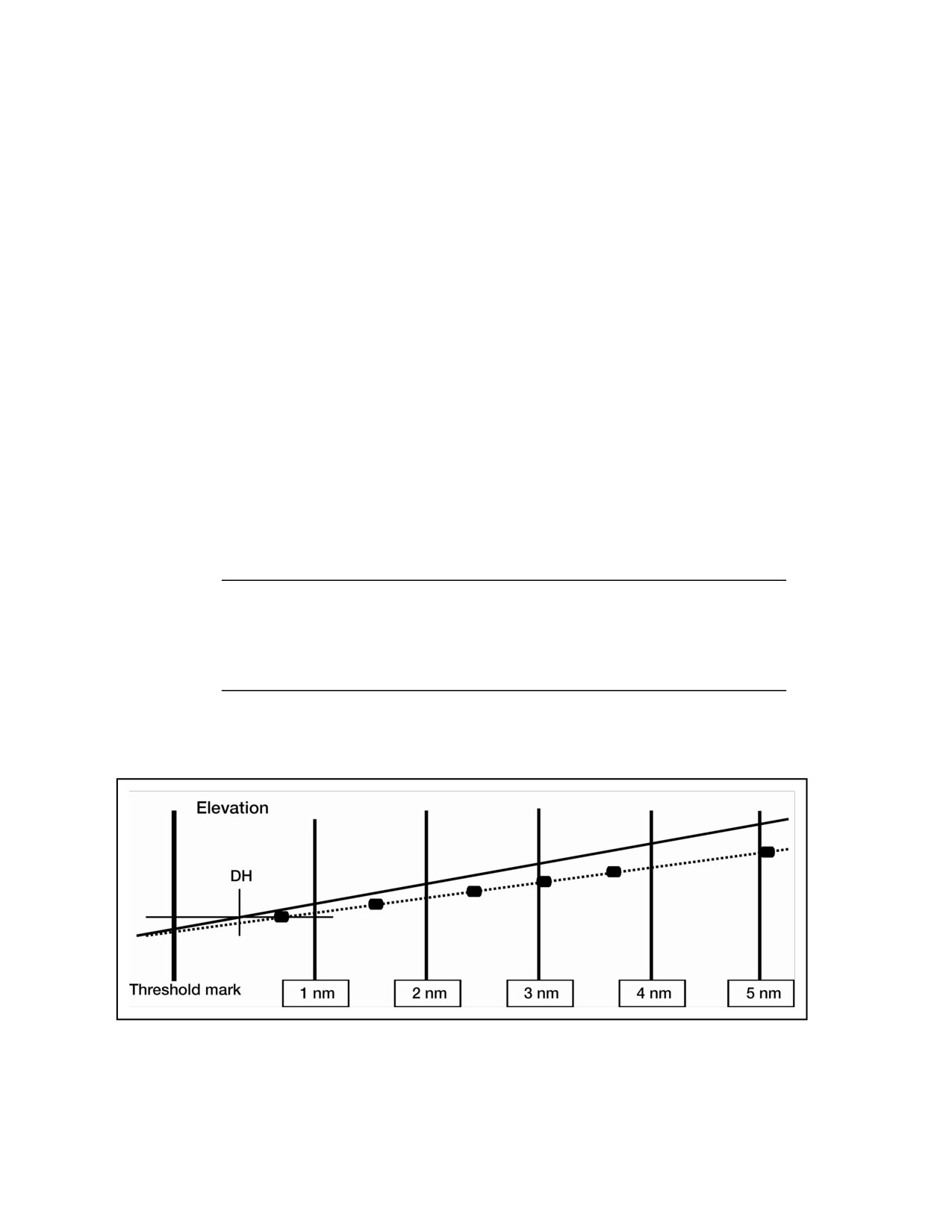
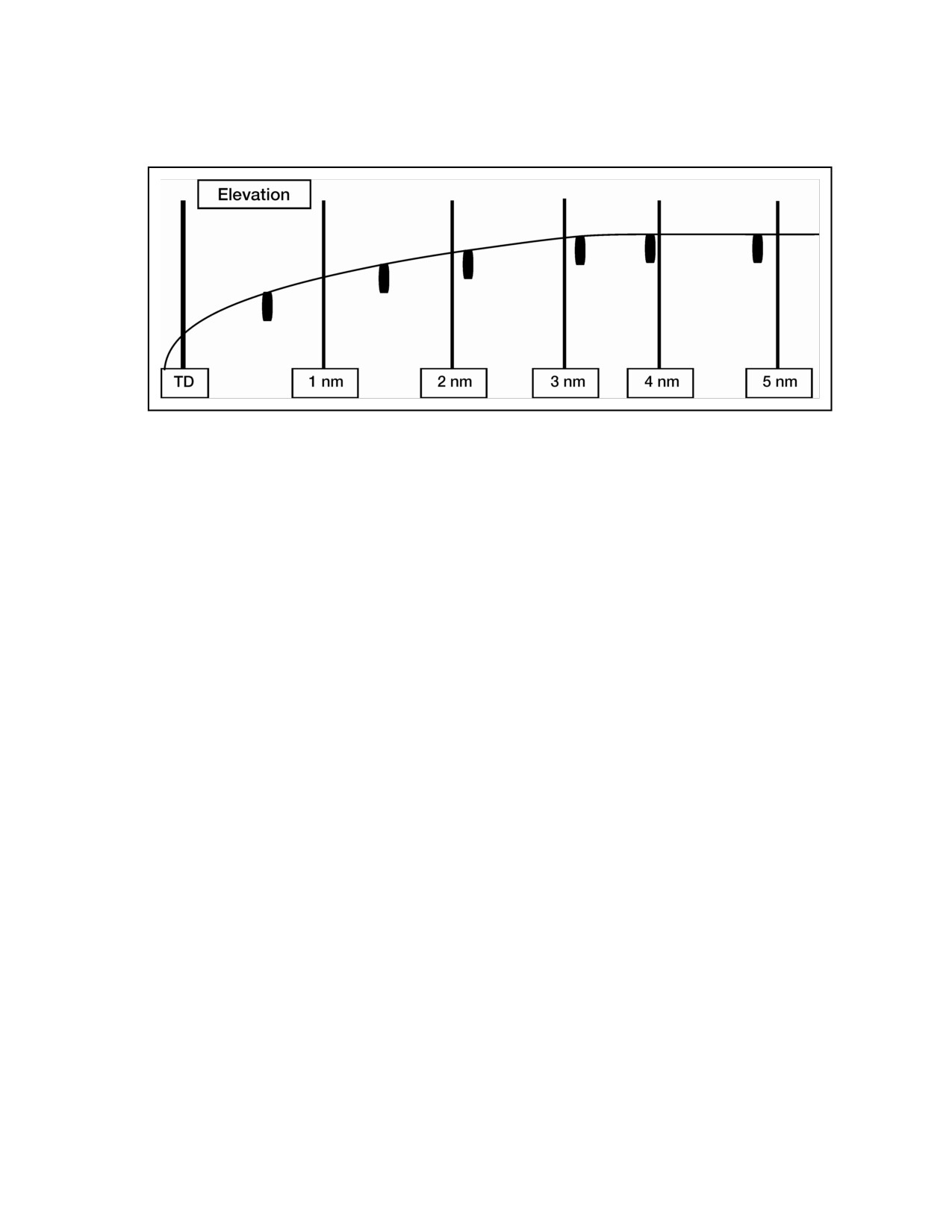
3-27. The second approach will be to check the glide-path angle lower safe
limits (see figures 3-6 and 3-7). The FI pilot will request that the controller
use the “B” cursor for the approach (see figure 3-6). Older analog radar
systems such as the FPN 40/62, TPN-18/18A do not display a “B” cursor. To
execute the lower safe limit approach, use the
“A” cursor to apply the
following procedures using standard phraseology (see figure 3-7).
z Issue descent notification 10 to 30 seconds prior to the top of the
aircraft target touching or an eighth of the target width intercepting
the elevation cursor. The aircraft’s final approach fix or descent point
will have to be adjusted to compensate for this type of approach.
z When the top of the aircraft target touches the elevation cursor, the
aircraft will be considered on-path for the lower safe limits approach
using the “A” cursor (see figure 3-7). Approaches using the “B” cursor
are identical to normal PAR glidepath except for the use of the “B”
cursor and the phraseology “on-path” (see figure 3-6).
z Issue standard course and trend information to maintain the aircraft
on glide path throughout the approach, as described previously.
3-28. FI approaches are normally conducted by the most experienced
controller in a facility. This does not preclude familiarizing all controllers
with FI procedures, terminology, and maneuvers. These procedures are
further outlined in FAAO 8200.1A and shall be incorporated in the facility
training program.
Note: In accordance with FAAO 8200.1, surveillance approaches shall be
evaluated using surveillance type radarscopes. Conducting an ASR approach
on a PAR display is not acceptable for flight inspection purposes. This does
not preclude controllers from exercising the elevation failure procedures of
FAAO 7110.65.
3-29. All radar facility controllers shall receive this training and it will be
annotated in the individual training records as “Radar Safety Limits.”
Figure 3-6. “B” Cursor Lower Safe Limits (on Path)
3-10
________________________________________________
Radar and Flight Following Services
Figure 3-7. “A” Cursor Lower Safe Limits (on Path)
3-30. Flight inspection of deployed radar facilities is determined by the
mission requirements. See appendix G for installation and NAVAID
certification requirements/guidance.
MINIMUM VECTORING ALTITUDE CHARTS
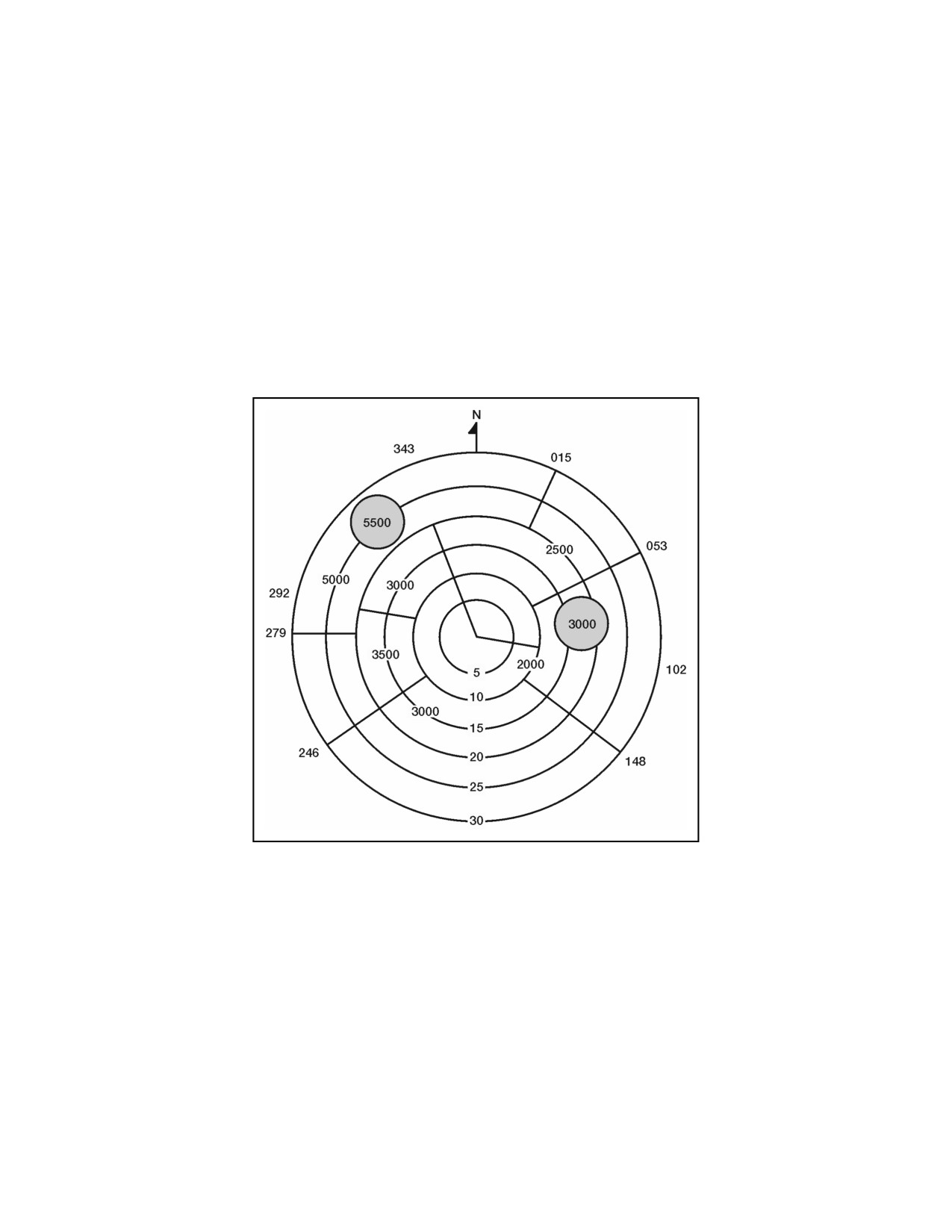
3-31. To provide controllers with minimum IFR altitudes for radar vectoring,
facilities shall prepare MVA charts for all ASR systems. The area covered by
the MVA chart shall be to the maximum primary radar range (installation)
and a minimum of 25 nautical miles (NM) (tactical).
(Appendix G has more
information for tactical operations.) MVA values from adjacent IFR facilities
may be utilized outside a facility delegated airspace/operations area. Facility
chiefs shall determine where the MVA charts are to be displayed, and the
appropriate DARR should be contacted, if assistance is required. Figure 3-8
is a sample of an MVA chart, page 3-12.
3-32. The MVA chart will be drawn on two current sectional aeronautical
charts. The most current obstruction data for updating an aeronautical chart
prior to use is available at the National Imagery and Mapping Agency
(NIMA) Electronic Chart Updating Manual
(ECHUM) site
duplication methods may be used if the information can be reproduced
clearly. The chart will be centered on the location of the radar antenna site
and segmented into areas, as required by the different MVAs. Configuration
of the areas and features shown on the chart will vary with local terrain and
operational considerations. If the following methods apply, whoever prepares
the chart shall
z Depict areas in relationship to magnetic bearings from the antenna
site and radials from very high frequency omnidirectional ranges
(VOR), very high frequency omnidirectional ranges and tactical air
navigation
(VORTAC), tactical air navigation
(TACAN),
nondirectional radio beacons (NDB), or radar display range marks.
z Make area boundaries compatible with map overlay or video map
data to facilitate correlation between vectoring charts and radar
displays.
3-11
FM 3-04.303 (FM 1-303) ______________________________________________________________
z Make each area large enough to accommodate aircraft vectoring. In
some cases, it may be desirable to combine adjoining smaller areas
having different altitudes into a single large area with one altitude.
z Establish area boundaries at least 3 miles from the obstruction that
determines the MVA. If the distance from the antenna is 40 miles or
more, the area boundaries will be at least
5 miles from the
obstruction.
z Enclose an isolated prominent obstruction with a buffer of at least 3
miles to avoid a large area with an excessively high MVA. If the
distance from the antenna is 40 miles or more, the obstruction will be
enclosed with a buffer of at least 5 miles. This facilitates vectoring
around the obstruction.
Figure 3-8. Sample MVA Chart
3-33. The minimum IFR vectoring altitude in each area also shall be
determined. Minimum vectoring altitudes are established despite the flight-
checked radar coverage in the sector concerned. Altitudes are based on
obstruction (manmade or terrain) clearance criteria only, and the controller
must determine if a target return is adequate for control purposes.
3-34. An MVA may be established outside of controlled airspace. If an MVA
is established, this information will be noted on the chart. The minimum-
vectoring altitude on MVA charts must be compatible with vectoring
altitudes established for associated radar instrument approach procedures.
The minimum vectoring altitude in each area will be shown, and the
controlling obstructions will be documented.
3-12
________________________________________________
Radar and Flight Following Services
3-35. The name of the facility will be affixed to both sectional charts, and the
edition and date will be printed on the obstruction documentation of each
MVA chart. MVA charts will be submitted to the appropriate DARR for
review, prior to submission for FAA approval. The DARR will then return
one set of charts to the originating facility. MVA documentation will be
submitted to the DARR using FAA Form 7210-9 (En Route Minimum
IFR/Minimum Vectoring Altitude):
z Have the FAA Form
7210-9 signed by the ATC chief/ATC SR
SGT/PSG.
z Provide two copies of the new current FAA Form 7210-9 and maps.
z Do not use large pens to mark on the charts or labels taped/glued;
this can cover-up obstacles.
z Use the FAA
7210.3, chapter
3, other displays and FAA Order
8260.19, chapter 3, section 7, to prepare the form and document
information on charts. Also, see the back of FAA Form 7210-9 for
additional instructions.
3-36. The ATC chief/ATC SR SGT/PSG/ATC facility chief shall ensure that
MVA charts are reviewed and the necessary changes made at least once
annually to maintain currency and simplicity. They shall obtain FAA
approval through the appropriate DARR for all reviews and revisions.
MINIMUM SAFE ALTITUDE WARNING AND CONFLICT ALERT
3-37. Minimum safe altitude warning (MSAW) is a software function of the
ARTS designed to generate an alert when an associated aircraft with Mode-C
is at, or predicted to be at, an unsafe altitude. MSAW monitors aircraft for
terrain and obstacle separation and will generate an alert, both aural and
visual, on the display of the air traffic controller. MSAW consists of two
detection components, the general terrain map (GTM) and the approach path
monitor (APM). The ATC chief/ATC SR SGT/PSG/ATC facility chief may
temporarily inhibit the MSAW, the approach path monitor portion of the
MSAW, and conflict alert (CA) functions if their continual use would impact
adversely on operational priorities. He is authorized to inhibit CA at specific
operating positions, if advantageous to operations.
3-38. MSAW digital terrain maps shall be kept current. The DARR shall
ensure that FAA regional airspace branches furnish all automated radar
facilities copies of newly received FAA Forms
7460-2 (Notice of Actual
Construction or Alteration). The DARR also shall ensure that all automated
radar facilities receive emergency notices of the erection of structures that
are 200 feet or more above ground level and lie within 60 nautical miles of
the radar site. To keep digital terrain maps (DTM) current, automated radar
facilities also require copies of the National Flight Data Digest (NFDD) that
contain information pertinent to that facility.
3-39. The ATC chief/ATC SR SGT/PSG/ATC facility chief shall ensure that
FAA Forms 7460-2 are reviewed and the appropriate corrections made to the
DTMs. He also shall ensure that the magnetic variation of the facility DTMs
coincides with the magnetic variation of the facility radar video and
geographical maps.
3-40. A DTM is constructed to align with the radar antenna, which has been
offset for magnetic north. Therefore, any change in antenna offset will result
3-13
FM 3-04.303 (FM 1-303) ______________________________________________________________
in a corresponding change in the relative positions of the terrain points and
obstacles used to determine DTM bin-altitude assignments. This will
require, not only generating and verifying a new DTM, but also readapting
the MSAW and CA databases to coincide with the changed declination.
These databases would be, for example, airport areas, inhibit volume areas,
and capture boxes.
MAGNETIC VARIATIONS OF VIDEO, GEOGRAPHICAL, AND MSAW DIGITAL
TERRAIN MAPS
3-41. Permanent echoes are the primary references for verifying radar
antenna alignment. The ATC chief/ATC SR SGT/PSG/ATC facility chief shall
ensure that the magnetic variations of radar video, geographical, and DTMs
coincide.
DIGITAL MAP VERIFICATION
3-42. The accuracy of new or modified digital maps shall be verified by using
targets of opportunity that fly over displayed fixes, navigational aids, and so
forth. Discrepancies shall be documented showing the observed direction and
displacement. If any discrepancy cannot be corrected or, if the results
obtained from targets of opportunity are not satisfactory, the facility may
request a flight check through the DARR.
RADAR BEACONS
3-43. Radar beacon (IFF or selective identification feature [SIF]) decoders
permit controllers to display responses from selected transponder reply codes
in modes 1, 2, and 3. SIF mode 1 and 2 replies are defined by appropriate
command instructions. Controllers shall not instruct an aviator to change to,
or turn off, these modes without specific approval from a responsible
authority.
3-44. When existing beacon equipment does not display emergency returns
without specific actions by the controller, he shall not be required to monitor
radar indicators for emergency display possibilities except
z When advised by an aircraft that an emergency condition exists and
that the airborne equipment is set to provide emergency returns.
z To support emergency situations at the request of an ATC facility or
appropriate agency.
3-45. To obtain the desired display with currently installed equipment,
controllers should
z Select only the radar beacon codes necessary to display radar beacon
replies associated with the controller area of jurisdiction.
z Select the raw/test position to display aircraft equipped with an IFF
radar beacon decoder only.
Note: Replies from beacon-equipped aircraft will appear as undecoded pulse
trains when the equipment is operated in this configuration.
3-14
________________________________________________
Radar and Flight Following Services
3-46. The double-code train displayed by the ID feature is designed to appear
on the indicator for 30 seconds after the pilot releases the switch on the
airborne equipment. A controller shall not instruct a pilot to turn off this
component of the airborne equipment.
3-47. When primary radar is not usable and beacon alignment has been
verified, beacon returns may be used to vector the aircraft to a point with
PAR coverage. This is where the final approach begins. Only primary radar
will be used to conduct PAR approaches. Beacon returns shall not be used to
conduct ASR final approaches unless an emergency exists and the pilot
concurs with their use.
3-48. When it is desirable to do so, beacon targets may be displaced at a
slightly greater range than their respective primary returns. A facility will
issue a directive specifying the standard relationship between primary
returns and the beacon control slash of secondary returns. This directive is
issued whether or not a beacon adjustment is done. The maximum allowable
displacement is one-half mile applied in one-quarter-mile increments.
SECTION II - FLIGHT FOLLOWING
3-49. The procedures in this chapter for flight following and airspace
management are for use in and around cantonment areas, training areas,
and ranges. However, this does not preclude their use in a tactical
environment.
PURPOSE
3-50. Flight following is the observation of the progress of aircraft identified
by radar or by reports at predetermined times or geographic points. The
aviator provides the primary navigation information and the controller
receives and correlates the aircraft identity with the appropriate geographic
position. Flight following also is a service that may be used to provide pilot
briefings and en route communications and to assist aircraft in emergency
situations. In addition, it may be used to issue and relay ATC clearances and
aviation weather information, monitor NAVAIDs, and provide a point-of-
flight watch.
RESPONSIBILITIES
3-51. Installation commanders should review their local airspace
management measures and determine if an Army airspace information
center facility is required for flight safety in their cantonment areas, training
areas, and ranges. When possible, the airspace management concept (A2C2)
described in FM 3-52 should be incorporated at each installation system for
airspace management. To preclude conflict, commanders may need to
establish an A2C2 cell to be responsible for developing procedures for
planning and scheduling airspace use. Installations should take the
following actions to evaluate existing methods of airspace management or to
develop and implement additional airspace/aircraft procedures:
z Determine overall requirements for airspace management training
based on the number of aircraft.
3-15
FM 3-04.303 (FM 1-303) ______________________________________________________________
z
Establish and coordinate an air route system with the installation
plans and training office, Assistant Chief of Staff, G3 (Operations and
Plans), (G3) air, AT&A officer, and other key players in the airspace
management arena.
z
Establish routes to move aircraft to/from/through cantonment areas,
training areas, or ranges.
z
Ensure that routes of flight do not cross/join or have two-way traffic
at the same altitude, or establish procedures to preclude conflict.
z
Ensure the use of a common frequency for aircraft using the same
routes of flight or training areas.
z
Establish adequate reporting points that are easily identifiable and
not located in or near brightly lighted or populated areas.
z
Establish training areas, and subdivide free-play areas for mission
training based on the overall training/airspace requirements, number
of aircraft, and type of training.
z
Number, letter, or name subdivided areas, and depict them on the
installation maps.
z
Schedule free-play training areas in advance for specific unit
training.
z
Establish control procedures that preclude conflict on ingress/egress
routes where chokepoints may exist.
z
Establish separate routes of flight for night vision device (NVD)/nap-
of-the-earth (NOE) training and operations.
z
Ensure that NVD/NOE routes have easily identifiable start and
release points.
z
Establish procedures to preclude the mixing of lighted and unlighted
aircraft.
z
Establish the maximum allowable density for aircraft in each free-
play training area, and specify the data in the installation SOP.
3-52. Airspace information centers, with a staff of qualified ATC personnel,
shall provide communication and control of corridor feeder-route systems,
chokepoints, crossing corridors, and transition areas in cantonment areas,
training areas, and ranges. When required, these facilities provide altitude
or other means of separation. In addition, they shall
z Provide a common frequency.
z Issue advisories that allow pilots to separate their aircraft from other
aircraft and activities or adverse weather that may endanger the
aircraft.
z Monitor the flight progress of all participating aircraft within the
facility area of responsibility.
z Advise other area users of aircraft activity that may impact on, or
conflict with, the mission or activity.
z Provide assistance during emergencies.
z Assist with search and rescue efforts, as needed.
PROCEDURES
3-53. The procedures developed for conducting day-to-day operation of an
airspace information center depend on a number of circumstances. Local
3-16
________________________________________________
Radar and Flight Following Services
requirements govern exact operational procedures. However, the number
and types of operating agencies and the activities in the facility area
influence these procedures. Installations needing assistance in determining
requirements for facility personnel and equipment shall submit a facility
request through their MACOM to ATSCOM. (See AR 95-2 for blank form and
procedures.) The procedures and requirements outlined below establish a
minimum standard and shall apply to all Army airspace information centers.
3-54. Each facility shall have an up-to-date map of its area of responsibility.
Each map shall depict the following areas and routes:
z Explosive ordinance disposal (EOD)/hazardous cargo route.
z Impact areas.
z Firing points.
z Navigational aids.
z Air defense identification zones (ADIZ) and no-fly areas.
z Prominent obstructions.
z
NOE, NVD, and remotely piloted vehicle (RPV) routes.
z Mandatory reporting points.
z Radio and radar blind spots.
z IFR recovery airfields and landing areas.
z Restricted/prohibited areas.
z Aircraft entry and exit points.
z Changeover points.
z Corridors, transition areas, training areas, and ranges.
z The same grid system as other area ATC and search and rescue
facilities.
3-55. The flight progress of participating aircraft shall be monitored, and the
maximum time between position reports shall be 30 minutes. Less time may
be required depending on the type, length, and area of routes such as an NOE
route.
3-56. The facility’s area of responsibility shall be divided into as many
subareas as necessary to simplify recognition and reporting. Each area shall
be lettered, numbered, or named. The boundaries of these subareas, such as
rivers, roads, and power lines, should be easily recognized from the air.
3-57. Procedures shall be developed to ensure the timely receipt and
dissemination of area weather information. Each facility should be
electronically connected to the same weather dissemination equipment as
that in other area ATC facilities.
3-58. Procedures shall be developed between the flight following facility and
other area ATC facilities to ensure that timely control information is passed.
Letters of agreement and operations letters shall establish procedures
concerning hand-offs, control transfers, flight plans, and arrival and
departure times.
3-17
FM 3-04.303 (FM 1-303) ______________________________________________________________
3-59. The facility should have the capability of communicating with other
ATC facilities and agencies that use or operate within the facility area of
responsibility. Standard ATC radio and interphone phraseology shall be used
in all facility communications.
3-60. The facility area and airspace is determined by local, host-nation, post,
camp, or station requirements. The area and airspace may or may not
contain a restricted or prohibited area, overlap, underlay or join another ATC
facility area or airspace. Whether a facility joins another ATC facility area or
airspace is determined by local requirements, equipment, and agreements.
FAAO 7400.2 and FAAO 7610.4 contain additional information on the
procedures for handling airspace matters and special military operations.
3-18
Chapter 4
Facility Equipment
This chapter discusses the ATC facility equipment, equipment checks and
facility maintenance. It includes information on facility ground
inspection, certification, and recertification procedures and the
radar/NAVAID emergency warning
CONTENTS
and evacuation system.
(The
Equipment Layouts
4-1
equipment requirements for an
Facility Ground Inspection,
Army ATC facility and information
Certification, and Recertification
on the basic operating equipment
Procedures
4-3
and suggested equipment layouts
Radar/NAVAID Emergency Warning
for fixed facilities are found in
and Evacuation System (Installation
Facilities Only)
4-5
chapter 8, section IV.)
Navigational Aids
4-11
EQUIPMENT LAYOUTS
4-1. The ATC chief/ATC SR SGT/PSG/ATC facility chief may recommend
changes to the equipment layout of his facility. However, installation
facilities must submit the request for approval of a change, modification, or
alteration to ATC equipment, through command channels, to the
Commander, USAAVNC, ATTN: ATZQ-ATC, Fort Rucker, Alabama 36362-
5265. Tactical units must submit the request for approval of a change,
modification, or alteration to ATC equipment, through command channels, to
the Commander, Communications-Electronics Command
(CECOM),
AMSEL-LC-CCS-A-AT, Fort Monmouth, New Jersey 07703-5000.
EQUIPMENT CHECKS/CHECKLIST
4-2. The ATC chief/ATC SR SGT/PSG/ATC facility chief shall establish a list
of equipment checks to be completed at the beginning of each shift; for
example, FSC-92, radio, light gun, DBRITE, and automatic terminal
information service (ATIS) checks. DA Form 3502-R shall be used to record
the results of equipment checks. Tape recorders may be included in the
equipment checklist. However, they also require additional checks, as shown
in paragraph 4-41 (Recorder Checks and Tape Changes).
4-3. The equipment checklist shall be a locally produced form; the checklist
may be a separate form, or it may be placed on the back of DA Form 3502-R.
This form is not intended to circumvent the Army maintenance system, but
only to serve as a list of equipment that must be checked. Completion of
equipment preventive maintenance checks and services (PMCS) shall be
documented on the appropriate maintenance form according to DA
Pam 738-750 and applicable operator/maintenance manual. The equipment
4-1
FM 3-04.303 (FM 1-303) ______________________________________________________________
checklist shall be completed at the beginning of each shift. Completed
checklists shall be filed with and retained the same as DA Form 3502-R.
4-4. If all equipment is operational, the entry on the form may be limited to
“checklist complete.” If outages occur, the entry must identify those outages,
the name of the agency notified and their operating initials; for example,
“checklist complete; DBRITE and 126.2R OTS MAINT/CB NTFYD.” Equip-
ment outages shall be documented on the appropriate maintenance form
according to DA Pam 738-750 and the applicable operator/maintenance
manual.
4-5. If an operational check of the primary crash alarm system or emergency
frequencies cannot be conducted when a facility begins operation, these
systems shall not be included as items on the equipment checklist. These
systems shall be checked at least once a day and the results entered on DA
Form 3502-R.
(Chapter 8 describes the additional equipment checks and
requirements.)
4-6. On DA Form 3502-R, a capital “E” (equipment) shall be placed in the
time (UTC) column to the left of entries showing equipment out-of-service
time and return-to-service time. The “E” for a specific equipment outage
need not be repeated each day thereafter unless the equipment returns to
service. Examples of these entries are “E 0800, checklist complete, 126.2T
OTS MAINT/CB NTFYD-JO” and “E 0810, 126.2T RTS, radio and recorder
checks complete-JO.”
NOTICES TO AIRMEN
4-7. ATC facilities are responsible for notifying the designated facility or
office of any equipment outage, service curtailment, or airfield activity that
may require a NOTAM. These procedures shall be contained in a
LOA/operations letter.
FACILITY MAINTENANCE
Scheduling
4-8. The maintenance supervisor at each facility or unit shall ensure that
personnel schedule services, inspections, and repairs of ATC equipment
according to AR 750-1, DA Pam 738-750 and the applicable operator/
maintenance manual. Personnel shall coordinate scheduling with the ATC
CHIEF/ATC SR SGT/PSG/ATC facility chief.
Coordination
4-9. The maintenance chief and ATC chief/ATC SR SGT/PSG/ATC facility
chief shall ensure that certified maintenance personnel are available to
perform any phase of the cursor alignment or adjustment requiring the use of
test, measurement, and diagnostic equipment (TMDE). Maintenance of a
NAVAID that services two or more airfields or is a part of the National
Airspace System (NAS) must be coordinated with the ARTCC and other
facilities affected.
Training/Use of Manuals
4-10. The ATC chief/ATC SR SGT/PSG/ATC facility chief shall ensure every
controller is trained to perform operator-level and crew-level unit
maintenance on each equipment system or subsystem. Controllers shall use
4-2
_______________________________________________________________
Facility Equipment
the appropriate technical or commercial manuals to perform this
maintenance.
Certification of Technicians
4-11. Maintenance supervisors at each facility or unit shall ensure that
newly assigned maintenance personnel are certified as ATC maintenance
technicians. The technicians must be certified according to the maintenance
certification program, which is explained in chapter 8.
Note: Until the AN/FSC-92(V) console is replaced, facilities using this
console shall develop/ implement a program to train ATC operators to reboot
the system. This procedure shall be incorporated into the facility training
program and annotated on the controllers’ DA Form 3479-R.
Spare and Repair Parts
4-12. Maintenance personnel shall obtain spare and repair parts to support
the following installation systems from Commander, U.S. Army Aviation
Center, ATTN: ATZQ-ATC, Fort Rucker, Alabama 36362-5265, as outlined in
the current external standing operating procedures:
z AN/FPN-40 radar.
z AN/FRN-41 VOR.
z AN/GRC-171/211 transceivers.
z GRR/GRT receivers/transmitters.
z GRM TTC-8/800.
z AN/FRN-47 distance measuring equipment (DME).
FACILITY GROUND INSPECTION, CERTIFICATION, AND RECERTIFICATION
PROCEDURES
GROUND INSPECTION
4-13. A facility ground inspection shall be conducted to determine if the
facility is operating within, and can be expected to continue operating within,
performance tolerances. The inspection shall consist of collecting and
recording performance data, inspecting the physical condition of the facility,
and reviewing the quality of maintenance procedures. (See chapter 8.)
CERTIFICATION
4-14. When a facility is initially commissioned for use in the National
Airspace System, the maintenance chief shall complete a formal certificate
for facility certification. The chief will forward the certificate (figure 4-1) to
the appropriate FAA office.
RECERTIFICATION
4-15. Facility recertification is conducted the same as initial certification
except that the maintenance chief does not need to send a formal certificate
to the FAA. Recertification shall be accomplished at the intervals specified in
TM 95-225.
4-3
FM 3-04.303 (FM 1-303) ______________________________________________________________
ATC FACILITY CERTIFICATION
The undersigned hereby attests that (name of ATC facility) meets the applicable
performance standards and tolerances in the pertinent technical manuals. Should
this facility subsequently fail to meet applicable ground or flight inspection criteria, the
maintenance chief agrees to issue a NOTAM through (name of FAA facility). In the
latter event and if conflict with other IFR traffic could result, it is understood that
continued use of the facility for military IFR operations will be disapproved by the
FAA.
Signature _______________________
Name __________________________
Title ___________________________
Date ___________________________
Figure 4-1. Certificate for Initial Facility Certification
AUTOMATIC TERMINAL INFORMATION SERVICE (INSTALLATION FACILITIES ONLY)
4-16. ATIS provides advance operational and meteorological information for
terminal areas and noncontrol airports using a controller-prepared tape
recording. This information is repetitively broadcast on a voice outlet for
aircraft arriving or departing an airport or operating within the terminal
area. FAAOs 7110.65 and 7210.3 contain further guidance on ATIS.
CLOCKS
4-17. A reliable clock shall be visible from each operating position in all ATC
facilities. Clocks shall be checked at the beginning of each shift. The results
of time checks shall be logged on DA Form 3502-R. Time checks will be
performed according to FAAO 7210.3. In a tactical environment, ATC
facilities shall obtain a time check from the next higher control facility or
from global positioning system (GPS).
LIGHT GUNS
4-18. ATC light gun color codes and meanings shall be attached to the back
or side of the light guns. Except when they are in actual use, ATC light guns
shall be adjusted to provide a red light when the switch is activated.
CRASH ALARM SYSTEM
4-19. Crash telephone and radio receiver/transmitter keys should be
centrally located so they are readily available to all control positions.
AR 385-95 and AR 420-90 prescribes the policies, procedures, and guidelines
on the primary crash alarm system, secondary crash alarm circuit, and local
crash grid maps.
4-20. The ATC chief/ATC SR SGT/PSG/ATC facility chief shall develop proce-
dures for each position in the event of an aircraft accident/incident. These
procedures shall be published in the facility FTM and separate position
binders.
4-4
_______________________________________________________________
Facility Equipment
RADAR/NAVAID EMERGENCY WARNING AND EVACUATION SYSTEM
(INSTALLATION FACILITIES ONLY)
4-21. Radar/NAVAID facilities close to runways shall be equipped with an
emergency warning and evacuation system to alert personnel working around
or in these facilities to emergency situations. This system should consist of
an aural or a visual alarm or a combination of the two. One or more of the
ATC facilities shall be able to activate the alarm at all times. The ATC
chief/ATC SR SGT and maintenance chief shall develop and publish
evacuation procedures.
DIGITAL BRIGHT RADAR INDICATOR TOWER EQUIPMENT (INSTALLATION FACILITIES
ONLY)
4-22. Some towers are combined with full radar approach control facilities,
and the controllers rotate between the tower and approach control. Under
these conditions, local controllers may use certified DBRITE displays for the
terminal radar function if they can satisfy the FAA air traffic requirements
regarding aircraft operating on runways or in the surface area. The
conditions and limitations for DBRITE usage shall be specified in an LOA.
4-23. Other towers are combined with full radar approach control facilities;
however, the controllers do not rotate between the approach control and the
tower. Under these conditions, local controllers may use certified DBRITE
displays to
z Identify aircraft and their exact location or spatial relationship to
other aircraft.
(This authority does not alter the visual separation
procedures outlined in FAAO 7110.65.)
z Provide radar traffic advisories to aircraft.
z Provide directions or suggested headings to VFR aircraft as a radar
identification method or as an advisory navigational aid.
z Provide information and instructions to aircraft operating in the
surface area.
4-24. When the conditions in the previous paragraph and the following
conditions are present, local controllers may also use certified DBRITE
displays to ensure separation between successive departures, arrivals, and
overflights within the surface area. The additional conditions are if
z Tower has no delegated airspace.
z Radar separation procedures do not require the tower to provide
radar vectors.
z Local controllers have radar training and certification or qualification
commensurate with their radar duties.
z A signed copy of the LOA was submitted to the DARR.
Note: The LOA must authorize the specific function and prescribe the
procedures to be used. It must also prescribe the process for a transition to
nonradar procedures or the suspension of separation authority in case of a
radar outage.
4-5
FM 3-04.303 (FM 1-303) ______________________________________________________________
4-25. The procedures for giving and receiving radar handoffs or pointouts do
not impair the local controller’s ability to satisfy FAA and Army ATC
requirements for aircraft operation on runways or within the surface area.
4-26. The tower facility may be delegated the responsibility for providing the
services outlined in the previous paragraphs. In flight-following facilities,
DBRITE will provide traffic advisories and VFR radar services.
4-27. The DBRITE is IFR-certifiable; at select GCA locations, it will serve as
the surveillance radar.
TELEPHONE LINES
4-28. When possible, all noncommercial telephone lines to installation ATC
facilities shall terminate in the communications console key system installed
in the facility. Commercial telephones should be provided on separate
instruments. When this is not possible and commercial telephones are
recorded, a beeper tone is required.
4-29. Direct telephone lines are required between ATC facilities. Their use
shall be restricted to the relay of essential command and control instructions
and advisories. Calls on direct telephone lines are handled secondarily to the
primary function of ATC services. The lines should not be used to relay
information such as departure or arrival times and load messages that can be
handled by other means. If either a command post or an ATC facility
requires immediate priority over the other, it shall on initial contact state,
“Stand by for emergency instructions.” These occurrences shall be entered on
DA Form 3502-R.
4-30. Direct telephone lines are required between adjacent ATC facilities and
area ATC centers. Such elements as the fire station, crash and rescue team,
flight operations, weather station, military police, and hospital are also
authorized direct telephone lines.
RADIO EQUIPMENT
4-31. ATC facilities are required radio transmitters and receivers according
to chapter 8. ATC facilities are also authorized to join radio nets with the
crash and rescue team, airfield services, weather station, fire station,
ambulance service, and security agency. To the extent possible, these radios
will terminate within the communications console.
4-32. During the hours of operation, ATC facilities shall continuously
monitor all assigned radio frequencies. Facilities that share radios shall
establish procedures to ensure that one of the facilities continuously monitors
these frequencies.
4-33. All ATC facilities should have a transmit-receive capability on
emergency frequencies 121.5 megahertz (MHz) and 243.0 MHz. When ATC
facilities are close, they shall share transmitters and receivers if services will
not be degraded. If transmitters and receivers are shared, geographical area
coverage shall not be reduced. In addition, transmitters will be equipped
with lockout devices to avoid inadvertent interference between facilities.
4-34. The two emergency frequencies shall not be terminated on the same
transmit-receive key selector of any other frequency. When a remote
communications console is provided to a non-ATC facility at an airfield that
4-6
_______________________________________________________________
Facility Equipment
has an ATC facility, only the emergency receiver shall be provided. ATC
facilities without an emergency frequency capability shall have appropriate
telephone lines for relaying emergency information.
4-35. As a minimum, two-way transmitter and receiver checks shall be
conducted daily on all radio frequencies. These checks shall also be
conducted following tape recorder and other equipment repairs and normal
preventive maintenance.
SEARCH AND RESCUE SATELLITE-AIDED TRACKING (SARSAT)
4-36. The search and rescue satellite is a system of international satellites
used for monitoring emergency frequencies
121.5 MHz,
243.0 MHz and
406 MHz. Any transmission over 30 seconds long on these frequencies
(instantaneously on 406 MHz) causes an international search and rescue
satellite to activate the SARSAT ground-processing center. This puts rescue
operations into action. Unintentional keying of these frequencies has caused
a number of false alarms. Maintenance checks of these frequencies shall be
keyed into dummy loads. The operational checks shall not exceed 15 seconds.
RECORDERS
4-37. Installation ATC facilities shall have recorders and shall record all ATC
communications by position. All tactical facilities and/or systems equipped
with recorders shall adhere to these procedures. In addition, the facilities
may share recorders, when feasible (tower/GCA, ARAC/flight following).
Note: The digital voice recorder system (DVRS) has an internal global
positioning system time source. It is not necessary to reserve a separate
recording channel for “time.”
Position-Recording Channels
4-38. Except as shown in the following paragraph 4-39 (Radio transmit-
receive frequencies), the facility shall record relative to position rather than
frequency. Recording channels shall be assigned to positions in the following
order:
z Precision approach radar.
z Arrival control.
z Approach control.
z Departure control.
z Local control.
z Flight data (tower).
z Flight-following control.
z Clearance delivery.
z Ground control.
z Flight data (radar).
z Flight-following data.
z Coordinator.
z Supervisor.
z Automatic terminal information service.
4-7
FM 3-04.303 (FM 1-303) ______________________________________________________________
Note: When a channel is not available to record on the ATIS, the message
will be recorded once at an operating position.
Radio Transmit-Receive Frequencies
4-39. After requirements in the previous paragraph are met, the remaining
spare channels may be used for channel clearing and for recording the
primary radio transmit-receive frequencies. The frequencies are recorded in
the following order:
z Very high frequency
(VHF) and ultra high frequency
(UHF)
emergency.
z Primary crash net.
z Approach control (radar or nonradar).
z Departure control.
z Local control.
z Ground control.
z Pilot to metro service.
Newly Established Positions
4-40. A facility may implement additional operating positions. If additional
operating positions are implemented, recorder channels assigned to functions
in the previous paragraph shall be released in reverse priority to record these
new positions. The desirability of recording individual frequencies shall not
justify acquiring additional recorders to record by frequency. Instead, unused
recorder channels should be assigned to the applicable functions. When a
facility is equipped with more than one recorder, the ATC chief/ATC SR
SGT/PSG/ATC facility chief shall determine which one to use in recording the
previously (Radio transmit-receive frequencies) listed frequencies, positions,
and services. The ATC chief/ATC SR SGT/PSG/ATC facility chief also
determines the priority in which they are recorded or released.
Recorder Checks and Tape Changes
4-41. The ATC chief/ATC SR SGT/PSG/ATC facility chief shall determine if
their local situation would be better suited for a daily, twice weekly, or
weekly changing of the recorded media. At a minimum, the recorded media
will be changed weekly.
4-42. A facility memorandum, operations letter, or letter of agreement shall
be developed outlining the procedures for changing, marking, loading, and
securing recorded media, and for controller/maintenance responsibilities. If
the DVRS is not convenient to operating areas, the ATC chief/ATC SR
SGT/PSG/ATC facility chief and the responsible maintenance chief shall
develop a written agreement assigning this responsibility. It is imperative
that all controllers and maintenance personnel are properly trained to check
the recorders, change the recorded media, and perform PMCS. This training
will be noted in the training records.
z The controllers monitor the quality of recordings. At the beginning of
each shift, the SL or CIC shall ensure that all recording channels are
operating properly.
4-8
_______________________________________________________________
Facility Equipment
z The ATC chief/ATC SR SGT/PSG/ATC facility chief and the
maintenance chief shall establish written procedures to ensure that
the recording quality is checked after all radio, recorder, or telephone
equipment maintenance. These checks shall be noted on DA
Form 3502-R. At dual facilities, the ATC chief/PSG may appoint one
facility to make all tape changes and recorder checks. However, the
results of tape changes and recorder checks shall be noted on DA
Form 3502-R for each facility.
Tape Recorder Labels
4-43. An ID number shall be assigned/attached to each recorded media. At
the beginning of each day, the number of the recorded media will be entered
on DA Form 3502-R. If it is necessary to change the recorded media during
the shift, the reason for the change, the number of the recorded media
removed, and the number of the recorded media started shall be entered on
DA Form 3502-R. The individual changing the recorded media shall
annotate the date/time/initials on the recorded media log before storing the
cartridge.
Tape Recording Accountability
4-44. The ATC chief/ATC SR SGT/PSG/ATC facility chief has custodial
responsibility for tape recordings made on equipment furnished or
maintained by the Army. When another service or agency has custodial
responsibility for the recorder tapes, an LOA shall be initiated to specify
access and retention policies and procedures.
Tape Recording Maintenance
4-45. The recorded media containing normal day-to-day operations shall be
retained for a minimum of 15 days from day of last recorded material. The
recorded media can then be erased, but only by using the procedures outlined
in the DVRS operator’s manual.
4-46. Recorded media containing information on emergencies, or alleged
violations, shall be retained for
30 days. If the facility has a DVRS
reproducer, or if an alternate means is available, the recorded media can be
transferred to a regular cassette and will be retained for 30 days. Tapes shall
be identified and certified as outlined in figure 4-2. At the end of 30 days, if
no verbal or written request for these recordings has been received, they can
be erased and reused as necessary. However, if a request is received within
30 days, the recordings shall be handled the same as a recording concerning
an accident.
4-47. Recordings containing accident information shall be retained for a
minimum of six months. They shall be extracted from the DVRS as soon as
possible and identified and certified as outlined in figure 4-2. If recordings
are not requested within six months, the tapes can be erased and reused as
necessary. An exception to this policy is that all recordings pertaining to a
hijacking will be retained for three years.
4-48. Recorded tapes are sometimes made part of an accident or incident
investigation file. The only parts of recordings that must be retained are
those that contain conversation during the time of the accident or incident
and the initial and terminal overrun of five minutes of the running time of
the accident/incident. Procedures for retaining this time period are outlined
4-9
FM 3-04.303 (FM 1-303) ______________________________________________________________
in the DVRS operator’s manual. It will provide for a direct electronic
connection between the recording medium (the DVRS hard disk) and the
target recorded media.
I certify that this is the original recording made in
(facility)
containing
all conversation on
(position) at
(channel) pertaining to
(accident or emergency)
(aircraft ID) on
(date) .
Signature ________________________
Name ___________________________
Grade ___________________________
Title
____________________________
Date ____________________________
Figure 4-2. Certification of Tapes Containing Accident Data
4-49. When re-recorded tapes/transcripts are certified, they become official
records and shall be retained according to AR 25-400-2 and this manual. The
re-recordings are treated the same as original tapes or records. If written
authorization is received from the airfield commander or investigating team,
re-recorded or transcribed tapes may be returned to service immediately. If
written authorization is not received, the tape will be retained for six months.
Transcript Preparation
4-50. Each transcript will be prepared according to appendix E; each
transcript will include the following information:
z Subject.
z Identity of the recording facility.
z List of facilities making transmissions and, as used in the body of the
transcript, abbreviations for each.
z Frequency, landline, or position recorded.
z Date and time covered by the transcript.
z Certification.
Marking Completed Transcripts
4-51. The completed transcript will be marked “FOR OFFICIAL USE ONLY
(SPECIAL HANDLING REQUIRED).” AR 25-55 contains more information
on releasing records from Army files.
Abbreviations for ATC Facilities
4-52. ATC facilities included in the transcription shall be abbreviated by
using the appropriate location designator followed by ARTCC, tower (TWR),
ARAC, GCA, corps airspace information center (C-AIC), division airspace
information center
(D-AIC), or AIC. Aircraft may be identified by an
abbreviated call sign when confusion will not result.
4-10
_______________________________________________________________
Facility Equipment
Format for Typed Transcription
4-53. A typed transcription will have the following format:
z Precede each transcription with the identity of the transmitting
station. When the station is unknown, use UNK.
z Single-space the body of the transcription.
z Double-space between contacts to separate them.
z Show breaks in continuity of contact, such as garble, by using a series
of asterisks; otherwise, the transcription shall be verbatim.
z Make time entries to the nearest second preceding each transmission
when time-code generator systems are installed. These entries will
be at approximately one-minute intervals in the body of the
transcript.
z Certify the transcription as shown in figure 4-3.
As custodian of the original recording, I hereby certify this to be a true and exact
(copy/transcript) thereof.
Signature _________________________
Name ____________________________
Grade____________________________
Title _____________________________
Date _____________________________
Figure 4-3. Certification of Transcription
4-54. When copies of written records are required, certify each copy as shown
in figure 4-4.
I hereby certify this to be a true and exact copy of the original record on file at this
office.
Signature _________________________
Name ____________________________
Grade____________________________
Title _____________________________
Date _____________________________
Figure 4-4. Certification of Copies of Written Records
NAVIGATIONAL AIDS
4-55. All NAVAIDs must pass an FAA flight check inspection before IFR
operations are conducted. The procedures contained in TM 95-226 shall be
used to construct a precision or non-precision approach that will service the
4-11
FM 3-04.303 (FM 1-303) ______________________________________________________________
terminal area. The en route criteria shall be established by the ACA. Critical
information about tactical approach procedures at instrumented heliports
and airfields must be developed by the sector responsible for the approach.
This information must then be disseminated to the aviation units,
C-AIC/D-AIC, and the appropriate A2C2 elements for inclusion in the airspace
control order (ACO). The Tactical Approach Publications System (TAPS) form
is the primary method of accomplishing this. The following actions shall be
accomplished to prepare for a flight check:
z Ensure that all personnel are familiar with TM 95-225.
z Provide accurate facility data for new or relocated facilities.
z
(Tactical only) Ensure a TERPS/TAPS package is complete and
provide the approved packet to flight-check personnel.
z Develop an LOA concerning the airspace used for the approach
procedure.
z Assign the best-qualified controller available.
z Establish communications on a single dedicated frequency.
z Ensure that all facility equipment is calibrated in accordance with
applicable manuals.
z Ensure personnel will be available to make corrections and
adjustments.
z Provide transportation to move flight inspection equipment and
personnel.
4-56. The approach control facility normally is designated the primary
NAVAID monitoring facility. At locations without an approach control, the
tower is designated the primary NAVAID monitoring facility.
z
Monitors.
Some ATC facilities do not operate continuously. If the NAVAID
is to remain on the air continuously, another facility or agency
shall be assigned monitoring responsibility. This facility or
agency shall also provide continuous manning and respond
quickly to the call for maintenance personnel. In addition, it shall
establish procedures in a LOA or operations letter concerning
equipment outages and submission of notices to airmen.
Monitors that do not provide an automatic visual or aural alarm
shall be checked at least once an hour. When an ATC facility is
responsible for monitoring NAVAIDs, the facility chief shall
include monitoring instructions in the FTM. If a NAVAID
monitor alarm is received, the ID feature shall be checked aurally
and the responsible maintenance authority notified immediately.
If the alarm cannot be silenced and the ID feature cannot be
heard, the NAVAID is considered inoperative.
If personnel suspect that a control line or monitor failure rather
than a malfunction of the NAVAID causes an alarm, they must
take the appropriate action per FAAO 7110.65. If a malfunction
is confirmed, use of the NAVAID shall be discontinued. A
NOTAM shall be published showing NAVAIDs with inoperative
monitors as unmonitored. A Department of Defense (DOD) FLIP,
en route supplement, and IFR supplement will also show those
NAVAIDs without installed monitors as unmonitored.
4-12
_______________________________________________________________
Facility Equipment
z Interruptions and malfunctions.
The ATC chief/ATC SR SGT/PSG/ATC facility chief establishes
procedures for reporting interruptions to NAVAIDs and
malfunctions in communications and radar equipment. He
ensures the timely response of maintenance personnel to a report
of an interruption or a malfunction.
The on-duty SL or CIC shall report any known or reported
malfunction in equipment or interruption to a NAVAID to the
appropriate office; for example, maintenance personnel, ARTCC,
approach control facility, and any other facility that may be
affected. He then reports the malfunction or interruption to the
airfield commander.
WIND INDICATOR EQUIPMENT
4-57. Normally, each AAF or Army heliport (AHP) has only one wind-sensing
unit and all ATC facilities use the same unit. These wind indicators should
be located at the landing and takeoff area. Because of terrain, distance, local
operational requirements, equipment and facility upgrades, and mobile
facilities, wind equipment may be located at various sites on the airfield.
Readout values derived from transmitters not located at the landing and
takeoff area shall be used as an aid to determine estimated wind conditions.
Controllers can determine estimated wind after comparing readout values
from transmitters and windsocks and from visual observations of the landing
and takeoff area. Estimated wind values transmitted to other facilities and
to pilots shall be reported as wind estimated
(for example,
“WIND
ESTIMATED TWO ONE ZERO AT FIVE”).
ALTIMETERS
Setting Comparisons
4-58. At the beginning of each shift, an ATC facility providing air traffic
service shall compare the official altimeter setting with its instrument
setting. Any difference shall be posted next to the face of the instrument and
recorded on DA Form 3502-R. The correction factor shall be applied to the
reading obtained from the facility instrument before the altimeter setting is
transmitted to a pilot or another facility. Use of the facility instrument shall
be discontinued at
z Non-precision approach locations when the correction factor exceeds
±0.05-inch of mercury.
z Precision approach locations when the correction factor exceeds
±0.02-inch of mercury.
Obtaining Official Altimeter Settings
4-59. Altimeter-setting indicators inspected and calibrated according to AWS
guidance may be used to obtain the official altimeter setting at locations that
have no local weather service support. At facilities with no weather reporting
station and only one altimeter device, the altimeter setting may be compared
with values obtained from adjacent weather stations if at locations where
z Precision ILS or PAR approaches are conducted, the distance to the
weather station is not more than 10 nautical miles and the wind
speed is 25 knots or less.
4-13
FM 3-04.303 (FM 1-303) ______________________________________________________________
z Non-precision approaches are conducted, the distance to the weather
station is not more than 25 nautical miles and the wind speed is
30 knots or less.
Altimeter Settings Not Compared
4-60. When weather conditions indicate the probability of a steep pressure
gradient between the two locations or the elevation difference exceeds
1,000 feet, altimeter settings are not compared. At locations that do not meet
the 10- and 25-nautical mile limitations, a mercurial barometer or altimeter-
setting indicator is required to make comparisons.
Tactical Altimeter-Setting Indicators
4-61. Tactical ATC facilities not equipped with calibrated altimeter-setting
indicators shall obtain settings from supporting Air Force weather teams.
Estimated Settings
4-62. Air traffic controllers shall issue an altimeter setting as estimated
according to FAAO 7110.65. They shall issue the setting as missing if it is
not available.
EGRESS SYSTEMS (INSTALLATION FACILITIES ONLY)
4-63. All control towers shall comply with the egress requirements of the Life
Safety Code in National Fire Safety Code 101. Local or host-nation safety and
fire professionals shall evaluate compliance with the code. Documentation of
evaluations shall be maintained as a permanent facility record. If host-
nation requirements apply, they must be met even if they are more stringent.
4-64. Some towers must have an egress system besides the normal means of
entering and exiting. These towers shall obtain and install a system that
safety and fire professionals determine is satisfactory. The preferred
alternate egress system is an exterior ladder that complies with the safety
requirements for fixed ladders published in the American National Standards
Institute Regulation A14.3.
NIGHT VISION DEVICES
NVD Training
4-65. At locations where NVDs are required, controllers shall be trained in
the operational use of NVDs. Until NVDs are available to table(s) of
distribution and allowances
(TDA)/table of organization and equipment
(TOE) ATC personnel, they should be obtained through coordination with the
aviation unit requiring the training. All NVD training shall be entered on
DA Form 3479-R, section III. The NVDs shall not be worn by controllers but
used as binoculars during night vision operations. ATC facilities or units
using NVDs shall establish a training program that includes, as a minimum,
the instruction given below.
NVD Operation and Care
4-66. Orientation and briefing on NVD operation and care consists of a class
on the characteristics, function, and maintenance of NVDs in accordance with
the applicable technical manuals (TMs), to include the
z Removal of NVDs from the receptacle, ensuring pressure is released.
z Removal of the front lens covers.
4-14
_______________________________________________________________
Facility Equipment
z Insertion of the battery.
z Adjustments of short gauge for flight data and adjustments of infinite
for local and ground control.
Preparation of the Control Tower
4-67. This instruction includes
z Use of minimum lighting.
z Covering the console to prevent reflection.
z Enforcing the no-smoking policy.
z Use of NVDs for no more than two hours without a break.
z Limit on the number of personnel in the tower.
Hands-On Training
4-68. This consists of an orientation after dark, to include
z Instruction on distinguishing prominent terrain and other objects in
the area.
z Unimpaired vision of traffic areas.
z Adjustment of devices, as required.
z Distinguishing an aircraft with minimum lighting.
z Difference between participating and nonparticipating aircraft.
z Strict observation of aircraft at all times.
z Control of airfield and landing area lighting.
Visual Contact Loss
4-69. To reestablish contact, the controller must
z Know the altitude of the aircraft.
z Request aircraft position reports.
z Use known landmarks.
z Have the observation confirmed by another controller.
NVD Procedures
4-70. To establish local NVD procedures, the ATC chief/ATC SR SGT/
PSG/ATC facility chief shall coordinate with the airfield commander or the
senior field aviation commander supported. These procedures should
include
z NVD routes.
z Traffic density.
z Airfield lighting.
z Hours of operation.
z Traffic restrictions.
z Emergency procedures.
z Weather requirements.
z Nonparticipating traffic.
z Aircraft lighting (lights out or dim mode).
4-15
FM 3-04.303 (FM 1-303) ______________________________________________________________
z Publication of a NOTAM, if required. Air traffic controllers shall be
familiar with any exemptions or waivers, which may grant relief to
the requirement of CFR 14, Part 91.209 concerning aircraft lighting
requirements.
Traffic Patterns, Runways, or Landing Areas
4-71. Besides the above procedures, the ATC chief/ATC SR SGT/PSG/ATC
facility chief shall ensure that both lighted and unlighted aircraft do not use
the same traffic pattern, runway, or landing area. The chief shall also ensure
that a NOTAM is published if the rotating beacon is to be turned off. If the
glare from facility windows or other lights makes it difficult for the
controllers to see and separate NVD traffic, the airfield commander or
aviation commander shall be advised that positive control cannot be
provided. Provisions for advising the commander shall be included in an
LOA with the user.
Note: During aircraft NVD training when aircraft and airfield lighting
systems are turned off, controllers are required to use NVDs.
4-16
Chapter 5
Reference Material
This chapter discusses the procedures used to maintain reference
materials at each facility.
It
CONTENTS
includes information on types of
Section I - Reference Files, Charts,
files,
charts, diagrams, maps,
Diagrams, and Maps
5-1
administrative correspondence, and
Facility Reference File
5-2
operating records and forms.
Controller Reference File
5-2
Recent Information File
5-2
Operating Position Files
5-2
SECTION I - REFERENCE FILES,
Charts, Diagrams, and Maps
5-3
CHARTS, DIAGRAMS, AND MAPS
Section II - Administrative
Correspondence
5-4
Letters of Agreement
5-4
5-1. The ATC chief/ATC SR
Letters of Procedure
5-7
SGT/PSG/ATC facility chief
Operations Letters
5-10
shall maintain a current
Facility Memorandums
5-11
set of facility directives,
Section III - Operating Records and
letters
of
agreement
Forms
5-12
(LOAs), FAA
handbooks
Operational Hazard Report
5-12
and orders, Army regula-
Training and Proficiency Record-Air
tions, field manuals, tech-
Traffic Controller and
nical
manuals,
AIG
Trainee/Controller Evaluation
5-13
messages, and facility
ATC Facility Personnel Status Report .. 5-13
training manuals.
All
Tactical Approach Publications System5-18
references shall be immedi-
ATC Maintenance Personnel Certification
ately available to facility
and Related Training Record
5-19
Records Review and Retention
5-22
personnel for operations,
Contests and Appeals
5-22
reference, training, and
GCA Operations Log
5-22
study. Appendix B lists the
Daily Report of Air Traffic Control Facility 5-26
publications that are basic
Air Traffic Control Position Log
5-27
to ATC facility operations
Flight Progress Strips
5-28
and training. The ATC
chief/ATC SR SGT/PSG/
ATC facility chief shall
determine if additional publications are required to support operational or
training needs. Reference material shall be arranged in loose-leaf binders,
labeled in accordance with AR 25-400-2, and kept in a bookcase, rack, or
other suitable container. Required reference materials may be maintained on
computer recorded media (such as, hard drive, CD, zip drive, floppy disk)
provided that controllers and maintainers have immediate access to the
current material. However, the recent information and operating position
files, charts, diagrams, and maps will not be maintained on recorded media.
Media will be listed, labeled, and stored in accordance with AR 25-400-2. The
5-1
FM 3-04.303 (FM 1-303) ______________________________________________________________
ATC chief/ATC SR SGT/PSG/ATC facility chief will ensure that the
publication quantity requirements of this FM and AR 95-2, table 12-1, and
figures 12-1 through 12-3 are met in a paper, recorded media, or combined
format. Internet/intranet links to required reference materials are not
authorized.
FACILITY REFERENCE FILE
5-2. The ATC chief/ATC SR SGT/PSG/ATC facility chief shall establish and
maintain a complete reference file of the written material required for facility
operations. This file shall be maintained in the ATC chief/ATC SR
SGT/PSG/ATC facility chief's office.
5-3. As a minimum, the facility reference file shall include the publications
listed in appendix B. This file should also contain copies of FTMs, SOPs,
operating manuals, and other materials of value to controllers and facility
operations. At dual ATC facilities (TWR and GCA), one facility reference file
may be used by both facilities. However, separate files may be justified
because of the geographic separation of the facilities or the large number of
controllers.
CONTROLLER REFERENCE FILE
5-4. The publications listed in appendix B are required to support daily
operations; they shall be readily available to controllers in facility operating
positions. Dual ATC facilities shall maintain separate controller reference
files. The facility reference file may also serve as the controller reference file
(installation facilities only) when the ATC chief/ATC SR SGT/PSG/ATC
facility chief's office and facility operations are located in the same room.
RECENT INFORMATION FILE
5-5. The ATC chief/ATC SR SGT/PSG/ATC facility chief shall maintain an
information file in a folder, binder, or clipboard. The file shall be used to post
shift schedules and new information about facility operations. This file is
temporary. Items are removed and filed in accordance with AR 25-400-2
after all personnel have initialed the document. It shall be readily available
to controllers in facility operating positions. Each controller shall read and
initial new directives, changes, or other materials before assuming a control
position. Items may be removed from the file when all controllers have
initialed them.
OPERATING POSITION FILES
5-6. Each facility will maintain operating position files in a loose-leaf binder
or some other suitable display file. These files shall be available for each
operating position so all controllers have an immediate source for confirming
data or obtaining information. To determine what to include in the files, the
ATC chief/ATC SR SGT/PSG/ATC facility chief must decide what material
applies to each position.
5-7. All local procedures and instruction handbook materials pertaining to a
certain operating position will be identified, defined, and maintained. For
example, an arrival control position file should include LOAs, operations
5-2
_______________________________________________________________
Reference Material
letters, memorandums, and other documents pertaining to arrival control
procedures.
5-8. Mandatory items for operating position files include
z Instructions dealing with airfield emergencies
(such as in-flight/
ground emergencies, hijacking, bomb threats, facility evacuation, and
position-specific responsibilities).
z A list of suitable airports, as determined by the facility chief, showing
runways, type of surface lighting, and distance and bearing from the
facility.
5-9. Suggested items for operating position files include
z Instrument departure procedure diagrams.
z Photographs or exact depictions of a radarscope adjusted to optimum.
z Extracts from LOAs, LOPs, operations letters, and facility
memorandums.
z A photograph or exact depiction of a video map superimposed over
radar-ground returns to aid in determining the accuracy of the scope
alignment.
CHARTS, DIAGRAMS, AND MAPS
5-10. Each ATC facility, control tower, radar facility, and flight-following
facility shall maintain certain charts, diagrams, and maps for reference. The
requirements for these materials are given below.
z
ATC facility. Each ATC facility shall maintain current crash grid
maps, sunrise and sunset tables, and flight information publications.
z
Control tower. Each control tower shall develop and maintain the
following diagrams and charts:
Airfield diagram. The airfield diagram shall depict runways,
ramps, blind spots, ILS-critical areas, helipads, wind
equipment, and RT groups. The ATC facility chief shall
review the chart annually and post the date of review to the
chart.
Intersection-takeoff diagram.
The intersection-takeoff
diagram shall depict distances remaining rounded down to
the nearest 50 feet.
(for example, 4,075 would be rounded
down to 4,050 and 10,045, to 10,000.) The intersection-take-
off diagram maybe incorporated into the airfield diagram
provided no information is omitted and the diagram remains
legible.
z
Visibility Charts—
Installation. The ATC facility chief and weather support
personnel shall prepare a chart of day and night visibility
markers. They may use panoramic photographs marked with
distances and cardinal compass points. Each marker shall be
identified and its distance from the tower noted. The height
of the marker also shall be noted if used for estimating
heights of clouds and obscuring phenomena. The ATC facility
chief and weather personnel will review these charts
5-3
FM 3-04.303 (FM 1-303) ______________________________________________________________
annually; both personnel conducting the review will annotate
their name and the date on the chart.
Tactical tower. Tower facilities shall prepare a generic
visibility chart for use on deployments. Once the field site is
established, the PSG/ATC facility chief shall coordinate with
weather personnel to establish usable visibility markers.
Once approved, the date will be posted on the chart.
z Radar facility. Each radar facility shall keep a runway diagram of
each airfield it services and a map of the facility's jurisdiction area.
The map shall depict airfields, NAVAIDs, Class D airspace, area and
section boundaries, MOA restricted and prohibited areas, airways,
and prominent objects. The facility shall also maintain a video map,
if the capability exists, and an MVA chart. Chapter 3 contains details
about video maps and MVA charts.
z Flight-following facility. Each flight-following facility shall keep an
up-to-date map of its area of responsibility. Chapter 3 contains
additional information about flight-following procedures.
SECTION II - ADMINISTRATIVE CORRESPONDENCE
5-11. The ATC facility shall maintain a file of administrative correspondence.
This correspondence should include LOAs, LOPs, operations letters, and
facility memorandums.
LETTERS OF AGREEMENT
5-12. LOAs may apply to a specific facility, a group of facilities, or all
facilities within a designated geographical area. LOAs are prepared between
the U.S. Army and other services or a host nation. They are also prepared
between centers and towers, centers and terminal radar facilities, or ATC
facilities located on the same or different airfields. The ATC chief/ATC SR
SGT/PSG/ATC facility chief shall prepare LOAs to
z Delegate areas of control jurisdiction and the conditions of use.
z Define special operating conditions or specific ATC procedures.
z Define interfacility or interagency responsibilities and coordination
requirements.
z Describe procedures or minima that deviate from or is not contained
in, FAAO 7110.65, this manual, or other pertinent directives.
5-13. The ATC chief/ATC SR SGT/PSG/ATC facility chief responsible for
developing an LOA shall
z Confine the material in each LOA to a single subject or purpose.
z Ensure that the LOA is properly prepared.
z Describe the responsibilities and procedures that apply to each
facility and organization involved.
z Attach charts or other visual presentations, as appropriate, to depict
the conditions of the agreement.
z Delegate responsibility for air traffic control. He shall describe the
area in which the responsibility is delegated and define the conditions
5-4
_______________________________________________________________
Reference Material
governing the use of that area. He shall also specify and explain the
control, communications, and coordination procedures.
z Coordinate the LOAs with the appropriate facilities, agencies, and
authorities.
z Coordinate and forward all proposed LOA to the appropriate
USAASD-E/EUSA/DARR before a LOA is signed. The DARR shall
review and coordinate them, then return them to the originator with
comments. LOAs between U.S. Army ATC units located on the same
or adjacent airfields do not require the involvement of the DARR.
z Establish the effective date of the LOA at
30 days after its
distribution. This will give the participants time to familiarize their
personnel with the agreement and revise directives and flight charts.
z Prepare the letter in final form.
z Sign the letter and obtain the other required signatures.
z Distribute copies of the signed LOA, according to the distribution
stated in the letter.
5-14. A change in the requirements of any party signing the agreement will
create the need to rewrite or amend the letter. Revisions, attachments, or
supplements to LOAs shall be processed as page replacements. They shall be
coordinated the same as the original letters. Revisions shall be marked as
follows:
z Place an asterisk to the left of each new or revised paragraph or
section to signify that it is new material.
z Identify page revisions by the revision (REV) number (for example,
REV 1). Enter the effective date in the lower right corner of each
revised page.
5-15. To ensure timeliness and conformance to current policies and
directives, the ATC chief/ATC SR SGT/PSG/ATC facility chief shall review all
facility LOAs annually no later than the anniversary month of the original
document. He shall also sign and date the annual reviews. Figure 5-1 shows
a sample format for an FAA or a U.S. Army LOA.
5-5
FM 3-04.303 (FM 1-303) ______________________________________________________________
(Name) Air Route Traffic Control Center and (Name) FAA
(Name) Approach
Control and
(Name)
LETTER OF AGREEMENT
EFFECTIVE: (Date)
SUBJECT: Special VFR Operations Within
(Name)
Airport Surface Area
1. PURPOSE: (List responsibilities, and describe necessary coordination.)
2. CANCELLATION: (Use as required.)
3. SCOPE: (Specify areas having ATC responsibility and names and types of facilities.)
4. RESPONSIBILITIES: (Specify responsibilities.)
5. PROCEDURES:
a. ATC-assigned airspace.
(List the procedures for requesting and authorizing airspace,
handling aircraft to and from airspace, and notifying ATC when the airspace is no longer
required.)
b. Transfer of control. (Specify transfer procedures.)
c. Departures.
(Specify the required advance time for filing flight plans, and outline
additional items required in the flight plan. For example, list the type of departure and the
control transfer points.)
d. En route.
(Include in this information that ATC is responsible for effecting separation in
assigned airspace when nonparticipating aircraft are cleared to operate within that airspace.)
e. Arrivals.
(Outline handoff procedures and special instructions.)
f. General.
(Include, if appropriate, missed-approach procedures, special VFR operations,
and provisions for handling movement of national-defense aircraft in emergencies.)
6. ATTACHMENTS: (List, as required, items such as a chart of ATC-assigned airspace areas
and common reference or handoff points.)
Airfield Commander,
(Name) AAF
Chief,
(Name) ARTCC
Chief,
(Name) ATC Facility
Director,
(Name) Region
(Name and title of appropriate authority)
Figure 5-1. Sample Format for an FAA or a U.S. Army LOA
5-6
_______________________________________________________________
Reference Material
LETTERS OF PROCEDURE
5-16. LOPs should be prepared using AR 25-50 and FAAO 7610.4 as
administrative guidelines. Ensure LOPs are worded so the Army maintains
the greatest degree of mission flexibility within limits prescribed by law or
regulation. Care must be taken to choose the appropriate subject matter,
terminology, and correct procedures when negotiating the content.
5-17. AT&A officers must ensure LOPs are negotiated when an
operational/procedural need requires the cooperation or concurrence of other
facilities/organizations. LOPs shall be prepared when it is necessary to—
z Define SUA responsibilities.
z Supplement established operational/procedural instructions.
z Define responsibilities and coordinating requirements.
z Establish or standardize operating methods.
z Describe airspace to segregate special operations.
z Specify special operating conditions.
z Specify special operational conditions or specific air traffic control
procedures.
5-18. LOP criteria governing SUA shall include as a minimum—
z Scheduling procedures and updates, to include requirement and time
parameters for providing updates to the schedule.
z Activation/deactivation procedures.
z Activation/deactivation times.
z Authorized (signed) by the affected ATC facility manager and the
military representative of the originating or scheduling activity.
z Address transfer of airspace during emergency conditions. In the
event of a bona fide emergency, the using agency may approve the
controlling agency’s request for use of SUA. The using agency, when
notified by an FAA manager/supervisor of an emergency, will transfer
the airspace to the controlling agency as soon as safety permits. The
controlling agency will return the airspace to the using agency when
the emergency traffic situation is resolved.
z The using agency will approve/disapprove the controlling agency’s
request to use SUA for situations caused by weather, by assessing the
immediate situation and its impact on Army and civil aircraft
operations. The decision will be made based on a request from an
FAA supervisor and imminent/existing weather conditions (not traffic
flow). Weather conditions that require special considerations are
tornadoes, hurricanes, blizzards, etcetera. The controlling agency
will return the airspace to the Using Agency within 30 minutes after
the weather situation is no longer a factor.
Note: The controlling agency will provide using agency, upon request, an
after action report (AAR) when SUA is transferred.
5-19. LOPs will be processed in accordance with AR 95-2, the AT&A officer
shall coordinate an LOP with the appropriate DARR prior to discussions with
the FAA, during development, and when modifications are made. Provide the
DARR a detailed explanation of the purpose of the LOP to include a copy of
5-7
FM 3-04.303 (FM 1-303) ______________________________________________________________
the concept of operation, if applicable. If an AT&A officer is not available, the
unit commander or designed representative may need to coordinate directly
with the DARR.
5-20. Forward all LOPs to the DARR for review at least 45 days prior to the
desired implementation date. Activities/agencies that do not have a DARR,
may forward their documents directly to: USAASD-E (locations in Europe,
Africa, and the Middle East), EUSA ATS Office (Korea), and HQ, USAASA
for all other areas. Include the following:
z A cover memorandum, must include any changes to existing LOP,
along with background information for each change. If the LOP is
new, a brief description of the operation should be outlined. The unit
commander shall approve/sign memorandum.
z DARR endorsement will recommend approval or disapproval of the
LOP, and any recommended changes.
z Leave effective date and signatures blank until all coordination is
complete and all comments are considered and incorporated as
required. Once this has been accomplished, establish an effective
date, acceptable to all parties involved. This permits sufficient time
for distribution and for participating facilities and user groups to
familiarize personnel, revise directives, flight charts, etcetera, and
complete other actions as necessary.
5-21. Review of LOPs will be in accordance with AR 95-2. Review each LOP
at least once annually. DARR review is mandatory. Figure 5-2 is an example
LOP.
5-8
_______________________________________________________________
Reference Material
(EXAMPLE)
JOINT USE RESTRICTED AREA LETTER OF PROCEDURE
SUBJECT: Joint use letter of procedure for use of restricted areas R-OOOOA, R-OOOOB, R-OOOOC,
R-OOOOD, R-OOOOE
EFFECTIVE:
25 December 2002
In accordance with AR 95-2, AR 385-63, FAAO 7610.4, and FAAO 7400.8D, this letter establishes following
procedures for the joint use of restricted areas R-OOOOA, R-OOOOB, R-OOOOC, R-OOOOD, R-OOOOE
between: Jacks Air Route Traffic Control Center (controlling agency), Commander, Fort Every (using
agency), Fort Every Range Control (scheduling agency), and Fort Every Army Approach Control (ARAC).
CANCELLATIONS:
This letter of procedure cancels the (Title of previous letter) Joint use of letter of
procedures, same subject, dated 1 April 2001.
PROCEDURES:
1. ARAC:
a. Inform controlling agency of activation/deactivation times for R-OOOOA, R-OOOOB, R-OOOOC, R-
OOOOD, R-OOOOE.
b. Notify controlling agency 30 minutes prior to activation of special use airspace via landline.
c.
When notified by controlling agency manger/supervisor personnel of an emergency, Army
supervisor will assess the immediate situation and its impact on Army and civil aircraft operations and
make a decision to return/denial request for use of restricted area (s).
d. When controlling agency manger/supervisor requests use of restricted airspace for a situation
caused by weather, Army supervisor will make a decision to release/deny request based upon
imminent/existing weather conditions (not traffic flow). Examples of weather conditions that require
special considerations are tornadoes, hurricanes, blizzards, etcetera.
2. Controlling agency:
a.
Will coordinate with the using agency for use of the designated restricted airspace when not in
accordance with FAAO 74008.
b.
Shall return designated airspace to the using agency within 30 minutes of request.
3. Scheduling agency:
c.
Shall coordinate schedule changes between ARAC and controlling agency.
d.
Shall forward, as soon as possible, schedule changes to the controlling agency, via dedicated or
commercial line.
EXECUTED:
__________________________
______________________
Signed
Signed
__________________________
______________________
Title
Title
__________________________
______________________
Date
Date
__________________________
DARR Review By/Date:
Figure 5-2. Example Format for a LOP
5-9
FM 3-04.303 (FM 1-303) ______________________________________________________________
OPERATIONS LETTERS
5-22. Operations letters apply between ATC facilities and other US Army
agencies, or units located on the same airfield or heliport (such as, ATC
towers and base operations or fire station/crash rescue). The ATC chief/ATC
SR SGT/PSG/ATC facility chief shall prepare operations letters to
z Supplement established operational or procedural instructions.
z Establish or standardize operating methods.
z Establish responsibilities to
Operate airport equipment.
Provide emergency services.
Exchange braking action reports with the airport
management.
(As a minimum, procedures shall cover the
prompt exchange of reports indicating runway-braking
conditions have deteriorated to "poor" or "nil" or have
improved to "good.")
Report operating limitations and hazards.
z Define the responsibilities of the tower and the airport management
or other authority for movement and nonmovement areas.
Note: Operations letters are not written between ATC facilities these actions
require a LOA.
5-23. Appropriate subjects of operations letters between the tower and
airport management/aircraft operator include
z Airport emergency service.
z Airport lighting operation.
z Airport condition reporting.
z Vehicular traffic control on airport movement areas.
5-24. The ATC chief/ATC SR SGT/PSG/ATC facility chief responsible for
developing an operations letter shall
z Confine the material in each letter to a single subject or purpose.
z Ensure that the operations letter is properly prepared.
z Describe the responsibilities and procedures that apply to the facility
and organization involved.
z Attach charts or other visual presentations to depict the conditions or
circumstances stated in the letter.
z Coordinate the letter with the airfield commander before initiating
any other coordination.
z Coordinate the letter with the appropriate facilities, agencies, or
authorities.
z Obtain approval of the operations letter.
z Establish an effective date that allows time for participating facilities
and agencies to familiarize their personnel with the contents of the
letter and to complete other preimplementation actions.
z Prepare the letter in final form.
z Sign the letter and obtain the other required signatures.
5-10
_______________________________________________________________
Reference Material
z Distribute copies of the signed letter to the appropriate facilities or
agencies.
5-25. All parties concerned shall retain a copy of the operations letter and
review it annually no later than the anniversary month of the original
document. The ATC chief/ATC SR SGT/PSG/ATC facility chief shall date and
sign the annual review. Figure 5-3 is a sample format for a control tower or
an airfield operations letter.
5-26. A change in the requirements of any party signing the operations letter
requires rewrite or revising the letter. However, a change in key personnel
does not require a rewrite or revision. Rewrites or revisions shall be
processed as page replacements and be coordinated the same as the original
letter. Revisions shall be marked as follows:
z Place an asterisk to the left of each new or revised paragraph or
section to signify that it is new material.
z Identify page revisions by the REV number (for example, REV 1).
Enter the effective date in the lower right corner of each revised page.
Operations Letter Between
(Name) Airfield Operations and
(Name)
Control
Tower
(Name)
Airfield Operations Letter No___
(Name)
Control Tower Letter No___
SUBJECT: (Write a short statement to describe the contents of the letter.)
EFFECTIVE: (Enter the effective date of the letter and the number of cancelled letters.)
(Write a paragraph to outline the text of the letter. Give enough detail to preclude a
misunderstanding of the intended procedures and responsibilities and required coordination.)
(Signature)
(Signature)______
Airfield Operations Officer ATC Chief/ATC SR SGT/PSG/ATC Facility Chief,
Tower Name
Airfield Name
DISTRIBUTION: (as appropriate)
Figure 5-3. Sample Format for a Control Tower or an Airfield Operations Letter
FACILITY MEMORANDUMS
5-27. The ATC chief/ATC SR SGT/PSG/ATC facility chief shall issue facility
memorandums when internal facility operations must be regulated and
standardized. Memorandums will contain instructions on the administrative
or operational practices and procedures within the facility. The ATC
chief/ATC SR SGT/PSG may issue a memorandum as a joint document when
it applies to two or more ATC facilities under his jurisdiction.
5-11
FM 3-04.303 (FM 1-303) ______________________________________________________________
5-28. Facility memorandums will follow the standard Army memorandum
format in accordance with AR 25-50 and be numbered in sequence (02-1, 02-2
meaning the first/second memorandum for 2002). They will be limited to one
subject, operation, or procedure; enclosures and attachments may be
included. Facility memorandums shall be reviewed for currency annually no
later than the anniversary month of the original document. The ATC
chief/ATC SR SGT/PSG/ATC facility chief shall date and sign the annual
review.
SECTION III - OPERATING RECORDS AND FORMS
5-29. Facility records shall be managed according to the procedures in
AR 25-400-2 and as directed by the servicing adjutant general. They are a
part of the facility's permanent records and subject to review by authorized
personnel or agencies. No records, recorded or written, shall be released
without permission from the ATC chief/ATC SR SGT/PSG/ ATC facility chief
and after coordination with the airfield commander (installation) and ATS
unit commander. Entries on all facility operating forms shall be neat and
accurate. When practical, entries should be typewritten (computer generated
forms may be used); however, entries may be printed in ink. Incorrect entries
will not be erased or struck over. When an entry must be corrected, a line
will be typed or drawn through the incorrect portion and the correct entry
made. The controller correcting the error shall initial the correction. Blank
copies of the reproducible forms prescribed in this manual are in the back of
this manual.
Electronic forms may be downloaded from
http://www.usapa.army.mil/. These forms may be reproduced locally on 8 1/2-
by
11-inch paper. Instructions for completing DA Form 3501-R
(GCA
Operations Log), DA Form
3502-R (Daily Report of Air Traffic Control
Facility), and DA Form 3503-R (Air Traffic Control Position Log) are given in
paragraphs 5-44 through 5-55.
OPERATIONAL HAZARD REPORT
5-30. Controllers that witness procedural or material operational hazards or
unsafe ATC practices or procedures shall submit DA Form 2696 (Operational
Hazard Report) to their supervisors. Procedures covering the completion and
disposition of DA Form 2696 are covered in AR 385-95. The ATC chief/ATC
SR SGT/PSG/ATC facility chief shall ensure that blank copies of this form are
available. He shall also ensure that completed forms are correct and
submitted through the appropriate commander to the local aviation safety
officer or airfield operations officer.
5-31. Information copies of DA Form 2696 pertaining to Army ATC
procedures shall be forwarded to Commander, USAAVNC, ATTN: ATZQ-
ATC, Fort Rucker, Alabama 36362-5265. Information copies of completed
forms shall be retained at the facility until final action has been completed.
The FTM shall include instructions for preparing and submitting DA
Form 2696.
5-32. Operational hazard reports are not to be used to report alleged flight
violations for punitive action. AR 95-1 provides guidance for processing
alleged flight violations.
5-12
_______________________________________________________________
Reference Material
TRAINING AND PROFICIENCY RECORD—AIR TRAFFIC CONTROLLER AND
TRAINEE/CONTROLLER EVALUATION
5-33. Chapters
6 and 7, and appendix A of this publication covers the
preparation, retention, and distribution of DA Forms 3479-R and 3479-1-R.
ATC FACILITY PERSONNEL STATUS REPORT
5-34. All facilities authorized or assigned U.S. Army, Army National Guard,
DAC, contract, air traffic controllers or ATC maintenance personnel shall
prepare and submit DA Form 3479-6-R (ATC Facility and Personnel Status
Report) or an automated version of the form within the first 15 workdays of
the succeeding calendar month. All Army Reserve units shall submit DA
Form 3479-6-R quarterly based on a calendar year. The units shall forward
this completed unclassified form to the MACOM headquarters through the
normal chain of command. They also shall send a copy directly to
Commander, USAAVNC, ATTN: ATZQ-ATC, Fort Rucker, Alabama 36362-
5265.
All installation ATC facilities shall provide the local airfield
commander with a copy of the monthly traffic record (block 11 of the form).
The responsible commander or his designated representative will verify the
accuracy of the report. Instructions for completing DA Form 3479-6-R are
given below.
Note: If there is an advantage in doing so, this form or data may be
transmitted by electronic means.
z
Block 1. Unit. Enter the agency, battalion, company, platoon, or
detachment having command of the ATC facility, branch, division,
element, or section identified in the report. Include the mailing
address of the city, post, or station.
z
Block 2. Facility/Branch/Division/Element/Section. Enter the name,
title, or number of the section to which ATC personnel being reported
are assigned (for example, Forney Army Airfield, Hanchey Army
Heliport, 1st Platoon, or 3d Platoon).
z
Block 3. Date. Enter the month and year the report covers in the
following format: Mmm YY (Dec 02).
z
Block 4. Hours of Operation. Enter the number of hours per day and
days per week that each facility or staff element operates. More than
one entry may be required to indicate different hours of operation.
(for example, Monday through Friday/16 hours [M-F/16] or Saturday,
Sunday, and Holidays/8 hours [S-S-H/8].)
z
Block 5. Manned Positions. Enter an X under each position normally
manned by an individual dedicated to that position during each shift.
If an individual is normally responsible for more than one position
during a given shift, show position responsibility by entering C1
under each position.
(For example, show the normally combined
positions of GC and LC by placing C1 under each position for that
shift.) If more positions are combined and assigned to a second
individual, enter C2 under these positions. Shift A shall be the first
shift of the day (for example, 0600-1400 or 0700-1500). Shift B shall
be the second shift of the day, and Shift C shall be the third shift of
5-13
FM 3-04.303 (FM 1-303) ______________________________________________________________
the day. The facilities that normally do not operate on weekends and
holidays shall use shift D for those periods.
Note: The appropriate acronyms shall be used for position titles. If the
appropriate acronyms are not listed in the glossary of this publication, local
acronyms shall be used in block 5 and defined in block 9, Remarks.
z
Block 6. TDA Authorizations (by MOS). Enter both controller and
maintenance ATC personnel by MOS (or job series for civilians);
follow with the authorized total and on-hand total (for example,
93C-5/4, 2152-2/2, 35D-2/1, or 0856-1/2). Do not indicate skill levels.
DA Form 3479-6R reporting is for the status of the facility/section on
the last day of the month. All personnel on special duty (SD) or
temporary duty
(TDY) are considered on-hand at the losing
facility/section for reporting purposes. Any person that has PCS,
transferred, ETS, terminated employment, or is on terminal leave
during the course of the month (to include the last day) is no longer
on-hand at the end of the month.
z
Block 7. TOE Authorizations (by MOS). Enter totals the same way
as in block 6.
z
Block 8. Aircraft Activity (by Shift). Enter the total aircraft activity
for each shift. Using the installation facility criteria (see instructions
in block 11), report the aircraft activity for tactical ATC exercises by
shift only. For installation facilities, the totals in block 8 shall be the
same as the totals in block 11.
z
Block 9. Remarks. Use this block to explain any entry in blocks 1
through 8.
z
Block 10. Personnel. Enter alphabetically, by facility or section, all
assigned military and civilian controller, and maintenance personnel.
Complete block 10 as shown below.
Column (a) Name. Enter the individual's last name, first
name, and middle initial.
Column (b) Rank. Enter the rank for military and pay grade
for civilian employees (for example, SSG, GS 11, or WG 10).
Column (c) MOS. Enter the individual's primary MOS. For
civilians, enter 2152 or 0856, as appropriate.
Column (d) ETS. Enter the individual's current ETS/RCP
date (military only).
Column (e) ATCS No. Enter the individual's assigned ATCS
certificate number.
Column (f) Date Assigned. Enter the date the individual was
assigned to a tactical section or facility for training. Enter a
new assigned date each time an individual is moved
geographically or is moved from one facility to another within
the same facility complex
(for example, Heidelberg to
Wiesbaden or tower to GCA). If dual rated, the date assigned
will be the facility/section of primary assignment.
Column (g) Date Rated. Enter the letter T for trainee. Enter
the date the individual was issued a facility rating for that
5-14
_______________________________________________________________
Reference Material
facility. This date shall correspond to the date entered on the
back of the ATCS certificate. If, for example, an individual is
rated in tower and working in GCA, make no entry in this
column until he becomes rated in GCA. Annotate the tower
rating, however, in the Remarks column.
The same
procedures will be used to denote tactical training and
ratings.
If dual rated, the date rated will be the
facility/section of primary assignment.
Column (h) Remarks. Enter the following information, as
applicable:
o
The gaining unit shall list SD personnel and indicate the
primary unit.
o
The primary unit shall list SD personnel and indicate the
location of the SD.
o
Indicate when an individual is a 90, 60, and 30-day loss
for ETS or PCS loss. The baseline for reporting a
projected loss is that any inclusive date of the departure
month is considered the first day of the month. Show the
PCS moves in this block for the month following the PCS.
Enter the date of departure and destination if PCS. For
PCS losses, indicate the estimated time of arrival at the
new location. Attach the ATCS certificates for ETS
personnel to the DA Form 3479-6-R submitted for that
month. Units that report their DA Form
3479-6-R
electronically shall ensure that surrendered ATCS
certificates are mailed IAW the standards associated with
the paper-filed format.
o
Enter REQ if making a request for reissuance of an ATCS
certificate. State the reason for the request, such as lost,
worn, or name change; indicate the date the individual
completed ATC School. These entries shall remain in the
Remarks column until the individual receives a new
ATCS certificate.
o
Enter primary and additional ATC duty assignments (for
example, facility chief, training supervisor, or examiner).
o
Enter the training status and cumulative downtime (for
example, PQ FD/GC, 10 days CDT).
Note:
(Installation Only) Cumulative Downtime (CDT) is any authorized
reason to stop ATC training as defined in chapter 4 of AR 95-2 and any time
a trainee cannot dedicate at least four hours to ATC training, that day will be
considered CDT. Normal days off, holidays, and leave other then emergency
leave are not counted for CDT.
o Enter the number of calendar months an individual is
extended with a training time extension (TTE) and the
expiration date of the extension. An approved TTE starts
the day after the initial rating period ends. The TTE
expires the same day on a later calendar month. Include
5-15