FM 3-04.303 AIR TRAFFIC SERVICES FACILITY OPERATIONS, TRAINING, MAINTENANCE, AND STANDARDIZATION (DECEMBER 2003) - page 3
FM 3-04.303 (FM 1-303) ______________________________________________________________
the reason the individual did not become rated, qualified,
or certified in the prescribed time. If a training time
extension has been granted, start CDT over with zero on
the start date of the TTE.
o
Enter groundings, and include the estimated date for
return to duty. List the reason for grounding using one of
the following terms: positive urinalysis, medical,
administrative, or disciplinary.
o
Enter reclassification actions.
An individual being
reclassified remains on report with no ATCS number until
reclassified.
o
State the reason for suspension (or example, apathy, lack
of ability, or pending medical evaluation).
o
Enter the reason an individual is not working in the
facility or unit or the reason training is not being
conducted (for example, emergency leave, field exercise,
unit training NCO, or ETS).
o
Enter the Social Security number of newly assigned
individuals.
o
Enter the dual rating (for example, TWR/GCA).
o
Enter any other data (for example, maintenance certified
[AN/TSQ71B, FPN-40], pathfinder, tactical certification,
or additional skill identifiers as appropriate).
Notes: The following abbreviations and acronyms shall be used to complete
the form: cumulative downtime
(CDT), date training starts
(DTS),
emergency leave (emg lv), estimated date of return (EDR), estimated date of
arrival (EDA), field training exercise (FTX), medical grounding (med gd),
reclassification (reclas), training time extended (TTE), training time resumed
(TTR), positive urinalysis (PUA), and training time stopped (TTS).
All dates shall be entered numerically by day, month and year; for example,
21 August, 2002, will be entered as 21 Aug 02.
z Block 11. Monthly Traffic Record (installation facilities only). In
addition to the data in block
8, Installation ATC facilities shall
maintain a monthly traffic count in the following categories:
z Block 11a. Enter the name of the AAF/AHP
Military aircraft, air carriers, and general aviation aircraft.
Maintain a separate count of activity for military aircraft, air
carriers, and general aviation aircraft in installation control
towers, approach control facilities, and ground-controlled
approach facilities.
5-16
_______________________________________________________________
Reference Material
z
Block 11b and 11c. Tower-IFR and Tower-VFR. Movement by (1)
local and (2) transient aircraft. Use the following criteria to count
control tower activity:
Count a single aircraft arrival, departure, or overflight as one.
Count a single aircraft touch-and-go, stop-and-go, low
approach, missed approach, or wave-off/go-around below the
traffic pattern altitude as two.
Count formation flights according to the number of aircraft in
the formation.
(For example, count a flight of two aircraft
flying a low approach as four and a flight of two aircraft
making a full stop as two.)
Count helicopters that remain within the airport traffic area
while on air taxi to or from working or alert areas the same as
departures or arrivals. Enter the count in the tower VFR
local column.
Count UAV traffic the same as manned aircraft. Tower-VFR
movement by (1) local and (2) transient aircraft.
z
Block 11d. ARAC (not to include final) by (1) IFR and (2) VFR. Use
the following criteria to count approach control activity:
ARTS/STARS has the capability for automated traffic count
and should be used to the fullest extent. Unique traffic that
cannot be programmed into the automation system will be
counted and added to the automated count manually.
Count aircraft operations the same as tower operations.
However, count formation flights as only one operation.
Count aircraft as instrument operations when they are
provided separation regardless of existing weather conditions
or type of flight plan.
Count VFR operations, and enter them in the same format
and category as instrument operations (for example, military,
air carrier, and general aviation).
Count UAV the same as manned aircraft.
z
Block 11e. GCA radar vector (pattern). Count each GCA pattern
(vector), ASR final, and PAR final as one. When GCA/ASR radar is
used for range monitoring/flight-following of UAV aircraft, the
provisions established for flight-following facilities will be used. If
active separation from other UAVs or manned aircraft is applied, IFR
count will apply.
z
Block 11f. GCA/ARAC (1) final ASR and (2) final PAR. Count each
GCA ASR final, and PAR final as one. When GCA/ASR radar is used
for range monitoring/flight-following of UAV aircraft, the provisions
established for flight following facilities will be used. If active
separation from other UAVs or manned aircraft is being applied, IFR
count will apply.
z
Block 11g. AIC/tower flight following (total count). Use the following
criteria to count total flight-following activity:
Count the initial contact with an aircraft as one.
5-17
FM 3-04.303 (FM 1-303) ______________________________________________________________
Count formation flights as a single operation.
Count each position report made while the aircraft is en route
as one. (To be counted, the position report must be posted to
the flight progress strip.)
Count each aircraft entering or departing an unmanned area
(restricted area, range and NOE, NVD route) as one.
(To be
counted, this data must be posted to the flight progress strip.)
Count UAV traffic the same as manned aircraft.
z
Block 12. Date. Enter the date the form was completed.
z
Block 13. Prepared by. Enter the name of the individual who
completed the form and the telephone numbers
(commercial,
including the area code, and DSN). A signature is not required.
z
Block 14. Last AIG received. Enter the last AIG message received.
z
Block 15a. Authentication officer. Enter the name, title, office
symbol, and telephone numbers (commercial, including the area code,
and DSN) of the commander or civilian equivalent.
z
Block 15b. Signature of authentication officer. The commander or
civilian equivalent signs this block.
z
System outage reporting. System outages involving ATC installation
equipment will be reported to ATSCOM on a monthly basis as an
attachment to DA Form 3479-6-R. Outages include all out-of-service
conditions (for example: one channel of a dual-channel system out-of-
service condition).
The attachment will contain the following
information:
Unit/organization.
Facility/airfield.
System/subsystem.
Serial number.
Date out of service (dd Mmm yy).
Date returned to service (dd Mmm yy).
Not-mission-capable maintenance hours.
Not- mission-capable supply hours.
Reason for outage.
Restore method:
(action(s) taken to return system to fully
mission capable status).
TACTICAL APPROACH PUBLICATIONS SYSTEM
5-35. Critical information about tactical approach procedures at
instrumented heliports and airfields must be distributed to aviators. The
ATS LNO shall ensure that TERPS and any other critical information are
included in the ACO as a complement to the ATO.
5-36. The platoon sergeant or designated ATC facility chief will develop
T/SIPs and apply the TERPS in TM 95-226 to obstacle clearance criteria. He
is also responsible for preparing TAPS messages and distributing them to the
ATS battalion TOC. The messages must be prepared accurately and sent by
5-18
_______________________________________________________________
Reference Material
the most expeditious means. Some information in the TAPS message may be
classified and shall be transmitted and handled as such. A copy of each
message shall be forwarded to the ATS LNO of the airspace management
element to be further disseminated to participating aviation units.
5-37. DA Form 3479-8-R (Tactical Approach Publications System) shall be
completed as explained below. A blank copy of this reproducible form is at
the back of this manual.
z
Line 1. Enter the airfield coordinates.
z
Line 2. Self-explanatory.
z
Line 3. Enter the SOI version or item number.
z
Line 4. Self-explanatory.
z
Line 5. Enter the final approach course to the NDB.
z
Line 6. Self-explanatory.
z
Line 7. See TM 95-226.
z
Lines 7A and 7B. Self-explanatory.
z
Lines 8 and 9. See TM 95-226.
z
Line 10. Enter the height or MDA above the landing area (visibility
requirement).
z
Line 11. Enter the geographic location of the landing area (for
example, north or southwest).
z
Line 12. Enter the landing area distance from the NDB in feet.
(If
the distance is off the airport, use miles and fractions of miles.)
z
Line 13. Enter the SOI version or item number.
z
Line 14. Self-explanatory.
z
Line 15. Enter the final approach no-wind heading.
z
Line 16. Self-explanatory.
z
Line 17. Enter the decision height above TDZE
(visibility
requirement).
z
Line 18. Enter the type of airport lighting.
z
Line 19. Enter the missed approach point (as needed). This line may
be used—
To prescribe factors for standard NDB approaches.
To report the status of flight checks.
To issue special warnings such as obstructions in the airport
area.
z
Line 20. Self-explanatory.
ATC MAINTENANCE PERSONNEL CERTIFICATION AND RELATED TRAINING
RECORD
5-38. DA Form 3479-9-R (ATC Maintenance Personnel Certification and
Related Training Record) will be used to maintain a record of the status of
each individual in the certification program for the associated facility/shop.
It specifies the technician's certification authority by the system/subsystem/
equipment for which there is an associated examination. The information on
the form shall include (but is not limited to)—
z All certification authority issued, including interim.
5-19
FM 3-04.303 (FM 1-303) ______________________________________________________________
z All certification-related schooling, correspondence study, OJT, out-of-
house training, and certification program examinations.
The
information shall also include examination results (passed, failed)
and completion dates of the training and examinations.
z Signature/initials of responsible officials
(maintenance chief/
maintenance training personnel).
z The beginning and ending dates of acquired experience.
z The date that certification authority was revoked on specific
systems/subsystems/equipment.
5-39. Instructions for preparing DA Form 3479-9-R are given below. All
entries will be made in ink unless indicated otherwise.
z
Block 1. Name. Enter the technician's name.
z
Block 2. SSN. Enter the technician's SSN.
z
Block 3. Grade/Rank. Enter (in pencil) the technician's grade/ rank;
for example, GS-11 or SSG.
z
Block 4. System/Subsystem/Equipment.
Enter the specific
system/subsystem/equipment on which the technician is qualified or
will qualify (for example, AN/FRN-41(V), AN/TSQ-71B, FSC-92, or
ASR-9).
z
Block 5. Theory. In column a, enter the method by which system
requirements were met (refer to footnote 1 or DA Form 3479-9-R). In
column b, enter the date (DDMMMYY) the technician successfully
completed the theory (concepts) requirements (for example, 101199).
In column c, the responsible official writes his initials.
z
Block 6. Performance. In column a, enter the method by which
performance requirements were met
(refer to footnote
1 on
DA Form 3479-9-R). In column b, enter the date (DDMMMYY) that
the technician successfully completed performance requirements. In
column c, the responsible official writes his initials.
z
Block 7. Certification. In column a, enter the date (DDMMMYY) the
certification authority requirements were fully met and the theory
(concepts) examination was successfully completed (refer to footnote 2
on DA Form 3479-9-R). In column b, enter the date (DDMMMYY) the
certification authority was revoked.
z
Block 8. Duty Station. Enter the technician's duty station (for
example, Robert Gray AAF, Fort Hood or Company B, 164th ATS
Group).
z
Block
9.
Date of Action. Enter the date
(DDMMMYY) of that
particular action.
z
Block 10. Enter the type of action or remarks that pertain to the
entry in block 9.
z
Block 11. Maintenance Chief’s Signature. Self-explanatory.
z
Block 12. System/Subsystem/Equipment.
Enter the system/
subsystem/equipment for which the technician took the training or
examination.
z
Block 13. Course Number. Enter the course number (for example, if
applicable, the MOS (35D), FAA, or ASI course number).
z
Block 14. Training or Examination. In column a, enter C or P (refer
to footnote 3 on DA Form 3479-9-R). If the training or examination
5-20
_______________________________________________________________
Reference Material
does not pertain to either, leave blank. In column b, enter the edition
number of the theory (concepts)/performance examination. In column
c, record the results of the examination or course by entering either P
or F (refer to footnote 4 on DA Form 3479-9-R). In column d, enter
the completion date (DDMMMYY) of the examination or course.
z Block 15. Remarks. Enter remarks pertaining to the technician's
training; if desired, continue remarks on an attached sheet.
z Block 16. Initials. If the entries in blocks 12 through 15 pertain to
examination results, the examiner writes his initials in block 16. If
the entries pertain to training, the maintenance chief writes his
initials in block 16.
5-40. Responsibility Assignment. DA Form 3479-9-R is used to evaluate a
technician's progress toward becoming certified or to assess unsatisfactory
progress in a training program. The technician will be told what he must do
to improve and why. This information may include study assignments or
additional OJT.
5-41. DA Form
3479-10-R
(Responsibility Assignment) is also used to
officially assign certification responsibility/authority to the technician.
Instructions for completing DA Form 3479-10-R are given below.
z
Block 1. Type. Enter an X in the appropriate box. Enter the revision
number if applicable.
z
Block 2. Date. Enter the date (DDMMMYY).
z
Block 3. Page Number. Self-explanatory.
z
Block 4. Name. Enter the technician's name.
z
Block 5. Location. Enter the technician's duty location (for example
Fort Hood or Camp Stanley, Korea).
z
Block 6. Position Title and Rank/Grade. Enter the position title and
rank/grade of the technician.
z
Block 7. Immediate Supervisor. Enter the immediate supervisor's
name.
z
Block 8. Location/Phone Number. Enter the location and office
telephone number of the immediate supervisor.
z
Block 9. System/Facility/Equipment. In column a, enter the type of
equipment for which the technician is assigned responsibility (for
example, AN/FRN-41(V)1, MARK 1F or MARK 20A). In column b,
enter the identification of the station or location (for example, PTK
CNS or Starns Beacon, Cairns Tower).
z
Block 10. Responsibility.
(Refer to maintenance and certification
codes on the back of DA Form 3479-10-R.) In column a, enter the
appropriate maintenance responsibility code. In column b, enter the
appropriate certification responsibility code.
z
Block 11. Effective Dates. Enter the effective starting and ending
dates (DDMMMYY) of the responsibility. The ending date is when
the responsibility is no longer required or has been revoked.
z
Block 12. Comments. Enter comments pertaining to certification
responsibilities; if there are no comments, so state by entering
"None."
5-21
FM 3-04.303 (FM 1-303) ______________________________________________________________
z Block 13. Special Instructions/Restrictions/Limitations/ Remarks.
Enter special instructions for restrictions/ limitations, and enter
other remarks.
(If certification code LC is entered in block 10, the
limitations must be shown in block 13. If code SSC is entered in
block 10, the equipment must be listed in block 13.)
z Block
14.
Technician. Enter the technician's name, title, and
grade/rank. The technician will sign in this block.
z Block 15. Immediate Supervisor. Enter the immediate supervisor's
name. The immediate supervisor will sign in this block.
z Block 16. Examiner. Enter the name of the examiner
(facility
maintenance chief or battalion/company
35D personnel). The
examiner will sign in this block.
z Block 17. Copy to. Enter an X in the box marked FILE if this is the
file copy, and indicate who was given a copy of this DA Form 3479-10-
R. If an X is entered in the OTHER box, specify the personnel or
element receiving a copy.
Note: The names and titles may be printed rather than typed in blocks 14
through 16.
RECORDS REVIEW AND RETENTION
5-42. The maintenance chief must review the technician's folder contents
annually and annotate "Annual Review" in blocks 8 through
11 of the
DA Form 3479-9-R. As the technician becomes certified or completes related
training, the record will be annotated within 15 days. Once the maintenance
chief reviews and signs the records, all performance examination results will
be placed in the order that the examinations were taken with the latest on
top. These results will be retained in the record as long as equipment
certification authority remains valid. These folders are permanent records
and will remain active while an individual is an ATC maintenance
technician. The records of an reclassified technician shall be returned to the
individual upon completion of reclassification actions.
CONTESTS AND APPEALS
5-43. Trainees/technicians may agree or disagree with the review and make
the comments that they feel are necessary. They will place their comments
on a separate sheet and attach the sheet to the review. The reviewing
authority ensures that the forms are filled out properly, makes the
appropriate entries/comments, and signs and dates the form.
The
technicians may contest or appeal the entries on DA Form
3479-9-R.
Complaints will be directed through channels to Commander, USAAVNC,
ATTN: ATZQ-ATC, Fort Rucker, Alabama 36362-5265.
GCA OPERATIONS LOG
5-44. DA Form 3501-R is used to record air traffic in GCA facilities. It should
be initiated at the beginning of each calendar day
(0000 local time or
whenever the facility begins operations for the day). Time entries shall be in
UTC. The ATC chief/ATC SR SGT/PSG/ATC facility chief shall review each
5-22
_______________________________________________________________
Reference Material
completed DA Form 3501-R and sign the authentication block (block 2). If
more than one form is required to log daily activities, the pages shall be
numbered consecutively and stapled together. Daily totals shall be entered
on the final form.
5-45. DA Form 3501-R shall be completed as follows (see figure 5-4):
z
Item 1. Enter the name of the GCA facility.
z
Item 2. The facility chief signature is required.
z
Item 3. Both the date and time in the period covered shall be in UTC.
z
Item 4a and 4b. Insert an X for the aircraft of a VFR or IFR flight
plan in the applicable column.
z
Item 4c. Enter aircraft identification or call sign (R12345).
z
Item 4d. Enter aircraft type (UH60).
z
Item 4e. Enter the time of radar contact in UTC.
z
Item 4f. Enter LA [low approach], FS [full stop], TG [touch-and-go],
or other type of approach.
z
Item 4g. Enter the operating initials of the controller conducting the
supervised or simulated ASR pattern portion of the approach and the
initials of the controller who is signed on behind a trainee or
controller on remedial training. An example of an entry for a trainee
conducting an approach would be BR/CB.
z
Item 4h. Enter the operating initials of the controller conducting the
live unsupervised and non-simulated ASR pattern portion of the
approach.
z
Item 4i. Enter the operating initials of the controller conducting the
supervised or simulated ASR final portion of the approach and the
initials of the controller who is signed on behind a trainee or
controller on remedial training. An example of an entry for a trainee
conducting an approach would be BR/CB.
z
Item 4j. Enter the operating initials of the controller conducting the
live unsupervised and non-simulated ASR final portion of the
approach.
z
Item 4k. Enter the operating initials of the controller conducting the
supervised or simulated final portion of the precision approach and
the initials of the controller who is signed on behind a trainee or
controller on remedial training. An example of an entry for a trainee
conducting an approach would be BR/CB.
z
Item 4l. Enter the operating initials of the controller conducting the
live unsupervised and non-simulated final portion of the precision
approach.
z
Item 4m. Enter an X if the approach is an emergency or No Gyro
simulated or live.
z
Item 4n. Enter the time the aircraft was released to another agency,
tower, or ARAC.
z
Item
4o. Enter remarks such as MA
[missed approach], the
controller’s initials followed by ILS MON if the controller monitored a
NAVAID approach or departure (CB ILS MON) or any other control
instructions.
5-23
FM 3-04.303 (FM 1-303) ______________________________________________________________
z Add up all approaches for VFR and IFR aircraft in columns 4g
through
4l at the bottom of DA Form
3501-R and write the
cumulative total is written in the bottom left corner of
DA Form 3501-R.
Note: For item 4g, 4i, and 4k, the rated controller will enter their initials
after the controllers needing direct supervision initials, using the same
format as used in DA Form 3503-R. (See paragraph 5-53)
5-46. DA Form 3501-R shall be filed daily with DA Form 3502-R and
retained for a minimum of one calendar month. For example all the logs in
June 2003 may not be destroyed until 1 August 2003. ARAC facilities shall
use flight progress strips to record traffic movements instead of
DA Form 3501-R.
5-24
FM 3-04.303 (FM 1-303) ______________________________________________________________
DAILY REPORT OF AIR TRAFFIC CONTROL FACILITY
5-47. All Army ATC facilities shall use DA Form 3502-R (an electronic
version may be used) to record daily activities. This form shall be initiated at
the beginning of each calendar day
(0000 local time or when facility
operations begin for the day). Entries shall be in UTC. The logs shall be
closed at midnight local for facilities operating on a 24-hour basis. Facilities
operating less then 24 hours a day shall open the log when the facility opens
for daily operations and close the logs when the facility officially ends
operations for the day.
5-48. Only authorized Army, FAA, and ICAO abbreviations and phrase
contractions shall be used for entries. The entries will describe all abnormal
conditions, unusual occurrences, or items of interest. Examples of entries are
equipment checks, outages or restorations, emergencies, accidents and unsafe
conditions. The operating initials of the individual making the entry shall
follow all entries in the remarks section of the form.
5-49. Supervisory responsibility shall be indicated in the remarks section
using assigned operating initials (for example, "CB ASSUMED DUTIES AS
SL"; “CB DEPARTED FACILITY, WS ASSUMED DUTIES AS CIC”). The
controller responsible for the shift shall sign the appropriate signature block
of the form in ink when he departs the facility. Two controllers on the same
shift may be assigned supervisory responsibility at different times. When
this occurs, they both shall sign in the appropriate block. They will divide
the block and include the UTC for the period they were assigned supervisory
responsibility (for example, I. M. Happy, 0600-0930/U. R. Wrong, 0930-1400).
5-50. The-facility chief shall review each DA Form 3502-R for accuracy and
sign in the authentication block by the end of the following day or next
scheduled workday. This form shall be filed daily and retained for a
minimum of one calendar month.
(For example, June 2003 logs may be
destroyed 1 August 2003.)
5-51. The following are standard entries that shall be made on the
DA Form 3502-R: Any unusual occurrence shall also be annotated on the
form.
z Equipment checklist completed.
z Equipment outages or returns to service.
(Enter a capital E
[Equipment] to the left of the time entry.)
z Tape being recorded (for example, “TAPE 3 DECK 2 IN USE”).
z Initials of the person and the facility notified of events (for example,
CS/WX, JD/OPS, or RH/ARAC).
z Shift change completion (for example, “SHIFT CHG CMPLT, ABOVE
NOTED WR”).
z
Supervisor on duty; for example CB/SL or CH/CIC.
z TIME CHECK OT, annotate amount of time off (for example TIME
ADJUSTED, CLOCK 35 SECONDS FAST [each shift]).
z Facility or log opening and closing.
(Around-the-clock facilities shall
show when the log was opened and closed. Part-time facilities shall
show when the facility and logs were opened and closed.
z Opening and closing broadcast
(for example "CLOSING
BROADCAST CMPLT").
5-26
_______________________________________________________________
Reference Material
z Weather conditions at the airfield, heliport, or landing area; for
example, WX-IFR/VFR.
z Tower visibility if different than what is reported by the official
weather report.
AIR TRAFFIC CONTROL POSITION LOG
5-52. DA Form 3503-R provides a record of personnel assigned to each
operating position within an ATC facility. Controllers assigned responsibility
for an operating position initiate the DA Form 3503-R at the beginning of
each calendar day. (This would be 0000 local time or when facility operations
begin for the day). Entries shall be in UTC. Pages shall be added as
necessary to complete the day. The logs shall be closed at midnight local for
facilities operating on a 24-hour basis. Facilities operating less then 24 hours
a day shall open the log when the facility opens for daily operations and close
the logs when the facility officially ends operations for the day.
5-53. Controllers requiring direct supervision shall use their operating
initials followed by a slant mark (/) and the facility-rated controller's initials.
Those under direct supervision include
z Controller trainees who are not positioned qualified.
z Controllers being evaluated for facility rating by ATCS/CTO
examiners.
z Rated controllers who are not current.
z Rated controllers who are receiving remedial training.
5-54. DA Form 3503-R is filed daily with DA Form 3502-R and retained for a
minimum of one calendar month. (For example all the logs in June 2003 may
not be destroyed until 1 August 2003.)
5-55. Automated versions/methods may be used to track position of
assignment. Automated versions/methods used to track position assignment
are not excluded from minimum retention periods addressed above.
5-27
FM 3-04.303 (FM 1-303) ______________________________________________________________
Note: When a correction is required on the DA Form 3503-R a line shall be
drawn through all three blocks, then the person making the correction shall
place their operating initials at the end of the line and begin again on the
next row. See figure 5-5.
AIR TRAFFIC CONTROL POSITION LOG
For use of this form, see FM 3-04.303; the proponent agency is
TRADOC
POSITION
LC
PERIOD COVERED (UTC)
FROM
TO
HOUR
DATE
HOUR
DATE
0530
10 FEB 03
1800
10 FEB 03
INITIALS
TIME ON (UTC)
TIME OFF (UTC)
BC
0530
0845
AJ
0845
1245
CB
1254
CB
CB
1245
1800
Figure 5-5. Sample Correction Format for DA Form 3503-R
FLIGHT PROGRESS STRIPS
5-56. FAA Form 7230-7.2 (Flight Progress Strip—Terminal-Continuous), or
FAA Form 7230-8 (Flight Progress Strip—Terminal-Cut) shall be filed daily,
and retained for a minimum of one calendar month (for example, June 2003
logs may be destroyed 1 August 03).
5-57. As outlined in FAAO
7110.65, FAA Form
7230-7.2, or
FAA Form 7230-8 shall be used to record all instrument approaches.
FAA Form 7230-21 shall be used to record all flight-following movements.
5-58. If there is an advantage in doing so, tower facilities may use VFR logs
or notepads instead of flight strips to record all VFR operations except flight-
following movements. All other facilities, shall record IFR and VFR
operations on appropriate flight strips
5-59. FAA
Form
7230-21
(Flight
Progress
Strip-FSS)
(NSN 7530-01-449-4244) and the flight strip holder (NSN 6605-00-485-6649,
Type 5) may be ordered through the normal supply channels.
5-60. Standard ATC control information symbols shall be used, and
completed strips shall be maintained in the same manner as other ATC flight
strips.
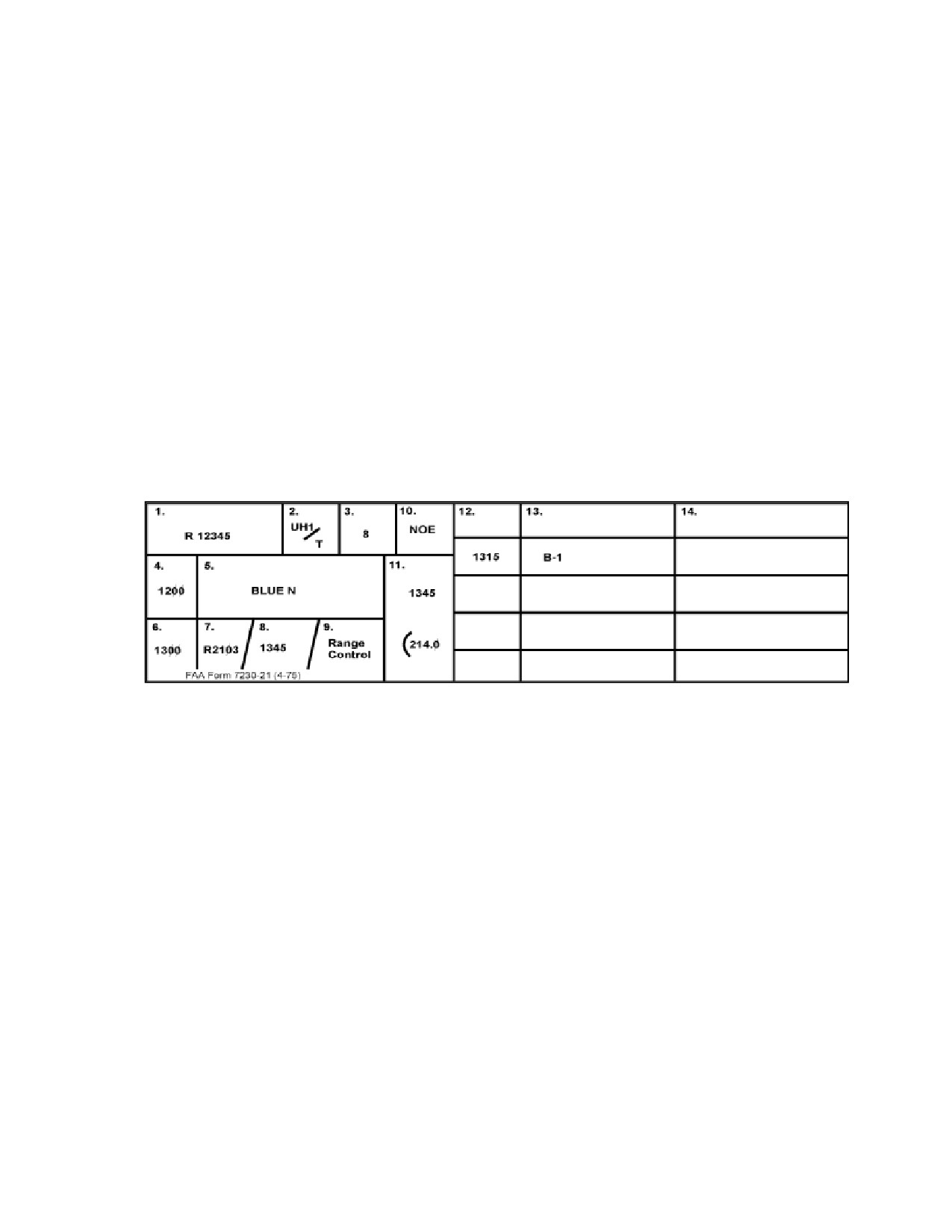
5-61. Instructions for completing FAA Form 7230-21 are given below. The
block numbers below correspond to the pertinent block numbers on the
sample of a completed flight progress strip in figure 5-6.
z Block 1. Aircraft identification.
5-28
_______________________________________________________________
Reference Material
z Block 2. Type of aircraft and the equipment suffix used for any
special equipment such as the DME transponder.
z Block 3. Altitude.
z Block 4. Beacon code.
z Block 5. Route or area of flight.
z Block 6. Radio or radar contact time in UTC.
z Block 7. Destination (the training area or intended landing area).
z Block 8. ETA at the destination in UTC.
z Block 9. Coordination effected (CRC, FCC, range control, and ADIZ).
z Block 10. Type mission (for example, NOE, NVD, and
administrative).
z Block 11. Time of last radio contact and handoff information.
z Block 12. Time at reporting points.
z Blocks 13 and 14. Reporting points, amendments, clearances, and so
forth that correspond to block 12. Blocks 13 and 14 can be changed or
modified by the facility as necessary.
Figure 5-6. Sample Completed Progress Strip
5-29
Chapter 6
Installation Facility Training Program
The ATC facility training program (FTP) provides standardization and
guidance in conducting facility training. The FTP guides newly assigned
personnel through an established program of instruction (POI) to become
facility-rated and remain proficient. Each ATC chief/ATC SR SGT/facility
chief shall develop a FTP within the established training time limits in
accordance with AR 95-2, chapter 4.
CONTENTS
Program of Instruction
6-1
Facility Training Manual
6-4
PROGRAM OF INSTRUCTION
Training and Proficiency Record-Air
6-1. The installation FTP
Traffic Controller
6-5
consists of three types of
Trainee/Controller Evaluation
6-9
training, a FTM, four
training phases, tests, and
the appropriate evaluations. In addition to this training, the program shall
include the knowledge and skill requirements in the FAR, Part 65. All
written examinations shall be closed book. The only exception to the rule is
FLIPs, charts, and supplement examinations which are open book. All
examinations/answer sheets will have trainee/controllers name, date, test
subject and grade posted in the lower right hand corner prior to being posted
in DA Form 3479-R.
6-2. FTP’s shall incorporate a training schedule that gives the trainee,
trainer, and SL a clear understanding of what the trainee is expected to learn
and a reasonable amount of time in which to learn it. It also gives facility
supervisors a means to maintain a trainee’s progression effectively through
the FTP. The schedule shall prescribe
z A timetable for position qualification at each control position to
include a recommended date for PQ.
z A timeframe for each FTM chapter test.
z Those tests required before the trainee can become PQ’d at each
control position.
z The recommended date for position qualification examinations.
z The recommended date of the pre-FAA/ATCS examination.
z The recommended date of the final FAA/ATCS examination.
z The recommended date of the facility rating.
6-3. Chapter tests do not have to be taken in sequence. However, trainees
should begin training in the least complex control position. They may take
chapter tests to become PQ as soon as their abilities indicate they are ready.
6-1
FM 3-04.303 (FM 1-303) ______________________________________________________________
TYPES OF TRAINING
Qualification
6-4. Newly assigned personnel receive qualification training before they can
obtain a facility rating. This training is also given to facility-rated controllers
when new procedures are instituted or new ATC equipment is installed. This
training shall be annotated in section III, IV, V and VI (as applicable) of
DA Form 3479-R.
Proficiency
6-5. Facility-rated or PQ controllers are given proficiency training to remain
current and proficient on ATC policies, procedures, and equipment. This type
of training includes but is not limited to weather certification, changes to
Army regulations, field manuals, handbooks, and operational procedures.
Proficiency training shall be annotated in sections III, IV, V and VI (as
applicable) of DA Form 3479-R.
Remedial
6-6. Remedial training shall be given only to personnel who have shown that
they are no longer qualified to perform satisfactorily in a control position at
which they previously qualified.
This training, given to correct a
demonstrated weakness, may consist of classroom instruction or additional
time on the position under direct supervision, or both. The ATC chief/ATC
SR SGT/ATC facility chief determines the time limits for the controllers’
receiving the remedial training. This training shall be annotated in
sections III, IV, and V (as applicable) of DA Form 3479-R. The reason for the
remedial training and time limits shall be annotated in section VI.
TRAINING PHASES
Indoctrination
6-7. All newly assigned personnel begin the FTP with this phase. The
indoctrination phase shall consist of
z A briefing on what is expected of the trainee.
z An introduction to AR 95-2.
z Discussion of training time limits.
z Issuance of the FTM.
z A comprehensive review of chapter 1 of the FTM and a general review
of the remaining chapters.
z A review of the training schedule.
z A tour of the ATC facility and other airfield facilities and, if possible,
a local orientation flight.
z A certificate of grades/ATCS verification.
z A successful written or oral examination on chapter 1 of the FTM.
The trainee must complete the examination before entering the next
phase.
Primary Knowledge
6-8. The trainee may take the primary knowledge phase in a classroom or at
the facility while assigned to a shift. This phase teaches the general subjects
that the trainee needs to begin training at each operating position. A written
6-2
________________________________________________
Installation Facility Training Program
closed-book examination on chapters 2 through 4 of the FTM and initial
weather certification completes this phase. A current flight physical and
DA Form 4186 (Medical Recommendation for Flying Duty) stating full flying
duties (FFD) approved and signed by the unit commander are required before
the trainee enters the next phase.
Position Qualification
6-9. In this phase, the trainee receives hands-on training at each operating
position and written or oral examinations on the FTP requirements that
apply to the control procedures. The trainee is then evaluated on each
operating position, and the results are recorded on DA Form 3479-1-R and
section V of DA Form 3479-R (see appendix A).
6-10. Position qualification training should begin at the least complex control
position and advance to the most complex. To become PQ at a control
position, the trainee must complete all FTP requirements that apply to that
position.
He also must receive a satisfactory evaluation on
DA Form 3479-1-R and, in the evaluators’ comments section, a
recommendation from the ATC facility chief/ATC training supervisor/shift
leader that he become PQ. The ATC chief/ATC SR SGT/ATC facility chief or
training supervisor shall then evaluate the trainee to determine if he is
qualified. Annotate these evaluations in section V of DA Form 3479-R and, in
the remarks block, state that they are recommended for PQ or are now PQ.
Note: The same individual that recommends PQ/rating shall not evaluate
the trainee for PQ/rating. All personnel who recommend or rate an
individual shall be rated in that facility with the exception of ATCS/CTO
examiners.
Facility Rating
6-11. After the trainee is PQ at all control positions, he shall be given a pre-
FAA/ATCS facility rating examination. He must also receive a satisfactory
evaluation on DA Form 3479-1-R and, in the evaluators’ comments section, a
recommendation from the facility chief/training supervisor that he is
recommended for facility rating. He shall then be given a final FAA/ATCS
facility rating examination and be evaluated on all operating positions
pertaining to the rating. The results shall be recorded on DA Form 3479-1-R.
These evaluations shall be annotated in section V of DA Form 3479-R and in
the remarks block, it shall be stated that they are recommended for facility
rating or rated.
z Pre-FAA/ATCS examination. This written examination should
consist of 50 to 100 questions from the FTM, AIM, FAAO 7110.65,
LOA, operations letters, approach charts, FLIPs, DPs, maps, charts
and associated air traffic service and weather references. The
questions shall pertain only to those topics that the trainee must
know to operate as a controller at the facility to which he is assigned.
This examination presents the trainee with examples of the types of
questions that are on the final FAA/ATCS written examination; it
may also show him areas that he needs to review. If the trainee fails
this examination, he shall return to classroom study and be
rescheduled for the examination to be administered in approximately
6-3
FM 3-04.303 (FM 1-303) ______________________________________________________________
one week. This failure shall be annotated in sections III, IV, and VI
of DA Form 3479-R.
z Final FAA/ATCS facility rating examination.
This written
examination shall consist of 50 to 100 questions on topics that the
trainee must know to be a controller at the facility to which he is
assigned. If the trainee fails this examination, he shall return to
classroom study and be rescheduled for the examination. This failure
shall be annotated in sections III, IV, and VI of DA Form 3479-R.
z Facility rating evaluation. This evaluation, which is recorded on
DA Form 3479-1-R, shall cover all operating positions pertaining to
the rating. It should be conducted under normal traffic conditions.
This DA Form 3479-1-R shall be annotated in section V of the
DA Form 3479-R and retained in the record for one calendar year.
ADMINISTRATION AND MANAGEMENT TRAINING
6-12. This training prepares personnel to progress from a controller to a
facility chief.
Management training is an ongoing program wherein
supervisors continuously train subordinates to assume supervisory positions.
Upon completion of the facility training, all personnel shall receive training
in facility administration and management.
Administration and
management training shall culminate in a written examination of at least
25 questions. As a minimum, this training shall include those subjects listed
in chapter 13 of the FTM.
6-13. Failure to complete this training satisfactorily shall not be used as a
reason for reclassification action. The examination serves to point out weak
areas so the individual may improve his performance. The administrative
management exam shall be administered within 30 days after an individual
becomes facility-rated and prior to assuming the duties of CIC, SL, ATC
training supervisor, or ATC facility chief. For Department of the Army
civilian (DACs), the administrative management exam shall be administered
no later than 30 days after the DAC becomes eligible to perform CIC or any
other supervisory duties. If he receives an unsatisfactory score, he shall be
administered the exam once every 30 days until he achieves a passing score.
All training and test results shall be entered into sections III, IV, and VI, as
appropriate, of DA Form 3479-R.
FACILITY TRAINING MANUAL
6-14. The FTM is a locally prepared publication. The ATC chief/ATC SR
SGT/PSG/ATC facility chief is responsible for its preparation, content, and
quality.
The manual provides personnel with a logical step-by-step
progression to becoming facility-rated. The quality of the FTM has a direct
bearing on the effectiveness of a facility training program. FTMs shall be
reviewed, rewritten, and/or updated at least annually. A memorandum will
be attached to the front of each FTM with the date, statement of review or
update, and the facility chief’s signature. This memorandum will be created
even if no changes are made.
6-15. The FTM is used for facility rating preparation and remedial and
proficiency training. The manual also serves as a reference. The charts,
6-4

________________________________________________
Installation Facility Training Program
maps, photographs, and drawings in the FTM make the information more
understandable.
6-16. At least three copies of the FTM shall be maintained at a facility: a
copy for the facility reference file, one for the controller reference file, and
another for controllers to sign out. Additionally, one copy shall be sent to the
quality assurance office where it shall be maintained on file. The facility may
maintain any number of additional copies for controller use.
6-17. Appendix C, Detailed Outline for an Installation Facility Training
Manual, shows a detailed FTM subject outline for installation facilities. The
chapters or portions of chapters in the FTM that do not apply to a particular
facility may be marked “not applicable” or be used as determined by the ATC
chief/ATC SR SGT/PSG/ATC facility chief. The chief may choose to include
those chapters that apply to a collocated or adjacent facility to familiarize
controllers with that facility. However, trainees shall not be tested for record
purposes on chapters that do not apply toward a facility rating.
TRAINING AND PROFICIENCY RECORD—AIR TRAFFIC CONTROLLER
6-18. Each tactical and installation ATC facility shall maintain a complete
and current DA Form 3479-R (see appendix A) for all military and civilian
controllers. To accomplish this, one training folder shall be used with a
divider separating the installation records from the tactical. However, duty
assignment may determine which sections (installation/tactical) are in front.
For example, tactical facilities may place installation sections III through VII
behind the divider instead of in front. To avoid duplication, sections I and II
will be combined; the record will be maintained in the front of the folder.
DA Form 3479-R shall be used to document all ratings awarded and
proficiency, qualification, and remedial training conducted during field
exercises. A blank copy of this reproducible form is located in the back of this
manual;
an electronic
copy
may be downloaded from
http://www.usapa.army.mil/. Table 6-1 shows the seven sections of this form.
Table 6-1. Explanation of DA Form 3479-R
Section
Title
Entries
I
Personal Identifying
Assignments, certifications, and ratings.
Data
II
Schools Attended
Names of ATC schools or courses (military and civilian)
attended and date of completion. 93C AIT, 93C Basic
Non-Commissioned Officer Academy (BNCOC) (Fort
Rucker), Advanced Non-Commissioned Officer Academy
(ANCOC) (Fort Rucker), Airborne, Air Assault, Battle Staff
NCO Course, TERPS (U.S. Air Force [USAF]/FAA only),
Joint Air Operations Staff (JAOS), Joint Firepower Control
Course (JFCC), Joint Airspace Command and Control
Course (JAC2C), Pathfinder, Airspace Management and
courses in accordance with DA Pam 611-21.
6-5

FM 3-04.303 (FM 1-303) ______________________________________________________________
Table 6-1. Explanation of DA Form 3479-R
Section
Title
Entries
III
Qualification,
The subject of the instruction presented, the appropriate
Proficiency, and
code letter (Q - qualification, P - proficiency, R -
Remedial Training
remedial), the date training was completed, total hours of
Record
instruction, and remarks.
IV
Written/Oral/Practical
The subject tested, the date that the practical test was
Test Action
administered, the score received, and the remarks. (All
written tests will be retained until a trainee is facility-rated.
Thereafter, written tests shall be kept on file for one year
from the date of the test.)
V
Proficiency Checks
The operating position in which the check is conducted,
the date of the check, the score or rating received, the
number of hours expended on the proficiency check, the
sequenced number of the evaluation (for example, 00-4
indicates the fourth evaluation of 2000), followed by
recommend PQ/rating or the letters “PQ” when position-
qualified, or Rated and any additional comments in the
Remarks column. (DA Form 3479-1-R will be used to
record proficiency checks. All evaluations of a trainee
shall be kept on file until the trainee is facility-rated.
Thereafter, the facility rating and all subsequent practical
evaluations shall be kept on file for one year from the date
of the evaluation.)
VI
Miscellaneous General
Additional information pertaining to remarks in other
Comments
sections, interview data, or comments that may affect the
individual’s career
(for example, duties not to include
flying (DNIF)/FFD safe aviation via exceptional service
(SAVES), training time extensions, reason(s) for remedial
training, awards, or letters of commendation). Each entry
shall start with a date and then the appropriate entry. The
name, rank, title, and signature of the individual making
the entries is required for each entry.
6-6

________________________________________________
Installation Facility Training Program
Table 6-1. Explanation of DA Form 3479-R
Section
Title
Entries
VII
Individual Radar
The monthly record count of radar approaches conducted
by the controller and, in the appropriate column, the type
Record
of approach and operation. This section shall be closed
out the last day of each calendar year by entering the
yearly total— the total to date (the total of all the previous
year’s approaches). If a controller was previously rated in
a radar facility, but is currently working in a tower or AIC,
then enter only the date and bring forward the totals each
year. Monthly entries of 0 are not necessary. If a
controller has never been radar-rated, the form may be
left blank. This section applies only to radar facilities;
however, it must be kept for all controllers once they start
radar training. Supervised or simulated (S/S) approaches
are counted separately from live (LV) approaches.
Note: S/S-Supervised approaches are approaches that
require direct supervision for a controller, and simulated
approaches are conducted on an ATC simulator. Live
(LV) approaches are those approaches that do not
require direct supervision and are not simulated
approaches.
6-19. DA Form 3479-R is a permanent record that serves as a comprehensive
record of training, certification, qualification, proficiency, ratings, and duty
assignments.
Preparation and Maintenance
6-20. The ATC chief/ATC SR SGT/ATC facility chief/ATC training supervisor
at all Army ATC facilities shall maintain DA Form 3479-R on assigned or
attached ATC specialists (military and civilian). A paper record on each
controller shall be maintained in an area that is accessible only to authorized
personnel. No one shall remove, alter, omit, delete, or destroy any section or
component of the DA Form 3479-R. The only exception is section VII, which
will be removed at the end of the year (the runs are totaled and brought
forward to a new section VII and posted in the records). The ATC facility
chief/training supervisor shall sign in the remarks section that they have
verified that the runs brought forward are accurate. The previous year
section VII will be returned to the controller after the ATC facility chief dates
and signs the form.
z The record will be kept in a straight cut, 9½-inch by 11¾-inch, heavy-
duty Kraft file folder (NSN 7530-00-222-3443). Each folder shall
contain a label in the upper left corner (see appendix A) with the
controller’s last name, first name, middle initial, and Social Security
number. The folder shall be filed alphabetically by the controller’s
last name. A dummy folder shall be used and labeled in accordance
with AR 25-400-2. The following information shall be entered on the
front cover of the file folder:
6-7
FM 3-04.303 (FM 1-303) ______________________________________________________________
Air Traffic Controller Individual Training Records Folder, United
States Army.
If found, the folder shall be returned to the Commander,
USAAVNC, ATTN: ATZQ-ATC, Fort Rucker, Alabama 36362-
5265.
These folders will contain DA Form 3479-1-R, training received, and
examination results. It will also contain performance related to
training and ratings and other correspondence related to training and
ratings. DA Form 4186, ratings and certification through training,
complete the contents.
z
When a controller is transferred, the ATC chief/ATC SR SGT/
PSG/ATC facility chief will close out sections III through VI of the
controller’s DA Form
3479-R by signing and dating them
(see
appendix A). The ATC chief/ATC SR SGT/PSG/ATC facility chief will
verbally counsel the controller about the negative ramifications of
removing or altering the contents of DA Form 3479-R while in transit
to the new duty assignment. The individual will hand carry this
record to the ATC chief/ATC SR SGT/PSG/ATC facility chief or his
designee at his next duty assignment. The gaining unit shall inspect
the record for deficiencies, annotate that deficiencies were found but
are uncorrectable in section VI, and continue the record without
removing previous entries/sections.
z
The left inside portion of the folder shall contain sections I through
VII of DA Form 3479-R. A computer disc containing the automated
DA Form 3479-R may be stored on the inside portion of the folder. No
other forms, records, or papers shall be retained on the left side of the
folder. The right inside portion of the folder shall contain, from top to
bottom, DA Forms 3479-1-R, with a divider separating tactical and
installation
(latest on top); all written tests
(latest on top); and
DA Forms 4186. A DA Form 4186 used for grounding shall be placed
on top of DA Form 4186 issued by the flight surgeon to indicate a
completed flight physical. The DA Form 4186 used for grounding
shall be retained until the individual is returned to flight status; it is
then removed from the training record.
z
Only those forms and records listed in the paragraph immediately
above are to be retained with the DA Form 3479-R. Such information
as training time extensions, reclassification, and counseling shall not
be retained with DA Form 3479-R. However, remarks of these
actions shall be entered in section VI of the form.
Note:
Every time a soldier reports to a new duty station, a new
DA Form 4186 is required. This DA Form 4186 replaces the old form in the
DA Form 3479-R.
Availability
6-21. File folders are available to the individual controller upon request.
They also will be made available to
z ATSCOM.
z Commanders.
6-8
________________________________________________
Installation Facility Training Program
z FAA authorities.
z Supervisors (training or shift).
z Aircraft accident and flight violation investigators.
z Systems managers and their authorized representatives.
z Military examiners who facility-rate the controller for duty.
z Other authorized individuals who request the folders in person from
the record custodian or who submit written requests to system
managers.
Note: Requests for files shall state the reason for the request; the intended
use of the information; and the requester’s name, military or civilian status,
ATCS number, and duty location. Requests are approved by the ATC
chief/ATC SR SGT/PSG/ATC facility chief.
Contests and Appeals
6-22. Individuals may contest (appeal) the entries on the DA Form 3479-R.
The appeals shall be directed through channels to the Commander,
USAAVNC, ATTN: ATZQ-ATC, Fort Rucker, Alabama 36362-5265.
Retention
6-23. These records are permanent and shall remain active while an
individual is an air traffic controller. The records will be returned to the
individual upon completion of reclassification actions, termination of service,
and so forth.
TRAINEE/CONTROLLER EVALUATION
6-24. The DA Form 3479-1-R provides a written evaluation of an individual’s
training progress or job performance. It also provides a means for showing
weak points that need to be corrected. Personnel responsible for the
completion of DA Form 3479-1-R shall ensure the evaluation factors are
standardized for each operating position within the facility.
PREPARATION
6-25. DA Form 3479-1-R is used to record trainee/controller proficiency and
qualification at all control positions.
The evaluator shall make the
appropriate entries and sign the form. These are important forms; therefore,
they must be completed properly and on time. Annotate the evaluations in
section V of DA Form 3479-R and, in the remarks block state the reason the
DA Form 3479-1-R was given (for example proficiency, recommended position
qualification, or facility rating). Complete DA Form 3479-1. A blank copy of
DA Form 3479-1-R is at the back of this manual.
z NAME block. Self-explanatory.
z GRADE block. Enter rank/civilian grade level (SGT/GS 10).
z ATCS NUMBER block. Self-explanatory.
z EVALUATION NUMBER block. The training supervisor assigns the
number.
z TYPE OF TRAINING block. Show the type of training/evaluation
conducted (qualification, proficiency, or remedial).
6-9
FM 3-04.303 (FM 1-303) ______________________________________________________________
z
POSITION FACILITY EVALUATED block. Self-explanatory.
z
TRAINING MONTH block. Show the progressively numbered
training month for trainee/controller.
(This block does not apply to
proficiency evaluations conducted for facility-rated controllers.)
z
Satisfactory
(SAT), NEEDS improvement
(IMPROV), and
unsatisfactory
(UNSAT) columns. Using evaluation factors A
through H on the form, rate the trainee’s/controller’s performance
according to the following guidelines. Place a check in the appropriate
column for items 1 through 29.
SAT. A checkmark in this column indicates that the
trainee/controller is performing at a level that is satisfactory
for position qualification.
NEEDS IMPROVEMENT. A checkmark in this column
indicates that the trainee is performing at a level that is less
than satisfactory for position qualification. However, he is at
the level expected at this point in the training program. This
column should be considered an extension of the SAT column.
A checkmark in this column indicates satisfactory training
progress.
UNSAT. A checkmark in this column indicates that the
trainee/ controller is not performing at the level of
competency expected at this point in the training program.
Examples would be continued errors in the subject area with
little or no improvement shown and failure to complete study
assignments. Checkmarks in this column, though not
extremely uncommon, should not be taken lightly nor
considered normal. The instructor and the trainee should
place additional emphasis on training in these areas.
z
TRAFFIC CONDITION block. Self-explanatory.
z
OVERALL RATING block. The overall rating is an indication of the
trainee’s progress in the training program. This rating shall be either
SAT or UNSAT. The instructor considers the amount of time the
trainee has been on the position and where he would expect the
trainee to have progressed at this point. Unlike items 1 through 29,
which are rated against a PQ level of competency, the overall rating
is the objective opinion of the instructor/evaluator. His opinion is
based on such factors as past experience, training time limitations,
and traffic and complexity levels. A trainee/controller who has some
areas marked SAT and others NEEDS IMPROVEMENT but none
marked UNSAT could receive a SAT overall rating. This would
indicate that the trainee/controller is progressing satisfactorily but
still needs additional training and experience to reach the PQ level of
competency. Any areas marked UNSAT in blocks A through H shall
make the overall Rating UNSAT.
z
EVALUATOR COMMENTS block. This block is probably the most
important part of the evaluation form. The instructor should make
detailed comments concerning the trainee’s performance during the
evaluation period, emphasizing those areas marked NEEDS
IMPROVEMENT or UNSAT. The instructor should tailor his
remarks specifically to the items so marked and provide examples of
6-10
________________________________________________
Installation Facility Training Program
situations that led to the ratings. He should be specific and honest.
The instructor’s comments must substantiate the ratings given for
items 1 through 29 and the overall rating. He should take the time to
discuss each rating in depth with the trainee. Supervisors should
allow sufficient time for the instructor and trainee to accomplish this
in an undisturbed environment
(such as the break room or
classroom). During the discussion, the instructor should also be sure
to comment on the trainee’s good points and accomplishments.
Building a trainee’s self-confidence is an integral part of the training
program.
z DATE, TYPED/PRINTED NAME AND GRADE, and SIGNATURE blocks. All
such blocks on page 2 of the form are self-explanatory.
z CONTROLLER/TRAINEE COMMENTS block. Supervisors and
instructors should encourage trainees to comment (for example on
their progress, the training program, and the instructor’s technique).
These comments are important, especially if the overall rating is
UNSAT or the trainee disagrees with the evaluation.
z REVIEWING AUTHORITY COMMENTS block. The ATC chief/ATC
SR SGT/PSG/ATC facility chief/training supervisor is the reviewing
authority and adds the appropriate comments. Individual shall not
review DA Form 3479-1-R that they have written as evaluator.
USE
6-26. A single evaluation form may be used to evaluate the performance of a
trainee/controller at more than one control position. However, an evaluation
form shall not be used to show two different types of training. For example, a
single form shall not be used to evaluate a trainee’s proficiency at one
position and qualification or remedial training at another position.
6-27. DA Form
3479-1-R provides a written evaluation of a rated PQ
controller’s ability to perform at a position. It is also used to evaluate a
trainee’s progress toward becoming PQ. If his proficiency or training
progress is not satisfactory, the trainee/controller must be told why and what
he must do to improve. This may include study assignments, oral or written
tests, or extra time on a position. The ATC chief/ATC SR SGT/PSG/ATC
facility chief should use the results of trainee/controller evaluations to
determine training trends, time extensions, and FTP modifications.
DA Form 3479-1-R is also used to support reclassification requests.
FREQUENCY
6-28. The supervisor determines when to conduct trainee/controller
evaluations. As a minimum, these evaluations shall be conducted
z Within each
14 calendar days after a trainee begins position
qualification training.
z Within each 30-calendar days for each position at which a trainee is
PQ.
z Every time a trainee is PQ or facility rated.
z Before a trainee is recommended for PQ or facility rating.
z To evaluate proficiency after a loss of currency.
z To regain qualification after receiving remedial training for a
demonstrated weakness while operating a control position.
6-11
FM 3-04.303 (FM 1-303) ______________________________________________________________
Note: A DA Form 3479-1-R will be completed on or before the evaluation due
date, whether or not there is traffic. The evaluation shall state the reason
why a P or Q DA Form 3479-1-R could not be completed. The evaluation
shall be administered the first available date that traffic is present.
LOSS OF CURRENCY
6-29. Evaluations given to assess proficiency after a loss of currency shall be
administered on all control positions with direct one-on-one supervision. The
evaluation shall be conducted under normal traffic conditions and last long
enough to provide a reliable performance sample. It must be completed
satisfactorily before the controller assumes position responsibility without
supervision. The evaluation given for a loss of currency does not make the
controller current for the month given. The evaluation only satisfies the
proficiency requirements and allows the controller to continue working
toward his currency requirements during the next 30 days without direct
one-on-one supervision. Evaluations given for a loss of currency shall be
administered by the ATC facility chief, ATC training supervisor, or shift
leader and are retained for one year. The ATC chief or ATC SR SGT may
administer the evaluation, if he is facility-rated and current in the facility.
ATCS/CTO examiners for that type of facility may also administer the
evaluation.
RETENTION
6-30. When the reviewing authority signs an evaluation, it shall be placed on
top of written tests and other evaluations and attached to the right inside
portion of DA Form 3479-R. The results of all evaluations shall be entered in
section V of the controller’s training record. Evaluations shall be retained
until the trainee is facility-rated. After the trainee completes facility rating,
all evaluations except the rating DA Form 3479-1-R shall be returned to the
controller. The rating DA Form 3479-1-R shall be retained for one year.
6-12
Chapter 7
Tactical Facility Training Program
The ATC facility training program (FTP) provides standardization and
guidance in conducting facility training. The FTP guides newly assigned
personnel through an established POI to become facility-rated and remain
proficient. Each PSG/facility chief shall develop a FTP. This FTP shall
be within the established training time limits in accordance with AR 95-2,
chapter 4.
CONTENTS
PROGRAM OF INSTRUCTION
Program of Instruction
7-1
7-1. The
standardized
Facility Training Manual
7-4
tactical
FTPs
(see
Training and Proficiency Record - Air
DA Forms 3479-11-R
Traffic Controller
7-5
through
DA Form 3479-
Trainee/Controller Evaluation
7-8
19R) contain minimum
training requirements and
record entries that shall be completed prior to facility rating. They consist of
three types of training (a facility training manual, two training phases, tests
and the appropriate evaluations). All written examinations shall be closed
book. The only exception to this rule is FLIPs, charts, and supplement
examinations which are open book. All examinations/answer sheets will have
trainee/controllers name, date, test subject, graders initials and grade posted
in the lower right hand corner prior to being posted in DA Form 3479-R.
7-2. The FTP’s shall incorporate a training schedule that gives the trainee,
trainer, and SL a clear understanding of what the trainee is expected to learn
and a reasonable amount of time in which to learn it. It also gives facility
supervisors a means to maintain a trainee's progression effectively through
the FTP. The schedule shall prescribe
z A recommended completion date for Phase I.
z Actual completion date for Phase I.
z Recommended completion date for Phase II.
z The recommended date of the pre-ATCS examination.
z The actual completion date of Phase II.
7-3. Chapter tests do not have to be taken in sequence. However, trainees
should begin training in the least complex control position. They may take
chapter tests to become PQ as soon as their abilities indicate they are ready.
7-1
FM 3-04.303 (FM 1-303) ______________________________________________________________
TYPES OF TRAINING
Qualification
7-4. Newly assigned personnel receive qualification training before they can
obtain a facility rating. This training is also given to facility rated controllers
when new procedures are instituted or new ATC equipment is installed. This
training shall be annotated in section III, IV, V, and VI (as applicable) of
DA Form 3479-R.
Proficiency
7-5. Facility-rated or PQ controllers are given proficiency training to remain
current and proficient on ATC policies, procedures, and equipment. This type
of training includes but is not limited to weather certification, changes to
Army regulations, field manuals, handbooks, and operational procedures.
Proficiency training shall be annotated in sections III, IV, V, and VI (as
applicable) of DA Form 3479-R.
Remedial
7-6. Remedial training shall be given only to personnel who have shown that
they are no longer qualified to perform satisfactorily in a control position at
which they previously qualified.
This training, given to correct a
demonstrated weakness, may consist of classroom instruction or additional
time on the position under direct supervision, or both. The PSG/ATC facility
chief determines the time limits for the controllers' receiving the remedial
training. This training shall be annotated in sections III, IV, V, and VI (as
applicable) of DA Form 3479-R.
TRAINING PHASES
Phase 1 - Qualification
7-7. This phase consists of individual and team training on the installation,
operation and maintenance of all equipment associated with the ATC system
to which the controller will be assigned
(for example, AN/TSW-7A or
AN/TSQ-221).
7-8. Tasks, conditions, and standards for equipment training shall be taken
from the appropriate ARTEP manual.
7-9. The unit shall determine the amount and type of A2C2 training.
7-10. Controllers shall begin this training within 60 days of assignment to
the platoon or within 60 days of completing a installation training program.
Active duty controllers shall complete the training within three calendar
months from the date they enter the program and Army National
Guard/reserve component controllers, within two annual training periods.
Phase II - Position Training and Rating
7-11. This phase covers the ability of trainees to control air traffic in a
tactical environment. The trainee receives hands-on training at each
operating position and receives examinations on the FTP requirements that
apply to the control procedures. The trainee is then evaluated on each
operating position, and the results are recorded on DA Form 3479-1-R and
annotated in section V of the DA Form 3479-R. (See appendix A)
7-2
__________________________________________________
Tactical Facility Training Program
7-12. To become PQ at a control position, the trainee must complete all FTP
requirements that apply to that position. He must receive a satisfactory
evaluation on DA Form 3479-1-R and, in the remarks block, a
recommendation from the facility chief/training supervisor/SL that he become
PQ. The PSG/ATC facility chief or training supervisor shall then evaluate
the trainee to determine if he is qualified. After the trainee is PQ at all
control positions, he shall be given a pre-FAA/ATCS facility rating
examination.
He also must receive a satisfactory evaluation on
DA Form 3479-1-R and, in the Remarks block, a recommendation from the
facility chief/training supervisor/SL that he is recommended for facility
rating. An ATCS examiner shall administer the written and practical ATCS
exam that covers both phases of the FTP.
Note: The same individual that recommends PQ/rating shall not evaluate
the trainee for PQ/rating.
7-13. The following tasks are performed by an ATCS examiner:
z
The ATCS examiner shall give an over-the-shoulder evaluation on all
positions applicable to the rating using DA Form 3479-1-R.
z
The examiner shall annotate the initial rating of tactically certified
on the back of the controller's FAA Form 7220-1
(Air Traffic
Controller Specialist Card) and in the controllers DA Form 3479-R
section I.
z
Each time the controller is deployed to provide air traffic services
after the initial rating, he must be given a written or oral proficiency
check for the applicable portions of the tactical FTM and complete an
over-the-shoulder evaluation on all positions applicable to the rating
using DA Form 3479-1-R. This proficiency check shall be recorded in
sections III, IV, V, and VI of DA Form 3479-R.
z
When reassigned to a new unit, the controller must complete the unit
specific FTP requirements and receive an over-the-shoulder
evaluation, administered by the ATCS examiner, on all positions
applicable to the rating using DA Form 3479-1-R. Upon completion of
the required training and evaluation, the controller will be re-
certified. Duplicate rating on like tactical facilities (AN/TSW-7A -
AN/TSW-7A) shall not be annotated on the controllers
FAA Form 7220-1
(pink card).
All required training, testing,
evaluations, and remarks shall be entered in sections III, IV, V, and
VI of DA Form 3479-R.
z
When a controller transfers within the same unit for cross training,
those like items that can transfer from FTP to FTP shall be
annotated as
“P” training
(such as Initial Weather certification,
power equipment). This does not include A2C2 training (facility
specific), ARTEP task, FTM tests, pre-ATCS or ATCS examinations.
Note: ATCS examiners will set training time limits for Phase II ratings after
considering the time available to evaluate a controllers’ performance in a
tactical environment.
7-3
FM 3-04.303 (FM 1-303) ______________________________________________________________
ADMINISTRATION AND MANAGEMENT TRAINING
7-14. This training prepares personnel to progress from a controller to a
facility chief.
Management training is an ongoing program, wherein
supervisors continuously train subordinates to assume supervisory positions.
Upon completion of the facility training, all personnel shall receive training
in facility administration and management.
Administration and
management training shall culminate in a written examination of at least
25 questions. As a minimum, this training shall include those subjects listed
in chapter 13 of the FTM.
7-15. Failure to satisfactorily complete this training shall not be used as a
reason for reclassification action. The examination serves to point out weak
areas so the individual may improve his performance. The administrative
management exam shall be administered within 30 days after an individual
becomes facility-rated and prior to assuming the duties of CIC, SL, or ATC
facility chief. If he receives an unsatisfactory score, he shall be administered
the exam once every 30 days until he achieves a passing score. All training
and test results shall be entered into sections III, IV, and VI as appropriate of
the DA Form 3479-R.
FACILITY TRAINING MANUAL
7-16. The FTM is a locally prepared publication. The PSG/ATC facility chief
is responsible for its preparation, content, and quality. The manual provides
personnel with a logical step-by-step progression to becoming facility-rated.
The quality of the FTM has a direct bearing on the effectiveness of a facility's
training program. FTMs shall be reviewed, rewritten, and/or updated at
least annually. A memorandum will be attached to the front of each FTM
with the date, statement of review or update, and the facility chief’s
signature. This memorandum will be created even if no changes are made.
7-17. The FTM is used for facility rating preparation and remedial and
proficiency training. The manual also serves as a reference source. The
charts, maps, photographs, and drawings in the FTM make the information
more understandable.
7-18. At least three copies of the FTM shall be maintained at a facility: one
copy for the facility reference file, one for the controller reference file, and one
for controllers to sign out. Additionally, one copy shall be sent to their
quality assurance office where it shall be maintained on file. The facility may
maintain any number of additional copies for controller use.
7-19. Appendix C, Abbreviated Outline for a Tactical Facility Training
Manual, shows an abbreviated outline for tactical facilities. The chapters or
portions of chapters in the FTM that do not apply to a particular facility may
be marked "not applicable" or be used as determined by the PSG/ATC facility
chief. The chief may choose to include those chapters that apply to a
collocated or adjacent facility to familiarize controllers with that facility.
However, trainees shall not be tested for record purposes on chapters that do
not apply toward a facility rating.
7-4

__________________________________________________
Tactical Facility Training Program
TRAINING AND PROFICIENCY RECORD—AIR TRAFFIC CONTROLLER
7-20. Each tactical and installation ATC facility shall maintain a complete
and current DA Form 3479-R (see appendix A) for all military and civilian
controllers. To accomplish this, one training folder shall be used with a
divider separating the installation records from the tactical record. However,
duty assignment may determine which sections (installation/tactical) are in
front (for example, tactical facilities may place installation sections III thru
VII behind the divider instead of in front). To avoid duplication, sections I
and II will be combined; the record will be maintained in the front of the
folder. Tactical facilities are not required to take DA Form 3479-R on short-
term field exercises that do not exceed 30 days. However they shall take each
trainee’s standardized FTP DA Form 3479-11-R through DA Form 3479-19-R
to the field. Upon completion of the exercises, all training, test, and
evaluations shall be annotated in the controllers DA Form 3479-R section III,
IV, V, VI, and VII as appropriate. DA Form 3479-R shall be used to
document all ratings awarded and proficiency, qualification, and remedial
training conducted during field exercises. A blank copy of this reproducible
form is located in the back of this manual, or a computer-generated copy may
be downloaded from http://www.usapa.army.mil/. Table 7-1 shows the seven
sections of this form.
Table 7-1. Explanation of DA Form 3479-R
Section
Title
Entries
I
Personal Identifying
Assignments, certifications, and ratings.
Data
II
Schools Attended
Names of ATC schools or courses (military and civilian)
attended and date of completion. (93C AIT, 93C Basic Non-
Commissioned Officer Academy (BNCOC) (Fort Rucker),
Advanced Non-Commissioned Officer Academy (ANCOC)
(Fort Rucker), Airborne, Air Assault, Battle Staff NCO Course,
TERPS (U.S. Air Force [USAF]/FAA only), Joint Air
Operations Staff (JAOS), Joint Firepower Control Course
(JFCC), Joint Airspace Command and Control Course
(JAC2C), Pathfinder, Airspace Management and courses in
accordance with DA Pam 611-21.
III
Qualification,
The subject of the instruction presented, the appropriate code
Proficiency, and
letter (Q - qualification, P - proficiency, R - remedial), the
Remedial Training
date training was completed, total hours of instruction, and
Record
remarks.
IV
Written/Oral/Practical
The subjected tested, the date the practical test was
Test Action
administered, the score received, and the remarks. (All written
tests will be retained until a trainee is facility-rated. Thereafter,
written tests shall be kept on file for one year from the date of
the test.)
7-5

FM 3-04.303 (FM 1-303) ______________________________________________________________
Table 7-1. Explanation of DA Form 3479-R
V
Proficiency Checks
The operating position and facility in which the check is
conducted, the date of the check, the score or rating received,
the number of hours expended on the proficiency check, the
sequenced number of the evaluation (for example, T00-4
indicates the fourth evaluation of 2000), “followed by
recommend PQ/rating or the letters “PQ” when position-
qualified, or ATCS rated, and any additional comments in the
Remarks column. (DA Form 3479-1-R will be used to record
proficiency checks. All evaluations of a trainee shall be kept
on file until the trainee is facility-rated. Thereafter, the facility
rating and all subsequent practical evaluations shall be kept
on file for one year from the date of the evaluation.)
VI
Miscellaneous General
Additional information pertaining to remarks in other sections,
interview data, or comments that may affect the individual’s
Comments
career (for example, DNIF/FFD SAVES, training time
extensions, reason(s) for remedial training, awards, or letters
of commendation). Each entry shall start with a date and then
the appropriate entry. The name, rank, title, and signature of
the individual making the entries is required for each entry.
VII
Individual Radar Record
The monthly record count of radar approaches conducted by
the controller and, in the appropriate column, the type of
approach and operation. This section shall be closed out the
last day of each calendar year by entering the yearly total—
the total to date (the total of all the previous year’s
approaches). If a controller was previously rated in a radar
facility, but is currently working in a tower or AIC, then enter
only the date and bring forward the totals each year. Monthly
entries of 0 are not necessary. If a controller has never been
radar-rated, the form may be left blank. This section applies
only to radar facilities; however, it must be kept for all
controllers once they start radar training. Supervised or
simulated (S/S) approaches are counted separately from live
(LV) approaches.
Note: S/S—Supervised approaches are approaches that
require direct supervision for a controller and simulated
approaches are conducted on an ATC simulator. Live (LV)
approaches are those approaches that do not require direct
supervision and are not simulated approaches.
7-21. DA Form 3479-R serves as a comprehensive record of training,
certification, qualification, proficiency, ratings, and duty assignments.
Preparation and Maintenance
7-22. The PSG/facility chief at all Army ATC facilities shall maintain
DA Form 3479-R on assigned or attached ATC specialists. A paper record on
each controller shall be maintained in an area that is accessible only to
authorized personnel. No one shall remove, alter, omit, delete, or destroy any
7-6
__________________________________________________
Tactical Facility Training Program
section or component of the DA Form 3479-R. The only exception is section
VII, which will be removed under the following circumstance: At the end of
the year the runs are totaled and brought forward to a new section VII and
posted in the records. The PSG/ATC facility chief shall sign in the remarks
section that they have verified the runs brought forward are accurate. The
previous year’s section VII will be returned to the controller after the ATC
facility chief dates and signs the form.
z
The record will be kept in a straight cut, 9 1/2- by 11 3/4-inch, heavy-
duty, Kraft file folder (NSN 7530-00-222-3443). Each folder shall
contain a label in the upper left corner (see appendix A) with the
controller's last name, first name, middle initial, and Social Security
number. The folder shall be filed alphabetically by the controller's
last name. A dummy folder shall be used and labeled in accordance
with AR 25-400-2. The following information shall be entered on the
front cover of the file folder:
Air Traffic Controller Individual Training Records Folder, United
States Army.
If found, the folder shall be returned to the Commander,
USAANVC, ATTN: ATZQ-ATC, Fort Rucker, Alabama 36362-
5265.
These folders will contain DA Form 3479-1-R, training received, and
examination results. It will also contain performance related to
training and ratings and other correspondence related to training and
ratings. DA Form 4186 and grades, ratings, and certification through
training complete the contents.
z
When a controller is transferred, the PSG/ATC facility chief will close
out sections III through VI of the controller's DA Form 3479-R by
signing and dating them (see appendix A). The PSG/ATC facility
chief will verbally counsel the controller about the negative
ramifications of removing or altering the contents of DA Form 3479-R
while in transit to the new duty assignment. The individual will
hand carry this record to the PSG/ATC facility chief or his designee at
his next duty assignment. The gaining unit shall inspect the record
for deficiencies, annotate that deficiencies were found but are
uncorrectable in section VI, and continue the record without removing
previous entries/sections.
z
The left inside portion of the folder shall contain sections I through
VII of DA Form 3479-R. A computer disc containing the automated
DA Form 3479-R may be stored on the inside portion of the folder. No
other forms, records, or papers shall be retained on the left side of the
folder. The right inside portion of the folder shall contain, from top to
bottom, DA Forms 3479-1-R, with a divider separating tactical and
installation,
(latest on top); all written tests
(latest on top); and
DA Forms 4186. A DA Form 4186 used for grounding shall be placed
on top of a DA Form 4186 issued by the flight surgeon to indicate a
completed flight physical. The DA Form 4186 used for grounding
shall be retained until the individual is returned to flight status; it is
then removed from the training record.
7-7
FM 3-04.303 (FM 1-303) ______________________________________________________________
z
Only those forms and records listed in the paragraph immediately
above are to be retained with the DA Form 3479-R. Such information
as training time extensions, reclassification, and counseling shall not
be retained with DA Form 3479-R. However, remarks of these
actions shall be entered in section VI of the form.
Note: Every time a soldier reports to a new duty station, a new
DA Form 4186 is required. This DA Form 4186 replaces the old form in the
DA Form 3479-R.
Availability
7-23. File folders are available to the individual controller upon request.
They also will be made available to
ATSCOM.
Commanders.
FAA authorities.
Supervisors (training or shift).
Aircraft accident and flight violation investigators.
Systems managers and their authorized representatives.
Military examiners who facility-rate the controller for duty.
Other authorized individuals who request the folders in person
from the record custodian or who submit written requests to
system managers.
Note: Requests for files shall state the reason for the request; the intended
use of the information; and the requester's name, military or civilian status,
ATCS number, and duty location. The ATC chief/PSG/ATC facility chief
approves requests.
Contests and Appeals
7-24. Individuals may contest the contents of or appeal the entries to the DA
Form 3479-R. The complaints shall be directed through channels to the
Commander, USAAVNC, ATTN: ATZQ-ATC, Fort Rucker, Alabama 36362-
5265.
Retention
7-25. These records are permanent and shall remain active while an
individual is an air traffic controller. The records will be returned to the
individual upon completion of reclassification actions, termination of service,
and so forth.
TRAINEE/CONTROLLER EVALUATION
7-26. The DA Form 3479-1-R provides a written evaluation of an individual's
training progress or job performance. It also provides a means for showing
weak points that need to be corrected. PSG/ATC facility chief responsible for
the completion of DA Form 3479-1-R shall ensure the evaluation factors are
standardized for each position within the facility.
7-8
__________________________________________________
Tactical Facility Training Program
PREPARATION
7-27. DA Form 3479-1-R is used to record trainee/controller proficiency and
qualification at all control positions.
The evaluator shall make the
appropriate entries and sign the form. These are important forms; therefore,
they must be completed properly and on time. The evaluations given shall be
annotated in section V of DA Form 3479-R and in the remarks block state the
reason the DA Form 3479-1-R was given
(for example proficiency,
recommended position qualification, or certification). DA Form 3479-1-R
shall be filled out as explained below. A blank copy of this reproducible form
is at the back of this manual.
z
NAME block. Self-explanatory.
z
GRADE block. Enter rank (SGT).
z
ATCS NUMBER block. Self-explanatory.
z
EVALUATION NUMBER block. The training supervisor assigns the
number preceded by a “T” (T02-05).
z
TYPE OF TRAINING block. Show the type of training/evaluation
conducted, and the facility that the training was conducted on (for
example Q, P, or R AN/TSW-7A).
z
POSITION/FACILITY EVALUATED block. Show the position
evaluated and the facility (for example LC AN/TSW-7A).
z
TRAINING MONTH block. N/A
z
SAT, NEEDS IMPROV, and UNSAT columns. Using evaluation
factors A through H on the form, rate the trainee's/controller's
performance according to the guidelines given below. Place a check
mark in the appropriate column for items 1 through 29.
SAT. A check mark in this column indicates that the trainee/
controller is performing at a level that is satisfactory for position
qualification.
NEEDS IMPROVEMENT. A checkmark in this column indicates
that the trainee is performing at a level that is less than
satisfactory for position qualification. However, the trainee is at
the level expected at this point in the training program. This
column should be considered an extension of the SAT column. A
checkmark in this column indicates satisfactory training
progress.
UNSAT. A checkmark in this column indicates that the trainee/
controller is not performing at the level of competency expected at
this point in the training program. Examples would be continued
errors in the subject area with little or no improvement shown
and failure to complete study assignments. Checkmarks in this
column, though not extremely uncommon, should not be taken
lightly nor considered normal. The instructor and the trainee
should place additional emphasis on training in these areas.
z
TRAFFIC CONDITION block. Self-explanatory.
z
OVERALL RATING block. The overall rating is an indication of the
trainee's progress in the training program. This rating shall be either
SAT or UNSAT. The instructor considers the amount of time the
trainee has been on the position and where he would expect the
trainee to have progressed at this point. Unlike items 1 through 29,
7-9
FM 3-04.303 (FM 1-303) ______________________________________________________________
which are rated against a PQ level of competency, the overall rating
is the objective opinion of the instructor/evaluator. The instructor’s
opinion is based on such factors as past experience, training time
limitations, and traffic and complexity levels. A trainee/controller
who has some areas marked SAT and others NEEDS
IMPROVEMENT but none marked UNSAT could receive a SAT
overall rating. This would indicate that the trainee/controller is
progressing satisfactorily but still needs additional training and
experience to reach the PQ level of competency. Any areas marked
UNSAT in blocks A through H shall make the overall rating block
UNSAT.
z
EVALUATOR COMMENTS block. This block is probably the most
important part of the evaluation form. The instructor should make
detailed comments concerning the trainee's performance during the
evaluation period, emphasizing those areas marked NEEDS
IMPROVEMENT or UNSAT. The instructor should tailor remarks
specifically to the items so marked and provide examples of situations
that led to the ratings. The instructor should be specific and honest,
and comments must substantiate the ratings given for items 1
through 29 and the overall rating. The instructor should take the
time to discuss each rating in depth with the trainee. Supervisors
should allow sufficient time for the instructor and trainee to
accomplish this in an undisturbed environment (such as the break-
room or classroom). During the discussion, the instructor should also
be sure to comment on the trainee's good points and
accomplishments. Building a trainee's self-confidence is an integral
part of the training program.
z
DATE, TYPED/PRINTED NAME AND GRADE, and SIGNATURE blocks. All
such blocks on the reverse side of the form are self-explanatory.
z
CONTROLLER/TRAINEE COMMENTS block. Supervisors and
instructors should encourage trainees to comment (for example, on
their progress, the training program, and the instructor's technique).
These comments are important, especially if the overall rating is
UNSAT or the trainee disagrees with the evaluation.
z
REVIEWING AUTHORITY COMMENTS block. The PSG/ATC
facility chief/training supervisor is the reviewing authority and adds
the appropriate comments.
USE
7-28. A single evaluation form may be used to evaluate the performance of a
trainee/controller at more than one control position. However, an evaluation
form shall not be used to show two different types of training. For example, a
single form shall not be used to evaluate a trainee's proficiency at one
position and qualification or remedial training at another position.
7-29. DA Form 3479-1-R provides a written evaluation of a rated PQ
controller's ability to perform at a position. It is also used to evaluate a
trainee's progress toward becoming PQ. If his proficiency or training
progress is not satisfactory, the trainee/controller must be told why and what
he must do to improve. This may include study assignments, oral or written
tests, or extra time on a position. The PSG/facility chief should use the
results of trainee/controller evaluations to determine training trends, time
7-10
__________________________________________________
Tactical Facility Training Program
extensions, and FTP modifications. DA Form 3479-1-R is also used to
support reclassification requests.
FREQUENCY
7-30. The supervisor determines when to conduct trainee/controller
evaluations. As a minimum, these evaluations shall be conducted
z Before a trainee is recommended for PQ or a facility rating.
z Every time a trainee is PQ or facility rated.
z To regain proficiency each time the facility is deployed on an ATC
mission when the controller has exceeded 30 days without working
traffic in that facility.
z To regain qualification after receiving remedial training for a
demonstrated weakness while operating a control position.
z For a trainee, at least once every field problem, or for longer missions
once every seven days.
PROFICIENCY
7-31. Evaluations given to regain proficiency shall be administered on all
control positions. The evaluation shall be conducted under normal traffic
conditions and last long enough to provide a reliable performance sample. It
must be satisfactorily completed before the controller assumes position
responsibility without supervision.
7-32. The ATCS examiner shall administer evaluations given for rated
controller proficiency, when deployed on an ATC mission or FTX, if the
controller has not set up or deployed and worked traffic with his/her assigned
facility within the last 30 days. After at least two of the most experienced
rated controllers are found to be proficient by the ATCS examiner, the
remaining controllers may be evaluated for proficiency by the proficient
controllers. The DA Form 3479-1-R is retained for one year.
7-33. Controllers assigned to installation facilities and concurrently assigned
to a like tactical facility (7A, TTCS) are not required to receive a proficiency
evaluation if they meet the currency requirements outlined in appendix H.
This does not preclude the requirements to set up the tactical equipment for
proficiency training at least once every 30 days. Setting up the equipment
shall be recorded in section III of DA Form 3479-R as proficiency training.
Note: The proficiency evaluations do not have to be administered on the
deployment or FTX site. They may be administered anywhere and anytime
prior to the controller assuming ATC responsibilities without direct
one-on-one supervision and within 30 days of the deployment/FTX.
RETENTION
7-34. Once signed by the reviewing authority, evaluations shall be placed on
top of written tests and other evaluations and attached to the right inside
portion of the DA Form 3479-R. The results of all evaluations shall be
entered in section V of the controller's training record. Evaluations shall be
retained until the trainee is facility-rated. After the facility rating is
completed, all evaluations (except ratings on DA Form 3479-1-R) shall be
7-11
FM 3-04.303 (FM 1-303) ______________________________________________________________
returned to the controller. The ratings on DA Form 3479-1-R shall be
retained for one year.
7-12
Chapter 8
Maintenance
Federal Aviation Administration Order 6000.6, U.S. Interagency Ground
Inspection governs ground inspection, certification, and the operation of
military facilities used in the National Airspace System
(NAS).
TM 95-225 is the standard manual of flight inspection procedures. This
chapter includes portions of that manual along with additional
explanatory material, where applicable. The Army has one ground
inspection standard that applies to all fixed and tactical ATC facilities.
This guidance shall not relieve maintenance or supervisory personnel
from executing procedures or emergency actions warranted by specific
situations. Flight inspections are required for initial setting and
commissioning of all facilities. Additional inspections are required to
monitor the operating status of the facility from the user’s point of view.
SECTION I - GROUND INSPECTION
CONTENTS
Section I - Ground Inspection
8-1
CERTIFICATION RESPONSIBILITY
Certification Responsibility
8-1
8-1. Certification is the quality
Certification Procedures
8-2
control used by facility mainte-
Section II - ATC Maintenance
Certification Program
8-6
nance to ensure ATC facilities
Program Objectives
8-7
provide their advertised service.
Certification Responsibility and
Facility maintenance independ-
Authority
8-7
ent discretionary judgment about
Maintenance Technician Certification
8-8
the provision of advertised
Theory of Operation and Performance
services, the need to separate
Examinations
8-10
profit motivations from opera-
Theory (Concepts) Written
tional decisions, and the desire to
Examinations
8-11
minimize liability, make the
Section III - Records File, Forms,
regulatory function of certifica-
and Maintenance Certification
tion and oversight an inherently
Requirements
8-13
governmental function. Verifica-
Records File
8-13
tion is the process by which non-
Forms
8-15
Federal personnel (as defined in
Section IV - Air Traffic Control and
FAR 171 and FAAO 6700.20)
NAVAID Facility Standards
8-16
perform a similar quality control
General
8-16
function. Facility maintenance is
Environmental Control Standards for
responsible for overseeing the
ATC and NAVAID Facilities
8-38
verification process.
8-2. Personnel with specific written certification authority and responsibility
on the subject facility shall perform certification. Section II describes
8-1
FM 3-04.303 (FM 1-303) ______________________________________________________________
certification authority credentials. Personnel without certification authority
may perform maintenance and logging duties. These activities shall either be
confined to non-certification parameters or followed with the appropriate
certification by a fully qualified system specialist.
CERTIFICATION PROCEDURES
8-3. Systems, subsystems, and service certification shall be entered in the
appropriate maintenance log prior to commissioning and periodically
thereafter, in accordance with applicable maintenance handbooks. Log
entries for services without a maintenance log shall be placed in the
associated facility maintenance log, in accordance with DA Pam 738-750.
Certification shall be performed during restoration process after—
z An interruption or outage caused by or affecting a certification para-
meter. Recertification is not required when a facility with internal
monitoring and auto-reset or operator-initiated reset returns to
service, and no other action other than the reset was taken.
z The removal of certification due to system degradation.
z The maximum certification interval (PMCS and equipment align-
ment) has been exceeded.
z Any maintenance activity affecting a certification parameter.
8-4. Certification shall also be performed following an aircraft accident or
incident when required by TM 95-225 and FAAO 8020.11b.
INSPECTION RESPONSIBILITY
8-5. Personnel responsible for ground inspection of Army ATC and NAVAID
facilities can use the information in this chapter to establish criteria for
determining the technical efficiency of these facilities. This guidance does
not authorize agencies to assume ground inspection authority over facilities
that are not now under their jurisdiction. The facility maintenance chief and
the ATC chief/ATC SR SGT/PSG or their representatives are responsible for
coordinating ground inspection activities. Maintenance personnel having
inspection responsibility for a facility must request confirming flight
inspection when safe operation of the facility is in question. Flight
inspections are required when—
z Circumstances require a confirming flight inspection.
z Circumstances do not require a confirming flight inspection.
Note: Special flight inspections will be accomplished per TM 95-225,
section 104.5.
VOR/DME/TACAN Inspections (Installation Facilities Only)
8-6. Circumstances requiring a confirming flight inspection include—
z Major changes in local obstructions or buildings that may affect the
signal strength, coverage, or courses.
z Replacement or installation of the TAC/DME antenna or radio
frequency (RF) subassemblies (excluding transmission lines) of the
antenna.
8-2