FM 3-04.303 AIR TRAFFIC SERVICES FACILITY OPERATIONS, TRAINING, MAINTENANCE, AND STANDARDIZATION (DECEMBER 2003) - page 1
*FM 3-04.303 (FM 1-303)
Field Manual
Headquarters
Department of the Army
No. 3-04.303
Washington, DC, 3 December 2003
Air Traffic Services
Facility Operations, Training,
Maintenance, and Standardization
Table of Contents
Page
Preface
VI
Chapter 1
Introduction
1-1
Waivers
1-1
Planning
1-2
Air Traffic Control Certification and Rating
1-2
Federal Aviation Administration Academy Training
1-2
ATC Facility Classification
1-3
Understanding this Publication
1-3
Chapter 2
FACILITY ADMINISTRATION
2-1
Section I - Responsibilities and Procedures
2-1
Duty Positions and Responsibilities
2-1
Other Positions for Operating and Controlling the ATC Facility
2-6
Communications Procedures
2-7
Operating Initials
2-8
Facility Currency/Proficiency
2-8
Coordinated Universal/Local Time
2-10
Procedures/Notification for Opening and Closing Facilities
2-10
Standard Facility Shifts and Workweeks
2-10
Emergency Manning Levels Policy (Installation Facilities Only)
2-13
Control and Coordination of Airfield/Heliport Areas
2-14
Section II - Aircraft Accidents and Incidents
2-15
Involvement of Aircraft
2-15
Responsibilities of Shift Leader
2-16
Responsibilities of ATS Leaders
2-16
Accidents or Incidents Involving Radar Facilities
2-17
Information Release
2-17
Section III - Weather
2-18
Cooperative Weather Watch (Installation Facilities Only)
2-18
Distribution Restriction: Approved for public release; distribution is unlimited.
*This publication supersedes FM 1-303, dated 5 April 1993.
i
FM 3-04.303 (FM 1-303) ______________________________________________________________
Chapter 3
RADAR AND FLIGHT FOLLOWING SERVICES
3-1
Section I - Radar
3-1
Radar Service
3-1
Automation Program Changes (Installation Facilities Only)
3-3
Automatic Acquisition and Termination Areas (Installation Facilities Only)
3-3
TPX-42/44 System
3-4
Radar Mapping
3-4
Flight Inspection Approaches
3-9
Minimum Vectoring Altitude Charts
3-11
Minimum Safe Altitude Warning and Conflict Alert
3-13
Magnetic Variations of Video, Geographical, and MSAW Digital Terrain Maps
3-14
Digital Map Verification
3-14
Radar Beacons
3-14
Section II - Flight Following
3-15
Purpose
3-15
Responsibilities
3-15
Procedures
3-17
Chapter 4
FACILITY EQUIPMENT
4-1
Equipment Layouts
4-1
Facility Ground Inspection, Certification, and Recertification Procedures
4-3
Radar/NAVAID Emergency Warning and Evacuation System (Installation
Facilities Only)
4-5
Navigational Aids
4-11
Chapter 5
REFERENCE MATERIAL
5-1
Section I - Reference Files, Charts, Diagrams, and Maps
5-1
Facility Reference File
5-2
Controller Reference File
5-2
Recent Information File
5-2
Operating Position Files
5-2
Charts, Diagrams, and Maps
5-3
Section II - Administrative Correspondence
5-4
Letters of Agreement
5-4
Letters of Procedure
5-7
Operations Letters
5-10
Facility Memorandums
5-11
Section III - Operating Records and Forms
5-12
Operational Hazard Report
5-12
Training and Proficiency Record—Air Traffic Controller and Trainee/Controller
Evaluation
5-13
ATC Facility Personnel Status Report
5-13
Tactical Approach Publications System
5-18
ATC Maintenance Personnel Certification and Related Training Record
5-20
Records Review and Retention
5-22
Contests and Appeals
5-23
GCA Operations Log
5-23
Daily Report of Air Traffic Control Facility
5-25
Air Traffic Control Position Log
5-27
Flight Progress Strips
5-28
ii
_______________________________________________________________________________
Chapter 6
INSTALLATION FACILITY TRAINING PROGRAM
6-1
Program of Instruction
6-1
Facility Training Manual
6-4
Training and Proficiency Record—Air Traffic Controller
6-5
Trainee/Controller Evaluation
6-9
Chapter 7
TACTICAL FACILITY TRAINING PROGRAM
7-1
Program of Instruction
7-1
Facility Training Manual
7-4
Training and Proficiency Record—Air Traffic Controller
7-5
Trainee/Controller Evaluation
7-8
Chapter 8
MAINTENANCE
8-1
Section I - Ground Inspection
8-1
Certification Responsibility
8-1
Certification Procedures
8-2
Section II - ATC Maintenance Certification Program
8-7
Program Objectives
8-7
Certification Responsibility and Authority
8-7
Maintenance Technician Certification
8-8
Theory of Operation and Performance Examinations
8-10
Theory (Concepts) Written Examinations
8-11
Section III - Records File, Forms, and Maintenance Certification
Requirements
8-14
Records File
8-14
Forms
8-15
Section IV - Air Traffic Control and NAVAID Facility Standards
8-16
General
8-17
Environmental Control Standards for ATC and NAVAID Facilities
8-38
Appendix A
Training and Proficiency Records
A-1
Appendix B
Publication Reference Files
B-1
Appendix C
Facility Training Manuals
C-1
Appendix D
Theodolite Operations
D-1
Appendix E
Air Traffic Control Tape Transcriptions
E-1
Appendix F
Risk Management
F-1
Appendix G
Tactical Operations
G-1
Appendix H
Determining Currency Requirements (Installation Facilities Only)
H-1
GLOSSARY
Glossary-1
BIBLIOGRAPHY
Bibliography-1
INDEX
Index-1
iii
FM 3-04.303 (FM 1-303) ______________________________________________________________
Figures
Page
Figure
2-1. Message Format for an EML Report
2-14
Figure
3-1. Radar Safety Limits (PAR without a “B” Cursor)
3-6
Figure
3-2. Radar Safety Limits (PAR with “B” Cursor)
3-7
Figure
3-3. Radar Safety Limits (ASR with Digital Video)
3-8
Figure
3-4. Radar Safety Limits (ASR with Analog Video)
3-9
Figure
3-5. PAR “A” Cursor (on Glide Path)
3-9
Figure
3-6.
“B” Cursor Lower Safe Limits (on Path)
3-10
Figure
3-7.
“A” Cursor Lower Safe Limits (on Path)
3-11
Figure
3-8. Sample MVA Chart
3-12
Figure
4-1. Certificate for Initial Facility Certification
4-4
Figure
4-2. Certification of Tapes Containing Accident Data
4-10
Figure
4-3. Certification of Transcription
4-11
Figure
4-4. Certification of Copies of Written Records
4-11
Figure
5-1. Sample Format for an FAA or a U.S. Army LOA
5-6
Figure
5-2. Example Format for a LOP
5-9
Figure
5-3. Sample Format for a Control Tower or an Airfield Operations Letter.. 5-11
Figure
5-4. GCA Operations Log
5-25
Figure
5-5. Sample Correction Format for DA Form 3503-R
5-28
Figure
5-6. Sample Completed Progress Strip
5-29
Figure
8-1. ATC Maintenance Technician Certification Process
8-10
Figure A-1. Standardized ATC Record Dummy Folder
A-1
Figure A-2. Standardized ATC Record Folder
A-2
Figure A-3. DA Form 3479-R Example
A-4
Figure A-4. DA Form 3479-9-R Example
A-49
Figure A-5. DA Form 3479-10-R Example
A-51
Figure D-1. Theodolite Components
D-1
Figure D-2. Cutaway View of the Theodolite Optical System
D-5
Figure D-3. Vertical Axis Adjustment
D-7
Figure D-4. Theodolite Positioned
D-10
Figure D-5. Desired Angle Set and Theodolite Repositioned
D-11
Figure D-6. Theodolite Barrel Elevated
D-12
Figure D-7. Adjustment for Height Differences
D-13
Figure D-8. Theodolite Positioned for Zero Elevation Difference
D-14
Figure D-9. Theodolite Positioned for Known Elevation Difference
D-14
Figure D-10. Zero Elevation Difference Calculated
D-16
Figure E-1. Memorandum Format for Official Tape Transcriptions
E-2
Figure F-1. Sample Risk Matrix
F-5
Figure G-1. Sample Obstruction Documentation
G-3
Figure G-2. Radar Reflector Diagram (Left of Runway)
G-4
Figure G-3. Navigational Aid (NAVAID) Deployment Matrix
G-7
Figure G-4. Precision Approach Radar (GCA) Data
G-9
iv
_______________________________________________________________________________
Tables
Page
Table
2-1. Data Relative to Density Altitude Advisory Broadcast
2-19
Table
6-1. Explanation of DA Form 3479-R
6-6
Table
7-1. Explanation of DA Form 3479-R
7-5
Table
8-1. Equipment Certification Listing
8-16
Table
8-2. Major Equipment (ARAC)
8-20
Table
8-3. Major Equipment (Type A and Type B Towers)
8-22
Table
8-4. Design Drawings
8-23
Table
8-5. Power Standards
8-24
Table
8-6. Standard Equipment
8-24
Table
8-7. Major Equipment - ILS
8-25
Table
8-8. Major Equipment - GCA
8-26
Table
8-9. Electrical Power Standards
8-27
Table
8-10. Power Conditioning Requirements
8-27
Table
8-11. Major Equipment - TVOR
8-28
Table
8-12. Electrical Power Standards
8-28
Table
8-13. Major Equipment - NDB
8-29
Table
8-14. Electrical Power Standards
8-29
Table
8-15. Major Equipment
8-30
Table
8-16. Electrical Power Standards
8-30
Table
8-17. Major Equipment
8-31
Table
8-18. Electrical Power Standards
8-31
Table
8-19. Major Equipment - Installation AIC
8-32
Table
8-20. Space and Amenity Requirements
8-32
Table
8-21. Electrical Power Standards
8-33
Table
8-22. Pilot Controlled Airport Lighting
8-34
Table
8-23. Major Equipment
8-35
Table
8-24. Carpet Specifications
8-36
Table
8-25. Furniture Specifications
8-36
Table
8-26. Progress Strips/Strip Holders
8-37
Table
8-27. Critical/Noncritical Environmental Control Standards
8-39
Table B-1. Required ATC Reference Files
B-1
Table B-2. Required ATC Maintenance Reference Files
B-3
Table F-1. Sample Installation Risk Assessment
F-2
Table F-2. Sample Tactical Risk Assessment
F-3
v
Preface
This publication provides instructions, standards, and guidance to operate and manage United
States (U.S.) Army air traffic control (ATC) facilities and units. It is intended for use by all
Active Army, Army National Guard, U.S. Army Reserve, Department of the Army (DA) civilians,
and contract personnel who perform ATC duties for the U.S. Army. All standards, policies, and
procedures in this manual are mandatory, according to AR 95-2.
This field manual supplements applicable DA, Federal Aviation Administration (FAA), and
International Civil Aviation Organization (ICAO) publications to be used in providing air traffic
services. When the U.S. Army provides ATC services in overseas areas, deviations from these
standards may be necessary to conform to foreign government regulations. Deviations shall be
outlined in an agreement between one of the following—
• Theater commander and the host government.
• Host government military commanders and U.S. Army commanders.
• Host government ATC authorities and the U.S. Army commanders.
• Host government ATC authorities and U.S. Army ATC authorities.
Combat support ATC services performed to support aviation mission requirements may also
dictate deviations from established standards. Such deviations shall be approved in writing by
an O-6 or higher.
For more information concerning on-going ATC issues and contact numbers, refer to
• Air Traffic Services Command (ATSCOM) Internet home page
• The U.S. Army Aeronautical Services Agency Internet home page
The proponent of this publication is U.S. Army Training and Doctrine Command (TRADOC).
Send comments and recommendations on DA Form 2028 (Recommended Changes to Publications
and Blank Forms) directly to Commander, U.S. Army Aviation Center, ATTN: ATZQ-TDS-D,
Fort Rucker, Alabama 36362-5000.
This publication has been reviewed for operations security considerations.
Unless this publication states otherwise, masculine nouns and pronouns do not
refer exclusively to men.
vi
Chapter 1
Introduction
The policies and procedures in this manual standardize U.S. Army ATC
training, facilities, operations, management, and maintenance. The
procedures in this manual dealing with operational requirements,
position responsibilities, and duties are the minimum standard, unless
stated otherwise. The ATC chief/senior air traffic control sergeant (ATC
SR SGT)/platoon sergeant (PSG)/ATC facility chief is responsible for
facility operations, quality assurance, training, and rating standards. At
his discretion, he may increase any or all of the minimum requirements
established by this manual. This chapter explains how to use this manual
and how to request waivers to the guidance in this manual. It also defines
the specific terms as they are used in this manual.
WAIVERS
1-1. All deviations from the policies outlined in this manual require the
submission of a waiver. Requests for waivers shall be sent through channels
to Commander, USAAVNC,
CONTENTS
ATTN: ATZQ-ATC, Fort
Waivers
1-1
Rucker, Alabama
36362-
Planning
1-2
5265. When a waiver must
Air Traffic Control Certification and
be expedited, an organiza-
Rating
1-2
tion may get interim
Federal Aviation Administration
approval by phone, through
Academy Training
1-2
channels,
from
the
ATC Facility Classification
1-3
Director,
Air
Traffic
Understanding this Publication
1-3
Services
Command
(ATSCOM) (defense switching network [DSN] 558-3007/Commercial [334]
255-3007 or Chief, Fixed Branch Support Division, DSN 558-1635).
1-2. Waivers will be submitted in memorandum format and outline the
specific need, time period, and reason for exception. A risk assessment and
an hourly traffic count from the previous 15-day period will be attached as
supporting documentation for justification when the waiver content
addresses either of the following:
z Manning.
z Position consolidation.
z Standard shifts.
z Standard workweeks.
1-3. The organization initiating the requests shall be responsible for the
requests for renewal or extension of waivers. Subordinate and intermediate
1-1
FM 3-04.303 (FM 1-303) ______________________________________________________________
commands will ensure that all requests are endorsed, or commented on
appropriately, then sent to ATSCOM. All approved waivers will contain a
cancellation date or condition in the final paragraph.
PLANNING
1-4. Airspace planning is required when airspace is required for training or
contingency operations. The air traffic and airspace officer
(AT&AO),
Department of the Army regional representative (DARR), United States
Army Aeronautical Service Detachment—Europe (USAASD-E) Commander,
or Eighth Army (EUSA) ATC Office must be involved early to coordinate
airspace requirements with the appropriate (Federal Aviation Administration
[FAA]/host nation
[HN]) airspace planners. Air traffic services
(ATS)
personnel will assist in developing an effective Army airspace command and
control (A2C2) plan that will provide safe and effective use of airspace across
the operational continuum. The ATS unit must coordinate with the aviation
unit responsible for aircraft participating in the operation. During the initial
planning stage, these ATS units must—
z Coordinate airspace use.
z Determine what letter of agreement (LOA)/letter of procedure (LOP)
must be established.
z Select the equipment site.
z Perform initial terminal instrument procedures
(TERPS) of the
airspace.
z Determine what additional services are available/required, for
example crash rescue and petroleum, oil, and lubricants (POL).
AIR TRAFFIC CONTROL CERTIFICATION AND RATING
1-5. Military personnel, DA civilians, foreign nationals, and contract
personnel performing ATC duties in ATC facilities shall become qualified and
facility-rated according to AR 95-2. All controllers and supervisors, both
military and civilian, must meet and maintain the physical standards of
AR 40-501, the Office of Personnel Management (OPM) Handbook X-118, or
their official job descriptions. Foreign nationals performing ATC duties in
U.S. Army facilities shall comply with the ATC physical requirements of the
host nation.
FEDERAL AVIATION ADMINISTRATION ACADEMY TRAINING
1-6. During March of each year, the ATSCOM will conduct annual
solicitation of Army requirements for technical training conducted by the
FAA Academy. These requirements shall be identified by units and provided
through command channels to the Commander, U.S. Army Aviation Center,
ATTN: ATZQ-ATC, Fort Rucker, Alabama 36362-5265, not later than 1 April.
The ATSCOM will present the consolidated Army requirements to the FAA
Academy during the annual call to training conference.
1-7. The ATSCMO will disseminate quotas to the requesting units during
September, or upon receipt from the FAA Academy. Units shall complete a
DD Form 1556 (Request, Authorization, Agreement, Certification of Training
and Reimbursement) for course attendance for each quota received or return
the quota to the Commander, U.S. Army Aviation Center, ATTN:
1-2
_____________________________________________________________________
Introduction
ATZQ-ATC, Fort Rucker, Alabama 36362-5265, not later than 30 days before
the class start date.
ATC FACILITY CLASSIFICATION
1-8. ATC facilities are grouped into five major classifications:
z Airfield/Heliport/Airport traffic control tower (ATCT).
z Ground-controlled approach (GCA).
z Army airspace information center (AIC).
z Army approach control (nonradar) (AAC).
z Army radar approach control (ARAC).
UNDERSTANDING THIS PUBLICATION
TERMS
1-9. To understand this publication, the reader must be familiar with the
terms used. The Glossary explains the terms, acronyms, and abbreviations,
used in this field manual.
SYMBOLS
1-10. The diagonal (/) indicates “or” or “and.” For example, orders/handbooks
may mean orders or handbooks or may mean orders and handbooks.
WORD MEANINGS
1-11. The meanings for some of the words used in this manual are given
below.
z Shall or an action verb in the imperative mood means a procedure is
mandatory.
z Should means a procedure is recommended.
z May or need not means a procedure is optional.
z Aircraft means the airframe or crewmembers or both.
z ATC-certified means the person graduated from a formal ATC school
and possesses an air traffic control specialist (ATCS) certificate.
z Position-qualified
(PQ) means a controller passed all phases of
training for a particular operating position (such as local control [LC],
ground control
[GC], and precision approach radar
[PAR]) and
received a satisfactory evaluation on DA Form 3479-1-R (Trainee/
Controller Evaluation).
z Facility-rated means a controller completed all phases of training and
possesses the appropriate certification for a particular facility.
z Installation facility is defined by the major Army command
(MACOM), regardless of the equipment used (see glossary).
z A tactical facility is considered tactical until a facilities request is
approved by the MACOM and validated by ATSCOM. (See AR 95-2,
chapter 14.)
APPENDIXES
1-12. The following appendixes are in this manual:
z Appendix A - Training and Proficiency Records
1-3
FM 3-04.303 (FM 1-303) ______________________________________________________________
z Appendix B - Publication Reference Files
z Appendix C - Facility Training Manuals
z Appendix D - Theodolite Operations
z Appendix E - Air Traffic Control Tape Transcriptions
z Appendix F - Risk Management
z Appendix G - Tactical Operations
z Appendix H
- Determining Currency Requirements
(Installation
Facilities Only)
1-4
Chapter 2
Facility Administration
This chapter outlines the processes and procedures used for ATC facility
administration. Section I addresses mandatory supervisory and control
positions and the associated responsibilities as outlined in AR 95-2.
These operating positions shall be
CONTENTS
manned, and the functions
Section I - Responsibilities and
performed, only by ATC personnel
Procedures
2-1
qualified to perform those duties.
Duty Positions and Responsibilities
2-1
The requirements and procedures
Other Positions for Operating and
for day-to-day facility operations
Controlling the ATC Facility
2-6
are also explained in this section.
Communications Procedures
2-7
Operating Initials
2-8
ATC facilities shall use local
Facility Currency/Proficiency
2-8
standing operating procedures
Coordinated Universal/Local Time
2-10
(SOPs) to supplement these
Procedures/Notification for Opening
requirements when necessary.
and Closing Facilities
2-10
Section II discusses processes,
Standard Facility Shifts and
procedures, and responsibilities
Workweeks
2-10
Emergency Manning Levels Policy
pertaining to aviation accidents
(Installation Facilities Only)
2-13
and incidents. Section III addresses
Control and Coordination of
weather-related processes and
Airfield/Heliport Areas
2-14
procedures.
Section II - Aircraft Accidents and
Incidents
2-15
Involvement of Aircraft
2-15
SECTION I - RESPONSIBILITIES
Responsibilities of Shift Leader
2-16
AND PROCEDURES
Responsibilities of ATS Leaders
2-16
Accidents or Incidents Involving Radar
Facilities
2-17
DUTY POSITIONS AND
Information Release
2-17
RESPONSIBILITIES
Section III - Weather
2-18
Cooperative Weather Watch
QUALITY ASSURANCE NCO
(Installation facilities Only)
2-18
2-1. Quality
assurance
(QA) personnel are the
battalion and higher, commanders’ subject matter experts in all matters
pertaining to air traffic control. The QA noncommissioned officer (NCO)—
z Serves as ATCS/control tower operator (CTO) examiner in accordance
with AR 95-2 and this manual.
z Ensures training and facility operations are in accordance with
published directives and SOPs.
2-1
FM 3-04.303 (FM 1-303) ______________________________________________________________
z Conducts evaluations as required.
z Ensures terminal instrument procedures (TERPS) are complete and
accurate in accordance with TM 95-226 (tactical only).
ATC CHIEF/ATC SENIOR SERGEANT/PLATOON SERGEANT
2-2. The ATC chief/ATC SR SGT/PSG supervises and manages all ATC
facilities under his control at an airfield, heliport, or field site. He also
z Provides liaison on matters of ATC and airspace with the AT&A;
DARR; FAA; MACOMs; local post, camp, or station commander; and
representatives of other units, agencies, or commands.
z Ensures that ATC systems are operationally acceptable.
z Ensures that facilities collect and safeguard data on aircraft mishaps,
emergencies, or violations.
z Ensures that assigned ATC personnel maintain currency.
z Ensures that facilities set up and conduct training and rating
programs according to prescribed regulations.
z Ensures TERPS are complete and accurate in accordance with
TM 95-226 (tactical only).
z May serve as ATCS/CTO examiner in accordance with AR 95-2 and
this manual.
ATS A2C2
LIAISON
2-3. Liaison personnel are responsible for assisting the airspace control
authority (ACA) to establish and maintain the Army A2C2. This A2C2 system
is linked with the ACA by communications, standardized procedures,
acquisition systems, and liaison. The A2C2 element in the area of
operations—
z Coordinates and integrates airspace use.
z Coordinates airspace with other users.
z Maintains ATS overlays within the command post.
z Assists in developing and maintaining the airspace utilization map.
z Staffs’ requests for special-use airspace.
z Identifies and resolves conflicts between airspace users.
z Develops plans, procedures, and SOPs and disseminates them to
appropriate agencies.
z Advises higher headquarters and subordinate units of significant
airspace activities and the impact that airspace command and control
(C2) will have on operations.
z Disseminates information concerning enemy air defense.
z Coordinates selected identification
(ID) requirements and
identification friend or foe (IFF) procedures for Army aircraft.
z Coordinates and disseminates information and changes in
coordinating altitude.
z Coordinates requirements for flight plans, air defense, and airspace
control measures.
z Maintains and disseminates the location and status of airfields,
navigational aids (NAVAID), landing zones (LZ), and pickup zones
(PZ) in the area of operations.
2-2
____________________________________________________________
Facility Administration
z Coordinates requirements for airfield terminal control zones and
other A2C2 elements.
z Coordinates and disseminates ATS and air defense (AD) procedures
to be used by aviation units.
z Maintains and disseminates airspace control measure
(ACM)
information.
ATC FACILITY CHIEF
2-4. The ATC facility chief is a facility-rated ATCS who manages the
applicable ATC facility and personnel. The ATC facility chief also
z Ensures that the facility operates according to military and FAA
rules and regulations.
z Develops and maintains a facility training program (FTP) and facility
training manual (FTM).
z Develops TERPS (tactical only).
z May serve as ATCS/CTO examiner in accordance with AR 95-2 and
this manual.
z Ensures that all controllers meet the physical standards of
AR 40-501, AR
95-2, DA Pamphlet
(Pam)
611-21, the OPM
Handbook X-118, their official job descriptions, and/or local/host
nation requirements.
z Ensures the operational readiness of facility equipment and
associated NAVAIDs.
z Maintains a current file of pertinent regulations, manuals, charts,
maps, and training material in accordance with appendix B and
AR 95-2.
z Ensures that assigned personnel maintain currency.
z Maintains custodial control of all facility forms, records, and
publications and ensures their accuracy, completeness, and
distribution.
z Initiates and maintains a facility duty schedule.
z Recommends trainees for PQ/facility rating.
z PQs trainees.
ATC TRAINING SUPERVISOR
2-5. The ATC training supervisor is a facility-rated ATC specialist
designated by the facility chief. The training supervisor
z Plans, schedules, directs, and supervises the facility training of
assigned ATC personnel.
z Supervises and conducts classroom and self-study training.
z Develops local course material, training aids, and control scenarios to
supplement DA, USAAVNC, and FAA training programs.
z Evaluates and analyzes the capabilities and progress of the ATC
personnel assigned to that facility.
z Maintains training records.
z Ensures the position qualification of trainees.
z Recommends trainees for PQ/facility rating.
z PQs trainees.
2-3
FM 3-04.303 (FM 1-303) ______________________________________________________________
z Recommends to the ATC facility chief those controllers who require
proficiency or remedial training. The training supervisor bases his
recommendations on both personal observations and shift leader (SL)
comments.
z May serve as ATCS/CTO examiner in accordance with AR 95-2 and
this manual.
DATA SYSTEMS OFFICER (INSTALLATION ONLY)
2-6. The data systems officer (DSO) is responsible to the facility chief for
integrating, operating, and modifying ATC automation systems. A DSO
should be appointed when the complexity of the automation system requires
three or more full-time data system specialists. The DSO also
z Maintains familiarity with all control scenarios.
z Develops computer programs for the facility.
z Represents the ATC chief/ATC facility chief during meetings or
negotiations concerning automation.
z Prepares the automation status reports, notices, and correspondence
necessary for managing and operating the automation system.
z Prepares recommendations, justifications, and estimates for
automation system upgrades.
z Analyzes procedures; traffic flow; and data processing, transfer, and
display information.
z Supervises the data system specialists.
DATA SYSTEMS SPECIALIST (INSTALLATION ONLY)
2-7. The data systems specialist (DSS) ensures that the facility computer and
related equipment function properly. He also
z Performs systems analyses.
z Develops and modifies the program.
z Ensures program accuracy.
z Coordinates with adjacent automated facilities.
z Identifies the operational or procedural impact of program patches
and changes.
SHIFT LEADER
2-8. During the SL’s tour of duty, he is responsible to the facility chief for the
efficiency of facility operations. He also performs his normal ATC duties in
addition to those of the SL. The SL
z Assigns and directs all phases of the subordinates’ work.
z Makes sure personnel receive on-the-job training.
z Assists and advises controllers during emergency situations.
z Maintains facility records.
z Makes sure personnel are current and proficient.
z Notifies search and rescue facilities of aircraft in distress and
provides assistance and advice.
z Delegates responsibility to subordinates and assists the training
supervisor.
2-4
____________________________________________________________
Facility Administration
z Evaluates the operational effectiveness of facility systems,
subsystems, and equipment.
z Records and reports outages and takes action to correct discrepancies.
z Recommends trainees for PQ.
z May serve as ATCS/CTO examiner in accordance with AR 95-2 and
this manual.
CONTROLLER-IN-CHARGE
2-9. The ATC facility chief or SL should rotate the controller-in-charge (CIC)
assignment among the facility potential supervisors. This procedure exposes
the controller to supervisory duties and responsibilities of the SL and is not
an attempt to preempt the military rank structure. A CIC will be designated
to assume duties of the SL as outlined below.
z When supervisory personnel leave the facility or are off duty, the ATC
facility chief or SL shall designate a CIC for the period the supervisor
is absent. Assigning a CIC assures that coordination and cooperation
will continue when the SL is not available.
z The CIC shall assume all duties and responsibilities of the SL except
recommending trainees for position qualification. He also performs
his normal ATC duties in addition to those of the SL.
z The CIC shall sign as the SL on the bottom of DA Form 3502-R (Daily
Report of Air Traffic Control Facility). (See chapter 5.)
CONTROL TOWER OPERATOR AND ATCS EXAMINERS
2-10. CTO and ATCS examiners shall be designated and assume duties as
outlined below.
z Military or civilian CTO and ATCS examiners shall be designated
according to AR 95-2, FAAO 7220.1, and this manual. AR 95-2
explains how to request examiner designations. The facility-rated
controllers meeting the requirements of AR 95-2 may be
recommended for designation as examiners.
z Primary and alternate ATCS examiners may be appointed per facility
or tactical system as long as not more than two examiners are
appointed per facility/tactical system.
z During the planning stages, leaders must consider the possibility that
issuance of temporary FAA CTO certificates will be required for
temporary locations.
z Examiners shall administer CTO and ATCS facility rating tests
according to Federal aviation regulations (FAR), Part 65; FAA Orders
7220.1 and 8080.1; and this manual. They conduct the tests properly
and complete, maintain, and submit the related forms and records
according to procedures in FAAO 7220.1 and FAAO 8080.1. CTO and
ATCS examiners
Maintain test security.
Develop and maintain the facility rating tests.
Make sure applicants meet eligibility requirements.
Issue temporary CTO certificates and sign ATCS certificates.
Administer all prescribed written and practical tests for the
facility-rating exam.
2-5
FM 3-04.303 (FM 1-303) ______________________________________________________________
Maintain a record of ratings issued (by name, date, and type) and
retain the record in facility files.
Complete and submit the necessary certification of forms
according to FAAO
7220.1, FAAO
8080.1 and AR 95-2
(installation only).
Report testing or certification irregularities or problems, as
appropriate, to the PSG/ATC facility chief, DARR office, or QA.
ATC MAINTENANCE CHIEF
2-11. The ATC maintenance chief is responsible for all ATC equipment
maintenance. Duties include, but are not limited to, the following:
z Coordinate maintenance-related issues, such as LOA, on-call rosters,
and NAVAID scheduled maintenance with the ATC chief/ATC SR
SGT/ PSG or ATC facility chief.
z Ensure maintenance facilities are maintained according to applicable
military and FAA publications and standards.
z Ensure the qualifications of maintenance personnel.
z Coordinate ATC equipment maintenance with support and supported
units.
z Establish a maintenance training and certification program for the
local facility.
z Coordinate facility configuration changes with the ATC chief or PSG
and higher headquarters.
z Maintain, “as built” diagrams and drawings for ATC facilities and
equipment in accordance with AR 95-2.
z Maintain a current file of pertinent regulations, manuals, and
training material in accordance with appendix B.
OTHER POSITIONS FOR OPERATING AND CONTROLLING THE ATC FACILITY
2-12. Operating and controlling the ATC facility require these other positions
and responsibilities in addition to the supervisory positions in the paragraphs
above.
z Local control (LC). The LC issues information and clearance for
properly separating and sequencing aircraft under his control.
z Ground control (GC). The GC issues information and instructions for
the orderly movement of traffic (aircraft, vehicles, and pedestrians)
on the movement area.
z Flight data (FD). The FD receives, posts, and relays flight data
clearances and messages and assists in facility operations, as
directed.
z Coordinator (CI)
(installation only). The CI coordinates the flow of
air traffic between other positions or facilities, as required.
z Clearance delivery
(CD)
(installation only).
The CD delivers
clearances to departing aircraft. The function of the CD is separate
from that of the GC or FD.
z Flight following (FF). The FF issues information and advisories to
arriving, departing, and en route aircraft and monitors the flight
progress of aircraft. The FF also receives, posts, and relays progress
2-6
____________________________________________________________
Facility Administration
reports and posts information to flight data strips, boards, charts, and
tactical situation maps.
z Departure control (DC). Applying radar or nonradar standards, the
DC expedites the movement of departing aircraft. The DC provides
separation between successive departures and between departing and
arriving aircraft.
z Arrival control (AC). Applying radar or nonradar standards, the AC
expedites the movement of arriving aircraft. The AC provides
separation between successive arrivals and between arriving and
departing aircraft.
z Approach control (AP). Applying radar or nonradar standards, the
AP provides for the separation and sequencing of instrument flight
rules (IFR) aircraft operating within a designated area of jurisdiction.
z Airport surveillance radar (ASR). The ASR provides for the radar
sequencing and separation of aircraft vectored to intercept the final
approach courses for handoff to precision approach radar or for the
conduct of a surveillance approach.
z Precision approach radar (PAR). The PAR issues instructions to the
pilot based on the position of the aircraft relative to the final
approach course, glide path, and distance from touchdown. The PAR
also monitors certain nonradar instrument approaches.
COMMUNICATIONS PROCEDURES
2-13. The SL on duty is responsible for all communications emanating from
the facility. The ATC chief/ATC SR SGT/PSG/ATC facility chief shall ensure
that periodic checks are made to detect and prevent superfluous or
unauthorized transmissions, as discussed in the following paragraphs:
z The SL takes action to detect and prevent radio or telephone
transmission of false or deceptive communications and obscene,
indecent, or profane language. The SL is also responsible for
detecting unauthorized or unassigned IDs and preventing willful or
malicious interference with other communications.
z Besides normal ATC transmissions, the facility may need to transmit
third-party messages about the safety of aircraft operations or the
preservation of life or property. Such transmissions are authorized
on ATC radio communications channels. Controller personnel or
persons concerned with the emergency may handle these
transmissions. Noncontroller personnel may be given access to ATC
facilities, if control instructions are not issued and their
transmissions can be interrupted to continue ATC services.
z ATC facilities may relay non-ATC instructions only when no other
source of communication is available and the transmissions will not
interfere with ATC instructions. When it appears that such
broadcasts may affect the control of air traffic, ATC personnel shall
immediately notify the ATC chief/ATC SR SGT/PSG/ATC facility
chief.
2-7
FM 3-04.303 (FM 1-303) ______________________________________________________________
OPERATING INITIALS
2-14. The ATC chief/ATC SR SGT/PSG/ATC facility chief shall assign
controllers and maintenance personnel individual, two-letter operating
initials. The facility chief and maintenance chief shall maintain a list of
operating initials for all assigned personnel on a facility memorandum.
Except where signatures are required, controllers shall use the assigned
operating initials on all interphone systems and facility forms and records.
FACILITY CURRENCY/PROFICIENCY
2-15. An installation controller is current and may exercise the privileges of
his rating when he meets the requirements in appendix H.
2-16. Tactical controllers shall meet the following requirements for
proficiency.
z
Each time the controller is deployed, on a real world mission or FTX,
to provide air traffic services after the initial rating, he shall be given
a written or oral proficiency check for the deployment-specific
portions of the facility training manual (FTM). This training may be
given prior to the deployment.
z
If the controller has not set up or deployed and worked traffic with
his/her assigned facility within the last 30 days, they shall also be
given an evaluation using DA Form 3479-1-R (Trainee/Controller
Evaluation), to evaluate proficiency. The evaluation shall be
administered on all control positions. The evaluation will last long
enough to provide a reliable performance sample. It must be
satisfactorily completed before a controller assumes position
responsibility without direct supervision.
z
Proficiency evaluations are initially administered by the ATCS
examiner to the controllers with the most experience for that type of
facility. After at least two of the most experienced rated controllers
are found to be proficient by the ATCS examiner, the remaining
controllers may be evaluated for proficiency by those controllers.
These evaluations shall be recorded on DA Form 3479-1-R and the
results entered in section V of DA Form 3479-R. The proficiency
evaluation shall be maintained for one year on the right side of the
controllers record.
z
Controllers that are assigned to installation facilities and are
concurrently assigned to a like tactical facility (7A, TTCS, etc.) are
not required to receive a proficiency evaluation if they meet the
currency requirements outlined in appendix H. This does not
preclude the requirements to set up the tactical equipment for
proficiency training at least once every 30 days. Setting up the
equipment shall be recorded in section III of DA Form 3479-R as
proficiency training.
2-8
____________________________________________________________
Facility Administration
Notes: If there is not a “rated controller” who is current/proficient in a
facility, the examiner(s) responsible for that facility assumes all
responsibility and signs on behind the controller(s) on the DA Form 3503-R
(Air Traffic Control Position Log). The examiner(s) will perform direct one-
on-one supervision to the non-current/proficient controller(s) until they can
be given a satisfactory evaluation (DA Form 3479-1-R); the form will be
maintained for one year.
(Tactical only). The proficiency evaluations do not have to be administered
on the deployment or FTX site. They may be administered anywhere and
anytime prior to the controller assuming ATC responsibilities without direct
one on one supervision and is within 30 days of the deployment/FTX
2-17. Remedial training shall be noted on DA Form 3479-R (Training and
Proficiency Record—Air Traffic Controller), if additional training is needed to
regain proficiency because of an unsatisfactory evaluation. The amount of
training devoted to regaining proficiency should depend on the number and
type of previous ratings the controller holds. Individuals unable to regain
proficiency shall be processed in accordance with AR 95-2.
RESTRICTING THE USE OF MILITARY PERSONNEL OUTSIDE THEIR MOS
2-18. When planning normal work periods and shift schedules, supervisors
must consider the time air traffic controllers and maintenance personnel
devote to other military duties. Temporarily assigning controllers and
maintenance personnel to duties outside their MOS can adversely affect both
flight safety and professional development. Supervisors must retain the
expertise necessary for safe control of air traffic. Therefore, supervisors
should restrict the use of ATC personnel outside their MOS to essential
military duties.
RECORDING THE TIME PERSONNEL WORK OUTSIDE THEIR MOS
2-19. For personnel working outside their MOS (not available for duty; for
example special duty [SD] or medical disqualification), supervisors shall
make an entry in the Remarks section of DA Form 3479-6-R (Air Facility and
Personnel Status Report). (See chapter 5.)
NONCONTROLLER PERSONNEL IN ATC FACILITIES
2-20. The ATC chief/ATC SR SGT/PSG/ATC facility chief shall keep to a
minimum the number of non-ATC personnel in an ATC facility. The chief
shall be the final authority on the admittance of non-ATC personnel to the
facility and the number permitted at any one time.
(In the chief’s absence,
the SL or CIC will assume this responsibility.)
MEDICAL RESTRICTIONS TO ATC DUTIES
2-21. If a supervisor determines that a controller’s physical or mental health
is questionable, he shall relieve the controller of ATC duties. The supervisor
shall refer the controller to a flight surgeon/medical examiner for an
evaluation and a ruling. If a controller is receiving a substance or medical
procedure that is likely to provoke an adverse systemic reaction, he shall be
restricted from ATC duties. The controller will not perform ATC duties until
2-9
FM 3-04.303 (FM 1-303) ______________________________________________________________
declared fit in accordance with AR 40-501. AR 40-8 addresses the factors to
consider and the appropriate medical restrictions to ATC duty.
COORDINATED UNIVERSAL/LOCAL TIME
2-22. All ATC facilities shall use Coordinated Universal Time (UTC) and date
in all operational activities. Local time shall be used for facility duty
schedules, daily traffic counts, and other administrative forms and
correspondence.
PROCEDURES/NOTIFICATION FOR OPENING AND CLOSING FACILITIES
2-23. The installation commander establishes the ATC facility’s hours of
operation (installation only). The ATC unit commander establishes a tactical
ATC facility hours of operation per mission requirement. Facilities that
operate less than
24 hours per day,
7 days per week shall establish
procedures for opening and closing. They shall coordinate these procedures
with airfield operations and/or the ATC facility having instrument flight
rules (IFR) jurisdiction. These procedures shall also be included in a LOA or
operations letter. When part-time facilities open or close, they shall
broadcast the service they are resuming or terminating.
2-24. If airfield operations continue to function when the ATC facility is
closed, The ATC facility and base/flight operations shall exchange pertinent
flight data before the facility opens or closes. The facility shall publish its
hours of operation in the appropriate flight information publications
(FLIP)/notices to airmen (NOTAM)/aviation procedures guide (APG).
STANDARD FACILITY SHIFTS AND WORKWEEKS
2-25. Facility shifts and workweeks must be designed in accordance with
policy guidance in AR 95-2. Scheduled shifts are a facility “planning” tool to
meet operational requirements and may or may not reflect the individual
controllers “actual” hours of duty. Requirements may necessitate a regularly
“scheduled” shift (for example day, swing, mid, A, B, C exceeding 8 hours).
2-26. The battalion/group commander, and airfield commander in the
absence of an ATS unit structure, may authorize, in writing, a facility to
schedule an up-to-10-hour shift for a period not to exceed 60 days. All
waivers approved by the commander shall be kept on file within the facility
and a copy shall be forwarded to the Commander, U.S. Army Aviation
Center, ATTN: ATZQ-ATC, Fort Rucker, Alabama 36362-5265
2-27. If a facility must operate with extended shifts beyond
60 days, a
written request for waiver shall be prepared and sent through the
installation commander to ATSCOM for approval. The request will indicate
the purpose, justification, projected time period of extended hours, and the
recommended solution(s) for the waiver.
2-28. Battalion/group commanders responsible for ATS/ATC operations may
direct up to 12-hour tactical shifts to support contingencies, field training,
deployment for field training, and exercises when operating from a temporary
location that does not involve the control of civil aircraft. The application of
12-hour shifts may include 12 hours of controlling duties; the window for
performing controlling duties shall not exceed 16 hours.
2-10
____________________________________________________________
Facility Administration
Note: An 8-hour uninterrupted rest period shall occur prior to shift in both
installation and tactical operations. Controllers shall not be scheduled for any
duties during periods of uninterrupted rest.
2-29. FAR, Part 65.47 applies to all persons performing installation air traffic
control duties for the U.S. Army. For Maximum hours of duty refer to
AR 95-2. Requirements may necessitate a regularly “scheduled” workweek in
excess of 40 hours.
2-30. The battalion/group commander, and airfield commander in the
absence of an ATS unit structure, may authorize, in writing, a facility to
schedule an up-to-a-50-hour workweek for a period not to exceed 60 days. All
waivers approved by the commander shall be kept on file within the facility; a
copy shall be forwarded to the Commander, USAAVNC, ATTN: ATZQ-ATC,
Fort Rucker, Alabama 36362-5265.
2-31. Facility shifts and workweeks must be designed in accordance with
policy guidance in AR 95-2. If a facility must operate with extended
workweeks beyond 60 days, a written request for waiver shall be prepared
and sent through the installation commander to ATSCOM for approval. The
request will indicate the purpose, justification, projected time period of
extended workweeks, and the recommended solution(s) for the waiver.
HOURLY TRAFFIC COUNT (INSTALLATION ONLY)
2-32. Facility managers should compile hourly traffic counts to assist in the
effective management of manpower and staffing requirements. The facility
hourly traffic count data shall be according to the categories set forth in
chapter 5. ATC facility and personnel status report shall accompany all
requests for waivers to standard shifts, standard workweeks, or minimum
staffing. The data shall be from the previous 15-day period.
SHIFT REQUIREMENTS
Qualified Controller for Each Operating Position
2-33. Shift duty and actual shift manning shall provide a qualified controller
for each operating position in the facility. This does not preclude reducing
the actual shift manning to the minimum stated in the following paragraphs
when flying activities are less than normal, such as on holidays and
weekends.
Consolidation of Operating Positions
2-34. The ATC chief/ATC SR SGT/PSG/ATC facility chief may permit
consolidation of operating positions; either one may approve the performance
of more than one function by a rated or PQ controller. No less than two
controllers shall be present for duty in the control tower, approach control
tower (nonradar), GCA, AIC, and ARAC. One of them shall be facility-rated
and the other PQ in at least one position. A facility memorandum shall
identify those positions that cannot be combined with another.
Jointly Operated Facilities (Installation Only)
2-35. Jointly operated facilities, such as an AIC and ARAC, need not meet
the shift requirements of both facilities. However, the controllers must be
2-11
FM 3-04.303 (FM 1-303) ______________________________________________________________
cross-trained and, as a minimum, PQ in an operational position of the other
facility; for example, when the AIC is located within the ARAC. At least two
controllers must be on duty; this is a total requirement for both facilities, not
two controllers for each of the jointly operated facilities. The AIC facility-
rated controller must be PQ at an ARAC position, and the ARAC facility-
rated controller must be PQ at an AIC position.
POSITION ASSIGNMENTS
2-36. Only ATC personnel who are qualified to perform the duties as outlined
in AR 95-2 and this manual shall man the operating positions. Controllers
shall be assigned to positions as required by traffic, equipment, and
individual qualifications.
2-37. Non-PQ trainees shall not be assigned to positions on which they are
not qualified unless they are under direct supervision of facility rated
controllers. In addition, PQ controllers shall not be assigned to more than
one position at a time, unless they are qualified on both positions.
2-38. Facility-rated controllers providing direct one-on-one supervision are
directly responsible for operating the position. Non-PQ trainees shall not be
assigned to more than one operating position at a time. During the facility-
rating evaluations, the examiner signs on the DA Form 3503-R behind the
controller evaluated. Noncurrent or nonproficient, facility-rated controllers
shall not be assigned to a position unless given direct one-on-one supervision
by current facility-rated controllers.
2-39. At the discretion of the SL, non-PQ trainees may conduct precision or
surveillance approaches during IFR conditions under certain circumstances.
They may conduct these approaches if
z Direct one-on-one supervision is maintained.
z Direct communications override is available at the position of
operation.
z Weather conditions are acceptable (not less than a 500-foot ceiling or
one-mile visibility).
TRANSFER OF POSITION RESPONSIBILITY
2-40. Position responsibility shall be transferred according to FAAO 7110.65
and appropriate facility directives. All controllers, including supervisors,
shall know how to perform the duties of any position to which they may be
assigned before they assume the responsibility. Each controller shall also
z Read the recent information file, DA Form 3502-R, and any other
operational data that the ATC chief/ATC SR SGT/PSG/ATC facility
chief, SL, or CIC may specify.
z Obtain a briefing on communications, traffic and airfield conditions,
equipment outages, and current and forecast weather.
z Accept responsibility for the position only after ensuring that the
briefing is complete and all questions about the operation of the
position have been resolved.
2-41. The relieving controller and the controller being relieved shall share
equal responsibility for the completeness and accuracy of the position-relief
briefing. The ATC chief/ATC SR SGT/PSG/ATC facility chief shall provide a
2-12
____________________________________________________________
Facility Administration
tailored checklist of the equipment and conditions that will likely be a factor
at each position during relief periods.
EMERGENCY MANNING LEVELS POLICY (INSTALLATION FACILITIES ONLY)
2-42. Emergency manning level (EMLs) shall reflect the minimum number of
facility-rated and PQ personnel required to provide services for the hours of
operation necessary to support the primary mission. It is based on—
z
48-hour workweek per controller.
z
Exclusion of nonqualified controllers.
z
Combined positions of operation wherever practicable.
z
Risk assessment.
2-43. The following formula is used to determine EMLs: Daily hours
operational X number of operational positions X number of days operational
each week divided by maximum hours a controller can work in one week
(48 hours) = EML.
Example. 16 hours of operation daily X 2 operational positions X 5 days
operation per week = 160 divided by 48 = 3.3. (For EML purposes, the value
is rounded up to the next whole number.) In this case, the EML is 4.
2-44. Current EMLs shall be validated by the respective MACOMs, and
reviewed and updated annually.
2-45. After the EMLs of the ATC facility has been validated, the post, camp,
or station commander will be advised, in writing, of the EMLs of his facilities.
Every effort will be made to anticipate EMLs. The USAAVNC commander
(address below) and the post, camp, or station commander will be advised
through channels as far in advance as possible that a facility is anticipated to
be at or below the EML.
2-46. ATC facilities may be operated at EMLs for a period not to exceed
60-days. If assigned and attached rated and PQ controller strength does not
increase during this period, services or hours of operation must be reduced.
When the rated and PQ controller strength falls below the EML, services or
hours of operation shall be curtailed immediately. The reduction in services
or hours of operation shall remain in effect until the EML is attained.
2-47. Notification that services or hours of operation have been curtailed is
sent through command channels to Commander, U.S. Army Aviation Center,
ATTN: ATZQ-ATC, Fort Rucker, Alabama 36362-5265. Figure 2-1 shows the
format for an EML report, page 2-14.
2-13
FM 3-04.303 (FM 1-303) ______________________________________________________________
Title: EML Report
Facility and location:
Services and hours of operation to be curtailed if the EML extends beyond the
60-day period:
Expected implementation date of the curtailment:
Specific reasons for the proposed curtailment:
Services remaining and the proposed hours of operation:
Estimated date that normal services and hours of operation should resume:
Action implemented or planned:
Figure 2-1. Message Format for an EML Report
2-48. If corrective action cannot be taken in time to avoid the curtailment,
the post, camp, or station commander shall be notified of the anticipated
reduction in ATC hours of operation or services. On the date the curtailment
is effective and again on the date normal operations resume, a supplemental
report shall be submitted through channels to Commander, U.S. Army
Aviation Center, ATTN: ATZQ-ATC, Fort Rucker, Alabama 36362-5265.
CONTROL AND COORDINATION OF AIRFIELD/HELIPORT AREAS
2-49. The ATC chief/ATC SR SGT/PSG/ATC facility chief shall coordinate
closely with airfield management to establish written procedures for ensuring
the most efficient use of runways. They also ensure positive control and
coordination of personnel, ground vehicles, and aircraft on or near taxiways,
runways, and landing areas. Personnel in or near these areas shall maintain
two-way radio communications with the control tower to the maximum extent
possible and shall be familiar with tower light gun signals. These procedures
shall be developed in an operations letter.
AIRPORT ADVISORY SERVICE
2-50. An airport advisory service may be provided at locations without an
operational control tower. This service does not require air traffic controllers.
Flight operations personnel providing airport advisory services shall not use
air traffic control instructions. Airport advisory services are provided to
arriving and departing aircraft and are limited to
z Wind direction and speed.
z Favored runway (not runway in use).
z Altimeter setting.
z Pertinent known traffic.
z Pertinent known field conditions.
z Airport taxi routes and traffic patterns.
z Authorized instrument approach procedures.
2-51. The above information is advisory in nature and does not constitute an
ATC clearance. Such phrases as “cleared for takeoff” and “cleared to land”
shall not be used. Any phraseology that can be construed, as directive in
2-14
____________________________________________________________
Facility Administration
nature shall not be used, for example “Enter right traffic for runway three
six, number two follow the UH-60 on right base”. FAAO 7110.10 contains
additional information about airport advisory services.
MAINTENANCE PERSONNEL POLICY
Scheduling Personnel for Duty
2-52. Certified ATC maintenance personnel shall be scheduled for duty
during normal duty hours, Monday through Friday. However, such factors as
equipment outages, mission requirements, maintenance schedules, and the
number of assigned personnel may require the scheduling of maintenance
personnel at times other than during normal duty hours.
Procedures for Recalling ATC Maintenance Personnel
2-53. The ATC chief/ATC SR SGT/PSG/ATC facility chief shall coordinate
with the maintenance chief to develop written procedures for recalling ATC
maintenance personnel if ATC or NAVAID equipment fails. These
procedures shall outline who (by name) must respond, what types of failures
require a recall, and who (for example, facility chief or SL) is responsible for
initiating the recall.
Note: ATC equipment with backup systems or NAVAIDs that do not provide
the only means of an IFR approach to the active runway normally would not
require a recall of maintenance personnel. However, factors to consider are
the amount of time before maintenance personnel arrive for scheduled duty,
current and forecast weather conditions, and aircraft traffic.
Rosters
2-54. Rosters of on-call personnel shall be readily available to controllers
and maintenance personnel.
SECTION II - AIRCRAFT ACCIDENTS AND INCIDENTS
INVOLVEMENT OF AIRCRAFT
2-55. Components of the Army ATC system become involved in an aircraft
accident or incident in various ways. The involvement may result from
z Irregularities or deviations from established procedures by pilots.
These situations require special handling by controllers and result in
the delay or re-sequencing of other aircraft.
z Operational errors involving equipment failure, personnel
procedures, or system components. These errors, either individually
or in combination, result in deviations from established ATC
standards.
z Near collisions reported by the pilot of an aircraft involved in the
incident. When a facility, service, or NAVAID is suspected to have
been involved in an aircraft accident or incident, ATS must act
immediately. ATC shall provide continuing safe, orderly, and
expeditious movement of all air traffic operating under the
jurisdiction of the ATC facility. In addition, ATC shall obtain
2-15
FM 3-04.303 (FM 1-303) ______________________________________________________________
accurate and complete information on which to base a detailed
investigation. The responsibilities following an aircraft accident or
incident are outlined below.
RESPONSIBILITIES OF SHIFT LEADER
2-56. The SL shall
z Notify the ATC chief/ATC SR SGT/PSG/ATC facility chief and other
designated personnel of the accident or incident.
z Request a local weather observation, unless there has been an
intervening meteorological aviation report
(METAR) or special
observation (SPECI).
z Record all appropriate details, including the local weather
observation, on DA Form 3502-R (see chapter 5).
z Mark and safeguard the recording tapes that are
(or may be)
pertinent to the accident and handle them according to chapter 4 of
this publication. In case of an incident, such as an emergency or a
complaint about ATC services that does not result in an accident,
removal of recorder tapes before the normal rotation time is
unnecessary.
Note: It is extremely important that ATC personnel immediately inform the
local weather personnel of each emergency or aircraft mishap. When notified
of an emergency, the weather station must intensify the weather watch to
ensure the aircraft in distress receives the maximum weather support. ATC
personnel must notify the weather station of an aircraft mishap immediately.
Thus, they can take the official weather observation and annotate the
recording instruments as closely as possible to the actual time of the accident.
RESPONSIBILITIES OF ATS LEADERS
2-57. As soon as possible after notification of an accident or incident, the ATC
chief/SR SGT/PSG/ATC facility chief, training supervisor, SL, or CIC shall
z Relieve the controller for physical and psychological evaluation by the
local medical officer or flight surgeon if there is any indication that
the controller contributed to the accident or incident. The controller
shall obtain a clearance from the local medical officer or flight
surgeon before returning to duty. The controller shall be transported
to the local medical facility according to AR 385-95.
z Obtain a written statement about the incident or accident from all
controllers and supervisory personnel involved. Written or taped
records pertaining to an aircraft accident shall be retained for a
minimum of 6 months. Written or taped records pertaining to an
aircraft incident shall be retained for a minimum of 30 days.
z Examine the condition of the equipment, along with technically
certified maintenance personnel, to determine whether it could have
contributed to the accident or incident.
z Notify the chain of command. When an aircraft accident/incident
occurs and any part of a unit or ATC facility is known or suspected to
have had involvement, the Director, ATSCOM and the Director,
2-16
____________________________________________________________
Facility Administration
USAASA, will be notified within
24 hours of accident/incident.
Within three working days, a follow-up notification will be provided
by facsimile to ATSCOM and USAASA (see website for phone
numbers). The notification will include the following information:
Date/time of accident/incident.
Number/type aircraft involved.
Number of injuries/fatalities.
Brief synopsis of events to include ATC involvement.
Actions taken.
A point of contact by name, position, and telephone number to
obtain additional information.
Note: Additional instruction pertaining to facility actions shall be contained
in the ATC facility position binder.
ACCIDENTS OR INCIDENTS INVOLVING RADAR FACILITIES
2-58. When an accident or incident involves, or is suspected to have involved,
radar equipment, the facility shall discontinue radar service until a flight
check is performed. An exception to this policy would be during IFR
conditions when aircraft can neither land using other NAVAIDs nor proceed
to an alternate landing area. In this situation, the facility shall not
terminate radar service if the pilot has been informed about the radar
equipment and concurs in its use.
INFORMATION RELEASE
2-59. No controller shall give interviews, make statements, or release any
written or recorded information to news agencies or unauthorized personnel
or organizations without consulting the ATC chief/ATC SR SGT/PSG/ATC
facility chief. Information on an aircraft accident, incident, or alleged
violation of any kind shall not be released outside official Army channels
without approval of the Commander, USAASA. The airfield commander and
ATC/maintenance chief/ATC SR SGT/PSG/ATC facility chief are responsible
for compiling this information. The names and Social Security numbers of
personnel involved will be treated as restricted information. The unit
commander may approve release of information outside of the organization to
other Army elements, after consultation with the Staff Judge Advocate (SJA).
Also, the unit commander, after consultation with the SJA and Public Affairs
Office (PAO), may approve Army press releases. Request for information
outside of Army channels will be referred to Commander, U.S. Army
Aeronautical Agency, ATTN: Airspace Division, Bldg 1466, Suite N319, Fort
Belvoir, VA 22060-5582.
2-17
FM 3-04.303 (FM 1-303) ______________________________________________________________
Note: Headquarters, Department of the Army Deputy Chief of Staff, G3 is
the release or denial authority for Freedom of Information Act
(FOIA)
requests. Commander, USAASA serves as the DCS, G3 Executive Agent for
the U.S. Army regarding airspace, aeronautical information, air traffic
control, and flight procedures policy.
SECTION III - WEATHER
2-60. Despite the value of the latest official weather observation, controllers
must advise aircraft of current weather information and visual observations.
They also must inform local weather personnel of each in-flight emergency or
aircraft mishap. This section explains the requirements and procedures for
providing these services.
COOPERATIVE WEATHER WATCH (INSTALLATION FACILITIES ONLY)
2-61. The cooperative weather watch is an observation program in which air
traffic controllers and other nonweather personnel assist in monitoring
weather conditions. The LOA between ATC agencies and the appropriate air
weather service
(AWS) must include local watch requirements and
procedures. Air traffic controllers shall maintain a cooperative weather
watch at all times according to AR 115-10, AR 115-11, and this manual.
TOWER VISIBILITY OBSERVATIONS
2-62. Although tower visibility observations (TVO) are limited, they are no
less important than the METAR, SPECI, and local observations that weather
personnel take. The accuracy and timeliness of TVOs are critical to the
safety and efficiency of aircraft operations and to the protection of military
resources.
z As advisories. TVOs are advisories unless weather station personnel
verify them or unless the individuals taking the observations have
been certified to make official weather reports. This information may
include thunderstorm location and movement and rapidly
deteriorating visibility. Tower controllers must also advise terminal
radar facilities of any observed phenomena not in the current
weather report.
z As support to the cooperative weather watch program. Tower
controllers must relay TVOs to weather station personnel to support
the cooperative weather watch program. This requirement is
particularly important during severe weather and when conditions
observed by nonweather personnel and those reported in the current
weather observation are different. The local situation and weather
observation site location influence how the weather station reports or
relays information. The station will issue a new observation or
include reports of differing conditions, such as runway visual range
(RVR) and prevailing visibility, in an official weather observation
(METAR, SPECI, or local). The local weather unit and the
organizations to which certified non-weather personnel are assigned
will establish the criteria and procedures for weather reporting. ATC
facility chiefs shall contact the nearest weather station to visit and
2-18
____________________________________________________________
Facility Administration
review regulations concerning weather observation, reporting, and
personnel training.
2-63. Tower facilities shall perform TVOs at the request of the local weather
station or airfield commander. Facilities that perform TVOs shall develop a
LOA between the ATC facility and the weather station. The LOA shall state
the weather elements to be reported, responsibilities, and coordination
procedures. Air Force weather stations, for example, normally publish these
requirements in regulations or supplements.
2-64. All controllers shall complete initial qualification
(Q) weather
certification at each facility before starting PQ training. They shall renew
their weather certification no later than the anniversary month of their
previous certification. As part of these certifications, the ATC chief/ATC SR
SGT/PSG/ATC facility chief shall ensure that comprehensive training is
given to tower controllers by weather personnel on tower
(prevailing)
visibility. Tower visibility training shall include definitions, visibility and
sector determination criteria and procedures, and reporting procedures. The
results of initial (Q) and annual certification (P) shall be entered on DA
Form 3479-R in section III. Required entries in section III include the date
training was completed and the total training time given. The name of the
organization conducting the weather training will be entered under the
remarks section. If a test is given, the results shall be entered on DA
Form 3479-R in section IV. If remedial training is required it will be
completed as previously outlined, except an “R” will indicate the type of
training given.
2-65. In accordance with AR 115-10 (AFJI 15-157), local weather service
authorities will provide a practical training program to certify air traffic
controllers as limited weather observers. If no servicing weather station
exists, the requesting agency shall make sure limited weather observation
(LWO) training is provided. Controllers shall perform weather observations
as a secondary function; their primary function is ATC.
BROADCAST OF DENSITY ALTITUDE ADVISORY
2-66. When the temperature reaches a certain level, ATC facilities at Army
airfields (AAF) and heliports with field elevations of 2,000 feet mean sea level
(MSL), or above, shall broadcast a density altitude advisory to departing and
arriving aircraft. Table 2-1 shows the temperatures and elevations at which
the advisory will be broadcast.
Table 2-1. Data Relative to Density Altitude Advisory Broadcast
Field Elevation (ft MSL)
Temperature (ºF)
Temperature (ºC)
2,000 to 2,999
85 and higher
29 and higher
3,000 to 3,999
80 and higher
27 and higher
4,000 to 4,999
75 and higher
24 and higher
5,000 to 5,999
70 and higher
21 and higher
6,000 to 6,999
65 and higher
18 and higher
7,000 to 7,999
60 and higher
16 and higher
2-19
FM 3-04.303 (FM 1-303) ______________________________________________________________
RELAY OF WEATHER OBSERVATIONS TO THE TOWER
2-67. The local weather service shall relay weather observations to the tower.
Controllers shall post observations received by telephone on notepads or on
the reverse side of flight strips. Observers and controllers will use the
standard weather symbols and abbreviations.
Weather Data
2-68. The airfield weather status (IFR or visual flight rules [VFR]) shall be
posted to DA Form 3502-R when daily operations begin. As it changes during
the day, the status is again posted to the form.
2-69. Controllers do not need to retain weather data received over recorded
voice lines or automated systems. However, they shall retain, with the DA
Form 3502-R, weather data received over unrecorded voice lines and data
copied on notepaper. Both the observer and the controller initials shall be
posted on each observation received.
Visibility Checkpoint Charts
2-70. All control tower facility chiefs shall prepare visibility checkpoint
charts as outlined in chapter 5. They will use these charts to report tower
visibility and to observe changes in the reported visibility. When the official
report and the tower observation differ, the tower shall report the tower
visibility to the weather station and the terminal radar facility. The lesser of
the surface (official) and tower visibility shall be used for aircraft operations.
Tower visibility may include the entire surface area or any portion of the
area. For example, “Tower visibility is two and one-half miles” or “Tower
visibility to the south is one-half mile.” When tower visibility is less than
four miles and differs from the reported values, it should be included in the
Remarks section of an official weather observation. Tower visibility is also
transmitted to all arriving and departing aircraft. This is not necessary if it
is included in a current ATIS broadcast (installation facilities only).
2-20
Chapter 3
Radar and Flight Following Services
This chapter provides guidance for conducting radar and flight following
services and is not an attempt to preclude the responsibilities of either a
radar or airspace information center from adhering to the guidance in
other chapters of this field manual (FM) or other regulations.
CONTENTS
Section I - Radar
3-1
SECTION I - RADAR
Radar Service
3-1
Automation Program Changes
RADAR SERVICE
(Installation facilities Only)
3-3
Automatic Acquisition and Termination
3-1. Radar service shall be
Areas (Installation facilities Only)
3-3
provided only when the
TPX-42/44 System
3-4
controller has a suitable
Radar Mapping
3-4
target and is satisfied that
Flight Inspection Approaches
3-9
the presentation and the
Minimum Vectoring Altitude Charts
3-11
equipment performance are
Minimum Safe Altitude Warning and
adequate for the service
Conflict Alert
3-13
provided. A target nor-
Magnetic Variations of Video,
mally should be received on
Geographical, and MSAW Digital
every scan from the final
Terrain Maps
3-14
approach fix to the missed
Digital Map Verification
3-14
approach point.
Radar Beacons
3-14
Section II - Flight Following
3-15
DAILY PERFORMANCE CHECKS
Purpose
3-15
Responsibilities
3-15
3-2. On a day-to-day basis,
Procedures
3-17
each
radar
controller
determines if the quality of
his radar display is satisfactory for ATC purposes. Radar performance
quality is determined by comparing identified targets against data obtained
during the commissioning flight check. The controller and maintenance
personnel also may determine the quality of the radar display jointly through
minimum performance criteria. Radar controllers shall be familiar with the
commissioning flight check and minimum performance data. The ATC
chief/ATC SR SGT/PSG/ATC facility chief shall make this information
available to the controllers.
3-1
FM 3-04.303 (FM 1-303) ______________________________________________________________
3-3. At the beginning of each facility workday, or as soon as practicable
thereafter, the SL shall ensure that each radar controller completes the
necessary radar alignments and adjustments according to the appropriate
manuals. The daily radar performance check shall be part of routine
equipment checks. Controllers shall accomplish this check once each shift,
unless lack of traffic makes it impossible. For radar performance checks,
airport surveillance radar systems shall conform to the following tolerances.
Coverage
3-4. A usable target return will be maintained along the entire airway/route
or arrival or departure control route for which radar service is provided. A
usable target return is defined as one that is not missed on more than two
consecutive scans or three seconds (azimuth or elevation). Tracking accuracy
along these routes will be within the fix/map accuracy (as described in the
following paragraphs). Radar services for arrival or departure routes exist
between the normal handoff point and a point one-half mile from the end of
the runway.
Fix/Map Accuracy
3-5. Radar accuracy must be such that reporting aircraft are within a
circular area about the fix. The radius of this area is three percent of the fix-
to-station distance or 500 feet (1,000 feet for the air traffic control radar
beacon system [ATCRBS]) whichever is greater. Tolerances are not assigned
for a fixed target ID or a moving target indicator.
Secondary Airports
3-6. For secondary airports, radar services exist at the point where the
aircraft leaves or enters the bottom fringe of the radar coverage pattern. The
vertical coverage pattern will meet the operational requirements of the
facility in both the horizontal (the distance from antenna to the outer fringe)
and the vertical planes. No tolerance is assigned horizontally; however, a
complete radar commissioning is required for a vertical acceptance check.
Surveillance Approaches
3-7. The radar used for surveillance approaches shall present a usable target
return through the final course. Surveillance approaches must meet the
following tolerances, or they will be canceled.
z Straight in approach to runway. The surveillance approach course
line will coincide with the runway centerline extended. Maximum
error left or right of the runway edges shall not exceed 500 feet at the
missed approach point.
z Circling approach to an airport. If it is more advantageous to do so,
the approach course may be aligned to the center of the airport or to
any portion of the usable landing area. For helicopters, the final
approach may be established to a missed-approach point not farther
than 2,600 feet from the center of the landing area. For a point-in-
space approach, the final approach may be established to a point from
which flight to the landing area must be accomplished by visual
reference to a prescribed route along the surface. In each instance,
approach guidelines will be provided to the prescribed missed-
approach point. Guidance accuracy must be within three percent of
the distance between the selected delivery point and the radar
antenna.
3-2
________________________________________________
Radar and Flight Following Services
DISPLAY INDICATORS (INSTALLATION FACILITIES ONLY)
3-8. Radar approach, departure control, and VFR radar advisory functions
normally will be conducted from a radar approach control. A direct-view or
digital bright radar indicator tower equipment (DBRITE) display may be
used. Radar approach and departure control functions may be performed
from the tower cab if
z Not more than two radar-operating positions are required and
DBRITE display indicators are used on a permanent basis.
z More than two operating positions are required and DBRITE display
indicators are installed on an interim basis pending the
establishment of a radar approach control.
z Temporarily, radar display indicators other than DBRITE display
indicators are installed.
3-9. If a scan conversion DBRITE is used, the standard installation will
consist of one operational and one standby scan conversation unit. The range
and center selected for the master DBRITE display will be the same on all
slaved display indicators.
3-10. If the radar operating positions concerned require individual beacon
decoding, each DBRITE display position will need a separate scan conversion
unit. A DBRITE display installed in the tower cab for local control shall be
positioned where it can be viewed easily from the local controller’s normal
sitting or standing position. At least one direct-view indicator must be
retained if the surveillance-approach capability would be lost when only the
scan conversion DBRITE display is used.
AUTOMATION PROGRAM CHANGES (INSTALLATION FACILITIES ONLY)
3-11. Facility chiefs of automated facilities shall review each site program
bulletin (terminal) issued by FAA air traffic services or the U.S. Air Force
and local program patches to determine their impact on operations and
procedures. When necessary, a facility directive will be issued to describe
functional changes and resulting procedural changes. When a facility has a
DBRITE hosted by an FAA or Air Force radar automation system, the facility
chief shall coordinate with the host facility chief to determine the impact of a
site program bulletin.
AUTOMATIC ACQUISITION AND TERMINATION AREAS (INSTALLATION
FACILITIES ONLY)
3-12. The ATC chief/ATC SR SGT/PSG/ATC facility chief shall
z Establish automatic acquisition areas for arrivals and overflights at
ranges that permit automatic acquisition of targets before the air
route traffic control center
(ARTCC)/automated radar terminal
system (ARTS)-to-ARTS automatic handoff area when the center is in
the radar data processing (RDP) mode.
z Coordinate with adjacent automated facilities to ensure that
computer handoffs will be initiated only after the aircraft are within
their facility automatic acquisition area.
3-3
FM 3-04.303 (FM 1-303) ______________________________________________________________
Note: Coordination may not be feasible because of airspace assignment.
Therefore, a facility directive shall prescribe the use of an appropriate
procedure according to FAAO 7110.65 to confirm the identity of all aircraft
handed off before ARTS acquisition.
z Establish automatic acquisition areas for departing aircraft that are
one mile or less from the end of the runway.
z Establish automatic termination areas
For arriving aircraft that are one mile or less from the runway
threshold.
At satellite airfields, for arriving aircraft that are at the
minimum radar coverage range or altitude, whichever is greater.
z Prescribe, in a facility directive, the operating position responsibility
for determining if an automatic acquisition of a departure track has
occurred.
3-13. Distances greater than those specified above may be authorized when
operational conditions dictate. FAA concurrence may be obtained through
the DARR.
TPX-42/44 SYSTEM
3-14. The FTM shall specify the discrete codes assigned to each operating
position from the code subsets allocated to the facility. The ATC chief/ATC
SR SGT/PSG/ATC facility chief shall develop local procedures, operating
instructions, and training materials to standardize intra-facility operations of
the TPX-42/44 system. Before the TPX-42/44 is used, its operational status
shall be verified. When the system is released to maintenance technicians,
TPX-42/44 data shall not be used and the affected facilities shall be informed
of scheduled and unscheduled shutdowns.
RADAR MAPPING
3-15. The minimum radar-mapping capability for ATC services, if required,
is a five-channel mapper. Except as noted in the paragraph 3-18 (Airport
Surveillance Radar), radar facilities shall not use grease pencil markings,
plastic tape, compass rose grid lines, range marks, or other innovations to
replace a video map or map overlay.
3-16. As necessary, facility chiefs shall coordinate with adjacent radar
facilities and the responsible authority for flight checks to ensure the
accuracy and adequacy of common reference points on radar maps when they
are used to provide ATC services. To reduce scope clutter and increase
operational efficiency, data on video maps should be limited to
z Handoff points.
z Reporting points.
z Major obstructions.
z Range accuracy marks.
z Airfields and heliports.
z Airway/route centerlines.
z Map alignment indicators.
3-4
________________________________________________
Radar and Flight Following Services
z Hospital emergency landing areas.
z Radio navigational and approach aids.
z Special-use tracks such as scramble, recovery, and standard
instrument departure (SID).
z Runway centerline extensions to a minimum of six miles.
z Prominent geographic features such as islands and mountains.
z Minimum vectoring altitude (MVA) in hundreds of feet, for example,
25 equals 2,500 feet.
z Boundaries such as controlled special-use areas, terminal buffer
areas, or outer fix holding-pattern areas.
z Airports immediately outside the area of jurisdiction but within the
airspace used to receive radar handoffs and depicted by the facility
having jurisdiction over the airspace.
3-17. The guidance in the previous paragraph will assist controllers in
making emergency airport recommendations when in-flight emergencies
occur near facility boundaries. There is no intent to establish criteria for
airfield depiction. Because facilities having jurisdiction depict airfields on
their video maps, those same airfields shall be depicted on the adjacent
facility video map. FAAO 7110.65 provides additional information on airfield
depiction.
AIRPORT SURVEILLANCE RADAR
3-18. To provide surveillance approaches, ASR indicators shall be equipped
with a video mapper or electronic cursor as a reference to the runway
centerline extended. On radar systems not equipped to provide this service, a
map overlay may be used. This centerline reference shall be extended to a
minimum of six miles or the final approach fix whichever is greater. The use
of grid indicator lines on the face of the surveillance scope to form the ASR
final approach course is not authorized. The facility chief shall prepare a
chart with recommended altitudes for surveillance approaches. This chart
shall be maintained in the facility and made readily available to controllers.
RADAR (ASR/PAR) SAFETY LIMITS
3-19. These safety limits serve as a minimum standard for controllers to
determine if an aircraft can execute a safe approach using the smallest
aircraft target. They are established in relation to the azimuth and elevation
cursors. The limits begin at the point the aircraft reaches the final approach
fix or intercepts the glide path and end at the missed approach point/decision
height (DH). (See figures 3-1 through 3-4.) To supplement FAAO 7110.65,
the following standards shall be utilized as a basis for instituting a program
within facilities conducting ASR/PAR approaches.
3-20. The following standards shall be used with radar systems that do not
have a “B” cursor on the PAR display. (See figure 3-1.) Once the aircraft
begins descent and progresses along the final approach, ensure that—
z Elevation:
From five to three miles, the target does not exceed more than
one-half target length above or below the elevation cursor.
3-5
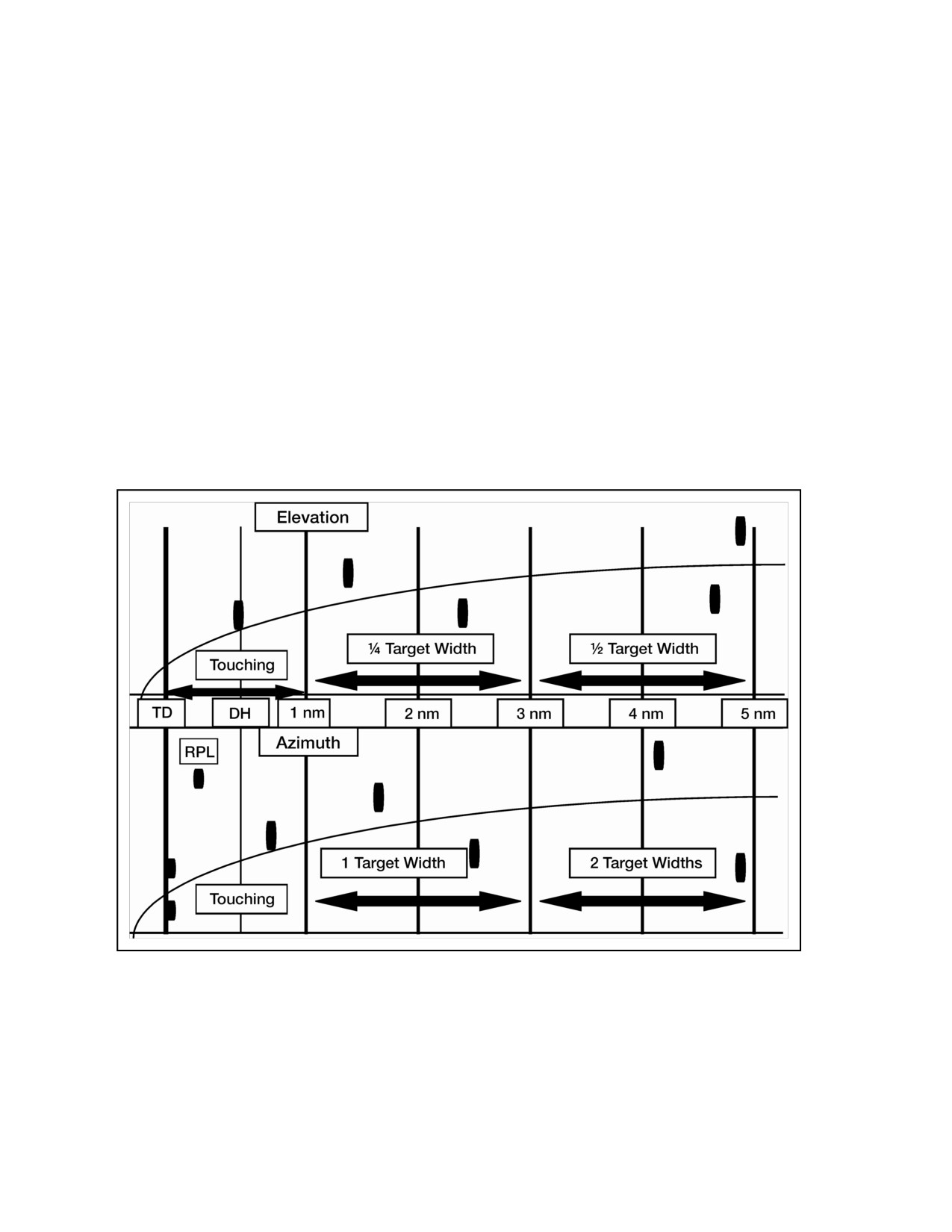
FM 3-04.303 (FM 1-303) ______________________________________________________________
From three miles to one mile, the target does not exceed more
than one-quarter target length above or below the elevation
cursor.
From one mile to DH, the target must be touching the elevation
cursor.
From DH to touchdown (TD), as advisories only, the target should
be touching the elevation cursor.
z Azimuth:
From five to three miles, the target does not exceed more than
two target lengths left or right of azimuth cursor.
From three miles to one mile, the target does not exceed one
target length left or right of azimuth cursor.
From one mile to DH, the target must be touching the azimuth
cursor.
From DH to TD, as advisories only, the target should be touching
the azimuth cursor.
Figure 3-1. Radar Safety Limits (PAR without a “B” Cursor)
3-21. The following standards shall be used with radar systems that have a
“B” cursor on the PAR display. (See figure 3-2.) Once the aircraft begins
descent and progresses along the final approach, ensure that—
3-6
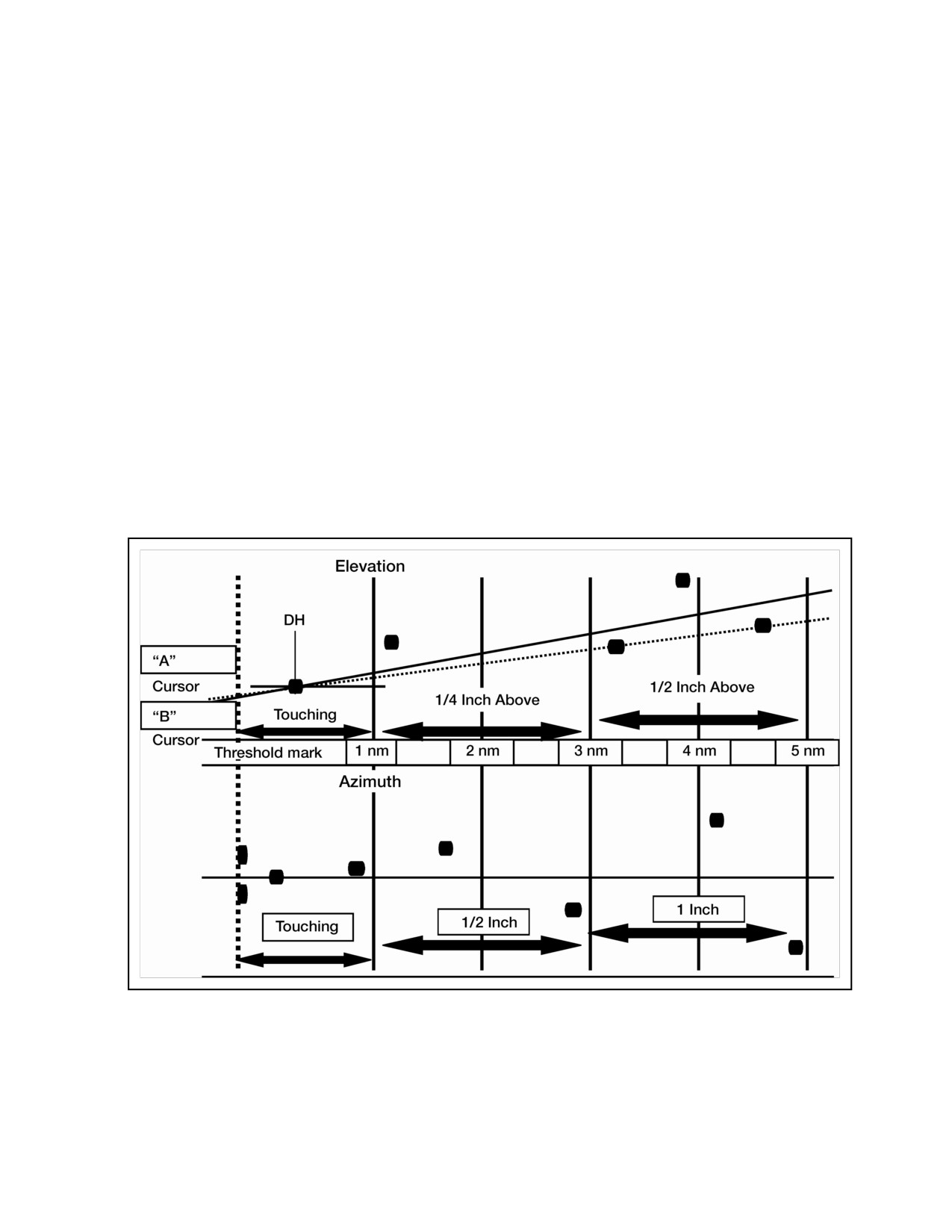
________________________________________________
Radar and Flight Following Services
z Elevation:
From five to three miles, the target does not exceed the “B” cursor
(below) or more than one-half inch above the elevation “A” cursor.
From three miles to one mile, the target does not exceed the “B”
cursor (below) or more than one-quarter inch above the elevation
“A” cursor.
From one mile to DH, the target must be touching the elevation
“A” cursor.
From DH to TD, as advisories only, the target should be touching
the elevation “A” cursor.
z Azimuth:
From five to three miles, the target does not exceed more than
one inch left or right of azimuth cursor.
From three miles to one mile, the target does not exceed one-half
inch left or right of the azimuth cursor.
From one mile to DH, the target must be touching the azimuth
cursor.
From DH to TD, as advisories only, the target should be touching
the azimuth cursor.
Figure 3-2. Radar Safety Limits (PAR with “B” Cursor)
3-22. The following standards shall be used when applying the elevation
failure procedures of FAAO 7110.65, if authorized, on the digital radars
currently being fielded such as the air traffic navigation, integration, and
3-7
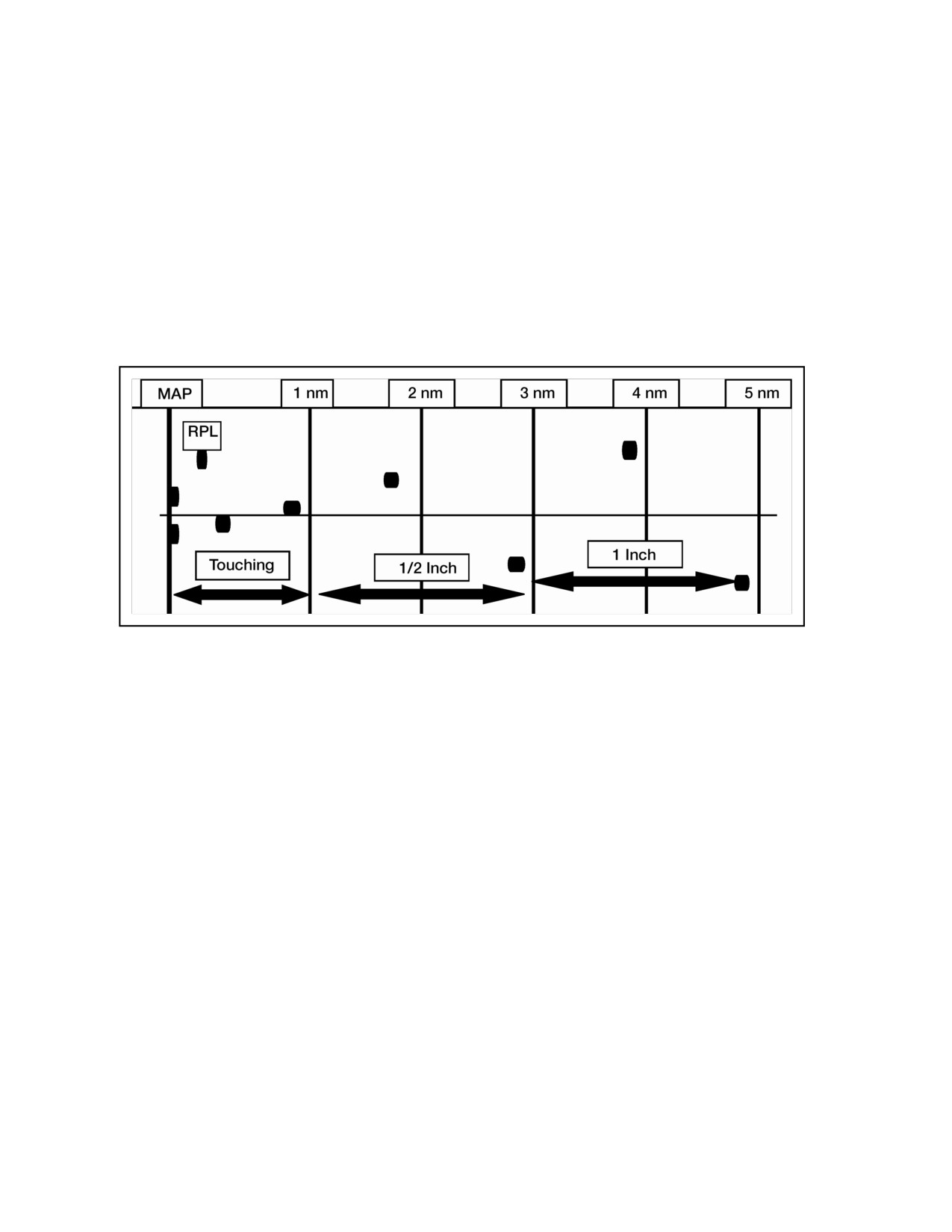
FM 3-04.303 (FM 1-303) ______________________________________________________________
coordination system (ATNAVICS) and installation PAR (fixed base precision
approach radar [FBPAR]). (See figure 3-3.) Once the aircraft begins descent
and progresses along the final approach ensure that—
z ASR:
From five to three miles, the target does not exceed one inch left
or right of azimuth cursor.
From three miles to one mile, the target does not exceed one-half
inch left or right of azimuth cursor.
From one mile to missed approach point (MAP), the target must
be touching the azimuth cursor.
Figure 3-3. Radar Safety Limits (ASR with Digital Video)
3-23. The following standards shall be used during ASR approaches on the
older analog radar systems currently in use worldwide such as the
TPN-18/18A, and FPN-40 (authorized when using PAR azimuth to apply the
elevation failure procedures of FAAO 7110.65) (see figure 3-4). Once the
aircraft begins descent and progresses along the final approach ensure that—
z ASR:
From five to three miles, the target does not exceed more than
two target widths left or right of azimuth cursor.
From three miles to one mile, the target does not exceed one
target width left or right of azimuth cursor.
From one mile to MAP, the target must be touching the azimuth
cursor.
3-8
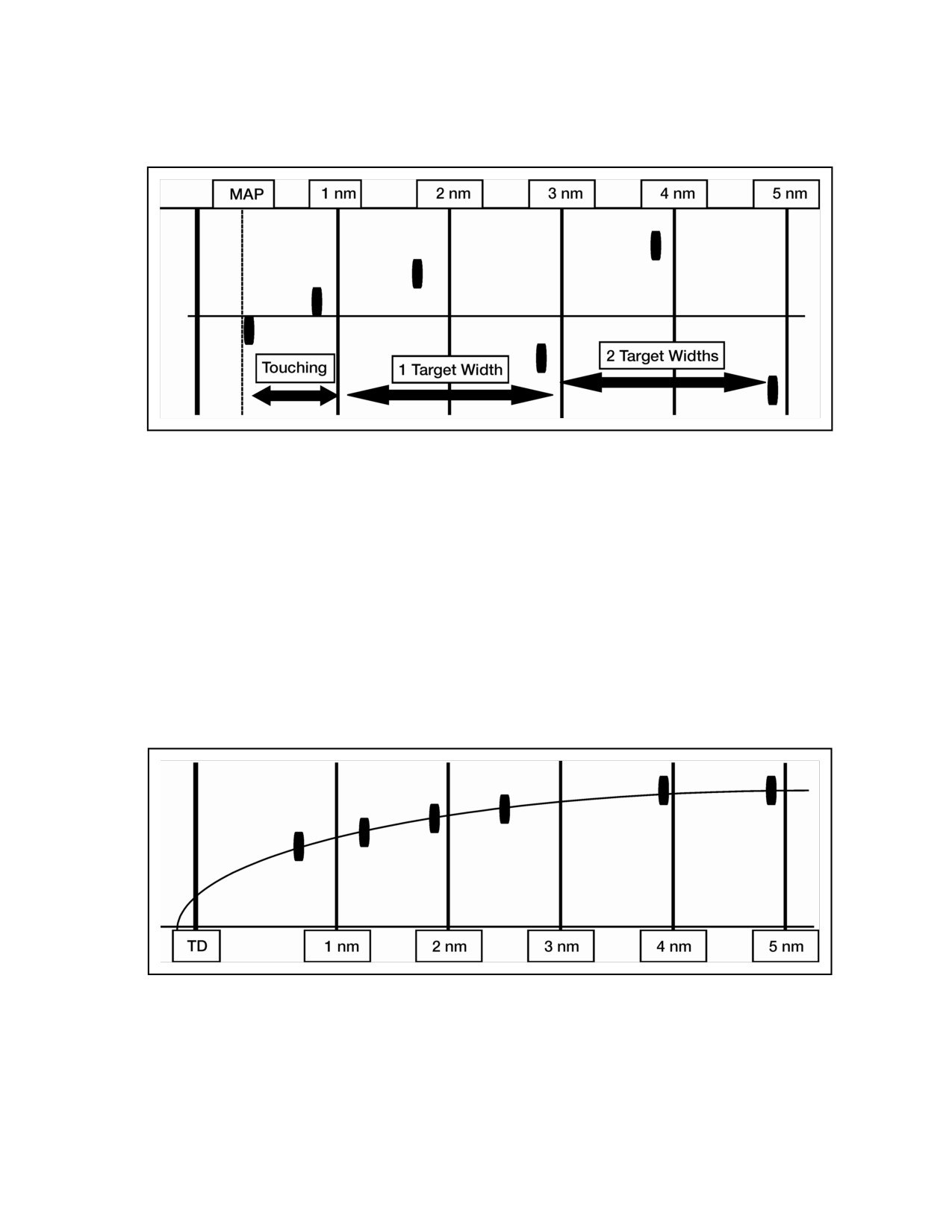
________________________________________________
Radar and Flight Following Services
Figure 3-4. Radar Safety Limits (ASR with Analog Video)
3-24. If the pilot deviates from the final approach course beyond the limits in
the previous paragraph, or the pilot does not respond to trend information,
apply the procedures outlined in FAAO 7110.65.
FLIGHT INSPECTION APPROACHES
3-25. When conducting radar approaches for flight inspection (FI), the pilot
will perform a minimum of two approaches to check facility alignment.
3-26. One approach will be conducted under normal conditions requiring
numerous glide-path information calls. This approach establishes the facility
angle and course alignment. The FI pilot commonly refers to the elevation
cursor as the “A” cursor (see figure 3-5).
Figure 3-5. PAR “A” Cursor (on Glide Path)
3-9
///////////////////////////////////////