FM 3-04.303 AIR TRAFFIC SERVICES FACILITY OPERATIONS, TRAINING, MAINTENANCE, AND STANDARDIZATION (DECEMBER 2003) - page 6
Appendix E
Air Traffic Control Tape Transcriptions
This appendix is an example format for transcribing air traffic control
tapes. Memorandum format contained in AR 25-50 is the Army standard.
PURPOSE
E-1. The following format will standardize transcribing tapes for
accidents/incidents.
CONTENTS
z Subject.
z Recording facility.
z List of transmitting facilities.
z Facility, land line, or position being recorded.
z Date of, and time covered by, transcript.
z Certification.
FORMAT
E-2. The following figure provides the required memorandum format for tape
transcriptions.
E-1
FM 3-04.303 (FM 1-303) ______________________________________________________________
DEPARTMENT OF THE ARMY
ORGANIZATION NAME/TITLE
CITY, STATE, AND ZIP CODE
OFFICE SYMBOL (MARKS NUMBER)
DATE
MEMORANDUM FOR
SUBJECT: Transcript of Accident/Incident of (Aircraft call sign) on (Date)
1. The recording facility was (facility name).
2. The following is a list of facilities/operating position(s)/aircraft (and their abbreviations) that made
transmissions during the period 5 minutes prior to 5 minutes after the recorded accident/incident.
OFFICE SYMBOL
SUBJECT: Transcript of Accident/Incident of (Aircraft call sign) on (Date)
TRANSMITTER
ABBREVIATION
R12345
R345
Coastal
C-AIC
3. The time period covered and date of this transcript is from (5 minutes prior to accident/incident) to
(5 minutes after accident/incident) on (date).
4. As custodian of the original recording, I certify this to be a true and exact TRANSCRIPT thereof.
FRED E. JOHNSONE
SFC, USA
Tower Chief
Figure E-1. Memorandum Format for Official Tape Transcriptions
E-2
Appendix F
Risk Management
Risk management is not an add-on feature to the decisionmaking process,
but rather a fully integrated element of planning and executing
operations… Risk management helps us preserve combat power and
retain the flexibility for bold and decisive action.
Proper risk
management is a combat multiplier that we can ill afford to squander.
General Dennis J. Reimer
Chief of Staff, Army
27 July 1996
Risk decisions are the commander’s business. Such decisions are
normally based on the next higher commander’s guidance on how much
risk he is willing to accept and delegate for the mission. Risk decisions
should be made at the lowest possible level, except in extreme
circumstances. FM 100-14 and this appendix provides guidance on risk
management; use this appendix as a tool when assessing ATS missions.
RISK MANAGEMENT PROCESS
F-1. Risk management is the process of identifying, assessing, and controlling risks
arising from operational factors, and making decisions that balance risk costs with
mission benefits. Hazards and the resulting risks may vary as circumstances change and
experiences are gained. Leaders and individual soldiers become the assessors for ever-
changing hazards
(such as those associated with environment—weather, visibility,
contaminated air, water, and soil—equipment readiness, individual and unit experience,
and fatigue). The risk management process allows individuals to make informed,
conscious decisions and accept risks at acceptable levels.
F-2. During the exercise planning stage, a risk assessment must be conducted to
accomplish risk management. This systematic process helps leaders make informed
decisions. The five major areas for risk assessment are fiscal, threat, tactical doctrine,
physical security, and safety. Leaders must complete the following five steps for risk
management. Tactical units shall conduct risk assessment before each mission. Each
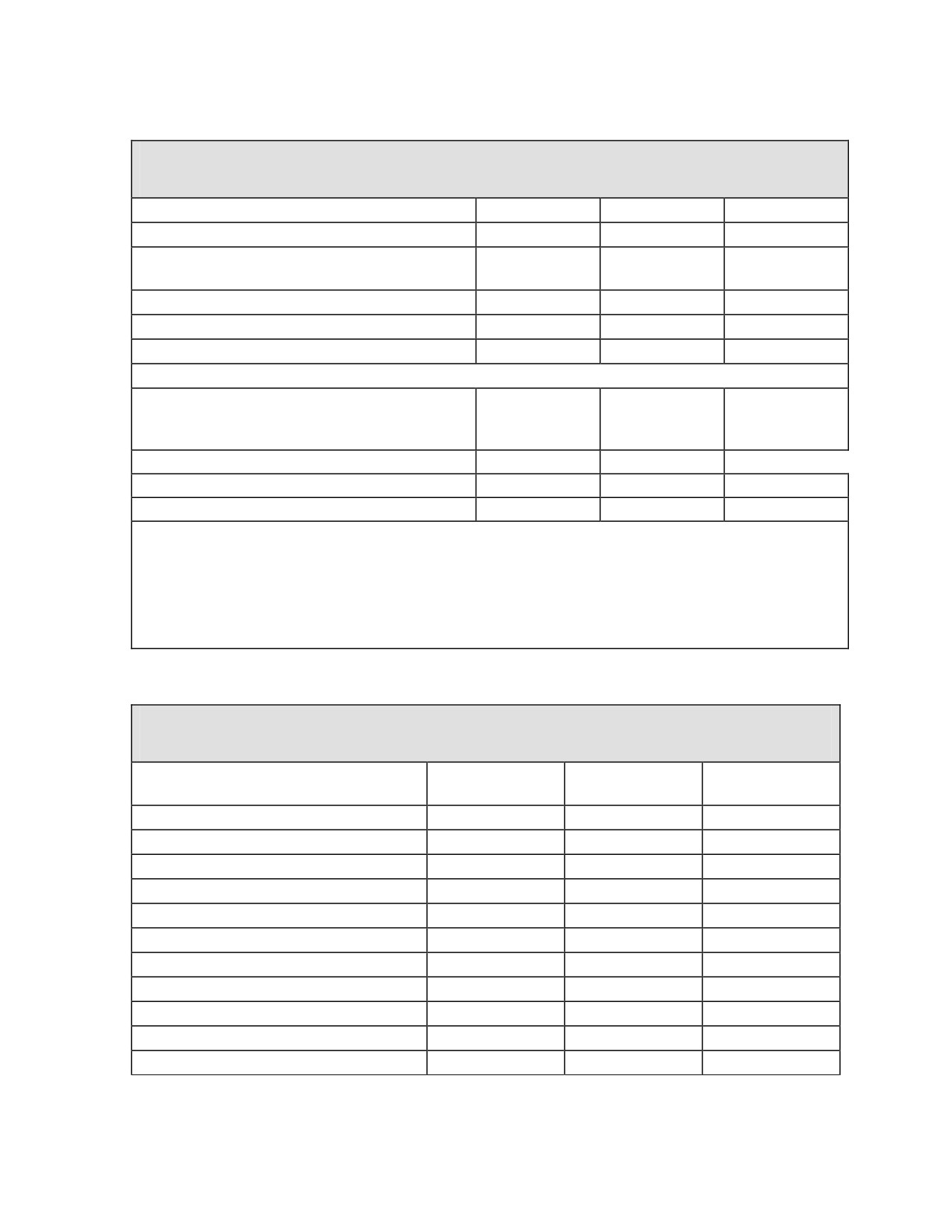
tactical facility shall develop its own risk assessment. See table F-1 for an example of a
risk assessment worksheet.
Step 1. Identify Hazards
F-3. Make an operations analysis. This is simply a description, normally in time
sequence, of the events that are expected to occur during the operation.
F-4. Make a preliminary hazard analysis. This is a list of the various hazards that could
occur and result in accidents. It is developed using experience, the data base, and
scenario thinking or similar techniques.
F-1

FM 3-04.303 (FM 1-303) ______________________________________________________________
F-5. If necessary, use a more in-depth hazard analysis. This analysis is normally used
when time permits or when certain risks require more careful consideration to be fully
understood.
Step 2. Assess Hazards
F-6. Assess the various hazards to determine their relative probability and severity and
their potential impact on the mission.
Step 3. Make Decisions and Develop Controls
F-7. Develop risk control options, starting with the most serious risks.
F-8. Complete a training realism assessment to assure the suitability of risk controls.
F-9. Make risk decisions. Select risk controls that will reduce the risk to a practical
minimum consistent with the mission objectives.
Step 4. Implement Controls
F-10. Implement the risk control procedures. Implementation is best accomplished by
integrating the procedures as standards in unit SOPs, orders, and training operations.
Step 5. Supervise
F-11. Maintain the effectiveness of risk controls by ensuring that risk control standards
are as effective as expected and kept at high levels.
Table F-1. Sample Installation Risk Assessment
All Rated Mixed
One Or More
1. Facility Personnel Experience
All CTO Rated
(CTO/ATCS)
Not PQ
Inexperience- (<6 Mos)
3
4
5
Experience- (6 - 12 Mos)
2
3
4
Experience- (>12 Mos)
1
2
3
2. Airport Structure (Select one each line)
< Or = 1
2 - 3
3 Or More
a. Number of Adjacent Facilities Within 15
1
2
3
nautical miles
b. Number of Primary Landing Surfaces
1
2
3
c. Number of NAVAIDS
1
2
3
d. Number of Coordinating Facilities
1
2
3
3. Traffic Density
Day
Night
Night vision
goggles (NVG)
20 + A/C per hour
3
4
5
5 - 19 A/C per hour
2
3
4
LESS THAN 5 per hour
1
2
3
Wet Bulb Globe
Temperature
(WBGT)
(WBGT)
(WBGT)
4. Weather
Category I
Category II/III
Category IV/V
Night IFR
3
4
5
F-2
________________________________________________________________
Risk Management
Table F-1. Sample Installation Risk Assessment
Day IFR
2
3
4
Day/Night VFR
1
2
3
On Shift
On Shift
On Shift
5. Fighter Mgmt Rest
8 Hours
9 Hours
10 Hours
8 Hours
--
4
5
8 - 12 Hours
2
3
4
12 - 24 Hours
1
2
3
Note: Shift member with the least amount of rest will be used for calculation
More Than 6
6. Cumulative Fighter Mgmt Hrs Worked In --
0 - 2 Weeks
3 - 6 Weeks
Weeks Over 40
Days
Over 40 Hrs
Over 40 Hrs
Hrs
50 +
3-4
5
2
3
4
40 - 50
1
2
3
LESS THAN 40
Notes: As a minimum paragraph 1, 5, and 6 shall be used in all installation ATC risk assessments.
New risk assessment should be completed semiannually or when there is a change in facility
operating hours or airport structure. Any significant change in personnel should be considered as a
cause for a new risk assessment.
Instructions: Under the appropriate column circle only one value for each numbered block. For
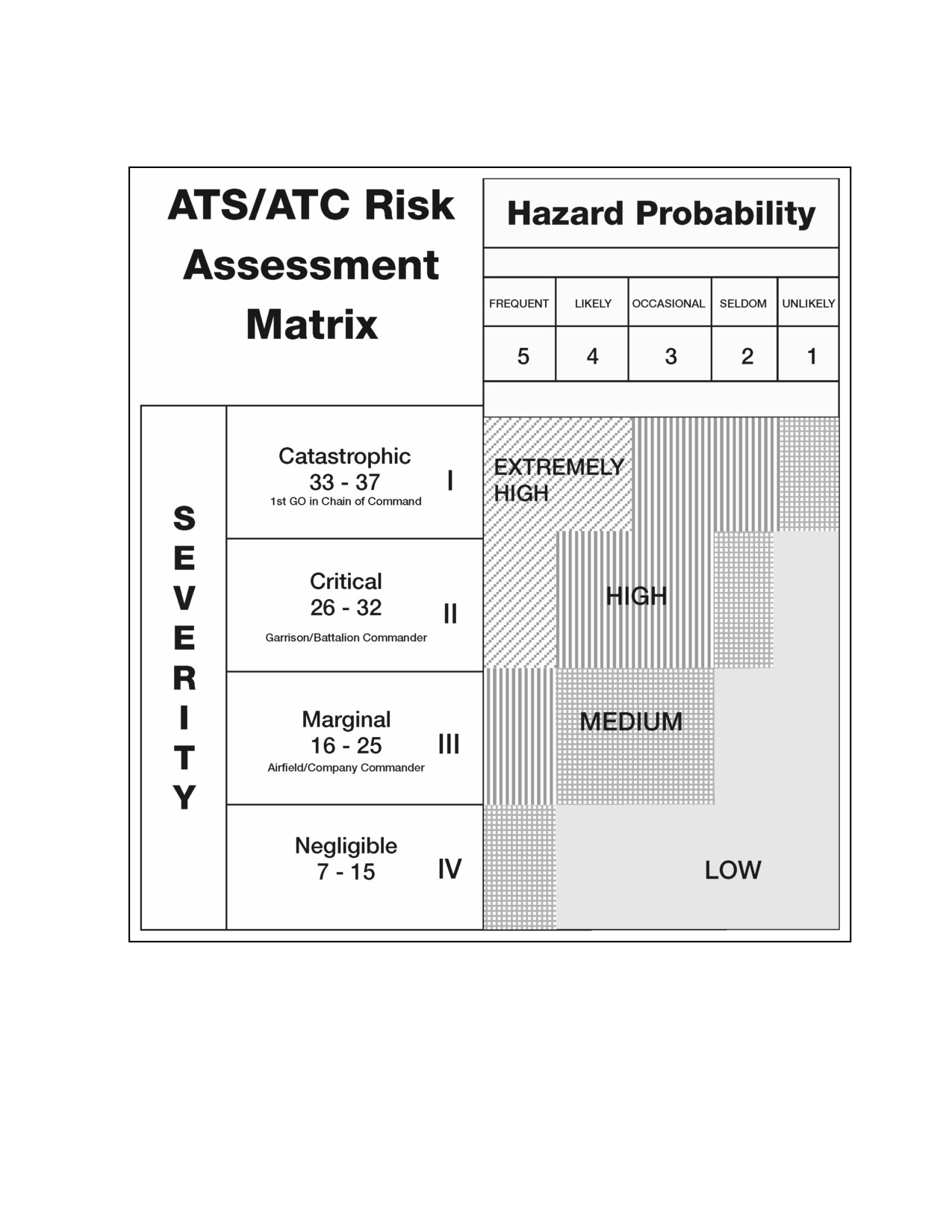
block 2, circle one value for each line. Total all circled values and compare to ATS/ATC risk matrix.
Table F-2. Sample Tactical Risk Assessment
All Rated Mixed
One Or More Not
1. Team Experience
All CTO Rated
(CTO/ATCS)
PQ
Inexperience- (<3 Months)
3
4
5
Experience- (3 - 6 Months)
2
3
4
Experience- (>6 Months)
1
2
3
2. Mission Planning Time Allotted To Plan
8 Hours
4 - 8 Hours
Less 4 Hours
Complex
3
4
5
Routine-New Mission
2
3
4
Routine-Same Mission
1
2
3
3. Traffic Density
Day
Night
Nvg
20 + A/C per hour
3
4
5
5 - 19 A/C per hour
2
3
4
Less Than 5 per hour
1
2
3
F-3

FM 3-04.303 (FM 1-303) ______________________________________________________________
Table F-2. Sample Tactical Risk Assessment
(WBGT)
(WBGT)
(WBGT)
4. WEATHER
Category I
Category II/III
Category IV/V
Night IFR
3
4
5
Day IFR
2
3
4
Day/Night VFR
1
2
3
5. Environment
Garrison/ EXCL
Tactical AVG
Tactical POOR
Operating Environment
Condition
Condition
Condition
TAC/Unsecured
3
4
5
TAC/Secured
2
3
4
Garrison
1
2
3
On Shift
On Shift
6. Fighter Mgmt Rest
On Shift 8 Hours
10 Hours
12 Hours
8 Hours
--
4
5
8 - 12 Hours
2-3
4
12 - 24 Hours
1
2
3
Note: Team member with the least amount of rest will be used for calculation
More Than 6
7. Cumulative Fighter Mgmt Hrs Worked
0 - 2 Weeks Over
3 - 6 Weeks Over
Weeks Over 40
In -- Days
40 Hrs
40 Hrs
Hrs
50 +
3
-4
5
40 - 50
2
3
4
Less Than 40
1
2
3
Notes: As a minimum paragraph 1, 6, and 7 shall be used in all tactical ATS risk assessments.
Instructions: Under the appropriate column circle only one value for each numbered block. Total
all circled values and compare to ATS/ATC risk matrix.
F-4
________________________________________________________________
Risk Management
Figure F-1. Sample Risk Matrix
F-5
Appendix G
Tactical Operations
This appendix contains criteria and guidance on tactical deployment of
ATS NAVAIDS. Commanders should use this appendix as a tool for
assessing ATS mission requirements. Additional information may be
found in FAAO 8260.3, FAAO 8260.15D, and FAAO 8260.36A.
TERMINAL INSTRUMENT PROCEDURES
G-1. Terminal instrument procedures (TERPS) is the process of developing
approach procedures based on location, obstacles, airspace, air traffic flow,
procedures desired, and aircraft performance in accordance with
FAAO 8200.1, FAAO 8260.15D, FAAO 8260.3B, and this manual.
G-2. Under National Agreement (NAT) 127, the FAA provides worldwide
terminal instrument procedures service for the U.S. Army. This service shall
include original procedure development and amendments as necessary (to
include procedures for contingency/exercise operations), facility and
procedure flight inspection service, site evaluation of proposed navigational
aids, procedure processing, and publication.
Request for procedure
development shall be forwarded to the FAA through the DARR, USAASD-E
Commander, or Eighth Army ATC Office.
REQUIRED INFORMATION FOR PROCEDURE DEVELOPMENT
G-3. In accordance with NAT 127, the following information is required for
procedure development (see figures G-1 through G-3, pages G-3, G-4, and
G-7).
z Type procedure requested.
z Type radar system in use.
z Two copies of FAA Form 7210-9 (En Route Minimum IFT/Minimum
Vectoring Altitude Obstruction Document).
z Two copies of the sectionals used for the MVA chart (MVAC).
z Requested glideslope (GS).
z Requested threshold crossing height (TCH).
z Runway point of intercept (RPI) distance.
z Ground plane intercept (GPI) distance.
z Requested decision height.
z Latitude/longitude/elevation of—
Runway threshold (RWY THLD).
Runway departure end.
Touchdown (TD)/runway point of intercept (RPI).
Radar receiver/transmitter (R/T) group.
Ground plane intercept (GPI).
G-1
FM 3-04.303 (FM 1-303) ______________________________________________________________
NDB location.
z NDB approach information (identifier, frequency, holding patterns,
altitudes, fixes, include any restrictions, such as remain within five
nautical miles).
z Missed approach procedure (straight or turning with direction).
z Airport information.
z Name (identifier), elevation.
z NAVAIDS (include type, location, procedure, glideslope, if applicable).
z Runway number, length, width, lighting (include approach lights),
markings, composition.
z Displaced threshold (latitude/longitude).
z Any photographs of airport (surface, air, or satellite), maps (scale
1:24,000 through
1:500,000), airport layout plans
(ALP) or civil
engineering master tabs, if available.
IDENTIFYING OBSTACLES
G-4. Obstacles
(manmade or natural) within
25 nautical miles
(at a
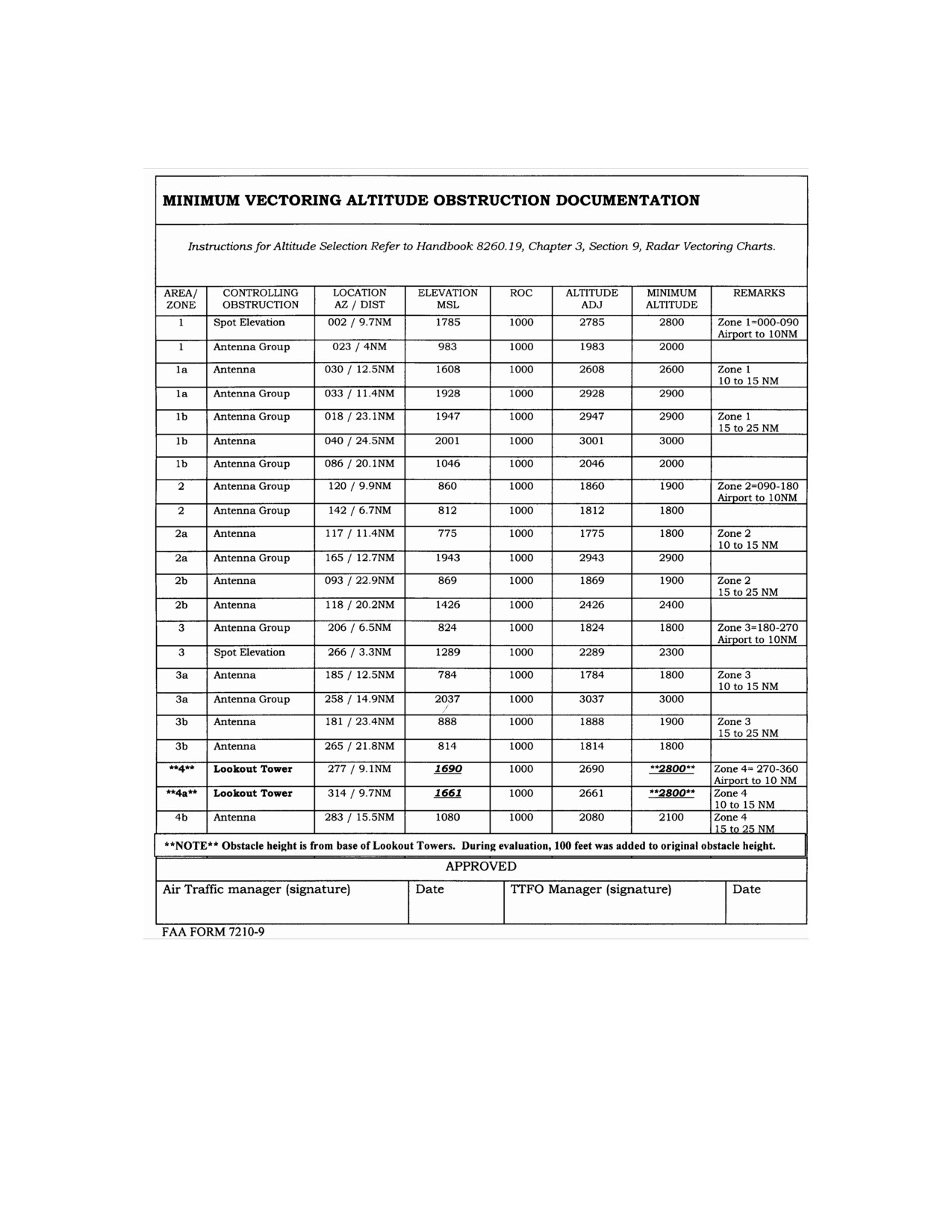
minimum) of a tactical NAVAID shall be identified and annotated on
FAA Form 7210-9 (see figure G-1). This example is completed using non-
mountainous terrain required obstacle clearance (ROC) of 1000 feet in lieu of
mountainous terrain (ROC 2000). The example also shows how the horizon
may be broken down into four equal areas of ninety degrees each and ranges
in increments of 5 to 10 miles. This makes it easier to scan for obstacles.
When obstacles are identified, they will be used to determine the procedure
altitudes for the NDB, the minimum vectoring altitude (MVA), minimum safe
altitude (MSA), lowest usable glidepath, and any required adjustments to the
missed approach procedure. U.S. Army ATS facilities shall forward two
copies of new or revised MVAC and FAA Form 7210-9 to the appropriate
DARR for review. For U.S. Army installations outside U.S. territory and not
under an FAA regional office, MVAC shall be forwarded to HQ USAASA or
USAASD-E respective of the area of responsibility. Chapter 3 contains more
information on the development of minimum vectoring altitude charts
(MVAC).
G-2
_______________________________________________________________
Tactical Operations
Figure G-1. Sample Obstruction Documentation
RADAR REFLECTOR DIAGRAM
G-5. These diagrams provide accurate information about the radars
installation and its location in relation to the runway/landing area. This
diagram may also assist tower personnel by alerting them to
hazardous/restricted areas in relation to the radar facility. When flight
G-3
FM 3-04.303 (FM 1-303) ______________________________________________________________
inspection (FI) of the radar is conducted by ATSCOM, the FI team will use a
theodolite provided by the unit, their own theodolite, or the automated flight
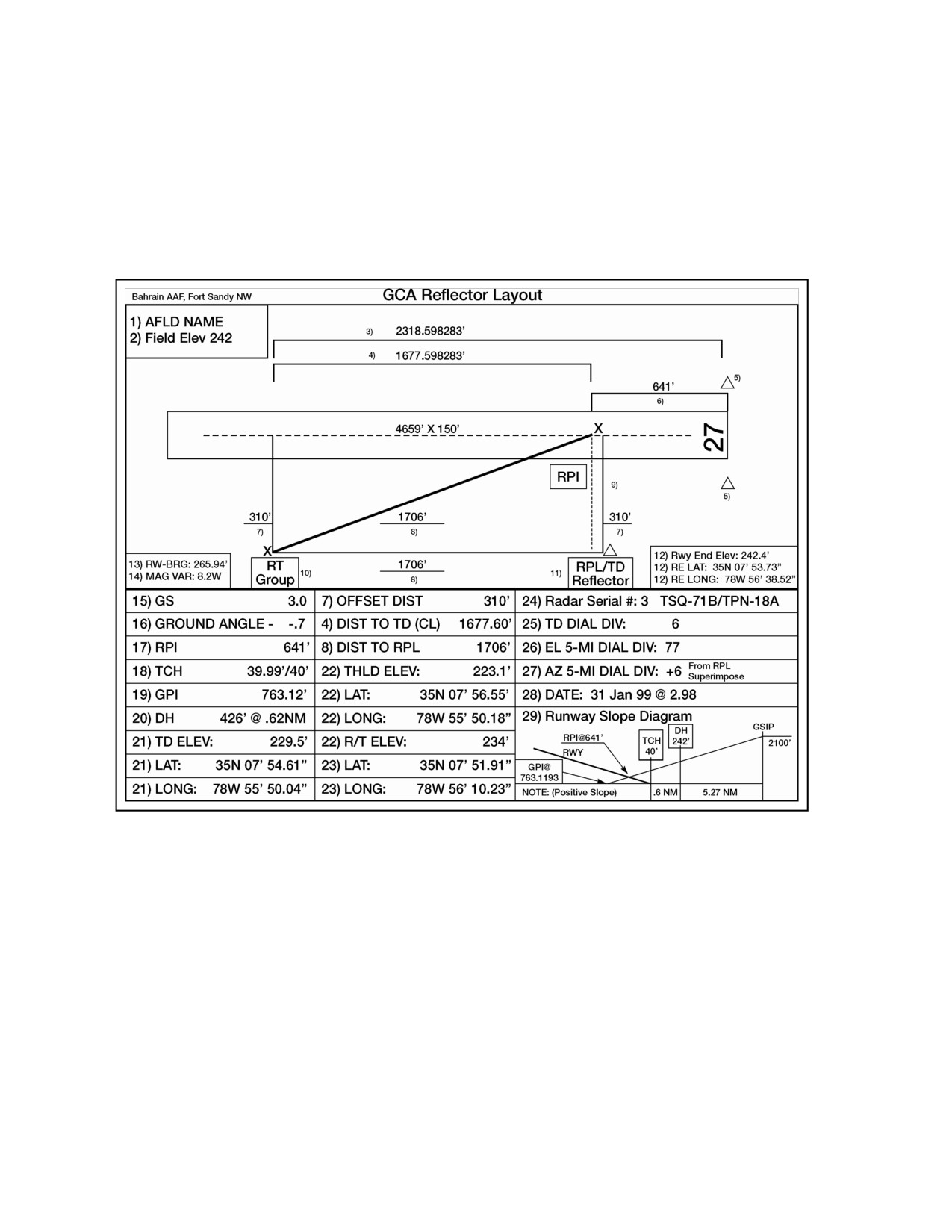
inspection system (AFIS). The sample radar reflector diagram (figure G-2)
shows all the information that the AFIS requires to complete a
commissioning flight inspection of IFR/VFR radar facilities. This information
shall be sent to ATSCOM along with the request for flight inspection.
Figure G-2. Radar Reflector Diagram (Left of Runway)
G-6. The radar reflector diagram is completed as follows:
Items 1 and 2. Self explanatory
Item 3. Insert distance from abeam receiver/transmitter (R/T) group, to RWY
THLD on runway centerline.
Item 4. Insert distance from abeam R/T group, to TD/RPI on RWY centerline.
Item 5. Determine which reflector method will be used. (Centerline reflector
shall be a minimum of 200 feet from THLD toward approach path of aircraft
in accordance with FAAO 8260.3 (TERPS). Bracket reflectors shall be a
minimum of 75 feet off RWY centerline. If brackets are used to mark TD/RPI,
they are set up 90 degrees of RWY centerline abeam TD/RPI. Also see
Item 9).
G-4
_______________________________________________________________
Tactical Operations
Item 6. Insert distance from TD/RPI to RWY THLD.
Item 7. Insert offset distance from R/T group to RWY centerline.
Item 8. Insert distance from R/T group to TD/RPI on angle. (Item 4 squared +
Item 7 squared = ? (push inverse or shift or 2nd function key square) = R/T to
TD/RPI on angle.
Example:
Item 4 = 100 feet offset squared = 10,000
Item 7 = 1,000 feet squared = 1,000,000
10,000 + 1,000,000 = 1,010,000
1,010,000 INV square = 1,004.987562 feet
Item 8 = 1,004.99 feet
Item 9. Insert distance from runway parallel line (RPL) to TD/RPI on angle.
(When RPL is used to mark TD/RPI, it will be farther away from R/T than
distance R/T to TD/RPI on centerline). Item 8 above shows that while TD/RPI
is
1,000 feet from the R/T on centerline, the actual distance from R/T to
TD/RPI on the direct line is 1,004.99 feet. You will have to measure 4.99 feet
from TD/RPI toward THLD, then place the RPL reflector 90 degrees off RWY
centerline to ensure touchdown rangemark is properly aligned.
Item 10. Location of R/T group.
Item 11. Location of RPL reflector (may be used to mark TD/RPI). (See
Item 9.)
Item 12. Insert runway end elevation (departure end of instrument runway),
latitude/longitude.
Item 13. Insert runway bearing (for example RWY 27 can be 265 degrees to
274.99 degrees).
Item 14. Insert magnetic variation for the location.
Item 15. Insert glideslope/glidepath angle.
Item 16. Insert ground angle (GA) between R/T and TD/RPI.
Item 17. Insert distance from THLD to RPI.
Item 18. Insert threshold crossing height (TCH) (shall be between 32 feet and
60 feet to avoid requiring a waiver).
Item 19. Insert distance from THLD to ground plane intercept (GPI).
Item 20. Insert decision height
(DH) altitude and location (for example
.7 nautical miles).
Item 21. Insert airfield elevation at TD with latitude/longitude.
Item 22. Insert airfield elevation at THLD with latitude/longitude.
Item
23. Insert airfield elevation at center of R/T group with
latitude/longitude.
Item 24. Insert radar R/T group serial number with type (for example
Serial #3, TPN-18A).
G-5
FM 3-04.303 (FM 1-303) ______________________________________________________________
Item 25. Insert TD dial division (DD) (for example ground angle (GA) x 20 +
20 = TD DD).
Item 26. Insert elevation 5 mile DD (formula found in equipment technicaI
manual (TM) or use formula as follows for TPN-18/18A).
STEP 1. 30380.5 x tangent (TAN) GS = altitude angle alignment (AAA).
STEP 2. Distance R/T to TD/RPI on angle + 30380.5 = ?
STEP 3. Answer Step 1 / Answer Step 2 = ?
STEP 4. Answer from Step 3 (INV TAN) = EAA.
STEP 5. EAA x 20 + 20 = Elevation 5 mile DD.
Item 27. Insert azimuth 5 mile DD (Formula found in TM or use formula as
follows for TPN-18/18A).
STEP 1. Distance R/T to TD/RPI on angle + 30380.5 = ?
STEP 2. Offset distance R/T to centerline / answer of Step 1 = ?
STEP 3. Answer from Step 2 (INV TAN) = ?
STEP 4. Answer of Step 3 (? x 10) = amount to add or subtract from RPL
DD. (Left of RWY=Add, Right of RWY=Subtract)
Item 28. Insert date of FI and actual GS angle.
Item 29. Draw runway slope diagram.
FLIGHT INSPECTION
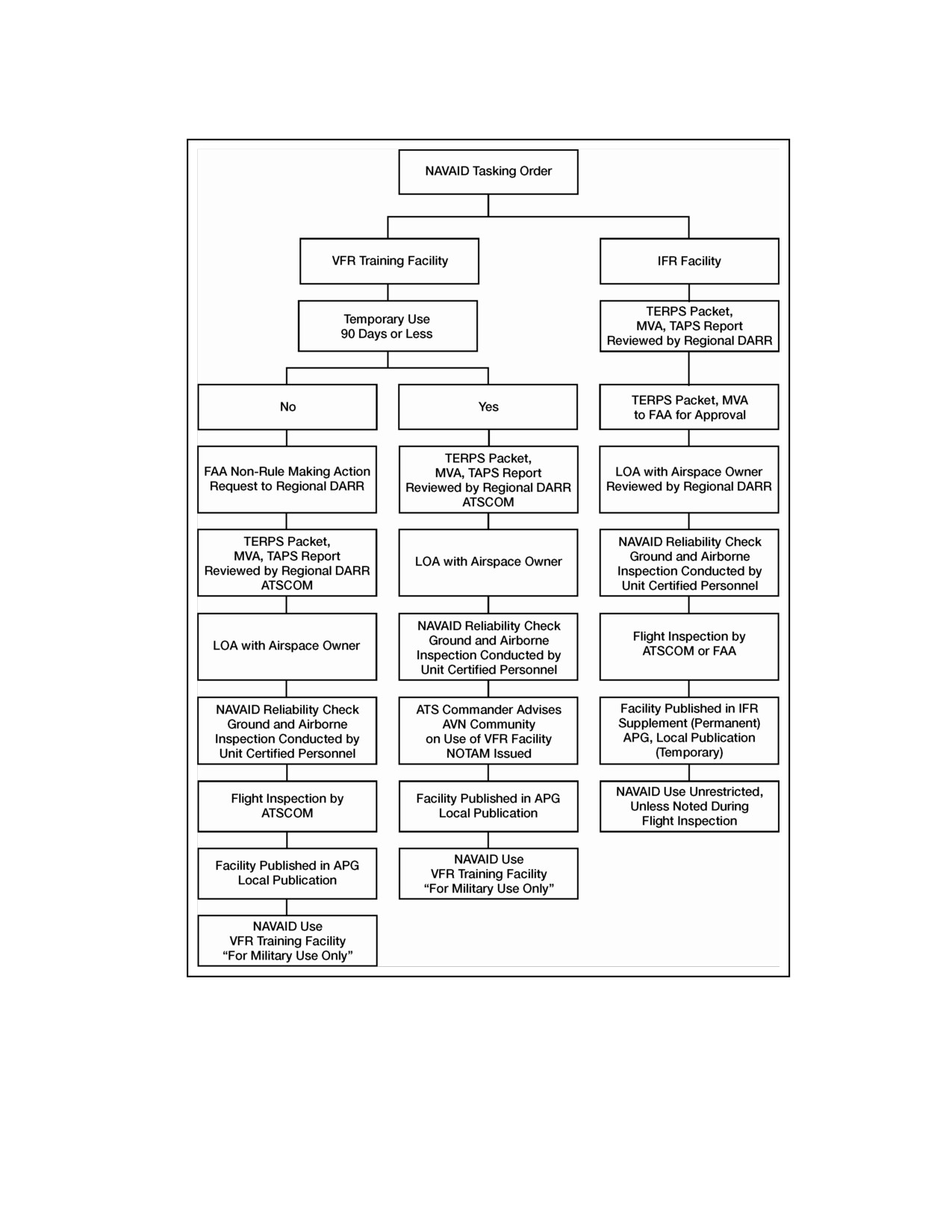
G-7. The FAA and ATSCOM are the only agencies that can certify NAVAIDS
prior to their use. In accordance with FM 1-120, while deployed in a combat
or contingency zone, the ATS unit normally provides limited flight inspection
of deployed air navigational facilities, using organic expertise and aviation
assets. The ATS commander will be responsible for advising the supported
aviation units of the risks involved in using these air navigational facilities
when a certified flight inspection has not been performed. This is especially
true when instrument meteorological conditions (IMC) may exist. This
authority is not meant to supersede the requirement for completing a
certified flight inspection, but to allow commanders the flexibility of limited
usage of deployed air navigational facilities until such time as a certified
flight inspection may be completed. See figure G-3 for further certification
requirements/guidance.
G-6
_______________________________________________________________
Tactical Operations
Figure G-3. Navigational Aid (NAVAID) Deployment Matrix
G-7
FM 3-04.303 (FM 1-303) ______________________________________________________________
TERPS PACKETS
G-8. A TERPS packet shall be completed each time a NAVAID is installed for
operational use. Instructions for completing each form in the packet are
provided for clarification and guidance.
G-9. When the radar system is deployed for periods less than 90 days (VFR
training/military use only), the packet sent to regional DARR/USAASD-E/
ATSCOM shall include the following documents:
z FAA Form 7210-9 (MVA Obstruction Document).
z Minimum vectoring altitude chart (MVAC) drawn on two copies of the
appropriate sectionals.
z DA Form 3501-1-R (Precision Approach Radar [GCA] Data).
z DA Form 3479-8-R.
G-10. When the radar is deployed for VFR/IFR use or for more than 90 days
(VFR training), the packet sent to regional DARR/USAASD-E shall include
the following documents.
z FAA Form 7210-9.
z Minimum vectoring altitude chart (MVAC) drawn on two copies of the
appropriate sectionals.
z DA Form 3479-8-R.
z DA Form 3501-1-R.
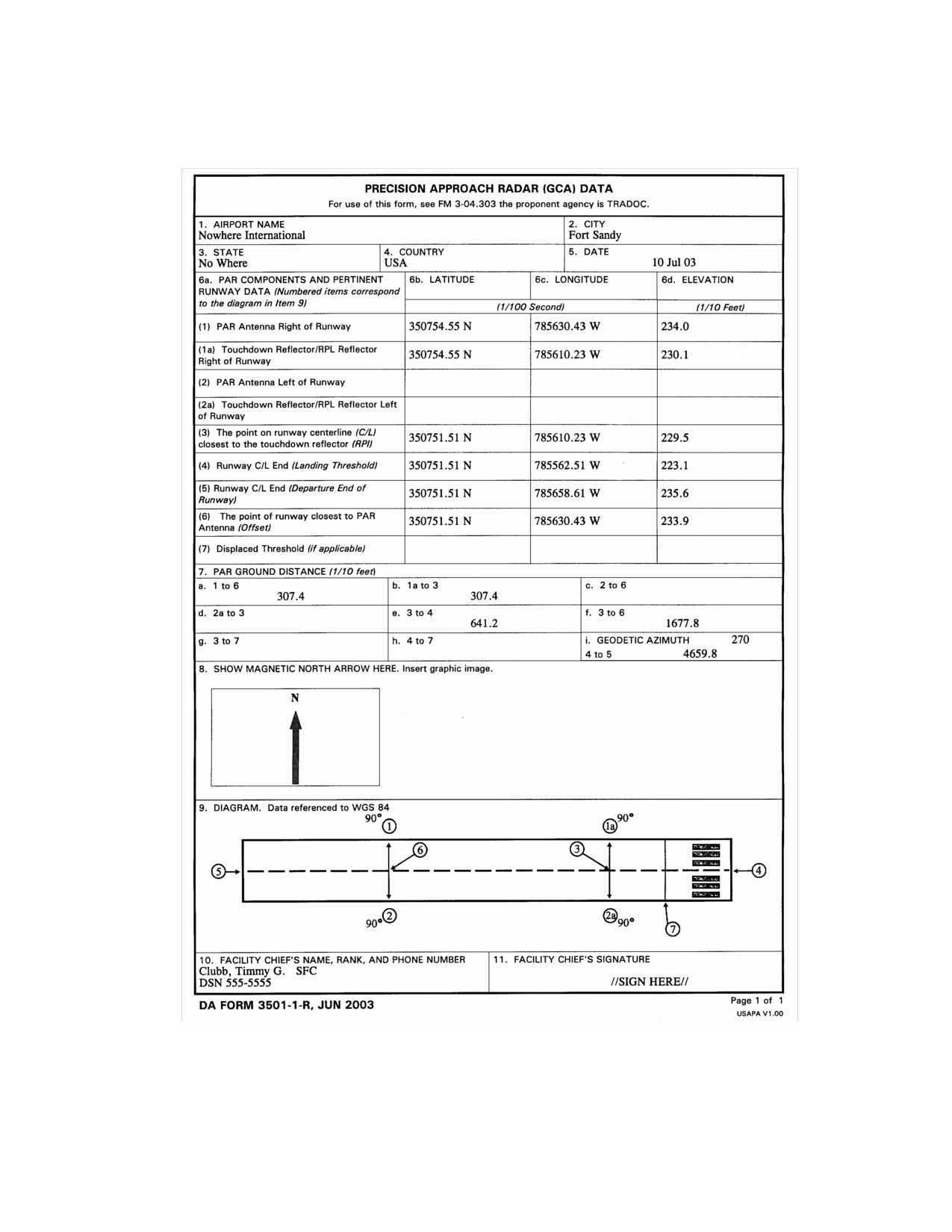
G-11. DA Form
3501-1-R contains all the information required by
USAASA/USAASD-E to have a terminal instrument approach procedure
developed
(see figure G-4). When ASR approaches are requested, the
information contained in the PAR data sheet for the specific radar shall be
used to develop the procedure.
Instructions for completing
DA Form 3501-1-R are as follows:
z Item 1: List the name of the airport/airfield/facility.
z Item 2 through 5: Self-explanatory.
z Item 6a through 6d: Provide the coordinates (6b and 6c) to the 1/100
second, and elevation (6d) to the 1/10 foot for the items listed in 6a.
The numbered items correspond to the diagram in item 9.
G-8
_______________________________________________________________
Tactical Operations
Figure G-4. Precision Approach Radar (GCA) Data
G-9
FM 3-04.303 (FM 1-303) ______________________________________________________________
z
Item 7: Information needed for 7a through 7i corresponds to the
items under column 6a and the diagram in item 9. Provide the
distance, to 1/10 foot, for each of the following items—
7a: If the PAR antenna (RT group) is placed on the right side of
the runway, provide the distance from the PAR antenna to the
point of runway closest to PAR antenna (offset).
7b: If the PAR antenna (RT group) is placed on the right side of
the runway, provide the distance from the touchdown reflector or
RPL reflector to the point on the runway centerline closest to the
touchdown reflector. (Skip to 7e.)
7c: If the PAR antenna (RT group) is placed on the left side of the
runway, provide the distance from the PAR antenna to the point
of runway closest to PAR antenna (offset).
7d: If the PAR antenna (RT group) is placed on the left side of the
runway, provide the distance from the touchdown reflector or
RPL reflector to the point on the runway centerline closest to the
touchdown reflector.
7e: Provide the distance from the point on the runway centerline
closest to the touchdown reflector to the runway centerline end
(landing threshold).
7f: Provide the distance from the point on the runway centerline
closest to the touchdown reflector to the point of runway closest to
PAR antenna (offset).
7g: If applicable, provide the distance from the point on the
runway centerline closest to the touchdown reflector to the
displaced threshold.
7h: If applicable, provide the distance from the runway centerline
end (Landing Threshold) to the displaced threshold.
7i: Provide the distance from the runway centerline end (landing
threshold) to the runway centerline end (departure end of the
runway). Additionally provide the geodetic azimuth from point 4
to point 5. This is the magnetic heading of the runway.
z
Item 8: Indicate with an arrow the direction of magnetic north in
relation to the runway in item 9. If you are using formflow the arrow
can be copied from PowerPoint and pasted in the box provided.
z
Item 9: The Diagram is provided on the form for reference and
requires no input from the controller.
z
Item 10 and 11: Self-explanatory.
G-12. DA Form 3479-8-R, Tactical Approach Publications System (TAPS), is
used to distribute information on tactical NAVAIDS to supported units. The
form should be completed and distributed early enough in the mission, that it
is included in the aviation unit’s aviation procedures guide (APG).
G-10
Appendix H
Determining Currency Requirements
(Installation Facilities Only)
Pending revision of AR 95-2, which will include currency requirements
previously contained in TC 95-93, use this appendix to determine
currency requirements. A controller is current and may exercise the
privileges of his/her rating when the following requirements are met.
H-1. Except for ATC chiefs, ATC SR SGTs and data systems officers, air
traffic controllers shall remain current in the ATC facility to which assigned.
Before becoming facility rated, a position-qualified individual may perform
controller duties in those positions for which he is qualified. However, he
must be under the general supervision of a controller who is facility rated and
current in that facility.
H-2. To remain current in a tower/AIC facility, facility chiefs, training
supervisors, and data system specialists shall demonstrate their ability to
apply relevant procedures and techniques in actual operation of all functions
and positions associated with the rating held, at least 24 hours per calendar
month. This time shall be equitably distributed among all positions that are
relative to the rating/position held. Half the time spent behind a trainee may
count toward currency requirements.
H-3. To remain current in a tower/AIC facility, all other controllers shall
demonstrate their ability to apply relevant procedures and techniques in
actual operation of all functions and positions associated with the rating held,
at least
40 hours per calendar month. This time shall be equitably
distributed among all positions that are relative to the rating/position held.
The time spent on a position monitoring a trainee will satisfy this
requirement.
H-4. To remain current in the GCA, each controller shall conduct at least
10 PAR/ASR approaches per calendar month.
H-5. When a facility-rated controller is assigned a trainee and the amount of
air traffic activity limits currency, the facility chief may allow the controller
to count his approaches concurrently with those counted by the trainee
controller receiving the one-on-one supervision. However, not more than five
monitored or simulated approaches may be counted toward monthly
currency.
H-6. Target simulations may also be used to fulfill up to 50 percent of the
monthly currency approach requirements.
H-1
FM 3-04.303 (FM 1-303) ______________________________________________________________
H-7. The provisions of H-1 and H-2 above shall not be applied concurrently to
reduce the required number of approaches to less than five actual
approaches. Time spent in a tactical situation performing the same types of
duties for which the rating is held shall be counted for currency.
H-8. ARAC controllers are not required to conduct any set number of PAR
approaches. ARAC facility chiefs are expected to establish currency
requirements consistent with manning, training, and safety requirements.
To remain current in an ARAC facility, controllers shall rotate each month
through all positions on which they are rated. A minimum of 16 hours shall
be spent on control or operational positions.
H-9. Every effort shall be expended to provide sufficient time, equipment, and
training flights to ensure radar controllers meet operational and currency
requirements.
H-10. When radar controllers have difficulty maintaining currency because of
insufficient traffic, the airfield commander shall be advised in writing.
Correspondence shall include the number of hours the facility can be
adequately staffed and a request to provide the required number of
approaches needed to maintain controller currency. If the controllers are
unable to maintain currency, the airfield commander shall be advised, in
writing, that a NOTAM should be issued stating what hours the facility will
be out of service.
H-11. To maintain currency in two different facilities, dual-rated controllers
must meet the currency requirements for the facility of assignment. When
the second rating is in the tower/AIC, the controller must be present for duty
in that facility not less than 24 hours each calendar month. If the second
rating is in a GCA, five actual PAR/ASR approaches are required.
H-12. If a controller does not maintain currency, it will be noted on DA
Form 3479-R with remarks as required.
H-13. An air traffic controller who has failed to maintain currency shall be
given an evaluation to assess proficiency. The evaluation shall be
administered on all control positions. The evaluation will be conducted under
normal traffic conditions and last long enough to provide a reliable
performance sample. It must be satisfactorily completed before the controller
assumes position responsibility without direct supervision. The evaluation
given for a loss of currency does not make the controller current for the
month given. The evaluation only satisfies the proficiency requirements and
allows the controller to continue working toward his currency requirements
during the next 30 days, without direct one-on-one supervision. Evaluations
for loss of currency will be administered by the ATC facility chief, training
supervisor, or shift leader and retained for one year. The ATC chief or ATC
SR SGT may administer the evaluation if facility-rated and current in the
facility. The ATCS/CTO examiner may also administer the evaluation. The
evaluation is recorded on DA Form 3479-1-R.
H-2
________________________
Determining Currency Requirements (Installation Facilities Only)
H-14. Remedial training shall be noted in sections III, IV, V, and VI of DA
Form 3479-R, if additional training is needed to regain proficiency because of
an unsatisfactory evaluation. The amount of training devoted to regaining
proficiency should depend on the number and type of previous ratings the
controller holds. Individuals unable to regain proficiency shall be processed
in accordance with AR 95-2.
H-3
Glossary
A²C²
Army airspace command and control
A
adjacent (in formula)
AAC
Army approach control (nonradar)an air traffic control facility
located at a U.S. Army airfield or heliport. It provides approach
control service without the use of radar.
AAF
Army airfield
AAR
after action report
AC
arrival control
ACA
airspace control authoritya service component commander
designated by the joint force commander to plan and coordinate
airspace control matters. The ACA also is responsible for the
operation of the airspace control system in the airspace control
area. As used in this publication, the airspace control authority is
the Air Force component commander (AFCC) or the Commander
Air Forces (COMAFFOR).
ACM
airspace control measure
ACO
airspace control ordera document that details all approved
airspace requests. It complements the air tasking order (ATO)
cycle and serves as the one planning document for airspace
considerations.
act
actual
AD
air defense
ADIZ
air defense identification zone
AHP
Army heliport
AIC
Airspace information centerformerly flight coordination center,
flight operations center, or Army flight-following service an ATC
facility used in the corps/division area to provide flight-following
services and air warning advisories and assist in search and rescue
operations
AIG
address indicating/indicator group
AIM
aeronautical information manual
air carrier
a civil aircraft certified to operate and serve the public interest by
transporting people and cargo for scheduled and unscheduled
operations
air taxi
a term used to describe helicopter or vertical takeoff and landing
(VTOL) aircraft movement conducted above the surface. However,
air traffic movement is not above 100 feet above ground level
(AGL). The aircraft may proceed either by hover taxi or flight at
speeds of more than 20 knots. The pilot is solely responsible for
selecting a safe airspeed and altitude for the operation being
conducted.
Glossary-1
FM 3-04.303 (FM 1-303) ______________________________________________________________
airspace
a service provided within the combat zone to maximize combat
control
effectiveness. It does so by promoting safe, efficient, and flexible
use of airspace. Airspace control permits flexibility of actions in
controlled airspace. Authority to approve, disapprove, or deny
combat operations is vested only in the joint force commander.
airspace
the coordination, integration, and regulation of the use of airspace
management
of defined dimensions
AIT
advanced individual training
AL
Alabama
ALE
automated link establishment
ALSF-1
high-intensity approach lighting system
AM
amplitude modulation
ANCD
automated net control devices
ANCOC
Advanced Noncommissioned Officer Course
AOC
air operations center
AP
approach control
APG
aviation procedures guide
APM
approach path monitor
AR
Army regulation
ARAC
Army radar approach control
ARIMS
Army records information management system (formerly MARKS)
ARNG
Army National Guard
ARR
arrival
ARTCC
air route traffic control center
ARTEP
Army training and evaluation program
ARTS
Automated Radar Terminal System
ARTS II
Automated Radar Terminal System (ARTS) IIa programmable,
nontracking, computer-aided display subsystem capable of
modular expansion. ARTS II provides a level of automated ATC
capability at terminals with low-to-medium activity. Flight
identification and altitude may be associated with the display of
secondary radar targets. Flight plan information also may be
exchanged between the terminal and the air route tactical control
center (ARTCC).
asgd
assigned
ASHRAE
American Society of Heating, Refrigeration, and Air Conditioning
Engineers
ASI
additional skill identifier
Glossary-2
________________________________________________________________________
Glossary
ASR
airport surveillance radar the approach control radar used to
detect and display an aircraft position in the terminal area. It
provides range and azimuth information but does not provide
elevation data. Final ASRan instrument or visual approach
wherein the air traffic controller issues instructions to the pilot.
The instructions are based on the aircraft position in relation to
the final approach course (azimuth) and the distance (range) from
the end of the runway as displayed on the controller's radar
indicator.
AT
annual training
AT&A
air traffic and airspace
AT&AO
air traffic and airspace officer
ATC
air traffic control/controller
ATCS
air traffic control section, air traffic control specialist
ATC SR SGT
air traffic control senior sergeant
ATCRBS
air traffic control radar beacon system
ATCSS
air traffic control signaling system
ATCT
airport traffic control tower
ATSCOM
Air Traffic Services Command
ATIS
automatic terminal information service
ATNAVICS
air traffic navigation, integration, and coordination system
ATO
air tasking order the document that implements tactical air
support. The order tasks assigned and attached units to
accomplish specific missions to support the objectives of the joint
force commander. The combat plans division of the air operations
center (AOC) publishes the ATO daily. The order provides
sufficient detail to enable mission aircrew and theater air- ground
system (TAGS) elements to execute assigned missions.
ATS
air traffic services
ATTN
attention
avn
aviation
AWDS
Automated Weather Distribution System
AWS
air weather service
baluns
impedence-matching transformers
BNCOC
Basic Noncommissioned Officer Course
BTU
British Thermal Unit
C²
command and control
C
Centigrade; concept
CA
conflict alert
C-AIC
corps airspace information center
CBO
callback only (responsibility code)
CCU
communication control unit
Glossary-3
FM 3-04.303 (FM 1-303) ______________________________________________________________
CD
clearance delivery; combat developer
CDT
cumulative downtime
CECOM
Communications-Electronics Command
certification
the technical verification that the system/subsystem/equipment
provides the required or advertised services to the user (air traffic
personnel or the aviation community) after commissioning. The
verification is followed by the prescribed written entry in the
official facility maintenance log. Certification includes the
independent determination as to when the system/subsystem
equipment should be either continued or removed from service.
certification
consists of the appropriate documentation in the certification and
authority
training records of the satisfactory completion of the theory and
performance requirements according to the directive on the
pertinent system/subsystem/equipment. The certification
authority may be exercised only after the assignment in, writing
of, specific responsibilities in the certification/training records.
certification
DA Form 3479-9-R (ATC Certification and Related Training
record
Record)
certification
responsibility consisting of the accountability for determining and
responsibility
documenting the operational status of specific systems/
subsystems/equipment in the official facility maintenance log.
CFM
cubic feet per minute (obsolete); use ft3/min
CI
coordinator
CIC
commander-in-chief; controller in charge
CM
configuration management
co
company
COMSEC
communications security
controller
person authorized to provide ATC service
CONUS
continental United States
CRC
control and reporting centeran element of the theater air -
ground system (TAGS) from which air defense, radar control, and
warning operations are conducted within its area of responsibility.
The CRC supervises the activities of subordinate units. It collects,
displays, evaluates, and disseminates information on air activities
throughout the TAGS. The CRC provides defensive and offensive
mission control, navigational and air rescue assistance, and threat
warning for friendly aircraft. The CRC provides the means for air
traffic regulation and identification coordination of air defense
activities. It is the primary control agency in the airspace control
area or sector.
CTA
common table of allowance
CTO
control tower operator
current
Controller is current and may exercise the privileges of their rating
when they meet the requirements of appendix H, paragrpah H-2
through H-4
Glossary-4
________________________________________________________________________
Glossary
currency
signifies that a person has met all the requirements for performing
the duties associated with a particular facility rating
CXAM
concept exam
DA
Department of the Army
DAC
Department of the Army civilian
D-AIC
division airspace information center
DARR
Department of the Army regional representative
DAT
digital audio tape
dB
decibel
DBRITE
digital bright radar indicator tower equipment
DCA
Deputy Chief of Staff
DC
departure control
DEP
departure
DH
decision height
direct
(one-on-one) supervision provided by a facility-rated, current/
proficient supervisor or controller who is assigned to a control
position with an individual who is not position-qualified or
proficient at that control position
DME
distance measuring equipment
DMOS
duty military occupational specialty
DNIF
duties not to include flying
DOD
Department of Defense
DSN
defense switching network
DSO
data systems officer
DSS
direct support system; data systems specialist
DTM
digital terrain map
DTS
date training starts
DVRS
digital voice recorder system
E
equipment; enlisted
ECCM
electronic counter-countermeasures
ECHUM
electronic chart updating manual
ECM
electronic countermeasures
ECU
electronic control unit
EDA
estimated date of arrival
EDR
expect departure release; estimated date of return
EIP
engineering installation package
EMC
electromagnetic compatibility
emerg
emergency
EML
emergency manning level
EOD
explosive ordnance disposal; explosive ordnance demolition
Glossary-5
FM 3-04.303 (FM 1-303) ______________________________________________________________
ETA
estimated time of arrival
ETS
expiration term of service
ETVS
enhanced tower voice switch
EUSA
Eighth United States Army
examiner
an ATC maintenance person designated, in writing, to monitor and
conduct examinations
exp
experience
F
Fahrenheit; failed
FAA
Federal Aviation Administration
facility rating
an endorsement on a control tower operator (CTO) or an air control
specialist (ATCS) certificate that signifies the applicant has
demonstrated the competence, qualifications, and skills required to
control air traffic at a given location. A certificate, along with the
rating, is issued to the applicant to confirm the rating and grant
certain privileges. It may prescribe certain limitations according to
the Federal Aviation Act, Federal aviation regulations (FAR), and
Army regulations.
FAR
Federal aviation regulations
FARP
forward area rearming/refueling point
FBPAR
fixed wing precision approach radar
FC
full certification for complete service (responsibility code)
FCC
Federal Communication Commission.
FD
flight data
FDB
Fahrenheit dry bulb
FDIO
flight data entry and printout equipment
FF
flight following
FFD
full flying duties
FI
flight inspection
FIC
full installation certification (responsibility code)
FIR
facility inspection responsibility (responsibility code)
FLIP
flight information publication
FM
field manual, frequency modulation
FOIA
Freedom of Information Act
FPN
fixed pulse radar navigation aid
FS
full stop
FSC
front supply classification
FSS
flight service station
ft
foot/feet
FTM
facility training manual
FTP
facility training program
FTX
field training exercise
Glossary-6
________________________________________________________________________
Glossary
FWB
Fahrenheit wet bulb
G3
Assistant Chief of Staff, G3 (Operations and Plans)
GC
ground control
GCA
ground-controlled approacha radar approach system operated
from the ground by ATC personnel transmitting radio instruction
to a pilot. The approach may be conducted with airport
surveillance radar (ASR) only or with both surveillance and
precision approach radar (PAR). The use of the term GCA by
pilots is discouraged except when they are referring to a GCA
facility. Pilots should specifically request either a PAR approach
when they desire a precision radar approach or an ASR or a
surveillance approach when they desire a nonprecision radar
approach.
gd
grounding
general
the portion of civil aviation that includes all facets of aviation
aviation
except air carriers
general
supervision provided by the shift supervisor or controller in charge
supervision
(CIC) to ensure the efficient operation of the facility .
GPI
ground plane intercept
GPS
global positioning system
GS
general support; general schedule
GTM
general terrain map
HF
high frequency
HIRLS
high-intensity runway lighting system
HQ
headquarters
Hz
hertz
I
interim
IAW
in accordance with
ICAO
International Civil Aviation Organization
ID
identification
IFF
identification, friend or foe (radar)
IFR
instrument flight rulesrules that govern the procedures for
conducting instrument flight. The term “IFR” is also used by
aviators and controllers to indicate the type of flight plan filed
ILS
instrument landing system
IMC
instrument meteorological conditionsmeteorological conditions
expressed in terms of visibility, the distance from clouds, and the
ceiling. They are less than the minima specified for visual
meteorological conditions (was IFR).
improv
improvement
init
initial
installation
one or more ATS facilities, located on an Army airfield or heliport,
Glossary-7
FM 3-04.303 (FM 1-303) ______________________________________________________________
facilities
which provides air traffic control particular functions (formerly
named fixed-base ATC facilities)
intro
introduction
JAC²C
Joint Airspace Command and Control Course
JAOS
joint air operations staff
JFCC
Joint Firepower Control Course
JO
job order
kv
kilovolt
kw
kilowatt
KHz
kilohertz
LA
low approach
LAT
lattitude
LC
local control, limited certification (responsibility code)
LNO
liaison officer
LOA
letter of agreement
LONG
longitude
LOP
letter of procedure
emg lv
emergency leave
LWO
limited weather observation
LZ
landing zone
MA
missed approach
MACOM
major Army command
maint
maintenance
MALS
medium intensity approach light system
MAP
missed approach point
MDA
minimum descent altitude (now MAP)
med
medical
METAR
meteorological aviation report
MHz
megahertz
military
rotary-wing and fixed-wing airframes under the jurisdiction of the
aircraft
U.S. military, foreign military, or U.S. Coast Guard
MIRLS
medium-intensity runway (edge) lights
MMS
meteorological measuring system
MOA
military operations area
MOS
military occupational specialty
MRA
minimum reception altitude
M/S
monitored and/or simulated
MSA
minimum safe altitude
MSAW
minimum safe altitude warning
MSL
mean sea level
Glossary-8
________________________________________________________________________
Glossary
MVA
minimum vectoring altitude
MVAC
minimum vectoring altitude charts
MWOD
multiple word of day
N
north
NAS
National Airspace System
NATO
North Atlantic Treaty Organization
NAVAID
navigational aid
NCO
noncommissioned officer
NDB
nondirectional radio beacon
NIMA
National Imagery and Mapping Agency
NM
nautical miles
no
number
NOE
nap-of-the-earth
no-Gyro
a radar approach/vector provided in case the gyrocompass or
directional gyro malfunctions. Instead of providing the pilot with
headings to be flown, the controller observes the radar track and
issues the control instructions “turn right/left” or “stop turn,” as
appropriate.
NOTAM
notice to airmen
NSN
national stock number
NTFYD
notified
NTRN
nonresident training
NVD
night vision device
NVG
night vision goggles
NVIS
near vertical incidence sky wave
O
opposite (in formula)
OCE
Office, Chief of Engineer
OCONUS
outside continental United States
ODALS
omnidirectional approach lights system
OJT
on-the-job training
OPM
Office of Personnel Management
ops
operations
OTS
out of service
overflights
aircraft that receive Army ATC services while overflying or
transiting a facility area of responsibility.
P
proficiency (as in type of training)
pam
pamphlet
PAO
public affairs office
PAPI
precision approach path indicator
Glossary-9
FM 3-04.303 (FM 1-303) ______________________________________________________________
PAR
precision approach radara precision instrument approach
wherein the air traffic controller issues guidance for aviator
compliance. The instruction is based on the aircraft position in
relation to the final approach course (azimuth), the glide slope
(elevation), and the distance (range) from the touchdown point on
the runway, as displayed on the controller’s radarscope.
final PAR
a PAR approach wherein the controller issues instructions to the
pilot. Instructions are based on the aircraft position in relation to
the final approach course (azimuth), the glide slope (elevation),
and the distance (range) from the touchdown point on the runway
as displayed on the radar indicator. This count shall also be used
to record radar-monitored, nonradar approaches (such as ILS
approaches).
PC
prior certification, personal computer
PCS
permanent change of station
PEXAM
performance examination- an examination designed to test the
ATC maintenance technician’s proficiency by means of a practical
hands-on demonstration on the particular
system/subsystem/equipment
PIREPS
pilot reports
PLDC
Primary Leadership Development Course
PLL
prescribed load list
PMCS
preventive maintenance checks and services
PMOS
primary military occupational specialty
POI
program of instruction
POL
petroleum, oil, and lubricants
position
a term that attests that an individual has mastered the knowledge
qualification
and skills required to operate independently at a specific ATC
operating position. It is one step in the process of obtaining a
facility rating
positive control
the operation of air traffic in a radar/nonradar control environment
in which positive identification, tracking, and direction of aircraft
within an airspace are conducted by an agency having the
authority and responsibility therein
PQ
position-qualified
PSG
platoon sergeant
PUA
positive urinalysis
PZ
pickup zone
Q
qualification
QA
quality assurance
qual
qualification
qualified
a facility-rated controller or one who is position-qualified on one or
controller
more controller positions
R
remedial; record; reproducible
Glossary-10
________________________________________________________________________
Glossary
radar approach
an instrument approach procedure that uses PAR or ASR
RAIL
runway alignment indicator lights
R-AST
regular workloadassistance as assigned by supervisor
(responsibility code)
R-ASTCS
regular workloadand/or callback as assigned by supervisor
(responsibility code)
RCO
remote communication outlet
RCP
reception center processing
RDP
radar data processing
reclas
reclassification
reg
regulation
REQ
request
rev
revision
RH
relative humidity
RF
radio frequency
RPI
runway point of intercept
RPV
remotely piloted vehicle
RSC
radio set controls
RSP
reconnaissance and security positions
RT
radar tracking; receiver/transmitter
RTRN
return resident training
RTS
return to service
RVR
runway visual range
RWA
regular workload assignments (responsibility code)
RWCS
regular workload and callback responsibility (responsibility code)
SAAFR
standard use Army aviation flight route
SALS
short, high-intensity approach lighting system
SARSAT
search and rescue satellite-aided tracking
sat
satisfactory
SAVES
safe aviation via exceptional service
SD
special duty
SEIP
standard engineering installation package
SHAPE
Supreme Headquarters Allied Powers Europe
SID
standard instrument departure
SIF
selective identification feature
SINCGARS
Single-Channel Ground and Airborne Radio System
SJA
Staff Judge Advocate
SL
shift leader
SOI
signal operation instructions
Glossary-11
FM 3-04.303 (FM 1-303) ______________________________________________________________
SOP
standing operating procedure
SPECI
special observation
SPC
specialist
SR
senior
SS
shift supervisor
SSALR
simplified short approach lighting system with runway alignment
indicator
SSALS
simplified short approach lighting system
SSB
single side band
SSC
subsystem certification (responsibility code)
SSG
staff sergeant
SSN
Social Security number
STAF
duties as assigned by facility maintenance chief (responsibility
code)
STARS
SHAPE Technical Center Adaptable Radar Simulator
SUA
special use airspace
supv
supervisor
SVFR
special visual flight rules
SWOD
single word of day
T
trainee; tangent (in formula)
TAC
tactical air commander
TACAN
tactical air navigation
TAN
tangent
TAPS
tactical approach publication system
TC
training circular; quantity of air outlets (in formula)
TD
touchdown
TDA
table(s) of distribution and allowances
TDY
temporary duty
TDZE
touchdown zone elevation
TE
quantity of air outlets (in formula)
terneplate
lead-tin alloy coating
TERP
terminal instrument procedures
TG
touch and go
TM
technical manual
TMDE
test, measurement, and diagnostic equipment
TOC
tactical operations center, technical order compliance, theater of
operations command
TOE
table of organization and equipment
TPN
tactical packet network
TPX
military beacon system
Glossary-12
________________________________________________________________________
Glossary
TR
computed air quantity (in formula)
TRADOC
U.S. Army Training and Doctrine Command
T/SIP
tactical/standard instrument procedures
TTCS
tactical terminal control system
TTE
training time extended
TTR
training time resumed, target tracking radar, time to repair, total
tank requirement
TTS
training time stopped
TVO
tower visibility observations
TVOR
terminal VHF omnidirectional range
TWR
tower; aerodrome control tower
UH
utility helicopter
UHF
ultra high frequency
UNK
unknown
unsat
unsatisfactory
UPS
uninterrupted power supply
U.S.
United States
USA
U.S. Army, United States of America
USAASA
U.S. Army Aeronautical Services Agency
USAASD-E
U.S. Army Aeronautical Service DetachmentEurope
USAAVNC
U.S. Army Aviation Center
USAF
U.S. Air Force
USAISC
U.S. Army Information Systems Command
USAR
U.S. Army Reserve
USFK
U.S. Forces, Korea
UTC
coordinated universal time
ATSCOM
Air Traffic Services Command, formerly U.S. Army Air Traffic
Control Activity (USAATCA)
VASI
visual approach slope indicator
VFR
visual flight rulesthe rules that govern the procedures for
conducting flight under visual conditions. The term VFR is used in
the United States to indicate weather conditions equal to or
greater than, minimum VFR requirements. The term is also used
by pilots and controllers to indicate the type of flight plan.
VFR
operations conducted according to visual flight rules
operations
VHF
very high frequency
VOR
very high frequency omnidirectional range
VORTAC
very high frequency omnidirectional range (VOR) and tactical air
navigation (TACAN) (collocated)
WBGT
wet bulb globe temperature
Glossary-13
FM 3-04.303 (FM 1-303) ______________________________________________________________
w/chgs
with changes
WG
wage grade (civilian employee)
WX
weather
Glossary-14
Bibliography
REQUIRED PUBLICATIONS
ARMY PUBLICATIONS
AR 25-50, Preparing and Managing Correspondence, 3 June 2002.
AR 25-55, The Department of the Army Freedom of Information Act Program, 14 April
1997.
AR 70-1, Army Acquisition Policy, 15 December 1997.
AR 25-400-2, The Army Records Information Management System (ARIMS),
18 March 2003.
AR 40-8, Temporary Flying Restrictions Due to Exogenous Factors, 17 August 1976.
AR 40-501, Standards of Medical Fitness, 30 September 2002.
AR 95-1, Flight Regulations, 1 September 1997.
AR 95-2, Air Traffic Control, Airspace, Airfields, Flight Activities and Navigation Aids,
10 August 1990
AR 115-10, Weather Support for the U.S. Army (AFJI 15-157), 30 June 1996.
AR 115-11, Geospatial Information and Services, 10 December 2001.
AR 190-51, Security of Unclassified Army Property (Sensitive and Nonsensitive),
30 September 1993.
AR 310-49, The Army Authorization Documents System (TAADS), 15 December 1980.
AR 385-10, The Army Safety Program, 23 May 1988.
AR 385-95, Army Aviation Accident Prevention, 10 December 1999.
AR 420-90, Fire and Emergency Services, 10 September 1997.
AR 700-138, Army Logistics Readiness and Sustainability, 16 September 1997.
AR 710-2, Inventory Management Supply Policy Below the Wholesale Level,
31 October 1997.
AR 725-50, Requisition, Receipt, and Issue System, 15 November 1995.
AR 735-5, Policy and Procedures for Property Accountability, 10 June 2002.
AR 750-1, Army Materiel Maintenance Policy and Retail Maintenance Operations,
1 August 1994.
AR 750-43, Army Test, Measurement and Diagnostic Equipment Program,
28 November 1997.
ARTEP 1-425-MTP, Air Traffic Control Battalion, 5 April 1996.
Bibliography-1
FM 3-04.303 (FM 1-303) ______________________________________________________________
DA Pam 25-30, Consolidated Index of Army Publications and Blank Forms, 1 April 2003.
DA Pam 25-50, Compliation of Army Addresses, 3 September 2002.
DA Pam 611-21, Military Occupational Classification and Structure, 31 March 1999.
DA Pam 710-2-1, Using Unit Supply System (Manual Procedures) (Standalone
Publication), 31 December 1997.
DA Pam 710-2-2, Supply Support Activity Supply System: Manual Procedures,
30 September 1998.
DA Pam 738-750, Functional Users Manual for the Army Maintenance Management
System (TAMMS), 1 August 1994.
DA Pam 750-10, U.S. Army Equipment Index of Modification Work Orders, 1 August 1989.
DA Pam 750-35, Guide for Motor Pool Operations, 1 August 1994.
FM 1-100, Army Aviation Operations, 21 February 1997 (will be revised as FM 3-04.100).
FM 1-120, Army Air Traffic Services Contingency and Combat Zone Operations,
22 May 1995 (will be revised as FM 3-04.120).
FM 3-52 (FM 100-103), Army Airspace Command and Control in a Combat Zone,
1 August 2002
FM 3-100.2 (FM 100-103-1), ICAC2 Multiservice Procedures for Integrated Combat
Airspace Command and Control, 30 June 2000.
FM 4-25.11 (FM 21-11), First Aid for Soldiers, 23 December 2002
FM 4-30.3 (FM 9-43-1), Maintenance Operations and Procedures, 1 September 2000.
FM 7-0 (FM 25-100), Training the Force, 22 October 2002.
FM 11-486-23, Telecommunications Engineering for Air Traffic Control Facilities and
System, 15 October 1979.
FM 11-487-4, Installation Practices; Communications Systems Grounding, Bonding and
Shielding, 28 December 1987.
FM 22-100, Army Leadership, 31 August 1999 (will be revised as FM 6-22).
FM 24-2, Spectrum Management, 21 August 1991 (will be revised as FM 6-02.70).
FM 25-101, Battle Focused Training, 30 September 1990 (will be revised as FM 7-1).
FM 3-0 (FM 100-5), Operations, 14 June 2001.
FM 3-21.38 (FM 57-38), Pathfinder Operations, 1 October 2002.
FM 100-103-2, TAGS Multiservice Procedures for Theater Air-Ground System,
29 July 1998 (will be revised as FM 3-52.2).
FM 101-5, Staff Organization and Operations, 31 May 1997 (will be revised as FM 5-0).
Bibliography-2
____________________________________________________________________
Bibliography
MIL-STD-188-124, Grounding, Bonding and Shielding for Common Long Haul/Tactical
Communications System Including Ground Based Communications-Electronics
Facilities and Equipment, 1 May 1998.
MIL-STD-1472B, Human Engineering Design Criteria for Military Systems, Equipment and
Facilities, 31 December 1974.
MIL-STD-1472D, Human Engineering Design Criteria for Military Systems Equipment
and Facilities, 14 March 1989.
TB 11-6625-3263-25, Test Equipment Modernization (TEMOD) Program Guide and
Replacement Lists, 12 September 2000.
TB 43-118, Field Instructions for Painting and Preserving Communications-Electronics
Equipment, 16 June 1986.
TB 43-129, Safety Requirements for Use of Antenna and Mast Equipment, 15 June 1986.
TB 43-180, Calibration and Repair Requirements for the Maintenance of Army Materiel,
15 September 2002.
TB 385-4, Safety Requirements for Maintenance of Electrical and Electronic Equipment,
1 August 1992.
TB 750-25, Maintenance of Supplies and Equipment: Army Test, Measurement and
Diagnostic Equipment (TMDE) Calibration and Repair Support (C&S) Program,
1 March 1997.
TB Med 523, Control of Hazards to Health from Microwave and Radio Frequency Radiation
and Ultrasound, 15 July 1980.
TB Sig 222, Soldier and Soldiering, 5 March 1985.
TC 95-93, Air Traffic Control Facility Operations and Training, 22 March 1989.
TM 5-803-7, Airfield and Heliport Planning and Design, 1 May 1999.
TM 9-6140-200-14, Operator’s, Unit, Direct Support and General Support Maintenance
Manual for Lead-Acid Storage Batteries; 4HN, 24 Volt (Dry) (NSN 6140-00-059-
3528) M11188/2-24V; 4HN, 24 Volt (Wet) (6140-01-396-1968) M11188/2-24V; 2HN,
12 Volt (Dry) (6140-00-057-2553) MS35000-2; 2HN, 12 Volt (Wet)
(6140-01-390-1969) MS35000-2; 6TN, 12 Volt (Dry), 11 November 1998.
TM 95-225, United States Standard: Flight Inspection (NAVAIR 16-1-520; AFM 55-8; FAA
OA-P8200.1), 1 May 1963.
TM 95-226, United States Standard For Terminal Instrument Procedures (TERPS)
(OPNAVINST 3722.16C; AFM 55-9; FAA HDBK 8260.3B), 7 July 1976.
RELATED PUBLICATIONS
FORMS
DA Form 2028, Recommended Changes to Publications and Blank Forms, (DA Form 4569).
Bibliography-3
FM 3-04.303 (FM 1-303) ______________________________________________________________
DA Form 2696-R (DA Form 2696), Operational Hazard Report.
DA Form 3479-R, Training and Proficiency Record—Air Traffic Controller (LRA).
DA Form 3479-1-R, Trainee/Controller Evaluation (LRA).
DA Form 3479-6-R, ATC Facility and Personnel Status Report, March 1989.
DA Form 3479-8-R, Tactical Approach Publications System.
DA Form 3479-9-R, ATC Maintenance Personnel Certification and Related Training
Record.
DA Form 3479-10-R, Responsibility Assignment.
DA Form 3479-11-R, Tactical Facility Training Program (FTP) AN/TSQ-198 Tactical
Terminal Control System.
DA Form 3479-12-R, Tactical Facility Training Program (FTP) AN/GRC-206 Tactical Tower
System.
DA Form 3479-13-R, Tactical Facility Training Program (FTP) AN/TSC-61B Airspace
Information Center.
DA Form 3479-14-R, Tactical Facility Training Program (FTP) AN/TSQ-221 Tactical
Airspace Integration System (TAIS).
DA Form 3479-15-R, Tactical Facility Training Program (FTP) AN/TSW-7A Air Traffic
Control Central.
DA Form 3479-16-R, Tactical Facility Training Program (FTP) AN/TSQ-71B Landing
Control Central.
DA Form 3479-17-R, Tactical Facility Training Program (FTP) AN/TPN-31 Air Traffic
Navigation Integration and Coordination System (ATNAVICS).
DA Form 3479-18-R, Tactical Facility Training Program (FTP) AN/TSQ-70A Tactical Tower
System.
DA Form 3479-19-R, Tactical Facility Training Program (FTP) AN/TSQ-97A Tactical Tower
System.
DA Form 3501-R, GCA Operations Log.
DA Form 3501-1-R, Precision Approach Radar (GCA) Data.
DA Form 3502-R, Daily Report of Air Traffic Control Facility (DA Form 4569).
DA Form 3503-R, Air Traffic Control Position Log.
DA Form 4186, Medical Recommendation for Flying Duty.
DD Form 1556, Request, Authorization, Agreement, Certification of Training and
Reimbursement.
FAA Form 7210-9, En Route Minimum IFR/Minimum Vectoring Altitude Obstruction
Document.
Bibliography-4
____________________________________________________________________
Bibliography
FAA Form 7230-7, Flight Progress Strip, Terminal-Continuous With Center Performation
(DA Form 3501-R).
FAA Form 7230-8, Flight Progress Strip, Terminal-Cut.
FAA Form 7230-21, Flight Progress Strip, Flight Service Station (FSS).
FAA Form 7460-2, Notice of Actual Construction or Alteration Form.
FAA Form 8240-22, Facility Data Sheet.
FUTURE PUBLICATIONS
National Fire Protection Association (NFPA) Life Safety Code 101, 17 October 2003
OTHER PUBLICATIONS
AFJI 15-157, Meteorological Support for the Army, 23 April 1990.
AFM 32-1076 (AFR 88-14), Design Standards for Visual Air Navigation Facilities,
1 December 1997.
American National Standards Institute Regulation A14.3-1992
International Civil Aviation Organization Manual 7910, Location Indicators.
JP 3-52, Joint Doctrine for Joint Airspace Control in the Combat Zone, 22 July 1995.
Title 14, Code of Federal Regulations (CFR), Aeronautics and Space, Part 91.209, General
Operating and Flight Rules-Aircraft Lights.
National Imagery and Mapping Agency (NIMA), Electronic Chart Updating Manual
(ECHUM), May 2003
FAA Handbook 7340.1, Contractions, (Change 3, 20 March 2003).
FAA Advisory Circular 70/7460-1, Obstruction Marking and Lighting, 15 April 2000.
Federal Aviation Regulations, Part 65.47 Certification: Airmen Other Than Flight
Crewmembers, 10 August 1962.
FAAO 6000.6, United States Interagency Ground Inspection Manual, 1 April 1967.
FAAO 6000.15, General Maintenance Handbook for Airway Facilities, 11 August 2000.
FAAO 6310.19, Maintenance of the Airport Surveillance Radar, February 1999.
FAAO 6360.1, Maintenance of Air Traffic Conrol Beacon Interrogator, 16 May 1979.
FAAO 6470.29, Maintenance of Enroute Air to Ground Communications Facilities,
7 August 1985.
FAAO 6480.6, Maintenance of Terminal Air Traffic Control Air to Ground Facilities,
20 June 1990.
Bibliography-5