FM 3-55.93 LONG-RANGE SURVEILLANCE UNIT OPERATIONS (JUNE 2009) - page 4
Chapter 5
Insertion and Extraction Methods
The LRS team must be prepared to insert and extract by various means to accomplish
their mission. The team can insert and extract by water (Section I), air (Section II),
land (vehicle [Section III] or on foot [Section IV]); or it can stay behind [also covered
in Section IV]. Proficiency at inserting and extracting improves the team’s likelihood
of accomplishing—and surviving—the mission.
A member of the LRSU headquarters should accompany LRS teams on insertions and
extractions by air. The presence of a representative from headquarters emphasizes the
criticality of the air mission. He can also assist with navigation and other key duties,
as dictated by the unit SOP.
Section I. WATERBORNE OPERATIONS
Using inland and coastal waterways can improve the speed, stealth, and flexibility of a LRS team's insertion
and extraction.
CONSIDERATIONS
5-1.
Waterborne insertion means include using surface craft, swimming on the surface, helocasting, or
a combination of these. Whichever they choose, they should execute during limited visibility for
maximum stealth. While planning waterborne operations, leaders must consider the following factors:
• Enemy situation.
• Civilian situation.
• Shipping.
• Beach landing site, which must allow the team to infiltrate and support movement to the inland
objective.
• Environmental factors; for example, winds, waves, fog, thunderstorms and lightning.
• Equipment.
• Time schedule. Leaders use reverse planning to schedule operational events.
• Drop site. The team debarks a larger vessel at a planned drop site then begins infiltration.
• Launch point. A point where swimmers enter the water and begin infiltration.
• Method of loading. Supervisors inspect to ensure loads and lashings, especially waterproofing,
adhere to unit SOP.
COMBAT RUBBER RAIDING RECONNAISSANCE CRAFT
5-2.
Most LRS teams use a combat rubber raiding reconnaissance craft, commonly called a "rubber
boat," for small-boat operations.
TECHNICAL INFORMATION
5-3.
Specifications and other information about the rubber boat follow:
Inflation—This boat is inflated with foot pumps, using four separate valves on the inside of the
gunwale. Each valve is used to section off the rubber boat into five separate air-tight
compartments.
23 June 2009
FM 3-55.93
5-1
Chapter 5
Structure—A keel tube runs the length of the boat and two skeg tubes serve as shock absorbers.
Size—Outside, the boat measures about 6 feet by 15 feet. Inside, it measures about 3 by 10 feet.
Weight—The boat weighs 265 pounds, including the deck.
Maximum Payload—The boat can carry a maximum of 2,710 pounds.
Motors—The standard motor is a 40-HP short-shaft outboard motor. Adding a kit to stiffen the
transom allows the use of either two 35-HP motors or one 55-HP motor.
CREW RESPONSIBILITIES
5-4.
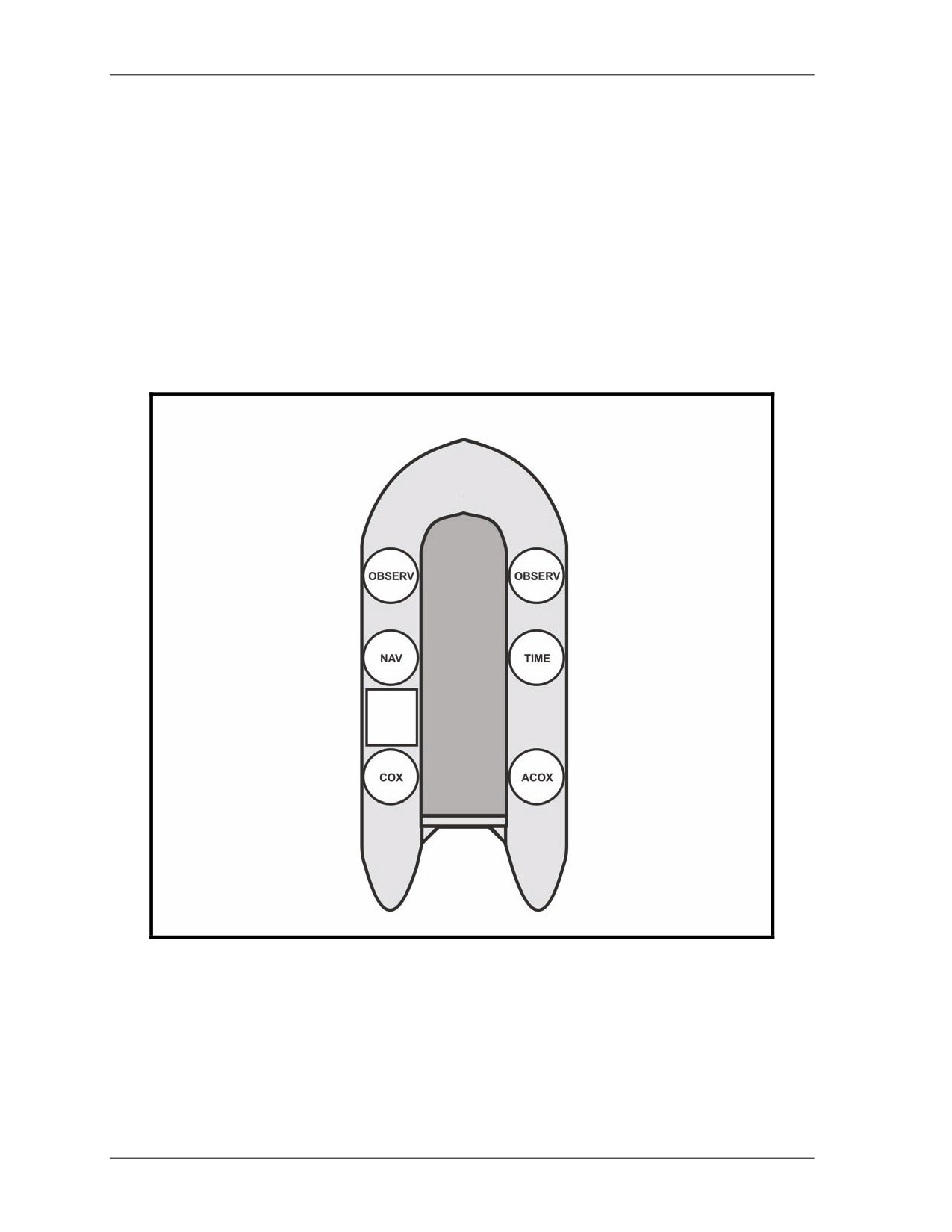
The crew includes a coxswain, assistant coxswain, timekeeper, two observers (for security), and a
navigator. To ensure mission success, each Soldier must track the team's location during movement. The
team is positioned as shown in Figure 5-1.
Figure 5-1. Rubber boat.
Coxswain—The coxswain controls the boat and the actions of the crew. He supervises the
loading, lashing, and distribution of equipment. He maintains the heading and speed of the boat
and gives all commands.
Assistant Coxswain—The assistant coxswain helps the coxswain navigate and control personnel,
and, when needed, assumes the duties of the coxswain. He also stows and uses the bowline, and
he provides rear security for the crew.
5-2
FM 3-55.93
23 June 2009
Insertion and Extraction Methods
Timekeeper—The timekeeper keeps time during dead reckoning and aids in navigation. He
provides flank security during movement.
Navigator—The navigator tracks the team's movement on the chart and reads the GPS as needed.
He notifies the coxswain of any changes in heading, and he provides flank security during
movement.
Observer—The observer(s) notifies the coxswain of any obstacles and provides frontal security
during movement.
PREPARATION OF PERSONNEL AND EQUIPMENT
5-5.
Each person dons a work vest, a life preserver, or both. He dons any additional equipment, such as
LCE, over his vest. He slings his rifle over his life preserver, where it is readily available. Securely lashing
radios, ammunition, and other bulk equipment to the boat prevents loss in case the boat capsizes. To lash
equipment to the boat—
• Secure a 5-foot section of 1-inch tubular nylon across the boat at the rear set of "D" rings.
• Securely knot a 12-foot section of 1-inch tubular nylon to the front "D" ring. Place a loop about
two feet from the other end of the rope. Using a slip knot, tie off this section to the
5-foot section.
• Attach a snaplink to the top of each rucksack frame and secure the rucksack to the
equipment line.
• Place the coxswain's rucksack at the rear of the boat. Route the snaplink through the loop at the
rear of the equipment line. If the boat capsizes, the coxswain can release the knot, allowing the
rucksacks to float free of the boat while he tries to right it.
LAUNCHING OF BOAT
5-6.
When timing the launch, the coxswain observes surf conditions and considers wave intervals.
When team members are about thigh deep in the water, the coxswain orders them to board by pairs. As
soon as they board, they grab a paddle and help keep the boat perpendicular to the waves as the coxswain
starts the motor. After the motor is running, the coxswain orders the rest of the team into the boat. To help
avoid capsizing, the boat is kept perpendicular to the waves.
BEACHING OF BOAT
5-7.
The coxswain observes the surf to see when to enter. To avoid capsizing, he has the team shift
their weight to the rear of the boat before the boat enters the surf.
5-8.
As the boat enters the surf zone, all team members work to keep the boat perpendicular to the
waves. The coxswain observes the surf and commands the team to vary speed as needed and to avoid
plunging into breakers. He periodically looks seaward to observe the waves.
5-9.
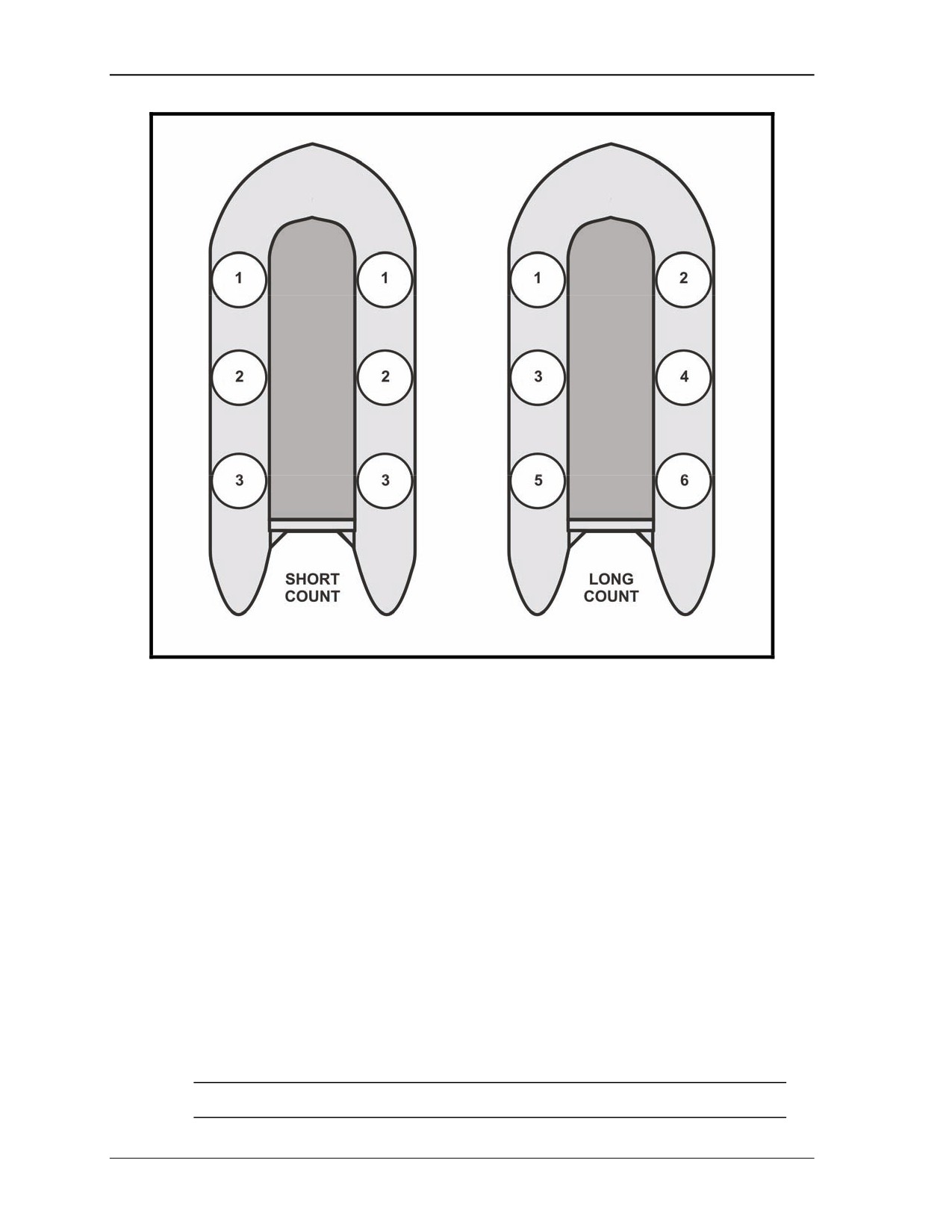
When the boat reaches shallow water, the coxswain orders the team out of the boat in pairs, for
example (short count), "Ones, out; twos, out" (Figure 5-2). On disembarking, each pair immediately grabs
the boat handles and pulls the boat to the beach.
5-10.
The coxswain directs the team to empty the water from the boat and carry it to higher ground. He
has two team members provide security.
5-11.
Once the team reaches an area suitable for caching the boat, they conceal it in a surface or
subsurface cache, or, if required, they submerge the equipment.
23 June 2009
FM 3-55.93
5-3
Chapter 5
Figure 5-2. Short count, long count.
OFFSHORE NAVIGATION
5-12.
Inserting a team from a larger vessel to their small boat might require offshore navigation. To
move a long distance in a small boat, the team must be highly skilled in navigating by nautical charts, tides,
currents (piloting), and dead reckoning. They must be able to compute for a compensated launch point,
using offset navigation to take into account tides and current. Before launching, the team should conduct
timed runs at full, half, and a quarter throttle. This helps them determine the speed of the boat at each
setting, which is a critical part of navigation. To determine the speed (distance/time = speed), they divide
the distance by the time, or the team uses a nautical slide rule. The types of navigation follow:
Piloting uses visible references from land or sea, the depth of the water, and other published
information. It resembles land navigation by terrain association.
Dead reckoning is the predicted advancement of a vessel's position from a known point
(debarking point) to calculate the vessel's approximate position at any time. It uses distance,
speed, and time. It does not factor in water currents.
Celestial navigating uses the positions of the sun, moon, other planets, and stars relative to that of
Earth. Because it requires a stable platform (for the sextant) and reference publications,
celestial navigation is impractical for use on smaller vessels.
Electronic-radio navigating uses radio waves and satellite-based positioning systems such as
GPS or Long-Range Navigation—Revision C (LORAN-C).
Note: Express distance in nautical miles.
5-4
FM 3-55.93
23 June 2009
Insertion and Extraction Methods
MAINTENANCE
5-13.
The team must wash the boat with fresh water after using it in salty or muddy water.
• Remove all sand and debris.
• Carefully clean between the bottom and the skeg tube.
• Stand the boat upright on its cones against a wall, or suspend it. Using a high-pressure hose,
rinse the entire boat. Allow several hours for it to dry.
• Wipe any remaining sand off the boat with a dry rag.
• After the boat dries, check and clean all metallic parts.
• Spray the valves with silicone to prevent freezing.
STORAGE
5-14.
Store the boat in a dry, cool place out of direct sunlight. Avoid storing it near furnaces, steam
pipes, boilers, oil or oil-contaminated areas, grease, solvents, or sharp or pointed objects. If possible, store
it on a rack. Excessive handling, such as rolling and unrolling, will shorten the life of the boat. When
storing it in a carrying bag, be sure to roll the boat from bow to stern.
SCOUT SWIMMERS
5-15.
The term "scout swimmers" refers to a pair of surface swimmers assigned a reconnaissance or
security mission in advance of the boat or other swimmers. Scout swimmers secure the beach-landing site
and reconnoiter it to ensure that it can accommodate the entire team. They must also reconnoiter a suitable
assembly area, cache sites, and a position from which to signal the remainder of the team into the beach-
landing site. The team must maintain strict noise and light discipline throughout the operation.
EQUIPMENT
5-16.
Normally, scout swimmers launch from a small boat outside the surf zone. Their equipment
includes a life vest, swim fins, dive tool, MK 13 day or night flare, and coral shoes or booties.
Life Vest
5-17.
Each scout swimmer wears his life vest under all equipment except his wet suit. It has no quick
release, because he must wear it throughout his mission.
Serviceability
• Check the oral inflation tube.
• Inflate the vest and check it for leaks.
• Check the CO2 inflation mechanism.
Preventive Maintenance
• Wash in fresh water after use.
• Clean and lubricate the CO2 mechanism.
• Replace the C02 cartridge if used.
• Partially inflate the vest.
• Store vest in a cool, dry area.
Swim Fins
5-18.
These help propel the swimmer.
23 June 2009
FM 3-55.93
5-5
Chapter 5
Serviceability
5-19.
Check fins for proper fit and broken straps. Check for any rips or tears.
Preventive Maintenance
5-20.
Wash the fins with fresh water after each use. Store in a cool dry place.
Dive Tool
5-21.
Swimmers keep this tool or knife with them at all times in case they become entangled while
swimming.
Serviceability
• Check for rust or corrosion.
• Sharp edges.
• Cracked or broken blade.
Preventive Maintenance
• Wash with fresh water.
• Sharpen.
• Lubricate.
• Store dive tool out of the sheath to dry.
MK13 Day or Night Flare
5-22.
This is an emergency signal device.
Serviceability
• Use flare only if seals are intact.
• Check pull-ring lanyard.
Preventive Maintenance
• Wash in fresh water.
• Store according to standing operating procedures.
Coral Shoes or Booties
5-23.
The swimmer wears these under his fins. They protect his feet from coral, rocks, or other
sharp-edged or poisonous underwater objects.
Serviceability
• Check for rips or holes.
• Check for proper fit.
• Check to ensure the zippers work.
Preventive Maintenance
• Wash in fresh water.
• Dry away from direct sunlight.
5-6
FM 3-55.93
23 June 2009
Insertion and Extraction Methods
LAUNCH POINT
5-24.
Scout swimmers normally move from the debarkation to launch points in inflatable boats with
motors. The scout swimmers enter the water at the launch point. The launch point should be at least 400
meters off the beach, out of the range of small arms.
RECONNAISSANCE
5-25.
Once the team reaches the launch point, the team leader sends out a scout swim team to
reconnoiter the beach-landing site. Before leaving the main body, the swimmers receive last-minute
instructions or adjustments to the original plan. The scout swimmers' may either leave their rucksacks with
the main body or take them along. The swimmers use a dive compass, or they guide on prominent terrain
features or lights on the beach. To allow all-round observation, they swim facing each other, which lets
each swimmer observe the area behind the other one.
APPROACH
5-26.
As the scout swimmers reach the surf zone, or when they get close to the beach-landing site, they
start using the breaststroke to observe the beach. They approach with stealth and caution, keeping a low
profile. One of them looks to the rear periodically so he can warn of large waves, which could injure or
separate them from their equipment and each other. When they reach shallow water and determine that the
situation is safe, they remove their fins.
1. If they can see the wood line easily from the waterline, one scout swimmer remains in the
water just inside the waterline and covers the other Soldier’s movement across the beach.
Once the first scout moves to the edge of the wood line, he covers his partner's movement to
the same position.
2. If the topography prohibits easy observation of the wood line from the waterline, the
swimmers move by successive bounds.
3. Once both scouts move inland, they use a modified box pattern to reconnoiter and secure the
beach. They choose a suitable assembly and cache site that provides the entire team cover and
concealment.
4. One scout positions himself at the edge of the wood line. He provides security for the
remainder of the team and guides them to the assembly area. The other scout positions
himself where he can signal the main body. When he makes visual contact, with the
remainder of the team, he moves to the waterline.
5. When the remainder of the team reaches the beach-landing site, the scout at the waterline
directs them to the other scout, who guides them to the assembly area. After the last team
member passes him, the scout at the waterline disguises any tracks left in the sand and rejoins
the team.
6. If possible, the team locates the cache site away from the assembly area. If the enemy
discovers and follows the tracks or trails from the beach to the assembly area, they could
easily determine the number of personnel involved in the operation by counting swim gear.
HELOCASTING OPERATIONS
5-27.
Helocasting can be an effective means of inserting and extracting LRS teams and equipment. The
speed, range, and lift capability of rotary-wing aircraft make them excellent waterborne delivery and
recovery vehicles. Helocast preparation considerations include--
1. When planning for the number of personnel for each type of aircraft, the leader uses the
standard planning figures for loading troops. He can adjust these figures based on aircraft
configuration, type of equipment, and casting or recovery procedures. He coordinates these
items in advance with the aircrew.
23 June 2009
FM 3-55.93
5-7
Chapter 5
2.
Rehearsals include all jumpers, the crew, the accompanying equipment, and support
personnel. During live-casting rehearsals, the leader emphasizes the commands, positions,
and timing of body exit and water entry.
3.
All equipment attaches to the jumper with l/4-inch, 80-pound test, cotton webbing. In or on
this webbing, he normally carries a mask, fins, web belt with knife, flare(s), and life vest.
4.
When using rubber boats, the team must—
a. Tie down and secure all equipment inside the boat.
b. Secure the motor in the floor of the boat and pad it with honeycomb cardboard (for
UH-60).
c. Securely attach and isolate fuel cans.
d. Secure paddles under the gunwales, out of the way of the rest of the gear.
e. Secure the rucksacks as tightly as possible to the deck of the boat.
f. Waterproof all equipment in the boat in case of submersion.
g. Regardless of the type of aircraft used, tie down or secure all equipment. Tape or pad all
sharp edges or items.
h. If using side doors for casting (UH-60 or UH-1H), secure the doors in the open position,
and tape all edges.
i. With a CH-46 or CH-47, ensure the ramp is secured in the open or casting position (10
degrees below horizontal).
j. To use a wire ladder for recovery, secure it beforehand using a wire "donut" secured to the
floor of the aircraft. Use 5/8-inch wire and secure the wire to at least five points
using snaplinks.
k. Ensure all personnel (cast master, pilots, and safety boats) use the same frequency.
l. Ensure the casting area is clear of all surface and subsurface obstacles.
5-28.
When helocasting from a ramp, such as a CH-47, the cast master gives the commands
GET READY, STAND UP, CHECK EQUIPMENT, SOUND OFF WITH EQUIPMENT CHECK, and
GO. When using UH-60 or UH-lH, he omits STAND UP:
1. The cast master ensures jumpers leave their seat belts on until they hear the command
GET READY.
2. If using a rubber boat, the team moves it to the end of the ramp. Just before the command
GO, they push out until the boat is about halfway past the edge of the ramp. On hearing the
command GO, they push the boat off the ramp.
3. The cast master ensures that when the pilot drops personnel, he flies within 10 feet of the
surface of the water at 10 knots or slower.
4. When casting from the ramp, jumpers assume a normal prepare-to-land attitude.
5. When casting from a side door, jumpers cast from a seated door position. On the cast master's
command, jumpers push off and face the direction of flight, assuring a normal prepare-to-
land attitude.
6. The cast master throws bundles or rucksacks before the jumper exits on the command GO.
7. Upon entering the water, the jumper signals "Okay" to the cast master and safety boat.
8. When using a single rotor aircraft for recovery operations, the cast master lowers a wire
ladder to the swimmers, who line up at 50-meter intervals in the recovery area.
5-8
FM 3-55.93
23 June 2009
Insertion and Extraction Methods
9. As the aircraft flies over, each swimmer hooks the lowest rung on the ladder with his leading
arm and climbs to a designated height, where he hooks up (with snaplink and rope seat) to
the ladder.
10. All CH-46 or CH-47 aircraft land in the water. If using a rubber boat with a motor, the team
drives the boat up to the ramp. When the rubber boat is not using a motor, the cast master
uses the aircraft's winch to lower a rope with a 10-pound-padded weight attached to it. He
lowers the rope behind the boat and drags the rope over it. The swimmers secure the rope,
and the winch pulls the boat in.
11. When swimmers are in the water without a boat, they either go up a ladder or, if the aircraft is
on the water, they swim up to the ramp.
12. For SPIES recovery, swimmers put on their harnesses before the helicopter arrives. The
helicopter hovers over the group of swimmers as they attach their harnesses to the "D" ring.
5-29.
Due to the hazards involved, the leader emphasizes safety in all aspects of planning and executing
helicopter casting and recovery operations:
• Immediately before a helocast and recovery operation, the leader—
— Physically reconnoiters the casting area.
— Verifies water depth and the absence of obstacles and debris.
• He ensures that the water is at least 15 feet deep.
• He ensures motorized safety boats are in the water with motors.
• He establishes radio voice communications between the safety boats and the drop aircraft.
• He ensures the cast master has voice communications with the pilot.
• He ensures one dive supervisor and two divers, with complete scuba gear, are in a safety boat.
• He ensures that a qualified medic/dive medical technician is in one of the safety boats.
• He ensures drop altitude stays within 10 feet of the surface of the water.
• He ensures drop speed remains at or slower than 10 knots indicated airspeed.
• If an injury occurs, the leader ceases until he determines the cause and extent of the injury.
Section II. HELICOPTER OPERATIONS
Helicopters provide a variety of methods for inserting and extracting teams. (FM 3-05.210, TC 21-24 and
USASOC Reg 350-6 provide more information.) This section only covers the operational requirements and
procedures for SPIES, FRIES, Army aviation, air assault, pick-up and landing zones, and the UH-60 loading
sequence. Training requirements are covered in FM 3-05.210 and USASOC Reg 350-6.
SPECIAL PATROL INSERTION/EXTRACTION SYSTEM
5-30.
The SPIES should be used only when the team needs immediate extraction or cannot move to a
clear (open) position suitable for helicopter landing. The SPIES works best for extracting LRS teams over
short distances. Teams are almost never inserted by SPIES because doing so would expose them to
observation and fire throughout the insertion. Before a SPIES operation, the leader thoroughly briefs
participants. Before inserting, the team receives extensive training in SPIES operations. Personnel
supporting the SPIES operation receive a complete preoperational briefing. This is most crucial when the
operation involves assets other than the extraction helicopter such as gunships, aerial observers, or artillery.
23 June 2009
FM 3-55.93
5-9
Chapter 5
FAMILIARIZATION
5-31.
When time and situation permit, personnel unfamiliar with SPIES should watch or help with the
rigging of the helicopter. Initial training with SPIES is without combat equipment. This builds confidence
in the equipment and procedures, and it aids in more comprehensive training of new SPIES masters.
SAFETY
5-32.
This safety briefing should cover at a minimum--
• Area hazards.
• General Aircraft safety.
• SPIES equipment and its characteristics.
• Preoperational inspection of equipment.
• Proper donning of the harness.
• Method of insertion and extraction.
• Hand-and-arm signals and emergency signals.
• Medical coverage.
• Communications requirements.
• Operational requirements for limited visibility.
COMMUNICATIONS
5-33.
Helicopter noise necessitates radio communications be the primary means of communications
between the Soldiers on the ground and the helicopter. Light and arm-and-hand signals are the alternate
means of communication. The SPIES master uses the inter-cockpit communication system on the
helicopter. Soldiers practice the appropriate arm-and-hand and light signals in case radio communications
fail.
5-34.
Radio operators should use headsets and voice suppressors (if available) rather than handsets. This
frees the ground RTO's hands so that, when the helicopter hovers, he can hook up faster and more safely.
EXTRACTION
5-35.
After the extracting team is located on the ground, the SPIES master helps direct the helicopter the
proper distance above the team. On order of the pilot, the SPIES master drops the rope.
1. The team leader positions himself to move and approach the rope as the SPIES master drops
it. Once the rope is clear of any obstacles, the team leader directs the team to move to their
assigned positions along the hookup points.
2. Each member attaches the primary (harness) snaplink to the "D" ring on his side of the line.
Using the safety line and snaplink, he hooks into the alternate or secondary hookup point on
the opposite side of the rope. He faces forward along the line so that, when the aircraft
ascends, he is looking in the direction of travel. He holds up the SPIES rope and routes it over
the shoulder closest to the rope. With the other hand, he gives a thumbs-up signal to the team
leader and SPIES master signaling he is ready to go.
3. After all team members signal they are ready, the team leader physically inspects (if time and
situation permit) each team members hook up. The team leader then hooks himself on to the
lowest point with the RTO. He then gives the thumbs-up signal to the SPIES master. He
continues this thumbs-up signal, which at night is an arranged light signal, until the helicopter
reaches a safe altitude (about 3 meters above the tallest obstacle at the extraction site).
5-10
FM 3-55.93
23 June 2009
Insertion and Extraction Methods
4. During extraction, the team RTO maintains communications with the extraction helicopter.
Because he is near the bottom of the rope with the team leader, he can assist in giving verbal
confirmation of all light and arm-and-hand signals, and relay information between the team
leader, the SPIES master and the aircraft crew.
CAUTION
Not all chemical lights are visible at night using image intensifying night
vision devises. Coordination with the pilots during the air mission brief
to finalize the types and colors of chemical lights to use is required.
EMERGENCY PROCEDURES
5-36.
During the flight, from the time the team extracts until they safely detach from the SPIES rope,
each team member watches for any problems that might arise from above or below. The Soldier above
checks the Soldier below. At the first sign of danger, or if an emergency occurs, the team leader or a team
member places his free hand on the top of his head. When the SPIES master sees this, he instructs the pilot
to make an emergency landing in the nearest and safest area.
DISMOUNTING PROCEDURES
5-37.
When the extraction helicopter has reached a tactically safe dismount area, the pilot transitions to
a hover and then begins a vertical descent. The SPIES master continuously provides information to the
pilot on the distance from the ground to the lower end of the SPIES rope. As team members reach the
ground, they immediately move away from the aircraft. For a UH-60, the team walks to a 90-degree angle
to the front of the aircraft. For a UH-1, the team walks to the direction of the front of the aircraft. In both
cases, the pilot or the crew can see the team is out from under the aircraft. The team ensures the SPIES
rope does not interfere with the aircraft and that the aircraft does not land on the rope. All team members
rapidly unhook themselves and their teammates who need assistance. Once unhooked, they move away
from the area and set up security, or help clear the rope if the helicopter is going to land.
OPERATIONAL TRAINING
5-38.
In preparing for an operation, if the leader thinks the situation, mission, or terrain indicates the
need for a SPIES extraction, then he should include a SPIES harness in each Soldier's equipment list. If the
mission or insertion precludes team members from wearing the harnesses, they should carry them inside
their packs. As soon as they request helicopter extraction, they can retrieve and don their harnesses.
1. The extraction helicopter(s) proceeds to the area and the pilot establishes radio or visual
contact with the team. The backup helicopter, equipped with the SPIES, remains aloft and
away from the area, maintaining visual contact with the LZ and monitoring radio
communications.
2. The SPIES master deploys the rope, and then notifies the pilot the rope is out. The pilot
normally cannot see the team nor determine the most suitable position for the aircraft. The
SPIES master gives the pilot vertical and lateral corrections until the aircraft reaches the
desired position. He commands, LEFT, RIGHT, FORWARD, or REAR, along with the
estimated distance. For example, LEFT, 10 FEET. The SPIES master counts down as the
pilot responds, for example, "Ten, nine, eight, seven, six, hover. Hold, ropes out." The SPIES
master informs the pilot of any unexpected drift that could pull the team into an obstruction.
The crew chief maintains his attention to the safety of the aircraft and watches for any
possible interference with the tail rotor.
3. To avoid losing weapons during a SPIES extraction, team members sling them over their
shoulders and attach them to their bodies with safety lines. They secure other weapons and
equipment against the wind as well. After observing this, the team leader gives them the
thumbs-up signal.
23 June 2009
FM 3-55.93
5-11
Chapter 5
4. During the extraction, the team RTO maintains communications with the extraction
helicopter. He verbally confirms the thumbs-up signal and relays any other relevant
information during the flight. He should position himself near or at the bottom hookup point.
This ensures he can give accurate information about the extraction, the clearing of obstacles,
and the descent.
5. The extraction aircraft must lift off vertically until the SPIES rope clears all obstacles. If
needed, team members can fire their individual weapons from the hip with their barrels
directed downward at a 45-degree angle and outward from the team.
6. Once the aircraft clears any vertical obstacles, the RTO, who is the lowest Soldier on the
SPIES rope, signals the pilot all team members have cleared the obstacle. This is especially
important during limited visibility. Even if the pilot uses night vision goggles, his depth
perception is poor when looking 120 feet below the aircraft.
7. On descent, both the RTO and the SPIES master inform the pilot of his altitude, drift, and
forward speed. They also tell him whether their ropes are oscillating enough to potentially
injure team members on impact. The RTO counts down in 10-foot increments ("Fifty, forty,
thirty, twenty, ten, nine, eight…one; one man down, two…") until the whole team is down.
During limited visibility, the SPIES master might not be able to see this.
8. Once the team is on the ground, the SPIES master monitors drift. Sudden lateral shifts can
drag team members before they can disconnect from their ropes.
WATER-EXTRACTION PROCEDURE
5-39.
The SPIES also works well for extracting LRS teams from the water. Three inflatable life vests or
other flotation devices are attached to the SPIES; one to each end of the attachment points, and one to the
middle of the attachment point area, just above the middle two sets of "D" rings. Each team member wears
a SPIES harness under his life vest. In amphibious operations, he may also wear swim fins, mask, and
snorkel. This simplifies hookup to the SPIES rope in the chop and spray caused by the helicopter.
1. After the pilot stabilizes the aircraft above the team members, he gives the order and the
SPIES master drops the SPIES rope (with flotation attached).
2. When the team members finish hooking up to the SPIES rope, the team leader signals the
SPIES master to start liftoff.
3. The aircraft must lift off vertically until all team members and the bottom end of the rope
clear the water. During initial liftoff, the aircraft may drag team members through the water.
They must be ready to roll onto their backs until the aircraft lifts them clear of the water.
4. The aircraft should fly at the same speed and altitude as it would over land. Dismounting
procedures also remain the same, except for shipboard landings: on a ship, all team members
take their orders from the personnel in charge of the deck.
PERSONNEL DUTIES AND RESPONSIBILITIES
5-40.
SPIES training and operations require the designation of key personnel to perform assigned tasks.
The positions are unit commander, SPIES master, ground safety officer (GSO) or NCO, air mission
commander, and pilot in command.
QUALIFICATIONS OF SPIES MASTER
5-41.
Selection of personnel for qualification as SPIES master should be based on the individual's
demonstrated leadership capabilities, maturity, and knowledge of SPIES operations. Individuals selected
must participate in at least three SPIES operations (observe twice and execute SPIES master duties once
under the supervision by a qualified SPIES master). For example, the SPIES master candidate configures
the hookups in the helicopter, helps prepare for an operation, and conducts a successful operation under the
supervision of a qualified SPIES master. He must be able to give an effective pilot's brief, use the aircraft
5-12
FM 3-55.93
23 June 2009
Insertion and Extraction Methods
communication equipment, and understand aviation terminology. Additional qualifications
requirements include--
• Holds the rank of sergeant or above (may be waived).
• Completed initial SPIES training.
• Knows all aspects of a SPIES operation.
• Has received instructions on and demonstrated proficiency in:
— Rigging of the helicopter.
— Inspection and preparation of SPIES.
— Donning of the SPIES harness.
— Coordination responsibilities.
— Soldier or aircrew briefings.
— Organization of the personnel to be extracted.
— Instruction to pilots in maintaining the aircraft position over the target.
— Throwing and retrieving SPIES.
— Hand-and-arm signals.
— Emergency procedures.
GENERAL DUTIES OF THE SPIES MASTER
5-42.
The SPIES master is responsible for the safe conduct of the SPIES operation. Preflight, he—
Equipment
5-43.
Inventories and inspects all SPIES equipment.
Briefs
5-44.
Briefs pilots and others concerned about the details of the operation, concentrating on extraction
and dismounting procedures.
Inter-Cockpit Communications System Helmet
5-45.
Ensures that he has an inter-cockpit communications helmet and a gunner's belt or, lacking a belt,
a sling rope instead. He connects, then checks the operation of the inter-cockpit communication system. On
all SPIES operations, he, the crew chiefs, and the pilots must establish interagency communications using
this system.
Rope
5-46.
Attaches the SPIES rope to the helicopter as previously described.
Loose Items
5-47.
Checks for loose items that could fall on a team member during flight.
Axe
5-48.
Ensures that the axe is available, sharp, and securely stored so that it presents no danger to the
Soldiers on the SPIES rope. He also ensures that he has an alternate means of cutting the rope in case of
emergency.
23 June 2009
FM 3-55.93
5-13
Chapter 5
DUTIES OF THE SPIES MASTER DURING EXTRACTION
5-49.
On arrival at the team's estimated position, the SPIES master helps the pilot determine the exact
locations of the team members, and—
1. As the aircraft approaches the team's location, he helps the pilot (using the clock system)
position the aircraft directly above the team.
2. He requests permission from the pilot to drop the SPIES rope when the aircraft is hovering
above the team.
3. He drops the rope, taking care to avoid striking team members on the ground.
4. He notifies the pilot when the rope is down, and reports any altitude corrections necessary to
ensure that the team members can reach all of the SPIES attachment points.
5. He watches for the team leader to give the thumbs-up signal.
6. When he sees it, he tells the pilot that the team is ready for extraction, and he requests a
vertical liftoff.
7. He advises the pilot of the team's approximate position, the locations of any potential
obstacles, and the avoidance of horizontal movement.
8. If a team member becomes entangled with an obstacle during the extraction, he notifies the
pilot to stop the vertical lift immediately. If the situation is critical, he prepares to cut the
SPIES rope (the anchor point or cargo straps) after team members are secured to the obstacle
or on the ground.
9. When he is sure the team has cleared all obstructions, he advises the pilot. The pilot flies to a
safe altitude (about 350 feet above ground level for training purposes, or, in combat, however
high the situation dictates), or transitions to forward flight.
10. At frequent intervals during the flight, he advises the pilot on the safety status of all team
members. He constantly watches the team and checks the security of the SPIES attachments.
DUTIES OF THE SPIES MASTER DURING DISMOUNTING
5-50.
On arrival at the dismount area, the SPIES master tells the pilot the approximate height of the
lower roper from the ground and—
1. Once the pilot starts the vertical descent, the SPIES master continually informs the pilot of the
approximate distance between the lowest roper and the ground.
2. He informs the pilot of any horizontal drift or oscillation in the rope, and of any obstructions.
3. He tells the pilot when the rope is about 25 feet above the ground and again when it is 10 feet
above the ground.
4. He ensures that the rate of descent is slow enough to enable the team members to land safely.
5. He reports initial touchdown of the lowest roper, when the last team member lands safely, and
when all team members are disconnected.
6. On order of the pilot, he either retrieves or disconnects and drops the SPIES rope. With the
UH-60/1H helicopter, he can only retrieve the rope if he has previously attached a recovery
rope (a 12-foot sling rope or two 6-foot sling ropes joined together) about 5 or 6 feet below
the cargo hook or cargo strap hookup point. The recovery rope must be attached using a
self-tightening knot such as the Prussik knot. The standing end of the sling rope may be
fastened to the deck tie-down or to a snaplink. Although the line should be kept out of the
way, it must be long enough to control any oscillation in the SPIES during flight.
5-14
FM 3-55.93
23 June 2009
Insertion and Extraction Methods
INSPECTION
5-51.
A certified SPIES master or rigger inspects SPIES at a minimum every 6 months or whenever the
serviceability of the equipment is in doubt. Out-dated, spliced, abraded, or cut ropes are removed from
service. The SPIES master or rigger inspects the ropes as follows:
1.
Inspects harness and suspension sling webbing for signs of contamination from oil, grease,
acid, rust, cuts, twists, fading, excessive wear, or fusing (indicated by unusual hardening or
softening of webbing fibers), fraying, burns, abrasions, and loose or broken stitching (in
excess of three stitches). The inspector removes damaged harnesses or suspension slings and
returns damaged equipment to supply for appropriate disposition. In some cases, riggers may
be able to repair deficiencies.
2.
Inspects all hardware for signs of corrosion, pitting, ease of operation, security of attachment,
bends, dents, nicks, burrs, and sharp edges. Replacing any hardware (except the chest strap
adapter) that requires unstitching the webbing, makes the harness unserviceable.
3.
Replaces the "V" ring by cutting the strap above the stitching. A qualified rigger can fold and
stitch a new end section for leg straps. If straps are damaged, the harness or suspension sling
is unserviceable and must be returned to supply for appropriate disposition.
4.
Ensures rope is free of splices.
5.
Inspects the surface of the rope for splices, cuts, excessive abrasions, and snags. Cuts are
considered excessive when four or more strands in any 5-inch length are cut. The two-to-one
braided rope has 12 pair (24 strands) around the circumference. Abrasion is extensive when
torn yarns are equivalent to that of four strands of any 5-inch length. A rope that has been
subjected to heavy loads might display glazed areas where it has rubbed against hard
surfaces. Painted or fused fibers can both produce a glazed appearance. A rope can also get
fuzzy on the surface from long use. The effect on the strength of the rope by glazing or
surface fuzz is negligible.
6.
Inspects the rope for signs of contamination by acid, alkaline compounds, salt water, fire
extinguishing solutions, and petroleum-based solvents. Although ropes gradually and
uniformly change color with use, this does not decrease its strength. However, exposure to
strong chemicals, usually indicated by spotty discoloration on the rope, can affect the strength
of the rope.
7.
Ensures the eye loop at the attachment point is not broken, frayed, or loose.
SERVICE LIFE
5-52.
The SPIES master and riggers check ropes, harnesses, and suspension slings for expiration of
service life or total life. Expiration of service is 7 years from the date the manufacturer's package is opened,
and total life is 15 years from the date of manufacture.
REPAIR AND CLEANING OF ROPE
5-53.
To repair the rope, the SPIES master must--
Note: You must repair loose or broken stitching.
1. Wash contaminated ropes with a mild detergent (such as liquid dish soap) and cold water,
followed by a rinse in clean, fresh water. Dry the rope at room temperature (not to exceed
140 degrees Fahrenheit).
2. Remove stubborn oil, grease, hydraulic fluid, and other petroleum stains with the cleaning
agent xylene (Grade A or B, TT-X 916). Use the cleaning agent as directed.
23 June 2009
FM 3-55.93
5-15
Chapter 5
WARNING
AVOID TRYING TO REPAIR NONREPAIRABLE DAMAGE, TO
INCLUDE ACID CONTAMINATION, CUTS, OR FRAYS ON
HARNESS OR SLING WEBBING.
STORAGE
5-54.
The SPIES master stows the SPIES as follows:
1. Protect nylon materials from direct sunlight as much as possible to avoid ultraviolet
deterioration.
2. Stow the SPIES rope in an aviator's kit bag for protection when not in use.
3. Use bins or similar facilities to store SPIES equipment. Use shelves that are at least 4 inches
from the walls and 12 inches from the floor. Ensure that storage areas are well ventilated and
free of oil, acid, cleaning compounds, and other contaminants. Avoid stowing equipment
above or near hot water pipes or other heat sources.
RIGGING OF A UH-1H AND UH-60
5-55.
To rig the UH-lH or UH-60 helicopter (with cargo hook) for a SPIES Operation, use the following
equipment:
• One SPIES rope with deployment bag.
• Two 11-foot or 9-foot, three- or four-loop, Type 26 cargo slings.
• Two Type IV connector links.
• Nine locking snaplinks.
• One 12-foot sling rope.
• One roll of heavy-duty ("100 mile-an-hour") tape.
• One block of wood measuring 4 by 4 by 18 inches.
• One fire ax (for use during emergency cutaway procedures).
Note: For UH-1H or UH-60 helicopters without cargo hooks, use the same equipment plus
two additional 9-foot or 11-foot, three- or four-loops, Type 26 cargo slings, two additional
Type IV connector links, and a total of 16 locking snaplinks.
5-56.
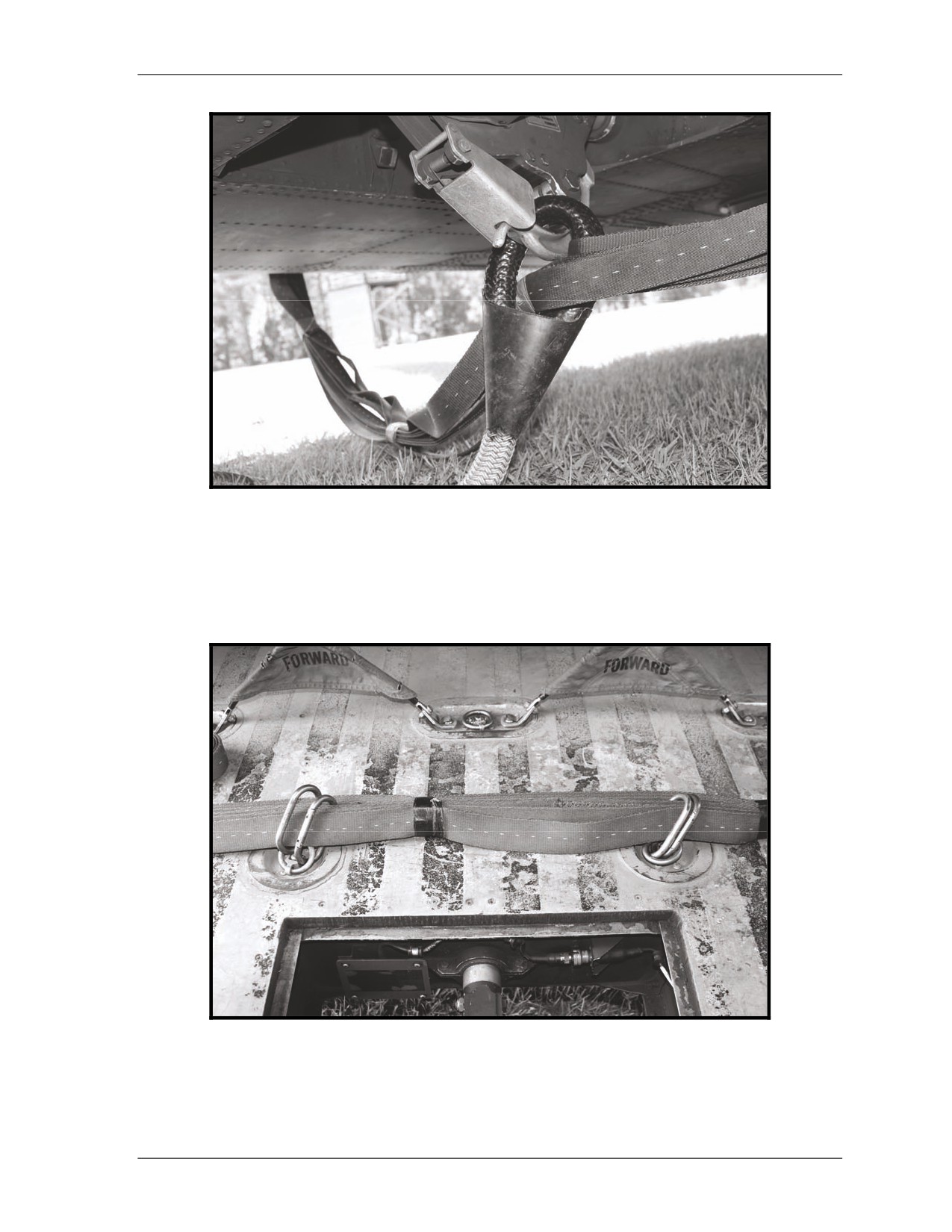
The primary attachment point for the SPIES rope is the cargo hook. At the end of the SPIES rope,
the polyurethane-encapsulated eye is attached to the cargo hook. The two 9- or 11-foot-long, cargo
suspension slings joined together by a Type IV link to form one continuous sling. The team stretches out
this sling on the helicopter deck. They take one end under the helicopter and through the eye of the SPIES
rope, and they connect it on the other end of the sling using a Type IV link assembly. The straps are taped
with 100-mph tape at 12-inch intervals (Figure 5-3). On the UH-1H only, the sling is passed between the
helicopter skids and the fuselage. For both models, they can use locally procured padding to protect the
sling from damage around the edge of the cargo hatch.
5-16
FM 3-55.93
23 June 2009
Insertion and Extraction Methods
Figure 5-3. SPIES rope rigging on UH-60
5-57.
Once the team secures the SPIES rope and cargo straps, they secure the straps running across the
deck of the helicopter. To do this takes eight snaplinks. The team spaces the snaplinks evenly across the
deck, alternating from one side of the strap to the other, and from top and bottom. The first snaplink goes
from the rear of the strap around the bottom two straps, and the next snaplink goes from the front of the
cargo strap around the top two sections of the strap. This continues until the team establishes at least four
points (Figure 5-4).
Figure 5-4. Rigging of snap links.
5-58.
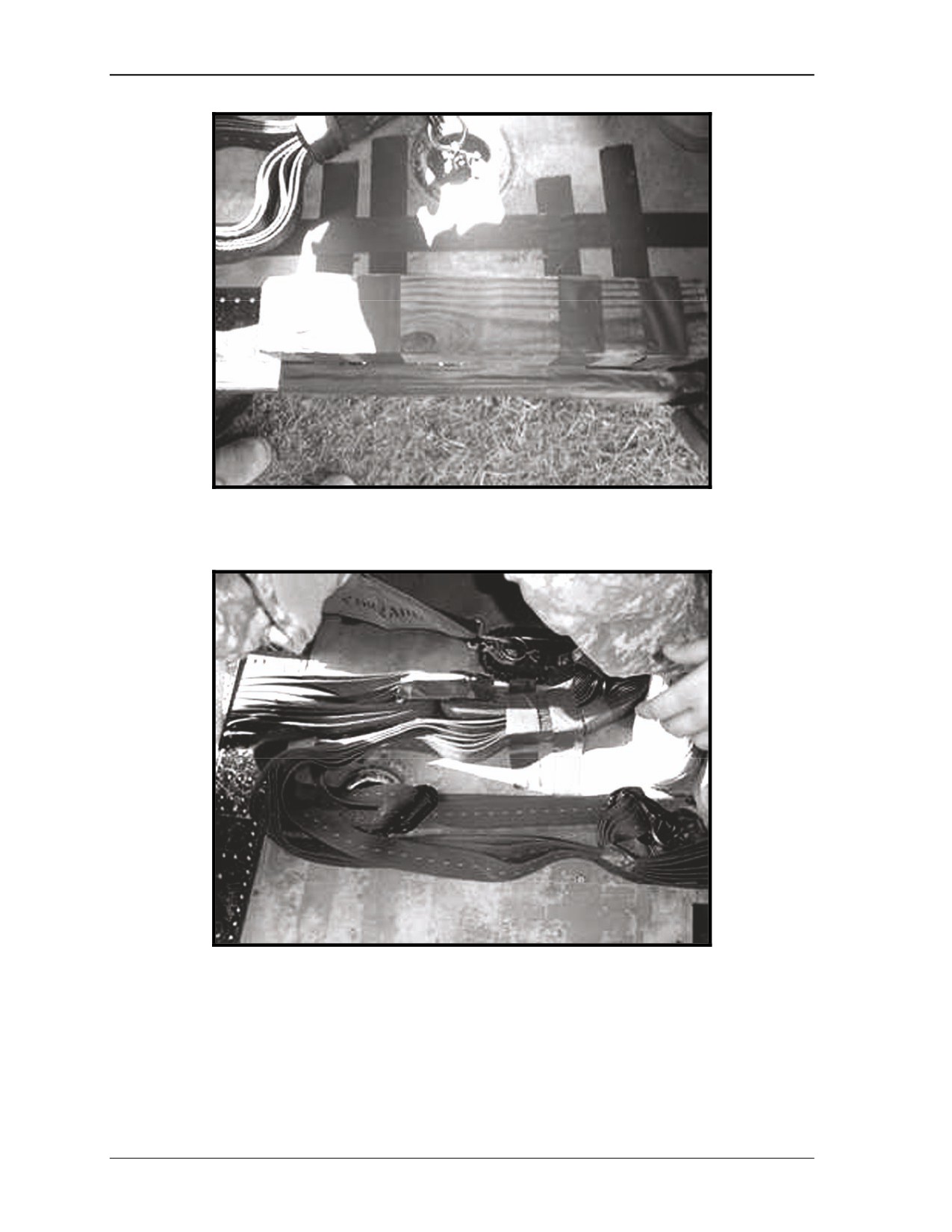
The 4-inch by 4-inch block of wood is taped down along the right edge of the doorway so the
cargo strap crosses the block perpendicularly at the middle. The wood block serves as a chopping block
pad in case of an emergency cutaway (Figure 5-5).
23 June 2009
FM 3-55.93
5-17
Chapter 5
Figure 5-5. Rigging of wood block.
5-59.
Once the cargo strap and wood block are secured, the excess cargo strap is gathered on the
opposite side of the wood block and taped to the floor of the aircraft (Figure 5-6).
Figure 5-6. Excess cargo straps secured.
5-60.
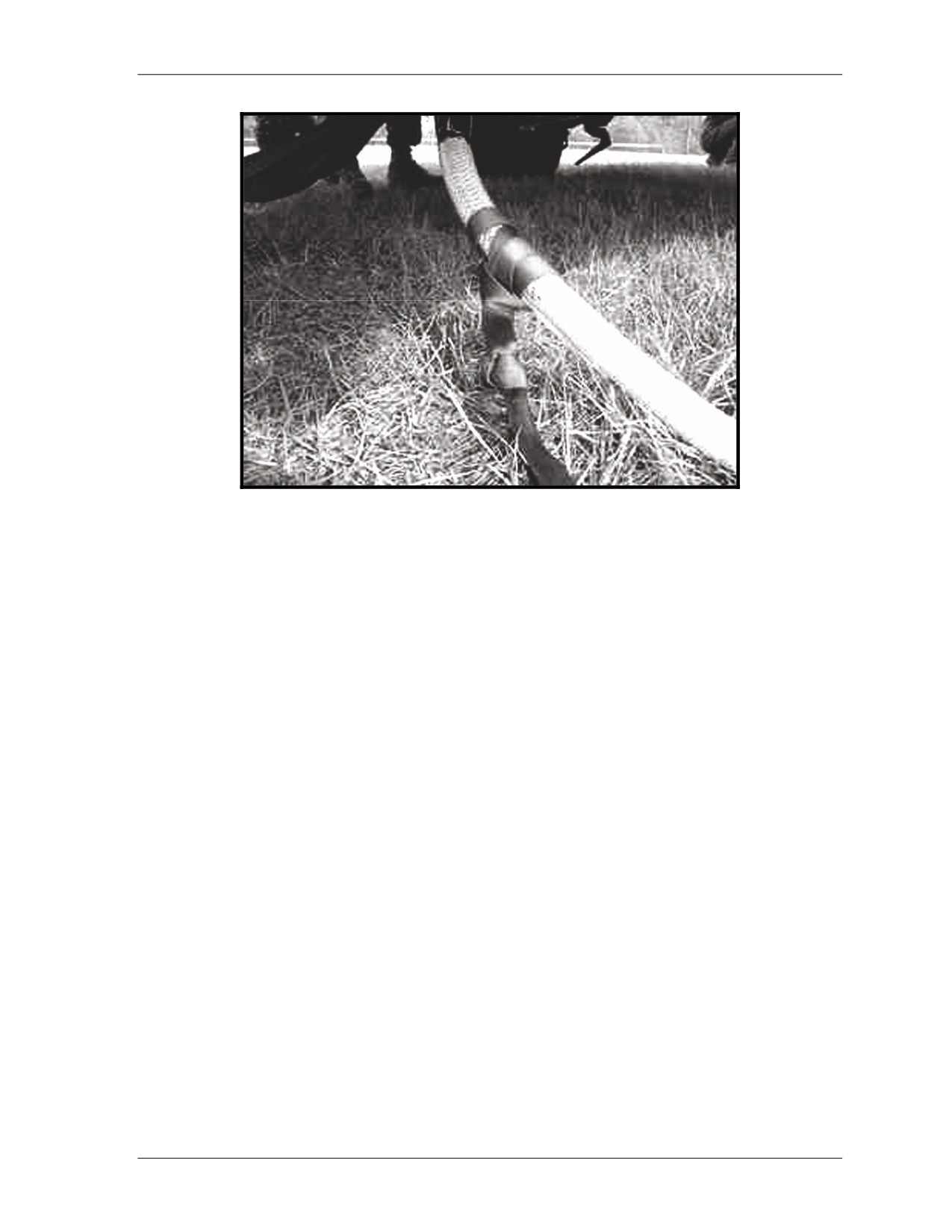
The sling rope is then tied to the SPIES rope by a Prusik knot about 2 to 3 feet below the cargo
hook (Figure 5-7). A bowline knot with a half hitch is then tied to the running end and the ninth snap link
is inserted and connected to a cargo ring in the middle of the aircraft floor. This line serves as a recovery
line for the rope so that the aircrew can retrieve the rope into the aircraft. The recovery rope should be long
enough so the weight on the SPIES rope is hanging from the cargo hook and not the recovery rope.
5-18
FM 3-55.93
23 June 2009
Insertion and Extraction Methods
Figure 5-7. Recovery line with Prusik knot.
5-61.
If the SPIES rope is not to be used immediately, it is neatly coiled and placed on the opposite side
of the aircraft from the wood block. This ensures it will not become tangled or interfere with normal
aircraft operations.
5-62.
If the helicopter has no cargo hook, or if the hook is not working properly, the team can still use
the SPIES by doubling up on the cargo slings and Type IV links. This places two cargo straps side by side,
for a total of four slings and four Type IV links.
5-63.
The team must use caution when using the UH-lH, because different configurations of the
helicopter may make rigging difficult. Some of them have steps, which get in the way during both
installation and operation. Others have rocket pods or mounted machine guns. The team might have to
hook up two different UH-1s in two different ways.
RIGGING OF A CH-46 OR CH-47
5-64.
The CH-46 and CH-47 require—
• One SPIES rope with deployment bag.
• Two 9-foot or two 11-foot, three- or four-loop slings.
• Four Type IV connectors.
• Eight oval snap links.
• Heavy-duty tape (100-mph tape).
• A 12-foot length of tubular nylon or one 12-foot sling rope.
5-65.
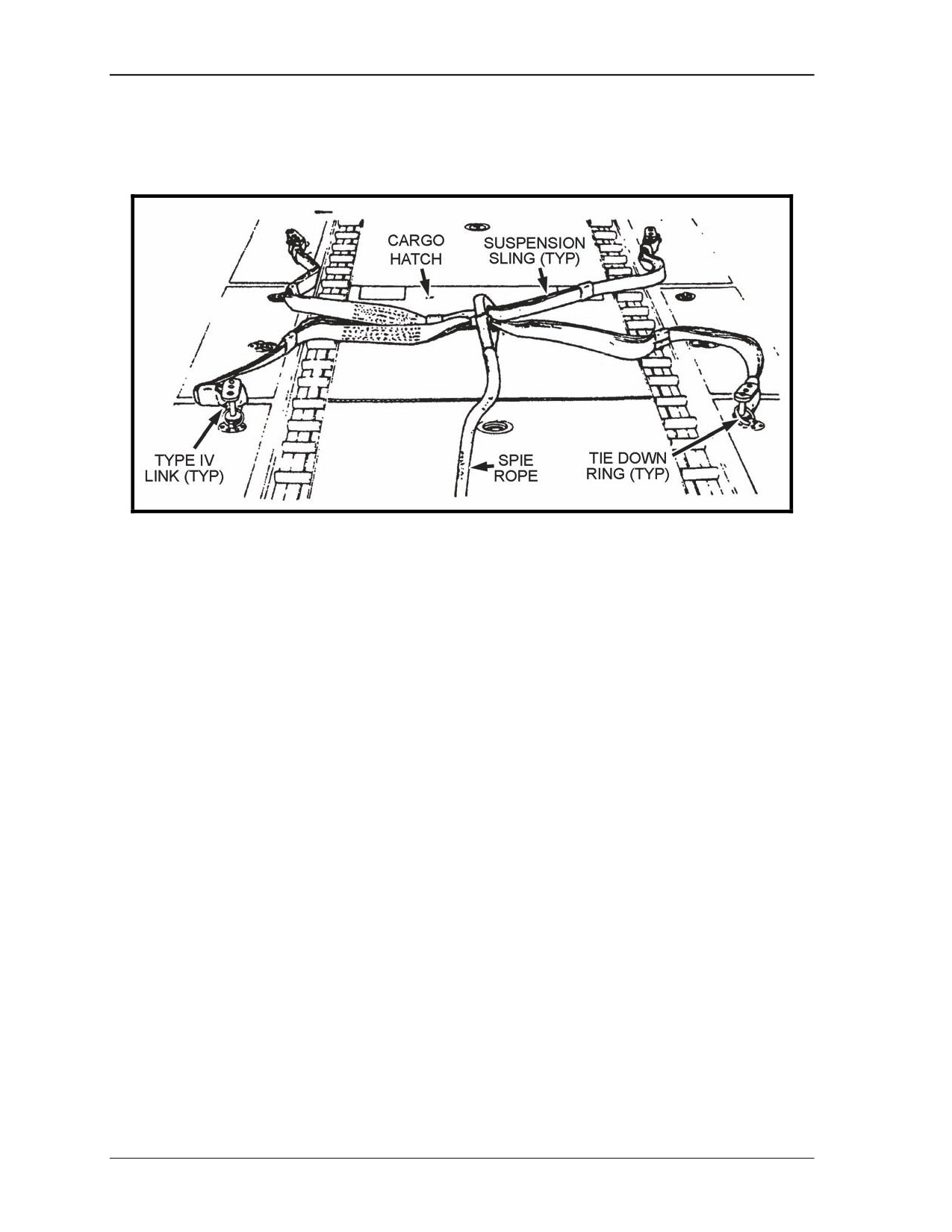
As they do with the UH models, the team attaches the SPIES rope using the slings and snaplinks
(Figure 5-8). They pass the slings through the eye of the rope and attach it to the outboard cargo tie-down
rings on the aircraft floor. They use two tie-down rings for each sling. They can use locally procured
padding around the edge of the cargo hatch to protect the slings from damage.
5-66.
The team arranges the cargo straps to form two U-shapes. They place one strap forward of the
cargo hole in the center of the aircraft floor, and the other one aft, toward the rear of the helicopter.
However, varying positions of the tie-down rings could require them to adapt their rigging techniques
accordingly. Once they finish the rigging, the cargo straps should hold the SPIES rope comfortably
23 June 2009
FM 3-55.93
5-19
Chapter 5
centered and slightly below the cargo hatch. Attaching snaplinks close to all four tie-down points serves as
a backup in case of a faulty tie-down ring, and reduces the amount of movement in the cargo suspension
straps. The team should use eight snaplinks, two at each point, with swing gates reversed, for added
security.
Figure 5-8. SPIES rigging procedures for CH-46 or CH-47.
FAST-ROPE INSERTION/EXTRACTION SYSTEM
5-67.
The FRIES, also know as "fast rope," is a polyester rope, consisting of three olive drab 1 3/4-inch
strands, and comes in 20-, 40-, 60-, 90-, and 120-foot lengths. The top of the main rope has an 8-inch eye
spliced in, which allows the team to attach the rope to specially equipped helicopters. Before conducting a
fast-rope operation, the team must thoroughly inspect the rope. The following paragraphs cover the
requirements and procedures for FRIES operations; however, FM 3-05.210 and USASOC Reg 350-6 cover
training requirements.
INSPECTION
5-68.
The team lays out the rope so they can inspect the full length for fraying and the eyelet on the end
for excessive wear. Snags from normal use will not significantly weaken the rope. A rope with several
strands frayed in one particular spot or any single strand cut halfway through cannot be used. If the fast
rope gets wet, team members "S"-fold it or hang it in a dry, warm area out of direct sunlight. It must dry
thoroughly before the next use. If the team uses the fast rope in salt water or it becomes imbedded with dirt
or mud, the rope must be washed in fresh water within 72 hours and then dried as described above. Inspect
the rope for contamination by acid, alkaline compounds, salt water, fire extinguishing solutions, or
petroleum-based solvents. Although ropes gradually change color uniformly with use, this does not
necessarily indicate a decrease in strength, unless the change is due to contact with strong chemicals.
Chemicals usually cause spotting, not uniform discoloration. A DA Form 5752-R (Rope Log (Usage and
History)) for each rope must be maintained. See TM 10-1670-262-12&P for detailed maintenance and
inspection information on FRIES equipment. The aviation unit is responsible for installing, removing,
storing, and maintaining the FRIES mounting bars.
5-20
FM 3-55.93
23 June 2009
Insertion and Extraction Methods
RIGGING OF THE UH-60
5-69.
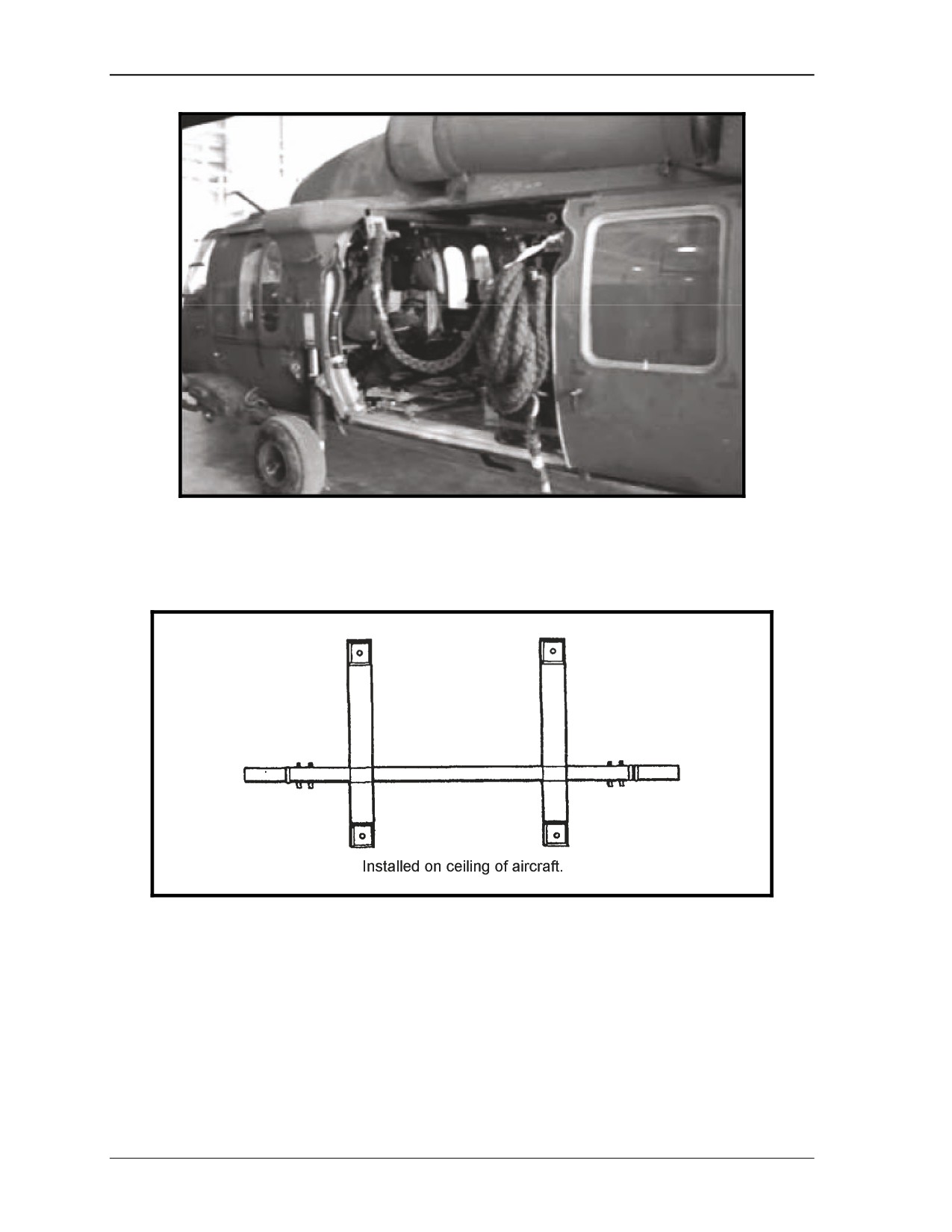
The aviation unit is responsible for rigging the aircraft (Figure 5-9 and Figure 5-10). The FRIES
master and selected personnel may rig or assist in the rigging under the supervision of the aircrew.
Personnel—
• Ensure the aviation unit has removed the center row, which has nine seats.
• Ensure the aviation unit has provided in-flight floor restraints for fast-rope personnel. These
restraints can include seat belts, sling ropes, or CGU straps.
• Remove both of the storage pins, and allow the bars to rotate down.
• Extend the fast-rope bars out to their desired length, fully extended for insertions, and insert the
storage pin in the correct hole.
• Inspect the bar for cracks and for security of nuts and bolts.
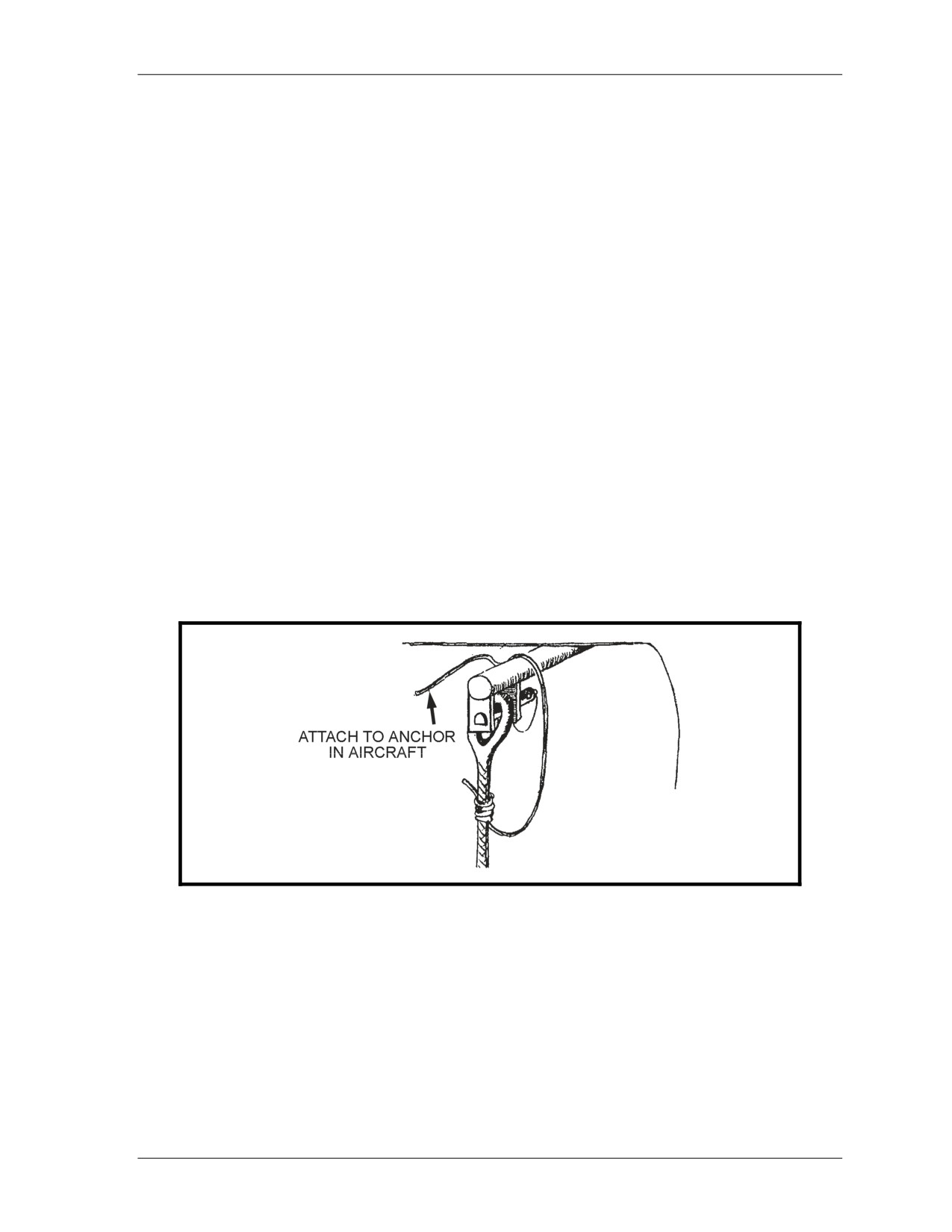
• Rig the fast rope to the fast-rope attachment point, as follows:
— Remove safety pin from the fast-rope release system and apply upward pressure to cabin
wall-mounted release handle, releasing the gate.
— Insert woven loop the fast rope into the attachment point.
— Insert the gate through the woven loop of the fast rope and into the receptacle.
— Apply a downward pressure to cabin wall-mounted release handle while pushing the gate
out until the gate is fully seated in the receptacle (locking position).
— Back-coil the fast rope and secure it to the cabin floor; or, insert the fast-rope retention strap
through the coil, and suspend the fast rope from the ceiling of the fuel tank. Finally, use the
safety pin to secure the quick-release mechanism (Figure 5-10).
Figure 5-9. Fast-rope rigging procedures for UH-60.
23 June 2009
FM 3-55.93
5-21
Chapter 5
Figure 5-10. UH-60 rigged for fast roping
OTHER AIRCRAFT
5-70.
The CH-47, CH-46, RH-53, and HH-53 aircraft use the same type of fast-rope bar, only double,
for use with the ramps (Figure 5-11).
Figure 5-11. Fast-rope rigging procedures for other aircraft.
SAFETY
5-71.
All personnel involved in FRIES operations are responsible for identifying hazardous situations
and preventing injuries of personnel. Anyone who observes an unsafe condition or act is authorized to halt
the operation and inform the FRIES master or the pilot in command. See USSOCOM Reg 350-6 for the
most current safety requirements.
5-22
FM 3-55.93
23 June 2009
Insertion and Extraction Methods
Emergencies after Roping Starts
5-72.
In case of an emergency, personnel follow emergency procedures:
Unsafe Drift or Premature Liftoff
• FRIES master, assistant FRIES masters, safety, or roper stops the stick.
• Ropers stop descent and lock in.
• FRIES master or crewman informs the pilot in command and guides him in, moving the aircraft
back on target.
• Unit continues operations.
Rope Hung or Snagged
• Safety ensures ropers are off the rope and clear.
• Aircraft descends or lands, as needed.
• Ground personnel free the rope.
• Unit resumes the operation.
Premature or Unintentional Deployment of the Fast Rope
• Notifies the pilot in command.
• Follows the aircrew's instructions.
Lost Communications
5-73.
During all training and operations, the pilot in command or the crewmembers and the FRIES
master must use the intercom. If the intercom fails, they use hand-and-arm signals until they can clear the
rope and restore the intercom:
Stop Stick--A clenched fist touching the chest.
Ropes--Open palm toward the door in a horizontal motion.
Aircraft Movement--An open palm moving and facing in the direction required.
Stop Aircraft Movement--A clenched fist.
DANGER
HOLD ONTO THE SAFETY LINE DURING THE CRITICAL TIME
BETWEEN THE ONE-MINUTE WARNING AND BEFORE "ROPERS
AWAY." WHEN THE DOORS ARE OPEN, ANY SUDDEN
AIRCRAFT MOVEMENT COULD THROW YOU OUT OF THE
AIRCRAFT.
DUTIES OF FAST-ROPE MASTER
• Brief members of his team and aircrew.
• Inspect team members to ensure that their equipment is configured correctly. For example,
ensure that each member has his work gloves and has tied down all equipment on his person.
• Backbrief, and then inspect aircraft rigging.
• Install the FRIES rope in the aircraft and conduct safety checks.
23 June 2009
FM 3-55.93
5-23
Chapter 5
• Relay 10-minute, 6-minute, and l-minute warnings to team members. Use time warnings as a
tool to help synchronize aircrew and ropers' actions. Modify time warnings according to user
needs, but always issue 1-minute warning.
• Break chemical lights, if required, at the 6-minute warning. During night operations, mark the
rope with six chemical lights:
— Two at the mount.
— Two at the end.
— Two 15 feet from the end.
Note: Not all chemical lights are visible at night, even through image-intensifying night
vision devices. The FRIES master must coordinate with the pilots during the air mission brief
to finalize the types and colors of chemical lights to use.
• Ensure the rope is properly configured for deployment (back-coiled to prevent tangles).
• Ensure the team members are in order of exit no later than the 1-minute warning.
• Confirm target on final approach.
• Deploy the rope and ensures it reaches the ground.
• During night operations, wear NVG, see and verify that you see two horizontal chemical lights.
• Deploy personnel, advising the pilots by announcing--
— "Rope out" when deploying the rope over the target.
— "Ropers away" when the first roper exits on the fast rope.
— "Rope clear" to inform the pilots the aircraft is clear for flight.
— "Hold" to inform the pilots to hold the aircraft position.
— "Move, [left, right, forward, or back]" as needed.
• Account for personnel and signals aircrew.
INDIVIDUAL ROPER
• Understand all aspects of the insertion and emergency procedures.
• Configure his individual equipment correctly to prevent snagging and injuries.
• At the command STAND BY (given at 1-minute warning), check self one last time and prepare
to exit the position.
• At the command GO, maintain an orderly formation and exit rapidly.
• Grasp the rope firmly before exiting--never jump for the rope.
• On exit, rotate your body 90 to 180 degrees to ensure your equipment clears the aircraft.
• Exit at 1-second intervals. Begin to slow descent about halfway down to avoid landing on the
other ropers.
• Descend the rope, controlling your speed.
• Brake two-thirds of the way down to avoid landing on ropers that preceded you.
• Prepare to land just before reaching the ground by spreading your legs about shoulder-width
apart, and with your knees slightly bent.
• At landing, quickly move clear of the rope to avoid colliding with descending ropers.
5-24
FM 3-55.93
23 June 2009
Insertion and Extraction Methods
ARMY AVIATION AND AIR ASSAULT
5-74.
Army aviation can increase LRSU mobility as well as flexibility. Once inserted behind enemy
lines, LRS teams gather combat intelligence that can lead to rapid and decisive action by friendly forces. A
successful air assault derives from carefully analyzing the factors of METT-TC and from detailed and
precise reverse planning. The latter actually consists of five basic plans, all of which leaders develop for
each air assault. To make the best use of available time, R&S squadron insertion and extraction section in
coordination with the LRSC headquarters normally coordinate and develop these plans. If time is limited,
planners can compress the steps of planning, or they can conduct them concurrently. They can also
supplement detailed, written plans and orders with SOPs. Normally, a battalion is the lowest level that
plans, coordinates, and controls air assault operations. Even when companies and lower conduct
operations, most planning occurs at battalion or higher.
GROUND TACTICAL PLAN
5-75.
The commander's ground tactical plan forms the foundation of a successful air assault operation.
All other plans must support it. It specifies actions in the objective area to accomplish the mission, and it
also addresses subsequent operations.
LANDING PLAN
5-76.
The landing plan supports the ground tactical plan. The landing plan sequences elements into the
AO. It ensures units arrive at the designated locations on time and are prepared to execute the ground
tactical plan.
AIR MOVEMENT PLAN
5-77.
The air movement plan is based on the ground tactical and landing plans. It schedules the
movement of Soldiers, equipment, and supplies from PZs to LZs by air.
LOADING PLAN
5-78.
The loading plan is based on the air movement plan. It ensures that Soldiers, equipment, and
supplies are loaded on the correct aircraft. Planning aircraft loads helps ensure unit integrity. Cross-loading
may be necessary to ensure survivability of C2 assets and the mix of weapons arriving at the LZ ready to
fight. The detachment or team leader should ensure the aircraft is loaded so that dismounting Soldiers can
react promptly and contribute to mission accomplishment.
STAGING PLAN
5-79.
The staging plan is based on the loading plan. It prescribes when and in what order ground units
(Soldiers, equipment, and supplies) will move to the PZ (order of movement).
PICKUP AND LANDING ZONES
5-80.
Pickup and landing zone size requirements depend on the type and number of helicopters and the
minimum acceptable distances between aircraft. Small unit leaders should be skilled in selecting and
marking of PZs and LZs.
MARKING TECHNIQUES
5-81.
During the day, a ground guide marks the PZ or LZ for the lead aircraft by holding his individual
weapon over his head, by displaying a folded VS-17 panel chest-high, or by other identifiable means. At
night, an inverted "Y" marks the landing point of the lead aircraft. Chemical light sticks or beanbag lights
help maintain light discipline (Figure 5-12). Each additional aircraft that lands in the same PZ or LZ
requires an additional light. For an observation, utility, or attack aircraft, the exact landing point is marked
with a single light. For cargo aircraft (CH-47, CH-53, CH-54), each additional landing point is marked
with two lights. The two lights are placed 10 meters apart and aligned in the aircraft's direction of flight.
23 June 2009
FM 3-55.93
5-25
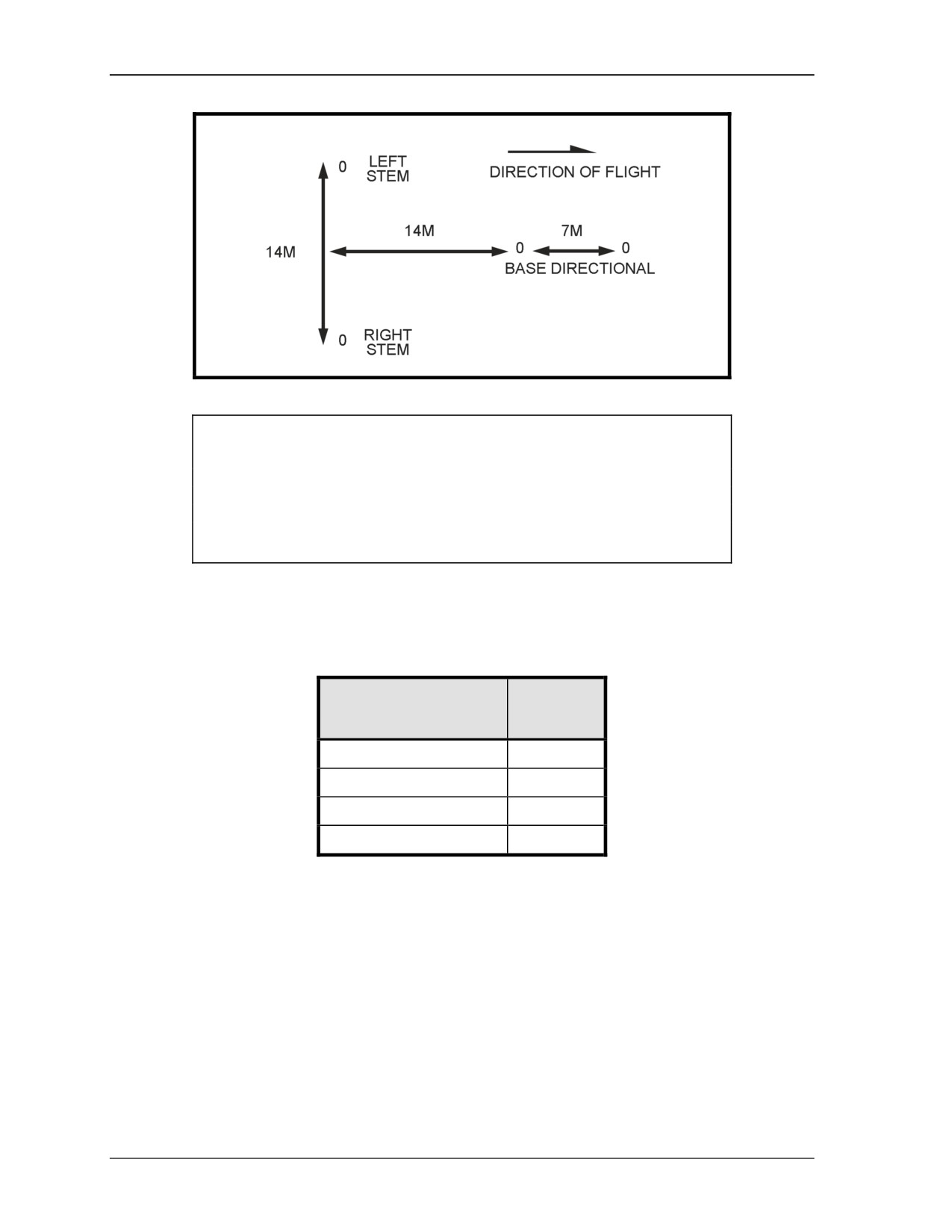
Chapter 5
Figure 5-12. Marking procedures for landing and pickup zones.
CAUTION
Not all chemical lights are visible at night, even through
image-intensifying night vision devices. The FRIES master must
coordinate with the pilots during the air mission brief to finalize the
types and colors of chemical lights to use.
LANDING POINT
5-82.
Each aircraft requires a circular landing point separate from those designated for other aircraft,
and free of obstacles. Table 5-1 shows the minimum recommended landing point diameters (in meters).
Table 5-1. Minimum recommended landing point diameters.
Minimum
Landing
Aircraft
Diameter
Observation helicopters
25 meters
UH-1, AH-1
35 meters
UH-60, AH-64
50 meters
Cargo helicopters
80 meters
SURFACE CONDITIONS
5-83.
The surface of the PZ or LZ should allow clear visibility of the touchdown point. It should be free
of landing hazards such as blowing sand, dust, or snow. It should contain no obstacles that could damage
landing aircraft such as trees, stumps, or large rocks. The surface must be firm enough to support the
traffic. It should have adequate drainage to allow rainfall to run off. Unacceptable levels of CBRN
contamination can preclude the use of an area. If part of an area falls short for any reason, that part is not
used.
GROUND SLOPE
5-84.
Generally, if the ground slopes 0 to 6 percent, then the pilot should land upslope. If the ground
slopes 7 to 15 percent, then he should land side slope. Over 15 percent, he should not touch down at all,
but he may, if conditions allow, hover to drop off or pick up personnel or equipment.
5-26
FM 3-55.93
23 June 2009
Insertion and Extraction Methods
Obstacles
5-85.
For planning purposes, use an obstacle clearance ratio of 10 to 1 on the approach and departure
ends of the PZ and LZ. That is, a helicopter approaching or departing directly above a 10-foot tall tree
needs 100 feet of horizontal clearance. Mark obstacles within the PZ and LZ only if the enemy cannot see
the markings. At night, mark them with red lights, but turn them on only when the PZ or LZ is in use. In
the daytime, use red panels instead of lights.
Approach and Departure
5-86.
Analyze the terrain surrounding a possible PZ or LZ for air traffic patterns. In a tactical situation,
avoid repeatedly approaching the PZ or LZ over the same ground. Choose approaches that are free of
obstacles. Pilots should land into the wind, but away from the sun. Ideally, they approach and depart along
the axis of the LZ, over the lowest obstacle, and into the wind.
Load Size
5-87.
When a helicopter is loaded to near maximum lift capacity, it needs more distance to lift off and
land. It cannot ascend or descend vertically. The nearer the load to maximum, the larger the PZ and LZ
must be to accommodate a flight.
Operations
5-88.
Before the aircraft arrives, the PZ control party secures the PZ. Both the PZ control party and the
Soldiers and equipment are positioned in the LRS team PZ or ORP. When occupying the team PZ or ORP,
the team leader should (Figure 5-13) —
• Maintain all-round security of the PZ or ORP.
• Maintain communications (ground-to-air).
• Brief the marking team for the exact aircraft landing point, and check their equipment.
• Establish priority of loading for each Soldier.
• If time permits a detailed plan, use a coordination checklist.
23 June 2009
FM 3-55.93
5-27
Chapter 5
LANDING ZONE OPERATIONS
5-89.
The following priority of action applies when landing on an LZ:
1. The LRS team leader gets the landing direction from the pilot, and then alerts all team
members before landing. This helps orient them to the LZ, particularly at night.
2. When the aircraft lands, personnel immediately unbuckle their seat belts and exit the aircraft
with all equipment.
3. As soon as the crew chief or pilot directs them, the LRS team unloads the aircraft.
4. The team moves 15 to 20 meters away from the side of the aircraft and assumes the prone
position facing away from the aircraft, weapons at the ready position, until the aircraft departs
the LZ.
5. The team moves to a predetermined location using techniques that fit the terrain. Once the
team reaches the concealed assembly point, the team leader quickly counts personnel and
equipment, and then proceeds.
6. The team moves quickly to an assembly area out of sight and hearing of the LZ. They remain
only long enough to adjust their senses to the surrounding environment and to verify the
location of the LZ.
7. If planed and coordinated during the air mission brief, the insertion aircraft may be loitering
nearby in case the team is compromised and needs hasty extraction. This is critical if the team
is engaged by enemy forces on the LZ.
8. If the team makes contact on or near the LZ, they immediately execute the appropriate
battle drill.
9. The LRS team leader calls for CAS, CCA or fire support, if available.
10. Once the team disengages from the enemy force, the team leader moves the unit to a covered
and concealed position, accounts for personnel and equipment, and decides whether to
continue with the mission.
11. If the team leader decides to call for emergency extraction.
a. The team leader gives a direction and distance to the emergency extraction site from the
insertion site.
b. As the aircraft approaches, the team leader initiates a directional signal using, for example,
pen gun flares, or a strobe light with a directional funnel attached.
c. This ground-to-air signal lets the pilot determine a clock direction and distance from the
aircraft to the team's location. The pilot identifies the signal initiated by the team.
d. After confirming the signal, the pilot forms his approach, assisted by the team leader.
OBSTACLES
5-90.
These include any obstructions, such as trees, stumps, or rocks that could interfere with aircraft
operation on the ground. During daylight, the aircrew is responsible for avoiding obstacles on the PZ or
LZ. For night and limited visibility operations, all obstacles are marked with red lights. The following
criteria are used to mark obstacles:
1. Mark the near and far sides of the obstacle on the aircraft approach route.
2. If the obstacle is on the aircraft departure route, mark the near side of the obstacle.
3. If the obstacle protrudes into the PZ or LZ, but is outside of the flight route of the aircraft,
mark the near side of the obstacle.
4. Mark large obstacles located on the approach route by circling the obstacle with red lights.
5-30
FM 3-55.93
23 June 2009
Insertion and Extraction Methods
5.
(Signalman) use arm-and-hand signals to guide aircraft in for landing. Stand to the right front
of the aircraft, where the pilot can see him best. At night, use lighted batons or flashlights in
each hand. When using flashlights, avoid blinding the pilot. Keep the batons and flashlights
lit at all times when signaling. The speed of the arm movement indicates the desired speed of
aircraft compliance with the signal.
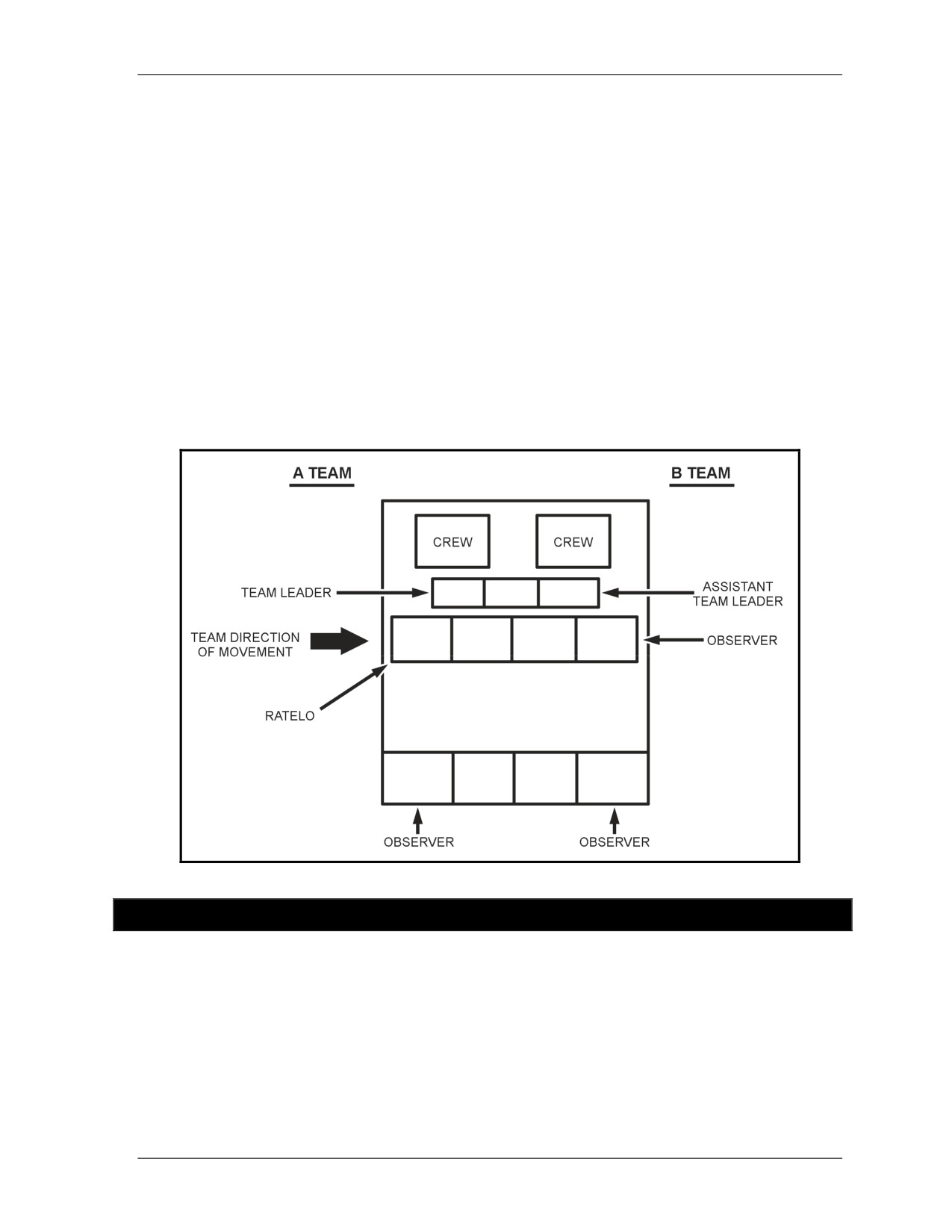
UH-60 LOADING SEQUENCE
5-91.
To maintain communications with the pilot, the team leader--
1. Uses the aircraft troop commander's handset or requests a separate headset. Initiates
movement once the aircraft has landed.
2. When the far- and near-side teams move to the aircraft, in file, leads the near-side group
(Figure 5-14).
3. Ensures that all personnel wear and carry rucksacks on the aircraft.
4. Notifies the crew chief when all team members board and prepare for liftoff.
5. Ensures that all personnel buckle up as soon as they reach their assigned seats.
Figure 5-14. UH-60 loading sequence.
Section III. VEHICLE OPERATIONS
The LRS team can move by vehicle from the planning area to a point of departure in a secure area.
Traditionally the team normally dismounts at the FLOT, makes final preparations, and conducts a forward
passage of lines. LRS teams now have the capability to conduct mounted operations providing relatively rapid
and secure operational assets within the AO. A LRS team no longer need rely on outside support in order to
insert, extract, infiltrate, and exfiltrate in the AO.
23 June 2009
FM 3-55.93
5-31
Chapter 5
MOBILITY PLATFORMS
5-92.
LRSU use a variety of vehicles to support themselves when conducting operations. The use of
all-terrain vehicles (ATV), variations of the HMMWV, and nonstandard tactical vehicles (NSTVs) allow
the commander to rapidly employ teams with reduced resupply requirements while conducting operations.
5-93.
The ATV’s primary mission is short-range mounted reconnaissance. The ATV provides the
capability to conduct surveillance and reconnaissance missions over a 48-hour or 250-mile range (carrying
extra fuel) without resupply in austere environments over difficult terrain.
5-94.
The different variations of the HMMWV such as the army standard M1025A2 or the M1114 are
good platforms to conduct long-range R&S in a desert environment.
5-95.
NSTV come in a variety of configurations such as four-door pickup trucks and sport utility
vehicles. The NSTV are also used to conduct R&S missions, but allow the LRS teams flexibility when
operating in areas that limit the use of standard military vehicles.
PLANNING CONSIDERATIONS
5-96.
Planning and preparation for a mounted mission starts long before the LRS team is alerted.
Preparations include training and rehearsals such as mounted battle drills, laager/hide sites and vehicle
maintenance. The distance from the FOB to the operational area, or even the staging (launch) site may
require additional transportation. Various infiltration combinations of aircraft, rail line, or surface ships
may be required to get the mounted team positioned to insert into an operational area. These infiltration
combinations may also be used to increase the operational range of the mounted team by decreasing the
required distance for overland insertion. When an operation requires either aircraft and surface ships or
other combinations, a rendezvous must take place to transfer the team. The method selected should be one
that will land or position the element with the least chance of detection as close as possible to its AO and as
simply and rapidly as possible. Factors to consider include—
• Security.
• Size of the element.
• Operational requirements relating to the overt or covert nature of the mission.
• Capabilities of personnel and equipment loads.
• Availability of transport and delivery capabilities.
• Weather, terrain, hydrographic, and astronomical data, and conditions in the delivery area.
• Enemy and friendly situation in the delivery area and AO.
• The team may be delivered into the staging area, delivery area or the AO via—
— Surface ships.
— Amphibious landing craft.
— Fixed- or rotary-wing aircraft.
— Rail lines.
— Line haul transport.
—Any combination of the above.
PRE-MISSION CONSIDERATIONS
5-97.
Elements should consider the following factors when planning for a successful infiltration.
5-32
FM 3-55.93
23 June 2009
Insertion and Extraction Methods
Mission
5-98.
The mission determines what and how much ammunition and supplies are necessary, including
special equipment.
Enemy and Friendly Situation
5-99.
Order of battle (OB) affects the routes, communications procedures and capabilities, external
exfiltration capabilities, and sources of resupply.
Troops Available and Training Level of Unit Personnel
5-100. LRS teams are proficient in air infiltration and dismounted operations. However, mounted
operations require additional training such as cross-country and night driving with and without night vision
aids and vehicle maintenance, recovery operations, and use and care of mounted weapon systems.
Terrain and Weather
5-101. Terrain and weather affect route planning, personal equipment, and special equipment needs.
Light conditions determine the time available for movement.
Time and Distance
5-102. These factors primarily affect the amount of required fuel for the vehicles and subsistence for
team members, since distance and duration are similar.
Civilian Populace
5-103. Mission planning must consider the local civilians in the AO and what to do in case of mission
compromise.
Equipment and Supplies
5-104. The pre-mission considerations help determine the teams' logistical needs. The team must plan for
the minimum levels of all needed supplies. Mission essential equipment and supplies take priority in the
allocation of space. During planning, the team may find that pre-positioned equipment is available in the
AO. This equipment can range from fuel and water to a complete HMMWV with weapons,
communications equipment, and repair parts. The availability of pre-positioned supplies greatly reduces the
number of vehicles and amount of equipment the unit must deploy with, and reduces the deployment
timeline. Additionally, when planning for deployment, the unit must allocate time to inspect and prepare
the equipment when it arrives in country.
Collective and Individual Training
5-105. LRS teams are capable of operating in all types of terrain and using various insertion and
extraction techniques. However, all teams require training to become and stay proficient.
Collective Training
5-106. Training required for the mounted LRS teams include cross-country and night driving (with and
without night vision aids), vehicle navigation, vehicle infiltration, garage site, MSS and hide site
establishment, vehicle maintenance, recovery operations, mounted battle drills, and dismounted crew battle
drills. Priority for team collective training for the vehicles must always include maintenance.
Individual Training
5-107. The following paragraphs address suggested individual training team members:
Team Leader and Assistant Team Leader--Mounted mission planning, detachment mounted
training concepts, mounted employment, battle drills, load planning and vehicle maintenance
management. The assistant team leader should also be hazardous material certified.
Senior Scout Observer--Mounted mission planning, mounted employment, battle drills, vehicle
maintenance, load planning and hazardous material certified.
23 June 2009
FM 3-55.93
5-33
Chapter 5
Radiotelephone Operator (RTO)--Mounted employment, battle drills, electrical wiring techniques,
and vehicle maintenance.
Assistant Radiotelephone Operator (ARTO)--Mounted employment, battle drills, electrical wiring
techniques, and vehicle maintenance.
Scout Observer--Mounted employment, battle drills, and vehicle maintenance.
Cross-Training
5-108. LRS team members require thorough cross-training. Each vehicle crew must be able to operate
independently for extended periods of time.
Vehicle Preparation
5-109. LRS personnel prepare as necessary for airland, paradrop, waterborne, and overland insertions.
They plan for and spend sufficient time preparing their vehicles for the assigned mission, from infiltration
to exfiltration. They must be prepared to conduct all maintenance and repair operations in the field.
5-110. Team members cross load each vehicle so that if required it can act independently during the
mission. Total weight of the vehicle, cargo and personnel is a prime consideration during operations. An
overloaded vehicle handles poorly, consumes fuel at a higher rate, and will experience more maintenance
problems. Items having the greatest effect on weight are fuel, water (50 pounds per 5 gallon container),
ammunition by type (including shipping containers), and personal equipment.
Equipment and Personnel Preparation
5-111. An important aspect to pre-mission preparation is vehicle maintenance and keeping all equipment
in a ready status. Members must inspect and exercise their vehicles even while in garrison. The assistant
team leader is responsible for status of the team’s vehicle. Preventive maintenance checks and service are
normally conducted, at a minimum, weekly while in garrison. This includes road testing the team's
vehicles. This test should include on- and off-road operation in all gears. Check for wheel alignment and
listen for any unusual noises.
5-112. Keep the basic equipment common to each mission on the vehicle at all times (Figure 5-15). This
equipment includes tools; petroleum, oils, and lubricants (POL); spare parts; recovery items; tire repair
kits; and other miscellaneous items. This method will not only save loading time and storage space, it
reduces the chance that these items will be forgotten. Prepare each vehicle using a unit standardized vehicle
load plan. This list is compiled from unit SOPs, experience, and mission requirements. The unit vehicle
load plan standardizes the location of equipment common to all in each vehicle. This ensures that anyone
assigned to the unit can go to any vehicle and locate or pack team equipment. Control and assist the
preparations after alert using pre-mission checklists.
5-113. Leaders conduct inspections to ensure the vehicles are loaded properly. Upon receipt of a notice to
deploy, inspect the unit's vehicles as soon as possible to ensure mechanical reliability. Conduct this
inspection at least 30 days before vehicle shipment (or as early as possible) to allow motor pool personnel
time to correct deficiencies. Motor pool personnel normally help inexperienced team personnel perform
this inspection. It is key that the team personnel be present at the vehicle maintenance inspection.
Test-drive each vehicle to ensure mechanical reliability. Make sure the inspection takes the vehicle up to
operating temperatures. Check climbing ability, winch operation with load, transmission and transfer case
performance through all gears on challenging terrain, engine performance, and wheel alignment. Also,
listen for any unusual noises or rattles. After the inspection and test, rate each vehicle by performance. The
stronger vehicles should perform the more challenging aspects of the mission. Avoid overloading or
hauling trailers with the weaker vehicles.
5-114. The next inspection should take place 3 to 5 days before load out or during planning. Inspect the
items normally kept on the vehicle and all mission-related equipment for accountability and serviceability.
The last inspection should be the normal final inspection or spot check done during the last few hours
before the infiltration or shipment of the equipment.
5-34
FM 3-55.93
23 June 2009
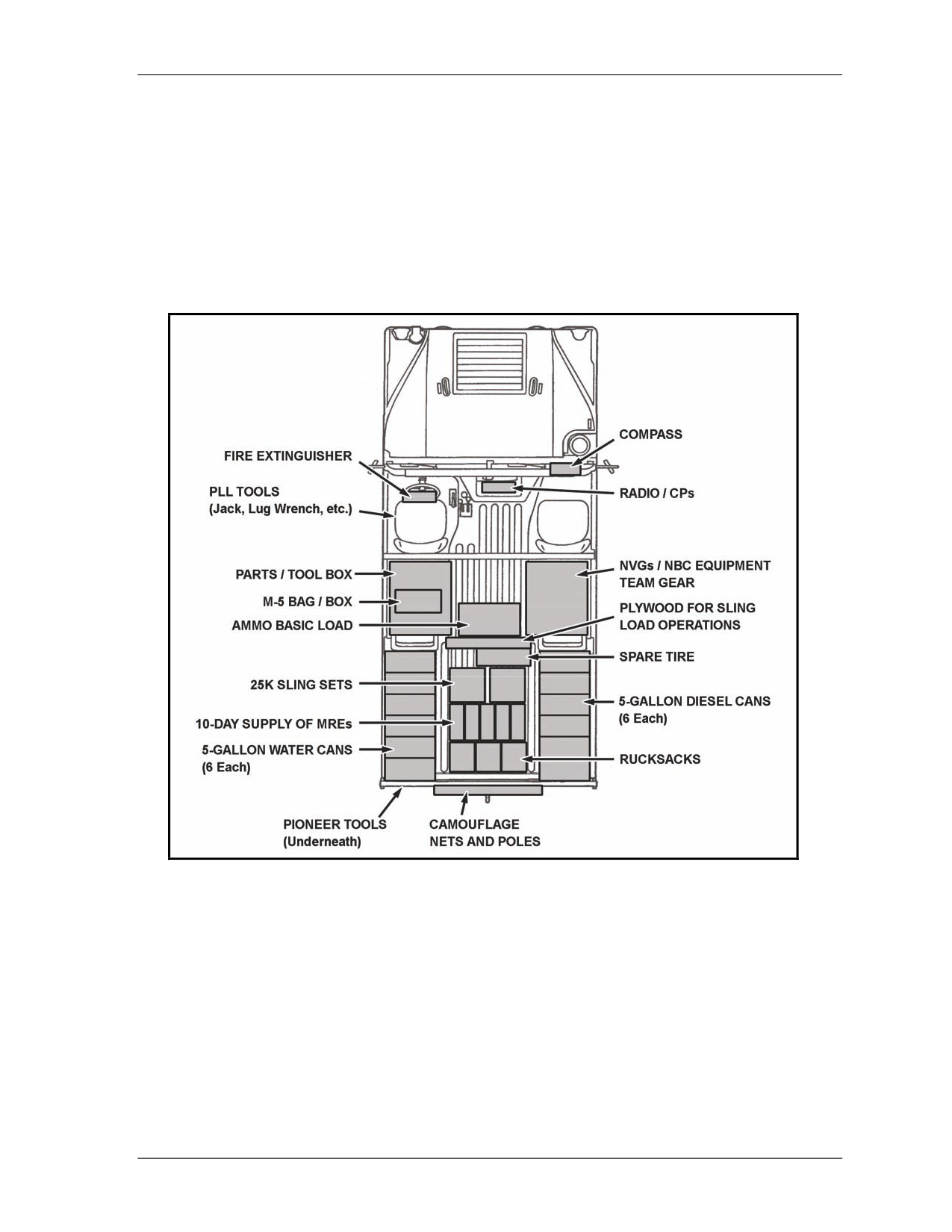
Insertion and Extraction Methods
5-115. Plan for sufficient fuel supplies. Fuel trucks, fuel points or resupply may not be available in the
mission area. Frequently, it is difficult or impossible to get any kind of resupply. For a HMMWV, a good
figure is 9 miles per gallon (mpg) for initial estimation of fuel requirements. Plan for and take adequate
water. Minimum water planning figures are 4 to 6 quarts per man per day for mounted operations in a
desert environment. Take additional water for dismounted missions within the mounted role. Omit the
water carried on individual load-bearing equipment (LBE) for this requirement. Team members use a
vehicle water bottle for the crew. They never use the water supplies on their LBE unless separated from the
vehicles during dismounted operations or when placed in a survival or evasion situation. As a rule,
consume water from the vehicle’s stores first before using personal stores.
Figure 5-15. Example vehicle load configuration.
5-116. Plan for and take adequate food supplies. Remember that food consumption in hot, dry climates is
generally less than in other climates. Individuals should pack most of their food items in a food bag (ditty
bag) instead of their rucksack to limit the extent of unpacking their rucksack when getting meals. A ditty
bag ensures they will have a minimal kit of food, survival and evasion items on hand. Construct the ditty
bag from a durable bag large enough to hold three days of food, minimal sleeping gear, personal evasion
and survival gear, first aid kit, and personal toilet articles. Pack at least three meals in the rucksack, so
individual team members will have a food supply if required to abandon the vehicle rapidly. If several
cases of food are packed on the vehicle, the crew must only open one at the time. This aids in estimating
how long the food will last, and prevents the constant shuffling of equipment. Place ammunition where it
can be accessed quickly. Secure large ammunition cans or containers to prevent injury in accidents due to
shifting loads. Construct and position a vehicle destruction kit for quick accessibility. Each member should
have three basic loads of small arms ammunition: one on the LBE (primary), one in rucksack (secondary),
23 June 2009
FM 3-55.93
5-35
Chapter 5
and one in an ammunition can positioned in the vehicle (contingency). The ammunition can in the vehicle
should contain all contingency ammunition for the crew. Position basic signaling ammunitions near the
navigator’s position. These would include colored smoke and colored star clusters to aid in identification.
5-117. Plan for maintenance and repair contingencies based on the mission, the terrain and weather in the
AO, mission duration, and maintenance experience. A detachment normally carries one general mechanic’s
toolbox, with metric supplement. In addition, each vehicle carries its own operator vehicle maintenance set
and a small supply of motor oil, transmission fluid, and brake fluid for basic maintenance needs.
5-118. For long duration missions, a trailer towed by a second and third vehicle can carry additional
maintenance supplies. Each vehicle should also carry one complete replacement set of fluids, including
motor oil, transmission fluid, brake fluid, and antifreeze. Each vehicle should also carry basic spare parts
such as fan belts, upper and lower radiator hoses, and main fuel tank drain plugs. Construct a battle-
damage repair kit with such items as a tire plug kit, automotive liquid metal, assorted hose clamps, and
radiator repair kit (FM 4-30.31).
5-119. On long-duration missions requiring trailer usage, construct an additional spare parts box to carry
such items as starter, alternator, half shafts, glow plugs, and battery. The team will normally carry enough
POL and replacement parts to repair any maintenance problem in the field within their capability. Once
everything is packed and ready for deployment, strap down and secure all equipment and supplies. All
equipment must be tied down securely for cross-country driving.
Operational Employment
5-120. The success of the mission and survival of the LRS team lies in its ability to infiltrate, move,
conduct operations, and exfiltrate--all without being detected. In mounted operations, survival depends on
moving mostly during times of limited visibility and using proper camouflage techniques at all other times.
Infiltration and Exfiltration
5-121. The threat to each method of infiltration and exfiltration is different. The following paragraphs
illustrate typical threats to a mounted team when infiltrating by air or by ground.
Air infiltration and Exfiltration
5-122. Mounted LRS teams infiltrating and exfiltrating by air must avoid an extensive and integrated
enemy air defense system. Such a system provides complete coverage at all altitudes with a high
redundancy of coverage in heavily defended areas. Soviet doctrine, currently used by many nations, has
tried to improve low-altitude detection.
Ground Infiltration and Exfiltration
5-123. Mounted LRS teams infiltrating and exfiltrating by land must avoid security forces. These forces
employ sensors, minefields, barriers, patrols, checkpoints, and other populace control measures to detect
clandestine movement across closed borders. Once the mounted team crosses the border, it still faces rear
area security threats.
Planning Considerations
5-124. The following paragraphs address the planning considerations for air and ground infiltration:
Air Infiltration
5-125. The mounted LRS team can use several platforms to infiltrate its mission area.
5-36
FM 3-55.93
23 June 2009
Insertion and Extraction Methods
C-17A
5-126. The C-17A Globemaster III can be used as an infiltration platform. Planning
considerations include—
• Travel time to operational area is greatly reduced.
• Team can carry a mounted weapons system.
• Vehicle is mission-ready, except weapons system is unloaded.
• Aircraft can carry an entire team with trailers loaded and prepared for movement.
• Team can carry spare parts and additional mission equipment such as trailers and pallets.
• Runway must be C-17A-capable, with a packed dirt runway at least 916 meters long.
C-130/MC-130
5-127. The C-130 Hercules aircraft has a great deal of advantages as an infiltration platform. Important
planning considerations include—
• The team can fit two vehicles per aircraft.
• Weapons systems can be mounted.
• Vehicle is mission-ready, except weapons system is unloaded.
• Everyone can ride on the aircraft.
• On the C-130, vehicle fuel tanks must be half-empty (without waiver).
• On the MC-130, vehicles allowed on board with a full tank, with prior coordination.
• These aircraft require a C-130-capable dirt strip (916 meters).
CH-47 Helicopter, Internal Load
5-128. The basic HMMWV will fit inside a CH-47 helicopter with two inches of clearance around the
vehicle (Figure 5-16). This clearance makes for a very tight fit and must be carefully rehearsed with the
aircrew. Planning considerations include—
• Crew must rig the vehicle.
• No objects may extend from the top or sides of the vehicle.
• The weapon system is stored.
• The team cannot use trailers.
• Available rehearsal time with driver and aircrew.
• A requirement for flat LZ or PZ. Any surface undulation will cause the internal frame of the
CH-47 to bend. This bend will lock the GMV in the helicopter or prevent it from being loaded
or unloaded.
23 June 2009
FM 3-55.93
5-37
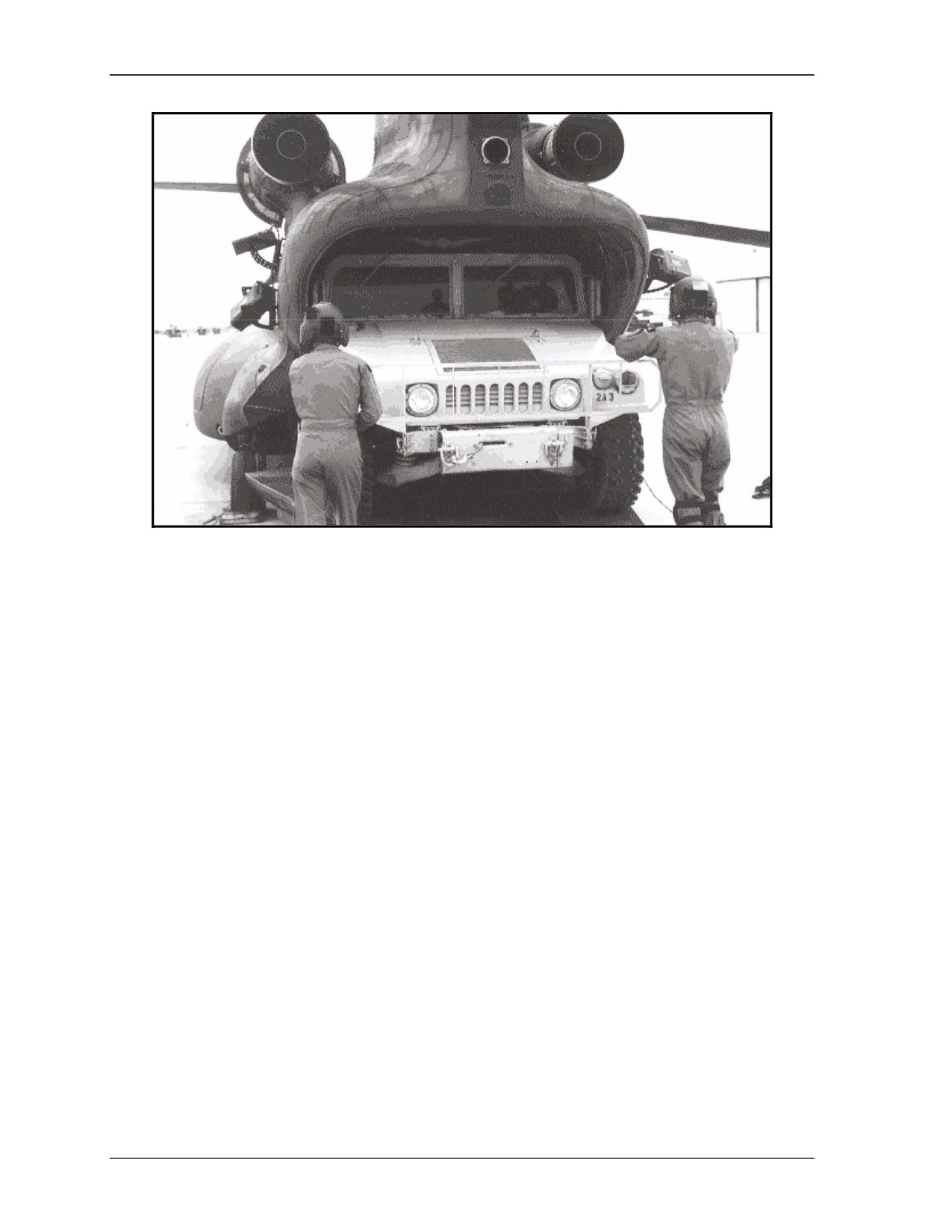
Chapter 5
Figure 5-16. Procedures for loading HMMWV into CH-47 for infiltration.
MH-47 Helicopter, Sling Load
5-129. Using procedures developed with 5th SFG(A) and 160th Special Operations Aviation Regiment,
the MH-47 can land, hook up the vehicle, and load the vehicle crew on the same aircraft. The procedures
for working with an MH-47 are different from conventional sling load operations and require coordination
and rehearsals. Planning considerations include the following:
• Need for additional sling sets.
• Rigging the vehicle.
• Rehearsal with aircrew.
Ground infiltration
5-130. The HMMWV leaves a unique vehicle signature, and its tracks are difficult to conceal. Take
extreme care during route selection.
Range
5-131. Mission planning range for a mounted LRS team with a full combat load is 10 days or 1,000 miles
without resupply. A combat loaded HMMWV can expect to carry at least six additional 5-gallon fuel cans
and six 5-gallon water cans on the back of the vehicle. This planning range can be extended to 10+ days or
1,000+ miles if using trailers to carry more supplies (fuel, food, and water), or if using an advanced
operational base or caches for en route resupply.
Rigging of Vehicle
5-132. A common mistake is to take everything when using a vehicle. Take care to properly load and
configure the vehicles for a long distance movement.
Trailer(s)
5-133. These can be taken for use en route or cached.
5-38
FM 3-55.93
23 June 2009
Insertion and Extraction Methods
Fundamentals of Movement
5-134. When planning and conducting movement, consider the below listed fundamentals of movement
to reduce the chance of enemy observation and contact.
Cover and Concealment
5-135. Use terrain features and vegetation that offer protection from enemy observation. When using
cover and concealment to its full advantage, personnel will usually need to compromise between security
and speed of movement.
Skylining
5-136. Avoid skylining. Select routes that avoid high ground that may silhouette the vehicles.
Chokepoints
5-137. Avoid chokepoints. Chokepoints or areas where the terrain naturally channels routes are often
sites for ambushes or areas that the enemy may have under observation. If a chokepoint proves impossible
to avoid, then reconnoiter it thoroughly before moving through it.
Populated Areas
5-138. Avoid known or suspected populated areas. For example, in desert environments, this means all
water holes, because the populace--and the enemy--know all the water holes. A mounted LRS team cannot
move covertly if people know they are in the area.
Movement Discipline
5-139. Practice movement discipline. Movement discipline means adhering to your light, noise, litter, and
interval rules. It also means keeping your speed slow enough so that you do not leave a large dust signature
(usually 10 to 12 miles per hour [mph] on most surfaces at night, slower during the day).
Security
5-140. Maintain 360-degree security at all times to avoid being surprised. The team leader or the unit
SOP assigns a sector of fire and observation to each vehicle during movement and at halts.
Routes and Contingencies
5-141. Make sure all team members know the route and contingency plans.
Methods of Travel
5-142. There are two methods of travel in the operational area. Either on existing tracks, trails, or roads,
or traveling cross-country. Each has advantages and disadvantages:
Tracks, Trails, or Roads
Advantages include speed of movement, hard-packed trails that do not easily yield readable
prints and signs of passage, quietness of movement, less stress on vehicles and tires, and
sometimes easier navigation.
Disadvantages are a greater chance of being seen or compromised, natural lanes of observation
and fire for the enemy, and more probable mechanical or manual ambushes. The HMMWV
leaves a distinctive tire trail unlike any other truck.
Cross-Country
Advantages to traveling cross-country include less chance of enemy observation or contact,
usually more cover and concealment, and less chance of an ambush.
Disadvantages are slower rates of movement, more noticeable vehicle tracks and signs of
passage, greater tire failure and vehicle stress, and more difficult navigation. The team must
rehearse cross-country movement in terrain as close as possible to that of the target area
before deployment.
23 June 2009
FM 3-55.93
5-39
Chapter 5
MOVEMENT TECHNIQUES AND MOVEMENT FORMATIONS
5-143. Movement techniques combined with movement formations allow units to conduct tactical
movement in any METT-TC situation. These combinations can be used when all elements are mounted, or
when there is a combination of mounted and dismounted forces, regardless of what type of vehicle is used.
Movement Techniques
5-144. The three standard movement techniques are traveling, traveling overwatch, and bounding
overwatch. Different movement techniques are used based on the likelihood of enemy contact.
Traveling--The traveling movement technique is used when enemy contact is not expected or
likely.
Traveling Overwatch--The traveling overwatch movement technique is used when enemy contact
is possible.
Bounding Overwatch--The bounding overwatch movement technique is used when enemy
contact is likely or expected.
Formations
5-145. The mounted LRS team can employ a number of different movement formations depending on the
number of vehicles and the situation.
Column and Staggered Column--Use this formation when speed is essential as it moves on a
designated route. The column offers good protection to the flacks, but little to the front and
rear. The lead vehicle or section normally controls column movement by following the planned
route and speed. The staggered column is used in open terrain. Use the visibility rule for
interval.
Illumination conditions, terrain and vegetation, and night vision equipment affect this rule. The
driver keeps the vehicle to his front in sight.
Line Formation--Use this formation is best used when maximum reconnaissance forward is
needed.
Wedge and VEE Formations--Use these formations when immediate mutual support and depth is
desired. In the wedge formation, the vehicle(s) in the middle of the formation are forward. In
the VEE formation, the vehicle(s) on the flanks are forward. These formations can also be used
with extremely wide intervals, determined by visibility, to conduct reconnaissance operations
(Figure 5-17).
Diamond Formation--Use this formation when crossing extremely large open areas. Each section
forms a side of the box when moving forward. Visibility determines the interval between
vehicles in each section. The interval between sections should not be greater than 900 to 1,000
meters. This formation is hard to control; therefore, the sections plan for and designate rally
points before they separate.
5-40
FM 3-55.93
23 June 2009
Insertion and Extraction Methods
Figure 5-17. HMMWVs in wedge formation.
Actions at Halts
5-146. Any time the team conducts a planned halt (short or long), it will also conduct a coordinated
shutdown of all vehicles. The team leader initiates the shutdown using hand and arm signals. He exits his
vehicle and stands where everyone can see him. He waves his arm in a circle over his head, and then drops
it toward the ground. This signals all vehicles to shut down their engines at the same time. When the halt is
over, he uses the same procedure to signal all drivers to start their engines at the same time. If neither the
leader nor the assistant leader can visually signal all of the vehicles at the same time, then either may use
the radio to indicate engine shutdown or engine on. Although radio use should be avoided to lessen the
team’s radio signature, it can be conducted safely if done properly. Once the vehicles have been shut down,
and before any other functions take place, the team conducts a security listening halt. The commander sets
the duration for halts during planning or in team SOPs. Short-duration halts are used to communicate with
higher headquarters, make necessary repairs, or establish a satellite position fix on a GPS receiver. For
halts of less than 15 minutes, the team remains in formation. Personnel man all vehicle weapons and
establish 360-degree security. For halts of more than 15 minutes, the team tries to move off its direction of
travel and reform. During the halt, the team performs necessary tasks. Each Soldier receives a briefing on
the present location. An updated contingency plan is issued if needed.
Coil
5-147. Use this formation when moving in a column formation or along a road or trail. The team moves
into a partial perimeter along the route of march. Members of each vehicle observe their assigned section
of the perimeter. The terrain determines vehicle interval, but it is seldom less than 50 meters.
23 June 2009
FM 3-55.93
5-41
Chapter 5
Laager Sites
5-148. A laager site is a secure vehicle encampment. Mounted teams should use this site to maintain
vehicles, rest crews, plan missions, and hide during daylight.
Types
5-149. The two types of laager sites are short duration (occupied for only one period of daylight) or long
duration (occupied for longer than one period of daylight). During route planning, select tentative primary
and alternate laager sites on the primary and alternate routes. The team should arrive in the general area of
the laager sites about two hours before begin morning nautical twilight (BMNT). This allows time for a
proper reconnaissance and emplacement and camouflage of the vehicles before first light. Upon reaching a
tentative laager site, or before first light, the ATV element or a dismounted element can reconnoiter it.
Once the site is selected, the assistant team leader enters the site on foot and directs incoming vehicles into
position. As each vehicle moves into position, its members receive their areas of responsibility. After the
team is in place, it conducts a listening period to determine if there is any activity in the area.
Tasks
5-150. After the listening period, tasks (in order of priority) are—
• Security.
• Launch a dismounted patrol to erase signs of vehicles into the laager site out to a predetermined
distance set by unit SOP.
• Camouflage one vehicle, or one vehicle per section, at a time. The others provide security.
• Confirm sectors of fire and prepare range cards.
• Emplace early warning devices or claymores.
• Establish observation posts (OPs) or listening posts (LPs), if necessary.
• Establish field telephone communications to each vehicle.
• Reduce security, refuel, perform maintenance, and attend to personal hygiene.
Description
5-151. The laager site need not resemble a circle. The terrain and vegetation play a role in locating each
vehicle. All vehicles may be placed in the perimeter if necessary. When conducting detachment operations,
the detachment sergeant’s vehicle (number 2), is normally located in the center of the laager site. This
formation resembles a triangle and allows a greater arc of fire if attacked. When selecting and preparing a
LRS team’s laager site, the priority is concealment, remaining undetected, and if compromised, breaking
contact rapidly (Figure 5-18).
Occupation
5-152. The LRS team may have to occupy the laager site for more than one period of daylight. Such an
occupation is most common when it needs to wait for more advantageous weather or light conditions
before moving, has deployed a dismounted element on a mission and must remain in the area, or is in a
situation where repairs to equipment must be made before resuming the mission. When occupied for more
than one period of daylight, additional tasks include—
• Enhancing early warning measures.
• Improving continuously defensive positions (to include defensive minefields as necessary).
• Conducting reconnaissance and establishing surveillance of the area.
• Upon vacating the laager site, the team sterilizes the site as much as possible to deny the enemy
intelligence on its operations.
• Continuing to enhance concealment of the site, even if doing so reduces its potential
evacuation routes.
5-42
FM 3-55.93
23 June 2009