FM 3-55.93 LONG-RANGE SURVEILLANCE UNIT OPERATIONS (JUNE 2009) - page 3
Team Operations
SURVEILLANCE SITE
4-103. During periods of activity on the objective, all personnel should be awake and alert to aid in
security and recording. One person cannot record and conduct surveillance at the same time during
periods of increased activity. The team keeps detailed surveillance logs, to include sketches of the
objective. The more detailed the information and sketches are, the more successful the mission will be.
When the team recognizes PIR, intelligence requirements, SIR, ISR tasks and RFIs, they send it to the
hide site promptly for transmission to the COB or AOB either immediately (PIR) or during a scheduled
communications window. They can use either secure or nonsecure means, depending upon the
equipment or time available. The messages must be complete and well written to reduce time needed for
corrections or clarification. (Chapter 6 provides examples of communication orders formats.) The team
pays particular attention to the amount of movement, noise and light discipline, and the reduction of any
reflection that may come from using optics. The team must pack any equipment not in use so that they
can evacuate the site quickly. As with the hide site, the team must completely disseminate all information
collected before they change shifts. If the team plans to perform a breakout drill, they send a message to
the hide site first, if possible.
LINKUP AND DISSEMINATION OF INFORMATION
4-104. When the decision is made to leave the objective, the team must perform a number of actions.
The plan outlines the routes they will take, site breakdown procedures, and security during breakdown.
After they break down the site, they thoroughly sterilize it to prevent the enemy from detecting their
presence and knowing where to release tracker teams. The team must leave nothing behind that can give
the enemy any information. They take extra care with their security. The team is in great danger from
this point until the extraction is complete.
4-105. While the surveillance team moves out, the hide site team breaks down and sterilizes the site.
They follow the same procedures and precautions as described for the surveillance site.
4-106. The team rehearses linkup procedures before the mission begins. During linkup, the team is at
the greatest risk of fratricide. Everyone must understand all signals. Only one element may move into the
linkup site at a time. Who moves first is decided during rehearsals. Communications and night vision
capability assist in conducting linkups. After the linkup, the team disseminates all information gained in
case they become separated again before extraction.
CONTINGENCIES
4-107. Due to the uncertainty of the situation, contingencies require plans, rapid response, and special
procedures to ensure safety and readiness of personnel and equipment. The team must consider the
following contingencies for the execution phase:
• Actions on enemy contact during insertion.
• Break in contact.
• Actions taken by the team if separated during insertion.
• Plan for priority of destruction of equipment.
• Rally or rendezvous plan to cover team during foot infiltration to objective, while on the
objective, and during exfiltration.
• Plan for avoiding all known or suspected enemy forces, danger areas, or civilian
concentrations.
• Security during movement, halts, cache, communications, and during hide or surveillance site
construction.
• Cross-loading of equipment, sensitive items, and construction material.
• Lack of a communications plan (team internal and external to the COB).
23 June 2009
FM 3-55.93
4-29
Chapter 4
• Actions on enemy contact.
• Linkup plan for both teams internally, and with other friendly forces.
HEAVY TEAM AND PLATOON OPERATIONS
4-108. Some METT-TC conditions may require a LRS team to have additional Soldiers attached or in
support. A LRS team may require additional personnel to carry surveillance site construction materials
and water. These additional Soldiers (three to six) are known as a "mule team." They accompany the
team to the objective area, construct the subsurface surveillance site, and depart the objective area during
limited visibility. The advantage to using these TTP is that the LRS team is rested when starting the
surveillance mission.
4-109. METT-TC conditions may also allow for the use of a LRSD employed as a tactical platoon. The
LRSD establishes a patrol base, and then emplaces multiple surveillance sites. The LRSD acts both as
the sustainment base and as a quick reaction force in case a surveillance site is compromised. This
technique has been very successfully employed in desert environments when the objective area is far
from any support base and multiple surveillance sites are needed. Sustainment and rotation of
surveillance site personnel occurs during the hours of limited visibility.
Section IV. COMBAT ASSESSMENT
Combat assessment is the determination of the overall effectiveness of force employment during military
operations. Combat assessment has three major components: battle damage assessment (BDA), munitions
effects assessment, and reattack recommendation (JP 3-60 and FM 1-02). However, LRS teams only participate
in the BDA component. LRS teams are critical sensors for all fire-support platforms. At times, they may be the
only source of targeting information available for high-value targets (HVTs). Keys to a successful combat
assessment operation are using standardized report formats and sending the best possible information and
images of the damage observed for trained analysts to evaluate.
DEFINITION AND PURPOSE
4-110. BDA is the timely and accurate estimate of damage resulting from the application of military
force, either lethal or nonlethal, against a predetermined objective. BDA can be applied to the
employment of all types of weapon systems (air, ground, naval, and special forces weapons systems)
throughout the range of military operations. BDA is primarily an intelligence responsibility with required
inputs and coordination from the operators (FM 1-02). BDA, in its most basic form, answers four
questions quickly and accurately:
• Was the target hit?
• What was the extent of physical and functional damage?
• Were the commander's objectives achieved in full, in part, or not at all?
• Should the target be reattacked?
4-111. The LRS team can make a recommendation to reattack, but it is the targeting planners, not the
LRS team, who decide whether the target should be reattacked.
CONSIDERATIONS
4-112. When assessing battle damage, the team should consider—
CONDITION OF THE TARGET
4-113. This includes the overall level of destruction or serviceability of the target and whether it was
occupied or unoccupied, and whether the enemy was withdrawing or reinforcing.
4-30
FM 3-55.93
23 June 2009
Team Operations
CASUALTIES
4-114. This includes the number of wounded or dead.
EQUIPMENT DAMAGE OR SERVICEABILITY
4-115. This lists destroyed and neutralized vehicles and weapon systems, and identifies which need
repair or recovery.
INSTALLATION DAMAGE OR SERVICEABILITY
4-116. This identifies damage levels and relative serviceability of runways, roads, buildings, lighting,
bridges, power and phone lines, and any repair and damage-control activities.
MISSION PLANNING FACTORS
4-117. In addition to normal planning factors, BDA missions include—
• Task organization (forward observers or combat controllers).
• Personnel markings.
• Position markings.
• Communications equipment and frequencies.
• BDA criteria.
• Special equipment such as lasers and thermals.
• Pulse repetition codes.
• Authentication codes.
• Training in the use of special equipment.
• Rehearsals and precombat inspections.
• Withdrawal.
CHARACTERISTICS
4-118. Initial post-strike BDA reports are sent to the COB or AOB, who sends them to the controlling
headquarters. The team is responsible for obtaining and reporting raw data about collateral, physical, and
functional damage.
WEAPON AND ORDNANCE MALFUNCTIONS
4-119. Because the team observes and reports any observed battle damage, the team can also report the
number and type of dud ordinance and any weapon malfunctions.
REPORTS
4-120. The team reports their BDA observations from the target area in either the SALUTER or
INTREP format. They should include digital imagery, if available.
DAMAGE TYPES AND LEVELS
4-121. The team reports the extent of physical and functional damage sustained by each target.
Physical damage assessments estimate the extent of physical damage resulting from the application of
military force, that is, from munitions blasts, fragmentation, and the effects of fire. The team bases their
assessment upon observed or interpreted damage.
23 June 2009
FM 3-55.93
4-31
Chapter 4
COLLATERAL DAMAGE
4-122. The team reports any collateral damage that occurs during BDA missions. Collateral damage is
defined as unintentional or incidental damage to facilities or equipment, or casualties, that occur due to
military actions directed against a targeted enemy force or facility.
PHYSICAL DAMAGE
4-123. Assessing physical damage is a judgment call. The key factors are the type and size of the target
and warhead used, and the location of the detonation. The team also considers whether the enemy's use
of camouflage, concealment, and deception reduced or increased the physical damage, because these
factors could distort the assessment.
FUNCTIONAL DAMAGE
4-124. The team assesses the extent to which military force degraded or destroyed the ability of the
targeted facility or objective to perform its intended mission. The level of success is based upon the
operational objectives established against the target. Because assessment of functional damage is
subjective, the team need not associate a confidence level with it. However, they can include an estimate
of the time required for the recuperation or replacement of the target function.
No Functional Damage--Target is undamaged or has sustained little or no damage to critical
element(s), leaving normal functional capability intact. The target is fully operational or able to
act; it is mission capable. This damage level does not require recuperation or replacement
times.
Light Functional Damage--The critical element(s) of the target has sustained damage, causing
less than a 15 percent decrease in normal operational capability. This damage level requires an
estimation of the time required for recuperation or replacement of the target function.
Moderate Functional Damage--The critical element(s) of the target has sustained damage,
causing a 15 to 45 percent decrease in normal operational capability. This damage level
requires an estimation of the time required for recuperation or replacement of the target
function.
Severe Functional Damage--The critical element(s) of the target has sustained damage, causing
greater than a 45 percent decrease in normal operational capability. This damage level requires
an estimation of the time required for recuperation or replacement of the target function.
Functional Destruction--The critical element(s) of the target has sustained damage rendering the
entire target unusable for its original purpose. Target cannot support combat or production
operations without repairing or replacing critical elements. This damage level requires an
estimation of the time required for recuperation or replacement of the target function.
Abandoned--Regardless of physical damage, this facility or equipment is not being used for its
intended purpose. Target cannot support combat or production operations without being
reoccupied, re-equipped, or both.
Unknown Functional Damage--Although the critical element(s) of the target has been attacked,
insufficient data exist to assess whether functional damage occurred.
BRIDGES
4-125. A bridge is designed to allow movement of personnel and equipment across an obstacle.
Destruction of the bridge might not be required. For example, degrading the ability of the bridge to allow
movement of vehicles might be enough to accomplish the mission.
4-32
FM 3-55.93
23 June 2009
Team Operations
PHYSICAL DAMAGE
4-126. When reporting physical damage, report the number of spans that are damaged and destroyed
out of the total number of spans on the bridge. Note that the deck or floor of a railroad bridge can be
solid or open track.
No Damage--Military action has caused no apparent damage.
Light Damage--The bridge has sustained superficial damage, but the roadway remains
undamaged.
Moderate Damage--All spans remain intact, but one or more spans has sustained holes in the
deck or floor. For pontoon bridges, one pontoon section has been sunk.
Severe Damage--All spans remain attached, but one or more spans has sustained 50 percent
destruction to the deck or floor width. For pontoon bridges, two or more nonadjacent pontoon
sections has been sunk.
Destruction--At least one span has been dropped. Piers or abutments might have sustained
damage or they might have been destroyed. For pontoon bridges, two or more adjacent pontoon
sections have been sunk.
FUNCTIONAL DAMAGE
4-127. Using the assessment of physical damage can help determine the level of functional damage.
Highway Bridge--When you report that a bridge has sustained moderate to severe damage,
identify the number of lanes that remain open (on a highway bridge) and what how much traffic
can still use the bridge.
Railroad Bridge--Moderate or greater physical damage to a railroad bridge generally renders
it unusable.
Pontoon Bridge--Recuperation time may be short in duration for a pontoon bridge that has been
destroyed due to the destruction of a few sections. Several factors such as the presence or
availability of spare sections, repair capability, or both, can rapidly reverse the effects of an
attack. Some might be repaired before the combat assessment report is completed.
Permanent Spanned Bridge--When a permanent bridge span sustains moderate to severe
physical damage, assessing the extent of functional damage is difficult. The combat assessment
analyst can seldom see under the bridge, but the damage there often exceeds the damage he can
see on the deck. This is due to the delayed fuses used on most bridges.
BUILDINGS
4-128. A building is designed to environmentally shelter an enclosed function or equipment.
Destruction of the building is not required. The point is to destroy the critical element(s) it houses.
TYPES
4-129. These include framed buildings, buildings with load-bearing walls, high multistory buildings,
and buildings with multiple wings.
Framed Buildings--Framed structures (such as military headquarters, office buildings, and
aircraft hangars) rarely collapse totally in an attack with conventional weapons. However,
regardless of external and overall damage, the building's frame tends to remain intact. On the
other hand, a steel or concrete frame need not collapse for the building to sustain damage at the
levels previously described.
Buildings with Load Bearing Walls--In contrast to framed buildings, those with load-bearing
walls, that is, walls that carry the weight of the floor and roof, generally sustain damage levels
equal to the amount of building collapse, and the damaged elements generally include the
load-bearing and non-load-bearing structural elements.
23 June 2009
FM 3-55.93
4-33
Chapter 4
High, Multistory Buildings--For buildings with more than four stories or with multiple sections
(or wings), the team should report the level of damage for each story, section, or wing
individually and that of the structure as a whole. For example, if a ten-story building receives
severe damage to the upper three stories, they report the level of damage to those three floors
plus the level of damage to the structure as a whole, which in this case might be assessed as
moderate.
Buildings with Multiple Wings--For buildings with multiple wings, the team reports the
destroyed wings and the damage to the remainder of the structure. For example, they might
report that the North and South wings of a headquarters building have been destroyed, while
the center section sustained only moderate damage.
PHYSICAL DAMAGE
4-130. Target-element-area damage includes damage to non-load-bearing elements such as facades and
external sheathing, as well as broken windows and glass, blown-out curtain walls, and blown-out
roof panels.
No Damage--Military action has caused no apparent damage.
Light Damage--At this level of damage, the target-element area has sustained up to 15
percent damage.
Moderate Damage--At this level of damage, the target-element area has sustained from 15 to 45
percent damage.
Severe Damage--At this level of damage, the target-element area has sustained from 45 to 75
percent damage.
Destruction--At this level of damage, the target-element area has sustained from 75 to 100
percent damage.
FUNCTIONAL DAMAGE
4-131. The greater the extent of physical damage to the building, the greater the likelihood that the
critical element(s) within is damaged, hence the building requires a longer recuperation time to restore
the function.
Location and Hardness--Although the level of physical damage to a building and functional
damage to its critical element(s) correlate somewhat, the location and hardness of a building's
contents are the keys to a meaningful functional assessment. For example, in an industrial
building, the machinery may be less vulnerable than the structure in which it is contained. The
structure might be moderately damaged, while the machinery it houses sustains little or no
damage. On the other hand, fragile computer or other electronic equipment might be destroyed
while the building that houses it sustains far less functional damage.
Contents--Framed structures tend to show less apparent physical damage and is less likely to
collapse than other types of buildings. Thus, determining the functional damage to the contents
of a framed building is more difficult than assessing those of a wall-bearing structure. These
tend to show more physical damage, and they collapse more readily, causing greater functional
damage to their contents than do framed structures.
Recuperation--The team reports recuperation for both the structure and for the critical elements.
Structural Damage as Unusability Criteria--General weaponeering guidance considers a
building unusable (functionally destroyed) when it has sustained 50 percent structural damage.
Depending on the type and location of critical elements, a lesser percentage of damage may be
adequate to achieve the desired level of functional degradation.
4-34
FM 3-55.93
23 June 2009
Team Operations
Landmarks and Symbols--A building may also serve as an important landmark or other symbol
of national unity and resolve; in these cases, the entire building may be the critical element.
BUNKERS
4-132. Bunkers were formerly called hardened facilities. It can be very difficult for LRS teams to
provide accurate BDA on bunkers unless they are able to conduct a physical inspection.
PHYSICAL DAMAGE
4-133. Target-element-area damage includes damage to non-load-bearing elements such as facades and
external sheathing, as well as to broken windows and glass, blown-out curtain walls, and blown-out
roof panels.
No Damage--Military action has caused no apparent damage.
Light Damage--At this level of damage, no weapon penetration has occurred, but exterior
damage is apparent.
Moderate Damage--At this level of damage, weapons have obviously penetrated the bunker.
Severe Damage--At this level of damage, part, but less than one-third of, the bunker roof or
sidewalls has collapsed.
Destruction--At this level of damage, more than one-third of the bunker roof and sidewalls have
collapsed.
FUNCTIONAL DAMAGE
4-134. Assessing damage to all types of hardened structures requires analysis of aircraft cockpit video
(ACV) and a search for blown-off entrance doors, burn marks outside entrances, or smoke from fire or
secondary explosions. The results of this analysis must be compared to information about the internal
configuration of the bunker to determine the approximate location of the weapon detonation.
4-135. A single weapon is unlikely to collapse or partially destroy a large bunker built with lots of
thick concrete, burster slabs, and soil layers. However, a big weapon detonation inside the bunker
generally destroys the contents. Knowledge of bunker construction such as dimensions, wall placement,
and thickness of roofs, floors, or walls is required to accurately assess the extent of internal physical and
functional damage.
4-136. Functional damage to a bunker depends on its mission. If internal compartmentalization allows,
a round that penetrates the bunker has a good chance of damaging or destroying sensitive contents such
as aircraft or munitions. If the damage is not too great, the contents can be moved. In these situations,
depending on the level of physical damage, the contents can be removed and the bunker can be
reconstituted to reuse for protective storage of other equipment or supplies.
4-137. A successful weapon penetration and detonation generally damages or destroys both mission
and operations in a bunker serving in a production or C2 role. In any of these situations, the extent of
functional damage depends on estimates of physical damage to the internal structure, ventilation system,
to electronic or communications equipment, and to power supplies, lights, water lines, tools, and
equipment, for example. Generally, long recuperation times are associated with this type of internal
damage. As with buildings, when reporting recuperation, the team reports both the structure's
recuperation and the recuperation of the critical elements.
DAMS AND LOCKS
4-138. Dams and locks have one function: to contain water on the upstream side. Military action
can cause--
23 June 2009
FM 3-55.93
4-35
Chapter 4
NO DAMAGE
4-139. If no damage occurs, no loss of functionality occurs.
DAMAGE
4-140. A breach, break, or puncture in the face of the lock or dam affects functionality immediately in
the form of a leak, whose size depends on the amount of damage.
DESTRUCTION
4-141. Loss of the lock or dam causes an immediate flood, which is total functional failure.
DISTILLATION TOWERS
4-142. Distillation tower targets include the tower and all associated equipment.
PHYSICAL DAMAGE
4-143. When reporting physical damage to a specific tower, also report damage level of equipment
directly associated with the tower. This equipment usually includes one or more furnaces, heat
exchangers, or condensers; and elevated pipe ways. If possible, also report damage level of the control
building associated with the distillation tower.
No Damage
4-144. Military action has caused no apparent damage.
Light Damage
4-145. Military action has caused no apparent penetration of tower shell or disruption to piping
connections. Portions of the insulation covering the tower shell appear damaged or scorched.
Moderate Damage
4-146. Military action has left the tower shell standing, but has penetrated the tower or deformed or
severed piping connections.
Destruction
4-147. Military action has at least partially collapsed or toppled the tower.
FUNCTIONAL DAMAGE
4-148. The effects of damaging a distillation tower on the target’s production capabilities depend on
the specific functions of the towers such as primary distillation or secondary processing. The team
reports functional damage of a distillation tower in terms of the time required to repair or replace it and
the specific production capabilities denied in the meantime. The team must also report damage to
equipment directly associated with a distillation tower, because the results could compare to significant
damage to the tower.
MILITARY EQUIPMENT
4-149. This applies to equipment whether deployed or in depot:
DEFINITIONS
• Armored vehicles include tanks and armored personal carriers.
• Artillery includes field and antiaircraft artillery systems, both towed and self propelled.
• Trucks include all types of nonarmored vehicles, whether used for land transportation, and C2.
4-36
FM 3-55.93
23 June 2009
Team Operations
• Locomotives and rolling stock include all types of rail transportation.
• Aircraft include all types of fixed- and rotary-wing aircraft.
• Rockets include single-round and multiround rockets and their associated launchers.
• Missiles include surface-to-surface and surface-to-air (fixed and mobile) missiles and their
associated launchers.
• Radar antennas include those that stand alone or are attached to a van or trailer. Radars may or
may not be associated with a missile site.
• Fire-control components include all vans or trailers (radar, guidance, power and computer)
associated with SSM, SAM, and AAA sites.
PHYSICAL DAMAGE
4-150. The team must consider their observations carefully before they report "No damage" to military
equipment. They might not observe some of the physical deformations that happened to it. To determine
damage level, they must analyze as many sources and types of information as they can observe; for
example, a complete lack of either vehicular movement or radio transmissions for an extended period of
time. Then, when they are ready to report physical damage to military equipment, they must report the
total number of each type of equipment observed, the number of pieces of equipment damaged, and the
number destroyed.
No Damage
4-151. Military action has caused no apparent damage.
Damage
4-152. Military action has caused physical deformations to equipment such as holes, exterior scorch
marks, or broken or missing exterior equipment or components such as broken tracks or wheel or
missing armored plates. However, major components remain intact.
Destruction
4-153. Military action has left the equipment unrepairable, possibly scrappable. This qualifies as
catastrophic damage (K-Kill).
FUNCTIONAL DAMAGE
4-154. The level of functional damage of a missile or radar site depends upon the extent of damage, the
number of critical elements and their individual levels of damage, and the interconnectivity of the
various elements that make up the site. Visible damage might have little or no effect on equipment
functionality. Functional damage of equipment includes any damage that partly or completely reduces--
• The ability of the C2 nodes to effectively operate.
• The ability of the logistics nodes to--
-- Fuel,
-- Arm,
-- Fix,
-- Transport,
-- Operate, or
-- Protect.
23 June 2009
FM 3-55.93
4-37
Chapter 4
• The ability of the engineering resources to provide--
-- Mobility,
-- Countermobility, and
-- Survivability support.
TYPES OF EQUIPMENT
4-155. Types of equipment whose reduction in capability can affect the functioning of a site or
element include--
Armored Vehicles and Artillery--Functional damage is an elimination of firepower capability
(F-kill), prevention of mobility (M-kill), or both, which the crew cannot repair on the
battlefield.
Trucks--Functional damage is a reduction in mobility (M-kill) or in ability to use the truck's
internal equipment for a number of hours until the crew can repair the equipment or vehicle.
Locomotives and Rolling Stock--Functional damage is prevention of mobility (M-kill) for a
number of hours until the crew can repair the locomotive or rolling stock cars. Functional
damage can also include damage or destruction of materials within the cars.
Aircraft--Functional damage prevents takeoff (PTO-kill) for a number of hours until the crew can
repair it.
Rocket, Missile, or Launcher--Functional damage prevents successful or effective firing of the
weapon (F-kill). The crew cannot repair this damage on the battlefield.
Radar Antenna or Its Van or Trailer--Functional damage prevents a radar system from
acquiring, firing, or tracking missiles (F-kill) until the system can be repaired.
GROUND FORCE PERSONNEL
4-156. Damaging or destroying an occupied position such as a bunker, trench, or other structure or a
vehicle such as a personnel carrier or truck usually causes casualties. FM 6-30 states that for indirect fire,
thirty-percent casualties or materiel damage inflicted during a short time span normally renders a unit
ineffective. However, a commander will stipulate the desired effects and percentages required for
success against specific target categories.
PHYSICAL DAMAGE
4-157. In addition to reporting physical damage levels, the team should estimate the total percentage of
the ground force destroyed. For equipment, see the damage definitions provided for military equipment.
No Damage
4-158. Military action has caused no apparent damage.
Damage
4-159. Military action has caused up to 30 percent casualties to visible personnel or to occupied
positions or organic equipment.
Destruction
4-160. Military action has caused more than 30 percent casualties to visible personnel or to occupied
positions or organic equipment.
4-38
FM 3-55.93
23 June 2009
Team Operations
FUNCTIONAL DAMAGE
4-161. The attrition of ground forces is influenced by factors in the domains of battle: physical
(personnel, weapons systems, and sustainment), cybernetic (C2), morale (will to fight), training, and
leadership. Generally, the greater the personnel casualties and damage to their equipment and
communications and supply networks, the greater the attrition of ground forces and the lower their
combat effectiveness. Desertions or POW losses may also render a unit ineffective. As part of
determining enemy combat effectiveness (ability to function), two factors must be addressed in clear and
simple terms:
• Reconstitution of forces and recuperation of facilities.
• Residual capabilities to perform defense, assault, and supply missions.
STORAGE TANKS FOR PETROLEUM, OIL, LUBRICANTS
4-162. Although a POL tank may sustain damage, its contents may be retrievable and usable.
PHYSICAL DAMAGE
No Damage
4-163. Military action has caused no apparent damage.
Light to Moderate Damage, Aboveground Tanks
4-164. Military action has punctured top walls, sidewalls, or both; possibly spilled contents; caused no
evidence of sustained fire; left structural integrity intact.
Light to Moderate Damage, Partly or Completely Underground Tanks
4-165. Round has penetrated tank, but no secondary explosion or sustained fire has occurred.
Destruction
4-166. Military action has caused at least partial collapse or buckling of side wall; or, a secondary
explosion or a sustained fire has occurred, or both.
FUNCTIONAL DAMAGE
4-167. Significant functional damage of a POL storage installation is expressed in terms of storage
capacity rendered unusable and time required to repair or replace this denied capacity.
POWER PLANT TURBINES AND GENERATORS
4-168. Power plant turbines and generators may be housed in separate structures or together in a single
structure called a "generator hall." Physical damage to the turbine or generator units can be difficult to
identify if the generator hall remains relatively intact. Therefore, damage estimates to the units are based
upon the location of the weapon detonation and on the physical damage to the building itself. The closer
to the floor a weapon detonates, the greater the probability of unit damage. The extent and location of
structural damage, as opposed to roof-panel damage, is another indicator of unit damage--the greater the
wall damage and structural collapse, the greater the likelihood that the unit(s) is damaged or destroyed
under the rubble.
PHYSICAL DAMAGE
4-169. When reporting physical damage, the team reports the number of turbines or generators that are
damaged and destroyed out of the total number of units at the facility. When performing combat
assessment on a generator hall, they report physical damage to both the building
(see previous
discussion), and they estimate damage to the turbines or generators located inside.
23 June 2009
FM 3-55.93
4-39
Chapter 4
No Damage
4-170. Military action has caused no apparent damage.
Damage
4-171. Military action has caused no apparent weapon penetration of unit, but the environmental
housing over the unit has sustained damage and is disfigured. The unit may also have been displaced
from its foundation.
Destruction
4-172. Military action has breached or penetrated the turbine or generator unit, causing extensive
structural deformation, or completely tore the unit apart. This is a catastrophic kill (K-kill).
FUNCTIONAL DAMAGE
4-173. Power plants with free-standing, gas-turbine-generator units can operate independently of each
other. These units are housed in light metal structures that provide environmental protection only.
Destruction of one unit of these units only partly degrades electrical production. Also, because turbines
and generator units exemplify machines that are less vulnerable to damage than their housing,
moderately damaging a generator hall can have little or no effect on the units it houses, and thus on their
functioning. When reporting recuperation, the team reports recuperation both of the structure and of the
turbines and generators.
RAIL LINES AND RAIL YARDS
4-174. Recuperation time for destroyed rail yards may be short in duration, because new rails, repair
equipment, and repair personnel might already be onsite or readily available.
PHYSICAL DAMAGE
4-175. These definitions also indicate the rail yard's functional damage.
No Damage
4-176. Military action has caused no apparent damage.
Cut
4-177. Military action has cratered one or more tracks, prohibiting movement around the damaged
area, although movement around or past the damaged area (choke point or rail yard) is still possible on
undamaged tracks.
Destruction
4-178. Military action has caused multiple cuts to multiple tracks, which keeps rolling stock from
moving around or past the damaged area (choke point or rail yard).
FUNCTIONAL DAMAGE
4-179. The location(s) of rail yard "cuts" and the ability of the yard to bypass the damage determine the
extent of functional damage to the rail yard.
ROADS
4-180. Where geographically possible, an alternate to damaging a road with crater(s) is to attack the
adjacent hillside to cause a landslide to cover the road.
PHYSICAL DAMAGE
No Damage
4-181. Military action has caused no apparent damage.
4-40
FM 3-55.93
23 June 2009
Team Operations
Cratered
4-182. Military action has cratered the road, but vehicles can maneuver around the damaged section.
4-183. Cut
4-184. Military action has caused so many aligned and close-set craters that vehicles cannot pass.
FUNCTIONAL DAMAGE
4-185. The effectiveness of attacks on roads depends on reducing or stopping traffic flow. Estimating
flow reduction and road repair requirements are based on whether and what vehicles the adjacent terrain
allows to bypass the damaged road section, on the depth and width of the cratered area, on the
availability of repair equipment and personnel (usually readily available), and so on.
RUNWAYS AND TAXIWAYS
4-186. To successfully assess runway or taxiway damage, the team must know the takeoff and landing
capabilities of the aircraft located at the airfield. They must also know what type or category of aircraft
can or cannot use the airfield. A fighter or bomber base may be considered interdicted if damage
prevents normal operation of the aircraft stationed there. However, the airfield may be usable by other
aircraft types that can operate on an unimproved runway. The team can refer to the appropriate aircraft
documents for specific aircraft minimum clear (takeoff) length (MCL) and minimum clear takeoff width
(MCW) dimensions. The team also assesses nearby roads for possible aircraft use.
PHYSICAL DAMAGE
4-187. An assessment of physical damage to runways and taxiways implies its functional capability.
No Damage
4-188. Military action has caused no apparent damage.
Cratered
4-189. Military action has cratered runways or taxiways, but aircraft can maneuver around them.
Cut
4-190. Military action has caused multiple craters in line and close enough together to prohibit aircraft
movement around them. However, operations can occur beyond the cut.
Interdicted
4-191. Military action has caused multiple cuts close enough together to prevent any takeoff or landing
operations, either between the cuts, or between the last cut and the runway overrun.
FUNCTIONAL DAMAGE
4-192. The effectiveness of an attack on a runway or taxiway depends on whether surface cratering
prevents aircraft takeoff or landing.
SATELLITE DISHES
4-193. Before assessing damage to a satellite dish (es), the team must know the dish type (fixed or
tracking) and the location of the damage.
PHYSICAL DAMAGE
No Damage
4-194. Military action has caused no apparent damage.
23 June 2009
FM 3-55.93
4-41
Chapter 4
Light Damage
4-195. Military action has blown off a few reflective panels.
Moderate Damage
4-196. Military action has blown off less than 25 percent of the reflective panels and either damaged
the dish support structure or the feed horn, or both.
Severe Damage
4-197. Military action has blown off between 25 and 60 percent of the reflective panels, changed the
antenna point, and either slightly deformed the dish or damaged its structural components, or both.
Destruction
4-198. Military action has blown off more than 60 percent of the reflective panels, destroyed the feed
horn, extensively deformed the dish, or knocked the dish off its base, or any combination of these.
FUNCTIONAL DAMAGE
4-199. Functional degradation to sites depends on damage to the dish or its associated control
building(s), or both.
SHIPS
4-200. The types and locations of damage determine the ship's ability to continue offensive and
defensive operations as well as its need to return to the shipyard for repairs.
PHYSICAL DAMAGE
4-201. The team must consider certain factors before determining the level of physical damage.
Factors
• Seaworthiness--Is the ship listing, capsized, or sunk?
• Firepower--What are the degrees of damage to the ship's guns, launchers, and magazines?
-- Surface-to-air guns.
-- Surface-to-surface guns.
-- Antisubmarine guns.
• Flight deck.
• Hangars.
• Aircraft elevators.
• Mobility--To what degree is the rudder (steering) damaged? How much does this degrade the
ship's sustained speed capability?
• Sensors--To what degree is the ship's search equipment damaged and capability reduced (air,
surface, and subsurface)? This assessment considers radar, sonar, and fire-control means.
• Command, Control, and Communications--What percentage, type, and level of damage was
inflicted on the pilot house, the bridge, the combat information center, the communications
center, antennas, computer systems, and data links? What is the reconstitution time for each?
Levels
No Damage--Military action has caused no apparent damage.
Moderate Damage--Military action has caused physical deformation, holes in the ship or its
equipment, reduced the ship's ability to move or maneuver, or any combination of these.
4-42
FM 3-55.93
23 June 2009
Team Operations
Severe Damage--Military action has destroyed or burned more than one-third of the
superstructure or deck area, rendered major subsystems (weapon sensors, radar) inoperable,
destroyed the ship's ability to move or maneuver, or any combination of these.
Destruction--Military action has flooded more than one-third of the ship's waterline length. This
indicates that the ship is experiencing uncontrolled flooding, and is sinking. In addition, the
ship's major subsystem that supports operations is destroyed.
FUNCTIONAL DAMAGE
4-202. When assessing functional damage, the team considers the ship's ability or inability to move and
maneuver and the degree of disruption to particular ship subsystems such as its weapon-delivery
capability, the functioning of its sensors, and so on.
STEEL TOWERS
4-203. Steel towers transmit electric power and support communications antennas, for example.
PHYSICAL DAMAGE
No Damage--Military action has caused no apparent damage.
Damage--Military action has damaged supports, but tower remains standing.
Destruction--Military action has caused tower to collapse or topple.
FUNCTIONAL DAMAGE
4-204. The level of functional damage associated with a physically damaged steel tower depends on
the tower's function and on its connectivity with other target elements.
TRANSFORMERS
4-205. A transformer is a static electrical device that uses mutual electromagnetic induction to convert
AC power from one current on one circuit to a different current on another circuit. The team must report
the extent of external damage, if any, and the expected effects.
PHYSICAL DAMAGE
4-206. When reporting physical damage, include the total number of transformers, and the number
damaged or destroyed.
No Damage--Military action has caused no apparent damage.
Damage--Military action has left the structure of the unit intact, but blackened as a result of a fire
or of leakage of oil.
Destruction--Military action has torn the structure apart or greatly distorted it. This is considered
catastrophic damage (K kill).
FUNCTIONAL DAMAGE
4-207. The effect of transformer damage on the target's function depends on the facility's power
requirements and on the enemy's ability to reroute the power.
TUNNEL ENTRANCES OR PORTALS
4-208. Tunnels at best are dangerous places for people, but some are used only for storage. Tunnels are
used for passage, operations, storage, or some combination of these. When reporting damage to tunnel
entrances, the team should also include, when possible, the estimated volume and size of the debris or
rubble pile that blocks the entrance. This can help in estimating clearing and recuperation times.
23 June 2009
FM 3-55.93
4-43
Chapter 4
PHYSICAL DAMAGE
4-209. Physical damage to a tunnel entrance generally makes it impassable and can reduce the
protection afforded to anything or anyone in the tunnel during follow-on attacks.
No Damage--Military action has caused no apparent damage.
Light Damage--Military action has left the portal (the approach or entrance to the tunnel) intact,
but craters and debris partly block access. The doors, if any, operate as before the attack.
Moderate Damage--Military action has left the portal intact, but entrance to the tunnel is
completely cut off by craters or debris. The doors, if any, do not operate.
Severe Damage--Military action has partly collapsed the portal, and has completely blocked any
entrance to the tunnel.
Destruction--Military action has completely collapsed the portal, rendering access to the tunnel
impossible.
FUNCTIONAL DAMAGE
4-210. The extent of functional damage depends on the size of crater(s), the degree of portal collapse,
or the amount of debris blocking the entrance. Degree of functional damage also depends on the purpose
of the tunnel facility. For example, a storage tunnel is much more vulnerable to entrance damage than a
C2 tunnel, which depends less on ingress and egress. The time required to repair tunnel entrances
depends on the extent of damage and the availability of personnel and equipment. In addition, the tunnel
might have many entrances. How many it has affects the level of functional damage. When reporting the
functional damage to tunnel entrances, the team considers accessibility based on how many entrances
remain useable.
TUNNEL FACILITY AIR VENTS
4-211. Air vents are vital for some tunnel facilities. They bring in fresh air and remove exhaust fumes
and other noxious byproducts. Closing off these vents can sometimes prevent usage of the tunnel or
facility altogether. The vents are less critical for facilities used for storage only, but more critical if they
contain operating equipment and people.
PHYSICAL DAMAGE
No Damage--Military action has caused no apparent damage.
Damage--Military action has partly blocked the vent opening with craters and debris. The vent
structure might not be damaged.
Destruction--Craters or debris completely block the vent opening.
FUNCTIONAL DAMAGE
4-212. Functional damage restricts or cuts off airflow through the vent(s) in the facility. Complete
elimination of airflow to or through the facility might require the destruction of multiple air vents. When
reporting the functional damage of the facility vents, the team must divide the number of damaged vents
by the total number of vents to determine the overall percentage of airflow blockage in the facility.
Section V. TARGET ACQUISITION
Target acquisition is conducted by a combat patrol. The intent of a combat patrol is to make contact with the
enemy, in contrast to a reconnaissance patrol where the intent is to avoid enemy contact. LRS teams seldom
conduct combat patrols. However, the capability to conduct a target-acquisition mission is inherent within a
LRS team. The team can serve as the initial eyes of a long-range targeting asset, by providing terminal guidance
using appropriate communication and signal such as a beacon or mirror by marking the target with a laser.
Normally, a LRS team is tasked to conduct surveillance or reconnaissance of an NAI. If a target of opportunity
4-44
FM 3-55.93
23 June 2009
Team Operations
is observed, the LRS team can be retasked to engage the target. Under these circumstances, the team guides the
munitions or aircraft onto the target, then moves out undetected.
COMBAT PATROL
4-213. The LRS team reorganizes into three elements: acquisition, communications, and security.
• When using a laser designator, the acquisition element has a two-Soldier laser team and a
communications element.
• When adjusting artillery, close air, AC-130, or attack helicopters, the acquisition element and
communications element can combine.
MISSION PLANNING FACTORS
4-214. Route planning and movement are the same for target acquisition as for a surveillance or
reconnaissance mission. A pickup zone close to the planned acquisition point allows for quick removal
from the area. The PZ must, at a minimum, support FRIES or SPIES operations, although air landing is
preferred. All team members must have a method to illuminate their position to assist in fratricide
avoidance. Teams need a positive ground-to-air communications means such as a VHF radio. All attack
helicopters and USAF CAS aircraft have VHF capabilities.
• Review all procedures for controlling available fires prior to mission execution.
• During mission coordination, confirm the PAVE Penny codes for laser designators with a
USAF or Army aircraft representative.
• Establish and confirm self-authenticators and code words for communicating with the USAF or
Navy on a nonsecure net.
• Quickly assess bomb damage before withdrawing.
• Know the rules of engagement.
• Plan for the effect on and reaction of the local populace.
• Coordinate no-fire and restrictive-fire zone for weapons systems operators.
EMPLOYMENT OF LASER DESIGNATORS
4-215. Lasers aid in target identification, location of aim point, site selection, and site illumination.
Aim Point Location—The laser aids in location of aim point by revealing—
— Target reflectivity.
— Ordnance type.
— Method of delivery.
Beam divergence—Offset should not exceed 7 degrees from either side -the aircraft must stay
within that cone.
Target Orientation—Laser energy reflects in an arc, but is strongest at the angle where it would
reflect if the surface were a mirror. If the laser designator is perpendicular to a surface the
reflection can be seen from all angles on the designated side, but can be detected best near the
laser designator to target line.
Weather conditions—Visibility of less than three nautical miles restricts the operation, regardless
of aircraft type.
23 June 2009
FM 3-55.93
4-45
Chapter 4
Site Selection—The aircraft must be able to approach within 10-to 60 degrees to the left or right
of the team’s location. While maximizing standoff, the team needs to ensure they have both
optical and electrical LOS to the target. Observer to target distance should not exceed the
capabilities of the laser designator being employed.
Site Illumination—The laser aids in illuminating the site.
Function Check—Conduct a laser function check, and recheck the laser codes based on the type
of aircraft conducting the attack. Designate the target (paint) for not less than 5 seconds before
the aircraft releases its ordnance. For guns or other nonguided ordnance, you can use the laser
to identify targets for aircraft without the 5 second (paint).
FIRE SUPPORT
4-216. Fire support, particularly artillery and CAS, are excellent assets to use during target-acquisition
missions or in support while breaking out of a site or away from contact. Leaders must fully integrate
fire support into their plans. They must understand how fire support can assist or detract from the
execution of their assigned missions. They must understand fire support limitations.
INDIRECT-FIRE SUPPORT CAPABILITIES
4-217. Indirect fire support capabilities follow:
• Quick response time.
• Adjustability of fire.
• Variety of munitions, including precision munitions.
• Multiple strike capability.
• All-weather capability.
INDIRECT-FIRE SUPPORT LIMITATIONS
4-218. Indirect fire support limitations follow:
• Range.
• Naval gunfire availability limited to areas with naval assets.
CLOSE AIR SUPPORT (USAF FIXED WING) CAPABILITIES
4-219. Close air support (CAS, or Army fixed wing) capabilities follow:
• Long range.
• Visual target engagement and adjustment of fires.
CLOSE AIR SUPPORT (USAF FIXED WING) LIMITATIONS
4-220. Close air support (CAS, or Army fixed wing) limitations follow:
• Limited time on target.
• Limited compatibility with team radio systems (depending on aircraft type).
• Limited munitions.
• Limited ability to operate in poor weather.
CLOSE COMBAT ATTACK (ARMY ROTARY WING) CAPABILITIES
4-221. Close combat attack (CCA, or Army rotary wing) capabilities follow:
• Medium range.
• Longer time on target than fixed wing assets.
4-46
FM 3-55.93
23 June 2009
Team Operations
• Visual target engagement and adjustment of fires.
• VHF radio capabilities.
CLOSE COMBAT ATTACK (ARMY ROTARY WING) LIMITATIONS
4-222. Close combat attack limitations follow:
• Limited ability to operate in poor weather.
• Limited munitions.
• Vulnerability to enemy ground fire.
FIRE PLANS
4-223. Teams plan targets on infiltration and exfiltration routes, LZs, DZs, PZs, routes to and from the
objective, on the objective, between the objective and surveillance, and between the surveillance and
hide sites (contiguous targets work well). Teams plan RFAs and NFAs as needed. Coordination is done
using the team target list and coordination checklist. They consider the effects, the mission, the types of
targets, and the methods of engagement.
Section VI. URBAN TERRAIN
The LRS teams can be very effective in an urban environment. Their ability to gather information and report
timely information about the current situation is vital to the BFSB intelligence-collection plan. The LRS team
can help in two ways during an urban operation: First, the commanders can use LRS teams extensively and
effectively for surveillance. Second, he can use them on a limited basis for reconnaissance. Before committing
a LRS team to a mission in urban terrain, he must consider all aspects of the mission and the environment.
Specifically, he must consider the differences between LRSU support to offense, defense, stability and civil
support operations.
SURVEILLANCE OPERATIONS
4-224. This is normally the primary mission a LRS team conducts in an urban environment. LRS teams
are most often used to report information received along main supply routes to and from the urban
environment. Depending on the size of the urban area and location of key buildings, the LRS team might
report information on specific buildings, motor pools, and so on. During stability operations, a LRS team
might surveil a specific target from inside the environment. Considerations include camouflage,
observation, security, and support.
CAMOUFLAGE
4-225. LRS teams are proficient in camouflage techniques specific to urban environments such as
window screening and false walls.
OBSERVATION
4-226. In built-up areas, windows provide readily accessible observation ports. However, care should
be taken to prevent optics from protruding beyond the window. This is an obvious sign of a surveillance
position. The team members must position themselves as far back in the room as possible to keep from
being seen. To lower their silhouettes, they can support their positions with a table or sand bags. Another
technique is to observe through a hole in the wall. When observing through the window, individuals
should stand well back in the shadows. At all times, care must be taken to avoid allowing light to reflect
off optics.
23 June 2009
FM 3-55.93
4-47
Chapter 4
SECURITY
4-227. From the time the team leaves the last secure point until exfiltration, security remains a constant
and immediate concern. Teams plan constant and sustained security for every phase of the mission. In
the security role, the team can use both active and passive security devices. Teams can stage objects in
and around the site that will identify any presence. All security devices must be able to withstand
scrutiny.
PROTECTION AND SUSTAINMENT SUPPORT
4-228. In an urbanized AO, the LRS team can achieve protection and sustainment in stay-behind or
rollover missions.
RECONNAISSANCE OPERATIONS
4-229. This is the second mission that a LRS team can perform in an urban environment. Due to the
increased chance of compromise in an urbanized environment, the commander should consider
employing LRS teams in a very limited reconnaissance role. The LRS team plans reconnaissance
missions on urbanized terrain in as much detail as possible. Considerations include—METT-TC, the type
of mission, planning time, specialized equipment need to accomplish the mission, and specialized
equipment weight and size.
PLANS
4-230. Urban areas are categorized in the following manner, by population size:
• Villages (population of 3,000 inhabitants or less).
• Towns (population of over 3,000 to 100,000 inhabitants and not part of a major urban
complex).
• City (population over 100,000 to 1 million inhabitants).
• Metropolis (population over 1 million to 10 million inhabitants).
• Megalopolis (population over 10 million inhabitants).
RULES OF ENGAGEMENT
4-231. All LRS team members must receive a detailed briefing on the rules of engagement before
deployment in an urban environment.
VISIBILITY
4-232. Weather, smoke, and dust always obscure visibility. Military operations can change urban
terrain, shifting shadows and dead spaces around every time a building collapses or a new pile of rubble
forms.
SIZE, LOCATION, AND HISTORY
4-233. Within the city, urban terrain differs based on size, location, and history.
Industrial Areas and Residential Sprawl
4-234. Residential areas have some houses or small dwellings with yards, gardens, trees and fences.
Streets normally form rectangular or curving patterns. Industrial areas usually have low
(one- to
three-story) flat-roofed buildings. Most of these are factories or warehouses, and they are generally
located on or along major rail and highway routes. Both types of terrain have many open areas.
Core Periphery—A core periphery has narrow streets (12 to 20 meters wide) and continuous
fronts of brick- and heavy-walled-concrete buildings. Most buildings are about the same height,
ranging between two and three stories in small towns and five to ten stories in large cities.
4-48
FM 3-55.93
23 June 2009
Team Operations
City Cores and Outlying High-Rise Areas—Typical city cores consist mostly of high-rise
buildings that can vary greatly in height. More modern buildings often have more space
between them than that do the buildings in older city cores. This open construction style is
more prevalent in outlying high-rise areas than in city cores. Streets generally form rectangular
patterns.
Commercial Ribbons—These rows of stores, shops, and miscellaneous structures are built on
either side of the major (at least 25 meters wide) streets that run through built-up areas. These
structures are uniformly two or three stories tall.
INSERTION AND EXTRACTION
4-235. Leaders must consider the distance of the insertion or extraction, and the training of all team
members. They consider support assets, their own experience, and internal and external assets. All types
of insertion and extraction means available in other environments are still viable in an urban
environment; however, considerations for their use may be different. For example, the use of
nonstandard tactical vehicles may be a good insertion and extraction platform in urban areas during
stability operations. Subterranean corridors such as sewers, subways, underground tunnels, or drainage
systems can be used with great effectiveness.
EVALUATION
4-236. When a LRS team evaluates urban terrain, it considers the following factors:
Observation
4-237. Buildings on the edge of a city generally offer better observation than those inside. There, tall
buildings with numerous windows often offer the best observation, especially if the buildings have
spaces between them.
Avenues of Approach
4-238. The best way to enter a building is from the top. Therefore, the most important avenue of
approach is one that quickly leads to the top from fire escapes, drainpipes, or adjacent buildings.
Key Control Points
4-239. Key control points in a building include entrances, hallways, and stairs. Whoever controls these
controls the building.
Doors and Fire Barriers
4-240. These are common in commercial buildings. They become obstacles when closed or secured.
Furniture and appliances can also become obstacles.
Cover and Concealment
4-241. Buildings with brick walls and a few narrow windows balance cover and concealment. Roofs
provide little protection—lower floors offer LRS teams better protection than do areas directly under the
roof. Additionally, floor layouts with many small rooms offer more protection than those with
larger rooms.
Intercity Distribution of Building Types
4-242. Leaders can generally determine the layout of a city by the distribution of the buildings within
the city. In built-up areas, mass-construction buildings (modern apartments and hotels) are the most
common structures. They comprise two-thirds of the total area, and they are usually constructed of brick.
Steel and concrete-framed multistory buildings comprise the city's core area, its most valuable land. As
centers of economic and political power, they have potentially great military significance. Open spaces,
such as parks, athletic fields, and golf courses, comprise about 15 percent of the average city's area. Most
of this 15 percent is suitable for air assault or Airborne operations. However, approaches to these areas
may have obstacles such as tall buildings, trees and wires, and should be carefully considered during
23 June 2009
FM 3-55.93
4-49
Chapter 4
planning. Additionally, rooftops complement this 15 percent since many can take the weight of aircraft
or the impact of men and equipment jumping on to them.
Sources of Information
4-243.
Cities offer a wealth of useful information. This information is found in a variety of sources.
•
Large-scale city maps.
•
Diagrams of underground sewer, utility, transport, and other systems.
•
Publicly available information about key public buildings.
•
Rosters of key personnel.
•
US government studies and data bases that detail—
— Size and density of the population.
— Police and security capabilities.
— Civil defense and air-raid shelters.
— Fire-fighting capabilities.
— Utility systems.
— Medical facilities.
— Mass-communication facilities.
Equipment
4-244.
Some of the items a Soldier might consider carrying into an urban environment include—
•
Camera.
•
Communications equipment with various antennas.
•
Spotting scope with stand.
•
Binoculars.
•
Dark cloth.
•
Tape.
•
Glass cutter.
•
Complete cleaning kit.
•
Multipurpose knife.
•
Suppressed pistol.
•
Notebook.
•
Pencils.
•
Tape recorder.
•
Sleeping pad.
•
Wasp and hornet spray.
•
Bungee cord(s).
•
Small saw.
•
Crowbar.
4-50
FM 3-55.93
23 June 2009
Team Operations
COMMUNICATIONS
4-245. Probably the most important consideration in planning urban communications is type of antenna
placement.
Subsurface Surveillance Site
4-246. A team can split into surveillance and hide sites, with the hide site located outside of the urban
area. If so, team members at the hide site should be able to use their HF, UHF TACSAT, and LOS
systems normally. However, when the surveillance site operates subsurface, they need an antenna for
LOS communications with the hide site. Depending on the situation, the team members at the
surveillance site might be able to use the whip antenna that is normally issued with their inter team radio.
When the sites are split, the surveillance site can use any one of several methods to establish LOS
communications with the hide site.
4-247. Sometimes, the team will have to use remote equipment to communicate with the hide site.
Before the mission, they should try to obtain some field-expedient materials.
4-248. If the team is configured in a combined surveillance and hide site, and the entire element is in a
subsurface environment, then the team must remote the long-range antenna system to the surface area.
4-249. To make contact with the COB or AOB, the RTO might be able to attach the HF antenna wire
to some nearby metallic object that protrudes above the surface such as a light, a fence, or a storm drain
gate. The RTO must remember to place the antenna system towards the receiving station. If using UHF
TACSAT, the antenna must be placed so that no obstructions stand between it and the satellite.
4-250. Operating from a subsurface situation can be highly risky, because the enemy may be able to
detect the antenna.
4-251. Communications are easier to achieve from an elevated position such as a building or other
structure. In most cases, depending on distance, the surveillance team can use the whip antennas organic
to their radio system.
4-252. If a structure obstructs the LOS view between the two sites (surveillance and hide), then the
RTO can make a closed-loop antenna. He fastens Claymore wire to an interior wall in a loop from the
socket of the radio's whip antenna to the ground for the radio. He must remember to cut the antenna to at
least one full wave-length of the frequency he is using. This is an excellent antenna to use during urban
area missions.
4-253. VHF antennas are much shorter than HF antennas. In fact, the antennas used for HF
communications can also be used for VHF, except that they must be scaled down for higher frequencies.
However, constructing and placing them is much the same as it is for the LOS.
4-254. Other items that can be used for HF communications include—.
• Existing antennas on the structure.
• Existing electrical wiring (team has to test for conductivity).
• Metal plumbing pipes.
• Ceiling grids.
• Metal clothes lines.
• Metal building frames (if power to the building is off, otherwise damage to the radio could
occur).
23 June 2009
FM 3-55.93
4-51
Chapter 4
WARNING
Never construct antennas less than twice their length from power
lines and transformers.
HIDE AND SURVEILLANCE SITES
4-255. When selecting a suitable site, Soldiers tend to go for height. In an urban operation, this can be
a mistake. The greater the height attained, the more the LRS Soldier has to look out over an area and
away from his immediate surroundings. For example, to see the road below a tenth-floor surveillance
site, the LRS Soldier must lean out of the window, which reveals his location and exposes him to fire.
Though the observer cannot predict where incidents will occur, he can expect that the ranges will be
relatively short distances. A surveillance site must cover its surroundings as well as middle and far
distances. In urban areas, this is rarely possible: sites are often forced off ground-floor levels by passing
pedestrians. However, generally, the team should avoid going above the second floor.
CONSIDERATIONS
4-256. When considering possible hide or surveillance positions, the team should consider old, derelict
buildings as they are unlikely to be reoccupied by civilians in the area. Abandoned or unoccupied houses
or buildings also offer good sites, but could be booby-trapped or be reoccupied by civilians. The team
must search the building after they have occupied it. Buildings that provide protection from weather and
small arms are preferred. They should avoid isolated buildings as they tend to be obvious observation
positions. After carefully observing the inhabitants' daily routines, the team can occupy private
residences. They can occupy the home and establish hides or surveillance sites in the basement or attic,
or both, but the homeowner will pose a danger and the team should generally limit their stay to 12 to 24
hours. The team can use shops with empty accommodations on a second floor, but again should limit
their stay to 12 to 24 hours.
CONSTRUCTION
4-257. During the reconnaissance phase, the team plans the construction of an urban hide or
surveillance site in detail. They must prepare a view aperture, a viewing platform (if needed), and the
interior layout. Selection of the viewing aperture takes priority over construction of the viewing platform
or any interior work. When construction begins, the team must pull local security to warn of any excess
noise or act as early warning. If they have floor plans of the building or house during their planning
phase, the team can rehearse the construction and occupation of the site. Before constructing a hide or
surveillance site, the team records what the area looks like so that they can return it to normal before
departing.
CAMOUFLAGE
4-258. To survive in an urban environment, LRS Soldiers must supplement cover and concealment
with camouflage. To properly camouflage their positions, they must study the terrain in the surrounding
area. The site must blend in with the terrain. For instance, in an undamaged building, they should not
make a loophole for observation. They should use only the materials that they need-excess materials can
reveal their position. They should also consider—
Use of Shadows—Buildings in urban areas throw sharp shadows.
Color and Texture—The team needs to break up the silhouettes of their individual equipment.
They can use burlap or canvas strips for this. The predominant colors are normally brown, tan,
and gray. The team should evaluate the camouflage they need for each location separately.
4-52
FM 3-55.93
23 June 2009
Team Operations
Section VII. IMAGERY COLLECTION AND TRANSMISSION
The timely and accurate collection and transmission of imagery, video or hand drawn pictures of the objective,
plays a key role in the success of follow-on missions. The purpose of imagery collection and transmission is to
provide an accurate description of enemy strengths, positions and capabilities so that the commander can make
informed decisions. With the introduction of new technology and integration between digital cameras, global
positioning system (GPS) devices, laser range-finding equipment and other electronic devices, it is now easier
and of more tactical value to take digital imagery of objectives. The use of a digital camera with laser range-
finding equipment and GPS helps produce clear, real-time information.
IMAGERY LABELS
4-259. All personnel on the team should be proficient at labeling images according to the unit SOP.
PRINCIPLES
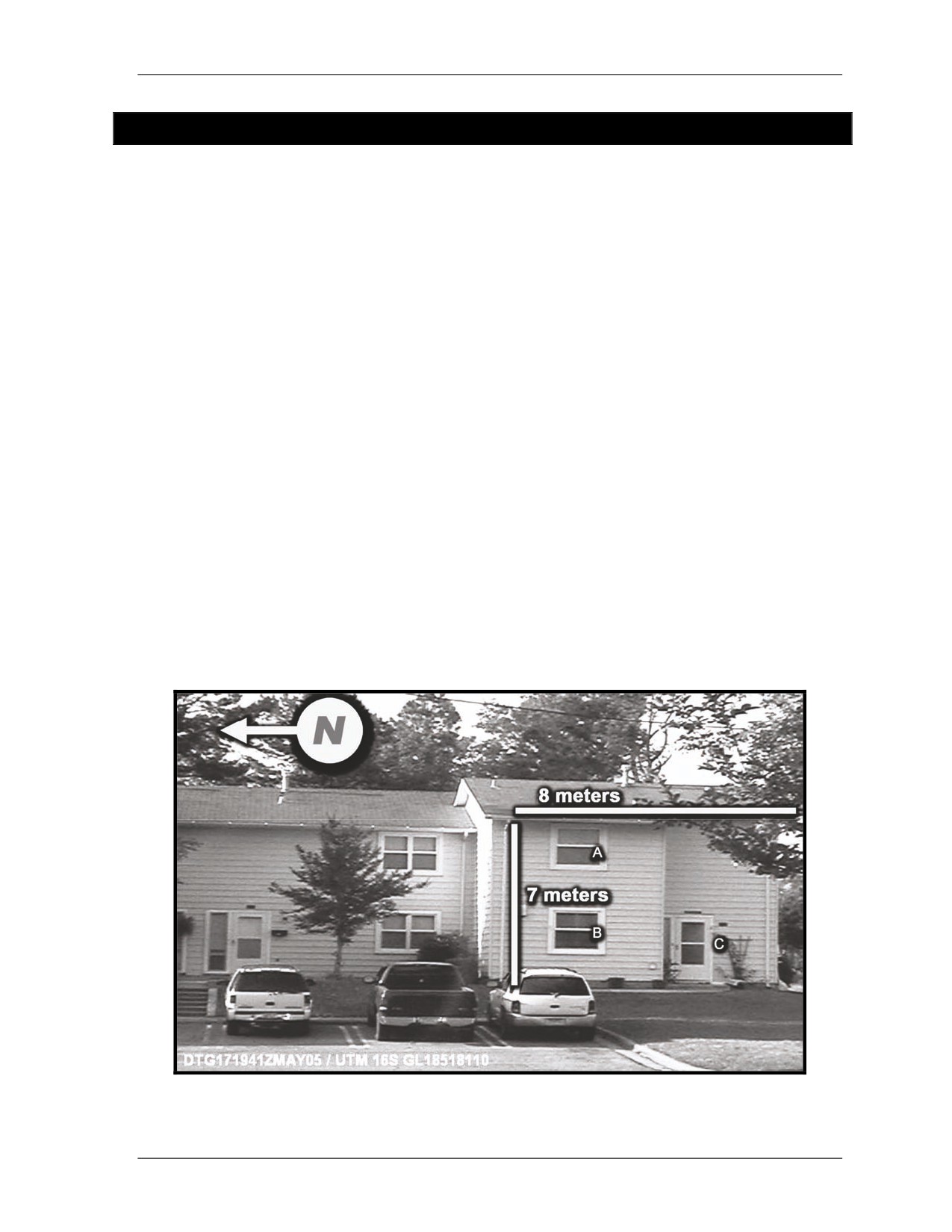
4-260. General principles of labeling imagery include (Figure 4-9 and Figure 4-10) —
• Placement of letters or numbers on the image to correspond with the legend.
• Placing appropriate arrows and other graphics where needed.
• Ensuring the image has a title, including a name, DTG, and grid, for example,
• North-seeking arrow.
• Size of the picture (from East to West, North to South).
• Remarks page for details about what each number or letter means.
Figure 4-9. Example imagery labels.
23 June 2009
FM 3-55.93
4-53

Chapter 4
Figure 4-10. Example imagery legend.
IMAGE-GATHERING EQUIPMENT
4-261. There are many types of cameras and video cameras available. The majority of this equipment
becomes dated quickly, so it is important to stay proficient in the equipment available.
CAMERAS
4-262. Several different types of cameras may be used to gather imagery from an objective. Some basic
principles should be adhered to when considering what type and or kind to use—
• Durable.
• Waterproof.
• Number of images at a particular resolution.
• Film type, memory stick, or compact flash card.
• Weight and size measurements.
VIDEO CAMERAS
4-263. The introduction of the video camera recorder (a camera capable of taking video and still
images) has aided the R&S community in its ability to record information. Considerations for video
camera use are—
• Zoom.
• Quality and resolution.
• Battery life.
• Power converter for military batteries (BA-5590).
COMPRESSION SOFTWARE
4-264. The use of compression software can greatly enhance the effectiveness of a unit when it comes
to gathering and transmitting imagery and video. Compression software allows compression of files up
4-54
FM 3-55.93
23 June 2009
Team Operations
to 88% smaller then the original file. Being able to compress files aids in decreasing the amount of time
required to transmit.
OBJECTIVE SKETCH
4-265. In the case of loss of communication or enemy compromise, an objective sketch may be the
only piece of information about that objective available. The ability to draft a proper objective sketch is
an extremely important skill. It is important to understand the basics of objective sketch production.
Understanding the basics allows a novice or non-artist to draw an understandable objective sketch.
Types
Panoramic Sketches
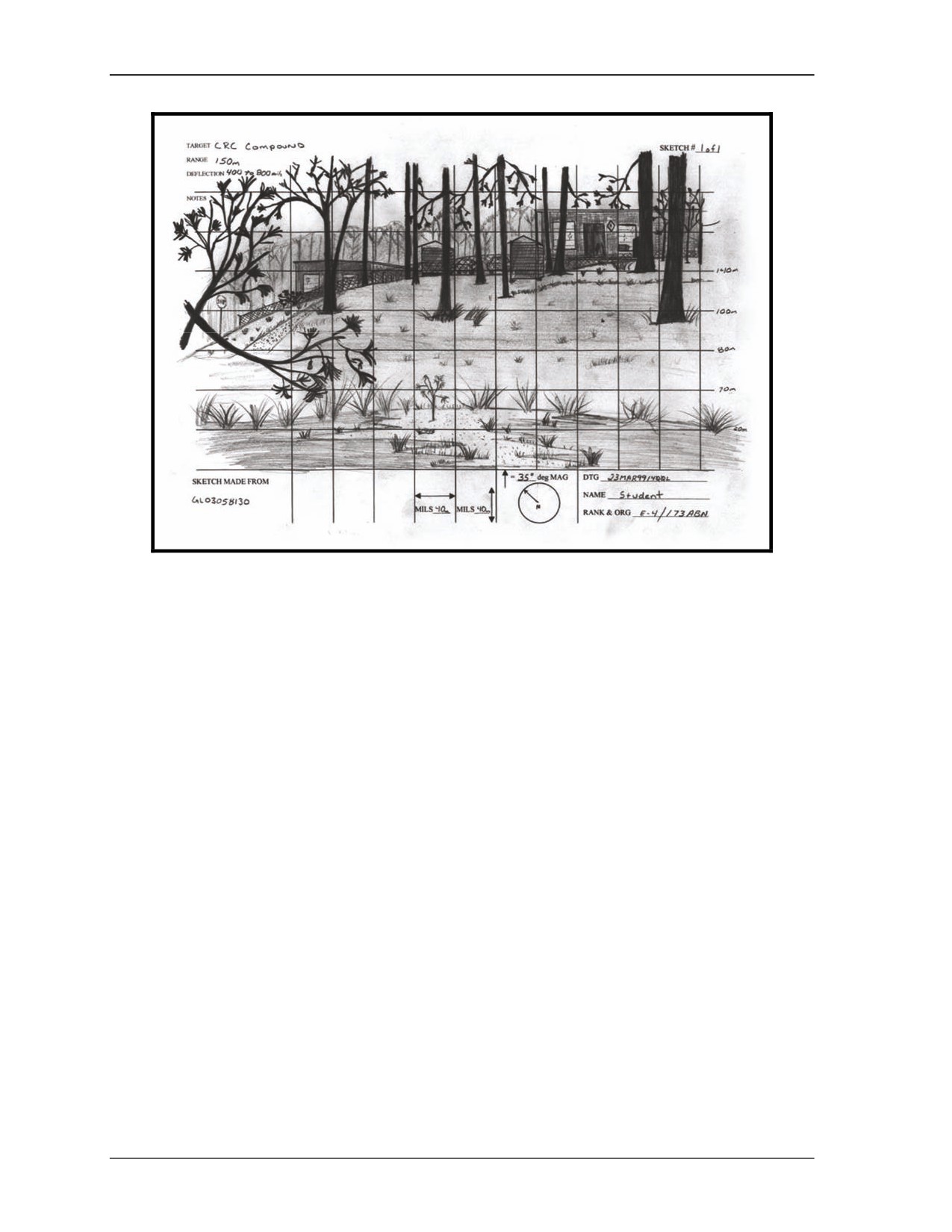
4-266. Each of these represents an area or object, and is drawn to scale from the observer’s
perspective. It provides a useful way to record details about a specific area or structure (Figure 4-11).
Topographic Sketches
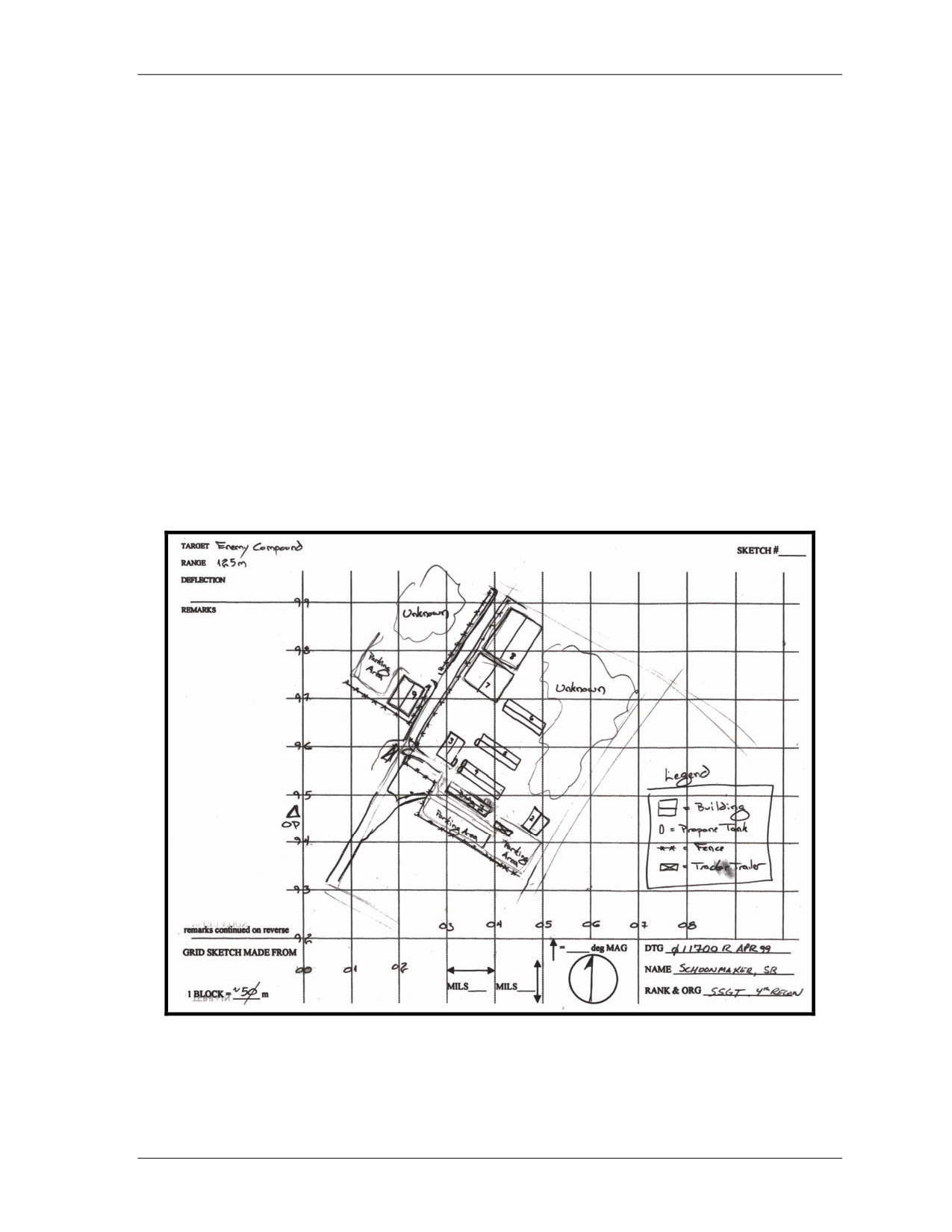
4-267. Each of these represents a large area drawn to scale as seen from above (bird's eye view). It
shows reliable distances and azimuths between major features. A topographic sketch can also be used as
an overlay on a range card (Figure 4-12).
Figure 4-11. Example panoramic sketch.
23 June 2009
FM 3-55.93
4-55
Chapter 4
Figure 4-12. Example topographic sketch.
Objective Sketch
4-268. Each of these, most easily drawn on a printed objective sketchpad, shows all useful information.
The pad includes reminders of what specific information should be placed on the objective sketch. The
sketch pad includes marginal information and remarks (Figure 4-13).
4-56
FM 3-55.93
23 June 2009

Team Operations
Figure 4-13. Example objective sketchpad.
Marginal Information
• Target number.
• Range from the preparer to the objective.
• Reference point, that is, the point of origin.
• Deflection angle from the preparer to the objective.
• Grid coordinates for the objective.
• Block scale, that is, the size of the blocks printed or drawn on the sketchpad.
• Mils latitude and longitude (for air strikes using fixed wing aircraft).
• Magnetic azimuth from the preparer to the objective.
• Sketch number (if more than one sketch).
• DTG when the sketch was prepared.
23 June 2009
FM 3-55.93
4-57
Chapter 4
• Name of the preparer.
• Rank and organization of the preparer.
Remarks
• Terrain on the objective.
• Vegetation, that is, whether it can provide concealment.
• Structural composition at the objective, for example, brick, mud, or wood.
• Tactical value of the objective; for example, what purpose it could serve such as prison camp,
training camp, or communications site.
• Additional information of tactical relevance such as whether buildings on the objective are
elevated and whether their windows have screens, the locations of power lines and
construction, types of sidings, building numbers, lighting, gaps, breach points, or any other
information that might help the chain of command plan follow-on missions.
Preparation
4-269. Sketching is an easy way to record information about an objective. The following are some
useful steps to take when preparing a sketch:
• Work from the whole to the part.
• Use common shapes to show common objects such as roads, buildings, and poles.
• Draw in perspective.
• Use vanishing points.
• Cross-hatch to show depth in the sketch.
• Avoid concentrating on the fine details unless used to clarify the drawing or emphasize
something of tactical importance.
Work from the Whole to the Part
4-270. Figure 4-14 shows an example drawing technique for whole to part.
4-58
FM 3-55.93
23 June 2009
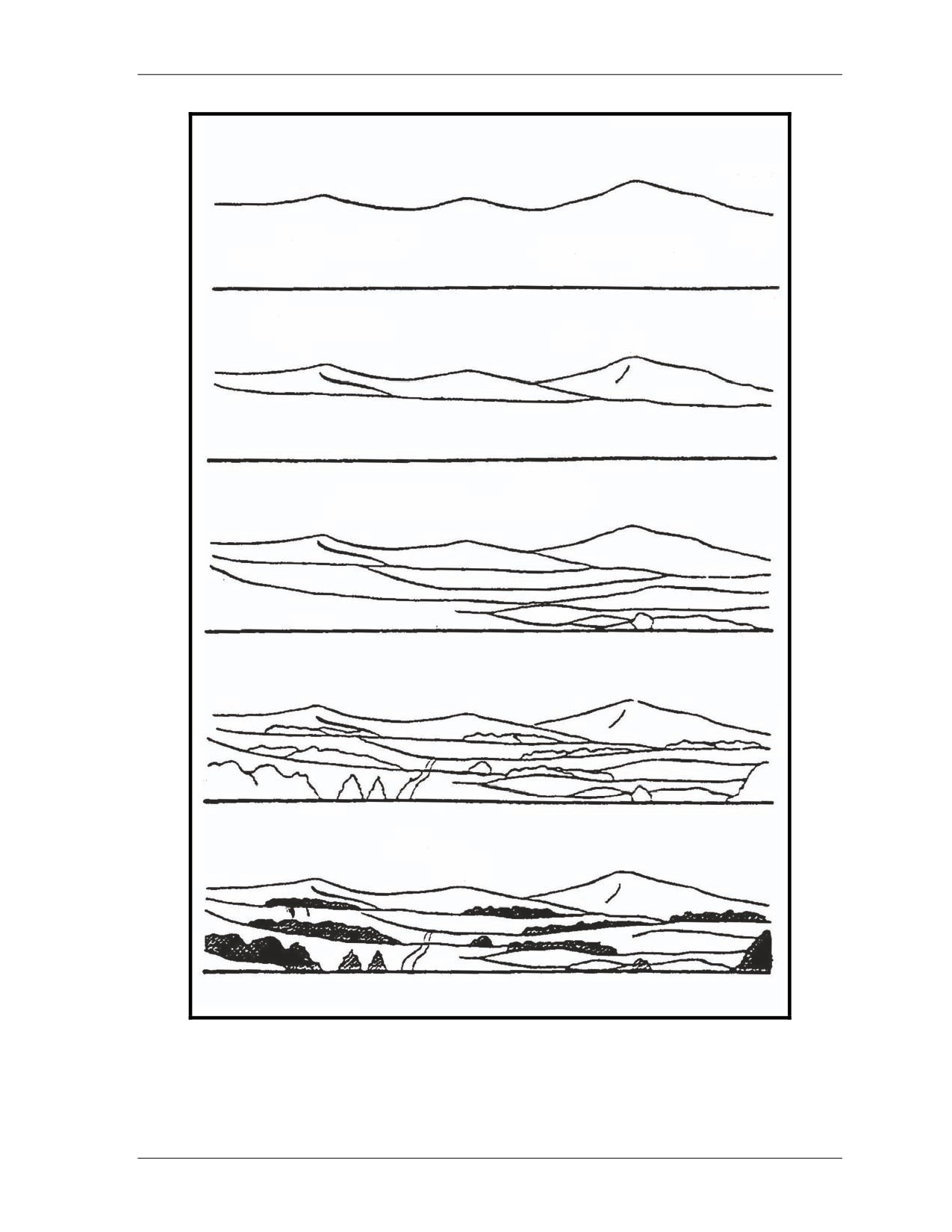
Team Operations
Figure 4-14. Example drawing technique: whole to part.
23 June 2009
FM 3-55.93
4-59
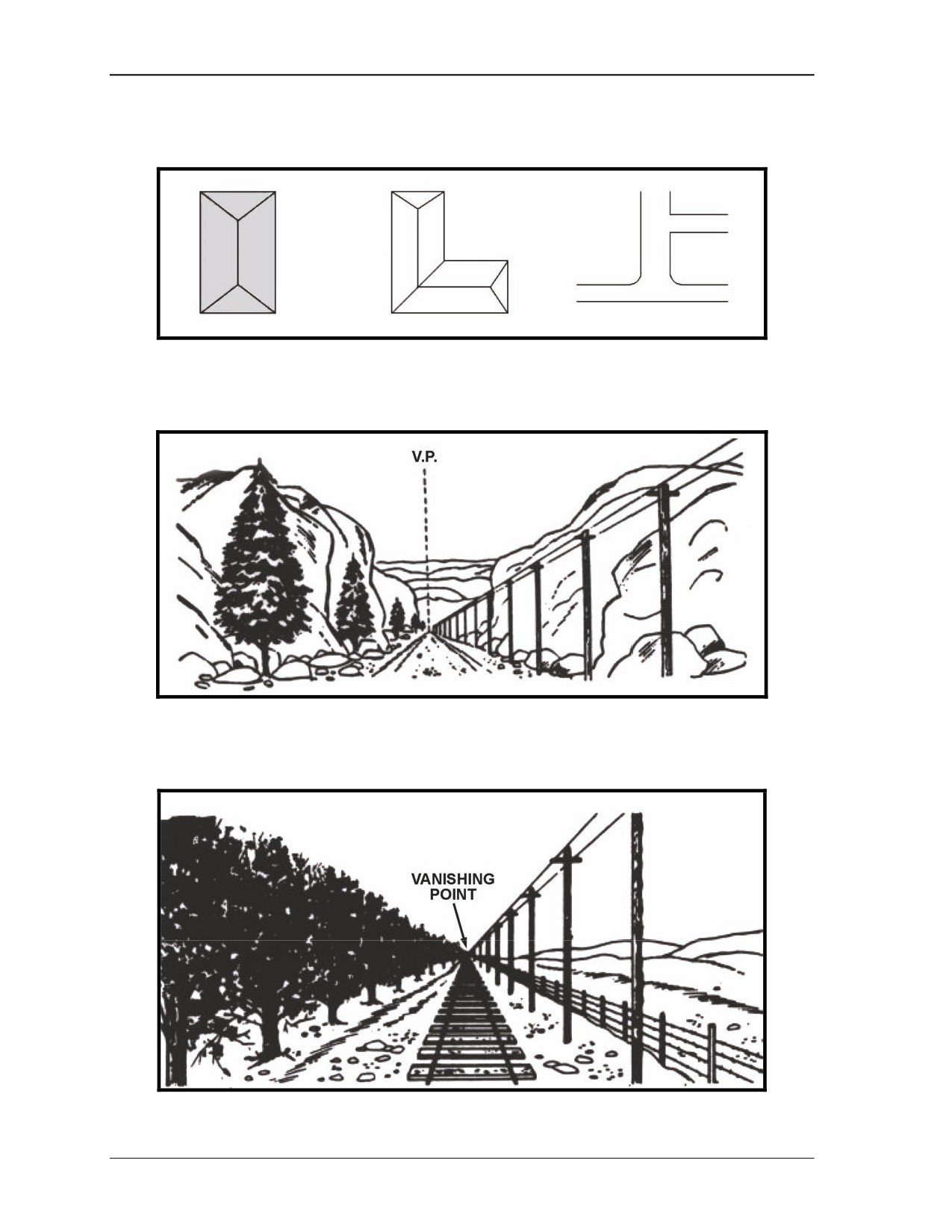
Chapter 4
Use Common Shapes for Common Objects
4-271. Use common shapes to show common objects such as roads, buildings, and poles (Figure 4-15).
Figure 4-15. Example drawing technique: use of common shapes to show common objects.
Use Perspective Drawing
4-272. Draw in perspective (Figure 4-16).
Figure 4-16. Example drawing technique: use of perspective to represent depth.
Use Vanishing Points
4-273. Use vanishing points (Figure 4-17).
Figure 4-17. Example drawing technique: use of vanishing points to indicate distance.
4-60
FM 3-55.93
23 June 2009
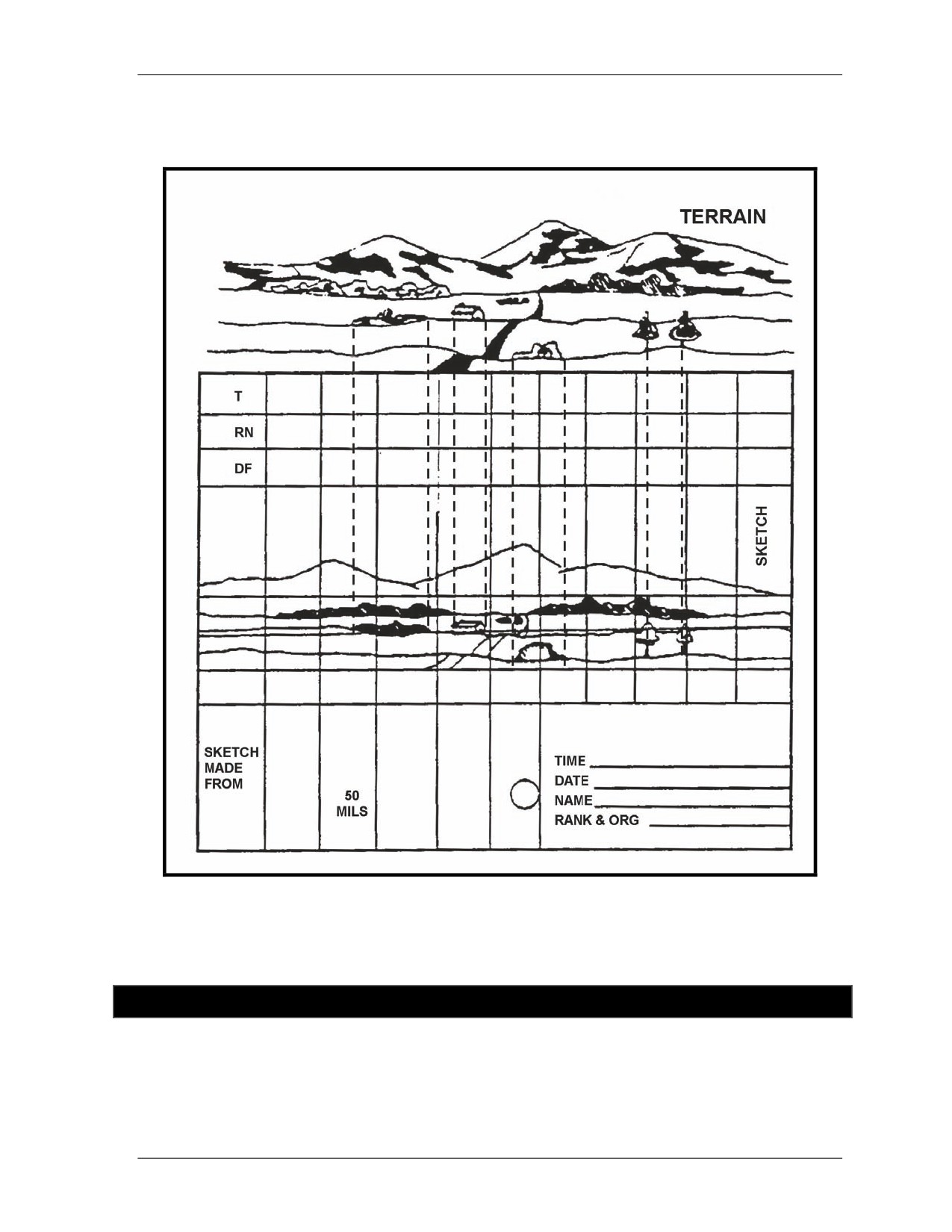
Team Operations
Cross-Hatch to Show Depth
4-274. Use hatching to show depth in the sketch (Figure 4-18).
Figure 4-18. Example drawing technique: hatching.
Detail Only the Most Important Elements
4-275. Avoid concentrating on fine detail except to clarify the drawing or to emphasize something of
tactical importance.
Section VIII. STABILITY OPERATIONS
This section discusses LRSU activities in stability operations. LRSU are well suited to conduct stability
operations, because can they provide both overt and covert combat information. Both of these are critical to
success in stability operations. Stability operations occur unilaterally, or with offensive and defensive
operations. United States forces can participate in a stability operation while a host nation is at war. In addition,
stability can evolve into war, and leaders should be prepared in case this occurs. Stability operations influence
23 June 2009
FM 3-55.93
4-61
Chapter 4
the political, civil and military environments, and can disrupt illegal activities. Military operations in stability
are characterized by indirectness rather than directness.
TYPES
4-276. Stability operations typically fall into ten broad and often overlapping types. For example, a
force engaged in a peace operation may at the same time conduct arms control or a show of force to set
the conditions for achieving an end state. This paragraph introduces stability operations. (See FM 3-0
and FM 3-07 for more detailed information.) The LRSU can participate in any of the following
operations in a stability environment:
• Peace operations (POs).
• Foreign internal defense (FID).
• Humanitarian and civic assistance.
• Foreign humanitarian assistance.
• Security assistance.
• Support to insurgencies.
• Support to counterdrug operations.
• Combating terrorism.
• Noncombatant evacuation operations (NEO).
• Arms control.
• Show of force.
PEACE OPERATIONS
4-277. Peace operations (PO) support strategic and policy objectives and the diplomatic activities that
implement them. POs include peacekeeping operations (PKOs), peace enforcement operations (PEOs),
and support to diplomatic efforts to establish and maintain peace. Peace operations monitor and ease the
implementation of agreements, such as a cease-fire or truce. They can also support diplomatic efforts to
reach a long-term political settlement. They usually consist of observing, monitoring, or supervising and
aiding the parties to a dispute. The mission of a peace operation is fluid, and is based on a review of
METT-TC. LRSU activities supporting PKO include, among others—
• R&S of a demilitarized zone.
• Surveillance of confrontation areas.
• Surveillance of cease-fire areas.
• R&S of refugee camps.
• Damage assessment.
• Monitoring of chemical, biological, radiological, or nuclear activity.
• R&S of smuggling routes.
FOREIGN INTERNAL DEFENSE
4-278. Foreign internal defense (FID) is participation by civilian and military agencies of a government
in any action programs taken by another government to free and protect its society from subversion,
lawlessness, and insurgency (FM 1-02). The main objective is to promote stability by helping a host
nation establish and maintain institutions and facilities responsive to its people’s needs. Army forces in
FID normally advise and assist host-nation forces conducting operations to increase their capabilities.
4-62
FM 3-55.93
23 June 2009
Team Operations
4-279. When conducting FID, Army forces provide military supplies as well as military advice, tactical
and technical training, and intelligence and logistics support (not involving combat operations). Army
forces conduct FID operations in accordance with JP 3-07.1 and FM 3-07. Army forces provide indirect
support, direct support (not involving combat operations), or conduct combat operations to support a
host nation’s efforts.
4-280. LRSU support during FID normally consists of the traditional role of information gathering, but
can also consist of training host nation combat information gathering units. LRSU can also provide
long-range communications capability to host nations or deployed US forces.
HUMANITARIAN AND CIVIC ASSISTANCE
4-281. Humanitarian and civic assistance
(HCA) programs provide assistance to the host nation
populace in conjunction with military operations and exercises. The very nature of HCA programs
frequently dictates that additional engineer units and support capabilities will augment units participating
in HCA operations. In contrast to humanitarian and disaster relief operations, HCA are planned activities
authorized by the Secretary of State with specific budget limitations and are appropriated in the Army
budget. Assistance must fulfill unit-training requirements that correspondingly create humanitarian
benefit to the local populace. HCA programs must be in compliance with Title 10, United States Code,
Sections 401, 401(E), (5), and Section 2551. For additional information on selected sections of Title 10,
US Code for medical support, see FM 8-42. See AR 40-400 for information on emergency medical
treatment for local national civilians during stability operations. Humanitarian and civic actions are
limited to the following categories:
• Medical, dental, and veterinary care provided in rural areas of a country.
• Construction of rudimentary surface transportation systems.
• Well drilling and construction of basic sanitation facilities.
• Rudimentary construction and repair of public facilities.
• Specified activities related to mine detection and clearance, including education, training, and
technical assistance.
4-282. It is unlikely LRSU would participate in HCA activities. However, LRSU could provide
support to units conducting traditional HCA activities by providing search and rescue, and long-range
communications support.
SECURITY ASSISTANCE
4-283. Security assistance includes the participation of Army forces in any of a group of programs by
which the US provides defense articles, military training, and other defense-related services to foreign
nations by grant, loan, credit, or cash sales in furtherance of national policies and objectives (JP 3-07).
Army forces support security assistance efforts by training, advising, and assisting multinational and
friendly armed forces. LRSU forces are well suited to provide training and advisory services in their
normal areas of expertise.
SUPPORT TO INSURGENCIES
4-284. An insurgency is an organized movement aimed at the overthrow of a constituted government
through the use of subversion and armed conflict (JP 1-02). At the direction of the President and/or
Secretary of Defense, US military forces may assist insurgents or counterinsurgents.
4-285. The US supports selected insurgencies that oppose oppressive regimes who work against US
interests. Major considerations include the feasibility of effective support and the compatibility of US
and insurgent interests. Because support for insurgencies is often covert, special operations forces are
frequently involved. Leaders may call upon general-purpose forces when needed. That is, when the
situation requires their particular specialties or when the scope of operations is so vast that conventional
23 June 2009
FM 3-55.93
4-63
Chapter 4
forces are required. LRSU activities in support of an insurgency or counterinsurgency consist of but not
limited to--
• Early warning for US and host nation forces.
• Reconnaissance for lines of communication (LOC).
• Surveillance of refugee camps.
• R&S of targets for future direct action.
• Training of insurgent forces in their normal areas of expertise.
SUPPORT TO COUNTERDRUG OPERATIONS
4-286. Military efforts support law enforcement agencies
(LEAs), other US agencies, state
governments, and foreign governments. The goal of counterdrug operations is to stop the flow of illegal
drugs at the source, in transit, and during distribution.
• DOD may provide training, assistance, equipment, and facilities as long as doing so does not
affect US military readiness.
• The Posse Comitatus Act applies only to federalized forces, and only within the US.
For example, federal military forces may not search US civilians, arrest US civilians, or
conduct any related law-enforcement activity involving US civilians.
• Title 10, United States Code, Sections 371-378, gives military forces the authority to assist
civilian LEAs.
• DOD may pass information collected during normal operations to law-enforcement agencies.
• Military efforts support and complement--not replace--the counterdrug efforts of other entities.
(These entities can include US agencies, states, and cooperating foreign governments.) The
Army can support any or all phases of a combined and synchronized effort to attack the flow of
illegal drugs at the source, in transit, and during distribution. In counterdrug operations, LRS
normally supports law-enforcement agencies. LRSU activities supporting counterdrug
operations include but are limited to—
— R&S of shipment facilities.
— R&S of shipment routes.
— R&S of marijuana, cocoa, and poppy fields.
— Surveillance of narcotics traffickers.
— Surveillance of air and vehicle traffic.
COMBATING TERRORISM
4-287. Joint Publication 1-02 defines terrorism as "the calculated use of unlawful violence or threat of
unlawful violence to inculcate fear; intended to coerce or intimidate governments or societies in pursuit
of goals that are generally political, religious, or ideological" (JP 3-07.2).
Categories
4-288. Terrorism is categorized three ways, based on where its control and support originate:
• Non-state supported terrorism.
• State-supported terrorism.
• State-directed terrorism.
4-64
FM 3-55.93
23 June 2009
Team Operations
Methods
4-289. Antiterrorism refers to defensive measures taken against terrorism. Counterterrorism refers to
offensive actions taken against terrorism.
Antiterrorism
4-290. The DOD Dictionary defines this as "defensive measures used to reduce the vulnerability of
individuals and property to terrorist acts, to include limited response and containment by local military
forces." Typical antiterrorism actions include—
• Crime prevention and physical security actions that prevent theft of weapons, munitions,
identification cards, and other materials.
• Physical security actions designed to prevent unauthorized access or approach to facilities.
• Positioning and hardening of facilities.
• Coordination with local law enforcement.
• Policies regarding travel, size of convoys, breaking of routines, host nation interaction, and
off-duty restrictions.
• Protection from weapons of mass destruction.
Counterterrorism
4-291. The DOD Dictionary defines this as "offensive measures taken to prevent, deter, and respond to
terrorism." Specially organized and trained counterterrorism units usually conduct counterterrorism
operations. In some cases, conventional forces provide, at most, limited support. LRSU activities that
support combating terrorism include at a minimum—
• R&S to confirm terrorist activity.
• Surveillance of a terrorist safe house.
• Surveillance of suspected or known terrorists.
• Surveillance of individuals on the black, white, and gray lists.
• Force-protection surveillance.
NONCOMBATANT EVACUATION OPERATIONS
4-292. Noncombatant evacuation operations (NEO) relocate threatened civilian noncombatants to
secure areas. Normally, these operations remove US citizens from foreign nations where their lives are in
danger either from the threat of hostilities or from a natural disaster. In addition to US citizens, relocated
civilians can include selected host-nation citizens and third-country nationals. NEO has three basic
environments:
Permissive—A permissive environment has no apparent physical threat and no host-nation
opposition. Military assistance is normally limited to agency support. This operation (NEO in a
permissive environment) is slow and deliberate. It is the least likely environment in which an
NEO might occur.
Uncertain—An uncertain environment requires the commander to disseminate the ROE early.
The host nation may or may not be in control, but cannot ensure safety. An uncertain
environment increases the need for a reaction force.
Hostile—A hostile environment might require a large security element and a large reaction force.
The ROEs must be strictly enforced. The host nation or other threat will probably oppose
evacuation. The LRSU activities supporting NEO include, at a minimum—
— R&S of NEO sites.
— Early warning for host nation and United States forces.
23 June 2009
FM 3-55.93
4-65
Chapter 4
— PR and CSAR support.
— Perimeter security.
— Linkup force.
— Pilot and casualty removal from downed aircraft.
ARMS CONTROL
4-293. This stability operation is associated with weapons of mass destruction. For example, on 26
November 1993, Iraq agreed to long-term monitoring of its weapons programs. Under the resolution,
international weapons inspectors were authorized to roam Iraq freely and for an indefinite period. Their
goal was to prevent Iraq from acquiring weapons of mass destruction. Inspectors monitored numbers,
types, and performance characteristics of the weapon systems at issue. The inspection also extended
beyond weapons to include C2, logistics support, and intelligence mechanisms. LRSU activities
supporting arms control include, at a minimum—
• R&S of ammunition holding areas.
• R&S of motor pools.
• R&S of suspected transshipment sites.
• R&S of weapon cache.
• Chemical, biological, radiological, or nuclear monitoring.
• Inspection of storage facilities.
SHOW OF FORCE
4-294. A show of force is a mission carried out to demonstrate resolve. Units conducting a show of
force must deploy rapidly due to the political need for timely action. As the word "show" implies, media
coverage is desirable and must be planned. Commanders must prepare in case a show of force evolves
into a combat operation.
• A show of force—
— Bolsters and reassures allies.
— Deters potential aggressors.
— Gains or increases regional influence.
— Defuses a situation that could damage US interests or national objectives.
—Lends credibility to US commitments and increases regional influence.
• It can take any of the following forms:
— Combined training exercise.
— Rehearsal.
— Forward deployment of military forces.
—Introduction and buildup of military forces in a region such as in Operation "Golden
Pheasant," conducted during a 1988 border incident between Honduras and Nicaragua.
• Some LRSU activities that support shows of force follow:
— Participation in Airborne operations.
— Surveillance from fixed observation posts.
— Route reconnaissance.
4-66
FM 3-55.93
23 June 2009
Team Operations
CAPABILITIES AND LIMITATIONS
4-295. Planning factors for stability include intelligence, rules of engagement, multinational
operations, OPSEC, demography, deception, technology, and COMSEC.
INTELLIGENCE
4-296. The nature of stability operations require detailed intelligence. LRS teams need this intelligence
before they infiltrate. It should include the target location and description; enemy equipment and
capabilities; any civilian personnel in the area; and a variety of terrain, weather, and other related facts.
RULES OF ENGAGEMENT
4-297. The commander must monitor the ROE to ensure that all teams know when and how to apply
force to meet specific situations. He must avoid vague or wordy ROE. Each Soldier must understand the
rules as they apply to him. LRS teams must adjust rapidly to changes in the ROE.
MULTINATIONAL OPERATIONS
4-298. LRSUs must be prepared to coordinate and work with the host country's military and
paramilitary forces. Every situation is unique and depends on the extent of involvement of US forces and
the nature of the operations. Chief considerations when planning multinational operations are C2,
intelligence, operational procedures, and sustainment.
OPERATIONS SECURITY
4-299. OPSEC is critical for LRSU in stability operations. Due to the potential for other forces (US or
host nation) to operate near LRS teams, LRS commanders must carefully coordinate to reduce the risk of
fratricide. This requirement poses an equally dangerous risk to OPSEC for the teams.
DEMOGRAPHY
4-300. LRS commanders must study all aspects of the local population to understand the effect that it
might have on teams operating in the area. He can obtain information from a variety of sources, to
include area studies, intelligence staff agencies, local government, and the media.
DECEPTION
4-301. To reduce the risk to LRS teams, commanders should consider using deception, particularly
during insertion of the teams. Establishing false landing zones and sending dummy radio transmissions
are two techniques to deceive the enemy. Deception is limited only by the imagination, but leaders
should consider and coordinate all means of insertion or extraction through the R&S squadron S-3.
TECHNOLOGY
4-302. Technology is a proven combat multiplier. Advanced optics, thermal sights, and remote sensors
increase the capabilities of the LRS teams. Commanders must weigh the advantages against the inherent
disadvantages. These include increased Soldier's load and the impact of emitting the various equipment
signatures.
COMMUNICATIONS SECURITY
4-303. The threat of interception and direction finding exists in all levels of conflict. Foreign purchases
of threat equipment and relatively inexpensive off-the-shelf technology have enabled many third world
countries and indigenous forces to equip themselves with the ability to take advantage of poor
COMSEC. LRS commanders and team leaders must take appropriate measures to enforce COMSEC
procedures.
23 June 2009
FM 3-55.93
4-67
Chapter 4
Section IX. SPECIAL MISSIONS
Special missions include, among others, CBRN; Pathfinder; and personnel recovery (PR).
CHEMICAL, BIOLOGICAL, RADIOLOGICAL, AND NUCLEAR
4-304. LRSU may be called on to perform limited CBRN reconnaissance duties. The amount or type of
equipment available and the current qualifications of the team members help determine the nature of
these duties (FM 3-100).
PATHFINDER
4-305. Commanders sometimes require LRSU to perform limited Pathfinder duties. This capability is
limited by the team's pathfinding experience, number of radios, and signaling devices (FM 3-21.38).
PERSONNEL RECOVERY
4-306. The LRSU commander, with assistance from the Joint Search and Rescue Center (JSRC), is
responsible for conducting PR operations in support of his own operations and should be prepared to do
so. He also coordinates with the rescue coordination center (RCC), advising them when his teams might
have to evade a threat. He relays information such as isolated personnel report (ISOPREP) cards and an
evasion plan of action (EPA) along with overlays of the evasion corridor. After he coordinates with other
evasion planning agencies, he might determine that the unit must make its own evasion plans. He starts
by identifying the team's evasion corridor and forms an evasion annex with the assistance of the JSRC
(JP 3-50.2 and FM 3-50.1).
4-68
FM 3-55.93
23 June 2009