FM 3-55.93 LONG-RANGE SURVEILLANCE UNIT OPERATIONS (JUNE 2009) - page 1
*FM 3-55.93 (FM 7-93)
Field Manual
Headquarters
No. 3-55.93 (FM 7-93)
Department of the Army
Washington, DC
23 June 2009
Long-Range Surveillance Unit
Operations
Contents
Page
Preface
xiii
Summary of Change
xv
Chapter 1
FULL-SPECTRUM OPERATIONS
1-1
Section I. TYPES AND COMBINATIONS OF ARMY OPERATIONS
1-1
Four Types of Army Operations
1-1
Intelligence
1-2
Section II. INFANTRY RECONNAISSANCE AND SURVEILLANCE UNITS
1-2
Characteristics
1-2
Missions and Organizations
1-3
Section III. LONG-RANGE SURVEILLANCE COMPANY
1-3
Primary Missions
1-4
Secondary Missions
1-4
Comparison to Special Operations Forces
1-4
Organization
1-4
Sustainment
1-5
Subordinate Organizations and Key Personnel
1-5
LRSD and LRS Teams
1-7
Characteristics
1-7
Capabilities
1-8
Limitations
1-8
Chapter 2
COMMAND AND CONTROL
2-1
Section I. OVERVIEW
2-1
Standard LRSU Command and Control
2-1
BFSB Staff
2-2
Reconnaissance and Surveillance Squadron
2-6
Nonstandard LRSU Command and Control
2-7
Command Posts
2-7
Tactical Operations Center
2-10
Task Organization Outside NAMED Areas of Interest
2-13
Liaison Duties, Employment, and Coordination
2-13
Distribution Restriction: Approved for public release; distribution is unlimited.
*This publication supersedes FM 7-93, 3 October 1995.
23 June 2009
FM 3-55.93
i
Contents
Section II. COMMUNICATIONS, COMPUTERS, AND INTELLIGENCE
2-14
Communications
2-14
Computers and Intelligence
2-15
Chapter 3
MISSION DEVELOPMENT
3-1
Section I. ISR OPERATIONS AND MISSION ORDERS
3-1
ISR Operations
3-1
Mission Orders
3-3
Section II. MISSION PLANNING FOLDER
3-5
Development
3-5
Contents
3-5
Target Folder Format
3-9
Section III. OPERATIONS SECURITY
3-12
Personnel Security
3-12
Mission Classification
3-12
Separation
3-13
Security during Coordination
3-13
Chapter 4
TEAM OPERATIONS
4-1
Section I. PHASES
4-1
Planning Phase
4-1
Infiltration Phase and Insertion Method
4-16
Execution (Actions on Objective)
4-17
Exfiltration Phase and Extraction Method
4-17
Recovery
4-18
Section II. RECONNAISSANCE OPERATIONS
4-21
Area Reconnaissance
4-21
Zone Reconnaissance
4-23
Route Reconnaissance
4-25
Bridge Classification
4-25
Leader Reconnaissance
4-25
Section III. SURVEILLANCE OPERATIONS
4-26
Selection and Occupation of Sites
4-26
Security and Reports
4-27
Linkup and Dissemination of Information
4-29
Contingencies
4-29
Heavy Team and Platoon Operations
4-30
Section IV. COMBAT ASSESSMENT
4-30
Definition and Purpose
4-30
Considerations
4-30
Characteristics
4-31
Damage Types and Levels
4-31
Bridges
4-32
Buildings
4-33
Bunkers
4-35
Dams and Locks
4-35
Distillation Towers
4-36
Military Equipment
4-36
ii
FM 3-55.93
23 June 2009
Contents
Ground Force Personnel
4-38
Storage Tanks For Petroleum, Oil, Lubricants
4-39
Power Plant Turbines and Generators
4-39
Rail Lines and Rail Yards
4-40
Roads
4-40
Runways and Taxiways
4-41
Satellite Dishes
4-41
Ships
4-42
Steel Towers
4-43
Transformers
4-43
Tunnel Entrances Or Portals
4-43
Tunnel Facility Air Vents
4-44
Section V. TARGET ACQUISITION
4-44
Combat Patrol
4-45
Mission Planning Factors
4-45
Employment of Laser Designators
4-45
Fire Support
4-46
Fire Plans
4-47
Section VI. URBAN TERRAIN
4-47
Surveillance Operations
4-47
Reconnaissance Operations
4-48
Plans
4-48
Hide and Surveillance Sites
4-52
Section VII. IMAGERY COLLECTION AND TRANSMISSION
4-53
Imagery Labels
4-53
Image-Gathering Equipment
4-54
Section VIII. STABILITY OPERATIONS
4-61
Types
4-62
Capabilities and Limitations
4-67
Section IX. SPECIAL MISSIONS
4-68
Chemical, Biological, Radiological, and Nuclear
4-68
Pathfinder
4-68
Personnel Recovery
4-68
Chapter 5
INSERTION AND EXTRACTION METHODS
5-1
Section I. WATERBORNE OPERATIONS
5-1
Considerations
5-1
Combat Rubber Raiding Reconnaissance Craft
5-1
Scout Swimmers
5-5
Helocasting Operations
5-7
Section II. HELICOPTER OPERATIONS
5-9
Special Patrol Insertion/Extraction System
5-9
Fast-Rope Insertion/Extraction System
5-20
Army Aviation and Air Assault
5-25
Pickup and Landing Zones
5-25
UH-60 Loading Sequence
5-31
23 June 2009
FM 3-55.93
iii
Contents
Section III. VEHICLE OPERATIONS
5-31
Mobility Platforms
5-32
Planning Considerations
5-32
Section IV. OTHER OPERATIONS
5-46
Airborne Operations
5-47
Stay-Behind Operations
5-47
Foot Movement Operations
5-48
Chapter 6
COMMUNICATIONS
6-1
Section I. NETWORKS
6-1
Architecture and Frequency Management
6-1
Operations Bases
6-1
Teams
6-2
Section II. RADIOS, COMPUTERS, AND THE BASE RADIO STATION
6-2
Elements of Success
6-2
HF, VHF, and UHF Radios
6-2
Primary, Alternate, and Contingency Radios
6-3
Fundamentals
6-4
Beyond-Line-of-Sight Equipment
6-4
Ruggedized COTS Laptop
6-6
Communications Base Radio Station Platform
6-7
Section III. OPERATIONS
6-7
Tactical Employment
6-7
Site Selection
6-8
Tactical Satellite
6-9
Section IV. REPORTS
6-9
Messages and Report Formats
6-9
Communications Security
6-16
Section V. ELECTRONIC WARFARE
6-16
Electronic attack
6-17
Electronic warfare support
6-17
Electronic protection
6-17
Section VI. ANTENNAS
6-19
Wavelength and Frequency
6-19
Resonance
6-19
Polarization
6-20
Radio Wave Propagation
6-20
Classification
6-23
Construction and Selection
6-26
Common Types of Antennas
6-27
Field-Expedient Antennas
6-31
High Frequency, Directional, Field-Expedient Antennas
6-34
Section VII. UNUSUAL ENVIRONMENTS
6-36
Desert Operations
6-36
Jungle Operations
6-36
Cold Weather Operations
6-37
iv
FM 3-55.93
23 June 2009
Contents
Mountain Operations
6-38
Urban Operations
6-39
Chapter 7
INTELLIGENCE PREPARATION OF THE BATTLEFIELD
7-1
SECTION I. DEFINE THE OPERATIONAL ENVIRONMENT
7-1
Identify Significant Characteristics of the Environment
7-1
Identify the Limits of the Command's Area of Operations
7-3
Establish the Limits of the Area of Influence and the Area of Interest
7-3
Evaluate Existing Databases and Identify Intelligence Gaps
7-4
Initiate Collection of Information Required to Complete IPB
7-4
SECTION II. DESCRIBE ENVIRONMENTAL EFFECTS ON OPERATIONS
7-4
Analyze the Environment
7-4
Describe Environmental Effects
7-9
SECTION III. EVALUATE THE THREAT
7-9
Analyze Threat Factors
7-9
Update or Create Threat Models
7-10
Identify Threat Capabilities
7-16
SECTION IV. DETERMINE THREAT COURSES OF ACTION
7-17
Identify the Threat's Likely Objectives and Desired Endstate
7-17
Identify the Full Set of COAs Available to the Threat
7-17
Evaluate and Prioritize Each Course of Action
7-18
Develop Courses of Action
7-18
Identify Initial ISR Requirements
7-21
Prepare Decision Support Template
7-21
Chapter 8
EVASION AND RECOVERY
8-1
Fundamentals
8-1
Chain of Command
8-2
Plans
8-2
Types of Recovery
8-2
Classifications of Evasion
8-3
Movement
8-4
Disguises
8-6
Evasion Aids
8-7
Evasion Areas
8-9
Appendix A
RECRUITMENT, ASSESSMENT, AND SELECTION PROGRAM
A-1
Purpose and Organization
A-1
Recruitment
A-1
Assessment
A-2
Selection
A-4
Reassignment
A-5
Appendix B
ORDERS AND BRIEFS
B-1
Section I. ORDERS
B-1
Warning Order
B-1
Operation Order
B-4
Fragmentary Order
B-8
23 June 2009
FM 3-55.93
v
Contents
Section II. BRIEFS
B-8
Types
B-8
Confirmation Brief
B-11
Mission Analysis Brief
B-11
Decision Brief
B-17
Backbrief
B-17
Mission Concept Brief
B-20
Debrief
B-34
Appendix C
PLANNING AREA FACILITIES AND SITES
C-1
Facilities
C-1
Fixed Site
C-1
Field Site
C-1
Appendix D
GEOGRAPHIC ENVIRONMENTS
D-1
Jungle Operations
D-1
Desert Operations
D-1
Mountain Operations
D-2
Cold Weather Operations
D-2
Appendix E
CONTINGENCY PLANS
E-1
Branches and Sequels
E-1
Contingency Plan Matrix
E-1
Appendix F
COORDINATION FOR ARMY AVIATION
F-1
Appendix G
HIDE AND SURVEILLANCE SITES
G-1
Surface Sites
G-1
Hasty Subsurface Sites
G-2
Finished Subsurface Site
G-4
Site Selection
G-7
Leader Reconnaissance
G-7
Occupation of Hide Site
G-7
Actions in Hide Site
G-9
Priority of Work
G-9
Site Sterilization
G-9
Appendix H
BATTLE DRILLS
H-1
Break Contact
H-1
React to Air Attack
H-5
React to Indirect Fire
H-6
React to Flares
H-6
Break from Hide or Surveillance Site
H-6
Appendix I
TRACKING AND COUNTERTRACKING
I-1
Concepts of Tracking
I-1
Organization of Tracking Team
I-5
Tracker and Dog Team
I-5
Appendix J
NIGHT OPERATIONS
J-1
Night Vision
J-1
Hearing
J-4
Smell
J-4
vi
FM 3-55.93
23 June 2009
Contents
Fatigue
J-5
Selection of Route
J-5
Night Walking
J-6
Signals
J-7
Target Detection
J-8
Movement
J-9
Appendix K EXAMPLE EVASION AND RECOVERY PLAN
K-1
GLOSSARY
Glossary-1
REFERENCES
References-1
INDEX
Index-1
Figures
Figure
1-1. Organization of long-range surveillance company
1-5
Figure
1-2. Concept of intelligence, surveillance, and reconnaissance
1-10
Figure
2-1. Company operations base
2-8
Figure
2-2. Example C2 employment schematic for a LRSC
2-9
Figure
2-3. Example C2 employment schematic for a LRSD in an MSS
2-10
Figure
3-1. Intelligence, surveillance, and reconnaissance
3-2
Figure
3-2. LRS mission development process
3-4
Figure
3-3. Example format for target folder
3-10
Figure
4-1. TLP and METT-TC
4-7
Figure
4-2. Development of courses of action
4-12
Figure
4-3. Reconnaissance and surveillance elements
4-22
Figure
4-4. Fan method
4-23
Figure
4-5. Converging routes method
4-24
Figure
4-6. Successive sector method
4-24
Figure
4-7. Example surveillance site
4-27
Figure
4-8. Example hide site
4-28
Figure
4-9. Example imagery labels
4-53
Figure
4-10. Example imagery legend
4-54
Figure
4-11. Example panoramic sketch
4-55
Figure
4-12. Example topographic sketch
4-56
Figure
4-13. Example objective sketchpad
4-57
Figure
4-14. Example drawing technique: whole to part
4-59
Figure
4-15. Example drawing technique: use of common shapes to show common objects
4-60
Figure
4-16. Example drawing technique: use of perspective to represent depth
4-60
Figure
4-17. Example drawing technique: use of vanishing points to indicate distance
4-60
Figure
4-18. Example drawing technique: hatching
4-61
Figure
5-1. Rubber boat
5-2
Figure
5-2. Short count, long count
5-4
23 June 2009
FM 3-55.93
vii
Contents
Figure
5-3. SPIES rope rigging on UH-60
5-17
Figure
5-4. Rigging of snap links
5-17
Figure
5-5. Rigging of wood block
5-18
Figure
5-6. Excess cargo straps secured
5-18
Figure
5-7. Recovery line with Prusik knot
5-19
Figure
5-8. SPIES rigging procedures for CH-46 or CH-47
5-20
Figure
5-9. Fast-rope rigging procedures for UH-60
5-21
Figure
5-10. UH-60 rigged for fast roping
5-22
Figure
5-11. Fast-rope rigging procedures for other aircraft
5-22
Figure
5-12. Marking procedures for landing and pickup zones
5-26
Figure
5-13. Example coordination checklist
5-28
Figure
5-14. UH-60 loading sequence
5-31
Figure
5-15. Example vehicle load configuration
5-35
Figure
5-16. Procedures for loading HMMWV into CH-47 for infiltration
5-38
Figure
5-17. HMMWVs in wedge formation
5-41
Figure
5-18. Single camouflaged HMMWV
5-43
Figure
5-19. Multiple camouflaged HMMWVs
5-43
Figure
6-1. Automatic link sequence
6-5
Figure
6-2. AN/PRC-150(C) in vehicular AN/VRC-104 (V)3 configuration
6-7
Figure
6-3. Communications data wire diagram
6-10
Figure
6-4. Report format
6-11
Figure
6-5. Example message header
6-12
Figure
6-6. Measurement of a wavelength
6-19
Figure
6-7. Components of ground wave
6-21
Figure
6-8. Structure of ionosphere
6-22
Figure
6-9. HF skip zone and distance
6-23
Figure
6-10. Unidirectional antenna pattern
6-24
Figure
6-11. Bidirectional antenna pattern
6-25
Figure
6-12. Omni-directional antenna pattern
6-26
Figure
6-13. Half-wave dipole antenna
6-27
Figure
6-14. Formula for calculating length of half-wave dipole antenna applied to example
6-28
Figure
6-15. Inverted "V" antenna
6-28
Figure
6-16. Long-wire antenna
6-29
Figure
6-17. Sloping wire antenna
6-30
Figure
6-18. Terminated sloping "V" antenna
6-30
Figure
6-19. Repair procedure, whip antenna
6-31
Figure
6-20. Expedient insulators
6-32
Figure
6-21. High frequency antenna, long-wire type
6-34
Figure
6-22. High frequency antenna, half-rhombic type
6-34
Figure
6-23. High frequency antenna, "V" type
6-35
Figure
6-24. Sloping antenna, "V" type
6-35
viii
FM 3-55.93
23 June 2009
Contents
Figure
7-1. Classification of urban area by size
7-2
Figure
7-2. Example link diagram
7-12
Figure
7-3. Example association matrix
7-13
Figure
7-4. Example relationship matrix
7-14
Figure
7-5. Example activities matrix
7-15
Figure
7-6. Example time event chart
7-16
Figure
7-7. Example pattern analysis plot sheet
7-19
Figure
8-1. Types of recovery
8-3
Figure B-1. Example warning order
B-3
Figure B-2. Example operation order
B-5
Figure B-3. Example fragmentary order
B-8
Figure B-4. Brief types
B-8
Figure B-5. Analysis of mission, intent, and priority intelligence requirements
B-12
Figure B-6. Analysis of specified and implied tasks
B-13
Figure B-7. Analysis of facts
B-14
Figure B-8. Analysis of assumptions
B-15
Figure B-9. Analysis of mission roadblocks, issues, and restated mission
B-16
Figure B-10. Example backbrief
B-18
Figure B-11. Slide 1, LRSC mission concept brief
B-21
Figure B-12. Slide 2, statement of purpose
B-21
Figure B-13. Slide 3, LRSC insertion conditions check
B-22
Figure B-14. Slide 4, agenda
B-22
Figure B-15. Slide 5, recommendation
B-23
Figure B-16. Slide 6, ISR fusion element
B-23
Figure B-17. Slide 7, S-2/ISR fusion element
B-24
Figure B-18. Slide 8, ATO slide
B-24
Figure B-19. Slide 9, team insertion and extraction
B-25
Figure B-20. Slide 10, LRSC insertion conditions check
B-25
Figure B-21. Slide 11, movement and maneuver
B-26
Figure B-22. Slide 12, fire support
B-26
Figure B-23. Slide 13, air protection
B-27
Figure B-24. Slide 14, sustainment
B-27
Figure B-25. Slide 15, command and control
B-28
Figure B-26. Slide 16, intelligence
B-28
Figure B-27. Slide 17, LRSC
B-29
Figure B-28. Slide 18, "Do we know what to look for?"
B-29
Figure B-29. Slide 19, LRSC IPB
B-30
Figure B-30. Slide 20, LRSC maneuver
B-30
Figure B-31. Slide 21, LRSC fire support
B-31
Figure B-32. Slide 22, LRSC sustainment
B-31
Figure B-33. Slide 23, LRSC C2
B-32
23 June 2009
FM 3-55.93
ix
Contents
Figure B-34. Slide 24, LRSC C2, communications
B-32
Figure B-35. Slide 25, LRSC abort criteria
B-33
Figure B-36. Slide 26, LRSC risk mitigation
B-33
Figure B-37. Slide 27, LRSC recommendation
B-34
Figure B-38. Slide 28, commander's decision
B-34
Figure B-39. Example debrief
B-35
Figure B-40. Example intelligence estimate annex
B-40
Figure B-41. Example communications annex
B-42
Figure B-42. Example fire support annex
B-43
Figure B-43. Example linkup annex
B-44
Figure B-44. Example vehicle movement annex
B-45
Figure B-45. Example air infiltration/exfiltration annex
B-47
Figure C-1. Example fixed site for planning
C-2
Figure C-2. Example planning area
C-3
Figure C-3. Use of intermediate staging area for planning
C-4
Figure E-1. Example completed contingency matrix
E-2
Figure F-1. Example OPORD
F-2
Figure F-2. Example fire support annex
F-4
Figure F-3. Example intelligence annex
F-5
Figure F-4. Example rehearsal area annex
F-6
Figure F-5. Example vehicular movement coordination annex
F-7
Figure G-1. Two-man surface site using ghillie suits
G-1
Figure G-2. Suspension line-weave site
G-3
Figure G-3. Polyvinyl chloride site
G-3
Figure G-4. Example subsurface site
G-6
Figure G-5. Fishhook and dog-leg methods
G-8
Figure G-6. Forcible occupation of site
G-8
Figure H-1. Break contact front (diamond or file)
H-2
Figure H-2. Break contact front, left and right (Australian peel)
H-3
Figure H-3. Break contact left, right (diamond or file)
H-4
Figure H-4. React to enemy air attack
H-5
Figure H-5. React to indirect fire or air attack
H-6
Figure H-6A. Break contact from hide or surveillance site
H-8
Figure I-1. Areas surveyed for indicators by tracker
I-1
Figure I-2. Examples of displacement
I-2
Figure I-3. Types of footprints
I-3
Figure I-4. Box method for determination of number of footprints
I-4
Figure J-1. Typical scanning patterns
J-2
Figure J-2. Off-center viewing technique
J-2
Figure K-1. Example plan of action for an evasion
K-2
Figure K-2. Example of DD Form 1833 TEST (V2) (front)
K-5
x
FM 3-55.93
23 June 2009
Contents
Figure K-3. Example of DD Form 1833 TEST (V2) (back)
K-6
Tables
Table
4-1. Actions and responsibilities of LRSU personnel
4-4
Table
4-2. LRS tasks by operation
4-10
Table
4-3. Priority of actions for rehearsal
4-14
Table
5-1. Minimum recommended landing point diameters
5-26
Table
6-1. Radios that work with AN/PRC-150 in various security modes
6-3
Table
6-2. Radio interoperability capabilities and characteristics
6-6
Table
6-3. Procedure for use of duress codes
6-11
Table
6-4. Report formats
6-13
Table
6-5. Typical format for an Angus (Initial Entry) Report
6-13
Table
6-6. Typical format for a Boris (Intelligence) Report
6-14
Table
6-7. Typical format for a Cyril (Situation) Report
6-15
Table
6-8. Typical format for an Under (Cache) Report
6-15
Table
6-9. Typical format for a Crack (Battle Damage Assessment) Report
6-16
Table
6-10. Priority for destruction of communications devices
-6-18
Table
6-11. Contents of a MIJI report
6-18
Table
6-12. High frequency ranges in ionosphere
6-21
Table
7-1. Identification of gaps in existing databases
7-4
Table B-1. Comparison of brief types
B-9
Table J-1. Light sources and distances
J-3
Table J-2. Sounds and distances
J-4
Table J-3. Odor sources and distances
J-5
23 June 2009
FM 3-55.93
xi
Preface
This manual is primarily written for US Army long-range surveillance units (LRSU) and other Infantry
reconnaissance and surveillance (R&S) units. It is also provided for use by corps, division, brigade combat
team
(BCT); battlefield surveillance brigade
(BFSB); and reconnaissance and surveillance squadron
commanders and staffs; instructors of US Army corps, division, and BCT intelligence, surveillance and
reconnaissance (ISR) operations. In addition, many of the subjects covered should be a ready and useful
reference for other branches of the US Army and US military, and for multinational forces working in a joint
environment.
This manual defines the organization, roles, operational requirements, mission tasks, battlefield functions, and
command and control (C2) relationships of LRSCs organic to the R&S squadron of the BFSB. It also provides
the doctrine for LRSU to use in combat training and combat. It establishes a common base of tactical
knowledge from which leaders can develop specific solutions to LRSU tactical problems. It increases the
effectiveness of LRSU operations by also providing doctrinal principles and selected battlefield-proven tactics,
techniques, and procedures (TTPs). The Digital Training Management System (DTMS) contains the LRSC
combined arms training strategies (CATS) and collective tasks for training the LRSU. Before leaders can use
this manual to develop and execute training for, and to plan, coordinate, and execute LRS missions, they must
first know FM 3-21.8, Infantry Rifle Platoon and Squad, and LRSC CATS.
This publication applies to the Active Army, the Army National Guard (ARNG)/Army National Guard of the
United States (ARNGUS), and the United States Army Reserve (USAR) unless otherwise stated.
The Summary of Changes lists major changes from the previous edition. Changes include lessons learned.
The proponent for this publication is the US Army Training and Doctrine Command (TRADOC). The
preparing agency is the US Army Infantry School. Send comments and recommendations by any means, US
mail, e-mail, fax, or telephone, using the format of DA Form 2028, Recommended Changes to Publications and
Blank Forms.
E-Mail
john.edmunds@conus.army.mil
Office/Fax
(706) 544-6448/-6421 (DSN 834)
US Mail
Commander, Ranger Training Brigade
ATTN: ATSH-RB/Edmunds
10850 Schneider Rd, Bldg 5024
Ft Benning, GA 31905
Unless this publication states otherwise, masculine nouns and pronouns may refer to either men or women.
Some or all of the uniforms shown in this manual were drawn without camouflage to improve the clarity of the
illustration.
23 June 2009
FM 3-55.93
xiii
Summary of Changes
This manual provides a major update of FM
7-93, Long-Range Surveillance Unit Operations. Most
significantly, this edition--
• Introduces--
—Full-spectrum operations.
—Intelligence, Surveillance and Reconnaissance (ISR) Task Force concept.
—BFSB staff elements that provide products and services in support of LRS operations.
—R&S squadron units and staff elements that provide products and services in support of LRS
operations.
—Transformation High-Frequency Radio System (THFRS) as the interim replacement LRS team
and base station radio system.
—Automatic link establishment (ALE) in beyond line-of-sight LRSU communications.
• Details--
—The new Long-Range Surveillance Company (LRSC) organization organic to the
Reconnaissance and Surveillance (R&S) Squadron of the Battlefield Surveillance Brigade
(BFSB).
—The deliberate planning methodology in context with the BFSB and R&S squadron
organizations.
—The requirements for the next generation of LRSU base radio stations.
• Updates the chapters on—
—Intelligence preparation of the battlefield (IPB, Chapter 7).
—Evasion and recovery (E&R, Chapter 8).
• Updates the chapters on—
—Intelligence preparation of the battlefield (IPB, Chapter 7).
—Evasion and recovery (E&R, Chapter 8).
• Adds sections or paragraphs on—
—Combat assessment (Chapter 4, Section IV).
—Target acquisition (Chapter 4, Section V).
—Urban operations (Chapter 6, Section VII).
—Stability operations (Chapter 4, Section VIII).
—Collection and transmission of imagery, to include digital photos (Chapter 4, Section VII).
—Special missions (Chapter 4, Section IX).
—Vehicle infiltration and exfiltration (Chapter 5, Section III).
—Multiple LRS team and LRS detachment tactical operations (Chapter 4, Section III).
• Adds appendixes on—
—Planning area facilities and sites.
—Army aviation coordination.
• Expands—
—The appendix on personnel recruitment, assessment, and selection procedures.
—The explanations and examples of briefings that LRS teams may have to perform to gain
approval for mission execution.
—The purpose, contents and format for a LRSU mission planning folder (MPF), including the
target folder.
—The appendix on LRS team contingency planning.
—The section on message formats.
• Deletes all references to "isolation" or "isolation facility (ISOFAC)" and replaces these terms
with "planning" and "planning facility." Isolation and ISOFAC are special operations forces
terms and are not used by LRSU.
23 June 2009
FM 3-55.93
xv
Chapter 1
Full-Spectrum Operations
Section I of this chapter discusses full-spectrum operations as a basis for
understanding the role of Infantry reconnaissance and surveillance (R&S) units in the
modular force. Section II defines and discusses those units. It also overviews Infantry
surveillance and reconnaissance units, details LRSU organizations and missions, and
introduces R&S terms and concepts. Section III introduces the discussion of the
long-range surveillance company
(LRSC) that will continue throughout the
remainder of the book. It also provides an example of how long-range surveillance
units (LRSU) have been successfully used in stability operations.
The term "long-range surveillance unit" (LRSU) includes all LRSC and subordinate
LRSD units, unless otherwise stated. The tactics, techniques, and procedures (TTP)
in this manual are also useful to all US Army R&S units, to include Ranger
reconnaissance units, Pathfinder companies, BCT scout platoons, reconnaissance
squadrons and troops, and special operations units.
Many of the subjects covered in this manual are common to all Infantry surveillance
and reconnaissance units and should be a ready and useful reference.
Section I. TYPES AND COMBINATIONS OF ARMY OPERATIONS
Full-spectrum operations involve the simultaneous conduct of any combination of the four types of Army
operations, offensive, defensive, stability, and civil support, across the spectrum of conflict. Two critical
components of each are the commander’s understanding of the enemy and the operational environment (OE).
Therefore, this section discusses how the commander can combine the types of Army operations based on the
area of operations (AO). The mission dictates which type predominates. Finally, because Infantry R&S units
are integral parts of the intelligence warfighting function (WFF), this section discusses how they directly
support the commander’s understanding of the enemy. (See FM 3-0 for more information about the four types
of Army operations.)
FOUR TYPES OF ARMY OPERATIONS
1-1.
This paragraph defines each type of Army operation and its relationship to the others in full-
spectrum operations. The mission dictates which type predominates:
OFFENSIVE OPERATIONS
1-2.
These operations carry the fight to the enemy by closing with and destroying enemy forces,
seizing territory and vital resources, and imposing the commander’s will on the enemy. To do this, the
commander focuses on seizing, retaining, and exploiting the initiative.
DEFENSIVE OPERATIONS
1-3.
These operations counter enemy offensive operations. They defeat attacks, destroying as many
attackers as necessary. They control land, resources, and populations. They also retain terrain, guard
populations, and protect key resources.
STABILITY OPERATIONS
1-4.
These operations sustain or establish civil security and control over areas, populations, and
resources. They use military capabilities to reconstruct or restore essential services and governance, and
they support civilian agencies. Stability operations include both coercive and cooperative actions. They can
occur before, during, or after offensive and defensive operations, or they may occur separately, usually at
the low end of the spectrum of conflict. Stability operations lead to an environment in which, in
cooperation with a legitimate government, the other instruments of national power can predominate.
23 June 2009
FM 3-55.93
1-1
Chapter 1
CIVIL SUPPORT OPERATIONS
1-5.
These operations are conducted within the United States and its territories. They address the
consequences of man-made or natural accidents and incidents beyond the capabilities of civilian
authorities, or in support of homeland security. Homeland security provides the nation with strategic
flexibility by protecting its citizens and infrastructure from conventional and unconventional threats. It has
two components. The first is homeland defense. If the United States comes under direct attack, or is
threatened by hostile armed forces, Army forces under joint command conduct offensive and defensive
operations to defend the homeland. The other is civil support, which is the fourth type of Army operation.
Civil support operations take the following forms:
• Support to civil authorities.
• Support to civil law enforcement.
• Protection of military and civilian critical assets.
• Response and recovery.
COMBINATIONS BASED ON AREA OF OPERATIONS
1-6.
The four types of Army operations are combined in full-spectrum operations, depending on the
area of operations (AO):
JOINT CAMPAIGNS ABROAD
• Offensive.
• Defensive.
• Stability.
HOMELAND SECURITY
• Offensive.
• Defensive.
• Civil support.
INTELLIGENCE
1-7.
Key to fighting the Army’s modular organizations in full-spectrum operations is moving to
positions of advantage and acting before the enemy can respond. Essential to this operational concept is
timely, relevant, and accurate intelligence. Infantry R&S units are organized, trained and equipped to
provide the critical and timely information needed by the commander and his staff in order to
develop intelligence.
Section II. INFANTRY RECONNAISSANCE AND SURVEILLANCE UNITS
Infantry R&S units primarily collect combat information. However, these units also have organic equipment,
such as small-unmanned aircraft systems (UASs), long-range advanced scout surveillance system (LRAS3),
low-light amplification systems, and digital cameras--that greatly assist in collecting information. The
information these and other systems collect can be enhanced, compressed, and sent immediately to the
commander or intelligence section of the supported unit. This section defines the characteristics, missions, and
organizations of Infantry R&S units.
CHARACTERISTICS
1-8.
Infantry R&S units share many characteristics, capabilities, limitations, organizational structures,
and missions. Each unit is organized and equipped to address the specific information needs of the
commander. These units are typically lightly armed, operate in squad size or smaller, and are foot mobile,
1-2
FM 3-55.93
23 June 2009
Full-Spectrum Operations
but can conduct mobile reconnaissance. Their leaders and Soldiers must have special qualifications such as
Airborne, Ranger, military diver, military freefall, or Pathfinder.
MISSIONS AND ORGANIZATIONS
1-9.
Infantry R&S unit operations directly contribute to the collection of intelligence at the tactical,
operational, and strategic levels of war. The information these units gather is critical to successful
operations by combined arms, joint and multinational commanders, and units.
UNIT TYPES
1-10.
Each of these six types of Infantry surveillance and reconnaissance units has a doctrinal manual
that covers its missions, organizations, and equipment:
Scout Platoons organic to Infantry battalions of an Infantry brigade combat team (IBCT).
Infantry Reconnaissance Companies organic to reconnaissance squadrons of IBCTs.
Ranger Scout Platoons organic to Ranger battalions of the 75th Ranger Regiment.
Ranger Reconnaissance Company organic to the 75th Ranger Regiment.
Pathfinder Companies organic to combat aviation brigades medium (CAB(M)).
LRS Companies organic to R&S squadrons of battlefield surveillance brigades (BFSB). Each
LRSC has three LRSDs.
SCOUT PLATOONS AND INFANTRY RECONNAISSANCE COMPANIES
1-11.
Scout platoons and Infantry reconnaissance companies collect tactical combat information for
Infantry battalions and IBCTs. For detailed mission, capabilities, and organizations of these units, see FM
3-21.20 and FM 7-92. These units can conduct the following missions:
• Conduct zone, area, and route reconnaissance.
• Screen.
• Conduct surveillance.
• Conduct linkup and liaison.
• Guide maneuver forces.
• Detect, survey, and monitor chemicals and radiation.
RANGER SCOUT PLATOONS AND THE RANGER RECONNAISSANCE COMPANY
1-12.
These are special operations force (SOF) units. They primarily collect information for their parent
units. For missions, capabilities, and organizations of Ranger scout platoons and the Ranger reconnaissance
company, see FM 7-85.
PATHFINDER COMPANY
1-13.
The Pathfinder company's primary mission is to provide navigational aid and advisory services to
military aircraft in areas designated by the supported unit commander. Inherent in this mission is the ability
to conduct R&S of these areas, and to report tactical combat information to the supported unit commander.
After the R&S mission, the primary mission of the Pathfinder can be conducted. Pathfinder companies can
also conduct R&S as a stand-alone mission. This mission supports the intelligence WFF needs of both
operational and tactical level commanders. For detailed missions, capabilities, and organizations of
Pathfinder companies, see FM 3-21.38.
Section III. LONG-RANGE SURVEILLANCE COMPANY
The LRSC serve the intelligence WFF needs of both operational and tactical level commanders.
23 June 2009
FM 3-55.93
1-3
Chapter 1
PRIMARY MISSIONS
1-14.
LRSCs perform the following four primary missions:
• Surveillance.
• Zone and area reconnaissance.
• Target acquisition.
• Target interdiction.
1-15.
Combat assessment, and its subcomponent battle damage assessment, is not a stand-alone LRSU
mission. It is an inherent capability in all LRSU missions (Chapter 4, Section IV).
SECONDARY MISSIONS
1-16.
In addition to these primary missions, LRSU can perform the following secondary missions, given
time, training resources, additional personnel and equipment:
• Route reconnaissance.
• Emplacement and recovery of sensors.
• Pathfinder operations.
• Personnel recovery (PR) and combat search and rescue (CSAR).
• Chemical detection and radiological surveillance and monitoring operations.
Note: Providing security for other units is outside the range of a doctrinal or
organizationally supported LRSU mission. LRS teams are lightly armed and lack organic
automatic weapons necessary for defense and escort missions. In addition, LRS teams are
limited-in-number and should only be used for the stated purpose of combat
information-gathering.
COMPARISON TO SPECIAL OPERATIONS FORCES
1-17.
LRSU are not SOF, although they share many of the same tactics, techniques, procedures, terms,
equipment, and organizational structure. Similarly, scouts and cavalry units are not LRSU but also share
many TTPs and equipment. The clearest distinction between these units is who they work for and where
they operate on the battlefield:
Strategic Level--SOF, including Army Special Forces, when assigned a special reconnaissance
mission, generally operate at the strategic level.
Operational Level--LRSU generally operate at the operational level.
Tactical Level--Scouts and cavalry units generally operate at the tactical level.
ORGANIZATION
1-18.
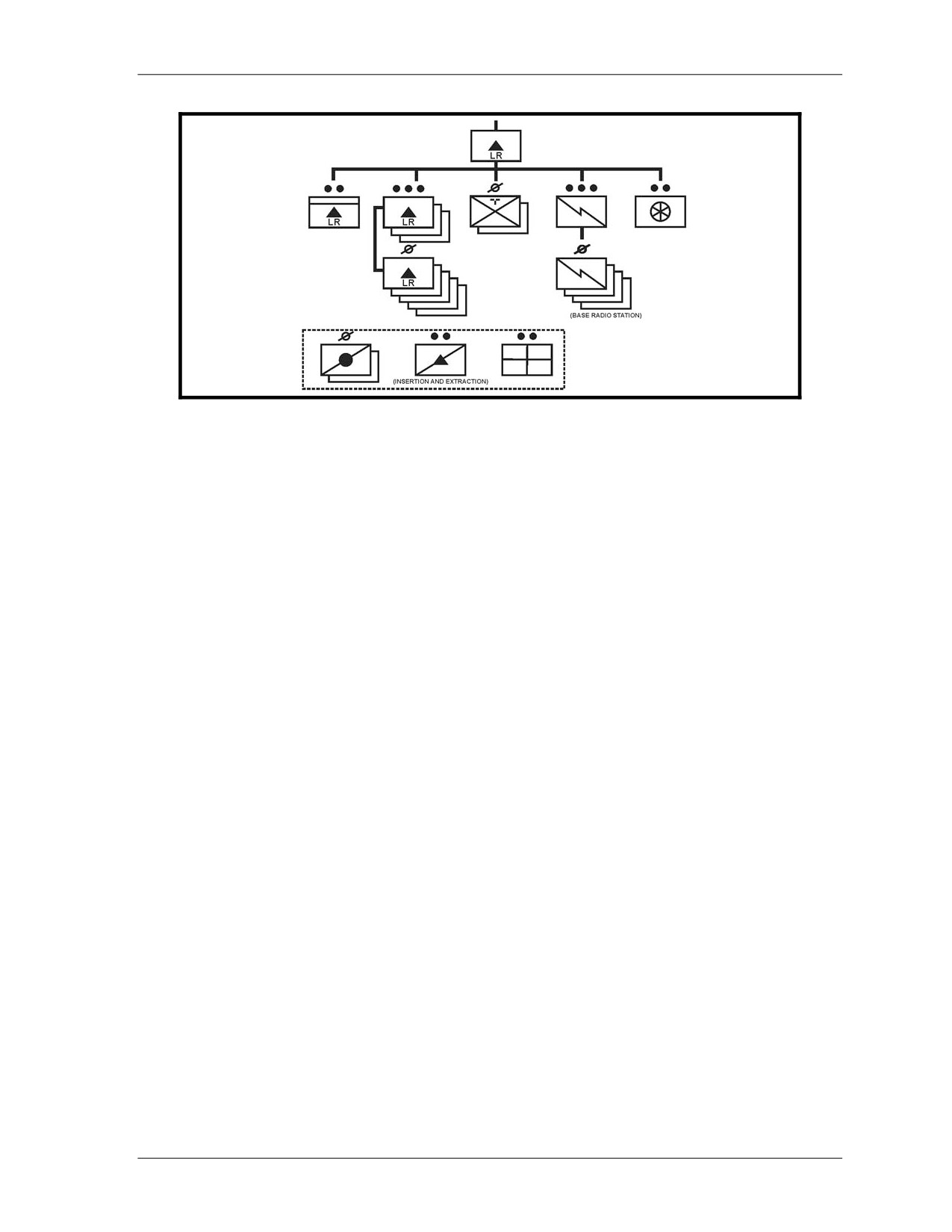
The LRSC has one organizational structure. The total active force structure will consist of
six LRS companies with 90 LRS teams. The reserve component also has six LRSC with 90 LRS teams
(Figure 1-1).
1-4
FM 3-55.93
23 June 2009
Full-Spectrum Operations
Figure 1-1. Organization of long-range surveillance company.
SUSTAINMENT
1-19.
Sustainment for the LRSC is provided by the BFSB brigade support company (BSC). The LRSC
depends on additional outside support for parachute rigging, and on aircraft for insertion and extraction
operations.
SUBORDINATE ORGANIZATIONS AND KEY PERSONNEL
1-20.
The LRSC is not a designed modular unit. However, it shares many of the characteristics of a
modular unit. When supplemented with additional medical, fires, communications, rigging, logistics, and
operations planning support, the LRSC or a LRSD can be deployed and employed as a separate unit.
HEADQUARTERS SECTION
1-21.
The headquarters section serves both a planning and logistics role for the LRSC. Due to the
austere nature of the headquarters section, the LRSC relies heavily on other organizations, such as the R&S
squadron, the BFSB S-2 and S-3
(for LRS team mission planning and execution), and general
logistics support. The section is composed of--
Commander
1-22.
The LRSC headquarters section is led by the company commander. The LRSC commander is an
Airborne, Ranger-qualified Infantry officer. He should be a graduate of the Long-Range Surveillance
Leaders Course (LRSLC) or the Reconnaissance and Surveillance Leaders Course (RSLC). He should also
be qualified or familiar with military free fall (MFF), underwater military diver, Pathfinder, and sniper
(target interdiction) operations. The company commander is required in the course of his duties to regularly
interact with senior commanders and staff officers. Minimum qualifications include previous very
successful company command and staff experience. By table of organization and equipment, the company
commander is a Captain. However, experience and required duties indicate that the more appropriate rank
for the LRSC commander is that of Major.
Executive Officer
1-23.
The executive officer (XO) is an Airborne, Ranger-qualified Infantry officer, who serves as
second in command and provides logistics planning and control. He should be a graduate of the LRSLC or
RSLC. The XO is required in the course of his duties to regularly interact with senior commanders and
staff officers. Minimum qualifications include previous very successful company XO and staff experience.
By table of organization and equipment, the XO is a Lieutenant. However, experience and required duties
indicate that the more appropriate rank for the LRSC XO is that of Captain.
23 June 2009
FM 3-55.93
1-5
Chapter 1
First Sergeant
1-24.
The 1SG is the most experienced NCO in LRS operations. As such, he helps plan, operationally
control, and administer the unit. He should be a graduate of the LRSLC or RSLC, and both battle-planning
staff and MFF qualified.
Master Sergeant (Operations Sergeant)
1-25.
The master sergeant, who serves as operations sergeant, should be a graduate of the LRSLC or
RSLC. He is both battle-planning staff and MFF qualified. He is the primary planner and is experienced in
LRS operations.
Supply Sergeant and Armorer
1-26.
The supply sergeant and assistant are both Pathfinder qualified.
COMMUNICATIONS PLATOON
1-27.
The communication platoon has a headquarters section and four base radio stations (BRSs).
Headquarters Section
1-28.
The platoon leader is an Airborne and Ranger-qualified Signal Officer. The platoon leader is
required in the course of his duties to regularly interact with senior commanders and staff officers. At the
least, his qualifications must include very successful signal platoon leader and staff experience. The
platoon sergeant is a communications Master Sergeant who is Airborne, Ranger, and battle-planning staff
qualified. The platoon leader and platoon sergeant should be graduates of the LRSLC or RSLC. In addition
to the platoon leader and platoon sergeant, the headquarters section has two NCO radio
operators/maintainers--both are Airborne and Ranger qualified.
1-29.
The communications platoon headquarters section is responsible for planning and executing all
aspects of the communications plan to link deployed LRS teams to the company operations base (COB) or
mission support site
(MSS) and the supported unit headquarters. This includes frequency spectrum
planning, communications security (COMSEC) and unit-level equipment repair and evacuation. At least
two of the members of the communications platoon headquarters section should be graduates of the
Frequency Managers Course.
Base Radio Stations
1-30.
Each of the four BRSs has a six-Soldier team, which is mainly responsible for maintaining
communication between deployed LRS teams, the COB or MSS and the supported unit headquarters.
Depending on the communications means used between LRS teams and the COB or MSS, the BRSs can
support three MSS or relay sites and the COB simultaneously.
SNIPERS
1-31.
The sniper teams are organized into two teams of two men each: senior sniper and sniper. The
senior sniper is Airborne Ranger qualified and the sniper is Airborne qualified. Both the senior sniper and
the sniper should be graduates of the LRSLC or RSLC and of either the US Army Special Forces or
Marine sniper course. All the snipers should also be MFF qualified. The company sniper employment
officer (SEO) is normally the company commander, the XO or 1SG. (FM 23.10 gives more information
about sniper team training and employment.)
TRANSPORTATION SECTION
1-32.
The transportation section is led by a staff sergeant, 88M. It is manned by five more transportation
Soldiers. The section has three trucks and two trailers. The section’s main duty is to transport personnel
and material at the direction of the company XO and 1SG.
1-6
FM 3-55.93
23 June 2009
Full-Spectrum Operations
LRSD AND LRS TEAMS
LRSD
1-33.
The three LRSD are each led by an Airborne, Ranger-qualified Infantry officer. Each detachment
leader should be a graduate of the LRSLC or RSLC. Also, he should be MFF and Pathfinder qualified. He
is responsible for the training, readiness, and employment of the LRS teams in the detachment. The
detachment leader is required in the course of his duties to regularly interact with senior commanders and
staff officers. He is also required to be prepared to operate independent of the LRSC utilizing a MSS.
Minimum qualifications include: previous very successful platoon leader and staff experience. By table of
organization and equipment, LRSD leaders are Lieutenants. However, experience and required duties
indicate that the more appropriate rank for a detachment leader is that of Captain.
LRS TEAMS
1-34.
Each LRS team is led by an Airborne, Ranger qualified Infantry Sergeant First Class or Staff
Sergeant. There is one Sergeant First Class per detachment and he doubles as the detachment sergeant
when his LRS team is not planning, on a mission or recovering. Team leaders should be graduates of the
LRSLC or RSLC. Normally, the team leader is also battle-planning staff, MFF, underwater military diver,
and Pathfinder qualified, or a combination of these qualifications.
1-35.
LRS team members are, at a minimum, Airborne qualified. All team members should be graduates
of the LRSLC or RSLC. They should also have a combination of MFF, underwater military diver and
Pathfinder qualifications.
LEGACY LRSC AND LRSD
1-36.
The legacy Army of Excellence LRSC was a unit normally organic to a Military Intelligence
Brigade previously found at corps level. This type of LRSC is not addressed in this manual as all are
currently scheduled for deactivation.
1-37.
The legacy Army of Excellence LRSD was a unit normally organic to a Military Intelligence
Battalion previously found at division level. While these LRSD are all scheduled for deactivation, some
commanders have maintained them or they may be temporarily authorized while awaiting activation of the
BFSB R&S Squadron LRSC. This type of LRSD is not specifically addressed in this manual.
CHARACTERISTICS
1-38.
All LRS operations are characterized by the following:
• They follow strict operations security (OPSEC) procedures before, during, and after mission
employment. This limits operational exposure of other LRS teams conducting missions.
• Units receive detailed intelligence preparation of the battlefield (IPB) from the BFSB S-2.
They plan and rehearse in detail with internal and supporting assets. This helps ensure
successful operations.
• Division- or corps-level assets, such as joint aviation, joint fire support, and communications,
must support planning, infiltration and insertion, exfiltration and extraction, and contingencies.
1-39.
LRS teams are also characterized by the following:
• Teams provide persistent surveillance on targets that can be covered only intermittently by
most other systems.
• Teams avoid contact with enemy forces and local population.
• Team firepower is normally limited to small arms, grenades, and Claymore mines.
• Teams have organic ground mobility assets.
• Team members depend on an expert knowledge of digital high frequency (HF) and ultra high
frequency (UHF) tactical satellite (TACSAT) communications equipment, enemy TTPs, order
23 June 2009
FM 3-55.93
1-7
Chapter 1
of battle (OB), and practiced skill in identifying equipment to successfully execute missions.
• Team members depend on the use of stealth, cover, concealment, and their Infantry and
Ranger skills to remain undetected.
• Team equipment and supplies include only what the team can man-pack or cache, if
dismounted.
CAPABILITIES
1-40.
Modular force LRSCs are fully self-mobile once deployed to the AO. The LRSC is not a modular
unit but can deploy detachments as independent units if provided additional support. LRSC and LRSD can
do the following:
• Establish long-range digital communications using HF or UHF radio systems.
• Transmit both voice and data.
• Use planned or emergency resupply drops.
1-41.
LRS teams have additional capabilities:
• Collect and transmit near-real-time digital imagery.
• Operate in inclement weather and over difficult terrain.
• Evade.
• Use special equipment cache sites emplaced by the LRSU or other friendly forces.
• Use captured supplies and equipment.
• Demonstrate the “art of camouflage” by—
—Blending in with units and formations who have already established a presence.
—Using clandestine cameras and sensors.
—Shadowing blinds and false walls.
• Stay behind or infiltrate over land (dismounted or mounted), over water (small boat and
underwater), or by air (rotary wing, static line parachute, or MFF).
• Exfiltrate over land, water, or air; or link up with advancing friendly forces.
• Operate with the use of organic ground mobility assets and, if resupply is available, conduct
extended range and duration reconnaissance missions.
• Conduct dismounted operations for up to seven days with little or no external direction and
support.
• Conduct operations in all types of terrain and environments.
LIMITATIONS
1-42.
LRSU have the following limitations:
• Neither the LRSC nor the LRSD are modular. Both require additional support in the areas of
medical, fires, communications, rigging, logistics, intelligence, and operations planning in
order to provide a full range of operational capability.
• They lack organic medical capability. The LRSC depends on attached medics from the R&S
squadron or on individual first aid. Ideally, LRS team members are certified emergency
medical technicians (EMTs). At a minimum, each team member must be a qualified combat
lifesaver (CLS).
• They are lightly armed and have limited self-defense capabilities.
1-8
FM 3-55.93
23 June 2009
Full-Spectrum Operations
• They require the support from the R&S squadron, BFSB S-2 and S-3, or division or corps staffs
and units. This support includes—
—Intelligence products.
—Integrated area communications.
—Access to a common-user telephone system.
—Frequency management.
—Satellite communications channel access.
—Packing, rigging, and loading supplies.
—Equipment for aerial resupply and parachute insertions.
—Air transport to the area of operations.
—Maintenance, supply, mess, administration, finance, personnel, and chaplain services.
• The tactical situation, equipment limitations, or enemy electronic surveillance or jamming may
prevent LRS teams from maintaining continuous communications with the controlling
headquarters.
23 June 2009
FM 3-55.93
1-9
Chapter 1
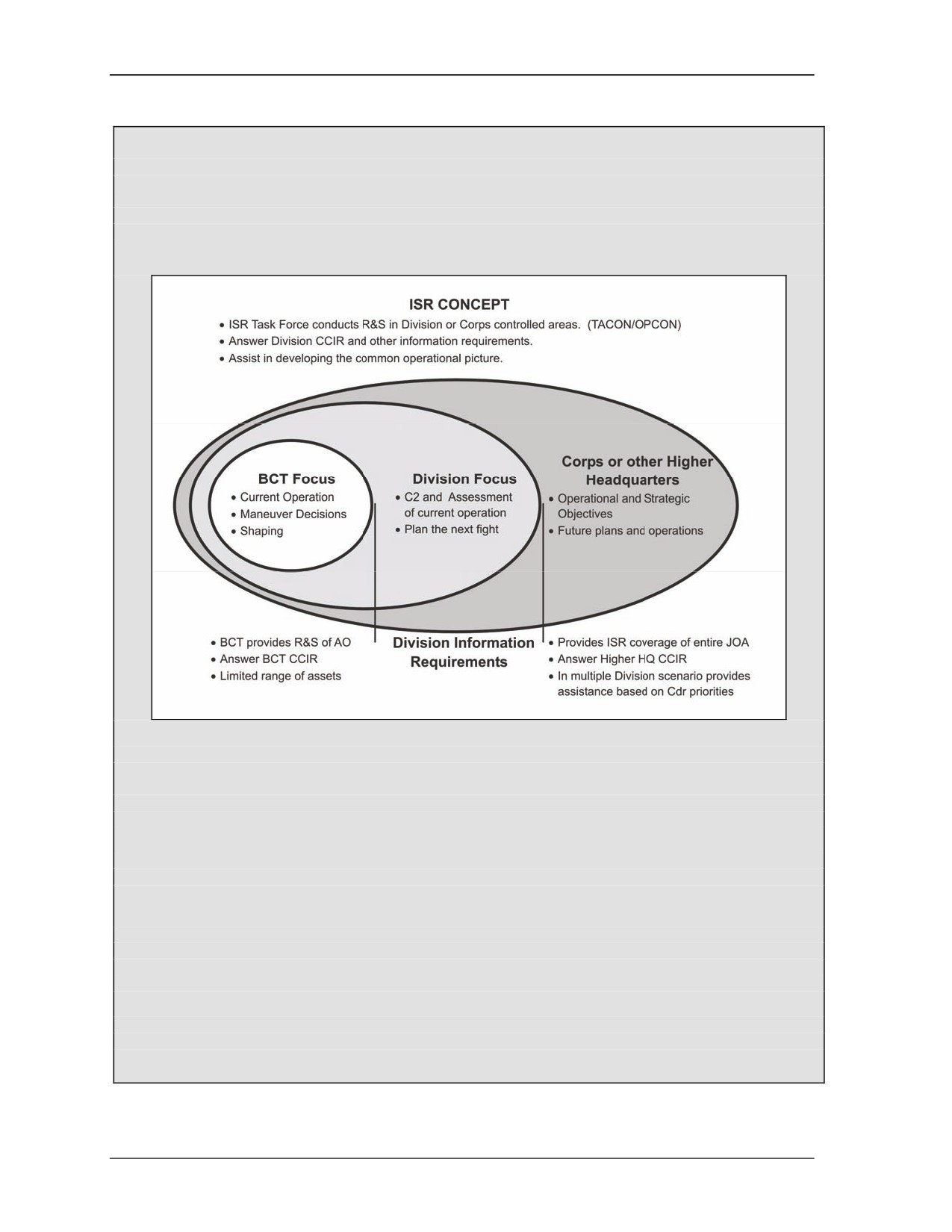
Example LRSU Operational Employment--ISR Task Force
Operational areas can be assigned, or remain unassigned, and thus the responsibility of the higher
headquarters such as the division or corps. When the higher headquarters leaves areas unassigned, that
portion of the AO requires a level of situational understanding (SU) sufficient to detect and classify threats.
During past operations, an intelligence, surveillance and reconnaissance
(ISR) task force, successfully
provided SU to the division or corps headquarters in an unassigned AO (Figure 1-2).
Figure 1-2. Concept of intelligence, surveillance, and reconnaissance.
A key enabler of future warfighting concepts is enhanced situational awareness (SA) that leads to actionable
SU. This is achieved by fusing information obtained through a layered network of Soldiers, sensors, and
collection platforms with information on friendly forces, enemy forces, and the environment to obtain a common
operational picture that is shared across the force. The ISR task force integrated multiple intelligence-gathering
systems and provided information about the enemy or potential enemy to the decision maker.
The most successful use of the ISR Task Force concept and organization has occurred during stability
operations, due to the relative freedom of movement available to both friendly and enemy forces. The enemy
force often hides among the population, making them difficult to track and target. The ISR Task Force
integrated many sources to create actionable intelligence.
LRSU have typically been integrated into the ISR Task Force to provide combat information through persistent
surveillance on named areas of interest (NAIs) or targets. In addition to providing combat information, the
LRSU clandestinely emplaced, monitored, and recovered sensors for other units attached to the ISR Task
Force. The LRSU also acquired targets for artillery and close air support (CAS), and interdicted targets as part
of (sniper) operations against selected targets.
The BFSB is similar to an ISR Task Force in that it is organized to integrate intelligence, R&S and other
combat units to provide immediate response to actionable intelligence. The BFBS headquarters element is
sufficiently robust that it can accept attachment of combat forces.
1-10
FM 3-55.93
23 June 2009
Chapter 2
Command and Control
This chapter describes how LRSU use Infantry and Ranger skills, communications
operators, and intelligence personnel to collect and report battlefield information.
LRSU operations depend on effective command and control
(Section I) and
communications, computers, and intelligence (Section II).
Section I. OVERVIEW
Command and control is the exercise of authority and direction by a properly designated commander over
assigned and attached forces in the accomplishment of a mission. Commanders perform C2 functions through a
C2 system (FM 6-0). The LRSU C2 system is structured for rapid deployment, and for collecting and reporting
information. This section discusses the LRSU internal C2 system and the functions and organizations that
provide mission taskings and support. It also discusses—
• Standard and nonstandard command and control.
• BFSB sections.
• R&S squadron.
• Command posts.
• Tactical operations centers (TOCs).
• Task organizations outside named areas of interest.
• Liaisons.
STANDARD LRSU COMMAND AND CONTROL
2-1.
The LRSU commander receives missions in the tradition manner of mission-type orders. Based on
these orders, he assesses the situation, makes decisions, and directs actions like any other commander.
However, he employs individual LRS teams IAW separate mission taskings that specify areas, objectives,
or people to observe. LRSU can have multiple subunits spread out over hundreds of kilometers
simultaneously planning, conducting, and recovering from operations. To C2 these operations, the
commander depends on a robust communications system, detailed and well practiced SOPs, and subunit
leaders who are highly skilled in all aspects of R&S.
SUPPORT
2-2.
Support to LRS teams includes intelligence, operations, communications, and sustainment:
Intelligence Support includes target information and IPB products.
Operations Support includes planning, coordinating and developing mission planning folders
(MPF), infiltration, exfiltration and fire support.
Communications Support includes frequency planning and positioning communications sites.
Sustainment Support includes planning facility, mess, medical, maintenance, and
general supplies.
COMPANY
2-3.
The LRSC depends on the BFSB staff, the R&S squadron, and the BSC for most intelligence,
operations, and sustainment support. The LRSC deploys to an operational area as part of the BFSB. The
BFSB S-2 ISR fusion element produces target information and IPB products. If the LRSC deploys as an
attached element to a corps, division, JTF, or multinational headquarters without the BFSB, then the
23 June 2009
FM 3-55.93
2-1
Chapter 2
G-2/J-2 and G-3/J-3 must perform these critical functions, along with all other operations and
sustainment support.
DETACHMENT
2-4.
A LRSD deploys to an operational area as part of a larger unit, normally the LRSC, because it
lacks the ability to plan and execute missions, or to sustain itself. A LRSD can be attached or OPCON to
almost any type of larger unit, and can be doctrinally employed, if the unit provides intelligence, planning,
insertion, extraction, and sustainment support.
BFSB STAFF
2-5.
The BFSB has three staff sections, which the LRSU primarily interacts with and depends on for
planning and support: S-2, S-3 and the S-4.
S-2 SECTION
2-6.
The BFSB S-2 section coordinates IPB for staff planning, decision making, and targeting. They
support the commander's and staff’s planning portion of the military decision-making process (MDMP).
To answer the commanders’ priority intelligence requirement (PIR) and other intelligence requirements,
the S-2 section processes and analyzes all information it collects, and then produces and disseminates
timely, relevant, and accurate intelligence. The S-2 also monitors the current threat situation and any
environmental factors that might influence friendly or enemy courses of action. The following elements in
the BFSB S-2 each provide specific products and services in support of LRS operations:
ISR Fusion Element
2-7.
The BFSB ISR fusion element conducts all-source analysis and integrates
(fuses) current
intelligence. Working under the supervision of the S-2, the ISR fusion element develops and maintains an
intelligence database consisting of all unprocessed information and other intelligence products. The ISR
fusion element keeps the commander and staff situationally aware, and provides intelligence to exploit
enemy weaknesses and vulnerabilities.
Functions
2-8.
The ISR fusion element—
• Produces the IPB and mission support products.
• Develops intelligence estimates.
• Analyzes the battlefield area.
• Develops situational and targeting data to support maneuver and fires.
• Prepares combat assessments.
Products
2-9.
The ISR fusion element produces—
• Target information as part of the LRS team MPF.
• Country studies.
• Imagery.
• Threat data (objective, capabilities, composition, and disposition).
• Threat templates.
• Situational templates.
• Event templates.
• Modified combined obstacle overlays (MCOO) in coordination with the geospatial information
and services (GI&S) section.
• Environmental data, for example, edible plants and indigenous animals.
• Solar and lunar data in coordination with the combat weather team.
2-2
FM 3-55.93
23 June 2009
Command and Control
Geospatial Information and Services Section
2-10.
The GI&S section supports the commander and staff with required geospatial information and
maintains databases up-to-date to support the unit with terrain and weather effects products and analysis.
Functions
2-11.
The GI&S section—
• Provides a terrain visualization mission folder to determine the terrain's effect on both friendly
and enemy operations.
• Produces maps and terrain products.
• Helps the ISR fusion element prepare the IPB.
Products
2-12.
The GI&S section produces—
• Hydrology overlays.
• Cover and concealment overlays.
• Soil composition overlays.
• Vegetation composition overlays.
• Obstacle overlays.
• Combined obstacle overlays.
• Special maps.
USAF Combat Weather Team
2-13.
The USAF combat weather team provides weather forecasting support for organic and attached
units of the BFSB. They can also provide weather effects analysis as it pertains to military operations. This
greatly enhances the ability of the BFSB to conduct collection of information to support the commander.
Functions
2-14.
The USAF combat weather team—
• Advises the task force commander on Air Force weather capabilities, support limitations, and
how weather information can enhance combat operations.
• Evaluates and disseminates weather data such as—
— Forecasts.
— Warnings.
— Advisories.
• Monitors the overall weather support mission for the commander.
• Serves as the commander's agent, identifying and resolving weather-support responsibilities.
• Determines weather-support data requirements.
• Advises the Air Force on the operational weather-support requirements of the supported Army
command.
• Participates in targeting meetings.
• Prepares climatological studies, and analyzes them in support of planned exercises, operations,
and commitments.
23 June 2009
FM 3-55.93
2-3
Chapter 2
• Coordinates weather support to subordinate units.
• Helps Army aircraft accident-investigation boards.
Products
2-15.
USAF combat weather team produces—
• Weather forecasts.
• Climatological data.
• Solar, lunar, and darkness data.
• Weather effects on friendly and enemy operations and equipment.
BFSB S-3 SECTION
2-16.
The following elements in the BFSB S-3 section each provide specific products and services in
support of LRS operations:
S-3, Operations
2-17.
The S-3 manages training, operations, plans, force development, and modernization. The BFSB
S-3 section prepares and distributes orders to subordinate units. Normally it does not give specific orders to
the LRSC. The BFSB commander gives mission type orders to the R&S squadron. The R&S squadron then
conducts the MDMP and gives mission type orders to the LRSC. However, the BFSB S-3 section does
assist in the LRSC in mission planning and execution for individual LRS team employment.
2-18.
The S-3—
•
Supervises the tactical command post (TACCP) when deployed.
•
Develops courses of action.
•
Prepares, coordinates, and disseminates standing operating procedures, orders, and directives
(with other staff sections’ input).
•
Synchronizes all operations, to include reviewing and coordinating subordinate plans and
actions.
•
Coordinates with other brigades to place BFSB assets within their AOs as necessary.
•
Requests and coordinates external assets for the R&S squadron’s insertion and extraction of
ground elements.
•
Requests and coordinates joint personnel recovery assets as required.
•
Coordinates and directs terrain and airspace management.
•
Coordinates extended range multipurpose UAS support from the combat aviation brigade.
•
Recommends priorities for allocating command resources and support.
•
Directly assists the commander in controlling preparation for and execution of operations.
•
Coordinates staff planning, execution, and supervision of information operations.
•
Plans and coordinates stability operations.
•
Conducts BFSB collection operations.
•
Performs terrain management within the BFSB AO, when assigned.
•
Supports sensitive site exploitation.
•
Integrates risk management into operational planning.
2-4
FM 3-55.93
23 June 2009
Command and Control
2-19.
The S-3 staff—
• Plans, executes, and supervises OPSEC.
• Conducts civil-military operations.
• Conducts BFSB collection operations.
• Performs terrain management within the BFSB AO, when assigned.
• Supervises the actions of the following special staff officers that have LRSU coordination and
support responsibilities:
— Air defense and airspace management/brigade aviation element (ADAM/BAE).
— Air Force tactical air control party attached to the BFSB.
— Fires cell.
Air Defense and Airspace Management/Brigade Aviation Element
2-20.
The ADAM/BAE—
• Evaluates any air threat to BFSB operations.
• Analyzes aerial threat factors bearing on the OE.
• Analyzes the effects of weather and terrain on air operations.
• Determines threat aerial courses of action.
• Develops an air and missile defense (AMD) concept of support for each course of action
(COA), wargames the AMD concept of support, and compares courses of action.
• Maintains the AMD running estimate.
• Prepares the AMD annex.
• Synchronizes AMD operations.
• Plans and coordinates airspace command and control, and deconflicts airspace.
• Integrates aviation into BFSB sustaining operations, such as medical evacuation and aerial
resupply.
• Represents aviation during the MDMP and other planning processes such as IPB, ISR
synchronization, and targeting.
• Maintains the aerial portion of the common operational picture.
• Assists the fires element to analyze airspace control orders and air tasking orders.
• Coordinates directly with the aviation brigade or the supporting aviation task force for detailed
air mission planning.
Air Force Tactical Air Control Party
2-21.
The TACP is the aligned US Air Force element that coordinates tactical air assets and operations
such as CAS, air interdiction, joint suppression of enemy air defenses (J-SEAD), reconnaissance, and
airlift. Specifically, the TACP—
• Advises the commander and staff on the employment of tactical air (TACAIR).
• Operates and maintains Air Force TACAIR direction radio net and air request net.
• Transmits requests for immediate close air and reconnaissance support.
• Transmits advance notification of impending immediate airlift requirements.
23 June 2009
FM 3-55.93
2-5
Chapter 2
• Coordinates tactical air support missions with the fire-support element and the appropriate
Army airspace command and control (AC2) element.
• Recommends intelligence requirements to the S-2 through the S-3.
• Plans the simultaneous employment of air and surface fires.
• Supervises forward air controllers (FACs).
• Integrates air-support sorties with the BFSB's scheme of maneuver.
• Participates in targeting meetings.
• Serves as a member of the targeting cell.
• In the absence of a FAC, assists the fire support officer (FSO) in directing air strikes.
• Provides Air Force input into the AC2.
Fires Cell
2-22.
The FC—
• Develops and recommends surface targets to attack.
• Employs fires to influence the will of and to destroy, neutralize, or suppress enemy forces.
• Plans, coordinates, disseminates, and maintains fire support coordination measures.
• Plans and requests CAS.
• Coordinates clearance of fires.
• Plans the employment of nonlethal fires.
• Synchronizes fires within the BFSB AO.
BFSB S-4 SECTION
2-23.
The S-4 is responsible for planning brigade sustainment. The S-4 is the link between the BFSB’s
organic BSC and the theater support command for coordinating logistics support. Specific to LRSU
operations, the S-4 is responsible for coordinating riggers in support of Airborne (static line, MFF and
resupply) operations.
RECONNAISSANCE AND SURVEILLANCE SQUADRON
2-24.
The R&S squadron is a multifunctional unit designed to collect and report information that
answers the BFBS commander's critical information requirements
(CCIR) and other information
requirements (IR) using manned ground assets and small UAS. It can also acquire targets and, on a limited
basis, interdict targets. The squadron has a headquarters and headquarters troop (HHT), one LRSC, and
two mounted ground reconnaissance troops. It has long-range communications that allow it to operate
dispersed and communicate throughout the division AO. The R&S squadron is designed to simultaneously
employ the LRSC and the reconnaissance troops dispersed within the higher unit's AO. Except for its
organic medical platoon, the R&S squadron depends on the BSC for all of its logistical support.
HEADQUARTERS AND HEADQUARTERS TROOP
2-25.
The R&S squadron HHT has organic elements specifically designed to support the employment of
the LRSC: medics, forward observers (FOs), and the insertion and extraction section organic to the S-3
section. These Soldiers are distinguished by special qualifications identifiers and additional skill identifiers
(SQIs and ASIs) in the R&S squadron headquarters and headquarters troop's TOE.
2-26.
The combat medic section of the medical platoon has six Soldiers identified for direct support
(DS) to the LRSC: the staff sergeant section NCO and five specialist medics. Each of these Soldiers is
Airborne and special operations combat medic qualified, so they can support LRS team missions.
2-6
FM 3-55.93
23 June 2009
Command and Control
2-27.
Within the fire support platoon, two fire support staff sergeants, and two sergeant FOs are
Airborne and Ranger qualified. This gives them the basic skills needed to participate in LRS team missions
when target acquisition is required.
2-28.
The insertion and extraction section helps plan and execute infiltration and exfiltration of LRS
teams, and provides general planning support for the LRSC and ground reconnaissance troops. The section
has five Soldiers: a Captain assistant operations officer, a sergeant first class assistant operations NCO, a
staff sergeant assistant operations NCO, and two specialist vehicle drivers. The Captain must be Airborne,
Ranger, and Pathfinder-qualified. The assistant operations NCOs are Airborne, Ranger, Pathfinder, and
underwater military diver-qualified. The section--
• Helps plan, coordinate, and develop MPFs.
• Keeps a list, overlays of, and additional information about possible landing zones (LZs), drop
zones (DZs), and pickup zones (PZs).
• Coordinates requests for any air operations with aviation support units.
• Posts the schedule of infiltration and exfiltration operations.
2-29.
In addition to the R&S squadron, Soldiers and sections that directly support the LRSC, the S-2
and the S-4 have additional important support functions. The S-2 section collaborates with the BFSB ISR
fusion element to produce target information for LRS team missions. The S-4 section coordinates with the
BFSB S-4 section for riggers to support LRS team insertion operations through other sustainment units
as needed.
NONSTANDARD LRSU COMMAND AND CONTROL
2-30.
LRSU are in high demand and limited in number. Therefore, even a LRSC or a task-organized
LRSD is often told to support units other than a BFSB or R&S squadron. However, support and functions
provided by the BFSB, the R&S squadron, and the BSC are essential and necessary to the successful
execution of a LRSU operation.
2-31.
Without this support, the LRSU would be limited as to the spectrum of missions it could
successfully perform. These limitations should be explained clearly to the gaining unit commander and
considered during the conduct of the MDMP.
2-32.
LRSDs can also be task-organized between LRSCs. For instance, if a LRSC requires additional
assets to perform its mission, a LRSD can be attached from another LRSC. For rapid interoperability,
communications SOPs (message formats, COMSEC, and reporting procedures) must be similar or, if
possible, identical.
COMMAND POSTS
2-33.
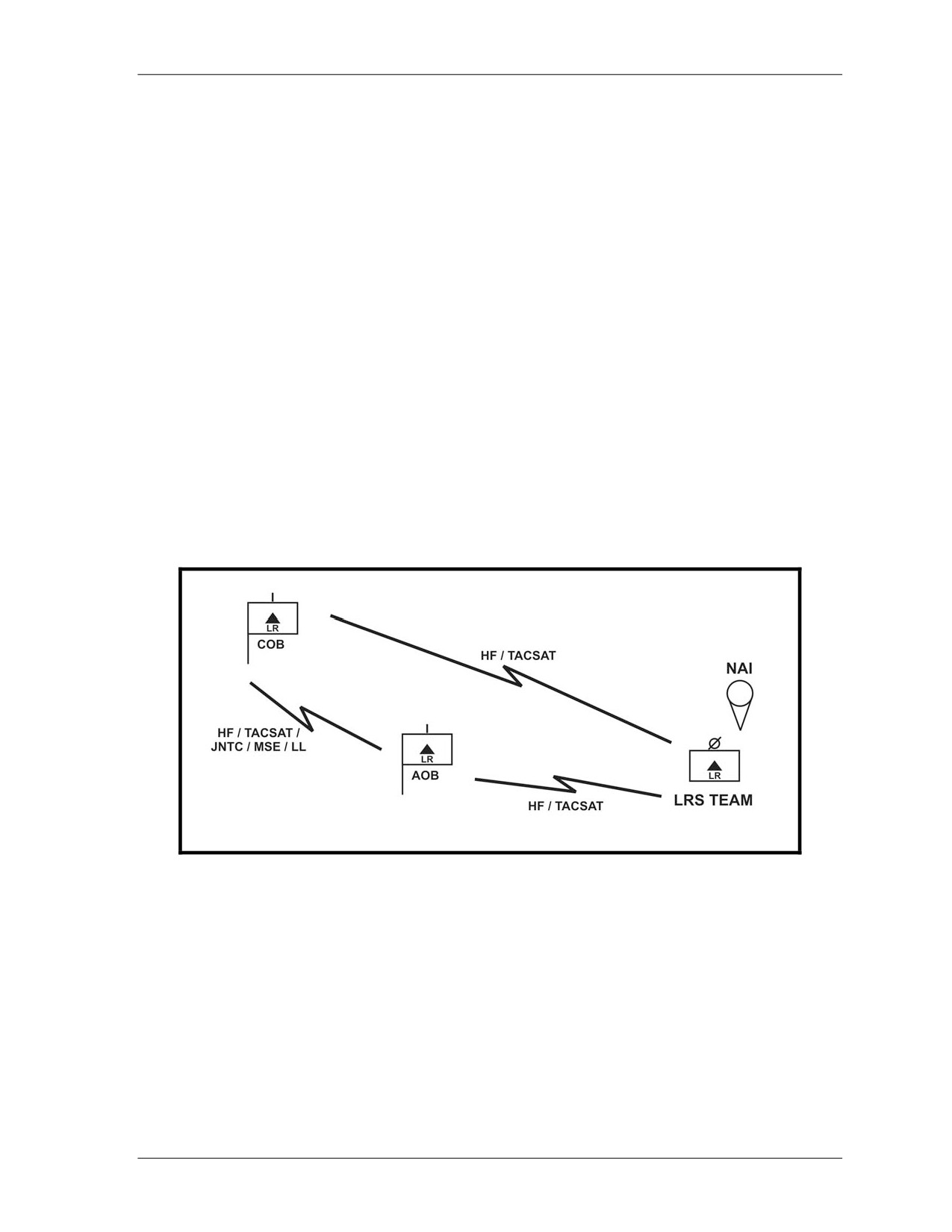
LRSUs normally employ three types of command posts: a company operations base (COB), an
alternate operations base (AOB), and an MSS.
COMPANY OPERATIONS BASE
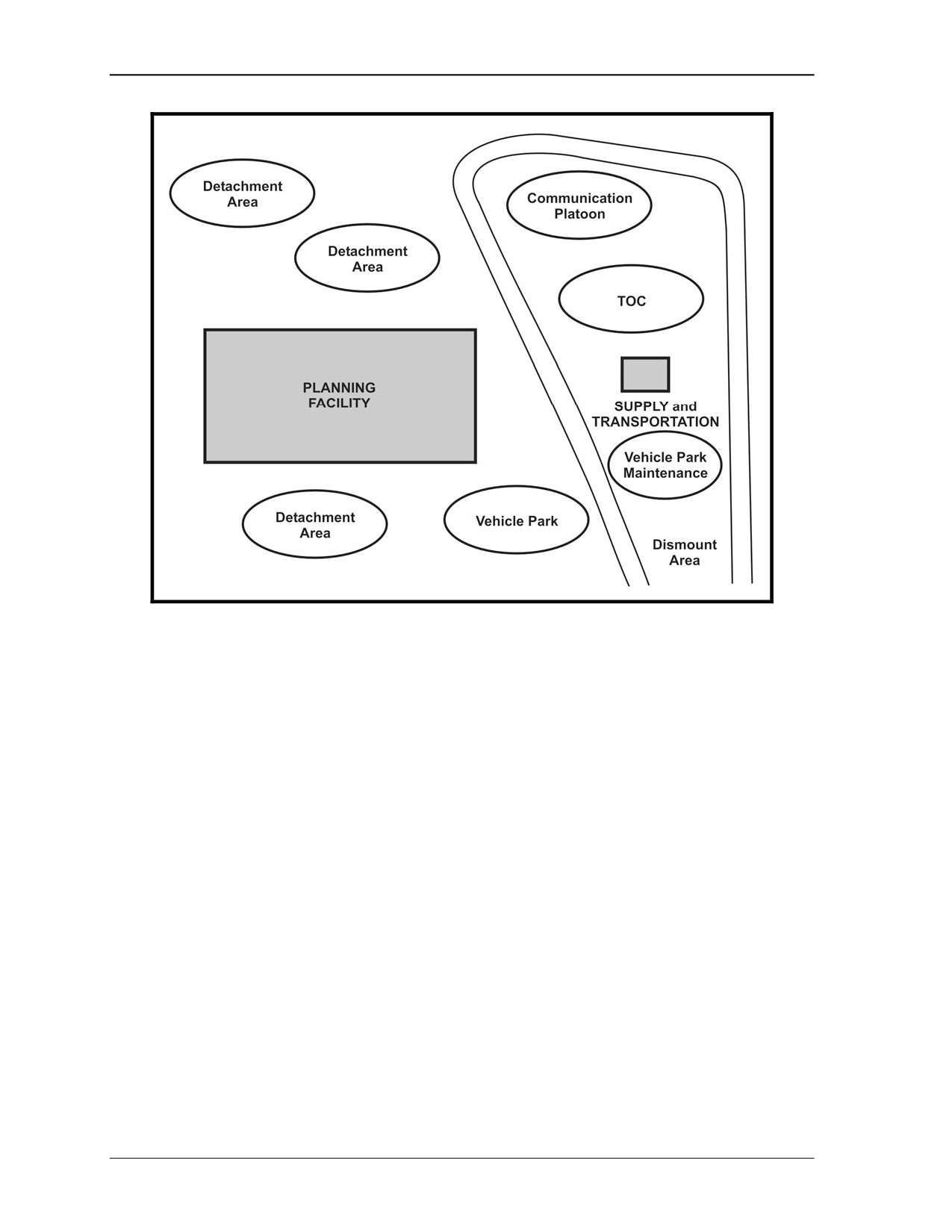
2-34.
Figure 2-1 shows an example COB, which normally collocates with or near the R&S squadron
tactical operations center (TOC) or the BFSB main command post (MCP). A key consideration for the
location of the COB is the requirement for a secure location or facility for LRS team planning. Teams
should be separated from each other to preserve operational security and to allow them to conduct detailed
planning with minimal interruption. This location is called the planning facility. Most members of the
LRSU locate in the COB.
23 June 2009
FM 3-55.93
2-7
Chapter 2
Figure 2-1. Company operations base.
2-35.
In addition to the planning facility, the COB includes areas for a TOC, the company headquarters,
the communications platoon or BRS, motor park, helicopter LZ, and LRSD and team living areas.
METT-TC determines whether the site should be a fixed or a field site.
2-36.
The company commander selects the general location of the LRSU COB. Based on the
commander's requirements, the 1SG or XO determines the exact location. He oversees the setup of the base
and the implementation of security for it.
2-37.
Each LRSD or LRS team is assigned an area, within which it sets up a CP. When a team deploys,
the platoon sergeant, or a designated team leader, provides for security in the team area and for any
equipment that the team did not take on the mission.
Operations Section
2-38.
The operations section sets up, secures, and restricts access to the company TOC. The section
prepares and marks an LZ nearby. The operations NCO normally controls the LZ, however a LRSD or
LRS team can also be given the mission to set up and control it.
Communications Platoon
2-39.
The communications platoon is assigned an area. It sets up required HF, UHF TACSAT, and very
high frequency (VHF) antenna systems; operates the company or detachment wire net; and provides
communication equipment maintenance and logistical support. The communications platoon coordinates
for the unit to be included into the local area network (LAN). This allows them access to the higher unit
switching system.
2-8
FM 3-55.93
23 June 2009
Command and Control
Company Headquarters
2-40.
The company headquarters is assigned an area from which it provides administrative and
logistical support as required. The 1SG initiates and enforces the operations base security plan.
Base Radio Station
2-41.
Intelligence reports (INTREP) received by the BRS go directly to the R&S squadron S-2 and the
BFSB ISR fusion element. The LRSU operation section neither delays nor changes any INTREP. If a BRS
receives a message at the AOB and not the COB, the operator sends it, exactly as received, by the fastest,
most secure means to the COB. Unit SOPs largely determines how INTREPs are processed once received
at the COB.
ALTERNATE OPERATIONS BASE
2-42.
The primary mission of the AOB is to serve as a communications relay between the COB and
deployed LRS teams. AOB planning considerations derive from the communication requirements of the
COB and on the deployed LRS teams. Normally, the communication platoon leader controls the AOB but
is not necessarily located there. Selected personnel from the operations section also normally locate at the
AOB. The task organization for the LRSU AOB varies based upon METT-TC considerations and
unit SOPs.
2-43.
The COB and AOBs maintain communication with employed teams using HF or UHF TACSAT
radios. For OPSEC purposes, each team has a separate frequency and cryptographic keys. The tactical
switching system between the two bases allows them to communicate. Depending on METT-TC
requirements, HF or line of sight (LOS) radio systems provide backup communications. (Figure 2-2 shows
an example C2 employment schematic for a LRSC.)
Figure 2-2. Example C2 employment schematic for a LRSC.
2-44.
The AOB locates where it can best support communications with deployed LRS teams. Because
of its limited ability to provide for its own security, the AOB normally collocates with another unit. For
linkup operations, the LRSC can collocate a BRS-equipped liaison officer (LNO) team with the moving
unit.
MISSION SUPPORT SITE
2-45.
If required, the LRSU can also use an MSS. An MSS is a temporary grouping of operations,
communications, and support personnel, formed to conduct a specific operation or mission. Normally, the
MSS commander is a LRS detachment leader. The only difference between C2 for a LRSD in an MSS and
a LRSC is that the LRSD may not use an AOB. (Figure 2-3 shows an example C2 employment schematic
for a LRSD in an MSS.)
23 June 2009
FM 3-55.93
2-9
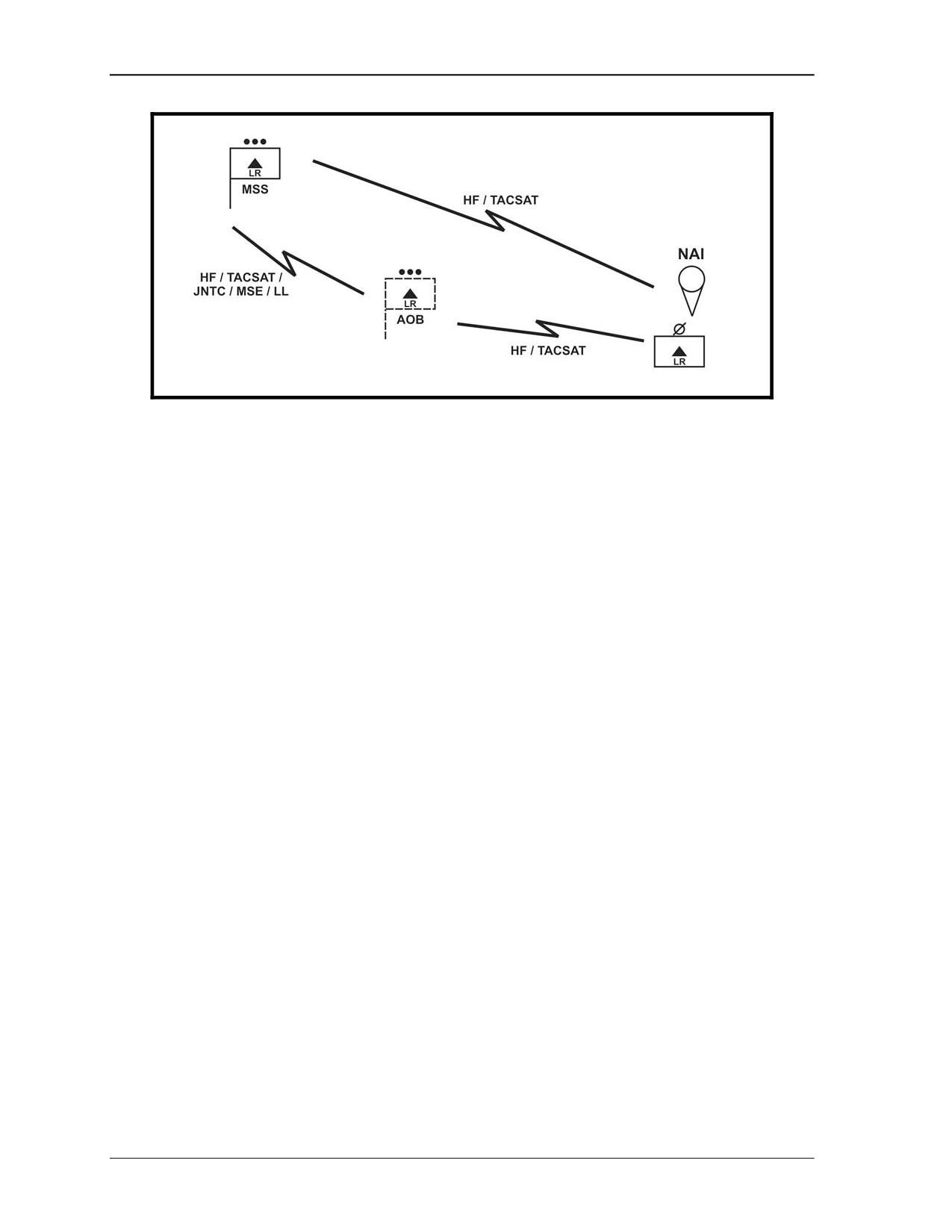
Chapter 2
Figure 2-3. Example C2 employment schematic for a LRSD in an MSS.
TACTICAL OPERATIONS CENTER
2-46.
The LRSU TOC sets up in the COB. The TOC gives commanders a C2 capability with higher
headquarters and subordinate elements.
LRSC
2-47.
In the LRSC TOC, personnel perform specific functions as follows:
Battle Captain or NCO
2-48.
The battle captain or NCO supervises operations in the TOC. In the LRSC, the battle captain is
normally a LRS detachment leader. This duty normally rotates between the three LRS detachment leaders.
The battle captain or NCO plans and coordinates the company's tactical operations based on
the
commander's guidance and--
• Analyzes assigned missions.
• Plans employment of teams.
• Prepares or approves operations orders (OPORD) before they go to the commander.
• Updates the commander on current and projected tactical situations.
• Supervises the preparation of all operational and intelligence documents.
• Supervises coordination with higher and supporting headquarters.
• Reports the operational status of committed and uncommitted LRS teams.
• Ensures that the current situation is posted on all maps and charts.
• Collects and forwards combat information from the LRS teams to higher.
• Maintains the operations workbook.
• Approves the TOC personnel work schedule.
• Ensures preparation of the briefing area and maps.
• Posts the mission planning chart.
• Collects combat information from LRS team operations.
• Updates mission folders after receiving info from BFSB and R&S squadron staff elements.
• Posts and maintains the enemy situation overlay.
2-10
FM 3-55.93
23 June 2009
Command and Control
• Informs teams of critical information that could affect their missions.
• Conducts final security inspections of LRS teams before deployment.
Operations Sergeant
2-49.
The operations sergeant supervises the TOC enlisted personnel. He assumes responsibility for the
TOC in the absence of the battle captain. He also--
• Helps prepare and edit all tactical operations plans.
• Supervises the operation of the planning area.
• Posts the current situation on the friendly situation overlay.
• Posts current data from deployed teams on mission-status charts.
• Establishes the TOC personnel work schedule.
• Coordinates with the 1SG for TOC messengers and guards.
• Ensures that only authorized personnel enter the TOC.
• Posts the manning chart.
• Prepares the situation report (SITREP) for the period.
• Helps maintain the operation workbook.
• Acts as a shift leader to maintain a 24-hour capability in the TOC.
Chemical, Biological, Radiological, and Nuclear NCO
2-50.
The CBRN NCO helps establish, administer, and apply defensive CBRN operations. He also--
• Supervises preparation of CBRN reports.
• Supervises maintenance of CBRN supply.
• Supervises unit and individual CBRN training records.
• Serves as principal NCO of the CBRN defense team.
• Collects CBRN information and data.
• Interprets and analyzes CBRN information and data.
• Disseminates CBRN information and data.
• Acts as a shift leader to maintain a 24-hour capability in the TOC.
Liaison NCO
2-51.
The LNO coordinates test fire areas; rehearsal areas; communication equipment test areas; and
supply, medical, transportation requirements.
Ongoing Actions
2-52.
During the mission, the TOC personnel monitor the progress of surveillance teams and are
prepared to coordinate for exfiltration, fire support, resupply, linkups or any other action that might arise.
They do this by sending updated SITREPs and any changes to the LRS team's mission. They also receive,
log, and disseminate combat and administrative information from the teams. In addition, they--
• Monitor the guard frequency 24 hours a day.
• Coordinate resupply for committed teams.
• Coordinate emergency extractions.
• Coordinate medical evacuations.
23 June 2009
FM 3-55.93
2-11
Chapter 2
• Coordinate other required support.
• Plan and coordinate additional missions as directed by the commander.
• Monitor scheduled communication times.
Debriefing
2-53.
Immediately after exfiltration, personnel from the R&S squadron S-2 or the BFSB S-2, debrief
each LRS team. In addition, the LRSC communications platoon leader or a BRS section sergeant debriefs
the team on communications specific details.
Messages
2-54.
The battle captain or NCO provides a receipt for all incoming messages. He forwards INTREPs
from LRS teams to the BFSB S-2 ISR fusion element and R&S squadron S-2, as required. He also--
• Records in the staff journal the receipt of each message.
• Posts the information from each message to appropriate maps and charts.
• Files each message in the journal file by journal-entry number.
• Records in the journal all messages that go out of the TOC.
Journal
2-55.
The Daily Staff Journal or Duty Officer’s Log (DA form 1594) is a chronological record of events
pertaining to the unit during a given period. The battle captain or NCO maintains the journal. He
cross-references all items to the journal entries by journal item number. He posts all messages to the
journal, and notes the following information about each:
• Sender.
• Message number.
• Message title or a description of the event.
• Time of receipt.
• Journal item number.
• Message center number (if applicable).
• Action taken.
• His initials.
Security
2-56.
Normally the 1SG or the operations NCO restricts and controls personnel access to the TOC and
to the planning facility. Unit SOPs establish procedures for controlling and identifying visitors. The TOC
and the planning facility should have only one secure entrance. The entrance to the planning facility should
have limited access and be secured at all times when LRS teams are conducting mission planning. Unit
SOP details appropriate security measures in the safeguarding and handling of all classified material, to
include preparing and rehearsing and emergency destruction.
Displacement
2-57.
When directed to displace, the on-duty shift continues to operate; the off-duty shift breaks down
all equipment and loads it on the vehicles. The COB notifies the AOB of the departure time, route and
proposed relocation site. When the COB is ready to displace, it transfers control to the AOB. The AOB
monitors committed teams and controls operations. When the COB is again operational, it reassumes
control and the AOB sends an update of the situation.
2-12
FM 3-55.93
23 June 2009
Command and Control
LRSD
2-58.
When employed at an MSS, the LRS detachment leader, detachment sergeant, and attached
communications personnel perform all functions. The LRSC commander may supplement the LRSD
personnel as needed to assist in planning and operation of the MSS.
TASK ORGANIZATION OUTSIDE NAMED AREAS OF INTEREST
2-59.
All LRSU should use the same communication procedures. This facilitates task organizing LRSU
as battlefield conditions change. The rapid pace of some operations may require the LRSU to coordinate
C2 of deployed LRS teams and to exchange information to meet the commander's intelligence needs.
Special situations could include the employment of the LRSU outside the BFSB's area of operations or
area of interest.
2-60.
During retrograde operations, the C2 of any LRS teams beyond the BFSB's area of interest is
temporarily transferred to the unit now responsible for that area. This action requires an LNO with a BRS
to locate with the new controlling headquarters. Once teams are extracted, they return to the parent LRSU.
TASK ORGANIZATION FOR BRIGADE, TASK FORCE, OR BOTH
2-61.
For certain contingency operations, a LRSD, or portions of a LRSC, might be OPCON of a BCT.
This most often occurs in a stability operation and before the BFSB S-2 ISR fusion element deploys to the
AO. It also occurs when BCTs expand control of a sector and deployed LRS teams are operating in that
sector. When the latter occurs, an LNO with a BRS locates with the BCT MCP. For mission planning, a
member of the BFSB S-2 ISR fusion element or R&S squadron S-2 LNO can accompany the LRS control
element.
LIAISON DUTIES, EMPLOYMENT, AND COORDINATION
2-62.
The term "liaison" refers to the contact or intercommunication maintained between elements of
military forces in order to ensure mutual understanding and unity of purpose and action. A trained,
competent, trusted, and informed officer or noncommissioned officer is the key to effective liaison.
Normally, the unit provides its own LNO.
DUTIES
2-63.
The commander must trust the LNO completely. The LNO must hold the appropriate rank and
have the appropriate experience for each particular mission. During LRS operations, he provides the
critical link between the LRSU and external agencies. He coordinates the planning process, assists as
needed, and generally supports the LRS operation.
EMPLOYMENT
2-64.
The actual method of employing LNOs varies, depending on each unit's requirements and SOPs.
Corps, Division, or Both
2-65.
The LRSU can be tasked to provide the corps or division headquarters with personnel to help
coordinate C2 between the LRSU and its controlling headquarters. The LNO can assist in the coordination
and tracking of LRS team operations, and provide other assistance as required.
Brigade or Task Force
2-66.
When required, the LRSU might need to provide an LNO to work with a BCT or task force staff.
His duties would be similar to the duties provided to the corps and or division staff.
Headquarters or Operations Section
2-67.
The headquarters or operations section of the LRSC normally employs internal LNOs to work
with LRS teams preparing for an operation. These LNOs help the LRS team plan and coordinate upcoming
missions. They can also help prepare and set up the planning facility and enforce security procedures.
To ensure the effectiveness of the LNOs, they should be senior in rank, and experienced in LRS
23 June 2009
FM 3-55.93
2-13
Chapter 2
operations. Each should work with his assigned team throughout the planning process and infiltration
phase. Because he knows that teams’ mission, he can serve in place of any injured or incapacitated team
member. After infiltration, if he is no longer needed on the team, he can help the operations section track
the battle and exfiltrate, extract, debrief, and recover the LRS team. However, until the supported team's
mission is complete, he should not be allowed to deploy on another LRS team mission until the supported
LRS team’s mission is complete.
COORDINATION
2-68.
Specific LNO duties include--
• Internally, the LNO coordinates test fire areas; rehearsal areas; communication equipment test
areas; and supply, medical, transportation requirements. He also helps destroy excess LRS team
planning materials, and inventories and secures team equipment not needed for the mission.
• Externally, the LNO coordinates with any outside unit or element. He normally has the
authority to coordinate with all relevant staff agencies and sister service units.
Section II. COMMUNICATIONS, COMPUTERS, AND INTELLIGENCE
The LRS team is a valuable combat information collection asset assigned to the BFSB. Rapid and efficient
information flow between the BFSB and the LRS TOC requires an efficient and timely dissemination link. This
section first discusses communications in general as it applies to LRSU, and then discusses computers and
intelligence.
COMMUNICATIONS
2-69.
The rapid flow of information to the BFSB S-2 ISR fusion element is vital for decision-making,
and directly affects the successful execution of operations. Once the BRS receives a message from a
deployed LRS team, it is forwarded to the COB for decryption and analysis. The BRS at the COB uses
organic wire lines or runners (when collocated) to relay team reports. If the BRS operator cannot collocate
with the COB, he must send messages by secure UHF TACSAT, VHF or HF radio.
2-70.
The BRS at the COB must stay in constant communication with the AOB. If the BRS at the COB
is destroyed or otherwise incapacitated, then the AOB assumes the mission of the COB, or collocate with
them. The AOB battle tracks the entire mission. BRS-to-BRS communication systems include—
• HF radio.
• UHF TACSAT.
• DSVT with facsimile.
• VHF (needed if AOB must be collocated with COB).
• Local and wide area networks (LAN and WAN).
2-71.
If a BRS collocates with a support unit that employs mobile subscriber equipment (MSE), the
AOB uses the digital secure-voice terminal (DSVT) with facsimile.
2-72.
The COB and the AOB should also use a digitized, lightweight video-reconnaissance system that
can receive imagery from the deployed teams via HF, UHF TACSAT, and VHF.
2-73.
When the COB receives a message from either BRS, it decrypts and analyzes it, and then, as
quickly as possible, sends it to the BFSB S-2 ISR fusion element. They also send it to the R&S squadron
S-2. As a minimum, the link from the COB to the BFSB S-2 ISR fusion element should include—
• Secure VHF (computer, voice, or both).
• DSVT with facsimile.
• LAN.
• Runner.
2-14
FM 3-55.93
23 June 2009
Command and Control
COMPUTERS AND INTELLIGENCE
2-74.
The LRSC TOC connects to the BFSB S-2 ISR fusion element and the R&S squadron S-2 LAN
via both secure and nonsecure links.
ISR COMPUTER WORKSTATION
2-75.
The LRSC TOC requires access to an ISR computer workstation. This workstation is normally
linked to other intelligence network processors, which—
• Lets the LRSC report all ISR tasks and requests for information (RFIs) in real time. Sending
information directly to the BFSB S-2 ISR fusion element updates the intelligence database and
promotes immediate analyzing and processing of the information.
• Allows the LRSC access to current information in the friendly database, including imagery,
enemy OB, situation maps, and enemy templates relevant to the LRSU mission. It also gives
the unit access to current information from other intelligence databases.
LOCAL AREA NETWORK LINE
2-76.
The secondary link to the BFSB S-2 ISR fusion element is a secure LAN line. This normally
requires a DSVT or an MSE tactical facsimile machine.
HUMAN COURIER
2-77.
This is normally the final contingency means of disseminating information between the LRSU
TOC and the BFSB S-2 ISR fusion element. However, if the LRSU TOC is located away from the BFSB
S-2 ISR fusion element, this takes more time than any other method.
23 June 2009
FM 3-55.93
2-15
Chapter 3
Mission Development
Successful LRS missions require detailed planning and coordination. The BFSB
commanders' collection plans describe the desired PIR and intelligence requirements.
The PIR drives the conduct of ISR operations. After the LRSU collects information,
the BFSB S-2 ISR fusion element evaluates it during the continuous IPB process.
This chapter answers the questions: Why and how do the BFSB, R&S squadron and
the LRSC develop the LRS team mission? This chapter answers this question by
discussing ISR operations and mission orders (Section I), the mission planning folder
(Section II), and OPSEC (Section III).
Section I. ISR OPERATIONS AND MISSION ORDERS
ISR is defined as an activity that synchronizes and integrates the planning and operation of sensors, assets, and
processing, exploitation, and dissemination systems in direct support of current and future operations. This is an
integrated intelligence and operations function. (JP 1-02). Mission orders is a technique for completing combat
orders that allows subordinates maximum freedom of planning and action to accomplish missions (FM 1-02). It
leaves the "how" of mission accomplishment to the subordinate. How these two concepts work together is
critical to understanding the mission development process for LRSU.
ISR OPERATIONS
3-1.
The BFSB conducts ISR operations to enable the division commander to precisely focus joint
elements of combat power and simultaneously execute current operations while preparing for future
operations. Key to successful accomplishment of the BFSB mission is the targeted collection, analysis, and
dissemination of intelligence that satisfies the needs of the supported unit commander. All elements of the
BFSB are organized and trained for this purpose.
3-2.
The BFSB fills two roles in conducting ISR operations. First, it executes the ISR plan for the
supported unit (division, corps, JTF, or multinational). Second, it augments BCTs and other supporting
brigades with ISR capabilities.
3-3.
Collaborative planning is conducted between organizations so that at each level ISR plans are
synchronized and integrated early in the MDMP. This also allows subordinate units to task collection
assets as early as possible to collect the needed information.
ORGANIZATIONS ABOVE THE BFSB
3-4.
As the BFSB's higher unit conducts the MDMP, the commander and staff identify information
that is needed to make informed decisions. This information is PIR, which along with friendly force
information requirements comprise the CCIR. As soon as the G-2/J-2 and the G-3/J-3 know the CCIR, they
start formulating an ISR plan. This plan includes seeking answers from higher-level organizations, and
tasking subordinate units. The MDMP process produces an OPORD or OPLAN. In addition to the main
body of the order, the process produces Annex B Intelligence and Annex L Intelligence, Surveillance and
Reconnaissance. Included in Annex L is the ISR tasking matrix, which assigns to subordinate units specific
tasks associated with collecting information—the ISR tasks for which the unit is responsible.
BFSB PLANNING
3-5.
As the BFSB receives its mission orders, it conducts its own MDMP. The BFSB follows the same
process as the higher unit, which results in the production of mission orders for its subordinate units.
However, unlike the ISR efforts of BCTs, the BFSB does not focus on internal requirements. It focuses on
gathering and disseminating information that meets the requirements and priorities of the higher-level
commander and staff.
23 June 2009
FM 3-55.93
3-1
///////////////////////////////////////