FM 3-55.93 LONG-RANGE SURVEILLANCE UNIT OPERATIONS (JUNE 2009) - page 2
Chapter 3
3-6.
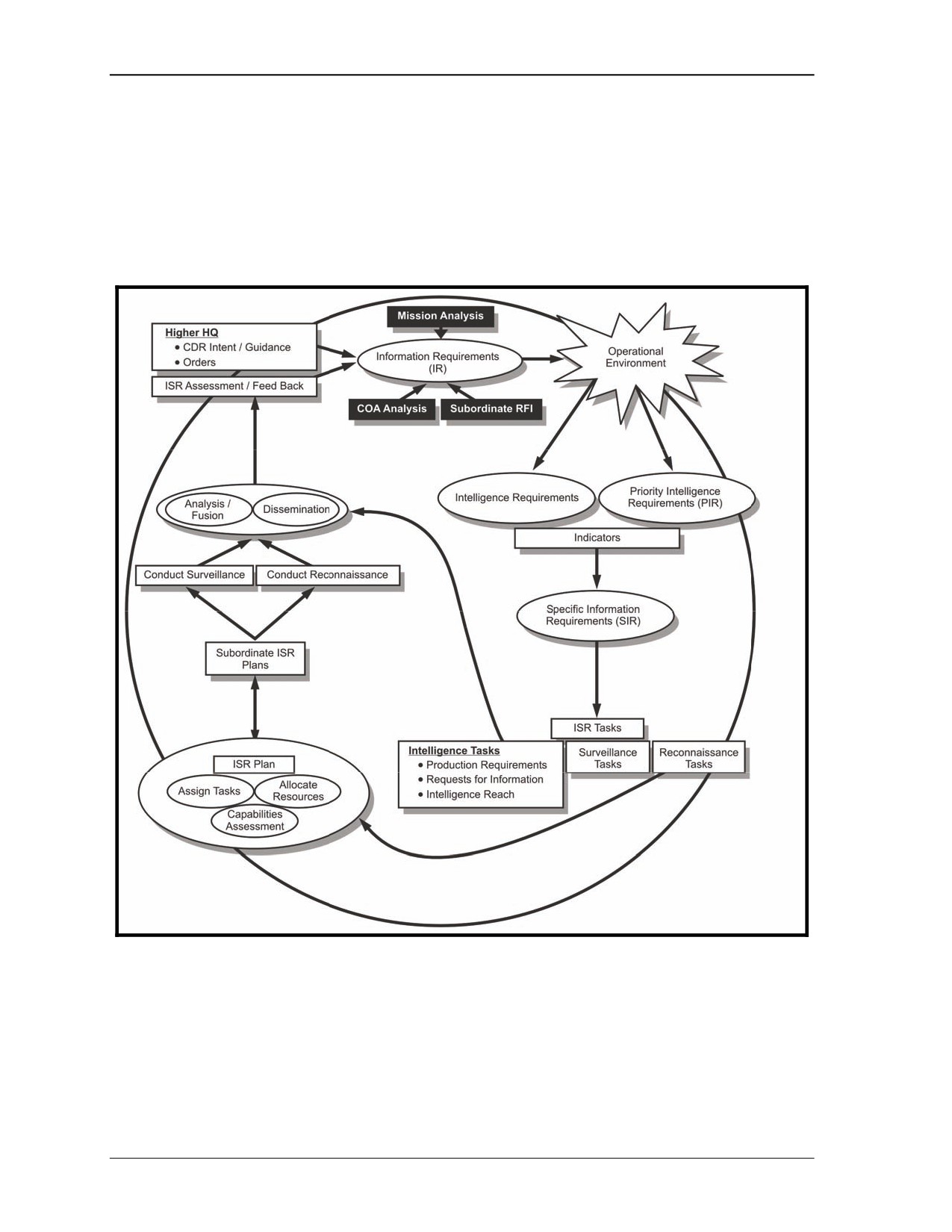
As part of the MDMP, the staff performs ISR synchronization and ISR integration to develop its
ISR plan (Figure 3-1). ISR synchronization determines the intelligence requirements that must be met,
compares them to the units or assets available and capable of collecting in the time and location required,
and balances them with the higher unit's priorities. The S-2 leads this coordinated staff effort. The product
is the ISR synchronization plan. The S-3 leads the ISR integration effort. The S-3 uses the ISR
synchronization plan to develop ISR tasks. These tasks are assigned to either the staff or subordinate units.
The ISR tasks—in conjunction with task organization, graphics, fire support plans, coordinating
instructions, and sustainment information—are merged together into the ISR plan. The BFSB ISR plan is
the basis for the BFSB operation order.
Figure 3-1. Intelligence, surveillance, and reconnaissance.
TARGET IDENTIFICATION
3-7.
Potential LRS targets are first identified by the BFSB staff during the wargaming step of the
MDMP. The BFSB S-2 ISR fusion element OIC participates in the MDMP, and during war-gaming,
assesses which potential targets best suit the capabilities of LRS teams. He normally seeks the assistance of
the R&S squadron S-3 insertion and extraction section or the LRSC commander, in evaluating the
suitability and feasibility of potential targets. He then gains the concurrence of the BFSB S-2 and S-3.
3-2
FM 3-55.93
23 June 2009
Mission Development
3-8.
The BFSB S-3 notifies the R&S squadron S-3, who consults with the LRSC commander again
regarding the suitability and feasibility of the targets. Notification of the LRS commander is recommended
before the LRS commander receives the OPORD from the R&S Squadron because this serves as a warning
order. This allows the LRSC to start troop leading procedures (TLP).
3-9.
Simultaneously, the BFSB S-2 ISR fusion element begins developing information on each
potential target for inclusion into target folders. The target information is an essential part of the LRS
team MPF.
R&S SQUADRON PLANNING
3-10.
The same process is followed when the R&S squadron receives the BFSB OPORD, with one
exception. The R&S squadron S-2 in most cases does not have the capability to provide the target
information needed for LRS teams to plan missions. As a result, most LRS target information is developed
and disseminated by the BFSB S-2 ISR fusion element.
MISSION ORDERS
3-11.
The result of the ISR process is the need, for example, for a target to be surveiled. The higher-
level unit avoids dictating how the LRS team should conduct the mission.
LRSC PLANNING
3-12.
The LRSC receives the target information from the BFSB S-2 ISR fusion element as it becomes
available. This allows the LRSC commander to issue warning orders (WARNO) and begin to identify
assets required to conduct the anticipated mission.
3-13.
The HQ section, communications platoon leader, LRS detachment leaders, the R&S squadron S-3
insertion and extraction section, and a LRS team LNO form the planning cell and assist the LRSC
commander in the conduct of TLP. The commander ensures the OPORD provides detailed information on
the friendly and enemy situation, communications and sustainment. The commander normally writes the
company mission statement and the intent, task and purpose for each LRS team with the assistance of the
LRS detachment leaders. This information is essential to answer the question "why" the individual LRS
team is deploying to a particular target to collect specific information for the supported unit commander.
3-14.
Normally, LRS detachment leaders do not write detachment or individual LRS team OPORDs.
They act as members of the planning cell writing the company OPORD and assist in the production of
individual team MPFs. If a LRSD is deployed to an MSS, the detachment leader normally does write
an order.
3-15.
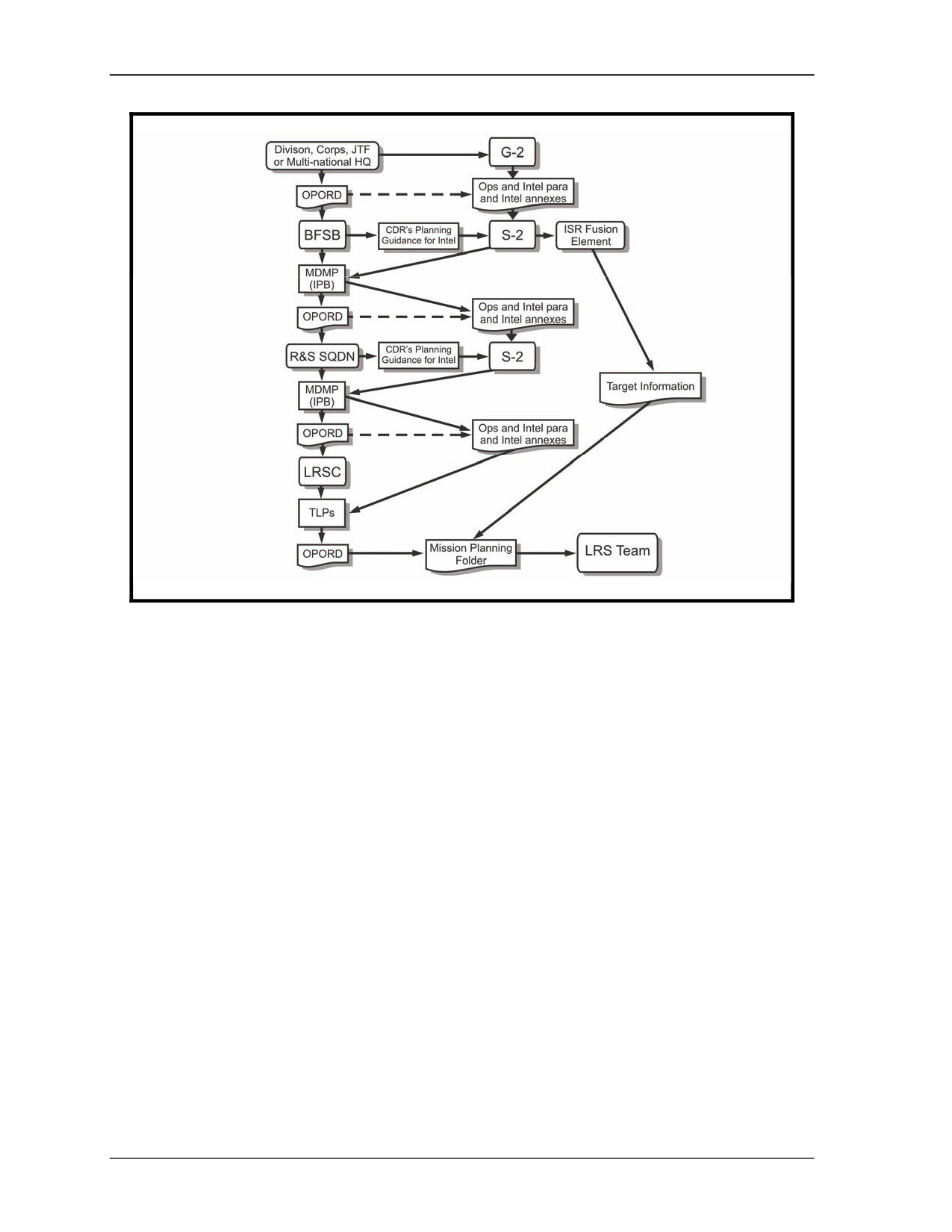
The result of the company planning efforts is an OPORD and individual LRS team MPFs. The
MPF is mission order based. It does not dictate how the mission will be performed. It does provide the
who, what, when, where and why of the mission. (Figure 3-2 summarizes the LRS mission-development
process.)
23 June 2009
FM 3-55.93
3-3
Chapter 3
Figure 3-2. LRS mission development process.
ADDITIONAL PLANNING CONSIDERATIONS
3-16.
Although LRS teams should not be held in reserve, the BFSB and R&S squadron should consider
the need to conduct continuous operations. LRS teams need to recover from missions and staffs must
anticipate needs for future operations. General guidelines for operational tempo are—1/3 of the teams
conducting missions, 1/3 preparing for employment and 1/3 recovering, training and preparing to receive a
new mission.
3-17.
As information is collected and reported from deployed teams, each organization above the LRSC
analyzes it to determine if it met any intelligence requirements. This allows each organization to make an
initial determination if it can or must task new LRS teams or reallocate other assets to collect required
information or begin collection on other priorities.
3-18.
LRS teams generally require 24 to 48 hours for deliberate planning. Planning time can be reduced
by well-written, understood, and rehearsed unit SOPs.
HASTY PLANNING
3-19.
Sometimes, less than the recommended LRS team planning time of 24 to 48 hours is available.
Although LRS teams are capable of employment on short notice, the potential benefit must be weighed
against the risk associated with hasty planning and execution. At a minimum, the following information is
needed for hasty planning and execution:
• Mission statement, to include area or object to surveil, latest time information of value
(LTIOV), and anticipated length of mission.
• PIR, intelligence requirements, associated specific information requirements (SIR), ISR tasks,
and RFIs.
3-4
FM 3-55.93
23 June 2009
Mission Development
• Enemy situation in the target area.
• Commander’s intent for intelligence (can be stated by the BFSB or R&S squadron S-2 or S-3).
• Method of insertion, with abort criteria. Coordination time and place are included, if applicable.
• Fire support plan, to include assets available.
• Exfiltration plan.
• Communications plan (provided by the LRSC headquarters).
• Linkup, if applicable.
• Contingency planning guidance.
Section II. MISSION PLANNING FOLDER
The BFSB and R&S squadron S-2 and S-3 provide information and intelligence products to support the LRS
mission. The LRSC commander, the communications platoon leader, the R&S squadron insertion and
extraction section, and the LRS team LNO request information from the staffs. After developing, collating and
packaging the information and products, the LRSC headquarters section assembles the MPF. The MPF contains
primarily three products: the LRSC operations order, the team's mission specific information, and the target
folder.
DEVELOPMENT
3-20.
The MPF is a stand-alone document prepared by the LRSC headquarters to help the LRS team
leader plan and execute his mission. It provides the LRS team leader with detailed information about his
AO and mission, including maps, photographs, sketches, climatology, area geography, and recent enemy
activity. It also provides coordination information, such as details about infiltration and exfiltration,
insertion and extraction means and corridors.
3-21.
Development of the MPF begins as soon as the LRSC is notified of a potential mission. The LRS
headquarters section, communications platoon leader, LRS detachment leaders, the insertion and extraction
section, and the LRS team LNO coordinate the mission and assemble the MPF. Requesting information
from the BFSB and R&S squadron staff elements is a critical step for MPF development. As with any
order, the LRSC company commander is ultimately responsible for the completeness and accuracy of
the document.
3-22.
Simultaneously, in writing the company order, the BFSB S-2 ISR fusion element develops
specific information about the target and compiles it into the target folder for inclusion into the MPF.
CONTENTS
3-23.
The MPF normally contains, at a minimum, base LRSC OPORD, team mission-specific
information, and target information. The MPF can also contain additional information or resources to assist
the LRS team in mission planning. This information includes: excepts from R&S squadron and BFSB
order (as required), unit SOP formats for briefings, orders, RFIs, reports, supply requests, logs, planning
area setup, and so on.
LRSC OPERATIONS ORDER
3-24.
The LRSC operations order follows the standard five-paragraph order format with annexes. In
general, the order includes the enemy road to war/enemy situation, and the mission, intent, and concept
of operations for the BFSB, R&S squadron, and LRSC commanders. If a LRSD is operating independently
of the LRSC in an MSS, the detachment leader will substitute his mission, intent, and concept of the
operation for the LRSC commander.
23 June 2009
FM 3-55.93
3-5
Chapter 3
3-25.
The LRSC operations order does not contain information that is specific to individual LRS team
missions. For example, paragraph 5, command and signal, will provide information on the location of
COB, AOB, frequency ranges used (which radios to carry) and when reports are expected. It will not
contain the specific frequencies or times for communications windows the individual teams will use.
LRS TEAM-SPECIFIC OPERATIONS INFORMATION
3-26.
Operational security considerations require that each team knows only the specific information
that is pertinent to their mission. While commanders can make exceptions to this general rule, each team is
only provided the information they need to conduct their specific mission.
3-27.
Normally, the LRS team specific operations information also follows the standard five-paragraph
order format with annexes. The information contained in this document will not repeat information
contained within the LRSC operations order but is formatted to supplement the company order. For
example, paragraph 5, command and signal, will specify the frequencies, communications windows and
code words the individual team will use.
3-28.
The planning for a LRS team is largely a bottom-up process. The LRSC provides information and
packages the contents to assist the LRS team in analyzing and completing their plan. The information
should most importantly be complete and through. Also, the information should be presented in a form that
makes it easy for the team to reference and use. A common method of packaging is to provide annexes and
appendices to the base order that group information by the five phases of a LRS team operation. Examples
appendixes might cover insertion, extraction, evasion, and communications. Below is a list of items
normally covered in the LRS team base order, appendices or annexes:
Critical Times
• Time schedule during planning.
• Event times during operations.
Fire Support
• Task and purpose.
• Supporting units.
• Unit locations.
• Frequencies and call signs.
• Type and size of fire support.
• Target numbers.
• No-fire areas (NFA) or restrictive fire areas (RFA) numbers (method of control).
• High-payoff target (HPT) list.
• CAS (A- or C-type ordnance).
• Gun target lines.
• Danger close.
• Planning ranges.
Available Air Insertion and Extraction Platforms
• Air assault, Airborne, MFF insertion.
• Unit supporting and point of contact.
• Type and number of supporting aircraft.
• Aircraft capabilities such as Special Purpose Insertion and Extraction System (SPIES) and Fast
Rope Insertion and Extraction System (FRIES).
3-6
FM 3-55.93
23 June 2009
Mission Development
• Date-time group for aircraft availability.
• Air mission commander.
• Location of pickup zone.
• Tentative flight routes.
• Date-time groups for the initial planning conference and the air mission brief.
• Suppression of enemy air defenses (SEAD) plan (lethal and nonlethal).
Vehicle or Ground Insertion
• Supporting unit and point of contact.
• Type and number of vehicles.
• Date-time group (DTG) for vehicle availability.
• Pickup location.
• Tentative routes.
• Passage point date-time group and location.
• Frequencies and call signs.
• Recognition signals.
• Fire support.
Host Nation or Partisan Forces
• Supporting personnel.
• Type of insertion platform (time available and capabilities).
• Coordination for linkup.
• Linkup.
• Recognition signals.
• Routes.
Waterborne Operational Information Requirements
• Supporting unit.
• Insertion platform.
• Tables showing currents and tides (blue water).
• Tables showing currents and depths (brown water).
• Terrain at beach-landing site.
• Fire support.
Communications Data
• Frequency modulations (signal operation instructions).
• UHF TACSAT frequencies and availability.
• HF propagation charts.
• HF list.
• VHF frequency list.
23 June 2009
FM 3-55.93
3-7
Chapter 3
• Reporting procedures from LRSC or LRSD to higher headquarters.
• IP address.
Evasion Plan
• Personnel recovery procedure and evasion corridors.
• DD Form 1833 TEST (V2).
• Location of selected area for evasion (SAFE) or designated area of recovery (DAR).
• Documents that describe SAFEs.
• Blood chits.
• General survival information.
• Civilian population information.
• Cache and air resupply.
• Medical information.
• Border information.
• Food sources.
• Water sources.
• Plant and wildlife data.
• Epidemic diseases.
• Air-tasking order, special instructions, and airspace-control order.
Maps, Products, and Imagery
3-29.
These supplement target folder information.
• Gridded satellite imagery of possible LZs or PZs, recovery points, and linkup sites.
• Line of sight and field of view from the proposed surveillance site, 360 degrees from the
objective.
• Maps.
1: 250,000.
1: 100,000.
1: 50,000.
1: 25,000.
3-8
FM 3-55.93
23 June 2009
Mission Development
• Gridded satellite imagery.
• Multispace imagery products.
• Elevation tint.
• Slope tint.
• Surface drainage.
• Panoramic graphs.
• MCOO.
• Hydrology overlay and charts.
• Overlay of landing or pickup zone.
• Cover and concealment overlay.
• Operational graphics (friendly unit locations).
• Overlay of DARs (if used).
• Flight corridors and air control points.
• Enemy situational template (most dangerous and probable courses of action).
• Enemy event template.
• Photos or pictures of enemy weapon systems and uniforms.
TARGET FOLDER FORMAT
3-30.
The target folder is created by and the responsibility of the BFSB S-2 fusion element. The R&S
squadron S-3 insertion and extraction section, the S-2 section, the LRSC operations section, and the LRS
team LNO assist in the development of the target folder. The target folder format is derived from
FM 3-05.102 (Appendix C). The advantage of using this format is the standardization of the information
the BFSB S-2 fusion element is required to produce (Figure 3-3).
23 June 2009
FM 3-55.93
3-9
Chapter 3
(Classification)
Section 1: Target Identification and Description
A. Target identification data.
B. Description and significance.
C. Detailed target description.
D. Target vulnerability assessment.
Section 2: Natural Environment
A. Geographic data (including terrain and hazards to movement).
B. Meteorological data (climatologically overview and tables and
illumination data).
C. Hydrographic data (coastal, waterway, lakes, luminescence, and
so on).
Section 3: Threat
A. Ground forces.
B. Paramilitary and indigenous forces (including intelligence and
security and police services).
C. Naval forces (including Coast Guard and maritime border guard).
D. Air forces.
E. Air defense forces (including radars, passive detectors, and
C2).
F. Electronic order of battle.
G. Space-based assets.
H. Counter Intelligence environment (efforts of indigenous forces
to collect against R&S forces).
I. Other.
(Classification)
Figure 3-3. Example format for target folder.
3-10
FM 3-55.93
23 June 2009
Mission Development
(Classification)
Section 4: Demographics and Cultural Features
A. Area population characteristics.
B. Languages, dialects, and ethnic composition.
C. Social conditions.
D. Religious factors.
E. Political characteristics.
F. Economic conditions.
G. Miscellaneous (for example, currency, holidays, dress, and
customs).
Section 5: Lines of Communications and Information Systems
A. Airfields.
B. Railways.
C. Roadways.
D. Waterways.
E. Ports.
F. Petroleum, oils, and lubricants (POL).
G. Power grid.
H. Public information media and telecommunications (print, radio,
television, telephone, and so on).
Section 6: Infiltration and Exfiltration. This includes potential DZs,
LZs, recover zones, seaward launch and recovery points, and
beach landing zones.
A. Potential zones.
B. Choke points between insertion point(s) and objective.
Section 7: Survival, Evasion, Resistance, Escape, Recovery (SERER)
Data. See JP 3-50.3, Joint Doctrine for Evasion and Recovery.
A. SAFE data.
B. SAID data.
C. Survival data.
Section 8: Unique Intelligence (mission-specific requirements not
covered above)
Section 9: Intelligence Shortfalls
(Classification)
Figure 3-3. Example format for target folder (continued).
23 June 2009
FM 3-55.93
3-11
Chapter 3
(Classification)
Appendix A: Bibliography
Appendix B: Glossary
Appendix C: Imagery
Appendix D: Maps and Charts
Appendix E: Sensitive Compartmented Information (if applicable)
(Classification)
Figure 3-3. Example format for target folder (continued).
Section III. OPERATIONS SECURITY
LRS units' OPSEC measures are important planning considerations. LRS mission classification seldom falls
below SECRET during war or stability conditions. This section discusses security classifications; mission
classification; the need and procedures for separating teams during planning; and security during coordination.
PERSONNEL SECURITY
LEADERS
3-31.
Leaders require TOP SECRET clearance and inclusion on the BFSB S-2 ISR fusion element
access roster as well as TOP SECRET SCI access to national-level assets so that they can plan missions
in detail:
• LRSC commander.
• LRSC executive officer.
• LRS detachment leaders.
• LRSC communications platoon leader.
• First Sergeant.
• Operations NCO.
• Any LRSU Soldier acting as an LNO.
• The LRS team leader.
LRS TEAM MEMBERS
3-32.
Each LRS team member must hold a current SECRET clearance and access level, or higher. The
information that a LRS team needs for planning purposes is sometimes classified above the individual team
member’s access level. When a LRSU Soldier fails the mandatory investigation for a required security
clearance, he receives a transfer to a position or unit with lower clearance requirements. Members of a
LRSU who frequently engage in alcohol- or drug-related incidents, demonstrate financial or mental
instability, or violate the law are reassigned or separated from military service. The BFSB commander must
entrust a LRSU Soldier with mission-sensitive and classified information. Mishandling of information, no
matter how innocent the compromise, constitutes a serious incident.
MISSION CLASSIFICATION
3-33.
LRS missions receive SECRET-level classification due to the vulnerability of a six-man element,
which might be operating deep behind enemy lines. LRS team locations are seldom posted or mentioned on
a computer LAN, graphic or written OPORD, intelligence summary (INTSUM), or INTREP, regardless of
the classification of the dissemination vehicle. The BFSB S-2 ISR fusion element OIC, S-2s, S-3s, G-2,
3-12
FM 3-55.93
23 June 2009
Mission Development
G-3, R&S squadron, BFSB, division and corps commanders are normally the only personnel outside the
LRS operations cell that "need to know" LRS team locations. Teams working close together might need
collateral support and, therefore, might need to know. At a minimum, they publish NFAs or RFAs on the
FC's system. The system then automatically disseminates information to all units on the system. The BFSB
generally needs to coordinate with the special operations coordinator (SOCOORD) LNO at division or
corps as special forces and LRS teams might be operating in the same AO. Information provided to the
SOCOORD LNO prevents fratricide among LRS and SOF operating in the same AO.
SEPARATION
3-34.
LRS teams plan independently. What they need to know (critical information) generally depends
on mission proximity. That is, LRS teams may require support from another team in the form of a
communications relay or contact team (Joint Pub 3-50.12). The planning facility separates teams and
insolates them from distractions and mission operational pace. Each team member keeps all information
about his mission from the other teams. He only acknowledges, mentions, or discusses it with other
members of his own team. Keeping mission information internal to the team ensures that, if one team is
compromised and later captured, the enemy can only obtain information about that team and its mission.
3-35.
Teams on the ground-conducting missions avoid communicating with each other. Radio
communications are vulnerable to direction-finding (DF) equipment. Threat forces might target areas
where LRS teams could be templated to operate. The less that it knows about other teams' missions, the
more secure they and the LRSU as a whole remain.
SECURITY DURING COORDINATION
3-36.
Coordination, such as air mission briefs, can also compromise a LRS team mission. The LRS
LNO must consider OPSEC when coordinating. During an air mission brief, everyone avoids discussing
the mission location, NAI, or duration. They only discuss details such as the infiltration route, checkpoints,
call signs, and logger area.
23 June 2009
FM 3-55.93
3-13
Chapter 4
Team Operations
The success of LRS operations depends on thorough planning, acquisition of ISR
tasks and RFIs, rapid and timely reporting, and avoidance of detection.
LRS teams collect critical information for the BFSB commander in support of
division commanders' PIR. Answers to the PIR directly affect the commander's
decision-making and dictate the successful execution of military operations. This
chapter discusses the following aspects of LRS team operations:
Phases (Section I)
Reconnaissance operations (Section II)
Surveillance operations (Section III)
Combat assessment (Section IV)
Target acquisition (Section V)
Urban terrain (Section VI)
Imagery collection and transmission (Section VII)
Stability operations (Section VIII)
Special missions (Section IX)
Section I. PHASES
LRS team operations have five distinct phases--planning, infiltrating/inserting, executing
(actions on the
objective), exfiltrating/extracting, and recovering. Controlling or supporting deployed teams can overlap into
more than one phase.
PLANNING PHASE
4-1.
Detailed planning at all levels helps ensure mission success and team survival. The planning
phase starts when the commander receives the mission folder from the BFSB S-2 ISR fusion element. It
extends throughout the final inspection of the LRS team.
SEQUENCE
4-2.
In most cases, the commander, XO, first sergeant, and operations personnel participate in the
initial S-2 planning. To ensure the LRS team completes each of its planning tasks, the team follows a
detailed timeline.
Type of Planning
4-3.
The length of time available determines whether the team conducts deliberate or hasty planning.
Deliberate Planning (24 to 48 hours available for planning).
Hasty Planning (less than 24 hours available for planning).
Required Planning Events
4-4.
The LRS team should cover the following events in each planning sequence, regardless of
time available:
• Alert notification.
• N-Hour planning sequence (the sequence followed before deployment).
• H-Hour sequence (the deployment sequence).
23 June 2009
FM 3-55.93
4-1
Chapter 4
ACTIVITIES
4-5.
To make the best use of time for planning at company, detachment, and team levels, all leaders
use TLP. Table 4-1 (page 4-4 and 4-5) lists what each member of the company and detachment must do
during the planning phase.
LRSU Commander
• Receives WARNOs and OPORDs from the R&S squadron and BFSB headquarters as required.
• Reviews target information from the BFSB S-2 ISR fusion element.
• Conducts TLP and mission analysis using METT-TC.
• Prepares and issues WARNOs as required.
• Prepares and issues OPORDs as required.
• Supervises the finalization of the MPF.
• Coordinates with BFSB and R&S squadron staff members.
• Approves the location of the COB, AOBs, and MSSs.
• Receives LRS team confirmation briefs.
• Receives LRS team decision briefs.
• Receives LRS team backbriefs.
LRSC Headquarters
• Receives WARNOs and OPORDs from the R&S squadron and the BFSB headquarters.
• Receives target information from the BFSB S-2 ISR fusion element.
• Finalizes MPFs and issues to LRS team leaders as required.
• Helps commander conduct TLP to include developing and issuing WARNOs and OPORDs.
• Establishes COB (including the planning facility), AOBs and MSSs.
• Helps coordinate and finalize team mission support requirements
— Aviation.
— Fire support.
— Imagery.
— Sustainment.
• Prepares briefings as required.
Communications Platoon
• Receives company WARNOs and OPORDs.
• Helps commander conduct TLP to include developing and issuing WARNOs and OPORDs.
• Conducts TLP for the communications platoon.
• Prepares and issues WARNOs as required.
• Prepares and issues OPORDs as required.
• Supervises the finalization of the communications plan for each MPF.
• Establishes BRSs.
• Confirms all radio frequencies with R&S squadron S-6 or BFSB S-6.
4-2
FM 3-55.93
23 June 2009
Team Operations
• Develops communications plan for company WARNOs, OPORDs and communication
annexes.
• Coordinates and conducts communication rehearsals.
LRS Detachment Leader
• Receives WARNOs and OPORDs from the R&S squadron and BFSB headquarters as required.
• Receives WARNOs and OPORDs from the LRSU headquarters as required.
• Receives and reviews target information from the BFSB S-2 ISR fusion element as required.
• Helps establish the COB (including the planning facility), AOB and MSSs as required.
• Helps commander conduct TLP to include developing and issuing WARNOs and OPORDs.
• Conducts TLP for his detachment.
• Prepares and issues WARNOs as required.
• Prepares and issues OPORDs as required.
• Supervises the finalization of the MPF.
• Coordinates with BFSB and squadron staff members.
• Approves the location of MSSs in support of his LRSD.
• Receives LRS team-confirmation briefs.
• Receives LRS team-decision briefs.
• Receives LRS team backbriefs.
LRS Team Leader and Team Members
•
Receives the initial mission analysis from LRSC headquarters.
•
Receives WARNO from LRSC headquarters or LRS detachment leader.
— The team leader and radio telephone operator (RTO) normally attend.
— The RTO serves as the recorder.
•
Conducts TLP.
•
Issues team WARNOs.
•
Conducts initial inspections.
•
Moves to and establishes team area in the planning facility.
•
Receives the OPORD with mission folder from LRSC headquarters or LRS detachment leader.
•
Issues confirmation brief.
•
Receives decision brief.
•
Issues COA or decision brief to commander (after mission analysis brief).
•
Directs the activities of the team LNO.
•
Delivers OPORD to the LRS team (LRS team leader).
•
Coordinates as needed with operations personnel.
•
Memorizes plan and prepares for backbrief.
•
Backbriefs the commander or his representative.
•
Conducts final inspection.
23 June 2009
FM 3-55.93
4-3

Chapter 4
Note: The entire team normally attends the OPORD.
Table 4-1. Actions and responsibilities of LRSU personnel.
Communications
LRS detachment
Commander
Operations
Platoon
Leader
Team
LNO
Receives OPORD
[Select personnel]
Platoon leader
Accompanies commander
and MPF from R&S
accompanies
accompanies commander
Squadron S-3 or
commander
BFSB S-3
Initiates alert
Receives or relays
Receives or relays the alert
Receives or relays
Receives or
Receives or
procedures
the alert
the alert
relays alert
relays alert
Reviews mission
Establishes the
Begins mission preparation
Begins preparations
Begins
Team LNO:
folder
COB, to include
for movement to planning
preparations
Starts preparing
planning facility
facility
for movement
to move to
Conducts TLP
to planning
planning facility
facility
Company LNO:
Deploys to
higher
headquarters
Develops company
Helps develop the
Helps develop the WARNO
Helps develop the
Continues
Team LNO:
WARNO
WARNO
WARNO (as required)
preparations
continues
for movement
preparing to
to planning
move to
facility
planning facility
Issues company
Receives the
Receives WARNO
Receives WARNO
Receives
Team LNO:
WARNO
WARNO
WARNO
Receives
WARNO
Company LNO:
Establishes
contacts
Conducts mission
Helps the
Issues WARNO
Issues WARNO
Issues
Team LNO:
analysis (METT-TC)
commander
WARNO
Helps establish
conduct METT-TC
Establishes base stations
Moves to and establishes
team area in
detachment area in the
Begins initial
planning facility
Helps the commander
COB
inspections
conduct METT-TC
Helps the commander
Moves to and
Conducts mission analysis
conduct METT-TC
establishes
(METT-TC) for the PLT
team area in
Conducts mission
the planning
analysis (METT-TC) for
facility
the PLT
Develops company
Helps the
Helps the commander
Helps the commander
Continues TLP
Company LNO:
OPORD
commander
develop the OPORD
develop the OPORD
Begins
develop the
coordination
OPORD
Develop PLT OPORD
Develops PLT OPORD
Finalizes MPF
Issues company
Issues intelligence
Issues communications
Develops detachment
Receives
Team LNO:
OPORD
annex
annex, paragraph 5
OPORD (as required)
company
Receives
OPORD
company
OPORD
Receives
Begins mission
Begins BRS operations
Receives confirmation
Issues
Receives
confirmation brief
development and
brief
confirmation
guidance
coordination
brief
Provides guidance
Provides guidance
Leader--Issues
updated
WARNO to
team
4-4
FM 3-55.93
23 June 2009

Team Operations
Table 4-1. Actions and responsibilities of LRSU personnel (continued).
Communications
LRS detachment
Commander
Operations
Platoon
Leader
Team
LNO
Supervises mission
Supervises mission
Continues BRS operation
Supervises mission
Conducts mission
Assists team
preparation
preparation
preparation
analysis (METT-TC)
with analysis
and conducts
coordination
Receives COA
Supervises mission
Continues BRS operation
Receives COA
Conducts COA
Assists team
decision brief
preparation
decision brief
decision brief
with COA
Receives COA decision
decision brief
Gives guidance
Receives COA
brief
Gives guidance
decision brief
Supervises mission
Supervises mission
Continues BRS operation
Supervises mission
Develops OPORD
Assists team
preparation
preparation
preparation
with analysis
and conducts
coordination
Assists team
with OPORD
development
Supervises mission
Supervises mission
Continues BRS operation
Supervises mission
Issues team OPORD
Receives
preparation
preparation
preparation
OPORD
Receives team
Receives team
Continues BRS operation
Receives team
Conducts backbrief
Helps team
backbrief
briefback
briefback
conduct
Receives team backbrief
backbrief
Provides guidance
Provides guidance
Briefs R&S Squadron
Helps commander
Helps commander
Helps commander
Helps commander
Helps team
or BFSB
conduct briefing
conduct briefing
conduct briefing
conduct briefing
prepare and
commanders on
coordinate
team mission and
Continues BRS operation
Supervises mission
mission
execution (as
preparation
required)
Supervises mission
Supervises mission
Continues BRS operation
Supervises mission
Continues mission
Helps team
preparation
preparation
preparation
preparation
prepare and
coordinate
Checks
mission
communications
Conducts rehearsals
Supervises mission
Supervises mission
Continues BRS operation
Supervises mission
Checks
Helps team
preparation
preparation
preparation
communications
prepare and
coordinate
Conducts rehearsals
mission
Supervises mission
Supervises mission
Continues BRS operation
Supervises mission
Sterilizes planning
Helps team
preparation
preparation
preparation
facility
prepare and
coordinate
Conducts final
mission
inspection
Briefs back as needed
ORDERS
4-6.
LRSU OPORDs are very detailed and specific to LRS operations. To ensure mission success,
LRSU orders must contain all planning coordination conducted for the pending mission. For this reason,
OPORD format may deviate from the standard five-paragraph Army order format. Appendix B shows
some example orders formats used in LRSU operations.
23 June 2009
FM 3-55.93
4-5
Chapter 4
Movement Order--This stand-alone order facilitates an uncommitted, typically administrative,
unit movement. While the arrangement of the troops and vehicles should expedite their
movement and conserve time and energy, they should still maintain 360-degree security.
Warning Order--This notifies of an upcoming order or action. The WARNO can, but need not,
follow the standard five-paragraph OPORD format.
Confirmation Brief--No later than 30 minutes after receiving the unit OPORD, each subordinate
leader gives his higher commander a confirmation brief. This demonstrates his understanding
of the higher unit OPORD. It also ensures the correct focus during mission planning.
COA or Decision Brief--The team conducts a METT-TC analysis, analyzes possible COAs,
develops and compares war games. The team leader then briefs the commander on his chosen
COA, explaining the criteria he used to choose it over other possible COAs. When the team
leader finishes his briefing, the commander approves, disapproves, or modifies the COA and
gives guidance on finalizing the team plan.
Operations Order--The unit leader uses the OPORD to coordinate the actions of subordinates in
the execution of an operation. Sometimes called the five-paragraph field order, this order
describes, at a minimum, the task organization, situation, mission, execution, administrative
and logistics support, and command and signal requirements for the specific operation.
Fragmentary Order--An abbreviated OPORD, used to update the original OPORD. Fragmentary
orders (FRAGO) can be issued anytime. Although the FRAGO follows the five-paragraph
OPORD format, it normally only includes the paragraphs or items that have changed. New
missions or significant mission changes require a new OPORD rather than just a FRAGO.
Backbrief--A briefing by subordinates to the commander to review how subordinates intend to
accomplish their mission (FM 1-02). The backbrief can be a formal or informal presentation.
During the backbrief, each leader conveys detailed information about the planned mission as he
understands it. This gives the recipient of the briefing an idea of the leader and unit's ability to
conduct a planned mission. After listening to the subordinate leader's backbrief, each leader
briefs back his own understanding of the mission to his higher as required. The unit SOP
usually identifies who briefs whom and what must be briefed.
PLANNING PROCEDURES
4-7.
The LRSU uses detailed planning procedures to enhance mission planning and OPSEC. Unit
SOPs and leaders cover planning procedures in detail. Each LRSU should have a planning facility, with
a separate planning area for each team planning for a mission. In the planning area, the team only sees
mission-essential personnel such as the LNO, members of the planning cell, or others on the access
roster. The unit maintains OPSEC at all times to avoid compromising the teams and the mission. "Need
to know" applies: The less each Soldier knows about the other teams' missions, the less can be divulged
in case of capture.
4-8.
The planning facility location can vary, but the unit can locate it wherever they can achieve the
objective of separating a LRS team during planning from the remainder of the unit. A planning facility
can be located at an intermediate staging base, depending on the unit's deployment plan. The planning
facility can use tents, buildings, hangers, or navy vessels. The exact structures used matter less than the
ability to achieve and maintain security and separation. A planning facility should only have one
controlled entrance, and the unit must maintain an access roster.
4-9.
An ideal planning facility has separate sleeping quarters, showers, electricity, heat or
air-conditioning, and a latrine for each team. If possible, the planning facility should be structured to
make the teams' accommodations comfortable.
4-6
FM 3-55.93
23 June 2009
Team Operations
TROOP LEADING PROCEDURES
4-10.
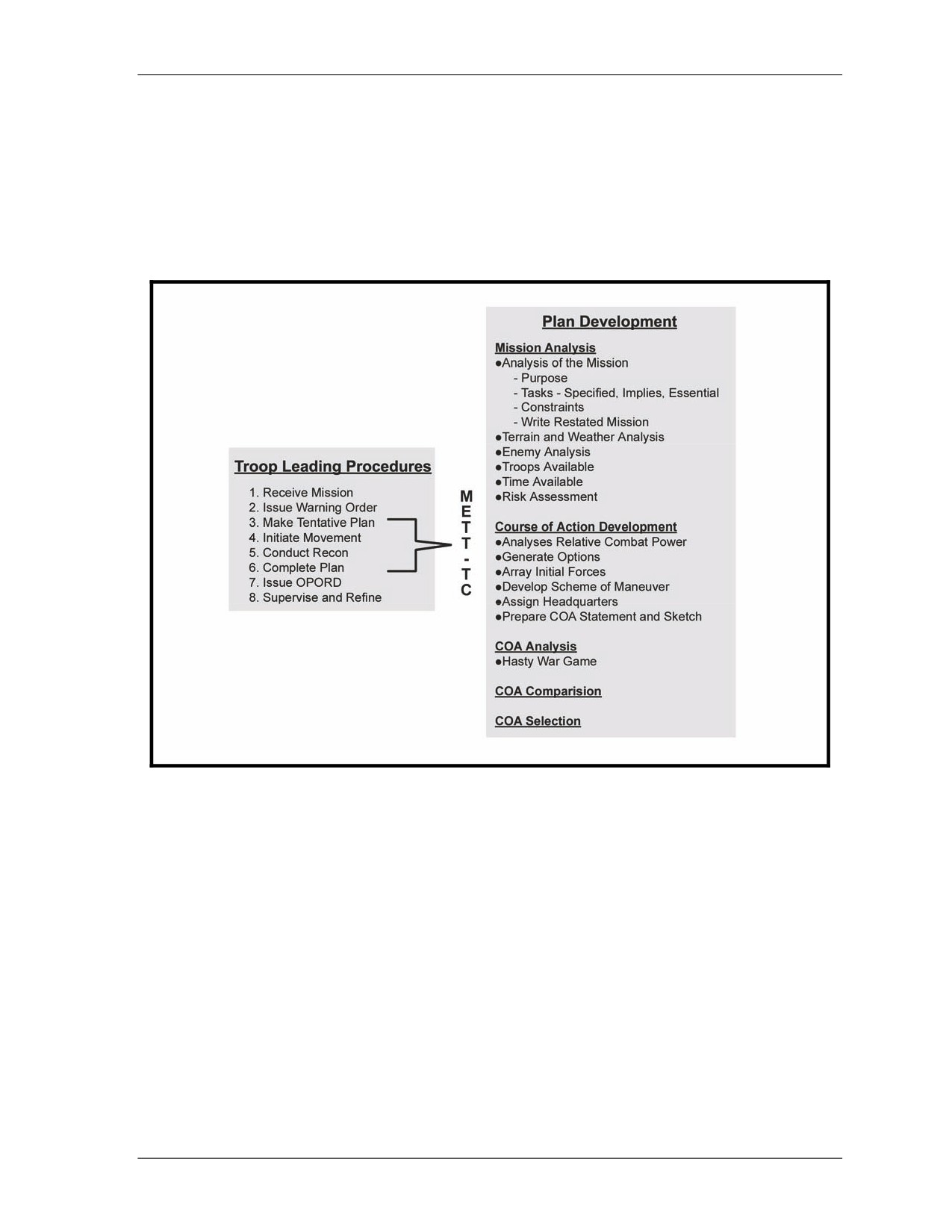
The TLP provides leaders at company level and below with a framework to develop plans and
orders, and to prepare for operations. TLP is a dynamic process used by small unit leaders to analyze a
mission, develop a plan, and prepare for an operation. These procedures enable leaders to maximize
available planning time while developing effective plans and adequately preparing their unit(s) for an
operation. The TLP have eight steps, shown in Figure 4-1. The sequence is not rigid. They can be
modified to meet the mission, situation, and available time. Some steps are performed concurrently,
while others may continue throughout the operation (FM 5-0).
Figure 4-1. TLP and METT-TC.
4-11.
LRS teams use TLP slightly differently than do other units. Normally, Steps 3 and 4 reverse,
because the team moves to the planning facility before receiving the company OPORD and making a
tentative plan (mission analysis). After Step 7, the team usually must backbrief to gain approval to
conduct the mission. The following description of how TLP are executed uses the LRS team as an
example. However, other LRSU leaders use TLP the same way:
Receive the Mission
4-12.
Detailed planning ensures mission success and team survival. On receipt of the WARNO, the
team begins an intensive preparatory phase at the unit area. The team leader has the team start initial
inspections and prepare for movement to the planning facility. Occasionally, the team may need to
receive the initial mission briefing (OPORD with MPF) at this time. However, it is preferred this briefing
occur after the team is in the planning facility.
23 June 2009
FM 3-55.93
4-7
Chapter 4
Perform an Initial Assessment--During the initial assessment, the team leader conducts a
METT-TC analysis with the available information. The team leader shares the results of this
analysis with the team that are necessary to complete details of the WARNO. Details of the
analysis may be withheld from the team for OPSEC reasons until arrival at the planning
facility.
Allocate the Available Time--The LRS team leader produces a time schedule based on the
information received in the company or detachment WARNO. Using the reverse planning
methodology, knowing critical times and experienced judgment on time estimates for events
are essential in creating a realistic time schedule. The team leader should also consider potential
changes to the time schedule. For example, if the team were ordered to execute the mission six
hours early, the team leader must determine what remaining critical must still be completed to
ensure mission success.
Issue the Warning Order
4-13.
The team leader issues a WARNO to the team. This WARNO generally provides the same
information as the company WARNO, with the addition of both general and team-specific instructions
(Appendix B).
Initiate Movement
4-14.
After the inspections, the team compiles a list of deficiencies and an initial supply request. The
team and LNO move to the planning facility area, where they set up the planning facility IAW unit SOP
(Appendix D).
Make a Tentative Plan
4-15.
Making a plan combines mission analysis, COA development, COA analysis, COA comparison,
and COA approval. The team leader and RTO normally receive the mission briefing from the
commander, detachment leader, or the operations section. At the same briefing, the team leader receives
the mission folder. Following the briefing, the team leader conducts a confirmation briefing. The team
leader, with the assistance of the team, conducts mission analysis using METT-TC.
Conduct a Confirmation Brief
4-16.
Immediately following the OPORD, the team leader briefs the commander or detachment leader
to confirm that he understands the mission and the commander's intent. (Appendix B provides an
example confirmation brief.) Before mission planning begins, the team leader may give the team an
updated WARNO based on material in the company OPORD.
Begin Team-Planning Process
4-17.
The team begins the planning process. The team leader might conduct a visual reconnaissance
of the AO. If feasible, the senior scout accompanies him. While he reconnoiters, the assistant team leader
supervises equipment and personnel preparation. TOC personnel make themselves available for
coordination throughout the planning phase.
Note: The OPORD, not the backbrief, drives planning. The backbrief is just a form
of rehearsal.
Analyze the Mission
4-18.
The team leader reviews and studies the mission, first identifying the specified and implied
tasks. From the specified and implied tasks, the team leader identifies the essential tasks. These tasks
must be completed to accomplish the mission. Failure to complete an essential task results in mission
failure. He also identifies any constraints. The product of this part of the mission analysis is the restated
mission.
4-8
FM 3-55.93
23 June 2009
Team Operations
Mission Statement
4-19.
The restated mission is a simple, concise expression of the essential tasks the unit must
accomplish, and the purpose to be achieved. The mission statement says who (the unit), what (the task),
when (either the critical time or on order), where (location), and why (the purpose of the operation).
Each mission statement has three distinct elements: operation, task, and purpose:
Operation
4-20.
This is a military action. It consists of all the processes involved with combat: movement,
supply, attack, defense, and maneuvers to gain objectives. LRSU conduct the following four operations:
Surveillance--This is a systematic observation of airspace or surface area by visual, aural (hearing),
electronic, photographic, or other means.
Reconnaissance--This is any action taken to obtain information about the operational area. It
includes any visual or other detection methods taken to learn the enemy's or potential enemy's
activities and resources and the area's meteorological, hydrographic, or geographic
characteristics.
Target Acquisition--This is the detection, identification, and location of a target in sufficient detail
to permit the effective employment of weapons against it.
Target Interdiction--This is any action taken to divert, disrupt, delay, or destroy the enemy's surface
military potential before it can be used effectively against friendly forces.
Task
4-21.
A task is a clearly defined, measurable activity accomplished by individuals and organizations.
(Table 4-2 identifies LRS tasks by operation.) A task includes specific actions that contribute to mission
accomplishment or other requirements. A task is definable, obtainable, and decisive; and it is either
specified or implied. A specified task is stated in the WARNO, mission order, annex, or overlay, or the
commander directs it. An implied task is neither specified, routine, nor included in the SOP, yet it is
inherent and mission specific. It is deduced from the order and its products:
Observe--This is the visual; audible; or mechanical, electrical, or photographic monitoring of enemy
activities. It applies to missions in which the enemy's location is known or strongly suspected, such
as an NAI where the enemy must pass.
Locate--This is to search or examine an area to find an enemy (or his equipment) known to be present
in the AO, but whose specific location is unknown.
Detect--This is to discover or discern the existence or presence of enemy activity. This task applies to
missions in which little, if anything is known about the enemy. The enemy may or may not
be present.
Determine--This is to decide or settle conclusively that this task applies to missions in which much
information is known about the enemy. However, some questions still exist about his exact
disposition, location, or content. This mission is to gather one or two specified intelligence
requirements.
Identify--This is to positively recognize enemy units, formations, equipment, and so on.
Evaluate--This is to examine and judge carefully and place a value or worth on the condition and state
of specified structures or enemy capabilities. Structures or enemy location are known.
Confirm--This is to support or establish certainty or validity.
Deny--This is to prove untrue or invalid.
Report--This is to communicate collected information accurately and in a timely manner.
Mark--This is to designate a target by using lasers or other marking devices.
Pinpoint--This is to locate and precisely identify a target for engagement without using lasers.
23 June 2009
FM 3-55.93
4-9
Chapter 4
Measure--This is to estimate by comparing two distances.
Attack by fire--This is to use direct fires, supported by indirect fires, to engage an enemy without
closing with him to destroy, suppress, fix, or deceive him.
Suppress--This results in the temporary degradation of the performance of a force or weapons system
below the level needed to accomplish the mission.
Disrupt--This is to integrate direct and indirect fires, terrain, and obstacles to upset an enemy’s
formation or tempo, interrupt his timetable, or cause his forces to commit prematurely or attack in
piecemeal fashion.
Table 4-2. LRS tasks by operation.
Target
Target
Operation
Surveillance
Reconnaissance
Acquisition
Interdiction
TASKS:
• Observe
• Report
• Mark
• Attack-by-fire
• Locate
• Locate
• Locate
• Suppress
• Detect
• Detect
• Detect
• Disrupt
• Determine
• Identify
• Identify
• Identify
• Confirm
• Pinpoint
• Evaluate
• Deny
• Report
• Pinpoint
• Confirm
• Deny
Purpose
4-22.
The purpose generally supports the BFSB’s purpose and is the same as other Army operations.
LRSU study strengths, dispositions, composition, and capabilities of the friendly and enemy forces that
could affect the team's mission.
• Plan use of time and prepare a written schedule for required actions. Include--
— Time.
— Event.
— Place.
— Uniform.
— Personnel who will attend.
• Use the reverse-planning technique.
• Select and request equipment (routine and special).
Enemy
4-23.
The MPF provides information about the enemy’s composition, disposition, strength, recent
activities, ability to reinforce, and possible COAs. The team also determines what they do not know
about the enemy and requests that information. It is likely the enemy situation will remain uncertain and
the experience and training of the LRS team becomes essential in determining a realistic enemy situation.
4-10
FM 3-55.93
23 June 2009
Team Operations
Terrain
4-24.
This aspect of mission analysis addresses the military aspects of terrain: observation and fields
of fire; avenues of approach; key terrain; obstacles; and cover and concealment (OAKOC). The MPF
provides significant details about the operations area including hydrology, LOS data, and locations of
potential drop zones, landing and pick-up zones.
Weather
4-25.
The five military aspects of weather include visibility, winds, precipitation, cloud cover,
temperature, and humidity (FM 34-130). The consideration of their effects is an important part of the
mission analysis. The team reviews the forecasts and conclusions available in the MPF and develops
their own conclusions on the effects of weather on the mission. The analysis considers the effects on
personnel, equipment, and supporting forces, such as air and artillery support. The team identifies the
aspects of weather that can affect the mission. They focus on factors whose effects they can mitigate. For
example, the team leader may modify SOP uniform and carrying loads based on the temperature. The
team leader checks for compliance during preparation, especially during rehearsals (FM 5-0).
Troops and Support Available
4-26.
The team leader knows the status of the teams’ morale, their experience and training, and the
strengths and weaknesses. The team leader realistically determines all available resources. This includes
possible attachments like a sniper team, target acquisition or a medic. The assessment includes knowing
the strength and status of team members and their equipment. It also includes understanding the full
array of assets in support of the team. The team knows, for example, how much indirect fire, by type, is
available, when it will become available and the time it takes to employ. They consider any new
limitations based on level of training or recent fighting.
Time Available
4-27.
The team leader continues to refine the time schedule. The team views its own tasks and enemy
actions in relation to time. Most importantly, the team leader monitors the time available. As the situation
changes, the team leader uses his experience to adjust the time schedule to ensure the team is best
prepared to accomplish the mission.
Civil Considerations
4-28.
Civil considerations are how the man-made infrastructure, civilian institutions, and attitudes and
activities of the civilian leaders, populations, and organizations within an AO influence the conduct of
military operations (FM 6-0). Rarely are military operations conducted in uninhabited areas. Most of the
time, units are surrounded by noncombatants. LRS team operations are in fact even more complicated
because they often depend on effectively hiding among the civilian population. These noncombatants
include residents of the AO, local officials, and governmental and nongovernmental organizations
(NGOs). Based on information from higher headquarters and their own knowledge and judgment, the
team leader identifies civil considerations that affect their mission. Civil considerations are analyzed in
terms of six factors, known by the memory aid ASCOPE (FM 6-0):
• Areas.
• Structures.
• Capabilities.
• Organizations.
• People.
• Events.
23 June 2009
FM 3-55.93
4-11
Chapter 4
Develop Courses of Action
4-29.
The purpose of COA development (Figure 4-2) is simple: to determine one or more ways to
accomplish the mission. Most missions and tasks can be accomplished in more than one way. However,
in a time-constrained environment, the team leader may develop only one COA. Normally, the team will
develop two or more. Usable COAs are suitable, feasible, acceptable, distinguishable, and complete. To
develop them, the team focuses on the actions the team takes at the objective and conducts a reverse plan
to the point infiltration starts.
COA DEVELOPMENT
1. Analyze relative combat power.
2. Generate options.
3. Array forces.
4. Develop the concept of operations.
5. Assign responsibilities.
6. Prepare COA statement and sketch.
Figure 4-2. Development of courses of action.
Analyze (War-Game)
4-30.
For each COA, the team thinks through the operation from beginning to end. They compare
each COA with the most likely enemy COA, given what the LRS team is doing at that instant. Normally,
small unit leaders visualize a set of actions, reactions and counteractions. The LRS team leader does this
also, but because the LRS team’s objective is to not make enemy contact, the result should minimize the
chance of contact. The team records the results of all wargames.
Compare
4-31.
The team leader compares results of all the wargames and chooses the COA that has the best
chance of mission accomplishment and preserves the team for future operations. Criteria normally
include-- mission accomplishment, time to execute the mission, risk, and posture of the team for future
operations.
Approve
4-32.
The team leader picks the COA that best supports successful mission accomplishment.
Normally, before the team continues plan development, the team leader must obtain approval for the
chosen COA. This briefing is given to the detachment leader or company commander. Once approval is
obtained and guidance given, the team begins development of the OPORD.
Conduct Reconnaissance
4-33.
Ideally, the team leader reconnoiters the area visually. If this cannot be done, then the team
leader continues to study aerial reconnaissance photos, UAS video and satellite imagery (if available).
He confirms, clarifies, and supplements information gleaned from maps and other sources.
Complete the Plan
4-34.
Complete detailed planning to include necessary coordination with all support elements
required for the mission. (Appendix G provides an example list of the necessary coordination.)
Issue the OPORD
4-35.
Include all necessary annexes. Use a detailed OPORD format.
(Appendix B provides an
example.) Use visual aids (terrain models, objective sketches, charts, photos, maps, and overlays) to
reinforce information and to help ensure the team fully understands all aspects of the mission.
4-12
FM 3-55.93
23 June 2009
Team Operations
Supervise and Inspect Soldiers
4-36.
The team leader and the assistant team leader supervise the team throughout the preparation to
ensure timely completion of all required tasks. They inspect to ensure that--
• The team takes only the equipment required for the mission.
• All equipment is functional, complete, secured, and evenly distributed.
• Resupply bundles and packages meet SOP criteria.
• Cache meets SOP criteria.
• Insertion vehicle and aircraft preparation meet SOP criteria.
Check the Communications Equipment
4-37.
Under the guidance of the team leader, the RTO checks all communications equipment on a
distant BRS (HF and UHF TACSAT). They also check--
• Internal communications with all VHF frequency modulation (FM) communications
equipment. Unserviceable and inoperable equipment is reported to the communications
NCOIC.
• For all radios, frequencies are confirmed with the frequency manager, and, if needed, more
frequencies are requested.
Rehearse Mission
4-38.
After briefing the OPORD, the team leader conducts rehearsals. This includes inspecting
personnel and equipment. During the rehearsal, the team wears the full uniform and carries all
mission-essential equipment. The unit conducts detailed, full force rehearsals, because the team needs
them to reinforce complex procedures. Terrain and conditions should, as much as possible, replicate
those expected for the actual operation. Detailed rehearsals can include transportation and OPFOR, and
as many contingencies as can be anticipated. The team simulates casualties among key personnel, with
other team members assuming their duties. Leaders continually ask team members to answer
mission-specific questions. Sand table briefings, a map study, and photograph examinations should
complement all rehearsals. At a minimum, during hasty planning, the team should rehearse actions in the
objective area (entering; maintaining; and sterilizing the hide, surveillance, and communication sites).
Otherwise, rehearsals should cover as much as possible the following, also shown in Table 4-3.
• Off-loading and assembly procedures at points of insertion.
• Movement formations.
• "Lost-man" drill.
• Security halt procedures.
• Actions at possible danger areas.
• Reaction drill for aircraft flyover (friendly or enemy).
• Countertracking techniques.
• Actions on enemy contact such as chance, near/far ambush, sniper, air attack, indirect fire, flares.
• Loading procedures at the extraction site.
• Special actions (as required), and use of new or unfamiliar equipment.
• Procedures for emplacement and recovery of a cache.
• Actions at recovery points or contact points.
• Actions in the absence of a communications plan.
• Communications during scheduled windows and initial entry.
23 June 2009
FM 3-55.93
4-13

Chapter 4
Table 4-3. Priority of actions for rehearsal.
Rehearsal Type
Hasty/
Minimal/
Detailed/
Rehearsal Actions
Critical
Important
Useful
Actions in the objective area (entering,
X
X
X
maintaining, and sterilizing the hide, surveillance,
and communication sites)
Off-loading and assembly procedures at points
X
X
of insertion
Movement formations
X
X
"Lost-man" drill
X
X
Security halt procedures
X
X
Actions at possible danger areas
X
X
Reaction drill for aircraft flyover (friendly or enemy)
X
X
Countertracking techniques
X
X
Actions on enemy contact (chance, near and far
X
X
ambush, sniper or air attack, indirect fire, flares)
Loading procedures at the extraction site
X
X
Special actions (as required) and use of new
X
X
or unfamiliar equipment
Procedures for emplacing and recovering cache
X
X
Actions at recovery points or contact points
X
X
Actions in the absence of a communications plan
X
X
Communications during scheduled windows
X
X
and initial entry
Transportation contingencies
X
Sand table briefings
X
Map study
X
Photographic examinations
X
Conduct Backbrief
4-39.
When mission planning is complete, the team briefs back the entire mission to the commander
or to the commander's designated representative. The backbrief ensures the commander that the team
understands and is prepared for the mission. They can shorten the backbrief to accommodate condensed
planning time or as the commander requests, based on his knowledge of the team's experience and on
who attends the backbrief. The team rehearses the backbrief to ensure that all team members understand
all aspects of the operation. (Appendix B provides an example backbrief format.)
Conduct Final Inspection
4-40.
The team always conducts a final inspection before the team leaves the planning area. The team
leader inspects personnel, personal equipment, and mission equipment, especially those items identified
during previous inspections or during rehearsals as needing correction. The team leader questions team
members to reinforce critical aspects of the mission.
4-14
FM 3-55.93
23 June 2009
Team Operations
Receive Intelligence Updates
4-41.
The team leader receives intelligence updates from higher and adapts his plans accordingly.
CONTROL MEASURES
4-42.
A control measure is a graphic or oral directive assigning responsibility, coordinating fires and
maneuver, and controlling combat operations. Each measure is shown graphically and easily identified
on the ground. Examples include boundaries, objectives, coordinating points, and contact points. Some
control measures that help the team leader control team actions during the mission are--
• Times of departure and return.
• Points of departure and reentry.
• Checkpoints.
• Routes.
• Forward line of own troops (FLOT).
• Phase lines (PLs).
• Restrictive fire lines (RFLs) and NFAs or RFAs.
• Decision points (DPs).
• Designated areas for recovery (DARs).
• Limits of advance (LOA).
• Recovery points.
• Contact points.
• SAFEs.
• Airspace-recovery activation signals.
• No-fly areas.
• Identification friend or foe (IFF).
FIELD PLANNING ACTIVITIES
4-43.
Leaders can conduct field planning one of two ways:
Field Planning
4-44.
This generally means conducting deliberate planning in a tent. Special considerations include--
• The number of tents required for all elements to have sufficient planning and sleeping space.
• Type and quantity of lighting required.
• Heating requirements.
• Latrine facilities.
• Dining facilities. Ideally, teams should receive at least two hot meals a day.
• Security considerations such as wire, field phones, and guards.
• Support required to construct the site and maintain it for the period required.
• Communications to supporting units during planning and conduct of the mission.
• Rehearsal areas.
23 June 2009
FM 3-55.93
4-15
Chapter 4
Patrol-Base Planning
4-45.
This refers to planning that occurs when the team receives a change of mission during the
conduct of an operation. LRS patrol-base principles apply. The team--
• Maintains security.
• Plans and issues a FRAGO.
• Plans resupply.
• Plans for continuous communications.
CONTINGENCY PLANS
4-46.
The contingency plan covers alternate, anticipated major events that could occur before, during,
and after an operation, for example--
• Replacement of team members as needed to fulfill mission requirements.
• Transportation to the planning facility.
• The planning facilities (garrison or field).
• Direct support for unserviceable equipment.
• Acquisition of mission-essential equipment.
• Security during the mission planning process.
• Reposition to COB, AOB or MSS.
INFILTRATION PHASE AND INSERTION METHOD
4-47.
The infiltration phase extends from the point of embarkation to arrival in the objective area.
Insertion method options include--
• High altitude, high opening (HAHO).
• High altitude, low opening (HALO).
• FRIES.
• SCUBA.
• SPIES.
• Air.
• Vehicle.
• Rubber boat.
• Stay behind.
• Rollover.
• Foot movement.
4-48.
Any requested SEAD and CAS start when the insertion platform crosses the FLOT and starts
moving towards the insertion point. Insertion normally ends after the team caches nonmission-essential
equipment and the insertion platform leaves the loiter area. Generally, the infiltration phase continues
with team movement from the point of insertion to the security halt, and ends before the objective rally
point (ORP). Ideally, infiltration occurs during times of limited visibility. If the team must halt during
4-16
FM 3-55.93
23 June 2009
Team Operations
periods of increased visibility, they establish a clandestine patrol base. During infiltration, the team
leader records the team's movements in the patrol log. In the log, the team leader records in detail--
• The general direction of movement.
• Deviations from planned infiltration route.
• Information about terrain and weather.
• Enemy sightings en route.
• Signs of activity.
• Grid locations.
• Any peculiarities.
• Time of initial entry report.
EXECUTION (ACTIONS ON OBJECTIVE)
4-49.
The LRS team establishes a security halt and the leader reconnoiters to identify an ORP. After
the team establishes the ORP, the leader moves out to pinpoint the objective or NAI, then to establish
surveillance. Once the reconnaissance is complete, other team members move to and establish the
tentative hide site and to set up communications with the COB or AOB. The surveillance team keeps
their "eyes on" the objective and maintains continuous communications with the hide site. The
surveillance site reports ISR tasks to the hide site.
4-50.
If the LRS team cannot establish communications, the team and the LRS COB or AOB execute
the "no communications" contingency plan (developed during the planning phase).
4-51.
The hide site sends information to the COB or AOB via HF or UHF TACSAT communications.
Once communications is established, the COB or AOB forwards the information to the BFBS S-2 ISR
fusion element over a LAN. The R&S squadron is copied on all reports.
4-52.
The LRS team keeps sending reports to the COB or AOB until the team meets the mission
completion criteria or until the LTIOV. The LRS team reports during designated communication
windows or, if the report is information answering a PIR, out of those windows. After the team pulls
back from the objective they disseminate information, collect all surveillance logs and objective
sketches.
EXFILTRATION PHASE AND EXTRACTION METHOD
4-53.
This phase starts after the team links up and disseminates information at the ORP and ends
when the team arrives at the debriefing location. Exfiltration routes normally differ from infiltration
routes. The team leader (again) keeps a patrol log, which details--
• The general direction of movement.
• Deviations from the planned exfiltration route.
• The terrain and weather.
• Enemy sightings.
• Signs of activity.
• Peculiarities.
4-54.
Extraction method options include--
• Linkup (friendly or partisan).
• Air.
• SPIES.
• Vehicle.
• Watercraft.
• Rollover.
23 June 2009
FM 3-55.93
4-17
Chapter 4
RECOVERY
4-55.
This phase starts when the LRS team returns to the debriefing site, which is normally located at
the planning facility, and starts the multiphase debriefing process. It ends with the after action review
(AAR).
DEBRIEFING PROCESS
4-56.
The whole LRS team attends all phases of the debriefing. The debriefing covers the team's
actions and all related details, chronologically, from the start of the infiltration phase, through arrival at
the debriefing site. The debriefing process normally includes the following in sequence: initial
debriefing, post initial debriefing, review of documents and other materials, follow-up debriefing, AAR
and team report of lessons learned.
Debrief Team
4-57.
A trusted and knowledgeable intelligence representative, or LRS operations personnel conducts
the debriefing, which starts NLT two hours after the team returns. The timely collection, analysis, and
dissemination of information recovered in the debrief can provide many answers needed for follow-on
missions in the objective area.
Follow-up Actions
4-58.
After the debriefing, the LRS team starts equipment maintenance, refit operations, and training
for follow-on missions.
Timing
4-59.
Every LRS team is debriefed immediately after returning from a mission. The debriefing is
important in the intelligence collection effort, especially when used to clarify and expound on
information received via reporting.
Advantages
4-60.
A debriefing can--
• Bring out unreported details that when collated with other information could alter the picture of
the enemy situation.
• Update terrain information.
• Reveal the location of downed or missing friendly aircraft.
• Highlight shortcomings in pre-mission planning in unit SOPs.
• Help reconstruct a mission in which casualties were sustained, either to recover remains or to
determine KIA, MIA, or POW status.
• Provide historical record of the mission for post-hostilities analysis.
Site
4-61.
The LRS operations and the supporting intelligence section provide a facility for the debriefing.
They must choose a quiet, secure site with few physical, visual, or audible distractions. For example, if
they set up in a tent, they should do so away from generators. Before the LRS team arrives, the
debriefing team sets up everything they need such as maps, overlays and other planning materials. They
arrange for soup and coffee to keep team members alert and active during the debriefing process. If the
debriefing team plans to record the debriefing on audio or videotape, they should set up and test the
equipment before the team arrives.
4-18
FM 3-55.93
23 June 2009
Team Operations
Written or Taped Record of Information
4-62.
Rather than recording the mission himself, the debriefer should delegate this task to two people
(written record) or one person (electronic record that is, audio or videotape). The recorder(s) should
concentrate on locations, times, direction of movement, and any other information the debriefer
identifies as important. For best results, the recorders should use two electronic recording devices so that
they can capture everything accurately. Voice and video recorders capture the facts of a debriefing and
serve as excellent historical records. When a patrol is in progress or the pace of an operation increases, a
unit can record the action and send copies of the tapes in place of formal patrol reports. Knowing that he
can hear or see a tape of the proceedings later keeps most requesters from asking to attend the live
debriefing. Operations provide the overlays produced during planning. These include the infiltration,
exfiltration, evasion and recovery (E&R), enemy situation map, and enemy SITEMP overlays. On a
clean overlay, the team records the actual routes taken. They also mark locations of key events such as
halts, enemy sightings, and signs of enemy presence or passage. On the overlay, they can add short
narratives of the events.
Protocol
4-63.
Everyone attending must understand the rules. Although informal, the initial debriefing still
follows a strict protocol. Regardless of rank, the debriefer is in charge of the debriefing at all times. This
keeps the process orderly and prevents conflict. Interested parties may submit questions or comments for
the debriefer to address during the session. This ensures that all personnel receive as much information
as possible. "Strangers" may not interrogate the team. Only the debriefer may address them during the
debriefing. This allows rapport to build between the debriefer and the team. The LRS team sits together
in the center of the room or tent, in front of a map of their operational area. The debriefer sits or stands
near the team, where they can all see and reach the maps. Other participants, such as recorders, interested
staff members, and LNOs, sit in the second or third row of chairs from the map. This reinforces the fact
that the team members are the center of the debrief. This encourages them to speak out, especially when
attendance includes only a small group of people whom the team knows.
Attendees
4-64.
The entire team, the debriefer(s), two recorders or one with an electronic recording device, the
LRSU commander, the operations sergeant, and a communications representative attend the debriefing.
A few interested parties, such as the R&S squadron or BFSB commanders, may also attend. If unable to
attend, the commanders may give their questions to the debrief team beforehand. Keeping the group
small helps the LRS and debriefing teams establish rapport. It also reduces the chance of hostilities.
Debriefer
4-65.
The debriefer focuses on helping team members reconstruct their mission. Ideally, the debriefer
is an enemy OB analyst or technician who worked with the team before they infiltrated. An enemy OB
analyst will know the team's mission, the enemy situation in general, and how to deal with information
from other sources.
Raw Data
4-66.
Before the debriefing, the team gives the intelligence section representative all team maps and
notes; patrol, surveillance, communications, and photo logs; film and sketches; captured material; and
any other relevant materials.
Time-Sensitive Information
4-67.
The intelligence staff immediately exploits time-sensitive information critical to their
commander's, or higher level, decision-making process. For example, the debriefer might ask first about
the location of insurgent safe houses, so that friendly direct-action teams can target them.
23 June 2009
FM 3-55.93
4-19
Chapter 4
TECHNIQUES
4-68.
The debriefer can use several methods to gather information. A good technique is to use a map
of the team's AO. He starts at the team's point of infiltration and follows their routes and actions through
exfiltration. He monitors the flow of information to ensure the team covers all events, sightings, and
activities up to the point of arrival at the debriefing site. After going over the initial mission information,
he segments route information. He asks specific questions, emphasizing the specific WFF that affected
the team's mission. On a clean map overlay, the team leader and other members of the team annotate
route deviations, enemy sightings, or mission-sensitive information. Rather than leading participants
through the reconstruction of the mission, he keeps them focused and asks them questions for
clarification. The team leader is the key, but not the only, speaker. He helps ensure that each member
gets the chance to say what he saw.
Prepared Questions
4-69.
The debriefer asks about observed target types.
Spot Reports
4-70.
The team elaborates on their earlier reports.
Map
4-71.
The team talks through the mission as executed.
INITIAL DEBRIEFING
4-72.
The LRS operations section, a member of the BFSB S-2 ISR fusion element and a
representative of the R&S squadron S-2 section conduct this portion of the debriefing, but other staff
elements may also attend. This debriefing should help answer PIR, intelligence requirements, SIR, and
ISR tasks and RFIs. When the team arrives, the debriefer escorts them to the site. The initial debriefing is
quick and to the point. The debriefer chooses what format and line of questioning he will use.
POST-INITIAL DEBRIEFING
4-73.
At the end of the formal debrief, a communications representative debriefs the RTO. He covers
communications-specific information when certain antennas worked best, which frequencies were best,
and other communications-specific issues. After the initial intelligence debriefing, the intelligence staff
gathers all maps, logs, notebooks, papers, exposed film, video tapes, photographs, recovered equipment,
and other material. If necessary, they inventory all rucksacks, map cases, and uniform pockets to ensure
that they have collected all items of intelligence interest. Then, they thoroughly review all of the
collected items for data and formulate more detailed questions for the next stage of debriefing. The team
remains separated from outside contact until after the follow-up debrief, but can start recovery operations
(showering, eating, sleeping, and conducting post-mission maintenance).
REVIEW OF DOCUMENTS AND OTHER MATERIAL
4-74.
The BFBS and R&S squadron S-2 sections process all of the information the team collected.
Individual members of the team can be requisitioned to clarify a sketch or log entry. The LRS team also
begins to complete a debrief report and to collate their AAR notes. The R&S squadron and LRS
operations section collects information on the adequacy of MPF, intelligence and operations support.
The original overlays and maps should not be destroyed or discarded. After properly classifying and
annotating them, the squadron S-2 files them. Later, they will go into the unit historian's archives, for
reference in case of future missions into the same AO. These artifacts, consisting of actual operations
overlays, maps, orders, and debriefing records, should go into an historical database. Though considered
of little immediate value, the information in these items assumes increased importance over time, not
only for historical reasons, but also for reference for future operations.
4-20
FM 3-55.93
23 June 2009
Team Operations
FOLLOW-UP DEBRIEF AND AFTER-ACTION REVIEW
4-75.
After individual debriefings, and not later than six hours after the team has recovered to the
debriefing site, the LRS operations section assembles the LRS team and the staff for a follow-up
debriefing and AAR. The commander may also attend. At this debriefing, the team leader summarizes
the operation, focusing on the team's stated and implied missions. He also briefs unanticipated team or
member activities such as actions to exploit a high-value source of information. Each staff section takes a
turn questioning the team members. This debriefing gives the team members the chance to raise issues of
support, communication, and coordination as well as any other perceived deficiencies in planning or
execution. The commander provides any further guidance and releases the team to prepare their AAR
and Report of Lessons Learned.
AFTER-ACTION REVIEW AND REPORT OF LESSONS LEARNED
4-76.
The AAR identifies who, what, when, why, where, and how of the operation. It permanently
records the team's major activities from planning to debriefing. As such, it serves as an extremely
important template for comparison with past missions and planning of future missions. In his report, the
team leader reflects on the operation and makes recommendations for the future. He organizes them
IAW the WFF. He states what did and did not work, and identifies how the unit's existing TTP need to
change.
Section II. RECONNAISSANCE OPERATIONS
The three forms of reconnaissance operations are area reconnaissance, zone reconnaissance and route
reconnaissance. Reconnaissance missions greatly increase a team's vulnerability and chances of compromise.
The team's mobility is generally limited to foot movement and the amount of equipment carried reduces the size
of the area they can reconnoiter. Appendix J provides example formats for reconnaissance of bridges and
routes.
AREA RECONNAISSANCE
4-77.
Area reconnaissance is a form of reconnaissance operation. It is a directed effort to obtain
detailed information concerning the terrain or enemy activity within a prescribed area (FM 1-02). The
location may be given as a grid coordinate or an objective on an overlay. The team leader organizes the
team to conduct the reconnaissance in one of two ways. Depending on the terrain and time, the team may
either use single or multiple separate reconnaissance and security elements (Figure 4-3). Reconnaissance
and security teams are normally used in any size reconnaissance patrol. When conducting reconnaissance
missions in team-sized units, the leader can organize the team in any of several ways:
• One two- to three-Soldier reconnaissance and security team conducts the reconnaissance. The
rest of the team stays at the release point and establishes a hide site.
• Two reconnaissance and security teams reconnoiter a separate portion of the objective, and then
meet at a designated linkup point.
• One reconnaissance and security team, followed closely by a security team, acting as a
quick-reaction force.
4-78.
One or two Soldiers in a reconnaissance and security team can reconnoiter, while the rest of the
element provides security. However, the number of Soldiers in a reconnaissance and security team
varies, depending on the mission. Usually, three can provide both an adequate reconnaissance and the
required security. The information used may vary according to the terrain. The most important planning
consideration is that each member of the reconnaissance and security team knows the sector or area for
which he is responsible.
23 June 2009
FM 3-55.93
4-21
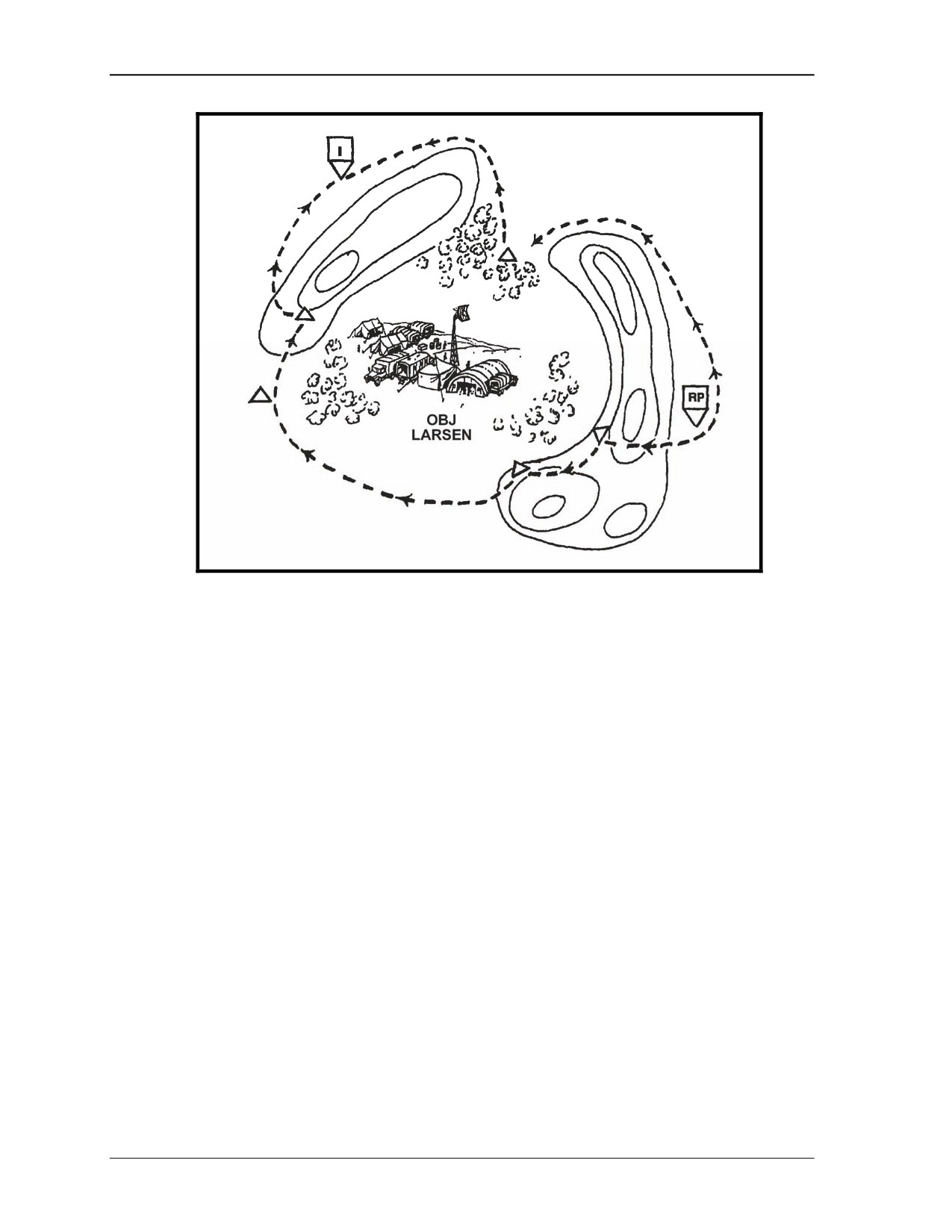
Chapter 4
Figure 4-3. Reconnaissance and surveillance elements.
4-79.
Before executing an area reconnaissance, the team develops a detailed plan using all available
information. They conduct this mission the same as they would a surveillance mission. First, the leader
pinpoints the reconnaissance objective or NAI, and second, he locates the best vantage points for a static
surveillance. The best static surveillance techniques include—
Long-Range Observation and Surveillance
4-80.
Long-range observation and surveillance means "the observation of an objective from a point"
(an observation post [OP]). The OP is normally outside enemy small-arms weapons range and local
security measures. The LRS team can use this technique whenever METT-TC lets them gather
information from a distance. It is the best way to conduct an area reconnaissance, because the team
remains far enough away to avoid detection. Using this technique also keeps the team's no-fire or
restricted fire area from overlapping with the objective area. When the reconnaissance team cannot
gather information from one OP, they can move to a series of OPs until they gather the required
information. Observation posts require adequate cover and concealment and a good view of the
objective. Routes between and from OPs to the hide site or RP also require cover and concealment.
Short-Range Observation and Surveillance
4-81.
Short-range observation and surveillance is "the observation of an objective from a place that is
within the range of enemy small-arms weapons fire and local security measures."
• Short-range observation works best when METT-TC requires a close approach to the objective
to gain information.
• The reconnaissance teams can conduct short-range observation and surveillance from OPs, but
they must usually move near the objective before they can find a place where they can observe.
In some cases, the teams may gather information by listening, even though they cannot see
the enemy.
4-22
FM 3-55.93
23 June 2009
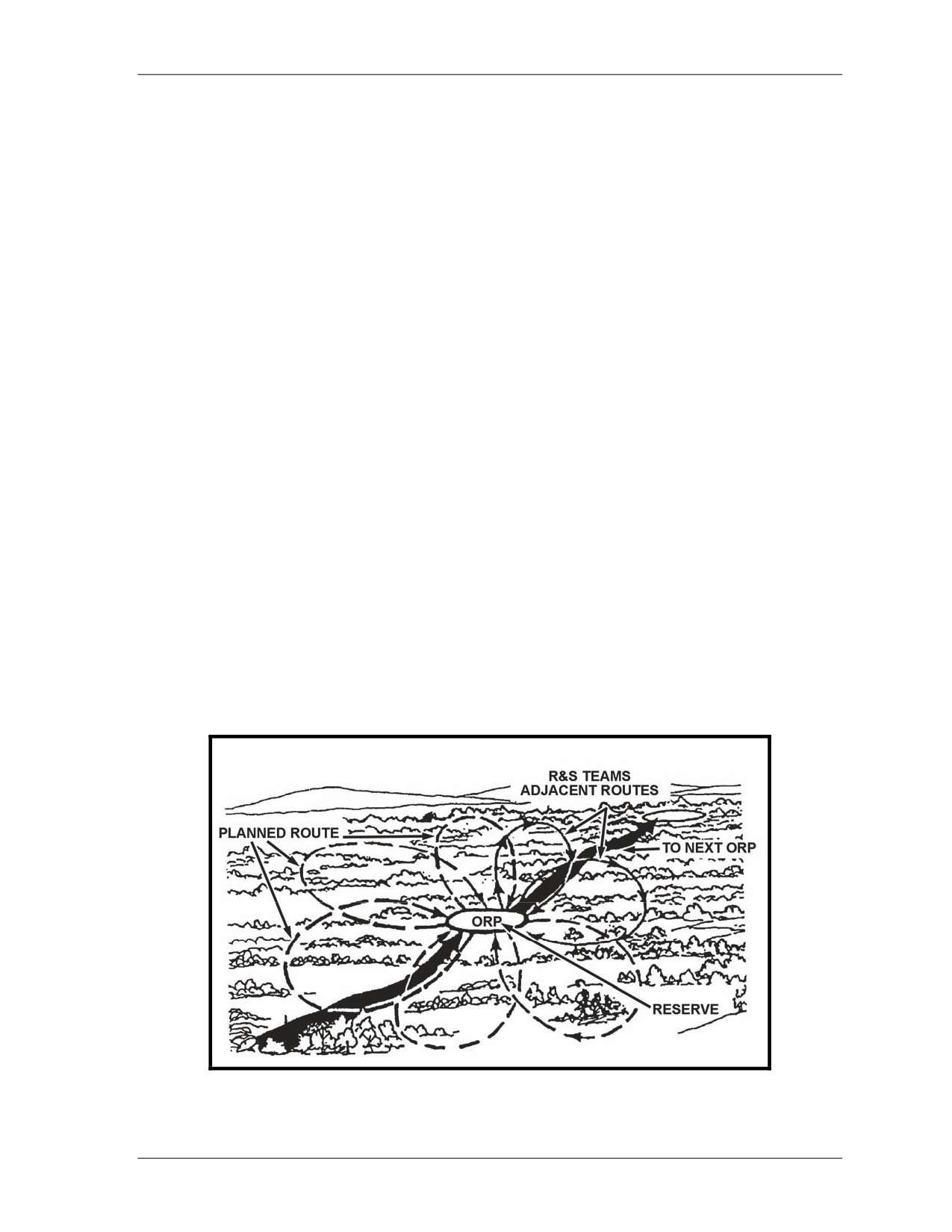
Team Operations
• Observing at short ranges increases the chance of detection. The enemy might use
anti-intrusion devices and patrols near key installations. Inclement weather can reduce the
sounds of the reconnaissance team's movement, and limited visibility favors short-range
observation. When the team must observe at short ranges, they use every means available to
avoid detection.
4-82.
To reconnoiter a road, the team leader selects multiple vantage points (OPs) along the road. The
reconnaissance element reconnoiters bridges, defiles, bends in the road, and urban areas. The
reconnaissance element reports the condition, trafficability, and width of the road; evidence of the
enemy, obstacles; bridge and ford locations and conditions; and tunnel or underpass locations and
dimensions.
4-83.
To reconnoiter a wood line, the reconnaissance element uses concealed routes and stealth to
reach the wood line and avoids contact. The reconnaissance element checks for evidence of enemy
activity such as tracks, litter, old fighting positions, mines, booby traps, and obstacles. The
reconnaissance element determines if the woods are trafficable. The element checks all positions from
which the enemy could observe and fire on friendly elements in open areas, then reports.
ZONE RECONNAISSANCE
4-84.
Zone reconnaissance is a directed effort to obtain detailed information on all routes, obstacles,
terrain, and enemy forces within a zone defined by boundaries (FM 1-02). The team obtains detailed
information about routes, obstacles, key terrain, and enemy activities in a zone established by lateral
boundaries. The team can use the fan, converging-routes, or successive-sectors method.
FAN METHOD
4-85.
The team leader selects a series of ORPs throughout the zone. When the team arrives at the first
ORP, it halts and establishes security. The team leader confirms the team's location. He then selects
reconnaissance routes to and from the ORP. The routes form a fan-shaped pattern around the ORP
(Figure 4-4). The routes must overlap to ensure that the team reconnoiters the entire area. Once the
routes are selected, the team leader sends out reconnaissance elements. He keeps a small reserve in the
ORP. For example, if the team has three reconnaissance elements, he sends two, keeping the third in
reserve. The team leader also sends the elements out on adjacent routes. This keeps the teams from
making contact in two different directions. After the team has reconnoitered the area (fan), the leader
reports the information. The team then moves to the next ORP and repeats these actions.
Figure 4-4. Fan method.
23 June 2009
FM 3-55.93
4-23
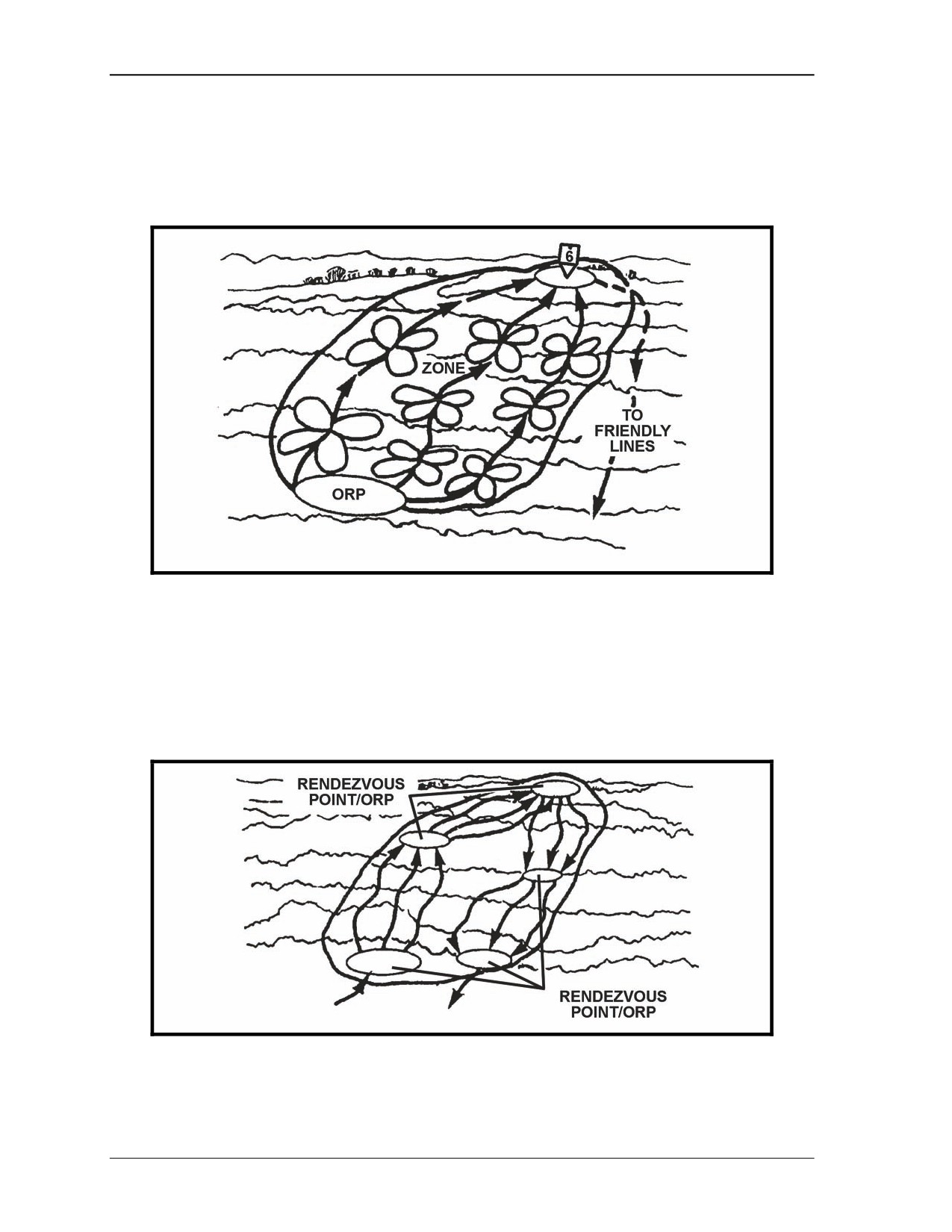
Chapter 4
CONVERGING-ROUTES METHOD
4-86.
The team leader selects an ORP, reconnaissance routes through the zone, and then a linkup
point. He sends out a sub element on each route. He normally moves with the center element. The
subunits normally reconnoiter their routes by using the fan method. The entire team meets at the linkup
point at the designated time (Figure 4-5).
Figure 4-5. Converging routes method.
SUCCESSIVE-SECTOR METHOD
4-87.
This method is a continuation of the converging-routes method. The team leader selects an
ORP, a series of reconnaissance routes, and linkup points. The actions of the team from each ORP to
each linkup point are the same as in the converging-routes method, that is, each linkup point becomes the
ORP for the next phase. When the team meets, the team leader again designates reconnaissance routes, a
linkup time, and the next linkup point. This action continues until the team has reconnoitered the entire
zone (Figure 4-6).
Figure 4-6. Successive sector method.
4-24
FM 3-55.93
23 June 2009
Team Operations
ROUTE RECONNAISSANCE
4-88.
Route reconnaissance is a directed effort to obtain detailed information of a specified route and
all terrain from which the enemy could influence movement along that route (FM 1-02).
4-89.
Route reconnaissance obtains information about enemy activity, obstacles, route conditions, and
critical terrain features along a specific route. It is generally beyond the capability of a LRS team to
obtain precise data for road curves, widths and heights of underpasses, and dimensions of tunnels.
However, they can report the types of vehicles that use the roads, or that enter or exit the tunnels. From
this, intelligence personnel can estimate the weight limits, widths, and other information about the roads,
tunnels, and underpasses. The LRS team follows the example report formats provided in FM 5-170.
Example intelligence requirements for a LRS route reconnaissance include--
• The available space (in meters) in which a force can maneuver without having to bunch up to
avoid obstacles. The size of trees and the density of forests are reported due to the effect on
vehicle movement.
• The locations of all obstacles and of any available bypass(s).
• Any enemy forces that can influence movement along the route.
• The observation and fields of fire along the route and adjacent terrain.
• The locations along the route that provide good cover and concealment.
• Trafficability along the route.
• Landing and pickup zones along the route.
• Any bridges by construction and type, estimated dimensions of each, and any vehicles crossing
the bridge. This helps intelligence personnel estimate its load classification.
BRIDGE CLASSIFICATION
4-90.
This is not a separate category of reconnaissance, but it might be a necessary part of an area,
zone, or route reconnaissance. The team follows procedures to ensure that they provide the dimensional
data needed to analyze the bridge's structure for repairs, demolition, or military-load classification.
Seldom can a team obtain precise measurements. However, if possible, they report the type and number
of vehicles that cross the bridge. Intelligence can then estimate the weight, height, and weight limit of the
bridge (FM 5-170).
LEADER RECONNAISSANCE
4-91.
The leader plans and reconnoiters all primary and alternate surveillance and hide sites. The
criteria for selecting these sites is similar, except that the hide site must be sited to allow for long-range
communications, and the surveillance site must allow round-the-clock surveillance. Leaders evaluate all
primary and alternate sites based on the following criteria, then they establish and disseminate rally
points and break out plans for all sites:
HIDE SITE
• Does the site facilitate long-range (HF or UHF TACSAT) communications?
• Does the area provide concealment as well as routes of ingress and egress?
• Are dominant or unusual terrain features located nearby?
• Is the area wet, does it have adequate drainage, or is it prone to flooding?
• Is the area a place that the enemy would want to occupy?
• Is the site silhouetted against the skyline or a contrasting background?
• Are roads or trails located nearby?
23 June 2009
FM 3-55.93
4-25
Chapter 4
• Are other natural lines of drift located nearby?
• Could the hide personnel become trapped easily in the site?
• Do obstacles, such as a ditch, fence, wall, stream, or river, prevent vehicle movement nearby?
• Are any inhabited areas located in the prevailing downwind area?
• Are any suitable communication sites located nearby?
• Is the site in the normal line of vision of enemy personnel in the area?
• Is there a source of water in the area?
SURVEILLANCE SITE
•
Can the team place the designated surveillance target(s) under constant and effective
observation and within the range of surveillance devices to be used?
•
Would the surveillance site have to move if weather and light conditions change?
•
Does the area provide concealment?
•
Does the area provide adequate egress routes?
•
Are dominant or unusual terrain features located nearby?
•
Is the area wet, does it have adequate drainage, or is the area prone to flooding?
•
Would the enemy want to occupy this area?
•
Is the site silhouetted against the skyline or a contrasting background?
•
Are any roads or trails located nearby?
•
Are any other natural lines of drift located nearby such as gullies, draws, or any terrain easy for
foot movement?
•
Could the surveillance team become trapped easily in the site?
•
Do any obstacles, such as a roadside ditch, fence, wall, stream, or river, prevent vehicle
movement nearby?
•
Are any inhabited areas located in the prevailing downwind area?
•
Is the site in the normal line of vision of enemy personnel in the area?
•
Is there a source of water in the area?
•
Does the site facilitate communications?
Section III. SURVEILLANCE OPERATIONS
This section discusses selection and occupation of sites; security and reports; linkup and dissemination of
information; contingencies and heavy team and platoon operations.
SELECTION AND OCCUPATION OF SITES
4-92.
After he completes his reconnaissance (described in Section II), the leader selects the hide and
surveillance sites. While selecting the sites, he determines whether each site will have
nonmission-essential equipment. His decision determines the size of sites to construct and the type of
breakout drills that the team must perform, if required.
4-26
FM 3-55.93
23 June 2009
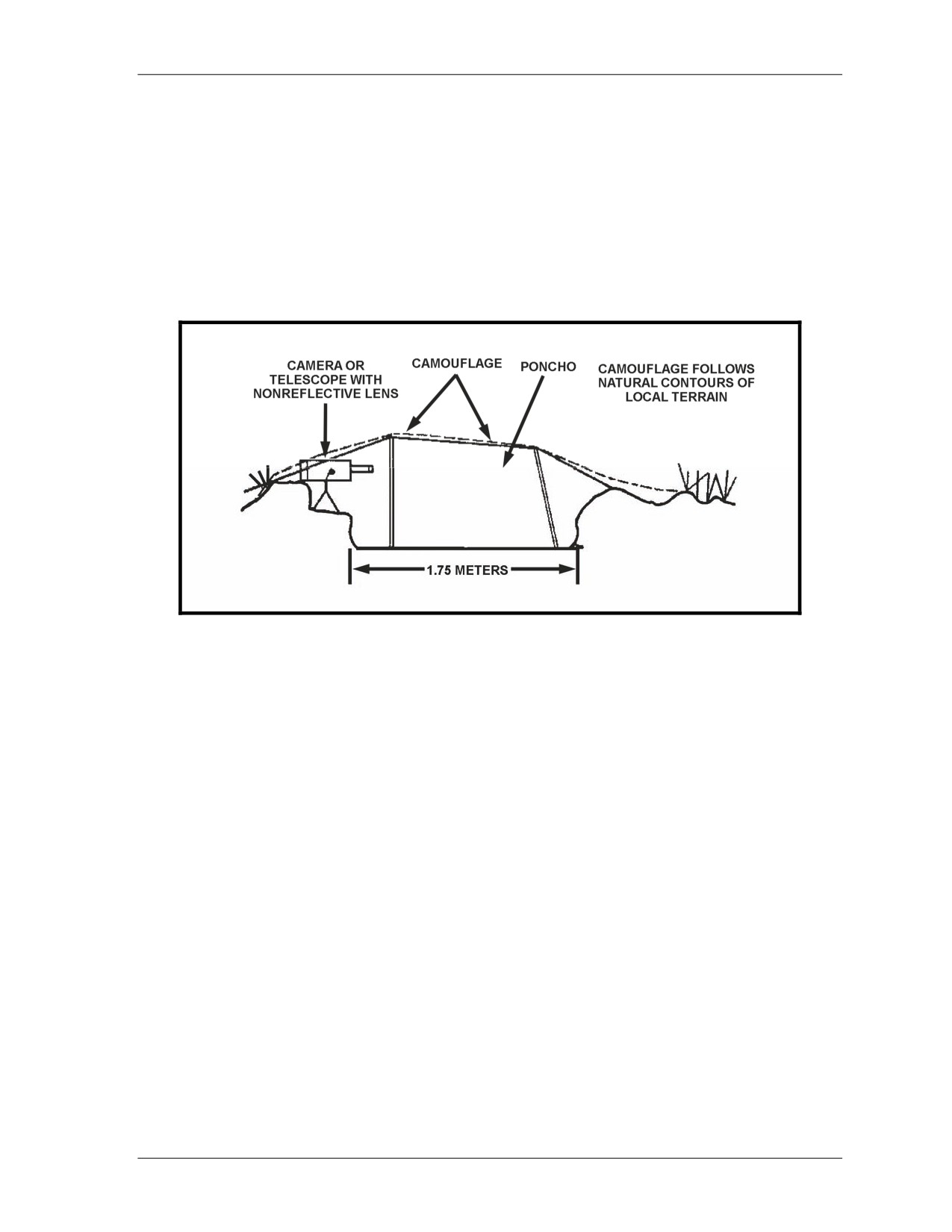
Team Operations
HIDE SITE
4-93.
The team should test communications from the tentative site before they start constructing it.
Otherwise, they might have to start over with a new site.
SURVEILLANCE SITE
4-94.
The leader selects each site based on the quality of its observation and communications with the
other site. To determine if the planned surveillance site (Figure 4-7) will work well for surveillance, the
team places all optics at the same levels they will use when they actually occupy the site, such as at
ground level. Seldom do circumstances allow for rebuilding of sites. Finally, try to minimize digging
signatures (sound and dust).
Figure 4-7. Example surveillance site.
OCCUPATION
4-95.
Teams maintain security at all time. Security personnel must emplace far enough out to detect
intruders, but must remain close enough to alert the team. A technique to alert the site of an intruder is to
simply tug on a cord tied from the security position to a Soldier at the site.
4-96.
The team should maintain all-round security, and pay close attention to the most likely avenues
of approach. Each site needs all-round observation and a view of anyone or anything in the area. This
helps prevent compromise, as it allows team members to detect movement and gives them the advantage
if they must break out of the site.
4-97.
Appendix H discusses how to construct hide and surveillance sites. In most cases, the team
should only work on a surveillance site in limited visibility, but they can work on a hide site during the
day, if needed. Generally, the team must camouflage all sites well enough to escape detection from
greater than 10 meters. The sites should blend well with the surrounding terrain in texture and form.
4-98.
The LRS team prepares and rehearses a complete breakout plan. Team members prepare
equipment for executing a breakout drill immediately. Pre-positioned M18 Claymore mines and smoke
grenades can facilitate a quick breakout of the site.
SECURITY AND REPORTS
4-99.
The team prepares and sends reports during actions on the objective from on the start of
observation activities until the dissemination of information. The reports the team members at each site
must make depend on that site's specific tasking.
23 June 2009
FM 3-55.93
4-27
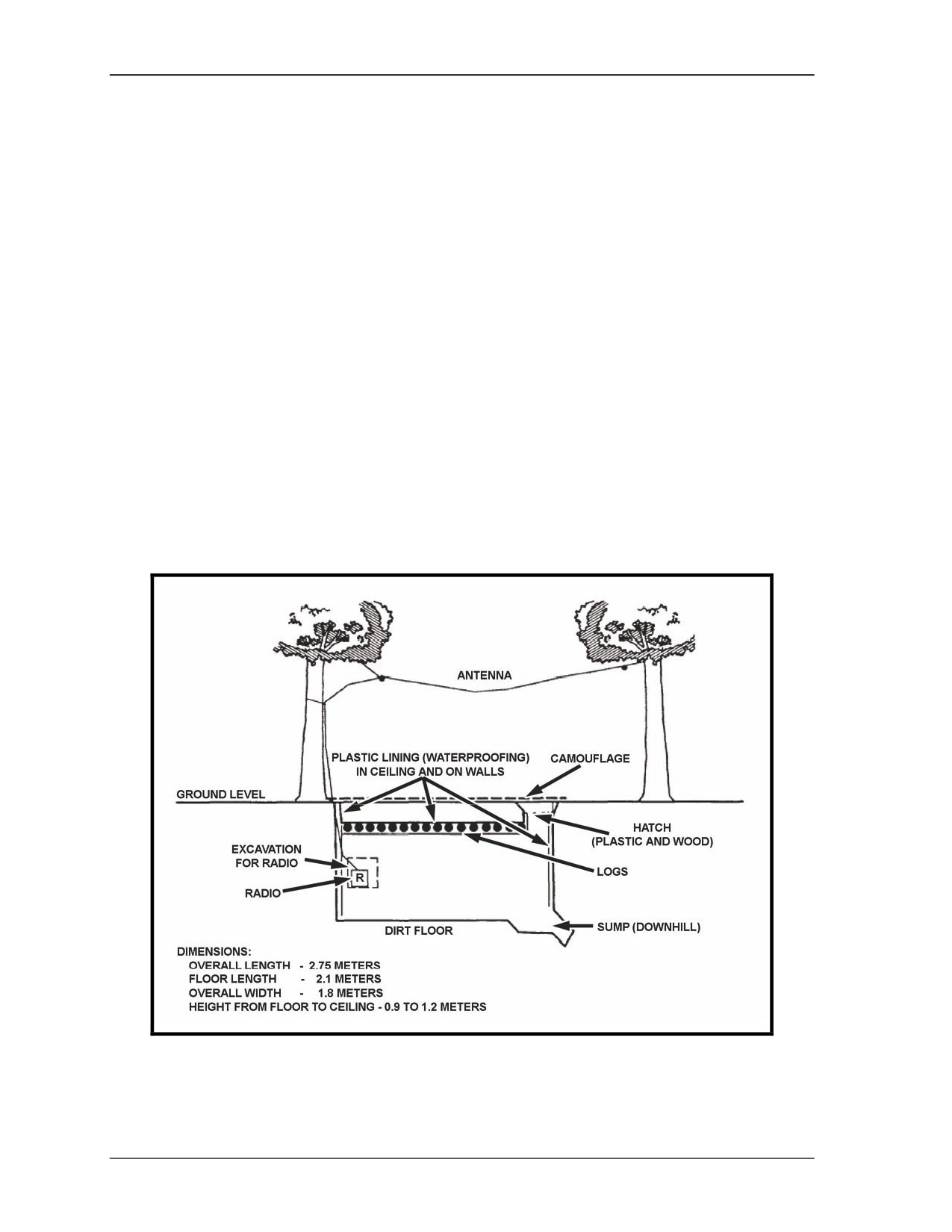
Chapter 4
HIDE SITE
4-100. The primary mission of the hide site is to facilitate team internal and long-range
communications. On long missions, team members can rotate between the surveillance and hide sites
(Figure 4-8). It is usually more secure than the surveillance site, because it is farther from the objective
and designed for hiding. Antennas, a hide site's largest signature, should remain up only when in use.
Otherwise, they are lowered or removed. One team member serves as lookout while another one
constructs or adjusts the antennas. The lookout must be able to see the enemy before the enemy sees the
Soldier working on the antennas. To prevent detection, team members minimize movement around the
site. They use countertracking whenever someone moves around the site. They also minimize noise and
light. Although the site is well camouflaged, noise and light can easily compromise the team's location.
4-101. The team keeps detailed communications and patrol logs throughout the mission. The
communications log includes—
• Exact messages sent.
• Exact messages received.
• Antennas used or tried, and their configuration time(s) and location(s).
4-102. Before any element performs a shift change in the site, all information collected at the site by
the outgoing shift is disseminated, to include—
• Message traffic.
• The status of the surveillance site.
• Any enemy activity on the objective.
Figure 4-8. Example hide site.
4-28
FM 3-55.93
23 June 2009