FM 3-55.93 LONG-RANGE SURVEILLANCE UNIT OPERATIONS (JUNE 2009) - page 5
Insertion and Extraction Methods
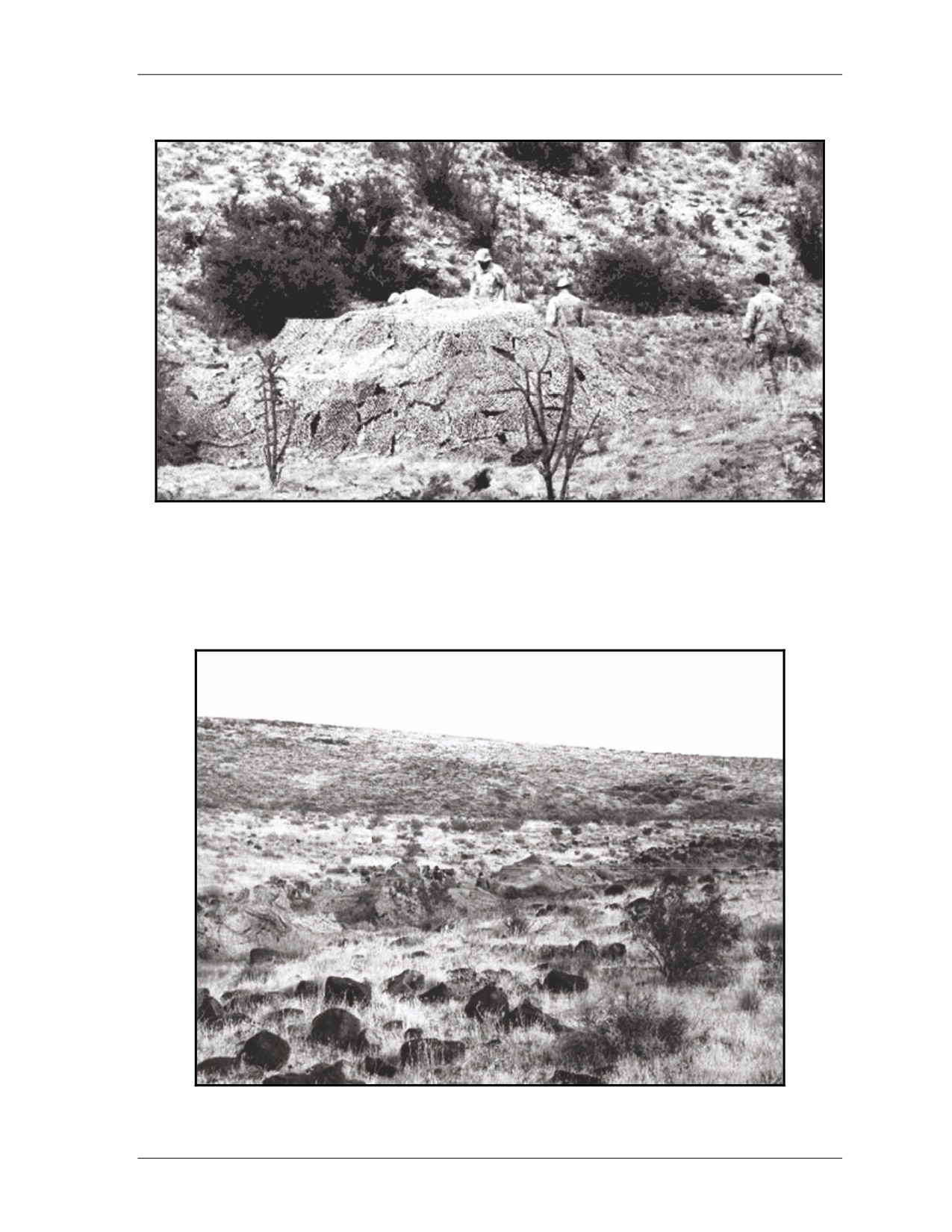
Figure 5-18. Single camouflaged HMMWV.
Camouflage
5-153. Mounted LRS teams operating behind enemy lines need to stay undetected to complete the
mission. In an unsupported role in a desert environment, a key to remaining undetected is to use proper
camouflage measures. The team’s ability to hide in the desert is limited only by the imagination and
resourcefulness of its members (Figure 5-19).
Figure 5-19. Multiple camouflaged HMMWVs.
23 June 2009
FM 3-55.93
5-43
Chapter 5
Camouflage Theory
5-154. The biggest threat to the team is detection. Detection can be by—
Direct Observation--Where the observer sees the subject with his eyes, either aided or unaided.
Indirect Observation--Where the observer sees an image of the subject and not the subject itself.
Indirect observation uses photography, radar, infrared, thermal imaging, and televideo.
Factors of Recognition
5-155. Regardless of the method of observation, certain factors help the eye and brain identify an object.
The six factors of recognition are—
Position—This factor relates to the position of the object in relation to its surroundings. In
addition, position is space relative to one object and another.
Shape—Experience teaches people to associate an object with its shape or outline. At a distance,
the outline of objects can be recognized long before the details of its makeup can be
determined. Trucks, guns, tanks, and other common military items all have distinctive outlines
that help to identify them.
Shadow—Shadow may be even more revealing than the object itself. This fact is true when
viewed from the air. Sometimes it may be more important to break up or disrupt the shadow
than the object itself.
Texture—Texture refers to the ability of an object to reflect, absorb, and diffuse light. It may be
defined as the relative smoothness or roughness of a surface. A rough surface reflects little light
and will usually appear dark to the eye or in a photo. A smooth surface such as an airstrip,
although it might be painted the same color as its surroundings, would show up as a lighter tone
on a photo. One of the most revealing breaches of camouflage discipline is shine. Shine attracts
attention by reflecting light such as sunlight or moonlight.
Contrast—Color is an aid to an observer when there is a contrast between the object and its
background. The greater the contrast in color, the more visible the object is. Usually darker
shades of a given color will be less likely to attract an observer’s attention than the lighter
shades.
Movement—The last factor of recognition is movement. Although this factor seldom reveals the
identity of an object, it is the most important one of revealing location. Movement is detected
easily and usually through the observer’s peripheral vision.
Concealment of Objects
5-156. Hiding is the concealment of an object by some form of physical screen.
Hiding—Using thick vegetation or terrain features that screen vehicles from ground observation.
In some cases, the screen itself can be invisible to detection and, at times, it is the overt screen
that protects the activity or equipment from observation.
Blending—Arranging or applying camouflage materials on, over, or around an object so that it
appears to be part of the background. Blending distinctly man-made objects into a natural
terrain pattern is necessary to maintain a normal and natural appearance.
Disguising—Simulating an object or activity so that it looks like something else. Clever disguises
will mislead the enemy as to identity, strength, and intention.
Camouflage in the Desert
5-157. Camouflage challenges encountered in the desert require special attention to overcome. The lack
of natural overhead cover, the increased range of vision, and the bright tones of terrain all require emphasis
on sitting, dispersion, and camouflage discipline to achieve concealment. Cast shadows are notably
conspicuous. Deserts generally have large areas of sand, little tall vegetation, brilliant sunlight, and
extreme temperatures. Rocky areas, steep wadis, and washes characterize desert environments. The density
5-44
FM 3-55.93
23 June 2009
Insertion and Extraction Methods
of vegetation coverage is often as high as 80 percent. Most of the vegetation is low, averaging about 30
inches high in flat areas, while in the wadis and at higher elevations, it can average close to 10 feet. When
viewed from the air, the desert floor appears spotted or pockmarked in many areas. Vegetation commonly
found in the desert includes colors ranging from pale yellow to dark gray and dark brown. Although green
and brown are the principal colors of most desert vegetation, it is important to study the target area
vegetation and terrain to formulate a proper vehicle camouflage plan. No one camouflage system or pattern
will work for every desert or even different parts of the same desert. Only with detailed planning can a
mounted detachment plan for and prepare the materials necessary to properly conceal their vehicles.
Further Camouflage Considerations
5-158. In preparing for desert operations, position selection, reflection reduction, and concealment are
conditions the team must consider--
Position Selection
5-159. Site or position selection is of critical importance in any environment but particularly so in the
desert. Site positions that fit into the existing ground pattern with minimum alteration to the terrain are
ideal. The sites selected should suppress ground observation. Some areas such as valley floors might have
sparse vegetation, but adjacent wadis could offer thicker vegetation with opportunities for defilade and
enhanced potential for concealment from aerial threats. Day laagers should not be areas that would be
obvious to enemy patrols. The team leader usually positions the vehicles to provide 360-degree security
and good concealment, and to allow rapid egress from the position.
Reflection Reduction
5-160. Reducing surfaces that reflect light is a measure that starts in garrison before deployment. It
involves removing mirrors and covering headlights and taillights. The windshield can be left on so that it
provides protection from blowing sand, dust, and rocks thrown up by the vehicle in front. The other option
is to remove the glass and have team members use eye protection. The windshield frame should not be
removed because it provides rollover protection. Team members cover all reflective surfaces with a
close-weaved, non-see-through cloth such as canvas or target cloth. They leave a sight portal open for
driving. If cloth or other material is unavailable, they mix water and dirt to get mud, and apply it to the
reflective surfaces.
Concealment
5-161. Usually the best way to conceal vehicles is with nets. Ideally, use the Lightweight Camouflage
Screening System (LWCSS) in the desert. These nets provide concealment from visual, near infrared,
radar, and target-acquisition devices. This net is not intended as a complete camouflage system as it
depends on imitation of the ground surface, both in color and texture, to be effective. In some deserts, the
woodland pattern would blend in better. Alternatives to using the LWCSS are--
• Use open-weaved cloth with color patches to match the terrain in the operational area.
This type of net might be the best choice in an area consisting mostly of sand dunes.
• Garnish a large fishing net with burlap to suit the color of the operational area.
• Add vegetation to this net to enhance concealment.
5-162. In open areas, drape the net over the vehicle and slope the sides gradually to the ground. Break up
the outline of the vehicle by placing props or poles underneath, and then intertwine vegetation into the net.
Eliminate shadows caused by the vehicle or net. In broken country, use the drape to tie the net to some
irregularity in the terrain such as next to a mesquite or brush mound. Break up the outline and eliminate
shadows. After placing the net, cut and place brush into the net to add realism, texture, and similarity to the
terrain and to help break up the outline.
23 June 2009
FM 3-55.93
5-45
Chapter 5
Maintenance and Recovery
5-163. Preventive maintenance is critical to being able to execute mounted operations. Long supply lines
and minimum stocks on hand will increase the time needed to get vital replacement items and repair parts.
Proper maintenance must be performed on equipment throughout the whole spectrum of service, that is,
before, during, and after operations.
Organization
5-164. R&S squadron units conduct operator level maintenance as with any other unit. Organization level
maintenance is provided by the BSC. The R&S squadron receives organizational support from a
maintenance team provided by the BSC. The LRSC also receives support from this BSC maintenance team.
As a result, it is highly unlikely a LRS team conducting a mounted mission will be accompanied by a
mechanic from the BSC. Therefore, the mounted LRS team should prepare itself to handle all operator and
unit maintenance during a mission. In addition, some depot-level knowledge may be necessary. Team
members regularly attend maintenance courses for the mobility platforms the unit uses.
Preventive Maintenance Checks and Services
5-165. The vehicles assigned to a mounted LRS team must be properly maintained and serviced. Its
members must perform routine PMCS on their vehicles before, during, and after all operations. The
vehicles also require regular operation. The team must perform post-operations maintenance procedures
immediately after the conclusion of each mission.
Desert Environmental Effects
5-166. Several factors affect mounted operations in a desert environment:
Rough Terrain
5-167. Severe terrain consisting of rough, uneven ground, steep mountains, and loose sand and rocks will
cause vibrations and result in the loosening of nuts, bolts, fuel, and hydraulic lines. It could also disrupt
electrical components. Rough terrain can severely affect tires, wheels, transmissions, and suspension
systems. Therefore, frequent inspections are necessary to ensure vehicles function properly and to prevent
long downtime due to repairs.
Sand and Dust
5-168. The abrasive effects of sand and dust adversely affect equipment. Any moving part faces the
probability of being damaged or impaired by sand or dust. Brakes, recoil systems, bearings, hydraulics, and
relays are all susceptible to incapacitation by sand or dust. Also, sand and dust mixed with lubricants turns
into an abrasive paste that can easily wear and score moving parts. Cover equipment when not in use.
Frequent preventive maintenance will help to alleviate these problems to a manageable degree.
Heat and Low Humidity
5-169. Surface temperatures can reach 140 degrees and reflect heat under and into vehicles. Surface
temperatures heat parts and accessories making them untouchable without protection. Such intense heat
coupled with low humidity can overheat the vehicles and batteries, and can degrade the seals and tires.
Frequent inspections, protection with covers, and regular maintenance can aid in reducing the effects of
these environmental factors.
Vegetation
5-170. In some deserts, thorny and spiny plants pose a serious problem for tires, and can puncture
radiator hoses. Use of proper individual driving techniques is the first preventive measure for stopping
flats.
Section IV. OTHER OPERATIONS
The team can also be inserted by other means such as by Airborne operations, stay-behind operations, and
foot operations.
5-46
FM 3-55.93
23 June 2009
Insertion and Extraction Methods
AIRBORNE OPERATIONS
5-171. Air insertion is the fastest way to infiltrate. LRS teams and equipment may insert by parachute, by
static line, or by free-fall techniques.
PLANNING CONSIDERATIONS
5-172. Units must plan—
• To coordinate for the suppression of enemy air defenses along the infiltration corridor.
• To determine whether enemy air defense artillery lies within artillery or naval gunfire range.
• To coordinate with the transporting unit.
• To consider and prepare for in-flight emergencies.
• To use an adverse weather aerial-delivery system during limited visibility or adverse weather.
• To dispose of parachutes, once assembled.
• Lost or dead Soldier.
LANDING PLAN
5-173. Leaders plan the operation using reverse planning. The ground tactical plan drives the other plans.
The landing plan includes—
• Place of delivery.
• Time of delivery.
• Assembly area.
• Method of delivery (type of parachutes).
• Sequence of delivery. Team may be transported on an aircraft with personnel dropping on a
different DZ.
• Load in order of the sequence of drops.
• Door bundles.
AIR MOVEMENT PLAN
5-174. The air movement plan includes the manifest, load plan, flight routes, in-flight checkpoints, flight
times, load time, station time, takeoff time, and time on target.
MARSHALING PLAN
5-175. The jumpmaster gives his briefings. The team conducts sustained Airborne training. Leaders plan
all joint tactical operations and support. The LRS team, equipment, and supplies are moved to departure
airfield. Leader must know the answers to the following questions:
• Aircraft location.
• Transportation to the airfield.
• Linkup point for transportation.
• No later than team arrival time at a specified location.
STAY-BEHIND OPERATIONS
5-176. The stay-behind team lets the enemy bypass so they can perform a specific mission behind
enemy lines.
23 June 2009
FM 3-55.93
5-47
Chapter 5
PLANNING CONSIDERATIONS
5-177. When friendly forces expect an enemy offensive and friendly defensive operations, or when
friendly forces are conducting limited offensive or reconnaissance operations, a stay-behind operation
might offer the best way for a LRS team to infiltrate. In both cases, the forward friendly unit escorts the
LRS team to the AO and provides security during site preparation.
SITE PREPARATION
5-178. Because the enemy is expected to overrun and occupy the LRS team's AO, they must prepare a
good subsurface site. The team can stock enough supplies to operate for an extended period in a subsurface
hide site. Engineer support is highly desirable in the construction of such a site (Appendix J).
FOOT MOVEMENT OPERATIONS
5-179. When traveling on foot, the LRS team departs as usual from a secure area. The team can move on
foot alone, or can combine foot and vehicle movement. They normally move during limited visibility. They
always depart from a secure area. To prevent enemy detection, they travel over rugged terrain normally not
occupied by enemy forces.
PLANNING CONSIDERATIONS
5-180. Route planning requires extensive intelligence on enemy unit locations. The team needs fire
support during movement.
INTELLIGENCE
5-181. Ground surveillance radar (GSR) can help them avoid enemy units, and radar-detection systems
alert them when the enemy uses it. Tactical communication-intercept systems can warn them of actual
enemy along the infiltration route.
SUPPLIES
5-182. The team can only carry enough supplies to move short distances for short periods of time,
normally not more than a few days. Because the team's supplies may be depleted once they arrive at the
AO, the parent unit must place a priority on resupply.
5-48
FM 3-55.93
23 June 2009
Chapter 6
Communications
This chapter discusses the networks
(Section I), operations
(Section II), radios,
computers and base radio station (Section III), reports (Section V), electronic warfare
(Section VI), antennas (Section VII) and operational environments (Section VIII),
LRSU use to send and receive near real-time information. It also discusses
communications in electronic warfare
(Section IV) and unusual environments
(Section VII).
Section I. NETWORKS
The LRSC must use several communications networks simultaneously. For example, the COB communicates
internally, to the AOB, to higher, and to deployed teams. The AOB maintains nets to the deployed teams and
the COB, and must be ready to communicate with the R&S squadron S-2, BFSB S-2, G-2, or J-2, if needed.
The LRSC maintains an internal communications net with deployed teams. The deployed team must maintain a
net to higher echelons and a team internal net.
ARCHITECTURE AND FREQUENCY MANAGEMENT
6-1.
The LRSU have sophisticated and powerful communications equipment. They must also have
access to multiple frequencies in multiple spectrums. Both are needed for the LRSU to send and receive
near-real time information over many types of digital and analog systems.
ARCHITECTURE MANAGEMENT
6-2.
The LRSU will need frequencies in the HF, VHF and UHF spectrums. Current communications
systems operate in all three spectrums. The LRSU need multiple high frequencies for HF radio systems
ever-changing optimum frequency of transmission (FOT) as well as multiple channel assignments for
automatic link-establishment (ALE) radios.
FREQUENCY MANAGEMENT
6-3.
Such complex communications require extensive frequency management. The BFSB S-6 is
responsible for requesting frequencies with the JTF, corps or division G-6 to ensure that the unit is
allocated a sufficient amount and type of frequencies to accomplish the mission The R&S squadron S-6
and the LRSC signal platoon leader submit all frequency requests thru the BFSB S-6.
OPERATIONS BASES
6-4.
Three primary networks and two backup networks are normally established for communications
between operating bases:
PRIMARY
6-5.
This includes--
• Internal wire net with tactical switching system (landline telephone).
• Tactical local area networks (LAN) for communication by computer or voice over internet
protocol (VoIP) phones.
• Combat net radios (single channel ground and Airborne radio system (SINCGARS)) and
AN/PRC-148.
23 June 2009
FM 3-55.93
6-1
Chapter 6
BACKUP
6-6.
This includes--
• HF radio.
• UHF tactical satellite radios.
• Secure cellular/satellite phones.
TEAMS
6-7.
For internal communications, the LRS teams use secure LOS combat net radio systems. Secure,
handheld, lightweight radios like the multipurpose and multiband inter/intra team radio
(MBITR)
incorporate frequency hopping
(FH) and embedded communications security
(COMSEC) that are
compatible with the SINCGARS. These radios also allow communications with other Army and joint
elements, including aircraft, and thus are ideally suited to LRS operations.
Section II. RADIOS, COMPUTERS, AND THE BASE RADIO STATION
R&S units that see everything and cannot report what they see are a wasted resource. The ability to
communicate is the lifeblood of LRSU, and radios are the heart that make this possible. LRSU must be experts
in the use of multiple radios systems and in the three primary military radio frequency spectrums: high
frequency (HF), very high frequency (VHF), and ultra high frequency (UHF). LRS Soldiers must be highly
proficient in programming, troubleshooting, and maintaining many types of radios.
ELEMENTS OF SUCCESS
6-8.
Successful communications depend on—
• The type of emission.
• The amount of transmitter power output.
• The characteristics of the transmitter antenna.
• The amount of propagation path loss.
• The characteristics of the receiving antenna.
• The amount of noise received.
• The relative sensitivity and selectivity of the receiver.
• An approved list of usable frequencies within a selected frequency range.
HF, VHF, AND UHF RADIOS
6-9.
These three radio wave spectrums combine to provide the primary and alternate means for LRSU
to effectively communicate on the battlefield.
HF RADIOS
6-10.
High frequency radios are harder to maintain than the commonly used LOS radios. However, they
provide an unbeatable combination of reliability, economy, transportability, and versatility. Under ideal
conditions, a HF radio using only 20 watts of transmitter power can successfully communicate over
thousands of miles. Knowledgeable operators, backed by well-designed antennas and by propagation
predictions from a propagation-engineering service, are key to successful HF radio system performance.
Modern HF radios, such as the AN/PRC-138 and AN/PRC-150, incorporate the technologies of ALE, link
quality analysis (LQA), embedded COMSEC, and digital modems are ideal for LRSU operations. These
radios simplify HF communications and increase reliability and interoperability (Table 6-1).
6-2
FM 3-55.93
23 June 2009

Communications
VHF RADIOS
6-11.
These are generally simple to use and provide reliable and clear, short-range tactical
communications. The SINCGARS series of radios provide tactical units excellent communications that is
easy to secure from enemy eavesdropping.
Table 6-1. Radios that work with AN/PRC-150 in various security modes.
KY-57
HF
VHF
PT
CT
External
LOS
NLOS
AN/PRC-148 MBITR
X
X
X
X
AN/PRC-152
X
X
X
X
AN/PRC-119
X
X
X
X
SINCGARS
AN/PRC-117A/D/F
X
X
X
X
AN/PRC-113
X
X
X
X
X
X
AN/PRC-138
X
X
X
X
AN/PRC-112A/C
X
X
X
MX-300B6/B12
X
X
X
X
TR720A/B/C
X
X
X
Saber 5/G6
X
X
X
X
PSC-5C/D
X
X
X
X
X
LST-5C
X
X
X
X
UHF RADIOS
6-12.
These provide reliable tactical (LOS), operational, and strategic communications. However, due to
the high demand and to potential interoperability problems with other units, it is not always practical for
LRSU to use this spectrum.
PRIMARY, ALTERNATE, AND CONTINGENCY RADIOS
6-13.
The COB and AOB maintain long-range communications with employed teams using HF and
UHF TACSAT radios. For single-channel HF radio systems, each team should have a separate frequency.
However, due to ever-changing ionosphere conditions and competition for frequencies, two teams might
have to share a single frequency. If so, the COB should set up primary, alternate, and guard frequencies;
use the primary and alternate frequencies for scheduled communications traffic; and use the guard
frequency only for priority traffic--
• To report ISR tasks.
• To request extraction and fire support.
• To request medical evacuation.
6-14.
The LRSC communications platoon leader must carefully design HF networks that use ALE. To
ensure network reliability, he must analyze in detail the number of deployed teams, the availability of
frequencies, the distances between stations, and the configurations of radio sets. Since ALE and
3G-capable radios automatically choose the best frequency for a particular radio path, he should program
separate day and night channel groups to speed link establishment.
23 June 2009
FM 3-55.93
6-3
Chapter 6
FUNDAMENTALS
6-15.
The team RTO transmits important information over the HF radio system. He continually adjusts
it to keep up with changing conditions and missions. Successful HF communications depends on his
knowledge; the type of emission (voice or data); the transmitter power output; selection of the best possible
antenna and antenna site; proper antenna construction; propagated frequencies; terrain and weather; and
atmospheric conditions. The variable over which he has the most control is antennas. To help eliminate
skip zones, the RTO can achieve the NVIS effect with any HF-friendly antenna. This lets him establish
communications with the COB or AOB. Extensive training of team members on HF radio systems and
antenna construction is essential to mission success (TC 9-64, FM 6-02.74).
BEYOND-LINE-OF-SIGHT EQUIPMENT
6-16.
In addition to communicating with many other types of digital and analog equipment, the LRSU
also requires equipment that can communicate beyond line of sight (BLOS). Tactical VHF radios like the
SINCGARS, are LOS only. The LRSU must be experts in the use of HF and TACSAT systems. Only HF
allows long-range communications without the use of terrestrial or satellite relays. The LRSU can send
either secure voice or data over HF.
SPECIALIZED RADIO MODEM
6-17.
The ALE controller (modem) automatically controls a HF receiver and transmitter. This allows
the radio to establish the best possible link with one or more HF radio stations. Each ALE controller
(radiotelephone) can be embedded (internal) or external to modern HF radio equipment. It works on the
principles of LQA and--
• Has in memory a predetermined set of frequencies, each properly propagated for conditions.
• Continuously scans its memory channels, typically about two channels per second.
• Has call signs programmed in, including own (SELF) and network's.
-- Network (NET) call signs.
-- Group (GROUP) call signs.
-- Individual (IND) call signs.
• Transmits LQA, each of which sounds the programmed frequencies to find the one with the
best link quality factors on a regular or automated schedule or when initiated by the operator.
• In a listening mode, logs each station's call sign and ranks the station's associated frequencies
and channels based on the quality of the link.
• When someone at the station wants to place a call, tries to link to the outstation using the data
collected during ALE and sounding activities. In the absence of this data, seeks the station and
tries to link a logical circuit between two users on a network with all channels working. When
the receiving station hears its address, the ALE controllers stop scanning channels and remain
at that frequency. Each station notifies users that it has found the other station and is checking
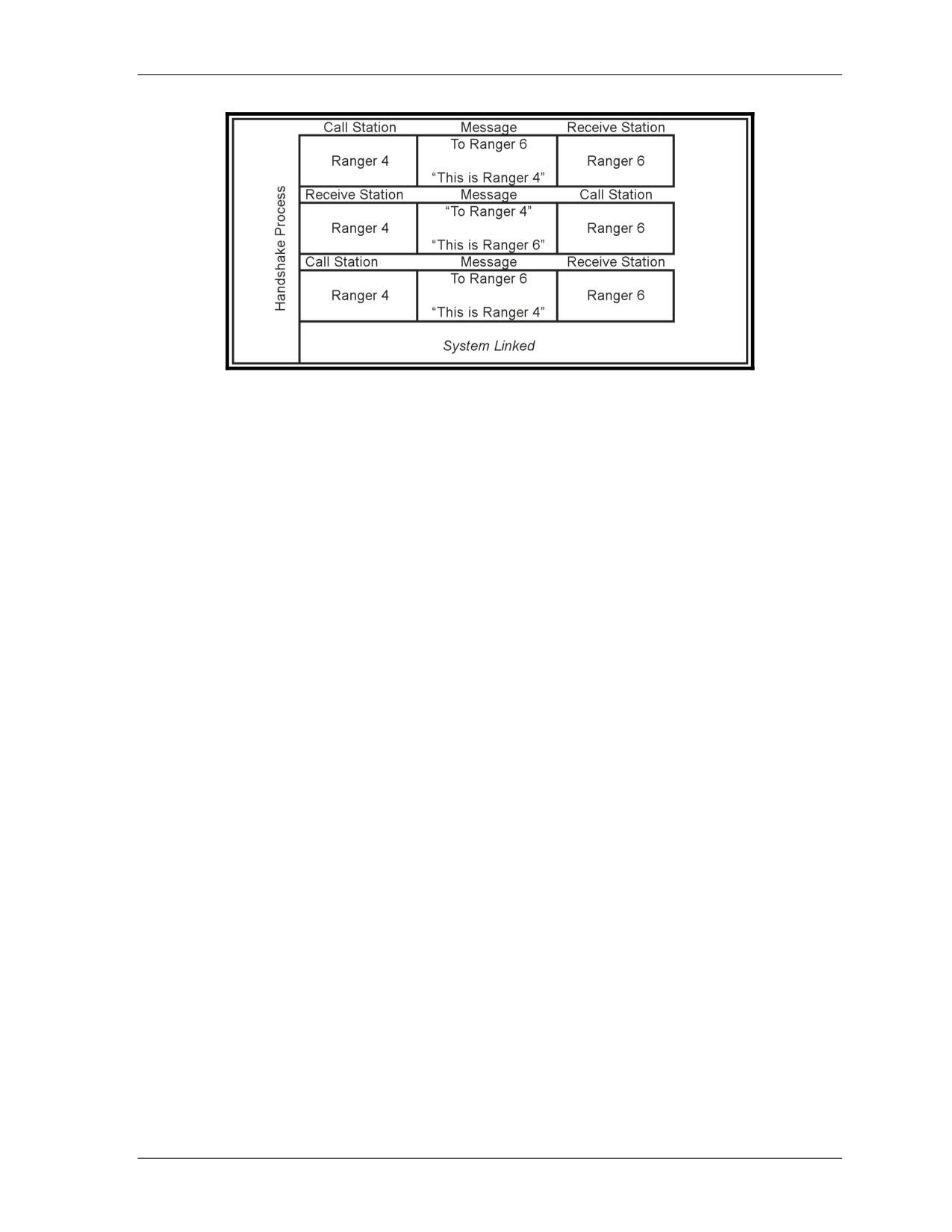
to confirm communications compatibility. This is called a "handshake." Once the handshake is
complete, each station notifies its users that it is ready for traffic. Figure 6-1 shows
communications between two stations during the "handshake" and LQA.
6-4
FM 3-55.93
23 June 2009
Communications
Figure 6-1. Automatic link sequence.
• At the end of a link session, the ALE controllers send the link command TERMINATION, and
returns to scanning mode to await further traffic. Built-in safeguards ensure that ALE
controllers return to scanning mode if contact is lost.
AN/PRC-150(C) ADVANCED HF OR VHF TACTICAL RADIO SYSTEM
6-18.
The AN/PRC-150(C) is a HF transceiver that covers the frequency range from 1.6 to 60 MHz in
SSB and FM modes. Embedded COMSEC allows secure communications between ground and aircraft as
well as with the Army’s SINCGARS radios. The AN/PRC-150(C) also has an internal, high-speed,
Military Standard 188-110B serial-tone modem, which sends and receives data at speeds up to 9,600 BPS;
an embedded military standard 188-141A; ALE; digital voice 600 (DV 600); and frequency hopping
(electronic protection). The AN/PRC-150(C) belongs to a family of interoperable software-designed
radios. This family also includes the AN/PRC-117F(C), which is the manpack test platform for Step 2B of
the Joint Tactical Radio System program. The AN/PRC-150(C) gives units BLOS communications without
the need to rely on satellites from a crowded battlefield. The systems' manpack and vehicular
configurations ensure reliable communications and allow rapid transmission of data and imagery. The
AN/PRC-150 replaces the AN/PRC-138.
AN/PRC-148
6-19.
The MBITR AN/PRC-148 is a lightweight, durable, compact radio. Its secure multiband voice
and data communications are ideally suited for use by LRS teams. It interoperates with a wide variety of
existing military and civilian systems, while providing the LRS team leader internal C2. The MBITR's
built-in emergency beacon and a GPS interface with PLGR can serve as an emergency radio during escape
and evasion
(E&E) operations. It transmits in the
30- to
512- MHz frequency range and allows
communications in the following bands:
• VHF FM and AM.
• UHF AM (air to ground).
• UHF FM (LOS).
AN/PRC-152
6-20.
The AN/PRC-152 is a multiband, lightweight, handheld radio. An optional, built-in GPS receiver
allows time tracking and position reporting. Embedded COMSEC supports Vinson, advanced narrowband
digital voice terminal
(ANDVT), AES, Fascinator, and KG-84. The AN/PRC-152 operates between
30 and 512 MHz, and is compatible with many military and civilian radio systems. VHF/UHF line of sight
supports AM and FM modulation as well as high-performance waveform and TACSAT communications.
23 June 2009
FM 3-55.93
6-5

Chapter 6
AN/PRC-117F
6-21.
The AN/PRC-117F is a multiband, multimission, 30 to 512 MHz radio. All -117Fs (manpack,
vehicular, marine, and base station) have COMSEC, UHF TACSAT, ECCM, and DAMA capabilities. The
AN/PRC-117F works with many communications systems, including SINCGARS, AN/PRC-148,
AN/PRC-112, AN/PSC-5, and most civilian handheld radios. Like the AN/PRC-150, the AN/PRC-117F
interfaces with many data devices, to include ruggedized laptop computers. Although the AN/PRC-117F is
microprocessor-based, it is controlled by software rather than hardware. It can retransmit voice or data
across traditional frequency bands and waveforms with two antenna ports and data rates up to 64 Kbps.
AN/PSC-5C/D
6-22.
The AN/PSC-5 is a multiband, multimission communications terminal. It provides excellent
interoperability with military, marine, and civilian radio systems. It operates in the VHF and UHF
frequency spectrum (30 to 512 MHz), and supports line of sight (LOS), TACSAT (5K, 25K and DAMA),
SINCGARS and Havequick I and II. It has an embedded COMSEC engine, which allows the sending of
secure voice and data. It can achieve data rates of 76.8 Kbps.
INTEROPERABILITY
6-23.
Table 6-2 shows the interoperability capabilities and characteristics of the radios commonly used
by LRSU.
Table 6-2. Radio interoperability capabilities and characteristics.
Max Power
Data
Radio
Freq Range
Output
Controller
TACSAT
Vehicle Kit
AN/PRC-150
1.6-60 MHz
20 Watts
Yes
N/A
AN/VRC-104
AN/PRC-148
30-512 MHz
5 Watts
N/A
5K
AN/VRC-111
AN/PRC-152
30-512 MHz
5 Watts
Yes
5K, 25K
AN/VRC-110
AN/PSC-117F
30-512 MHz
20 Watts
Yes
5K, 25K, DAMA
AN/VRC-103
AN/PSC-5C/D
30-512 MHz
20 Watts
Yes
5K, 25K, DAMA
Multiple kits
available
AN/PRC-119F
30-88 MHz
4 Watts
N/A
N/A
VRC-89/90/91/92
RETRANSMISSION
6-24.
Retransmission can greatly extend the range of a radio LOS network. Traditionally, SINCGARS
retransmission networks are used with two different frequencies or net IDs, called F1 to F2 retransmission.
This requires planning and establishment of triggers where radios will have to switch frequencies based on
their location on the battlefield. With the ASIP radio, users can use same net retransmission using the same
frequency or net ID. This is called F1 to F1 retransmission. Most current radios support retransmission
operations with the use of a retransmission cable. If the range between two networks it too great for ground
wave radios, two LOS networks can be connected using TACSAT radios. Both the AN/PSC-5 (all models)
and the AN/PRC-117F will connect two LOS (VHF/UHF) networks by way of satellite communications.
VIDEO TRANSMISSION
6-25.
Each deployed LRS team uses a lightweight video-reconnaissance system to send and receive
real-time images.
RUGGEDIZED COTS LAPTOP
6-26.
The LRS teams use this ruggedized, standard laptop to send and receive text messages and images
over the radio. A serial port or external data controller card connects the laptop by cable to the data port of
6-6
FM 3-55.93
23 June 2009
Communications
the radio. A data controller card is needed to send data via radio waves. The card manages the data
reducing errors and transmission times. Some radios use "tactical chat" or wireless messaging-terminal
software as the Graphic User Interface for sending and receiving data. Radios without an internal data
controller card require an external card. Either an inline cable controller or Personal Computer Memory
Card International Association (PCMCIA) card will work with the laptop as long as it supports the cards
interface. In the field, special charging kits allows a team to operate and charge a laptop with a BA-5590 or
BB-390 / BB-2590 battery.
COMMUNICATIONS BASE RADIO STATION PLATFORM
6-27.
Each LRSC is authorized eight BRS platforms. The BRS is a multifunctional communications
platform currently in development. In addition to HF communications, each BRS provides;
• TACSAT communications with the AN/VRC-103(V1 or V2).
• VHF communications via AN/VRC-92, AN/VRC-110, or AN/VRC-111.
• Network capability with interface to existing secure and nonsecure networks.
• Modular and reconfigurable to meet changing mission requirements.
• Dismountable and can be stored or transported in transit cases.
Section III. OPERATIONS
BRS comprise the most critical part of the LRSU communications network. It is the primary link between the
commander and his deployed teams. Each BRS monitors all deployed team frequencies and channels.
TACTICAL EMPLOYMENT
6-28.
All LRSU BRS are based on the Army's Transformation High-Frequency Radio System (THFRS).
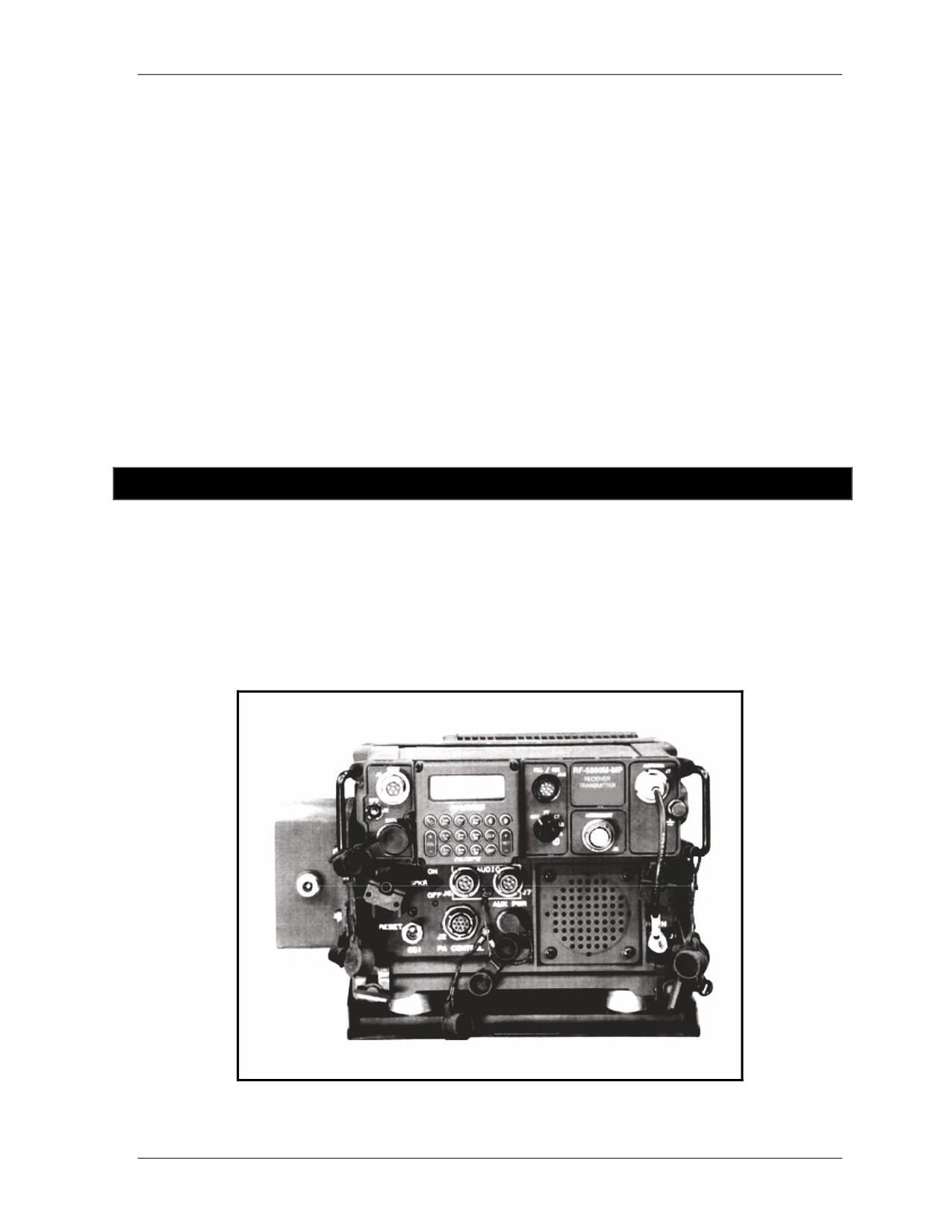
This system is in turn based on the AN/PRC-150(C) manpack radio (Figure 6-2). The THFRS can be
configured in the same basic manner as the older AN/TSC-128 in an S-250 communications shelter. The
THFRS works with various power amplifiers, couplers, antennas, software, and ancillaries to build various
vehicular and BRS configurations.
Figure 6-2. AN/PRC-150(C) in vehicular AN/VRC-104 (V)3 configuration.
23 June 2009
FM 3-55.93
6-7
Chapter 6
COMPANY OPERATIONS BASE
6-29.
When space allows, the BRS should be physically located with or in close proximity to the COB
TOC. This allows a direct link between the operations cell and the BRS operators. If circumstances
prohibit this employment, the BRS is linked to the TOC by VHF, UHF TACSAT, tactical LAN, or field
wire. A new BRS configuration is in development.
ALTERNATE OPERATIONS BASE
6-30.
This base relays communications between the LRS teams and the COB BRS. It links to the COB
through joint or Army tactical switching systems.
• The COB and AOB use HF and UHF TACSAT radios as secondary means of communication.
• Message traffic between the two stations should travel by the fastest, most secure means
available.
• Due to variables such as terrain and interference, the AOB can sometimes receive messages the
COB cannot.
• The AOB BRS is normally positioned farther from the deployed teams than the COB BRS and
can operate mounted or dismounted. It is prepared to assume the mission if the COB, if the
COB displaces or is destroyed.
• The communications platoon leader recommends to the LRSC commander the approximate
distance and location of the AOB based on, among other factors--
-- Probability of communications with the deployed teams and the COB BRS.
-- Available local support or unit capability to support.
HF OR UHF TACSAT RADIO
6-31.
These are the surveillance team’s primary means of communication with the BRS. Data-burst
equipment and compression software shorten transmission times. Encryption prevents the enemy from
deciphering radio transmissions. Lightweight digital photo or video systems allow transmission of near
real-time imagery.
• The team leader selects a communication site using METT-TC. The site should allow antenna
construction and terrain masking.
• Teams transmit and receive routine messages during scheduled communication windows. For
messages requiring transmission outside the schedule, the team first establishes a link with the
COB or AOB in ALE mode or with the guard frequency, if in single sideband (SSB mode), and
then transmits the message.
• Internal team communications is via secure VHF radios and visual signals. Leaders ensure
everyone takes the proper OPSEC and COMSEC precautions.
SITE SELECTION
6-32.
The reliability of radio communications depends largely on proper radio site selection. The
communications platoon leader and the BRS team leader must ensure that both primary and alternate sites
satisfy technical, tactical, security, and other performance criteria.
ALL OPERATIONS BASES
6-33.
The site needs good cover and concealment, and a location free of interference (man-made or
natural). Moving the site may be necessary if interference becomes a problem. Common sources of
interference include; high-tension power lines, over population of antennas, electronic countermeasures,
thick vegetation and terrain.
6-8
FM 3-55.93
23 June 2009
Communications
COMPANY OPERATIONS BASE
6-34.
The COB is the primary link between the deployed teams and BFSB S-2 fusion element. COB
BRS is normally located well within the security umbrella of the BFSB. It should be close enough to the
BFSB and R&S squadron S-2 sections to permit a land wire network for reporting purposes.
ALTERNATE OPERATIONS BASE
6-35.
The AOB may collocate if communications are established and maintained between the deployed
teams and the COB. For increased survivability and redundancy, the AOB may be located elsewhere in the
AO. If communication cannot be established or maintained between the teams and the COB, the AOB is
moved in order to establish communication with the deployed teams and the COB. When the AOB is used
as the primary reporting link, it must maintain a constant communication path with the COB, while the
COB generally moves with the BFSB or R&S squadron.
TACTICAL SATELLITE
6-36.
UHF TACSAT radio is a reliable communications system with unlimited range. It comes in both
manpack and vehicle configurations. The best systems for LRS missions are multiband, multimission,
multisystem-compatible UHF TACSAT systems with--
• Embedded demand-assigned, multiple access (DAMA) capabilities.
• Satellite communications modems.
• Diverse communications and transmission security capabilities.
6-37.
Understandably, satellite channels and UHF TACSAT systems are in high demand and are also in
short supply. Because the priority for UHF TACSAT channels goes to division HQ and above, joint and
special operations units, LRSUs usually must share satellite channels. For this reason, the HF radio remains
the primary means of communication. When LRSU do get satellite access, they must carefully manage it
for airtime and message precedence.
Section IV. REPORTS
Teams communicate with the BRS at specified times or per-designated communications windows, with each
team having a separate window. The number of scheduled times used by the LRSU depends on METT-TC.
Scheduling windows too often places a team at risk, while scheduling windows too seldom can reduce the
relevance of time-sensitive intelligence.
MESSAGES AND REPORT FORMATS
6-38.
To accomplish their mission, LRS teams must send timely and accurate messages, properly
formatted, to the COB, AOB or MSS BRS. Each team does this during assigned "windows," based on
METT-TC. Using too frequent windows raises susceptibility to enemy interception and direction-finding
capabilities; however, using too few windows reduces the relevance--and usefulness--of time-sensitive
intelligence. For the purpose of this manual, a message refers to the information sent from one station to
another. Most messages follow a report format.
MESSAGES
6-39.
Each BRS logs in detail all messages it sends and receives. The unit SOP specifies how done. The
BRS team chief in the COB ensures that all messages for committed teams originate with the operations
section and that they are properly formatted.
Interoperability
6-40.
Report formats provided below are based on the standardized formats in FM 6-99.2. LRSC should
base unit SOPs on these report formats in order to gain rapid interoperability between LRSU.
23 June 2009
FM 3-55.93
6-9
Chapter 6
Incoming Messages from Team
6-41.
When the BRS receives a message from a team, it is logged and forwarded to the operations
section for decryption. Intelligence reports are generally sent directly to the BRS located at the COB, then
to the BFSB S-2 fusion element and the R&S squadron S-2 after being logged and examined by the LRSC
TOC. The LRSC TOC neither delays nor changes any intelligence report. Sometimes, the AOB BRS
receives a message that the COB BRS does not receive. When this happens, the AOB logs the message and
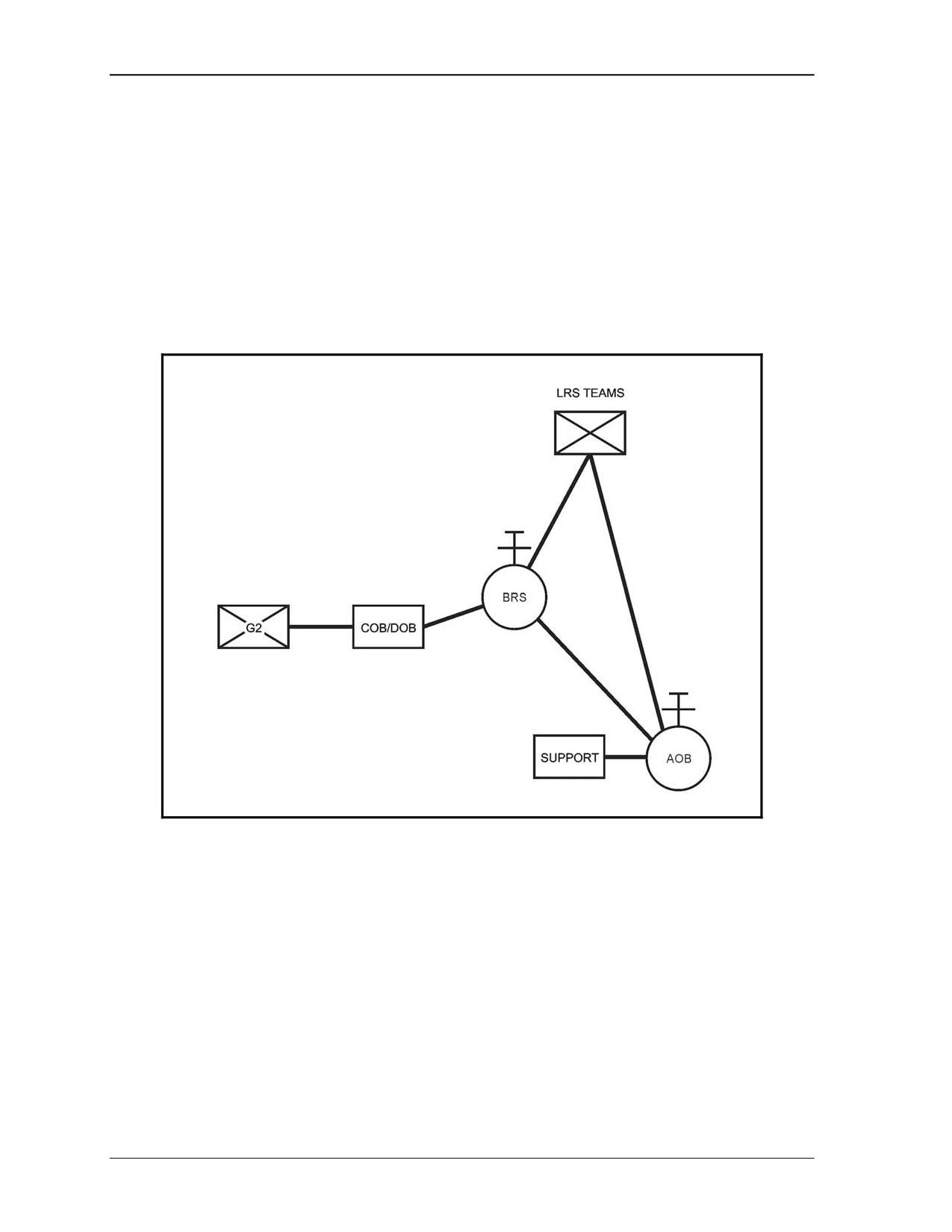
sends it, exactly as received, by the fastest, most secure means to the COB (Figure 6-3).
Outgoing Messages to Team
6-42.
The LRSC operations section formats and encrypts any message going out to a team. The BRS
then transmits it during that team's next scheduled communication time after the BRS team chief ensures
the message is properly formatted.
Figure 6-3. Communications data wire diagram.
Code Words or Letters
6-43.
Code words or letters are used by transmitting stations to send vital information quickly, and in a
secure manner. These letters and code words are given to the team during mission planning. They keep
transmissions short. They inform the receiving station of the situation on the ground without long
descriptions. Code words are also used to send vital information in a secure manner. Without knowledge of
the meaning of the code words/ code letters, the meaning of message will not be known to any intercepting
station or person.
6-10
FM 3-55.93
23 June 2009
Communications
Duress Codeword
6-44.
A duress code is a simple word placed in a message to indicate the sending station is not under
duress (Table 6-3). A duress code requires planning and rehearsal to ensure an appropriate response. This
code is normally changed after each mission to avoid compromise.
• Only the team, the COB, the AOB and--if used, the MSS--know the duress code.
• The sending station inserts the code into a precise location in the message so the receiving
station will know they did so deliberately, not under coercion. Each team and BRS has a
different duress code.
Situation Normal
• Sender includes duress code in the correct location.
• Recipient responds to content of message.
Situation Compromised
• Sender omits the duress code.
• Recipients ignore content of message and responds to the emergency by initiating compromise
procedures.
Table 6-3. Procedure for use of duress codes.
Situation
Sender
Recipient
Normal
Include duress code
Respond to content
Compromised
Omit duress code
Initiate compromise procedures
REPORT FORMAT
6-45.
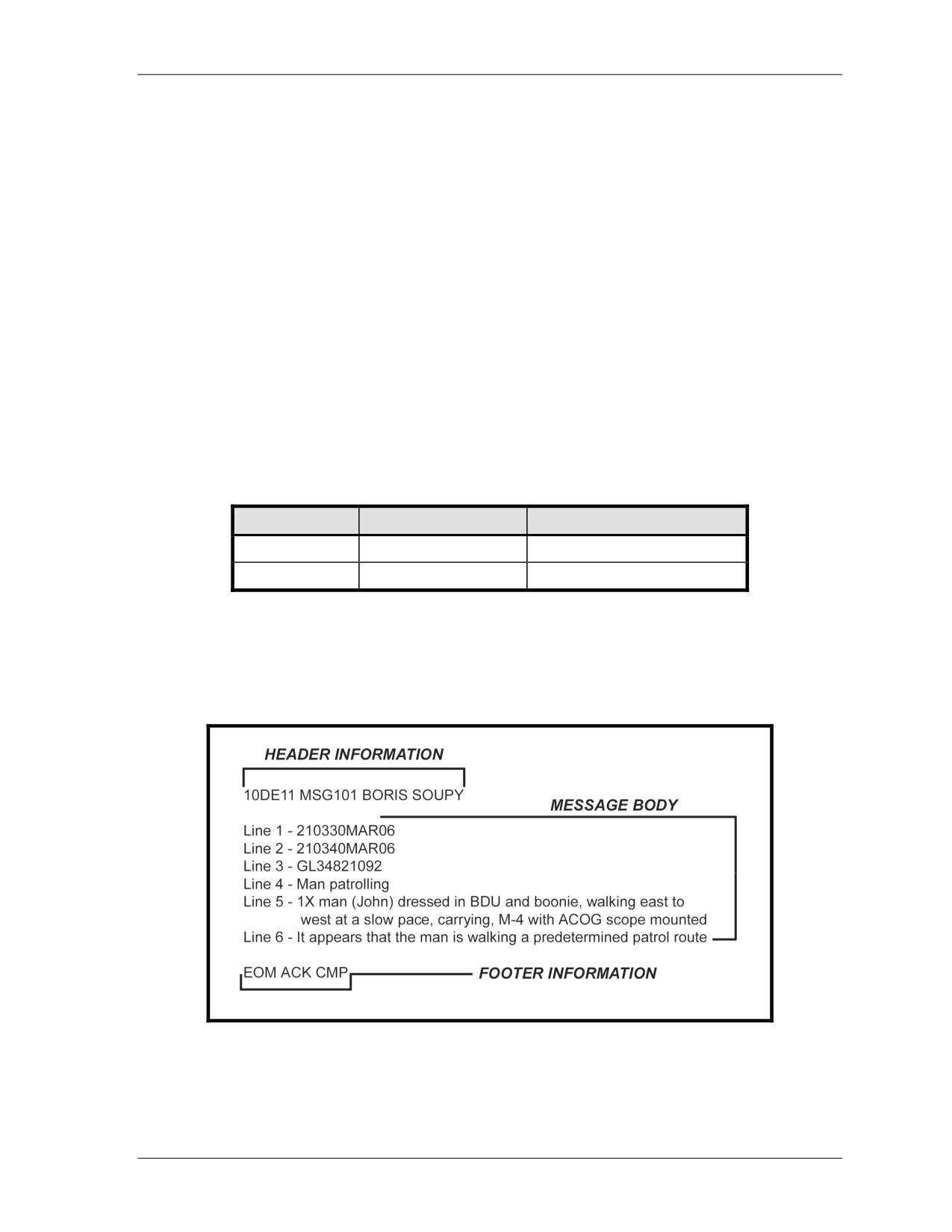
Information is placed into a report format
(Figure 6-4) to aid encryption, decryption and
information recognition. Using a report format makes even partially received messages useful, because the
information is more recognizable. The message is divided into three parts.
Figure 6-4. Report format.
23 June 2009
FM 3-55.93
6-11

Chapter 6
Header Information
6-46.
Messages are numbered in sequence of transmission, the first number being the team number. If
messages include pictures, they are named using the message number along with an alphabetical
designation to match the picture with the corresponding message, for example, 101A, 101B (Figure 6-5).
Address--10 DE 11
10= Receiving address
DE= this is
11= Sending address
Message #--MSG 101
Type of report
BORIS
This indicates the type of report that follows.
Duress codeword SOUPY
This is a 5 letter codeword used to inform the
receiving station that the sending station is not in
duress or being forced to send the message.
Figure 6-5. Example message header.
Message Body
6-47.
The message body varies depending on the report format. Recipients must be able to recognize,
understand, and react quickly to the information contained in the message. This means the unit SOP must
provide for short, standard message language. This serves three purposes: observer guidance, speed and
communications security. The format gives the observer a tool to report specific information. Knowing the
format speeds the writing and reading of the message. Keeping messages short decreases transmission time
and helps avoid enemy radio direction finding (RDF) units.
Footer Information
6-48.
Particular information goes into a report footer:
End of message
EOM
This tells the receiving station that the message is
complete.
Acknowledgement
ACK
This requests that the receiving station acknowledge
Requested
receiving the message.
Signature
CMP
Initials of the RTO responsible for transmitting the
message.
REPORT FORMAT TYPES
6-49.
LRSU use five basic report formats (Table 6-4):
6-12
FM 3-55.93
23 June 2009

Communications
Table 6-4. Report formats.
Proword
Actual Report Title
Purpose
Angus
Initial Entry Report
To alert the BRS and operations of the status of
the insertion, the team's initial situation, and
possible deviations from infiltration plan.
Boris
Intelligence Report
To report PIR/intelligence requirements/SIR and
intelligence tasks when observed.
Cyril
Situation Report
To report the team's situation (excludes
PIR/intelligence requirements/SIR and intelligence
tasks).
Under
Cache Report
To report an emplaced cache.
Crack
Battle Damage
To report battle damage on a specified target.
Assessment Report
Angus (Initial Entry) Report
6-50.
The RTO normally sends the Angus (Initial Entry) Report as soon after the insertion as the tactical
situation allows. This is usually completed within four hours of insertion. If the Angus is not transmitted
within this window the LRSC operations section may assume the mission is compromised and initiate
emergency procedures. This message alerts the operations section of the status of the insertion, the team's
initial situation, and possible deviations from the infiltration plan due to previously unknown conditions on
the ground. Table 6-5 shows the typical format of an Angus report and the message information
contained in it.
Table 6-5. Typical format for an Angus (Initial Entry) Report.
Line
No.
Content
Example
1
DTG
152307NOV06
2
Team status
Green
(use code words)
3
Current location (6-digit grid with grid zone
GL098569
identifier)
4
Possible deviations from briefed plan (inform
Due to restrictive terrain, the team will
higher of pending changes to team plan)
deviate more to the North on primary
infiltration route
5
Remarks
None
Boris (Intelligence) Report
6-51.
The RTO normally sends the Boris (Intelligence) Report to the BRS as soon as the LRS team has
PIR to report. Other ISR tasks are normally sent during prescribed communications windows. Table 6-6
shows the typical format for a Boris report and the message information contained in it.
23 June 2009
FM 3-55.93
6-13

Chapter 6
Table 6-6. Typical format for a Boris (Intelligence) Report.
Line
Content
Example
No.
1
DTG
131844SEP05
2
DTG of observed
131506SEP05
activity
3
Location of
West side of hill GL96578354
observed activity
4
Observed activity
Preparing radio to transmit and receive
Manning reinforced fighting/defensive position
5
Description of
4 pax in military uniform outside reinforced fighting position.
personnel,
vehicles,
The pax are called A, B, C, and D. Three of them, A, B, and C, are wearing PCs.
weapons, and
Pax D is wearing a boonie hat. Pax A is manning a radio that is carried inside a
equipment
rucksack and placed on top of the fighting position. (The radio has a long,
whip-type antenna.) Pax B (fair skinned) is talking on the radio. Pax A and Pax B
are both standing on the West side of the position. Pax C is standing on the
North side of the position. Pax D is on the North side of the position, but is
walking toward the East. Pax C and Pax D are carrying unidentifiable assault
rifles. Pax D is wearing load-carrying equipment.
The fighting position is a poured concrete structure, built into a berm, whose
[wooden?] roof has with a small overhang. About 3 feet of the structure is visible
aboveground. The structure is about 7 feet long (North to South). In the middle of
the East and West walls are viewports. A triple-strand concertina wire obstacle
runs North to South about 5 meters to the East of the fighting position. Triple
strand wire is set up on the West side of an 8-foot tall chain link fence, which
also runs North to South. V-shaped barbed wire runs along the top of the fence.
6
Team
Believe A and B have weapons, though not observed. Pax B seems to be the
assessment
leader of the group, because he is talking on the radio. The enemy seems to be
preparing to man the fighting position for an unknown period of time. The enemy
also appears to be in a nonaggressive posture, because their weapons are
slung. Assume additional ammunition and possibly explosives are cached in the
position. The layout of the obstacles and the location of the position suggest the
position is used for observation and early warning.
Cyril (Situation) Report
6-52.
The RTO must send the Cyril
(Situation) Report during, and only during, scheduled
communication windows. The Cyril reports the team’s situation, status (medical, team equipment, food,
water, batteries), past, current, and planned activity. Table 6-7 shows the typical format and content of a
Cyril report. The team must send a Cyril report during every communications window.
6-14
FM 3-55.93
23 June 2009

Communications
Table 6-7. Typical format for a Cyril (Situation) Report.
Line No.
Content
Example
1
DTG
131844SEP05
2
Current location (8-digit
JL14593487
grid with identifier)
3
Medical status of team
Green
(code words)
4
Status of team
Green
equipment
5
Status of food, water,
3xMREs, 4xQts water, 14x 5590s, and 3xAAs
and batteries (food and
water per person)
6
Team activity since last
Pulled surveillance on objective.
communications window
Moved survey site due to poor visibility on objective.
7
Team activity until next
Broke down equipment and prepared for exfiltration
communications window
8
Team leader remarks
Weather deteriorated, dropping distance of standoff
and visibility of objective
Under (Cache) Report
6-53.
The LRS team RTO or the COB normally sends the Under (Cache) Report to report caches of
personnel records, intelligence documents, personnel burials, and so on. After the team infiltrates, the
LRSC operations section reports caches such as ammunition, demolitions, barter items, weapons, food, and
water. Table 6-8 shows the typical format of an Under Report and the message information contained in it.
Table 6-8. Typical format for an Under (Cache) Report.
Line No.
Content
Example
1
DTG (date-time group)
131844SEP05
2
Type of cache (surface,
Subsurface
subsurface, or
submerged)
3
Contents
7xMREs 1,000 rds 5.56
4
Location (10-digit grid
FT 7404620956
with identifier)
5
Initial and Final
IRP: Intersection at 34590216 (300m E)
Reference points
FRP: Stream intersection at 34650236 (20 m N)
(IRP and FRP)
6
Depth
3 feet
7
Additional information
Cache is buried at the base of 50-foot oak tree that has scratch
marks at knee level on the West-facing side
Crack (Battle Damage Assessment) Report
6-54.
The Crack (Battle Damage Assessment) Report is used to provide a timely and accurate estimate
of damage resulting from the application of military force, either lethal or nonlethal, against a
predetermined objective. Table 6-9 shows an example for a Crack report and the message information
contained in it.
23 June 2009
FM 3-55.93
6-15

Chapter 6
Table 6-9. Typical format for a Crack (Battle Damage Assessment) Report.
Line No.
Content
Example
1
DTG
131256NOV05
2
Location of target (8-digit grid with identifier)
JL14593487
3
Type of target such as vehicle, building, or bridge
T-72 Tank
4
Description of target
Vehicle
destruction is
Physical Damage Assessment--How much physical damage was inflicted
catastrophic.
by military force (munitions blast, fragmentation, or fire) on a particular
Vehicle is
target? This assessment is based on observed or interpreted damage.
inoperable.
Functional Damage Assessment--To what degree were the attack
objectives achieved against a particular target? This assessment is
based on the degree to which the application of military force degraded
or destroyed the functional or operational ability of the targeted facility or
objective to perform its intended mission.
5
BDA analysis The level of confidence in the accuracy of the assessment,
Confirmed.
and whether the reattack is necessary.
No reattack
necessary.
Confirmed
Data that has been confirmed visually or otherwise assured through
IMINT, weapon system (aircraft cockpit) video, SIGINT, MASINT, or
HUMINT (signal, measurement and signals, or human intelligence).
•
95 percent confidence that assessment is accurate.
•
Data requires no additional intelligence.
Probable
• At least 50 percent confidence.
• Data sources are reliable; data requires little additional intelligence.
Possible
• At most 50 percent confidence.
• Data requires considerable additional intelligence.
COMMUNICATIONS SECURITY
6-55.
This function is management intensive for LRSU operations. The LRSC commander ensures the
unit’s COMSEC custodian keeps enough of the necessary materials on hand, both for training and
contingency missions. Possible COMSEC considerations for LRSU operations include--
• JTF, corps or division nets.
• BFSB and R&S squadron nets.
• Internal company and team nets.
• Digital secure voice terminal key for MSE network.
• JTF, corps, division or BFSB UHF TACSAT keys.
Section V. ELECTRONIC WARFARE
Electronic warfare (EW) is any military action involving the use of electromagnetic and directed energy to
control the electromagnetic spectrum or to attack the enemy (FM 1-02). There are three major subdivisions
within electronic warfare: electronic attack, electronic warfare support, and electronic protection.
6-16
FM 3-55.93
23 June 2009
Communications
ELECTRONIC ATTACK
6-56.
That division of EW involving the use of the electromagnetic energy, directed energy, or
antiradiation weapons to attack personnel, facilities, or equipment with the intent of degrading,
neutralizing, or destroying enemy combat capability and is considered a form of fires (FM 1-02).
ELECTRONIC WARFARE SUPPORT
6-57.
That division of EW involving actions tasked by, or under the direct control of, an operational
commander to search for, intercept, identify, locate or localize sources of intentional or unintentional
radiated electromagnetic energy for the purpose of immediate threat recognition, targeting, planning and
conduct of future operations (FM 1-02).
ELECTRONIC PROTECTION
6-58.
That division of EW involving passive and active means taken to protect personnel, facilities, and
equipment from any effects of friendly or enemy employment of EW that degrade, neutralize or destroy
friendly combat capability (FM 1-02). LRSU are primarily concerned with electronic protection.
METHODS
6-59.
These refer to anything a LRSU does to prevent or reduce the effectiveness of enemy EW and
enhance electronic protection.
Security Tasks
6-60.
Emission security includes--
• Using brevity lists.
• Masking antenna locations.
• Using directional antennas.
• Using the lowest possible output power.
6-61.
Transmission security includes--
• Using voice communication only when essential.
• Developing and using brevity lists.
• Minimizing transmission time.
• Planning messages.
• Encrypting messages.
6-62.
Cryptograph security includes--
• Exclusive use of authorized codes and key lists only. Only National Security Agency (NSA)-
approved codes are authorized for encoding and decoding US Army message traffic. The same
is true of mechanical cryptograph systems.
• Physical security of all cryptograph and equipment. This includes a comprehensive and
workable plan for the destruction of material and equipment. It also includes the SOPs that
identify to all team members where material and equipment are kept by the RTO. Table 6-10
shows the priority for destroying material and equipment.
23 June 2009
FM 3-55.93
6-17
Chapter 6
Table 6-10. Priority for destruction of communications devices.
1.
All superseded cryptographic keys.
2.
All current cryptographic keys.
3.
Zero all keyed devices.
4.
All future cryptographic keys.
5.
All cryptographic devices.
6.
Radios.
7.
Brevity list.
8.
Communications log.
Data-Burst Devices
6-63.
To further reduce the chance that the enemy will use radio direction finding (RDF) equipment
against them, the BRS and teams use data-burst devices. They can use the nonsecure OA-8990/P digital
message device group, KL-43F, or portable computer. These devices shorten transmission times--they do
not prevent the enemy from intercepting the radio traffic.
PROCEDURES
6-64.
These procedures apply to interference, jamming, and deception. When someone at the BRS or on
the team hears interference and suspects jamming, he should--
• Remain calm and continue to operate as if nothing unusual is happening.
• Prevent the enemy from knowing whether his jamming is successful or detected.
• Switch to a higher power on the radio.
• Reorient the antenna to the receiving station.
• Report the jamming using the meaconing, intrusion, jamming, and interference (MIJI) report
format in the signal operating instructions supplemental instructions (Table 6-11). Send the
report over a network free of jamming and interference to ensure that it reaches the intended
recipient.
• Until communications can be established and maintain over the desired frequency, use an
alternate one.
Table 6-11. Contents of a MIJI report.
Item
Contents
1
Type of report
2
Type of incident
3
Type of equipment affected
4
Frequency affected
5
Affected station call sign
6
Affected station coordinates
6-18
FM 3-55.93
23 June 2009
Communications
Section VI. ANTENNAS
This section discusses several concepts to help communications personnel select the best antenna.
WAVELENGTH AND FREQUENCY
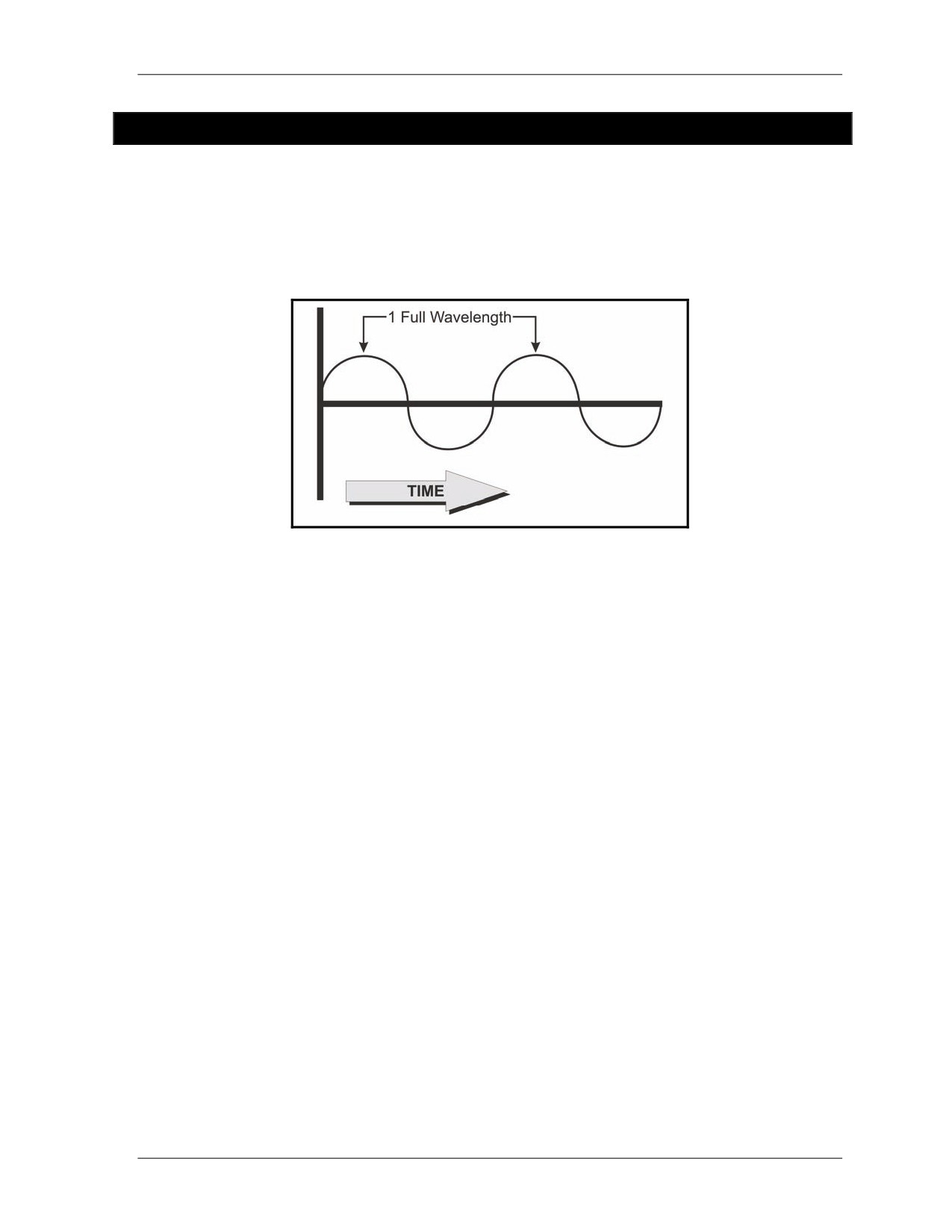
6-65.
A wavelength is the distance that an electromagnetic wave travels to complete one cycle at a
particular frequency (Figure 6-6). In radio communication, the length of an antenna relates directly to the
frequency's wavelength. This relationship is important to know when building antennae for a specific
frequency or frequency range.
Figure 6-6. Measurement of a wavelength.
RESONANCE
6-66.
Antennas are classified as either resonant or nonresonant, depending on their design. Both are
commonly used on tactical circuits. However, if you can get a clear signal with a resonant antenna, that
should be your first antenna choice rather than a nonresonant or standing-wave-ratio antenna.
RESONANT ANTENNAS
6-67.
A resonant antenna matches the wavelength of one particular frequency.
• Advantage is efficiency; most radio signals sent to a resonant antenna radiate successfully.
• Disadvantage is lack of flexibility; a separate antenna must be built for each frequency used.
NONRESONANT ANTENNAS
6-68.
These antennas match a range of frequencies.
• Advantage: This kind of antenna works with more than one frequency.
• Disadvantage: A nonresonant antenna, as the name implies, reduces resonance, which weakens
the signal. The more frequencies the antenna resonates, the lower the resonance quality, which
in turn reduces the efficiency of the signal.
STANDING WAVE RATIO
6-69.
Signal energy resonates, or causes energy waves in a certain pattern on an antenna. These waves
are measured and compared to the standard wave to determine if an antenna resonates at a particular
frequency. Although a 1-to-1 ratio to a standing wave (standing wave ratio) is ideal, 1.1-to-1 ration is about
the best ratio obtainable. When building wire antennas, the operator should adjust the length of the antenna
until he obtains the lowest possible standing wave ratio. A 3-to-1 standing wave ratio is acceptable. Check
the operator’s manual for the particular radio in use to determine the maximum standing wave ratio that the
radio can tolerate. Some radios automatically lower the power output of the transmitter if the standing
wave ratio is too high.
23 June 2009
FM 3-55.93
6-19
Chapter 6
POLARIZATION
6-70.
Polarization is the relationship of radio energy radiated by an antenna to the earth. The most
common polarizations are horizontal (parallel to the earth’s surface) and vertical (perpendicular to the
earth’s surface). Others, such as circular and elliptical, also exist. A vertical antenna normally radiates a
vertically polarized signal, and vice versa.
GROUND WAVES
6-71.
For best communication with HF ground waves, both the sending and receiving antennas should
have the same polarization. Vertical polarization works best for HF ground-wave propagation.
SKY WAVES
6-72.
For HF sky-wave propagation, the sending and receiving antennas need not have the same
polarization, because the ionosphere will bend the waves, thus randomly changing their polarization
anyway. However, horizontal polarization works best for HF sky-wave propagation.
RADIO WAVE PROPAGATION
6-73.
HF communications can be established using either ground- or sky-wave propagation. With
low-powered, man-pack radios, ground-wave communication can be established out to about 30 km,
depending on conditions. High-powered, vehicle-mounted equipment allows communication out to about
100 km. Sky-wave communications range from several to thousands of kilometers.
GROUND-WAVE PROPAGATION
6-74.
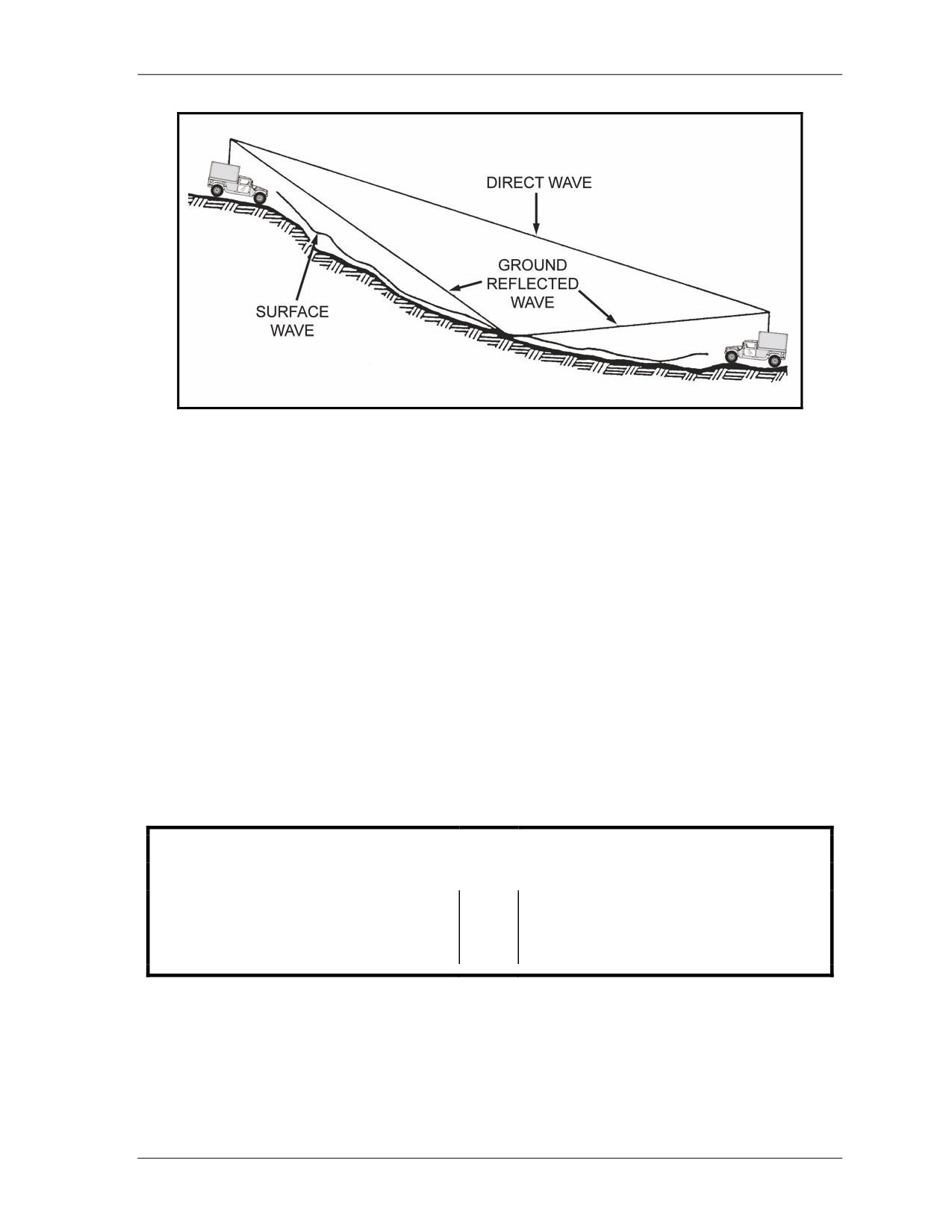
Ground-wave propagation means sending a radio signal along or near the surface of the earth. The
ground-wave signal has three parts: the direct, reflected, and surface waves (Figure 6-7).
Surface Wave
6-75.
The surface wave travels, as the name implies, along the surface of the earth. It is the usual means
of ground-wave communication. The surface wave depends on the type of surface that lies between the two
antennas. With a good conducting surface, such as seawater, long ground-wave distances are possible.
Poor surfaces, such as sand or frozen ground, shorten the distance the surface wave can travel. Heavy
vegetation or mountainous terrain can do the same.
Direct Wave
6-76.
The direct wave travels from one antenna to the other in what is called the line-of-sight mode.
Maximum line-of-sight distance depends on the height of the antenna above ground. The higher the
antenna, the longer the LOS. Because radio signals travel in the air, any obstruction between the antennas,
such as a mountain, can block or reduce the signal. For an antenna 10 feet above the ground, the maximum
LOS is 8 km (5 miles).
6-20
FM 3-55.93
23 June 2009
Communications
Figure 6-7. Components of ground wave.
Reflected Wave
6-77.
This is a wave that bounces off the earth on its way to the receiving antenna.
Space Wave
6-78.
This wave is the combination of a reflected wave and a direct wave.
SKY-WAVE PROPAGATION
6-79.
HF signals travel much farther by sky-wave propagation than by ground-wave propagation.
Sky-wave propagation is the bending (refraction) of the radio signal by a region of the atmosphere called
the ionosphere.
6-80.
The ionosphere is an electrically charged (ionized) region of the atmosphere that extends from an
altitude of about 60 to 1,000 km (37 to 620 miles) above the earth’s surface. Energy from the sun ionizes
the atmosphere in this altitudinal range, and the electrical charge there refracts (bends) some radio signal
that enters it, sending the signal back to the earth.
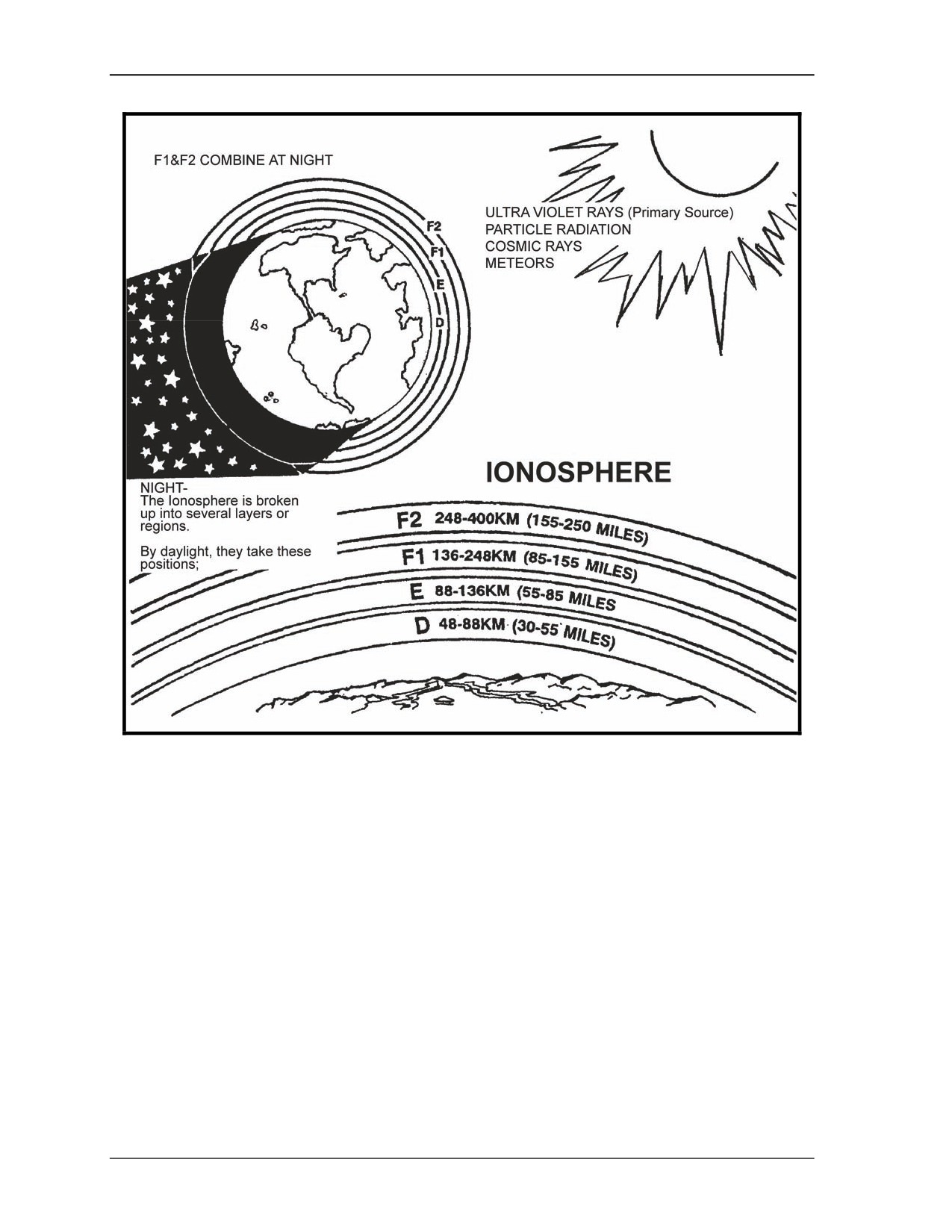
6-81.
The area that affects HF communications the most lies between the altitudes of 48 km (29.6 miles,
which lies below or inside the ionosphere) to 500 km (310 miles). This 440 km (273 mile) area is divided
into four incremental altitudinal ranges: D, E, F1, and F2 (Table 6-12 and Figure 6-8).
Table 6-12. High frequency ranges in ionosphere.
D
--
48 to
88 km
(30 to
55 miles)
NOTE:
E
--
88 to 136 km
(55 to
85 miles)
F1 and F2 combine into F at night:
F1 -- 136 to 248 km
(88 to 155 miles)
F
--
136 to 400 km
(88 to 250 miles)
F2 -- 248 to 400 km (155 to 250 miles)
↔
23 June 2009
FM 3-55.93
6-21
Chapter 6
Figure 6-8. Structure of ionosphere.
6-82.
The majority of HF sky-wave communications depend on the F1 and F2 regions. The F2 region is
used the most for long-range daytime communications.
6-83.
The E region is the next lower region. It is present 24 hours a day, although at night it is much
weaker. The E region is the first region with enough charge to bend radio signals. At times, parts of the
E-region become highly charged. This can either help or block HF communications. These highly charged
areas are called "sporadic E." They occur most often during the summer.
6-84.
The D-region is closest to earth and only exists during the day. It cannot bend a radio signal back
to earth, but it does play an important role in HF communication. The D-region absorbs energy from the
radio signal passing through it, thereby reducing the strength of the signal.
6-85.
The bending of the radio signal by the ionosphere depends on the frequency of the radio signal,
the degree of ionization in the ionosphere, and the angle at which the radio signal strikes the ionosphere. At
a vertical (straight up) angle, the highest frequency bent back to earth is called the critical frequency. Each
region of the ionosphere (E, F1, and F2) has a separate critical frequency. For a vertical angle, signals
above the highest critical frequency pass through all ionospheric regions and into outer space. Frequencies
below the critical frequency of a region are bent back to the earth by that region; however, if the frequency
is too low, the signal is absorbed by the D region. To have HF sky-wave communication, a radio signal
must be a high enough frequency to pass through the D region, but not so high a frequency that it passes
6-22
FM 3-55.93
23 June 2009
Communications
through the refracting region. Thus, radio operators must have current propagation charts from which to
choose the most effective frequency during a given time period. To achieve an NVIS effect, the radio
operator subtracts 20 percent from frequencies propagated on commercial computer propagation programs.
6-86.
The angle at which a radio signal strikes the ionosphere plays an important part in sky-wave
communication. As previously stated, any frequency above the critical frequency passes through the
refracting region. If the radio signal having a frequency above the critical frequency is sent at an angle, the
signal is bent back to earth instead of passing through the region. This can be compared to skipping stones
across a pond. If a stone is thrown straight down at the water, it penetrates the surface. If a stone is thrown
at an angle to the pond, the stone skips across the pond. For every circuit, there is an optimum angle above
the horizon called the takeoff angle. This angle produces the strongest signal at the receiving station. This
optimum takeoff angle is used to select the antenna for a specific circuit. By placing a dipole antenna
between one-eighth and one-quarter wavelength above ground level, the radio operator achieves an NVIS
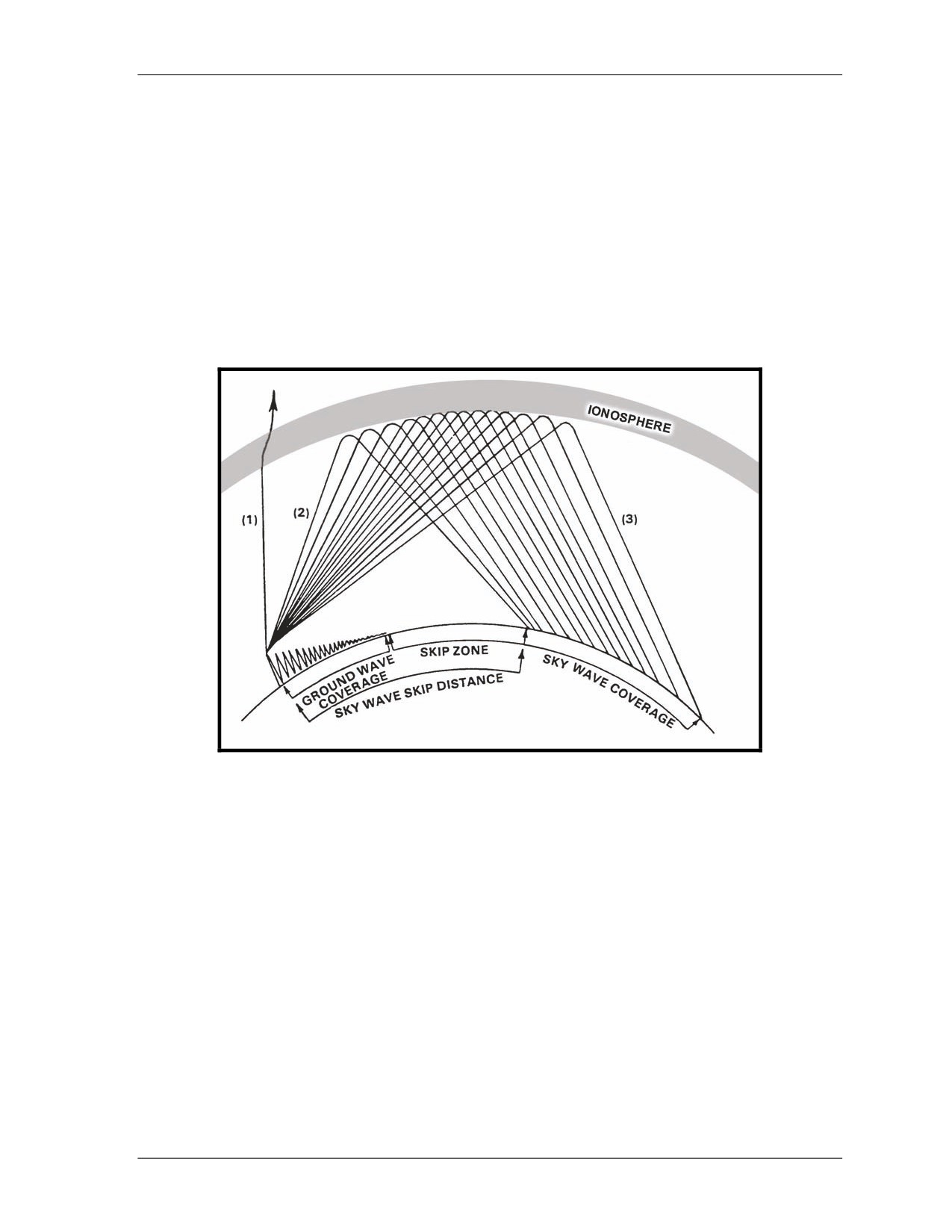
effect, and he reduces or eliminates any skip zone (Figure 6-9).
Figure 6-9. HF skip zone and distance.
6-87.
Depending on the frequency, antenna, and other factors, an area may exist between the longest
ground-wave range and the shortest sky-wave range where no signal exists. This is called the skip zone and
no communication is possible. The NVIS effect can eliminate this problem.
6-88.
Multiple frequencies are usually needed to maintain sky-wave communication. As a minimum,
two frequencies, one for day and one for night are normally required.
CLASSIFICATION
6-89.
Antennas are classified by the directions in which they can radiate energy. The three
classifications include omnidirectional antennas (all directions), bidirectional antennas (two directions), or
directional (one direction). A directional antenna is the best choice--if it works--because its signal is the
most difficult for the enemy to locate.
DIRECTIONAL
6-90.
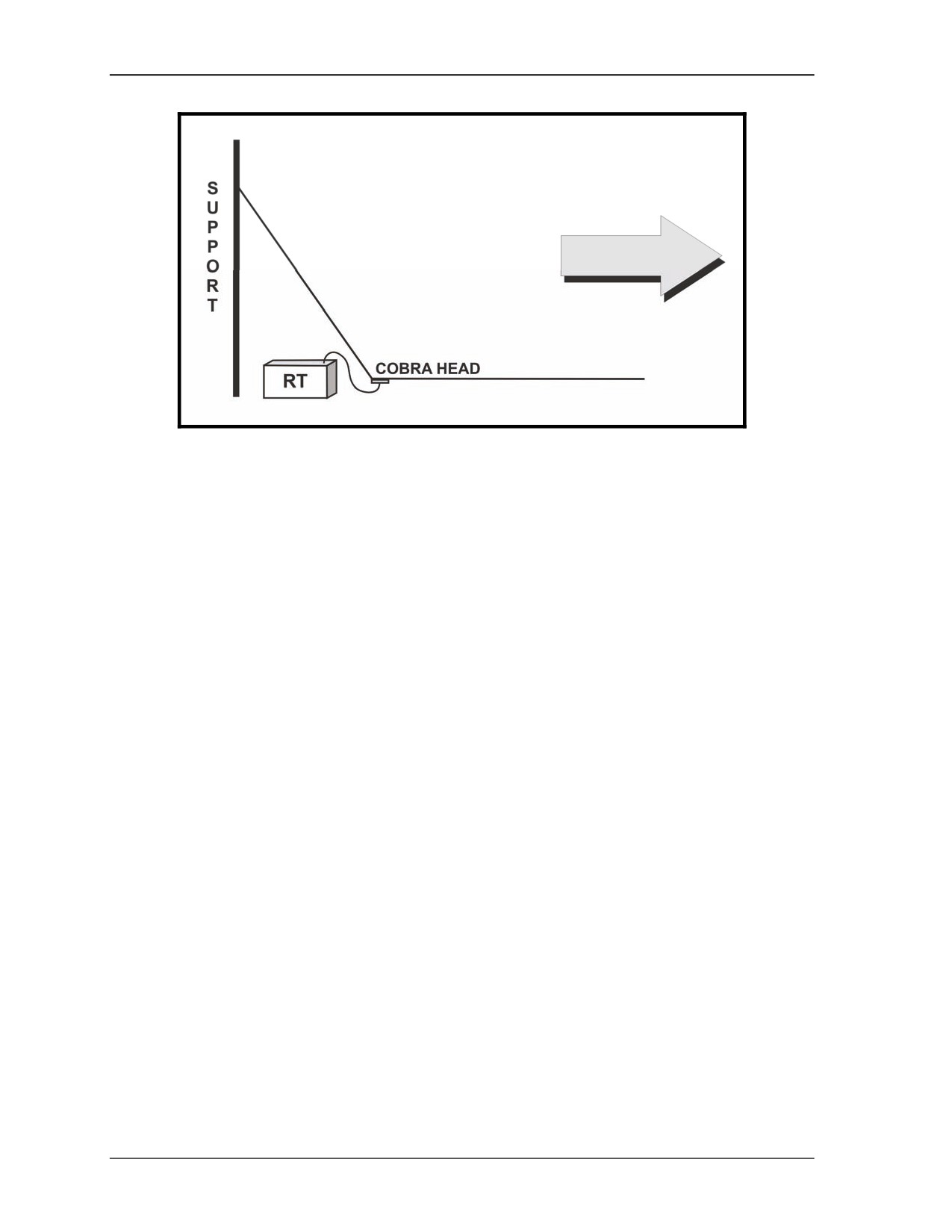
This antenna's single lobe of energy sends a unidirectional signal (Figure 6-10). The width of the
signal ranges from a narrow pencil beam to a 60-degree arc, depending on the type of directional
antenna chosen.
23 June 2009
FM 3-55.93
6-23
Chapter 6
Figure 6-10. Unidirectional antenna pattern.
Application
6-91.
Directional antennas are used on long-range, point-to-point circuits that need concentrated radio
energy to ensure a reliable signal.
Orientation
6-92.
A directional antenna concentrates most of its energy in one direction, so it requires careful
orientation.
Detection
6-93.
The enemy has a hard time determining the origin of directional antennas, which minimizes
interference.
Adaptation of Bidirectional Antennas for Directional Use
6-94.
Adding a terminating resistor to absorb the energy of the second lobe allows directional use of a
bidirectional (long-wire or sloping "V") antenna. The terminating resistor must match the antenna. That is,
it must be able to absorb one-half of the power output of the connected transmitter and provide 400 to
600 ohms of resistance.
BIDIRECTIONAL
6-95.
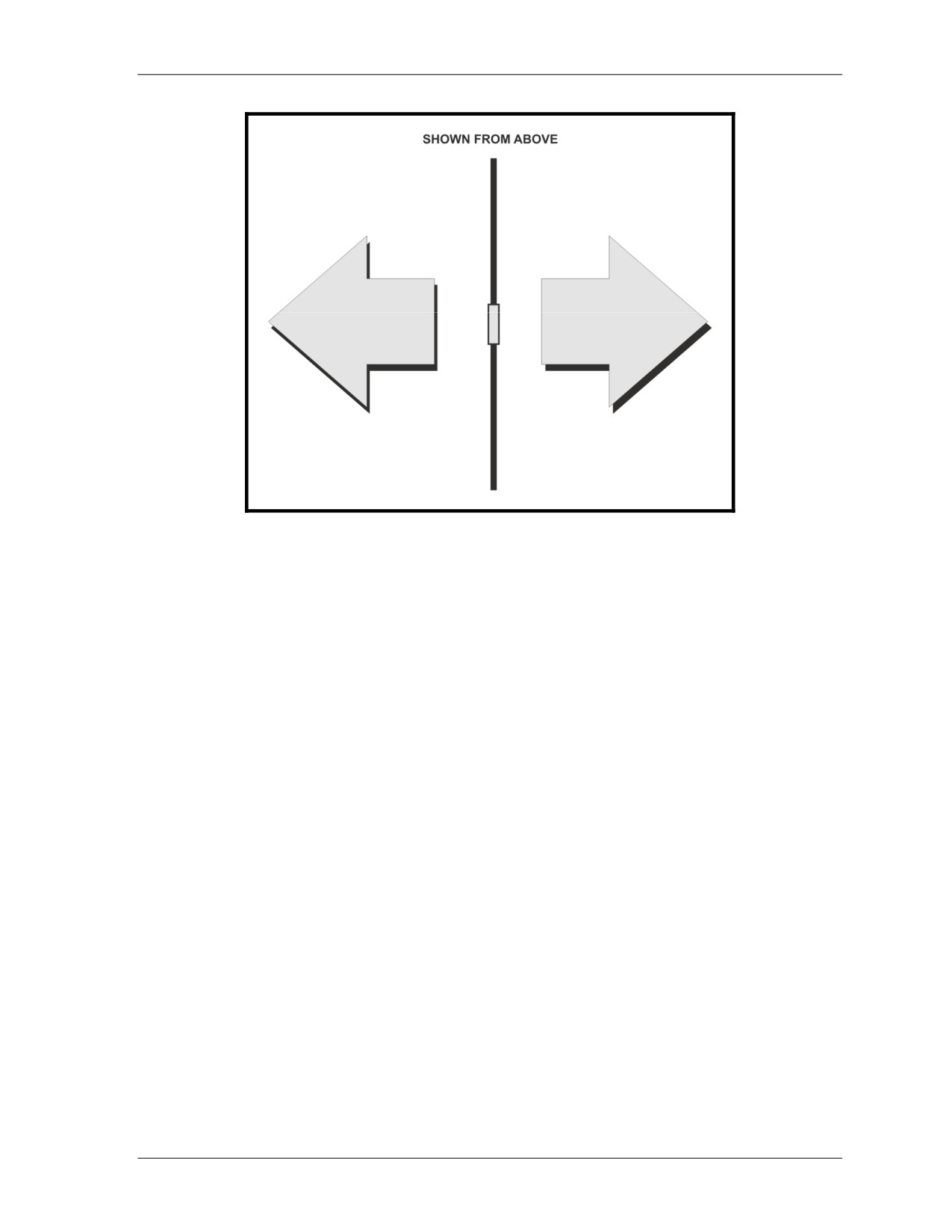
A bidirectional antenna (Figure 6-11) has two opposite lobes of radio energy, with an area of null
energy (no energy) between them. The lobes produce two strong signals in opposite directions, and weaker
ones in all other directions.
6-24
FM 3-55.93
23 June 2009
Communications
Figure 6-11. Bidirectional antenna pattern.
Application
6-96.
Bidirectional antennas are usually used on point-to-point circuits and in situations where the
antenna null can be positioned to reduce or block signals that could interfere with reception.
Orientation
6-97.
To work properly (radiate in the desired directions), a bidirectional antenna must be oriented to
the ground wave, and this is difficult to do. Lowering the antenna to create a near-vertical-incidence
skywave (NVIS) effect makes this more difficult, because it increases the radiation pattern. A bidirectional
antenna is best used near other antennas, which should be placed in its null to reduce interference and
interaction between the antennas.
Examples
6-98.
The bidirectional antennas most commonly used in tactical situations are the sloping-"V,"
random-length wire, and half-wave dipole.
OMNI-DIRECTIONAL ANTENNA
6-99.
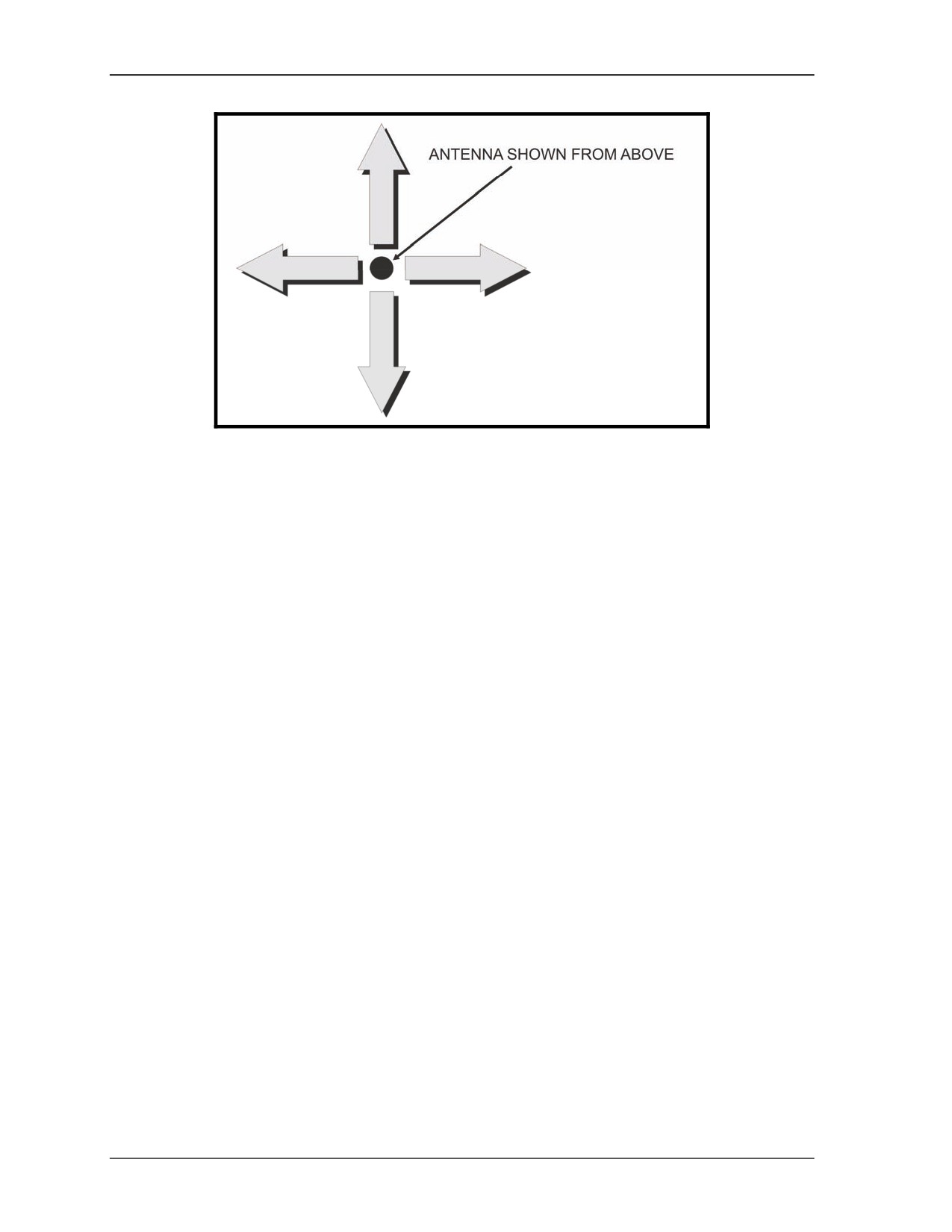
An omnidirectional antenna (Figure 6-12) radiates and receives energy equally well in all compass
directions. It is used when it is necessary to communicate in separate directions at once. However, it is also
more susceptible to interference from all directions. The most common omnidirectional antenna is the
whip. Some others are the quarter-wave vertical
(RC-292 and OE-254) and the crossed dipole
(AS-2259) antennas.
23 June 2009
FM 3-55.93
6-25
Chapter 6
Figure 6-12. Omni-directional antenna pattern.
CONSTRUCTION AND SELECTION
6-100. Antenna construction is limited only by the imagination. There are many types and configurations.
However, the operator must be careful not to construct an antenna that has a high standing wave ratio,
which could damage radio equipment. He should use standing wave ratio meters when testing or using
unfamiliar antennas. In selecting an antenna for an HF circuit, the operator must know the type of
propagation.
GROUND-WAVE PROPAGATION
6-101. Ground-wave propagation requires low takeoff angles and vertically polarized antennas. The whip
antenna provides good omnidirectional ground-wave radiation. If a directional antenna is needed, the
operator selects one with a good low-angle vertical radiation.
SKY-WAVE PROPAGATION
6-102. Sky-wave propagation complicates antenna selection. After first finding the distance between
radio stations, the radio operator can determine the required takeoff angle. The takeoff angle-to-distance
tables give approximate takeoff angles for day and night sky-wave propagation. If the circuit distance is
966 kilometers (600 miles) during the day, the required takeoff angle is about 25 degrees. At night, it is 40
degrees. Therefore, the operator selects an antenna that has high gain from 25 to 40 degrees. He omits this
step if the propagation predictions give the takeoff angles. For NVIS-constructed antennas and short-range
HF communications, he subtracts 20 percent from these predictions and uses a planning range of 0 to
300 miles.
COVERAGE
6-103. The radio operator determines what type of coverage to use. If the radio circuit consists of mobile
(vehicular) stations or of many stations at different directions from the transmitter, an omnidirectional
antenna is required. If the circuit is point to point, he can use a directional or bidirectional antenna.
Normally, the receiving station locations dictate this choice.
CONSTRUCTION
6-104. Before he can select an antenna, the operator must examine the materials available to build one.
He needs two supports to build a horizontal dipole, and a third support in the middle for frequencies of 5
mega hertz (MHz) or less. If he has nothing he can use for a support, he cannot build a dipole antenna.
6-26
FM 3-55.93
23 June 2009
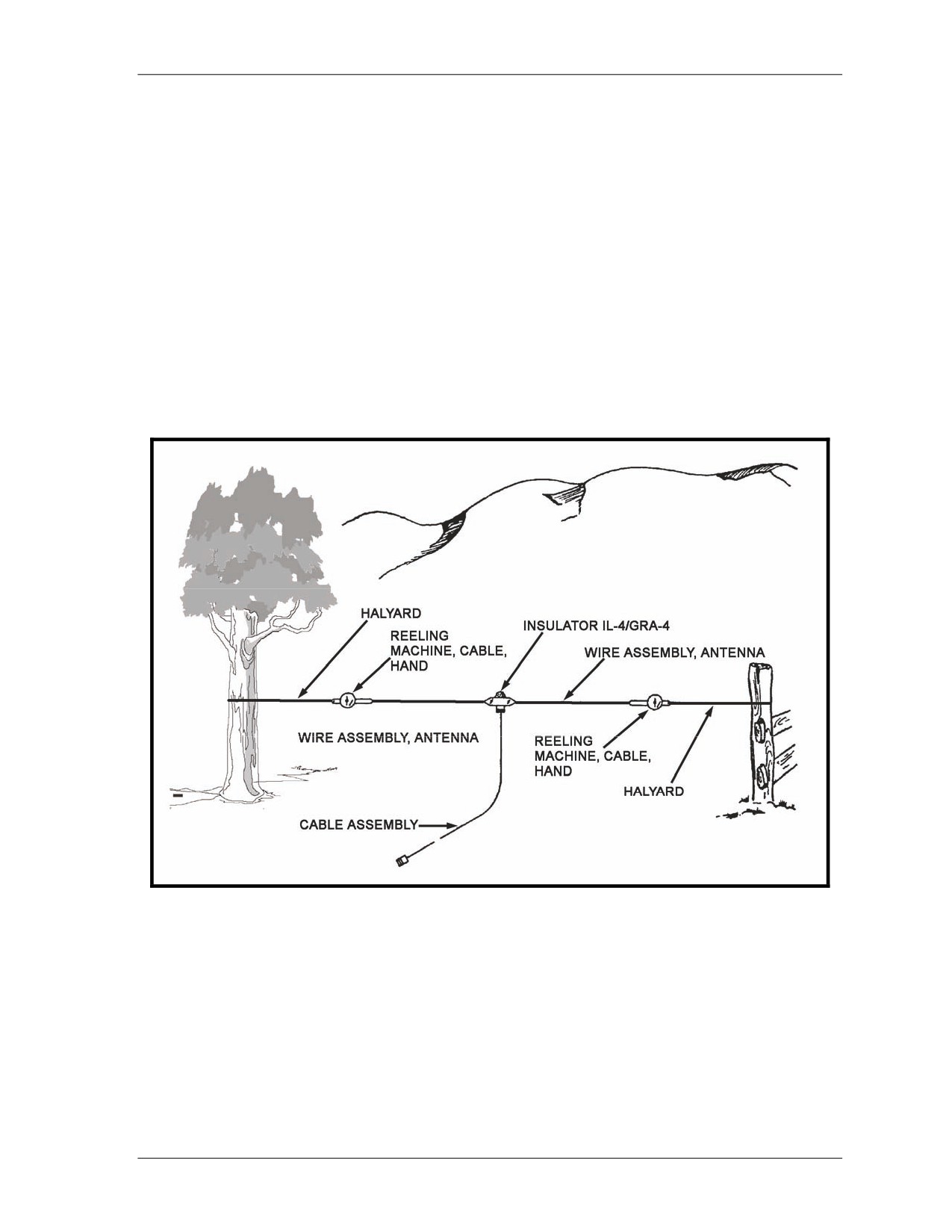
Communications
SITE
6-105. Another consideration is the site itself. The tactical situation usually determines the antenna
positions. The ideal area is clear and flat with no trees, buildings, fences, power lines, or mountains.
Unfortunately, the tactical communicator seldom finds such a perfect site, so he just tries to find one as flat
and clear as possible. He will often have to settle for less ideal sites, and these sites usually interfere with
the patterns and functioning of the antennas.
COMMON TYPES OF ANTENNAS
6-106. Common antenna types include the half-wave dipole, inverted "V," long wire, and the
sloping "V."
HALF-WAVE DIPOLE
6-107. The half-wave dipole antenna is a balanced resonant antenna (Figure 6-13). It produces its
maximum gain in a narrow range between 2 percent above and 2 percent below the design frequency.
Since frequency assignments are normally several megahertz apart, the operator must build a separate
dipole for each assigned frequency.
Figure 6-13. Half-wave dipole antenna.
Length of Dipole
6-108. The operator calculates the length of a half-wave dipole using the formula
length = 468/frequency, as shown in Figure 6-14.
Height of Dipole
6-109. The operator normally keeps the height of a dipole between one-fourth and one-half wavelength
above ground level for long-range sky wave. For NVIS of 0 to 300 miles, and for inverted and sloping "V"
antennas, the operator raises the antenna between one-eighth and one-fourth wavelengths above
ground level.
23 June 2009
FM 3-55.93
6-27
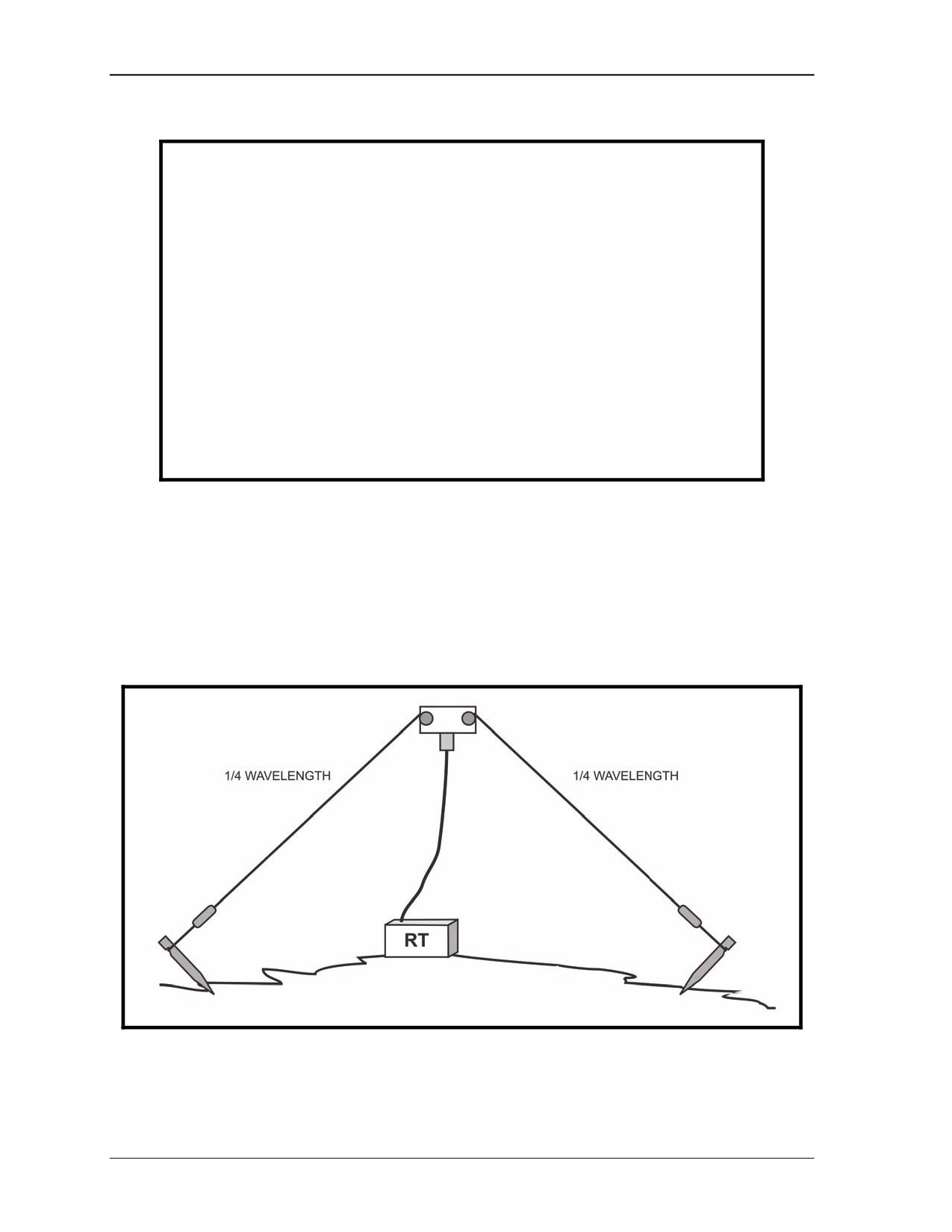
Chapter 6
Length (in meters)
=
(150.00 x 0.95) = 142.50 Frequency in MHz
Length (in feet)
=
(492.00 x 0.95) = 468.00 Frequency in MHz
For harmonic operation, calculate the length of a long-wire antenna
(one wavelength or longer) as follows:
Length (in meters)
=
(150.00 x (N--0.05)) / Frequency in MHz
Length (in feet)
=
(492.00 x (N--0.05)) / Frequency in MHz
Where N = the number of half-wave lengths in the total length of the antenna.
For example, if the number of half-wavelengths is 3 and the frequency in MHz is 7, then--
If length (in meters)
=
(150.00 x (N--0.05)) / Frequency in MHz
Then
(150.00 x (3--0.05)) / 7
(150.00 x (2.95)) / 7
(442.50 / 7)
so length in meters
=
63.20
Figure 6-14. Formula for calculating length of half-wave dipole antenna applied to example.
INVERTED "V"
6-110. The inverted "V" or "drooping dipole" antenna (Figure 6-15) is similar to a dipole antenna, except
that it only requires one center support. Like a dipole, it is used for a specific frequency, and it has a
bandwidth of plus or minus 2 percent of design frequency. Because of the inclined sides, the inverted "V"
antenna produces a combination of horizontal and vertical radiation; vertical off the ends and horizontal
broadside to the antenna. All the construction factors for a dipole also apply to the inverted "V." Although
the inverted "V" has less gain than a dipole, the fact that it only requires one support makes it the preferred
antenna in some tactical situations.
Figure 6-15. Inverted "V" antenna.
6-28
FM 3-55.93
23 June 2009
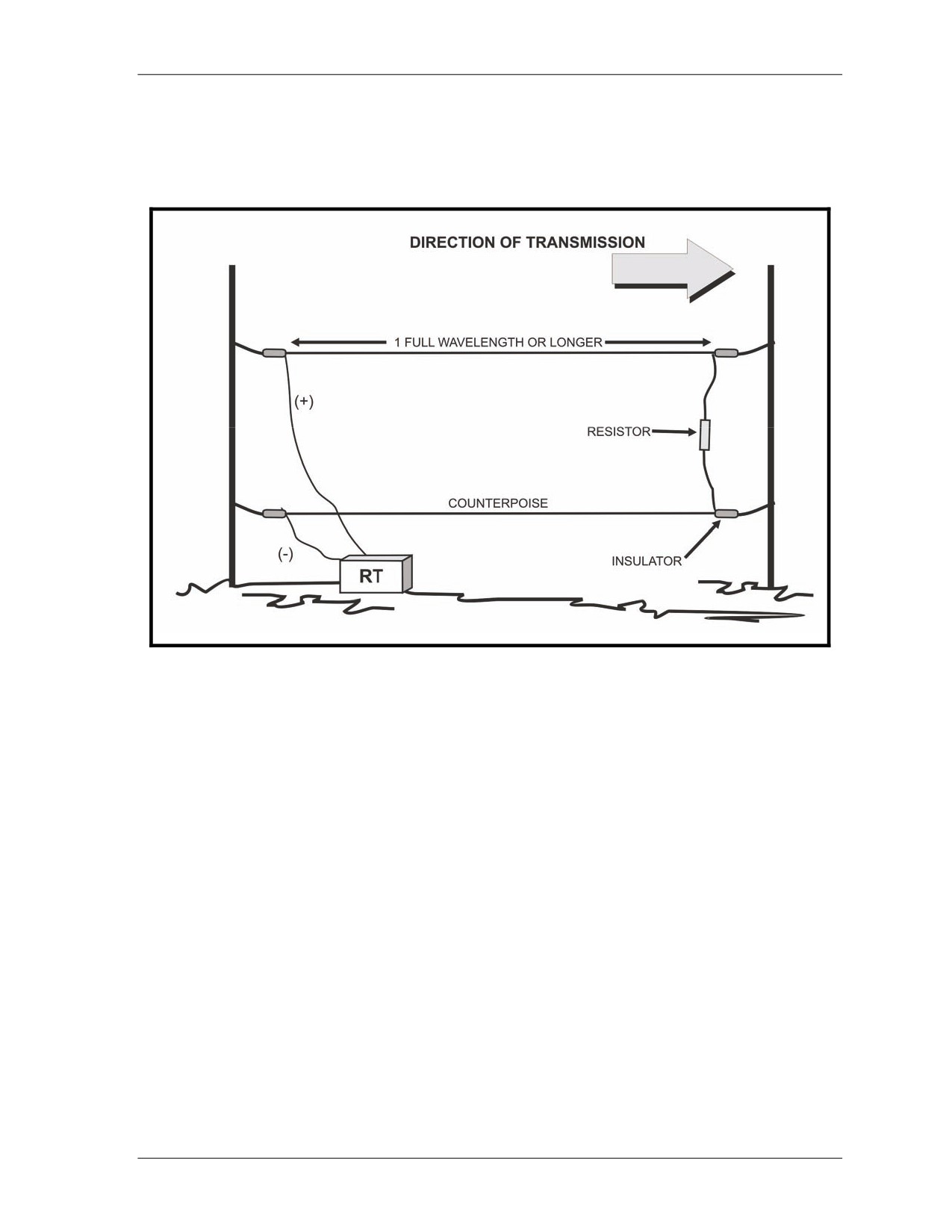
Communications
LONG-WIRE ANTENNA
6-111. A long-wire antenna is one that is at least as long as one wavelength (Figure 6-16). However, it
should be longer to achieve good gain and directional characteristics. Constructing long-wire antennas is
simple, but using the correct dimensions and making the correct adjustments are both critical to its success.
Figure 6-16. Long-wire antenna.
Direction
6-112. A long-wire antenna is made directional by placing a terminating resistor at the distant station end
of the antenna. The terminating resistor should be a 600-ohm, noninductive resistor that can absorb at least
one-half of the transmitter power. Terminating resistors are part of some radio sets, but can be made locally
using a 100-watt, 106-ohm resistor (NSN 5905-00-764-5573).
Construction
6-113. Building a long-wire antenna only requires wire, support poles, insulators, and a terminating
resistor (if directionality is desired). The only other requirement is that the operator string the antenna in as
straight a line as the situation permits. Because the antenna is less than 20 feet tall, it requires no tall
support structures.
SLOPING WIRE
6-114. If an HF circuit is only a single point-to-point ground link or a short skywave link, and if all other
stations are oriented in the same direction, then the team can use a sloping wire antenna (Figure 6-17). The
radiating wire is normally one quarter of the wavelength. (Antenna length is measured from the radio
equipment.) The far end of the antenna should be connected to a rope whose other end is tied to a
nonconductive weight such as a stone or brick. The weighted end is then thrown over a tree so that the
antenna forms a 30- to 45-degree angle to the ground. Angles greater than 45 degrees are used for ground
waves, and less than 30 degrees for sky waves. The angle formed by the wire should point in the direction
opposite that of the intended receiver.
23 June 2009
FM 3-55.93
6-29
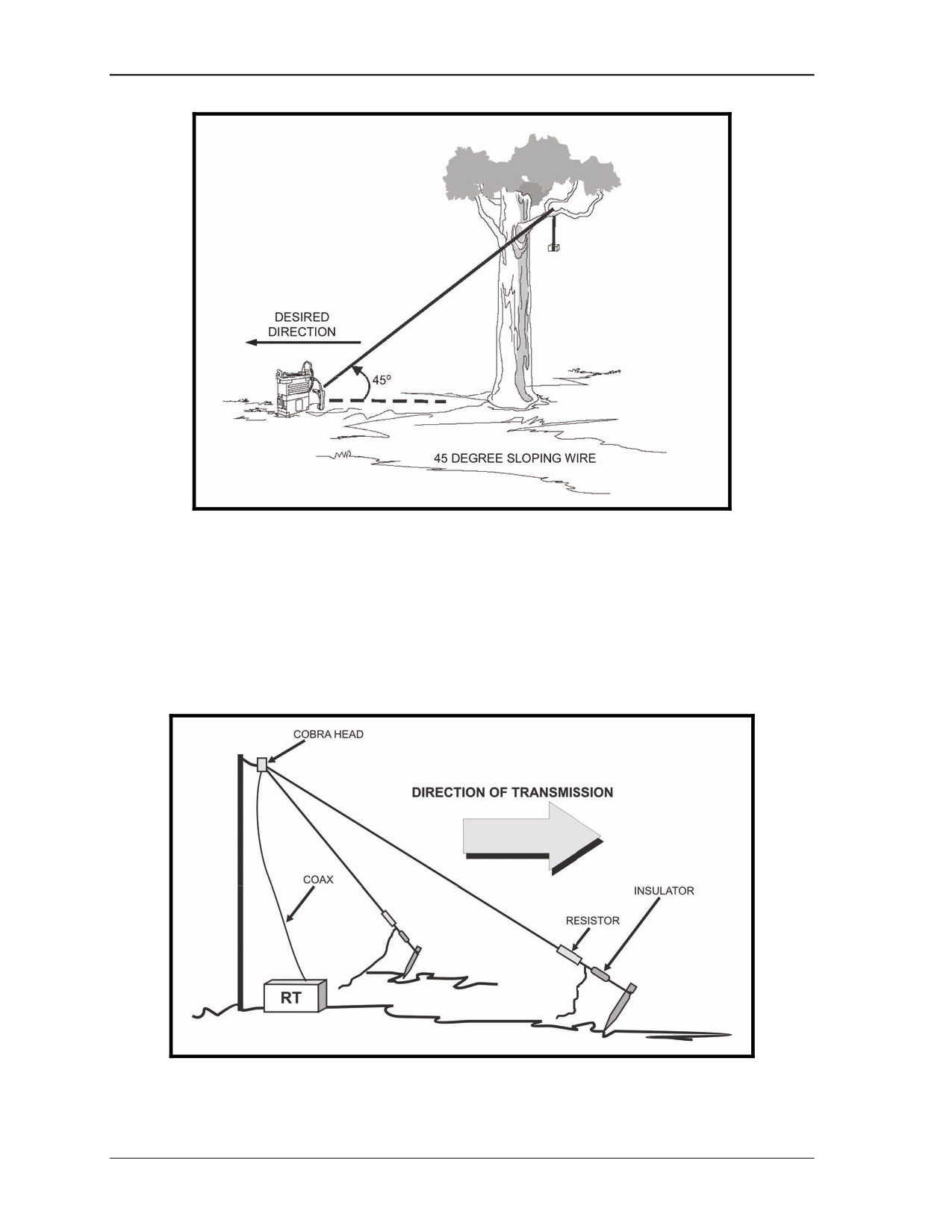
Chapter 6
Figure 6-17. Sloping wire antenna.
TERMINATED SLOPING "V"
6-115. The sloping "V" antenna is a short- to long-range sky-wave antenna that the radio operator can
build in the field (Figure 6-18). Gain and directivity depend on leg length. For reasonable performance, the
antenna should be at least one-half wavelength long. To make the antenna directional, the operator puts
terminating resistors on each leg on the open part of the "V." The terminating resistors should be 300 ohms
and be capable of absorbing one-half of the transmitter’s power output. These terminating resistors are
either procured or locally made. Using the terminating resistors, the operator aims the antenna so that the
line cutting the "V" in half points at the distant station.
Figure 6-18. Terminated sloping "V" antenna.
6-30
FM 3-55.93
23 June 2009
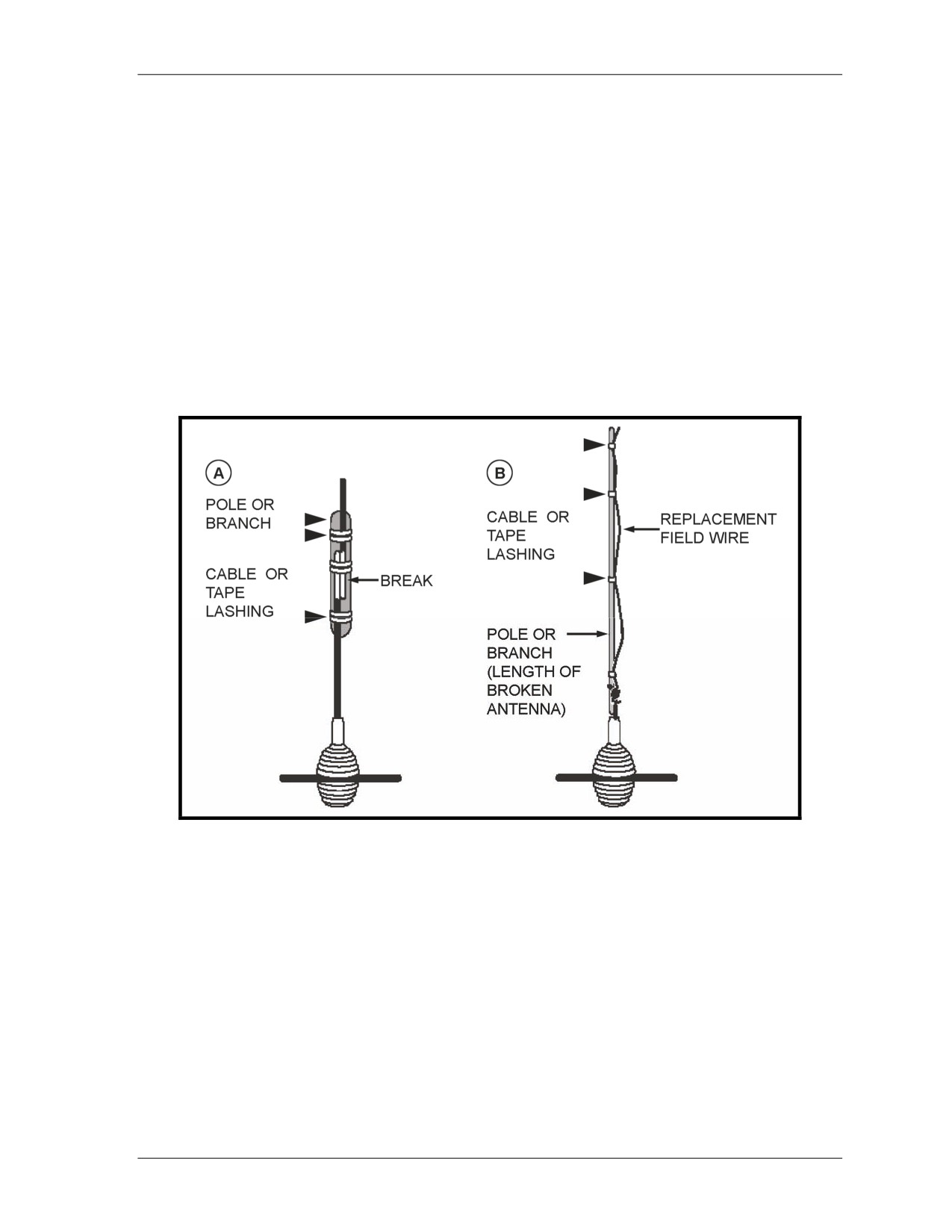
Communications
FIELD-EXPEDIENT ANTENNAS
6-116. Operators must know the importance of field-expedient antennas. The operator will have to
construct field-expedient antennas if conventional ones are damaged or missing parts.
REPAIR OF DAMAGED ANTENNA
6-117. A broken whip antenna can be temporarily repaired (Figure 6-19)--
• If the whip is broken in two sections, the operator can join the sections. First, he removes the
paint and cleans the sections where they join. This ensures a good electrical connection. Then,
he places the sections together and secures them using bare wire or tape.
• If the whip is badly damaged, the radio operator can use field wire (WD1/TT) of the same
length as the original antenna. The radio operator removes the insulation from the lower end of
the field wire antenna, twists the conductors together, sticks them into the antenna base
connector, and secures the conductors with a wooden block. He supports the antenna wire with
a tree or a pole.
Figure 6-19. Repair procedure, whip antenna.
INSULATORS
6-118. The radio operator can make these from items that are readily available (Figure 6-20). He should
choose materials that do not absorb water, as those that do, such as rope or cloth, will lose their insulating
characteristics and become conductors themselves should they get wet.
23 June 2009
FM 3-55.93
6-31
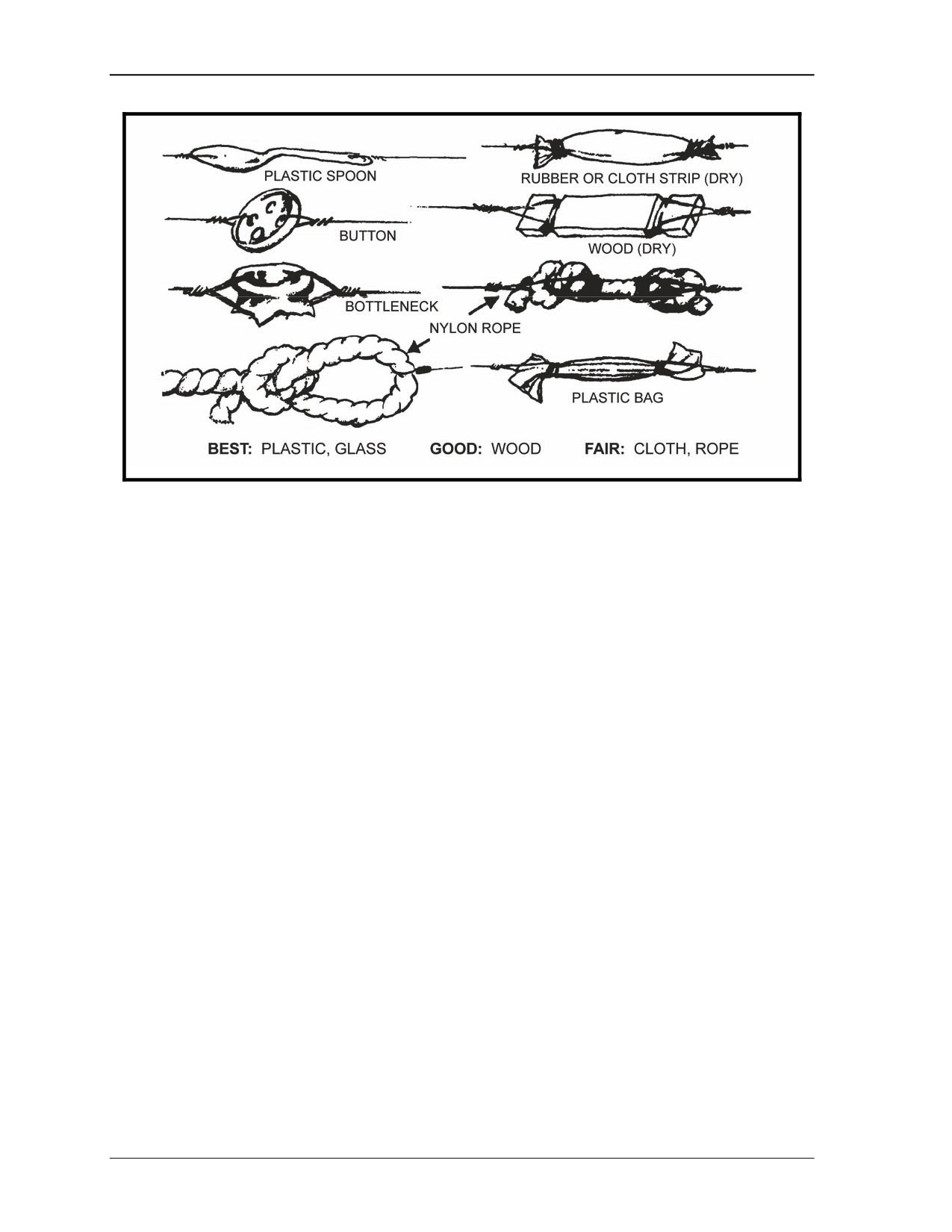
Chapter 6
Figure 6-20. Expedient insulators.
SUPPORTS
6-119. Many expedient antennas require support. The most common support is a strong tree that can
survive heavy windstorms. However, even the largest tree sways enough in the wind to break a wire
antenna. The operator attaches a spring or piece of old inner tube to one end of the antenna to keep it taut
while preventing it from breaking or stretching as the tree sways. If a small pulley is available, he attaches
that to the tree. He attaches one end of a rope to the end of the antenna, passes the rope through the pulley
on the tree, then attaches a heavy weight to the free end of rope. This lets the tree sway without straining
the antenna.
TERMINATING RESISTORS
6-120. Resistors for low-power (man-pack) HF radios are readily available from commercial radio supply
stores. However, carbon resistors that can dissipate more than 5 watts are hard to find.
6-121. As a field-expedient technique, the radio operator can connect the low-power (5-watt) resistors in
parallel to enable a terminator to handle greater power. For example, eight 5-watt, 4,000-ohm resistors
connected in parallel become a 500-ohm, 40-watt terminator. Unfortunately, this is still too small to work
with a high-power, HF terminator. A terminator for a 1,000-watt transmitter requires 100 5-watt resistors.
However, a series of 100-watt, 106-ohm resistors (NSN 5905-00-764-5573) may be mounted on a single
insulating board to serve as a terminator for a high-powered transmitter.
FIELD-EXPEDIENT WIRE
6-122. If regular antenna wire is unavailable, the radio operator can use field telephone wire (WD1/TT)
to build antennas. Field wire consists of two insulated wires, and each of those has four copper and three
steel strands.
• When making electrical connections with field wire, the operator uses the copper strands. To
identify them he removes about 1 inch of insulation from one end of the insulated wire. He
holds it where the insulation ends and bends the strands to the side. When he releases the
pressure, the steel strands snap back to their original positions, but the copper strands remain
bent. He can then wrap these copper strands around the steel strands for a good electrical
connection.
6-32
FM 3-55.93
23 June 2009
Communications
• If field wire is used as the radiating element of an antenna, the two insulated wires in the
twisted pair must be connected together at the ends so that electrically the two wires act as one.
-- First, the radio operator tightly twists together all six steel strands from the two wires (for
strength).
-- Second, he twists the eight copper strands together (to connect them electrically).
-- Third, he twists the copper strands around the steel strands.
• When using them as a feed line for a dipole antenna, the radio operator connects each of the
two insulated wires of the twisted pair to a separate leg of the dipole. At the radio, he connects
one wire (any wire) to the center connector of the radio antenna terminal and the second wire to
a screw on the antenna case.
• In an emergency, any wire of sufficient length can be used for an antenna, for example, barbed
wire, electrical wire, fence wire, or metal-cored clothesline. Communication has even been
successful using metal house gutters and metal bed springs. A radio operator’s mission is
incomplete until he establishes communication.
GROUND
6-123. All radio equipment should be grounded to prevent shock and damage to equipment during
electrical storms. This protects the operator and his equipment. Also, some antennas must have a
radio-frequency ground before they will function. Most radio sets come with a ground rod that should
provide enough ground if used properly in good soil. The radio operator checks to ensure that the ground
rod is neither oily nor corroded. He drives the rod into the ground so that the top of the rod is below
surface. To ensure a good electrical connection, he makes sure that the top of the ground rod and the end of
the ground strap are both clean and bright. Then, he uses a clamp or a nut and bolt to make a good
mechanical and electrical connection at the ground rod.
Alternative Materials
6-124. If he has no ground rod, he can use water pipes, concrete reinforcing rods, metal fence posts
(protective paint coating removed), or any length of metal. If a water system has metal pipes, he can make
a good ground by clamping the ground strap to a water pipe. He can also use underground pipes, tanks, and
metal building foundations.
WARNING
Never ground on any piping or underground tanks that contain
flammable materials such as natural gas or gasoline.
Soil Additives
6-125. The operator can improve the conductivity of dry soil by adding water and chemicals such as table
or Epsom salt to it (Epsom salt is less corrosive than table salt). First, the radio operator digs a hole around
the ground rod. Then, he mixes and pours into it one pound of the chemical and one gallon of water. He
should periodically add water to keep the ground damp. He can use urine in place of water, if needed.
Multiple Ground Rods
6-126. Using multiple ground rods can also improve the electrical ground. If he has enough ground rods,
the operator can build a “star ground.” He drives a single rod into the center of a circle that measures about
20 feet in diameter. Then, he drives additional ground rods around the outside of the circle. He connects
the ground strap from the radio to the center rod, which he in turn connects to the rods along the outside of
the circle. Finally, he connects the rods around the circle.
23 June 2009
FM 3-55.93
6-33
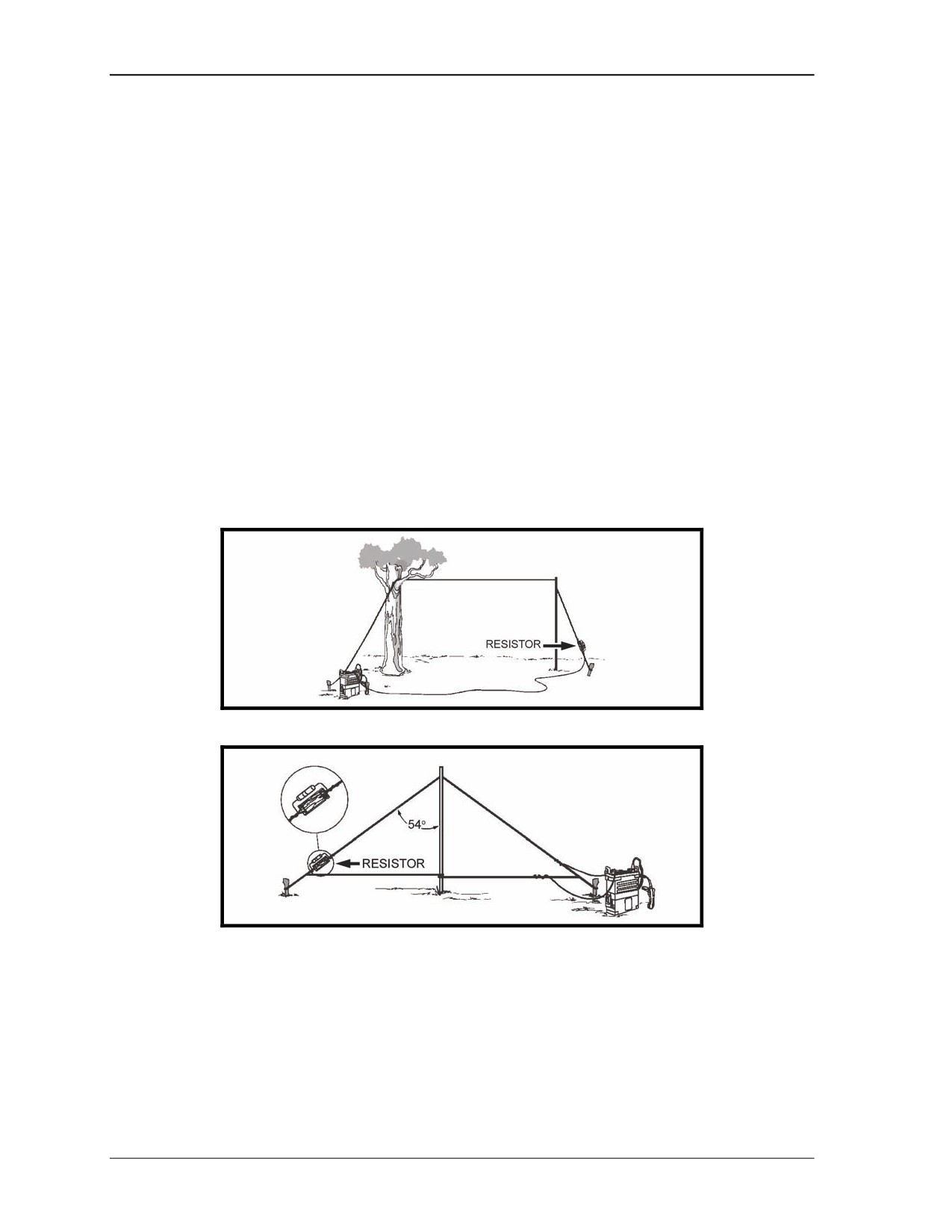
Chapter 6
HIGH FREQUENCY, DIRECTIONAL, FIELD-EXPEDIENT
ANTENNAS
6-127. The long-wire (Figure 6-21) and vertical half-rhombic (Figure 6-22) are two field-expedient,
directional antennas. These antennas consist of a single wire, preferably two or more wavelengths long,
supported on poles at a height of 3 to 7 meters (10 to 20 feet) above the ground. The antennas will,
however, operate satisfactorily at less than 1 meter (about 3 feet) aboveground. The far end of the wire
connects to ground through a noninductive resistor of 500 to 600 ohms. The resistor should have a rating
of at least one-half the wattage output of the transmitter. This ensures that the output power of the
transmitter does not burn out the resistor. A reasonably good ground, such as a number of ground rods or a
counterpoise, should be used at each end of the antenna. The radiation pattern is directional. The antennas
are used primarily to transmit or receive HF signals. The "V" antenna is another field-expedient, directional
antenna (Figure 6-23). It consists of two wires forming a "V" with the open area of the "V" pointing toward
the desired direction of transmission or reception. To make construction easier, the legs may slope
downward from the apex of the "V." This is called a sloping "V" antenna (Figure 6-24). The angle between
the legs varies with the length of the legs in order to achieve maximum performance. To make the antenna
radiate in only one direction, add noninductive terminating resistors from the end of each leg (not at the
apex) to ground. The resistors should be approximately 500 ohms and have a power rating at least one-half
that of the output power of the transmitter being used. Without the resistors, the antenna radiates
bidirectionally, both front and back. The antenna must be fed by a balanced transmission line.
Figure 6-21. High frequency antenna, long-wire type.
Figure 6-22. High frequency antenna, half-rhombic type.
6-34
FM 3-55.93
23 June 2009