FM 6-0 COMMANDER AND STAFF ORGANIZATION AND OPERATIONS (MAY 2014) - page 4

Chapter 9
Table 9-3. Sample synchronization matrix tool
Time/Event/Phase
H - 24 hours (or event or
H-hour (or event or
H + 24 (or event or
phase)
phase)
phase)
Enemy Action
Initiates threat activities and
Defends from security
Commits reserve
movements
zone
Population or Civilian
Orderly evacuation from
Action
area continues
Decision Points
Conduct aviation attack of
OBJ Irene
Control Measures
1st ABCT
Move on Route Irish
Cross LD
Seize on OBJ Irene
2d ABCT
Move on Route Longstreet
Cross LD
Seize on OBJ Rose
3d ABCT
FPOL with 1st BCT
Attack enemy reserve on
Avn Bde
OBJ Irene
BFSB
Reserve
Information
Collection
Fires
Prep fires initiated at H-5
Suppression of enemy air
defense initiated
Engineer
PMO
CBRN
Sustainment
Mission Command
Main CP with 1st BCT
Close Air Support
Electronic Warfare
Enemy command and
control jammed
Nonlethal Effects
Surrender broadcasts and
leaflets
Host Nation
Interagency
NGOs
Begins refugee relief
Note: The first column is representative only and can be modified to fit formation needs.
AMD air and missile defense
H
hour
Avn Bde aviation brigade
LD
line of departure
ABCT armored brigade combat team
NGO
nongovernmental organization
CBRN chemical, biological, radiological, and nuclear
OBJ
objective
CP
command post
PMO
provost marshal office
FPOL
forward passage of lines
9-141. The sketch note method uses brief notes concerning critical locations or tasks and purposes. These
notes refer to specific locations or relate to general considerations covering broad areas. The commander
and staff mark locations on the map and on a separate war-game work sheet. Staff members use sequential
numbers to link the notes to the corresponding locations on the map or overlay. Staff members also identify
actions by placing them in sequential action groups, giving each subtask a separate number. They use the
war-game work sheet to identify all pertinent data for a critical event. (See table 9-4.) They assign each
event a number and title and use the columns on the work sheet to identify and list in sequence—
9-32
FM 6-0, C2
22 April 2016

The Military Decisionmaking Process
z
Units and assigned tasks.
z
Expected enemy actions and reactions.
z
Friendly counteractions and assets.
z
Total assets needed for the task.
z
Estimated time to accomplish the task.
z
The decision point tied to executing the task.
z
CCIRs.
z
Control measures.
z
Remarks.
Table 9-4. Sample sketch note method
Critical Event
Seize OBJ Sword
Sequence number
1
Action
TF 3 attacks to destroy enemy company on OBJ
Sword
Reaction
Enemy company on OBJ Club counterattacks
Counteraction
TF 1 suppresses enemy company on OBJ Club
Assets
TF 3, TF 1, and TF2
Time
H+1 to H+4
Decision point
DP 3a and 3b
Commander’s critical information
Location of enemy armor reserve west of PL Jaguar
requirements
Control measures
Axis Zinc and support by fire position 1
Remarks
none
DP
decision point
PL
phase line
OBJ
objective
TF
task force
War-Game the Operation and Assess the Results
9-142. War-gaming is a conscious attempt to visualize the flow of operations given the friendly force’s
strengths and dispositions, the enemy’s capabilities and possible COAs, and civilian locations and
activities. During the war game, the commander and staff try to foresee the actions, reactions, and
counteractions of all participants, including civilians. The staff analyzes each selected event. It identifies
tasks that the force one echelon below it must accomplish, using assets two echelons below the staff.
Identifying strengths and weaknesses of each COA allows the staff to adjust the COAs as necessary.
9-143. The war game focuses not so much on the tools used but on the people who participate. Staff
members who participate in war-gaming should be the individuals deeply involved in developing COAs.
Red team members (who can provide alternative points of view) provide insight on each COA. In stability
tasks, subject matter experts in areas such as economic or local governance can also help assess the
probable results of planned actions, including identifying possible unintended effects.
9-144. The war game follows an action-reaction-counteraction cycle. Actions are those events initiated by
the side with the initiative. Reactions are the opposing side’s actions in response. With regard to stability
tasks, the war game tests the effects of actions, including intended and unintended effects, as they stimulate
anticipated responses from civilians and civil institutions. Counteractions are the first side’s responses to
reactions. This sequence of action-reaction-counteraction continues until the critical event is completed or
until the commander decides to use another COA to accomplish the mission.
9-145. The staff considers all possible forces, including templated enemy forces outside the area of
operations, that can influence the operation. The staff also considers the actions of civilians in the area of
operations, the diverse kinds of coverage of unfolding events, and their consequences in the global media.
22 April 2016
FM 6-0, C2
9-33
Chapter 9
The staff evaluates each friendly move to determine the assets and actions required to defeat the enemy at
that point or to accomplish stability tasks. The staff continually considers branches to the plan that promote
success against likely enemy counteractions or unexpected civilian reactions. Lastly, the staff lists assets
used in the appropriate columns of the work sheet and lists the totals in the assets column (not considering
any assets lower than two command levels below the staff).
9-146. The commander and staff examine many areas during the war game. These include, but are not
limited to—
z
All friendly capabilities.
z
All enemy capabilities and critical civil considerations that impact operations.
z
Global media responses to proposed actions.
z
Movement considerations.
z
Closure rates.
z
Lengths of columns.
z
Formation depths.
z
Ranges and capabilities of weapon systems.
z
Desired effects of fires.
9-147. The commander and staff consider how to create conditions for success, protect the force, and
shape the operational environment. Experience, historical data, SOPs, and doctrinal literature provide much
of the necessary information. During the war game, staff officers perform a risk assessment for their
functional areas for each COA. They then propose appropriate control measures. They continually assess
the risk of adverse reactions from population and media resulting from actions taken by all sides in the
operation. Staff officers develop ways to mitigate those risks.
9-148. The staff continually assesses the risk to friendly forces, balancing between mass and dispersion.
When assessing the risk of weapons of mass destruction to friendly forces, planners view the target that the
force presents through the eyes of an enemy target analyst. They consider ways to reduce vulnerability and
determine the appropriate level of mission-oriented protective posture consistent with mission
accomplishment.
9-149. The staff identifies the required assets of the warfighting functions to support the concept of
operations, including those needed to synchronize sustaining operations. If requirements exceed available
assets, the staff recommends priorities based on the situation, commander’s intent, and planning guidance.
To maintain flexibility, the commander may decide to create a reserve to maintain assets for unforeseen
tasks or opportunities.
9-150. The commander can modify any COA based on how things develop during the war game. When
doing this, the commander validates the composition and location of the decisive operation, shaping
operations, and reserve forces. Control measures are adjusted as necessary. The commander may also
identify situations, opportunities, or additional critical events that require more analysis. The staff performs
this analysis quickly and incorporates the results into the war-gaming record.
9-151. An effective war game results in the commander and staff refining, identifying, analyzing,
developing, and determining several effects. (See table 9-5.)
9-34
FM 6-0, C2
22 April 2016
The Military Decisionmaking Process
Table 9-5. Effective war game results
The commander and staff refine (or modify)—
Each course of action, to include identifying branches and sequels that become on-order or be-prepared missions.
The locations and times of decisive points.
The enemy event template and matrix.
The task organization, including forces retained in general support.
Control requirements, including control measures and updated operational graphics.
Commander’s critical information requirements and other information requirements—including the latest time
information is of value—and incorporate them into the information collection plan.
The commander and staff identify—
Key or decisive terrain and determining how to use it.
Tasks the unit retains and tasks assigned to subordinates.
Likely times and areas for enemy use of weapons of mass destruction and friendly chemical, biological, radiological,
and nuclear defense requirements.
Potential times or locations for committing the reserve.
The most dangerous enemy course of action.
The most likely enemy course of action.
The most dangerous civilian reaction.
Locations for the commander and command posts.
Critical events.
Requirements for support of each warfighting function.
Effects of friendly and enemy actions on civilians and infrastructure and on military operations.
Or confirming the locations of named areas of interest, target areas of interest, decision points, and intelligence
requirements needed to support them.
Analyzing, and evaluating strengths and weaknesses of each course of action.
Hazards, assessing their risk, developing control measures for them, and determining residual risk.
The coordination required for integrating and synchronizing interagency, host-nation, and nongovernmental
organization involvement.
The commander and staff analyze—
Potential civilian reactions to operations.
Potential media reaction to operations.
Potential impacts on civil security, civil control, and essential services in the area of operations.
The commander and staff develop—
Decision points.
A synchronization matrix.
A decision support template and matrix.
Solutions to achieving minimum essential stability tasks in the area of operations.
The information collection plan and graphics.
Themes and messages.
Fires, protection, and sustainment plans and graphic control measures.
The commander and staff determine—
The requirements for military deception and surprise.
The timing for concentrating forces and starting the attack or counterattack.
The movement times and tables for critical assets, including information systems nodes.
The estimated the duration of the entire operation and each critical event.
The projected the percentage of enemy forces defeated in each critical event and overall.
The percentage of minimum essential tasks that the unit can or must accomplish.
The media coverage and impact on key audiences.
The targeting requirements in the operation, to include identifying or confirming high-payoff targets and establishing
attack guidance.
The allocation of assets to subordinate commanders to accomplish their missions.
22 April 2016
FM 6-0, C2
9-35
Chapter 9
Conduct a War-Game Briefing (Optional)
9-152. Time permitting, the staff delivers a briefing to all affected elements to ensure everyone
understands the results of the war game. The staff uses the briefing for review and ensures that it captures
all relevant points of the war game for presentation to the commander, COS (XO), or deputy or assistant
commander. In a collaborative environment, the briefing may include selected subordinate staffs. A
war-game briefing format includes the following:
z
Higher headquarters’ mission, commander’s intent, and military deception plan.
z
Updated IPB.
z
Assumptions.
z
Friendly and enemy COAs that were war-gamed, including—
Critical events.
Possible enemy actions and reactions.
Possible impact on civilians.
Possible media impacts.
Modifications to the COAs.
Strengths and weaknesses.
Results of the war game.
z
War-gaming technique used.
General War-Gaming Rules and Responsibilities
9-153. War gamers need to—
z
Remain objective, not allowing personality or their sense of “what the commander wants” to
influence them.
z
Avoid defending a COA just because they personally developed it.
z
Record advantages and disadvantages of each COA accurately as they emerge.
z
Continually assess feasibility, acceptability, and suitability of each COA. If a COA fails any of
these tests, reject it.
z
Avoid drawing premature conclusions and gathering facts to support such conclusions.
z
Avoid comparing one COA with another during the war game. This occurs during Step 5—COA
Comparison.
Mission Command Responsibilities
9-154. The commander has overall responsibility for the war-gaming process, and the commander can
determine the staff members who are involved in war-gaming. Traditionally, certain staff members have
key and specific roles.
9-155. The COS (XO) coordinates actions of the staff during the war game. This officer is the unbiased
controller of the process, ensuring the staff stays on a timeline and achieves the goals of the war-gaming
session. In a time-constrained environment, this officer ensures that, at a minimum, the decisive operation
is war-gamed.
9-156. The G-3 (S-3) assists the commander with the rehearsal. The G-3 (S-3)—
z
Portrays the friendly scheme of maneuver, including the employment of information-related
capabilities.
z
Ensures subordinate unit actions comply with the commander’s intent.
z
Normally provides the recorder.
9-157. The assistant chief of staff, signal (G-6 [S-6]) assesses network operations, spectrum management
operations, network defense, and information protection feasibility of each war-gamed COA. The G-6 (S-6)
determines communications systems requirements and compares them to available assets, identifies
potential shortfalls, and recommends actions to eliminate or reduce their effects.
9-36
FM 6-0, C2
22 April 2016
The Military Decisionmaking Process
9-158. The information operations officer assesses the information operations concept of support against
the ability of information-related capabilities to execute tasks in support of each war-gamed COA and the
effectiveness of integrated information-related capabilities to impact various audiences and populations in
and outside the area of operations. The information operations officer, in coordination with the electronic
warfare officer, also integrates information operations with cyber electromagnetic activities.
9-159. The assistant chief of staff, civil affairs operations (G-9 [S-9]) ensures each war-gamed COA
effectively integrates civil considerations (the
“C” of METT-TC). The civil affairs operations officer
considers not only tactical issues but also sustainment issues. This officer assesses how operations affect
civilians and estimates the requirements for essential stability tasks commanders might have to undertake
based on the ability of the unified action partners. Host-nation support and care of dislocated civilians are
of particular concern. The civil affairs operations officer’s analysis considers how operations affect public
order and safety, the potential for disaster relief requirements, noncombatant evacuation operations,
emergency services, and the protection of culturally significant sites. This officer provides feedback on
how the culture in the area of operations affects each COA. If the unit lacks an assigned civil affairs officer,
the commander assigns these responsibilities to another staff member.
9-160. The red team staff section provides the commander and assistant chief of staff, intelligence (G-2)
with an independent capability to fully explore alternatives. The staff looks at plans, operations, concepts,
organizations, and capabilities of the operational environment from the perspectives of enemies, unified
action partners, and others.
9-161. The electronic warfare officer provides information on the electronic warfare target list, electronic
attack taskings, electronic attack requests, and the electronic warfare portion of the collection matrix and
the attack guidance matrix. Additionally, the electronic warfare officer assesses threat vulnerabilities,
friendly electronic warfare capabilities, and friendly actions relative to electronic warfare activities and
other cyber electromagnetic activities not covered by the G-6 or G-2.
9-162. The staff judge advocate advises the commander on all matters pertaining to law, policy,
regulation, good order, and discipline for each war-gamed COA. This officer provides legal advice across
the range of military operations on law of war, rules of engagement, international agreements, Geneva
Conventions, treatment and disposition of noncombatants, and the legal aspects of targeting.
9-163. The operations research and systems analysis staff section provides analytic support to the
commander for planning and assessment of operations. Specific responsibilities include—
z
Providing quantitative analytic support, including regression and trend analysis, to planning and
assessment activities.
z
Assisting other staff members in developing customized analytical tools for specific
requirements, providing a quality control capability, and conducting assessments to measure the
effectiveness of operations.
9-164. The safety officer provides input to influence accident and incident reductions by implementing
risk management procedures throughout the mission planning and execution process.
9-165. The knowledge management officer assesses the effectiveness of the knowledge management plan
for each course of action.
9-166. The space operations officer provides and represents friendly, threat, and non-aligned space
capabilities.
Intelligence Responsibilities
9-167. During the war game the G-2 (S-2) role-plays the enemy commander, other threat organizations in
the area of operations, and critical civil considerations in the area of operations. This officer develops
critical enemy decision points in relation to the friendly COAs, projects enemy reactions to friendly actions,
and projects enemy losses. The intelligence officer assigns different responsibilities to available staff
members within the section (such as the enemy commander, friendly intelligence officer, and enemy
recorder) for war-gaming. The intelligence officer captures the results of each enemy, threat group, and
civil considerations action and counteraction as well as the corresponding friendly and enemy strengths and
vulnerabilities. By trying to realistically win the war game for the enemy, the intelligence officer ensures
22 April 2016
FM 6-0, C2
9-37
Chapter 9
that the staff fully addresses friendly responses for each enemy COA. For the friendly force, the
intelligence officer—
z
Refines intelligence and information requirements and the planning requirements tools.
z
Refines the situation and event templates, including named areas of interest that support decision
points.
z
Refines the event template with corresponding decision points, target areas of interest, and
high-value targets.
z
Participates in targeting to select high-payoff targets from high-value targets identified during
IPB.
z
Recommends priority intelligence requirements that correspond to the decision points.
z
Refines civil considerations overlays, databases, and data files.
z
Refines the modified combined obstacle overlays and terrain effects matrices.
z
Refines weather products that outline the critical weather impacts on operations.
Movemenent and Maneuver Responsibilities
9-168. During the war game, the G-3 (S-3) and assistant chief of staff, plans (G-5 [S-5]) are responsible
for movement and maneuver. The G-3 (S-3) normally selects the technique for the war game and role-plays
the friendly maneuver commander. Various staff officers assist the G-3 (S-3), such as the aviation officer
and engineer officer. The G-3 (S-3) executes friendly maneuver as outlined in the COA sketch and COA
statement. The G-5 (S-5) assesses warfighting function requirements, solutions, and concepts for each
COA; develops plans and orders; and determines potential branches and sequels arising from various
war-gamed COAs. The G-5 (S-5) also coordinates and synchronizes warfighting functions in all plans and
orders. The planning staff ensures that the war game of each COA covers every operational aspect of the
mission. The members of the staff record each event’s strengths and weaknesses and the rationale for each
action. They complete the decision support template and matrix for each COA. They annotate the rationale
for actions during the war game and use it later with the commander’s guidance to compare COAs.
Fires Responsibilities
9-169. The chief of fires (fire support officer) assesses the fire support feasibility of each war-gamed
COA. This officer develops a proposed high-payoff target list, target selection standards, and attack
guidance matrix. The chief of fires works with the intelligence officer to identify named and target areas of
interest for enemy indirect fire weapon systems, and identifies high-payoff targets and additional events
that may influence the positioning of field artillery and air defense artillery assets. The chief of fires should
also offer a list of possible defended assets for air defense artillery forces and assist the commander in
making a final determination about asset priority.
Protection Responsibilities
9-170. The chief of protection assesses protection element requirements, refines EEFIs, and develops a
scheme of protection for each war-gamed COA. The chief of protection—
z
Refines the critical asset list and the defended asset list.
z
Assesses hazards.
z
Develops risk control measures and mitigation measures of threats and hazards.
z
Establishes personnel recovery coordination measures.
z
Implements operational area security to include security of lines of communications,
antiterrorism measures, and law enforcement operations.
z
Ensures survivability measures reduce vulnerabilities.
z
Refines chemical, biological, radiological, and nuclear operations.
Sustainment Responsibilities
9-171. During the war game, the assistant chief of staff, personnel (G-1 [S-1]) assesses the personnel
aspect of building and maintaining the combat power of units. This officer identifies potential shortfalls and
9-38
FM 6-0, C2
22 April 2016
The Military Decisionmaking Process
recommends COAs to ensure units maintain adequate manning to accomplish their mission. As the primary
staff officer assessing the human resources planning considerations to support sustainment operations, the
G-1 (S-1) provides human resources support for the operation.
9-172. The assistant chief of staff, logistics
(G-4
[S-4]) assesses the logistics feasibility of each
war-gamed COA. This officer determines critical requirements for each logistics function (classes I through
VII, IX, and X) and identifies potential problems and deficiencies. The G-4 (S-4) assesses the status of all
logistics functions required to support the COA, including potential support required to provide essential
services to the civilians, and compares it to available assets. This officer identifies potential shortfalls and
recommends actions to eliminate or reduce their effects. While improvising can contribute to
responsiveness, only accurately predicting requirements for each logistics function can ensure continuous
sustainment. The logistics officer ensures that available movement times and assets support each COA.
9-173. During the war game, the assistant chief of staff, financial management
(G-8) assesses the
commander’s area of operations to determine the best COA for use of resources. This assessment includes
both core functions of financial management: resource management and finance operations. This officer
determines partner relationships (joint, interagency, intergovernmental, and multinational), requirements
for special funding, and support to the procurement process.
9-174. The surgeon section coordinates, monitors, and synchronizes the execution of the health system
activities for the command for each war-gamed COA to ensure a fit and healthy force.
Recorders
9-175. The use of recorders is particularly important. Recorders capture coordinating instructions, subunit
tasks and purposes, and information required to synchronize the operation. Recorders allow the staff to
write part of the order before they complete the planning. Automated information systems enable recorders
to enter information into preformatted forms that represent either briefing charts or appendixes to orders.
Each staff section keeps formats available to facilitate networked orders production.
STEP 5-COURSE OF ACTION COMPARISON
9-176. COA comparison is an objective process to evaluate COAs independently and against set
evaluation criteria approved by the commander and staff. The goal is to identify the strengths and
weaknesses of COAs, enable selecting a COA with the highest probability of success, and further
developing it in an OPLAN or OPORD. The commander and staff perform certain actions and processes
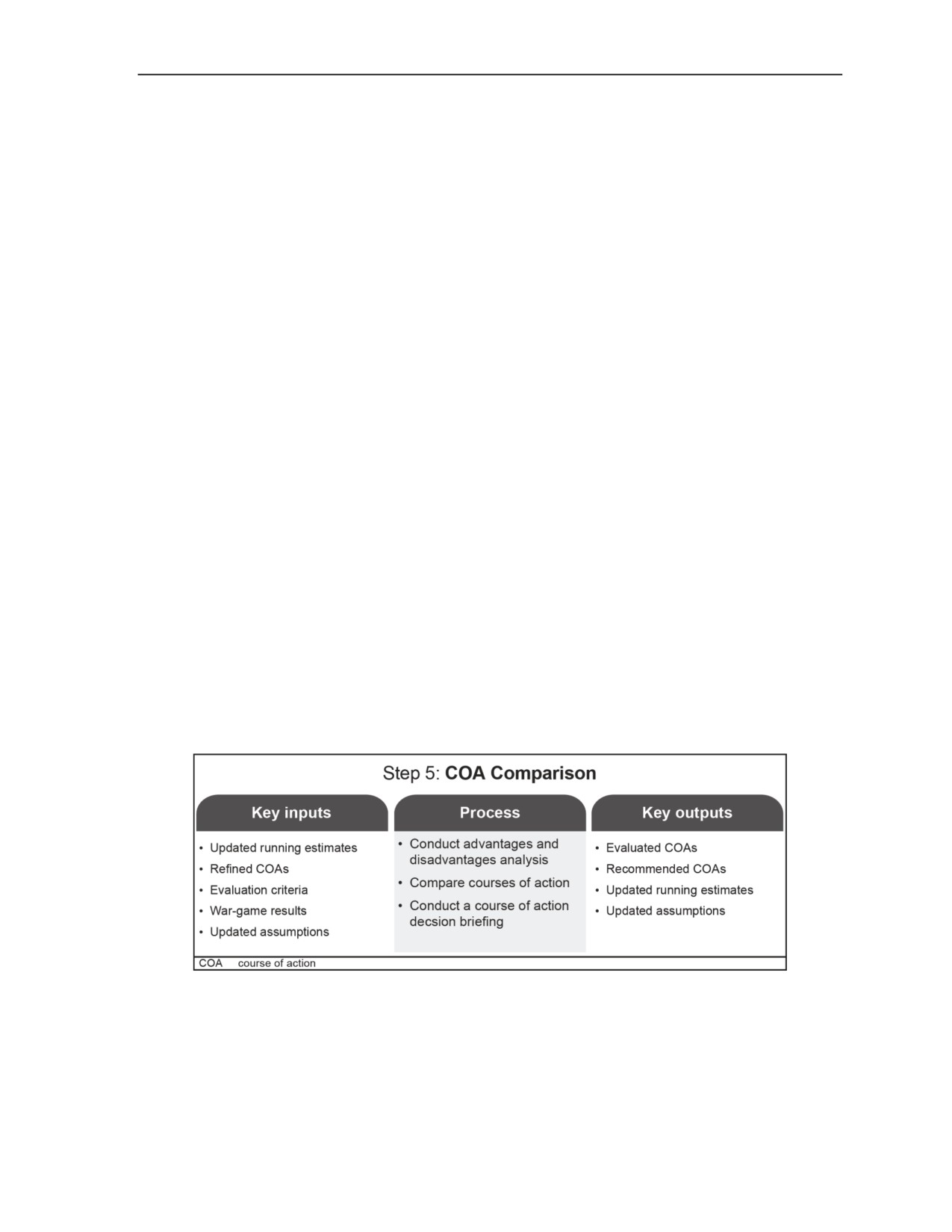
that lead to key outputs. (See figure 9-13.)
Figure 9-13. Step 5-course of action comparison
◄ Conduct Advantages and Disadvantages Analysis
9-177. The COA comparison starts with all staff members analyzing and evaluating the advantages and
disadvantages of each COA from their perspectives. Staff members each present their findings for the
others’ consideration. Using the evaluation criteria developed during mission analysis and refined during
22 April 2016
FM 6-0, C2
9-39

Chapter 9
course of action development, the staff outlines each COA, highlighting its advantages and disadvantages.
Comparing the strengths and weaknesses of the COAs identifies their advantages and disadvantages with
respect to each other. (See table 9-6.)
Table 9-6. Sample advantages and disadvantages
Course of Action
Advantages
Disadvantages
Decisive operation avoids major terrain
Units conducting the decisive
obstacles. Adequate maneuver space
operation face stronger resistance at
Course of action 1
available for units conducting the
the start of the operation.
decisive operation and the reserve.
Limited resources available to
establishing civil control to town X.
Shaping operations provide excellent
Operation may require the early
flank protection of the decisive
employment of the division’s reserve.
operations.
Upon completion of decisive
Course of action 2
operations, units conducting shaping
operations can quickly transition to
establish civil control and provide civil
security to the population in town X.
◄ Compare Courses of Action
9-178. Comparison of COAs is critical. The staff uses any technique that helps develop those key outputs
and recommendations and assists the commander to make the best decision. A common technique is the
decision matrix. This matrix uses evaluation criteria developed during mission analysis and refined during
COA development to help assess the effectiveness and efficiency of each COA. (See table 9-7.)
Table 9-7. Sample decision matrix
Weight1
1
2
1
1
2
Criteria2
Course of
Simplicity
Maneuver
Fires
Civil control
Mass
Total
Action
2
2
2
1
1
8
COA 13
(4)
(2)
(11)
COA 23
1
1
1
2
2
7
(2)
(4)
(10)
Notes:
1
The COS (XO) may emphasize one or more criteria by assigning weights to them based on a determination of their
relative importance. Higher weights correspond to emphasized or more important criteria.
2
Criteria are those approved by the commander during the mission analysis brief.
3
COAs selected for war-gaming have rankings assigned with regards to each criteria based on relative advantages
and disadvantages of each COA. For example, when compared for relative simplicity, COA 2 is simpler than COA 1
and is therefore ranked 1, with COA 1 ranked 2.
9-179. The decision matrix is a tool to compare and evaluate COAs thoroughly and logically. However,
the process may be based on highly subjective judgments that can change dramatically during the course of
evaluation. In table 9-7, the weights reflect the relative importance of each criterion as initially estimated
by a COS (XO) during mission analysis and adjusted or approved by the commander. During COA
comparison, rankings are assigned from 1 to however many COAs exist. Lower rankings are more
preferred. After assigning ranks to COAs, the staff adds the unweighted ranks in each row horizontally and
records the sum in the Total column on the far right of each COA. The staff then multiplies the same ranks
by the weights associated with each criterion and notes the product in parenthesis underneath the
unweighted rank. No notation is required if the weight is
1. The staff adds these weighted ranks
horizontally and records the sum in parenthesis underneath the unweighted total in the Total column to the
right of each COA. The staff then compares the totals to determine the most preferred (lowest total) COA
9-40
FM 6-0, C2
22 April 2016
The Military Decisionmaking Process
based on both unweighted and weighted ranks. Although the lowest total denotes a most preferred solution,
the process for estimating relative COA ranks and relative criteria weighting may be highly subjective.
Upon review and consideration, the commander—based on personal judgment—may accept the results of
the decision matrix or elect to execute one of the other COAs.
9-180. Commanders and staffs cannot solely rely on the outcome of a decision matrix, as it only provides
a partial basis for a solution. During the decision matrix process, planners carefully avoid reaching
conclusions from a quantitative analysis of subjective weights. Comparing and evaluating COAs by each
criterion is probably more useful than merely comparing totaled ranks. Judgments often change with regard
to the relative weighting of criteria during close analysis of COAs, which will change weighted rank totals
and possibly the most preferred COA.
9-181. The staff compares feasible COAs to identify the one with the highest probability of success
against the most likely enemy COA, the most dangerous enemy COA, the most important stability task, or
the most damaging environmental impact. The selected COA should also—
z
Pose the minimum risk to the force and mission accomplishment.
z
Place the force in the best posture for future operations.
z
Provide maximum latitude for initiative by subordinates.
z
Provide the most flexibility to meet unexpected threats and opportunities.
z
Provide the most secure and stable environment for civilians in the area of operations.
z
Best facilitate information themes and messages.
9-182. Staff officers often use their own matrix to compare COAs with respect to their functional areas.
Matrixes use the evaluation criteria developed before the war game. Their greatest value is providing a
method to compare COAs against criteria that, when met, produce operational success. Staff officers use
these analytical tools to prepare recommendations. Commanders provide the solution by applying their
judgment to staff recommendations and making a decision.
Conduct a Course of Action Decision Briefing
9-183. After completing its analysis and comparison, the staff identifies its preferred COA and makes a
recommendation. If the staff cannot reach a decision, the COS (XO) decides which COA to recommend.
The staff then delivers a decision briefing to the commander. The COS (XO) highlights any changes to
each COA resulting from the war game. The decision briefing includes—
z
The commander’s intent of the higher and next higher commanders.
z
The status of the force and its components.
z
The current IPB.
z
The COAs considered, including—
Assumptions used.
Results of running estimates.
A summary of the war game for each COA, including critical events, modifications to any
COA, and war-game results.
Advantages and disadvantages (including risks) of each COA.
The recommended COA. If a significant disagreement exists, then the staff should inform
the commander and, if necessary, discuss the disagreement.
STEP 6-COURSE OF ACTION APPROVAL
9-184. After the decision briefing, the commander selects the COA to best accomplish the mission. If the
commander rejects all COAs, the staff starts COA development again. If the commander modifies a
proposed COA or gives the staff an entirely different one, the staff war-games the new COA and presents
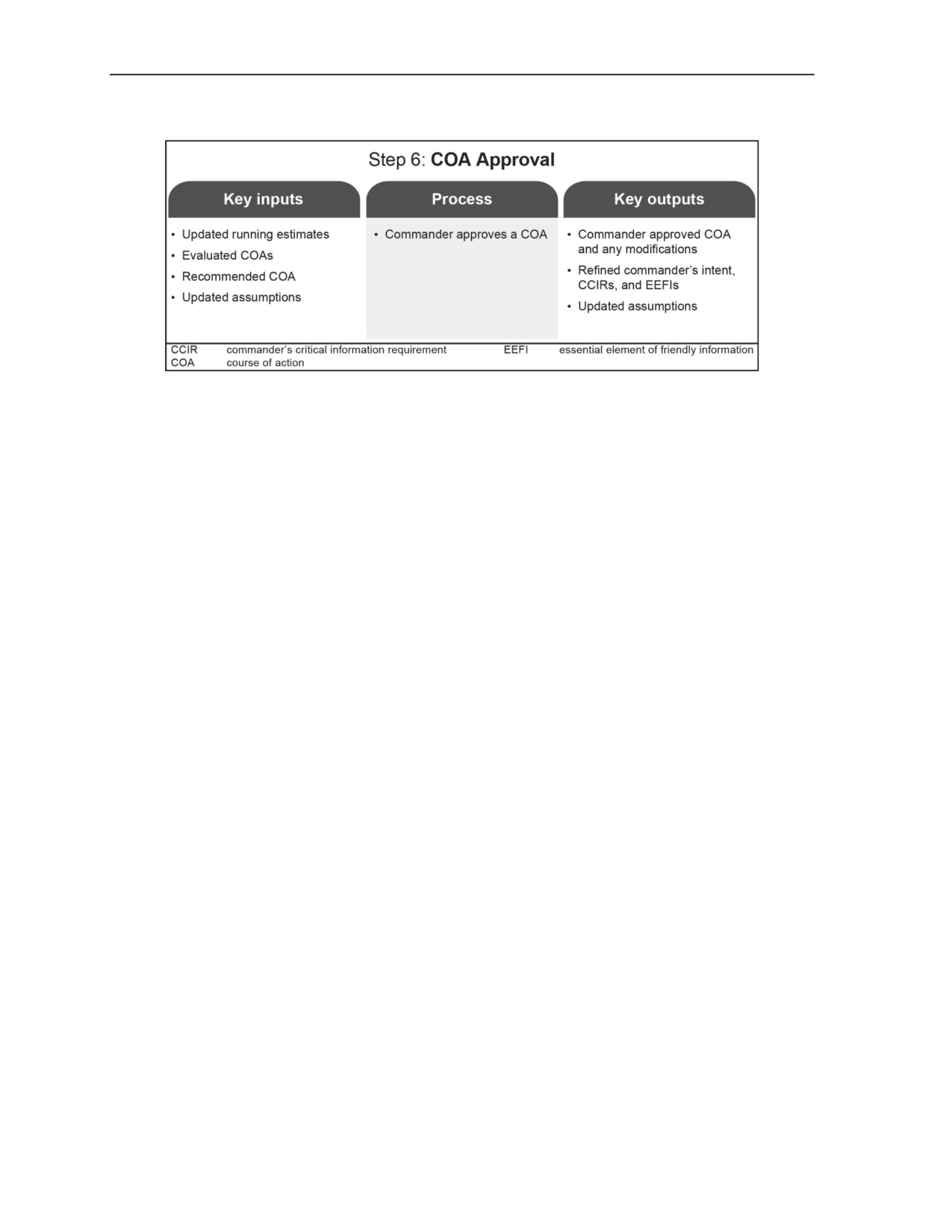
the results to the commander with a recommendation. (See figure 9-14.)
22 April 2016
FM 6-0, C2
9-41
Chapter 9
Figure 9-14. Step 6-course of action approval
9-185. After approving a COA, the commander issues the final planning guidance. The final planning
guidance includes a refined commander’s intent (if necessary) and new CCIRs to support execution. It also
includes any additional guidance on priorities for the warfighting functions, orders preparation, rehearsal,
and preparation. This guidance includes priorities for resources needed to preserve freedom of action and
ensure continuous sustainment.
9-186. Commanders include the risk they are willing to accept in the final planning guidance. If there is
time, commanders use a video teleconference to discuss acceptable risk with adjacent, subordinate, and
senior commanders. However, commanders still obtain the higher commander’s approval to accept any risk
that might imperil accomplishing the higher commander’s mission.
9-187. Based on the commander’s decision and final planning guidance, the staff issues a WARNORD to
subordinate headquarters. This WARNORD contains the information subordinate units need to refine their
plans. It confirms guidance issued in person or by video teleconference and expands on details not covered
by the commander personally. The WARNORD issued after COA approval normally contains—
z
The area of operations.
z
Mission.
z
Commander’s intent.
z
Updated CCIRs and EEFIs.
z
Concept of operations.
z
Principal tasks assigned to subordinate units.
z
Preparation and rehearsal instructions not included in the SOPs.
z
A final timeline for the operations.
STEP 7-ORDERS PRODUCTION, DISSEMINATION, AND TRANSITION
9-188. The staff prepares the order or plan by turning the selected COA into a clear, concise concept of
operations and the required supporting information. The COA statement becomes the concept of operations
for the plan. The COA sketch becomes the basis for the operation overlay. If time permits, the staff may
conduct a more detailed war game of the selected COA to more fully synchronize the operation and
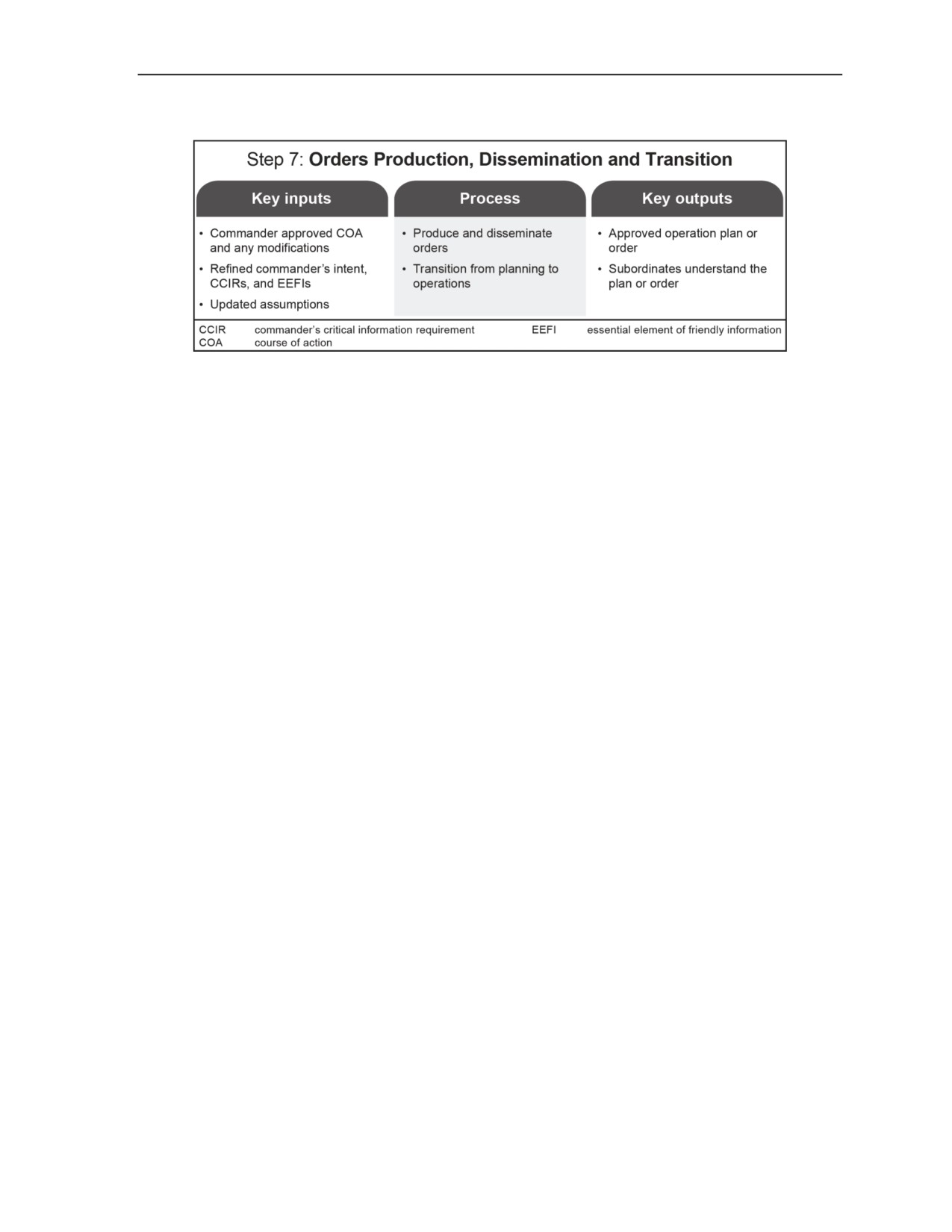
complete the plan. (See figure 9-15 on page 9-42.) The staff writes the OPORD or OPLAN using the
Army’s operation order format. (See appendix C.)
9-42
FM 6-0, C2
22 April 2016
The Military Decisionmaking Process
Figure 9-15. Step 7-orders production, dissemination, and transition
9-189. Normally, the COS (XO) coordinates with staff principals to assist the G-3 (S-3) in developing the
plan or order. Based on the commander’s planning guidance, the COS (XO) dictates the type of order, sets
and enforces the time limits and development sequence, and determines which staff section publishes
which attachments.
9-190. Prior to the commander approving the plan or order, the staff ensures the plan or order is internally
consistent and is nested with the higher commander’s intent. They do this through—
z
Plans and orders reconciliation.
z
Plans and orders crosswalk.
Plans and Orders Reconciliation
9-191. Plans and orders reconciliation occurs internally as the staff conducts a detailed review of the
entire plan or order. This reconciliation ensures that the base plan or order and all attachments are complete
and in agreement. It identifies discrepancies or gaps in planning. If staff members find discrepancies or
gaps, they take corrective actions. Specifically, the staff compares the commander’s intent, mission, and
commander’s CCIRs against the concept of operations and the different schemes of support (such as
scheme of fires or scheme of sustainment). The staff ensures attachments are consistent with the
information in the base plan or order.
Plans and Orders Crosswalk
9-192. During the plans and orders crosswalk, the staff compares the plan or order with that of the higher
and adjacent commanders to achieve unity of effort and ensure the plan meets the superior commander’s
intent. The crosswalk identifies discrepancies or gaps in planning. If staff members find discrepancies or
gaps, they take corrective action.
Approving the Plan or Order
9-193. The final action in plan and order development is the approval of the plan or order by the
commander. Commanders normally do not sign attachments; however, they should review them before
signing the base plan or order.
9-194. Step 7 bridges the transition between planning and preparations. The plans-to-operations transition
is a preparation activity that occurs within the headquarters. It ensures members of the current operations
cell fully understand the plan before execution. During preparation, the responsibility for developing and
maintaining the plan shifts from the plans (or future operations) cell to the current operations cell. This
transition is the point at which the current operations cell becomes responsible for controlling execution of
the operation order. This responsibility includes answering requests for information concerning the order
and maintaining the order through fragmentary orders. This transition enables the plans cell to focus its
planning efforts on sequels, branches, and other planning requirements directed by the commander. (See
22 April 2016
FM 6-0, C2
9-43
Chapter 9
ADRP 5-0 for information on the plans to operations handover and chapter 12 of this manual for
information on rehearsals.)
9-195. Commanders review and approve orders before the staff reproduces and disseminates them, unless
commanders have delegated that authority. Subordinates immediately acknowledge receipt of the higher
order. If possible, the higher commander and staff brief the order to subordinate commanders in person.
The commander and staff conduct confirmation briefings with subordinates immediately afterwards.
Confirmation briefings can be conducted collaboratively with several commanders at the same time or with
single commanders. These briefings may be conducted in person or by video teleconference.
PLANNING IN A TIME-CONSTRAINED ENVIRONMENT
9-196. Any planning process aims to quickly develop a flexible, sound, and fully integrated and
synchronized plan. However, any operation may “outrun” the initial plan. The most detailed estimates
cannot anticipate every possible branch or sequel, enemy action, threat action, or reaction from the local
population, unexpected opportunity, or change in mission directed from higher headquarters. Fleeting
opportunities or unexpected enemy action may require a quick decision to implement a new or modified
plan. When this occurs, units often find themselves pressed for time in developing a new plan.
9-197. Before a unit can effectively conduct planning in a time-constrained environment, it must master
the steps in the full MDMP. A unit can only shorten the process if it fully understands the role of each and
every step of the process and the requirements to produce the necessary products. Training on these steps
must be thorough and result in a series of staff battle drills that can be tailored to the time available.
9-198. Quality staffs produce simple, flexible, and tactically sound plans in time-constrained
environments. Any METT-TC factor, but especially limited time, may make it difficult to complete every
step of the MDMP in detail. Applying an inflexible process to all situations does not work. Anticipation,
organization, and prior preparation are the keys to successful planning under time-constrained conditions.
9-199. Staffs can use the time saved on any step of the MDMP to—
z
Refine the plan more thoroughly.
z
Conduct a more deliberate and detailed war game.
z
Consider potential branches and sequels in detail.
z
Focus more on rehearsing and preparing the plan.
z
Allow subordinate units more planning and preparation time.
THE COMMANDER’S RESPONSIBILITY
9-200. The commander decides how to adjust the MDMP, giving specific guidance to the staff to focus on
the process and save time. Commanders shorten the MDMP when they lack time to perform each step in
detail. The most significant factor to consider is time. It is the only nonrenewable, and often the most
critical, resource. Commanders (who have access to only a small portion of the staff or none at all) rely
even more than normal on their own expertise, intuition, and creativity as well as on their understanding of
the environment and of the art and science of war. They may have to select a COA, mentally war-game it,
and confirm their decision to the staff in a short time. If so, they base their decision more on experience
than on a formal, integrated staff process.
9-201. Effective commanders avoid changing their guidance unless a significantly changed situation
requires major revisions. Making frequent, minor changes to the guidance can easily result in lost time as
the staff constantly adjusts the plan with an adverse ripple effect throughout overall planning.
9-202. Commanders consult with subordinate commanders before making a decision, if possible.
Subordinate commanders are closer to the operation and can more accurately describe enemy, friendly, and
civilian situations. Additionally, consulting with subordinates gives commanders insights into the
upcoming operation and allows parallel planning. White boards and collaborative digital means of
communicating greatly enhance parallel planning.
9-44
FM 6-0, C2
22 April 2016
The Military Decisionmaking Process
9-203. In situations where commanders must decide quickly, they advise their higher headquarters of the
selected COA, if time is available. However, commanders do not let an opportunity pass just because they
cannot report their actions.
THE STAFF’S RESPONSIBILITY
9-204. Staff members keep their running estimates current. When time constraints exist, they can provide
accurate, up-to-date assessments quickly and move directly into COA development. Under
time-constrained conditions, commanders and staffs use as much of the previously analyzed information
and as many of the previously created products as possible. The importance of running estimates increases
as time decreases. Decisionmaking in a time-constrained environment usually occurs after a unit has
entered the area of operations and begun operations. This means that the IPB, an updated common
operational picture, and some portions of the running estimates should already exist. Civilian and military
joint and multinational organizations operating in the area of operations should have well-developed plans
and information to add insights to the operational environment. Detailed planning provides the basis for
information that the commander and staff need to make decisions during execution.
TIME-SAVING TECHNIQUES
9-205. Paragraphs 9-206 through 9-210 discuss time-saving techniques to speed the planning process.
Increase Commander’s Involvement
9-206. While commanders cannot spend all their time with their planning staffs, the greater the
commander’s involvement in planning, the faster the staff can plan. In time-constrained conditions,
commanders who participate in the planning process can make decisions (such as COA selection) without
waiting for a detailed briefing from the staff.
Limit the Number of Courses of Action to Develop
9-207. Limiting the number of COAs developed and war-gamed can save planning time. If time is
extremely short, the commander can direct development of only one COA. In this case, the goal is an
acceptable COA that meets mission requirements in the time available. This technique saves the most time.
The fastest way to develop a plan has the commander directing development of one COA with branches
against the most likely enemy COA or most damaging civil situation or condition. However, this technique
should be used only when time is severely limited. In such cases, this choice of COA is often intuitive,
relying on the commander’s experience and judgment. The commander determines which staff officers are
essential to assist in COA development. Normally commanders require the intelligence officer, operations
officer, plans officer, chief of fires (fire support officer), engineer officer, civil affairs operations officer,
information operations officer, military information support operations officer, electronic warfare officer,
and COS (XO). They may also include subordinate commanders, if available, either in person or by video
teleconference. This team quickly develops a flexible COA that it feels will accomplish the mission. The
commander mentally war-games this COA and gives it to the staff to refine.
Maximize Parallel Planning
9-208. Although parallel planning is the norm, maximizing its use in time-constrained environments is
critical. In a time-constrained environment, the importance of WARNORDs increases as available time
decreases. A verbal WARNORD now, followed by a written order later, saves more time than a written
order one hour from now. The staff issues the same WARNORDs used in the full MDMP when
abbreviating the process. In addition to WARNORDs, units must share all available information with
subordinates, especially IPB products, as early as possible. The staff uses every opportunity to perform
parallel planning with the higher headquarters and to share information with subordinates.
Increase Collaborative Planning
9-209. Planning in real time with higher headquarters and subordinates improves the overall planning
effort of the organization. Modern information systems and a common operational picture shared
22 April 2016
FM 6-0, C2
9-45
Chapter 9
electronically allow collaboration with subordinates from distant locations, can increase information
sharing, and can improve the commander’s visualization. Additionally, taking advantage of subordinates’
input and knowledge of the situation in their areas of operations often results in developing better COAs
quickly.
Use Liaison Officers
9-210. Liaison officers posted to higher headquarters and unified action partners’ headquarters allow
commanders to have representation in their higher headquarters’ planning session. These officers assist in
passing timely information to their parent headquarters and directly to the commander. Effective liaison
officers have the commander’s full confidence and the necessary rank and experience for the mission.
Commanders may elect to use a single individual or a liaison team. As representatives, liaison officers
must—
z
Understand how their commander thinks and interpret verbal and written guidance.
z
Convey their commander’s intent, planning guidance, mission, and concept of operations.
z
Represent their commander’s position.
z
Know the unit’s mission; tactics, techniques, and procedures; organization; capabilities; and
communications equipment.
z
Observe the established channels of command and staff functions.
z
Be trained in their functional responsibilities.
z
Be tactful.
z
Possess the necessary language expertise.
9-46
FM 6-0, C2
22 April 2016
Chapter 10
Troop Leading Procedures
Troop leading procedures provide small-unit leaders with a framework for planning
and preparing for operations. Leaders of company and smaller units use troop leading
procedures to develop plans and orders. This chapter describes the eight steps of
troop leading procedures and their relationship to the military decisionmaking
process
(MDMP). While this chapter explains troop leading procedures from a
ground-maneuver perspective, it applies to all types of small units.
BACKGROUND AND COMPARISON TO THE MDMP
10-1. Troop leading procedures (TLP) extend the MDMP to the small-unit level. The MDMP and TLP are
similar but not identical. They are both linked by the basic Army problem-solving process (see chapter 4).
Commanders with a coordinating staff use the MDMP as their primary planning process. Company-level
and smaller units lack formal staffs and use TLP to plan and prepare for operations. This places the
responsibility for planning primarily on the commander or small-unit leader.
10-2. Troop leading procedures are a dynamic process used by small-unit leaders to analyze a mission,
develop a plan, and prepare for an operation (ADP 5-0). These procedures enable leaders to maximize
available planning time while developing effective plans and preparing their units for an operation. (See
paragraphs 10-10 to 10-41 for a discussion on the eight steps of TLP.)
10-3. Leaders use TLP when working alone or with a small group to solve problems. For example, a
company commander may use the executive officer, first sergeant, fire support officer, supply sergeant, and
communications sergeant to assist during TLP.
10-4. The type, amount, and timeliness of information passed from higher to lower headquarters directly
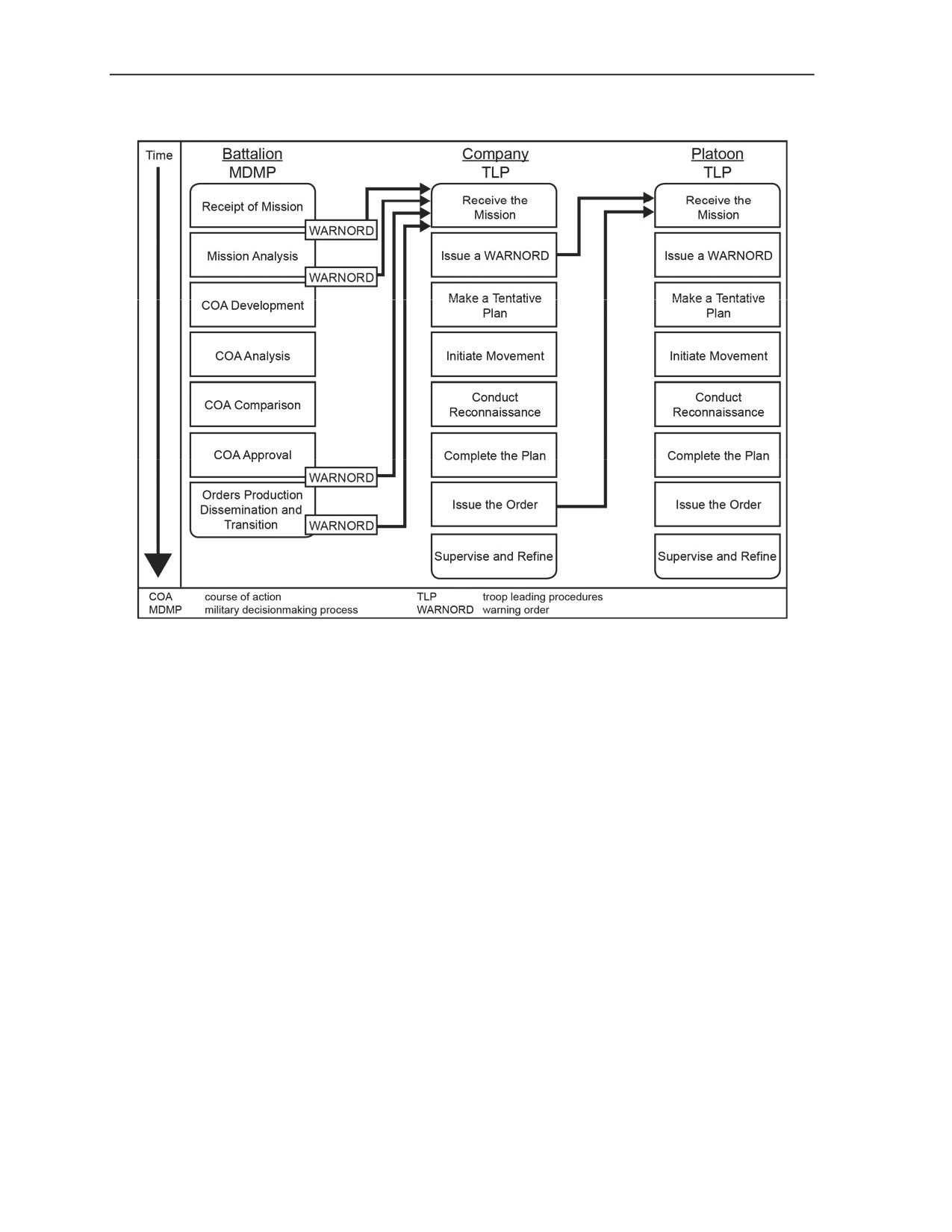
impact the lower unit leader’s TLP. Figure 10-1 on page 10-2 illustrates the parallel sequences of the
MDMP of a battalion with the TLP of a company and a platoon. The solid arrows depict when a higher
headquarters’ planning event could start the TLP of a subordinate unit. However, events do not always
occur in the order shown. For example, TLP may start with receipt of a warning order (WARNORD), or
they may not start until the higher headquarters has completed the MDMP and issued an operation order
(OPORD). WARNORDs from higher headquarters may arrive at any time during TLP. Leaders remain
flexible. They adapt TLP to fit the situation rather than try to alter the situation to fit a preconceived idea of
how events should flow.
5 May 2014
FM 6-0
10-1
Chapter 10
Figure 10-1. Parallel sequences of the MDMP and troop leading procedures
10-5. Normally, the first three steps (receive the mission, issue a WARNORD, and make a tentative plan)
of TLP occur in order. However, the sequence of subsequent steps is based on the situation. The tasks
involved in some steps (for example, initiate movement and conduct reconnaissance) may occur several
times. The last step, supervise and refine, occurs throughout.
10-6. A tension exists between executing current operations and planning for future operations. The
small-unit leader must balance both. If engaged in a current operation, leaders have less time for TLP. If in
a lull, transition, or an assembly area, leaders have more time to perform TLP thoroughly. In some
situations, time constraints or other factors may prevent leaders from performing each step of TLP as
thoroughly as they would like. For example, during the step make a tentative plan, small-unit leaders often
develop only one acceptable course of action (COA) instead of multiple COAs. If time permits, leaders
develop, compare, and analyze several COAs before deciding which one to execute.
10-7. Ideally, a battalion headquarters issues at least three WARNORDs to subordinates when conducting
the MDMP as depicted in figure 10-1. WARNORDs are issued upon receipt of mission, completion of
mission analysis, and when the commander approves a COA. However, the number of WARNORDs is not
fixed. WARNORDs serve a function in planning similar to that of fragmentary orders (FRAGORDs)
during execution. Commanders may issue a WARNORD whenever they need to disseminate additional
planning information or initiate necessary preparatory action, such as movement or reconnaissance.
10-8. Leaders begin TLP when they receive the initial WARNORD or receive a new mission. As each
subsequent order arrives, leaders modify their assessments, update tentative plans, and continue to
supervise and assess preparations. In some situations, the higher headquarters may not issue the full
sequence of WARNORDs; security considerations or tempo may make it impractical. Commanders
carefully consider decisions to eliminate WARNORDs. Subordinate units always need to have enough
10-2
FM 6-0
5 May 2014
Troop Leading Procedures
information to plan and prepare for the operation. In other cases, leaders may initiate TLP before receiving
a WARNORD based on existing plans and orders and on their understanding of the situation.
10-9. Parallel planning hinges on distributing information as it is received or developed. Leaders cannot
complete their plans until they receive their unit mission. If each successive WARNORD contains enough
information, the higher headquarters’ final order will confirm what subordinate leaders have already
analyzed and put into their tentative plans. In other cases, the higher headquarters’ order may change or
modify the subordinate’s tasks enough that additional planning and reconnaissance are required.
STEPS OF TROOP LEADING PROCEDURES
10-10. TLP provide small-unit leaders a framework for planning and preparing for operations. TLP begin
when the leader receives a mission and continues throughout the operations process (plan, prepare, execute
and assess). TLP are a sequence of actions that assist leaders to effectively and efficiently use available
time to issue orders and execute tactical operations.
10-11. TLP consist of eight steps. TLP are also supported by risk management. (See FM 5-19 for more
information on risk management.) The sequence of the steps of TLP is not rigid. Leaders modify the
sequence to meet the mission, situation, and available time. Some steps are done concurrently, while others
may go on continuously throughout the operation:
z
Step 1-Receive the mission.
z
Step 2-Issue a warning order.
z
Step 3-Make a tentative plan.
z
Step 4-Initiate movement.
z
Step 5-Conduct reconnaissance.
z
Step 6-Complete the plan.
z
Step 7-Issue the order.
z
Step 8-Supervise and refine.
STEP 1-RECEIVE THE MISSION
10-12. Receive the mission may occur in several ways. It may begin when the initial WARNORD or
OPORD arrives from higher headquarters or when a leader anticipates a new mission. Frequently, leaders
receive a mission in a FRAGORD over the radio. Ideally, they receive a series of WARNORDs, the
OPORD, and a briefing from their commander. Normally, after receiving an OPORD leaders give a
confirmation brief to their higher commander to ensure they understand the higher commander’s intent and
concept of operations. The leader obtains clarification on any portions of the higher headquarters plan as
required.
10-13. When they receive the mission, leaders perform an initial assessment of the situation (mission
analysis) and allocate the time available for planning and preparation. (Preparation includes rehearsals and
movement.) When a higher headquarters assigns a mission, it provides small-unit leaders an analysis of its
operational environment. Often, higher headquarters will provide this assessment using the operational
variables (political, military, economic, social, information, infrastructure, physical environment, and time
[PMESII-PT]). From this higher level assessment, they can draw information relevant to their own
operational environments and supplement it with their own knowledge of local conditions. During mission
analysis, they filter relevant information into the categories of the mission variables (mission, enemy,
terrain and weather, troops and support available, time available, and civil considerations [METT-TC]).
(See appendix A for a more detailed description of PMESII-PT and METT-TC). This initial assessment and
time allocation form the basis of their initial WARNORDs and addresses the factors of METT-TC. The
order and detail in which leaders analyze the factors of METT-TC is flexible. It depends on the amount of
information available and the relative importance of each factor. For example, leaders may concentrate on
the mission, enemy, and terrain, leaving weather and civil considerations until they receive more detailed
information.
10-14. Often, leaders do not receive their final unit mission until the WARNORD is disseminated after
COA approval or after the OPORD. Effective leaders do not wait until their higher headquarters completes
5 May 2014
FM 6-0
10-3
Chapter 10
planning to begin their planning. Using all information available, leaders develop their unit mission as
completely as they can. They focus on the mission, commander’s intent, and concept of operations of their
higher and next higher headquarters. They pick major tasks their unit will probably be assigned and
develop a mission statement based on information they have received. At this stage, the mission may be
incomplete. For example, an initial mission statement could be, “First platoon conducts an ambush in the
next 24 hours.” While not complete, this information allows subordinates to start preparations. Leaders
complete a formal mission statement during TLP step 3 (make a tentative plan) and step 6 (complete the
plan).
10-15. Based on what they know, leaders estimate the time available to plan and prepare for the mission.
They begin by identifying the times they must complete major planning and preparation events, including
rehearsals. Reverse planning helps them do this. Leaders identify critical times specified by higher
headquarters and work back from them, estimating how much time each event will consume. Critical times
might include times to load aircraft, the line of departure, or the start point for movement.
10-16. Leaders ensure that all subordinate echelons have sufficient time for their own planning and
preparation needs. Generally, leaders at all levels use no more than one-third of the available time for
planning and issuing the OPORD. Leaders allocate the remaining two-thirds of it to subordinates.
Figure 10-2 illustrates a possible time schedule for an infantry company. The company adjusts the tentative
schedule as necessary.
0600-Execute mission.
0530-Finalize or adjust the plan based on leader’s reconnaissance.
0400-Establish the objective rallying point; begin leader reconnaissance.
0200-Begin movement.
2100-Conduct platoon inspections.
1900-Conduct rehearsals.
1800-Eat meals.
1745-Hold backbriefs (squad leaders to platoon leaders).
1630-Issue platoon OPORDs.
1500-Hold backbriefs (platoon leaders to company commander).
1330-Issue company OPORD.
1045-Conduct reconnaissance.
1030-Update company WARNORD.
1000-Receive battalion OPORD.
0900-Receive battalion WARNORD; issue company WARNORD.
OPORD operation order
WARNORD warning order
Figure 10-2. Sample schedule
STEP 2-ISSUE A WARNING ORDER
10-17. As soon as leaders finish their initial assessment of the situation and available time, they issue a
WARNORD. Leaders do not wait for more information. They issue the best WARNORD possible with the
information at hand and update it as needed with additional WARNORDs.
10-18. The WARNORD contains as much detail as possible. It informs subordinates of the unit mission
and gives them the leader’s timeline. Leaders may also pass on any other instructions or information they
think will help subordinates prepare for the new mission. This includes information on the enemy, the
nature of the higher headquarters’ plan, and any specific instructions for preparing their units. The most
important thing is that leaders not delay in issuing the initial WARNORD. As more information becomes
available, leaders can—and should—issue additional WARNORDs. By issuing the initial WARNORD as
quickly as possible, leaders enable their subordinates to begin their own planning and preparation.
10-19. WARNORDs follow the five-paragraph OPORD format. (See appendix C for the WARNORD
format.) Normally an initial WARNORD issued below battalion level includes—
10-4
FM 6-0
5 May 2014

Troop Leading Procedures
z
The mission or nature of the operation.
z
The time and place for issuing the OPORD.
z
Units or elements participating in the operation.
z
Specific tasks not addressed by unit standard operating procedures (SOPs).
z
The timeline for the operation.
STEP 3-MAKE A TENTATIVE PLAN
10-20. Once they have issued the initial WARNORD, leaders develop a tentative plan. This step
combines the MDMP steps 2 through 6: mission analysis, COA development, COA analysis, COA
comparison, and COA approval. At levels below battalion, these steps are less structured than for units with
staffs. Often, leaders perform them mentally. They may include their principal subordinates—especially
during COA development, analysis, and comparison. However, leaders—not their subordinates—select the
COA on which to base the tentative plan.
Mission Analysis
10-21. To frame the tentative plan, leaders perform mission analysis. This mission analysis follows the
METT-TC format, continuing the initial assessment performed in TLP step 1. (See table 10-1 for a brief
description of the mission variables and appendix A for a more detailed description.)
Table 10-1. Mission variables
Variable
Description
Mission
Commanders and staffs view all of the mission variables in terms of their
impact on mission accomplishment. The mission is the task, together with
the purpose, that clearly indicates the action to be taken and the reason
therefore. It is always the first variable commanders consider during
decisionmaking. A mission statement contains the "who, what, when,
where, and why" of the operation.
Enemy
The second variable to consider is the enemy—dispositions (including
organization, strength, location, and tactical mobility), doctrine, equipment,
capabilities, vulnerabilities, and probable courses of action.
Terrain and
Terrain and weather analysis are inseparable and directly influence each
weather
other’s impact on military operations. Terrain includes natural features (such
as rivers and mountains) and man-made features (such as cities, airfields,
and bridges). Commanders analyze terrain using the five military aspects of
terrain expressed in the memory aid OAKOC: observation and fields of fire,
avenues of approach, key and decisive terrain, obstacles, cover and
concealment. The military aspects of weather include visibility, wind,
precipitation, cloud cover, temperature, and humidity.
Troops and
This variable includes the number, type, capabilities, and condition of
available friendly troops and support. These include supplies, services, and
support
support available from joint, host nation, and unified action partners. They
available
also include support from civilians and contractors employed by military
organizations, such as the Defense Logistics Agency and the Army Materiel
Command.
Time available
Commanders assess the time available for planning, preparing, and
executing tasks and operations. This includes the time required to
assemble, deploy, and maneuver units in relationship to the enemy and
conditions.
Civil
Civil considerations are the influence of man-made infrastructure, civilian
considerations
institutions, and activities of the civilian leaders, populations, and
organizations within an area of operations on the conduct of military
operations (ADRP 5-0). Civil considerations comprise six characteristics,
expressed in the memory aid ASCOPE: areas, structures, capabilities,
organizations, people, and events.
5 May 2014
FM 6-0
10-5
Chapter 10
Course of Action Development
10-22. Mission analysis provides information needed to develop COAs. COA development aims to
determine one or more ways to accomplish the mission. At lower echelons, the mission may be a single
task. Most missions and tasks can be accomplished in more than one way. Normally, leaders develop two
or more COAs. However, in a time-constrained environment, they may develop only one. Leaders do not
wait for a complete order before beginning COA development. Usable COAs are suitable, feasible,
acceptable, distinguishable, and complete. Leaders develop COAs as soon as they have enough information
to do so. To develop COAs, leaders focus on the actions the unit takes at the objective and conduct a
reverse plan to the starting point.
Analyze Relative Combat Power
10-23. During COA development, leaders determine whether the unit has enough combat power to defeat
the force (or accomplish a task in stability or defense support of civil authorities tasks) against which it is
arrayed by comparing the combat power of friendly and enemy forces. Leaders seek to determine where,
when, and how friendly combat power (the elements of intelligence, movement and maneuver, fires,
sustainment, protection, mission command, leadership, and information) can overwhelm the enemy. It is a
particularly difficult process if the unit is fighting a dissimilar unit, for example, if an infantry unit is
attacking or defending against an enemy mechanized force. Below battalion level, relative combat power
comparisons are rough and generally rely on professional judgment instead of numerical analysis. When an
enemy is not the object of a particular mission or tasks, leaders conduct a troop-to-task analysis to
determine if they have enough combat power to accomplish the tasks. For example, a company commander
assigned the task “establish civil control in town X” would need to determine if there were enough Soldiers
and equipment (including vehicles and barrier materials) to establish the necessary check points and
security stations within the town to control the population in town X.
Generate Options
10-24. Leaders brainstorm different ways to accomplish the mission. They determine the doctrinal
requirements for the operation, including the tactical tasks normally assigned to subordinates. Doctrinal
requirements give leaders a framework from which to develop COAs.
10-25. Next, leaders identify where and when the unit can mass overwhelming combat power to achieve
specific results (with respect to enemy, terrain, time, or civil considerations) that accomplish the mission.
Offensive and defensive tasks focus on the destructive effects of combat power. Stability tasks, on the other
hand, emphasize constructive effects. Leaders identify any decisive points and determine what result they
must achieve at the decisive points to accomplish the mission. This helps leaders determine the required
tasks and the amount of combat power to apply at a decisive point.
10-26. After identifying tasks, leaders next determine the purpose for each task. There is normally one
primary task for each mission. The unit assigned this task is the main effort. The other tasks should support
the accomplishment of the primary task.
Develop an Initial Concept of Operations
10-27. The concept of operations describes how the leader envisions the operation unfolding from its start
to its conclusion or end state. It determines how accomplishing each task leads to executing the next. It
identifies the best ways to use available terrain and to employ unit strengths against enemy weaknesses.
Fire support considerations make up an important part of the concept of operations. Planners identify
essential stability tasks. Leaders develop the graphic control measures necessary to convey and enhance the
understanding of the concept of operations, prevent fratricide, and clarify the task and purpose of the main
effort.
Assign Responsibilities
10-28. Leaders assign responsibility for each task to a subordinate. Whenever possible, they depend on
the existing chain of command. They avoid fracturing unit integrity unless the number of simultaneous
10-6
FM 6-0
5 May 2014
Troop Leading Procedures
tasks exceeds the number of available elements. Different command and support arrangements may be the
distinguishing feature among COAs.
Prepare a Course of Action Statement and Sketch
10-29. Leaders base the COA statement on the concept of operations for that COA. The COA statement
focuses on all significant actions, from the start of the COA to its finish. Whenever possible, leaders
prepare a sketch showing each COA. It is useful to provide the amount of time it takes to achieve each
movement and task in the COA sketch. This helps subordinate leaders gain an appreciation for how much
time will pass as they execute each task of the COA. The COA contains the following information:
z
Form of movement or defense to be used.
z
Designation of the main effort.
z
Tasks and purposes of subordinate units.
z
Necessary sustaining operations.
z
Desired end state.
10-30. Table 10-2 provides a sample mission statement and COA statement for an infantry company in
the defense.
Table 10-2. Sample mission and course of action statements
B Co/1-31 IN defends NLT (not later than) 281700(Z) AUG 2005 from
Mission
GL 375652 to GL 389650 to GL 394660 to GL 373665 to prevent the
Statement:
envelopment of A Co, the battalion main effort.
The company defends with two platoons (PLTs) forward and one PLT in
depth from PLT battle positions. The northern PLT (2 squads) destroys
enemy forces to prevent enemy bypass of the main effort PLT on Hill
657. The southern PLT (3 squads, 2 Javelins) destroys enemy forces to
prevent an organized company attack against the Co main effort on Hill
657. The main effort PLT (3 squads, 2 TOWS) retains Hill 657
(vicinity GL378659) to prevent the envelopment of Co A (battalion
COA Statement:
main effort) from the south. The anti-armor section (1 squad, 4
Javelins) establishes ambush positions at the road junction (vicinity GL
377653) to destroy enemy recon to deny observation of friendly
defensive position and to prevent a concentration of combat power
against the main effort PLT. The company mortars establish a mortar
firing point vicinity GL 377664 to suppress enemy forces to protect
the main effort platoon.
Analyze Courses of Action (War-game)
10-31. For each COA, leaders think through the operation from start to finish. They compare each COA
with the enemy’s most probable COA. At the small-unit level, the enemy’s most probable COA is what the
enemy is most likely to do given what friendly forces are doing at that instant. The leader visualizes a set of
actions and reactions. The object is to determine what can go wrong and what decision the leader will likely
have to make as a result.
Course of Action Comparison and Selection
10-32. Leaders compare COAs by weighing the advantages, disadvantages, strengths, and weaknesses of
each, as noted during the war game. They decide which COA to execute based on this comparison and on
their professional judgment. They take into account—
5 May 2014
FM 6-0
10-7
Chapter 10
z
Mission accomplishment.
z
Time available to execute the operation.
z
Risks.
z
Results from unit reconnaissance.
z
Subordinate unit tasks and purposes.
z
Casualties incurred.
z
Posturing of the force for future operations.
STEP 4-INITIATE MOVEMENT
10-33. Leaders conduct any movement directed by higher headquarters or deemed necessary to continue
mission preparation or position the unit for execution. They do this as soon as they have enough
information to do so or the unit is required to move to position itself for a task. This is also essential when
time is short. Movements may be to an assembly area, a battle position, a new area of operations, or an
attack position. They may include movement of reconnaissance elements, guides, or quartering parties.
STEP 5-CONDUCT RECONNAISSANCE
10-34. Whenever time and circumstances allow, or as directed by higher headquarters, leaders personally
observe the area of operations for the mission prior to execution. No amount of information from higher
headquarters can substitute for firsthand assessment of the mission variables from within the area of
operations. Unfortunately, many factors can keep leaders from performing a personal reconnaissance. The
minimum action necessary is a thorough map reconnaissance supplemented by imagery and intelligence
products. As directed, subordinates or other elements (such as scouts) may conduct reconnaissance while
the leader completes other TLP steps.
10-35. Leaders use results of the war game to identify information requirements. Reconnaissance tasks
seek to confirm or deny information that supports the tentative plan. They focus first on information gaps
identified during mission analysis. Leaders ensure their leader’s reconnaissance complements the higher
headquarters’ information collection plan. The unit may conduct additional reconnaissance tasks as the
situation allows. This step may also precede making a tentative plan if commanders lack enough
information to begin planning. Reconnaissance may be the only way to develop the information required
for planning.
STEP 6-COMPLETE THE PLAN
10-36. During this step, leaders incorporate the results of reconnaissance into their selected COA to
complete the plan or order. This includes preparing overlays, refining the indirect fire target list,
coordinating sustainment with signal requirements, and updating the tentative plan because of
reconnaissance. At lower levels, this step may entail only confirming or updating information contained in
the tentative plan. If time allows, leaders make final coordination with adjacent units and higher
headquarters before issuing the order.
STEP 7-ISSUE THE ORDER
10-37. Small-unit orders are normally issued verbally and supplemented by graphics and other control
measures. An order follows the standard five-paragraph OPORD format. (See appendix C for the OPORD
format.) Typically, leaders below company level do not issue a commander’s intent. They reiterate the
intent of their higher and next higher commanders.
10-38. The ideal location for issuing the order is a point in the area of operations with a view of the
objective and other aspects of the terrain. The leader may perform a leader’s reconnaissance, complete the
order, and then summon subordinates to a specified location to receive it. Sometimes security or other
constraints make it impractical to issue the order on the terrain. Then leaders use a sand table, a detailed
sketch, maps, and other products to depict the area of operations and the situation.
10-8
FM 6-0
5 May 2014
Troop Leading Procedures
STEP 8-SUPERVISE AND REFINE
10-39. Throughout TLP, leaders monitor mission preparations, refine the plan, coordinate with adjacent
units, and supervise and assess preparations. Normally, unit SOPs state individual responsibilities and the
sequence of preparation activities. To ensure the unit is ready for the mission, leaders supervise
subordinates and inspect their personnel and equipment.
10-40. A crucial component of preparation is the rehearsal. Rehearsals allow leaders to assess their
subordinates’ preparations. They may identify areas that require more supervision. Leaders conduct
rehearsals to—
z
Practice essential tasks.
z
Identify weaknesses or problems in the plan.
z
Coordinate subordinate element actions.
z
Improve Soldier understanding of the concept of operations.
z
Foster confidence among Soldiers.
10-41. Company and smaller sized units use four types of rehearsals, and they are discussed in chapter 12:
z
Backbrief.
z
Combined arms rehearsal.
z
Support rehearsal.
z
Battle drill or SOP rehearsal.
5 May 2014
FM 6-0
10-9
Chapter 11
Military Deception
This chapter provides information on military deception. Initially this chapter
addresses the principles of military deception. It then discusses how commanders use
military deception to shape the area of operations in support of decisive action. The
chapter concludes with a discussion of how to plan, prepare, execute, and assess
military deception.
MILITARY DECEPTION PROCESS AND CAPABILITY
11-1. Modern military deception is both a process and a capability. As a process, military deception is a
methodical, information-based strategy that systematically, deliberately, and cognitively targets individual
decisionmakers. The objective is the purposeful manipulation of decisionmaking. As a capability, military
deception is useful to a commander when integrated early in the planning process as a component of the
operation focused on causing an enemy to act or react in a desired manner. (See JP 3-13 for a discussion in
information operations and JP 3-13.4 for a more detailed discussion on military deception.)
PRINCIPLES OF MILITARY DECEPTION
11-2. Military deception is applicable during any phase of military operations in order to create conditions
to accomplish the commander’s intent. The Army echelon that plans a military deception often determines
its type. The levels of war define and clarify the relationship between strategic and tactical actions. The
levels have no finite limits or boundaries. They correlate to specific levels of responsibility and military
deception planning. They help organize thought and approaches to a problem. Decisions at one level
always affect other levels. Common to all levels of military deception is a set of guiding principles:
z
Focus on the target.
z
Motivating the target to act.
z
Centralized planning and control.
z
Security.
z
Conforming to the time available.
z
Integration.
FOCUS ON THE TARGET
11-3. Leaders determine which targeted decisionmaker has the authority to make the desired decision and
then can act or fail to act upon that decision. Many times it is one, key individual, or it could be a network
of decisionmakers who rely on each other for different aspects of their mission or operation.
MOTIVATING THE TARGET TO ACT
11-4. Leaders determine what motivates the targeted decisionmaker and which information-related
capabilities are capable of inducing the targeted decisionmaker to think a certain way. The desired result is
that the targeted decisionmaker acts or fails to act as intended. This result is favorable to friendly forces.
Often, the military objective is to manipulate the targeted decisionmaker’s thinking and subsequent actions.
This can be accomplished in a variety of ways. Leaders—
5 May 2014
FM 6-0
11-1
Chapter 11
z
Exploit target biases. Leaders provide the targeted decisionmakers with information that fulfills
their expectations. This reinforces the target’s preexisting perceptions and can be exceptionally
powerful.
z
Employ variety. The target should receive information, true and false, through multiple means
and methods, from many angles, throughout the information and operational environment.
z
Avoid windfalls. Important military information that is too easy to obtain is usually suspect.
Information that “falls” into the enemy’s hands must appear to be the result of legitimate
collection activities.
z
Leverage the truth. Any deception must conform to the target’s perception of reality. It is much
simpler to have the deception adhere to the target’s belief than to make the target accept an
unexpected reality as truth.
CENTRALIZED PLANNING AND CONTROL
11-5. Centralized planning and control ensures continuity. The assistant chief of staff, plans (G-5 [S-5])
usually leads the planning. However, there may be times when the commander designates a military
deception officer to assist the G-5 (S-5) throughout the planning, hand-off, and termination of the deception
operation. Centralizing the planning and control is imperative. It keeps the deception operation on track and
limits unintended leaks and compromises.
SECURITY
11-6. Successful military deception requires strict security and protection measures to prevent compromise
of both the deception and the actual operation. This includes counterintelligence, computer network
defense, operations security, camouflage, and concealment.
(See FM 5-19 for a discussion on risk
management. See AR 530-1 for more detailed information and regulations on operations security.)
CONFORMING TO THE TIME AVAILABLE
11-7. Planning, preparing, executing, and assessing military deception must conform to the time available
for both sides to “play their parts” in the deception. The targeted decisionmaker requires time to see,
interpret, decide, and act upon the deception. Equally important, friendly forces require time to detect and
assess the targeted decisionmaker’s reaction to the deception.
INTEGRATION
11-8. A military deception is an integral part of the concept of an operation. It is not an afterthought or a
stand-alone operation. The military deception officer assists the staff in integrating the deception operation
throughout all phases of the operation. This begins with planning, the hand-off to current operations, and
eventually the termination of the deception. Integration involves the use of information-related capabilities
and activities. Military information support operations can contribute to the deception plan by providing a
means to disseminate both accurate and deceptive information to the targeted decisionmakers by discreetly
conveying approved tailored deception messages to selected target audiences. Therefore, the individual
assigned as the military deception officer is often well versed in the use and integration information-related
capabilities and activities.
MILITARY DECEPTION IN SUPPORT OF OPERATIONS
11-9. Military deception often relies on the basic understanding that the complexities and uncertainties of
combat make decisionmakers susceptible to deception. The basic mechanism for any deception is either to
increase or decrease the level of uncertainty, or ambiguity, in the mind of the deception target (or targeted
decisionmaker). Military deception and deception in support of operations security present false or
misleading information to the targeted decisionmaker with the deliberate intent to manipulate uncertainty.
The aim of deception is to either increase or decrease the targeted decisionmaker’s ambiguity in order to
manipulate the target to perceive friendly motives, intentions, capabilities, and vulnerabilities erroneously
and thereby alter the target’s perception of reality.
11-2
FM 6-0
5 May 2014
Military Deception
AMBIGUITY-DECREASING DECEPTION
11-10. Ambiguity-decreasing deception reduces uncertainty and normally confirms the enemy
decisionmaker’s preconceived beliefs, so the decisionmaker becomes very certain about the selected course
of action (COA). This type of deception presents false information that shapes the enemy decisionmaker’s
thinking, so the enemy makes and executes a specific decision that can be exploited by friendly forces. By
making the wrong decision, which is the deception objective, the enemy could misemploy forces and
provide friendly forces an operational advantage. For example, ambiguity-decreasing deceptions can
present supporting elements of information concerning a specific enemy’s COA. These deceptions are
complex to plan and execute, but the potential rewards are often worth the increased effort and resources.
AMBIGUITY-INCREASING DECEPTION
11-11. Ambiguity-increasing deception presents false information aimed to confuse the enemy
decisionmaker, thereby increasing the decisionmaker’s uncertainty. This confusion can produce different
results. Ambiguity-increasing deceptions can challenge the enemy’s preconceived beliefs. These deceptions
draw enemy attention from one set of activities to another, create the illusion of strength where weakness
exists, create the illusion of weakness where strength exists, and accustom the enemy to particular patterns
of activity that are exploitable at a later time. For example, ambiguity-increasing deceptions can cause the
target to delay a decision until it is too late to prevent friendly mission success. They can place the target in
a dilemma for which there is no acceptable solution. They may even prevent the target from taking any
action at all. Deceptions in support of operations security (OPSEC) are typically executed as this type of
deception.
TACTICAL DECEPTION
11-12. Most often, Army commanders will be faced with deciding when and where to employ military
deception in support of tactical operations. The intent of tactical deception is to induce the enemy
decisionmakers to act in a manner prejudicial to their interests. This is accomplished by either increasing or
decreasing the ambiguity of the enemy decisionmaker through the manipulation, distortion, or falsification
of evidence. Military deception undertaken at the tactical level supports engagements, battles, and stability
tasks. This focus is what differentiates tactical deception from other forms of military deception. (See
JP 3-13.4 for more information on military deception.)
STRATEGIC AND OPERATIONAL MILITARY DECEPTION
11-13. Less frequently, Army commanders will employ strategic and operational military deception to
influence enemy strategic decisionmakers’ abilities to successfully oppose U.S. national interests and goals
or to influence enemy decisionmakers’ abilities to conduct operations. These deceptions are joint or
multinational efforts. In these cases, Army commanders usually opt to form a military deception cell to
plan, coordinate, integrate, assess, and terminate the deception.
11-14. On occasion, Army commanders will employ deception in support of OPSEC. This is a military
deception that protects friendly operations, personal, programs, equipment, and other assets against foreign
intelligence security services collection. The intent of deception in support of OPSEC is to create multiple
false indicators to confuse or make friendly intentions harder to interpret by foreign intelligence security
services and other enemy intelligence gathering apparatus. This deception limits the ability of foreign
intelligence security services to collect accurate intelligence on friendly forces. Deceptions in support of
OPSEC are general in nature, and are not specifically targeted against particular enemy decisionmakers.
Deceptions in support of OPSEC are instead used to protect friendly operations and forces by obscuring
friendly capabilities, intentions, or vulnerabilities. (See chapter 14 for information on risk management and
AR 530-1 for information and regulations on OPSEC.)
MILITARY DECEPTION TACTICS
11-15. The selection of military deception tactics and their use depends on an understanding of the current
situation as well as the desired military deception goal and objective. (See appendix A for a discussion of
5 May 2014
FM 6-0
11-3
Chapter 11
operational and mission variables.) As a rule, Army commanders should be familiar with planning and
conducting feints, ruses, demonstrations, and displays.
z
A feint, in military deception, is an offensive action involving contact with the adversary
conducted for the purpose of deceiving the adversary as to the location and/or time of the actual
main offensive action (JP 3-13.4).
z
A ruse, in military deception, is a trick of war designed to deceive the adversary, usually
involving the deliberate exposure of false information to the adversary’s intelligence collection
system (JP 3-13.4).
z
A demonstration, in military deception, is a show of force in an area where a decision is not
sought that is made to deceive an adversary. It is similar to a feint but no actual contact with the
adversary is intended (JP 3-13.4).
z
A display, in military deception, is a static portrayal of an activity, force, or equipment intended
to deceive the adversary’s visual observation (JP 3-13.4).
COMMON MILITARY DECEPTION MEANS
11-16. Army commanders should also be familiar with some of the more commonly available military
deception means that can be employed to support a given military deception. They cover the full scope of
units, forces, personnel, capabilities, and resources available to the commander for the conduct of decisive
action. In most cases, Army commanders have at their disposal the use of the following six
information-related capabilities and other activities to support a planned military deception:
z
Military information support operations.
z
OPSEC.
z
Camouflage, concealment and decoys.
z
Cyber electromagnetic activities.
z
Physical attack and destruction capabilities.
z
Presence, posture, and profile.
MILITARY INFORMATION SUPPORT OPERATIONS
11-17. Dedicated military information support operations (MISO) assets have the ability to discretely
convey intended information to the targeted decisionmaker via selected target audiences and appropriate
key communicators. MISO assets can add additional fidelity to ruses, demonstrations, and displays.
OPERATIONS SECURITY
11-18. Military deception and OPSEC are complementary. They both seek to control the information
available to the targeted decisionmaker. The intent is to protect indicators and deny information which
could reveal the true operation. OPSEC measures do not expose the military deception while promoting
and exposing those indicators and information supportive of the military deception. A deception in support
of OPSEC uses false information about friendly forces’ intentions, capabilities, or vulnerabilities to shape
the enemy’s perceptions. It targets the enemy’s intelligence, surveillance, and reconnaissance capabilities to
distract the enemy’s intelligence collection away from, or provide cover for, unit operations. A deception in
support of OPSEC is a relatively easy form of deception to use and is very appropriate for use at
battalion-level and below. To be successful, a balance must be achieved between OPSEC and military
deception requirements.
CAMOUFLAGE, CONCEALMENT, AND DECOYS
11-19. Camouflage, concealment, and decoy activities are normally individual or unit responsibilities and
governed by standard operating procedures (SOPs). They can also play a role in a larger military deception
or deception in support of OPSEC where camouflage, concealment, and decoys comprise just a few of
many elements that mislead the enemy’s intelligence, surveillance, and reconnaissance capabilities. Merely
hiding forces may not be adequate, as the enemy may need to “see” these forces elsewhere. In such cases,
11-4
FM 6-0
5 May 2014
Military Deception
cover and concealment can hide the presence of friendly forces, but decoy placement should be coordinated
as part of the deception in support of OPSEC.
CYBER ELECTROMAGNETIC ACTIVITIES
11-20. Commanders exploit cyberspace and the electromagnetic spectrum for deception purposes. Cyber
electromagnetic activities can be used to show friendly intentions and to shape perceptions of friendly
actions. Cyber electromagnetic activities can add fidelity and believability to feints, ruses, demonstrations,
and displays.
PHYSICAL ATTACK AND DESTRUCTION CAPABILITIES
11-21. Nothing is perhaps more effective at shaping an enemy’ perceptions than the attack and destruction
of enemy assets, units, resources, and capabilities. When used to support a military deception, fires and
physical attacks (feints, demonstrations, and displays) can exploit perceptions and biases as to where the
enemy believes the friendly decisive operation will be committed.
SUSTAINMENT CAPABILITIES
11-22. Many times sustainment operations are much more visible than combat preparations, and become a
key indicator of when, where, and how combat operations will be conducted. When linked with fires and
physical attacks, sustainment operations used in support of military deception seek to confirm the targeted
decisionmaker’s perceptions and biases as to where friendly forces will commit decisive operations.
MILITARY DECEPTION IN THE OPERATIONS PROCESS
11-23. Military deception is considered in all activities of the operations process. Planning, preparing,
executing, and continually assessing military deception does not take place in isolation. It occurs
simultaneously with the operations process. If it does not, then the risk increases exponentially for the
military deception to be under resourced and not integrated into the larger operation as the military
deception evolves. It is unlikely that an under resourced and nonintegrated military deception will succeed.
Because military deception supports a range of missions, and to prevent one unit’s military deception from
compromising another unit’s operations, leaders coordinate military deceptions both laterally and
vertically. Deception operations are approved by the headquarters two operational echelons higher than the
originating command. Only two authorities can direct a military deception: a higher headquarters and the
originating unit commander.
PLANNING
11-24. Planning develops the information needed to prepare, execute, and assess a military deception. The
output of the military deception mission analysis is the running estimate, prepared by the military deception
officer. The running estimate identifies military deception opportunities, information and capability
requirements, and recommends feasible deception goals and objectives. The military deception officer
presents this estimate during the mission analysis briefing. The estimate considers current capabilities
based on enemy susceptibilities, preconceptions, and biases; available time; and available military
deception means. A key outcome of the running estimate is the determination of whether or not there is a
viable military deception opportunity. (See chapter 8 for more information on running estimates.) Military
deception may be a feasible option, if it is appropriate to the mission, and if there is a possibility of success.
Issues to consider when determining if military deception is a viable course of action include:
z
Availability of assets.
z
Understanding the military deception target.
z
Suitability.
z
Time.
5 May 2014
FM 6-0
11-5
Chapter 11
Availability of Assets
11-25. The commander determines if sufficient assets exist to support both the operation and the military
deception. There are few assets specifically designed and designated for military deception. This means the
commander must shift assets from the operation to support the military deception. Commanders must be
certain that shifting assets to support a military deception does not adversely affect the operation or prevent
mission success.
Understanding the Military Deception Target
11-26. The commander determines if sufficient information exists on how the military deception target
acquires information and makes decisions, what knowledge the target has of the situation, and how the
target views the friendly force. The commander also determines if sufficient information exists to reveal the
targeted decisionmaker’s biases, beliefs, and fears. If necessary, the staff can make assumptions about the
military deception target, but it must avoid mirror imaging its preconceptions onto the military deception’s
targeted decisionmaker.
Suitability
11-27. Some missions are better suited to military deception than others. When a unit has the initiative
and has some control over the area of operations, then military deception is more suitable.
Time
11-28. The commander determines if sufficient time exists to execute a military deception. Execution of
the military deception must provide sufficient time for the military deception target to observe the military
deception activities, form the desired perceptions, and act in a manner consistent with the deception
objective.
Military Deception Planning Steps
11-29. The basic steps of military deception planning come together during COA analysis, comparison,
and approval and are overseen by the military deception officer. (These are MDMP steps 2, 3, and 4. See
chapter 9 for a detailed discussion of the MDMP.) The G-5 (S-5)-developed COAs provide the basis for
military deception COAs. The military deception officer develops military deception COAs in conjunction
with the G-5 (S-5). Basing the military deception COAs on the operational COAs ensures deception COAs
are feasible, practical, and nested and effectively support the operational COAs.
11-30. The military deception officer and G-5(S-5) planners consider the military deception COAs as the
staff war-games the COAs. They analyze the strengths and weaknesses of each military deception COA
and compare it against the criteria established by the military deception officer for evaluating the military
deception COAs.
11-31. The military deception officer, working with the G-5
(S-5) planners, prepares the military
deception plan after the commander approves the military deception COA. Once the G-5 (S-5) planner
completes, coordinates, and reviews the military deception for consistency, it is presented to the
commander for tentative approval. To ensure synchronization of military deception at all levels, approval
authority for military deception resides two echelons above the originating command. After the approving
authority has approved the military deception plan, it becomes a part of the operation plan (OPLAN) or
operation order (OPORD). It is important that military deception plans are not widely distributed. In order
to ensure every opportunity to succeed and to protect the military deception from compromise, access to the
military deception operation is strictly limited to those with a need to know.
11-32. The military deception officer ensures that each military deception plan is properly constructed.
There are ten steps in military deception planning:
z
Step 1—Determine the military deception goal.
z
Step 2—Determine the deception objective.
z
Step 3—Identify the military deception target.
11-6
FM 6-0
5 May 2014
Military Deception
z
Step 4—Identify required perceptions of the military deception target.
z
Step 5—Develop the military deception story.
z
Step 6—Identify the military deception means.
z
Step 7—Develop military deception events.
z
Step 8—Develop OPSEC and other protection measures.
z
Step 9—Develop assessment criteria.
z
Step 10—Develop a termination plan.
Step 1—Determine the Military Deception Goal
11-33. The military deception goal is the desired contribution of the military deception to friendly mission
success. The military deception goal is often expressed in terms of the desired optimal situation under
which the commander wants to conduct the primary operation. The military deception goal is usually
recommended in the running estimate and confirmed by the commander’s planning guidance at the
conclusion of mission analysis. Alternatively, the commander can identify the military deception role and
leave it to the staff to identify desired military deception actions.
Step 2—Determine the Deception Objective
11-34. The military deception objective is the purpose of the military deception expressed in terms of
what the enemy is to do or not to do at the critical time and location. Like the military deception goal, the
military deception objective is also recommended in the running estimate and confirmed by the commander
in the commander’s planning guidance at the conclusion of mission analysis.
Step 3—Identify the Military Deception Target
11-35. The military deception target is the enemy decisionmaker or a select set of decisionmakers with the
authority to make the decision that will achieve the deception objective.
Step 4—Identify Required Perceptions of the Military Deception Target
11-36. The military deception target perceptions are what the military deception target must believe in
order to make the decision that will achieve the deception objective. This perception of friendly force
actions is based on the deception objective and exploits the military deception target’s information
processing cycle. This includes the supporting information and network enabled systems, decisionmaking
processes, beliefs, biases, and preconceptions regarding friendly forces and the situation. It is often more
effective to tell the military deception target what the target wants to believe than it is to convince the target
of something different.
Step 5—Develop the Military Deception Story
11-37. The military deception story is a plausible, but essentially false, view of the situation that leads the
military deception target to act in a manner that accomplishes the military deception objective. It weaves
military deception events together into a coherent whole that describes the situation that the commander
wants the military deception target to perceive. If the military deception target is to develop the desired
perceptions, the military deception story must be believable, verifiable, and consistent. The story must be
doctrinally correct for the situation. Ideally, the military deception target should form the exact mental
picture projected by the military deception story as the military deception unfolds. To develop the military
deception story, the military deception officer thinks about how the target sees the situation and then writes
the story from the target’s perspective. An example would be to write the story similar to the military
deception target’s own intelligence estimate. The military deception story is based upon what the military
deception target believes and understands already and the evidence or observables (friendly force actions,
units, and real or fake resources) that reinforce the military deception target’s beliefs and understanding.
5 May 2014
FM 6-0
11-7
Chapter 11
Step 6—Identify the Military Deception Means
11-38. The military deception means are the methods, resources, and techniques used to create required
observables (things the military deception target needs to see in order to deduce the desired perceptions)
and act out the military deception story. The nature of the desired perception, with the indicators needed to
convey the perception to the deception target, determines the deception means employed. Physical means
are observable physical activities of forces, systems, and individuals that present visual indicators.
Technical means could include cyber-based messaging and information sharing venues, smart phone and
mobile wireless communications, radio broadcasts, radar emissions, and electromagnetic deception.
Administrative means are used to convey oral, pictorial, documentary, or other material evidence to the
deception target. While there may be many means available, the means employed must be consistent.
Step 7—Develop Military Deception Events
11-39. The military deception events are the activities conducted through military deception means at a
specific time and location to convey the military deception story to the target. To convey the military
deception story, the events must be observed and sensed by the enemy. To determine this, the military
deception officer pairs up military deception means with the enemy’s intelligence collection system
capabilities. If the enemy intelligence system can “see” the military deception event, then it can collect the
information it needs to piece together the military deception story. The systematic, yet seemingly random,
projection of deception story elements by multiple means also makes the deception more believable. The
military deception officer must also take care to ensure that information reaching the enemy appears as
legitimately collected. Important military information that is too easy to obtain is usually suspect.
Step 8—Develop Operations Security and Other Protection Measures
11-40. OPSEC and other protection measures are employed with military deception in order to ensure that
only the desired military deception events reach the enemy and that actions in support of the supported
operations are concealed. False indicators are wrapped in significant amounts of factual information to
enhance their acceptance but not to compromise the supported operation. Without OPSEC, the deceptive
activities may not convince the enemy to believe the military deception story if the preparations for the
supported operation are also observable. Equally important is risk assessment. All military deception
involves risk and cost. Commanders base the decision to conduct a military deception on a deliberate
assessment that weighs costs against benefits. Risk can be mitigated by ensuring the success of the
supported operation does not hinge upon the success of the military deception, anticipating conditions that
could compromise the military deception, and developing responses in the event of unintended effects. (See
chapter 14 for information on risk management and a discussion on risk management and AR 530-1 for
information and regulations on operations security.)
Step 9—Develop Assessment Criteria
11-41. Commanders and staffs focus assessment efforts by developing criteria and feedback mechanisms
that they use to assess the progress of the military deception. In particular, early and frequent coordination
with the assistant chief of staff, intelligence (G-2 [S-2]) is important. The commander and staff monitor
feedback and compare it against the measures of effectiveness (MOEs) established for the operation.
Feedback comes in the form of information that reveals how the military deception target is responding to
the military deception story and if the plan is working. Assessment efforts focus on two types of military
deception feedback:
z
Target feedback—information, analytical determinations and evidence (MOEs) that the target is
receiving and acting on the military deception.
z
Conduit feedback—information and evidence
(MOEs) that the conduits are receiving,
processing, and transmitting elements of the military deception.
Ideally, there will be indicators of whether the target is receiving the military deception story as planned,
and if the target is acting in accordance with the military deception objective. (See chapter 15 for more
information on assessment.)
11-8
FM 6-0
5 May 2014
Military Deception
Step 10—Develop a Termination Plan
11-42. Military deception does not just simply end. It must be guided by a commander-approved
termination plan that in essence represents a coherent, structured, and implementable exit strategy. This is
important because the commander terminates a military deception after it meets its objective. Like the
military deception story, the exit strategy must also be believable and consistent with friendly operational
profiles. Additionally, the enemy should not know what deception means, techniques, and events were
used. Otherwise, the next deception operation may not have the desired effect due to the enemy gaining
insights into friendly tactics, techniques, and procedures.
PREPARING
11-43. During preparation, commanders take every opportunity to refine the military deception plan based
on updated intelligence and friendly information. OPSEC activities also continue during preparation for the
military deception. OPSEC is a dynamic effort that anticipates and reacts to enemy collection efforts.
11-44. Military deception plans are not static and are continually adjusted. The military deception officer
normally moves with the military deception plan from the G-5 to the future operations integrating cell to
oversee the refinement of the plan and ensure it is fully integrated with the operation. As assumptions prove
true or false, enemy perceptions are confirmed, or the status of friendly units change, the military deception
officer adjusts the military deception for the commander, or recommends aborting it if the military
deception can no longer significantly influence the situation and achieve the military deception goal.
EXECUTING
11-45. Execution takes place in a dynamic environment and as part of the operation. The commander,
assisted by the military deception officer, continually assesses and refines the military deception as it
unfolds during execution. Consequently, the military deception officer must move from the future
operations integrating cell to the current operations integrating cell with the military deception plan in order
to direct the military deception operation and its termination.
11-46. Terminating a military deception is the final execution decision. When the decision to terminate is
made, the appropriate termination branch or sequel becomes the basis for execution of a deliberate series of
events designed to end the military deception while protecting its existence and the means and techniques
employed to execute it.
ASSESSING
11-47. Assessment is the continuous monitoring—throughout planning, preparation, and execution—and
evaluation of the current situation to measure the overall effectiveness of the operations (see ADRP 5-0 and
chapter 15). This involves receiving information about the implementation of the military deception and
evaluating it against established MOEs. It also includes continual reassessment of the military deception
objective, target, story, and events to ensure they are still important to the accomplishment of the mission
objectives. There are four types of assessments conducted during a military deception:
z
Monitoring and evaluating the military deception to ensure it continues to support the supported
operations.
z
Evaluating how the target is acting or not acting in response to the military deception story.
z
Monitoring for unintended consequences resulting from the military deception.
z
Determining when termination criteria are met.
11-48. Commanders continually assess military deception events. A military deception’s effectiveness is
directly related to the validity of the projected situation when the supported operation starts. Validating this
projection with updated information is essential to any assessment. Such assessment is necessary to
determine when to commence, modify, or terminate the military deception. (See chapter 15 for more
information on assessment.)
5 May 2014
FM 6-0
11-9
This page intentionally left blank.
Chapter 12
Rehearsals
Rehearsing key actions before execution allows Soldiers to become familiar with the
operation and translate the abstract ideas of the written plan into concrete actions.
This chapter describes types of rehearsals. It then lists the responsibilities of those
involved. It also contains guidelines for conducting rehearsals.
REHEARSAL BASICS
12-1. Rehearsals allow leaders and their Soldiers to practice key aspects of the concept of operations.
These actions help Soldiers orient themselves to their environment and other units before executing the
operation. Rehearsals help Soldiers build a lasting mental picture of the sequence of key actions within the
operation.
12-2. Rehearsals are the commander’s tool to ensure staffs and subordinates understand the commander’s
intent and the concept of operations. They allow commanders and staffs to identify shortcomings in the
plan not previously recognized. Rehearsals also contribute to external and internal coordination, as the staff
identifies additional coordinating requirements.
12-3. Effective and efficient units habitually rehearse during training. Commanders at every level routinely
train and practice various rehearsal types. Local standard operating procedures (SOPs) identify appropriate
rehearsal types and standards for their execution. All leaders conduct periodic after action reviews to ensure
their units conduct rehearsals to standard and correct substandard performances. After action reviews also
enable leaders to incorporate lessons learned into existing plans and orders, or into subsequent rehearsals.
12-4. Adequate time is essential when conducting rehearsals. The time required varies with the complexity
of the mission, the type and technique of rehearsal, and the level of participation. Units conduct rehearsals
at the lowest possible level, using the most thorough technique possible, given the time available. Under
time-constrained conditions, leaders conduct abbreviated rehearsals, focusing on critical events determined
by reverse planning. Each unit will have different critical events based on the mission, unit readiness, and
the commander’s assessment.
12-5. The rehearsal is a coordination event, not an analysis. It does not replace war-gaming. Commanders
war-game during the military decisionmaking process (MDMP) to analyze different courses of action to
determine the optimal one. Rehearsals practice that selected course of action. Commanders avoid making
major changes to operation orders (OPORDs) during rehearsals. They make only those changes essential to
mission success and risk mitigation.
REHEARSAL TYPES
12-6. Each rehearsal type achieves a different result and has a specific place in the preparation timeline.
The four types of rehearsals are the—
z
Backbrief.
z
Combined arms rehearsal.
z
Support rehearsal.
z
Battle drill or SOP rehearsal.
BACKBRIEF
12-7. A backbrief is a briefing by subordinates to the commander to review how subordinates intend
to accomplish their mission. Normally, subordinates perform backbriefs throughout preparation. These
5 May 2014
FM 6-0
12-1
Chapter 12
briefs allow commanders to clarify the commander’s intent early in subordinate planning. Commanders use
the backbrief to identify any problems in the concept of operations.
12-8. The backbrief differs from the confirmation brief
(a briefing subordinates give their higher
commander immediately following receipt of an order) in that subordinate leaders are given time to
complete their plan. Backbriefs require the fewest resources and are often the only option under
time-constrained conditions. Subordinate leaders explain their actions from the start to the finish of the
mission. Backbriefs are performed sequentially, with all leaders reviewing their tasks. When time is
available, backbriefs can be combined with other types of rehearsals. Doing this lets all subordinate leaders
coordinate their plans before performing more elaborate drills.
COMBINED ARMS REHEARSAL
12-9. A combined arms rehearsal is a rehearsal in which subordinate units synchronize their plans with
each other. A maneuver unit headquarters normally executes a combined arms rehearsal after subordinate
units issue their OPORD. This rehearsal type helps ensure that subordinate commanders’ plans achieve the
higher commander’s intent.
SUPPORT REHEARSAL
12-10. The support rehearsal helps synchronize each warfighting function with the overall operation. This
rehearsal supports the operation so units can accomplish their missions. Throughout preparation, units
conduct support rehearsals within the framework of a single or limited number of warfighting functions.
These rehearsals typically involve coordination and procedure drills for aviation, fires, engineer support, or
casualty evacuation. Support rehearsals and combined arms rehearsals complement preparations for the
operation. Units may conduct rehearsals separately and then combine them into full-dress rehearsals.
Although these rehearsals differ slightly by warfighting function, they achieve the same result.
BATTLE DRILL OR STANDARD OPERATING PROCEDURE REHEARSAL
12-11. A battle drill is a collective action rapidly executed without applying a deliberate decisionmaking
process. A battle drill or SOP rehearsal ensures that all participants understand a technique or a specific set
of procedures. Throughout preparation, units and staffs rehearse battle drills and SOPs. These rehearsals do
not need a completed order from higher headquarters. Leaders place priority on those drills or actions they
anticipate occurring during the operation. For example, a transportation platoon may rehearse a battle drill
on reacting to an ambush while waiting to begin movement.
12-12. All echelons use these rehearsal types; however, they are most common for platoons, squads, and
sections. They are conducted throughout preparation and are not limited to published battle drills. All
echelons can rehearse such actions as a command post shift change, an obstacle breach lane-marking SOP,
or a refuel-on-the-move site operation.
METHODS OF REHEARSAL
12-13. Methods for conducting rehearsals are limited only by the commander’s imagination and available
resources. Several methods are illustrated in figure 12-1. Resources required for each method range from
broad to narrow. As listed from left to right, each successive method takes more time and more resources.
Each rehearsal method also imparts a different level of understanding to participants.
12-14. Paragraphs 12-15 through 12-51 address these implications for each method:
z
Time—the amount of time required to conduct (plan, prepare, execute, and assess) the rehearsal.
z
Echelons involved—the number of echelons that can participate in the rehearsal.
z
Operations security (OPSEC) risks—the ease by which an enemy can exploit friendly actions
from the rehearsal.
z
Terrain—the amount of space needed for the rehearsal.
12-2
FM 6-0
5 May 2014
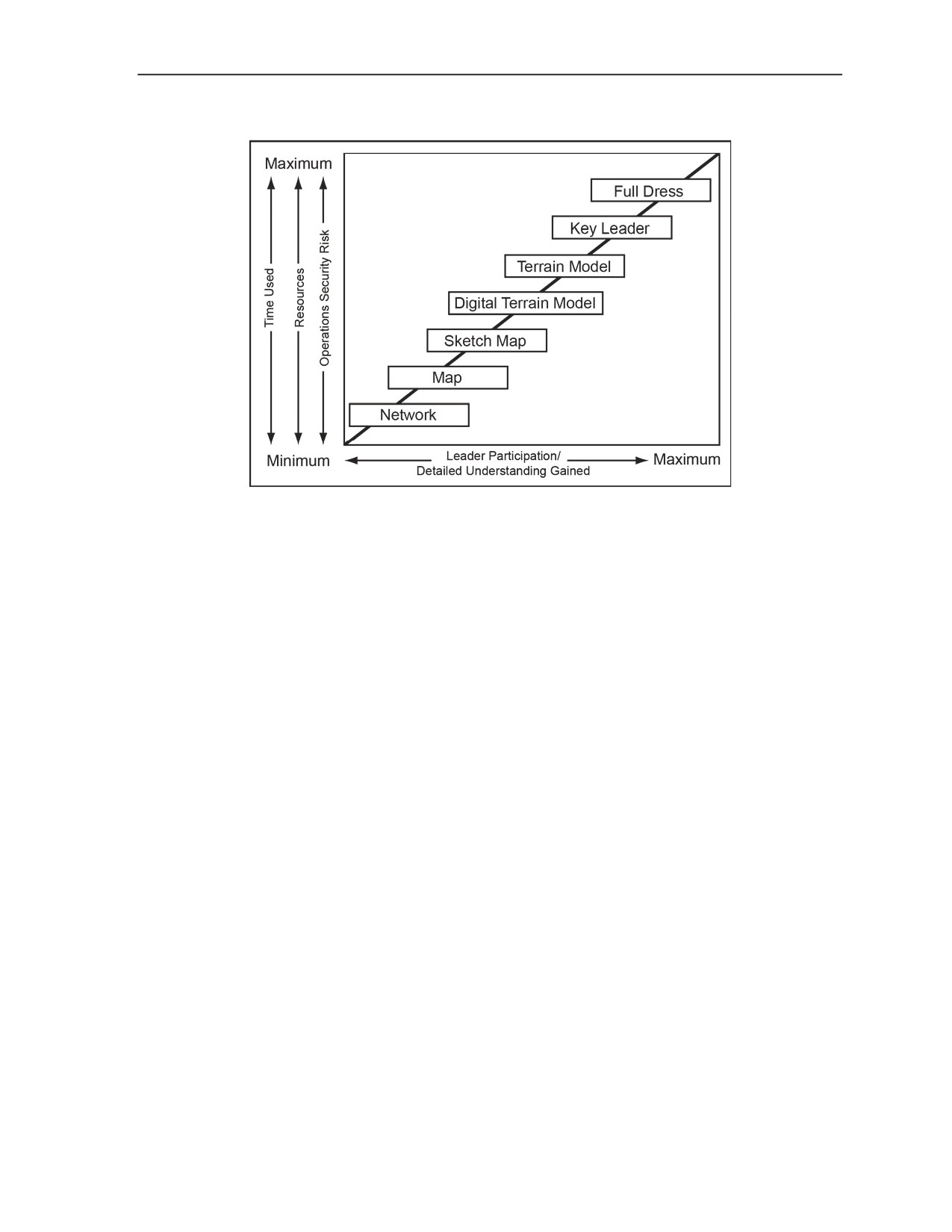
Rehearsals
Figure 12-1. Types of rehearsals
FULL-DRESS REHEARSAL
12-15. A full-dress rehearsal produces the most detailed understanding of the operation. It includes every
participating Soldier and system. Leaders conduct the rehearsal on terrain similar to the area of operations,
initially under good light conditions, and then in limited visibility. Leaders repeat small-unit actions until
units execute them to standard. A full-dress rehearsal helps Soldiers clearly understand what commanders
expect of them. It helps them gain confidence in their ability to accomplish the mission. Supporting
elements, such as aviation crews, meet and rehearse with Soldiers to synchronize the operation.
12-16. A unit may conduct full-dress rehearsals. The higher headquarters may conduct and support
full-dress rehearsals. The full-dress rehearsal is most difficult to accomplish at higher echelons. At those
levels, commanders may develop an alternate rehearsal plan that mirrors the actual plan but fits the terrain
available for the rehearsal.
12-17. Full-dress rehearsals consume more time than any other rehearsal type. For companies and smaller
units, full-dress rehearsals most effectively ensure all units in the operation understand their roles.
However, brigade and task force commanders consider how much time their subordinates need to plan and
prepare when deciding whether to conduct a full-dress rehearsal.
12-18. All echelons involved in the operation participate in the full-dress rehearsal.
12-19. Moving a large part of the force may create an OPSEC risk by attracting unwanted enemy
attention. Commanders develop a plan to protect the rehearsal from enemy information collection.
Sometimes they develop an alternate plan, including graphics and radio frequencies, that rehearses selected
actions without compromising the actual OPORD. Commanders take care not to confuse subordinates
when doing this.
12-20. Terrain management for a full-dress rehearsal is challenging. Units identify, secure, clear, and
maintain the rehearsal area throughout the rehearsal.
KEY LEADER REHEARSAL
12-21. Circumstances may prohibit a rehearsal with all members of the unit. A key leader rehearsal
involves only key leaders of the organization and its subordinate units. It normally takes fewer resources
than a full-dress rehearsal. Terrain requirements mirror those of a full-dress rehearsal, even though fewer
5 May 2014
FM 6-0
12-3
Chapter 12
Soldiers participate. The commander first decides the level of leader involvement. Then the selected leaders
rehearse the plan while traversing the actual or similar terrain. Often commanders use this technique to
rehearse fire control measures for an engagement area during defensive tasks. Commanders often use a key
leader rehearsal to prepare key leaders for a full-dress rehearsal. The key leader rehearsal may require
developing a rehearsal plan that mirrors the actual plan but fits the terrain of the rehearsal.
12-22. Often, small-scale replicas of terrain or buildings substitute for the actual area of operations.
Leaders not only explain their plans, but also walk through their actions or move replicas across the
rehearsal area or sand table. This is called a rock drill. It reinforces the backbrief given by subordinates,
since everyone can see the concept of operations and sequence of tasks.
12-23. A key leader rehearsal normally requires less time than a full-dress rehearsal. Commanders
consider how much time their subordinates need to plan and prepare when deciding whether to conduct a
reduced-force rehearsal.
12-24. A small unit from the echelons involved can perform a full-dress rehearsal as part of a larger
organization’s key leader rehearsal.
12-25. A key leader rehearsal is less likely to present OPSEC risks than a full-dress rehearsal because it
has fewer participants. However, it requires the same number of radio transmissions as for a full-dress
rehearsal.
12-26. Terrain management for the key leader rehearsal can be as difficult as for the full-dress rehearsal.
Units identify, secure, clear, and maintain the rehearsal area throughout the rehearsal.
TERRAIN-MODEL REHEARSAL
12-27. The terrain-model rehearsal is the most popular rehearsal method. It takes less time and fewer
resources than a full-dress or reduced-force rehearsal. An accurately constructed terrain model helps
subordinate leaders visualize the commander’s intent and concept of operations. When possible,
commanders place the terrain model where it overlooks the actual terrain of the area of operations. The
model’s orientation coincides with that of the terrain. The size of the terrain model can vary from small
(using markers to represent units) to large (on which the participants can walk). A large model helps
reinforce the participants’ perception of unit positions on the terrain.
12-28. Often, constructing the terrain model consumes the most time during this technique. Units require
a clear SOP that states how to build the model so it is accurate, large, and detailed enough to conduct the
rehearsal. A good SOP also establishes staff responsibility for building the terrain model and a timeline for
its completion.
12-29. Because a terrain model is geared to the echelon conducting the rehearsal, multi-echelon rehearsals
using this technique are difficult.
12-30. This rehearsal can present OPSEC risks if the area around the rehearsal site is not secured.
Assembled commanders and their vehicles can draw enemy attention. Units must sanitize the terrain model
after completing the rehearsal.
12-31. Terrain management is less difficult than with the previous rehearsal types. A good site is easy for
participants to find, yet it is concealed from the enemy. An optimal location overlooks the terrain where the
unit will execute the operation.
DIGITAL TERRAIN-MODEL REHEARSAL
12-32. Digital terrain models are virtual representations of the area of operations. Units drape
high-resolution imagery over elevation data thereby creating a fly-through or walk-through. Holographic
imagery produces the view in three dimensions. Often, the model hot links graphics, detailed information,
unmanned aircraft systems, and ground imagery to key points providing more insight into the plan. The
unit geospatial engineers or imagery analysts can assist in digital model creation. Detailed city models
already exist for many world cities.
12-4
FM 6-0
5 May 2014
Rehearsals
12-33. The time it takes to create the digital three-dimensional model depends on the amount of available
data on the terrain being modeled.
12-34. Of all the echelons involved, this type of rehearsal best suits small units, although with a good
local area network, a wider audience can view the graphics. All echelons may be provided copies of the
digital model to take back to their headquarters for a more detailed examination.
12-35. If not placed on a computer network, there is limited OPSEC risk because it does not use a large
physical site that requires securing and leaders can conduct the rehearsal under cover. However, if placed
on a computer network, digital terrain models can be subject to enemy exploitation due to inherent
vulnerabilities of networks.
12-36. This space requires the least terrain of all rehearsals. Using tents or enclosed areas conceals the
rehearsal from the enemy.
SKETCH-MAP REHEARSAL
12-37. Commanders can use the sketch-map technique almost anywhere, day or night. The procedures are
the same as for a terrain-model rehearsal except the commander uses a sketch map in place of a terrain
model. Large sketches ensure all participants can see as each participant walks through execution of the
operation. Participants move markers on the sketch to represent unit locations and maneuvers.
12-38. Sketch-map rehearsals take less time than terrain-model rehearsals and more time than map
rehearsals.
12-39. Units tailor a sketch map to the echelon conducting the rehearsal. Multi-echelon rehearsals using
this technique are difficult.
12-40. This rehearsal can present OPSEC risks, if the area around the rehearsal site is not secured.
Assembled commanders and their vehicles can draw enemy attention. Units must sanitize, secure, or
destroy the sketch map after use.
12-41. This technique requires less terrain than a terrain-model rehearsal. A good site ensures participants
can easily find it yet stay concealed from the enemy. An optimal location overlooks the terrain where the
unit will execute the operation.
MAP REHEARSAL
12-42. A map rehearsal is similar to a sketch-map rehearsal except the commander uses a map and
operation overlay of the same scale used to plan the operation.
12-43. The map rehearsal itself consumes the most time. A map rehearsal is normally the easiest
technique to set up since it requires only maps and graphics for current operations.
12-44. Units tailor a map rehearsal’s operation overlay to the echelon conducting the rehearsal.
Multi-echelon rehearsals using this technique are difficult.
12-45. This rehearsal can present OPSEC risks, if the area around the rehearsal site is not secured.
Assembled commanders and their vehicles can draw enemy attention.
12-46. This technique requires the least terrain of all rehearsals. A good site ensures participants can
easily find it yet stay concealed from the enemy. An optimal location overlooks the terrain where the unit
will execute the operation.
NETWORK REHEARSAL
12-47. Units conduct network rehearsals over wide-area networks or local area networks. Commanders
and staffs practice these rehearsals by talking through critical portions of the operation over
communications networks in a sequence the commander establishes. The organization rehearses only the
critical parts of the operation. These rehearsals require all information systems needed to execute that
portion of the operation. All participants require working information systems, the OPORD, and graphics.
Command posts can rehearse battle tracking during network rehearsals.
5 May 2014
FM 6-0
12-5
Chapter 12
12-48. This technique can be time efficient, if units provide clear SOPs. However, if the organization has
unclear SOPs, has units not operating on the network, or has units without working communications, this
technique can be time-consuming.
12-49. This technique lends itself to multi-echelon rehearsals. Participation is limited only by the
commander’s intent and the capabilities of the command’s information systems.
12-50. If a unit executes a network rehearsal from current unit locations, the OPSEC risk may increase.
The enemy may monitor the increased volume of transmissions and potentially compromise information.
To avoid such compromise, organizations use different frequencies from those planned for the operation.
Using wire systems is an option, but this does not exercise the network systems, which is the strong point
of this technique.
12-51. If a network rehearsal is executed from unit locations, terrain considerations are minimal. If a
separate rehearsal area is required, considerations are similar to those of a reduced-force rehearsal.
REHEARSAL RESPONSIBILITIES
12-52. This discussion addresses responsibilities for conducting rehearsals based on the combined arms
rehearsal. Responsibilities are similar for other types of rehearsals.
REHEARSAL PLANNING
12-53. Commanders and chiefs of staff (executive officers at lower echelons) plan rehearsals.
Commander
12-54. Commanders provide certain information as part of the commander’s guidance during the initial
mission analysis. They may revise the following information when they select a course of action:
z
Rehearsal type.
z
Rehearsal technique.
z
Location.
z
Attendees.
z
Enemy course of action to be portrayed.
Chief of Staff (Executive Officer)
12-55. The chief of staff (executive officer) (COS [XO]) ensures all rehearsals are included in the
organization’s time-management SOP. The COS (XO) responsibilities include—
z
Publishing the rehearsal time and location in the OPORD or warning order (WARNORD).
z
Conducting staff rehearsals.
z
Determining rehearsal products, based on type, technique, and mission variables.
z
Coordinating liaison officer attendance from adjacent units.
REHEARSAL PREPARATION
12-56. Everyone involved in executing or supporting the rehearsal has responsibilities during preparation.
Commander
12-57. Commanders prepare to rehearse operations with events phased in proper order, from start to
finish. Under time-constrained conditions, this often proves difficult. Commanders—
z
Identify and prioritize key events to rehearse.
z
Allocate time for each event.
z
Perform personal preparation, including reviews of—
12-6
FM 6-0
5 May 2014