FM 6-0 COMMANDER AND STAFF ORGANIZATION AND OPERATIONS (MAY 2014) - page 2
Chapter 2
brigade and lower echelon headquarters, the S-3 has coordinating staff responsibility for these staff
officers. The chief of protection prepares Annex E (Protection) to the operation order or operation plan.
(See ADRP 3-37 for more details.) The chief of protection’s responsibilities include, but are not limited
to—
z
Directing analysis, planning, and coordinating protection functions and missions.
z
Advising the commander on the allocation and employment of all assigned or attached
protection assets.
z
Chairing the protection working group.
z
Coordinating input and making recommendations to the commander on the assets to be included
in the critical and defended asset lists.
z
Monitoring and assessing the protection effort.
z
Conducting staff coordination with other headquarters cells, nodes, and functional groupings.
z
Managing protection support for major operations.
z
Synchronizing protection operations between CPs.
z
Managing training and materiel enhancements.
z
Providing guidance on protection systems and the execution of protection tasks.
SPECIAL STAFF OFFICERS
2-73. Every staff has special staff officers. This section addresses the specific duties of each special staff
officer. The number of special staff officers and their responsibilities vary with authorizations, the desires
of the commander, and the size of the command. If a special staff officer is not assigned, the officer with
coordinating staff responsibility for the area of expertise assumes those functional responsibilities. During
operations, special staff officers work in parts of the CP designated by the commander, COS, or their
supervising coordinating staff officer. In general, the COS (XO) exercises coordinating staff responsibility
over those special staff officers without a coordinating staff officer.
AIR AND MISSILE DEFENSE OFFICER
2-74. The air and missile defense officer is responsible for coordinating air and missile defense activities
and plans with the area air and missile defense commander, joint force air component commander, and
airspace control authority. The air and missile defense officer coordinates the planning and use of all joint
air and missile defense systems, assets, and operations. A key role of the air and missile defense officer is
to advise the commander on developing a critical asset list and a defended asset list of assets that can be
defended by air and missile defense forces. Army forces air and missile defense plans are synchronized
with the area air defense commander’s area air defense plan, the joint force air component commander’s
joint air operations plan and daily air tasking order, and the airspace control authority’s airspace control
plan, and daily airspace control order. The air and missile defense officer prepares a portion of Annex D
(Fires) to the operation order or operation plan. (See FM 3-01, FM 3-27, and FM 3-52 for more details.)
2-75. The air and missile defense officer is the senior air defense artillery officer in the command and the
commander of an air defense artillery unit supporting it. An air and missile defense officer is authorized at
the division, corps, and theater army levels. Examples of air and missile defense officer responsibilities
include, but are not limited to—
z
Disseminating air tasking order and airspace control order information to air defense artillery
units.
z
Integrating airspace coordinating measures to support air and missile defense operations.
z
Recommending active and passive air defense measures.
z
Determining requirements and recommending assets to support air and missile defense.
z
Planning and coordinating airspace use with other staffs.
z
Providing information on the status of air and missile defense systems, air and missile attack
early warning radars, and air defense artillery ammunition.
2-16
FM 6-0
5 May 2014
Staff Duties and Responsibilities
z
Estimating the adequacy of the air defense artillery ammunition controlled supply rate.
z
Coordinating and synchronizing Army forces air and missile defense with joint force air and
missile defense.
AIR LIAISON OFFICER
2-76. The air liaison officer is responsible for coordinating aerospace assets and operations, such as close
air support, air interdiction, air reconnaissance, airlift, and joint suppression of enemy air defenses. The air
liaison officer is the senior Air Force officer with each tactical air control party. Air liaison officer
responsibilities include, but are not limited to—
z
Advising the commander and staff on employing aerospace assets.
z
Operating and maintaining the Air Force tactical air direction radio network and Air Force air
request network.
z
Transmitting requests for immediate close air support and reconnaissance support.
z
Transmitting advance notification of impending immediate airlift requirements.
z
Acting as liaison between air and missile defense units and air control units.
z
Planning the simultaneous employment of air and surface fires.
z
Coordinating air support missions with the chief of fires or fire support officer, and the
appropriate airspace control element.
z
Supervising joint terminal attack controllers and the tactical air control party.
z
Integrating air support sorties with the Army concept of operations.
z
Participating in targeting team meetings.
z
Directing close air support missions.
z
Providing Air Force input into airspace control.
AVIATION OFFICER
2-77. The aviation officer is responsible for coordinating Army aviation assets and operations at division,
corps, and theater army levels. (See FM 3-52 for more details.) The aviation officer’s responsibilities
include, but are not limited to—
z
Exercising staff supervision and training over Army aviation operations.
z
Monitoring aviation flying-hour, standardization, and safety programs.
z
Planning and supervising Army aviation operations.
z
Providing technical advice and assistance on using Army aviation for evacuation (medical or
other).
z
Participating in targeting meetings.
CHEMICAL, BIOLOGICAL, RADIOLOGICAL, AND NUCLEAR OFFICER
2-78. The chemical, biological, radiological, and nuclear
(CBRN) officer is responsible for CBRN
operations, obscuration operations, and CBRN asset use. The CBRN officer prepares a portion of Annex C
(Operations) and a portion of Annex E (Protection) to the operation order or operation plan.
(See
FM 3-11.21 for more details.) The CBRN officer’s responsibilities include, but are not limited to—
z
Recommending courses of action to minimize friendly and civilian vulnerability.
z
Coordinating across the entire staff while assessing the effect of enemy CBRN-related attacks
and hazards on current and future operations.
z
Coordinating Army health system support requirements for CBRN operations with the surgeon.
z
Coordinating with other staff for CBRN-related operations.
z
Planning, supervising, and coordinating CBRN decontamination
(except patient
decontamination) operations.
z
Assessing weather and terrain data to determine environmental effects on potential CBRN
hazards and threats.
5 May 2014
FM 6-0
2-17
Chapter 2
z
Overseeing construction of CBRN shelters.
z
Planning and recommending integration of obscuration into tactical operations.
z
Advising the commander on CBRN threats and hazards and passive defense measures.
CIVILIAN PERSONNEL OFFICER
2-79. The civilian personnel officer manages and administers the civilian employee personnel management
program. This civilian employee has a permanent position on the staff at divisions and corps. (See Army
Regulation [AR] 690-11 and other regulations in this series for more details.) Specific duties include, but
are not limited to—
z
Advising the commander and staff concerning the civilian employee personnel management
program and supervising the management and administration of that program within the
command.
z
Administering civilian personnel management laws and regulations.
z
Participating, when appropriate, in negotiations with host nations on labor agreements.
z
Developing plans and standby directives for procuring, using, and administering the civilian
labor force and using local labor in foreign areas during emergencies (with other staff members).
DENTAL SURGEON
2-80. The dental surgeon coordinates dental activities within the command. All dental activities are
planned at the medical brigade (support), medical command (deployment support), or Army Service
component command. (See FM 4-02.19 for more details.) Dental surgeon responsibilities include, but are
not limited to—
z
Coordinating dental activities with the surgeon.
z
Exercising staff supervision over and providing technical assistance to dental activities.
z
Planning and supervising dental functions.
z
Developing a program for dental support of foreign humanitarian assistance.
z
Providing advice and technical assistance in constructing, rehabilitating, and using dental
facilities.
ELECTRONIC WARFARE OFFICER
2-81. The electronic warfare officer is a specially trained officer who performs electronic warfare duties
and integrates cyber electromagnetic activities. The electronic warfare officer prepares a portion of
Annex C (Operations) to the operation order or operation plan and contributes to any section that has a
cyber electromagnetic activities subparagraph such as Annex N (Space Operations). Electronic warfare
officer responsibilities include, but are not limited to—
z
Leading the electronic warfare element.
z
Integrating and synchronizing cyber electromagnetic activities.
z
Coordinating, preparing, and maintaining the electronic warfare target list, electronic attack
taskings, and electronic attack requests.
z
Coordinating with other staff when conducting electronic warfare.
z
Assessing opponent strength and vulnerabilities, friendly capabilities, and friendly missions in
electronic warfare terms.
z
Developing a prioritized adversary target list based on high-value targets and high-payoff targets
(with the chief of fires and fire support officer).
z
Coordinating the electronic attack target list with organic military intelligence units and with
adjacent and higher commands, including joint and multinational commands when appropriate.
z
Coordinating with the information operations officer to deconflict cyber electromagnetic
activities and information operations.
z
Leading the cyber electromagnetic activities working group.
z
Participating in working groups and targeting meetings.
2-18
FM 6-0
5 May 2014
Staff Duties and Responsibilities
ENGINEER OFFICER
2-82. The engineer officer resides in the protection cell and is responsible for planning and assessing
survivability operations. The engineer officer is involved in planning and operations with more than just the
protection warfighting function. For example, mobility and countermobility are part of movement and
maneuver, general engineering is part of sustainment, and geospatial engineering supports the intelligence
warfighting function. The engineer officer prepares Annex G (Engineer) to the operation order or operation
plan. (See FM 3-34 for more details.) Specific duties include, but are not limited to—
z
Advising the chief of protection on survivability operations.
z
Coordinating and synchronizing survivability operations.
z
Synchronizing and integrating engineer operations (combat and construction) between multiple
command posts and organizations.
z
Writing engineer FRAGORDs, WARNORDs, and related products.
z
Providing real-time reachback linkage to United States Army Corps of Engineers knowledge
centers and supporting national assets.
z
Updating the running estimate.
EXPLOSIVE ORDNANCE DISPOSAL OFFICER
2-83. The explosive ordnance disposal officer is responsible for coordinating the detection, identification,
recovery, evaluation, rendering safe, and final disposal of explosive ordnance. An explosive ordnance
disposal officer is authorized at corps and divisions. The explosive ordnance disposal officer prepares a
portion of Annex E (Protection) to the operation order or operation plan. (See AR 75-15 for more details.)
Explosive ordnance disposal officer responsibilities include, but are not limited to—
z
Establishing and operating an explosive ordnance disposal incident reporting system.
z
Establishing, operating, and supervising technical intelligence reporting procedures.
z
Coordinating requirements for explosive ordnance disposal support with requesting units, other
Army commands, other Services, federal agencies, and multinational partners. Coordination may
include arranging for administrative and logistic support for subordinate explosive ordnance
disposal units.
z
Monitoring the supply status of and expediting requests for special explosive ordnance disposal
tools, equipment, and demolition materials.
EQUAL OPPORTUNITY ADVISOR
2-84. The equal opportunity advisor coordinates matters concerning equal opportunity for Soldiers and
their families. Commanders at every echelon are authorized to appoint an equal opportunity advisor. (See
AR 600-20 for more details.) The duties and responsibilities of the equal opportunity advisor include, but
are not limited to—
z
Advising and assisting the commander and staff on all equal opportunity matters, including
sexual harassment, discrimination, and affirmative action.
z
Consulting with the servicing legal representative during all informal and formal investigations.
z
Recognizing and assessing indicators of institutional and individual discrimination and sexual
harassment.
z
Recommending, developing, and monitoring affirmative action and equal opportunity plans and
policies to reduce or prevent discrimination and sexual harassment.
z
Collecting and processing demographic data concerning all aspects of equal opportunity climate
assessment.
z
Managing or conducting all equal opportunity education and training programs within the
command, to include conducting ethnic observances.
z
Receiving and helping process complaints.
5 May 2014
FM 6-0
2-19
Chapter 2
FORCE MANAGEMENT OFFICER
2-85. The force management officer is responsible for accounting for the force and its resources. This
officer evaluates the organizational structure, functions, and workload of military and civilian personnel to
ensure their proper use and requirements. By conducting formal, on-site manpower and equipment surveys,
this officer ensures documents for the modified TOE and the tables of distribution and allowances reflect
the minimum essential and most economical equipment needed for the mission.
FOREIGN DISCLOSURE OFFICER
2-86. The foreign disclosure officer is responsible for the oversight and coordination of specific disclosure
of or access to classified military information or controlled unclassified information to representatives of
foreign governments and international organizations. (See AR 380-10 for more details.)
HISTORIAN
2-87. The historian is the special staff officer responsible for implementing the commander’s history
program. This includes collecting, preserving, and expressing the accurate historical record of the
command. The historian can be either an officer or a civilian professional historian. Historian
responsibilities include, but are not limited to—
z
Preparing the Command Report and Annual History.
z
Collecting and preservating unit historical documents such as plans, orders, and after action
reviews and reports.
z
Providing historical perspective and institutional memory to the planning and decisionmaking
process.
z
Preparing special studies and reports, based on assembled historical material.
z
Maintaining a historical research collection to support the institutional memory of the command.
z
Supervising the command’s historical program.
HUMAN TERRAIN TEAMS
2-88. The human terrain team’s mission is to conduct operationally relevant social science research and
provide commanders and staffs with an embedded knowledge capability to establish a coherent, analytical,
socio-cultural framework for operational planning, preparation, execution, and assessment.
2-89. When deployed with a unit, human terrain teams support the commander and staff in the planning,
preparation, execution, and assessment of operations. Human terrain team members may also assist the
commander in building relationships with local leaders and power brokers. This will assist the supported
commander in gaining local, regional, socio-cultural, economic, and political insight. Human terrain team
responsibilities include, but are not limited to—
z
Conducting social science research in support of the commander and staff to assist in the
development of commander’s critical information requirements (CCIRs) as well as perceived
gaps in the unit’s cultural knowledge.
z
Gathering data and conducting analysis to make that data operationally relevant to the
commander and staff for given situations.
z
Ensuring the analytic cultural framework for operational planning, decisionmaking, and
assessment is incorporated into the continuous planning processes conducted by the commander
and staff.
INFORMATION OPERATIONS OFFICER
2-90. The information operations officer is the special staff officer responsible for synchronizing and
deconflicting information-related capabilities employed in support of unit operations. The information
operations officer is authorized at theater army through brigade. Coordinated by the G-3, the information
operations officer leads the information operations element located in the movement and maneuver cell at
2-20
FM 6-0
5 May 2014
Staff Duties and Responsibilities
echelons above brigade. The responsibilities of the information operations officer include, but are not
limited to—
z
Analyzing the information environment to discern impacts it will have on unit operations and to
exploit opportunities to gain an advantage over threat forces.
z
Identifying opportunities to employ information-related capabilities to enable achieving friendly
operational objectives.
z
Assessing the risk associated with the use of information-related capabilities as part of supported
unit operations.
z
Providing input to the synchronization matrix for the use of available information-related
capabilities in support of unit operations.
z
Identifying information-related capabilities support gaps not resolvable at the unit level.
z
Coordinating with other Army, Service, or joint forces to use information-related capabilities to
augment existing unit capability shortfalls.
z
Providing information as required in support of operations security at the unit level.
z
Providing information as required in support of military deception at the unit level.
z
Leading the information operations working group.
z
Assessing the effectiveness of employed information-related capabilities.
KNOWLEDGE MANAGEMENT OFFICER
2-91. The knowledge management officer directs the knowledge management section. Knowledge
management officers ensure that units understand knowledge management processes and procedures. They
demonstrate how these processes and procedures can improve efficiency and shared understanding during
training and enhance operational effectiveness during operations, especially in time-constrained
environments. Knowledge management officers need not remain in the CP. Commanders may require their
knowledge management officer to move with them. The knowledge management officer’s duties and
responsibilities include, but are not limited to—
z
Developing knowledge management techniques, policies, and procedures and ensuring
command-wide dissemination.
z
Performing staff planning and coordination of knowledge management functions and activities
to improve shared understanding, learning, and decisionmaking.
z
Creating an organizational knowledge network and metrics for evaluating its effectiveness.
z
Leading the staff in assessing unit performance.
z
Integrating and synchronizing knowledge management functions and activities with higher
echelon and subordinate commands.
z
Monitoring emerging knowledge management trends for incorporation into unit operations.
z
Chairing the knowledge management working group.
LIAISON OFFICER
2-92. Liaison officers are the commander’s representative at the headquarters or agency to which they are
sent. They promote coordination, synchronization, and cooperation between their parent unit and higher
headquarters, interagency, coalition, host-nation, adjacent, and subordinate organizations as required. As
subject matter experts from their assigned headquarters, liaison officers are usually embedded in another
organization to provide face-to-face coordination. (See chapter 13 and unit SOPs.)
MILITARY DECEPTION OFFICER
2-93. The military deception officer is responsible for coordinating military deception assets and
operations. The military deception officer works within the G-5 plans movement and maneuver cell. A
military deception officer is authorized at corps and theater army levels. At division and lower echelons,
the commander will designate a military deception officer when necessary. Usually the individual
designated by the commander is well versed in the use of Army information-related capabilities that are
employed to influence an enemy decisionmaker. The military deception officer provides input to various
5 May 2014
FM 6-0
2-21
Chapter 2
annexes to the operation order or operation plan as warranted, including preparing a portion of Annex C.
Military deception officer responsibilities include, but are not limited to—
z
Exercising staff supervision over military deception activities.
z
Providing expertise in military deception operations planning.
z
Managing information required to conduct military deception operations and civil considerations
analysis to better determine the effects of ambiguity.
z
Determining requirements or opportunities for military deception operations (with the G-2)
through red teaming the adversaries’ most probable courses of action.
z
Coordinating with the military information support operations planner for support to the
deception targets, deception objectives, and deception story.
z
Coordinating with the information operations officer to ensure themes, messages, and actions
support and enable the military deception plan.
z
Coordinating with the cyber electromagnetic activities staff lead to ensure that cyber
electromagnetic activities support and enable the military deception plan.
z
Producing, distributing, briefing, and coordinating the military deception plan on a need-to-know
basis.
z
Coordinating operations security measures to shield the military deception plan with the
operations security officer.
z
Integrating military deception assets (both conventional and unconventional).
z
Assessing the execution and effects of military deception operations.
MILITARY INFORMATION SUPPORT OFFICER
2-94. The military information support officer is responsible for synchronizing military information
support operations
(MISO) in support of unit operations. A military information support officer is
authorized at division, corps, and theater army. A military information support NCO is authorized at the
brigade level. If no military information support NCO is assigned, the commander of an attached military
information support element may assume the military information support staff officer’s responsibilities.
Coordinated by the G-3, the military information support officer prepares a portion of Annex C
(Operations) to the operation order or operation plan.
(See MISO doctrine for more details.)
Responsibilities include, but are not limited to—
z
Coordinating with the information operations officer to ensure synchronization of MISO.
z
Planning, coordinating, and synchronizing MISO to support the overall operation.
z
Recommending prioritization of the efforts of attached military information support forces.
z
Evaluating enemy information efforts and the effectiveness of friendly MISO on target groups
(with the G-2, information operations officer, and G-9).
z
Assessing MISO effectiveness.
z
Assessing the potential effects of adversary information, misinformation, and propaganda on
command objectives and determining the best response, if any, in conjunction with the
information operations officer.
z
Providing military information products and support to an approved military deception plan.
OPERATIONS RESEARCH AND SYSTEMS ANALYSIS OFFICER
2-95. The operations research and system analysis officer conducts analysis in support of operations,
across staff sections and employed forces. The operations research and system analysis officer is the
principal advisor to the COS and the commander on analytical techniques. The operations research and
system analysis officer provides a flexible capability to the commander to use mathematical rigor to
confirm or deny theories, to analyze problems and determine their true cause, and to project current trends.
The operations research and system analysis officer is often tasked to be the action officer for the
assessment working group. This officer’s duties and responsibilities include, but are not limited to—
2-22
FM 6-0
5 May 2014
Staff Duties and Responsibilities
z
Managing, analyzing, and visualizing data using statistical information, geospatial information,
spreadsheets, and graphics software.
z
Developing customized tools for staff sections.
z
Providing quality control.
z
Supporting COA analyses and operations planning.
z
Conducting assessments to determine effectiveness of an operation.
z
Conducting analyses to support the staff’s military decisionmaking process.
OPERATIONS SECURITY OFFICER
2-96. The operations security officer is responsible for the command’s operations security program. The
operations security officer prepares a portion of Annex E (Protection) to the operation order or operation
plan. (See AR 530-1 for information on operations security policy and procedures.) The operations security
officer’s responsibilities include, but are not limited to—
z
Identifying and recommending the essential elements of friendly information (EEFIs).
z
Conducting analysis of adversaries as part of the IPB process.
z
Conducting analysis of vulnerabilities as part of the IPB process.
z
Assessing operations security risk.
z
Developing, coordinating, and applying operations security measures across the staff.
z
Writing the running estimate for operations security.
z
Writing the operations security appendix to the protection annex.
z
Monitoring, assessing, and adjusting operations security as required.
z
Reviewing internal staff documents, information system logs, and news releases for sensitive
information and potential compromise of EEFIs.
z
Searching news sources, web logs (blogs), and other web sites for sensitive information and
compromise of EEFIs.
z
Attending the information operations working group as required.
PERSONNEL RECOVERY OFFICER
2-97. The personnel recovery officer is responsible for the coordination of all personnel recovery related
matters. The personnel recovery officer prepares a portion of Annex E (Protection) to the operation order or
operation plan. (See FM 3-50.1 for more details.) Personnel recovery officer duties include, but are not
limited to—
z
Developing and maintaining the organization’s personnel recovery program.
z
Recommending recovery COAs to the commander.
z
Coordinating personnel recovery issues, both vertically and horizontally.
z
Developing personnel recovery SOPs, plans, and annexes.
z
Supporting joint personnel recovery or establishing a joint personnel recovery center as required.
z
Assisting personnel recovery officers in developing subordinate recovery programs.
PROVOST MARSHAL
2-98. The provost marshal is responsible for planning, coordinating, and employing all organic, assigned,
or attached military police assets. Usually the senior military police officer in the command, the provost
marshal augments the staff with a small planning cell that typically works within the G-5. A provost
marshal is authorized at corps and division headquarters. The provost marshal prepares a portion of Annex
C (Operations) and a portion of Annex E (Protection) to the operation order or operation plan. (See
ADRP 3-37 and FM 3-39 for more details.) Provost marshal responsibilities include, but are not limited
to—
5 May 2014
FM 6-0
2-23
Chapter 2
z
Conducting maneuver and mobility support operations, including route reconnaissance,
surveillance, circulation control, dislocated civilian and straggler control, and information
dissemination.
z
Directing components of area security operations, including activities associated with
antiterrorism operations, zone and area reconnaissance, checkpoint access control, and physical
security of critical assets, nodes, and sensitive materials.
z
Managing detainee operations and resettlement operations.
z
Coordinating and directing law and order operations, including liaison with local civilian law
enforcement authorities.
z
Conducting police intelligence operations, including activities related to the collection,
assessment, development, and dissemination of police intelligence products.
z
Coordinating customs and counterdrug activities.
z
Providing physical security guidance for commanders.
z
Assisting with area damage control and CBRN detection and reporting.
z
Helping the commander administer discipline, law, and order.
RED TEAM OFFICER
2-99. Red teaming enables commanders to fully explore alternative plans and operations in the context of
the operational environment and from the perspective of partners, adversaries, and others. Red teams assist
commanders and staffs with critical and creative thinking and help them avoid groupthink, mirror imaging,
cultural missteps, and tunnel vision throughout the conduct of operations. Red teams are part of the
commander’s staff at division headquarters through the theater army headquarters. Brigades may be
augmented with a red team as required. Commanders use red teams to provide alternatives during planning,
execution, and assessment. The red team officer’s duties and responsibilities include, but are not limited
to—
z
Broadening the understanding of the operational environment.
z
Assisting the commander and staff in framing problems and defining end state conditions.
z
Challenging assumptions.
z
Ensuring the perspectives of the enemies and adversaries and others are appropriately
considered.
z
Aiding in identifying friendly and enemy vulnerabilities and opportunities.
z
Assisting in identifying areas for assessment.
z
Anticipating cultural perceptions of partners, adversaries, and others.
z
Conducting independent critical reviews and analyses of plans and concepts to identify potential
weaknesses and vulnerabilities.
SECRETARY OF THE GENERAL STAFF
2-100. The secretary of the general staff is the special staff officer who acts as XO for the COS. Corps,
divisions, major support commands, and general officers with a staff are authorized a secretary of the
general staff. Secretary of the general staff responsibilities include, but are not limited to—
z
Planning and supervising conferences chaired by the commander, deputy or assistant
commanders, or the COS.
z
Directing preparation of itineraries for distinguished visitors to the headquarters and monitoring
their execution.
z
Monitoring preparation and execution of all official social events and ceremonies involving the
commander, deputy or assistant commanders, or the COS.
z
Monitoring and disseminating command correspondence.
z
Acting as the informal point of contact for liaison officers.
2-24
FM 6-0
5 May 2014
Staff Duties and Responsibilities
STAFF WEATHER OFFICER
2-101. The G-2 (S-2) staff, with the support of the staff weather officer, is responsible for providing the
commander with a thorough understanding of terrestrial and solar weather effects and their impact on
friendly and threat systems and operations, as well as civil considerations. The G-2 (S-2) staff provides this
information during the planning process and incorporates significant weather effects into all of the primary
intelligence products (intelligence estimates, intelligence summaries, and the intelligence portion of the
common operational picture [COP]). Weather effects are analyzed based on the military aspects of weather
(visibility, wind, precipitation, cloud cover, temperature, and humidity). The staff weather officer is
responsible for coordinating operational weather support and weather services through the G-2 (S-2). The
staff weather officer, an Air Force officer or NCO, leads a combat weather team of two or more personnel.
(See AR 115-10 for more information.) Staff weather officer responsibilities include—
z
Coordinating weather support procedures for garrison and before and during deployments with
its supported Army command.
z
Advising the Army commander on Air Force weather capabilities, limitations, and the ways in
which weather support can enhance operations.
z
Helping the G-2 (S-2) arrange weather support for subordinate units.
z
Helping the G-2 (S-2) and staff produce weather displays, graphic COP overlays, and weather
effects tactical decision aids displaying weather effects on friendly and threat forces, weapons
systems and sensor payloads, and information collection units and assets.
z
Evaluating and disseminating weather products and data.
z
Advising the Air Force on Army operational weather support requirements.
z
Helping the G-2 (S-2) monitor the weather support mission, identify responsibilities, and resolve
weather support deficiencies.
SPACE OPERATIONS OFFICER
2-102. The space operations officer is in charge of the space support element and is responsible for
providing space-related tactical support and coordination of space-based capabilities available to the
command. An Army space support team is often placed under operational control to a command, if the
workload or product requirements exceed the capacity of the organic space support element. The team’s
officer in charge fulfills the space operations officer’s responsibilities. The space operations officer
prepares Annex N (Space Operations) to the operation order or operation plan. (See FM 3-14 for more
details.) Space operations officer responsibilities include, but are not limited to—
z
Advising the commander on the space architectures, capabilities, limitations, and use of theater,
strategic, national, and commercial space assets.
z
Calculating, analyzing, and disseminating global positioning system satellite coverage and
accuracy data.
z
Facilitating the dynamic retasking of space-based assets to support current and future operations.
z
Assisting in acquiring Department of Defense and commercial satellite terrain and weather
imagery (classified and unclassified) to enhance mapping, mission analysis, and other actions
requiring near real-time imagery from denied areas.
z
Advising the G-2 and the information operations officer on capabilities and vulnerabilities of
threat and commercial space systems.
z
Providing estimates on the effects of space weather activities on current and future operations
and the effects of terrestrial weather on space-based capabilities.
z
Nominating threat or foreign ground stations for targeting (with the G-3 chief of fires).
z
Coordinating the activities of the Army space support team supporting the command.
z
Integrating into special technical operations to maximize all the unique and specialized
space-related technical capabilities into operations.
5 May 2014
FM 6-0
2-25
Chapter 2
TRANSPORTATION OFFICER
2-103. The transportation officer coordinates transportation assets and operations and also prepares a
portion of Annex F (Sustainment). (See ATP 4-16 for more details.) Transportation officer responsibilities
include, but are not limited to—
z
Planning and directing administrative movements, including onward movement from ports of
debarkation, sustainment movements, and other movements as directed.
z
Planning movement scheduling and regulations of main supply routes.
z
Planning the mode of operations (truck, rail, air, and water).
z
Planning the movement of materiel and personnel.
z
Monitoring movements on routes two echelons lower than the unit.
VETERINARY OFFICER
2-104. The veterinary officer is responsible for coordinating assets and activities concerning veterinary
services within the command. All veterinarian activities are planned at the medical brigade (support),
medical command (deployment support), or Army Service component command. (See ADRP 4-0 and
FM 4-02.18 for more details.) Veterinary officer responsibilities include, but are not limited to—
z
Coordinating veterinary activities with the surgeon and other staff members.
z
Determining requirements for veterinary supplies and equipment.
z
Ensuring safety of food and food sources.
z
Advising on health and operational risks of animal disease, including possible biological warfare
events.
z
Monitoring the sanitation of food storage facilities and equipment.
z
Managing veterinary equipment and facilities.
z
Coordinating animal housing.
z
Participating in civil-military operations.
z
Coordinating the use of medical laboratory services by veterinary personnel.
z
Preparing reports on command veterinary activities.
PERSONAL STAFF OFFICERS
2-105. Personal staff officers work under the immediate control of, and have direct access to, the
commander. By law and regulation, personal staff officers have a unique relationship with the commander.
The commander establishes guidelines or gives guidance on when a personal staff officer informs or
coordinates with the COS (XO) or other staff members. Some personal staff officers have responsibilities
as special staff officers and work with a coordinating staff officer. They do this on a case-by-case basis,
depending on the commander’s guidance or the nature of the task. Personal staff officers also may work
under the supervision of the COS (XO). Although there are other members in the commander’s personal
staff, this section discusses only staff officers and the command sergeant major.
AIDE-DE-CAMP
2-106. The aide-de-camp serves as a personal assistant to a general officer. An aide-de-camp is authorized
for general officers in designated positions. The rank of the aide-de-camp depends on the rank of the
general officer. No officer exercises coordinating staff responsibility over the aide-de-camp. Aide-de-camp
responsibilities include, but are not limited to—
z
Providing for the general officer’s personal well-being and security, and relieving the general
officer of routine and time-consuming duties.
z
Preparing and organizing schedules, activities, and calendars.
z
Preparing and executing trip itineraries.
z
Coordinating protocol activities.
z
Acting as an executive assistant.
2-26
FM 6-0
5 May 2014
Staff Duties and Responsibilities
z
Meeting and hosting the general officer’s visitors.
z
Supervising other personal staff members
(secretaries, assistant aides, enlisted aides, and
drivers).
z
Performing varied duties, according to the general officer’s desires.
CHAPLAIN
2-107. The mission of the chaplain is to perform or provide religious support to the unit by assisting the
commander in providing for the free exercise of religion and religious, moral, and ethical leadership.
Chaplains execute their distinct religious support mission for Soldiers, members of other military services,
family members, and authorized civilians in a variety of geographical locations, operational situations, and
circumstances. Chaplains provide religious support and advise commanders on the impact of religion,
reflecting the dual roles of religious leaders and religious staff advisors. Chaplains and chaplain assistants
are assigned at all battalion and higher echelons. The chaplain prepares a portion of Annex F
(Sustainment). (See FM 1-05 for more details.)
COMMAND SERGEANT MAJOR
2-108. The command sergeant major is the senior noncommissioned officer of the command at battalion
and higher echelons. Command sergeants major carry out policies and enforce standards for the
performance, training, and conduct of enlisted Soldiers. They give advice and initiate recommendations to
the commander and staff in matters pertaining to enlisted Soldiers. In operations, a commander employs the
command sergeant major throughout the area of operations to extend command influence, assess the morale
of the force, and assist during critical events.
INSPECTOR GENERAL
2-109. The inspector general is responsible for advising the commander on the command’s overall
welfare and state of discipline. The inspector general is a confidential advisor to the commander. An
inspector general is authorized for general officers in command positions. The inspector general prepares
Annex U (Inspector General) to the operation order or operation plan. (See AR 20-1 for more details.)
Inspector general responsibilities include, but are not limited to—
z
Advising commanders and staffs on inspection policy.
z
Advising commanders on the effectiveness of the organizational inspection program.
z
Conducting inspections as the commander requires and monitoring corrective actions.
z
Receiving allegations and conducting investigations and investigative inquiries.
z
Monitoring and informing the commander of trends, both positive and negative, in all activities.
z
Consulting with staff sections, as appropriate, to obtain items for the special attention of
inspectors and to arrange for technical assistance.
z
Providing the commander continuous, objective, and impartial assessments of the command’s
operational and administrative effectiveness.
z
Assisting Soldiers, Army civilians, family members, retirees, and other members of the force
who seek help with Army-related problems.
z
Identifying and helping to resolve systemic problems.
INTERNAL REVIEW OFFICER
2-110. The internal review officer provides professional internal audit capability and delivers pertinent,
timely, and reliable information and advice to the commander. This information and advice evaluates risk,
assesses management control measures, fosters stewardship, and improves the quality, economy, and
efficiency of business practices. (See AR 11-7 for more details.) Internal review officer responsibilities
include, but are not limited to—
z
Completing internal audits of functions or organizational entities in the command with known or
suspected problems, determining the nature and cause of problems, and suggesting resolutions.
z
Providing troubleshooting—quick reaction efforts to prevent serious problems from developing.
5 May 2014
FM 6-0
2-27
Chapter 2
z
Providing an audit compliance function by serving as the point of contact with external audit
groups. In addition, the internal review office facilitates the external audit reply and response
process and performs follow-up audits.
z
Coordinating with higher headquarters and other agencies to ensure units properly follow all
standards and policies.
PUBLIC AFFAIRS OFFICER
2-111. The public affairs officer understands and coordinates the flow of information to Soldiers, the
Army community, and the public. The public affairs officer prepares Annex J (Public Affairs) to the
operation order or operation plan. (See FM 3-61 for more details.) Public affairs officer responsibilities
include, but are not limited to—
z
Planning and supervising the command public affairs program.
z
Advising and informing the commander of the public affairs impact and implications of planned
or current operations.
z
Preparing themes and messages for the commander for public communications.
z
Serving as the command representative for all communications with external media.
z
Assessing the information requirements and expectations of the Army and the public, monitoring
media and public opinion, and evaluating the effectiveness of public affairs plans and operations.
z
Coordinating with other information-related capabilities to ensure synchronization through the
information operations working group.
z
Coordinating logistics and administrative support of civilian journalists under unit administrative
control.
z
Conducting liaison with media representatives to provide accreditation, mess, billet, transport,
and escort as authorized and appropriate.
z
Developing and educating the command on policies and procedures for protecting against the
release of information detrimental to the mission, national security, and personal privacy.
z
Informing Soldiers, family members, and Army civilians of their rights under the Privacy Act,
operations security responsibilities, and roles as implied representatives of the command when
interacting with news media.
z
Recommending news, entertainment, and information for Soldiers and home station audiences.
SAFETY OFFICER
2-112. The safety officer coordinates safety activities throughout the command and advises the
commander on matters relating to the Army safety program, including its implementation and
effectiveness. Commanders at every echelon from battalion through corps appoint a safety officer. An
aviation safety officer is authorized for corps staffs and all aviation units. The safety officer prepares a
portion of Annex E (Protection) to the operation order or operation plan. (See AR 385-10 for more details.)
Safety officer responsibilities include, but are not limited to—
z
Implementing the command safety and occupational health program.
z
Implementing the accident prevention program.
z
Coordinating with the inspector general and provost marshal on correcting unsafe trends
identified during inspections.
z
Providing input to the G-1 (S-1) on projected accident losses.
z
Providing safety training to the local civilian labor force.
z
Reviewing risk assessments and recommending risk-reduction control measures for all
operations.
STAFF JUDGE ADVOCATE
2-113. The staff judge advocate is the senior legal advisor in the command and the primary legal advisor
to the commander. The commander and the staff judge advocate shall, at all times, communicate directly on
2-28
FM 6-0
5 May 2014
Staff Duties and Responsibilities
matters relating to the administration of military justice, including, but not limited to, all legal matters
affecting the morale, good order, and discipline of the command. The staff judge advocate also provides
legal advice and support to the staff and coordinates actions with other staff sections to ensure the timely
and accurate delivery of legal services throughout the command. The staff judge advocate is a member of
the commander’s personal and special staff. A legal support element—typically composed of three judge
advocates—deploys in direct support of each brigade-level task force. The staff judge advocate provides
complete legal support encompassing the six core legal disciplines—military justice, international and
operational law, administrative and civil law, contract and fiscal law, claims, legal assistance. The staff
judge advocate prepares a portion of Annex C (Operations) and Annex F (Sustainment) to the operation
order or operation plan. (See AR 27-1 and FM 1-04 for more details.)
SURGEON
2-114. The surgeon is responsible for coordinating health assets and operations within the command. This
officer provides and oversees medical care to Soldiers, civilians, and enemy prisoners of war.
Organizations from battalion through Army Service component command level are authorized a surgeon.
The surgeon prepares a portion of Annex E (Protection) and Annex F (Sustainment) to the operation order
or operation plan. (See FM 4-02.21 for more details.) Surgeon responsibilities include, but are not limited
to—
z
Advising the commander on the health of the command.
z
Providing health education and training.
z
Coordinating medical evacuation, including Army dedicated medical evacuation platforms (air
and ground).
z
Ensuring the establishment of a viable veterinary services program (including inspection of
subsistence and outside the continental U. S. food production and bottled water facilities,
veterinary preventive medicine, and animal medical care).
z
Ensuring an area medical laboratory capability or procedures for obtaining this support from out
of theater resources are established for the identification and confirmation of the use of suspect
biological and chemical warfare agents by opposition forces. This includes the capability for
specimens and samples packaging, and establishing handling requirements and escort and chain
of custody requirements.
z
Establishing clinical laboratory capabilities, including blood banking.
z
Planning for and implementing preventive medicine operations (including preventive medicine
programs, initiating preventive medicine measures to counter the health threat, and establishing
medical and occupational and environmental health surveillance).
z
Supervising and preparing health-related reports and statistics.
z
Advising on the effects of the medical threat on personnel, rations, and water.
z
Advising how operations affect the public health of personnel and the indigenous populations.
5 May 2014
FM 6-0
2-29
This page intentionally left blank.
Chapter 3
Managing Knowledge and Information
This chapter expands on the mission command warfighting function tasks “conduct
knowledge management and information management.” First, it presents a model
used to explain the progressive transformation of data into understanding. Then the
chapter discusses the specifics of knowledge management followed by a discussion
on information management. Finally, it describes the interrelationship between
knowledge management and information management.
KNOWLEDGE AND UNDERSTANDING
3-1. Success in operations demands timely and effective decisions based on applying judgment to
available information and knowledge. Throughout the conduct of operations, commanders (supported by
their staffs, subordinate commanders, and unified action partners) seek to build and maintain situational
understanding. Situational understanding is the product of applying analysis and judgment to relevant
information to determine the relationships among the operational and mission variables to facilitate
decisionmaking (ADP 5-0).
3-2. Commanders also strive to create shared understanding within the force and with unified action
partners. Essential to mission command is the shared understanding and appreciation of the operational
context and the commander’s intent by multiple participants. The shared understanding of an operational
environment, the operation’s purpose, the problem, and approaches to solving the problem form the basis
for unity of effort and trust. This shared understanding is the context within which decentralized actions can
be performed by units as if they were centrally coordinated. Knowledge management helps create shared
understanding through the alignment of people, processes, and tools within the organizational structure and
culture in order to increase collaboration and interaction between leaders and subordinates. Knowledge
management facilitates situational understanding and acts as a catalyst for enhanced shared understanding.
(See Army doctrine for more information on shared understanding.)
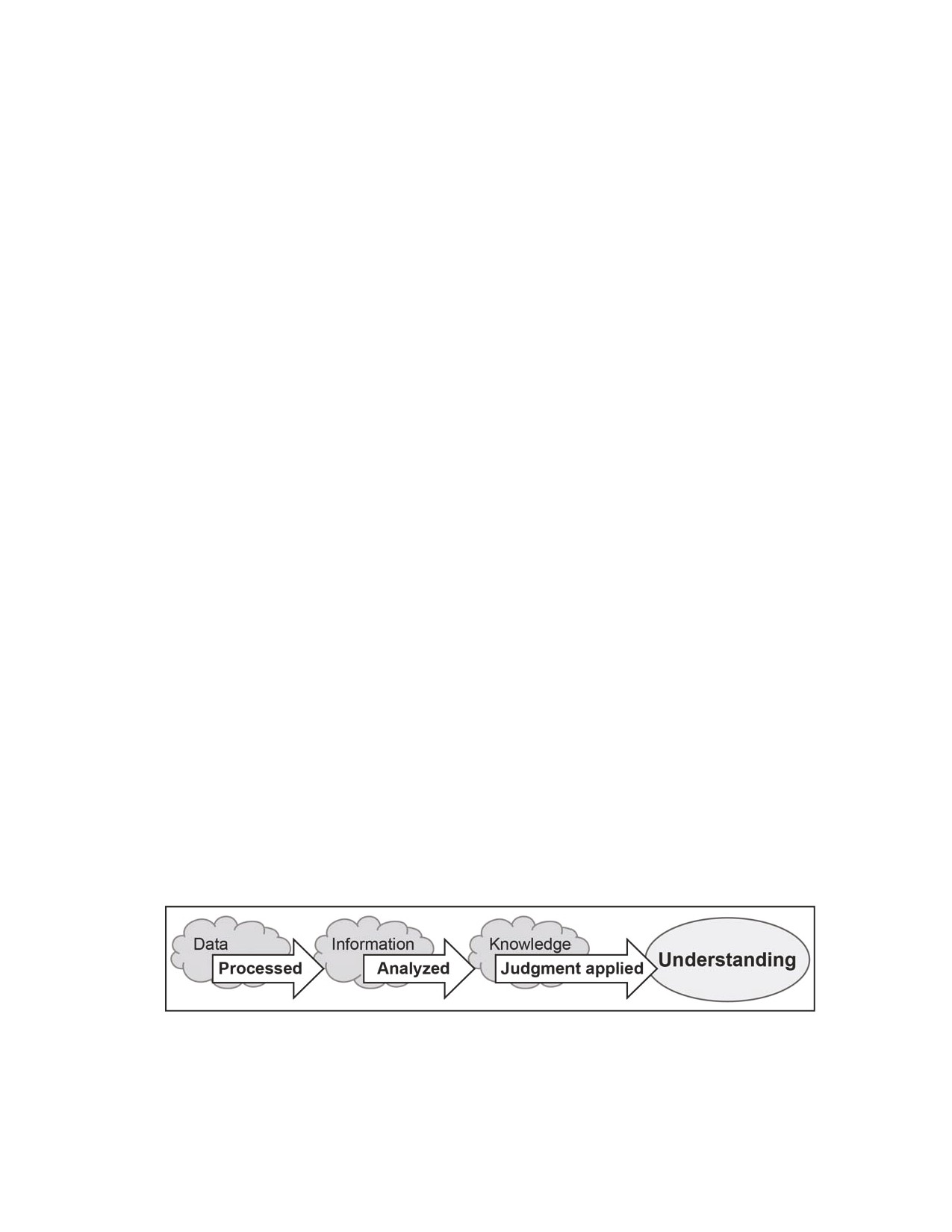
3-3. Knowledge management and information management assist commanders with progressively adding
meaning at each level of processing and analyzing to help build and maintain their situational
understanding. They are interrelated activities that support the commander’s decisionmaking. There are
four levels of meaning. From the lowest level to the highest level, they include data, information,
knowledge, and understanding. At the lowest level, processing transforms data into information. Analysis
then refines information into knowledge. Commanders and staffs then apply judgment to transform
knowledge into understanding. Commanders and staffs continue a progressive development of learning, as
organizations and individuals assign meaning and value at each level. (See figure 3-1.)
Figure 3-1. Achieving understanding
3-4. Data consist of unprocessed signals communicated between any nodes in an information system, or
sensing from the environment detected by a collector of any kind (human, mechanical, or electronic)
(ADRP 6-0). In typical organizations, data often flows to command posts from subordinate units.
5 May 2014
FM 6-0
3-1
Chapter 3
Subordinate units push data to inform higher headquarters of events that facilitate situational
understanding. Data can be quantified, stored, and organized in files and databases; however, data only
becomes useful when processed into information.
3-5. Information is the meaning that a human assigns to data by means of the known conventions used in
their representation. Information alone rarely provides an adequate basis for deciding and acting. Effective
mission command requires further developing information into knowledge so commanders can achieve
understanding.
3-6. Knowledge is information that has been analyzed to provide meaning or value or evaluated as to
implications for the operation. (FM 6-01.1) It is also comprehension gained through study, experience,
practice, and human interaction that provides the basis for expertise and skilled judgment. Staffs work to
improve and share two types of knowledge, tacit and explicit.
3-7. Tacit knowledge resides in an individual’s mind. It is the domain of individuals, not technology. All
individuals have a unique, personal store of knowledge gained from life experiences, training, and formal
and informal networks of friends and professional acquaintances. This knowledge includes learned
nuances, subtleties, and work-arounds. Intuition, mental agility, effective responses to crises, and the ability
to adapt are also forms of tacit knowledge. Leaders use tacit knowledge to solve complex problems and
make decisions. They also routinely engage subordinates’ tacit knowledge to improve organizational
learning and enhance unit innovation and performance.
3-8. Explicit knowledge consists of written or otherwise documented information that can be organized,
applied, and transferred using digital (such as computer files) or non-digital (such as paper) means. Explicit
knowledge lends itself to rules, limits, and precise meanings. Examples of explicit knowledge include
dictionaries, official department publications (field manuals, technical manuals, tactics, techniques, and
procedures publications, and Department of the Army pamphlets) and memorandums. Explicit knowledge
is primarily used to support situational awareness and shared understanding as it applies to decisionmaking.
3-9. Understanding is knowledge that has been synthesized and had judgment applied to it to comprehend
the situation’s inner relationships. Judgment is based on experience, expertise, and intuition. Ideally, true
understanding should be the basis for decisions. However, commanders and staffs realize that uncertainty
and time preclude achieving perfect understanding before deciding and acting.
KNOWLEDGE MANAGEMENT
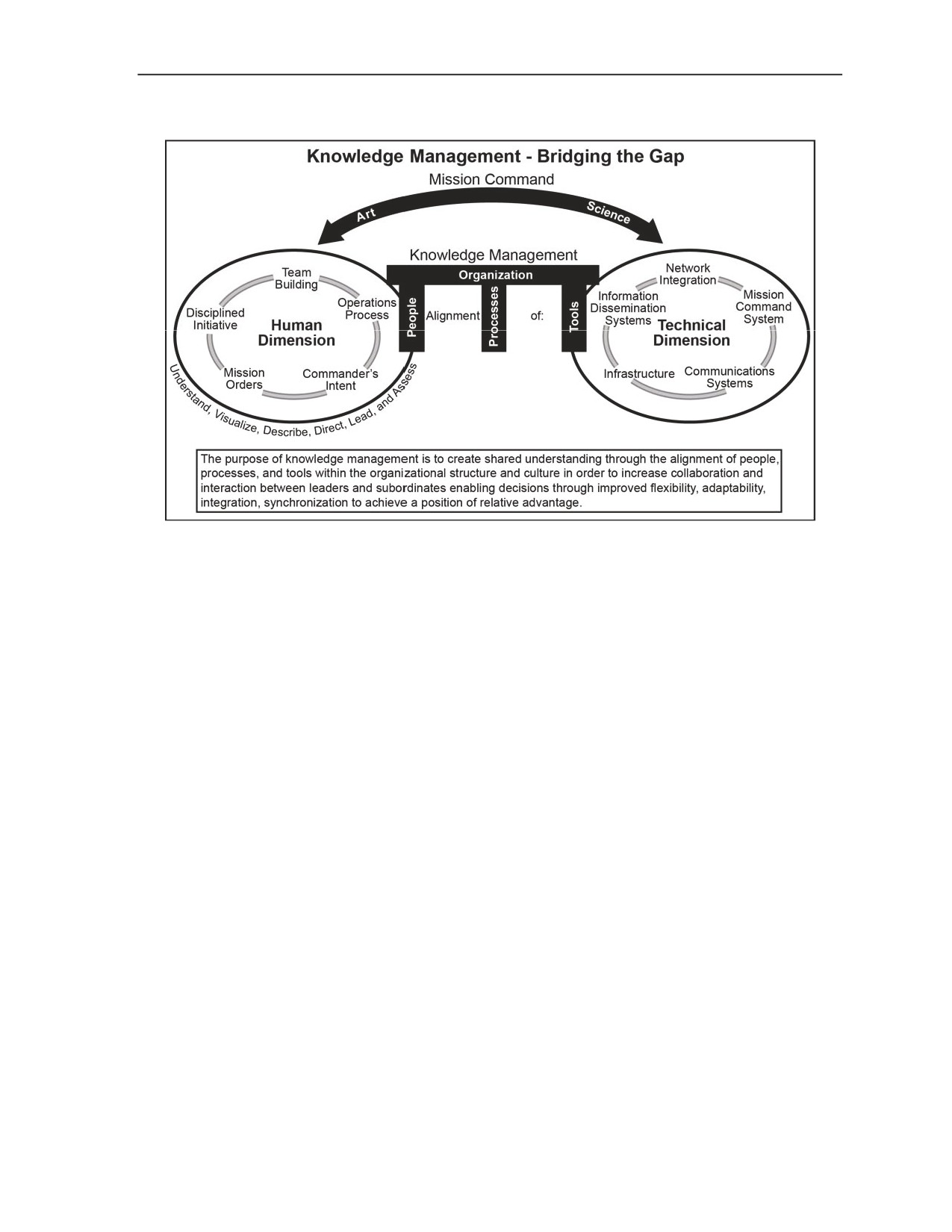
3-10. Knowledge management is the process of enabling knowledge flow to enhance shared understanding,
learning, and decisionmaking (ADRP 6-0). Knowledge flow refers to the ease of movement of knowledge
within and among organizations. Knowledge must flow to be useful. The purpose of knowledge
management is to create shared understanding through the alignment of people, processes, and tools within
the organizational structure and culture in order to increase collaboration and interaction between leaders
and subordinates. This results in better decisions and enables improved flexibility, adaptability, integration,
and synchronization to achieve a position of relative advantage. Effective and efficient use of knowledge in
conducting operations and supporting organizational learning are essential functions of knowledge
management.
(See figure
3-2 for a depiction of knowledge management flow.) Sound knowledge
management practices include—
z
Collaboration among personnel at different places.
z
Rapid knowledge transfer between units and individuals.
z
Reachback capability to Army schools, centers of excellence, and other resources.
z
Leader and Soldier agility and adaptability during operations.
3-2
FM 6-0
5 May 2014
Managing Knowledge and Information
Figure 3-2. Knowledge management flow
3-11. Knowledge management provides the methods and means to efficiently share knowledge among
individuals and distribute relevant information where and when it is needed. Knowledge management
creates, organizes, applies, transfers, collects, codifies, and exchanges knowledge and information between
people. It seeks to align people and processes with appropriate tools to continuously capture, maintain, and
re-use key information, decisions, and lessons learned to help units learn and adapt and improve mission
performance.
3-12. Knowledge management leverages knowledge that resides in individuals and organizations. It
facilitates the flow of that knowledge across the organization and between organizations so units can apply
that knowledge to mission or operational requirements. Every Soldier must understand and practice
knowledge management. It enables the Army and its subordinate commands at every level to be learning
organizations.
KNOWLEDGE MANAGEMENT COMPONENTS
3-13. Knowledge management is organized into four components that enable the understanding and
visualization of leaders and develops shared understanding of subordinates. The four components are—
z
People.
z
Processes.
z
Tools.
z
Organization.
People
3-14. Of the four components, people are the most vital for successful knowledge management. People
include the commander and staff; higher echelon, lower echelon, and adjacent commanders and staffs;
other Army leaders; and other agencies that might contribute to answering information requirements. They
include those inside and outside the organization that create, organize, apply, and transfer knowledge; and
the leaders who act on that knowledge. Knowledge only has meaning in a human context. It moves between
and benefits people, not machines.
5 May 2014
FM 6-0
3-3
Chapter 3
3-15. The knowledge management officer
(KMO) plays a special role in knowledge management.
Working through the chief of staff (COS) or executive officer (XO), the KMO is responsible for developing
the knowledge management plan that integrates and synchronizes knowledge and information management.
The KMO synchronizes knowledge and information management to facilitate the commander’s situational
understanding for any problem set and to provide the staff shared understanding. The KMO accomplishes
this by using the tools, processes, and people available to facilitate an environment of shared
understanding. For instance, the KMO assists the COS (XO) in the command post design, the reporting
procedures standard operating procedure (SOP), the battle rhythm, and the working groups’ structure.
Moreover, the KMO is concerned with sharing and disseminating knowledge and information inside and
outside the organization. The KMO is the principal advisor in developing the plan, or blueprint, to facilitate
situational and shared understanding of the operational environment, the problem, and approaches to
solving the problem.
3-16. Staffs execute the knowledge management plan developed by the KMO. Staffs develop and provide
knowledge from which commanders and other decisionmakers achieve situational awareness and shared
understanding, make decisions, and execute those decisions. Staffs are involved in both directing actions
and assessing progress. The structure of personnel, units, and activities creates explicit communication
channels for knowledge transfer within and between organizations.
Processes
3-17. The five-steps in the knowledge management process are assess, design, develop, pilot, and
implement. Its activities are integrated into the operations process used in the planning, preparing,
executing, and assessing of operations. This integration enables the transfer of knowledge between and
among individuals and organizations. Soldiers, groups, teams, and units employ them. Knowledge
exchange occurs both formally—through established processes and procedures—and informally—through
collaboration and dialogue. The knowledge management process also seeks to ensure that knowledge
products and services are relevant, accurate, timely, and usable to commanders and decisionmakers. (See
FM 6-01.1 for more information on the knowledge management process.)
3-18. Assessment precedes all other steps. This step begins with determining what information leaders
need to make decisions, and how the unit provides information for those leaders. Knowledge management
officers identify gaps in the process, and as they establish objectives, they begin to consider possible
solutions to address those gaps. As solutions are implemented, they are assessed to evaluate their
effectiveness and to recommend new solutions or improvements.
3-19. Design is the second step in the knowledge management process. Design is identifying tailored
frameworks for knowledge management products or services that effectively and efficiently answer
information requirements and meet the objectives established in the assessment step. Services created in the
design step are often shared through virtual communities that are established to share information on a
certain topic. The knowledge management products or services could be refinements of an existing process
or a new solution identified after the assessment. For example, when conducting a relief in place the
incoming unit members may reorganize the command post that they assume from the outgoing unit based
on their knowledge management assessment. In this example, the KMO assists in reorganizing the
command post to develop situational and shared understanding.
Note: The design step of the knowledge management process differs from and should not be
confused with Army design methodology. See ADRP 5-0 for more information on Army design
methodology.
3-20. Develop is the step that actually builds the solution derived from the assessment and design steps.
First, the KMO and the staff collaborate to establish the social framework for the virtual communities and
other knowledge-sharing venues designed in the previous step. A social framework is the means by which
individuals and organizations with a common interest are able to communicate with each other (such as
through video and audio teleconferencing and messaging). Knowledge management representatives provide
insight and advice on the social frameworks best suited to the organization. Once the social frameworks are
established for the virtual communities, signal staff section personnel, usually portal administrators or
3-4
FM 6-0
5 May 2014
Managing Knowledge and Information
designers, assist in connecting them to the technical network. The knowledge management section works
with the unit on both aspects of this step. (See knowledge management doctrine for information on
knowledge management representatives.)
3-21. Pilot is the phase that deploys the knowledge management solution and tests and validates it with the
unit. This aspect is an incremental test of a modification to an existing process or procedure. Important
considerations of the pilot step include communicating the proposed knowledge management plan to the
commander and staff and ensuring acceptance or discussing alternatives as needed. The knowledge
management section must be prepared to train and coach unit personnel as needed in order to successfully
deploy and test the solution.
3-22. Implement is the phase that executes the validated knowledge management plan and integrates it into
the unit information systems. Training and coaching personnel on their specific roles and tasks continues as
needed. Knowledge managers monitor the initial implementation of the knowledge management plan and
make any necessary adjustments. Once the knowledge management plan is fully implemented and
integrated into the operations process, knowledge managers continue to monitor and assess results.
3-23. The steps of the knowledge management process and their associated activities are not ends in
themselves. The knowledge management section uses them to improve knowledge management within the
organization before operations, throughout the operations process, and after operations. Furthermore, the
KMO synchronizes them with the unit’s battle rhythm.
Tools
3-24. Throughout the process, the KMO uses tools that include information systems and various software
tools used to put knowledge products and services into organized frameworks. Knowledge management
tools are anything that is used to share and preserve information. The mission determines the tool.
Commonly used tools include—
z
Information systems: The equipment and facilities that collect, process, store, display, and
disseminate information. This includes computers—hardware and software—and
communications, as well as policies and procedures for their use.
z
Collaboration tools: These tools are information systems that include online capabilities that
make team development and collaboration possible. Examples include chat, white-boarding,
professional forums, communities of interest, communities of practice, and virtual teaming.
z
Expertise-location tools: These tools support finding subject matter experts.
z
Data-analysis tools: These tools support data synthesis that identifies patterns and establishes
relationships among data elements.
z
Search-and-discover tools: These tools include search engines that look for topics, recommend
similar topics or authors, and show relationships to other topics.
z
Expertise-development tools: These tools use simulations and experiential learning to support
developing experience, expertise, and judgment.
Organization
3-25. An organization is the matrix in which people, processes, and tools function to integrate individual
learning and organizational learning strategies. The commander is responsible for establishing a culture of
shared understanding and knowledge, which is critical for learning organizations. The commander creates a
mindset of shared understanding and has the greatest influence on the organization. Knowledge
management is effective in climates that are conducive to openly sharing ideas. Organizations bring their
attitudes, feelings, values, and behaviors together, creating a system of processes facilitated by tools that
will characterize that group. The KMO must consider this dynamic when advising and assisting
organizations regarding the knowledge management plan. The KMO cannot plan in a vacuum and must
have the commander’s commitment in executing the knowledge management plan.
5 May 2014
FM 6-0
3-5
Chapter 3
KNOWLEDGE MANAGEMENT TASKS
3-26. Knowledge management components are supported by four knowledge management tasks that bring
an organization closer to situational and shared understanding. The four knowledge management tasks are
creating knowledge, organizing knowledge, applying knowledge, and transferring knowledge.
Creating Knowledge
3-27. Knowledge creation is the process of developing new knowledge or combining, restructuring, or
repurposing existing knowledge in response to identified knowledge gaps. (FM 6-01.1) Knowledge comes
from a variety of sources, including new technology, answering the commander’s critical information
requirements, or the sharing of information that others need to know. Knowledge is also created when
organizations learn, which in turn enables organizations to adapt. The output of collaborative planning from
working groups is an example of creating knowledge.
Organizing Knowledge
3-28. Organizing knowledge includes archiving, labeling, and identifying. These are specific tasks of
knowledge managers under the implement step of the knowledge management process. Organizing
knowledge ensures that users can discover and retrieve knowledge that is relevant, and knowledge
managers can track knowledge products throughout their life cycle. Archiving consists of moving outdated
and irrelevant knowledge from active status to an inactive status, based on rules and policies. Labeling
takes content that is no longer relevant, archives it, and keeps it separate from current knowledge products.
Identifying involves determining whether to archive or dispose of content. Subject matter experts do this by
reviewing content that exceeds a specified date or does not meet usage benchmarks. Based on this review,
they determine whether regulations require retaining content or destroying it.
Applying Knowledge
3-29. Applying knowledge refers to making knowledge accessible to those who need to use it. KMOs seek
to create conditions so users can retrieve and apply the knowledge they need. This is the primary purpose of
content management, and it occurs during the implement step of the knowledge management process. (See
FM 6-01.1 for information on content management.) A key aspect of knowledge management is ensuring
that multiple users can easily retrieve knowledge products, which enables collaboration in applying
knowledge. One example is posting the decision template on the unit portal so subordinate units can access
it is applying knowledge.
Transferring Knowledge
3-30. Knowledge transfer is the movement of knowledge—including knowledge based on expertise or
skilled judgment—from one person to another (FM 6-01.1). It describes how knowledge is passed between
individuals and groups. It includes knowledge developed within the unit and received from other sources.
Effective knowledge transfer allows all involved to build on each other’s knowledge in ways that
strengthen not only individual Soldiers but also the entire organization. It is more than simply moving or
transferring files and data. Since knowledge transfer occurs between people, knowledge management
includes creating techniques and procedures to develop knowledge skills in leaders, build experience, and
transfer expertise.
INFORMATION MANAGEMENT
3-31. Information management is the science of using procedures and information systems to collect,
process, store, display, disseminate, and protect data, information, and knowledge products (ADRP 6-0).
Information management supports, underpins, and enables knowledge management. The two are linked to
facilitate understanding and decisionmaking. Information management is a technical discipline that
involves the planning, storage, manipulating, and controlling of information throughout its life cycle in
support of the commander and staff. Information management employs both staff management and
processes to make information available to the right person at the right time. Information management
provides a structure so commanders and staffs can process and communicate relevant information and
3-6
FM 6-0
5 May 2014
Managing Knowledge and Information
make decisions. Effective information management contributes to the knowledge management tasks of
knowledge creation and supports shared understanding for all unit members.
3-32. Generally, information management relates to the tasks of collection, processing, display, storage,
distribution, and protection of data and information. In contrast, knowledge management uses information
to create, organize, apply, and transfer knowledge to support achieving understanding, making decisions,
and ultimately taking effective action. The assistant chief of staff, signal (G-6 [S-6]) enables knowledge
management by providing network architecture and the technological tools necessary to support content
management and knowledge sharing.
INFORMATION MANAGEMENT COMPONENTS
3-33. Information management is organized into two components, procedures and information systems.
These two components facilitate the collection, processing, storing, displaying, disseminating, and
protecting of knowledge and information. Information management provides the timely and protected
distribution of relevant information to commanders and staff elements. It supports and is a component of
knowledge management.
Procedures
3-34. The two primary procedures for information management are establishing information requirements
and information categories. An information requirement is any information element the commander and
staff require to successfully conduct operations
(ADRP 6-0). Information management begins by
identifying information gaps and developing information requirements. Commanders and staffs may use
tools such as mission variables and operational variables to categorize information. (See appendix A for a
discussion of mission and operational variables.) All information given to commanders should be relevant
information for answering information requirements. Effective information management identifies and
organizes relevant information and processes data into information for development into and use as
knowledge. Information management then quickly routes information to those who need it. That is,
commanders should only receive information that they need for exercising mission command. Forces
determine the relevance of information based on the following characteristics:
z
Accurate—conveys the true situation.
z
Timely—is available in time to make decisions.
z
Useable—is portrayed in common, easily understood formats and displays.
z
Complete—provides all necessary data.
z
Precise—has the required level of detail.
z
Secure—affords required protection.
3-35. As operations progress, commanders and staffs require additional information to gain further
understanding and support decisionmaking. Effective commanders and staffs prioritize the collection of
required information. Doctrine organizes information into two categories: the commander’s critical
information requirements (CCIRs) and the essential elements of friendly information (EEFIs).
3-36. A commander’s critical information requirement is an information requirement identified by the
commander as being critical to facilitating timely decision making (JP 3-0). The two key elements are
friendly forces information (FFIR) and priority intelligence requirements (PIRs). A CCIR is—
z
Specified by the commander for a specific operation.
z
Applicable only to the commander who specifies it.
z
Situation dependent-directly linked to a current or future mission.
z
Time-sensitive.
3-37. A friendly force information requirement is information the commander and staff need to understand
the status of friendly force and supporting capabilities (JP 3-0). FFIRs identify the information about the
mission, troops and support available, and time available for friendly forces that the commander considers
most important. In coordination with the staff, the operations officer manages FFIRs for the commander.
5 May 2014
FM 6-0
3-7
Chapter 3
3-38. A priority intelligence requirement is an intelligence requirement, stated as a priority for intelligence
support, that the commander and staff need to understand the adversary or other aspects of the operational
environment (JP 2-01). PIRs identify the information about the enemy, terrain and weather, and civil
considerations that the commander considers most important. The intelligence officer manages PIRs for the
commander.
3-39. An effective mission command system anticipates and answers a commander’s information
requirements. Commanders carefully allocate collection resources to obtain data and information for
critical tasks. They set priorities for collection by establishing the CCIRs. Commanders widely distribute
their CCIRs and revise them as the situation changes. Information is continuously collected. It may be
delivered on a routine schedule or as requested. An information-push system pushes information from the
source to the user as it becomes available or according to a schedule (such as through routine reports). An
information-pull system supplies information as requested. Commanders and staffs determine how to use
and integrate both types of systems.
3-40. An essential element of friendly information is a critical aspect of a friendly operation that, if known
by the enemy, would subsequently compromise, lead to failure, or limit success of the operation and
therefore should be protected from enemy detection (ADRP 5-0). Although EEFIs are not CCIRs, they
have the same priority. EEFIs establish an element of information to protect rather than one to collect.
EEFIs identify those elements of friendly force information that, if compromised, would jeopardize mission
success. EEFIs help commanders protect vital friendly information. Their identification is the first step in
the operations security process and central to the protection of information.
Information Systems
3-41. Information systems are the physical dimension of information management. Staffs use automated
systems for efficient processing, storing, and disseminating of information. Information systems—
especially when merged into a single, integrated network—enable extensive information sharing. Effective
information systems and processes make relevant information easy to share and easy for commanders to
use. The goal is not to process vast amounts of information but to enable commanders to develop an
accurate situational understanding as quickly as possible.
3-42. An effective way to communicate relevant information is the common operational picture—a single
display of relevant information within a commander’s area of interest tailored to the user’s requirements
and based on common data and information shared by more than one command (ADRP 6-0). The common
operational picture (COP) integrates many digital information systems to display relevant information.
Initially, commanders and staffs analyze their mission using operational and mission variables. They begin
to develop the COP. Commanders determine their information requirements, and additional information is
collected based on those requirements. Commanders and staffs continue to refer to and refine the COP as
the situation evolves. They use the COP as a tool for developing knowledge and understanding.
Commanders and staffs are obligated to share their understanding of the COP to subordinate and higher
commands to facilitate synchronized operations and parallel understanding.
INFORMATION MANAGEMENT TASKS
3-43. The information management components are supported by six primary tasks to enable knowledge
management and facilitate situational understanding and decisionmaking. The six tasks are collect, process,
store, display, disseminate and protect. The network operations
(signal) essential task of content
management enables information producers and consumers to more efficiently perform information
management. Content management consists of information dissemination management and content staging
capabilities and is defined as the technologies, techniques, processes, policies, and procedures necessary to
provide Soldiers an awareness of relevant, accurate information through automated access to newly
discovered or recurring information in a timely, efficient, and usable format. Information dissemination
management officers seek to facilitate the retrieval or distribution of the right information, to the right
place, at the right time, and in the right format. Content staging is a capability by which information can be
compiled, cataloged, and cached.
(See JP
6-0 and FM 6-02.71 for more information on content
management, information dissemination management, and content staging.)
3-8
FM 6-0
5 May 2014
Managing Knowledge and Information
Collect
3-44. Data collection operations work to answer the commander’s critical information requirements.
Collection describes compiling data based on those requirements. Through information dissemination
management and content staging capabilities, producers of information can quickly accumulate data sensed
or generated at the beginning of the information management process.
Process
3-45. Processing information describes the act of cataloging data via established and usually routine sets of
procedures to link or fuse it with other related data in order to create information. Information
dissemination management and content staging capabilities enable the automated registering of data in
order for it to be developed into information and stored until needed.
Store
3-46. Storage of information describes the caching of information using any medium necessary. Storage
provides the physical and virtual staging of information. Information regarding storage locations may be
listed in unit SOPs or operation orders (OPORDs). Information dissemination management and content
staging capabilities enable the digital caching of processed information in a secure system.
Display
3-47. Display of information describes the visual presentation of collected information, data, or
knowledge. Examples of displays include graphic control images and map boards, as well as the various
electronic displays used in command posts. These displays serve to enhance understanding of the status of
operations.
Disseminate
3-48. Disseminating information is a primary task for information management. Information dissemination
management capabilities allow for the efficient distribution or retrieval of relevant information of any kind
from one person or place to another, in a usable form, by any means to improve understanding or to initiate
or govern action. Information dissemination takes the following two basic forms: broadcast or
point-to-point dissemination. Information dissemination management activities should exhibit a judicious
combination of broadcast and point-to-point forms of dissemination.
3-49. Broadcast dissemination allows senders to distribute information simultaneously to a large number of
users. Anyone with access to the network can receive the information. The greatest advantage of this
method is that information managers can disseminate information to the widest audience in the shortest
amount of time. Since the information is sent to a variety of users with varying relevant information
requirements, the information cannot be tailored to a specific commander's needs. Another major drawback
of broadcast dissemination is that undisciplined use of this method can quickly lead to information
overload.
3-50. Point-to-point dissemination directs information to a specific user or users. Using this method,
information can be easily passed from one commander to the next. Dissemination methods should be
tailored to meet specific relevant information needs of each recipient with built-in mechanisms that are not
present in broadcast dissemination.
Protect
3-51. For information producers and users, protection involves actions taken to counter threats and
vulnerabilities during all steps of the information management process. Protection activities include
encryption of data at rest, granting access to information on a need-to-share basis, and using secure,
authorized processes to disseminate and display information.
5 May 2014
FM 6-0
3-9
Chapter 3
3-52. Protection ensures the confidentiality, integrity, and availability of information traversing networks
and residing on information systems from the time it is collected, processed, and stored until it is
discovered, distributed, and used by the users, systems, and decisionmakers.
KNOWLEDGE AND INFORMATION MANAGEMENT IN PRACTICE
3-53. The staff task of “conduct knowledge management and information management” is essential to the
mission command warfighting function and entails the continuous application of the knowledge
management process of assess, design, develop, pilot, and implement activities designed to capture and
distribute knowledge throughout the organization. The knowledge management process is used throughout
the operations process to put the knowledge management plan into practice. Paragraphs 3-54 through 3-62
describe the activities involved in the conduct of knowledge and information management.
3-54. Assessments are critical to conducting knowledge and information management. They provide the
feedback to the organization on what is effective. The assessment leads to an organization that learns and
adapts. Assessment, the continuous monitoring and evaluation of the current situation, precedes and guides
every operations process activity and concludes each operation or phase of an operation. Staffs use several
tools to assess progress. Running estimates, the COP, and after action reviews are the three most prevalent.
3-55. Preparation activities help commanders, staffs, and subordinates understand the situation and their
roles in upcoming operations. Knowledge management and information management support preparation
by working to enable learning across the organization through various venues such as forums and working
groups. Preparation consists of activities that units perform to improve their ability to execute an operation.
Knowledge management and information management supports staff preparatory activities such as plan
refinement, training battle drills, rehearsals, liaison, inspections, confirmation briefs, and coordination.
Knowledge management staff sections have the essential function of facilitating this learning. Based on
their improved situational understanding, commanders refine the plan, as required, prior to execution.
3-56. Knowledge management and information management support mission execution through reporting,
refinement of communications, and collaborative processes. Knowledge management and information
management support learning during execution by capturing (through reports and after action reviews) the
available data, information, and knowledge from individuals and organizations. Knowledge that is needed
for daily work is collated, standardized, and transferred for use to create value through learning. This
knowledge is a result of cross-functional staff analysis coordination and subsequent recommendations and
decisions. These are outputs from boards and workgroups, as well as from individuals.
3-57. Staffs support the commander in understanding situations, making and implementing decisions,
controlling operations, and assessing progress by providing timely and relevant information and analysis.
Staffs use knowledge management and information management to extract knowledge from the vast
amount of available information. This enables staffs to provide knowledge to commanders in the form of
recommendations and running estimates to help commanders build and maintain their situational
understanding.
3-58. Effective staffs establish and maintain a high degree of coordination and cooperation with staffs of
higher echelon, lower echelon, supporting, supported, and adjacent units. They do this by actively
collaborating with commanders and staffs of other units to solve problems. During coordination, the KMO
helps align the processes to the people, leading to an identification of the proper tools, while the
information management officer installs, operates, and maintains many of the identified tools.
3-59. Staffs apply the science of control to support the commander’s tasks by conducting knowledge
management and information management. Knowledge management supports improving organizational
learning, innovation, and performance. Conducting information management develops tools for the
collection and distribution of timely and relevant information to commanders and staffs. These technical
tools help enable knowledge transfer. Tools within the technical dimension can be large and complex like
computer networks or simple items like maps and overlay graphics. Conducting knowledge management
and information management helps commanders develop a shared understanding with other commanders
and staffs.
3-60. Examples of knowledge and information activities include, but are not limited to, the following—
3-10
FM 6-0
5 May 2014
Managing Knowledge and Information
z
Maintaining running estimates.
z
Completing requests for information.
z
Collecting and displaying important information (such as CCIR and execution matrices).
z
Synchronizing the unit’s battle rhythm with the higher headquarters’ battle rhythm.
z
Updating and sharing the COP.
z
Producing orders, plans, and reports.
z
Convening or participating in meetings to include boards, and working groups.
z
Collaborating across communities of interest, communities of practice, and professional and
functional forums.
z
Standardizing knowledge management and information management procedures.
z
Conducting after action reviews and applying lessons learned.
z
Identifying knowledge gaps in organizations and processes and applying knowledge
management processes to develop solutions and streamline processes.
z
Supporting learning before, during, and after operations and training events.
z
Developing, piloting, establishing, and sustaining collaborative knowledge networks.
z
Developing and providing knowledge and information management policies and processes to
facilitate knowledge capture, search, and dissemination.
z
Developing digital continuity books and Web sites.
z
Designing and administering knowledge networks and forums.
3-61. In practice, the KMO and signal officer work in close coordination to fulfill the commander’s
knowledge management needs. The COS or XO is responsible for the knowledge management program,
and the KMO is the principal advisor. The KMO focuses on the knowledge management plan to facilitate
situational understanding for the commander and shared understanding for the unit. The signal officer
focuses on the technical aspects to support the knowledge management plan.
3-62. The technical element of information management helps enable knowledge creation, transfer, and
flow. An illustration of the differences between knowledge and information management functionality is a
unit’s tactical web portal. The signal officer is normally responsible for the technical management of the
tactical portal, while the KMO establishes policies and governance related to knowledge and information
management and provides the signal officer with an understanding of requirements related to connectivity,
performance, security, and configuration control.
5 May 2014
FM 6-0
3-11
This page intentionally left blank.
Chapter 4
Problem Solving
Problem solving is a daily activity for leaders. This chapter describes types of
problems followed by a description of a systematic approach to assist in solving well-
and medium-structured problems.
PROBLEMS
4-1. The ability to recognize and effectively solve problems is an essential skill for leaders. A problem is
an issue or obstacle that makes it difficult to achieve a desired goal or end state. The degree of interactive
complexity of a given situation is the primary factor that determines that problem’s structure. Problems
range from well-structured to ill-structured. (See ADRP 5-0 more discussion on types of problems.)
4-2. Well-structured problems are easy to identify, required information is available, and methods to
solve them are somewhat obvious. While often difficult to solve, well-structured problems have verifiable
solutions. Problems of mathematics and time and space relationships, as in the case with detailed logistics
planning and engineering projects, illustrate well-structured problems. For well-structured problems,
leaders may use the problem solving process, troop leading procedures, or the military decisionmaking
process (MDMP).
4-3. Medium-structured problems are more interactively complex than well-structured problems. For
example, a field manual describes how a combined arms battalion conducts a defense, but it offers no
single solution that applies to all circumstances. Leaders may agree on the problem and the end state for the
operation. However, they may disagree about how to apply the doctrinal principles to a specific piece of
terrain against a specific enemy. Medium-structured problems may require iterations of the problem
solving process, troop leading procedures, or the MDMP.
4-4. Ill-structured problems are complex, nonlinear, and dynamic; therefore, they are the most challenging
to understand and solve. Unlike well- or medium-structured problems, leaders disagree about how to solve
ill-structured problems, what the end state should be, and whether the desired end state is even achievable.
Army design methodology assists leaders in understanding ill-structured problems and developing
operational approaches to manage or solve those problems. (See ADRP 5-0 for more information on the
Army design methodology.)
4-5. Not all problems require lengthy analysis. For well-structured problems, leaders may make quick
decisions based on their experiences. For well-structured or medium-structured problems involving a
variety of factors, leaders need a systematic problem-solving process. The objective of problem solving is
not just to solve near-term problems, but to also do so in a way that forms the basis for long-term success.
THE PROBLEM SOLVING PROCESS
4-6. Troop leading procedures and the MDMP are specifically designed for planning and problem solving
for conducting operations. For situations when operational planning is not appropriate, the Army’s
approach to problem solving involves the following steps:
z
Gather information and knowledge.
z
Identify the problem.
z
Develop criteria.
z
Generate possible solutions.
z
Analyze possible solutions.
5 May 2014
FM 6-0
4-1
Chapter 4
z
Compare possible solutions.
z
Make and implement the decision.
GATHER INFORMATION AND KNOWLEDGE
4-7. Gathering information and knowledge and is an important first step in problem solving. Leaders
cannot understand or identify the problem without first gathering information and knowledge. While
described as a step, gathering information and knowledge continues throughout the problem solving
process. It helps leaders understand the situation and determine what the problem is by defining its
limitations and scope. Leaders never stop acquiring and assessing the impact of new or additional
information relevant to the problem.
4-8. Leaders require facts and assumptions to solve problems. Understanding facts and assumptions is
critical to understanding problem solving. In addition, leaders need to know how to handle opinions and
organize information.
Facts
4-9. Facts are verifiable pieces of information that have objective reality. They form the foundation on
which leaders base solutions to problems. Regulations, policies, doctrinal publications, commander’s
guidance, plans and orders, and personal experiences are just a few sources of facts.
Assumptions
4-10. An assumption is a supposition on the current situation or a presupposition on the future course of
events, either or both assumed to be true in the absence of positive proof, necessary to enable the
commander in the process of planning to complete an estimate of the situation and make a decision on the
course of action (JP 5-0). In other words, an assumption is information that is accepted as true in the
absence of facts, but cannot be verified. Appropriate assumptions used in decisionmaking have two
characteristics:
z
They are valid; that is, they are likely to be true.
z
They are necessary; that is, they are essential to continuing the problem solving process.
4-11. If the process can continue without making a particular assumption, leaders discard that assumption.
So long as an assumption is both valid and necessary, leaders treat it as a fact. Problem solvers continually
seek to confirm or deny the validity of their assumptions.
Opinions
4-12. When gathering information, leaders evaluate opinions carefully. An opinion is a personal judgment
that the leader or another individual makes. Opinions cannot be totally discounted. They are often the result
of years of experience. Leaders objectively evaluate opinions to determine whether to accept them as facts,
include them as opinions, or reject them.
Organizing Information
4-13. Leaders check each piece of information to verify its accuracy. If possible, two individuals should
check and confirm the accuracy of facts and the validity of assumptions. Being able to establish whether a
piece of information is a fact or an assumption is of little value if those working on the problem do not
know the information exists. Leaders share information with the decisionmaker, subordinates, and peers, as
appropriate. A proposed solution to a problem is only as good as the information that forms the basis of the
solution. Sharing information among members of a problem-solving team increases the likelihood that a
team member will uncover the information that leads to the best solution.
4-14. Organizing information includes coordination with units and agencies that may be affected by the
problem or its solution. Leaders determine these as they gather information. They coordinate with other
leaders as they solve problems, both to obtain assistance and to keep others informed of situations that may
affect them. Such coordination may be informal and routine. For an informal example, a squad leader
4-2
FM 6-0
5 May 2014
Problem Solving
checks with the squad to the right to make sure their fields of fire overlap. For a formal example, a division
action officer staffs a decision paper with the major subordinate commands. As a minimum, leaders always
coordinate with units or agencies that might be affected by a solution they propose before they present it to
the decisionmaker.
IDENTIFY THE PROBLEM
4-15. A problem exists when the current state or condition differs from or impedes achieving the desired
end state or condition. Leaders identify problems from a variety of sources. These include—
z
Higher headquarters’ directives or guidance.
z
Decisionmaker’s guidance.
z
Subordinates.
z
Personal observations.
4-16. When identifying a problem, leaders actively seek to identify its root cause, not merely the symptoms
on the surface. Symptoms may be the reason that the problem became visible. They are often the first
things noticed and frequently require attention. However, focusing on the symptoms of a problem may lead
to false conclusions or inappropriate solutions. Using a systematic approach to identifying the real problem
helps avoid the “solving symptoms” pitfall.
4-17. Leaders do the following to identify the root cause of a problem:
z
Compare the current situation to the desired end state.
z
Define the problem’s scope or boundaries.
z
Answer the following questions:
Who does the problem affect?
What does the problem affect?
When did the problem occur?
Where is the problem?
Why did the problem occur?
z
Determine the cause of obstacles between current and desired end state.
z
Write a draft problem statement.
z
Focus information collection efforts specific to the problem.
z
Redefine the problem as necessary as the staff acquires and assesses new knowledge and
information.
z
Update facts and assumptions.
4-18. After identifying the root causes, leaders develop a problem statement—a statement that clearly
describes the problem to be solved. When the staff bases the problem upon a directive from a higher
authority, it is best to submit the problem statement to the decisionmaker for approval. This ensures the
problem solver has understood the decisionmaker’s guidance before continuing.
4-19. Once leaders develop a problem statement, they make a plan to solve the problem. Leaders make the
best possible use of available time and allocate time for each problem-solving step. This allocation provides
a series of deadlines to meet in solving the problem. Leaders use reverse planning to prepare their
problem-solving timeline. They use this timeline to periodically assess progress. They do not let real or
perceived pressure cause them to abandon solving the problem systematically. They change time
allocations as necessary, but they do not omit steps.
DEVELOP CRITERIA
4-20. The third step in the problem-solving process is developing criteria. A criterion is a standard, rule, or
test by which something can be judged—a measure of value. Problem solvers develop criteria to assist
them in formulating and evaluating possible solutions to a problem. Criteria are based on facts or
assumptions. Problem solvers develop two types of criteria: screening and evaluation.
5 May 2014
FM 6-0
4-3
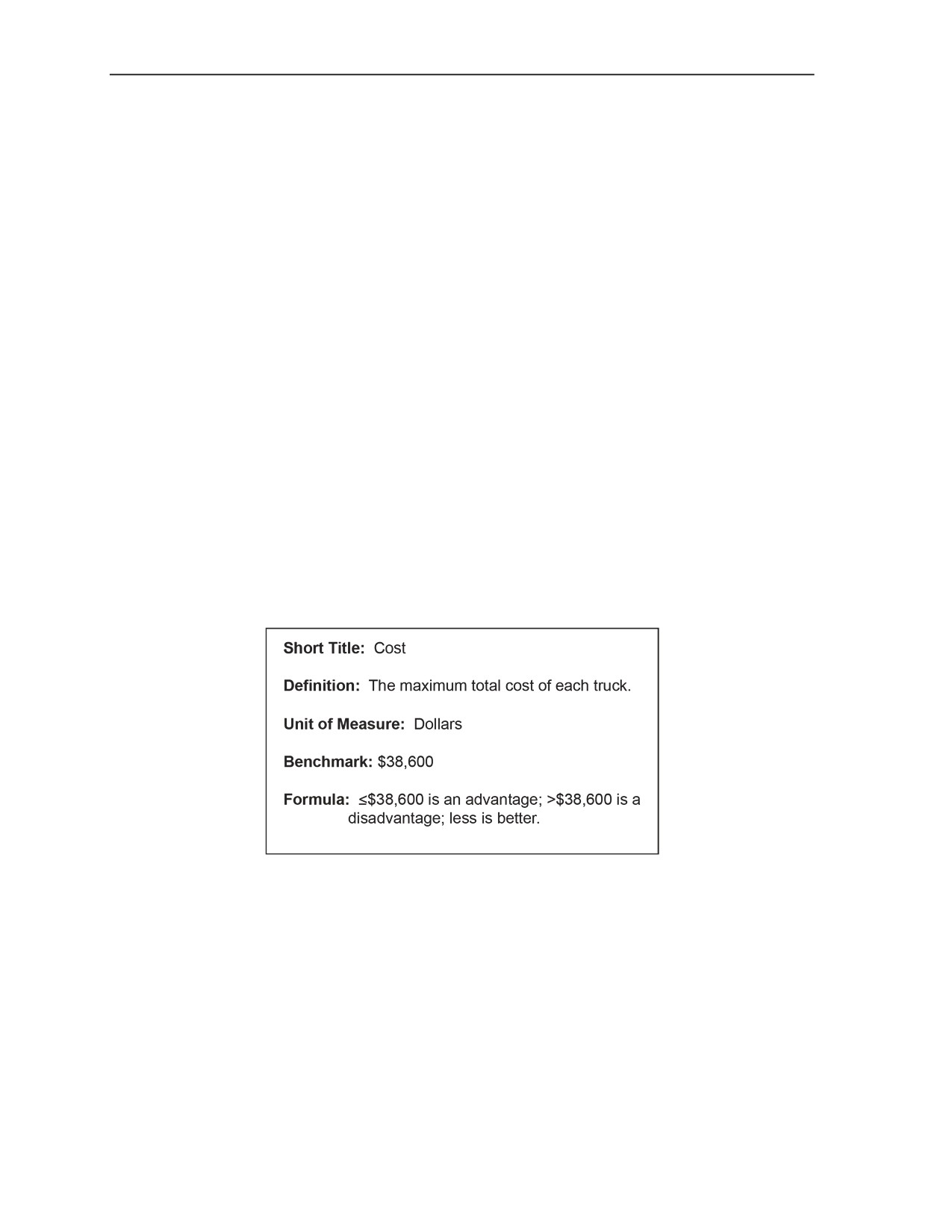
Chapter 4
SCREENING CRITERIA
4-21. Leaders use screening criteria to ensure solutions they consider can solve the problem. Screening
criteria defines the limits of an acceptable solution. They are tools to establish the baseline products for
analysis. Leaders may reject a solution based solely on the application of screening criteria. Leaders
commonly ask five questions of screening criteria to test a possible solution:
z
Is it suitable?—Does it solve the problem and is it legal and ethical?
z
Is it feasible?—Does it fit within available resources?
z
Is it acceptable?—Is it worth the cost or risk?
z
Is it distinguishable?—Does it differ significantly from other solutions?
z
Is it complete?—Does it contain the critical aspects of solving the problem from start to finish?
EVALUATION CRITERIA
4-22. After developing screening criteria, the problem solver develops the evaluation criteria in order to
differentiate among possible solutions.
(See figure
4-1.) Well-defined evaluation criteria have five
elements:
z
Short Title—the criterion name.
z
Definition—a clear description of the feature being evaluated.
z
Unit of Measure—a standard element used to quantify the criterion. Examples of units of
measure are U.S. dollars, miles per gallon, and feet.
z
Benchmark—a value that defines the desired state or “good” for a solution in terms of a
particular criterion.
z
Formula—an expression of how changes in the value of the criterion affect the desirability of
the possible solution. The problem solver states the formula in comparative terms (for example,
less is better) or absolute terms (for example, a night movement is better than a day movement).
Figure 4-1. Sample evaluation criterion
4-23. A well thought-out benchmark is critical for meaningful analysis. Decisionmakers employ analysis to
judge a solution against a standard, determining whether that solution is good in an objective sense. It
differs from comparison, in which decisionmakers judge possible solutions against each other, determining
whether a solution is better or worse in a relative sense. Benchmarks are the standards used in such
analysis. They may be prescribed by regulations or guidance from the decisionmaker. Sometimes, a
decisionmaker can infer the benchmark by the tangible return expected from the problem’s solution. Often,
however, leaders establish benchmarks themselves. Four common methods for doing this are—
z
Reasoning—based on personal experience and judgment as to what is good.
z
Historical precedent—based on relevant examples of prior success.
4-4
FM 6-0
5 May 2014
Problem Solving
z
Current example—based on an existing condition, which is considered desirable.
z
Averaging—based on the mathematical average of the solutions being considered. Averaging is
the least preferred of all methods because it essentially duplicates the process of comparison.
4-24. In practice, the criteria by which choices are made are almost never of equal importance. Because of
this, it is often convenient to assign weights to each evaluation criterion. Weighting criteria establishes the
relative importance of each one with respect to the others. Weighting should reflect the judgment of the
decisionmaker or acknowledged experts as closely as possible. For example, a decisionmaker or expert
might judge that two criteria are equal in importance, or that one criterion is slightly favored in importance,
or moderately or strongly favored. If decisionmakers assign these verbal assessments numerical values,
from 1 to 4 respectively, they can use mathematical techniques to produce meaningful numerical criteria
weights.
GENERATE POSSIBLE SOLUTIONS
4-25. After gathering information relevant to the problem and developing criteria, leaders formulate
possible solutions. They carefully consider the guidance provided by the commander or their superiors, and
develop several alternatives to solve the problem. Too many possible solutions may result in time wasted
on similar options. Experience and time available determine how many solutions leaders consider. Leaders
should consider at least two solutions. Limiting solutions enables the problem solver to use both analysis
and comparison as problem-solving tools. Developing only one solution to “save time” may produce a
faster solution but risks creating more problems from factors not considered.
4-26. When developing solutions, leaders generate options. They then summarize solutions in writing,
sketches, or both.
GENERATE OPTIONS
4-27. Leaders must use creativity to develop effective solutions. Often, groups can be far more creative
than individuals. However, those working on solutions should have some knowledge of or background in
the problem area.
4-28. The basic technique for developing new ideas in a group setting is brainstorming. Brainstorming is
characterized by unrestrained participation in discussion. While brainstorming, leaders—
z
State the problem and make sure all participants understand it.
z
Appoint someone to record all ideas.
z
Withhold judgment of ideas.
z
Encourage independent thoughts.
z
Aim for quantity, not quality.
z
Hitchhike ideas—combine one person’s thoughts with those of others.
At the conclusion of brainstorming, leaders may discard solutions that clearly miss the standards described
by the screening criteria. If this informal screen leaves only one or no solution, then leaders need to
generate more options.
SUMMARIZE THE SOLUTION IN WRITING AND SKETCHES
4-29. After generating options, leaders accurately record each possible solution. The solution statement
clearly portrays how the action or actions solve the problem. In some circumstances, the solution statement
may be a single sentence. For example, it might be “Provide tribal leader with the means to dig a well.” In
other circumstances, the solution statement may require more detail, including sketches or concept
diagrams. For example, if the problem is to develop a multipurpose small-arms range, leaders may choose
to portray each solution with a narrative and a separate sketch or blueprint of each proposed range.
5 May 2014
FM 6-0
4-5
Chapter 4
ANALYZE POSSIBLE SOLUTIONS
4-30. Having identified possible solutions, leaders analyze each one to determine its merits and drawbacks.
If criteria are well defined, including a careful selection of benchmarks, analysis is greatly simplified.
4-31. Leaders use screening criteria and benchmarks to analyze possible solutions. They apply screening
criteria to judge whether a solution meets minimum requirements. For quantitative criteria, they measure,
compute, or estimate the raw data values for each solution and each criterion. In analyzing solutions that
involve predicting future events, they use war-gaming, models, and simulations to visualize events and
estimate raw data values for use in analysis. Once raw data values have been determined, the leader judges
them against applicable screening criteria to determine if a possible solution merits further consideration.
Leaders screen out any solution that fails to meet or exceeds the set threshold of one or more screening
criteria.
4-32. After applying the screening criteria to all possible solutions, leaders use benchmarks to judge them
with respect to the desired state. Data values that meet or exceed the benchmark indicate that the possible
solution achieves the desired end state. Data values that fail to meet the benchmark indicate a poor solution
that fails to achieve the desired end state. For each solution, leaders list the areas in which analysis reveals
it to be good or not good. Sometimes the considered solutions fail to reach the benchmark. When this
occurs, the leader points out the failure to the decisionmaker.
4-33. Leaders carefully avoid comparing solutions during analysis. Comparing solutions during analysis
undermines the integrity of the process and tempts problem solvers to jump to conclusions. They examine
each possible solution independently to identify its strengths and weaknesses. They are also careful not to
introduce new criteria.
COMPARE POSSIBLE SOLUTIONS
4-34. During this step, leaders compare each solution against the others to determine the optimum one.
Comparing solutions identifies which solution best solves the problem based on the evaluation criteria.
Leaders use any comparison technique that helps reach the best recommendation. The most common
technique is a decision matrix. (See paragraphs 9-176 through 9-182 for information on using a decision
matrix.)
MAKE AND IMPLEMENT THE DECISION
4-35. After completing their analysis and comparison, leaders identify the preferred solution. If a superior
assigned the problem, leaders prepare the necessary products (verbal, written, or both) needed to present
the recommendation to the decisionmaker. Before presenting the findings and a recommendation, leaders
coordinate their recommendation with those affected by the problem or the solutions. In formal situations,
leaders present their findings and recommendations to the decisionmaker as staff studies, decision papers,
or decision briefings.
4-36. A good solution can be lost if the leader cannot persuade the audience that it is correct. Every
problem requires both a solution and the ability to communicate the solution clearly. The writing and
briefing skills a leader possesses may ultimately be as important as good problem-solving skills.
4-37. Based on the decisionmaker’s decision and final guidance, leaders refine the solution and prepare
necessary implementing instructions. Formal implementing instructions can be issued as a memorandum of
instruction, policy letter, or command directive. Once leaders have given instructions, they monitor their
implementation and compare results to the measure of success and the desired end state established in the
approved solution. When necessary, they issue additional instructions.
4-38. A feedback system that provides timely and accurate information, periodic review, and the flexibility
to adjust must also be built into the implementation plan. Leaders stay involved and carefully avoid
creating new problems because of uncoordinated implementation of the solution. Army problem solving
does not end with identifying the best solution or obtaining approval of a recommendation.
4-6
FM 6-0
5 May 2014
Chapter 5
Staff Studies
This chapter describes staff studies. It provides instructions and a format for a staff
study. It then provides an example for preparing a staff study. It concludes with
instructions on coordinating staff studies and a list of common problems.
DEVELOPING STAFF STUDIES
5-1. A staff study is a detailed formal report to a decisionmaker requesting action on a recommendation.
It provides the information and methodology used to solve a problem. (See chapter 4 for more information
on problems.) The staff study includes an official memorandum for the commander’s signature that
implements the action. The leader coordinates staff studies with all affected organizations. Staff studies
include statements of nonconcurrence, if applicable, so that the decisionmaker clearly understands all staff
members’ support for the recommendation. A staff study is comprehensive; it includes all relevant
information needed to solve the problem and a complete description of the methodology used to arrive at
the recommended solution.
5-2. The staff study follows the seven-step Army problem-solving process described in chapter 4. This
ensures that the staff clearly identifies the problem, follows a logical sequence, and produces a justifiable
solution.
5-3. The body of a completed staff study is a stand-alone document. While enclosures are a part of most
staff studies, a decisionmaker should not have to refer to them to understand the recommendation and the
basis for it. Enclosures contain details and supporting information and help keep the body of the study
concise.
THE STAFF STUDY FORMAT
5-4. Staff officers prepare staff studies as informal memorandums in the format found in figure 5-1 on
pages 5-2 through 5-4. Units may establish their own format to meet local requirements.
5 May 2014
FM 6-0
5-1
Chapter 5
Office Symbol
Date
MEMORANDUM FOR Address the staff study to the decisionmaker. Include through addressees if
required.
SUBJECT: Succinctly describe the subject to distinguish it from other documents as a courtesy to the
decisionmaker. Do not simply state “staff study” as this does not provide sufficient detail, nor does it
convey any information about the subject.
1. PROBLEM. Concisely state the problem.
2. RECOMMENDATION. Recommend a solution or solutions based on the conclusion in paragraph
10. If there are several recommendations, state each one in a separate subparagraph.
3. BACKGROUND. Briefly state why the problem exists. Provide enough information to place the
problem in context. This discussion may include the origin of the action and a summary of related
events. If a tasking document is the source of the problem, place it in enclosure 2 and refer to it here.
4. FACTS. State all facts that influence the problem or its solution. List each fact as a separate
subparagraph. Make sure to state the facts precisely and attribute them correctly. Facts must stand-
alone: either something is a generally accepted fact or it is attributed to a source that asserts it to be
true. There is no limit to the number of facts as long as every fact is relevant. Include all facts relevant to
the problem, not just facts used to support the study. The decisionmaker must have an opportunity to
consider facts that do not support the recommendation. State any guidance given by the decisionmaker.
Refer to enclosures as necessary for amplification, references, mathematical formulas, or tabular data.
5. ASSUMPTIONS. Identify assumptions necessary for a logical discussion of the problem. List each
assumption as a separate subparagraph.
6. POSSIBLE SOLUTION. List all solutions considered. Place each solution in a separate
subparagraph. List each solution by number and name or as a short sentence in the imperative (for
example, “Increase physical security measures at key assets”). If a solution is not self-explanatory,
include a brief description of it. Use enclosures to describe complex solutions.
7. CRITERIA. List and define, in separate subparagraphs, the screening and evaluation criteria. A
fact or an assumption in paragraph 4 or 5 should support each criterion. At a minimum, the number of
facts and assumptions should exceed the number of criteria. In a third subparagraph, explain the
rationale for how the evaluation criteria are weighted.
a. Screening Criteria. List the screening criteria, each in its own sub-subparagraph. Screening criteria
define the minimum and maximum characteristics of the solution to the problem. Answer each screening
criterion: Is it suitable, feasible, acceptable, distinguishable, and complete? (See chapter 4, paragraph
4-18.) Screening criteria are not weighted. They are required, absolute standards. Reject courses of
action that do not meet the screening criteria.
b. Evaluation Criteria. List the evaluation criteria, each in its own sub-subparagraph. List them in
order of their weight, from most to least important. Define each evaluation criterion in terms of five
required elements: short title, definition, unit of measure, benchmark, and formula. (See chapter 4,
paragraphs 4-19 to 4-22 and figure 4-1.)
c. Weighting of Criteria. State the relative importance of each evaluation criterion with respect to the
others. Explain how each criterion compares to each of the other criteria (equal, slightly favored,
favored, or strongly favored) or provide the values from the decision matrix and explain why the
criterion is measured in that way. (See chapter 4.) This subparagraph explains the order in which the
evaluation criteria are listed in subparagraph 7b.
8. ANALYSIS. List the courses of action that do not meet the screening criteria and the results of
applying the evaluation criteria to the remaining ones.
Figure 5-1. Staff study paper format example
5-2
FM 6-0
5 May 2014
Staff Studies
a. Screened Out Courses of Action. List the courses of action that did not meet the screening criteria,
each in its own subparagraph, and the screening criteria each did not meet. This subparagraph is
particularly important if a solution the decisionmaker wanted to be considered does not meet the
screening
b. Course of Action 1. In subsequent subparagraphs, list the courses of action evaluated, each in a
separate subparagraph. Discuss the advantages and disadvantages of each solution. For quantitative
criteria, include the payoff value. Discuss or list advantages and disadvantages in narratives. Use the
form that best fits the information. Avoid using bullets unless the advantage or disadvantage is self-
evident.
(1) Advantages. List the advantages for course of action 1.
(2) Disadvantages. List the disadvantages for course of action 1.
c. Course of Action 2. (Use the same format as above and continue the analysis.)
(1) Advantages. List the advantages for course of action 2.
(2) Disadvantages. List the disadvantages for course of action 2.
9. COMPARISON. Compare the courses of action to each other, based on the analysis outlined in
paragraph 8. Develop in a logical, orderly manner the rationale used to reach the conclusion stated in
paragraph 10. If leaders use quantitative techniques in the comparison, summarize the results clearly
enough that the reader does not have to refer to an enclosure. Include any explanations of quantitative
techniques in enclosures. State only the results in this paragraph.
10. CONCLUSION. State the conclusion drawn based on the analysis (paragraph 8) and comparison
(paragraph 9). The conclusion must answer the question or provide a possible solution to the problem. It
must match the recommendation in paragraph 2.
11. COORDINATION. List all organizations with which the study was coordinated (“staffed”). If the
list is long and space is a consideration, place it at enclosure 3. If the staffing list is placed in enclosure
3, indicate the number of nonconcurrences with the cross-reference (for example, “See enclosure 3; 2
nonconcurrences”; or “See enclosure 3; no nonconcurrences”).
A representative of each organization with which the study was staffed indicates whether the
organization concurs with the study, nonconcurs, or concurs with comment. Representatives place their
initials in the blank, followed by their rank, name, position, telephone number, and e-mail address. If
separate copies were sent to each organization (rather than sending one copy to each organization in
turn), this information may be typed into the final copy of the study and the actual replies placed in
enclosure 4. Recommend this technique when using e-mail for staffing.
Place all statements of nonconcurrence and considerations of nonconcurrence in enclosure 3, or in
separate enclosures for each nonconcurrence. Concurrences with comments may be placed in enclosure
3 or in a separate enclosure or enclosures.
ACOS, G-1
CONCUR/NONCONCUR_____________CMT_________DATE:_____________
ACOS, G-2
CONCUR/NONCONCUR_____________CMT_________DATE:_____________
ACOS, G-3
CONCUR/NONCONCUR_____________CMT_________DATE:_____________
ACOS, G-4
CONCUR/NONCONCUR_____________CMT_________DATE:_____________
12. APPROVAL/DISAPPROVAL. Restate the recommendation from paragraph 2 and provide a
format for the approval authority to approve or disapprove the recommendation.
a. That the (state the approving authority and recommended solution).
APPROVED____________DISAPPROVED____________SEE ME____________
b. That the (approving authority) sign the implementing directive(s) (TAB A).
APPROVED____________DISAPPROVED____________SEE ME____________
Figure 5-1. Staff study paper format example (continued)
5 May 2014
FM 6-0
5-3
Chapter 5
13. POINT OF CONTACT. Record the point of contact (or action officer) and contact information.
Additional contact information may include the action officer’s organization, a civilian telephone
number, a unit address, and an e-mail address.
[Signature Block] Prepare the signature block as specified in Chapter 2 of AR 25-50.
[#] Encl (Tab the enclosures)
1. Implementing document - Enclosure 1 contains implementing memorandums, directives, or letters
submitted for signature or approval. Since a staff study requests a decision, enclosure 1 contains the
documents required to implement the decision (Tab A).
2. Tasking document - Enclosure 2 contains the document that directed the staff study or decision
paper. If the requirement was given verbally, include the memorandum for record that documents the
conversation. If no record exists, enter “Not used” in the annex list in the body (Tab B).
3. Coordination list - Enclosure 3 contains the staffing list if the list is too long for paragraph 11. If
paragraph 11 contains the entire staffing list, enter “Not used” in the enclosure list in the body (Tab C).
4. Nonconcurrences - Enclosure 4 contains statements of nonconcurrence and considerations of
nonconcurrence. These documents may be placed in separate enclosures. Place concurrences with
comment in either enclosure 4 or a separate enclosure. If there are no statements of nonconcurrence,
enter “Not used” in the enclosure list in the body (Tab D).
5-[#]. Other supporting documents, listed as separate enclosures - Other enclosures contain detailed
data, lengthy discussions, and bibliographies. Number the pages of each enclosure separately, except
when an enclosure contains several distinct documents (such as, concurrences) (Tabs E through Z, if
necessary).
Figure 5-1. Staff study paper format example (continued)
COORDINATING STAFF STUDIES
5-5. Preparing a staff study normally involves coordinating with other staff officers and organizations. At
a minimum, action officers obtain concurrences or nonconcurrences from agencies affected by the study’s
recommendations. Other aspects of the study may require coordination as well. Coordination should be as
broad as time permits but should be limited to agencies that might be affected by possible
recommendations or that have expertise in the subject of the study.
5-6. Action officers anticipate nonconcurrences and try to resolve as many as possible before staffing the
final product. An action officer who cannot resolve a nonconcurrence has two options:
z
Modify the staff study to satisfy the nonconcurrence, but only if the analysis and comparison
supports the change. If this is done after the final draft has been staffed, the officer must re-staff
the study.
z
Prepare a consideration of nonconcurrence and include it and the statement of nonconcurrence in
enclosure 4 to the staff study.
Statements of Nonconcurrence
5-7. A statement of nonconcurrence is a recommendation for the decisionmaker to reject all or part of the
staff study. Statements of nonconcurrence are prepared in the memorandum format; e-mails may be
accepted at the commander’s discretion. They address specific points in the recommendations or the study,
stating why they are wrong or unacceptable. They offer an alternative or a constructive recommendation
when possible.
Considerations of Nonconcurrence
5-8. Action officers prepare considerations of nonconcurrence as a memorandum for record. They present
the reasons for the nonconcurrence accurately and assess them objectively. Then they state why the study is
correct and why the decisionmaker should reject the nonconcurrence.
5-4
FM 6-0
5 May 2014
Staff Studies
COMMON PROBLEMS WITH STAFF STUDIES
5-9. These questions identify the most common problems found in staff studies. Leaders should review
them before beginning a staff study and periodically thereafter:
z
Is the subject too broad?
z
Is the problem properly defined?
z
Are facts or assumptions clear and valid?
z
Are there any unnecessary facts or assumptions?
z
Are there any facts that appear for the first time in the discussion?
z
Are there a limited number of options or courses of action?
z
Are evaluation criteria invalid or too restrictive?
z
Is the discussion too long?
z
Is the discussion complete?
z
Must readers consult the enclosures to understand the staff study?
z
Does the conclusion include a discussion?
z
Is the logic flawed or incomplete?
z
Does the conclusion follow from the analysis?
z
Can the solution be implemented within resource and time constraints?
z
Do the conclusions and recommendations solve the problem?
z
Is there an implementing directive?
z
Have new criteria been introduced in the analysis or comparison?
5 May 2014
FM 6-0
5-5
Chapter 6
Decision Papers
This chapter explains decision papers. It provides instructions, a format, and an
example for preparing decision papers.
PREPARING DECISION PAPERS
6-1. A decision paper is a piece of correspondence that requests the decisionmaker to act on its
recommendation and provides the required implementing documents for signature. Action officers use a
decision paper when they do not need a formal report or the decisionmaker does not require the details a
staff study provides.
6-2. Decision papers are brief. Unlike staff studies, decision papers are not self-contained. For a decision
paper, much of the material that would be included in a staff study is kept in the action officer’s file.
Decision papers contain the minimum information the decisionmaker needs to understand the action and
make a decision. The action officer synthesizes the facts, summarizes the issues, presents feasible
alternatives, and recommends one of them. Action officers attach essential explanations and other
information as enclosures, which are always tabbed.
FORMATTING DECISION PAPERS
6-3. Action officers prepare decision papers as informal memorandums (see AR 25-50) in the format
shown in figure 6-1 on page 6-2. This format also parallels the steps of the Army problem-solving process.
Commands may establish format standards to meet local requirements. Decision papers should not exceed
two pages, excluding the staffing list and supporting documentation. The coordination requirements for a
decision paper are the same as those for a staff study.
5 May 2014
FM 6-0
6-1
Chapter 6
Office Symbol (Marks Number)
Date
MEMORANDUM FOR Address the decision paper to the decisionmaker. Include through addressees or
on the routing slip, as specified by command policy.
SUBJECT: Briefly state the decision’s subject. Be specific as the reader should not have to begin reading
the body of the decision paper to figure out the subject. “Decision paper” is not an acceptable subject.
1. For DECISION. Indicate if the decision is time-sensitive, tied to an event, or has a suspense date to a
higher headquarters. Show internal suspense dates on the routing slip, if necessary. However, do not show
them in this paragraph. (Paragraph headings may be either underlined or bolded, according to command
policy.)
2. PURPOSE. State clearly the decision required, as an infinitive phrase. An infinitive phrase uses a verb,
but has no subject, for example, “To determine the...,” or, “To obtain
” Include in the purpose
statement who, what, when, and where, if pertinent.
3. RECOMMENDATION. Recommend a solution or solutions to the problem. If there are several
recommendations, state each one in a separate subparagraph.
4. BACKGROUND AND DISCUSSION. Explain the origin of the action, why the problem exists, and a
summary of events in chronological form. It helps put the problem in perspective and provides an
understanding of the alternatives and the recommendation. If the decision paper is the result of a tasking
document, refer to that document in this paragraph and place it at enclosure 2.
5. IMPACTS. State the impact of the recommended decision. Address each affected area in a separate
subparagraph, for example, personnel, equipment, funding, environment, and stationing. State parties
affected by the recommendation and the extent to which they are affected.
6. COORDINATION. The coordination, approval line, point of contact, signature block, and enclosures
follow the same directions as for a staff study. (See chapter 5.)
ACOS, G-1
CONCUR/NONCONCUR_____________CMT______DATE: ______
ACOS, G-3
CONCUR/NONCONCUR_____________CMT______DATE: ______
7. APPROVAL/DISAPPROVAL.
a. That the (state the approving authority and recommended solution).
APPROVED____________DISAPPROVED____________SEE ME____________
b. That the (approving authority) sign the implementing directive(s) (TAB A).
APPROVED____________DISAPPROVED____________SEE ME____________
[Signature Block] Prepare the signature block as specified in Chapter 2 of AR 25-50.
[#] Encl
(Tab the enclosures)
1. Implementing document - Enclosure 1 contains implementing memorandums, directives, or letters
submitted for signature or approval. Since a staff study requests a decision, enclosure 1 contains the
documents required to implement the decision (Tab A).
2. Tasking document - Enclosure 2 contains the document that directed the staff study or decision
paper. If the requirement was given verbally, include the memorandum for record that documents the
conversation. If no record exists, enter “Not used” in the annex list in the body (Tab B).
3. Coordination list - Enclosure 3 contains the staffing list if the list is too long for paragraph 6. If
paragraph 6 contains the entire staffing list, enter “Not used” in the enclosure list in the body (Tab C).
4. Nonconcurrences
- Enclosure
4 contains statements of nonconcurrence and considerations of
nonconcurrence. These documents may be placed in separate enclosures. Place concurrences with
comment in either enclosure 4 or a separate enclosure. If there are no statements of nonconcurrence,
enter “Not used” in the enclosure list in the body (Tab D).
5-[#]. Other supporting documents, listed as separate enclosures - Other enclosures contain detailed
data, lengthy discussions, and bibliographies. Number the pages of each enclosure separately, except
when an enclosure contains several distinct documents (such as, concurrences) (Tabs E through Z, if
necessary).
Figure 6-1. Decision paper format example
6-2
FM 6-0
5 May 2014