FM 6-0 COMMANDER AND STAFF ORGANIZATION AND OPERATIONS (MAY 2014) - page 1
*FM 6-0
Field Manual
Headquarters
Department of the Army
No. 6-0
Washington, DC, 5 May 2014
Commander and Staff Organization and Operations
Contents
Page
PREFACE
vi
INTRODUCTION
vii
Chapter 1
COMMAND POST ORGANIZATION AND OPERATIONS
1-1
Command Post Organization
1-1
Command Post Organization Considerations
1-3
Command Post Cells, Staff Sections, and Elements
1-5
Command Post Operations
1-8
Chapter 2
STAFF DUTIES AND RESPONSIBILITIES
2-1
Primary Staff Responsibilities
2-1
Common Staff Duties and Responsiblities
2-2
Staff Characteristics
2-2
Staff Relationships
2-3
Staff Organization
2-4
Coordinating Staff Officers
2-6
Special Staff Officers
2-16
Personal Staff Officers
2-26
Chapter 3
MANAGING KNOWLEDGE AND INFORMATION
3-1
Knowledge and Understanding
3-1
Knowledge Management
3-2
Information Management
3-6
Knowledge and Information Management in Practice
3-10
Chapter 4
PROBLEM SOLVING
4-1
Problems
4-1
The Problem Solving Process
4-1
Identify the Problem
4-3
Develop Criteria
4-3
Generate Possible Solutions
4-5
Distribution Restriction: Approved for public release; distribution is unlimited.
*This publication supersedes ATTP 5-01.1, dated 14 September 2011.
11 May 2015
FM 6-0, C1
i
Contents
Analyze Possible Solutions
4-6
Compare Possible Solutions
4-6
Make and Implement the Decision
4-6
Chapter 5
STAFF STUDIES
5-1
Developing Staff Studies
5-1
Coordinating Staff Studies
5-4
Common Problems with Staff Studies
5-5
Chapter 6
DECISION PAPERS
6-1
Preparing Decision Papers
6-1
Formatting Decision Papers
6-1
Chapter 7
MILITARY BRIEFINGS
7-1
Types of Military Briefings
7-1
Steps of Military Briefings
7-3
Chapter 8
RUNNING ESTIMATES
8-1
Types of Running Estimates
8-1
Essential Qualities of Running Estimates
8-1
Running Estimates in the Operations Process
8-2
Chapter 9
THE MILITARY DECISIONMAKING PROCESS
9-1
Characteristics of the Military Decisionmaking Process
9-1
Steps of the Military Decisionmaking Process
9-4
Planning in a Time-Constrained Environment
9-44
Chapter 10
TROOP LEADING PROCEDURES
10-1
Background and Comparison to the MDMP
10-1
Steps of Troop Leading Procedures
10-3
Chapter 11
MILITARY DECEPTION
11-1
Military Deception Process and Capability
11-1
Principles of Military Deception
11-1
Military Deception in Support of Operations
11-2
Military Deception in the Operations Process
11-5
Chapter 12
REHEARSALS
12-1
Rehearsal Basics
12-1
Rehearsal Types
12-1
Methods of Rehearsal
12-2
Rehearsal Responsibilities
12-6
Rehearsal Details
12-9
Chapter 13
LIAISON
13-1
Role of Liaison
13-1
Liaison Responsibilities
13-3
Liaison Considerations
13-8
Chapter 14
DECISIONMAKING IN EXECUTION
14-1
Activities of Execution
14-1
Rapid Decisionmaking and Synchronization Process
14-3
Chapter 15
ASSESSMENT PLANS
15-1
Assessment and the Operations Process
15-1
ii
FM 6-0, C1
11 May 2015
Contents
The Assessment Process
15-2
Assessment Plan Development
15-3
Assessment Steps
15-4
Chapter 16
AFTER ACTION REVIEWS AND REPORTS
16-1
Introduction to After Action Reviews and Reports
16-1
Formal and Informal After Action Reviews
16-1
Benefits of After Action Reviews
16-2
Conducting After Action Reviews
16-3
Executing After Action Reviews
16-6
The After Action Report
16-7
Appendix A OPERATIONAL AND MISSION VARIABLES
A-1
Appendix B
+COMMAND AND SUPPORT RELATIONSHIPS
B-1
Appendix C PLANS AND ORDERS FORMATS
C-1
Appendix D ANNEX FORMATS
D-1
GLOSSARY
Glossary-1
REFERENCES
References-1
INDEX
Index-1
Figures
Figure 1-1. Command post organization
1-5
Figure 1-2. Integration of plans, future operations, and current operations
1-8
Figure 3-1. Achieving understanding
3-1
Figure 3-2. Knowledge management flow
3-3
Figure 4-1. Sample evaluation criterion
4-4
Figure 5-1. Staff study paper format example
5-2
Figure 6-1. Decision paper format example
6-2
Figure 7-1. Information briefing format example
7-1
Figure 7-2. +Decision briefing format example
7-2
Figure 7-3. Planning considerations for military briefings
7-4
Figure 7-4. Preparation considerations for military briefings
7-5
Figure 8-1. Generic base running estimate format
8-2
Figure 9-1. The seven steps of the military decisionmaking process
9-3
Figure 9-2. Step 1-receipt of the mission
9-4
Figure 9-3. Step 2-mission analysis
9-7
Figure 9-4. Step 3-course of action development
9-16
Figure 9-5. +Sample brigade course of action sketch
9-24
Figure 9-6. Step 4-course of action analysis and war-gaming
9-26
Figure 9-7. Sample belt method
9-28
Figure 9-8. Sample modified belt method using lines of effort
9-29
Figure 9-9. Sample avenue-in-depth method
9-29
11 May 2015
FM 6-0, C1
iii
Contents
Figure
9-10. Sample modified avenue-in-depth method using lines of effort
9-30
Figure
9-11. Sample box method
9-30
Figure
9-12. Sample modified box method using lines of effort
9-31
Figure
9-13. Step 5-course of action comparison
9-39
Figure
9-14. Step 6-course of action approval
9-42
Figure
9-15. Step 7-orders production, dissemination, and transition
9-43
Figure
10-1. Parallel sequences of the MDMP and troop leading procedures
10-2
Figure
10-2. Sample schedule
10-4
Figure
12-1. Types of rehearsals
12-3
Figure
13-1. Example liaison officer handbook outline
13-3
Figure
13-2. Examples of liaison officer questions
13-4
Figure
13-3. Example recommended packing list
13-5
Figure
13-4. Liaison checklist—before departing the sending unit
13-6
Figure
13-5. Liaison duties—during the liaison tour
13-8
Figure
13-6. Liaison duties—after the liaison tour
13-8
Figure
14-1. Rapid decisionmaking and synchronization process
14-3
Figure
15-1. Assessment framework
15-5
Figure
15-2. Example end state conditions for a defense
15-6
Figure
15-3. Example end state conditions for a stability operation
15-7
Figure C-1. Paragraph layout for plans and orders
C-6
Figure C-2. Operation plan or operation order format
C-11
Figure C-3. Operation order or operation plan attachment format
C-22
Figure C-4. Warning order format
C-24
Figure C-5. Fragmentary order format
C-25
Figure C-6. Example of overlay order graphic
C-27
Figure D-1. Sample Annex A (Task Organization) format
D-7
Figure D-2. Sample Annex B (Intelligence) format
D-10
Figure D-3. Sample Annex C (Operations) format
D-15
Figure D-4. Sample Annex D (Fires) format
D-21
Figure D-5. Sample Annex E (Protection) format
D-27
Figure D-6. Sample Annex F (Sustainment) format
D-34
Figure D-7. Sample Annex G (Engineer) format
D-41
Figure D-8. Sample Annex H (Signal) format
D-46
Figure D-9. Sample Annex J (Public Affairs) format
D-52
Figure D-10. Sample Annex K (Civil Affairs Operations) format
D-56
Figure D-11. Sample Annex L (Information Collection) format
D-62
Figure D-12. Sample Annex M (Assessment) format
D-67
Figure D-13. Sample Annex N (Space Operations) format
D-71
Figure D-14. Sample Annex P (Host-Nation Support) format
D-77
Figure D-15. Sample Annex Q (Knowledge Management) format
D-82
Figure D-16. Sample Annex R (Reports) format
D-85
iv
FM 6-0, C1
11 May 2015
Contents
Figure D-17. Sample Annex S (Special Technical Operations) format
D-87
Figure D-18. Sample Annex U (Inspector General) format
D-92
Figure D-19. Sample Annex V (Interagency Coordination) format
D-96
Figure D-20. Sample Annex W (Operational Contract Support) format
D-100
Figure D-21. Sample Annex Z (Distribution) format
D-106
Tables
Introductory table-1. New Army terms
ix
Table
1-1. Sample shift-change briefing
1-11
Table
1-2. Sample SOP for a division civil affairs operations working group
1-14
Table
9-1. Examples of commander’s planning guidance by warfighting function
9-15
Table
9-2. Historical minimum planning ratios
9-20
Table
9-3. Sample synchronization matrix tool
9-32
Table
9-4. Sample sketch note method
9-33
Table
9-5. Effective war game results
9-35
Table
9-6. Sample advantages and disadvantages
9-40
Table
9-7. Sample decision matrix
9-40
Table
10-1. Mission variables
10-5
Table
10-2. Sample mission and course of action statements
10-7
Table
12-1. Example sustainment and protection actions for rehearsals
12-11
Table
13-1. Senior liaison officer rank by echelon
13-1
Table
14-1. Decision types and related actions
14-2
Table
14-2. Examples of change indicators
14-4
Table
14-3. Course of action considerations
14-7
Table
15-1. Assessment measures and indicators
15-3
Table
16-1. Brigade after action report format
16-8
Table A-1. Operational variables
A-2
Table B-1. Joint support categories
B-2
Table B-2. +Army command relationships
B-5
Table B-3. +Army support relationships
B-6
Table C-1. Designated letters for dates and times
C-8
Table C-2. List of attachments and responsible staff officers
C-17
Table D-1. Army unit listing convention
D-3
11 May 2015
FM 6-0, C1
v
Preface
FM 6-0, Commander and Staff Organization and Operations, provides commanders and their staffs with tactics
and procedures for exercising mission command. This publication supersedes ATTP 5-0.1, Commander and
Staff Officer Guide.
To comprehend the doctrine contained in this publication, readers must first understand the nature of unified
land operations as described in ADP 3-0 and ADRP 3-0, Unified Land Operations. In addition, readers must
also fully understand the principles of mission command as described in ADP 6-0 and ADRP 6-0, Mission
Command, and the fundamentals of the operations process found in ADP 5-0 and ADRP 5-0, The Operations
Process.
The principal audience for FM
6-0 includes Army commanders, leaders, and unit staffs
(officers,
noncommissioned officers, and Soldiers). Commanders and staffs of Army headquarters serving as a joint
+headquarters or multinational headquarters should also refer to applicable joint or multinational doctrine
concerning the range of military operations as well as the employment of joint or multinational forces. Trainers
and educators throughout the Army will also use this publication.
Commanders, staffs, and subordinates ensure their decisions and actions comply with applicable United States,
international, and, in some cases, host-nation laws and regulations. Commanders at all levels ensure their
Soldiers operate in accordance with the law of war and the rules of engagement. (See FM 27-10.)
FM 6-0 uses joint terms where applicable. Selected joint and Army terms and definitions appear in both the
glossary and the text. Terms for which FM 6-0 is the proponent publication (the authority) are marked with an
asterisk (*) in the glossary. Terms and definitions for which FM 6-0 is the proponent publication are boldfaced
in the text. For other definitions shown in the text, the term is italicized and the number of the proponent
publication follows the definition.
FM 6-0 applies to the Active Army, the Army National Guard/Army National Guard of the United States, and
the United States Army Reserve unless otherwise stated.
The proponent of FM 6-0 is the United States Army Combined Arms Center. The preparing agency is the
Combined Arms Doctrine Directorate, United States Army Combined Arms Center. Send comments and
recommendations on a DA Form 2028 (Recommended Changes to Publications and Blank Forms) to
Commander, United States Army Combined Arms Center, Fort Leavenworth, ATTN: ATZL-MCD (FM 6-0),
300 McPherson Avenue, Fort Leavenworth, KS 66027-1300; submit an electronic DA Form 2028; or by an
e-mail to usarmy.leavenworth.mccoe.mbx.cadd-org-mailbox@mail.mil.
vi
FM 6-0, C1
11 May 2015
Introduction
FM 6-0, Commander and Staff Organization and Operations, provides commanders and staffs with many of the
tactics and procedures associated with exercising mission command. Mission command is the exercise of
authority and direction by the commander using mission orders to enable disciplined initiative within the
commander's intent to empower agile and adaptive leaders in the conduct of unified land operations (ADP 6-0).
Mission command is both a philosophy and a warfighting function.
As the Army's philosophy of command, mission command emphasizes that command is essentially a human
endeavor. Successful commanders understand that their leadership guides the development of teams and helps
to establish mutual trust and shared understanding throughout the force.
Mission command is also a warfighting function. The mission command warfighting function is the related tasks
and systems that develop and integrate those activities enabling a commander to balance the art of command
and the science of control in order to integrate the other warfighting functions. As a warfighting function,
mission command consists of the related tasks and a mission command system that support the exercise of
authority and direction by the commander. As a warfighting function, mission command assists commanders in
blending the art of command with the science of control, while emphasizing the human aspects of mission
command. (See ADRP 6-0 for more details.)
FM 6-0 is intended to serve several purposes. First, it provides commanders and staffs specific information they
will need in the exercise of mission command. Second, the manual provides multiple templates and examples of
products that commanders and staffs routinely use in the conduct of operations. Finally, FM 6-0 discusses roles
and responsibilities that should be understood to facilitate ease of communication among various members of
different organizations. It should be noted that although FM 6-0 provides tactics and procedures, commanders
may modify products as necessary to meet mission requirements. Local standard operating procedures (SOPs)
may also provide examples of products more suitable to specific situations.
FM 6-0 reflects Army leadership decisions to replace the mission command staff task of conduct inform and
influence activities with synchronize information-related capabilities. As a result, FM 6-0 does not use the term
inform and influence activities. However, commanders remain responsible for the mission command
commander task of inform and influence audiences inside and outside their organizations. Other changes
resulting from this decision include—
z
The assistant chief of staff, G-7
(S-7), inform and influence activities is replaced by the
information operations officer. The information operations officer is a special staff officer,
coordinated by the G-3 (S-3) operations officer.
z
The inform and influence activities staff section is replaced by an information operations
element located in the movement and maneuver cell within each echelon.
z
The inform and influence activities working group is replaced by the information operations
working group.
z
The military information support operations officer is a special staff officer coordinated by the
G-3 (S-3) operations officer.
FM 6-0 contains 16 chapters and 4 appendixes. The chapters are organized by topic and have been updated to
reflect changes to doctrine formats (Doctrine 2015) and changes in ADP 3-0 and ADRP 3-0, ADP 6-0 and
ADRP 6-0, and ADP 5-0 and ADRP 5-0. The following is a brief introduction and summary of changes by
chapter and appendix.
Chapter 1 addresses and provides an update to command post organization and operations as part of the
facilities and equipment component of the mission command system described in ADRP 6-0. This chapter
describes how commanders organize their headquarters into command posts and cross-functionally organize
their staffs. This chapter defines the different types of command posts and describes their purposes. The chapter
concludes by providing guidelines for command post operations. Updates to this material include the deletion of
a mission command functional cell.
5 May 2014
FM 6-0
vii
Introduction
Chapter 2 discusses, updates and describes staff duties, responsibilities, and characteristics as part of the
personnel component of the mission command system. It also explains staff relationships and the importance of
building staff teams.
Chapter 3 is a new chapter and discusses and expands on the staff task of “conduct knowledge management
and information management” found in ADRP 6-0.
Chapter 4 provides an updated discussion of problem solving. Problem solving is a daily activity for leaders
and underpins the commander task of drive the operations process and the staff task of conduct the operations
process discussed in ADRP 5-0. The major change in the problem solving process is in the first and second
steps. Step 1 is now “Gather Information and Knowledge” and Step 2 is now “Identify the Problem.” This
aligns the problem solving process with the military decisionmaking process found in Chapter 9.
Chapter 5 provides information, instruction, and an annotated example of how to prepare and write a formal
report in the form of a staff study.
Chapter 6 provides information, instruction, and an annotated example of how to prepare and write a decision
paper.
Chapter 7 provides information, instruction, and annotated examples of how to prepare and conduct the four
types of military briefings.
Chapter 8 discusses and provides an annotated example of running estimates. It supports the principle of
“commanders drive the operations process” found in ADRP 5-0. This chapter defines running estimates and
describes how the commander and staff build and maintain their running estimates throughout the operations
process.
Chapter 9 addresses, defines, and provides updated graphics to better organize and explain the military
decisionmaking process. Chapter 9 provides two updates to this material:
z
In step 2 of the military decisionmaking process, “develop the initial information collection
plan” replaces “develop initial intelligence collection synchronization tools.”
z
In “develop initial intelligence collection tools”, step 7 of the military decisionmaking process is
now titled “orders production, dissemination, and transition.”
Chapter 10 provides information on troop leading procedures, one of the Army’s planning methodologies
found in ADRP 5-0. While this chapter explains troop leading procedures from a ground-maneuver perspective,
it applies to all types of small units.
Chapter 11 is a new chapter and provides information on military deception, one of the additional mission
command warfighting functions tasks described in ADRP 6-0. Initially this chapter addresses the principles of
military deception. It then discusses how commanders use military deception to shape the operational
environment in support of decisive action. The chapter concludes with a discussion of how to plan, prepare,
execute, and assess military deception.
Chapter 12 provides information on rehearsals. Rehearsals are a preparation activity as described in ADRP 5-0.
This chapter describes types of rehearsals, lists responsibilities of personnel involved, and contains guidelines
for conducting rehearsals.
Chapter 13 provides information on liaison, a planning and preparation activity as described in ADRP 5-0.
This chapter discusses responsibilities of liaison officers and teams. It includes liaison checklists and an
example outline for a liaison officer handbook.
Chapter 14 is a new chapter and describes decisionmaking during execution. It expands on execution activities
found in ADRP 5-0. This chapter discusses how commanders, supported by their staffs, assess the operation’s
progress, make decisions and direct the application of combat power to seize, retain, and exploit the initiative.
Chapter 15 provides information on assessment and its role in the operations process as described in
ADRP 5-0. It describes the assessment process and key terms. This chapter concludes with guidelines and
details to assist commanders and their staffs in developing formal assessment plans.
viii
FM 6-0
5 May 2014
Chapter 16 provides information on after action reviews and new information on after action reports as part of
assessment described in ADRP 5-0. This chapter provides an annotated after action report format for use by all
levels of command.
Appendix A is a new appendix and provides information on operational and mission variables.
Appendix B provides information on and definitions of command and support relationships.
Appendix C provides updated information and annotated examples of the operation order, operation plan,
warning order, fragmentary order, and attachments. This appendix contains a complete list of all operation plan
or order attachments: annexes, appendixes, tabs, and exhibits.
Paragraph 3 of the base operation order or operation plan now contains a new subparagraph titled “Cyber
Electromagnetic Activities.”
Appendix D provides updated information and annotated examples of all the annex formats (from A to Z) for
the operation plan or order. This appendix does not contain annotated examples of the subordinate attachments
to the annex: appendixes, tabs, or exhibits. Changes to formats include—
z
Appendix 1 (Design Products) to Annex C (Operations) is now titled Appendix 1 (Army Design
Methodology Products) to Annex C (Operations).
z
The cyber electromagnetic activities appendix formerly found in Annex D (Fires) is now
Appendix 12 (Cyber Electromagnetic Activities) to Annex C (Operations).
z
Appendix 13 to Annex C (Operations) is now titled “Military Information Support Operations.”
z
Appendix 14 to Annex C (Operations) is now titled “Military Deception.”
z
Appendix 15 to Annex C (Operations) is a new appendix titled “Information Operations.”
z
The air and missile defense appendix has been moved from Annex E (Protection) to Annex D
(Fires) and is titled Appendix 7 (Air and Missile Defense) to Annex D (Fires).
z
Annex E (Protection) now has fourteen appendixes and is updated in accordance with
ADRP 3-37.
z
Annex E (Protection) retains an appendix titled Appendix 12 (Coordinate Air and Missile
Defense).
z
Appendix 13 (Detainee and Resettlement) to Annex C (Operations) is now Appendix 14
(Detainee and Resettlement) to Annex E (Protection).
z
Annex J is now “Public Affairs.”
z
New annexes include Annex Q (Knowledge Management) and Annex W (Operational Contract
Support).
This version of FM 6-0 does not discuss the tactics or procedures related to—
z
Information operations.
z
Cyber electromagnetic activities.
z
Civil affairs operations.
z
Installing, operating, or maintaining the network.
z
Information protection.
Users should see the appropriate doctrinal publication for details.
FM 6-0 adds the following terms. (See introductory table-1.)
Introductory table-1. New Army terms
Term
Acronym
Remarks
Fragmentary order
FRAGORD
Adopts joint definition and acronym
Warning order
WARNORD
Adopts joint definition and acronym
5 May 2014
FM 6-0
ix
Chapter 1
Command Post Organization and Operations
This chapter describes how commanders organize their headquarters into command
posts during the conduct of operations. This chapter defines the different types of
command posts and describes their purposes. Next, this chapter discusses the
effectiveness and survivability factors commanders consider when organizing their
command posts. This chapter also describes how commanders cross-functionally
organize their staffs within command posts into functional and integrating cells. The
chapter concludes by providing guidelines for command post operations, including
the importance of establishing standard operating procedures
(SOPs) for the
headquarters. (See the corresponding proponent publications for specific guidance on
command post organization by echelon or type of unit. See JP 3-33 for more
information on an Army headquarters serving as a joint headquarters.)
COMMAND POST ORGANIZATION
1-1. In operations, effective mission command requires continuous close coordination, synchronization,
and information sharing across staff sections. To promote this, commanders cross-functionally organize
elements of staff sections in command posts (CPs) and CP cells. Additional staff integration occurs in
meetings, including working groups and boards. (See paragraphs 1-65 through 1-71.)
1-2. A command post is a unit headquarters where the commander and staff perform their
activities. The headquarters design, combined with robust communications, gives commanders a flexible
mission command structure consisting of a main CP, a tactical CP, and a command group for brigades,
divisions, and corps. Combined arms battalions are also resourced with a combat trains CP and a field
trains CP. Theater army headquarters are resourced with a main CP and a contingency CP. (See appropriate
echelon publications for doctrine on specific types of CPs and headquarters organizations.)
1-3. Each CP performs specific functions by design as well as tasks the commander assigns. Activities
common in all CPs include, but are not limited to—
z
Maintaining running estimates.
z
Controlling operations.
z
Assessing operations.
z
Developing and disseminating orders.
z
Coordinating with higher, lower, and adjacent units.
z
Conducting knowledge management and information management.
z
Conducting network operations.
z
Providing a facility for the commander to control operations, issue orders, and conduct
rehearsals.
z
Maintaining the common operational picture.
z
Performing CP administration (examples include sleep plans, security, and feeding schedules).
z
Supporting the commander’s decisionmaking process.
MAIN COMMAND POST
1-4. The main command post is a facility containing the majority of the staff designed to control
current operations, conduct detailed analysis, and plan future operations. The main CP is the unit’s
principal CP. It includes representatives of all staff sections and a full suite of information systems to plan,
5 May 2014
FM 6-0
1-1
Chapter 1
prepare, execute, and assess operations. It is larger, has more staff members, and is less mobile than the
tactical CP. The chief of staff (COS) or executive officer (XO) leads and provides staff supervision of the
main CP. Functions of the main CP include, but are not limited to—
z
Controlling and synchronizing current operations.
z
Monitoring and assessing current operations (including higher and adjacent units) for their
impact on future operations.
z
Planning operations, including branches and sequels.
z
Assessing the overall progress of operations.
z
Preparing reports required by higher headquarters and receiving reports for subordinate units.
TACTICAL COMMAND POST
1-5. The tactical command post is a facility containing a tailored portion of a unit headquarters
designed to control portions of an operation for a limited time. Commanders employ the tactical CP as
an extension of the main CP to help control the execution of an operation or a specific task, such as a gap
crossing, a passage of lines, or an air assault operation. Commanders may employ the tactical CP to direct
the operations of units close to each other, such as during a relief in place. The tactical CP may also control
a special task force or a complex task, such as reception, staging, onward movement, and integration.
1-6. The tactical CP is fully mobile and includes only essential Soldiers and equipment. The tactical CP
relies on the main CP for planning, detailed analysis, and coordination. A deputy commander or operations
officer generally leads the tactical CP.
1-7. When employed, tactical CP functions include, but are not limited to—
z
Monitoring and controlling current operations.
z
Monitoring and assessing the progress of higher and adjacent units.
z
Performing short-range planning.
z
Providing input to targeting and future operations planning.
1-8. When the commander does not employ the tactical CP, the staff assigned to it reinforces the main
CP. Unit SOPs should address the specifics for this, including procedures to quickly detach the tactical CP
from the main CP.
COMMAND GROUP
1-9. A command group consists of the commander and selected staff members who assist the
commander in controlling operations away from a command post. The command group is organized
and equipped to suit the commander’s decisionmaking and leadership requirements. It does this while
enabling the commander to accomplish critical mission command warfighting function tasks anywhere in
the area of operations.
1-10. Command group personnel include staff representation that can immediately affect current
operations, such as maneuver, fires (including the air liaison officer), and intelligence. The mission and
available staff, however, dictate the command group’s makeup. For example, during a deliberate breach,
the command group may include an engineer and an air defense officer. When visiting a dislocated
civilians’ collection point, the commander may take a translator, a civil affairs operations officer, a medical
officer, and a chaplain.
1-11. Divisions and corps headquarters are equipped with a mobile command group. The mobile command
group serves as the commander’s mobile CP. It consists of ground and air components equipped with
information systems. The mobile command group’s mobility allows commanders to move to critical
locations to personally assess a situation, make decisions, and influence operations. The mobile command
group’s information systems and small staff allow commanders to do this while retaining communications
with the entire force.
1-2
FM 6-0
5 May 2014
Command Post Organization and Operations
EARLY-ENTRY COMMAND POST
1-12. While not part of the unit’s table of organization and equipment, commanders can establish an
early-entry command post to assist them in controlling operations during the deployment phase of an
operation. An early-entry command post is a lead element of a headquarters designed to control
operations until the remaining portions of the headquarters are deployed and operational. The
early-entry command post normally consists of personnel and equipment from the tactical CP with
additional intelligence analysts, planners, and other staff officers from the main CP based on the situation.
1-13. The early-entry command post performs the functions of the main and tactical CPs until those CPs
are deployed and fully operational. A deputy commander, COS (XO), or operations officer normally leads
the early-entry command post.
COMMAND POST ORGANIZATION CONSIDERATIONS
1-14. When organizing the CP, commanders must consider effectiveness and survivability. However,
effectiveness considerations may compete with survivability considerations, making it difficult to optimize
either. Commanders balance survivability and effectiveness considerations when organizing CPs.
EFFECTIVENESS CONSIDERATIONS AND FACTORS
1-15. CP staff and equipment are arranged to facilitate coordination, information exchange, and rapid
decisionmaking. CPs must effectively communicate with all subordinate units and the higher headquarters.
An effective CP organization enables quick deployment, employment, and displacement throughout the
unit’s area of operations. Five factors contribute to CP effectiveness: design and layout, standardization,
continuity, deployability, and capacity and range.
Design and Layout
1-16. Many design considerations affect CP effectiveness. At a minimum, commanders position CP cells
and staff elements to facilitate communication and coordination. Other design considerations include, but
are not limited to—
z
Efficient facilitation of information flow.
z
Connectivity to information systems and the network.
z
Positioning information displays for ease of use.
z
Integrating information on maps and displays.
z
Adequate workspace for the commander and staff.
z
Ease of deployment, employment, and displacement (setup, teardown, and mobility).
z
Effective and efficient power generation and distribution.
1-17. Well-designed CPs integrate command and staff efforts. Meeting this requirement requires matching
the CP’s manning, equipment, information systems, and procedures against its internal layout and utilities.
Organizing the CP into functional and integrating cells promotes efficiency and coordination.
(See
paragraphs 1-28 through 1-46.)
Standardization
1-18. Standardization increases efficiency and eases CP personnel training. Commanders develop detailed
SOPs for all aspects of CP operations. Standard CP layouts, battle drills, and reporting procedures increase
efficiency. Units follow and revise SOPs throughout training. Units constantly reinforce standardization
using SOPs to make many processes routine. Staffs then effectively execute them in demanding, stressful
operations.
Continuity
1-19. Commanders staff, equip, and organize CPs to control and support 24-hour operations. However,
duplicating every staff member within a CP is unnecessary. Commanders carefully consider the primary
5 May 2014
FM 6-0
1-3
Chapter 1
role and functions assigned to each CP and resource it accordingly. Internal CP SOPs address shifts, rest
plans, and other CP activities important to operating continuously. Leaders enforce these provisions.
1-20. Maintaining continuity during displacement or catastrophic loss requires designating alternate CPs
and procedures for passing control between them. SOPs address providing continuity when units lose
communications with the commander, subordinates, or a particular CP. Commanders designate seconds in
command and inform them of all critical decisions. Primary staff officers also designate alternates.
Deployability
1-21. CPs deploy efficiently and move within the area of operations as required. Determining the
capabilities, size, and sequence of CPs in the deployment flow requires careful consideration. Commanders
can configure CP elements as an early-entry command post if needed. CP size directly affects deployment
and employment.
Capacity, Connectivity, and Range
1-22. Efficient and effective CP organization allows the commander to maintain the capacity to plan,
prepare, execute, and continuously assess operations. CPs require uninterrupted connectivity to effectively
communicate with higher and subordinate headquarters. Commanders and staffs must consider various
factors that can adversely affect the efficiency of communications systems, such as built-up areas,
mountains, and atmospheric conditions.
SURVIVABILITY FACTORS
1-23. CP survivability is vital to mission success. CPs often gain survivability at the price of effectiveness.
When concentrated, the enemy can easily acquire and target most CPs. However, when elements of a CP
disperse, they often have difficulty maintaining a coordinated staff effort. When developing command post
SOPs and organizing headquarters into CPs for operations, commanders use dispersion, size, redundancy,
and mobility to increase survivability.
Dispersion
1-24. Dispersing CPs often enhances survivability. Commanders place minimum resources in the deep and
close areas and keep more elaborate facilities in security areas. This makes it harder for the enemy to find
and attack them. It also decreases support and security requirements in the deep and close areas. Most of
the staff is co-located in the main CP; the tactical CP contains only the staff and equipment essential to
controlling portions of an operation for a limited time.
Size
1-25. A CP’s size affects its survivability. Larger CPs ease face-to-face coordination; however, they are
vulnerable to multiple acquisitions and means of attack. Units can hide and protect smaller CPs more
easily, but they may not control all force elements. Striking the right balance provides a responsive yet
agile organization. For example, commanders require information for decisions; they do not need every
subject matter expert located with them.
Redundancy
1-26. Some personnel and equipment redundancy is required for continuous operations. Redundancy
allows CPs to continue operating when mission command systems are lost, damaged, or fail under stress.
Mobility
1-27. CP mobility improves CP survivability, especially at lower echelons. Successful lower-echelon CPs
move quickly and often. A smaller size and careful movement planning allow CPs to displace rapidly to
avoid the enemy.
1-4
FM 6-0
5 May 2014
Command Post Organization and Operations
COMMAND POST CELLS, STAFF SECTIONS, AND ELEMENTS
1-28. Within CPs, commanders cross-functionally organize their staffs into CP cells and staff sections to
assist them in the exercise of mission command. A command post cell is a grouping of personnel and
equipment organized by warfighting function or by planning horizon to facilitate the exercise of
mission command. Staff sections are groupings of staff members by areas of expertise under a
coordinating, special, or personal staff officer. Elements are groupings of staff members subordinate to
specific staff sections. Staff sections and elements of staff sections are the building blocks for CP cells.
(See chapter 2 for a detailed discussion on the duties and responsibilities of staffs.)
1-29. Commanders organize their CPs by functional and integrating cells. Functional cells group personnel
and equipment by warfighting function (minus mission command). Integrating cells group personnel and
equipment by planning horizon. Not all staff sections permanently reside in one of the functional or
integrating cells. The G-6 (S-6) signal and G-9 (S-9) civil affairs sections are examples. These staff
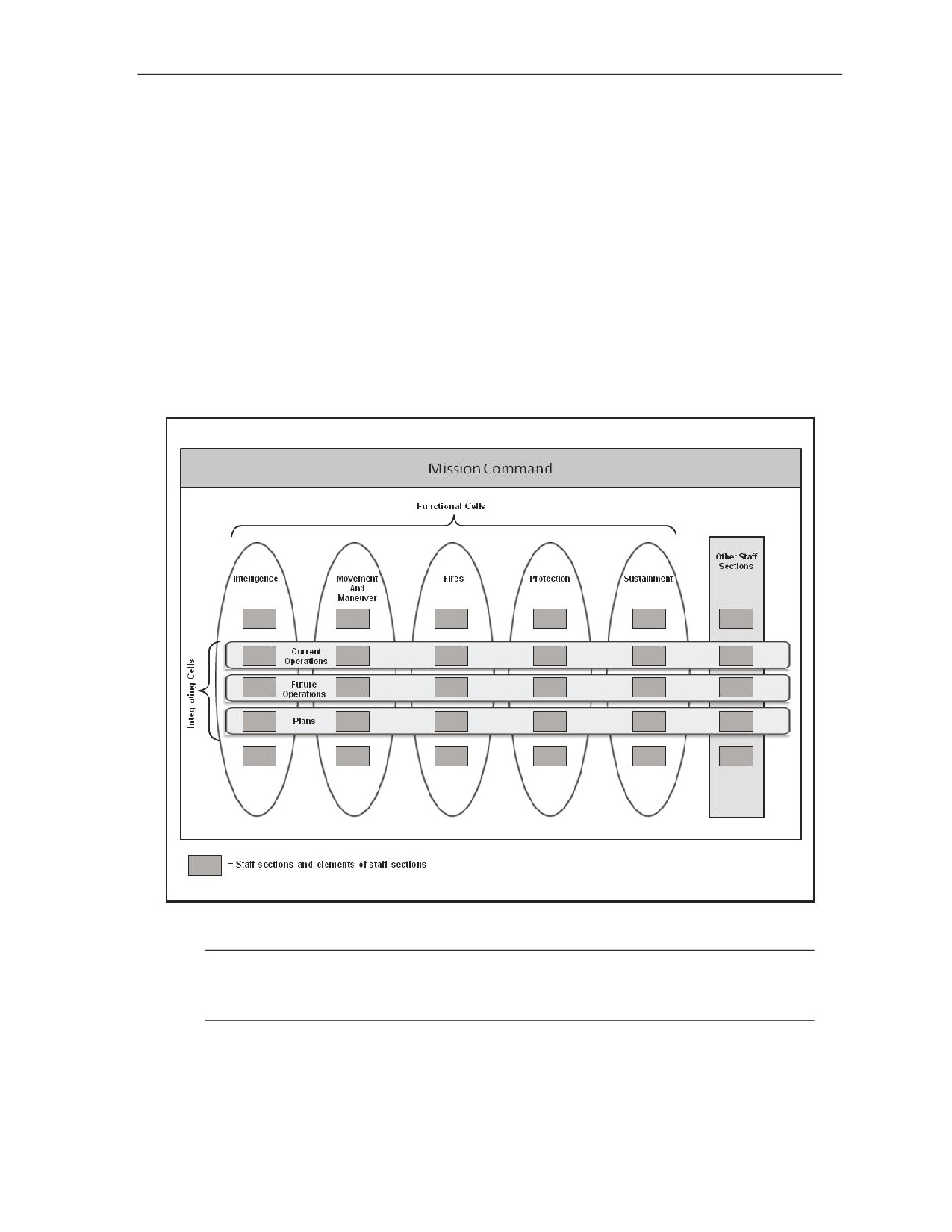
sections do, however, provide representation to different CP cells as required, and they coordinate their
activities in the various meetings established in the unit’s battle rhythm. (See figure 1-1.)
Figure 1-1. Command post organization
Note: Figure 1-1 represents the standard command post organizational design. However, the
standard design is tailorable. Commanders organize and reorganize their command post to meet
changing situations and the requirements of their specific operations.
MISSION COMMAND
1-30. The entire command post
(depicted as the mission command box in figure
1-1) assists the
commander in the exercise of mission command. Therefore, commanders do not form a specific mission
5 May 2014
FM 6-0
1-5
Chapter 1
command functional cell. All of the various command post cells and staff sections assist the commander
with specific tasks of the mission command warfighting function. For example, all functional and
integrating cells assist the commander with conducting the operations process. As such, the command post
as a whole, including the commander, deputy commanders, and command sergeants major, represents the
mission command warfighting function.
FUNCTIONAL CELLS
1-31. The functional cells within a CP are intelligence, movement and maneuver, fires, protection, and
sustainment. Echelons above brigade are resourced to establish all five functional cells described in
paragraphs 1-32 through 1-36. (See appropriate brigade and battalion publications for specifics on the
functional cells at those levels.)
Intelligence Cell
1-32. The intelligence cell coordinates activities and systems that facilitate understanding of the threats,
terrain and weather, and other relevant aspects of the operational environment. The intelligence cell
requests, receives, and analyzes information from multiple sources to produce and distribute intelligence
products. The intelligence cell consists of the majority of the intelligence staff and an attached U.S. Air
Force weather team. Higher headquarters may augment this organization with additional capabilities to
meet mission requirements. The unit’s G-2 (S-2) intelligence officer leads this cell.
Movement and Maneuver Cell
1-33. The movement and maneuver cell coordinates activities and systems that move forces to achieve a
position of advantage. This includes tasks related to gaining a positional advantage by combining forces
with direct fire or fire potential (maneuver) and force projection (movement). Elements of the operations,
airspace control, aviation, engineer, geospatial information and service, and space support element form
this cell. Staff elements in the movement and maneuver cell also form the core of the current operations
integration cell. The unit’s operations officer leads this cell. (See paragraphs 1-37 through 1-50 for a
discussion of the integrating cells.)
Fires Cell
1-34. The fires cell coordinates, plans, integrates, and synchronizes the employment and assessment of
fires in support of current and future operations. The fires cell develops high payoff targets and selects
targets for attack. The fires cell recommends targeting guidance to the commander. The fires cell plans,
synchronizes, coordinates, and integrates adaptable fires matched to a wide range of targets and target
systems. The fires cell coordinates target acquisition, target dissemination, and target engagement functions
for the commander. At the division level, the air and missile defense section is integrated within the fires
cell to ensure coordination of sense and warning systems, synchronization of fires, and airspace integration.
The fires cell coordinates activities and systems that provide collective and coordinated use of Army
indirect fires, joint fires, and air and missile defense through the targeting process. The fires cell includes
elements of fire support, the Air Force (or air component), the air and missile defense section, and liaison
officers from joint or multinational fire support agencies. Additional augmentation to the fires cell includes
the naval surface fire support liaison officer and Army space support team(s). The unit’s chief of fires (or
fire support officer at brigade and below) leads this cell.
Protection Cell
1-35. The protection cell coordinates the activities and systems that preserve the force through risk
management. This includes tasks associated with protecting personnel and physical assets. Elements of the
following staff sections form this cell: chemical, biological, radiological, and nuclear; engineer; personnel
recovery; and provost marshal. Additionally, a safety officer is assigned at theater army and, with
augmentation, as required down to the brigade level. The protection cell coordinates with the signal staff
section to further facilitate the information protection task. The chief of protection leads this cell.
1-6
FM 6-0
5 May 2014
Command Post Organization and Operations
Sustainment Cell
1-36. The sustainment cell coordinates activities and systems that provide support and services to ensure
freedom of action, extend operational reach, and prolong endurance. It includes those tasks associated with
logistics, personnel services, and health service support. The following staff sections form this cell:
personnel, sustainment, financial management, and surgeon. The chief of sustainment (or logistics officer at
brigade and below) leads this cell.
INTEGRATING CELLS
1-37. Whereas functional cells are organized by warfighting functions, integrating cells are organized by
planning horizons. They coordinate and synchronize forces and warfighting functions within a specified
planning horizon and include the plans cell, future operations cell, and current operations integration cell. A
planning horizon is a point in time commanders use to focus the organization’s planning efforts to shape
future events (ADRP 5-0). The three planning horizons are long, mid, and short (generally associated with
the plans cell, future operations cell, and current operations integration cell, respectively).
1-38. Planning horizons are situation-dependent and are influenced by events and decisions. For example,
the plans cell normally focuses its planning effort on the development of sequels—the subsequent next
operation or phase of the operation based on possible outcomes (success, stalemate, or defeat) of the
current operation or phase. The future operations cell normally focuses its efforts on branch plans—options
built into the base plan that changes the concept of operations based on anticipated events, opportunities, or
threats. Planning guidance and decisions by the commander or that of the higher headquarters influence the
planning horizons.
1-39. Not all echelons and types of units are resourced for all three integrating cells. Battalions, for
example, combine their planning and operations responsibilities in one integrating cell. The brigade combat
team has a small, dedicated plans cell but it is not resourced for a future operations cell. Divisions and
higher echelons are resourced for all three integrating cells as shown in figure 1-2 on page 1-8.
Plans Cell
1-40. The plans cell is responsible for planning operations for the long-range planning horizons. It prepares
for operations beyond the scope of the current order by developing plans and orders, including branch plans
and sequels. The plans cell also oversees military deception planning.
1-41. The plans cell consists of a core group of planners and analysts led by the G-5 (S-5) plans officer (or
the operations officer at battalion level). All staff sections assist as required. Since a brigade has a small,
dedicated plans cell, the majority of its staff sections balance their efforts between the current operations
integration and plans cells. Battalions are not resourced for a plans cell. Planning in combined arms
battalions occurs in the current operations integration cell.
Future Operations Cell
1-42. The future operations cell is responsible for planning operations in the mid-range planning horizon. It
focuses on adjustments to the current operation—including the positioning or maneuvering of forces in
depth—that facilitate continuation of the current operation. The cell consists of a core group of planners led
by an assistant operations officer (the chief of future operations). All staff sections assist as required.
Divisions and higher echelon headquarters have a future operations cell. Battalion and brigade headquarters
do not.
1-43. In many respects, the future operations cell serves as a bridge between the plans and current
operations integration cells. The future operations cell monitors current operations and determines
implications for operations within the mid-range planning horizon. In coordination with the current
operations integration cell, the future operations cell assesses whether the ongoing operation must be
modified to achieve the current phase’s objectives. Normally, the commander directs adjustments to the
operation, but the cell may also recommend options to the commander. Once the commander decides to
adjust the operation, the cell develops the fragmentary order (FRAGORD) necessary to implement the
change. The future operations cell also participates in the targeting working group since the same planning
5 May 2014
FM 6-0
1-7
Chapter 1
horizons normally concern them both. The future operations cell updates and adds details to the branch
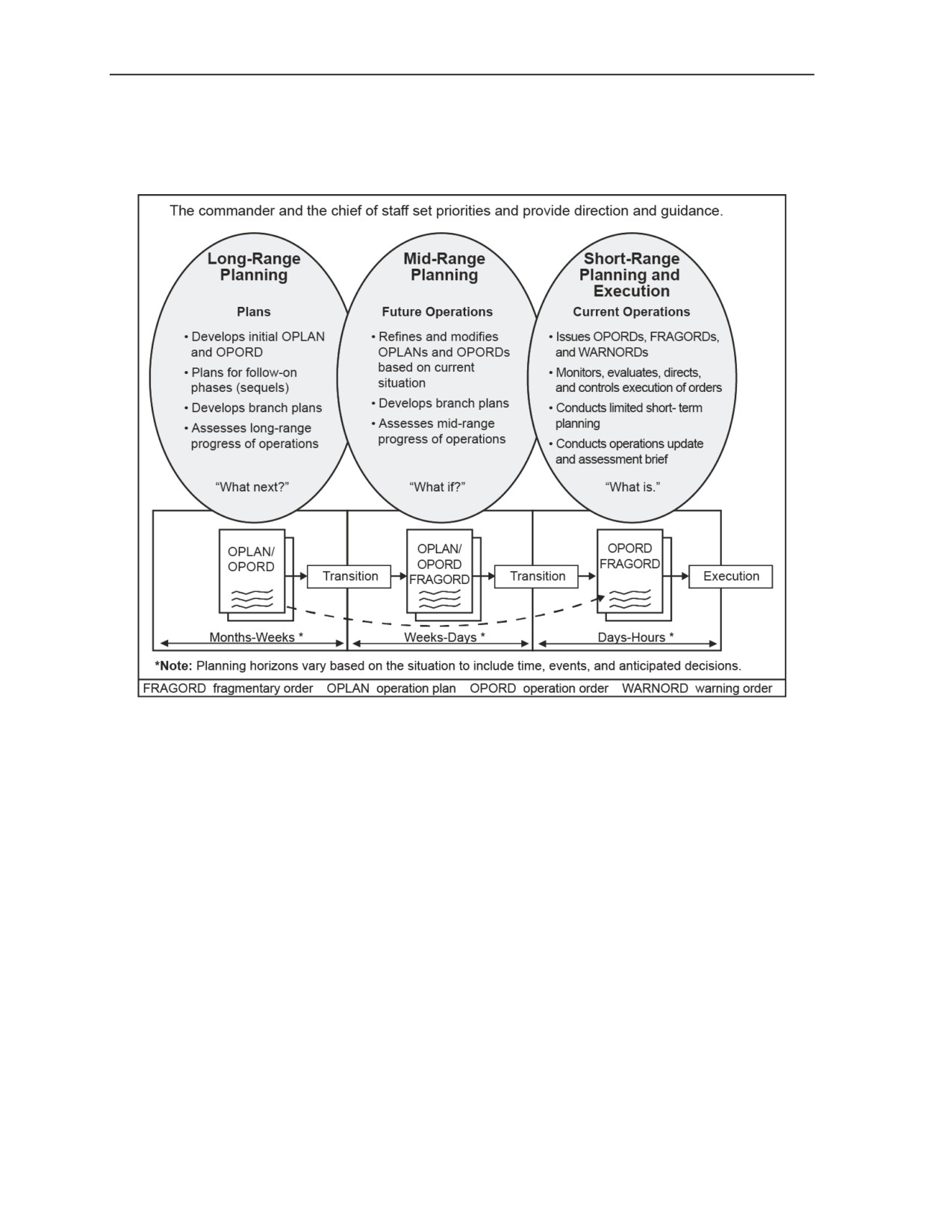
plans foreseen in the current operation and prepares any orders necessary to implement a sequel to the
operation. (See figure 1-2.)
Figure 1-2. Integration of plans, future operations, and current operations
Current Operations Integration Cell
1-44. The current operations integration cell is the focal point for the execution of operations. This
involves assessing the current situation while regulating forces and warfighting functions in accordance
with the mission, commander’s intent, and concept of operations.
1-45. The current operations integration cell displays the common operational picture and conducts shift
changes, assessments, and other briefings, as required. It provides information on the status of operations to
all staff members and to higher, subordinate, and adjacent units. The operations synchronization meeting is
the most important event in the battle rhythm in support of the current operation.
1-46. The operations officer leads the current operations integration cell and is aided by an assistant
operations officer (the chief of operations). Elements or watch officers from each staff section and liaison
officers from subordinate and adjacent units form this cell. All staff sections are represented in the current
operations integration cell, either permanently or on call.
COMMAND POST OPERATIONS
1-47. Units must man, equip, and organize command posts to control operations for extended periods.
Effective CP personnel use information systems and equipment to support 24-hour operations while they
continuously communicate with all subordinate, higher, and adjacent units. Commanders arrange CP
1-8
FM 6-0
5 May 2014
Command Post Organization and Operations
personnel and equipment to facilitate internal coordination, information sharing, and rapid decisionmaking.
They also ensure that they have procedures to execute the operations process within the headquarters to
enhance how they exercise mission command. Commanders use the battle rhythm, SOPs, and meetings to
assist them with effective CP operations.
STANDARD OPERATING PROCEDURES
1-48. SOPs that assist with effective mission command serve two purposes. Internal SOPs standardize each
CP’s internal operations and administration. External SOPs developed for the entire force standardize
interactions among CPs and between subordinate units and CPs. Effective SOPs require that all Soldiers
know their duties and train to standards. (See FM 7-15 for more information on the tasks of command post
operations.)
1-49. Each CP should have SOPs that address the following:
z
Organization and setup.
z
Staffing and shift plans, including eating and sleeping plans.
z
Physical security and defense.
z
Priorities of work.
z
Equipment and vehicle maintenance, including journals and a maintenance log.
z
Load plans and equipment checklists.
z
Orders production and dissemination procedures.
z
Plans for handling, storing, and cleaning up hazardous materials.
z
Battle rhythm.
z
Use of Army Battle Command Systems, such as Command Post of the Future, Advanced Field
Artillery Tactical Data System, and Blue Force Tracker.
1-50. In addition to these SOPs, each CP requires—
z
CP battle drills.
z
Shift-change briefings.
z
Reports and returns.
z
Operations update and assessment briefings.
z
Operations synchronization meetings.
z
Procedures for transferring control between CPs.
Command Post Battle Drills
1-51. Each CP requires procedures to react to a variety of situations. Specific actions taken by a CP should
be defined in its SOPs and rehearsed during training and operations. Typical CP battle drills include, but
are not limited to—
z
React to an air, ground, or chemical, biological, radiological, or nuclear attack.
z
React to indirect fire.
z
React to jamming or suspected communications compromise.
z
Execute dynamic targeting.
z
Execute a close air support mission.
z
React to a cyber intrusion or attack.
z
React to a mass casualty incident.
z
React to a civil riot or incident.
z
React to significant collateral damage.
z
React to incorrect information affecting an operational environment.
z
React to a degraded network.
z
React to a duty status and whereabouts unknown incident.
5 May 2014
FM 6-0
1-9
Chapter 1
Shift-Change Briefings
1-52. During continuous operations, CPs operate in shifts. To ensure uninterrupted operations, staffs
execute a briefing when shifts change. Depending on the situation, this briefing may be formal or informal
and include the entire staff or selected staff members. Normally key CP leaders meet face-to-face. The
COS (XO) oversees the briefing, with participants briefing their areas of expertise. The briefing’s purpose
is to inform the incoming shift of—
z
Current unit status.
z
Significant activities that occurred during the previous shift.
z
Significant decisions and events anticipated during the next shift.
The commander may attend and possibly change the focus of the briefing. If the commander issues
guidance or makes a decision, issuing a FRAGORD may be necessary.
1-53. The shift-change briefing format and emphasis change based on the situation. For example, the
format for a force supporting civil authorities in a disaster area differs from a force conducting offensive
tasks abroad. To facilitate a quick but effective shift-change briefing, unit SOPs should contain tailored
formats.
1-54. The shift-change briefing provides a mechanism to formally exchange information periodically
among CP staff members. CP staff members coordinate activities and inform each other continuously. They
immediately give information to the commander that answers a commander’s critical information
requirement or is exceptional information. They disseminate information that potentially affects the entire
force to the commander, higher headquarters, and subordinate units as the situation dictates. Situational
understanding for CP staff members includes knowing who needs what relevant information and why they
need it. CP staff members exercise initiative when they ensure relevant information gets to the people who
need it. (See table 1-1 for a sample shift change briefing.)
1-10
FM 6-0
5 May 2014
Command Post Organization and Operations
Table 1-1. Sample shift-change briefing
Current mission and commander’s intent (COS [XO])
Enemy situation (G-2 [S-2])
x Significant threat or local populace attitudes and actions during the last shift.
x Current enemy situation and changes in the most likely enemy courses of action.
x Anticipated significant threat or undesired local populace activity in the next 12/24/48 hours.
x Changes in priority intelligence requirements (PIRs).
x Weather update and weather effects on operations in the next 12/24/48 hours.
x Changes to information collection priorities.
x Status of information collection units and capabilities.
Civil Situation (G-2 [S-2] and G-9 [S-9])
x Significant actions by the population during the last shift.
x Current civil situation.
x Disposition and status of civil affairs units and capabilities.
x Significant activities involving the population anticipated during the next shift.
Friendly situation (G-3 [S-3])
x Significant friendly actions during the last shift.
x Subordinate units’ disposition and status.
x Higher and adjacent units’ disposition and status.
x Major changes to the task organization and tasks to subordinate units that occurred during the last
shift.
x Answers to CCIRs and changes in CCIRs.
x Changes to information collection.
x Disposition and status of selected information collection units and capabilities.
x Answers to EEFIs and changes in EEFIs.
x Significant activities and decisions scheduled for next shift (review of the decision support matrix).
x Anticipated planning requirements.
x Liaison officer update.
Running estimate summaries by warfighting function and staff section. Briefers include—
x Fires
x CBRN officer
x Air liaison officer
x Provost marshal
x Aviation officer
x G-1 (S-1)
x Air and missile defense officer
x G-4 (S-4)
x Information operations officer
x G-6 (S-6)
x Engineer officer
x Electronic warfare officer
Briefings include—
x Any significant activities that occurred during the last shift.
x The disposition and status of units within their area of expertise.
x Any changes that have staff wide implications (for example, “higher headquarters changed the
controlled supply rate for 120 mm HE, so that means...”).
x Upcoming activities and anticipated changes during the next shift.
CP operations and administration (headquarters commandant or senior operations
NCO)—
x CP sustainment issues.
x CP displacement plan and proposed new locations.
x CP security.
x Priority of work.
COS (XO) guidance to the next shift, including staff priorities and changes to the battle
rhythm.
CBRN chemical, biological, radiological, and nuclear
HE
high explosive
CCIR commander’s critical information requirement
mm
millimeter
COS chief of staff
NCO
noncommissioned officer
CP
command post
PIR
priority intelligence requirement
EEFI
essential element of friendly information
S-1
personnel staff officer
G-1
assistant chief of staff, personnel
S-2
intelligence staff officer
G-2
assistant chief of staff, intelligence
S-3
operations staff officer
G-3
assistant chief of staff, operations
S-4
logistics staff officer
G-4
assistant chief of staff, logistics
S-6
signal staff officer
G-6
assistant chief of staff, signal
S-9
civil affairs operations staff officer
G-9
assistant chief of staff, civil affairs operations
XO
executive officer
5 May 2014
FM 6-0
1-11
Chapter 1
Reports and Returns
1-55. A unit’s reporting system facilitates timely and effective information exchange among CPs and
higher, lower, and adjacent headquarters. An established SOP for reports and returns drives effective
information management. These SOPs state the writer, the frequency and time, and recipient of each report.
(List nonstandard reports in Annex R [Reports] of the operation plan and operation order.)
Operation Update and Assessment Briefing
1-56. An operation update and assessment briefing may occur daily or any time the commander calls for
one. Its content is similar to the shift-change briefing, but it has a different audience. The staff presents it to
the commander and subordinate commanders. It provides all key personnel with common situational
understanding. Often commanders require this briefing shortly before an operation begins to summarize
changes made during preparation, including changes resulting from information collection efforts.
1-57. During the briefing, staff sections present a summary of their running estimates. Subordinate
commanders brief their current situation and planned activities. Rarely do all members conduct this briefing
in person. All CPs and subordinate commanders participate using available communications equipment,
including radios, conference calls, and video teleconferences. The briefing follows a sequence and format
specified by SOPs. This keeps transmissions short, ensures completeness, and eases note taking. This
briefing normally has a format similar to a shift-change briefing. However, it omits CP administrative
information and includes presentations by subordinate commanders in an established sequence.
Operations Synchronization Meeting
1-58. The operations synchronization meeting is the key event in the battle rhythm in support of the current
operation. Its primary purpose is to synchronize all warfighting functions and other activities in the
short-term planning horizon. It is designed to ensure that all staff members have a common understanding
of current operations, including upcoming and projected actions at decision points.
1-59. The operations synchronization meeting does not replace the shift-change briefing or operation
update and assessment briefing. Chaired by the G-3 (assistant chief of staff, operations) or S-3 (operations
staff officer), representatives of each CP cell and separate staff section attend the meeting. The operations
synchronization meeting includes a FRAGORD addressing any required changes to maintain
synchronization of current operations, and any updated planning guidance for upcoming working groups
and boards. All warfighting functions are synchronized and appropriate FRAGORDs are issued to
subordinates based on the commander’s intent for current operations.
Transferring Control of Operations Between Command Posts
1-60. The employment and use of CPs are important decisions reflected in the operation order. Often, a
particular CP may control part or all of the operation for a specific time. Effectively transferring control
between CPs requires a well-understood SOP and clear instructions in the operation order.
1-61. While all CPs have some ability to exercise control on the move, they lose many capabilities they
have when stationary. Therefore, CPs normally control operations from a static location. During moves,
they transfer control responsibilities to another CP. Transfer of control requires notifying subordinates,
since many network operations change to route information to the new controlling CP. SOPs establish these
requirements to minimize interruptions when transferring control.
BATTLE RHYTHM
1-62. A headquarters’ battle rhythm consists of a series of meetings (to include working groups and
boards), briefings, and other activities synchronized by time and purpose. The battle rhythm is a
deliberate daily cycle of command, staff, and unit activities intended to synchronize current and
future operations. The COS (XO) oversees the unit’s battle rhythm. The COS (XO) ensures activities are
logically sequenced so that the output of one activity informs another activity’s inputs. Not only is this
important internally within the headquarters, the unit’s battle rhythm must nest with the higher
headquarters. This ensures that the information pertinent to decisions and the recommendations on
1-12
FM 6-0
5 May 2014
Command Post Organization and Operations
decisions made in the headquarters are provided in a timely manner to influence the decisionmaking of the
higher headquarters, where appropriate. Understanding the purpose and potential decisions of each meeting
and activity is equally important. This understanding allows members of the staff and subordinate
commanders to provide appropriate input to influence decisions. The COS (XO) balances other staff duties
and responsibilities with the time required to plan, prepare for, and hold meetings and conduct briefings.
The COS (XO) also critically examines attendance requirements. Some staff sections and CP cells may
lack the personnel to attend all events. The COS (XO) and staff members constantly look for ways to
combine meetings and eliminate unproductive ones.
1-63. The battle rhythm enables—
z
Establishing a routine for staff interaction and coordination.
z
Facilitating interaction between the commander and staff.
z
Synchronizing activities of the staff in time and purpose.
z
Facilitating planning by the staff and decisionmaking by the commander.
1-64. The battle rhythm changes during execution as operations progress. For example, early in the
operation a commander may require a daily plans update briefing. As the situation changes, the commander
may only require a plans update every three days. Some factors that help determine a unit’s battle rhythm
include the staff’s proficiency, higher headquarters’ battle rhythm, and current mission. In developing the
unit’s battle rhythm, the chief COS (XO) considers—
z
Higher headquarters’ battle rhythm and report requirements.
z
Subordinate headquarters’ battle rhythm requirements.
z
The duration and intensity of the operation.
z
Integrating cells’ planning requirements.
MEETINGS
1-65. Meetings are gatherings to present and exchange information, solve problems, coordinate action, and
make decisions. They may involve the staff; the commander and staff; or the commander, subordinate
commanders, staff, and others as necessary (including unified action partners). Who attends depends on the
issue. Commanders establish meetings to integrate the staff and enhance planning and decisionmaking
within the headquarters. Commanders also identify staff members to participate in the higher commander’s
meeting, including working groups and boards. (JP 3-33 discusses the various working groups and boards
used by joint force commanders.) Decisions made during meetings must be shared internally within the
headquarters, with the higher headquarters, and with subordinate units.
1-66. The number of meetings and the subjects they address depend on the situation and echelon. While
numerous informal meetings occur daily within a headquarters, meetings commonly included in a unit’s
battle rhythm and the cells responsible for them include—
z
A shift-change briefing (current operations integration cell).
z
An operation update and assessment briefing (current operations integration cell).
z
An operations synchronization meeting (current operations integration cell).
z
Planning meetings and briefings (plans or future operations cells).
z
Working groups and boards (various functional and integrating cells).
1-67. Often, the commander establishes and maintains only those meetings required by the situation.
Commanders—assisted by the COS (XO)—establish, modify, and dissolve meetings as the situation
evolves. The COS (XO) manages the timings of these events through the unit’s battle rhythm.
1-68. For each meeting, a unit’s SOPs address—
z
Purpose.
z
Frequency.
z
Composition (chair and participants).
z
Inputs and expected outputs.
z
Agenda.
5 May 2014
FM 6-0
1-13

Chapter 1
1-69. Boards and working groups are types of meetings and are included in the unit’s battle rhythm. A
board is a grouping of predetermined staff representatives with delegated decision authority for a
particular purpose or function. Boards are similar to working groups. However, commanders appoint
boards to make decisions. When the process or activity being synchronized requires command approval, a
board is the appropriate forum.
1-70. A working group is a grouping of predetermined staff representatives who meet to provide
analysis, coordinate, and provide recommendations for a particular purpose or function. Their cross-
functional design enables working groups to synchronize contributions from multiple CP cells and staff
sections. For example, the targeting working group brings together representatives of all staff elements
concerned with targeting. It synchronizes the contributions of all staff elements with the work of the fires
cell. It also synchronizes fires with future operations and current operations integration cells. (See table 1-2
for a sample SOP for a working group.)
Table 1-2. Sample SOP for a division civil affairs operations working group
Purpose:
x Establish policies, procedures, priorities, and overall direction for all civil-
military operations projects
Purpose and
x Provide update on ongoing civil-military operations projects
frequency
x Identify needs within the area of operations
x Present suggested future projects
Frequency: Weekly
Chair: G-9
Attendees:
x Civil affairs battalion representative
x Military information support
x G-2 representative
element representative
x G-3 operations representative
x Provost marshal or force
x G-5 planner
protection representative
Composition
x Information operations
x Special operations forces
representative
liaison officer
x Staff judge advocate representative
x Surgeon
x Host-nation liaison officers
x Chaplain
x Engineer planner
x Project manager and
x Public affairs brigade combat team
contractor representatives
and Marine Corps liaison officer
Inputs:
Outputs:
x Project management status
x Updated project status matrix
x Information operations working
x Proposed project matrix
Inputs and
group (last week’s)
x Long-range civil-military
outputs
x Targeting board
operation plan adjustment
x Higher headquarters operation
order
x G-2 update or assessment
x Operations update
x Staff judge advocate concerns
x Public perception update
x Discussion or issues
Agenda
x Civil affairs project update
x Approval of information
x Engineer project update
operations working group
inputs
G-2
assistant chief of staff, intelligence
G-5
assistant chief of staff, plans
G-3
assistant chief of staff, operations
G-9
assistant chief of staff, civil affairs operations
1-71. Working groups address various subjects depending on the situation and echelon. Battalion and
brigade headquarters normally have fewer working groups than higher echelons have. Working groups may
convene daily, weekly, monthly, or intermittently depending on the subject, situation, and echelon. Typical
working groups and the lead cell or staff section at division and corps headquarters include the following:
z
Assessment working group (plans or future operations cell).
z
Operations and intelligence working group (intelligence cell).
1-14
FM 6-0
5 May 2014
Command Post Organization and Operations
z
Targeting working group (fires cell).
z
Protection working group (protection cell)
z
Civil affairs operations working group (civil affairs operations staff section).
z
Information operations working group (movement and maneuver cell).
z
Cyber electromagnetic activities working group (electronic warfare element).
5 May 2014
FM 6-0
1-15
Chapter 2
Staff Duties and Responsibilities
This chapter describes staffs, including their responsibilities, characteristics, and
relationships, and explains the importance of building staff teams. This chapter also
outlines the basic staff structure common to all headquarters and provides a
discussion of the common duties and responsibilities of all staff sections. This
chapter concludes by describing the duties and responsibilities of specific
coordinating, special, and personal staff officers by area of expertise.
PRIMARY STAFF RESPONSIBILITIES
2-1. The staff is a key component of the mission command system. In addition to executing the mission
command staff tasks (see ADRP 6-0), the primary responsibilities of any staff are to—
z
Support the commander.
z
Assist subordinate commanders, staffs, and units.
z
Inform units and organizations outside the headquarters.
SUPPORT THE COMMANDER
2-2. Staffs support the commander in understanding, visualizing, and describing the operational
environment; making and articulating decisions; and directing, leading, and assessing military operations.
Staffs make recommendations and prepare plans and orders for the commander. Staff products consist of
timely and relevant information and analysis. Staffs use knowledge management to extract that information
from the vast amount of available information. (See chapter 3 for more information on knowledge
management.) Staffs synthesize this information and provide it to commanders in the form of running
estimates to help commanders build and maintain their situational understanding. (See chapter 8 for more
information on running estimates.)
2-3. Staffs support and advise the commander within their area of expertise. While commanders make
key decisions, they are not the only decisionmakers. Trained and trusted staff members, given
decisionmaking authority based on the commander’s intent, free commanders from routine decisions. This
enables commanders to focus on key aspects of operations.
2-4. Staffs support the commander in communicating the commander’s decisions and intent through plans
and orders. (See appendixes C and D for more information on plans and orders formats and annexes.)
ASSIST SUBORDINATE COMMANDERS, STAFFS, AND UNITS
2-5. Effective staffs establish and maintain a high degree of coordination and cooperation with staffs of
higher, lower, supporting, supported, and adjacent units. Staffs help subordinate headquarters understand
the larger context of operations. They do this by first understanding their higher headquarters’ operations
and commander’s intent, and nesting their own operations with higher headquarters. They then actively
collaborate with subordinate commanders and staffs to facilitate a shared understanding of the operational
environment. Examples of staffs assisting subordinate units include performing staff coordination, staff
assistance visits, and staff inspections.
INFORM UNITS AND ORGANIZATIONS OUTSIDE THE HEADQUARTERS
2-6. The staff keeps its units well informed. The staff also keeps civilian organizations informed with
relevant information according to their security classification, as well as their need to know. As soon as a
5 May 2014
FM 6-0
2-1
Chapter 2
staff receives information and determines its relevancy, that staff passes that information to the appropriate
headquarters. The key is relevance, not volume. Masses of data are worse than meaningless data; they
inhibit mission command by distracting staffs from relevant information. Effective knowledge management
helps staffs identify the information the commander and each staff element need, and its relative
importance. (See chapter 3 for more details on knowledge management.)
2-7. Information should reach recipients based on their need for it. Sending incomplete information
sooner is better than sending complete information too late. When forwarding information, the sending
staff highlights key information for each recipient and clarifies the commander’s intent. Such highlighting
and clarification assists receivers in analyzing the content of the information received in order to determine
that information that may be of particular importance to the higher and subordinate commanders. The
sending staff may pass information directly, include its analysis, or add context to it. Common, distributed
databases can accelerate this function; however, they cannot replace the personal contact that adds
perspective.
COMMON STAFF DUTIES AND RESPONSIBLITIES
2-8. In addition to the mission command staff tasks, each staff element has specific duties and
responsibilities by area of expertise. However, all staff sections share a set of common duties and
responsibilities:
z
Advising and informing the commander.
z
Building and maintaining running estimates.
z
Providing recommendations.
z
Preparing plans, orders, and other staff writing.
z
Assessing operations.
z
Managing information within area of expertise.
z
Identifying and analyzing problems.
z
Conducting staff assistance visits.
z
Performing risk management.
z
Performing intelligence preparation of the battlefield.
z
Conducting staff inspections.
z
Conducting staff research.
z
Performing staff administrative procedures.
z
Exercising staff supervision over their area of expertise.
z
Consulting and working with the servicing legal representative.
STAFF CHARACTERISTICS
2-9. In addition to the leader attributes and core competencies addressed in Army leadership doctrine, a
good staff officer is competent, exercises initiative, applies critical and creative thinking, is adaptable, is
flexible, has self-confidence, is cooperative, is reflective, and communicates effectively. (See ADRP 6-22
for more details.) Effective staff officers seek a shared understanding of the operational environment with
their commander, as well as the commanders of both higher and subordinate headquarters. This shared
understanding includes the commander’s visualization of the operational approach, to include his intent.
Staffs continually reassess that understanding as changes occur within the operational environment.
2-10. Effective staff officers are competent in all aspects of their area of expertise. They are experts in
doctrine and the processes and procedures associated with the operations process, and they understand the
duties of other staff members enough to accomplish coordination both vertically and horizontally.
2-11. Staff officers exercise individual initiative. They anticipate requirements rather than waiting for
instructions. They anticipate what the commander needs to accomplish the mission and prepare answers to
potential questions before they are asked.
2-2
FM 6-0
5 May 2014
Staff Duties and Responsibilities
2-12. Staffs apply critical and creative thinking throughout the operations process to assist commanders in
understanding and decisionmaking. As critical thinkers, staff officers discern truth in situations where
direct observation is insufficient, impossible, or impractical. They determine whether adequate justification
exists to accept conclusions as true based on a given inference or argument. As creative thinkers, staff
officers look at different options to solve problems. They use adaptive approaches (drawing from previous
similar circumstances) or innovative approaches (coming up with completely new ideas). In both instances,
staff officers use creative thinking to apply imagination and depart from the old way of doing things.
2-13. Effective staff officers are adaptive. They recognize and adjust to changing conditions in the
operational environment with appropriate, flexible, and timely actions. They rapidly adjust and
continuously assess plans, tactics, techniques, and procedures.
2-14. Staff officers are flexible. They avoid becoming overwhelmed or frustrated by changing
requirements and priorities. Commanders may change their minds or redirect the command after receiving
additional information or a new mission and may not inform the staff of the reason for a change. Staff
officers remain flexible and adjust to any changes. They set priorities when there are more tasks to
accomplish than time allows. They learn to manage multiple commitments simultaneously.
2-15. Staff officers possess discipline and self-confidence. They understand that all staff work serves the
commander, even if the commander rejects the resulting recommendation. Staff officers do not give a “half
effort” even if they think the commander will disagree with their recommendations. Alternative and
possibly unpopular ideas or points of view assist commanders in making the best possible decisions.
2-16. Staff officers are team players. They cooperate with other staff members within and outside the
headquarters. This practice contributes to effective collaboration and coordination.
2-17. Staff officers are reflective in their actions. While conducting actions, they are able to quickly assess
and implement corrective measures that lead to successful outcomes. Upon completion of actions, they
analyze and assess events to implement measures that maximize efficiencies in the future.
2-18. Staff officers communicate clearly and present information orally, in writing, and visually (with
charts, graphs, and figures). Staff officers routinely brief individuals and groups. They know and
understand briefing techniques that convey complex information in easily understood formats. They can
write clear and concise orders, plans, staff studies, staff summaries, and reports.
STAFF RELATIONSHIPS
2-19. Staff effectiveness depends in part on relationships of the staff with commanders and other staff.
Collaboration and dialogue aids in developing shared understanding and visualization among staffs at
different echelons. A staff acts on behalf of, and derives its authority from, the commander. Although
commanders are the principal decisionmakers, individual staff officers make decisions within their
authority based on broad guidance and unit standard operating procedures (SOPs). Commanders insist on
frank dialogue between themselves and their staff officers. A staff gives honest, independent thoughts and
recommendations, so commanders can make the best possible decisions. Once the commander makes a
decision, staff officers support and implement the commander’s decision even if the decision differs from
their recommendations.
2-20. Teamwork within a staff and between staffs produces the staff integration essential to synchronized
operations. A staff works efficiently with complete cooperation from all staff sections. A force operates
effectively in cooperation with all headquarters. Commanders and staffs contribute to foster this positive
climate during training and sustain it during operations. However, frequent personnel changes and
augmentation to the headquarters adds challenges to building and maintaining the team. While all staff
sections have clearly defined functional responsibilities, none can operate effectively in isolation.
Therefore, coordination is extremely important. Commanders ensure staff sections are properly equipped
and manned. This will allow staffs to efficiently work within the headquarters and with their counterparts in
other headquarters. Commanders ensure staff integration through developing the unit’s battle rhythm,
including synchronizing various meetings, working groups, and boards.
5 May 2014
FM 6-0
2-3
Chapter 2
STAFF ORGANIZATION
2-21. The basis for staff organization depends on the mission, each staff’s broad areas of expertise, and
regulations and laws. While staffs at every echelon and type of unit are structured differently, all staffs
share some similarities. (See paragraphs 2-22 to 2-38.)
CONSIDERATIONS
2-22. The mission determines which activities to accomplish. These activities determine how commanders
organize, tailor, or adapt their individual staffs to accomplish the mission. The mission also determines the
size and composition of a staff, including staff augmentation.
2-23. Regardless of mission, every Army staff has common broad areas of expertise that determine how
the commander divides duties and responsibilities. The duties and responsibilities inherent in an area of
expertise are called functional responsibilities. Grouping related activities allows an effective span of
control and unity of effort. Areas of expertise may vary slightly, depending on the echelon of command and
mission. For example, at battalion level there is no financial manager, while certain sustainment units
combine the intelligence and operations functions.
2-24. Army regulations and laws establish special relationships between certain staff officers and the
commander. For example, regulations require the inspector general (AR 20-1), staff judge advocate
(AR 27-10), and chaplain (AR 165-1) to be members of the commander’s personal staff.
2-25. Every organization requires an authorization document that states a headquarters’ approved structure
and resources. It is the basis and authority for personnel assignments and equipment requisitions. This
document is a table of organization and equipment (TOE), a modified TOE, or a table of distribution and
allowances (known as TDA). Commanders establish authorizations by developing a modified TOE from
the TOE for their individual units. Commanders prescribe in more detail the organization, personnel, and
equipment to be authorized to accomplish missions in specific operational environments. Commanders can
change their individual modified TOEs with Department of the Army approval.
STRUCTURE
2-26. The basic staff structure includes a COS (XO) and various staff sections. A staff section is a
grouping of staff members by area of expertise under a coordinating, special, or personal staff
officer. A principal staff officer—who may be a coordinating, special, or personal staff officer for the
commander—leads each staff section. The number of coordinating, special, and personal principal staff
officers and their corresponding staff sections varies with different command levels.
Commander
2-27. Commanders are responsible for all their staffs do or fail to do. A commander cannot delegate this
responsibility. The final decision, as well as the final responsibility, remains with the commander. When
commanders assign a staff member a task, they delegate the authority necessary to accomplish it.
Commanders provide guidance, resources, and support. They foster a climate of mutual trust, cooperation,
and teamwork.
Deputy Commander and Assistant Division Commanders
2-28. The commander determines the duties and responsibilities of the deputy and assistant commanders.
These duties and responsibilities are formally declared and outlined in a terms of reference memorandum
signed by the commander. In a corps or division, the deputy or assistant commander extends the
commander’s span of control in areas and functions as the commander designates. The deputy or assistant
commander’s specific duties vary from corps to corps and division to division.
2-29. The corps deputy commander serves as the commander’s primary assistant and second-in-command
of the corps. The corps deputy commander has specific duties directed by the commander and described in
corps SOPs. The corps deputy commander and assistant division commanders do not have their own staffs,
2-4
FM 6-0
5 May 2014
Staff Duties and Responsibilities
but they can request staff assistance at any time. They may supervise or control certain staff elements based
on responsibilities assigned by the commander.
2-30. A division has two assistant division commanders who support the commander. The division
commander specifies and assigns responsibility for tasks to the assistant division commanders to achieve
the commander’s intent. Normally one assistant division commander is the senior officer in the main
command post and is responsible for supervising the execution of current operations. Both assistant
division commanders prepare to execute operations from the tactical command post or mobile command
group, as directed by the commander, to help control the execution of all division operations.
2-31. The corps deputy commander and assistant division commanders interact with the chief of staff and
staff principal advisors based on duties the commanding general assigns. The deputy commander and
assistant division commanders maintain situational understanding to enable them to assume command at
any time. Because of this requirement, the corps deputy commander normally remains at the main
command post (CP) to co-locate physically or virtually with the commanding general. The deputy
commander and assistant division commanders have two general responsibilities:
z
Temporarily assume the commanding general’s duties.
z
Assume certain delegated authorities.
Chief of Staff (Executive Officer)
2-32. The Chief of Staff
(Executive Officer)
(COS [XO]) is the commander’s principal assistant.
Commanders normally delegate executive management authority to the COS (XO). As the key staff
integrator, the COS (XO) frees the commander from routine details of staff operations and the management
of the headquarters. Division and higher units are assigned a COS. Brigade and battalions are assigned an
XO. The COS (XO) ensures efficient and prompt staff actions. The COS (XO) duties include, but are not
limited to—
z
Coordinating and directing the work of the staff.
z
Establishing and monitoring the headquarters battle rhythm and nesting with higher and
subordinate headquarters battle rhythms for effective planning support, decisionmaking, and
other critical functions.
z
Representing the commander when authorized.
z
Formulating and disseminating staff policies.
z
Ensuring effective liaison exchanges with higher, lower, and adjacent units and other
organizations as required.
z
Supervising the sustainment of the headquarters and activities of the headquarters and
headquarters battalion or company.
z
Supervising staff training.
z
Supervising the special staff sections in division through Army Service component command
headquarters.
Principal Staff Officers
2-33. The principal staff officers consist of officers from the coordinating and special staff sections, as well
as personal staff officers. Paragraphs 2-36 through 2-72 discuss coordinating staff officers. Paragraphs 2-73
through 2-104 discuss special staff officers. Paragraphs 2-105 through 2-114 discuss personal staff officers.
Noncommissioned Officers
2-34. Noncommissioned officers (NCOs) serve alongside their staff officer counterparts in all staff
sections. They execute similar duties as those of their staff officer. NCOs often provide the experience and
continuity in their particular staff section. They are to be counted upon to provide expert advice to the staff
officer and other members of the staff section. NCOs display the same characteristics as good staff officers
as described in paragraphs 2-9 to 2-18.
5 May 2014
FM 6-0
2-5
Chapter 2
Augmentation
2-35. Often, Army headquarters receive augmentation teams to assist with mission command.
Commanders integrate these teams and detachments into their command posts. For example, divisions
commonly receive a civil affairs battalion when deployed. A civil affairs planning team within that
battalion augments the civil affairs staff section and plans cell in the division headquarters. In other
instances, commanders may request staff augmentation. Augmentation teams include, but are not limited
to—
z
Army space support team.
z
Army cyberspace operations support team.
z
Civil affairs planning team.
z
Combat camera team.
z
Legal support teams.
z
Mobile public affairs detachment.
z
Military history detachment.
z
Military information support operations units.
z
Army information operations field support team.
z
Individual augmentation by specialty (for example, assessment, or economic development).
COORDINATING STAFF OFFICERS
2-36. Coordinating staff officers are the commander’s principal assistants who advise, plan, and coordinate
actions within their area of expertise or a warfighting function. Commanders may designate coordinating
staff officers as assistant chiefs of staff, chiefs of a warfighting function, or staff officers. Coordinating staff
officers may also exercise planning and supervisory authority over designated special staff officers.
Note: The commander’s rank determines whether the staff is a G staff or an S staff.
Organizations commanded by a general officer have G staffs. Other organizations have S staffs.
Most battalions and brigades do not have plans or financial management staff sections.
2-37. The coordinating staff consists of the following positions:
z
Assistant chief of staff (ACOS), G-1 (S-1)—personnel.
z
ACOS, G-2 (S-2)—intelligence.
z
ACOS, G-3 (S-3)—operations.
z
ACOS, G-4 (S-4)—logistics.
z
ACOS, G-5—plans.
z
ACOS, G-6 (S-6)—signal.
z
ACOS, G-8—financial management.
z
ACOS, G-9 (S-9)—civil affairs operations.
z
Chief of fires.
z
Chief of protection.
z
Chief of sustainment (see paragraph 2-55).
2-38. A chief of fires, a chief of protection, and a chief of sustainment are authorized at division and corps
levels. They coordinate their respective warfighting functions for the commander through functional cells
within the main command post. (See chapter 1.)
ASSISTANT CHIEF OF STAFF, G-1 (S-1), PERSONNEL
2-39. The ACOS, G-1 (S-1) is the principal staff officer for all matters concerning human resources
support (military and civilian). The G-1 (S-1) also serves as the senior adjutant general officer in the
command. Specific responsibilities of the G-1
(S-1) include manning, personnel services, personnel
support, and headquarters management. The G-1 (S-1) has coordinating staff responsibility for the civilian
2-6
FM 6-0
5 May 2014
Staff Duties and Responsibilities
personnel officer and the equal opportunity advisor. The G-1 (S-1) prepares a portion of Annex F
(Sustainment) to the operation order or operation plan. (See FM 1-0 for more details.)
Man the Force
2-40. Manning the force impacts the effectiveness of all Army organizations, regardless of size, and affects
the ability to successfully accomplish all other human resource core competencies and key functions.
Manning includes five functional tasks: personnel readiness management, personnel accountability,
personnel strength reporting, retention operations, and personnel information management. Corps and
division G-1s maintain overall responsibility for personnel readiness management of subordinate elements.
Corps and division G-1s maintain the responsibility to assist brigade S-1s and the national provider in
shaping the force to meet mission requirements. Personnel accountability is the by-name management of
the location and duty status of every person assigned or attached to a unit. Personnel strength reporting is a
numerical product of the accountability process. The Army Retention Program is the long-term answer for
maintaining end strength. Personnel information management is a process to collect, process, store, display,
and disseminate information about Soldiers, Army civilians, units, and other personnel as required.
Provide Human Resources Services (Essential Personnel Services)
2-41. Essential personnel services are initiated by the Soldier, unit commanders, unit leaders, G-1s (S-1s),
or from the top of the human resource command. Typical actions initiated by the Soldier are personnel
action requests, requests for leaves or passes, changes to record of emergency data or life insurance
elections, changes to dependent information, allotments, saving bonds, and direct deposit information.
Typical actions initiated by commanders include requests for awards or decorations, promotions,
reductions, and bars to reenlistment. Normally, the supervisor at all levels initiates evaluation reports (such
as change of rater and complete the record reports). The military postal system operates as an extension of
the United States Postal Service. Casualty operations record, report, verify, and process casualty
information from the unit level to the casualty and mortuary affairs operations center, notify appropriate
individuals, and provide casualty assistance to the next-of-kin.
Coordinate Personnel Support
2-42. Personnel support activities encompass those functions and activities that contribute to unit readiness
by promoting fitness, building morale and cohesion, enhancing quality of life, and providing recreational,
social, and other support services for Soldiers, Army civilians, and other personnel who deploy with the
force. Personnel support encompasses the following functions: morale, welfare, and recreation, command
interest programs, and Army band operations. Commanders at all levels are responsible for the morale,
welfare, and recreation support provided to their Soldiers and civilians. Command interest programs
include family readiness, Army substance abuse program, suicide prevention program, and other programs
as directed. Army bands provide music for ceremonial and morale support in all operations to sustain
Soldiers and to inspire leaders.
Headquarters Management
2-43. Headquarters management includes, but is not limited to—
z
Managing the organization and administration of the headquarters.
z
Providing administrative support for military and civilian personnel, including leaves, passes,
counseling, transfers, awards, and personal affairs.
z
Providing information services, including publications, printing, distribution, and material for
the Freedom of Information Act.
z
Providing administrative support for non-U.S. forces, foreign nationals, and civilian internees.
z
Administering discipline, law, and order
(with the provost marshal), including desertion,
court-martial offenses, punishments, and straggler dispositions.
5 May 2014
FM 6-0
2-7
Chapter 2
ASSISTANT CHIEF OF STAFF, G-2 (S-2), INTELLIGENCE
2-44. The ACOS, G-2 (S-2) is the chief of the intelligence warfighting function and the principal staff
officer responsible for providing intelligence to support current and future operations and plans. This
officer gathers and analyzes information on enemy, terrain, weather, and civil considerations for the
commander. The G-2 (S-2) is responsible for the preparation of Annex B (Intelligence) and assists the
assistant chief of staff, operations (G-3 [S-3]) in the preparation of Annex L (Information Collection). (See
FM 2-0 for additional information on the G-2 [S-2], and see ADP 2-0 and ADRP 2-0 for more details.)
2-45. The G-2 (S-2), together with the G-3 (S-3), helps the commander coordinate, integrate, and supervise
the execution of information collection plans and operations. The G-2 (S-2) helps the commander focus and
integrate these assets and resources to satisfy the battalion through corps intelligence requirements. Some
of the specific responsibilities of the G-2 (S-2) include, but are not limited to-
z
Overseeing the intelligence functional cell, specifically situation development, target
development, support to lethal and nonlethal targeting, support to indications and warnings,
support to assessment, and support to protection.
z
Providing the commander and staff with assessments of threat capabilities, intentions, and
courses of action (COAs) as they relate to the division or corps and its mission.
z
Identifying gaps in intelligence and developing collection strategies.
z
Disseminating intelligence products throughout the unit (battalion through corps) as well as to
higher and subordinate headquarters.
z
Answering requests for information from subordinate commanders, staffs, and higher and
adjacent units.
z
Coordinating the units’ intelligence requirements with supporting higher, lateral, and subordinate
echelons.
z
Overseeing the intelligence cell’s contributions to planning requirements and assessing
collection.
z
Participating with staff in performing intelligence preparation of the battlefield (IPB).
z
Monitoring intelligence operations.
z
Ensuring ongoing intelligence operations are collecting information needed for anticipated
decisions or other priority intelligence requirements (PIRs).
z
Ensuring information concerning the PIRs is processed and analyzed first.
z
Recommending changes to the information collection plan based on changes in the situation and
weather.
z
Counterintelligence responsibilities including, but not limited to—
Coordinating counterintelligence activities.
Identifying enemy intelligence collection capabilities, such as efforts targeted against the
unit.
Evaluating enemy intelligence capabilities as they affect operations security, signals
security, countersurveillance, security operations, military deception planning, military
information support operations, and protection.
Vetting all contractors and their employees to deter the subversive nature of insurgent
activities.
z
Support to security programs includes—
Supervising the command and personnel security programs.
Evaluating physical security vulnerabilities to support the G-3 (S-3) and assistant chief of
staff, signal (G-6 [S-6]).
Performing staff planning and supervising the special security office.
ASSISTANT CHIEF OF STAFF, G-3 (S-3), OPERATIONS
2-46. The ACOS, G-3 (S-3) operations officer’s responsibilities are unique within the coordinating staff.
The G-3 (S-3) is the chief of the movement and maneuver warfighting function and the principal staff
2-8
FM 6-0
5 May 2014
Staff Duties and Responsibilities
officer responsible for all matters concerning training, operations and plans, and force development and
modernization. In addition to coordinating the activities of the movement and maneuver warfighting
function, the operations officer is the primary staff officer for integrating and synchronizing the operation
as a whole for the commander. While the COS (XO) directs the efforts of the entire staff, the operations
officer ensures warfighting function integration and synchronization across the planning horizons in current
operations integration, future operations, and plans integrating cells. (See chapter 1.) Additionally, the
operations officer authenticates all plans and orders for the commander to ensure the warfighting functions
are synchronized in time, space, and purpose in accordance with the commander’s intent and planning
guidance.
2-47. The G-3 (S-3) has coordinating staff responsibility for the G-5, aviation officer, engineer officer,
military information support officer, information operations officer, force management officer, and space
operations officer, as well as other staff officers residing in the movement and maneuver cell.
2-48. The G-3 (S-3) is responsible for and prepares Annex L (Information Collection) and Annex V
(Interagency Coordination). In conjunction with the G-5 (S-5), the G-3 (S-3) prepares Annex A (Task
Organization), Annex C (Operations), and Annex M (Assessment) to the operation order or operation plan.
In conjunction with the knowledge management officer (KMO), the G-3 (S-3) prepares Annex R (Reports)
and Annex Z (Distribution).
Training
2-49. G-3 (S-3) training responsibilities include, but are not limited to—
z
Conducting training within the command.
z
Preparing training guidance for the commander’s approval.
z
Identifying training requirements, based on the unit mission essential task list and training status.
z
Determining requirements for and allocation of training resources.
z
Organizing and conducting internal schools, and obtaining and allocating quotas for external
schools.
z
Conducting training inspections, tests, and evaluations.
z
Maintaining the unit readiness status of each unit in the command.
z
Compiling training records and reports.
Plans and Operations
2-50. The G-3
(S-3) has responsibilities for plans and operations. Overall, this officer prepares,
coordinates, authenticates, reviews, publishes, and distributes written operation orders and plans. This
includes the command SOP, plans, orders (including fragmentary orders [FRAGORDs] and warning orders
[WARNORDs]), exercises, terrain requirements, and products involving contributions from other staff
sections. The G-3 (S-3) provides coordination, integrates information collection, and allocates resources.
2-51. The G-3 (S-3) coordinates with other staff officers during plans and operations. This list is not
all-inclusive. This officer coordinates with the G-1 (S-1) for civilian personnel involvement in tactical
operations and with the assistant chief of staff, civil affairs operations (G-9 [S-9]) on using Army forces to
establish or reestablish civil government. By coordinating with the commander, the COS (XO), G-6 (S-6),
and the G-3 (S-3) can establish, oversee, and supervise staff activities of the command post. Coordinating
with the engineer officer, G-2 (S-2), chief of protection, G-9 (S-9), and surgeon, the G-3 (S-3) establishes
environmental vulnerability protection levels. Coordinating with the chief of protection and operations
security officer, the G-3 (S-3) establishes operations security priorities, plans, and guidance.
2-52. The G-3 (S-3) integrates information collection during plans and operations. This officer integrates
information collection into the concept of operations and manages the information collection effort through
integrated staff processes and procedures. The G-3 (S-3) also synchronizes information collection with the
overall operation throughout the operations process
(with the rest of the staff). By developing the
information collection plan
(with rest of the staff) to support the commander’s visualization, the
information collection plan produces an initial information collection order.
5 May 2014
FM 6-0
2-9
Chapter 2
2-53. The G-3 (S-3) allocates resources during plans and operations and ensures units provide necessary
support requirements when and where required. The G-3 (S-3) retasks and refocuses collection assets
during execution (considering recommendations from the rest of the staff). This officer recommends use of
resources, including resources required for military deception, and sustainment requirements (with the G-1
[S-1]) and the assistant chief of staff, logistics G-4 [S-4]).
2-54. During plans and operations, the G-3 (S-3) also—
z
Develops the information collection annex to plans and orders (with the rest of the staff).
z
Allocates information collection tasks (considering recommendations from the rest of the staff).
z
Integrates fires into operations.
z
Plans tactical troop movements, including route selection, priority of movement, timing,
security, bivouacking, quartering, staging, and preparing movement orders.
z
Develops the ammunition required supply rate (with the G-2 [S-2], chief of fires [fire support
officer], and G-4 [S-4]).
z
Requisitions replacement units (through operations channels).
z
Participates in course of action and decision support template development (with the G-2 [S-2]
and the chief of fires [fire support officer]).
z
Recommends general command post locations.
z
Recommends task organizations and assigns missions to subordinate elements.
z
Supports linguist requirements, to include consolidating linguist requirements and establishing
priorities for using linguists.
ASSISTANT CHIEF OF STAFF, G-4 (S-4), LOGISTICS
2-55. The ACOS, G-4 (S-4) is the principal staff officer for sustainment plans and operations, supply,
maintenance, transportation, services, and operational contract support. At division and corps level the G-4
is titled the chief of sustainment. At brigade level and below the S-4 serves as the principal staff officer
coordinating sustainment. The G-4 (S-4) helps the support unit commander maintain logistics visibility
with the commander and the rest of the staff. As the chief of sustainment, the G-4 has coordinating staff
responsibility for the G-1, G-8, transportation officer, and the surgeon. The G-4 (S-4) prepares Annex F
(Sustainment), Annex P (Host-Nation Support) and Annex W (Operational Contract Support) to the
operation order or operation plan. (See ADRP 4-0 for more details.)
Sustainment Plans and Operations (General)
2-56. The G-4 (S-4) responsibilities for sustainment plans and operations include, but are not limited to—
z
Developing the logistic plan to support operations (with the G-3 [S-3]).
z
Coordinating with the G-3 (S-3), G-2 (S-2), and engineer officer to requisition cataloged
topographic foundation data and existing mission-specific data sets from the Defense Logistics
Agency.
z
Coordinating with the G-3 (S-3) and G-1 (S-1) on equipping replacement personnel and units.
z
Coordinating with the support unit commander on the current and future support capability of
that unit.
z
Coordinating the selection of main supply routes and logistic support areas (with the engineer
officer) and recommending them to the G-3 (S-3).
z
Performing logistic preparation of the battlefield (with the support command).
z
Recommending command policy for collecting and disposing of excess property and salvage.
2-10
FM 6-0
5 May 2014
Staff Duties and Responsibilities
Supply
2-57. The G-4 (S-4) responsibilities for supply include, but are not limited to—
z
Determining supply requirements, except medical (with the support unit commander and the
G-3 [S-3]).
z
Coordinating all classes of supply except Class VIII (which is coordinated through medical
supply channels).
z
Coordinating the requisition, acquisition, and storage of supplies and equipment and the
maintenance of materiel records.
z
Recommending sustainment priorities and controlled supply rates.
z
Ensuring that accountability and security of supplies and equipment are adequate (with the
provost marshal).
z
Calculating and recommending to the G-3 (S-3) basic and prescribed loads, and helping the
G-3 (S-3) determine required supply rates.
Maintenance
2-58. The G-4 (S-4) responsibilities for maintenance include, but are not limited to—
z
Monitoring and analyzing the equipment readiness status.
z
Determining maintenance workload requirements, except medical (with the support command).
z
Coordinating equipment recovery and evacuation operations (with the support command).
z
Determining maintenance timelines.
Transportation
2-59. The G-4 (S-4) responsibilities for transportation include, but are not limited to—
z
Conducting operational and tactical planning to support mode and terminal operations, and
movement control.
z
Planning administrative troop movements (with the G-3 [S-3]).
z
Coordinating transportation assets for other Services.
z
Coordinating with the G-9 (S-9) for host-nation support.
z
Coordinating special transport requirements to move the command post.
z
Coordinating with the G-1 (S-1) and the provost marshal to transport replacement personnel and
enemy prisoners of war.
z
Coordinating with the G-3 (S-3) for sustainment of tactical troop movements.
Services
2-60. The G-4 (S-4) responsibilities for services include, but are not limited to—
z
Coordinating the construction of facilities and installations, except for fortifications and signal
systems.
z
Coordinating field sanitation.
z
Coordinating organizational clothing and individual equipment exchange and replacement.
z
Coordinating unit spill-prevention plans.
z
Coordinating or providing food preparation, water purification, mortuary affairs, aerial delivery,
laundry, shower, and clothing and light textile repair.
z
Coordinating the transportation, storage, handling, and disposal of hazardous material or
hazardous waste.
5 May 2014
FM 6-0
2-11
Chapter 2
Staff Planning and Supervision
2-61. The G-4 (S-4) has the following staff planning and supervisory responsibilities:
z
Identifying requirements the unit can meet through contracting.
z
Identifying requirements and restrictions, in conjunction with the staff judge advocate, for using
local civilians, enemy prisoners of war, civilian internees, and detainees in sustainment
operations.
z
Coordinating with the staff judge advocate on legal aspects of contracting.
z
Coordinating with financial managers on the financial resources availability.
z
Coordinating real property control and fire protection for facilities.
2-62. A support operations officer or materiel officer is authorized in support commands and battalions. As
the principal staff officer for coordinating logistics, the support operations officer or materiel officer
provides technical supervision for the sustainment mission of the support command and is the key interface
between the supported unit and the support command. The responsibilities of the support operations officer
or materiel officer include, but are not limited to—
z
Advising the commander on support requirements versus support assets available.
z
Coordinating external support requirements for supported units.
z
Synchronizing support requirements to ensure they remain consistent with current and future
operations.
z
Planning and monitoring support operations and making adjustments to meet support
requirements.
z
Coordinating with other staff.
z
Preparing and distributing the external service support SOP that provides guidance and
procedures to supported units.
ASSISTANT CHIEF OF STAFF, G-5, PLANS
2-63. The ACOS, G-5 (S-5) is the principal staff officer for planning operations for the mid- to long-range
planning horizons at division echelon and higher. In conjunction with the G-3 (S-3), the G-5 prepares
Annex A (Task Organization), Annex C (Operations), and Annex M (Assessment) to the operation order or
operation plan. (See ADRP 5-0 for more details.)
2-64. Plans and orders consist of—
z
Preparing, coordinating, authenticating, publishing, and distributing operation plans, concept
plans, and operation orders.
z
Conducting mission analysis of higher headquarters plans and orders.
z
Reviewing subordinate supporting plans and orders.
z
Coordinating and synchronizing warfighting functions in all plans and orders.
2-65. The G-5 has staff planning and supervisory responsibility for—
z
Overseeing operations beyond the scope of the current order (such as the next operation or the
next phase of the current operation).
z
Developing plans, orders, branches, and sequels.
z
Conducting military deception planning.
z
Developing policies and other coordinating or directive products, such as memorandums of
agreement.
ASSISTANT CHIEF OF STAFF, G-6 (S-6), SIGNAL
2-66. The ACOS G-6 (S-6) is the principal staff officer for all matters concerning network operations
(jointly consisting of Department of Defense Information Network Operations and applicable portions of
the Defensive Cyberspace Operations), network transport, information services, and spectrum management
operations within the unit’s area of operations. The G-6 (S-6) prepares Annex H (Signal) and participates in
preparation of Appendix 12 (Cyberspace Electromagnetic Activities) to Annex C (Operations) with input
2-12
FM 6-0
5 May 2014
Staff Duties and Responsibilities
from the G-2 (S-2) and in coordination with the G-3 (S-3), to the operation order or operation plan. (See
FM 6-02.70 and FM 6-02.71 for more details.) G-6 (S-6) responsibilities include, but are not limited to—
z
Preparing and maintaining network operations estimates, plans, and orders.
z
Overseeing Department of Defense Information Network Operations related functions that
engineer and install the network to support operational requirements.
z
Directing and managing the operation of the network to ensure network and information system
availability and information delivery.
z
Managing the execution of Defensive Cyberspace Operations for the network in coordination
with other staff sections.
z
Overseeing or participating in the development of plans and orders for cyber electromagnetic
activities in conjunction with other staff sections.
z
Overseeing or participating in the development and maintenance of the cyberspace common
operational picture with assistance from the G-2 (S-2) and other staff sections.
z
Coordinating and managing spectrum management operations and communications security
within the area of operations.
z
Recommending CP locations, based on operational requirements and the information
environment.
z
Recommending network-related essential elements of friendly information.
z
Coordinating contractor and maintenance support for all network operations, information
services, and electromagnetic spectrum management.
Network Operations
2-67. The network operations officer oversees the operation and defense of the warfighting information
network and ensures the confidentiality, integrity, and availability of information critical to mission
command and the establishment of a cyber-related common operation picture. At the operational and
tactical level, network operations capabilities include network and systems management, information
assurance and computer network defense
(to include response actions), information dissemination
management, and content staging. G-6 (S-6) responsibilities related to network operations include, but are
not limited to—
z
Coordinating, planning, and directing the integration of the mission-related networks and
information systems with those of unified action partners.
z
Ensuring the effective and efficient operations of information systems, elements of systems, and
services (including operating systems, databases, and hosts of the end-users).
z
Provisioning networked system services with the desired level of quality and guaranteed
availability.
z
Coordinating unit commercial and military satellite communications requirements with the space
operations officer.
z
Managing radio frequency allocations and assignments and providing electromagnetic spectrum
management within the area of operations.
z
Planning, coordinating, and directing all measures that protect information and information
systems by ensuring their availability, integrity, authentication, confidentiality, and
nonrepudiation.
z
Monitoring, detecting, analyzing, and responding to unauthorized activity
(malicious or
non-malicious) occurring within information networks and systems.
z
Ensuring that information dissemination management and content staging capabilities used to
deliver, discover, and store information meet the command’s critical information requirements.
z
Coordinating, planning, and directing all command information assurance activities.
z
Providing operational and technical support to all assigned or attached units.
5 May 2014
FM 6-0
2-13
Chapter 2
ASSISTANT CHIEF OF STAFF, G-8, FINANCIAL MANAGEMENT
2-68. The ACOS, (G-8) is the principal staff officer singularly responsible for all financial management
(resource management and finance operations). As the principal financial management advisor to the
commander, this officer directs, prioritizes, and supervises the operations and functions of the G-8 staff
sections assigned to the G-8 and the contingency command post. In coordination with the financial
management center and through the theater sustainment command, the G-8 establishes and implements
command finance operations policy. The G-8 is responsible for those operational financial management
tasks supporting the theater. This officer works with the servicing legal representative for advice regarding
laws and financial management regulations governing obligations, expenditures, and limitations on the use
of public funds. The G-8 coordinates financial management policies and practices with the expeditionary
contracting command to ensure guidance is executed in accordance with Department of the Army (DA)
mandates. The G-8 prepares a portion of Annex F (Sustainment). (See FM 1-06 for more details.)
2-69. The financial management center is a modular and tailorable operational financial management unit.
Its mission is inextricably linked to the theater army G-8, but it is assigned to a theater sustainment
command. The financial management center supports the Army Service component command, theater
sustainment command, and the expeditionary sustainment command by providing cash management,
internal control measures, accounting, automation, and technical guidance for financial management
companies and financial management detachments. To provide adequate theater and national-provider
responsiveness and support, the financial management center maintains oversight of all financial
management operations and placement of all operational and tactical financial management units in theater.
The financial management center provides technical coordination of all theater finance operations and
collected advice to the theater army G-8 and the theater sustainment command commander on all aspects of
theater finance operations.
ASSISTANT CHIEF OF STAFF, G-9 (S-9), CIVIL AFFAIRS OPERATIONS
2-70. The ACOS, G-9 (S-9) is the principal staff officer responsible for all matters concerning civil affairs.
The G-9 (S-9) establishes the civil-military operations center, evaluates civil considerations during mission
analysis, and prepares the groundwork for transitioning the area of operations from military to civilian
control. The G-9 (S-9) advises the commander on the military’s effect on civilians in the area of operations,
relative to the complex relationship of these people with the terrain and institutions over time. The
G-9 (S-9) is responsible for enhancing the relationship between Army forces and the civil authorities and
people in the area of operations. The G-9 (S-9) is required at all echelons from battalion through corps, but
it is normally authorized only at division and corps. Once deployed, units below division level may be
authorized an S-9. The G-9 (S-9) prepares Annex K (Civil Affairs Operations) to the operation order or
operation plan. (See FM 3-57 for more information.) G-9 (S-9) responsibilities include, but are not limited
to—
z
Operating a civil-military operations center to maintain liaison with other U.S. government
agencies, host-nation civil and military authorities, and nongovernmental and international
organizations in the area of operations.
z
Coordinating with the chief of fires or fire support officer on the restricted target list and the
no-strike list.
z
Planning community relations programs to gain and maintain public understanding and goodwill
and to support military operations.
z
Providing the G-2 (S-2) information gained from civilians in the area of operations.
z
Coordinating with the surgeon on the military use of civilian medical treatment facilities,
materials, and supplies.
z
Coordinating with the information operations officer to ensure disseminated information is not
contradictory.
z
Coordinating with the public affairs officer on supervising public information media under civil
control.
2-14
FM 6-0
5 May 2014
Staff Duties and Responsibilities
z
Providing instruction to units, officials (friendly, host-nation civil, or host-nation military), and
the population on identifying, planning, and implementing programs to support civilian
populations and strengthen host-nation internal defense and development.
z
Identifying and assisting the G-6 (S-6) with coordinating military use of local information
systems.
z
Coordinating with the provost marshal to control civilian traffic in the area of operations.
z
Helping the G-4 (S-4) coordinate facilities, supplies, and other materiel resources available from
the civil sector to support operations.
CHIEF OF FIRES OR FIRE SUPPORT OFFICER
2-71. The chief of fires is the principal staff officer responsible for the fires warfighting function at
division through theater army. At brigade and below, the fire support officer serves as a special staff officer
for fires. This officer synchronizes and coordinates fire support for the S-3 who integrates fire support into
plans and operations. The chief of fires has coordinating responsibility for the air and missile defense
officer and the air liaison officer. The chief of fires or fire support officer prepares Annex D (Fires) to the
operation order or operation plan. (See ADRP 3-09 for more details.) The chief of fires or fire support
officers’ responsibilities include, but are not limited to—
z
Planning, preparing, executing, and assessing all fires tasks in support of offensive, defensive
and stability tasks and providing inputs for preparation of the operation plan and operation order.
z
Developing, with the commander and G-3 (S-3), a scheme of fires to support the operation.
z
Planning and coordinating fire support tasks.
z
Developing a proposed high-payoff target list, target selection standards, and an attack guidance
matrix.
z
Identifying named and target areas of interest, high-payoff targets, and additional events that
may influence the positioning of fire support assets.
z
Coordinating the positioning of fires assets.
z
Providing information on the status of Army, joint, and multinational fires and their systems,
including target acquisition assets and munitions.
z
Recommending fire support coordination measures to support current and future operations and
managing changes to them.
z
Recommending and implementing the commander’s counterfire and target engagement
priorities.
z
Recommending to the commander the establishment, responsibilities, authorities, and duties of a
force field artillery headquarters as necessary.
z
Conducting the tasks associated with integrating and synchronizing joint fires and multinational
fires with the other warfighting functions.
z
Training fires cell personnel to perform all of their functions.
z
Advising the commander and staff of available fires capabilities and limitations.
z
Leading the targeting working group.
z
Working with the COS (XO), and G-3 (S-3) to integrate all types of fires into the commander’s
concept of operations.
z
Accompanying the commander in the command group during execution of tactical operations
(when directed).
CHIEF OF PROTECTION
2-72. The chief of protection is the principal staff officer responsible for the protection warfighting
function at division through theater army. The chief of protection is the principal advisor to the commander
on all matters relating to the protection warfighting function. Brigade and lower echelon headquarters are
not assigned a chief of protection. The chief of protection has coordinating staff responsibilities for the
chemical, biological, radiological, and nuclear officer; the explosive ordnance disposal officer; the
operations security officer; the personnel recovery officer; the provost marshal; and the safety officer. At
5 May 2014
FM 6-0
2-15
///////////////////////////////////////