FM 6-0 COMMANDER AND STAFF ORGANIZATION AND OPERATIONS (MAY 2014) - page 5
Rehearsals
Task organization completeness.
Personnel and materiel readiness.
Organizational level of preparation.
Chief of Staff (Executive Officer)
12-58. The COS (XO) through war-gaming and coordination with the commander—
z
Prepares to serve as the rehearsal director.
z
Coordinates time for key events requiring rehearsal.
z
Establishes rehearsal time limits per the commander’s guidance and mission variables.
z
Verifies rehearsal site preparation. A separate rehearsal site may be required for some events,
such as a possible obstacle site. A good rehearsal site includes—
Appropriate markings and associated training aids.
Parking areas.
Local security.
z
Determines the method for controlling the rehearsal and ensuring its logical flow, such as a
script.
Subordinate Leaders
12-59. Subordinate leaders complete their planning. This planning includes—
z
Completing unit OPORDs.
z
Identifying issues derived from the higher headquarters’ OPORD.
z
Providing a copy of their unit OPORD with graphics to the higher headquarters.
z
Performing personal preparation similar to that of the commander.
z
Ensuring they and their subordinates bring all necessary equipment.
Conducting Headquarters Staff
12-60. Conducting headquarters staff members—
z
Develop an OPORD with necessary overlays.
z
Deconflict all subordinate unit graphics. Composite overlays are the first step for leaders to
visualize the organization’s overall plan.
z
Publish composite overlays at the rehearsal, including, at a minimum—
Movement and maneuver.
Intelligence.
Fires.
Sustainment.
Signal operations.
Protection.
REHEARSAL EXECUTION
12-61. During the rehearsal execution, the commander, COS
(XO), assistants, subordinate leaders,
recorder, and staff from the conducting headquarters have specific responsibilities.
Commander
12-62. Commanders command the rehearsal just as they will command the operation. They maintain the
focus and level of intensity, allowing no potential for subordinate confusion. Although the staff refines the
OPORD, it belongs to the commander. The commander uses the order to conduct operations. An effective
rehearsal is not a commander’s brief to subordinates. It validates synchronization—the what, when, and
5 May 2014
FM 6-0
12-7
Chapter 12
where—of tasks that subordinate units will perform to execute the operation and achieve the commander’s
intent.
Chief of Staff (Executive Officer)
12-63. Normally, the COS (XO) serves as the rehearsal director. This officer ensures each unit will
accomplish its tasks at the right time and cues the commander to upcoming decisions. The chief of staff’s
(executive officer’s) script is the execution matrix and the decision support template. The COS (XO) as the
rehearsal director—
z
Starts the rehearsal on time.
z
Has a formal roll call.
z
Ensures everyone brings the necessary equipment, including organizational graphics and
previously issued orders.
z
Validates the task organization. Linkups must be complete or on schedule, and required materiel
and personnel must be on hand. The importance of this simple check cannot be overemphasized.
z
Ensures synchronization of the operational framework being used—deep-close-security,
decisive-shaping-sustaining, or main and supporting efforts.
(See ADRP
3-0 for more
information on the three operational frameworks.)
z
Rehearses the synchronization of combat power from flank and higher organizations. These
organizations often exceed the communications range of the commander and assistant chief of
staff, operations (G-3 [S-3]) when they are away from the command post.
z
Synchronizes the timing and contribution of each warfighting function.
z
For each decisive point, defines conditions required to—
Commit the reserve or striking forces.
Move a unit.
Close or emplace an obstacle.
Fire at planned targets.
Move a medical unit, change a supply route, and alert specific observation posts.
z
Disciplines leader movements, enforces brevity, and ensures completeness.
z
Keeps within time constraints.
z
Ensures that the most important events receive the most attention.
z
Ensures that absentees and flank units receive changes to the OPORD and transmits changes to
them as soon as practical.
z
Communicates the key civil considerations of the operation.
Assistant Chief of Staff, G-3 (S-3)
12-64. The G-3 (S-3) assists the commander with the rehearsal. The G-3 (S-3)—
z
Portrays the friendly scheme of maneuver.
z
Ensures subordinate unit actions comply with the commander’s intent.
z
Normally provides the recorder.
Assistant Chief of Staff, G-2 (S-2)
12-65. The assistant chief of staff, intelligence (G-2 [S-2]) portrays the enemy forces and other variables
of the operational environment during rehearsals. The G-2 (S-2) bases actions on the enemy course of
action that the commander selected during the MDMP. The G-2 (S-2)—
z
Provides participants with current intelligence.
z
Portrays the best possible assessment of the enemy course of action.
z
Communicates the enemy’s presumed concept of operations, desired effects, and end state.
12-8
FM 6-0
5 May 2014
Rehearsals
z
Explains other factors of the operational environment that may hinder or complicate friendly
actions.
z
Communicates the key civil considerations of the operation.
Subordinate Leaders
12-66. Subordinate unit leaders, using an established format, effectively articulate their units’ actions and
responsibilities as well as record changes on their copies of the graphics or OPORD.
Recorder
12-67. The recorder is normally a representative from the G-3 (S-3). During the rehearsal, the recorder
captures all coordination made during execution and notes unresolved problems. At the end of the
rehearsal, the recorder—
z
Presents any unresolved problems to the commander for resolution.
z
Restates any changes, coordination, or clarifications directed by the commander.
z
Estimates when a written fragmentary order (FRAGORD) codifying the changes will follow.
Conducting Headquarters Staff
12-68. The staff updates the OPORD, decision support template, and execution matrix based on the
decisions of the commander.
REHEARSAL ASSESSMENT
12-69. The commander establishes the standard for a successful rehearsal. A properly executed rehearsal
validates each leader’s role and how each unit contributes to the overall operation—what each unit does,
when each unit does it relative to times and events, and where each unit does it to achieve desired effects.
An effective rehearsal ensures commanders have a common vision of the enemy, their own forces, the
terrain, and the relationships among them. It identifies specific actions requiring immediate staff resolution
and informs the higher commander of critical issues or locations that the commander, COS (XO), or
G-3 (S-3) must personally oversee.
12-70. The commander (or rehearsal director in the commander’s absence) assesses and critiques all parts
of the rehearsal. Critiques center on how well the operation achieves the commander’s intent and on the
coordination necessary to accomplish that end. Usually, commanders leave the internal execution of tasks
within the rehearsal to the subordinate unit commander’s judgment and discretion.
REHEARSAL DETAILS
12-71. All participants have responsibilities before, during, and after a rehearsal. Before a rehearsal, the
rehearsal director states the commander’s expectations and orients the other participants on details of the
rehearsal, as necessary. During a rehearsal, all participants rehearse their roles in the operation. They make
sure they understand how their actions support the overall operation and note any additional coordination
required. After a rehearsal, participants ensure they understand any changes to the OPORD and
coordination requirements, and they receive all updated staff products.
12-72. Commanders do not normally address small problems that arise during rehearsals. Instead, the
G-3 (S-3) recorder keeps a record of these problems. This ensures the commander does not interrupt the
rehearsal’s flow. If the problem remains at the end of the rehearsal, the commander resolves it then. If the
problem jeopardizes mission accomplishment, the staff accomplishes the coordination necessary to resolve
it before the participants disperse. Identifying and solving such problems is a major reason for conducting
rehearsals. If commanders do not make corrections while participants are assembled, they may lose the
opportunity to do so. Coordinating among dispersed participants and disseminating changes to them often
proves more difficult than accomplishing these actions in person.
5 May 2014
FM 6-0
12-9
Chapter 12
BEFORE THE REHEARSAL
12-73. Before the rehearsal, the rehearsal director calls the roll and briefs participants on information
needed for execution. The briefing begins with an introduction, overview, and orientation. It includes a
discussion of the rehearsal script and ground rules. The detail of this discussion is based on participants’
familiarity with the rehearsal SOP.
12-74. Before the rehearsal, the staff develops an OPORD with at least the basic five paragraphs and
necessary overlays. The staff may not publish annexes; however, responsible staff officers should know
their content.
Introduction and Overview
12-75. Before the rehearsal, the rehearsal director introduces all participants as needed. Then, the
rehearsal director (normally the COS [XO]) gives an overview of the briefing topics, rehearsal subjects and
sequence, and timeline, specifying the no-later-than ending time. The rehearsal director explains after
action reviews, describes how and when they occur, and discusses how to incorporate changes into the
OPORD. The director explains any constraints, such as pyrotechnics use, light discipline, weapons firing,
or radio silence. For safety, the rehearsal director ensures all participants understand safety precautions and
enforces their use. Last, the director emphasizes results and states the commander’s standard for a
successful rehearsal. Subordinate leaders state any results of planning or preparation (including rehearsals)
they have already conducted. If a subordinate recommends a change to the OPORD, the rehearsal director
acts on the recommendation before the rehearsal begins, if possible. If not, the commander resolves the
recommendation with a decision before the rehearsal ends.
Orientation
12-76. The rehearsal director orients the participants to the terrain or rehearsal medium. The rehearsal
director identifies orientation using magnetic north on the rehearsal medium and symbols representing
actual terrain features. After explaining any graphic control measures, obstacles, and targets, the rehearsal
director issues supplemental materials, if needed.
Rehearsal Script
12-77. An effective means for the rehearsal director to control rehearsals is the use of a script. It keeps the
rehearsal on track. The script provides a checklist so the organization addresses all warfighting functions
and outstanding issues. It has two major parts: the agenda and response sequence.
Agenda
12-78. An effective rehearsal follows a prescribed agenda that everyone knows and understands. This
agenda includes, but is not limited to—
z
Roll call.
z
Participant orientation to the terrain.
z
Location of local civilians.
z
Enemy situation brief.
z
Friendly situation brief.
z
Description of expected enemy actions.
z
Discussion of friendly unit actions.
z
A review of notes made by the recorder.
12-79. The execution matrix, decision support template, and OPORD outline the rehearsal agenda. These
tools, especially the execution matrix, both drive and focus the rehearsal. The commander and staff use
them to control the operation’s execution. Any templates, matrixes, or tools developed within each of the
warfighting functions should tie directly to the supported unit’s execution matrix and decision support
template. Examples include an intelligence synchronization matrix or fires execution matrix.
12-10
FM 6-0
5 May 2014
Rehearsals
12-80. An effective rehearsal realistically and quickly portrays the enemy force and other variables of the
operational environment without distracting from the rehearsal. One technique for doing this has the
G-2 (S-2) preparing an actions checklist. It lists a sequence of events much like the one for friendly units
but from the enemy or civilian perspective.
Response Sequence
12-81. Participants respond in a logical sequence: either by warfighting function or by unit as the
organization deploys, from front to rear. The commander determines the sequence before the rehearsal. The
staff posts the sequence at the rehearsal site, and the rehearsal director may restate it.
12-82. Effective rehearsals allow participants to visualize and synchronize the concept of operations. As
the rehearsal proceeds, participants talk through the concept of operations. They focus on key events and
the synchronization required to achieve the desired effects. The commander leads the rehearsal and gives
orders during the operation. Subordinate commanders enter and leave the discussion at the time they expect
to begin and end their tasks or activities during the operation. This practice helps the commander assess the
adequacy of synchronization. Commanders do not “re-war-game” unless absolutely necessary to ensure
subordinate unit commanders understand the plan.
12-83. The rehearsal director emphasizes integrating fires, events that trigger different branch actions, and
actions on contact. The chief of fires (fire support officer) or firing unit commander states when to initiate
fires, who to fire them, from where the firing comes, the ammunition available, and the desired target
effect. Subordinate commanders state when they initiate fires per their fire support plans. The rehearsal
director speaks for any absent staff section and ensures the rehearsal addresses all actions on the
synchronization matrix and decision support template at the proper time or event.
12-84. The rehearsal director ensures that the rehearsal includes key sustainment and protection actions at
the appropriate times. Failure to do so reduces the value of the rehearsal as a coordination tool. The staff
officer with coordinating staff responsibility inserts these items into the rehearsal. Special staff officers
should brief by exception when a friendly or enemy event occurs within their area of expertise.
Summarizing these actions at the end of the rehearsal can reinforce coordination requirements identified
during the rehearsal. The staff updates the decision support template and gives a copy to each participant.
Under time-constrained conditions, the conducting headquarters staff may provide copies before the
rehearsal and rely on participants to update them with pen-and-ink changes. (See table 12-1.)
Table 12-1. Example sustainment and protection actions for rehearsals
x Casualty evacuation routes.
x Support area displacement times and locations.
x Ambulance exchange point
x Detainee collection points.
locations.
x Aviation support.
x Refuel-on-the-move points.
x Military police actions.
x Class IV and Class V resupply
points.
x Logistics release points.
Ground Rules
12-85. After discussing the rehearsal script, the rehearsal director—
z
States the standard (what the commander will accept) for a successful rehearsal.
z
Ensures everyone understands the parts of the OPORD to rehearse. If the unit will not rehearse
the entire operation, the rehearsal director states the events to be rehearsed.
z
Quickly reviews the rehearsal SOP if all participants are not familiar with it. An effective
rehearsal SOP states—
Who controls the rehearsal.
Who approves the rehearsal venue and its construction.
5 May 2014
FM 6-0
12-11
Chapter 12
When special staff officers brief the commander.
The relationship between how the execution matrix portrays events and how units rehearse
events.
z
Establishes the timeline that designates the rehearsal starting time in relation to H-hour. For
example, begin the rehearsal by depicting the anticipated situation one hour before H-hour. One
event executed before rehearsing the first event is deployment of forces.
z
Establishes the time interval to begin and track the rehearsal. For example, the rehearsal director
may specify that a ten-minute interval equates to one hour of actual time.
z
Updates friendly and enemy activities as necessary. For example, the rehearsal director describes
any ongoing reconnaissance.
The rehearsal director concludes the orientation with a call for questions.
DURING THE REHEARSAL
12-86. Once the rehearsal director finishes discussing the ground rules and answering questions, the
G-3 (S-3) reads the mission statement, the commander reads the commander’s intent, and the G-3 (S-3)
establishes the current friendly situation. The rehearsal then begins, following the rehearsal script.
12-87. Paragraphs 12-88 through 12-101 outline a generic set of rehearsal steps developed for combined
arms rehearsals. However, with a few modifications, these steps support any rehearsal technique. The
products depend on the rehearsal type.
Step 1-Enemy Forces Deployed
12-88. The G-2 (S-2) briefs the current enemy situation and operational environment and places markers
on the map or terrain board (as applicable) indicating where enemy forces and other operationally
significant groups or activities would be before the first rehearsal event. The G-2 (S-2) then briefs the most
likely enemy course of action and operational context. The G-2 (S-2) also briefs the status of information
collection operations (for example, citing any patrols still out or any observation post positions).
Step 2-Friendly Forces Deployed
12-89. The G-3 (S-3) briefs friendly maneuver unit dispositions, including security forces, as they are
arrayed at the start of the operation. Subordinate commanders and other staff officers brief their unit
positions at the starting time and any particular points of emphasis. For example, the chemical, biological,
radiological, and nuclear (CBRN) officer states the mission-oriented protective posture level, and the chief
of fires (fire support officer) or fires unit commander states the range of friendly and enemy artillery. Other
participants place markers for friendly forces, including adjacent units, at the positions they will occupy at
the start of the operation. As participants place markers, they state their task and purpose, task organization,
and strength.
12-90. Sustainment and protection units brief positions, plans, and actions at the starting time and at
points of emphasis the rehearsal director designates. Subordinate units may include forward arming and
refueling points, refuel-on-the-move points, communications checkpoints, security points, or operations
security procedures that differ for any period during the operation. The rehearsal director restates the
commander’s intent, if necessary.
Step 3-Initiate Action
12-91. The rehearsal director states the first event on the execution matrix. Normally this involves the
G-2 (S-2) moving enemy markers according to the most likely course of action. The depiction must tie
enemy actions to specific terrain or to friendly unit actions. The G-2 (S-2) portrays enemy actions based on
the situational template developed for staff war-gaming.
12-92. As the rehearsal proceeds, the G-2 (S-2) portrays the enemy and other operational factors and
walks through the most likely enemy course of action (per the situational template). The G-2 (S-2) stresses
reconnaissance routes, objectives, security force composition and locations, initial contact, initial fires
12-12
FM 6-0
5 May 2014
Rehearsals
(artillery, air, and attack helicopters), probable main force objectives or engagement areas, and likely
commitment of reserve forces.
Step 4-Decision Point
12-93. When the rehearsal director determines that a particular enemy movement or reaction is complete,
the commander assesses the situation to determine if a decision point has been reached. Decision points are
taken directly from the decision support template.
12-94. If the commander determines the unit is not at a decision point and not at the end state, the
commander directs the rehearsal director to continue to the next event on the execution matrix. Participants
use the response sequence (see paragraphs 12-81 through 12-84) and continue to act out and describe their
units’ actions.
12-95. When the rehearsal reaches conditions that establish a decision point, the commander decides
whether to continue with the current course of action or select a branching course of action. If electing the
current course of action, the commander directs the rehearsal director to move to the next event in the
execution matrix. If selecting a branch, the commander states the reason for selecting that branch, states the
first event of that branch, and continues the rehearsal until the organization has rehearsed all events of that
branch. As the unit reaches decisive points, the rehearsal director states the conditions required for success.
12-96. When it becomes obvious that the operation requires additional coordination to ensure success,
participants immediately begin coordinating. This is one of the key reasons for rehearsals. The rehearsal
director ensures that the recorder captures the coordination and any changes and all participants understand
the coordination.
Step 5-End State Reached
12-97. Achieving the desired end state completes that phase of the rehearsal. In an attack, this will usually
be when the unit is on the objective and has finished consolidation and casualty evacuation. In the defense,
this will usually be after the decisive action (such as committing the reserve or striking force), the final
destruction or withdrawal of the enemy, and casualty evacuation is complete. In stability tasks, this usually
occurs when a unit achieves the targeted progress within a designated line of effort.
Step 6-Reset
12-98. At this point, the commander states the next branch to rehearse. The rehearsal director resets the
situation to the decision point where that branch begins and states the criteria for a decision to execute that
branch. Participants assume those criteria have been met and then refight the operation along that branch
until they attain the desired end state. They complete any coordination needed to ensure all participants
understand and can meet any requirements. The recorder records any changes to the branch.
12-99. The commander then states the next branch to rehearse. The rehearsal director again resets the
situation to the decision point where that branch begins, and participants repeat the process. This continues
until the rehearsal has addressed all decision points and branches that the commander wants to rehearse.
12-100. If the standard is not met and time permits, the commander directs participants to repeat the
rehearsal. The rehearsal continues until participants are prepared or until the time available expires.
(Commanders may allocate more time for a rehearsal but must assess the effects on subordinate
commanders’ preparation time.) Successive rehearsals, if conducted, should be more complex and realistic.
12-101. At the end of the rehearsal, the recorder restates any changes, coordination, or clarifications that
the commander directed and estimates how long it will take to codify changes in a written FRAGORD.
AFTER THE REHEARSAL
12-102. After the rehearsal, the commander leads an after action review. The commander reviews lessons
learned and makes the minimum required modifications to the existing plan. (Normally, a FRAGORD
effects these changes.) Changes should be refinements to the OPORD; they should not be radical or
significant. Changes not critical to the operation’s execution may confuse subordinates and hinder the
5 May 2014
FM 6-0
12-13
Chapter 12
synchronization of the plan. The commander issues any last minute instructions or reminders and reiterates
the commander’s intent.
12-103. Based on the commander’s instructions, the staff makes any necessary changes to the OPORD,
decision support template, and execution matrix based on the rehearsal results. Subordinate commanders
incorporate these changes into their units’ OPORDs. The COS (XO) ensures the changes are briefed to all
leaders or liaison officers who did not participate in the rehearsal.
12-104. A rehearsal provides the final opportunity for subordinates to identify and fix unresolved
problems. The staff ensures that all participants understand any changes to the OPORD and that the
recorder captures all coordination done at the rehearsal. All changes to the published OPORD are, in effect,
verbal FRAGORDs. As soon as possible, the staff publishes these verbal FRAGORDs as a written
FRAGORD that changes the operation order.
12-14
FM 6-0
5 May 2014

Chapter 13
Liaison
This chapter discusses responsibilities of liaison officers and teams. It addresses
requirements distinct to Army operations and unified action. It includes liaison
checklists and an example outline for a liaison officer handbook.
ROLE OF LIAISON
13-1. Liaison is that contact or intercommunication maintained between elements of military forces or
other agencies to ensure mutual understanding and unity of purpose and action (JP 3-08). Most commonly
used for establishing and maintaining close communications, liaison continuously enables direct, physical
communications between commands and with unified action partners. Commanders use liaison during
operations and normal daily activities to help facilitate a shared understanding and purpose among
organizations, preserve freedom of action, and maintain flexibility. Liaison provides commanders with
relevant information and answers to operational questions, thus enhancing the commander’s situational
understanding.
13-2. Liaison activities augment the commander’s ability to synchronize and focus combat power. They
include establishing and maintaining physical contact and communications between elements of military
forces and nonmilitary agencies during unified action. Liaison activities ensure—
z
Cooperation and understanding among commanders and staffs of different headquarters.
z
Coordination on tactical matters to achieve unity of effort.
z
Synchronization of lethal and nonlethal effects.
z
Understanding of implied or inferred coordination measures to achieve synchronized results.
LIAISON OFFICER
13-3. A liaison officer (LNO) represents a commander or staff officer. LNOs transmit information directly,
bypassing headquarters and staff layers. A trained, competent, trusted, and informed LNO (either a
commissioned or a noncommissioned officer [NCO]) is the key to effective liaison. LNOs must have the
commander’s full confidence and experience for the mission. At higher echelons, the complexity of
operations often requires an increase in the rank required for LNOs. (See table 13-1.)
Table 13-1. Senior liaison officer rank by echelon
Senior liaison officer rank by echelon
Recommended rank
Multinational or joint force commander1
Colonel
Corps
Lieutenant Colonel
Division
Major
Brigade, regiment, or group
Captain
Battalion
Lieutenant
1These include joint force commanders and functional component commanders and may also include major
interagency and international organizations.
13-4. The LNO’s parent unit or unit of assignment is the sending unit. The unit or activity that the LNO is
sent to is the receiving unit, which may be a host nation. An LNO normally remains at the receiving unit
until recalled. LNOs represent the commander and they—
5 May 2014
FM 6-0
13-1
Chapter 13
z
Understand how the commander thinks and interpret the commander’s messages.
z
Convey the commander’s intent, guidance, mission, and concept of operations.
z
Represent the commander’s position.
13-5. As a representative, the LNO has access to the commander consistent with the duties involved.
However, for routine matters, LNOs work for and receive direction from the chief of staff or executive
officer
(COS [XO]). Using one officer to perform a liaison mission conserves manpower while
guaranteeing a consistent, accurate flow of information. However, continuous operations may require a
liaison team or liaison detachment.
13-6. The professional capabilities and personal characteristics of an effective LNO encourage confidence
and cooperation with the commander and staff of the receiving unit. In addition to the discussion in
paragraph 13-4, effective LNOs—
z
Know the sending unit’s mission; current and future operations; logistics status; organization;
disposition; capabilities; and tactics, techniques, and procedures.
z
Appreciate and understand the receiving unit’s tactics, techniques, and procedures; organization;
capabilities; mission; doctrine; staff procedures; and customs.
z
Are familiar with—
Requirements for and purpose of liaison.
The liaison system and its reports, documents, and records.
Liaison team training.
z
Observe the established channels of command and staff functions.
z
Are tactful.
z
Possess familiarity with local culture and language, and have advanced regional expertise if
possible.
LIAISON ELEMENTS
13-7. Commanders organize liaison elements based on the mission variables (mission, enemy, terrain and
weather, troops and support available, time available, and civil considerations [METT-TC]) and echelon of
command. (See appendix A for more details.) Two command liaison teams are authorized in division,
corps, and theater army headquarters. Common ways to organize liaison elements include, but are not
limited to—
z
A single LNO.
z
A liaison team consisting of one or two LNOs, or an LNO and a liaison NCO in charge, clerical
personnel, and communications personnel along with their equipment.
z
Couriers
(messengers) responsible for the secure physical transmission and delivery of
documents and other materials.
z
A digital liaison detachment comprised of several teams with expertise and equipment in
specialized areas, such as intelligence, operations, fire support, air defense, and sustainment.
DIGITAL LIAISON DETACHMENTS
13-8. Digital liaison detachments provide Army commanders units to conduct liaison with major
subordinate or parallel headquarters. Digital liaison detachments consist of staff officers with a broad range
of expertise who are capable of analyzing the situation, facilitating coordination between multinational
forces, and assisting in cross-boundary information flow and operational support. These 30-Soldier teams
are essential not only for routine liaison, but also for advising and assisting multinational partners in
conducting planning and operations at intermediate tactical levels. These detachments can operate as a
single entity for liaison with a major multinational headquarters, or provide two smaller teams for digital
connectivity and liaison with smaller multinational headquarters. Commanders can also tailor digital liaison
detachments to match a given mission. The basis of digital liaison detachments allocation is five per
committed theater Army, one per corps and division serving as a joint task force headquarters, or as
approved by the Department of the Army. The support requirement for a coalition during
13-2
FM 6-0
5 May 2014
Liaison
counterinsurgency or foreign internal defense is one digital liaison detachment for each multinational
headquarters (division or above) and one for the host-nation Ministry of Defense.
LIAISON PRACTICES
13-9. When possible, liaison is reciprocal among higher, lower, supporting, supported, and adjacent
organizations. Each organization sends a liaison element to the other. It must be reciprocal when U.S.
forces are placed under control of a headquarters of a different nationality and vice versa, or when
brigade-sized and larger formations of different nationalities are adjacent. When not reciprocal, the
following practices apply to liaison where applicable:
z
Higher-echelon units establish liaison with lower echelons.
z
In contiguous operations units on the left establish liaison with units on their right.
z
In contiguous operations units of the same echelon establish liaison with those to their front.
z
In noncontiguous operations units establish liaison with units within closest proximity.
z
Supporting units establish liaison with units they support.
z
Units not in contact with the enemy establish liaison with units in contact with the enemy.
z
During a passage of lines, the passing unit establishes liaison with the stationary unit.
z
During a relief in place, the relieving unit establishes liaison with the unit being relieved.
If liaison is broken, both units act to reestablish it. However, the primary responsibility rests with the unit
originally responsible for establishing liaison.
LIAISON RESPONSIBILITIES
13-10. Both sending and receiving units have liaison responsibilities before, during, and after operations.
SENDING UNIT
13-11. The sending unit’s most important tasks include selecting and training the best qualified Soldiers
for liaison duties. Liaison personnel should have the characteristics and qualifications discussed in
paragraphs 13-3 through 13-6. (See figure 13-1 for an example outline for an LNO handbook. See figure
13-2 on page 13-4 for sample questions that LNOs should be able to answer. See figure 13-3 on page 13-5
for a sample LNO packing list.)
Sample Liaison Officer Handbook Outline
Table of contents.
Sending unit’s tasking order.
Purpose statement.
Introduction statement.
Definitions.
Scope statement.
Responsibilities and guidelines for conduct.
Actions to take before departing from the sending unit.
Actions to take on arriving at the receiving unit.
Actions to take during liaison operations at the receiving unit.
Actions to take before departing from the receiving unit.
Actions to take upon returning to the sending unit.
Figure 13-1. Example liaison officer handbook outline
5 May 2014
FM 6-0
13-3
Chapter 13
Sample questions. Liaison officers should be able to answer the following questions:
Does the sending unit have a copy of the receiving unit’s latest operation plan, operation order, and
fragmentary order?
Does the receiving unit’s plan support the plan of the higher headquarters? This includes
sustainment as well as the tactical concept. Are main supply routes and required supply rates known?
Can the controlled supply rate support the receiving unit’s plan?
What are the receiving unit’s commander’s critical information requirements?
At what time, phase, or event are they expected to change? Are there any items the commander’s
critical information requirements do not contain with which the sending unit can help?
Which sending commander decisions are critical to executing the receiving unit operation?
What are the “no-later-than” times for those decisions?
What assets does the unit need to acquire to accomplish its mission? How would the unit use them?
How do they support attaining the more senior commander’s intent? From where can the unit obtain
them? Higher headquarters? Other Services? Multinational partners?
How do units use aviation assets?
How can the liaison officers communicate with the sending unit? Are telephones, radios, facsimile
machines, computers, and other information systems available? Where are they located? Which
communications are secure?
What terrain did the unit designate as key? Decisive?
What weather conditions would have a major impact on the operation?
What effect would a chemical, biological, radiological, and nuclear environment have on the
operation?
What effect would large numbers of refugees or enemy prisoners of war have on the receiving unit’s
operations?
What is the worst thing that could happen during execution of the current operation?
How would a unit handle a passage of lines by other units through the force?
What conditions would cause the unit to request operational control of a multinational force?
If the unit is placed under operational control of a larger multinational force, or given operational
control of a smaller such force, what special problems would it present?
If going to a multinational force headquarters, how do the tactical principles and command concepts
of that force differ from those of U.S. forces?
What host-nation support is available to the sending unit?
What are the required reports from higher and sending units’ standard operating procedures?
Figure 13-2. Examples of liaison officer questions
13-4
FM 6-0
5 May 2014
Liaison
Example recommended packing list:
Credentials (including courier card, permissive jump orders, if qualified). Blank forms as required.
References.
Excerpts of higher and sending headquarters’ operation orders and plans.
Sending unit standard operating procedures.
Sending unit’s command diagrams and recapitulation of major systems.
The unit modified table of equipment, unit status report (if its classification allows), and mission briefings.
The assistant chief of staff, operations (G-3 [S-3]) and the force modernization officer are excellent
sources of these.
Computers and other information systems required for information and data exchange (for example,
command post of the future, SECRET Internet Protocol Router Network, and Nonsecure Internet Protocol
Router Network devices.)
Automated network control device.
Communications equipment.
Sending unit telephone book.
List of commanders and staff officers.
Telephone calling (credit) card.
Cell phone.
Movement table.
Administrative equipment (for example, pens, paper, scissors, tape, and hole punch).
Map and chart equipment (for example, pens, pins, protractor, straight edge, scale, distance counter,
acetate, and unit markers).
Tent and accessories (camouflage net, cots, and stove, as appropriate).
Foreign phrase book and dictionary.
Local currency as required.
Rations and water.
Weapons and ammunition.
Night-vision device.
Figure 13-3. Example recommended packing list
13-12. The sending unit describes the liaison team to the receiving unit providing number and types of
vehicles and personnel, equipment, call signs, and frequencies. The LNO or liaison team also requires—
z
Point-to-point transportation, as required.
z
Identification and appropriate credentials for the receiving unit.
z
Appropriate security clearance, courier orders, and information systems accredited for use on the
receiving unit’s network.
z
The standard operating procedures (SOPs) outlining the missions, functions, procedures, and
duties of the sending unit’s liaison section.
z
If the receiving unit is multinational, it may provide communications equipment and personnel.
13-13. The movement from the sending unit to the receiving unit requires careful planning and
coordination. (See figure 13-4 on page 13-6 for a list of tasks for liaison personnel to perform before
departing the sending unit.)
5 May 2014
FM 6-0
13-5
Chapter 13
Example liaison checklist before departure from sending unit:
Understand what the sending commander wants the receiving commander to know.
Receive a briefing from operations, intelligence, and other staff elements on current and future
operations.
Receive and understand the tasks from the sending unit staff.
Obtain the correct maps, traces, and overlays.
Arrange for transport, communications and cryptographic equipment, codes, signal instructions, and
the challenge and password—including their protection and security. Arrange for replacement of
these items, as necessary.
Complete route-reconnaissance and time-management plans so the liaison team arrives at the
designated location on time.
Ensure that liaison team and interpreters have security clearances and access appropriate for the
mission.
Verify that the receiving unit received the liaison team’s security clearances and will grant access to
the level of information the mission requires.
Verify courier orders.
Know how to destroy classified information in case of an emergency during transit or at the receiving
unit.
Inform the sending unit of the liaison officer’s departure time, route, arrival time, and, when known,
the estimated time and route of return.
Pick up all correspondence designated for the receiving unit.
Conduct a radio check.
Know the impending moves of the sending and receiving units.
Bring accredited information systems needed to support liaison operations.
Pack adequate rations and water for use in transit.
Arrange for the liaison party’s departure.
Figure 13-4. Liaison checklist—before departing the sending unit
RECEIVING UNIT
13-14. The receiving unit—
z
Provides the sending unit with the LNO’s reporting time, place, point of contact, recognition
signal, and password.
z
Provides details of any tactical movement and logistics information relevant to the LNO’s
mission, especially while the LNO is in transit.
z
Ensures that the LNO has access to the commander, the COS (XO), and other officers, as
required.
z
Gives the LNO an initial briefing of the unit battle rhythm and allows the LNO access necessary
to remain informed of current operations.
z
Protects the LNO while at the receiving unit.
z
Publishes an SOP outlining the missions, functions, procedures to request information,
information release restrictions and clearance procedures, and duties of the LNO or team at the
receiving unit.
z
If possible, provides access to communications equipment
(and operating instructions, as
needed) when the LNO needs to communicate using the receiving unit’s equipment.
13-6
FM 6-0
5 May 2014
Liaison
z
Provides adequate workspace for the LNO.
z
Provides administrative and logistic support, or agreed to host-nation support.
DURING THE TOUR
13-15. During the tour, LNOs have specific duties. LNOs inform the receiving unit’s commander or staff
of the sending unit’s needs or requirements. Due to the numbers of LNOs in the headquarters, sending units
guard against inundating the receiving unit with formal requests for information. By virtue of their location
in the headquarters and knowledge of the situation, LNOs can rapidly answer questions from the sending
unit and keep the receiving unit from wasting planning time answering requests for information. (See figure
13-5 on page 13-8 for a summary of LNO duties.) During the liaison tour, LNOs—
z
Arrive at the designated location on time.
z
Promote cooperation between the sending and receiving units.
z
Accomplish their mission without becoming overly involved in the receiving unit’s staff
procedures or actions; however, they may assist higher echelon staffs in war-gaming.
z
Follow the receiving unit’s communications procedures.
z
Actively obtain information without interfering with the receiving unit’s operations.
z
Facilitate understanding of the sending unit’s commander’s intent.
z
Help the sending unit’s commander assess current and future operations.
z
Remain informed of the sending unit’s current situation and provide that information to the
receiving unit’s commander and staff.
z
Quickly inform the sending unit of the receiving unit’s upcoming missions, tasks, and orders.
z
Ensure the sending unit has a copy of the receiving unit’s SOP.
z
Inform the receiving unit’s commander or COS (XO) of the content of reports transmitted to the
sending unit.
z
Keep a record of their reports, listing everyone met (including each person’s name, rank, duty
position, and telephone number) as well as key staff members and their telephone numbers.
z
Attempt to resolve issues within the receiving unit before involving the sending unit.
z
Notify the sending unit promptly if unable to accomplish the liaison mission.
z
Report their departure to the receiving unit’s commander at the end of their mission.
5 May 2014
FM 6-0
13-7
Chapter 13
Example liaison duties during the tour:
Arrive at least two hours before any scheduled briefings.
Check in with security and complete any required documentation.
Report to and present credentials to the chief of staff (executive officer) or supervisor, as appropriate.
Arrange for an office call with the commander.
Meet coordinating and special staff officers.
Notify the sending unit of arrival (use the liaison establishment report).
Visit staff elements, brief them on the sending unit’s situation, and collect information from them.
Deliver all correspondence designated for the receiving unit.
Annotate on all overlays the security classification, title, map scale, grid intersection points, and
effective date-time group, when received, and from whom received.
Pick up all correspondence for the sending unit when departing the receiving unit.
Inform the receiving unit of the liaison officer’s departure time, return route, and expected arrival time
at the sending unit.
Submit a liaison disestablishment report to the sending unit when departing.
Figure 13-5. Liaison duties—during the liaison tour
13-16. Once a deploying liaison team or detachment arrives and sets up communications at the receiving
unit, it submits a liaison establishment report to the sending unit. This report informs the sending unit’s
command that the detachment is ready to conduct liaison, and it establishes exactly what systems are
available. A re-deploying team or detachment submits a liaison disestablishment report to the sending unit
as its last action prior to disconnecting its digital devices. This report informs the command that the
element is leaving the network and is no longer capable of conducting liaison at any level beyond unsecure
voice. (See unit SOPs for the liaison establishment report and the liaison disestablishment report formats.)
AFTER THE TOUR
13-17. After returning to the sending unit, LNOs promptly transmit the receiving unit’s requests to the
sending unit’s commander or staff, as appropriate. (See figure 13-6 for a list of tasks to perform after
completing a liaison tour.)
Example liaison duties after the tour:
Deliver all correspondence.
Brief the chief of staff (executive officer) and appropriate staff elements.
Prepare the necessary reports.
Clearly state what they did and did not learn from the mission.
Figure 13-6. Liaison duties—after the liaison tour
13-18. Accuracy is important. Effective LNOs provide clear, concise, complete information. If the
accuracy of information is in doubt, they quote the source and include the source in the report. LNOs limit
their remarks to mission-related observations.
LIAISON CONSIDERATIONS
13-19. Joint, interagency, and multinational operations require greater liaison efforts than most other
operations.
13-8
FM 6-0
5 May 2014
Liaison
JOINT OPERATIONS
13-20. Current joint information systems do not meet all operational requirements. Few U.S. military
information systems are interoperable. Army liaison teams and detachments require information systems
that can rapidly exchange information between commands to ensure Army force operations are
synchronized with operations of the joint force and its Service components.
INTERAGENCY OPERATIONS
13-21. Army forces may participate in interagency operations across the range of military operations,
especially when conducting stability or defense support of civil authorities tasks. Frequently, Army forces
conduct operations in cooperation with or in support of civilian government agencies. Relations in these
operations are rarely based on standard military command and support relationships; rather, national laws
or specific agreements for each situation govern the specific relationships in interagency operations.
Defense support of civil authorities provides an excellent example. Federal military forces that respond to a
domestic disaster will support the Federal Emergency Management Agency, while National Guard forces
working in state active duty status (Title 32 United States Code) or conducting National Guard defense
support of civil authorities will support that state's emergency management agency. National Guard forces
federalized under Title 10 United States Code will support the Federal Emergency Management Agency.
The goal is always unity of effort between military forces and civilian agencies, although unity of
command may not be possible. Effective liaison and continuous coordination become keys to mission
accomplishment. (See FM 3-28.)
13-22. Some missions require coordination with nongovernmental organizations. While no overarching
interagency doctrine delineates or dictates the relationships and procedures governing all agencies,
departments, and organizations in interagency operations, the National Response Framework provides
some guidance. Effective liaison elements work toward establishing mutual trust and confidence,
continuously coordinating actions to achieve cooperation and unity of effort. (See JP 3-08.) In these
situations, LNOs and their teams require a broader understanding of the interagency environment,
responsibilities, motivations, and limitations of nongovernmental organizations, and the relationships these
organizations have with the U.S. military.
MULTINATIONAL OPERATIONS
13-23. Army units often operate as part of a multinational force. Interoperability is an essential
requirement for multinational operations. The North Atlantic Treaty Organization
(NATO) defines
interoperability as the ability to operate in synergy in the execution of assigned tasks. Interoperability is
also the condition achieved among communications-electronics systems or items of satisfactory
communication between them and their users. The degree of interoperability should be defined when
referring to specific cases. Examples of interoperability include the deployment of a computer network
(such as the Combined Enterprise Network Theater Information Exchange System) to facilitate inter-staff
communication. Nations whose forces are interoperable can operate together effectively in numerous ways.
Less interoperable forces have correspondingly fewer ways to work together. Although frequently
identified with technology, important areas of interoperability include doctrine, procedures,
communications, and training. Factors that enhance interoperability include planning for interoperability,
conducting multinational training exercises, staff visits to assess multinational capabilities, a command
atmosphere that rewards sharing information, and command emphasis on a constant effort to eliminate the
sources of confusion and misunderstanding.
13-24. The multinational forces with which the U.S. operates may not have information systems that are
compatible with U.S. or other systems. Some nations may lack computerized information systems.
Reciprocal liaison is especially important under these conditions. Mutual trust and confidence is the key to
making these multinational operations successful. Liaison during multinational operations includes explicit
coordination of doctrine as well as tactics, techniques, and procedures. Effective liaison requires patience
and tact during personal interactions. The liaison officer needs a thorough understanding of the strategic,
operational, and tactical aims of the international effort. Foreign disclosure limitations often require special
communications and liaison arrangements to address cultural differences and sensitivities as well as to
5 May 2014
FM 6-0
13-9
Chapter 13
ensure explicit understanding throughout the multinational force. Two structural enhancements that
improve the coordination of multinational forces are liaison networks and coordination centers.
13-25. A multinational coordination center or coalition coordination center is a means of increasing
multinational coordination. U.S. commanders routinely create such a center in the early stages of any
coalition effort, especially one that is operating under a parallel command structure. It is a proven means of
integrating the participating nations’ military forces into the coalition planning and operations processes,
enhancing coordination and cooperation, and supporting an open and full interaction within the coalition
structure. Normally, the multinational coordination center focuses upon coordination of coalition force
operations, which will most likely involve classified information. (See JP 3-16 for more information on
multinational operations.)
13-10
FM 6-0
5 May 2014
Chapter 14
Decisionmaking in Execution
This chapter describes the major activities of execution to include assessing,
decisionmaking, and directing action. The chapter concludes with a discussion of the
rapid decisionmaking and synchronization process.
ACTIVITIES OF EXECUTION
14-1. Planning and preparation accomplish nothing if the command does not execute effectively. Execution
is putting a plan into action by applying combat power to accomplish the mission (ADRP 5-0). In
execution, commanders, supported by their staffs, focus their efforts on translating decisions into actions.
Inherent in execution is deciding whether to execute planned actions, such as changing phases or executing
a branch plan. Execution also includes adjusting the plan based on changes in the situation and an
assessment of the operation’s progress. (See ADRP 5-0 for fundamentals of execution).
14-2. Throughout execution, commanders, supported by their staffs, assess the operation’s progress, make
decisions, and direct the application of combat power to seize, retain, and exploit the initiative. Major
activities of execution include—
z
Assessment: Monitoring current operations and evaluating progress.
z
Decisionmaking: Making decisions to exploit opportunities or counter treats.
z
Directing action: Apply combat power at decisive points and times.
ASSESSMENT DURING EXECUTION
14-3. During execution, continuous assessment is essential. Assessment involves a deliberate comparison
of forecasted outcomes to actual events, using criteria to judge operational progress towards success. The
commander and staff assess the probable outcome of the operation to determine whether changes are
necessary to accomplish the mission, take advantage of opportunities, or react to unexpected threats.
Commanders also assess the probable outcome of current operations in terms of their impact on potential
future operations in order to develop concepts for these operations early. (See ADRP 5-0 for fundamentals
of assessment. See chapter 15 for details for building an assessment plan).
14-4. Assessment includes both monitoring the situation and evaluating progress. During monitoring,
commanders and staffs collect and use relevant information to develop a clear understanding of the
command’s current situation. Commanders and staffs also evaluate the operation’s progress in terms of
measures of performance
(MOPs) and measures of effectiveness
(MOEs). This evaluation helps
commanders assess progress and identify variances—the difference between the actual situation and what
the plan forecasted the situation would be at that time or event. Identifying variances and their significance
leads to determining if a decision is required during execution.
DECISIONMAKING DURING EXECUTION
14-5. When operations are progressing satisfactorily, variances are minor and within acceptable levels.
Commanders who make this evaluation—explicitly or implicitly—allow operations to continue according
to plan. This situation leads to execution decisions included in the plan. Execution decisions implement a
planned action under circumstances anticipated in the order. An execution decision is normally tied to a
decision point.
14-6. An assessment may determine that the operation as a whole, or one or more of its major actions, is
not progressing according to expectations. Variances of this magnitude present one of two situations:
5 May 2014
FM 6-0
14-1

Chapter 14
z
Significant, unforeseen opportunities to achieve the commander’s intent.
z
Significant threats to the operation’s success.
In either case, the commander makes an adjustment decision. An adjustment decision is the selection of a
course of action that modifies the order to respond to unanticipated opportunities or threats. An adjustment
decision may include a decision to reframe the problem and develop an entirely new plan.
14-7. Executing, adjusting, or abandoning the original operation is part of decisionmaking in execution. By
fighting the enemy and not the plan, successful commanders balance the tendency to abandon a
well-conceived plan too soon against persisting in a failing effort too long. Effective decisionmaking during
execution—
z
Relates all actions to the commander’s intent and concept of operations.
z
Is comprehensive, maintaining integration of combined arms rather than dealing with separate
functions.
z
Relies heavily on intuitive decisionmaking by commanders and staffs to make rapid adjustments.
DIRECTING ACTION
14-8. To implement execution or adjustment decisions, commanders direct actions that apply combat
power. Based on the commander’s decision and guidance, the staff resynchronizes the operation to mass
the maximum effects of combat power to seize, retain, and exploit the initiative. This involves
synchronizing the operations in time, space, and purpose and issuing directives to subordinates. (See table
14-1 for a summary of a range of possible actions with respect to decisions made during execution.)
Table 14-1. Decision types and related actions
Decision types
Actions
Minor variances from
Execute planned actions
the plan
x
Commander or designee decides which planned actions
Operation proceeding
best meet the situation and directs their execution.
according to plan. Variances
x
Staff issues fragmentary order.
are within acceptable limits.
x
Staff completes follow-up actions.
Execute a branch or sequel
x
Commander or staff review branch or sequel plan.
Anticipated situation
x
Commander receives assessments and recommendations
Operation
encountering
for modifications to the plan, determines the time available
variances within the limits for
to refine it, and either issues guidance for further actions or
one or more branches or
directs execution of a branch or sequel.
sequels anticipated in the plan.
x
Staff issues fragmentary order.
x
Staff completes follow-up actions.
Unanticipated situation—
Make an adjustment decision
friendly success
x
Commander recognizes the opportunity or threat and
Significant, unanticipated
determines time available for decisionmaking.
positive variances result in
x
Based on available planning time, commanders determine if
opportunities to achieve the
they want to reframe the problem and develop a new plan.
end state in ways that differ
In these instances, the decision initiates planning.
Otherwise, the commander directs the staff to refine a single
significantly from the plan.
course of action or directs actions by subordinates to exploit
the opportunity or counter the threat and exercise initiative
within the higher commander’s intent.
Unanticipated situation—
x
Commander normally does not attempt to restore the plan.
enemy threat
x
Commander issues a verbal warning or fragmentary order to
Significant,
unanticipated
subordinate commanders.
negative variances impede
mission accomplishment.
x
Staff resynchronizes operation, modifies measures of
effectiveness, and begins assessing the operation for
progress using new measures of effectiveness.
14-2
FM 6-0
5 May 2014
Decisionmaking in Execution
RAPID DECISIONMAKING AND SYNCHRONIZATION PROCESS
14-9. The rapid decisionmaking and synchronization process is a technique that commanders and staffs
commonly use during execution. While identified here with a specific name and method, the approach is
not new; its use in the Army is well established. Commanders and staffs develop this capability through
training and practice. When using this technique, the following considerations apply:
z
Rapid is often more important than process.
z
Much of it may be mental rather than written.
z
It should become a battle drill for the current operations integration cells, future operations cells,
or both.
14-10. While the military decisionmaking process (MDMP) seeks the optimal solution (see chapter 9), the
rapid decisionmaking and synchronization process seeks a timely and effective solution within the
commander’s intent, mission, and concept of operations. Using the rapid decisionmaking and
synchronization process lets leaders avoid the time-consuming requirements of developing decision criteria
and comparing courses of action (COAs). Operational and mission variables continually change during
execution. This often invalidates or weakens COAs and decision criteria before leaders can make a
decision. Under the rapid decisionmaking and synchronization process, leaders combine their experience
and intuition to quickly reach situational understanding. Based on this, they develop and refine workable
COAs.
14-11. The rapid decisionmaking and synchronization process facilitates continuously integrating and
synchronizing the warfighting functions to address ever-changing situations. It meets the following criteria
for making effective decisions during execution:
z
It is comprehensive, integrating all warfighting functions. It is not limited to any one warfighting
function.
z
It ensures all actions support the decisive operation by relating them to the commander’s intent
and concept of operations.
z
It allows rapid changes to the order or mission.
z
It is continuous, allowing commanders to react immediately to opportunities and threats.
14-12. The rapid decisionmaking and synchronization process is based on an existing order and the
commander’s priorities as expressed in the order. The most important of these control measures are the
commander’s intent, concept of operations, and commander’s critical information requirements (CCIRs).
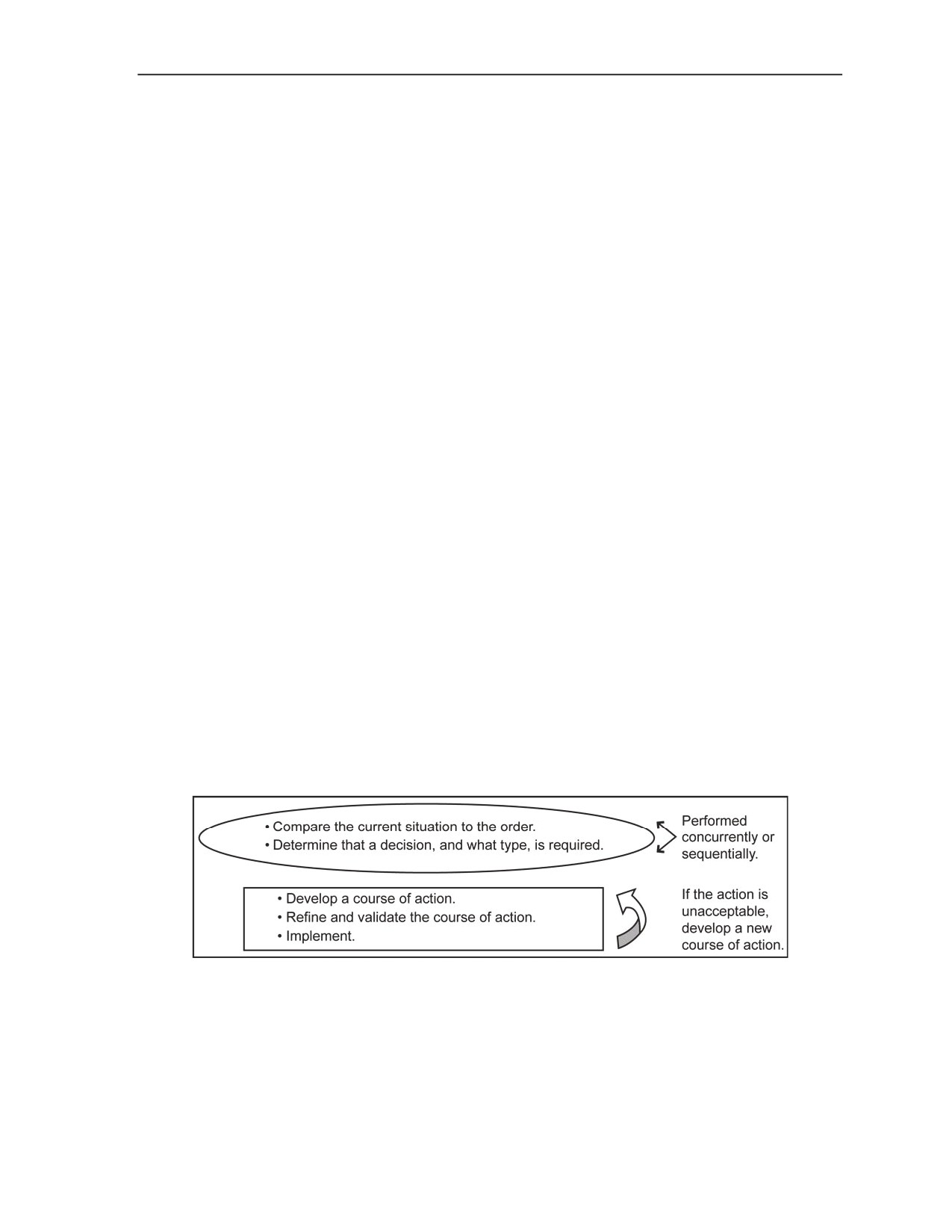
The rapid decisionmaking and synchronization process includes five steps. The first two may be performed
in any order, including concurrently. The last three are performed interactively until commanders identify
an acceptable course of action. (See figure 14-1.)
Figure 14-1. Rapid decisionmaking and synchronization process
COMPARE THE CURRENT SITUATION TO THE ORDER
14-13. Commanders and staffs identify likely variances during planning and identify options that will be
present and actions that will be available when each variance occurs. During execution, commanders and
staffs monitor the situation to identify changes in conditions. Then they ask if these changes affect the
overall conduct of operations or their part in them and if the changes are significant. Finally, they identify
5 May 2014
FM 6-0
14-3
Chapter 14
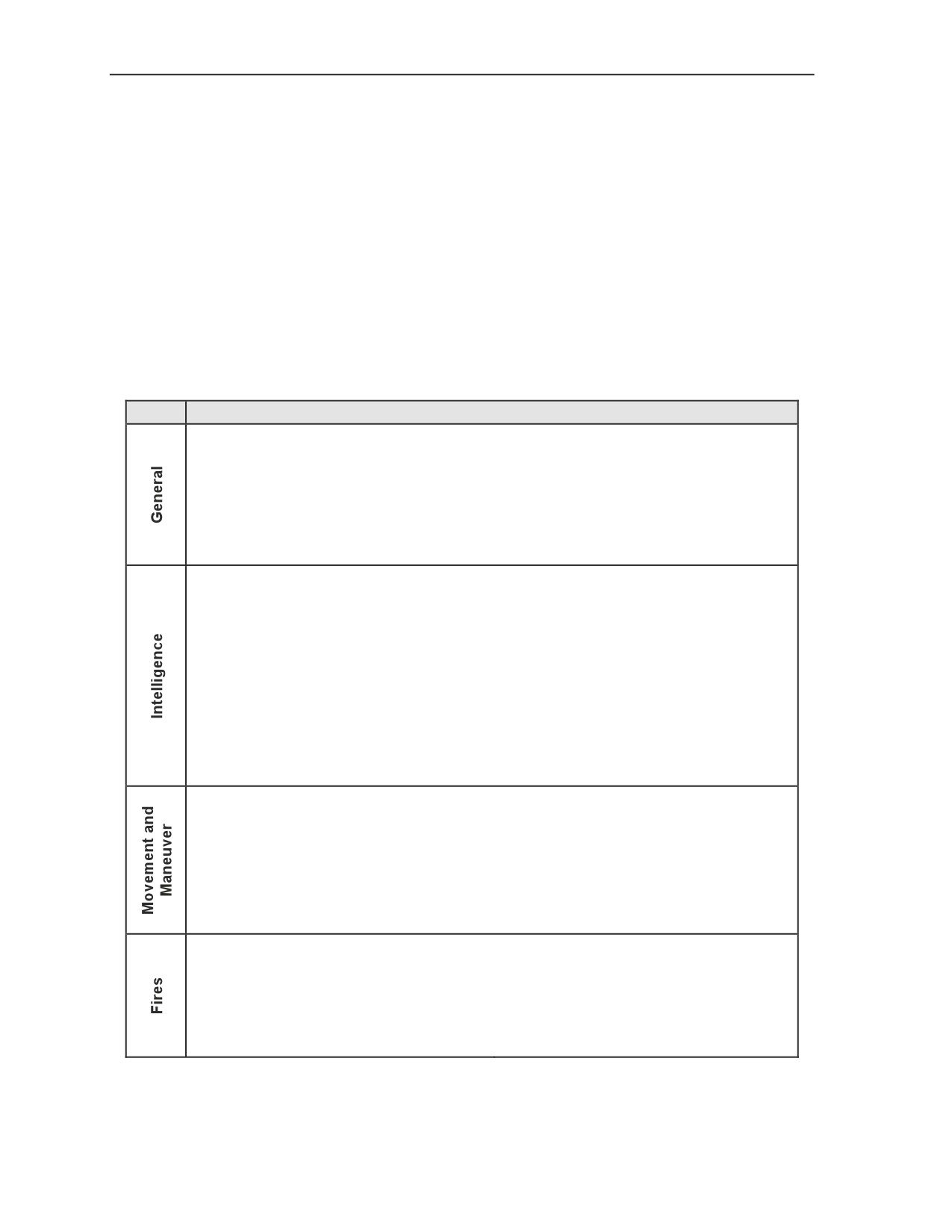
if the changed conditions represent variances from the order—especially opportunities and risks. Staff
members use running estimates to look for indicators of variances that affect their areas of expertise. (See
table 14-2 for examples of indicators.)
14-14. Staff members are particularly alert for answers to CCIRs that support anticipated decisions. They
also watch for exceptional information—information that would have answered one of the CCIRs if the
requirement for it had been foreseen and stated as one of the CCIRs. Exceptional information usually
reveals a need for an adjustment decision.
14-15. When performing the rapid decisionmaking and synchronization process, the current operations
integration cell first compares the current situation to the one envisioned in the order. It may obtain
assistance from the assessment section or the red team section in this analysis. If the situation requires
greater analysis, the chief of staff or executive officer (COS [XO]) may task the future operations cell
(where authorized) or the plans cell to perform this analysis. At echelons with no future operations cell, the
plans cell or the current operations integration cell performs this function.
Table 14-2. Examples of change indicators
Types
Indicators
x
Answer to a commander’s critical information
x
Change in capabilities of subordinate unit.
requirement.
x
Change in role of host-nation military force.
x
Identification of an information requirement.
x
Climate changes or natural disasters
x
Change in mission.
impacting on the population, agriculture,
industry.
x
Change in organization of unit.
x
Change in leadership of unit.
x
Upcoming local election.
x
Signing or implementation of peace treaty or
x
Changes in key civilian leadership.
other key political arrangement.
x
Identification of enemy main effort.
x
Enemy electronic attack use.
x
Identification of enemy reserves or
x
Indicators of illicit economic activity.
counterattack.
x
Identification of threats from within the
x
Indications of unexpected enemy action or
population.
preparation.
x
Increased unemployment within the
x
Increase in enemy solicitation of civilians for
population.
intelligence operations.
x
Interference with freedom of religious worship.
x
Identification of an information requirement.
x
Identification of high-value targets.
x
Insertion of manned surveillance teams.
x
Unmanned aircraft system launch.
x
Disruption of primary and secondary education
x
Answer to a priority intelligence requirement.
system.
x
Enemy rotary-wing or unmanned aircraft
x
Unexplained disappearance of key members of
system use.
intelligence community.
x
Success or failure in breaching or gap crossing
x
Success or failure of a subordinate unit task.
operations.
x
Modification of an airspace control measure.
x
Capture of significant numbers of enemy
x
Numbers of dislocated civilians sufficient to
prisoners of war, enemy command posts,
affect friendly operations.
supply points, or artillery units.
x
Damages to civilian infrastructure affecting
x
Establishment of road blocks along major
friendly mobility.
traffic routes.
x
Loss of one or more critical transportation
x
Unexplained displacement of neighborhoods
systems.
within a given sector.
x
Receipt of an air tasking order.
x
Execution of planned fires.
x
Battle damage assessment results.
x
Modification of a fire support coordination
x
Unplanned repositioning of firing units.
measure.
x
Identification of high-payoff targets.
x
Effective enemy counterfire.
x
Negative effects of fires on civilians.
x
Identification of an information requirement.
x
Destruction of any place of worship by friendly
fire.
14-4
FM 6-0
5 May 2014

Decisionmaking in Execution
Table 14-2. Examples of change indicators (continued)
Types
Indicators
x
Chemical, biological, radiological, nuclear
x
Identification of threats to communications
report or other indicators of enemy
or computer systems.
chemical, biological, radiological, nuclear
x
Reports of enemy targeting critical
use.
host-nation infrastructure.
x
Report or other indicators of enemy
x
Identification of threat to base or
improvised explosive device use.
sustainment facilities.
x
Indicators of coordinated enemy actions
x
Escalation of force incidents.
against civilians or friendly forces.
x
Loss of border security.
x
Increased criminal activity in a given sector.
x
Increase in organized protests or riots.
x
Significant loss of capability in any class of
x
Degradations to essential civilian
supply.
infrastructure by threat actions.
x
Opening or closing of civilian businesses
x
Civilian mass casualty event beyond
within a given area.
capability of host-nation resources.
x
Identification of significant incidences of
x
Identification of significant shortage in any
disease and nonbattle injury casualties.
class of supply.
x
Closing of major financial institutions.
x
Outbreak of epidemic or famine within the
x
Mass casualties.
civilian population.
x
Medical evacuation launch.
x
Receipt of significant resupply.
x
Dislocated civilian event beyond capability
x
Disruption of one or more essential civil
of host-nation resources.
services (such as water or electricity).
x
Disruption of key logistics lines of
x
Contact on a supply route.
communication.
x
Answer to a friendly force information
requirement.
x
Changes in availability of host-nation
support.
x
Mass detainees.
x
Impending changes in key military
x
Effective adversary information efforts on
leadership.
civilians.
x
Interference with freedom of the press or
x
Loss of civilian communications nodes.
news media.
x
Loss of contact with a command post or
x
Receipt of a fragmentary order or warning
commander.
order from higher headquarters.
x
Jamming or interference.
DETERMINE THE TYPE OF DECISION REQUIRED
14-16. When a variance is identified, the commander directs action while the chief of operations leads
chiefs of the current operations integration cell and selected functional cells in quickly comparing the
current situation to the expected situation. This assessment accomplishes the following:
z
Describes the variance.
z
Determines if the variance provides a significant opportunity or threat and examines the
potential of either.
z
Determines if a decision is needed by identifying if the variance:
Indicates an opportunity that can be exploited to accomplish the mission faster or with fewer
resources.
Directly threatens the decisive operation’s success.
Threatens a shaping operation such that it may threaten the decisive operation directly or in
the near future.
Can be addressed within the commander’s intent and concept of operations.
(If so,
determine what execution decision is needed.)
Requires changing the concept of operations substantially. (If so, determine what adjustment
decision or new approach will best suit the circumstances.)
5 May 2014
FM 6-0
14-5
Chapter 14
14-17. For minor variances, the chief of operations works with other cell chiefs to determine whether
changes to control measures are needed. If so, they determine how those changes affect other warfighting
functions. They direct changes within their authority (execution decisions) and notify the COS (XO) and
the affected command post cells and staff elements.
14-18. Commanders intervene directly in cases that affect the overall direction of the unit. They describe
the situation, direct their subordinates to provide any additional information they need, and order either
implementation of planned responses or development of an order to redirect the force.
DEVELOP A COURSE OF ACTION
14-19. If the variance requires an adjustment decision, the designated integrating cell and affected
command post cell chiefs recommend implementation of a COA or obtain the commander’s guidance for
developing one. They use the following conditions to screen possible COAs:
z
Mission.
z
Commander’s intent.
z
Current dispositions and freedom of action.
z
CCIRs.
z
Limiting factors, such as supply constraints, boundaries, and combat strength.
14-20. The new options must conform to the commander’s intent. Possible COAs may alter the concept of
operations and CCIRs, if they remain within the commander’s intent. However, the commander approves
changes to the CCIRs. Functional cell chiefs and other staff leaders identify areas that may be affected
within their areas of expertise by proposed changes to the order or mission. Course of action considerations
include, but are not limited to, those shown in table 14-3.
14-21. The commander is as likely as anyone else to detect the need for change and to sketch out the
options. Whether the commander, COS (XO), or chief of operations does this, the future operations cell is
often directed to further develop the concept and draft the order. The chief of operations and the current
operations integration cell normally lead this effort, especially if the response is needed promptly or the
situation is not complex. The commander or COS (XO) is usually the decisionmaking authority, depending
on the commander’s delegation of authority.
14-22. Commanders may delegate authority for execution decisions to their deputies, COSs (XOs), or
their operations officers. They retain personal responsibility for all decisions and normally retain the
authority for approving adjustment decisions.
14-23. When reallocating resources or priorities, commanders assign only minimum essential assets to
shaping operations. They use all other assets to weight the decisive operation. This applies when allocating
resources for the overall operation or within a warfighting function.
14-24. Commanders normally direct the future operations cell or the current operations integration cell to
prepare a fragmentary order (FRAGORD) setting conditions for executing a new COA. When lacking time
to perform the MDMP, or quickness of action is desirable, commanders make an immediate adjustment
decision—using intuitive decisionmaking—in the form of a focused COA. Developing the focused COA
often follows mental war-gaming by commanders until they reach an acceptable COA. If time is available,
commanders may direct the plans cell to develop a new COA using the MDMP, and the considerations for
planning become operative. (See table 14-3.)
14-6
FM 6-0
5 May 2014
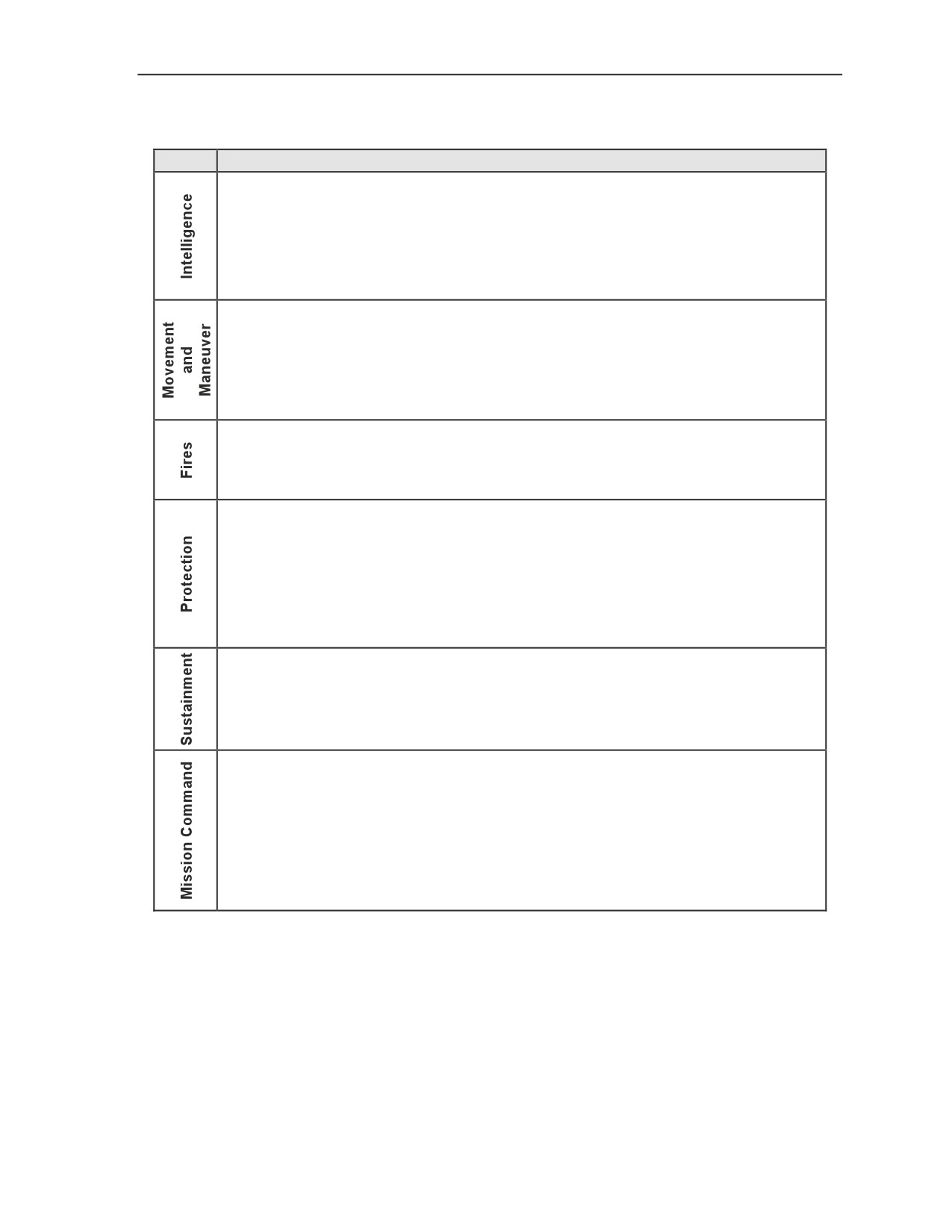
Decisionmaking in Execution
Table 14-3. Course of action considerations
Types
Actions
x
Modifying priority intelligence
x
Updating the enemy situation template
requirements and other intelligence
and enemy course of action
requirements.
statements.
x
Updating named areas of interest
x
Modifying the information collection
and target areas of interest.
plan.
x
Updating the intelligence estimate.
x
Confirming or denying threat course of
action.
x
Assigning new objectives.
x
Modifying airspace control measures.
x
Assigning new tasks to subordinate
x
Making unit boundary changes.
units.
x
Emplacing obstacles.
x
Adjusting terrain management.
x
Clearing obstacles.
x
Employing obscurants.
x
Establishing and enforcing movement
priority.
x
Delivering fires against targets or
x
Modifying radar zones.
target sets.
x
Modifying the priority of fires.
x
Modifying the high-payoff target list
x
Modifying fire support coordination
and the attack guidance matrix.
measures.
x
Moving air defense weapons
x
Changing air defense weapons control
systems.
status.
x
Establishing decontamination sites.
x
Enhancing survivability through
x
Conducting chemical, biological,
engineer support.
radiological, and nuclear
x
Revising and updating personnel
reconnaissance.
recovery coordination.
x
Establish movement corridors on
x
Reassigning or repositioning response
critical lines of communications.
forces.
x
Prioritizing medical evacuation
x
Repositioning and prioritizing general
assets.
engineering assets.
x
Repositioning logistics assets.
x
Modifying priorities.
x
Positioning and prioritizing detainee
x
Modifying distribution.
and resettlement assets.
x
Moving communications nodes.
x
Moving command posts.
x
Modifying information priorities for employing information as combat power.
x
Adjusting themes and messages to support the new decision.
x
Adjusting measures for minimizing civilian interference with operations.
x
Revising recommended protected targets.
x
Recommending modifications of stability tasks, including employment of civil affairs
operations and other units, to perform civil affairs operations tasks.
REFINE AND VALIDATE THE COURSE OF ACTION
14-25. Once commanders describe the new COA, the current operations integration cell conducts an
analysis to validate its feasibility, suitability, and acceptability. If acceptable, the COA is refined to
resynchronize the warfighting functions enough to generate and apply the needed combat power. Staffs
with a future operations cell may assign that cell responsibility for developing the details of the new COA
and drafting a fragmentary order to implement it. The commander or COS (XO) may direct an “on-call”
operations synchronization meeting to perform this task and ensure rapid resynchronization.
14-26. Validation and refinement are done quickly. Normally, the commander and staff officers conduct a
mental war game of the new COA. They consider potential enemy reactions, the unit’s counteractions, and
5 May 2014
FM 6-0
14-7
Chapter 14
secondary effects that might affect the force’s synchronization. Each staff member considers the following
items:
z
Is the new COA feasible in terms of my area of expertise?
z
How will this action affect my area of expertise?
z
Does it require changing my information requirements?
Should any of the information requirements be nominated as a CCIR?
What actions within my area of expertise does this change require?
Will this COA require changing objectives or targets nominated by staff members?
z
What other command post cells and elements does this action affect?
z
What are potential enemy reactions?
z
What are the possible friendly counteractions?
Does this counteraction affect my area of expertise?
Will it require changing my information requirements?
Are any of my information requirements potential CCIRs?
What actions within my area of expertise does this counteraction require?
Will it require changing objectives or targets nominated by staff members?
What other command post cells and elements does this counteraction affect?
14-27. The validation and refinement will show if the COA will solve the problem adequately. If it does
not, the COS or chief of operations modifies it through additional analysis or develops a new COA. The
COS (XO) informs the commander of any changes made to the COA.
IMPLEMENT
14-28. When a COA is acceptable, the COS (XO) recommends implementation to the commander or
implements it directly, if the commander has delegated that authority. Implementation normally requires a
FRAGORD; in exceptional circumstances, it may require a new operation order (OPORD). That order
changes the concept of operations (in adjustment decisions), resynchronizes the warfighting functions, and
disseminates changes to control measures. The staff uses warning orders
(WARNORDs) to alert
subordinates to a pending change. The staff also establishes sufficient time for the unit to implement the
change without losing integration or being exposed to unnecessary tactical risk.
14-29. Commanders often issue orders to subordinates verbally in situations requiring quick reactions. At
battalion and higher echelons, written FRAGORDs confirm verbal orders to ensure synchronization,
integration, and notification of all parts of the force. If time permits, leaders verify that subordinates
understand critical tasks. Verification methods include the confirmation brief and backbrief. These are
conducted both between commanders and within staff elements to ensure mutual understanding.
14-30. After the analysis is complete, the current operations integration cell and command post cell chiefs
update decision support templates and synchronization matrixes. When time is available, the operations
officer or chief of operations continues this analysis to the operation’s end to complete combat power
integration. Staff members begin the synchronization needed to implement the decision. This
synchronization involves collaboration with other command post cells and subordinate staffs. Staff
members determine how actions in their areas of expertise affect others. They coordinate those actions to
eliminate undesired effects that might cause friction. The cells provide results of this synchronization to the
current operations integration cell and the common operational picture.
14-8
FM 6-0
5 May 2014
Chapter 15
Assessment Plans
This chapter provides information on assessment and its role in the operations
process. Next, it describes the assessment process and defines key assessment terms.
This chapter concludes by describing a methodology for developing formal
assessment plans. (See ADRP 5-0 for more information on the fundamentals of
assessment.)
ASSESSMENT AND THE OPERATIONS PROCESS
15-1. Assessment is the determination of the progress toward accomplishing a task, creating a condition, or
achieving an objective (JP 3-0). Assessment precedes and guides the other activities of the operations
process. Assessment involves deliberately comparing forecasted outcomes with actual events to determine
the overall effectiveness of force employment. More specifically, assessment helps the commander
determine progress toward attaining the desired end state, achieving objectives, and performing tasks. It
also involves continuously monitoring and evaluating the operational environment to determine what
changes might affect the conduct of operations.
15-2. Throughout the operations process, commanders integrate their own assessments with those of the
staff, subordinate commanders, and other unified action partners. Primary tools for assessing progress of an
operation include the operation order (OPORD), the common operational picture, personal observations,
running estimates, and the assessment plan.
15-3. Assessment occurs at all echelons. The situation and echelon dictate the focus and methods leaders
use to assess. Normally, commanders assess those specific operations or tasks that they were directed to
accomplish. This properly focuses collection and assessment at each echelon, reduces redundancy, and
enhances the efficiency of the overall assessment process.
15-4. For units with a staff, assessment becomes more formal at each higher echelon. Assessment
resources (including staff officer expertise and time available) proportionally increase from battalion to
brigade, division, corps, and theater army. The analytic resources and level of expertise of staffs available
at higher echelon headquarters include a dedicated core group of analysts. This group specializes in
operations research and systems analysis, formal assessment plans, and various assessment products.
Division, corps, and theater army headquarters, for example, have fully resourced plans, future operations,
and current operations integration cells. They have larger intelligence staffs and more staff officers trained
in operations research and systems analysis. Assessment at brigade echelon and lower is usually less
formal, often relying on direct observations and the judgment of commanders and their staffs.
15-5. Often, time available for detailed analysis and assessment is shorter at lower echelons. Additionally,
lower echelon staffs are progressively smaller and have less analytic capability at each lower echelon. As
such, assessment at these echelons focuses on the near term and relies more on direct observation and
judgments than on detailed assessment plans and methods.
15-6. For small units (those without a staff), assessment is mostly informal. Small-unit leaders focus on
assessing their unit’s readiness—personnel, equipment, supplies, and morale—and their unit’s ability to
perform assigned tasks. Leaders also determine whether the unit has completed assigned tasks. If those
tasks have not produced the desired results, leaders explore why they have not and consider what
improvements could be made for unit operations. As they assess and learn, small units change their tactics,
techniques, and procedures based on their experiences. In this way, even the lowest echelons in the Army
follow the assessment process.
5 May 2014
FM 6-0
15-1
Chapter 15
THE ASSESSMENT PROCESS
15-7. Assessment is continuous; it precedes and guides every operations process activity and concludes
each operation or phase of an operation. Broadly, assessment consists of, but is not limited to, the following
activities—
z
Monitoring the current situation to collect relevant information.
z
Evaluating progress toward attaining end state conditions, achieving objectives, and performing
tasks.
z
Recommending or directing action for improvement.
MONITORING
15-8. Monitoring is continuous observation of those conditions relevant to the current operation
(ADRP 5-0). Monitoring within the assessment process allows staffs to collect relevant information,
specifically that information about the current situation that can be compared to the forecasted situation
described in the commander’s intent and concept of operations. Progress cannot be judged, nor effective
decisions made, without an accurate understanding of the current situation.
15-9. Staff elements record relevant information in running estimates. Staff elements maintain a
continuous assessment of current operations to determine if they are proceeding according to the
commander’s intent, mission, and concept of operations. In their running estimates, staff elements use this
new information and these updated facts and assumptions as the basis for evaluation.
EVALUATING
15-10. The staff analyzes relevant information collected through monitoring to evaluate the operation’s
progress toward attaining end state conditions, achieving objectives, and performing tasks. Evaluating is
using criteria to judge progress toward desired conditions and determining why the current degree of
progress exists (ADRP 5-0). Evaluation is at the heart of the assessment process where most of the analysis
occurs. Evaluation helps commanders determine what is working and what is not working, and it helps
them gain insights into how to better accomplish the mission.
15-11. Criteria in the forms of measures of effectiveness (MOEs) and measures of performance (MOPs)
aid in evaluating progress. MOEs help determine if a task is achieving its intended results. MOPs help
determine if a task is completed properly. MOEs and MOPs are simply criteria—they do not represent the
assessment itself. MOEs and MOPs require relevant information in the form of indicators for evaluation.
15-12. A measure of effectiveness is a criterion used to assess changes in system behavior, capability, or
operational environment that is tied to measuring the attainment of an end state, achievement of an
objective, or creation of an effect (JP 3-0). MOEs help measure changes in conditions, both positive and
negative. MOEs are commonly found and tracked in formal assessment plans. MOEs help to answer the
question “Are we doing the right things?”
15-13. A measure of performance is a criterion used to assess friendly actions that is tied to measuring
task accomplishment (JP 3-0). MOPs help answer questions such as “Was the action taken?” or “Were the
tasks completed to standard?” A MOP confirms or denies that a task has been properly performed. MOPs
are commonly found and tracked at all echelons in execution matrixes. MOPs are also commonly used to
evaluate training. MOPs help to answer the question “Are we doing things right?” There is no direct
hierarchical relationship among MOPs to MOEs. Measures of performance do not feed MOEs, or combine
in any way to produce MOEs—MOPs simply measure the performance of a task.
15-14. In the context of assessment, an indicator is an item of information that provides insight into a
measure of effectiveness or measure of performance (ADRP 5-0). Indicators take the form of reports from
subordinates, surveys and polls, and information requirements. Indicators help to answer the question
“What is the current status of this MOE or MOP?” A single indicator can inform multiple MOPs and
MOEs. (See table 15-1 for additional information concerning MOEs, MOPs, and indicators.)
15-2
FM 6-0
5 May 2014

Assessment Plans
Table 15-1. Assessment measures and indicators
Measure of effectiveness
Measure of performance
Indicator
(MOE)
(MOP)
Used to measure
Used to measure task
Used to provide insight into a MOE
attainment of an end state
accomplishment.
or MOP.
condition, achievement of
an objective, or creation of
an effect.
Answers the question:
Answers the question:
Answers the question:
Are we doing the right
Are we doing things right?
What is the status of this MOE or
things?
MOP?
Measures why (purpose)
Measures what (task
Information used to make
in the mission statement.
completion) in the mission
measuring what or why possible.
statement.
No direct hierarchical
No direct hierarchical
Subordinate to MOEs and MOPs.
relationship to MOPs.
relationship to MOEs.
Often formally tracked in
Often formally tracked in
Often formally tracked in formal
formal assessment plans.
execution matrixes.
assessment plans.
Typically challenging to
Typically simple to choose
Typically as challenging to select
choose the appropriate
the appropriate ones.
appropriately as the supported
ones.
MOE or MOP.
RECOMMENDING OR DIRECTING ACTION
15-15. Monitoring and evaluating are critical activities; however, assessment is incomplete without
recommending or directing action. Assessment may diagnose problems, but unless it results in
recommended adjustments, its use to the commander is limited.
15-16. When developing recommendations, staffs draw from many sources and consider their
recommendations within the larger context of the operation. While several ways to improve a particular
aspect of the operation might exist, some recommendations could impact other aspects of the operation. As
with all recommendations, staffs should address any future implications.
ASSESSMENT PLAN DEVELOPMENT
15-17. Critical to the assessment process is developing an assessment plan. Units use assessment working
groups to develop assessment plans when appropriate. A critical element of the commander’s planning
guidance is determining which assessment plans to develop. An assessment plan focused on attainment of
end state conditions often works well. It is also possible, and may be desirable, to develop an entire formal
assessment plan for an intermediate objective, a named operation subordinate to the base operation plan, or
a named operation focused solely on a single line of operations or geographic area. The time, resources,
and added complexity involved in generating an assessment plan strictly limit the number of such efforts.
15-18. Commanders and staffs integrate and develop an assessment plan within the military
decisionmaking process (MDMP). As the commander and staff begin mission analysis, they also need to
determine how to measure progress towards the operation’s end state.
15-19. Effective assessment incorporates both quantitative
(observation-based) and qualitative
(judgment-based) indicators. Human judgment is integral to assessment. A key aspect of any assessment is
the degree to which it relies upon human judgment and the degree to which it relies upon direct observation
and mathematical rigor. Rigor offsets the inevitable bias, while human judgment focuses rigor and
processes on intangibles that are often key to success. The appropriate balance depends on the situation—
particularly the nature of the operation and available resources for assessment—but rarely lies at the ends
of the scale.
5 May 2014
FM 6-0
15-3
Chapter 15
ASSESSMENT STEPS
15-20. During planning, the assessment working group develops an assessment plan using six steps:
z
Step 1—Gather tools and assessment data.
z
Step 2—Understand current and desired conditions.
z
Step 3—Develop an assessment framework.
z
Step 4—Develop the collection plan.
z
Step 5—Assign responsibilities for conducting analysis and generating recommendations.
z
Step 6—Identify feedback mechanisms.
Once the assessment working group develops the assessment plan, it applies the assessment process of
monitor, evaluate, and recommend or direct continuously throughout preparation and execution.
STEP 1—GATHER TOOLS AND ASSESSMENT DATA
15-21. Planning begins with receipt of mission. The receipt of mission alerts the staffs to begin updating
their running estimates and gather the tools necessary for mission analysis and continued planning. Specific
tools and information gathered regarding assessment include, but are not limited to—
z
The higher headquarters’ plan or order, including the assessment annex if available.
z
If replacing a unit, any current assessments and assessment products.
z
Relevant assessment products (classified or open-source) produced by civilian and military
organizations.
z
The identification of potential data sources, including academic institutions and civilian subject
matter experts.
STEP 2—UNDERSTAND CURRENT AND DESIRED CONDITIONS
15-22. Fundamentally, assessment is about measuring progress toward the desired end state. To do this,
commanders and staffs compare current conditions in the area of operations against desired conditions.
Army design methodology and the MDMP help commanders and staffs develop an understanding of the
current situation. As planning continues, the commander identifies desired conditions that represent the
operation’s end state.
15-23. Early in planning, commanders issue their initial commander’s intent, planning guidance, and
commander’s critical information requirements (CCIRs). The end state in the initial commander’s intent
describes the desired conditions the commander wants to achieve. The staff element responsible for the
assessment plan identifies each specific desired condition mentioned in the commander’s intent. These
specific desired conditions focus the overall assessment of the operation. Understanding current conditions
and desired conditions forms the basis for building the assessment framework.
STEP 3—DEVELOP AN ASSESSMENT FRAMEWORK
15-24. All plans and orders have a general logic. This logic links tasks to subordinate units to the
achievement of objectives, and the achievement of objectives to attainment of the operation’s end state. An
assessment framework incorporates the logic of the plan and uses measures (MOEs, MOPs, and indicators)
as tools to determine progress toward attaining desired end state conditions. (See figure 15-1.)
15-4
FM 6-0
5 May 2014
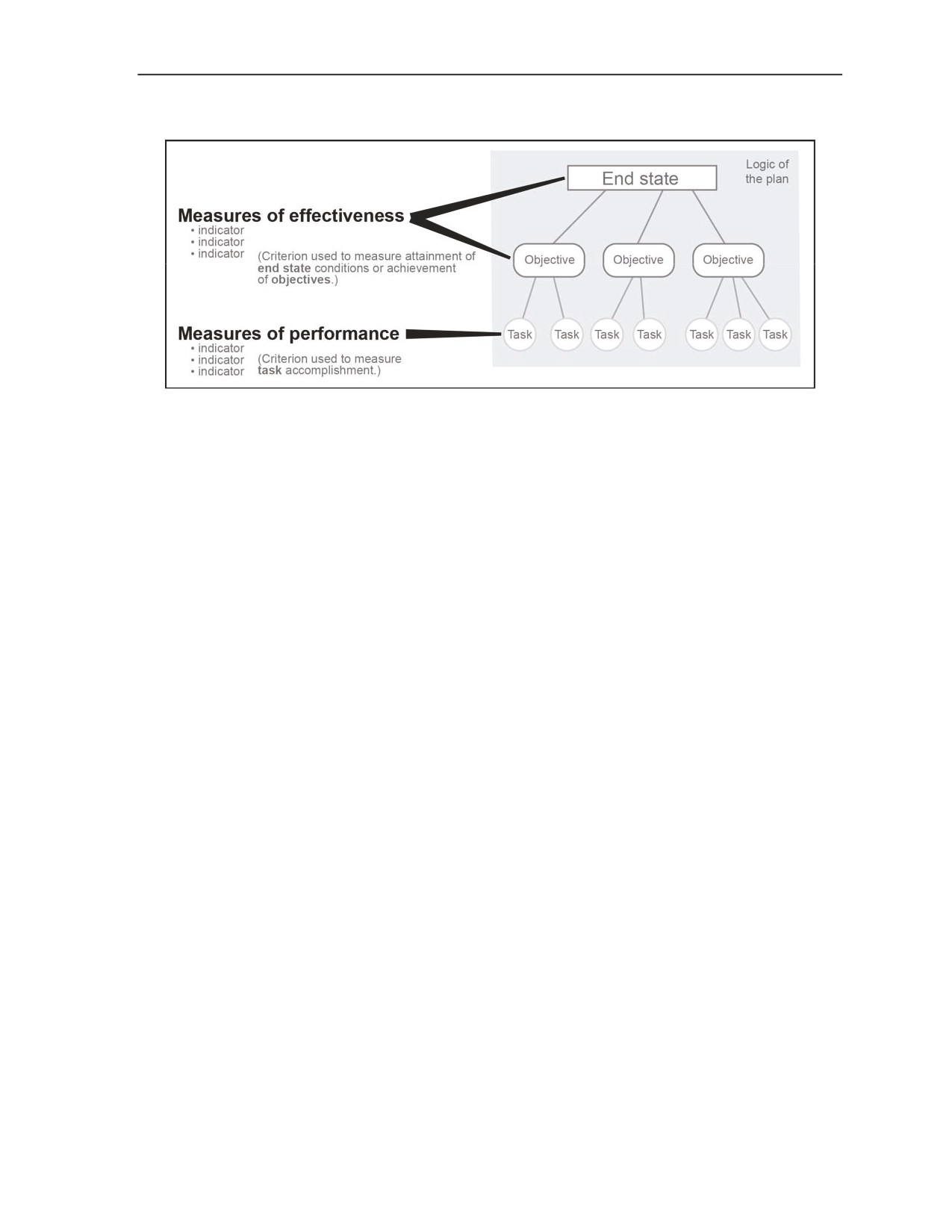
Assessment Plans
Figure 15-1. Assessment framework
15-25. Developing an assessment framework involves—
z
Selecting and writing measures (MOEs and MOPs).
z
Organizing the measures into an assessment framework.
Selecting and Writing Measures
15-26. Based on their understanding of the plan, members of the staff develop specific MOEs and MOPs
(with associated indicators) to evaluate the operations process. Measures of effectiveness are tools used to
help measure the attainment of end state conditions, achievement of objectives, or creation of effects.
Measures of performance are criteria used to assess friendly actions that are tied to measuring task
accomplishment.
Selecting and Writing Measures of Effectiveness
15-27. Guidelines for selecting and writing MOEs consist of the following:
z
Select only MOEs that measure the degree to which the desired outcome is achieved.
z
Choose distinct MOEs.
z
Include MOEs from different causal chains.
z
Use the same MOE to measure more than one condition when appropriate.
z
Avoid overburdening subordinates with additional reporting requirements.
z
Structure MOEs so that they have measurable, collectable, and relevant indicators.
z
Write MOEs as statements not questions.
z
Maximize clarity.
15-28. Commanders select only MOEs that measure the degree to which the desired outcome is achieved.
There must be an expectation that a given MOE will change as the conditions being measured change.
15-29. Commanders choose MOEs for each condition as distinct from each other as possible. Using
similar MOEs can skew the assessment by containing virtually the same MOE twice.
15-30. Commanders include MOEs from differing relevant causal chains for each condition whenever
possible. When MOEs have a cause and effect relationship with each other, either directly or indirectly, it
decreases their value in measuring a particular condition. Measuring progress towards a desired condition
by multiple means adds rigor to the assessment.
15-31. In the example in figure 15-2 on page 15-6 under condition 1, both MOE 1 and MOE 3 have no
apparent cause and effect relationship with each other, although both are valid measures of the condition.
This adds rigor and validity to the measurement of that condition. MOE 2 does have a cause and effect
5 May 2014
FM 6-0
15-5
Chapter 15
relationship with MOE 1 and MOE 3, but it is a worthwhile addition because of the direct relevancy and
mathematical rigor of that particular source of data. (See figure 15-2.)
End state condition 1: Enemy division X forces prevented from interfering with corps
decisive operation.
MOE 1: Enemy division X forces west of phase line blue are defeated.
x Indicator 1: Friendly forces occupy objective SLAM (yes or no).
x Indicator 2: Number of reports of squad-sized or larger enemy forces in the division area of
operations in the past 24 hours.
x Indicator 3: Current G-2 assessment of number of enemy division X battalions west of phase
line blue.
MOE 2: Enemy division X forces indirect fire systems neutralized.
x Indicator 1: Number of indirect fires originating from enemy division X’s integrated fires
command in the past 24 hours.
x Indicator 2: Current G-2 assessment of number of operational 240mm rocket launchers within
enemy division X’s integrated fires command.
MOE 3: Enemy division X communications systems disrupted.
x Indicator 1: Number of electronic transmissions from enemy division X detected in the past 24
hours.
x Indicator 2: Number of enemy division X battalion and higher command posts destroyed.
G-2
assistant chief of staff, intelligence
mm millimeter
MOE
measure of effectiveness
Figure 15-2. Example end state conditions for a defense
15-32. Commanders use the same MOE to measure more than one condition when appropriate. This sort
of duplication in the assessment framework does not introduce significant bias unless carried to the
extreme.
15-33. Commanders avoid or minimize additional reporting requirements for subordinate units. In many
cases, commanders use information requirements generated by other staff elements as MOEs and indicators
in the assessment plan. With careful consideration, commanders and staffs can often find viable alternative
MOEs without creating new reporting requirements. Excessive reporting requirements can render an
otherwise valid assessment plan onerous and untenable.
15-34. Commanders structure MOEs so that measurable, collectable, and relevant indicators exist for
them. A MOE is of no use if the staff cannot actually measure it.
15-35. Commanders write MOEs as statements, not questions. MOEs supply answers to questions rather
than the questions themselves.
15-36. Commanders maximize clarity. A MOE describes the sought information precisely, including
specifics on time, information, geography, or unit, if needed. Any staff member should be able to read the
MOE and understand exactly what information it describes.
Selecting and Writing Measures of Performance
15-37. MOPs are criteria used to assess friendly actions that are tied to measuring task accomplishment.
MOPs help to answer questions such as “Was the action taken?” or “Were the tasks completed to
standard?” A MOP confirms or denies that a task has been properly performed. MOPs are commonly found
and tracked at all levels in execution matrixes.
15-38. In general, operations consist of a series of collective tasks sequenced in time, space, and purpose
to accomplish missions. The current operations cells use MOPs in execution matrixes and running
estimates to track completed tasks. Evaluating task accomplishment using MOPs is relatively
straightforward and often results in a yes or no answer. Examples of MOPs include:
z
Route X cleared.
z
Generators delivered, are operational, and are secured at villages A, B, and C.
15-6
FM 6-0
5 May 2014
Assessment Plans
z
$15,000 spent for schoolhouse completion.
z
Aerial dissemination of 60,000 leaflets over village D.
Selecting and Writing Indicators
15-39. Staffs develop indicators that provide insights into MOEs and MOPs. Staffs can gauge a
measurable indicator either quantitatively or qualitatively. Imprecisely defined indicators often pose a
problem. For example, staffs cannot measure the indicator “Number of local nationals shopping.” The
information lacks clear parameters in time or geography. Staffs can measure the revised indicator “Average
daily number of local nationals visiting main street market in city X this month.” Additionally, staffs
should design the indicator to minimize bias. This particularly applies when staffs only have qualitative
indicators available for a given MOE. Many qualitative measures are easily biased, and Soldiers must use
safeguards to protect objectivity in the assessment process. (See figure 15-3.)
15-40. A collectable indicator has reasonably obtained data associated with the indicator. In some cases,
the data may not exist, or the data may be prohibitively difficult to collect. As an example, if condition 2
MOE 2 in figure 15-3 had the indicator “Host-nation medical care availability in city X this month” that
indicator is not likely collectable. This number exists, but unless a trusted source tracks and reports it,
Soldiers cannot collect it. The revised indicator “Battalion commander’s monthly estimate of host-nation
medical care availability in city X on a scale of 1 to 5” is collectable. In this case, the staff did not have a
quantitative indicator available, so they substituted a qualitative indicator.
End state condition 1: Enemy defeated in the brigade area of operations.
MOE 1: Enemy kidnapping activity in the brigade area of operations disrupted.
x Indicator 1: Monthly reported dollars in ransom paid as a result of kidnapping operations.
x Indicator 2: Monthly number of reported attempted kidnappings.
x Indicator 3: Monthly poll question #23: “Have any kidnappings occurred in your neighborhood
in the past 30 days?” Results for provinces ABC only.
MOE 2: Public perception of security in the brigade area of operations improved.
x Indicator 1: Monthly poll question #34: “Have you changed your normal activities in the past
month because of concerns about your safety and that of your family?” Results for provinces
ABC only.
x Indicator 2: Monthly kindergarten through high school attendance in provinces ABC as
reported by the host-nation ministry of education.
x Indicator 3: Monthly number of tips from local nationals reported to the brigade terrorism tips
hotline.
MOE 3: Sniper events in the brigade area of operations disrupted.
x Indicator 1: Monthly decrease in reported sniper events in the brigade area of operations.
(Note: It is acceptable to have only one indicator that directly answers a given MOE. Avoid
complicating the assessment needlessly when a simple construct suffices.)
Condition 2: Role 1 medical care available to the population in city X.
MOE 1: Public perception of medical care availability improved in city X.
x Indicator 1: Monthly poll question #42: “Are you and your family able to visit a doctor or health
clinic when you need to?” Results for provinces ABC only.
x Indicator 2: Monthly poll question #8: “Do you and your family have important health needs that
are not being met?” Results for provinces ABC only.
x Indicator 3: Monthly decrease in number of requests for medical care received from local
nationals by the brigade.
MOE 2: Battalion commander estimated monthly host-nation medical care availability in
battalion area of operations.
x Indicator 1: Monthly average of reported battalion commander’s estimates (scale of 1 to 5) of
host-nation medical care availability in the battalion area of operation.
MOE measure of effectiveness
Figure 15-3. Example end state conditions for a stability operation
5 May 2014
FM 6-0
15-7
Chapter 15
15-41. An indicator is relevant if it provides insight into a supported MOE or MOP. Commanders must
ask pertinent questions, such as—
z
Does a change in this indicator actually indicate a change in the MOE?
z
What factors unrelated to the MOE could cause this indicator to change?
z
How reliable is the correlation between the indicator and the MOE?
15-42. For example, the indicator “Decrease in monthly weapons caches found and cleared in the division
area of operations” is not relevant to the MOE “Decrease in enemy activity in the division area of
operations.”
15-43. The indicator could plausibly increase or decrease with a decrease in enemy activity. An increase
in friendly patrols could result in greater numbers of caches found and cleared. Staffs may also have
difficulty determining when the enemy left the weapons, raising the question of when the enemy activity
actually occurred. These factors, unrelated to enemy activity, could artificially inflate the indicator, creating
a false impression of increased enemy activity within the assessment framework. In this example, staffs can
reliably measure enemy activity levels without considering weapons caches or using the indicator for this
MOE.
Organizing the Assessment Framework
15-44. When organizing the assessment framework, MOEs and MOPs can be applied to the logic of the
plan in different ways. The overall approach to using those measures is visually depicted in the assessment
framework. That overall approach may be more quantitative or more qualitative, although it rarely resides
at the extremes.
15-45. Regardless of the specific measures chosen and the specific ways they are used in the formal
assessment plan, it is imperative that the staff explicitly records the logic it uses to create the assessment
framework. Every measure used is chosen for a reason, and that reason must be recorded in a narrative
form in the formal assessment plan. Specific measures are combined (or not combined) in specific ways in
the formal assessment, and those reasons must be recorded explicitly in the formal assessment plan.
Lessons learned have shown that the rationale involved in creating a formal assessment plan can be rapidly
lost. Recording the logic in the assessment plan mitigates this risk.
15-46. One example of organizing an assessment framework is a hierarchical structure which begins with
end state conditions, followed by MOEs, and finally indicators. Commanders broadly describe the
operation’s end state in their commander’s intent. The assessment working group then identified specific
desired conditions from the commander’s intent. Staffs measure each condition by MOEs. The MOEs are
in turn informed by indicators.
15-47. Such a formal assessment framework is simply a tool to assist commanders with estimating
progress. Using a formal assessment framework does not imply that commanders mathematically determine
the outcomes of military operations. Commanders and staff officers apply judgment to results of
mathematical assessment to assess progress holistically. For example, commanders in an enduring
operation may receive a monthly formal assessment briefing from their staff. This briefing includes both
the products of the formal assessment process as well as the expert opinions of members of the staff,
subordinate commanders, and other partners. Commanders combine what they find useful in those two
viewpoints with their personal assessment of the operation, consider recommendations, and direct action as
needed.
15-48. A significant amount of human judgment goes into designing such an assessment framework.
Choosing MOEs and indicators that accurately measure progress toward each desired condition is an art.
Processing elements of the assessment framework requires establishing weights and thresholds for each
MOE and indicator. Setting proper weights and thresholds requires operational expertise and judgment.
Input from the relevant staff elements and subject matter experts is critical. Staffs record the logic of why
the commander chose each MOE and indicator. This facilitates personnel turnover as well as an
understanding of the assessment plan among all staff elements.
15-49. Another approach to organizing an assessment framework focuses on producing narrative
assessments for each end state condition, using measures (MOEs, MOPs, and indicators) to argue for or
15-8
FM 6-0
5 May 2014
Assessment Plans
against progress rather than combining the measures in one holistic mathematical model. Under this
approach, the assessment working group builds the most convincing arguments they can for and against the
achievement of a given end state condition. Significant mathematical rigor may be a part of these
arguments, but a holistic mathematical model is rejected. After the for and against arguments are produced,
the assessment working group applies judgment to that raw material to create the most plausible narrative
assessment for that end state condition. The chair of the assessment working group determines when the
collective judgment of the group is in dispute.
STEP 4—DEVELOP THE COLLECTION PLAN
15-50. Each indicator represents an information requirement. In some situations, staffs feed these
information requirements into the information collection synchronization process. Then, staffs task
information collection assets to collect on these information requirements. In other situations, reports in the
unit standard operating procedures (SOPs) may suffice. If not, the unit may develop a new report. Staffs
may collect the information requirement from organizations external to the unit. For example, a host
nation’s central bank may publish a consumer price index for that nation. The assessment plan identifies the
source for each indicator as well as the staff member who collects that information. Assessment
information requirements compete with other information requirements for resources. When an information
requirement is not resourced, staffs cannot collect the associated indicator and must remove it from the
plan. Staffs then adjust the assessment framework to ensure that the MOE or MOP is properly worded.
STEP 5—ASSIGN RESPONSIBILITIES FOR CONDUCTING ANALYSIS AND GENERATING
RECOMMENDATIONS
15-51. In addition to assigning responsibility for collection, commanders assign staff members to analyze
assessment data and develop recommendations. For example, the intelligence officer leads the assessment
of enemy forces. The engineer officer leads the effort on assessing infrastructure development. The civil
affairs operations officer leads assessment concerning the progress of local and provincial governments.
The chief of staff aggressively requires staff principals and subject matter experts to participate in
processing the formal assessment and in generating smart, actionable recommendations. The operations
research and analysis officer assists the commander and staff with developing both assessment frameworks
and the command’s assessment process.
STEP 6—IDENTIFY FEEDBACK MECHANISMS
15-52. A formal assessment with meaningful recommendations that is not presented to the appropriate
decisionmaker wastes time and energy. The assessment plan identifies the who, what, when, where, and
why of that presentation. The commander and staff discuss feedback leading up to and following that
presentation as well. Feedback might include which assessment working groups the commander requires
and how to act on and follow up on recommendations.
5 May 2014
FM 6-0
15-9
Chapter 16
After Action Reviews and Reports
This chapter discusses how to plan for and use the after action review as a learning
tool. This chapter concludes with a discussion of and a format for the after action
report.
INTRODUCTION TO AFTER ACTION REVIEWS AND REPORTS
16-1. An after action review is a guided analysis of an organization’s performance, conducted at
appropriate times during and at the conclusion of a training event or operation with the objective of
improving future performance. It includes a facilitator, event participants, and other observers (ADRP 7-0).
Leaders can use action reviews not only for training situations, but also for operations. Leaders can also
employ after action reviews during pauses in action, as individual missions are completed, or after phases
of the operation as time permits, enabling units to also learn during operations.
16-2. The after action report is the written record of a unit’s after action review, or a consolidation of
comments, lessons learned, or best practices during the course of an operation or exercise. The after action
report documents a unit’s actions for historical purposes and highlights key lessons learned and best
practices. Commanders systematically collect, use, and share lessons learned and best practices throughout
an operation or extended training event. Additionally, lessons learned and best practices are available for
consideration and application by the operating and generating force through the Center for Army Lessons
Learned. (See paragraphs 16-50 to 16-53 for an after action report discussion and table 16-1 for an after
action report format.)
FORMAL AND INFORMAL AFTER ACTION REVIEWS
16-3. Two types of after action reviews exist: formal and informal. Commanders generally conduct formal
action reviews after completing a mission. Normally, only informal after action reviews are possible during
the conduct of operations.
16-4. Leaders plan formal after action reviews when they complete an operation or otherwise realize they
have the need, time, and resources available. Formal after action reviews require more planning and
preparation than informal after action reviews. Formal after action reviews require site reconnaissance and
selection; coordination for aids
(such as terrain models and large-scale maps); and selection, setup,
maintenance, and security of the after action review site. During formal after action reviews, the after
action review facilitator (unit leader or other facilitator) provides an overview of the operation and focuses
the discussion on topics the after action review plan identifies. At the conclusion, the facilitator reviews
identified and discussed key points and issues, and summarizes strengths and weaknesses.
16-5. Leaders use informal after action reviews as on-the-spot coaching tools while reviewing Soldier and
unit performance during or immediately after execution. Informal after action reviews involve all Soldiers.
These after action reviews provide immediate feedback to Soldiers, leaders, and units after execution. Ideas
and solutions leaders gathered during informal after action reviews can be applied immediately as the unit
continues operations. Successful solutions can be identified and transferred as lessons learned.
16-6. Formal and informal after action reviews generally follow the same format:
z
Review what was supposed to happen. The facilitator and participants review what was
supposed to happen. This review is based on the commander’s intent for the operation, unit
operation or fragmentary orders (FRAGORDs), the mission, and the concept of operations.
z
Establish what happened. The facilitator and participants determine to the extent possible what
actually happened during execution. Unit records and reports form the basis of this
5 May 2014
FM 6-0
16-1
Chapter 16
determination. An account describing actual events as closely as possible is vital to an effective
discussion. The assistant chief of staff, intelligence
(G-2 [S-2]) provides input about the
operation from the enemy’s perspective.
z
Determine what was right or wrong with what happened. Participants establish the strong and
weak points of their performance. The facilitator guides discussions so that the conclusions the
participants reach are operationally sound, consistent with Army standards, and relevant to the
operational environment.
z
Determine how the task should be done differently next time. The facilitator helps the chain of
command lead the group in determining how participants might perform the task more
effectively. The intended result is organizational and individual learning that can be applied to
future operations. If successful, this learning can be disseminated as lessons learned.
16-7. Leaders understand that not all tasks will be performed to standard. In their initial planning, they
allocate time and other resources for retraining after execution or before the next operation. Retraining
allows participants to apply the lessons learned from after action reviews and implement corrective actions.
Retraining should be conducted at the earliest opportunity to translate observations and evaluations from
after action reviews into performance in operations. Commanders ensure Soldiers understand that training
is incomplete until the identified corrections in performance have been achieved. Successful lessons can be
identified as lessons learned and disseminated.
16-8. After action reviews are often tiered as multi-echelon leader development tools. Following a session
involving all participants, senior commanders may continue after action reviews with selected leaders as
extended professional discussions. These discussions usually include a more specific review of leader
contributions to the operation’s results. Commanders use this opportunity to help subordinate leaders
master current skills and prepare them for future responsibilities. After action reviews are opportunities for
knowledge transfer through teaching, coaching, and mentoring.
16-9. Commanders conduct a final after action review during recovery after an operation. This after action
review may include a facilitator. Unit leaders review and discuss the operation. Weaknesses or
shortcomings identified during earlier after action reviews are identified again and discussed. If time
permits, the unit conducts training to correct these weaknesses or shortcomings in preparation for future
operations.
16-10. Lessons learned can be disseminated in at least three ways. First, participants may make notes to
use in retraining themselves and their sections or units. Second, facilitators may gather their own and
participants’ notes for collation and analysis before dissemination and storage for others to use.
Dissemination includes forwarding lessons to other units conducting similar operations as well as to the
Center for Army Lessons Learned, doctrinal proponents, and generating force agencies. Third, units should
publicize future successful applications of lessons as lessons learned.
BENEFITS OF AFTER ACTION REVIEWS
16-11. After action reviews are the dynamic link between task performance and execution to standard.
Through the professional, candid discussion of events, Soldiers can identify what went right and what went
wrong during the operation using measures of effectiveness. When appropriate, they can evaluate their
performance of tasks using measures of performance. (See chapter 15 for more information on measures of
effectiveness and measures of performance).
16-12. The discussion helps Soldiers and leaders identify specific ways to improve unit proficiency. Units
achieve the benefits of after action reviews by applying their results. Applications may include organizing
observations, insights, and lessons learned; revising how the unit executes tactics, techniques, and
procedures; and developing future training.
16-13. After action reviews may reveal problems with unit standard operating procedures. If so, unit
leaders revise the procedures and ensure that the unit implements the changes during future operations.
Leaders can use the knowledge that after action reviews develop to assess performance, correct
deficiencies, and sustain demonstrated task proficiency. These improvements will enhance unit
performance in future operations.
16-2
FM 6-0
5 May 2014
After Action Reviews and Reports
CONDUCTING AFTER ACTION REVIEWS
16-14. Effective after action reviews require planning and preparation. During planning for an operation,
commanders allocate time and resources for conducting after action reviews and assign responsibilities for
them. The amount and level of detail needed during planning and preparation depends on the type of after
action review and the resources available. The after action review process has four steps:
z
Step 1—Plan.
z
Step 2—Prepare.
z
Step 3—Execute.
z
Step 4—Follow-up (using after action reports).
16-15. After action reviews during operations differ from those during training in the lack of observer
controllers or observer trainers. During operations, there are no dedicated collectors of data and
observations. Instead, unit generated assessments of the operation’s progress form the basis of the after
action review.
PLANNING AFTER ACTION REVIEWS
16-16. An after action review plan provides the foundation for a successful after action review.
Commanders develop a plan for each after action review as time allows. The plan specifies—
z
Who will conduct the after action review.
z
Who will provide information.
z
Aspects of the operation the after action review should evaluate.
z
Who will attend the after action review.
z
When and where the after action review will occur.
z
Aids to be used for the after action review.
16-17. Commanders or facilitators use the after action review plan to identify critical places and events
that must be covered to provide a useful after action review. Examples include the decisive operation,
critical transitions, and essential tasks. The after action review plan also includes who will address each
event.
16-18. Commanders specify what they want to accomplish with the after action review and what the after
action review will address. The operation order (OPORD) may provide tasks and conditions. Measures of
effectiveness and some measures of performance are extracted from the order. FM
7-15 contains
recommended measures of performance to develop training and evaluation outline evaluation criteria for
supporting tasks. The primary source for standards for most Army units is their proponent-approved
collective tasks.
16-19. Copies of the OPORD and daily journal are given to the senior facilitator. The senior facilitator
distributes these to the after action review team members to review and use them to identify critical events
and times for discussion during the after action review.
Scheduling After Action Reviews
16-20. Commanders plan for an after action review at the end of each operation whenever possible. The
after action review planner should decide the scope of the after action review and allocate sufficient time.
Quality after action reviews help Soldiers receive better feedback on their performance and remember
lessons longer.
Determining Who Will Attend
16-21. The after action review plan specifies who the commander wants to attend the after action review.
At each echelon, an after action review has a primary set of participants. At squad and platoon levels, all
Soldiers should attend and participate. At company and higher levels, it may not be practical to have
everyone attend because of operations or training. In this case, unit commanders, other unit leaders, and
5 May 2014
FM 6-0
16-3
Chapter 16
other key players may be the only participants. Facilitators may recommend additional participants, based
on their observations.
Choosing After Action Review Aids
16-22. Appropriate aids add to an after action review’s effectiveness; however, facilitators use an aid only
if it makes the after action review better. Aids should promote learning and directly support discussion of
the operation. Dry-erase boards, video equipment, terrain models, enlarged maps, and unit information
systems are all worthwhile under the right conditions. Terrain visibility, group size, suitability for the task,
and availability of electric power are all considerations when selecting after action review aids.
Preparing the After Action Review Plan
16-23. The after action review plan is only a guide. Commanders and facilitators should review it
regularly to make sure it still applies and meets the unit’s needs. The plan may be adjusted as necessary, but
changes take preparation and planning time away from facilitators and leaders. The after action review plan
should allow facilitators and leaders as much time as possible to prepare.
PREPARING FOR AFTER ACTION REVIEWS
16-24. Preparation is key to effectively executing any plan. Facilitators begin to prepare for an after action
review before the operation and continue preparations until the actual event. Facilitators announce to unit
leaders the starting time and location as soon as possible after these are set. This lets unit leaders account
for personnel and equipment, perform post-operation actions, and move to the after action review site while
facilitators are preparing and rehearsing.
Reviewing Objectives, Orders, Plans, and Doctrine
16-25. Facilitators review the unit’s mission before the after action review. The mission’s objectives form
the after action review’s focus and the basis for observations. Facilitators review current doctrine, technical
information, and applicable unit standard operating procedures to ensure they have the tools needed to
properly guide discussion of unit and individual performance. Facilitators read and understand all warning
orders (WARNORDs), OPORDs, and FRAGORDs issued before and during execution to understand what
the commander wanted to happen. The detailed knowledge that facilitators display as a result of these
reviews gives added credibility to their comments.
Identifying Key Events
16-26. Facilitators identify critical events and ensure they collect data on those events or identify
personnel who observed them. Examples of critical events include, but are not limited to—
z
Issuance of OPORDs and FRAGORDs.
z
Selected planning steps.
z
Contact with opposing forces.
z
Civil security attacks while conducting stability tasks.
z
Passages of lines and reliefs in place.
Collecting Observations
16-27. Facilitators need a complete picture of what happened during the operation to conduct an effective
after action review. Each facilitator for subordinate, supporting, and adjacent units provides the senior
facilitator with a comprehensive review of collected data on their organizations and the impact those units
had on the unit accomplishing its mission.
16-28. The senior facilitator receives input on the enemy from the G-2 (S-2). The enemy’s perspective is
critical to identifying why a unit succeeded or not. During formal after action reviews, the G-2 (S-2) briefs
what is known of the enemy’s plan and intent to set the stage for discussing what happened and why it
16-4
FM 6-0
5 May 2014
After Action Reviews and Reports
happened. Obtaining this data after operations is extremely difficult; therefore, these observations often are
treated as assumptions rather than facts.
16-29. During their review, facilitators accurately record what they learn about events by time sequence to
avoid losing valuable information and feedback. Facilitators use any recording system that is reliable
(notebooks and laptops), sufficiently detailed (identifying times, places, and names), and consistent.
16-30. Facilitators include the date-time group of each observation so that they can easily integrate it with
other observations. This practice provides a comprehensive and detailed overview of what happened. When
facilitators have enough time, they review their notes and fill in any details not written down earlier.
16-31. One of the most difficult facilitator tasks is determining when and where to obtain information
about the operation or the aspects of it selected for the after action review. Facilitators remain professional,
courteous, and respectful at all times.
Organizing the After Action Review
16-32. Once facilitators have gathered all available information, they organize their notes chronologically
to understand the flow of events. They select and sequence key events in terms of their relevance to the
unit’s mission and objectives. This helps them identify key discussion and teaching points.
16-33. An effective after action review leads participants to discover strengths and weaknesses, propose
solutions, and adopt a course of action to improve future operations. Facilitators organize an after action
review using one of three methods: chronological order of events, warfighting functions, or key events,
themes, or issues.
Chronological Order of Events
16-34. An after action review using the chronological order of events is logical, structured, and easy to
understand. It follows the flow of the operation from start to finish. Covering actions in the order they
occurred helps Soldiers and leaders better recall what happened. This method usually cannot cover all
actions, only critical events.
Warfighting Functions
16-35. This type of an after action review allows participants to discuss the operation across all its phases
by warfighting function. This method identifies systemic strengths and weaknesses and is useful for staff
growth and learning.
Key Events, Themes, or Issues
16-36. An after action review using key events, themes, or issues focuses the discussion on critical
operational events that directly support achieving the after action review’s objectives. This works well
when time is limited.
Selecting After Action Review Sites
16-37. After action reviews should occur at or near where the operation occurred. Leaders should identify
and inspect the after action review site and prepare a diagram showing placement of aids and other
equipment. A good site minimizes wasted time by allowing rapid assembly of key personnel and
positioning of aids. For larger units, this might not be possible for the whole operation. However, higher
echelon after action reviews may include visits to selected actual sites to provide learning opportunities.
16-38. The after action review site should let Soldiers see the terrain where the operation occurred or
accurate representations of it. If this is not possible, facilitators find a location that allows Soldiers to see
where the critical or most significant actions happened. Facilitators should have a map or other
representation of the area of operations detailed enough to help everyone relate key events to the actual
terrain. The representation may be a terrain model, enlarged map, or sketch. Facilitators also require a copy
of the unit’s graphics or recovered displays of the situation from the information systems databases.
5 May 2014
FM 6-0
16-5