FM 3-3-1 Nuclear Contamination Avoidance - page 18
FM 3-3-1
the intent of their commander’s operational concept until
conditions, fires that may start after EMP damages relays
communications are reestablished.
and other electronic components could be a hazard. Troops
Keep subordinate commanders apprised of critical
need to practice the skills needed to extinguish electrical
intelligence information.
The electronic systems used to
fires inside shelters and enclosures, and must have
gather, process, and disseminate information concerning
appropriate life-support and fire-fighting equipment at hand.
hostile forces may be upset or damaged by EMP effects.
Remember that
EMP may not be the most significant
Subordinate leaders will be able to respond to the loss of
effect.
While both types of EMP cause similar types of
this information only if they have a clear picture of the
damage, it is useful to recall the basic differences between
most critical facets of the battlefield situation before the
them:
intelligence information was interrupted or lost.
While surface-burst EMP is the most far-reaching of the effects
Make maximum use of the least vulnerable equipment:
produced by a near-surface-burst nuclear weapon, it may or
If only some of the equipment in a unit has been hardened
may not be the most important effect for tactical unit
against EMP effects, commanders must place these items
operations. In some situations, depending on METT-T,
where they can have maximum impact (like contributing to
emphasis may be given to blast and thermal effects.
the main effort).
In case of a high-altitude nuclear detonation, the only effect of
Maximum use also should be made of unhardened, but less
the weapon that can affect troops in the field is HEMP.
vulnerable, equipment. For example, radios operating at
Recognize that
indications and warning
of enemy use
frequencies of 100 megahertz and above tend to be less
of surface and air burst nuclear weapons
may not be
vulnerable to EMP than radios operating at lower frequencies.
present for HEMP threats.
Current doctrine highlights a
Provide for redundant, multiple mode communication
number of indicators that may provide warning of enemy
links between positions.
It has always been sound tactical
use of surface and air burst nuclear weapons. These
doctrine to provide for alternative modes of communication
include the withdrawal of hostile forces from contact,
between positions, such as, backing up a radio link with
increased air reconnaissance, heightened activity on the
wire or messengers. The need to reduce EMP effects on
part of enemy NBC units, and steps taken by hostile forces
radios and other electronic equipment gives even greater
to increase their mission-oriented protective posture status.
priority to this requirement.
Such indicators, however, are unlikely to provide warning
Preplanning and training in the use of backup and
of a high altitude EMP threat.
alternate communications nets are essential. Wherever and
whenever consistent with the mission, establish two or
Collectors and Antennas
more communications paths and have a contingency plan to
reestablish communications. For example, SHF radios
For EMP to damage electronic and electrical equipment,
might be used as an alternative link because they are less
the EMP energy must establish contact with these devices.
vulnerable to EMP. Area microwave nets might be another
Army hardening programs protect equipment by
option, as well as fiber optics systems, if available, since
establishing shields between the harmful EMP fields and
they couple very little (if any) EMP energy. Other
critical components.
alternatives include air, messengers, motor vehicles, and
The form that damaging EMP energy takes depends on
wire.
the type of antenna or other receiver that picks up the
energy. Long lines tend to pick up electrical energy; loops
Note:
If fiber optics are wrapped in metal, the metal can
tend to gather magnetic energy. Both can be extremely
function as an antenna and the devices attached to fiber op-
damaging, especially on sensitive computer memories.
tics cables may be vulnerable. Also, fiber optics may be
Because they are not commonly regarded as collectors or
susceptible to damage from radiation.
antennas, unintended pickups may be overlooked. Potential
Try to
maintain a stock of critical spare parts.
In some
unintended antennas include such objects as gun tubes,
cases, EMP damage may affect only one part of a system,
heating and ventilation ducts, water pipes, fuel pipelines,
which, if replaced, will allow the device to function as
conduits, grounding rods and wires, commercial phone and
before. Fuses are particularly important; therefore, troops
power lines, missiles, guy wires, fences, railroad tracks,
need to know the locations of all fuses in their equipment
and power lines from generators, etc. Remember, if you
and maintain and keep spares on hand.
wouldn’t touch the object if it were standing upright in a
Emphasize crosstraining.
After equipment has been
lightning storm, assume it is an unintentional collector or
subjected to EMP, reconstitution and recovery will be
antenna.
maximized if personnel know what to look for and what to
A number of EMP mitigation techniques that can be
do to restore essential equipment.
employed with these collectors or antennas follow:
Prepare safety plans and practice safety drills.
In
Identify all collectors or antennas in your area. Even a quick
some mitigation postures, troops will be operating in
survey can reveal surprising vulnerabilities to EMP.
closed equipment vans and other shelters. Under these
C-8
FM 3-3-1
Where possible, avoid contact of equipment with unintentional
First, avoid loops that function as magnetic dipole
collectors or antennas:
antennas. Loops may not be obvious immediately; different
Each physical contact is an opportunity for EMP to
types of equipment and connectors may be involved.
enter and damage tactical equipment. For example, signal
Secondly, whenever possible, rely on short, straight cable
and power equipment attached to commercial lines can
runs. The length of a cable has a major impact on the
pick up damaging surges of power.
amount of EMP energy that it picks up and transmits to
While contact with unintentional antennas, such as
equipment. For example, a 5-foot cable run might pick up
civilian and military power lines, should be avoided, don’t
an electrical current of 5 amps, which is enough to
cause any unnecessary damage to these facilities. They
operationally upset some electronic equipment, but not
may be of value for recovery and reconstitution.
enough to cause functional damage. A 1-mile cable run in
When possible, disconnect and collapse collectors or antennas.
the same EMP field could pick up as much as 50,000
If the mission permits, shut down electronic equipment and
amps. Try to use short straight cable runs with low
disconnect all antennas. Simply turning the equipment off is
impedance grounds; and if possible, cluster cable runs.
not sufficient; damaging energy can still enter through the
If cables are strung in the air, they can pickup more
antennas.
EMP energy. Shallow underground burial does not provide
Where possible, avoid use of the most vulnerable antennas. The
significant protection; and deep burial (10 feet or more) is
most vulnerable types of antennas include long wires or rods,
not worth the construction effort.
wide angle doublets, and omnidirectional antennas. Less
Use balanced, shielded, twisted-pair cable in preference
vulnerable antennas include—
to coaxial; and use coaxial in preference to unshielded
Those with smaller radiating elements, such as small
cable. Imagine three 250-foot cables in the same EMP
directional antennas, that pick up relatively less EMP
environment. An unshielded cable could pick up as much
energy.
as 100,000 volts. A coaxial cable could pick up only about
Antennas designed to pickup frequencies above 100
1/30th of this energy—roughly 2,000 to 3,000 volts. A
megahertz.
balanced, shielded twisted-pair cable would do even better,
Extend antennas to the minimum amount possible. The amount
only picking up about 500 to 1,000 volts.
of potentially damaging EMP energy that gets into a radio
If grounds are required for troop safety, provide them
depends, in large part, on the length of the antenna.
according to the specifications in technical manuals. Also
Avoid loops.
use grounds that offer the best protection against EMP. If
Avoid the creation of loops in wire and other antennas
available, make use of insulating material, such as rubber
or collectors. Loops act as magnetic dipole antennas,
mats, in communication vans, shelters, etc.
allowing magnetic EMP energy to affect the systems
Whenever possible use common grounds. In multiple
connected to them. Exercise caution in using equipment
cabinet systems (communications vans), ground each
with internal loops, which can also function as antennas.
cabinet within the shelter and have only one common
Recognize different types of systems that might be
ground reaching outside the vehicle to the earth. Employ
linked in nonobvious loops. For example, a phone line may
grounding schemes that provide the best protection against
run from a van to a switchboard; the switchboard may be
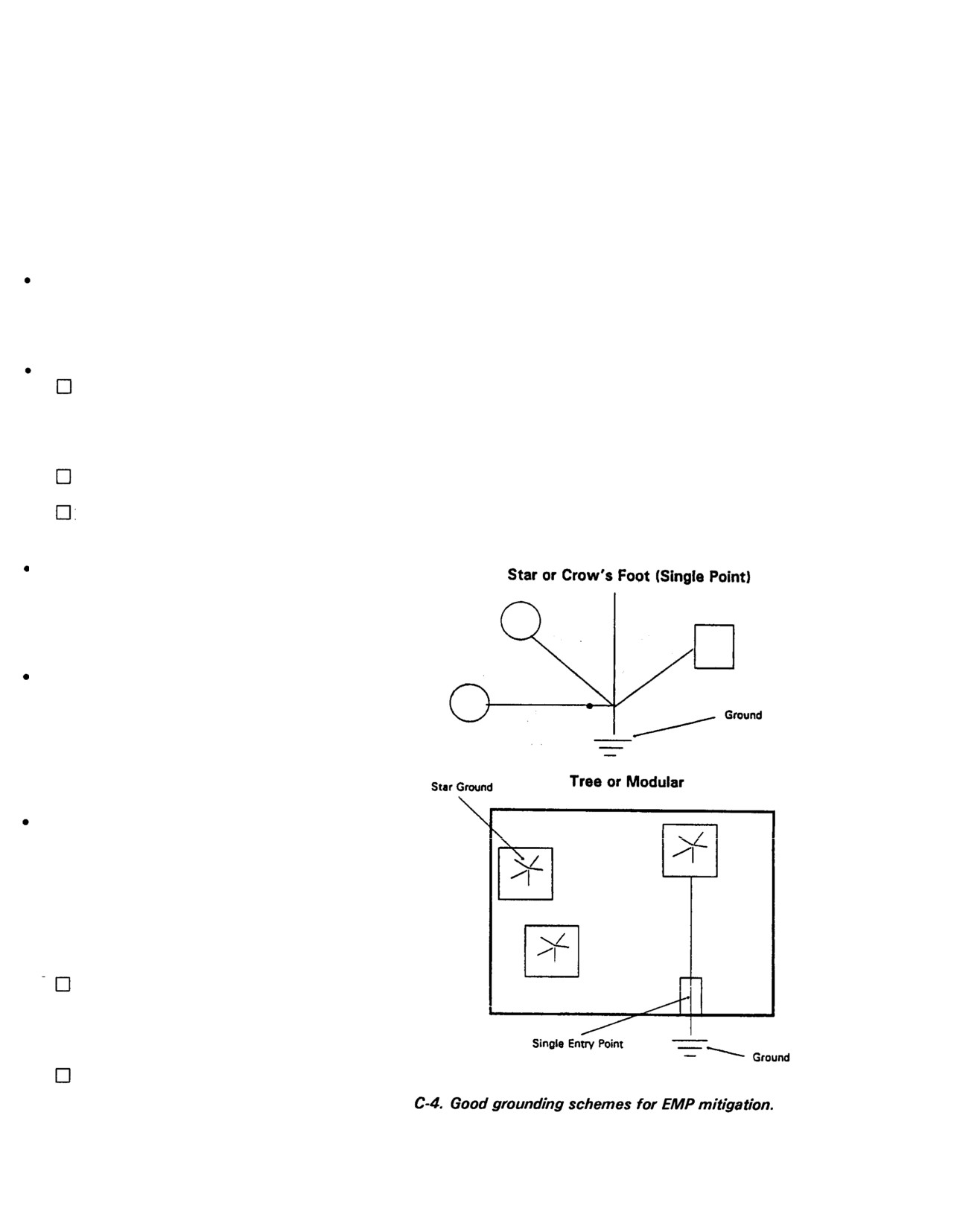
EMP. Figure C-4 outlines the preferred grounding schemes
linked by wire to a command post; the command post may
for EMP mitigation-the single-point star or crow’s foot
have a power line correction to a generator; and the same
ground and the “tree.” The tree grounding scheme is likely
generator may have a power line to the van, thus resulting
to be the most practical for many configurations of
in an effective loop antenna or collector.
equipment. Since loops are to be avoided, use the tree
Ensure antenna guy lines are properly insulated from the
configuration whenever equipment needs to be linked by
antenna. Some large antennas use guy lines as braces to
connectors that might couple EMP energy.
provide stability, and these lines can function as antennas,
coupling EMP. This energy will flow into the antenna (and
Command, Control,
through it into electronic equipment) unless the antenna or
guy line connections are well insulated.
Communications, and Intelligence
C3I equipment poses some of the most challenging
Cables and Grounds
tactical decisions for commanders developing EMP
mitigation plans and procedures.
Normally, ground cables and rods provide protection
Dispersed operations, to include the use of remotes,
from lightning. From the standpoint of EMP mitigation,
increase survivability by reducing the unit’s single-point
however, grounds and other forms of cables are
signatures and increasing the number of targets an enemy
unintentional antennas. The following points must be
must find and engage. At the same time, when operating in
considered for grounding and other forms of cables.
this mode, units depend more on electronic devices to
maintain command and control through communications.
C-9
FM 3-3-1
For example, long lines between positions that can function
EMP effects. Make regular backups of computer memories
as unintended antennas, can increase the unit’s
to ensure that essential data is not lost in case of
vulnerability to EMP. Furthermore, if electronic
EMP-induced operational upset or damage, and store them
communications are interrupted or destroyed by EMP, the
in a separate place, ideally an EMP-shielded van, shelter,
unit may not be able to accomplish its missions.
or vehicle.
There are realistic tactical trade-offs for which no pat
answers can be offered. However, some guidelines can be
Shelters and Shielding
applied to specific METT-T situations. Remember the
following:
Even if EMP fields are very powerful, damage to
Use redundant, multiple-mode communications. Units
equipment can be limited or eliminated if devices are kept
generally do not have extra radio equipment, but do have
in shielded shelters that prevent the EMP energy from
access to other modes of communication, such as field
entering. The key principles to remember when dealing
telephones, messengers, flares, and other signal devices, and
with shields and shelters are the requirements for a
aircraft and vehicles.
continuous shield made of metal.
Make maximum use of the least vulnerable equipment:
Shields are continuous when they have no breaks or
Most EMP energy occurs in the frequency range
openings. Once the shielding metal is at least a few
below 100 megahertz. While many tactical radios operate
millimeters thick, having a continuous shield with no
in this frequency range, some, like microwave systems, do
breaks is more important than adding more layers of
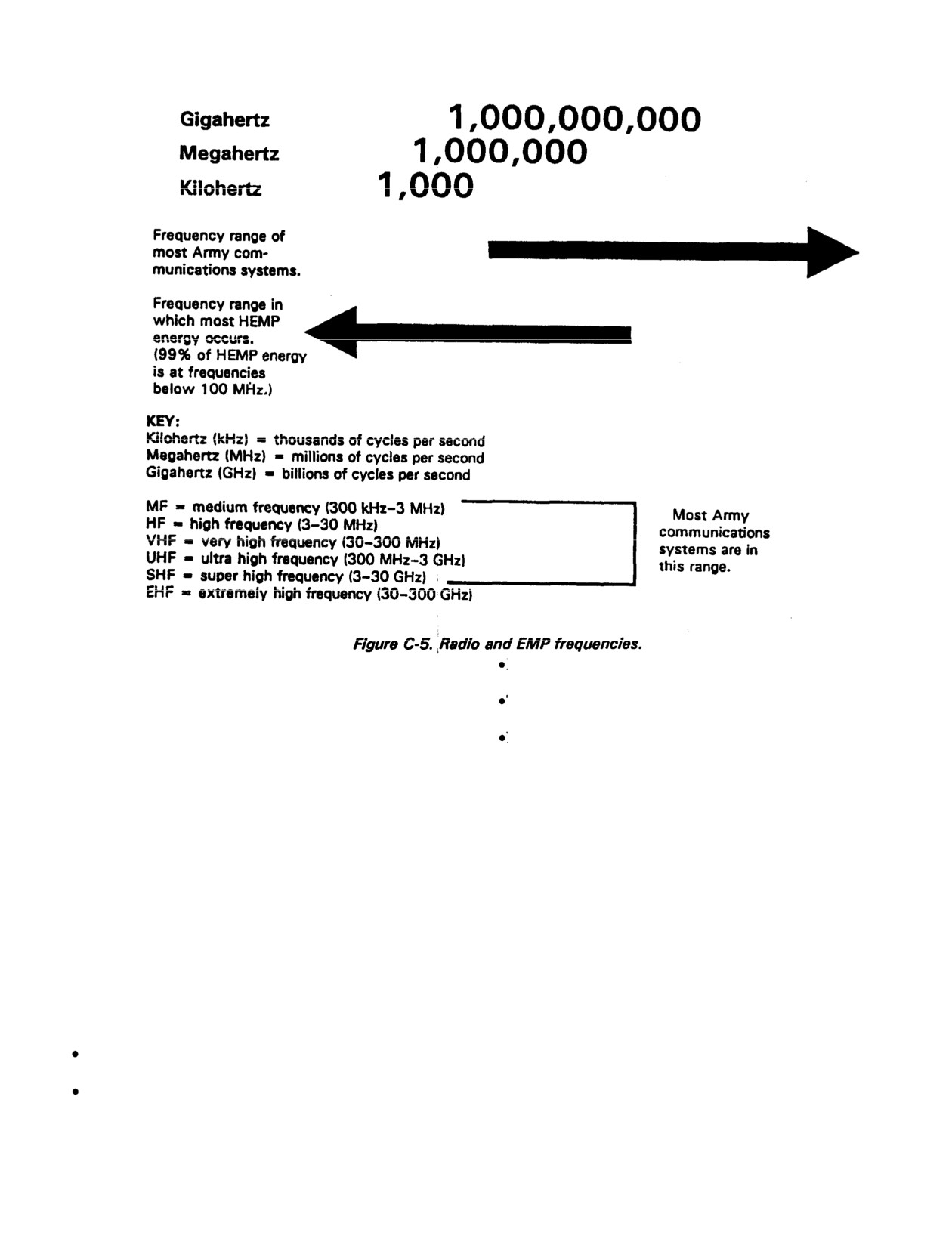
not. Figure C-5 shows the correlation between megahertz
shielding metal. However, most shields and shelters used
and commonly used abbreviations for radio frequencies.
by tactical forces will have openings (van doors, access
Microwave grids may be very effective alternative
panels in radio cases, etc.). If these apertures are left open,
communications nets.
the integrity of the shield is compromised, and damaging
Broadband radios pose major problems in that EMP
EMP energy can enter to damage equipment.
energy is broadband. Hence, broadband radios can couple
EMP is composed of both electrical and magnetic
more energy than narrow-band radios.
energy, and any conducting metal can shield against
Plan for the potential loss of communications
equipment. Everyone in the unit should know the
standing operating procedures to be adopted if, for
any reason, one or more modes of communication are
lost. Units should practice using backup and
alternative systems.
Consider disconnecting some communications
equipment. This extreme measure may need to be
considered; however, mission factors must be
examined carefully before using this tactical option.
If this mitigation technique is employed, the best
procedure is to disconnect the radios from antennas
and/or store them inside sealed vans, vehicles, or
shelters.
Other effects, in addition to EMP, may interfere with
radio communication. A high-altitude nuclear
detonation can affect the earth’s ionosphere and
thereby interfere with radios that use the ionosphere
to move signals. By the same token, radios may be
lost due to battle damage. These possibilities reinforce
the need to develop and practice backup and alternate
communications schemes. Take special steps to
protect computers. These steps may include—
To the extent practical, operate and store
computers in shielded shelters, vans, or vehicles.
Consider placing extra calculators and other small
devices in ammunition cans, and storing those cans
in sheltered areas away from the sides and comers.
Computer tapes, discs, and
drums tend to be relatively resistant to
C-10
FM 3-3-1
electrical effects. Iron and steel provide good protection
If the group of cables must enter the shelter, place them near
against magnetic EMP energy. Other kinds of shielding are
the phone or power penetrations.
unlikely to be effective and/or practical for field use.
Try to terminate cable shields, ground buses, and other
Shielded shelters can take many forms. A
connectors on the exterior of the shelter without a penetration.
communications van or an armored fighting vehicle is what
If possible, insulate penetrating lines just before entry into the
many people think of when shelters are discussed.
shelter, for instance, air conditioning lines, water pipes,
However, an ammunition can (with the lid tightly closed) is
ventilation ducts. Exhaust pipes are penetrations that can serve
an expedient shelter for small items such as calculators or
as unintended antennas, and they should be insulated if
backup computer diskettes, and the metal case of a radio
possible.
can be an effective shelter if antennas have been removed
As is true for all EMP mitigation procedures,
and all access panels are closed.
commanders need to consider shielding and shelters in the
It is possible to have cables, antennas, and other
context of their overall tactical situation. Employment of
connectors attached to, or running into, a shielded shelter
proper maintenance and operating procedures is of
and still maintain the EMP protection. One should not have
particular importance.
complete confidence unless these connections have been
evaluated in an Army EMP shielding program.
Power Sources
Nevertheless, there are good layout procedures that can
limit the possible damage from running (intended or
Electronic equipment needs power. In some situations,
unintended) antennas through shields into shelters. Proper
power sources may be more vulnerable to EMP effects
procedures must be used when linking shelters to antennas
than the devices being driven. While generating equipment
and other connectors. These procedures include—
may be fairly resistant to EMP, devices within the
If possible, group cables and other intended or unintended
generating equipment that control power generation can be
antennas.
vulnerable. Therefore, the following procedures can be
Place groups of cables in metal conduit.
used to lessen power source vulnerability. If EMP occurs,
commercial power equipment and sources may be taken off
C-11
FM 3-3-1
line. Therefore, plan to rely on military power-generating
Commercial power sources may be able to stay on line or
equipment. The long lines used in civilian power systems
come back up after EMP energy hits.
can pick up significant amounts of EMP energy, which can
Use of commercial power sources after an attack
cause damage to military equipment connected to the
requires an evaluation of trade-offs. On the one hand, this
civilian grid.
may be the most readily available alternative or backup
Automatic control systems and other components may be
source, particularly for combat support and combat service
vulnerable to EMP effects. If consistent with the mission,
support units. On the other hand, the next EMP attack may
the best posture is to have this equipment shut off and
damage critical connected equipment. Selective
use may be
physically disconnected. Keep commercial power grids in
the best option with some systems (but not all)
mind as a potential source of energy after an initial attack.
interconnected on a mission-specific basis.
Postattack Recovery and Continued Operations
For either HEMP or SBEMP, the first priorities of
should be taught the procedures needed to attempt quick
commanders should be to continue to engage in tactical
fixes, and should have necessary tools and parts (such as
operations and to carry out high-priority, mission-essential,
fuses) on hand.
recovery and reconstitution operations that integrate EMP
Presume that upset has occurred to computers.
mitigation with other tactical considerations.
Mission-critical computer memories can suffer upset at
Use standing operating procedures to establish and
levels of EMP that are far lower than the intensities
implement priorities. Postattack and transattack
required to inflict functional damage. At first glance, the
environments will be confusing. Hence, commanders need
results of upset may be invisible and may only be revealed
to establish recovery and reconstitution priorities prior to
when it becomes evident that critical information is
the attack, and exercise oversight to ensure these priorities
incorrect or unavailable. It is a good practice to assume
are followed.
that memories have been upset and automatically reload
Avoid the single-event fallacy.
backups.
There is no reason to presume that an attacker will stop
After this has been done, create a duplicate and save it as
after the initial use of nuclear weapons, particularly if
the backup and return it to its EMP protected location to be
high-altitude EMP is being used to create surprise. Indeed,
used if additional attacks occur.
hostile forces may plan to use a series of EMP attacks to
Test all equipment.
Consistent with command priorities,
disrupt and destroy US forces’ combat capabilities. If a
all electronic equipment should be inspected for operational
unit abandons its EMP mitigation posture as soon as it
upset and/or functional damage. This includes items that
begins recovery and reconstitution operations, it will be
have been shielded or hardened against EMP effects in
highly vulnerable to a follow-on attack.
Army shielding programs. In some cases, both upset and
Unit standing operating procedures and plans must strike
functional damage may not be immediately evident.
a balance between recovery and reestablishment of
When inspecting equipment for damage, focus on the
mission-essential capabilities and maintenance of mitigation
most obvious areas for problems. In assessing damage and
postures against EMP and other nuclear weapon effects.
attempting expedient recoveries, begin with the obvious
Place a high priority on the reestablishment of
fixes (fuses and circuit breakers) at the obvious
command functions.
Since EMP predominantly affects
places-points at which EMP energy may have entered the
electronic equipment, and since the maintenance of
system via components near the antenna.
command is the prerequisite for effective operations,
Army targeting doctrine does not call for the deliberate
mitigation techniques that advance this objective should be
use of EMP effects to inflict damage on targets. Any
given high priority.
damage that does result is a bonus. It is, however, highly
Start with a rapid assessment of damage.
In a unit that
consistent with AirLand Battle doctrine to exploit the
has been subjected to EMP effects, electronic equipment
possibilities for surprise that enemy use of EMP may
may be functionally damaged, operationally upset, or
present. An enemy employing EMP effects to disrupt
unaffected, depending on shielding, effectiveness of EMP
mission-critical electronic equipment may be subject to
mitigation posture, etc. Therefore, initial postattack
tactical surprise if the commanders of US forces, who
operations should include a rapid assessment of the overall
survived the attack with essential combat capabilities intact,
damage inflicted on predesignated high-priority equipment.
seize and exploit the initiative. In addition, recognize that
Implement quick-fix repairs on critical equipment.
EMP can function as a valuable supplement to the nuclear
Even though electronic equipment has suffered functional
attack warning and reporting system. In many tactical
damage from EMP, repairs may be straight-forward, such
situations, EMP effects may be the first indication that
as, resetting circuit breakers or replacing fuses. Troops
nuclear weapons have been employed.
C-12
FM 3-3-1
Appendix E
Nomograms and Tables
This appendix contains nomograms and tables for use in
across the top. Where the two columns intersect is the
radiological calculations, a hairline for local reproduction,
downwind distance of Zone I.
and a map scale for use in total dose calculations (crossing
For fallout decay (Table E-5), enter with the R
value on
1
problems).
the left side, and t in hours across the top. Where the two
Tables beginning Table E-1 are set to tabular format.
columns intersect is the Rt value. To determine the R
1
They are presented with their corresponding nomograms.
value, find the Rt value in the t column and read across to
To determine the radioactive cloud and stem parameters,
the left to determine R
1
. Some mathematical estimation of
find the appropriate yield in the left-hand column (Table
the data may be required.
E-1) and read the data across the table.
To determine total dose (Table E-24), page E-50, enter
Stabilized cloud-top and cloud-bottom angle yield
the table for the appropriate decay rate with the Te value in
estimation is presented in Table E-2. Enter the table with
the left-hand column and the Ts value across the top.
the stabilized cloud-top or bottom angle in the left-hand
Where the two columns intersect is the value for the index
column. Read across the top of the table with the
scale. Turn to Table E-43, page E-88, for the index table.
flash-to-bang time or distance to ground zero. Where the
Enter the index value across the top of the table and the R
1
two columns intersect is the estimated yield, some
value down the left hand side. Where the two columns
mathematical estimation may be required.
intersect is the total dose. If the index and R
values are
1
To determine the downwind distance of Zone I (zone of
not present in the table either multiply the index value by
immediate concern) (Table E-4), find the appropriate yield
R
1
value for a product in total dose, or mathematically
in the left-hand column, and the effective wind speed
estimate the data in the table.
E-1
FM 3-3-1
Appendix F
Additional Calculations
This appendix gives more detailed procedures for working radiological fallout and decay problems discussed in Chapter 6.
Determining Decay Rate
exactly in straight lines. In actual practice, the best straight
Pocket Calculator Method
line is fitted to the points. The value of n may then be
Assume that you are required to find the logarithm of
determined for each location and an average n determined
12.85. Reading down Column A in Table 6-4, you find
as follows:
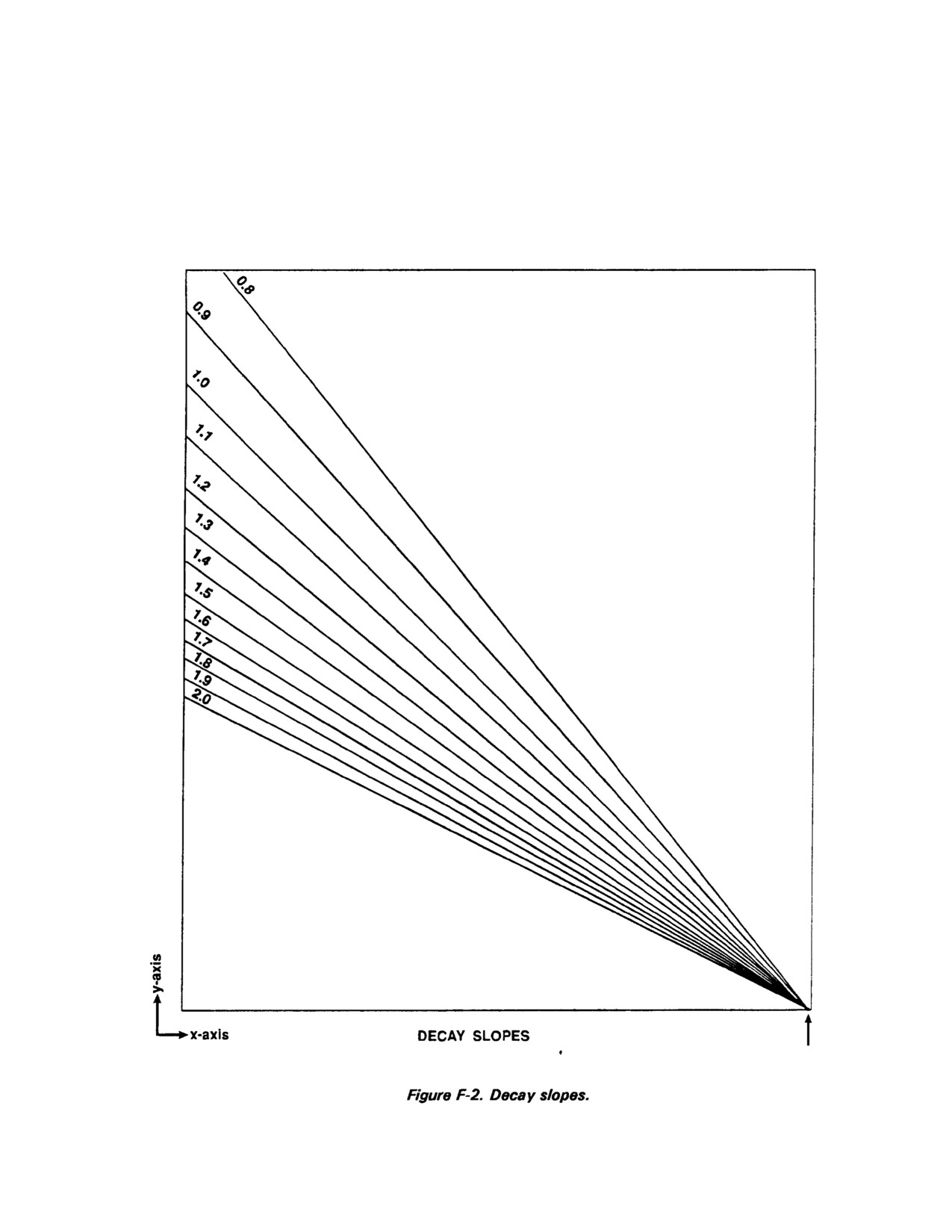
that a value exists for 12.8 and 12.9, but not 12.85. How
Place a piece of acetate, overlay paper, or other
do you find the log of 12. 85?
transparent material over Figure F-2 (page F-2) and trace
Set the problem up like this: 12.85 log = 1.109 enter
it. Next, orient the transparent material over the log-log
12.85 hit log = 1.109.
paper. Position the arrow on the transparent device at the
point where the slope intersects the x-axis. Holding this
position, align the y-axis indicator so that it is parallel with
Graphical Method
the y-axis of the log-log paper.
When a sequence of dose rates (NBC 4 nuclear series
Note which slope on the transparency most closely
reports) from one location is plotted on log-log graph
matches the slope on the log-log paper. The slope which
paper, the decay rate of the contamination causes the line
most closely matches has an n value printed along the left
plotted to be a straight line, inclined at a slope (n) to the
side of the transparency. This is the decay rate for these
axes of the graph.
plotted dose rates.
Suppose you have readings from a set of NBC 4 nuclear
Decay rate may be calculated from the plotted slope by
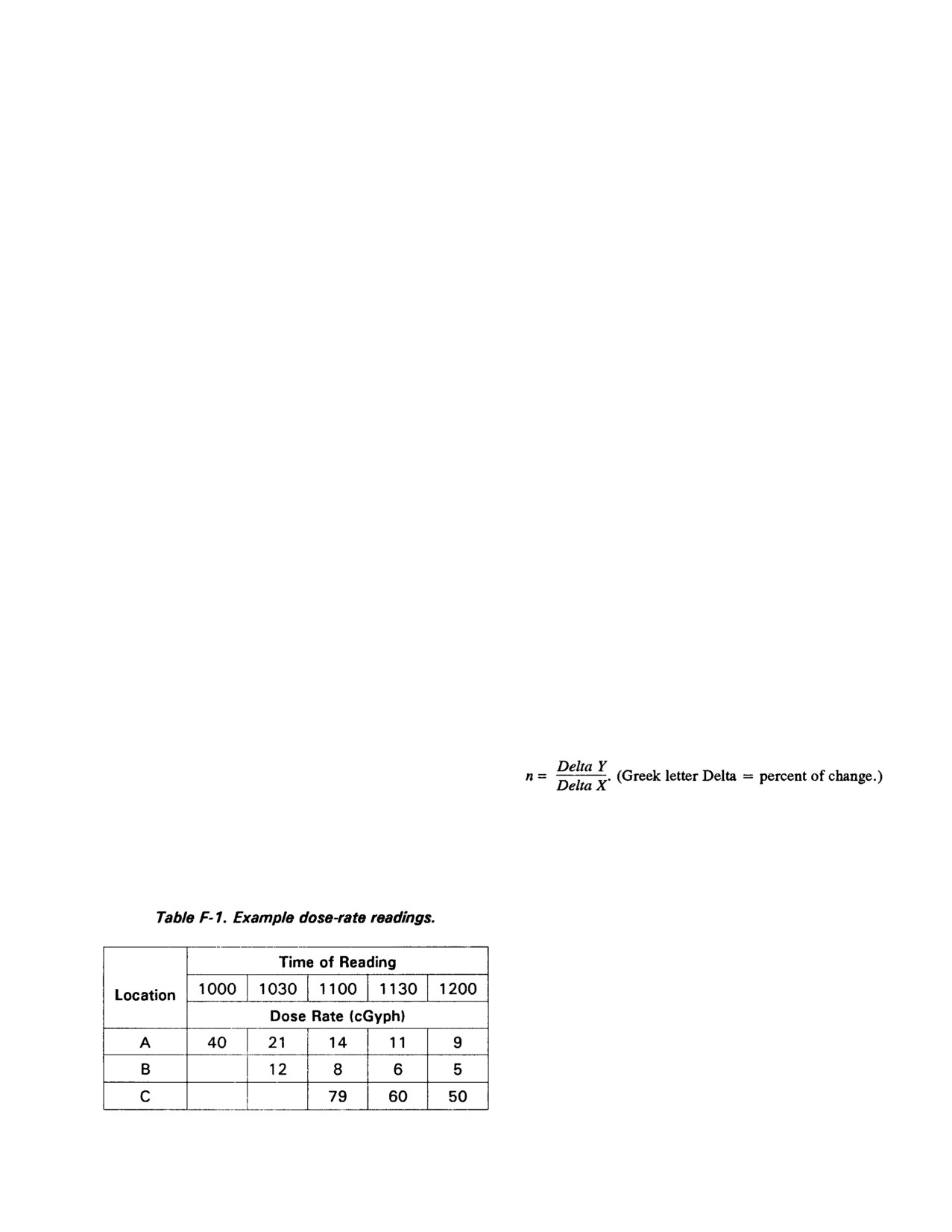
series reports (Table F-1) are received for decay-rate
measuring each axis in centimeters and using the formula
determination. H-hour is known or determined to be 0930.
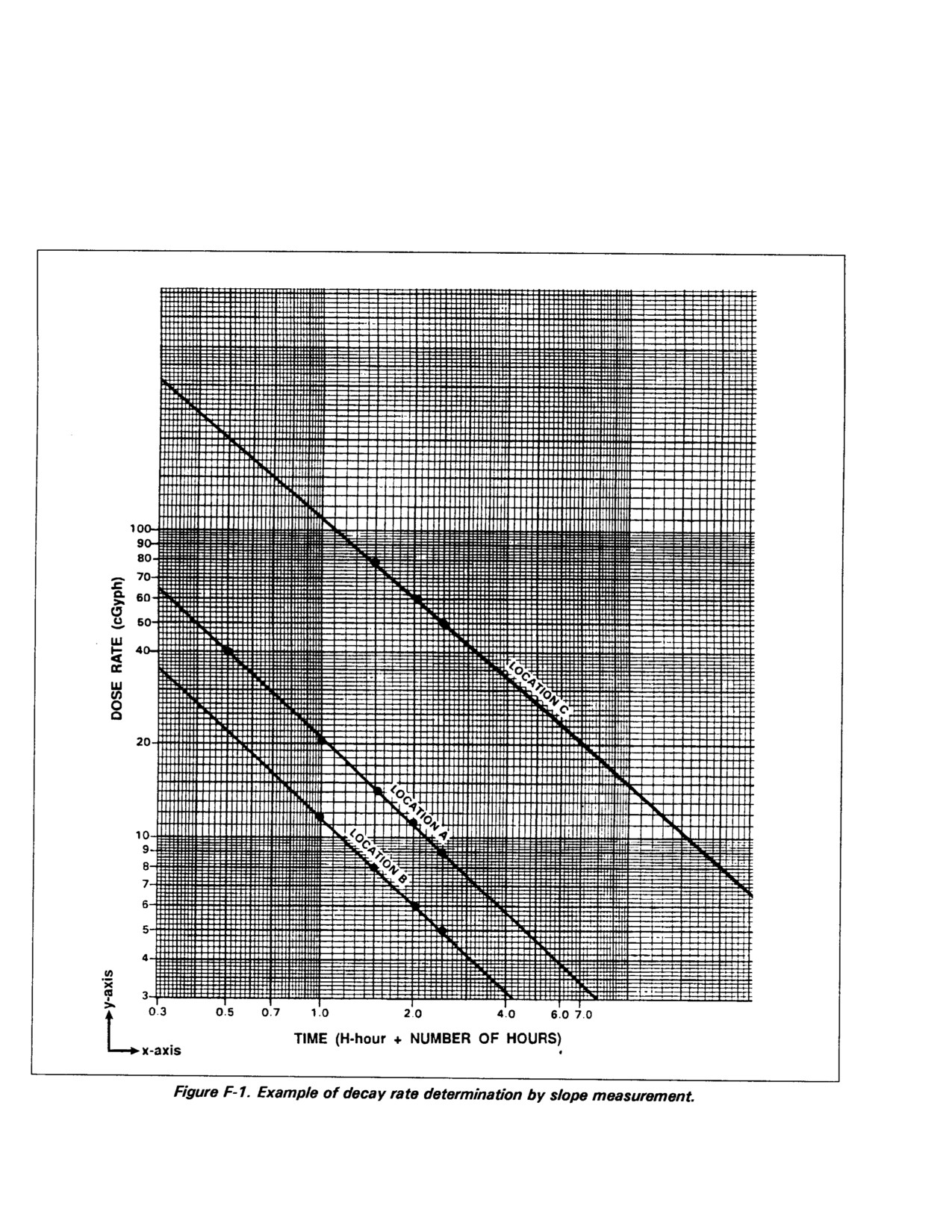
Figure F-1 (next page) shows this data plotted on log-log
graph paper. The time is used as the number of hours past
Once the decay rate (n) is determined, the radiological
H-hour. Three lines are drawn through the points. The
reading may be normalized to H + 1 readings. This
slope of these three parallel lines is n, the decay exponent.
reading is commonly referred to as the R
reading. This is
1
Remember, this is an example to demonstrate a
nothing more than determining, mathematically what the
procedure. In actual practice, the points will not likely fall
dose rate reading was at any given location, one hour after
the burst. Survey teams and monitors enter an area and
take readings at various times after the burst (H-hour).
These readings may be 15 minutes or 10 hours after the
burst.
Any reading that is not recorded 1 hour (H + 1) after a
burst is commonly referred to as an Rt reading. To
perform radiological calculations and make decisions on
the nuclear battlefield, all readings must be represented
using the same time reference. If this is not done, the
radioactive elements will decay and a true representation of
the hazard, past and present, cannot be made.
F-1
FM 3-3-1
Determining Dose Rates
Situation 1:
A monitor reports a dose rate of 100 cGyph
This can be determined mathematically, using a
5 hours after the burst. The decay rate is unknown so the
hand-held pocket calculator that as a power function,
monitor assumes standard decay (n = 1.2). What was the
which is represented by a button labeled either “Yx” or
dose rate at the monitor’s location at H + ?
"Xy".
F-2
FM 3-3-1
The following formula is used to solve the problem
Step 2.
Push 5 (for H + 5 when the reading was taken).
mathematically:
Push Yxor Xy
fiction key, then the n value of 1.2.
R
l
= Rt ÷ t (Yx) n +/-.
Step 3.
Press the +/- key, and then the equals (=) key.
(R
1
may be calculated by R
1
= R
t
x tyxn.
The answer should be 689.86, or 690 cGyph.
Step 1.
Turn on calculator; and punch in the Rreading
This method is the most accurate. The answer may be
t
of 100 cGyph; press the ÷ key.
slightly different from that found using the nomogram
F-3
FM 3-3-1
method discussed in Chapter 6. That is because
The formula used in Situation 1 also can be written or
nomograms are subject to operator error and interpretation.
used as-R
t
= R
1
x t (Yx) n (+/-).
Situation 2.
Further monitoring determines the decay
Step 1.
Turn on calculator, and punch in the R
1
reading
rate to be 0.9. The monitor’s reading, using the procedure
of 426 cGyph; press the multiplication key (x).
of Situation 1, is normalized to a new R
1
(H + 1) of 426
Step 2.
Push 8 (for H + 8). Press the Yx
or Xy
key, and
cGyph. The commander wants to know what the reading
enter the n value of 0.9.
will be at the monitor’s location at H + 8 hours.
Step 3.
Press the +/- key and then equals (=). The
answer should be 66 cGyph.
Normalizing Factors
To compute normalizing factors without using the table
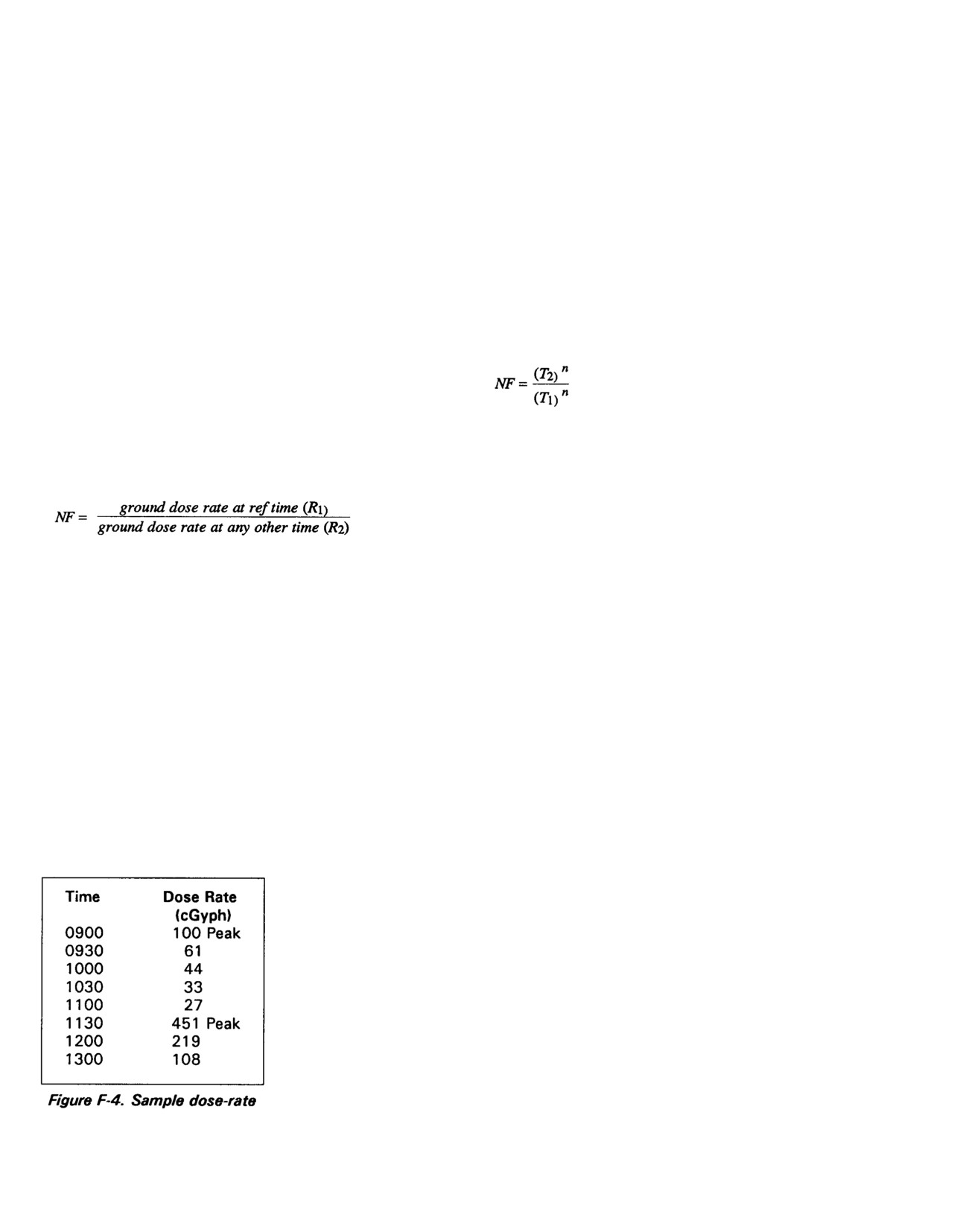
a. NF = (T
2
)n, when the reference time is H + 1.
of values method discussed in Chapter 6, use either the
mathematical or graphical method.
b.
when the reference time is H + 48.
Mathematical Method
Graphical Method
The normalizing factor is the ratio of the ground dose
rate at a reference time to the ground dose rate at any other
The graphical method is used when it is necessary to
known time. It can be expressed as-
determine a large number of normalizing factors or to
extend the time scope of an existing table. You have to
know both n and H-hour.
Figure F-3 (page F-4) shows NF plots for H + 1 and
The normalizing factor is computed using the Kaufman
H + 48 hours. To use these plots, enter the bottom of the
equation, R
1
T
1
n = R
2
T
2
n. This is the mathematical
plot with time the dose rate was measured. Read up to the
method. Subscript 1 denotes the reference time, and
subscript 2 denotes any other known time a dose rate is
appropriate decay slope. At this intersection, read left to
the left-hand scale for the NF.
determined.
Since:
Multiple Burst Procedures
push the log button on your calculator. Store this
Calculating Fallout of One Burst
information in memory. Divide 3 by 1; push the log
Fallout has been received from two detonations, one at
button. Divide the log of 100 ÷ 27 (stored in memory) by
0800Z and one at 1100Z, resulting in the readings shown
the log of 3 ÷ 1. The answer is 1.1918.
in Figure F-4.
Step 2.
Determine the decay rate for the second burst.
Predict the dose rates for the 0800Z burst at this location
First determine the contribution of the first burst dose rate
24 hours after the burst. Sufficient data is available to
to the 1200 hour reading of 219 cGyph. This is determined
separate the two bursts.
with the formula R
1
÷ tyxn = R
t:
R
= H + 1 reading for the first burst
1
t = time in hours from the H = 1 value of the first burst to
Calculator
H + 1 for the second burst
n = decay rate for the first burst calculated in Step 1
Method
Yx
= power button on calculator
Use this method if
100 ÷ 4YX
1.2 = 1.9 cGyph.
your calculator has a
To determine the reference or peak reading of the second
logarithm function,
burst-
or log button and a
219 cGyph - 19 cGyph = 200 cGyph at 1200 from the
power key, or Xy, or
second burst
Y’ button.
Step 1.
Calculate
the decay exponent
for the first burst.
Divide 100 by 27 and
F-4