FM 3-3-1 Nuclear Contamination Avoidance - page 19
FM 3-3-1
F-5
FM 3-3-1
By using these procedures you can determine any dose
rate, at any particular time with your calculator.
R
1
= Rt (t) yx
n
R
t
= R
l
÷ tyxn
t = Rt ÷ R
1
=
INV
yxn t/-.
R
a
= H + 1 reading of second burst
To solve for t is a little more complicated than the other
R
= Last reading minus contribution from first burst
b
procedures.
Tb= Time, in hours, of last reading from detonation
Given:
time of second burst
R
t
= 7
R
= 200
T
= Time, in hours, of reference reading for second
1
a
n = 1.1
burst
Find: t.
Divide 7 by 200. Push equals. Push the INV button, then
1.1, then the +/- button; then the equals button. In other
words, t = R
÷ R
= INV Yxn + l -.
t
l
R
t
value for the first burst: R
t
=
(R
1
÷ tyxn)
=
(100 ÷ 5yx1.2)
Graphical Method
=
R
t
= 14.5 cGyph.
Use the graphical method when sufficient data is not
The R
value in this case is 100 cGyph. Use the value of
available to separate the multiple burst readings.
1
5 hours for t, because the reading of 108 cGyph occurred
Fallout has been received from two detonations.
at 1300, which is 5 hours after the first burst. Push the yx
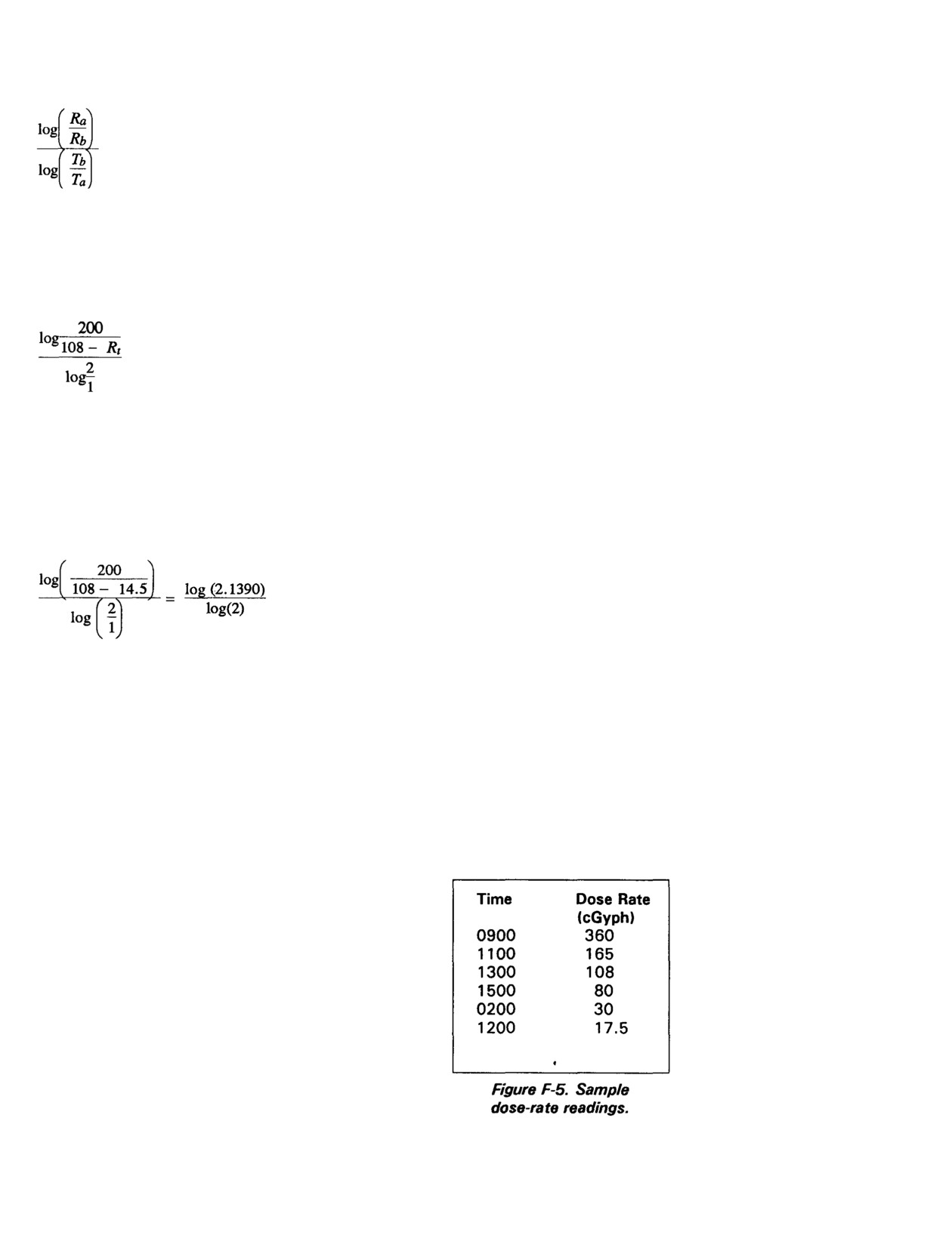
Dose-rate measurements were made at the intervals shown
power key on the calculator, then the decay rate of 1.2 for
in Figure F-5. The time of the second burst is 0800. Time
the first burst. The answer, in this case, is 14.5 cGyph
of the first burst is not known.
contribution from the first burst.
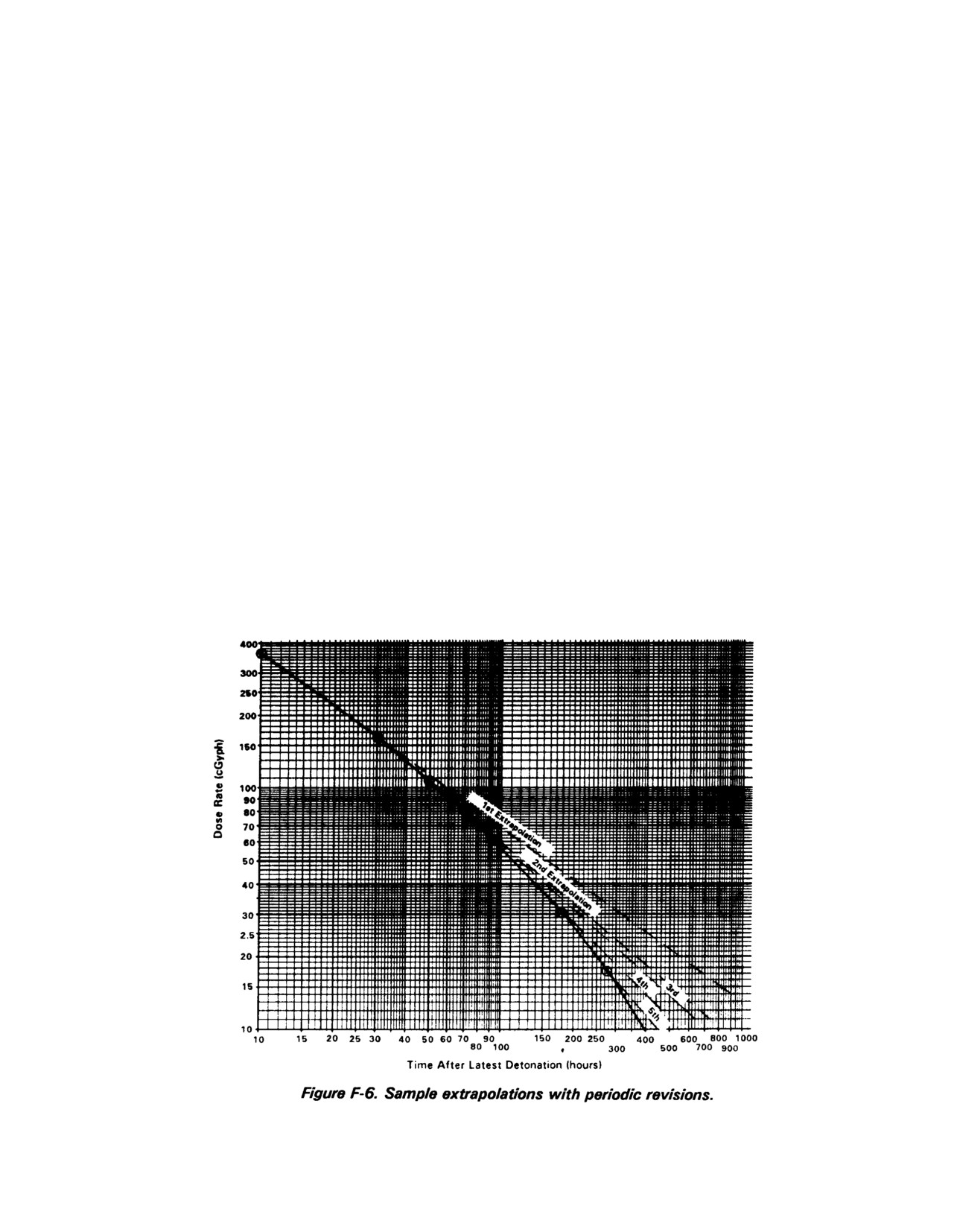
After receiving the measurement made at 1100, predict
the dose rate at that location at 2000 on the following day
(36 hours after the burst). After receiving each succeeding
dose-rate measurement, update this prediction. Sufficient
data are not available to separate the two bursts.
Step 1.
Plot on log-graph paper the 0900 and 1100
Using the log button on the calculator, find the log of the
dose-rate measurements against the time after the second
top and bottom numbers, then divide 0.3302 by 0.3010;
burst.
and your answer is 1.097, or 1.1.
Step 2.
Draw a straight line through these points and
The decay rate, therefore, after rounding to the nearest
extrapolate the line past H + 36 hours (see Figure F-6,
tenth, for the second burst is 1.1.
next page).
Step 3.
Calculate the 0800Z dose rate 24 hours after the
Step 3.
As a first approximation, determine a dose rate
first burst. Remember, the T
b
for 1.1 is only 5 hrs. You
of 28.0 cGyph for 2000 on the day following the burst
have to use 1.2 or get another series report.
(R
) directly from the graph.
36
R24
= R
÷ 24Yx
1.2
x
1
Step 4.
Upon receiving the 1300 measurement, plot this
R24
= rate 24 hours after first burst
x
reading on the graph.
R
1
= R
1
reading for first burst
Step 5.
Draw a new straight line through the 1100 and
Yx
= power key
1300 points; and
R24
x
= 100 ÷ 24yx1.2
extrapolate the line
R24
x
= 2.2067 cGyph
past H + 36 hours.
R21
y
= R
1
÷ yx, 1.1
Step 6.
As a second
R21
y
= rate of second burst at 0800Z
(and better)
R
= R
or reference reading for the second burst
approximation,
1
1
21 = 0800Z is 21 hours after the detonation time of the
determine a dose rate
second burst
of 20.5 cGyph for H
Yx
= power key on calculator
+ 36 hours directly
1.1 = decay rate for second burst
from the second
R21
= 7.02 cGyph
extrapolation.
y
R21
y
= 7.02 cGyph.
Step 7.
Repeat the
Add the reading for 24 hours after the first burst to the
procedure described in
reading 21 hours after the second burst:
steps 4 through 6.
2.2067 + 7.02 = 0.23, or 9 cGyph.
Upon receipt of the
F-6
FM 3-3-1
1500, 0200, and 1200 measurements, update the prediction
R= 61.6, or 62 cGyph.
t
for R
36
to 18.0, 14.5, and 12.5 cGyph, respectively.
Step 3.
Find the dose rate contribution at 1730 from the
Step 8.
See Figure F-6 for an illustration of the dose-rate
second burst.
calculation. Reading from this figure, the true dose rate
Rt
a
= R
t
- R
t1
encountered at H + 36 hours at that location is 12.5 cGyph.
R
= 300 cGyph - 62 cGyph
ta
R
= 238 cGyph.
ta
Step 4.
Find R
for the second burst only.
Calculating Overlapping Fallout
1a
R
= R
(t), Yx
. n
1
t
H-hour is known for each burst. At 251500, a 20-KT
R
= 238 (0.5), Yx, 1.2
1
nuclear weapon was detonated on the surface “near” your
R
1
= 103.5, or 104 cGyph.
position. Sometime later, fallout arrived on your position.
Step 5.
Find Rat 1900 for each burst. For the first
t
At 1630, a peak dose rate of 126 cGyph was measured.
burst—
Subsequent readings indicated that n = 1.4. At 251700,
R
= 222 cGyph
1
another weapon was detonated close to your area, and
t = H + 4 hours
fallout arrived soon after. At 251730, a second peak dose
R
= (R
ÿ t, Yx, n)
t
1
rate of 300 cGyph was measured.
R
= 222 ÿ 4, Yx, 1.4
t
Assuming that n = 1.2 for the second weapon, what will
R= 31.8, or 32 cGyph.
t
the dose rate be at 1900? This may be calculated using Step
For the second burst—
3 of the calculator method for determining an R
value.
R
= 104 cGyph
1
1
When H-hour for each detonation is known, calculate the
t=H+2
dose or dose rate for each event and add them together to
R
= R
÷ t, Yx, n
t
l
get the total dose or dose rate received.
R
= 104 ÷ 2, Yx, 1.2
t
Step 1.
Find R
for the first detonation.
R= 45.3, or 45 cGyph.
1
t
R
= [Rt
(t), yxn]
Step 6.
Find the total dose rate at 1900. Total dose rate
1
R
1
= [126 (1.5) yx, 1.4]
is the sum of dose rates at that time.
R
= 222.3 cGyph.
R total = R
+ R
1
t
t2
Step 2.
Find Rat 1730 for first fallout only.
R total = 32 + 45
t
R
t
= R
1
ÿ t Yxn
R total = 77 cGyph.
R
t
= 222.3 ÷ 2.5 Yx
1.4
F-7