FM 3-3-1 Nuclear Contamination Avoidance - page 17
FM 3-3-1
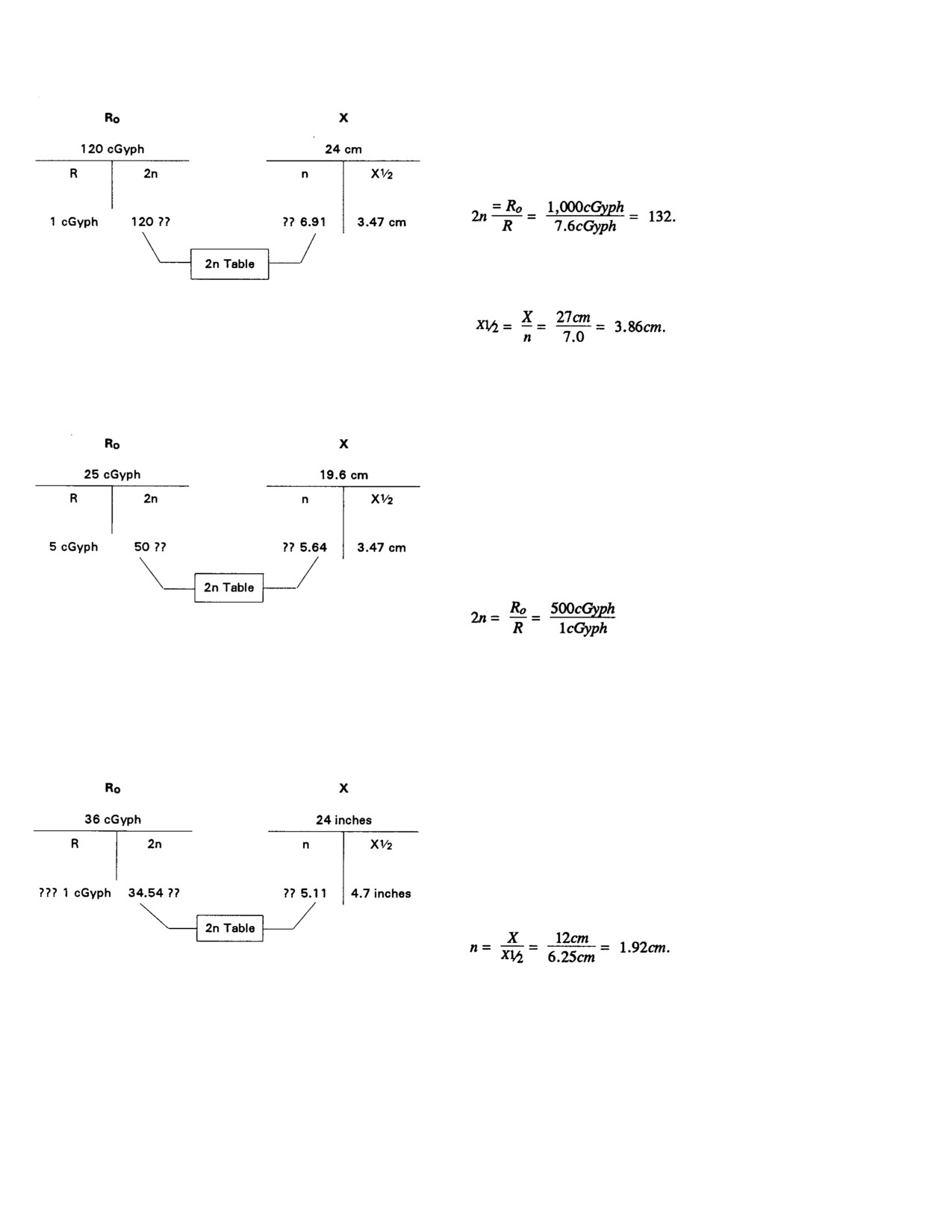
Ro = 1,000 cGyph
X = 27CM
R = 7.60 cGyph
Find: X½.
solution
Enter Table B-2 in the 2n column and find 2n equals 128
and 136. Table B-1 directs use of the smaller 2n of 128.
Read corresponding n value of 7.0.
✴ Note: When working any problem with the mathematical
Apply the equation:
method, a horizontal line means you divide; a vertical line means
you multiply.
Having found the half thickness for the shielding
Problem:
Find total thickness of shielding.
material in the problem above, the NBC officer wants to
Situation 2. You reported an initial dose rate with no
know how much material is needed to reduce a dose rate of
shielding (Ro of 500 cGyph after a nuclear detonation.
25 cGyph down to .5 cGyph.
Your shielding material has a half-thickness of 7.5 cm
(thickness of material necessary to degrade gamma
radiation dose by one-half).
For safety, you desire no more than 1 cGyph exposure
inside a bunker. What thickness of shielding material is
needed to protect the occupants?
Ro = 500 cGyph
X½ = 7.5 cm
R = 1 cGyph
Find: X.
First, solve for 2n:
The bunker you are in has two feet of sandbags on it. A
monitor has reported a dose rate reading of 36 cGyph
Enter Table B-2 in 2n column, and find 2n is between
outside. The commander has taken the monitor on a trip to
480 and 512. Table B-1 directs use of the larger 2n of 512.
the division Command Center. The NBC Officer must
Read the corresponding n value of 9.0. Use the equation
report the inside reading to the battalion XO in ten
X = (n) (X-1/2X = (9.0) (7.5 cm) = 67.5 cm.
minutes. Division NBC has reported that 4.7 inches of the
Problem: Find the initial dose rate with no shielding.
local earth in sandbags will reduce a dose rate in half.
Situation 3: A bunker has a total thickness of 12 cm
shielding material (X). The half-thickness of the shielding
material (X-1/2) is 6.25 cm. From inside the bunker, a
final dose-rate (R) of 5 cGyph is read. What was the initial
dose rate with no shielding (Ro)?
X = 12cm
X½ = 6.25 cm
R = 5 cGyph.
Find: Ro
Solution:
First, solve the equation for n:
Problem:
Find the half thickness, using the 2n table.
Enter Table B-2 in the n column, and find n is between
Situation 1: An initial dose rate with no shielding (Ro)
1.9 and 2.0. Table B-1 directs use of the larger n value of
was 1,000 cGyph. The total thickness of the bunkers
2.0. The corresponding 2n value is 4. Utilize the equation
shielding material (X) is 27 cm. A final dose-rate (R)
Ro = (2n) (R)
received inside the bunker was 7.60 cGyph. What is the
Ro = (5 cGyph) (4.0) = 20 cGyph.
half thickness of the bunkers shielding material?
B-2
FM 3-3-1
Transmission Factors
Transmission factors are used in radiation calculations to
determine the impact of shielding on radiation exposure.
TFs are simpler and preferred when the half thickness and
X
=
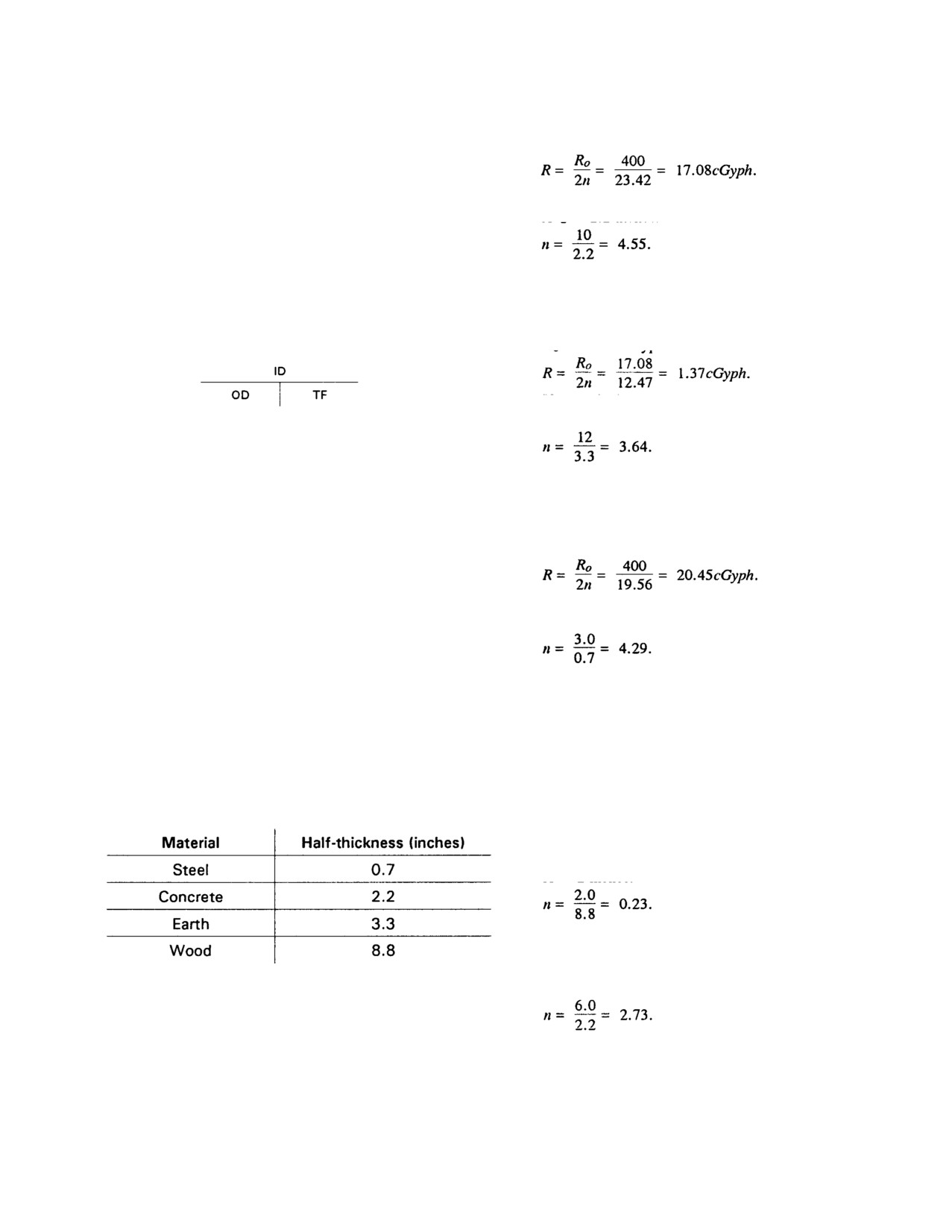
10 inches.
total thickness are not important, and only the actual
X½ = 2.2 inches.
reduction of the dose rate is the primary consideration.
Transmission factors are always less than 1.
2n = 23.42.
Determination of
Find: What would be the dose rate if you added 1 foot of
earth cover to the bunker?
Transmission Factors
Solution:
R0
= 17.08 cGyph.
TFs are calculated using the following formula:
X = 12 inches.
X½ = 3.3 inches.
ID = inside dose, or dose rate.
OD = outside dose or dose rate.
TF = transmission factors.
2n = 12.47.
Find: What would the dose rate be inside a tank with 3
inches of armor plating (steel)?
Sample Problems
Solution:
Situation: ID = 66 OD = 550.
R0
= 400 cGyph.
Find: TF.
Solution: 66 ÷ 550 = .12.
Situation: ID = 45 OD = 120.
X = 3 inches.
Find: TF.
X½ = 0.7 inches.
Solution: 45 ÷ 120 = .375.
Situation: You are inside a tank with a reading of 45
cGyph, and you have recorded an outside reading of 1,125
2n = 19.56.
cGyph. What is the TF for the tank?
Problem:
In the same radiologically contaminated area,
Solution: 45 ÷ 1125 = 0.04.
the dose rate has decayed to 180 cGyph at H + 2 hours.
Which of the following would offer you more protection
from the radiation: a wooden building with 2-inch walls; a
Exercise Problems
concrete bunker with 6-inch walls; a foxhole with 12
In the table below are half-thicknesses for some common
inches of earth cover?
materials (These values will be used in solving the
Solutions:
problems that follow.):
Building: R0
= 180 cGyph.
R=?
X½ = 8.8 inches.
X = 2 inches.
Bunker:
R0
= 180 cGyph.
R=?
X½ = 2.2 inches.
Problem:
The outside dose rate of residual radiation in a
X = 6 inches.
radiologically contaminated area is 400 cGyph at H + 1.
Find: What would be the dose rate inside a concrete
bunker if the walls were 10 inches thick?
Foxhole: R0
= 180 cGyph.
Solution:
R=?
R0
= 400 cGyph.
X½ = 3.3 inches.
X = 12 inches.
B-3
FM 3-3-1
R = 75 cGyph.
X½ = 0.7 inches (from Table B-3).
Answer:
A foxhole with 12 inches of earth cover would
X = 2.0 inches.
give the best protection.
Note:
The higher the n, the higher the 2n; so, the better
the protection. The higher 2n divided into the R0
will result
2n =
6.95
(from Table B-1, next page).
in a smaller R.
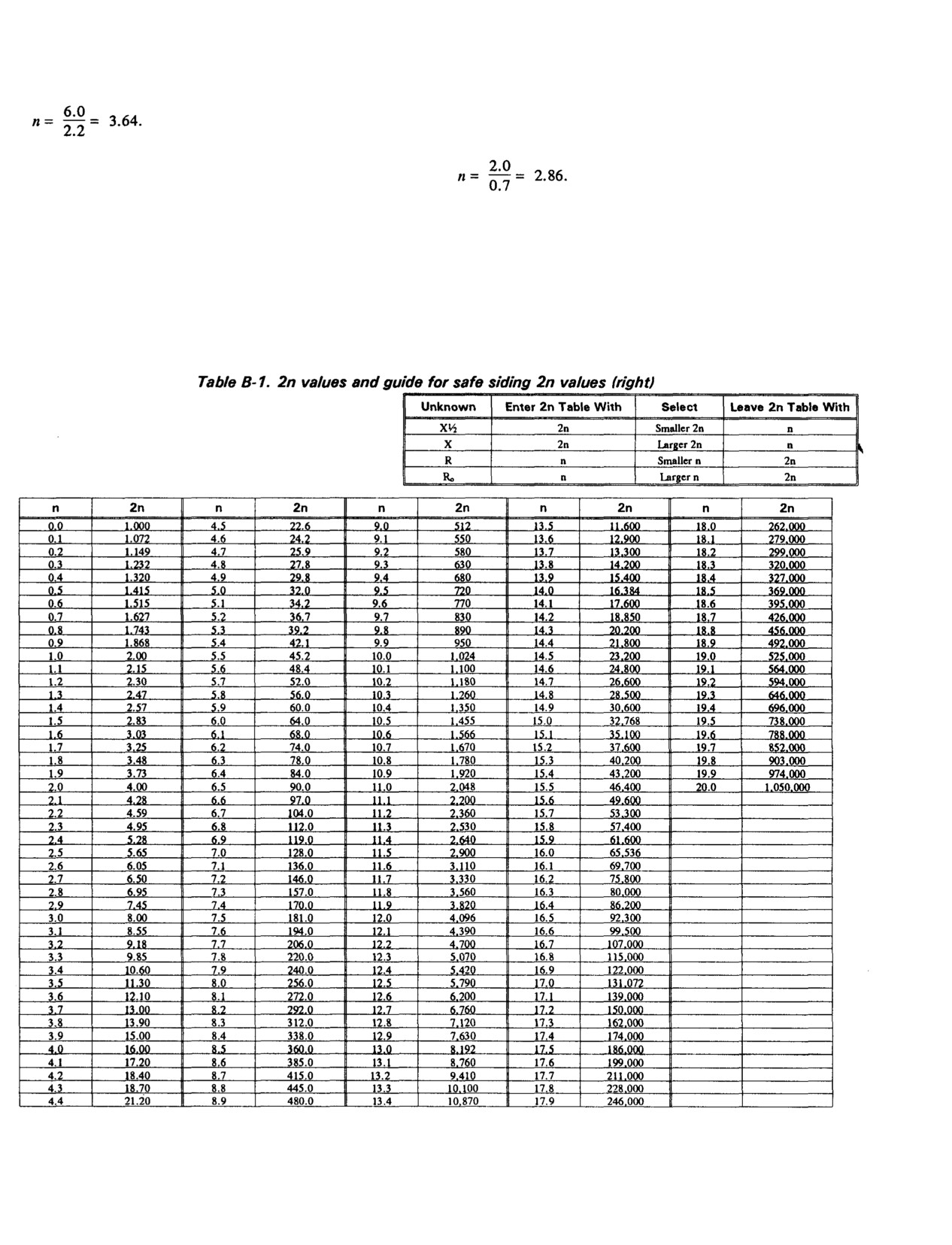
The guide for safe-siding depends on the unknown
Problem:
You are located in a tank in a radiologically
variable. For example, if the thickness is unknown, find X
contaminated area. The dose rate inside is 75 cGyph. The
in the unknown column, read to the right. Enter the table
tank has approximately 2 inches or armor plating (steel).
with 2n, select the larger value of 2n, and leave with the
Find: What is the approximate outside dose rate?
value of n corresponding to that larger value.
Solution:
Note:
Gamma radiation energy varies.
R0
= 6.95 X 75 = 521.25 cGyph.
B-4
FM 3-3-1
Appendix C
Nuclear Burst Effects on Electronics
Electromagnetic pulse is a nuclear weapons effect that
equipment. Fast neutrons cause permanent damage by
can have significant impact on electrical and electronic
emplacing (or dislodging) atoms in crystals. Shielding that
equipment. EMP, although it represents only one percent
reduces gamma and neutron radiation will reduce the
of the total energy produced by a nuclear burst, can
effects of TREE. The cause of the damage may be short in
destroy or cause serious damage to electronic equipment
duration but permanent. Damage amount depends on the
through current surges.
dose rate. The effects on electronic equipment may or may
Transient-radiation effects on electronics has similar
not be shielded out.
effects to EMP, except TREE is caused by gamma and
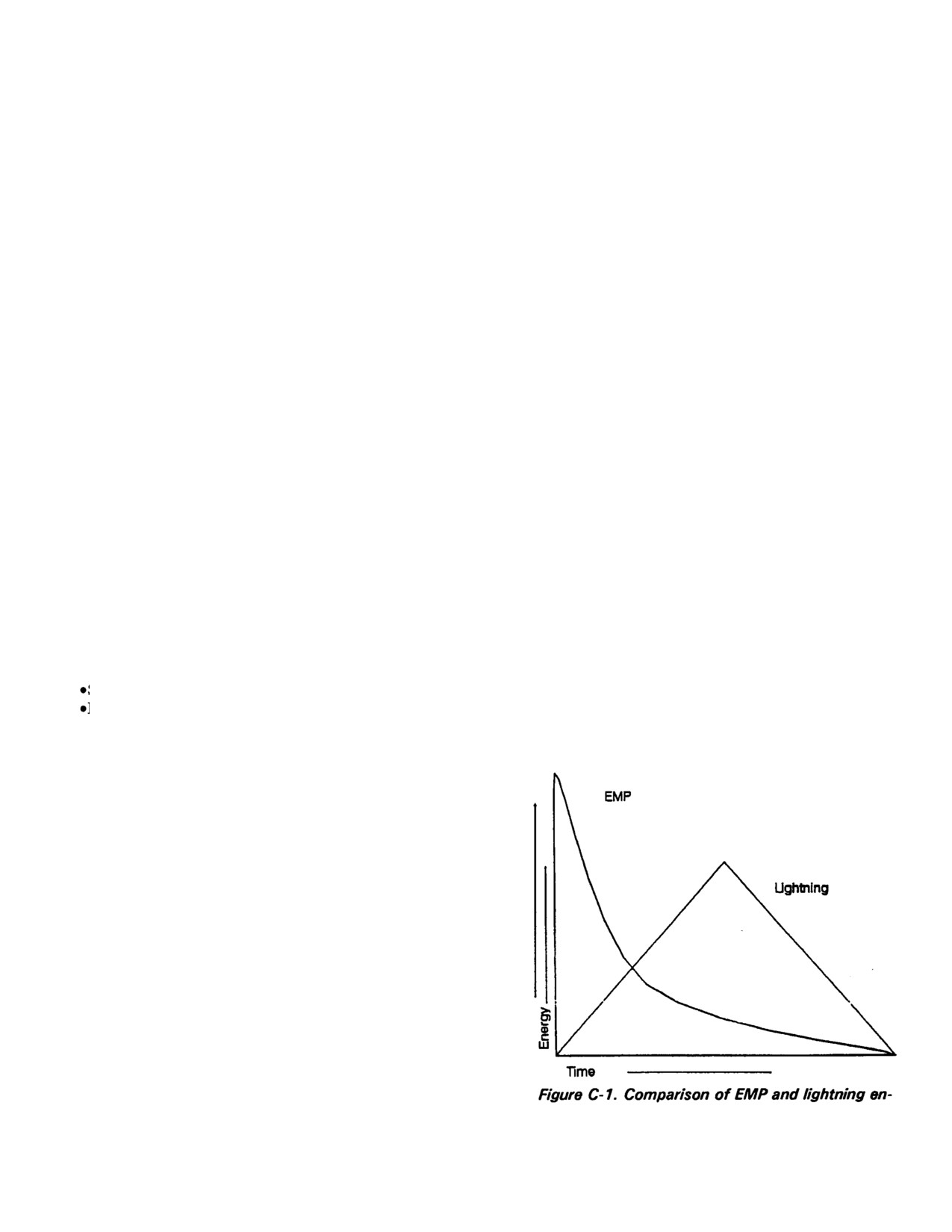
Unlike lightning, EMP does not produce a flash in the
neutron (initial) radiation. Although gamma radiation
sky or a loud noise. Also, devices that protect equipment
causes only temporary ionization of electronic components,
against lightning do not necessarily provide protection
this can lead to permanent damage in other parts of the
against EMP (see Figure C-l).
Types of EMP
Nuclear explosions occurring at heights of roughly 2
detonation to avoid damage due to blast, thermal and other
kilometers to 30 kilometers are, for complex technical
effects, but they still may be subject to damage from
reasons, less likely to produce EMP effects of concern to
SBEMP. At the same time, however, a range denoted in
forces in the field. There are two types of EMP of
tens of kilometers is considerably below the ranges
particular importance for tactical forces:
associated with HEMP; its effects can cover areas on the
Surface-burst EMP (SBEMP)
order of thousands of kilometers.
High-altitude EMP (HEMP).
Furthermore, depending on a unit’s location within the
area affected by SBEMP, other effects (blast, thermal,
radiation) may be of greater tactical significance. For
Surface-Burst EMP
Surface-burst EMP is produced whenever a nuclear
device is set off on the ground or at a low altitude above
the earth. A tactical nuclear weapon could produce
SBEMP.
SBEMP from surface bursts at altitudes of about 200
meters or less can be even more powerful than
HEMP—HEMP energy levels may be in the range of
50,000 volts per meter. Values for SBEMP may be in the
region of one million volts per meter. Furthermore, these
high levels of SBEMP may couple (weld together) buried
or above-ground cables outside the immediate vicinity of
the nuclear detonation. If this happens, these cables may
remain intact and transmit tremendous surges of energy to
connected systems down the line.
Because of the physics involved, SBEMP fields extend
only to ranges on the order of 10 to 20 kilometers from the
point of detonation. These fields are significant for tactical
units that might be far enough away from a nuclear
C-1
FM 3-3-1
high-altitude nuclear detonations, in contrast, EMP is the
impaired because their antennas are not designed to pick up
only militarily significant nuclear weapons effect.
energy in the frequency ranges in which EMP energy is
A unit not affected by the other effects of a near surface
most likely to occur. Because of the extremely high
burst of a nuclear weapon can still be affected by SBEMP,
altitudes of the explosions that produce HEMP, forces in
which is the most far-reaching of the prompt effects
the field will not be affected by the blast, thermal,
produced by a nuclear weapon detonated on the ground or
radiation and other effects of the nuclear weapon. Indeed,
at low altitude.
field units may not have any indication that a nuclear
When units are threatened by SBEMP, commanders are
explosion has occurred except for the arrival of HEMP and
aware that a threat exists because of the thermal, blast, and
the resultant effects on electronic equipment.
other effects of the nuclear detonation. However,
In some respects, EMP energy is similar to radio waves
commanders may not be aware of the effective ranges at
produced by nearby lightning strikes. Both involve a
which the SBEMP energy can damage critical electronic
sudden pulse of energy, and both are attracted to
equipment. For example, if a 10-kiloton nuclear weapon
intentional and unintentional collectors or antennas. EMP
were detonated on the ground, the safety (standoff)
and lightning differ in the following crucial respects:
distance for troops in the open is about 2,400 meters. At
EMP pulses rise much more rapidly. The pulse rise time for
this range, troops could withstand the thermal effects,
EMP may be a few billionths of a second; the comparable
which would extend farther than blast and other immediate
interval for a lightning pulse involves millionths of a second.
effects. In this same example, however, EMP damage to
Each field strength can differ radically. Lightning may be in
some. types of critical electronic equipment could occur at
the range of a few thousand volts per meter; EMP can involve
ranges of 5,000 meters.
50,000 volts per meter. In some circumstances, a nearby
lightning strike (50 to 100 meters distant) may be similar to
some manifestations of EMP energy.
High-Altitude EMP
HEMP pulses are shorter in duration—usually less than a
High-altitude EMP (HEMP) is produced when a nuclear
thousandth of a second as compared to lightning pulses that
explosion occurs 30 kilometers or more above the earth’s
last hundreds of milliseconds.
surface. Because of the physical processes that generate
Lightning occurs at much lower frequencies and in bands well
HEMP, which differ from those that produce SBEMP,
below the frequencies used by tactical communications
HEMP effects can have considerable strength at great
systems. Unfortunately, EMP concentrates in some of the
distances. Units throughout a theater might be affected
bands most frequently used by tactical communications
without ever being aware that a nuclear explosion had
systems.
taken place. An example of HEMP’s effects is provided by
Because of these differences, devices that provide
a test conducted by the United States in 1962 in which a
protection against lightning strikes may not necessarily
nuclear device was detonated above Johnston Island in the
protect against EMP effects.
Pacific. EMP effects were evident in electronic devices in
Hawaii, 800 miles away from the test site.
The HEMP Threat
Furthermore, a nuclear detonation 400 kilometers above
Moscow would produce an EMP field that would cover all
High-altitude EMP (HEMP) can present unique threats
of Germany. US forces in Germany would not see a flash
to tactical forces. Because of the extremely high altitudes at
nor feel a shockwave, yet the HEMP field could damage or
which these nuclear detonations occur, forces on the
destroy critical electronic components in communications
systems and other materiel. While the strengths of HEMP
fields vary, it could be as much as 50,000 volts per meter.
Since field forces have no way to anticipate the levels of
EMP to which they will be subjected, tactical units must be
capable of withstanding the worst case, 50,000 volts per
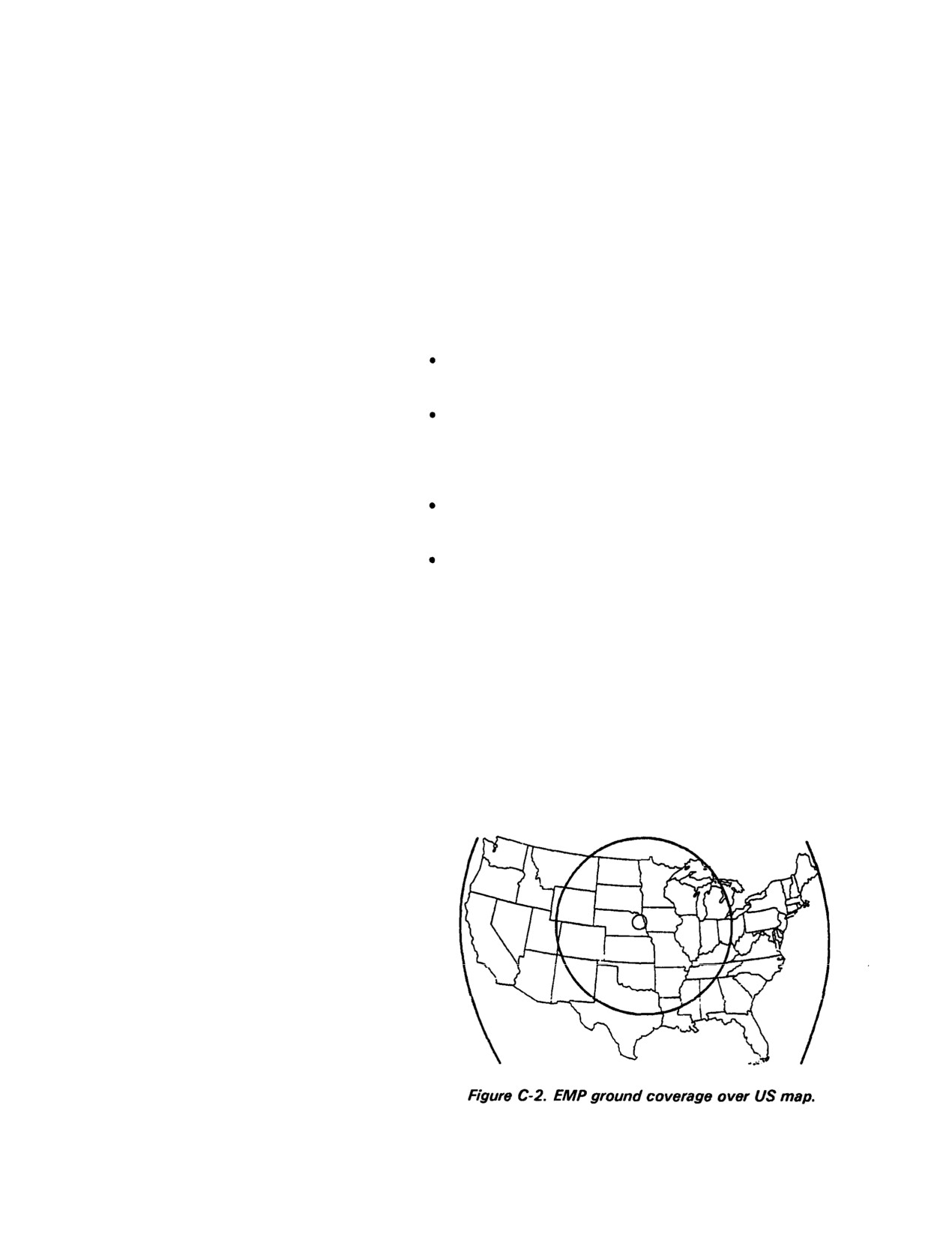
meter. Figure C-2 illustrates HEMP ground coverages of at
least 25,000 volts per meter for heights of burst of at least
100 kilometers (inner ring) and 500 kilometers (outer ring).
While 99 percent of HEMP energy is at frequencies
below 100 megahertz, most HEMP occurs in the frequency
ranges between 100 kilohertz and 10 megahertz.
Communication systems operating in these frequency
ranges are most likely to pick up EMP energy and suffer
damage. Correspondingly, microwave and other systems
that operate at higher frequencies are less likely to be
C-2
FM 3-3-1
ground may be unaware of the explosion until after EMP
with minimal communications (and hence less reliance on
has struck, causing damage to unhardened equipment.
communications equipment). Furthermore, some
Such a high-altitude nuclear burst could disable US
unclassified assessments suggest that many items of Threat
forces’ communications, sensors, and other electronic
military equipment may be capable of withstanding EMP
equipment. By employing hardened equipment and using
effects.
mitigation techniques, the aggressor might use HEMP to
Because of the possibility of nuclear proliferation, the
create confusion and surprise in US forces.
unique threats posed by HEMP may be encountered in
This type of preliminary attack would have an added
conflicts with other aggressor nations as well. A nation that
advantage, aside from its effects on electronic systems: the
has only recently acquired nuclear weapons may have only
high altitude nuclear burst would not cause collateral
a small number of them available for use. In a conflict with
damage.
the United States, such a nation might use one or more
In this unclassified publication, a detailed assessment of
nuclear weapons to produce HEMP effects to disrupt
enemy threats cannot be provided. Note, however, that
operations of US forces and make them more vulnerable to
such exploitations of HEMP effects would be consistent
follow-on conventional, chemical, and nuclear attacks.
with the emphasis Threat military doctrine places on
These threats posed by HEMP reinforce the requirement
surprise attack, the potential use of nuclear weapons at the
to integrate EMP mitigation techniques into tactical unit
outset of a conflict, and Threat operational procedures in
standing operating procedures to ensure that
which units are trained to operate for sustained periods
mission-essential capabilities are not upset or destroyed.
Tactical
Equipment
Tactical units use many types of electronic equipment
penetrates an equipment case and couples to internal
and electrical components, such as radios, radars, power
wiring. Examples of damage caused by operational upset
generators, calculators, fire-control systems, computers,
are-
and computer chips. Also, units use civilian sources for
Operators of intelligence gathering and target acquisition
electrical power. The primary threat of EMP is damage to
equipment may lose track of hostile forces.
electronic equipment and components.
Essential information such as crypto identification codes may
Both HEMP and surface burst EMP (SBEMP) can
be lost.
damage electronic equipment by causing current surges,
Pilots of helicopters and fixed-wing aircraft may be given
burning out or melting components, and upsetting
erroneous information on their instrument panel readouts.
computer memories. Modem microprocessor computer
Weapon guidance systems may malfunction.
chips, increasingly used in tactical equipment, are
Unhardened equipment varies in its vulnerability to
particularly vulnerable since they are designed to operate at
EMP. While the hardness or vulnerability levels of specific
very low power levels.
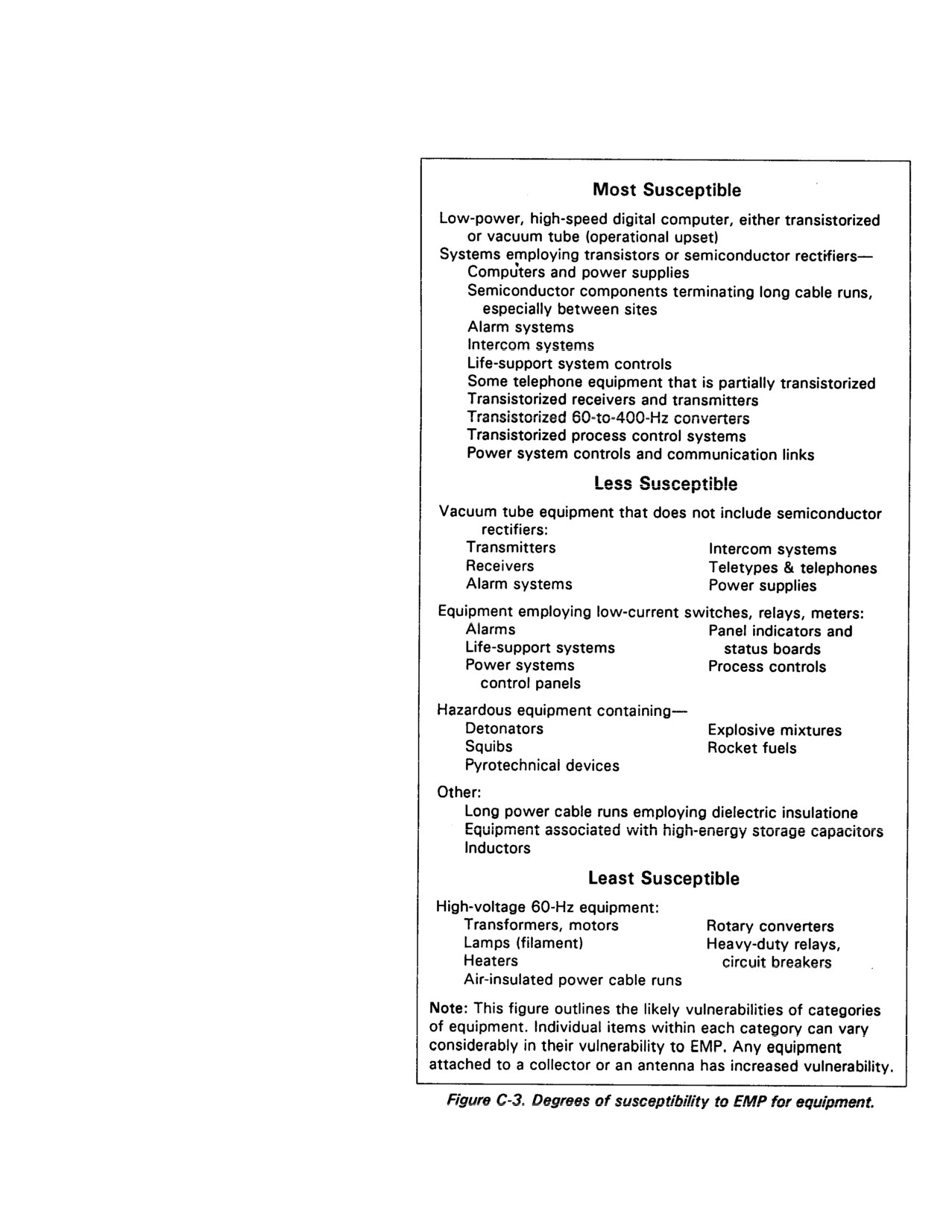
items of equipment are classified, the most vulnerable
EMP can cause functional damage or operational upset.
categories of equipment are shown in Figure C-3 (next
Functional damage is physical damage to equipment that
page).
requires replacement or repair of components. It should not
As emphasized in Figure C-3, vulnerability to EMP can
be assumed that equipment suffering from functional
vary significantly within each category of equipment.
damage is destroyed forever. By using postattack
Several rules of thumb can be employed to make rough
mitigation procedures, it may be possible to quickly return
estimates of the vulnerability of electronic equipment
the item to use (such as, by replacing fuses and resetting
(None of these rules apply to EMP-hardened equipment.
circuit breakers).
Hardened material should withstand EMP effects.):
No physical damage is evident with operational upset.
Any system that employs a digital computer is susceptible,
This may appear to be less important than functional
particularly to upset. EMP can destroy or distort the
damage. However, it can be just as damaging, because
information contained in the computer’s memory.
EMP interferes with the operation of the equipment by
Pieces of equipment with state-of-the-art, low-power transistors
erasing data from a computer memory or by causing a
and semiconductors are more susceptible to EMP damage than
computer device to send an erroneous signal to the piece of
similar equipment using older technologies with vacuum
equipment it controls. In addition, operational upset is of
tubes.
concern because it can occur at EMP energy levels that are
The more powerful the signal a piece of equipment (such as a
1/10th to 1/100th of those required to inflict functional
radio receiver) is designed to receive, the less susceptible it
damage. EMP does not directly affect internal electronic
is to EMP-induced damage.
components. It can only cause damage if it gets into a piece
Equipment with large collectors is more susceptible to EMP
of equipment through collectors or antennas, or if it
damage than equipment with small collectors.
C-3
FM 3-3-1
Unhardened radios operating at frequencies of 100 megahertz
megahertz (such as, super high frequency and microwave
or below, (such as, high frequency systems) are susceptible.
equipment) may be less susceptible.
Communications systems operating at frequencies above 100
Personnel
Personnel can be directly injured by EMP only if they
catch fire if relays are switched to the wrong positions.
are physically touching metallic collectors (cables, railroad
Also, pilots may receive incorrect information from digital
lines, etc.) at the moment of the tremendous EMP surge.
instruments that have been upset by EMP. These secondary
However, troops are unlikely to be in this situation and can
effects can be mitigated using appropriate standing
be instructed to avoid physical contact with such collectors.
operating procedures.
EMP hazards may exist from indirect or secondary EMP
effects. For example, damaged electronic equipment may
Collectors
and Antennas
Unlike some other nuclear weapon effects, the damage
Unintentional antennas are any metal conducting materials, to
caused by EMP depends in large part on the configuration
include rail lines, pipes, power lines, vehicle bodies, and
of the equipment subjected to it. For example, equipment
concertina wire used to protect positions.
that has been developed in EMP hardening programs can
Commanders’ EMP mitigation plans will be effective
resist high levels of EMP. The key to these hardening
only if they deal with both types of collectors and antennas.
programs is shielding—creating barriers between the EMP
Usually, there are a number of unintended EMP collectors
energy and critical components of the equipment. Recall
in or near a tactical unit.
that EMP is a powerful radio wave, and like other radio
Commanders can identify the unintended antennas in
waves, it is picked up by collectors and antennas. Shielding
their units and areas of operations to which EMP
eliminates unintentional antennas or creates protective
mitigation procedures must be applied. If there is a metal
barriers around critical electronic components.
object in the unit area that you would not want to touch
While there is no substitute for the use of equipment that
during a lightning storm (particularly if you were to take
has been hardened against EMP, some of the principles of
the object and place it vertically in the air), it is probably
EMP hardening and shielding can be employed by units in
an unintended antenna, such as, a long wire, grounding
the field to minimize EMP effects. Collectors and antennas
rod, spool of metal cable, or rail line.
have a major impact on the amount of EMP energy that
However, this rule of thumb only applies to the
can get into a piece of equipment and cause damage.
identification of potential unintended antennas through
In developing EMP mitigation plans, commanders need
which EMP energy might couple to electronic/electrical
to know about the two types of antennas that absorb EMP
systems. EMP is not the same as lightning, and devices
Intentional antennas are those normally used with tactical
that provide protection against lightning generally do not
communications equipment.
automatically provide protection against EMP.
Basic Planning
EMP mitigation is not something that can be handled by
EMP is not a blinding flash of energy that instantly kills
a higher headquarters. Each unit employing
or injures everyone or automatically destroys tactical
communications and other electronic equipment must
material. Primarily, it affects electronic equipment and the
develop and implement an EMP mitigation plan consistent
use of mitigation techniques can reduce or eliminate
with its assigned mission(s). The following paragraphs
damage caused by EMP. Hardened items may not be
contain planning considerations that should be used when
affected at all.
developing mitigation plans.
Don’t regard EMP as a hard to understand newly
Take EMP effects seriously.
discovered effect. EMP was one of the nuclear weapon
If no mitigation procedures are used, both HEMP and
effects predicted during the first nuclear tests, and it has
surface-burst EMP (SBEMP) can damage mission-essential
been studied for over 30 years. You don’t have to be a
electronic equipment that is not hardened.
nuclear physicist to understand how EMP can affect
Don’t exaggerate the effects of EMP.
C-4
FM 3-3-1
tactical equipment or to develop and implement effective
training, it is tempting to use commercial radios and other
mitigation procedures.
nonmilitary-issue equipment which are nonstandard and not
Use hardened equipment.
Through command channels, commanders
can obtain information concerning the EMP
hardness of their equipment, including the
identification of equipment that has been
hardened in EMP shielding programs.
Make maximum use of and place primary
reliance on hardened equipment.
Keep hardened equipment hardened.
Improper use or maintenance can reduce the
hardness or shielding of equipment. Use
EMP mitigation procedures to maintain the
hardness of shielding equipment; and ensure
that troops follow maintenance procedures
specified in technical manuals.
Know your equipment. Ensure all
personnel in the unit know their equipment
and understand the factors that make these
items more or less vulnerable to EMP
damage. Some characteristics, such as the
use of microprocessor computer chips in a
system or the presence of an intended or
unintended antenna, can have a major impact
on a piece of equipment’s vulnerability.
Avoid myths and misconceptions. EMP
has been the subject of a number of popular
science articles that are not necessarily
accurate. Some false rumors about EMP and
EMP mitigation have been circulating. Here
are the facts—
Don’t rely on lightning suppressors and
arrestors. While EMP is similar to lightning
in some ways, EMP is more powerful and
differs in other characteristics. Hence,
military and commercial devices that provide
adequate protection against lightning strikes
generally do not provide protection against
EMP.
Don’t plan on wrapping everything in
aluminum foil or putting every item of
equipment in metal boxes. Taking these steps
may make sense when dealing with small,
redundant items, such as an extra hand-held
calculator might be kept in a sealed
ammunition can. As a general rule, it doesn’t
make sense to try to put all of your
equipment away in these types of expedient
shielded containers. In reality, your
equipment may not be protected and more
importantly, you need your equipment to
accomplish the mission.
Don’t rely on nonmilitary standard
commercial equipment. During peacetime
C-5
FM 3-3-1
EMP hardened. In many situations, quick reconstitution
warning of an attack is provided should take no more than
and recovery of standard-issue equipment will be possible
15 minutes to implement.
because the needed parts are in the supply system. This
Integrate EMP mitigation into battle plans.
will not be true for nonstandard items.
AirLand Battle doctrine requires the synchronization of
Avoid the single-event fallacy. In assessments of
all elements of the force in integrated plans. Commanders
potential tactical situations, don’t assume that EMP will
must understand their superiors’ overall operational
occur once and then be over. The contrary may be the
concepts and plans, and must take the initiative to exploit
case. An aggressor may initiate a precursor attack with
opportunities to implement these plans as the opportunities
high altitude EMP to initially damage unprotected
occur.
equipment, and then follow-up with additional high altitude
Effective EMP protection procedures are not confidential
or surface-burst explosions to exploit the tactical situation.
nor impractical. In most cases, effective EMP procedures
The only valid countermeasure is to adopt and sustain EMP
are simply extensions of approved tactical doctrine.
mitigation postures consistent with tactical missions.
Place priority on EMP mitigation procedures that are
Anticipate EMP. Effective EMP mitigation techniques
consistent with the unit’s assigned missions and aligned
must be integrated into a unit’s standard operating
with the basic operational concept—AirLand Battle
procedures. Units should normally operate in a protective
doctrine. Place emphasis on mitigation techniques that are
posture. Additional protective measures to be undertaken if
integrated into unit standing operating procedures, with
particular emphasis on warning or short warning conditions.
Mitigation
Techniques
EMP mitigation techniques apply in the following three
As a general rule, making an addition to stand-alone
environments in which tactical units operate:
equipment that does not have wires or connectors running
1. Administrative and training situations.
outside the protected enclosure does not interfere with the
2. Preattack and during attack operations.
EMP hardening of the shelter. However, any addition of
3. Postattack recovery and continued operations.
new connectors (such as, running a telephone wire or extra
This appendix presents EMP mitigation techniques
air conditioning or ventilation hoses into a shelter) that do
appropriate for each of these environments. The
not go through an approved surge arrestor and penetration
distinctions made between these three environments are not
shield or connector, can seriously impact on the hardness
hard and fast. For example, tactical operations will be
of the protected area.
conducted concurrent with the implementation of postattack
recovery measures. Furthermore, the presentation of these
Rules of Thumb
techniques is cumulative, and the techniques suggested for
administrative and training situations also should be carried
Many EMP-hardening schemes create shields between
forward to the preattack, during attack, and postattack
the electronic equipment and external EMP environments.
environments.
Therefore, any cable or other penetration that creates a
hole or gap in the shield can seriously degrade the system’s
survivability. Field units should never add connectors to
Administrative and Training
hardened equipment unless directed to do so. Even the
Situations
small break in the shielding required “to allow a heater
power cord or a ventilation hose to enter can be damaging.
Some of the most important EMP mitigation procedures
A number of rules of thumb can be kept in mind when
can be initiated under peacetime administrative and training
performing maintenance on both EMP-hardened and
conditions. These include—
nonhardened systems, from backpack radios to
Adhering to maintenance procedures.
communications vans:
Training with back-up systems.
Make every effort to ensure that metal-to-metal connections are
Under all conditions, the most important EMP mitigation
clean and provide good metal-to-metal contact. Ensure that
procedures are to use hardened equipment and to maintain
no gaps exist in the shield. Don’t allow dust or dirt to
equipment hardness by using correct maintenance and
accumulate. Make sure that sloppy paint jobs don’t allow
operational procedures. Improper maintenance can readily
globs or paint to build up along the edges of hatches, doors,
reduce or eliminate a piece of equipment’s built-in EMP
or other openings.
hardening.
Check for, and repair holes and cracks, ensuring that clean
Extreme caution must be exercised when adding
metal-to-metal contact is restored.
components to already hardened equipment, such as,
placing new systems in a hardened van or mobile shelter.
C-6
FM 3-3-1
Ensure that operating and maintenance personnel can identify
In a combat environment where forces might be
all cable shields used for the system.
subjected to EMP, a firm grasp of these approved
Have maintenance personnel check, repair, and, if necessary,
procedures can make the difference between defeat and
replace shields that become worn or damaged. Ensure that
victory. Commanders can be confident in the ability of
shields make good contact with connector shells.
their units to employ these approved backup procedures
Replace loose or damaged connections, such as, gaskets and
only if they train and test their forces prior to combat.
finger stocks.
Keep access panel doors and other openings shut whenever
Preattack and During-Attack
possible. Such openings provide breaks in shielding and allow
Operations
EMP energy to enter and damage components.
Minimize the length of cable runs and avoid cable loops, if
While it is impossible to list a single set of EMP
possible. Long runs and loops can create unintentional
mitigation procedures to be used in all tactical situations,
antennas that attract EMP energy.
some general guidelines likely to be valid in most
Ensure power systems and other cable layouts are in an
circumstances are discussed in this section.
approved “tree” configuration. This configuration is outlined
Learn to recognize EMP effects.
in the discussion of cables and grounding.
Under demanding field conditions, individual items of
If the system uses filters, ensure they are maintained according
electronic equipment may fail for a number of reasons
to appropriate technical manuals.
other than EMP. For instance, combat units may be
DO not add grounding points within an enclosure or shelter.
subjected to radio electronic combat (REC) that may
Multiple grounds can create loops, which can have damaging
interfere with radio communications by jamming and
currents induced into them by EMP.
emitting false signals. It is important not to confuse these
Ensure copies of all required technical manuals and other
events with the effects of EMP. In addition, it is important
pertinent documents are available.
to recognize that the effects of EMP may not be
Train and cross train personnel in prescribed maintenance
immediately evident, particularly if a unit has many items
procedures and evaluate their performance in field conditions.
of equipment that have been hardened to resist EMP
Take advantage of the maintenance required to meet
effects. Nevertheless, EMP effects could be present, with
chemical warfare requirements. Vans and cases designed to
potentially disastrous consequences, such as, upsetting
survive in a chemical warfare environment are often
computer memories so they no longer provide an accurate
airtight with clean contact between edges of the outer
portrayal of the tactical situation.
surface of the container. This is the same clean contact
Several rules of thumb can be used to identify the
required to maintain EMP shielding and hardness.
possible presence of EMP effects.
Failures in electronic systems that are confined to nonhardened
Training With Back-Up Systems
items of equipment.
Failures in multiple types and numbers of nonhardened
Tactical forces use electronic equipment, which can be
electronic systems.
operationally upset or seriously damaged by EMP, for a
The simultaneous failure of electronic equipment in multiple
variety of purposes, including—
units. This can be ascertained by establishing contact with
Position finding and reporting.
adjacent units and higher headquarters.
Communications.
The inability to establish electronic communications and/or the
Computation and calculation (such as, targeting solutions).
sudden occurrence of static. REC can also interfere with radio
Storage of tactical and logistical information.
transmissions; but REC does not cause physical damage to
For each of these functions, there are approved
the radio itself. Hence, if nonhardened radios continue to
nonelectronic or alternative electronic procedures and
function, but encounter static or jamming, REC, rather than
systems. Maps and compasses can provide location
EMP, may be the cause.
information. With adequate preplanning, a backup signal
The results of arcing—burnt or melted spots—can indicate the
system, employing messengers, flares, sound-making
impact of EMP on a nonhardened system.
devices, and other nonelectronic means, can be employed.
If sufficiently close to a surface burst to observe blast and
Also, multiple electronic systems, such as, wire and SHF
thermal signatures, presume that EMP effects may be present.
radios, can be used to supplement potentially vulnerable
Use the other rules of thumb to identify the potential effects
HF and UHF radios.
of high-altitude EMP.
Nomograms and slide rules can be used to solve tactical
Ensure subordinate leaders understand the
problems. Also, extra calculators can be stored in empty,
commander’s operational concept.
If EMP degrades or
sealed ammunition cans within vehicles or vans. Manual
eliminates communications, mission accomplishment
systems exist that can be used to sort and retrieve tactical
hinges on the ability of subordinate leaders to implement
and logistical information.
C-7