FM 3-3-1 Nuclear Contamination Avoidance - page 15
FM 3-3-1
Step 1.
Place a pencil compass on the center of the
platoons position and measure over the 20 cGyph contour
line where this contour line crosses the MSR. Without
Step 6.
Turn to Figure-6-12, page 6-26, the total dose
changing the compass gap, place the compass on the map
nomogram for a decay rate of 1.2. Align the hairline
scale in Figure E-1, Appendix E. Use the 1:25,000 scale.
across the Te
value of H + 4. Again, find that the Ts
value
The distance from the platoon’s position to the 20 cGyph
is less than 1 hour. As described earlier, place the hairline
contour line should be 0.6 kms.
on 1. Pin the hairline down on the index scale (middle
Step 2.
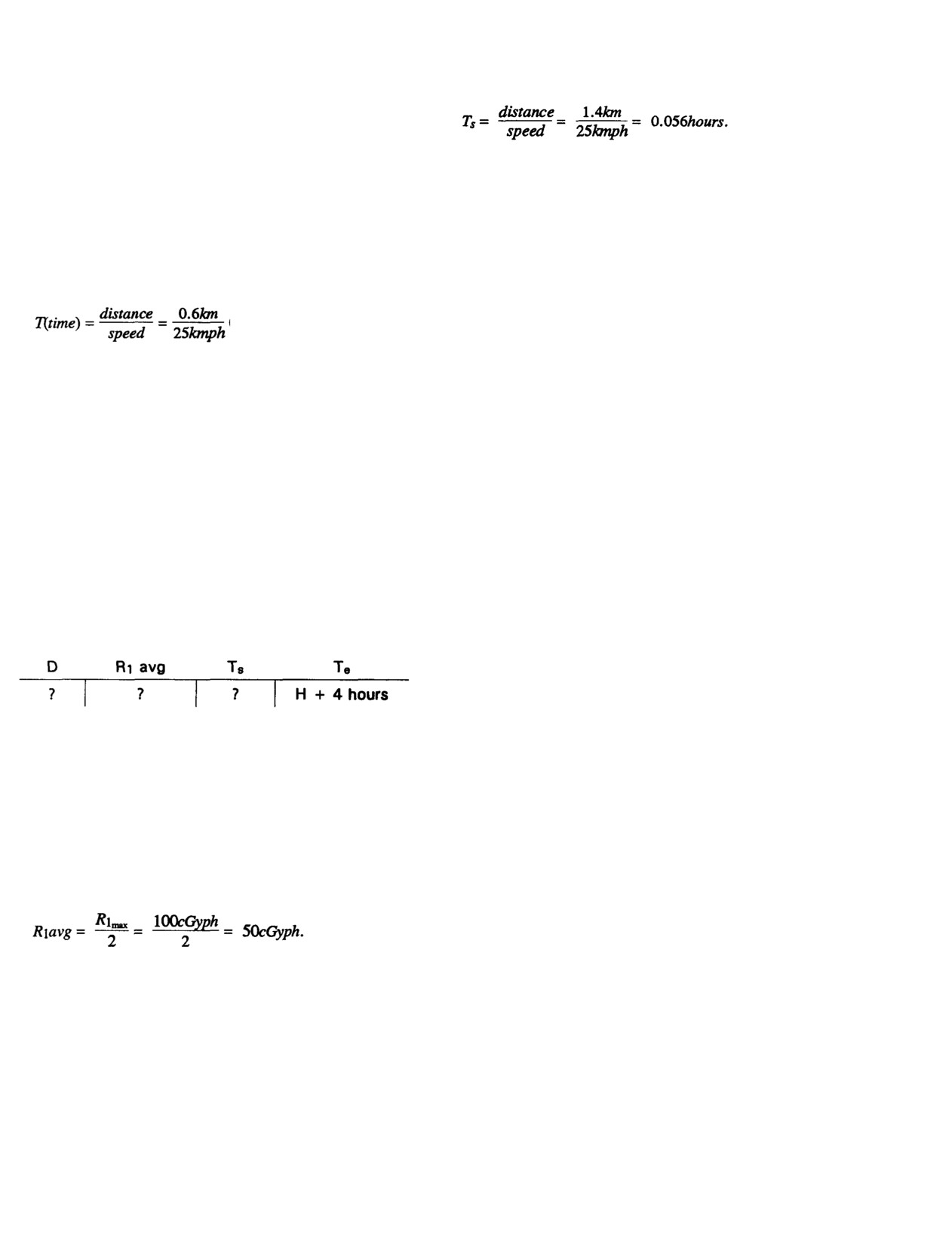
If the platoon departs from its locaton at 1900,
scale); and rotate the hairline so that it crosses the R1
scale
and travels 0.6 kms at 25 kmph, at what time will the
at the R1
value of 50 cGyph. Read the value in the far
platoon enter the contaminated area? To determine this use
left-hand column labeled Total Dose (D). Again, this value
the following formula:
is off the printed scale.
In this case and all similar cases in which the hairline
falls off the scale, there are two ways to solve the probelm.
In other words, with a nuclear burst that occurred at
First method is to multiply the R1, avg value (50 cGyph) by
1500, the unit will depart at H + 4 hours. The distance
10. When rotating the hairline on the index scale, lay the
that the unit must travel down the MSR, before it reaches
hairline across the new R1
avg value of 500 cGyph. Read
the contaminated environment will take approximately 1.45
adjusted total dose from the far left-hand column. In this
minutes. This is derived by multiplying 0.024 by 60 to gain
case, that dose is approximately 80 cGyph. Divide this
the time in minutes. When working with radiological
number (80 cGyph) by 10 to find actual dose-in this case,
contamination, from fallout, 1.45 minutes is immaterial.
8 cGy. The second method is to multiply the R1
value by
Beacuse this time and distance is small, for the purpose of
the index value where the hairline crosses the index scale.
this example, use the time of H + 4 for the platoon to
Both methods are correct, and the preferred method is left
enter (Te) the contaminated area.
to the individual. Place this value in the visualization.
Step 3.
Setup the remainder of the problem in the
Step 7.
This dose (8 cGy) is the dose for a Ts
of 1 hour.
following manner—
In this problem the Ts
value was 0.056. To determine the
IDt
= TF x D.
actual outside, unshielded dose in this area, multiply the
IDt =
inside total dose received
dose by the Ts:
TF = transmission factor for HMMWVs (see Table 6-1)
D adj = D x Ts
D = total dose received (unshielded).
= 8 x 0.056
Visualize the problem of finding D (total dose):
D adj = 0.448 cGy.
So, for this problem the actual unshielded dose the
soldiers may receive is leas than 1 cGy or 0.448 cGy.
However, the soldiers are in HMMWVs.
R1
avg = average R1
value
Step 8.
Multiply the dose (0.448 cGy) by the
Ts
= time of stay in contaminated area
transmission factor for HMMWVs (0.6) to calculate the
Te = time in which unit enters the contaminated area
inside, shielded dose rate the soldiers can expect to receive:
In this example, use H + 4 as the Te
value.
IDt = 0.448 cGy x 0.6
Step 4.
Referring back to Figure 6-16, the highest dose
= 0.2688 or 0.3 cGy.
rate the platoon is expected to encounter is 100
soldiers of the chemical platoon are expected to receive
cGyph—used as the R1 max, because it is the highest known
0.3 cGy, or leas than 1 cGy, during their movement. Keep
dose rate along the MSR. Unless a survey actually
in mind that this calculation is based on a HMMWV
establishes the actual R1max, use the known dose rates
transmission factor that was obtained using a radioactive
found on Te
overlay graphics. Calculate the R1
average for
source that is almost twice as strong as average fallout. So,
the problem:
the actual dose the soldiers receive may be less.
To answer the brigade S3’s question, give the final dose
the soldiers will receive. The S3 does not want to know
Now, go back to the visualization in Step 3, and plug in
how you arrived at those numbers—just the information. In
the value for R1
avg.
this case, the soldiers are expected to receive 0.2688 cGy.
Plug into the visualization (Step 3) the value for TF from
As stated originally, the platoon is rated at RES-1 moderate
Table 6-1.
risk. Refer to Appendix A to determine the risk value.
Step 5.
Measure the map distance from Point A
From Table A-2 in Appendix A, moderate risk for RES-1
(intersection of the 20 cGyph contour line and the MSR) to
units is less than or equal to 30 cGy. Add the expected
Point B, where the platoon will exit the contamination.
dose of 0.2688 or 0.3 cGy to determine what RES category
This distance should equal approximately 1.4 kilometers.
the platoon will be in after its movement. The answer to
Time of stay (Ts) is calculated as follows:
the brigade S3’s question is “Yes,” the platoon can
6-30
FM 3-3-1
accomplish the move without exceeding 70 cGy total
the platoon’s entry into the area, increase the traveling
exposure. No additional protective measures are required
speed of the vehicles, or add shielding to the vehicles (see
other than to cover the nose and mouth with a cloth or
Appendix B for adding shielding). In some cases all three
wear the protective mask to protect the respiratory track
steps outlined here may be used to reduce the dose
from airborne radiological contaminants. If for some
received and meet mission requirements.
reason (enemy activity, vehicle breakdown, etc.) the
To calculate the time of exit (TX) in this problem, or
platoon has to extend its stay in the area, new calculations
exactly when the platoon must exit the area, use the
must be made using the new value for TS.
following formula:
If the actual dose received by the platoon were to exceed
Tx
= Te
+ Ts.
the prescribed dose, you should suggest they either delay
Application of Avoidance Principles
The concepts presented in this chapter can be applied to
the integrated battlefield. To do this, you use the checklist
in Appendix G as a guide for tactical operations.
ANBACIS
System
As discussed in Chapter 2, ANBACIS is a computer
EDMs and radiological calculations for total dose, crossing
system capable of generating NBC warning and reporting
problems and induced radiation.
messages; but the system also is capable of calculating
6-31
FM 3-3-1
Chapter
7
Neutron-Induced Radiation Areas
As discussed in the beginning of Chapter 3, neutrons are
produced in all nuclear weapon bursts. Some of these
neutrons may be captured by the various elements in the
soil under the burst. As a result, these elements become
radioactive, emitting beta particles and gamma radiation
for an extended period.
Beta particles are a negligible hazard unless the
radioactive material makes direct contact with the skin for
an extended period or is inhaled. Beta particles can cause
skin irritations varying from reddening to open sores. In
contrast, gamma radiation readily penetrates the body and
can cause radiation injury and even death. To determine
the external military hazard posed by induced radiation, an
analysis of the dose rate of the emitted gamma radiation
must be determined. For this reason neutron-induced areas
are considered areas of gamma activity.
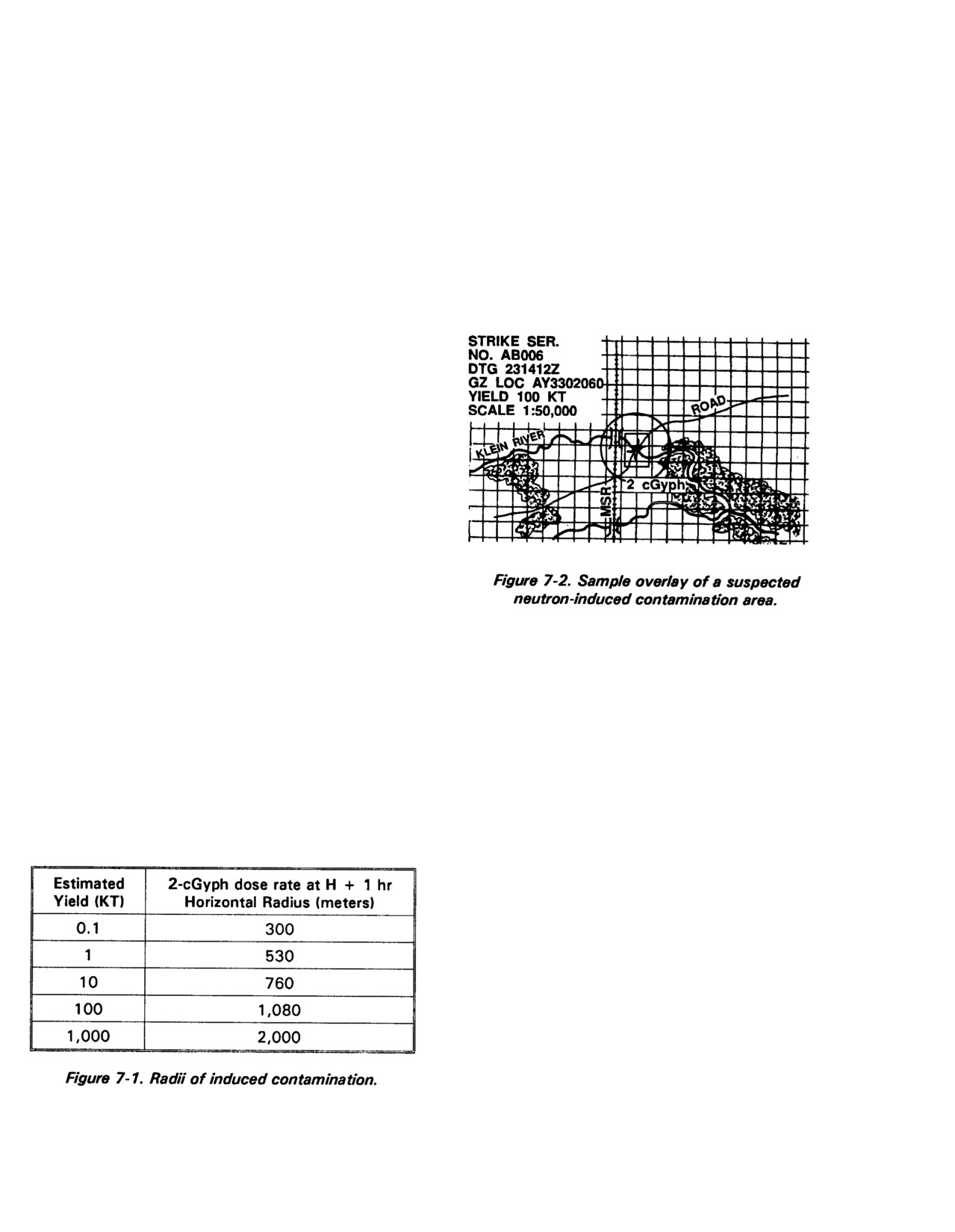
The location of a suspected induced-radiation area
created by an airburst is determined by nuclear burst data.
On the map overlay, this radius is drawn about the GZ
Weather conditions have no influence upon its location or
point as a circle. The circle is labeled, and nuclear burst
size. Surface winds will not affect the pattern. The pattern,
data and overlay data are recorded. (See Figure 7-2.) This
if produced, will always be around GZ. The size of the
area is regarded as contaminated until actual dose-rate
pattern depends on the yield of the weapon and the height
readings indicate otherwise. The actual area of
of burst. Figure 7-1 shows the boundaries of the induced
contamination is usually substantially less, depending upon
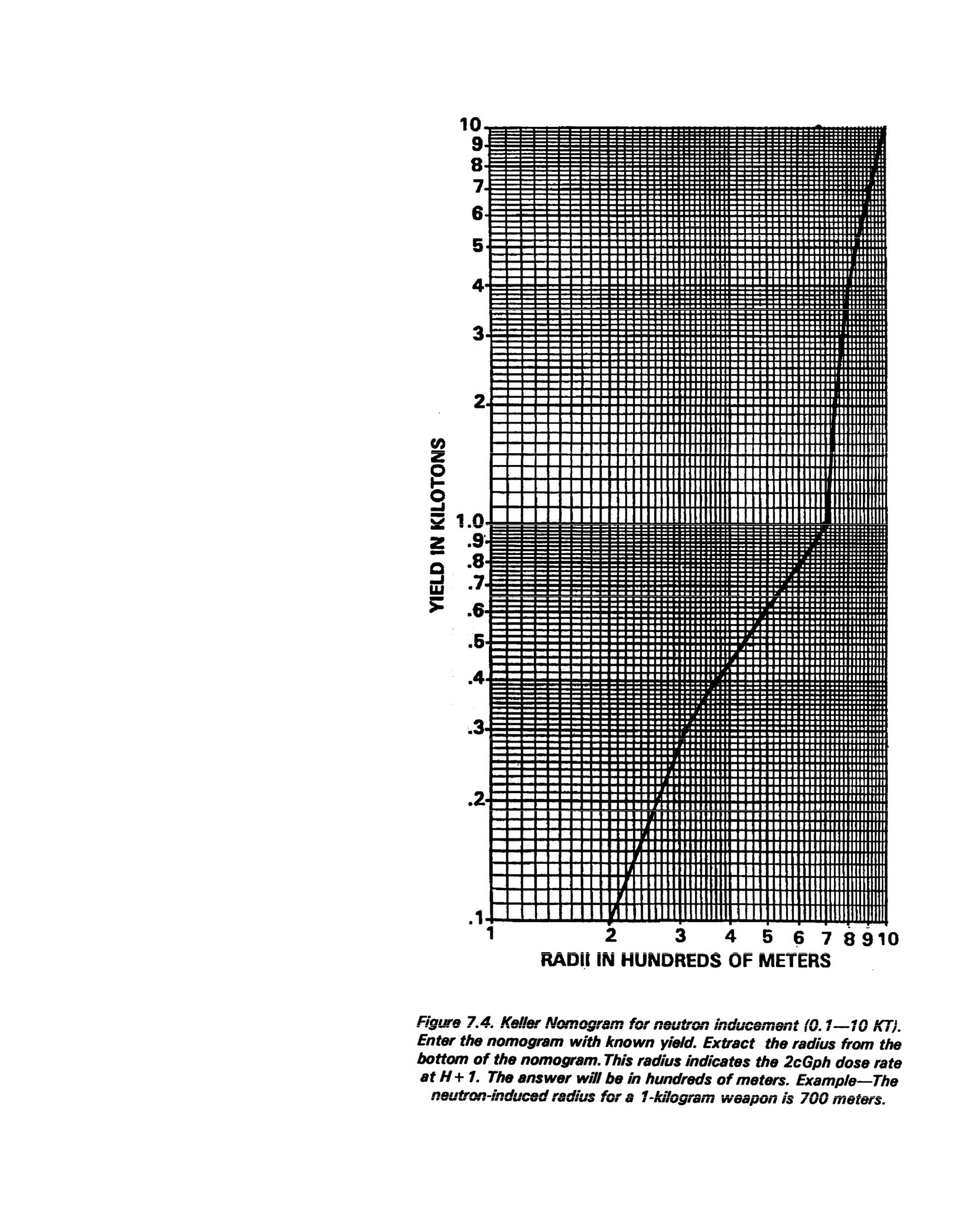
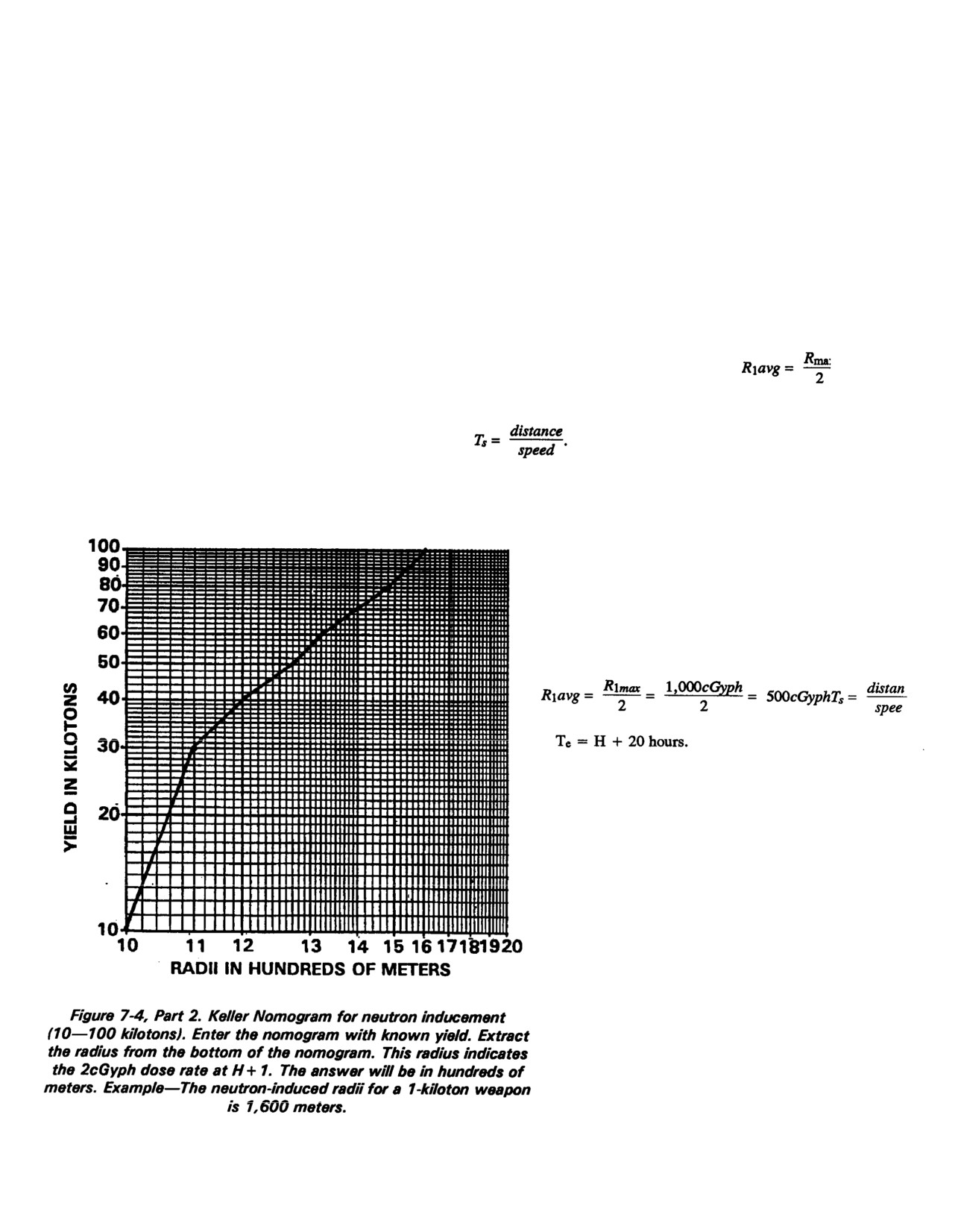
area for different yields. Refer to Figure 7-4 (page 7-3 and
actual yield and height of burst.
page 7-4) for the Keller Nomogram. Assuming an optimum
Avoid neutron-induced radiation areas whenever
height of the weapon (or interpolated if not listed), the
possible. If the area cannot be avoided, the commander
distance given is the maximuim horizontal radius to which
must follow the protection techniques for fallout.
a 2-cGyph dose rate will extend one hour after burst.
To avoid neutron-induced radiation, the commander
must know where the suspected area may be. All enemy
airbursts are assumed to create hazard areas. Friendly
bursts employed in packages may create induced areas very
near one another. Commanders must understand that the
GZ for an airburst should not be crossed for 24 to 96 hours
after the burst. Routine occupancy of an area of induced
radiation is possible from two to five days after burst. In
this case, low dose rates become even more significant.
This is because of the accumulated dose acquired over the
period of exposure. A commander should seek the least
contaminated region available. During occupancy, the area
should be checked with the dosimeter once an hour.
7-0
FM 3-3-1
fallout. For fallout, the decay rate is calculated by using
Plotting NIGA Areas
the Kaufman equation. For induced radiation, the
To plot a neutron-induced gamma activity area, enter
percentage, by weight, of elements present in the soil
Figure 7-4, Part 1 or Part 2, with the known yield on the
determines the decay rate. Since soil composition varies
left side of the chart. Lay the hairline across the chart and
widely, even in a localized area, you must know the actual
pin down the hairline on the dark black index line. Rotate
chemical composition of the soil to determine the rate of
the hairline laterally and read the radii of the NIGA pattern
decay of induced radiation.
in hundreds of meters at the bottom of the chart.
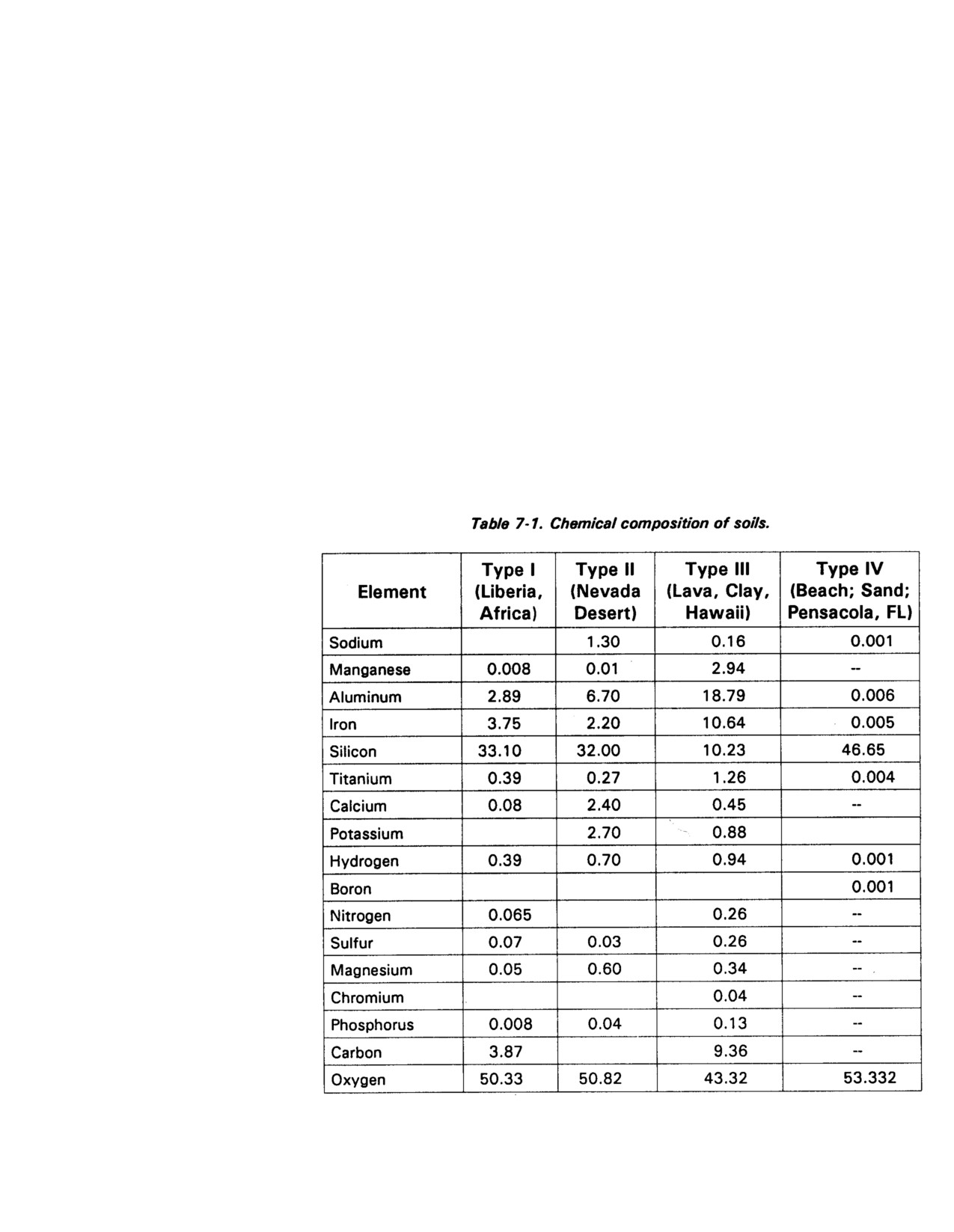
All soils are divided into four types. Table 7-1 has been
extracted from Defense Nuclear Agency Effects Manual 1
(DNA E-M-1). Since the actual soil composition will not
Decay of Induced Radiation
be known, Soil Type II, the slowest decay, is used for all
The soil in the target area is radioactive to a depth of 0.5
calculations until the NBCC advises use of a different soil
meter at GZ. In contrast, fallout is a deposit of radioactive
type.
dust on the surface. From this it can be seen that decon of
Soil type is determined by using engineer soil maps or an
the induced-radiation area is impractical.
NBC 4 report and the induced-decay nomograms. The
Decay characteristics of induced radiation are
method is basically a process of elimination The dose rate
considerably different from those of fallout. Fallout is a
and the time it was measured are applied to an
mixture of many substances, all with different rates of
induced-decay nomogram. This results in an H + 1 or R1
decay. Induced radiation is produced primarily in
dose rate. Then, if the other dose rates and times from the
aluminum, manganese, and sodium. Other elements, such
series report result in the same R1
dose rate, that is the soil
as silicon, emit so little gamma radiation, or decay so fast,
that they are less important.
During the first 30 minutes
after a burst, the principal
contributor to induced
radiation is radioactive
aluminum.
Almost all soils contain
aluminum. It is one of the
most abundant elements in
the earth’s surface.
Aluminum-28 has a half-life
of 2.3 minutes. Because of
this, almost all of the
radioactive aluminum has
decayed within 30 minutes
after burst.
Most soils also contain
significant quantities of
manganese. This element,
Manganese 56 has a half-life
of 2.6 hours. From 30
minutes after burst until 10
to 20 hours after burst, both
manganese and Sodium 24,
which has a half-life of 15
hours are the principal
contributors to radiation.
After 10 to 20 hours after
burst, Sodium 24, is the
principal source of radiation.
Soil composition is the
most important factor in the
decay of induced radiation.
Its decay must be considered
differently from that of
7-1
FM 3-3-1
type. If not, check the other nomograms until the one used
intersects the vertical line and the interpolated value (tick
results in the same RI.
mark) as closely as possible. The following three problems
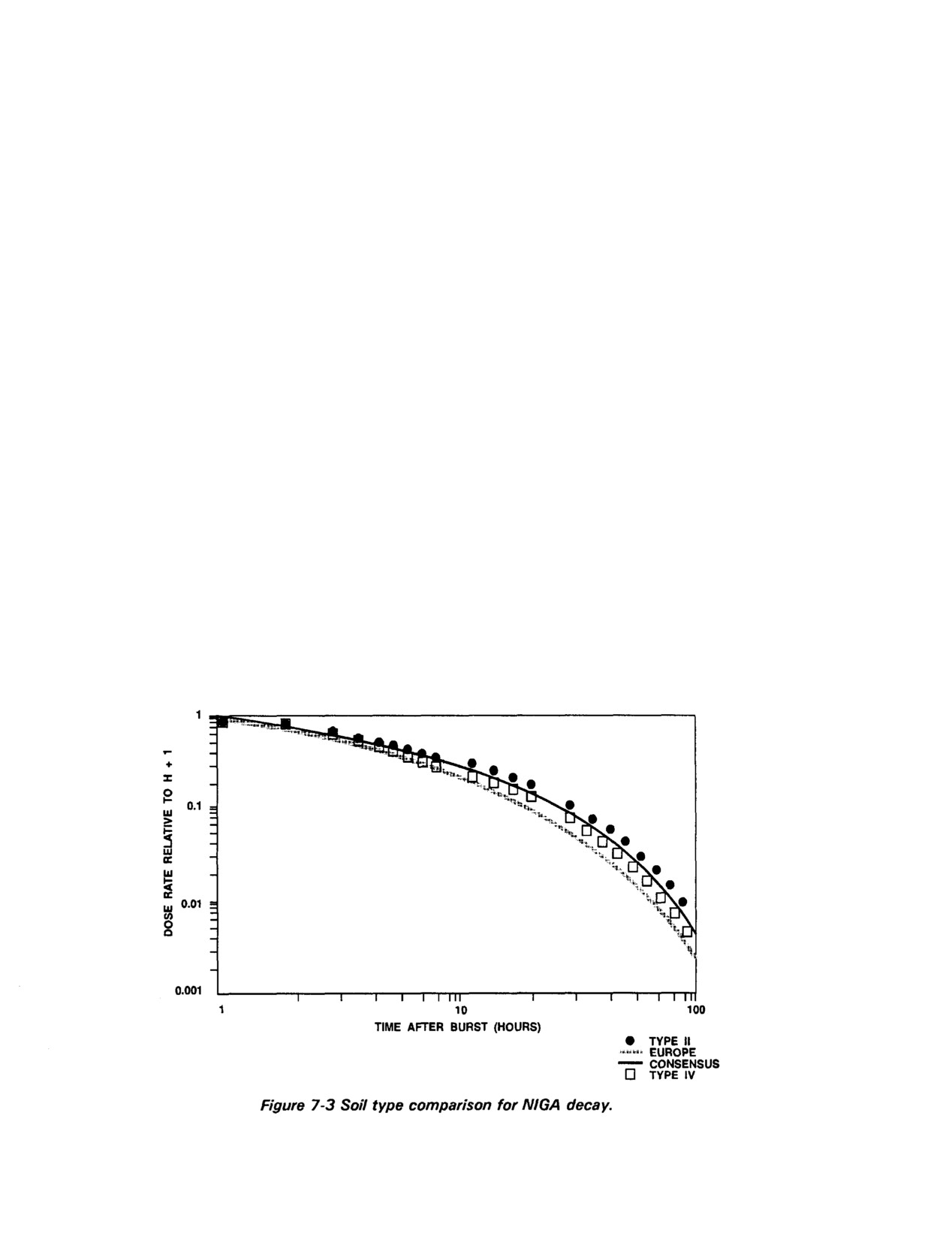
Soil Type II is listed as the type of soil found in the
are concerned with technique only; they do not consider
Nevada Desert. This is due to the amount of sodium and
the impact that high dose rates might have on operations in
manganese in the soil and not the composition as a whole.
the contaminated area. Each problem requires the use of a
Figure 7-3 (next page) depicits a graph comparing NIGA
Keller nomogram for solving the problem (Figure 7-4,
decay for various soils. From this graph, Soil Type II
parts 1 and 2, next two pages). The caption for each
NIGA decay compares directly to the soil type labeled
nomogram contains a guide for using the nomogram.
Consensus. Consensus is the average soil (sodium and
Problem 1.
manganese content only) world-wide. Therefore, Soil Type
Given: Rt = 150 cGyph at H + 3 hours, Soil Type 11.
II is considered the standard soil used for calculations when
Find: RI.
the actual soil type is unknown.
Answer: 180 cGyph.
From Figure 7-3, Soil Type IV compares directly to the
Solution: Select nomogram for Soil Type 11. Align the
average European soil, in sodium and manganese content.
hairline with the 3-hour tick mark on the Time (middle)
Therefore, use Soil Type IV when determining NIGA
scale (t) and the 150 cGyph point on the Rt
scale. Read the
decay in this region.
dose rate as 180 cGyph at the point of intersection with the
RI
scale.
Problem 2.
Dose-Rate Calculations
Given: R1 = 300 cGyph, Soil Type III.
The decrease in the dose rate must be calculated before
Find: Rtt
at H + 7 hours.
total dose can be found. This is done with decay
Answer 63 cGyph.
nomograms. Use the residual radiation (induced) decay
Solution: Select nomogram for Soil Type III. Align the
nomograms in Appendix E (Figures E-44, E-45, E-48 and
hairline with the 7-hour tick mark on the Time (middle)
E49) for these calculations. They allow the user to predict
scale (t) and the 300-cGyph point on the R1
scale. Read the
the dose rate at any time after the burst. Each nomogram
dose rate as 63 cGyph at the point of intersection with the
denotes time (hours) after burst for one of the four soil
Rt
scale.
types.
Problem 3.
In each nomogram, the RI
scale is at the right. This
Given: R1
= 200 cGyph, Soil Type IV.
scale shows H + 1 dose rates. The Rt
scale is on the left.
Find: time (t) when RI
= 70 cGyph.
This scale shows dose rates at times other than H + 1.
Answer: H + 11 hours.
In working with nomograms, be as consistent as possible
Solution: Select nomogram for Soil Type IV. Align the
when joining values with the hairline. Be sure the hairline
hairline with 200 cGyph on the R1
scale and 70 cGyph on
7-2
FM 3-3-1
the Rt
scale. Read the time as H + 11 hours
at the point of intersection of the hairline with
the time scale.
Total Dose Calculations
for NIGA
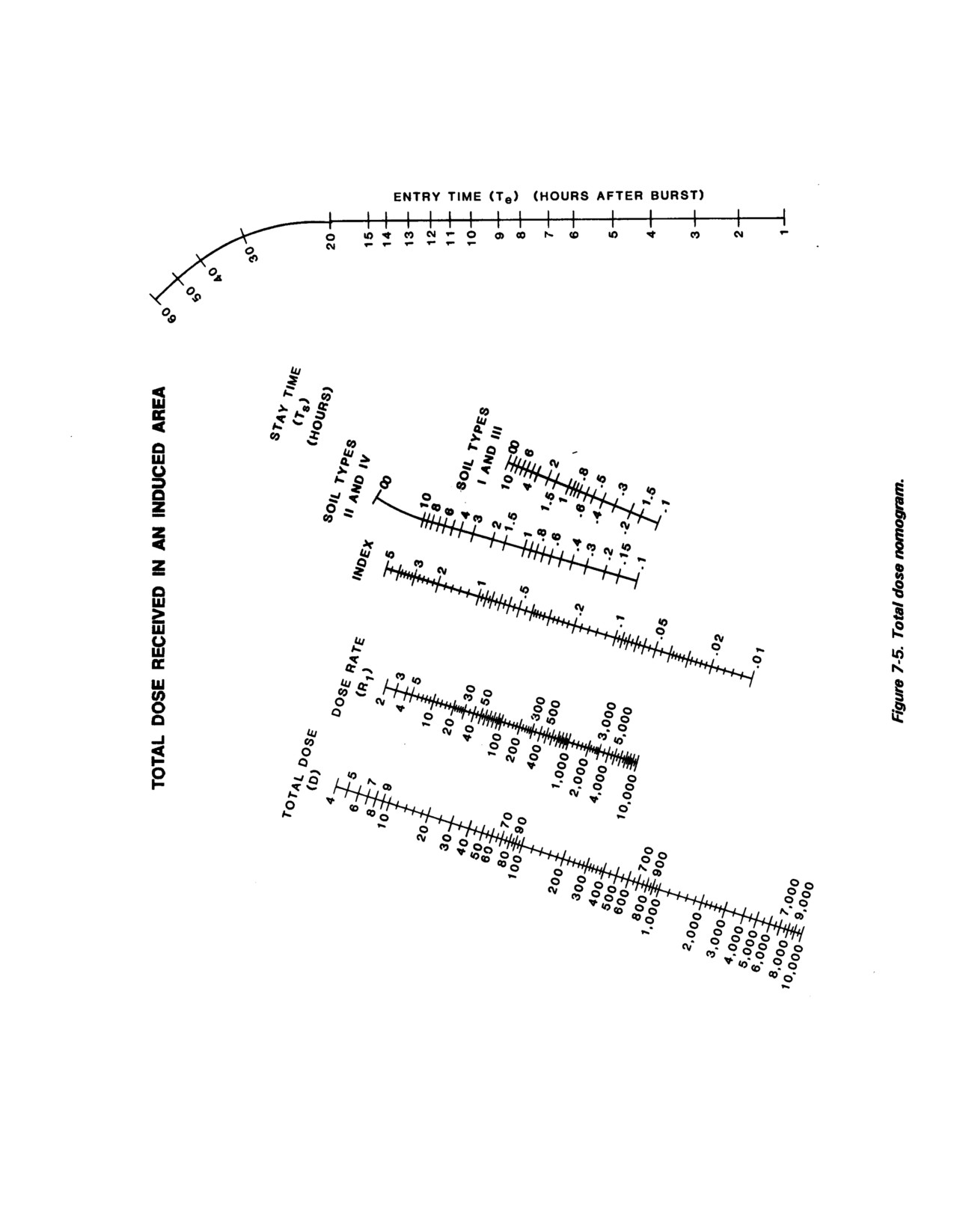
Use the nomogram in Figure 7-5 (page 7-5)
for predicting the total dose received in an
induced area. This nomogram relates total
dose, H + 1 dose rate, stay time, and entry
time. The two scales to the left of the index
line show total dose and H + 1 dose rate.
There are two time-of-stay scales to the right
of the index line. The extreme right scale
shows time of entry. The index line is a
“pivoting” line used as an intermediate step
between D and R1. R1
is found by using one
of the induced &cay nomograms. If soil type
is unknown, assume the soil is type II. The
total dose nomogram, Figure 7-5 is never
used to find RI.
In Figure 7-5, soil types II and IV under
stay time are used for total dose calculations if
the soil type is not known. If the soil type is
known, the appropriate scale under stay time
is used. It is possible to find any one value on
the total dose nomogram if the other three are
given, as illustrated in the following problems.
These problems are concerned with
techniques only. They do not consider the
impact the dose or dose rates might have on
operations in a contaminated area.
Problem 1.
Given: R1
= 140 cGyph
Te=H+6 hours
Ts
= 1 hour
Soil Type II.
Find: D.
Answer: 72 cGy.
Solution: On the nomogram in Figure 7-5,
connect H + 6 on the Te
scale with 1 hour on
the T
s
scale (soil types II and IV) with a
hairline. Pin the hairline at the point of
intersection with the index scale. Now pivot
the hairline to 140 cGyph on the R1
scale.
Read 72 cGy on the D scale.
Problem 2.
Given: R1
= 300 cGyph
Te=H+6 hours
D = 70 cGy
Soil Type III.
Find: Ts.
Answer: 1 hour.
7-3
FM 3-3-1
Solution: On nomogram in Figure 7-5, connect 70 cGy
APCs should be sandbagged both on top and bottom.
on the D scale with 300 cGyph on the R1
scale. Pin the
Always use uncontaminated soil in the sandbags.
hairline at the point of intersection with the index scale.
As with fallout, the limit to the amount of exposure to
Pivot the hairline to H + 6 hours on the Te. scale. Read 1
radiation is expressed by the higher commander’s OEG. To
hour on the Ts
scale (soil types I and III).
meet this OEG, the lower commander must employ as
many of the dose reduction principles as possible.
In calculating total dose, it is necessary to determine an
Crossing an Induced-Radiation Area
average dose rate. Dose rates increase as the center of the
If an area must be crossed, select the lowest dose rate
area is approached, and then decrease beyond the center of
area, consistent with the mission. Route selection may be
the area. The average dose rate represents a mean value the
influenced by several factors. Unpassable terrain, such as
individual is exposed to during the time of stay. A
mountains or swamps, may influence the route. Obstacles,
reasonable approximation of the average dose rate can be
such as tree blowdown, fires, or rubble, also may limit the
obtained by dividing by two the maximum dose rate
number of routes or the mode of movement.
predicted to be encountered. This is written
If an option exists for crossing an induced area, select
the method in the following priority order:
Time of stay: Time of stay (stay time) must be calculated
1. Aircraft.
for crossing problems. Use the folowing relationship:
2. Armored vehicles and personnel carriers.
3. Wheeled vehicles.
4. On foot.
Problem.
Sandbag all vehicles used in crossing to increase
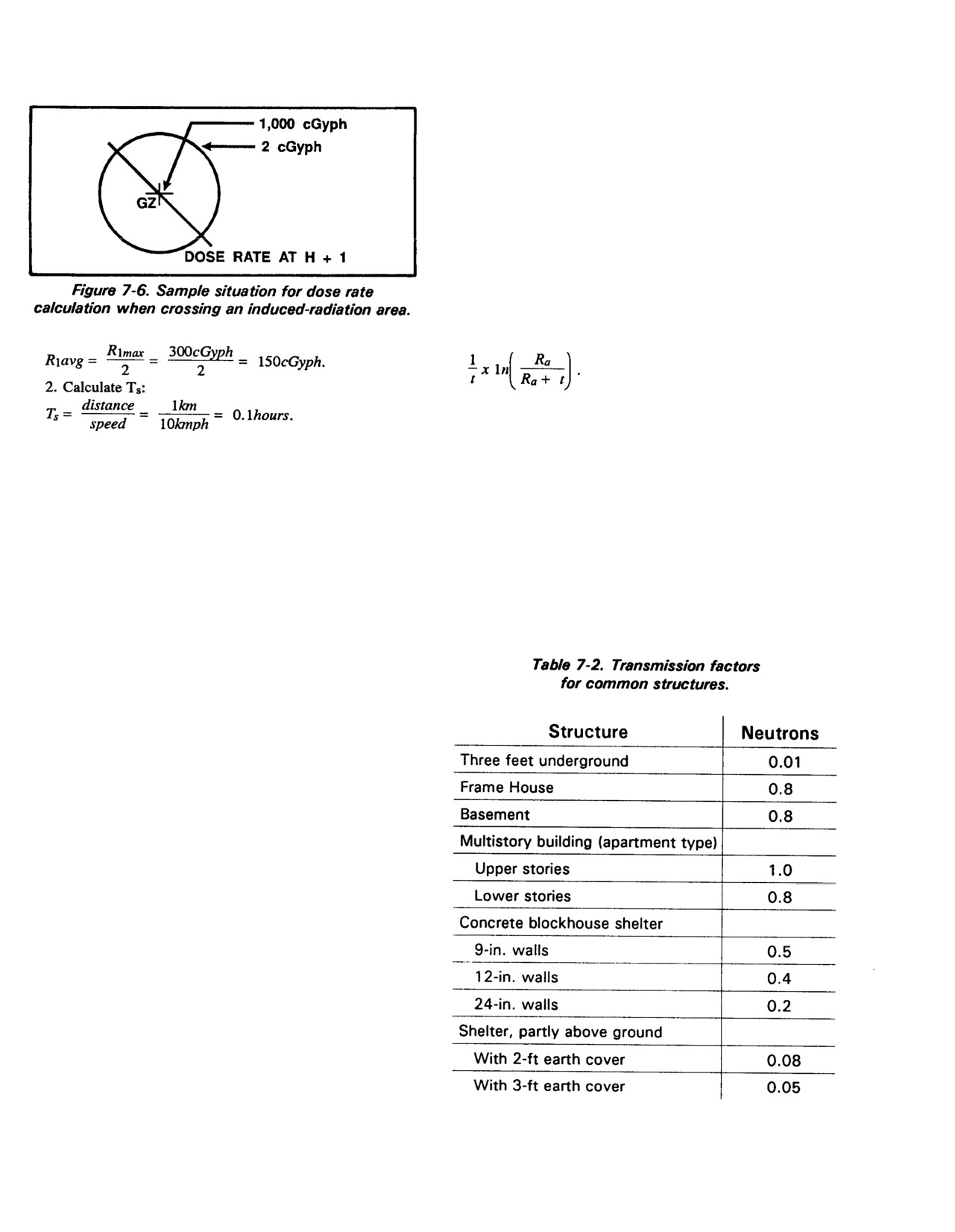
Figure 7-6 (page 7-6) shows an example problem for
shielding. Sandbag floors and sides of cargo vehicles.
calculating dose when crossing an induced radiation area.
Given: A crossing will take place (as shown
in Figure 7-6) at H + 20 hours. Distance of
the route across the area is 1 kilometer, Speed
during the crossing (on foot) will be 5
kilometers per hour.
Find: D.
Answer 20 cGy.
solution
On the nomogram in Figure 7-5, connect
0.2 hours on the Ts
scale (soil types II and IV)
and 20 hours on the Te
scale with a hairline.
Pivot through the point of intersection with
the index scale to 500 cGyph on the R1
scale.
Read a total dose of 19 cGy on the D scale at
the point of intersection with the hairline.
Problem 2.
Given: An induced area with Soil Type II
must be crossed at H + 10 hours. Distance
across the area is 1 kilometer. Speed of
crossing is 10 kilometers per hour. The
highest H + 1 dose rate is 300 cGyph.
Crossing will be conducted in APCs with a
TF of 0.22.
Find: ID.
Answer: 1.32 cGy, or 1 cGy.
Solution:
1. Calculate R
I
avg:
7-4
FM 3-3-1
7-5
,
l
FM 3-3-1
Determination of Decay Rate
for Induced Radiation
Decay characteristics of induced radiation are
considerably different from those of fallout. The Kaufman
equation may not be applied.
The decay of induced radiation depends on the elements
in which it is induced. Soil contains many different
elements with varying half-lives, so, the decay rate changes
in time, and must be monitored constantly.
The decay rate n at a fixed location can only be
determined from consecutive measurements, using the
following equation:
R
a
is the dose rate reading in cGyph at an arbitrary time
a and Ra
+ t is a second reading taken at the same location
3. On the nomogram in Figure 7-5, connect 10 hours on
after t hours. One n () is the natural logarithm to base e (e
the Te. scale with 0.1 hour on the Ts
scale (soil types II and
= 2.71828..., Eulerian constant).
IV). Pin the hairline on the index scale. Pivot the hairline
Manganese and sodium are two elements frequently
150 cGyph on the R1
scale. Read the outside dose as 6 cGy.
found in soils with relatively long half-lives. Therefore,
4. Calculate the inside total dose:
they are expected to be the principal sources of radiation
inside dose = outside dose x TF
after a burst. For sodium with its half-life of 15 hours, the
=
6 cGyx 0.22
decay rate is 0.046. For manganese with its half-life of 2.6
=
1.32 cGy, or 1 cGy.
hours, the decay rate is 0.27.
Transmission Factors
for Neutron-Induced Areas
Transmission factors for induced areas are determined in
the field. The TFs in Table 7-2 should be used with the
greatest reservation. Actual TFs in induced areas may be
higher by as much as 70 percent, because of a very
technical characteristic of radiation. Essentially the strength
of gamma radiation is measured in million electron volts
(MEV). Fallout less than 24 hours old has an average
energy of 0.67 MEV. Induced radiation emitted from the
three principal soil elements has a range of 0.68 MEV to
1.2 MEV.
Because of the unique decay characteristics of induced
radiation, TFs must be recalculated frequently. Every four
hours is recommended. This accounts for changes in the
penetrating ability of the remaining radiation.
Field calculation of neutron-induced TFs is identical to
that for fallout. TFs may be applied to dose rates or total
dose.
The following mathematical calculations relate to NIGA
from a single burst at a single location.
7-6
FM 3-3-1
Tout = -l/n*ln(EXP(-n*Te)-(n*DL)/R
Determination of the Dose Rate
l
Where Te
is the time of entry in hours after the reference
for an Arbitrary Time
time at which the dose rate was R
1
and the decay rate was
D. One n () and EXP() are the natural logarithm and the
The dose rate R
+ t in cGyph at an arbitrary time t
1
exponential function, respectively.
hours after a reading is calculated as R
1
+ t = Ra * EXP (
Determination of the Earliest Time of Entry.To
-n * t). Ra
is the dose rate at the time t of the reading, n is
ensure a limiting dose DL
is not accumulated during a stay
the decay rate at that time, and exp () is the exponential
in an NIGA area, the earliest time of entry tin
can be
function (inverse or INV (); the argument is the power to
which e = 2.71828 . . . is raised).
determined as follows:
Te = -1/n*(DL/(R*n*(l-exp(-n*Ts)))).
Note:
The following characters or character combinations
Where T
S
is the time of stay in the area in hours, R
r
is the
indicate keys on the pocket calculator*,EXP,Yx, INV,
dose rate at the reference time H + 1, and n is the decay
(
and
).
When you encounter one of these in a formula,
rate at that time. One n () and EXP () are the natural
press the key indicated. Remember that negative n (-n) is
logarithm and the exponential function, respectively.
not an indication to press the minus key.
There are two other methods to calculate crossing
problems. The
hand-held pocket calculator method:
Determination of Dose
Step 1.
Turn on the calculator, and punch in the value
for Rl, press "÷"; then "(1- n ).”
Accumulated in an NIGA Area
Step 2.
Press the multiplication key; then “(” and the
The dose D in cGy accumulated between entry to and
value for Ts. Then push the power key "Yx."
exit from an NIGA area is found by using the formula—
Step
3. Press “(” again and 1 -n. push the minus
D=R
/n*(EXP(-n*Te )-EXP(-n*tout)). R
is
symbol “-.”
1
1
the dose rate in cGyph at the reference time, n is the decay
Step 4.
Again, press “(”, the value for Te, and "Yx."
rate at that time, tin and tout are the time of entry and exit
Press “(” again and then “1 - n.” Press “(” twice, then
from the NIGA area in hours after the reference time. EXP
equals.
() is the exponential function.
The whole equation written out looks like this—
D = RI+(1-n)x(Tsyx(l-n)-(TeYx
(l-n)))=.
Determination of Time of Exit
For time of entry (Te—
from an NIGA Area
T
= Tsyx(l-n)-Dx(l-n)÷R l= I N V Yx
e
(1-n)
=.
Given a Maximum Dosage
For time of stay (Ts)—
If a certain limit DL
for the dose accumulated during a
Ts=Dx(l-n)÷R
+ Te, Yx ( l - n ) = I . Yx
l
stay in an NIGA area is given, the time tout to leave the
(1-n)=.
area can be determined from the following equation:
7-7