FM 3-3-1 Nuclear Contamination Avoidance - page 14
FM 3-3-1
6-20
FM
3-3-1
Step 1.
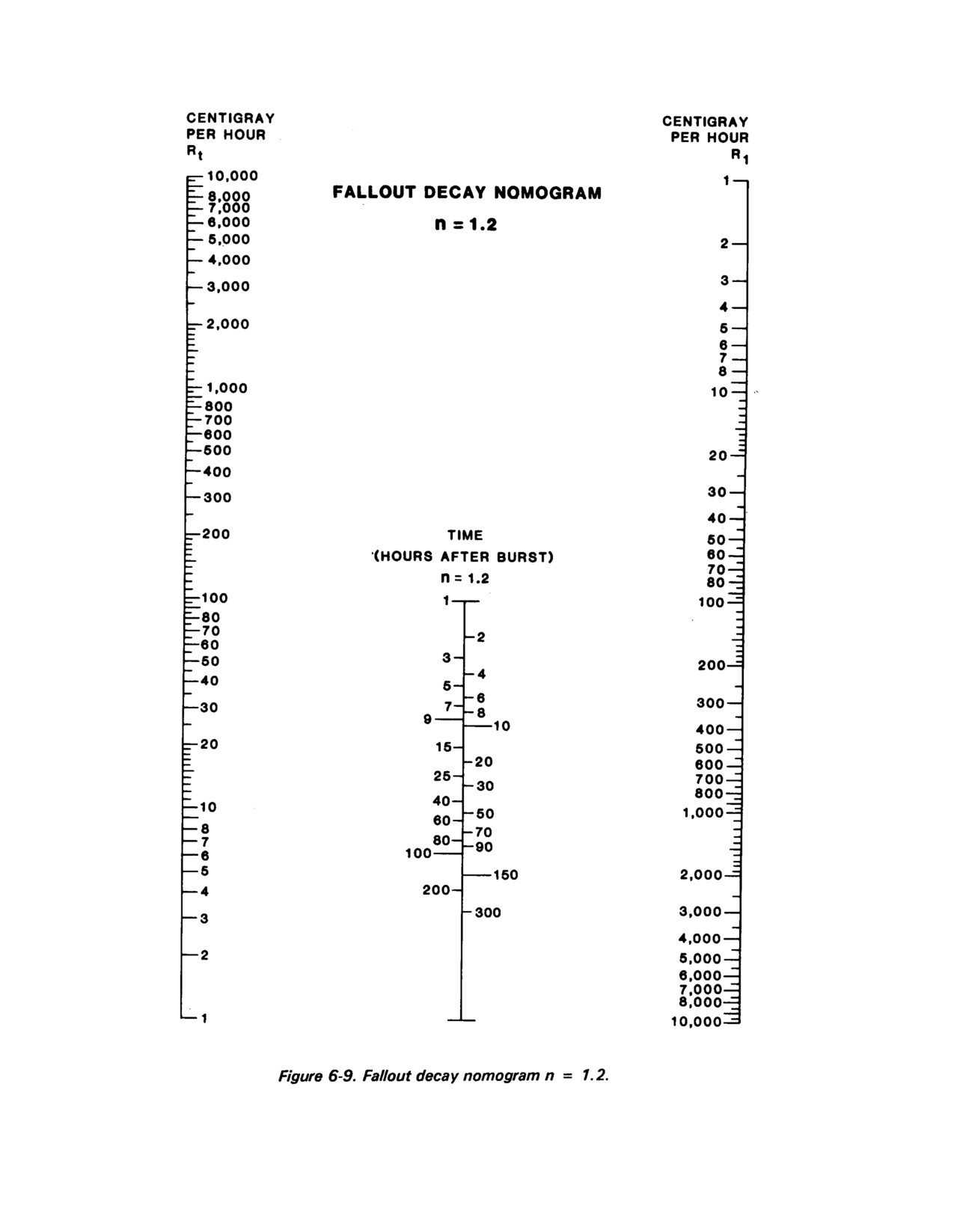
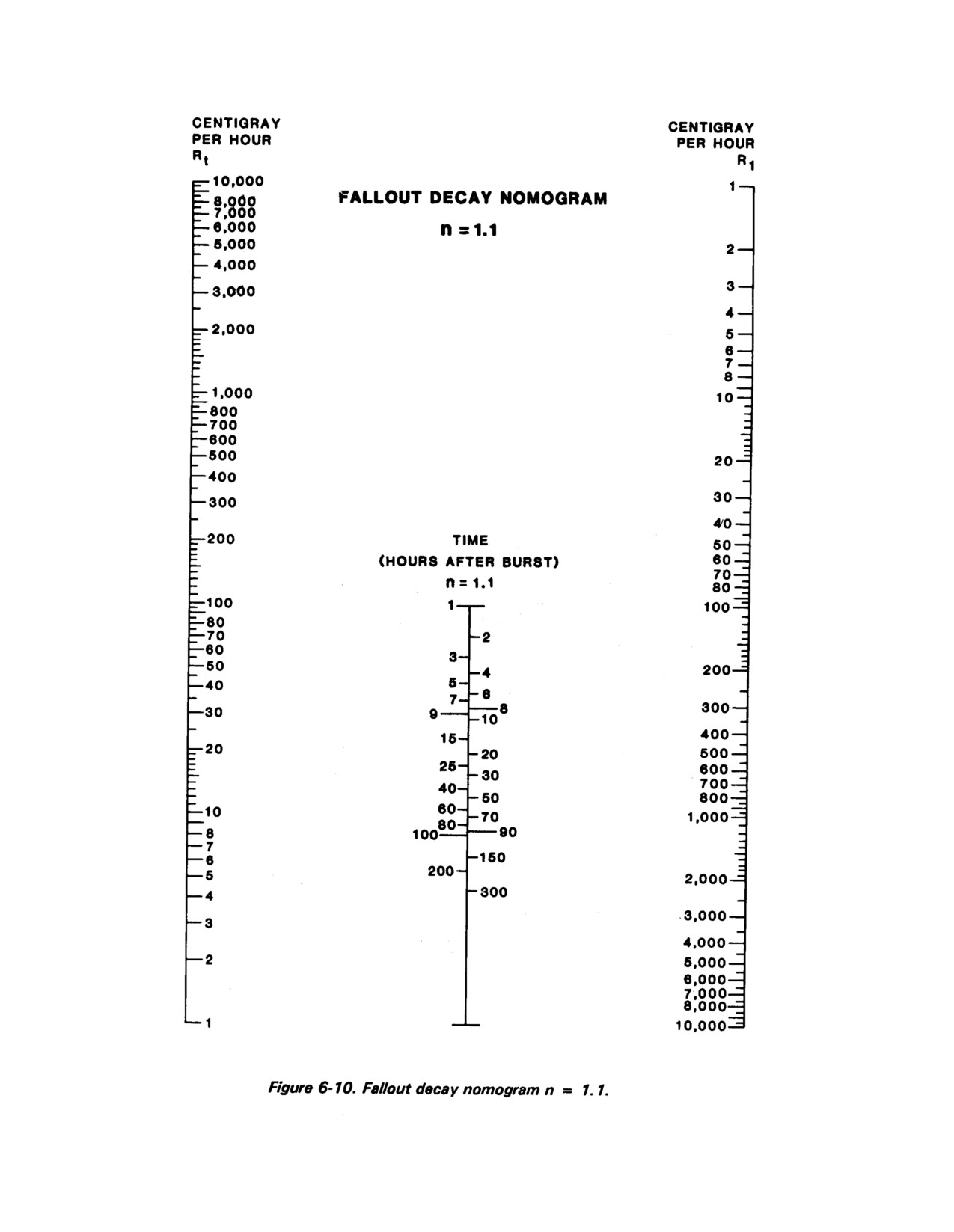
Using the nomogram in Figure 6-11 for a decay
rate of 1.4, line up the hairline across the Rt
value and t
value. Read 222 cGyph on the R1
scale.
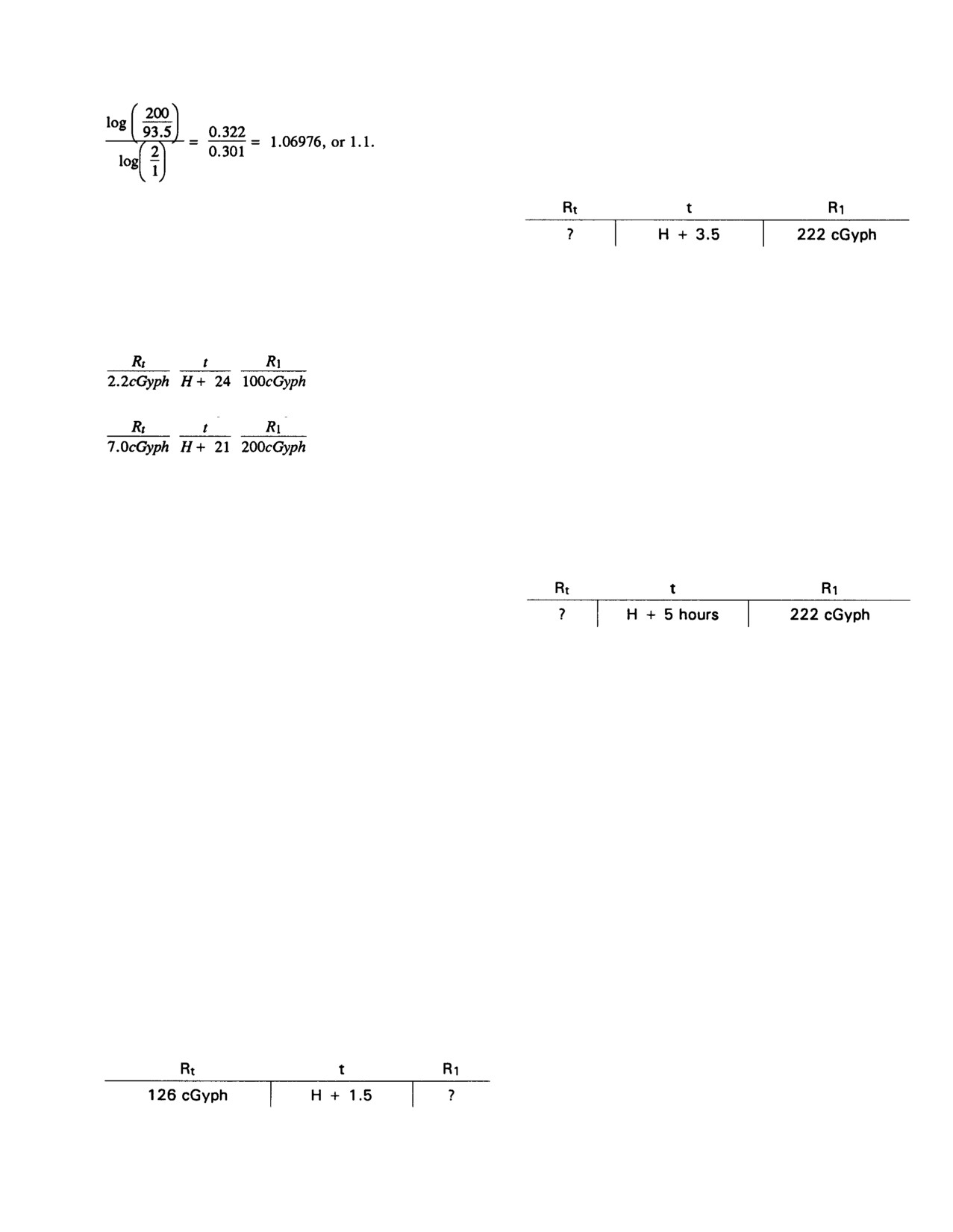
Find Rt
at 1830 hours for the first fallout only.
Visualize the problem as follows:
The nomogram method may now be used to calculate the
dose rate at the time of operational interest.
Using a nomogram, calculate the 0800Z dose rate 24
Step 2.
Using the same nomogram as in Step 1, lineup
hours after the first burst by finding the dose rate for that
the hairline across the R1
value of 222 and the t value of
specific time for each burst separately, and add the two
3.5 (1830 is 3.5 hours after the first burst). Read the value
values. Use a decay rate of 1.2 for the first burst, and 1.1
of 38 on the Rt
scale.
for the second:
Step 3.
Find the dose rate contribution at 1830 from the
(n = 1.2 nomogram in Figure 6-9).
second burst. Subtract the Rt
value determined in Step 2
from the reported dose rate at 1830 (300 cGyph). Dose rate
contribution of the second burst is 262 cGyph.
Rt2=Rt-R1
(n = 1.1 nomogram in Figure 6-10).
Rt = 300 cGyph -38 cGyph
Rt = 262 cGyph
Step 4.
Find R1
for the second burst only. Follow the
Dose rate total at 24 hours after the first burst is
procedures outlined in Step 1 to determine the R1
value.
calculated as follows:
Use the 1.2 nomogram in Figure 6-9. Line up the Rt
value
2.2 cGyph + 7.0 cGyph
= 9.2, or 9 cGyph.
of 262 cGyph and the t value of 1.5. Read the R1
value of
400 cGyph.
Find Rt
at 2000 hour for each burst.
Dose Rate Calculations
Visualize the problem as follows:
for Overlapping Fallout
H-hour is known for each burst. At 251500, a 20-KT
nuclear weapon was detonated on the surface. Sometime
Step 5.
For first burst, using the same nomogram as in
later, fallout arrived on your position. At 1630, a peak
Step 1, lineup the hairline on the R1
scale at
dose rate of 126 cGyph was measured, Subsequent
approximately the 222 cGyph value. Hairline must cross
readings indicated that n = 1.4. At 251700, another
the t scale at 5 (H + 5). Read the approximate value of 34
weapon was detonated, and fallout arrived at ypur position
cGyph on the Rt
scale.
soon after. At 251830, a second peak dose rate of 300
R1 = 222 cGyph
cGyph was measured.
t = H+4hours
Note:
This problem also may be calculated with a hand-
For the second burst, using the 1.2 decay-rate nomogram
held pocket calculator. These procedures are outlined in
as in Step 4, line up the hairline on the R1
value of 400
Appendix F. The calculator procedures must be followed if
cGyph and cross the t scale at 3 (H + 3). Read the RI
the value for t (time) is less than 1 hour.
value of 85 cGyph.
Step 6.
Find the total dose rate at 2000 hours. Total dose
Problem 1.
Assuming that n = 1.2 for the second
rate is the sum of dose rates at that time. Add the Rt value
weapon, what will the dose rate be at 2000? This may be
of 34 cGyph at H + 5 for the first burst and the Rt value of
calculated by either of two methods for determining an R1
85 cGyph at H + 3 for the second burst.
value. The first method (A) is to follow the steps for using
total dose at 2000 = Rtl
+ Rt2
the nomogram. The second method (B) is outlined in
total dose at 2000 = 34 cGyph and 85 cGyph
Appendix F.
total dose at 2000 = 119 cGyph
Solution:
Problem 2.
If a new unit moves into your area at 2200
When H-hour for each detonation is known, calculate the
and occupies foxholes for three hours, what total dose can
dose or dose rate for each event, and add them together to
they expect to receive? To work this portion of the
get the total dose or dose rate received.
problem, use the total dose nomogram for the decay rate of
Find R1
for the first detonation.
1.4 in Figure 6-11.
Visualize the problem as follows:
Step 1.
Find dose received from first burst.
Visualize the problem as follows:
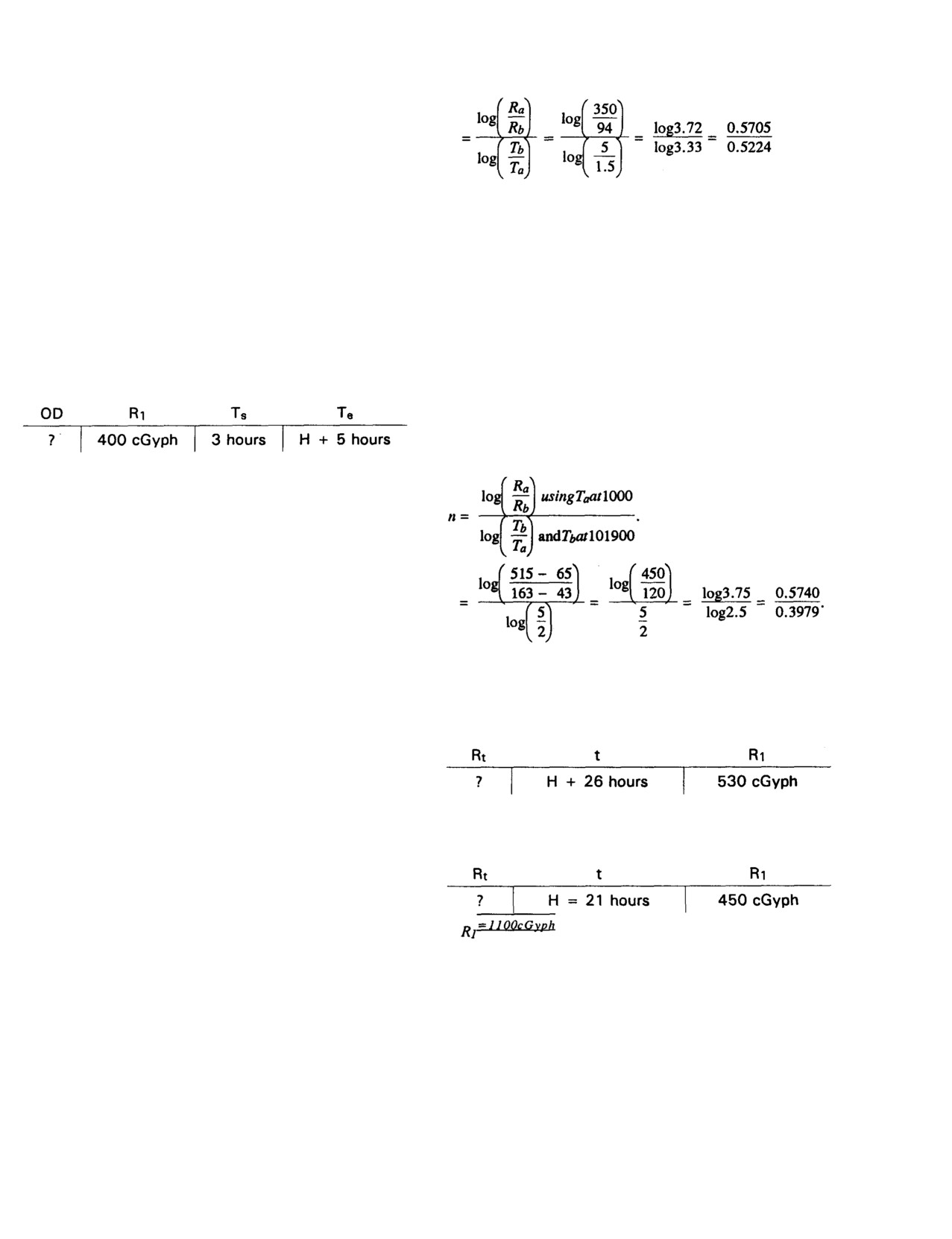
OD
R1
Ts
Te
6-21
FM 3-3-1
?
222cGyph
3 hr
H+7
I
I
I
(2200 is 7 hours after the first burst).
Note:
In computing this problem do not consider any ra-
diation exposure the unit may receive prior to entering the
foxholes. For the purposes of this example, only consider
Answer: n = 1.09 = 1.1
Step 2.
Using n = 1.1, calculate the contribution the
the radiation exposure the unit will receive once it (the
first burst made to the total dose rate after 101500. Using
unit) enters the foxholes.
the data presented in the problem and the decay value of
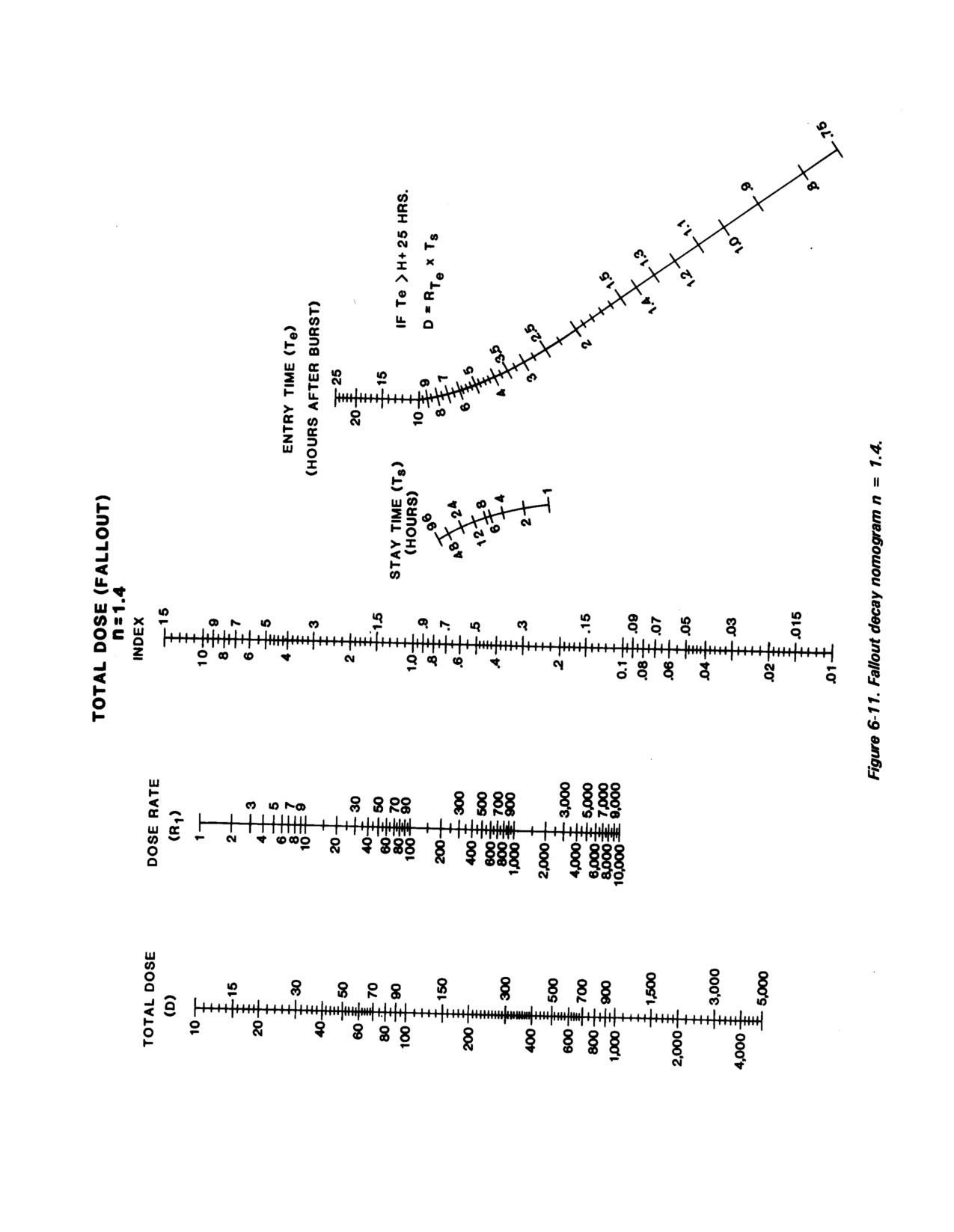
From Figure 6-11, read the value of 30 cGy. Multiply
1.1, normalize the peak reading of 350 cGyph at H + 1.5
this value by the transmission factor for foxholes (O. 1),
hours to H + 1. Using Figure 6-10 and the methods
found in Table 6-1.
discussed previously, determine an H + 1 value of 530
ID= OD X TF
cGyph.
ID = 30 cGy x 0.1
Dose Rate from First Burst:
ID=3cGy
101000 (H + 1) 530 cGyph
Step 2.
Find dose received from the second burst.
101500 (H + 6) 78 cGyph
Visualize the problem as follows:
101600 (H + 7) 65 cGyph
101700 (H + 8) 55 cGyph
101800 (H + 9) 48 cGyph
101900 (H + 10) 43 cGyph
(2200 is 5 hours after the second burst).
Step 3.
Calculate the decay constant for the second burst.
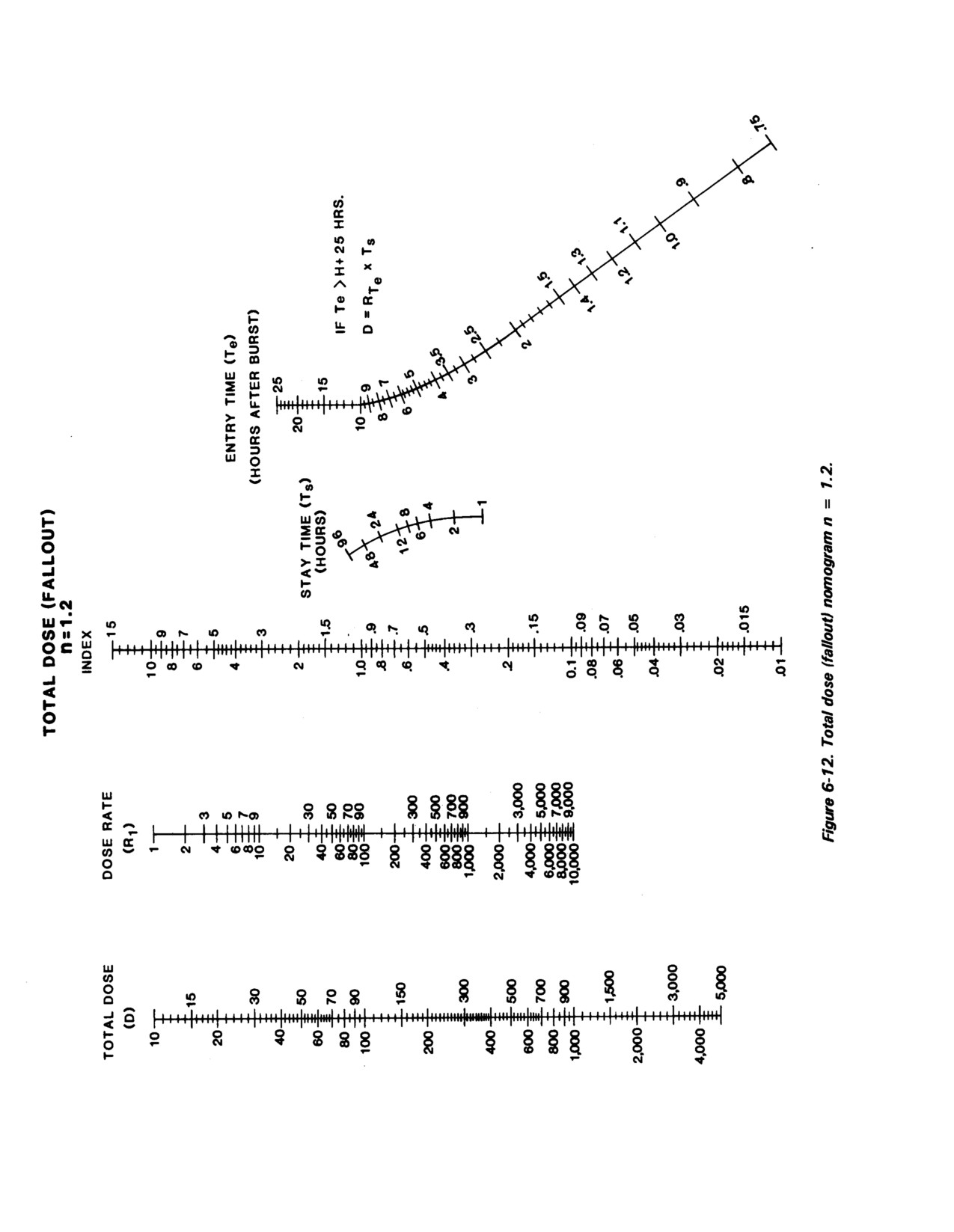
Using the nomogram for total dose, decay rate 1.2 in
Figure 6-12, compute the following:
OD = 125 cGy
ID= OD X TF
ID = 125
CGy X 0.1
ID = 12.5 cGy.
Step 3.
Find the total dose from both bursts.
D total = D1 + D2
= 3 cGy + 12.5 cGy
= 15.5 cGy.
Answer: n = 1.444 = 1.4
Note:
These values apply only to the location where the
Step 4.
Calculate dose rate at 111100 for each burst, and
dose rate measurement was taken. The procedure must be
add together.
repeated for each additional location.
Visualize the problem for the first burst (n = 1.1) as
Problem 3.
follows:
You have the following information and monitoring data:
100900 H-hour
101030350 cGyph (peak)
101100260 cGyph
Rt
=
15 cGyph.
101200163 cGyph
Visualize the problem for the second burst (n = 1.4) as
101400 94 cGyph, H-hour, second burst
follows:
101500100 cGyph
101600515 cGyph
101700295 cGyph
101800216 cGyph
101900163 cGyph
Find the dose rate at 111100.
Rt
= 16 cGyph
Solution:
Rtotal
= Rt1
+ Rt2
Since H-hour is known for both detonations, a
= 15 cGyph + 16 cGyph.
mathematical procedure can be used.
Answer: Rtotal
= 31 cGyph.
Step 1.
Determine the decay constant for the first burst.
H-hour is known only for the most recent burst. In this
circumstance, a graphical approximation must be made.
Situation: There have been several surface bursts which
have deposited fallout on your position. H-hour for the
6-22
FM 3-3-1
most recent detonation was 150700 hours. Monitoring
15110083 cGyph
reports since are listed below:
15130055 cGyph.
150700 30 cGyph
What is the projected H + 27 dose rate at this time?
150800 128 cGyph
Step 3.
Plot the new data and connect the two most
150830263 cGyph (peak)
current values with a straight line, extending it to H + 27
151000 112 cGyph
hours.
Problem:
Find the dose rate at 161000 using these steps:
Step 4.
Read as a second extrapolation, 11.8 cGyph.
Step 1.
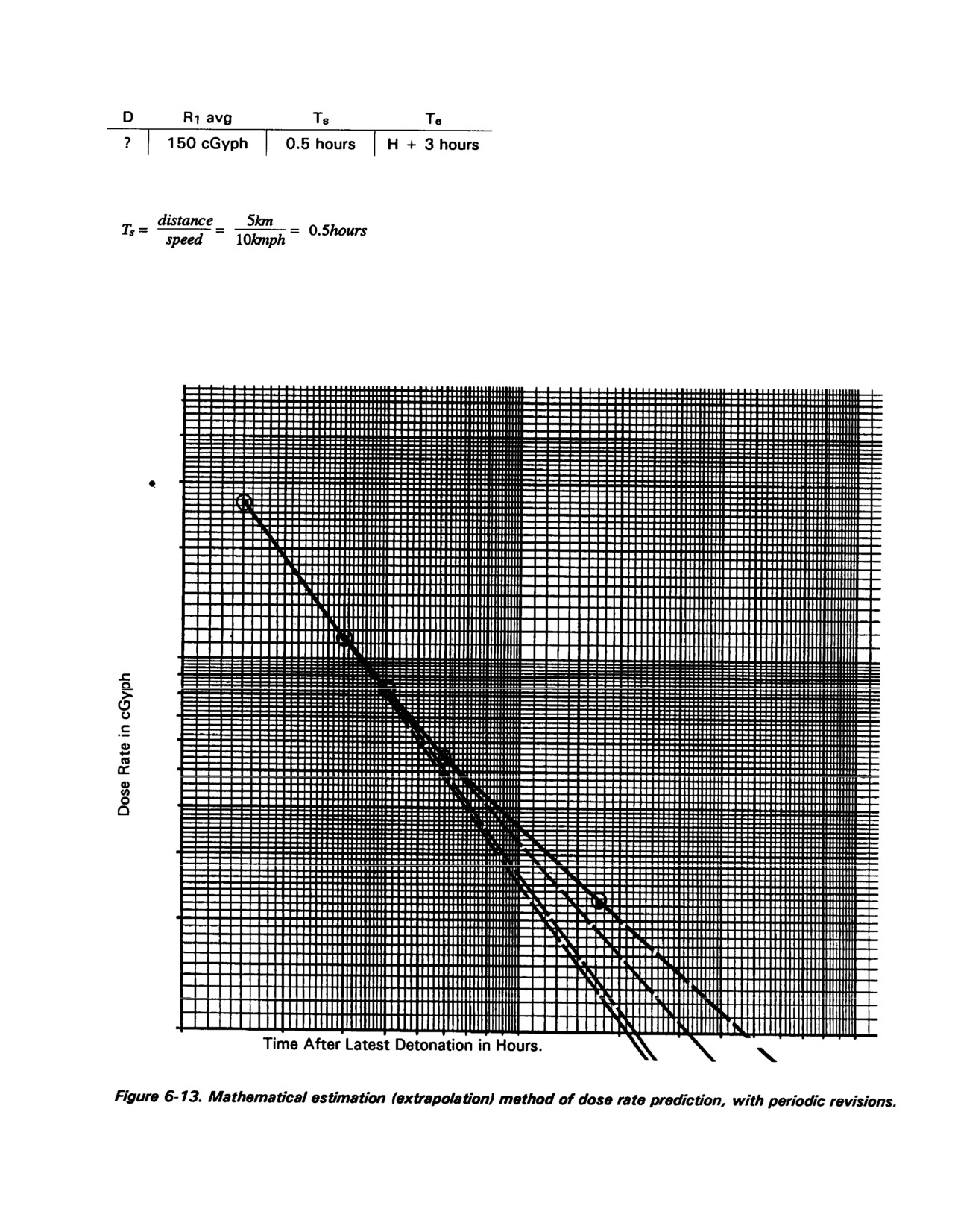
On log-log graph paper, plot the peak dose (263
Situation (continued): It is now 152400, and the latest
cGyph) and subsequent dose rates. Draw a straight line
monitor report is 22 cGyph.
through them extending to 161000 (H + 27 hours) (see
What is the projected H + 27 rate now?
Figure 6-13, page 27).
Step 5.
Plot the new data and connect the last two values
Step 2.
Read as first extrapolation, 7.5 cGyph.
with a straight line extending to H + 27 hours.
Situation (continued): It is now 151300 and you have
Step 6.
Read as a third extrapolation, 15.5 cGyph.
received these additional reports:
Crossing a Fallout Area
In nuclear warfare, it is possible that extensive areas will
be contaminated with residual activity. It may be necessary
to cross an area where there is residual radiation. This
In crossing a fallout area, the length of exposure or time
might occur when exploiting our own nuclear bursts or in
of stay must be calculated. The length of the crossing route
retrograde or offensive operations coupled with
within the outer perimeter of the contamination is divided
enemy-delivered nuclear bursts. These areas may be
by the average speed of crossing. This speed must be
occupied eventually, but operations will be complicated
constant.
because the total dose received by our troops must be kept
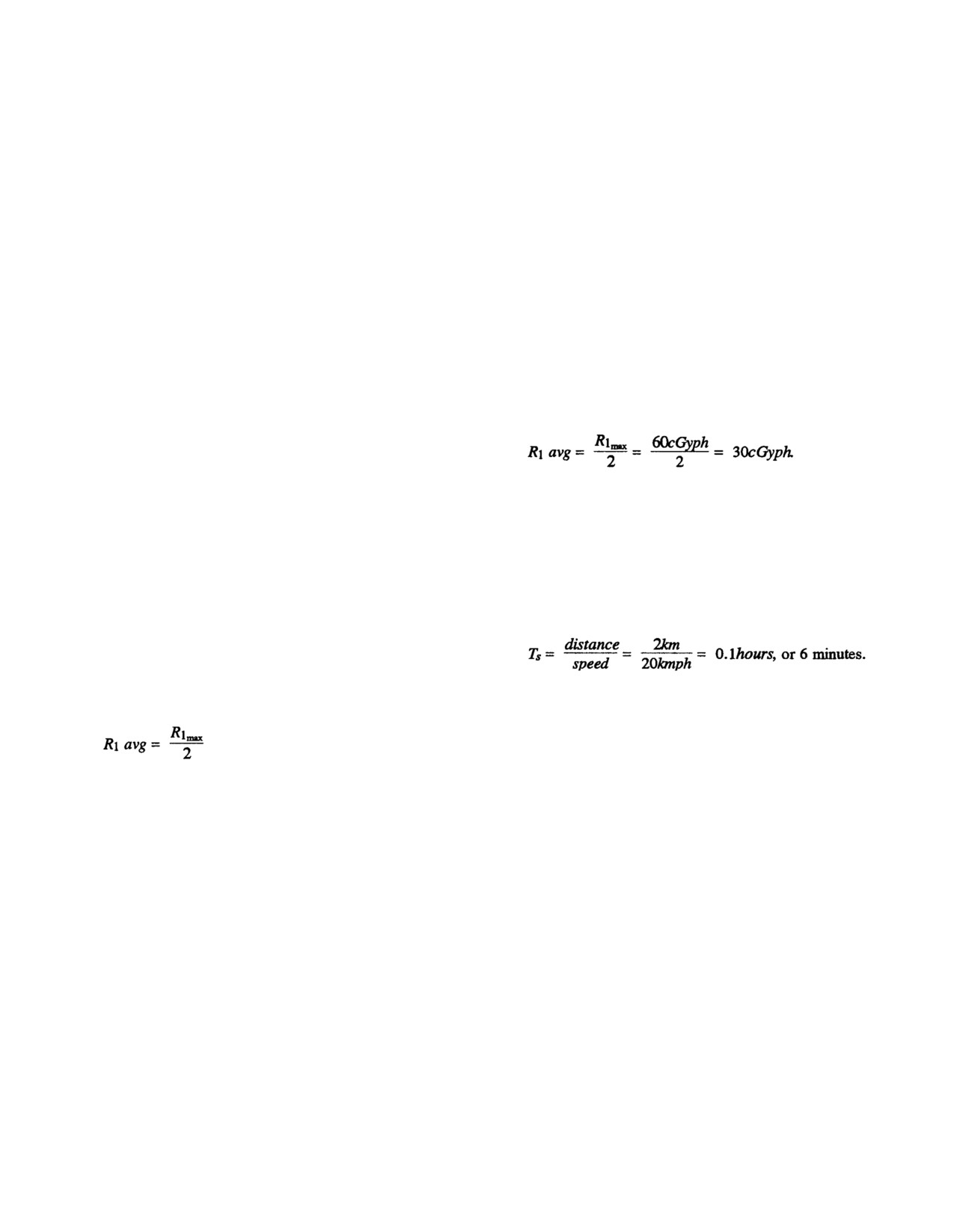
Ts
=
distance ,where TS
is time of stay
to a minimum.
speed
When crossing a contaminated area, the dose rate will
If the distance across an area is 2 kilometers, and the
increase as the center of the area is approached and will
speed is a constant 20 kilometers per hour then—
decrease as the far side is approached. Therefore,
determine an average dose rate for total dose calculations.
A reasonable approximation of the average dose rate can
When-a unit must cross a contaminated area, it is given
be determined by using one-half of the highest dose rate.
OEG. (See Appendix A for more details on OEG.) This is
This is written—
the maximum permissible dose. The unit calculates various
entry times and stay times that will keep the total dose
below the OEG. The average dose rate also must be
R1
average = average dose rate at H + 1
known. Transmission factors for vehicles are applied to
R1max = highest dose rate encountered or expected to
total dose or dose rates. (Refer to Table 6-1.)
be encountered at H+ 1.
The following problems concern techniques only. They
After the average dose rate has been determined, entry
do not consider the impact that these doses or dose rates
times that will keep the total dose below that specified in
might have on operations in a contaminated area. When
operational exposure guidance can be computed on the
solving for total dose (D) with an actual stay time (TS) of
basis of estimated stay times. Total dose also can be
less than 1 hour, aline the hairline with 1 hour on the
computed for specified entry times and stay times. The
appropriate nomogram to obtain a total dose. Multiply this
following paragraphs outline procedures for these
total dose figure by the actual decimal fraction of the time
calculations.
of stay to obtain the true total dose.
In calculating the total dose to be received when crossing
Problem 1.
a fallout area, you need the time of entry into the area, the
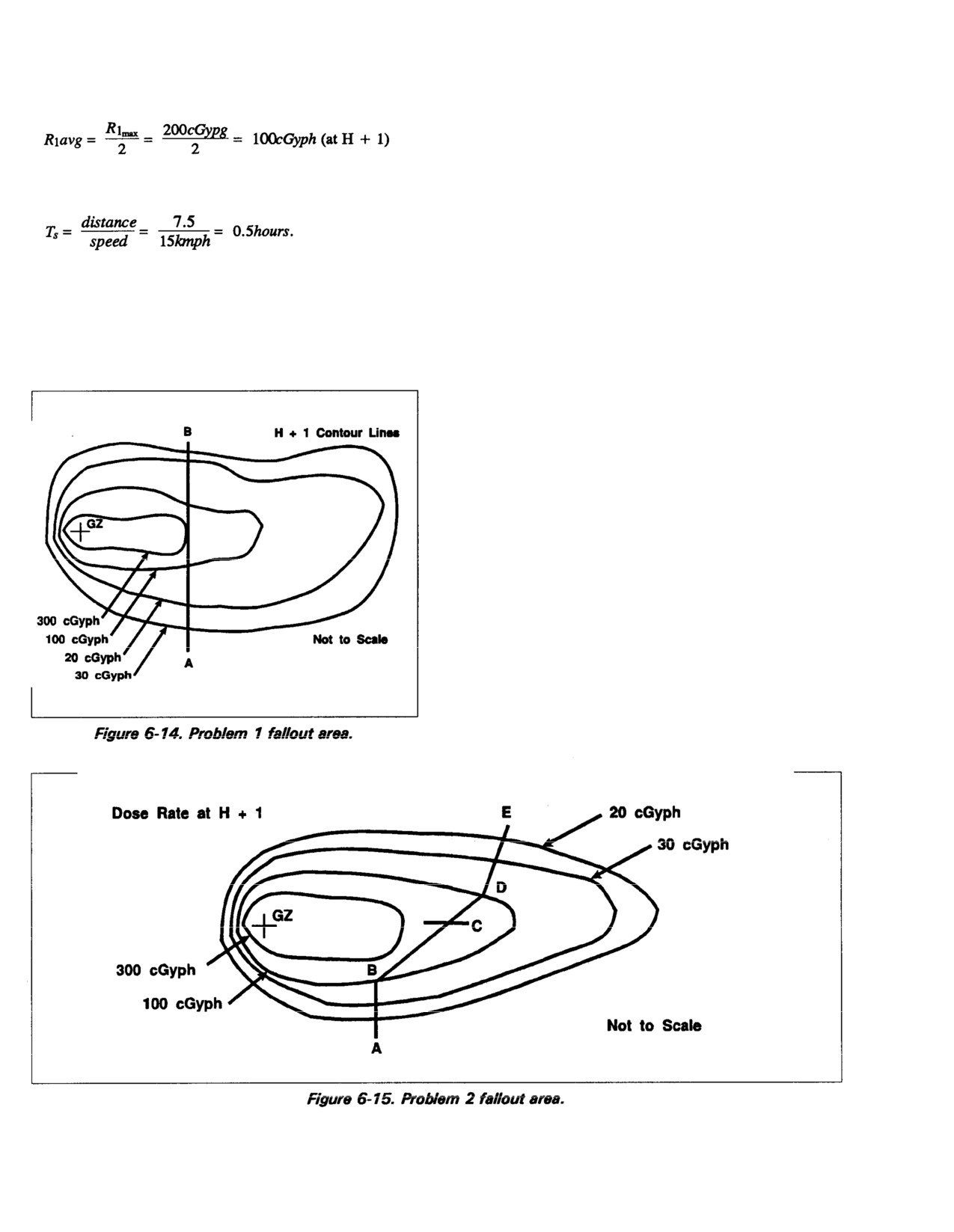
Troops are to cross the fallout area in Figure 6-14 (page
average dose rate along the route, and the time of stay
6-28) at H + 3 hours in M113s moving at 10 kmph. The
within the area. Use the total dose nomograms in Appendix
route from A to B, a distance of 5 km, will be used.
E for these calculations.
(Assume standard decay of 1.2).
In crossing, the average dose rate is equal to one-half of
Find: Total dose the troops will receive.
the maximum dose rate encountered on the route. If the
Visualize the problem as follows:
maximum dose rate encountered is 60 cGyph, then—
6-23
FM 3-3-1
6-24
FM 3-3-1
6-25
FM 3-3-1
6 - 2 6
FM 3-3-1
D = 32 X .5)Ts)
D = 16 cGyph.
Calculate the inside dose:
Answer: 9.6 cGy
TF = 0.3 (Table 6-1)
Solution: Calculate the average dose rate as follows:
ID=ODxlF
Te=H+3hrs
= 16 x 0.3
= 4.8 cGy.
Problem 2.
R1
= (highest exposure anticipated)
Troops are to cross the fallout area in Figure 6-15 (page
= (300 cGyph)
6-28) at H + 3 hours in 2-ton trucks moving at 15 kmph,
= 150 cGyph
using the route A-B-C-D-E. Total distance equals 7.5
D=?
kilometers.
Use Figure E-36
Find: Total dose the troops will receive.
to compute average dose rate.
Answer: 7.2 cGy.
D = 32 cGyph outside dose from nomogram at 1 hour Ts
solution
6-27
FM 3-3-1
1. Calculate the average dose rate:
ID = OD X TF
= 12 x 0.6
= 7.2 cGy.
Problem 3.
(Rl
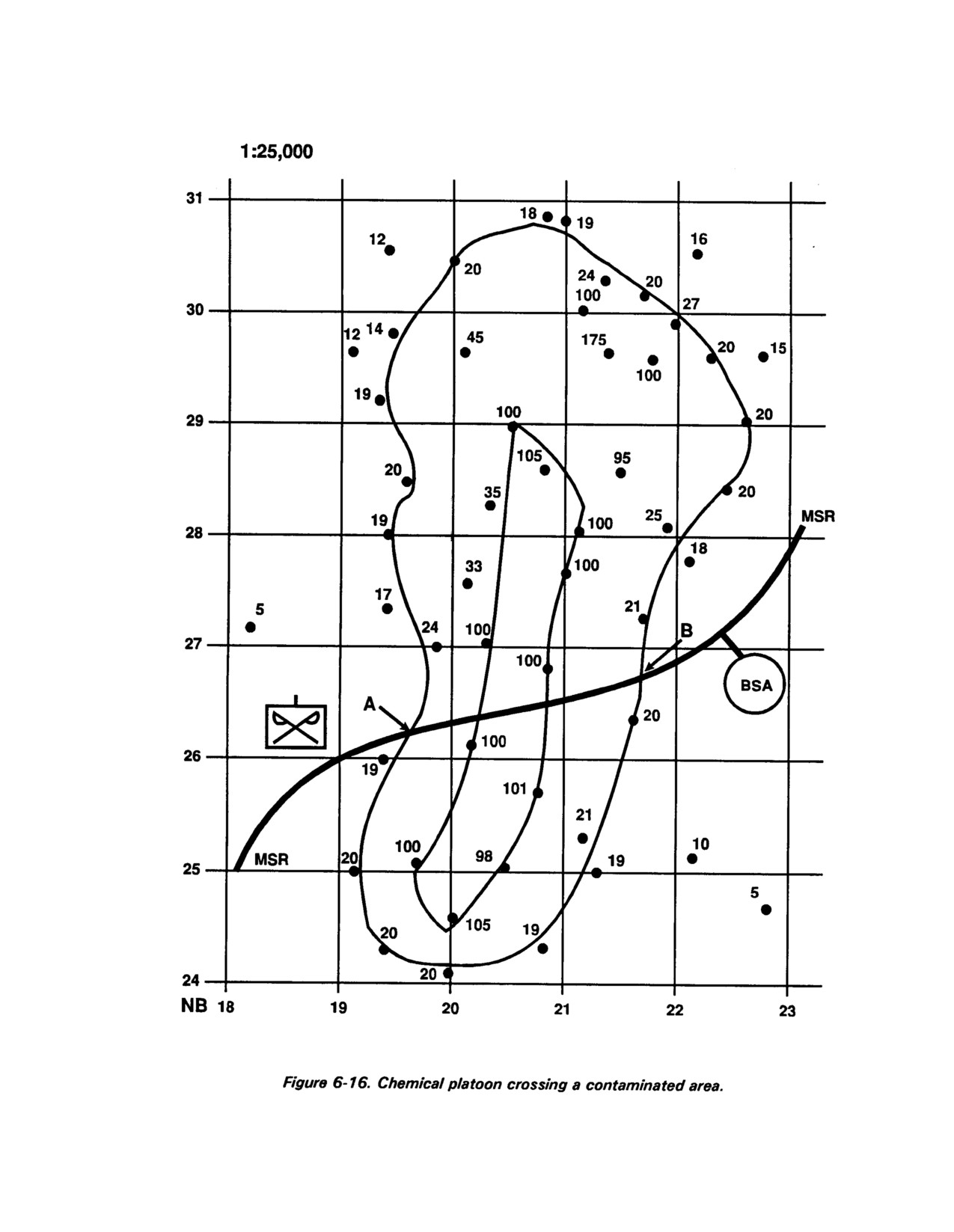
max at point C interpolated from Figure 6-16 page
A chemical company smoke generator platoon operating
6-28).
2. Calculate the time of stay:
within 1st Brigade’s sector must top off its fog oil load
while moving to the new mission site at the BSA (refer to
Figure 6-16, page 6-29). A mountain range 3 kilometers, to
the south and enemy activity 3 kilometers to the north
3. Find the outside dose:
prevent the platoon from maneuvering around the
R1
avg = 100 cGyph
contamination. Time to complete this mission is essential.
Te
= H + 3 hours
It is now 261830, and the platoon must have smoke on
TS
= 0.5 hour
target by 262100 to support the next phase of 1st Brigade’s
D = 12 cGy.
operation. The platoon must move along the main supply
4. Calculate the inside dose:
TF = 0.6 (Table 6-1)
route (MSR) to the brigade support area (BSA) to obtain
more fog oil. Due to previous operations, the platoon is
rated at RES 1 (moderate risk—as explained in Appendix
A) and the soldiers are not to exceed 70 cGy total in this
movement. The brigade S3 has turned to you, as the
chemical staff specialist for 1st Brigade, and asked whether
or not the platoon can accomplish this mission and not
exceed the 70 cGy OEG. The S3 also wants to know what
dose the platoon is expected to receive, and if there are any
special precautions the platoon should take to limit its
exposure.
Although presented as an example, this may be a typical
situation on a nuclear battlefield, and is representative of
what is commonly referred to as a crossing problem. The
‘platoon will depart (SP) from its location (NB187262) at
1900 and travel in HMMWVs along the MSR at a speed of
25 kilometers per hour. Using the map scale in Figure E-1,
Appendix E, answer the brigade S3’s questions.
6-28
FM 3-3-1
6-29