FM 3-3-1 Nuclear Contamination Avoidance - page 12
FM 3-3-1
The ARR provides relatively little detail, covering only those
The
previous dose
of the ARR team is another important
parts of the contaminated area that are of immediate
factor. The ARR team carries an IM147/PD (USA) or
operational concern. Other portions of the area can wait until
IM143/PD (USMC) dosimeter. This dosimeter is checked
surveys are conducted.
frequently to ensure the OEG is not exceeded. Other type
A debriefing is held by the NBCC’s centralized defense team
dosimeters are unacceptable because of their large scales.
after the ARR is complete.
Usually the OEG given to ARR teams will be around 10
Upon arrival over the contaminated area, the ARR team
cGy. Large-scale dosimeters do not permit readings in this
locates the edge of the area. Once the edge is located, the
range. Because of the maneuverability of the helicopter,
team determines checkpoints that can be identified from the
the team can immediately remove itself from high dose rate
air and on the map. Often the team flies on an azimuth
areas, if necessary.
from a known point, as a modification of the course leg
Communications
play a large part in the ability of an
technique. The altitude and air speed are determined by the
ARR team to quickly accomplish its mission. The NBCC
team as explained for aerial survey. These team-selected
does not have organic radios. It may not have assigned
check-points are used for route, course leg, and point
frequencies or call signs. Thus, the NBCC must rely on
techniques. An additional technique involves flying from a
other nets. ARR teams will monitor these nets awaiting
checkpoint along a compass heading. Constant airspeed is
mid-mission changes. Because the NBCC must borrow a
maintained. This airspeed and the flight duration is also
radio, real-time transmission of data may be impossible.
recorded on DA Form 1971-1-R.
Under hostile EW conditions, it may not be recommended.
The point technique may be the only viable way to
Range of radios must also be considered. Face-to-face
perform ARR at or ahead of the FLOT. This technique
delivery of data is preferred. However, pilots must be
permits nap-of-the-earth flight at appropriate speeds and
briefed so they do not inadvertently disclose the NBCC
evasive maneuvers. It reduces the ADA threat. It also
location. This OPSEC measure may require the pilot to
permits shielded readings if accurate AGCF dose rates are
land at a location and send the data by telephone.
determined for the aircraft. All shielded readings must be
taken from the same height as the aerial dose rate of the
NBCC Actions
AGCF data.
The NBCC converts shielded dose rates to ground dose
rates by application of the AGCF. Further processing
ARR Limitations
involves normalizing dose rates to H + 1 or other
Under hostile ADA conditions, route and course leg
reference time. At early stages, the decay rate of fallout is
techniques for ARR are not recommended. These
assumed to be n = 1.2. If neutron-induced contamination
techniques create a unique signature and predictable
is present, soil type 11 is assumed to be present. Outside
movements.
dose rates may be normalized using normalizing factors or
ARR in
arctic, desert, or jungle
regions with few or no
the M1A1 radiac calculator for fallout or decay
landmarks for checkpoint identification is difficult. The
nomograms for induced contamination. Subsequent actions
quickest way to identify a location under such conditions is
for plotting are identical to those used to plot survey data.
to mark the spot on the ground by dropping bags of talc,
Contamination plots are for immediate operations and
flour, or paint from the helicopter. Specialized
are valid, at best, for a few hours after creation. Each plot
communications support may also be required to establish
consists of the perimeter of the contamination and dose
locations from radio fixes while the helicopter hovers.
rates at points of operational interest. See Figure 5-25 for
The
status of training
of the ARR team must also be
an example of a plot developed from reconnaissance data.
considered. The best source of ARR teams is the aviation
The NBC 5 nuclear report format is not used to
unit that supplies the helicopter. In general, ARR teams
disseminate a contamination plot. This avoids confusion
must be better trained than survey teams. ARR teams are
with line item Xray contour line. When the plot must be
essentially autonomous. They must understand all facets of
sent to other units and messengers or facsimiles are not
the operation. They must also be capable of independent
available, the comer coordinates of a box outlining the area
and innovative action to accomplish their missions.
may be sent. The NBCC should establish this procedure in
the FSOP.
NEXT PAGE INTENTIONALLY LEFT BLANK
5-37
FM 3-3-1
Chapter 6
Nuclear Defense
Nuclear operations present unique challenges to
Determine H-hour, or when the nuclear devise exploded.
commanders, unit NBC defense teams, and chemical staff
Determine the tactical implication of rainout.
personnel. To provide the required accurate information
Determine the period of validity and decay rate.
and battlefield intelligence, numerous mathematical
Normalize survey readings to H + 1.
calculations must be performed. These calculations are
Calculate total dose when crossing fallout areas.
used to—
This chapter details the mathematical procedures
Calculate the optimum time to exit a fallout area.
required to provide this essential information.
Optimum Time of Exit for Fallout Areas
Radiological fallout may present a serious hazard to units
nonessential items and recover them at a later time when
that remain in a contaminated area. Shelters, such as field
the dose rate has decreased to an acceptable value.
emplacements, are the best protective measures against
The following abbreviations are used in optimum time of
nuclear radiation for troops. If the shelter provides any
exit calculations:
appreciable amount of protection, it will be advantageous
Topt = MF x Tev.
to remain and improve the shelter rather than to evacuate
Topt = optimum time of exit.
to an uncontaminated area. If the situation permits, and
MF = multiplication factor.
higher headquarters approves, the commander may decide
Tev = time (in hours) required to evacuate the
to move out of the contaminated area. By evacuating at the
contaminated area.
optimum exit time, the radiation dose to personnel is kept
Ae = average transmission factor of the vehicles used
to a minimum.
during movement out of the contaminated areas.
To compute the optimum exit time for a fallout area, you
As = average transmission factor of the shelter. (This
must know the time of detonation, location of
includes vehicles being used as shelters).
uncontaminated area; and the average transmission factor
Compute the optimum exit time using the three following
of the vehicles used and the shelters involved, plus the time
steps:
required to evacuate the position.
Step 1.
Calculate the tranmission factor ratio, As/Ae.
If the nuclear burst was not sighted by the unit, the
Step 2.
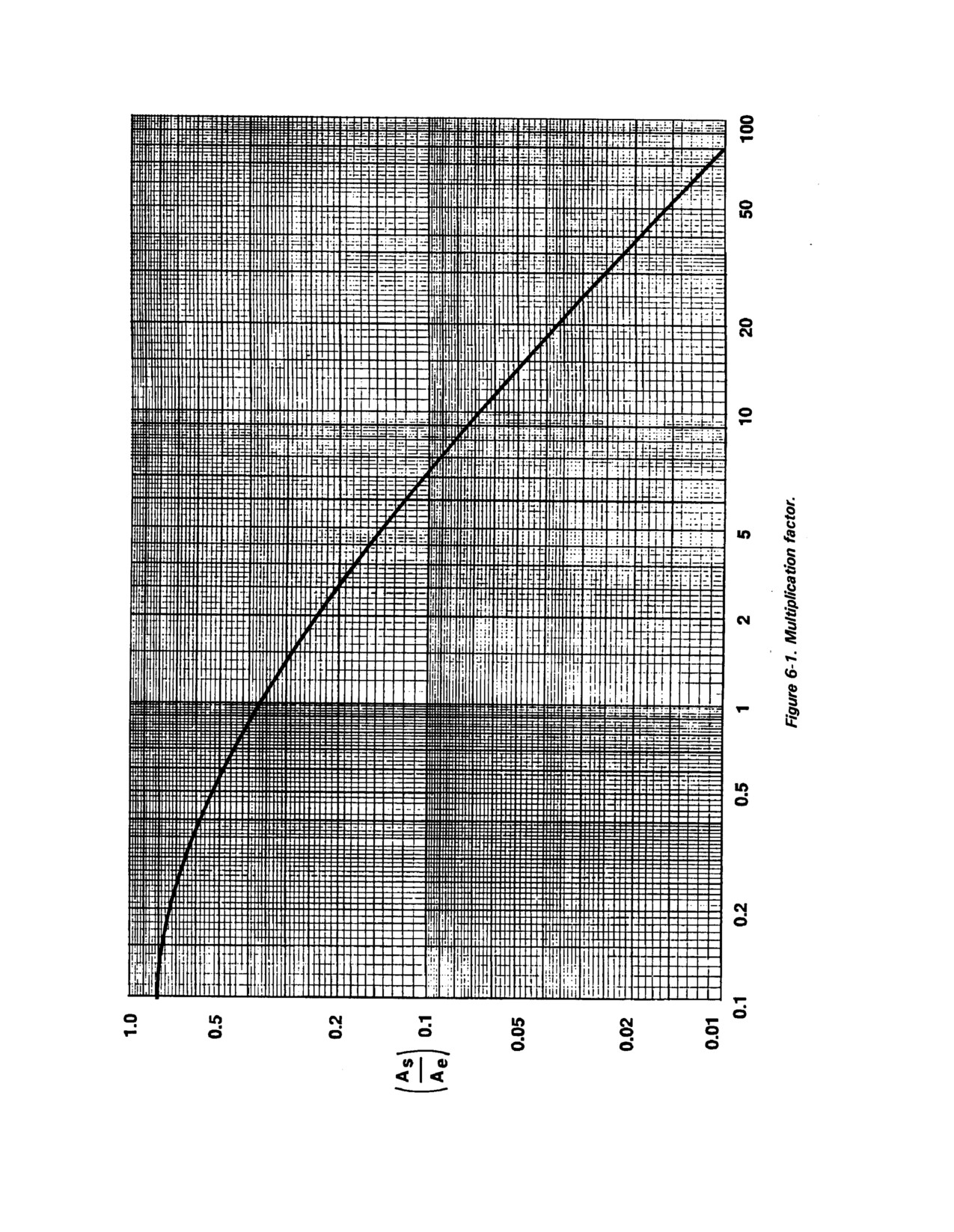
Determine the multiplication factor. Enter the
nearest NBCC will provide the H-hour.
vertical axis of Figure 6-1 with the value obtained for
When moving from an area contaminated by fallout, the
As/Ae. Move horizontally along this value to the curve.
unit moves into an uncontaminated location. This will
Move straight down and read the multiplication factor from
necessitate waiting until fallout is complete at present
the horizontal axis.
positions.
Step 3.
Calculate the optimum exit time. Multiply the
The average transmission factor of the fallout shelters
multiplication factor by the Tev. The product is the
and the vehicles used to leave the contaminated area must
optimum time, in hours after detonation, that the unit
be computed. Since all shelters are not the same, an
should leave its shelters and evacuate the area. Optimum
average value should be used. The transmission factor of a
time of exit equals the multiplication factor times Tev.
vehicle may be calculated. A unit moving on foot will be
fully exposed and will have a transmission factor of 1.0.
Special Considerations
The time to load vehicles and move out of the
contaminated area must be estimated. To minimize
The unit should evacuate the fallout area as soon as
exposure time, it may be necessary to temporarily abandon
possi ble when ratios of
are equal to or greater than 0.5.
6-1
FM 3-3-1
6-2
FM 3-3-1
If the optimum time of exit is estimated to be before the
Sample
Problem
actual arrival of fallout, the unit should evacuate the area
as soon as possible after fallout is complete and an
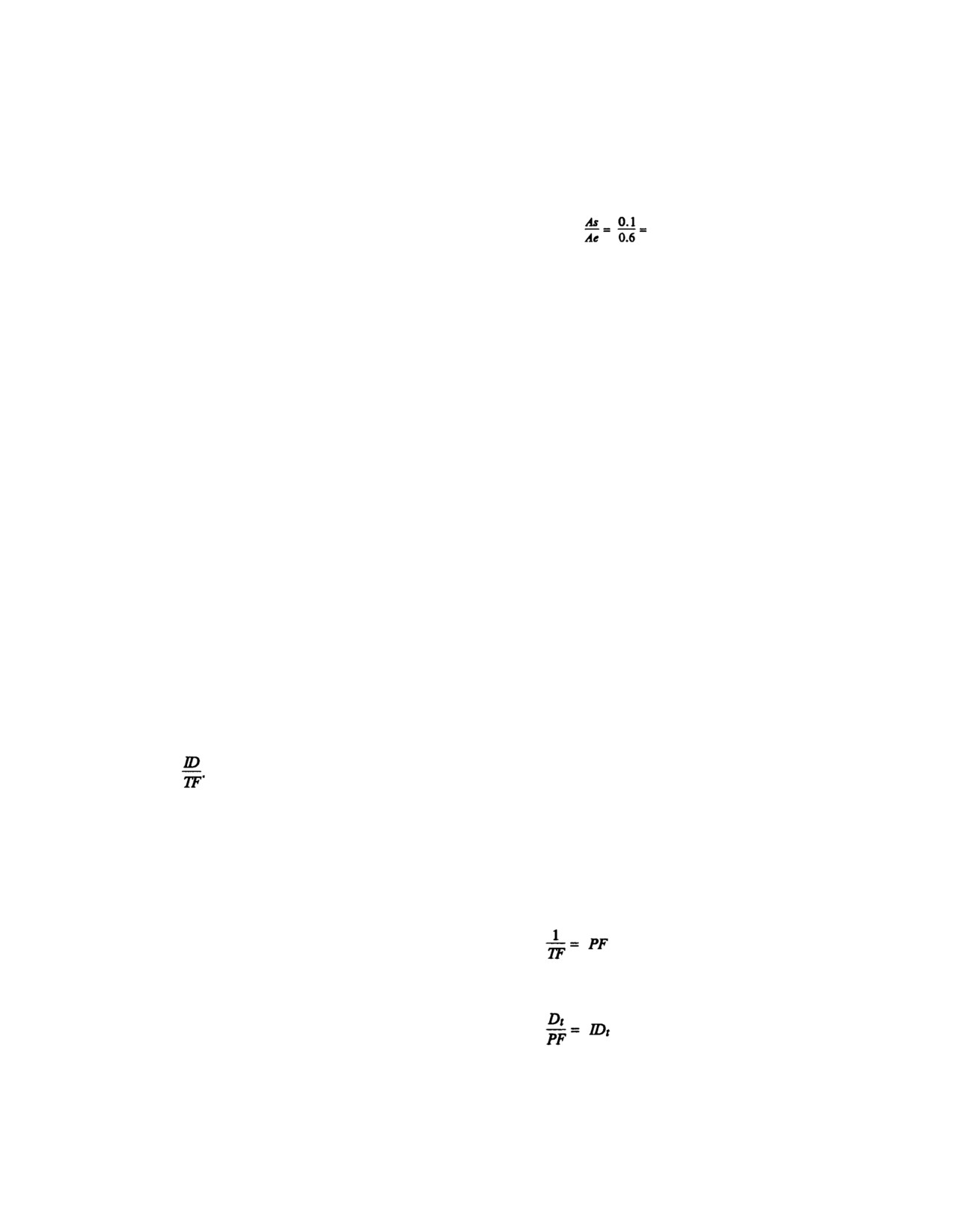
Given: As = 0.1 (foxhole)
uncontamianted area is available.
Ae = 0.6 (2½-ton truck)
The unit will receive the smallest dose possible if it
Tev = 1 hour
leaves the contaminated area at the optimum time of exit. If
Find: Optimum time of exit
the unit commander is willing to accept up to a ten percent
Solution:
0.167
increase in dose, he or she may leave the shelters any time
Multiplication factor = 2.9
between one-half and twice the optimum time of exit.
Optimum time of exit = Multiplication factor x Tev
If possible, personnel should improve their shelters while
= 2.9x1
waiting for the optimum time of exit. This, however,
= 2.9, or 2 hours and 54 minutes.
should only be attempted if the personnel do not have to
Optimum time of exit calculations bring up two other
leave the shelter to improve it. The estimate of the
areas that are a vital part to radiological operations. One is
optimum time of exit should be recalculated if significant
transmission factors and the other is the calculation of
improvement is made in the shelters. Improved shelters
H-hour.
mean the unit may remain for a longer period, to minimize
the dose to personnel.
Transmission Factors
A transmission factor (TF) is that fraction of the outside
They are not based on dose rates from fallout; they are
(ground) dose or dose rate received inside the enclosure
based on gamma radiation from Cobalt 60. Energies from
that provides the shielding. (Refer to Appendix B for a
radioactive elements are measured in million electron volts
more detailed discussion on shielding). TFs are always less
(MEVs). The average from Cobalt 60 is roughly 1.25.
than one. TFs are used to find the reduction in dose or
Average energy from gamma activity in fallout is 0.67.
dose rates received when personnel are protected from
Since Cobalt-60 radiation is almost twice as strong as the
radiation.
radiation from fallout, actual TFs should be much smaller
TFs are always determined in operational situations by
(more protection).
the unit NBC defense team. Each TF is calculated using
Note that these TFs are not used under operational
the formula below:
situations. Commanders and operations personnel use these
precalculated TFs to judge the relative shielding ability of
transmission factor=inside dose or dose rate (ID)
outside dose or dose rate (OD)
various vehicles and shelters. They are provided also for
instruction and practice. For vehicles that have AN/VDR2s
Rearrangement of this formula yields ID = OD x TF
installed, each user need only verify that the correct
and OD =
The TF is needed because its principal use
attenuation factor has been entered (IAW TM
11-6665-251-10) and then read the outside dose directly off
is to find the ID.
the display. The attenuation factor is the mathematical
Problem 1. The outside dose is 90 cGyph. Use the
inverse of the transmission factor and has already been
transmission factor to calculate the inside dose. What dose
calcualted for many vehicles. These factors are printed on
would troops in M 113 armored personnel carriers receive?
the mounting bracket for the AN/VDR2.
The TF for an M113 is 0.3.
Another method that may be used to calculate the
ID=ODxTF
shielding properties is using a protection factor (PF). PF
=90x0.3
may be calculated with the following formula:
= 27cGy
Problem 2. Transmission factors also may be applied to
dose rates. A measured outside dose rate is 100 cGyph.
The inside dose rate is calculated by use of the
To determine the shielding properties of a vehicle use the
transmission factor. Find the dose rate inside the M113:
following formula
ID= OD x TF
= 100 x 0.3
= 30 cGyph.
ODt
= outside total dose
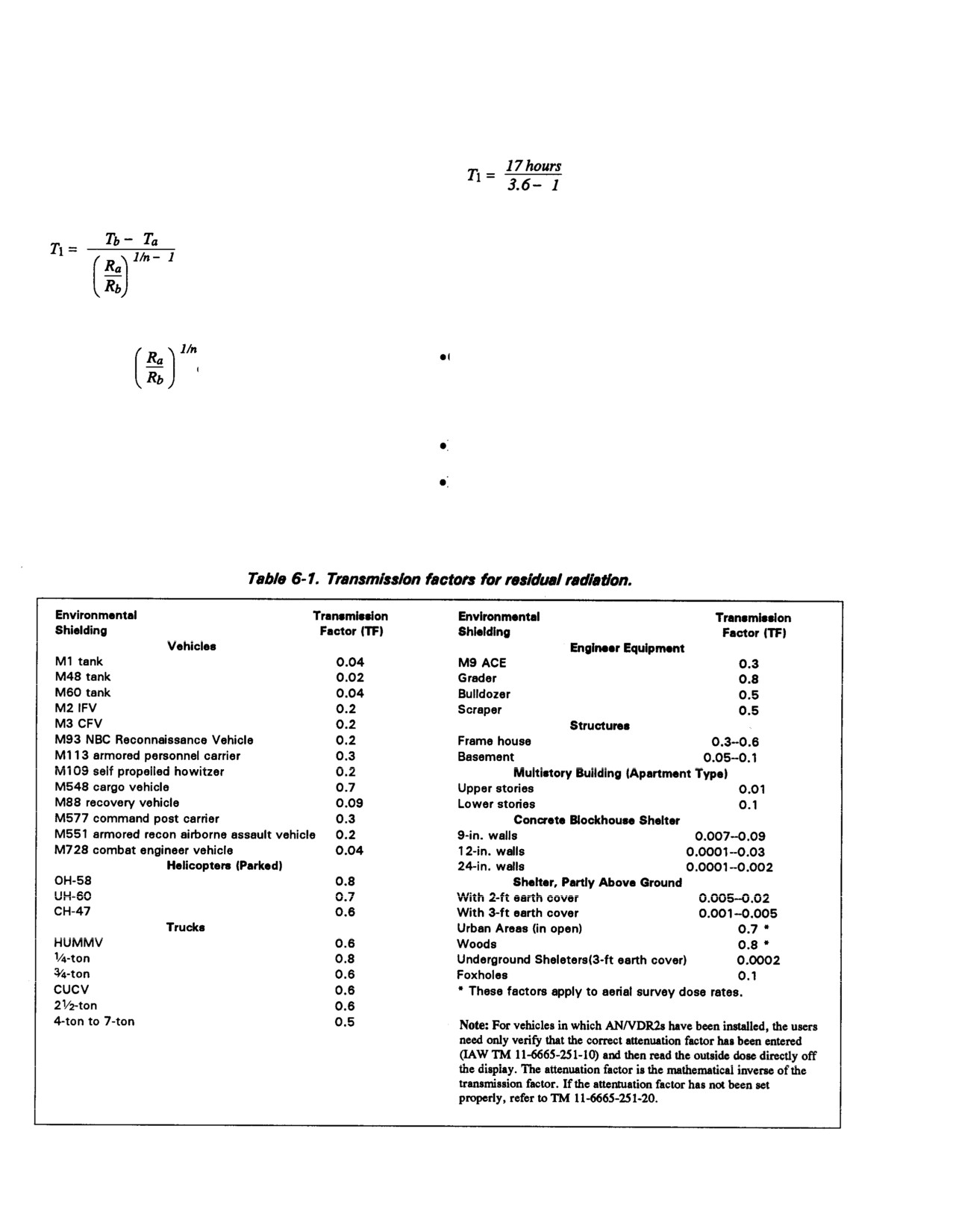
A list of precalculated transmission factors are in Table
IDt
= inside total dose
6-1. These TFs are for the most exposed occupied location.
6-3
FM 3-3-1
Calculation of H-Hour
H-hour may be calculated mathematically or by using the
= 6.54= 6.5 hours
ABC-Ml radiac calculator. Calculate H-hour
mathematically, using the following procedure (All
Since T1
is the time after H-hour at which reading Ra
calculations must be made after fallout is complete.):
was made, the H-hour = Ta
- T1
= 0500, 15 January -6.5
hours = 2230, 14 January.
Use of ABC-M1 Radiac Calculator
T1
= time after H-hour at which reading Ra
was made.
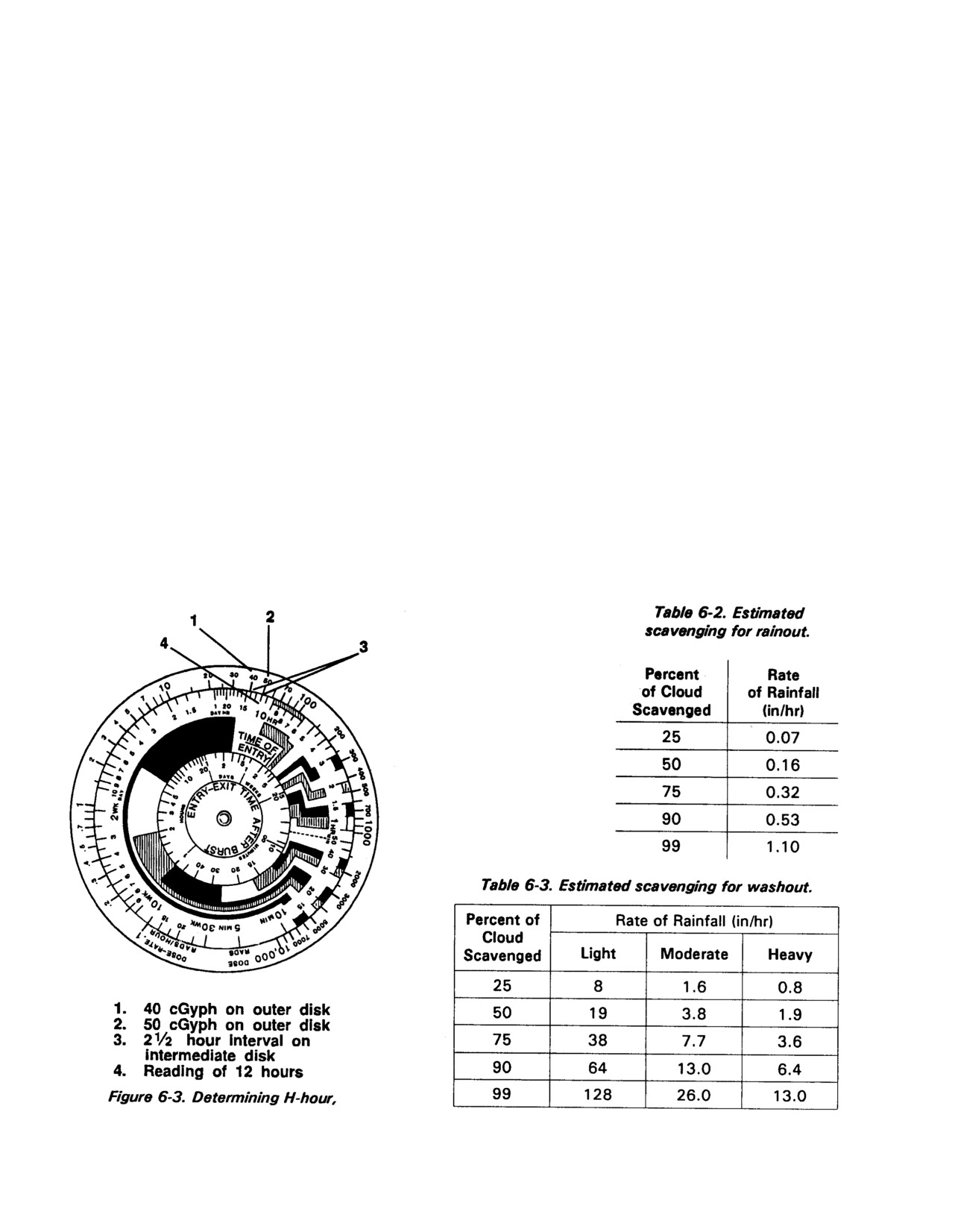
The ABC-M1 radiac calculator (Figure 6-3, page 6-6)
Tb-Ta
= interval between readings Ra
and Rb.
may be used to determine H-hour (if n = 1.2) as follows:
Choose two readings. For example, the first and last readings
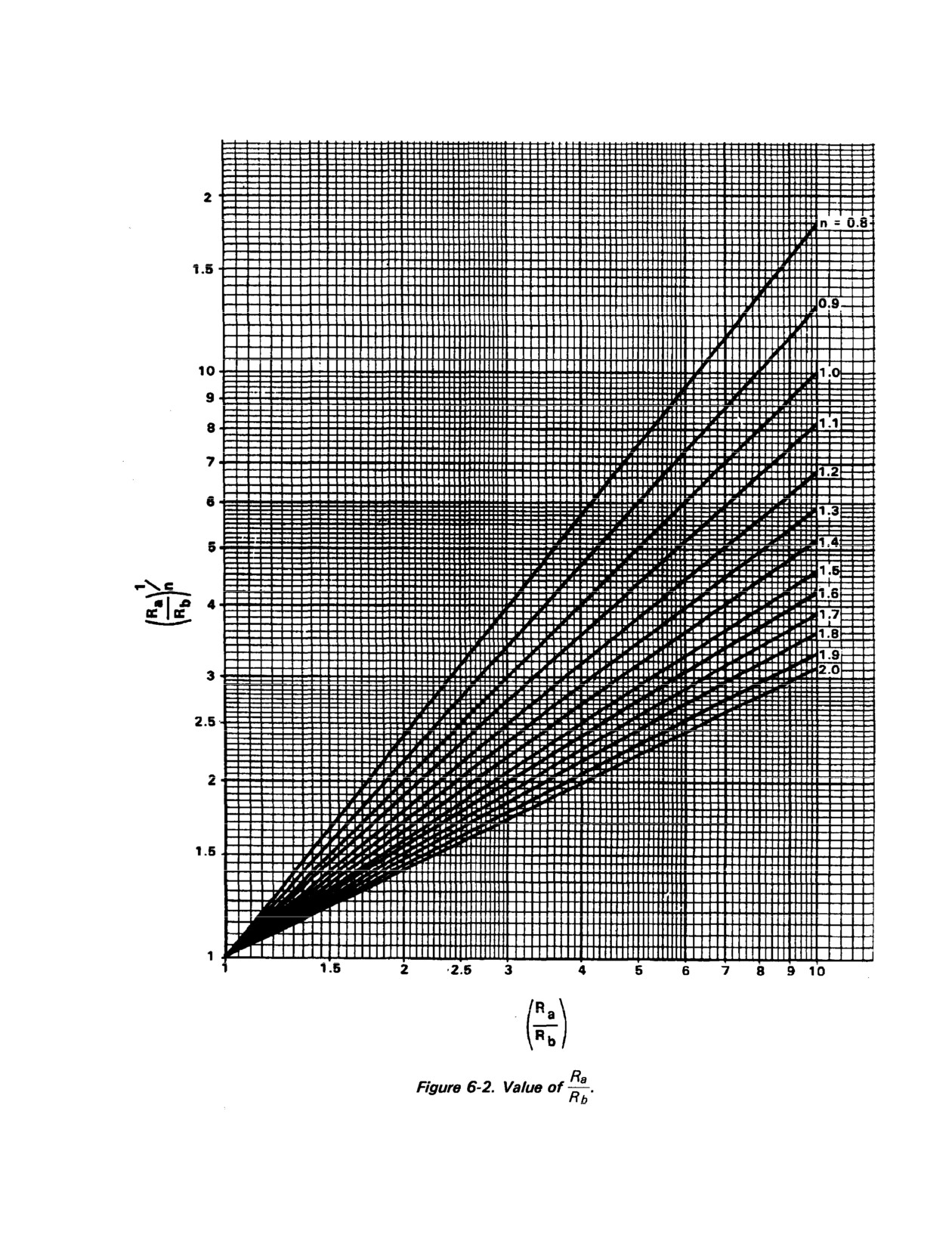
The value of
can be caluclated or may be read
made at a particular location:
from a family of slopes (Figure 6-2, next page). To
Time Dose Rate
calculate, use an assumed decay exponent or one that has
1600 50 cGyph
been determined.
1830 40 cGyph.
Locate the two dose rates on the outer disk of the ABC-M1.
For example, monitoring reports Ra
and Rb
represent the
Determine the time interval between the two readings.
earliest and latest data available for a particular location
within a contaminated area:
Move the intermediate disk until a time interval of 2½ hours
coincides with the 40- and 50-cGyph readings on the outer
Ra= = 112 cGyph (0500, 15 January)
disk. Read the time under the 50 cGyph as 12 hours. The
Rb
= 24 cGyph (2200, 15 January).
50-cGyph dose rate was read at 1600; thus, 1600 corresponds
From Figure 6-2, assuming n = 1.2
6-4
FM 3-3-1
6-5
FM 3-3-1
to H = 12. This means that H-hour was 12 hours earlier than
condensate in the atmosphere, then fall back to the surface
1600 (see Figure 6-3). H-hour = 1600-1200 = 0400.
as rain.
As mentioned previously, the NBC 3 nuclear report is
If the airborne radioactive debris from a nuclear burst
only a prediction which provides a means of locating
should encounter precipitation, a large portion of the debris
probable radiation hazards. Militarily significant fallout
may be brought to earth with the rain or other moisture.
will occur within the predicted area. However, the
The resulting fallout pattern will be irregular, producing
prediction does not indicate exactly where the fallout will
local hot spots within the fallout pattern. Although an air
occur or what the dose rate will be at a specific location.
burst normally does not produce any militarily significant
Where fallout will occur is a function of weather and
fallout, precipitation in or above the nuclear cloud can
terrain. The most significant weather effect, as far as
cause significant contamination on the ground.
fallout is concerned, is commonly referred to as rainout or
Precipitation may also affect the fallout distribution from
washout.
surface or sub-surface bursts by washing contamination
from one location and depositing it in lower areas.
There are basically two factors that must be considered
Rainout and Washout
to determine whether or not rainout will occur and to what
Rainout and washout are nothing more than the removal
extent. The first is
duration of the precipitation-the
of radioactive particles from a nuclear cloud by
longer the precipitation the greater the percentage of the
precipitation when the nuclear cloud is below or within a
nuclear cloud will be washed or scavenged. Table 6-2
percipitation cloud. Even when rain clouds are not present,
represents this percentage as a factor of precipitation
rainout or washout may occur. This will depend on the
duration. This occurs when a nuclear cloud is within a rain
amount of water evaporated by the fireball and rising as
cloud. Notice, rainfall rate appears to have little effect on
water vapor. Such evaporation may occur when a nuclear
rainout. Washout, on the otherhand, occurs when the
detonation occurs over a large body of water, such as a
nuclear cloud is below the rain cloud. Here, the rainfall
lake or ocean. A nuclear weapon detonated in a high
rata directly effects the amount of scavenging that will
humidity area may also result in rainout or washout. When
occur. Table 6-3 reflects this effect. The terms light,
water vapor rises with the nuclear cloud, it will cool and
moderate, and heavy in this table refer to rates of 0.05,
0.2, and 0.47 inches
of rain per hour,
respectively, as
measured at the
surface. Thus, it
would appear that
rainout is more
effective than
washout in
scavening a nuclear
cloud.
The other factor is
the
altitude of the
stabilized nuclear
cloud versus the
6-6
FM 3-3-1
altitude of the rain or snow cloud. The altitudes of most
rain cloud tops range from 10,000 to 30,000 feet. The
bottom of these clouds, where most precipitation emerges,
is commonly at an altitude of about 2,000 feet.
Precipitation from severe thunderstorms may originate as
high as 60,000 feet. If the rain cloud is smaller than the
nuclear cloud, then only that portion of the nuclear cloud
covered by the rain cloud will be affected by washout or
rainout; whichever applies. If the nuclear cloud extends
past, or higher than the top of the rain cloud, then only that
portion of the nuclear cloud that lies within and under the
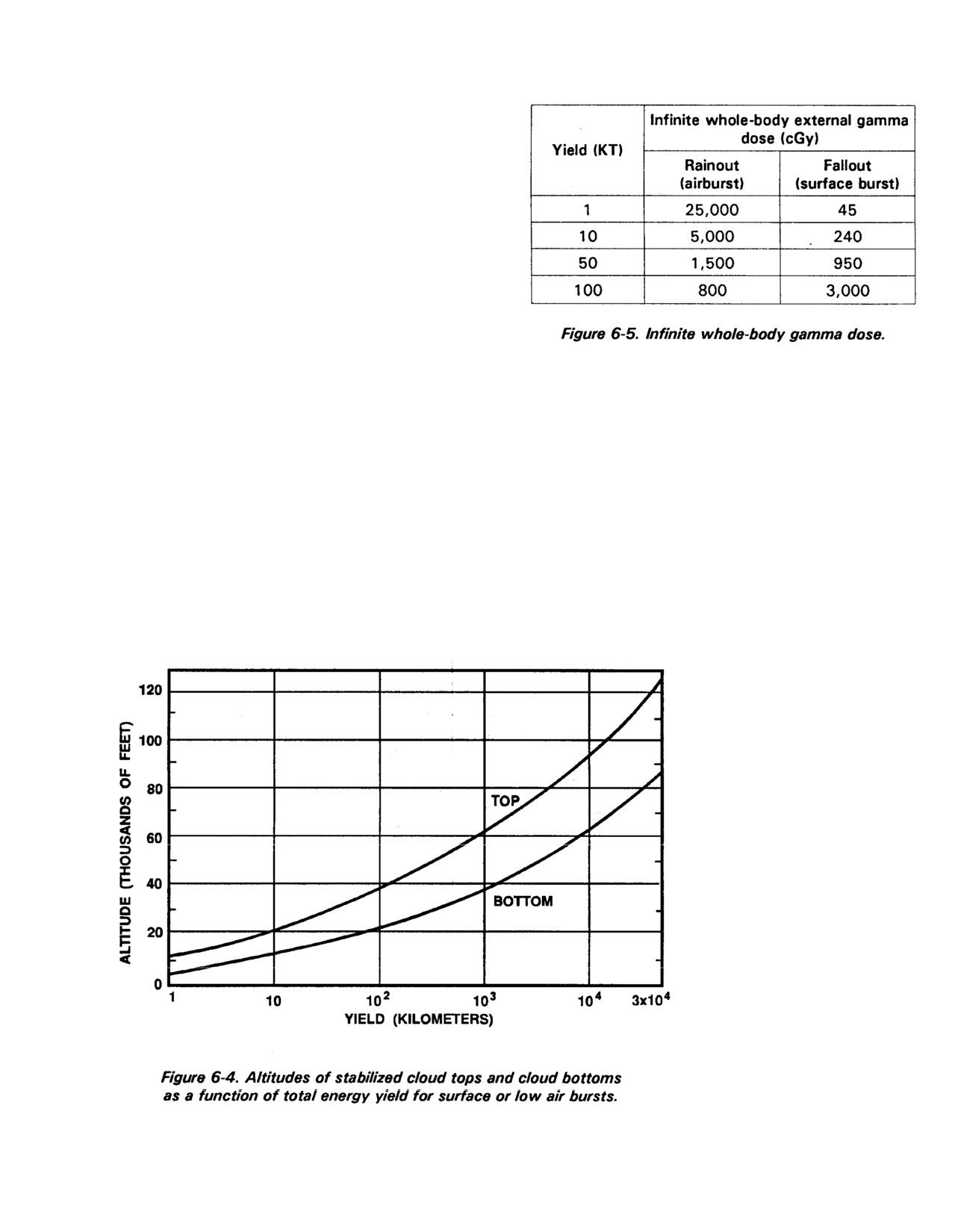
rain cloud will be affected. Figure 6-4 depicts the average
heights or altitudes of stabilized nuclear cloud tops and
bottoms, per yield for surface and low-air bursts. Obtain
data from the staff weather service to determine the heights
altitudes, horizontal movement during the fall of particles
of clouds that cover the area in which the nuclear burst
will tend to decrease the concentration of radioactivity on
occurred. This will provide data that can be used to
the ground. This movement and deposition will result in
determine whether or not the nuclear cloud will be subject
elongated surface fallout patterns. The exact shape will
to washout or rainout.
depend on the amount of rainfall, wind, and surface
If the nuclear cloud should drift into a rain or snow
conditions. However, the radioactivity deposited on the
cloud at some point after the burst, the surface
ground from rainout is much more significant than that of
contamination caused by scavenging will be decreased due
dry or normal fallout. This is due primarily to the fact that
to radioactive decay. The longer between detonation and
rainout causes the radioactive particles suspended in the
entering into the rain cloud, the less radioactive material
atmosphere to fall to the surface at a faster and more
will be present. Finally, the particles that are scavenged
concentrated level than dry fallout. Research of this
will not be deposited on the ground immediately, but will
phenomena was conducted in the early 1970’s and yielded
fall with the precipitation (typically 800 to 1,200 feet per
the data presented in Figure 6-5. This data suggests that the
minute for rain and 200 feet per minute for snow). Since
contamination from low yield air bursts subject to rainout
the particles are scavenged over time and over a range of
produces radioactive contamination at a much more
significant level than dry fallout
from a surface burst. This is due
primarily to the rain or snow
forcing the particles of fallout to
the ground faster and in a heavier
concentration.
Tactical Implications
Exposed personnel without
access to structures, vehicles or
field works offering a reasonable
radiological protection factor
(such as, trenches with 18 inches
of earth overhead cover) would
soon become non-effective if they
were in an area of rainout from a
lower-yield weapon(s). The area
would be contaminated to such an
extent as to render it dangerous
for them to remain in the affected
area long without receiving an
incapacitating dose of radiation.
Runoff from the affected area,
containing high-intensity
radiological contamination, could
6-7
FM 3-3-1
contaminate water supplies in an adjacent unaffected area.
forecasts to be made. Guidance, based on this forecast may
Runoff in contaminated areas will flow into water sources
then be passed to affected units on what action
such as lakes, rivers, and streams, creating concentrated
commanders should be prepared to take. One obvious
energy levels. Monitor water sources with the AN/PDR27
action is that they should order continuous monitoring
set on the higher scale and the probe in a plastic bag,
when rainout is forecasted or at the onset of rain. If rainout
before consuming or entering the water.
occurs, they are faced with one of two simple choices:
It seems obvious that certain extra warning measures
either get their units under proper cover, or get them away
should be implemented. Divisional NBCCs should give
from the area—if tactical considerations permit. It is worth
special warnings to units that may be subject to rainout. At
mentioning that the enemy is unlikely to occupy the
present it is not yet practicable to give this with great
vacated area for the same reason the unit leaves it.
accuracy, but enough should be known to enable sensible
Period of Validity and Decay Rate
Fallout will decay according to the following Kaufman
calculations are to be made. That is, the more reliable the
equation—
dose-rate monitoring and the longer the time interval over
R1T1n
= R2T2n.
which they are taken, the longer the time in which reliable
R = dose rates at a single location, and 1 and 2
dose calculations can be made.
correspond to the times they were taken.
As a rule of thumb, reliable dose calculations can be
T = time in hours after H-hour, that readings 1 and 2
projected in time (Tp-period of validity) over a period three
were taken.
times as long as the monitoring time interval. The period
n = decay exponent, and 1 and 2 denote different times
of validity (Tp) is a mathematical calculation that
after H-hour. When 1 denotes H + 1, and 2 denotes any
determines how long the decay rate is good. For example,
other time, the equation becomes R2
= R1
T2
- n.
for a decay rate determined from monitoring readings
Dose calculations and pattern evaluations depend upon
taken between H + 4 and H + 8, dose calculations could
decay rate. So the decay exponent must be known. In
be reliably projected from H + 8 to H + 20 (T
= H + 8
P
fallout contamination, the value of n will not necessarily be
+ [3 (8 - 4)] = H + 20). Additional monitoring data will
constant with time or even constant throughout a particular
extend this time. Thus, the calculations based upon decay
contaminated area, although the pattern as a whole will
rate are valid for 20 hours after the burst. The date-time
representing 20 hours from the attack is recorded on the
contamination overlay as the do-not-use-after date-time
Caution
group. This calculation is placed on the contamination
When dealing with overlapping contamination
overlay to advise the user of the length of time the
patterns, using an average n value for the overall
calculations are valid.
pattern can lead to serious error.
The formula for determining the period of validity T
pis—
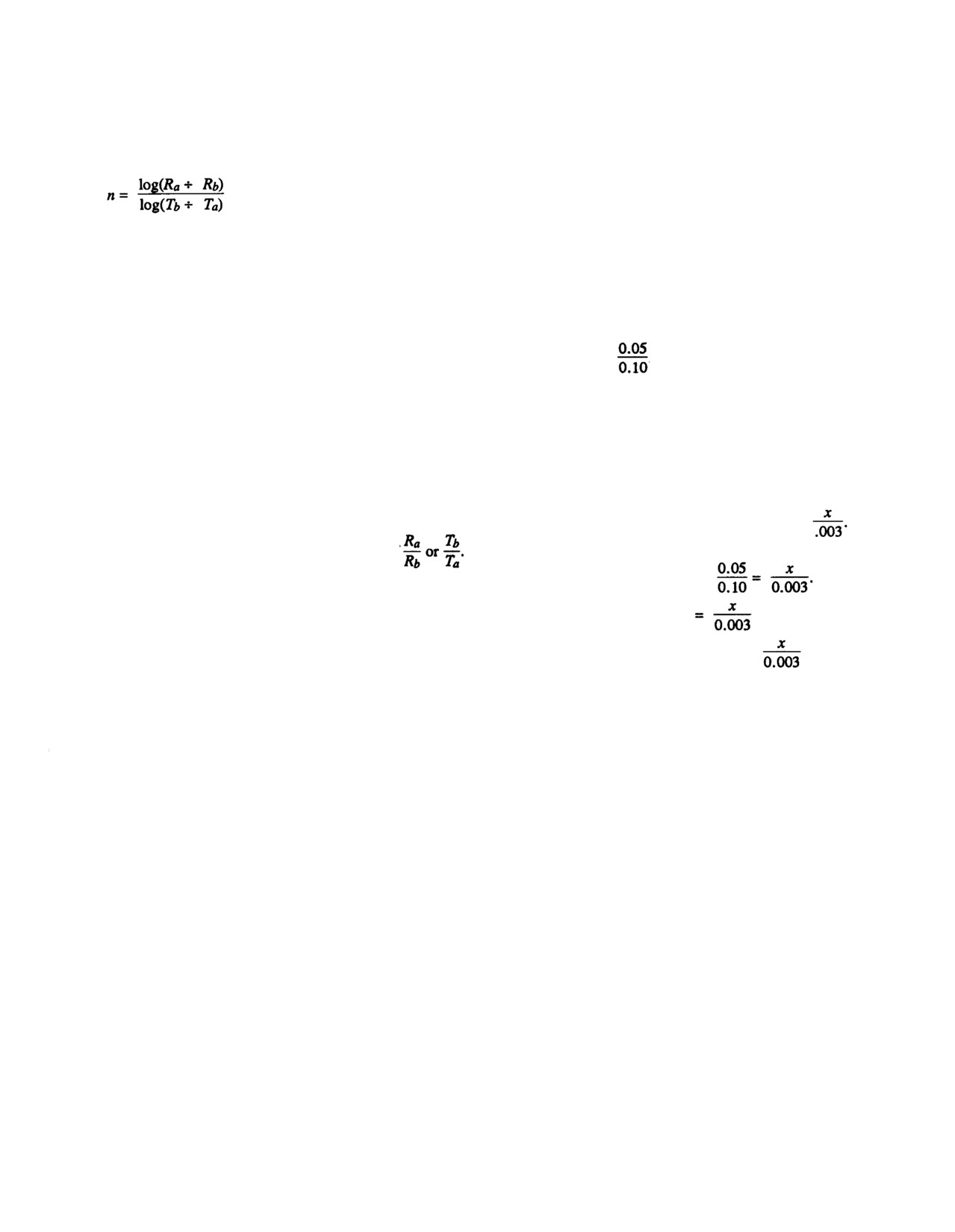
Tp=3(Tb-Ta)+Tb
An illustration of the preferred method in which
decay-rate determinations and estimations are used in
have an average value. This average value will vary from
developing a contamination pattern is presented below.
pattern to pattern.
Additional methods to calculate the decay rate are
The amount of variation is expected to be from about 0.2
presented in Appendix F.
to 2.0 for fallout. The lower values of n also can be
Example:
Collection effort for a fallout-producing
expected for salted weapons. Salted weapons refers to
nuclear burst (H-hour known) begins at H + 4. It is
weapons that have additives included in the warhead
expected to be completed by H + 6. The target time for
generally to produce or increase induced radiation. The
preparation of the pattern is H + 8. By H + 6, a decay
average value of n for most patterns (referred to as
estimation can be made and the remainder of the dose-rate
standard decay) will be 1.2. Standard decay may be
information processed. This will result in a reasonably
assumed when decay-rate determination has not yet been
reliable H + 1 pattern. By H + 6, a decay-rate
made.
determination can be accomplished to allow the use of the
Determination of decay rate depends on H-hour. A
pattern until about H + 12. By H + 12, a decay-rate
sequence of dose-rate readings (NBC 4 nuclear Series
determination can be made to allow use of the pattern until
reports) from several selected locations is required. The
H + 36 hours. Each extension of time extends the
reliability of the decay-rate calculation depends on the
do-not-use-after date-time group for the contamination plot.
precision of the dose-rate readings, the interval over which
the readings are taken, and the time over which dose
6-8
FM 3-3-1
Example:
You need the logarithm of 12.85. Reading
Determination of Decay Rate
down Column A in Table 6-4, you find values only for
Determine the decay exponent by solving the Kaufman
12.8 and 12.9—none for 12.85. To find the log of 12.85—
equation for n:
Set the problem up like this and follow the four steps
shown:
Value from Value from
Column A Column B
Ra
= dose rate (cGyph) measured at time, Ta
(a peak
12.81.107 (log of 12.8)
dose rate recorded at H + 1 or later).
12.8 X
(log of 12.85)
Rb
= dose rate (cGyph) measured at time, Tb
(the last
12.91.110
(log of 12.9)
dose rate available).
Step 1.
Take the difference between 12.8 and 12.85,
Ta
= the time (H + . hours after burst) that dose rate Ra
which is 0.05. Take the difference between 12.8 and 12.9,
was measured.
which is 0.1. Set these values up as a numerator and
Tb
= the time (H + _ hours after burst) that dose rate Rb
was measured.
denominator:
n = decay rate of fallout.
Step 2.
Take the difference between 1.107 (log value of
Note:
Ra,Rb, Ta, and Tb
are determined from the NBC 4
12.8 derived from Column B, Table 6-4) and the log value
nuclear series reports submitted by units that have been di-
of 12.85, which at this point, is unknown. This unknown is
rected by the NBCC to pass dose rate readings every half
presented by an “x.” Take the difference between 1.107
hour for 2 hours, followed by hourly reports. These reports
(log value of 12.8 derived from Column B in Table 6-4)
begin after the NBC 4 peak has been determined.
and 1.110 (log value of 12.9 derived from Column B,
Table 6-4. In this case, the answer is 0.003. Set these two
Table 6-4, (next four pages), provides nontypical
logarithms of numbers. The tables consist of two columns
values up as a numerator and denominator
marked A and B. Column A is the quotient of
Step 3.
Take the value in Step 1 and value in Step 2 and
The logarithm of that quotient is found in Column B.
set them equal to each other:
Note that Column A is given to one decimal place only.
To use the table, round your quotient to the nearest single
Solve the equation: 0.5
decimal place, and locate that number in Column A. Read
the logarithm of that number in Column B.
(0.003) 0.5 =
(0.003).
Example:
10 divided by 6 equals 1.666666667. Round
Step 4.
Add the value of “x” (0.0015) to the log value of
to 1.7, and enter Column A with 1.7. The logarithm from
12.8 (1. 107). The answer will be the log value of 12.85.
Column B is 0.230.
1.107 (log value of 12.8)
Sometimes, when using the logarithms in Table 6-4, you
+
0.0015
may need the” log of a number that is not listed. In this
-
2.1085 (log value of 12.85)
case, mathematical estimation is required.
Normalizing Readings to H + 1
Once the decay rate (n) is determined, the radiological
decay and a true representation of the hazard, past and
reading may be normalized to H + 1 readings. This
present (because radioactivity is accumulative in the human
normalized reading is commonly referred to as the R1
body) cannot be made.
reading. It is nothing more than determining,
In other words—
mathematically what the dose rate reading was at any given
First Situation-Monitor A reports a dose rate of 100
location, one hour after the burst. Survey teams and
cGyph 5 hours after the burst. The decay rate is unknown,
monitors enter an area and take readings at various times
so the monitor assumes standard decay (n = 1.2). What
after the burst (H-hour). These readings may be 15 minutes
was the dose rate at Monitor A’s location at H + 1?
or 10 hours after the burst. Any reading that is not
This can be determined by two methods; the nomogram
recorded 1 hour (H + 1) after a burst is commonly
method, which is the preferred method, but subject to
referred to as an Rt reading. To perform radiological
operator error, and the mathematical method which is
calculations and make decisions on the nuclear battlefield,
outlined in Appendix F.
all readings must be represented using the same time
reference. If this is not done, the radioactive elements will
(Text continued on page 6-14)
6-9