FM 3-3-1 Nuclear Contamination Avoidance - page 10
FM 3-3-1
The second OCF will be based on the decay rate actually
to unshielded ground dose rates at the reference time
present. This may or may not be n = 1.2.
(normally H + 1) for the particular pattern.
Determination of dose-rate contours and key dose-rate
locations requires large quantities of dose-rate information.
Plotting Data
However, much of the information is not needed on the
Contaminated areas are shown on the radiological
radiological situation map. So, worksheet overlays are
situation map. Only minimum essential information about
prepared for the initial identification and surveillance of
detected and identified areas of contamination are shown.
each contamination hazard. Only the necessary
This allows interpretation of the contamination situation.
identification information is transferred to the radiological
Each contaminated area is shown by a pattern of dose-rate
situation map.
contour lines and a few key dose rates for points, routes,
Monitoring reports and point surveys are processed and
or areas of particular concern. Eventually all monitoring,
plotted into ground dose rates for the points at which the
survey, and recon information for a contaminated area is
readings were taken.
plotted as ground dose rates. This information is corrected
Airborne Radioactivity
Most contaminated particles in a radioactive cloud rise to
minutes. Actual completion of fallout can be determined if
considerable heights. Thus, fallout may occur over a large
a peak NBC 4 nuclear report is received from the area of
area. It may also last for an extended period. A survey
interest.
conducted before fallout is complete would be inaccurate;
Dose-rate information from an aerial survey using the
because, contaminants would still be suspended in the air.
route or course leg technique is processed into normalized
For this reason, as well as the hazard to surveying
ground dose rates that existed at certain points along the
personnel, radiological surveys are not accomplished
route. To plot this information—
before completion of fallout.
Before receiving the dose-rate information, mark and label
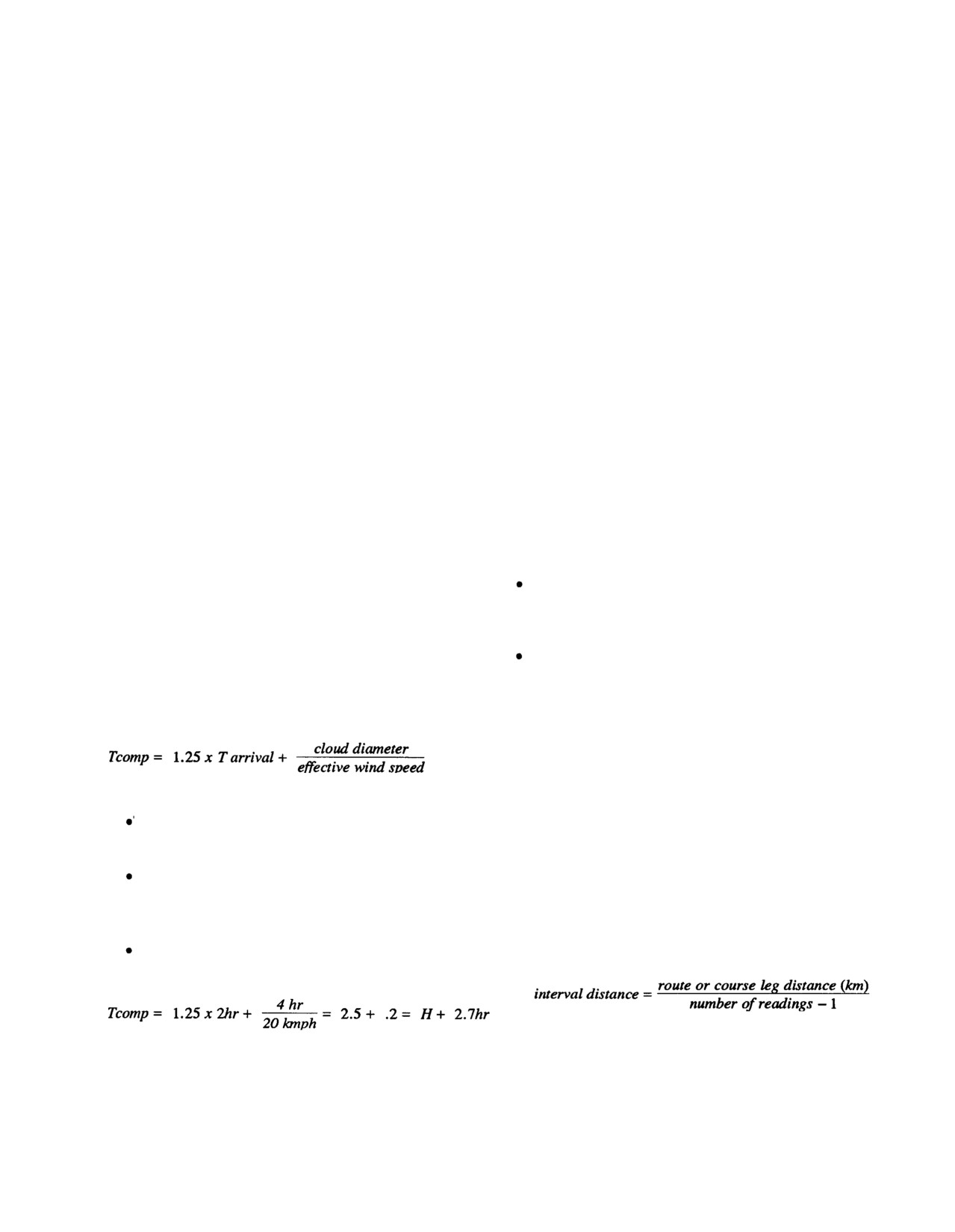
An estimate of the time of completion (Tcomp) of fallout
the checkpoints for the route or course leg on the worksheet
for a particular location may be determined using a
overlay. Trace out the preselected route or course leg that the
mathematical procedure. The time (T) in hours after burst
survey party actually traveled.
when fallout will be completed at any specific point is
After the survey data is received, count the number of
approximately 1.25 times the time of arrival (in hours after
readings taken for the route or leg. The number of time
burst). Add the time in hours required for the nuclear cloud
intervals used during the flight is required, so be sure to
to pass over.
include all readings, including zero readings. Since the
This is expressed by using the formula:
aircraft flew at a constant ground speed, taking readings at
equal time intervals, the distance covered between any two
consecutive readings will be the same. If the route or leg is
Example: For a given location, the following data has
divided into a number of equal lengthsegments, the total
been determined—
number of segments will equal the number of time intervals.
Time arrival = H + 2 hours
Each division point on the route or leg will represent a location
(Determined by dividing the distance from GZ to the
over which a dose rate reading was taken. The interval
given point by the effective wind speed.)
between readings equals the length of the course leg or route
Cloud diameter = 4 km
divided by the number of readings minus one.
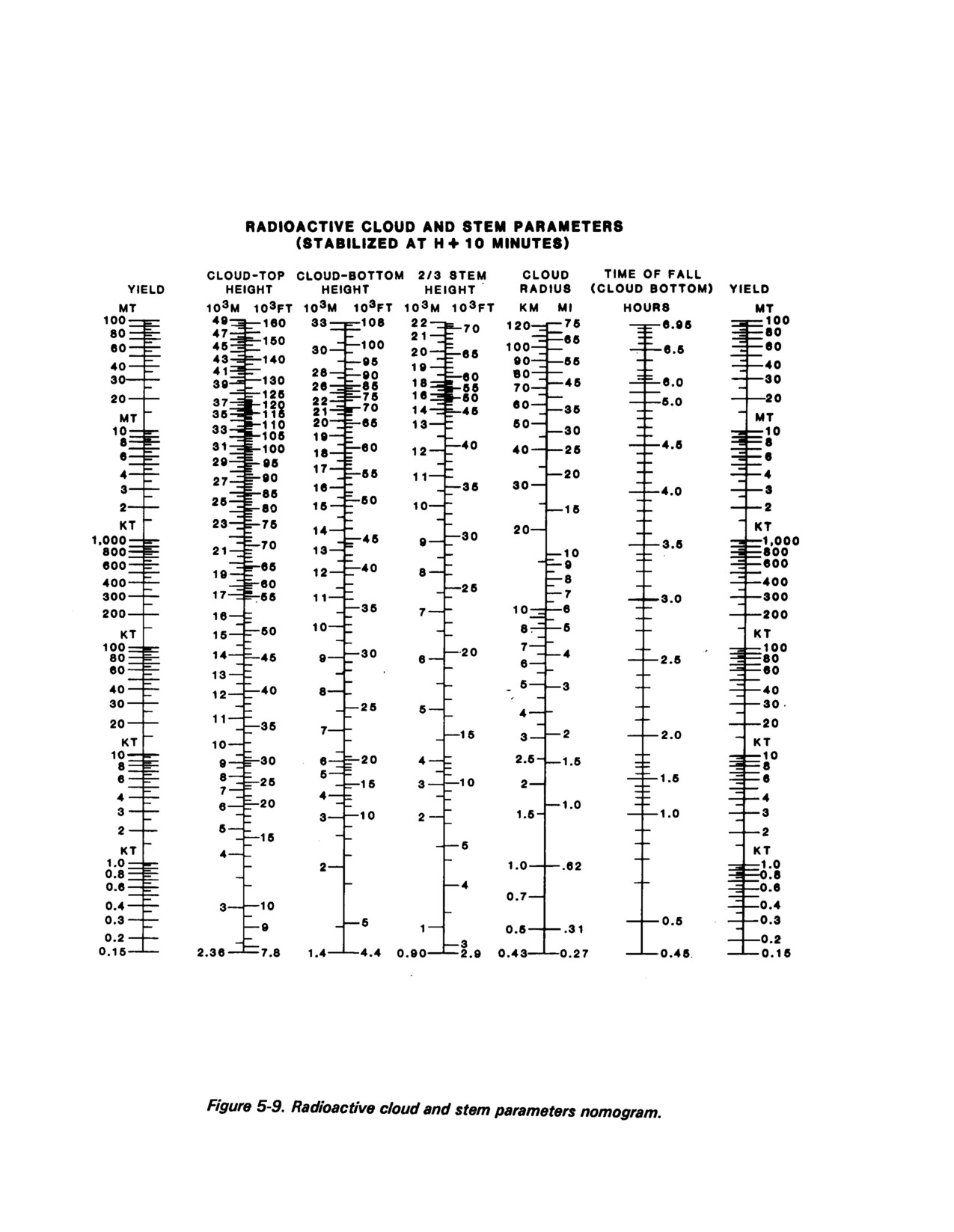
(Determined from the radioactive cloud and stem
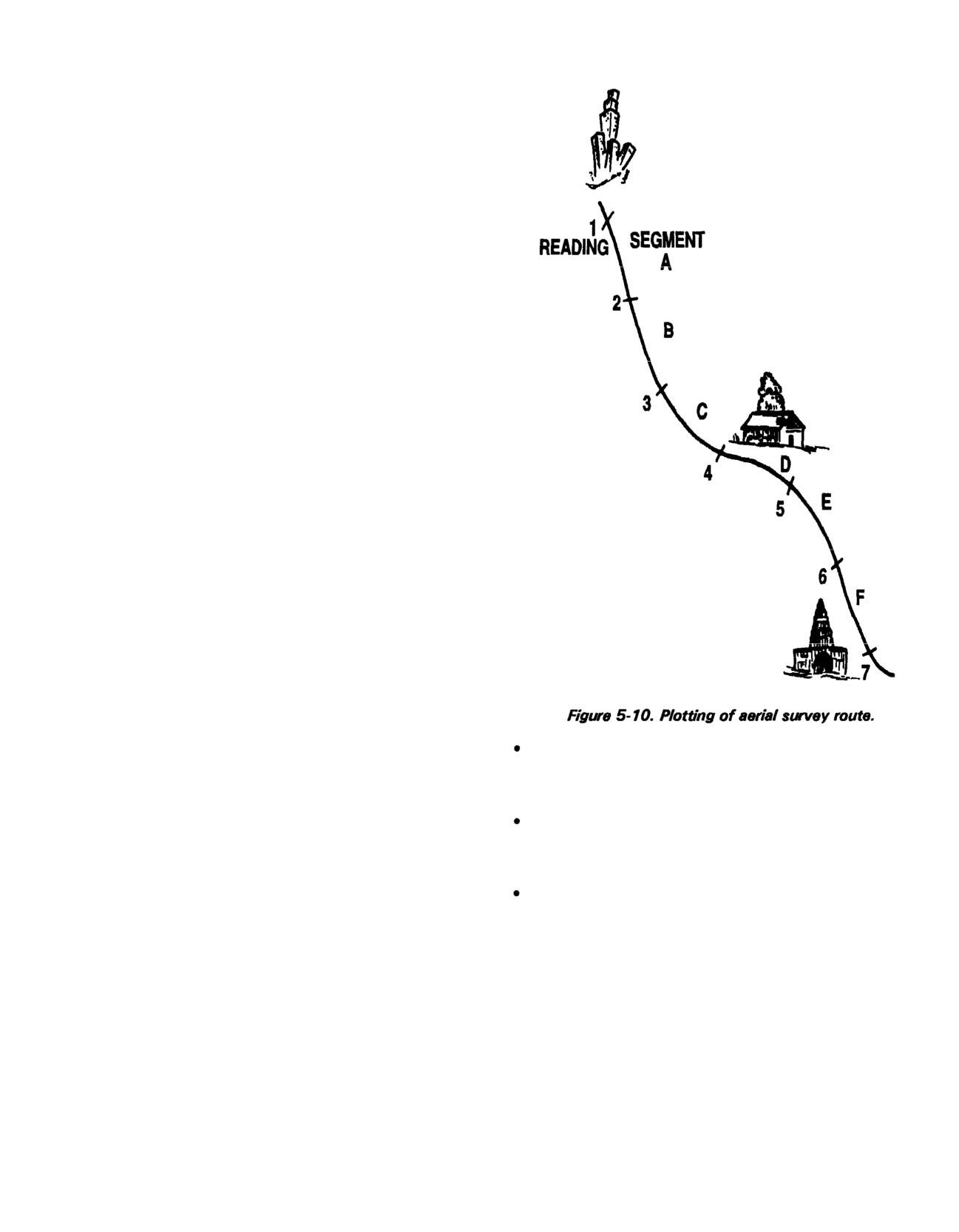
For example—Figure 5-10 shows the points along route
parameters nomogram in Figure 5-9, next page. (Lineup
over which readings were taken. In this case, seven
yield on both sides—read cloud radius-multiply by 2).)
readings were taken (#1—#7); but the route is divided into
Effective wind speed = 20 kmph
only six segments (A—F)-one less than the number of
(Determined from line Zulu of the NBC 3 report.)
readings taken by the survey party. The formula is—
Apply the formula to this data as follows:
As the dose-rate readings are processed, post the
Note:
To convert 2.7 hours into clock time, multiply .7
normalized dose rates to the worksheet overlay besides the
by 60. The product in this example is 42. Therefore, Tomp
location point for the route,
is 2 hours and 42 minutes.
Dose-rate information from an aerial survey conducted
Thus, fallout for the given location is expected to be
using course legs is plotted basically the same as the aerial
complete by H + 2.7 hours, or H + 2 hours and 42
route technique.
5-17
FM 3-3-1
5-18
FM 3-3-1
Contour Line Plotting
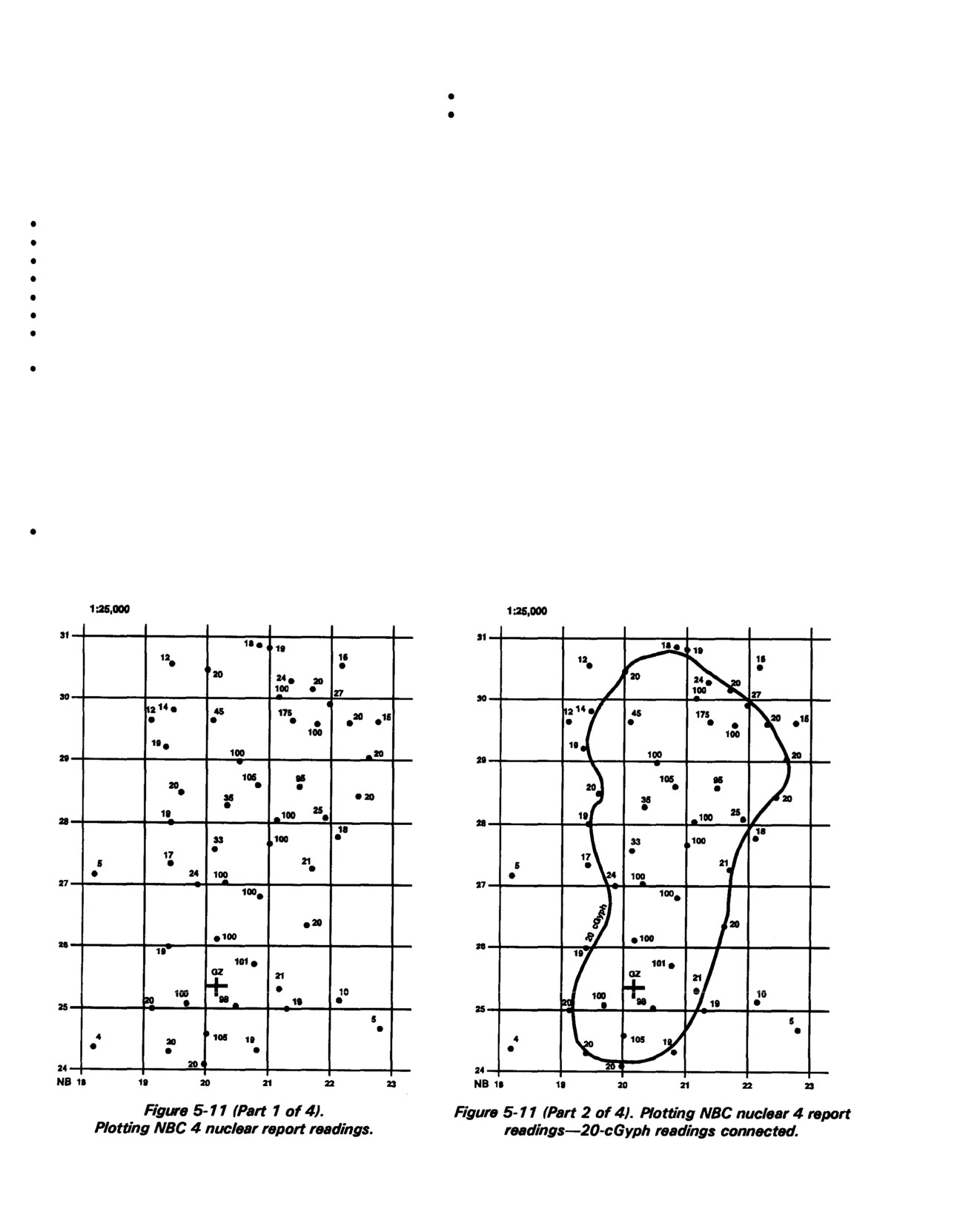
Once we have the information gathered by the survey
team or individual monitor, as presented in the NBC 4
report, normalized H + 1 (R) readings, the data may be
1
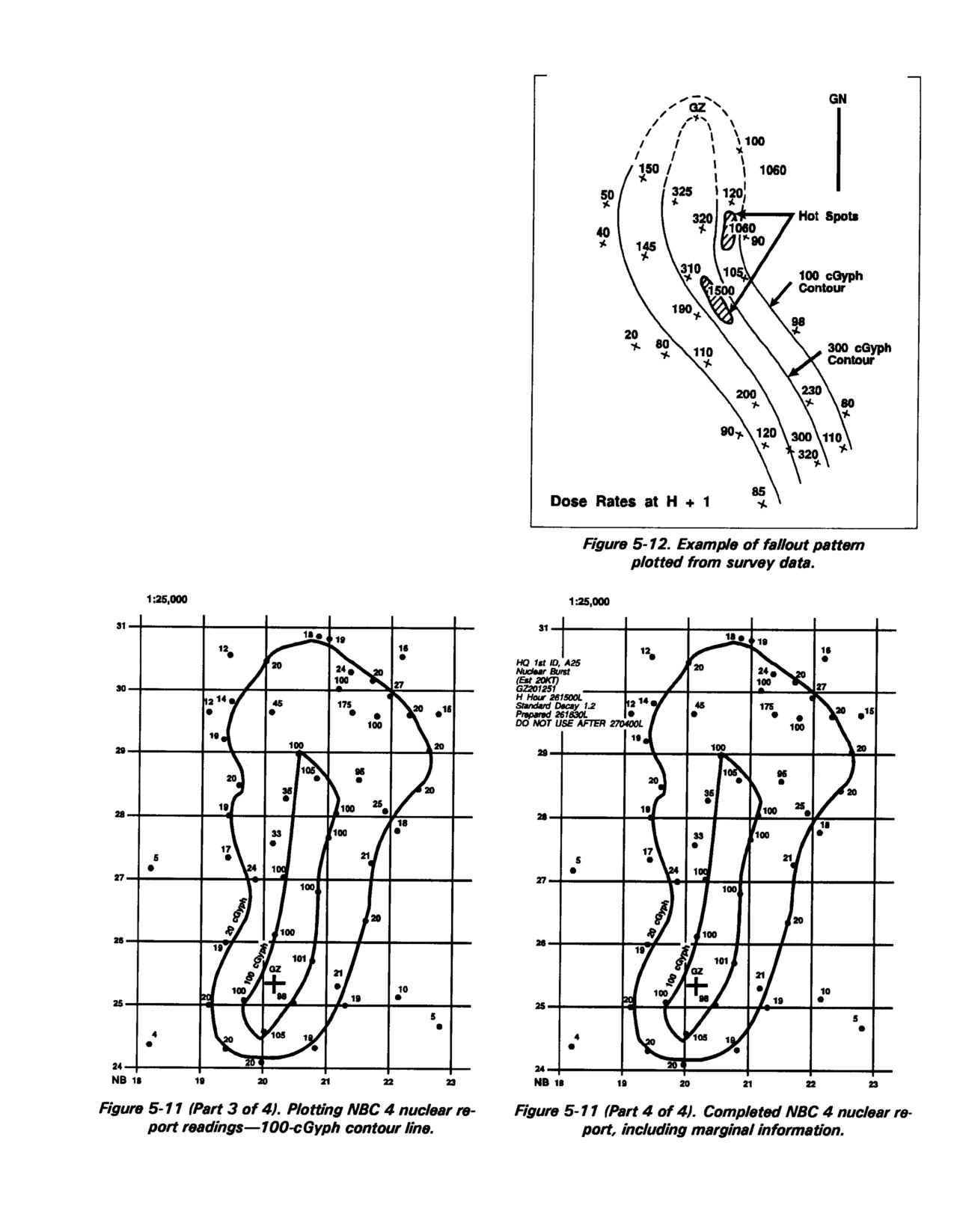
plotted on the situation map (Figure 5-11, Part 1, next
page). Draw a contour line connecting all 20-cGyph or
near-20-cGyph readings (Figure 5-11, Part 2, next page).
This contour line should be black. Use a contour line of 30
cGyph for NATO use. Label this contour line and mark
GZ with a “+. ”
When constructing the radiological contamination
overlay, there are factors that locally affect the
contamination pattern. This is particularly true between
points in an aerial survey. These include terrain features,
such as bluffs or cuts, heavily built-up or wooded areas,
and bodies of water. For example, a large river will carry
away any fallout landing in it, leaving its path relatively
free of contamination. Also, the contamination hazard near
a lake will be lower than expected. The fallout particles
will sink to the bottom of the lake and the water will
provide shielding. In wooded areas or built-up areas, a
measure of the reduction of dose rate can be obtained by
using the transmission factors (see Table 6-1) for these
areas.
Draw a contour line connecting all readings of 100
cGyph or near 100 cGyph (Figure 5-11, Part 3, page
5-19). Label this line 100 cGyph. For colored overlays,
this contour line should be blue. Using lines Whiskey and
Xray, record this overlay or plot information as an NBC 5
nuclear report.
Higher readings probably would be present (300-1,000
cGyph); but for this example, only plot the readings shown
in Figure 5-11 (pages 5-18 and 5-19).
The following NBC 5 report supports the overlay in
Figure 5-11:
Priority
261840 local
Determine the H + 1 dose-rate contour lines to be plotted (for
Unclass
example, 30, 100, 300, 1000 cGyph). These contour lines
NBC 5 Nuclear
may be required for NBC 5 purposes or for anticipated
A
25
calculations to be made from the data.
F
NB201251
Determine the points along the various survey routes, course
R
1.2
legs, and near monitoring locations where the desired dose
T
261600 Zulu
rates are located. Mathematically estimate between dose rates,
W
NB195250; NB204270; NB206290;
if necessary.
NB209269; NB195250
Connect with a smooth line all the points having the same dose
X
NB200241; NB216264; NB224285;
rates. Use all plotted monitoring data as additional guides in
NB217302; NB200303; NB196285;
constructing these contours.
NB191250; NB200241
The plotter must use care and judgment in plotting these
The NBC 5 report states where the contamination is and
contours and must visualize the probable general shape and
at what dose rate—unlike the NBC 2 or 3, which reports
direction of the pattern. Any dose rates disproportionately
where the contamination is expected or predicted to land.
higher than other readings in the immediate area indicate
This gives the ground commander information required to
possible hot spots. When such readings are reported, that
plan operations, while limiting or avoiding radiation
area should be rechecked, If dose rates are confirmed,
exposure.
these hot spots should be plotted and clearly identified.
Dose-rate contour lines showing the contamination
Plotted contours may be extended to downwind areas
hazard in an area can be drawn when all the dose-rate
where fallout has not arrived. The contours may be
information in the area is posted. To do this—
extended if necessary to complete the fallout pattern. As
5-19
FM 3-3-1
peak reports or surveys are submitted from downwind
Time-of-completion lines for fallout.
locations, the pattern is altered accordingly and thus kept
Dose at reference time for key crossings or probable stay times.
up to date. Figure 5-12, next page, shows a typical plot
The preferred method for transmitting a radiological
that might be developed from survey data.
contamination overlay is by facsimile channels of electrical
Radiological contamination overlays used for evaluation
communications. It is fast and accurate. Facsimile devices
must provide the most detailed information possible. The
normally are available at battalion and higher headquarters.
minimum information required is—
Three devices are used to transmit contamination overlays
Map designation and orientation data.
to lateral and higher commands. When liaison or
Nuclear burst and GZ identification.
messenger service is not available, the information can be
H-hour.
sent as an NBC 5 nuclear report.
Reference time.
Decay rate/soil type.
Reporting Data
Time-of preparation and validity time.
Facsimile channels of electrical communications are not
Source of the contamination-fallout or neutron-induced
always available. If this is the case, the radiological
contamination.
contamination overlay must be converted into a series of
Militarily significant contamination perimeters—
readings and coordinates for transmission as an NBC 5
—New fallout (H-hour to H + 48 hours)—20 cGyph at
nuclear report. From the division NBCC the readings
H + 1 for short-term (24-hour) occupancy, 10 cGyph at H
should be transmitted to the three brigades; the division
+ 1, if longer occupancy of a contaminated area is
artillery; the armored cavalry squadron, the aviation,
expected.
signal, and engineer battalions; the chemical company; the
—Old fallout (H + 48 hours)—1 cGyph at the time of
MP company; the support command and attached units;
preparation.
and any other units designated by the commander. This
—Neutron-induced contamination—2 cGyph at H + 1
method has a disadvantage. It requires the addressee to
hour.
replot data from the NBC 5 nuclear report and draw
Dose-rate, information-contour lines and key dose rates, if
dose-rate contours, a time-consuming process. Staff
possible.
planners must consider that the shapes of dose-rate
Additional information that is desirable but not essential—
5-20
FM 3-3-1
contours drawn to correspond with a relatively brief series
of readings and coordinates can vary significantly.
If electrical communications for hard copy are not
available and if time and distance permit, radiological
contamination overlays are sent by messenger. Data is
transmitted by the NBC 5 nuclear report as a last resort.
When the contamination comes from a single burst, the
dose rates will be normalized to H + 1. But if there have
been several detonations at different times and no single H
+ 1 is possible, the dose rates are reported for a specific
time. Line item Oscar is used instead of line item Tango on
the NBC 5 nuclear report.
It is not necessary or even desirable to report all four
line items (Uniform, Victor, Whiskey, and Xray) on the
NBC 5 nuclear report. Four lines have been provided for
flexibility. Line item Xray should always be sent for
avoidance purposes.
On the NBC 5 nuclear report, coordinates are listed
sequentially around the contour. A contour line that
completes a plot is represented by repeating the first
coordinate. NBC 5 nuclear reports having incomplete
contours are sent in sequence, with the first and last
coordinate different, indicating the break in the contour.
Report the decay rate on line Romeo. Users of the NBC
5 nuclear report are not confined to predetermined lines.
Any line described in Chapter 2 may be added.
5-21
FM 3-3-1
The maximum H + 1 (R) dose rate encountered in each
Evaluation Contamination Overlays
1
of the areas is used as part of the dose calculations. A
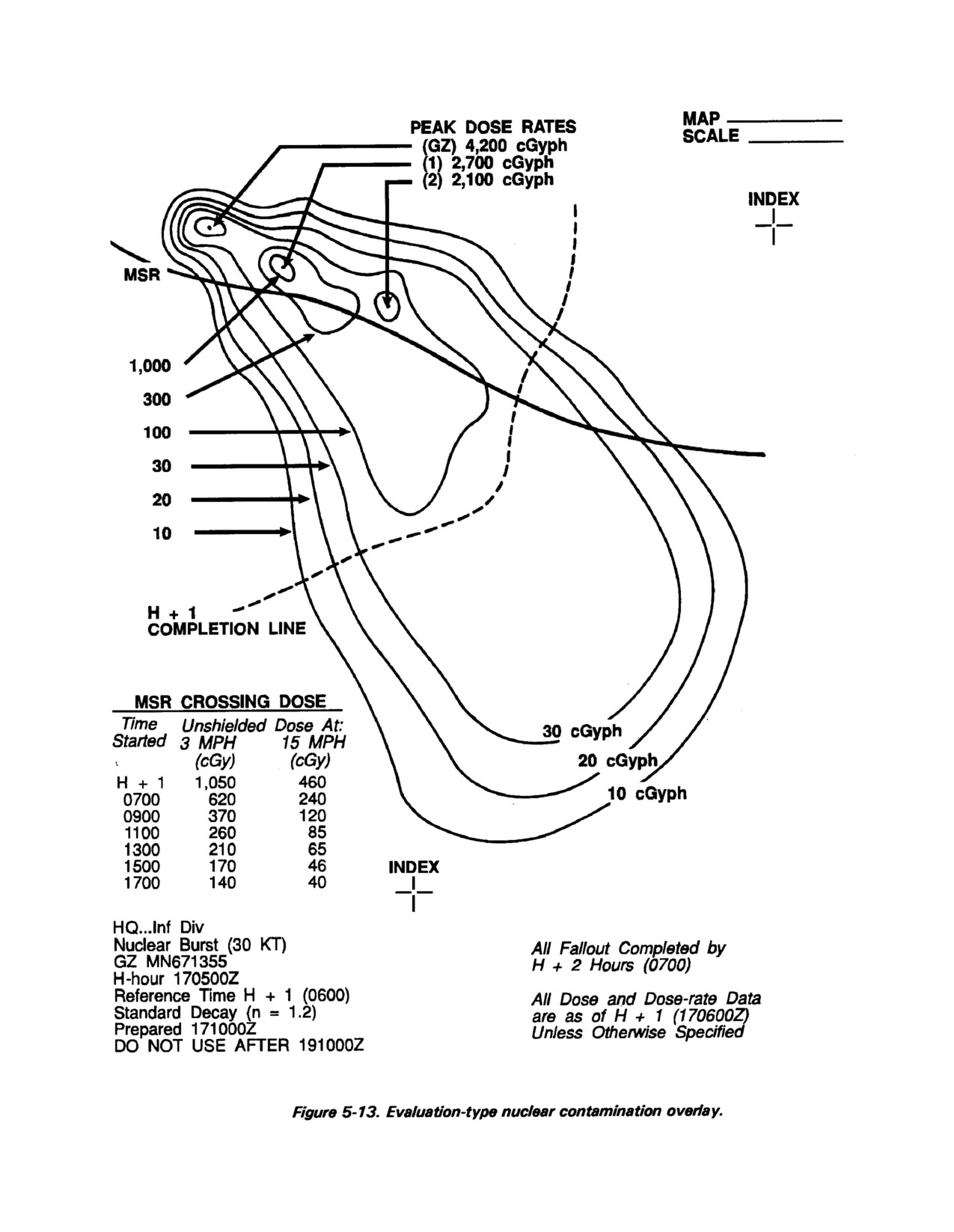
Figure 5-13 (next page) illustrates an evaluation
diagram of the data is shown in Figure 5-17 (page 5-25).
contamination plot showing H + 1 dose rates. The H + 1
Using the n = 1.2 total dose nomogram, the solution is
dose rate plot is the beginning point for developing a plot
shown as the inset to Figure 5-15 (page 5-23).
that will show the contaminated area shrinking. The first
Total dose calculations should not be projected beyond
step is to determine what is to be illustrated. An
the do-not-use-after date-time group. In the above example,
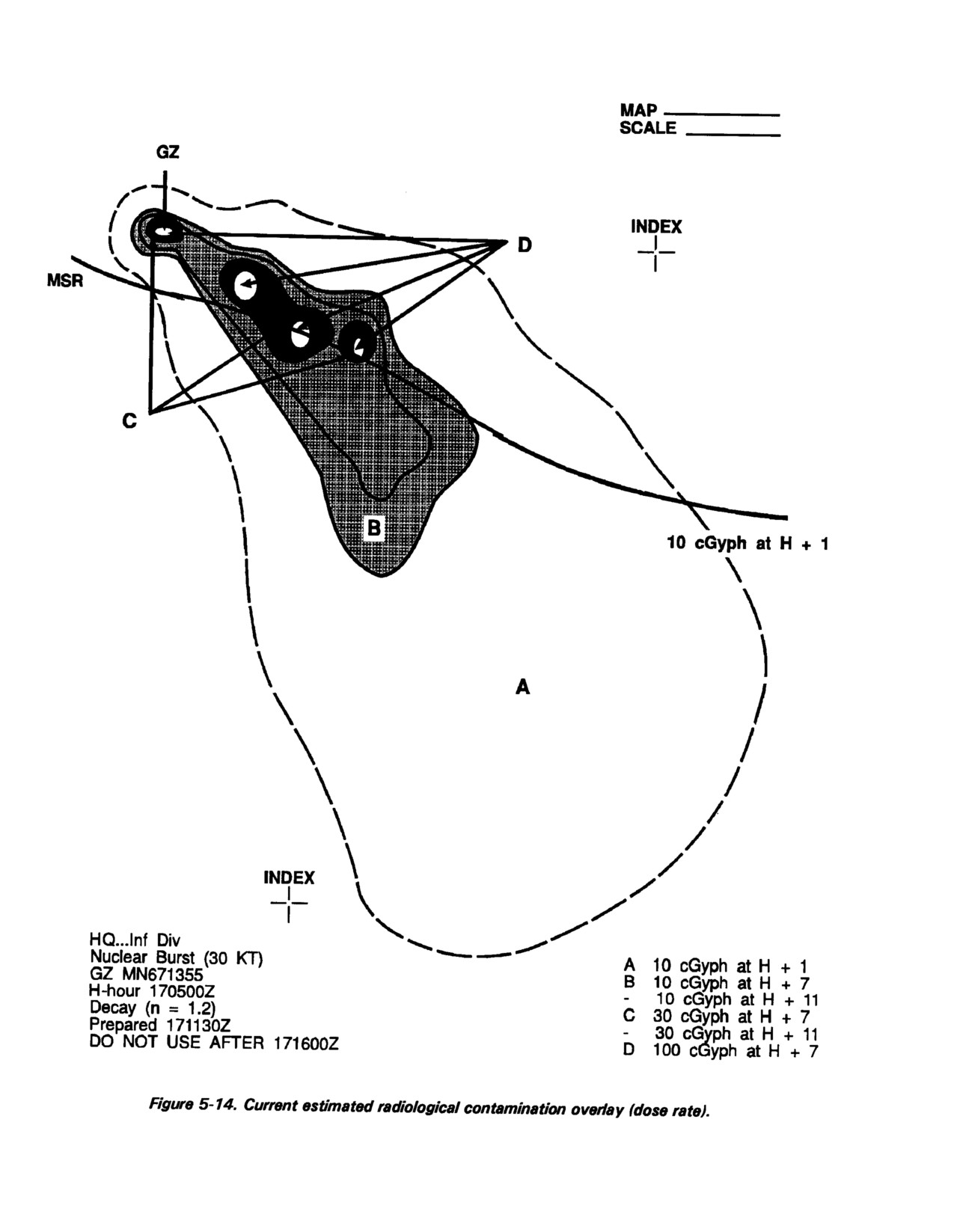
examination of Figure 5-14, page 5-22, reveals the 30- and
entry is H + 7, and maximum stay time is four hours.
100-cGyph contour lines have been shown at H + 7 and H
Thus, time of exit is H + 11. Note that neither the plot nor
+ 11. The 10-cGyph contour line has been shown at H +
the data can be sent in an NBC 5 nuclear report.
1, H + 7, and H + 11. H + 11 is the latest time, because
it equals the do-not-use-after date-time group 171600Z.
Since a dose rate at H + 1 will decay to a lesser value, a
Estimation Contamination Overlays
decay nomogram must be used. Thus, the solution involves
A radiological contamination overlay prepared for
solving for a higher dose rate that will decay to the
estimation purposes does not lend itself to briefings and
preselected dose rate at the specified time. The selected
similar requirements. A briefing requires a presentation of
dose rates are diagramed below for clarity:
the current radiological contamination picture that lets the
R
t
t
R
1
n=1.2
viewer picture the current hazard and the decay of the
10
7
hazard over a short period (three to six hours). This type of
10
11
presentation is of particular use for staff analysis of the
30
7
area, and for rapid visualization of the contamination
30
11
hazard.
10
7
A contamination overlay showing dose rates for
100 11
estimation purposes, is shown in Figure 5-14 (page 5-22).
The overlay attempts to show a shrinking contaminated
Use of then = 1.2 decay nomogram results in—
area. This may be done by color contrast, overlay flips, or
R
t
t
R
1
n =
1.2
the use of dashed, dotted, and solid lines.
10
7
103
10
11
170
30
7
300
Aerial Survey Team Actions
30
11
325
The NBC defense team has ready access to the latest
100
7
1,000
information available concerning the survey area. The
100
11
1,700
defense team provides this information to the survey team
The next step is to return to the H + 1 dose-rate plot and
at a briefing. In addition to information about the
mathematically estimate these dose rates. Place a piece of
contaminated area, the defense team provides the aerial
transparent material over the H + 1 plot and trace the
survey team with the identification of the course legs or
estimated dose rate contour lines. Label each contour line
routes to be flown, the tentative survey height, and the
with dose rate and time. Thus, for 10 cGyph, three contour
approximate times during which groups of the course legs
lines are drawn and labeled. Figure 5-14 (page 5-22) shows
or routes are to be flown. The unit NBC defense team will
the process to this point.
furnish the survey team with the operation exposure
Repeat the process for the 100- and 300-cGyph contour
guidance and the turnback dose. For an explanation of
lines. Note that the NBC 5 nuclear report cannot be used to
turn-back dose rate (D
refer to Appendix A.
tb)
disseminate this plot.
The aerial survey party determines, as applicable—
A contamination overlay prepared for estimation
Actual height above ground at which each course leg or route
purposes, showing total dose areas for various times of
is to be flown.
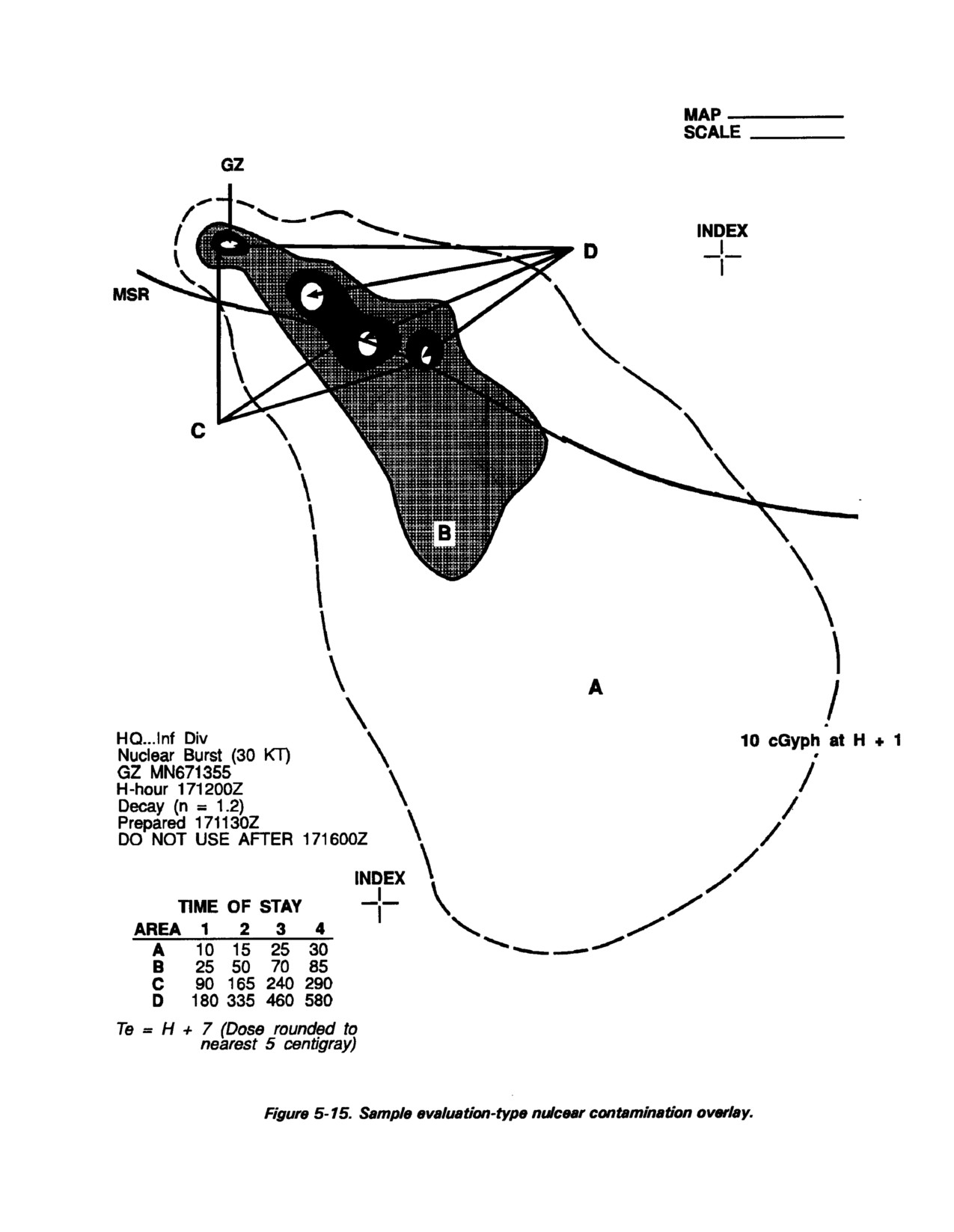
stay, is in Figure 5-15 (page 5-23). This plot shows the
Ground speed for each course leg or route.
consequence of occupying or crossing the area. The plot
Direction of fright for each course leg or route.
assists in planning future operations and goes to the staffs
Locations for determining AGCF data.
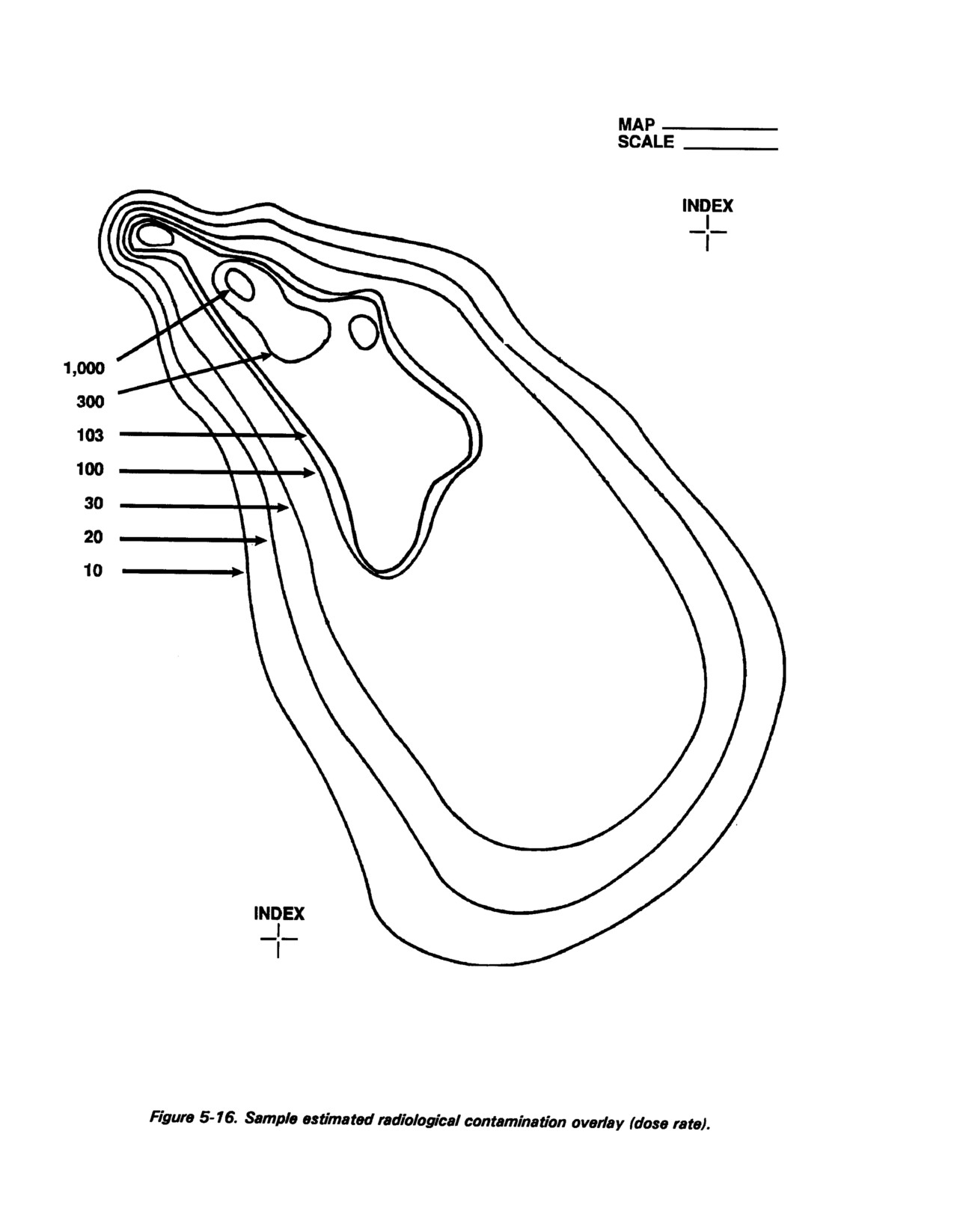
and down to battalion commander. (See Figure 5-16, page
Time intervals between readings.
5-24.) The plot is marked in color or contrasting patterns
Whether to delay the flight of a particular course leg or route.
to identify hazard areas.
Upon arrival over the contaminated area, the survey
Again, Figure 5-15 is used as the start point along with
team has several decisions to make before the actual survey
guidance concerning the times of entry and times of stay.
begins. Four of these decisions and a discussion of each
For Figure 5-15, a time of entry of H
+
7 was used for all
follow:
calculations. Time of stay was selected as 1, 2, 3, and 4
Direction of flight for each course leg or route.
Factors
hours. Note that the plot is divided into four areas-A, B,
that could influence this decision include weather, sun
C, and D.
glare, fuel economy, the aircraft's duration of fight, and
completion of fallout.
5-22
FM 3-3-1
5-23
FM 3-3-1
5-24
FM 3-3-1
5-25
FM 3-3-1
5-26