FM 3-3-1 Nuclear Contamination Avoidance - page 9
FM 3-3-1
NBC defense team that an outside dose rate of 1 or more
report. The word “peak” is used with line item Romeo.
cGyph exists and gives the time of reading. The unit NBC
Intermediate headquarters do not screen or delay peak
defense team warns and alerts all unit personnel of the
reports. This information is extremely important to the
arrival of fallout. Defensive measures per SOP are
NBCC.
implemented. The defense team then formats an NBC 4
Special Reports.
FSOP/OPLAN/OPORD and other
nuclear report to send to the NBCC. The word “initial” is
standing instructions may establish the requirement for
used with line item Romeo to alert the NBCC to the value
special NBC 4 nuclear reports. These special reports are
of the report.
evaluated by the NBCC. They invite command attention to
Intermediate headquarters screen and evaluate the initial
areas or conditions of serious concern. The operational
NBC 4 nuclear report. If the hazard has already been
situation, unit radiation status, and similar considerations
reported, the precedence of the report is reduced. The
determine the criteria for these special reports. They
report may be eliminated if several reports have already
cannot be specified here. Generally, this report may be
been submitted. The initial report is used at the NBCC to
required when the ground dose rate goes above a specified
confirm the fallout prediction. The dose rates cannot be
value. When the dose rate increases after it has decreased,
converted to H + 1.
a special report may also be sent. In this case, the word
Peak Report.
While performing continuous monitoring,
“overlapping” could be used with line item Romeo. Special
the unit monitor records dose rates on DA Form 1971-R
reports may be required after a specified period of time if
according to the time intervals specified in unit SOP. Dose
the unit remains in the area.
rates should be recorded at 15-minute intervals while
fallout is arriving. The dose rate steadily rises until it
Additional Reports
reaches a peak and then it decreases. In some cases, the
In addition to the automatic reports-initial, peak, and
dose rate may fluctuate for a short time before beginning a
special-units may be required or directed to submit other
constant decrease.
reports.
Once there is a constant decrease, the monitor takes an
Increasing and Decreasing Reports.
Dose rates
inside reading and then an outside reading for the CF
reported on NBC 4 nuclear reports (line item Romeo)
calculation. First, the inside reading is recorded on DA
followed by the words increasing or decreasing are never
Form 1971-R as the next reading in sequence (in the main
sent unless requested. This cuts down on communications
body of the form) and also in the CF data portion of the
overload. It is logical to assume that the dose rate at a unit
form. Other entries for the CF block are completed.
which sent an initial NBC 4 nuclear report will increase,
Within three minutes, the monitor goes to the outside
peak, and then decrease. The computations used to
location previously used and takes an outside dose-rate
normalize (convert to H + 1) the peak dose rate also
reading. The monitor immediately returns to the shelter.
convert any decreasing dose rate at that location to the
Exposure to radiation during this short period of time is
same H + 1 dose rate. From this it can be seen that
minimal.
unsolicited increasing and decreasing reports clutter the
The monitor records the highest outside dose-rate
reporting channels with useless information.
reading in the CF data block on DA Form 1971-R. The
Directed Reports.
Selected units in the contaminated
monitor then reports the location of the readings, the time
area will be directed to submit additional NBC 4 nuclear
of readings, the inside dose rate and the outside dose rate
reports. The NBCC uses these reports to evaluate a
to the unit NBC defense team. The monitor does not
radiological contamination hazard-the decay rate of fallout
calculate or apply the CF to this data. The unit SOP
and how long this decay rate (and the contamination
outlines the means of communication to be used. The
overlay) will remain valid. They are used to determine the
monitor does not need to use the NBC 4 format to report
H-hour (if unknown) and the soil type in induced areas.
this information. It is usually sent over unit radio or wire
Reliable calculations are directly related to the precision
nets or presented in person. Any questions about the
of the dose rate measurement. Tactical decisions and
information are cleared up at this time. The monitor
personnel safety depend on the accuracy of these
resumes continuous monitoring-recording dose rates at
measurements. Further development of the contamination
30-minute intervals after the peak dose rate has been
situation depends upon this data. An error in dose rate
reported. This procedure is continued until the unit leaves
measurements means a similar error in calculating future
the contaminated area or the radiation level drops to 1
dose rates and total dose.
cGyph or the commander directs that periodic monitoring
The NBCC carefully selects locations for additional
begin.
dose-rate readings. Close coordination with the G3 is
The unit NBC defense team records the monitor’s
required.
information onto DA Form 1971-R. After all information
Selection is based on—
is recorded, the team calculates the CF and applies it to the
How long the unit is likely to remain in the area.
highest dose rate. It then formats the NBC 4 nuclear
The training status of the unit.
5-7
FM 3-3-1
Comparison of average soil, vegetation, and terrain across the
time each reading was taken is also given. Inside dose rates
entire area and at the proposed monitoring location.
are converted to outside dose rates. Units may be directed
The tactical situation.
to submit the Summary report or FSOP/OPLAN/OPORD
The need for representative information throughout the
or other written instructions may require the report to be
contaminated area according to its size and unit distribution.
submitted at a specified time (for example, H + 24 or H +
There are three directed reports-Series, Summary, and
48).
Verification. Instructions for report frequency, precedence,
The unit NBC defense team will direct its unit monitors
reporting procedures, communications channels, and
to take dose-rate readings at several locations within their
format are established by FSOP/OPLAN/OPORD and
subunit boundaries, Unit monitors take these readings at
other written instructions. The names of these reports
locations specified either by the defense team or at
describe their purpose. To the monitor or unit defense team
locations they choose. The location, dose rate, and time of
the name means a dose-rate reading taken in accordance
reading are recorded on DA Form 1971-R and the form
with a specific procedure.
returned to the defense team.
Series Reports.
A Series report consists of dose-rate
The defense team organizes this data into the NBC 4
readings taken at the same location at 30-minute intervals
nuclear Summary report. The word “Summary” is used
for 2 ½ hours followed by hourly reports. This report
with line item Romeo. The defense team ensures that
begins after a peak dose rate has been noted at the
enough readings are taken at various points so the coverage
monitor’s location.
expresses the situation across its area. The report is sent to
Requests to units selected to submit series reports come
the NBCC through intermediate headquarters where
through intelligence channels. Requests must ask
additional data from other units are added if available. The
specifically for a Series report and are passed, ultimately,
report can be used to verify an overlay of shrinking
to the NBC defense team, which directs the monitoring. A
contamination.
request for a Series report alerts the monitor to take a
Verification Reports.
The Verification report is a
series of dose rate readings at 30-minute intervals.
unit’s response to a direct request from the NBCC. If data
Whenever possible, the readings are taken at 30-minute or
is lacking from a specified location near or in the unit area,
hourly intervals from time of burst (TOB). If TOB is 0745,
the NBCC requests a Verification report. These reports
readings should be taken at 0815, 0845, 0915, and 0945.
also can be used to recheck an unusually high dose rate, a
The location must remain constant. Readings are recorded
zero reading, or other abnormalities. The NBCC is aware
on DA Form 1971-R. The monitor reports each reading
that the previously reported dose rate is no longer valid
and the time it was measured to the NBC defense team.
because radioactive decay will have taken place. A
The monitor continues the procedure until told to stop. The
Verification report is not a retransmission of previously
instrument used to measure dose rates should be zeroed
reported readings, but a check of the actual condition of
before each reading.
the area.
The unit NBC defense team organizes the data into the
A unit tasked with submitting a Verification report will
NBC 4 nuclear report. The word “Series” is used with line
receive specific instructions. These will include the exact
item Romeo. As per FSOP/OPLAN/ OPORD or other
location for the readings, why the report is requested, and
written instructions, the reports may be sent one at a time
details about communications.
or held until several have been collected and then reported.
A unit monitor tasked to perform monitoring uses the
Intermediate headquarters do not screen or delay these
direct technique to take the readings whenever possible.
reports. They are needed at the NBCC for fallout decay
The monitor records all data on DA Form 1971-R and
rate and other calculations.
turns the form in to the unit NBC defense team when the
Summary Reports.
A Summary report shows the
mission is completed.
radiation distribution throughout a unit’s area of
The team will format the NBC 4 nuclear report. The
responsibility. The locations for readings are selected by
word “Verification” is used with line item Romeo.
the reporting unit according to the distribution of its
Intermediate headquarters do not screen these reports.
elements and the extent or variety of the area’s terrain. The
They are passed without delay to the NBCC.
Surveys
Nuclear surveys are conducted to find the extent and
Surveys require time and coordination. Men and equipment
intensity of contamination. Radiological monitoring and
must be diverted from primary missions. Because of these
reconnaissance provides general information about
circumstances, surveys are conducted only when the
contamination for immediate operations. Surveys provide
intensity of contamination must be known. Future dose
detailed information on which future operations are based.
rates can be predicted from the data provided by
5-8
FM 3-3-1
monitoring or survey. Recon cannot provide sufficient data
Control of Surveys
for this. Monitoring provides data only in areas occupied
by troops.
There are two different methods of control over surveys,
If no operations are planned in the area, a survey is not
centralized and decentralized. Centralized surveys mean
required. However, if there is a remote chance that this is
that the NBCC ordering the survey provides the defense
not the case, a survey should be conducted at the earliest
team. The radiological data is reported directly to this
opportunity. Current techniques are designed for
team. The data is not screened, consolidated, or evaluated
reasonable safe survey of high dose rate areas. Once the
in any way by intermediate headquarters.
contamination has decayed, the survey will be difficult.
Decentralized control is used when the NBCC cannot or
Often, a survey will be delayed until the area is under
should not control the movements of the survey teams.
friendly control. Survey in the Covering Force Area (CFA)
Thus, decentralized control means that the NBCC has
or forward of the Forward Line of Troops (FLOT) is not
directed a subordinate unit to control a survey. This unit
done unless knowledge is imperative and loss of survey
will report data directly to the NBCC. It will not screen,
team is acceptable. This will be an extremely rare case.
consolidate, or evaluate the data in any way.
Calculations based upon survey data are a series of
The type of survey used is also a factor in determining
approximations. These are sufficient for field use;
which method of control is used. Aerial surveys can cover
however, best accuracy is obtained by resurveying the area
large areas. They also require air space management. The
every few days. Theoretically, once a radiological hazard
unit NBC defense team must be able to obtain information
has been identified, the contamination existing at any
on the operational situation. This avoids directing the
future time can be calculated. However, weathering and
aircraft into hostile areas. This type of information is not
inaccuracies in initial survey make this approach
available below NBCC level. Also, subordinate units do
unrealistic. Frequent resurvey of contaminated areas is
not normally have aircraft available for a survey. Thus,
essential. The frequency and detail of resurvey will be
centralized control by the NBCC is used for aerial surveys.
determined by the reliability of the initial survey. Resurvey
This may differ, however, based on the organizational
will be planned and conducted in the same way as the
composition of the unit.
initial survey.
During ground surveys, decentralized control is best.
Surveys are not conducted by units unless directed. The
This is because the NBCC does not have radios or has only
NBCC will initiate surveys or request that a subordinate
limited access to radios, which are necessary to control the
unit be directed to conduct a survey.
ground survey teams. Also, distances may be too great
A survey is performed by a group comprised of a
from the survey area to the NBCC location for good
defense team and one or more survey teams. The defense
communications. Control of a ground survey may require
team, consisting of one or more men, plans and directs the
too much of the NBCC’s time. For these reasons, the
survey. It screens and transmits the data to the authority
subordinate unit tasked to perform the ground survey
that ordered the survey. The survey team, organized within
provides the defense team. Therefore, decentralized control
the company/troop/ battery NBC team, consists of a
by the subordinate unit is used for ground surveys.
monitor and necessary support and security personnel.
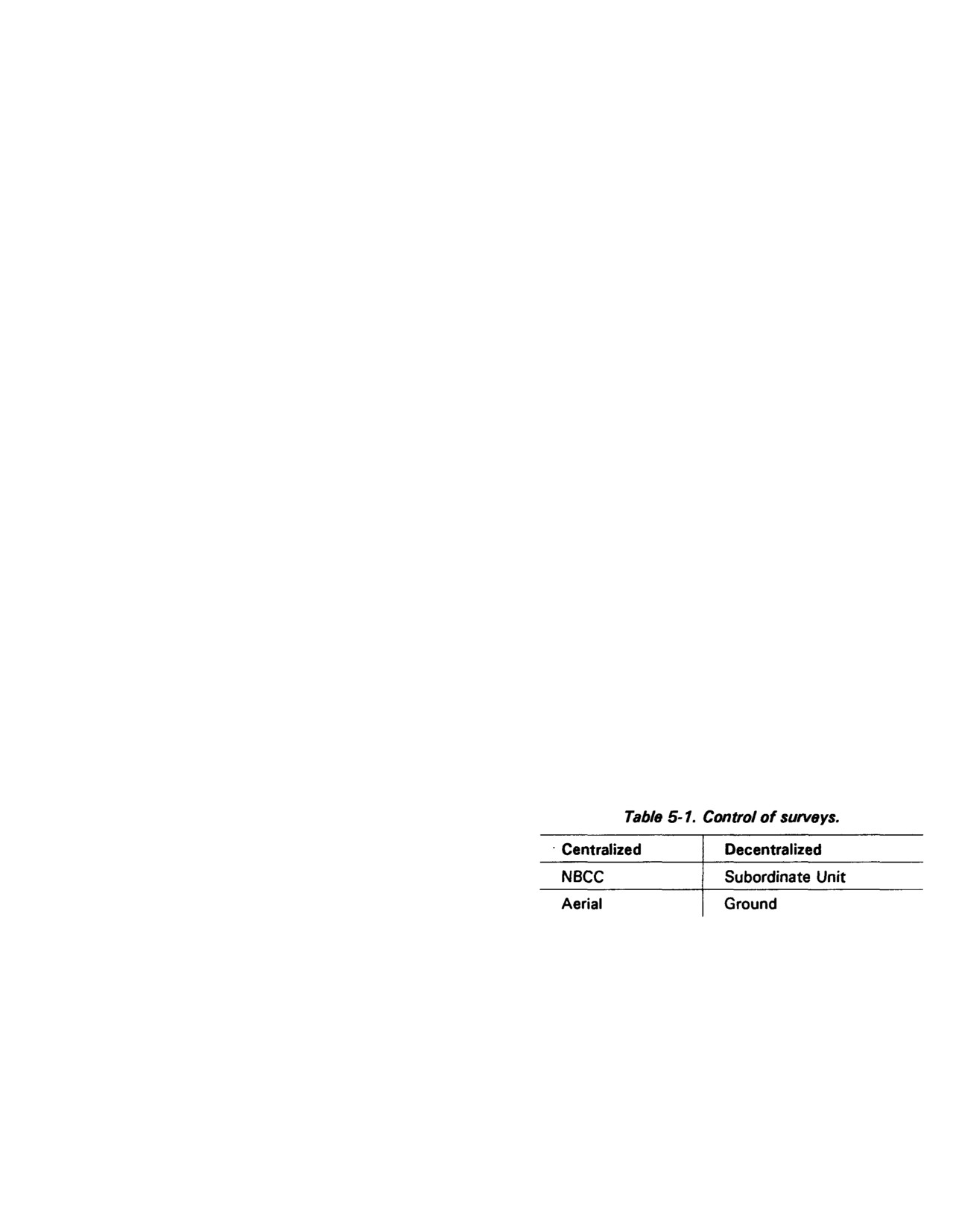
Table 5-1 shows the relationships between the NBCC
Only the minimum number of personnel are exposed to
and subordinate units, centralized and decentralized
radiation. The defense team briefs the survey teams and
control, and the type of surveys.
controls their movements.
There are two types of surveys, aerial and ground. The
type used depends on many factors. Aerial surveys are
conducted for large areas and have advantages over ground
surveys. They are faster and more flexible. They expose
personnel to lower doses, and require fewer personnel and
equipment to perform. However, aircraft may not always
be available. Ground surveys can be done under unit
control using unit equipment. They can be done in any type
Survey Planning at the NBC Center
of weather, and they can be done when aircraft cannot fly.
They are more accurate than aerial surveys. These points
Radiological contamination on the nuclear battlefield
are considered by the NBCC when deciding the type of
may cover large areas. It may occur in many locations with
survey to use.
overlap of contaminated areas, and may be in varying
stages of decay. Initial detection of new contamination will
probably be in the form of NBC 4 nuclear Contact reports
from recon elements. These reports will alert the command
to the presence of a previously undetected hazard. This
5-9
FM 3-3-1
will cause a new series of orders and requests to be
Factors Influencing the Plan
initiated for radiological information. These orders and
The following paragraphs list some of the factors
requests will be superimposed upon existing survey plans
affecting survey planning with guidance concerning their
already functioning for older contaminated areas. Thus, the
major effects. In preparing the survey plan, each factor
supervision and coordination of the radiological
must be estimated and balanced against the need for
intelligence effort will be a continuing process.
information:
The NBCC initiates all radiological surveys. This
Knowledge of the Contamination.
Knowledge about the
ensures that the right amount of data is obtained at the right
contaminated area which is available or expected to be
time. It also ensures that surveys are not initiated when
available (such as recon data and monitoring reports) will help
data is not required. This reduces the burden of
determine the size of the area to be surveyed and the amount
subordinate units. Subordinate units execute only their
of detail required.
assigned portions of the plan(s).
Operational Situation.
In rapidly changing situations,
centralized control is necessary. Under such conditions, aerial
Factors Influencing Reliability
survey is required for critical counterattack routes. A
With the guidance and procedures outlined, aerial
checkpoint overlay for aerial survey planning will be prepared
surveys provide the defense team with adequate and
as areas are assigned or as areas of interest change. Main
sufficiently reliable data, Generally, the dose rate
supply routes and so forth may be surveyed using the ground
determined by aerial survey varies from the true dose rate
technique later. The operational situation will dictate the
at the ground location. This is because of survey meter
availability of personnel and equipment.
errors, pilot errors, monitoring errors, errors due to
Urgency.
Aerial surveys are normally the most rapid means
contamination of aircraft at touchdown for ground reading,
of obtaining information.
and the overall system errors.
Weather.
Aerial surveys may be precluded by poor visibility.
The type and source of contamination will determine the
Surveys should be delayed during precipitation and high
survey requirements and sequence of calculations to be
winds. These conditions tend to change a contamination
performed. The types and sources of radiological
pattern. Ground surveys can be accomplished in any weather,
contamination are—
except as noted. Aerial surveys may be precluded by bad
Induced contamination. Contamination resulting from a nuclear
weather.
burst where the contamination can be related to a specific
Terrain.
Lack of road nets or the inability of the soil to support
nuclear burst where fallout did not occur, or contamination is
ground movement may eliminate a ground survey. An aerial
localized around an obvious ground zero area.
survey is of limited use in mountainous terrain. In areas such
Fallout (known weapon). Contamination arriving or
as arctic, desert, or jungle, where reference points are rare,
identifiable as fallout which can be related to a particular
marking reference points with cans of paint or bags of talc or
nuclear burst.
flour may be required. The type of survey must be carefully
Fallout (unknown weapon). Contamination arriving or
selected. Often radio fixes and precise time, distance, speed,
identifiable as fallout which cannot be related to a particular
and direction calculations must be made.
nuclear burst.
S Status of Training.
Inadequate training or losses of trained
Contamination (unknown source). Contamination identifiable
personnel may limit survey capability. The status of training
as induced or fallout which cannot be related to a known
must be considered in selection of the type of survey. Status
source.
of training of defense teams at subordinate headquarters will
Combination and multiples of the above.
also affect this. A record of equipment status and training
The radiological survey plan for a contaminated area will
status of available monitors, survey teams, and subordinate
be based upon the estimation of many variables. The plan
defense teams must be maintained for survey planning. Aerial
must establish, as a minimum, the amount of detail
survey requires the best or most well-trained monitors.
required, method of control (decentralized or centralized),
T Time-distance.
Time-distance factors must be estimated and
type of survey (ground or air), and technique to be used
considered when selecting the most appropriate type of survey
(route, point, course leg, or preselected dose rate). The
to obtain data and allow evaluation within the commander’s
survey plan for a particular contaminated area will
time limits. Survey operations are not initiated until fallout
probably contain a combination of these methods, types,
has ceased. Dependence upon monitoring reports is the
and techniques.
primary method of obtaining a rough estimate of
For example, a typical survey of a contaminated area
contamination information during arrival of fallout.
may include an aerial survey and a ground survey. Each
Dose.
Dose status of survey personnel and the operation
covers a different zone within the contaminated area, and
exposure guidance set by the commander must be evaluated
all the techniques may be employed.
when planning the type of survey.
5-10
FM 3-3-1
Communications.
Availability of communications will affect
Survey of these areas is not difficult; however, normal
all phases of the survey plan. Aerial survey will normally
calculations necessary to present a clear picture will not work.
impose the least communications load or risk.
The primary task in these calculations involves sorting dose
Maps.
The NBCC must consider maps and the areas they
rates of one contribution from the other. Prior knowledge
cover. These maps must be available to units that will
about decay or soil type for an area before overlap occurs is
participate in the survey.
critical. See Chapter 6 for more details on overlapping
Area Coverage.
All helicopters have approximately the same
calculations.
survey area coverage capability of between 130 and 450
The basis for planning an aerial survey is the checkpoint
square kilometers per hour per aircraft, depending upon the
overlay. Checkpoints that are easily identified from the air
detail required. Any powered vehicle is satisfactory for
and on a map (small bodies of water, streams, or road
conducting ground surveys. All vehicles have approximately
junctions) are selected for the entire area of responsibility
the same area coverage capability of between 15 and 40 square
by the NBCC in coordination with the aviation section.
kilometers per hour per vehicle, depending upon the degree
These checkpoints are maintained as an overlay by these
of detail required, the road network, and the trafficability of
two staffs. Then, when a survey requirement is established,
the contaminated area. However, because of the superior
the defense team selects a series of course legs, routes, and
shielding and cross-country characteristics of the tracked
points where data will provide sufficient ground dose-rate
armored vehicle, this type of vehicle is preferred. Regardless
information to evaluate the contaminated area.
of the type of vehicle used, additional shielding (sand bags or
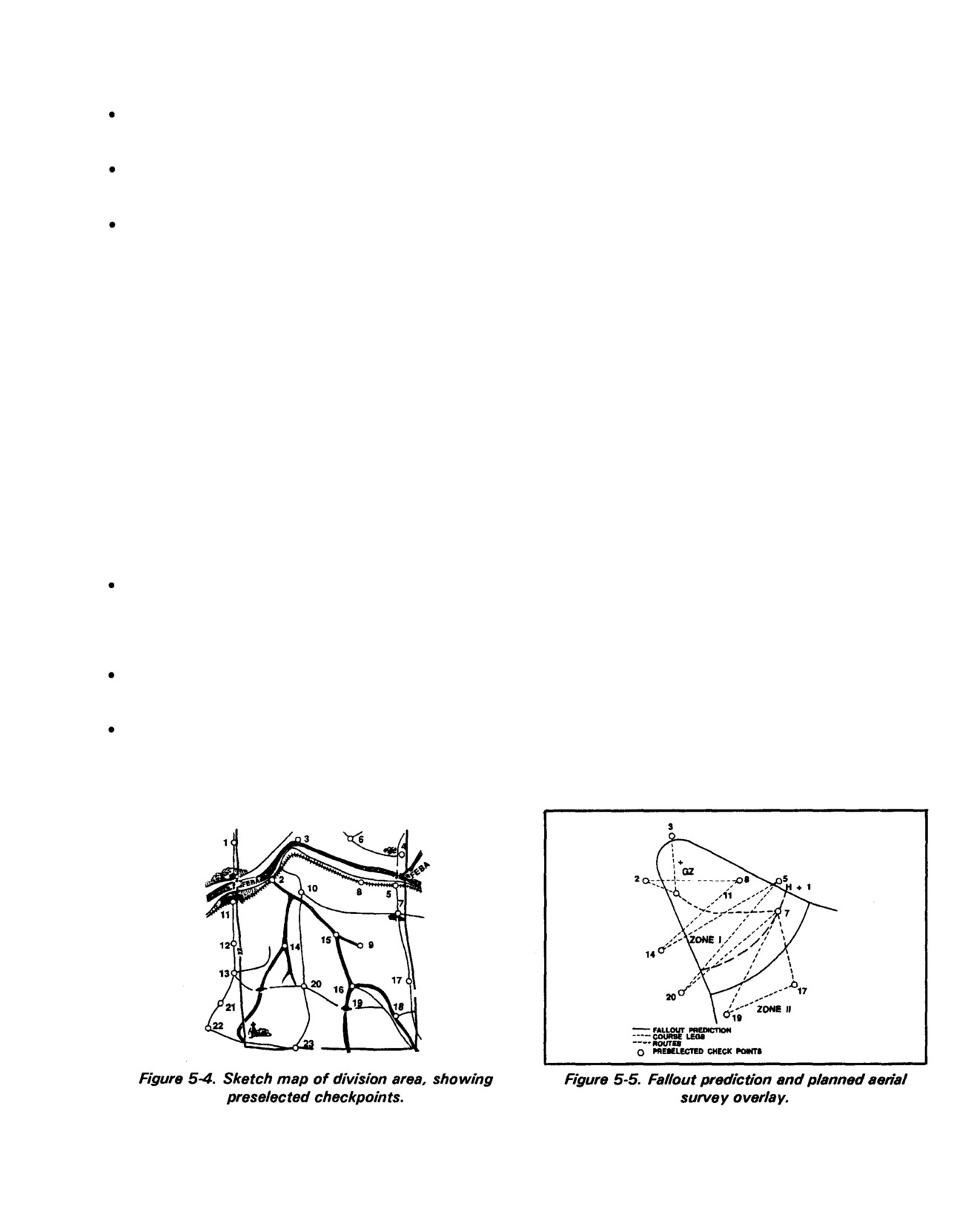
Figure 5-4 illustrates a divisional area with preselected
metal plates) is always added to the vehicle. To determine
checkpoints. This overlay is used with the fallout
how much additional shielding to add to the vehicle, refer to
prediction or neutron-induced prediction outlined in
Appendix B and the vehicle data plate for load density. This
Chapters 4 and 7. Figure 5-5 shows an overlay plan for an
will reduce the total dose of survey personnel. Selection of
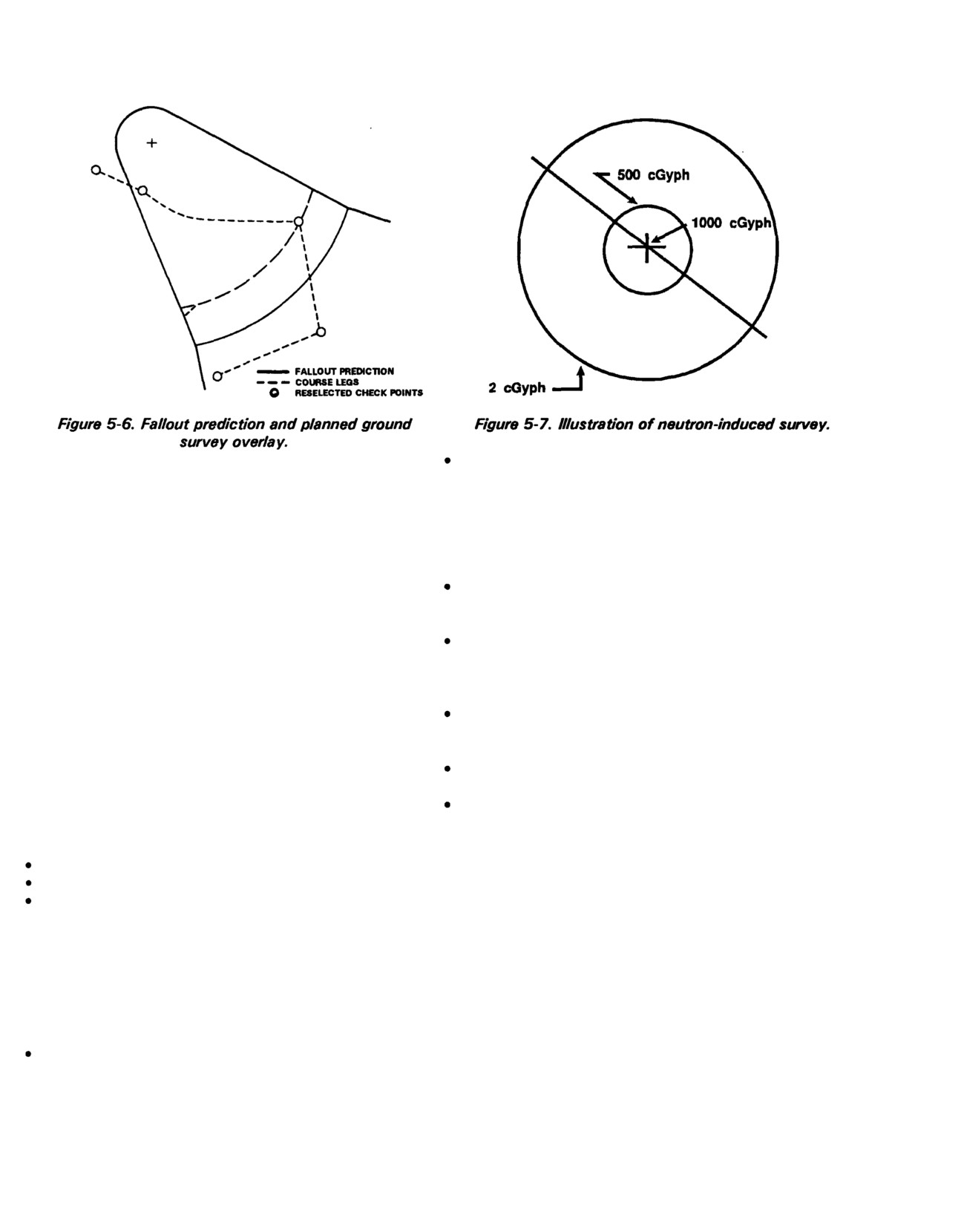
aerial survey. Figure 5-6 (next page) shows an overlay
the type of vehicle used is based upon the relative shielding
plan for the ground survey portion of the plan. When
correlation factors of one vehicle compared to another. See
survey of neutron-induced areas is required, a single
Figure 5-1 to make these comparisons. The higher the
course leg is selected which will pass directly through
number, the better the protection.
ground zero. The survey will begin at the edge of the
Contamination.
A listing or an overlay showing points, routes,
contaminated area. Since the contaminated area is taken to
or areas where contamination could seriously affect
be circular, survey ceases at ground zero.
accomplishment of the mission will be maintained for survey
Dose rates equal to those found on the course leg are
planning. These areas, routes, and points are prioritized to
assumed to be present on the other side of ground zero in
help with survey planning.
reverse order. When conducting a survey of an induced
Damage Assessment.
Often a helicopter will be deployed to
area, use either the IM174 or AN/VDR2 Radiacmeter.
conduct area damage assessment after an attack. When this
Only this survey instrument is capable of detecting the
occurs, survey and damage assessment can be combined.
entire radiation hazard. Thus, the find plot will be
Multiple Bursts/Sources of Contamination.
When multiple
concentric circles. Figure 5-7 (next page) illustrates survey
bursts occur, fallout can overlap other fallout areas or induced
of neutron-induced areas. Only aerial survey is used.
areas can interlock. Also, several sources can overlap one
Ground survey will result in unacceptable total doses for
another such as a neutron-induced area overlapped by fallout.
survey personnel.
5-11
FM 3-3-1
A dosimeter, such as the DT 236/PDR75, IM47,
Personnel and Equipment
AN/UDR13/PD, or IM143/PD (USMC), must be carried for
purposes of radiation exposure control. The IM47 or IM143
Requirements
should be mechanically zeroed before use and all radiac
Personnel and equipment for ground survey teams and
equipment should be checked to see that it is serviceable. The
monitors for aerial survey teams are drawn from the
AN/VDR2 can also be used to read accumulated dose, but the
company/troop/battery NBC teams subordinate to the
instrument must remain in operation for the entire mission.
authority directing the survey. Reconnaissance units have
DA Forms 1971-R and 1971-1-R are used for recording
the capability (if provided aircraft) of performing aerial or
information collected during the survey. Local reproduction
ground surveys as a priority mission when required.
of these forms is required.
A watch is needed to determine the time when survey readings
Personnel
are taken. For aerial surveys, a stopwatch or a watch with a
sweep-second hand is needed to time the interval between
The number of ground survey teams required at any one
time will depend on the situation, terrain, time available,
readings.
Vehicles that have high radiation shielding characteristics (high
detail desired, and other factors. Generally, more
correlation factors listed in Figure 5-1) should be selected for
personnel are needed for large areas, if time is limited.
ground surveys.
The same factors that influence the number of survey
Communications equipment necessary for rapid reporting is
teams required for ground surveys apply to aerial surveys.
required.
Monitors for the aerial survey teams should be selected
Maps of the land areas to be surveyed must be available to the
from units normally located near aircraft landing areas.
survey team.
This reduces the time needed to brief the survey teams and
get them airborne. Primary sources for monitors are—
NBC recon units.
Coordination
Other units with trained monitors.
The unit NBC defense team will coordinate the activities
Aerial observers who regularly fly recon and surveillance
of the survey teams with the units located in or near the
missions.
area to be surveyed. If coordination by the defense team
NBC defense teams for ground survey established at all
cannot be accomplished because of lack of communications
echelons use organic, school-trained personnel.
or other causes, the survey teams will be informed. The
survey teams will then be directed to coordinate, provided
Equipment
the situation in the area and the required time of
Units will require the following equipment to perform
completion of the survey permit.
ground surveys:
The IM174-series or AN/VDR2 radiacmeter used for
measuring dose rates.
5-12
FM 3-3-1
a. Command. Location of defense team.
Survey Team Briefing
b. Signal.
Adequate control of the radiological survey, once
(1) Data reporting procedure.
initiated, will depend to a large extent upon proper briefing
(2) Special instructions concerning SOI.
of the survey teams. Survey team briefings may vary from
(3) Call signs, code to be used, and reporting times.
group to individual briefings. This depends upon space,
(4) Communications means (primary and alternate).
time, and operational conditions; briefings may be given in
oral, written, overlay, or other form. In any case, a
Aerial Survey
briefing should always be conducted. The written or oral
briefing is essentially an order. It should generally follow
Aerial radiological survey information can be obtained
the form of the five-paragraph operation order. The
by use of the IM1740/PD or AN/VDR-2 Radiacmeter held
following is a radiological survey party briefing order
in a vertical position (face up), in rotary wing aircraft.
reference list (List any maps, charts, or other documents
Aerial surveys are conducted rapidly and at a distance from
necessary to understand the order.):
the radiation source. Hence, aerial survey teams are
Radiological Survey Party Briefing Reference List
exposed to considerably less radiation than ground survey
1. Situation.
teams if an equivalent ground survey were conducted over
a. Operational Situation. Briefly describe the operational
the same area. Aerial surveys can be employed over areas
situation as it concerns conduct of the survey, to include en-
that have dose rates unacceptably dangerous to ground
emy forces, friendly forces, and planned actions.
survey teams. Because of speed and flexibility, aerial
b. Contamination Situation. Present any factual informa-
surveys can be employed over large areas, over unoccupied
tion available about the contaminated area, to include lim-
areas of operational concern, over enemy occupied areas,
its, dose rates, sources of contamination, terrain, and
and over areas of difficult accessibility to ground troops.
weather.
Aerial survey is preferable when conducting surveys of
2. Mission.
large areas. The advantages of aerial survey over ground
Clear, concise statement of task to be accomplished (who,
survey are speed and flexibility of employment; lower
what, when, where, and why).
radiation doses to survey team members, and minimum
3. Execution.
requirements for equipment, personnel, and
a. Concept of Operation.
communications. However, the dose-rate readings are not
b. Specific Assignment of Each Team. In subsequent sepa-
as accurate as those obtained by ground survey. Another
rate lettered subparagraphs (such as a, b, c, d, and e) give
disadvantage is that dose rates for specific points on the
a specific task of each survey party. Include the coordina-
ground may not be provided by aerial survey.
tion required.
c. Coordinating Instructions. The last subparagraph of
Techniques
paragraph 3 of the order contains instructions applicable
The techniques used to conduct detailed aerial surveys
to two or more of the survey teams, such as—
include the route technique, the course leg technique, and
(1) Time of departure and return.
the point technique.
(2) Routes and alternate routes to and from the contami-
In using the route technique, the pilot flies between two
nated area.
checkpoints, following the route of some predominant
(3) Coordination required.
terrain feature such as a road that connects the two
(4) Dose danger limitations. If the AN/VDR-2 is to be
checkpoints.
used to check for turnback dose (or dose rate), this value
In using the course leg technique, the pilot flies a straight
shall be entered as the alarm setpoint and checked prior to
line course (course leg) between two checkpoints. The
departure (turnback dose and operation exposure guid-
procedure followed in obtaining dose-rate information
ance).
between checkpoints is the same, using either the route
(5) Actions to be taken upon reaching limitations in (4)
technique or the course leg technique. When the dose-rate
above.
information obtained from either technique is processed,
(6) Whether and when marking of contaminated areas is
the result is a series of ground dose rates spaced at
required.
equidistant intervals along the path over which the aircraft
(7) Debriefing-where, when, by whom.
flew.
(8) Decontamination - if required, when, where, and by
The point technique is used to determine the ground dose
whom.
rate at points of operational concern and is normally
4. Administration and Logistics.
employed to obtain more precise dose-rate information at
Contains information such as required equipment and
those points than can be obtained by use of other aerial
forms.
survey techniques. Processed data from dose-rate
5. Command and Signal.
5-13
FM 3-3-1
information obtained using the point technique are ground
dose rates existing at each of the selected points.
Procedures
The course leg technique requires that the aerial survey
party fly a straight line course (course leg) between two
checkpoints. The pilot maintains as near as possible a
constant height above the ground, a constant ground speed,
and a straight flight direction between the starting and
ending checkpoints of each course leg.
The pilot locates the starting checkpoint of a course leg
to be flown and either locates the end checkpoint or
determines the azimuth of the course leg.
The pilot flies the aircraft on the proper course to pass
over the initial checkpoint on a straight path to the end
checkpoint. When on course, the pilot alerts the monitor
and gives him the height above ground. Shortly before
reaching the initial checkpoint, the monitor records the
time and height above ground. The monitor
rechecks/rezeroes the survey instrument before each course
leg, to assure proper operation.
The pilot commands “Mark” when the aircraft is directly
over the starting checkpoint, at which time the monitor
reads the survey meter, records the dose rate, and begins
timing preselected time intervals.
The monitor reads the survey meter and records the dose
rate at each preselected time interval (for example, every
10 seconds).
The pilot again alerts the monitor when the aircraft
approaches the end checkpoint. When the aircraft is
directly over the end checkpoint, the pilot commands
“Mark”. At this time, the monitor reads and records the
final dose rate.
The procedures for a route survey are identical to those
for a course leg survey. However, this may or may not
require a straight flight direction.
Procedures for a point survey require the aircraft to land
near the point of interest. The monitor dismounts, proceeds
to the selected point, and takes the reading by using normal
ground monitoring procedures. When high dose rates do
not permit this procedure, aerial dose rates are taken and
air-ground correlation factor (AGCF) data are applied by
the NBCC.
Survey Meter Location in Aircraft
A specific location for the survey meter in the aircraft
must be selected for each aerial survey.
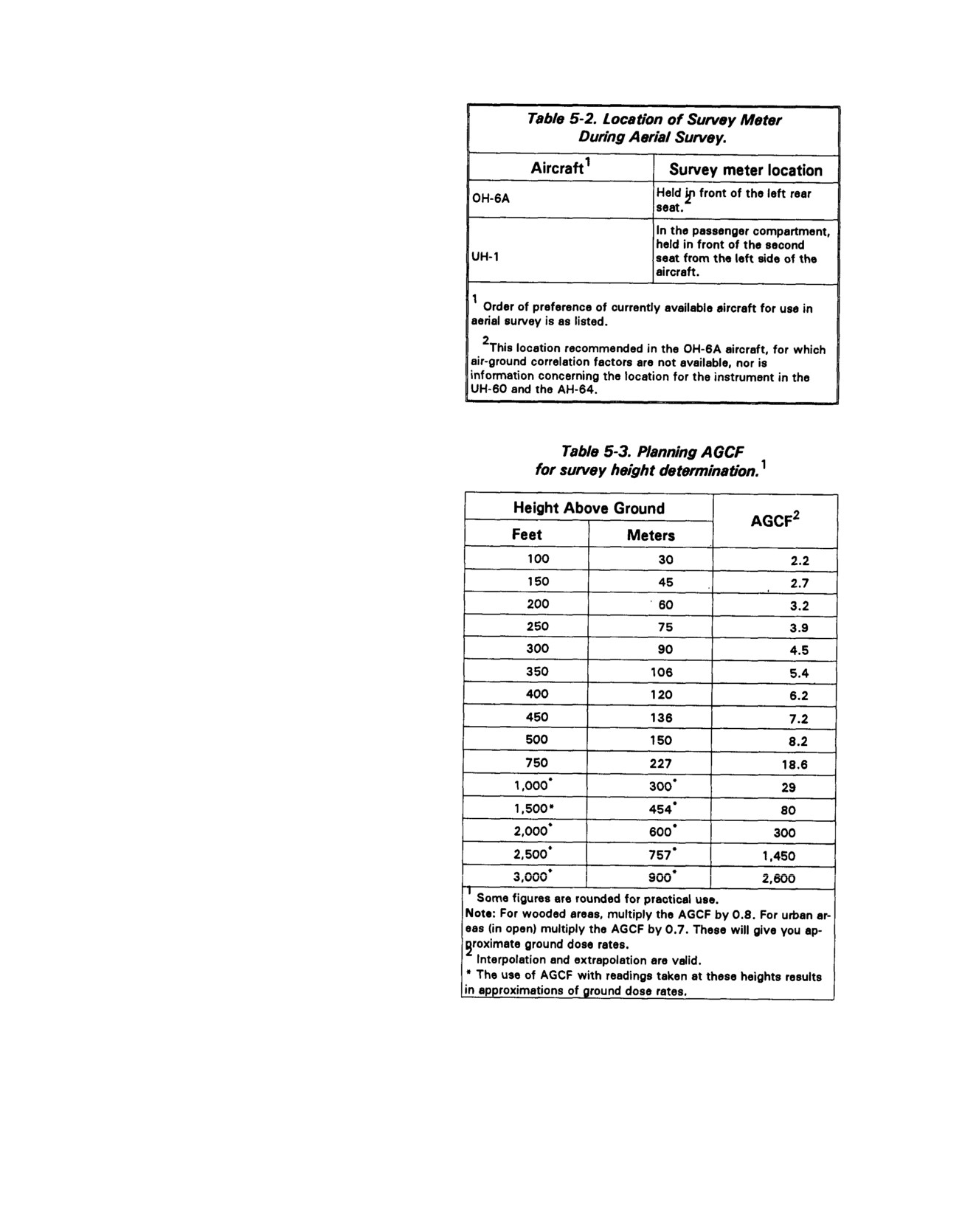
The best survey meter locations for several aircraft are
in Table 5-2. If the air-ground correlation factors from
Table 5-3 are to be used, the survey meter
must
be located
within the aircraft as specified in Table 5-2.
selected for the convenience of the pilot and monitor.
When air-ground correlation factor data are to be
When aircraft not included in the table are used, such as
determined during the survey, the location of the survey
the UH-60 or AH-64, the survey meter location must be
meter may be as given in Table 5-2 or the location may be
5-14
FM 3-3-1
selected. All dose-rate readings in a survey must be made
Ground dose rate = Aerial dose rate x AGCF
with the meter in the selected location.
= 10 cGyph x 8.2
= 82 cGyph.
Capability of Aircraft
Air-Ground Correlation Factors
Light fixed-wing aircraft or helicopters are satisfactory
An air-ground correlation factor (AGCF) is required for
for conducting aerial surveys; however, because of the
calculation of ground dose rates from aerial dose rates
slow speeds required, helicopters are the most desirable.
taken in an aircraft during a survey. The AGCF is the ratio
Light fixed-wing aircraft and helicopters have
of a ground dose-rate reading to a reading taken at
approximately the same survey area coverage capability of
approximately the same time in an aircraft at survey height
between 130 and 450 square kilometers per hour per
over the same point on the ground. There are two
aircraft, depending upon the detail required. Order of
techniques for obtaining the AGCF.
preference of currently available aircraft for use in aerial
The preferred technique is by direct determination of
surveys is in Table 5-2.
ground and aerial dose rates during the survey and
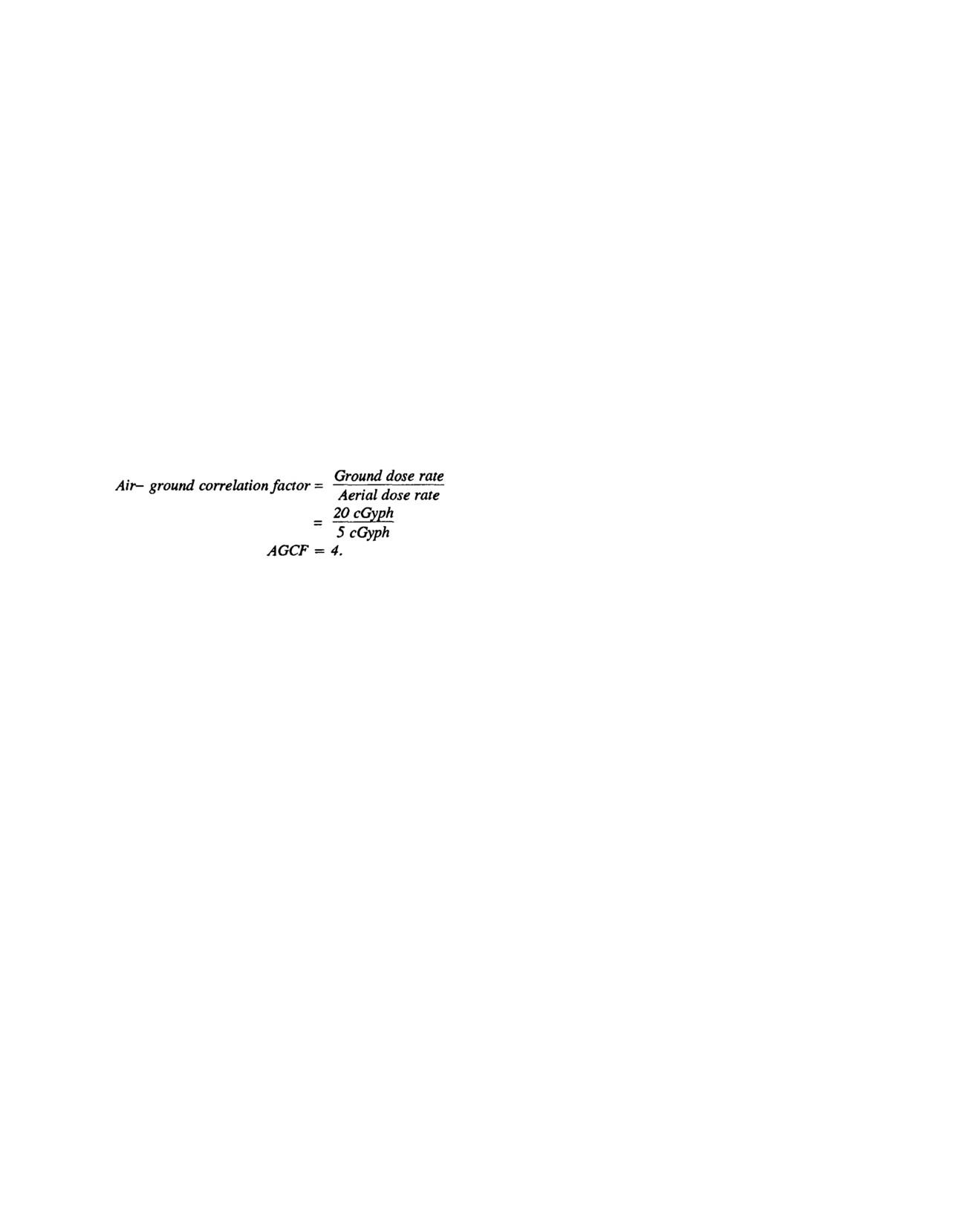
subsequent calculation of the AGCF. The AGCF may be
Determination of Overall
calculated as shown below, using the aerial dose rate taken
at survey height and the ground dose rate:
Correction Factor
Ground dose rate = 20 cGyph.
When calculating aerial survey data, an additional step
Aerial dose rate (60-meter survey height) = 5 cGyph
reduces the number of required calculations. Multiply the
AGCF by the normalization factor (NF, Table 6-5, on page
6-26) for the start time of the aerial route or course leg.
The product is the overall correction factor (OCF). An
OCF is calculated for each course leg, or route, of the
survey. The OCF is used instead of the NF and is
By multiplying the reading taken in the aircraft at a
calculated by the NBCC after the survey is completed. The
survey height of 60 meters by the AGCF, the 1-meter
OCF will convert shielded readings to unshielded readings
above ground level reading can be estimated. The
normalized to
procedure for determining the ground dose-rate reading
H+1.
involves landing near the selected point. The monitor
Sample:
AGCF x NF = OCF
proceeds to that point and takes the ground dose-rate
When processing ground survey data, use the same
reading, using normal monitoring procedures. AGCF data
procedures but use a vehicle correlation factor instead of
are obtained if possible for each two to four course legs or
an AGCF. Round dose rates to the nearest whole number.
routes flown. The sites for obtaining AGCF data should be
Vehicle correlation factors are discussed later in this
selected to approximate average foliage and ground surface
chapter.
conditions in the contaminated area. Accuracy of this
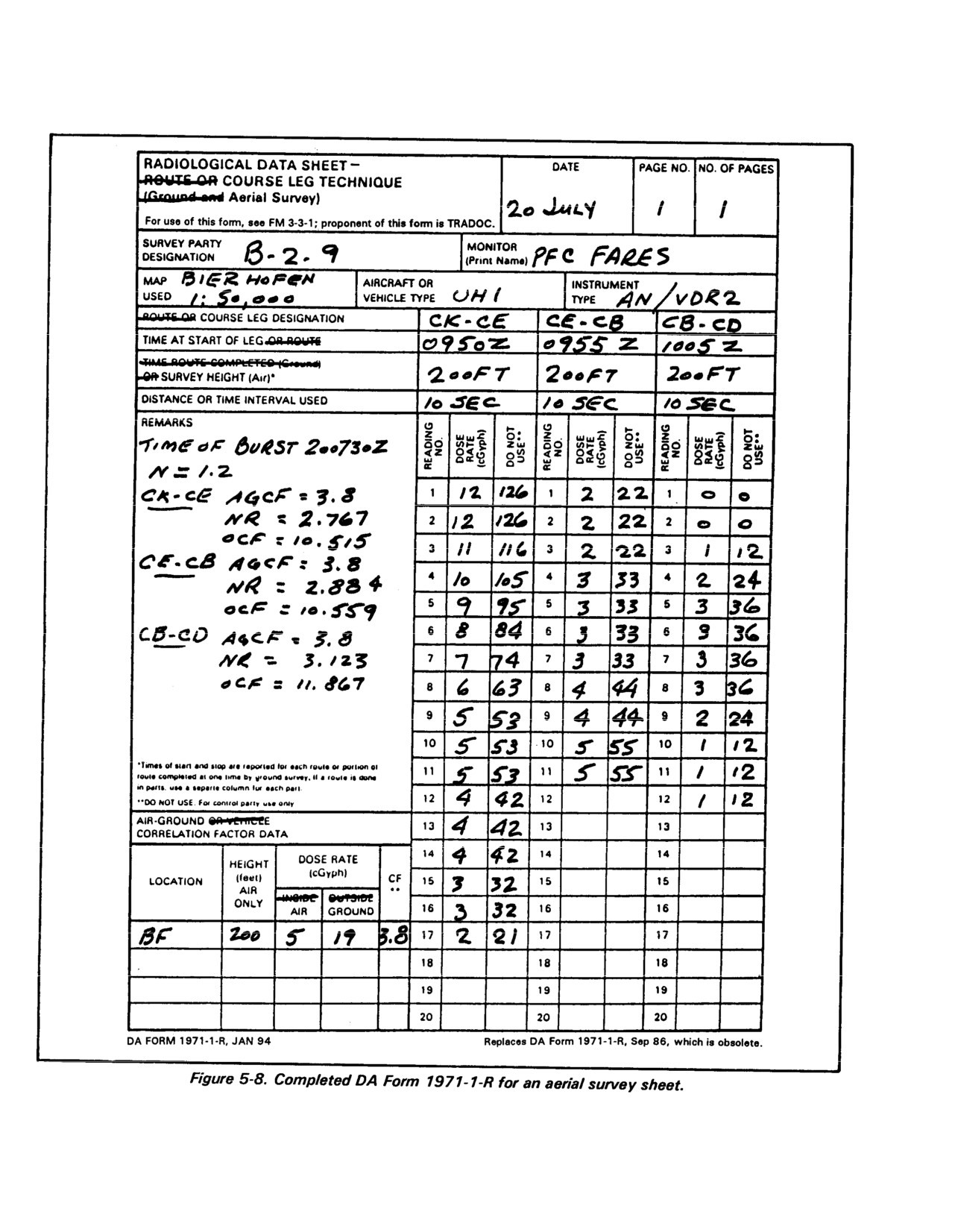
Figure 5-8 (next page) shows a completed DA Form
AGCF data as to position, height above ground, and dose
1971-1-R for an aerial survey. Note that an OCF was
rate is of primary importance. New data must be obtained
determined for each leg of the survey. The OCF was then
when survey height changes by 15 meters or more, when
used to multiply the dose rates on the legs to obtain the
ground foliage or average ground surface conditions
normalized readings. H + 1 readings are located in the
change significantly, if the aircraft or the survey meter is
control party column.
changed, or if weather conditions change drastically during
A special circumstance can arise whenever a survey or
monitoring.
recon is made over wooded or urban areas. In this case,
When the tactical situation, terrain conditions, high
the AGCF does not properly represent the air-to-ground
radiation dose rates, or other factors do not permit the use
ratio. This is because the fallout is much closer to the
of the preferred technique, the AGCF shown in Table 5-3
aircraft and the radiac instrument. The fallout is on the tops
are used. To estimate a ground dose rate, multiply the
of trees and on rooftops. To adjust for this situation, a
aerial dose rate obtained by the correlation factor from
correlation factor, as shown in Figure 5-1, must be applied
Table 5-3 for the type of aircraft and the height above
to the readings which were taken over trees or urban areas.
ground at which the reading was taken. In the following
During recon and some survey operations, the decay rate
example, while flying at a 150-meter survey height in a
will be unknown. Thus, two different OCF will be
UH-1, a reading of 10 cGyph was obtained; the AGCF for
calculated for the survey/recon data. One will be based on
a UH-1 at a height of 150 meters is 8.2:
n = 1.2 to provide a rapid means of developing a picture.
5-15
FM 3-3-1
5-16