FM 3-3-1 Nuclear Contamination Avoidance - page 7
FM 3-3-1
the limits of Zone I. So induced radiation will have no
except those that involve rainout or washout. They
effect on the extent of Zone I but will cause higher dose
represent an expected hazard area that can be quickly
rates in the area around GZ. Thus, the dose from induced
predicted immediately after receipt of actual or planned
radiation is not considered in determining the extent of
nuclear burst information.
Zone I.
Zone II is called the zone of secondary hazard. In this
Arrival of Fallout
zone, the total dose received by exposed, unprotected
personnel is not expected to reach 150 cGy within four
The arrival of fallout is of great interest to commanders.
hours after the arrival of fallout; but personnel may receive
Only by knowing when to expect fallout can plans be made
a total dose of 50 cGy (the negligible risk dose), or greater,
to avoid it. Calculate the estimated time of arrival of fallout
within the first 24 hours after the arrival of fallout. But,
using the following procedures—
only a small percentage of personnel in the zone is
Step 1.
Measure the distance from the given location to
expected to receive these doses.
GZ.
The exact dose personnel will receive at any location
Step 2.
Determine the effective wind speed from the
within Zone II depends upon the dose rate at their location,
NBC 3 nuclear report or by using the procedures outlined
the time of exposure, and available protection. Personnel
previously for EDMs in the preceding chapter.
located close to the extent of Zone I normally will receive
Step 3.
Divide the distance from GZ by the effective
higher doses than those located close to the extent of Zone
wind speed. The result is the estimated time of arrival :
II. Personnel with no previous radiation exposure maybe
permitted to continue critical missions for as long as four
hours after the arrival of fallout without incurring the
Commanders must remember three basic rules when
emergency risk dose. If personnel in this zone have
estimating the time of arrival of fallout
previously received significant radiation doses (a
Rule 1.
Fallout may arrive as early as one-half of the estimated
cumulative dose of 150 cGy or more), serious disruption of
time of arrival (ETA).
unit mission and casualty-producing doses may be expected.
Rule 2.
If fallout has not arrived by twice the ETA or H+ 12
(whichever is earliest) fallout is not expected to fall on that
location.
Outside the Predicted Area
Rule 3.
Fallout may not cover the entire predicted area.
Exposed, unprotected personnel may receive a total dose
Therefore, units must not move based solely on the fallout
that does not reach 50 cGy in the first day (24 hours) after
prediction.
actual arrival of fallout. The total dose for an infinite time
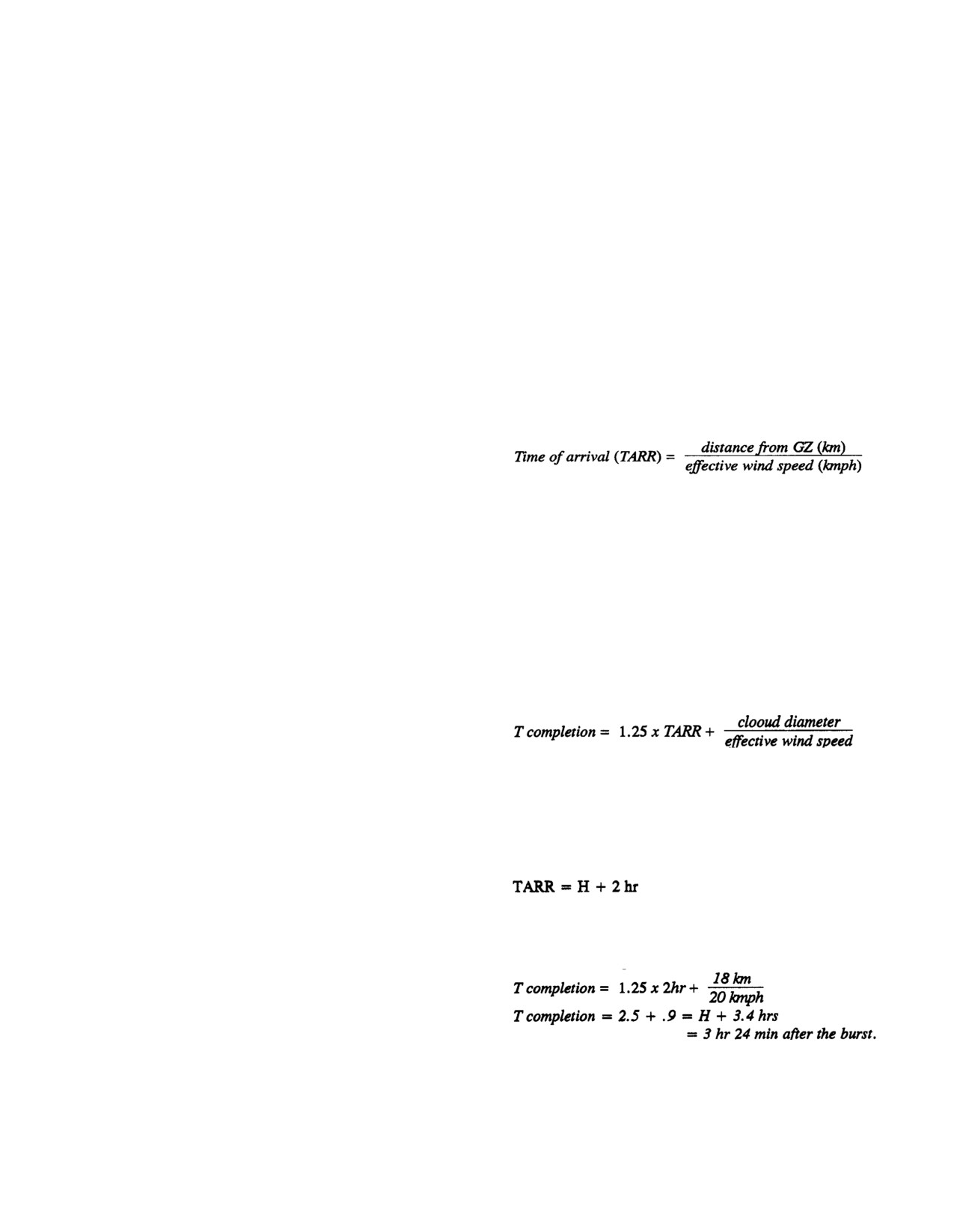
An estimate may also be made mathematically to
of stay outside the predicted area should not reach 150
determine when fallout will be completed at a particular
cGy. Therefore, outside the predicted area, no serious
location on the battlefield:
disruption of military operations is expected to occur if
personnel have not previously been exposed to nuclear
radiation. Appreciable previous exposure should be
The time (T) in hours stir detonation by which fallout
considered. In either case, periodic radiological monitoring
will be completed at any specific point is approximately
coupled with routine radiological defense measures
one and one-quarter the time of arrival (in hours after
normally will provide adequate protection. These defense
detonation) of fallout, plus the time in hours required for
measures or protection measures are outlined in FM 3-4.
the nuclear cloud to pass over.
Example: For a particular location, the following data
has been determined:
Reliability
The predicted zones of fallout are larger than the actual
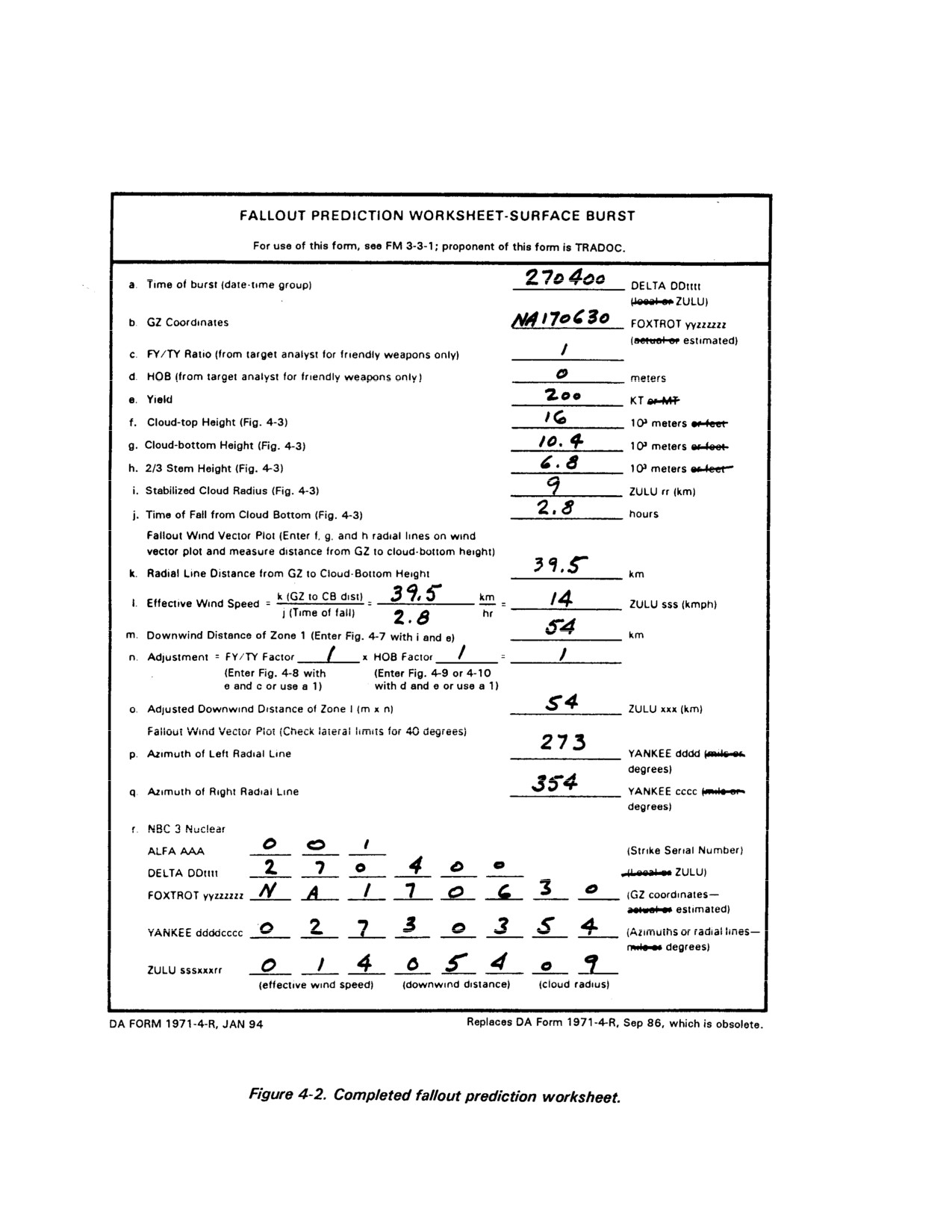
Cloud Diameter = 9 km (this number comes from Figure 4-2,
area of the ground that will be covered by fallout. These
line i, next page). Find the cloud radius for any given yield
zones represent areas of hazard. Radioactive particles are
and multiply by 2.
predicted to fall within these zones. Due to the uncertainty
Effective Wind Speed = 20 kmph
of weather and nuclear burst input data, the precise
locations of fallout within the zones cannot be reliably
predicted. Reconnaissance, monitoring, and survey will
assist in locating contaminated areas after fallout has
settled. These procedures are discussed in Chapter 5. The
The actual time of completion maybe determined by
zones, therefore, have been developed so that there is a
taking a series of dose-rate readings at the same location
reasonably high assurance that all militarily significant
over a period of time or by looking at an NBC 4 Peak
fallout will occur inside them. This is true in all cases
Report. The peak reading indicates that fallout is complete.
4-1
FM 3-3-1
Plot these dose rates against time on log paper. The dose
reading falls on the same straight line. This will indicate a
rate will increase, reach a maximum, and then start to
constant rate of decay. The time of completion can be
decrease with time. Plot a series of readings until the
determined from the graph by reading the dose rate on the
4-2
FM 3-3-1
straight line showing constant decay. This procedure will
be discussed later in this chapter.
NBCC Procedures
The NBCC prepares the detailed fallout prediction and
predict where the particles will land. The following steps
disseminates the information to subordinate units as an
are used to prepare the detailed fallout predictions:
NBC 3 nuclear report. The NBCC prepares the detailed
Step 1.
Prepare the fallout wind vector plot as described
fallout prediction by determining how high (layer) the
in Appendix D to this field manual. The fallout wind
fallout particles rise and then uses the wind vector plot to
vector plot is prepared each time new upper air wind data
4-3
FM 3-3-1
are received. Every prediction made from the current
Burst) for recording data. Nuclear burst information is
fallout wind vector plot should be prepared on a separate
recorded on lines a through e from the NBC 2 nuclear
overlay so that the current fallout wind vector plot can be
reports (see Figure 4-2).
saved for further use. The fallout wind vector plot may be
Step 3.
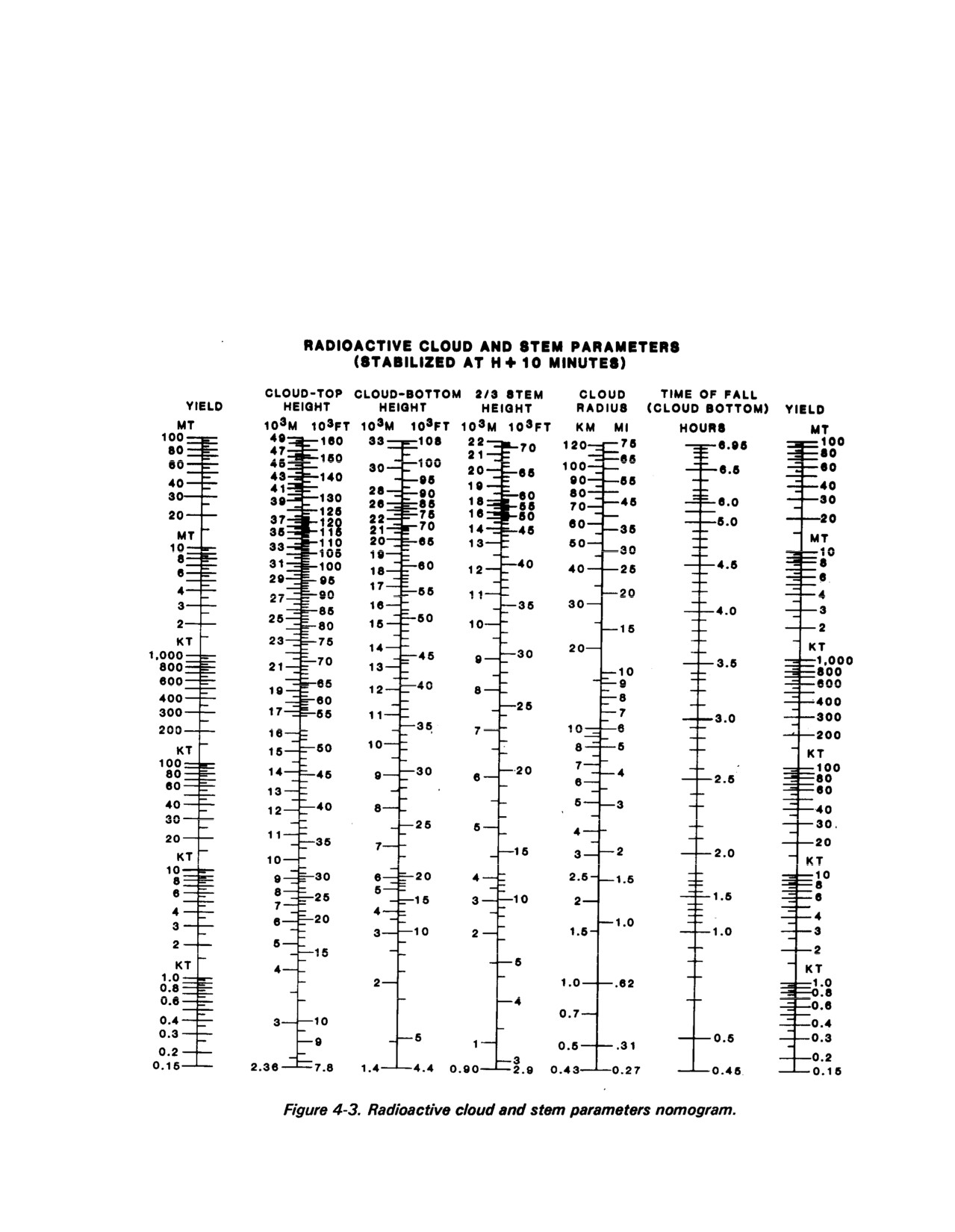
Determine cloud parameters. Once yield is
drawn to any convenient map scale.
determined (Step 2), use Figure 4-3 to determine cloud
Step 2.
Determine nuclear burst information. Use DA
parameters. Place a straightedge so that the values on the
Form 1971-4-R (Fallout Prediction Worksheet—Surface
left yield index scale and on the right yield index scale are
4-4
FM3-3-1
the same. Read all parameters under the straightedge.
with the center scale, read the downwind distance of Zone
Record cloud parameter values on lines f through j of the
I. Record this value on line M of the work sheet.
worksheet.
Obtain the fission yield/total yield (FY/TY) ratio from
Step 4.
Determine lateral limits of the fallout prediction.
the nuclear target analyst. FY/TY can also be found in
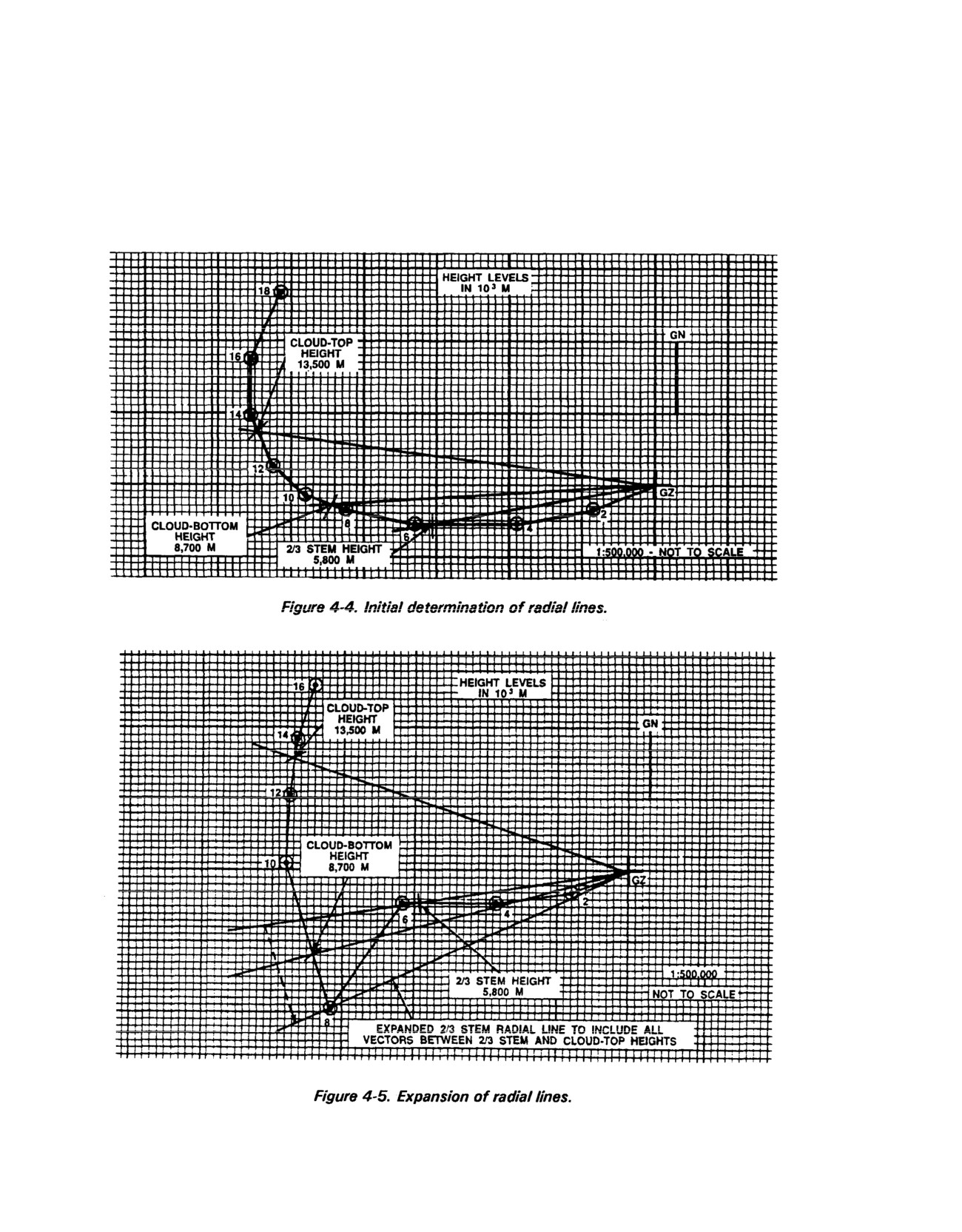
Mark points representing the cloud-top height,
FM 101-31-2 (S). The FY/TY ratio is expressed as a
cloud-bottom height, and two-thirds stem height on the
percentage. It states the percent of the weapon’s explosive
fallout wind vector plot. Draw radial lines from the GZ
ability that is contributed by the fission process. The
point through these height points (Figure 4-4). (Interpolate
remainder of the weapon’s yield is derived from fusion.
linearly between the wind vector if necessary.) Disregard
This is significant in fallout prediction. The fusion portion
all wind vectors below the two-thirds stem height point and
of the weapon does not create residual contamination.
above the cloud-top height point when preparing the
Thus, a weapon with a FY/TY ratio of 0.6 means that 60
prediction. If wind vectors between the two-thirds stem
percent is fission and 40 percent is fusion. A crude
height point and the cloud-top height point fall outside the
comparison could be that this weapon will make 40 percent
radial lines drawn from GZ through these points, expand
less fallout than a weapon with the same size yield which is
the angle formed by these two radial lines to include these
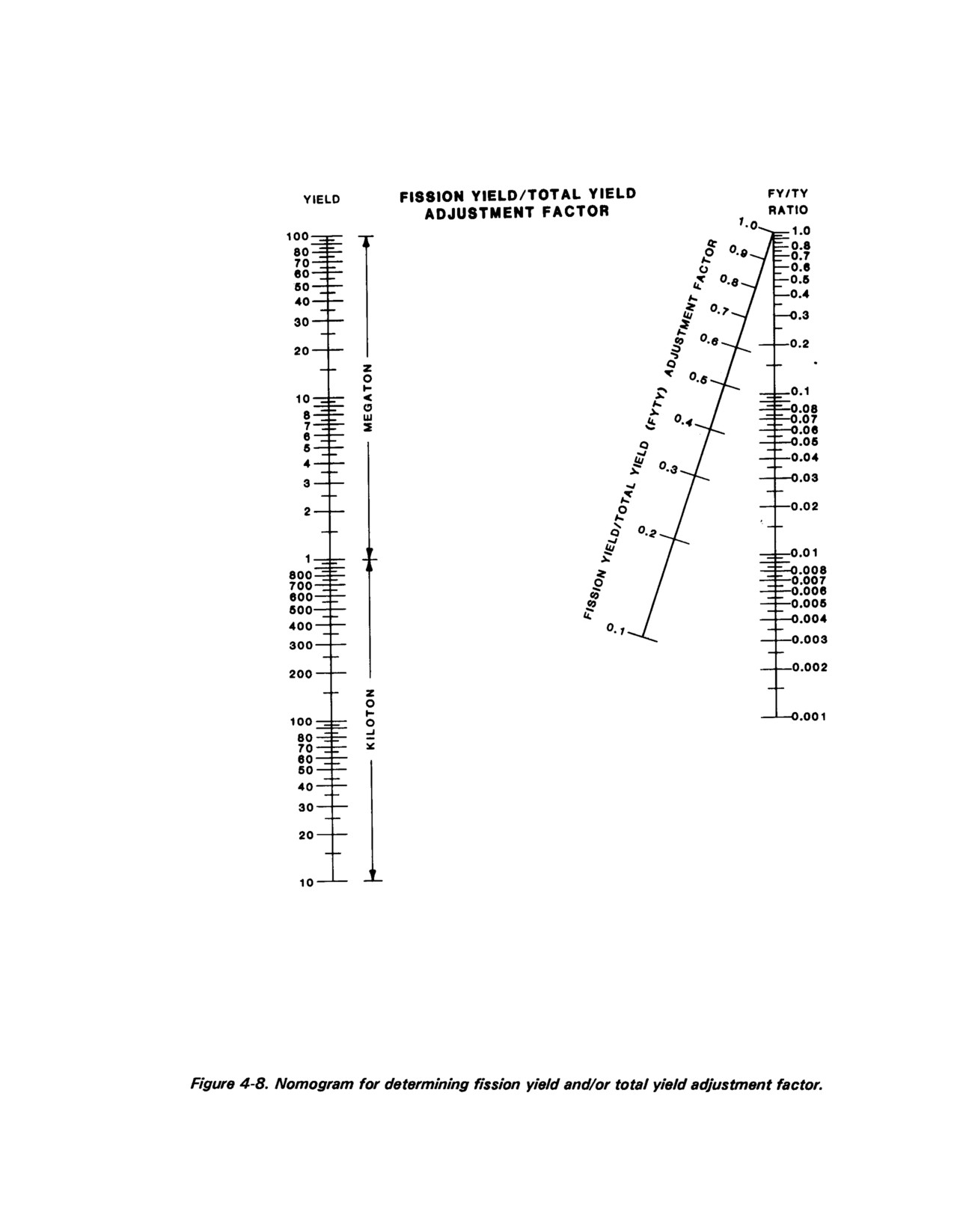
100 percent fission. If the FY/TY ratio is known, obtain
outside wind vectors. An example of this is shown in
the FY/TY adjustment factor from Figure 4-8, page 4-7, or
Figure 4-5
by using the FY/TY table in Appendix E.
Step 5.
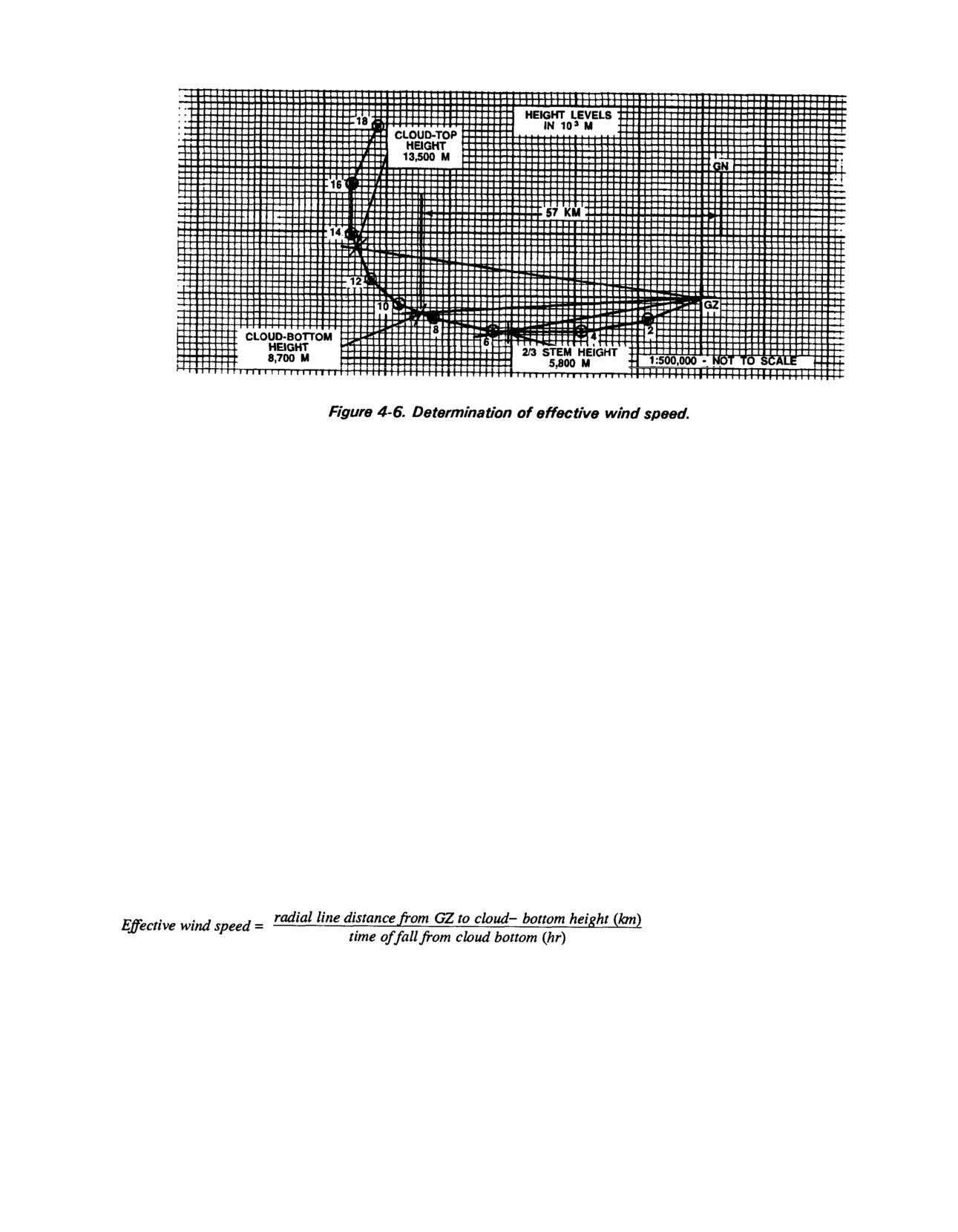
Determine the effective wind speed. Measure the
Lay a straightedge from the total yield on the left-hand
length of the radial line, in kilometers, from GZ to the
scale to the value of the FY/TY ratio on the right-hand
cloud-bottom height point (Figure 4-6). Record this value
scale. Where the straightedge intersects with the center
on line k of the work sheet. Read the time of fall from the
scale, read the FY/TY adjustment factor. If the FY/TY
cloud bottom (determined in step 3) from the work sheet
ratio is not known, assume the yield to be 100-percent
(item j). Compute the effective wind speed as shown in the
fission and use an FY/TY adjustment factor of 1. Record
formula below, and record on line Lima of the work sheet:
the FY/TY adjustment factor on line N of the work sheet,
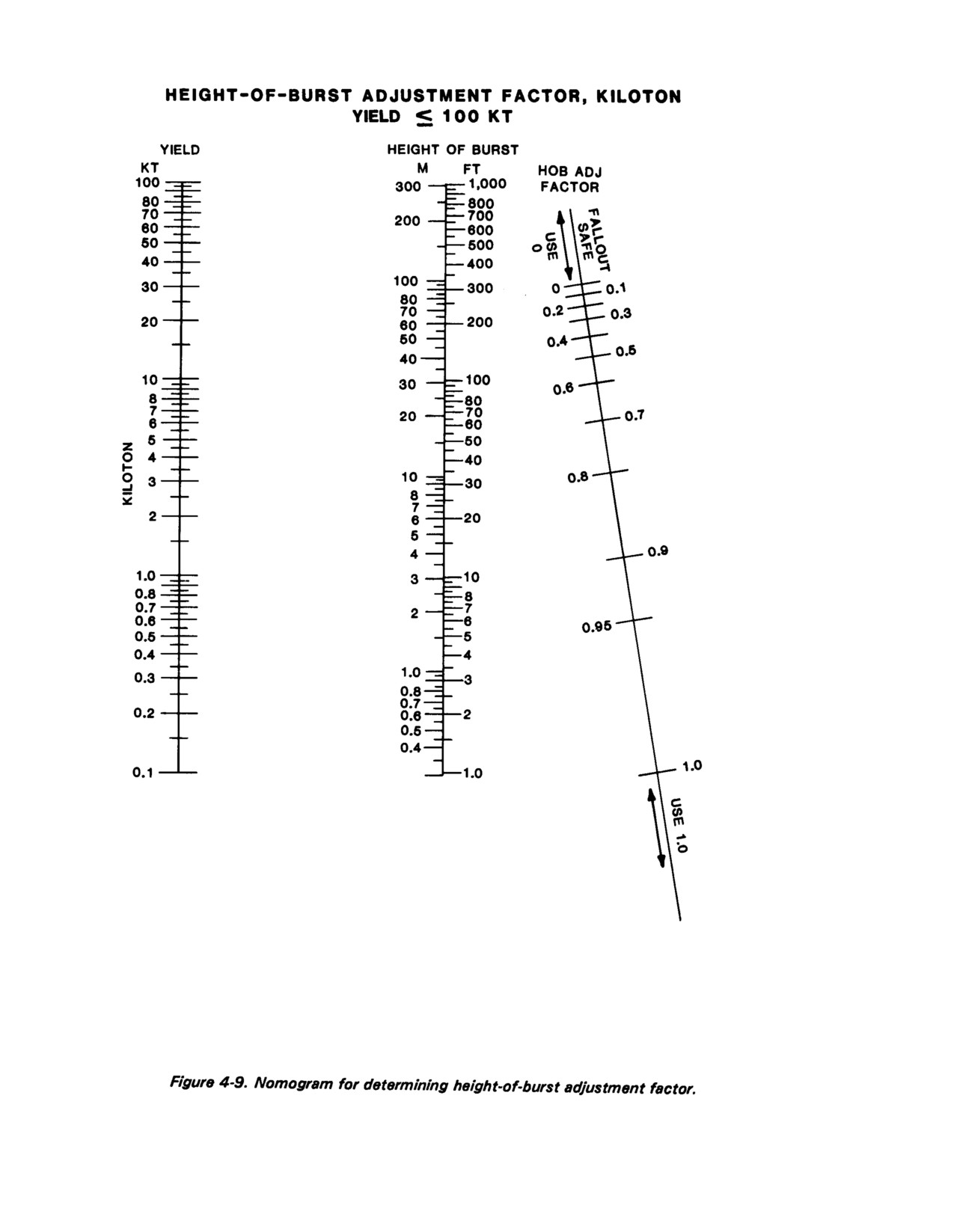
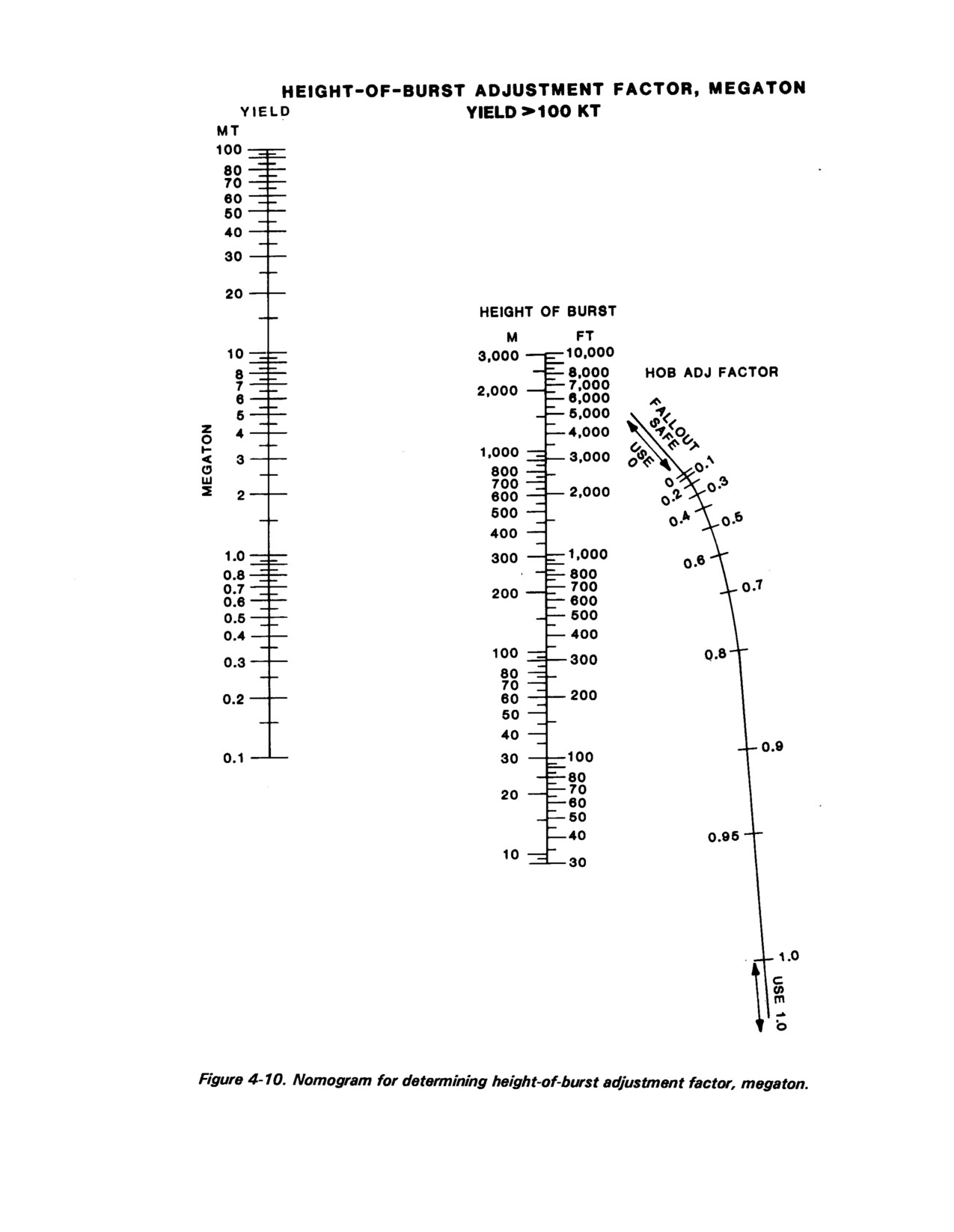
HOB is known (as in the case of a
prestrike friendly burst), obtain the
height-of-burst adjustment factor
from Figure 4-9 or 4-10, pages 4-8
or 4-9. Figure 4-9 is for yields equal
Note:
If the effective wind speed is less than 8 kmph, it is
to or less than 100 KT. Figure 4-10 is for yields greater
a special case. When the wind speed is less than 8 kmph,
than 100 KT. Lay a straightedge from the yield on the
always use an 8 kmph wind speed in step 6.
left-hand scale to the value of the Height-of-Burst on the
Step 6.
Determine the downwind distances of Zones I
center scale. At the intersection of the straightedge with the
and II.
right-hand scale, read the height-of-burst adjustment factor.
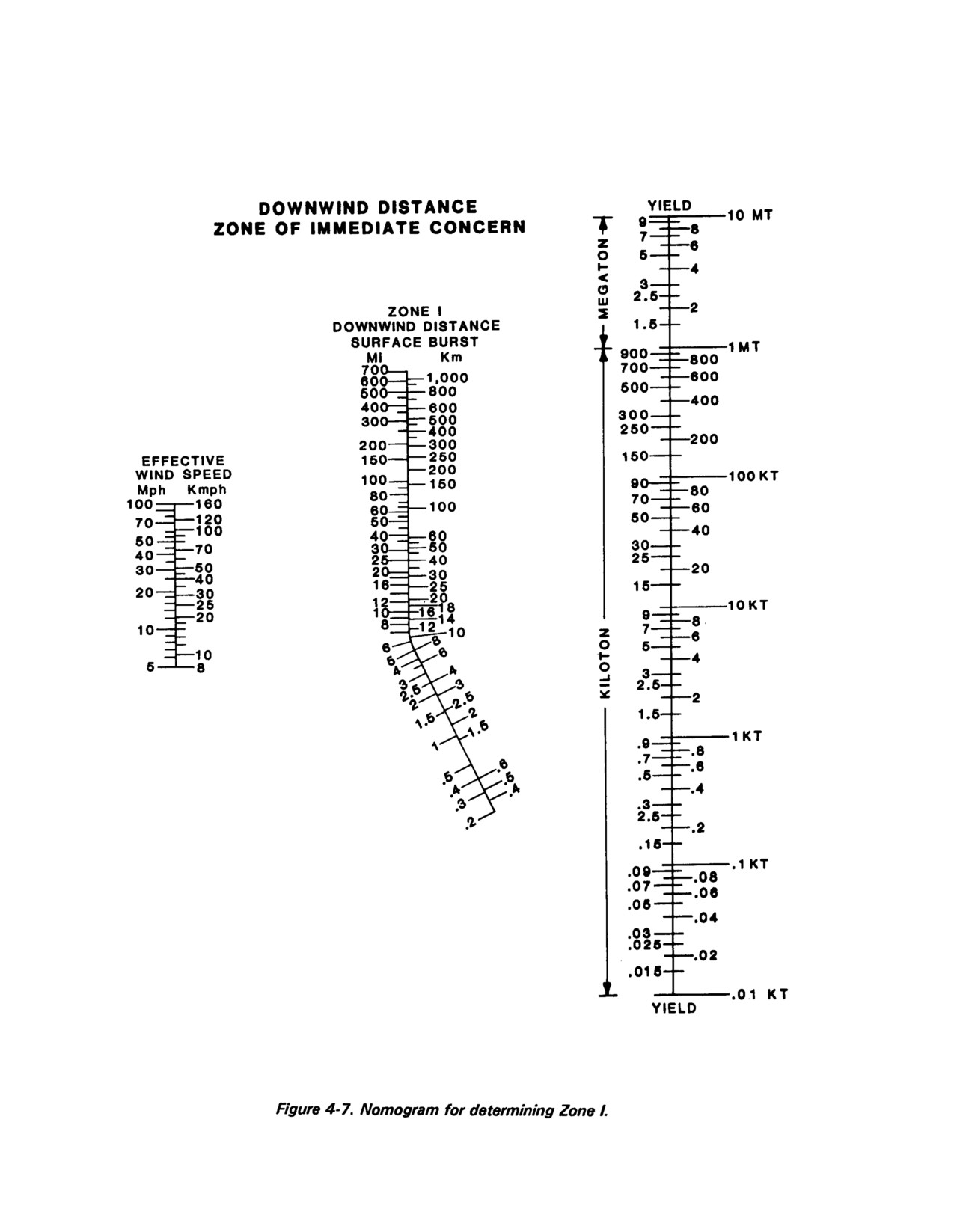
Using Figure 4-7, align a straightedge from the yield on
If height-f-burst is not known, assume a zero
the right-hand scale to the value of the effective wind speed
height-of-burst and use a height-f-burst adjustment factor
on the left-hand scale. Where the straightedge intersects
of 1. Record on line n of the work sheet.
4-5
FM 3-3-1
4-6
FM 3-3-1
4-7
FM 3-3-1
4-8
FM 3-3-1
4-9
FM 3-3-1
HOB adjustment factor may also be obtained by using
different map scale can now be used to complete the fallout
the HOB adjustment table in Appendix E.
prediction.)
Multiply the Zone I downwind distance for a surface
Between the two radial lines drawn from GZ, and using
burst (determined in “a” above) by both the height-of-burst
GZ as center, draw two arcs with radii equal to the Zone I
and the FY/TY adjustment factor to obtain the adjusted
and Zone II downwind distances found in step 6 (Figure
downwind distance of Zone I for the given conditions.
4-12, next page, Part 1).
Record this value on line o of the work sheet.
Using GZ as center, draw a circle around GZ with a
Double the Zone I distance recorded on line o to obtain
radius equal to the cloud radius at the selected map scale
the adjusted downwind distance of Zone II.
(Figure 4-12, Part 2).
Note:
If the effective wind speed is less than 8 kmph, the
Draw two tangents extending from the GZ circle to the
detailed prediction is now complete. Prepare the NBC 3 nu-
points of intersection of the two radial lines with the Zone I
clear report (line r on the work sheet) as described in Step
arc (Figure 4-12, Part 3).
9. If the wind speed is not less than 8 kmph, go to Step 7.
Using GZ as center, indicate the estimated times of
Step 7.
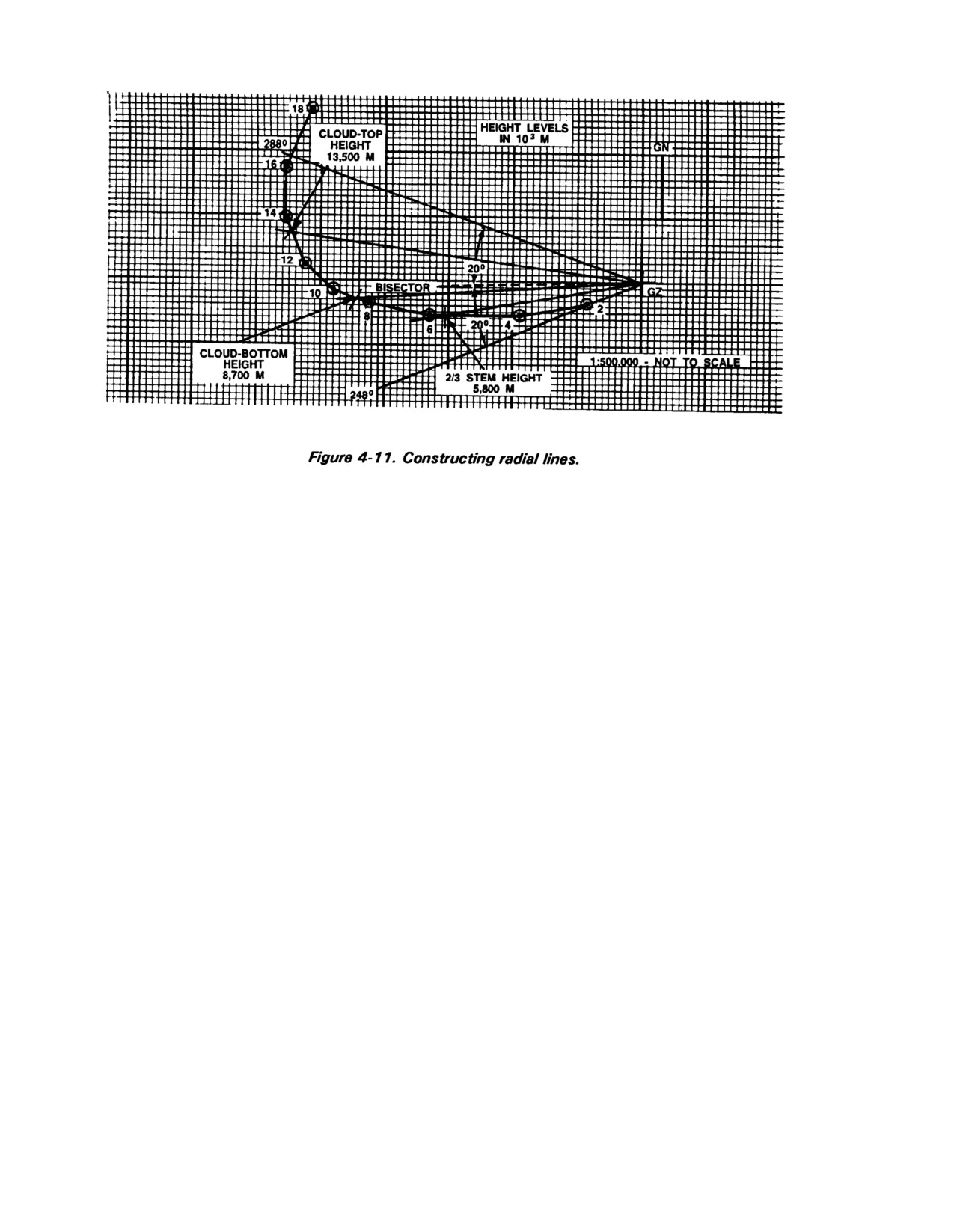
Construct left and right radial lines.
arrival of fallout by drawing dashed arcs downwind at
Measure the angle formed by the radial lines drawn from
distances representing effective wind speed for each hour
GZ to the cloud-top height and two-thirds stem height
of interest (Figure 4-12, Part 4).
points on the fallout wind vector plot (or the radial lines
Step 9.
Prepare the NBC 3 nuclear report. Complete line
which have been expanded to include vectors between the
r of the work sheet. The report will always include the
two-thirds stem height and the cloud-top height). If the
following line items:
angle formed is 40 degrees or greater, measure the
Alfa—This
line is the strike serial number. The strike
azimuths (in roils or degrees from GN) of the final left and
serial number is assigned by the NBCC at the operations
right lines and record on lines p and q of the work sheet. If
center responsible for the area in which the strike occurs.
the angle formed is less than 40 degrees, bisect the angle
Delta
DDtttt—This line is the date-time group of the
and expand the angle formed by the two radial lines to 40
burst, with DD (the day) and tttt (H-hour) in local or Zulu
degrees (20 degrees on each side of the bisector) (Figure
time (GMT) (state which).
4-11, above).
Foxtrot
yyzzzzzz—llis line is the actual or estimated
Step 8.
Complete the fallout prediction.
(state which) coordinates of GZ. The two letters yy
Start with GZ on an overlay at the selected map scale,
represent the appropriate 100, OQO-meter grid square and
and extend the radial lines at their proper azimuths to any
the letters zzzzzz coordinates of GZ within this grid
convenient distance. Mark GN on this overlay. (The fallout
square. This line item will be encoded if sent over an
wind vector plot was originally drawn to a convenient map
unsecure communications net. This is to deny tactical
scale; for example, 1:500,000. If it is more convenient, a
information on the effectiveness and accuracy of enemy
weapons.
4-10