FM 3-3-1 Nuclear Contamination Avoidance - page 6
FM 3-3-1
boundary, extend the zone boundary with a dashed line,
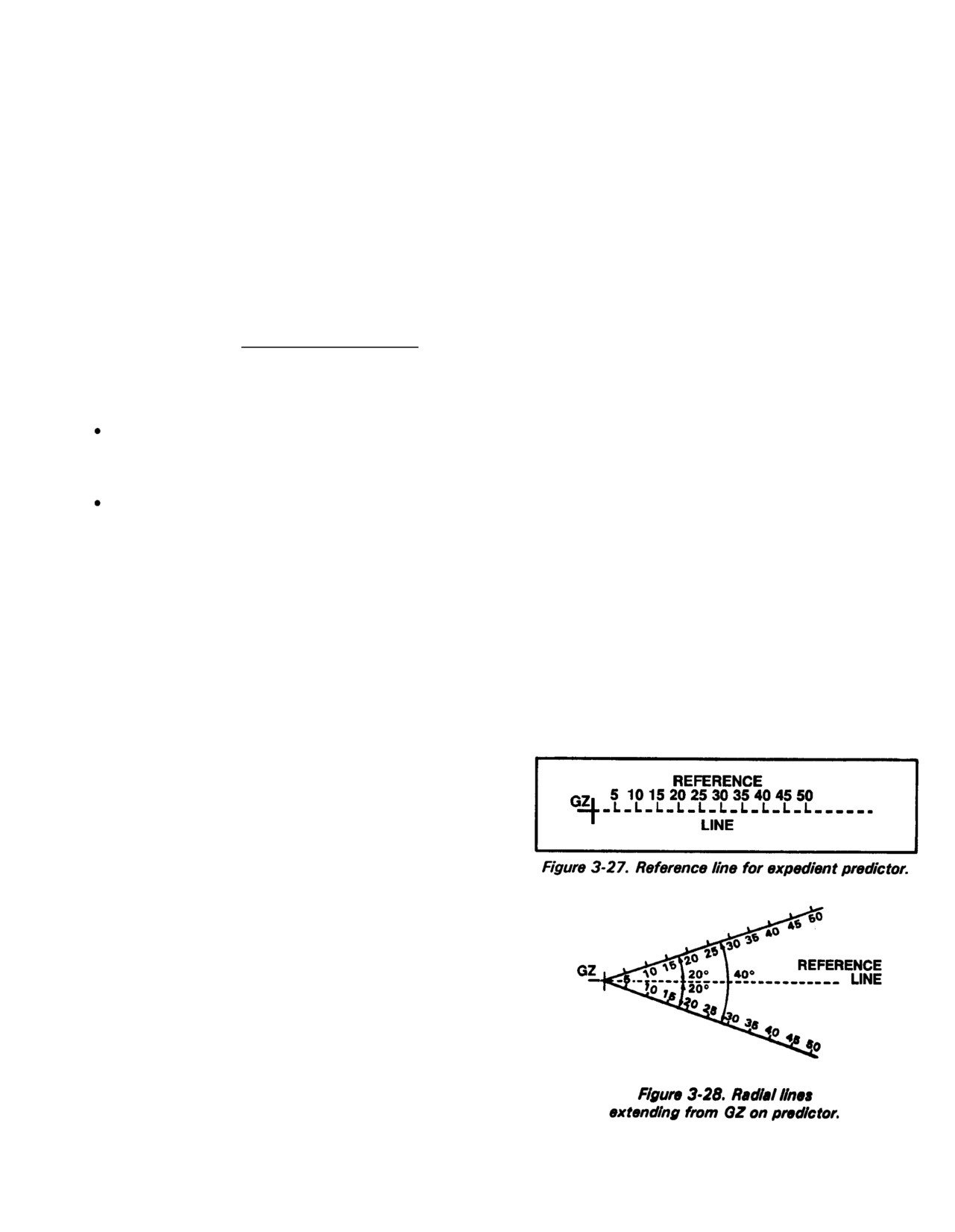
Step 1.
Select an appropriate map scale. On a piece of
and label with the appropriate time of arrival. Do not draw
pliable, transparent material or overlay paper, draw a thin
time-of-arrival arcs beyond Zone II.
dotted line (reference line) to a scaled length of 50
Times of arrival can be estimated. Multiply the effective
kilometers from a point selected to represent GZ (Figure
wind speed by the time of interest expressed in hours after
3-27).
the burst. Time-of-arrival arcs represent the expected
Step 2.
Draw and graduate in kilometers two radial lines
downwind extent of fallout at specific times. These arcs are
from GZ at angles of 20 degrees to the left and to the right
drawn as part of the fallout prediction. Estimate time of
of the dotted reference line (Figure 3-28).
arrival of fallout at a specific distance from GZ by dividing
Step 3.
On the side of GZ opposite the reference line,
the distance by the effective wind speed. The formula looks
draw a series of concentric semicircles (using the selected
like this:
map scale) having radii of 1.2 kilometers, 1.9 kilometers,
4,2 kilometers, 6.8 kilometers, 11.2 kilometers, 18.0
distance from GZ (km)
kilometers, and 28 kilometers). These figures correspond
Time of arrival (hr) =
effective wind speed (kmph)
to stabilized cloud radii from nuclear bursts with yields of
2 kilotons, 5 kilotons, 30 kilotons, 100 kilotons, and 3
For operational purposes, the following rules of thumb
megatons, respectively.
may be applied to the actual arrival of fallout:
Step 4.
Label the semicircles. Starting with the
The actual arrival of fallout may occur as early as one-half of
semicircle closest to GZ and moving up from GZ, label the
the estimated time of arrival. That is, if the estimated time of
semicircles A, B, C, D, E, F, and G. Moving down from
arrival of fallout is H+4 hours, actual arrival of fallout may
GZ, label the semicircles 2 kilotons, 5 kilotons, 30
occur as early as H+2 hours.
kilotons, 100 kilotons, 300 kilotons, 1 megaton, and 3
If actual arrival of fallout has not occurred at twice the estimated
megatons.
arrival time (or 12 hours, whichever is earlier), it may be
To use the field-constructed predictor, complete the
assumed that the area will not receive fallout. For example,
prediction by determining the downwind distance of the
if the estimated time of arrival of fallout in an area is H+5
Zone I from Figure E-6, Appendix E, using the procedures
hours and fallout has not occurred at H+10 hours, assume
described earlier. Place the protractor over an actual or
that the area will not receive fallout. Also, if a unit expects
assumed GZ on the map and draw a line to represent the
fallout to arrive at H+9, but it has not arrived by H+12,
effective downwind direction for the desired yield group.
assume it will not arrive at all.
Place GZ of the predictor over GZ on the map, and rotate
Orientation.
Make sure the scale of the M5A2 and the
the predictor until reference lines coincide with the
map scale are the same. Next, place the fallout predictor
effective downwind direction.
GZ point over the actual or assumed GZ on the map.
The simplified fallout prediction is verified only from the
Rotate the entire fallout predictor until the effective
standpoint of using the correct yield and GZ location. This
downwind direction in degrees on the azimuth dial is
is done upon receipt of the NBC 2 nuclear report from
pointing toward GN.
higher headquarters. Identify the simplified fallout
The simplified fallout prediction is now complete, and
the operational aspects of the fallout hazard can be
evaluated.
Special Notes:
Infrequently, the fallout wind vector plot
prepared by the NBCC may have a warning area angle
greater than 40 degrees. In these cases, state the greater
angle on the effective downwind message for the yield
group affected. Using units will expand the warning area
beyond the fixed 40-degree angle of the simplified fallout
predictor to correspond with the angle given on the
effective downwind message. Angles must be expanded
equally on both sides of the predictor. The expanded case
example discussed later in this chapter shows how this is
done.
Constructing a Simplified Predictor
If the fallout predictor shown in Figure 3-26 is not
available, a predictor can be constructed from any pliable,
transparent material to any desired map scale as follows:
3-23
FM 3-3-1
prediction by entering the strike serial number (line Alfa of
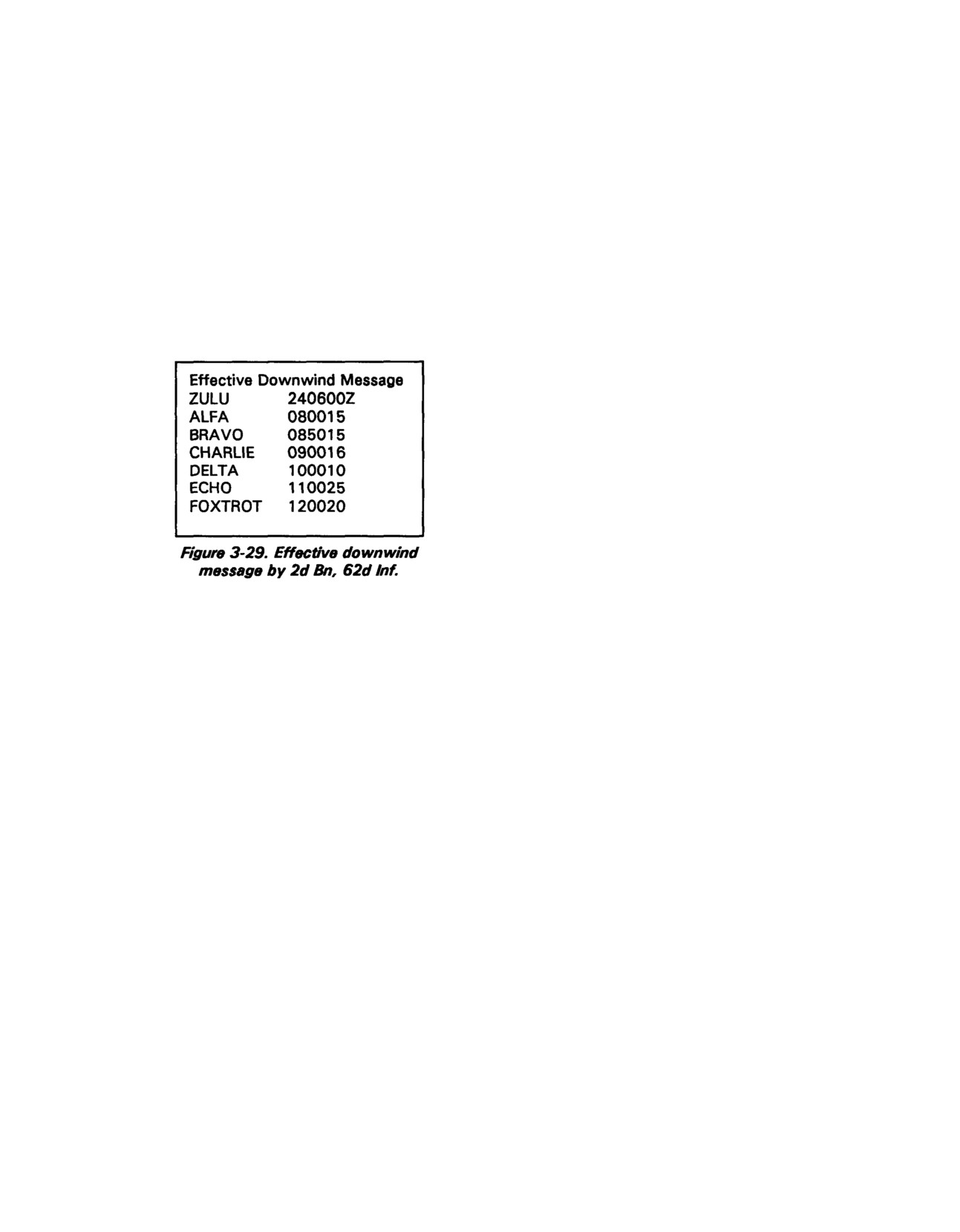
the product of the effective wind speed (16 kilometers per
NBC 2), coordinates of GZ, and date-time group of
hour) and the hours of interest after the burst to represent
detonation on the predictor. The following examples
the estimated times of arrival of fallout (16 kilometers at H
illustrate simplified fallout predictions.
+1 and 32 kilometers at H+2) (Figure 3-30). Arcs that
fall outside Zone II need not be drawn. Draw a straight
line from the center of the azimuth dial through the
Simplified Fallout Prediction
effective downwind direction (90 degrees) on the azimuth
(Normal Case)
dial, and label the line “GN.“
Place the center of the azimuth dial on the predictor over
The S3, 2d Battalion, 62d Infantry, has the effective
the estimated GZ (MN553298) on the map (the scales of
downwind message in Figure 3-29, based on the following
the map and predictor must correspond). Rotate the
situation scenario:
predictor around the GZ point until the GN line is pointing
At about 240600Z a nuclear burst occurred at a point
toward GN. The predictor is now oriented so that fallout is
estimated to be MN553298. A measurement of the
going toward 90 degrees. The area predicted to be covered
flash-to-bang
by fallout can now be evaluated.
time and
nuclear-burst
cloud width
Simplified Fallout Prediction
indicates an
(Expanded Case)
estimated yield
of 16 kilotons.
Assume that line Charlie is the same as in the preceding
Use the M5A2
example, but it also has three more digits—total of nine
fallout predictor
digits. Line Charlie now reads 090016060. Follow the
to make a fallout
same procedure as for a normal case, but expand the left
prediction. The
and right radial lines to 60 degrees. The prediction will
estimated yield
look like that in Figure 3-30.
(16
kilotons) lies
within the yield
Simplified Fallout Prediction
group Charlie (more than 5, not more than 30 kilotons).
So, use the effective downwind direction and effective
(Circular Case)
wind speed from line Charlie of the EDM; and use
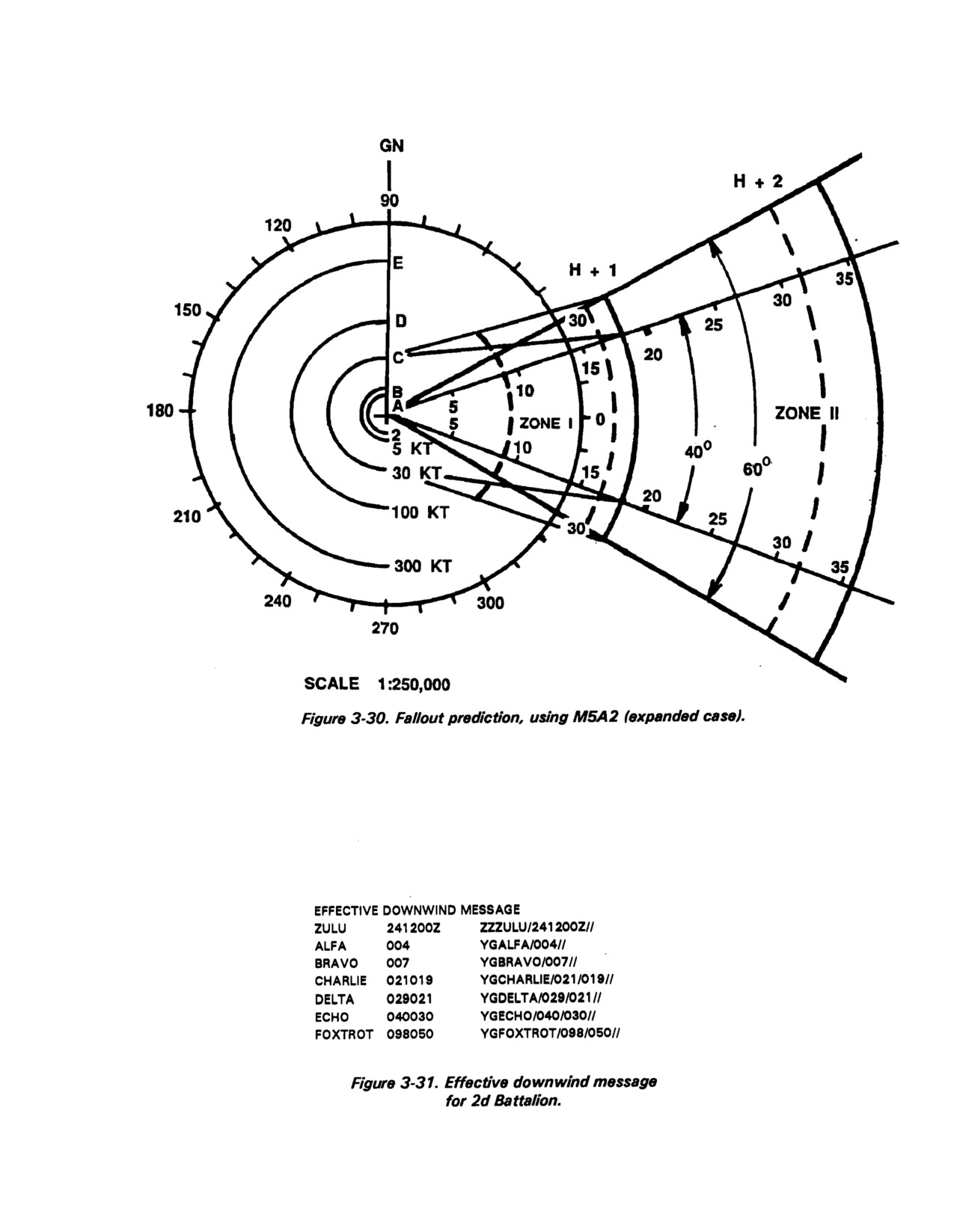
The S3, 2d Battalion, 62d Infantry, has the effective
semicircle C on the fallout predictor. Using a yield of 16
downwind message shown in Figure 3-31.
KT and an effective wind speed of 16 kilometers per hour,
At about 1300 a nuclear burst occurred at a point
read the downwind distance of Zone I (18 kilometers) from
estimated to be MN423876. A measurement of the cloud
the nomogram on the predictor. Draw an arc between the
width and distance to GZ indicates a yield of 4 kilotons.
radial lines of the predictor at a distance of 18 kilometers
The estimated yield of 4 kilotons falls into yield group
downwind from GZ (Figure 3-30). Double this distance;
Bravo of the effective downwind message, There are only
and draw a second arc between the radial lines of the
three digits in line Bravo (007). This indicates a wind
predictor at a distance of 36 kilometers downwind from
speed of less than 8 kmph. It also means the prediction will
ground zero.
have a circular pattern. On a piece of overlay paper, clear
Draw two straight lines tangent to the 30-kiloton cloud
plastic, or an M5A2 predictor drawn to scale, draw a circle
radius semicircle, and extend them to where the Zone I arc
with a 7-kilometer radius. Label it Zone I. For Zone II,
intersects the radial lines. The area enclosed by the two
double the distance of Zone I, and draw a circle, using the
lines, the 30-kilotons semicircle (40° angle), and the
same center used for Zone I. Label it Zone II. Label the
18-kilometer arc, is Zone I. The area enclosed by the
prediction with GZ and date-time of detonation. The
18-kilometer and 36-kilometer arcs and the radial lines is
prediction is now complete (see Figure 3-32). Now, it may
Zone II. Draw a series of dashed arcs at distances equal to
be placed on the map.
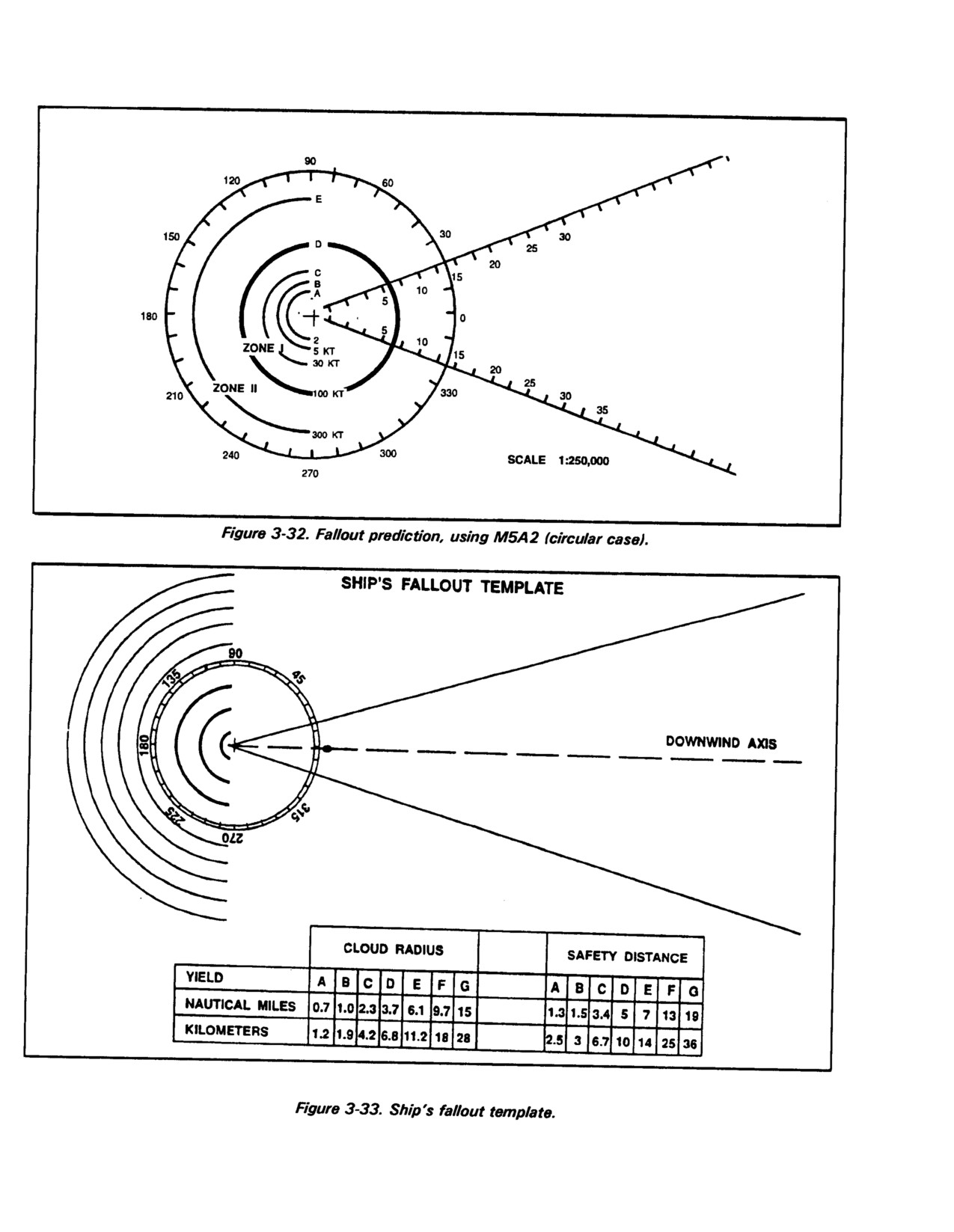
Ship’s Fallout Template
A fallout template, particularly designed for use on
difference is that the semicircles upwind of GZ on the
ships, is shown in Figure 3-33.
ship’s fallou template do not refer to preselected
The ship’s fallout template is similar to the M5A2 fallout
weapon-yield cloud radii.
predictor (Figure 3-26) used by forces on land. The main
3-24
FM 3-3-1
3-25
FM 3-3-1
3-26
FM 3-3-1
Safety Distance
Fallout Plotting
Determining the safety distance begins with determining
from NAV EDM and Observations
the fallout area at a specific time after detonation. Fallout
Worked example:
will not occur simultaneously within the predicted fallout
A ship has received the NAV EDM shown in Figure
area. It will commence in the vicinity of GZ and maybe
3-23 (page 3-19). At 201332Z, a nuclear burst is observed
expected to move down the fallout pattern (downwind
from the ship, and based upon the observations taken from
direction) with approximately the speed of the effective
the ship, the yield is estimated to be 70 KT; estimated GZ
wind.
is 56°00’ N-12° 00’ E. A NAV NBC 1 nuclear report is
The approximate zone in which deposition at the surface
transmitted as required; and the ship will have to prepare a
is taking place at a specific time after the detonation may
fallout prediction, using the simplified procedures:
be determined by use of the following procedures:
Step 1.
As the yield is estimated only on the basis of the
Step 1.
Multiply the effective downwind speed by time
ship’s own observations, the yield estimation may not be
(in hours) after the detonation.
accurate. So, to be on the safe side, the greatest yield of
Step 2.
To the distance found in Step 1, add and subtract
the yield group in which the estimated yield is contained
the safety distance obtained from the template (for the
should be used. Seventy KT is in yield group DELTA, and
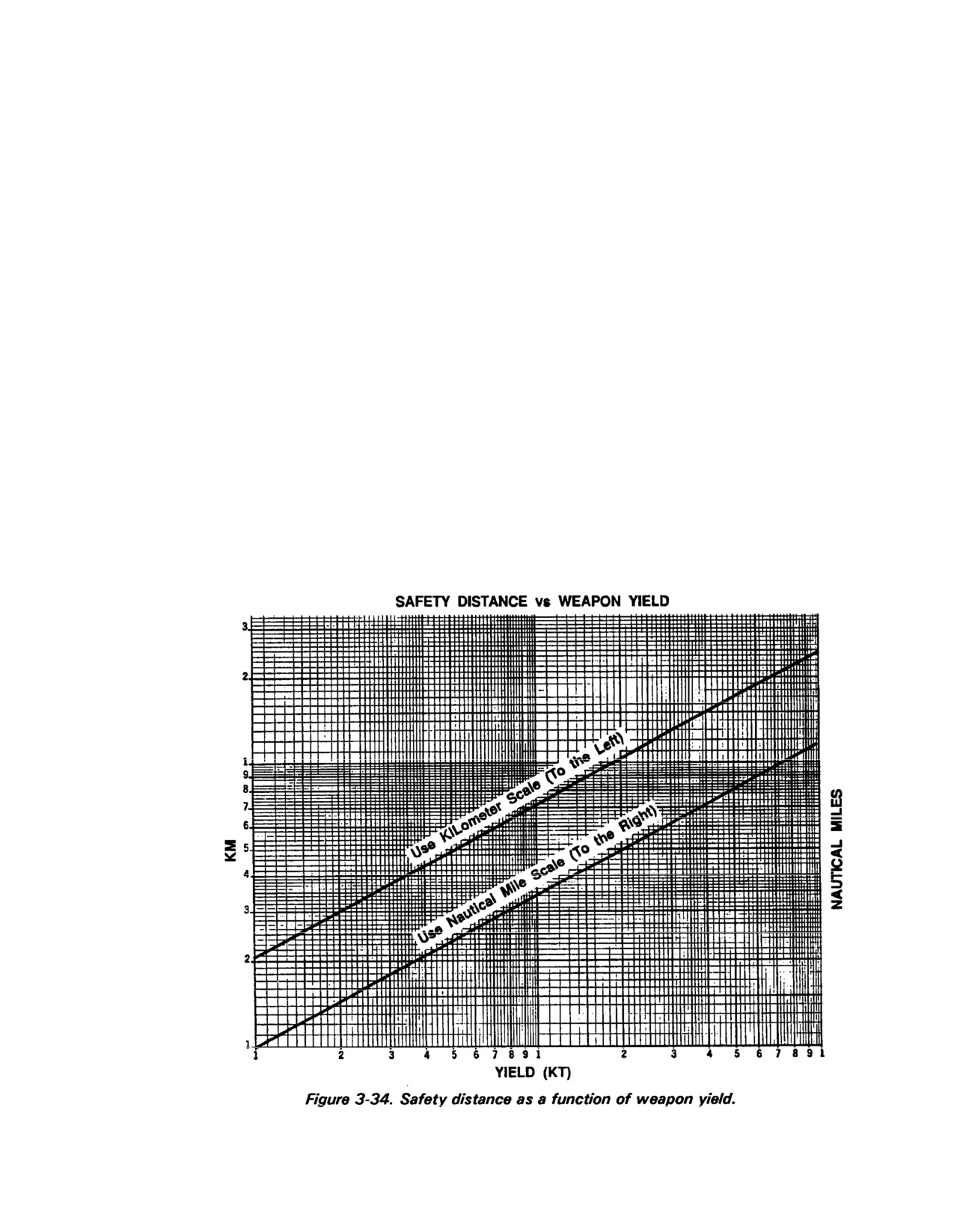
standard yield groups) or from the graph in Figure 3-34
the largest yield in this group is 100 KT. Therefore, 100
(any yield), to allow for finite cloud size, diffusion, and
KT will be used for the fallout prediction.
wind fluctuations.
Step 2.
Select the data contained in the DELTA yield
Step 3.
On the plot (template), with GZ as center and
group in the NAV EDM: DELTA 122016, meaning that
the two distances obtained from 2, as radii, draw two arcs
the effective downwind direction is 122 degrees, and the
across the fallout pattern. The zone enclosed between these
effective downwind speed is 16 knots.
two arcs will, in most cases, contain the area of deposition
Step 3.
On the template draw the GN line from GZ
at a specific time after the detonation.
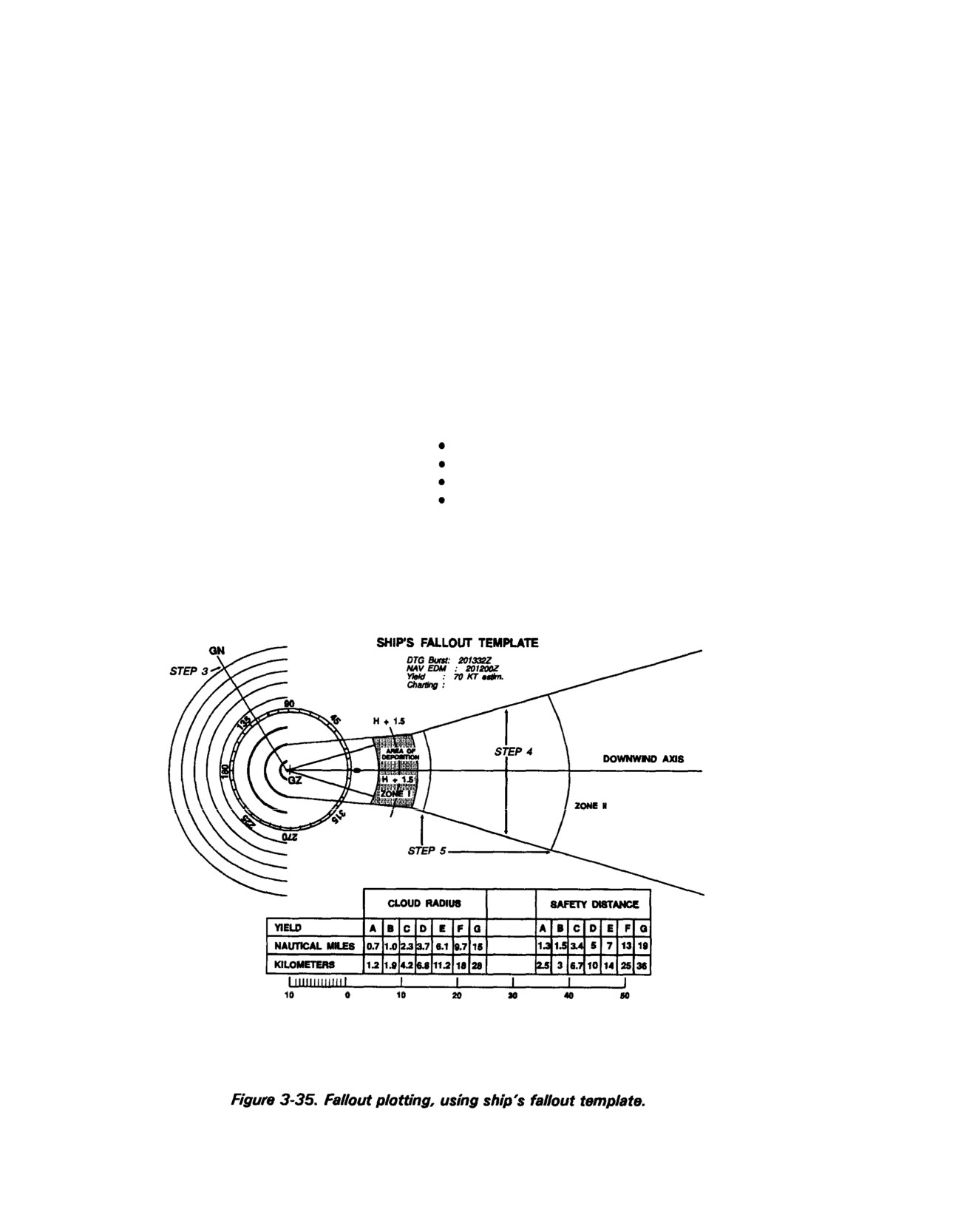
through 122 degrees on the compass rose see Figure 3-35.
Step 4.
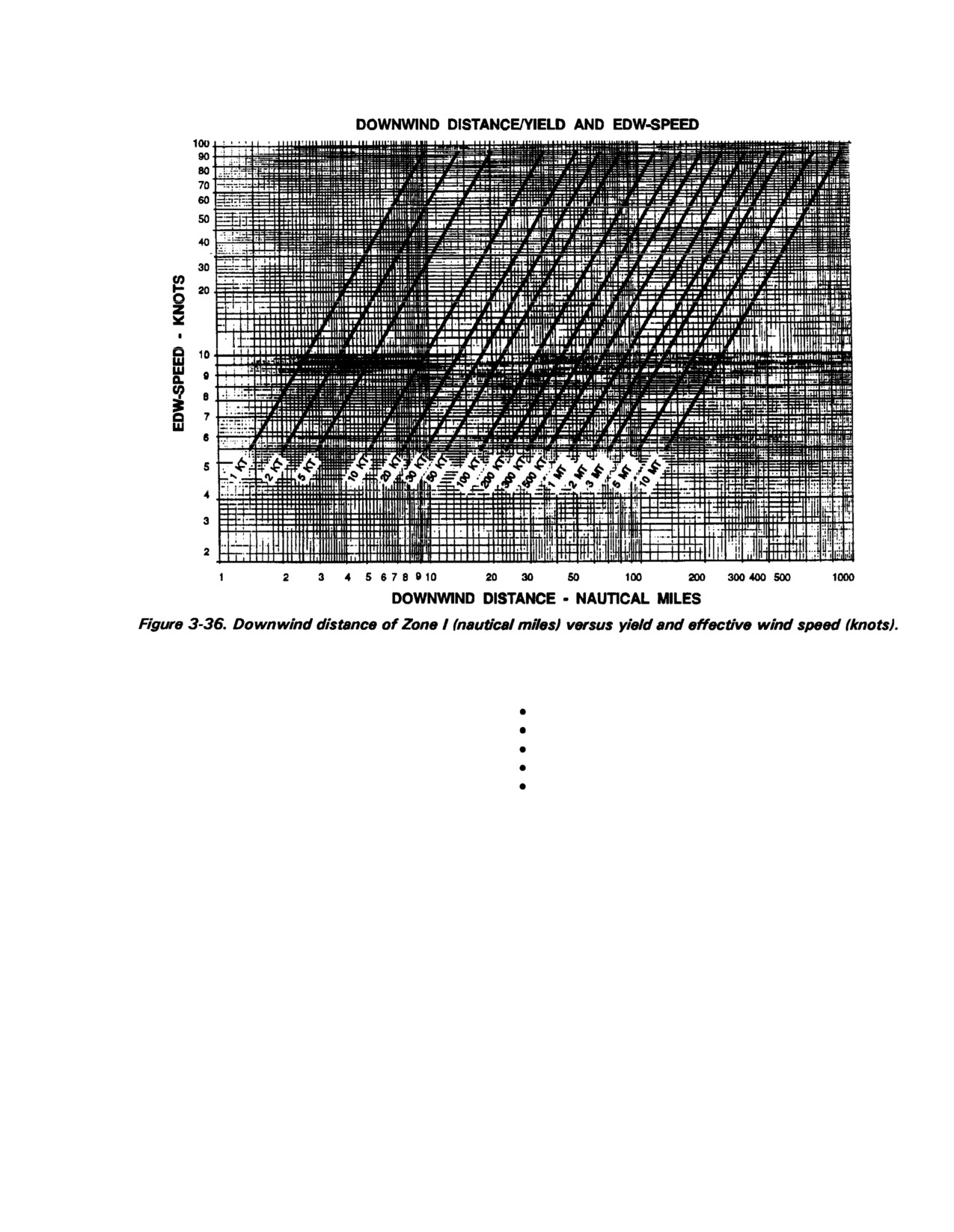
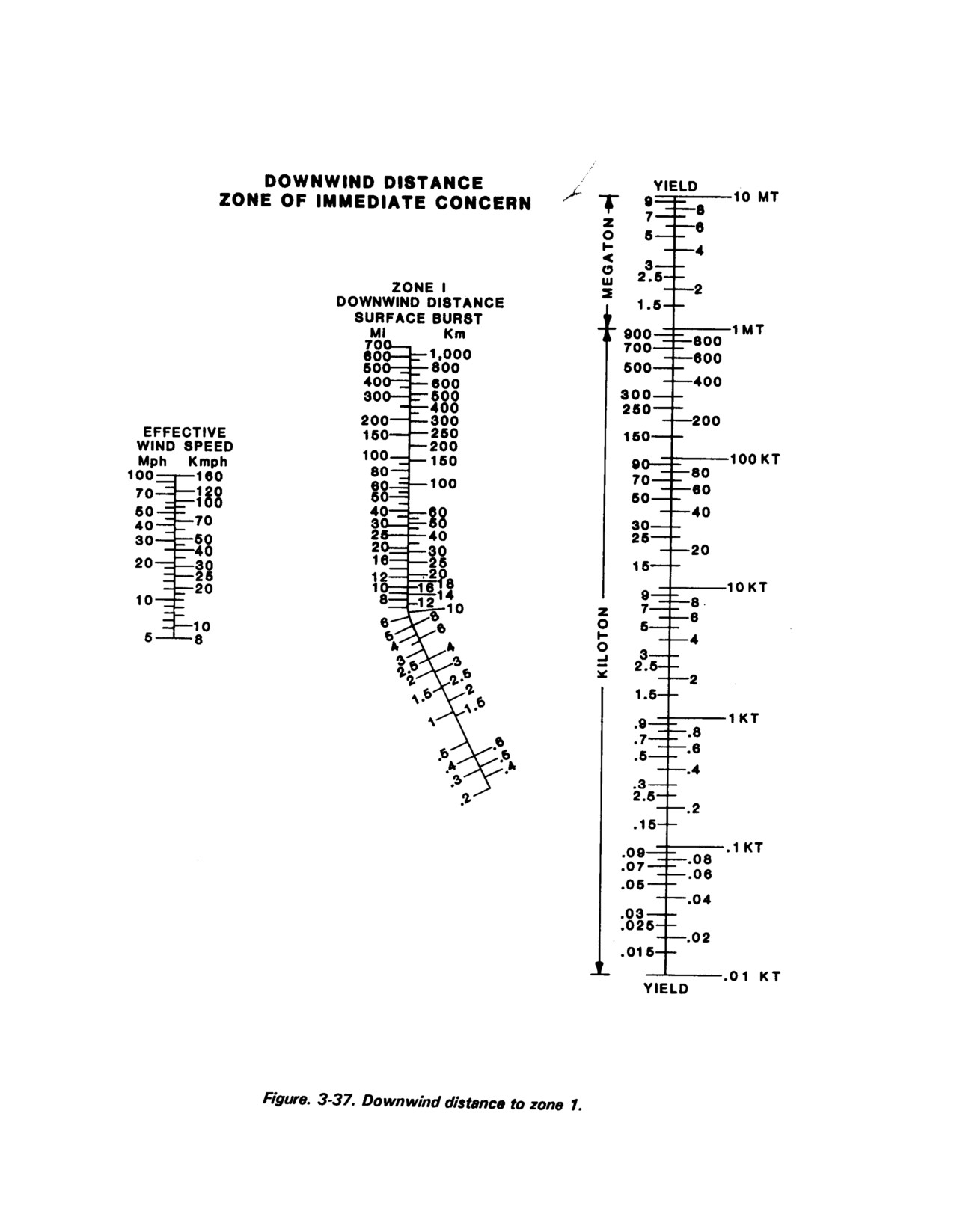
From the graph in Figure 3-36 (page 3-29) or the
3-27
FM 3-3-1
nomogram in Figure 3-37 (page 3-30), determine the
allow for finite cloud size, difusion and wind fluctuations,
downwind distance of Zone 1 to be 30 nautical miles. Zone
a certain distance ahead of and behind this line must be
II downwind distance is double this distance, or 60 nautical
added to determine the area within which, in most
miles from GZ, in effective downwind direction.
circumstances, the fallout will be deposited at the surface
Step 5.
Using GZ as center and the two distances, the
at H+1.5 hours. This is the safety distance. From the
Zone I and Zone II distances as radii (to the appropriate
table printed on the template or from Figure 3-34, find the
chart scale), draw two arcs between the radial lines. From
safety distance for yield group DELTA (100 KT) to be 5
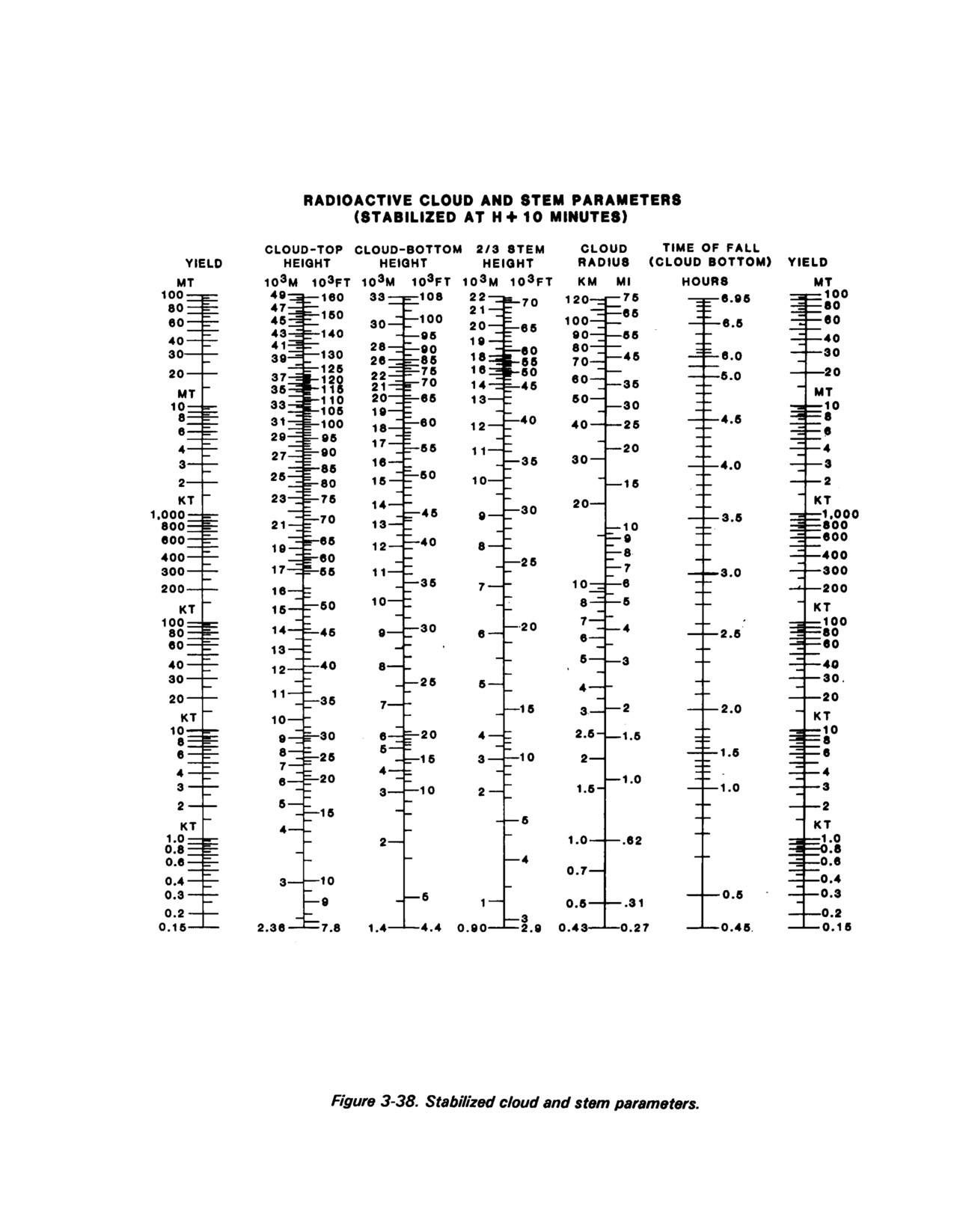
the template or from Figure 3-38 (page 3-31) read the
nautical miles. Add and subtract 5 nautical miles to and
cloud radius to be 3.7 nautical miles, and draw a
from 24 nautical miles:
semicircle upwind of GZ, using GZ as center and 3.7
24 + 5 = 29 nautical miles,
nautical miles as radius. The preprinted semicircles may be
and 24-5 = 19 nautical miles.
helpful. From the intersections of the Zone I arc with the
Using these two distances as radii and GZ as center,
radial lines, draw lines to connect with the ends of the
draw two arcs across the fallout pattern. The area confined
semicircle.
by the two arcs and the cross wind boundaries of the
Step 6.
Determine the area where deposit of fallout is
fallout area defines the approximate area of fallout deposit
estimated to take place at a specific time after the
at 1.5 hours after the detonation.
detonation Multiply the effective downwind speed by the
Complete the fallout prediction plot by indicating the
time (hours after detonation)—l.5 hours after the burst (H
following on the fallout template:
+1.5 hours): 16 knots x 1.5 hours = 24 nautical miles.
NAV EDM used,
With GZ as center and 24 nautical miles as radius, draw
Yield (estimated or actual),
a dotted arc across the fallout plot. This arc represents the
GZ, and
middle of the area within which fallout may be expected to
Geographic chart number (scaling).
reach the surface at H+1.5 hours after the detonation. To
3-28
FM 3-3-1
Step 4.
When the plot has been prepared, complete the
Fallout Plotting from NAV EDM
fallout prediction plot by indicating the following on the
and NAV NBC 2 Nuclear Report
template:
NAV NBC 2 nuclear report used,
Based on a number of NAV NBC 1 nuclear reports, the
Yield, and date-time of burst,
NBC collection/subcollection center will calculate the
GZ,
weapon yield, GZ, and type of burst. These data will be
Geographic chart number (scaling), and
transmitted to naval forces/ships in the format of a NAV
NAV EDM used.
NBC 2 nuclear report.
The NBC 2 nuclear report and simplified fallout
Example:
procedures are designed to give the tactical commander a
NAV NBC 2 Nuclear
quick reference or picture of the potential fallout pattern.
A 24
(strike aerial number)
This picture will allow the commander to plan accordingly,
D 201405Z
(date-tima of detonation)
F 56”00’N-11° 15’E
(location of detonation)
if the unit is within the potential fallout pattern. Such
planning and preparation may include: start continuous
H SURFACE
(type of burst)
N 10 KT
(actual yield)
monitoring, cover supplies and equipment (to include food
Based on the information from NAV NBC 2 nuclear
and water supplies), warn adjacent and subordinate units of
report and NAV EDM, the ship will produce a fallout plot,
the potential threat, and ensure dosimeters (IM93s) are
following the principles described in the preceding
zeroed and issued to appropriate individuals.
paragraphs with a few adjustments:
Once the NBCC has collected sufficient data (numerous
Step 1.
Determine downwind distance of Zone I by
NBC 1 and 2 nuclear reports from designated units, a
using the actual yield (item N in NAV NBC 2 nuclear
visual description of the crater and exact location of ground
report as entrance figure in Figure 3-36 or Figure 3-37.
zero) the center will generate an NBC 3 nuclear report for
Step 2.
Determine the cloud radius by using the actual
a detailed fallout prediction. This report provides tactical
yield as your entrance figure in Figure 3-38.
units more precise data on the extent and arrival of fallout
Step 3.
Determine the safety distance by using the actual
that will possibly be of operational concern.
yield as entrance figure in Figure 3-34.
3-29
FM 3-3-1
3-30
FM 3-3-1
3-31
FM 3-3-1
Chapter 4
Detailed Fallout Prediction—NBC 3 Report
Overview
The need for a fallout prediction system stems from the
total doses of nuclear radiation within four hours after
large-area radiological hazard that develops from
arrival of fallout. These doses may result in a reduction in
fallout-producing nuclear bursts. Contamination has a large
combat effectiveness.
impact on military planning and operations. This hazard
produces mass casualties if its presence is not detected and
Inside the Predicted Area
actions taken to minimize the radiological hazards.
Commanders at all echelons must understand its effects and
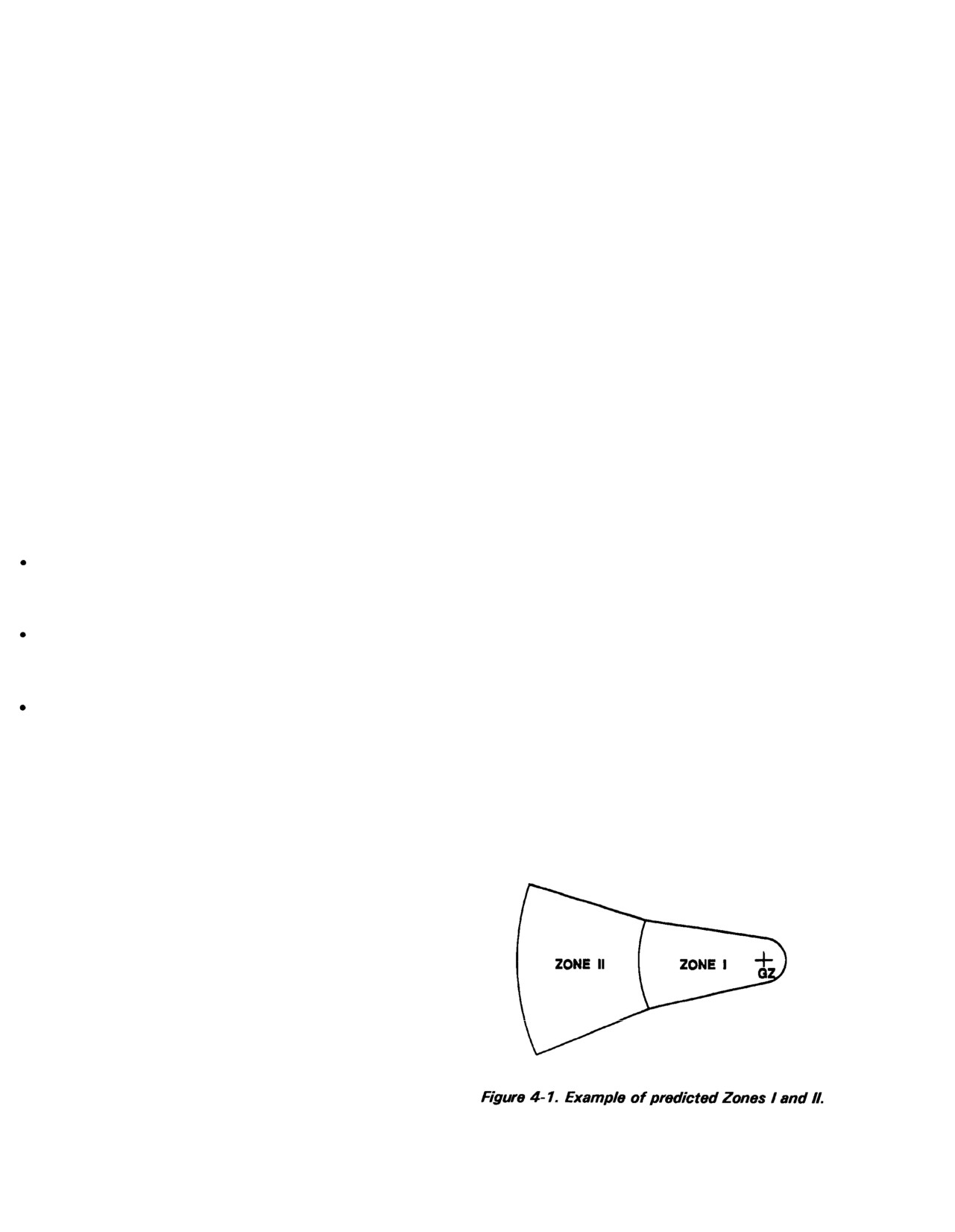
Zone I delineates the area of primary hazard and it is
take action to minimize those effects.
called the zone of immediate operational concern. In this
There are many occasions when a commander will
zone, there will be areas where exposed, unprotected
require a fallout prediction. Three examples follow:
personnel may receive doses of 150 centigray (cGy) (the
When the commander plans to use a nuclear weapon that lacks
emergency risk dose), or greater, in a relatively short
99-percent probability of being fallout safe or whenever a
period of time (less than four hours after arrival of fallout).
contact backup fuze is used, a prestrike fallout prediction is
(See Appendix A for a detailed discussion on emergency
prepared as part of the target analysis.
risk dose). Major disruptions of unit operations and
Information may indicate that fallout is occurring or that fallout
personnel casualties may occur within portions of this
probably will occur from a nuclear burst (friendly or enemy).
zone. Actual areas of disruption are expected to be smaller
In this case, a fallout prediction is required to enable the
than the entire area of Zone I. But, exact locations cannot
commander to warn higher, adjacent, and subordinate units.
be predicted.
When a fallout-producing burst occurs, an evaluating procedure
The exact dose personnel will receive at any location
is begun that will answer the commander’s questions about
inside Zone I depends on the dose rate at their location, the
the hazard. However, a time lag of several hours to a day or
time of exposure, and available protection. There is,
more may occur between the time of burst and the availability
however, a reasonably high assurance that personnel
of measured data (from radiological monitoring and/or
outside the boundary of Zone I will not be exposed to any
survey). This delays evaluation of the actual hazard. During
emergency risk dose in less than four hours. The radiation
this time lag, the fallout prediction (area of expected hazard),
produced from neutron-induced activity will be closely
or at best the fallout prediction supplemented by measured
confined to the area around GZ, which will be well within
radiation data, may be the only available information for
estimating the effects of the radiation hazard on tactical
operations or plans. This information is significant in that it
will enable the commander to avoid the contamination, if
possible.
Significance of Predicted
Fallout Zones
In both simplified and detailed prediction, a zone of
primary hazard (Zone I) and one of secondary hazard
(Zone II) are predicted. Figure 4-1 shows Zones I and II.
These zones are defined as areas where exposed,
unprotected personnel may receive militarily significant
4-0