FM 3-3-1 Nuclear Contamination Avoidance - page 5
FM 3-3-1
If the resolved yield is less than the estimated yield and
the estimated yield lies in a higher yield group on the
effective downwind message, use this higher yield when
reporting yields to field units. The higher yield will be
used until data can be refined and monitoring reports are
received.
NBC 2 Nuclear Report
The NBC 2 report reflects the evaluated nuclear burst
Subsequent data may be received after the NBC 2 report
data. Raw data is automatically submitted by designated
is sent. If this data changes the yield or GZ location, the
observer units each time the enemy attacks with nuclear
newer data is sent in a new NBC 2 report. The same strike
weapons. It represents the detailed evaluation of all raw
serial number and date-time of attack are used.
data.
Once the NBCC staff determines the resolved yield, they
The NBC 2 report has a precedence established in
formulate an NBC 2 report. In theory this is done only at
FSOP/OPLAN/OPORD or other written instructions.
division NBCC level. However, in practice the NBC 2
Precedence is based upon urgency. An NBC 2 report may
report may be done at battalion or brigade level. In some
have a different precedence for a unit in a danger zone
special cases, the NBC 2 report may be generated at unit
compared to a unit not in an affected area.
level. Any command level that has access to two or more
NBC 2 reports are created for all bursts-air, surface,
NBC 1 reports, upon which an accurate yield and exact
and unknown. When surface or unknown are reported as
location for ground zero may be determined, may produce
the type of burst, fallout predictions are made. Users of
NBC 2 reports are not limited to the use of the line items
shown in the example. Other line items, as appropriate,
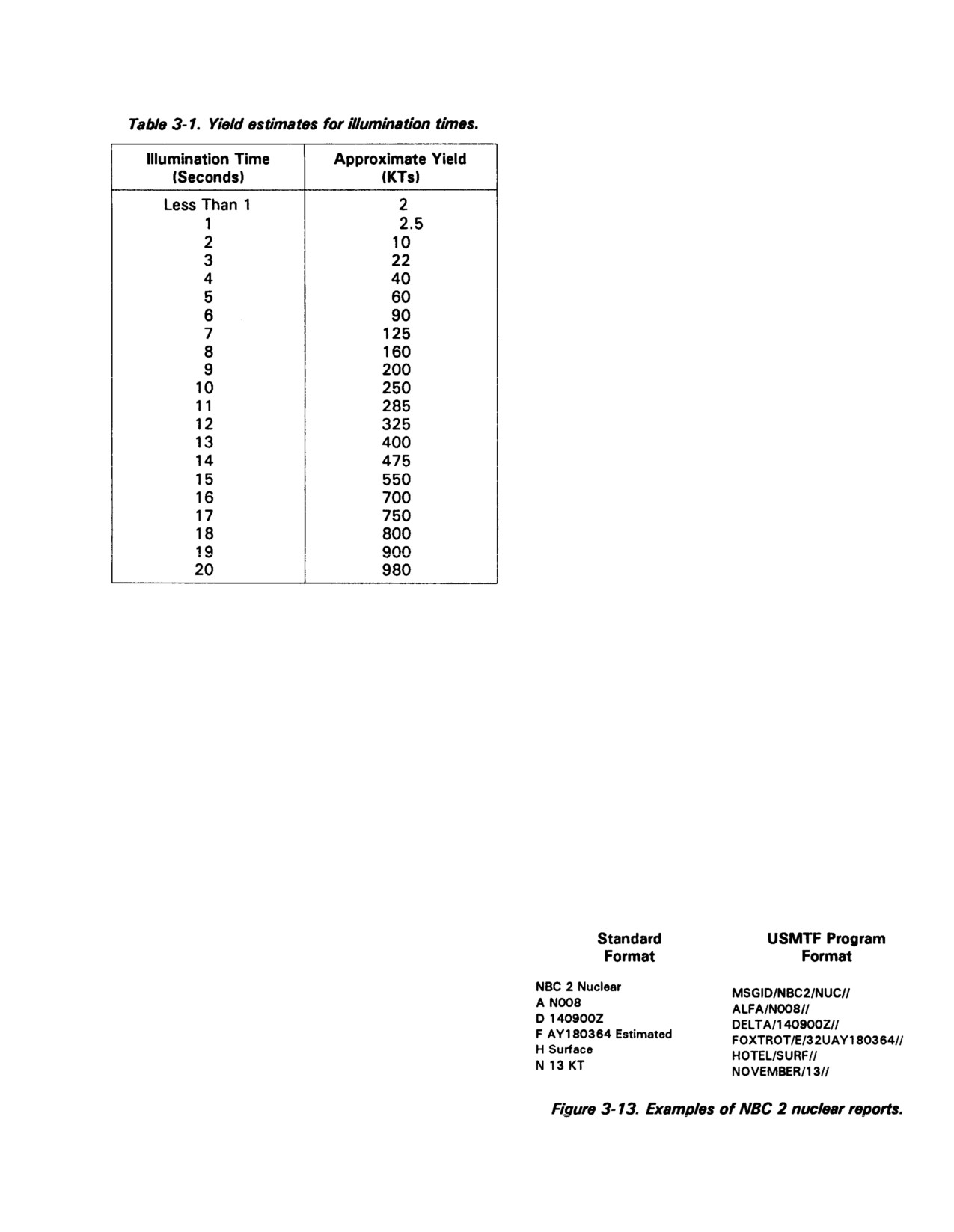
may be added. Figure 3-13 shows examples of NBC 2
reports.
Communication means for the NBC 2 report is
established by FSOP/OPLAN/OPORD or other written
instructions. Each NBC 2 report is sent to all affected
subordinate units and higher and adjacent headquarters.
This allows planning for future missions or boundary
changes.
3-13
FM 3-3-1
3-14
FM 3-3-1
an NBC 2 report. However, if NBC 2 reports are provided
prediction. Effetive downwind messages will be explained
by higher headquarters, they must be used; because,
later in this chapter.
generally, higher headquarters will have more accurate
data.
Simplified Fallout Prediction
The simplified fallout prediction system provides small
Strike Serial Number
unit commanders an immediate estimate of the fallout
The NBCC serves as a focal point for all requests for
hazard. The commander uses the simplified fallout
information concerning nuclear strikes. It is responsible for
prediction in the decision-making process. A current
assigning a strike serial number to each nuclear attack,
effective downwind message, nuclear burst information
friendly or enemy, that occurs within its assigned area. A
(NBC 2 nuclear report), and a simplified fallout predictor
record of these numbers is kept in a log or on a map
(M5A2 or field expedient) are required to prepare a
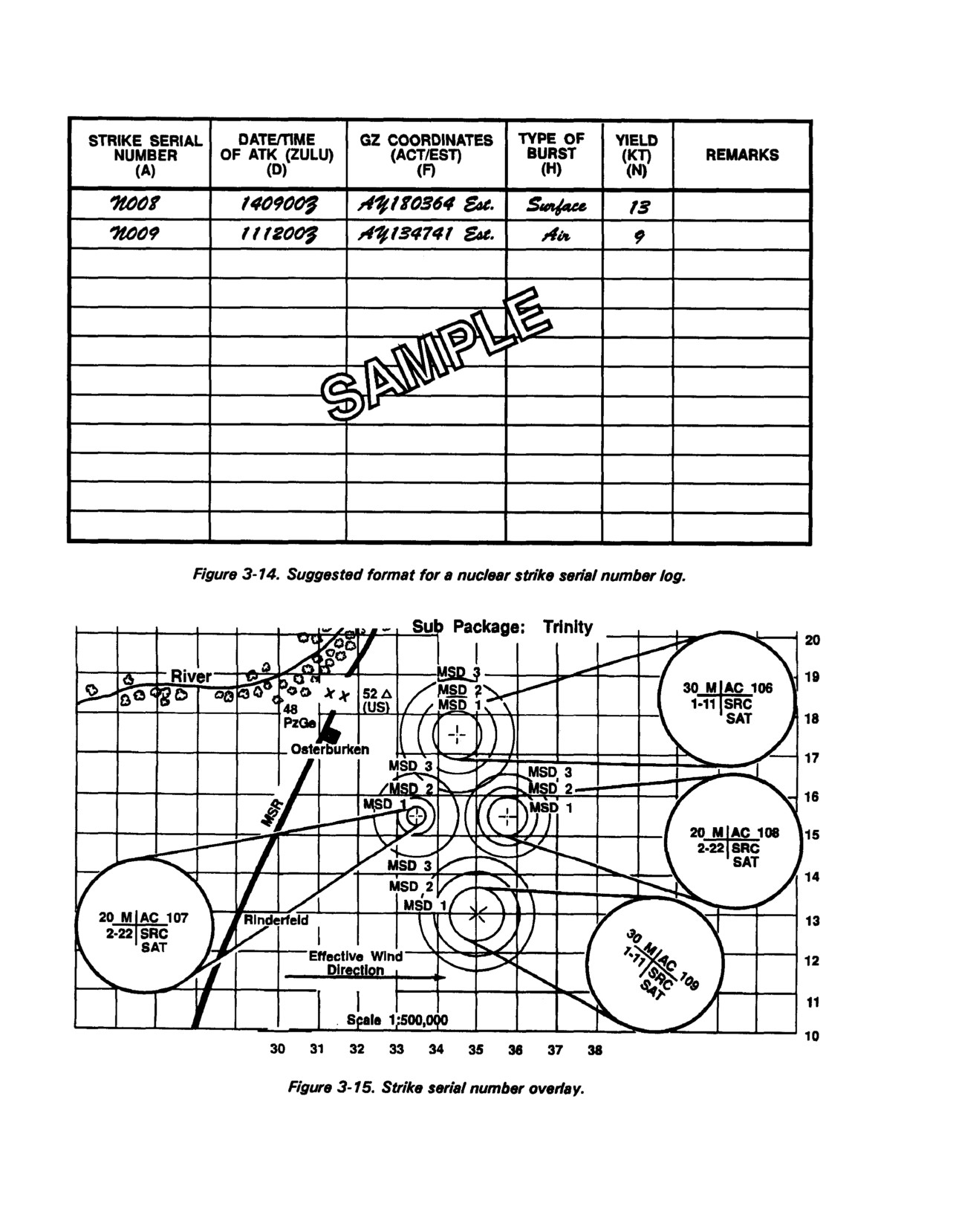
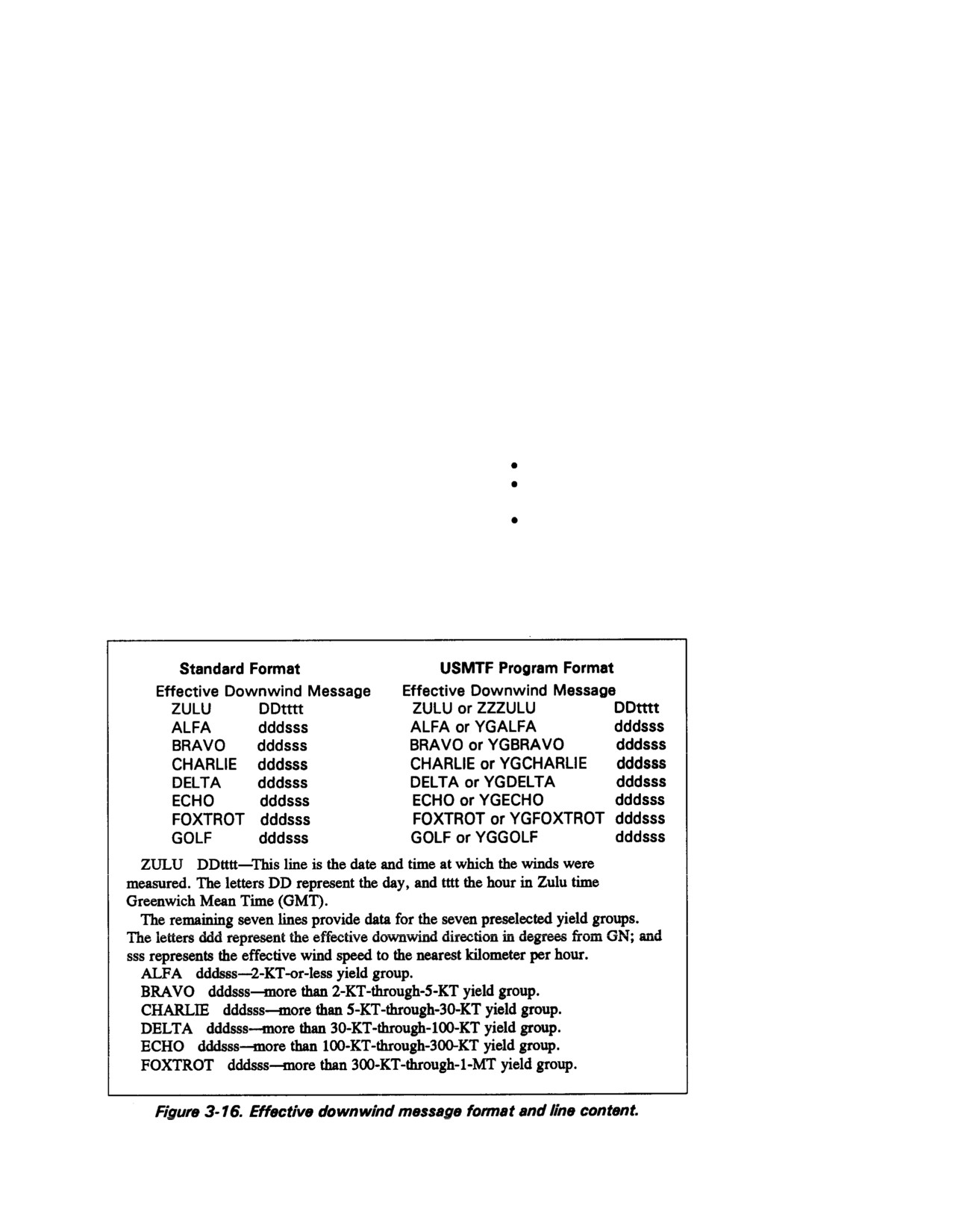
overlay. A suggested format for a log is shown at Figure
simplified fallout prediction. It is superceded upon receipt
3-14 and a map overlay at Figure 3-15.
of an upgraded NBC 2 nuclear report only if there is a
Note:
The resolved yield is baaed on the information pro-
disparity between the initial NBC 2 report and the
vided by the G2 on enemy nuclear capabilities by weapon
upgraded NBC 2 report. Otherwise, it is superceded by an
type.
NBC 3 nuclear report from higher headquarters.
Any system of numbering nuclear strikes designated by
To use the simplified fallout prediction system, a unit
SOP is permitted. The system maybe all numbers, all
should—
letters, or alphanumerical. Integration of the NBCC
Train on the simplified fallout prediction system.
headquarters designation in the serial number is also
Estsbliah communications with the battalion to maintain current
permitted. The headquarters responsible for the area of
wind data.
operation should not assign blocks of strike serial numbers
Have the necessary forms and overlays ready for use. These
to subordinate units.
include NBC 2 nuclear report formats, effective downwind
Once the unit receives the NBC 2 nuclear report, the unit
message formats, and the M5A2 fallout predictor. If the
NBC defense team takes the report and a current effective
M5A2 fallout predictor is not available, a field-constructed
downwind message, and prepares a simplified fallout
predictor and the nomogram in Figure E-6 in Appendix E may
be used.
Wind Data
To use the simplified fallout
prediction, you need the
effective wind speed and
downwind direction. This
information is prepared by the
NBCC as an effective
downwind message, and it is
transmitted to subordinate and
adjacent units each time new
upper air wind data are
received. Effective downwind
messages should be received
from the division NBCC every
12 hours. However, if one is
not received within 12 hours,
the latest message should
always be used. Effective
downwind messages more than
12 hours old, however, should
not be used for fallout
prediction.
The format for the effective
downwind message is a series
3-15
FM 3-3-1
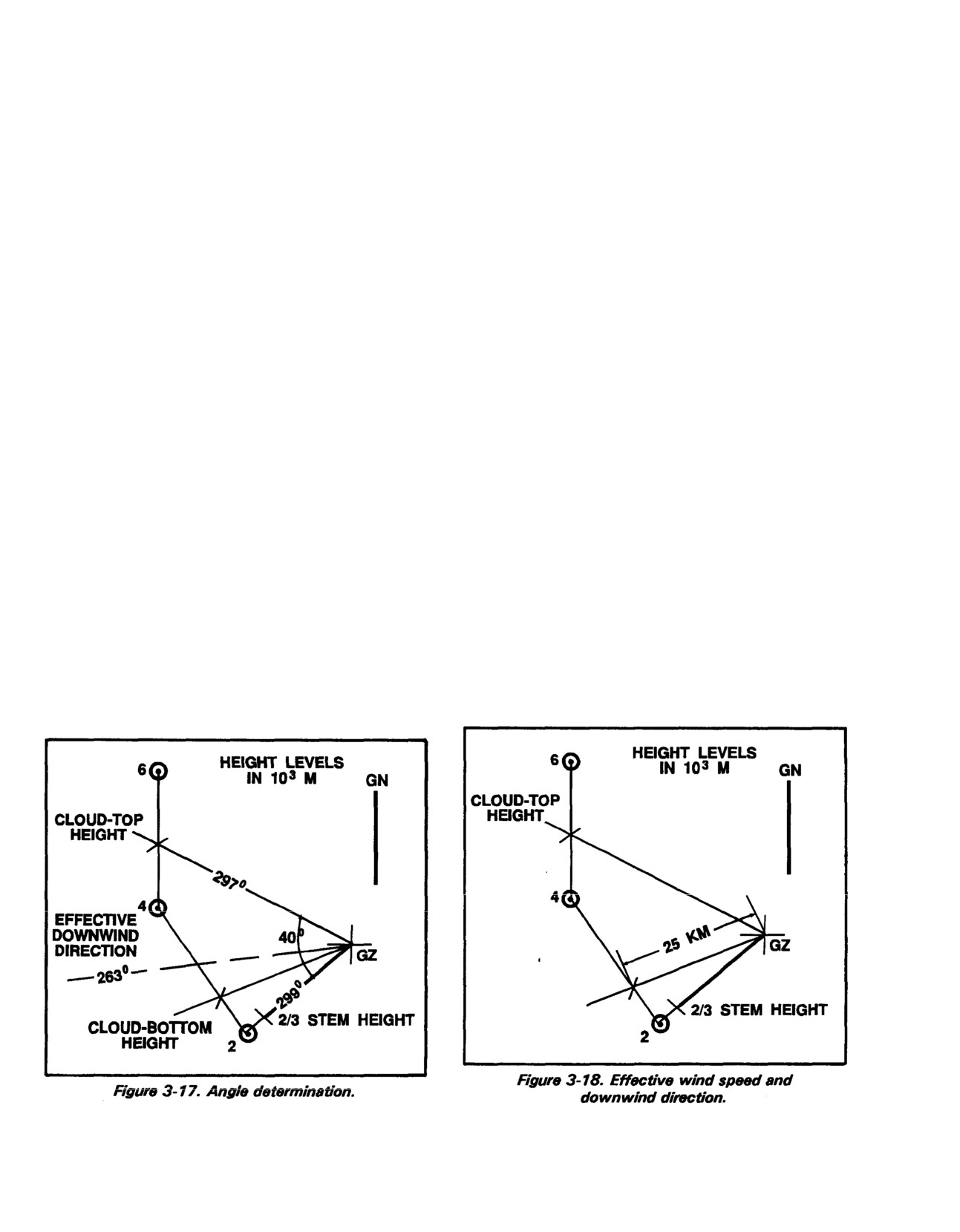
of eight lines preceded by the phrase “Effective Downwind
that when the Delta line is used, the yield of the weapon is
Message.” The significance of each line item is indicated
more than 30 KT but no more than 100 KT. Use of the
in Figure 3-16.
Delta line indicates that the fallout prediction was
For example, an effective downwind message reads
determined from a downwind direction of 90 degrees and
Delta 090025. The individual using this information knows
an effective wind speed of 25 kilometers per hour.
Effective Downwind Message
Preparing an EDM is similar to preparing a detailed
Note:
It is important to understand that all military
fallout prediction, which will be explained later in this
significant fallout is contained between 2/3 stem and cloud
chapter. The difference is the EDM is prepared for specific
top height. In relation to this fact all of the wind vectors
yields and it is used by a unit to prepare a simplified fallout
from where 2/3 stem is plotted up to cloud top height must
prediction. The NBCC is responsible for preparing and
fall between these two radial lines. If not the closest radial
disseminating the EDM. This normally is done once every
line must be moved to include these vectors. Some times it
twelve hours.
may be necessary to move only one, or both 2/3 stem and
cloud top height, a radial line that has been moved will
have the same nomenclature as the original line.
Preparation of a Message
Step 3.
To determine the effective wind speed, measure
(Wind Data)
the distance along the cloud-bottom radial line from GZ to
its intersection with the wind vector plot at the
Step 1.
Obtain the cloud-top height, cloud-bottom
cloud-bottom height point. Divide this distance by the time
height, and two-thirds stem height (from Figure E-3) for
of fall from the cloud bottom (Figure 3-17), or multiply by
each of the following yields: 2 KT, 5 KT, 30 KT, 100 KT,
the reciprocal as shown on the EDM worksheet.
300 KT, 1 MT, and 3 MT. This information is also on DA
Note: A situation may arise when the effective wind speed
Form 1971-3-R (Effective Downwind Message
for one or more yield groups is less than 8 kmph. In this
Worksheet). A blank DA Form 1971-3-R can be found in
case the downwind distance for Zone I is determined, using
Appendix H.
the nomogram in Figure E-6’s (Appendix E) zone of imme-
Step 2.
Place a sheet of overlay paper over the wind
diate concern. Enter the nomogram with the effective wind
vector plot, and mark a GN reference line and GZ.
speed of 8 kmph on the left-hand scale, and the highest
Preparation of wind vector plots is outlined in Appendix D.
yield for each yield group on the right-hand scale. Then,
Mark the cloud-top height, cloud-bottom height, and
read the downwind distance for Zone I on the center scale.
two-thirds stem height for the 2-KT yield (use the values
obtained in step 1). Draw radial lines from GZ through
these three points.
3-16
FM 3-3-1
Step 4.
To determine the effective downwind direction,
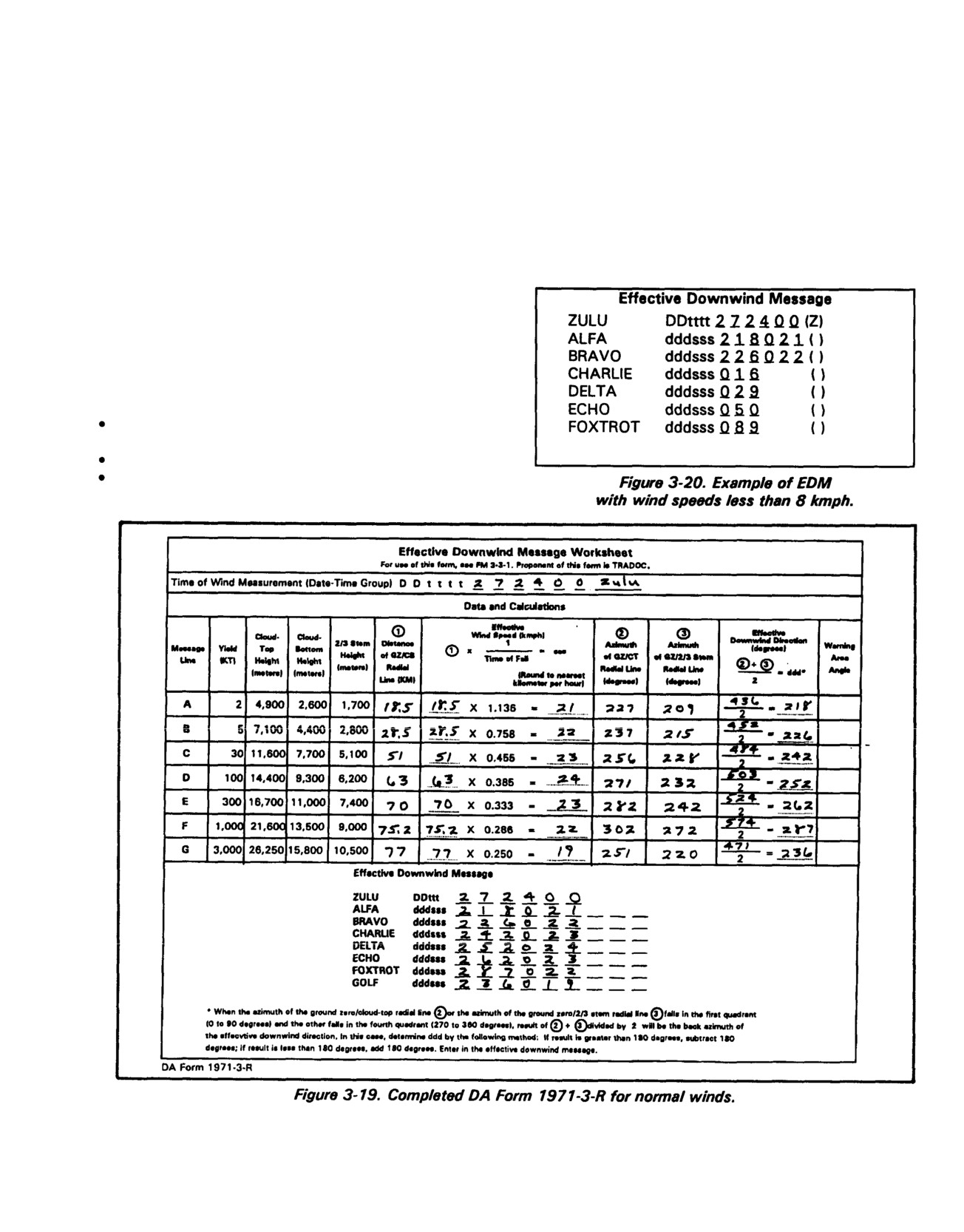
An example of a completed worksheet and an effective
use a protractor to bisect the angle formed by the cloud-top
downwind message for normal winds is depicted in Figure
height radial line and the two-thirds stem height radial line.
3-19.
Measure the azimuth of the bisector in degrees from GN.
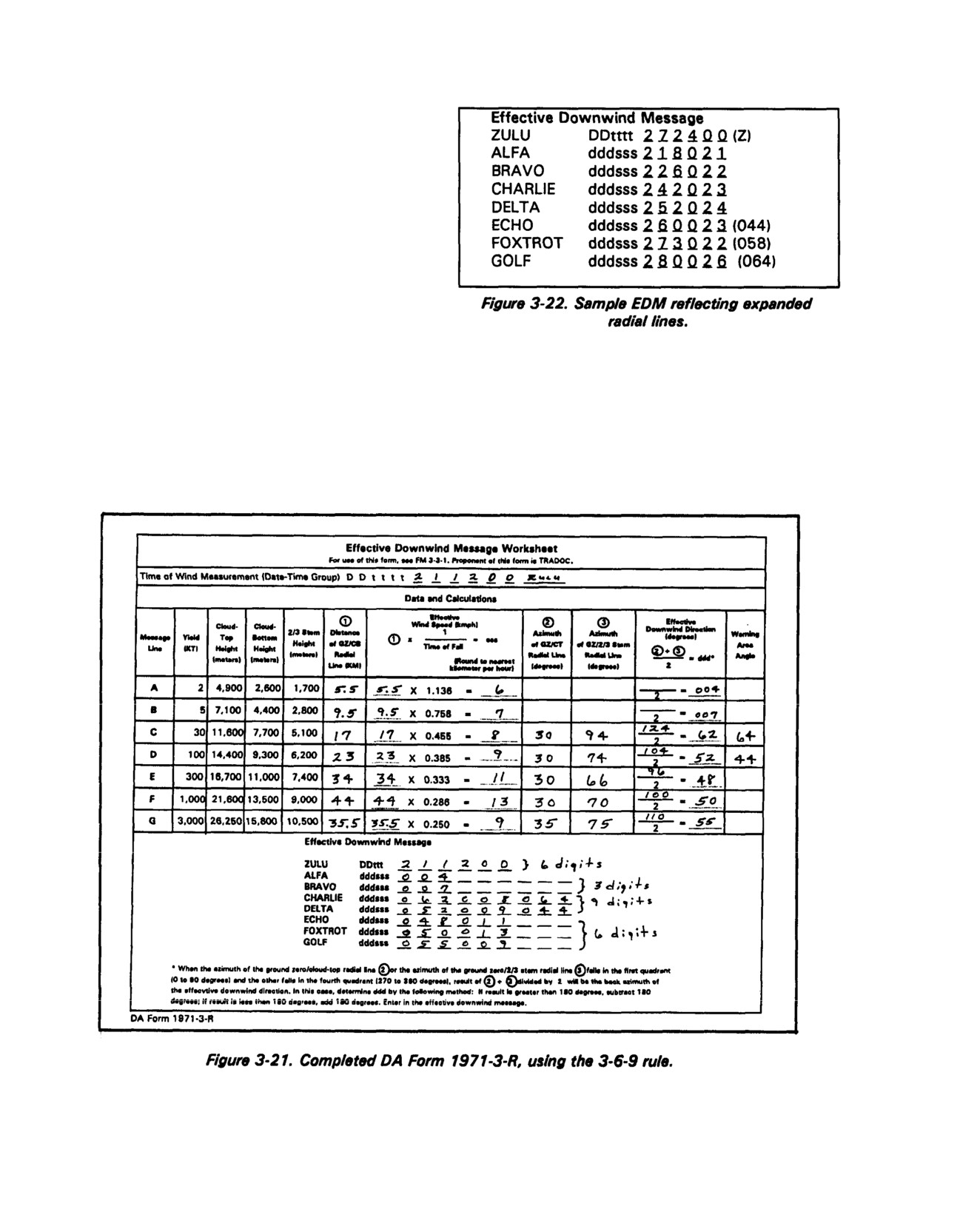
A worksheet with the two types of special cases
This is the effective downwind direction (Figure 3-18).
discussed is depicted in Figure 3-21, page 3-18.
Step 5.
Measure the angle between the cloud-top and
two-thirds stem, In some cases the angle will be more than
40 degrees. In those cases if the angle is an odd number,
round the angle to the next highest even number, and
record it on the worksheet in the expanded angle column
for the appropriate yield group.
Step 6.
Repeat steps 2 through 5 for the remaining yield
groups. Use a separate sheet of overlay paper for each
yield group,
Step 7.
Complete the EDM portion of the work sheet,
based on the data and calculations.
Remember the 3-6-9-digit rule:
3 digits mean winds less than 8 kmph, and digits represent Zone
I distance.
6 digits mean normal message.
9 digits mean expanded radial lines to a given number of
degrees.
3-17
FM 3-3-1
Special Cases
When the effective wind speed is less than 8 kmph for a
given yield group, the applicable line will contain only
three digits (Figure 3-20, page 3-17). These three digits
will represent the radial line distance (obtained by entering
the nomogram in Figure E-6 with the estimated yield and 8
kmph) of Zone I. In this case no wind speed is given, and
the fallout pattern will be two concentric circles.
Another special case occurs when the fallout is not
expected to fall within the normal 40-degree angle of the
prediction. In this case the appropriate line on the effective
downwind message has nine digits. The first six digits
represent wind direction and wind speed. The last three
digits show the angle in degrees between the left and right
radial lines (see Figure 3-22).
3-18
FM 3-3-1
Naval Effective Downwind Message
Effective downwind speed and downwind direction (the
NAV EDM). Should the wind conditions change
direction towards which the wind is blowing) vary with the
significantly within the six hours, a new NAV EDM will
yield. Seven downwind speeds and downwind directions
be transmitted.
are transmitted in the Naval effective downwind message,
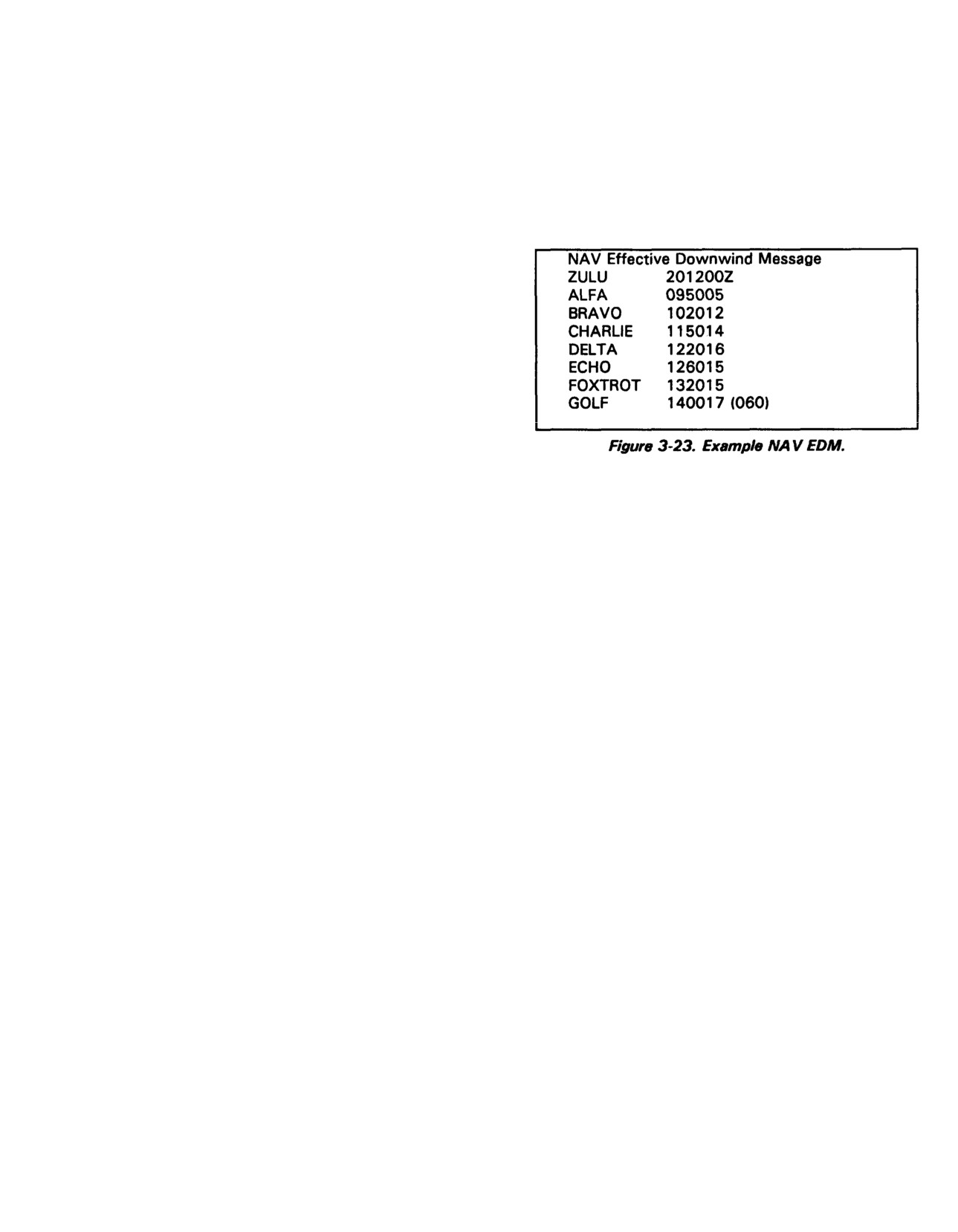
An example of a NAV EDM is shown in Figure 3-23.
corresponding to seven preselected yield groups. These
groups are—
ALFA 2 KT and less
BRAVO more than 2 KT to 5 KT
CHARLIE more than 5 KT to 30 KT
DELTA more than 30 KT to 100 KT
ECHO more than 100 KT to 300 KT
FOXTROT more than 300 KT to 1 MT
GOLF more than 1 MT to 3 MT.
NAV EDMs can be produced at Naval NBC centers
from actual wind data, or at designated meteorological
centers from computer-originated forecast wind data.
A fallout prediction is prepared for the largest yield
within each of the seven standard weapon yield groups—2
Note:
Naval ships receiving NBC reports from non-naval
KT, 5 KT, 30 KT, etc. And, the calculated downwind
sources may have to convert metric units into maritime
directions and effective downwind speeds are transmitted
units of measurements.
to naval forces and ships in the NAV EDM.
Special cases exist with the NAV EDM. These cases
The data will be transmitted in the following basic
occur when the effective wind speed is less than 5 knots
format:
and when the angle of the sector must be expanded.
NAV Effective Downwind Message
When the effective downwind apeed is less than 5 knots
ZULU
DDttttZ
for a given yield group, the applicable line of the NAV
ALFA
dddFFF
EDM contains only three digits, giving the downwind
BRAVO
dddFFF
distance of Zone I in nautical miles. An effective
CHARLIE
dddFFF
downwind direction is not transmitted in the NAV EDM,
DELTA
dddFFF
since in this case the downwind distance of Zone I
ECHO
dddFFF
describes the Zone I as a circle around GZ. Zone II will
FOXTROT
dddFFF
then be another circle around GZ, the radius of which is
GOLF
dddFFF.
double the radius of the Zone I circle. Use 5 knots when
In the NAV EDM, ZULU DDttttZ is the date (DD) and
estimating arrival time.
time (ttttZ) in GMT, at which the actual wind conditions
When, in the NAV EDM, a bracket containing a figure
were measured (for example, 250600Z is the 25th day of
is added to the normal 6-digit figure, it means that the
the month at 0600 GMT).
angle formed by the two radial lines must be expanded to
The ddd digits reflect effective downwind direction in
form an angle of the number of degrees indicated in the
degrees, and FFF effective downwind speed in knots
bracket. In Figure 3-23, yield group GOLF, the increased
(ALFA 080025 is a downwind direction of 080 degrees
angle is indicated to be 60 degrees-30 degrees to each
and 025 an effective downwind speed of 25 knots) valid for
side of the downwind axis. The angle expansion can also
yields of 2 KT or less.
be given by adding a seventh digit to any of the yield
Normally, a NAV EDM will be valid for six hours from
groups.
the time the winds were measured (item ZULU in the
Preparation of a Message
(Constant Pressure Data)
The procedure for preparing the effective downwind
plot representing the average cloud-bottom heights for the
message from a constant pressure surface wind vector plot
yields of interest. The average altitudes of cloud-bottom
is modified in three steps:
heights of the yields used in the simplified prediction
Step 1.
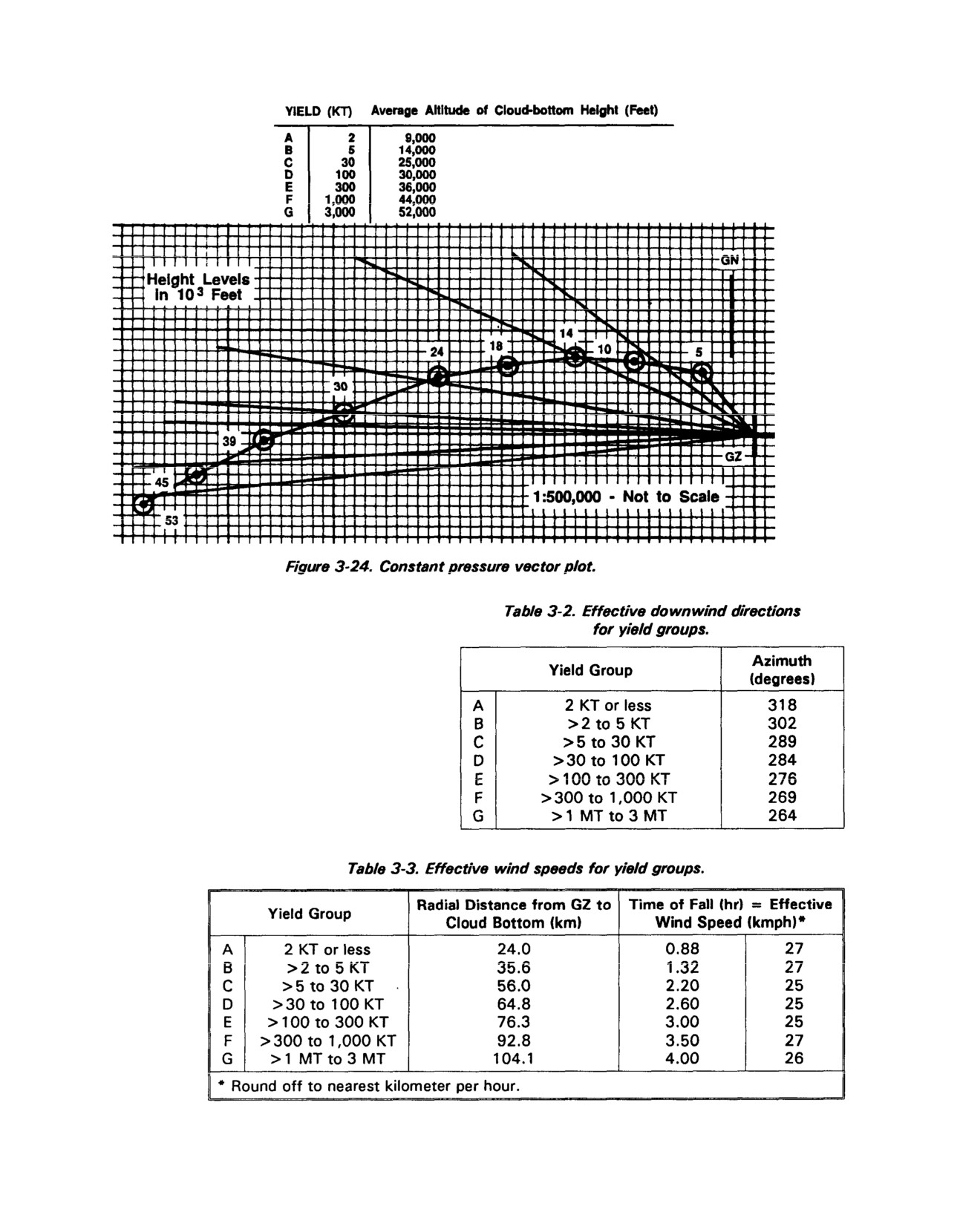
On the wind vector plot (Figure 3-24), draw
method are also shown in Figure 3-24.
radial lines from GZ through the points on the wind vector
3-19
FM 3-3-1
Step 2.
Calculate the effective downwind directions and
wind speeds:
a. Measure the azimuth of each radial line drawn which
corresponds to the yield and altitude (Step 1). These
azimuths (Table 3-2) are the effective downwind directions
for each yield group in this example.
b. Measure the length in kilometers of each radial line,
and divide these distances by the time of fall. The results
are the effective wind speeds, as shown in Table 3-3.
Step 3.
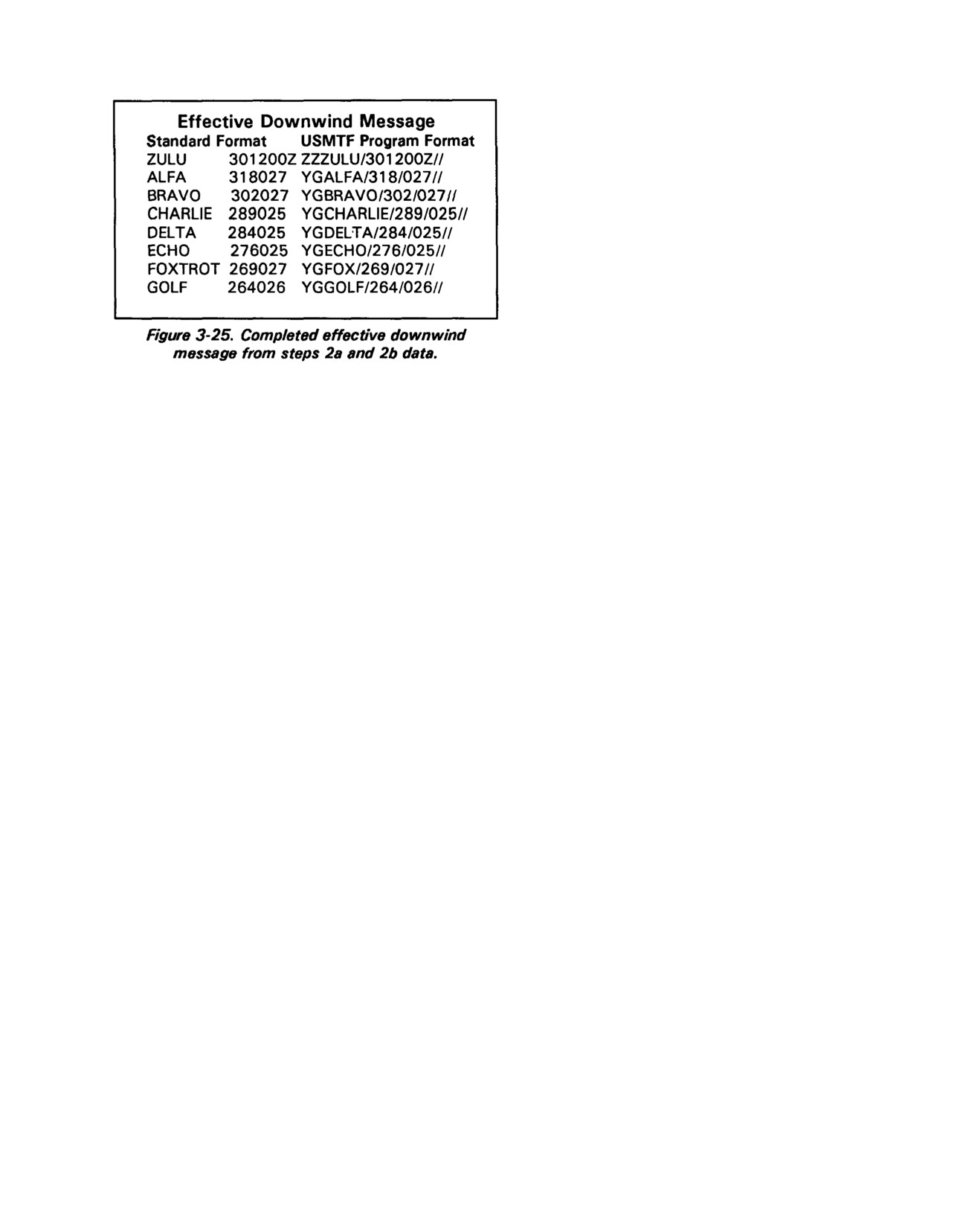
Prepare the EDM, using the data from steps 2a
and 2b. Figure 3-25 shows the completed EDM.
3-20
FM 3-3-1
M5A2 Fallout Predictor
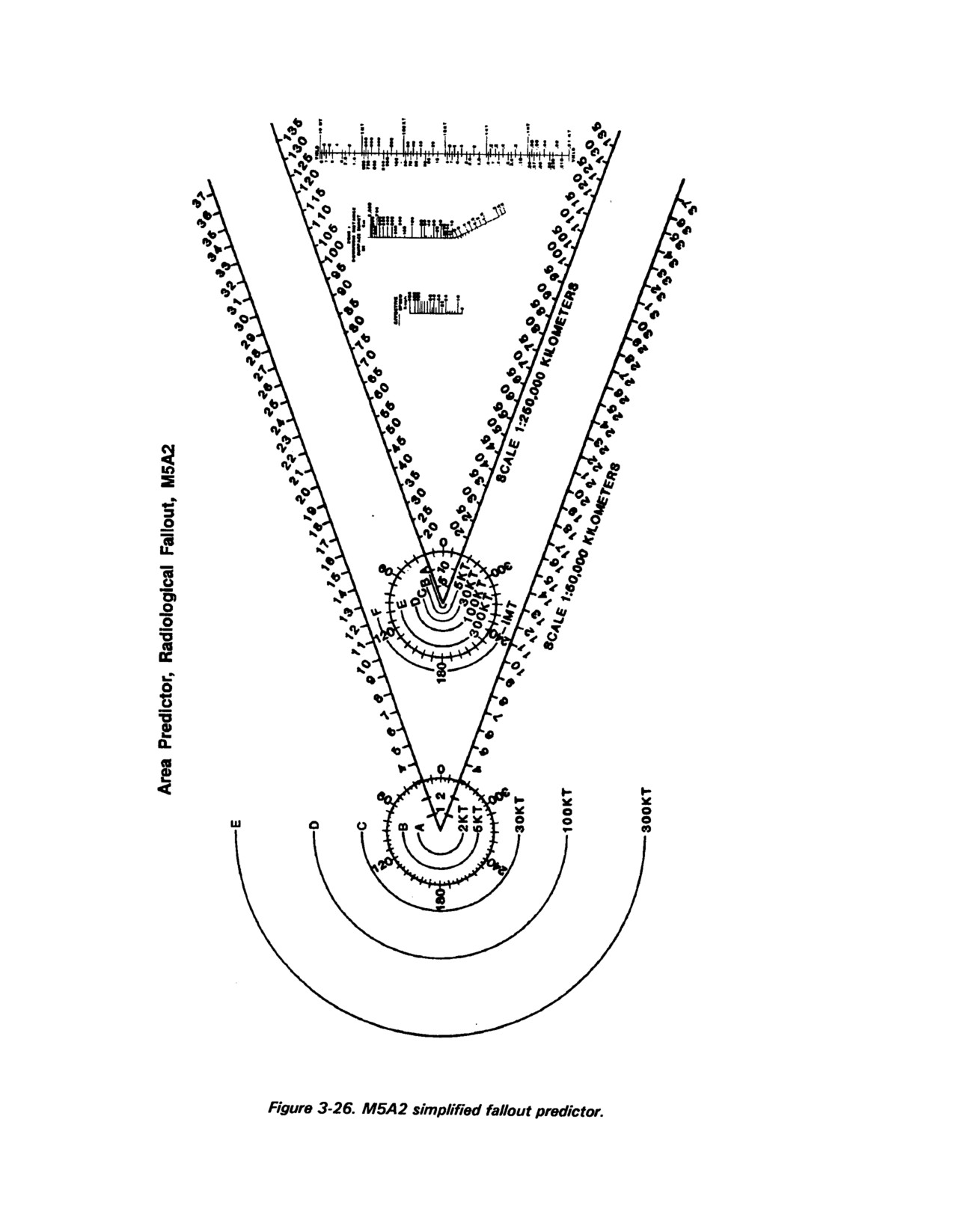
The M5A2 radiological fallout predictor (Figure 3-26,
of the M5A2 will obtain the yield and the location of GZ
page 3-22) is a transparent device used to outline the zones
from measured data or from the NBC 2 nuclear report.
of hazard resulting from surface bursts for preselected
Follow these six steps to prepare the prediction (See Figure
yield groups. The M5A2 fallout predictor is composed of
3-26, for fallout predictor.):
two simplified predictors and a nomogram for determining
Step 1.
Identify the prediction. Record the location of
the downwind distance of Zone I. One simplified predictor
GZ and the date-time of burst on the predictor.
is drawn to a scale of 1:50,000; the other predictor is
Step 2.
Effective wind speed and downwind direction.
drawn to a scale of 1:250,000. Each predictor contains six
Get this data from the appropriate line of the effective
preselected yield groups (A, B, C, D, E, and F).
downwind message.
Each simplified predictor consists of four major parts:
Step 3.
Downwind distances of the zones. Determine the
Part 1.
An azimuth dial for orientation.
downwind distance of Zone I from the nomogram (Figure
Part 2.
Semicircles depicting stabilized nuclear cloud
E-6) on the M5A2. Do this by connecting the effective
radii drawn about GZ and showing the area of
wind speed and the point on the scale representing the yield
contamination for each of the preselected yield groups.
with the straight edge or hairline.
Part 3.
A map scale calibrated in kilometers along two
Note:
Use the actual or estimated yield, not the yield
radial lines extending out from the center of the azimuth
group.
dial.
Read the downwind distance of Zone I, in kilometers, at
Part 4.
Nomogram for determining the downwind
the point of intersection of the straight edge. The
distance of Zone I.
downwind distance of Zone II is twice that of Zone I.
The nomogram from Figure E-6, consisting of three
Draw arcs between the two radial lines, using GZ as
scales, is positioned between the radial lines of the M5A2.
center, with radii equal to the two downwind distances
It is used to determine the downwind distance of Zone I.
determined.
The left-hand scale is the effective wind speed in
Step 4.
Draw left and right tangents from the cloud
kilometers per hour. The center scale is the downwind
radius line for the yield group (from Step 3) to the points
distance of Zone I in kilometers. The right-hand scale is
of intersection of the radial lines and Zone I arcs of the
the yield in kilotons.
predictor. This area represents the primary hazard.
To convert the M5A2 to conform with STANAG 2103,
Step 5.
Label Zones I and II. Darken the remainder of
draw a 28-kilometer semicircle around GZ, and label it
the prediction perimeter with a grease pencil to emphasize
with the letter G. This line is used for bursts greater than 1
the area of hazard.
megaton, but less than or equal to 3 megatons.
Step 6.
Time-of-arrival arcs. Draw in these arcs, using
the effective wind speed.
Draw as many &shed time-of-arrival arcs between the
Procedures
radial lines or tangent lines as will fall within the zones.
for Using Simplified Method
Label each time-of-arrival arc as hours after H-hour (for
example, H+1, H+2). Estimate times of arrival by using
Use of the M5A2 requires a current effective downwind
the effective wind speed (procedure indicated in the next
message, an actual or estimated yield of the nuclear
paragraph). If a time-of-arrival arc coincides with a zone
weapon detonated, and location of GZ. Normally, the user
3-21
FM 3-3-1
3-22