FM 3-3-1 Nuclear Contamination Avoidance - page 4
FM 3-3-1
look at the fireball. The brilliant light can cause permanent
yield. Nuclear burst angular cloud width (line item Lima,
damage to your eyes.
as explained in Chapter 2, for an NBC 1 report), and
As the brilliant light fades to a dull reddish glow, the
stabilized cloud-top/bottom angle or height (line item
fireball stage transforms into the nuclear burst cloud stage.
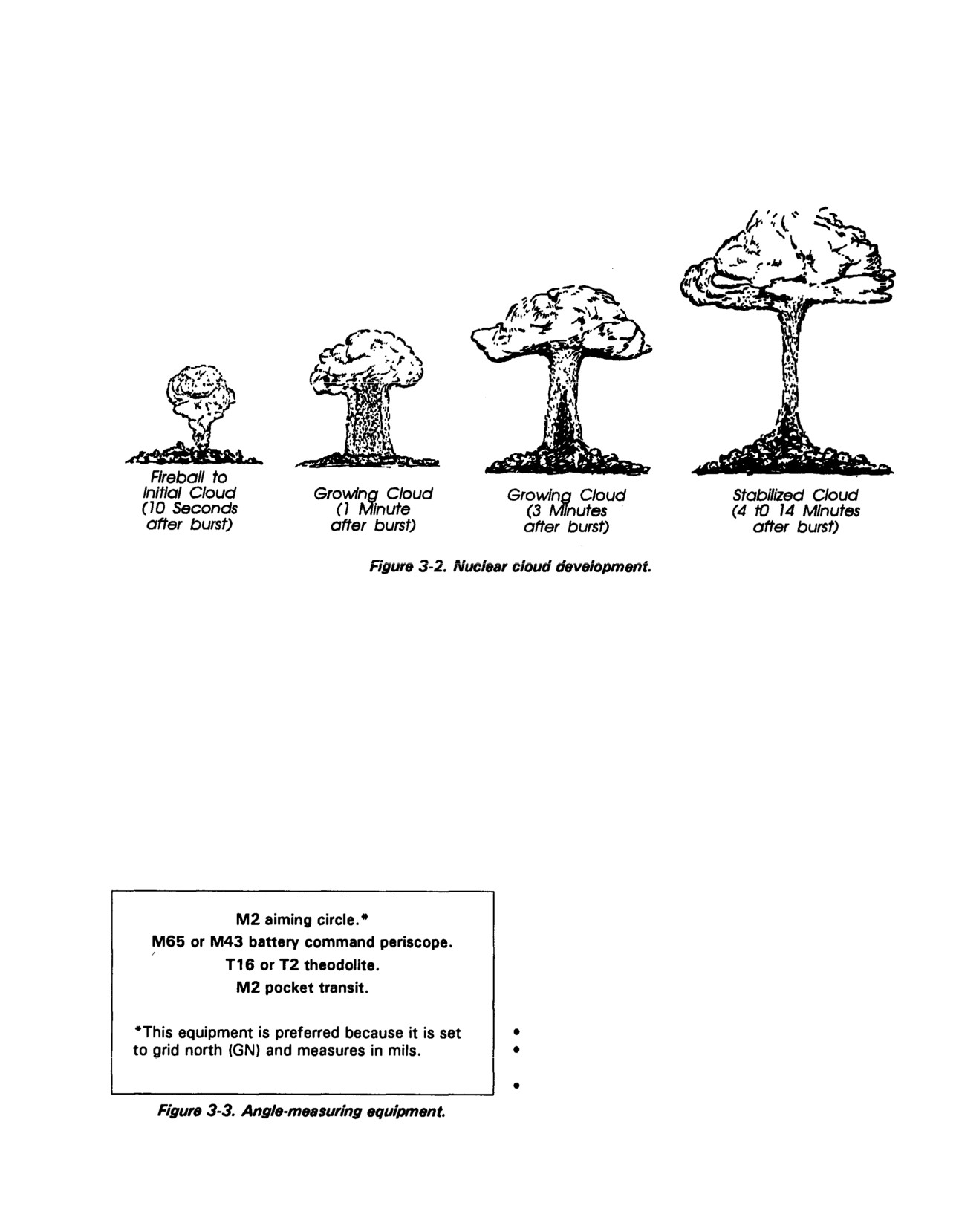
Mike) are measured during this stage. Figure 3-2 illustrates
At this point the cloud can be safely observed. The cloud
the growth of a nuclear cloud. After height stabilization (4
may be either a spherical cloud (high airburst) or a
to 14 minutes) the cloud continues to grow. This is due to
mushroom-type cloud, with or without a stem (low air or
wind, not nuclear energy. For this reason, cloud
surface burst). Relatively low-yield nuclear surface bursts
measurements are not taken after H+10 minutes.
have clouds similar to those produced by surface bursts of
Measurements of the nuclear burst cloud are taken at
conventional explosives. Severe turbulence and rapid
H+5 minutes (line item Lima) or at H+10 minutes (line
growth in cloud height and width are characteristic of this
item Mike).
stage.
Nuclear cloud measurements (parameters) have been
When the cloud ceases to grow in height, the stabilized
correlated with yield. The results are in nomograms and on
cloud stage begins. Height stabilization occurs from about
the ABC-M4A1 nuclear yield calculator. Use of the
4 to 14 minutes after the explosion, depending upon the
nomograms and the ABC-M4A1 is described later in this
chapter.
Specifically appointed and trained individuals determine
input data at unit level. They are the operators of the
angle-measuring equipment listed in Figure 3-3.
Unit SOPs detail the duties and circumstances
concerning when and how measurements are taken. For
accuracy, the following list of measurements (in order of
reliability) is provided to aid in SOP development
Nuclear burst angular cloud width at H+5 minutes.
Stabilized cloud-top or cloud-bottom height measured at H+10
minutes.
Stabilized cloud-top or cloud-bottom angle measured at H+10
minutes.
3-3
FM 3-3-1
Angular Cloud Width
Stabilized Cloud-Bottom
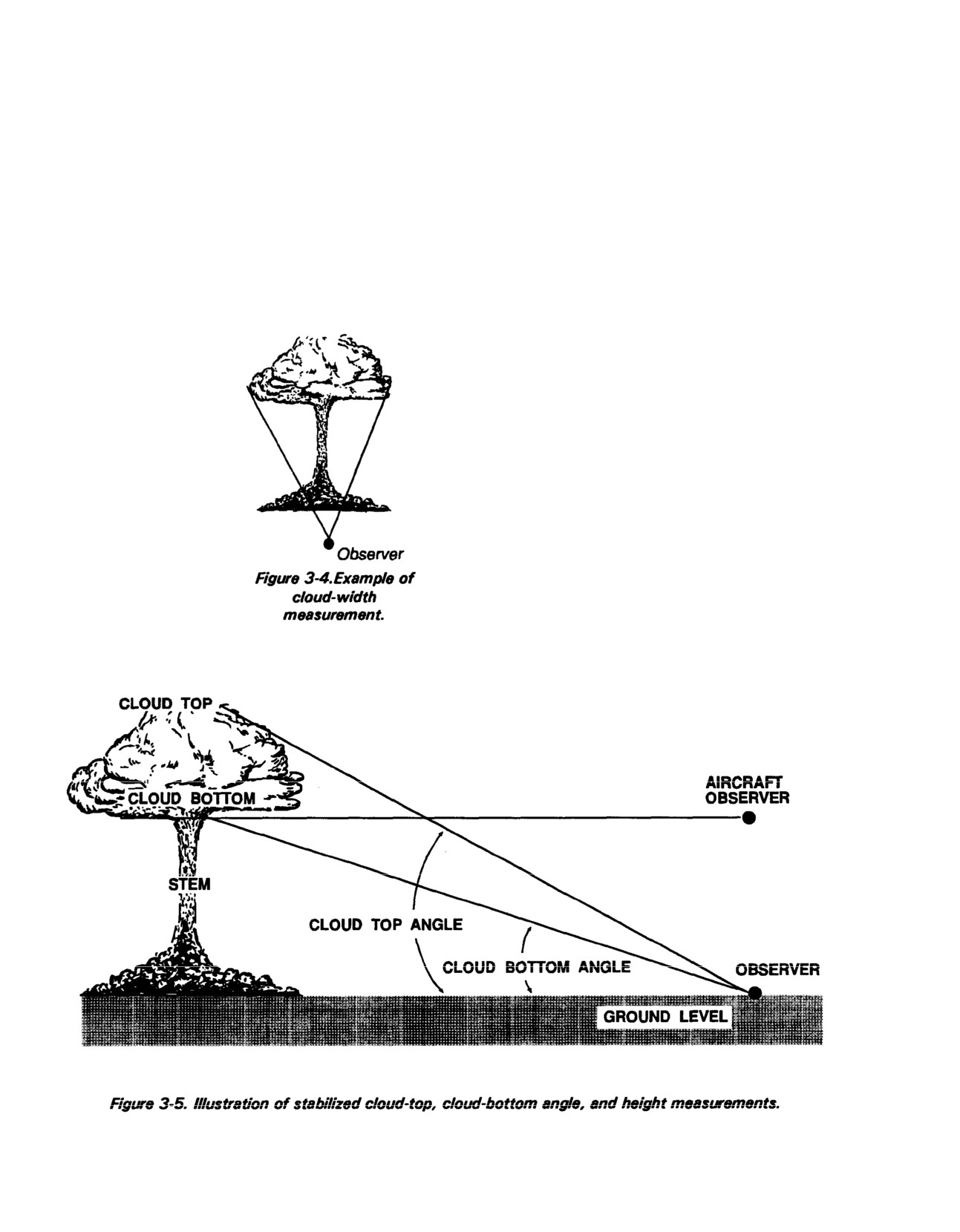
The width of the nuclear cloud is the angular dimension,
or Cloud-Top Angle
in mils or degrees, of the cloud diameter. The optical
The cloud-bottom angle measurement is the vertical
equipment operator takes this measurement at H+5
angle (in roils or degrees) measured from GZ level (on
minutes. This measurement is made for nuclear clouds
ground level, if GZ level is not discernible) to the point of
resulting from both air and surface bursts (see Figure 3-4).
intersection of the stabilized cloud and the stem.
All units have some ability to take this measurement. The
Measurement is made at H+10 minutes (see Figure 3-5).
lensatic compass should be used if the listed equipment is
Cloud-bottom or cloud-top angle measurements are not
not available. Use of binoculars for width measurement is
taken for airbursts.
extremely inaccurate.
The cloud-top angle measurement is a vertical angle (in
The angular width of the
roils or degrees) measured from GZ level (or ground level)
cloud is measured five
to the top of the stabilized cloud. This measurement is
minutes after the
made at H+10 minutes (see Figure 3-5).
detonation. The equipment
These measurements are less reliable than measurements
operator (of equipment
made at H+5 minutes. Most units in the field cannot take
listed in Figure 3-3)
cloud-bottom or cloud-top angle measurements. Therefore,
measures the azimuth by
they are not normally designated as observer units. These
sighting an azimuth to the
measurements cannot be made with a lensatic compass.
left side of the cloud and
If the angular width of the cloud cannot be measured, the
one to the right side of the
designated observer unit measures the cloud-bottom or
cloud. The difference
cloud-top angle. Nondesignated observer units with
between the numerical
angle-measuring equipment can also take this
values of these azimuths is
measurement. This measurement is made at H+10
the angular cloud width.
minutes. It is the vertical angle in mils or degrees from
This measurement is
ground level to the top or bottom of a stabilized nuclear
reported (in degrees or
cloud. This data is entered as line item Mike.
roils) on line item Lima.
The individuals specifically tasked to take cloud
Measurement is usually
measurements report this data and other data specified in
sent in mils.
the unit SOP to the unit NBC defense team. If the unit is a
designated observer, the defense team will format the
data
3-4
FM 3-3-1
into an NBC 1 report. The report is transmitted per
burst cloud (air burst). Enter this data as line item Charlie
instructions in FSOP/OPLAN/OPORD or other written
of the NBC 1 nuclear report. If the GZ can be observed,
directions.
determine the UTM coordinates or place name. Enter this
data as line item Foxtrot (actual). Omit line item Charlie.
(Aerial observers may provide estimated or actual GZ,
Cloud-Top or Cloud-Bottom Height
depending on altitude, orientation, terrain, and visibility
Helicopters and most small fixed-wing aircraft have a
conditions). GZ must be observed to use line item Foxtrot
limited capability to determine cloud height. Surface
(actual).
ceiling and enemy ADA threat are the principal reasons for
this limited capability. This measurement can be made with
Unit Level Procedures
high-performance USAF, USN, and USMC aircraft.
NBCC must coordinate with other service liaison officers
Unit level is defined as any level that does not have an
to make arrangements to measure cloud height.
organic NBCC. Unit level procedures for locating GZ and
Cloud height can be measured with radars. Again,
estimating yield are much leas complicated. The emphasis
NBCC coordination is required to establish this data
is placed on speed of the calculation, rather than on
source. Radar may also be helpful in resolving actual
accuracy. The NBC 2 report depends heavily on radio nets.
number of bursts, GZs, and yields.
The integrated battlefield will pose serious communications
problems tO
these nets.
Changing frequencies and call signs several times a day
Observer Position
causes other problems. All these problems, coupled with
Use UTM coordinates or use a place name. Enter this
an aggressive enemy electronic warfare program, will
location on line item Bravo of the NBC 1 nuclear report.
delay message traffic between higher and lower
Line item Bravo is required on all reports from ground
headquarters. Therefore, at the unit level, an independent
observers and should be encoded. This is the location of
means of calculation must be used until the NBC 2 report
the angle measuring equipment. It may or may not be the
data reaches this level.
unit’s location.
Any unit that is not part of the designated observer
Another important factor in determining the extent and
system is obligated to take cloud measurements to the best
effect of nuclear detonations is the location of ground zero
of its ability and record all observed burst data. These data
(GZ). This is reported as line Foxtrot on the NBC 1 report.
are recorded in the NBC 1 nuclear report format. They are
not reported to higher headquarters unless specifically
requested. All units use this data to locate GZ and to
Location of Ground Zero/Azimuth
estimate yield.
to the Attack
If the GZ cannot be observed, measure the azimuth from
observer to the center of the stem (surface burst) or nuclear
Location of Ground Zero
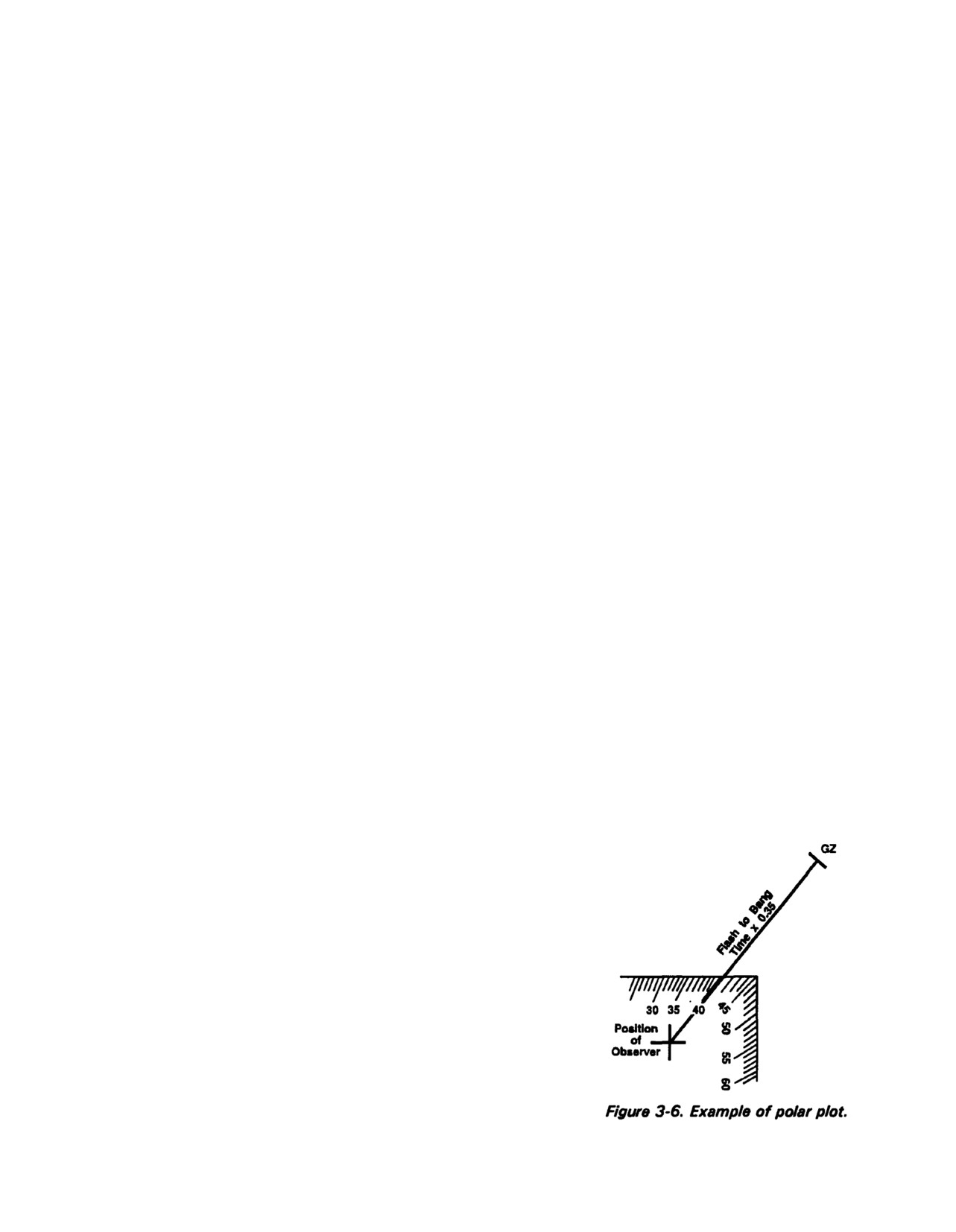
At unit level, GZ is located in either of two ways. For
small yield weapons, direct observation may provide actual
GZ location. Units do not, however, reconnoiter for the
GZ location. The other method used at unit level is called
the polar plot (see Figure 3-6).
Unit commanders are interested in obtaining a gross fix
on the GZ location. This enables rapid evaluation of the
burst to estimate the situation. Polar plot techniques are
baaed on flash-to-bang time and the speed of sound (350
meters per second or 0.35 kilometers per second). The
NBC defense team makes an approximation of the distance
between GZ and the observer, in kilometers. They multiply
the flash-to-bang time (data on line item Juliet of the NBC
1 report) by 0.35 kilometers per second.
Distance between GZ and observer = flash-to-bang time
(sec) x 0.35 km/sec
3-5
FM 3-3-1
Once this distance has been established, perform the
azimuth to grid azimuth. This information is found on line
following four steps:
item Charlie of the NBC 1 report.
Step 1.
On the situation map, plot the observer location.
Step 3.
Draw this azimuth to the length previously
This is line item Bravo on the NBC 1 nuclear report.
calculated as the distance between GZ and the observer.
Step 2.
Using a protractor, mark the azimuth from the
Step 4.
Read the grid coordinates of the place where the
observer position to the attack location. Convert magnetic
azimuth line in Step 3 ends. This is an approximate plot of
the GZ location.
Yield Estimation
that the use of nomograms will be difficult in most cases.
On Shore
Few, if any, units will have sufficient personnel to dedicate
Only higher headquarters will have classified intelligence
to an NBCC-type mission. Commanders at these levels
data that can be used as a comparison tool for resolved
need only an approximate yield value for entry into the
yield. Also, unit-level work conditions will be so varied
broad yield groups of
the effective downwind message.
3-6
FM 3-3-1
This message is used for the simplified fallout prediction,
cloud-top angle of 80 degrees with a flash-to-bang time of
discussed in detail later in this chapter. In any case, the
120 seconds is a large cloud very far away. This time the
apparent accuracy of the yield estimation nomograms is
calculator shows a yield of 0.02 kiloton, but the actual
unnecessary.
yield is greater than 10,000 kilotons.
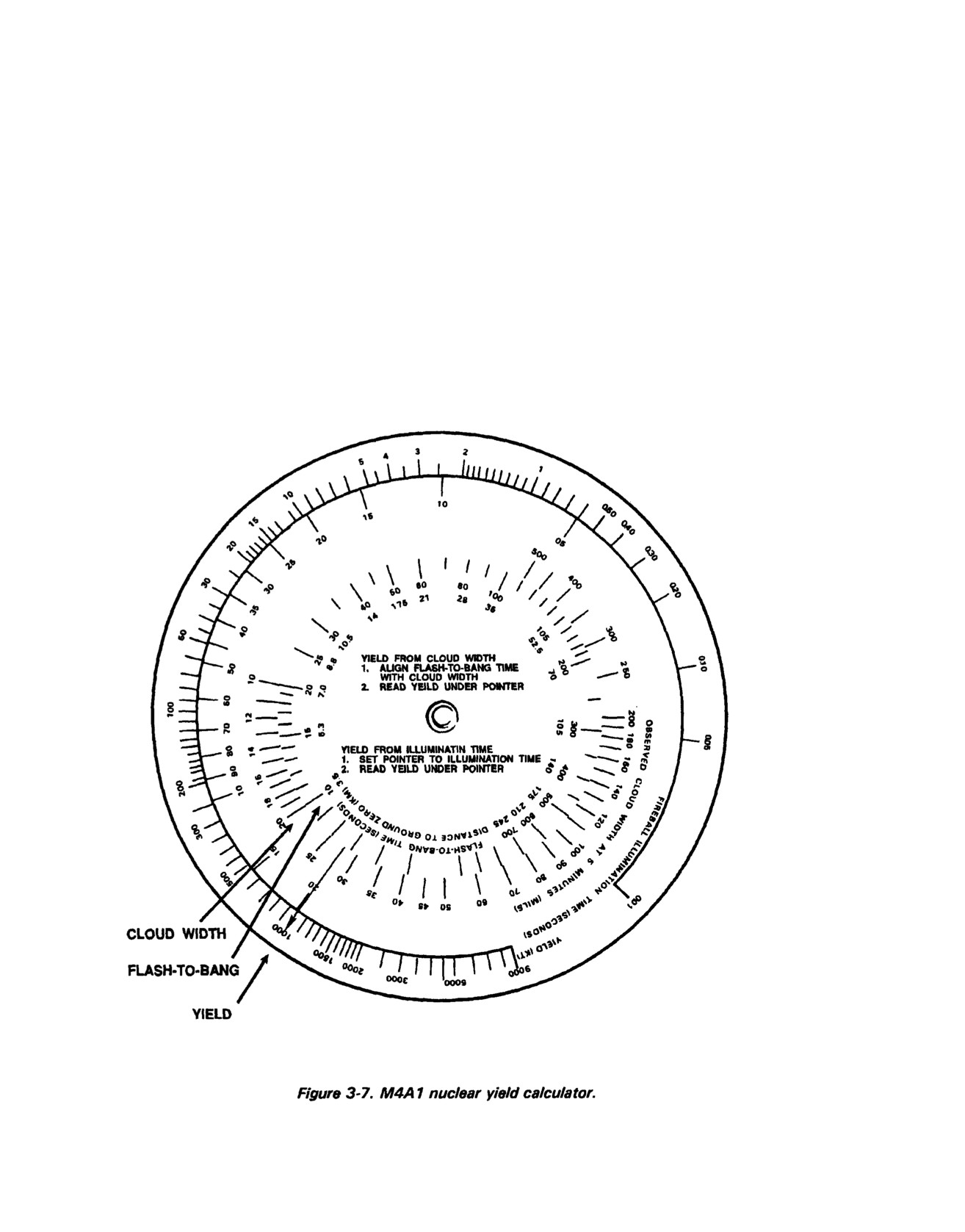
The M4A1 nuclear yield calculator (Figure 3-7) is
The M4A1 calculator is a rapid yield-estimation method
designed to provide rapid yield estimation based on any
designated specifically for unit level use. Its durability,
parameter except cloud-top or cloud-bottom height. This
size, and ease of operation make it the most suitable
calculator is a part of the M28A1 RADIAC calculator set,
method. All members of the unit NBC defense team are
NSN 6665-01-130-3616. Instructions for use of the M4A1
trained in its use. Nomograms are not used at unit level
calculator are on the instruction card in the set. This card
because of adverse conditions.
also provides check problems. Upon receipt of the M4A1
The GZ location and estimated yield calculated at unit
calculator, the user should solve the example problem on
level are used to create a simplified fallout prediction.
the instruction card. If the calculator will not solve the
Upon receipt of the NBC 2 report from the NBCC, the
example problem to within the specified tolerance, it must
original simplified fallout prediction is revised, using the
be destroyed and a new one obtained. Complete operating
new data. When the NBC3 report is received, it supersedes
instructions for the M4A1 are in TM 3-6665-303-10.
the revised simplified fallout prediction. This approach
There is one problem with the M4A1 calculator of which
allows the unit commander to make estimates and decisions
the unit NBC defense team must be aware. The calculator
based upon the best available information at that time.
is a round nomogram with a fixed hairline. Because of this,
there are situations in which the yield pointer may go off
Onboard Ships
scale on the high or low ends of the yield scale. Additional
burst information should clarify unexpected yield estimates
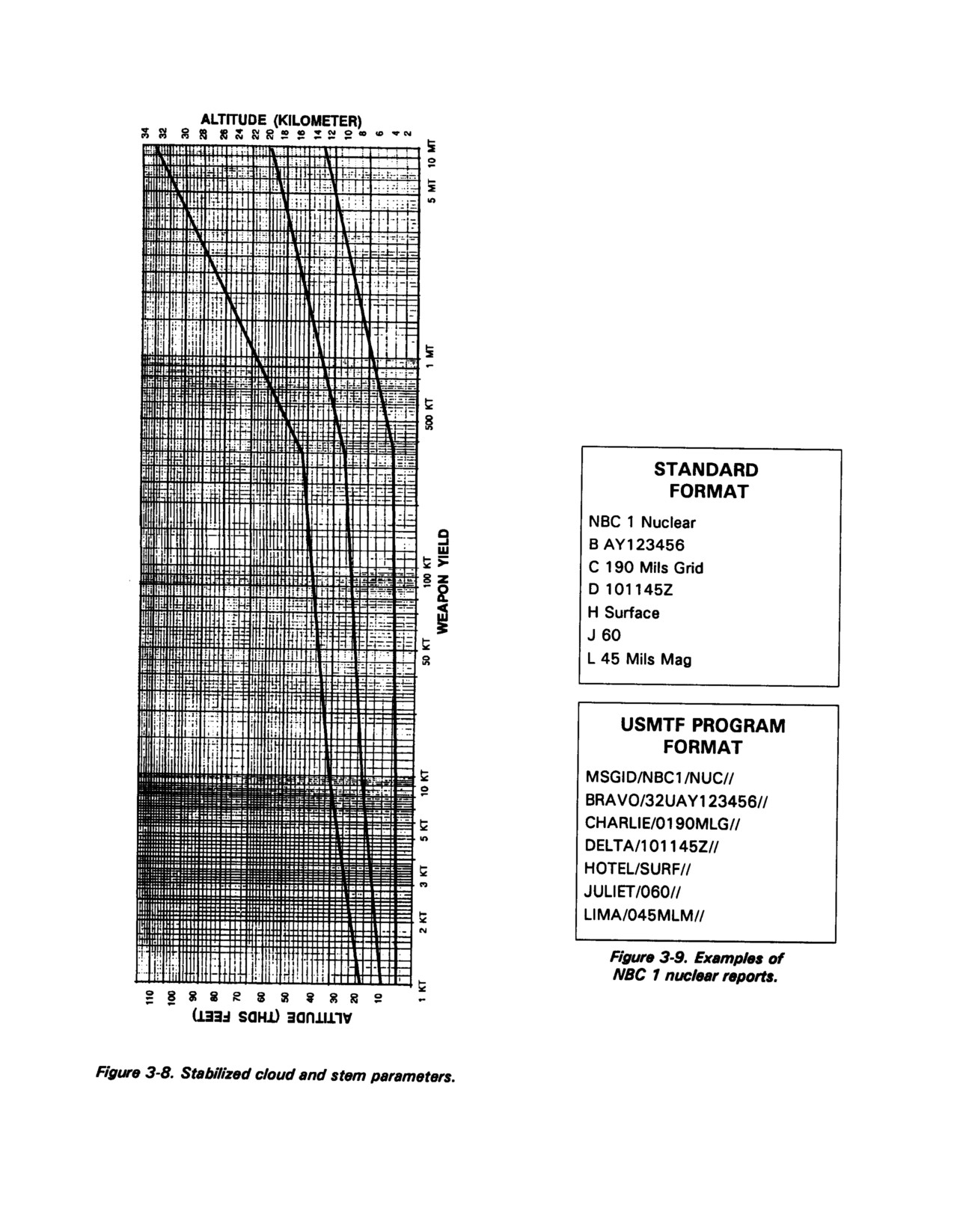
If stabilized cloud-top height or cloud-bottom height can
not consistent with the use of tactical nuclear weapons.
be measured, then Figure 3-8, next page, maybe used to
Familiarity with the calculator and an understanding of the
estimate the yield. Line up hairline with information given
size of a nuclear cloud in relation to the observer-GZ
on line Mike, (convert from meters or feet to kilometers or
distance (flash-to-bang time) will eliminate these problems.
thousands of feet.) Pin down where hairline crosses line in
For example, a nuclear cloud is 20 roils wide.
graph. Then plot so hairline is parallel. Read weapon yield
Flash-to-bang time was 10 seconds. This is a small cloud
on bottom of graph. When cloud-top or cloud-bottom
that is very close to the observer, indicating a small yield.
parameters are not available, ships will have to use the
The calculator shows a yield of 1,000 kilotons, but the
methods described in the preceding paragraphs for ground
actual yield is less than 0.02 kiloton. Conversely, a nuclear
forces.
Significance of Fallout Ashore Versus at Sea
The detailed and simplified procedures for fallout
ships will be particularly interested in the determination of
prediction are intended for use by all three services. The
the approximate area where fallout will reach the surface at
predictions are based on assumed land surface bursts. It is
a given time after burst.
recognized that the fallout from a sea surface burst may be
Ships with a meteorological capability maybe able to
different, but very little direct information is available on
obtain the required meteorological data for computation of
fallout from bursts on the surface of deep ocean water.
effective downwind, using standard pressure level winds.
It also must be stressed that the sea acts as an absorbent
Basic wind data for this purpose are generally available
of and shields against radioactive products. But, these
also from meteorological sources (airbases, meteorological
products may remain a hazard on land until they have
ships, or mobile weather stations).
decayed.
Ships which do not have a meteorological capability will
Another important difference is that recipients of
normally predict fallout areas by using the simplified
warnings ashore do not have the mobility of ships at sea,
procedure. Fallout prediction and plotting of fallout areas
and in most cases must deal with the hazard. Therefore,
on board naval ships is discussed in this chapter.
Flash-to-Bang Time
At the instant of the blue-white flash, cover eyes, hit the
wave or bang. Make a mental note of the count on which
ground, and start counting slowly—1,000 and 1, 1,000 and
the shock wave arrives (for example, 1,000 and 4). If the
2, 1,000 and 3, and so on-until the arrival of the shock
observer has a watch and can note the exact time (in
3-7
FM 3-3-1
3-8
FM 3-3-1
seconds), the watch can be used to record the flash-to-bang
shock waves—one blowing in one direction, and the other
time. This data is entered as line item Juliet on the NBC 1
blowing a few minutes later in the opposite direction. If the
nuclear report. Remain where you are until debris has
bang is-not heard in five minutes (a count of 1,000 and
stopped falling. It must be noted that there will be two
300), continue with other measurements.
Type of Burst and Time of Attack
After the second shock wave has passed, uncover your
and it connects with the cloud, record “surface” as line
eyes, and read the watch to the nearest minute. This data is
item Hotel. When the cloud does not match any mental
entered as line item Delta of the NBC 1 nuclear report.
image for air or surface, record “unknown” as line item
Observe the developing cloud to see if the burst was an
Hotel.
airburst by noting the shape and color of the cloud or the
“Unknown” also may be recorded whenever the attack
absence of a stem. If the cloud is lighter in color than the
occurs at night. A subsurface burst is recorded as
stem, or if the stem is ragged or broken (does not solidly
"surface,” only if the detonation ruptures the surface. This
connect with the cloud), record “air” as line item Hotel of
data also is recorded on line item Hotel.
the NBC 1 nuclear report. If the stem is thick and dark,
Recording and Reporting Nuclear Burst Data
Each unit, designated and nondesignated, uses the data to
The NBC 3 report will follow later. The NBC 3 report is
locate GZ and estimate the yield. Polar plot techniques are
more accurate and supersedes all simplified predictions.
used to locate GZ. Yield is estimated with the M4A1 yield
Examples of nuclear burst reports are shown in Figure
calculator. GZ and yield are used with the effective
3-9. These reports follow the standard NBC 1 nuclear
downwind message to make a simplified fallout prediction.
report format. These examples in no way limit the variety
Effective downwind messages and simplified fallout
of reports. Further, unit NBC defense teams are not
predictions will be explained later in this chapter. This
confined solely to the use of the line items in these
prediction is used until the NBC 2 report is received. Then
examples. Other line items may be added at the user’s
the simplified fallout prediction is revised and reevaluated.
discretion.
Evaluating Data
Data evaluation consists of locating GZ, estimating the
data gathered by one unit. Methods of calculation are
yield of the weapon, confirming the date-time group of the
simple and abbreviated. These reports also contain other
burst, and assigning a strike serial number. It is performed
data. Unit-level estimations are never transmitted to higher
at the NBCC. If the unit level establishes a serial number,
headquarters.
it will only be for that unit’s use and never transmitted
The NBCC is responsible for the NBC 2 report. This
higher.
report reflects the
GZ
location, yield, and other data that
All calculations of GZ locations and yields developed at
the entire command will use for fallout predictions. This
unit level are estimates. These calculations are based on
ensures that all units will make the same fallout prediction.
NBCC Procedures
NBCC techniques compare the data from many sources.
Date and Time of Attack
Much of this data is not available to any one unit. Only the
NBCC is authorized to assign strike serial numbers. This is
The date and time of the attack are always reported. The
generally from a block of numbers assigned to the division
time zone used is specified by FSOP/OPLAN/OPORD or
by corps. This block of serial numbers is usually listed in
is contained in other instructions. The NBCC conducts
FSOP/OPLAN/OPORDs. The serial numbers usually
time checks with designated observers and converts all
identify the corps, division and/or brigade areas, and the
times to Zulu time.
number of the strike.
3-9
FM 3-3-1
Bravo. Line item Bravo must be encoded if using an
Ground Zero Location
unsecure radio net. Therefore, these observer locations
At the NBCC, GZ location is always located before the
may have to be decoded prior to actual plotting.
yield is estimated. The NBCC uses several methods and
Step 2.
Determine each azimuth to be plotted. (This
data sources to locate GZ. Some of these methods are plots
information is at line item Charlie.) Convert all magnetic
of intersecting azimuths, radar reports, and aviator reports.
azimuths to grid azimuths. Using a protractor, mark each
If line item Foxtrot (actual) data on the NBC 1 report is not
azimuth from each observer position. Draw each azimuth
available, other methods are used to confirm this data.
to the distance necessary for them to intersect.
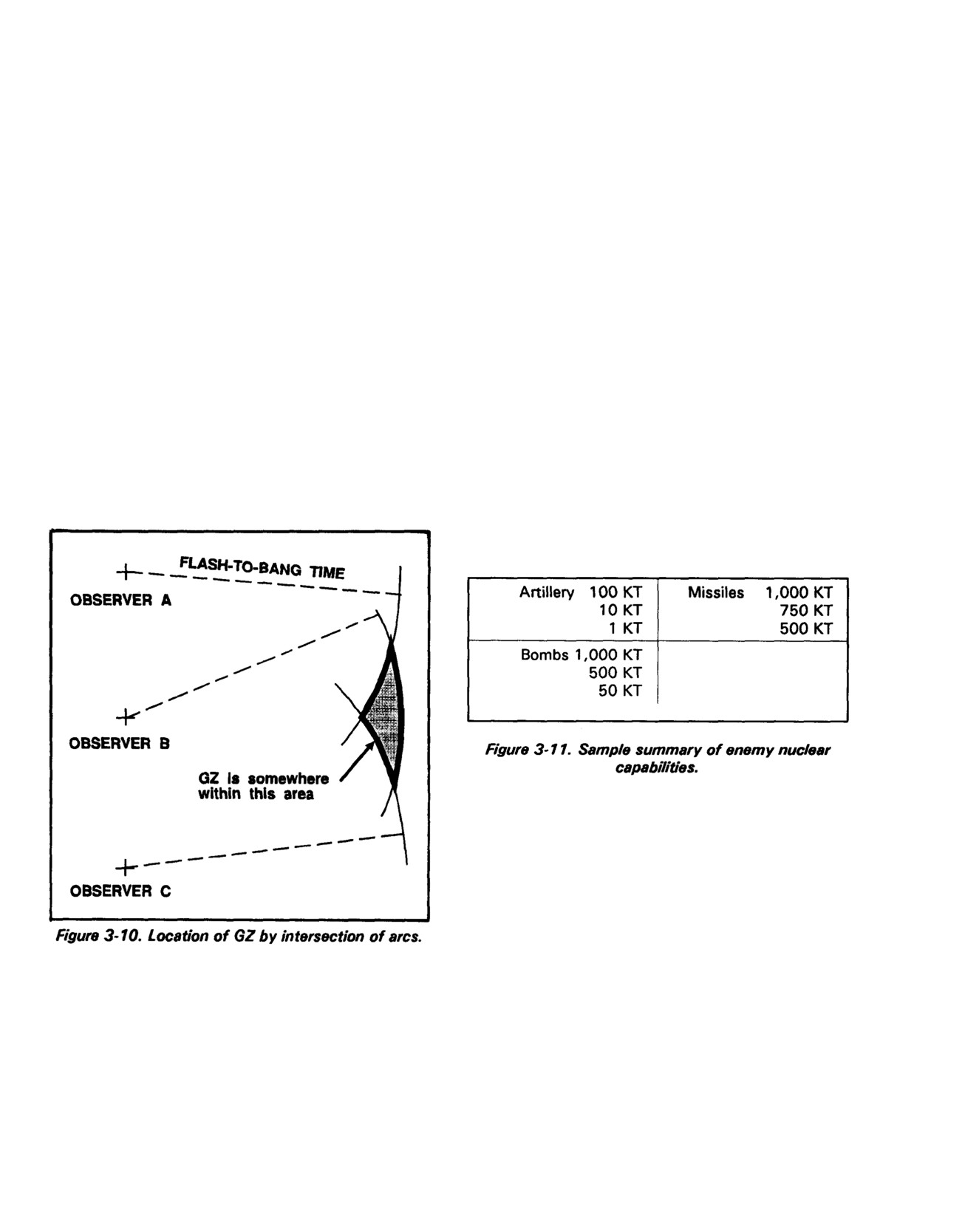
When azimuth data are incomplete, arcs for radii of
Step 3.
Post any data that assists in the &termination of
flash-to-bang distances from two or more observers can be
GZ location (such as, radar reports and pilot reports).
used. The NBCC can request NBC 1 reports from
Step 4.
Evaluate the data. The result of intersecting
nondesignated units to supplement data from designated
azimuths is an estimation of GZ location. GZ location is
units.
reported on the NBC 2 report at line item Foxtrot,
Combinations of azimuths and radii of flash-to-bang
qualified with the word “estimated,” unless Foxtrot
distances also can be used. This is done by multiplying
(actual) information is used in the determination. Line item
flash-to-bang time submitted on NBC 1 reports by the
Foxtrot must be encoded if using an unsecure radio net.
speed of sound (0. 35 kilometers per second) to determine a
In using this summary, the NBCC compares the
distance. Once the observer location has been plotted, the
estimated yield with known enemy yields. The estimated
flash-to-bang time distance can be drawn as an arc. If
yield and other intelligence sources, such as delivery
several arcs can be drawn, a gross fix of GZ can be
means, depth of the attack from the front line of troops,
determined. This is the most accurate method to estimate
type of burst, and other circumstances concerning the
the location of GZ. See Figure 3-10.
attack, will indicate which known enemy yield was actually
used. Only this resolved yield is reported to field units. A
simplified summary of enemy nuclear capabilities is shown
in Figure 3-11.
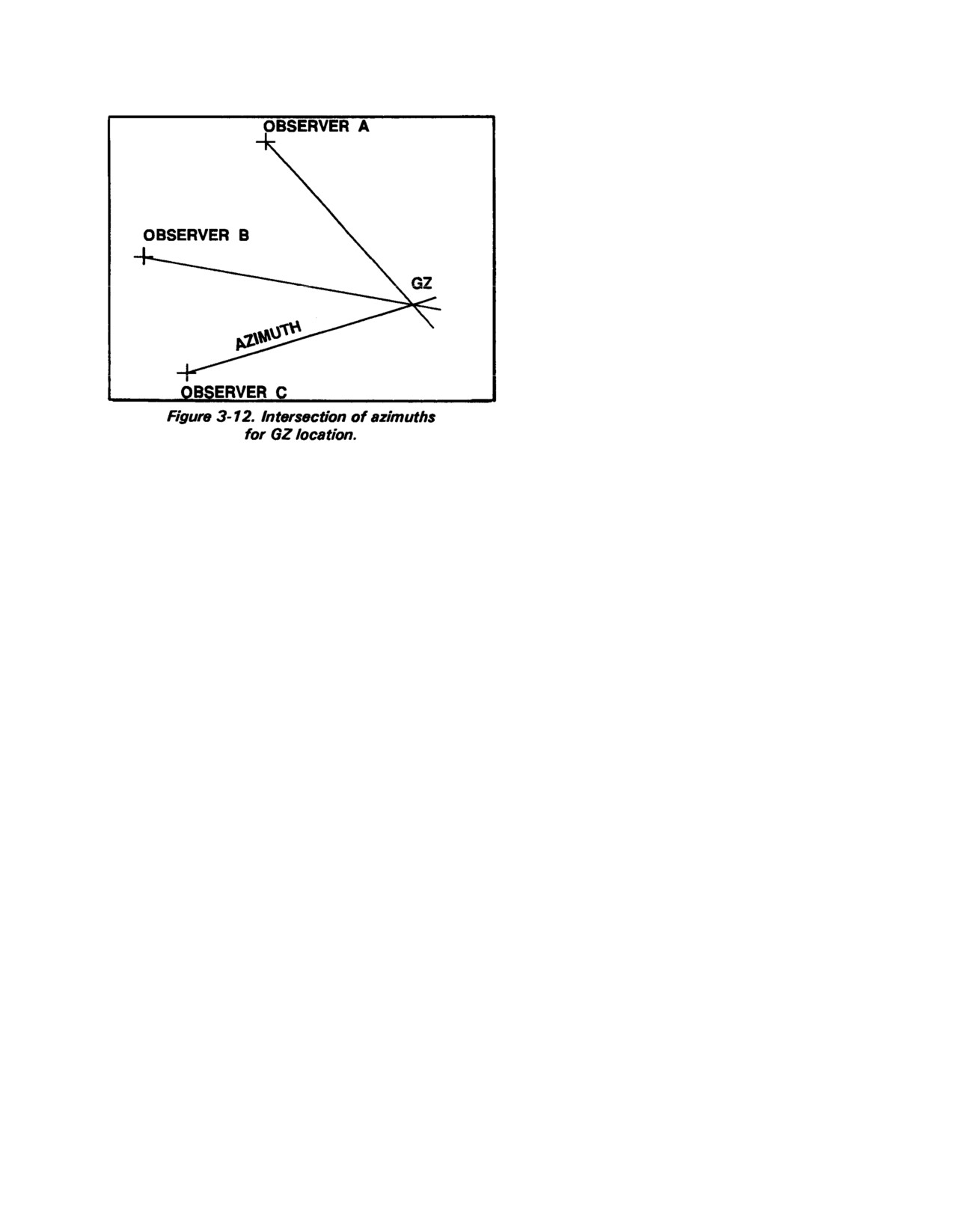
Disregard azimuths that do not intersect with other
azimuths. Whenever azimuths do not cross to form a clear
GZ location, the center of the plot is taken as GZ location.
The NBCC will request exact GZ coordinates from
aviation assets when aviation missions permit. Figure 3-12
shows an intersection of azimuths for GZ location.
Another GZ location technique involves the use of line
item Papa Alfa. Some air defense artillery radars have the
ability to paint an outline of the nuclear cloud on radar
scopes. The radar operator can determine coordinates of
H+5 minutes after burst, which outline the stabilized
The principal GZ location method is a plot of
nuclear cloud as if it were viewed from the top. These
interseting azimuths sent by designated observers. (This
coordinates may be sent as UTM coordinates. Coordination
information is found on line item Charlie of the NBC 1
between the NBCC and the unit that sends radar data is
reports.) To locate GZ using a plot of intersecting
required. This coordination must establish precedence of
azimuths, follow these four steps:
the report and communication channels to be used.
Step 1.
On the operations map overlay, locate and mark
Upon receipt of the data at the NBCC, the coordinates
the position of each observer unit, using data at line item
are plotted on the map, and the cloud contour is drawn.
3-10
FM 3-3-1
distance in kilometers between GZ and the observer. The
left-hand scale is the yield in kilotons (KT).
To use this nomogram, place a hairline from the point on
the right-hand scale (representing the nuclear burst angular
cloud width at H+5 minutes) through the point on the
center scale (representing the distance between GZ and the
observer). Read the yield where the hairline crosses the
yield scale.
For example, a plot of designated observer positions and
reported azimuths has been made. Observer A reported a
nuclear burst angular cloud width on line item Lima of 280
mils. The distance between observer A and GZ is 21
kilometers. To estimate the corresponding yield by using
the nomogram, use a hairline to connect 280 roils on the
right-hand scale with 21 kilometers on the center scale.
The point of intersection of the hairline and the left-hand
scale, is a yield of about 50 kilotons.
Stabilized Cloud-Top
The center of the outline is the GZ location. If the
or Cloud-Bottom Height
measurements are taken at H+5 minutes after burst, there
is a high assurance that GZ has been accurately fixed. This
Cloud-top or cloud-bottom height, when stabilized, can
GZ location technique is most valuable at night or when
be closely measured by pilots in jet aircraft. The NBCC
observer data cannot fix GZ location with 90 percent or
must coordinate with liaison officers to have airmail in the
greater assurance.
area determine this height. Height can also be measured by
some ADA radars. Measurements, in meters or feet above
the earth’s surface, must be made at H+10 minutes. Data
Yield Estimation
are reported on line item Mike.
Before the yield can be estimated, you must know the
NBCC members use the nomograms in Appendix E
location of GZ and the position of the observer when the
(Figure E-3) to correlate these measurements with yield.
cloud measurements were taken. Rather than require field
Distance between GZ and observer is not required.
personnel to solve complex formulas, the nuclear burst
The extreme left and right scales on the nomogram are
parameters are presented in nomograms. Each is an
yield in kilotons (KT) and megatons (MT). The scale
independent means of estimating yield. Emphasis is on
second from the left is the cloud-top height at H+ 10
estimating the yield. All nomograms are designed to
minutes in thousands (103) of meters or feet. The scale
provide approximate yields.
third from the left is the cloud-bottom height, also at
Flash-to-bang time (line item Juliet) is not used at NBCC
H+ 10 minutes. It, too, is graduated in thousands of meters
level for yield estimation, except as a last resort. This
or feet. The other scales on the nomogram (two-thirds stem
information is usually regarded as unreliable because of the
height, cloud radius, and time of fall) are not used in yield
stress associated with slow counting immediately after an
estimation. These scales are used in detailed fallout
attack. Instead, the NBCC uses the distance (in kilometers)
prediction.
between GZ and the observer. Plotting this data
To use the nomogram, determine stabilized cloud-top or
(intersecting azimuths) represents the best method of
cloud-bottom height from line item Mike of NBC 1 reports
determining the distance between GZ and observer
or as reported by pilots through liaison officers. Place a
location. Flash-to-bang time is used for yield estimation
hairline directly over the reported data and pin the hairline
only when azimuth information is not reported or is
to the nomogram. Pivot the hairline until it crosses the
incomplete.
outside yield scales at the same value. This value is the
estimated yield.
For example, a cloud-bottom height of 21,000 feet has
Nuclear Burst Angular Cloud Width
been reported. To estimate the corresponding yield, place a
NBCC members use the nomograms in Appendix E
hairline on the mark representing 21,000 feet (21) on the
(Figure E-5) to determine yield, based on the nuclear burst
third scale from the left. Pin the hairline and pivot it about
angular cloud width, and distance between GZ and the
this axis until equal values are read on the extreme left and
observer. The right-hand scale is the nuclear burst angular
right yield scales. Read a yield of 10 kilotons.
cloud width in roils and degrees. The center scale is the
3-11
FM 3-3-1
the point of intersection of the hairline and the left-hand
Stabilized Cloud-Top or
scale, read the yield. If cloud-top angle was used on the
Cloud-Bottom Angle
center scale, read yield on the right side of the left-hand
scale titled yield-cloud top (km). If a cloud-bottom angle is
The NBCC uses the nomogram in Figure E-4 in
used, read the yield on the left side of the left-hand scale
Appendix E to find yield, given the distance between GZ
titled yield-loud bottom (KT).
and the observer, and either the stabilized cloud-top angle
or the cloud-bottom angle. The right-hand scale gives the
For example, a designated observer reports an angle to
distance in kilometers from GZ to the observer and the
cloud bottom (line item Mike) of 200 mils. Distance
between GZ and this observer is 42 kilometers. Place a
fIash-to-bang time in seconds counted by the observer. The
hairline from 42 kilometers on the right-hand scale through
center scale is the cloud-top or cloud-bottom angle in roils
200 roils on the left side of the middle scale. Read the yield
or degrees. The left-hand scale is actually two scales. The
left side of this scale lists the yields to be read when using
as 55 kilotons on the left side (cloud bottom) of the
the cloud-bottom angle; the right side of this scale lists the
left-hand scale. This yield calculation is only a field
yields to be read when using the cloud-top angle.
estimate.
To use this nomogram, place a hairline through the point
If an observer reports cloud-top and cloud-bottom
on the right-hand scale representing distance between GZ
angles, use both in the yield estimate. Each angle will
and the observer and through the point on the center scale
result in a different yield. Use the average of the two
representing either the cloud-top or cloud-bottom angle. At
yields.
Yield Estimation From Radar Data
When nuclear attacks occur at night, measurements of
To estimate yield, the NBCC measures the radius of the
cloud parameters may be impossible. Under these
outline of the cloud and consults Table 3IV-1 in Chapter 3
conditions a good yield estimate can be made by the NBCC
of FM 101-31-2 (S). This data is classified and beyond the
if data from radars are available at line item Papa Alfa of
scope of this manual. Yield can be confirmed by entering
the NBC 1 nuclear report. A plot of this data will outline
the nomogram in Figure E-3 with cloud radius, and check
the nuclear cloud at its point of maximum lateral growth.
the yield, or vice versa.
Illumination Time
During the hours of darkness or poor visibility, yield
the intense light has faded. An observer in a foxhole can
may be estimated from the measurement of illumination
look at the floor of the foxhole. Counting procedure is the
time. Use this method only when it is impossible to obtain
same as that for flash-to-bang time. The person counting
cloud parameters as previously discussed. This yield
illumination time stops counting when the light begins to
estimation method only gives an estimate on the order of a
fade. The individuals specifically tasked by unit SOP to
factor-of-ten. In other words, a yield estimate of 20 KT
count illumination time must be trained to do so. Quick
could be as low as 2 KT or as high as 200 KT.
reflex action and presence of mind are required. Table 3-1,
Under no circumstances should the observer look
next page, shows rough estimates of yield, using
directly at the fireball. This will cause permanent damage
illumination time.
to the eyes. Observers can sense, with eyes closed, when
Resolved Yield
Each of the yield estimation techniques is presented in
The actual yield reported to the field units is called the
order of decreasing reliability, with results in approximate
resolved yield. To determine the resolved yield, the NBCC
yields. There also will be occasions when the data from
maintains a summary of enemy nuclear capabilities. This
several observers, concerning a single attack, will not
summary may reflect or&r-of-battle, delivery units, and
result in the same yield. Estimates for each strike are
known yields. This data is determined from G2 and other
averaged. The yield determined from nomograms is the
intelligence sources. FM 101-31-2(S) also offers data on
mid-point of the process. Again, this is an approximate
enemy yields and delivery systems.
yield.
3-12