FM 3-3-1 Nuclear Contamination Avoidance - page 2
FM 3-3-1
are assumed to be in one of three vulnerability categories
overpressures sufficient to cause severe injury from
and exposed to one of three levels of risk.
decelerative tumbling or lung damage.
Personnel in Foxholes.
This term refers to personnel in
1.8-meter-deep open foxholes, each with a 0.3-meter-firing
Vulnerability Categories
step. Blast overpressures of 296 kilopascals (kPa) (43 psi)
Unwarned, Exposed—Personnel
standing in the open at
cause lung hemmorage, which is the blast injury
time of burst, but drop to prone position before the blast
mechanism for producing casualties to personnel in
wave arrives. They may have areas of bare skin exposed to
foxholes. Nuclear radiation radii is computed, using
direct thermal radiation and may suffer temporary loss of
foxhole transmission factors. Foxhole collapse is no longer
vision. This category also applies to civilian personnel in
considered the governing casualty producing effect.
open areas.
Personnel in Tanks.
Severe damage to tanks was used
Warned, Exposed—Personnel
prone on open ground,
to find blast radii for casualties to personnel in tanks.
with all skin areas covered, and with an overall thermal
Nuclear radiation radii were computed, using transmission
protection at least equal to that provided by a two-layer,
factors for medium tanks with radiation liners.
summer uniform. Troops have been warned, but do not
Moderate Damage to Wheeled Vehicles.
Although the
have time to dig foxholes.
term "wheeled vehicles” originally referred to 2-1/2-ton
Warned, Protected—Personnel
have some protection
trucks and l/4-ton vehicles other than WWII jeeps, it also
against heat, blast, and radiation. Protected categories
applies to HMMWV and other vehicles smaller than 2 tons.
include tanks, armored personnel carriers, foxholes,
weapons emplacements, and command posts and shelters.
Targeting Terms and Criteria
Risk Criteria
Definitions for Structures
Negligible Risk
—Largest radius corresponding to 1
percent casualties or 2.5 percent nuisance effects.
Severe Damage (Sev).
A degree of structural damage
Moderate Risk
—Largest
radius corresponding to 2.5
that precludes further use of a structure for the purpose for
percent casualties or 5 percent nuisance effects.
which it was intended, without essentially complete
Emergency Risk
—5
percent casualties (nuisance effects
reconstruction. Generally, collapse of the structure is
not specified).
implied.
Moderate Damage (Mod).
A degree of structural
damage to principal load-carrying members (trusses,
Nuclear Radiation Safety
columns, beams) and walls that precludes effective use of a
Negligible Risk
—50
cGy for previously unexposed
structure for the purpose for which it was intended, until
troops.
major repairs are made.
Moderate Risk
—70
cGy for previously unexposed
Light Damage (Lit).
A degree of damage that results in
troops.
broken windows, slight damage to roofing and siding,
Emergency Risk
—150 cGy for previously unexposed
blowing down of light interior partitions, and slight
troops.
cracking of curtain walls in buildings. Generally, structures
receiving light damage can be used as intended, with only
minor repairs and removal of debris.
Primary Targets
For personnel primary targets, the combined effects of
Definitions for Vehicles
blast casualties and radiation casualties are considered in
Severe Damage (Sev).
Damaged, nonfictional, very
coverage and effects tables. For materiel primary targets,
difficult to repair. At least one subsystem is nonfunctional
only blast is considered.
and not repairable.
Exposed Personnel.
Unless otherwise stated, this term
Moderate Damage (Mod).
Damaged, nonfunctional,
refers to personnel in the open, regardless of physical
repairable with special tools, skills, and parts. At least half
posture or uniform. Radiation casualties are determined
of all subsystems (engine, power-train, tracks, etc.) are not
based on free-in-air doses sufficient to cause IP (8,000
functional, but are repairable.
cGy), IT (3,000 cGy), or LL (650 cGy), as identified in
Table 1-1. Blast casualties are determined from
1-7
FM 3-3-1
Analysis of Friendly Unit Vulnerability
Two techniques to evaluate friendly unit vulnerability to
Recommending ways to decrease vulnerability or increase
nuclear detonations are (1) a technical approach (unit
protection if the estimated damage exceeds the acceptable loss
dispositions are compared with the effects of an expected
criteria established by the commander.
weapon yield), and (2) an operational approach (unit
dispositions are compared with targeting criteria used by
Visual Technique
the threat target analyst).
Outline the unit battle position on the tactical map. Using
a compass, a piece of plastic with the radius of vulnerability
Vulnerability Analysis
drawn to scale on it, or a circular map scale. Superimpose
The primary tool for analysing friendly dispositions is
the radius of vulnerability chosen from Table 1-2 or 1-3
the radius of vulnerability (RV). RV is the radius of the
over the target area.
circle within which friendly troops will be exposed to a
The GZ used for the analysis is the location that would
risk equal to, or greater than, the emergency risk criterion
result in the highest fractional coverage of the target.
(5-percent combat ineffectiveness) and/or within which
From this worst-case GZ and the appropriate RV, an
material will be subjected to a 5-percent probability of the
estimation of the percentage of casualties or materiel
specified degree of damage. See Table 1-2 or 1-3 version
damage that might result from an enemy nuclear strike may
of the RV table in FM 101-31-2, Chapter 15. The GZ for
be determined.
the RV is always assumed to be the point where detonation
Using the center point of the compass, template, or
will do the greatest damage to the friendly unit or
circular map scale as the GZ, choose the GZ that would
installation. Delivery errors are not considered.
result in the highest fractional coverage of the target area.
Analyzing the vulnerability of friendly dispositions and
Visually estimate the percent of the unit covered by the RV.
installations consists of—
If this fractional coverage yields unacceptable losses of
Determining the appropriate threat yields based on current
personnel or equipment, the commander must then make a
intelligence.
decision on how to best reduce this casualty rate. This may
Determining the disposition of personnel in friendly units.
be done by adding shielding as outlined in Appendix B,
Obtaining the appropriate vulnerability radii from the RV
erecting the vulnerability reduction measures outlined in
table.
FM 3-4, or highlighted later in this chapter. A tactical
Estimating fractional coverage for each target category, using
decision may also be made to reduce vulnerability.
the visual, numerical, or index technique. For the purposes
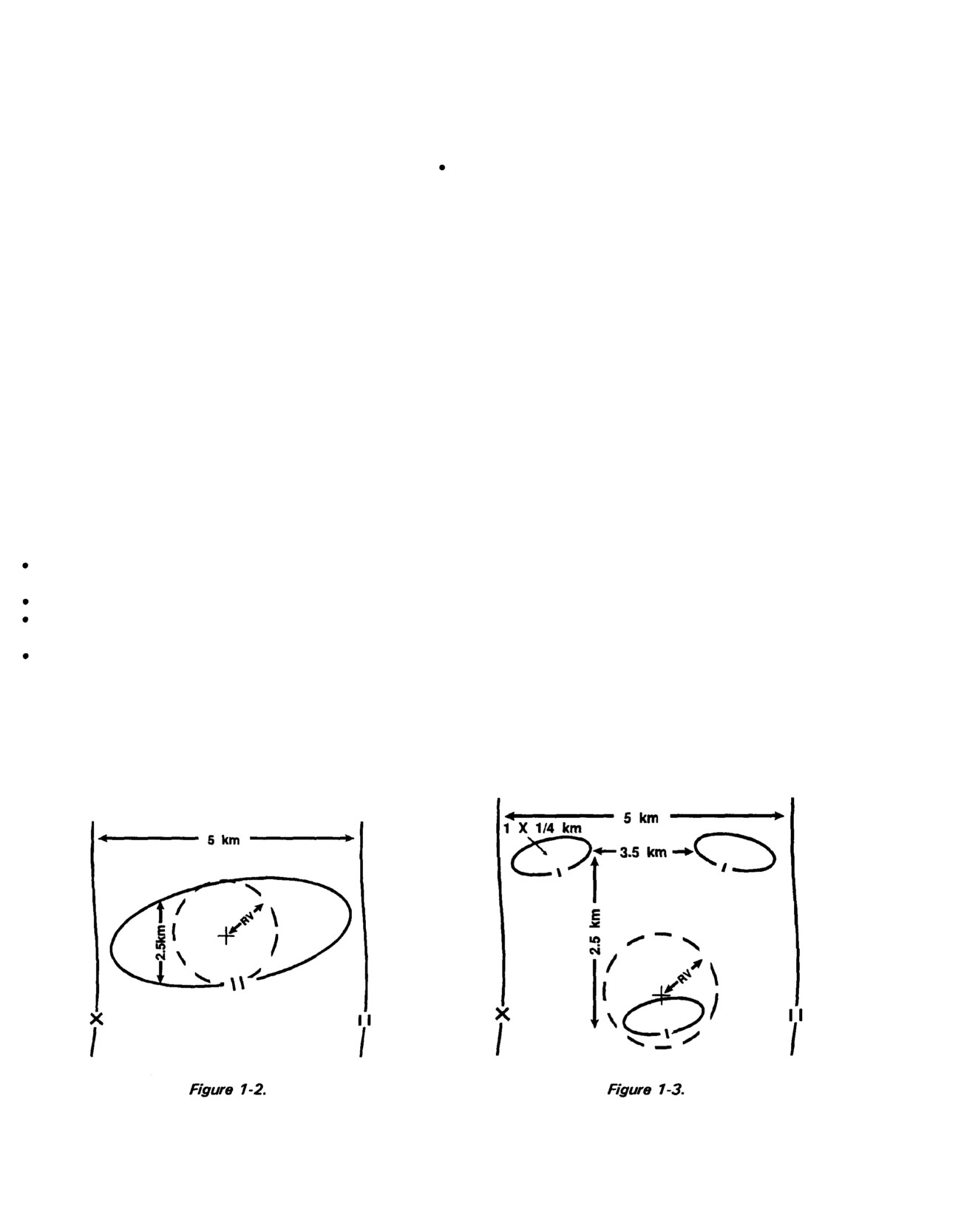
If a mechanized battalion occupies a battle position 5 km
of this discussion, the visual technique will be used. Although
wide, and 2.5 km deep, it could be positioned as in Figure
this technique is considered the least accurate, it is the easiest
1-2. Target elements are uniformly dispersed in the area.
method to use for the field commander. For additional
In this example, the RV or personnel in APCs to a 5-kt
information concerning the visual, numerical, or index, refer
weapon is shown with GZ at worst case. Since 50 percent
to FM 101-31-1, Chapter 4.
1-8
FM 3-3-1
of the battalion is covered by the RV of the 5-kt weapon,
When the estimated fractional coverage exceeds
then up to 50 percent of the battalion’s personnel in APCs
acceptable loss criteria, develop alternate courses of action
could become casualties. Obviously, the risk to a unit in
(COAs) to reduce the nuclear vulnerability of the friendly
this particular battle position is extreamly high.
unit or facilities by—
When the same battalion deploys in three company or
Dispersal
team battle positions in depth, the distances between
Increased protection
positions significantly reduce the damage, even assuming
Maintaining positions in close proximity to enemy forces
the weapon detorates at the optimum GZ. In Figure 1-3
Using passive measures such as operational sedcurity
although one company is 100 percent vulnerable, the
(OPSEC), deception, and/or camouflage.
battalion is only 33 percent vulnerable. Thus, one company
When mitigation actions are taken, reanalyze, using
may have up to 100 percent casualties, but the battalion
adjusted data.
may only have 33 percent casualties.
Vulnerability Reduction
Active measures prevent the enemy from using nuclear
Individual and unit collective measures are only discussed
weapons. Passive measures increase survivability.
briefly here. See FM 3-4 for detailed information.
Active Measures
Active measures are those taken to find and destroy
have the responsibility and sufficient assets for finding and
either the munitions or the delivery systems. Destruction of
destroying these targets.
delivery systems and munitions is the best method of
Corps and divisions do not have the capability to locate
reducing the chances of being attacked.
and destroy stockpiles or production facilities; but they do
The destruction of stockpiles of nuclear munitions and
have the capability to find and destroy delivery systems.
production facilities is usually beyond the capabilities of
Recon flights, counterbattery radar, and other intelligence
lower level commanders. Echelons above corps (EAC)
collection assets are used to find delivery systems, such as
long-range cannons and missile systems.
Passive
Measures
It is not possible to destroy all threat nuclear munitions
Plan Ahead
and/or delivery systems. Units must always take
precautions to avoid being targeted or to reduce the effects
Tasks take longer to perform in a nuclear environment.
of an attack if one does occur. These are passive measures.
Again, FM 3-4 contains tables to help commanders
All units must use passive measures as part of normal
estimate how long it takes to accomplish missions in a
operations to reduce the effects of operating under nuclear
nuclear environment. Commanders must take time to
conditions. These measures include—
carefully think out courses of action and allow for the
Plan ahead.
additional time requirement. This is commonly referred to
Avoid detection.
as wargaming. A bad decision could cause the unit to
Provide warning.
become needlessly contaminated or suffer casualties. Use
Maintain discipline.
the nuclear threat status for planning and stocking nuclear
H Seek protection.
defense equipment. Units must prepare to continue the
Disperse.
mission after a nuclear attack. Following an enemy nuclear
Remain mobile.
strike, commanders must quickly assess the damage and
Cover supplies and equipment.
reconstitute lost or weakened units.
Limit exposure.
Prevent spread of fallout.
Avoid Detection
Follow unit SOPs.
Camouflage.
Avoiding detection is the best way to prevent nuclear
attacks. Do this by employing good OPSEC measures.
These include camouflage, light discipline, and especially,
1-9
FM 3-3-1
signal security. Both active and passive measures must be
acceptable dispersion depends upon mission, enemy,
used to prevent the enemy from gaining target information.
terrain, troops, and time available (METT-T).
Use defensive electronic warfare; electronic
countermeasures (ECM) and electronic
Remain Mobile
counter-countermeasures (ECCM) to reduce the chances
of identification and location. In the nuclear environment,
Tactical mobility gives the commander the best chance
it is even more important that commanders consider
for avoidance. Constant movement prevents the enemy
displacing if detection and/or identification is suspected.
from pinpointing locations and accurately employing
nuclear weapons. However, the battlefield will be a
difficult place in which to maneuver. Contaminated areas,
Provide Warning
tree blowdown, urban rubble, fires, flooding, fallout, and
If the unit is unable to avoid a nuclear attack, early
craters are obstacles that must be dealt with. NBC recon
warning of battlefield hazards is very important. The
teams and the serving S2/G2 can provide useful
NBCWRS notifies units that adjacent units have been
information. The best source of information on mobility
attacked or that a downwind hazard is present. When no
routes, however, is the movement control center (MCC).
NBCWRS warning is received, periodic monitoring,
discussed later in this manual, is essential. Troops must be
Cover Supplies and Equipment
able to identify nuclear attacks and take appropriate
actions. NBC recon teams, using the NBC Reconnaissance
Store supplies and equipment under cover to prevent
System (NBCRS), alert moving units before they enter
contamination. Buildings offer excellent protection from
contaminated areas.
fallout. Field expedient methods are abundant.
NBC protective covers, tarpaulins, pallets, packing
materials, dunnage, and plastic (sheets, bags, and rolls) all
Maintain Discipline
can be used. Field expedient covers, especially canvas and
The unit must maintain discipline and confidence in its
cardboard, provide protection from fallout for a short
ability to survive and operate if it is to overcome the shock
period. Contamination seeps through all such covers;
of a nuclear attack and continue the mission. Commanders
however, NBC-PCs provide protection for up to 24 hours.
must be able to rely on their troops not to give up hope or
Units must replace covers as soon as possible after heavy
lose the sense of duty. Again, plan ahead. Use these plans
contamination. Although these covers may provide
whenever possible during unit training. Use the
protection against fallout, a contact hazard will remain
information contained in FM 3-4 to assist in developing
until the dust on the ground and on the protective cover has
unit plans.
decayed.
Seek Protection
Limit Exposure
Natural terrain may provide shelter from the effects of
All plans should include postattack procedures for
nuclear weapons. Ditches, ravines, and natural depressions
limiting exposure to radiological hazards. Amount of
reduce initial nuclear effects.
exposure is important. Every minute spent in a
Foxholes with solid overhead cover and shelters offer
radiologically contaminated environment increases a
good protection against nuclear weapons. However, any
person’s total radiation dose. Only personnel required to
overhead cover such as tents, tarpaulins, and ponchos offer
accomplish a mission are sent into a contaminated area.
at least some protection from fallout. Use NBC protective
Limit exposure with time. By waiting to enter a
covers (NBC-PCs) to protect equipment whenever possible.
contaminated area, the contamination level will decay and
with it the chance of exposure. Exposure can also be
accidental. Personnel may not know that equipment is
Disperse
contaminated. Usually, this can be prevented by always
Combat service support (CSS) installations and troops in
marking contaminated equipment. But there are places
compact assembly areas are vulnerable to nuclear weapons.
where nuclear contamination hazards can accumulate, such
Commanders must determine how much dispersion is
as air filters. All engines have air filters that trap nuclear
needed. Dispersion must reduce vulnerability but not
contaminants. These contaminants accumulate. So even if
hinder operations or prevent the unit from concentrating
the hazard area is small, it can be deadly. Persons working
when necessary. Supplies, especially food, POL, and
around equipment should be aware of hidden hazards.
ammunition, must be dispersed so they will not all be
Always dispose of contaminated collectors, such as air
destroyed at once. The more dispersed a unit is, the longer
filters, as contaminated waste.
it will take to do even routine tasks. The degree of
1-10
FM 3-3-1
contamination is present. Precautions or safety measures to
Prevent Spread of Contamination
take, when moving this equipment are—
Limiting the number of personnel and amount of
Notify the MCC of contaminated vehicles or contaminated
equipment in the area helps prevent the spread of
routes.
contamination. Make every effort to confine nuclear
Use as few transport vehicles as possible.
contamination to as small an area as possible. This begins
Use one route (especially around congested areas).
with monitoring to determine the amount and extent of
Monitor the route periodically for contamination.
contamination. It also reduces the amount of decon
Cover the material to keep contamination from being blown
required. Units moving from a contaminated area into a
onto the road. (Weigh the risk of ground contamination with
clean area should decontaminate at or near the edge of
the additional burden of decontamination/disposing of
contamination. Mark all contaminated areas, and report
potentially contaminated covering material).
them to other units to keep them from entering the
Warn personnel downwind if a vapor hazard is present.
contaminated area unknowingly.
Monitor and decontaminate transport vehicles before
Contaminated material presents additional problems to
transporting noncontaminated material.
limiting the spread of contamination. If the situation
Ensure transport crews wear protective masks to reduce the
permits, material can be left and allowed to decay. If the
hazard from airborne radioactive particles.
equipment is mission essential, it must be decontaminated
There may be instances in which contaminated material
on the spot or brought back to the rear and decontaminated.
or waste material must be disposed of or destroyed. Bury
If the situation permits, decontaminate as far forward as
the contaminated material. Burial is effective for all types
possible. If this is not possible, then material may have to
of contamination. Mark and avoid the area where
be transported to the rear for decontamination. If
contaminated waste is buried. Procedures for marking
contaminated material must be moved, keep in mind that
contaminated waste burial sites is outlined in FM 3-5. This
the amount of contamination transferred to the road
consists of submitting an NBC 5 nuclear report, outlining
network or ground surface is directly proportional to the
the contaminated waste burial site. However, this report
amount of contamination on the material, location of the
must be sent by the NBCC, so that line item Alpha, (strike
contamination, and type of surface on which the
serial number) may be assigned. The unit, therefore, that
closes the decontamination site must notify the NBCC.
1-11
FM 3-3-1
Chapter 2
NBC Warning and Reporting System
The primary means of warning units of an actual or
and type of hazard present. If the mission allows, affected
predicted nuclear hazard is the NBCWRS. It is a key in
units alter plans to avoid the hazard. Otherwise, the units
limiting the effects of nuclear attacks. The NBCWRS
upgrade protective measures and occupy or cross the
allows units to determine required protective measures and
hazard area. Units use the NBCWRS as battlefield
plan operations. Units take action depending on the mission
intelligence.
Standard
NBC Reports
The NBCWRS, to support radiological defense, consists
for acquiring the information and sending the report are
of five reports. Each is standardized by ATP 45/STANAG
discussed later in this chapter.
2103 and the US Message Text Format (USMTF). The
United States and its NATO, British, Canadian, and
Australian (ABCA) allies use the same message formats.
This improves the accuracy,
comprehension, and
interoperability of the system. It
also increases the speed of
dissemination and submission.
The five standard reports used to
exchange information are—
NBC l—initial report, giving basic
data compiled at unit level.
NBC 2—Report used for passing
evaluated data.
NBC 3—Report used for immediate
warning
of
predicted
contamination and hazard areas.
NBC 4—Report used for passing
monitoring and survey results.
NBC 5—Report used for passing
information on areas of actual
contamination.
The reports use standard
formats to shorten the message
being passed. The warning and
reporting system is based on a
code letter system. The meaning
and use of each letter used to
transmit an NBC message is
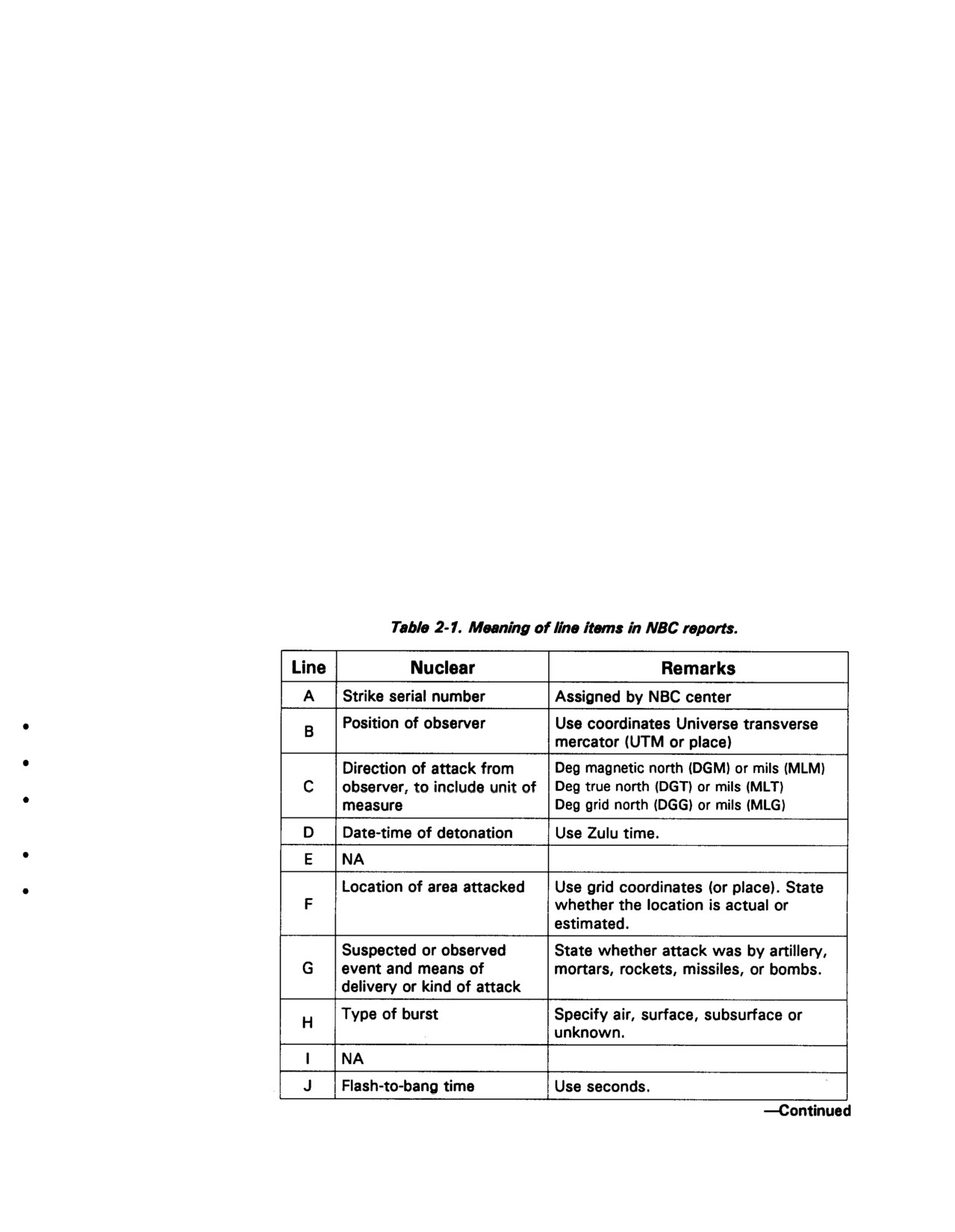
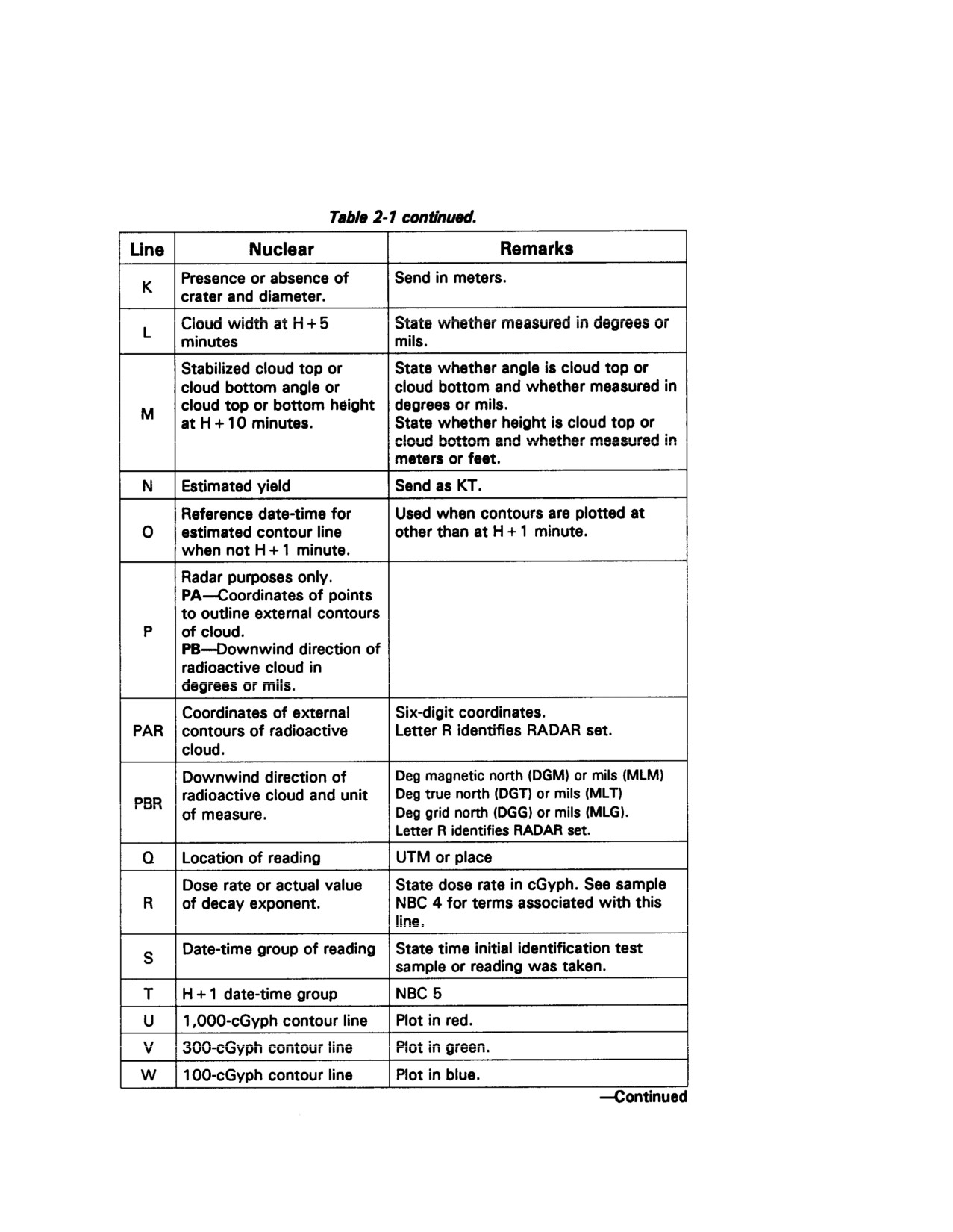
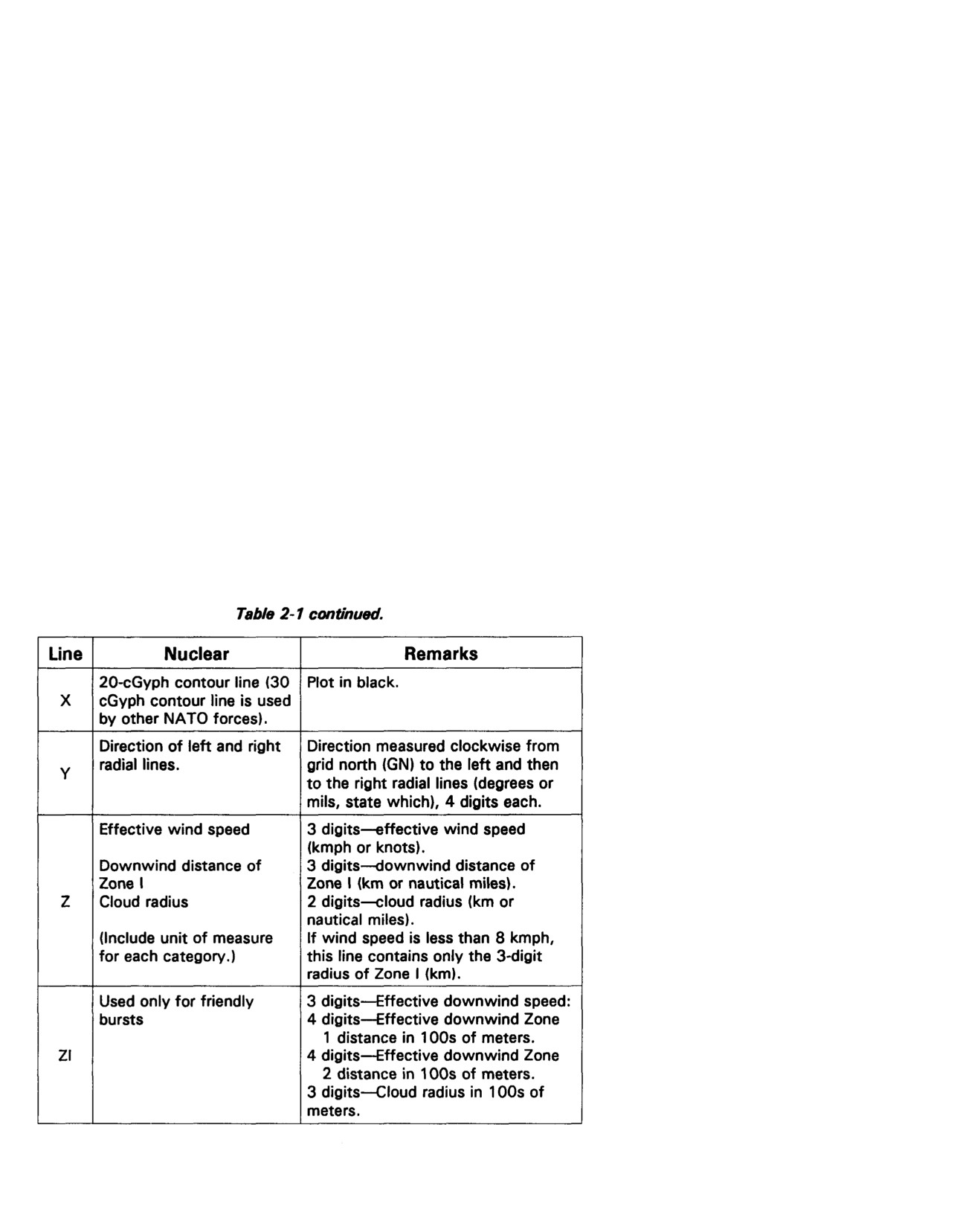
described in Table 2-1. The
following paragraphs describe
each report. Specific instructions
2-0
FM 3-3-1
data. All units must be completely familiar with the NBC 1
NBC 1 Report
report format and its information. The unit must prepare
The NBC 1 report is the most widely used report. The
this report quickly and accurately, and send it to the next
observing unit uses this report to provide nuclear attack
higher-headquarters.
Battalion and higher elements
decide which NBC 1 reports to
forward to the next higher
headquarters. If several reports
are received on the same nuclear
attack, then a consolidated NBC
1 report is forwarded, instead of
separate reports. This reduces the
number of reports to a
manageable level. NBC 1 reports
are not routinely passed to corps
or higher NBC centers (NBCC)
except fix the initial use report
Precedence of the NBC 1 report
depends on whether or not it is
an initial report. The initial use
report is FLASH precedence, all
others are IMMEDIATE
precedence.
Individuals identified by unit
SOP submit raw data to the unit
NBC defense team at
company/battery or troop level.
NBC 1 format should be used.
However a Size, Activity,
Location, Unit, Time, Equipment
(SALUTE) or Spot report may
also be used. And should be
submitted to the unit’s NBC
defense team. The unit NBC
defense team normally consists
of the unit chemical NBC NCO
(54B20) or an NCO that has been
school trained at an area NBC
defense two-week school, an
officer and an enlisted soldier
(corporal or above) who has
attended the same two-week
school. These soldiers will have
the special duties at unit level of
advising the commander on NBC
defense matters and formatting
NBC reports.
Normally, the unit NBC
defense team checks NBC 1
reports. This ensures that the
content of the report is known to
the commander or his or her
representative. It also ensures
that the report is in the proper
format and is as correct as
possible.
2-1
FM 3-3-1
All data observations are sent in a single, complete NBC
Personnel qualified to operate this equipment gather
1 report. Do not divide data into two parts to create a
data, such as azimuth to the attack from the observer,
subsequent report. NBC 1 reports are not used as attack
observer location, and cloud width at H+ 5 minutes, or
notification. They simply pass data. Separate procedures
cloud top/bottom angle at H+ 10 minutes. Aerial observers
must be developed for attack notification and are beyond
report cloud top/bottom height at H+ 10 minutes. If such
the scope of this manual. Attack notification may take the
equipment is not available to the unit, use the lensatic
form of a SALUTE, Spot, or Situation Report (SITREP)
compass to take measurements as accurately as possible.
report and should be addressed in detail in unit standing
If the unit is a designated observer unit, it may submit a
operating procedures (SOPs.)
subsequent NBC 1 nuclear report if new data concerning
The first time a nuclear weapon is used against US
actual GZ location or the presence or absence of a crater is
forces, the designated unit will send the NBC 1 report with
obtained. Nondesignated observer units should not submit
a FLASH precedence. Each intermediate headquarters will
subsequent reports unless requested. By choosing
forward the report with a FLASH precedence (or
designated observer units, the NBCC can limit the number
IMMEDIATE precedence, if a previous NBC 1 report has
of reports and ensure the accuracy of the reports received.
been forwarded). For the first NBC 1 nuclear report in the
Electromagnetic puke (EMP), transient radiation effects
brigade, use FLASH precedence. If the report is of a
on electronics (TREE), blackout, and an active enemy
second attack within the division, use IMMEDIATE.
electronic warfare threat will also take their toll on our
The observer determines the date-time of attack,
communications systems. NBC 1 reports will have to
flash-to-bang time, illumination time, type of burst,
compete with urgent requests for status and damage
location of (GZ) or azimuth to attack, and stabilized
information from the affected and nearby areas.
nuclear cloud measurements. Under conditions of limited
All reports from ground observers must contain line
visibility, the observer determines illumination time.
items Bravo (position of observer), Delta (date-time
Chapter 3 lists equipment needed to make necessary
group), Hotel (type of burst), and either Charlie (direction
observer calculations.
of attack) or Foxtrot (actual or estimated location of
attack). If line item Lima (cloud width) is reported, the
report must contain line items Bravo
and either Charlie or Foxtrot.
All reports from aerial observers
must contain line items Bravo
(position of observer) and Charlie
(direction of attack) or Bravo
(position of observer) and Foxtrot
(actual location of attack) if cloud
width (line item Lima) is reported.
Transmit only those line items of
the format for which data are
available. Use the word “Unknown”
only with line item Hotel (type of
attack).
Transmit line item Mike (cloud
top/bottom angle at H + 10) only
when data for line item Lima (cloud
width) cannot be obtained.
NBC 2 report
The NBC 2 report is based on one
or more NBC 1 reports. It is used to
pass evaluated data to higher,
subordinate, and adjacent units.
Division NBCC is usually the lowest
level that prepares NBC 2 reports.
However, brigade and battalion
NBC personnel may prepare the
NBC 2 report if they have sufficient
2-2
FM 3-3-1
data. However, these units will not assign a strike serial
where the hazard exists. If monitoring information is
number.
incomplete, a survey may be directed. Line items Quebec
Division NBCC prepares the NBC 2 nuclear report,
(date-time group of reading), Romeo (dose rate), and
assigns it a strike serial number, and disseminates it to the
Sierra (location of reading) are reported for a nuclear
appropriate units. Each subordinate unit then decides
hazard. These items are used as often as necessary to
whether to disseminate the report further. Subsequent data
complete the report. Other items may be included if
may be received after the NBC 2 nuclear report is sent. If
available and necessary to complete the report.
this data changes the yield or GZ location, send this data in
NBC 4 nuclear reports are normalized to H + 1 readings,
an NBC 2 nuclear update report. Use the same strike serial
as necessary, and plotted on the map. From this data a
number and date-time of attack. Line items Alfa (strike
contamination plot overlay is created. This overlay is sent
serial number), Delta (date/time group), Foxtrot location
to all units. Methods used to send the overlay to the field
of attack), Golf (means of delivery), Hotel (type of burst),
are, in descending order, computer data base update,
and November (yield) are always contained in the NBC 2
electrical facsimile, messenger, liaison officer, and the
nuclear report.
NBC 5 report. Chapter 5 contains examples of NBC 4
reports. In any case, NBC 4 reports will contain only
correlated data. The raw readings must be correlated and
NBC 3 Report
reflect the true hazard (outside) for that time.
Division NBCC uses the NBC 2 reports and the current
wind information to predict the fallout area. This is sent as
NBC 5 Report
an NBC 3 report. It is sent to all units that could be
affected by the hazard. Each unit plots the NBC 3 report
The NBC 5 report is prepared from the contamination
and determines which of its subordinate units are affected
plot. This report is last in order because it consists of a
and warns those units accordingly.
series of grid coordinates. Often this message must be sent
The NBC 3 report is a prediction of the fallout area. This
on FM radio nets. This requires lengthy transmission. The
prediction is safesided to ensure that a militarily significant
recipient is required to plot each coordinate and redraw the
hazard will not exist outside of the predicted hazard area.
plot. Line items Alfa (strike serial number), Delta
In other words, Zone I will represent areas where the dose
(date/time group), Foxtrot (location), Tango (H+ 1
rate will exceed 150 centigray per hour (cGyph) within 4
date-time group), or Oscar (reference time), Romeo (dose
hours; and Zone II is no more than 50 cGyph in 4 hours
rate), Uniform (1,000 cGyph), Victor (300 cGyph),
and less than 150 cGyph in 24 hours. Commanders should
Whiskey (100 cGyph), and X-Ray (20 cGyph) may be
use the report as battlefield intelligence when planning
reported for radiologically contaminated areas.
missions.
For most avoidance situations, only the outer boundary
When a unit is in a fallout area, the commander must
of the area is necessary. Complete details can follow later
decide whether to stay or move. This decision is based on
on the facsimile or messenger-delivered plot. Some
the mission, exposure status of the unit, and higher
contamination situations cannot be reported through use of
headquarters guidance. As the ANBACIS is improved, the
the NBC 5. These are areas of neutron-induced
commander will be able to view the modeled hazard area
contamination. These areas must be reported via the
on a computer screen instead of basing his decision on the
overlay.
safe-sided STANAG plots. This will provide a more
With the exception of line item Alfa, when a user has
realistic depiction of the hazard area. ANBACIS is
previously received data through other NBC reports, the
addressed in more detail later in this chapter.
data need not be repeated on the NBC 5.
The NBC 3 nuclear report (fallout prediction) is used to
For example, a unit receives an NBC 3 showing GZ
plan recon and survey operations. If time is critical, units
location (line item Foxtrot). The GZ location does not have
may also use it to plan operations. Lines Alfa (strike serial
to be reported on the NBC 5.
number), Delta (date/time group), Foxtrot (location of
The NBC 5 nuclear report is also used to transmit the
attack), Yankee (left and right radial lines), and Zulu
decay rate of fallout to field units. All units assume decay
(effective wind speed, downwind distance of Zone I, and
rate of fallout to be n = 1.2 until informed otherwise. The
cloud radius) are used for a nuclear hazard.
NBCC determines the decay rate and sends a report such
as the one below:
NBC 5 Nuclear
NBC 4 Report
A 52N002
When any unit detects NBC hazards through monitoring,
R 1.6
survey or reconnaissance, this information is reported
This message may be sent before or after a
using an NBC 4 report. Separate NBC 4 reports are
contamination plot has been received. Since decay rate of
consolidated and then plotted on the tactical map to show
fallout will decrease with time, the report could be sent
2-3
FM 3-3-1
several times during the period of interest for a
should include coordinates for the site and sump, so as to
contaminated area. The NBC 5 report is also used to report
notify other
units of the contamination area.
the closure of a decontamination site. The NBC 5 report
Managing the NBC Warning and
Reporting System
Managing the NBCWRS is crucial for the success of a
Monitoring, Survey,
command. To be useful, nuclear information must be
and Reconnaissance Data
collected, reported, and evaluated. Once evaluated, it can
be used as battlefield intelligence. Obtaining and
NBC 1 reports allow the NBCC to predict where the
converting nuclear information into usable nuclear
hazards will be. This prediction (NBC 3 report) is only an
intelligence does not just happen. The volume of
estimation of the hazard area. Feedback is needed from
information that needs to be collected and reported could
units to determine exactly where the contamination is
easily disrupt both communications and tactical operations
located.
if not properly managed. This section describes what
This feedback comes from monitoring, survey, and
information is available and how that information gets to
recon (NBC 4 reports). Monitoring and recon operations
the person or unit needing it.
give the initial location of NBC hazards to the NBCC.
Initial monitoring and recon reports are generally
Collecting Nuclear Information
forward through intelligence channels to the NBCC. This
information may also be sent to the NBCC by ANBACIS.
The first step in managing the NBCWRS is to determine
ANBACIS is the automated NBC information system and
what information is available and who is available to
is described later in this chapter.
collect it. Two types of data must be collected. Observer
The NBCC then plots the information on the situation
data provides information that a nuclear attack has
map. If more information is needed, the NBCC directs a
occurred. Monitoring, survey, and recon data provide
unit (picked because of its location and/or capability) to
information on where the hazard is located.
collect and forward the necessary data. This unit may be an
Every unit is responsible for observing and recording
organic company NBC defense team or an NBC recon-
nuclear attacks. But every unit does not automatically
naissance platoon from the divisional chemical defense
forward NBC 1 reports.
company.
Many units may observe a nuclear burst. But if every
Special operations forces will depend on special forces
unit forwarded a report, nothing would get through. For
operational detachments (SFOD) with attached LB teams,
this reason, selected units with equipment to make accurate
special forces group (SFG) Chemical detachments, or
measurements submit NBC 1 nuclear reports. These units
organic company NBC defense teams. The reconnaissance
are called designated observers. The division NBCC selects
platoon may be tasked organized to support a maneuver
designated observers and lists them in the FSOP/
brigade in NBC reconnaissance collection efforts. This
OPORD/OPLAN.
information could be from additional monitoring reports or
Additional units are selected during tactical operations
a survey of the area in question.
based on their physical locations. They are listed in the
Collecting nuclear information is a joint effort of units
operations order. The designated observer unit is discussed
and the NBCC. The unit does the actual collecting of
later in this chapter. Only selected units automatically
information. The NBCC plans for and directs the collection
submit NBC 1 nuclear reports to the NBCC.
effort. The division FSOP/OPORD/OPLAN should
describe who collects and forwards nuclear information for
evaluation. More detailed information concerning this
collection effort is addressed in Chapter 5 and in FM 3-19.
Evaluating Nuclear Information
After nuclear data has been collected, it is evaluated. It
intelligence for their own use until detailed results are
is then used as battlefield intelligence. The NBCC is the
available from the NBCC.
primary evaluation center. Units and intermediate
headquarters use the raw data to develop nuclear
2-4