FM 3-3-1 Nuclear Contamination Avoidance - page 3
FM 3-3-1
consolidate and screen NBC reports. By doing this, they
Unit Procedures
reduce the number of reports sent to the NBCC.
The outer perimeter of militarily significant
contamination is the important information for the unit.
NBCC Procedures
Unit procedures are simplified and leas accurate than
NBCC procedures. Emphasis is on speed rather than
Procedures used at NBCCs are more detailed and
accuracy. Fallout predictions are estimated quickly using
complex than those at unit level. They are baaed on
simplified predictions. NBC 4 reports are plotted, but
information from the entire division area and are more
minimal effort is spent in analyzing the degree of
accurate than unit procedures. NBCC procedures also take
contamination.
more time to complete. This is why units use a simplified
With exception of designated observer reporting units,
procedure while waiting for the NBCC analysis.
intermediate headquarters (such as battalion and brigade)
NBC 2, NBC 3, and NBC 5 reports from division NBCC
always supersede those done by subordinate units.
Transmitting Nuclear Information
Procedures used to transmit nuclear information to and
Attached or OPCON units may have no direct contact with a
from the NBCC are an important part of the NBC
parent unit. In these cases the headquarters to which they are
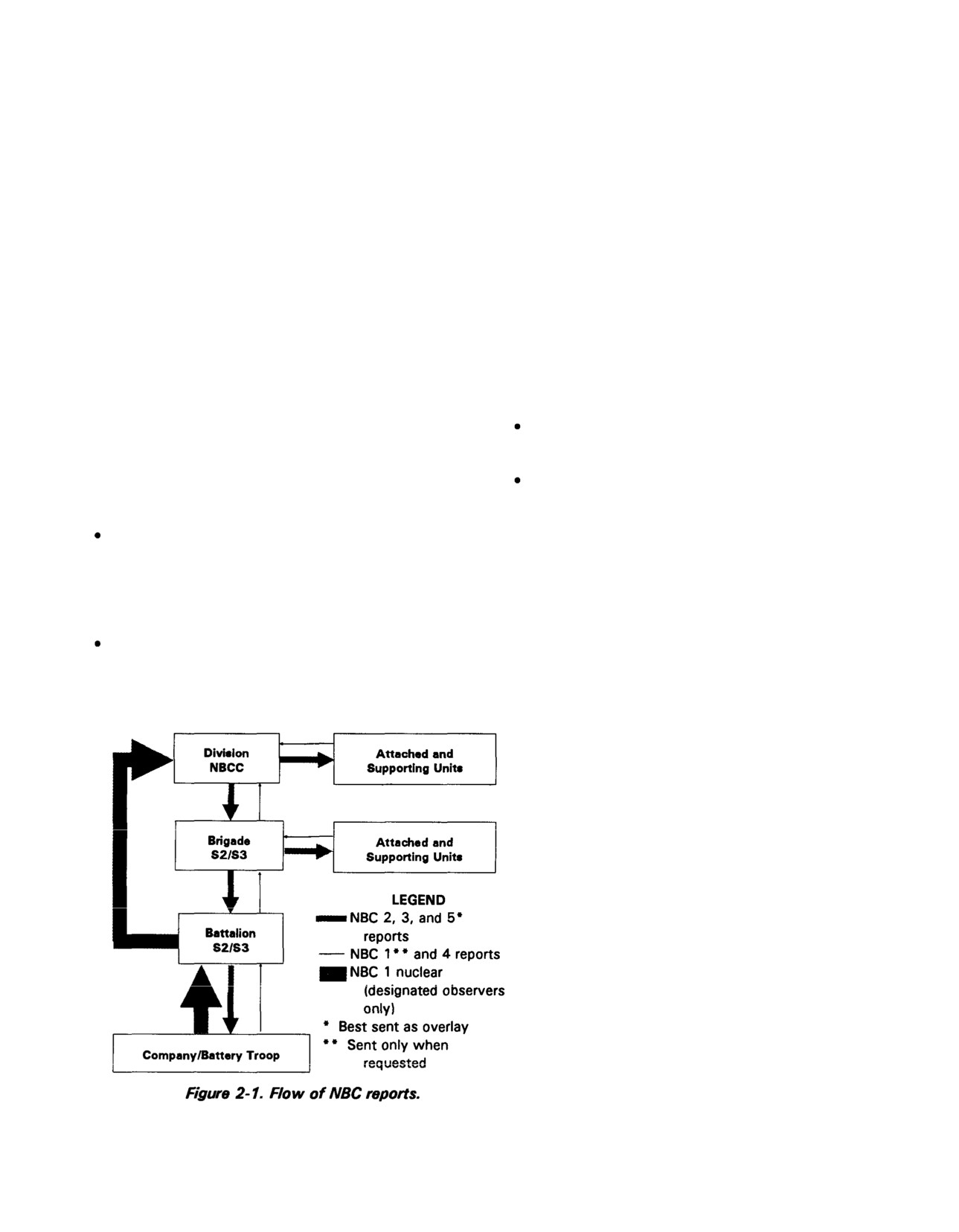
information system. Figure 2-1 shows the direction that
OPCON passes nuclear information.
various NBC reports travel. Usually the flow is through the
Units that operate independently (such as Military Police or
chain of command: from company to battalion to brigade
Engineers) that are operating in an area will report through
to division. There are exceptions to this:
the headquarters controlling that area of operation, normally
The NBCC may request information such as survey
a brigade tactical operations center (TOC).
information. The unit doing the survey may report directly
The method of transmitting information depends on the
back to division. This is especially true for aerial surveys. The
tactical situation and mission of the unit. Methods are
monitoring unit must also send an information copy back to
specified in FSOP/OPLAN/OPORD and unit SOP. At
the parent unit for command and control (C2) and for
brigade and higher headquarters, NBC reports usually are
recording of radiation exposure, if necessary.
passed on the intelligence net rather than the command net.
Designated observers send reports simultaneously to the
At battalion level and lower, there is generally only one
NBCC, and parent organization.
FM net available. This net is required to communicate
command information. Therefore, NBC reports should be
formatted ahead of time and be as short and concise as
possible. In this case, wire communications are best.
Support units use admin-log nets. However, these units
need to also inform the brigade TOC or division TOC
when operating in that unit’s area of operations. Wire
communications are excellent, if available. There are
numerous methods to communicate nuclear information.
One is ANBACIS, which accesses information from the
maneuver control system (MCS). The NBCC should
evaluate all possible methods and select those that best suit
the purpose. Again, this information should be contained in
the unit SOP or current operations order.
Each unit and command element has a specific function
in a nuclear environment. This function is in addition to
normal combat functions. The exception to this is the
NBCC whose primary function is NBC operations. The
preceding pages described procedures and requirements for
collecting, evaluating, and transmitting nuclear
information. This section described responsibilities at each
command level and is intended to be a guide only.
2-5
FM 3-3-1
Unit Level
Brigade or Task Force Level
Unit level collection, processing, and analysis techniques
The chemical personnel at brigade must perform the
are designed for rapid evaluation of nuclear data. The
same functions as battalion chemical personnel. Brigade
results are not as accurate as those obtained by the NBCC,
personnel also must—
but they are sufficient for planning until they can be
Coordinate with other staff sections and advise them on nuclear
replaced by those from the NBCC. Although analysis
matters.
techniques are similar for company, battalion, and brigade,
Plan and supervise decentralized radiological surveys.
each level has specific responsibilities for collecting and
Collect information from and assist NBC personnel within the
processing nuclear information. The responsibilities are
task force.
listed here (The major portion of nuclear information is
collected and reported by company-, battery-, or
NBCC Level
troop-level units.):
Report nuclear attack data, using the NBC warning and
NBCC techniques involve more complicated procedures
reporting system.
and are based upon the comparison of data from many
Monitor for nuclear radiation.
sources. Much of this data is not available to a single unit.
Plot simplified downwind hazards.
In addition to performing detailed analysis, the NBCC
Collect and forward soil and water samples.
also—
Conduct radiological surveys/reconnaissance.
Receives, collates, evaluates, and disseminates reports of
Organization and training of personnel to perform these
enemy nuclear attacks.
tasks must be according to AR 350-42.
Prepares and disseminates wind messages.
Estimates the effects of enemy and friendly nuclear detonations
and makes fallout predictions.
Battalion Level
Coordinates recon and survey activities with higher, lower, and
The battalion level monitors the information gathering of
adjacent units.
subordinate units. Battalion chemical personnel ensure that
Maintains an NBC situation map.
each subordinate unit is trained. Battalion personnel also
Provides advise to G2 on nuclear intelligence matters.
are trained to—
Provides technical assistance to all staff levels.
Consolidate and forward nuclear reports.
Selects designated observers.
Estimate effects of nuclear hazards.
Coordinates with other staff sections and advises those staff
Disseminate information on nuclear activities.
sections on nuclear matters.
Coordinate unit NBC recon activities with and through the
Provides technical assistance in the interrogation of POWs on
battalion S2/S3 sections and with the chemical company
nuclear matters. This technical assistance is generally in the
platoon leader tasked to support the battalion.
form of providing the interrogator a list of questions to ask
Coordinate with brigade to obtain additional smoke or decon
the prisoner. The questions may include employment tactics,
assets, if required.
NBC munitions, types of weapon systems available, and/or
Plan and supervise decentralized radiological surveys.
defence training status.
Maintain a nuclear situation overlay.
Designated Observer System
Although all units have some information-gathering
Designated Ground-Based Observers
responsibilities, certain units, because of their capabilities
and/or location, are chosen as designated observers for
Ground units are selected for the designated observer
nuclear attacks. Designated observers must be as accurate
system based on the following factors:
as possible when providing data on nuclear bursts.
Battlefield location.
Observers are selected to provide total coverage over the
Communication nets available.
entire area of interest. This requires both ground and aerial
Mission (current and future) interference due to enemy action.
observers. The designated observer system provides the
Training and experience.
essential data to prepare hazard location predictions and
Anticipated reliability of data.
nuclear damage assessments. It provides raw observer
Possession of organic angle-measuring equipment.
data, using a standard report format. The NBCC specifies
Field artillery and air defense artillery units are best
the primary and alternate means of communication.
suited as designated observer units. These units have
2-6
FM 3-3-1
organic optical equipment ideal for sighting measurements.
aviation officers to have several aircraft crews designated
See FM 101-10-1 for more information about which
as observers. The aviation unit commander selects the
divisional units have this equipment. These items, in order
crews. Designated aircrews are instructed to report data
of preference, are—
about the type of attack and when and where it occurred. If
•
M2 aiming circle.*
aviators measure cloud parameters, they must also provide
•
M65 or M43 battery command periscope.
the location from which it was measured.
•T16 or T2 theodolite.
Aviators have the advantage of height. They are able to
•M2 pocket transit.
see and report actual GZ locations. They also can see and
Any other unit (for example, a mortar platoon) having this or
estimate crater width. Such data is usually not obtainable
similar equipment may be designated an observer. Radar
from ground observer units.
should also be considered. Many radars can define the nuclear
cloud. Field artillery and air defense artillery radars are
Nondesignated Observers
positioned in the division and corps areas.
*This equipment is preferred because it is set to grid north (GN)
All units are required to record (in the prescribed
and measures in mils.
format) their observations concerning nuclear strikes.
Nondesignated observer units or any battalion or brigade
Designated Aerial Observers
units that have not been specifically tasked will transmit
their reports only on request. However, these units must
Aircraft provide excellent observer coverage for nuclear
report a nuclear attack only to the next higher headquarters
attacks. The NBCC coordinates with the appropriate
according to local SOP.
Friendly Nuclear
Attack Warning
Friendly troops close to an attack could be subjected to
Warning of impending attacks is initiated no earlier than
the same casualty-producing effects as the enemy. Advance
necessary to warn personnel. Use any means of
warning of a friendly nuclear attack ensures that friendly
communication (preferably secure) to ensure all affected
forces can protect themselves from the effects of the attack.
personnel are warned. It is crucial that all friendly forces,
This warning is in the form of a STRIKWARN message.
down to the lowest level, have time to react to the warning
OPSEC and SIGSEC measures are taken to prevent the
and take appropriate precautions.
enemy from intercepting the warning message and taking
Warning messages should be classified according to
protective measures.
current OPSEC instructions and the speed of dissemination
required. If secure electronic means are not available, the
message should be encoded. STRIKWARN messages may
Responsibility
be sent in the clear if the issuing commander determines
The executing commander is responsible for initiating
that safety warnings override security requirements. Do not
the warning. Commanders authorized to release nuclear
send a warning message in the clear earlier than 60 minutes
attacks must ensure that attacks affecting the safety of
before the attack. Lines Delta and Foxtrot of the
adjacent or other commands are coordinated with those
STRIKWARN should not be sent in the clear. The word
commands. Attack notification will normally be transmitted
“STRIKWARN” is never sent clear text.
from the division NBCC or from DIVARTY. This gives
Battalion is the lowest level to receive a STRIKWARN
adjacent commands enough time to warn their personnel,
message. At no time will messages be transmitted below
take protective measures, and prepare to exploit the
battalion level. Instead, subordinate units are given specific
weapons' effects.
instructions on what actions to take. These instructions are
STRIKWARN messages must be sent to—
brief and use the code words and formats described in unit
• Subordinate headquarters whose units are likely to be affected
SOP/FSOP/OPORD/OPLAN. They include—
by the attack.
•
Code word indicating type of attack.
•
A brevity code that describes the specific action to be taken.
• Adjacent land, air, and naval headquarters that may be affected
• Expected timed attack.
by the attack.
When a nuclear attack is cancelled, units previously
•
Next higher levels of command, when units not under the
warned must be notified by the fastest means available.
command of the executing commander may be affected by the
The cancellation message consists of line item Alfa from
attack.
the STRIKWARN plus the word “cancelled.” Line item
•
All aviation units and ground units that have aviation assets
Delta of the attack warning should be used also. Units
attached.
2-7
FM 3-3-1
receiving cancellation messages must always request
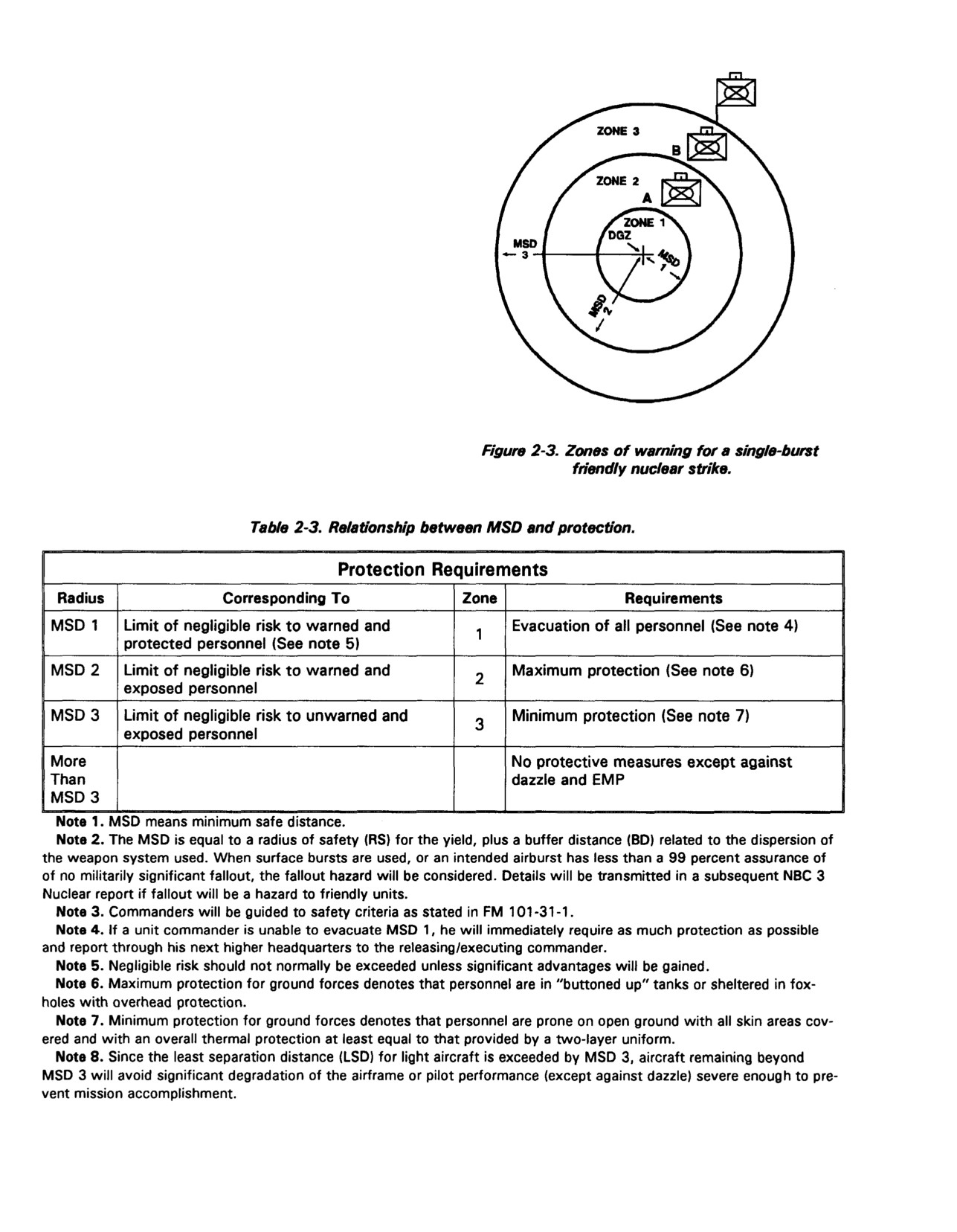
2-10) explains the relationship between MSD and
authentication from the sender.
protection.
The protection requirements in Table 2-3 are for
negligible risk to all personnel—the preferred risk. If the
STRIKWARN Messages
commander decides additional risk is necessary, the
As with the other NBC messages, STRIKWARN
protection can be modified. Appendix A describes the risk
messages have been standardized. The United States and its
categories in greater detail. Refer to it before making any
NATO and ABCA allies use the same message formats.
decisions. The protection requirements chart (Table 2-3) is
This speeds transmission of messages and improves
set up primarily for ground troops. Aircraft are sufficiently
accuracy and understanding. The meaning and use of each
protected if they remain outside MSD3. However, pilots
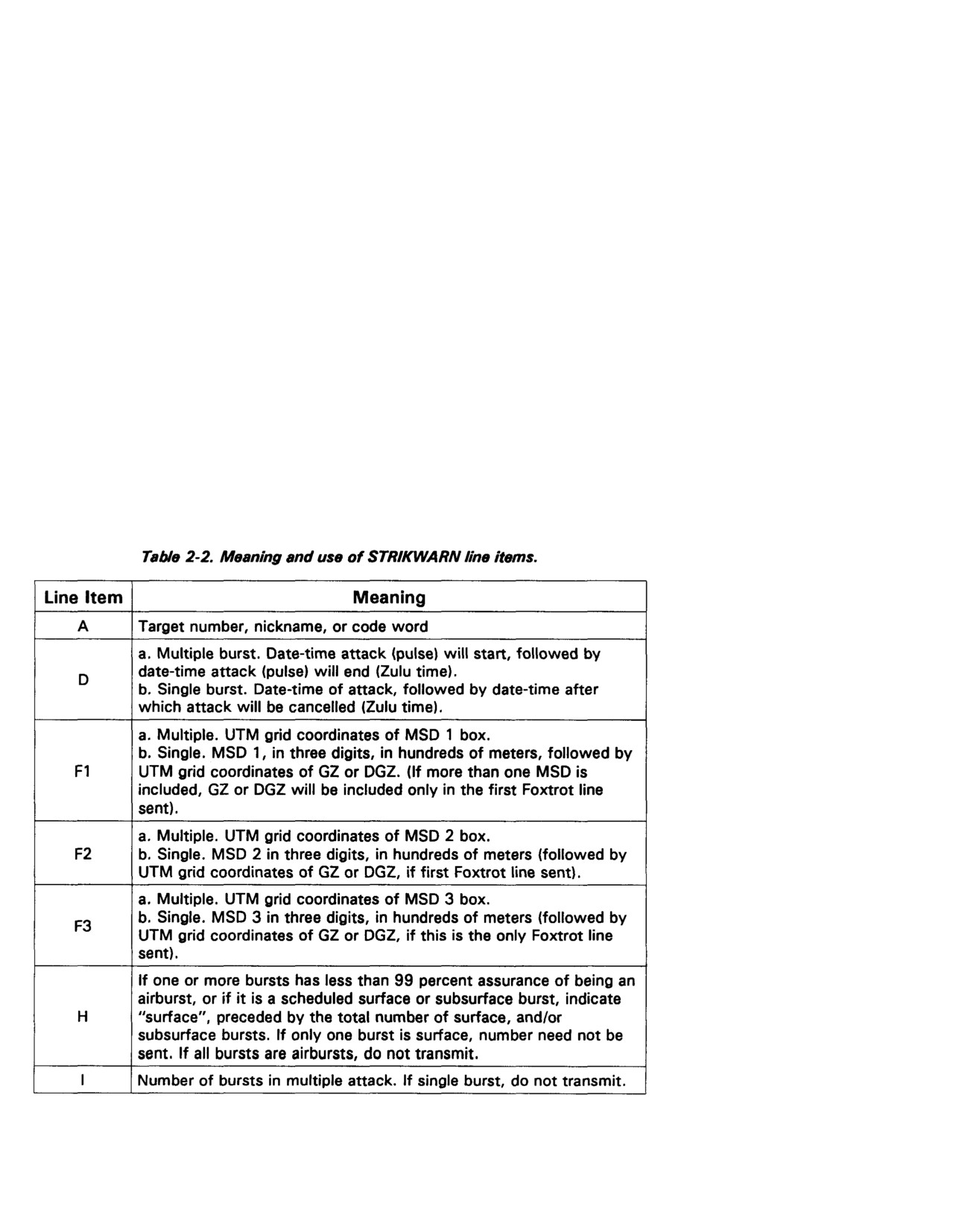
line item is described in Table 2-2, next page.
are susceptible to dazzle and may be affected at much
Alfa, Delta, Foxtrot, Hotel, and India are the only line
greater distances.
items transmitted for a STRIKWARN. If fallout is
When a unit receives a STRIKWARN message, the first
produced and will be a hazard to friendly troops, send an
action is to plot it on the tactical map. This identifies
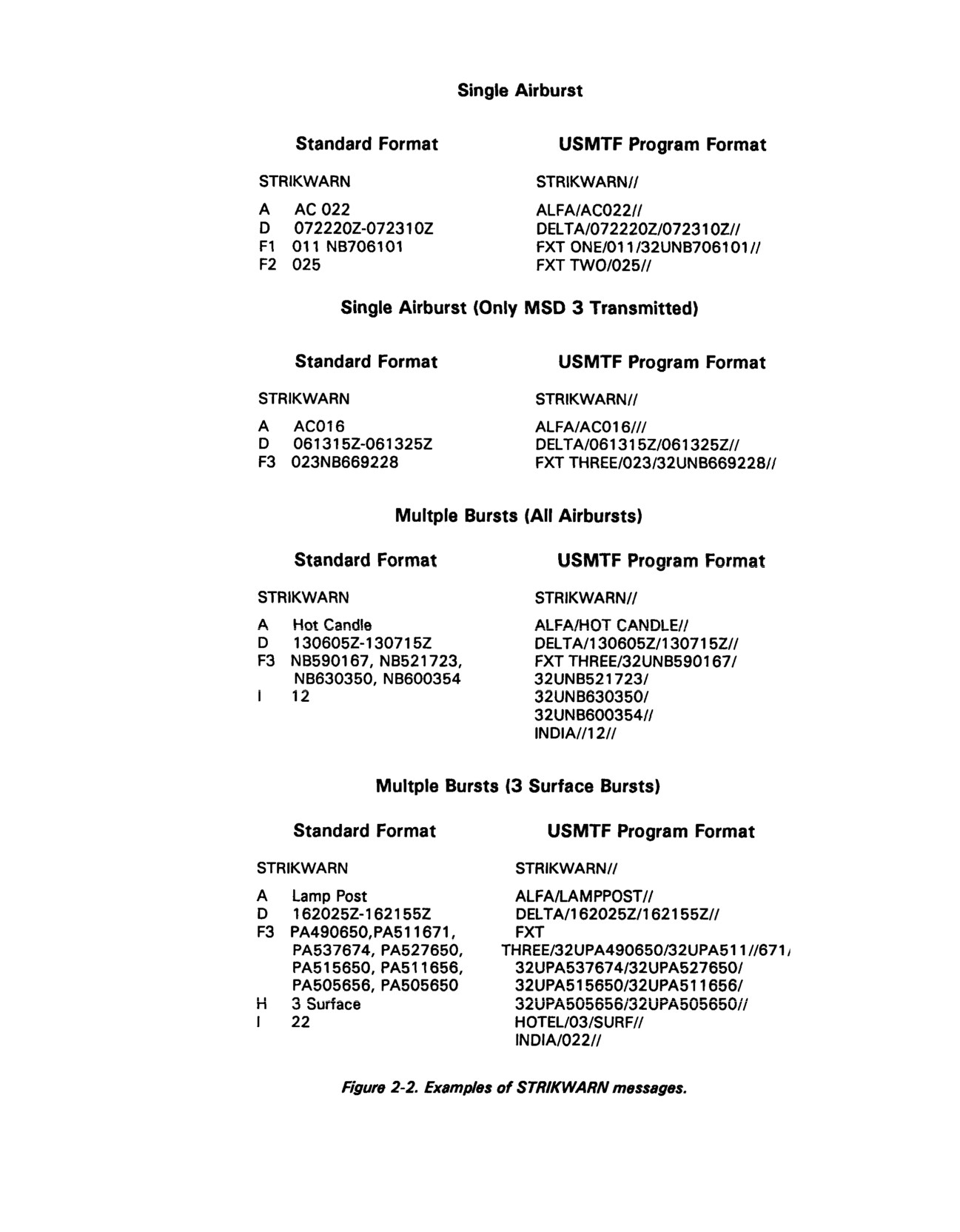
NBC 3 nuclear report to all affected units. Figure 2-2,
ground zero and how far the effects will extend. The
(page 2-9), shows examples of STRIKWARN messages in
commander can then determine what action to take. Figure
standard and USMTF formats.
2-3, (page 2-10), shows a plotted STRIKWARN for a
The closer a unit is to a nuclear attack, the greater are
single burst.
the precautions it must take. That is why there are three
The Alfa team in Figure 2-3 will have to dismount and
minimum safe distances (MSDs) in the STRIKWARN.
get in foxholes with overhead cover or evacuate the area.
Each MSD corresponds to a degree of protection needed to
On the other hand, Bravo team must, as a minimum,
remain in the area. Thus, if a unit cannot achieve the
assume a prone position. Battalion headquarters would only
protection required, it must exit that zone. Table 2-3 (page
have to be concerned with dazzle and EMP.
(Text is continued on page 2-10)
2-8
FM 3-3-1
2-9
FM 3-3-1
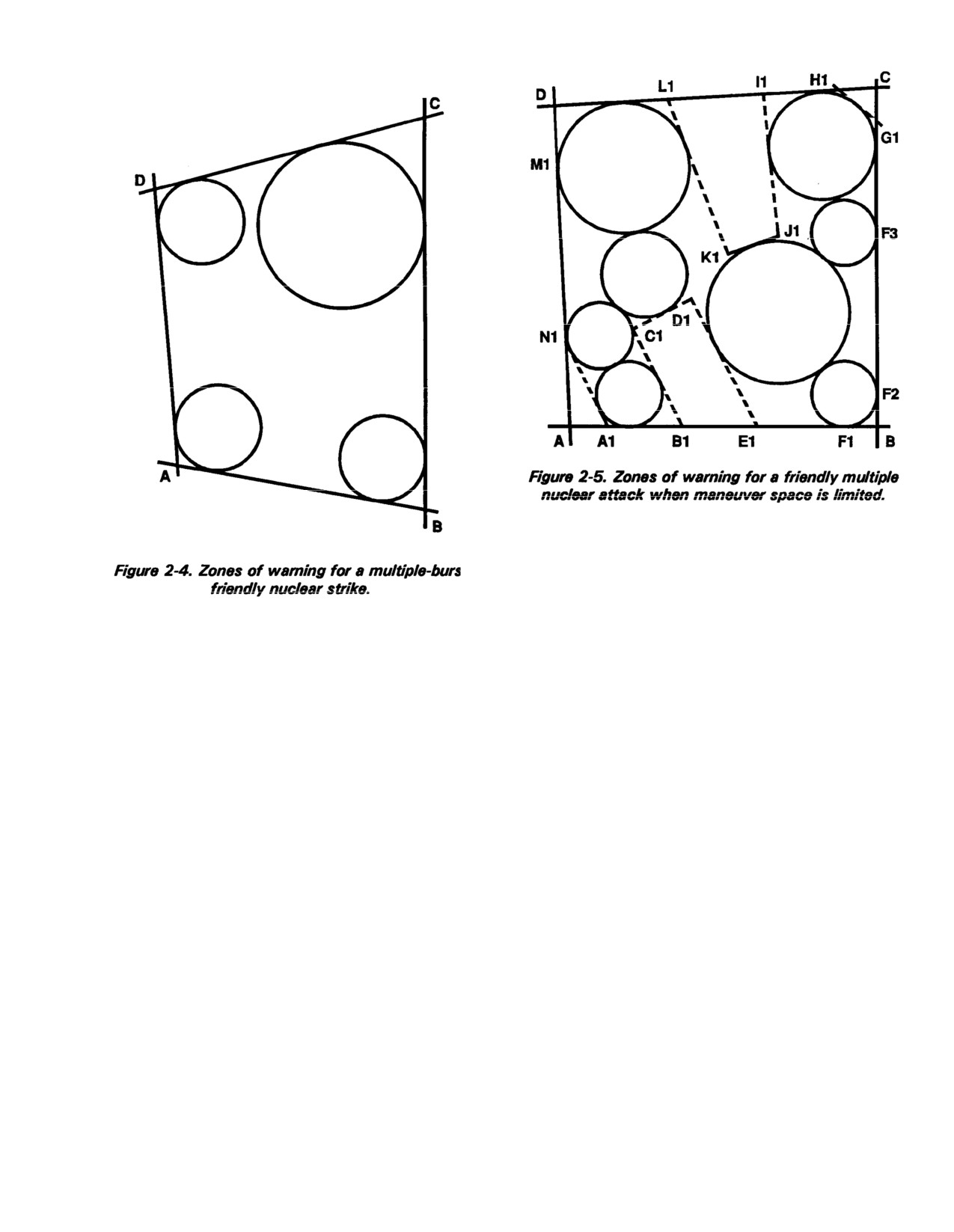
Nuclear weapons are often targeted as a group of
weapons (package) to defeat a particular threat. It would be
time consuming to send separate STRIKWARNs for every
weapon in a package. For that reason, multiple bursts are
grouped as a package, and the outer limits of the MSDs
plotted as a box. The coordinates for the comers of the box
are then transmitted. Plot the points nearest friendly troops
first. Figure 2-4, (page 2-11), shows a plotted
STRIKWARN for a multiple burst.
By drawing a box, large safe areas are included in the
hazard area. If maneuver space is limited, additional
coordinates could be added to the STRIKWARN. Figure
2-5, (page 2-11), shows a plotted STRIKWARN with
additional coordinates added.
2-10
FM 3-3-1
Automated Nuclear, Biological, and Chemical Information
System (ANBACIS)
ANBACIS is a software information system that supports
the NBC 2 reports to NBC 3 reports, using the correct
the chemical staff officer and NCOs, as well as chemical
weather information previously received electronically
units (squad to brigade). It furnishes the communication,
from the staff weather officer. It will take the basic wind
recordkeeping, and calculation of NBC warning and
report and create the effective downwind report in seconds.
reports, tactical decision aids, and databases essential to
This is done without drawing the wind vector plots outlined
accomplish their tasks. One module is the NBCWRS—an
in Chapter 3 and Appendix D.
automation of the manual data processing described in this
It has other modules to create smoke plans and to
manual. ANBACIS was designed to operate on the Army
calculate radiological/chemical problems and flamefield
Common Hardware and to operate in the stand-alone mode
expedient operations.
on any IBM compatible computer. ANBACIS is user
For additional information on ANBACIS, refer to the
friendly with drop-down windows.
ANBACIS user’s guide.
It can receive any number of NBC 1 reports and create
the correct number of NBC 2 reports. It will then convert
2-11
FM 3-3-1
Chapter 3
Introduction to Nuclear Operations
Under the threat of or in actual nuclear warfare, units in
The neutron-induced area is small by comparison with
the field must continually evaluate the impact that enemy
the fallout area produced by the same yield nuclear
use of nuclear weapons could have on the conduct of
weapon. It is often contained within the area of greatest
operations. They must be prepared for contingency action
destruction and collateral obstacles (tree blowdown,
to reduce the disruption caused by a nuclear attack.
rubble, and fire). Frequently, there will be no need to enter
Casualty-producing levels of fallout can extend to greater
the neutron-induced area. Units should move into
distances and cover greater areas than most other nuclear
neutron-induced areas only when necessary. If units are
weapon effects. Such fallout levels can, therefore,
required to pass through GZ or occupy positions in the
influence actions on the battlefield for a considerable
immediate vicinity of GZ, the induced radiation is
period. Knowledge and understanding of the radiological
operationally significant. Units will base their entry time
contamination aspects discussed in this chapter help the
and stay time on the radiation level present in the induced
commander determine the advantages and disadvantages of
area. Induced radiation is discussed in more detail in
each course of action open to him in the execution of
Chapter 7.
assigned missions.
The dose rate at any location within a contaminated area
Fallout areas can be the largest contaminated area
does not remain constant. The dose rate decreases with
produced on the battlefield. There is one important aspect
time. Thus, in time a radiation hazard will be of no
of fallout prediction: Winds aloft, as well as surface winds,
military significance. The rate at which this decay takes
determine where fallout will occur. Thus, the actual
place also varies with time, generally becoming slower as
location of fallout can differ appreciably from that which
time passes. The decay rate for contamination in an area
might be expected from the direction of surface winds.
depends upon many factors. It generally cannot be
Fallout particles are often visible during hours of
determined until several series of dose-rate readings are
daylight. The arrival and settling of dustlike particles after
taken for specific locations within the contaminated area.
a nuclear burst should be assumed to indicate the onset of
Standard decay conditions are therefore assumed by all
fallout unless monitoring shows no radiation in the area.
units until actual conditions are determined or until higher
Any precipitation following a nuclear attack must be
headquarters directs otherwise.
regarded as rainout from the nuclear cloud. Rainout will be
discussed later in this chapter.
Nuclear Weapons Effects
To fully appreciate and understand the characteristics of
environment in which the weapon is detonated, and the
radioactive contamination (fallout) from nuclear
vulnerability of the target.
detonations, one must first have a basic working
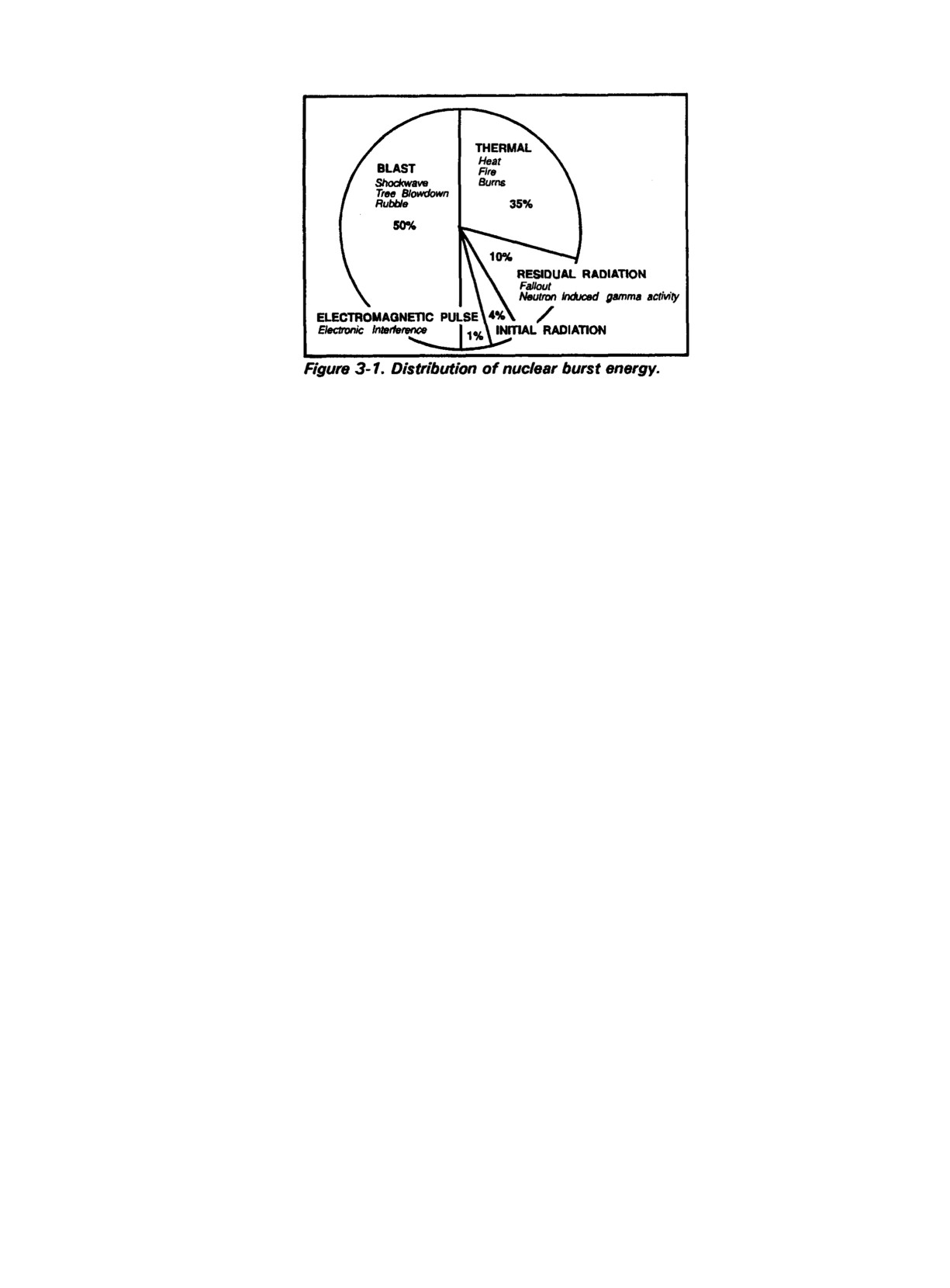
The normal distribution of energy in a low air burst is
knowledge of the origin and nature of these radioactive
depicted in Figure 3-1, next page. The primary focus of
materials. The overall effects of nuclear weapons depend
this chapter centers on only 15 percent of all energy
on the type of weapon, the height of burst (HOB), the
released in a nuclear detonation. That energy is generally
distance between the point of detonation and the target,
referred to as fallout (both initial and residual radiation)
and electromagnetic pulse (EMP).
3-0
FM 3-3-1
Initial Radiation Effects
Initial nuclear radiation is emitted within the first minute
primarily of neutrons and gamma rays. Both types of
after detonation. For weapons with yields less than
radiation, although different in character, travel
approximately 50 kiloton, initial nuclear radiation is
considerable distances at the speed of light, and produce
usually the governing effect in target planning. It consists
casualties.
Residual Radiation Effects
Residual nuclear radiation is that emitted later than one
only travels in the open air to 4 centimeters from the
minute after detonation. It consists of fallout,
source and cannot penetrate one to two sheets of ordinary
neutron-induced gamma activity (NIGA), and rainout.
paper, it cannot penetrate the first layer of human skin.
Residual radiation (fallout) comes from three basic sources:
Alpha is considered an internal or inhalation hazard. In
unused fissionable material, fission products, and
most situations this internal hazard would not affect the
neutron-induced activity. These three sources combined
immediate military operation because its effects on the
emit alpha, beta, and gamma radiation.
body would not be felt until many years later. Therefore,
The most significant radiation is gamma radiation,
alpha is not considered to be tactically significant.
which presents a serious personnel hazard because of ‘its
range and penetrating power.
Fission Products
Residual radiation is attenuated or scattered in the same
manner as initial gamma radiation.
In a fission reaction, the basic process that occurs is the
The biological response of humans to residual radiation
splitting of relatively large atoms into much smaller atoms.
is essentially the same as their response to initial radiation.
These smaller atoms are the end result of the fission
reaction; they are fission products. These smaller atoms
formed in the reaction are atoms of elements in the middle
Unused Fissionable Material
of the table of elements, for example, atoms of mercury,
Despite the high technology used to produce a nuclear
tin, arsenic, iron, and lead. At the instant of the
weapon, the weapon itself is still inefficient, to a certain
detonation, these fission products are formed as gas. Like
extent, in that all of the fuel, or radioactive material, used
the unfissioned bomb materials, they rise with the fireball
to produce the weapon is not expended. This is, in effect,
and smoke cloud. As the cloud cools, they condense into
wasted fuel.
solid particles, consisting of oxides of the elements
At the time of detonation, this wasted fuel is vaporized
mentioned above (and many others). These solid particles
by the high temperatures of the fireball. As the fireball and
are carried along above the earth by winds. But, at the
subsequent cloud rises and cools, this wasted fuel, now in
same time, they slowly settle toward the earth and appear
the form of a gas, condenses back to a solid state. These
as part of the fallout.
particles are carried by the wind and are scattered across
The isotopes of the elements formed in the fission
the surface of the earth as fallout. These particles emit
reaction are radioactive and are, for the most part, beta and
primarily alpha radiation. Considering, however, that alpha
gamma emitters. As a result, they do represent a
3-1
FM 3-3-1
significant contribution to the external hazard from fallout.
audible is by the use of an instrument for detecting radio
They actually make the highest contribution, by far, to the
waves, namely, a radio. Similiar statements apply to
gamma activity in fallout.
gamma radiation. The human senses are not capable of
Beta radiation, emitted in this process has a general
detecting it. We must have a special instrument for
range in the open air up to 20 feet, from the source. Beta
detecting it, an instrument called a RADIAC meter. Radiac
has the ability to penetrate 1/16 inch of aluminum and may
meters measure gamma without regard to its source. The
penetrate the first few layers of skin. Beta radiation may
dose or dose rates of radiation measured may represent
also cause a burning of the skin similiar to a first- or
radiation from fallout, neutron-induced gamma activity, or
second-degree sunburn, or may cause extensive internal
a combination of these.
damage, similiar to alpha, if inhaled. Therefore, like alpha,
beta contamination is not considered tactically significant.
Neutron-Induced Activity
Gamma radiation, however, because of it’s range and
penetrating power, is tactically significant and is the
The third form of radioactivity in fallout is
primary focus of the rest of this chapter.
neutron-induced gamma activity, commonly referred to as
Gamma radiation is not a particle or a dust, like alpha or
NIGA or induced radiation. When a nuclear weapon is
beta. It does, however, penetrate material, but, does not
detonated near enough to the ground to get significant
make that material radioactive. Gamma radiation is pure
damage or casualties, many of the neutrons released strike
energy traveling through space at the speed of light
in the vicinity of ground zero and penetrate the soil up to a
(186,000 miles per second). It is a form of electromagnetic
depth of one-half meter. As a result, some of the soil
radiation, differing only in frequency and source from
elements, such as sodium, aluminum, manganese, iron,
more commonly known forma, such as X-rays, radio
and potassium, become radioactive when hit by neutrons,
waves, and visible light.
and produce fairly high dose rates of gamma and beta
Consider radio waves. The human senses cannot detect
radiation. This type of residual radiation is called induced
radio waves. We cannot see, taste, feel, hear, or smell
radiation. It appears immediately following the burst and
them. The only way we can detect them and make them
can be tactically significant.
Effects of Fallout on Ships at Sea
Ships out to several hundred miles from ground zero
through water where, for all practical purposes, deposition
may be subject to fallout from surface and some
has ceased.
sub-surface bursts. A forecast of the fallout pattern will
enable them to take avoiding maneuvers or preventive
With the basic understanding of the energy distribution
measures.
of a nuclear burst, coupled with the basic concepts of the
Maneuvers to avoid fallout must be based on the naval
origins of radiation, commanders can translate this
effective downwind message (NAV EDM). Should it be
information into usable data for tactical units. In
necessary to pass through fallout, washdown or presetting
determining where radioactive debris may fall on the
systems (if available) should be activated, shelter stations
battlefield, and thus affect those units operating in the area,
assumed, and passage delayed as long as possible.
one must also understand the characteristics of the nuclear
If these measures are taken, casualties from fallout
cloud. This is important, because the presence or absence
should be negligible. Ships receiving no warning and
of a nuclear cloud will help in determining if the burst was
remaining within this fallout zone longer than necessary
a surface burst (which produces significant fallout). EMP
without adopting these preventive measures may sustain
is discussed in more detail in Appendix C.
serious casualties.
The size of a nuclear cloud helps estimate yield. Yield
Fallout landing on the surface of the water is rapidly
estimation is essential in determining the extent of
diffused, and there is very little danger to ships passing
contamination, where the fallout will go on the battlefield,
and the duration of tactically significant radiation.
Nuclear Clouds
The fireball stage exists from the instant of the explosion
Detecting the Attack
until the generally spherical cloud of explosion products
The development of nuclear clouds is divided into three
ceases to radiate a brilliant light. During this stage, do not
stages: fireball, burst cloud, and stabilized cloud.
3-2