FM 3-3-1 Nuclear Contamination Avoidance - page 1
FM 3-3-1
FMFM 11-18
Nuclear Contamination
Avoidance
Pub Date 09-94
PCN 139 001194 00
FM 3-3-1
Introduction
Contamination avoidance is the best defense against
unit being targeted. Dispersion, hardening of positions and
enemy use of nuclear weapons. Avoidance reduces the risk
equipment, and using overhead cover reduces the
of being targeted by nuclear weapons and minimizes the
effectiveness of an attack. Passive measures are discussed
effects of nuclear contamination hazards. Knowing where
in more detail in Chapter 1.
contamination exists or how long the hazard may persist is
essential to avoiding the hazard.
Warn and Report
Enemy use of nuclear weapons makes battlefield
operations more difficult and time consuming. Combat,
Once a nuclear attack has occurred everyone who might
combat support, and combat service support operations
be affected by the hazard must be warned. This gives units
may be more difficult to perform in a nuclear environment.
time to protect themselves against a possible hazard.
Tasks/missions may take more time because of the
NBCWRS is used for warning and reporting nuclear
problems created by nuclear contamination. Nuclear
hazards. These messages and their use are standardized and
attacks may cause casualties, materiel losses, and creation
kept simple so they can be passed rapidly and be easily
of obstacles. Training will reduce the problems caused by
understood. The NBCWRS is discussed in Chapter 2. The
nuclear attacks on the unit. Units must locate clean areas as
Automated NBC Information System (ANBACIS) will
well as locate contamination in a nuclear environment.
assist in speeding this process.
Contaminated units will have to perform decontamination
(decon) operations.
Locate, Identify, Track,
To survive and accomplish the mission, individuals and
and Predict Nuclear Hazards
units must take precautions to avoid or minimize effects of
initial and residual nuclear hazards. The threat of
By locating, identifying, tracking, and/or predicting
contamination may force individuals and units into
nuclear hazards, commanders can make informed decisions
collective protection. Using collective protection requires
for operating in or around nuclear hazards. Planning
special procedures that are time consuming. See FM 3-4
nuclear reconnaissance is discussed in Chapter 5. Tactics
for information on what measures or steps an enemy
and techniques of NBC reconnaissance are contained in
nuclear attack may affect friendly forces. FM 3-3 outlines
FM 3-19,
NBC Reconnaissance.
Techniques for predicting
how to anticipate an enemy chemical or biological attack
nuclear hazards are given in Chapters 3, 4, and 6. A
and minimize the effects on friendly forces.
portion of ANBACIS provides for the automatic calculation
of hazard areas due to nuclear weapons using or creating
Contamination Avoidance
all NBC 1 through NBC 5 Reports.
There are four steps to contamination
Limit Exposure
avoidance—implement passive defensive measures, warn
and report nuclear attacks, locate, identify, track and
If operation in a contaminated area is necessary, take
predict hazards, and limit exposure to nuclear hazards. If
steps to limit the amount of troop exposure. Chapter 5
the mission permits, avoiding nuclear hazards completely
discusses crossing contaminated areas. FM 3-4, NBC
is the best course of action. This is not always possible.
Protection,
gives guidance on protective measures for such
The mission may force you to occupy or cross a
crossings and FM 3-19,
NBC Reconnaissance,
describes
contaminated area. This manual outlines procedures to use
the techniques for finding the best crossing route.
when working or training to work in a contaminated
environment. Using these procedures, which are
Protection and Decontamination
summarized by the four steps of contamination avoidance,
units can minimize performance degradation.
If a unit is unable to avoid nuclear hazards, the
individual soldier and unit must take protective measures.
Actions that minimize equipment losses and limit the
Implement
spread of contamination are discussed in this manual.
Passive Defensive Measures
Measures taken to aid in protection are covered in detail in
Passive defensive measures are those measures taken to
FM 3-4.
reduce the probability of being bit by a nuclear attack or, if
If a unit is unable to avoid contamination, then some
hit, to reduce the effects of the attack. Operational security
form of decon may be necessary. Decon reduces the
measures such as good communication procedures, light
immediate NBC hazard.
discipline, and good camouflage reduce the chances of a
vi
FM 3-3-1
and disrupt the normal dispersion of fallout. Valleys and
Tactical Considerations
low areas provide defense against initial nuclear effects,
If nuclear weapons are used, individual and collective
but residual hazards may accumulate and linger.
protective measures must be taken. Time-consuming and
manpower-intensive tasks such as nuclear reporting,
Troops
radiological recon, surveys, and decon may be necessary.
The physical condition of troops is very important.
Tactical decisions must consider how troops will be
Mission
affected.
Radioactive contamination forces the commander to
reconsider how best to accomplish the mission with the
Time
available resources. The commander has three options. In
order of preference, these are—
Tasks may take longer in a nuclear environment. Adding
First, do the mission in a clean area. The commander must
nuclear requirements to conventional recon adds time to
decide whether the mission can be accomplished while staying
the mission. Decon operations are also time-consuming.
out of contaminated areas.
Anticipating the timing of nuclear attacks is important.
Second, do the mission in a contaminated area using a higher
Chemical and biological attacks are most likely to occur
risk level, and use more soldiers, to do the mission faster.
during the night and early morning or evening hours and
Third, do the mission in the same amount of time with the same
may be employed to enhance nuclear weapons effects.
number of soldiers, but wait for a longer period of time to
Employment of nuclear weapons causes severe problems,
start to allow for natural decay.
especially among pilots and crewmen, due to dazzle and
flash blindness.
Enemy
Training
In addition to trying to determine what the enemy plans
to do, the commander also must determine how and where
Commanders must understand the importance that
the enemy is most likely to use nuclear weapons. For
training has on a soldier and the unit’s ability to complete
example, if the enemy is attacking, expect nuclear weapons
the mission. When troops are well trained, they can
to be used to open gaps along avenues of advance or to
survive and fight on a contaminated battlefield. Poorly
destroy forces.
trained troops may not be able to recognize a nuclear
attack. Well-trained troops can do their jobs, while in a
nuclear environment. They know tasks take longer, but are
Terrain
able to adjust their procedures and/or work rate
Terrain modifies nuclear weapons’ effects. Hills restrict
accordingly.
the area affected by the initial effects of nuclear weapons
vii
FM 3-3-1
Chapter 1
Vulnerability Analysis
The focus of this field manual is nuclear contamination
concentration increases the effects of nuclear attacks and
avoidance. Like most concepts in the Army, contamination
the likelihood of their occurrence. Commanders must
avoidance is a process. This process involves:
decide what size of force to use and when they should be
Identifying the threat facing friendly forces.
concentrated.
Identifying whether friendly units are a target.
To assess a unit’s vulnerability to nuclear attack, the
Understanding the operational concerns and impact of nuclear
commander determines how well protected the unit is and
contamination.
the type and size of weapon likely to be used against it.
Locating nuclear hazards on the battlefield.
The commander then weighs various courses of action and
By identifying and locating nuclear hazards on the
determines which presents an acceptable risk to allow
battlefield, units will be able to either avoid the hazard or
accomplishment of the mission. This whole process starts
implement the protective procedures outlined in FM 3-4 to
with the Intelligence Preparation of the Battlefield (IPB)
minimize the affects. It should be emphasized, at this
and an initial assessment of the nuclear threat.
point, that if threat forces posses nuclear weapons, they
also probably possess chemical and/or biological weapons
The IPB Process
as well. Therefore, US forces must be prepared to operate
in an NBC environment. But, for the purpose of this
The IPB process is a staff tool that helps identify and
manual, contamination avoidance principles will center
answer the commander’s priority intelligence requirements
only on nuclear operations.
(PIR). It’s part of the operational planning that is necessary
Before we begin the discussion of contamination
for battle management.
avoidance, we must first discuss two critical, often
IPB is initiated and coordinated by the S2 and used to
overlooked, aspects of successful operations on the
predict battlefield events and synchronize courses of
contaminated battlefield. These two aspects are nuclear
action. IPB is designed to reduce the commander’s
threat assessment and vulnerability analysis. Both are
uncertainties concerning weather, enemy, and terrain for a
described in this chapter.
specific geographic area in a graphic format. It enables the
With the current trend in nuclear proliferation, the
commander to see the battlefield: where friendly and
nuclear threat now and in the future will be global. The
enemy forces can move, shoot, and communicate; where
proliferation of nuclear-capable nations in all contingency
critical areas lie; and where enemy forces (and his own)
regions increases the likelihood of US forces being targets
are most vulnerable. IPB guides the S2 in determining
of nuclear attack. The extensive development worldwide of
where and when to employ collection assets to detect or
nuclear power plants presents an additional nuclear hazard
deny enemy activities. These assets, working collectively,
condition if these facilities are damaged deliberately,
fulfill intelligence requirements and answer the PIR. IPB is
inadvertently, or by industrial accident.
the key for preparing for battle. It analyzes the intelligence
As Chapter 1 to FM 3-100 points out, nuclear weapons
data base in detail to determine the impact of enemy,
technology proliferation is increasing. Deploying US forces
weather, and terrain on the operation and presents this
must be capable of accurately assessing the nuclear threat
information graphically. It is a continuous process which
imposed by the opposing force and be capable of
supports planning and execution for all operations. IPB
addressing unit vulnerability to attack. Chapter 2 in
consists of a systematic five-function process:
FM 3-100 describes in detail how nuclear weapons may be
Evaluation of the battlefield (areas of operation and influence).
used and how their use may shape the battle.
Terrain analysis.
When planning operations, commanders must consider
Weather analysis.
the potential effects of nuclear weapons on personnel and
Threat evaluation.
equipment. In conventional operations, concentration of
Threat integration.
forces increases the chance for success, but this same
1-0
FM 3-3-1
On the battlefield, units will have incomplete intelligence
chemical staff best serves the commander as special staff
concerning enemy nuclear capabilities and/or intentions.
warfare experts. The DST must include nuclear concerns
Commanders must ensure that the IPB becomes an
and visually present them to the commander.
integrated process through which key members of the staff
During battle management activities, the chemical staff
contribute. IPB is a process involving intelligence and
advisor works with the S2 on the IPB. He or she
operations personnel. It must also be integrated with input
coordinates with the intelligence officer to analyze and
from chemical officers.
identify nuclear targets based on threat, terrain, and the
Chemical officers and NCOs, in coordination with the
AO. Potential threat nuclear targets could be key terrain,
S2/3, must address nuclear warfare during all phases of the
choke points, command and control facilities, counterattack
battle. This is accomplished only by direct participation in
routes, mobility corridors, troop concentrations and/or rear
the IPB process. Working with the S2, the chemical staff
area assembly points.
accomplishes the following:
A nuclear vulnerability assessment constitutes an
Generate template(s) of potential nuclear targets or areas of
important part of battlefield assessment and risk analysis
contamination.
and is a primary means through which the chemical staff
Designate templated areas that influence the scheme of
advisor participates in the battlefield assessment process. In
maneuver as named areas of interest (NAIs).
this assessment, the chemical officer must develop
Include NAIs in the collection plan, and identify indicators.
information for integration into the various staff estimates.
Include designated NAIs in the reconnaissance and
From the S2, the chemical officer or NCO obtains—
surveillance (R&S) plan, and designate responsibility for
Time of interest.
confirming or denying the template.
Threat probable courses of action and intent.
Using the IPB process, the chemical officer or NCO
NAIs and target areas of interest (TAIs).
provides the commander updates on the nuclear situation.
Summary of enemy activity, including any nuclear attacks,
Based on the time periods of interest, the chemical staff
movement of nuclear equipment or material, presence and
will provide the battle commander the following:
level of training of threat forces, and indicators of enemy
Detailed information on enemy nuclear capabilities, based on
nuclear warfare comments, such as queuing up weather radar.
the type of units and weapons the enemy has available in the
Specific items of interest from the S2 would be—
area of operations/area of influence (AO/AI) during a selected
Direction and speed of winds between O and 30,000 meters
period.
above the surface.
How the enemy would employ nuclear weapons to support his
How weather conditions may affect fallout patterns.
battle plan.
Terrain.
Areas of likely employment based on threat employment
Transportation assets (railways, airfields, road networks)
doctrine.
available for shipment of nuclear munitions.
Detailed analysis of terrain and weather in the unit’s AO during
Availability and location of industrial assets capable of
each period of interest, and how they could impact on nuclear
producing and/or weaponizing nuclear warfare material.
weapons.
Availability y of nuclear weapons, delivery systems, and
Templates of predicted fallout data which are updated as
location of stockpiles.
conditions change.
From the fire support officer (FSO), the chemical officer
Alternative actions the commander can initiate prior to the
obtains information on casualty percentages from friendly
phase time line in question so as to minimize degradation of
and threat conventional munitions. Examples of
forces.
information obtained include casualty percentages based on
Continuous monitoring of intelligence messages and radio
target size and casualty percentages based on weapon
traffic for any nuclear related information that could be
systems.
important to the unit’s mission.
The chemical staff also should prepare a list, general in
It is important that the chemical officer/NCO be succinct
nature, of information compiled from various sources (such
during the commander’s briefing or have his information
as news bulletins, spot reports, and intelligence summaries
presented by the S3 during his portion of the briefing.
(INSUMs)). This information, when viewed as single
Therefore, for input to be addressed, chemical personnel
events, may appear to be meaningless. However, when
must be players in the IPB process. Although it is
added to other pieces of information it may provide the key
developed under the direction of the S2, once completed,
that connects the information and present the best view of
the decision support template (DST) becomes an
the enemy’s intent. Items of general information include,
operational document and is briefed to the commander by
but are not limited to, the following:
the S3. If the chemical staff is an active participant in the
Availability of nuclear defense equipment to enemy forces.
IPB process, and is determined to serve the commander,
Amount of overhead cover or collective protection shelters or
then they must work within that process in developing the
systems. If enemy forces seek overhead cover or move into
DST and R&S plan. Through this participation, the
1-1
FM 3-3-1
collective protection shelters, it may indicate that the enemy
If the enemy does not possess munitions, the capability to
intends to use nuclear weapons.
deploy such munitions or expertise to employ them, have
The enemy’s stated national policy or philosophy on the use
attempts been made to gain this ability? Reports indicating the
of nuclear weapons: Has the enemy declared a no-use,
presence of advisors from other nations working with enemy
first-use, or limited-use only-for-retaliation-in-kind policy?
forces, international trade agreements or shipments of
Does the enemy consider the use of flame or smoke as NBC
equipment (such as, fuzes, weapons-grade uranium) may
agents?
provide insight to the enemy’s intent.
Leadership. Is the enemy’s national or military leadership
Once information is gathered, it will provide input to the
willing to use nuclear weapons on their own territory or
formulation of the nuclear threat status.
expose their own populations to the hazards generated by
nuclear munitions?
Nuclear Threat Status
(STANAG 2984)
US forces may not have to carry nuclear defense
possibly concentrate efforts in chemical or biological
equipment (radiac equipment) based on the initial threat
operations, smoke, herbicides, flame field expedients
estimate. If the threat condition changes and indicators
(FFE), and monitoring threat communication channels for
suggest the possible use of nuclear weapons by threat
nuclear threat indicators.
forces, this equipment would be deployed forward (to the
Serial 1 (low).
division support area or to the brigade support area). These
The opposing force has an offensive nuclear capability,
weapon stocks may be pre-palletized for immediate
has received training in defense and employment
deployment by aircraft to the affected unit if required.
techniques; but, there is no indication of the use of nuclear
However, this decision must be made based on available
weapons in the immediate future. This indication may be
aircraft or other transportation systems. This could be done
based on whether nuclear munitions are dispersed or
so that the forces would not have to carry the radiac
deployed, or the stated objectives and intent of opposing
equipment or dosimeters in their field packs or ruck sacks.
forces.
The minimum nuclear threat status is set at division or
Given this threat status, all personnel carry their personal
separate brigade level and is a flexible system determined
defense equipment, or nuclear defense equipment
by the most current enemy situation, as depicted by the
stockpiles are identified and would be readily available for
continuously updated IPB process. This allows local
deployment to the operational area if the threat status
commanders to increase the threat status if conditions
should increase. NBC reconnaissance systems deploy to the
change in their areas of operation. Threat status governs
operational area of interest to continue to provide a
the initial deployment of nuclear defense assets (equipment
monitoring capability of the opposing force. Chemical
or units) and the positioning of those assets on the
personnel continue to concentrate their efforts in the areas
battlefield or in the operational area. The nuclear threat
listed under Serial 0.
status serial numbers are for planning purposes according
Serial 2 (medium).
to STANAG 2984. These numbers, however, may be
The opposing force is equipped and trained in nuclear
substituted for a color code (Serial 0 = white; Serial 1 =
weapons defense and employment techniques. Nuclear
green, etc.). It does, however, require chemical personnel
weapons and employment systems are readily available.
at brigade and division level to stay abreast of the
Nuclear weapons have been employed in other areas of the
intelligence picture. The nuclear threat status is outlined in
theater. Continued employment of nuclear weapons is
the following paragraphs:
considered probable in the immediate future. Indicators
Serial 0 (none).
would be—
The opposing force does not possess nuclear defense
Nuclear munitions deployed to either field storage sites or
equipment, is not trained in nuclear defense or
firing units.
employment, and do not possess the capability to employ
Enemy troops carrying protective equipment.
nuclear weapons or systems. Further, the opposing force is
Nuclear recon elements observed with conventional recon
not expected to gain access to such weapons; and if they
units.
were able to gain these weapons, it is considered highly
Decon elements moved forward.
unlikely that the weapons would be employed against US
Unit nuclear defense equipment should be either
forces.
pre-palletized and located forward for easy access or issued
Under this status, a deploying force would not have to
to the soldiers responsible for use within the unit.
carry nuclear defense equipment. However, protective
Personnel and equipment should be kept under cover as
masks should be carried. Chemical personnel should
much as possible to protect them from contamination.
1-2
FM 3-3-1
Effective downwind messages (EDMs) should be sent out
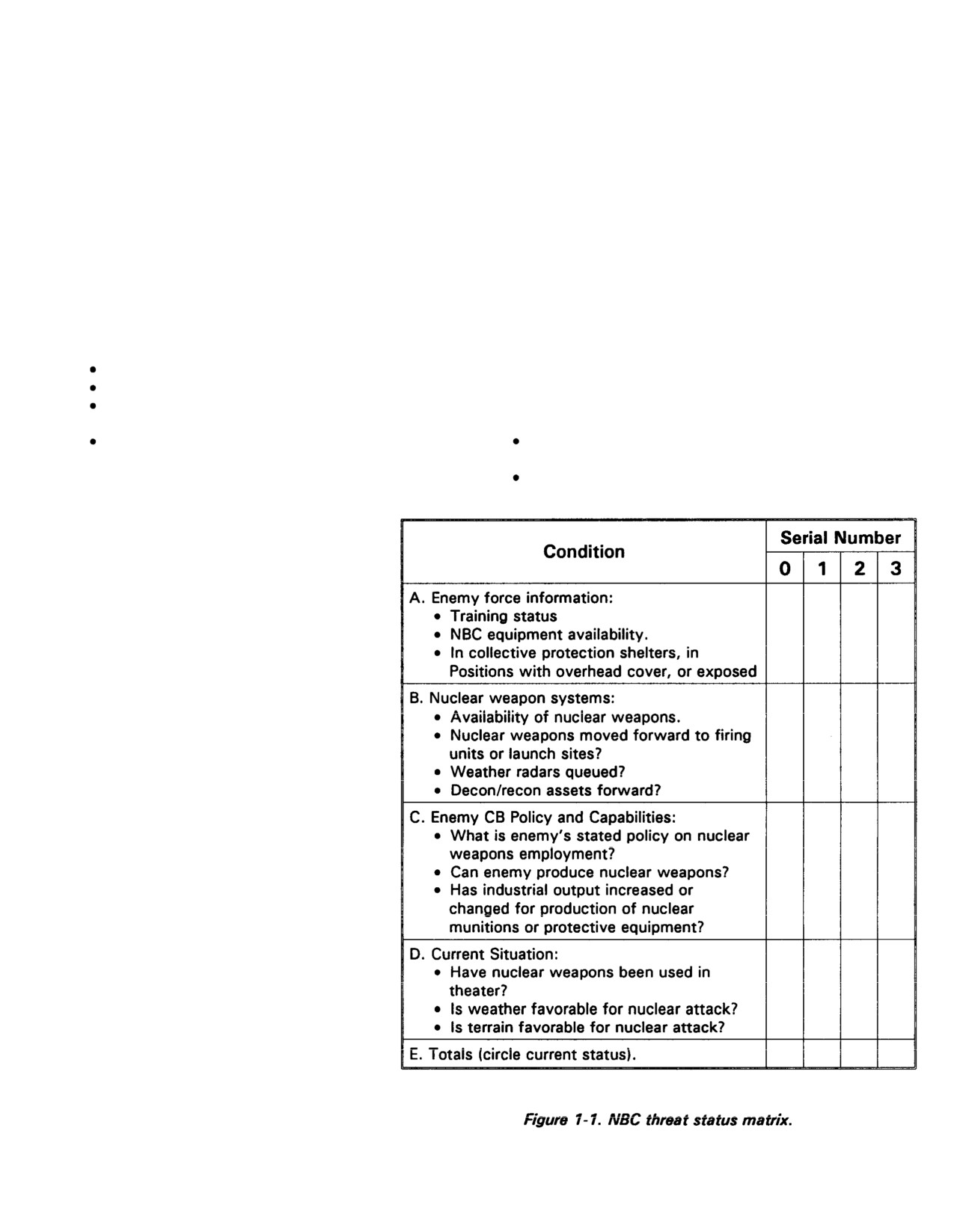
analysis is the Threat Status Matrix in Figure 1-1.
to subordinate units. Decontamination assets, NBC recon
More than one matrix may be necessary to determine the
assets and smoke support should be deployed as part of the
threat status for nuclear, biological, and chemical attack.
force structure. Detection and monitoring equipment
To use the matrix, place an “X” in the appropriate
should be issued to the operators. Unit should improve
block. Add each column; and whichever column has the
fighting positions and harden shelters if mission permits.
most X’s provides a means to identify what threat status
Serial 3 (high).
serial number could be used to indicate the enemy force
The opposing force possesses nuclear weapons and
intent. If an overall threat status cannot be determined due
delivery systems. Nuclear defense equipment is available
to an informational shortfall, collection assets should be
and training status is considered at par or better than that of
reallocated or positioned to gain the needed information.
the United States. Nuclear weapons have already been
Once the threat status estimate has been assessed, the
employed in the theater and attack is considered imminent.
chemical staff must analyze the protection level required
Indicators are—
for friendly forces. This is accomplished by modifying the
Nuclear attack in progress; but not in your area of operation.
MOPP analysis process contained in FM 3-4. Key factors
Nuclear warnings/signals to enemy troops.
include analyzing mission, environment, and soldier
Nuclear munitions delivered to firing units within range of
factors. These key factotrs are discussed in FM 3-4 and
friendly forces.
listed below:
Movement of surface-to-surface missiles to launch sites.
Understanding the mission and commander’s intent for
US forces should deploy with nuclear defense equipment
friendly forces.
in the unit load. This will depend on the nuclear threat to
Capabilities and level of training of friendly forces.
the airfield or port at which they land. Soldiers should
ensure radiac equipment is serviceable
prior to deployment. Decontamination
and nuclear recon assets should be task
organized and moved forward.
Contingency stocks of nuclear defense
equipment may be moved forward to the
battalion trains. EDMs are initiated.
Place collective protection systems into a
state of readiness, including those
systems in combat vehicles.
A threat status number can be used to
represent a combined status for NBC, or
it can be several numbers used to
represent each category. It is possible to
have a Chemical/Biological (CB) status of
three and a nuclear status of zero. This
threat status provides the commander
with guidance for deployment and
operational purposes. It allows the
commander to tailor chemical units to fit
any situation.
It also must be understood that the
threat status can change rapidly.
Although a nuclear status of zero may
exist during deployment, the opposing
force may seize industrial products or
obtain nuclear weapons from a
sponsoring nation. Therefore, the ground
commander must be capable of upgrading
the NBC defense posture quickly.
To assist in the formulation of the
threat status, the chemical staff, (in
conjunction with the S2) must analyze all
information received. A tool in this
1-3
FM 3-3-1
Availability of nuclear defense equipment and decon assets.
Availability of civilian contracted labor and water transport
In this regard, information may be obtained from the S2 or
for decon operations.
G5.
For urban areas, location of car washes. These car washes
Other factors include—
may be used in lieu of operational decon stations. Obtain data
Location and availability of additional building materials to
on local fire hydrants (location, type of connections, etc.).
harden shelters.
Hydrants may be used to provide water for decon operations.
Location of civilian chemical manufacturing and storage
The chemical staff must properly prepare the threat
facilities. In the event of a nuclear attack, these areas may be
status and identify the protection level required for friendly
targeted or damaged, multiplying the hazard to friendly
forces to withstand a nuclear attack. This information is
forces. Also, chemicals or hazardous materials stored in these
vital to the commander and for the successful
facilities may produce areas of contamination if storage
accomplishment of the mission. The commander may be
containers leak (either intentional or unintentional). To assess
required to reallocate or position units on the battlefield to
these hazards and how such a leak may impact on operations,
reduce vulnerability to an attack.
refer to DOT Regulation 5300.3 and DOD Regulation
4145.19-R-1.
Nuclear Vulnerability Analysis
A unit’s vulnerability to nuclear attack depends on the
ineffective. They remain ineffective until death, which
yield of the warhead likely to be used, the protection
usually occurs in 5 to 6 days.
available to the unit, and how well dispersed the unit is.
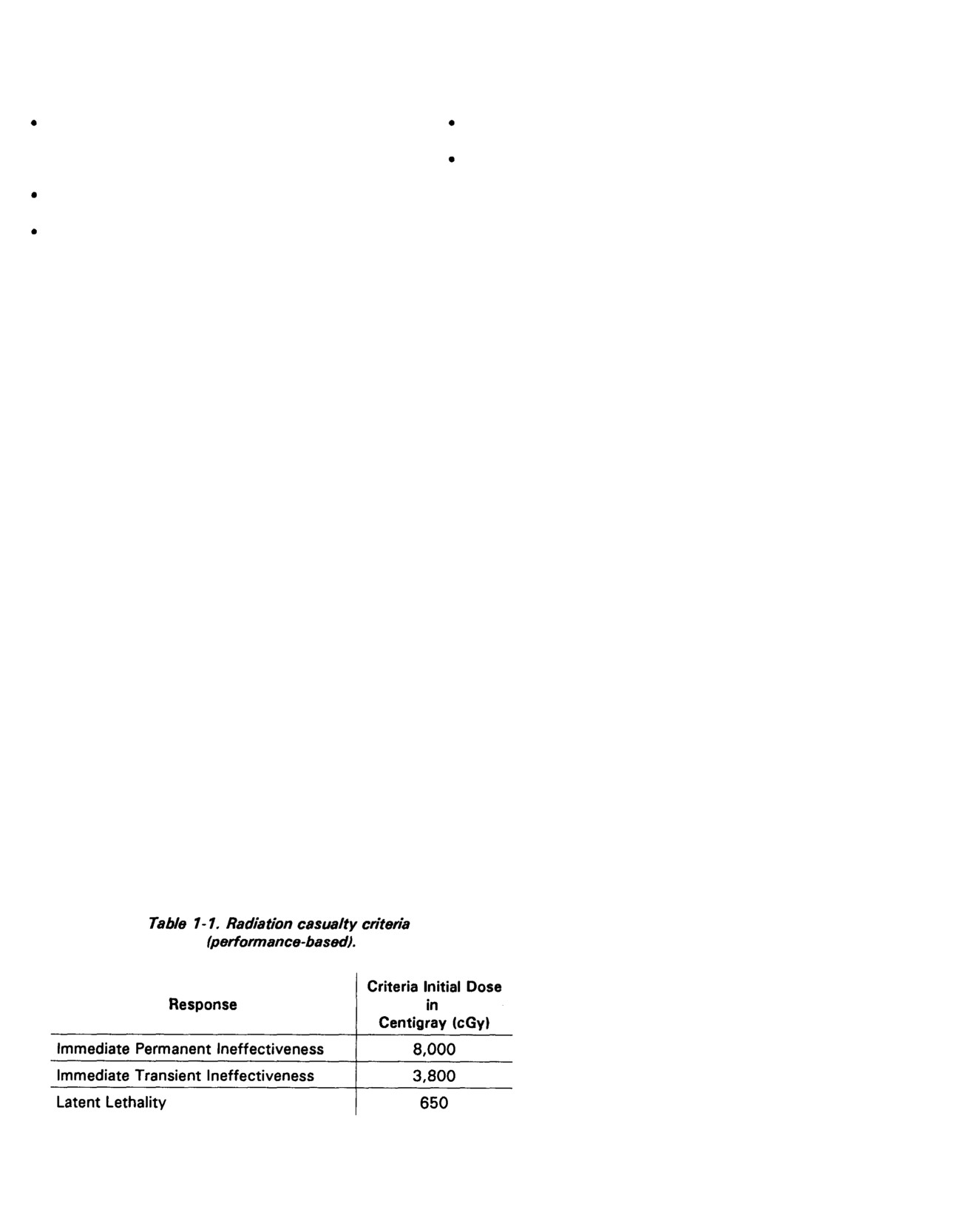
Latent Lethality (LL)-is the physiological response
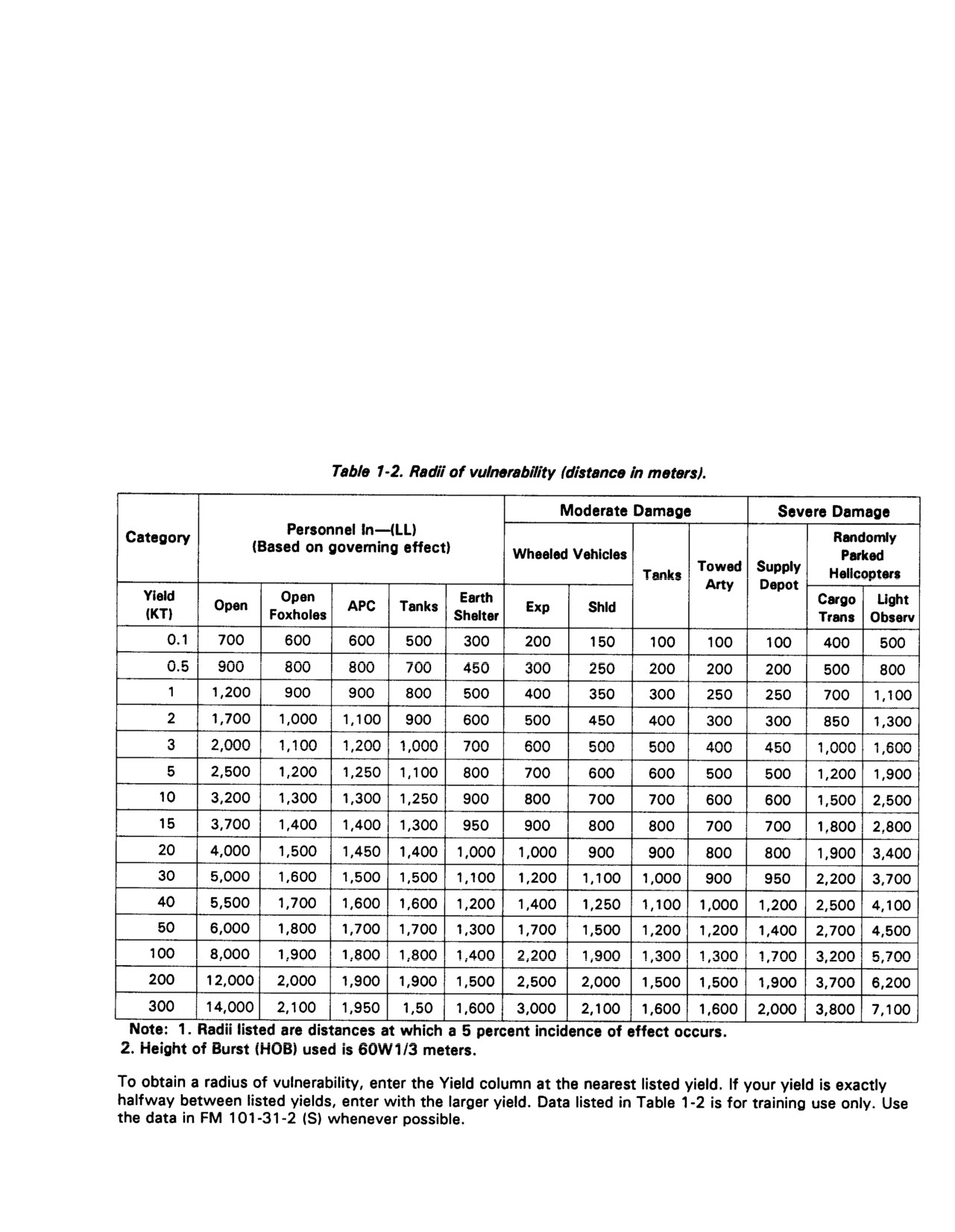
Tables 1-1 through 1-3 help estimate the damage caused by
from a dose of 650 cGy (RADs). For physically
a nuclear detonation. This information will help the
undemanding tasks, performance degrades about 3 hours
commander determine unit vulnerability to nuclear attack.
after exposure and remains so for approximately 2 days,
These tables are simplified and safesided. They assume that
when personnel will recover combat effectiveness for 6
the worst case of a nuclear burst will occur at ground zero
days or so. Then they relapse into degraded performance
(GZ) (see FM 101-31-1) and that all target elements will be
and remain so for 4 weeks after exposure when radiation
dispersed uniformly throughout the target area.
sickness becomes so severe that they are ineffective. They
Immediate Permanent Ineffectiveness (IP)—Personnel
will remain ineffective until death approximately 6 weeks
become ineffective within 3 minutes of exposure and
after exposure. For physically demanding tasks, personnel
remain ineffective until death. Death usually occurs within
performance degrades about 2 hours after exposure and
one day.
remains so for three weeks, when radiation sickness
Immediate Transient Ineffectiveness (IT)—Personnel
becomes severe enough to render the personnel ineffective.
become ineffective for any task within 3 minutes of
They remain ineffective until death approximately 6 weeks
exposure and remain so for approximately 7 minutes.
after exposure.
Personnel recover to greater than 75 percent of their
Physically Demanding Tasks-Personnel become less
pre-exposure performance levels after about 10 minutes
than 25 percent effective within 2 hours of exposure and
and remain so for about 30 minutes. Then their
remain so for 3 weeks, at which time radiation sickness
performance degrades for around 5 hours, for
symptoms will be present in sufficient severity to render
undemanding tasks or 2 hours for demanding tasks, when
them ineffective. Personnel will remain ineffective until
radiation sickness becomes so sever that they are
death in approximately 6 weeks.
Radiation casualties, with these three categories in mind,
become performance-based. Recent studies by
the Defense Nuclear Agency and the Ballistic
Research Laboratory reveal that lethal dosage
varies from subject to subject and according to
the physical demands of the task to be
performed. Thus, dosage is expressed in terms of
LD 50/30: the dose that will prove to be lethal to
50 percent of the exposed population within 30
days.
In an active nuclear environment, the more
concentrated a unit is, the more lucrative the
target becomes. If the unit itself is not the target,
1-4
FM 3-3-1
but falls within the fallout pattern, unit monitors will be
presented in Tables 1-2 and 1-3 (below and next page) are
capable of providing the commander with essential
for planning purposes only. See FM 101-31-2 (S) for actual
information regarding the hazard. Nuclear hazard
vulnerability radii.
prediction is covered in more detail in Chapter 3.
Based on vulnerability radius and unit size, commanders
Casualty and Damage Assessment
may determine the risk to the unit from a nuclear attack
and whether or not to adjust unit dispersion. However,
When assessing casualties or damage, the coverage
personnel may not be the target. Often, a unit’s equipment,
tables consider only blast and nuclear radiation effects. The
due to sensitivity and vulnerability, may be the target.
combined coverage of the two effects is listed. Thermal
Additional information concerning planning factors and
casualty data are included in the effects tables.
operational exposure guidance may be obtained in
Appendix A to this FM. Additional information concerning
Safety Distance Assessment
shielding afforded by particular vehicles and structures,
commonly referred to as transmission factors, can be found
Blast, thermal radiation, and nuclear radiation were
in Chapter 3 and Appendix B.
considered for assessing safety distances, and the largest
A more detailed discussion of nuclear vulnerability
radius of safety is listed. For calculations, friendly troops
analysis can be found in FM 101-31-1. The information
1-5
///////////////////////////////////////