FM 3-3-1 Nuclear Contamination Avoidance - page 8
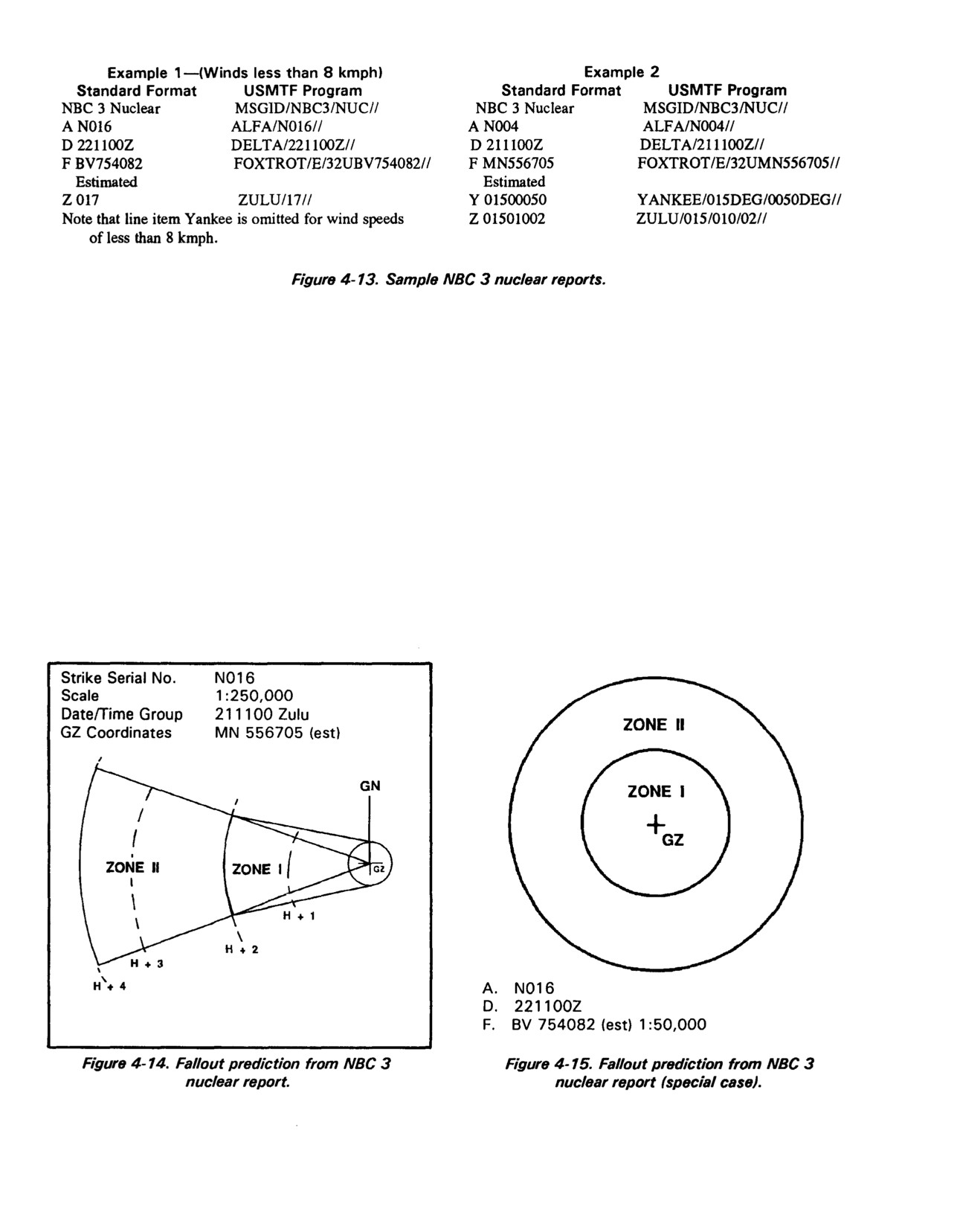
FM 3-3-1
Yankee
ddddcccc—This line is the azimuths of the two
Zulu
sssxxxrr—This line is the prediction dimensions.
radial lines to the nearest mil or degree from GN. The
The letters sss represent the effective wind speed (to the
letters dddd represent the azimuth of the left radial line and
nearest kilometer per hour), xxx represent the downwind
the letters cccc represent the azimuth of the right radial
distance of Zone I (to the nearest kilometer), and rr
line. Left and right in this case are the angles as they
represent the radius of the stabilized cloud (GZ circle) to
would appear to an observer located at GZ looking
the next higher kilometer if the value is not a whole
downwind. The unit of measurement (roils or degrees) of
number. (This line contains only three digits when the
the azimuths must be indicated. Omit this line when the
special case of low winds applies. ) Figure 4-13, next page,
special case of low winds (less than 8 kmph) exists.
shows sample NBC reports.
Unit Procedures
Upon receipt of an NBC 3 nuclear report, the unit
operations? If the report is new and/or may impact on unit
inspects the report. Several items are looked at. First, has
operations, it must be plotted. Two different plotting
the report been received or previously plotted? Second, is
procedures exist. Each procedure is discussed in the
the GZ location within the unit’s area of interest or zone of
following paragraphs. See figures 4-14 and 4-15, next page.
4-11
FM 3-3-1
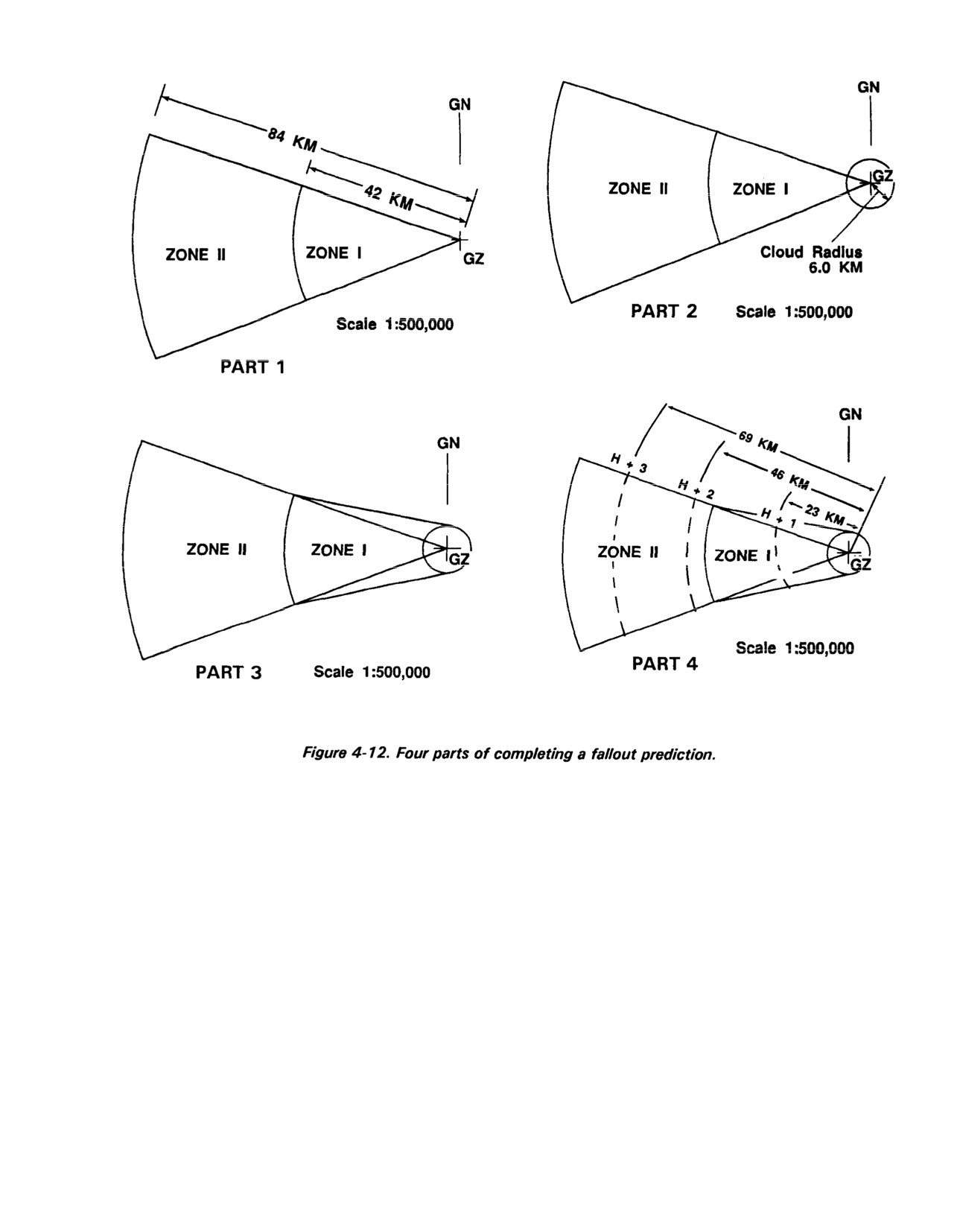
If the NBC 3 nuclear report contains line item Yankee,
Step 5.
Draw tangent lines from the outer edge of the
follow these steps:
cloud radius to the points of intersection of the radial lines
Step 1.
Identify map scale to be used. Obtain a sheet of
with the Zone I arc.
overlay paper or other transparent material. Mark a GZ
Step 6.
From line item Zulu, determine the effective
location and GN.
wind speed. Beginning at GZ, draw as many dashed
Step 2.
Examine line item Yankee. Starting at the GZ
time-of-arrival arcs between the radial and tangent lines as
location, draw the left radial line and then the right radial
will fit inside the prediction. Label the dashed arcs as
line measured from GN.
hours after the burst: H + 1, H + 2, and so on. H + 1 is
Step 3.
From line item Zulu, determine the downwind
the closest arc to GZ. If a time-of-arrival arc coincides
distance of Zone I. Starting from GZ, draw an arc between
with a Zone I or Zone II arc, extend the zone boundary
the radial lines with a radius equal to the distance of Zone
with a dashed line.
I. Label this area Zone I. Draw a second arc between the
Step 7.
Add marginal information to the plot. This
radial lines at twice the radius as the downwind distance of
should be all known information about the attack.
Zone II. Label this area Zone II.
Step 8.
Orient the prediction to the map and evaluate the
Step 4.
From line item Zulu, determine the size of the
hazard.
cloud radius. Using GZ as the center, draw a circle with a
radius equal to the stabilized cloud radius.
4-12

FM 3-3-1
If the NBC 3 nuclear report does not contain line item
a radius equal to Zone I distance. Label this area Zone I.
Yankee, follow these steps:
Draw a second circle at twice this radius for Zone II. Label
Step 1.
Identify map scale to be used. Obtain a sheet of
this arc Zone II.
overlay paper or other transparent material. Mark a GZ. A
Step 3.
Add marginal information to the plot. This
GN line is not necessary.
should be all known information about the attack.
Step 2.
The three digits shown are the radius of a circle
Step 4.
Orient the prediction to the map and evaluate the
for Zone I. Using the GZ as the center, draw a circle with
hazard.
Fallout Plotting from NAV NBC 3 Nuclear Report
In the case of a fallout producing nuclear detonation, the
From the intersections of the Zone I arc with the radial
NBC collection/sub-collection center will prepare a fallout
lines, draw lines to connect with the ends of the semicircle.
prediction, using the detailed procedure, as described
From Figure 3-36, in Chapter 3, find the safety distance
previously.
for the yield, in this example for a 10 KT weapon. Safety
The prediction will be passed to naval forces/ships in the
distance for 10 KT yield is 2.5 nautical miles.
format of a NAV NBC 3 nuclear report. An example
Determine the area where deposition of fallout is
follows:
estimated to take place at a specific time after the
NAV NBC 3 Nuclear
detonation. The effective downwind speed is given in letter
A.
24
(Strike serial number)
"Z," the first three digits. In the example, the wind speed
D.
2014052
(Date-time of burst)
is 10 knots. Multiply the effective downwind speed by the
F.
56º00ºN-11º15’E
(Location of burst)
time (hours after detonation, that is, 1.25 hours after
N.
10KT (Weapon yield)
detonation, or H + 1.25 hours):
Y.
01470187 DEGREES (Direction measured
10 knots x 1.25 hours = 12.5 nautical miles.
clockwise from GN to
Add and subtract the safety distance (from e above) to
left and right radial
and from 12.5 nautical miles.
lines)
12.5 + 2.5 = 15 nautical miles, and
z.
01000802
(Effective downwind
12.5 -2.5 = 10 nautical miles.
speed (knots) 3 digits,
Using these two distances as radii and GZ as center draw
downwind distance of
two arcs across the fallout pattern. The area confined by
Zone I (nautical miles)
the two arcs and the cross wind boundaries of the fallout
3 digits, and cloud
area defines the approximate area of deposition at H +
radius (nautical miles)
1.25 hours.
2 digits).
Complete the fallout plot by indicating the following on
The NBC information contained in the NAV NBC 3
the fallout template:
nuclear report can easily and rapidly be transferred to the
(1) NAV NBC 3 nuclear report used
ships fallout template (see Figure 3-35, in Chapter 3).
(2) Yield and date-time of burst
From letter "Y" it is seen that the angle between the GN
(3) GZ
line and the left radial line is 147 degrees, and the angle
(4) Geographic chart number (scaling).
between the GN line and the right radial line is 187
Note:
When the effective downwind speed is less than 5
degrees.
knots, the predicted fallout area will be circular. Then, the
The effective downwind direction will then be the
NAV NBC 3 nuclear report contains no letter “Y,” and let-
bisector of the angle formed by the two radial lines:
ter “Z” contains only three digits, indicating the Zone I
downwind distance in nautical miles. The fallout prediction
plot is prepared by drawing two concentric circles with GZ
From GZ, draw the GN line through 167 degrees on the
as center and Zone I and Zone II downwind distances as ra-
compass rose, and label GN.
dii-the Zone II radius being twice the Zone I radius.
From letter “Z,” find the downwind distance of Zone I
There may occur cases in which meteorological
to be 8 nautical miles. Then the downwind distance of
information normally used for fallout prediction is not
Zone II will be 8 x 2 = 16 nautical miles. Using the
available, for example the basic wind data message and the
appropriate map scale, with GZ as center and the two
NAV EDM.
distances as radii, draw two arcs between the radial lines.
It may, however, be possible for ships to obtain the
From letter “Z,” the last two digits are the cloud radius,
necessary wind data for fallout prediction from other
in this example 02 nautical miles. Using GZ as center and
sources and to compute the effective downwind direction
2 nautical miles radius, draw the cloud radius semi-circle
and speed by using standard pressure level winds.
upwind of GZ to scale.
This method of computation is described in Appendix D
to this field manual.
4-13
FM 3-3-1
Actual Fallout Direction
The actual direction fallout takes can be determined in
Strike and store all tentage if unit intends on moving. If not,
several ways. First, data submitted by radar operators on
cover tentage with NBC-PC.
line item Papa Bravo of the NBC 1 nuclear report reflects
Implement continuous radiological monitoring.
the direction fallout is actually traveling. This can indicate
Shutoff all ventilation systems not provided with dust filtration
fallout prediction reliability. Direction may be determined
capability.
even before the fallout prediction is created. When actual
Protect items that will be difficult or impossible to
direction varies with predicted direction, the prediction is
decontaminate later (such as rope).
revised in favor of the actual direction.
Do not allow personnel to leave shelters while fallout is
A second method of determining actual fallout direction
arriving.
is to plot NBC 4 nuclear reports, since these reports should
Request air evacuation.
originate from within the predicted area. If the reports
Once the unit receives an NBC 3 nuclear report, the
come from areas not predicted to receive fallout, the
report must be plotted on the operations map. This is best
prediction may require revision. Note that the prediction’s
accomplished by an overlay on clear plastic or other
shape is not an absolute boundary. Fallout will occur
transparent material.
outside the area. However, militarily significant fallout as
The preceding paragraphs outlined actions that should be
defined by Zone I and Zone II should be inside the
part of a unit SOP. Once the chemical staff places the NBC
predicted area.
3 nuclear report on the situation map, he or she must be
When a unit is in an area predicted to receive fallout, it
prepared to answer these two basic questions from the
must take action to reduce the potential threat. These
commander:
actions must be listed in the unit SOP. Some examples of
1. Where did it go off?
these actions are—
2. Are we or any of our troops in danger?
Alert all personnel.
The first question is easy, but one should be prepared to
Construct shelters with overhead cover or improve existing
discuss the exact location and whether or not there is a
shelters.
crater. If any friendly units were in the immediate area of
Calculate when fallout will arrive (H + . hours after burst).
ground zero, obtain a battle damage assessment or
Plan on having only half of this time to be sure.
post-strike analysis. Either one may be obtained from
Upload and prepare to move out of the contaminated area.
either the unit itself, if it is an organic element, the
Request permission to move depends on a combination of
affected units higher headquarters, or through intelligence
several factors (previous radiation absorbed dose; location
channels.
within the prediction, especially Zone I; importance of
The other question is more difficult to answer. The
mission in the area; physical capability; and optimum time to
commander must understand that the NBC 3 nuclear report
exit).
is only a prediction of potential fallout. The plot is
Move only when told to (depending on prearranged plans).
safesided to incorporate all areas that may be affected. The
Fasten clothing, roll down sleeves, and put on and wear helmet
plot, by no means, indicates that fallout will cover
and gloves.
everything within the radial lines. Calculate, for the
Calculate Optimum Time of Exit (Topt) and advise higher
commander, the time of arrival fallout as discussed earlier.
headquarters (discussed in detail in Chapter 6).
This will provide necessary information to the commander
Feed all personnel if time permits.
and the unit as a whole as to when the fallout may arrive.
Fill canteens; cover food and water in airtight containers.
Armed with this information the affected unit may adjust
Cover as much equipment as possible with NBC Protective
plans accordingly and know how long they have to prepare
Cover (NBC-PC) to reduce the decon burden.
before the arrival of fallout.
Use expendable field expedient covers such as plastic, foliage,
If a unit lies within the predicted fallout area, the
mud (washed off later to remove fallout), and tarpaulins.
commander will be interested in how soon that unit can
Improve shielding ability of evacuation vehicles by adding
depart the area, if required. This is calculated as the
clean earth before fallout arrives.
optimum time of exit .
4-14
FM 3-3-1
Chapter 5
Monitoring, Survey,
and Reconnaissance
Planning, Conducting, Recording, and Reporting
As explained in Chapter 3, nuclear fallout may
fallout will occur within the predicted area. However, the
contaminate a large portion of the battlefield. In order to
prediction does not indicate exactly where the fallout will
operate and survive on the nuclear battlefield, this
occur or what the dose rate will be at a specific location.
contamination must be located, reported, and avoided if
Radiological contamination can also be created by rainout
possible.
or washout. Areas of neutron-induced radiation also can be
Terrain affects wind direction which in turn determines
caused by low airbursts. Operations in a neutron-induced
where fallout will be deposited. Fallout will deposit
gamma activity (NIRA) area are explained in detail in
differently in a valley as with a reversed slope of a hill.
Chapter 7. Before planning operations in a nuclear
The only sure way of determining where fallout has
environment, commanders must be aware of residual
actually contaminated the surface is by conducting a
contamination hazards and measure the dose rate. This is
radiological survey or by receiving NBC 4 nuclear reports
done by one of three methods-monitoring, survey, or
from individual monitors. These reports are essential to
recon and the results are transmitted to units in the form of
report the actual contamination that is present.
an NBC 5 nuclear report.
Fallout predictions provide a means of locating probable
radiation hazards (see Chapter 4). Militarily significant
Monitoring
Radiological monitoring is done routinely to determine
Periodic monitoring is initiated after the first use of nuclear
the presence and intensity of the residual radiation hazard.
weapons in theater, when a unit is out of contact with
Monitoring is performed while in a stationary position. The
higher headquarters, when ordered by higher headquarters,
radiation may be from fallout or neutron-induced areas.
or when the unit stops continuous monitoring.
The IM174-series Radiacmeter or the AN/VDR-2 are the
During periodic monitoring, take a reading with the
basic instruments used to monitor for radiation.
IM174 or an AN/VDR-2 radiacmeter at least once each
Area Monitoring.
Since nuclear weapons may be
hour. Unit SOPs may reqire more frequent readings and
employed at any time on the battlefield, all units monitor
should provide detailed information on monitoring
for radiation upon initial deployment. Monitoring is
procedures. When a unit has more than one Radiacmeter,
included in normal intelligence activities. It provides early
only one is required for periodic monitoring.
warning and useful radiological information to units at all
Continuous Monitoring.
Continuous monitoring is the
levels. There are two types of area monitoring-periodic and
surveillance for radiation in the unit area or position. It is
continuous. Both types of monitoring can be performed
usually performed by units using the indirect technique.
using the direct or indirect technique, discussed later in this
Frequency of readings will depend on the current situation
chapter.
and unit SOP. Units will initiate continuous monitoring—
Periodic Monitoring.
Periodic monitoring consists of
When a nuclear detonation is observed, heard, or reported in
frequent checks of the unit area for radiation. Periodic
their area of operations.
monitoring assures the commander that the unit area is not
When an NBC 3 nuclear report is received and the unit is in
contaminated. It warns the unit if contamination arrives.
the predicted area of contamination.
5-1
FM 3-3-1
When a dose rate of 1 cGyph is recorded during periodic
monitoring.
When ordered by the unit commander.
Note:
CFs are always greater than 1.0. CFs are rounded
Units return to periodic monitoring when the dose rate
to the nearest hundredth.
(unshielded) falls below 1 cGyph or when ordered to do so.
Preprinted correlation factors are calculated for vehicles
based on the “best” location for the radiac instrument. CFs
may be reported in the NBC 4 nuclear report by line Zulu
Direct Monitoring
Bravo (ZB). CFs are the same as the attenuation factor
Direct monitoring is the simplest and most precise of the
when operating the AN/VDR-2.
monitoring techniques. A radiacmeter is used to get an
unshielded dose rate. Determine the unshielded (outside)
Survey Meter Location in Vehicles
dose rate by standing with the IM174 or AN/VDR2 held
Dose-rate readings are taken during a ground survey by
waist high, or 1 meter off the ground, and rotating your
mounted personnel using the route technique. These
body 360 degrees. The highest reading observed is
readings are taken inside the vehicle and later converted to
recorded as the dose rate. Take this reading in the open at
outside dose rates, using a correlation factor. For
least 10 meters away from buildings or other large
operational situations, the correlation factor data should be
structures or objects that may shield out a portion of the
obtained by the survey party for use by the unit NBC
radiation. In cities or built-up areas, take readings in the
defense team in calculating ground dose rates. The survey
center of the streets or at street intersections. If there are
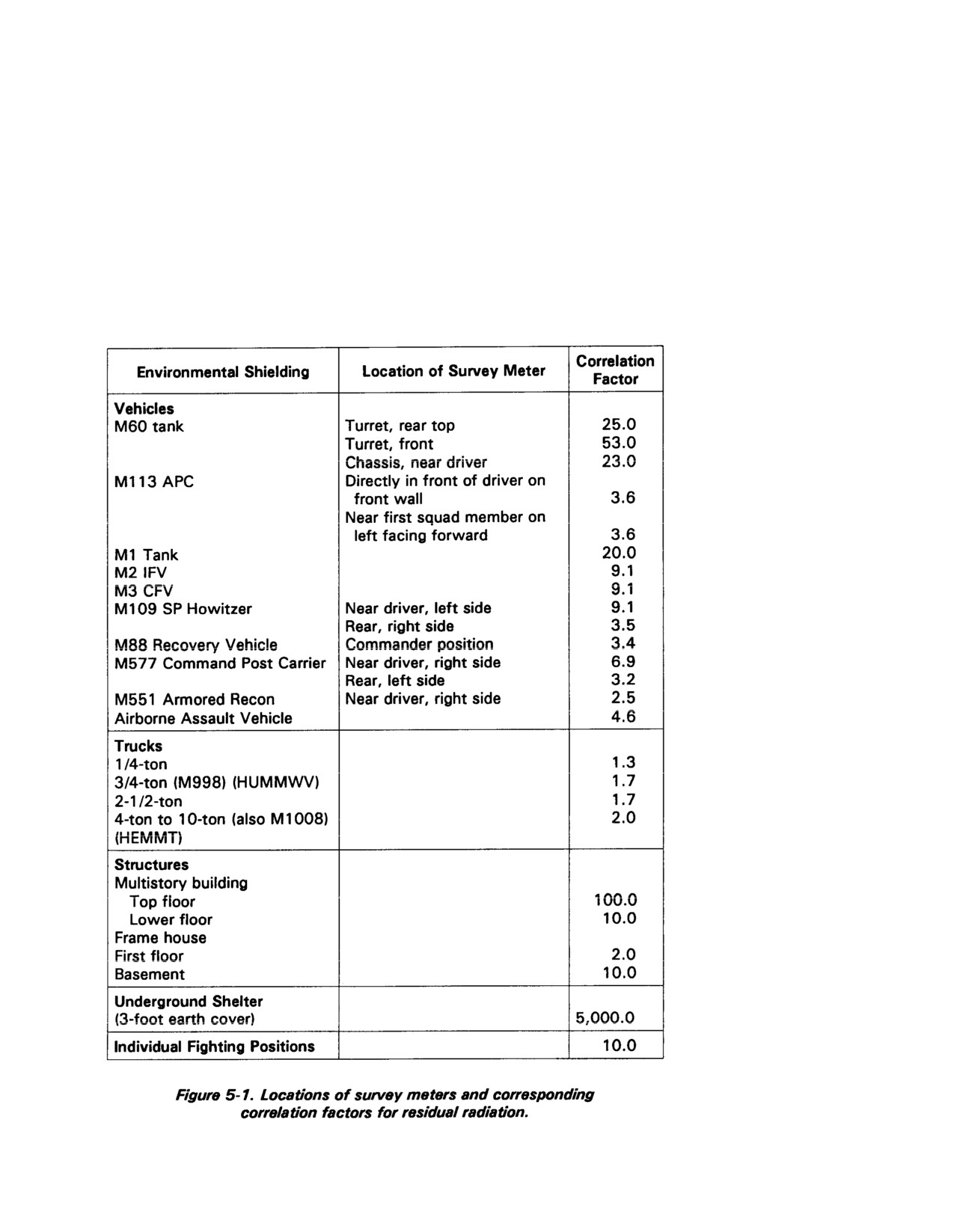
meter should be located as indicated in Figure 5-1, next
points of operational interest where you cannot get 10
page.
meters away from interference, take additional readings.
If the vehicle being used is not one of those in which the
Thus, if a road through a narrow cut or defile is of
location of the survey meter is designated in Figure 5-1,
operational interest, take readings both in the open near the
the survey meter should be held in a vertical position (face
cut and in the cut.
up) by the monitor, who is positioned in the assistant
Direct monitoring is used—
driver’s seat. The monitor should take the readings with
While monitoring for the initial detection or arrival of fallout.
the survey meter consistently located in the selected
When in low dose rate areas.
position.
When determining unshielded (outside) ground dose rates for
When the correlation factor data cannot be obtained by
transmission or correlation factors.
the survey party, published correlation factors may be used
When verifying the contamination status of a new position.
from Figure 5-1.
While moving through a contaminated area on foot.
For a vehicle in which the AN/VDR2 has already been
Direct readings are used when conditions and operational
installed, using the appropriate installation kit, the user
exposure guidance permit.
need only verify that the proper attenuation factor has been
entered (IAW TM 11-6665-2571-10). It is not necessary to
Indirect Monitoring
relocate the AN/VDR2.
Indirect monitoring is done inside shelters or vehicles.
This allows the unit to measure radiation levels and still
Correlation Factor Data
keep exposure to a minimum. Indirect monitoring is the
Correlation factor data are required in order to convert
preferred technique when operating in a contaminated area.
the reported readings taken inside the vehicle to ground
It is used whenever dose rates are high enough to be read
dose rates existing outside the vehicle.
inside the shielded location.
Data for the vehicle correlation factor are provided by
When the indirect technique is used, most of the readings
the survey party and consist of a set of two readings taken
are taken inside the vehicle or shelter. However, at least
at the same location. One reading is taken inside the
one outside reading is necessary to determine the
vehicle with the instrument located as indicated in Figure
correlation factor. Both the inside and outside readings
5-1. All subsequent inside readings reported for the survey
must be taken within three minutes of each other. Both
must be taken with the meter in this same position. The
must also be taken after fallout is complete. Take both
other reading is taken immediately as a normal ground
readings before determining the correlation factor. For
monitoring reading at the same location with the vehicle at
those vehicles in which the AN/VDR2 has been installed,
least 10 meters away. One or two additional sets of data
the user need only verify that the correct attenuation factor
should be taken at different locations so that the NBC
has been entered (IAW TM 11-6665-251-10) and then read
Defense Team can use an average vehicle correlation
the outside dose directly off the display.
factor.
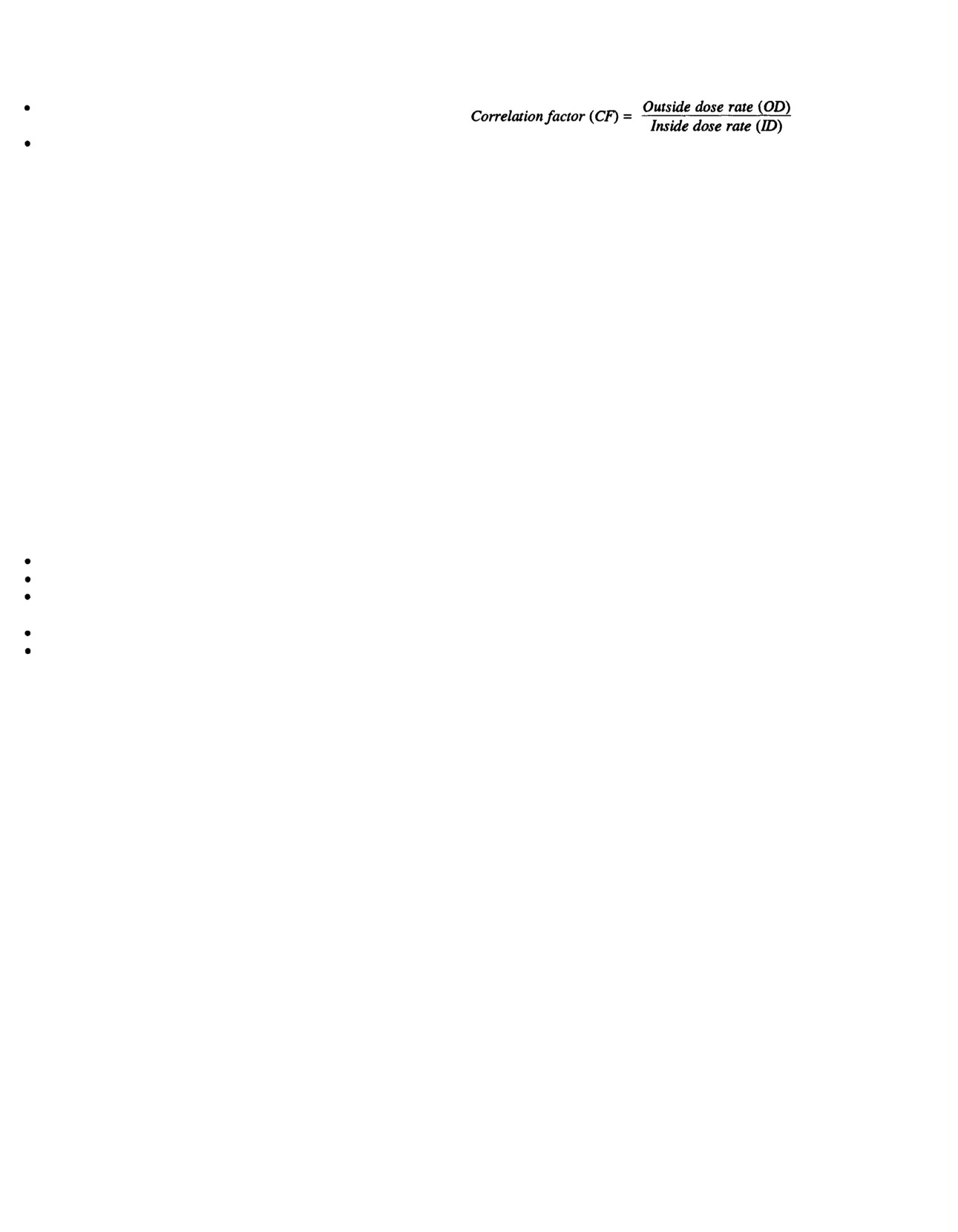
Calculate the correlation factor using the following
The sites for obtaining vehicle correlation factor data
formula:
should be selected to approximate average foliage and
5-2
FM 3-3-1
ground surface conditions for the contaminated area. New
same point. When readings are taken from vehicles, all
data must be obtained if these conditions change
readings are taken from one selected position.
significantly or if the survey meter or vehicle is changed.
The readings taken inside the vehicle or shelter represent
Additional correlation factor data taken because of the
inside shielded dose rates. These readings must be
aforementioned changes should not be averaged into
converted to outside unshielded dose rates by unit NBC
previously collected data, but should be used for applicable
defense team personnel before forwarding to higher.
routes or points. Accuracy of the correlation factor data is
Readings are converted using the following formula:
of paramount importance.
OD=ID x CF
When taking readings inside a shelter, the monitor stands
OD = Outside dose
at the center of the shelter, holds the radiacmeter waist
ID = Inside dose
high, rotates 360 degrees, and notes the highest readings.
CF = Correlation factor used.
All subseq.uent readings are taken the same way at the
Here is an example of this procedure. A company
monitor is located in an shelter
which has an open front, dug into
the side of a hill. A nuclear burst
occurs several kilometers away.
The monitor begins continuous
monitoring on the outside of the
shelter from a location that is at
least 10 meters away from any
object that might shield the
reading. Upon noting a reading of
1 cGyph on the instrument, the
monitor returns to the shelter and
notifies the unit NBC defense team
of the arrival of fallout. The
monitor continues to observe the
instrument, recording readings and
providing other data per unit SOP.
There is a steady rise in the dose
rate. When the monitor is certain
that the dose rate has peaked and is
decreasing (fallout is complete), a
reading of 20 cGyph is taken inside
the shelter. This reading was taken
from the center of the shelter, 1
meter above the floor. Within three
minutes the monitor goes to the
preselected location outside the
shelter. A ground dose-rate reading
shows 250 cGyph. Before entering
the shelter, the monitor brushes off
any fallout. The monitor reports to
the unit NBC defense team. The
report includes the inside reading,
the outside reading, the highest
(peak) reading noted in the shelter,
and any other data required per
unit SOP. The unit NBC defense
team calculates the CF and submits
all required reports to higher
headquarters.
The precalculated list of CFs is
shown in Figure 5-1 is not used by
the unit NBC defense team when
5-3
FM 3-3-1
calculating or reporting outside dose rates. Its principal use
associated with the dose rate that describes the
is to establish the relative shielding ability of one shelter,
circumstances surrounding the contamination. Note that the
structure, or vehicle as compared to another.
It is also used
definition of line item Romeo has been expanded. Key
for instructional and practice purposes.
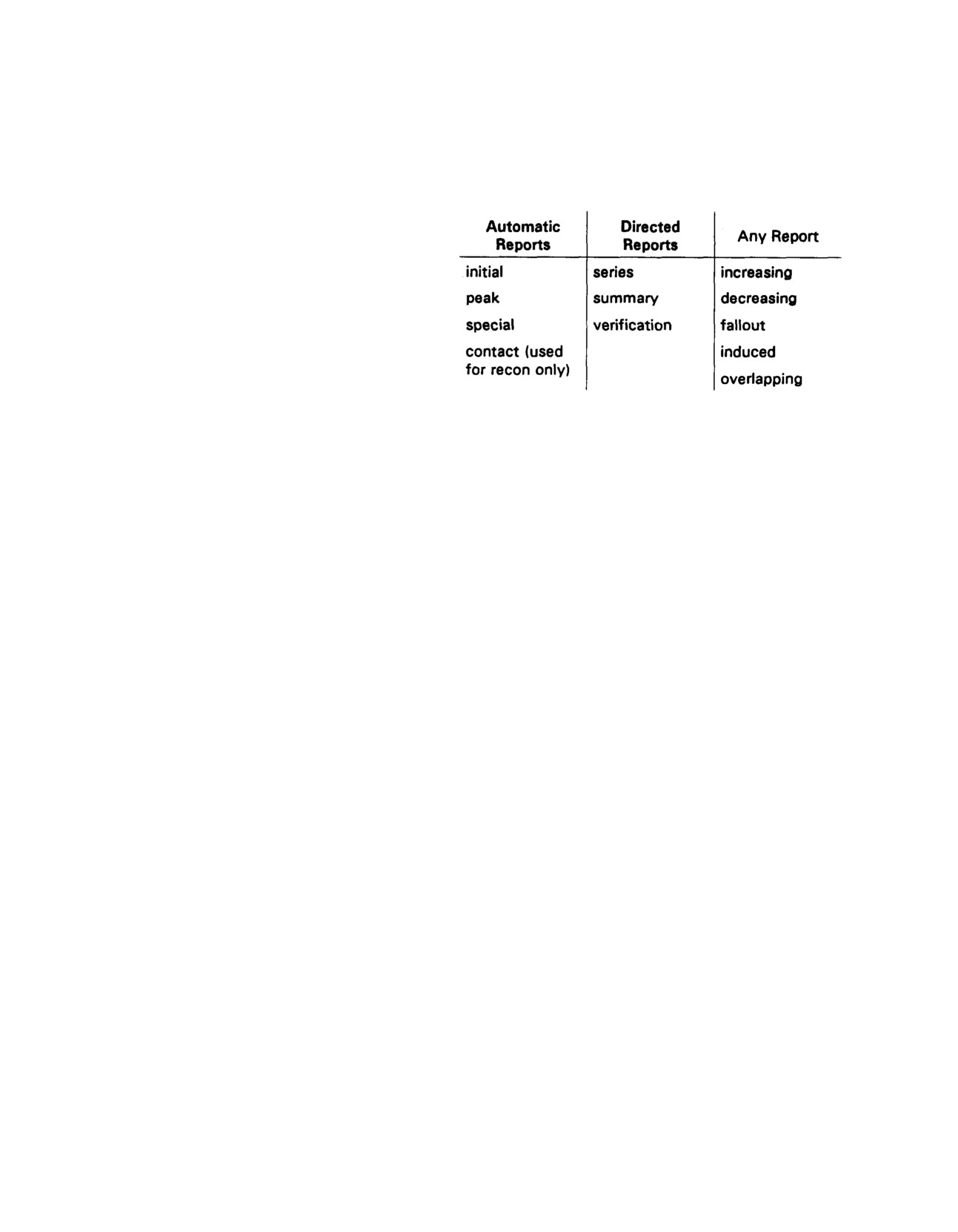
words used in preparing the NBC 4 nuclear report are
listed below. The following words are associated with line
item Romeo:
Recording and
Reporting
Monitoring Data
The NBCC receives monitoring reports from subordinate
units. These reports provide data essential to the
construction and updating of the contamination overlay.
This overlay is used by the entire command.
At unit level the primary purpose of monitoring is to
warn all personnel of the arrival or presence of
contamination. This allows the commander to take prompt
Note:
More than one word may be used on a single report.
action to minimize the hazard.
Radiological Data Sheet Notes
Recording Monitoring Data
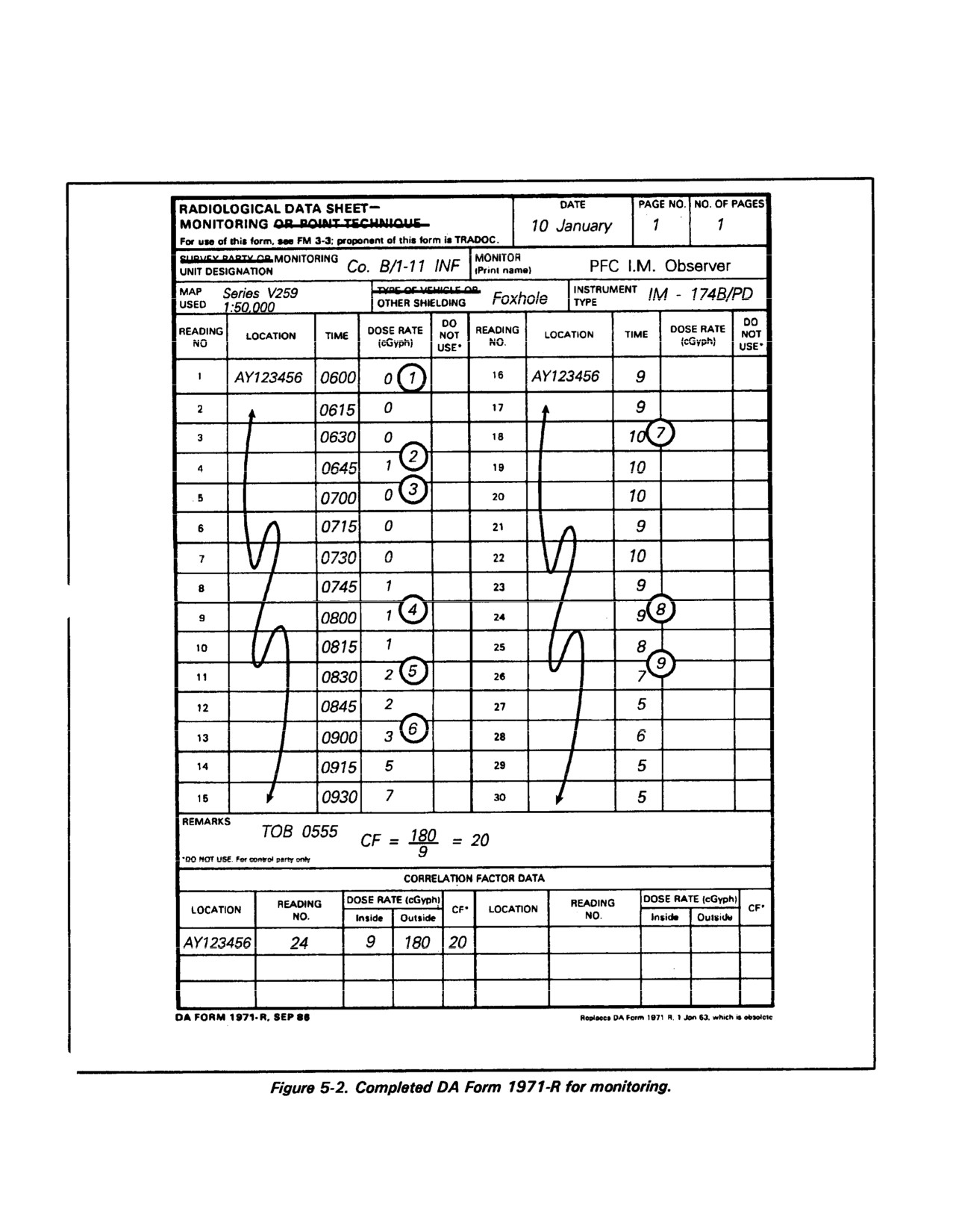
(See Figure 5-2)
DA Form 1971-R (Radiological Data Sheet-Monitoring
or Point Technique) is used to record monitoring data at
A nuclear weapon has detonated. Continuous monitoring
is initiated. Monitor awaits arrival of fallout in open areas.
unit level. Block headings are self-explanatory. Any
Fallout arrives. Monitor reads 1 cGyph, notes it, and
heading not applicable to the situation should be lined out.
reports it to the unit NBC defense team.
Space is provided for the monitor to enter data for the CF.
Monitor enters the shelter. No dose rate is noted inside
The monitor does not calculate the CF; this is done by the
because of the shielding. Dose rate must build to equal the
unit NBC defense team. The monitor uses the remarks
CF before a dose rate of 1 cGyph is apparent.
block to provide any additional information of value to the
Dose rate on the outside now equals CF (of course, the
NBC defense team. This block is also used by the NBC
monitor does not know the CF at this time). Monitor reads
defense team to enter the time of burst and to calculate the
CF.
1 cGyph on the inside. The dose rate continues to build. In
this example the OD must reach 40 before ID will reach 2.
A completed DA Form 1971-R showing monitoring data
The dose rate builds. The OD now equals 40 (this can be
and unit NBC defense team calculation of CF is shown in
seen once CF is applied to all previous readings).
Figure 5-2.
The DA Form 1971-R is also used as a copy sheet for
The dose rate continues to build and starts slowing the
rate of increase.
monitoring data passed from one headquarters to another.
The dose rate is almost the same as the previous reading.
Only outside dose rates are forwarded. The form can also
This indicates peak or near peak. The dose rate is
be sent or carried directly to the NBCC. Use the remarks
measured every 5 minutes now. The dose rate levels off. It
block to show normalizing factor calculations.
appears that no more fallout will arrive. Decay now takes
over. The peak reading is reported to the unit NBC defense
Reporting Monitoring Data
team.
The format for monitoring reports follows that found in
The decrease is noted. At this point, a collection of CF
NATO STANAG 2103/ATP45. Only that part of NBC 4
data is possible. The monitor notes the continuing decrease
report which pertains to monitoring reports is discussed
in dose rates. An OD of 180 is taken. The monitor reports
here.
a peak of 10 (shielded) at 1005 hours and the data for the
Note:
Correlation factors are based on the inverse of the
CF (OD = 180 and ID = 9). The NBC defense team
transmission factor for the given vehicle at the prescribed
calculates a CF of 20 and applies this data to the peak
location for the radiac instrument.
reading.
Monitoring reports contain the location of the reading,
The monitor continues to take readings at 30-minute
the dose rate, and the date-time the reading was taken. The
intervals until dose rate decreases below 1 cGyph or told to
location is sent as UTM grid coordinates; the dose-rate
stop.
reading is expressed in cGyph. Only outside (unshielded)
The following instructions do not limit the scope or body
dose rates are reported by the unit NBC defense team, and
of monitoring data. They attempt to show a large and
the date-time is reported in Zulu time. Certain words are
5-4
FM 3-3-1
flexible system. The important consideration is that both
the NBCC and the unit understand each other’s needs.
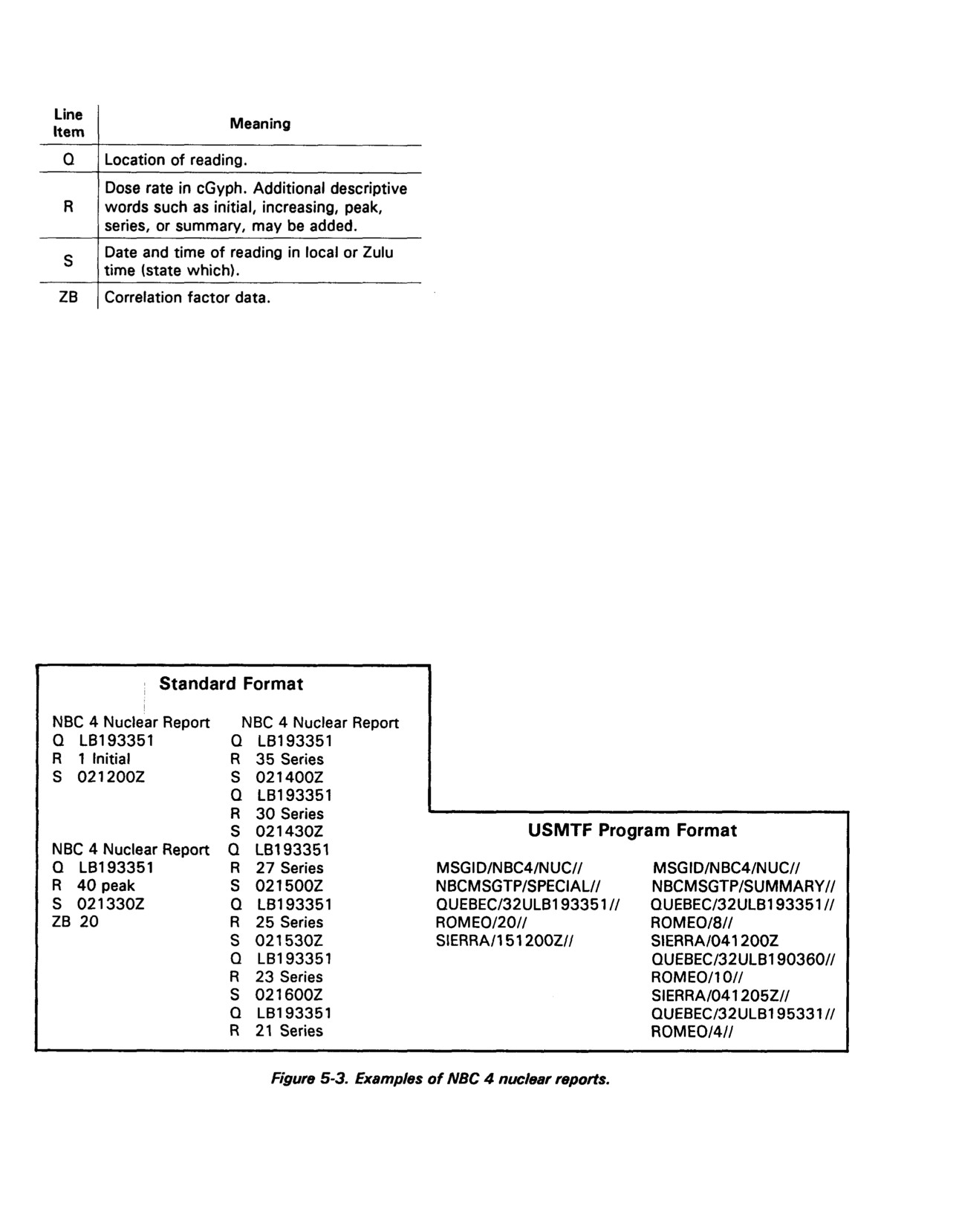
The format for NBC 4 nuclear reports is as follows:
5-5
FM 3-3-1
NBCC SOPs will detail in general terms how automatic
NBC 4 nuclear reports travel from company level to the
NBCC. When necessary, specified nets are used to allow
timely flow and to avoid overload. Directed reports will be
transmitted on the communications nets or other means
specified by the NBCC.
Figure 5-3, shows examples of NBC 4 nuclear reports.
These reports follow the format and report formatting
instructions. Line item Quebec is the unit’s location and
should be encoded for OPSEC purposes. This data need
not be encoded if the report is sent by secure means. Users
of the NBC 4 nuclear report are not limited solely to the
use of the line items shown in these examples. Other line
Report Formatting Instructions
items may be added at the user’s discretion.
Only the unit NBC defense team places monitoring data
to be sent to higher headquarters in the NBC 4 nuclear
Automatic Reports
report format. Unit monitors do not originate the NBC 4
All units in the contaminated area submit certain
nuclear report or send it to higher headquarters.
monitoring reports automatically. These provide the
Line items Quebec, Romeo, and Sierra may be repeated
minimum
as many times as necessary. When locations and times
essential information for warning, hazard evaluation, and
change, this gives a specific picture of the contamination
survey planning. Reports are sent through specified
throughout the area. A “zero” dose rate may be reported
charnels to reach the NBCC. Nondivisional and corps units
on line item Romeo.
in a division area submit reports to the division NBCC.
The NBCC provides guidance on precedence for an NBC
Corps units send reports to corps NBCC.
4 nuclear report in the SOP or other instructions. This
It is emphasized that the purpose of establishing
guidance is based on whether the report is an automatic or
automatic reports is to prevent overload of
a directed report. The precedence depends on the urgency
communications. In this way units are obligated, yet
of the report. It is usually sent IMMEDIATE, but may be
limited, to certain types of reports. This also insures that
upgraded or downgraded as the situation dictates.
only meaningful data are reported. The automatic reports
are initial, peak, and special—those specified by the NBCC
or required by intermediate commanders for operational
purposes.
Initial Report.
The unit monitor normally conducts
periodic monitoring. When conditions require continuous
monitoring, that technique is used. After noting a dose rate
of 1 or more cGyph outside, the monitor notes the time and
moves directly to shelter. The monitor reports to the unit
5-6