FM 3-3-1 Nuclear Contamination Avoidance - page 11
FM 3-3-1
Actual height above ground at which course leg or route
expressed in feet when working with US aircraft—US
is to be flown.
The NBCC will provide tentative guidance
altimeters are graduated in feet. Most NATO aircraft use
on survey height. Survey data obtained at heights above
meters.
500 feet above ground level (AGL) (150 meters) is
Ground speed for each course leg or route.
The slower
unreliable. A height of 200 feet AGL (60 meters) is
the aircraft speed and the shorter the time between
considered optimum. Actual survey height calculation is
readings, the more accurate the results. The NBCC will
done by the team. To do this, the team makes an initial
provide general guidance on distance between readings for
pass over the fallout area along a course leg at 1,000 feet.
certain high-interest areas. These may be areas near GZ or
The monitor observes the radiacmeter and notes the highest
in areas a unit is required to occupy. Final selection of
dose rate at that height. The monitor multiplies this dose
speed and interval is the judgment of the survey team. The
rate by the AGCF for this height-found in Table 5-3 (page
maximum acceptable interval between readings is 500
5-14). After the ground dose rate is found, consult Table
meters. The slow response time of the IM174()/PD family
5-3 again. This time the monitor looks for an AGCF
of radiacmeters reduces reliability of the data obtained at
which, when divided into the ground dose area will result
ground speeds above 53 knots (98 kilometers per hour).
in a dose rate that can be easily read on the instrument. For
For best plotting accuracy, at least 10 readings between
example, the highest dose rate noted over a course leg at
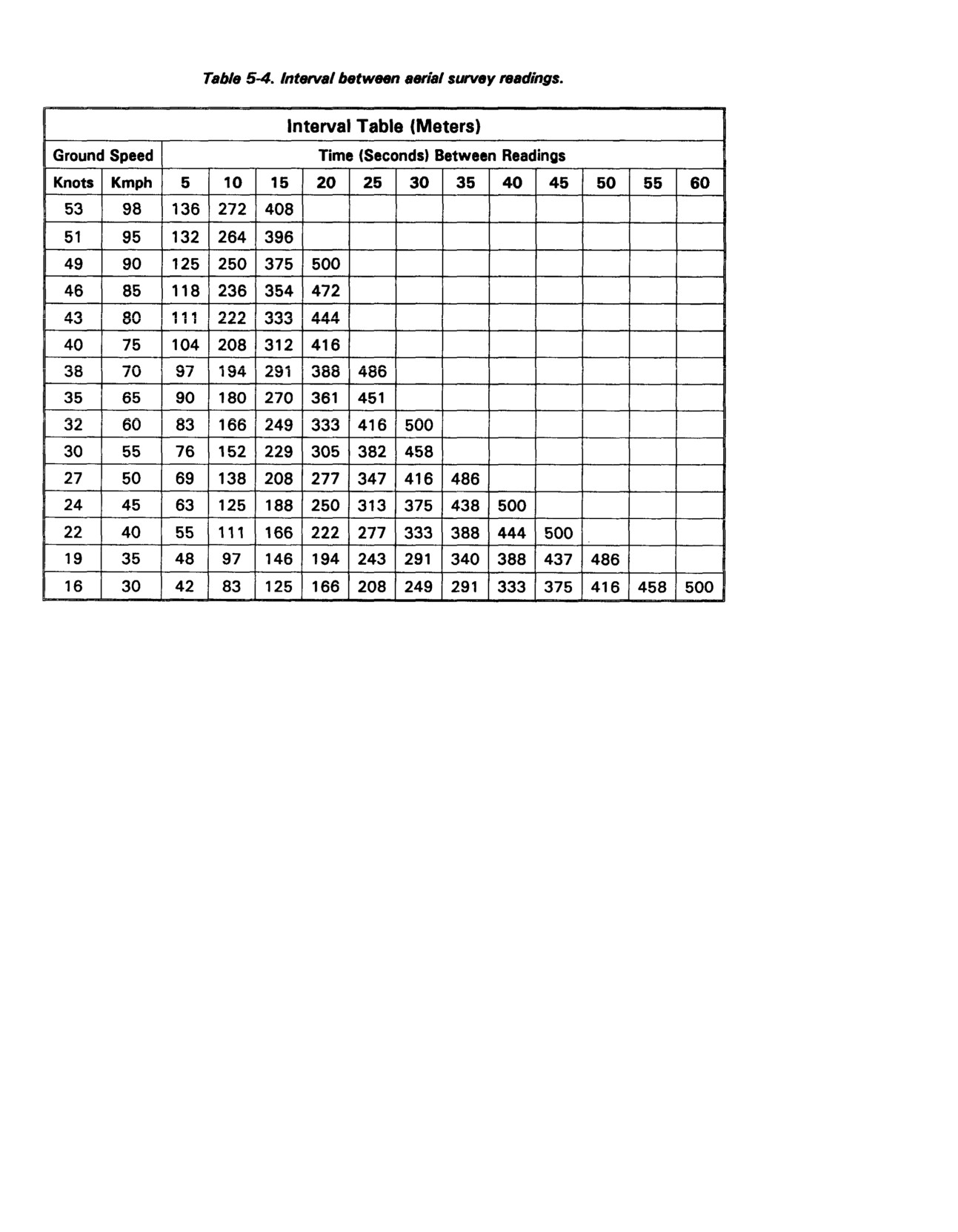
checkpoints is required. Table 5-4 (next page) shows all
200 feet was 30 cGyph. The AGCF from Table 5-3 for this
practical combinations of speed and time intervals.
height is 3.2. This results in 96 cGyph at 1 meter above the
Inspection of Table 5-4 reveals that any combination of
ground:
speed less than 53 knots and 15-second time interval will
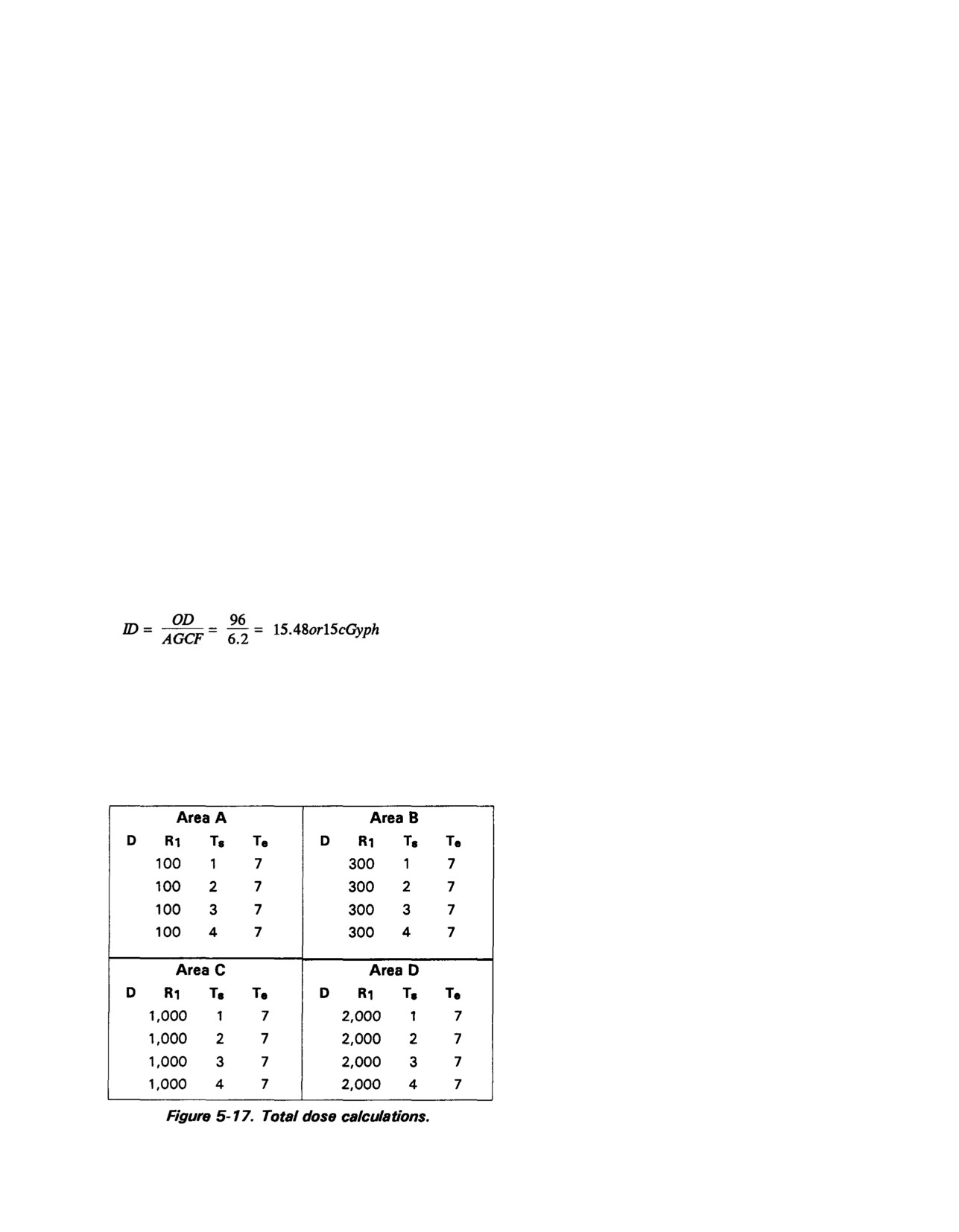
OD=ID x AGCF
yield a distance between readings of less than 500 meters.
= 30 x 3.2
Locations for determination of AGCF data.
The NBCC
= 96 cGyph
provides recommendations on locations during the survey
Next, the monitor selects a higher altitude that will give
briefing. The team makes the final selection of sites baaed
a lower dose rate reading on the instrument. The monitor
upon several factors. These factors are average foliage and
confirms this selection by dividing the AGCF for that
ground conditions, dose rates, and number of course legs
height into the ground dose rate. To continue the example,
or routes to be surveyed. AGCF dose rates should be taken
if the monitor selected a height of 400 feet, the AGCF
where they can be read on the low end of the scale of the
would be 6.2. When this is divided into the ground dose
radiacmeter (1 to 10 cGyph). This ensures accuracy. The
rate, the highest dose rate the monitor will read on this
aerial dose-rate portion of AGCF data must be taken at the
course leg is 15 cGyph:
survey height for the course leg or route. Actual
determination of ground dose rate for the AGCF requires
the aircraft to land near the point of interest. The monitor
Data for Table 5-3 was developed from Cobalt-60. Use
dismounts, proceeds to the selected point, and takes the
of the data provides a good estimate. In actual fallout
reading by using normal ground monitoring techniques.
situations, the NBCC will task survey teams to determine
The survey team must determine new AGCF data for
raw data for an actual table of fallout data. After the actual
every two to four course legs or routes flown, when
AGCF table has been determined, it is used in place of
average surface conditions change (for example, from an
Table 5-3. The calculation technique described above will
area with little snow to a lot of snow coverage or from an
be valid for the actual fallout data. Survey heights are
area with much standing water to an area with little or no
standing water), when terrain conditions change (from hilly
areas to flat lands), and when average foliage conditions
change (for example, from wooded areas to open areas or
from grasslands to wooded areas). Selected sites for AGCF
data must approximate the survey area.
New data must be obtained when survey height changes
by 15 meters or more, when ground foliage or average
ground surface conditions change significantly, if the
aircraft or the survey meter is changed, or if weather
conditions change drastically during monitoring.
Ground survey involves considerably less planning or
action on the part of the survey team. Essentially, the team
follows the instructions given during the survey briefing.
Recording and Reporting
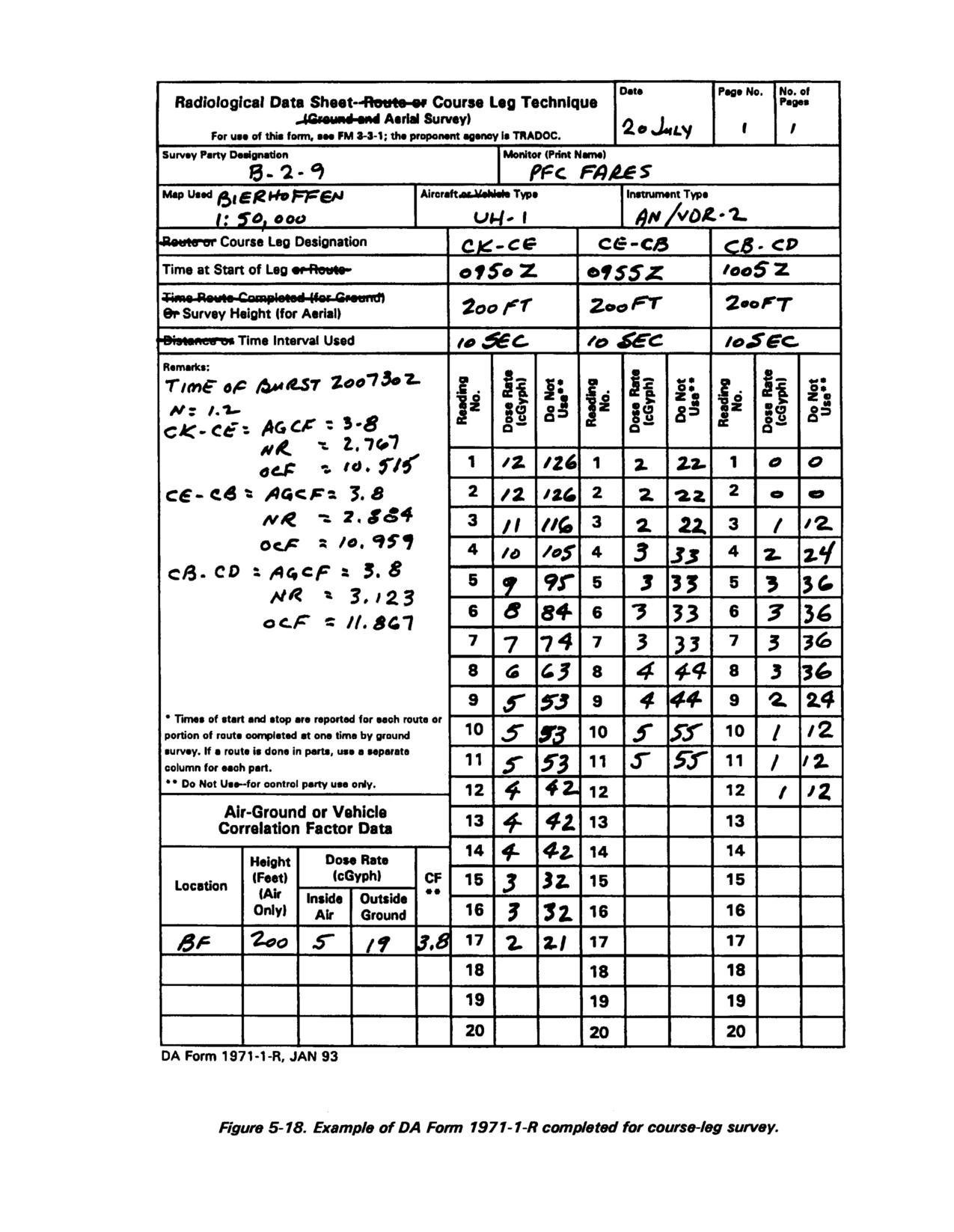
The radiological data sheet is used for recording data
obtained in aerial surveys. Data obtained using the route or
course leg technique are recorded on DA Form 1971-1-R
5-27
FM 3-3-1
(Radiological Data Sheet-Monitoring or Point
vehicles reduce doses received by personnel and must be
Technique). (See Figure 5-18, next page.) Data obtained
used whenever possible. Ground surveys lack the speed
by the point technique are recorded on DA Form 1971-R.
and flexibility of aerial surveys. They result in higher
Block headings are self-explanatory. Any headings not
nuclear radiation doses to personnel, place larger load on
applicable to the situation are lined through by the monitor.
communication facilities, and require division of more
Space is provided for use of the control team—the DO
personnel and equipment from the mission. However, a
NOT USE* blocks-for entry of the AGCF and normalized
ground survey is independent of weather conditions. It
readings. The Remarks block is used by the monitor to
provides more accurate information than an aerial survey.
provide any additional information of value to the unit
All echelons can perform ground surveys within their areas
NBC defense team. This block also is used by the defense
of responsibility, using regularly assigned personnel and
equipment.
team to enter time of nuclear burst and computations of
The techniques used to conduct ground surveys include
the AGCF, normalizing factor, and overall correction
the route technique, the point technique, and the
factor.
preselected dose-rate technique. For a detailed explanation
A radiological data sheet completed by the monitor and
on these techiques and specific movement formations to
showing data collected by use of the course leg technique
use while conducting ground surveys, refer to FM 3-19.
during aerial survey is shown in Figure 5-18.
Most ground surveys are performed using the route
Survey data is delivered to the defense team, upon
technique. In this technique, dose-rate readings are taken
completion of the survey, by physical drop, radio, or
inside the vehicle at selected intervals between checkpoints
telephone from the nearest landing zone. The NBCC must
along a route. The unit defense team uses a correlation
specify in the survey briefing how this is to be done.
factor to determine ground dose rates. The dose rate
information is then processed into normalized ground dose
rates. The route, checkpoints, and interval are determined
Ground Survey
prior to the survey. The plotting procedure can be done
Ground radiological surveys are normally performed by
before the survey information is received. To plot this
personnel in M93 NBC reconnaissance systems (NBCRSs)
information—
or FOXs. Armored vehicles also may be used. These
5-28
FM 3-3-1
5-29
FM 3-3-1
Mark and label the checkpoints on the worksheet overlay.
Correlation factor data are required to convert the
Trace the preselected routes.
reported readings taken inside the vehicle to ground dose
Divide the route between checkpoints into the preselected
rates outside the vehicle. Data for the vehicle CF are
intervals. Move in the same direction as that assigned the
provided by the survey team. It consists of a set of two
survey party.
readings taken at the same location within three minutes of
Enter the normalized ground dose rate beside the proper
each other. One readings is taken inside the vehicle. All
location as processed data is available on DA 1971-1-R.
subsequent inside readings must be taken with the meter in
In using the point technique, the ground dose rate is
the same position as the first. The other reading is taken
determined at a selected point. The reading is obtained by
immediately at the same location as a normal ground
dismounting from the vehicle and taking a direct ground
monitoring reading (the vehicle is pulled away at least 10
dose-rate reading or by taking the dose-rate reading inside
meters). Accuracy of the CF data is very important.
the vehicle. For accuracy, the first method is preferred. If
Notes:
1. Average ground survey vehicle speed is 15 miles
the dose rate is taken inside the vehicle, the ground dose
per hour.
rate will be determined by the unit NBC defense team by
2. Use midtime for ground survey for NF calcula-
using a CF. When taking readings while dismounted,
tion.
monitors should move at least 10 meters from the vehicle
Record data obtained using the point or preselected dose
to take the readings. This prevents undue shielding of the
rate technique on DA Form 1971-R. Record data obtained
radiation by the vehicle. Enter the normalized ground dose
using the route technique on DA Form 1971-1-R. (See
rates beside the proper location on the DA Form 1971-R.
Appendix H for reproducible forms.)
With the preselected dose-rate technique, locations of
Report survey data to the unit NBC defense team or the
preselected dose rates are determined along assigned
authority directing the survey as rapidly as possible.
routes. This technique normally is used only for
Intermediate headquarters do not screen or evaluate this
resurveying old fallout contamination (after H + 48 hours)
data. The communications means and reporting procedure
where the decay is very slow. Enter the normalized ground
for the data are specified by the NBCC during the survey
dose rates beside the proper location on the 1971-R.
briefing. Careful consideration must be given to signal
Most dose-rate readings taken during a ground survey by
security SIGSEC and enemy electronic warfare (EW)
mounted personnel using the route technique are taken
capabilities.
inside the vehicle. These readings are converted later to
Radiological survey information is of intelligence value
ground dose rates by the NBCC. The survey meter should
to the enemy. Proper security procedures for the reporting
be located as indicated in Figure 5-1. If the vehicle being
of these data are established by the defense team. For
used is not listed in Figure 5-1, the survey meter should be
example, location coordinates must be encoded if sent over
held in a vertical position (face up) by the monitor sitting
unsecured nets, or sent clear text on secure land lines. The
in the assistant driver’s seat. The survey meter should
more detailed the briefing of the survey parties, the more
remain in the same position for all the readings.
easily security can be maintained.
5-30
FM 3-3-1
5-31
FM 3-3-1
Radiological reconnaissance is the act of detecting the
Standard Signs
presence of radiation and measuring it with radiac
Signs used for marking contaminated areas are standard
instruments while moving. It is done before the main body
throughout NATO in color and size. This permits easy
of the unit encounters the hazard. Reconnaissance differs
identification. The color of the sign indicates the type of
from monitoring and survey in that reconnaissance maybe
contamination. The primary or background color indicates
used when—
the general type of hazard. The secondary color gives
A maneuver unit is required to move through or occupy an area
specifics as to what the hazard is.
where the presence of NBC contamination is unknown.
In addition to color, signs are also a standard size and
The boundaries of a known contaminated area must be
shape. The sign is a right-angled isosceles triangle. The
determined.
base is approximately 28 centimeters (11-½ inches), and
A clear route through or around a contaminated area is
the sides are approximately 20 centimeters (8 inches). The
required.
signs can be made of wood, plastic, metal, or any other
This contamination could be the result of fallout, rainout,
available material. Place each sign with the point of the
or neutron-induced contamination. Regardless of the
triangle down.
source, recon concentrates on location rather than intensity
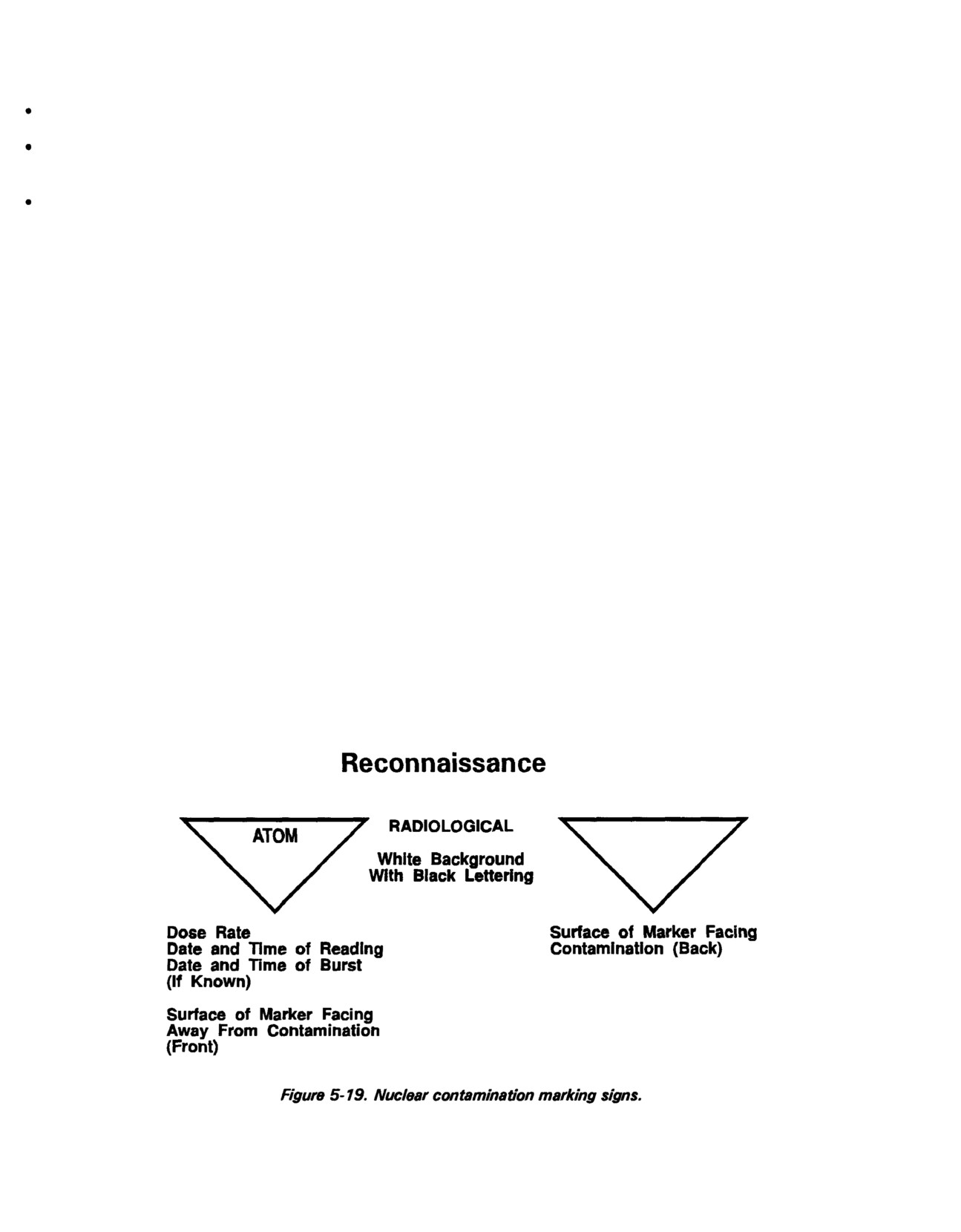
For radiological contamination, you need the dose rate,
or dose rate. Once plotted, recon data provides the
date and time of reading, and date and time of detonation,
minimum essential information needed to evaluate the
if known.
impact the contamination will have on current operations.
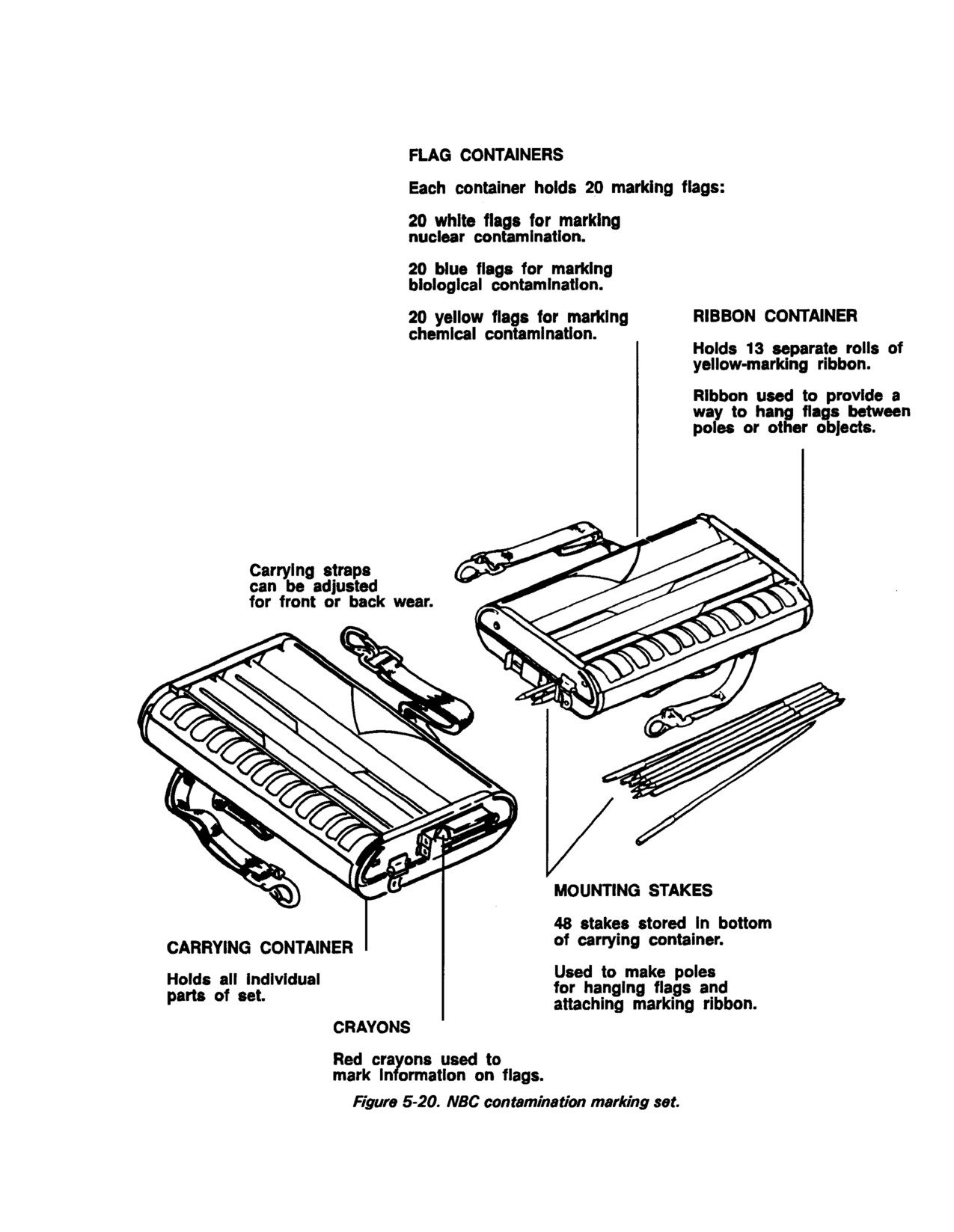
US forces mark contaminated areas with the NBC
Stated another way, recon provides information about
contamination marking set. It contains everything needed
uncontaminated or clean areas. Recon, then, permits
to mark a contaminated area: flags, ribbon, crayons,
avoidance of hazard areas.
mounting stakes, and a carrying container. TM
Often, contamination avoidance of radiological
3-9905401-10 describes the kit and its use. Figure 5-20
contamination is a matter of accepting the least amount of
(next page) shows the kit and its major components.
radiation rather than none at all.
If units do not have this kit available, they can make the
Radiological recon may be performed on the ground or
signs out of available metal, plastic, or wood. Field
in the air. Ground radiological recon (GRR) is conducted
expedient signs must be of standard shapes, sizes, and
by all units when moving. Aerial radiological recon (ARR)
colors.
is conducted only when an area is known to be
contaminated. The best vehicle available for GRR is the
Marking Procedures
NBCRs, or, as it is more commonly called, the Fox. This
vehicle is especially designed and equipped to operate in a
Marking warns friendly troops of contamination.
contaminated environment and to perform NBC recon
Therefore, the signs are placed where they most likely will
missions. The system has an added advantage in that the
be encountered by friendly units. In rear areas the entire
operator does not have to leave the vehicle to take a
circumference of the hazard area may need to be marked.
reading or sample. For more information concerning this
Individuals who find the contamination place the signs.
vehicle, refer to FM 3-19 and the operator’s manual.
They are placed where the contamination is detected.
Also, this vehicle gives a commander the ability to
Adjacent signs should be within sight of each other (25 to
quickly determine the extent of contamination by using
100 meters apart depending on terrain). This prevents units
those techniques outlined in FM 3-19. Operators of this
from missing the signs and entering a contaminated area.
vehicle are also able to mark the contaminated area with
Recon elements mark the area at the point of entry. Unit
the standard NATO NBC markers depicted in Figure 5-19,
survey teams are then responsible for determining
and
without leaving the vehicle.
marking the extent of the contamination.
If the unit does not have this vehicle, follow the
Some areas may contain more than one type of
procedures outlined next for contamination marking.
contamination or hazard. Mark these areas with the
appropriate signs placed near each other. For example, if
an area is both chemically and radiologically contaminated,
Contamination Marking
both signs are used and placed near each other.
Once contamination is found, mark the area and report to
For rear areas in, around, and behind the division
higher headquarters. Marking contaminated areas and
support area (DSA), and while in open terrain (desert,
equipment warns friendly units and helps them avoid the
plains, rolling hills, etc.), it is possible to raise these
contamination. Marking a contaminated area merely
contamination markers on poles. The poles may be
indicates the presence of a hazard. The extent of a hazard
camouflage support poles, extra tent poles, or any other
is determined by a detailed survey.
such material. The intent is to raise the contamination
marker up high enough so it can be seen for at least 200
5-32
FM 3-3-1
meters. This is done so that follow-on forces and support
Since residual hazards can collect in inaccessible places,
troops can be aware of the hazard.
contaminated vehicles and equipment must be marked or
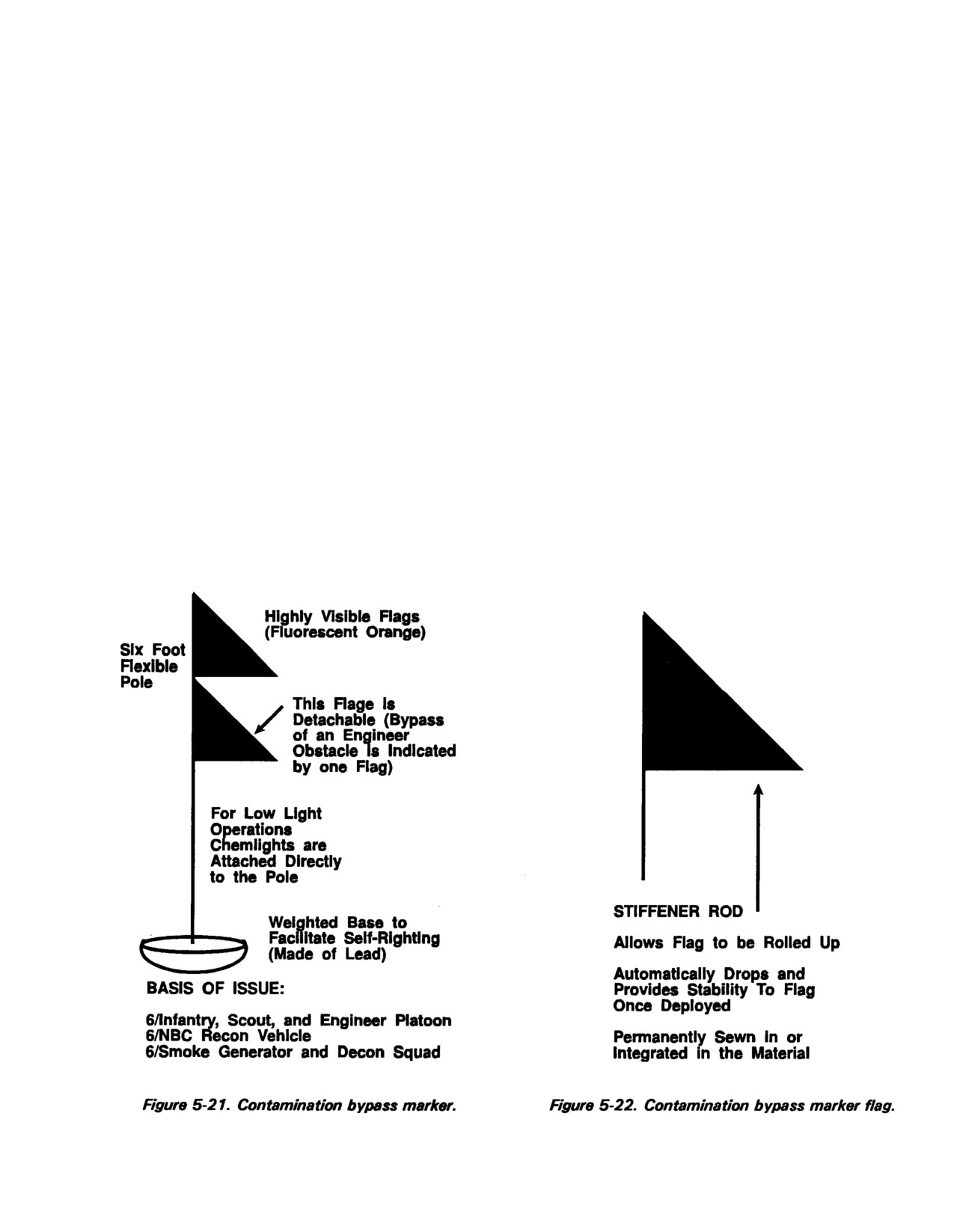
In these rear areas, clear areas or lanes also maybe
identified. Otherwise, maintenance personnel could be
marked for easy identification. One method of marking this
injured by hidden contamination. One way of doing this is
lane is using the NBC contamination bypass marker
to attach a marker to the outside of the vehicle.
depicted in figures 5-21 and 5-22 page 5-31.
Radiological Procedures.
Radiological contamination
Placing markers on poles or using the bypass marker in
marking signs are usually placed by unit recon teams. The
forward areas is considered tactically unsound and should
signs are placed on principal routes of entry into the
be avoided. It would only provide a roadmap for the
contaminated area where the dose rate is 1 cGyph at 1
enemy.
meter above the ground. Signs are not placed in the
Marking Contaminated Materiel.
Special procedures
interior portion of the area. This defeats the purpose of the
are used when marking and handling contaminated
warning. They are only placed on the perimeter of the
materiel. Materiel is marked to keep personnel from
area. Signs are moved periodically as the contamination
accidentally becoming contaminated. This means that
decays.
markers placed on materiel have to be visible from any
If a military advantage will be lost by marking a
angle. The disposition of the materiel depends on the
contaminated area, the commander may order that the area
situation. If it can be left in place to weather, that might be
not be marked. When this occurs, unit defense team
the best solution. If contaminated materiel is collected in a
personnel must be placed at principal entry points if the
holding area, then the area has to be marked and monitored
tactical situation permits.
for residual hazards. Since vapor hazards are additive,
Traffic control personnel normally are positioned so they
several pieces of like contaminated equipment together
can inform personnel entering the contaminated area about
could create a serious vapor hazard when located near each
the extent of the hazard. Defense team personnel should
other. This could be a problem in areas such as
not be positioned too near the contaminated area and they
maintenance holding areas.
should wear a tactical dosimeter. Generally, they should
not receive a dose greater than 1 cGy per day.
5-33
FM 3-3-1
Vehicle Correlation Factor
Ground Radiological Recon
In addition to the initial set of vehicle correlation factor
GRR is included in normal recon activities and provides
(VCF) data, presented in Figure 5-1 and discussed earlier
the following:
in this chapter, one or two additional sets of data should be
Warning of a hazard that otherwise might go undetected. Thus,
taken at different locations so that the defense team can use
GRR alerts units on the move when they contact a
an average VCF. Sites for obtaining VCF data should be
contaminated area.
selected to approximate average foliage and ground surface
Information to the unit commander about the extent or size of
conditions for the contaminated area. New data must be
the hazard just encountered.
obtained if these conditions change significantly or if the
Information to the unit commander about the location of clean
survey meter or vehicle is changed. Additional correlation
or uncontaminated areas.
factor data taken because of these changes should not be
Information about routes that can be used to avoid the
averaged into previously collected data, but should be used
contaminated area. If total avoidance cannot be accomplished,
for applicable routes or points.
GRR maybe able to determine the lowest dose-rate route to
Meter readings for VCF data should be taken within
be used while crossing the area.
three minutes of one another. Note that the monitor never
Attack Indications.
When reconnoitering for a
calculates or applies the VCF to his data.
radiological hazard, the team surveys the surroundings for
If the vehicle in question is equipped with the AN/VDR2
indications of the reason for its existence and additional
radiacmeter, this correlation factor is used and is referred
damage or obstacle indications. Some indicators areas
to as the attenuation factor for this meter. Mounting
follows—
instructions for the AN/VDR2 are in TM 11-6665-251-20.
Arrival and settling of dust-like particles.
Tree blowdown.
Scorching on one side of an object.
Unit Procedures
Overturned objects.
Unit involvement in radiological recon consists of GRR.
Evidence of treetop fires.
The unit plots contamination locations for local use only.
Dead animals and birds.
Units do not normalize GRR data; they are concerned with
Rain or snow after an airburst occurs.
location, not amount.
Radiological Samples.
When directed, the GRR team
Scouts and unit recon parties have principal missions of
takes samples of the contamination. This sampling is
gathering information about specific facets of the
required when the dose rate or decay rate is unpredictable.
battlefield. These missions could be bridge classification,
Samples are taken in low dose rate areas. These samples
fording locations, enemy strength and composition, or site
evaluation for headquarters elements or other activities.
GRR is an inherent part of this recon. On occasion GRR
could be a principal mission. This would occur when
contamination is known to exist.
The overall objective of the recon team is to locate a
clean path or a path acceptable to the commander. The
path may, however, be in another unit’s area of operations.
Use of this path would require approval from and
coordination with higher headquarters. If a contaminated
path in the unit’s area that would result in low exposure to
troops can be found, the commander may choose to use it.
The amount of contamination that can be crossed safely is
relative to the type of unit. An armor unit can safely cross
an area with high dose rates; while a dismounted infantry
unit must avoid such an area. Crossing should be done as
quickly as possible to reduce stay time, but at an
appropriate extended interval or slightly different parallel
routes to minimize radioactive dust pick-up from traffic
movement.
5-34
FM 3-3-1
are forwarded through channels specified by the NBCC.
Ground Radiological Reconnaissance Techniques.
In
Units do not automatically take such samples.
GRR, the most desirable information is the location of
Conditions for GRR.
Nuclear weapons maybe used on
uncontaminated areas. GRR is rarely concerned with the
the battlefield at any time. This could produce extensive
determination of the dose rates inside contaminated areas.
fallout areas or more localized neutron-induced
This task is left to radiological survey. (Surveys were
contamination areas. Even the total use of fallout-free
previously discussed in this chapter.)
airbursts can create residual contamination hot spots
Dose rates found during GRR are usually of secondary
because of rainout.
value. The location of the perimeter of the contamination
These hot spots could be in the vicinity of GZ or at
or paths around or through the contamination is of
distant locations. Because of the constant threat, all units,
principal value and importance. Knowledge of the
upon initial deployment, must conduct GRR. Thus, GRR is
perimeter location allows units to avoid the hazard
conducted during all tactical operations, patrols, and unit
completely.
movements.
Prior to the GRR, scouts or NBC teams must have a
Limitations of GRR.
When a mission is given to
specified dose-rate level. During GRR, this dose rate
conduct an area, zone, or route recon, the anticipated
serves as the threshold for contamination. This dose rate
hazards are considered. Avoidance techniques and methods
may be a matter of SOP or may be provided in mission
for complete protection from enemy action, minefield,
briefings. The dose rate should bean inside dose rate.
and chemically contaminated areas exist. However, since
Further, the dose rate should be low enough to be easily
radiation presents a penetrating hazard, the only complete
read on radiac instruments while moving. This is not a
protection from radiological contamination is avoidance of
turnback dose rate. This threshold dose rate must be
the area entirely. At this stage of recon, when radiological
carefully considered and compared to the TF for the
hazards are initially located, there is no indication of the
vehicles. The threshold dose rate may be entered into the
maximum dose rate that may be found.
AN/VDR2 after which the VDR2 will automatically alarm
The process of determiningg the highest dose rate maybe
every time this dose rate is reached.
lethal to the GRR team. The GRR team cannot conduct
When scouts or GRR teams discover contamination, they
detailed assessment of the contamination. Keep in mind
report its location. They may also report dose rates and
that the GRR teams also must locate other contaminated
time of detection. The NBC 4 nuclear report format can be
areas during other operations. These teams must have a
used to report these data; however, most expeditious
very low dose limit or operational exposure guidance
reporting requires only a simple statement that
(OEG). The arbitrary setting of a high OEG will result in
contamination is present at a specific location. When the
the loss of the team. These limitations restrict the GRR
NBC 4 nuclear report format is used, the word
team to locating only the outer limit of a contaminated
“CONTACT” is used with the dose rate or line item
area. Further reconnaissance for terrain trafficability,
Romeo. The word “INITIAL” is not used.
enemy activity, obstacles, chemical contamination, and so
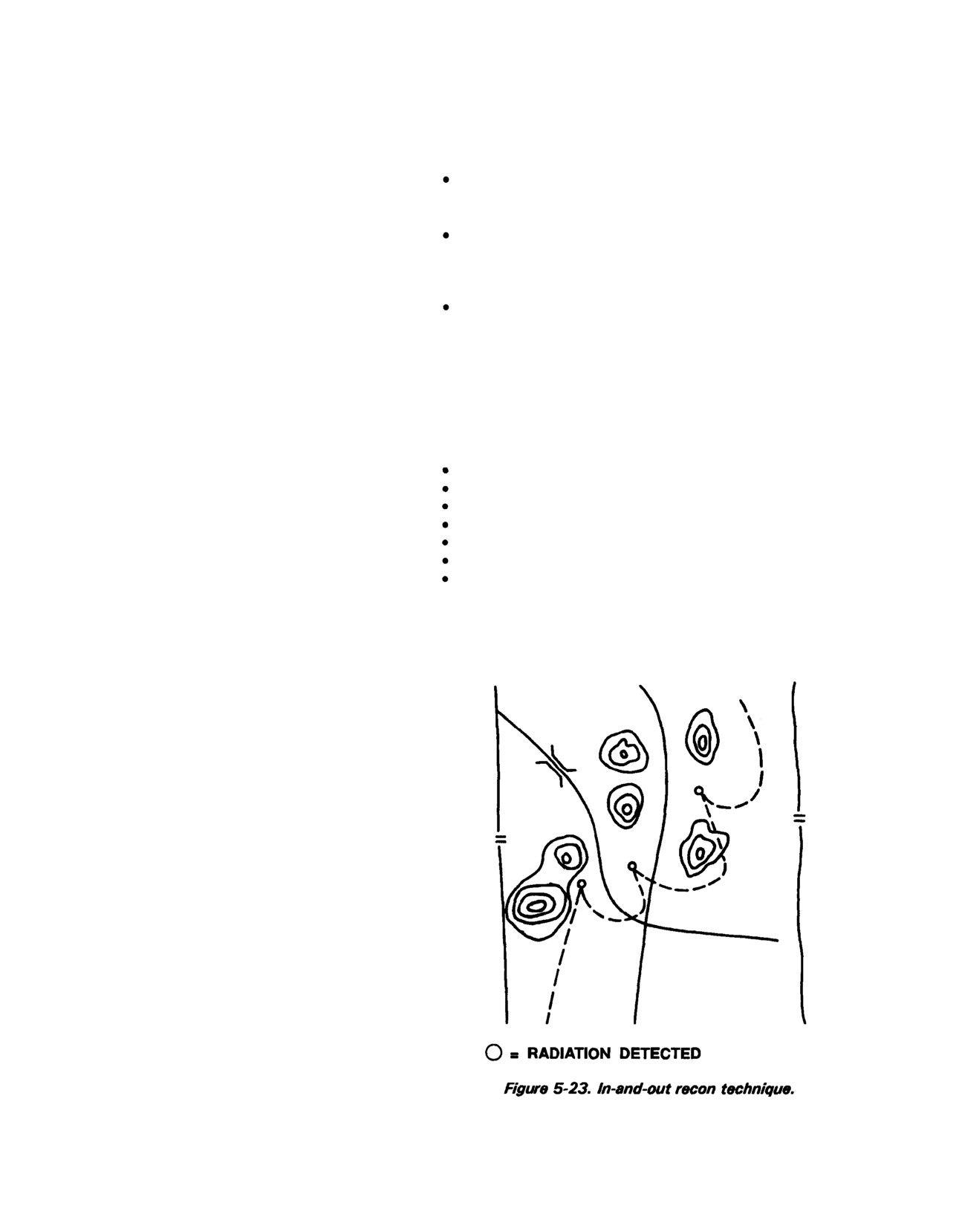
The in-and-out process is used by the GRR team after
forth, must stop if a low dose limit is to be maintained.
discovery. Upon detecting contamination, the team records
D is specified for each mission. (Refer to Appendix A for further
the reading, time, and location on DA Form 1971-R. A
tb
discussion of D.) This total dose is low enough to permit
report is rendered to alert the main body or unit. The team
tb
additional exposure to the contamination at later times.
then withdraws to an uncontaminated area. The team flanks
the contamination, repeating the in-and-out process within
the team’s assigned area, section, or zone. Figure 5-23
illustrates this process. Additional methods of determining
the location of radiological contamination are outlined in
FM 3-19.
Marking Areas.
GRR teams mark the outer boundaries
of the contamination unless told not to do so. In some
cases, this may provide benefit to the enemy about troop
movements. NATO markers are erected only at logical
points of entry facing away from the contamination. Data
are not normally recorded on the signs due to time
limitations in keeping with the expeditious nature of
reconnaissance operations. Writing on the signs does not
enhance the warning afforded by sighting or recognition.
Washout or Rainout.
The washing out of radiological
fallout particles from the air can vastly affect GRR
operations. For more information on washout and rainout
5-35
FM 3-3-1
refer to Chapter 6. If the condition is caused by rain, the
well as aerial security, fire support, communications, and
resulting contamination will collect in low areas, streams,
airspace coordination.
ponds, and rivers, creating hot spots. However, large still
Fallout also must be complete before ARR can begin at a
bodies of water will allow heavier fallout particles to settle
given location. Completion time may be calculated or it
and provide shielding. If snow causes the rainout, the area
may be indicated by NBC 4 nuclear peak reports from the
will initially be evenly blanketed. Heavy snowfall may
area or an area further downwind. Given the scope of the
shield indications and readings of radiation levels, but it
operation, only the NBCC can effectively coordinate these
will eventually melt, and the result will be the same as that
matters. This centralized control permits greater flexibility
caused by rain.
in moving the aerial teams to suspect areas. It also eases
A rainout area can be larger or smaller than a fallout
coordination across unit boundaries and provides data to
area when given the same size attack employed as a surface
the organization best equipped to convert, plot, and
burst. There is no satisfactory rainout prediction system.
disseminate the results-the NBCC.
Essentially, the prediction involves determining when it
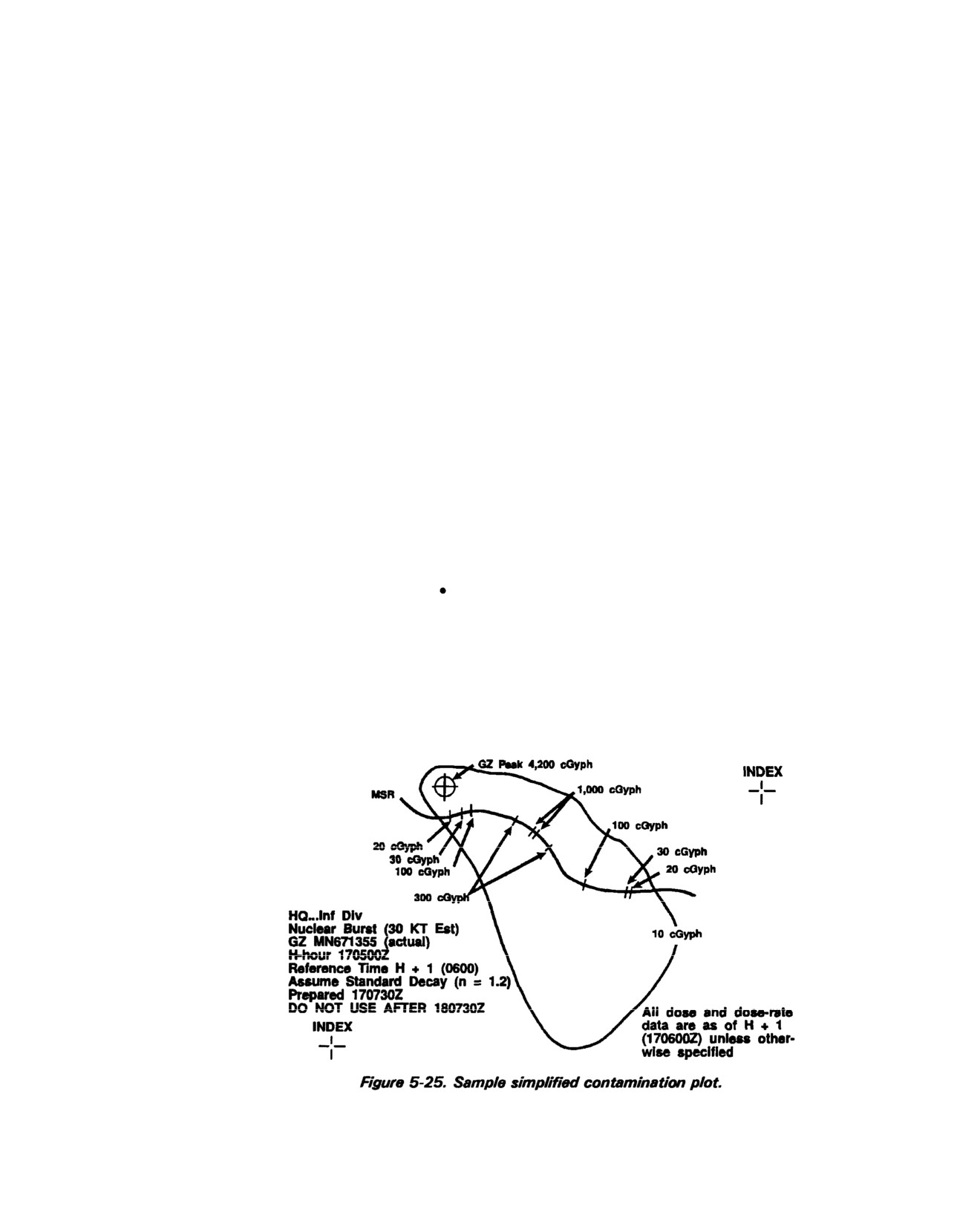
The product of ARR is a simplified contamination plot.
will rain, how much it will rain, and how large the
This plot, illustrated in Figure 5-25 also reflects the results
raindrops (sleet, bail, or snow) will be. Rainout can also
of unit monitoring and GRR reports. The plot has a short
cause a significant hot spot in an otherwise normal fallout
life span. It is constantly updated and refined as the
pattern. The GRR team should be aware of rainout and its
intelligence cycle feeds in additional information.
effects on the mission. Rainout can cause residual
Ultimately, an aerial survey will be conducted; however,
contamination from what should have been a fallout-free
the tactical situation must be stable for this to occur.
burst.
Finally, aircraft coordination, specifically helicopter
Unit NBC Defense Team Actions.
The unit NBC
support, is required. In these circumstances, division-level
defense team plots reports from the GRR team. The plot
taskings for helicopters will be required.
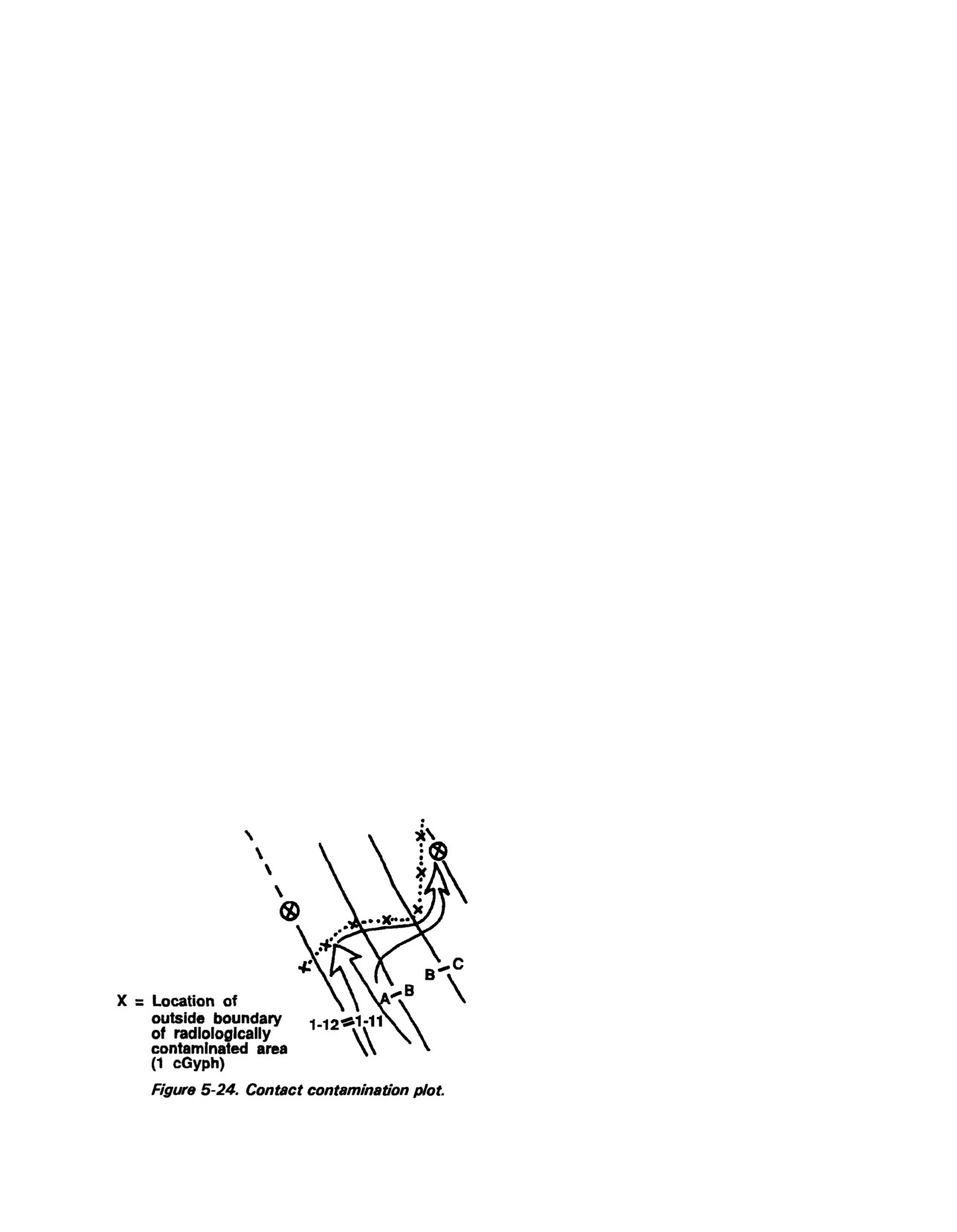
attempts to outline the contaminated area. The NBC
defense team does not attempt to normalize the GRR data.
ARR Techniques
Avoidance rather than evaluation is the objective. Figure
The techniques for conducting ARRs are the same as for
5-24 shows a contact contamination plot made by a unit
radiological surveys, with the following exceptions:
NBC defense team. The NBC defense team may be
The ARR team selects the checkpoints, routes, and course legs
required to exchange data with lateral units to obtain a
when they arrive over the area. The NBCC preplans only the
larger picture of the contamination. It also must submit its
general area over which the ARR is conducted. Under hostile
data to the NBCC for evaluation. Such data consist of dose
air defense artillery (ADA) conditions, route and course leg
rates, locations, and times of measurement. The NBC 4
nuclear report format sdhould be used.
technques are not recommended because of their unique
signatures. In this case, the point technique with
nap-of-the-earth flight at appropriate speed is recommended.
Aerial Recon
The NBCC directs all
aerial radiological recon
(ARR) as well as all
radiological surveys. This
centralizes control of the
teams and provides data for
command-wide use. Only
the NBCC has dedicated
personnel who can evaluate
and analyze ARR data and
rapidly convert it into usable
form.
ARR is a highly
specialized operation, which
requires trained personnel
and careful planning. In
most cases, ARR is
conducted at or ahead of the
FLOT. This requires air
defense artillery planning as
5-36