FM 3-3-1 Nuclear Contamination Avoidance - page 13
FM 3-3-1
6-10
FM 3-3-1
6-11
FM 3-3-1
6-12
FM 3-3-1
6-13
FM 3-3-1
The nomogram method uses the nomograms in Appendix
procedure of the first situation, is normalized to a new R1
E for the specific decay rate involved. The mathematical
(H+ 1) of 426 cGyph. The commander wants to know what
method requires a hand-held pocket calculator that has a
the reading will be at Monitor A’s location at H + 8 hours.
power function, which is represented by a button labeled
Rt
t
R1
either “yx” or “xy.”
n=0.9.
7
H = 8 hours
426 cGyph
Visualize the problem by preparing a situation matrix as
follows:
Step 1.
Write the situation matrix (left) to properly
Rt
t
R1
record the information in the problem.
n=1.2.
Step 2.
Find the nomogram for fallout decay using a
100 cGyph
H + 5 hours
?
decay rate (n) of 0.9 (see Figure E-14).
Step 1.
Write the situation matrix (at left) to properly
Step 3.
Line up the hairline on the value of 426 cGyph
record the information in the problem.
on the far right-hand R1
column. Lay the hairline across 8
Step 2.
Find the nomogram for fallout decay using a
in the center Time column. If the correct value is not listed
decay rate (n) of 1.2 (see Figure E-16).
(as in this problem for the number 8 in the Time column),
Step 3.
Lineup a hairline on the value of 100 cGyph on
approximate where the number would lie between 5 and 10.
the far left hand Rt column. Lay the hairline across 5 in the
Step 4.
Holding the hairline straight and steady, read the
center Time column.
value in the far left-hand Rt
column. This answer should be
Step 4.
Holding the hairline straight and steady, read the
approximately 65 cGyph.
value in the right-hand R column. Your answer should be
Use the nomograms in Appendix E to solve similar
approximately 650 cGyph.
problems. Be sure to select the correct nomogram for the
Second Situation
-Further monitoring determines the
stated decay rate.
decay rate to be 0.9. Monitor A’s reading, using the
Normalizing Factor
The NF corrects dose rate readings to the selected
Step 2.
Enter Table 6-5 with the time after burst. Read
reference time. Readings from radiological surveys
across to the appropriate decay exponent column and find
received from units must be normalized to H + 1 for use
the NF.
in plotting fallout contamination. The H + 1 calculations
Step 3.
Multiply the dose-rate reading by the
also are needed to estimate total dose. Normalizing factors
normalization factor. The product is the H + 1 dose-rate
may be found by using any of three methods: a table of
reading.
values, mathematical, or graphical. The table of values
The following example uses the table of values to
method is the preferred method. The mathematical and
determine the normalization factor, and uses it to convert
graphical methods are discussed in Appendix F.
R2
to R1.
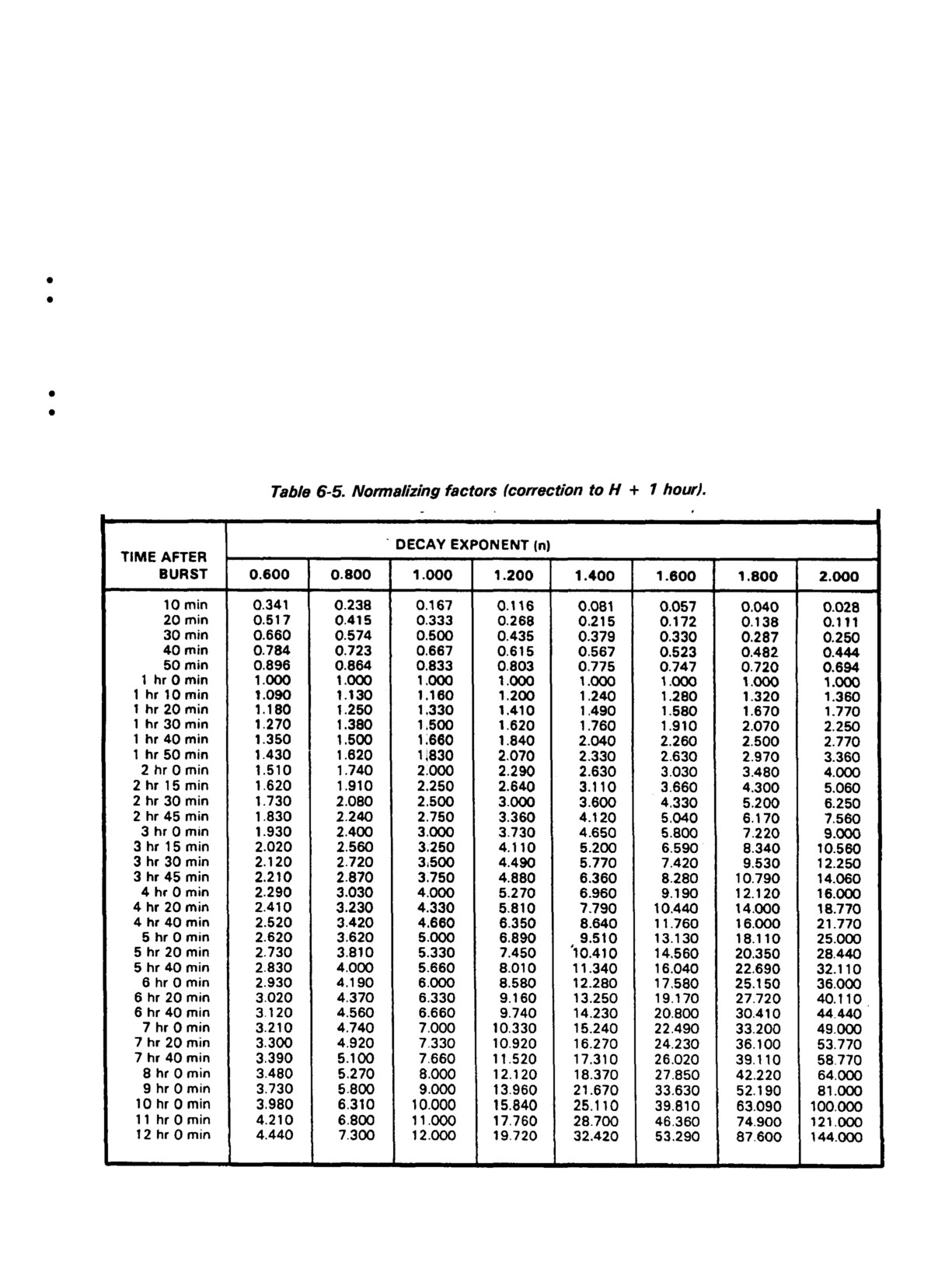
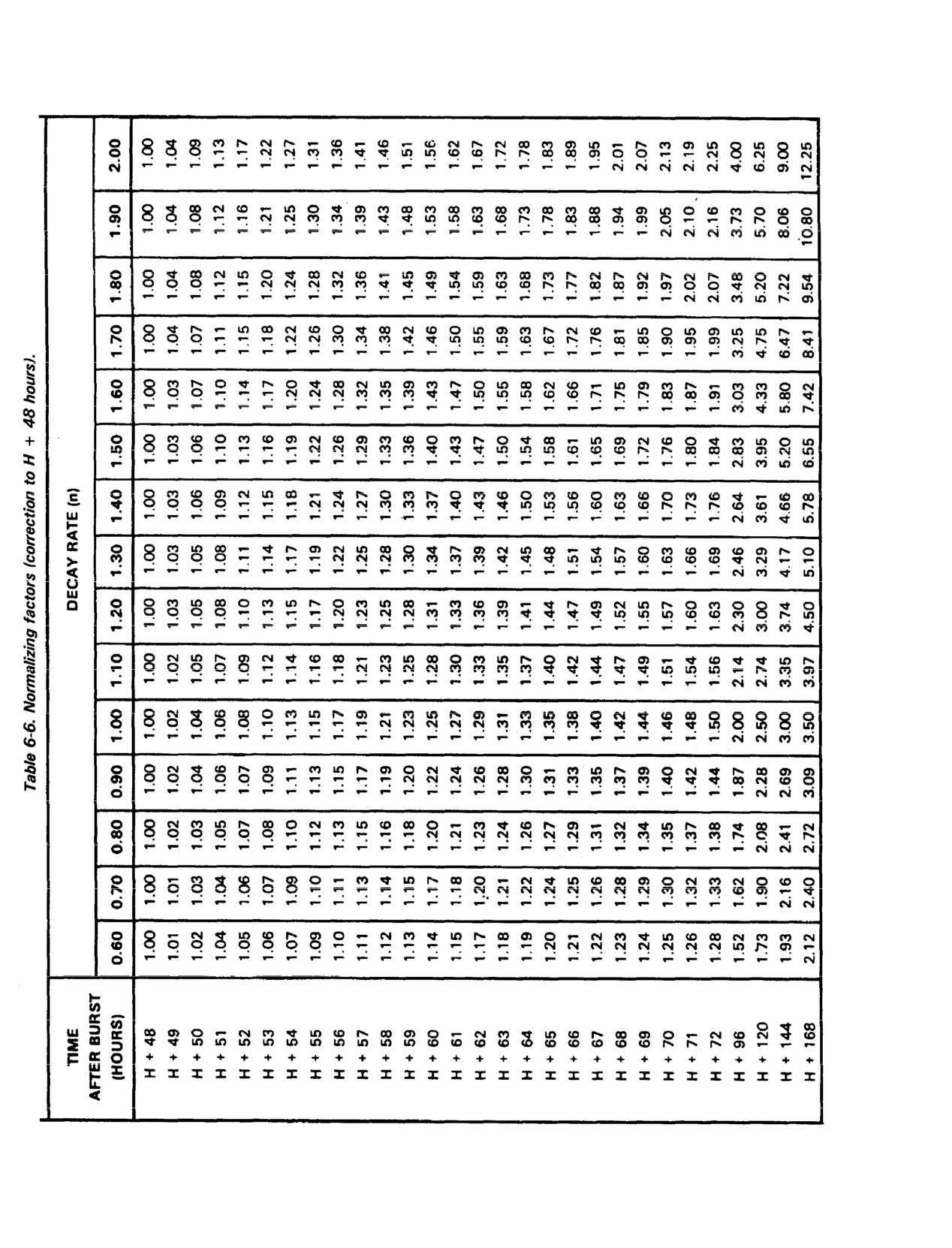
Tables 6-5 and 6-6 (next two pages) are examples of
Example
tables of normalizing factors for selected times after a
The outside dose rate at 1 hour and 20 minutes after the
nuclear burst and for anticipated decay exponents. The
burst was 100 cGyph. Enter Table 6-5 with 1 hour and 20
reference time in Table 6-5 is H + 1. The reference time
minutes and extract the normalizing factor of 1.41 from the
in Table 6-6 is H + 48 hours. This type of table normally
1.2 decay exponent column. (Because decay was not
is used when H-hour is known and the collection is
stated, assume standard decay of 1.2.) Calculate R1
as
initiated immediately. The following steps outline the
follows:
procedure for using a table of values.
R1 = NF X R2
Step 1.
Determine the time in hours and minutes after
R1
= 1.41 X 100 cGyph
the burst that the reading was taken.
R1
= 141 cGyph.
Total Dose Procedures
The dose rate of radiation does not directly determine
But the dose rate continually diminishes because of decay.
whether or not personnel become casualties. Casualties
This makes the calculation more complicated. The actual
depend on total dose received. If the dose rate were
dose received is always less than the product of dose rate at
constant, total dose would simply be the product of the
time of entry times duration of stay.
dose rate and the time spent in the contaminated area (just
Total dose, time of entry, and time of stay calculations in
as in a road movement problem, Rate x Time = Distance).
fallout areas are solved in total dose nomograms. These
6-14
FM 3-3-1
the nomograms can be used to find the missing piece of
nomograms are based on anticipated decay rates of n =
information. Determination of R1
was discussed earlier.
0.2 to n = 2.0 and are in Appendix E.
Total dose nomograms relate total dose, H + 1 dose
D and R1, and Ts
and Te
are used together. When
rate, stay time, and entry time. The index scale is a
working with total dose nomograms, start the problem on
pivoting line. It is used as an intermediate step between D
the side of the nomogram where the two known values are
and R1, and TS
and Te. The index scale value can be used
located. If D and R1
are given, start on the left side. If Ts
to multiply the R1
to find the D. The four values on these
and Te
are given, start on the right side. Never begin a
nomograms are defined below:
problem by joining D or R1
with either of the time values.
The following problems are for single explosions only.
D = total dose in cGy.
R1
= dose rate in cGyph one hour after burst (H + 1). The H
Multiple-burst fallout procedures are covered later in this
+ 1 dose rate ALWAYS must be used. NEVER use a dose
chapter.
rate taken at any other time. Total dose nomograms are never
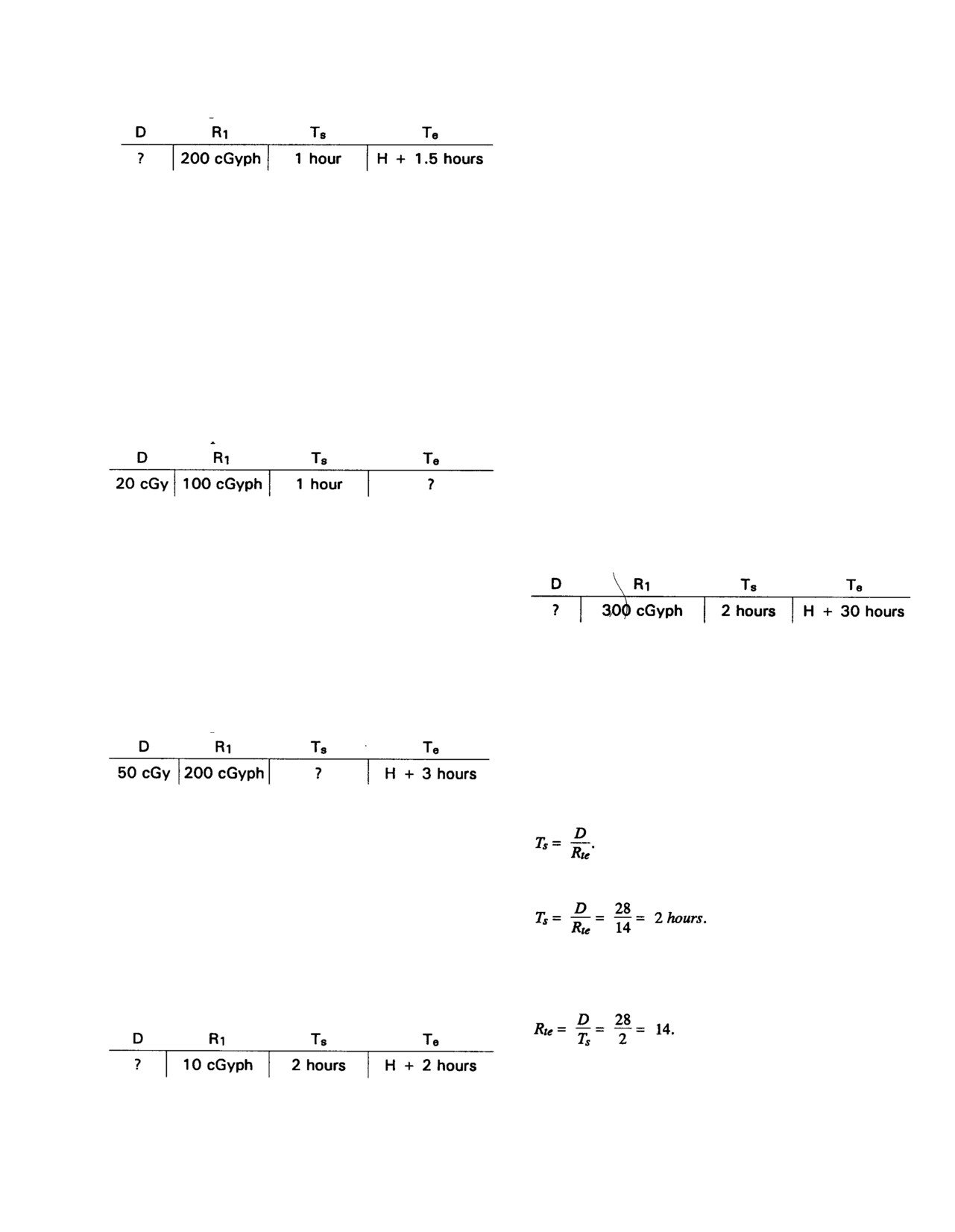
Problem 1.
used to determine the R1. Decay nomograms are used for this
Given:
purpose.
R1
= 200 cGyph
Te
= H + 1.5 hours
Ts
= stay time in hours.
Te
= entry time (hours after burst).
Ts
= 1 hour
R1
must be known before the total dose nomograms can
n = 1.2.
be used. If any two of the other three values are known,
Find: D.
6-15
FM 3-3-1
6-16
FM3-3-1
Visualize the problem as follows:
Select the n = 1.4 total dose nomogram. Connect 2
hours on the Te
scale and 2 hours on the Ts
scale with a
hairline. Pivot the hairline at its point of intersection with
the index scale to 10 cGyph on the R1
scale. Note that the
Answer: 90 cGy.
hairline crosses above the D column. To find D, multiply
Solution.
the value found where the hairline crosses the index scale
Select the n = 1.2 total dose nomogram. Connect H +
by the R1. In this case, index = 0.46, and R1
= 10
1.5 hours on the Te
scale and 1 hour on the Ts
scale with a
cGyph. Therefore, D = 4.6 cGy.
hairline. Pivot the hairline at its point of intersection with
By 25 hours after the burst, the change in” the rate of
the index scle to the 200 cGyph on the R1
scale. Read D =
decay is so low that it is relatively insignificant. Therefore,
90 cGyph on the total dose scale.
a different approach is used to estimate total dose when Te
Problem 2.
is greater than 25 hours. In this case, simply multiply the
Given:
dose rate at the time of entry by the time of stay. This is
D = 20 cGy
written—
R1
= 100 cGyph
D= Rte x Ts.
TS
= 1 hour
D = total dose (cGy)
n = 0.8
Rte = dose rate (cGyph) at time of entry
Find: Te
Ts
= time of stay (hr).
Visualize the problem as follows:
For example—
Given: R1
= 3
Gyph
Ts
= 2 hours
Te
= H + 30 hours
Answer: H + 6.6 hours.
n
=
0.9
Solution Select then = 0.8 total dose nomogram.
Find: D
Connect 20 cGyph on the D scale and 100 cGyph on the
Answer: 28 cGy,
R1
scale. Pivot the hairline at its point of intersection with
Visualize the problem as follows:
the index to the 1 hour on the Ts
scale. Read Te
= 6,6
hours on the Te
scale.
Problem 3.
D = 50 cGy
Solution Select the 0.9 decay rate nomogram. Align 2
R1
= 200 cGyph
hours on the Ts
scale with 30 hours on the Te
scale.
Te=H+3hours
However, in this case there is not a 30 hour scale on the
n = 1.6
time of entry chart. Use the 0.9 fallout decay nomogram to
Find: Ts.
determine what the dose would beat H + 30 hours.
Visualize the problem as follows:
Find dose:
D= Rtex Ts
D=14cGyph x 2hr
D = 28 cGy
Solution: Select then = 1.6 total dose nomogram.
When Ts
must be calculated against a dose limit or OEG,
Connect 50 cGyph on the D scale and 200 cGyph on the
the above formula must be rearranged:
R1
scale. Pivot the hairline at its point of intersection with
the index scale to the 3 hour point on the Te
scale. Read 2
hours on the TS
scale.
Using the data from the previous problem this is solved
Problem 4.
(Special case-Hairline off scale)
as follows:
Given: R1
= 10 cGyph
Ts
= 2 hour
Te=H+2hours
Note that the dose rate at the time of entry is used here.
n = 1.4.
Get the time of entry by determining the time the R1
value
Find: D
will decay to the Rt
value. Using the data from the two
Answer: 4.6 cGy.
previous examples—
Visualize the problem as follows:
Now determine when (time) 300 cGyph will reduce to 14
cGyph. Align the R1
value and the Rt
value. Note that the
Solution:
hairline crosses the time (t) scale at H + 30 hours.
6-17
FM 3-3-1
Sometimes monitors or survey team members will record
what would be normal for that area. This difference may
radiological contamination readings that are not normal
be caused by—rainout, which was discussed earlier,
readings. This situation may not be apparent until the
overlapping fallout from multiple bursts, and
readings are plotted by the NBCC on the situation map.
neutron-induced radiation.
These readings may record dose rates that are higher than
Multiple Burst Procedures
Under nuclear warfare conditions, there probably will be
weapon detonation. Procedures for predicting future dose
occasions when a fallout prediction overlaps an area in
rates in areas contaminated by single explosions are not
which contamination already exists. Similarly, there may
adequate in many instances within overlapping fallout
be cases in which fallout predictions overlap each other.
patterns. Fallout produced by more than one explosion
For example, two fallout-producing bursts can occur within
normally has different decay exponents at different
a few hours of each other-one upwind from the other.
locations in the area. The next section outlines procedures
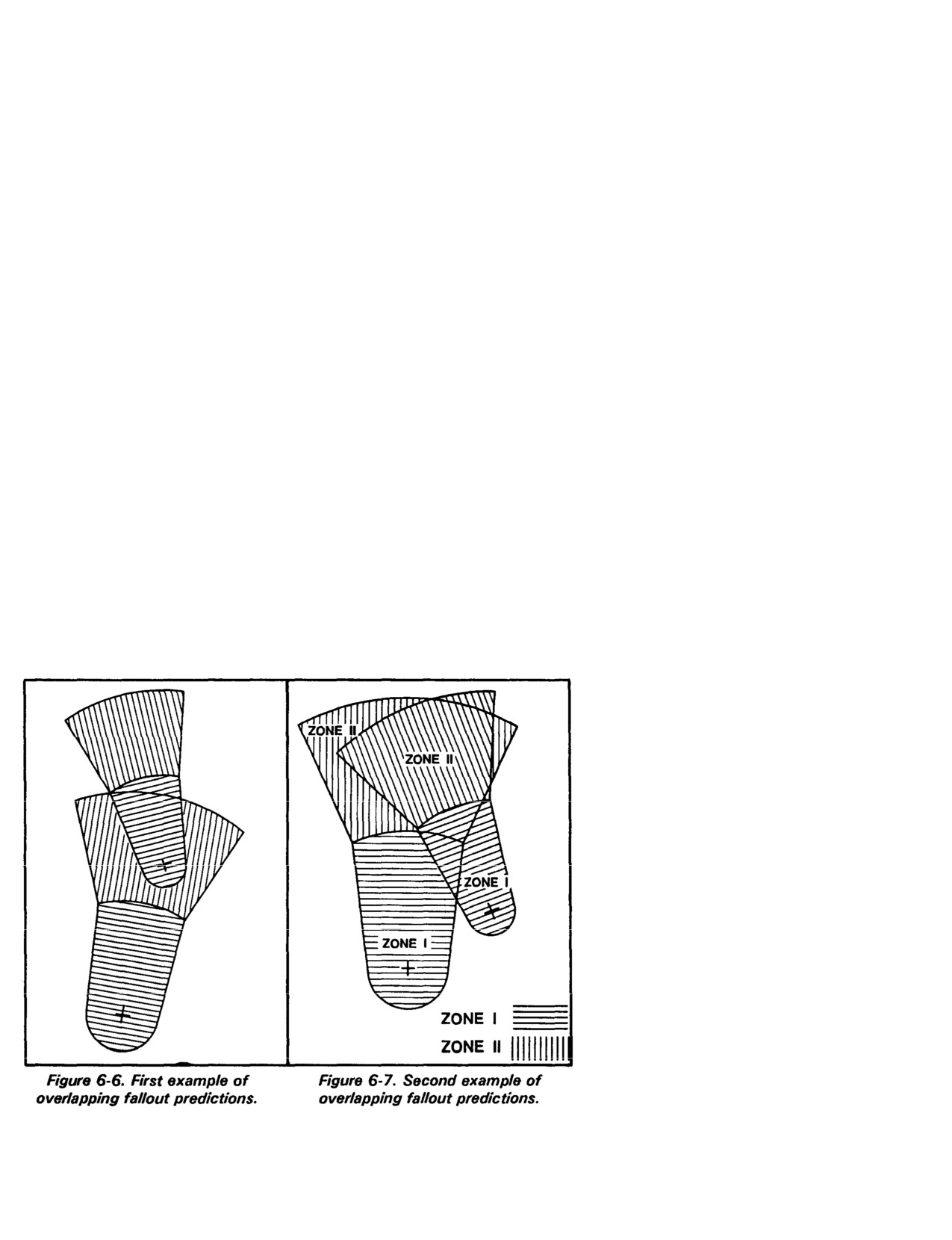
Use the following rule for determining the relative
for predicting future dose rates within overlapping fallout
hazard when two or more fallout predictions overlap—The
patterns.
hazard classification of an area where predicted fallout
hazard zones overlap should be only that of the higher
Dose Rate Calculation Methods
classification involved. That is, an overlap area involving
Zone I should be designated Zone I, and an overlap area
The methods described next apply to two or more
involving nothing more hazardous than Zone II should be
overlapping fallout patterns. The choice of method depends
designated Zone II (see Figures 6-6 and 6-7).
on whether the dose rates of each burst can be separated. If
The above rule is useful only for a matter of several
enough information is not available to separate the bursts
hours after the bursts. The extent of contamination should
or dose rates, refer to Appendix F.
be determined as soon as possible from monitoring and
If enough information is known to separate the different
survey reports. When bursts are separated by several
dose rates, use the following three steps:
hours, the pattern already on the ground must be
Step 1.
Separate the dose rates. You need the H-hour of
considered with the fallout prediction for the later burst.
each burst and two or more dose rate readings for the
It is highly probable that there will be areas on the
location of interest. Take these readings after the fallout
battlefield subject to fallout from more than one nuclear
from each burst peaks and prior to the arrival of new
fallout. Use normal procedures for
calculating the decay exponent (n)
for each burst at the location of
interest.
Step 2.
Calculate separately the
dose rate for the desired future time
for each burst. Add the results. This
procedure lets you calculate the total
dose rate for a specific location at
any time in the future.
Step 3.
Repeat steps 1 and 2 for
each location of interest within the
overlapping fallout patterns.
If enough information is not
known to separate the different dose
rates, use the following procedures:
Step 1.
For a specific location, use
log-log graph paper and plot the last
two dose rate measurements (after
peak) against the time after the latest
burst. (If the time of the latest
detonation is unknown, estimate
H-hour as the time of the latest
known burst.)
6-18
FM 3-3-1
Step 2.
Draw a straight line through these points and
and read down Column A until you find 3; read across to
extend the line to later times.
Column B, and read 0.477. Substitute this number for
Step 3.
Determine a first approximation of the future
log
in the formula, just as in Step 2.
dose rate directly from the graph.
Step 4.
Plot a later dose-rate measurement at that
Step 4.
The new formula should now look like this:
location when it becomes available.
Step 5.
Draw a straight line through the new latest two
Divide the top number by the bottom number.
points and extrapolate the line to later times.
Step 6.
Determine a better approximation of the future
= 1.190775681.
Step 5.
dose rate directly from the latest extrapolation.
Rounding this number up to the nearest tenth (0.1), your
Step 7.
Repeat steps 4,5, and 6 as later dose rate
answer should be an n value (or decay rate) of 1.2, which
measurements at that location become available.
equals standard decay.
Step 8.
Repeat steps 1 through 7 for each location of
Step 6.
Next, determine the decay rate for the second
interest within the overlapping fallout patterns.
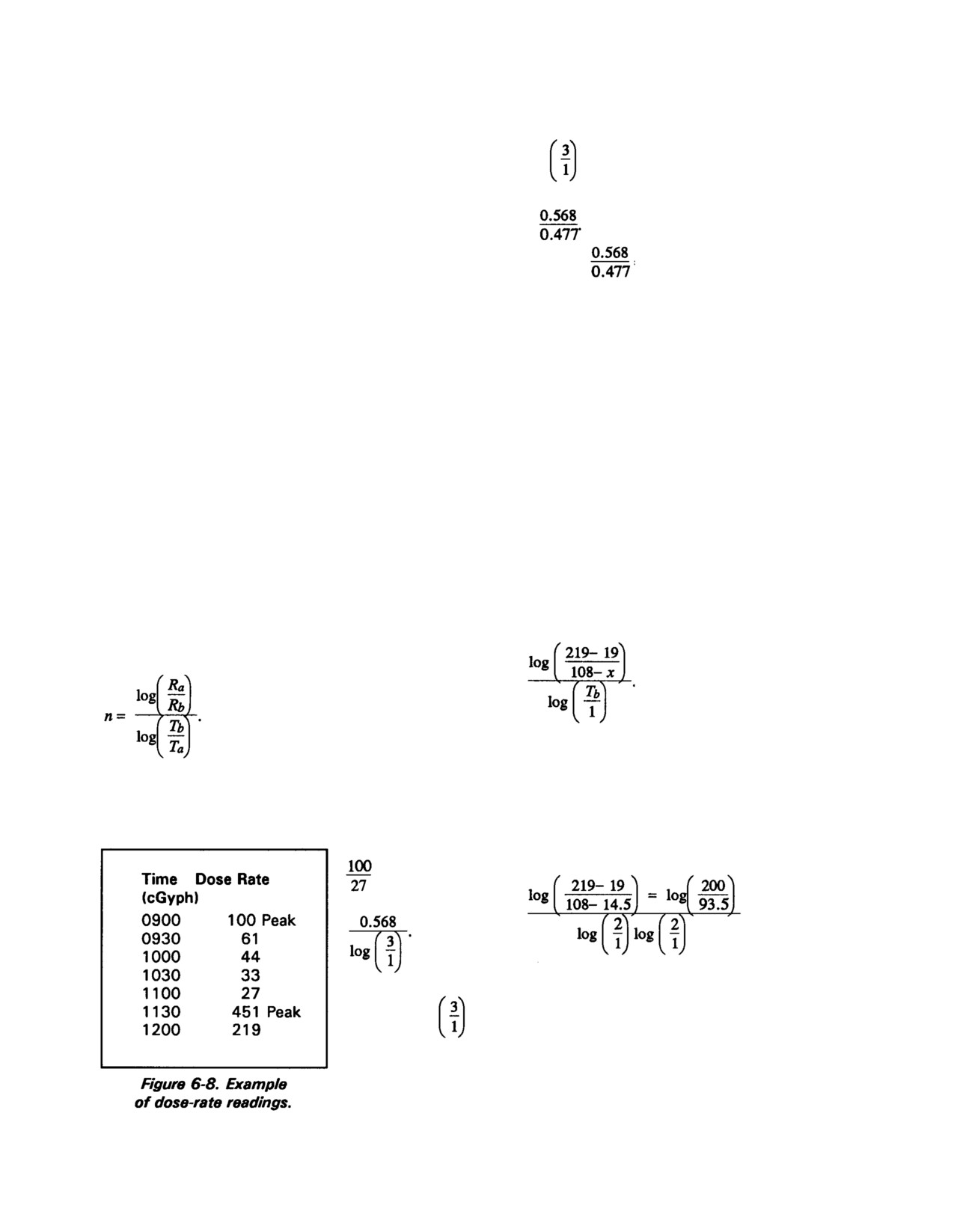
burst (see Figure 6-8). The second burst occurred at 1100.
Example of dose rate calculation:
This is three hours after the first burst. The fallout from
Problem:
Fallout has been received from two
the second burst peaked prior to H + 1 (1200). Thus, the
detonations-one at 0800Z and one at 1100Z (see Figure
reference dose rate for this portion is 219 cGyph.
6-8).
Determine how much of this reading (219 cGyph) was
Predict the dose rates for 0800Z at this location 24 hours
contributed by the first burst. We know that the first burst
after the burst. Sufficient data is available to separate the
occurred at 0800. This is four hours prior to our second
two bursts.
burst’s H + 1 value. Our H + 1 or R1
value for the first
Solution: Separate the two dose rates. This can be done
burst was 100 cGyph. Enter the nomogram for fallout
by two different methods: the logarithm method, which is
decay of 1.2 found in Figure 6-9 with the R1
value of 100
preferred, and the calculator method found in Appendix F.
and H + 4. Read the Rt value of 19 cGyph. Therefore, 19
cGyph of the 219 cGyph reading at 1200 was contributed
Logarithm chart method
by the first burst. Subtract 19 cGyph from 219 cGyph to
R1a
= Dose rate of first burst at H + 1.
determine the H + 1 value of the second burst. The
R2b
= Dose rate at the time of the second burst.
formula to determine the decay rate of the second burst
T2b
= Time in hours after the first burst of the R2b
would look like this:
reading.
T1a
= Time (in hours after first burst) of the Rla
reading.
Step 7.
The last reading in the report was 108 cGyph at
1300 This is five hours after detonation of the first burst.
Step 1.
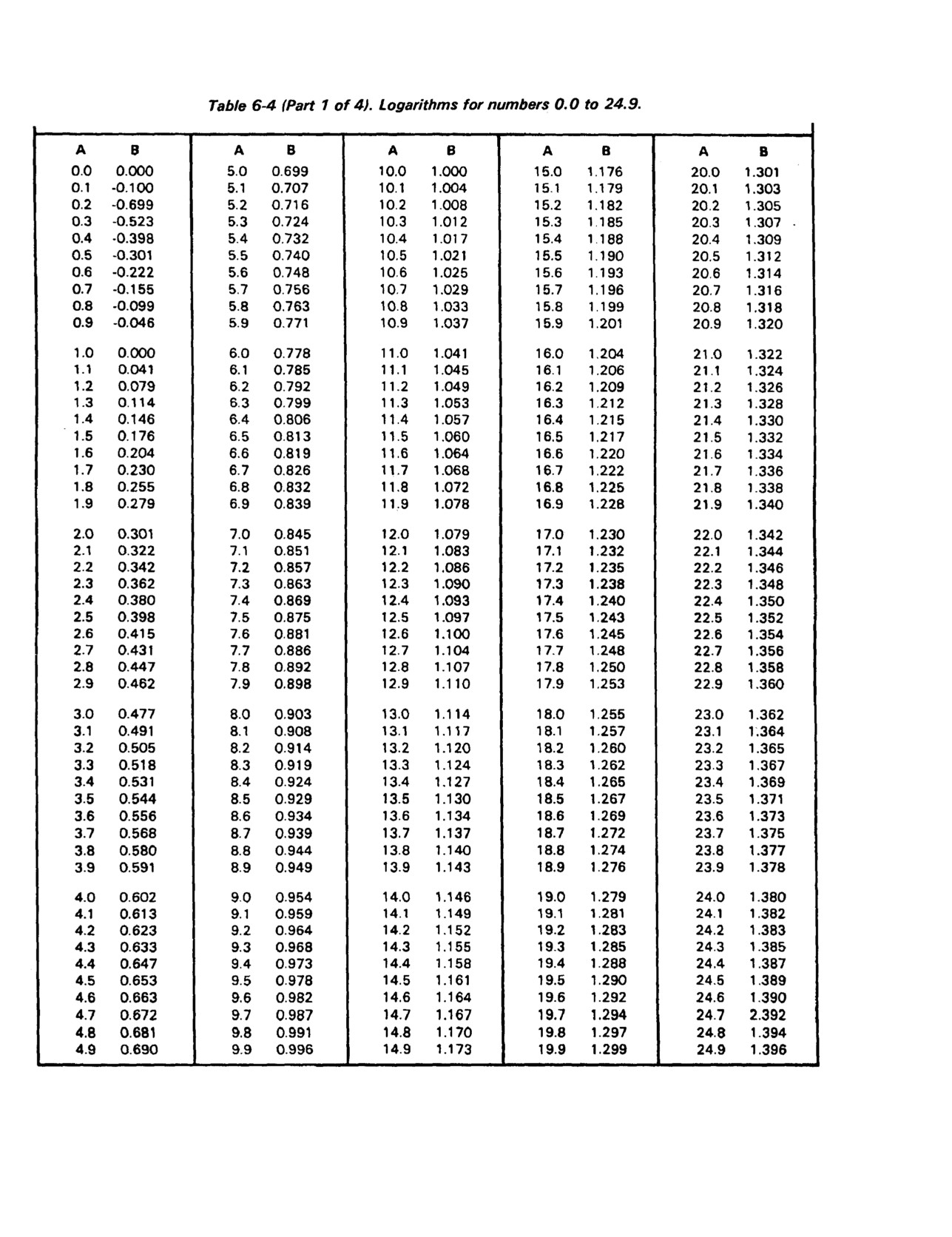
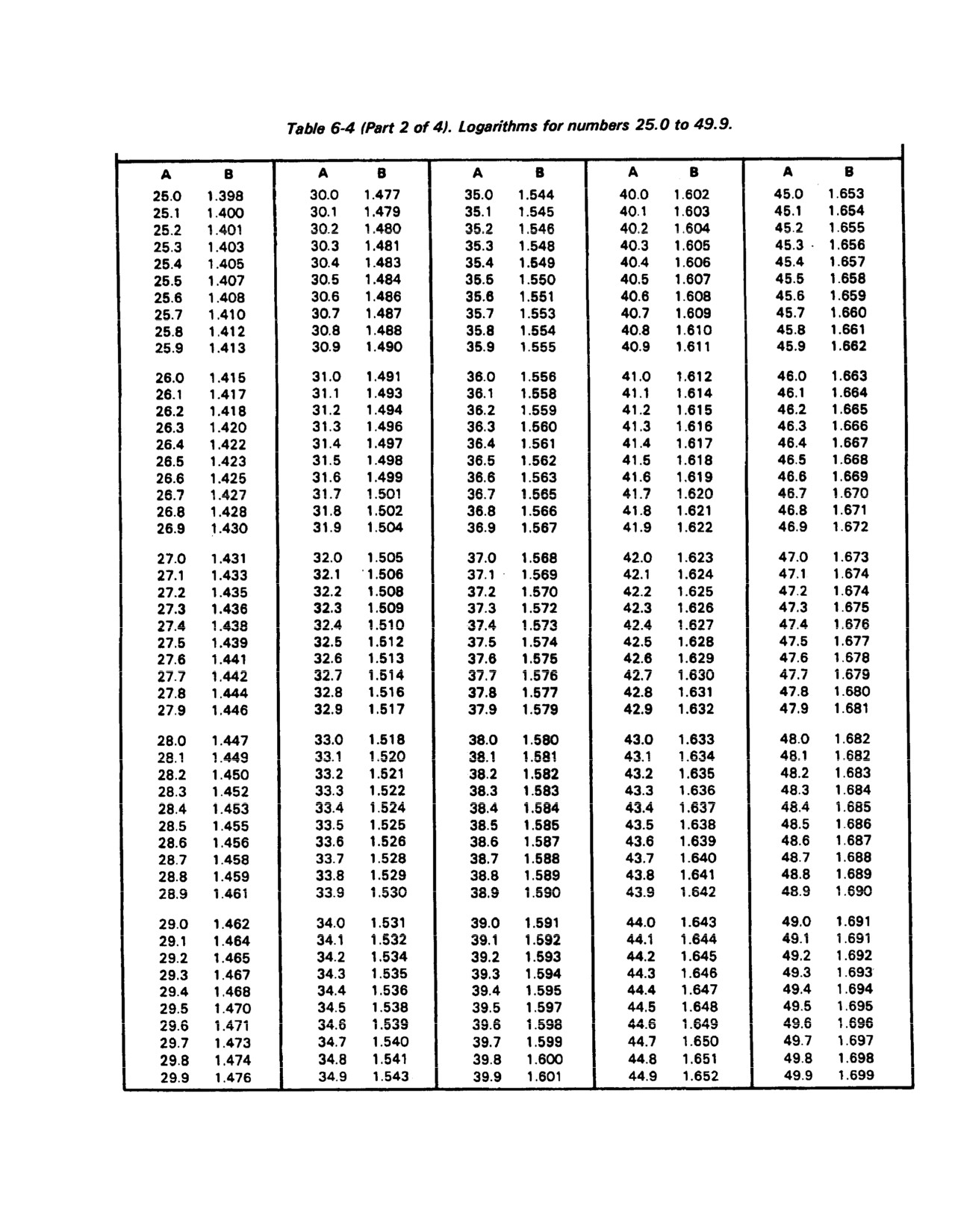
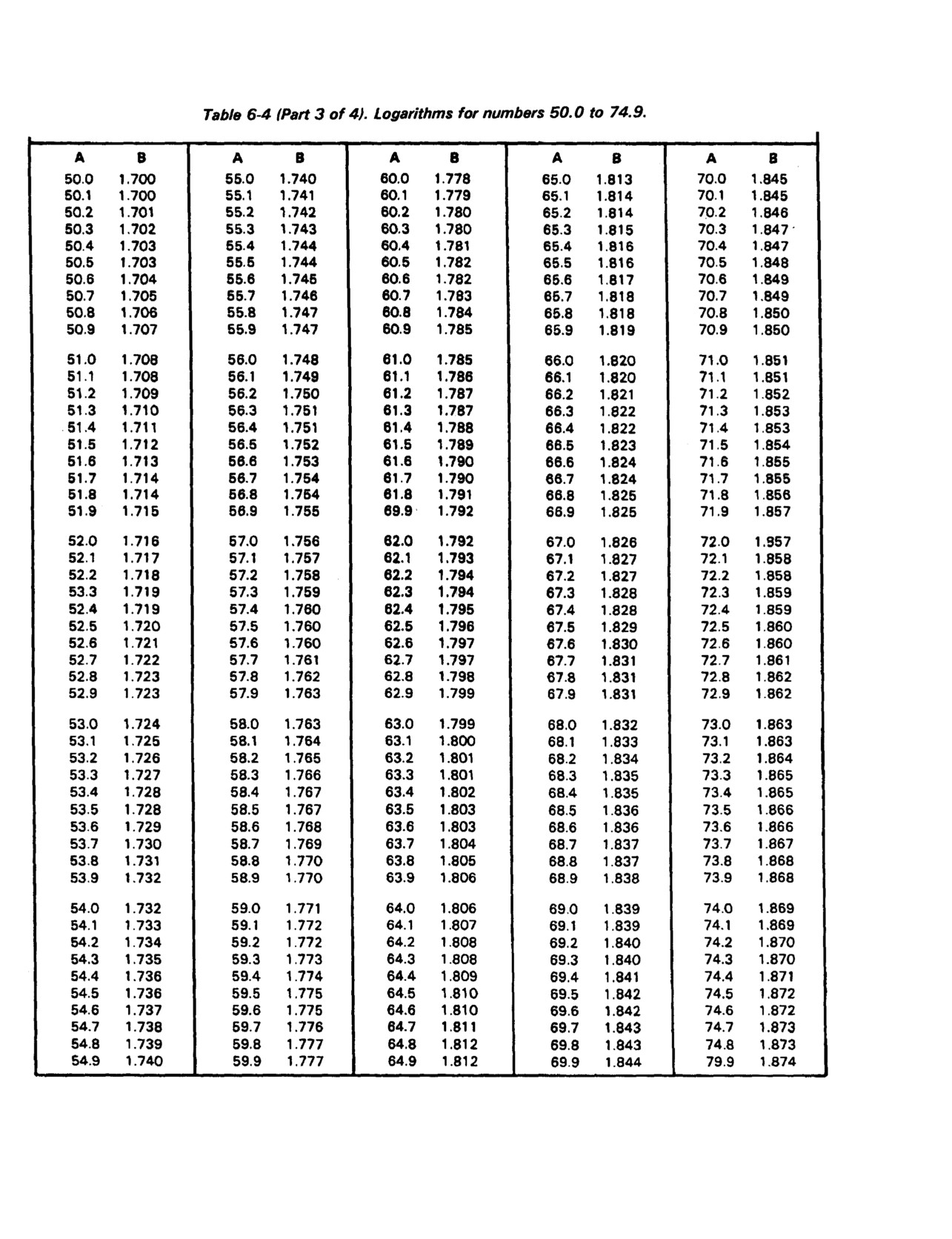
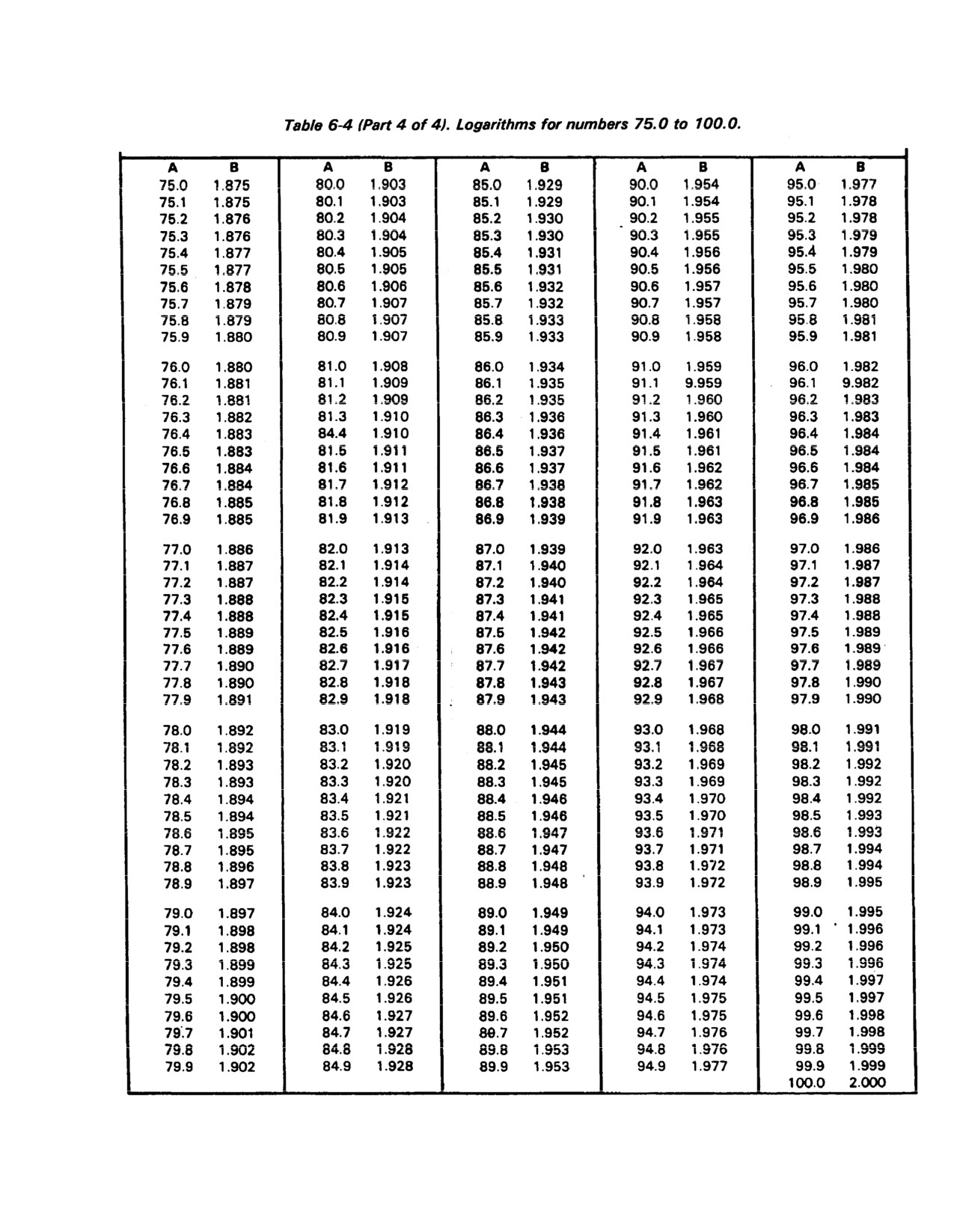
Divide 100 by 27 to get 3.7. Turn to Table 6-4
Using the same procedures outlined in Step 6, determine
(page 6-10) for the logarithm chart. Read down Column A
that 14.5 cGyph of the 108 cGyph reading was contributed
until you find 3.7. Read across to Column B, and extract
by the first burst. Substitute the “x” value in our formula
the log of 3.7, which is 0.568.
with 14.5 and substitute the Tb value for 2, since 1300 is 2
Step 2.
Replace
hours after the second burst. Our formula now looks like
this:
log with 0.568
in the formula.
Step 8.
Divide 200 by 93.5. This should equal 2.13.
Step 3.
Repeat
Enter the logarithm chart in Table 6-4 and read down
Column A until you find 2.1. Due to the rules of simple
Step 1 for log.
rounding, you would go to 2.1. If this is not desired, you
may mathematically estimate the log for 2.13. Extract the
Once you divide 3
number 0.322. Divide 2 by 1 and enter the logarithm
by 1, you should get
chart, find 2 and read 0.301. Divide 0.322 by 0.301. This
3. Turn to Table 6-4,
gives you a decay rate for the second burst of 1.069 or 1.1:
6-19