FM 3-3-1 Nuclear Contamination Avoidance - page 16
FM 3-3-1
Chapter 8
Civilian Radiation Hazards
The number of nations that have invested in nuclear
To minimize the effects or hazards resulting from the
power and nuclear research is extensive and increasing.
damage or destruction of a nuclear facility, prior planning
With this increase, the potential for US forces to operate in
must occur. When friendly units are required to operate in
or around areas that have these facilities also increases.
an area where such a facility exists, the chemical staff must
Damage to one of these facilities will present unique
accomplish the following:
challenges to US and allied armed forces and the citizens
Coordinate, through G5/S5, with emergency response teams.
of the host nation (HN). Radiation hazards released into the
These teams may be from the host nation government, armed
environment may cause immediate casualties or casualties
forces, or from the nuclear facility itself.
years later. To safeguard friendly forces and civilians from
Identify what radiological source material is present and what
these potential hazards, peacetime and tactical nuclear
type of contamination it will emit (alpha, beta, gamma, xray,
contamination avoidance principles must be carefully
or neutron).
blended.
Coordinate with the divisional radiation protection officer
If a nuclear facility (power plant, research facility, etc.)
(RPO) for technical assistance.
is damaged or destroyed, alpha and beta particulants are of
Coordinate with higher headquarters and the host nation to
the utmost concern. As discussed in Chapter 3, alpha
identify available NAIRA teams, technical escort units, or
radiation is not considered to be of tactical significance.
similar civilian agencies to assist if required,
However, alpha contamination is considered to be of prime
Establish evacuation procedures for noncombatants.
importance in peacetime radiation safety. This is due to the
Identify a chain-of-command for supervision and coordination
alpha particles ability to cause ionization of cells within the
of the clean-up effort.
body.
The following steps should be taken immediately by the
Alpha particles cannot be detected with normal tactical
tactical unit within the area of a civilian radiation hazard:
radiac instruments (AN/PDR27, IM174, or AN/VDR2).
Notify higher, lower, and adjacent units.
Alpha contamination can be detected only with the
Start continuous monitoring. Although tactical units will not
AN/PDR56 or AN/PDR60 radiac instruments. These
be able to detect alpha, continuous monitoring with an
instruments are generally assigned to special teams. These
AN/PDR27 or AN/VDR2 with the beta shield open may
teams, called NAIRA teams (or nuclear accident/incidence
provide a form of monitoring.
response and assistance teams) have the mission to respond
Secure the area around the facility. Establish a security
to the unwanted or unexpected release of radiological
perimeter of 620 meter radius around the sight, until relieved
material into the environment.
by appropriate response team or military police.
Beta particles are also of concern. These particles may
Attempt to evacuate casualties without endangering personnel
cause skin burns, similar to sunburn, or cause internal
to the needless exposure to ionizing radiation.
damage to the body. Furthermore, beta particles can cause
Personnel operating in and around the site should wear
damage to the eyes, normally manifesting itself as cataracts
protective masks to protect the respiratory tract from the
later in life.
inhalation of particulants and to protect the eyes from beta
radiation.
8-0
FM 3-3-1
Appendix A
Operational Exposure Guidance
Operational exposure guidance gives the commander a
based upon the radiation exposure status of the unit at that
flexible system of radiation exposure control. OEG
time and on the combat situation.
procedures aid in the successful employment of a unit on a
The commander can decide which unit to select for a
contaminated battlefield, while keeping the exposure of
given mission based on the OEG. Each level of command
personnel to a minimum. Radiation exposure must be
uses the OEG system to select the best unit to conduct a
controlled to the maximum extent possible consistent with
mission. The commander is assured the troops will receive
the mission. If exposure control is ignored, the results
the least amount of injuries or sickness possible.
could be disastrous. Establishing and using OEG helps the
Commanders put OEG in all operation orders. All
commander keep radiation exposures to a minimum and
command and staff agencies use OEG and RES to
still accomplish the mission. OEG is the key for reducing
accomplish the mission while minimizing radiation
casualties in radioactive fallout areas.
exposure.
All nuclear radiation, even in small doses, has some
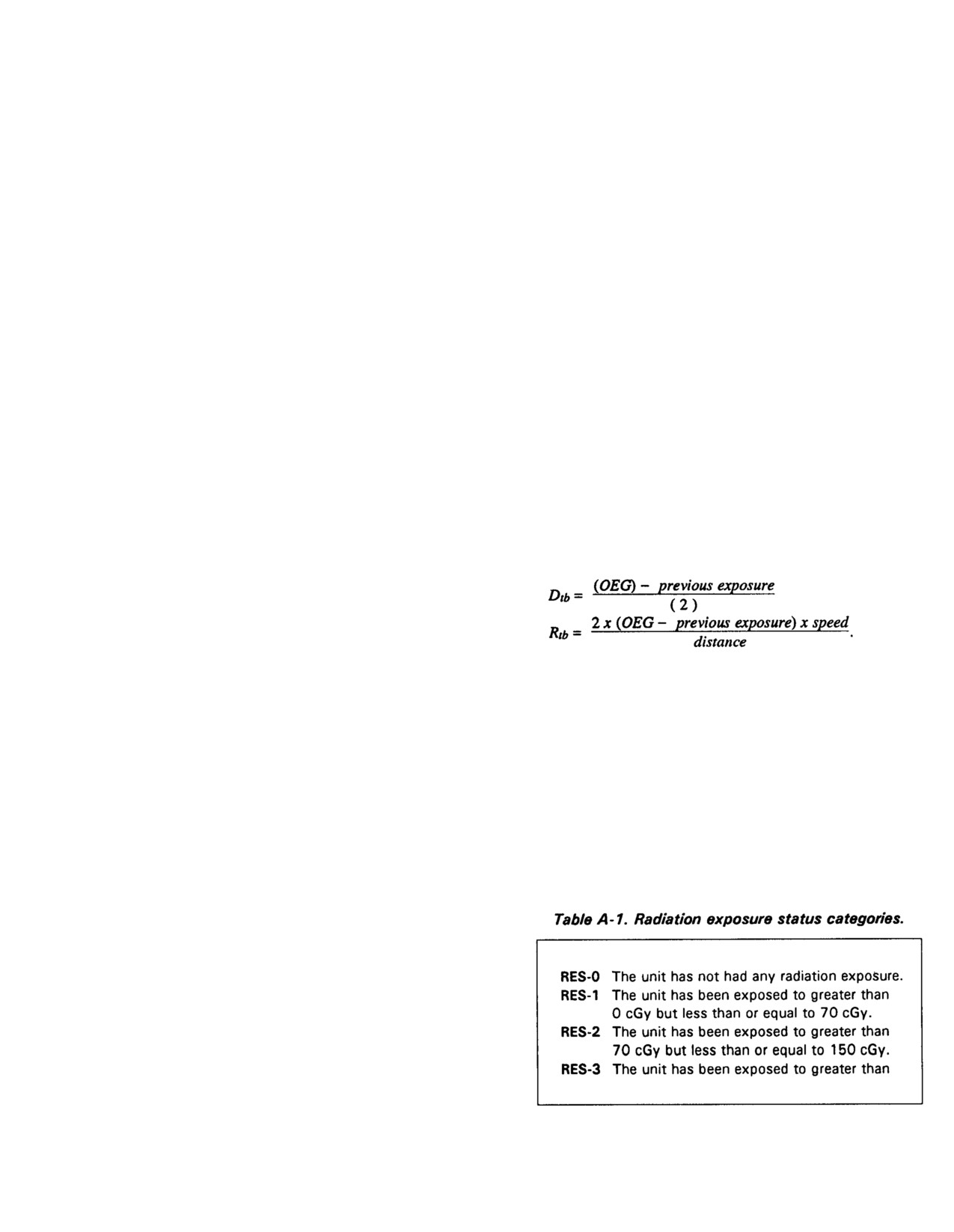
Based on the OEG, a unit can determine the turn-back
dose (D
) and turn-back dose rate (R
) for a military
harmful effect on the body. It should be avoided whenever
tb
tb
possible, without interfering with military operations.
operation (such as a radiological survey):
It is not possible to give the commander hard and fast
rules on radiation exposure. We cannot say that 20 cGy of
radiation will not affect the unit. The unit may have been
exposed to radiation previously. If the unit has had
previous exposure and receives another 20 cGy of
If the dosimeter reading indicates a turnback dose and
radiation, there may be casualties. This is why RES must
the dose rate is still increasing, the unit should immediately
be maintained. Establishing OEG must be based on a unit’s
leave the contaminated area by the same route it used to
prior exposure. The commander establishes an OEG for
enter the area. If the dose rate is decreasing, the
each tactical operation.
commander must decide whether to continue through the
Establishing one numerical value or acceptable degree of
contaminated area (then return to the unit by a clean route)
risk as an OEG for all subordinate units throughout a
or immediately leave by the same route used to enter the
campaign would be meaningless. An OEG must be
area. This may conflict with some basic rules of tactics or
established for each unit and each operation. It must be
recon, but it must be done to minimize casualties.
Categories
of Exposure
Effective use of radiation exposure records permits rapid
determination of a unit’s potential to operate in a
radiologically contaminated area. Dose criteria has been
established in four categories. Radiation Exposure Status-0
(RES-0), Radiation Exposure Status-1 (RES-1), Radiation
Exposure Status-2 (RES-2), and Radiation Exposure
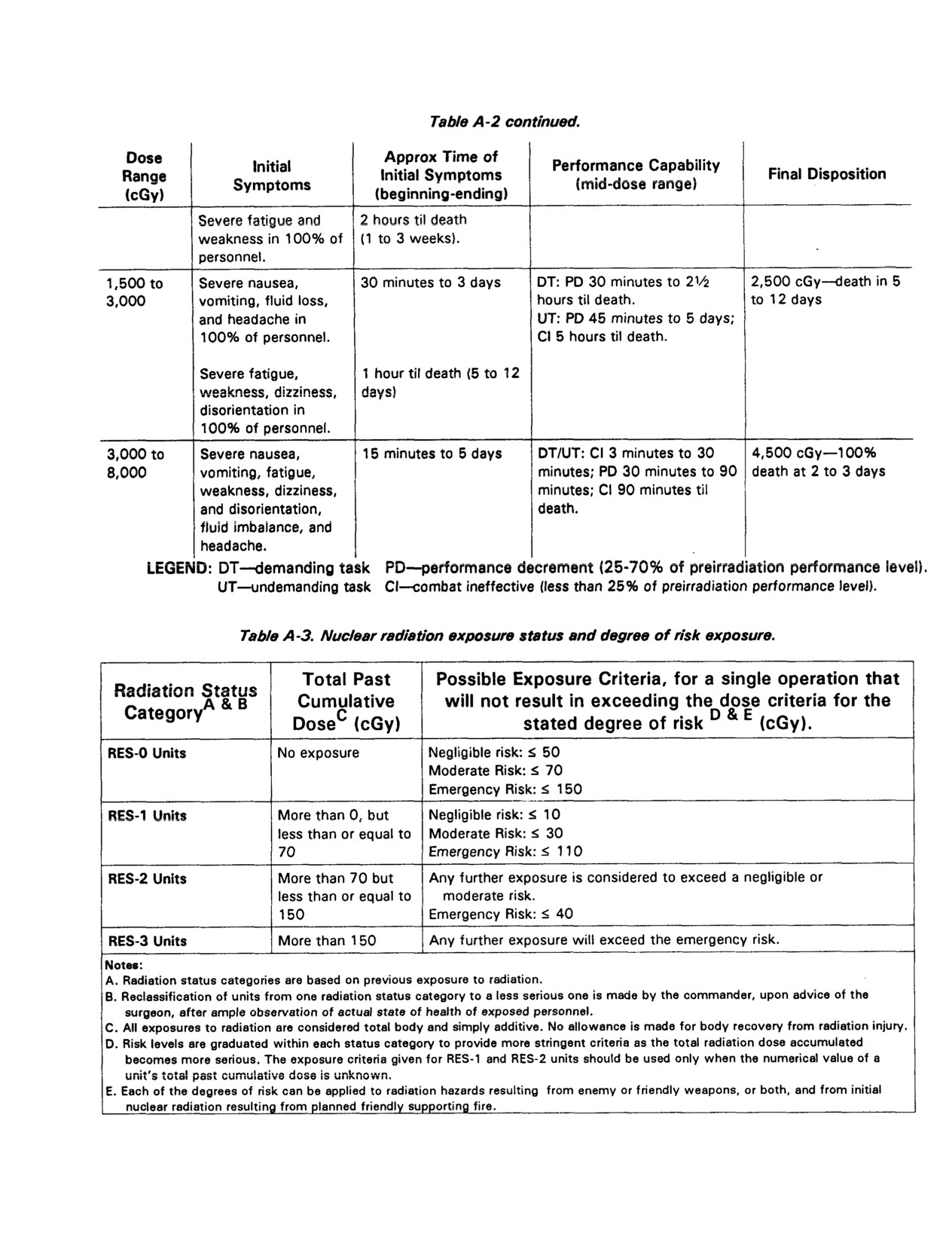
Status-3 (RES-3). Dose criteria is shown in Tables A-1 and
A-3 (page A-5) for each category. This information is based
on the best available estimates on predicting the effects of
radiation exposure.
A-1
FM 3-3-1
Risk
Criteria
The degree-of-risk concept helps the commander to
should not be exceeded unless a significant advantage will
establish an OEG for a single operation and minimize the
be gained.
number of radiation casualties. By using the RES
categories (Table A-1) of subordinate units and the
Moderate Risk
acceptable degree of risk, the commander establishes an
OEG based on the degree of risk (Table A-3, page A-4).
Moderate risk is the second risk category. The dose is 70
There are three degrees of risk-negligible, moderate, and
cGy for personnel in RES-0. This dose generally will not
emergency. Each risk can be applied to radiation hazards
cause casualties. Troops receiving a moderate risk dose
from enemy or friendly weapons, or both, and from initial
will experience no more than 5 percent incidence of
nuclear radiation from planned friendly supporting fire.
nuisance effects. Moderate risk is usually acceptable in
Degrees of risk are defined in percentages of either
close support operations. Moderate risk must not be
casualties or performance degradation. From a radiation
exceeded if troops are expected to operate at full efficiency.
standpoint, the effect causing performance degradation (but
not casualties) is vomiting. This is commonly called a
Emergency Risk
nuisance effect. Degrees of risk for radiation are discussed
in following paragraphs. (See FM 101-31-1 for a complete
Emergency risk is the final risk category. The dose is
discussion of degrees of risk, to include blast and thermal
150 cGy. In this category, not more than 5 percent
effects.)
casualties are expected. Nuisance effects may exceed the 5
Before beginning this discussion, let’s first look at what
percent level. The emergency risk dose is only acceptable
a casualty is and what nuisance effects are. A casualty is
in rare situations, termed disaster situations. Only the
defined as an individual whose performance effectiveness
commander can decide when the risk of the disaster
has dropped by 25% from normal. Specific measures of
situation outweighs the radiation emergency risk.
performance depend upon the task. This, of course, implies
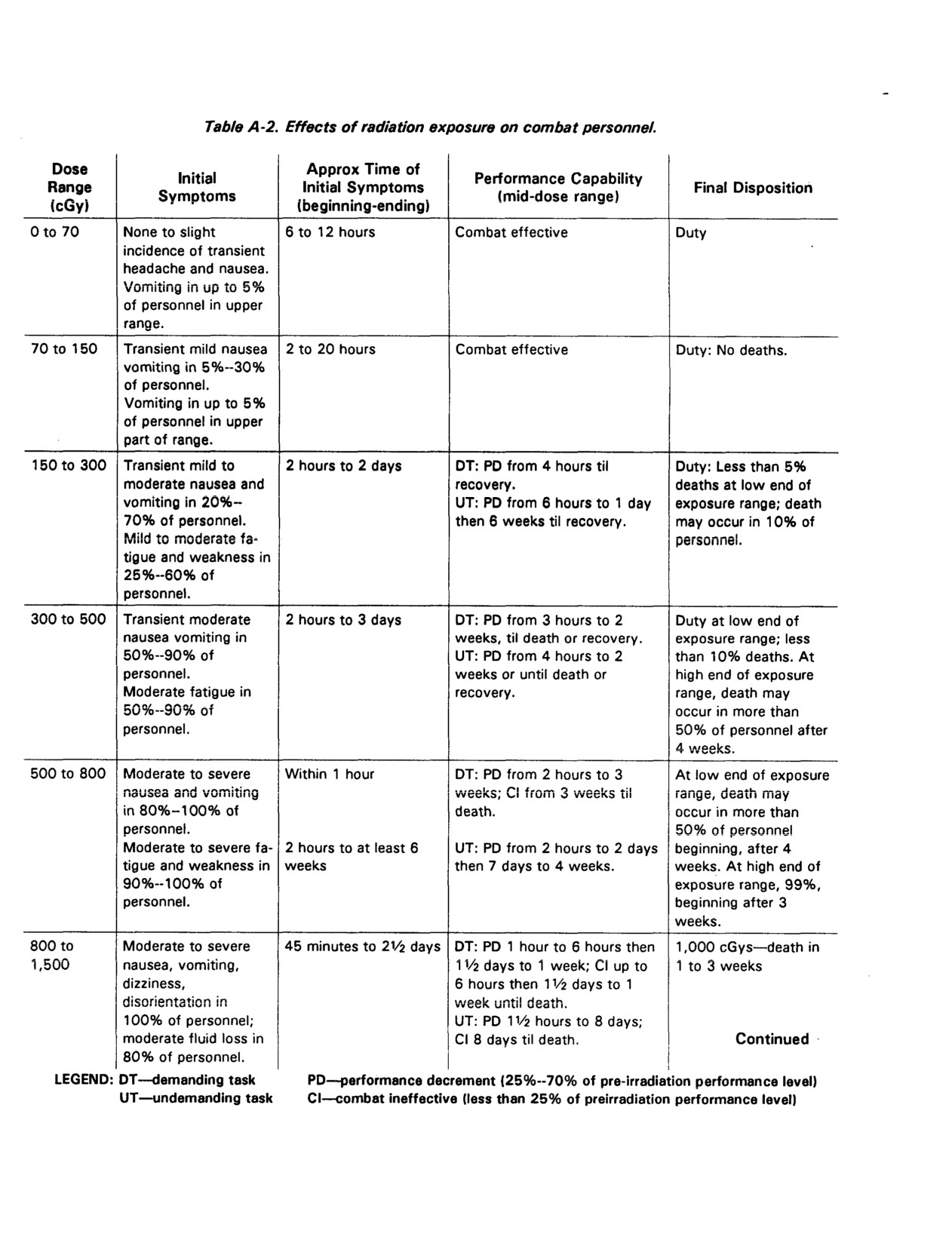
To better understand the relationship between the risk
that an individual casualty status may depend on the task
categories and the dose rate received, see Table A-2 (pages
assigned.
A-3 & -A4). The table data are not intended for use in
The casualty data presented next is based on a 50%
determining operational exposure guidance or categories of
confidence level that the unit is at 75% performance
risk. That information is contained in Table A-3 (page
decrement. Nuisance effects can range from vomiting, skin
A-4). Table A-3 shows the relationship of the categories of
burns, and ear drum rupture to nausea. These symptoms,
exposure and the degree of risk categories. It also shows
at low radiation levels, may take hours to develop.
the possible exposure criteria for a single operation that
Individuals thus exposed should be able to function in the
will not exceed the dose criteria for a stated degree of risk,
important hours after a nuclear attack and after the first set
The risk criteria for the RES-1 and RES-2 categories are
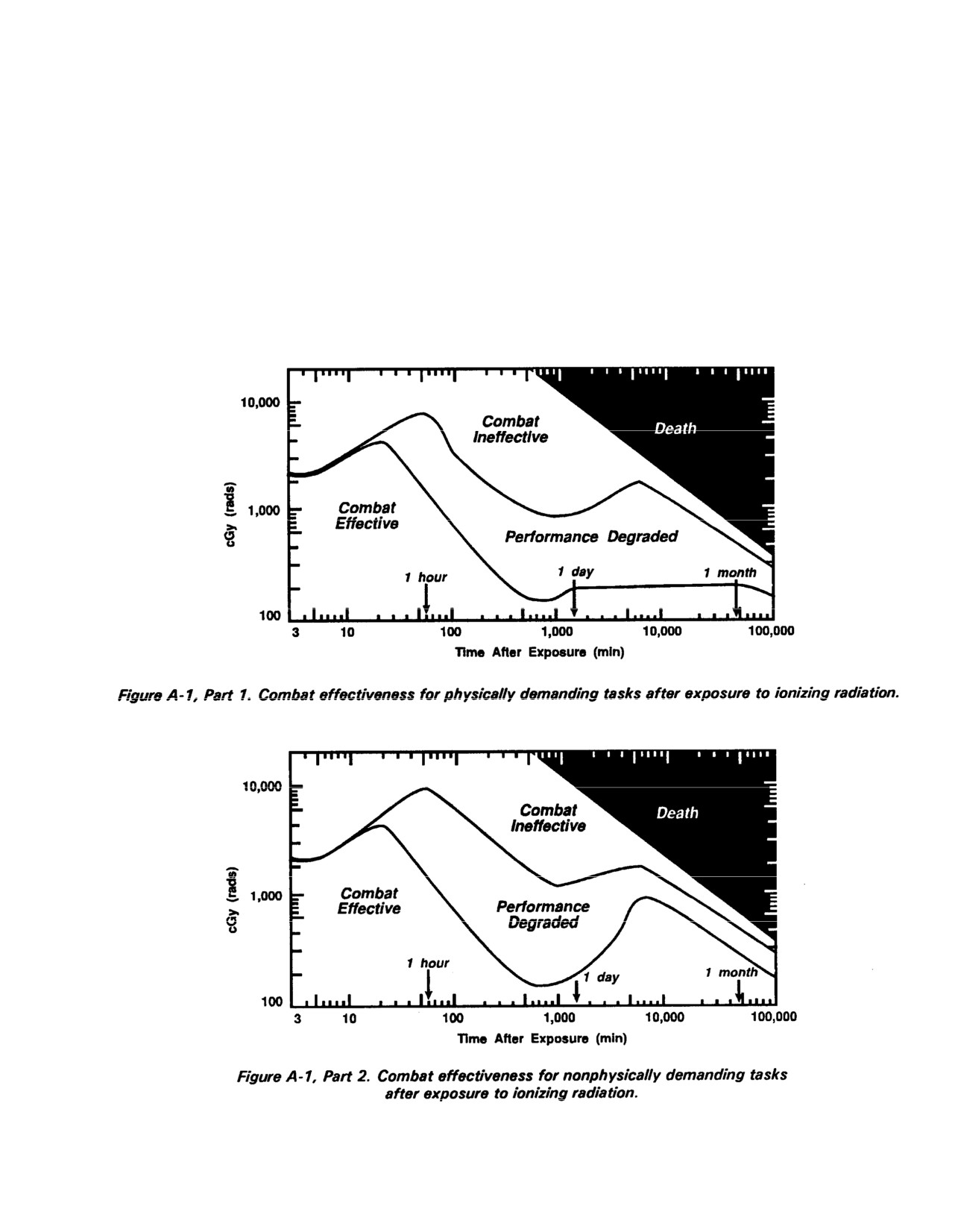
of symptoms abate. This performance decrement is further
based on assumed average exposures for units in RES-1
explained in Figure A-1, parts 1 and 2 (next page).
and RES-2 (40 cGy for RES-1, and 110 cGy for RES-2).
This criteria should be used only when the numerical value
of the total past cumulative dose of a unit is unknown.
Negligible Risk
When the cumulative dose within a category is known,
Negligible risk is the lowest risk category. The dose is 0
subtract the known dose from the RES-0 criteria for the
to 50 cGy for personnel in RES-0. This dose will not cause
degree of risk of concern.
any casualties. Troops receiving a negligible risk dose will
For example, if a unit in RES-1 received 30 cGy, it may
experience no more than 2.5 percent nuisance effects.
receive an additional dose of 20, 40, or 120 cGy,
Negligible risk is acceptable when the mission requires
respectively, before exceeding the negligible, moderate, or
units to operate in a contaminated area. Negligible risk
emergency dose.
Radiation Exposure Records
The OEG concept requires that radiation exposure
Battalion S1, in coordination with the battalion NBC
records be maintained by all units. Because platoons are
staff, maintains RES records for all assigned and attached
usually located in areas of equal radiation levels, the most
units. The records are based on platoon level data received
realistic unit exposure data are based on readings obtained
daily or after a mission in a radiologically contaminated
at the platoon level. Radiation exposure records are
area. Unit SOP indicates specific reporting procedures.
maintained at all levels.
Monthly records are maintained according to unit SOP.
A-2
FM 3-3-1
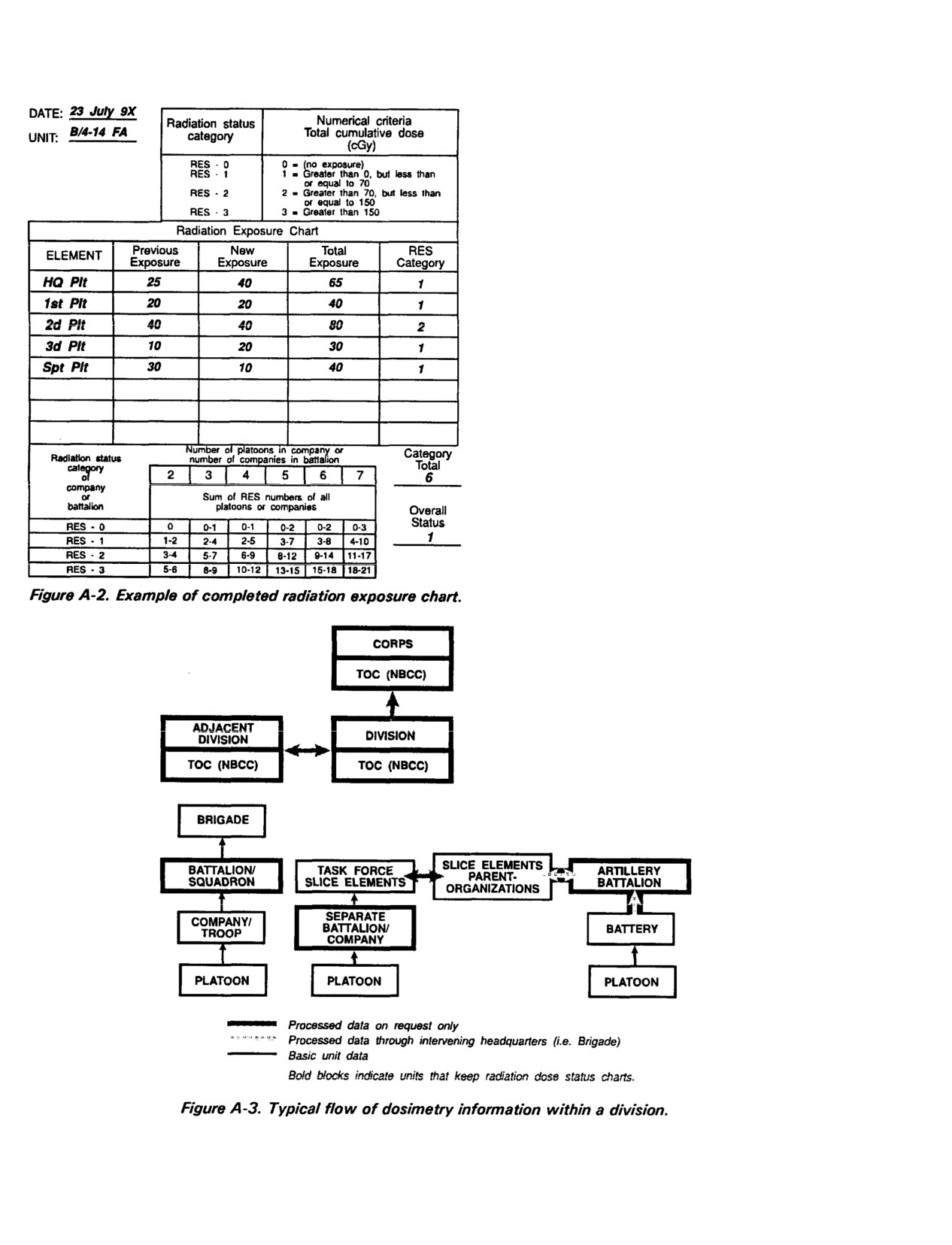
Figure A-2 (page A-5) shows a suggested way of
IM93s, which work on the principle of the electrical
maintaining RES data for each company within a battalion
collection of ions, are recharged after each report is
(companies maintain records by section). A blank radiation
submitted or every three days, whichever occurs first. For
exposure chart, DA 1971-6-R, is in Appendix H.
the DT236, prior to nuclear operations, each unit will read
10 percent of the total number of DT236 weekly to ensure
no leakage has occurred. After nuclear operations have
Processing DATA
commenced in the theater of operations, one third of the
The data from each platoon-size element are passed to
total number of DT236s will be read daily. The DT236s
the unit NBC defense team. Readings from tactical
have a response time of 24 hours and ± 30% accuracy.
dosimeters (IM93s or DT236s) are averaged by the defense
This is due to the process by which the DT236 records
team on a daily basis, and an informal record maintained at
radiation levels.
platoon and company level (Figure A-2 page A-5). The
(Text continued on page A-6)
A-3
FM 3-3-1
A-4
FM 3-3-1
A-5
FM 3-3-1
The DT236 uses the process of scintillation, or
the conversion of radiation into detectable light, to
record gamma; and the process of a solid state
semi-conductor for neutron radiation. The
solid-state semi-conductor must be heated to obtain
a radiation dose reading. Therefore, those DT236s
read directly after a nuclear burst will not show the
true amount of radiation received. During this
response time, readings should be obtained with the
IM93 dosimeters and used for planning purposes
once the 24 hours has elapsed. The readings from
the DT236 will be used for determining unit RES.
After recording all platoon information, the
company reports platoon and company status to the
battalion according to its SOP.
Battalion records and maintains the status on each
platoon, company, and attached elements. An
overall battalion status is reported to the S3 or
placed on the daily briefing chart. Battalion then
forwards the company and overall battalion status to
brigade.
Brigades maintain records on all company-size
elements as well as battalion overall RES. This
information generally is collected at the brigade
administrative and logistics center (ALOC) with the
brigade S1. Brigade NBC personnel must ensure
this information is collected, tabulated correctly,
A-6
FM 3-3-1
and maintained. Typical flow of dosimetry within a
procedures. It may be difficult, but it keeps personnel from
division is shown in Figure A-3.
becoming incapacitated due to overexposure to radiation.
In the example, total exposure begins with the records of
the previous day. The new exposure occurred in the past
Individual Dosimetry
24 hours. The RES category for each unit or element is
determined from Table A-3. Overall status of the battalion
The following information concerns unit dosimetry. As
is determined from the same table.
an interim measure until the Army issues the DT236
Since the platoon is the lowest level at which radiation
individual dosimeters to each soldier, the dose of the
exposure records are kept, replacements should be at
soldier is assumed to be the same as the platoon or similar
platoon level. An ineffective platoon is either pulled out of
size unit to which the soldier is assigned. When reassigned
a company, or the personnel are reassigned to different
or evacuated through medical or other channels, the
platoons with the same RES. A new platoon is then
soldier’s dose will be assumed to be the same as the
assigned to the company.
platoon or similar-size unit to which last assigned. A
This creates severe management problems for personnel
notation of this status (RES-0, RES-1, RES-2, RES-3) will
replacement. All levels of command must follow these
be made on the soldier’s official records for formal record
of radiation exposure when the individual is passed on to a
gaining unit.
The following is an example of
employment of an operation exposure
guide:
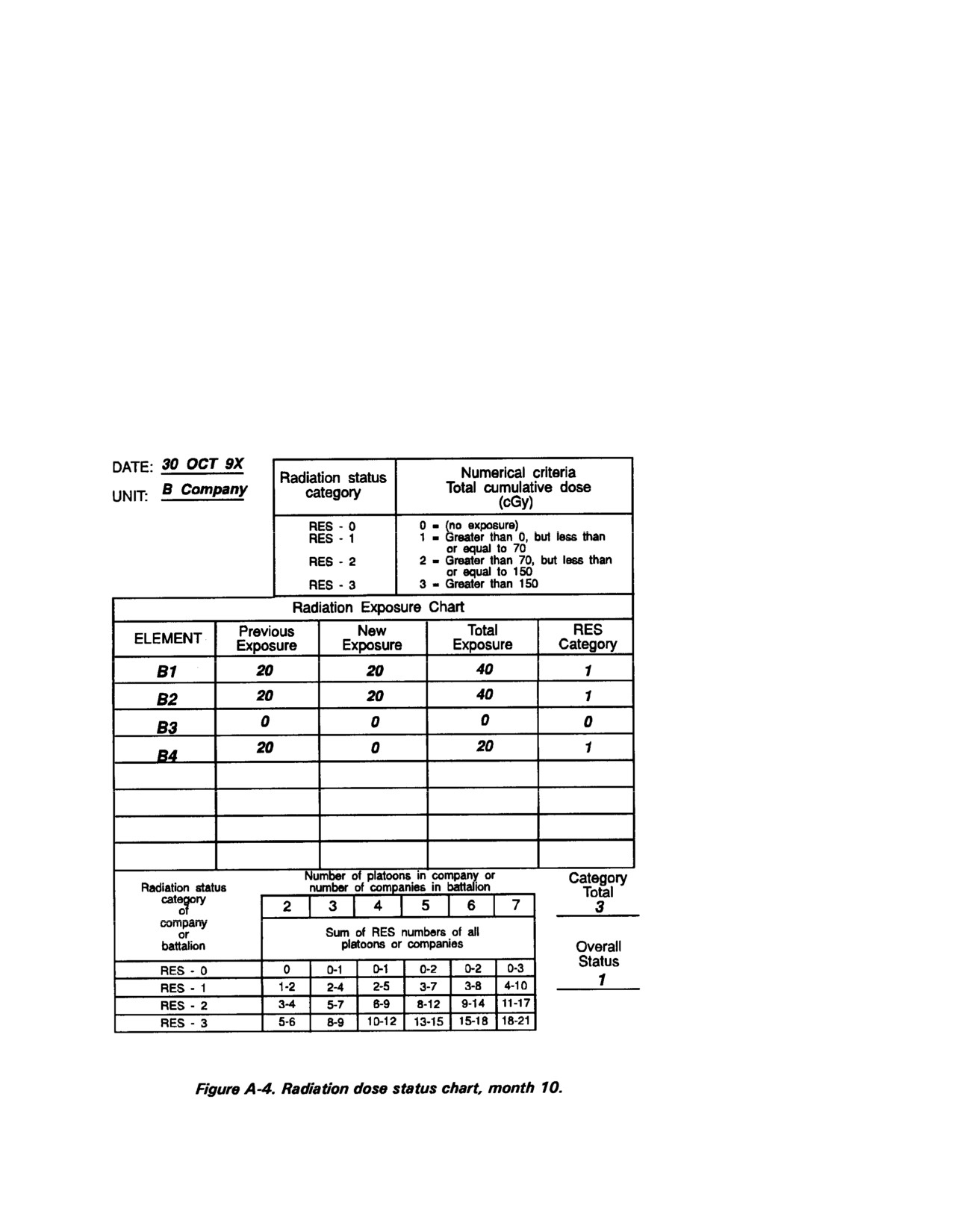
It is 6 October. The battalion
commander plans to commit Company
B on 7 October in a radiologically
contaminated area. He will accept a
moderate risk. The radiation dose
status chart (Figure A-4) is checked,
and the radiation status of Company B
is determined to be RES-1.
The commander notes from Table
A-3 that a RES-1 unit may receive a
dose less than or equal to 30 cGy and
not exceed a moderate risk. Therefore,
he establishes an OEG of no more
than 30 cGy for Company B in this
operation. He then examines the
estimate of hazard shown on the
contamination chart provided by the
division NBCC. If it does not exceed
the OEG, he consults with the S3 and
the surgeon concerning the potential of
B Company’s personnel for successful
accomplishment of the mission under
the conditions contemplated. The steps
discussed above usually precede
finalization of an operations plan and
are accomplished routinely through
normal staff action.
A-7
FM 3-3-1
Appendix B
Shielding
Shielding reduces the effects of gamma radiation on
Alpha Radiation
- A helium nucleus, stripped of its
personnel and equipment. Metal, concrete, soil, water, and
electrons, that travels only a few centimeters in air (5-10
wood are good shielding materials. The denser the
cm) and is an internal hazard only.
material, the better the shield. Low-density materials are as
Beta Radiation
- A very high speed electron that travels
effective as higher density materials when the total
a few meters in air, but has limited penetrating power.
thickness of the low density material is increased. Density
Beta radiation is an external hazard and internal hazard.
is defined as the number of molecules per unit of volume.
Gamma Radiation
- Pure energy traveling at the speed
The denser a material, the better shield it makes.
of light. Gamma can never be totally shielded out, but can
It is not possible for gamma radiation to be completely
be reduced to insignificant or negligible levels.
absorbed. However, if enough material is placed between
To determine the effectiveness of shielding, you must
the individual and the radiation source, the dose rate can be
calculate the dose rate (inside or outside) based on the
reduced to negligible proportions.
density and thickness of a given shield. This calculation
The three types of radiation which we try to shield
requires determining the half-thickness or
total thickness of
against are as follows:
a particular shielding material.
Principles
Density
- Mass (number of molecules per unit of
Effectiveness
volume). The denser a material, the better shield it makes.
Half-thickness
— The amount of material required to
The effectiveness of a given material in decreasing
reduce the dose rate by one-half,
radiation intensity is measured in units of half-value-layer
Total thickness
- This is the actual thickness of the
thickness, or half-thickness. This unit is defined as the
shielding material.
thickness of any material which reduces the dose rate of
Position of the shield
— The closer the shield is to the
gamma radiation to one-half its unshielded value. Thus, if
source the better.
a soldier were surrounded by a 6-inch concrete wall (6
Dose rate build-up
— This is produced by the shield. The
inches is the half-thickness of concrete) and the gamma
shield causes radiation to scatter; therefore, the closer you
radiation outside were 200 cGyph, he or she would receive
are to the shield the higher the dose rate.
gamma radiation at the rate of 100 cGyph. The addition of
another 6 inches reduces the rate to 50 cGyph. Each
succeeding half-thickness of concrete would, therefore,
Materials
reduce the radiation dose by one-half.
Earth.
The most common shielding material. About one
Problem:
How many half-thicknesses of the above
foot of earth makes a very adequate shield.
concrete wall reduce the radiation dose to 25 cGyph?
Concrete.
About 6 to 8 inches of concrete makes a good
Solution: Beginning with the rate of 200 cGyph, the first
shield.
half-thickness reduces it to 100 cGyph. The second
Steel.
Tanks and (USMC) amtracks are very good
half-thickness reduces the dose rate to 50 cGyph, and the
shields against radiation.
third to 25 cGyph. Three half-thicknesses (18 inches) of
Buildings. Wood or brick buildings make good shields.
concrete meets the requirement.
Mathematical Method
A series of computations are necessary to determine
shielding requirements. The following symbols represent
B-0
FM 3-3-1
unknown values. An equation accompanies each to allow a
(X 1/2) is 4 centimeters. What is the final dose rate
better understanding of what each represents.
resulting from the shielding?
R
= Initial dose rate with no shielding. R
=
(2n)
(R)
Ro = 2,000 cGyph
0
0
X=31cm
X½ = half-thickness of a shielding material. X½ =
X½ = 4 cm
X= Total thickness of the shielding material X = (n)
Find: R
(X½)
Solution: First, solve the equation n =
R = Final dose-rate resulting from X amount of
shielding. R =
n = The number of half-thicknesses contained in X, the
Enter Table B-1 in the n column and find n = 7.7 and
7.8. Go to Table B-1. You are looking for R, and you
total thickness of material. 2n
=
entered with n; so, select the smaller n value of 7.7. Read
Sample problem, using mathematical method:
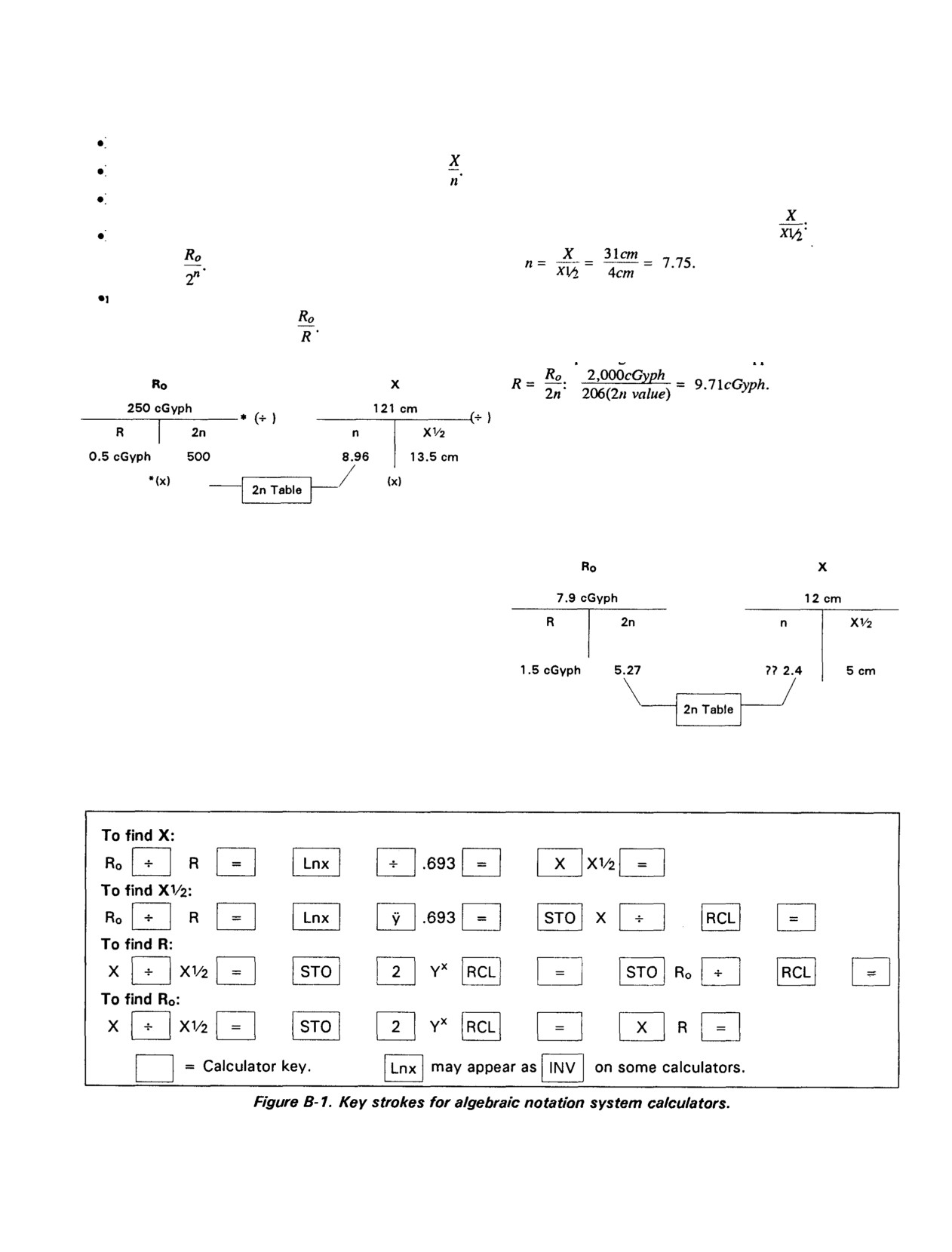
the corresponding 2n value of 206. Apply the equation
Figure B-1, below, shows the key strokes for algebraic
notation system calculators.
Note: Solutions based on calculator key strokes will al-
ways be smaller than those based on the 2n safe-siding ta-
ble, as a mathematical formula is more accurate than a
nomogram.
Situation: R = 1.5 cGyph X = 12 cm X 1/2 = 5 cm.
Sample problem, using the same method with the (2n
Find: The outside dose rate.
table): Use Table B-1 (page B-5) to simplify the process.
Table B-1 includes directions for extrapolating safe-sided
values not listed in the table. Table B-1 eliminates the need
for logarithms, graph paper, or slide rule.
Sample Problems
Problem:
Find the final dose rate with a known amount
of shielding.
Situation: You are in a bunker after a nuclear detonation
and need to know what final dose rate you will receive.
The initial dose rate with no shielding (Ro) is 2,000
Situation: R = 1 cGyph Ro = 120 cGyph X = 24 cm.
cGyph. The total thickness of the shielding material (X) is
Find: The half thickness for the shielding material.
31 centimeters. The half-thickness of the shielding material
B-1