FM 3-25.26 MAP READING AND LAND NAVIGATION (January 2005) - page 5
FM 3-25.26
(left or right) to find your destination or checkpoint, depending upon which way you planned
your deliberate offset.
(10) Because no one can move along a given azimuth with absolute precision, it is better
to plan a few extra steps than to begin an aimless search for the objective once you reach the
linear feature. If you introduce your own mistake, you will certainly know how to correct it.
This method will also cope with minor compass errors and the slight variations that always
occur in the earth’s magnetic field.
(11) There are disadvantages to dead reckoning. The farther you travel by dead reckoning
without confirming your position in relation to the terrain and other features, the more errors
you will accumulate in your movements. Therefore, you should confirm and correct your
estimated position whenever you encounter a known feature on the ground that is also on the
map. Periodically, you should accomplish a resection triangulation using two or more known
points to pinpoint and correct your position on the map. Pace counts or any type of distance
measurement should begin anew each time your position is confirmed on the map.
(a) It is dangerous to select a single steering mark, such as a distant mountaintop, and
then move blindly toward it. What will you do if you must suddenly call for fire support or a
medical evacuation? You must periodically use resection and terrain association techniques
to pinpoint your location along the way.
(b) Steering marks can be farther apart in open country, thereby making navigation more
accurate. In areas of dense vegetation, however, where there is little relief, during darkness,
or in fog, your steering marks must be close together. This, of course, introduces more
chance for error.
(c) Finally, dead reckoning is time-consuming and demands constant attention to the
compass. Errors accumulate easily and quickly. Every fold in the ground and detours as
small as a single tree or boulder also complicate the measurement of distance.
b. Moving by Terrain Association. The technique of moving by terrain association is
more forgiving of mistakes and far less time-consuming than dead reckoning. It best suits
those situations that call for movement from one area to another. Once an error has been
made in dead reckoning, you are off the track. Errors made using terrain association are
easily corrected, however, because you are comparing what you expected to see from the
map to what you do see on the ground. Errors are anticipated and will not go unchecked.
You can easily make adjustments based upon what you encounter. After all, you do not find
the neighborhood grocery store by dead reckoning—you adjust your movements according
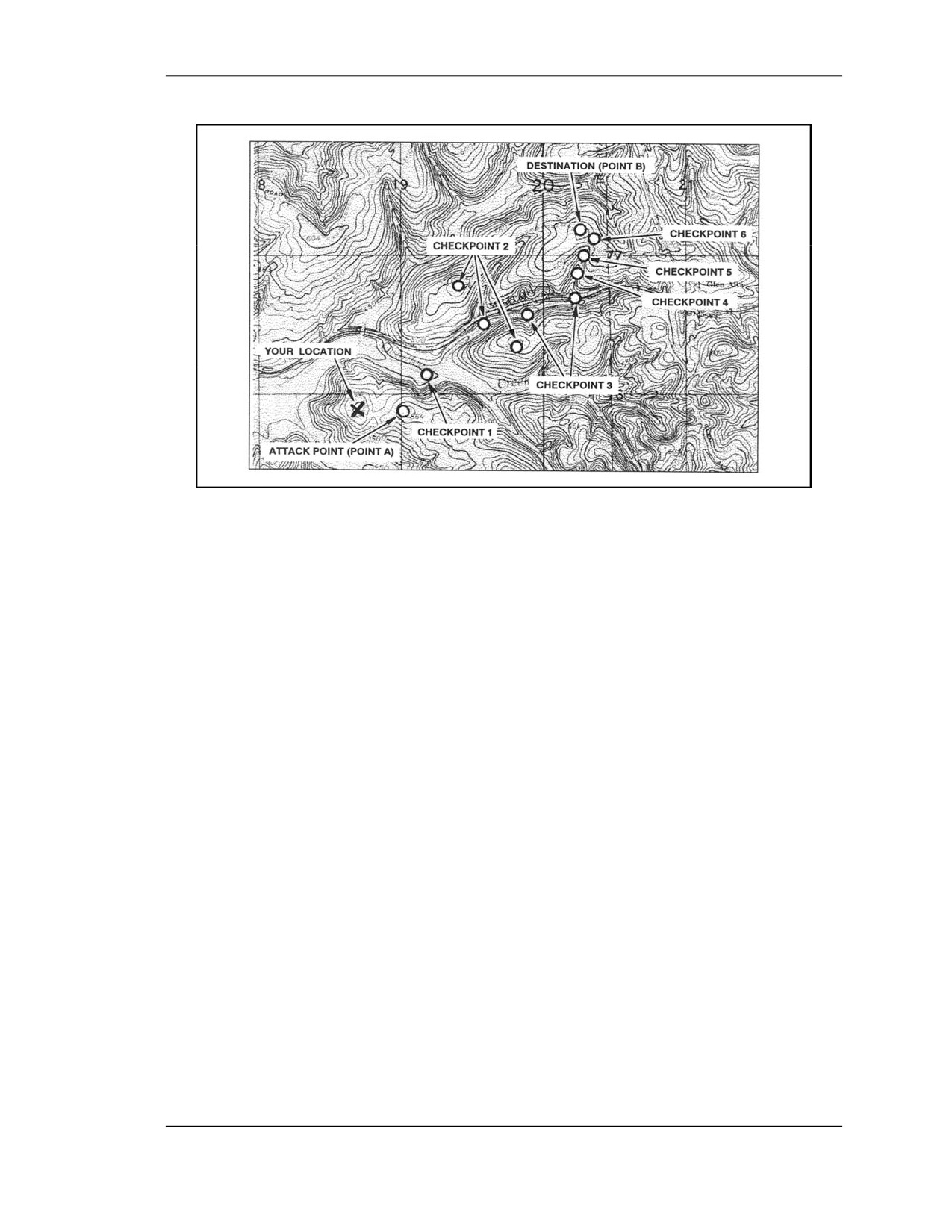
to the familiar landmarks you encounter along the way (Figure 11-8). Periodic position-
fixing through either plotted or estimated resection will also make it possible to correct your
movements, call for fire, or call in the locations of enemy targets or any other information of
tactical or logistical importance.
11-16
FOUO
18 January 2005
FM 3-25.26
Figure 11-8. Terrain association navigation.
(1) Identifying and Locating Selected Features. Being able to identify and locate the
selected features, both on the map and on the ground, are essential to the success in moving
by terrain association. The following rules may prove helpful.
(a) Be certain the map is properly oriented when moving along the route and use the
terrain and other features as guides. The orientation of the map must match the terrain or it
can cause confusion.
(b) To locate and identify features being used to guide the movement, look for the
steepness and shape of the slopes, the relative elevations of the various features, and the
directional orientations in relation to your position and to the position of the other features
you can see.
(c) Make use of the additional cues provided by hydrography, culture, and vegetation.
All the information you can gather will assist you in making the move. The ultimate test and
the best practice for this movement technique is to go out in the field and use it. The use of
terrain, other natural features, and any man-made objects that appear both on the map and on
the ground must be practiced at every opportunity. There is no other way to learn or retain
this skill.
(2) Using Handrails, Catching Features, and Navigational Attack Points. First,
because it is difficult to dead reckon without error over long distances with your compass,
the alert navigator can often gain assistance from the terrain.
(a) Handrails are linear features like roads or highways, railroads, power transmission
lines, ridgelines, or streams that run roughly parallel to your direction of travel. Instead of
using precision compass work, you can rough compass without the use of steering marks for
as long as the feature travels with you on your right or left. It acts as a handrail to guide the
way.
(b) Second, when you reach the point where either your route or the handrail changes
direction, you must be aware that it is time to go your separate ways. Some prominent
FOUO
11-17
18 January 2005
FM 3-25.26
feature located near this point is selected to provide this warning. This is called a catching
feature; it can also be used to tell you when you have gone too far.
(c) Third, the catching feature may also be your navigational attack point; this point is
the place where area navigation ends and point navigation begins. From this last easily
identified checkpoint, the navigator moves cautiously and precisely along a given azimuth
for a specified distance to locate the final objective. The selection of this navigational attack
point is important. A distance of 500 meters or less is most desirable.
(3) Recognizing the Disadvantages of Terrain Association. The major disadvantage to
navigation by terrain association is that you must be able to interpret the map and analyze the
world around you. Recognition of terrain and other features, the ability to determine and
estimate direction and distance, and knowing how to do quick in-the-head position fixing are
skills that are more difficult to teach, learn, and retain than those required for dead
reckoning.
c. Combination of Techniques. Actually, the most successful navigation is obtained
by combining the techniques described above. Constant orientation of the map and
continuous observation of the terrain in conjunction with compass-read azimuths, and
distance traveled on the ground compared with map distance, used together make reaching a
destination more certain. One should not depend entirely on compass navigation or map
navigation; either or both could be lost or destroyed.
NOTE: See Appendix E for information on orienteering.
11-7. NIGHT NAVIGATION
Darkness presents its own characteristics for land navigation because of limited or no
visibility. However, the techniques and principles are the same as those used for day
navigation. The success in nighttime land navigation depends on rehearsals during the
planning phase before the movement, such as detailed analysis of the map to determine the
type of terrain in which the navigation is going to take place, and the predetermination of
azimuths and distances. Night vision devices (Appendix G) can greatly enhance night
navigation.
a. The basic technique used for nighttime land navigation is dead reckoning with
several compasses recommended. The point man is in front of the navigator but just a few
steps away for easy control of the azimuth. Smaller steps are taken during night navigation,
so remember, the pace count is different. It is recommended that a pace count obtained by
using a predetermined 100-meter pace course be used at night.
b. Navigation using the stars is recommended in some areas; however, a thorough
knowledge of constellations and location of stars is needed (Chapter 9, paragraph 9-5c). The
four cardinal directions can also be obtained at night using the same technique described for
the shadow-tip method—just use the moon instead of the sun. In this case, the moon must be
bright enough to cast a shadow.
11-18
FOUO
18 January 2005
FM 3-25.26
CHAPTER 12
MOUNTED LAND NAVIGATION
A vehicle commander should be able to navigate from one point on the
ground to another with or without a compass. If separated from his unit and
given an azimuth and distance from their position to his, he should be able to
reach the unit and continue the mission. To move effectively while mounted,
he must know the principles of mounted navigation.
12-1. PRINCIPLES
The principles of land navigation while mounted are basically the same as while dismounted.
The major difference is the speed of travel. Walking between two points may take one hour,
but riding the same distance may only take 15 minutes. To be effective at mounted land
navigation, the travel speed must be considered.
12-2. NAVIGATOR’S DUTIES
The duties of a navigator are so important and exacting that he should not be given any other
duties. The leader should never try to be the navigator, since his normal responsibilities are
heavy, and one or the other job would suffer.
a. Assembling Equipment. Before the mission starts, the navigator must gather all the
equipment that will help him perform his job (maps, pencils, and so forth).
b. Servicing Equipment. The navigator is responsible for making sure that all the
equipment he may use or require is working.
c. Recording Data for Precise Locations. During movement, the navigator must make
sure that the correct direction and distance are recorded and followed. Grid coordinates of
locations must be recorded and plotted.
d. Supplying Data to Subordinate Leaders. During movement, any change in
direction or distance must be given to the subordinate leaders in sufficient time to allow them
to react.
e. Maintaining Liaison with the Commander. The commander normally selects the
route that he wants to use. The navigator is responsible for following that route; however,
there may be times when the route must be changed during a tactical operation. For this
reason, the navigator must maintain constant communication with the commander. The
navigator must inform the commander when checkpoints are reached, when a change in
direction of movement is required, and how much distance is traveled.
12-3. MOVEMENT
When preparing to move, the effects of terrain on navigating mounted vehicles must be
determined. You will cover great distances very quickly, and you must develop the ability to
estimate the distance you have traveled. Remember that 0.1 mile is roughly 160 meters, and
1 mile is about 1,600 meters or 1.6 kilometers. Having a mobility advantage helps while
navigating. If you get disoriented, mobility makes it much easier to move to a point where
you can reorient yourself.
FOUO
12-1
18 January 2005
FM 3-25.26
NOTE: To convert kilometers per hour to miles per hour, multiply by 0.62 (for example,
9 kilometers per hour x 0.62 = 5.58 miles per hour). To convert miles per hour to
kilometers per hour, divide miles per hour by 0.62 (for example, 10 miles per
hour ÷ 0.62 = 16.12 kilometers per hour).
a. Consider Vehicle Capabilities. When determining a route to be used when mounted,
consider the capabilities of the vehicles to be used. Most military vehicles are limited in the
degree of slope they can climb and the type of terrain they can negotiate. Swamps, thickly
wooded areas, or deep streams may present no problems to dismounted Soldiers, but the
same terrain may completely stop mounted Soldiers. The navigator must consider this when
selecting a route.
(1) Most vehicles can knock down a tree. The bigger the vehicle, the bigger the tree it
can knock down. Vehicles cannot knock down several trees at once. It is best to find paths
between trees that are wide enough for your vehicle. Military vehicles are designed to climb
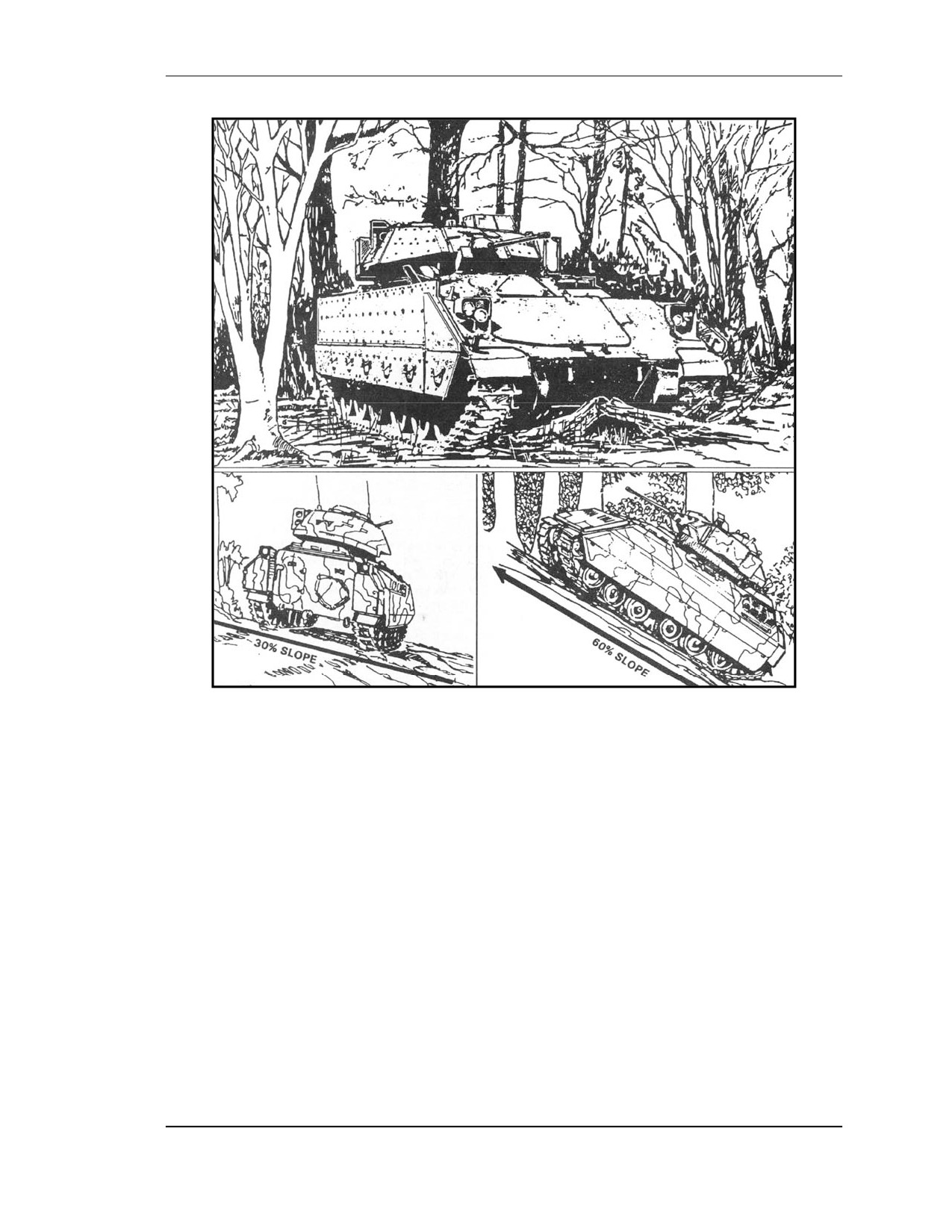
60-percent slopes on a dry, firm surface (Figure 12-1).
(2) You can easily determine approximate slope by looking at the route you have
selected on a map. A contour line in any 100 meters of map distance on that route indicates a
10-percent slope, two contour lines indicate 20-percent slope, and so forth. If there are four
contour lines in any 100 meters, look for another route.
(3) Side slope is even more important than the slope you can climb. Normally, a
30-percent slope is the maximum in good weather. When traversing a side slope, progress
slowly and without turns. Rocks, stumps, or sharp turns can cause you to throw the downhill
track under the vehicle, which would mean a big recovery task.
(4) For tactical reasons, you will often want to move in draws or valleys because they
provide cover. However, side slopes force you to move slowly.
NOTE: The above figures are true for a 10-meter or a 20-foot contour interval. If the map
has a different contour interval, just adjust the arithmetic. For instance, with one
contour line in 100 meters, a 20-meter interval would give a 20-percent slope.
b. Know the Effects of Weather on Vehicle Movement. Weather can halt mounted
movement. Snow and ice are obvious dangers, but more significant is the effect of rain and
snow on the load-bearing ability of soil. Cross-country vehicles may be restricted to road
movement in heavy rain. If it has rained recently, adjust your route to avoid flooded or
muddy areas. A mired vehicle only hinders combat capability.
c. Prepare Before Movement. Locate the start point and finish point on the map.
Determine the map’s grid azimuth from start point to finish point and convert it to a
magnetic azimuth. Determine the distance between the start point and finish point or any
intermediate points on the map and make a thorough map reconnaissance of that area.
12-2
FOUO
18 January 2005
FM 3-25.26
Figure 12-1. Tracked vehicle capabilities.
12-4. TERRAIN ASSOCIATION NAVIGATION
Terrain association is currently the most widely used method of navigation. The navigator
plans his route so that he moves from terrain feature to terrain feature. An automobile driver
in a city uses this technique as he moves along a street or series of streets, guiding on
intersections or features such as stores and parks. Like the driver, the navigator selects routes
or streets between key points or intersections. These routes must be capable of sustaining the
travel of the vehicle or vehicles, should be relatively direct, and should be easy to follow. In
a typical move, the navigator determines his location, determines the location of his
objective, notes the position of both on his map, and then selects a route between the two.
After examining the terrain, he adjusts the route using the following actions:
a. Consider Tactical Aspects. Avoid skylining, select key terrain for overwatch
positions, and select concealed routes.
b. Consider Ease of Movement. Use the easiest possible route and bypass difficult
terrain. Remember that a difficult route is harder to follow, is noisier, causes more wear and
tear (and possible recovery problems), and takes more time. Tactical surprise is achieved by
doing the unexpected. Try to select an axis or corridor instead of a specific route. Make sure
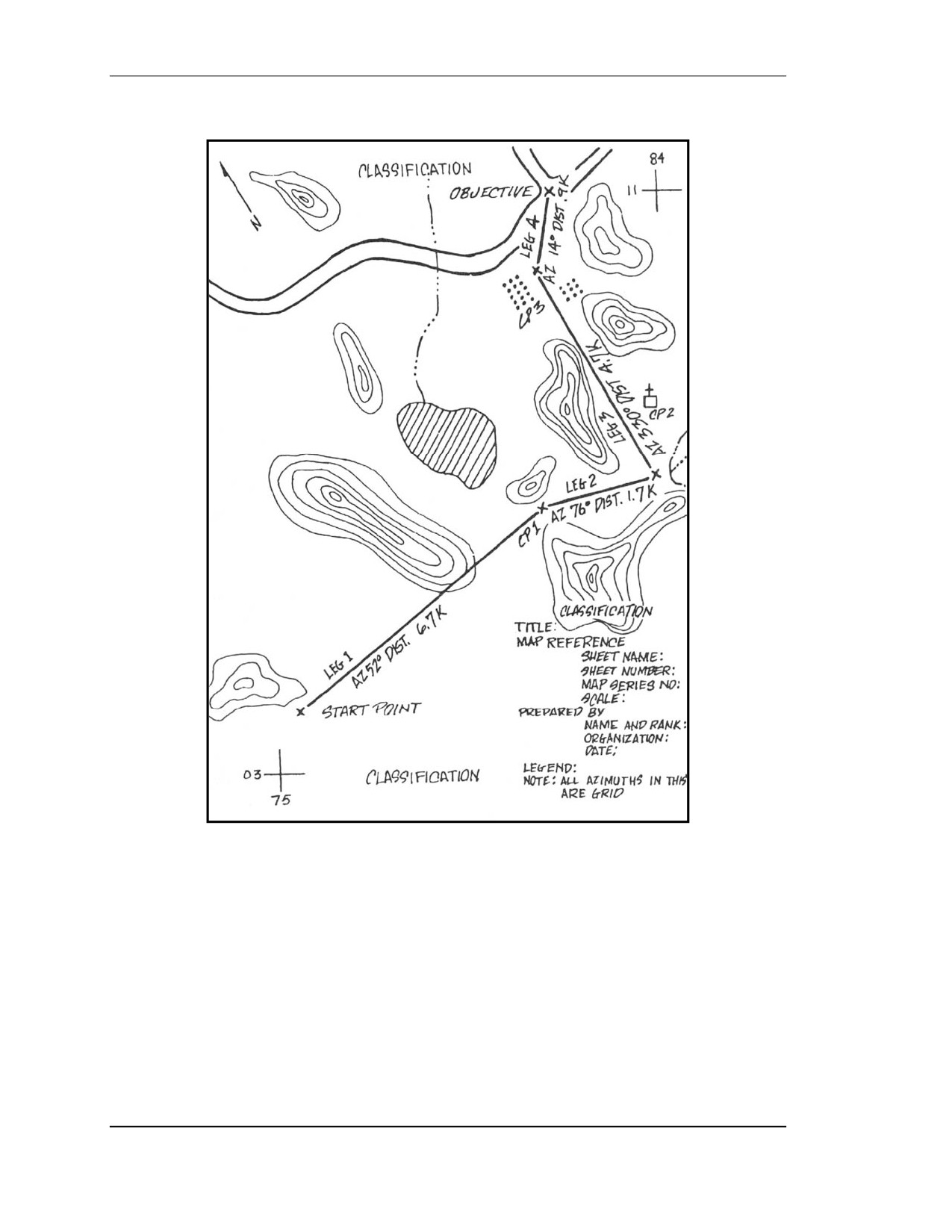
you have enough maneuver room for the vehicles (Figure 12-2).
FOUO
12-3
18 January 2005
FM 3-25.26
Figure 12-2. Primary route.
c. Use Terrain Features as Checkpoints. These checkpoints must be easily
recognizable in the light and weather conditions and at the speed at which you will move.
You should be able to find a terrain feature from your location that can be recognized from
almost anywhere and used as a guide. (For example, checkpoint 2, the church and
checkpoint 3, the orchard in Figure 12-2.)
(1) The best checkpoints are linear features that cross your route. Use streams, rivers,
hard-top roads, ridges, valleys, and railroads.
(2) The next best checkpoints are elevation changes such as hills, depressions, spurs, and
draws. Look for two contour lines of change. You will not be able to spot less than two lines
of change while mounted.
12-4
FOUO
18 January 2005
FM 3-25.26
(3) In wooded terrain, try to locate checkpoints at no more than 1,000-meter intervals. In
open terrain, you may go to about 5,000 meters.
d. Follow Terrain Features. Movement and navigation along a valley floor or near
(not necessarily on) the crest of a ridgeline is easiest.
e. Determine Directions. Break the route down into smaller segments and determine
the rough directions that will be followed. You do not need to use the compass; just use the
main points of direction (north, northeast, east, and so forth). Before moving, note the
location of the sun and locate north. Locate changes of direction, if any, at the checkpoints
picked.
f. Determine Distance. Determine the total distance to be traveled and the approximate
distance between checkpoints. Plan to use the vehicle odometer to keep track of distance
traveled. Use the pace-count method and keep a record of the distance traveled. When using
a pace count, convert from map distance to ground distance by adding the conversion factors
of 20 percent for cross-country movement.
g. Make Notes. Mental notes are usually adequate. Try to imagine what the route is like
and remember it.
h. Plan to Avoid Errors. Restudy the route selected. Try to determine where errors are
most apt to occur and how to avoid any trouble.
i.
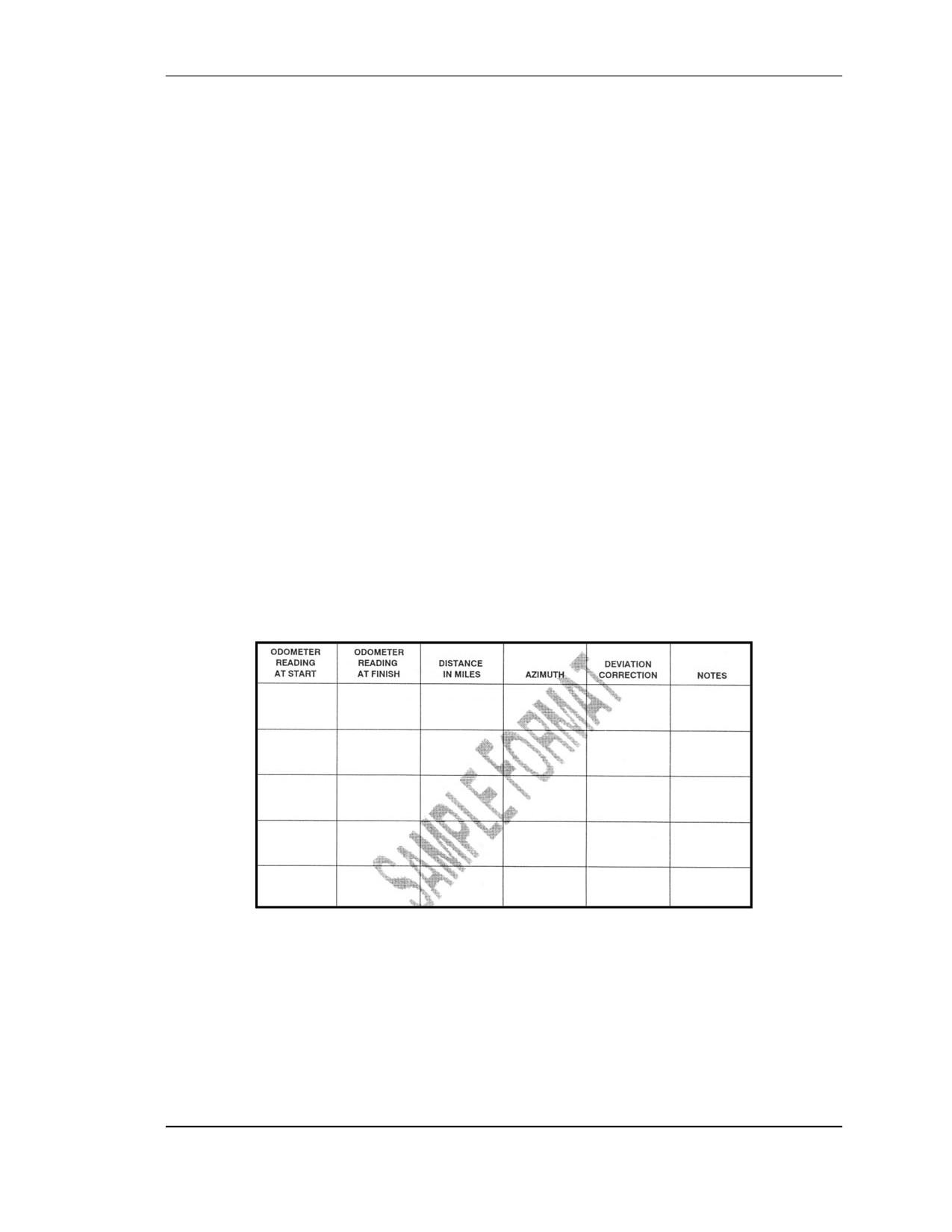
Use a Logbook. When the routes have been selected and the navigator has divided
the distance to be traveled into legs, prepare a logbook. The logbook is an informal record of
the distance and azimuth of each leg, with notes to aid the navigator in following the correct
route. The notes list easily identifiable terrain features at or near the point where the
direction of movement changes (Figure 12-3).
Figure 12-3. Sample of a logbook format.
12-5. DEAD RECKONING NAVIGATION
Dead reckoning is moving a set distance along a set line. Generally, it involves moving so
many meters along a set line, usually an azimuth in degrees. There is no accurate method of
determining a direction in a moving vehicle. A magnetic vehicle-heading reference unit may
be available in a few years; for now, use a compass.
a. With Steering Marks. This procedure is the same for vehicle travel as on foot.
FOUO
12-5
18 January 2005
FM 3-25.26
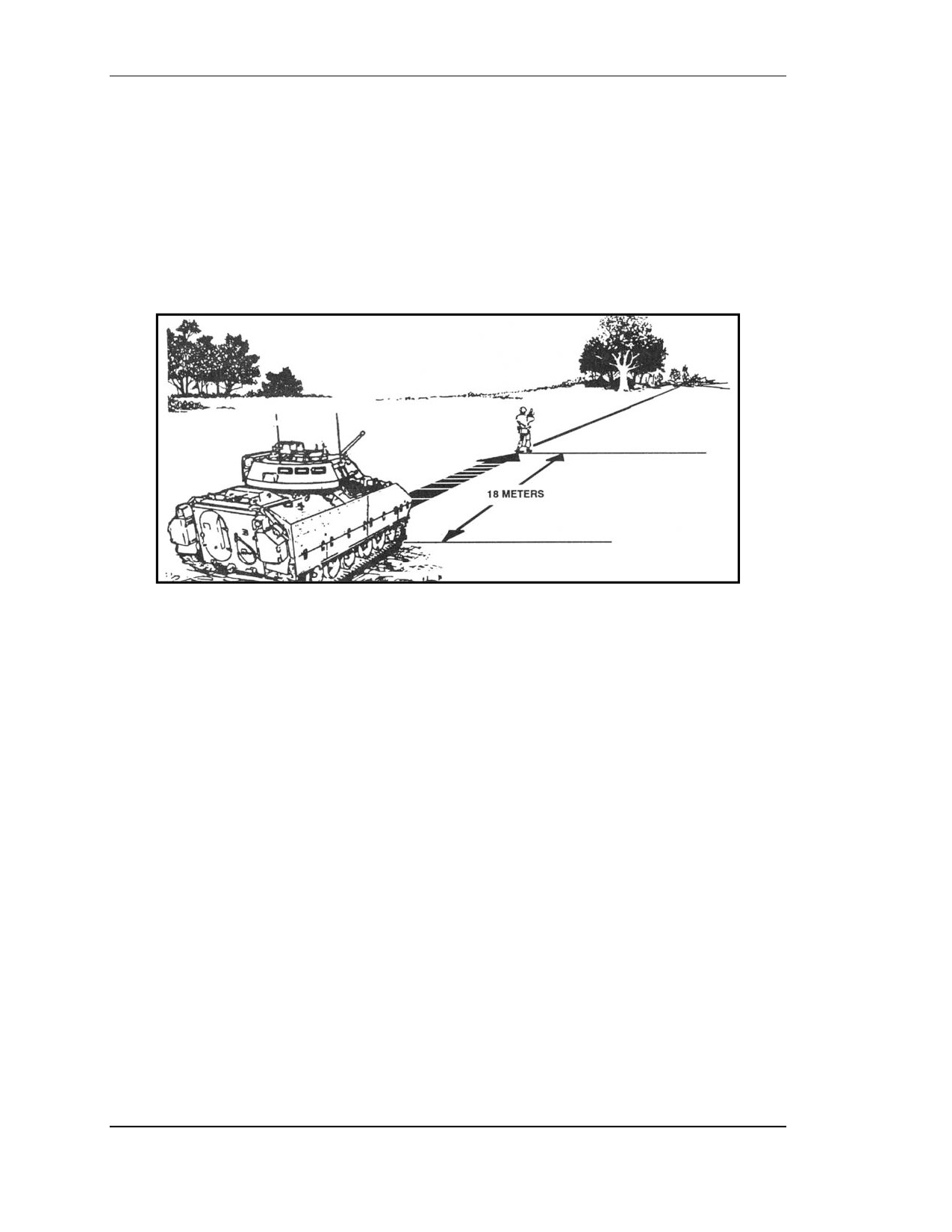
(1) The navigator dismounts from the vehicle and moves away from the vehicle (at least
18 meters).
(2) He sets the azimuth on the compass and picks a steering mark (rock, tree, hilltop) in
the direction on that azimuth (Figure 12-4).
(3) He remounts and has the driver identify the steering mark and proceed to it in as
straight a line as possible.
(4) On arrival at the steering mark or on any changes in direction, the navigator repeats
the first three steps for the next leg of travel.
Figure 12-4. Determining an azimuth, dismounted.
b. Without Steering Marks. This procedure is used only on flat, featureless terrain.
(1) The navigator dismounts from the vehicle, which is oriented in the direction of travel,
and moves at least 18 meters to the front of the vehicle.
(2) He faces the vehicle and reads the azimuth to the vehicle. By adding or subtracting
180 degrees, he determines the forward azimuth (direction of travel).
(3) On order from the navigator, the driver drives on a straight line to the navigator.
(4) The navigator remounts the vehicle, holds the compass as it will be held while the
vehicle is moving, and reads the azimuth in the direction of travel.
(5) The compass will swing off the azimuth determined and pick up a constant deviation.
For example, the azimuth was 75 degrees while you were away from the vehicle. When you
remounted and your driver drove straight forward, your compass showed 67 degrees. You
have a deviation of -8 degrees. All you need to do is maintain that 67-degree compass
heading to travel on a 75-degree magnetic heading.
(6) At night, the same technique can be used. From the map, determine the azimuth you
are to travel. Convert the grid azimuth to a magnetic azimuth. Line the vehicle up on that
azimuth, then move well in front of it. Be sure it is aligned correctly. Then mount, have the
driver move slowly forward, and note the deviation. If the vehicle has a turret, the above
procedure works unless you traverse the turret; this changes the deviation.
(7) The distance factor in dead reckoning is easy. Just determine the map distance to
travel and add 20 percent to convert to ground distance. Use your vehicle odometer to be
sure you travel the proper distance.
12-6
FOUO
18 January 2005
FM 3-25.26
12-6. STABILIZED TURRET ALIGNMENT NAVIGATION
Another method, if you have a vehicle with a stabilized turret, is to align the turret on the
azimuth you wish to travel, then switch the turret stabilization system on. The gun tube
remains pointed at your destination no matter which way you turn the vehicle. This
technique has been proven; it works. It is not harmful to the stabilization system. It is subject
to stabilization drift, so use it for no more than 5,000 meters before resetting.
NOTE: If you have to take the turret off-line to engage a target, you will have to re-do
the entire process.
12-7. COMBINATION NAVIGATION
Some mounted situations may call for you to combine and use both methods. Just remember
the characteristics of each.
a. Terrain association is fast, is error-tolerant, and is best under most circumstances. It
can be used day or night if you are proficient in it.
b. Dead reckoning is very accurate if you do everything correctly. You must be very
precise. It is also slow, but it works on very flat terrain.
c. You frequently will combine both. You may use dead reckoning to travel across a
large, flat area to a ridge, then use terrain association for the rest of the move.
d. You must be able to use both methods. You should remember that your probable
errors, in order of frequency, will be—
• Failure to determine distances to be traveled.
• Failure to travel the proper distance.
• Failure to properly plot or locate the objective.
• Failure to select easily recognized checkpoints or landmarks.
• Failure to consider the ease of movement factor.
FOUO
12-7
18 January 2005
This Page intentionally left blank.
FM 3-25.26
CHAPTER 13
NAVIGATION IN DIFFERENT TYPES OF TERRAIN
The information, concepts, and skills already presented will help you to
navigate anywhere in the world; however, there are some special
considerations and helpful hints that may assist you in various special
environments. The following information is not doctrine.
13-1. DESERT TERRAIN
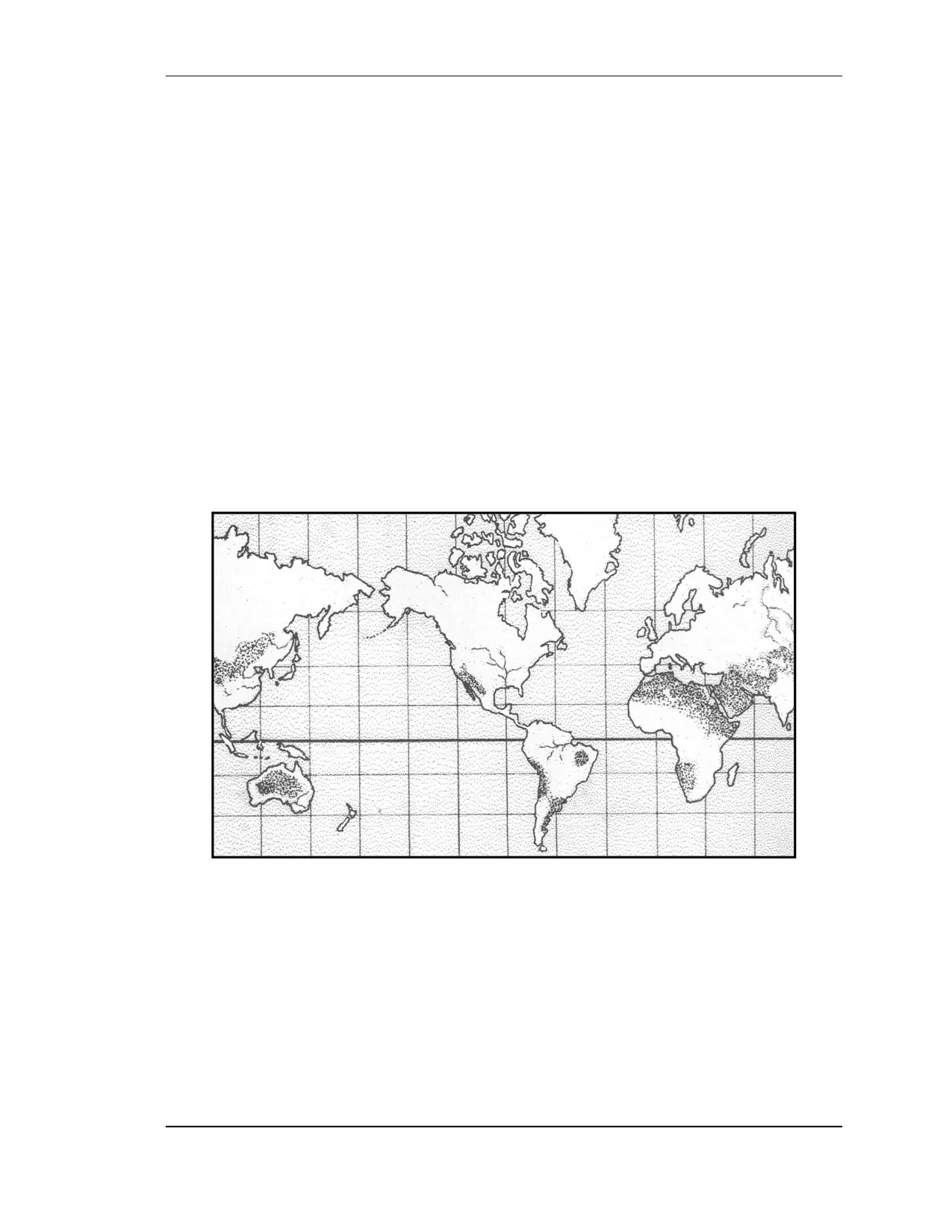
About 5 percent of the earth’s land surface is covered by deserts (Figure 13-1). Deserts are
large arid areas with little or no rainfall during the year. There are three types of deserts—
mountain, rocky plateau, and sandy or dune deserts. All types of forces can be deployed in
the desert. Armor and mechanized infantry forces are especially suitable to desert combat
except in rough mountainous terrain where light infantry may be required. Airborne, air
assault, and motorized forces can also be advantageously employed to exploit the vast
distances characteristic of desert warfare.
Figure 13-1. Deserts.
a. Desert Regions. In desert regions, terrain varies from nearly flat to lava beds and salt
marshes. Mountain deserts contain scattered ranges or areas of barren hills or mountains.
Table 13-1 (page 13-2) lists some of the world’s major desert regions and their locations.
FOUO
13-1
18 January 2005

FM 3-25.26
DESERT REGION
LOCATION
Sahara
North Africa
Kalahari
Southwest Africa
Arabian
Southwest Asia
Gobi
Mongolia and Northern China
Rub’al Khali
South Arabia
Great Basin, Colorado, Chichuahua,
Northern Mexico and Western United
Yuma Sonoran, and Mohave
States
Takla Makan
Northern China
Kyzyl Kum
Southwest USSR
Kara Kum
Southwest USSR
Syrian
Saudi Arabia, Jordan, and Iraq
Great Victoria
Western and South Australia
Great Sandy
Northwestern Australia
Patagonia
Southern Argentina and Chile
Atacama
Northern Chile
Table 13-1. Location of major desert regions.
(1) Finding the way in a desert presents some degree of difficulty for a person who has
never been exposed to this environment. Desert navigators have learned through generations
of experience.
(2) Normally, desert people are nomadic, constantly moving in caravans. Navigating
becomes second nature to them. Temperature in the tropical deserts reaches an average of
110 to 115 degrees during the day, so most navigation takes place at night using the stars.
Most deserts have some prevailing winds during the seasons. Such winds arrange the sand
dunes in a specific pattern that allows the navigator to determine the four cardinal directions.
He may also use the sun’s shadow-tip method.
(3) A sense of direction can be obtained by watching desert animals on their way to and
from water holes (oases). Water, navigation, and survival are closely related in desert areas.
Most deserts have pigeons or doves, and their drinking habits are important to the navigator.
As a rule, these birds never drink in the morning or during the day, making their evening
flights the most important. When returning from the oases, their bodies are heavier from
drinking and their flight is accompanied by a louder flapping of their wings.
(4) Visibility is also an important factor in the desert, especially in judging distance. The
absence of trees or other features prevents comparison between the horizon and the skyline.
b. Interpretation and Analysis. Many desert maps are inaccurate, which makes
up-to-date air, aerial photo, and ground reconnaissance necessary. In desert mountain areas
13-2
FOUO
18 January 2005
FM 3-25.26
contour intervals are generally large, so many of the intermediate relief features are not
shown.
(1) The desert normally permits observation and fire to maximum ranges. The terrain is
generally wide open and the exceptionally clear atmosphere offers excellent long-range
visibility. Combine this with a powerful sun and low cloud density and you have nearly
unlimited light and visual clarity, which often contribute to gross underestimations of ranges.
Errors of up to 200 or 300 percent are not uncommon. However, visibility conditions may be
severely affected by sandstorms and mirages (heat shimmer caused by air rising from the
extremely hot daytime desert surface), especially if the observer is looking into the sun
through magnifying optical instruments.
(2) Cover can be provided only by terrain feature masking because of the lack of heavy
vegetation and man-made objects. It only takes a few meters of relief to provide cover.
Concealment in the desert is related to the following factors:
(a) Shape. To prevent observation by the enemy, try to alter the standard shapes of
vehicles so they and their shadows are not instantly recognizable.
(b) Shine. Shine or glitter is often the first thing that attracts the observer’s eye to
movement many kilometers away. It must be eliminated.
(c) Color and Texture. All equipment should either be pattern painted or mudded to
blend in with the terrain.
(d) Light and Noise. Light and noise discipline are essential because sound and light
travel great distances in the desert.
(e) Heat. Modern heat image technology makes shielding heat sources an important
consideration when trying to hide from the enemy. This technology is especially important
during night stops.
(f) Movement. Movement itself creates a great deal of noise and dust, but a rapid
execution using all the advantages the topography offers can help conceal it.
c. Navigation. When operating in the broad basins between mountain ranges or on
rocky plateau deserts, there are frequently many terrain features to guide your movement.
Observing these known features over great distances may provide a false sense of security in
determining your precise location unless you frequently confirm your location by resection
or referencing close-in terrain features. It is not uncommon to develop errors of several
kilometers when casually estimating a position in this manner. Obviously, this can create
many problems when attempting to locate a small checkpoint or objective, calling for combat
support (CS), reporting operational or intelligence information, or meeting combat service
support (CSS) requirements.
(1) When operating in an area with few visual cues, such as a sandy or dune desert, or
when visibility is restricted by a sandstorm or darkness, you must proceed by dead
reckoning. The four steps and two techniques for navigation presented earlier remain valid in
the desert. However, understanding the desert’s special conditions is extremely helpful as
you apply the techniques.
(2) Tactical mobility and speed are key to successful desert operations. Obstacles and
areas such as lava beds or salt marshes, which preclude surface movements, do exist. But
most deserts permit two-dimensional movement by ground forces similar to that of a naval
task force at sea. Speed of execution is essential. Everyone moves farther and faster on the
desert. Special navigation aids sometimes used in the desert include:
FOUO
13-3
18 January 2005
FM 3-25.26
(a) Sun Compass. The sun compass can be used on moving vehicles and sextants. It
requires accurate timekeeping. However, the deviation on a magnetic compass that is caused
by the metal and electronics in the vehicle is usually less than +10 degrees.
(b) Gyro Compass. The gun azimuth stabilizer is in fact a gyro compass. If used on fairly
flat ground, it is useful for maintaining direction over limited distances.
(c) Fires. Planned tracer fire or mortar and artillery concentrations (preferably smoke
during the day and illumination at night) provide useful checks on estimated locations.
(d) Pre-positioned Lights. This method consists of placing two or more searchlights far
apart, behind the line of contact, beyond enemy artillery range, and concealed from enemy
ground observation. Units in the area can determine their own locations through resection,
using the vertical beams of the lights. These lights must be moved on a time schedule known
to all friendly units.
(3) The sand, hard-baked ground, rocky surfaces, thorny vegetation, and heat generally
found in the desert impose far greater demands for maintenance than you would plan for in
temperate regions. It may also take longer to perform that maintenance.
13-2. MOUNTAIN TERRAIN
Mountains are generally understood to be larger than hills. Rarely do mountains occur
individually; in most cases, they are found in elongated ranges or circular groups. When they
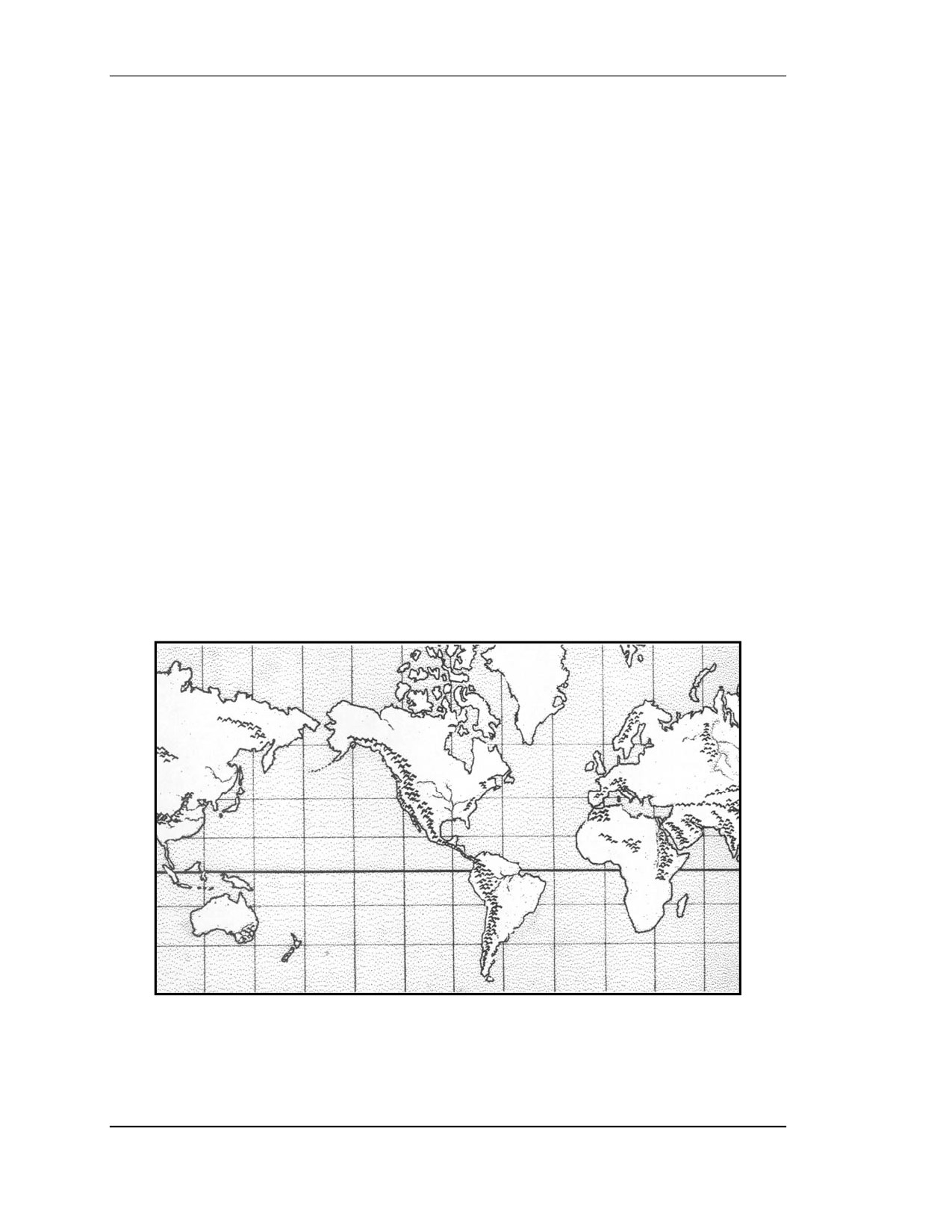
are linked together, they constitute a mountain system (Figure 13-2). Light forces (infantry,
airborne, and air assault forces) can operate effectively in mountainous regions because they
are not limited by terrain. Heavy forces must operate in passes and valleys that are
negotiable by vehicle.
Figure 13-2. Mountain systems.
a. Characteristics. Mountain systems are characterized by high, inaccessible peaks and
steep slopes. Depending on the altitude, they may be snow covered. Prominent ridges and
13-4
FOUO
18 January 2005

FM 3-25.26
large valleys are also found. Navigating in this type of terrain is not difficult providing you
make a careful examination of the map and the terrain.
b. Major Mountain Systems. Table 13-2 lists the major mountain systems and their
locations.
MOUNTAIN SYSTEM
LOCATION
Andes
Central and South America
Rockies
North America (USA and Canada)
Appalachians
North America (USA and Canada)
Alps
Central Europe
Himalayas
Asia
Caucasus
Western Asia and Europe (Russia)
Table 13-2. Location of major mountain systems.
c. Minor Systems. Some minor mountain systems are located in Antarctica, Hawaii,
Japan, New Zealand, and Oceania.
d. Climate. Because of the elevations, it is always colder (3 to 5 degrees per 300-meter
gain in altitude) and wetter than you might expect. Wind speeds can increase the effects of
the cold even more. Sudden severe storms and fog are encountered regularly. Below the tree
line, vegetation is heavy because of the extra rainfall and the fact that the land is rarely
cleared for farming.
e. Interpretation and Analysis. The heights of mountainous terrain permit excellent
long-range observation. However, rapidly fluctuating weather with frequent periods of high
winds, rain, snow, or fog may limit visibility. Also, the rugged nature of the terrain
frequently produces significant dead space at mid ranges.
(1) Reduced mobility, compartmented terrain, and the effects of rapidly changing
weather increase the importance of air, ground, aerial photo, and map reconnaissance. Since
mountain maps often use large contour intervals, microrelief interpretation and detailed
terrain analysis require special emphasis.
(2) At first glance, some mountainous terrain may not appear to offer adequate cover and
concealment; however, you can improve the situation. When moving, use rock outcroppings,
boulders, and heavy vegetation for cover and concealment; use terrain features to mask
maneuvers. Use harsh weather, which often obscures observation, to enhance concealment.
(3) Since there are only a few routing options, all-round security must be of primary
concern. Natural obstacles are everywhere, and the enemy can easily construct more.
f. Navigation. Existing roads and trails offer the best routes for movement. Off-road
movement may enhance security provided there is detailed reconnaissance, photo
intelligence, or information from local inhabitants to ensure the route is negotiable. Again,
the four steps and two techniques for navigation presented earlier remain valid in the
mountains. Nevertheless, understanding the special conditions and the terrain will help you
navigate. Other techniques that are sometimes helpful in mountains are:
FOUO
13-5
18 January 2005
FM 3-25.26
(1) Aspect of Slope. To determine the aspect of slope, take a compass reading along an
imaginary line that runs straight down the slope. It should cut through each of the contour
lines at about a 90-degree angle. By checking the map and knowing the direction of slope
where you are located, you will be able to keep track of your location, and it will help guide
your cross-country movement even when visibility is poor.
(2) Use of an Altimeter. Employment of an altimeter with calibrations on the scale down
to 10 or 20 meters is helpful to land navigators moving in areas where radical changes in
elevation exist. An altimeter is a type of barometer that gauges air pressure, except it
measures on an adjustable scale marked in feet or meters of elevation rather than in inches or
centimeters of mercury. Careful use of the altimeter helps to pinpoint your position on a map
through a unique type of resection. Instead of finding your position by using two different
directional values, you use one directional value and one elevation value.
13-3. JUNGLE TERRAIN
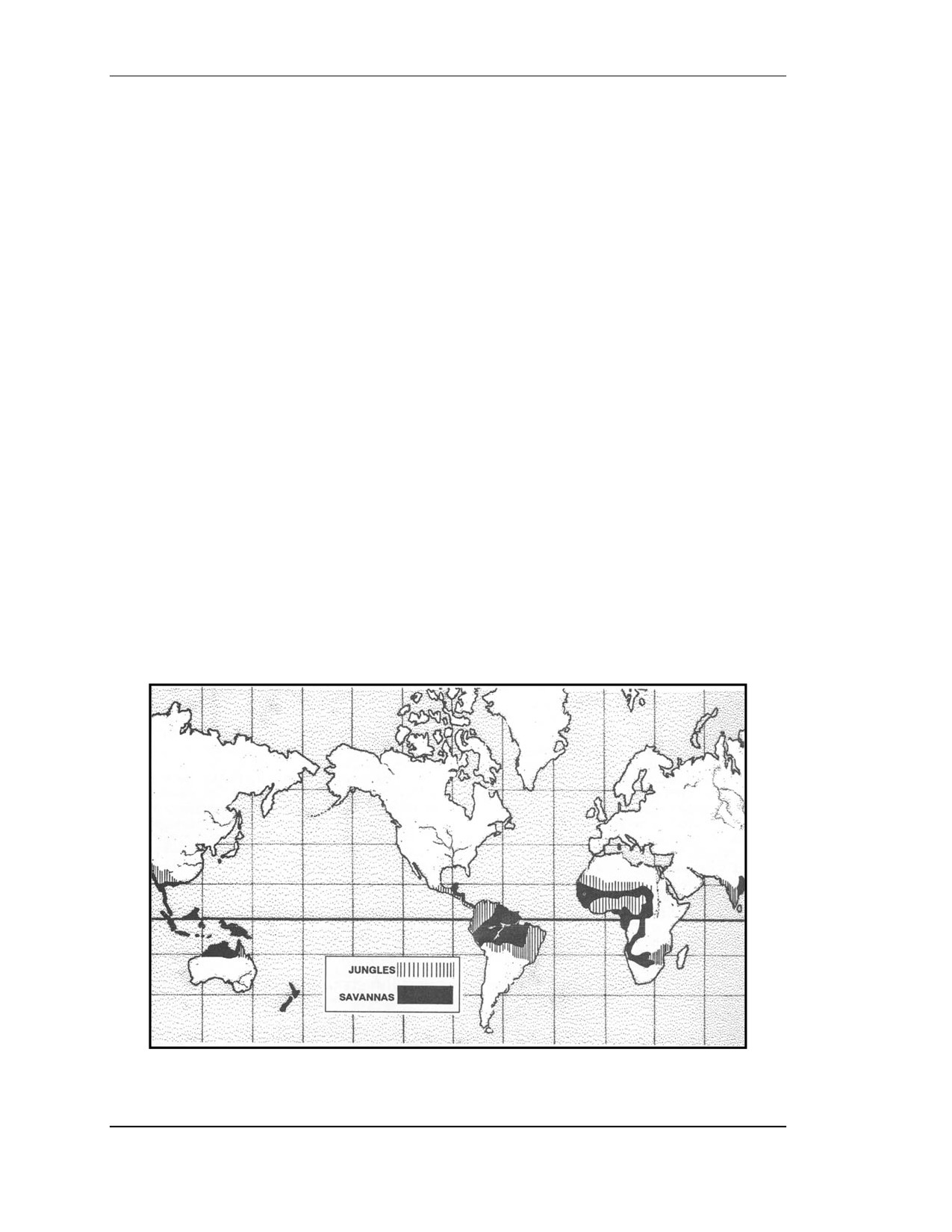
These large geographic regions are found within the tropics near the equator (Central
America, along the Amazon River, South-Eastern Asia and adjacent islands, and vast areas
in the middle of Africa and India) (Figure 13-3). Jungles are characterized as rainy, humid
areas with heavy layers of tangled, impenetrable vegetation. Jungles contain many species of
wildlife (tigers, monkeys, parrots, snakes, alligators, and so forth). The jungle is also a
paradise for insects, which are the worst enemy of the navigator because some insects carry
diseases (malaria, yellow fever, cholera, and so forth). While navigating in these areas, very
little terrain association can be accomplished because of the heavy foliage. Dead reckoning
is one of the methods used in these areas. A lost navigator in the jungle can eventually find
his way back to civilization by following any body of water with a downstream flow.
However, not every civilization found is of a friendly nature.
Figure 13-3. Jungles and savannas.
13-6
FOUO
18 January 2005
FM 3-25.26
a. Operations. Operations in jungles tend to be isolated actions by small forces because
of the difficulties encountered in moving and in maintaining contact between units. Divisions
can move cross-country slowly; but, aggressive reconnaissance, meticulous intelligence
collection, and detailed coordination are required to concentrate forces in this way. More
commonly, large forces operate along roads or natural avenues of movement, as was the case
in the mountains. Patrolling and other surveillance operations are especially important to
ensure security of larger forces in the close terrain of jungles.
(1) Short fields of observation and fire and thick vegetation make maintaining contact
with the enemy difficult. The same factors reduce the effectiveness of indirect fire and make
jungle combat primarily a fight between infantry forces. Support by air and mechanized
forces can be decisive at times, but it will not always be available or effective.
(2) Jungles are characterized by high temperatures, heavy rains, high humidity, and an
abundance of vegetation. The climate varies with location. Close to the equator, all seasons
are nearly alike with heavy rains all year. Farther from the equator (India and Southeast
Asia), there are distinct wet (monsoon) and dry seasons. Both zones have high temperatures
(averaging 75 to 95+ degrees Fahrenheit), heavy rainfall (as much as 400+ inches annually),
and high humidity (90 percent) all year.
(3) In temperate climates, areas of vegetation are the most likely to be altered and
incorrectly portrayed on a map. In jungle areas, the vegetation grows so rapidly that it is
more likely to be cleared and make these areas be shown incorrectly.
b. Interpretation and Analysis. The jungle environment includes dense forests,
grasslands, swamps, and cultivated areas. Forests are classified as primary and secondary
based upon the terrain and vegetation. Primary forests include tropical rain forests and
deciduous forests. Secondary forests are found at the edges of both rain forests and
deciduous forests and in areas where jungles have been cleared and abandoned. These places
are typically overgrown with weeds, grasses, thorns, ferns, canes, and shrubs. Movement is
especially slow and difficult. The extremely thick vegetation reaches a height of 2 meters
and severely limits observation to only a few meters.
(1) Tropical rain forests consist mostly of large trees whose branches spread and lock
together to form canopies. These canopies, which can exist at two and three different levels,
may form as low as 10 meters from the ground. They prevent direct sunlight from reaching
the ground, causing a lack of undergrowth on the jungle floor. Extensive above-ground root
systems and hanging vines are common and make vehicular travel difficult; foot movement
is easier. Ground observation is limited to about 50 meters and air observation is nearly
impossible.
(2) Deciduous forests are in semitropical zones that have both wet and dry seasons. In
the wet season, trees are fully leafed; in the dry season, much of the foliage dies. Trees are
usually less dense than in rain forests, which allows more sunlight to filter to the ground and
produces thick undergrowth. During the wet season, air and ground observation is limited
and movement is difficult. During the dry season, both improve.
(3) Swamps are common to all low, jungle areas where there is poor drainage. When
navigating in a swampy area, a careful analysis of map and ground should be taken before
any movement. The Soldiers should travel in small numbers with only the equipment
required for their mission, keeping in mind that they are going to be immersed in water part
of the time. The usual technique used in swamp navigation is dead reckoning. There are two
basic types of swamps—mangrove and palm. Mangrove swamps are found in coastal areas
FOUO
13-7
18 January 2005

FM 3-25.26
wherever tides influence water flow. Mangrove is a shrub-like tree that grows 1 to 5 meters
high. These trees have a tangled root system, both above and below the waterline, which
restricts movement either by foot or small boat. Observation on the ground and from the air
is poor, but concealment is excellent.
(4) Grassy plains or savannas are generally located away from the equator but within the
tropics. These vast land areas are characterized by flatlands with a different type of
vegetation than jungles. They consist mainly of grasses (ranging from 1 to more than 12 feet
in height), shrubs, and isolated trees. The most difficult areas to navigate are the ones
surrounded by tall grass (elephant grass); however, vehicles can negotiate here better than in
some areas. There are few or no natural features to navigate by, making dead reckoning or
navigation by stars the only technique for movement. Depending on the height of the grass,
ground observation may vary from poor to good. Concealment from air observation is poor
for both Soldiers and vehicles.
(5) Bamboo stands are common throughout the tropics. They should be bypassed
whenever possible. They are formidable obstacles for vehicles, and Soldier movement
through them is slow, exhausting, and noisy.
(6) Cultivated areas exist in jungles also. They range from large, well-planned,
well-managed farms and plantations to small tracts cultivated by farmers. The three general
types of cultivated areas are rice paddies, plantations, and small farms.
c. Navigation. Areas such as jungles are generally not accurately mapped because
heavy vegetation makes aerial surveys difficult. The ability to observe terrain features, near
or far, is extremely limited. The navigator must rely heavily upon his compass and the dead
reckoning technique when moving in the jungle. Navigation is further complicated by the
inability to make straight-line movements. Terrain analysis, constant use of the compass, and
an accurate pace count are essential to navigation in this environment.
(1) Rates of movement and pace counts are particularly important to jungle navigators.
The most common error is to overestimate the distance traveled. The distances in Table 13-3
can be used as a rough guide for the maximum distances that might be traveled in various
types of terrain during one hour in daylight.
MAXIMUM DISTANCE
TYPE OF TERRAIN
(Meters)
Tropical rain forest
up to 1,000
Deciduous forest
500
Secondary jungle
100 to 500
Tall grass
500
Swamps
100 to 500
Rice paddies (wet)
800
Rice paddies (dry)
2,000
Plantations
2,000
Trails
up to 3,000
Table 13-3. Guide for maximum travel distance in jungle environments.
13-8
FOUO
18 January 2005
FM 3-25.26
(2) Special navigation strategies that are helpful in jungles include:
(a) Personal Pace Table. You should either make a mental or written personal pace table
that includes your average pace count per 100 meters for each of the types of terrain through
which you are likely to navigate.
(b) Resection Using Indirect Fire. Call for mortar or artillery fire (airbursts of white
phosphorous or illumination) on two widely separated grids that are not on terrain features
like the one you are occupying and are a safe distance from your estimated location.
Directions to the airbursts sometimes must be determined by sound.
(c) Modified Area/Point Navigation. Even when making primary use of the compass for
dead reckoning, you are frequently able to area navigate to an expanded objective, which is
easily identified by terrain association. Then, simply develop a short, point-navigation leg to
your final destination.
13-4. ARCTIC TERRAIN
Arctic terrain includes those areas that experience extended periods of below freezing
temperatures. In these areas, the ground is generally covered with ice or snow during the
winter season. Although frozen ground and ice can improve trafficability, a deep
accumulation of snow can reduce it. Vehicles and personnel require special equipment and
care under these adverse conditions.
a. Operations. Both the terrain and the type and size of unit operations vary greatly in
arctic areas. In open terrain, armored and mechanized forces will be effective although they
will have to plan and train for the special conditions. In broken terrain, forests, and
mountains, light forces will predominate as usual. However, foot movement may take up to
five times as long as it might under warmer conditions.
b. Interpretation and Analysis. Both the terrain and cultural features you may
confront in winter may vary to any extreme, as can the weather. The common factor is an
extended period of below freezing temperatures. The terrain may be plains, plateaus, hills, or
mountains. The climate will be cold, but the weather will vary greatly from place to place.
Although most arctic terrain experiences snow, some claim impressive accumulations each
season such as the lake-effected snow belts off Lake Ontario near Fort Drum, New York.
Other areas have many cold days with sunshine and clear nights, and little snow
accumulation.
(1) In areas with distinct local relief and scattered trees or forests, the absence of foliage
makes movement by terrain association easier; observation and fields of fire are greatly
enhanced except during snowstorms. In relatively flat, open areas covered with snow
(especially in bright sunlight), the resulting lack of contrast may interfere with your being
able to read the land. With foliage gone, concealment (both from the ground and from the
air) is greatly reduced. As in desert areas, you must make better use of the terrain to conceal
your movements.
(2) Frozen streams and swamps may no longer be obstacles, and thus identification of
avenues of approach may be difficult in winter. However, the concept as to what is key
terrain is not likely to be affected.
c. Navigation. Special skills may be required in arctic terrain, such as the proper use of
winter clothing, skis, and snowshoes; but this does not affect your navigation strategies.
There are no special techniques for navigating in arctic terrain. Just be aware of the
FOUO
13-9
18 January 2005
FM 3-25.26
advantages and disadvantages that may present themselves and make the most of your
opportunities while applying the four steps and two techniques for land navigation.
(1) Remember, the highest caliber of leadership is required to ensure that all necessary
tasks are performed, that security is maintained, and that Soldiers and their equipment are
protected from the physical effects of very low temperatures. There is a great temptation to
do less than a thorough job at whatever the task may be when you are very cold.
(2) Night navigation may be particularly enhanced when operating in arctic terrain.
Moonlight and starlight on a clear night reflect off the snow, thus enabling you to employ
daytime terrain association techniques with little difficulty. Even cloudy winter nights are
often brighter than clear moonlit summer nights when the ground is dark and covered with
foliage. Movements with complete light discipline (no blackout drives) can often be
executed. On the other hand, areas with severe winter climates experience lengthy periods of
darkness each day, which may be accompanied by snow and limited visibility.
13-5. URBAN AREAS
The world continues to become more urbanized each year; therefore, it is unlikely that all
fighting will be done in rural settings. Major urban areas represent the power and wealth of a
particular country in the form of industrial bases, transportation complexes, economic
institutions, and political and cultural centers. Therefore, it may be necessary to secure and
neutralize them. When navigating in urban places, it is man-made features, such as roads,
railroads, bridges, and buildings, that become important while terrain and vegetation become
less useful.
a. Interpretation and Analysis. Military operations on urbanized terrain require
detailed planning that provides for decentralized execution. As a result of the rapid growth
and changes occurring in many urban areas, the military topographic map is likely to be
outdated. Supplemental use of commercially-produced city maps may be helpful, or an
up-to-date sketch can be made.
(1) Urbanized terrain normally offers many AAs for mounted maneuver well forward of
and leading to urban centers. In the proximity of these built-up areas, however, such
approach routes generally become choked by urban sprawl and perhaps by the nature of
adjacent natural terrain. Dismounted forces then make the most of available cover by moving
through buildings and underground systems, along edges of streets, and over rooftops. Urban
areas tend to separate and isolate units, requiring the small-unit leader to take the initiative
and demonstrate his skill in order to prevail.
(2) The urban condition of an area creates many obstacles, and the destruction of many
buildings and bridges as combat power is applied during a battle further limits your freedom
of movement. Cover and concealment are plentiful, but observation and fields of fire are
greatly restricted.
b. Navigation. Navigation in urban areas can be confusing, but there are often many
cues that will present themselves as you proceed. They include streets and street signs;
building styles and sizes; the urban geography of industrial, warehousing, residential
housing, and market districts; man-made transportation features other than streets and roads
(rail and trolley lines); and the terrain features and hydrographic features located within the
built-up area. Use the following strategies to stay on the route in an urban area.
(1) Process Route Descriptions. Write down or memorize the route through an urban
area as a step-by-step process. For example, “Go three blocks north, turn left (west) on a
13-10
FOUO
18 January 2005
FM 3-25.26
wide divided boulevard until you go over a river bridge. Turn right (north) along the west
bank of the river, and . . . ”
(2) Conceptual Understanding of the Urban Area. While studying the map and
operating in a built-up area, work hard to develop an understanding (mental map) of the
entire area. This advantage will allow you to navigate over multiple routes to any location. It
will also preclude your getting lost whenever you miss a turn or are forced off the planned
route by obstacles or the tactical situation.
(3) Resection. Whenever you have a vantage point to two or more known features
portrayed on the map, do not hesitate to use either estimated or plotted resection to pinpoint
your position. These opportunities are often plentiful in an urban setting.
FOUO
13-11
18 January 2005
This Page intentionally left blank.
FM 3-25.26
CHAPTER 14
UNIT SUSTAINMENT
Land navigation is a skill that is highly perishable. The Soldier must
continually make use of the skills he has acquired to remain proficient in
them. The institution is responsible for instruction in the basic techniques of
land navigation. The institution tests these skills each time a Soldier attends
a leadership course. However, it is the unit’s responsibility to develop a
program to maintain proficiency in these skills between institution courses.
The unit sustainment program provides training that builds on and
reinforces the skills the Soldier learned in the institution. It should use the
building-block approach to training: basic map reading instruction or
review, instruction on land navigation skills, dead reckoning training, dead
reckoning practice, terrain association training, terrain association practice,
land navigation testing, and building of leader skills. These leader skills
should include following a route selected by the commander and planning
and following a route selected by the leader.
The unit trainer should be able to set up a sustainment program, a
train-the-trainer program, and a land navigation course for his unit’s use. It
is recommended that units develop a program similar to the one outlined in
this chapter. Complete lesson outlines and training plans are available by
writing to Commander, 29th Infantry Regiment, ATTN: ATSH-INB-A, Fort
Benning, GA 31905-5595.
14-1. SET UP A SUSTAINMENT PROGRAM
The purpose of setting up a sustainment program in the unit is to provide Soldiers with
training that reinforces and builds on the training they have received in the institution. All
Soldiers should receive this training at least twice a year. The program also provides the unit
with a means of identifying the areas in which the Soldiers need additional training.
a. Training Guidance. The unit commander must first determine the levels of
proficiency and problems that his unit has in land navigation. This determination can be done
through after-action reports from the unit’s rotations to NTC/JRTC, ARTEP final reports,
feedback from his subordinates, personal observation, and annual training. Once the unit
commander decides where his training time should be concentrated, he can issue his training
guidance to his subordinate leaders. He also directs his staff to provide training sites,
resources, and time for the units to train land navigation. It is recommended that land
navigation be trained separately, not just included as a subtask in tactical training.
b. Certification. The unit commander must also provide his subordinate commanders
with a means of certifying training. The unit staff must provide subject matter experts to
ensure the training meets the standards decided upon by the unit commander. Instructors
should be certified to instruct, and courses should be certified before the unit uses it.
c. Program Development. The sustainment program should meet the requirements of
all of the unit’s Soldiers. It should address all skills from basic map reading to leaders’
planning and executing a route. The program should cover the following:
• Diagnostic examination.
FOUO
14-1
18 January 2005
FM 3-25.26
• Map reading instruction/review.
• Land navigation skills training.
• Dead reckoning training/practice.
• Terrain association training/practice.
• Land navigation written/field examination.
• Leaders’ training and testing.
The sustainment program should be developed and then maintained in the unit’s training
files. The program should be developed in training modules so that it can be used as a whole
program or used separately by individual modules. It should be designed so the commander
can decide which training modules he will use, depending on the proficiency of the unit. The
unit commander need only use those modules that fit his training plan.
14-2. SET UP A TRAIN-THE-TRAINER PROGRAM
The purpose of a train-the-trainer program in the unit is to develop trainers capable of
providing Soldiers with the confidence and skills necessary to accomplish all assigned land
navigation tasks.
a. Development of the Program. The unit commander should appoint a cadre of
officers and NCOs to act as primary and alternate instructors for land navigation training.
Use the training modules the unit has developed and have these Soldiers go through each
module of training until they can demonstrate expertise. Determine which instructors
conduct each module of training and have them practice until they are fully prepared to give
the training. These instructors act as training cadre for the entire unit. They train their peers
to instruct the subordinate units, and they certify each unit’s training.
b. Conduct of Training. Conduct training at the lowest level possible. Leaders must be
included in all training to keep unit integrity intact.
14-3. SET UP A LAND NAVIGATION COURSE
The unit commander provides specific guidance on what he requires in the development of a
land navigation course. It depends upon the unit’s mission, training plan, and tasks to be
trained. There are basic guidelines to use when setting up a course.
a. Determine the Standards. The unit commander determines the standards for the
course. Recommended standards are as follows:
• Distance between points: no less than 300 meters; no more than 1,200 meters.
• Total distance of lanes: no less than 2,700 meters; no more than 11,000 meters.
• Total number of position stakes: no less than seven for each lane; no more than
nine for each lane.
• Time allowed: no less than three hours; no more than four hours.
b. Decide on the Terrain. The unit should use terrain that is similar to terrain they will
be using in tactical exercises, but, terrain should be different each time training is conducted.
The training area for a dismounted course needs to be at least 25 square kilometers; mounted
courses require twice as much terrain so that vehicles are not too close to each other.
c. Perform a Map and Ground Reconnaissance. Check the terrain to determine
position stake locations, to look for hazards, and to develop training briefings. The following
sequence can be used to develop any type of land navigation course. The difference in each
course depends on the commander’s guidance.
14-2
FOUO
18 January 2005
FM 3-25.26
(1) Plot the locations of your position stakes on a 1:50,000-scale map.
(2) Fabricate or order position stakes.
(3) Request support from the local engineer or field artillery unit to survey the locations
of your position stakes.
(4) Emplace the position stakes in the surveyed locations.
(5) Certify the course by having your subject matter experts (SMEs) negotiate each lane
of the course.
(6) Prepare course requirement sheets and print them.
(7) Complete a risk assessment of the training area.
(8) Begin teaching.
FOUO
14-3
18 January 2005
This Page intentionally left blank.
FM 3-25.26
APPENDIX A
SKETCHES
A sketch is a free-hand drawing of a map or picture of an area or route of
travel. It shows enough detail and has enough accuracy to satisfy special
tactical or administrative requirements.
A-1. PURPOSE
Sketches are useful when maps are not available or the existing maps are not adequate, or to
illustrate a reconnaissance or patrol report. Sketches may vary from hasty to complete and
detailed, depending upon their purpose and the degree of accuracy required. For example, a
sketch of a large minefield will require more accuracy than a hasty sketch of a small unit’s
defensive position.
A-2. MILITARY SKETCHES
The scale of a sketch is determined by the object in view and the amount of detail required to
be shown. The sketch of a defensive position for a platoon or company normally calls for a
sketch of larger scale than a sketch for the same purpose for a division. Military sketches
also include road and area sketches.
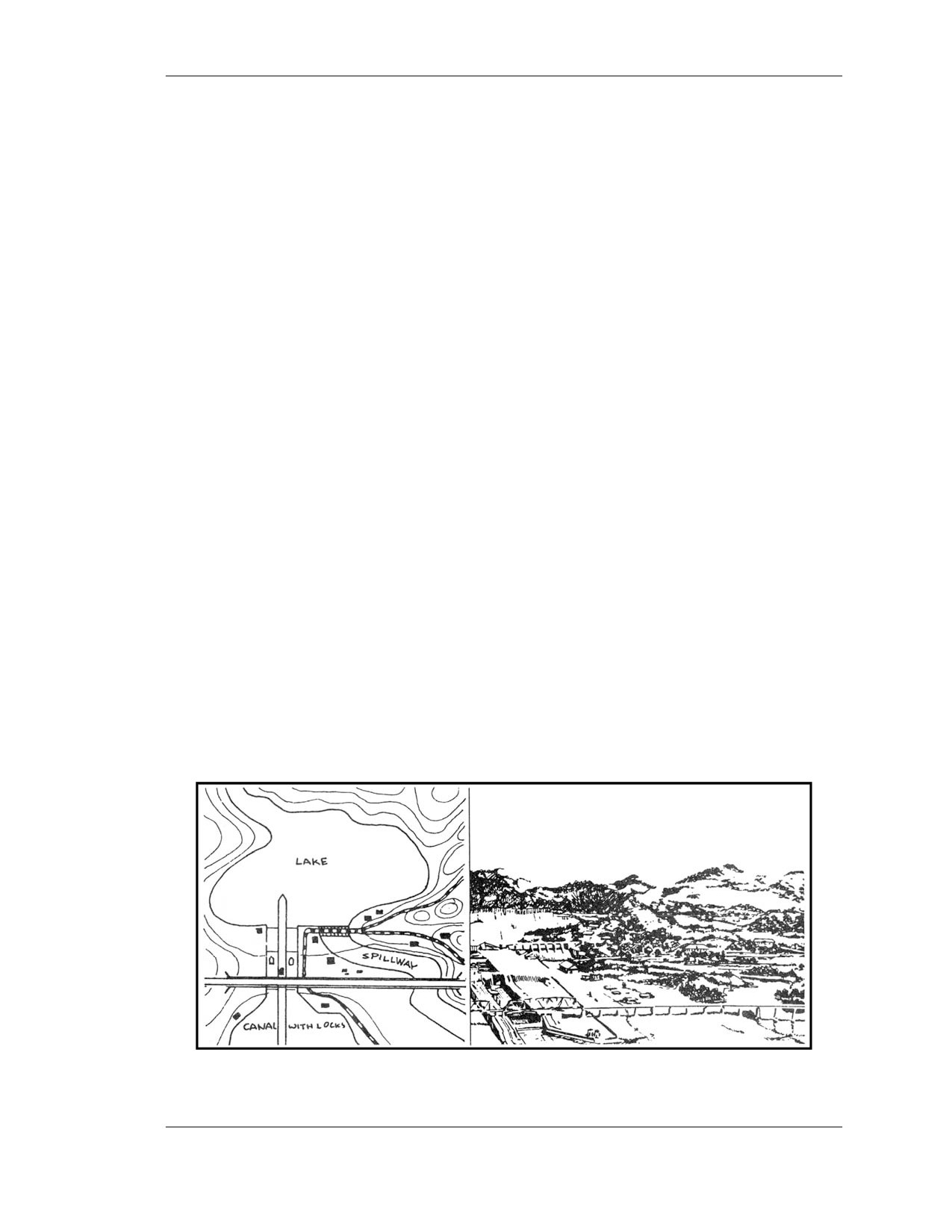
a. Field Sketches. A field sketch (Figure A-1) must show the north arrow, a scale, a
legend, and the following features:
• Power lines.
• Rivers.
• Main roads.
• Towns and villages.
• Forests.
• Rail lines.
• Major terrain features.
Figure A-1. Sketch map.
FOUO
A-1
18 January 2005
FM 3-25.26
b. Road Sketches. Road sketches show the natural and military features on and in the
immediate vicinity of the road. In general, the width of terrain sketches will not exceed
365 meters on each side of the road. Road sketches may be used to illustrate a road when the
existing map does not show sufficient detail.
c. Area Sketches. Area sketches include sketches of positions, OPs, or particular
places.
(1) Position Sketch. A position sketch is one of a military position, campsite, or other
area of ground. To effectively complete a position sketch, the sketcher must have access to
all parts of the area being sketched.
(2) Observation Post Sketch. An OP sketch shows the military features of ground along
a friendly OP line as far toward the enemy position as possible.
(3) Place Sketch. A place sketch is one of an area made by a sketcher from a single point
of observation. Such a sketch may cover ground in front of an OP line, or it may serve to
extend a position or road sketch toward the enemy.
A-2
FOUO
18 January 2005
FM 3-25.26
APPENDIX B
MAP FOLDING TECHNIQUES
One of the first considerations in the care of maps is proper folding.
B-1. FOLDING METHODS
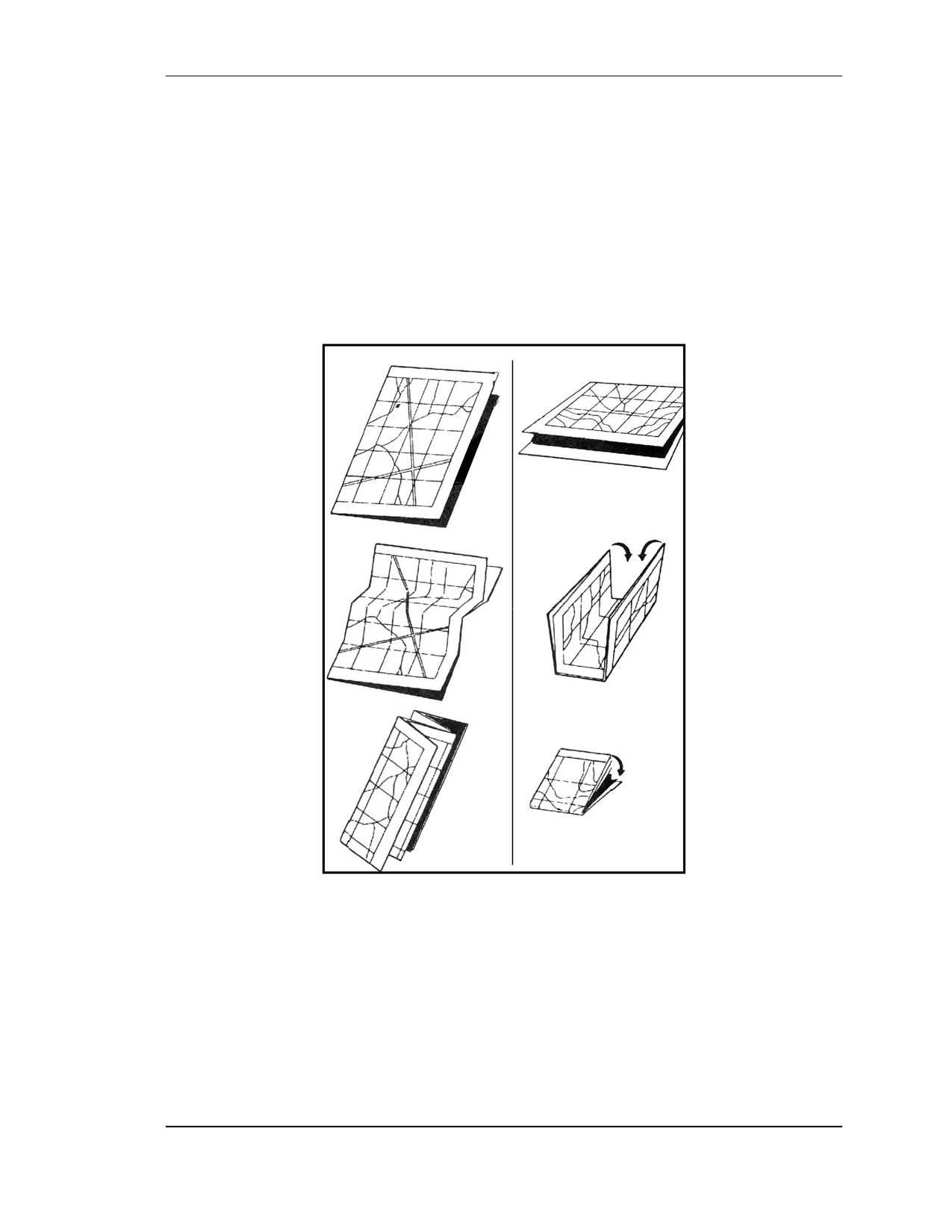
Figure B-1 shows two ways of folding maps to make them small enough to be carried
easily and still be available for use without having to unfold them entirely.
Figure B-1. Two methods of folding a map.
FOUO
B-1
18 January 2005
FM 3-25.26
B-2. PROTECTION OF MAP
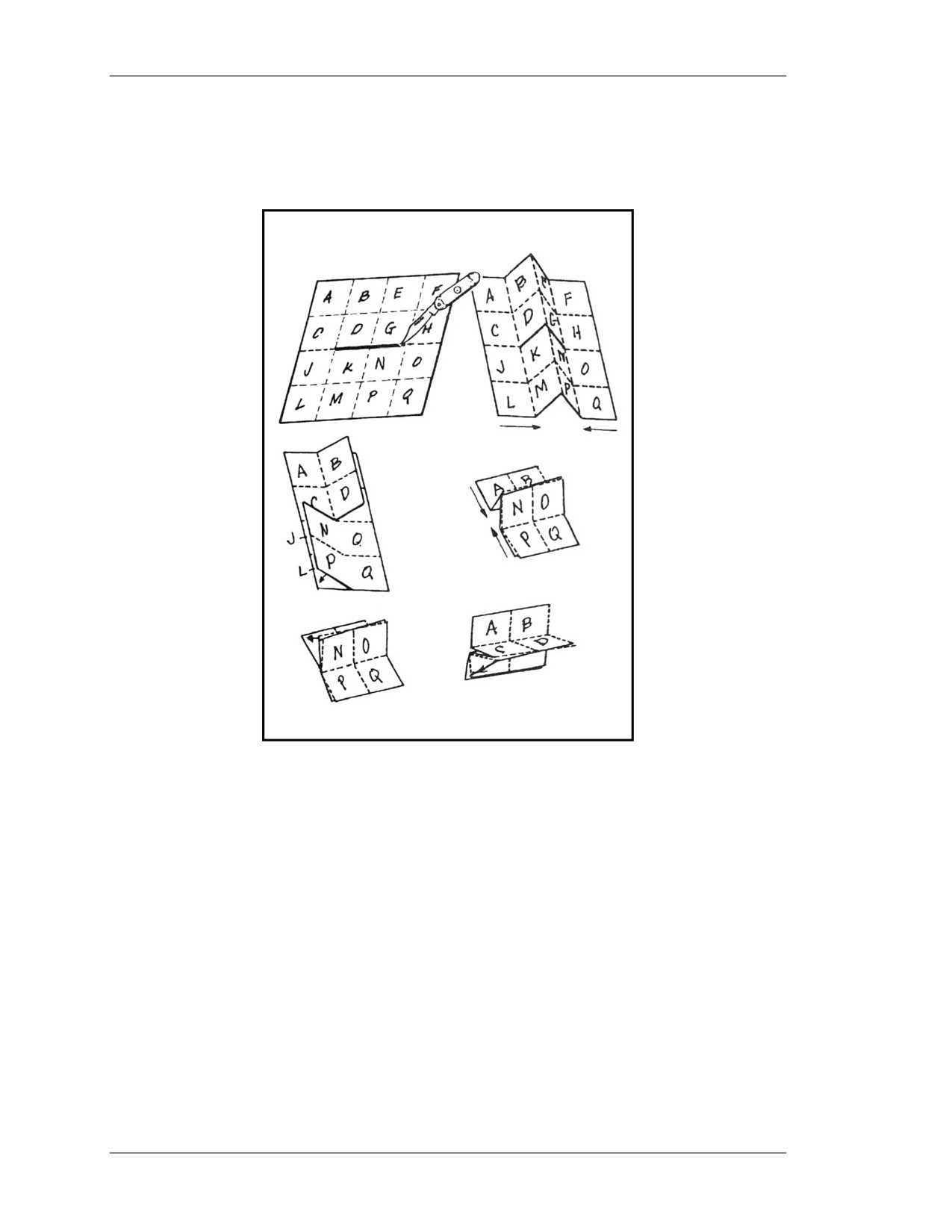
After a map has been folded, it should be placed in a folder for protection. Apply adhesive to
the back of the segments corresponding to A, F, L, and Q (Figure B-2).
Figure B-2. How to slit and fold a map for special use.
NOTE: Before attempting to cut and fold a map as illustrated in Figure B-2, make a
practice cut and fold with a piece of paper.
B-2
FOUO

FM 3-25.26
APPENDIX C
UNITS OF MEASURE
AND CONVERSION FACTORS
This appendix provides conversion tables for units of measure and
conversion factors that are used in military operations (Tables C-1 through
C-5, pages C-1 through C-3).
12 inches
=
1 foot
36 inches
=
1 yard
3 feet
=
1 yard
1,760 yards
=
1 mile statute
2,026.8 yards
=
1 mile nautical
5,280 feet
=
1 mile statute
6,080.4 feet
=
1 mile nautical
63,360 inches
=
1 mile statute
72,963 inches
=
1 mile nautical
Table C-1. English system of linear measure.
1 millimeter
=
0.1 centimeter
=
0.0393 inches
10 millimeters
=
1.0 centimeter
=
0.3937 inches
10 centimeters
=
1.0 decimeter
=
3.937 inches
10 decimeters
=
1.0 meter
=
39.37 inches
10 meters
=
1.0 decameter
=
32.81 feet
10 decameters
=
1.0 hectometer
=
328.1 feet
10 hectometers
=
1.0 kilometer
=
0.62 mile
10 kilometers
=
1.0 myriameter
=
6.21 miles
Table C-2. Metric system of linear measure.
1 mil
=
1/6400 circle
=
0.05625°
=
0.0625 grad
1 grad
=
1/400 circle
=
16.0 mils
=
0°54' = 0.9°
1 degree
=
1/360 circle
=
about 17.8 mils
=
about 1.1 grad
Table C-3. Equivalent units of angular measure.
FOUO
C-1
18 January 2005

FM 3-25.26
STATUTE
NAUTICLE
ONE
INCHES
FEET
YARDS
mm
MILES
MILES
Inch
1
0.0833
0.0277
-
-
25.40
Foot
12
1
0.333
-
-
304.8
Yard
36
3
1
0.00056
-
914.4
Statute Mile
63,360
5,280
1,760
1
0.8684
-
Nautical Mile
72,963
6,080
2,026
1.1516
1
-
Millimeter
0.0394
0.0033
0.0011
-
-
1
Centimeter
0.3937
0.0328
0.0109
-
-
10
Decimeter
3.937
0.328
0.1093
-
-
100
Meter
39.37
3.2808
1.0936
0.0006
0.0005
1,000
Decameter
393.7
32.81
10.94
0.0062
0.0054
10,000
Hectometer
3,937
328.1
109.4
0.0621
0.0539
100,000
Kilometer
39,370
3,281
1,094
0.6214
0.5396
1,000,000
Myriameter
393,700
32,808
10,936
6.2137
5.3959
10,000,000
ONE
cm
dm
M
dkm
hm
km
mym
Inch
2.540
0.2540
0.0254
0.0025
0.0003
-
-
Foot
30.48
3.048
0.3048
0.0305
0.0030
0.0003
-
Yard
91.44
9.144
0.9144
0.0914
0.0091
0.0009
-
Statute Mile
160,930
16,093
1,609
160.9
16.09
1.6093
0.1609
Nautical Mile
185,325
18,532
1,853
185.3
18.53
1.8532
0.1853
Millimeter
0.1
0.01
0.001
0.0001
-
-
-
Centimeter
1
0.1
0.01
0.001
0.0001
-
-
Decimeter
10
1
0.1
0.01
0.001
0.0001
-
Meter
100
1
1
0.1
0.01
0.001
0.0001
Decameter
1,000
10
10
1
0.1
0.01
0.001
Hectometer
10,000
100
100
10
1
0.1
0.01
Kilometer
100,000
1,000
1,000
100
10
1
0.1
Myriameter
1,000,000
10,000
10,000
1000
100
10
1
Table C-4. Conversion factors.
C-2
FOUO
18 January 2005
FM 3-25.26
Example I:
Problem:
Reduce 76 centimeters to (?) inches.
76 cm x 0.3937 = 29 inches
Answer:
There are 29 inches in 76 centimeters.
Example II:
Problem:
How many feet are there in 2.74 meters?
2.74
= 9 feet
.3048
There are approximately 9 feet in 2.74
Answer:
meters.
SCALE
1 INCH EQUALS
1 CENTIMETER EQUALS
416.67
feet
164.00
feet
1:5,000
127.00
meters
50.00
meters
833.33
feet
328.10
feet
1:10,000
254.00
meters
100.00
meters
1,041.66
feet
410.10
feet
1:12,500
317.00
meters
125.00
meters
1,666.70
feet
656.20
feet
1:20,000
508.00
meters
200.00
meters
2,083.30
feet
820.20
feet
1:25,000
635.00
meters
250.00
meters
4,166.70
feet
1,640.40
feet
1:50,000
1,270.00
meters
500.00
meters
5,280.00
feet
2,078.70
feet
1:63,360
1,609.30
meters
633.60
meters
8,333.30
feet
3,280.80
feet
1:100,000
2,540.00
meters
1,000.00
meters
20,833.00
feet
8,202.00
feet
1:250,000
6,350.00
meters
2,500.00
meters
41,667.00
feet
16,404.00
feet
1:500,000
12,700.00
meters
5,000.00
meters
Table C-5. Ground distance at map scale.
FOUO
C-3
18 January 2005
This Page intentionally left blank.
FM 3-25.26
APPENDIX D
JOINT OPERATIONS GRAPHICS
Joint operations graphics (Chapter 2, paragraph 2-6b[4]) are based
on the format of the standard 1:250,000-scale military topographic maps.
They contain additional information needed in present-day joint
air-ground operations.
D-1. TYPES
Each JOG is prepared in two types; one is designed for air operations and the other for
ground operations. Each version is identified in the lower margin as JOINT
OPERATIONS GRAPHIC (AIR) or JOINT OPERATIONS GRAPHIC (GROUND).
D-2. BASIC CONTENTS
The basic topographic information is the same on both JOG versions.
a. Power transmission lines are symbolized as a series of purple pylons connected
by a solid purple line.
b. Airports, landing facilities, and related air information are shown in purple. The
purple symbols that may be unfamiliar to the user are shown in the legend in the margin.
c. The top of each obstruction to air navigation is identified by its elevation above
sea level and its elevation above ground level.
d. Along the north and east edges of the graphic, detail is extended beyond the
standard sheet lines to create an overlap with the graphics to the north and to the east.
e. Layer tinting (paragraph 10-2a) and relief shading (paragraph 10-2c) are added as
an aid to interpreting the relief.
f. The incidence of the graphic in the world geographic reference system (paragraph
4-8b) is shown by a diagram in the margin.
D-3. JOINT OPERATIONS GRAPHIC (AIR)
The JOG (AIR) series, prepared for air use, contains detailed information on air facilities
such as radio ranges, runway lengths, and landing surfaces. The highest terrain elevation
in each 15-minute quadrangle is identified by the large open-faced figures shown in the
legend. Elevations and contours on JOG (AIR) sheets are given in feet.
D-4. JOINT OPERATIONS GRAPHIC (GROUND)
The JOG (GROUND) series is prepared for use by ground units, and only stable or
permanent air facilities are identified. Elevations and contours are located in the same
positions as on the air version, but are given in meters.
FOUO
D-1
18 January 2005
This Page intentionally left blank.
FM 3-25.26
APPENDIX E
ORIENTEERING
What is orienteering? Orienteering is a competitive form of land
navigation suitable for all ages and degrees of fitness and skill. It provides
the suspense and excitement of a treasure hunt. The object of orienteering is
to locate control points by using a map and compass to navigate through the
woods. The courses may be as long as 10 kilometers.
E-1. HISTORY
Orienteering began in Scandinavia in the nineteenth century. It was primarily a military
event and was part of military training. Not until 1919 was the modern version of
orienteering born in Sweden as a competitive sport. Ernst Killander, its creator, can be
rightfully called the father of orienteering. In the early thirties, the sport received a technical
boost with the invention of a new compass, more precise and faster to use. The Kjellstrom
brothers, Bjorn and Alvan, and their friend, Brunnar Tillander, were responsible for this new
compass. They were among the best Swedish orienteers of the thirties, with several
individual championships among them. Orienteering was brought into the U.S. in 1946 by
Bjorn Kjellstrom.
E-2. DESCRIPTION
Each orienteer is given a 1:50,000 topographic map with the various control points circled.
Each point has a flag marker and a distinctive punch that is used to mark the scorecard.
Competitive orienteering involves running from checkpoint to checkpoint. It is more
demanding than road running, not only because of the terrain, but because the orienteer must
constantly concentrate, make decisions, and keep track of the distance covered. Orienteering
challenges both the mind and the body; however, the competitor’s ability to think under
pressure and make wise decisions is more important than speed or endurance.
E-3. THE COURSE
The orienteering area should be on terrain that is heavily wooded, preferably uninhabited,
and difficult enough to suit different levels of competition. The area must be accessible to
competitors and its use must be coordinated with appropriate terrain and range control
offices.
a. The ideal map for an orienteering course is a multicolored, accurate, large-scale
topographic map. A topographic map is a graphic representation of selected man-made and
natural features of a part of the earth’s surface plotted to a definite scale. The distinguishing
characteristic of a topographic map is the portrayal of the shape and elevation of the terrain
by contour lines.
b. For orienteering within the United States, large-scale topographic (topo) maps are
available from the National Geospatial-Intelligence Agency
(NGA) Hydrographic
Topographic Center. The scale suitable for orienteering is 1:50,000.
FOUO
E-1
18 January 2005
FM 3-25.26
E-4. SETTING UP THE COURSE
The challenge for the course setter is to keep the course interesting, but never beyond the
individual’s or group’s ability. General guidance is to select locations that are easily
identifiable on the map and terrain, and accessible from several routes.
a. Those who set up the initial event should study a map for likely locations of control
points and verification of the locations. Better yet, they should coordinate with an
experienced competitor in selecting the course.
b. Orienteering includes several forms of events. Some of the most common are route,
line, cross-country, and score orienteering.
(1) Route Orienteering. This form can be used during the training phase and in advanced
orienteering.
(a) In this type of event, a master or advanced competitor leads the group as they walk a
route. Beginners trace the actual route walked on the ground onto their maps. They circle the
location of the different control points found along the walked route. When they finish, the
maps are analyzed and compared. During training, time is not a factor.
(b) Another variation is when a course is laid out on the ground with markers for the
competitor to follow. There is no master map, as the course is traced for the competitor by
flags or markers. The winner of the event is the competitor who has successfully traced the
route and accurately plotted the most control points on his map.
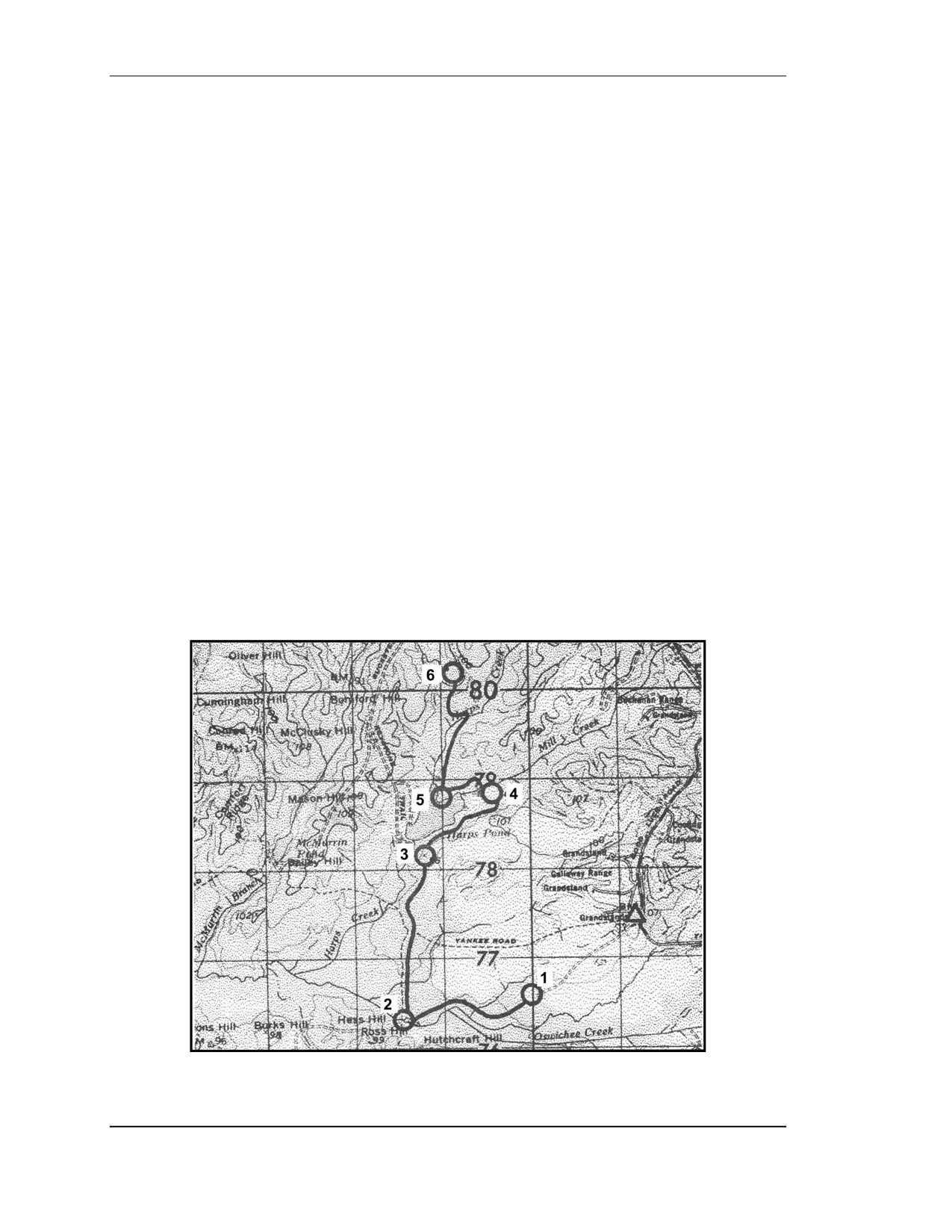
(2) Line Orienteering. At least five control points are used during this form of
orienteering training. The competitor traces on his map a preselected route from a master
map. The object is to walk the route shown on the map, circling the control points on the
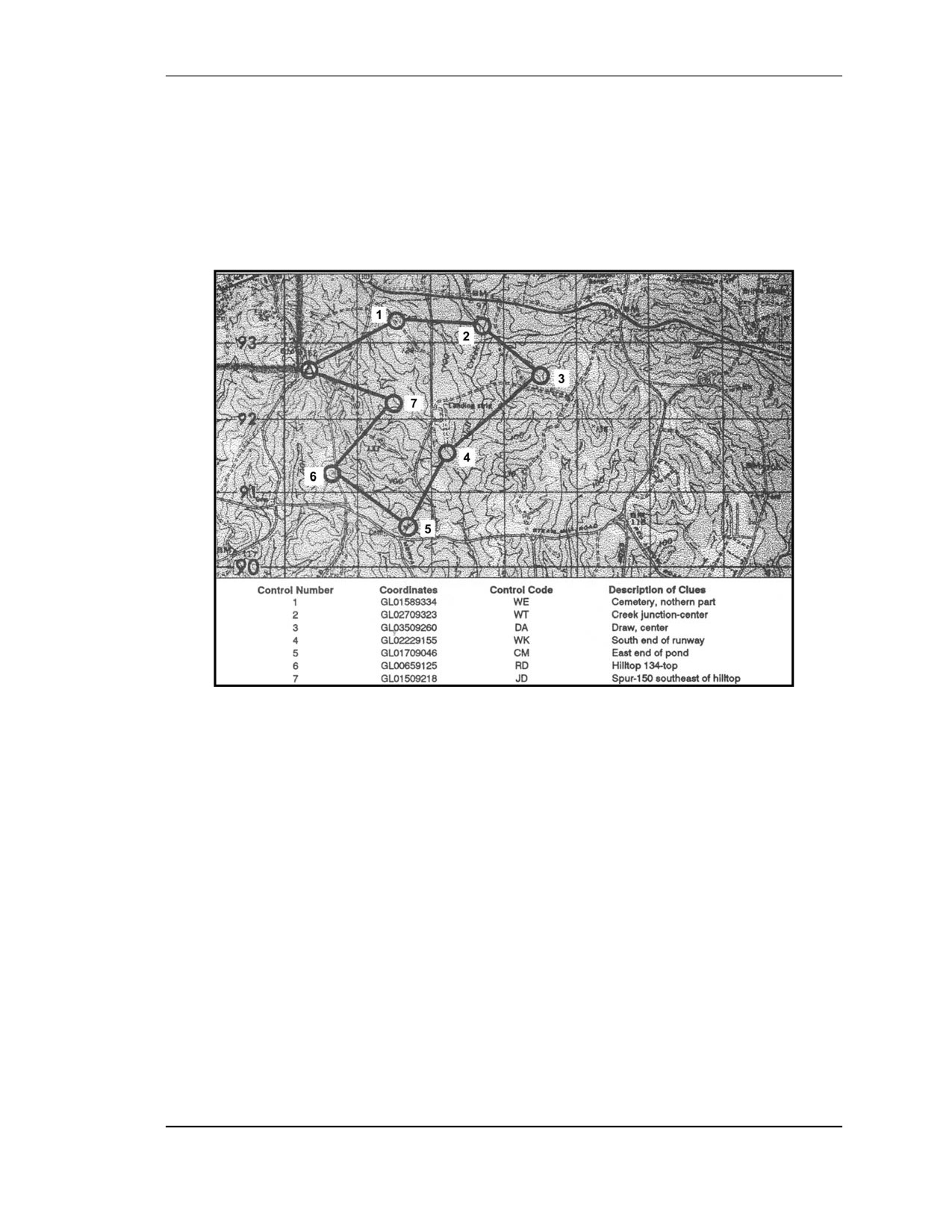
map as they are located on the ground (Figure E-1).
Figure E-1. Line orienteering.
E-2
FOUO
18 January 2005
FM 3-25.26
(3) Cross-Country Orienteering. This is the most common type of orienteering
competitions. It is sometimes called free or point orienteering and is considered to be the
most competitive and intriguing of all events (Figure E-2). In this event, all competitors must
visit the same controls in the same order. With the normal one-minute starting interval, it
becomes a contest of route choice and physical skill. The winner is the contestant with the
fastest time around the course.
Figure E-2. A cross-country orienteering map.
(a) After selecting the control points for the course, determine the start and finish
locations. The last control point should be near the finish. In describing each control’s
location, an eight-digit grid coordinate and a combination of two letters identifying the point
(control code) should be included in each descriptive clue list that is normally given to each
competitor at least two minutes before his start time.
(b) There are usually 6 to 12 control markers on the course in varying degrees of
difficulty and distances apart so that there are no easy, direct routes. Instead, each competitor
is faced with many choices of direct but difficult routes, or of indirect but easier routes. Each
control’s location is circled, and the order in which each is to be visited is clearly marked on
the master map. The course may be a closed transverse with start and finish collocated, or
the start and finish may be at different locations. The length of the course and difficulty of
control placement varies with the competitors’ degree of expertise. Regardless of the class of
event, all competitors must indicate on their event cards proof of visiting the control
markers. Inked stamps, coded letters, or punches are usually used to do this procedure.
FOUO
E-3
18 January 2005