FM 3-25.26 MAP READING AND LAND NAVIGATION (January 2005) - page 3
This Page intentionally left blank.
FM 3-25.26
CHAPTER 7
OVERLAYS
An overlay is a clear sheet of plastic or semi-transparent paper. It is used
to display supplemental map and tactical information related to military
operations. It is often used as a supplement to orders given in the field.
Information is plotted on the overlay at the same scale as on the map, aerial
photograph, or other graphic being used. When the overlay is placed over
the graphic, the details plotted on the overlay are shown in their true
position.
7-1.
PURPOSE
Overlays are used to display military operations with enemy and friendly troop dispositions,
and as supplements to orders sent to the field. They show detail that will aid in
understanding the orders, displays of communication networks, and so forth. They are also
used as annexes to reports made in the field because they can clarify matters that are difficult
to explain clearly in writing.
7-2.
MAP OVERLAY
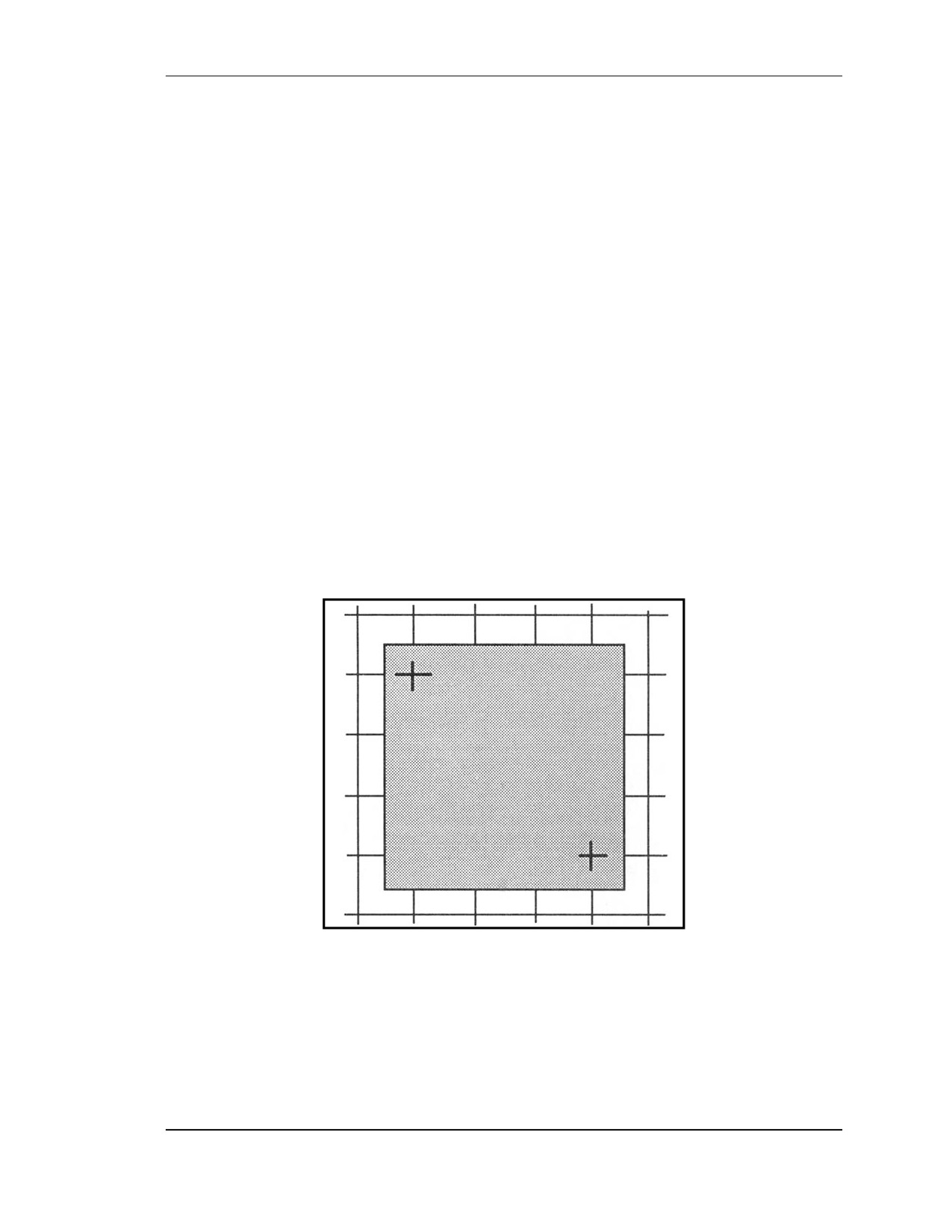
The three steps in making a map overlay are: orienting the overlay material, plotting and
symbolizing the detail, and adding the required marginal information (Figure 7-1).
Figure 7-1. Orienting the overlay.
a. Orienting. Orient the overlay over the place on the map to be annotated. Then, if
possible, attach it to the edges of the map with tape. Trace the grid intersections nearest the
two opposite corners of the overlay using a straightedge, and label each with the proper grid
coordinates. These register marks show exactly where the overlay fits on the map; without
them, the overlay is difficult to orient. It is imperative that absolute accuracy be maintained
in plotting the register marks, as the smallest mistake will throw off the overlay.
FOUO
7-1
18 January 2005
FM 3-25.26
b. Plotting New Detail. To plot any detail, use pencils or markers in standard colors
that make a lasting mark without cutting the overlay (FM 101-5-1).
(1) Use standard topographic or military symbols where possible. Nonstandard symbols
invented by the author must be identified in a legend on the overlay. Depending on the
conditions under which the overlay is made, it may be advisable to plot the positions first on
the map, then trace them onto the overlay. Since the overlay is to be used as a supplement to
orders or reports and the recipient will have an identical map, show only that detail with
which the report is directly concerned.
(2) If you have observed any topographic or cultural features that are not shown on the
map, such as a new road or a destroyed bridge, plot their positions as accurately as possible
on the overlay and mark with the standard topographic symbol.
(3) If difficulty in seeing through the overlay material is encountered while plotting or
tracing detail, lift the overlay from time to time to check orientation of information being
added in reference to the base.
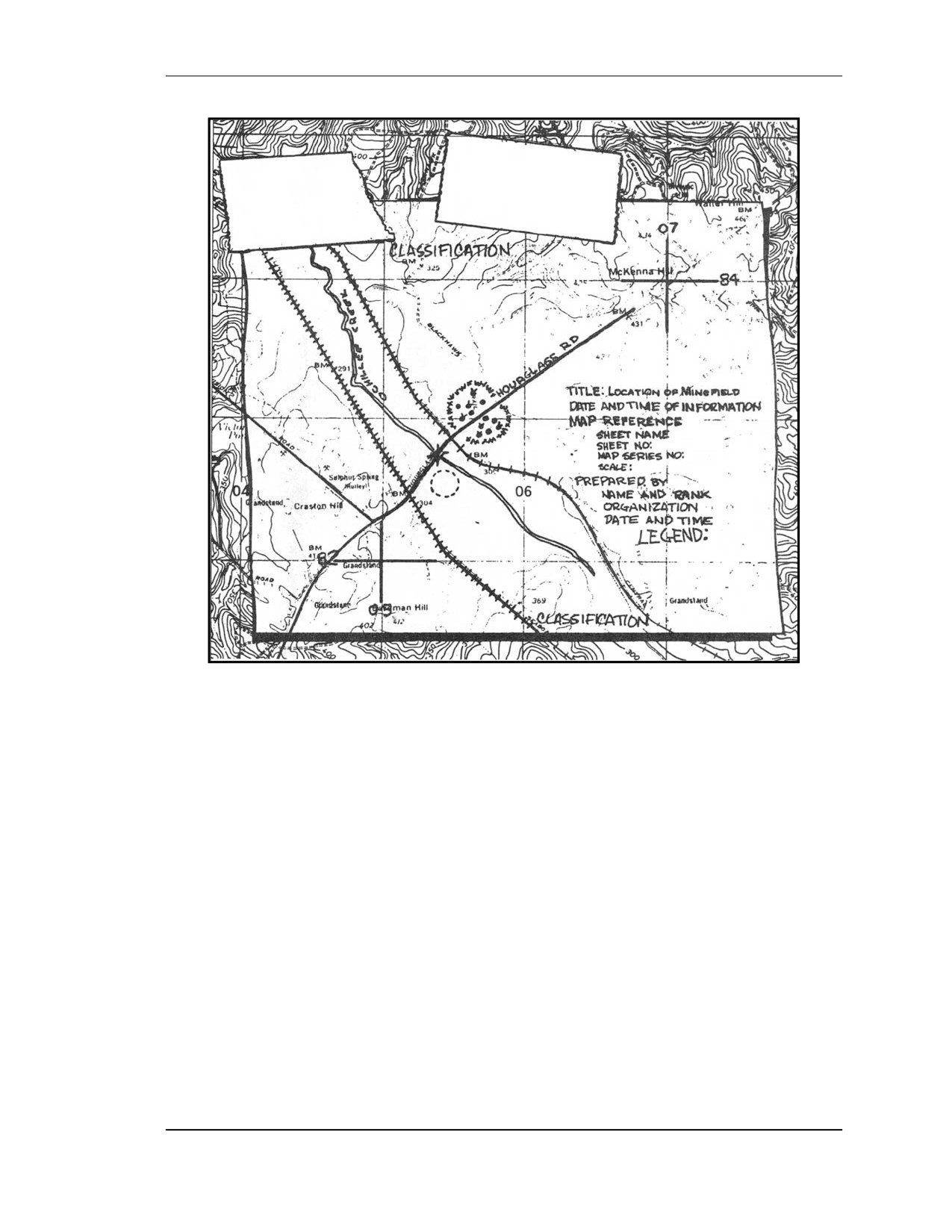
c. Recording Marginal Information. When all required detail has been plotted or
traced on the overlay, print information as close to the lower right-hand corner as detail
permits (Figure 7-2). This information includes the following data:
(1) Title and Objective. This tells the reader why the overlay was made and may also
give the actual location. For example, “Road reconnaissance” is not as specific as “Route
146 road reconnaissance.”
(2) Time and Date. Any overlay should contain the latest possible information. An
overlay received in time is valuable to the planning staff and may affect the entire situation;
an overlay that has been delayed for any reason may be of little use. Therefore, the exact
time the information was obtained aids the receivers in determining its reliability and
usefulness.
(3) Map Reference. The sheet name, sheet number, map series number, and scale must
be included. If the reader does not have the same map that was used for the overlay, this
provides the information necessary to obtain it.
(4) Author. The name, rank, and organization of the author, supplemented with a date
and time of preparation of the overlay, tells the reader if there was a time difference between
when the information was obtained and when it was reported.
(5) Legend. If it is necessary to invent nonstandard symbols to show the required
information, the legend must show what these symbols mean.
(6) Security Classification. This must correspond to the highest classification of either
the map or the information placed on the overlay. This will also be stated if the information
and map are unclassified. The locations of the classification notes are shown in Figure 7-2,
and the notes will appear in both locations as shown.
(7) Additional Information. Any other information that amplifies the overlay will also
be included. Make it as brief as possible.
7-2
FOUO
18 January 2005
FM 3-25.26
Figure 7-2. Map overlay with marginal information.
7-3.
AERIAL PHOTOGRAPH OVERLAY
Overlays of single aerial photographs are constructed and used in the same way as map
overlays. The steps followed are essentially the same, with the following exceptions:
a. Orienting. The photograph normally does not have grid lines to be used as register
marks. The borders of the photograph limit the area of the overlay, so the reference marks or
linear features are traced in place of grid register marks. Finally, to ensure proper location of
the overlay with respect to the photograph, indicate on the overlay the position of the
marginal data on the photograph as seen through the overlay.
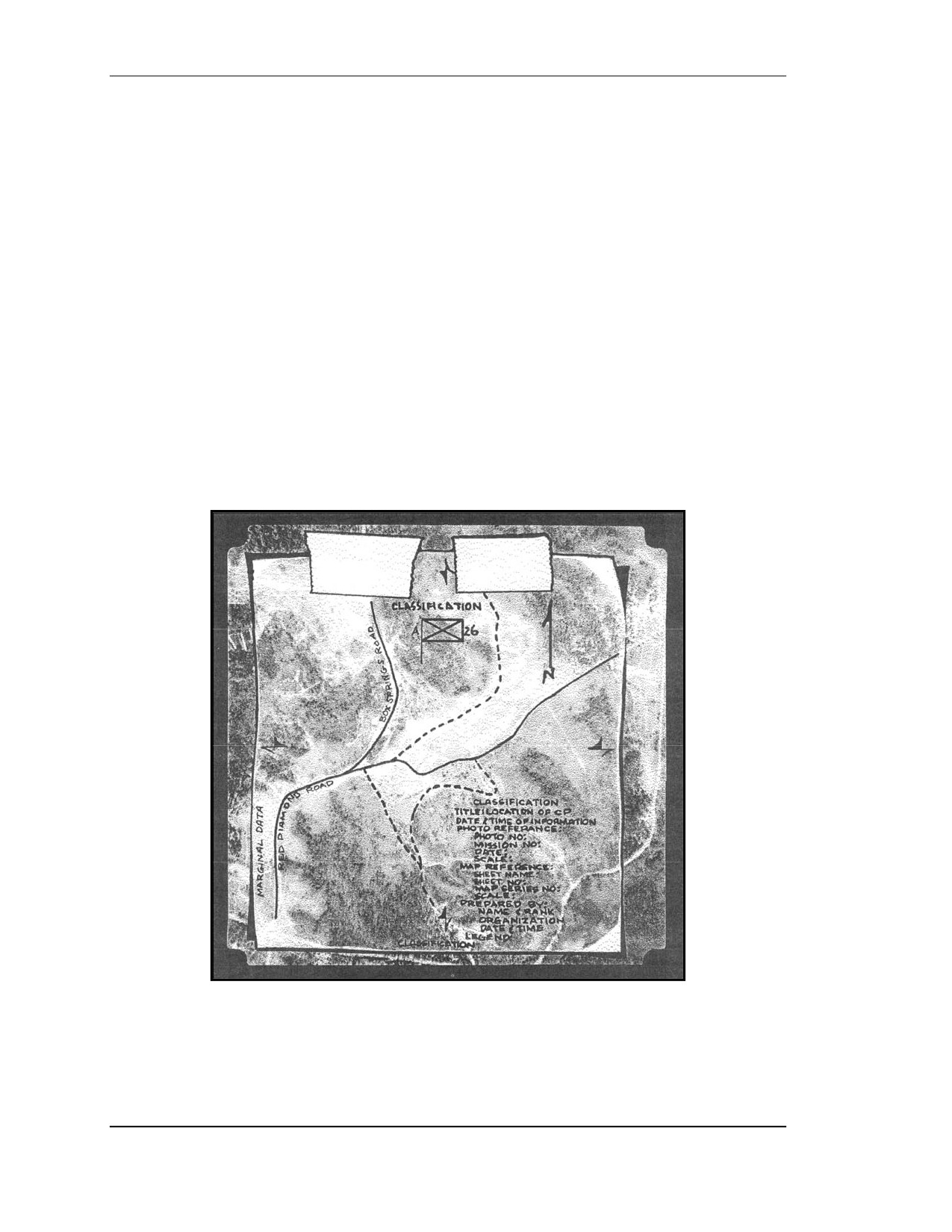
b. Recording Marginal Information. The marginal information shown on photographs
varies somewhat from that shown on maps. Overlays of photographs (Figure 7-3, page 7-4)
should show the following information:
(1) North Arrow. This may be obtained in two ways—by comparing with a map of the
area or by orienting the photograph by inspection. In the latter case, a compass or expedient
direction finder must be used to place the direction arrow on the overlay. Use the standard
symbol to represent the actual north arrow used—grid, magnetic, or true north.
(2) Title and Objective. This tells the reader why the photo overlay was made and may
also give the actual location.
FOUO
7-3
18 January 2005
FM 3-25.26
(3) Time and Date. The exact time the information was obtained is shown on a photo
overlay just as on a map overlay
(4) Photo Reference. The photo number, mission number, date of flight, and scale
appear here, or the information is traced in its actual location on the photograph.
(5) Scale. The scale must be computed since it is not part of the marginal data.
(6) Map Reference. Reference is made to the sheet name, sheet number, series number,
and scale of a map of the area, if one is available.
(7) Author. The name, rank, and organization of the author are shown, supplemented
with a date and time of preparation of the overlay.
(8) Legend. As with map overlays, this is only necessary when nonstandard symbols are
used.
(9) Security Classification. This must correspond to the highest classification of either
the photograph or the information placed on the overlay. It will also be stated if the
information and photograph are unclassified. The locations of the classification notes are
shown in Figure 7-3, and the notes will appear in both locations.
(10) Additional Information. Any other information that amplifies the overlay will also
be included. Make it as brief as possible.
Figure 7-3. Photographic overlay with marginal information.
7-4
FOUO
18 January 2005
FM 3-25.26
CHAPTER 8
AERIAL PHOTOGRAPHS
An aerial photograph is any photograph taken from an airborne vehicle
(aircraft, drones, balloons, satellites, and so forth). The aerial photograph
has many uses in military operations; however, for the purpose of this
manual, it will be considered primarily as a map supplement or map
substitute.
8-1.
COMPARISON WITH MAPS
A topographic map may be obsolete because it was compiled many years ago. A recent aerial
photograph shows any changes that have taken place since the map was made. For this
reason, maps and aerial photographs complement each other. More information can be
gained by using the two together than by using either alone.
a. Advantages. An aerial photograph has the following advantages over a map:
• It provides a current pictorial view of the ground that no map can equal.
• It is more readily obtained. The photograph may be in the hands of the user
within a few hours after it is taken; a map may take months to prepare.
• It may be made for places that are inaccessible to ground soldiers.
• It shows military features that do not appear on maps.
• It can provide a day-to-day comparison of selected areas, permitting evaluations
to be made of enemy activity.
• It provides a permanent and objective record of the day-to-day changes with the
area.
b. Disadvantages. The aerial photograph has the following disadvantages as compared
to a map:
• Ground features are difficult to identify or interpret without symbols and are
often obscured by other ground detail such as, for example, buildings in wooded
areas.
• Position location and scale are only approximate.
• Detailed variations in the terrain features are not readily apparent without
overlapping photography and a stereoscopic viewing instrument.
• Because of a lack of contrasting colors and tone, a photograph is difficult to use
in poor light.
• It lacks marginal data.
• It requires more training to interpret than a map.
8-2.
TYPES
Aerial photography most commonly used by military personnel may be divided into two
major types, the vertical and the oblique. Each type depends upon the attitude of the camera
with respect to the earth’s surface when the photograph is taken.
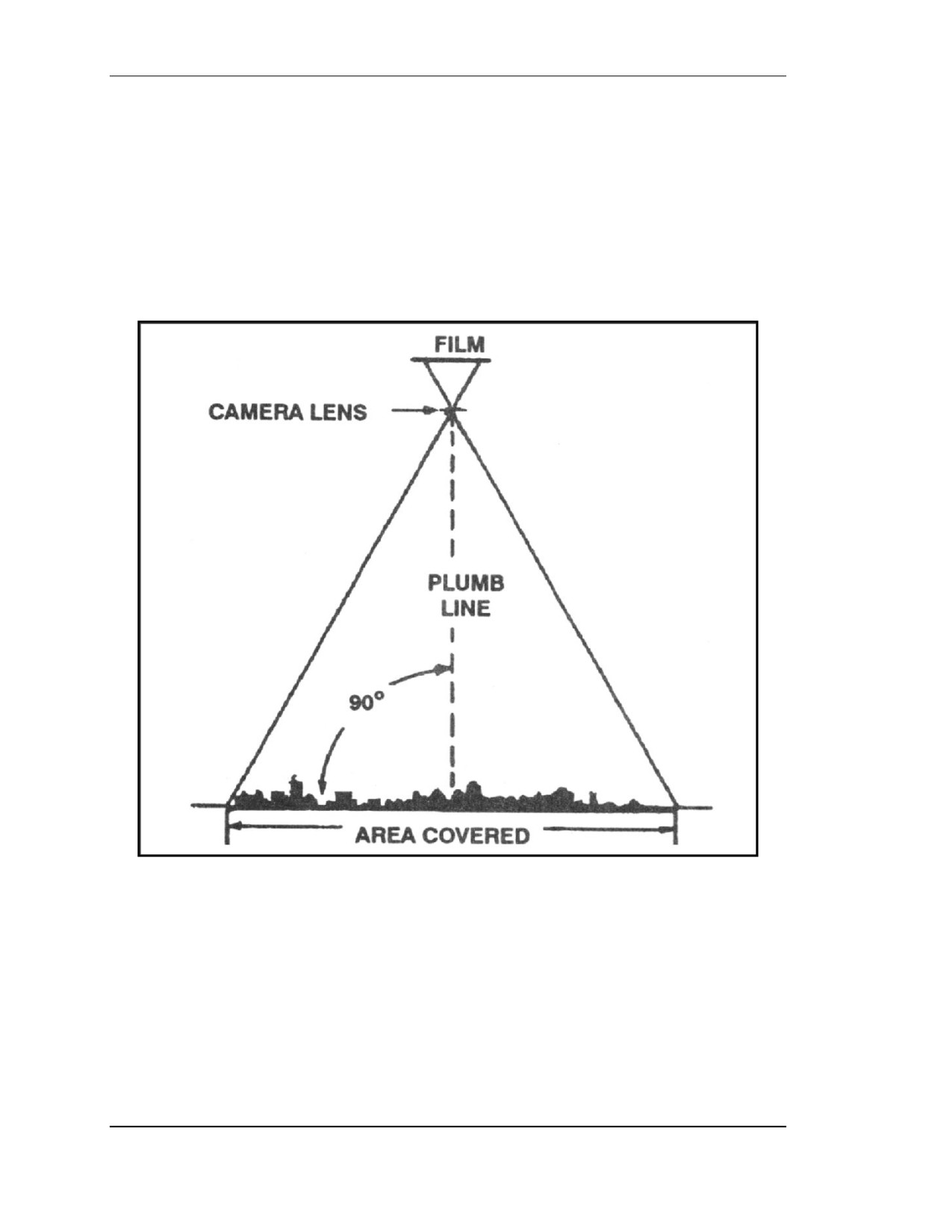
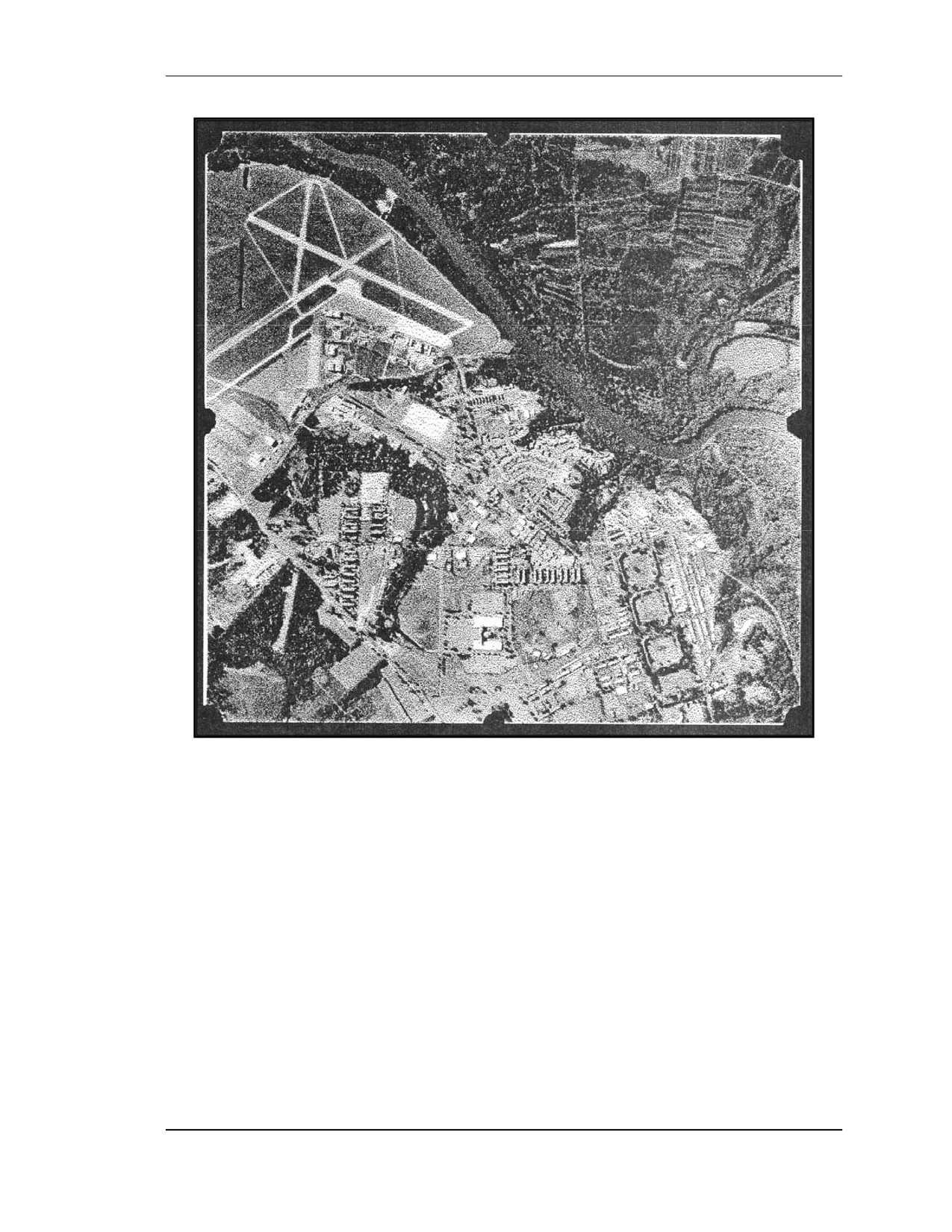
a. Vertical. A vertical photograph is taken with the camera pointed as straight down as
possible (Figure 8-1, page 8-2 and Figure 8-2, page 8-3). Allowable tolerance is usually
+ 3 degrees from the perpendicular (plumb) line to the camera axis. The result is coincident
with the camera axis. A vertical photograph has the following characteristics:
FOUO
8-1
18 January 2005
FM 3-25.26
• The lens axis is perpendicular to the surface of the earth.
• It covers a relatively small area.
• The shape of the ground area covered on a single vertical photo closely
approximates a square or rectangle.
• Being a view from above, it gives an unfamiliar view of the ground.
• Distance and directions may approach the accuracy of maps if taken over flat
terrain.
• Relief is not readily apparent.
Figure 8-1. Relationship of the vertical aerial
photograph with the ground.
8-2
FOUO
18 January 2005
FM 3-25.26
Figure 8-2. Vertical photograph.
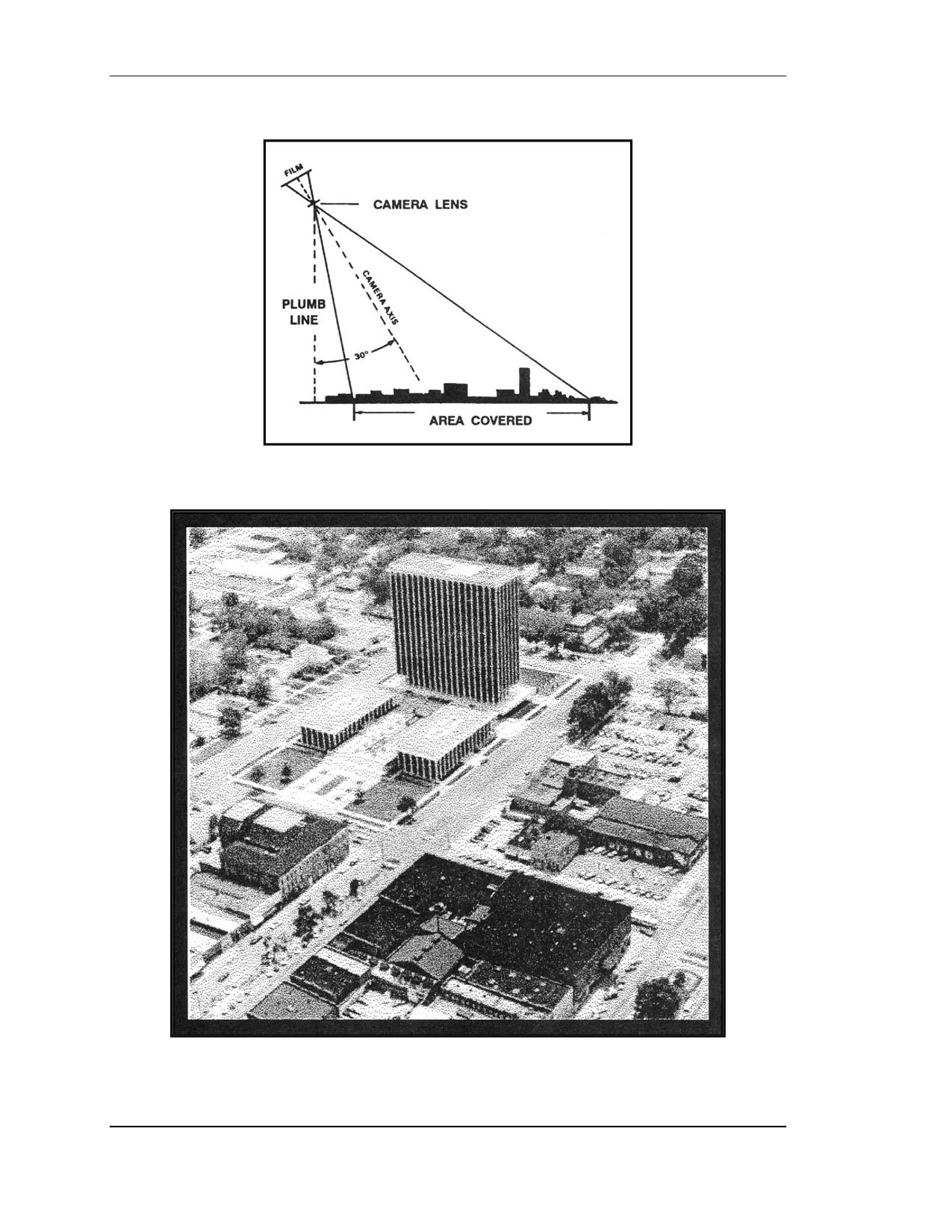
a. Low Oblique. A photograph taken with the camera inclined about 30 degrees from
the vertical is a low oblique (Figures 8-3 and 8-4, page 8-4). It is used to study an area before
an attack, to substitute for a reconnaissance, to substitute for a map, or to supplement a map.
A low oblique has the following characteristics:
• It covers a relatively small area.
• The ground area covered is a trapezoid, although the photo is square or
rectangular.
• The objects have a more familiar view, comparable to viewing from the top of a
high hill or tall building.
• No scale is applicable to the entire photograph, and distance cannot be measured.
Parallel lines on the ground are not parallel on this photograph; therefore,
direction (azimuth) cannot be measured.
• Relief is discernible but distorted.
• It does not show the horizon.
FOUO
8-3
18 January 2005
FM 3-25.26
Figure 8-3. Relationship of low oblique photograph to the ground.
Figure 8-4. Low oblique photograph.
8-4
FOUO
18 January 2005
FM 3-25.26
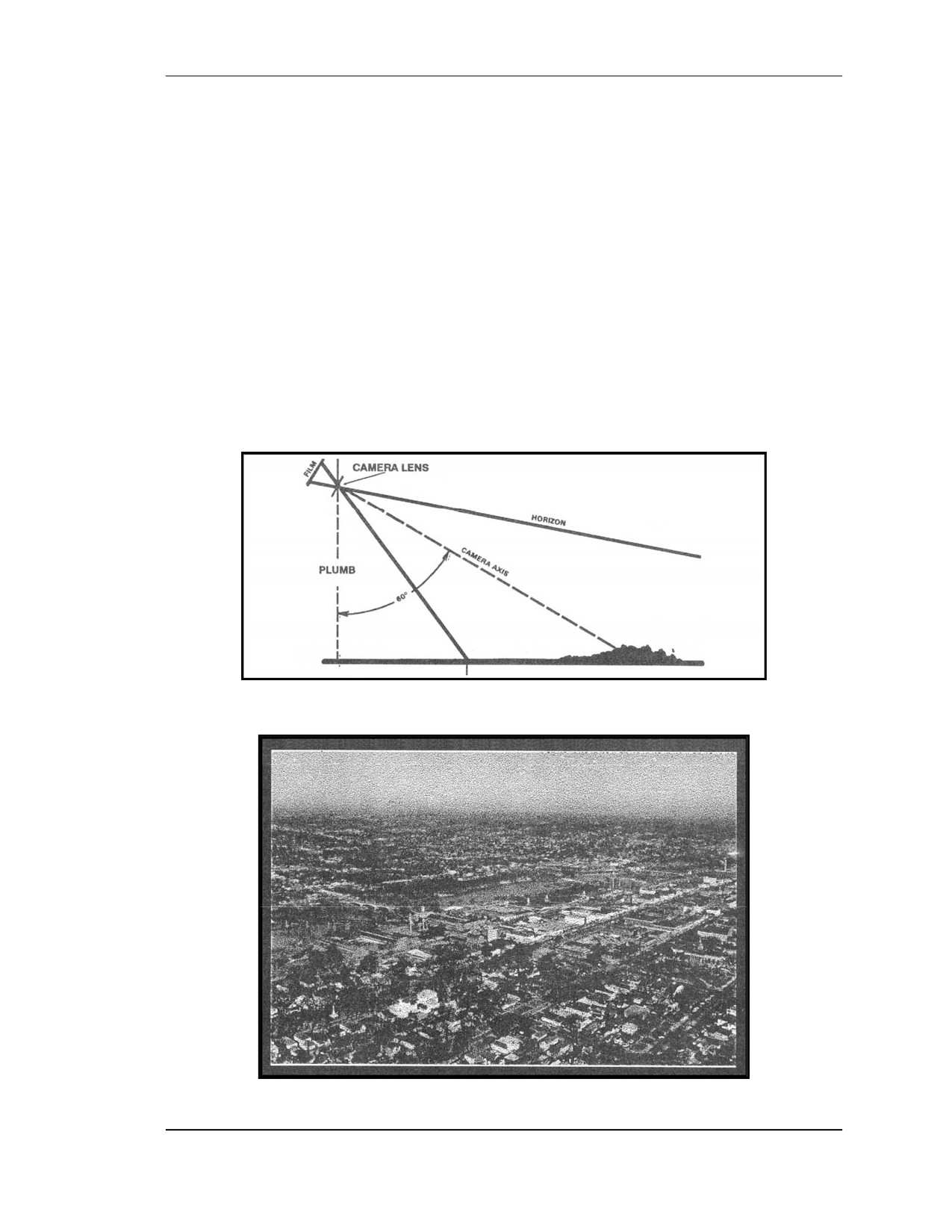
c. High Oblique. The high oblique is a photograph taken with the camera inclined
about 60 degrees from the vertical (Figures 8-5 and 8-6). It is used primarily in the making
of aeronautical charts and has a limited military application. However, it may be the only
photography available. A high oblique has the following characteristics:
• It covers a very large area (not all usable).
• The ground area covered is a trapezoid, but the photograph is square or
rectangular.
• The view varies from the very familiar to unfamiliar, depending on the height at
which the photograph is taken.
• Distances and directions are not measured on this photograph for the same
reasons that they are not measured on the low oblique.
• Relief may be quite discernible but distorted as in any oblique view. The relief is
not apparent in a high altitude, high oblique.
• The horizon is always visible.
Figure 8-5. Relationship of high oblique photograph to the ground.
Figure 8-6. High oblique photograph.
FOUO
8-5
18 January 2005
FM 3-25.26
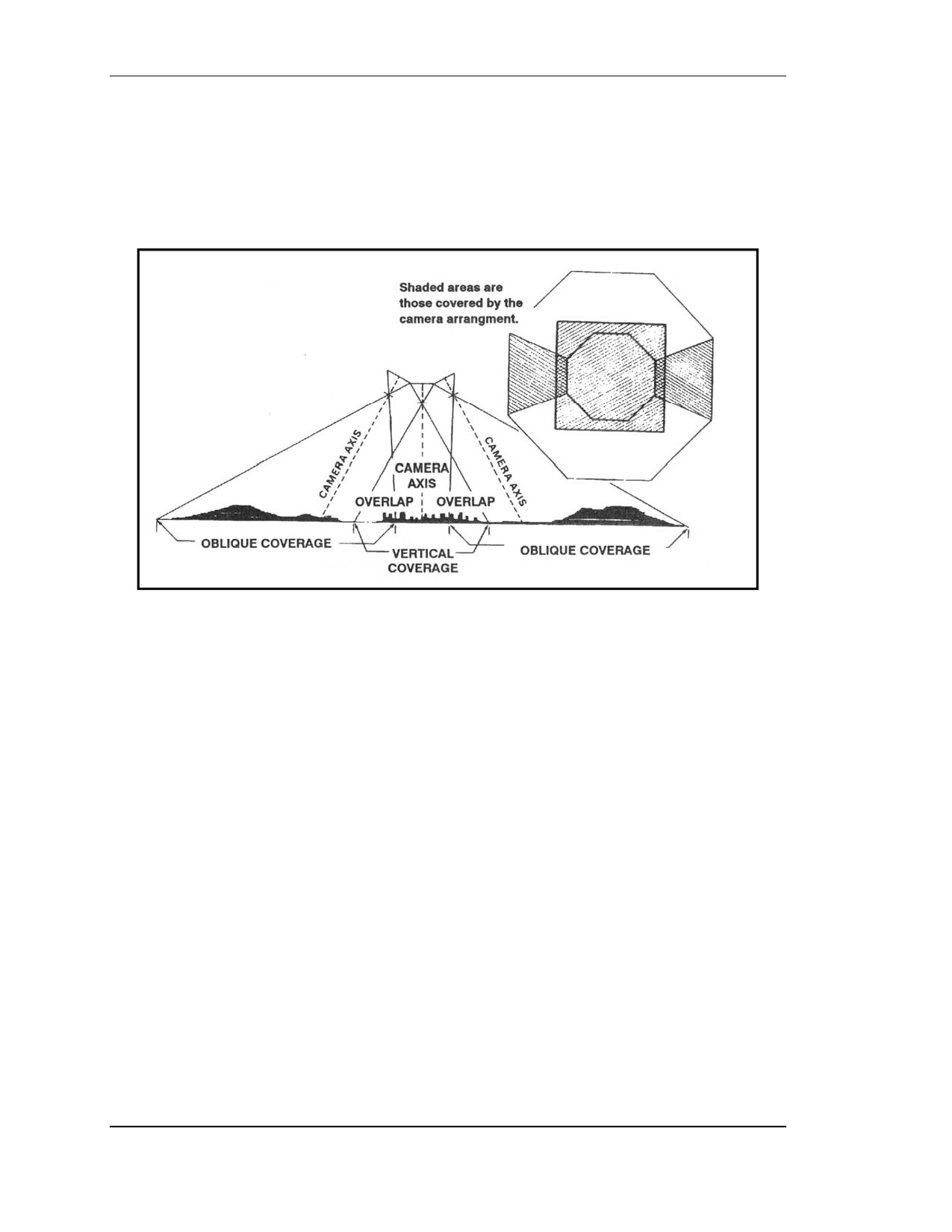
d. Trimetrogon. A trimetrogon is an assemblage of three photographs taken at the same
time, one vertical and two high obliques, in a direction at a right angle to the line of flight.
The obliques, taken at an angle of 60 degrees from the vertical, overlap the sides of the
vertical photography, producing composites from horizon to horizon (Figure 8-7).
Figure 8-7. Relationship of cameras to ground for trimetrogon
photography (three cameras).
e. Multiple Lens Photography. These are composite photographs taken with one
camera having two or more lenses, or by two or more cameras. The photographs are
combinations of two, four, or eight obliques around a vertical. The obliques are rectified to
permit assembly as verticals on a common plane.
f. Convergent Photography. These are done with a single twin-lens, wide-angle
camera, or with two single-lens, wide-angle cameras coupled rigidly in the same mount so
that each camera axis converges when intentionally tilted a prescribed amount (usually
15 or 20 degrees) from the vertical. Again, the cameras are exposed at the same time. For
precision mapping, the optical axes of the cameras are parallel to the line of flight, and for
reconnaissance photography, the camera axes are at high angles to the line of flight.
g. Panoramic. The development and increasing use of panoramic photography in aerial
reconnaissance has resulted from the need to cover in greater detail more and more areas of
the world.
(1) To cover the large areas involved, and to resolve the desired ground detail, present-
day reconnaissance systems must operate at extremely high-resolution levels. Unfortunately,
high-resolution levels and wide-angular coverage are basically contradicting requirements.
(2) A panoramic camera is a scanning type of camera that sweeps the terrain of interest
from side to side across the direction of flight. This permits the panoramic camera to record a
much wider area of ground than either frame or strip cameras. As in the case of the frame
cameras, continuous cover is obtained by properly spaced exposures timed to give sufficient
8-6
FOUO
18 January 2005
FM 3-25.26
overlap between frames. Panoramic cameras are most advantageous for applications
requiring the resolution of small ground detail from high altitudes.
8-3.
TYPES OF FILM
Types of film generally used in aerial photography include panchromatic, infrared, and color.
Camouflage detection film is also available.
a. Panchromatic. This film is the same type of film that is used in a small, commercial
hand-held camera. It records the amount of light reflected from objects in tones of gray
running from white to black. Most aerial photography is taken with panchromatic film.
b. Infrared. This is a black-and-white film that is sensitive to infrared waves. It can be
used to detect artificial camouflage materials and to take photographs at night if there is a
source of infrared radiation.
c. Color. This film is the same as that used in an average, commercial hand-held
camera. It is limited in its use because of the time required to process it and its need for clear,
sunny weather.
d. Camouflage Detection. This is a special type film that records natural vegetation in
a reddish color. When artificial camouflage materials are photographed, they appear bluish
or purplish. The name of this film indicates its primary use.
8-4.
NUMBERING AND TITLING INFORMATION
Each aerial photograph contains in its margin important information for the photo user. The
arrangement, type, and amount of this information is standardized; however, the rapid
development of cameras, film, and aeronautical technology since World War II has caused
numerous changes in the numbering and titling of aerial photographs. As a result, the photo
user may find that the marginal information on older photographs varies somewhat from the
standard current practice. With certain camera systems, some of the data are automatically
recorded on each exposure, while other systems require that all titling data be added to the
film after processing.
a. Standard titling data for aerial photography prepared for the use of the Department of
Defense are: for reconnaissance and charting photography, items 2 through 14 and item 19
are lettered on the beginning and end of each roll of film, and items 1 through 9 and item 19
are lettered on each exposure; for surveying and mapping photography, items 2 through 19
are lettered on the beginning and end of each roll of film, and items 1, 2, 3, 5, 6, 7, 8, 9, 13,
and 19 are lettered on each exposure.
(1) Negative number.
(2) Camera position.
(3) Taking unit.
(4) Service.
(5) Sortie/mission number.
(6) Date (followed by a double hyphen [=]).
(7) Time group and zone letter (GMT).
(8) Focal length.
(9) Altitude.
(10) Kind of photography or imagery.
(11) Geographic coordinates.
(12) Descriptive title.
FOUO
8-7
18 January 2005
FM 3-25.26
(13) Project number and or name.
(14) Camera type and serial number.
(15) Cone serial number (if any).
(16) Lens type and serial number.
(17) Magazine type and serial number.
(18) Type of photographic filter used.
(19) Security classification.
b. Automatically recorded data may differ somewhat in arrangement from the sequence
listed above, but the same information is available to the photo user. (A detailed explanation
of the titling items and the codes used to indicate them is found in TM 5-243.)
8-5.
SCALE DETERMINATION
Before a photograph can be used as a map supplement or substitute, it is necessary to know
its scale. On a map, the scale is printed as a representative fraction that expresses the ratio of
map distance to ground distance. For example:
RF = MD
GD
On a photograph, the scale is also expressed as a ratio, but is the ratio of the photo distance
(PD) to ground distance. For example:
RF = PD
GD
The approximate scale or average scale (RF) of a vertical aerial photograph is determined by
either of two methods: the comparison method or the focal length-flight altitude method.
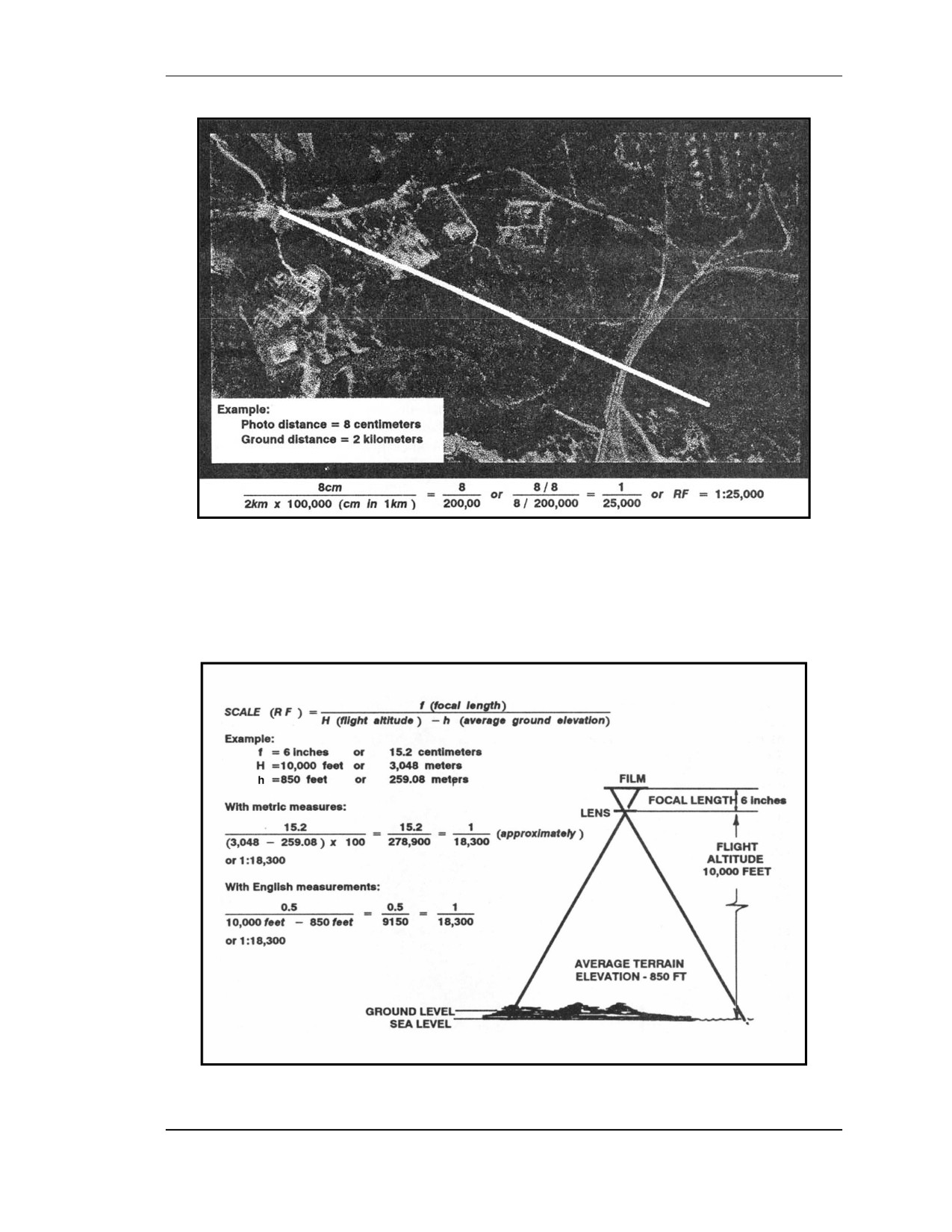
a. Comparison Method. The scale of a vertical aerial photograph is determined by
comparing the measured distance between two points on the photograph with the measured
ground distance between the same two points.
SCALE RF = Photo Distance
Ground Distance
The ground distance is determined by the actual measurement on the ground or by the use of
the scale on a map of the same area. The points selected on the photograph must be
identifiable on the ground or map of the same area and should be spaced in such a manner
that a line connecting them will pass through or nearly through the center of the photograph
(Figure 8-8).
8-8
FOUO
18 January 2005
FM 3-25.26
Figure 8-8. Selection of points for scale determination.
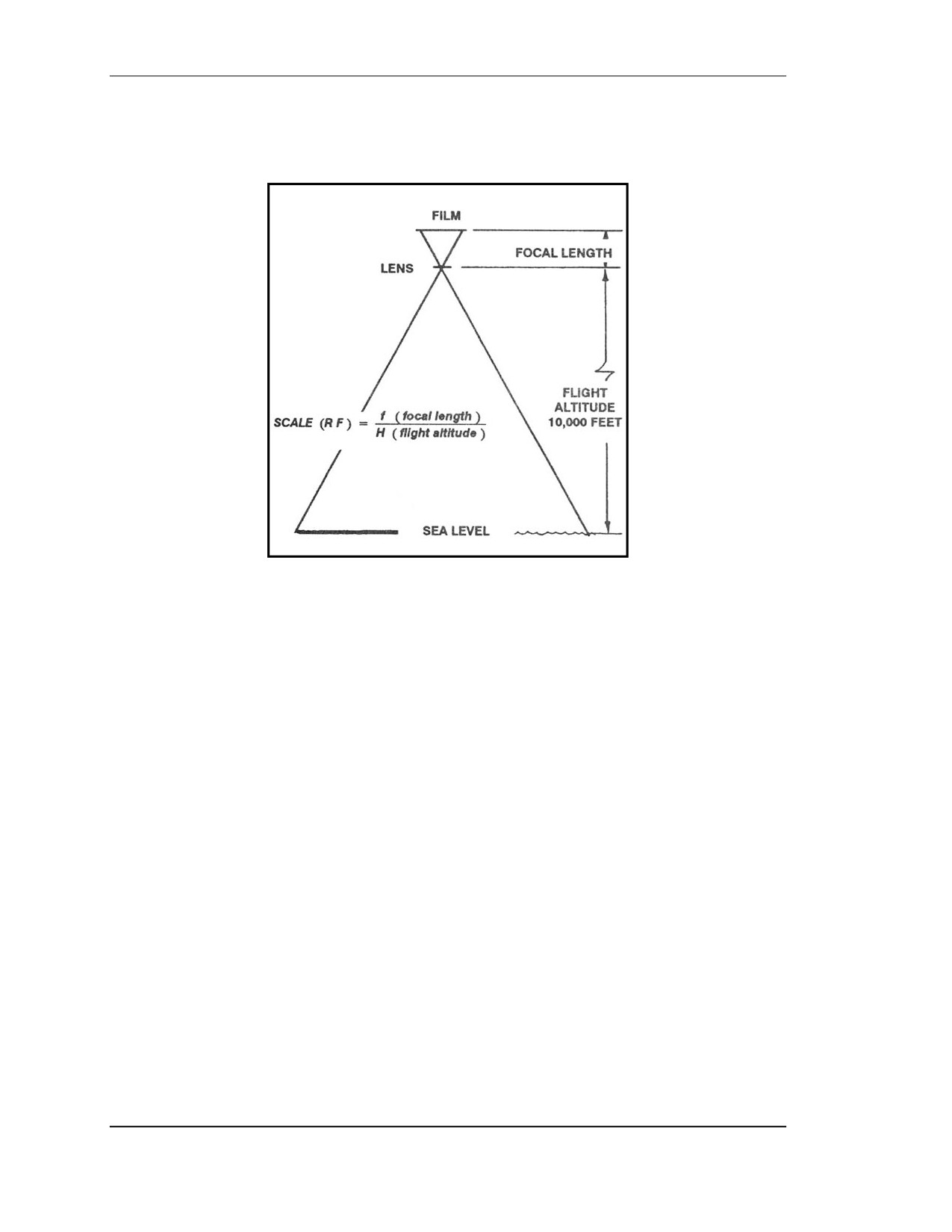
b. Focal Length-Flight Altitude Method. When the marginal information of a
photograph includes the focal length and the flight altitude, the scale of the photo is
determined using the following formula (Figure 8-9).
Figure 8-9. Computation of scale from terrain level.
FOUO
8-9
18 January 2005
FM 3-25.26
When the ground elevation is at sea level, “h” becomes zero, and the formula is as shown in
Figure 8-10.
Figure 8-10. Basic computation of scale from sea level.
8-6.
INDEXING
When aerial photos are taken of an area, it is convenient to have a record of the extent of
coverage of each photo. A map on which the area covered by each photo is outlined and
numbered or indexed to correspond to the photo is called an index map. There are two
methods of preparing index maps.
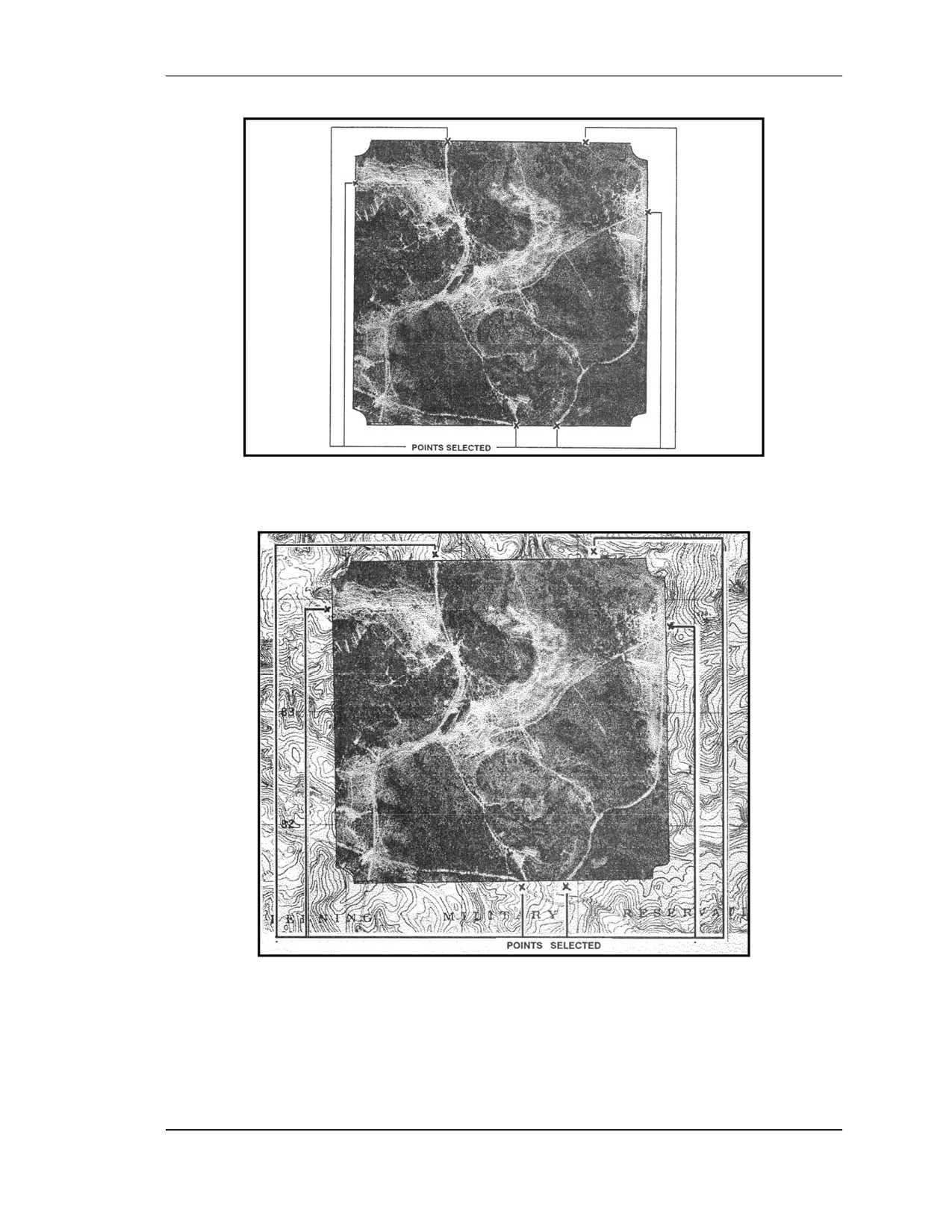
a. The four-corner method (Figures 8-11 and 8-12) requires location on the map of the
exact point corresponding to each corner of the photo. If a recognizable object, such as a
house or road junction can be found exactly at one of the corners, this point may be used on
the map as the corner of the photo. If recognizable objects cannot be found at the corners,
then the edges of the photo should be outlined on the map by lining up two or more
identifiable objects along each edge; the points where the edges intersect should be the exact
corners of the photo. If the photo is not a perfect vertical, the area outlined on the map will
not be a perfect square or rectangle. After the four sides are drawn on the map, the number of
the photograph is written in the enclosed area for identification. This number should be
placed in the same corner as it is on the photo.
8-10
FOUO
18 January 2005
FM 3-25.26
Figure 8-11. Four-corner method (selection of points).
Figure 8-12. Plotting, using the four-corner method.
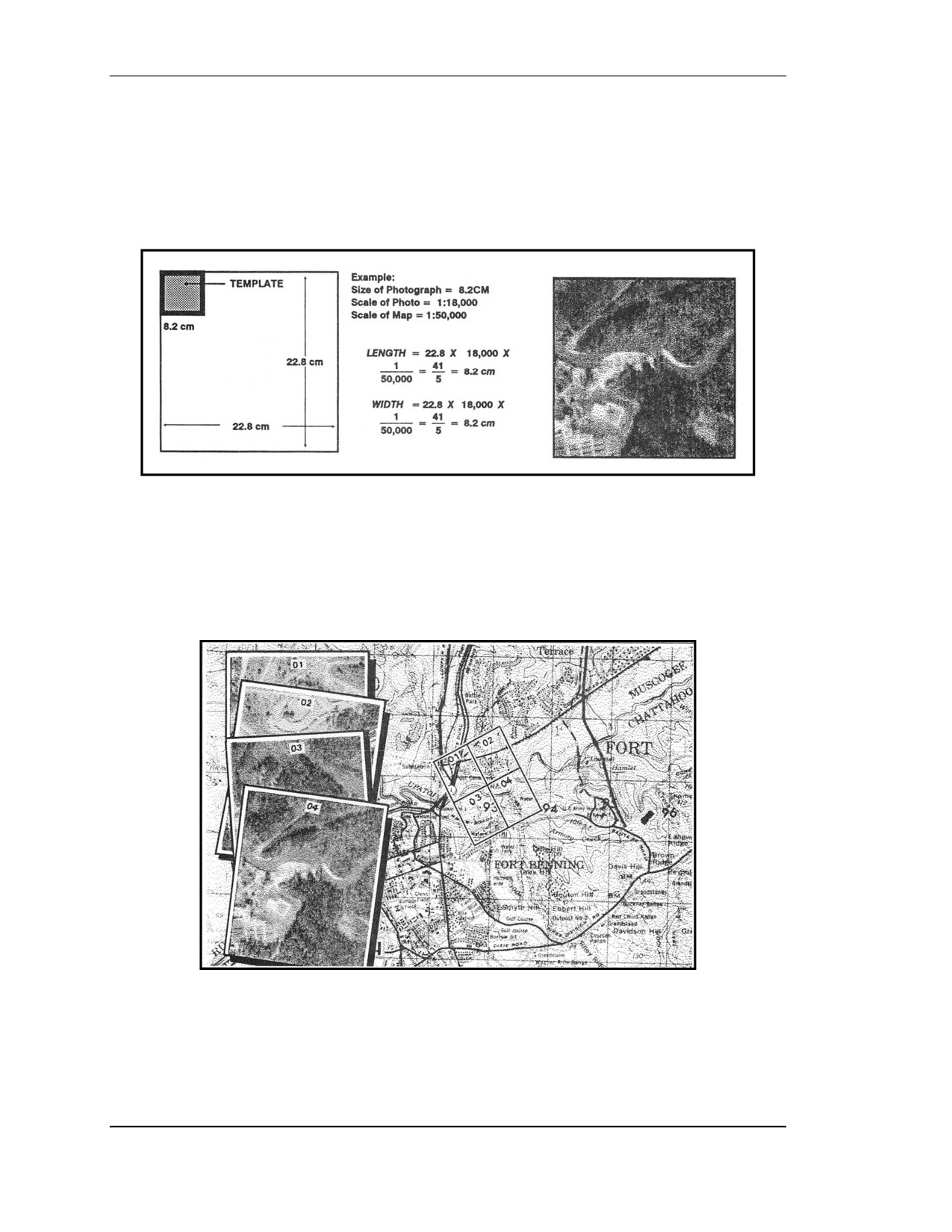
b. The template method is used when a large number of photos are to be indexed, and
the exact area covered by each is not as important as approximate area and location. In this
case, a template (cardboard pattern or guide) is cut to fit the average area the photos cover on
the index map. It is used to outline the individual area covered by each photo.
FOUO
8-11
18 January 2005
FM 3-25.26
(1) To construct a template, find the average map dimensions covered by the photos to
be indexed as follows. Multiply the average length of the photos by the denominator of the
average scale of the photos; multiply this by the scale of the map. Do the same for the width
of the photos. This gives the average length and width of the area each photo covers on the
map—or the size to which the template should be cut (Figure 8-13).
Figure 8-13. Constructing a template.
(2) To index the map, select the general area covered by the first photo and orient the
photo to the map. Place the template over the area on the map and adjust it until it covers the
area as completely and accurately as possible. Draw lines around the edges of the template.
Remove the rectangle and proceed to the next photo (Figure 8-14).
Figure 8-14. Indexing with a template.
c. After all photos have been plotted, write on the map sufficient information to identify
the mission or sortie. If more than one sortie is plotted on one map or overlay, use a different
color for each sortie.
8-12
FOUO
18 January 2005
FM 3-25.26
d. In most cases, when a unit orders aerial photography, an index is included to give the
basic information. Instead of being annotated on a map of the area, it appears on an overlay
and is keyed to a map.
8-7.
ORIENTATION OF PHOTOGRAPH
Orienting the photograph is important because it is of very little value as a map supplement
or substitute if its location and direction are not known by the user.
a. If a map of the same area as the photograph is available, the photograph is oriented to
the map by comparing features common to both and then transferring a direction line from
the map to the photograph.
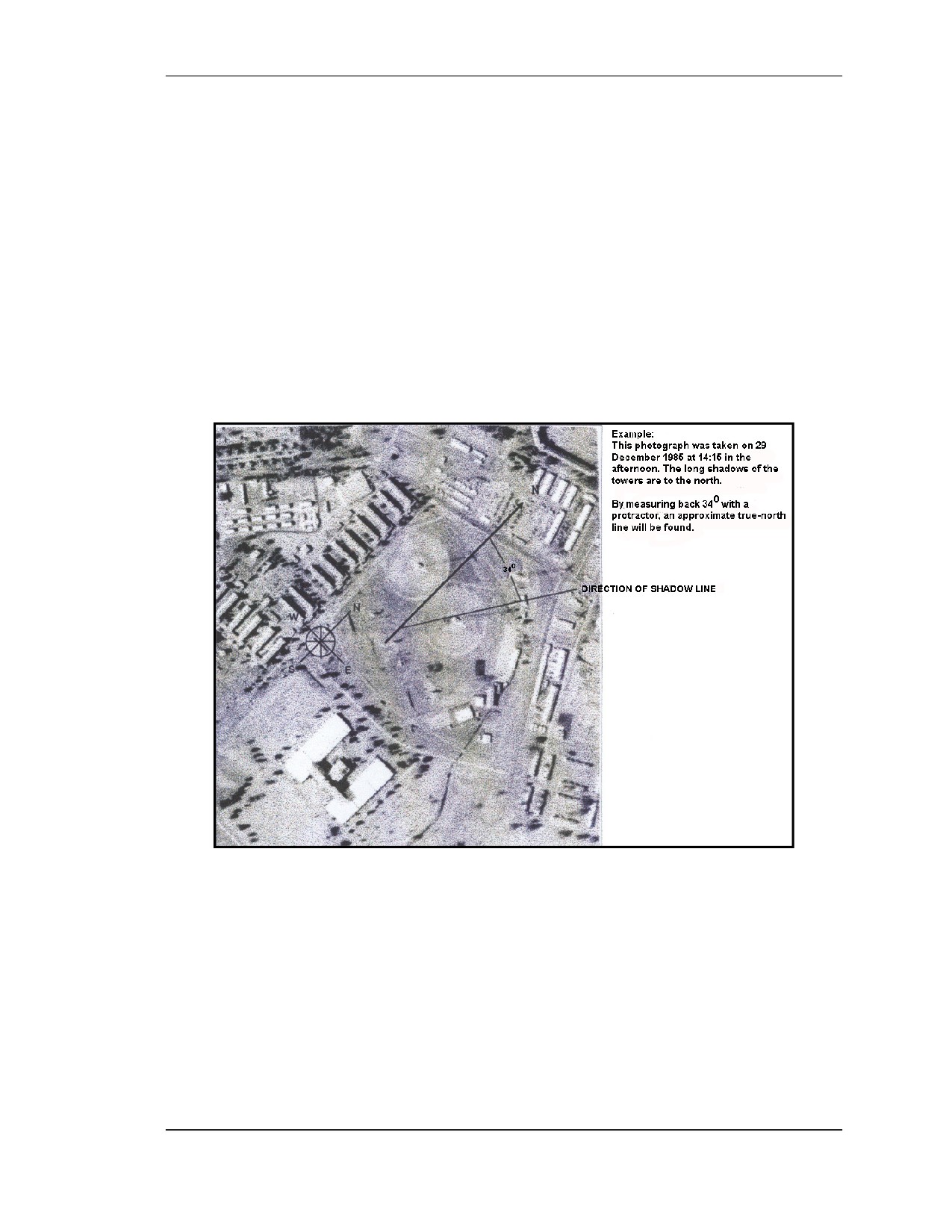
b. If no map is available, the shadows on a photograph may be used to get an
approximate true-north line. This method is not recommended in the torrid zone
(Figure 8-15).
Figure 8-15. Using shadows on a photograph to find north.
(1) North Temperate Zone. The sun moves from the east in the morning through south at
noon to west in the afternoon. Conversely, shadow fall varies from west through north to
east. Before noon, therefore, north is to the right of the direction of shadow fall; at noon,
north is the direction of shadow fall; and after noon, north is to the left of shadow fall. On an
average, the amount of variation in shadow fall per hour is 15 degrees. From marginal
information, determine the number of hours from noon that the photo was taken and multiply
that number by 15 degrees. With a protractor, measure an angle of that amount in the proper
direction (right to left) from a clear, distinct shadow, and north is obtained. For photographs
taken within three hours of noon, a reasonable accurate north direction can be obtained.
FOUO
8-13
18 January 2005
FM 3-25.26
Beyond these limits, the 15 degrees must be corrected, depending on time of year and
latitude.
(2) South Temperate Zone. The sun moves from east through north at noon to west.
Shadows then vary from west through south to east. Before noon, south is to the left of
shadow fall; at noon, south is shadow fall; and after noon, south is to the right of shadow fall.
Proceed as in (1) above to determine the direction of south.
c. On a photograph that can be oriented to the surrounding ground features by
inspection, a magnetic-north line can be established using a compass.
(1) Orient the photograph by inspection.
(2) Open the compass and place it on the photograph.
(3) Without moving the photograph, rotate the compass until the north arrow is under the
black fixed index line.
(4) Draw a line along the straight edge of the compass. This is a magnetic-north line.
8-8.
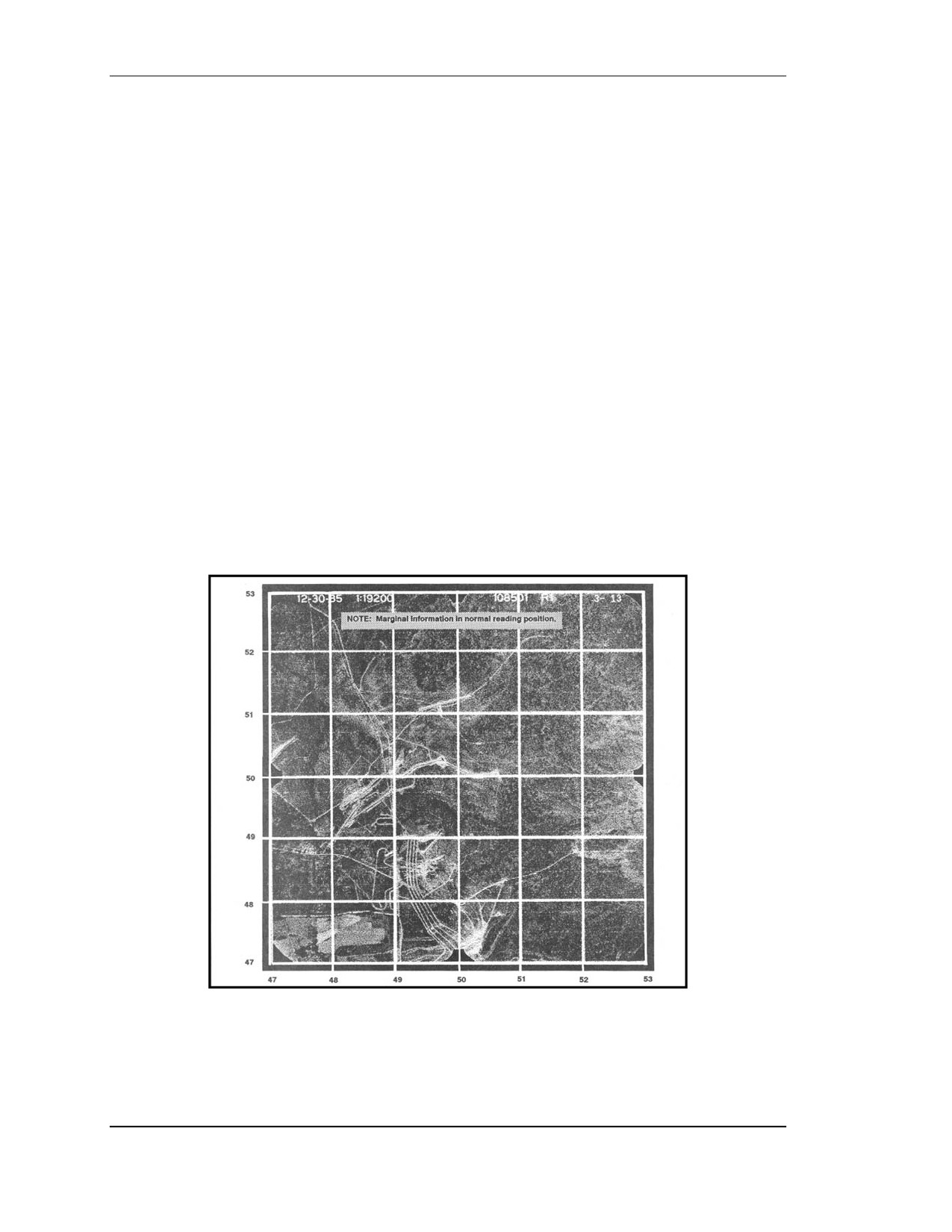
POINT DESIGNATION GRID
Since aerial photographs are seldom exactly the same scale as a map of the same area, it is
not feasible to print military grids on them. A special grid is used for the designation of
points on photographs (Figure 8-16). This grid, known as the point designation grid, has no
relation to the scale of the photo, to any direction, or to the grid used on any other
photograph or map. It has only one purpose, to designate points on photographs.
Figure 8-16. Point designation grid.
a. The point designation grid is rarely printed on photographs; therefore, it becomes the
responsibility of each user to construct the grid on the photograph. All users must construct
the grid in exactly the same way. Before the grid can be constructed or used, the photograph
8-14
FOUO
18 January 2005
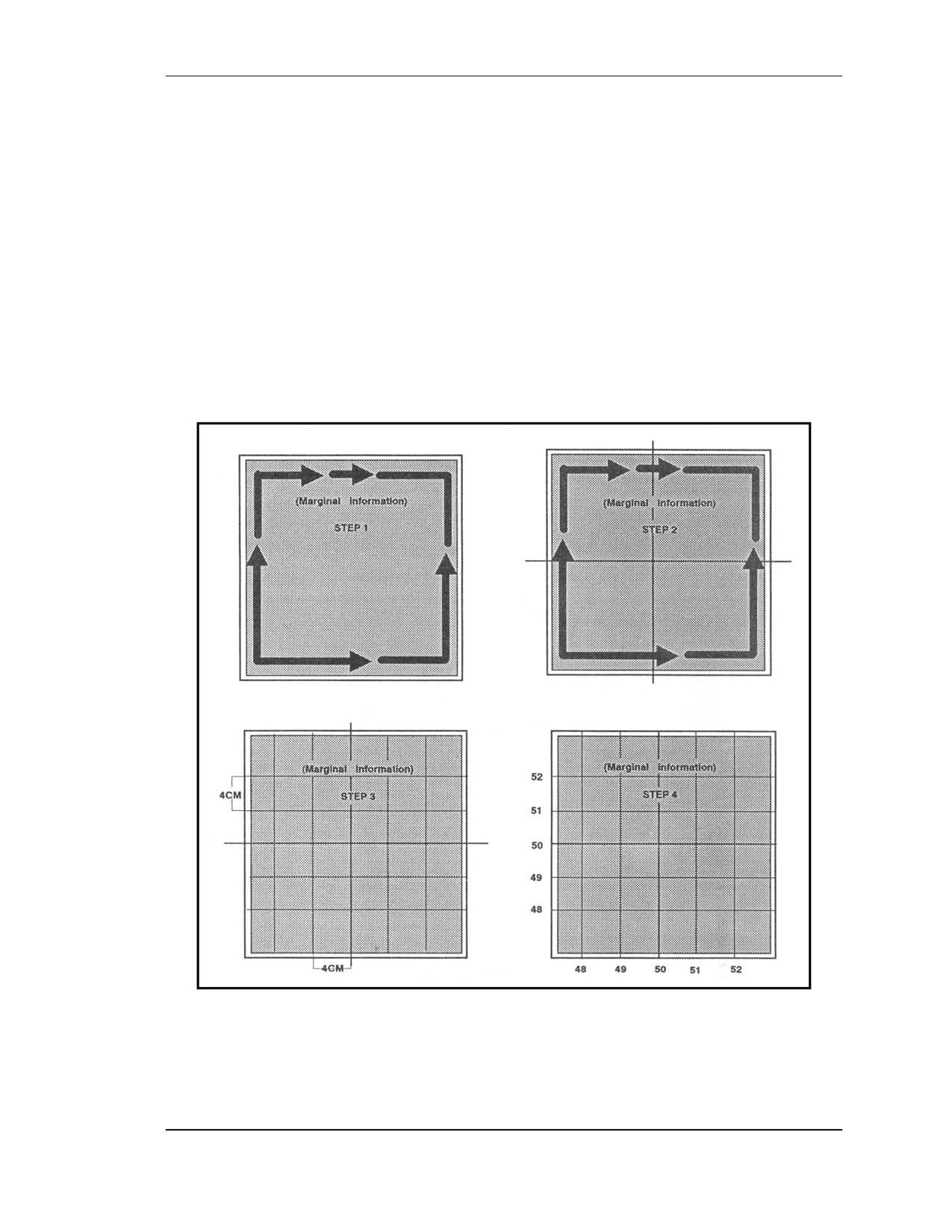
FM 3-25.26
must be held so that the marginal information, regardless of where it is located, is in the
normal reading position (Figure 8-17, step 1).
(1) Draw lines across the photograph joining opposite reference marks at the center of
each photograph (fiducial marks). If there are no fiducial marks, the center of each side of
the photograph is assumed to be the location of the marks (Figure 8-17, step 2).
(2) Space grid lines, starting with the center line, 4 centimeters (1.575 inches) apart (a
distance equal to 1,000 meters at a scale of 1:25,000). The 1:25,000 map coordinate scale
can be used for this dimension and to accurately designate points on the photograph, but this
does not mean that distance can be scaled from the photograph. Extend the grid past the
margins of the photograph so that a horizontal and vertical grid line fall outside the picture
area (Figure 8-17, step 3).
(3) Number each center line “50” and give numerical values to the remaining horizontal
and vertical lines so that they increase to the right and up (Figure 8-17, step 4).
Figure 8-17. Constructing a point designation grid.
b. Once the photograph is oriented, the point designation grid is used in the same
manner as the grid on a map (Figure 8-18), read right and up. The coordinate scale used with
the UTM grid on maps at the scale of 1:25,000 may be used to subdivide the grid square in
FOUO
8-15
18 January 2005
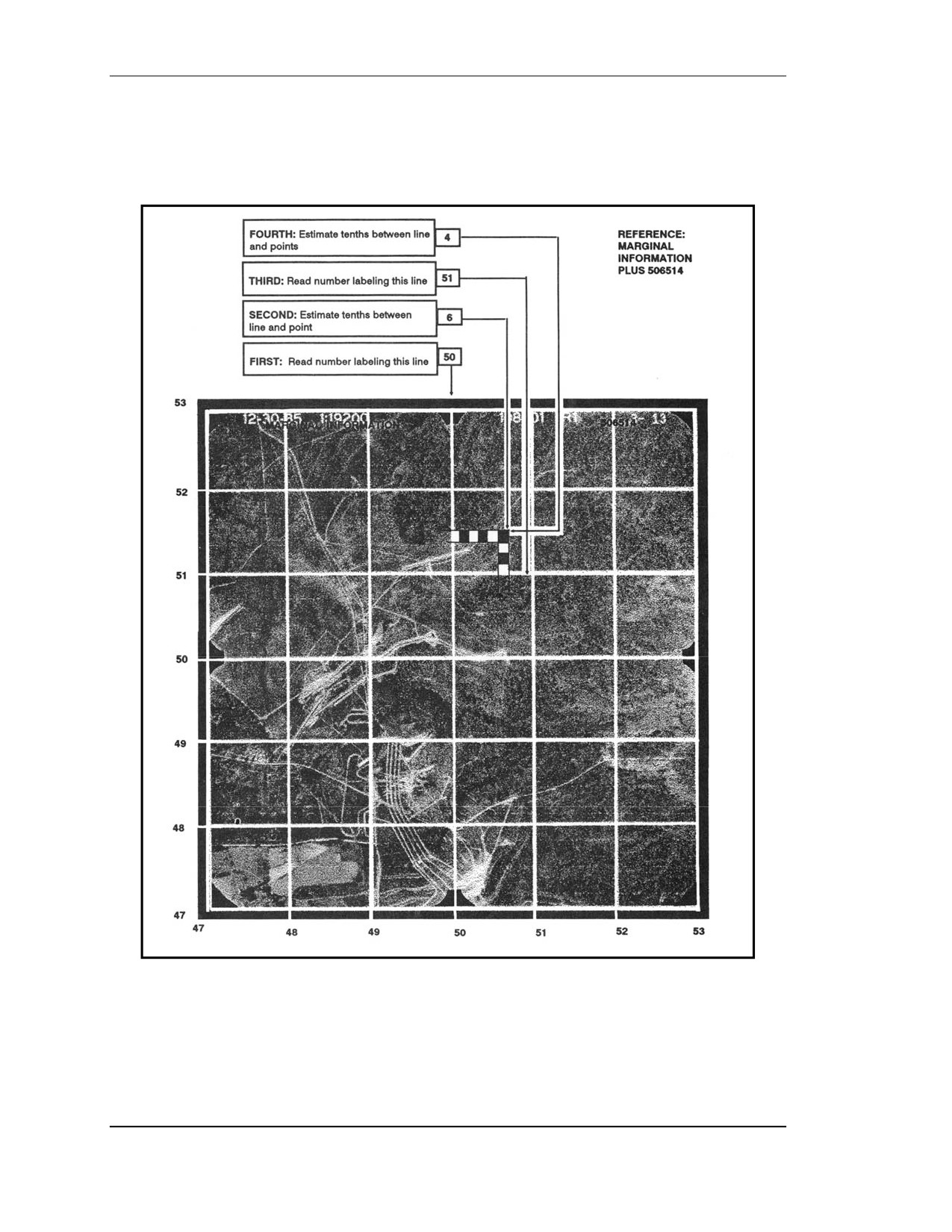
FM 3-25.26
the same manner as on a map. However, because the same point designation grid is used on
all photographs, the coordinates of a point on the photograph must be prefixed by the
identifying marginal information of the photograph.
Figure 8-18. Reading point designation grid coordinates.
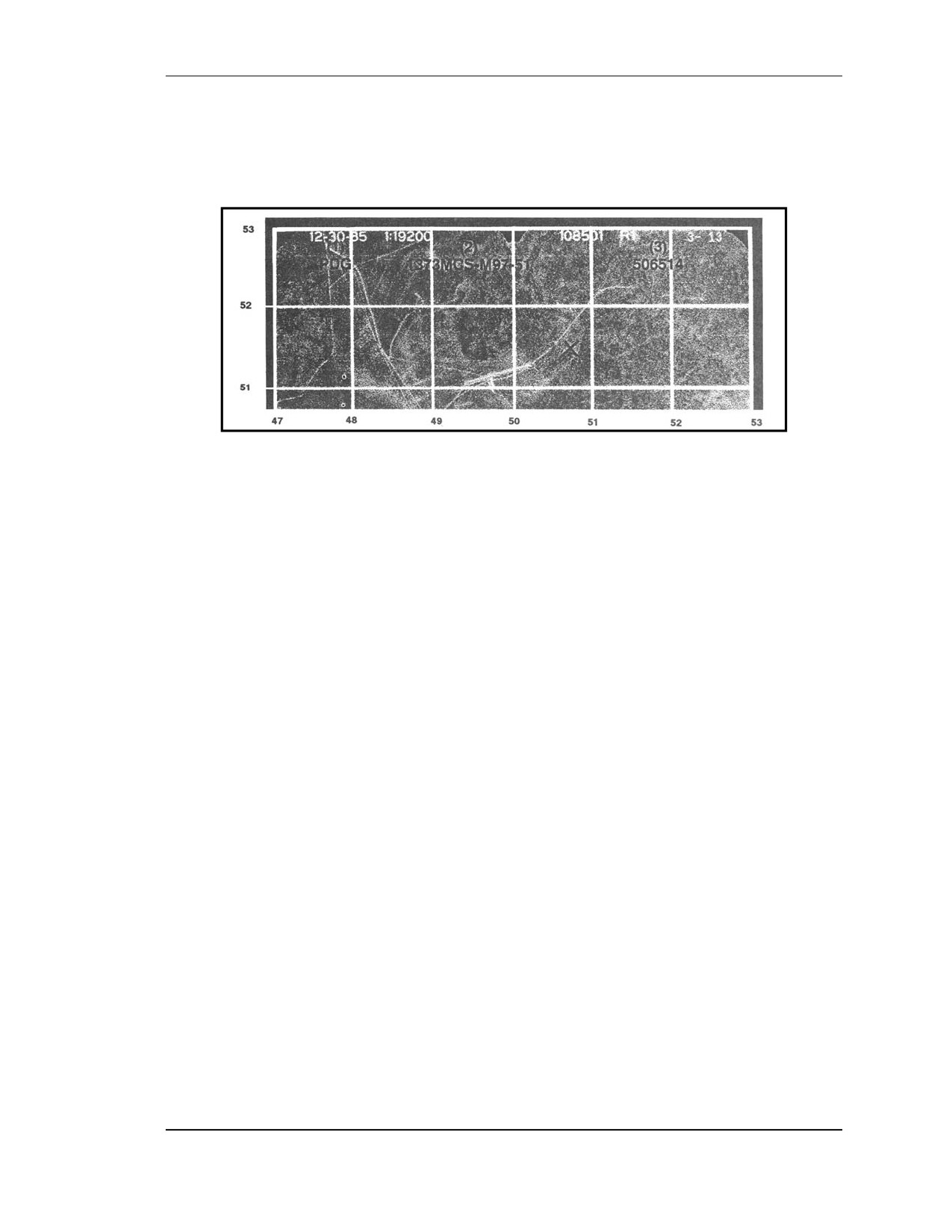
c. A grid coordinate using the point designation grid
(Figure 8-19) consists of
three parts:
• The letters “PDG” to indicate an aerial photograph rather than a map grid
coordinate.
8-16
FOUO
18 January 2005
FM 3-25.26
• The mission and photo negative number to identify which photograph is being
used.
• The six numerical digits to locate the actual point on the photograph.
Figure 8-19. Locating the grid coordinate on a point designation grid.
8-9.
IDENTIFICATION OF PHOTOGRAPH FEATURES
The identification of features on a photograph is not difficult if the following facts are
remembered. The view that is presented by the aerial photograph is from above and, as a
result, objects do not look familiar. Objects that are greatly reduced in size appear distorted.
Most aerial photography is black and white, and all colors appear on the photograph in
shades of gray. Generally speaking, the darker the natural color, the darker it will appear on
the photograph.
a. The identification of features on aerial photographs depends upon a careful
application of five factors of recognition. No one factor will give a positive identification; all
five are required.
(1) Size. The size of unknown objects on a photograph, as determined from the scale of
the photograph or a comparison with known objects of known size, gives a clue to their
identity. For example, in a built-up area the smaller buildings are usually dwellings, and the
larger buildings are commercial or community buildings.
(2) Shape (Pattern). Many features possess characteristic shapes that readily identify the
features. Man-made features appear as straight or smooth curved lines, while natural features
usually appear to be irregular. Some of the most prominent man-made features are highways,
railroads, bridges, canals, and buildings. Compare the regular shapes of these to the irregular
shapes of such natural features as streams and timber lines.
(3) Shadows. Shadows are very helpful in identifying features since they show the
familiar side view of the object. Some excellent examples are the shadows of water towers or
smoke stacks. As viewed directly from above, only a round circle or dot is seen, whereas the
shadow shows the profile and helps to identify the object. Relative lengths of shadows also
usually give a good indication of relative heights of objects.
(4) Shade (Tone or Texture). Of the many different types of photographic film in use
today, the film used for most aerial photography, except for special purposes, is
panchromatic film. Panchromatic film is sensitive to all the colors of the spectrum; it
registers them as shades of gray, ranging from white to black. This lighter or darker shade of
features on aerial photographs is known as the tone. The tone is also dependent on the
FOUO
8-17
18 January 2005
FM 3-25.26
texture of the features; a paved highway has a smooth texture and produces an even tone on
the photograph, while a recently plowed field or a marsh has a rough, choppy texture and
results in a rough or grainy tone. It is also important to remember that similar features may
have different tones on different photographs, depending on the reflection of sunlight. For
example, a river or body of water appears light if it is reflecting sunlight directly toward the
camera, but appears dark otherwise. Its texture may be smooth or rough, depending on the
surface of the water itself. As long as the variables are kept in mind, tone and texture may be
used to great advantage.
(5) Surrounding Objects. Quite often an object not easily recognized by itself may be
identified by its relative position to surrounding objects. Large buildings located beside
railroads or railroad sidings are usually factories or warehouses. Identify schools by the
baseball or football fields. It would be hard to tell the difference between a water tower next
to a railroad station and a silo next to a barn unless the surrounding objects, such as the
railroad tracks or cultivated fields, were considered.
b. Before a vertical photograph can be studied or used for identification of features, it
must be oriented. This orienting is different from the orienting required for the construction
or use of the point designation grid. Orienting for study consists of rotating the photograph
so that the shadows on the photograph point toward yourself. You then face a source of light.
This places the source of light, an object, and its shadow in a natural relationship. Failure to
orient a photograph properly may cause the height or depth of an object to appear reversed.
For example, a mine or quarry may appear to be a hill instead of a depression.
8-10. STEREOVISION
One of the limitations of the vertical aerial photograph is the lack of apparent relief.
Stereoscopic vision (or as it is more commonly known, stereovision or depth perception) is
the ability to see three-dimensionally or to see length, width, and depth (distance) at the
same time. This requires two views of a single object from two slightly different positions.
Most people have the ability to see three-dimensionally. Whenever an object is viewed, it is
seen twice—once with the left eye and once with the right eye. The fusion or blending
together of these two images in the brain permits the judgment of depth or distance.
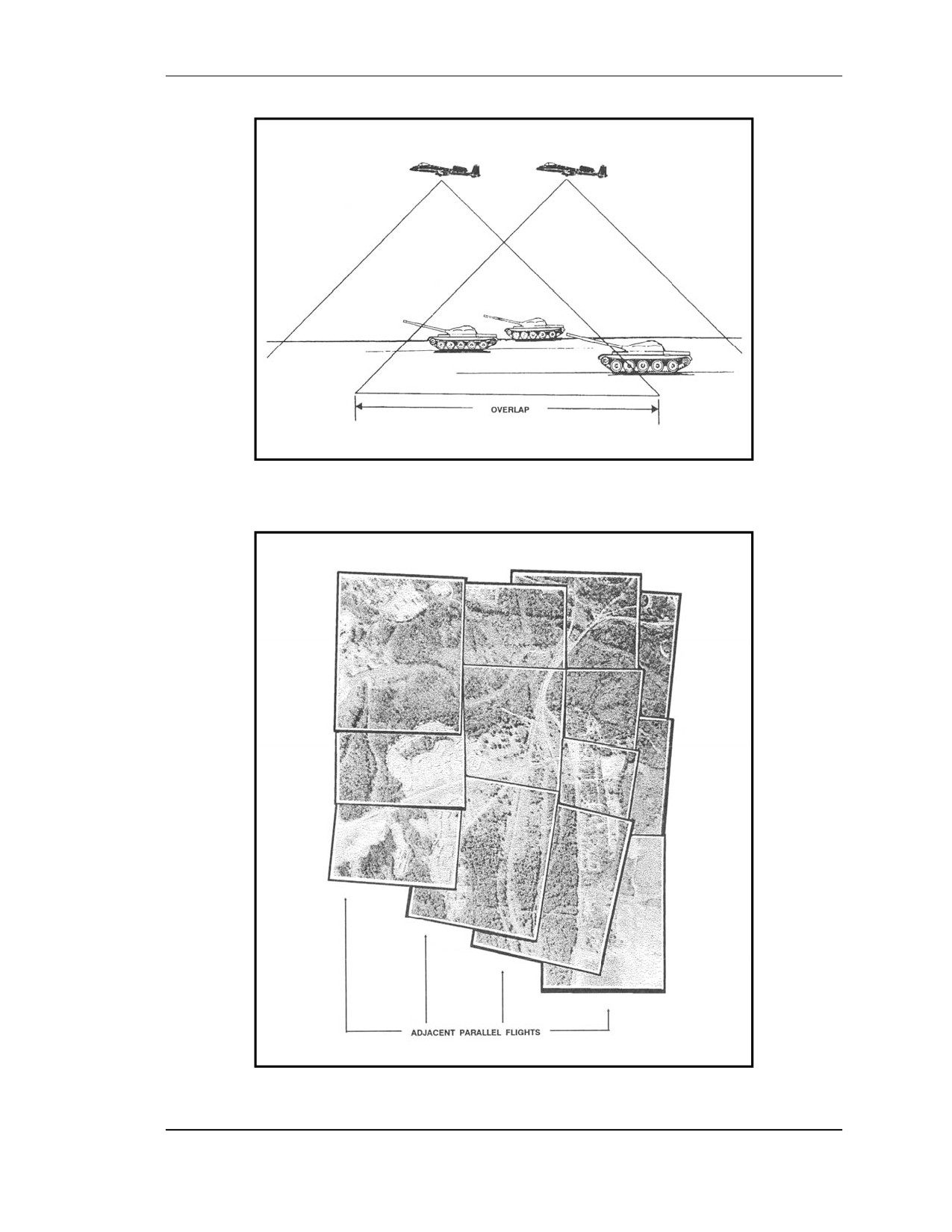
a. In taking aerial photographs, it is rare for only a single picture to be taken. Generally,
the aircraft flies over the area to be photographed taking a series of pictures, each of which
overlaps the photograph preceding it and the photograph following it so that an unbroken
coverage of the area is obtained (Figure 8-20). The amount of overlap is usually 56 percent,
which means that 56 percent of the ground detail appearing on one photo also appears on the
next photograph. When a single flight does not give the necessary coverage of an area,
additional flights must be made. These additional flights are parallel to the first and must
have an overlap between them. This overlap between flights is known as side lap and usually
is between 15 and 20 percent (Figure 8-21).
8-18
FOUO
18 January 2005
FM 3-25.26
Figure 8-20. Photographic overlap.
Figure 8-21. Side lap.
FOUO
8-19
18 January 2005
FM 3-25.26
b. The requirement for stereovision can be satisfied by overlapping photographs if one
eye sees the object on one photograph and the other eye sees the same object on another
photograph. While this can be done after practice with the eyes alone, it is much easier if an
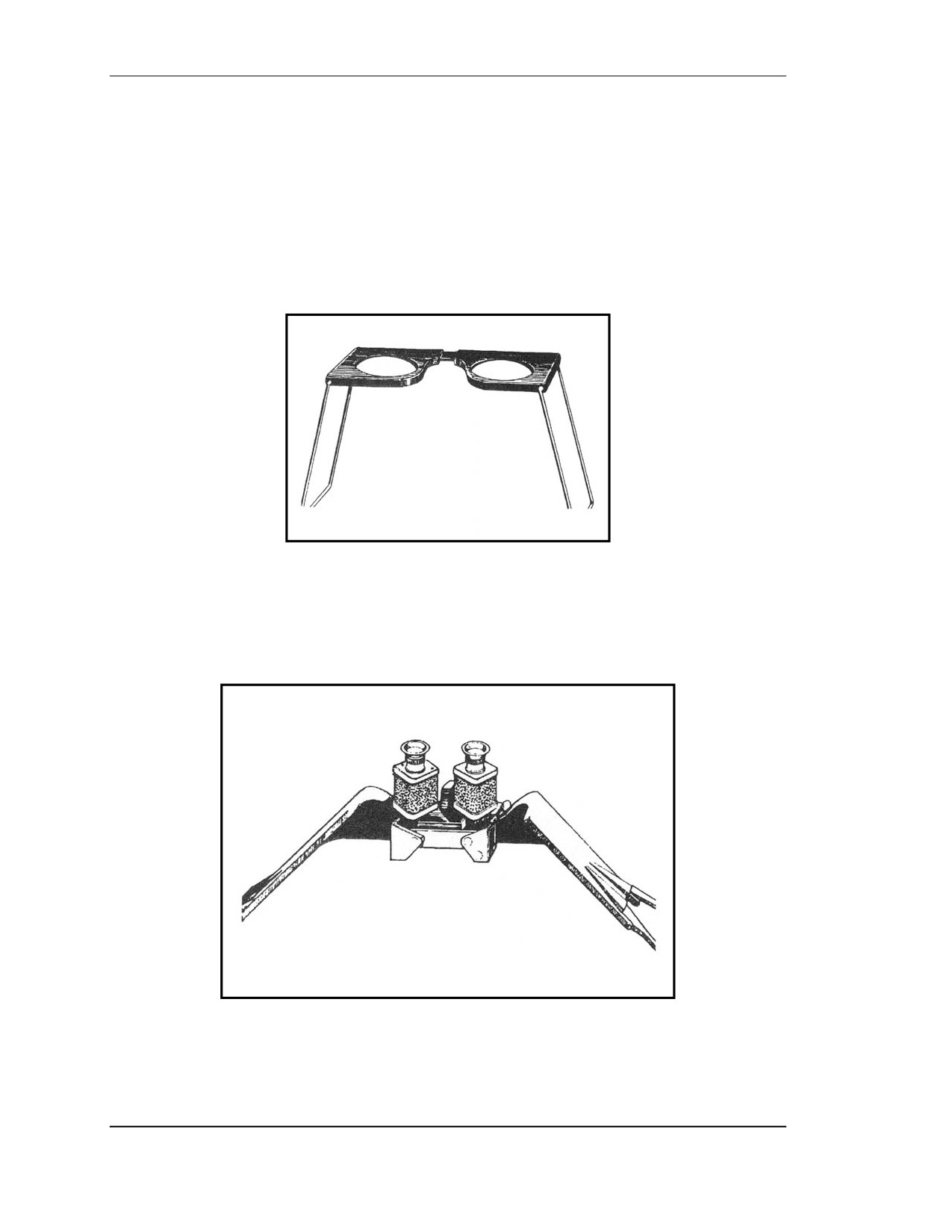
optical aid is used. These optical aids are known as stereoscopes. There are many types of
stereoscopes, but only the two most commonly used are discussed in this manual.
(1) Pocket Stereoscope. The pocket stereoscope (Figure 8-22), sometimes known as a
lens stereoscope, consists of two magnifying lenses mounted in a metal frame. Because of its
simplicity and ease of carrying, it is the type used most frequently by military personnel.
Figure 8-22. Pocket stereoscope.
(2) Mirror Stereoscope. The mirror stereoscope (Figure 8-23) is larger, heavier, and
more subject to damage than the pocket stereoscope. It consists of four mirrors mounted in a
metal frame.
Figure 8-23. Mirror stereoscope.
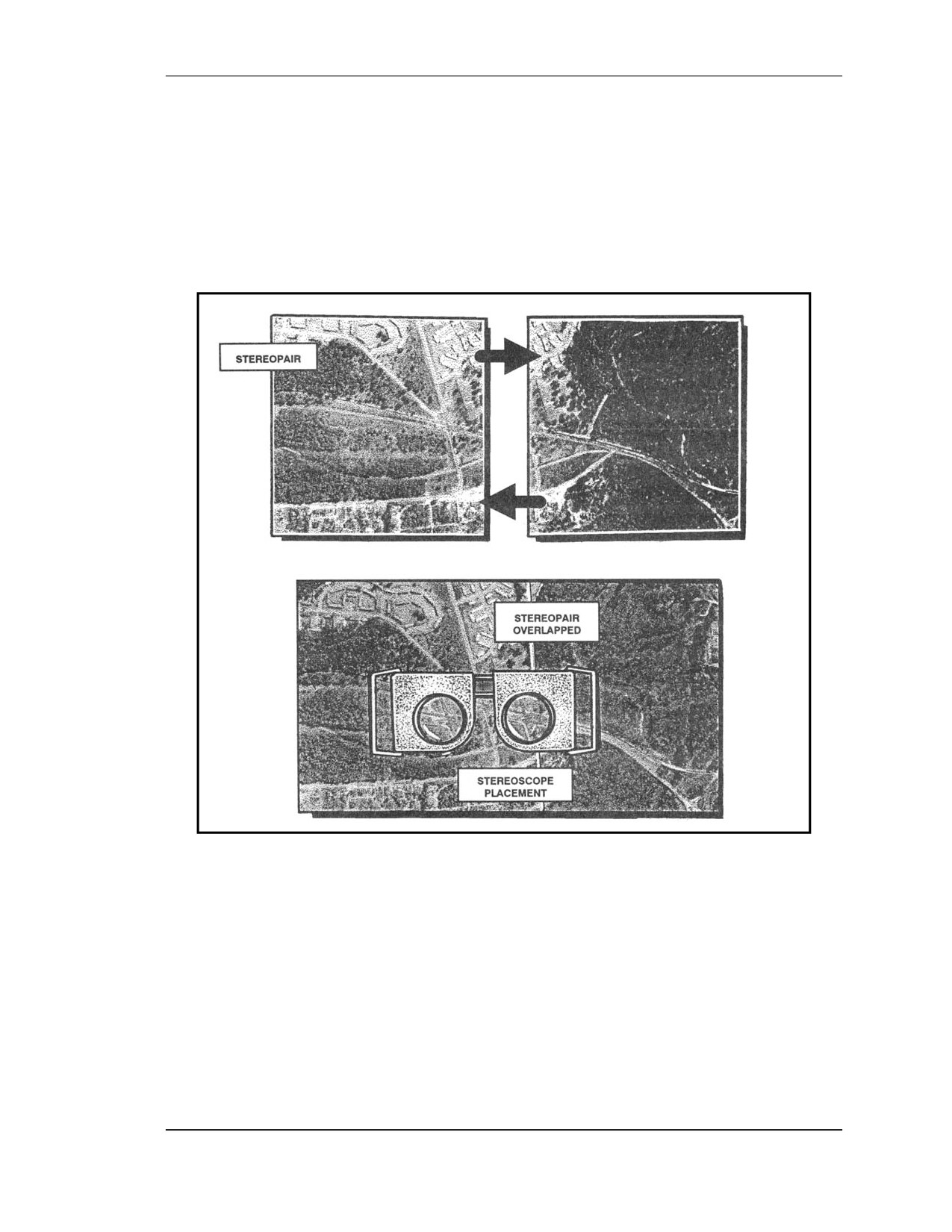
c. One method to orient a pair of aerial photographs for the best three-dimensional
viewing is as follows (Figure 8-24):
8-20
FOUO
18 January 2005
FM 3-25.26
(1) Arrange the selected pair of photos in such a way that the shadows on them generally
appear to fall toward the viewer. It is also desirable that the light source enters the side away
from the observer during the study of the photographs.
(2) Place the pair of photographs on a flat surface so that the detail on one photograph is
directly over the same detail on the other photograph.
(3) Place the stereoscope over the photographs so that the left lens is over the left
photograph and the right lens is over the right photograph.
Figure 8-24. Placement of stereoscope over stereopair.
(4) Separate the photographs along the line of flight until a piece of detail appearing in
the overlap area of the left photograph is directly under the left lens and the same piece of
detail on the right photo is directly under the right lens.
(5) With the photograph and stereoscope in this position, a three-dimensional image
should be seen. A few minor adjustments may be necessary such as adjusting the aerial
photographs of the stereoscope to obtain the correct position for your eyes. The hills appear
to rise and the valleys sink so that there is the impression of being in an aircraft looking
down at the ground.
(6) The identification of features on photographs is much easier and more accurate with
this three-dimensional view. The same five factors of recognition (size, shape, shadow, tone,
FOUO
8-21
18 January 2005
FM 3-25.26
and surrounding objects) must still be applied; but now, with the addition of relief, a more
natural view is seen.
8-22
FOUO
18 January 2005
FM 3-25.26
PART TWO
LAND NAVIGATION
CHAPTER 9
NAVIGATION EQUIPMENT AND METHODS
Compasses are the primary navigation tools to use when moving in an
outdoor world where there is no other way to find directions. Soldiers should
be thoroughly familiar with the compass and its uses. Part One of this
manual discussed the techniques of map reading. To complement these
techniques, a mastery of field movement techniques is essential. This chapter
describes the lensatic compass and its uses, and some of the field-expedient
methods used to find directions when compasses are not available.
9-1.
TYPES OF COMPASSES
The lensatic compass is the most common and simplest instrument for measuring direction.
It is discussed in detail in paragraph 9-2. The artillery M2 compass is a special-purpose
instrument designed for accuracy; it will be discussed in Appendix J. The wrist/pocket
compass is a small magnetic compass that can be attached to a wristwatch band. It contains a
north-seeking arrow and a dial in degrees. A protractor can be used to determine azimuths
when a compass is not available. However, it should be noted that when using the protractor
on a map, only grid azimuths are obtained.
9-2.
LENSATIC COMPASS
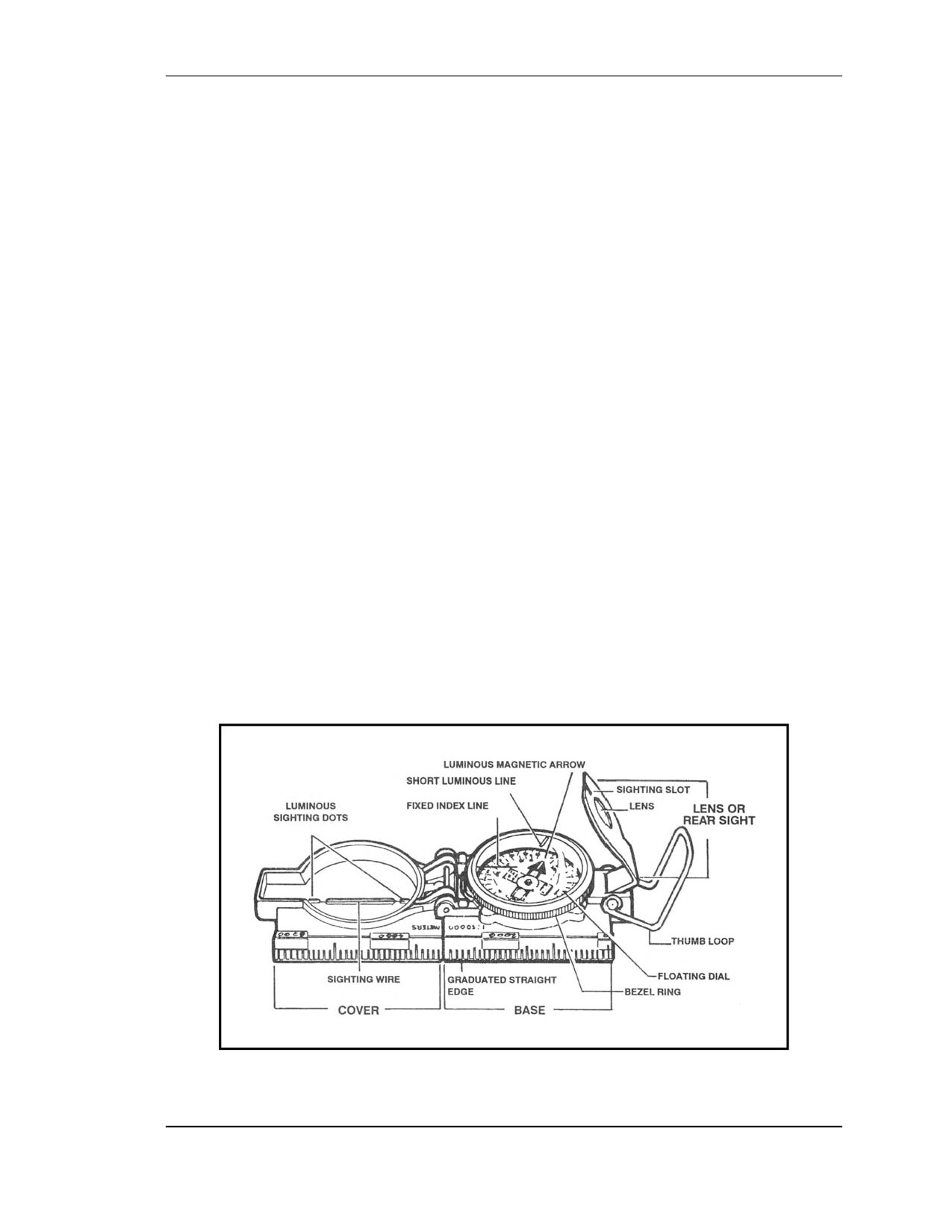
The lensatic compass (Figure 9-1) consists of three major parts: the cover, the base, and
the lens.
Figure 9-1. Lensatic compass.
FOUO
9-1
18 January 2005
FM 3-25.26
a. Cover. The compass cover protects the floating dial. The cover contains the sighting
wire (front sight) and two luminous sighting slots or dots used for night navigation.
b. Base. The base of the compass contains the following movable parts:
(1) The floating dial is mounted on a pivot so it can rotate freely when the compass is
held level. Printed on the dial in luminous figures are an arrow and the letters E and W. The
arrow always points to magnetic north and the letters fall at east (E) 90 degrees and west (W)
270 degrees on the dial. There are two scales; the outer scale denotes mils and the inner scale
(normally in red) denotes degrees.
(2) Encasing the floating dial is a glass containing a fixed black index line.
(3) The bezel ring is a ratchet device that clicks when turned. It contains 120 clicks when
rotated fully; each click is equal to 3 degrees. A short luminous line that is used in
conjunction with the north-seeking arrow during navigation is contained in the glass face of
the bezel ring.
(4) The thumb loop is attached to the base of the compass.
c. Lens. The lens is used to read the dial, and it contains the rear-sight slot used in
conjunction with the front for sighting on objects. The rear sight also serves as a lock and
clamps the dial when closed for its protection. The rear sight must be opened more than
45 degrees to allow the dial to float freely.
NOTE: When opened, the straight edge on the left side of the compass has a coordinate
scale; the scale is 1:50,000 in newer compasses.
WARNING
Some older compasses will have a 1:25,000 scale.
This scale can be used with a 1:50,000-scale map,
but the values read must be halved. Check the
scale.
9-3.
COMPASS HANDLING
Compasses are delicate instruments and should be cared for accordingly.
a. Inspection. A detailed inspection is required when first obtaining and using a
compass. One of the most important parts to check is the floating dial, which contains the
magnetic needle. The user must also make sure the sighting wire is straight, the glass and
crystal parts are not broken, the numbers on the dial are readable, and most important, that
the dial does not stick.
b. Effects of Metal and Electricity. Metal objects and electrical sources can affect the
performance of a compass. However, nonmagnetic metals and alloys do not affect compass
readings. The following separation distances are suggested to ensure proper functioning of a
compass:
High-tension power lines
55 meters.
Field gun, truck, or tank
18 meters.
Telegraph or telephone wires and barbed wire
10 meters.
Machine gun
2 meters.
9-2
FOUO
18 January 2005
FM 3-25.26
Steel helmet or rifle
1/2 meter.
c. Accuracy. A compass in good working condition is very accurate. However, a
compass has to be checked periodically on a known line of direction, such as a surveyed
azimuth, using a declination station. Compasses with more than 3 degrees variation should
not be used.
d. Protection. If traveling with the compass unfolded, make sure the rear sight is fully
folded down onto the bezel ring. This will lock the floating dial and prevent vibration, as
well as protect the crystal and rear sight from damage.
9-4.
USING A COMPASS
Magnetic azimuths are determined using magnetic instruments such as lensatic and M2
compasses. Employ the following techniques when using the lensatic compass.
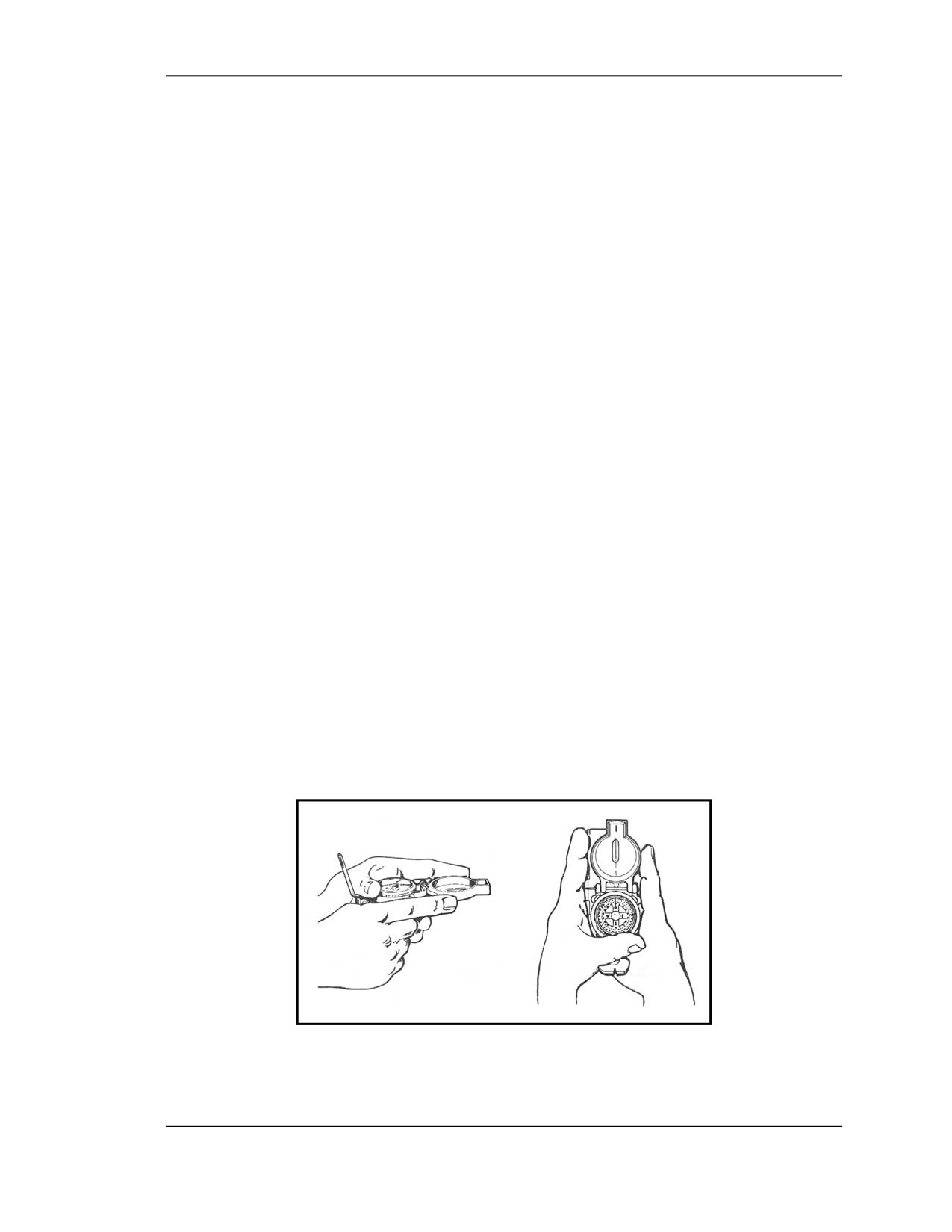
a. Using the Centerhold Technique. First, open the compass to its fullest so that the
cover forms a straightedge with the base. Move the lens (rear sight) to the rearmost position,
allowing the dial to float freely. Next, place your thumb through the thumb loop, form a
steady base with your third and fourth fingers, and extend your index finger along the side of
the compass. Place the thumb of the other hand between the lens (rear sight) and the bezel
ring; extend the index finger along the remaining side of the compass, and the remaining
fingers around the fingers of the other hand. Pull your elbows firmly into your sides; this will
place the compass between your chin and your belt. To measure an azimuth, simply turn
your entire body toward the object, pointing the compass cover directly at the object. Once
you are pointing at the object, look down and read the azimuth from beneath the fixed black
index line (Figure 9-2). This preferred method offers the following advantages over the
sighting technique:
• It is faster and easier to use.
• It can be used under all conditions of visibility.
• It can be used when navigating over any type of terrain.
• It can be used without putting down the rifle; however, the rifle must be slung
well back over either shoulder.
• It can be used without removing eyeglasses.
Figure 9-2. Centerhold technique.
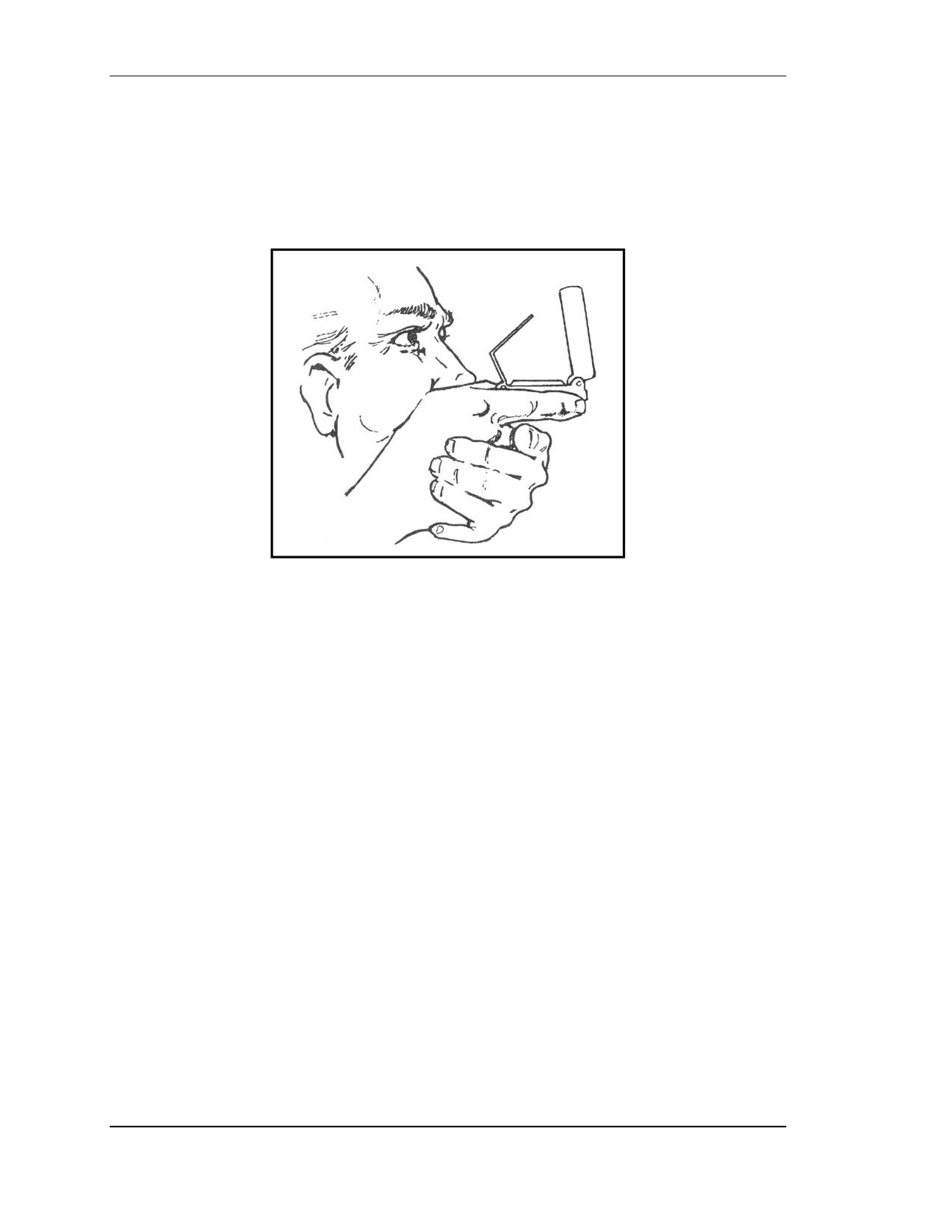
b. Using the Compass-to-Cheek Technique. Fold the cover of the compass containing
the sighting wire to a vertical position; then fold the rear sight slightly forward. Look
FOUO
9-3
18 January 2005
FM 3-25.26
through the rear-sight slot and align the front-sight hairline with the desired object in the
distance. Glance down at the dial through the eye lens to read the azimuth (Figure 9-3).
NOTE: The compass-to-cheek technique is used almost exclusively for sighting, and it is
the best technique for this purpose.
Figure 9-3. Compass-to-cheek technique.
c. Presetting a Compass and Following an Azimuth. Although different models of
the lensatic compass vary somewhat in the details of their use, the principles are the same.
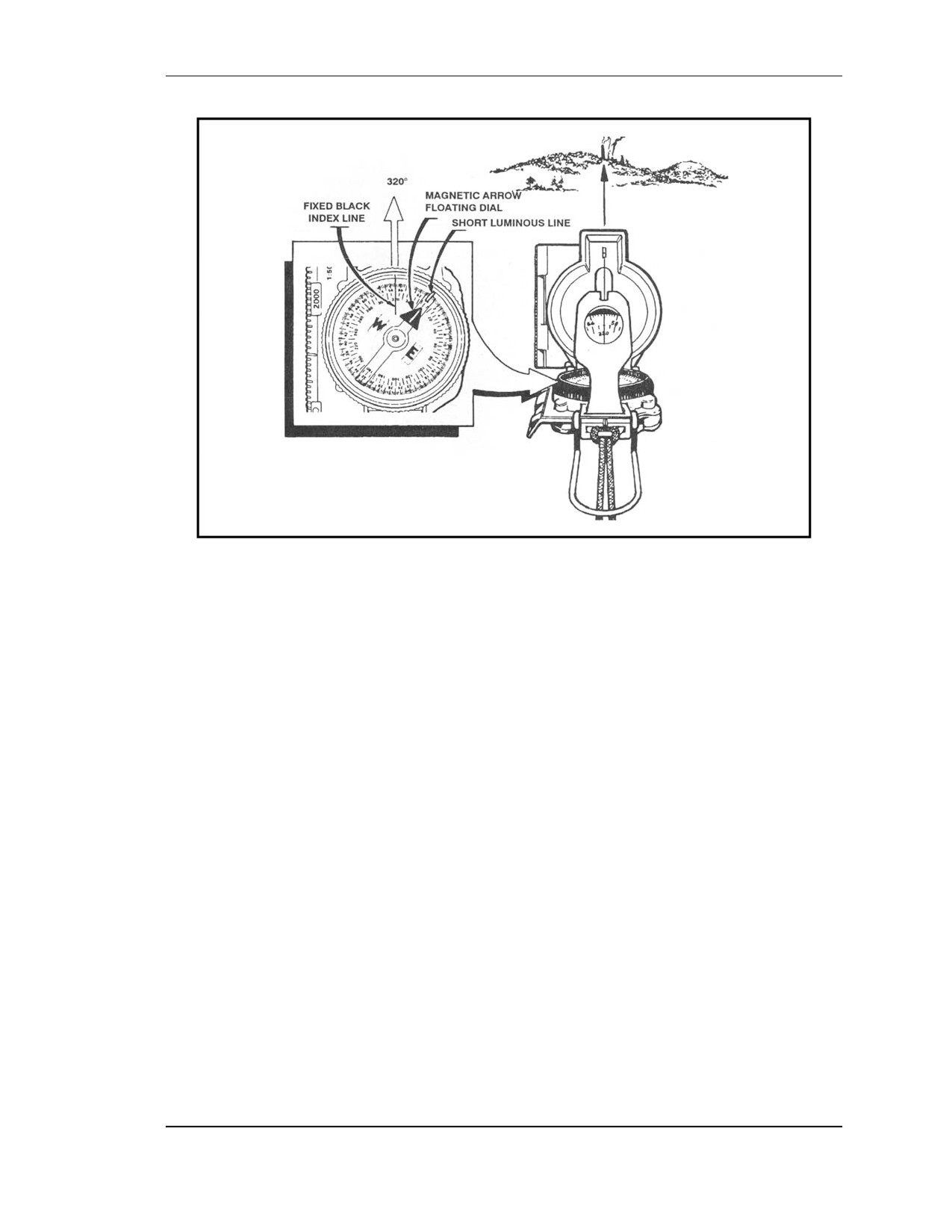
(1) During daylight hours or with a light source—
(a) Hold the compass level in the palm of the hand.
(b) Rotate it until the desired azimuth falls under the fixed black index line (for example,
320 degrees), maintaining the azimuth as prescribed (Figure 9-4).
(c) Turn the bezel ring until the luminous line is aligned with the north-seeking arrow.
Once the alignment is obtained, the compass is preset.
(d) To follow an azimuth, assume the centerhold technique and turn your body until the
north-seeking arrow is aligned with the luminous line. Proceed forward in the direction of
the front cover’s sighting wire, which is aligned with the fixed black index line that contains
the desired azimuth.
9-4
FOUO
18 January 2005
FM 3-25.26
Figure 9-4. Compass preset at 320 degrees.
(2) During limited visibility, an azimuth may be set on the compass by the click method.
Remember that the bezel ring contains 3-degree intervals (clicks).
(a) Rotate the bezel ring until the luminous line is over the fixed black index line.
(b) Find the desired azimuth and divide it by three. The result is the number of clicks that
you have to rotate the bezel ring.
(c) Count the desired number of clicks. If the desired azimuth is smaller than
180 degrees, the number of clicks on the bezel ring should be counted in a counterclockwise
direction. For example, the desired azimuth is 51 degrees; 51 degrees ÷ 3 = 17 clicks
counterclockwise. If the desired azimuth is larger than 180 degrees, subtract the number of
degrees from 360 degrees and divide by 3 to obtain the number of clicks. Count them in a
clockwise direction. For example, the desired azimuth is
330 degrees;
360 degrees − 330 degrees = 30 ÷ 3 = 10 clicks clockwise.
(d) With the compass preset as described above, assume a centerhold technique and
rotate your body until the north-seeking arrow is aligned with the luminous line on the bezel.
Proceed forward in the direction of the front cover’s luminous dots, which are aligned with
the fixed black index line containing the azimuth.
(e) When the compass is to be used in darkness, an initial azimuth should be set while
light is still available, if possible. With the initial azimuth as a base, any other azimuth that is
a multiple of three can be established using the clicking feature of the bezel ring.
NOTE: Sometimes the desired azimuth is not exactly divisible by three, causing an
option of rounding up or rounding down. Rounding up causes an increase in the
value of the azimuth, and the object is to be found on the left. Rounding down
FOUO
9-5
18 January 2005
FM 3-25.26
causes a decrease in the value of the azimuth, and the object is to be found on the
right.
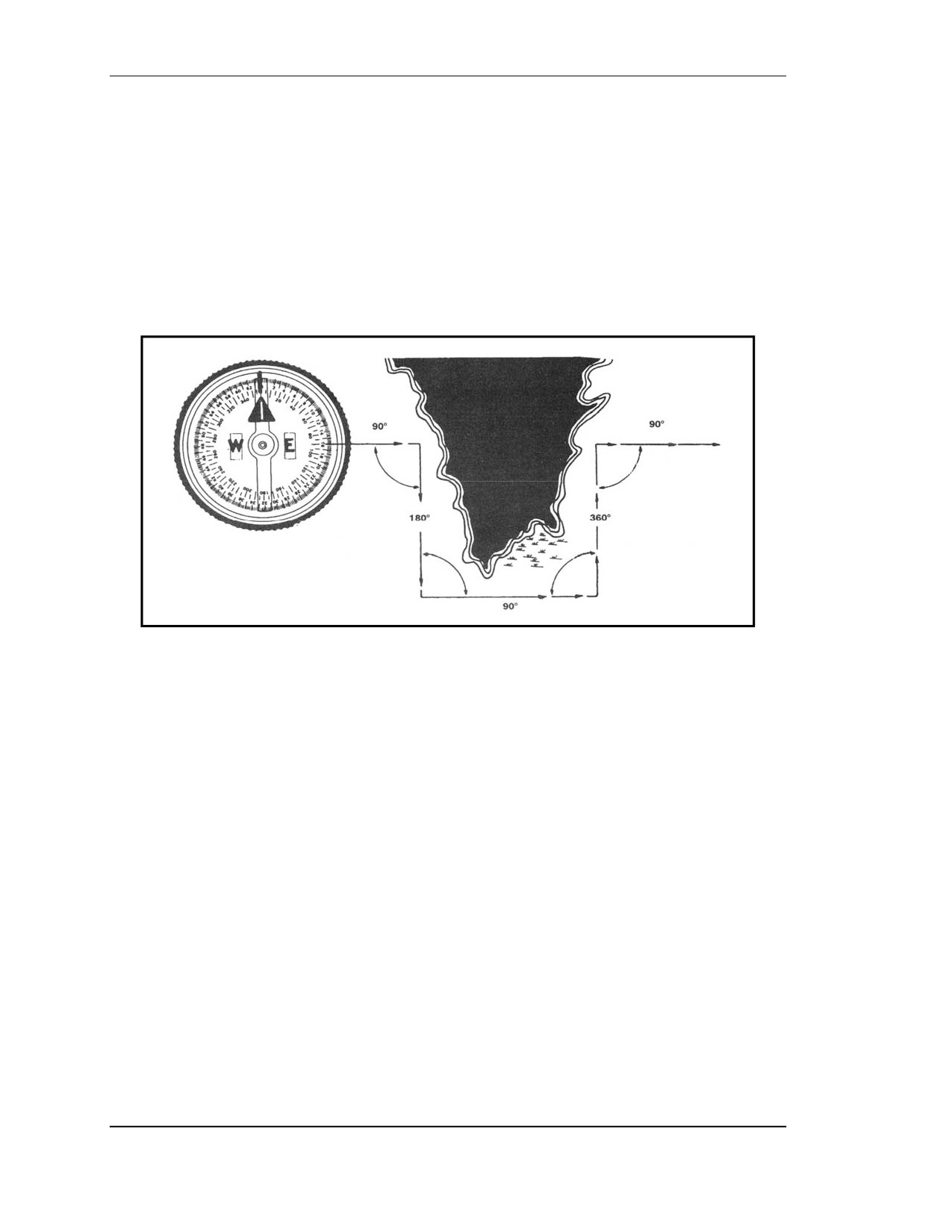
d. Bypassing an Obstacle. To bypass enemy positions or obstacles and still stay
oriented, detour around the obstacle by moving at right angles for specified distances.
(1) For example, while moving on an azimuth of 90 degrees change your azimuth to
180 degrees and travel for 100 meters. Change your azimuth to 90 degrees and travel for
150 meters. Change your azimuth to 360 degrees and travel for 100 meters. Then, change
your azimuth to 90 degrees and you are back on your original azimuth line (Figure 9-5).
Figure 9-5. Bypassing an obstacle.
(2) Bypassing an unexpected obstacle at night is a fairly simple matter. To make a
90-degree turn to the right, hold the compass in the centerhold technique; turn until the
center of the luminous letter E is under the luminous line (do not move the bezel ring). To
make a 90-degree turn to the left, turn until the center of the luminous letter W is under the
luminous line. This does not require changing the compass setting (bezel ring), and it ensures
accurate 90-degree turns.
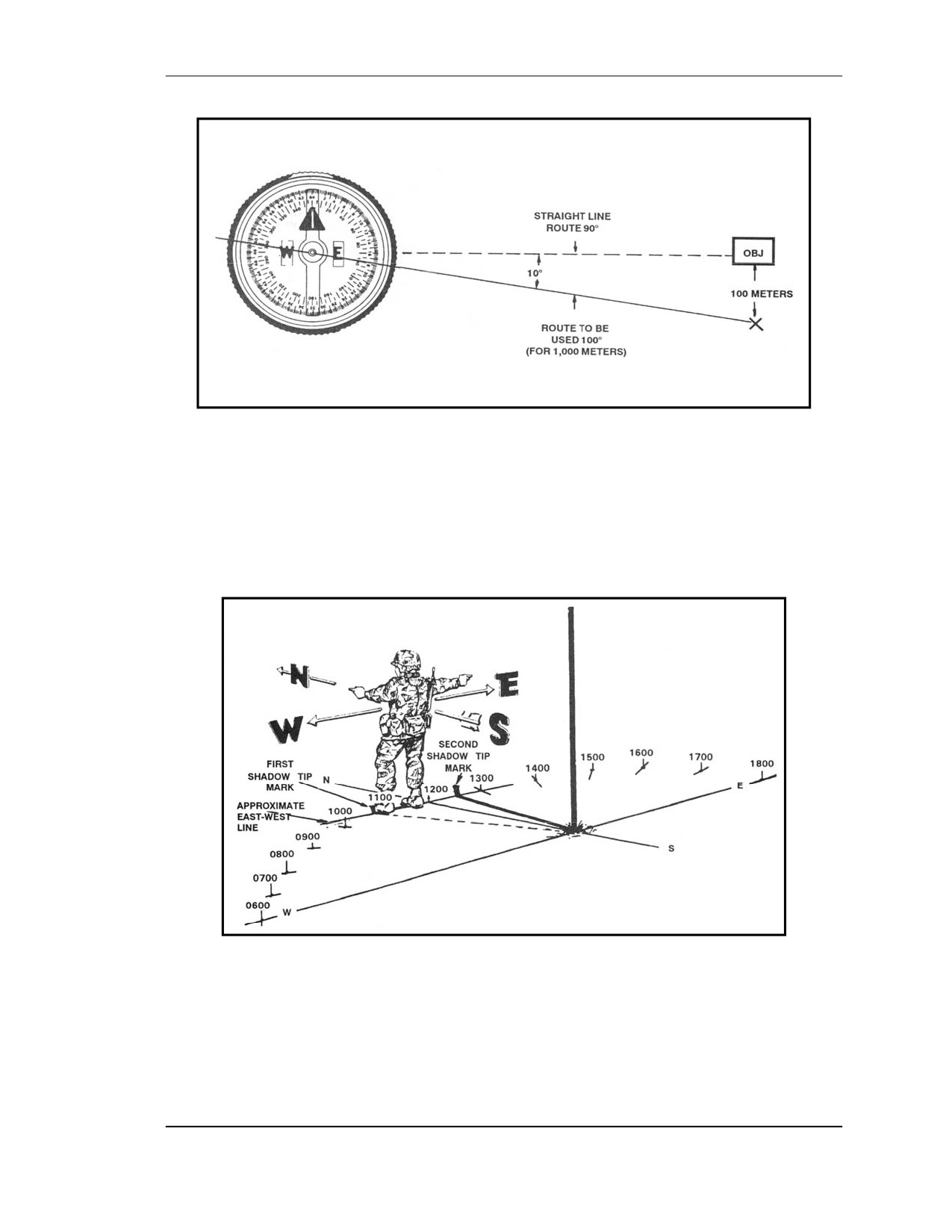
e. Offset. A deliberate offset is a planned magnetic deviation to the right or left of an
azimuth to an objective. Use it when the objective is located along or in the vicinity of a
linear feature such as a road or stream. Because of errors in the compass or in map reading,
the linear feature may be reached without knowing whether the objective lies to the right or
left. A deliberate offset by a known number of degrees in a known direction compensates for
possible errors and ensures that upon reaching the linear feature, the user knows whether to
go right or left to reach the objective. Ten degrees is an adequate offset for most tactical
uses. Each degree offset moves the course about 18 meters to the right or left for each
1,000 meters traveled. For example, in Figure 9-6, the number of degrees offset is 10. If the
distance traveled to “X” in 1,000 meters, then “X” is located about 180 meters to the right of
the objective.
9-6
FOUO
18 January 2005
FM 3-25.26
Figure 9-6. Deliberate offset to the objective.
9-5.
FIELD-EXPEDIENT METHODS
When a compass is not available, different techniques may be used to determine the four
cardinal directions.
a. Shadow-Tip Method. This simple and accurate method of finding direction by the
sun consists of four basic steps (Figure 9-7).
Figure 9-7. Determining directions and time by shadow.
Step 1.
Place a stick or branch into the ground at a level spot where a distinctive
shadow will be cast. Mark the shadow tip with a stone, twig, or other means.
This first shadow mark is always the west direction.
Step 2.
Wait 10 to 15 minutes until the shadow tip moves a few inches. Mark the
new position of the shadow tip in the same way as the first.
FOUO
9-7
18 January 2005
FM 3-25.26
Step 3.
Draw a straight line through the two marks to obtain an approximate east-
west line.
Step 4.
Standing with the first mark (west) to your left, the other directions are
simple; north is to the front, east is to the right, and south is behind you.
(1) A line drawn perpendicular to the east-west line at any point is the approximate
north-south line. If you are uncertain which direction is east and which is west, observe this
simple rule—the first shadow-tip mark is always in the west direction, everywhere on earth.
(2) The shadow-tip method can also be used as a shadow clock to find the approximate
time of day (Figure 9-7).
(a) To find the time of day, move the stick to the intersection of the east-west line and
the north-south line, and set it vertically in the ground. The west part of the east-west line
indicates 0600 hours, and the east part is 1800 hours, anywhere on earth, because the basic
rule always applies.
(b) The north-south line now becomes the noon line. The shadow of the stick is an hour
hand in the shadow clock, and with it you can estimate the time using the noon line and the 6
o’clock line as your guides. Depending on your location and the season, the shadow may
move either clockwise or counterclockwise, but this does not alter your manner of reading
the shadow clock.
(c) The shadow clock is not a timepiece in the ordinary sense. It makes every day 12
unequal hours long, and always reads 0600 hours at sunrise and 1800 hours at sunset. The
shadow clock time is closest to conventional clock time at midday, but the spacing of the
other hours compared to conventional time varies somewhat with the locality and the date.
However, it does provide a satisfactory means of telling time in the absence of properly set
watches.
(d) The shadow-tip system is not intended for use in polar regions, which the Department
of Defense defines as being above 60 degrees latitude in either hemisphere. Distressed
persons in these areas are advised to stay in one place so that search/rescue teams can easily
find them. The presence and location of all aircraft and ground parties in polar regions are
reported to and checked regularly by governmental or other agencies, and any need for help
becomes quickly known.
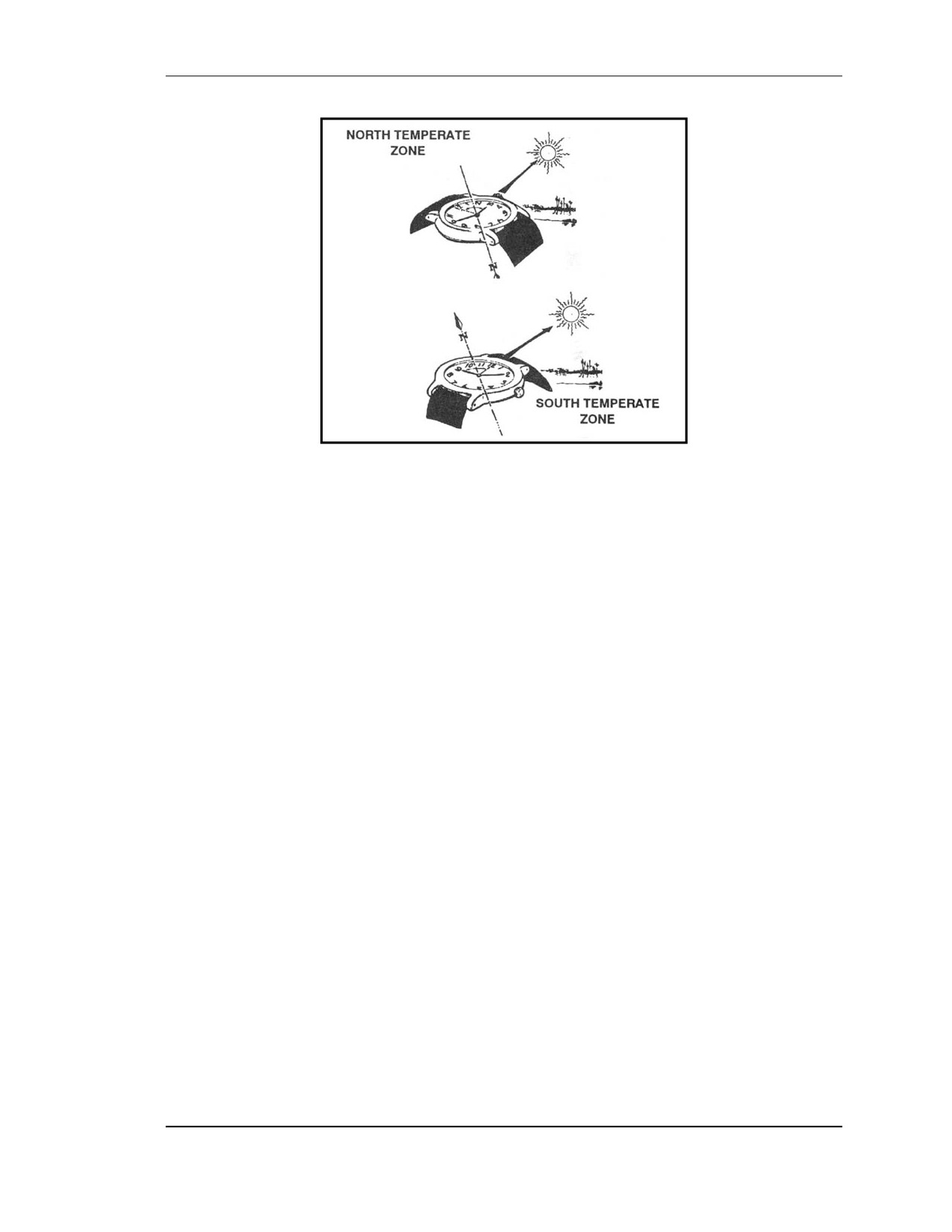
b. Watch Method. A watch can be used to determine the approximate true north and
true south.
(1) In the north temperate zone only, the hour hand is pointed toward the sun. A south
line can be found midway between the hour hand and 1200 hours, standard time. If on
daylight savings time, the north-south line is found between the hour hand and 1300 hours. If
there is any doubt as to which end of the line is north, remember that the sun is in the east
before noon and in the west after noon.
(2) The watch may also be used to determine direction in the south temperate zone;
however, the method is different. The 1200-hour dial is pointed toward the sun, and halfway
between 1200 hours and the hour hand will be a north line. If on daylight savings time, the
north line lies midway between the hour hand and 1300 hours (Figure 9-8).
9-8
FOUO
18 January 2005
FM 3-25.26
Figure 9-8. Determining direction using a watch.
(3) The watch method can be in error, especially in the lower latitudes, and may cause
circling. To avoid this, make a shadow clock and set your watch to the time indicated. After
traveling for an hour, take another shadow-clock reading. Reset your watch if necessary.
c. Star Method. Less than 60 of about 5,000 stars visible to the eye are used by
navigators. The stars seen as we look up at the sky at night are not evenly scattered across
the whole sky. Instead they are in groups called constellations.
(1) The constellations that we see depends partly on where we are located on the earth,
the time of the year, and the time of the night. The night changes with the seasons because of
the journey of the earth around the sun, and it also changes from hour to hour because the
turning of the earth makes some constellations seem to travel in a circle. But there is one star
that is in almost exactly the same place in the sky all night long every night. It is the North
Star, also known as the Polar Star or Polaris.
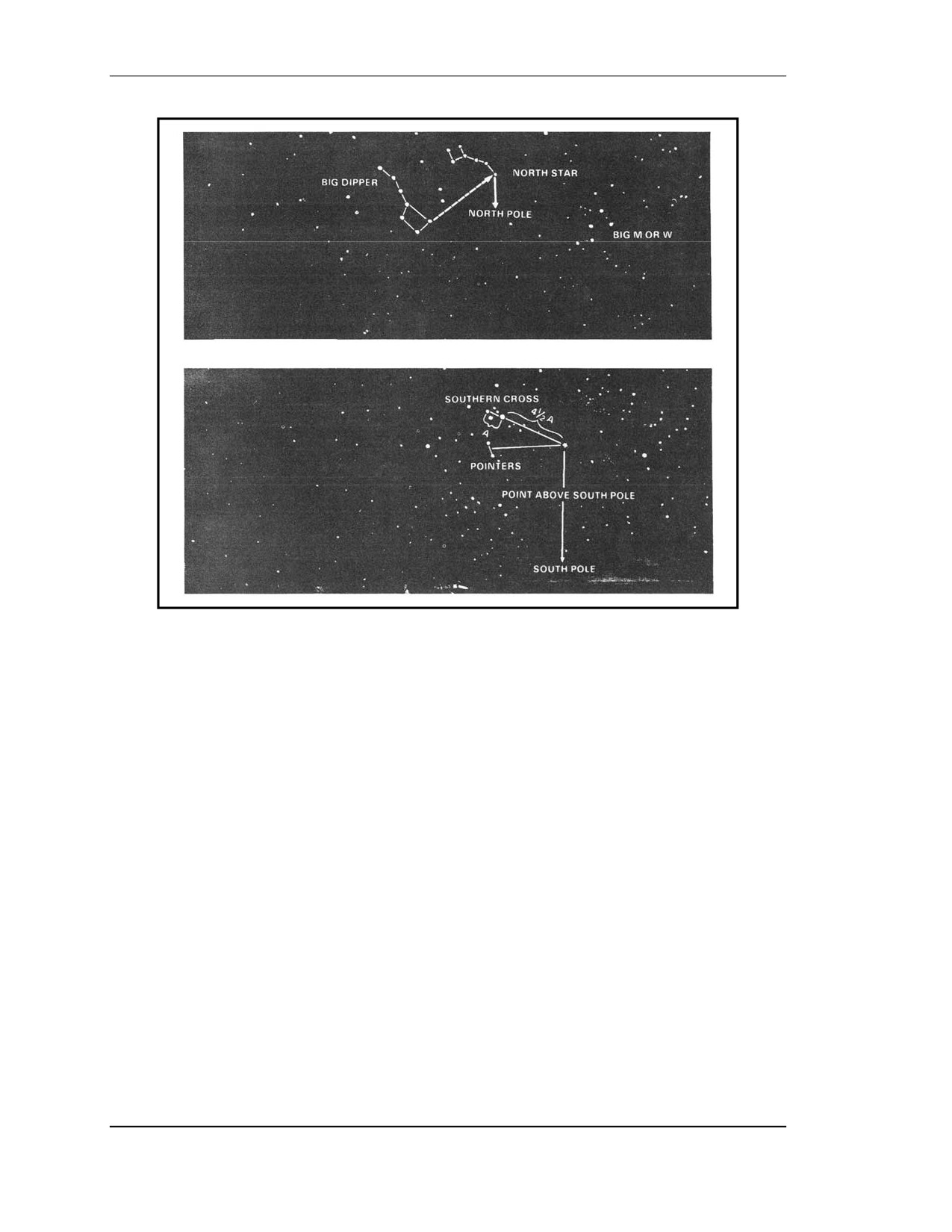
(a) The North Star is less than 1 degree off true north and does not move from its place
because the axis of the earth is pointed toward it. The North Star is in the group of stars
called the Little Dipper. It is the last star in the handle of the dipper. There are two stars in
the Big Dipper, which are a big help when trying to find the North Star. They are called the
Pointers, and an imaginary line drawn through them five times their distance points to the
North Star.
(b) Many stars are brighter than the North Star, but none is more important because of its
location. However, the North Star can only be seen in the northern hemisphere so it cannot
serve as a guide south of the equator. The farther one goes north, the higher the North Star is
in the sky, and above latitude 70 degrees, it is too high in the sky to be useful (Figure 9-9,
page 9-10).
FOUO
9-9
18 January 2005
FM 3-25.26
Figure 9-9. Determining direction by the
North Star and Southern Cross.
(2) Depending on the star selected for navigation, azimuth checks are necessary. A star
near the north horizon serves for about half an hour. When moving south, azimuth checks
should be made every 15 minutes. When traveling east or west, the difficulty of staying on
azimuth is caused more by the likelihood of the star climbing too high in the sky or losing
itself behind the western horizon than it is by the star changing direction angle. When this
happens, it is necessary to change to another guide star. The Southern Cross is the main
constellation used as a guide south of the equator, and the general directions for using north
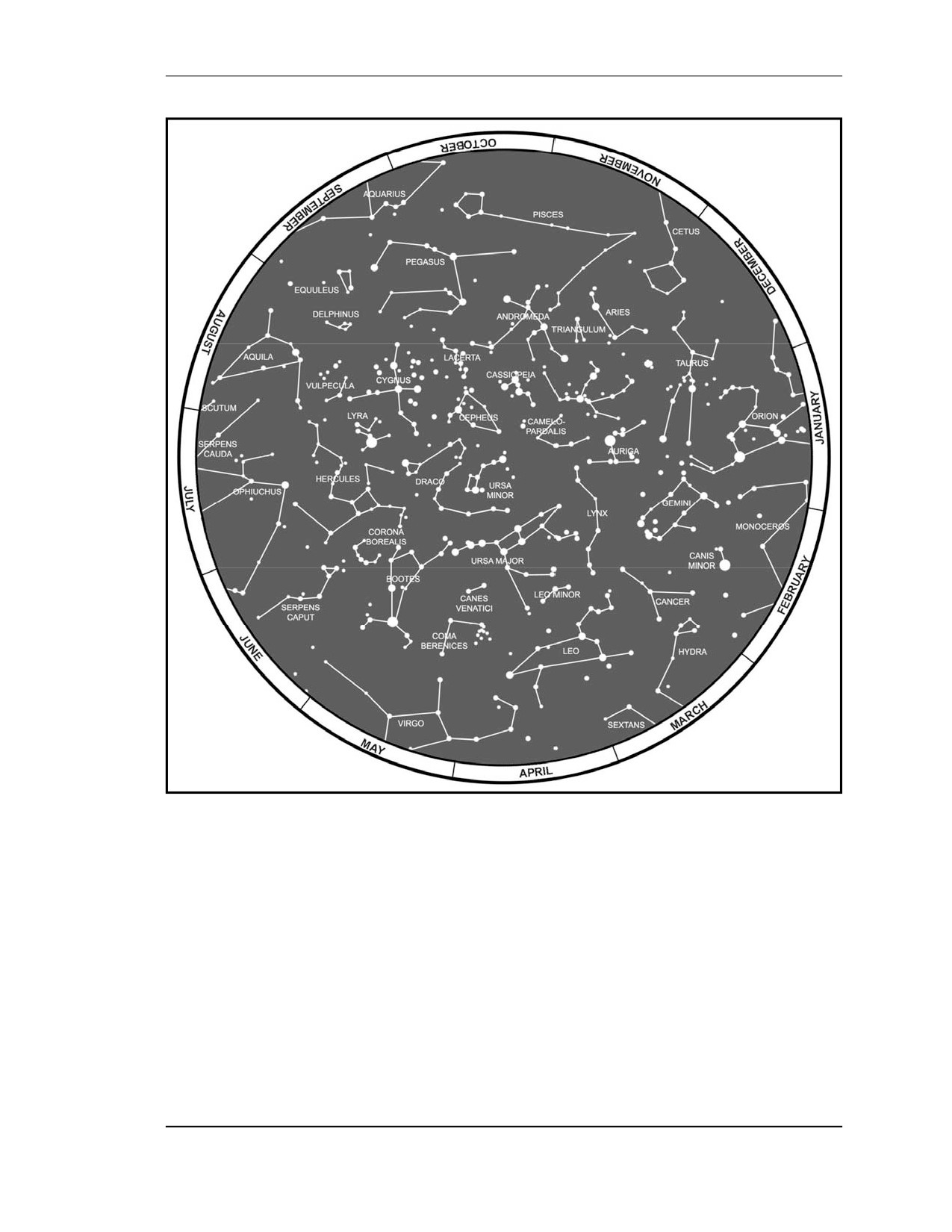
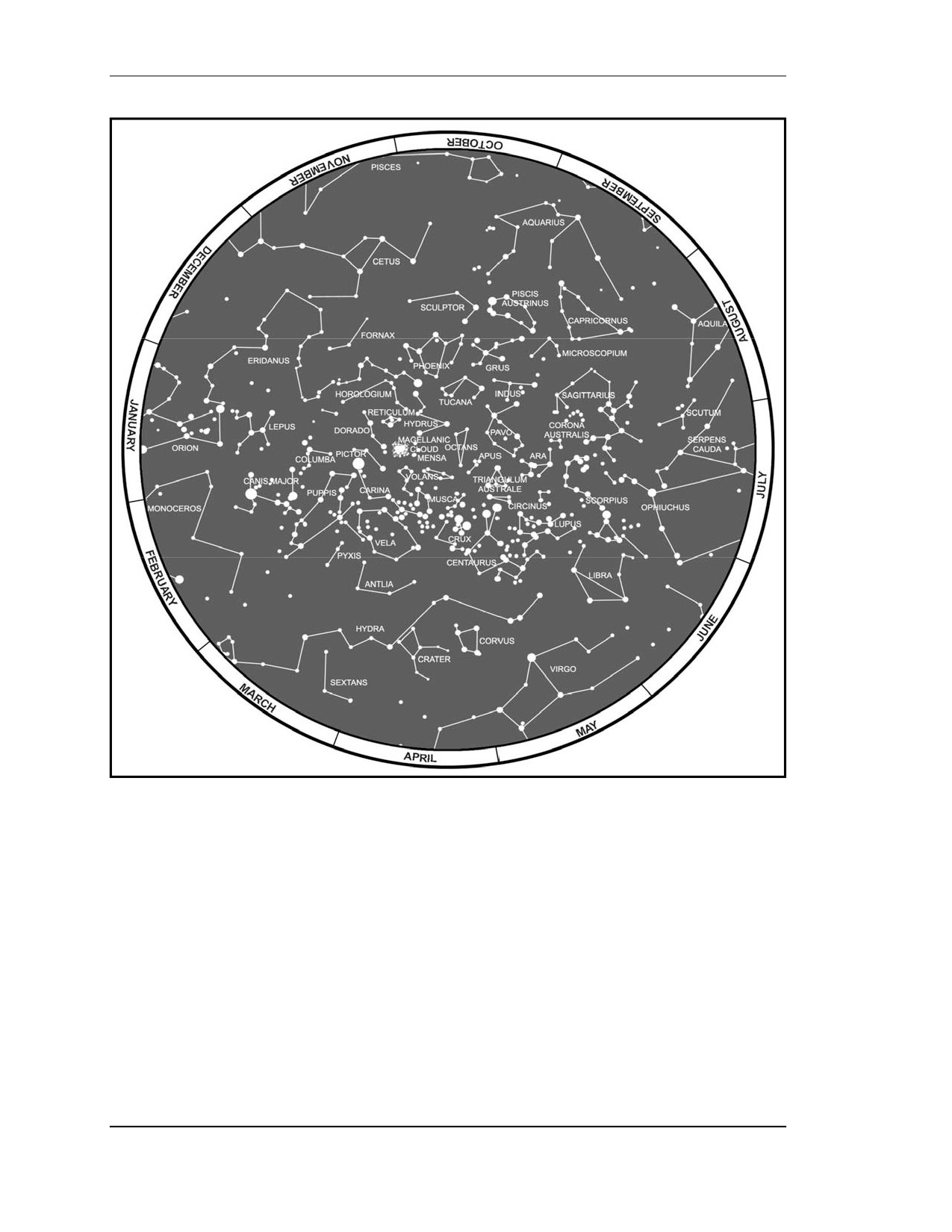
and south stars are reversed. When navigating using the stars as guides, the user must know
the different constellation shapes and their locations throughout the world (Figure 9-10 and
Figure 9-11 on page 9-12).
9-10
FOUO
18 January 2005
FM 3-25.26
Figure 9-10. Constellations, northern hemisphere.
FOUO
9-11
18 January 2005
FM 3-25.26
Figure 9-11. Constellations, southern hemisphere.
9-6.
GLOBAL POSITIONING SYSTEM
The GPS is a space-based, global, all-weather, continuously available, radio positioning
navigation system. It is highly accurate in determining position location derived from signal
triangulation from a satellite constellation system. It is capable of determining latitude,
longitude, and altitude of the individual user. It is being fielded in hand-held, manpack,
vehicular, aircraft, and watercraft configurations. The GPS receives and processes data from
satellites on either a simultaneous or sequential basis. It measures the velocity and range
with respect to each satellite, processes the data in terms of an earth-centered, earth-fixed
coordinate system, and displays the information to the user in geographic or military grid
coordinates. (See Appendix I for more information on the GPS.)
a. The GPS can provide precise steering information, as well as position location. The
receiver can accept many checkpoints entered in any coordinate system by the user and
convert them to the desired coordinate system. The user then calls up the desired checkpoint
9-12
FOUO
18 January 2005
FM 3-25.26
and the receiver will display direction and distance to the checkpoint. The GPS does not
have inherent drift, an improvement over the Inertial Navigation System, and the receiver
will automatically update its position. The receiver can also compute time to the next
checkpoint.
b. Specific uses for the GPS are position location; navigation; weapon location; target
and sensor location; coordination of firepower; scout and screening operations; combat
resupply; location of obstacles, barriers, and gaps; and communication support. The GPS
also has the potential to allow units to train their Soldiers and provide the following:
• Performance feedback.
• Knowledge of routes taken by the Soldier.
• Knowledge of errors committed by the Soldier.
• Comparison of planned versus executed routes.
• Safety and control of lost and injured Soldiers.
FOUO
9-13
18 January 2005