FM 3-25.26 MAP READING AND LAND NAVIGATION (January 2005) - page 1
*FM 3-25.26
FIELD MANUAL
HEADQUARTERS
No. 3-25.26
DEPARTMENT OF THE ARMY
Washington, DC, 18 January 2005
MAP READING AND LAND NAVIGATION
CONTENTS
Page
PREFACE
v
Part One
MAP READING
CHAPTER 1.
TRAINING STRATEGY
1-1.
Building-Block Approach
1-1
1-2.
Armywide Implementation
1-2
1-3.
Safety
1-2
CHAPTER 2.
MAPS
2-1.
Definition
2-1
2-2.
Purpose
2-1
2-3.
Procurement
2-2
2-4.
Security
2-2
2-5.
Care
2-3
2-6.
Categories
2-3
2-7.
Military Map Substitutes
2-6
2-8.
Standards of Accuracy
2-7
CHAPTER 3.
MARGINAL INFORMATION AND SYMBOLS
3-1.
Marginal Information on a Military Map
3-1
3-2.
Additional Notes
3-5
3-3.
Topographic Map Symbols
3-5
3-4.
Military Symbols
3-6
3-5.
Colors Used on a Military Map
3-6
DISTRIBUTION RESTRICTION: Distribution authorized to U.S. Government agencies
and their contractors only (this publication addresses current technology in areas of
significant or potentially significant military application). This determination was made on
September 13, 2004. Other requests for this document will be referred to: Commandant; U.S.
Army Infantry School; ATTN: ATSH-INB-O; Fort Benning, GA 31905-5593.
DESTRUCTION NOTICE: Destroy by any method that will prevent disclosure of
contents or reconstruction of the document.
_________________
*This publication supersedes FM 3-25.26, 20 July 2001.
FOUO
i
FM 3-25.26
Page
CHAPTER 4.
GRIDS
4-1.
Reference System
4-1
4-2.
Geographic Coordinates
4-1
4-3.
Military Grids
4-10
4-4.
United States Army Military Grid Reference System
4-12
4-5.
Locating a Point Using Grid Coordinates
4-17
4-6.
Locating a Point Using the U.S. Army Military Grid
Reference System
4-19
4-7.
Grid Reference Box
4-22
4-8.
Other Grid Systems
4-23
4-9.
Protection of Map Coordinates and Locations
4-25
CHAPTER 5.
SCALE AND DISTANCE
5-1.
Representative Fraction
5-1
5-2.
Graphic (Bar) Scales
5-3
5-3.
Other Methods
5-10
CHAPTER 6.
DIRECTION
6-1.
Methods of Expressing Direction
6-1
6-2.
Base Lines
6-1
6-3.
Azimuths
6-2
6-4.
Grid Azimuths
6-3
6-5.
Protractor
6-4
6-6.
Declination Diagram
6-7
6-7.
Intersection
6-13
6-8.
Resection
6-15
6-9.
Modified Resection
6-16
6-10.
Polar Plot
6-17
CHAPTER 7.
OVERLAYS
7-1.
Purpose
7-1
7-2.
Map Overlay
7-1
7-3.
Aerial Photograph Overlay
7-3
CHAPTER 8.
AERIAL PHOTOGRAPHS
8-1.
Comparison with Maps
8-1
8-2.
Types
8-1
8-3.
Types of Film
8-7
8-4.
Numbering and Titling Information
8-7
8-5.
Scale Determination
8-8
8-6.
Indexing
8-10
8-7.
Orientation of Photograph
8-13
8-8.
Point Designation Grid
8-14
ii
FOUO
18 January 2005
COORDINATING DRAFT
FM 3-25.26
Page
8-9.
Identification of Photograph Features
8-17
8-10.
Stereovision
8-18
Part Two
LAND NAVIGATION
CHAPTER 9. NAVIGATION EQUIPMENT AND METHODS
9-1.
Types of Compasses
9-1
9-2.
Lensatic Compass
9-1
9-3.
Compass Handling
9-2
9-4.
Using a Compass
9-3
9-5.
Field-Expedient Methods
9-7
9-6.
Global Positioning System
9-12
CHAPTER 10. ELEVATION AND RELIEF
10-1. Definitions
10-1
10-2. Methods of Depicting Relief
10-1
10-3. Contour Intervals
10-2
10-4. Types of Slopes
10-5
10-5. Percentage of Slope
10-7
10-6. Terrain Features
10-10
10-7. Interpretation of Terrain Features
10-16
10-8. Profiles
10-19
CHAPTER 11. TERRAIN ASSOCIATION
11-1. Orientation of the Map
11-1
11-2. Locations
11-6
11-3. Terrain Association Usage
11-6
11-4. Tactical Considerations
11-9
11-5. Movement and Route Selection
11-12
11-6. Navigation Methods
11-14
11-7. Night Navigation
11-18
CHAPTER 12. MOUNTED LAND NAVIGATION
12-1. Principles
12-1
12-2. Navigator's Duties
12-1
12-3. Movement
12-1
12-4. Terrain Association Navigation
12-3
12-5. Dead Reckoning Navigation
12-5
12-6. Stabilized Turret Alignment Navigation
12-7
12-7. Combination Navigation
12-7
iii
18 January 2005
FM 3-25.26
Page
CHAPTER 13. NAVIGATION IN DIFFERENT TYPES OF TERRAIN
13-1. Desert Terrain
13-1
13-2. Mountain Terrain
13-4
13-3. Jungle Terrain
13-6
13-4. Arctic Terrain
13-9
13-5. Urban Areas
13-10
CHAPTER 14. UNIT SUSTAINMENT
14-1. Set Up a Sustainment Program
14-1
14-2. Set Up a Train-the-Trainer Program
14-2
14-3. Set Up a Land Navigation Course
14-2
APPENDIX A. SKETCHES
A-1
APPENDIX B. MAP FOLDING TECHNIQUES
B-1
APPENDIX C. UNITS OF MEASURE AND CONVERSION FACTORS
C-1
APPENDIX D. JOINT OPERATIONS GRAPHICS
D-1
APPENDIX E. ORIENTEERING
E-1
APPENDIX F. M2 COMPASS
F-1
APPENDIX G. ADDITIONAL AIDS
G-1
APPENDIX H. FOREIGN MAPS
H-1
APPENDIX I. GLOBAL POSITIONING SYSTEM
I-1
APPENDIX J. PRECISION LIGHTWEIGHT GPS RECEIVER
J-1
APPENDIX K. DEFENSE ADVANCED GPS RECEIVER
K-1
GLOSSARY
Glossary-1
REFERENCES
References-1
INDEX
Index-1
iv
FOUO
18 January 2005
Change 1, FM 3-25.26
PREFACE
The field manual provides a standardized source document for Armywide reference on map
reading and land navigation. It applies to every Soldier in the Army regardless of service branch,
MOS, or rank.
* This manual also contains both doctrine and training guidance on map reading and land
navigation. Part One addresses map reading and Part Two, land navigation. The appendixes
include an introduction to orienteering and a discussion of several devices that can assist the
Soldier in land navigation.
* The proponent for this publication is the U.S. Army Training and Doctrine Command. The
preparing agency is the U.S. Army Infantry School. You may send comments and
recommendations by any means, US mail, e-mail, fax, or telephone, as long as you use or follow
the format of DA Form 2028, Recommended Changes to Publications and Blank Forms. You
may also phone for more information. Point of contact information is as follows.
E-mail: 229-DOC-LIT@benning.army.mil
Phone: Commercial: 706-545-8623 or DSN: 835-8623
Fax:
Commercial: 706-545-8600 or DSN: 835-8600
US Mail: Commandant, USAIS
ATTN; ATSH-INB, BLDG 74, Room 102
Dilboy Street, Bldg 74, Rm 102
Fort Benning, GA 31905-5593
Unless this publication states otherwise, masculine nouns and pronouns do not refer
exclusively to men.
30 August 2006
v
FOUO
This Page intentionally left blank.
C1, FM 3-25.26
PART ONE
MAP READING
CHAPTER 1
TRAINING STRATEGY
This manual responds to an Armywide need for a new map reading
and land navigation training strategy based on updated doctrine. This
chapter describes and illustrates this approach to teaching these skills.
1-1.
BUILDING-BLOCK APPROACH
Institution courses are designed to prepare the Soldier for a more advanced duty position
in his unit. The critical soldiering skills of move, shoot, and communicate must be
trained, practiced, and sustained at every level in the schools as well as in the unit. The
map reading and land navigation skills taught at each level are critical to the soldiering
skills of the duty position for which he is being school-trained. Therefore, they are also a
prerequisite for a critical skill at a more advanced level.
a. A Soldier completing initial-entry training must be prepared to become a team
member. He must be proficient in the basic map reading and dead reckoning skills.
* b. After completing the Warrior Leader Course (WLC), a Soldier should be ready to
be a team leader. This duty position requires expertise in the skills of map reading, dead
reckoning, and terrain association.
c. A Soldier completing the Basic Noncommissioned Officer’s Course (BNCOC)
has been trained for the squad leader position. Map reading and land navigation at skill
level 3 requires development of problem-solving skills; for example, route selection and
squad tactical movement.
d. At skill level 4, the Soldier completing the Advanced Noncommissioned Officer’s
Course (ANCOC) is prepared to assume the duty position of platoon sergeant or
operations NCO. Planning tactical movements, developing unit sustainment, and making
decisions are the important land navigation skills at this level.
e. Officers follow similar progression. A new second lieutenant must have mastered
map reading and land navigation skills, and have an aptitude for dead reckoning and
terrain association.
(1) After completing the Officer Basic Course (OBC), the officer must be prepared to
assume the duties and responsibilities of a platoon leader. He is required to execute the
orders and operations of his commander. Map reading and land navigation at this level
require development of the problem-solving skills of route selection and tactical
movement.
*(2) After completing the Captain’s Career Course
(CCC), the officer is
prepared to assume the duties and responsibilities of a company commander or primary
staff officer. The commander must plan and execute operations with full consideration to
all aspects of navigation. The staff officer must recommend battlefield placement of all
administrative, logistical, and personnel resources. These recommendations cannot be
tactically sound unless the estimate process includes a detailed analysis of the area of
operations. This ability requires expertise in all map reading and navigation skills to
include the use of nonmilitary maps, aerial photographs, and terrain analysis with respect
to both friendly and enemy forces. The commander/staff officer must plan and execute a
program to develop the unit’s train-the-trainer program for land navigation.
30 August 2006
1-1
FOUO
C1, FM 3-25.26
f. A program of demonstrated proficiency of all the preceding skill levels to the
specified conditions and standards is a prerequisite to the successful implementation of a
building-block training approach. This approach reflects duty position responsibilities in
map reading and land navigation. An understanding of the fundamental techniques of
dead reckoning or field-expedient methods is a basic survival skill that each Soldier must
develop at the initial-entry level. This skill provides a support foundation for more
interpretive analysis at intermediate skill levels 2 and 3, with final progression to level 4.
Mastery of all map reading and land navigation tasks required in previous duty positions
is essential for the sequential development of increasingly difficult abilities. Scope
statements support the building-block approach. It is part of the training doctrine at each
level in the institutional training environment of each course.
1-2.
ARMYWIDE IMPLEMENTATION
A mandatory core of critical map reading and land navigation tasks and a list of electives
will be provided to each TRADOC service school and FORSCOM professional
development school. Standardization is achieved through the mandatory core.
1-3.
SAFETY
Unit leaders plan to brief and enforce all safety regulations established by local range
control. They coordinate the mode of evacuation of casualties through the appropriate
channels. They review all installation safety regulations. Unit leaders must complete a
thorough terrain reconnaissance before using an area for land navigation training. They
should look for dangerous terrain, heavily trafficked roads, water obstacles, wildlife, and
training debris.
1-2
30 August 2006
FOUO
FM 3-25.26
CHAPTER 2
MAPS
Cartography is the art and science of expressing the known physical
features of the earth graphically by maps and charts. No one knows who
drew, molded, laced together, or scratched out in the dirt the first map. But a
study of history reveals that the most pressing demands for accuracy and
detail in mapping have come as the result of military needs. Today, the
complexities of tactical operations and deployment of troops are such that it
is essential for all Soldiers to be able to read and interpret their maps in
order to move quickly and effectively on the battlefield. This chapter includes
the definition and purpose of a map and describes map security, types,
categories, and scales.
2-1.
DEFINITION
A map is a graphic representation of a portion of the earth’s surface drawn to scale, as seen
from above. It uses colors, symbols, and labels to represent features found on the ground.
The ideal representation would be realized if every feature of the area being mapped could
be shown in true shape. Obviously this is impossible, and an attempt to plot each feature
true-to-scale would result in a product impossible to read even with the aid of a magnifying
glass.
a. To be understandable, features must be represented by conventional signs and
symbols. To be legible, many of these must be exaggerated in size, often far beyond the
actual ground limits of the feature represented. On a 1:250,000-scale map, the prescribed
symbol for a building covers an area about 500 square feet on the ground; a road symbol is
equivalent to a road about 520 feet wide on the ground; the symbol for a single-track railroad
(the length of a cross-tie) is equivalent to a railroad cross-tie about 1,000 feet on the ground.
b. The portrayal of many features requires similar exaggeration. Therefore, the selection
of features to be shown, as well as their portrayal, is in accordance with the guidance
established by the National Geospatial-Intelligence Agency (NGA).
2-2.
PURPOSE
A map provides information on the existence of, the location of, and the distance between
ground features such as populated places and routes of travel and communication. It also
indicates variations in terrain, heights of natural features, and the extent of vegetation cover.
With our military forces dispersed throughout the world, it is necessary to rely on maps to
provide information to our combat elements and to resolve logistical operations far from our
shores. Soldiers and materials must be transported, stored, and placed into operation at the
proper time and place. Much of this planning must be done using maps. All operations
require a supply of maps; however, the finest maps available are worthless unless the map
user knows how to read them.
FOUO
2-1
18 January 2005
FM 3-25.26
2-3.
PROCUREMENT
Most military units are authorized a basic load of maps. Local command supplements to
AR 115-11 provide tables of initial allowances for maps. Map requisitions and distributions
are accomplished through the NGA Hydrographic and Topographic Center’s Office of
Distribution and Services. In the division, however, the G2 section is responsible for maps.
a. To order a map, refer to the NGA catalog located at your S2/G2 shop. Part 3 of this
catalog, Topographic Maps, has five volumes. Using the delineated map index, find the map
or maps you want based upon the location of the nearest city. With this information, order
maps using the following forms:
• Department of Defense Form 1348 (DOD Single Line Item Requisition
System Document [Manual]). You can order copies of only one map sheet on
each form.
• Department of Defense Form 1348M (DOD Single Line Item Requisition
System Document [Mechanical]). DD 1348M is a punch card form for
AUDODIN ordering.
The numbered sections of all forms are the same. For example: In block 1, if you are in
CONUS, enter “AOD;” if you are overseas, enter “AO4.” In block 2, use one of the
following codes for your location. Your supply section will help you complete the rest of the
form.
LOCATION CODE
Europe
CS7
Hawaii
HM9
Korea
WM4
Alaska
WC1
Panama
HMJ
CONUS
HM8
b. Stock numbers are also listed in map catalogs, which are available at division and
higher levels and occasionally in smaller units. A map catalog consists of small-scale maps
upon which the outlines of the individual map sheets of a series have been delineated.
Another document that is an aid to the map user is the gazetteer. A gazetteer lists all the
names appearing on a map series of a geographical area, a designation that identifies what is
located at that place name, a grid reference, a sheet number of the map upon which the name
appeared, and the latitude and longitude of the named features. Gazetteers are prepared for
maps of foreign areas only.
2-4.
SECURITY
All maps should be considered as documents that require special handling. If a map falls into
unauthorized hands, it could easily endanger military operations by providing information of
friendly plans or areas of interest to the enemy. Even more important would be a map on
which the movements or positions of friendly Soldiers were marked. It is possible, even
though the markings on a map have been erased, to determine some of the erased
information. Maps are documents that must not fall into unauthorized hands.
a. If a map is no longer needed, it must be turned in to the proper authority. If a map is
in danger of being captured, it must be destroyed. The best method of destruction is by
2-2
FOUO
18 January 2005
FM 3-25.26
burning it and scattering the ashes. If burning is not possible, the map can be torn into small
pieces and scattered over a wide area.
b. Maps of some areas of the world are subject to third party limitations. These are
agreements that permit the United States to make and use maps of another country provided
these maps are not released to any third party without permission of the country concerned.
Such maps require special handling.
c. Some maps may be classified and must be handled and cared for in accordance with
AR 380-5 and, if applicable, other local security directives.
2-5.
CARE
Maps are documents printed on paper and require protection from water, mud, and tearing.
Whenever possible, a map should be carried in a waterproof case, in a pocket, or in some
other place where it is handy for use but still protected. (Appendix B shows two ways of
folding a map.)
a. Care must also be taken when using a map since it may have to last a long time. A
pencil is recommended if marking a map becomes necessary. Use light lines so they may be
erased easily without smearing and smudging or leaving marks that may cause confusion
later. If the map margins must be trimmed for any reason, it is essential to note any marginal
information that may be needed later, such as grid data and magnetic declination.
b. Special care should be taken of a map that is being used in a tactical mission,
especially in small units; the mission may depend on that map. All members of such units
should know the map’s location at all times.
2-6.
CATEGORIES
The NGA’s mission is to provide mapping, charting, and all geodesy support to the armed
forces and all other national security operations. NGA produces four categories of products
and services: hydrographic, topographic, aeronautical, and missile and targeting. Military
maps are categorized by scale and type.
a. Scale. Because a map is a graphic representation of a portion of the earth’s surface
drawn to scale as seen from above, it is important to know what mathematical scale has been
used. You must know the scale to determine ground distances between objects or locations
on the map, the size of the area covered, and how the scale may affect the amount of detail
being shown. The mathematical scale of a map is the ratio or fraction between the distance
on a map and the corresponding distance on the surface of the earth. Scale is reported as a
representative fraction (RF) with the map distance as the numerator and the ground distance
as the denominator.
map distance
Representative fraction (scale) = --------------------------------
ground distance
As the denominator of the representative fraction gets larger and the ratio gets smaller, the
scale of the map decreases. NGA maps are classified by scale into three categories: small-,
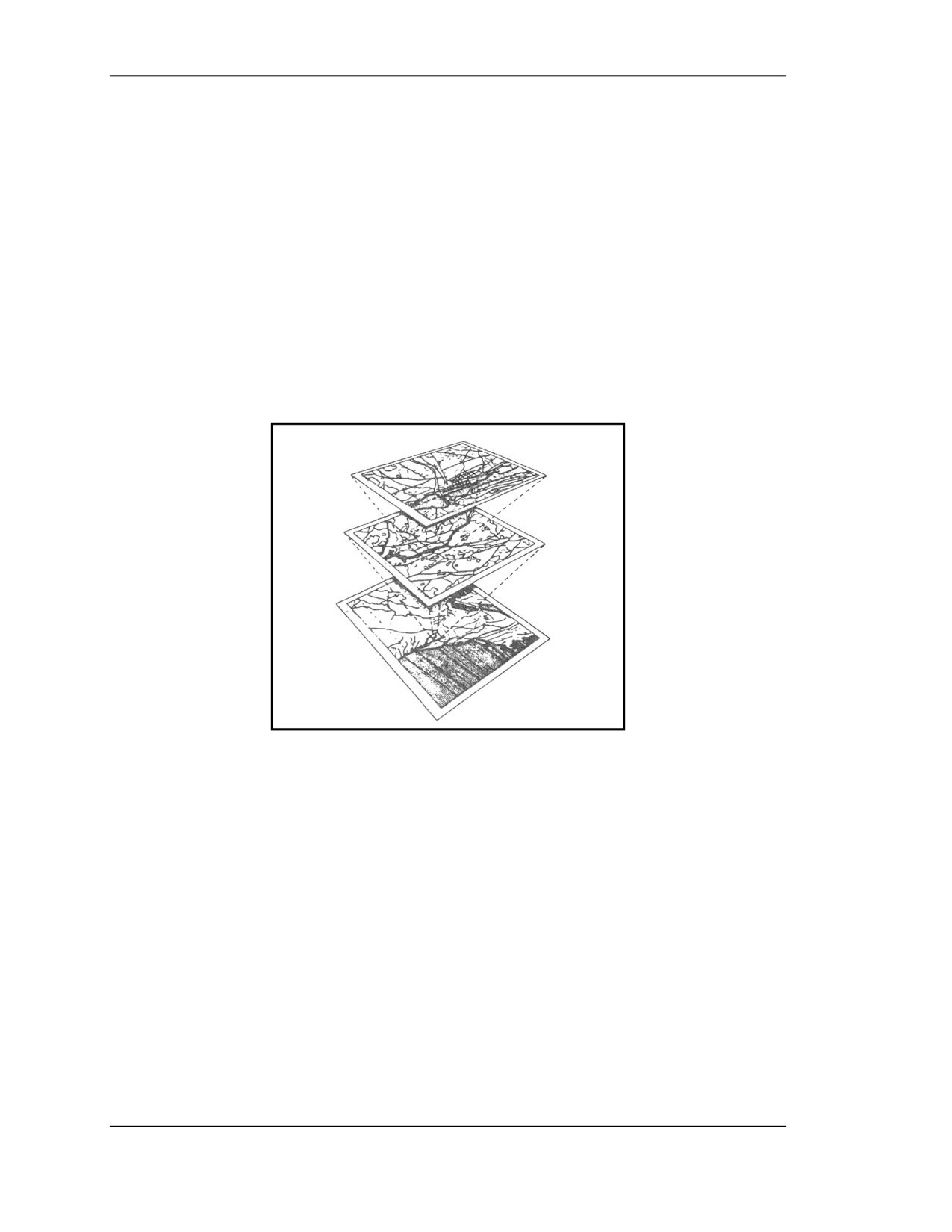
medium-, and large-scale maps (Figure 2-1, page 2-4). The terms “small scale,” “medium
scale,” and “large scale” may be confusing when read in conjunction with the number.
However, if the number is viewed as a fraction, it quickly becomes apparent that 1:600,000
FOUO
2-3
18 January 2005
FM 3-25.26
of something is smaller than 1:75,000 of the same thing. Therefore, the larger the number
after 1:, the smaller the scale of the map.
(1) Small. Maps with scales of 1:1,000,000 and smaller are used for general planning
and for strategic studies (bottom map in Figure 2-1). The standard small-scale map is
1:1,000,000. This map covers a very large land area at the expense of detail.
(2) Medium. Maps with scales larger than 1:1,000,000 but smaller than 1:75,000 are
used for operational planning (center map in Figure 2-1). They contain a moderate amount of
detail, but terrain analysis is best done with the large-scale maps. The standard medium-scale
map is 1:250,000. Medium-scale maps of 1:100,000 are also frequently encountered.
(3) Large. Maps with scales of 1:75,000 and larger are used for tactical, administrative,
and logistical planning (top map in Figure 2-1). These are the maps that you as a Soldier or
junior leader are most likely to encounter. The standard large-scale map is 1:50,000;
however, many areas have been mapped at a scale of 1:25,000.
Figure 2-1. Scale classifications.
b. Types. The map of choice for land navigators is the 1:50,000-scale military
topographic map. It is important, however, to know how to use the many other products
available from the NGA as well. When operating in foreign places, you may discover that
NGA map products have not yet been produced to cover your particular area of operations,
or they may not be available to your unit when you require them. Therefore, you must be
prepared to use maps produced by foreign governments that may or may not meet the
standards for accuracy set by NGA. These maps often use symbols that resemble those found
on NGA maps but which have completely different meanings. There may be other times
when you must operate with any map you can obtain. This might be a commercially
produced map run off on a copy machine at higher headquarters. In Grenada, many of our
troops used a British tourist map.
(1) Planimetric Map. A planimetric map presents only the horizontal positions for the
features represented. It is distinguished from a topographic map by the omission of relief,
normally represented by contour lines. Sometimes, it is called a line map.
2-4
FOUO
18 January 2005
FM 3-25.26
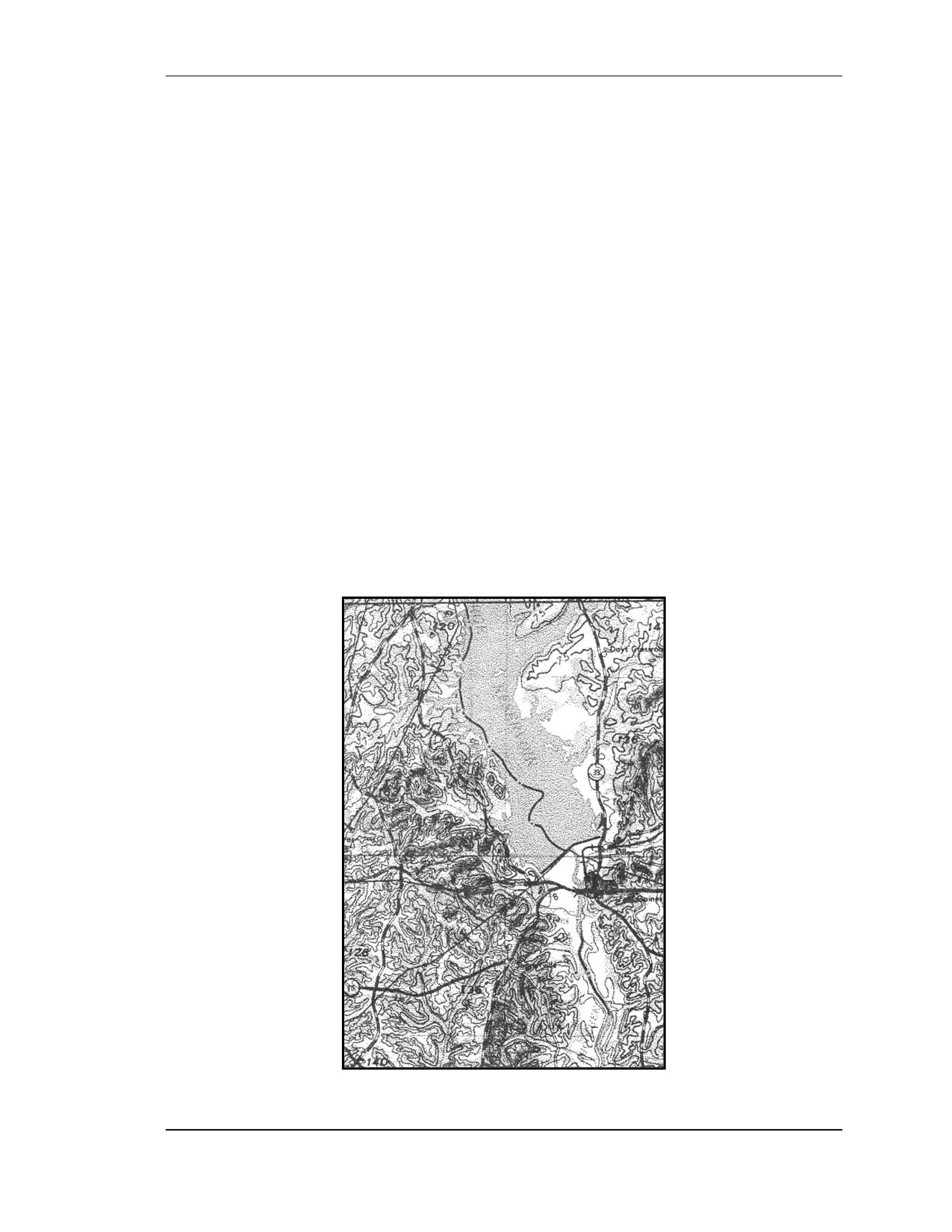
(2) Topographic Map. A topographic map portrays terrain features in a measurable way,
as well as the horizontal positions of the features represented. The vertical positions, or
relief, are normally represented by contour lines on military topographic maps. On maps
showing relief, the elevations and contours are measured from a specific vertical datum
plane, usually mean sea level. (Figure 3-1 in Chapter 3 shows a typical topographic map.)
(3) Photomap. A photomap is a reproduction of an aerial photograph upon which grid
lines, marginal data, place names, route numbers, important elevations, boundaries, and
approximate scale and direction have been added. (See Chapter 8 for additional information
on aerial photographs.)
(4) Joint Operations Graphics. Joint operations graphics are based on the format of
standard 1:250,000 medium-scale military topographic maps, but they contain additional
information needed in joint air-ground operations (Figure 2-2). Along the north and east
edges of the graphic, detail is extended beyond the standard map sheet to provide overlap
with adjacent sheets. These maps are produced both in ground and air formats. Each version
is identified in the lower margin as either joint operations graphic (air) or joint operations
graphic (ground). The topographic information is identical on both, but the ground version
shows elevations and contour in meters and the air version shows them in feet. Layer
(elevation) tinting and relief shading are added as an aid to interpolating relief. Both versions
emphasize airlanding facilities (shown in purple), but the air version has additional symbols
to identify aids and obstructions to air navigation.
(See Appendix D for additional
information.)
Figure 2-2. Joint operations graphic (air).
FOUO
2-5
18 January 2005
FM 3-25.26
(5) Photomosaic. A photomosaic is an assembly of aerial photographs that is commonly
called a mosaic in topographic usage. Mosaics are useful when time does not permit the
compilation of a more accurate map. The accuracy of a mosaic depends on the method
employed in its preparation and may vary from simply a good pictorial effect of the ground
to that of a planimetric map.
(6) Terrain Model. A terrain model is a scale model of the terrain showing features, and
in large-scale models showing industrial and cultural shapes. It provides a means for
visualizing the terrain for planning or indoctrination purposes and for briefing on assault
landings.
(7) Military City Map. A military city map is a topographic map (usually at 1:12,550
scale, sometimes up to 1:5,000), showing the details of a city. It delineates streets and shows
street names, important buildings, and other elements of the urban landscape important to
navigation and military operations in urban terrain. The scale of a military city map depends
on the importance and size of the city, density of detail, and available intelligence
information.
(8) Special Maps. Special maps are for special purposes such as trafficability,
communications, and assault maps. They are usually in the form of an overprint in the scales
smaller than 1:100,000 but larger than 1:1,000,000. A special purpose map is one that has
been designed or modified to give information not covered on a standard map. The wide
range of subjects that could be covered under the heading of special purpose maps prohibits,
within the scope of this manual, more than a brief mention of a few important ones. Some of
the subjects covered are—
• Terrain features.
• Drainage characteristics.
• Vegetation.
• Climate.
• Coasts and landing beaches.
• Roads and bridges.
• Railroads.
• Airfields.
• Urban areas.
• Electric power.
• Fuels.
• Surface water resources.
• Ground water resources.
• Natural construction materials.
• Cross-country movements.
• Suitability for airfield construction.
• Airborne operations.
2-7.
MILITARY MAP SUBSTITUTES
If military maps are not available, use substitute maps. The substitute maps can range from
foreign military or commercial maps to field sketches. The NGA can provide black and
white reproductions of many foreign maps and can produce its own maps based upon
intelligence.
2-6
FOUO
18 January 2005
FM 3-25.26
a. Foreign Maps. Foreign maps have been compiled by nations other than our own.
When they must be used, the marginal information and grids are changed to conform to our
standards, if time permits. The scales may differ from our maps, but they do express the ratio
of map distance to ground distance and can be used in the same way. The legend must be
used since the map symbols almost always differ from ours. Because the accuracy of foreign
maps varies considerably, they are usually evaluated in regard to established accuracy
standards before they are issued to our troops. (See Appendix H for additional information.)
b. Atlases. Atlases are collections of maps of regions, countries, continents, or the
world. Such maps are accurate only to a degree and can be used for general information
only.
c. Geographic Maps. Geographic maps provide an overall idea of the mapped area in
relation to climate, population, relief, vegetation, and hydrography. They also show the
general location of major urban areas.
d. Tourist Road Maps. Tourist road maps are maps of a region in which the main
means of transportation and areas of interest are shown. Some of these maps show secondary
networks of roads, historic sites, museums, and beaches in detail. They may contain road and
time distance between points. The scale should be carefully considered when using these
maps.
e. City/Utility Maps. City/utility maps are maps of urban areas showing streets, water
ducts, electricity and telephone lines, and sewers.
f. Field Sketches. Field sketches are preliminary drawings of an area or piece of
terrain. (See Appendix A.)
g. Aerial Photographs. Aerial photographs can be used as map supplements or
substitutes to help you analyze the terrain, plan your route, or guide your movement. (See
Chapter 8 for additional information).
2-8.
STANDARDS OF ACCURACY
Accuracy is the degree of conformity with which horizontal positions and vertical values are
represented on a map in relation to an established standard. This standard is determined by
the NGA based on user requirements. Maps are considered to meet accuracy requirement
standards unless otherwise specified in the marginal information.
FOUO
2-7
18 January 2005
This Page intentionally left blank.
FM 3-25.26
CHAPTER 3
MARGINAL INFORMATION AND SYMBOLS
A map could be compared to any piece of equipment, in that before it is
placed into operation, the user must read the instructions. It is important that
you, as a Soldier, know how to read these instructions. The most logical
place to begin is the marginal information and symbols, where useful
information telling about the map is located and explained. All maps are not
the same, so it is necessary to examine the marginal information carefully
each time a different map is used.
3-1.
MARGINAL INFORMATION ON A MILITARY MAP
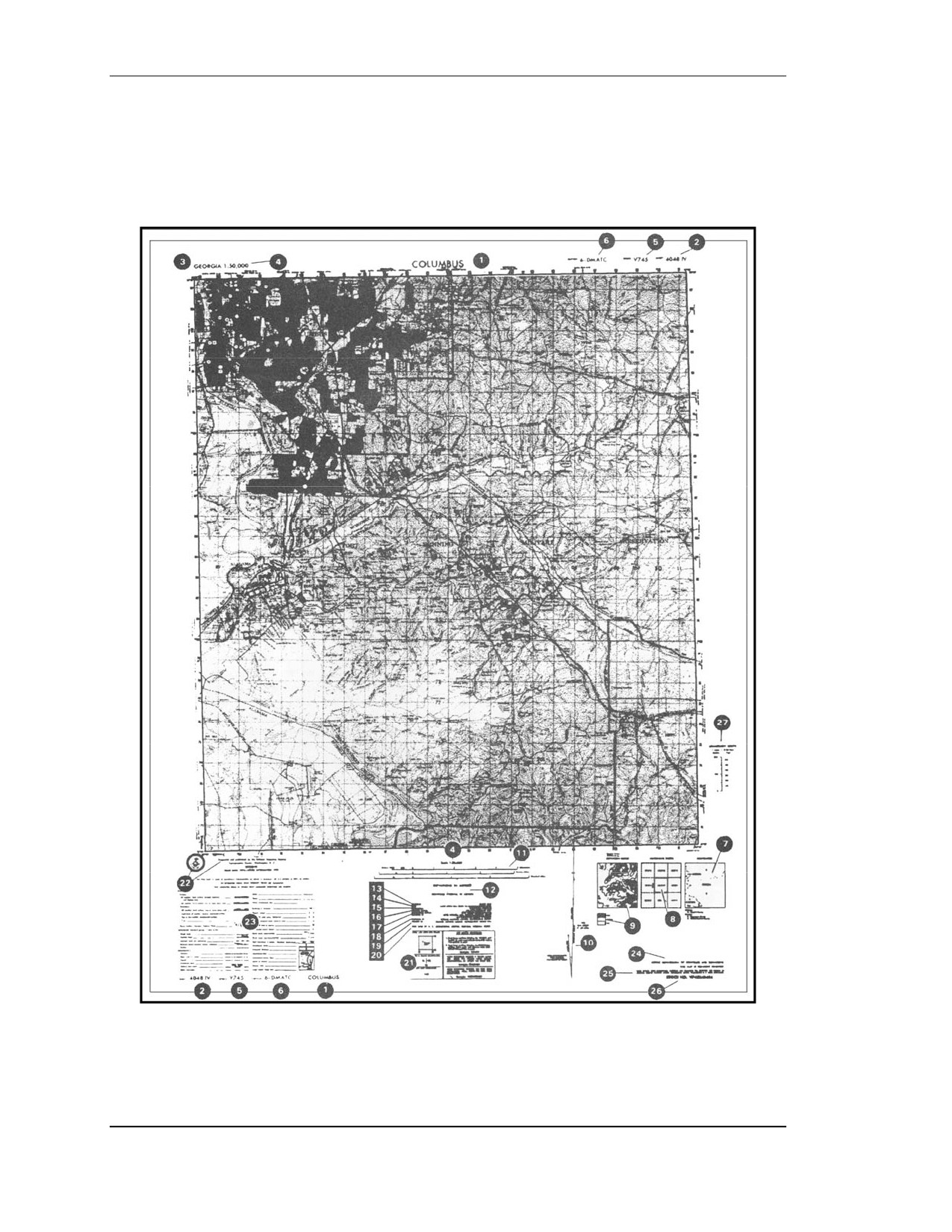
Figure 3-1 (page 3-4) shows a reduced version of a large-scale topographic map. The circled
numbers indicate the items of marginal information that the map user needs to know. These
circled numbers correspond to the following listed items.
a. Sheet Name (1). The sheet name is found in bold print at the center of the top and in
the lower left area of the map margin. A map is generally named for the largest settlement
contained within the area covered by the sheet, or for the largest natural feature located
within the area at the time the map was drawn.
b. Sheet Number (2). The sheet number is found in bold print in both the upper right
and lower left areas of the margin, and in the center box of the adjoining sheets diagram,
which is found in the lower right margin. It is used as a reference number to link specific
maps to overlays, operations orders, and plans. For maps at 1:100,000 scale and larger, sheet
numbers are based on an arbitrary system that makes possible the ready orientation of maps
at scales of 1:100,000, 1:50,000, and 1:25,000.
c. Series Name (3). The map series name is found in bold print in the upper left corner
of the margin. The name given to the series is generally that of a major political subdivision
such as a state within the United States or a European nation. A map series usually includes a
group of similar maps at the same scale and on the same sheet lines or format designed to
cover a particular geographic area. It may also be a group of maps that serve a common
purpose such as the military city maps.
d. Scale (4). The scale is found both in the upper left margin after the series name, and
in the center of the lower margin. The scale note is a representative fraction that gives the
ratio of a map distance to the corresponding distance on the earth’s surface. For example, the
scale note 1:50,000 indicates that one unit of measure on the map equals 50,000 units of the
same measure on the ground.
e. Series Number (5). The series number is found in both the upper right margin and
the lower left margin. It is a sequence reference expressed either as a four-digit numeral
(1125) or as a letter, followed by a three- or four-digit numeral (M661, T7110).
f. Edition Number (6). The edition number is found in bold print in the upper right
area of the top margin and the lower left area of the bottom margin. Editions are numbered
consecutively; therefore, if you have more than one edition, the highest numbered sheet is
the most recent. Most military maps are now published by the NGA, but older editions of
maps may have been produced by the U.S. Army Map Service. Still others may have been
drawn, at least in part, by the U.S. Army Corps of Engineers, the U.S. Geological Survey, or
FOUO
3-1
18 January 2005
FM 3-25.26
other agencies affiliated or not with the United States or allied governments. The credit line,
telling who produced the map, is just above the legend. The map information date is found
immediately below the word “LEGEND” in the lower left margin of the map. This date is
important when determining how accurately the map data might be expected to match what
you will encounter on the ground.
g. Index to Boundaries (7). The index to boundaries diagram appears in the lower or
right margin of all sheets. This diagram, which is a miniature of the map, shows the
boundaries that occur within the map area such as county lines and state boundaries.
h. Adjoining Sheets Diagram (8). Maps at all standard scales contain a diagram that
illustrates the adjoining sheets. On maps at 1:100,000 and larger scales and at 1:1,000,000
scale, the diagram is called the index to adjoining sheets. It consists of as many rectangles
representing adjoining sheets as are necessary to surround the rectangle that represents the
sheet under consideration. The diagram usually contains nine rectangles, but the number may
vary depending on the locations of the adjoining sheets. All represented sheets are identified
by their sheet numbers. Sheets of an adjoining series, whether published or planned, that are
at the same scale are represented by dashed lines. The series number of the adjoining series
is indicated along the appropriate side of the division line between the series.
i.
Elevation Guide (9). The elevation guide is normally found in the lower right
margin. It is a miniature characterization of the terrain shown. The terrain is represented by
bands of elevation, spot elevations, and major drainage features. The elevation guide
provides the map reader with a means of quick recognition of major landforms.
j.
Declination Diagram (10). The declination diagram is located in the lower margin of
large-scale maps and indicates the angular relationships of true north, grid north, and
magnetic north. On maps at 1:250,000 scale, this information is expressed as a note in the
lower margin. In recent edition maps, there is a note indicating the conversion of azimuths
from grid to magnetic and from magnetic to grid next to the declination diagram.
k. Bar Scales (11). Bar scales are located in the center of the lower margin. They are
rulers used to convert map distance to ground distance. Maps have three or more bar scales,
each in a different unit of measure. Care should be exercised when using the scales,
especially in the selection of the unit of measure that is needed.
l.
Contour Interval Note (12). The contour interval note is found in the center of the
lower margin normally below the bar scales. It states the vertical distance between adjacent
contour lines of the map. When supplementary contours are used, the interval is indicated. In
recent edition maps, the contour interval is given in meters instead of feet.
m. Spheroid Note (13). The spheroid note is located in the center of the lower margin.
Spheriods (ellipsoids) have specific parameters that define the X Y Z axis of the earth. The
spheriod is an integral part of the datum.
n. Grid Note (14). The grid note is located in the center of the lower margin. It gives
information pertaining to the grid system used and the interval between grid lines, and it
identifies the UTM grid zone number.
o. Projection Note (15). The projection system is the framework of the map. For
military maps, this framework is of the conformal type; that is, small areas of the surface of
the earth retain their true shapes on the projection; measured angles closely approximate true
values; and the scale factor is the same in all directions from a point. The projection note is
located in the center of the lower margin. (Refer to NGA for the development characteristics
of the conformal-type projection systems.)
3-2
FOUO
18 January 2005
FM 3-25.26
(1) Between 80 degrees south and 84 degrees north, maps at scales larger than 1:500,000
are based on the transverse Mercator projection. The note reads TRANSVERSE
MERCATOR PROJECTION.
(2) Between 80 degrees south and 84 degrees north, maps at 1:1,000,000 scale and
smaller are based on standard parallels of the lambert conformal conic projection. The note
reads, for example, LAMBERT CONFORMAL CONIC PROJECTIONS 36 DEGREES 40’
N AND 39 DEGREES 20’ N.
(3) Maps of the polar regions (south of 80 degrees south and north of 84 degrees north)
at 1:1,000,000 and larger scales are based on the polar stereographic projection. The note
reads POLAR STEREOGRAPHIC PROJECTION.
p. Vertical Datum Note (16). The vertical datum note is located in the center of the
lower margin. The vertical datum or vertical-control datum is defined as any level surface
taken as a surface of reference from which to determine elevations. In the United States,
Canada, and Europe, the vertical datum refers to the mean sea level surface. However, in
parts of Asia and Africa, the vertical-control datum may vary locally and is based on an
assumed elevation that has no connection to any sea level surface. Map readers should
habitually check the vertical datum note on maps, particularly if the map is used for low-
level aircraft navigation, naval gunfire support, or missile target acquisition.
q. Horizontal Datum Note (17). The horizontal datum note is located in the center of
the lower margin. The horizontal datum or horizontal-control datum is defined as a geodetic
reference point (of which five quantities are known: latitude, longitude, azimuth of a line
from this point, and two constants, which are the parameters of reference ellipsoid). These
are the basis for horizontal-control surveys. The horizontal-control datum may extend over a
continent or be limited to a small local area. Maps and charts produced by NGA are
produced on 32 different horizontal-control data. Map readers should habitually check the
horizontal datum note on every map or chart, especially adjacent map sheets, to ensure the
products are based on the same horizontal datum. If products are based on different
horizontal-control data, coordinate transformations to a common datum must be performed.
UTM coordinates from the same point computed on different data may differ as much as 900
meters.
r. Control Note (18). The control note is located in the center of the lower margin. It
indicates the special agencies involved in the control of the technical aspects of all the
information that is disseminated on the map.
s. Preparation Note (19). The preparation note is located in the center of the lower
margin. It indicates the agency responsible for preparing the map.
t.
Printing Note (20). The printing note is also located in the center of the lower
margin. It indicates the agency responsible for printing the map and the date the map was
printed. The printing data should not be used to determine when the map information was
obtained.
u. Grid Reference Box (21). The grid reference box is normally located in the center of
the lower margin. It contains instructions for composing a grid reference.
v. Unit Imprint and Symbol (22). The unit imprint and symbol is on the left side of the
lower margin. It identifies the agency that prepared and printed the map with its respective
symbol. This information is important to the map user in evaluating the reliability of the
map.
FOUO
3-3
18 January 2005
FM 3-25.26
w. Legend (23). The legend is located in the lower left margin. It illustrates and
identifies the topographic symbols used to depict some of the more prominent features on the
map. The symbols are not always the same on every map. Always refer to the legend to
avoid errors when reading a map.
Figure 3-1. Topographical map.
3-2.
ADDITIONAL NOTES
Not all maps contain the same items of marginal information. Under certain conditions,
special notes and scales may be added to aid the map user.
3-4
FOUO
18 January 2005
FM 3-25.26
a. Glossary. The glossary is an explanation of technical terms or a translation of terms
on maps of foreign areas where the native language is other than English.
b. Classification. Certain maps require a note indicating the security classification. This
is shown in the upper and lower margins.
c. Protractor Scale. The protractor scale may appear in the upper margin on some
maps. It is used to lay out the magnetic-grid declination for the map, which, in turn, is used
to orient the map sheet with the aid of the lensatic compass.
d. Coverage Diagram. On maps at scales of 1:100,000 and larger, a coverage diagram
may be used. It is normally in the lower or right margin and indicates the methods by which
the map was made, dates of photography, and reliability of the sources. On maps at
1:250,000 scale, the coverage diagram is replaced by a reliability diagram.
e. Special Notes (24). A special note is any statement of general information that
relates to the mapped area. It is normally found in the lower right margin. For example: This
map is red-light readable.
f. User’s Note (25). The user’s note is normally located in the lower right-hand margin.
It requests cooperation in correcting errors or omissions on the map. Errors should be
marked and the map forwarded to the agency identified in the note.
g. Stock Number Identification (26). All maps published by the NGA that are in the
Department of the Army map supply system contain stock number identifications that are
used in requisitioning map supplies. The identification consists of the words “STOCK NO”
followed by a unique designation that is composed of the series number, the sheet number of
the individual map and, on recently printed sheets, the edition number. The designation is
limited to 15 units (letters and numbers). The first 5 units are allotted to the series number;
when the series number is less than 5 units, the letter “X” is substituted as the fifth unit. The
sheet number is the next component; however, Roman numerals, which are part of the sheet
number, are converted to Arabic numerals in the stock number. The last 2 units are the
edition number; the first digit of the edition number is a zero if the number is less than 10. If
the current edition number is unknown, the number 01 is used. The latest available edition
will be furnished. Asterisks are placed between the sheet number and the edition number
when necessary to ensure there are at least 11 units in the stock number.
h. Conversion Graph (27). Normally found in the right margin, the conversion graph
indicates the conversion of different units of measure used on the map.
3-3.
TOPOGRAPHIC MAP SYMBOLS
The purpose of a map is to permit one to visualize an area of the earth’s surface with
pertinent features properly positioned. The map’s legend contains the symbols most
commonly used in a particular series or on that specific topographic map sheet. Therefore,
the legend should be referred to each time a new map is used. Every effort is made to design
standard symbols that resemble the features they represent. If this is not possible, symbols
are selected that logically imply the features they portray. For example, an open-pit mining
operation is represented by a small black drawing of a crossed hammer and pickax.
a. Ideally, all the features within an area would appear on a map in their true proportion,
position, and shape. This, however, is not practical because many of the features would be
unimportant and others would be unrecognizable because of their reduction in size.
b. The mapmaker has been forced to use symbols to represent the natural and man-made
features of the earth’s surface. These symbols resemble, as closely as possible, the actual
FOUO
3-5
18 January 2005
FM 3-25.26
features as viewed from above. They are positioned in such a manner that the center of the
symbol remains in its true location. An exception to this would be the position of a feature
adjacent to a major road. If the width of the road has been exaggerated, then the feature is
moved from its true position to preserve its relation to the road. (FM 21-31 provides a good
description of topographic features and abbreviations that are authorized for use on military
maps.)
3-4.
MILITARY SYMBOLS
In addition to the topographic symbols used to represent the natural and man-made features
of the earth, military personnel require some method for showing identity, size, location, or
movement of Soldiers, and military activities and installations. The symbols used to
represent these military features are known as military symbols. These symbols are not
normally printed on maps because the features and units they represent are constantly
moving or changing; military security is also a consideration. They do appear in special
maps and overlays (Chapter 7). The map user draws them in, in accordance with proper
security precautions. (Refer to FM 101-5-1 for complete information on military symbols.)
3-5.
COLORS USED ON A MILITARY MAP
By the fifteenth century, most European maps were carefully colored. Profile drawings of
mountains and hills were shown in brown, rivers and lakes in blue, vegetation in green, roads
in yellow, and special information in red. A look at the legend of a modern map confirms
that the use of colors has not changed much over the past several hundred years. To facilitate
the identification of features on a map, the topographical and cultural information is usually
printed in different colors. These colors may vary from map to map. On a standard
large-scale topographic map, the colors used and the features each represent are—
a. Black. Black indicates cultural (man-made) features such as buildings and roads,
surveyed spot elevations, and all labels.
b. Red-Brown. The colors red and brown are combined to identify cultural features, all
relief features, nonsurveyed spot elevations, and elevation such as contour lines on red-light
readable maps.
c. Blue. Blue identifies hydrography or water features such as lakes, swamps, rivers,
and drainage.
d. Green. Green identifies vegetation with military significance such as woods,
orchards, and vineyards.
e. Brown. Brown identifies all relief features and elevation such as contours on older
edition maps and cultivated land on red-light readable maps.
f. Red. Red classifies cultural features, such as populated areas, main roads, and
boundaries, on older maps.
g. Other. Occasionally, other colors may be used to show special information. These
are indicated in the marginal information as a rule.
3-6
FOUO
18 January 2005
FM 3-25.26
CHAPTER 4
GRIDS
This chapter covers how to determine and report positions on the ground
in terms of their locations on a map. Knowing where you are (position fixing)
and being able to communicate that knowledge is crucial to successful land
navigation as well as to the effective employment of direct and indirect fire,
tactical air support, and medical evacuation. It is essential for valid target
acquisition; accurate reporting of NBC contamination and various danger
areas; and obtaining emergency resupply. Few factors contribute as much to
the survivability of troops and equipment and to the successful
accomplishment of a mission as always knowing where you are. The chapter
includes explanations of geographical coordinates, Universal Transverse
Mercator grids, the military grid reference system, and the use of grid
coordinates.
4-1.
REFERENCE SYSTEM
In a city, it is quite simple to find a location; the streets are named and the buildings have
numbers. The only thing needed is the address. However, finding locations in undeveloped
areas or in unfamiliar parts of the world can be a problem. To cope with this problem, a
uniform and precise system of referencing has been developed.
4-2.
GEOGRAPHIC COORDINATES
One of the oldest systematic methods of location is based upon the geographic coordinate
system. By drawing a set of east-west rings around the globe (parallel to the equator), and a
set of north-south rings crossing the equator at right angles and converging at the poles, a
network of reference lines is formed from which any point on the earth’s surface can be
located.
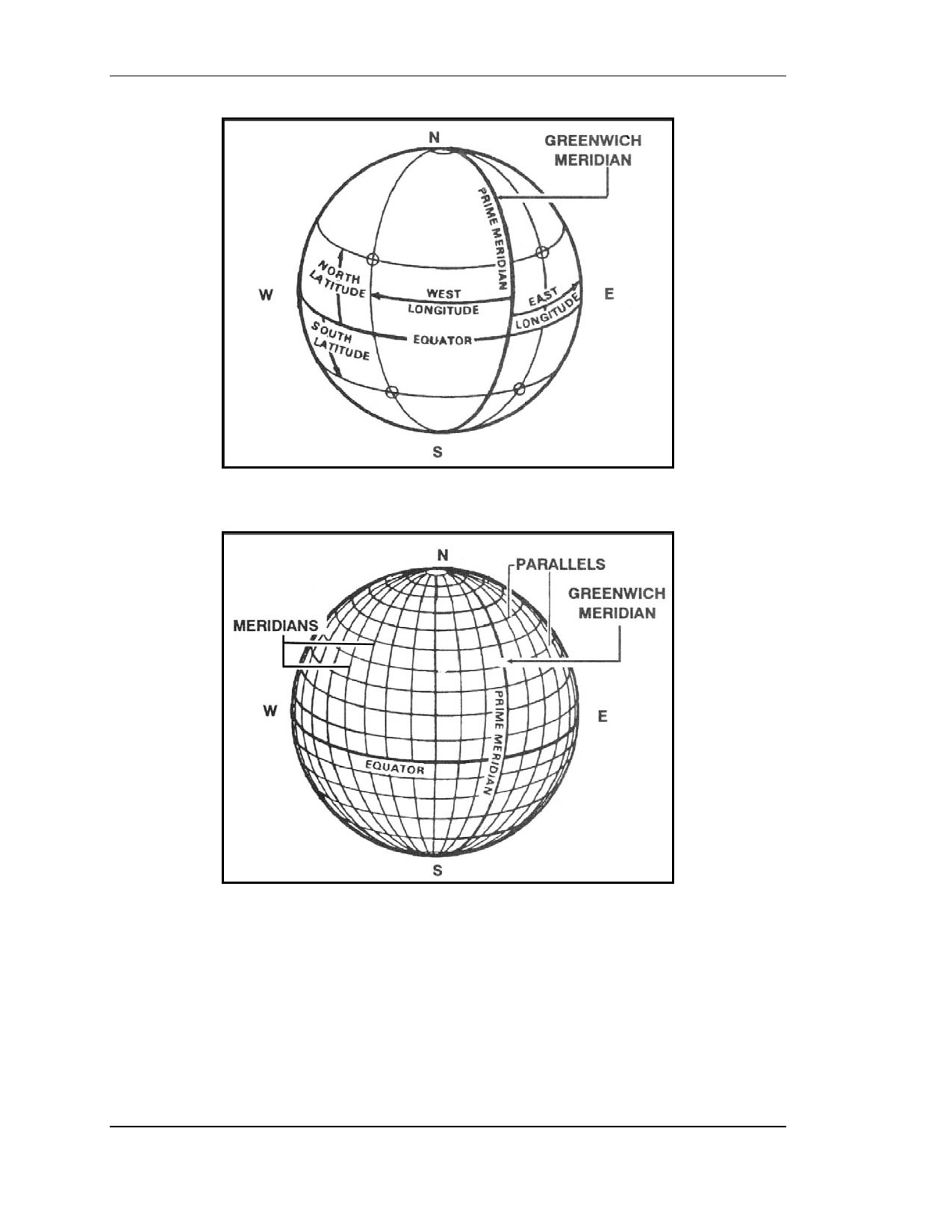
a. The distance of a point north or south of the equator is known as its latitude. The
rings around the earth parallel to the equator are called parallels of latitude or simply
parallels. Lines of latitude run east-west but north-south distances are measured between
them.
b. A second set of rings around the globe at right angles to lines of latitude and passing
through the poles are known as meridians of longitude or simply meridians. One meridian is
designated as the prime meridian. The prime meridian of the system we use runs through
Greenwich, England and is known as the Greenwich meridian. The distance east or west of a
prime meridian to a point is known as its longitude. Lines of longitude (meridians) run
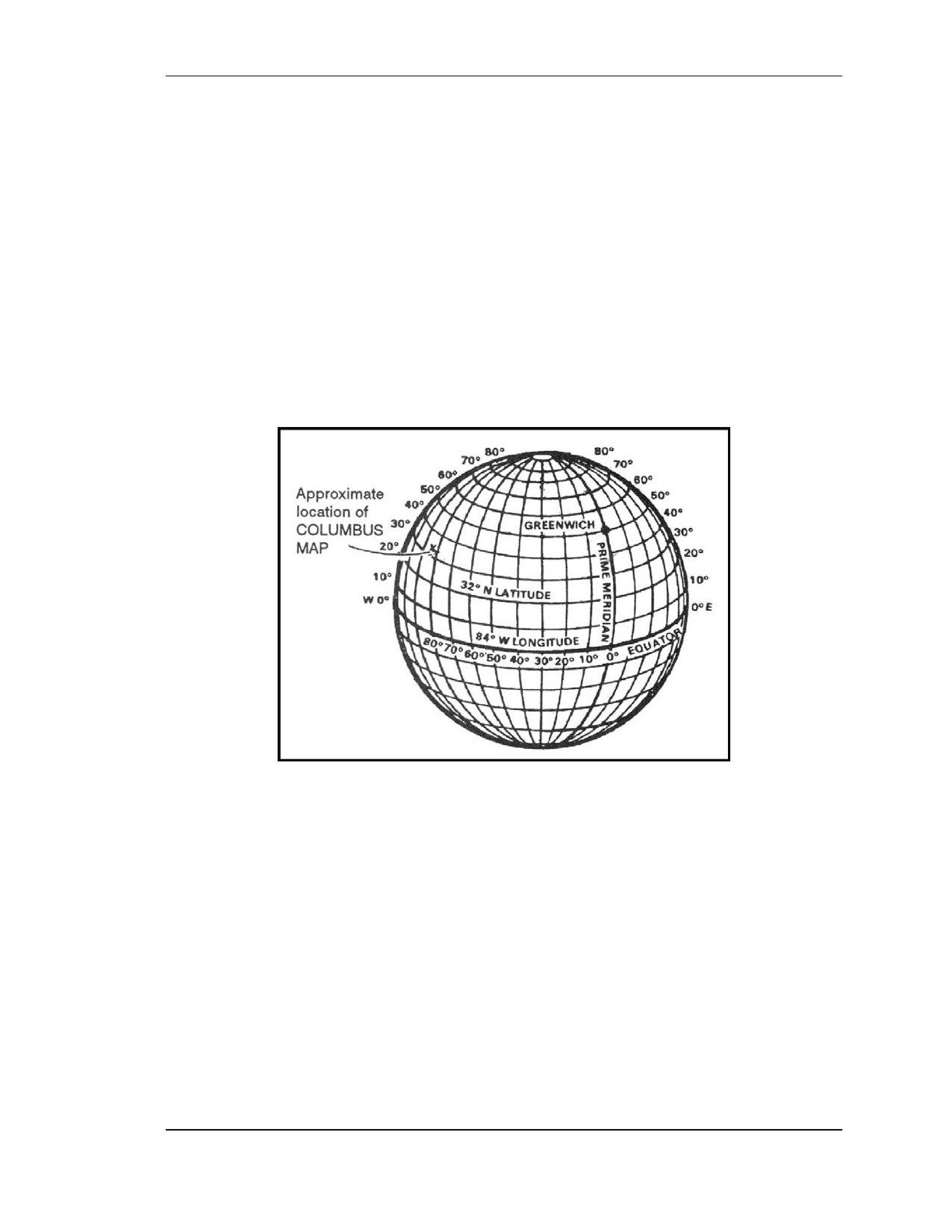
north-south but east-west distances are measured between them (Figures 4-1 and 4-2,
page 4-2).
FOUO
4-1
18 January 2005
FM 3-25.26
Figure 4-1. Prime meridian and equator.
Figure 4-2. Reference lines.
c. Geographic coordinates are expressed in angular measurement. Each circle is divided
into 360 degrees, each degree into 60 minutes, and each minute into 60 seconds. The degree
is symbolized by °, the minute by ′, and the second by ″.
(1) Starting with 0° at the equator, the parallels of latitude are numbered to 90° both
north and south. The extremities are the north pole at 90° north latitude and the south pole at
90° south latitude. Latitude can have the same numerical value north or south of the equator,
so the direction N or S must always be given.
4-2
FOUO
18 January 2005
FM 3-25.26
(2) Starting with 0° at the prime meridian, longitude is measured both east and west
around the world. Lines east of the prime meridian are numbered to 180° and identified as
east longitude; lines west of the prime meridian are numbered to 180° and identified as west
longitude. The direction E or W must always be given. The line directly opposite the prime
meridian, 180°, may be referred to as either east or west longitude.
(3) The values of geographic coordinates, being in units of angular measure, will mean
more if they are compared with more familiar units of measure. At any point on the earth, the
ground distance covered by one degree of latitude is about 111 kilometers (69 miles); one
second is equal to about 30 meters (100 feet). The ground distance covered by one degree of
longitude at the equator is also about 111 kilometers, but decreases as one moves north or
south, until it becomes zero at the poles. For example, one second of longitude represents
about 30 meters (100 feet) at the equator; but at the latitude of Washington, DC, one second
of longitude is about 24 meters (78 feet). Latitude and longitude are illustrated in Figure 4-3.
Figure 4-3. Latitude and longitude.
d. Geographic coordinates appear on all standard military maps; on some they may be
the only method of locating and referencing the location of a point. The four lines that
enclose the body of the map (neatlines) are latitude and longitude lines. Their values are
given in degrees and minutes at each of the four corners.
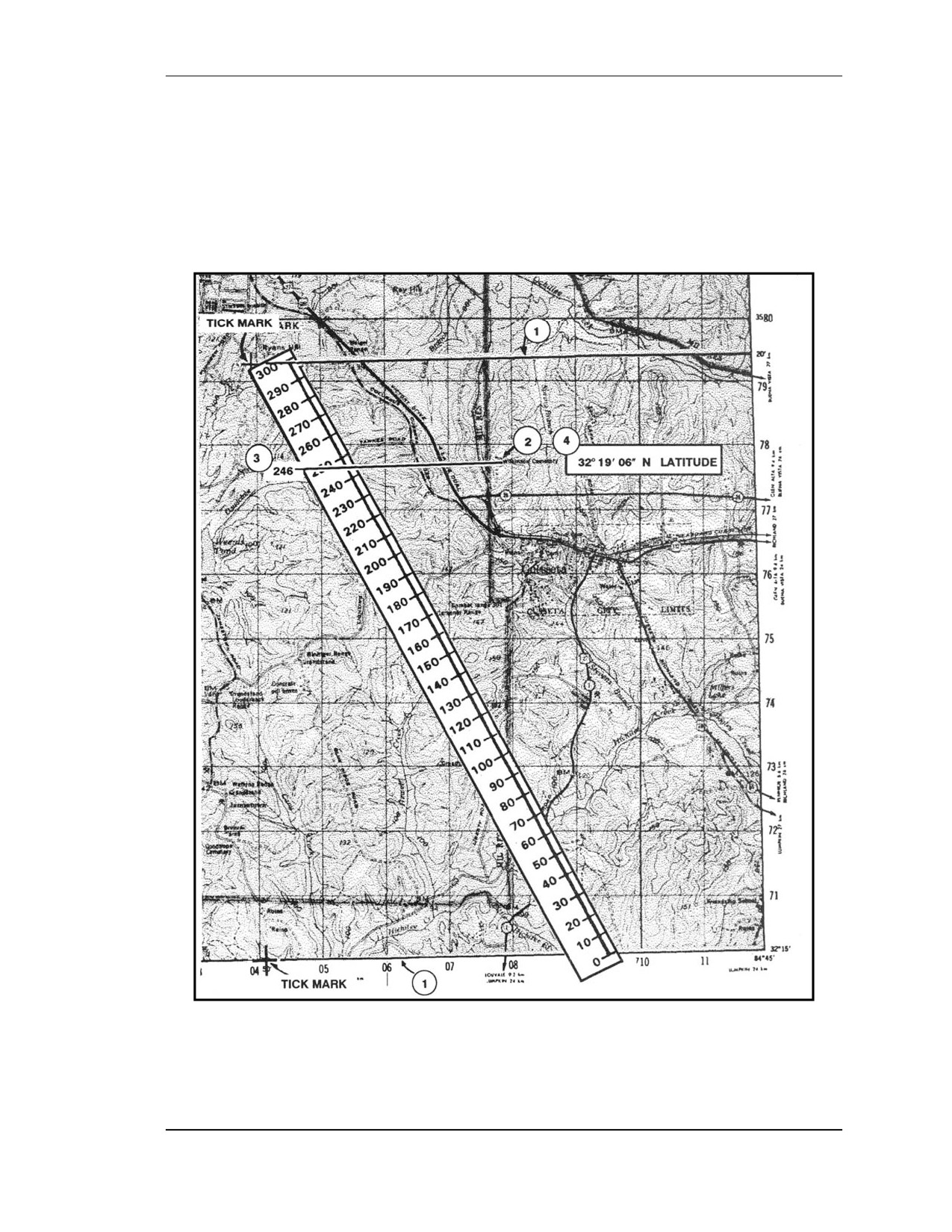
(1) On a portion of the Columbus map (Figure 4-4, page 4-5), the figures 32°15’ and
84°45’ appear at the lower right corner. The bottom line of this map is latitude 32°15’00”N,
and the line running up the right side is longitude 84°45’00”W.
(2) In addition to the latitude and longitude given for the four corners, there are small
tick marks at regularly spaced intervals along the sides of the map, extending into the body
of the map. Each of these tick marks is identified by its latitude or longitude value.
(3) Near the top of the right side of the map is a tick mark with the number 20’. The full
value for this tick marks is 32°20’00” of latitude. At one-third and two-thirds of the distance
across the map from the 20’ tick mark will be found a cross tick mark (grid squares GL 0379
FOUO
4-3
18 January 2005
FM 3-25.26
and FL 9679) and at the far side another 20’ tick mark. By connecting the tick marks and
crosses with straight lines, a 32°20’00” line of latitude can be added to the map. This
procedure is also used to locate the 32°25’00” line of latitude. For lines of longitude, the
same procedure is followed using the tick marks along the top and bottom edges of the map.
e. After the parallels and meridians have been drawn, the geographic interval (angular
distance between two adjacent lines) must be determined. Examination of the values given at
the tick marks gives the interval. For most maps of scale 1:25,000, the interval is 2’30”. For
the Columbus map and most maps of scale 1:50,000, it is 5’00”. The geographic coordinates
of a point are found by dividing the sides of the geographic square in which the point is
located into the required number of equal parts. If the geographic interval is 5’00” and the
location of a point is required to the nearest second, each side of the geographic square must
be divided into 300 equal parts (5’00” = 300”), each of which would have a value of one
second. Any scale or ruler that has 300 equal divisions and is as long as or longer than the
spacing between the lines may be used.
f. The following steps will determine the geographic coordinates of Wilkinson
Cemetery (northwest of the town of Cusseta) on the Columbus map.
(1) Draw on the map the parallels and meridians that enclose the area around the
cemetery.
(2) Determine the values of the parallels and meridians where the point falls.
Latitude 32°15’00” and 32°20’00”.
Longitude 84°45’00” and 84°50’00”.
(3) Determine the geographic interval (5’00” = 300”).
(4) Select a scale that has 300 small divisions or multiples thereof (300 divisions, one
second each; 150 divisions, two seconds each; 75 divisions, four seconds each, and so forth).
(5) To determine the latitude⎯
(a) Place the 0 of the scale on the latitude of the lowest number value (32°15’00”) and
the 300 of the scale on the highest numbered line (32°20’00”) (1, Figure 4-4).
(b) Keeping the 0 and 300 on the two lines, slide the scale (2, Figure 4-4) along the
parallels until the Wilkinson Cemetery symbol is along the edge of the numbered scale.
(c) Read the number of seconds from the scale (3, Figure 4-4), about 246.
(d) Convert the number of seconds to minutes and seconds (246” = 4’06”) and add to the
value of the lower numbered line (32°15’00” + 4’06” = 32°19’06”) (4, Figure 4-4).
(e) The latitude is 32°19’06”, but this information alone is not enough. The latitude
32°19’06” could be either north or south of the equator, so the letter N or S must be added to
the latitude. To determine whether it is N or S, look at the latitude values at the edge of the
map and find the direction in which they become larger. If they are larger going north, use N;
if they are larger going south, use S. The latitude for the cemetery is 32°19’06”N.
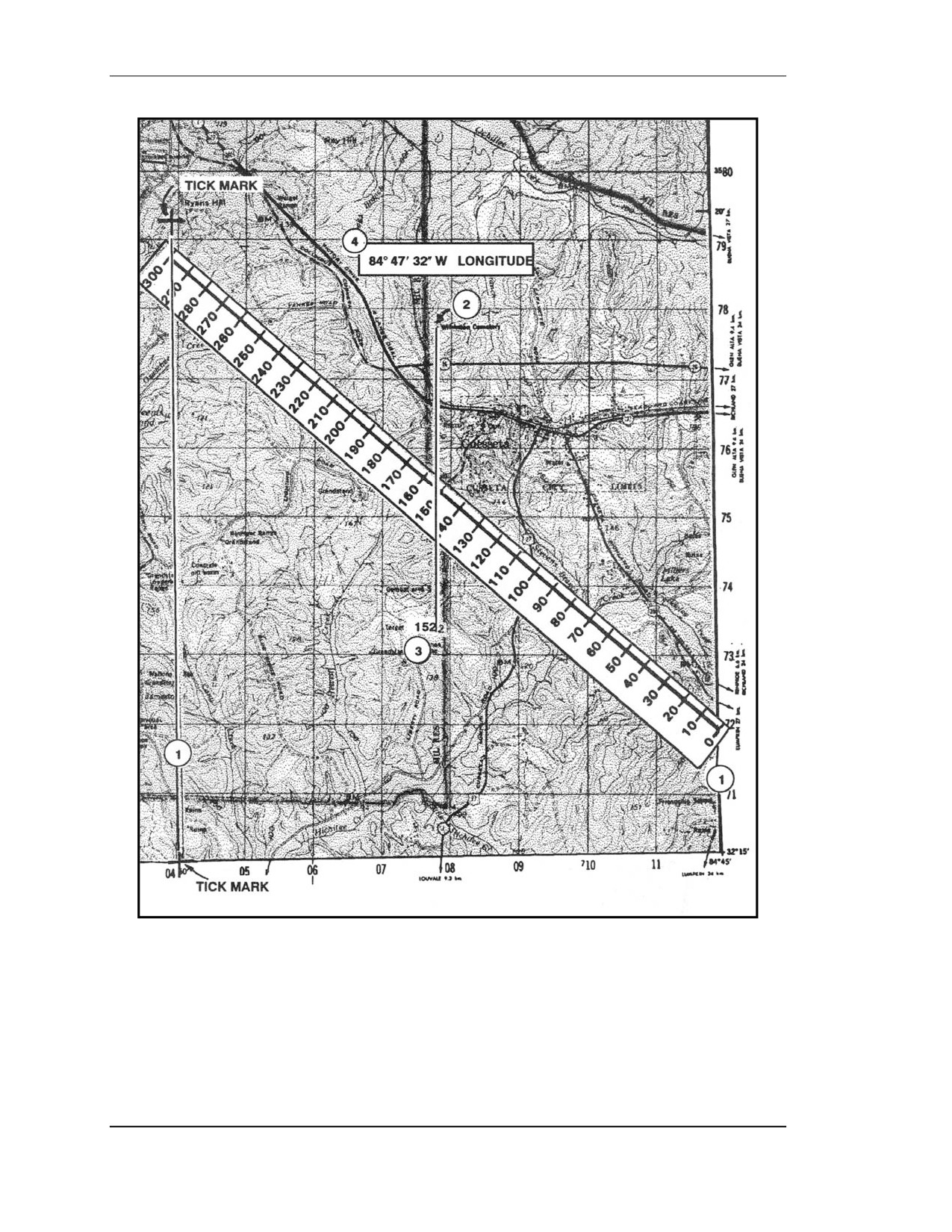
(6) To determine the longitude, repeat the same steps but measure between lines of
longitude and use E and W. The geographic coordinates of Wilkinson Cemetery should be
about 32°19’06”N and 84°47’32”W (Figure 4-5, page 4-6).
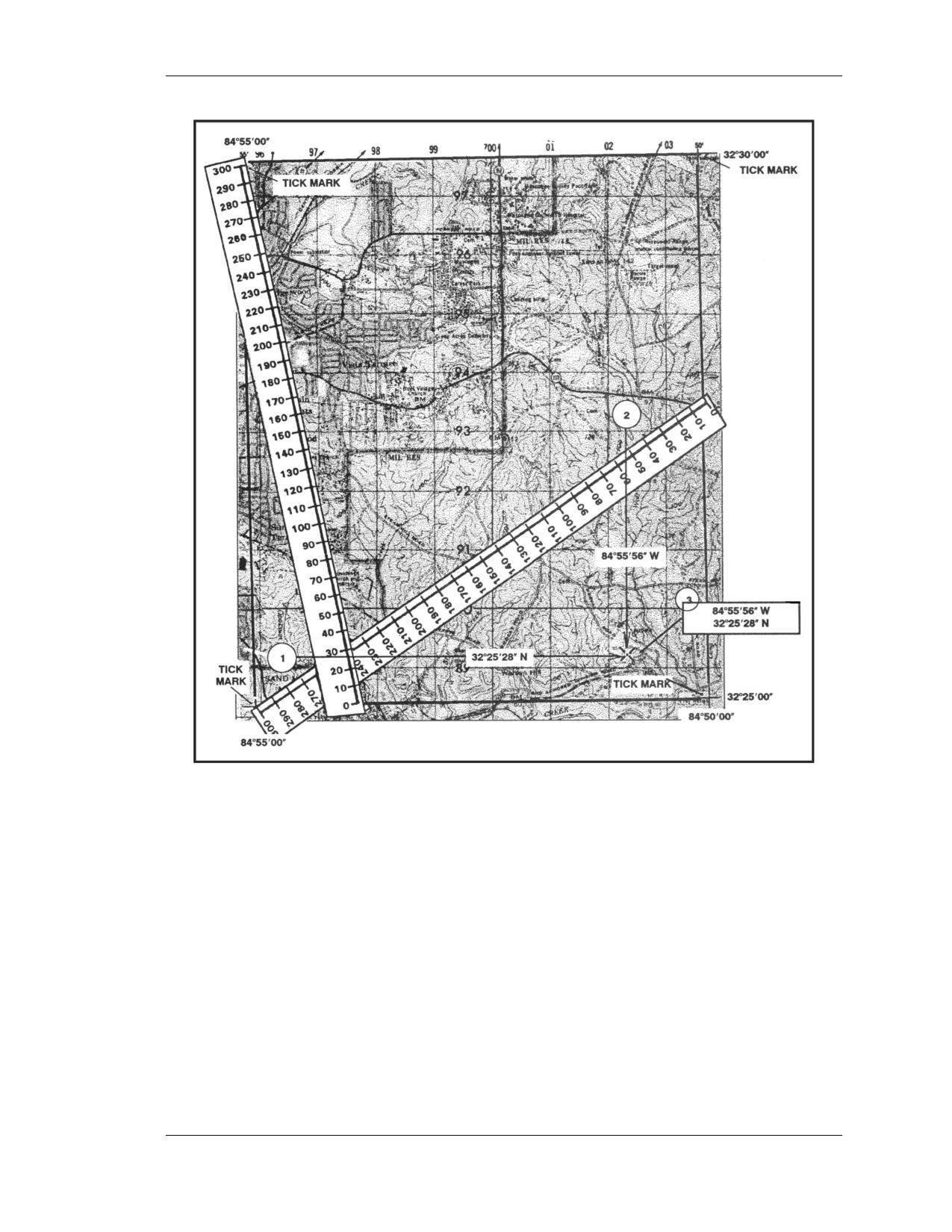
g. Many of the same steps are followed to locate a point on the Columbus map when
knowing the geographic coordinates (Figure 4-6, page 4-7). To locate 32°25’28”N and
84°50’56”W, first find the geographic lines within which the point falls: latitude 32°25’00”
and 32°30’0”; and longitude 84°50’00” and 84°55’00”. Subtract the lower latitude or
longitude from the higher latitude or longitude.
4-4
FOUO
18 January 2005
FM 3-25.26
(1) Place the 0 of the scale on the 32°25’00” line and the 300 on the 32°30’00”. Make a
mark at the number 28 on the scale (the difference between the lower and higher latitude).
(2) Place the 0 of the scale on the 84°50’00” line and the 300 on the 84°50’55”. Make a
mark at the number 56 on the scale (the difference between the lower and higher longitude).
(3) Draw a vertical line from the mark at 56 and a horizontal line from the mark at 28;
they intersect at 32 25’28”N and 84 50’56”W.
Figure 4-4. Determining latitude.
FOUO
4-5
18 January 2005
FM 3-25.26
Figure 4-5. Determining longitude.
4-6
FOUO
18 January 2005
C1, FM 3-25.26
Figure 4-6. Determining geographic coordinates.
h. If you do not have a scale or ruler with 300 equal divisions or a map whose
interval is other than
5’00”, use the proportional parts method. Following the steps
determines the geographic coordinates of horizontal control station 141.
(1) Locate horizontal control station
141 in grid square
(GL0784) (Figure 4-7,
page 4-8).
(2) Find a cross in grid square GL0388 and a tick mark in grid square GL1188 with
25’.
(3) Find another cross in grid square GL0379 and a tick mark in grid square GL1179
with 20’.
(4) Enclose the control station by connecting the crosses and tick marks. The control
station is between 20’ and 25’.
(5) With a boxwood scale, measure the distance from the bottom line to the top line
that encloses the area around the control station on the map (total distance).
30 August 2006
4-7
FOUO
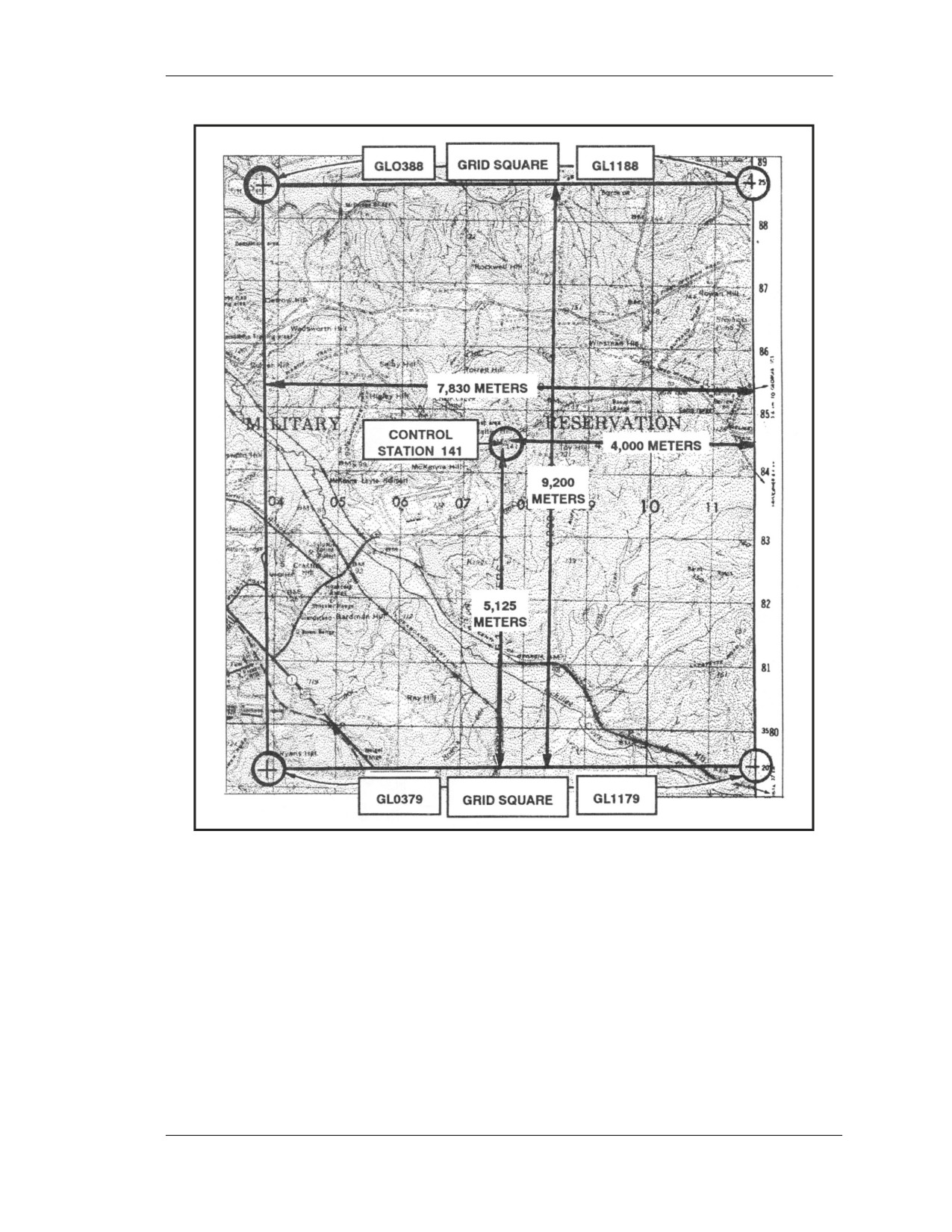
C1, FM 3-25.26
Figure 4-7. Using the proportional parts method.
(6) Measure the partial distance from the bottom line to the center of the control
station. These straight-line distances are in direct proportion to the minutes and seconds
of latitude and are used to set up a ratio.
(7) The total distance is 9,200 meters, and the partial distance is 5,125 meters.
(8) With the two distances and the five-minute interval converted to seconds (300”),
determine the minutes and seconds of latitude using the following formula:
1.
5,125 x 300 = 1,537,500
2.
1,537,500 ÷ 9,200 = 167
3.
167 ÷ 60 = 2’47”
*4. Add 2’47” to 32°20’00” = 32°22’47”
4-8
30 August 2006
FOUO
FM 3-25.26
(9) Follow the same procedures to determine minutes and seconds of longitude.
(10) The total distance is 7,830 meters, and the partial distance is 4,000 meters.
1.
4,000 x 300 = 1,200,000
2.
1,200,000 ÷ 7,830 = 153
3.
153 ÷ 60 = 2’33”
4. Add 2’33” to 84°45’ = 84°47’33”N
(11) The geographic coordinates of horizontal control station 141 in grid square GL0784
are 32°22’47”N latitude and 84°47’33”W longitude.
NOTE: When computing formulas, you must round off totals to the nearest whole
number in step 2. In step 3, convert the fraction to seconds by multiplying the
fraction by 60 and rounding off if the total is not a whole number.
i.
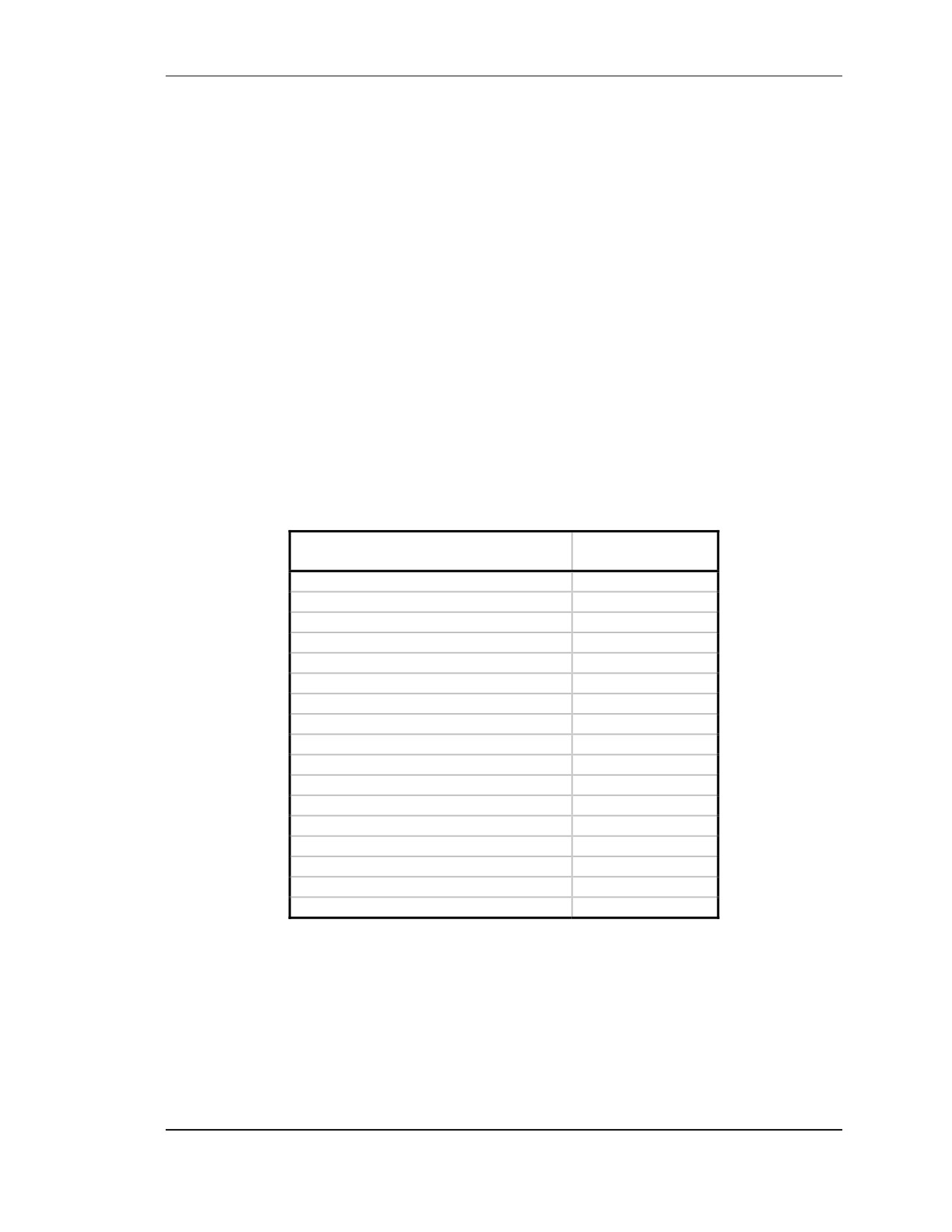
The maps made by some nations do not have their longitude values based on the
prime meridian that passes through Greenwich, England. Table 4-1 shows the prime
meridians that may be used by other nations. When these maps are issued to our soldiers, a
note usually appears in the marginal information giving the difference between our prime
meridian and the one used on the map.
PRIME
CITY, COUNTRY
MERIDIAN
Amsterdam, Netherlands
4°53’01”E
Athens, Greece
23°42’59”E
Batavia (Djakarta), Indonesia
106°48’28”E
Bern, Switzerland
7°26’22”E
Brussels, Belgium
4°22’06”E
Copenhagen, Denmark
12°34’40”E
Ferro (Hierro), Canary Islands
17°39’46”W
Helsinki, Finland
24°53’17”E
Istanbul, Turkey
28°58’50”E
Lisbon, Portugal
9°07’55”W
Madrid, Spain
3°41’15”W
Oslo, Norway
10°43’23”E
Paris, France
2°20’14”E
Pulkovo, Russia
30°19’39”E
Rome, Italy
12°27’08”E
Stockholm, Sweden
18°03’30”E
Tirane, Albania
19°46’45”E
Table 4-1. Table of prime meridians.
4-3.
MILITARY GRIDS
An examination of the transverse Mercator projection, which is used for large-scale military
maps, shows that most lines of latitude and longitude are curved lines. The quadrangles
formed by the intersection of these curved parallels and meridians are of different sizes and
shapes, complicating the location of points and the measurement of directions. To aid these
essential operations, a rectangular grid is superimposed upon the projection. This grid (a
FOUO
4-9
18 January 2005
FM 3-25.26
series of straight lines intersecting at right angles) furnishes the map reader with a system of
squares similar to the block system of most city streets. The dimensions and orientation of
different types of grids vary, but three properties are common to all military grid systems:
one, they are true rectangular grids; two, they are superimposed on the geographic
projection; and three, they permit linear and angular measurements.
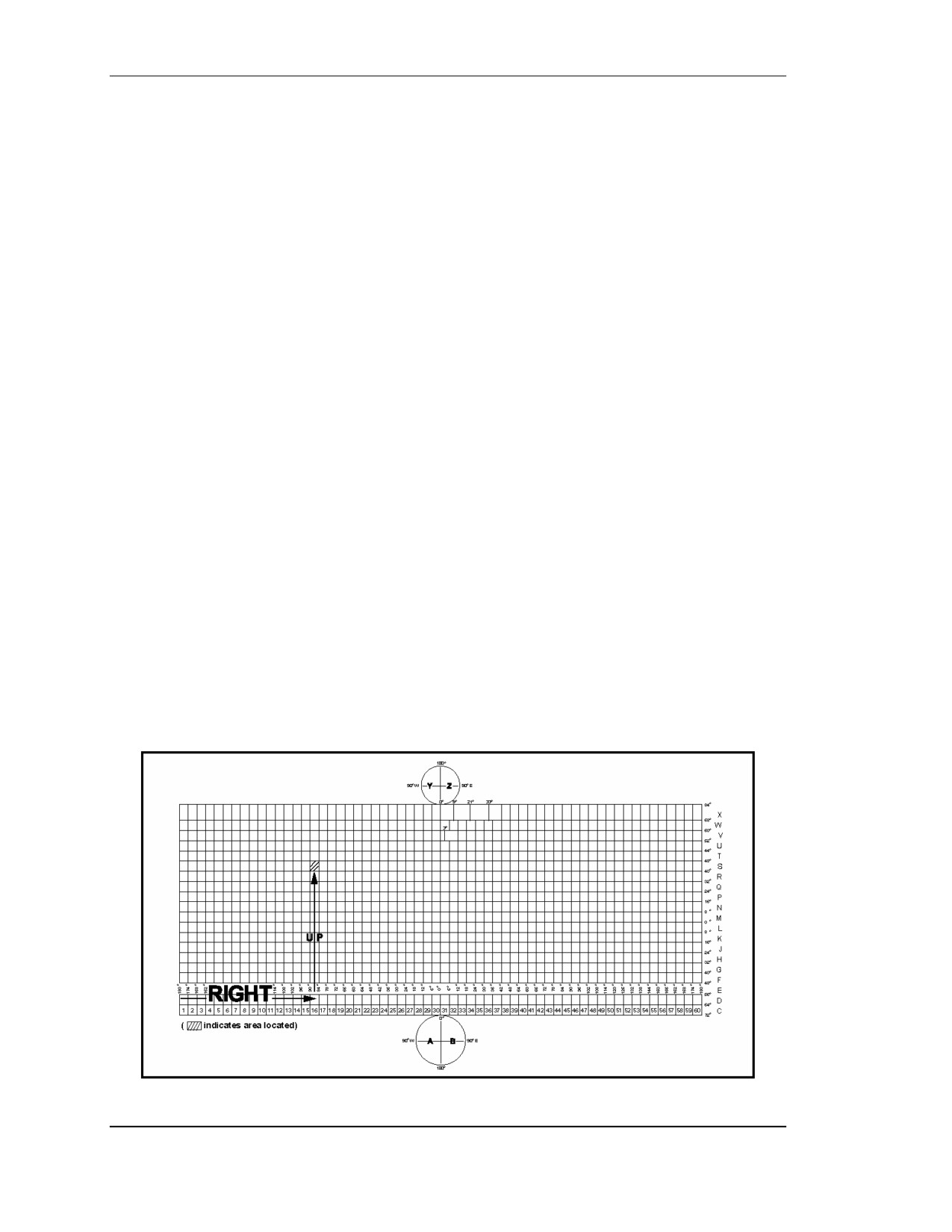
a. Universal Transverse Mercator (UTM) Grid. The UTM grid system was adopted
by the U.S. Army in 1947 for designating rectangular coordinates on large-scale military
maps. The UTM is currently used by the United States and NATO armed forces. With the
advent of inexpensive GPS receivers, many other map users are adopting the UTM grid
system for coordinates that are simpler to use than latitude and longitude. The UTM grid was
designed to cover that part of the world between latitude 84°N and latitude 80°S, and, as its
name implies, is imposed on the transverse Mercator projection. Each of the 60 zones
(6 degrees wide) into which the globe is divided for the grid has its own origin at the
intersection of its central meridian and the equator (Figure 4-8). The grid is identical in all 60
zones. Base values (in meters) are assigned to the central meridian and the equator, and the
grid lines are drawn at regular intervals parallel to these two base lines. With each grid line
assigned a value denoting its distance from the origin, the problem of locating any point
becomes progressively easier. Normally, it would seem logical to assign a value of zero to
the two base lines and measure outward from them. This, however, would require either that
directions⎯N, S, E, or W⎯be always given with distances, or that all points south of the
equator or west of the central meridian have negative values. This inconvenience is
eliminated by assigning “false values” to the base lines, resulting in positive values for all
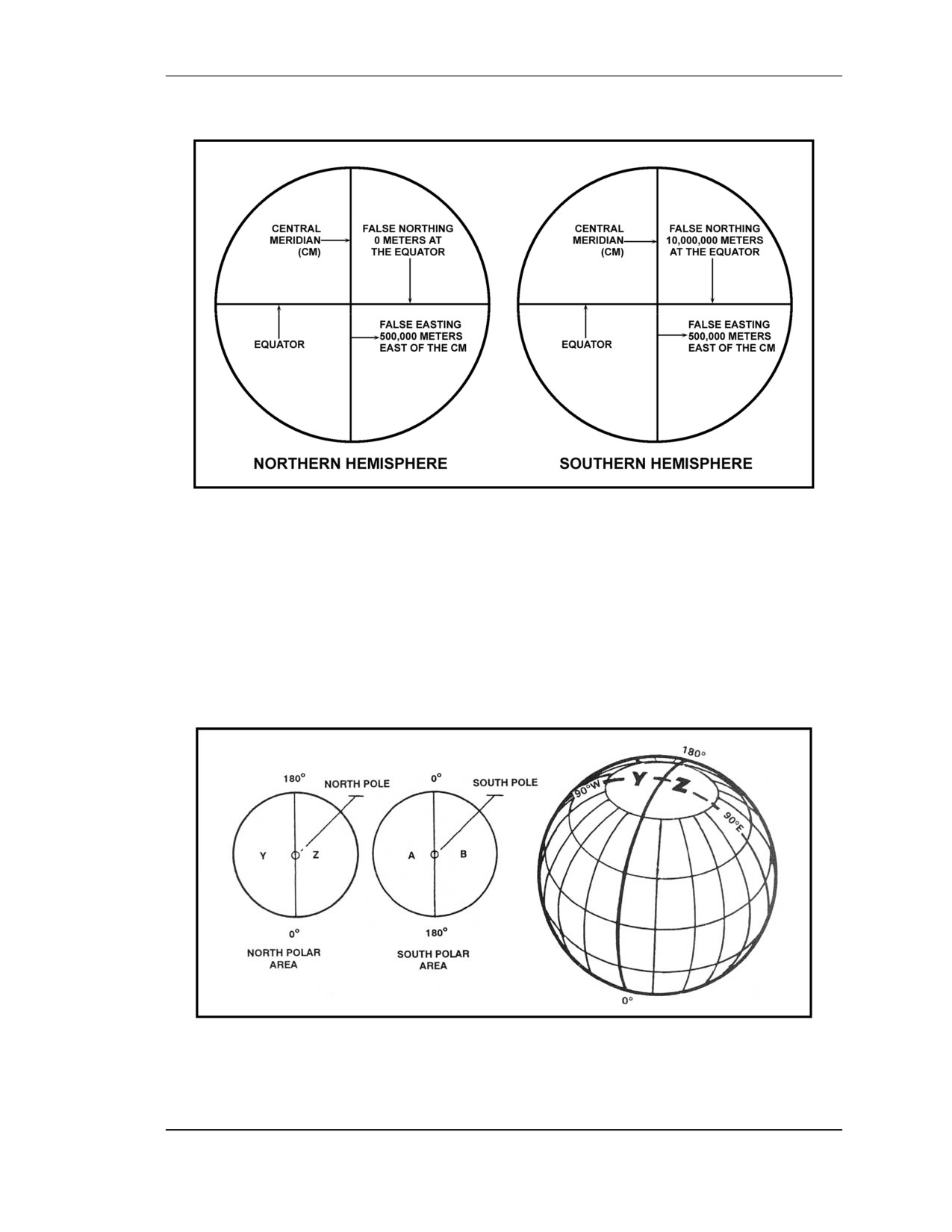
points within each zone. Distances are always measured RIGHT and UP (east and north as
the reader faces the map), and the assigned values are called “false easting” and “false
northing.” (Figure 4-9). The false easting value for each central meridian is 500,000 meters,
and the false northing value for the equator is 0 meters when measuring in the northern
hemisphere and 10,000,000 meters when measuring in the southern hemisphere. (The use of
the UTM grid for point designation will be discussed in detail in paragraph 4-4.)
Figure 4-8. UTM grid zone location.
4-10
FOUO
18 January 2005
FM 3-25.26
Figure 4-9. False eastings and northings for the UTM grid.
b. Universal Polar Stereographic (UPS) Grid. The UPS grid is used to represent the
polar regions (Figure 4-10, page 4-12).
(1) North Polar Area. The origin of the UPS grid applied to the north polar area is the
north pole. The “north-south” base line is the line formed by the 0-degree and 180-degree
meridians; the “east-west” base line is formed by the two 90-degree meridians.
(2) South Polar Area. The origin of the UPS grid in the south polar area is the south
pole. The base lines are similar to those of the north polar area.
Figure 4-10. Grid zone designation for UPS grid.
FOUO
4-11
18 January 2005
FM 3-25.26
4-4.
UNITED STATES ARMY MILITARY GRID REFERENCE SYSTEM
This grid reference system is designated for use with the UTM and UPS grids. The
coordinate value of points in these grids could contain as many as 15 digits if numerals alone
were used. The U.S. military grid reference system reduces the length of written coordinates
by substituting single letters for several numbers. Using the UTM and the UPS grids, it is
possible for the location of a point (identified by numbers alone) to be in many different
places on the surface of the earth. With the use of the military grid reference system, there is
no possibility of this happening.
a. Grid Zone Designation. The world is divided into 60 grid zones, which are large,
regularly shaped geographic areas, each of which is given a unique identification called the
grid zone designation.
(1) UTM Grid. The first major breakdown is the division of each zone into areas 6° wide
by 8° high and 6° wide by 12° high. Remember, for the transverse Mercator projection, the
earth’s surface between 80°S and 84°N is divided into 60 north-south zones, each 6° wide.
These zones are numbered from west to east, 1 through 60, starting at the 180° meridian.
This surface is divided into 20 east-west rows in which 19 are 8° high and 1 row at the
extreme north is 12° high. These rows are then lettered, from south to north, C through X
(I and O were omitted). Any 6° by 8° zone or 6° by 12° zone is identified by giving the
number and letter of the grid zone and row in which it lies. These are read RIGHT and UP so
the number is always written before the letter. This combination of zone number and row
letter constitutes the grid zone designation. Columbus lies in zone 16 and row S, or in grid
zone designation 16S (Figure 4-8).
(2) UPS Grid. The remaining letters of the alphabet—A, B, Y, and Z—are used for the
UPS grids. Each polar area is divided into two zones separated by the 0-180° meridian. In
the south polar area, the letter A is the grid zone designation for the area west of the 0-180°
meridian, and B for the area to the east. In the north polar area, Y is the grid zone
designation for the western area and Z for the eastern area (Figure 4-10).
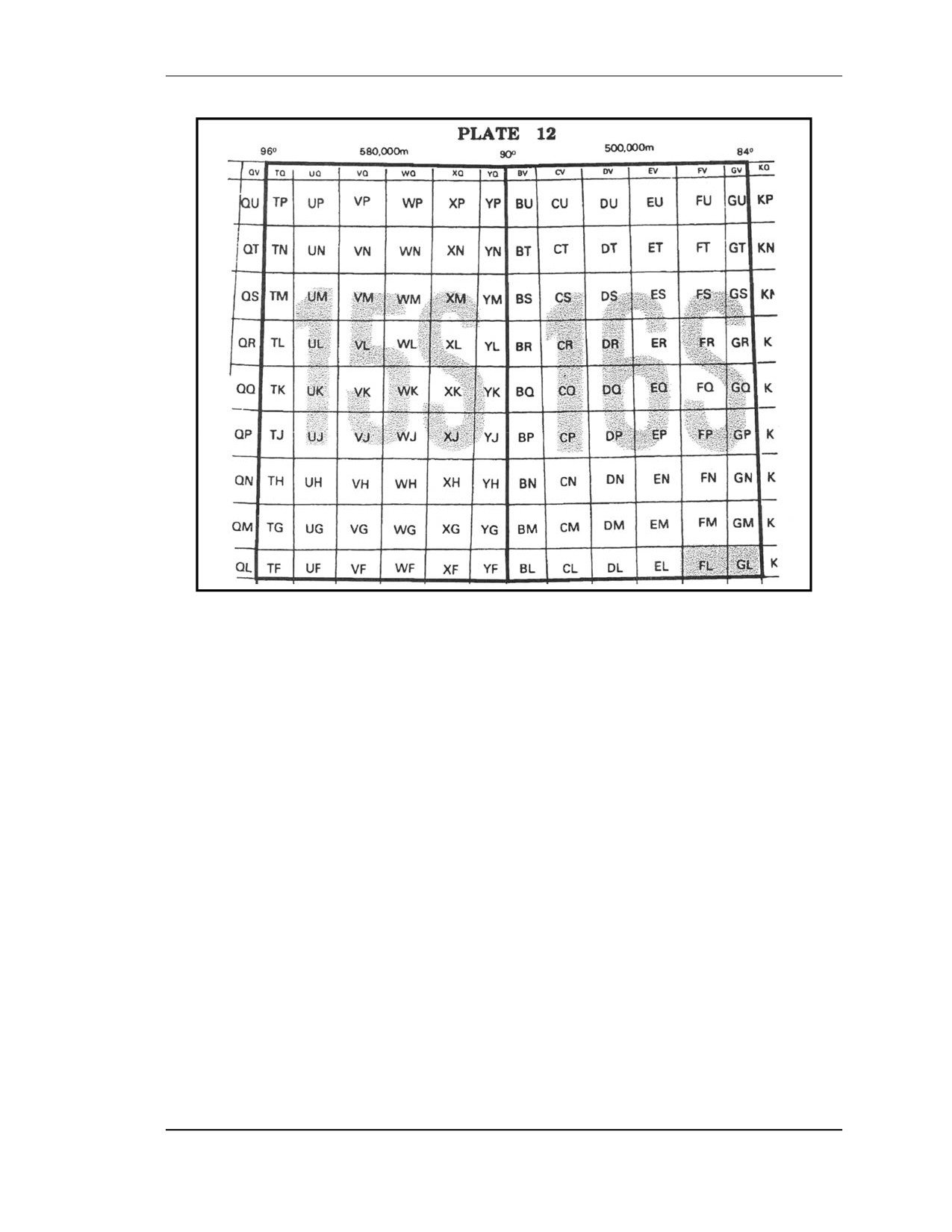
b.
100,000-Meter Square. Between 84°N and 80°S, each 6° by 8° or 6° by 12° zone is
covered by 100,000-meter squares that are identified by the combination of two alphabetical
letters. This identification is unique within the area covered by the grid zone designation.
The first letter is the column designation; the second letter is the row designation (Figure 4-
11). The north and south polar areas are also divided into 100,000-meter squares by columns
and rows. The 100,000-meter square identification letters are located in the grid reference
box in the lower margin of the map.
4-12
FOUO
18 January 2005
FM 3-25.26
Figure 4-11. Grid zone designation and 100,000-meter
square identification.
c. Grid Coordinates. We have now divided the earth’s surface into 6° by 8°
quadrangles, and covered these with 100,000-meter squares. The military grid reference of a
point consists of the numbers and letters indicating in which of these areas the point lies,
plus the coordinates locating the point to the desired position within the 100,000-meter
square. The next step is to tie in the coordinates of the point with the larger areas. To do this,
you must understand the following.
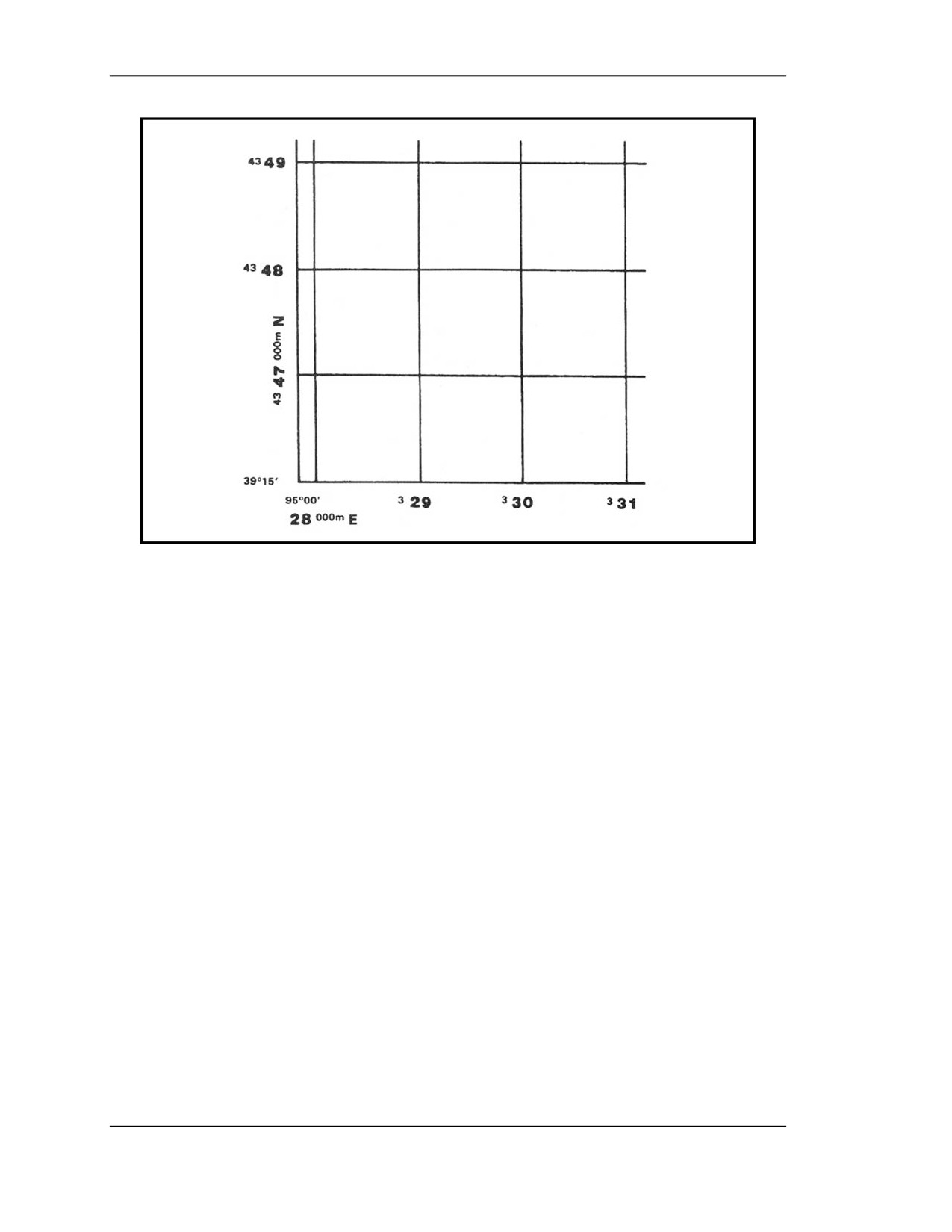
(1) Grid Lines. The regularly spaced lines that make the UTM and the UPS grid on any
large-scale maps are divisions of the 100,000-meter square; the lines are spaced at 10,000- or
1,000-meter intervals (Figure 4-12, page 4-14). Each of these lines is labeled at both ends of
the map with its false easting or false northing value, showing its relation to the origin of the
zone. Two digits of the values are printed in large type, and these same two digits appear at
intervals along the grid lines on the face of the map. These are called the principal digits, and
represent the 10,000 and 1,000 digits of the grid value. They are of major importance to the
map reader because they are the numbers he will use most often for referencing points. The
smaller digits complete the UTM grid designation.
FOUO
4-13
18 January 2005
FM 3-25.26
Figure 4-12. Grid lines.
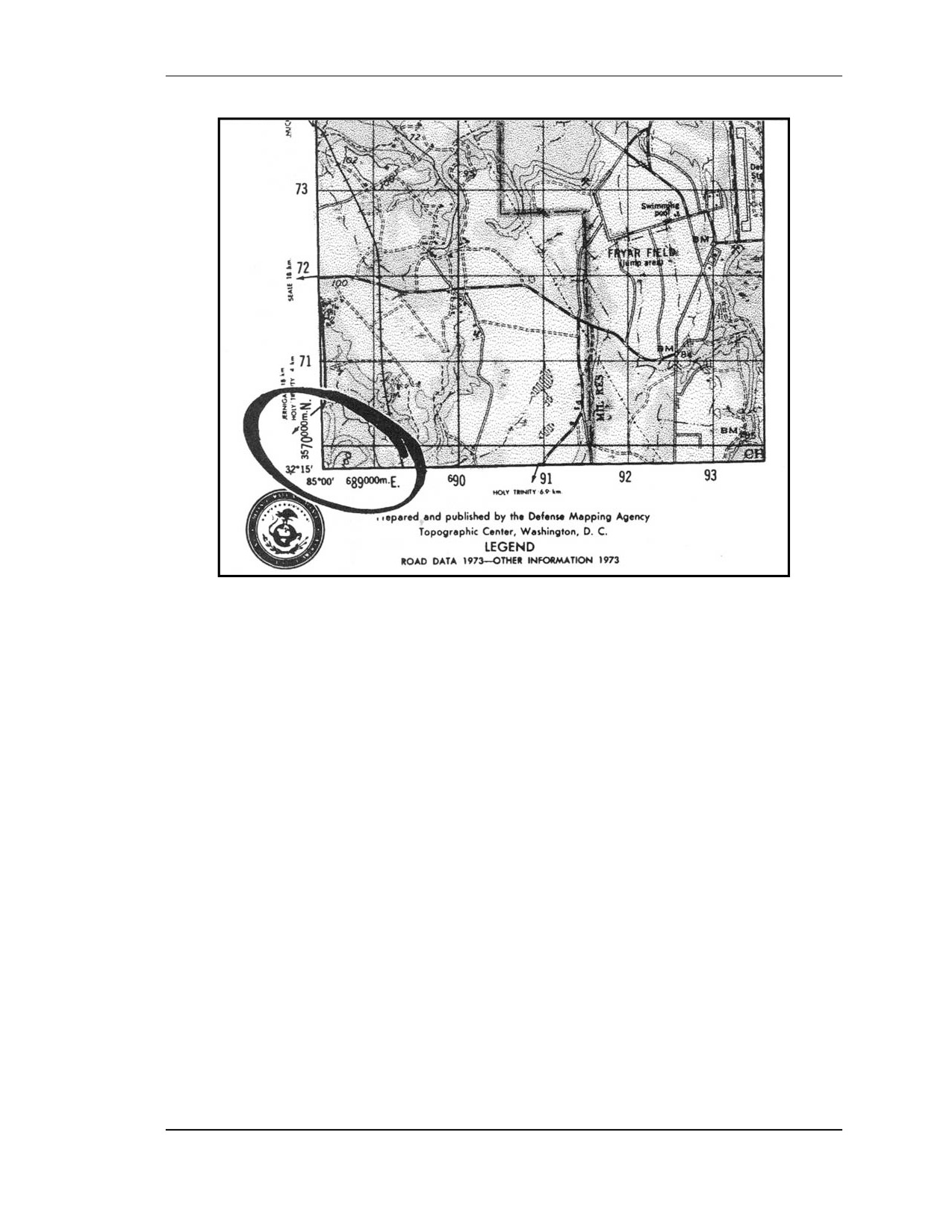
EXAMPLE: The first grid line north of the south-west corner of the Columbus map
is labeled 3570000m N. This means its false northing (distance north
of the equator) is 3,570,000 meters. The principal digits, 70, identify
the line for referencing points in the northerly direction. The smaller
digits, 35, are part of the false coordinates and are rarely used. The
last three digits, 000, of the value are omitted. Therefore, the first grid
line east of the south-west corner is labeled 689000m E. The principal
digits,
89, identify the line for referencing points in the easterly
direction (Figure 4-13).
4-14
FOUO
18 January 2005
FM 3-25.26
Figure 4-13. Columbus map, southwest corner.
(2) Grid Squares. The north-south and east-west grid lines intersect at 90°, forming grid
squares. Normally, the size of one of these grid squares on large-scale maps is 1,000 meters
(1 kilometer).
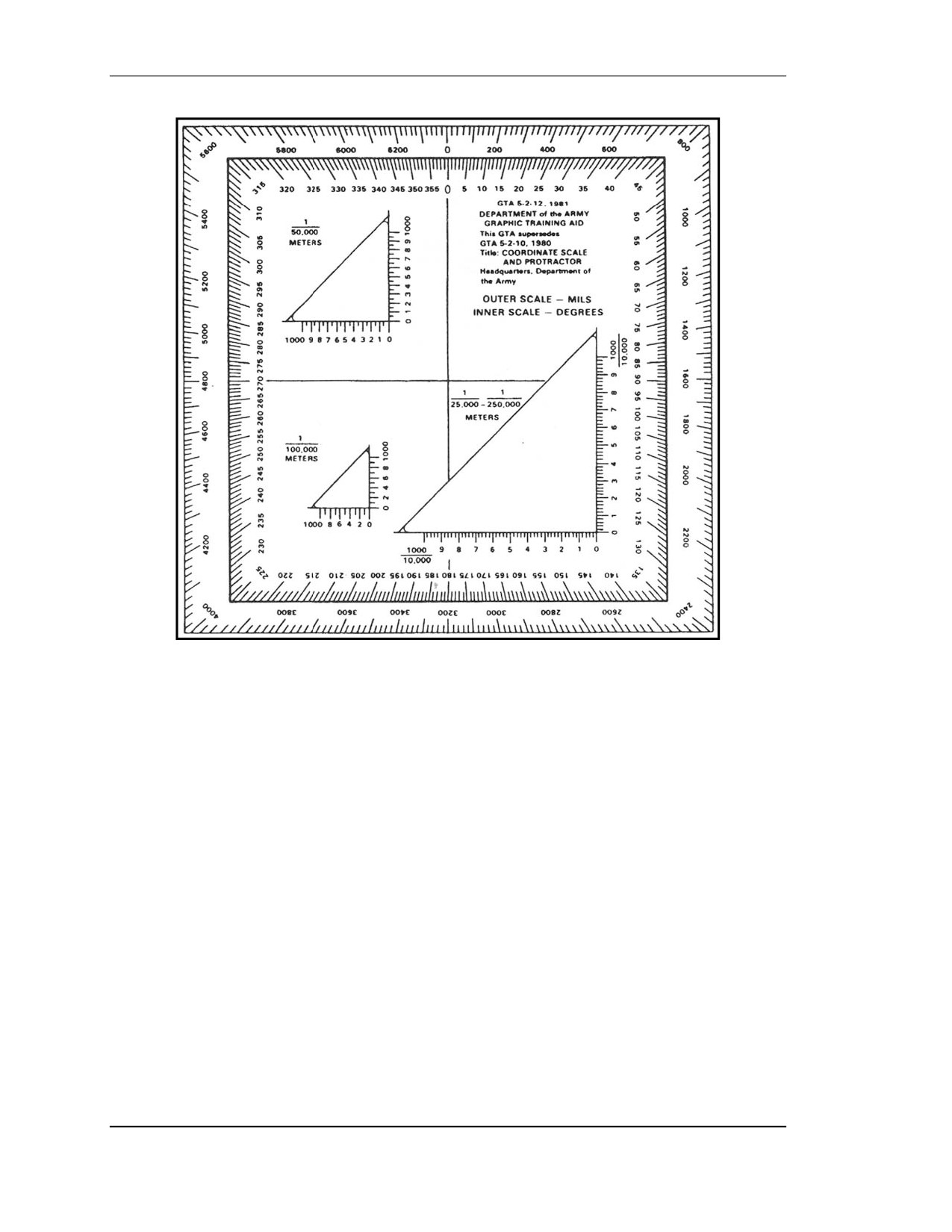
(3) Grid Coordinate Scales. The primary tool for plotting grid coordinates is the grid
coordinate scale. The grid coordinate scale divides the grid square more accurately than can
be done by estimation, and the results are more consistent. When used correctly, it presents
less chance for making errors. GTA 5-2-12 contains four types of coordinate scales
(Figure 4-14, page 4-16).
FOUO
4-15
18 January 2005
FM 3-25.26
Figure 4-14. Coordinate scales.
(a) The 1:25,000/1:250,000 (lower right in figure) can be used in two different scale
maps, 1:25,000 or 1:250,000. The 1:25,000 scale subdivides the 1,000-meter grid block into
10 major subdivisions, each equal to 100 meters. Each 100-meter block has five graduations,
each equal to 20 meters. Points falling between the two graduations can be read accurately
by the use of estimation. These values are the fourth and eighth digits of the coordinates.
Likewise, the 1:250,000 scale is subdivided into 10 major subdivisions, each equal to 1,000
meters. Each 1,000-meter block has five graduations, each equal to 200 meters. Points falling
between two graduations can be read approximately by the use of estimation.
(b) The 1:50,000 scale (upper left in Figure 4-14) subdivides the 1,000-meter block into
10 major subdivisions, each equal to 100 meters. Each 100-meter block is then divided in
half. Points falling between the graduations must be estimated to the nearest 10 meters for
the fourth and eighth digits of the coordinates.
(c) The 1:100,000 scale (lower left in Figure 4-14) subdivides the 1,000-meter grid block
into five major subdivisions of 200 meters each. Each 200-meter block is then divided in half
at 100-meter intervals.
4-5.
LOCATING A POINT USING GRID COORDINATES
Based on the military principle for reading maps (RIGHT and UP), locations on the map can
be determined by grid coordinates. The number of digits represents the degree of precision to
4-16
FOUO
18 January 2005
FM 3-25.26
which a point has been located and measured on a map⎯the more digits the more precise the
measurement.
a. Without a Coordinate Scale. In order to determine grids without a coordinate scale,
the reader simply refers to the north-south grid lines numbered at the bottom margin of any
map. Then he reads RIGHT to the north-south grid line that precedes the desired point (this
first set of two digits is the RIGHT reading). Then by referring to the east-west grid lines
numbered at either side of the map, the map reader moves UP to the east-west grid line that
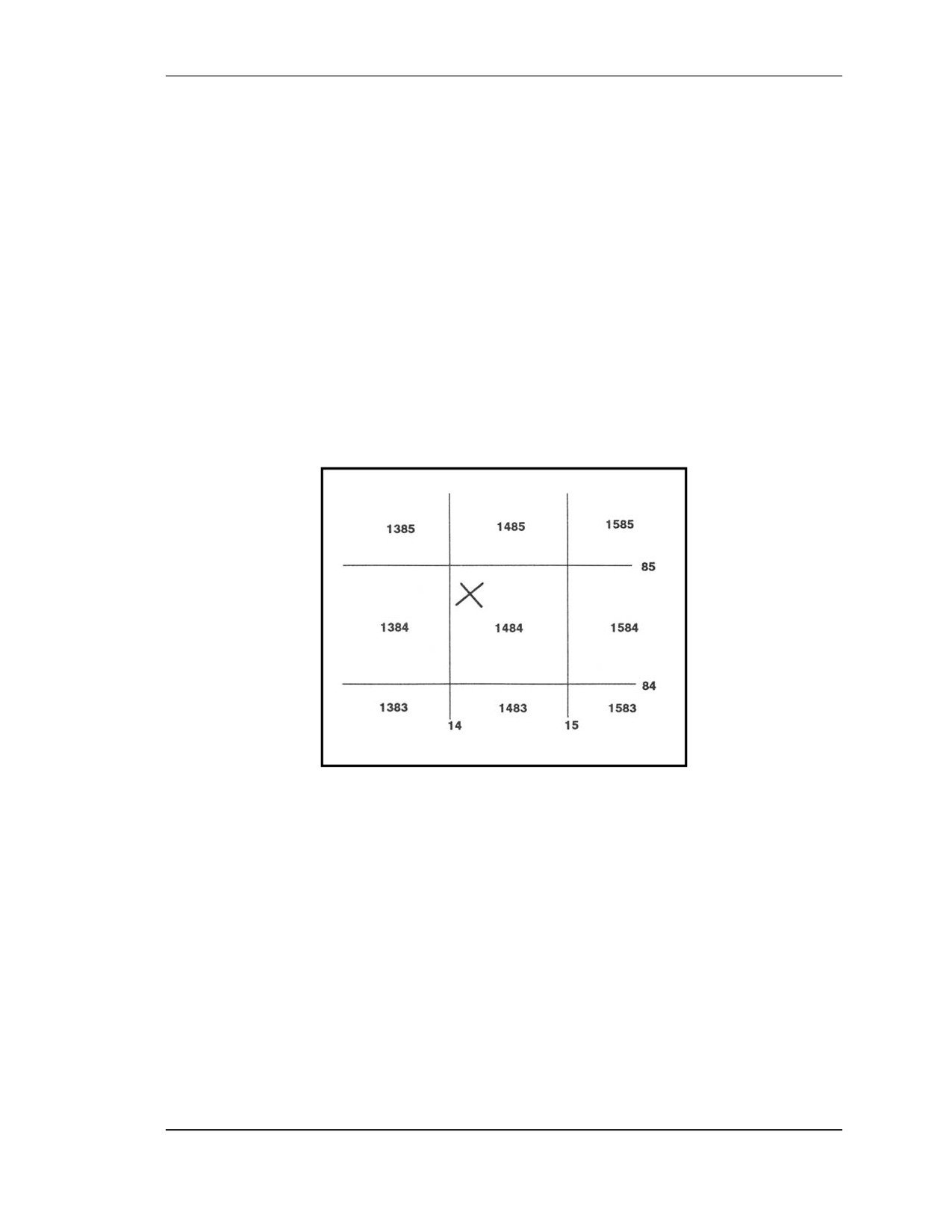
precedes the desired point (these two digits are the UP reading). Coordinates 1484 locate the
1,000-meter grid square in which point X is located; the next square to the right would be
1584; the next square up would be 1485, and so forth (Figure 4-15). To locate the point to
the nearest 100 meters, use estimation. By mentally dividing the grid square in tenths,
estimate the distance from the grid line to the point in the same order (RIGHT and UP). Give
complete coordinate RIGHT, then complete coordinate UP. Point X is about two-tenths or
200 meters to the RIGHT into the grid square and about seven-tenths or 700 meters UP. The
coordinates to the nearest 100 meters are 142847.
Figure 4-15. Determining grids without coordinate point.
b. With a Coordinate Scale. In order to use the coordinate scale for determining grid
coordinates, the map user has to make sure that the appropriate scale is being used on the
corresponding map, and that the scale is right side up. To ensure the scale is correctly
aligned, place it with the zero-zero point at the lower left corner of the grid square. Keeping
the horizontal line of the scale directly on top of the east-west grid line, slide it to the right
until the vertical line of the scale touches the point for which the coordinates are desired
(Figure 4-16, page 4-18). When reading coordinates, examine the two sides of the coordinate
scale to ensure that the horizontal line of the scale is aligned with the east-west grid line, and
the vertical line of the scale is parallel with the north-south grid line. The scale is used when
precision of more than 100 meters is required. To locate the point to the nearest 10 meters,
measure the hundredths of a grid square RIGHT and UP from the grid lines to the point.
Point X is about 17 hundredths or 170 meters RIGHT and 84 hundredths or 840 meters UP.
The coordinates to the nearest 10 meters are 14178484.
FOUO
4-17
18 January 2005
///////////////////////////////////////