FM 3-25.26 MAP READING AND LAND NAVIGATION (January 2005) - page 2
FM 3-25.26
c. Recording and Reporting Grid Coordinates. Coordinates are written as one
continuous number without spaces, parentheses, dashes, or decimal points; they must always
contain an even number of digits. Therefore, whoever is to use the written coordinates must
know where to make the split between the RIGHT and UP readings. It is a military
requirement that the 100,000-meter square identification letters be included in any point
designation. Normally, grid coordinates are determined to the nearest 100 meters (six digits)
for reporting locations. With practice, this can be done without using plotting scales. The
location of targets and other point locations for fire support are determined to the nearest
10 meters (eight digits).
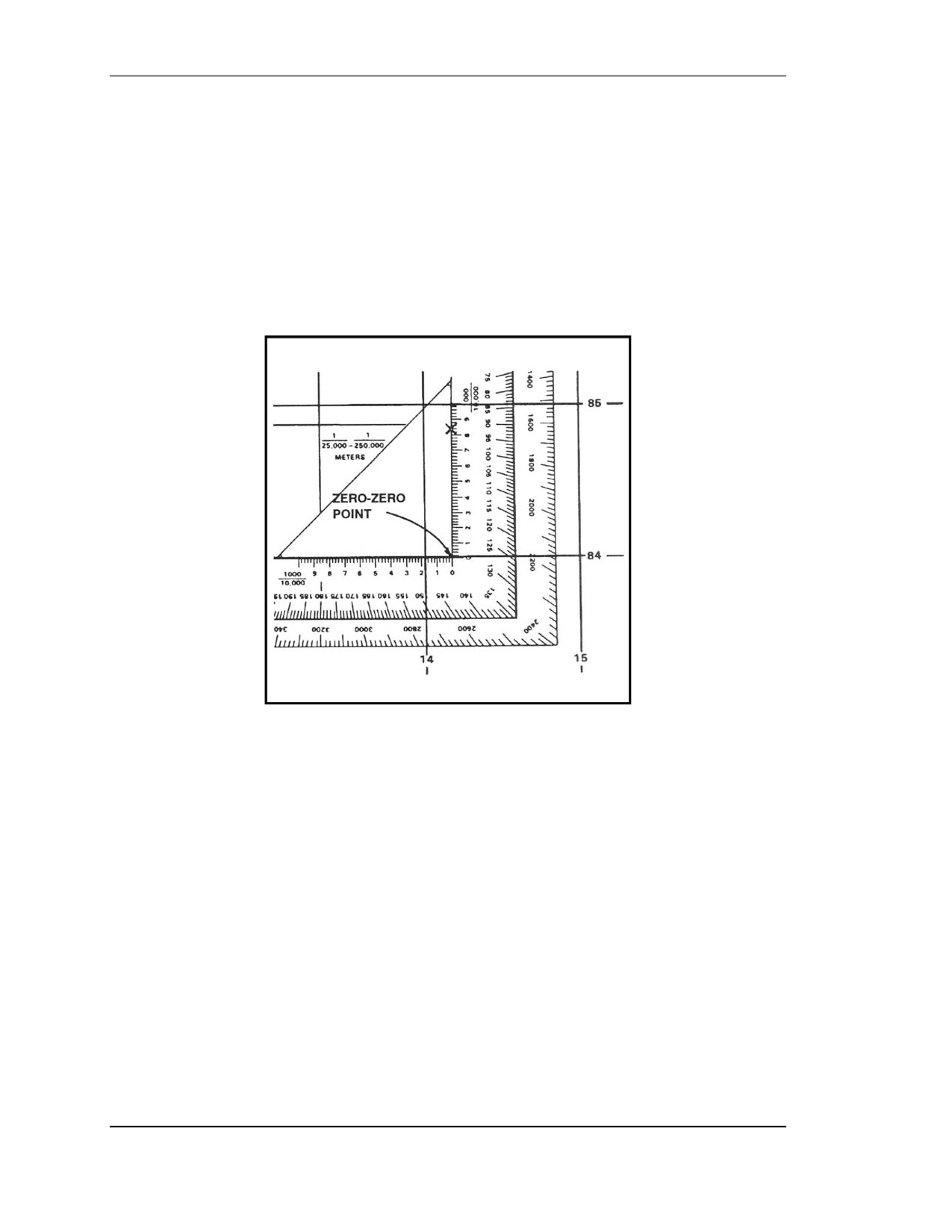
Figure 4-16. Placing a coordinate scale on a grid.
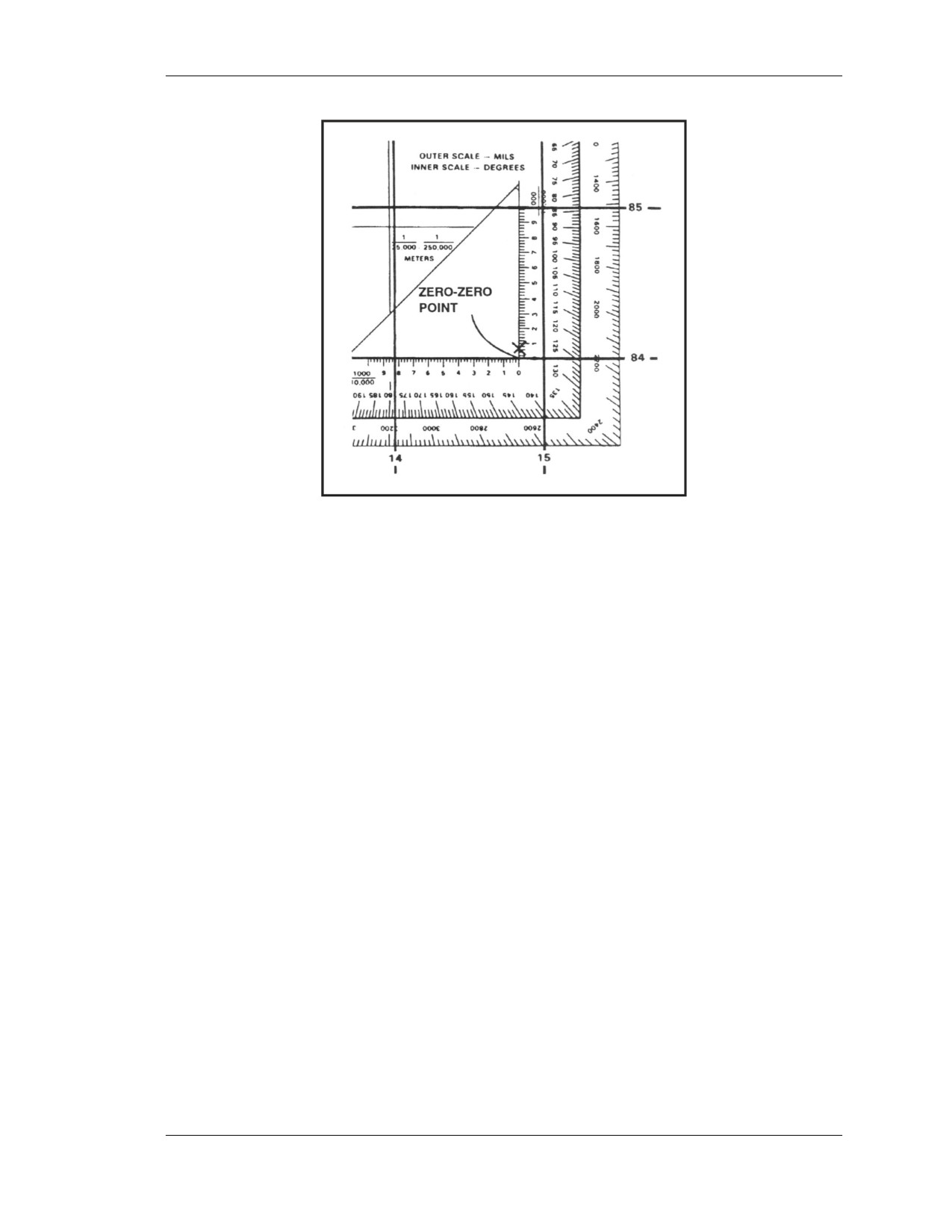
NOTE: Care should be exercised by the map reader using the coordinate scale when the
desired point is located within the zero-zero point and the number 1 on the scale.
Always prefix a zero if the hundredths reading is less than 10. In Figure 4-17, the
desired point should be reported as 14818407.
4-18
FOUO
18 January 2005
C1, FM 3-25.26
Figure 4-17. Zero-zero point.
NOTE: Special care should be exercised when recording and reporting coordinates.
Transposing numbers or making errors could be detrimental to military
operations.
4-6.
LOCATING A POINT USING THE U.S. ARMY MILITARY GRID
REFERENCE SYSTEM
There is only one rule to remember when reading or reporting grid coordinates⎯always
read to the RIGHT and then UP. The first half of the reported set of coordinate digits
represents the left-to-right (easting) grid label, and the second half represents the label as
read from the bottom to top (northing). The grid coordinates may represent the location
to the nearest 10-, 100-, or 1,000-meter increment.
* a. Grid Zone. The number 16 locates a point within zone 16, which is an area 6°
wide and extends between 80°S latitude and 84°N latitude (Figure 4-8, page 4-10).
* b. Grid Zone Designation. The number and letter combination, 16S, further locates
a point within the grid zone designation 16S, which is a quadrangle 6° wide by 8° high.
There are 19 of these quads in zone 16. Quad X, which is located between 72°N and
84°N latitude, is 12° high (Figure 4-8, page 4-10).
* c.
100,000-Meter Square Identification. The addition of two more letters locates a
point within the 100,000-meter grid square. Thus 16SGL (Figure 4-11, page 4-13) locates
the point within the 100,000-meter square GL in the grid zone designation 16S. (For
information on the lettering system of 100,000-meter squares, see TM 5-241-1.)
d.
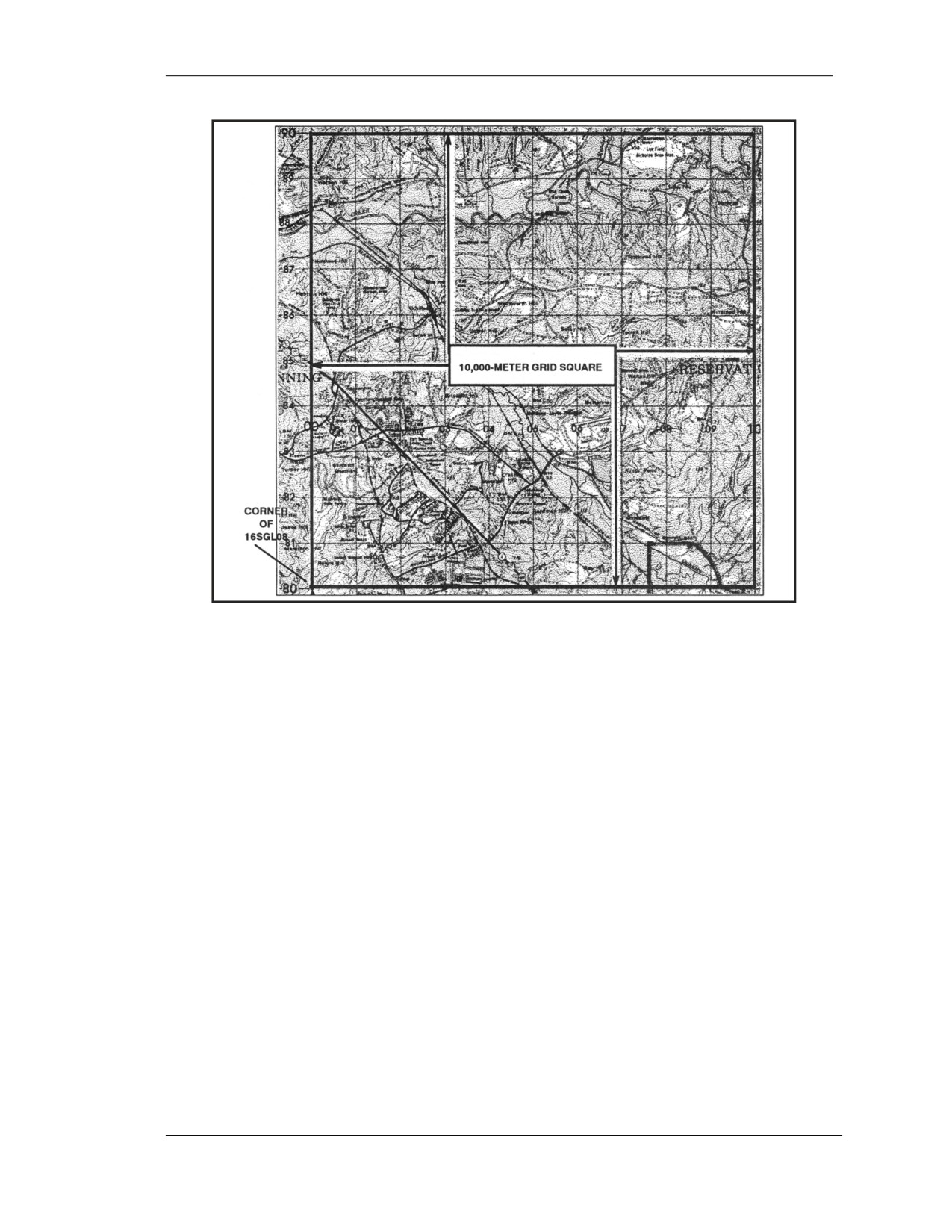
10,000-Meter Square. The breakdown of the U.S. Army military grid reference
system continues as each side of the 100,000-meter square is divided into 10 equal parts.
This division produces lines that are 10,000 meters apart. Thus the coordinates 16SGL08
would locate a point as shown in Figure 4-18. The 10,000-meter grid lines appear as
index (heavier) grid lines on maps at 1:100,000 and larger.
30 August 2006
4-19
FOUO
C1, FM 3-25.26
Figure 4-18. The 10,000-meter grid square.
e.
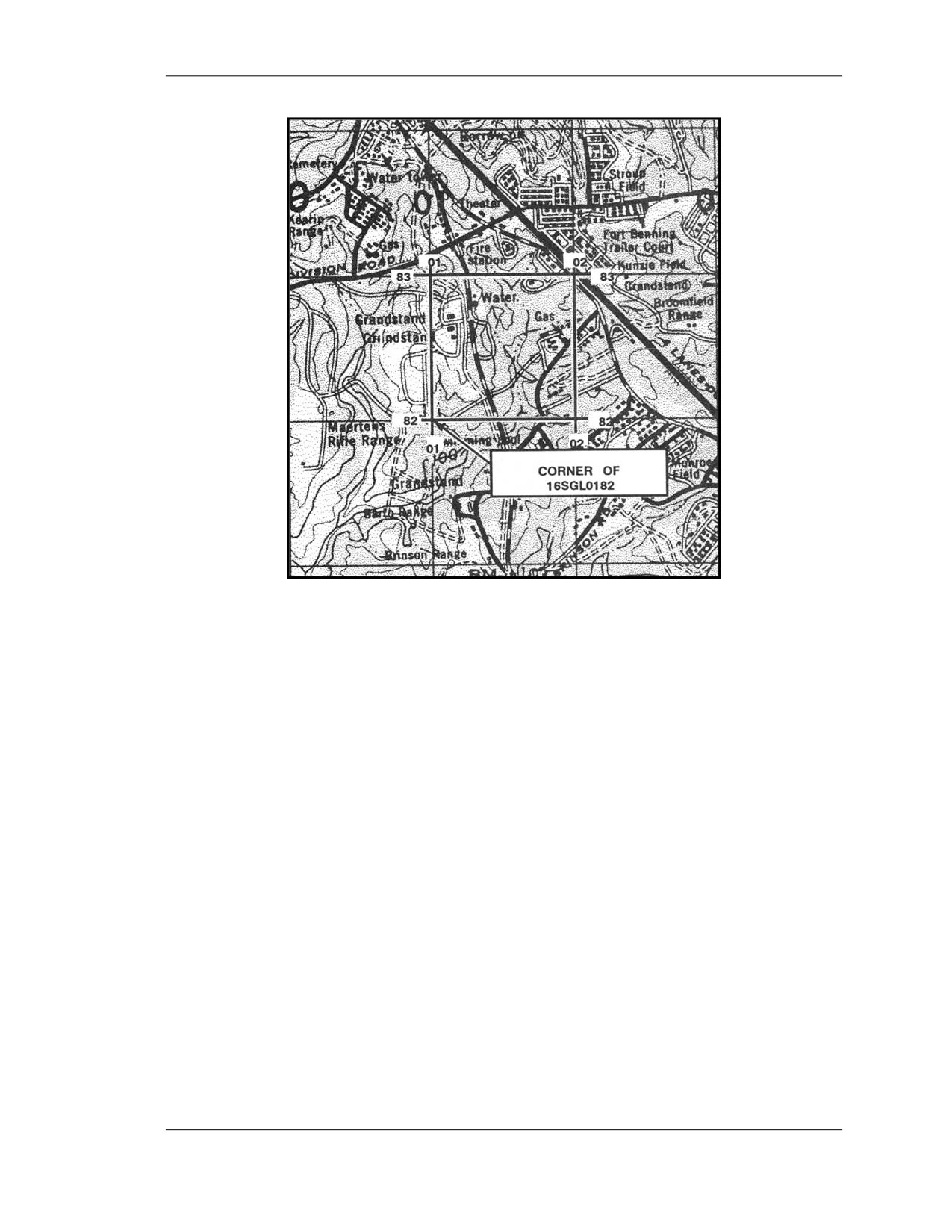
1,000-Meter Square. To obtain 1,000-meter squares, each side of the 10,000-
meter square is divided into 10 equal parts. This division appears on large-scale maps as
the actual grid lines; they are
1,000 meters apart. On the Columbus map, using
coordinates 16SGL0182, the easting 01 and the northing 82 gives the location of the
southwest corner of grid square 0182 or to the nearest 1,000 meters of a point on the map
(Figure 4-19).
4-20
30 August 2006
FOUO
FM 3-25.26
Figure 4-19. The 1,000-meter grid square.
f.
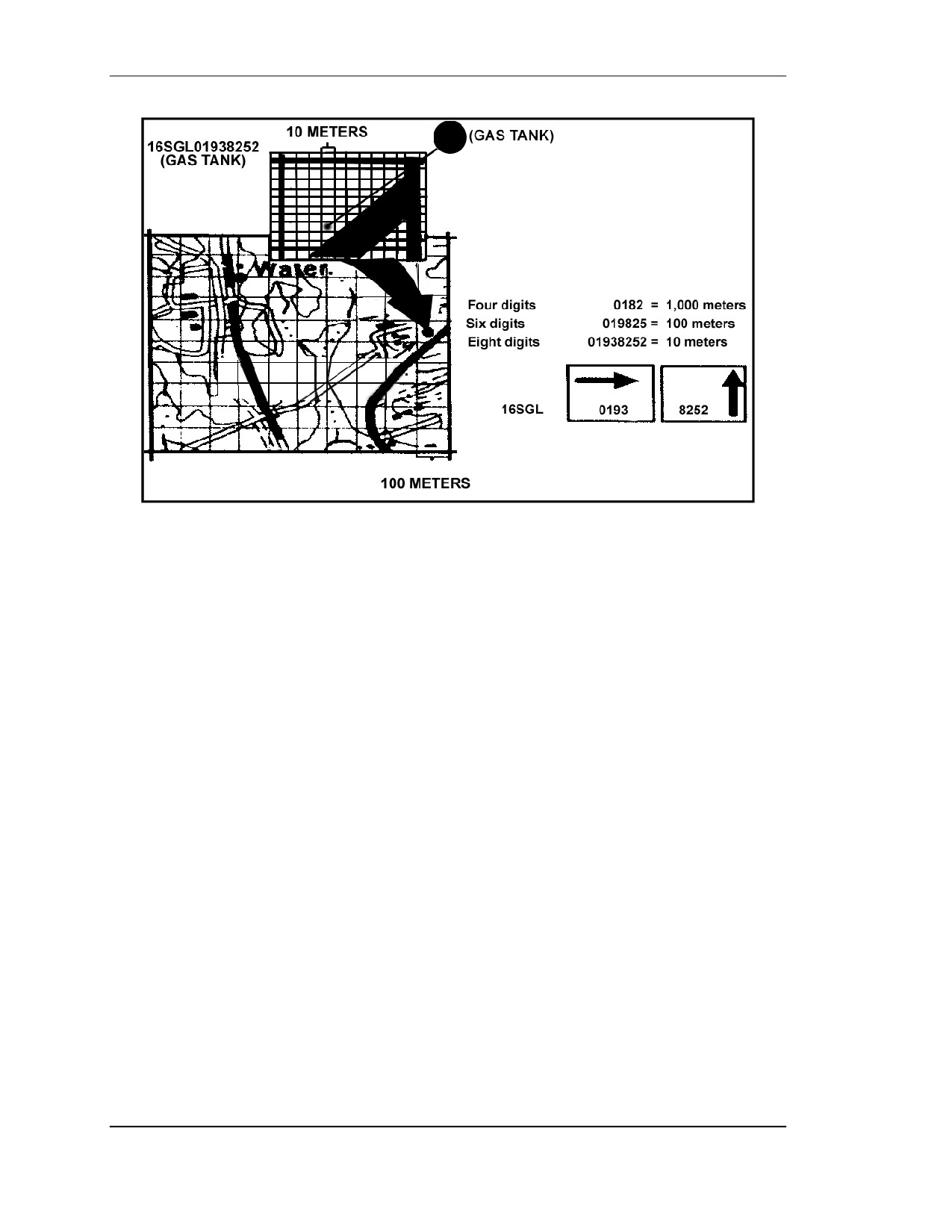
100-Meter Identification. To locate to the nearest 100 meters, the grid coordinate
scale can be used to divide the 1,000-meter grid squares into 10 equal parts (Figure 4-20,
page 4-22).
g.
10-Meter Identification. The grid coordinate scale has divisions every 50 meters on
the 1:50,000 scale and every 20 meters on the 1:25,000 scale. These can be used to estimate
to the nearest 10 meters and give the location of one point on the earth’s surface to the
nearest 10 meters. For example: 16SGL01948253 (gas tank).
FOUO
4-21
18 January 2005
FM 3-25.26
Figure 4-20. The 100-meter and 10-meter grid squares.
h. Precision. The precision of a point’s location is shown by the number of digits in the
coordinates; the more digits, the more precise the location (Figure 4-20, insert).
4-7.
GRID REFERENCE BOX
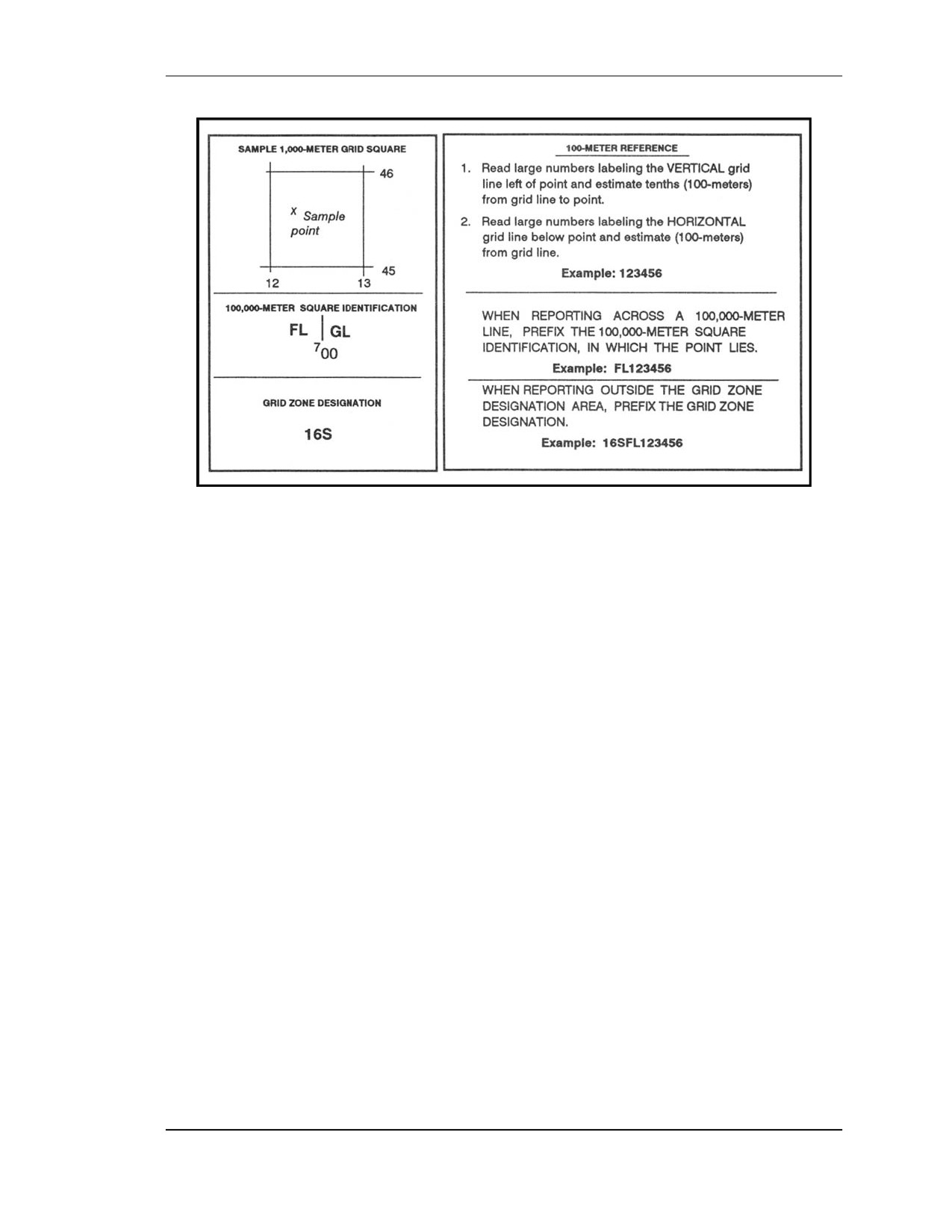
A grid reference box (Figure 4-21) appears in the marginal information of each map sheet. It
contains step-by-step instructions for using the grid and the U.S. Army military grid
reference system. The grid reference box is divided into two parts.
a. The left portion identifies the grid zone designation and the 100,000-meter square. If
the sheet falls in more than one 100,000-meter square, the grid lines that separate the squares
are shown in the diagram and the letters identifying the 100,000-meter squares are given.
EXAMPLE: On the Columbus map sheet, the vertical line labeled 00 is the grid
line that separates the two 100,000-meter squares, FL and GL. The
left portion also shows a sample for the 1,000-meter square with its
respective labeled grid coordinate numbers and a sample point within
the 1,000-meter square.
b. The right portion of the grid reference box explains how to use the grid and is keyed
on the sample 1,000-meter square of the left side. The following is an example of the
military grid reference:
EXAMPLE:
16S locates the 6° by 8° area (grid zone designation).
4-22
FOUO
18 January 2005
FM 3-25.26
Figure 4-21. Grid reference box.
4-8.
OTHER GRID SYSTEMS
The military grid reference system is not universally used. You must be prepared to interpret
and use other grid systems, depending on your area of operations or the personnel you are
operating with.
a. British Grids. In a few areas of the world, British grids are still shown on military
maps. However, the British grid systems are being phased out. Eventually all military
mapping will be converted to the UTM grid.
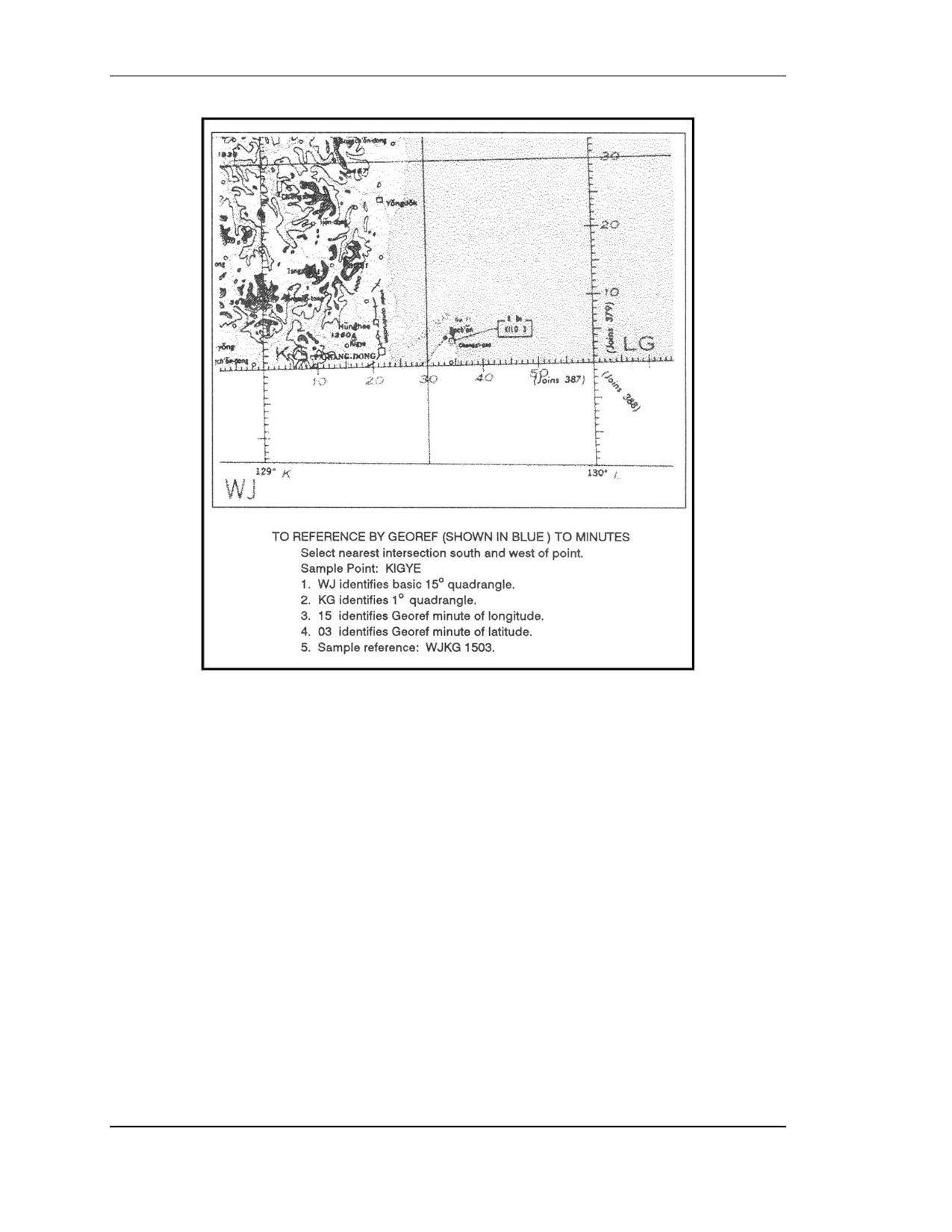
b. World Geographic Reference System (GEOREF). This is a worldwide position
reference system used primarily by the U.S. Air Force. It may be used with any map or chart
that has latitude and longitude printed on it. Instructions for using GEOREF data are printed
in blue and are found in the margin of aeronautical charts (Figure 4-20, page 4-24). This
system is based upon a division of the earth’s surface into quadrangles of latitude and
longitude having a systematic identification code. It is a method of expressing latitude and
longitude in a form suitable for rapid reporting and plotting. Figure 4-20 illustrates a sample
grid reference box using GEOREF. The GEOREF system uses an identification code that has
three main divisions.
FOUO
4-23
18 January 2005
FM 3-25.26
Figure 4-20. Sample reference using GEOREF.
(1) First Division. There are 24 north-south (longitudinal) zones, each 15° wide. These
zones, starting at 180° and progressing eastward, are lettered A through Z (omitting I and O).
The first letter of any GEOREF coordinate identifies the north-south zone in which the point
is located. There are 12 east-west (latitudinal) bands, each 15° wide. These bands are lettered
A through M (omitting I) northward from the south pole. The second letter of any GEOREF
coordinate identifies the east-west band in which the point is located. The zones and bands
divide the earth’s surface into 288 quadrangles, each identified by two letters.
(2) Second Division. Each 15° quadrangle is further divided into 225 quadrangles of 1°
each (15° by 15°). This division is effected by dividing a basic 15° quadrangle into 15
north-south zones and 15 east-west bands. The north-south zones are lettered A through Q
(omitting I and O) from west to east. The third letter of any GEOREF coordinate identifies
the 1° north-south zone within a 15° quadrangle. The east-west bands are lettered A through
Q (I and O omitted) from south to north. The fourth letter of a GEOREF coordinate identifies
the 1° east-west band within a 15° quadrangle. Four letters will identify any 1° quadrangle in
the world.
(3) Third Division. Each of the 1° quadrangles is divided into 3,600 1” quadrangles.
These 1” quadrangles are formed by dividing the 1° quadrangles into 60 1” north-south
4-24
FOUO
18 January 2005
FM 3-25.26
zones numbered 0 through 59 from west to east, and 60 east-west bands numbered 0 to 59
from south to north. To designate any one of the 3,600 1” quadrangles requires four letters
and four numbers. The rule READ RIGHT AND UP is always followed. Numbers 1 through
9 are written as 01, 02, and so forth. Each of the 1” quadrangles may be further divided into
10 smaller divisions both north-south and east-west, permitting the identification of 0.1”
quadrangles. The GEOREF coordinate for any 0.1”quadrangle consists of four letters and six
numbers.
4-9.
PROTECTION OF MAP COORDINATES AND LOCATIONS
A disadvantage of any standard system of location is that the enemy, if he intercepts one of
our messages using the system, can interpret the message and find our location. This
possibility can be eliminated by using an authorized low-level numerical code to express
locations. Army Regulation 380-40 outlines the procedures for obtaining authorized codes.
a. The authorized numerical code provides a capability for encrypting map references
and other numerical information that requires short-term security protection when, for
operational reasons, the remainder of the message is transmitted in plain language. The
system is published in easy-to-use booklets with sufficient material in each for one month’s
operation. Sample training editions of this type of system are available through the unit’s
communications and electronics officer.
b. The use of any encryption methods other than authorized codes is, by regulation,
unauthorized and shall not be used.
FOUO
4-25
18 January 2005
This Page intentionally left blank.
FM 3-25.26
CHAPTER 5
SCALE AND DISTANCE
A map is a scaled graphic representation of a portion of the earth’s
surface. The scale of the map permits the user to convert distance on the map
to distance on the ground or vice versa. The ability to determine distance on
a map, as well as on the earth’s surface, is an important factor in planning
and executing military missions.
5-1.
REPRESENTATIVE FRACTION
The numerical scale of a map indicates the relationship of distance measured on a map and
the corresponding distance on the ground. This scale is usually written as a fraction and is
called the representative fraction (RF). The RF is always written with the map distance as 1
and is independent of any unit of measure. (It could be yards, meters, inches, and so forth.)
An RF of 1/50,000 or 1:50,000 means that one unit of measure on the map is equal to 50,000
units of the same measure on the ground.
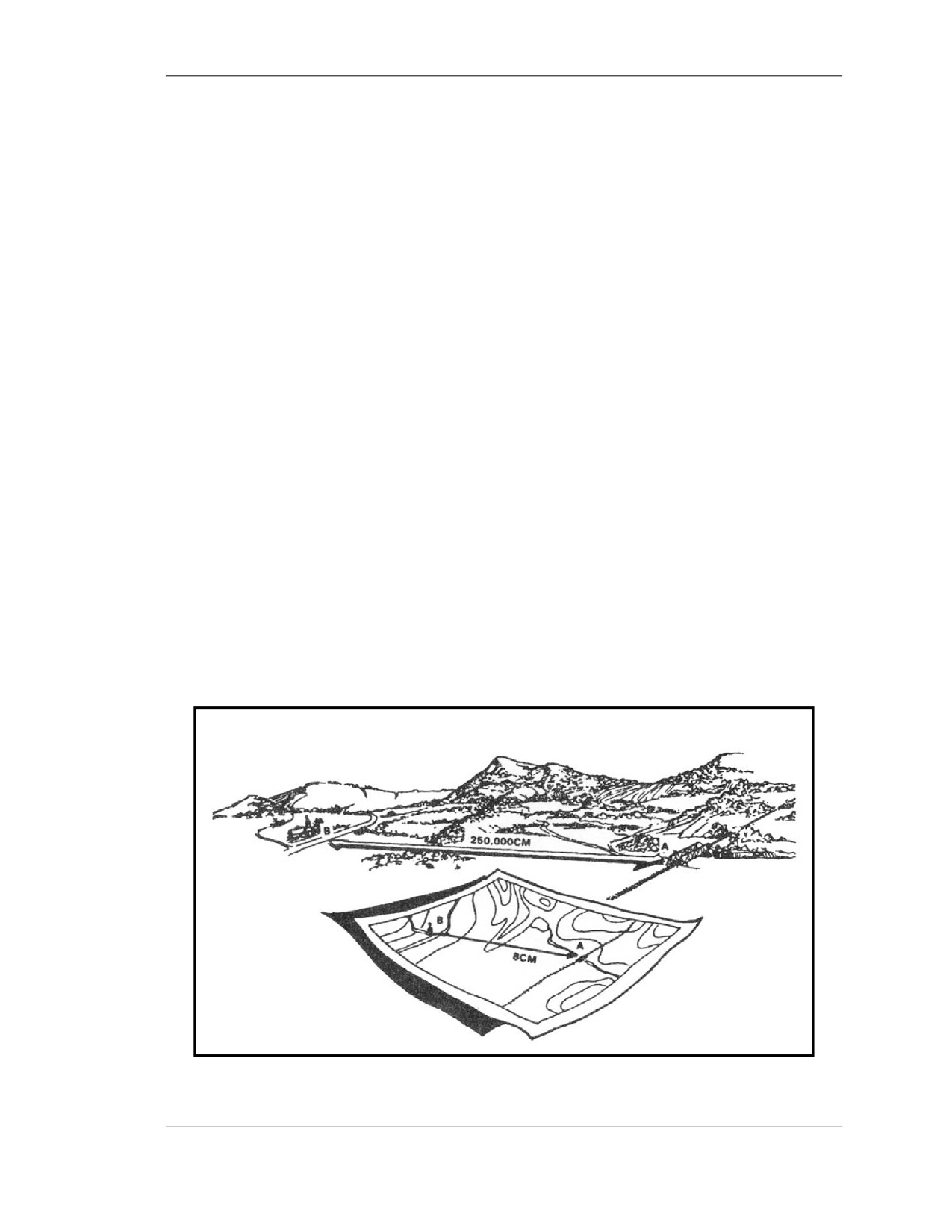
a. The ground distance between two points is determined by measuring between the
same two points on the map and then multiplying the map measurement by the denominator
of the RF or scale (Figure 5-1).
EXAMPLE:
The map scale is 1:50,000
RF = 1/50,000
The map distance from point A to point B is 5 units
5 x 50,000 = 250,000 units of ground distance
Figure 5-1. Converting map distance to ground distance.
FOUO
5-1
18 January 2005
FM 3-25.26
b. Since the distance on most maps is marked in meters and the RF is expressed in this
unit of measurement in most cases, a brief description of the metric system is needed. In the
metric system, the standard unit of measurement is the meter.
1 meter contains 100 centimeters (cm).
100 meters is a regular football field plus 10 meters.
1,000 meters is 1 kilometer (km).
10,000 meters is 10 kilometers.
NOTE: Appendix C contains the units of measure conversion tables.
c. The situation may arise when a map or sketch has no RF or scale. To be able to
determine ground distance on such a map, the RF must be determined. There are two ways to
do this:
(1) Comparison with Ground Distance. Measure the distance between two points on the
map—map distance (MD). Determine the horizontal distance between these same two points
on the ground—ground distance (GD). Use the RF formula and remember that RF must be in
the general form:
RF =
1
= MD
X GD
Both the MD and the GD must be in the same unit of measure and the MD must be
reduced to 1.
EXAMPLE:
MD = 4.32 centimeters
GD = 2.16 kilometers
(216,000 centimeters)
RF =
1
=
4.32
X
216,000
or
216,000 = 50,000
4.32
therefore
RF =
1
or
1:50,000
50,000
5-2
FOUO
18 January 2005
FM 3-25.26
(2) Comparison With Another Map of the Same Area that Has an RF. Select two
points on the map with the unknown RF, and measure the distance (MD) between them.
Locate those same two points on the map that has the known RF, and measure the distance
(MD) between them. Using the RF for this map, determine GD, which is the same for both
maps. Using the GD and the MD from the first map, determine the RF using the formula:
RF =
1
= MD
X GD
Occasionally it may be necessary to determine map distance from a known ground distance
and the RF:
MD = GD
Denominator or RF
Ground Distance = 2,200 meters
RF = 1:50,000
MD =
2,200 meters
50,000
MD = 0.044 meters x 100 (centimeters per meter)
MD = 4.4 centimeters
d. When determining ground distance from a map, the scale of the map affects the
accuracy. As the scale becomes smaller, the accuracy of measurement decreases because
some of the features on the map must be exaggerated so that they may be readily identified.
5-2.
GRAPHIC (BAR) SCALES
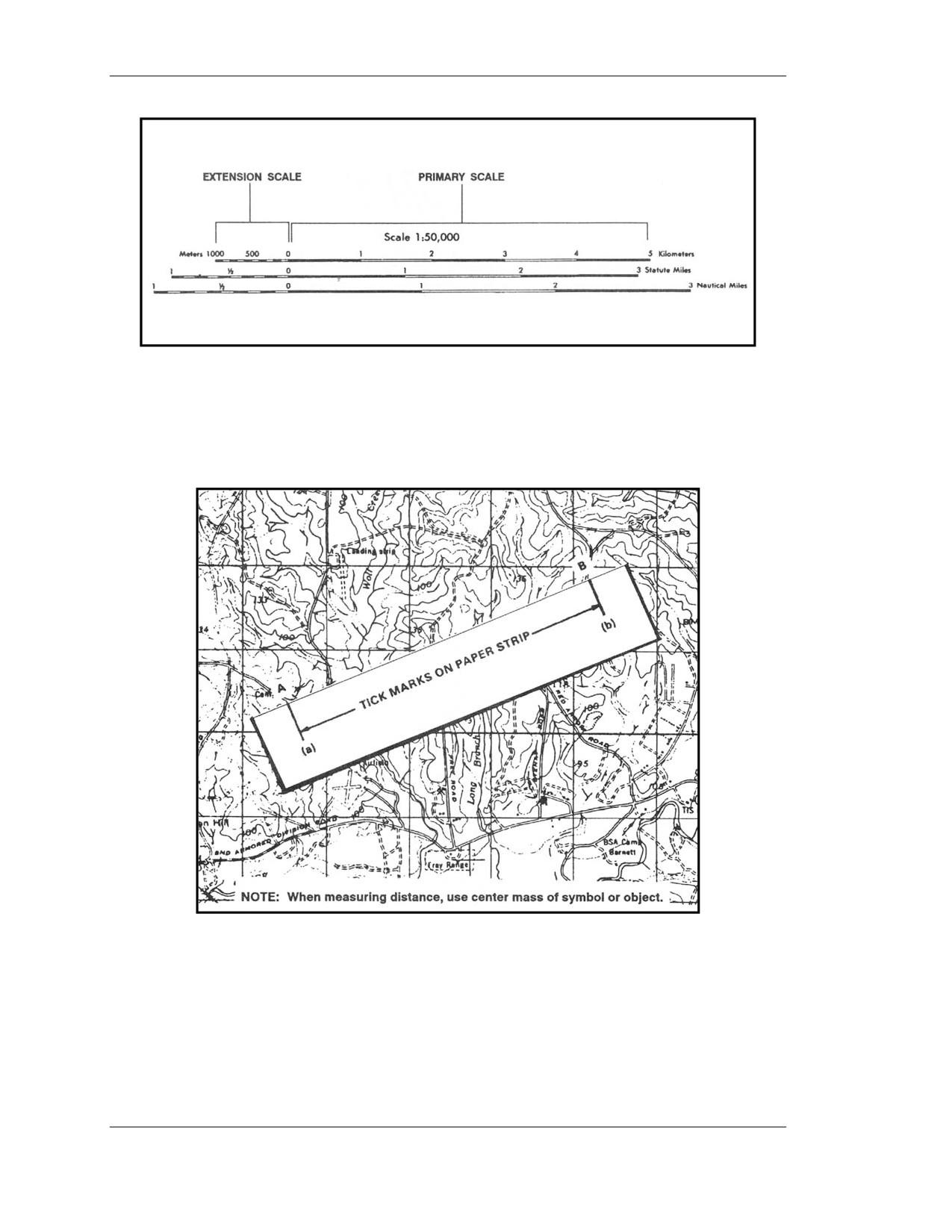
A graphic scale is a ruler printed on the map and is used to convert distances on the map to
actual ground distances. The graphic scale is divided into two parts. To the right of the zero,
the scale is marked in full units of measure and is called the primary scale. To the left of the
zero, the scale is divided into tenths and is called the extension scale. Most maps have three
or more graphic scales, each using a different unit of measure (Figure 5-2, page 5-4). When
using the graphic scale, be sure to use the correct scale for the unit of measure desired.
FOUO
5-3
18 January 2005
FM 3-25.26
Figure 5-2. Using a graphic (bar) scale.
a. To determine straight-line distance between two points on a map, lay a straight-edged
piece of paper on the map so that the edge of the paper touches both points and extends past
them. Make a tick mark on the edge of the paper at each point (Figure 5-3).
Figure 5-3. Transferring map distance to paper strip.
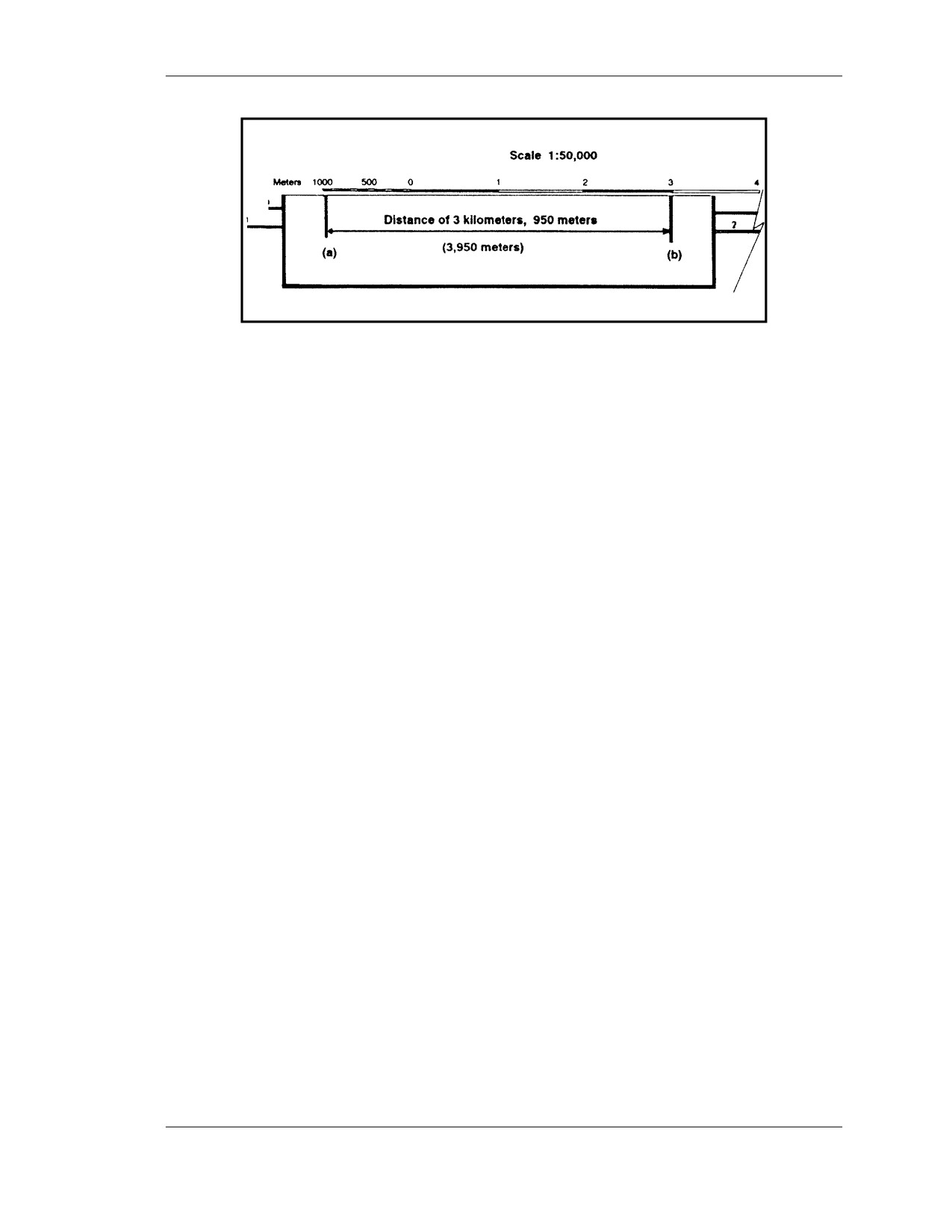
b. To convert the map distance to ground distance, move the paper down to the graphic
bar scale, and align the right tick mark (b) with a printed number in the primary scale so that
the left tick mark (a) is in the extension scale (Figure 5-4).
5-4
FOUO
18 January 2005
FM 3-25.26
Figure 5-4. Measuring straight-line map distance.
c. The right tick mark (b) is aligned with the 3,000-meter mark in the primary scale,
thus the distance is at least 3,000 meters. To determine the distance between the two points
to the nearest 10 meters, look at the extension scale. The extension scale is numbered with
zero at the right and increases to the left. When using the extension scale, always read right
to left (Figure 5-4). From the zero left to the beginning of the first shaded area is 100 meters.
From the beginning to the end of the shaded square is about 100 to 200 meters. From the end
of the first shaded square to the beginning of the second shaded square is about 200 to
300 meters. Remember, the distance in the extension scale increases from right to left.
d. To determine the distance from the zero to tick mark (a), divide the distance inside
the squares into tenths (Figure 5-4). As you break down the distance between the squares in
the extension scale into tenths, you will see that tick mark (a) is aligned with the 950-meter
mark. Adding the distance of 3,000 meters determined in the primary scale to the 950 meters
determined by using the extension scale, the total distance between points (a) and (b) is
3,950 meters.
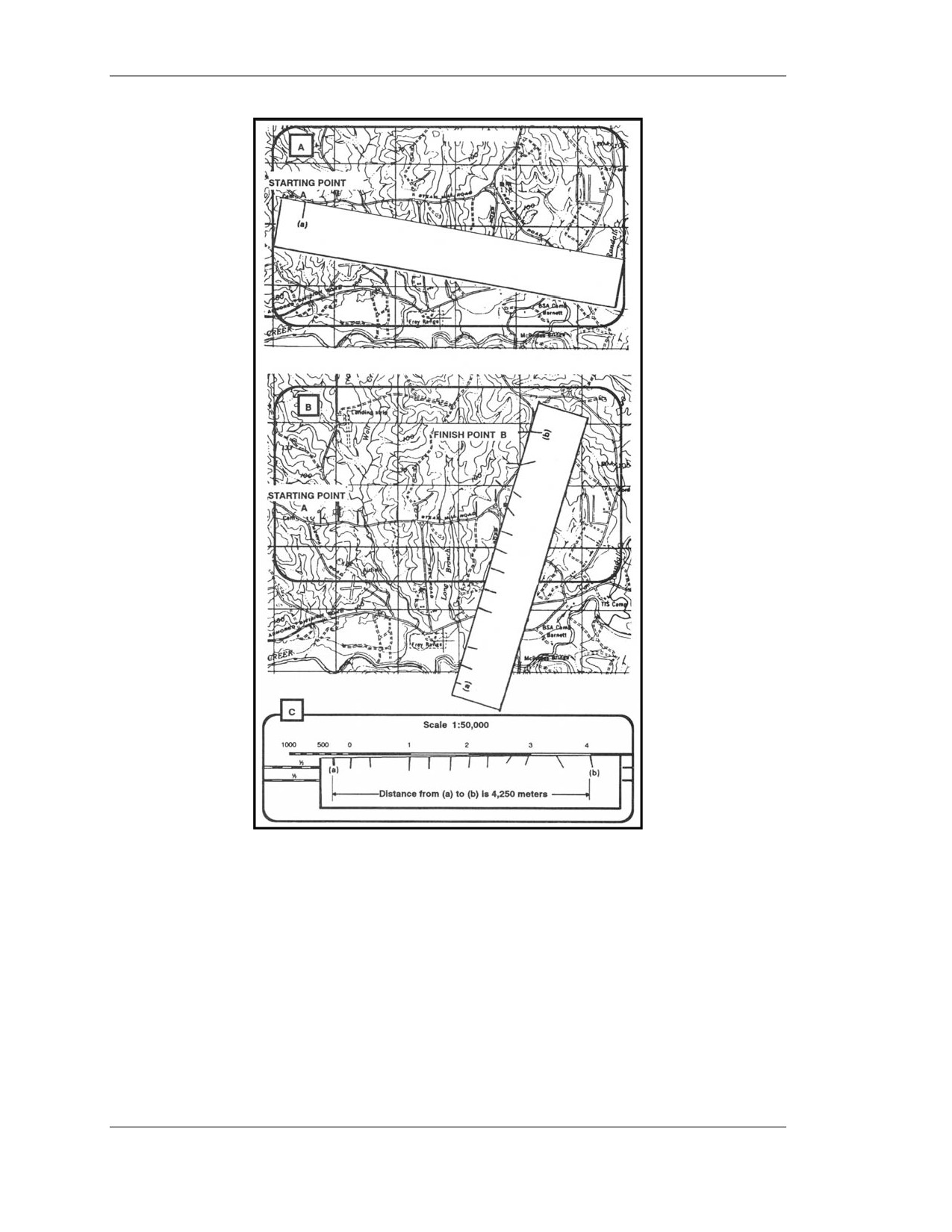
e. To measure distance along a road, stream, or other curved line, the straight edge of a
piece of paper is used. In order to avoid confusion concerning the point to begin measuring
from and the ending point, an eight-digit coordinate should be given for both the starting and
ending points. Place a tick mark on the paper and map at the beginning point from which the
curved line is to be measured. Align the edge of the paper along a straight portion and make
a tick mark on both map and paper when the edge of the paper leaves the straight portion of
the line being measured (A, Figure 5-5, page 5-6).
f. Keeping both tick marks together (on paper and map), place the point of the pencil
close to the edge of the paper on the tick mark to hold it in place. Then, pivot the paper until
another straight portion of the curved line is aligned with the edge of the paper. Continue in
this manner until the measurement is completed (B, Figure 5-5, page 5-6).
g. When you have completed measuring the distance, move the paper to the graphic
scale to determine the ground distance. The only tick marks you will be measuring the
distance between are tick marks (a) and (b). The tick marks in between are not used
(C, Figure 5-5, page 5-6).
FOUO
5-5
18 January 2005
FM 3-25.26
Figure 5-5. Measuring a curved line.
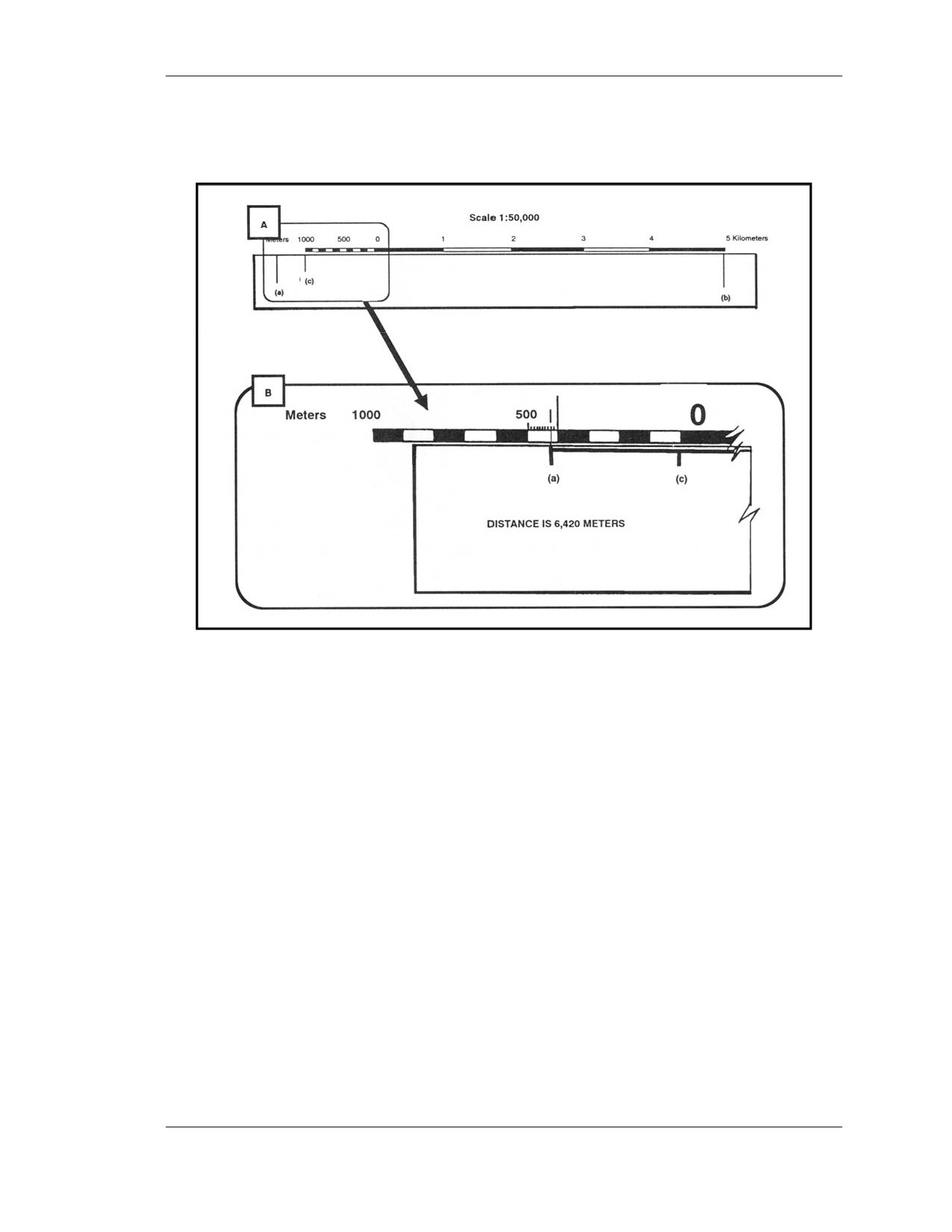
h. There may be times when the distance you measure on the edge of the paper exceeds
the graphic scale. In this case, there are different techniques you can use to determine the
distance.
(1) One technique is to align the right tick mark (b) with a printed number in the primary
scale, in this case the 5. You can see that from point (a) to point (b) is more than
6,000 meters when you add the 1,000 meters in the extension scale. To determine the exact
distance to the nearest 10 meters, place a tick mark (c) on the edge of the paper at the end of
the extension scale (A, Figure 5-6). You know that from point (b) to point (c) is 6,000
meters. With the tick mark (c) placed on the edge of the paper at the end of the extension
scale, slide the paper to the right. Remember the distance in the extension is always read
from right to left. Align tick mark (c) with zero and then measure the distance between tick
5-6
FOUO
18 January 2005
FM 3-25.26
marks (a) and (c). The distance between tick marks (a) and (c) is 420 meters. The total
ground distance between start and finish points is 6,420 meters (B, Figure 5-6).
Figure 5-6. Determining the exact distance.
(2) Another technique that may be used to determine exact distance between two points
when the edge of the paper exceeds the bar scale is to slide the edge of the paper to the right
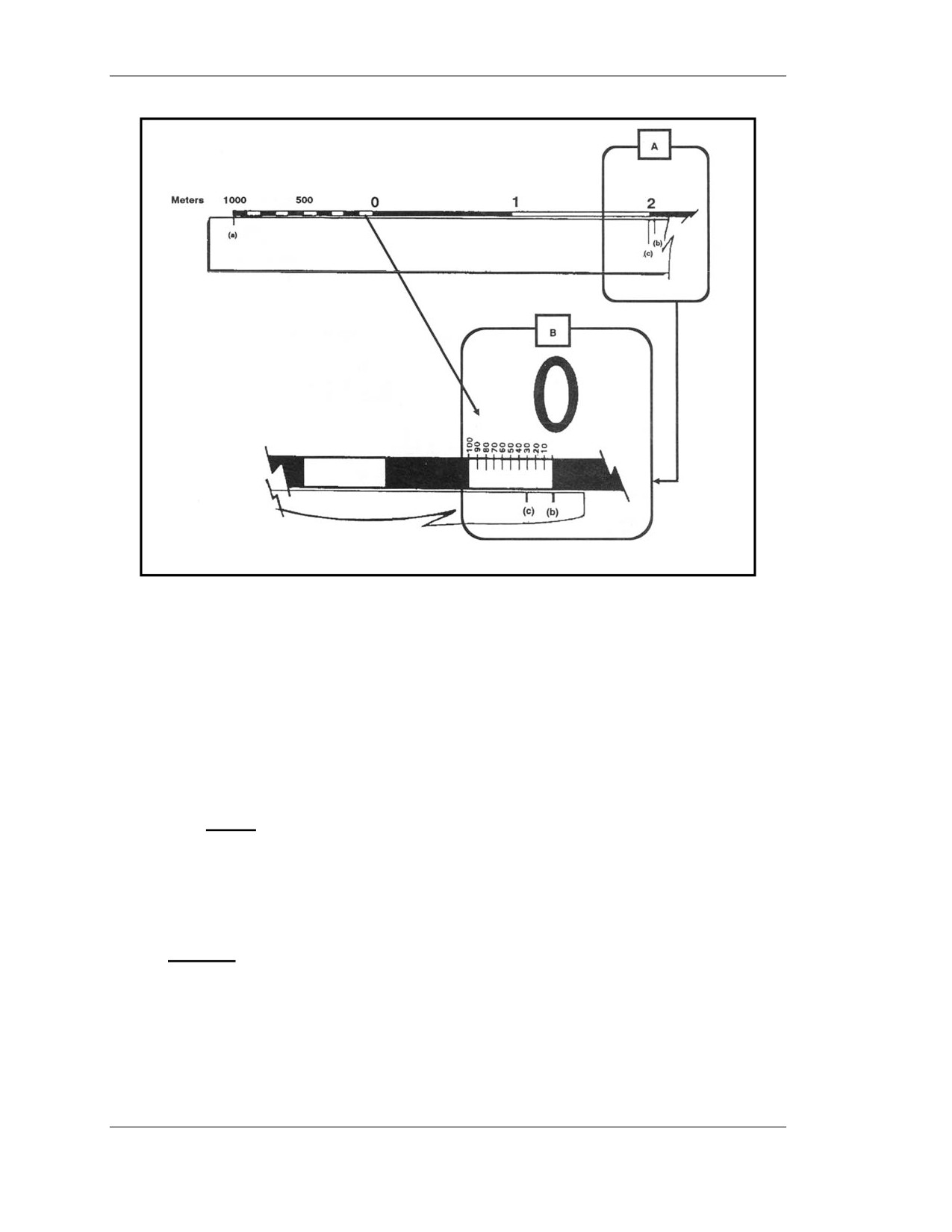
until tick mark (a) is aligned with the edge of the extension scale. Make a tick mark on the
paper, in line with the 2,000-meter mark (c) (A, Figure 5-7, page 5-8). Then slide the edge of
the paper to the left until tick mark (b) is aligned with the zero. Estimate the 100-meter
increments into 10-meter increments to determine how many meters tick mark (c) is from the
zero line (B, Figure 5-7, page 5-8). The total distance would be 3,030 meters.
(3) At times you may want to know the distance from a point on the map to a point off
the map. In order to do this, measure the distance from the start point to the edge of the map.
The marginal notes give the road distance from the edge of the map to some towns,
highways, or junctions off the map. To determine the total distance, add the distance
measured on the map to the distance given in the marginal notes. Be sure the unit of measure
is the same.
(4) When measuring distance in statute or nautical miles, round it off to the nearest
one-tenth of a mile and make sure the appropriate bar scale is used.
(5) Distance measured on a map does not take into consideration the rise and fall of the
land. All distances measured by using the map and graphic scales are flat distances.
Therefore, the distance measured on a map will increase when actually measured on the
ground. This must be taken into consideration when navigating across country.
FOUO
5-7
18 January 2005
FM 3-25.26
Figure 5-7. Reading the extension scale.
i.
The amount of time required to travel a certain distance on the ground is an important
factor in most military operations. This can be determined if a map of the area is available
and a graphic time-distance scale is constructed for use with the map as follows:
R = Rate of travel (speed)
T = Time
D = Distance (ground distance)
T = D
R
For example, if an infantry unit is marching at an average rate (R) of 4 kilometers per hour, it
will take about 3 hours (T) to travel 12 kilometers (D).
12 (D)
= 3 (T)
4 (R)
j.
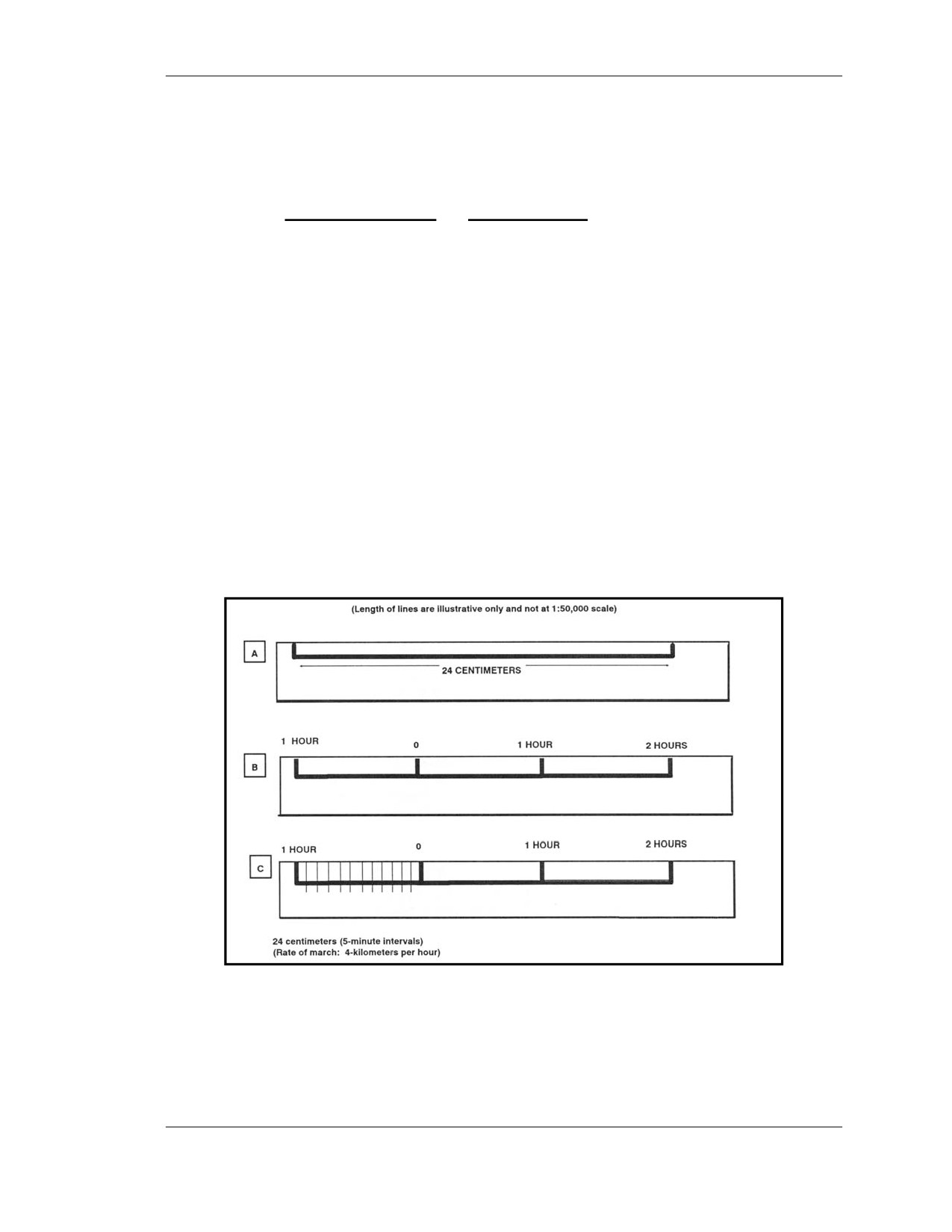
To construct a time-distance scale (A, Figure 5-8), knowing your length of march,
rate of speed, and map scale (that is, 12 kilometers at 3 kilometers per hour on a
1:50,000-scale map), use the following process:
(1) Mark off the total distance on a line by referring to the graphic scale of the map or, if
this is impracticable, compute the length of the line as follows:
5-8
FOUO
18 January 2005
FM 3-25.26
(a) Convert the ground distance to centimeters: 12 kilometers x 100,000 (centimeters per
kilometer) = 1,200,000 centimeters.
(b) Find the length of the line to represent the distance at map scale.
MD =
1
=
1,200,000
= 24 centimeters
50,000
50,000
(c) Construct a line 24 centimeters in length (A, Figure 5-8).
(2) Divide the line by the rate of march into three parts (B, Figure 5-8), each part
representing the distance traveled in one hour, and label.
(3) Divide the scale extension (left portion) into the desired number of lesser time
divisions.
1-minute divisions — 60
5-minute divisions — 12
10-minute divisions — 6
(4) C, Figure 5-8 shows a 5-minute interval scale. Make these divisions in the same
manner as for a graphic scale. The completed scale makes it possible to determine where the
unit will be at any given time. However, it must be remembered that this scale is for one
specific rate of march only, 4 kilometers per hour.
Figure 5-8. Constructing a time-distance scale.
5-3.
OTHER METHODS
Determining distance is the most common source of error encountered while moving either
mounted or dismounted. There may be circumstances where you are unable to determine
distance using your map or where you are without a map. It is, therefore, essential to learn
FOUO
5-9
18 January 2005
FM 3-25.26
methods by which you can accurately pace, measure, use subtense, or estimate distances on
the ground.
a. Pace Count. Another way to measure ground distance is the pace count. A pace is
equal to one natural step, about 30 inches long. To accurately use the pace count method,
you must know how many paces it takes you to walk 100 meters. To determine this, you
must walk an accurately measured course and count the number of paces you take. A pace
course can be as short as 100 meters or as long as 600 meters. The pace course, regardless of
length, must be on similar terrain to that you will be walking over. It does no good to walk a
course on flat terrain and then try to use that pace count on hilly terrain. To determine your
pace count on a 600-meter course, count the paces it takes you to walk the 600 meters, then
divide the total paces by 6. The answer will give you the average paces it takes you to walk
100 meters. It is important that each person who navigates while dismounted knows his pace
count.
(1) There are many methods to keep track of the distance traveled when using the pace
count. Some of these methods are: put a pebble in your pocket every time you have walked
100 meters according to your pace count; tie knots in a string; or put marks in a notebook.
Do not try to remember the count; always use one of these methods or design your own
method.
(2) Certain conditions affect your pace count in the field, and you must allow for them by
making adjustments.
(a) Slopes. Your pace lengthens on a downslope and shortens on an upgrade. Keeping
this in mind, if it normally takes you 120 paces to walk 100 meters, your pace count may
increase to 130 or more when walking up a slope.
(b) Winds. A head wind shortens the pace and a tail wind increases it.
(c) Surfaces. Sand, gravel, mud, snow, and similar surface materials tend to shorten the
pace.
(d) Elements. Falling snow, rain, or ice cause the pace to be reduced in length.
(e) Clothing. Excess clothing and boots with poor traction affect the pace length.
(f) Visibility. Poor visibility, such as in fog, rain, or darkness, will shorten your pace.
b. Odometer. Distances can be measured by an odometer, which is standard equipment
on most vehicles. Readings are recorded at the start and end of a course and the difference is
the length of the course.
(1) To convert kilometers to miles, multiply the number of kilometers by 0.62.
EXAMPLE:
16 kilometers = 16 x 0.62 = 9.92 miles
(2) To convert miles to kilometers, divided the number of miles by 0.62.
EXAMPLE:
10 miles = 10 divided by 0.62 = 16.12 kilometers
c. Subtense. The subtense method is a fast method of determining distance and yields
accuracy equivalent to that obtained by measuring distance with a premeasured piece of
wire. An advantage is that a horizontal distance is obtained indirectly; that is, the distance is
computed rather than measured. This allows subtense to be used over terrain where
5-10
FOUO
18 January 2005
FM 3-25.26
obstacles, such as streams, ravines, or steep slopes, may prohibit other methods of
determining distance.
(1) The principle used in determining distance by the subtense method is similar to that
used in estimating distance by the mil relation formula. The field artillery (FA) application of
the mil relation formula involves only estimations. It is not accurate enough for survey
purposes. However, the subtense method uses precise values with a trigonometric solution.
Subtense is based on a principle of visual perspective—the farther away an object is, the
smaller it appears.
(2) The following two procedures are involved in subtense measurement:
• Establishing a base of known length.
• Measuring the angle of that base by use of the aiming circle.
(3) The subtense base may be any desired length. However, if a 60-meter base, a 2-meter
bar, or the length of an M16A1 or M16A2 rifle is used, precomputed subtense tables are
available. The M16 or 2-meter bar must be held horizontal and perpendicular to the line of
sight by a soldier facing the aiming circle. The instrument operator sights on one end of the
M16 or 2-meter bar and measures the horizontal clockwise angle to the other end of the rifle
or bar. He does this twice and averages the angles. He then enters the appropriate subtense
table with the mean angle and extracts the distance. Accurate distances can be obtained with
the M16 out to approximately 150 meters, with the 2-meter bar out to 250 meters, and with
the 60-meter base out to 1,000 meters. If a base of another length is desired, a distance can
be computed by using the following formula:
Distance =
1/2 (base in meters)
Tan (1/2) (in mils)
d. Estimation. At times, because of the tactical situation, it may be necessary to
estimate range. There are two methods that may be used to estimate range or distance.
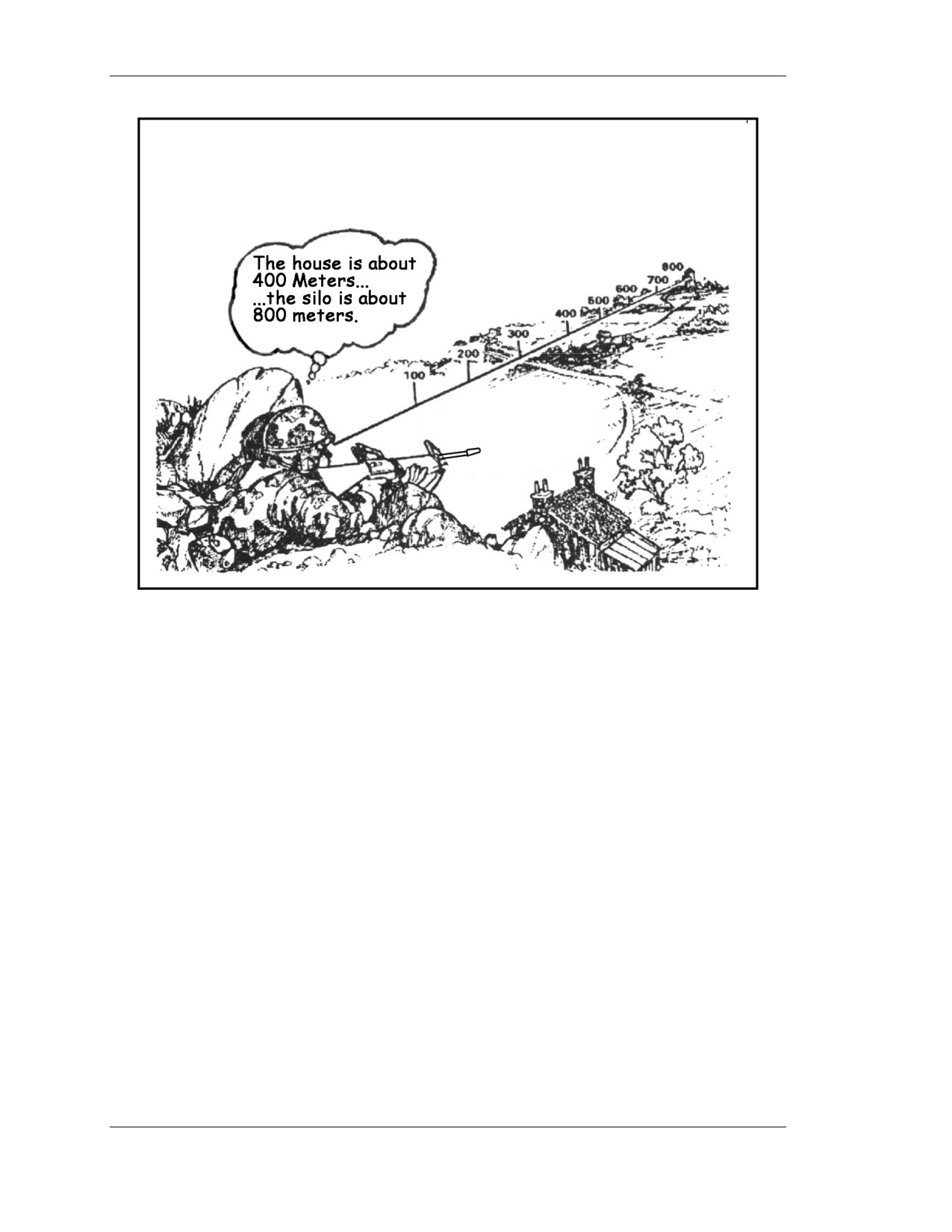
(1) 100-Meter Unit-of-Measure Method. To use this method, the soldier must be able to
visualize a distance of 100 meters on the ground. For ranges up to 500 meters, he determines
the number of 100-meter increments between the two objects he wishes to measure. Beyond
500 meters, the soldier must select a point halfway to the object(s) and determine the number
of 100-meter increments to the halfway point, then double it to find the range to the object
(Figure 5-9, page 5-12).
FOUO
5-11
18 January 2005
FM 3-25.26
Figure 5-9. Using a 100-meter unit-of-measure method.
(2) Flash-to-Bang Method. To use this method to determine range to an explosion or
enemy fire, begin to count when you see the flash. Count the seconds until you hear the
weapon fire. This time interval may be measured with a stopwatch or by using a steady
count, such as one-thousand-one, one-thousand-two, and so forth, for a three-second
estimated count. If you must count higher than 10 seconds, start over with one. Multiply the
number of seconds by 330 meters to get the approximate range (FA uses 350 meters instead).
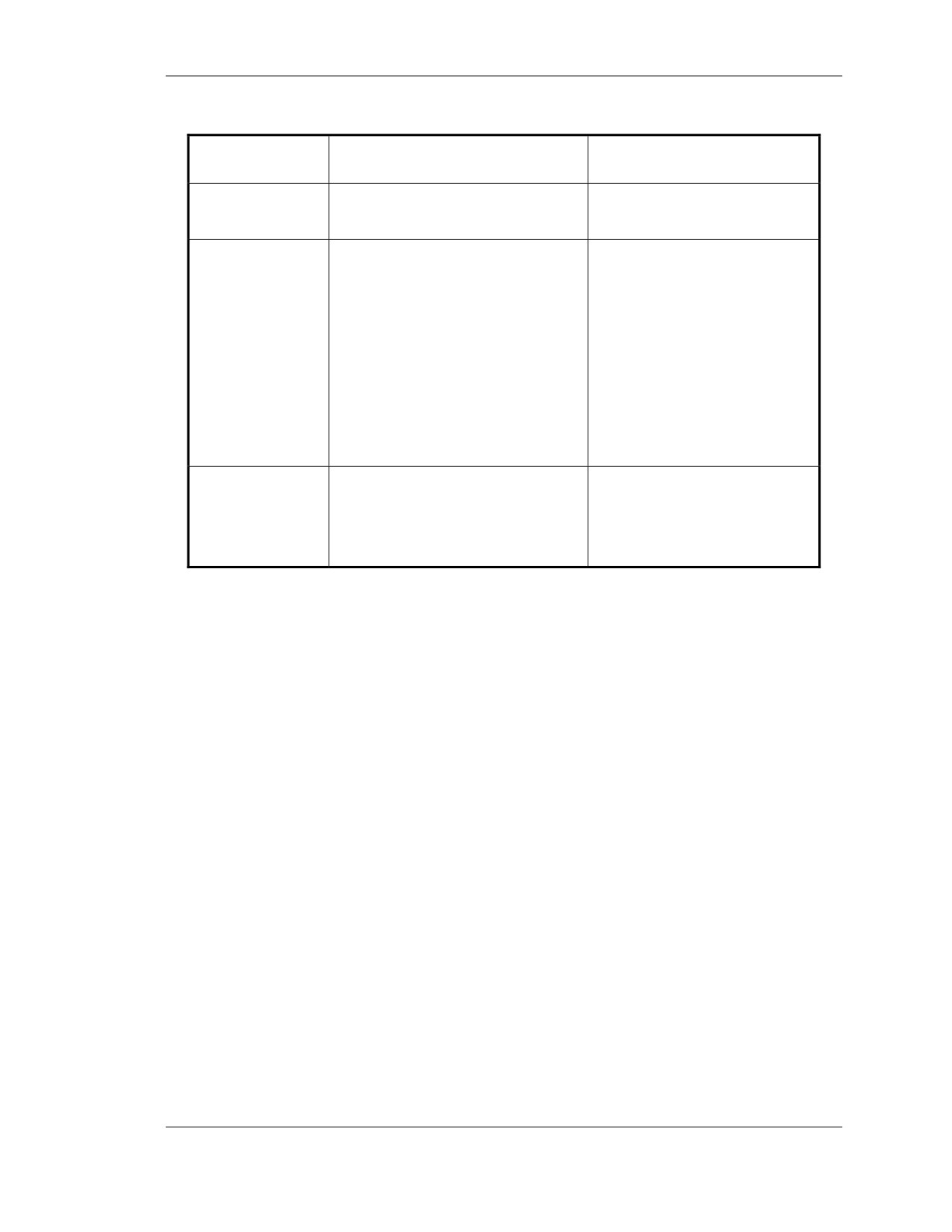
(3) Proficiency of Methods. The methods discussed above are used only to estimate
range (Table 5-1). Proficiency in both methods requires constant practice. The best training
technique is to require the soldier to pace the range after he has estimated the distance. In
this way, the soldier discovers the actual range for himself, which makes a greater
impression than if he is simply told the correct range.
5-12
FOUO
18 January 2005
FM 3-25.26
Factors Affecting
Factors Causing
Factors Causing
Range Estimation
Underestimation of Range
Overestimation of Range
The clearness of
When most of the object is visible and
When only a small part of the object
outline and details
offers a clear outline.
can be seen or the object is small in
of the object.
relation to its surroundings.
Nature of terrain or
When looking across a depression that
When looking across a depression
position of the
is mostly hidden from view.
that is totally visible.
observer.
When looking downward from high
When vision is confined, as in
ground.
streets, draws, or forest trails.
When looking down a straight, open
When looking from low ground
road or along a railroad.
toward high ground.
When looking over uniform surfaces like
In poor light, such as dawn and
water, snow, desert, or grain fields.
dusk; in rain, snow, fog; or when
the sun is in the observer’s eyes.
In bright light or when the sun is shining
from behind the observer.
Light and
When the object is in sharp contrast with
When object blends into the
atmosphere
the background or is silhouetted
background or terrain.
because of its size, shape, or color.
When seen in the clear air of high
altitudes.
Table 5-1. Factors of range estimation.
FOUO
5-13
18 January 2005
This Page intentionally left blank.
FM 3-25.26
CHAPTER 6
DIRECTION
Being in the right place at the prescribed time is necessary to successfully
accomplish military missions. Direction plays an important role in a
soldier’s everyday life. It can be expressed as right, left, straight ahead, and
so forth; but then the question arises, “To the right of what?” This chapter
defines the word azimuth and the three different norths. It explains in detail
how to determine the grid and the magnetic azimuths with the use of the
protractor and the compass. It explains the use of some field-expedient
methods to find directions, the declination diagram, and the conversion of
azimuths from grid to magnetic and vice versa. It also includes some
advanced aspects of map reading such as intersection, resection, modified
resection, and polar plots.
6-1.
METHODS OF EXPRESSING DIRECTION
Military personnel need a way of expressing direction that is accurate, is adaptable to any
part of the world, and has a common unit of measure. Directions are expressed as units of
angular measure.
a. Degree. The most common unit of measure is the degree (º) with its subdivisions of
minutes (') and seconds (").
1 degree = 60 minutes.
1 minute = 60 seconds.
b. Mil. Another unit of measure, the mil (abbreviated
/ in graphics), is used mainly in
artillery, tank, and mortar gunnery. The mil expresses the size of an angle formed when a
circle is divided into 6,400 angles, with the vertex of the angles at the center of the circle. A
relationship can be established between degrees and mils. A circle equals 6400 mils divided
by 360 degrees, or 17.78 mils per degree. To convert degrees to mils, multiply degrees
by 17.78.
c. Grad. The grad is a metric unit of measure found on some foreign maps. There are
400 grads in a circle (a 90-degree right angle equals 100 grads). The grad is divided into
100 centesimal minutes
(centigrads) and the minute into
100 centesimal seconds
(milligrads).
6-2.
BASE LINES
In order to measure something, there must always be a starting point or zero measurement.
To express direction as a unit of angular measure, there must be a starting point or zero
measure and a point of reference. These two points designate the base or reference line.
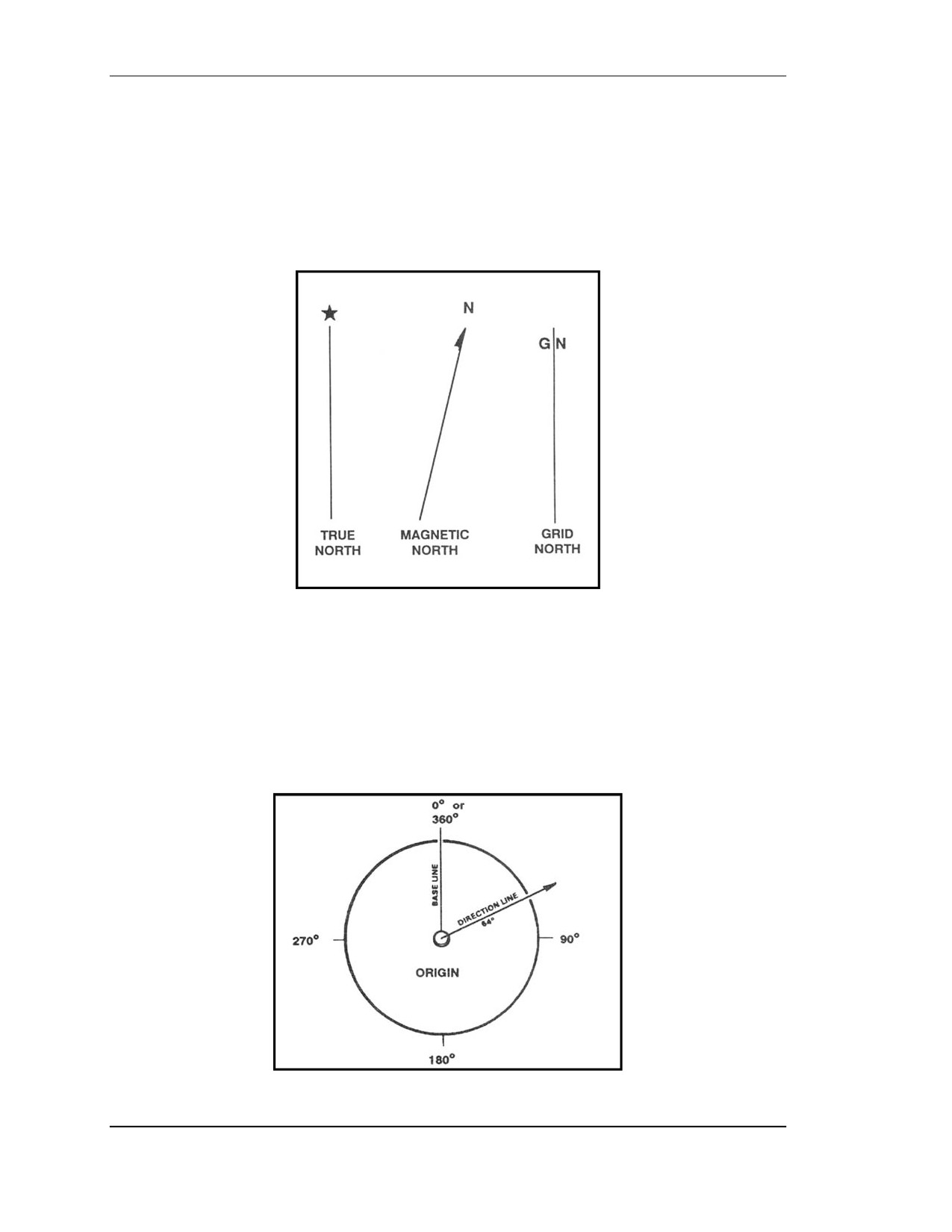
There are three base lines⎯true north, magnetic north, and grid north (Figure 6-1, page 6-2).
The most commonly used are magnetic and grid.
a. True North. True north is defined as a line from any point on the earth’s surface to
the north pole. All lines of longitude are true north lines. True north is usually represented by
a star.
FOUO
6-1
18 January 2005
FM 3-25.26
b. Magnetic North. Magnetic north is the direction to the north magnetic pole, as
indicated by the north-seeking needle of a magnetic instrument. The magnetic north is
usually symbolized by a line ending with half of an arrowhead. Magnetic readings are
obtained with magnetic instruments such as lensatic and M2 compasses.
c. Grid North. Grid north is the north that is established by using the vertical grid lines
on the map. Grid north may be symbolized by the letters GN or the letter “y”.
Figure 6-1. Three norths.
6-3.
AZIMUTHS
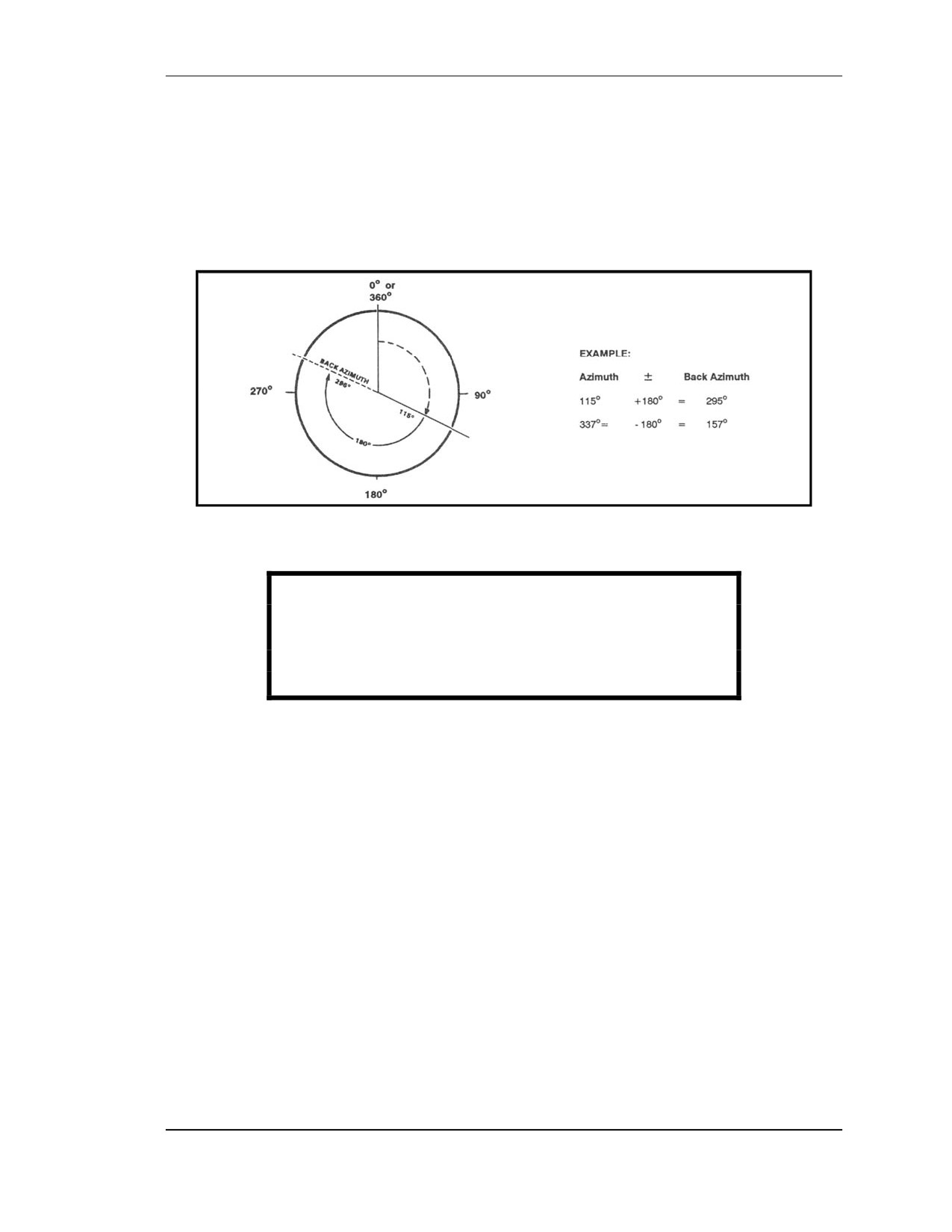
An azimuth is defined as a horizontal angle measured clockwise from a north base line. This
north base line could be true north, magnetic north, or grid north. The azimuth is the most
common military method to express direction. When using an azimuth, the point from which
the azimuth originates is the center of an imaginary circle (Figure 6-2). This circle is divided
into 360 degrees or 6400 mils.
Figure 6-2. Origin of azimuth circle.
6-2
FOUO
18 January 2005
FM 3-25.26
a. Back Azimuth. A back azimuth is the opposite direction of an azimuth. It is
comparable to doing “about face.” To obtain a back azimuth from an azimuth, add
180 degrees if the azimuth is 180 degrees or less; subtract 180 degrees if the azimuth is
180 degrees or more (Figure 6-3). The back azimuth of 180 degrees may be stated as
0 degrees or 360 degrees. For mils, if the azimuth is less than 3200 mils, add 3200 mils; if
the azimuth is more than 3200 mils, subtract 3200 mils.
Figure 6-3. Back azimuth.
WARNING
When converting azimuths into back azimuths,
extreme care should be exercised when adding or
subtracting the 180 degrees. A simple mathematical
mistake could cause disastrous consequences.
b. Magnetic Azimuth. The magnetic azimuth is determined by using magnetic
instruments such as lensatic and M2 compasses. (See Chapter 9 for details.)
c. Field-Expedient Methods. Several field-expedient methods to determine direction
are discussed in Chapter 9.
6-4.
GRID AZIMUTHS
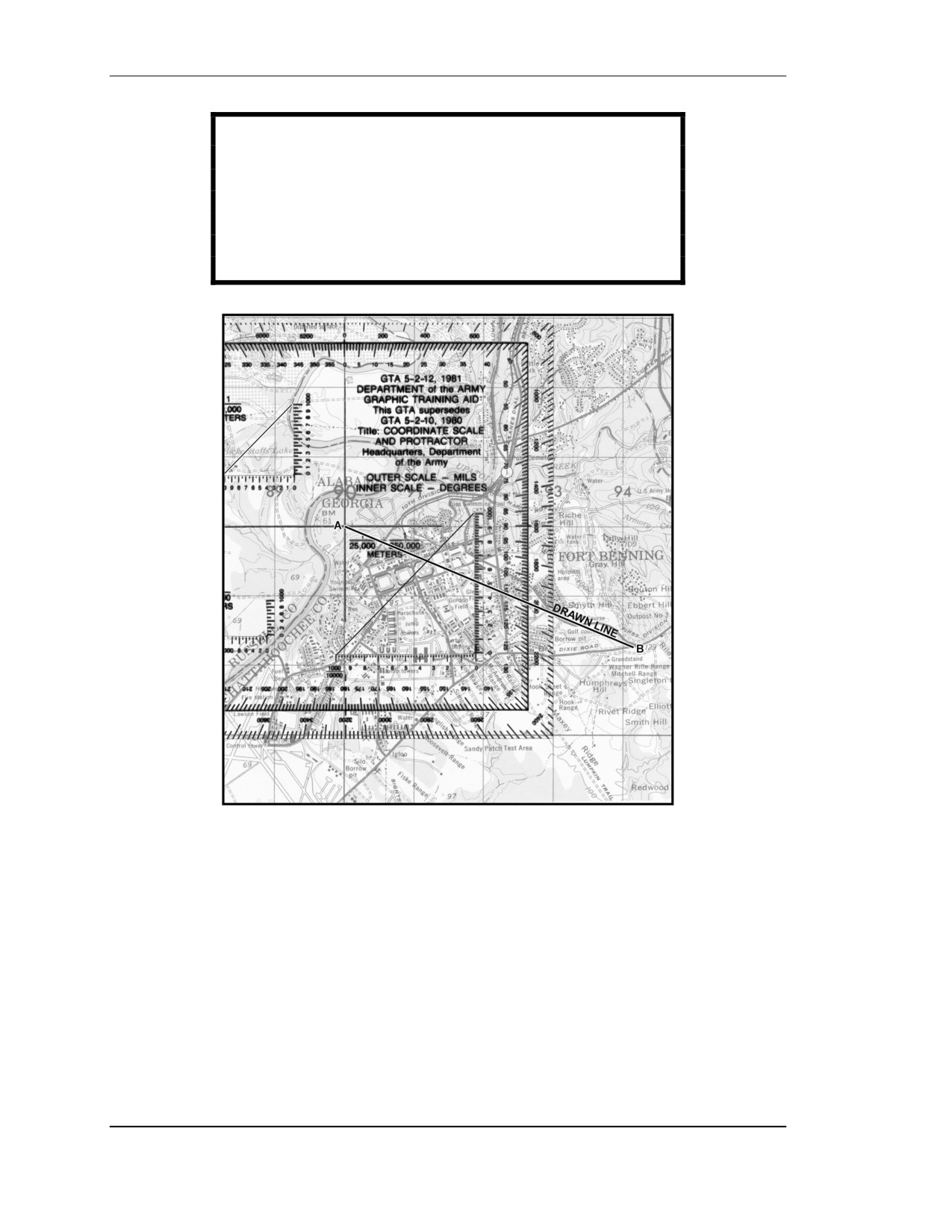
When an azimuth is plotted on a map between point A (starting point) and point B (ending
point), the points are joined together by a straight line. A protractor is used to measure the
angle between grid north and the drawn line, and this measured azimuth is the grid azimuth
(Figure 6-4, page 6-4).
FOUO
6-3
18 January 2005
FM 3-25.26
WARNING
When measuring azimuths on a map, remember that
you are measuring from a starting point to an
ending point. If a mistake is made and the reading is
taken from the ending point, the grid azimuth will be
opposite, thus causing the user to go in the wrong
direction.
Figure 6-4. Measuring an azimuth.
6-5.
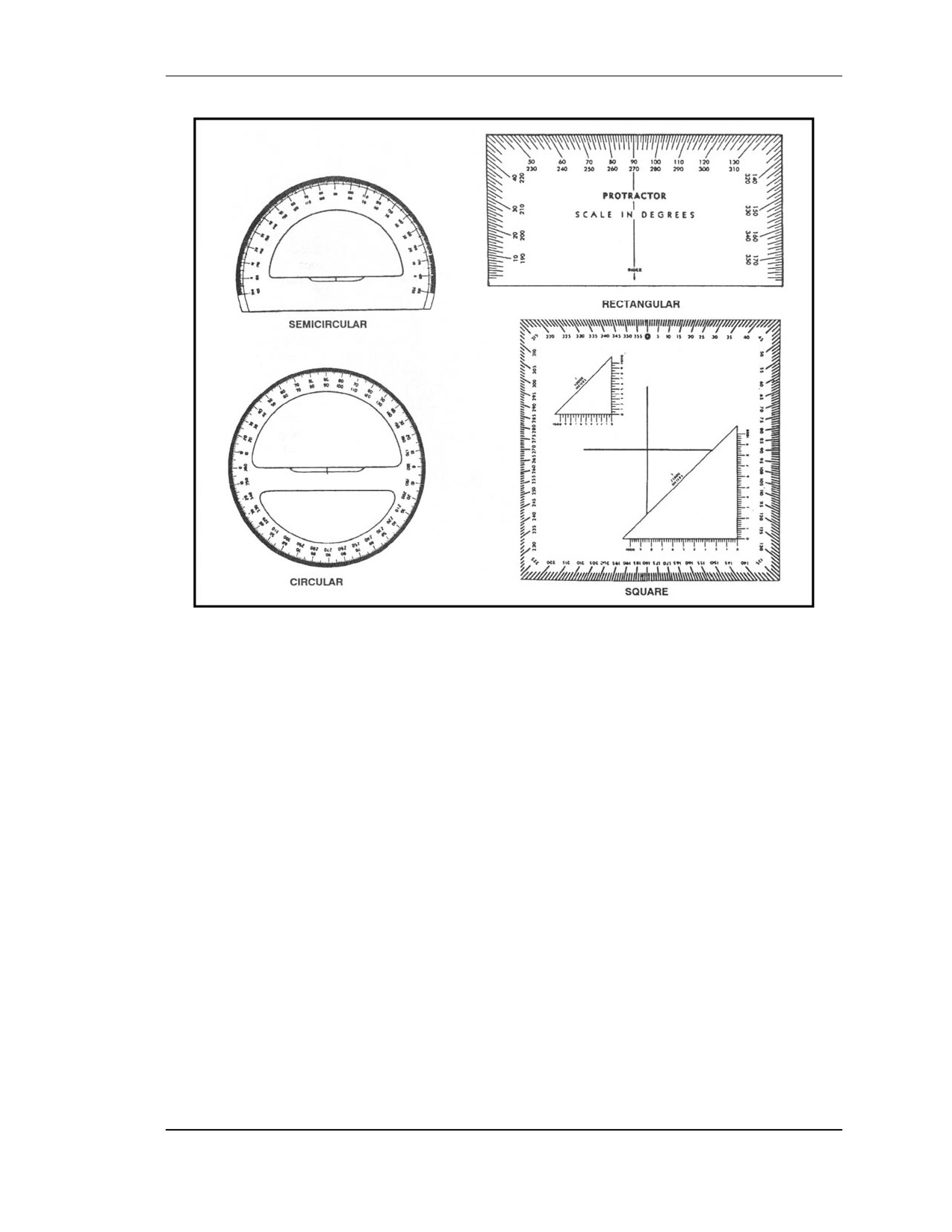
PROTRACTOR
There are several types of protractors—full circle, half circle, square, and rectangular
(Figure 6-5). All of them divide the circle into units of angular measure, and each has a scale
around the outer edge and an index mark. The index mark is the center of the protractor
circle from which all directions are measured.
6-4
FOUO
18 January 2005
FM 3-25.26
Figure 6-5. Types of protractors.
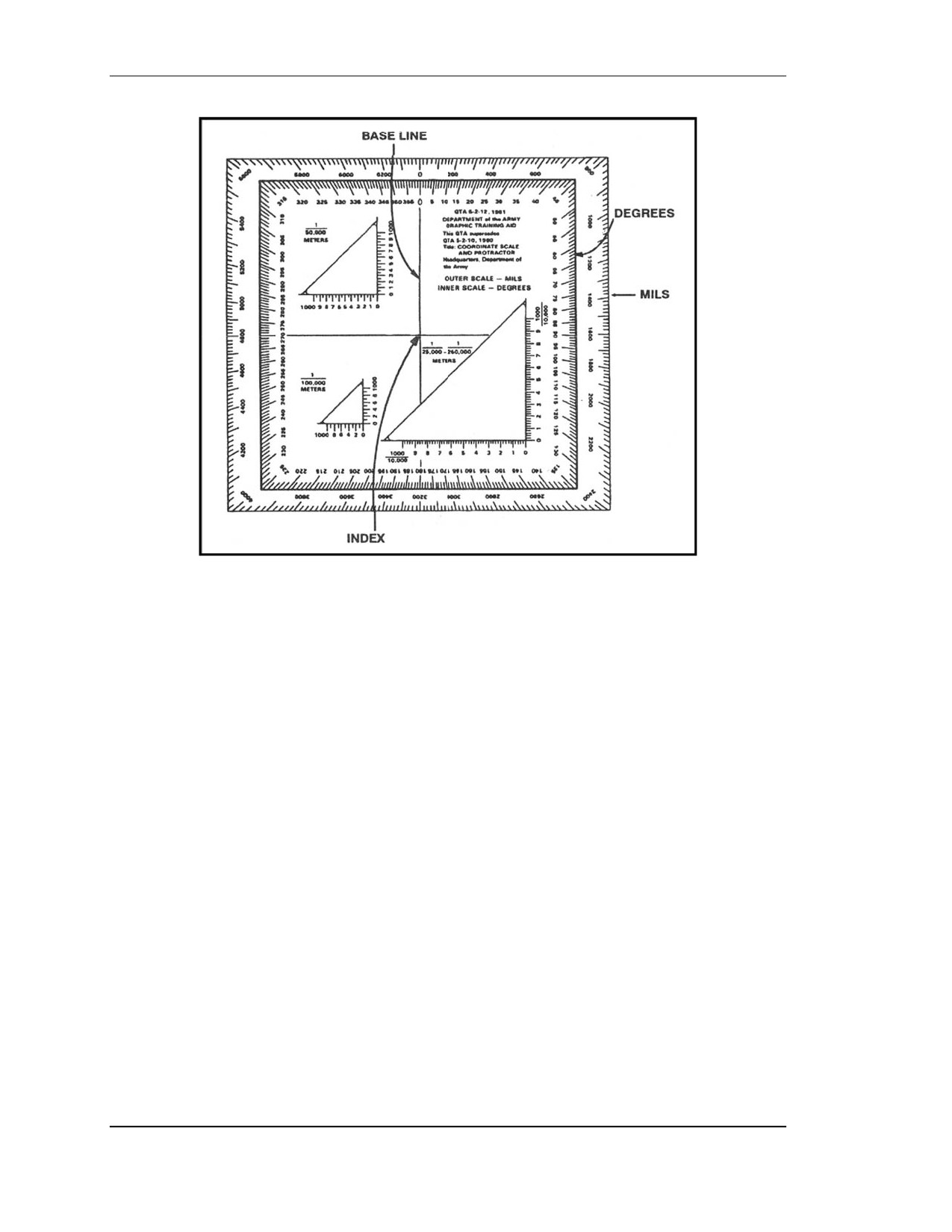
a. The military protractor, GTA 5-2-12, contains two scales: one in degrees (inner
scale) and one in mils (outer scale). This protractor represents the azimuth circle. The degree
scale is graduated from 0 to 360 degrees with each tick mark representing one degree. A line
from 0 to 180 degrees is called the base line of the protractor. The index or center of the
protractor is where the base line intersects the horizontal line, between 90 and 270 degrees
(Figure 6-6, page 6-6).
FOUO
6-5
18 January 2005
FM 3-25.26
Figure 6-6. Military protractor.
b. When using the protractor, the base line is always oriented parallel to a north-south
grid line. The 0- or 360-degree mark is always toward the top or north on the map and the
90-degree mark is to the right.
(1) To determine the grid azimuth—
(a) Draw a line connecting the two points (A and B).
(b) Place the index of the protractor at the point where the drawn line crosses a vertical
(north-south) grid line.
(c) Keeping the index at this point, align the 0- to 180-degree line of the protractor on
the vertical grid line.
(d) Read the value of the angle from the scale; this is the grid azimuth from point A to
point B (Figure 6-4, page 6-5).
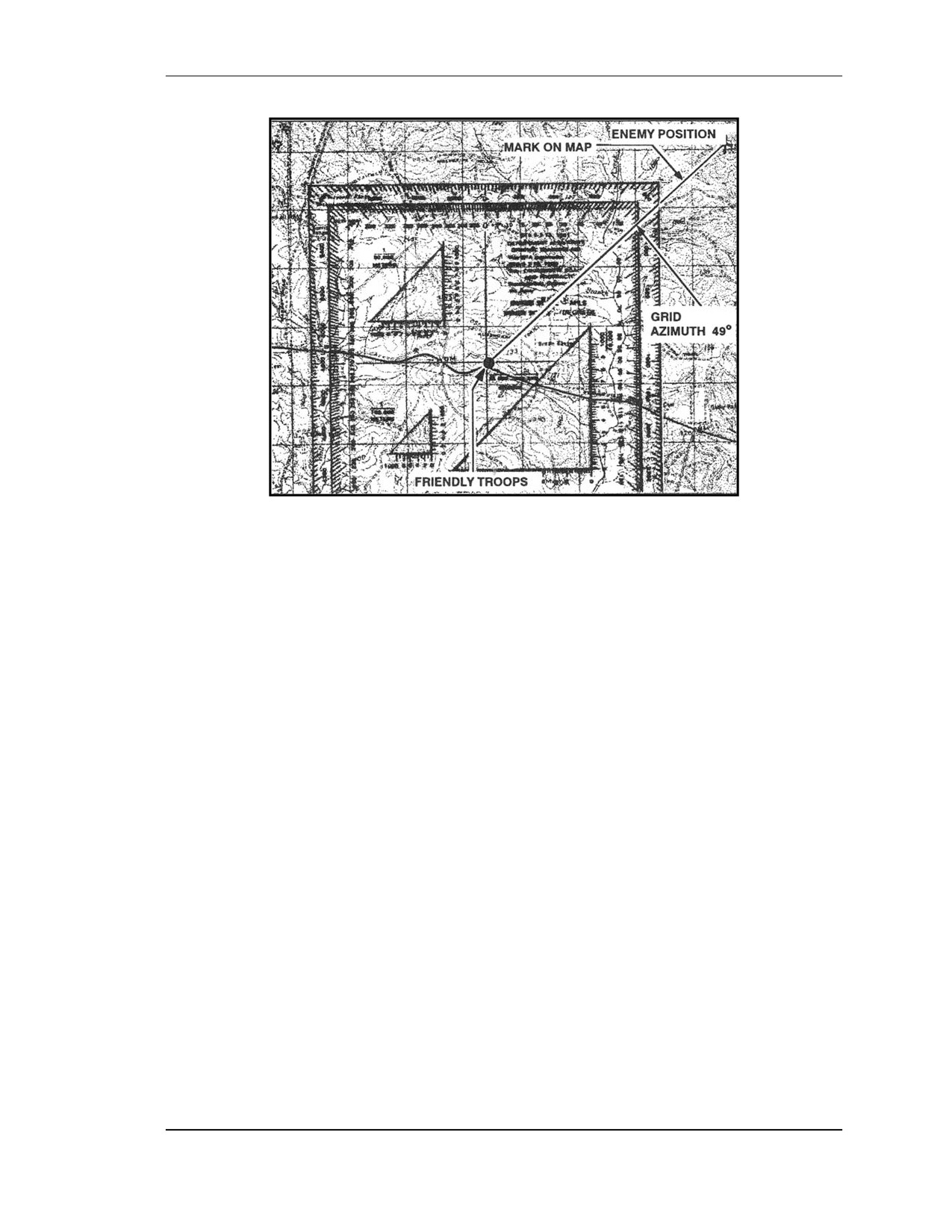
(2) To plot an azimuth from a known point on a map (Figure 6-7)—
(a) Convert the azimuth from magnetic to grid, if necessary (see paragraph 6-6).
(b) Place the protractor on the map with the index mark at the center of mass of the
known point and the base line parallel to a north-south grid line.
(c) Make a mark on the map at the desired azimuth.
(d) Remove the protractor and draw a line connecting the known point and the mark on
the map. This is the grid direction line (azimuth).
NOTE: When measuring an azimuth, the reading is always to the nearest degree or
10 mils. Distance does not change an accurately measured azimuth.
6-6
FOUO
18 January 2005
FM 3-25.26
Figure 6-7. Plotting an azimuth on the map.
c. To obtain an accurate reading with the protractor (to the nearest degree or 10 mils),
there are two techniques to check that the base line of the protractor is parallel to a
north-south grid line.
(1) Place the protractor index where the azimuth line cuts a north-south grid line,
aligning the base line of the protractor directly over the intersection of the azimuth line with
the north-south grid line. The user should be able to determine whether the initial azimuth
reading was correct.
(2) The user should re-read the azimuth between the azimuth and north-south grid line to
check the initial azimuth.
(3) Note that the protractor is cut at both the top and bottom by the same north-south grid
line. Count the number of degrees from the 0-degree mark at the top of the protractor to this
north-south grid line and then count the number of degrees from the 180-degree mark at the
bottom of the protractor to this same grid line. If the two counts are equal, the protractor is
properly aligned.
6-6.
DECLINATION DIAGRAM
Declination is the angular difference between any two norths. If you have a map and a
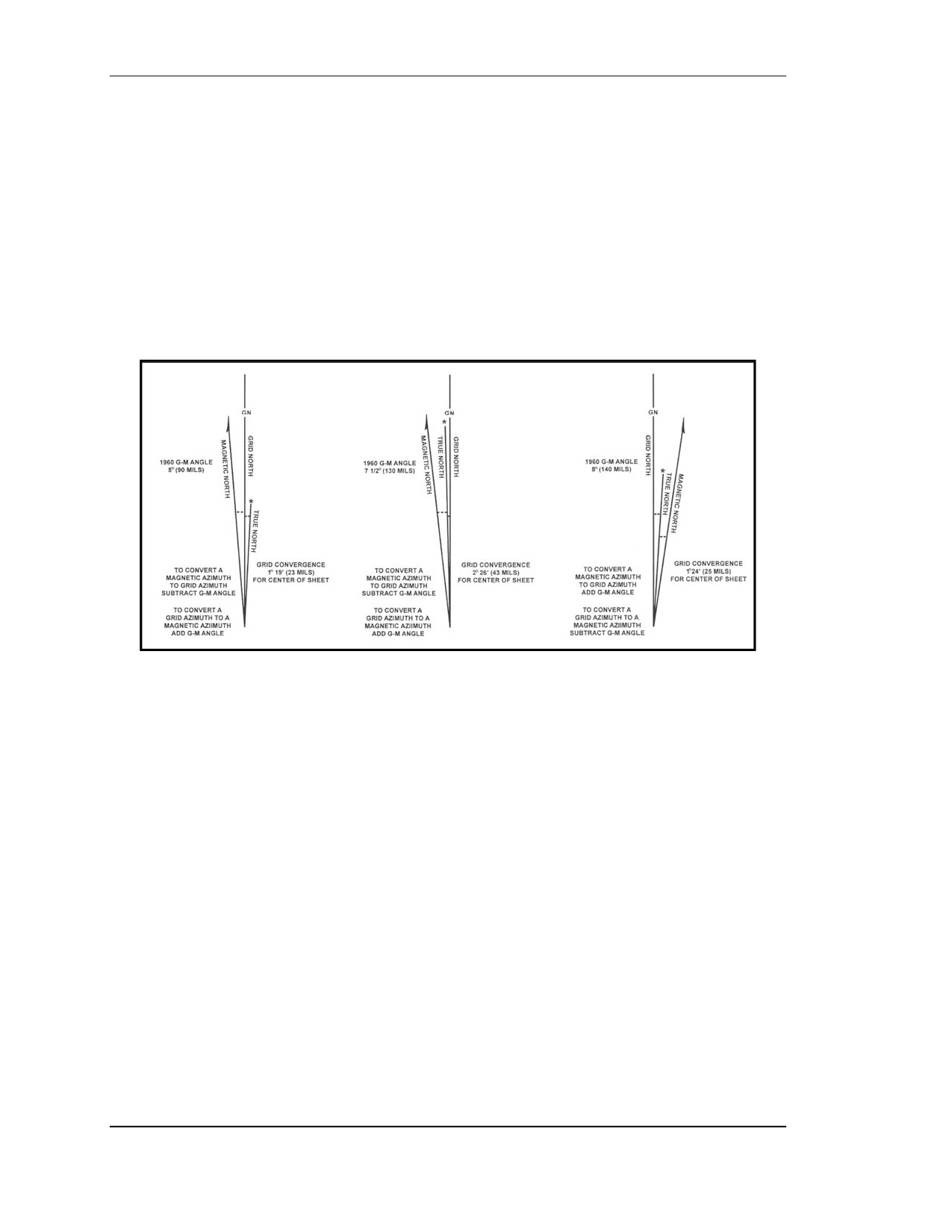
compass, the declination of most interest to you will be between magnetic and grid north.
The declination diagram (Figure 6-8, page 6-8) shows the angular relationship, represented
by prongs, among grid, magnetic, and true norths. While the relative positions of the prongs
are correct, they are seldom plotted to scale. Do not use the diagram to measure a numerical
value. This value will be written in the map margin (in both degrees and mils) beside the
diagram.
a. Location. A declination diagram is a part of the information in the lower margin on
most larger maps. On medium-scale maps, the declination information is shown by a note in
the map margin.
FOUO
6-7
18 January 2005
FM 3-25.26
b. Grid-Magnetic Angle. The G-M angle value is the angular size that exists between
grid north and magnetic north. It is an arc, indicated by a dashed line, that connects the
grid-north and magnetic-north prongs. This value is expressed to the nearest 1/2 degree, with
mil equivalents shown to the nearest 10 mils. The G-M angle is important to the map
reader/land navigator because azimuths translated between map and ground will be in error
by the size of the declination angle if not adjusted for it.
c. Grid Convergence. An arc indicated by a dashed line connects the prongs for true
north and grid north. The value of the angle for the center of the sheet is given to the nearest
full minute with its equivalent to the nearest mil. These data are shown in the form of a
grid-convergence note.
Figure 6-8. Declination diagrams.
d. Conversion. There is an angular difference between the grid north and the magnetic
north. Since the location of magnetic north does not correspond exactly with the grid-north
lines on the maps, a conversion from magnetic to grid or vice versa is needed.
(1) With Notes. Simply refer to the conversion notes that appear in conjunction with the
diagram explaining the use of the G-M angle (Figure 6-8). One note provides instructions for
converting magnetic azimuth to grid azimuth; the other, for converting grid azimuth to
magnetic azimuth. The conversion (add or subtract) is governed by the direction of the
magnetic-north prong relative to that of the grid-north prong.
(2) Without Notes. In some cases, there are no declination conversion notes on the
margin of the map; it is necessary to convert from one type of declination to another. A
magnetic compass gives a magnetic azimuth; but in order to plot this line on a gridded map,
the magnetic azimuth value must be changed to grid azimuth. The declination diagram is
used for these conversions. A rule to remember when solving such problems is: No matter
where the azimuth line points, the angle to it is always measured clockwise from the
reference direction (base line). With this in mind, the problem is solved using the following
steps:
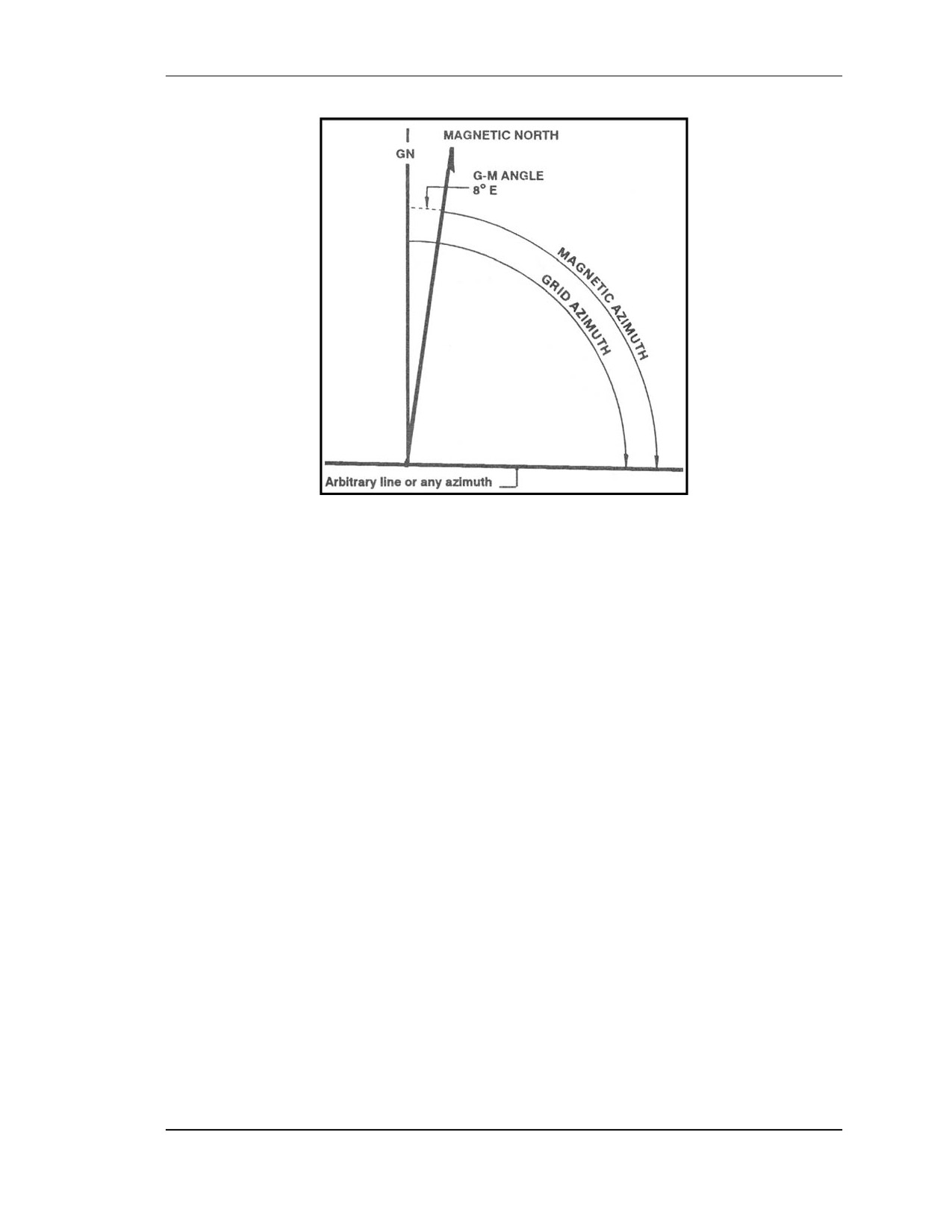
(a) Draw a vertical or grid-north line (prong). Always align this line with the vertical
lines on a map (Figure 6-9).
6-8
FOUO
18 January 2005
FM 3-25.26
Figure 6-9. Declination diagram with arbitrary line.
(b) From the base of the grid-north line (prong), draw an arbitrary line (or any azimuth
line) at a roughly right angle to north, regardless of the actual value of the azimuth in degrees
(Figure 6-9).
(c) Examine the declination diagram on the map and determine the direction of the
magnetic north (right-left or east-west) relative to that of the grid-north prong. Draw a
magnetic prong from the apex of the grid-north line in the desired direction (Figure 6-9).
(d) Determine the value of the G-M angle. Draw an arc from the grid prong to the
magnetic prong and place the value of the G-M angle (Figure 6-9).
(e) Complete the diagram by drawing an arc from each reference line to the arbitrary
line. A glance at the completed diagram shows whether the given azimuth or the desired
azimuth is greater, and, thus, whether the known difference between the two must be added
or subtracted.
(f) The inclusion of the true-north prong in relationship to the conversion is of little
importance.
e. Applications. Remember, there are no negative azimuths on the azimuth circle. Since
0 degree is the same as 360 degrees, then 2 degrees is the same as 362 degrees. This is
because 2 degrees and 362 degrees are located at the same point on the azimuth circle. The
grid azimuth can now be converted into a magnetic azimuth because the grid azimuth is now
larger than the G-M angle.
FOUO
6-9
18 January 2005
FM 3-25.26
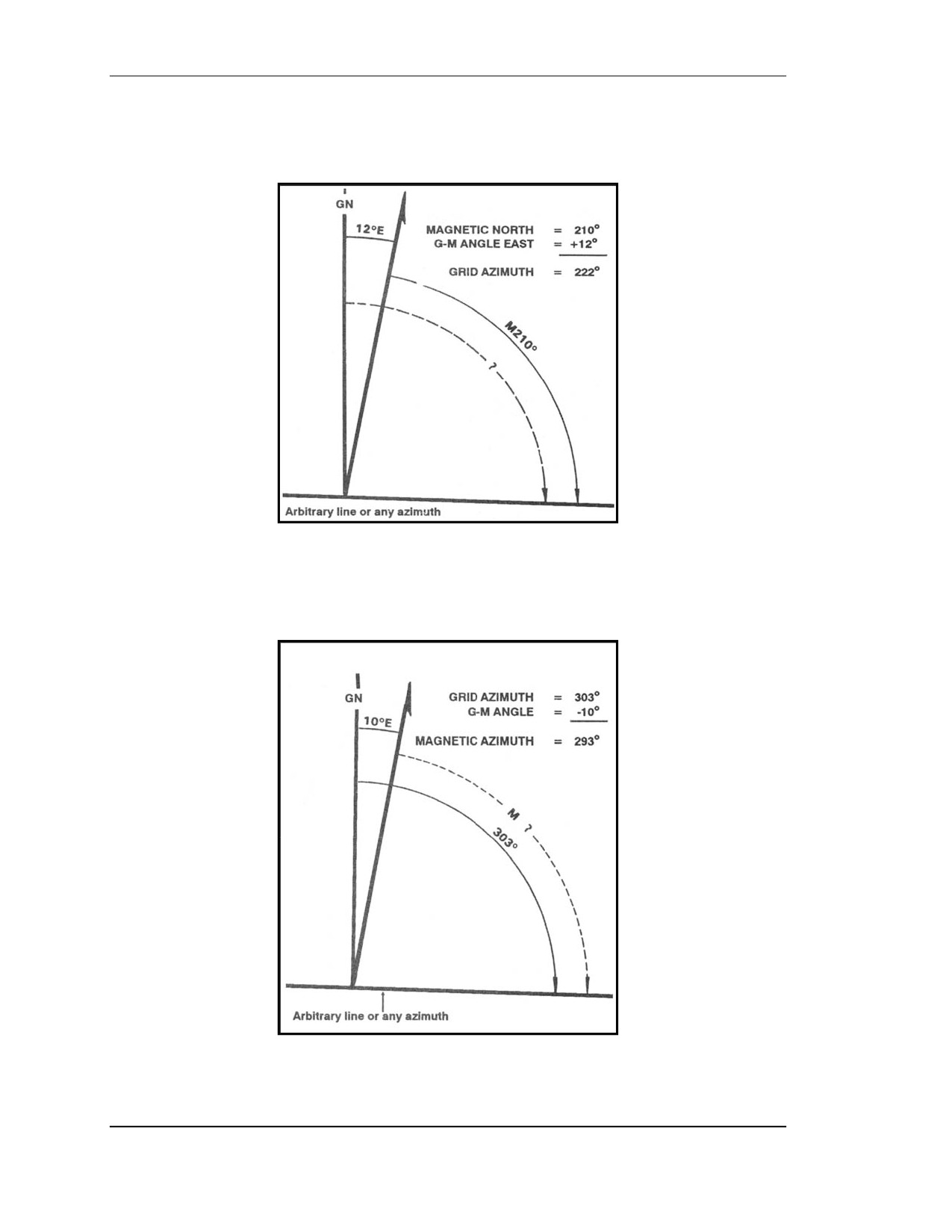
(1) When working with a map having an east G-M angle:
(a) To plot a magnetic azimuth on a map, first change it to a grid azimuth (Figure 6-10).
Figure 6-10. Converting to grid azimuth.
(b) To use a magnetic azimuth in the field with a compass, first change the grid azimuth
plotted on a map to a magnetic azimuth (Figure 6-11).
Figure 6-11. Converting to magnetic azimuth.
6-10
FOUO
18 January 2005
FM 3-25.26
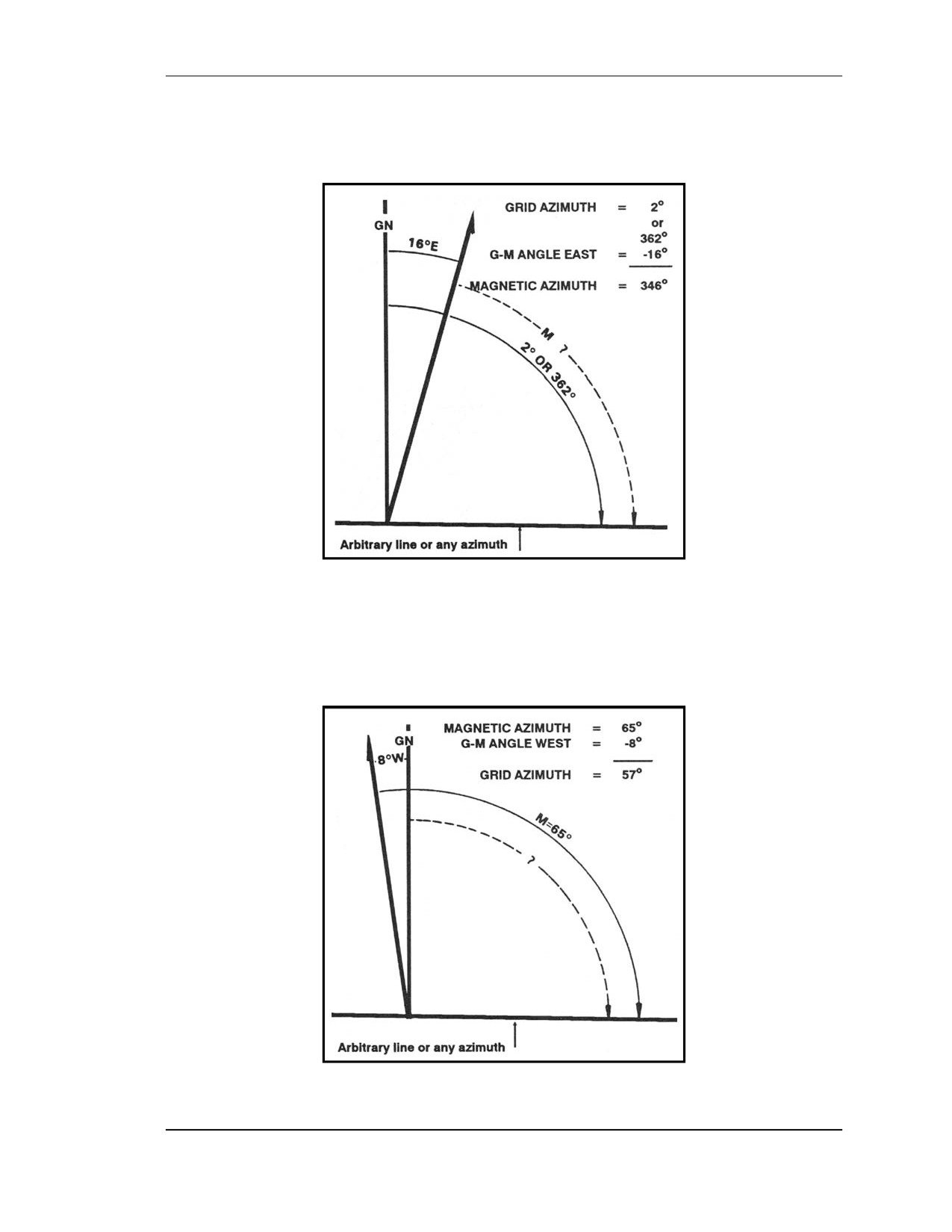
(c) Convert a grid azimuth to a magnetic azimuth when the G-M angle is greater than a
grid azimuth (Figure 6-12).
Figure 6-12. Converting to a magnetic azimuth
when the G-M angle is greater.
(2) When working with a map having a west G-M angle:
(a) To plot a magnetic azimuth on a map, first convert it to a grid azimuth (Figure 6-13).
Figure 6-13. Converting to a grid azimuth on a map.
FOUO
6-11
18 January 2005
FM 3-25.26
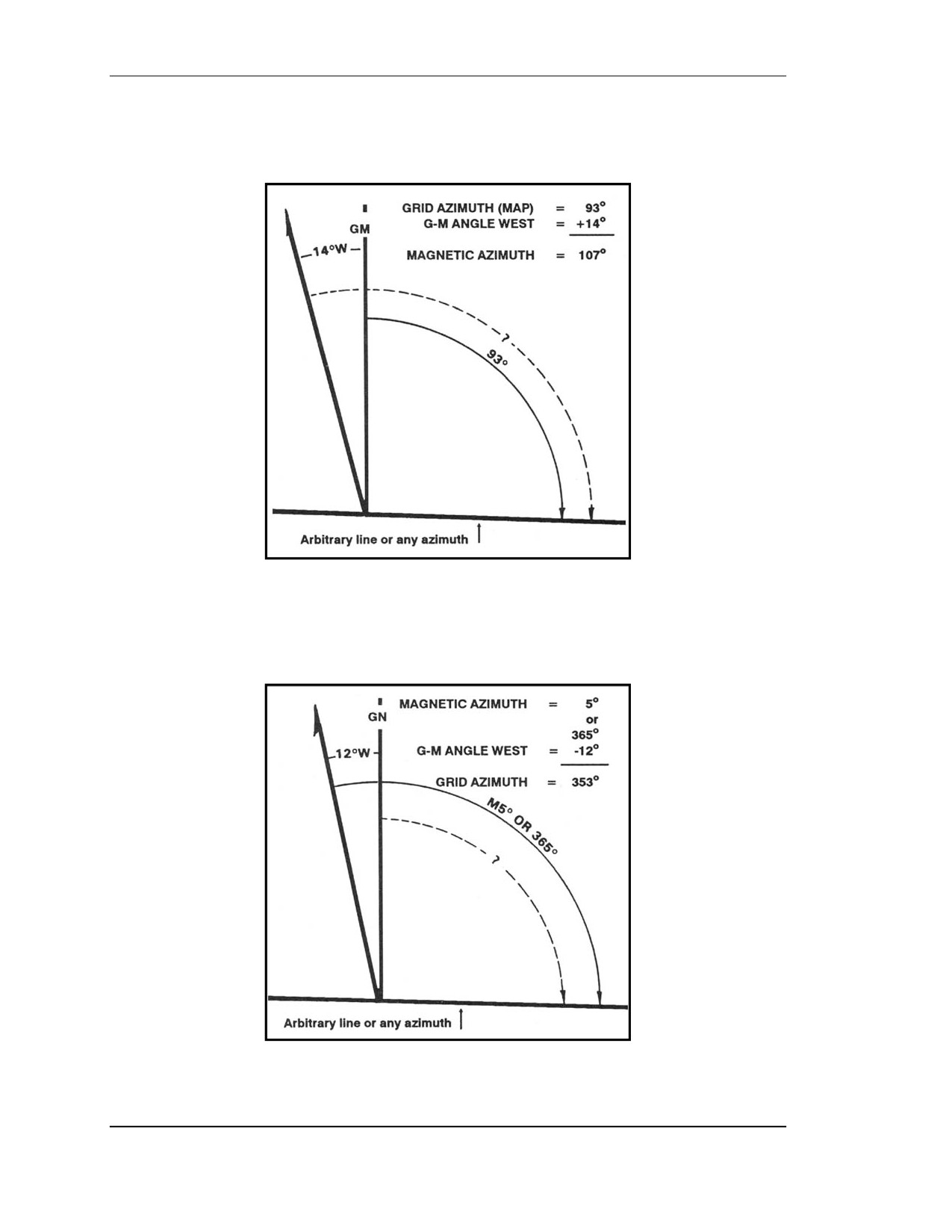
(b) To use a magnetic azimuth in the field with a compass, change the grid azimuth
plotted on a map to a magnetic azimuth (Figure 6-14).
Figure 6-14. Converting to a magnetic azimuth on a map.
(c) Convert a magnetic azimuth when the G-M angle is greater than the magnetic
azimuth (Figure 6-15).
Figure 6-15. Converting to a grid azimuth
when the G-M angle is greater.
6-12
FOUO
18 January 2005
FM 3-25.26
(3) The G-M angle diagram should be constructed and used each time the conversion of
azimuth is required. Such procedure is important when working with a map for the first time.
It also may be convenient to construct a G-M angle conversion table on the margin of the
map.
NOTE: When converting azimuths, exercise extreme care when adding and subtracting
the G-M angle. A simple mistake of 1 degree could be significant in the field.
6-7.
INTERSECTION
Intersection is the location of an unknown point by successively occupying at least two
(preferably three) known positions on the ground and then map sighting on the unknown
location. It is used to locate distant or inaccessible points or objects such as enemy targets
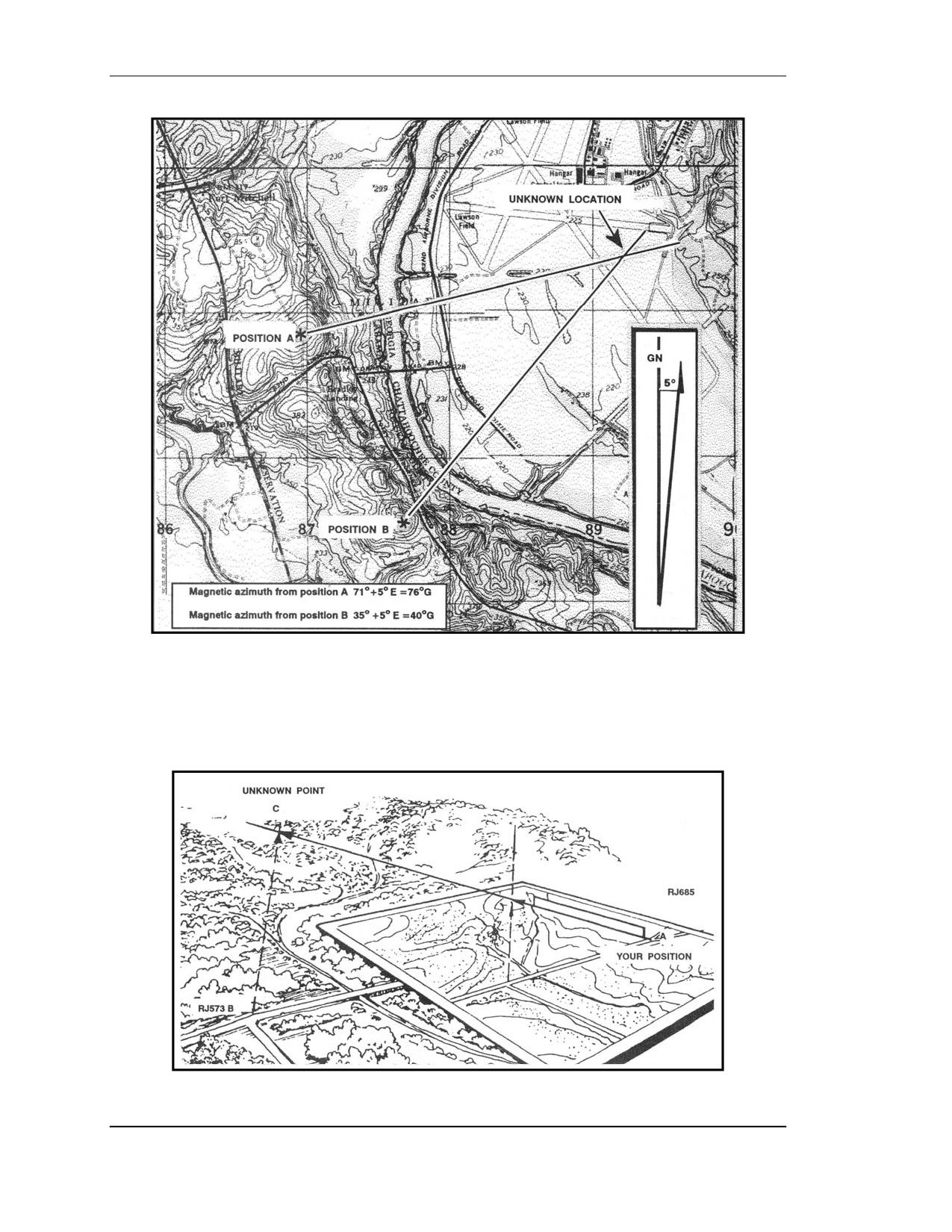
and danger areas. There are two methods of intersection: the map and compass method and
the straightedge method (Figures 6-16 and 6-17 on page 6-14).
a. When using the map and compass method⎯
(1) Orient the map using the compass.
(2) Locate and mark your position on the map,
(3) Determine the magnetic azimuth to the unknown position using the compass.
(4) Convert the magnetic azimuth to grid azimuth.
(5) Draw a line on the map from your position on this grid azimuth.
(6) Move to a second known point and repeat steps 1, 2, 3, 4, and 5.
(7) The location of the unknown position is where the lines cross on the map. Determine
the grid coordinates to the desired accuracy.
b. The straightedge method is used when a compass is not available. When using it—
(1) Orient the map on a flat surface by the terrain association method.
(2) Locate and mark your position on the map.
(3) Lay a straightedge on the map with one end at the user’s position (A) as a pivot point;
then, rotate the straightedge until the unknown point is sighted along the edge.
(4) Draw a line along the straightedge
(5) Repeat the above steps at position (B) and check for accuracy.
FOUO
6-13
18 January 2005
FM 3-25.26
Figure 6-16. Intersection, using map and compass.
(6) The intersection of the lines on the map is the location of the unknown point (C).
Determine the grid coordinates to the desired accuracy (Figure 6-17).
Figure 6-17. Intersection, using a straightedge.
6-14
FOUO
18 January 2005
FM 3-25.26
6-8.
RESECTION
Resection is the method of locating one’s position on a map by determining the grid azimuth
to at least two well-defined locations that can be pinpointed on the map. For greater
accuracy, the desired method of resection would be to use three or more well-defined
locations.
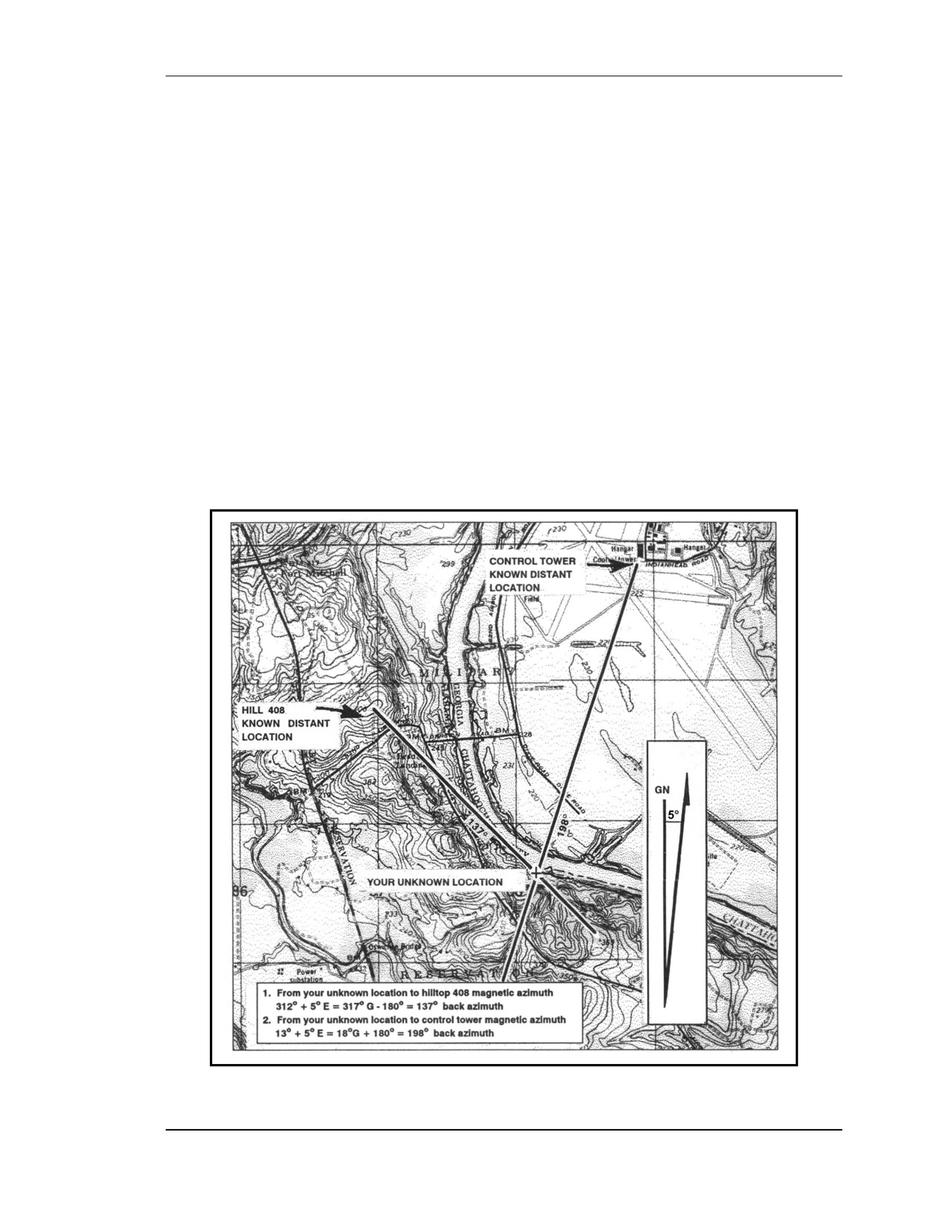
a. When using the map and compass method (Figure 6-18)—
(1) Orient the map using the compass.
(2) Identify two or three known distant locations on the ground and mark them on the
map.
(3) Measure the magnetic azimuth to one of the known positions from your location
using a compass.
(4) Convert the magnetic azimuth to a grid azimuth.
(5) Convert the grid azimuth to a back azimuth. Using a protractor, draw a line for the
back azimuth on the map from the known position back toward your unknown position.
(6) Repeat 3, 4, and 5 for a second position and a third position, if desired.
(7) The intersection of the lines is your location. Determine the grid coordinates to the
desired accuracy.
Figure 6-18. Resection with map and compass.
FOUO
6-15
18 January 2005
FM 3-25.26
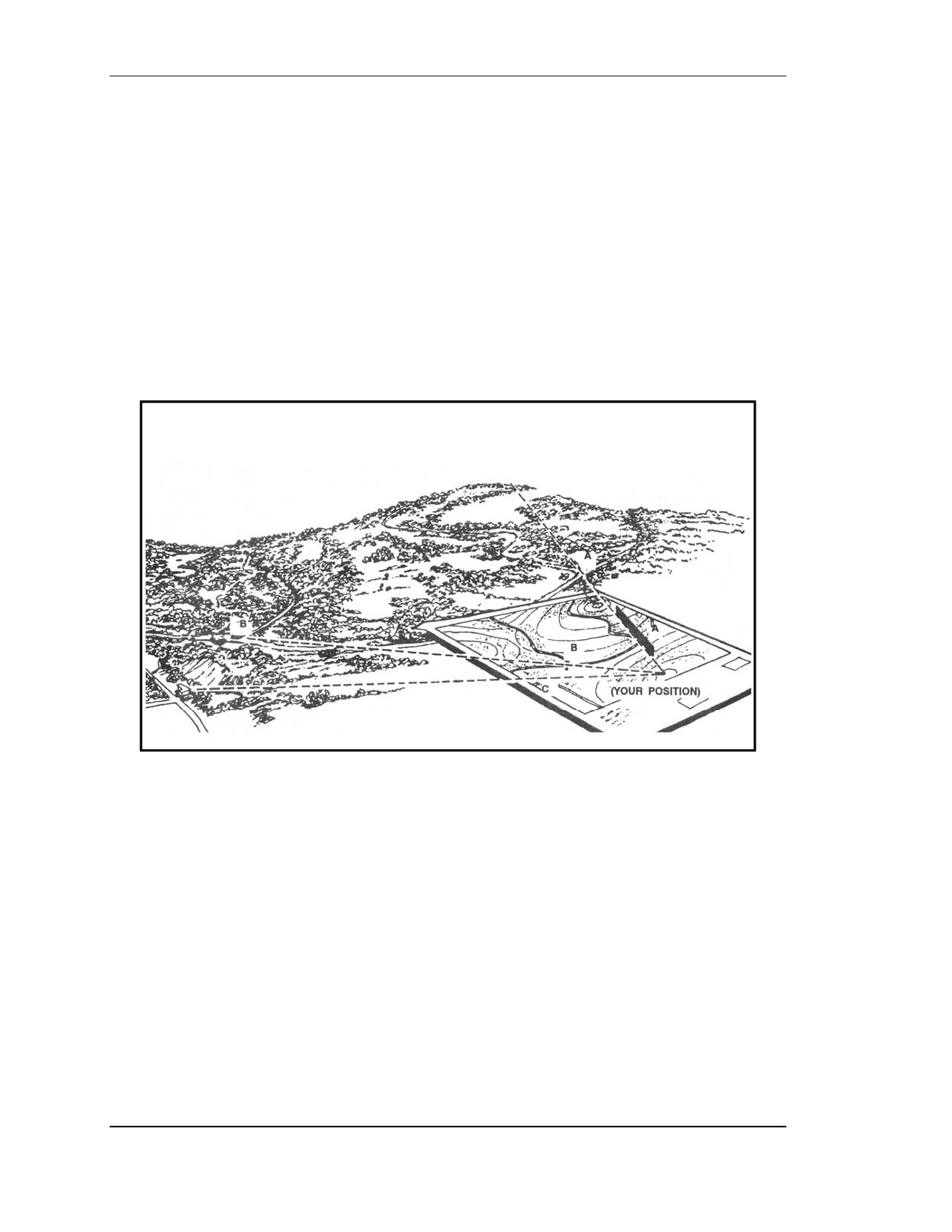
a. When using the straightedge method (Figure 6-19)—
(1) Orient the map on a flat surface by the terrain association method.
(2) Locate at least two known distant locations or prominent features on the ground and
mark them on the map.
(3) Lay a straightedge on the map using a known position as a pivot point. Rotate the
straightedge until the known position on the map is aligned with the known position on the
ground.
(4) Draw a line along the straightedge away from the known position on the ground
toward your position.
(5) Repeat 3 and 4 using a second known position.
(6) The intersection of the lines on the map is your location. Determine the grid
coordinates to the desired accuracy.
Figure 6-19. Resection with straightedge.
6-9.
MODIFIED RESECTION
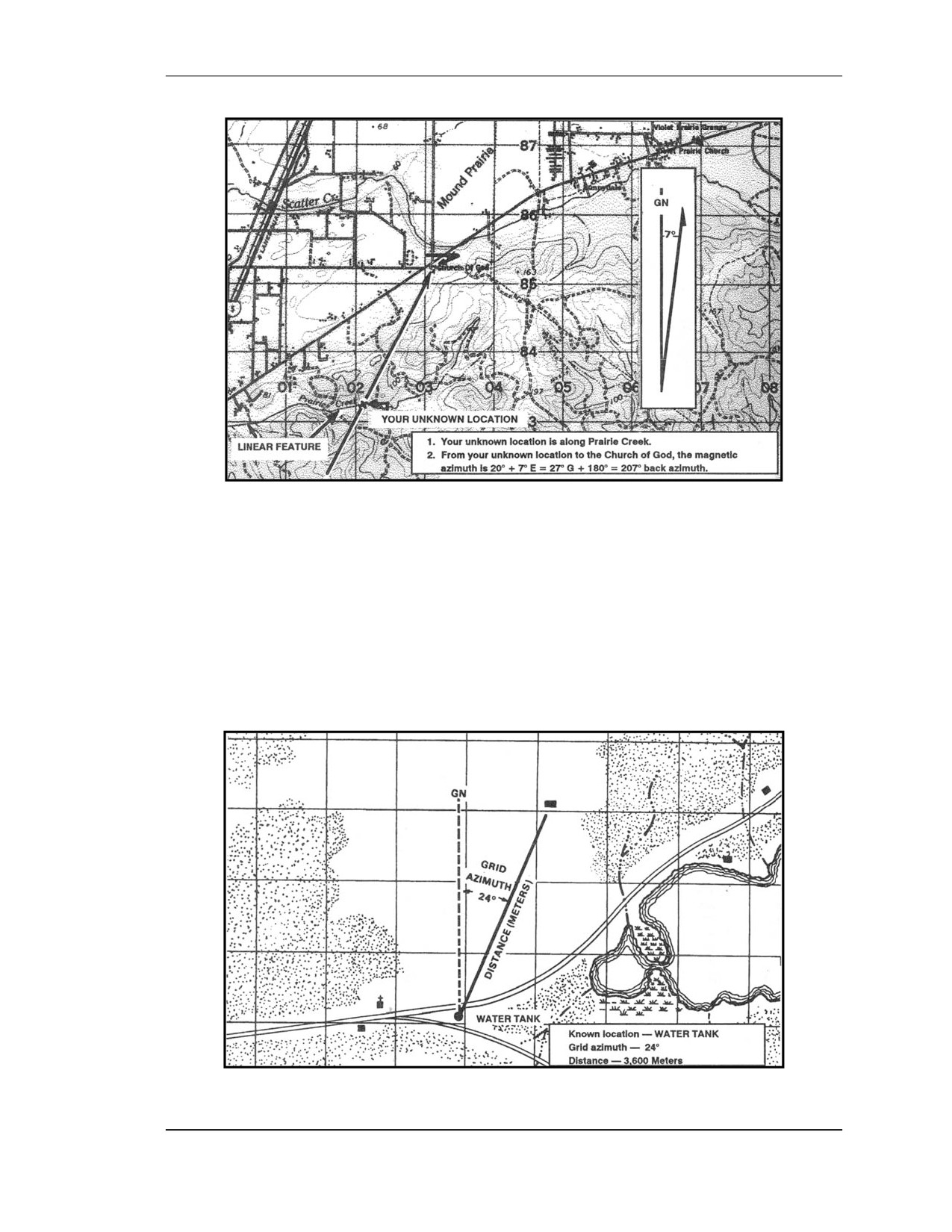
Modified resection is the method of locating one’s position on the map when the person is
located on a linear feature on the ground, such as a road, canal, or stream (Figure 6-20).
Proceed as follows:
a. Orient the map using a compass or by terrain association.
b. Find a distant point that can be identified on the ground and on the map.
c. Determine the magnetic azimuth from your location to the distant known point.
d. Convert the magnetic azimuth to a grid azimuth.
e. Convert the grid azimuth to a back azimuth. Using a protractor, draw a line for the
back azimuth on the map from the known position back toward your unknown position.
f. The location of the user is where the line crosses the linear feature. Determine the
grid coordinates to the desired accuracy.
6-16
FOUO
18 January 2005
FM 3-25.26
Figure 6-20. Modified resection.
6-10. POLAR PLOT
A method of locating or plotting an unknown position from a known point by giving a
direction and a distance along that direction line is called polar plot. The following elements
must be present when using polar plot (Figure 6-21).
• Present known location on the map.
• Azimuth (grid or magnetic).
• Distance (in meters).
Using the laser range finder to determine the range enhances your accuracy in determining
the unknown position’s location.
Figure 6-21. Polar plot.
FOUO
6-17
18 January 2005