FM 3-25.26 MAP READING AND LAND NAVIGATION (January 2005) - page 4
This Page intentionally left blank.
FM 3-25.26
CHAPTER 10
ELEVATION AND RELIEF
The elevation of points on the ground and the relief of an area affect the
movement, positioning, and, in some cases, effectiveness of military units.
Soldiers must know how to determine locations of points on a map, measure
distances and azimuths, and identify symbols on a map. They must also be
able to determine the elevation and relief of areas on standard military maps.
To do this, they must first understand how the mapmaker indicated the
elevation and relief on the map.
10-1. DEFINITIONS
There must be a reference or start point to measure anything. The reference or start point for
vertical measurement of elevation on a standard military map is the datum plane or mean sea
level, the point halfway between high tide and low tide. Elevation of a point on the earth’s
surface is the vertical distance it is above or below mean sea level. Relief is the
representation (as depicted by the mapmaker) of the shapes of hills, valleys, streams, or
terrain features on the earth’s surface.
10-2. METHODS OF DEPICTING RELIEF
Mapmakers use several methods to depict relief of the terrain.
a. Layer Tinting. Layer tinting is a method of showing relief by color. A different
color is used for each band of elevation. Each shade of color, or band, represents a definite
elevation range. A legend is printed on the map margin to indicate the elevation range
represented by each color. However, this method does not allow the map user to determine
the exact elevation of a specific point—only the range.
b. Form Lines. Form lines are not measured from any datum plane. Form lines have no
standard elevation and give only a general idea of relief. Form lines are represented on a map
as dashed lines and are never labeled with representative elevations.
c. Shaded Relief. Relief shading indicates relief by a shadow effect achieved by tone
and color that results in the darkening of one side of terrain features such as hills and ridges.
The darker the shading, the steeper the slope. Shaded relief is sometimes used in conjunction
with contour lines to emphasize these features.
d. Hachures. Hachures are short, broken lines used to show relief. Hachures are
sometimes used with contour lines. They do not represent exact elevations, but are mainly
used to show large, rocky outcrop areas. Hachures are used extensively on small-scale maps
to show mountain ranges, plateaus, and mountain peaks.
e. Contour Lines. Contour lines are the most common method of showing relief and
elevation on a standard topographic map. A contour line represents an imaginary line on the
ground, above or below sea level. All points on the contour line are at the same elevation.
The elevation represented by contour lines is the vertical distance above or below sea level.
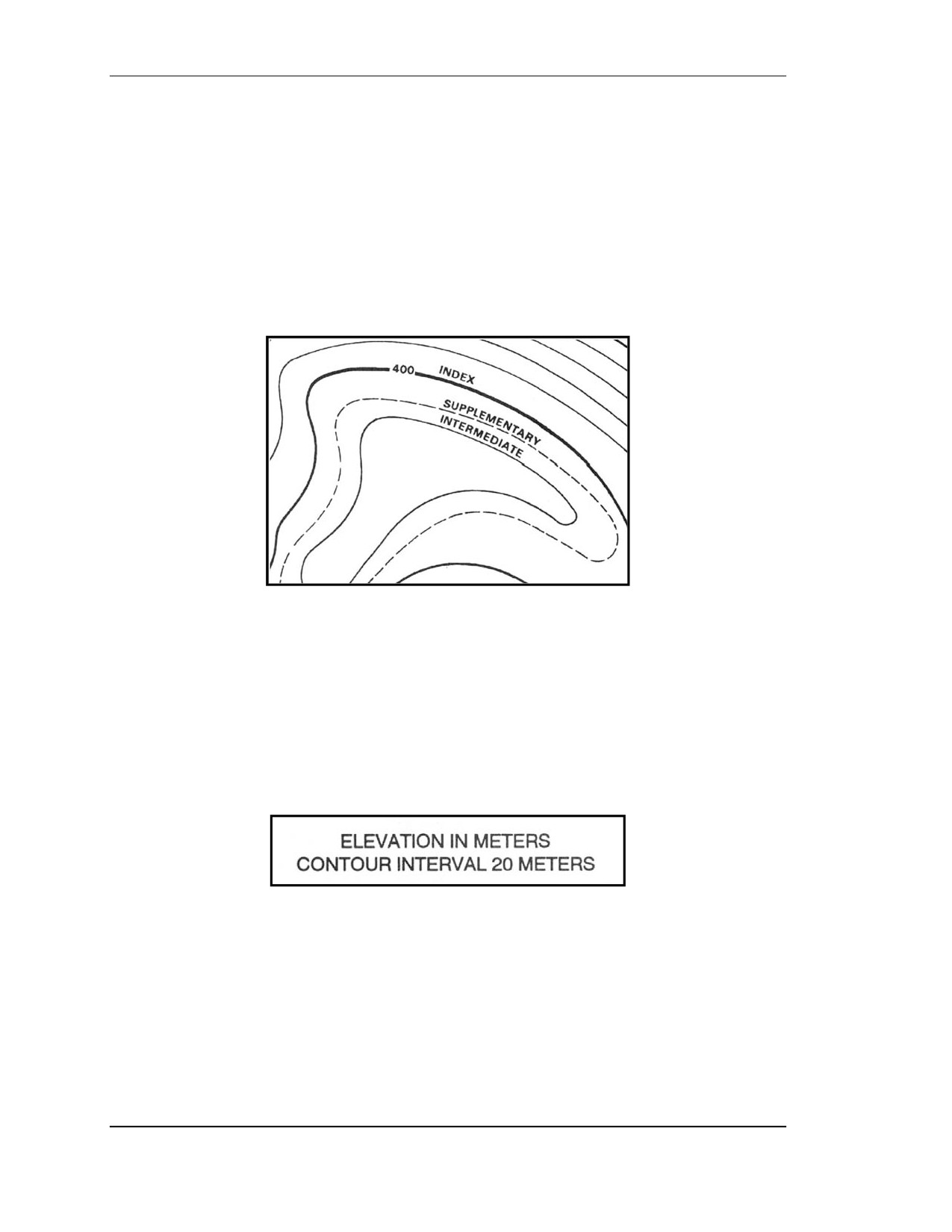
The three types of contour lines (Figure 10-1, page 10-2) used on a standard topographic
map are index, intermediate, and supplementary.
FOUO
10-1
18 January 2005
FM 3-25.26
(1) Index. Starting at zero elevation or mean sea level, every fifth contour line is a
heavier line. These are known as index contour lines. Normally, each index contour line is
numbered at some point. This number is the elevation of that line.
(2) Intermediate. The contour lines falling between the index contour lines are called
intermediate contour lines. These lines are finer and do not have their elevations given.
There are normally four intermediate contour lines between index contour lines.
(3) Supplementary. These contour lines resemble dashes. They show changes in
elevation of at least one-half the contour interval. Supplementary lines are normally found
where there is very little change in elevation such as on fairly level terrain.
Figure 10-1. Contour lines.
10-3. CONTOUR INTERVALS
Before the elevation of any point on the map can be determined, the user must know the
contour interval for the map he is using. The contour interval measurement given in the
marginal information is the vertical distance between adjacent contour lines. Use the
following procedures to determine the elevation of a point on the map.
a. Determine the contour interval and the unit of measure used; for example, feet,
meters, or yards (Figure 10-2).
Figure 10-2. Example contour interval note.
10-2
FOUO
18 January 2005
FM 3-25.26
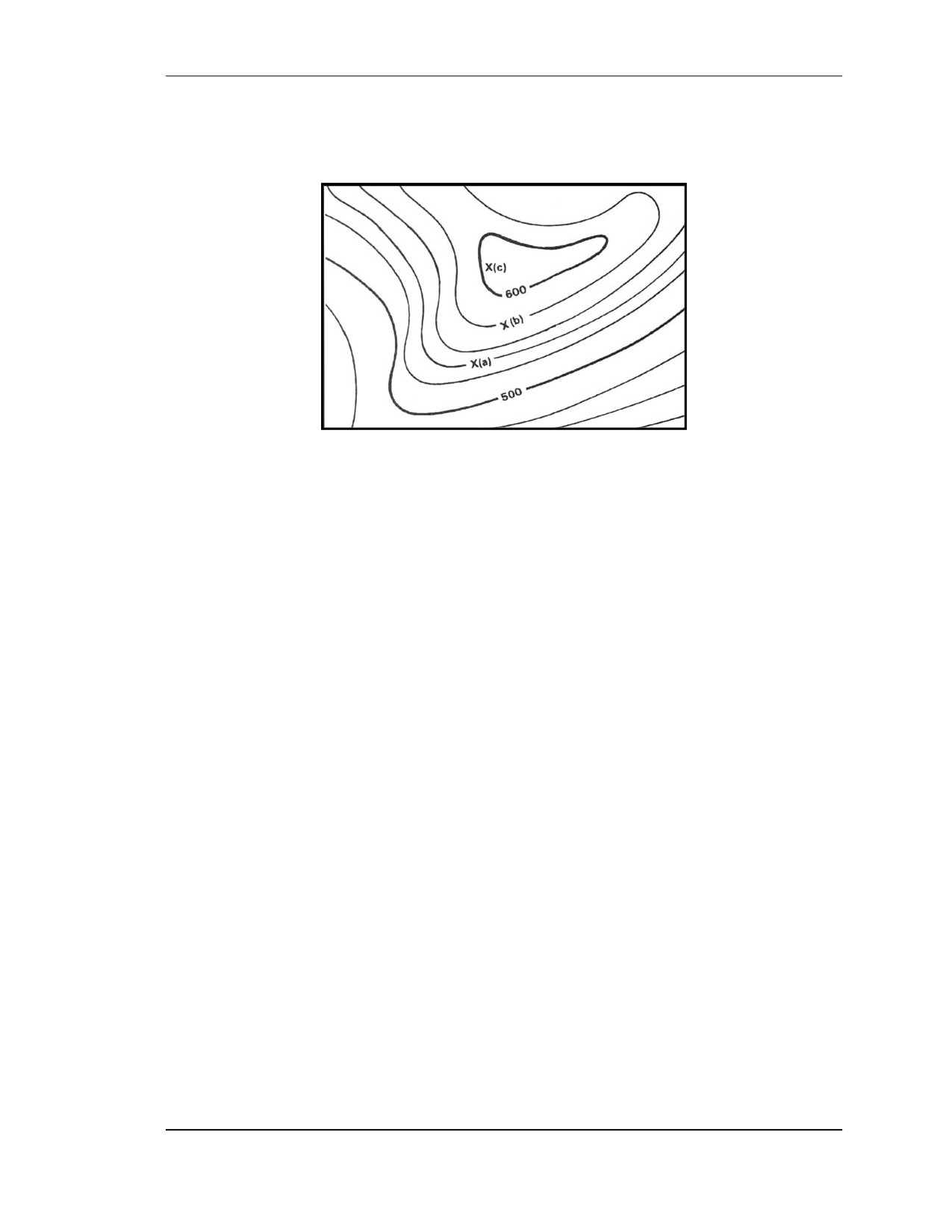
b. Find the numbered index contour line nearest the point you are trying to determine
the elevation for (Figure 10-3).
Figure 10-3. Points on contour lines.
c. Determine if you are going from lower elevation to higher, or vice versa. In
Figure 10-3, point (a) is between the index contour lines. The lower index contour line is
numbered 500, which means any point on that line is at an elevation of 500 meters above
mean sea level. The upper index contour line is numbered 600, or 600 meters. Going from
the lower to the upper index contour line shows an increase in elevation.
d. To determine the exact elevation of point (a), start at the index contour line numbered
500 and count the number of intermediate contour lines to point (a). Point (a) is located on
the second intermediate contour line above the 500-meter index contour line. The contour
interval is 20 meters (Figure 10-2), thus each intermediate contour line crossed to get to
point (a) adds 20 meters to the 500-meter index contour line. The elevation of point (a) is
540 meters; the elevation has increased.
e. To determine the elevation of point (b), go to the nearest index contour line. In this
case, it is the upper index contour line numbered 600. Point (b) is located on the intermediate
contour line immediately below the 600-meter index contour line. Below means downhill or
a lower elevation. Therefore, point (b) is located at an elevation of 580 meters. Remember, if
you are increasing elevation, add the contour interval to the nearest index contour line. If you
are decreasing elevation, subtract the contour interval from the nearest index contour line.
f. To determine the elevation to a hilltop, point (c), add one-half the contour interval to
the elevation of the last contour line. In this example, the last contour line before the hilltop
is an index contour line numbered 600. Add one-half the contour interval, 10 meters, to the
index contour line. The elevation of the hilltop would be 610 meters.
FOUO
10-3
18 January 2005
FM 3-25.26
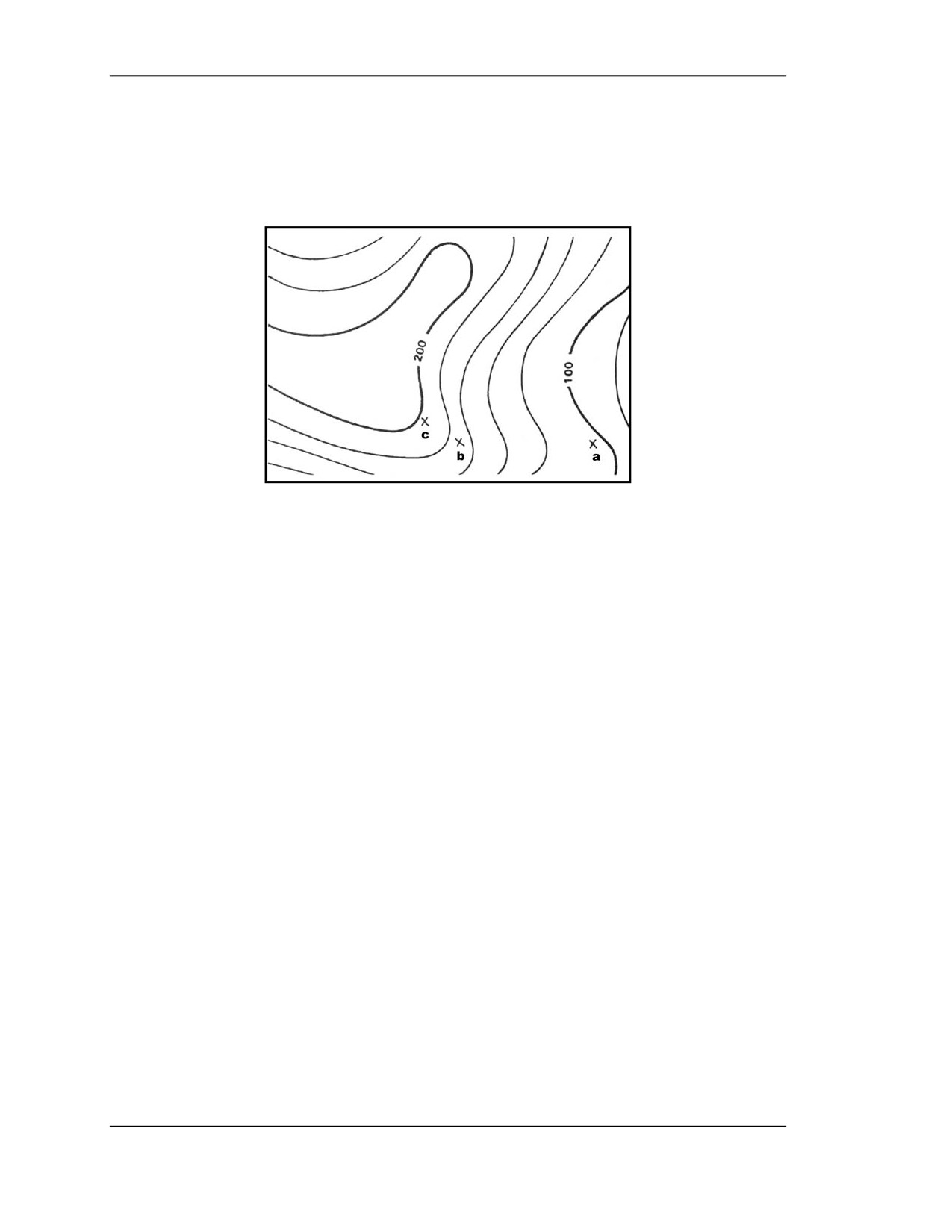
g. There may be times when you need to determine the elevation of points to a greater
accuracy. To do this, you must determine how far between the two contour lines the point
lies. However, most military needs are satisfied by estimating the elevation of points
between contour lines (Figure 10-4).
Figure 10-4. Points between contour lines.
(1) If the point is less than one-fourth the distance between contour lines, the elevation
will be the same as the last contour line. In Figure 10-4, the elevation of point a will be
100 meters. To estimate the elevation of a point between one-fourth and three-fourths of the
distance between contour lines, add one-half the contour interval to the last contour line.
(2) Point b is one-half the distance between contour lines. The contour line immediately
below point b is at an elevation of 160 meters. The contour interval is 20 meters; thus
one-half the contour interval is 10 meters. In this case, add 10 meters to the last contour line
of 160 meters. The elevation of point b would be about 170 meters.
(3) A point located more than three-fourths of the distance between contour lines is
considered to be at the same elevation as the next contour line. Point c is located
three-fourths of the distance between contour lines. In Figure 10-4, point c would be
considered to be at an elevation of 200 meters.
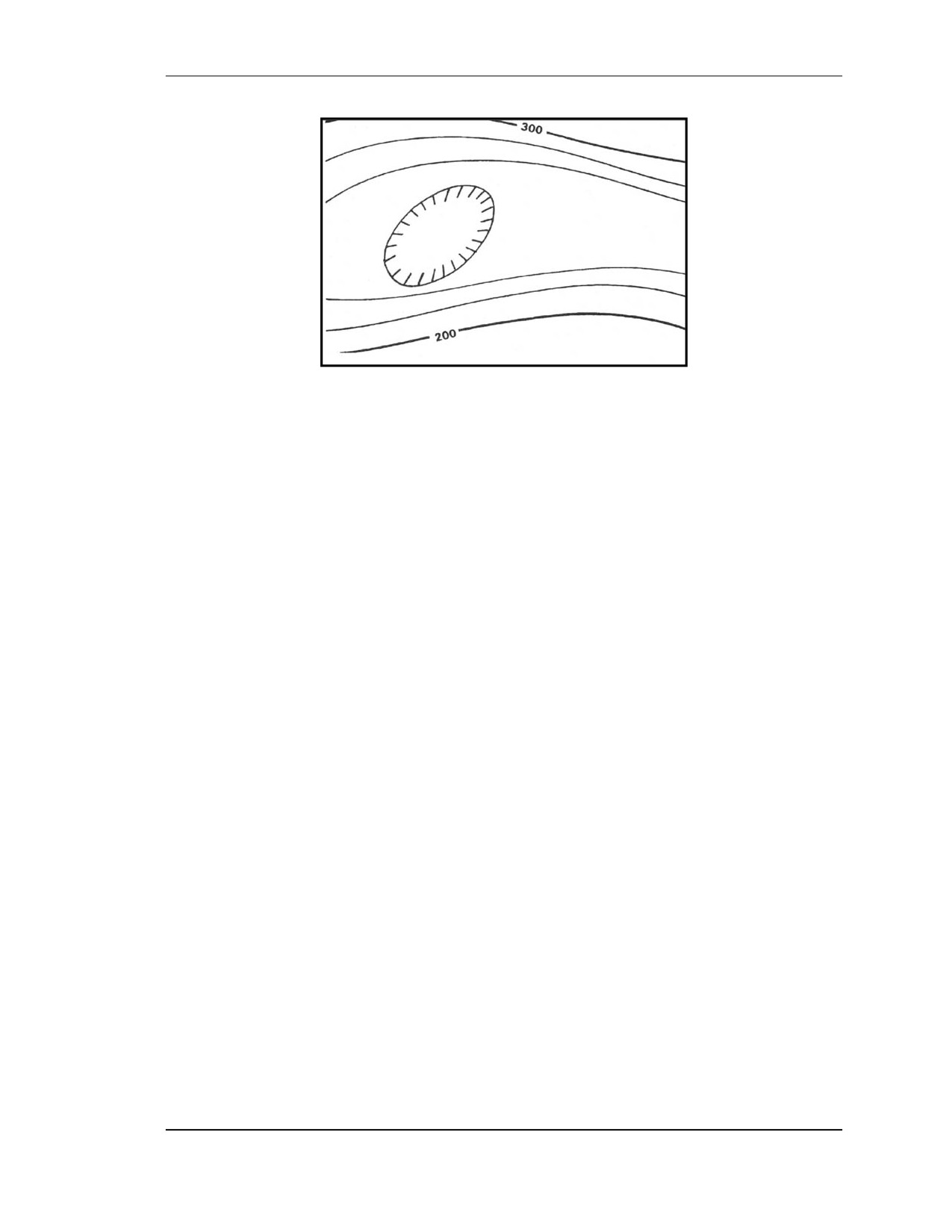
h. To estimate the elevation to the bottom of a depression, subtract one-half the contour
interval from the value of the lowest contour line before the depression. In Figure 10-5, the
lowest contour line before the depression is 240 meters in elevation. Thus, the elevation at
the edge of the depression is 240 meters. To determine the elevation at the bottom of the
depression, subtract one-half the contour interval. The contour interval for this example is 20
meters. Subtract 10 meters from the lowest contour line immediately before the depression.
The result is that the elevation at the bottom of the depression is 230 meters. The tick marks
on the contour line forming a depression always point to lower elevations.
10-4
FOUO
18 January 2005
FM 3-25.26
Figure 10-5. Depression.
i.
In addition to the contour lines, bench marks and spot elevations are used to indicate
points of known elevations on the map.
(1) Bench marks, the more accurate of the two, are symbolized by a black X; for
example X BM 214. The 214 indicates that the center of the X is at an elevation of 214 units
of measure (feet, meters, or yards) above mean sea level. To determine the units of measure,
refer to the contour interval in the marginal information.
(2) Spot elevations are shown by a brown X and are usually located at road junctions and
on hilltops and other prominent terrain features. If the elevation is shown in black numerals,
it has been checked for accuracy; if it is in brown, it has not been checked.
NOTE: New maps are being printed using a dot instead of brown Xs.
10-4. TYPES OF SLOPES
The rate of rise or fall of a terrain feature is known as its slope. Depending on the military
mission, Soldiers may need to determine not only the height of a hill, but the degree of the
hill’s slope as well. The speed at which equipment or personnel can move is affected by the
slope of the ground or terrain feature. This slope can be determined from the map by
studying the contour lines—the closer the contour lines, the steeper the slope; the farther
apart the contour lines, the gentler the slope. Four types of slopes that concern the military
are gentle, steep, concave, and convex.
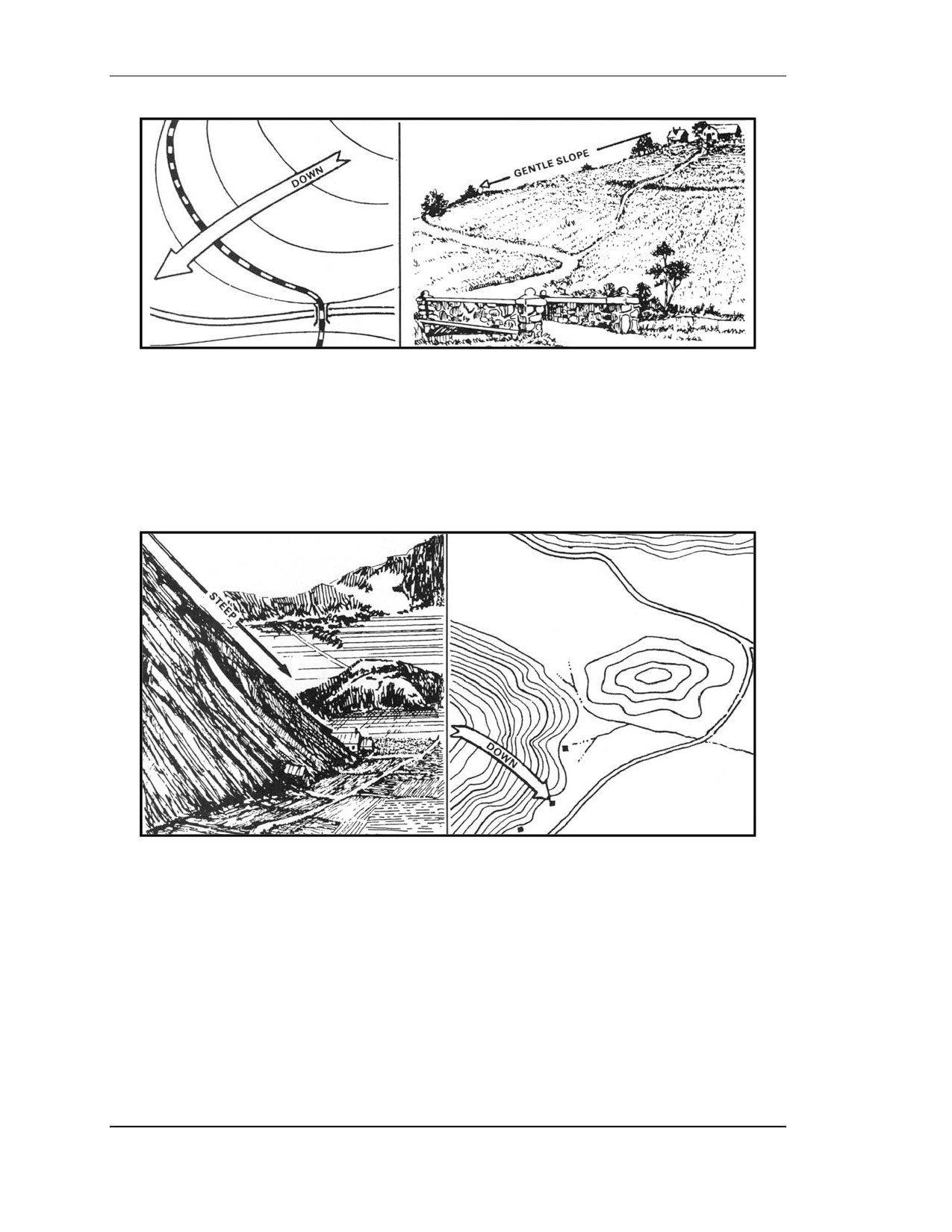
a. Gentle. Contour lines showing a uniform, gentle slope will be evenly spaced and
wide apart (Figure 10-6, page 10-6). Considering relief only, a uniform, gentle slope allows
the defender to use grazing fire. The attacking force has to climb a slight incline.
FOUO
10-5
18 January 2005
FM 3-25.26
Figure 10-6. Uniform, gentle slope.
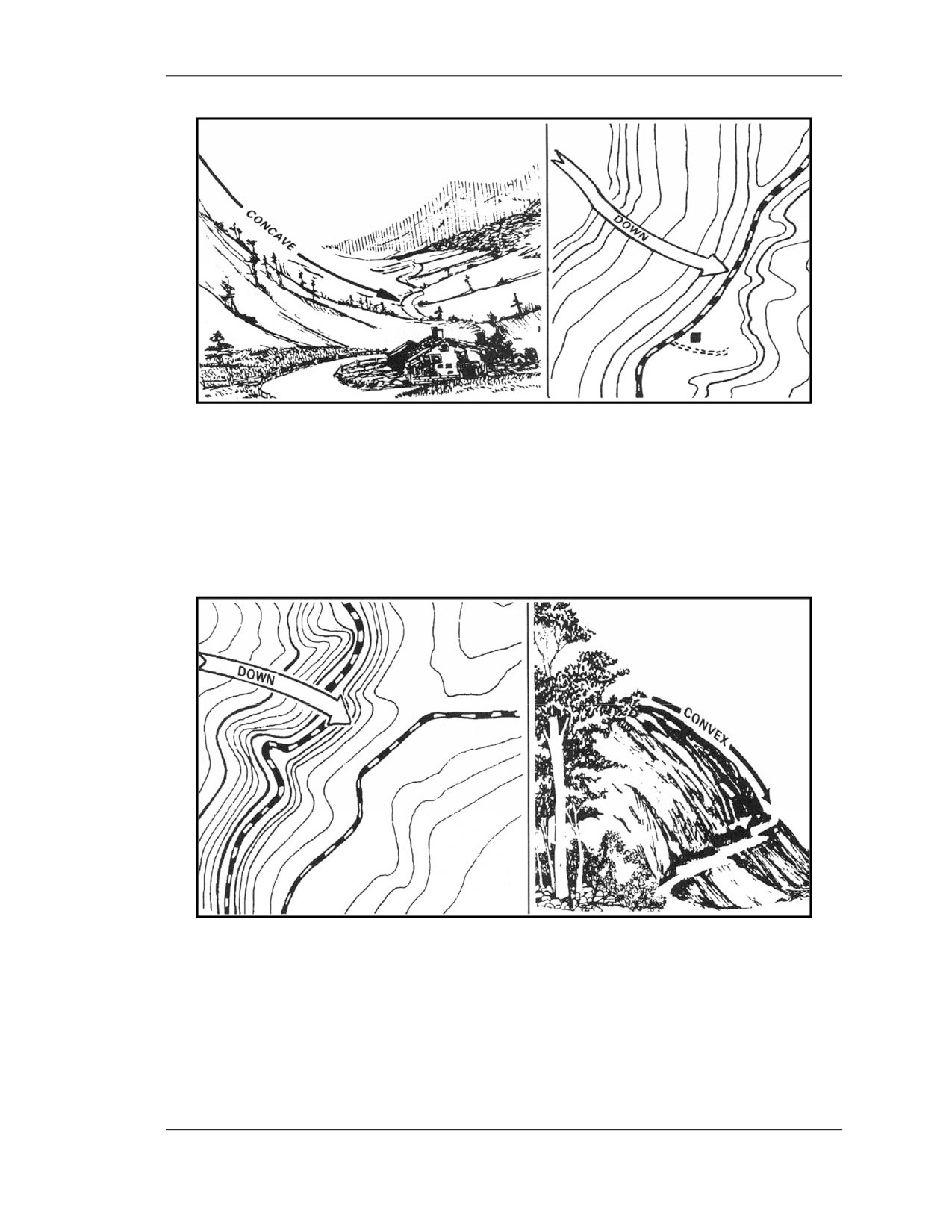
b. Steep. Contour lines showing a uniform, steep slope on a map will be evenly spaced,
but close together. Remember, the closer the contour lines, the steeper the slope
(Figure 10-7). Considering relief only, a uniform, steep slope allows the defender to use
grazing fire, and the attacking force has to negotiate a steep incline.
Figure 10-7. Uniform, steep slope.
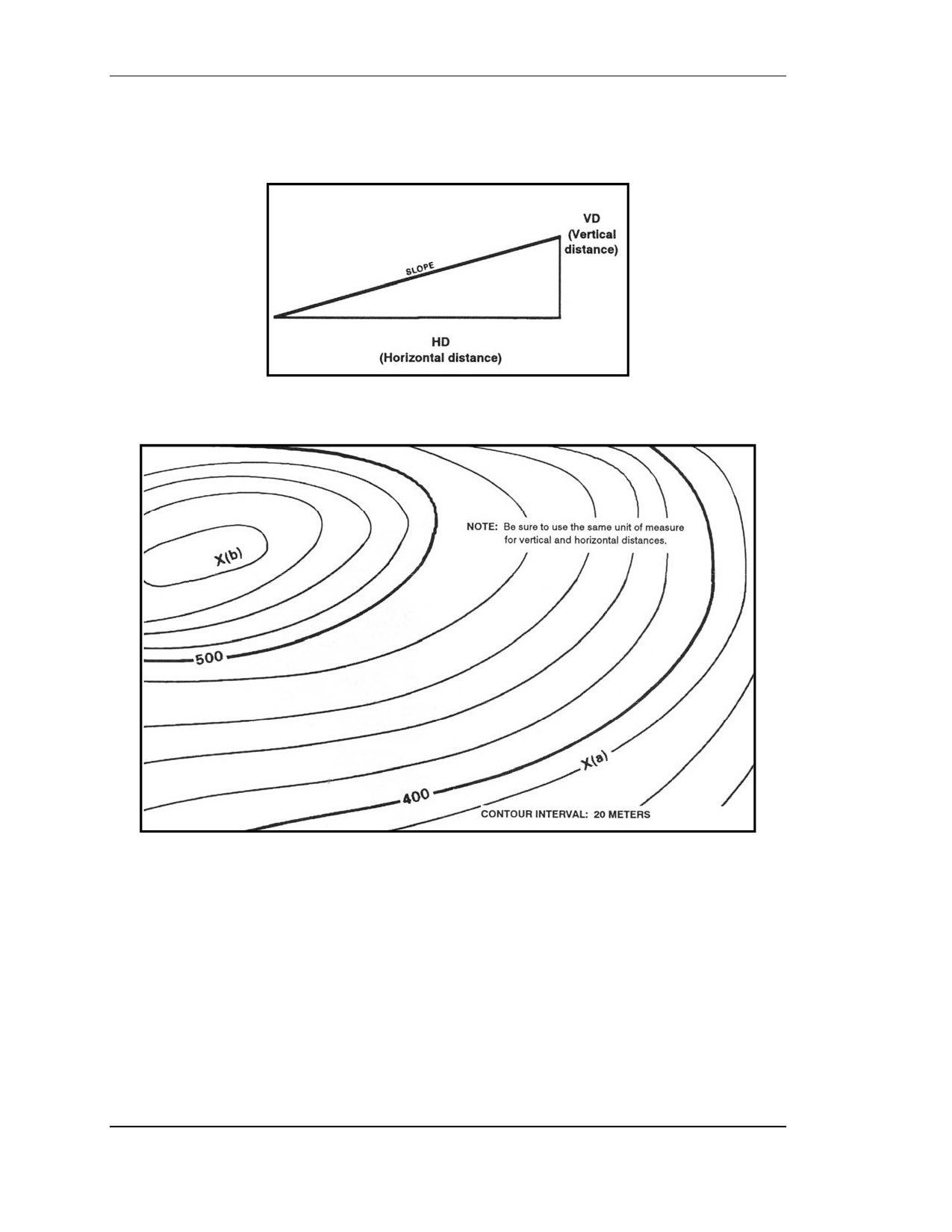
c. Concave. Contour lines showing a concave slope on a map will be closely spaced at
the top of the terrain feature and widely spaced at the bottom (Figure 10-8). Considering
relief only, the defender at the top of the slope can observe the entire slope and the terrain at
the bottom, but he cannot use grazing fire. The attacker would have no cover from the
defender’s observation of fire, and his climb would become more difficult as he gets farther
up the slope.
10-6
FOUO
18 January 2005
FM 3-25.26
Figure 10-8. Concave slope.
d. Convex. Contour lines showing a convex slope on a map will be widely spaced at the
top and closely spaced at the bottom (Figure 10-9). Considering relief only, the defender at
the top of the convex slope can obtain a small distance of grazing fire, but he cannot observe
most of the slope or the terrain at the bottom. The attacker will have concealment on most of
the slope and an easier climb as he nears the top.
Figure 10-9. Convex slope.
10-5. PERCENTAGE OF SLOPE
The speed at which personnel and equipment can move up or down a hill is affected by the
slope of the ground and the limitations of the equipment. Because of this, a more exact way
of describing a slope is necessary.
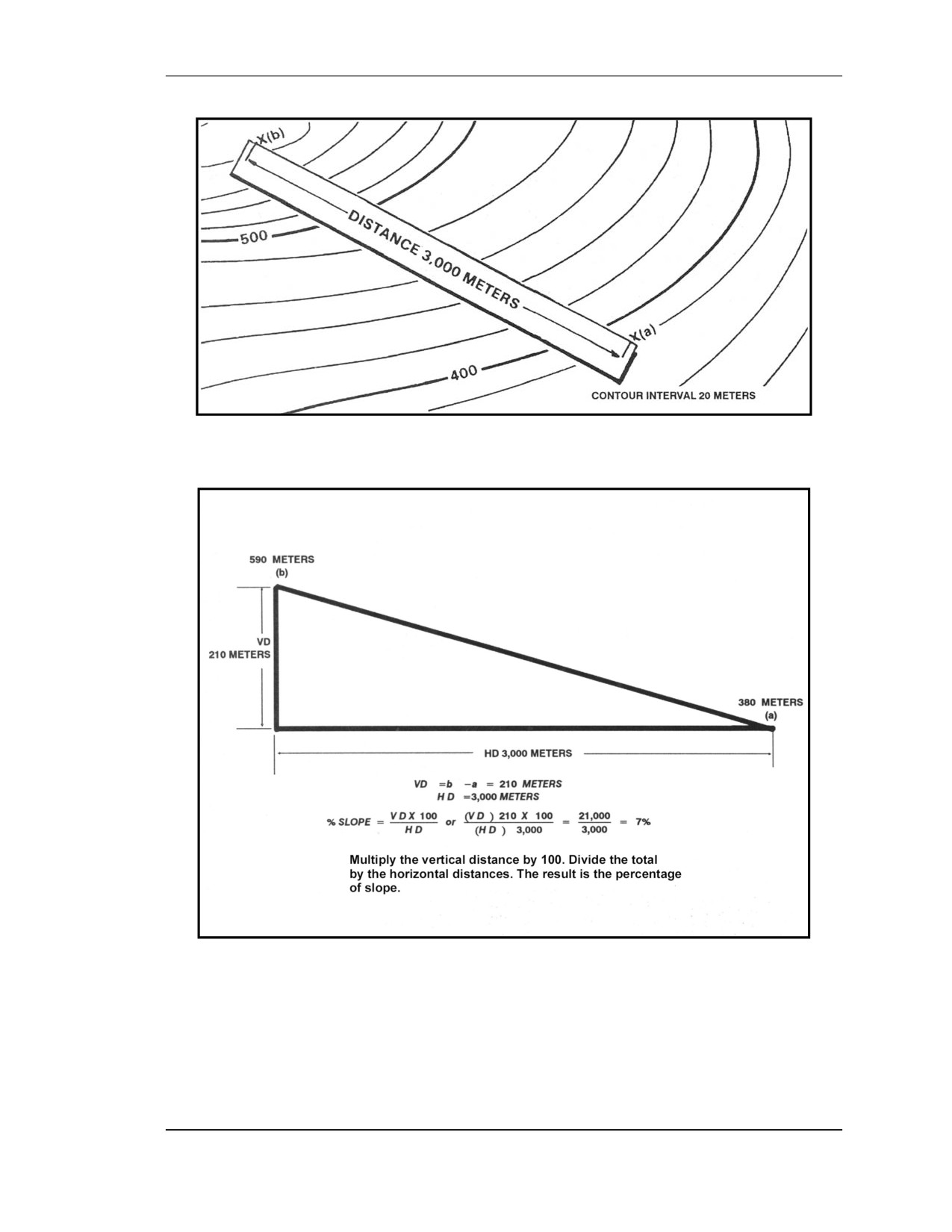
a. Slope may be expressed in several ways, but all depend upon the comparison of
vertical distance (VD) to horizontal distance (HD) (Figure 10-10, page 10-8). Before we can
determine the percentage of a slope, we must know the VD of the slope. The VD is
FOUO
10-7
18 January 2005
FM 3-25.26
determined by subtracting the lowest point of the slope from the highest point. Use the
contour lines to determine the highest and lowest point of the slope (Figure 10-11).
Figure 10-10. Slope diagram.
Figure 10-11. Contour lines around a slope.
b. To determine the percentage of the slope between points (a) and (b) in Figure 10-11,
determine the elevation of point (b) (590 meters). Then determine the elevation of point (a)
(380 meters). Determine the vertical distance between the two points by subtracting the
elevation of point (a) from the elevation of point (b).The difference (210 meters) is the VD
between points (a) and (b). Then measure the HD between the two points on the map in
Figure 10-12. After the horizontal distance has been determined, compute the percentage of
the slope by using the formula shown in Figure 10-13.
10-8
FOUO
18 January 2005
FM 3-25.26
Figure 10-12. Measuring horizontal distance.
Figure 10-13. Percentage of slope in meters.
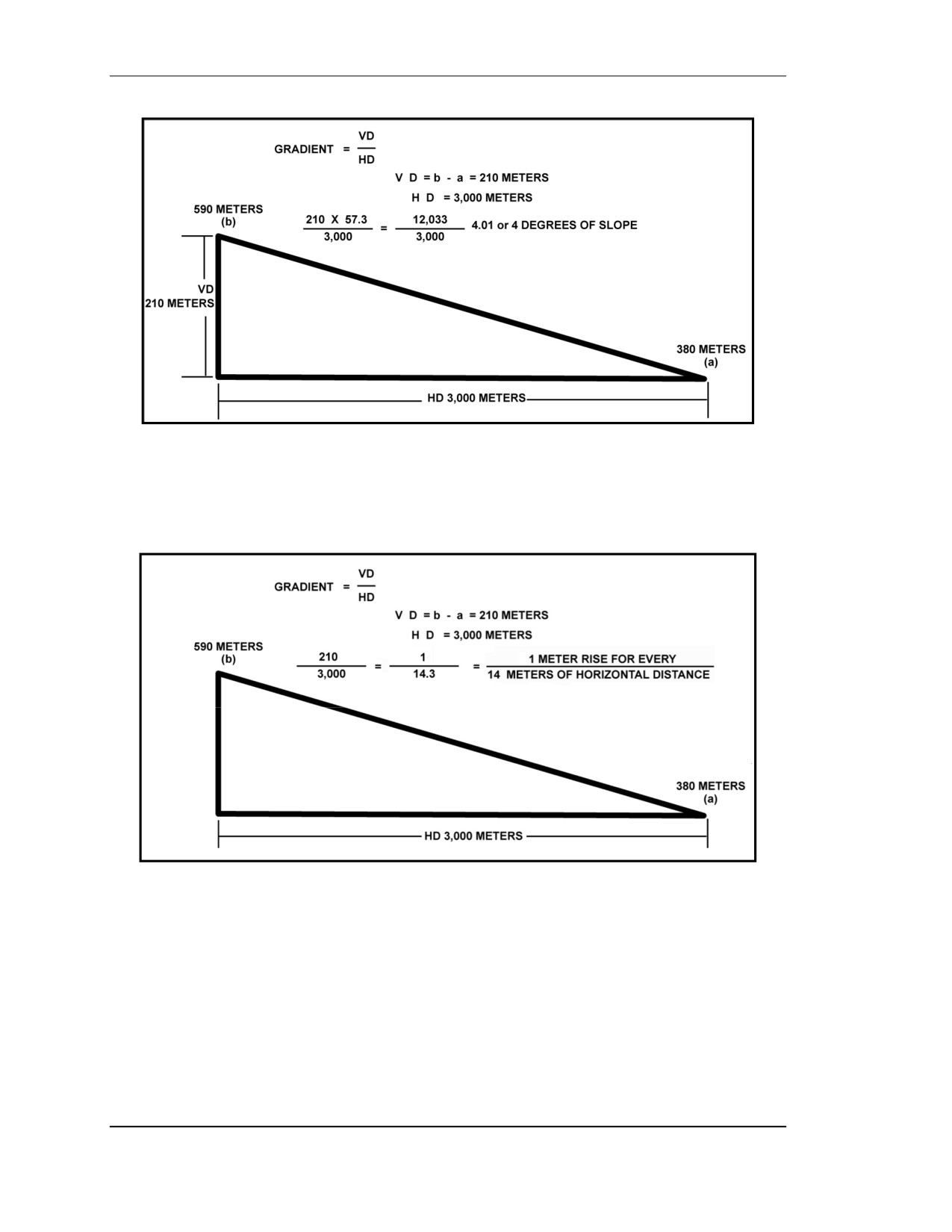
c. The slope angle can also be expressed in degrees. To do this, determine the VD and
HD of the slope. Multiply the VD by 57.3 and then divide the total by the HD (Figure 10-14,
page 10-10). This method determines the approximate degree of slope and is reasonably
accurate for slope angles less than 20 degrees.
FOUO
10-9
18 January 2005
FM 3-25.26
Figure 10-14. Degree of slope.
d. The slope angle can also be expressed as a gradient. The relationship of horizontal
and vertical distance is expressed as a fraction with a numerator of one (Figure 10-15).
Figure 10-15. Gradient.
10-6. TERRAIN FEATURES
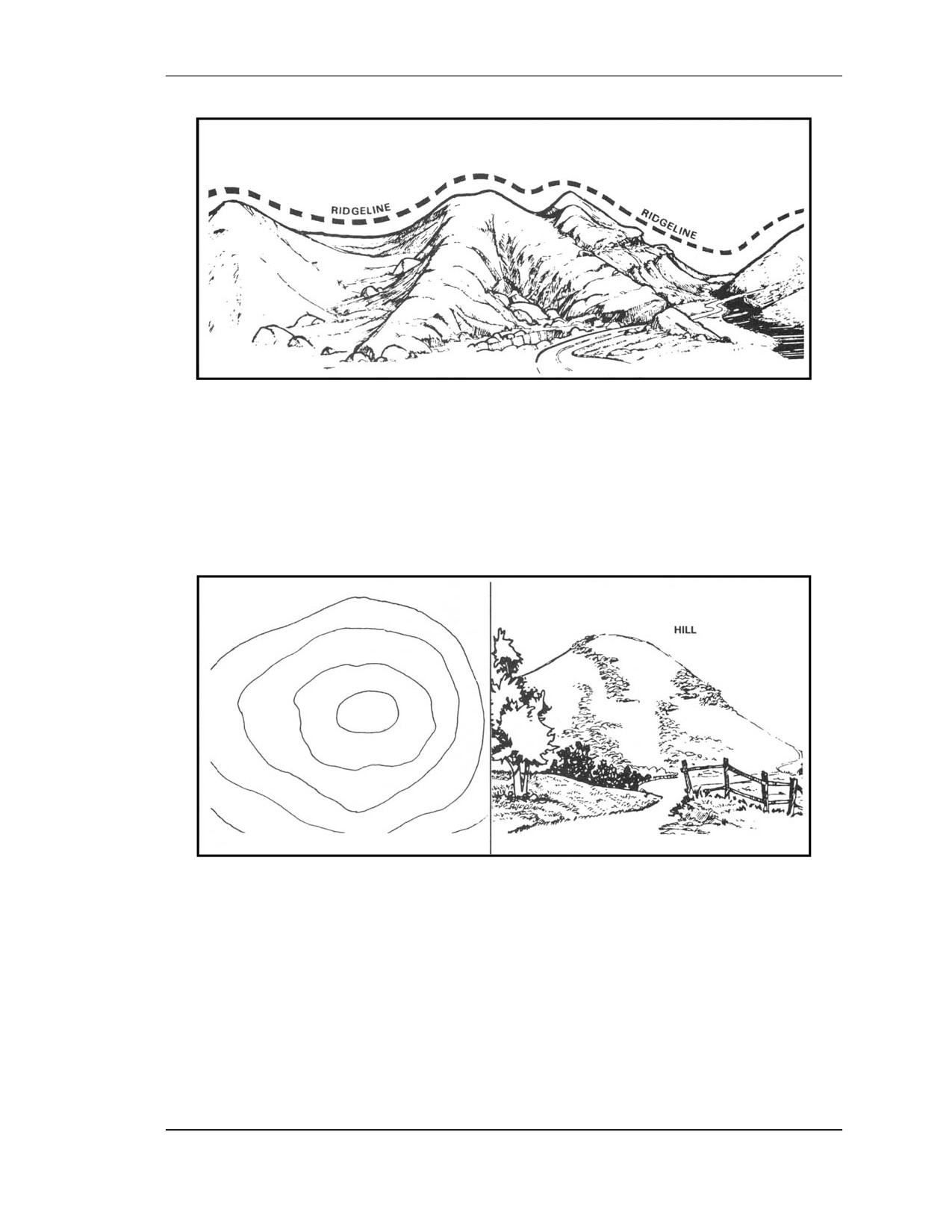
All terrain features are derived from a complex landmass known as a mountain or ridgeline
(Figure 10-16). The term ridgeline is not interchangeable with the term ridge. A ridgeline is
a line of high ground, usually with changes in elevation along its top and low ground on all
sides from which a total of 10 natural or man-made terrain features are classified.
10-10
FOUO
18 January 2005
FM 3-25.26
Figure 10-16. Ridgeline.
a. Major Terrain Features. Major terrain features are hills, saddles, valleys, ridges,
and depressions.
(1) Hill. A hill is an area of high ground. From a hilltop, the ground slopes down in all
directions. A hill is shown on a map by contour lines forming concentric circles. The inside
of the smallest closed circle is the hilltop (Figure 10-17).
Figure 10-17. Hill.
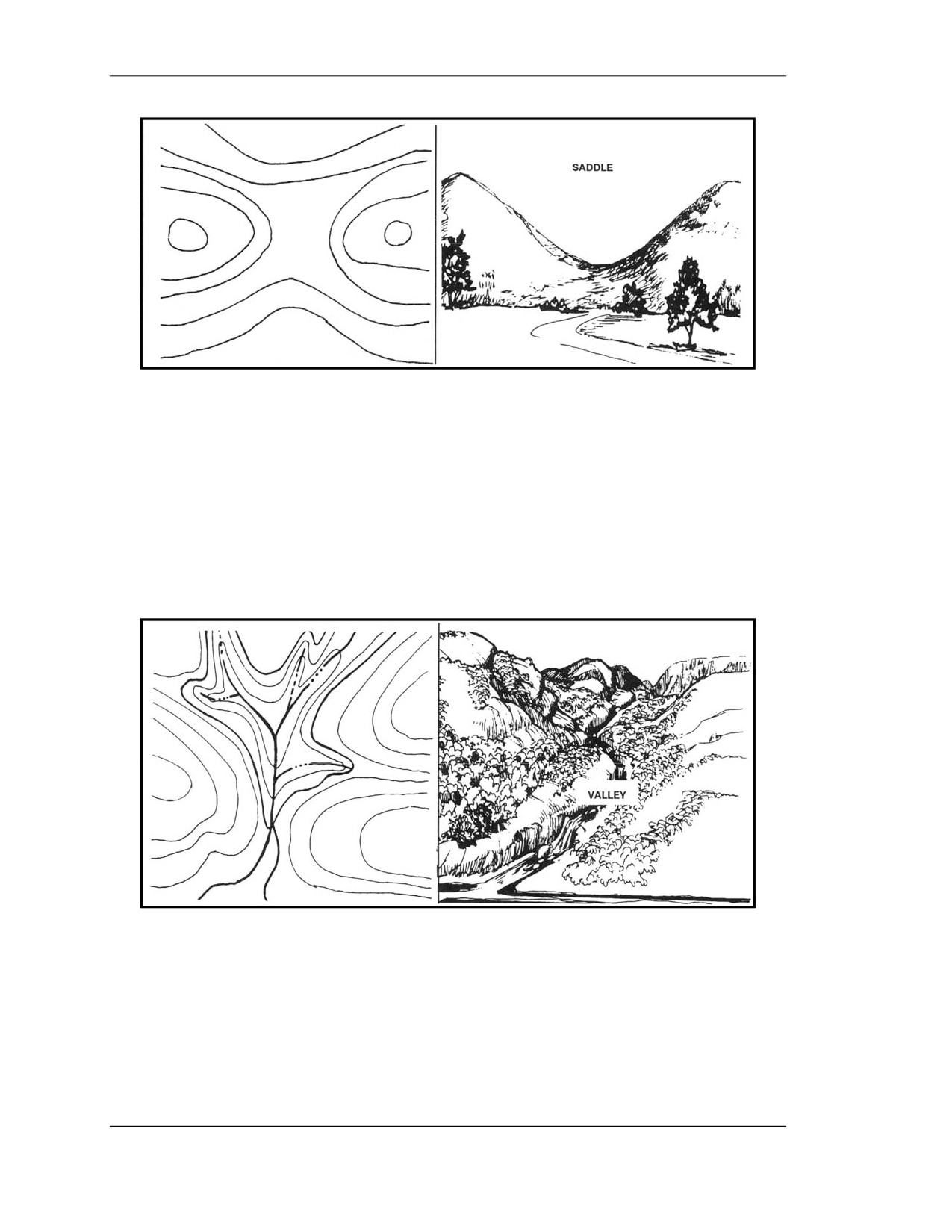
(2) Saddle. A saddle is a dip or low point between two areas of higher ground. A saddle
is not necessarily the lower ground between two hilltops; it may be simply a dip or break
along a level ridge crest. If you are in a saddle, there is high ground in two opposite
directions and lower ground in the other two directions. A saddle is normally represented as
an hourglass (Figure 10-18, page 10-12).
FOUO
10-11
18 January 2005
FM 3-25.26
Figure 10-18. Saddle.
(3) Valley. A valley is a stretched-out groove in the land, usually formed by streams
or rivers. A valley begins with high ground on three sides and usually has a course of
running water through it. If standing in a valley, three directions offer high ground, while
the fourth direction offers low ground. Depending on its size and where a person is
standing, it may not be obvious that there is high ground in the third direction, but water
flows from higher to lower ground. Contour lines forming a valley are either U-shaped or
V-shaped. To determine the direction water is flowing, look at the contour lines. The
closed end of the contour line (U or V) always points upstream or toward high ground
(Figure 10-19).
Figure 10-19. Valley.
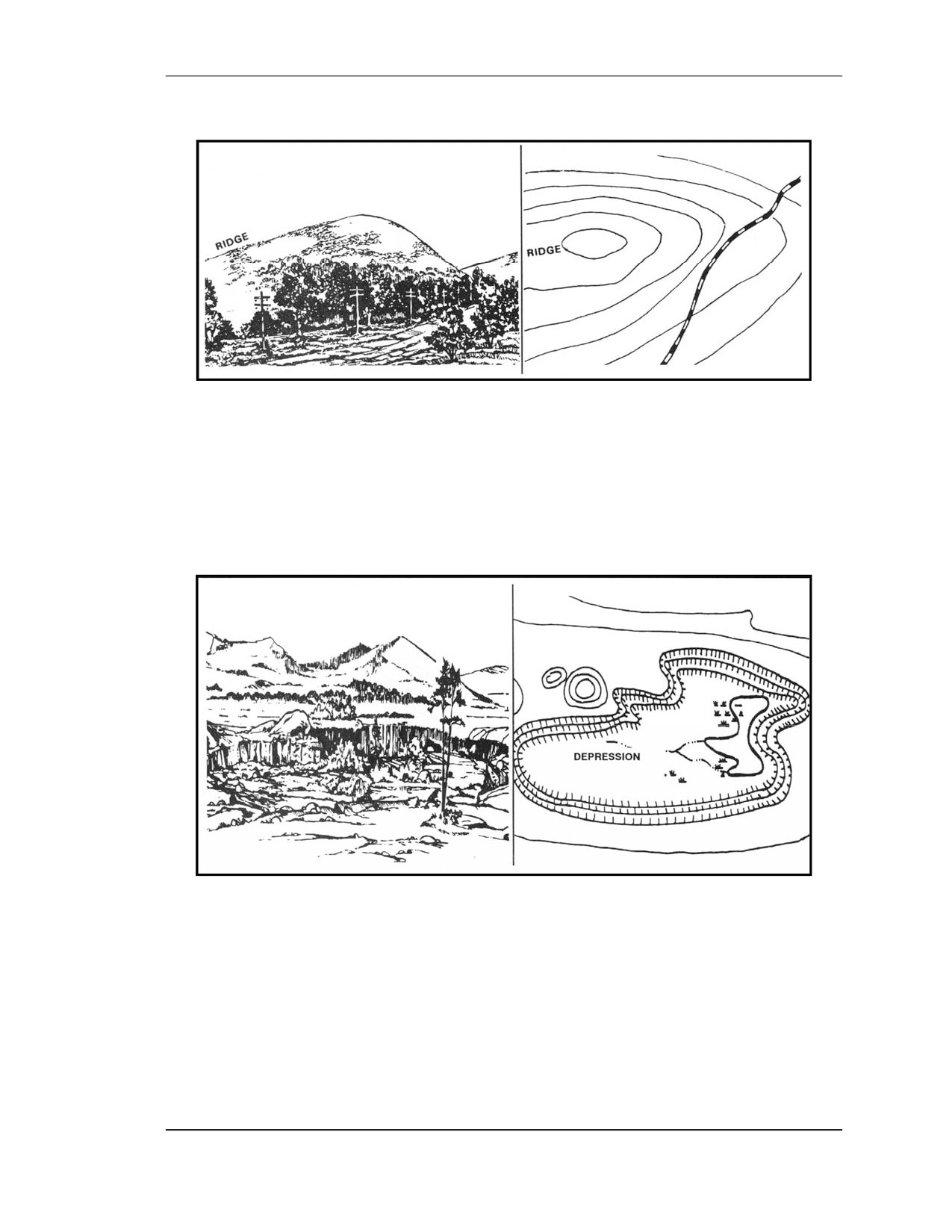
(4) Ridge. A ridge is a sloping line of high ground. If you are standing on the centerline
of a ridge, you will normally have low ground in three directions and high ground in one
direction with varying degrees of slope. If you cross a ridge at right angles, you will climb
steeply to the crest and then descend steeply to the base. When you move along the path of
the ridge, depending on the geographic location, there may be either an almost unnoticeable
slope or a very obvious incline. Contour lines forming a ridge tend to be U-shaped or
V-shaped. The closed end of the contour line points away from high ground (Figure 10-20).
10-12
FOUO
18 January 2005
FM 3-25.26
Figure 10-20. Ridge.
(5) Depression. A depression is a low point in the ground or a sinkhole. It could be
described as an area of low ground surrounded by higher ground in all directions, or simply a
hole in the ground. Usually only depressions that are equal to or greater than the contour
interval will be shown. On maps, depressions are represented by closed contour lines that
have tick marks pointing toward low ground (Figure 10-21).
Figure 10-21. Depression.
b. Minor Terrain Features. Minor terrain features include draws, spurs, and cliffs.
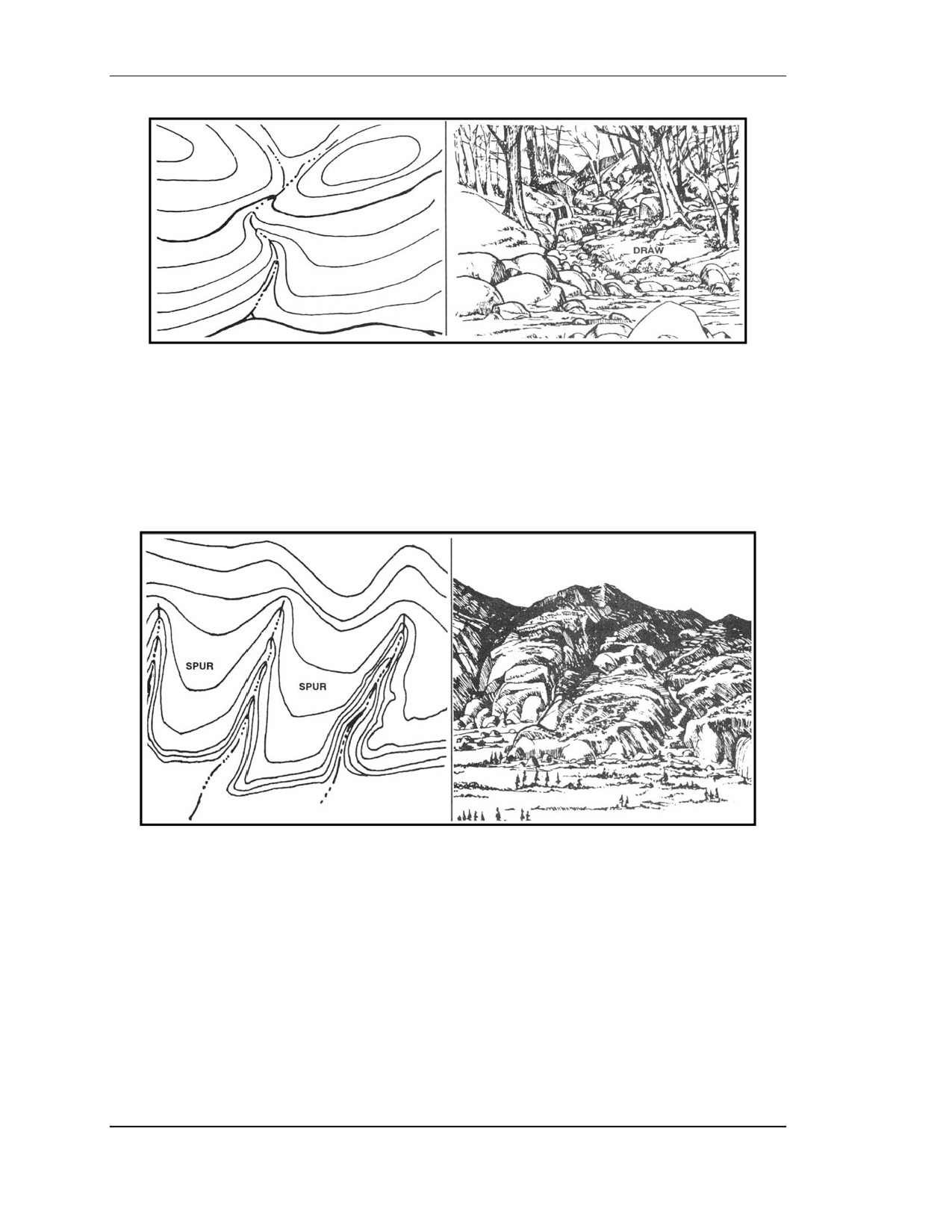
(1) Draw. A draw is a stream course that is less developed than a valley. In a draw, there
is essentially no level ground and, therefore, little or no maneuver room within its confines.
If you are standing in a draw, the ground slopes upward in three directions and downward in
the other direction. A draw could be considered as the initial formation of a valley. The
contour lines depicting a draw are U-shaped or V-shaped, pointing toward high ground
(Figure 10-22).
FOUO
10-13
18 January 2005
FM 3-25.26
Figure 10-22. Draw.
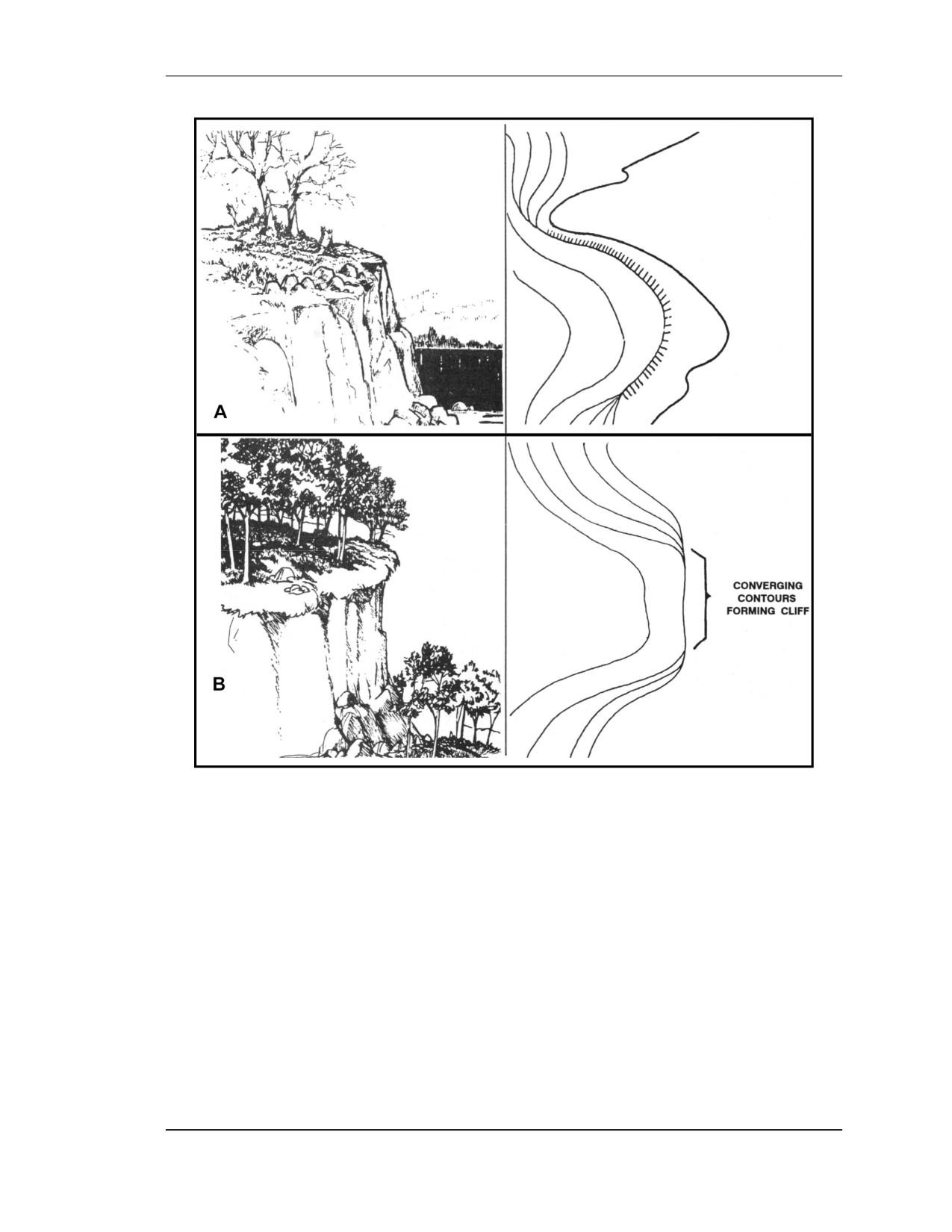
(2) Spur. A spur is a short, continuous sloping line of higher ground, normally jutting out
from the side of a ridge. A spur is often formed by two roughly parallel streams cutting
draws down the side of a ridge. The ground will slope down in three directions and up in
one. Contour lines on a map depict a spur with the U or V pointing away from high ground
(Figure 10-23).
Figure 10-23. Spur.
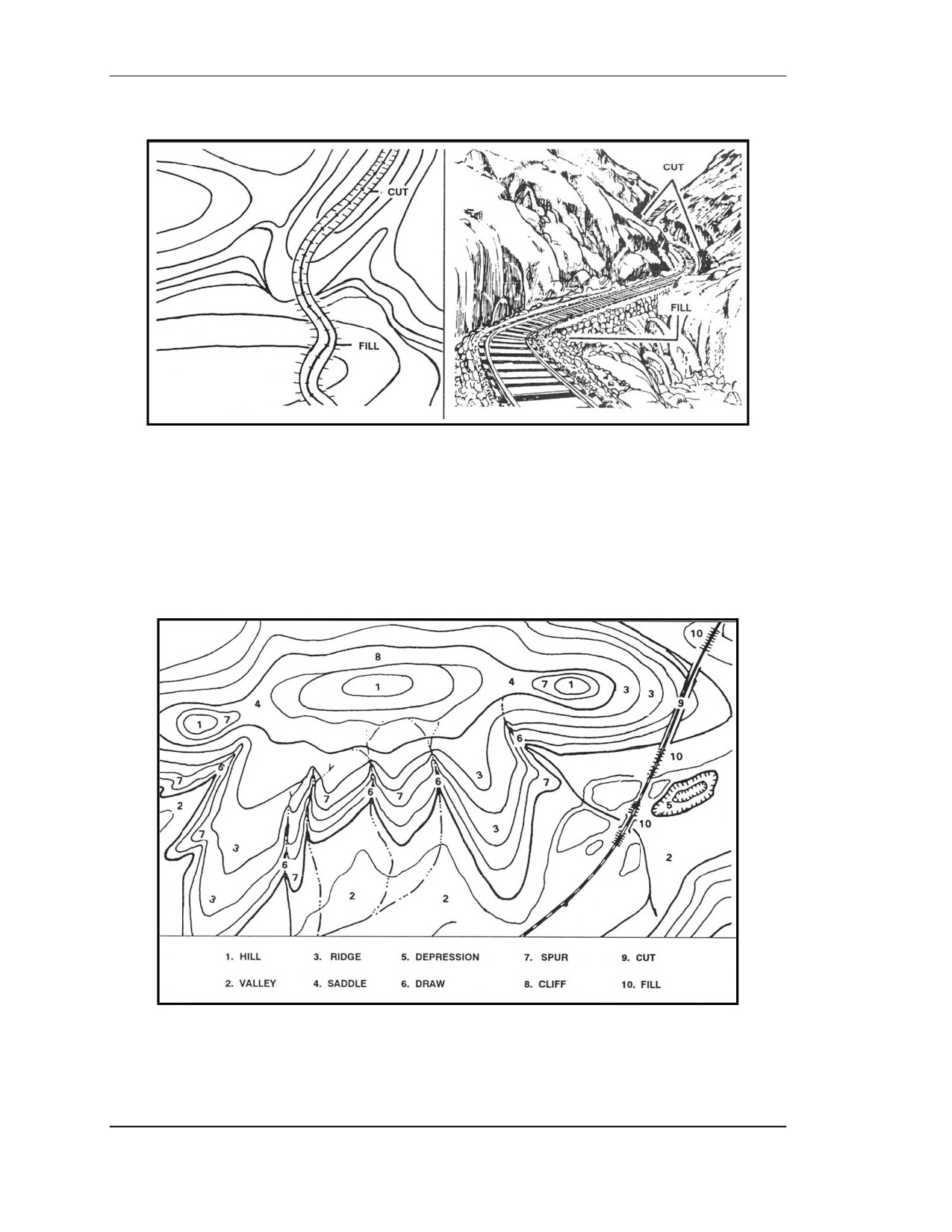
(3) Cliff. A cliff is a vertical or near vertical feature; it is an abrupt change of the land.
When a slope is so steep that the contour lines converge into one “carrying” contour of
contours, this last contour line has tick marks pointing toward low ground (A, Figure 10-24).
Cliffs are also shown by contour lines very close together and, in some instances, touching
each other (B, Figure 10-24).
10-14
FOUO
18 January 2005
FM 3-25.26
Figure 10-24. Cliff.
c. Supplementary Terrain Features. Supplementary terrain features include cuts and
fills.
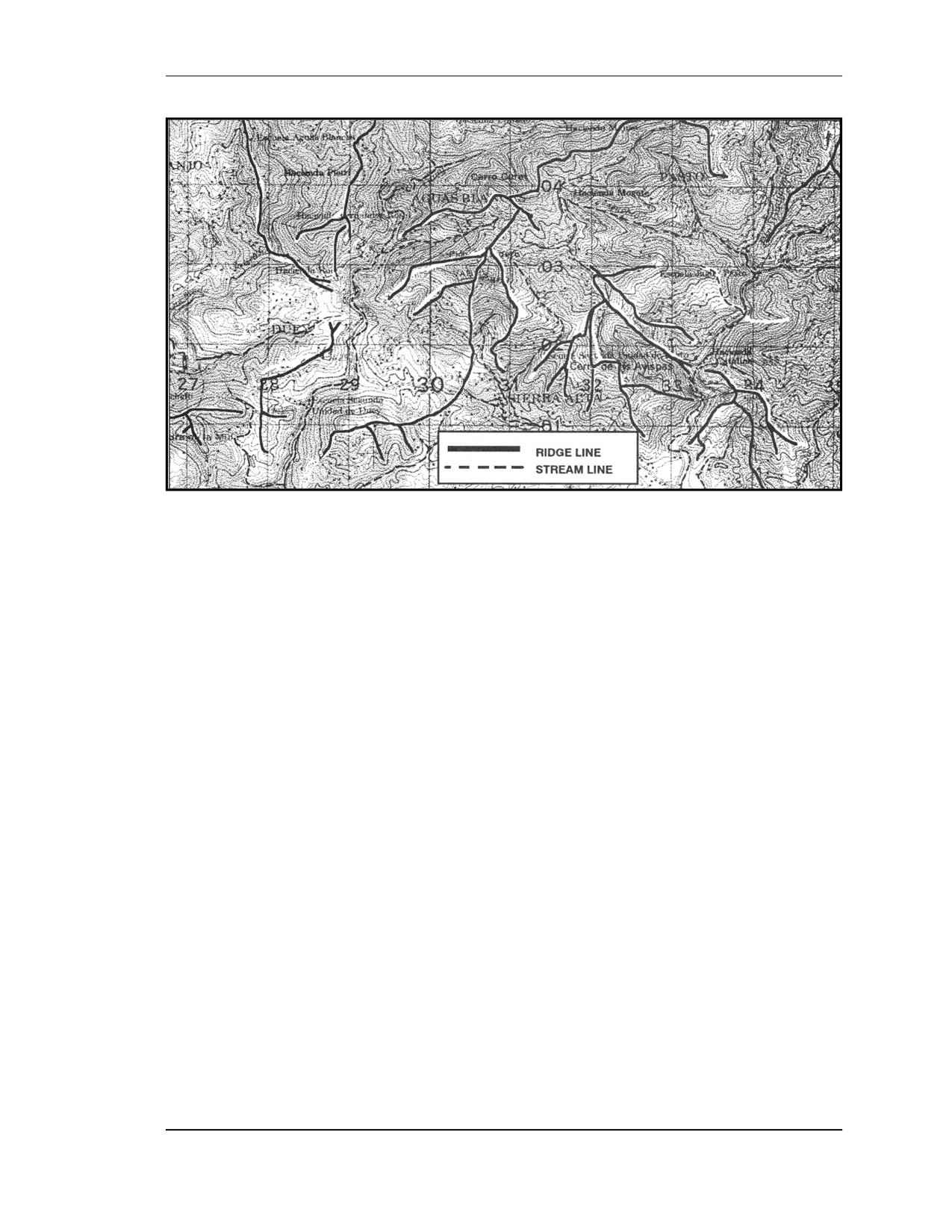
(1) Cut. A cut is a man-made feature resulting from cutting through raised ground,
usually to form a level bed for a road or railroad track. Cuts are shown on a map when they
are at least 10 feet high, and they are drawn with a contour line along the cut line. This
contour line extends the length of the cut and has tick marks that extend from the cut line to
the roadbed, if the map scale permits this level of detail (Figure 10-25, page 10-16).
(2) Fill. A fill is a man-made feature resulting from filling a low area, usually to form a
level bed for a road or railroad track. Fills are shown on a map when they are at least 10 feet
high, and they are drawn with a contour line along the fill line. This contour line extends the
length of the filled area and has tick marks that point toward lower ground. If the map scale
permits, the length of the fill tick marks are drawn to scale and extend from the base line of
the fill symbol (Figure 10-25).
FOUO
10-15
18 January 2005
FM 3-25.26
Figure 10-25. Cut and fill.
10-7. INTERPRETATION OF TERRAIN FEATURES
Terrain features do not normally stand alone. To better understand these when they are
depicted on a map, you need to interpret them. You can interpret terrain features
(Figure 10-26) by using contour lines; the shape, orientation, size, elevation, and slope
(SOSES) approach; ridgelining; or streamlining.
Figure 10-26. Terrain features.
a. Contour Lines. Emphasizing the main contour lines is a technique used to interpret
the terrain of an area. By studying these contour lines, you can better understand the layout
of the terrain and decide on the best route.
10-16
FOUO
18 January 2005
FM 3-25.26
(1) The following description pertains to Figure 10-27 (page 10-19). Running east to
west across the complex landmass is a ridgeline. A ridgeline is a line of high ground, usually
with changes in elevation along its top and low ground on all sides. The changes in elevation
are the three hilltops and two saddles along the ridgeline. From the top of each hill, there is
lower ground in all directions. The saddles have lower ground in two directions and high
ground in the opposite two directions. The contour lines of each saddle form half an
hourglass shape. Because of the difference in size of the higher ground on the two opposite
sides of a saddle, a full hourglass shape of a saddle may not be apparent.
(2) There are four prominent ridges. A ridge is on each end of the ridgeline and two
ridges extend south from the ridgeline. All of the ridges have lower ground in three
directions and higher ground in one direction. The closed ends of the U’s formed by the
contour lines point away from higher ground.
(3) To the south lies a valley; the valley slopes downward from east to west. Note that
the U of the contour line points to the east, indicating higher ground in that direction and
lower ground to the west. Another look at the valley shows high ground to the north and
south of the valley.
(4) Just east of the valley is a depression. Looking from the bottom of the depression,
there is higher ground in all directions.
(5) There are several spurs extending generally south from the ridgeline. They, like
ridges, have lower ground in three directions and higher ground in one direction. Their
contour line U’s point away from higher ground.
(6) Between the ridges and spurs are draws. They, like valleys, have higher ground in
three directions and lower ground in one direction. Their contour line U’s and V’s point
toward higher ground.
(7) Two contour lines on the north side of the center hill are touching or almost touching.
They have ticks indicating a vertical or nearly vertical slope or a cliff.
(8) The road cutting through the eastern ridge depicts cuts and fills. The breaks in the
contour lines indicate cuts, and the ticks pointing away from the road bed on each side of the
road indicate fills.
b. SOSES. A recommended technique for identifying specific terrain features and then
locating them on the map is to use five characteristics known by the mnemonic SOSES.
Terrain features can be examined, described, and compared with each other and with
corresponding map contour patterns in terms of their shapes, orientations, sizes, elevations,
and slopes. Through practice, you can learn to identify several individual terrain features in
the field and see how they vary in appearance.
(1) Shape. Shape is the general form or outline of the feature at its base.
(2) Orientation. Orientation is the general trend or direction of a feature from your
viewpoint. A feature can be in line, across, or at an angle to your viewpoint.
(3) Size. Size is the length or width of a feature horizontally across its base. For example,
one terrain feature might be larger or smaller than another.
(4) Elevation. Elevation is the height of a terrain feature. This can be described either in
absolute or relative terms as compared to the other features in the area. One landform may be
higher, lower, deeper, or shallower than another.
(5) Slope. Slope is the type (uniform, convex, or concave) and steepness or angle (steep
or gentle) of the sides of a terrain feature.
FOUO
10-17
18 January 2005
FM 3-25.26
NOTE: Further terrain analysis using SOSES can be learned by taking the Map
Interpretation and Terrain Association Course. It consists of three separate
courses of instruction: basic, intermediate, and advanced. Using photographic
slides of terrain and other features, basic instruction teaches how to identify basic
terrain feature types on the ground and on the map. Intermediate instruction
teaches elementary map interpretation and terrain association using real world
scenes and map sections of the same terrain. Advanced instruction teaches
advanced techniques for map interpretation and terrain association. The primary
emphasis is on the concepts of map design guidelines and terrain association
skills. Map design guidelines refer to the rules and practices used by
cartographers in the compilation and symbolization of military topographic
maps. Knowledge of the selection, classification, and symbolization of mapped
features greatly enhances the user’s ability to interpret map information.
c. Ridgelining. This technique helps you to visualize the overall lay of the ground
within the area of interest on the map. Use the following steps to implement this technique.
(1) Identify on the map the crests of the ridgelines in your area of operation by
identifying the close-out contours that lie along the hilltop.
(2) Trace over the crests so each ridgeline stands out clearly as one identifiable line. The
usual colors used for this tracing are red or brown; however, you may use any color at hand.
(3) Go back over each of the major ridgelines and trace over the prominent ridges and
spurs that come out of the ridgelines.
(4) When you have completed the ridgelining process, you will find that the high ground
on the map will stand out and that you will be able to see the relationship between the
various ridgelines (Figure 10-27).
d. Streamlining. This procedure (Figure 10-27) is similar to that of ridgelining.
(1) Identify all the mapped streams in the area of operations.
(2) Trace over them to make them stand out more prominently. The color used for this is
usually blue; but again, if blue is not available, use any color at hand so long as the
distinction between the ridgelines and the streamlines is clear.
(3) Identify other low ground, such as smaller valleys or draws that feed into the major
streams, and trace over them. This brings out the drainage pattern and low ground in the area
of operation on the map.
10-18
FOUO
18 January 2005
FM 3-25.26
Figure 10-27. Ridgelining and streamlining.
10-8. PROFILES
The study of contour lines to determine high and low points of elevation is usually adequate
for military operations. However, there may be times when a quick and precise reference to
determine exact elevations of specific points is needed. When exactness is demanded, a
profile is required. A profile, within the scope and purpose of this manual, is an exaggerated
side view of a portion of the earth’s surface along a line between two or more points.
a. A profile can be used for many purposes. The primary purpose is to determine if line
of sight is available. Line of sight is used⎯
• To determine defilade positions.
• To plot hidden areas or dead space.
• To determine potential direct fire weapon positions.
• To determine potential locations for defensive positions.
• To conduct preliminary planning in locating roads, pipelines, railroads, or other
construction projects.
b. A profile can be constructed from any contoured map using the following steps:
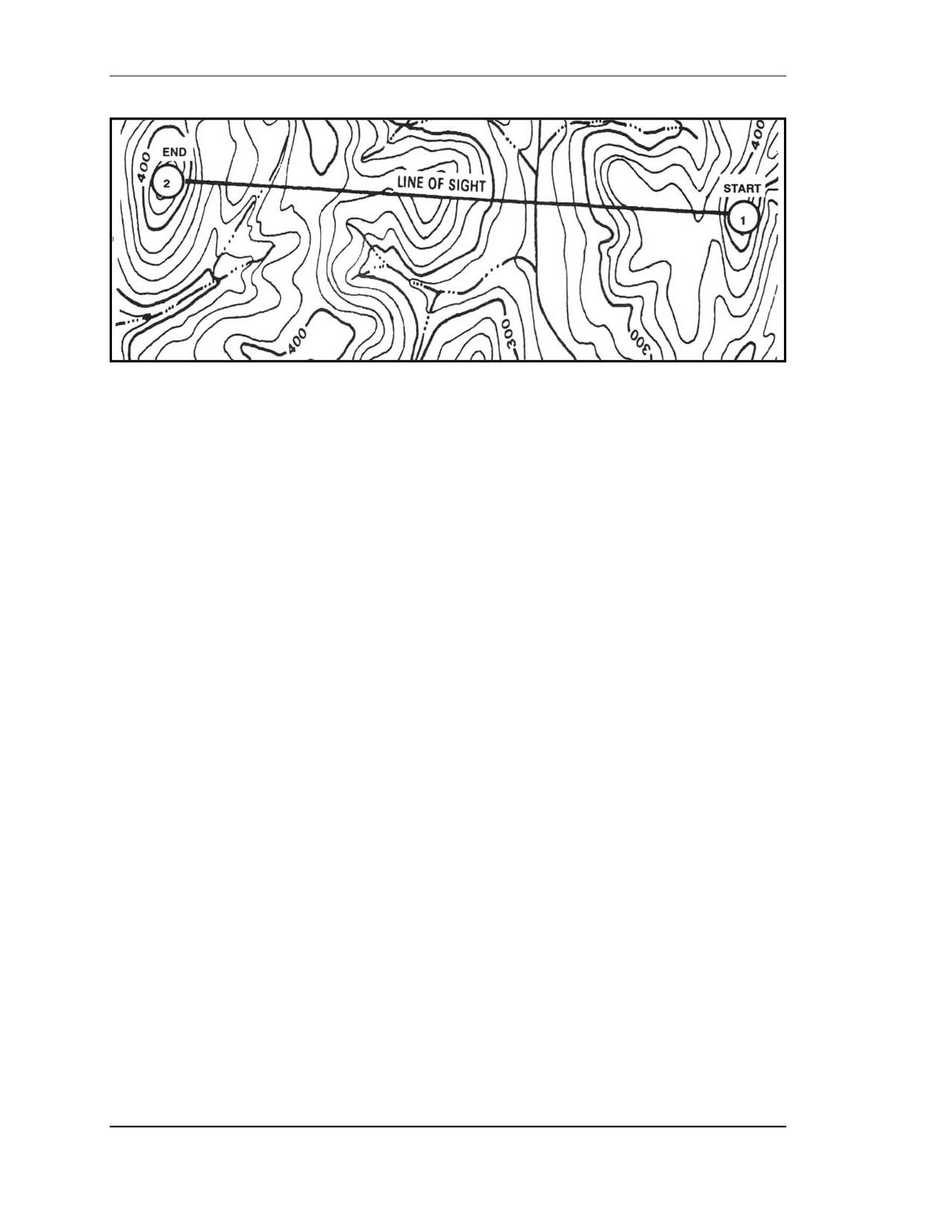
(1) Draw a line on the map from where the profile is to begin to where it is to end
(Figure 10-28, page 10-20).
FOUO
10-19
18 January 2005
FM 3-25.26
Figure 10-28. Connecting points.
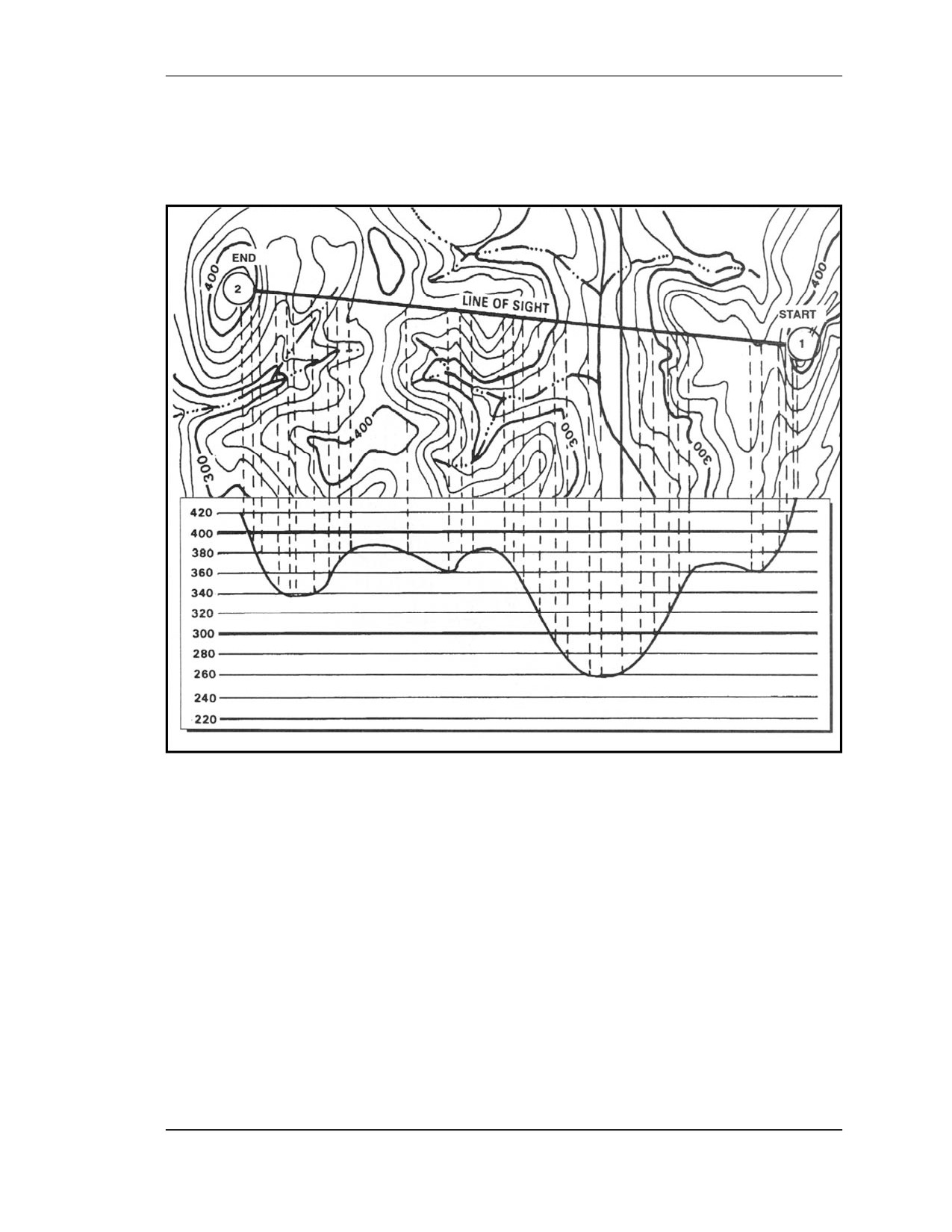
(2) Find the value of the highest and lowest contour lines that cross or touch the profile
line. Add one contour value above the highest and one below the lowest to take care of hills
and valleys.
(3) Select a piece of lined notebook paper with as many lines as was determined in (2)
above. The standard Army green pocket notebook or any other paper with 1/4-inch lines is
ideal. Wider lines, up to 5/8-inch, may be used. If lined paper is not available, draw equally
spaced horizontal lines on a blank sheet of paper.
(4) Number the top line with the highest value and the bottom line with the lowest value
as determined in (2) above.
(5) Number the rest of the lines in sequence, starting with the second line from the top.
The lines will be numbered in accordance with the contour interval (Figure 10-29).
(6) Place the paper on the map with the lines next to and parallel to the profile line
(Figure 10-29).
(7) From every point on the profile line where a contour line, stream, intermittent stream,
or other body of water crosses or touches, drop a perpendicular line to the line having the
same value. Place a tick mark where the perpendicular line crosses the number line
(Figure 10-29). Where trees are present, add the height of the trees to the contour line and
place a tick mark there. Assume the height of the trees to be 50 feet or 15 meters where dark
green tint is shown on the map. Vegetation height may be adjusted up or down when
operations in the area have provided known tree heights.
(8) After all perpendicular lines have been drawn and tick marks placed where the lines
cross, connect all tick marks with a smooth, natural curve to form a horizontal view or
profile of the terrain along the profile line (Figure 10-29).
10-20
FOUO
18 January 2005
FM 3-25.26
(9) The profile drawn may be exaggerated. The spacing between the lines drawn on the
sheet of paper will determine the amount of exaggeration and may be varied to suit any
purpose.
Figure 10-29. Dropping perpendiculars.
FOUO
10-21
18 January 2005
FM 3-25.26
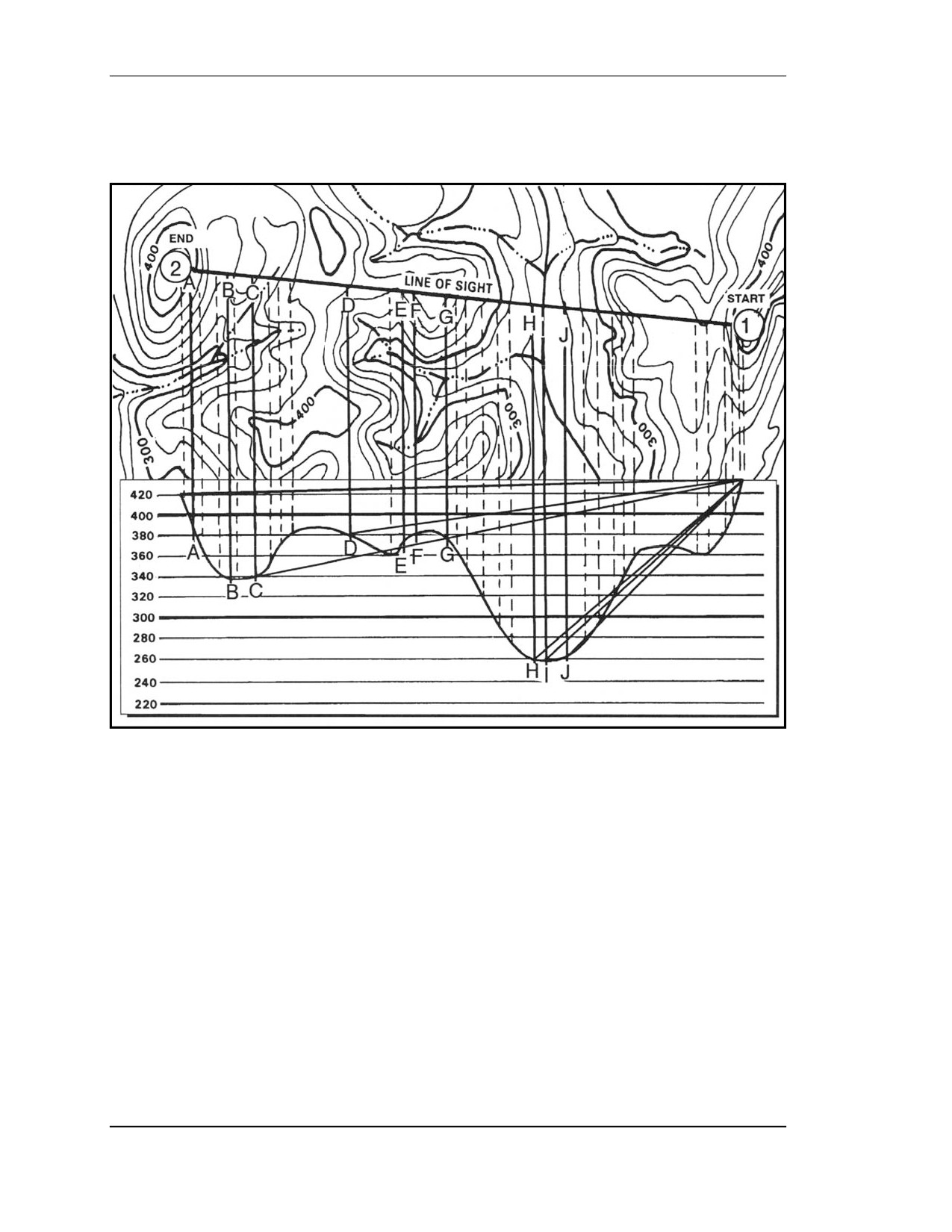
(10) Draw a straight line from the start point to the end point on the profile. If the straight
line intersects the curved profile, line of sight to the end point is not available (Figure 10-30).
Figure 10-30. Drawing lines to additional points.
(11) Line of sight to other points along the profile line can be determined by drawing a
line from the start point to additional points. In Figure 10-31 line of sight is available to⎯
A—Yes
D—Yes
G—Yes J—No
B—No
E—No
H—No
C—No
F—No
I—No
(12) The vertical distance between navigable ground up to the line of sight line is the
depth of defilade.
c. When time is short, or when a complete profile is not needed, one may be constructed
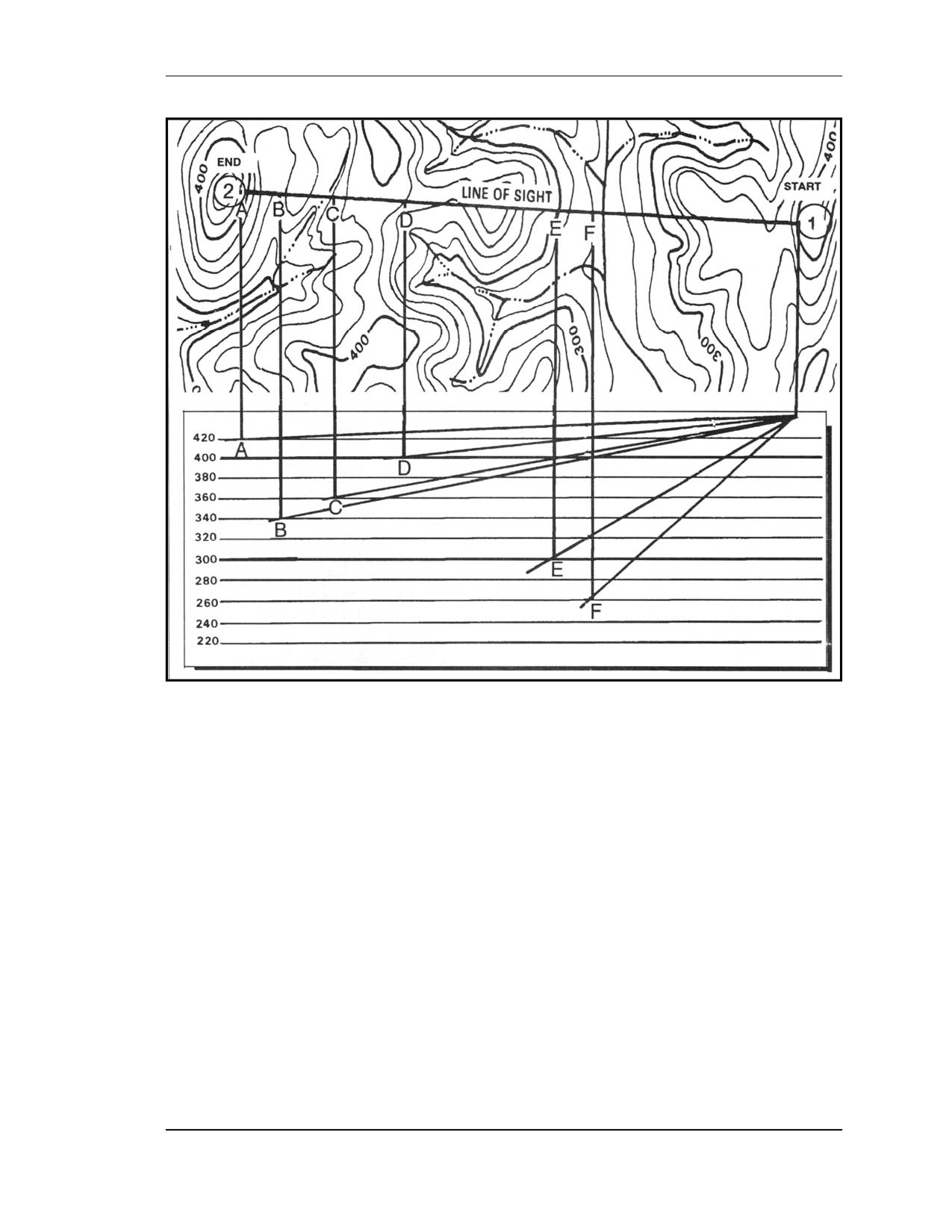
showing only the hilltops, ridges, and if desired, the valleys. This is called a hasty profile. It
is constructed in the same manner as a full profile (Figure 10-31).
10-22
FOUO
18 January 2005
FM 3-25.26
Figure 10-31. Drawing a hasty profile.
FOUO
10-23
18 January 2005
This Page intentionally left blank.
FM 3-25.26
CHAPTER 11
TERRAIN ASSOCIATION
Failing to use the vast amounts of information presented by the map and
available to the eye on the ground reduces the chances for success in land
navigation. The Soldier who has repeatedly practiced the skills of identifying
and discriminating among the many types of terrain and other features
knows how these features are mapped. By studying the map, he can begin to
visualize the shape of the land, estimate distances, and perform quick
resection from the many landmarks he sees. This Soldier is the one who will
be at the right place to help defeat the enemy on the battlefield.
This chapter tells how to orient a map with and without a compass, how
to find locations on a map as well as on the ground, how to study the terrain,
and how to move on the ground using terrain association and dead
reckoning.
11-1. ORIENTATION OF THE MAP
The first step for a navigator in the field is orienting the map. A map is oriented when it is in
a horizontal position with its north and south corresponding to the north and south on the
ground. Some orienting techniques are described herein.
a. Using a Compass. When orienting a map with a compass, remember that the
compass measures magnetic azimuths. Since the magnetic arrow points to magnetic north,
pay special attention to the declination diagram. Two techniques are used.
(1) First Technique. Determine the direction of the declination and its value from the
declination diagram.
(a) With the map in a horizontal position, take the straightedge on the left side of the
compass and place it alongside the north-south grid line with the cover of the compass
pointing toward the top of the map. This procedure places the fixed black index line of the
compass parallel to north-south grid lines of the map.
(b) Keeping the compass aligned as directed above, rotate the map and compass together
until the magnetic arrow is below the fixed black index line on the compass. At this time, the
map is close to being oriented.
(c) Rotate the map and compass in the direction of the declination diagram.
(d) If the magnetic north arrow on the map is to the left of the grid north, check the
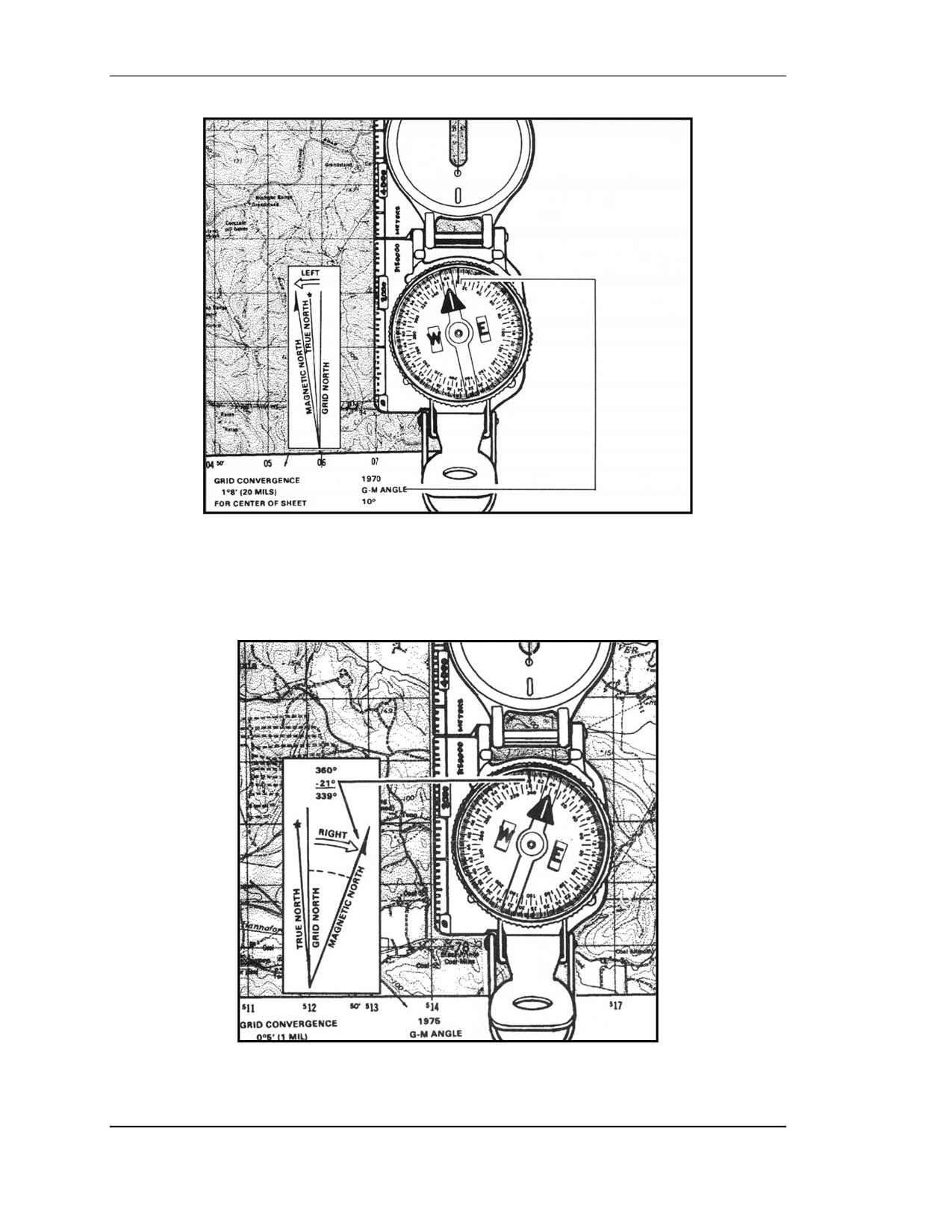
compass reading to see if it equals the G-M angle given in the declination diagram. The map
is then oriented (Figure 11-1, page 11-2).
FOUO
11-1
18 January 2005
FM 3-25.26
Figure 11-1. Map oriented with 10 degrees west declination.
(e) If the magnetic north is to the right of grid north, check the compass reading to see if
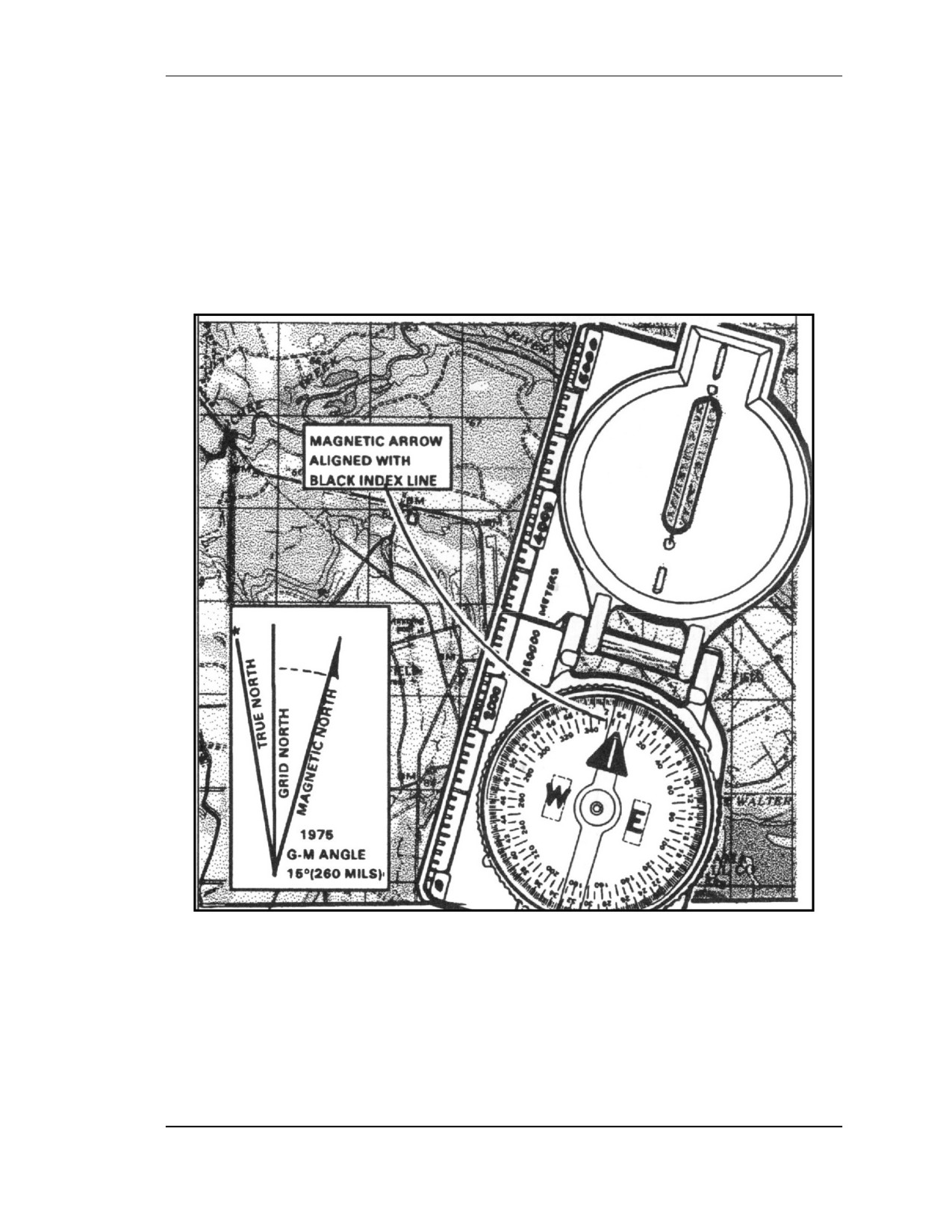
it equals 360 degrees minus the G-M angle (Figure 11-2).
Figure 11-2. Map oriented with 21 degrees east declination.
11-2
FOUO
18 January 2005
FM 3-25.26
(2) Second Technique. Determine the direction of the declination and its value from the
declination diagram.
(a) Using any north-south grid line on the map as a base, draw a magnetic azimuth equal
to the G-M angle given in the declination diagram with the protractor.
(b) If the declination is easterly (right), the drawn line is equal to the value of the G-M
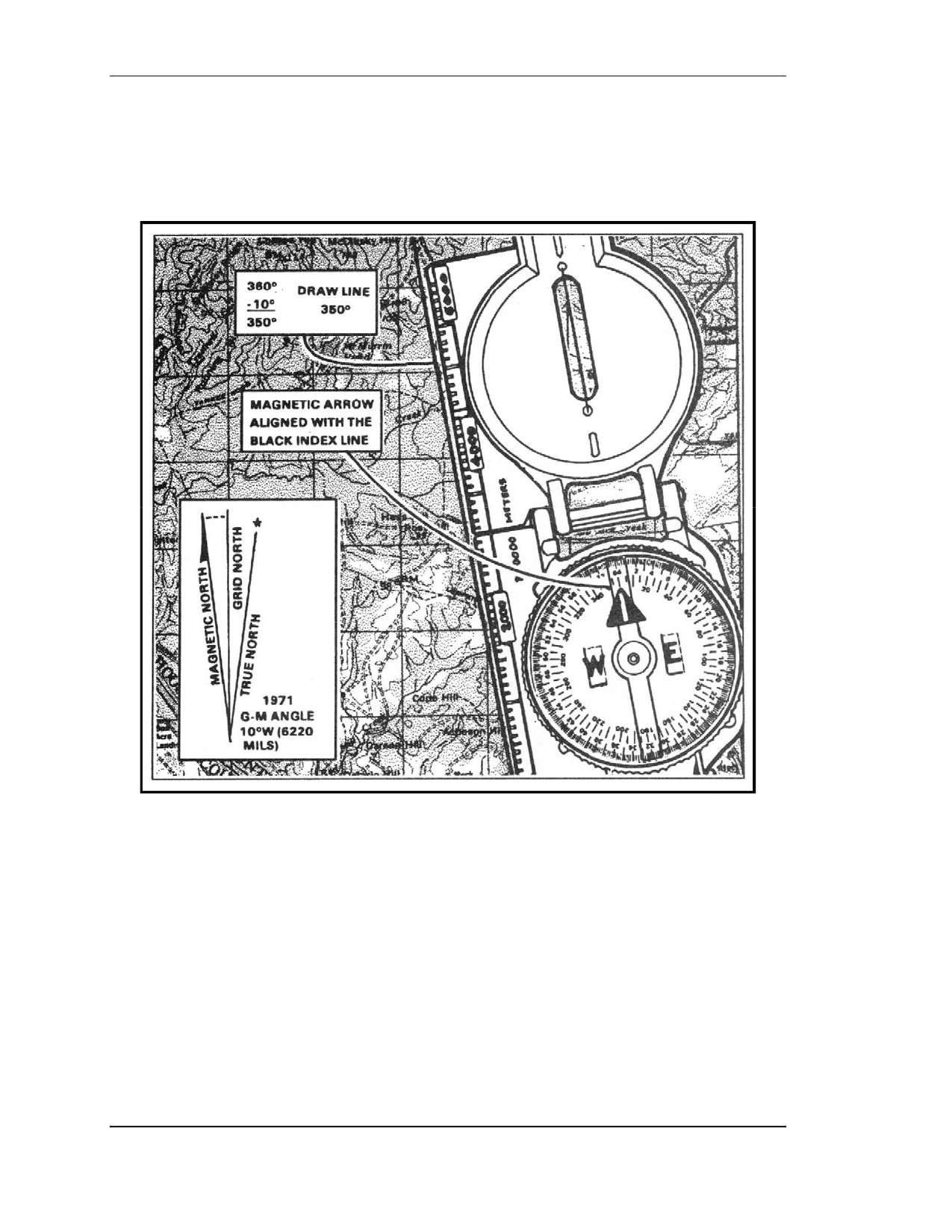
angle. Then align the straightedge on the left side of the compass alongside the drawn line on
the map. Rotate the map and compass until the magnetic arrow of the compass is below the
fixed black index line. The map is now oriented (Figure 11-3).
Figure 11-3. Map oriented with 15 degrees east declination.
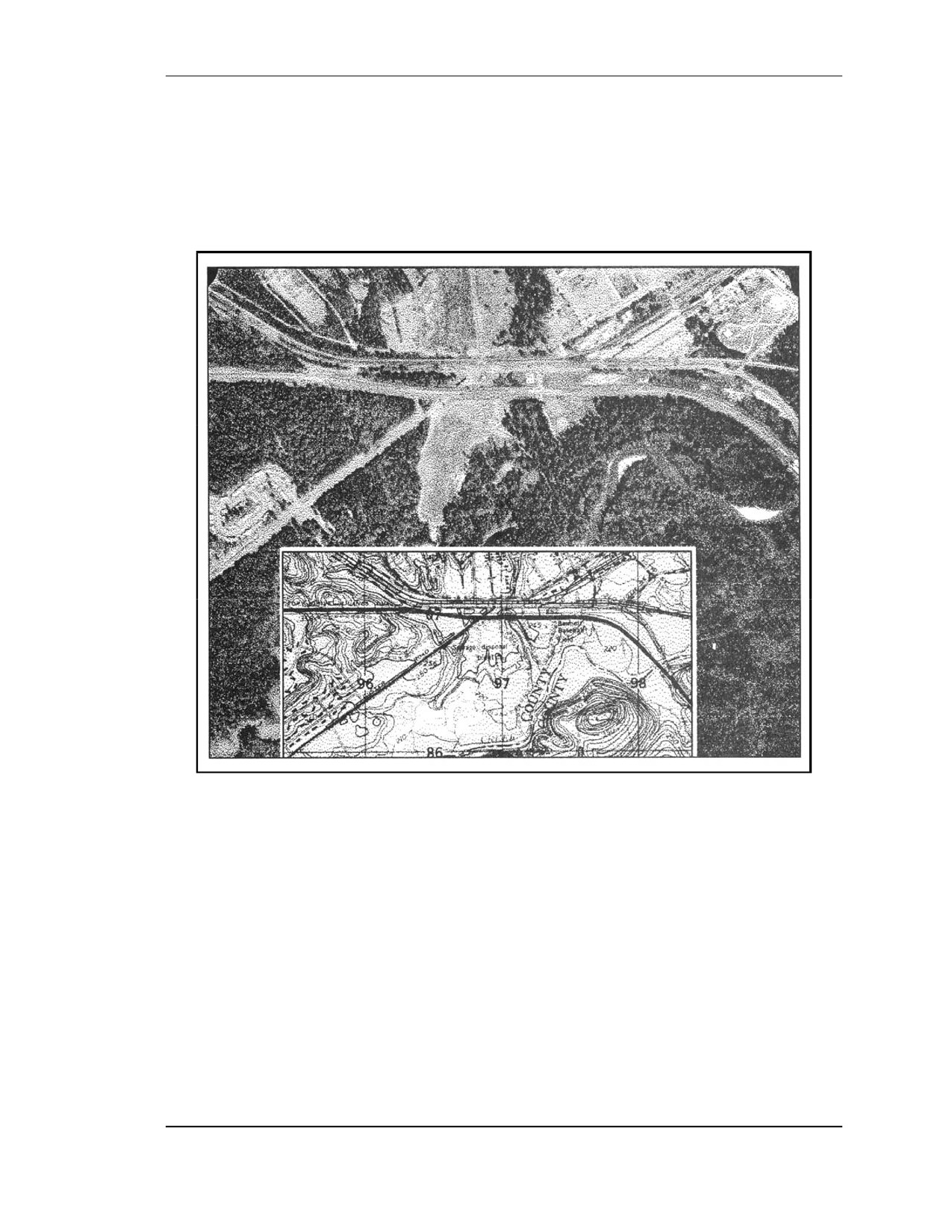
(c) If the declination is westerly (left), the drawn line will equal 360 degrees minus the
value of the G-M angle. Then align the straightedge on the left side of the compass alongside
the drawn line on the map. Rotate the map and compass until the magnetic arrow of the
compass is below the fixed black index line. The map is now oriented (Figure 11-4).
NOTES:
1. Once the map is oriented, magnetic azimuths are determined using the
compass. Do not move the map from its oriented position since any change in
FOUO
11-3
18 January 2005
FM 3-25.26
its position moves it out of line with the magnetic north. [See paragraph
11-6b(1).]
2. Special care should be taken when orienting your map with a compass. A
small mistake can cause you to navigate in the wrong direction.
Figure 11-4. Map oriented with 10 degrees west declination.
11-4
FOUO
18 January 2005
FM 3-25.26
b. Using Terrain Association. A map can be oriented by terrain association when a
compass is not available or when the user has to make many quick references as he moves
across country. Using this method requires careful examination of the map and the ground,
and the user must know his approximate location (Figure11-5). (Orienting by this method is
discussed in detail in paragraph 11-3.)
Figure 11-5. Terrain association.
FOUO
11-5
18 January 2005
FM 3-25.26
c. Using Field-Expedient Methods. When a compass is not available and there are no
recognizable terrain features, a map may be oriented by any of the field-expedient methods
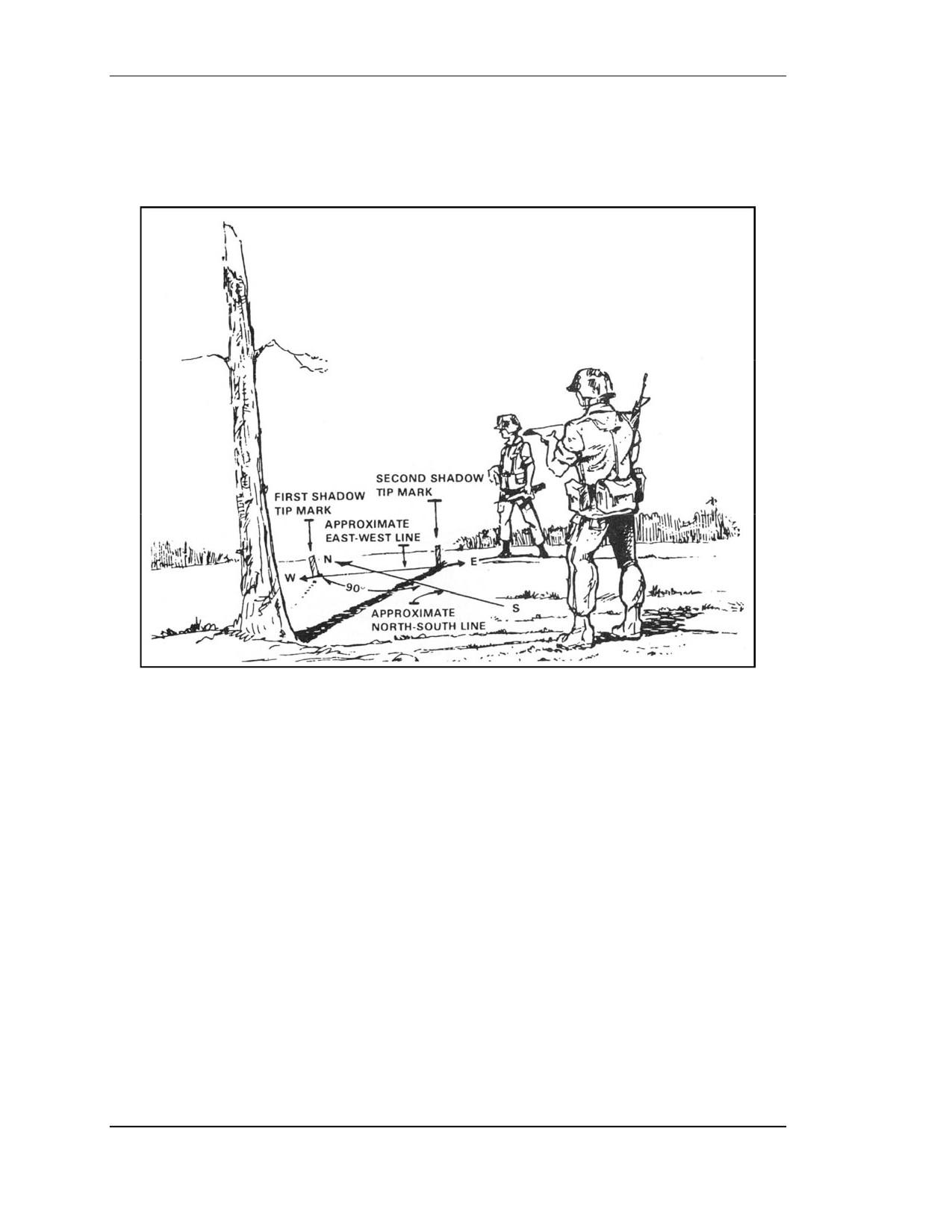
described in Chapter 9, paragraph 9-5. (Also, see Figure 11-6.)
Figure 11-6. Field-expedient method.
11-2. LOCATIONS
The key to success in land navigation is to know your location at all times. With this basic
knowledge, you can decide which direction and how far to travel.
a. Known Position. Most important of all is the initial location of the user before
starting any movement in the field. If movement takes place without establishing the initial
location, everything that is done in the field from there on is a gamble. Determine the initial
location by referring to the last known position, by grid coordinates and terrain association,
or by locating and orienting your position on the map and ground.
b. Known Point/Known Distance (Polar Plot). This location can be determined by
knowing the starting point, the azimuth to the desired objective, and the distance to it.
c. Resection, Modified Resection, and Intersection. See Chapter 6.
d. Indirect Fire. Finding a location by indirect fire is done with smoke. Use the point of
impact of the round as a reference point from which distances and azimuth can be obtained.
11-3. TERRAIN ASSOCIATION USAGE
The technique of moving by terrain association is more forgiving of mistakes and far less
time-consuming than dead reckoning. It best suits those situations that call for movement
from one area to another. Errors made using terrain association are easily corrected because
11-6
FOUO
18 January 2005
FM 3-25.26
you are comparing what you expected to see from the map to what you do see on the ground.
Errors are anticipated and will not go unchecked. You can easily make adjustments based
upon what you encounter. Periodic position-fixing through either plotted or estimated
resection will also make it possible to correct your movements, call for fire, or call in the
locations of enemy targets or any other information of tactical or logistical importance.
a. Matching the Terrain to the Map by Examining Terrain Features. By observing
the contour lines in detail, the five major terrain features (hilltop, valley, ridge, depression,
and saddle) should be determined. This is a simple task in an area where the observer has
ample view of the terrain in all directions. One-by-one, match the terrain features depicted
on the map with the same features on the ground. In restricted terrain, this procedure
becomes harder; however, constantly check the map as you move since it is the determining
factor (Figure 11-5).
b. Comparing the Vegetation Depicted on the Map. When comparing the vegetation,
a topographic map should be used to make a comparison of the clearings that appear on the
map with the ones on the ground. The user must be familiar with the different symbols, such
as vineyards, plantations, and orchards, that appear on the legend. The age of the map is an
important factor when comparing vegetation. Some important vegetation features were likely
to be different when the map was made. Another important factor about vegetation is that it
can change overnight by natural accidents or by man (forest fires, clearing of land for new
developments, farming, and so forth).
c. Masking by the Vegetation. Camouflage the important landforms using vegetation.
Use of camouflage makes it harder for the navigator to use terrain association.
d. Using the Hydrography. Inland bodies of water can help during terrain association.
The shape and size of lakes in conjunction with the size and direction of flow of the rivers
and streams are valuable help.
e. Using Man-made Features. Man-made features are an important factor during
terrain association. The user must be familiar with the symbols shown in the legend
representing those features. The direction of buildings, roads, bridges, high-tension lines, and
so forth make the terrain inspection a lot easier; however, the age of the map must be
considered because man-made features appear and disappear constantly.
f. Examining the Same Piece of Terrain During the Different Seasons of the Year.
In those areas of the world where the seasons are distinctive, a detailed examination of the
terrain should be made during each season. The same piece of land does not present the same
characteristics during both spring and winter.
(1) During winter, the snow packs the vegetation, delineating the land, making the terrain
features appear as clear as they are shown by the contour lines on the map. Ridges, valleys,
and saddles are very distinctive.
(2) During spring, the vegetation begins to reappear and grow. New vegetation causes a
gradual change of the land to the point that the foliage conceals the terrain features and
makes the terrain hard to recognize.
(3) During summer months, the effects are similar to those in the spring.
(4) Fall makes the land appear different with its change of color and gradual loss of
vegetation.
(5) During the rainy season, the vegetation is green and thick, and the streams and ponds
look like small rivers and lakes. In sparsely vegetated areas, the erosion changes the shape of
the land.
FOUO
11-7
18 January 2005
FM 3-25.26
(6) During a period of drought, the vegetation dries out and becomes vulnerable to forest
fires that change the terrain whenever they occur. Also during this season, the water levels of
streams and lakes drop, adding new dimensions and shape to the existing mapped areas.
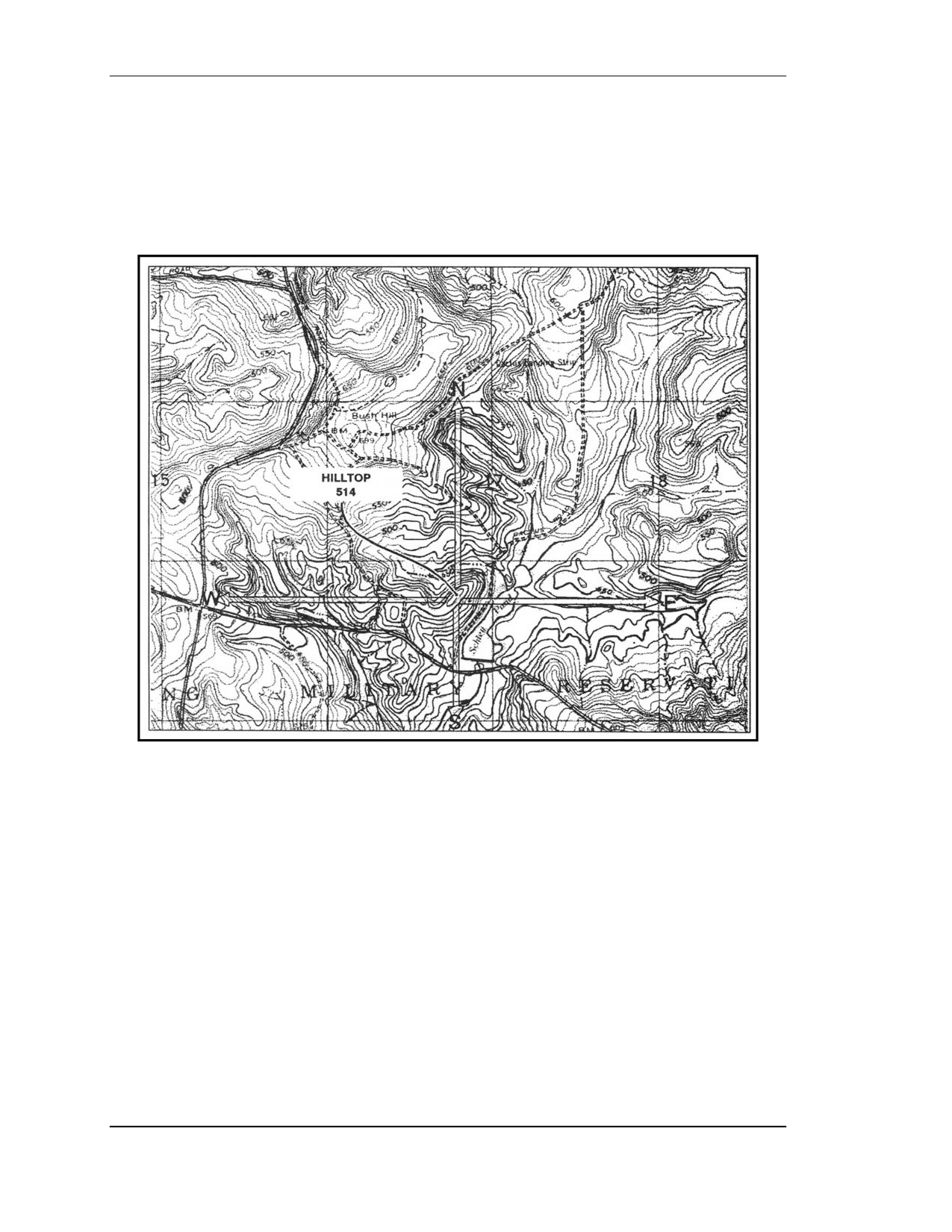
g. Following an Example of Terrain Association. Your location is hilltop 514 in the
left center of the map in Figure 11-7.
Figure 11-7. Example of terrain association.
(1) To The North. The contour lines indicate that the hill slopes down for about
190 meters, and that it leads into a small valley containing an intermittent stream. On the
other side of the stream as you continue with your northerly inspection, the terrain starts a
gradual ascent, indicating a hilltop partially covered with vegetation, until an unimproved
road is reached. This road runs along a gradual ridgeline with northwest direction. Then the
contour line spacings become narrow, indicating a steeper grade that leads to a narrow valley
containing a small intermittent stream. As you continue up, you find a small but prominent
ridge with a clearing. The contour lines once again show a steeper grade leading to a
moderate valley containing an intermittent stream running in a southeast direction.
(2) To The East. There is a clearing of the terrain as it slopes down to Schley Pond. An
ample valley is clearly seen on the right side of the pond, as indicated by the “U” and “V”
shape of the contour lines. This valley contains some swamp areas and there is a long
ridgeline on the north portion of the valley.
(3) To The South. The terrain gently slopes downward until a clear area is reached. It
continues in a downward direction to an intermittent stream running southeast in a small
11-8
FOUO
18 January 2005
FM 3-25.26
valley. There is also an improved road running in the same direction as the valley. At the
intersection of the roads as you face south, there is a clearing of about 120 meters on the
ridge. At the bottom of it, a stream runs from Schley Pond in a southwest direction through
an ample valley fed by two intermittent streams. As you continue, a steep, vegetated hill is
found with a clearing on its top, followed by a small saddle and another hilltop.
(4) To The West. First, you see a small, clear valley. It is followed by a general ridgeline
running northwest in which an unimproved road is located just before a hilltop. Continuing
on a westerly direction, you will find a series of alternate valleys and ridges.
11-4. TACTICAL CONSIDERATIONS
Military cross-country navigation is intellectually demanding because it is imperative that
the unit, crew, or vehicle survive and successfully complete the move in order to accomplish
its mission. However, the unnecessary use of a difficult route makes navigation too
complicated, creates more noise when proceeding over it, causes wear and tear on equipment
and personnel, increases the need for and needlessly complicates recovery operations, and
wastes scarce time. On receipt of a tactical mission, the leader begins his troop-leading
procedures and makes a tentative plan. He bases the tentative plan on a good terrain analysis.
He analyzes the considerations covered in the following mnemonics—OCOKA and
METT-TC.
a. OCOKA. The terrain should be analyzed for observation and fields of fire, cover and
concealment, obstacles, key terrain, and avenues of approach.
(1) Observation and Fields of Fire. The purpose of observation is to see the enemy (or
various landmarks) but not be seen by him. Anything that can be seen can be hit. Therefore,
a field of fire is an area that a weapon or a group of weapons can cover effectively with fire
from a given position.
(2) Cover and Concealment. Cover is shelter or protection (from enemy fire) either
natural or artificial. Always try to use covered routes and seek cover for each halt, no matter
how brief it is planned to be. Unfortunately, two factors interfere with obtaining constant
cover. One is time and the other is terrain. Concealment is protection from observation or
surveillance, including concealment from enemy air observation. Before, trees provided
good concealment, but with modern thermal and infrared imaging equipment, trees are not
always effective. When you are moving, concealment is generally secondary; therefore,
select routes and positions that do not allow covered or concealed enemy near you.
(3) Obstacles. Obstacles are any obstructions that stop, delay, or divert movement.
Obstacles can be natural (rivers, swamps, cliffs, or mountains) or they may be artificial
(barbed wire entanglements, pits, concrete or metal antimechanized traps). They can be
ready-made or constructed in the field. Always consider any possible obstacles along your
movement route and, if possible, try to keep obstacles between the enemy and yourself.
(4) Key Terrain. Key terrain is any locality or area that the seizure or retention of affords
a marked advantage to either combatant. Urban areas are often seen by higher headquarters
as being key terrain because they are used to control routes. On the other hand, an urban area
that is destroyed may be an obstacle instead. High ground can be key because it dominates
an area with good observation and fields of fire. In an open area, a draw or wadi (dry
streambed located in an arid area) may provide the only cover for many kilometers, thereby
becoming key. You should always attempt to locate any area near you that could be even
remotely considered as key terrain.
FOUO
11-9
18 January 2005
FM 3-25.26
(5) Avenues of Approach. These are access routes. They may be the routes you can use
to get to the enemy or the routes they can use to get to you. Basically, an identifiable route
that approaches a position or location is an avenue of approach to that location. They are
often terrain corridors such as valleys or wide, open areas.
b. METT-TC. Tactical factors other than the military aspects of terrain must also be
considered in conjunction with terrain during movement planning and execution as well.
These additional considerations are mission, enemy, terrain and weather, troops, and time
available.
(1) Mission. This refers to the specific task assigned to a unit or individual. It is the duty
or task together with the purpose that clearly indicates the action to be taken and the reason
for it—but not how to do it. Training exercises should stress the importance of a thorough
map reconnaissance to evaluate the terrain. This allows the leader to confirm his tentative
plan, basing his decision on the terrain’s effect on his mission.
(a) Marches by foot or vehicle are used to move troops from one location to another.
Soldiers must get to the right place, at the right time, and in good fighting condition. The
normal rate for an 8-hour foot march is 4 kilometers per hour. However, the rate of march
may vary, depending on the following factors:
• Distance.
• Time allowed.
• Likelihood of enemy contact.
• Terrain.
• Weather.
• Physical condition of Soldiers.
• Equipment/weight to be carried.
A motor march requires little or no walking by the Soldiers, but the factors affecting the rate
of march still apply.
(b) Patrol missions are used to conduct combat or reconnaissance operations. Without
detailed planning and a thorough map reconnaissance, any patrol mission may not succeed.
During the map reconnaissance, the mission leader determines a primary and alternate route
to and from the objectives.
(c) Movement to contact is conducted whenever an element is moving toward the enemy
but is not in contact with the enemy. The lead element must orient its movement on the
objective by conducting a map reconnaissance, determining the location of the objective on
both the map and the ground, and selecting the route to be taken.
(d) Delays and withdrawals are conducted to slow the enemy down without becoming
decisively engaged, or to assume another mission. To be effective, the element leader must
know where he is to move and the route to be taken.
(2) Enemy. This refers to the strength, status of training, disposition (locations), doctrine,
capabilities, equipment (including night vision devices), and probable courses of action that
impact upon both the planning and execution of the mission, including a movement.
(3) Terrain and Weather. Observation and fields of fire influence the placement of
positions and crew-served weapons. The leader conducts a map reconnaissance to determine
key terrain, obstacles, cover and concealment, and likely avenues of approach.
(a) Key terrain is any area whose control affords a marked advantage to the force
holding it. Some types of key terrain are high ground, bridges, towns, and road junctions.
11-10
FOUO
18 January 2005
FM 3-25.26
(b) Obstacles are natural or man-made terrain features that stop, slow down, or divert
movement. Consideration of obstacles is influenced by the unit’s mission. An obstacle may
be an advantage or disadvantage, depending upon the direction of attack or defense.
Obstacles can be found by conducting a thorough map reconnaissance and study of recent
aerial photographs.
(c) Cover and concealment are determined for both friendly and enemy forces.
Concealment is protection from observation; cover is protection from the effects of fire.
Most terrain features that offer cover also provide concealment from ground observation.
There are areas that provide no concealment from enemy observation. These danger areas
may be large or small open fields, roads, or streams. During the leader’s map
reconnaissance, he determines any obvious danger areas and, if possible, adjusts his route.
(d) Avenues of approach (AAs) are routes by which a unit may reach an objective or key
terrain. To be considered an AA, a route must provide enough width for the deployment of
the size force for which it is being considered. The AAs are also considered for the
subordinate enemy force. For example, a company determines likely AAs for an enemy
platoon; a platoon determines likely AAs for an enemy squad. Likely AAs may be either
ridges, valleys, or by air. By examining the terrain, the leader determines the likely enemy
AAs based on the tactical situation.
(e) Weather has little effect on dismounted land navigation. Rain and snow could
possibly slow down the rate of march, that is all. But during mounted land navigation, the
navigator must know the effect of weather on his vehicle. (See Chapter 12 for mounted land
navigation.)
(4) Troops. Consideration of your own troops is equally important. The size and type of
the unit to be moved and its capabilities, physical condition, status of training, and types of
equipment assigned all affect the selection of routes, positions, fire plans, and the various
decisions to be made during movement. On ideal terrain such as relatively level ground with
little or no woods, a platoon can defend a front of up to 400 meters. The leader must conduct
a thorough map reconnaissance and terrain analysis of the area his unit is to defend. Heavily
wooded areas or very hilly areas may reduce the front a platoon can defend. The size of the
unit must also be taken into consideration when planning a movement to contact. During
movement, the unit must retain its ability to maneuver. A small draw or stream may reduce
the unit’s maneuverability but provide excellent concealment. All of these factors must be
considered.
(a) Types of equipment that may be needed by the unit can be determined by a map
reconnaissance. For example, if the unit must cross a large stream during its movement to the
objective, ropes may be needed for safety lines.
(b) Physical capabilities of the Soldiers must be considered when selecting a route.
Crossing a large swampy area may present no problem to a physically fit unit, but to a unit
that has not been physically conditioned, the swampy area may slow or completely stop its
movement.
(5) Time Available. At times, the unit may have little time to reach an objective or to
move from one point to another. The leader must conduct a map reconnaissance to determine
the quickest route to the objective; this is not always a straight route. From point A to point
B on the map may appear to be 1,000 meters, but if the route is across a large ridge, the
distance will be greater. Another route from point A to B may be 1,500 meters—but on flat
FOUO
11-11
18 January 2005
FM 3-25.26
terrain. In this case, the quickest route would be across the flat terrain; however,
concealment and cover may be lost.
(6) Civil Considerations. Civil considerations are present throughout offensive
operations. They may preclude the attack of some targets, such as infrastructure and
historically significant areas, and may limit the use of land mines.
(a) Commanders focus their staffs on considerations that may affect mission
accomplishment. These factors include care and support for civilians within the AO and the
possible effect of refugees on operations and movements. Other considerations include
enemy locations with respect to civil populations, political and cultural boundaries, and
language requirements.
(b) Enemy propaganda may affect the attitude of civilians in the AO. It may also affect
domestic and foreign support for the operation. Operations commanders pay particular
attention to the effects of actions in the information environment. Tactical commanders may
have limited awareness of media reporting and its effect on public opinion. Operational
commanders gauge the effect of public opinion and keep their subordinates informed.
11-5. MOVEMENT AND ROUTE SELECTION
One key to success in tactical missions is the ability to move undetected to the objective.
There are four steps to land navigation. Being given an objective and the requirement to
move there, you must know where you are, plan the route, stay on the route, and recognize
the objective.
a. Know Where You Are (Step 1). You must know where you are on the map and on
the ground at all times and in every possible way. This includes knowing where you are
relative to—
• Your directional orientation.
• The direction and distances to your objective.
• Other landmarks and features.
• Any impassable terrain, the enemy, and danger areas.
• Both the advantages and disadvantages presented by the terrain between you and
your objective.
This step is accomplished by knowing how to read a map; recognize and identify specific
terrain and other features; determine and estimate direction; pace, measure, and estimate
distances; and both plot and estimate a position by resection.
b. Plan the Route (Step 2). Depending upon the size of the unit and the length and type
of movement to be conducted, several factors should be considered in selecting a good route
or routes to be followed. These include—
• Travel time.
• Travel distance.
• Maneuver room needed.
• Trafficability.
• Load-bearing capacities of the soil.
• Energy expenditure by troops.
• The factors of METT-TC.
• Tactical aspects of terrain (OCOKA).
• Ease of logistical support.
• Potential for surprising the enemy.
11-12
FOUO
18 January 2005
FM 3-25.26
• Availability of control and coordination features.
• Availability of good checkpoints and steering marks.
In other words, the route must be the result of careful map study and should address the
requirements of the mission, tactical situation, and time available. It must also provide for
ease of movement and navigation.
(1) Three route-selection criteria that are important for small-unit movements are cover,
concealment, and the availability of reliable checkpoint features. The latter is weighted even
more heavily when selecting the route for a night operation. The degree of visibility and ease
of recognition (visual effect) are the key to the proper selection of these features.
(2) The best checkpoints are linear features that cross the route. Examples include
perennial streams, hard-top roads, ridges, valleys, railroads, and power transmission lines.
Next, it is best to select features that represent elevation changes of at least two contour
intervals such as hills, depressions, spurs, and draws. Primary reliance upon cultural features
and vegetation is cautioned against because they are most likely to have changed since the
map was last revised.
(3) Checkpoints located at places where changes in direction are made mark your
decision points. Be especially alert to see and recognize these features during movement.
During preparation and planning, it is especially important to review the route and anticipate
where mistakes are most likely to be made so they can be avoided.
(4) Following a valley floor or proceeding near (not on) the crest of a ridgeline generally
offers easy movement, good navigation checkpoints, and sufficient cover and concealment. It
is best to follow terrain features whenever you can—not to fight them.
(5) A lost or a late arriving unit, or a tired unit that is tasked with an unnecessarily
difficult move, does not contribute to the accomplishment of a mission. On the other hand,
the unit that moves too quickly and carelessly into a destructive ambush or leaves itself open
to air strikes also has little effect. Careful planning and study are required each time a
movement route is to be selected.
c. Stay on the Route (Step 3). In order to know that you are still on the correct route,
you must be able to compare the evidence you encounter as you move according to the plan
you developed on the map when you selected your route. This may include watching your
compass reading (dead reckoning) or recognizing various checkpoints or landmarks from the
map in their anticipated positions and sequences as you pass them (terrain association). A
better way is to use a combination of both.
d. Recognize the Objective (Step 4). The destination is rarely a highly recognizable
feature such as a dominant hilltop or road junction. Such locations as this are seldom missed
by the most inexperienced navigators and are often dangerous places for Soldiers to occupy.
The relatively small, obscure places are most likely to be the destinations.
(1) Just how does a Soldier travel over unfamiliar terrain for moderate to great distances
and know when he reaches the destination? One minor error, when many are possible, can
cause the target to be missed. The answer is simple.
(2) Select a checkpoint (reasonably close to the destination) that is not so difficult to find
or recognize. Then plan a short, fine-tuned last leg from the new expanded objective to the
final destination. For example, you may be able to plan and execute the move as a series of
sequenced movements from one checkpoint or landmark to another using both the terrain
and a compass to keep you on the correct course. Finally, after arriving at the last
checkpoint, you might follow a specific compass azimuth and pace off the relatively short,
FOUO
11-13
18 January 2005
FM 3-25.26
known distance to the final, pinpoint destination. This procedure is called point navigation.
A short movement out from a unit position to an observation post or to a coordination point
may also be accomplished in the same manner.
11-6. NAVIGATION METHODS
Staying on the route is accomplished through the use of one or two navigation techniques—
dead reckoning and terrain association. These methods are discussed in detail below.
a. Moving by Dead Reckoning. Dead reckoning consists of two fundamental steps.
The first is the use of a protractor and graphic scales to determine the direction and distance
from one point to another on a map. The second step is the use of a compass and some means
of measuring distance to apply this information on the ground. In other words, it begins with
the determination of a polar coordinate on a map and ends with the act of finding it on the
ground.
(1) Dead reckoning along a given route is the application of the same process used by a
mapmaker as he establishes a measured line of reference upon which to construct the
framework of his map. Therefore, triangulation exercises (either resection or intersection)
can be easily undertaken by the navigator at any time to either determine or confirm precise
locations along or near his route. Between these position-fixes, establish your location by
measuring or estimating the distance traveled along the azimuth being followed from the
previous known point. You might use pacing, a vehicle odometer, or the application of
elapsed time for this purpose, depending upon the situation.
(2) Most dead reckoned movements do not consist of single straight-line distances
because you cannot ignore the tactical and navigational aspects of the terrain, enemy
situation, natural and man-made obstacles, time, and safety factors. Another reason most
dead reckoning movements are not single straight-line distances is because compasses and
pace counts are imprecise measures. Error from them compounds over distance; therefore,
you could soon be far from your intended route even if you performed the procedures
correctly. The only way to counteract this phenomenon is to reconfirm your location by
terrain association or resection. Routes planned for dead reckoning generally consist of a
series of straight-line distances between several checkpoints with perhaps some travel
running on or parallel to roads or trails.
(3) There are two advantages to dead reckoning. First, dead reckoning is easy to teach
and to learn. Second, it can be a highly accurate way of moving from one point to another if
done carefully over short distances, even where few external cues are present to guide the
movements.
(4) During daylight, across open country, along a specified magnetic azimuth, never
walk with the compass in the open position and in front of you. Because the compass will
not stay steady or level, it does not give an accurate reading when held or used this way.
Begin at the start point and face with the compass in the proper direction, then sight in on a
landmark that is located on the correct azimuth to be followed. Close the compass and
proceed to that landmark. Repeat the process as many times as necessary to complete the
straight-line segment of the route.
(5) The landmarks selected for this purpose are called steering marks, and their selection
is crucial to success in dead reckoning. Steering marks should never be determined from a
map study. They are selected as the march progresses and are commonly on or near the
highest points visible along the azimuth line you are following when they are selected. They
11-14
FOUO
18 January 2005
FM 3-25.26
may be uniquely shaped trees, rocks, hilltops, posts, towers, and buildings—anything that
can be easily identified. If you do not see a good steering mark to the front, you might use a
back azimuth to some feature behind you until a good steering mark appears out in front.
Characteristics of a good steering mark are:
(a) It must have some characteristics about it, such as color, shade of color, size, or shape
(preferably all four), that will assure you that it will continue to be recognized as you
approach it.
(b) If several easily distinguished objects appear along your line of march, the best
steering mark is the most distant object. This procedure enables you to travel farther with
fewer references to the compass. If you have many options, select the highest object. A
higher mark is not as easily lost to sight as is a lower mark that blends into the background
as you approach it. A steering mark should be continuously visible as you move toward it.
(c) Steering marks selected at night must have even more unique shapes than those
selected during daylight. As darkness approaches, colors disappear and objects appear as
black or gray silhouettes. Instead of seeing shapes, you begin to see only the general outlines
that may appear to change as you move and see the objects from slightly different angles.
(6) Dead reckoning without natural steering marks is used when the area through which
you are traveling is devoid of features, or when visibility is poor. At night, it may be
necessary to send a member of the unit out in front of your position to create your own
steering mark in order to proceed. His position should be as far out as possible to reduce the
number of chances for error as you move. Arm-and-hand signals or a radio may be used in
placing him on the correct azimuth. After he has been properly located, move forward to his
position and repeat the process until some steering marks can be identified or until you reach
your objective.
(7) When handling obstacles/detours on the route, follow these guidelines:
(a) When an obstacle forces you to leave your original line of march and take up a
parallel one, always return to the original line as soon as the terrain or situation permits.
(b) To turn clockwise (right) 90 degrees, you must add 90 degrees to your original
azimuth. To turn counterclockwise (left) 90 degrees from your current direction, you must
subtract 90 degrees from your present azimuth.
(c) When making a detour, be certain that only paces taken toward the final destination
are counted as part of your forward progress. They should not be confused with the local
pacing that takes place perpendicular to the route in order to avoid the problem area and in
returning to the original line of march after the obstacle has been passed.
(8) Sometimes a steering mark on your azimuth of travel can be seen across a swamp or
some other obstacle which you can simply walk around. Dead reckoning can then begin at
that point. If there is no obvious steering mark to be seen across the obstacle, perhaps one
can be located to the rear. Compute a back azimuth to this point and later sight back to it
once the obstacle has been passed in order to get back on track.
(9) You can use the deliberate offset technique. Highly accurate distance estimates and
precision compass work may not be required if the destination or an intermediate checkpoint
is located on or near a large linear feature that runs nearly perpendicular to your direction of
travel. Examples include roads or highways, railroads, power transmission lines, ridges, or
streams. In these cases, you should apply a deliberate error (offset) of about 10 degrees to the
azimuth you planned to follow and then move, using the lensatic compass as a guide, in that
direction until you encounter the linear feature. You will know exactly which way to turn
FOUO
11-15
18 January 2005