FM 3-90-1 Offense and Defense (Volume 1, March 2013) - page 6
Chapter 9
EXECUTING A WITHDRAWAL
9-85. Typically, when under enemy pressure, the less heavily engaged elements of the withdrawing force
withdraw first. The more heavily engaged units generally withdraw under the cover of a security force
using support provided by available fire support and electronic warfare assets. They take advantage of
obstacles to assist in breaking contact with the enemy. The commander conducts night movements and uses
obscuration smoke to screen friendly movement while reducing both the accuracy of enemy direct-fire
systems and the enemy’s ability to observe friendly movements. The security force continues to use
alternate and successive positions until the entire force breaks contact with the enemy.
9-86. The security force may remain in position and maintain a military deception. The main body moves
rearward to intermediate or final positions as rapidly as possible. After the main body withdraws a safe
distance, the security force begins its rearward movement. Once the security force begins moving, it
assumes the duties of a rear guard. Even if the enemy does not pursue the withdrawing force, the security
force continues to act as the rear guard unless the commander assigns that mission to another element.
However, if not pursued by the enemy, the security force may remain in a march column. (FM 3-90-2
provides a definition of a march column.)
9-87. On order, the main body moves rapidly on multiple routes to reconnoitered positions. It may occupy
a series of intermediate positions before completing the withdrawal. Usually functional and multifunctional
support and sustainment units, along with their convoy escorts, move first and precede combat units in the
withdrawal movement formation. The commander maintains the disciplined use of routes during a
withdrawal. Despite confusion and enemy pressure, subordinate units must follow specified routes and
movement times.
9-88. When the main body withdraws, its reserve remains well forward to assist the security force and
other units by employing supporting direct and indirect fires and counterattacks. The reserve can launch
spoiling attacks to disorganize and delay the enemy and extricate encircled or heavily engaged forces.
9-89. If the security force and the reserve cannot prevent the enemy from closing on the main body, the
commander must commit some or all of the main body to prevent the enemy from further interfering with
the withdrawal. The main body delays or defends, if the security force fails to slow the enemy. In this
event, the withdrawal resumes at the earliest possible time. If the enemy blocks movement to the rear, the
commander shifts to alternate routes to bypass the interdicted area. Alternatively, the withdrawing force
can attack through the enemy.
TERMINATING A WITHDRAWAL
9-90. Once the withdrawing force successfully disengages from the enemy, it has two options. It can rejoin
the overall defense under more favorable conditions or transition into a retirement and continue to move
away from the enemy and toward its next mission.
RETIREMENT
9-91. A retirement is an operation in which a force out of contact moves away from the enemy
(ADRP 3-90). Figure 9-9 shows the tactical mission graphic for a retirement. A retiring unit organizes for
combat, but it does not anticipate interference from enemy ground forces. Typically, another unit’s security
force covers the movement of one formation as the unit conducts a retirement. However, mobile enemy
forces, unconventional forces, air strikes, air assault operations, or long-range fires may attempt to interdict
the retiring unit. The commander must plan for enemy actions and organize the unit to fight in self-defense.
The commander usually conducts retirement operations to reposition forces for future operations or to
accommodate the current concept of operations.
9-92. When a withdrawal from action precedes a retirement, the actual retirement begins after the unit
breaks contact and organizes into its march formation organization. (While a force withdrawing without
enemy pressure can also use march columns, the difference between the two situations is the probability of
enemy interference.) Units conduct retirements as tactical road marches where security and speed are the
most important considerations.
9-16
FM 3-90-1
22 March 2013
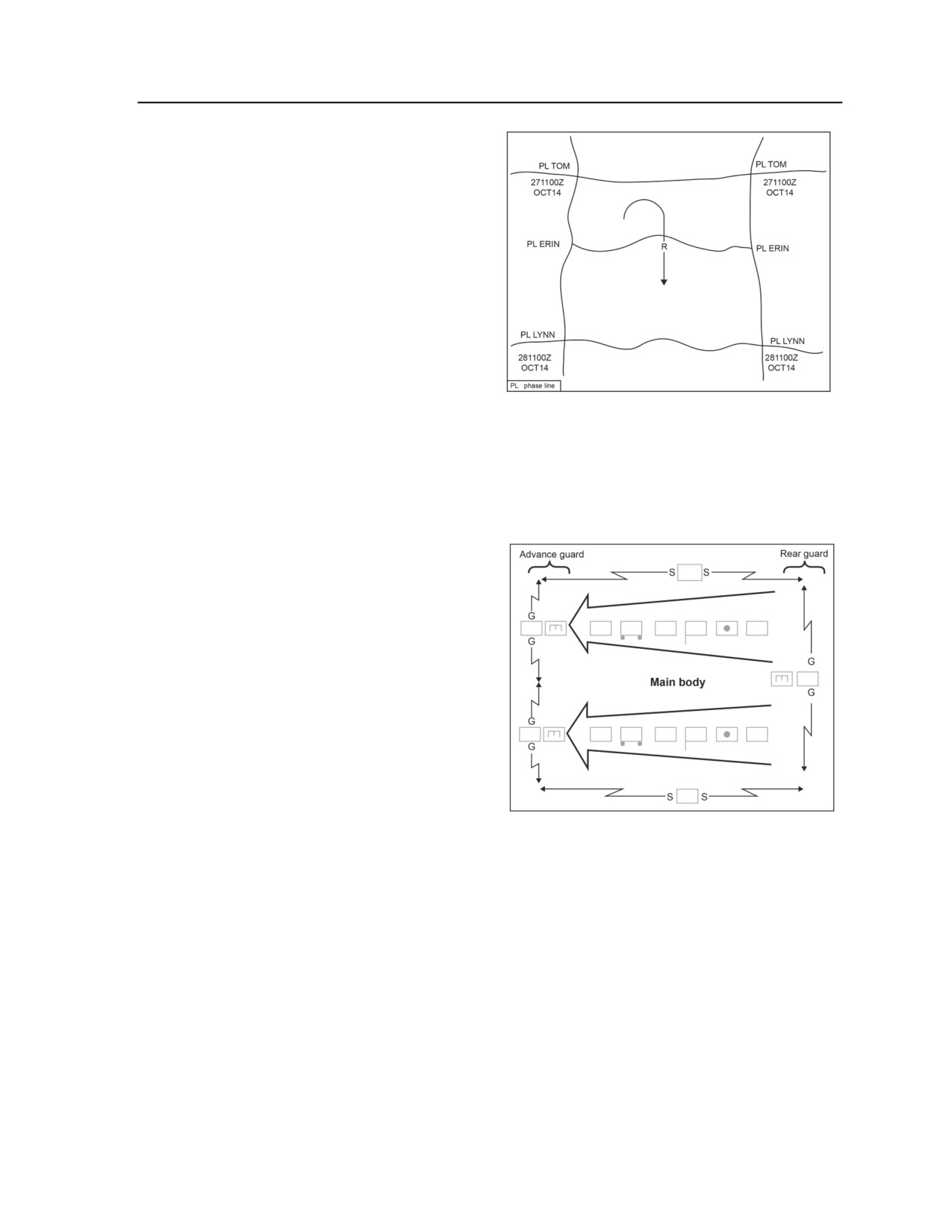
The Retrograde
9-93. The retiring unit generally moves toward an
assembly area, which should support the
preparations for the unit’s next mission. When
determining the routes the retiring force takes to
the assembly area, the commander considers the
unit’s capability to support defensive actions, if
combat occurs during the retirement.
9-94. The initial action in a retirement is to move
sustainment units and supplies to the rear. At the
designated time, the retiring unit executes a
withdrawal from action and forms into a march
formation. The unit can first move into an
assembly area, if this step is necessary, before
moving into a march formation to reestablish
mission command or resupply. Once it forms a
march formation, the force is prepared to initiate
Figure 9-9. Retirement tactical mission
the retirement. During the initial phase, the force
graphic
retires in multiple small columns. As the distance
from the enemy increases, smaller columns can consolidate into larger ones for ease of movement control.
Road nets and the potential for hostile interference influence how and when this consolidation occurs.
ORGANIZATION OF FORCES
9-95. The commander normally designates
security elements and a main body in a retirement.
(See figure 9-10.) The formation and number of
columns employed during a retirement depend on
the number of available routes and the potential for
enemy interference. The commander typically
moves major elements to the rear simultaneously.
However, a limited road net or a flank threat may
require echelonment of the movement in terms of
time and ground locations.
9-96. The terrain and the enemy threat dictate
whether the retiring force establishes a single rear
security force, which is usually a rear guard, or
whether each column forms a separate rear security
force. These security forces protect the rearward
moving columns from surprise, harassment, and
Figure 9-10. Organization of forces for a
attack by any pursuing enemy force. Their size and
retirement operation
composition depend on the strength and imminence
of the enemy threat. These security elements generally remain in march columns, unless there is a potential
for enemy interference. If the enemy establishes contact, the rear security element conducts a delay.
9-97. The retiring march columns normally require an advance guard augmented by engineers focused on
mobility. Engineers with the rear guard are focused on countermobility. The commander assigns a flank
security element to prevent potential enemy interference with the retiring force’s extended columns. The
commander may designate flank security responsibilities to subordinate march units.
9-98. The main body organizes in a manner opposite that of an approach march. (FM 3-90-2 explains the
approach march.) The movement of functional and multifunctional support and sustainment units should
precede the movement of combat forces. When necessary, elements of the main body can reinforce the rear
guard or any other security element. Because fire support elements and attack helicopter elements of the
main body can respond most rapidly, they are usually the first elements tasked for this mission.
22 March 2013
FM 3-90-1
9-17
Chapter 9
CONTROL MEASURES
9-99. The control measures used in a retirement are the same as those in a delay and a withdrawal. As in a
withdrawal, thorough planning and strict adherence to routes and movement times facilitate an orderly
retirement. Typically, the commander controls movement using movement times, routes, and checkpoints.
(FM 3-90-2 discusses these movement control measures.)
SUSTAINMENT
9-100. During retrograde operations, sustainment units echelon their movements to maintain adequate
support to the committed force. They maintain maximum dispersion consistent with control and local
security. Their goal is to provide uninterrupted support and maximum protection during the time it takes to
conduct the retrograde operation. By echeloning support, the commander reduces the amount of time each
sustainment unit spends moving, preventing it from performing its primary support tasks. High-priority
assets may require added protection to prevent their loss or capture. To reduce congestion and interference
with the operations of combat and functional and multifunctional support units, the commander should
displace supporting sustainment assets as early as possible, normally during periods of limited visibility.
The early displacement of sustainment units can also prevent revealing friendly future operations to the
enemy.
9-101. The commander anticipates the effects of retrograde movements on sustainment elements to ensure
adequate support for the operation and the prompt evacuation of casualties. Retrograde movements
generally result in increased distances between sustainment and combat units, which makes providing this
support more difficult. Retrograde operations generally require more Class III, and possibly more Class V,
supplies than during the conduct of other defensive tasks. These supplies must be available for emergency
issue. These two factors combine to increase the demand for transportation assets and space on main supply
routes. This, in turn, increases the need for movement management and pre-positioned services and
supplies. Sustainment units carry and cache necessary fuel and ammunition stocks as required by the
specific situation.
9-102. The sustainment provided must be mobile to cope with demands of the fluid tactical situation that
typically occurs during a retrograde operation. The commander prevents unnecessary supplies from
accumulating in areas that will be abandoned. Only essential medical and logistics support should be
located in the area involved in the retrograde operation.
9-103. The commander establishes maintenance, recovery, and evacuation priorities and destruction
criteria for inoperable equipment in paragraph
4 of the operations order. Maintenance requirements
generally overwhelm the organic capabilities of forward units during a retrograde operation. Forward units
place as much maintenance, recovery, and evacuation assets forward as possible to augment or relieve
combat elements of the burden of repairing unserviceable equipment. Recovery and evacuation vehicles
position themselves at critical locations to keep disabled vehicles from blocking movement routes. Forward
units evacuate systems that cannot be repaired within established timelines. They use all available means to
accomplish this, including equipment transporters and armored vehicles with inoperative weapon systems.
When recovery and evacuation are impossible, units destroy inoperable equipment to prevent capture.
When possible, units destroy the same vital components in each type of system to prevent the enemy from
rapidly exploiting captured friendly systems through battlefield cannibalization.
9-104. The commander assigns transportation priorities for the movement of combat troops and their
supplies, the movement of obstacle materials to impede the enemy, and the evacuation of casualties and
repairable equipment. The commander keeps main supply routes open and decontaminated as necessary.
Units control the back-haul of transportation assets before the retrograde begins, reducing the amount of
transportation needed to support the operation.
9-105. Generally, the commander uses many separate supply routes rather than just a few main supply
routes. Some routes remain open for traffic moving to the front while the bulk of functional and
multifunctional support and sustainment units displace farther rearward. Commanders designate and
reserve routes for evacuating displaced civilians. Commanders avoid designating routes that cross or
otherwise interfere with the unit’s main supply routes as much as possible.
9-18
FM 3-90-1
22 March 2013
The Retrograde
9-106. The senior military person present determines when to request medical evacuation and assigns
precedence of evacuation. This decision is based on the advice of the senior medical person at the scene,
the patient’s condition, and the tactical situation. Assignment of medical evacuation precedence is
necessary. The precedence provides the supporting medical unit and controlling headquarters with
information that is used in determining priorities for committing their evacuation assets. For this reason,
correct assignment of precedence cannot be overemphasized; over classification remains a continuing
problem. Patients are evacuated as quickly as possible, consistent with available resources and pending
missions. Medical elements supporting the retrograding force must provide rapid evacuation of casualties
to medical facilities. Medical evacuation requirements are especially demanding in the large AOs common
to the retrograde. Commanders may augment the ground ambulance capabilities of supporting forward
medical units.
9-107. Military police elements of the retrograde force are involved primarily in maneuver and mobility
support operations to support and preserve the commander’s freedom of movement. The commander may
augment supporting military police forces to establish traffic control points and route and convoy security.
Military police also provide support through the execution of internment and resettlement operations.
UNIQUE RETROGRADE SITUATIONS
9-108. Conditions that require conducting denial and stay-behind operations can arise during retrograde
operations. These two operations have their own unique planning and execution considerations.
DENIAL OPERATIONS
9-109. Denial operations are actions to hinder or deny the enemy the use of space, personnel,
supplies, or facilities. They may include destroying, removing, and contaminating those supplies and
facilities or erecting obstacles. Sometimes, an enemy unit will capture friendly equipment and supplies.
This situation often occurs during the conduct of defensive tasks. As a result, the defending commander
may be required to conduct denial operations. The principles of denial include the following:
z
The commander denies the enemy the use of military equipment and supplies.
z
Steps taken to deny equipment and supplies to the enemy do not, if possible, preclude their later
use by friendly forces.
z
The commander orders the destruction of military equipment and supplies only when friendly
forces cannot prevent them from falling into enemy hands.
z
The user is responsible for denying the enemy the use of the user’s military equipment and
supplies by means of its destruction, removal, or contamination.
z
Deliberately destroying medical equipment and supplies and making food and water unfit for
consumption is unlawful under the terms of the Geneva Conventions.
In denial operations, the definition of a unit’s military equipment and supplies could expand to include
military installations and any civilian equipment and supplies used by the friendly force. Under the law of
war, the destruction of civilian property is only permitted where required by immediate military necessity.
The determination of whether there is sufficient necessity to justify destruction is a complex decision that
requires consideration of moral, political, and legal considerations. Additionally, civil instability increased
by the destruction of civilian property, material, and equipment could have adverse effects on the outcomes
of the different elements of decisive action.
9-110. The commander who orders the denial operation must consider the potential value of the military
equipment and supplies to an enemy when determining the priorities and the extent of the denial operation.
Examples of high priorities for denial include—
z
Classified equipment, material, and documents.
z
Petroleum, oils, and lubricants (POL).
z
Sophisticated weapon systems or electronic equipment.
z
Heavy weapons and associated ammunition.
z
Communications equipment.
22 March 2013
FM 3-90-1
9-19
Chapter 9
z
Ferrying and bridging equipment.
z
Air, sea, and land transport systems.
Any other military supplies, equipment, or facilities that may be of use to an enemy are a lesser priority for
denial operations.
9-111. The commander issues detailed instructions to deny military equipment and supplies to prevent the
enemy from directly using them. Denial must also prevent an enemy from repairing a system through the
cannibalization of several systems. The unit must destroy the same parts in each type of system.
9-112. Denial differs from countermobility operations because the commander designs denial operations to
deprive the enemy of some or all of the short-term benefits of capturing an area. The impact of denial
operations on civilian inhabitants and the environment of the area act as a moral and a legal constraint on
their use by U.S. forces. The commander involves the staff judge advocate and civil affairs operations staff
officer in planning denial operations.
9-113. The commander ensures that executing the denial plan does not adversely affect the unit’s future
operations. This includes carefully considering the force’s demolition policy in relation to the purpose of
the rearward movement and the contemplated subsequent actions of the force. Widespread demolitions
during a retrograde may become a greater hindrance to a friendly force moving back into the area than to
the enemy during the friendly retrograde. For example, destroying the transportation infrastructure
increases friendly logistics difficulties once the area is recaptured. Removing or destroying militarily
significant supplies and equipment, such as fuel, obstacle materials, and rail cars, from an area requires
friendly forces to bring similar assets with them when they reoccupy the area.
9-114. The commander can expand a denial operation to prevent the enemy from exploiting resources,
such as fuel, minerals, and the indigenous population; routes of communication, such as river locks,
railroad switching yards, road interchanges, and bridges; and facilities, such as telephone exchanges, radio
and television stations, and the industrial plants of a region. The defending force can assist civil authorities
in evacuating the civilian population. The defending force either removes the resources, supplies, and
facilities from the area being abandoned to the enemy or destroys them in place. Such denial operations
may be either total or limited.
9-115. Total denial operations can produce long-term political, economic, military, and environmental
effects. Total denial operations have operational-level, and possibly strategic-level, impact. Total denial
operations consume large quantities of transportation and engineer resources and require considerable time
to plan and execute.
9-116. Limited or partial denial operations are particularly suitable if the defending force expects to regain
control of the area within a short time. The removal or destruction of only a few key components can
reduce a facility to limited utility, yet it allows for the facility’s quick restoration of all functions once it is
returned to friendly control. American forces only destroy discrete targets of significant military value.
Limited denial operations normally do not affect the advance of properly supported enemy combat
formations possessing cross-country mobility. However, they can seriously impede an enemy’s road-bound
and rail-bound logistics support if executed with skill and imagination according to an overall plan.
STAY-BEHIND OPERATIONS
9-117. A stay-behind operation is an operation in which the commander leaves a unit in position to
conduct a specified mission while the remainder of the forces withdraw or retire from an area. The
force should consist of enough combat, functional and multifunctional support, and sustainment elements to
protect and sustain its fighting capability for the duration of the mission. A stay-behind force may also
result from enemy actions that bypass friendly forces.
9-118. The main purpose of a stay-behind force is to destroy, disrupt, and deceive the enemy. This force
has a high-risk mission because of the danger that it will be located, encircled, and destroyed by the enemy.
Resupply and casualty evacuation are also extremely difficult. A commander considers assigning this
mission only after a thorough analysis of the mission variables of METT-TC. The stay-behind force attacks
enemy combat forces and command nodes, functional and multifunctional support, and sustainment
9-20
FM 3-90-1
22 March 2013
The Retrograde
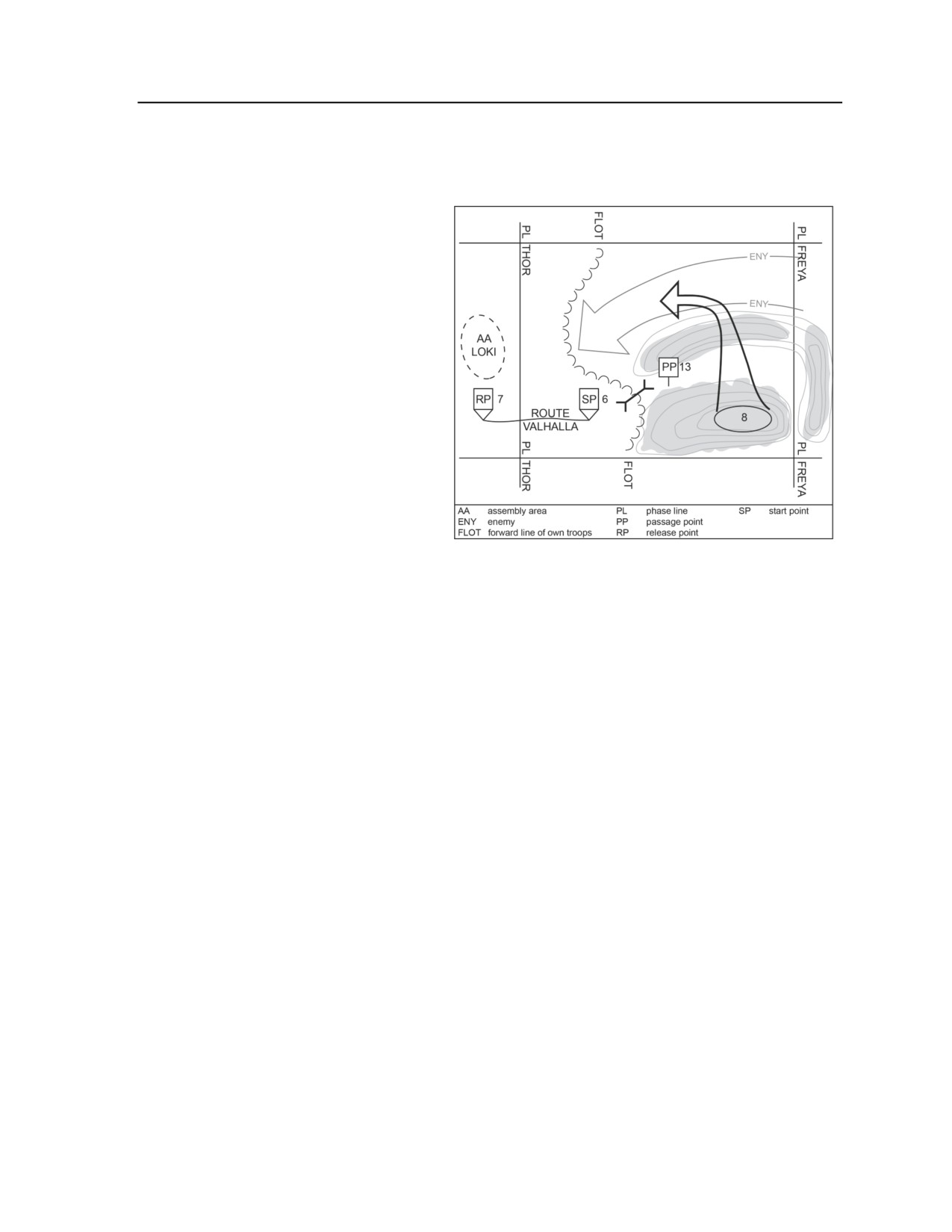
elements from unexpected directions. (See figure 9-11.) These attacks may cause enemy follow-on forces
to be more cautious and to slow down to clear possible attack and ambush sites. The commander may
require the stay-behind force to conduct a breakout from encirclement and linkup operations after it
completes its mission. (FM 3-90-2 discusses the conduct of a breakout from an encirclement.)
9-119. A light infantry, stay-behind force
surprises an enemy by conducting a series
of raids and ambushes. The light infantry
force can be inserted via infiltration, air
assault, or parachute; it can also be a
bypassed force. Attacks in the enemy
support area by friendly armored forces
can cover a larger area than attacks by
light infantry forces.
9-120. Stay-behind operations eventually
require the force to reenter friendly lines
or link up with other elements, often in
more than one location. The commander
must carefully coordinate this reentry to
prevent friendly fire incidents. The return
routes for the stay-behind force are the
best-covered and concealed routes
available. Commanders place guarded
gaps or lanes near obstacles along these
routes that cannot be bypassed.
Figure 9-11. Stay-behind force
9-121. A stay-behind operation is not a
suicide mission. The commander conducts this operation only when there is confidence that the stay-behind
force will rejoin the main body, extract itself in alternative ways, or the main body will fight its way
forward to link up with the stay-behind force.
22 March 2013
FM 3-90-1
9-21
Appendix A
Basic Tactical Control Measures
This appendix explains basic tactical control measures common to the conduct of
offensive and defensive tasks. These control measures apply to both automated and
hand-drawn graphic displays and overlays. This appendix portrays common control
measures for use on situation maps, overlays, and annotated aerial photographs. They
are also the standard for all simulations, to include those used in live, virtual, and
constructive environments.
GENERAL CONSIDERATIONS FOR CONTROL MEASURES
A-1. Units conducting tactical operations must have clearly defined tasks and responsibilities. The
commander uses control measures to impose restrictions that prevent units from impeding one another and
establish specific responsibilities. Control measures can be permissive (which allows something to happen)
or restrictive
(which limits how something is done). Control measures may be graphical, such as
boundaries, or procedural, such as target engagement priorities. A commander should establish only the
minimum control measures necessary to provide essential coordination and deconfliction between units.
Control measures must not unduly restrict subordinates in accomplishing their missions. The commander
removes restrictive control measures as soon as possible. Control measures can become more restrictive as
forces transition from an emphasis on the conduct of offensive and defensive tasks to an emphasis on the
conduct of the primary stability or defense support of civil authorities tasks. ADRP 1-02 discusses the rules
for drawing control measures on overlays and maps.
A-2. Well-conceived control measures facilitate the conduct of current and future operations. The
commander adjusts control measures as necessary to maintain synchronization and ensure mission
accomplishment as the tactical situation evolves. The commander balances the risk of introducing
additional friction into the operation with the benefits gained by changing them.
A-3. Control measures apply to all forces. The commander ensures that all higher-echelon control
measures, such as phase lines (PLs) and checkpoints, are incorporated into the unit’s graphic control
measures. The commander references only the control measures established by the higher headquarters
when making reports to that headquarters. The commander may or may not chose to establish a standard
naming convention for control measures in the unit standard operating procedures (SOPs). Examples of
such naming conventions would be reserving car model names for phase lines and female names for
objectives. This publication does not use a standard naming convention.
COMMON CONTROL MEASURES
A-4. Paragraphs A-5 through A-70 discuss control measures common to the conduct of all offensive and
defensive tasks. Paragraphs A-71 through A-88 discuss control measures common to the conduct of
offensive tasks. Finally, paragraphs A-89 through A-106 discuss control measures common to the conduct
of defensive tasks.
AIRSPACE COORDINATING MEASURES
A-5. The joint force commander designates an airspace control authority to develop, coordinate, and
publish airspace control procedures for operating the airspace control system in the joint operations area.
The airspace control authority establishes an airspace control plan that provides specific planning guidance
and procedures for the airspace control system for the joint operational area. The airspace control order
implements the airspace control plan by providing the details of the approved requests for airspace
22 March 2013
FM 3-90-1
A-1
Appendix A
coordinating measures (ACMs). It is published either as part of the air tasking order or as a separate
document. (See JP 3-52.) These ACMs are measures employed to facilitate the efficient use of airspace to
accomplish missions and simultaneously provide safeguards for friendly forces. Airspace elements
establish ACMs to accomplish one or more functions:
z
Establish reserved airspace for specific airspace users.
z
Restrict the actions of some airspace users.
z
Create airspace in which units can use weapons with minimal risk of friendly fire incidents.
(Friendly fire incidents include death by fratricide, injury, and property damage.)
z
Control actions of specific airspace users.
z
Require airspace users to accomplish specific actions.
A-6. JP 3-52 provides additional information on each of the following joint ACMs:
z
Coordinating altitude.
z
Low-level transit routes.
z
Minimum-risk routes
z
Restricted operations areas.
z
Special-use airspace.
z
High-density airspace control zones.
z
Standard use Army aviation flight routes.
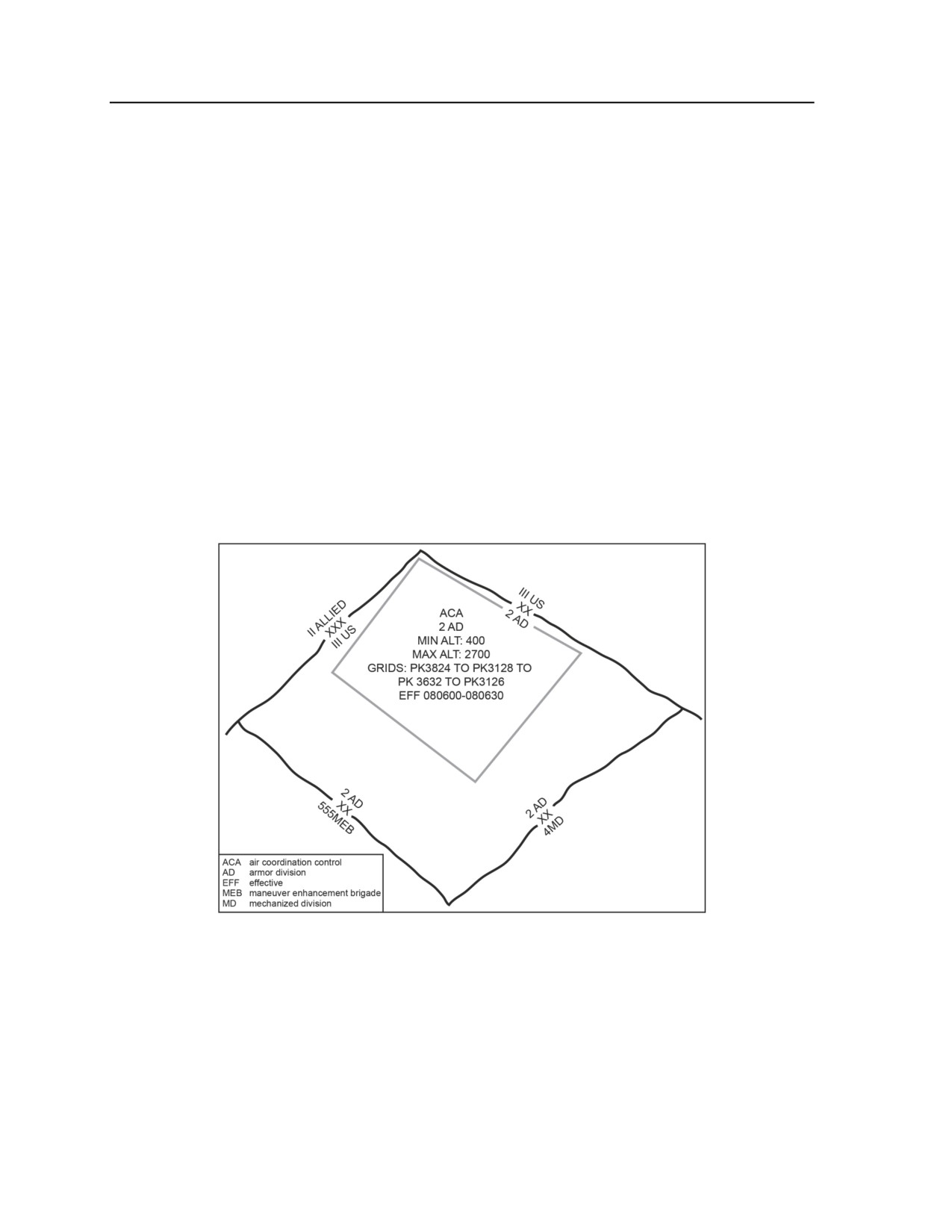
Figure A-1 shows how some of these joint ACMs are used to create an airspace coordination area.
Figure A-1. Example airspace coordination area
A-7. The Army, in addition to the seven joint ACMs listed in paragraph A-6, has developed additional
standardized ACMs. For Army forces, these measures assign responsibility, ensure conformity with the
tactical plan, describe and illustrate the concept of operations, maintain separation of forces, concentrate
effort, coordinate fires with maneuver, and assist in the control of forces. Army forces can graphically
depict the integration, coordination, regulation, and identification of Army airspace users with ground
forces in a given area of operations when they incorporate airspace coordinating measures with these
standardized Army ACMs. These Army ACMs are:
A-2
FM 3-90-1
22 March 2013
Basic Tactical Control Measures
z
Air corridor.
z
Axis of advance.
z
Air control point.
z
Battle position.
z
Engagement area.
z
Communications checkpoint.
z
Attack by fire position.
z
Observation post.
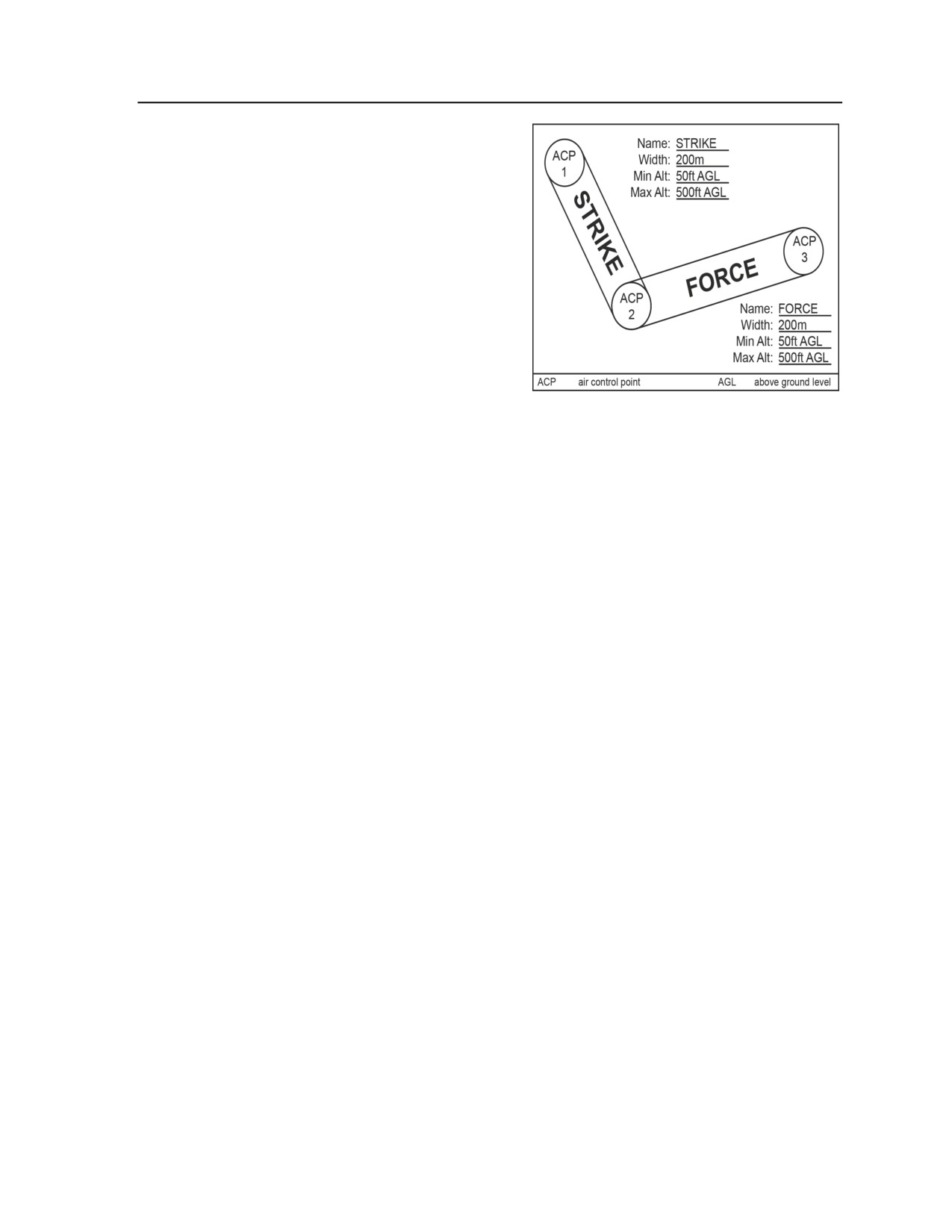
Figure A-2 provides an example air corridor with its
associated air control points. FM 3-52 provides
additional information on these Army ACMs.
AREA OF OPERATIONS
A-8. An area of operations
(AO) is both a basic
Figure A-2. Example air corridor and air
tactical concept and the basic control measure for all
control points
types of operations. An area of operations is an
operational area defined by the joint force commander for land and maritime forces that should be large
enough to accomplish their missions and protect their forces (JP 3-0). The joint force land component
commander, Army Service component command (ASCC) commander, or Army (ARFOR) commander will
in turn assign subordinates their own AOs. Those subordinates will further assign their subordinates AOs
down to the battalion or even company echelon based on the mission variables of mission, enemy, terrain
and weather, troops and support available, time available, and civil considerations (METT-TC). A unit
assigned an AO, although the owning unit, may not change control measures imposed by a higher
headquarters within its AO. However, it may establish additional control measures to coordinate and
synchronize its operations.
A-9. Assigning an AO to a subordinate headquarters maximizes decentralized execution by empowering
subordinate commanders to use their own initiative to accomplish their missions. This encourages the use
of mission command. (See ADRP 6-0 for a discussion of mission command.) At the same time it adds the
responsibilities listed in paragraph A-12 to the lower headquarters. Conversely, failure to designate
subordinate AOs maximizes centralized execution and limits subordinates’ tactical options. The latter
choice should be made only when mandated by the mission variables of METT-TC. For example, a brigade
combat team (BCT) commander responsible for blocking an enemy advance along a single avenue of
approach may assign subordinate battalions battle positions to support a BCT engagement area (EA)
instead of subdividing the BCT AO and the avenue of approach into battalion AOs.
A-10. A higher headquarters designates an AO using boundaries. A divisional commander normally
assigns AOs to subordinate maneuver units, such as BCTs or maneuver enhancement brigades. However,
the commander may also assign an AO to subordinate functional and multifunctional support or
sustainment units even though owning an AO is not a task for which these types of units are designed. For
example, they lack joint enablers like a tactical air control party. (This non-doctrinal mission for these later
types of units is most likely to occur during the conduct of the irregular warfare.) An assigned AO both
restricts and facilitates the movement of units and use of fires. It restricts units not assigned responsibility
for the AO from moving through the AO. It also restricts outside units from firing into or allowing the
effects of their fires to affect the AO. Both of these restrictions can be relaxed through coordination with
the owning unit. An assigned AO facilitates the movement and fires of the unit assigned responsibility for,
or owning, it. The assigned AO must encompass enough terrain for the commander to accomplish the
mission and protect friendly forces.
A-11. Commanders consider a unit’s area of influence when assigning it an area of operations. An area of
influence is a geographical area wherein a commander is directly capable of influencing operations by
maneuver or fire support systems normally under the commander’s command or control (JP 3-0). A unit’s
area of operations should not be substantially larger than its area of influence. Ideally, the entire AO is
encompassed by the area of influence. An area of operations that is too large for a unit to control can allow
22 March 2013
FM 3-90-1
A-3
Appendix A
sanctuaries for enemy forces to develop and may limit the unit’s flexibility of operations. If the
commander’s area of influence is smaller than the assigned AO, the commander must consider options for
extending the size of that area of influence. These options include the following techniques:
z
Changing the geographical dispositions of unit current systems to increase the size of the area of
influence and ensure coverage of key areas, installations, and systems.
z
Requesting additional assets.
z
Requesting boundary adjustments to reduce the size of the AO.
z
Accepting the increased risk associated with being unable to provide security throughout the
AO.
z
Moving the area of influence by phases to sequentially encompass the entire AO.
A-12. All units assigned an AO have the following responsibilities within the boundaries of that AO:
z
Terrain management.
z
Intelligence collection.
z
Civil affairs activities.
z
Air and ground movement control.
z
Clearance of fires.
z
Security.
z
Personnel recovery.
z
Environmental considerations.
(See ADRP 3-90 for a discussion of these responsibilities.)
ASSEMBLY AREAS
A-13. An assembly area is an area a unit occupies to prepare for an operation. Ideally, an assembly
area (AA) provides—
z
Concealment from air and ground observation.
z
Adequate entrances, exits, and internal routes.
z
Space for dispersion; each AA is separated by enough distance from other AAs to preclude
mutual interference.
z
Cover from direct fire.
z
Good drainage and soil conditions that can sustain unit vehicles and individual Soldier
movements.
z
Terrain masking of electromagnetic signatures.
z
Terrain allowing observation of ground and air avenues into the AA.
z
Sanctuary from enemy medium-range artillery fires because it is located outside the enemy’s
range.
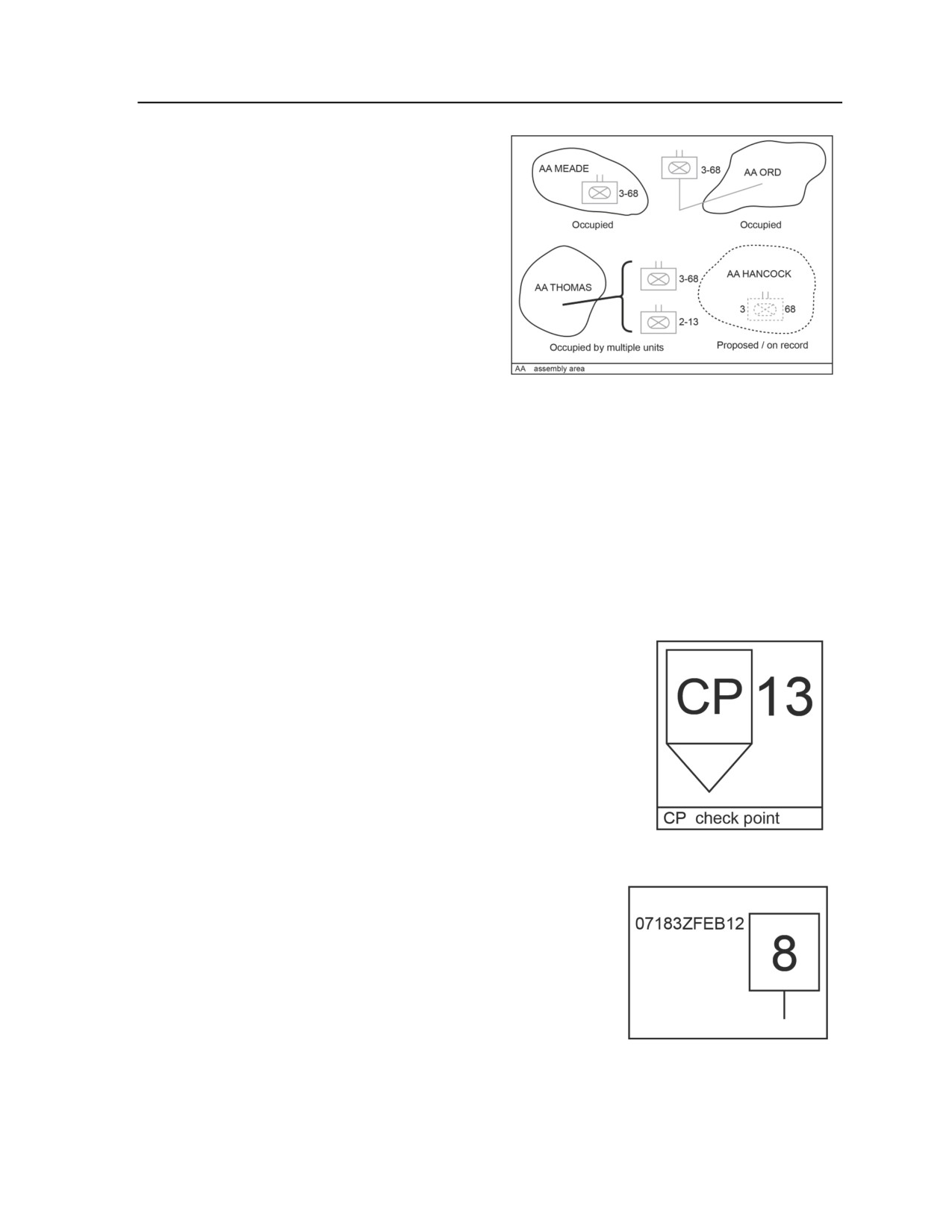
A-14. The commander assigns each unit its own AA. In figure A-3 on page A-5, the example of multiple
units occupying one AA is a graphical shortcut taken when the map scale would make depiction of multiple
assembly areas unreadable. In reality, the commander would subdivide AA Thomas into two smaller AAs,
one for each unit. A unit AA is normally within the AO of another unit. An AA is usually treated as a
noncontiguous AO. This means that a unit has the same responsibilities within its assigned AA as it has for
any other AO.
A-15. The proper location of AAs contributes significantly to both security and flexibility. The location
should facilitate future operations, so movement to subsequent positions can take place smoothly and
quickly by concealed routes. Because of their smaller signature, infantry units can use AAs closer to the
enemy than armored units without excessive risk of enemy detection. The tactical mobility of armored and
Stryker units allows them to occupy AAs at a greater distance from the line of departure (LD) than infantry
units.
A-4
FM 3-90-1
22 March 2013
Basic Tactical Control Measures
BOUNDARIES
A-16. A boundary is a line that delineates surface
areas for the purpose of facilitating coordination
and deconfliction of operations between adjacent
units, formations, or areas
(JP
3-0). A forward
boundary is a boundary of an echelon that is
primarily designated to divide responsibilities
between it and its next higher echelon. A lateral
boundary is a boundary that extends from the
rear boundary to the unit’s forward boundary.
A rear boundary is a boundary that defines the
rearward limits of a unit’s area. It usually also
defines the start of the next echelon’s support
area. The commander uses graphic control
measures to define the limits of an AO and, as such,
Figure A-3. Assembly area examples
establishes ground forces’ responsibilities. The
ACMs control the vertical dimension. The commander bases the boundaries of subordinate units on clearly
defined terrain features. This requirement is less important if all units in the AO have precision navigation
capabilities. Boundaries should not split responsibilities for roads, rivers, or railways. Responsibility for an
avenue of approach and key terrain should also belong to only one unit. The commander adjusts boundaries
as necessary in response to the evolving tactical situation. Any areas not delegated to a subordinate remain
the responsibility of the commander.
A-17. After military characteristics of the terrain are accounted for within the context of the unit’s mission,
existing political boundaries, such as city limits and provincial borders, are important considerations in
developing friendly unit graphical control measures and assigning subordinate unit AOs. Military
boundaries that conflict or do not align with existing political boundaries require additional effort when
trying to deconflict, manage, or organize the use of indigenous capabilities. However, during the conduct of
protracted operations within an AO, subordinate unit AOs should be
periodically adjusted to avoid the inadvertent creation of sanctuaries that
an enemy could exploit.
CHECKPOINT
A-18. A checkpoint is a predetermined point on the ground used to
control movement, tactical maneuver, and orientation
(ADRP 1-02).
Units can also use a checkpoint as a fire control measure in lieu of the
preferred control measure, a target reference point. Checkpoints are
useful for orientation. Units may use checkpoints to supplement or as
substitutes for PLs. They are also used in the conduct of sustainment
operations. Figure A-4 depicts checkpoint 13.
Figure A-4. Checkpoint
13
CONTACT POINT
A-19. In land warfare, a contact point is a point on the terrain, easily
identifiable, where two or more ground units are required to make
physical contact (JP 3-50). A commander establishes a contact point
where a PL crosses a lateral boundary or on other identifiable terrain
as a technique to ensure coordination between two units. The
commander provides a date-time group to indicate when to make that
physical contact. Figure A-5 depicts contact point 8.
A-20. The mutual higher commander of two moving units normally
designates the location of contact points and times of contact. When
Figure A-5. Contact point 8
one unit is stationary, its commander normally designates the location
22 March 2013
FM 3-90-1
A-5
Appendix A
of the contact point and the meeting time, and transmits this information to the commander of the moving
unit.
CRITICAL FRIENDLY ZONE
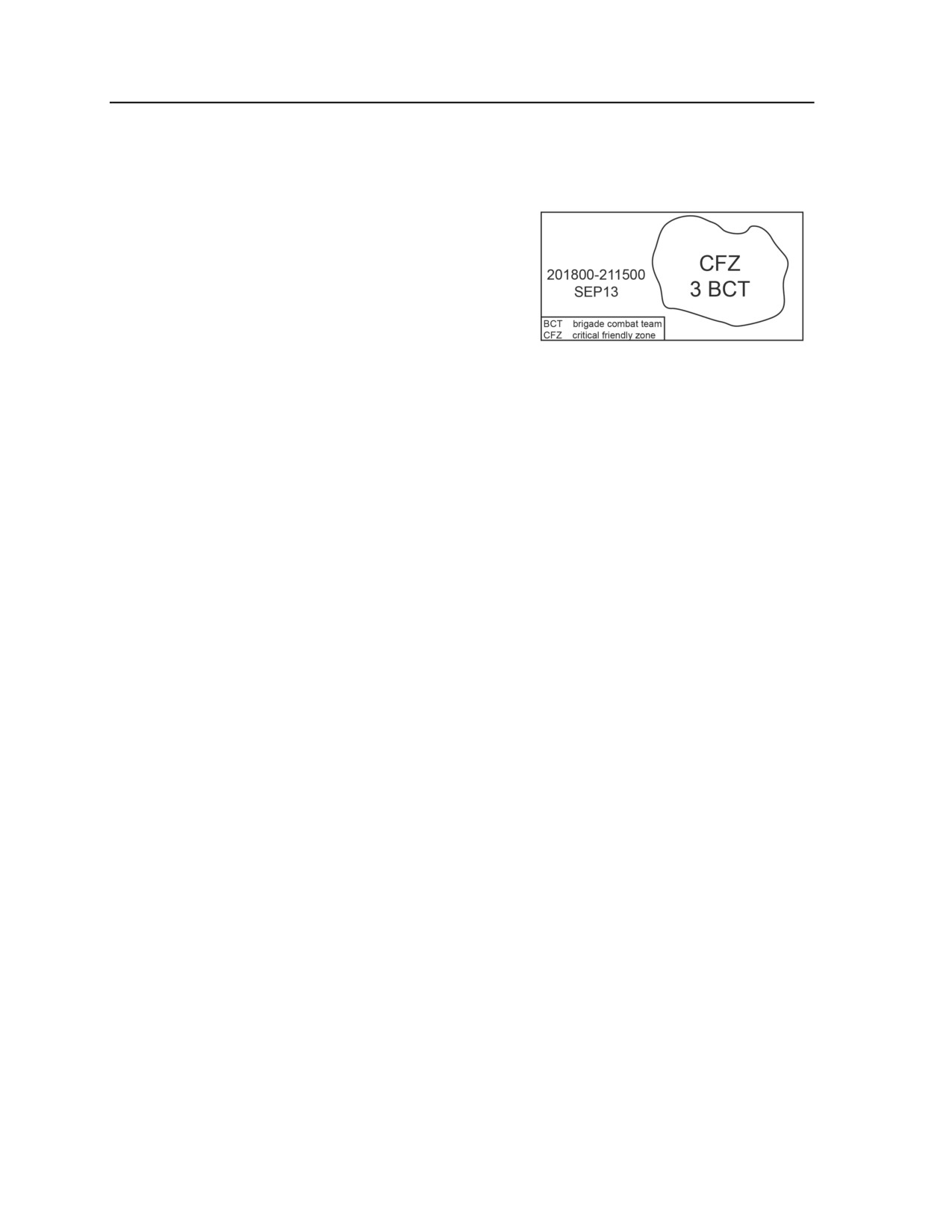
A-21. A critical friendly zone is an area, usually a friendly
unit or location, which the maneuver commander designates
as critical to the protection of an asset whose loss would
seriously jeopardize the mission (ADRP 1-02). A critical
friendly zone
(CFZ) is one of four different types of zones
used with field artillery target acquisition radars. Typical
CFZs include maneuver assembly areas, command posts,
forward arming and refueling points, friendly breaching
sites, and other troop concentrations. The exact size and
Figure A-6. Critical friendly zone
shape of the CFZ reflects the technical characteristics of the
sensor coverage and varies in accordance with the terrain. Figure A-6 shows a CFZ for a BCT. The
designation of a CFZ requires the availability of target acquisition radars to cover the designated area and
fire support weapon systems to conduct counterfire. (JP 3-09 defines counterfire as fire intended to destroy
or neutralize enemy weapons. Includes counterbattery and countermortar fire.) The supporting field
artillery unit’s automated fire support system is tied to that sensor to place the location of a weapon firing
into the CFZ ahead of all other targets in priority for counterfire. This results in an immediate call for fire
unless the system operator manually overrides the automated request for fire. The other three types of radar
zones are call-for-fire zone, artillery target intelligence zone, and censor zone. (For additional information
on the employment of all four of these radar zones, see FM 3-09.12.)
DIRECT FIRE CONTROL MEASURES
A-22. The small-unit commander communicates to subordinates the manner, method, and time to initiate,
shift, and mass fires, and when to disengage by using direct fire control measures. The commander should
control unit fires to direct the engagement of enemy systems to gain the greatest effect. The commander
uses intelligence preparation of the battlefield (IPB) products and reconnaissance to determine the most
advantageous way to use direct fire control measures to mass the effects on the enemy and reduce friendly
fire incidents from direct fire systems. The commander must understand the characteristics of weapon
systems and available munitions (such as the danger to unprotected Soldiers when tanks fire discarding
sabot ammunition over their heads or near them). Direct fire control measures defined in this publication
include engagement criteria, engagement priorities, sectors of fire, and target reference points (TRPs).
Maneuver platoon and company publications address other direct fire control measures, such as frontal,
cross, or depth fire patterns and simultaneous, alternating, or observed techniques of fire.
Engagement Area
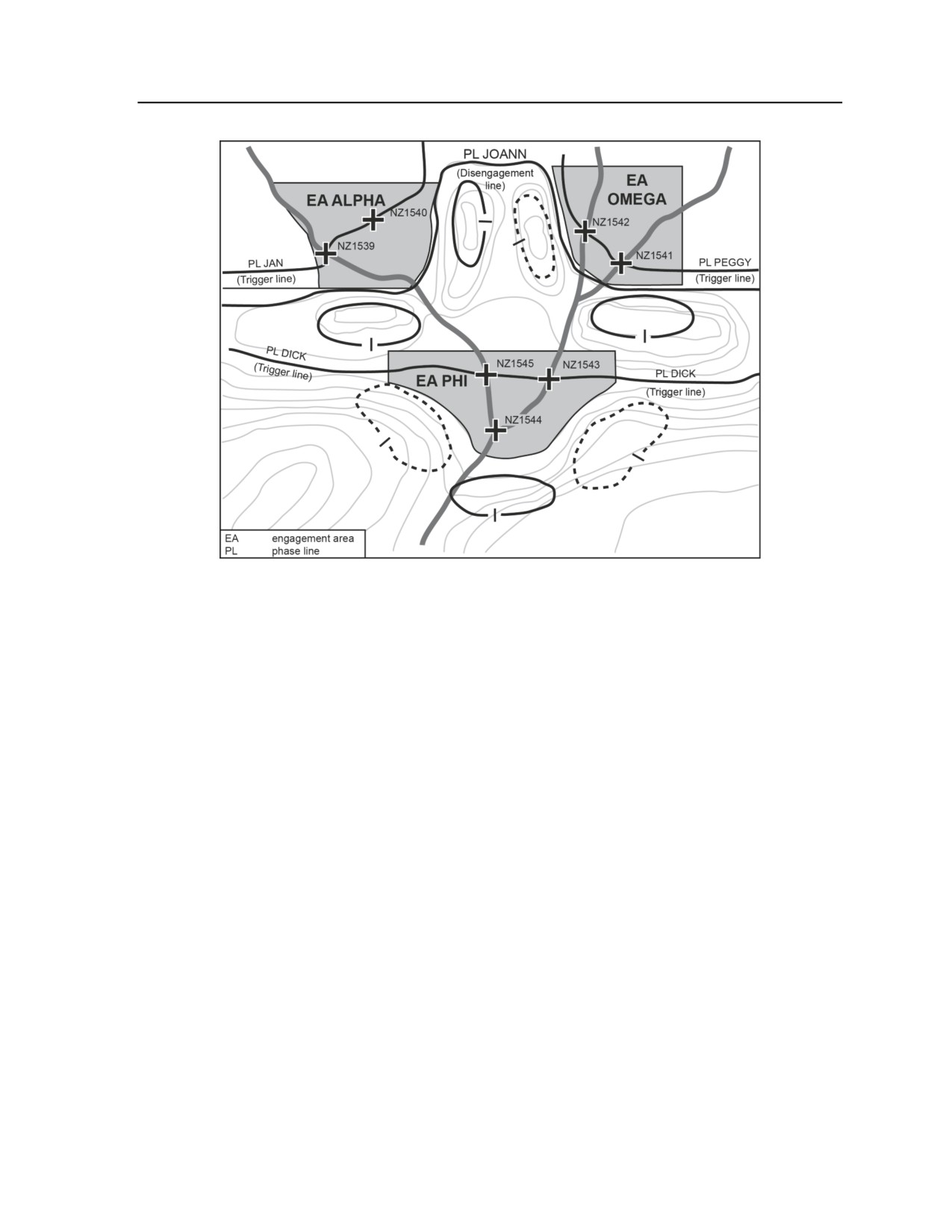
A-23. An engagement area is an area where the commander intends to contain and destroy an enemy
force with the massed effects of all available weapons and supporting systems. This includes organic
direct fire systems and supporting systems, such as close air support. Figure A-7 depicts several EAs used
within the context of a battalion defense. The commander determines the size and shape of the EA by the
relatively unobstructed line-of-sight from the weapon systems in their firing positions and the maximum
range of those weapons. The commander designates EAs to cover each enemy avenue of approach into unit
positions. The commander also can use them to designate known or suspected enemy locations. The
commander selects EAs and then arrays available forces and weapon systems in positions to concentrate
overwhelming effects into these areas. The commander routinely subdivides EA into smaller EAs for
subordinates using one or more target reference points or by prominent terrain features. The commander
assigns sectors of fires to subordinates to prevent friendly fire incidents, but responsibility for an avenue of
approach or key terrain is never split. These sectors normally do not affect friendly maneuver. Commanders
of units up to battalion task force size normally use this control measure. (See FM 90-7 for a discussion of
EA development.)
A-6
FM 3-90-1
22 March 2013
Basic Tactical Control Measures
Figure A-7. Example battalion engagement area
Engagement Criteria
A-24. Engagement criteria are protocols that specify those circumstances for initiating engagement
with an enemy force. They may be restrictive or permissive. For example, a company commander could
tell the 1st Platoon to wait until three enemy tanks reach a target reference point within its EA before
initiating fire. Another example is a battalion commander telling a company commander not to engage an
approaching enemy unit until it commits itself to an avenue of approach. The commander establishes
engagement criteria in the direct fire plan. Commanders and leaders of small tactical units use engagement
criteria in conjunction with engagement priorities and other direct fire control measures to mass fires and
control fire distribution.
Engagement Priority
A-25. Engagement priority specifies the order in which the unit engages enemy systems or functions.
The commander assigns engagement priorities based on the type or level of threat at different ranges to
match organic weapon systems capabilities against enemy vulnerabilities. Engagement priorities are
situationally dependent. The commander uses engagement priorities to distribute fires rapidly and
effectively. Subordinate elements can have different engagement priorities. For example, the commander
establishes engagement priorities so that M2 Bradley fighting vehicles engage enemy infantry fighting
vehicles or armored personnel carriers, while M1 Abrams tanks engage enemy tanks. Normally, units
engage the most dangerous targets first, followed by targets in depth or specialized systems, such as
engineer vehicles.
Sector of Fire
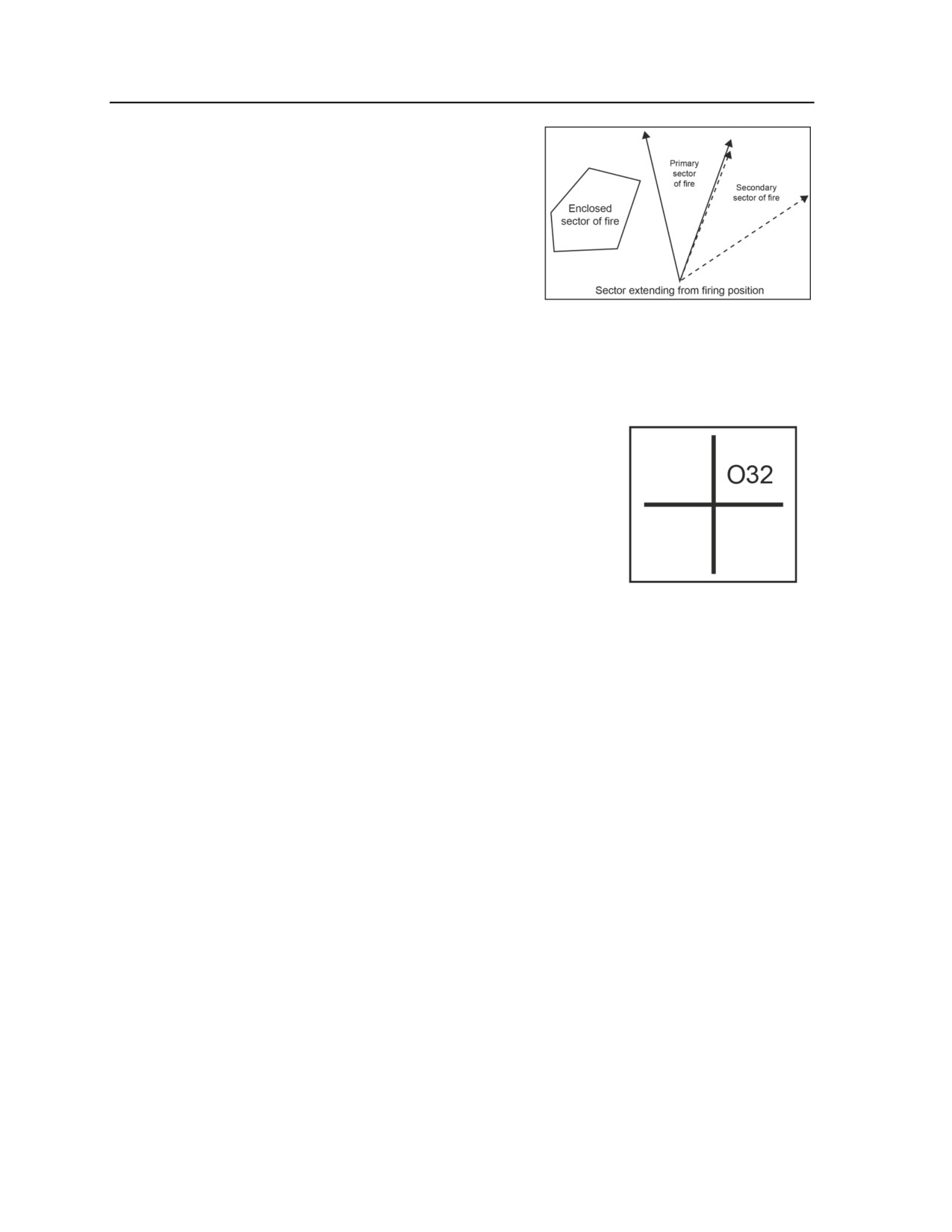
A-26. A sector of fire is that area assigned to a unit, a crew-served weapon, or an individual weapon
within which it will engage targets as they appear in accordance with established engagement
priorities. (See figure A-8 on page A-8.) Battalions and smaller echelons primarily use this direct fire
control measure. Each sector of fire can extend from a firing position to the maximum engagement range of
22 March 2013
FM 3-90-1
A-7
Appendix A
the weapon, or it can be an enclosed area at a distance from
the firing position. The commander should assign each
subordinate unit or available weapon system a primary sector
of fire and a secondary sector of fire to increase the capability
of concentrating fire in certain areas. The primary sector of
fire is that area in which the assigned unit, individual, or
crew-served weapon is initially responsible for engaging and
destroying enemy targets located in that sector in accordance
with established priorities for engagement. Fire shifts to the
secondary sector, on order, when there are no targets in the
primary sector, or when the commander needs to cover the
Figure A-8. Example sector of fire
movement of another friendly element. This secondary sector
of fire should correspond to another element’s primary sector of fire to obtain mutual support. Subordinate
commanders may impose additional fire control measures as required.
Target Reference Point
A-27. A target reference point is An easily recognizable point on the
ground (either natural or man-made) used to initiate, distribute, and
control fires
(ADRP 1-02). Target reference points (TRPs) can also
designate the center of an area where the commander plans to distribute
or converge the fires of all his weapons rapidly. They are used by task
force and below, and can further delineate sectors of fire within an
engagement area. TRPs are designated using the standard target symbol
and numbers issued by the fire support officer. Once designated, TRPs
may also constitute indirect fire targets. A TRP may be a natural terrain
feature, a man-made artifact, such as a building, or a marker emplaced by
the unit. Maneuver leaders at battalion and below designate TRPs to
Figure A-9. Target
define unit or individual sectors of fire and observation, usually within an
reference point 032
EA. A TRP can also designate the center of an area where the commander plans to rapidly distribute or
converge fires. A task force commander designates TRPs for subordinate company teams. Company
commanders designate TRPs for their platoons, sections, and, in some cases, individual weapons. Platoon
leaders or subordinate leaders may designate additional TRPs for their elements as necessary to control
direct and indirect fires. The echelon fire support officer can also designate TRPs as indirect fire targets by
using the standard target symbol and target numbering identification (two letters and four numbers). (See
FM 3-60 for additional information on indirect fire target numbering.) The TRP is designated using
numeric-only marking only if the TRP is not also used as an indirect fire target. Figure A-9 depicts the
symbol for TRP 032, a direct-fire only target reference point. The rest of the TRPs in the figures in this
publication are both direct- and indirect fire targets and thus designated using indirect fire symbology.
Trigger Line
A-28. A trigger line is A phase line located on identifiable terrain that crosses the engagement area—used
to initiate and mass fires into an engagement area at a predetermined range for all or like weapon systems
(ADRP 1-02). It is located on identifiable terrain—like all phase lines—that crosses an EA, a direction of
attack, or an axis of advance. The commander can designate one trigger line for all weapon systems or
separate trigger lines for each weapon or type of weapon system. The commander specifies the engagement
criteria for this specific situation. The criteria may be either time- or event-driven, such as a certain number
or certain types of vehicles to cross the trigger line before initiating engagement. The commander can use a
time-based fires delivery methodology or a geography based fires delivery. The commander may reserve
the authority to initiate engagement by firing the commander’s own individual weapon or giving the
command to fire.
A-8
FM 3-90-1
22 March 2013
Basic Tactical Control Measures
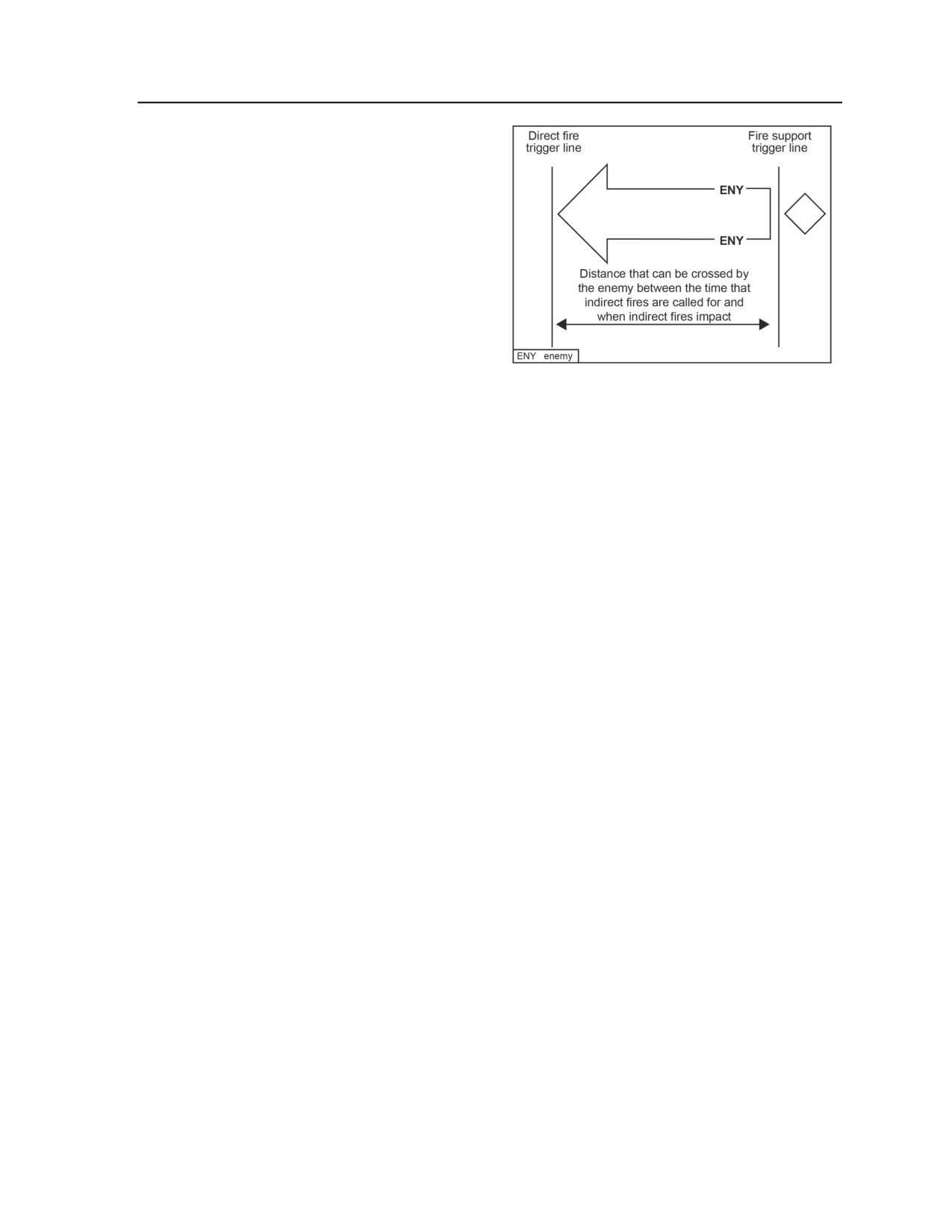
A-29. The commander designates a PL as the
trigger line for available supporting fire support
systems. The commander bases the location of the
trigger line on the mission variables of METT-TC,
including such variables as the time of flight for
artillery shells, positioning of the guns, and the
existence of quick-fire links. Its location varies
from situation to situation. Its position reflects the
distance an enemy force is likely to traverse in the
time it takes from when fires are requested to when
artillery rounds impact, at a given enemy’s
movement speed. (See figure A-10.) This gives
time for supporting fire support systems to respond
to the initial call for fire. For example, in a desert
environment—for enemy forces traveling at speed
Figure A-10. Trigger line examples
X, a battalion task force commander’s fire support
trigger line is approximately four kilometers beyond the point where the commander wants to engage the
enemy with indirect fires when M109A6 howitzers are in direct support. It is approximately six kilometers
when M109A3 howitzers are in direct support. The shorter distance reflects the generally more rapid
response capabilities of the M109A6.
A-30. The commander can establish another trigger line for the unit’s most accurate long-range weapon
system in the vicinity of the area where the fire support impacts to capitalize on the asymmetric attack.
However, dust and debris resulting from the artillery fire may prevent direct-fire systems from engaging the
enemy. The commander establishes other trigger lines and TRPs for shorter-range systems. The
commander may give guidance to extremely proficient crews to engage the enemy at longer than normal
ranges or give them different engagement priorities than the rest of the force, such as giving priority to
engaging air defense or engineer-breaching systems.
A-31. When the enemy reaches these closer trigger lines, the commander establishes a decision point to
help force a determination on whether the commander wants available longer-range systems to continue to
fire in depth or to concentrate unit fires on a single point. Many factors impact this decision, most of which
concern the enemy and how the enemy maneuvers and the effects of the defending force’s fires.
FIRE SUPPORT COORDINATION MEASURES
A-32. Commanders assigned an AO employ fire support coordination measures (FSCMs) to facilitate rapid
target engagement and simultaneously provide safeguards for friendly forces. FSCMs are either permissive
or restrictive. Boundaries are the basic FSCM. The fire support coordinator recommends FSCMs to the
commander based on the commander’s guidance, location of friendly forces, scheme of maneuver, and
anticipated enemy actions. Once established, they are entered into or posted on all the command’s displays
and databases. (ADRP 3-09 explains the use of all FSCMs in more detail).
Permissive Fire Support Coordination Measures
A-33. The primary purpose of permissive measures is to facilitate the attack of targets. Once they are
established, further coordination is not required to engage targets affected by the measures. Permissive
FSCMs include a coordinated fire line (CFL), a fire support coordination line (FSCL), and a free-fire area
(FFA).
Coordinated Fire Line
A-34. A coordinated fire line is a line beyond which conventional and indirect surface fire support means
may fire at any time within the boundaries of the establishing headquarters without additional coordination.
The purpose of the coordinated fire line is to expedite the surface-to-surface attack of targets beyond the
coordinated fire line without coordination with the ground commander in whose area the targets are located
(JP 3-09). BCTs or divisions usually establish a CFL, although a maneuver battalion may establish one. It
22 March 2013
FM 3-90-1
A-9
Appendix A
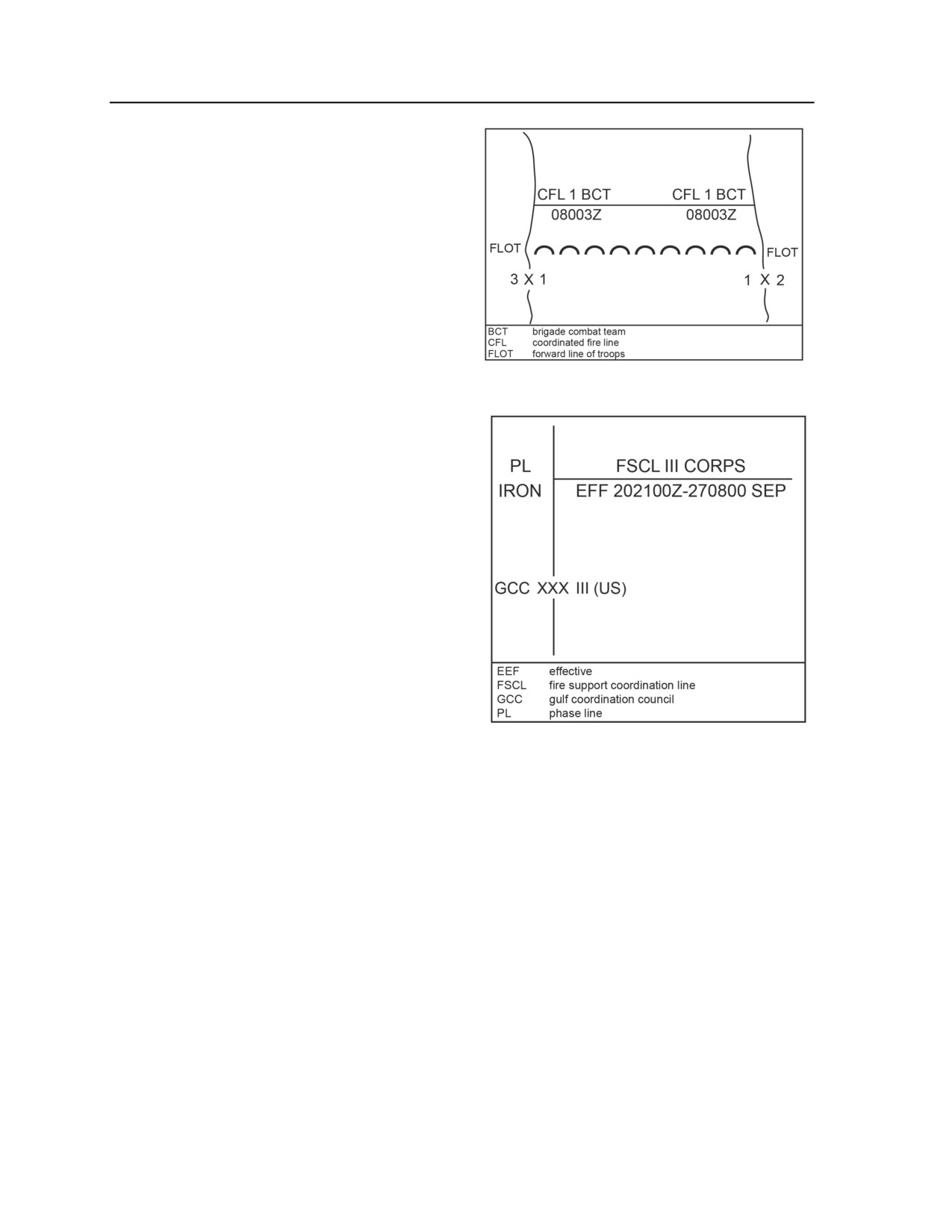
is located as close as possible to the establishing
unit without interfering with maneuver forces to
open up the area beyond the CFL to fires. A higher
echelon may consolidate subordinate unit CFLs. If
this occurs, any changes to the subordinate CFLs
are coordinated with the subordinate headquarters.
(See figure A-11.)
Fire Support Coordination Line
A-35. The fire support coordination line is a fire
support coordination measure that is established
and adjusted by appropriate land or amphibious
force commanders within their boundaries in
consultation with superior, subordinate, supporting,
Figure A-11. 1st Brigade combat team
and affected commanders. Fire support coordination
coordinated fire line
lines facilitate the expeditious attack of surface
targets of opportunity beyond the coordinating
measure. A fire support coordination line does not
divide an area of operations by defining a boundary
between close and deep operations or a zone for
close air support. The fire support coordination line
applies to all fires of air, land, and sea-based
weapon systems using any type of ammunition.
Forces attacking targets beyond a fire support
coordination line must inform all affected
commanders in sufficient time to allow necessary
reaction to avoid fratricide. Supporting elements
attacking targets beyond the fire support
coordination line must ensure that the attack will
not produce adverse effects on, or to the rear of, the
line. Short of a fire support coordination line, all
air-to-ground
and surface-to-surface
attack
operations are controlled by the appropriate land or
amphibious force commander. The fire support
Figure A-12. III Corps fire support
coordination line should follow well-defined terrain
coordination line
features. Coordination of attacks beyond the fire
support coordination line is especially critical to commanders of air, land, and special operations forces. In
exceptional circumstances, the inability to conduct this coordination will not preclude the attack of targets
beyond the fire support coordination line. However, failure to do so may increase the risk of fratricide and
could waste limited resources (JP 3-09). (See figure A-12.)
A-36. The commander designating a FSCL remains responsible for establishing the priority, effects, and
timing of fires impacting beyond the FSCL. Coordination for attacks beyond the FSCL is through the air
tasking order. The appropriate land or amphibious commander controls attacks short of the FSCL. Army
commanders use the tactical air control system or the Army air-ground system to control the execution of
close air support (CAS). By establishing a FSCL close-in, yet at sufficient depth so as to not limit high
tempo maneuver, land and amphibious force commanders ease the coordination requirements for
engagement operations within their AOs by forces not under their control, such as naval surface fire
support or air interdiction.
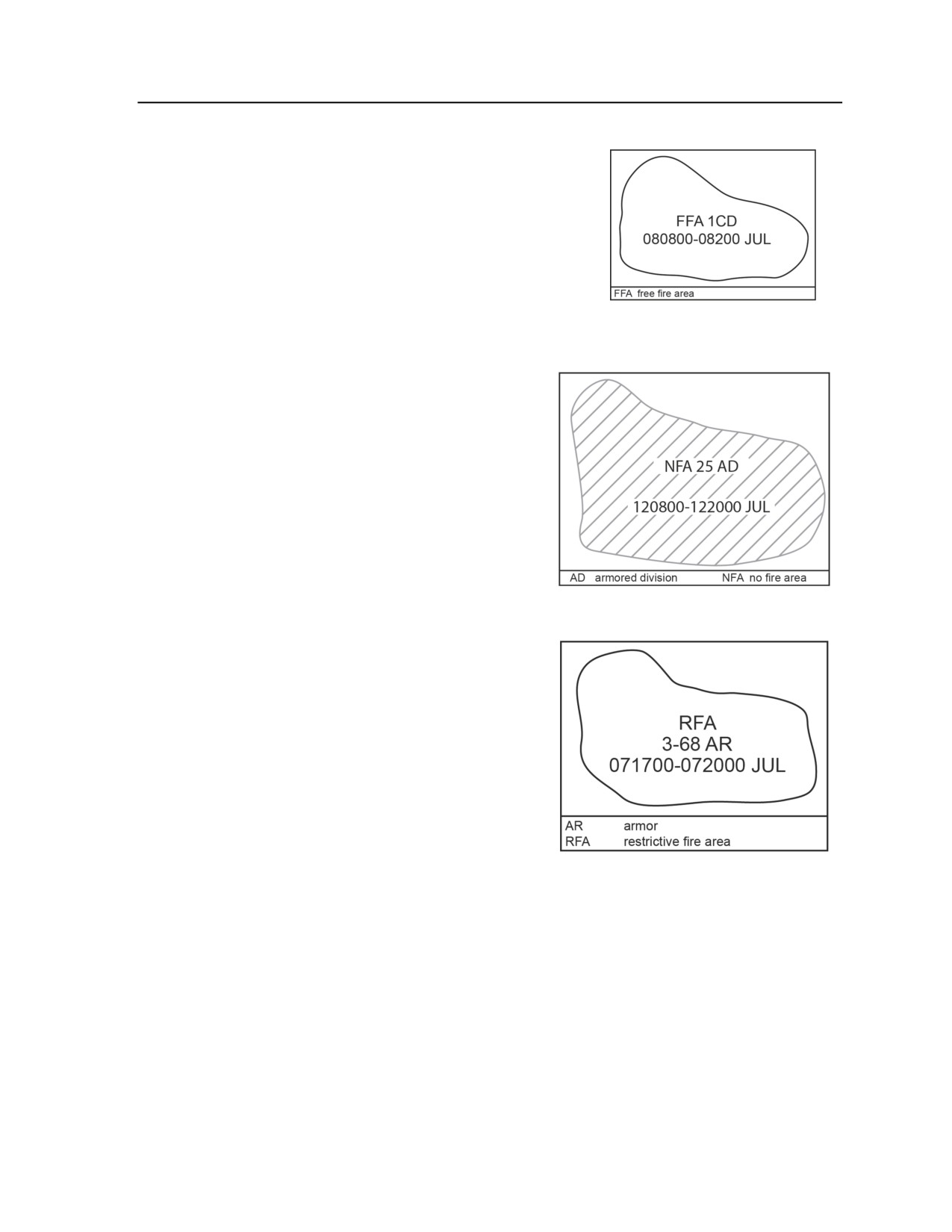
Free-Fire Area
A-37. A free-fire area is a specific area into which any weapon system may fire without additional
coordination with the establishing headquarters
(JP 3-09). Normally, division or higher headquarters
establish a FFA on identifiable terrain. (See figure A-13.)
A-10
FM 3-90-1
22 March 2013
Basic Tactical Control Measures
Restrictive Fire Support Coordination Measures
A-38. A restrictive FSCM prevents fires into or beyond the control
measure without detailed coordination. The primary purpose of
restrictive measures is to provide safeguards for friendly forces.
Restrictive FSCM include an airspace coordination area, a no-fire
area (NFA), a restrictive fire area (RFA), and a restrictive fire line
(RFL). Establishing a restrictive measure imposes certain
requirements for specific coordination before the engagement of
those targets affected by the measure.
(See FM 3-52
for a
description of an airspace coordination area.)
Figure A-13. 1CD free-fire
No-Fire Area
area
A-39. A no-fire area is an area designated by the
appropriate commander into which fires or their effects
are prohibited
(JP 3-09.3).
(See figure A-14.) A
commander uses a NFA to protect independently
operating elements, such as forward observers and special
operations forces. The commander can also use it to
protect friendly forces in the echelon support area and for
humanitarian reasons, such as preventing the inadvertent
engagement of displaced civilian concentrations, or to
protect sensitive areas, such as cultural monuments. This
rule has two exceptions:
z
The establishing headquarters may approve
fires within the NFA on a case-by-case mission
Figure A-14. Example no fire area
basis.
z
When an enemy force within a NFA engages a
friendly force, the friendly force may engage a
positively identified enemy force to defend
itself.
Restrictive Fire Area
A-40. A restrictive fire area is an area in which specific
restrictions are imposed and into which fires that exceed
those restrictions will not be delivered without
coordination with the establishing headquarters (JP 3-09).
(See figure A-15.) The purpose of the RFA is to regulate
fires into an area according to the stated restrictions, such
as no unguided conventional or dud-producing munitions.
Maneuver battalion or larger ground forces normally
Figure A-15. Example restrictive fire
establish RFAs. On occasion, a company operating
area
independently may establish a RFA. Usually, it is located
on identifiable terrain, by grid or by a radius (in meters) from a center point. The restrictions on a RFA may
be shown on a map or overlay, or reference can be made to an operation order that contains the restrictions.
Restrictive Fire Line
A-41. A restrictive fire line is a line established between converging friendly surface forces that prohibits
fires or their effects across that line (JP 3-09). Both or only one of those converging forces may be moving.
Fires and their effects can cross a RFL when the event has been coordinated with the establishing and
affected organizations. The purpose of the line is to prevent interference between converging friendly
forces, such as what occurs during a linkup operation. The next higher common commander of the
converging forces establishes the RFL. Located on identifiable terrain, it is usually located closer to the
22 March 2013
FM 3-90-1
A-11
Appendix A
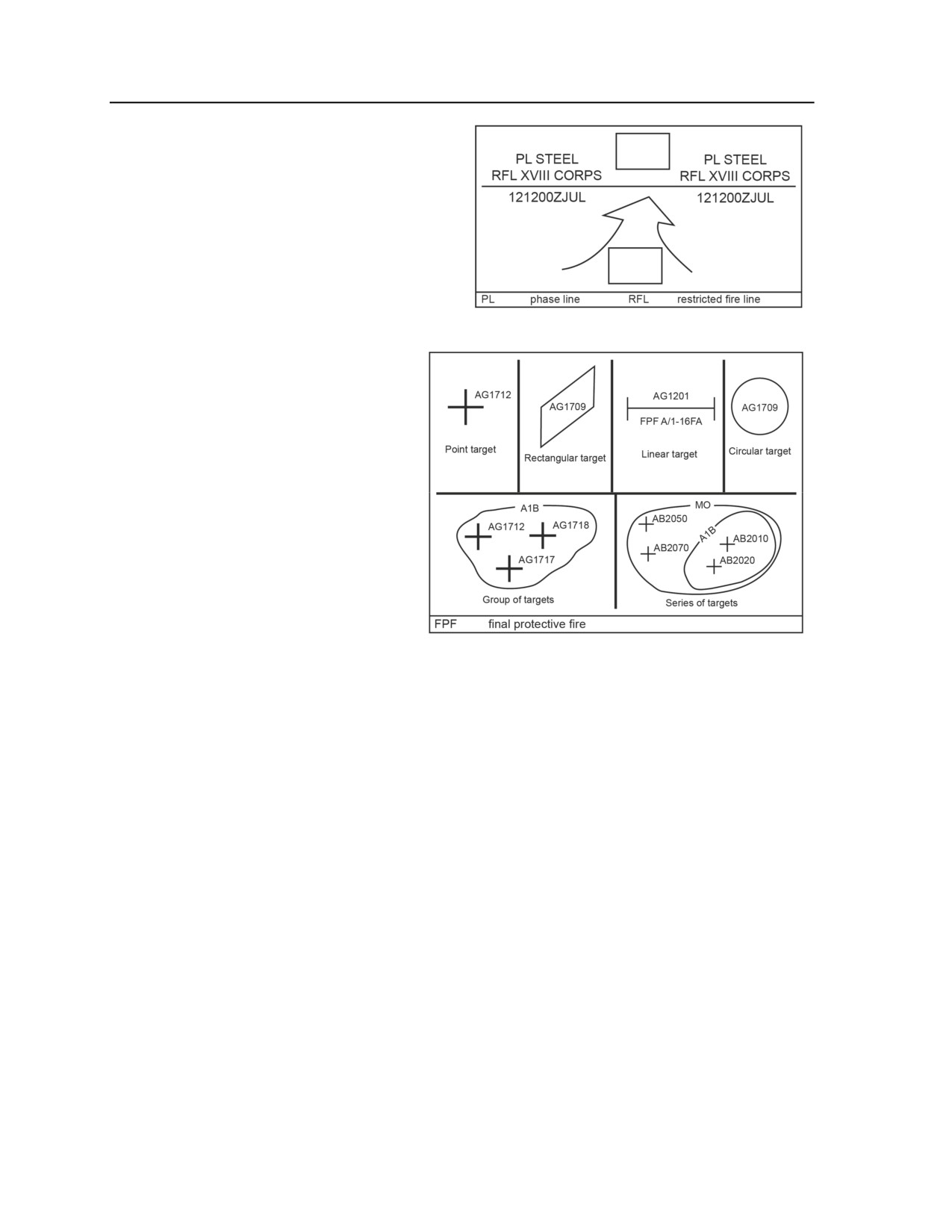
stationary force—if there is one—than to the
moving force. Alternatively, the commander can
use a RFL to protect sensitive areas, such as
cultural monuments. (See figure A-16.)
Fire Support Targets
A-42. In the fire support context, a target is an
area designated and numbered for future firing
(JP 3-60). There are control measures for point
targets, circular targets, rectangular targets, and
linear targets. Figure A-17 depicts these symbols.
Figure A-16. Example restrictive fire line
The commander designates fire support
targets using a two-letter and four-digit
code established in field artillery doctrine.
The commander may group two or more
targets for simultaneous engagement. This
is called a “group of targets.” A group of
targets is graphically shown by circling
the targets and identifying the group with
a group designator. This group designator
consists of the two letters assigned to the
block of target numbers assigned to a unit
with a number inserted between the two
letters. The commander may also attack
individual targets and groups of targets in
series or in a predetermined sequence.
When this occurs, it is referred to as a
“series of targets”. Graphically, a series of
targets is shown as individual targets or
Figure A-17. Fire support target symbols
groups of targets within a prescribed area.
The series is assigned a code name or
nickname. The fact that a series or group of targets has been designated does not preclude the attack of
individual targets within the series or group. It also does not preclude the attack of one or more groups of
targets within the series.
A-43. Doctrine classifies each fire support target as either a planned target or a target of opportunity.
Targets of opportunity are not planned in advance and are engaged as they present themselves in
accordance with established engagement criteria and rules of engagement. Planned targets are ones on
which fires are prearranged, although the degree of this prearrangement may vary.
A-44. Individually planned fire support targets may be further subdivided into scheduled and on-call fires.
Scheduled targets are planned targets on which field artillery and other fire support assets deliver their fires
in accordance with a pre-established time schedule and sequence. On-call targets are planned targets
engaged in response to a request for fires rather than in accordance with an established time schedule. An
on-call target requires less reaction time than a target of opportunity. The degree of prearrangement for the
on-call target influences the reaction time from request to execution-the greater the prearrangement, the
faster the reaction time. Priority targets are an example of on-call targets that have short reaction times,
since each priority target has a fire unit placed on it when it is not engaged in other fire missions. The final
protective fires (FPFs) of A Battery, 1st Battalion 16th Field Artillery in figure A-17 above is an example
of a priority target. (See ADRP 3-09 for additional information regarding fire support.)
A-45. Time-sensitive targets are not area targets designated and numbered for future firing. A
time-sensitive target is a joint force commander designated target requiring immediate response because it
is a highly lucrative, fleeting target of opportunity or it poses (or will soon pose) a danger to friendly forces
(JP 3-60).
A-12
FM 3-90-1
22 March 2013
Basic Tactical Control Measures
FORWARD LINE OF OWN TROOPS
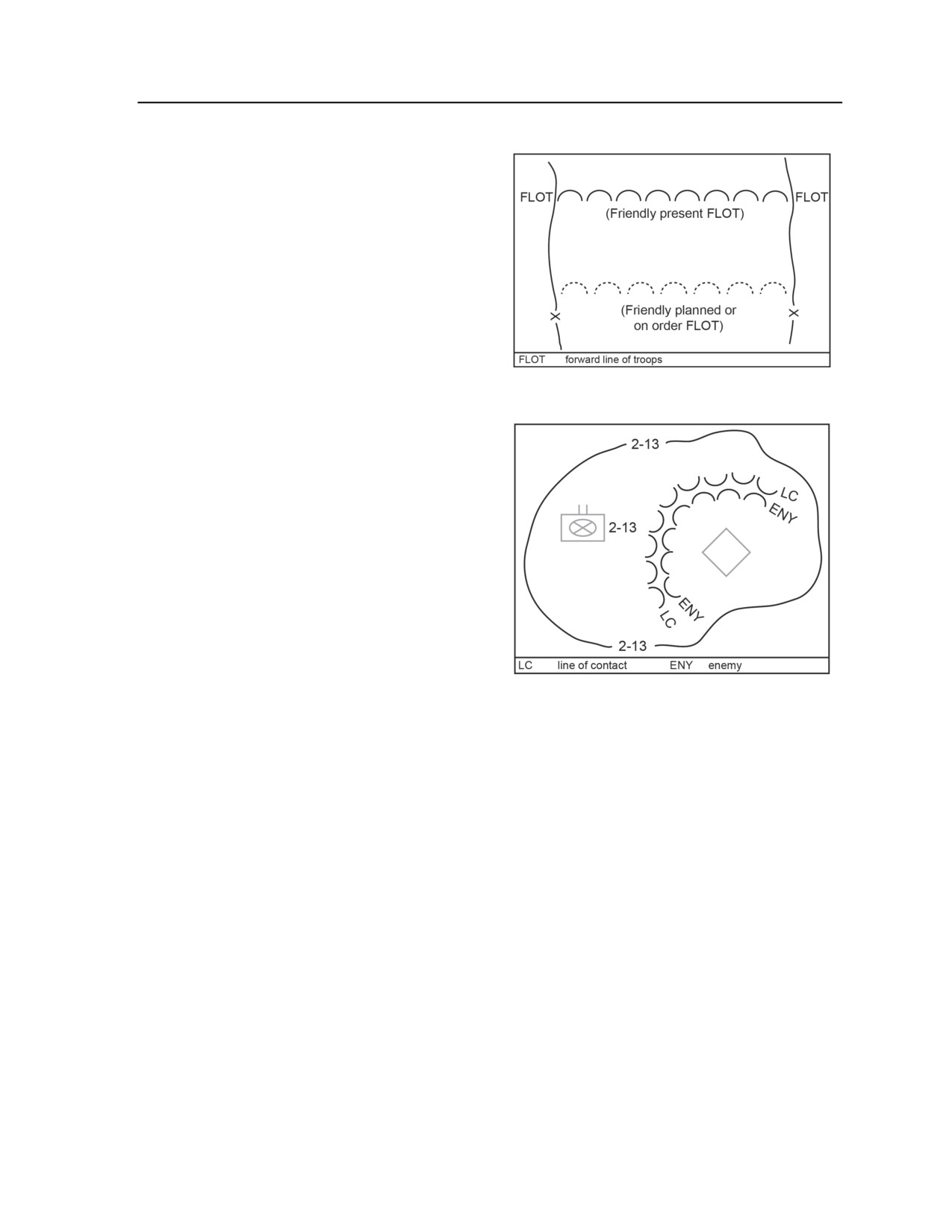
A-46. The forward line of own troops is a line
which indicates the most forward positions of
friendly forces in any kind of military operation at
a specific time (JP 3-03). The forward line of own
troops
(FLOT) normally identifies the forward
location of covering and screening forces. In the
defense, it may be beyond, at, or short of the
forward edge of the battle area (FEBA), depending
on the tactical situation. It does not include small,
long-range reconnaissance assets and similar
stay-behind forces. Friendly forces forward of the
FLOT may have a restrictive fire coordination
measure, such as an RFA, placed around them to
Figure A-18. Example forward line of own
preclude friendly fire incidents. Figure A-18
troops
depicts the symbol for the FLOT.
LINE OF CONTACT
A-47. The line of contact is a general trace
delineating the location where friendly and
enemy forces are engaged. The commander
designates the enemy side of the line of contact
(LC) by the abbreviation “ENY.” In the defense, a
LC is often synonymous with the FLOT. In the
offense, a LC is often combined with the LD.
Chapter 4 discusses the LD. Figure A-19 depicts
the symbol for the LC.
MOVEMENT CORRIDOR
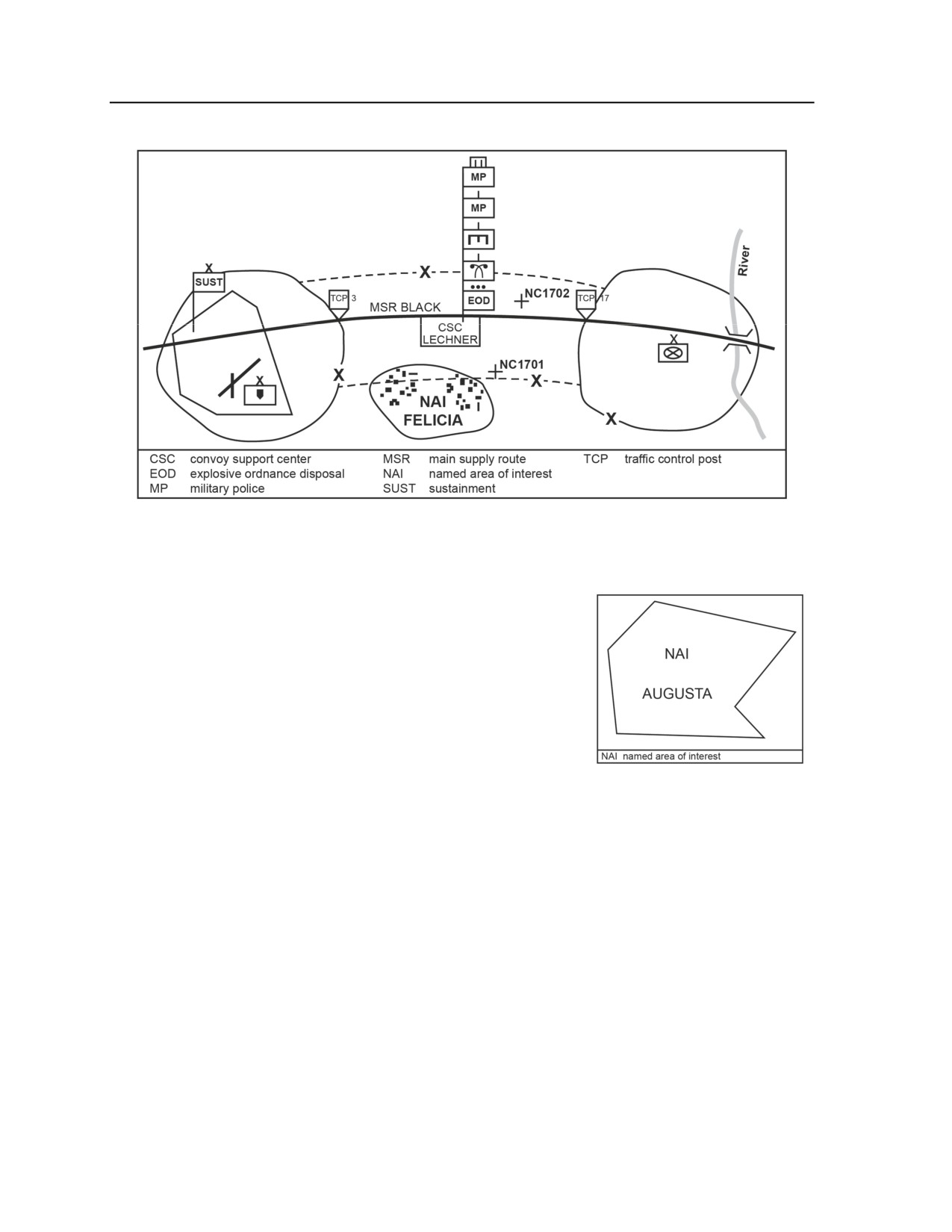
A-48. A movement corridor is a designated area
Figure A-19. Line of contact
established to protect and enable ground movement
along a route
(FM 3-90.31). Units establish a
movement corridor to set the conditions to protect and enable movement of traffic along a designated
surface route. Units conduct synchronized operations within the movement corridor such as
reconnaissance, security, mobility, and information engagement for forces that require additional mission
command, protection, and support to enable their movement. A movement corridor may be established to
facilitate the movement of a single element or be established for a longer period of time to facilitate the
movement of a number of elements along a given route. The owner of an AO may establish a movement
corridor within that AO along an established main supply route or a route designated for a unit’s
movement. The movement corridor would typically include the airspace above it to allow the establishing
unit to conduct aerial reconnaissance and fires. Figure A-20 on page A-14 depicts a movement corridor.
22 March 2013
FM 3-90-1
A-13
Appendix A
Figure A-20. Example movement corridor
NAMED AREA OF INTEREST
A-49. A named area of interest is the geographical area where
information that will satisfy a specific information requirement can
be collected
(ADRP 1-02). Named areas of interest (NAIs) are
usually selected to capture indications of enemy courses of action but
also may be related to battlefield and environmental conditions. In
this later case, the NAI may actually be a person, group, or portion of
cyberspace. The commander tailors the shape of the NAI symbol to
the actual area the commander wants observed, rather than using a
prescribed shape. It is possible to redesignate a NAI as a targeted
area of interest or a target area of interest (TAI) on confirmation of
enemy activity within the area, allowing a commander to mass the
Figure A-21. Named area of
effects of combat power on that area. Figure A-21 depicts NAI
interest Augusta
Augusta.
OBSTACLE CONTROL MEASURES
A-50. An obstacle is any natural or man-made obstruction designed or employed to disrupt, fix, turn, or
block the movement of an opposing force, and to impose additional losses in personnel, time, and
equipment on the opposing force (JP 3-15). Obstacles can be natural or man-made, or a combination of
both. Forces emplace tactical and protective obstacles that reinforce terrain restrictions and existing
obstacles, and integrate them with fires to affect enemy movement or maneuver and shape engagements.
Obstacle control measures are specific measures that simplify the granting of obstacle-emplacing
authority while providing obstacle control. They consist of—
z
Zones.
z
Belts.
z
Groups.
z
Restrictions.
A-14
FM 3-90-1
22 March 2013
Basic Tactical Control Measures
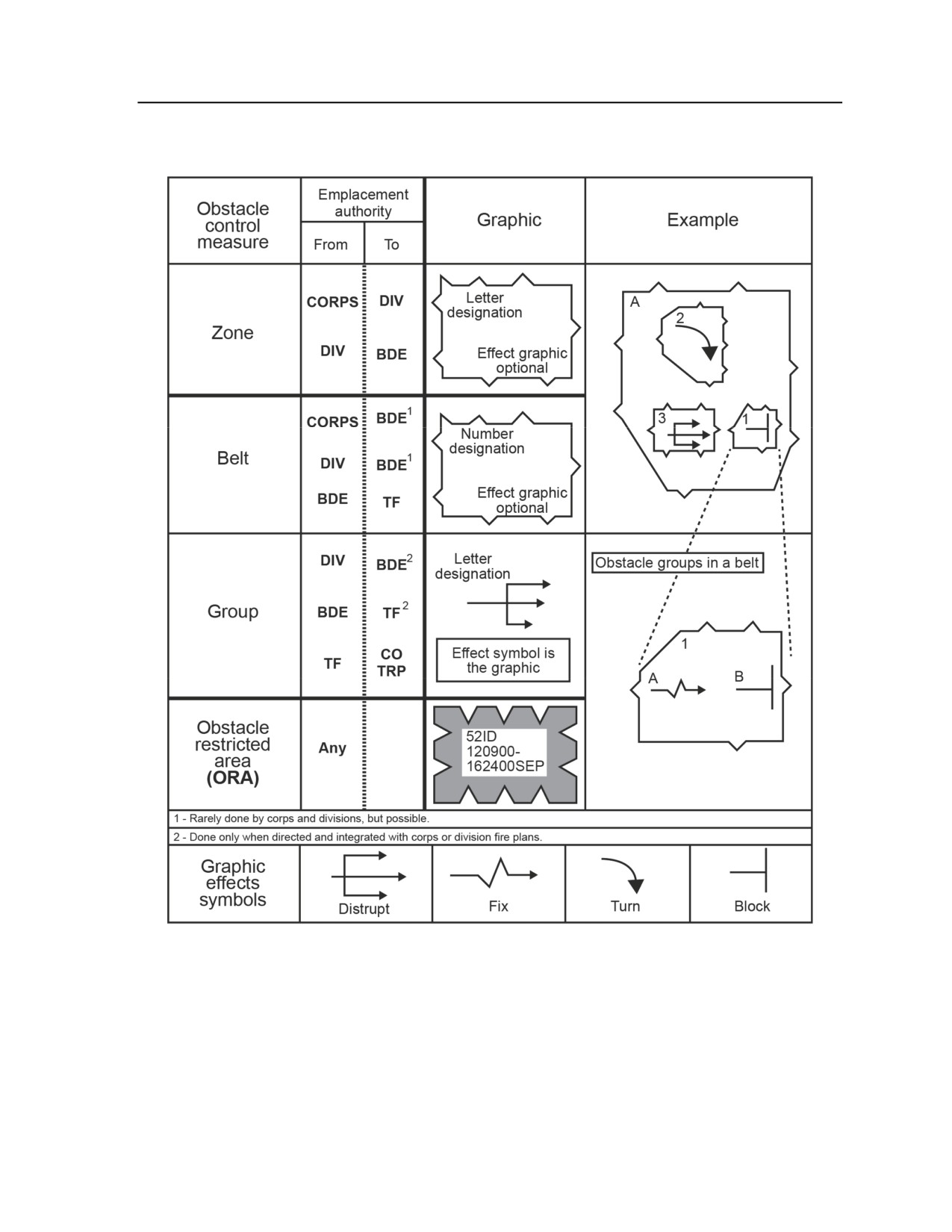
Figure A-22 summarizes these control measures. A commander assigned an AO can only emplace
protective obstacles unless authorized by that individual’s higher echelon commander.
Figure A-22. Obstacle control measure graphics
A-51. Analysis of the higher headquarters’ mission and commander’s intent identifies information that may
impact the mission. The components of this analysis are intent, AOs, military deception, directed and
implied tasks, limitations, available assets, risk, and emplacement timelines and risk. Among the directed
obstacle tasks are the planning, preparation, and execution of reserve obstacles. Reserve obstacles allow the
force to retain control over the mobility along a given avenue of approach. FM 90-7 discusses engagement
area development and obstacle integration.
22 March 2013
FM 3-90-1
A-15
Appendix A
Obstacle Zones
A-52. An obstacle zone is a division-level command and control measure, normally done graphically, to
designate specific land areas where lower echelons are allowed to employ tactical obstacles (JP 3-15).
Corps and division commanders use them to grant obstacle-emplacement authority to brigades (including
other major subordinate units). Obstacle zones are permissive, allowing a BCT to place reinforcing
obstacles to support their scheme of maneuver without interfering with future operations.
A-53. If the obstacle zone encompasses the entire BCT AO, another graphic is unnecessary. Commanders
may designate the entire AO as an obstacle zone, with the unit boundaries defining the geographical limits
of the zone. Obstacle zones do not cross BCT boundaries. Commanders assign obstacle zones to a single
subordinate unit to ensure unity of effort, just as they would when assigning defensive AOs or battle
positions. This keeps tactical obstacle responsibility along the same lines as control of direct and indirect
fires. This does not normally create vulnerabilities on the boundary between units since the commander
bases the assignment of both subordinate AOs and obstacle zones on defined avenues of approach.
A-54. A commander does not normally assign an obstacle effect (block, fix, turn, or disrupt) to an obstacle
zone. This allows subordinate commanders flexibility in using obstacles. The commander should establish
construction and resourcing priorities between different obstacle zones.
Obstacle Belts
A-55. An obstacle belt is a brigade-level command and control measure, normally given graphically, to
show where within an obstacle zone the ground tactical commander plans to limit friendly obstacle
employment and focus the defense (JP 3-15). It assigns an intent to the obstacle plan and provides the
necessary guidance on the overall effect of obstacles within a belt. Commanders plan obstacle belts within
assigned obstacle zones to grant obstacle-emplacement authority to their major subordinate units. Obstacle
belts also focus obstacles to support the brigade scheme of maneuver and ensure that obstacles do not
interfere with the maneuver of any higher headquarters.
A-56. Obstacle belts are restrictive, but also direct a subordinate unit to construct one or more obstacles to
create an effect in the area. They do not specify the type or number of obstacles. Obstacle belts do not cross
unit boundaries for the same reasons discussed in obstacle zones. A single unit is responsible for a belt;
however, a commander may assign more than one belt to a unit.
A-57. A BCT commander normally assigns an obstacle effect and priority to each obstacle belt. As with
the obstacle zone, the target and relative location are apparent. Adding a specific obstacle effect gives
purpose and direction to subordinate battalion obstacle planning. When BCT commanders assign an
obstacle effect, they ensure that obstacles within the belt complement the BCT fire plan.
A-58. A corps, division, or brigade commander may authorize emplacement authority for certain types of
protective obstacles outside of obstacle zones or belts. Normally, the commander authorizes company team
and base commanders to emplace protective obstacles within 500 meters of their positions, depending on
the mission variables of METT-TC. The commander usually limits the types of obstacles a unit may use for
protective obstacles that are outside of obstacle-control measures. For example, the commander may allow
only wire- and command-detonated mines outside of control measures for protective obstacles.
Furthermore, the commander may require that minefields be fenced on all sides to prevent friendly fire
incidents, after obtaining legal guidance concerning current rules and policies on mine emplacement.
Obstacle Groups
A-59. Obstacle groups are one or more individual obstacles grouped to provide a specific obstacle
effect. Task forces use obstacle groups to ensure that company teams emplace individual obstacles
supporting the task force’s scheme of maneuver. In rare cases, brigades, divisions, or even corps may use
obstacle groups for specific tactical obstacles. Also, units integrate obstacle groups with their direct- and
indirect-fire plans. Brigade and maneuver battalion commanders can plan their placement anywhere in the
obstacle zones or belts, respectively.
A-16
FM 3-90-1
22 March 2013
Basic Tactical Control Measures
A-60. Unlike obstacle zones or belts, obstacle groups are not areas but relative locations for actual
obstacles. Commanders normally show obstacle groups using the obstacle-effect graphics. When detailed
planning is possible (to include detailed on-the-ground reconnaissance), commanders may show obstacle
groups using individual obstacle graphics.
A-61. The company team commander and the engineer can adjust obstacles in the group if the intent and
link to the fire plan remain intact. Company team commanders make minor changes to obstacles and
fire-control measures based on terrain realities. For example, a commander may move a fixing obstacle
group and direct-fire TRPs a hundred meters to avoid having them masked by rolling terrain. However, a
major change to the obstacle group location requires the approval of the commander who ordered the
obstacle group emplacement.
Individual Obstacles
A-62. Each type of individual obstacle, such as abatis, antitank ditchs, booby traps, mines and minefields,
roadblocks, craters, and wire obstacles has its associated graphic. Once a unit constructs an individual
obstacle, the obstacle’s location is recorded and reported through the chain of command. Commanders
must report individual obstacles in sufficient detail so that any unit moving through the area can bypass or
reduce the obstacle without excessive risk. Each headquarters is responsible to ensure exact obstacle
locations are disseminated throughout its organization. Individual obstacle graphics are rarely shown on
maps above the battalion echelon and are not depicted in this publication. (Maneuver Support Center of
Excellence publications describe individual obstacles and establish their associated symbols.)
Obstacle Restrictions
A-63. Commanders may use obstacle restrictions to provide additional obstacle control and to limit the
specific types of obstacles used, such as restricting the use of buried mines. These restrictions ensure that
subordinates do not use obstacles with characteristics that impair future operations. These restrictions also
allow commanders to focus the use of limited resources for the decisive operation by restricting their use
elsewhere. An obstacle restricted area is a command and control measure used to limit the type or number
of obstacles within an area (JP 3-15). The commander with emplacement authority uses obstacle restricted
areas (ORAs) to restrict obstacle placement. The ORA graphic depicts the impacted area, the unit imposing
the restriction, and the restrictions in effect.
PHASE LINE
A-64. A phase line is a line utilized for control and coordination of military operations, usually an easily
identified feature in the operational area
(JP 3-09).
(See figure A-23 on page A-18.) A commander
establishes PLs to control the maneuver of the units. Phase lines are not boundaries unless designated as
such and do not establish any specific responsibilities between units, unless the operations order so
specifies. When possible, the commander places them along easily recognizable terrain features—such as
roads, railroad tracks, rivers, and ridgelines—to ensure easy identification. As with boundaries, this is less
important if all units are equipped with precision navigation devices, such as global positioning systems
(GPS). Some PLs have additional designations for specific purposes, such as a LD or a probable line of
deployment (PLD).
POSITION AREA FOR ARTILLERY
A-65. A position area for artillery is an area assigned to an artillery unit where individual artillery
systems can maneuver to increase their survivability. A position area for artillery is not an area of
operations for the artillery unit occupying it. The commander assigns position areas for artillery (PAAs)
for terrain management purposes. Establishing a PAA lets other subordinate units know they should avoid
occupying that same terrain, thus avoiding enemy counterfire. While the exact size of a PAA depends on
the mission variables of METT-TC, a Paladin platoon normally requires a PAA encompassing over four
square kilometers, and a Multiple Launch Rocket System (MLRS) platoon requires nine square kilometers.
(See figure A-24 on page A-18.)
22 March 2013
FM 3-90-1
A-17
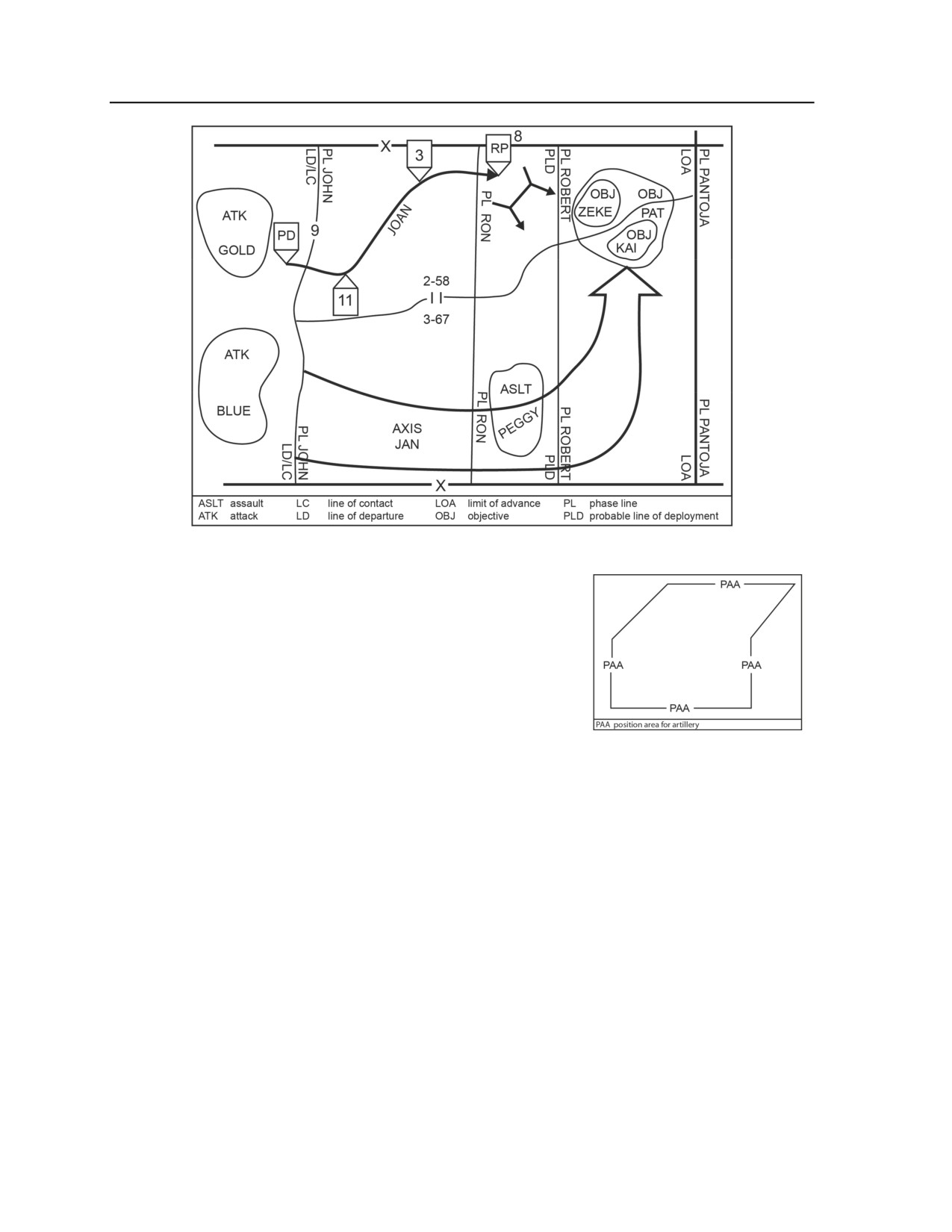
Appendix A
Figure A-23. Phase lines with other control measures
A-66. The maneuver echelon operations officer (G-3 or S-3) of the
unit that owns the terrain establishes the PAA. The occupying
artillery unit does not have the same authority and responsibilities
toward the PAA that are associated with a unit assigned an AO. For
example, other units can move through a PAA without clearing that
movement with the artillery unit. The artillery unit occupying a PAA
establishes liaison with the unit that owns the AO where the PAA is
located. The echelon fire support officer usually conducts this liaison
in accordance with standard command and support relationships.
(For a discussion of common command and support relationships,
Figure A-24. Position area for
see ADP 3-0. For a discussion of artillery missions, see ADRP 3-09.)
artillery
A-67. The decision to establish a PAA affects airspace control for
rotary-, fixed-wing, and tilt-rotor aircraft integration. A PAA is a base upon which to establish future
grid-target lines for lateral deconfliction and areas for rotary-, fixed-wing, and tilt rotor aircraft to avoid,
depending on high- or low-angle artillery fires.
ROUTE
A-68. A route is the prescribed course to be traveled from a specific point of origin to a specific
destination. (See Route Iron in figure A-25.) Routes can have different functions. Those functions can be
added as adjectives to specify different types of routes. Examples of such routes include a passing route and
a main supply route (MSR). The commander can further designate MSRs as open, supervised, dispatch,
reserved, or prohibited. The commander can assign names, numbers, or alphanumeric designations to
routes within the AO. (See FM 3-34.170 for additional information concerning route classification and
marking.)
A-18
FM 3-90-1
22 March 2013
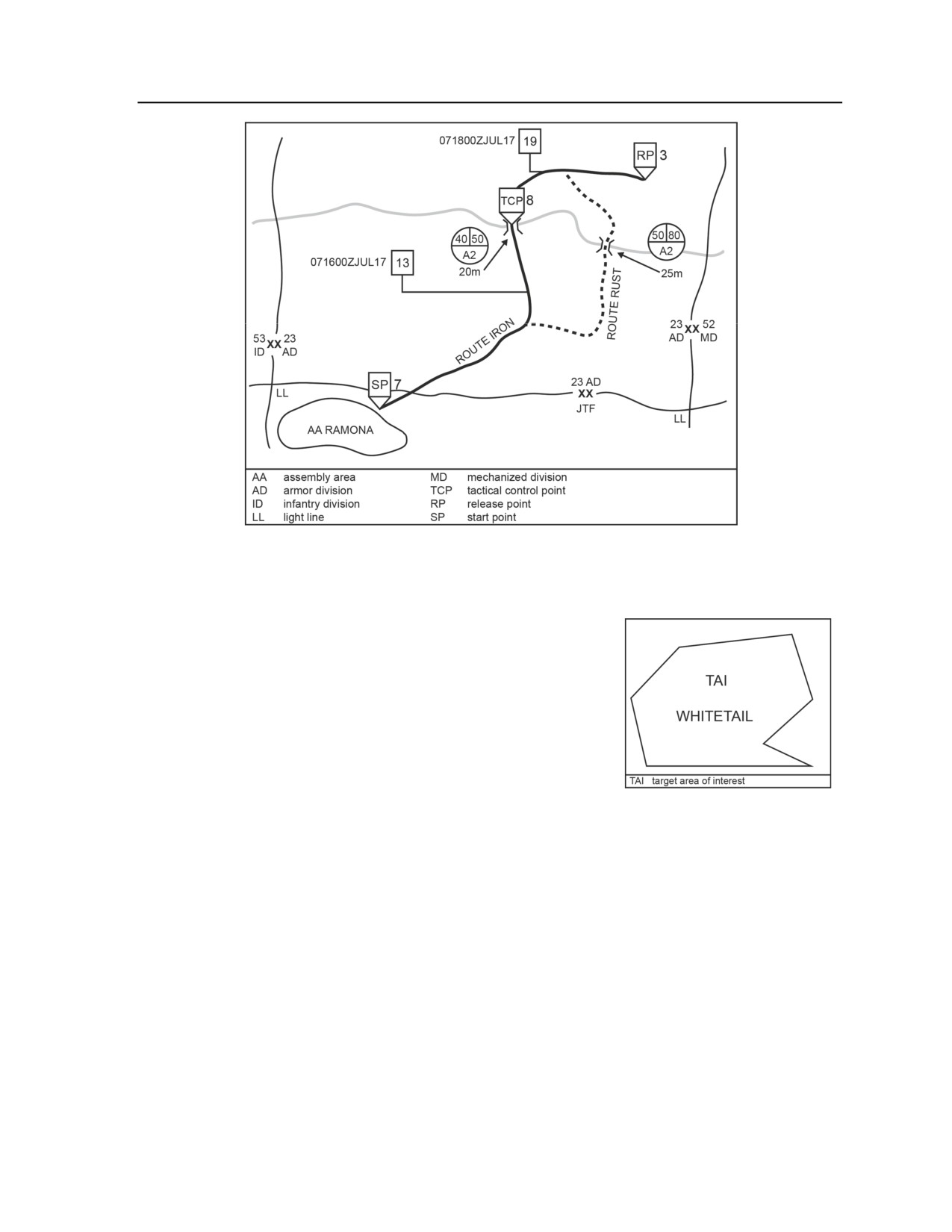
Basic Tactical Control Measures
Figure A-25. Example routes
TARGET AREA OF INTEREST
A-69. A target area of interest is the geographical area where
high-value targets can be acquired and engaged by friendly forces.
Not all target areas of interest will form part of the friendly course of
action; only target areas of interest associated with high priority
targets are of interest to the staff. These are identified during staff
planning and wargaming. Target areas of interest differ from
engagement areas in degree. Engagement areas plan for the use of all
available weapons; target areas of interest might be engaged by a
single weapon. (JP 2-01.3) Not all target areas of interest will form
part of the friendly course of action; only target areas of interest
associated with high priority targets are of interest to the staff. The
commander designates a target area of interest where subordinate
Figure A-26. Example target
friendly weapon systems can best attack high-payoff targets. The unit
area of interest
staff develops these target areas of interest during the targeting
process, based on the currently available products resulting from the IPB process. These target areas of
interest are further refined during wargaming and finally approved by the commander during course of
action approval. The shape of a target area of interest reflects the type of target and the weapon system
intended to engage that target. They are normally cued by surveillance assets, which include unmanned
aircraft system (UAS), combat observation and lasing teams (COLTs), long-range surveillance teams,
fixed-wing reconnaissance aircraft using a variety of sensors, and special operations forces. A commander
can designate a target area of interest for any organic or supporting systems, including close air support.
Target areas of interest differ from engagement areas in degree. Commanders plan EAs for the use of all
available weapons, while TAIs might be engaged by only a single weapon system. Figure A-26 depicts TAI
Whitetail.
A-70. The Army term targeted area of interest is the geographical area or point along a mobility corridor
where successful interdiction will cause the enemy to abandon a particular course of action or require the
enemy to use specialized engineer support to continue. It is where the enemy force can be acquired and
engaged by friendly forces (ADRP 1-02).
22 March 2013
FM 3-90-1
A-19
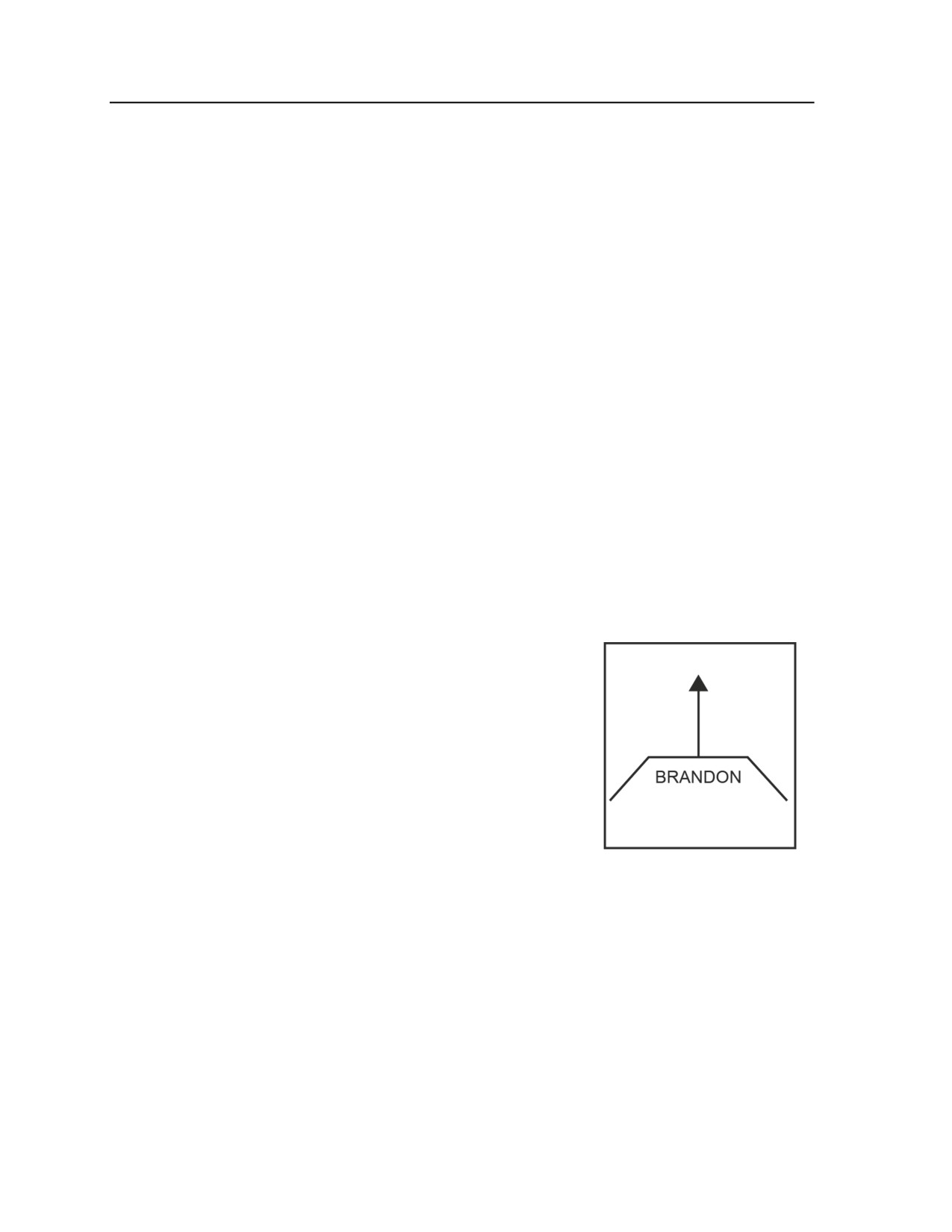
Appendix A
COMMON OFFENSIVE CONTROL MEASURES
A-71. This section defines in alphabetical order those common offensive control measures commanders
use to synchronize the effects of combat power. The commander uses the minimum control measures
required to successfully complete the mission while providing subordinates the flexibility needed to
respond to changes in the situation.
Assault Position
A-72. An assault position is a covered and concealed position short of the objective from which final
preparations are made to assault the objective. (ADRP 3-90). These final preparations can involve tactical
considerations, such as a short halt to coordinate the final assault, reorganize to adjust to combat losses, or
make necessary adjustments in the attacking force’s dispositions. These preparations can also involve
technical items, such as engineers conducting their final prepare-to-fire checks on obstacle clearing systems
and the crews of plow- and roller-equipped tanks removing their locking pins. An assault position may be
located near either a final coordination line (FCL) or a probable line of deployment (PLD). (Paragraphs
A-79 and A-84 define a FCL and a PLD respectively.)
Assault Time
A-73. The assault time establishes the moment to attack the initial objectives throughout the geographical
scope of the operation (ADRP 3-90). It is imposed by the higher headquarters in operations to achieve
simultaneous results from several different units. It synchronizes the moment the enemy feels the effects of
friendly combat power. It is similar to the time-on-target control method for fire mission processing used
by the field artillery. A commander uses it instead of a time of attack (see paragraph A-87) because of the
different distances that elements of the commander’s force must traverse, known obstacles, and differences
in each unit’s tactical mobility.
Attack by Fire Position
A-74. An attack by fire position designates the general position from
which a unit conducts the tactical task of attack by fire (ADRP 3-90).
(Appendix B defines the tactical mission task of attack by fire.) The
purpose of these positions is to mass the effects of direct fire systems
for one or multiple locations toward the enemy. An attack by fire
position does not indicate the specific site. Attack by fire positions
are rarely applicable to units larger than company size. Figure A-27
depicts attack by fire position BRANDON.
Attack Position
A-75. The attack position is the last position an attacking force
occupies or passes through before crossing the line of departure
Figure A-27. Attack by fire
(ADRP 3-90). An attack position facilitates the deployment and
position Brandon
last-minute coordination of the attacking force before it crosses the
LD. It is located on the friendly side of the LD and offers cover and concealment for the attacking force. It
is used primarily at battalion level and below. Whenever possible, units move through the attack position
without stopping. An attacking unit occupies an attack position for a variety of reasons, including, for
example, when the unit is waiting for specific results from preparation fires or when it is necessary to
conduct additional coordination, such as a forward passage of lines. If the attacking unit occupies the attack
position, it stays there for the shortest amount of time possible to avoid offering the enemy a lucrative
target. (Figure A-28 shows attack positions BLUE and GOLD used in conjunction with other common
offensive control measures.)
A-20
FM 3-90-1
22 March 2013
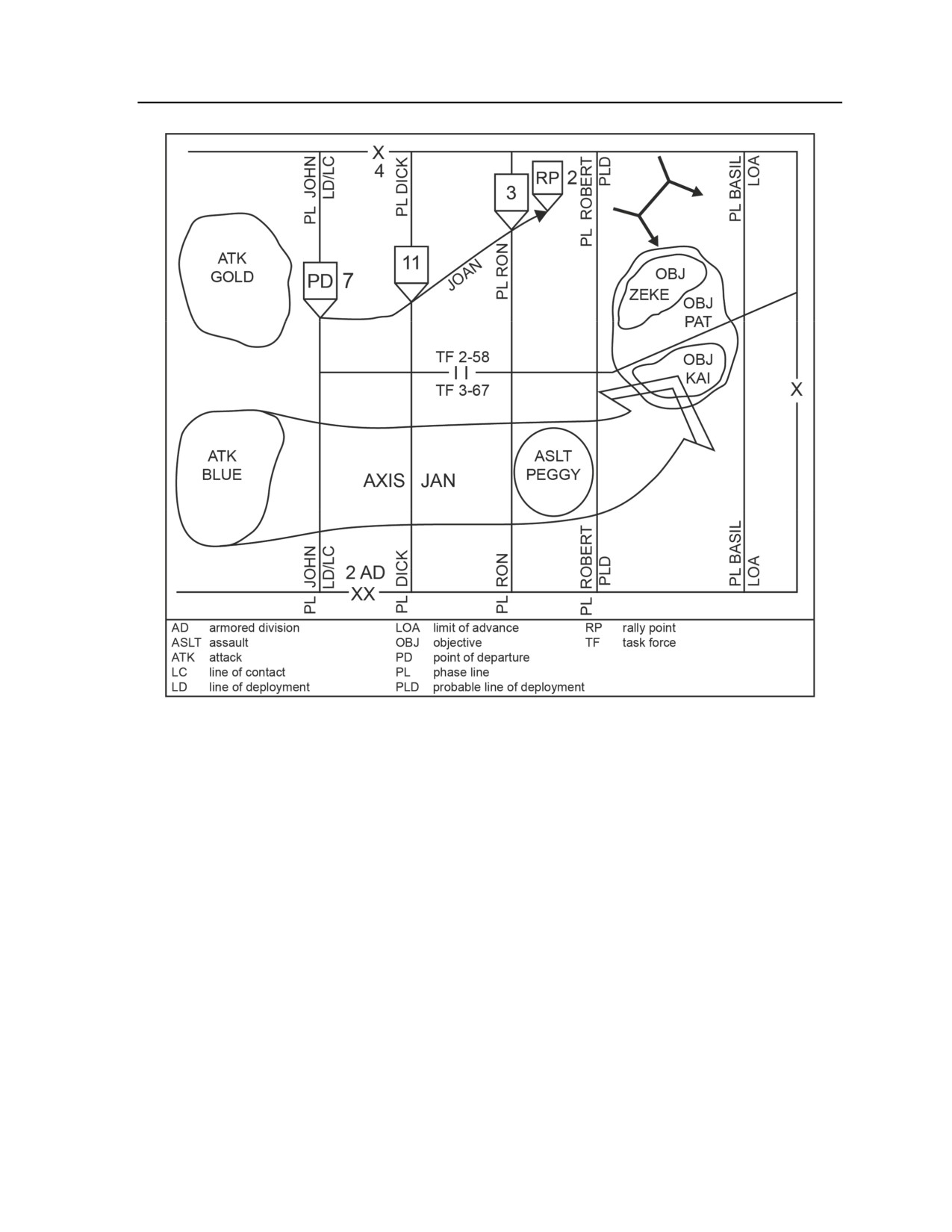
Basic Tactical Control Measures
Figure A-28. Attack positions used with other common offensive control measures
Axis of Advance
A-76. An axis of advance designates the general area through which the bulk of a unit’s combat power
must move (ADRP 3-90). When developing the axis of advance, the commander also establishes bypass
criteria. Bypass criteria are measures during the conduct of an offensive operation established by higher
headquarters that specify the conditions and size under which enemy units and contact may be avoided
(ADRP 3-90). There are three primary reasons why a commander uses an axis of advance:
z
First, to direct the bypass of locations that could delay the progress of the advancing force, such
as known contaminated areas.
z
Second, to indicate that the force is not required to clear the AO as it advances. The force will be
required to clear the axis in accordance with specified bypass criteria.
z
The third primary reason is to indicate to a unit involved in offensive encirclement, exploitation,
or pursuit operations the need to move rapidly toward an objective.
When using an axis of advance there is always the risk that enemy forces outside the axis not being
detected and being inadvertently bypassed. Figure A-28 depicts axis of advance JAN.
Battle Handover Line
A-77. The battle handover line is a designated phase line on the ground where responsibility transitions
from the stationary force to the moving force and vice versa
(ADRP 3-90). The common higher
22 March 2013
FM 3-90-1
A-21
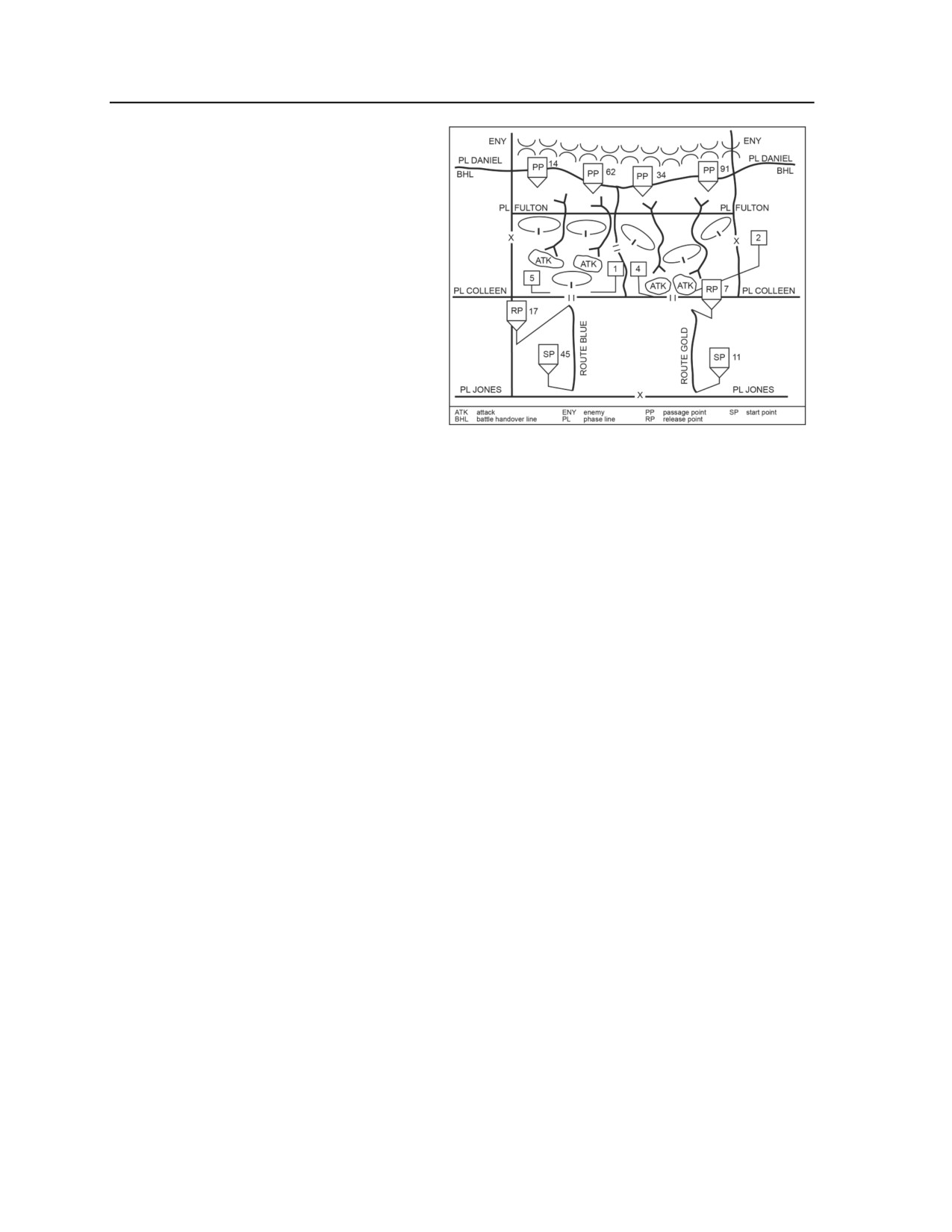
Appendix A
commander of the two forces establishes the
battle handover line (BHL) after consulting
both commanders. The stationary commander
determines the location of the line. The BHL
is forward of the forward edge of the FEBA
in the defense or the FLOT in the offense.
The commander draws it where elements of
the passing unit can be effectively supported
by the direct fires of the forward combat
elements of the stationary unit until passage
of lines is complete. The area between the
BHL and the stationary force belongs to the
stationary force commander. The stationary
force commander may employ security
forces, obstacles, and fires in the area. Figure
A-29 depicts a BHL used in conjunction with
other control measures for a rearward passage
of lines.
Figure A-29. Battle handover line in a rearward
passage of lines
Direction of Attack
A-78. The direction of attack is a specific direction or assigned route a force uses and does not deviate
from when attacking (ADRP 3-90). It is a restrictive control measure. The commander’s use of a direction
of attack maximizes control over the subordinate unit movement, and is often used during night attacks,
infiltrations, and when attacking through smoke. The commander establishes a direction of attack through a
variety of means, such as target reference points, checkpoints, GPS way points, and using sensors, such as
ground surveillance radar to track the attack force and target acquisition radars to track the impact of
artillery shells. Target reference points placed on recognizable terrain provide the commander with the
capability to rapidly shift fires and reorient subordinate maneuver forces. When using a direction of attack,
the commander designates a point of departure (PD). (Figure A-28 on page A-21 depicts direction of attack
JOAN.)
Final Coordination Line
A-79. The final coordination line is a phase line close to the enemy position used to coordinate the lifting
or shifting of supporting fires with the final deployment of maneuver elements (ADRP 3-90). Final
adjustments to supporting fires necessary to reflect the actual versus the planned tactical situation take
place before crossing this line. It should be easily recognizable on the ground. The FCL is not a fire support
coordination measure. (Figure A-30 shows PL ROBERT as the FCL for the 4th Brigade.)
Limit of Advance
A-80. The limit of advance is a phase line used to control forward progress of the attack. The attacking unit
does not advance any of its elements or assets beyond the limit of advance, but the attacking unit can push
its security forces to that limit
(ADRP 3-90). A commander usually selects a linear terrain feature,
perpendicular to the direction of attack, on the far side of the objective as the limit of advance (LOA)
because such a terrain feature is easily identifiable. The commander employs a LOA to prevent
overextending the attacking force and reduce the possibility of fratricide and friendly fire incidents by fires
supporting the attack. The commander positions a LOA far enough beyond the objective to allow the unit
to defend the objective. A LOA prevents units from exploiting success and launching a pursuit; therefore,
commanders should only use LOAs if they do not want their units to conduct an exploitation or pursuit. A
forward boundary is always a LOA, but a LOA is not necessarily a forward boundary. In fact, a LOA and
the unit’s forward boundary should rarely coincide because of the resulting limitations that a forward
boundary places on supporting fires beyond the forward boundary. Figure A-30 shows PL BASIL used as
4th Brigade’s LOA.
A-22
FM 3-90-1
22 March 2013
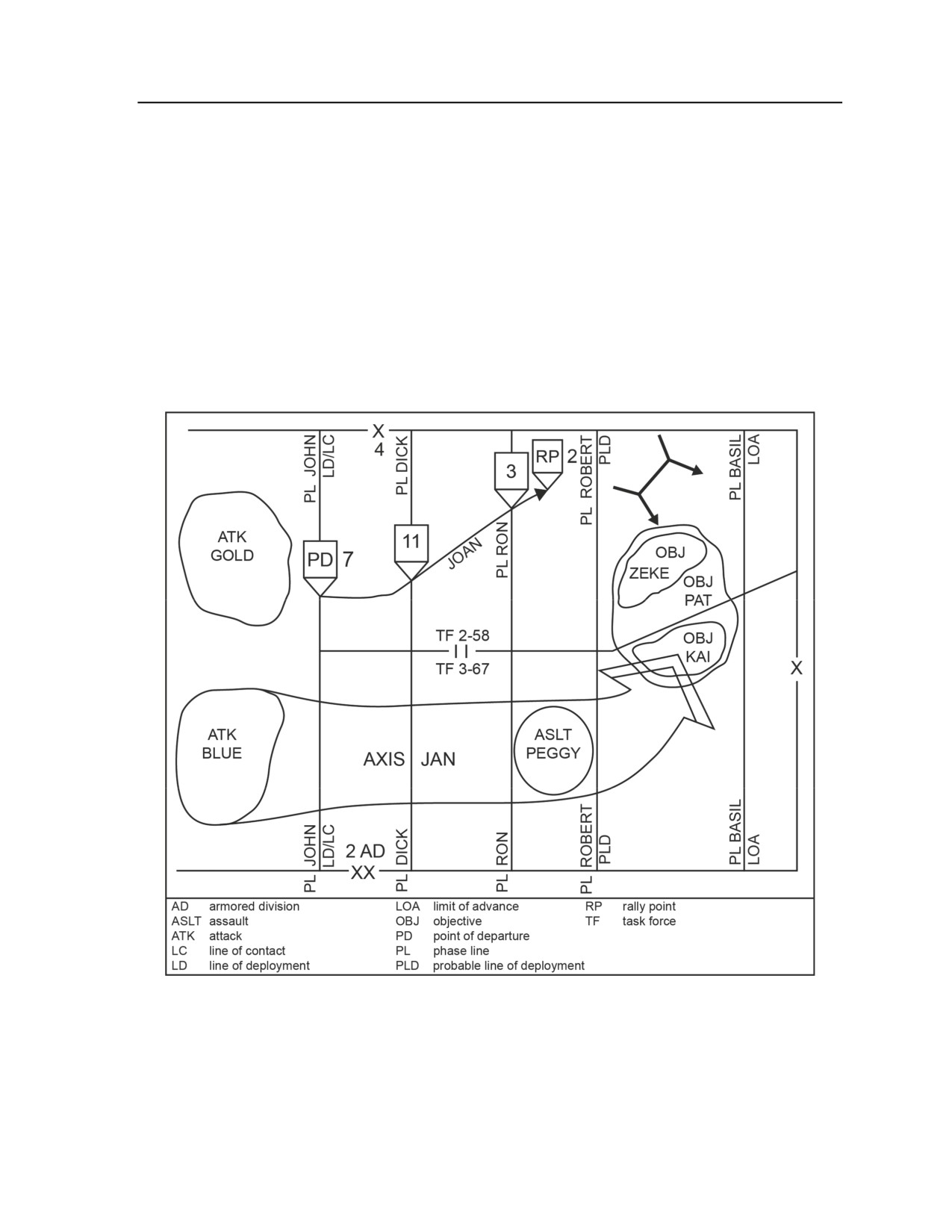
Basic Tactical Control Measures
Line of Departure
A-81. The line of departure is a phase line crossed at a prescribed time by troops initiating an offensive
operation (ADRP 3-90). The purpose of the LD is to coordinate the advance of the attacking force, so that
its elements strike the enemy in the order and at the time desired. The LD also marks where the unit
transitions from movement to maneuver. The commander can also use it to facilitate the coordination of
fires. Generally, it should be perpendicular to the direction the attacking force will take on its way to the
objective. Friendly forces should control the LD. The commander analyzes the terrain before designating a
LD. Different units have different movement rates on leaving their AAs based on their inherent mobility
characteristics and the terrain being crossed. The commander considers these different characteristics when
establishing the LD to prevent these differences from affecting the synchronization of the operation. When
possible, the commander selects the LD so that the terrain the attack unit traverses before crossing the LD
provides sufficient cover for the attacking unit’s final deployment into a combat formation before crossing
the LD. In many cases the LD is also the LC because the unit in contact is conducting the attack from its
current positions. Figure A-30 depicts PL JOHN as a combined LD and LC.
Figure A-30. Final coordination line, limit of advance, and line of departure used with other
offensive control measures
Objective
A-82. An objective is a location on the ground used to orient operations, phase operations, facilitate
changes of direction, and provide for unity of effort (ADRP 3-90). An objective can be either terrain- or
22 March 2013
FM 3-90-1
A-23
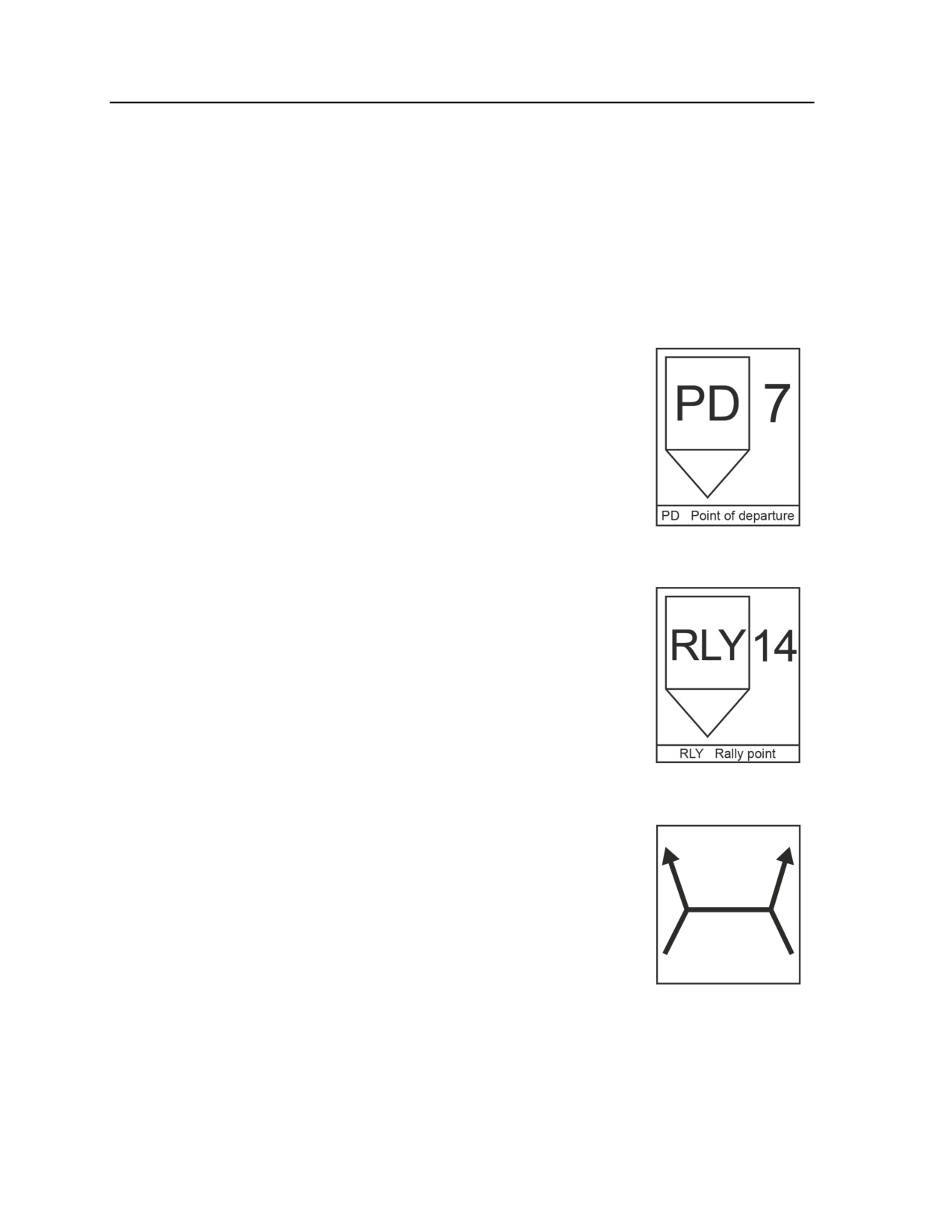
Appendix A
force-oriented. Terrain objectives should be easily identifiable on the ground to facilitate their recognition.
The commander determines force-oriented objectives based on known enemy positions. The commander
normally assigns subordinate commanders only their final objectives, but can assign intermediate
objectives as necessary. Figure A-30 on page A23 depicts objective PAT. Objective PAT is further broken
down into two subordinate objectives, objective KAI and objective ZEKE.
Point of Departure
A-83. The point of departure is the point where the unit crosses the LD and begins moving along a
direction of attack (ADRP 3-90). Units conducting reconnaissance and security patrols and other operations
in a low-visibility environment commonly use a PD as a control measure. Like an LD, it marks the point
where the unit transitions from movement to maneuver under conditions of limited visibility. Figure A-31
depicts PD 7.
Probable Line of Deployment
A-84. A probable line of deployment is a phase line that designates the
location where the commander intends to deploy the unit into assault
formation before beginning the assault
(ADRP 3-90). The PLD is used
primarily at battalion level and below when the unit does not cross the LD in
its assault formation. It is usually a linear terrain feature perpendicular to the
direction of attack and recognizable under conditions of limited visibility. The
PLD should be located outside the range where the enemy can place the
attacking force under effective direct fire. It has no use except as it relates to
Figure A-31. Point of
the enemy. In figure A-30 on page A-23, PL ROBERT could also be
departure 7
designated as the PLD.
Rally Point
A-85. A rally point is an easily identifiable point on the ground at which
aircrews and passengers can assemble and reorganize following an incident
requiring a forced landing. Alternatively, it is also an easily identifiable point
on the ground at which units can reassemble and reorganize if they become
dispersed
(ADRP 1-02). Forces conducting a patrol or an infiltration
commonly use this control measure. The objective rally point is a rally point
established on an easily identifiable point on the ground where all elements of
the infiltrating unit assemble and prepare to attack the objective (ADRP 3-90).
It is typically near the infiltrating unit’s objective; however, there is no
Figure A-32. Rally
standard distance from the objective to the objective rally point. It should be
point 14
far enough away from the objective so that the enemy will not detect the
infiltrating unit’s attack preparations. Figure A-32 depicts rally point 14.
Support by Fire Position
A-86. A support by fire position designates the general position from which a
unit conducts the tactical mission task of support by fire
(ADRP 3-90).
(Appendix B defines the tactical mission task of support by fire.) The purpose
of these positions is to increase the supported force’s freedom of maneuver by
placing direct fires on an objective that is going to be assaulted by a friendly
force. Support by fire positions are located within the maximum friendly
direct-fire range of the enemy positions. The commander selects them so that
Figure A-33. Support
the moving assault force does not mask its supporting fires. For this reason,
by fire position
support by fire positions are normally located on the flank of the assault force,
elevated above the objective if possible. Support by fire positions are rarely applicable to units larger than
company size. The support by fire position graphic depicted in figure A-33 indicates the general location
and direction from which the unit provides fires; it does not indicate a specific site.
A-24
FM 3-90-1
22 March 2013
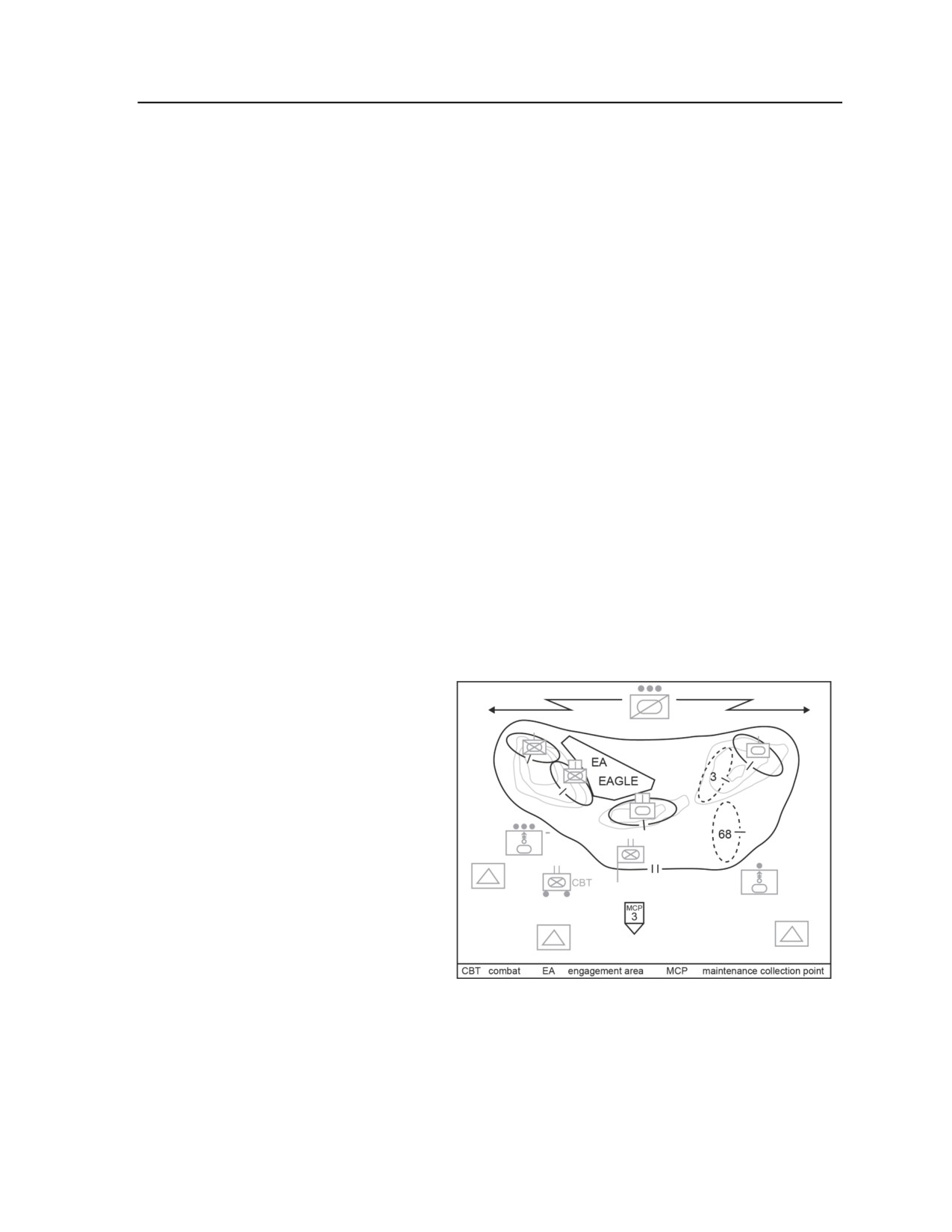
Basic Tactical Control Measures
Time of Attack
A-87. The time of attack is the moment the leading elements of the main body cross the line of departure,
or in a night attack, the point of departure.
(ADRP 3-90). A commander uses it when conducting
simultaneous operations where a shaping operation must accomplish its mission to set the conditions for the
success of the decisive operation. When determining time of attack, the commander considers the time
subordinates require to—
z
Conduct necessary reconnaissance, prepare plans, and issue orders.
z
Synchronize plans between all subordinate units.
z
Complete attack preparations, such as pre-combat inspections.
z
Move to the LD or PD.
A-88. Orders normally designate the time of attack as H-hour. This is normally when the main body
crosses the LD. However, H-hour can also designate the time to implement a phase of an operation, such as
an airborne or air assault phase. The headquarters planning the operation specifies the term’s exact
meaning. This is usually a part of the unit’s standard operating procedures (SOPs).
COMMON DEFENSIVE CONTROL MEASURES
A-89. The commander controls the defense by using control measures to provide the flexibility needed to
respond to changes in the situation and allow the defending commander to rapidly concentrate combat
power at the decisive point. Defensive control measures within a commander’s AO include designating the
security area, the battle handover line (BHL), the main battle area (MBA) with its associated FEBA, and
the echelon support area. (FM 3-90-2 discusses tactics associated with the conduct of security tasks.)
(Paragraph A-104 defines the FEBA.) The commander can use battle positions and additional direct fire
control and FSCMs in addition to those control measures discussed earlier in appendix A to further
synchronize the employment of combat power. The commander designates disengagement lines to trigger
the displacement of subordinate forces. These common defensive control measures are discussed in
alphabetical order below.
Battle Positions
A-90. A battle position is a defensive
location oriented on a likely enemy
avenue of approach (ADRP 3-90). The
battle position is an intent graphic that
depicts the location and general
orientation of the majority of the
defending forces. A commander’s use of a
battle position does not direct the position
of the subordinate’s entire force within its
bounds since it is not an AO. (See figure
A-34.) Units as large as battalion task
forces and as small as squads or sections
use battle positions. They may occupy the
topographical crest of a hill, a forward
slope, a reverse slope, or a combination of
these areas. The commander selects
positions based on terrain, enemy
capabilities, and friendly capabilities. A
Figure A-34. Task force battle position
commander can assign all or some
subordinates battle positions within the AO. (See figure A-35 on page A-26.)
A-91. The commander may assign subordinates battle positions in situations when there is a need to retain
a greater degree of control over the maneuver of subordinate units than that provided through only using an
AO, as the commander controls maneuver outside the general location of the battle position. Multiple battle
positions may be assigned to a single unit, which allows that unit to maneuver between battle positions. The
22 March 2013
FM 3-90-1
A-25
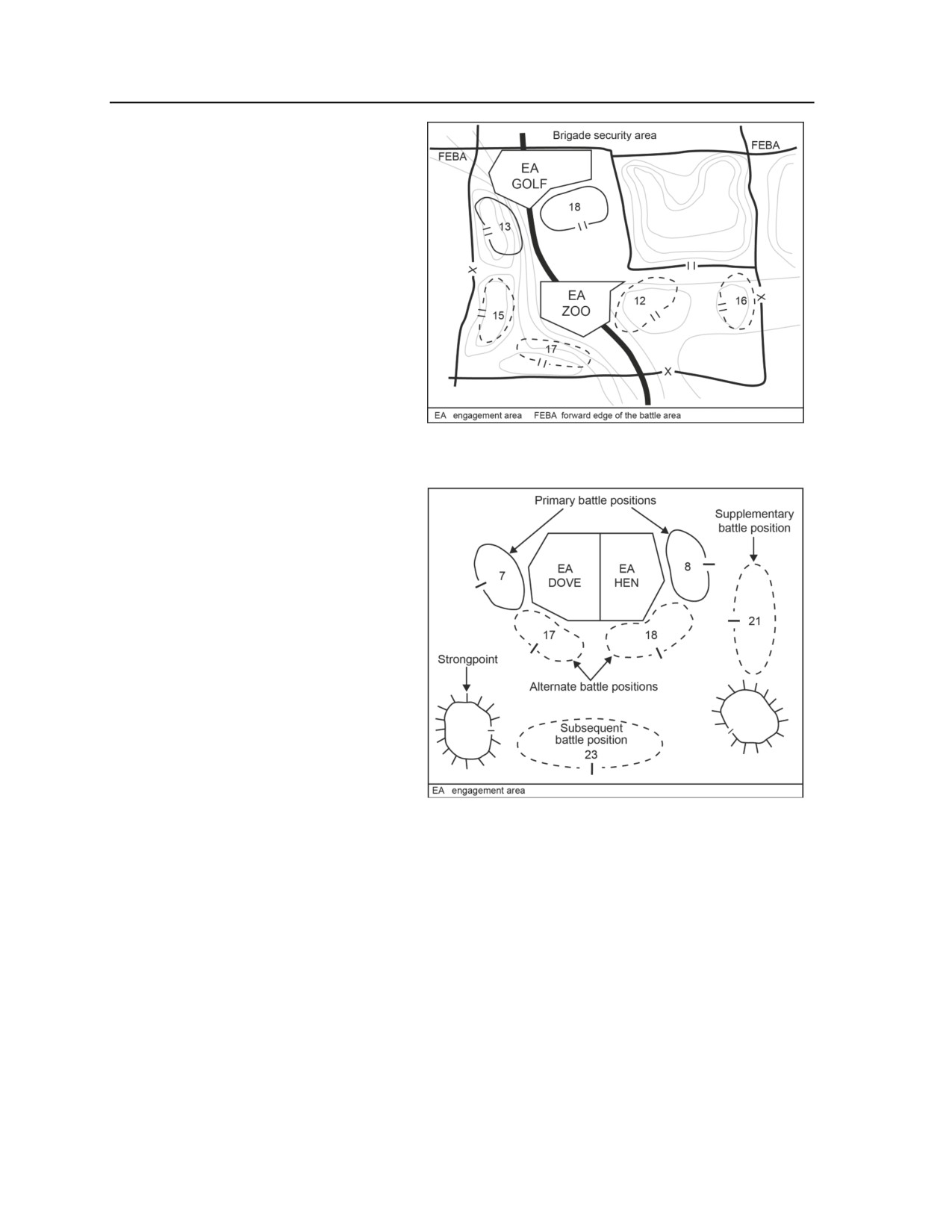
Appendix A
commander specifies mission and
engagement criteria to the unit assigned to
a battle position. Security, functional and
multifunctional support, and sustainment
forces typically operate outside a unit’s
battle position.
A-92. Units occupy or depart battle
positions as part of the overall plan. The
commander assigning a unit to a battle
position should specify when and under
what conditions the unit displaces from
the position, since they are not normally
held at all costs. If a unit is ordered to
defend a battle position, its commander
has the option of moving off the battle
position. If that unit is directed to retain a
battle position, its commander needs to
know the specific conditions that must
Figure A-35. Area of operations and battle position
exist before the unit can displace.
control measures used in combination
A-93. There are five kinds of battle
positions—primary,
alternate,
supplementary, subsequent, and strong
point. (See figure A-36.) When assigning
battle positions, the commander always
designates the primary battle position.
The commander designates and prepares
alternate, supplementary, and subsequent
positions as time and other resources
permit and if the terrain or situation
requires them.
A-94. The primary position is the
position that covers the enemy’s most
likely avenue of approach into the area of
operations
(ADRP 3-90). It is the best
position from which to accomplish the
mission, such as cover an EA.
A-95. An alternate position is a defensive
Figure A-36. Five kinds of battle positions
position that the commander assigns to a
unit or weapon for occupation when the primary position becomes untenable or unsuitable for carrying out
the assigned task (ADRP 3-90). It covers the same area as the primary position. The commander locates
alternate positions so the occupant can continue to fulfill the original task, such as covering the same
avenue of approach or EA as the primary position. These positions increase the defender’s survivability by
allowing the defender to engage the enemy from multiple positions. For example, a unit moves to its
alternate positions when the enemy brings suppressive fires on the primary position.
A-96. A supplementary position is a defensive position located within a unit’s assigned area of operations
that provides the best sectors of fire and defensive terrain along an avenue of approach that is not the
primary avenue where the enemy is expected to attack (ADRP 3-90). For example, an avenue of approach
into a unit’s AO from one of its flanks normally requires establishing supplementary positions to allow a
unit or weapon system to engage enemy forces traveling along that avenue.
A-97. A subsequent position is a position that a unit expects to move to during the course of battle
(ADRP 3-90). A defending unit may have a series of subsequent positions. Subsequent positions can also
have primary, alternate, and supplementary positions associated with them.
A-26
FM 3-90-1
22 March 2013
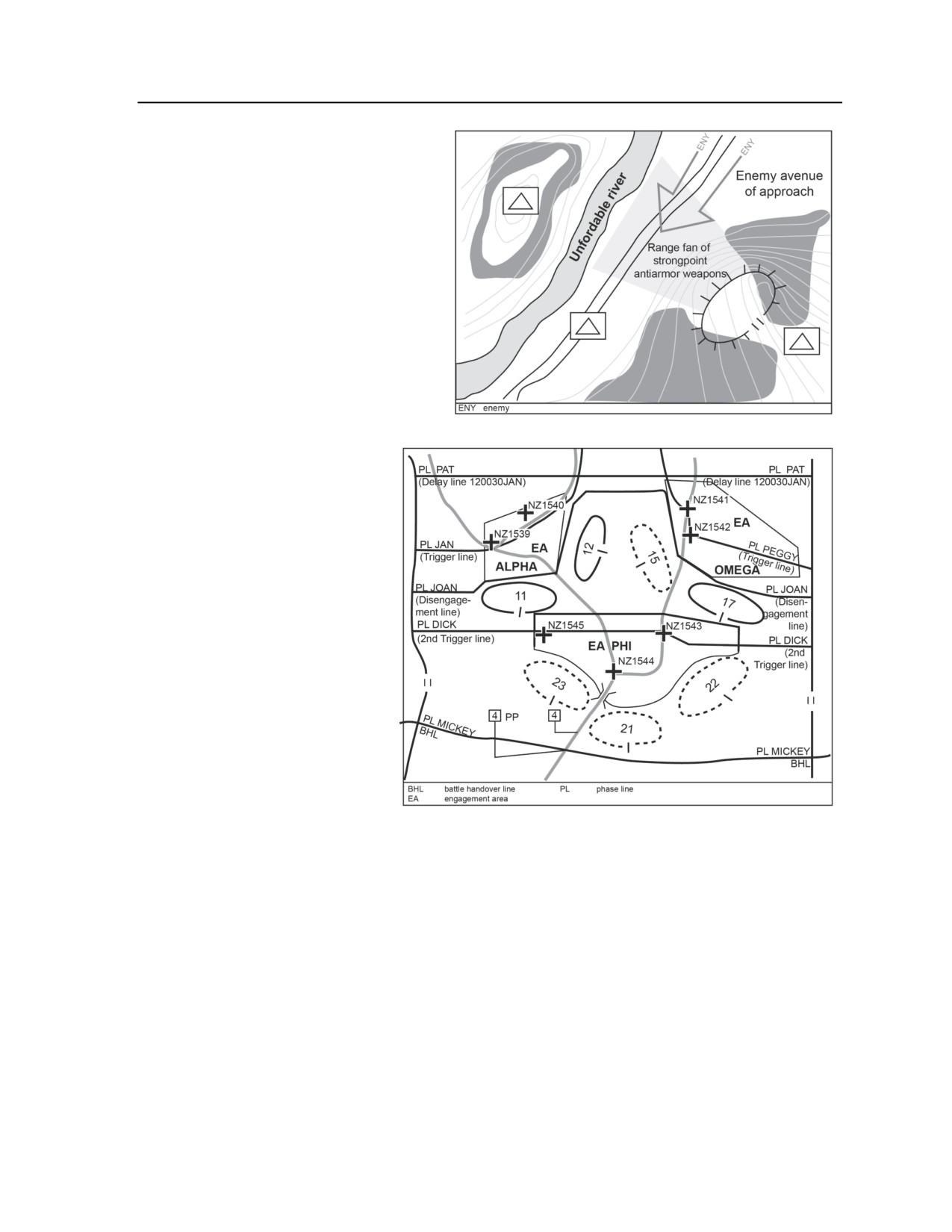
Basic Tactical Control Measures
A-98. A strong point is a heavily fortified
battle position tied to a natural or
reinforcing obstacle to create an anchor
for the defense or to deny the enemy
decisive or key terrain (ADRP 3-90). The
commander prepares a strong point for
all-around defense. (See figure A-37.) The
commander positions strong points on key
or decisive terrain. The unit occupying the
strong point prepares positions for its
weapon systems, vehicles, Soldiers, and
supplies. The commander also establishes
a strong point when anticipating that
enemy actions will isolate a defending
force retaining terrain critical to the
defense.
A-99. Before assigning a strong point
Figure A-37. Strong point defense
mission, the commander ensures
that the strong point force has
sufficient time and resources to
construct the position, which
requires significant engineer
support. A minimally effective
strong point typically requires a
one-day effort from an engineer
unit the same size as the unit
defending the strong point.
Normally,
companies
and
battalions occupy strong points,
although brigades may construct
them. The commander does not
normally establish strong points
for units smaller than company
size. This is because a platoon or
squad cannot secure a perimeter
large enough to encompass all
required assets and supplies.
Direct Fire Control Measures
Figure A-38. Direct fire control measures
A-100. The commander engages
the enemy force with all available defensive fires when it enters the defending unit’s engagement area.
These direct fire control measures, such as TRPs, trigger lines, and EAs, are discussed in this appendix
under the heading of “common offensive control measures” in paragraphs A-27, A-28, and A-23. (See
figure A-38.)
Disengagement Line
A-101. A disengagement line is a phase line located on identifiable terrain that, when crossed by the
enemy, signals to defending elements that it is time to displace to their next position (ADRP 3-90). Phase
Line JOAN is a disengagement line in figure A-39. The commander uses these lines in the delay and the
defense when the commander does not want the defending unit to become decisively engaged. The
commander establishes criteria for the disengagement, such as number of enemy vehicles by type, friendly
losses, or enemy movement to flanking locations. Commanders may designate multiple disengagement
lines, one for each system in the defense.
22 March 2013
FM 3-90-1
A-27
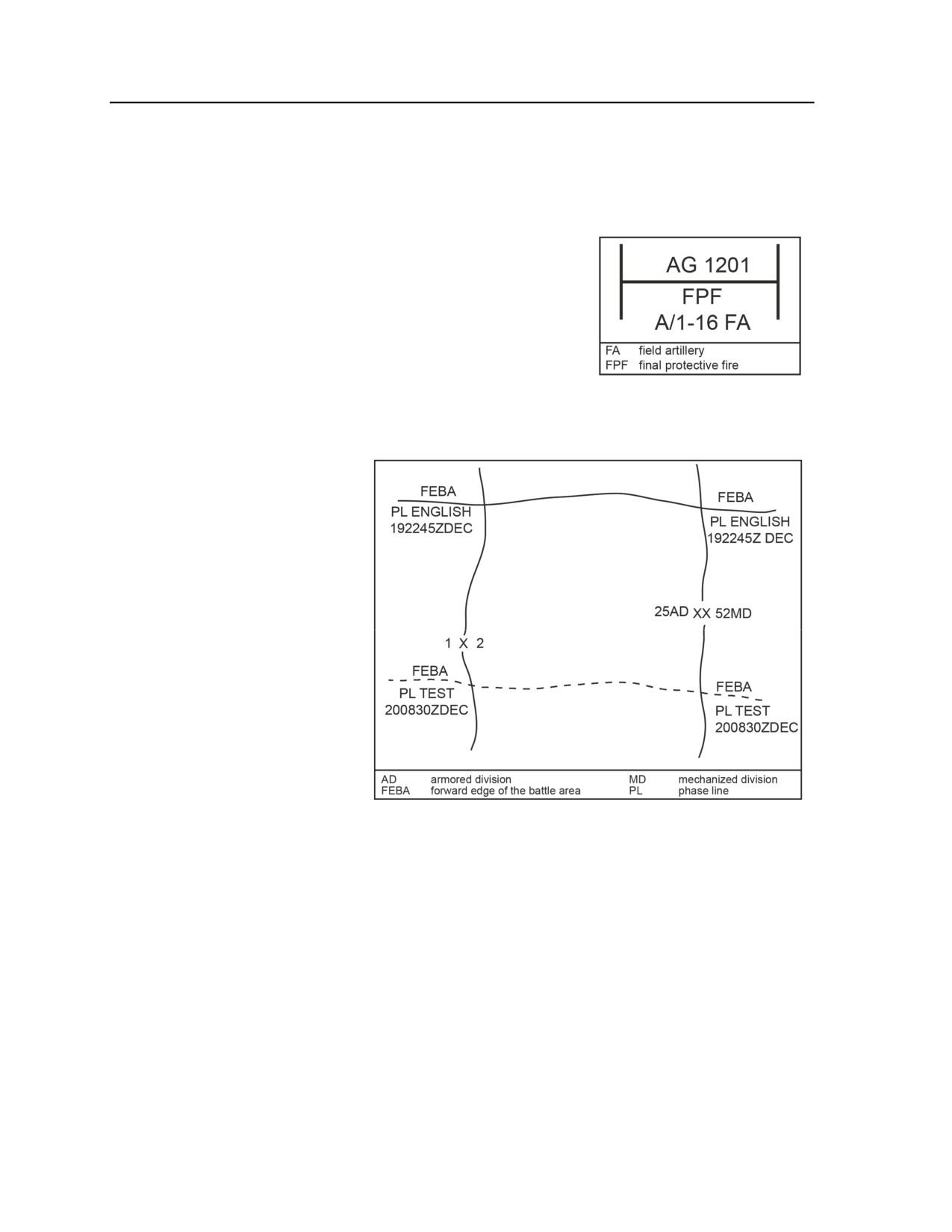
Appendix A
Fire Support Coordination Measures
A-102. The commander tries to engage the enemy at extended ranges and attrit the enemy force as the
enemy’s attack advances. To control indirect fires in the defense, the commander uses those common
FSCM introduced in paragraphs A-32 through A-45. The commander can also employ final protective
fires.
A-103. Final protective fire is an immediately available preplanned
barrier of fires designed to impede enemy movement across
defensive lines or areas (JP 1-02). Both direct- and indirect- fire
weapons can provide FPFs. The commander can only assign each
firing battery or platoon a single FPF. A FPF is a priority target for
an element or system, and those fire units are laid on that target when
they are not engaged in other fire missions. When the enemy force
initiates its final assault into a defensive position, the defending unit
initiates its FPFs to kill enemy infantry soldiers and suppress enemy
Figure A-39. Final protective
armored vehicles. (Figure A-39 depicts an FPF.)
fire
Forward Edge of the Battle Area
A-104. The forward edge of the
battle area is the foremost limit
of a series of areas in which
ground combat units are
deployed, excluding the areas in
which the covering or screening
forces are operating, designated
to coordinate fire support, the
positioning of forces, or the
maneuver of units
(JP 3-09.3).
The Army only uses a FEBA
during the conduct of defensive
tasks. The FEBA is not a
boundary, but it conveys the
commander’s intent. It marks the
foremost limits of the areas in
which the preponderance of
ground combat units deploy,
excluding the areas in which
security forces are operating.
MBA forces can temporarily
Figure A-40. Forward edge of the battle area
move forward of the FEBA to
expedite the retrograde operations of security forces. The commander designates a FEBA to coordinate fire
support and to assist in the maneuver of subordinate forces. A phase line designating the forward-most
point of the MBA indicates the FEBA. The FEBA shows the senior commander’s planned limit for the
effects of direct fires. Defending units must address this area in their scheme of maneuver and exchange
information regarding tactical plans at coordination points. (Figure A-40 graphically depicts the current
FEBA and a proposed FEBA.)
Main Battle Area
A-105. The main battle area is the area where the commander intends to deploy the bulk of the unit’s
combat power and conduct decisive operations to defeat an attacking enemy (ADRP 3-90). The defending
commander’s major advantage is the ability to select the ground on which the battle takes place. The
defender positions subordinate forces in mutually supporting positions in depth to absorb enemy
penetrations or canalize them into prepared EAs, defeating the enemy’s attack by concentrating the effects
of overwhelming combat power. The natural defensive strength of the position determines the distribution
A-28
FM 3-90-1
22 March 2013
Basic Tactical Control Measures
of forces in relation to both frontage and depth. In addition, defending units typically employ field
fortifications and obstacles to improve the terrain’s natural defensive strength. The MBA also includes the
area where the defending force creates an opportunity to deliver a decisive counterattack to defeat or
destroy the enemy.
A-106. The MBA extends from the FEBA to the unit’s rear boundary. The commander locates subordinate
unit boundaries along identifiable terrain features and extends them out beyond the FLOT by establishing
forward boundaries. Unit boundaries should not split avenues of approach or key terrain. The commander
selects the MBA based on the products of the IPB process and the commander’s own analysis using the
mission variables of METT-TC. The IPB process indicates how the enemy force will probably use the
available avenues of approach.
22 March 2013
FM 3-90-1
A-29
Appendix B
Tactical Mission Tasks
The tactical mission tasks in this appendix describe the results or effects the
commander wants to achieve—the what and why of a mission statement not
previously addressed in this publication. A mission statement contains the who, what,
when, where, and why associated with a specific operation. The what and why of a
mission statement are not the same thing and both are needed. The what is an effect
that is normally measurable. The why of a mission statement provides the mission’s
purpose. These tasks have specific military definitions that are different from those
found in a dictionary. In some cases, the discussion includes more than just a
definition; it includes results or effects in relation to the enemy, terrain, or friendly
forces not associated with any specific type or form of an operation. Tasks that
identify a friendly action rarely provide sufficient clarity for a mission statement.
B-1. A tactical mission task is the specific activity performed by a unit while executing a form of
tactical operation or form of maneuver. It may be expressed in terms of either actions by a friendly
force or effects on an enemy force. As shown in tables B-1, B-2, and B-3, there is no definitive list of
words or terms to describe the what and the why of a mission statement. The commander is not limited to
the tactical mission tasks listed in this appendix in specifying desired subordinate actions in an operations
order or operations plan. Many of the words and terms used to describe the what and why of a mission
statement do not have special connotations beyond their common English language meanings. However,
both the commander and the subordinate must have a common understanding of the what and why of the
operation. Tasks involving only actions by friendly forces rarely provide sufficient clarity for a mission
statement, thus the addition of a solid purpose coupled with the task adds understanding and clarity. The
commander ensures that the missions assigned to subordinate units are consistent with the scheme of
maneuver and the resources allocated to those subordinates. For example, a defending unit requires far
greater effort (resources) to destroy an enemy force than to defeat it. Likewise, an attacking unit requires
more combat power to clear the enemy from a given area than to contain that enemy in that same area.
Table B-1. Actions by friendly forces and effects on enemy forces
Actions by friendly forces
Effects on enemy forces
Attack by fire
Block
Breach
Canalize
Bypass
Contain
Clear
Defeat
Control
Destroy
Counterreconnaisance
Disrupt
Disengagement
Fix
Exfiltrate
Isolate
Follow and assume
Neutralize
Follow and support
Suppress
Occupy
Turn
Retain
Secure
Seize
Support by fire
22 March 2013
FM 3-90-1
B-1

Appendix B
Table B-2. Elements of operations and subordinate tasks
Elements of operations
Offensive tasks
Defensive tasks
Movement to contact:
Area defense
• Search and attack
• Cordon and search
Attack:
Mobile defense
• Ambush
• Demonstration
• Feint
• Raid
• Spoiling attack
Exploitation
Retrograde operations
• Delay
• Withdrawal
• Retirement
Pursuit
Forms of offensive maneuver
• Envelopment
• Frontal attack
• Infiltration
• Penetration
• Turning movement
Table B-3. Tactical shaping operations and tasks
Tactical shaping tasks
Passage of lines
Reconnaissance operations
• Zone
• Area
• Route
• Reconnaissance in force
Relief in place
Security operations:
• Screen
• Guard
• Cover
• Area (includes route and convoy)
• Local
Troop movements:
• Administrative movement
• Approach march
• Road march
B-2.
Many of the tactical mission tasks in this appendix or introduced previously in this publication have a
tactical mission graphic associated with them. Commanders and staff officers use tactical mission graphics
in conjunction with course of action development.
B-2
FM 3-90-1
22 March 2013
Tactical Mission Tasks
ACTIONS BY FRIENDLY FORCES
B-3. The following tactical mission tasks address actions by friendly forces. They are the action, the what,
the commander wants the friendly force to perform. Most of these actions have associated tactical mission
graphics that are used in course of action development and sketches as part of the military decisionmaking
process.
ATTACK BY FIRE
B-4. Attack by fire is a tactical mission task in which a commander uses direct
fires, supported by indirect fires, to engage an enemy force without closing with
the enemy to destroy, suppress, fix, or deceive that enemy. A commander assigning
this task to a subordinate must also state the desired effect on the enemy, such as
neutralize, fix, or disrupt. A commander normally employs this task when the mission
does not dictate or support close combat and occupation of a geographical objective by
Figure B-1.
another friendly force. The commander may assign the force conducting an attack by
Attack by fire
fire a battle position with either a sector of fire or an engagement area (EA), or the
tactical
commander may assign it an axis of advance and a force-oriented objective. The enemy
mission
may be stationary or moving. Figure B-1 shows the tactical mission graphic for attack
graphic
by fire. The arrow points at the targeted force or objective, and the commander places
the base of the arrow in the general area from which the commander wants to deliver the attack.
B-5. An attack by fire closely resembles the task of support by fire. The chief difference is that one unit
conducts the support by fire task to support another unit so it can maneuver against the enemy. The attack
by fire task includes—
z
Assigning sectors of fire or EAs to each subordinate weapon system to include the enemy’s
defensive positions or avenues of approach.
z
Designating control measures to allow massing, distributing, and shifting of direct and indirect
fires.
z
Designating battle positions, area of operations (AO), or axis of advance to allow the friendly
force to engage the enemy.
z
Providing for security and all-around defense, including control measures to ensure tie-in of
subordinate elements and maximum use of hide positions.
z
Using operations security (OPSEC) to deceive the enemy about movement, occupation, and
intent of the operation.
z
Reconnoitering, preparing, and securing movement routes and firing positions before the
movement of the main body, and stocking Class V items.
z
Providing movement instructions to the initial battle positions.
BREACH
B-6. Breach is a tactical mission task in which the unit employs all available means to
break through or establish a passage through an enemy defense, obstacle, minefield, or
fortification. A commander attempts to bypass and avoid obstacles and enemy defensive
positions to the maximum extent possible to maintain tempo and momentum. Breaching
enemy defenses and obstacle systems is normally the last choice. A breach is a synchronized
Figure B-2.
combined arms operation under the control of the maneuver commander. (Figure B-2 shows
Breach tactical
the control graphic for a breach.) The area located between the arms of the graphic shows the
mission
general location for the breach. The length of the arms extend to include the entire depth of the
graphic
area that must be breached. Breaching operations may be required to support an attack
anywhere along the continuum from a deliberate to a hasty attack. Regardless of where the attack falls along
the continuum, the breaching tenets—intelligence, breaching fundamentals, breaching organization, mass,
and synchronization—apply when conducting breaching operations in support of an attack. (ATTP 3-90.4
gives detailed information concerning breaching operations.)
22 March 2013
FM 3-90-1
B-3
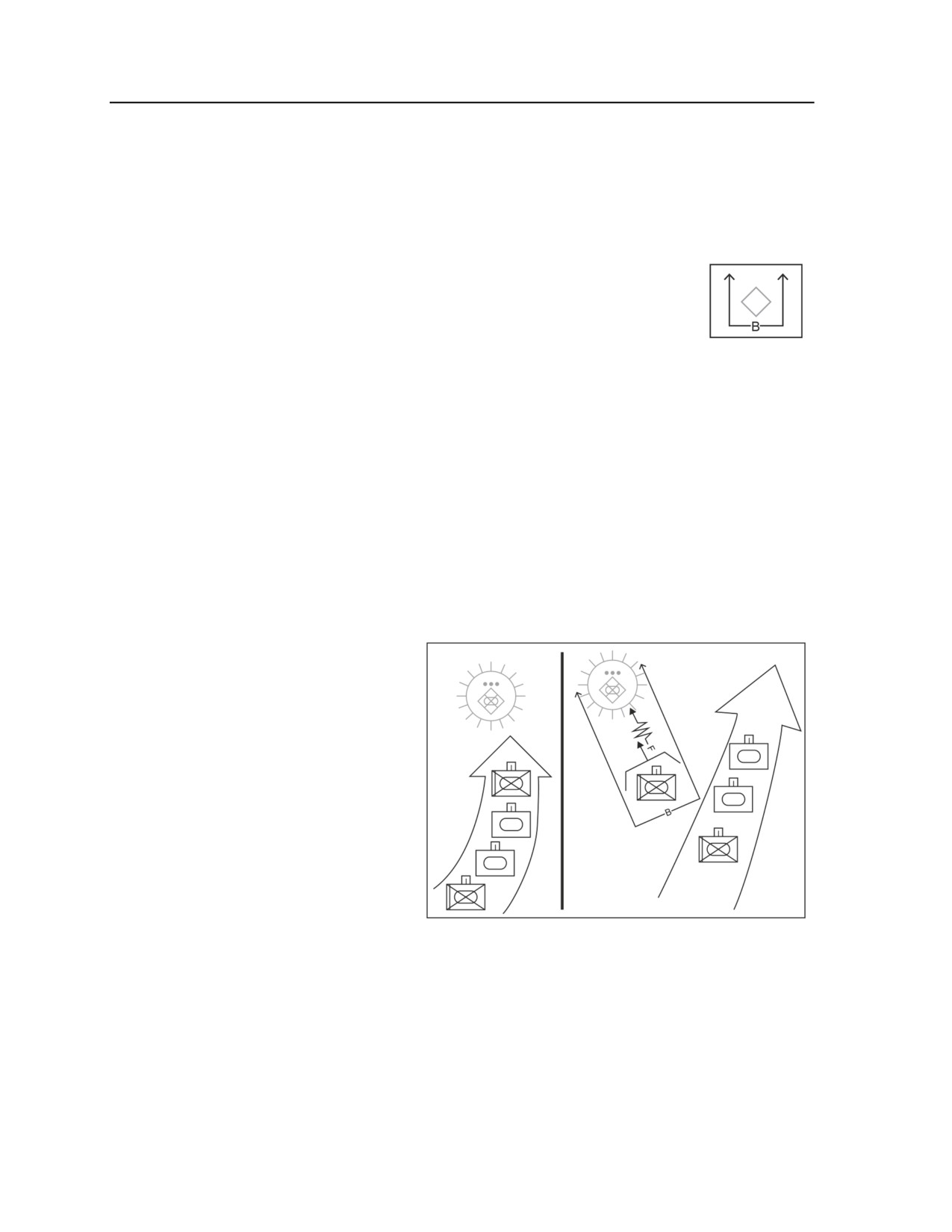
Appendix B
BYPASS
B-7. Bypass is a tactical mission task in which the commander directs the unit to maneuver around
an obstacle, position, or enemy force to maintain the momentum of the operation while deliberately
avoiding combat with an enemy force. A commander orders a bypass and directs combat power toward
mission accomplishment. A bypass can take place in offensive or defensive actions. (Figure B-3 shows the
tactical mission graphic for a bypass.) The arms of the graphic go on both sides of the location or unit that
will be bypassed.
B-8. The commander bases the bypass decision on—
z
The requirement to maintain momentum and aggressive action.
z
Knowledge of enemy strength, intent, or mission.
z
The degree to which the bypassed enemy can interfere with the advance.
Figure B-3.
z
The general state of the enemy force; for example, if enemy resistance is
Bypass
crumbling, the friendly force can take greater risks.
tactical
z
Any bypass criteria established by a higher headquarters.
mission
B-9. The force conducting the bypass immediately reports any bypassed obstacles and
graphic
enemy forces to its higher headquarters. The force normally keeps the bypassed enemy
under observation until relieved by another force, unless it is part of a raid. A senior commander does not
normally delegate authority to bypass below the battalion task force level. Bypass criteria are established to
limit the size of the enemy force that can be bypassed without the authority of the next higher commander.
Before approving the bypass, the commander ensures that the bypassing force checks the bypass route for
enemy presence and trafficability. The bypassing force prevents the bypassed enemy force from interfering
with the moving friendly force.
B-10. The two bypass techniques that the force can employ are—
z
Avoiding the enemy totally.
z
Fixing the enemy in place with fires and then conducting the bypass.
B-11. If the force cannot avoid the enemy,
the bypassing force must fix the enemy
with part of its maneuver elements and
bypass with the balance of the force. (See
figure B-4.) Generally, a commander will
not attempt to bypass an enemy force if
more than a third of the unit’s combat
power is required to fix the enemy. The
commander assigns one subordinate unit
the mission of fixing the enemy in this
situation, reinforcing the fixing force as
required by the mission variables of
mission, enemy, terrain and weather,
troops and support available, time
available,
and civil considerations
(METT-TC.) The fixing force coordinates
with the unit assigned to relieve the fixing
Figure B-4. Task force conducting a fix and bypass
force as soon as possible and provides the
new commander with all available information about the enemy and terrain. The relieving unit is normally
another unit assigned a follow-and-support task. Once relieved, the force fixing the enemy either rejoins its
parent organization or becomes part of the following element and comes under its control.
B-12. Occasionally the commander may direct the fixing force to break contact with the enemy after the
bypassing force completes the bypass. This occurs when the bypassing force has no requirement to
maintain an uninterrupted logistics flow, such as in a raid. In this case, the fixing force fixes the enemy by
employing defensive and limited offensive actions in synchronization with all available fire support until
ordered to rejoin the bypassing force.
B-4
FM 3-90-1
22 March 2013
Tactical Mission Tasks
Clear
B-13. Clear is a tactical mission task that requires the commander to remove all enemy forces and
eliminate organized resistance within an assigned area. The force does this by destroying, capturing, or
forcing the withdrawal of enemy forces, so they cannot interfere with the friendly unit’s mission. In all
cases, this task requires a thorough reconnaissance to discover the enemy’s locations. After discovering the
enemy’s location, the clearing force maneuvers against the enemy force. (Figure B-5 shows the tactical
mission graphic for clear.) The bar connecting the arrows designates the desired limit of advance for the
clearing force. The bar also establishes the width of the area to clear.
B-14. This task requires significant time and other resources. In the mission
statement, a commander can modify the objective associated with this task to
destroying, capturing, or forcing the withdrawal of only enemy forces larger than a
stated size. In this case, the clearing force keeps smaller enemy forces under
observation, while the rest of the friendly force bypasses them.
B-15. Clear is also a mobility task that involves the total elimination of an obstacle
that is usually performed by follow-on engineers and is not done under fire.
Figure B-5. Clear
Clearing operations are conducted to completely eliminate the enemy’s obstacle
tactical mission
effort or residual obstacles affecting the operational area. (See FM 3-34.210 for
graphic
more information on mobility clearing operations.)
CONTROL
B-16. Control is a tactical mission task that requires the commander to maintain physical influence
over a specified area to prevent its use by an enemy or to create conditions necessary for successful
friendly operations. That influence can result from friendly forces occupying the specified area or
dominating that area by their weapon systems. Control of an area does not require the complete clearance
of all enemy soldiers from the specified area. The tactical mission task of control differs from that of secure
because secure does not allow enemy fires to impact on the secured area. The enemy can engage targets
within the controlled area but cannot move ground forces through that area.
B-17. Control may also mean a command relationship or a function commanders exercise through their
mission command systems. (See ADRPs 3-0 and 6-0.)
COUNTERRECONNAISSANCE
B-18. Counterreconnaissance is a tactical mission task that encompasses all measures taken by a
commander to counter enemy reconnaissance and surveillance efforts. Counterreconnaissance is not
a distinct mission, but a component of all forms of security operations. It prevents hostile observation
of a force or area. Counterreconnaissance is an element of all security operations and most local security
measures. It involves both active and passive elements and includes combat action to destroy or repel
enemy reconnaissance units and surveillance assets.
B-19. Destroying enemy ground reconnaissance assets while denying the enemy information through other
collection systems allows friendly force commanders to operate against an enemy who is operating blindly.
The enemy commander’s inability to see the battlefield eventually desynchronizes the enemy commander’s
actions and renders that commander’s force vulnerable to aggressive action by friendly forces. (See chapter
12 for additional information on counterreconnaissance.)
DISENGAGE
B-20. Disengage is a tactical mission task where a commander has the unit break contact with the
enemy to allow the conduct of another mission or to avoid decisive engagement. It involves moving to
a location where the enemy cannot engage the friendly force with either direct fires or observed indirect
fires. Disengaging from the enemy while displacing from one position to the next is a difficult procedure. A
disengagement plan includes—
22 March 2013
FM 3-90-1
B-5