FM 3-90-1 Offense and Defense (Volume 1, March 2013) - page 4
Chapter 5
at risk of annihilation. The force conducting the encirclement must be self-contained, since it normally
operates out of supporting range of friendly indirect-fire systems. Therefore, it frequently has additional
supporting artillery attached. The primary mission of this encircling force is to prevent the enemy’s escape
by trapping the enemy between the encircling force and the direct-pressure force. The commander can
assign other missions to the force conducting the encirclement, such as—
z
Destroying enemy weapons of mass destruction and their delivery means.
z
Linking up with airborne or air assault forces in their airheads.
z
Reporting terrain conditions and other combat information beyond that normally addressed in
the unit standing operating procedures.
The commander can assign the encirclement mission, wholly or in part, to available airborne or air assault
units because their vertical envelopment capabilities allow friendly forces to be inserted deeper into
enemy-controlled territory than ground units. The time required to plan amphibious and airborne operations
and stage air- and sealift platforms airlift impacts the usefulness of airborne forces in small-scale pursuit
operations.
5-13. Forces assigned direct-pressure and encircling missions require engineer support to create lanes
through obstacles, which enables them to move rapidly and continuously. The commander should place
combat engineers well forward in unit movement formations to quickly breach any obstacles that cannot be
bypassed. Engineers accompanying the encircling force must also be prepared to conduct countermobility
and survivability tasks.
CONTROL MEASURES FOR A PURSUIT
5-14. The commander uses control measures to retain tactical options to converge on the most important
axis or to redirect the pursuit effort on a new axis. These control measures should be flexible and capable of
rapid adjustments to reflect changing conditions. In assigning control measures for a pursuit, subordinate
commanders are given as much freedom of action as possible, consistent with security and maintenance of
command integrity. This flexibility is also necessary when engaging advancing enemy reserves or
counterattack forces.
5-15. The commander employs centralized planning and decentralized execution during a pursuit. The
commander balances the need to prevent fratricide and friendly fire incidents with the need to allow
subordinates to take advantage of fleeting opportunities in a pursuit with rapidly moving forces and a
rapidly changing situation. The commander designates an area of operations (AO) for each maneuver unit
involved in the pursuit. The commander establishes few control measures for the direct-pressure force other
than phase lines and checkpoints during a pursuit. The commander uses phase lines to designate a forward
and rearward boundary for the direct-pressure force. The forward boundary relieves the direct-pressure
force of any responsibility beyond the forward boundary. It also gives the higher headquarters flexibility to
coordinate with the encircling force and address enemy elements located beyond that forward boundary.
The rear boundary becomes the boundary between the direct-pressure force and the follow and support
force.
5-16. If the force conducting the encirclement is a ground element, the control measures are almost
identical to those used during an envelopment. The commander must designate a route, an axis of advance,
or an AO adjacent to that of the force providing direct-pressure on the retrograding enemy to allow the
force conducting the encirclement force to move parallel to and eventually get ahead of the fleeing enemy
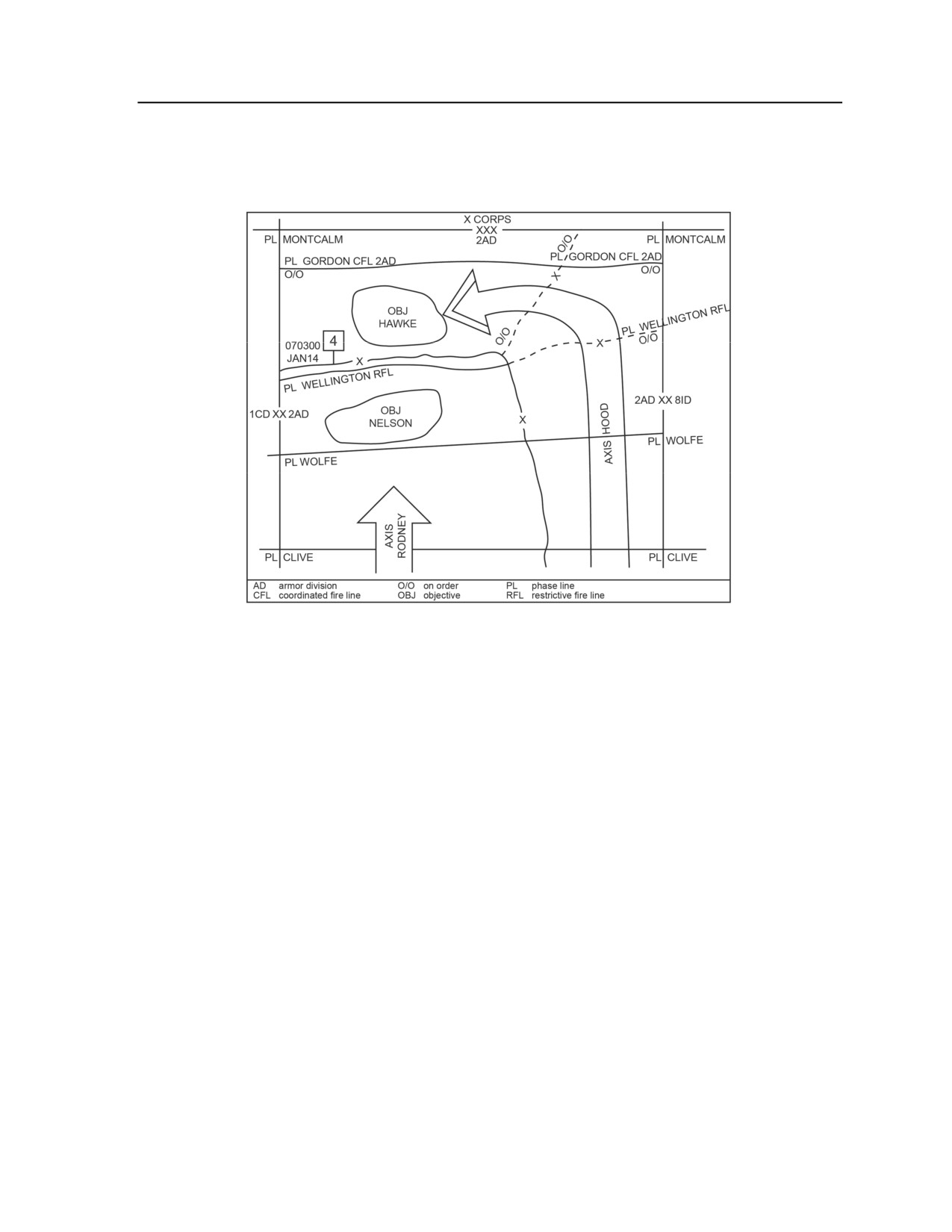
force. The commander can designate a terrain objective as a guide for the encircling force. (See objective
HAWKE in figure 5-3.) However, the commander may change this objective rapidly and frequently, based
on the progress of the encircling force and the enemy. The objective should be a terrain feature that
provides the encircling force good, defensible terrain that the enemy cannot easily bypass. The commander
often selects choke points, such as defiles and bridges, as objectives for the encircling force.
5-17. The commander establishes a boundary or a restrictive fire line between the force conducting the
encirclement and the force exerting direct-pressure before the encircling force reaches its objective. Other
fire support coordination measures (FSCMs) around the area currently occupied by the force conducting
the encirclement are established to relieve it of unnecessary fire support coordination responsibilities. The
5-4
FM 3-90-1
22 March 2013
Pursuit
overall commander directs security operations beyond the encircling force, allowing it to engage the
withdrawing enemy without devoting resources to flank and rear security. The overall commander
establishes additional control measures to control the convergence of both elements of the friendly force,
such as restrictive fire lines, phase lines, and contact points.
Figure 5-3. Pursuit control measures
PLANNING A PURSUIT
5-18. The commander anticipates an enemy retrograde operation as either a branch or a sequel to the plan.
The plan should identify possible direct-pressure, encircling, follow and support, and reserve forces and
issue on-order or be-prepared missions to these forces. The commander should employ the maximum
number of available maneuver forces in the pursuit. The commander bases the details of the plan on the
enemy’s anticipated actions, the combat formation of the attacking troops, and the amount of planning time
available. The commander also considers—
z
Possible routes the enemy might use to conduct retrograde operations.
z
Availability of reconnaissance and surveillance assets to detect enemy forces and acquire targets
in depth.
z
Scheme of movement and maneuver. (While combat forces will maneuver during the conduct of
a pursuit, some echelon sustainment elements will be moving.)
z
Availability and condition of pursuit routes.
z
Availability of forces to keep the pressure on the enemy force until its destruction is complete.
z
Critical terrain features.
z
Use of reconnaissance and security forces.
z
Allocation of precision-guided munitions and aviation support.
z
Availability of functional and multifunctional support and sustainment resources.
Pursuit planning must address the possibility of defending temporarily during operational pauses while
making preparations to continue the pursuit or to consolidate gains. However, the use of an operational
pause generally results in the abandonment of the pursuit because the enemy is able to use that time to
organize a coherent defense.
22 March 2013
FM 3-90-1
5-5
Chapter 5
5-19. The commander must specifically address how to detect the enemy retrograde operations; otherwise,
the enemy may succeed in breaking contact. The commander relies on active reconnaissance, an
understanding of enemy tactics, and knowledge of the current tactical situation. The commander must
watch for signs that indicate the enemy is preparing to conduct a retrograde, such as when the enemy—
z
Lacks the capability to maintain the current position or cohesion.
z
Conducts limited local counterattacks.
z
Intensifies reconnaissance and intelligence efforts.
z
Increases the amount of rearward movements and changes the type of elements conducting them,
especially by fire support and reserves.
z
Prepares facilities, installations, equipment, and supply stock-piles for demolition and
destruction.
z
Decreases fire in intensity and effectiveness through the AO.
z
Increases fires in one or more individual sectors of the front, which does not appear to be in
accordance with the developing situation, and at a time when the amount of defensive fires
seems to be decreasing.
The presence or absence of any of these signs may not necessarily indicate the start of a retrograde
operation. The enemy could be attempting to draw friendly forces into an ambush or setting up a
counterattack as part of the defense. The decision of when to start a pursuit is part of the art of tactics.
5-20. When the commander initiates a pursuit, the commander often creates the force conducting the
encirclement from uncommitted or reserve elements. Normally, these forces do not have allocated fire
support assets. The commander must plan how to redistribute fire support assets to properly support these
encircling forces. Attack helicopters and close air support are well suited to support the force conducting
the encirclement.
5-21. Engineer mobility and countermobility assets are instrumental in sustaining the rate of advance and
hindering the enemy’s withdrawal. Engineers prepare the route of advance and support the lateral
dispersion of units transitioning to the pursuit and the movement of the reserve. During the pursuit, the
commander must plan for engineers to provide assault bridging and emergency road repairs to sustain the
tempo of the pursuit. The commander also plans to use engineer assets to block any bypassed enemy’s
withdrawal routes by using antitank and command-operated mines, demolitions, and obstacles.
5-22. Sustainment units should plan for increased demand for fuel and maintenance as the tempo of
operations increases. In the pursuit, priority for sustainment normally goes to units having the greatest
success. Sustainment planners need to anticipate success since the depth of the pursuit depends on the
capability of sustainment assets to support the operation. The sustainment elements supporting the pursuing
force should be as mobile as possible. Sustainment planners are particularly concerned with supporting the
encircling force, such as providing casualty evacuation over possibly unsecured LOCs. The commander
may need aerial resupply or heavily guarded convoys to support this force. Security for sustainment
convoys and LOCs are major planning considerations.
5-23. The commander uses all available sustainment assets to provide essential support to the force
pursuing the enemy. The pursuit plan must result in a force prepared to conduct wide-ranging operations
using all available maneuver assets throughout the AO to complete the destruction and morale collapse of
the enemy force.
EXECUTING A PURSUIT
5-24. The goal of a pursuit is to destroy the withdrawing enemy. This generally occurs because of trapping
the enemy between the forces conducting direct-pressure and encirclement operations or a major
geographic barrier—such as an unfordable river—followed by the enemy’s defeat in detail. The
commander’s timeliness in deciding to initiate a pursuit is critical to its success. If the enemy begins a
retrograde undetected, the enemy avoids the constant pressure that results in disrupting that operation. The
commander expects the enemy forces to conduct retrograde operations at times advantageous to them—
usually at night or during bad weather.
5-6
FM 3-90-1
22 March 2013
Pursuit
5-25. A pursuit is often conducted as a series of encirclements in which successive portions of the fleeing
enemy are intercepted, cut off from outside support, and captured or destroyed. (FM 3-90-2 addresses the
tactics associated with the conduct of encirclement operations.) The force exerting direct pressure on the
retrograding enemy conducts a series of hasty attacks to destroy that enemy’s rear security force, maintain
constant pressure on the enemy’s main body, and slow the enemy’s withdrawal. At every opportunity, the
force exerting direct pressure fixes, disrupts, and destroys enemy elements, provided such actions do not
interfere with its primary mission of maintaining constant pressure on the enemy’s main body. The force
exerting direct pressure can bypass large enemy forces, if it can hand them off to follow and support units,
or if they do not pose a significant risk to the capability of the force applying direct-pressure to maintain
that direct pressure on the retrograding enemy main body.
5-26. As soon as the commander designates a unit to conduct the encirclement and directs its actions, the
force moves as swiftly as possible by the most advantageous routes to cut off the enemy’s retreat. If that
unit cannot move farther and faster than the enemy to achieve the encirclement, it attacks the enemy’s main
body on one of its flanks. When this occurs, the overall commander should constitute and dispatch a new
element to conduct an encirclement of the retrograding enemy force.
SHAPING OPERATIONS
5-27. This chapter discusses the execution of a pursuit. It uses the five steps introduced in chapter 4 for
illustrative purposes only. In practice these steps will overlap. The first three steps are normally shaping
operations. Maneuver completes the destruction of the retrograding enemy and is the decisive operation in
a pursuit. Follow through involves either a branch or a sequel to the pursuit.
Gain and Maintain Enemy Contact
5-28. At the first indication of an enemy retrograde, the BCT or lower-echelon commander who discovers
the enemy’s rearward movement acts to maintain contact with the enemy across a wide area without
waiting for orders from higher headquarters. This ensures that the enemy does not break contact and
conduct an orderly retirement. These forces in contact constitute the nucleus of the direct-pressure force. As
the situation permits, they reform into a movement column with reconnaissance and security elements in
the lead and, if necessary, to the flank.
5-29. During a pursuit, the intelligence effort is intensive. Reconnaissance and surveillance elements
concentrate on all routes the enemy could use when conducting a retrograde operation. These elements
provide information on the disposition of retreating enemy formations and on the forward movement of
reserves as the pursuit develops. The tactical situation during a pursuit may become obscure because of its
potential depth. Much of the combat information needed during a pursuit is located behind the fleeing
enemy force. Therefore, air reconnaissance, backed by technical intelligence systems, is vital to the overall
reconnaissance effort. It can determine—
z
The beginning of the rearward movement of enemy sustainment forces.
z
The composition of retrograding forces and their direction of movement.
z
The composition and direction of enemy reserve forces moving forward.
z
The nature of obstacles and intermediate defensive positions.
Information about fresh enemy reserves and prepared positions is vital at the stage when a pursuit force
may be approaching a culminating point; it may be the basis for terminating the pursuit.
5-30. The primary mission of the encircling force’s reconnaissance and surveillance assets is to find routes
for the encircling force to allow it to move behind withdrawing enemy units and establish blocking
positions. This mission may force these assets to operate outside the supporting range of the main body, as
they try to maneuver behind the retrograding enemy force. The encircling force avoids combat, when
possible, until it reaches its assigned objective area. However, en route to its objective, it overruns any
small enemy positions while bypassing larger enemy units. Forward security elements of the encircling
force conduct activities to prevent the enemy from interfering with the forward movement of the encircling
force’s main body. These security elements move rapidly along all available roads or routes and overrun or
bypass small enemy pockets of resistance. If they encounter strongly held enemy positions, they attempt to
22 March 2013
FM 3-90-1
5-7
Chapter 5
find routes around or through these positions. The encircling force can then avoid these enemy positions
and occupy blocking positions before withdrawing enemy forces can reach them. If necessary, the
encircling force organizes a hasty defense behind the enemy to block the enemy’ retreat.
Disrupt the Enemy
5-31. Keeping the enemy from reconstituting an effective defense is critical to success. Constant pressure
by direct-pressure forces and echelon fire support systems disrupts and weakens the enemy. The
commander uses fires to keep pressure on the enemy. The enemy commander must not be allowed to freely
adjust dispositions to counter the actions of the friendly force. Artillery fire and air strikes harass and
disrupt the enemy’s attempts to move engaged forces to the rear or bring previously uncommitted forces
into action. In a pursuit, decisive operations may include the ground maneuver of the direct-pressure or the
encircling force. Fire support targets in a pursuit include fires on enemy columns and troop or vehicle
concentrations at road junctions, defiles, bridges, and river crossings. They may also be used to repulse
enemy counterattacks, destroy or delay enemy reserves, and destroy the enemy’s fire support systems. The
commander conducts electronic warfare against the enemy’s command and control (C2) system as an
integral part of this disruption process, concentrating on destroying or degrading the enemy’s capability to
reconstitute and synchronize an effective defense.
Fix the Enemy
5-32. Using movement and fire or the threat of fires, the commander fixes a withdrawing enemy. If the
direct-pressure force disrupts the enemy’s C2 system, the enemy’s ability to counter friendly efforts is
significantly degraded, and the goal of fixing the enemy is much easier to accomplish.
5-33. The enemy force will attempt to use its reserves to restore the integrity of the defense or prevent the
withdrawing enemy force from being overrun. Fixing enemy reserves is essential to the pursuit’s success
and is normally the focus of echelon shaping operations. The direct-pressure force fixes enemy reserves in
place or slows them down so that they remain outside supporting distance until the withdrawing enemy
force is completely annihilated.
DECISIVE OPERATION
5-34. During the conduct of pursuit operations, the overall commander of the pursuit normally combines
the actions of a subordinate conducting a frontal pursuit to provide direct pressure on the retrograding
enemy with the actions of a second subordinate attempting to encircle that same retrograding enemy. The
force providing direct pressure advances in a column formation as quickly as possible. After a successful
penetration of a defending enemy, existing gaps between the different elements of the force and the apply
direct-pressure force are likely to increase. Aware of the vulnerability of open flanks in this situation, the
overall commander must deploy other elements with a reserve mission where they can respond to flank
dangers. The overall commander does not expect a uniform rate of advance on all axes. Some columns may
move rapidly, while others are still engaged in penetrating the enemy’s rear guard defensive positions or
meeting enemy counterattacks.
5-35. The actions of the force applying direct pressure should facilitate the commitment of another force
moving parallel to the rearward-moving enemy and attempting to encircle that enemy. The depth of the
pursuit depends on the size of the forces involved. It takes a division-level or higher commander to make
the decision to initiate a pursuit because of the resources necessary to conduct a pursuit. The commander
directing the initiation of a pursuit informs that individual’s higher commander of this intention. This
allows even greater resources to be devoted to the pursuit and avoids desynchronizing the higher
headquarters’ major operation or campaign.
5-36. The force providing direct pressure normally tasks its forward subordinate element to provide an
advance guard to prevent the enemy from ambushing its main body and to overrun or bypass small enemy
forces. This advance guard moves on multiple avenues of advance. If it encounters enemy units beyond its
capacity to defeat, it conducts actions on contact to develop the situation. The commander of the force
providing direct pressure uses combat information provided by these actions on contact to guide the main
body of the force providing direct pressure to a position of advantage where it can seriously degrade or
5-8
FM 3-90-1
22 March 2013
Pursuit
destroy the retrograding enemy force. These actions of the force providing direct pressure may or may not
be in conjunction with the actions of any encircling force.
5-37. The overall pursuit commander does everything possible to place a force behind a retrograding
enemy to encircle and trap the bulk of that enemy force between the encircling force and the force
providing direct pressure. The force providing direct pressure maintains enough pressure on the
retrograding enemy force so that the encircling force can envelop it. To envelop the enemy, the force
providing the direct-pressure force must be strong enough to overcome any enemy rear guard before the
enemy’s main body can complete its retrograde and reestablish a coherent defense. Once in its objectives,
the force conducting the encirclement defends or attacks as necessary, responding to the enemy’s actions
and those of the force providing direct pressure to complete the enemy’s geographic isolation.
5-38. A pursuing force must not give an enemy force time to reorganize for an all-around defense after it is
encircled. If the enemy forms a perimeter, the pursuing commander must repeatedly split it into smaller
elements until the encircled enemy force is destroyed. If time is not critical, the commander can keep the
encirclement closed, defeat enemy breakout attempts, and weaken the enemy by fires alone. The
commander can greatly accelerate the collapse of a large, encircled enemy force by using psychological
operations, precision-guided weapons, and improved conventional munitions in mass.
(FM 3-90-2
describes the tactics associated with the reduction of an encircled enemy force.) If the resulting
encirclement does not destroy the retrograding enemy force, the commander conducts additional pursuit
operations until the enemy is destroyed.
FOLLOW THROUGH
5-39. Once the commander initiates a pursuit, it is continued until a higher commander terminates the
pursuit. Conditions under which a higher commander may terminate a pursuit include the following:
z
The pursuing force annihilates or captures the enemy and resistance ceases.
z
The pursuing force fixes the enemy for follow-on forces.
z
The higher commander makes an assessment that the pursuing force is about to reach a
culminating point.
5-40. A commander often transitions from a pursuit into other types of offensive and defensive actions. If
the enemy attempts to reorganize, forces conducting a pursuit execute hasty attacks. They conduct an
exploitation to capitalize on the success of these attacks and then move back into pursuit. Forces
conducting a pursuit may also transition into a defense, if the pursuing force reaches a culminating point.
This usually occurs when the enemy introduces strong reinforcements to prepare for a counteroffensive. If
the pursuit is totally successful and the enemy is destroyed, the pursuing force may need to transition to a
focus on the conduct of stability tasks. (See ADRP 3-07.)
PURSUIT DURING OTHER THAN MAJOR COMBAT OPERATIONS
5-41. The transition to retrograde operations by unconventional enemies may make it more difficult for
tactical units to engage, capture, or kill enemy fighters during the conduct of pursuit operations in other
than major combat operations. Successful pursuit of unconventional enemies in these situations relies on
maintaining contact through surveillance assets, patrols, and host nation security forces. Since dispersing
unconventional forces usually use preplanned routes of withdrawal, or if pressed simply scatter and try to
blend into the local civilian population to rally later at a pre-designated point, any pursuit must be
undertaken immediately both on the ground and in the air. Boundaries should not prevent the pursuit of
unconventional forces into an adjacent unit’s area of operations. Operations orders or other means of
coordination should provide for this contingency.
5-42. Tactical leaders must recognize the potential for unconventional enemies to conduct a baited ambush
during their retrograde operations. Critical to mitigating risk to friendly forces during a pursuit is
maintaining one of the eight forms of contact—direct; indirect; nonhostile or civilian; obstacle; chemical,
biological, radiological, and nuclear (CBRN); aerial; visual; and electronic—and positioning of adjacent
units. These adjacent units may include aviation, host nation security forces, surveillance assets, other
ground forces, and quick response forces (QRFs).
22 March 2013
FM 3-90-1
5-9
Chapter 5
5-43. Unconventional enemies may establish base camps and conduct cross-border operations from
countries adjacent to the host country. They take advantage of an international boundary to launch
operations or to evade pursuit. Commanders operating in border areas must respect the sanctity of
international boundaries. However, they can conduct combat operations against the insurgent force once the
unconventional enemy force crosses back over the border. Ambush patrols and area ambushes are excellent
means of dealing with unconventional enemy forces who try to use an international border as a sanctuary.
5-44. Unconventional enemies should know that every ambush they execute may result in rapid, violent,
and relentless pursuit by friendly forces. Such action, executed automatically as a matter of first priority, is
most important to the overall effort to reduce the effectiveness and frequency of ambushes by
unconventional enemies. First, it ensures an early relief of the ambushed unit; second, it increases the
possibility of friendly forces making contact with the ambush party before it disperses; third, it reduces the
time available to the unconventional enemy to destroy the ambushed forces and to loot vehicles; and,
finally, successful pursuit operations will improve the morale of friendly units while having a
corresponding opposite effect upon unconventional enemy forces. Commanders must initiate pursuits of
ambush forces with the least possible delay, with only that degree of caution required to prevent falling into
a larger ambush.
5-10
FM 3-90-1
22 March 2013
PART TWO
Defensive Tasks
Chapter 6
Basics of the Defense
Defensive actions alone normally cannot achieve a decision. Their purpose is to
create conditions for a counteroffensive that allows Army forces to regain the
initiative. Other reasons for conducting defensive actions include—
z
Retaining decisive terrain or denying a vital area to the enemy.
z
Attriting or fixing the enemy as a prelude to offensive actions.
z
Surprise action by the enemy.
z
Increasing the enemy’s vulnerability by forcing the enemy to concentrate subordinate
forces.
GENERAL CONSIDERATIONS OF THE DEFENSE
6-1. A defensive task is a task conducted to defeat an enemy attack, gain time, economize forces, and
develop conditions favorable for offensive or stability tasks (ADRP 3-0). While the offense element of
decisive action is more decisive, the defense is the stronger element. The defense’s inherent strengths
include the defender’s ability to occupy positions before the attack and use the available time to prepare the
defenses. The defending force ends its defensive preparations only when it retrogrades or begins to fight.
Even during the fight, the defending force takes the opportunities afforded by lulls in the action to improve
its positions and repair combat damage. The defender does not wait passively to be attacked. The defender
aggressively seeks ways of attriting and weakening attacking enemy forces before the initiation of close
combat. The defender maneuvers to place the enemy in a
position of disadvantage and attacks the enemy at every
Characteristics of the
opportunity, using fires, electronic warfare, and joint assets, such
defense
as close air support. The static and mobile elements of the
defense combine to deprive the enemy of the initiative. The
• Disruption
defender contains the enemy while seeking every opportunity to
transition to the offense.
• Flexibility
• Maneuver
CHARACTERISTICS OF THE DEFENSE
• Massing effects
6-2. Successful defenses share the following characteristics:
• Operations in depth
disruption, flexibility, maneuver, massing effects, operations in
depth, preparation, and security.
(See ADRP
3-90 for a
• Preparation
discussion of these characteristics.)
• Security
22 March 2013
FM 3-90-1
6-1
Chapter 6
DEFENSIVE TASKS
6-3. There are three basic defensive tasks: the area defense, the mobile
Defensive tasks
defense, and the retrograde. These three tasks have significantly different
• Area defense
concepts and pose significantly different problems. Therefore, each
defensive task must be dealt with differently when planning and
• Mobile defense
executing the defense. Although the names of these defensive tasks
convey the overall aim of a selected operation, each typically contains
• Retrograde
elements of the other and combines static and mobile elements.
6-4. Although on the defense, the commander remains alert for opportunities to attack the enemy
whenever resources permit. Within a defensive posture, the defending commander may conduct a spoiling
attack or a counterattack, if permitted to do so by the mission variables of mission, enemy, terrain and
weather, troops and support available, time available, and civil considerations (METT-TC.) (Chapter 3
discusses these two forms of attack.)
AREA DEFENSE
6-5. The area defense is a defensive task that concentrates on denying enemy forces access to designated
terrain for a specific time rather than destroying the enemy outright (ADRP 3-90). The focus of the area
defense is on retaining terrain where the bulk of the defending force positions itself in mutually supporting,
prepared positions. Units maintain their positions and control the terrain between these positions. The
decisive operation focuses on fires into engagement areas (EAs), possibly supplemented by a counterattack.
The reserve may or may not take part in the decisive operation. The commander can use the reserve to
reinforce fires, add depth, block, or restore the position by counterattack, seize the initiative, and destroy
enemy forces. Units at all echelons can conduct an area defense. Units at all echelons may use an area
defense in conjunction with pursuit to transition from the defense- or offense-centric operations to
stability-centric operations. (Chapter 7 discusses the conduct of an area defense.)
MOBILE DEFENSE
6-6. The mobile defense is a defensive task that concentrates on the destruction or defeat of the enemy
through a decisive attack by a striking force (ADRP 3-90). (The Marine Corps has a different definition for
the mobile defense, see chapter 8.) The mobile defense focuses on defeating or destroying the enemy by
allowing enemy forces to advance to a point where they are exposed to a decisive counterattack by the
striking force. The striking force is a dedicated counterattack force in a mobile defense constituted with the
bulk of available combat power
(ADRP 3-90). A fixing force supplements the striking force. The
commander uses the fixing force to hold attacking enemy forces in position, to help channel attacking
enemy forces into ambush areas, and to retain areas from which to launch the striking force.
6-7. A mobile defense requires an area of operations (AO) of considerable depth. The commander must be
able to shape the battlefield, causing an enemy force to overextend its lines of communication (LOCs),
expose its flanks, and dissipate its combat power. Likewise, the commander must be able to move friendly
forces around and behind the enemy force targeted to be cut off and destroyed. Divisions and larger
formations normally execute mobile defenses. However, brigade combat teams (BCTs) and maneuver
battalions may participate as part of the fixing force or the striking force. (Chapter 8 discusses the mobile
defense.)
RETROGRADE
6-8. The retrograde is a defensive task that involves organized movement away from the enemy
(ADRP 3-90). The enemy may force these operations, or a commander may execute them voluntarily. The
higher commander of the force executing the retrograde must approve the operation before its initiation in
either case. The retrograde is a transitional operation; it is not conducted in isolation. It is part of a larger
maneuver scheme designed to regain the initiative and defeat the enemy. (Chapter 9 further discusses the
retrograde.)
6-2
FM 3-90-1
22 March 2013
Basics of the Defense
COMMON DEFENSIVE CONTROL MEASURES
6-9. The commander controls the defense by using control measures to provide the flexibility needed to
respond to changes in the situation and allow the defending commander to rapidly concentrate combat
power at the decisive point. Defensive control measures within a commander’s AO include designating the
security area, the battle handover line (BHL), the main battle area (MBA) with its associated forward edge
of the battle area
(FEBA), and the echelon support area. The commander uses battle positions and
additional direct fire control and fire support coordination measures (FSCMs) in addition to those control
measures referenced in the offensive task discussion of this publication and discussed in appendix A to
further synchronize the employment of combat power. The commander designates disengagement lines to
trigger the displacement of subordinate forces. These common defensive control measures are also
discussed in appendix A.
COMMON DEFENSIVE PLANNING CONSIDERATIONS
6-10. The defense is more effective when there is adequate time to thoroughly plan and prepare defensive
positions. Lack of preparation time may cause the commander to maintain a larger-than-normal reserve
force or accept greater risks than usual. All units must be capable of mounting a defense with minimal
preparation, but a strong defense takes time to organize and prepare. If the enemy attack does not take place
at the predicted time, the commander uses the additional time to improve the unit’s defensive positions.
The defending commander can increase the effectiveness of the security area, establish additional alternate
and supplementary positions, refine the defensive plan to include branches and sequels, conduct defensive
rehearsals, and maintain vehicles and personnel. To gain time to organize a defense, the commander may
order the security force to conduct a delay while the main body disengages and moves to more
advantageous positions. The security force must know how long it needs to delay the enemy for the main
body to prepare its defense and be task organized to conduct a delay. (FM 3-90-2 discusses tactics
associated with the conduct of a delay.)
6-11. At the attack’s onset, the defending commander yields the initiative to the enemy. However, the
defending commander exploits the advantages of prepared, mutually supporting positions organized for
all-around defense and knowledge of the terrain to slow the enemy’s momentum. The defending force
maintains its security and disrupts the enemy’s attack at every opportunity. The defending commander
hinders enemy offensive preparations by using long-range fires to reduce the force of the enemy’s initial
blows and start the process of wresting the initiative from the enemy. The defending force draws the enemy
into engagement areas where the defenders can initiate combat on their own terms. The commander
surprises the enemy with concentrated and integrated fires that violently erupt on exposed enemy
formations from concealed and protected positions. The defending commander then counterattacks the
enemy, repeatedly imposing unexpected blows. The commander exploits small tactical success and
opportunities to stop the attacker’s momentum.
6-12. The defending force does not have to kill every enemy soldier, squad, or combat system to be
successful. It only has to destroy the enemy’s ability to synchronize a combined arms team or the enemy
soldiers’ will to fight. Those events signal a transition period that affords the defending commander the
opportunity to seize the initiative and return to the offense.
6-13. The common defensive planning considerations addressed in paragraphs 6-14 through 6-114 apply
to the conduct of all defensive tasks. In the defense, synchronizing the effects of the warfighting functions
with information and leadership allows a commander to apply overwhelming combat power against
selected advancing enemy forces to unhinge the enemy commander’s plan and destroy the enemy’s
combined arms team. Defensive synchronization is normally the result of detailed planning and preparation
among the various units participating in an operation. While these activities may be separated in time and
space, they are synchronized if their combined consequences are felt at decisive times and places. All
defenses are a mix of static and dynamic actions. As an operation evolves, the commander knows that there
will probably be a requirement to shift decisive and shaping operations to press the engagement and keep
the enemy off balance. Synchronized prior planning and preparation bolster the commander’s combat
power, increasing the effectiveness of the defense. The commander must remain cognizant of the
22 March 2013
FM 3-90-1
6-3
Chapter 6
possibility of dislocated civilians attempting to move through defensive positions in an effort to escape
approaching enemy forces throughout the defense.
MISSION COMMAND
6-14. A defensive mission generally imposes few restrictions on the defending commander. It allows
freedom of maneuver within assigned boundaries, but requires the commander to prevent enemy
penetration of the rear boundary. Defending an AO is a typical mission for battalion and higher-echelon
units. This mission allows the commander to distribute forces to suit the terrain and plan an engagement
that integrates direct and indirect fires. The commander ensures that subordinate unit defensive plans are
compatible and that control measures, such as contact points and phase lines, are sufficient for flank
coordination when assigning AOs. The defensive plan must address what happens when it succeeds and the
opportunity exists to transition from defense to offense.
6-15. Defensive tasks are often difficult to conduct because they may occur against an enemy who has the
initiative and usually has superior combat power. The commander must have a clear understanding of the
battlefield situation to mass subordinate and supporting forces to disengage committed forces. The
commander takes advantage of war gaming that takes place in the military decisionmaking process to
derive decision points. The commander bases these decision points on enemy and friendly actions, such as
shifting fires, moving between battle positions, and rearming part or all of the defending force. The
commander may require additional signal support, such as retransmission teams, to sustain primary
communication, such as joint network node signal assets and tactical radio communications across the wide
frontages characteristic of many operations.
6-16. Because the enemy has the initiative, the commander may have to frequently shift shaping
operations or supporting efforts to contain the enemy’s attack until the defending force can seize the
initiative. This may require the commander to adjust subordinate unit AOs, repeatedly commit and
reconstitute the reserve, and modify the original plan.
6-17. The defending commander may change task organization to respond to the existing or projected
situation, such as forming a detachment left in contact before conducting a withdraw. Whenever possible,
the commander ensures that changes in task organization take place between units that have previously
trained or operated together to take advantage of established interpersonal relationships. The commanders
of such recently reorganized units place special attention on ensuring that each element directs its efforts
toward accomplishing the overall unit’s mission. This requires them to ensure synchronizing objectives,
control measures, movement routes, defensive positions, and specifically assigned tasks are understood. It
also requires using standard operating procedures by each element of the task-organized unit. Failure to
synchronize task-organized elements has often resulted in mission failure during training and actual
operations.
6-18. To break through the MBA, the enemy often attacks along the boundaries of defending units, when
they can be identified. Therefore, it is extremely important for commanders at every echelon to ensure that
the plan for their part of the defense is properly coordinated, not only within their units, but also with
flanking and supporting units. Commanders coordinate through personal visits to subordinate commanders
on the ground when possible. The staff rapidly transmits coordination decisions to all concerned. The
following planning aspects require attention in the coordination process:
z
Understanding the superior commander’s intent and concept of operations.
z
Understanding the tactics to be applied by flanking and supporting units.
z
Selecting boundary locations that do not increase the coordination problem.
z
Planning for mutual support.
z
Surveillance and target acquisition plans.
z
Location and composition of security forces.
z
Obstacle and demolition plans.
z
Fire plans, to include employing antitank systems, illumination, and smoke.
z
Air defense coverage areas.
6-4
FM 3-90-1
22 March 2013
Basics of the Defense
z
Employing the reserve in conjunction with information operations and fire support systems, such
as artillery and aviation.
z
Boundaries and other control measures.
z
Communications.
6-19. Because mission command facilities tend to be more stationary in the defense than in the offense, the
commander should place them in hardened areas or protective terrain and reduce their electronic signature.
They must remain capable of rapidly relocating to respond to battlefield developments.
6-20. The fact that the defending unit is typically relinquishing terrain along with its associated civilian
inhabitants makes dealing with those civilians more difficult in the defense than it is in the offense.
However, it is important that the defending unit prevent the uncoordinated movement of displaced civilians
within the AO. Such uncoordinated movements can hamper the execution of the unit’s defense by
hindering the repositioning of defending forces in response to the changing tactical situation, the
sustainment of defending forces, and the evacuation of casualties. It is also important that the defending
unit meet its legal obligations to the civilian inhabitants of its area of operations.
MOVEMENT AND MANEUVER
6-21. The commander’s intent is to defeat the enemy force’s attack by overwhelming it with repeated,
unexpected blows before it conducts its final assault on friendly defensive positions. As the enemy attack
fails, the enemy must attempt to withdraw or transition to a defense in the face of friendly counterattacks. If
the enemy succeeds in overrunning a key defensive position, the defending force counterattacks to
overwhelm the enemy before the enemy either organizes that position for defense or exploits success.
Exploit the Advantages of Terrain
6-22. The defending commander exploits the advantages of occupying the terrain where the battle will
occur. The defending force engages the attacker from locations that give the defending force an advantage.
These locations include defiles, rivers, thick woods, swamps, cliffs, canals, built-up areas, and reverse
slopes. Defensive positions in the MBA should make use of existing and reinforcing obstacles. The
commander may choose to shape the battlefield by defending in one area to deny terrain to the enemy while
delaying in another area to deceive the enemy commander into believing that the attacking enemy force has
achieved success.
6-23. The defending commander uses key terrain to impede the enemy’s movement. The defending
commander selects terrain that allows massing friendly fires but forces the enemy to commit forces
piecemeal into friendly engagement areas. This exposes portions of the enemy force for destruction without
giving up the advantages of fighting from protected positions. Examples of key terrain include terrain that
permits the defending force to cover a major obstacle system by fire, and important road junctions and
choke points that impact troop movements, such as the movement of reserves and lines of communications.
6-24. The commander determines the probable force ratios the defenders will face and establishes
positions accordingly. The terrain determines how quickly the enemy can close on defensive positions and
how much time is available to employ combat multipliers, such as indirect fires. Once the commander
arrives at acceptable force ratios—or the degree of risk that must be taken is clear—the commander
allocates available forces and begins planning EAs.
6-25. On each enemy avenue of approach, the commander determines where to destroy the enemy. The
commander arrays forces allocated to that avenue of approach around this point to establish an EA using
obstacles and fires to canalize enemy forces into it. The commander takes actions to increase the kill
probabilities of various weapon systems at different ranges. This includes establishing range markers for
direct fire weapons, confirming the zero on weapons, or clearing obstacles that might snag the cables over
which travel the commands of wire-guided munitions.
6-26. Generally, defending forces have the advantage of preparing the terrain by reinforcing natural
obstacles, fortifying positions, and rehearsing operations. First, they prepare the ground to force the
piecemeal commitment of enemy forces and their subsequent defeat in detail. Second, they prepare the
22 March 2013
FM 3-90-1
6-5
Chapter 6
ground to force the enemy to fight where the enemy does not want to fight, such as in open areas dominated
by terrain that offers adequate cover and concealment for the occupying friendly forces. The defending
force tries to guide or entice the enemy into these prepared engagement areas. Units employ and
continuously strengthen obstacles and fortifications to improve the natural defensive strength of a position,
which has a direct bearing on the distribution of forces, frontages, and depth of the defense. (FM 90-7
provides guidance on integrating obstacles into engagement and defensive positions.)
6-27. Terrain features that favors the defense include—
z
A series of parallel ridges across the line of hostile advance.
z
Unfordable streams, swamps, lakes, and other obstacles on the front and flanks.
z
High ground with good observation and long-range fields of fire.
z
Concealed movement routes immediately behind defensive positions.
z
A limited road network in front of the line of contact to confine the enemy to predictable
avenues of approach.
z
A good road network behind the line of contact that allows the commander to reposition forces
as the battle progresses.
6-28. The opposite of the terrain conditions listed above degrades a force’s ability to conduct defensive
tasks. For example, terrain with a limited road net that canalizes the defending force allows the enemy to
predict its movement and take steps to interdict that movement.
6-29. In accordance with the mission variables of METT-TC, units can conduct survivability moves
between their primary, alternate, and supplementary positions. A survivability move is a move that involves
rapidly displacing a unit, command post, or facility in response to direct and indirect fires, the approach of
an enemy unit, a natural phenomenon or as a proactive measure based on intelligence, meteorological data
and risk analysis of enemy capabilities and intentions
(including weapons of mass destruction)
(ADRP 3-90).
Maintain Security
6-30. Commanders use security operations to confuse the enemy about the location of the commander’s
main battle positions, prevent enemy observation of preparations and positions, and keep the enemy from
delivering observed fire on friendly positions. Commanders also try to force the attacking enemy to deploy
prematurely. They can offset the attacker’s inherent advantage of initiative regarding the time, place, plan,
direction, strength, and composition of the attack by forcing the enemy to attack blind into prepared
defenses. Commanders counter enemy ground reconnaissance activities through both active and passive
measures. The commander must not permit enemy reconnaissance and surveillance assets to determine the
precise location and strength of defensive positions, obstacles, engagement areas, and reserves. First, the
defending force conducts reconnaissance to gain and maintain contact with the enemy. Second, each
echelon normally establishes a security area forward of its MBA. The security area is that area that begins
at the forward area of the battlefield and extends as far to the front and flanks as security forces are
deployed. Forces in the security area furnish information on the enemy and delay, deceive, and disrupt the
enemy and conduct counterreconnaissance (ADRP 3-90). All units conduct aggressive security operations
within their AO, including the echelon support area, to seek out and repel or kill enemy reconnaissance and
other forces. Units implement operations security (OPSEC) and other information protection measures to
deny the enemy information about friendly dispositions. (See FM 3-90-2 for more information on the
tactics associated with the conduct of security tasks.)
Disrupt the Enemy Attack at Every Opportunity
6-31. The defending force conducts operations throughout the depth of the enemy’s formation in time and
space to destroy key enemy units and assets, particularly their artillery and reserves, or disrupt their timely
introduction into battle at the point of engagement. This allows the defending force to regain the initiative.
It conducts spoiling attacks to disrupt enemy’s troop concentrations and attack preparations. The defending
force counterattacks enemy successes rapidly with its reserve, the forces at hand, or a striking force before
the enemy can exploit success. It conducts electronic warfare to assist this process.
6-6
FM 3-90-1
22 March 2013
Basics of the Defense
Mass the Effects of Combat Power
6-32. The defending force must mass its combat power to overwhelm the enemy and regain the initiative.
The commander uses economy of force measures in areas that do not involve the decisive operation to mass
forces in the decisive area. This decisive point can be a geographical objective or an enemy force. In an
area defense, defending units use engagement areas to concentrate overwhelming combat power from
mutually supporting positions. In a mobile defense, the commander uses the striking force to generate
overwhelming combat power at the decisive point. Another way the commander can apply the effects of
mass is through committing the reserve.
6-33. Typically a commander will begin engaging advancing enemy forces at the maximum effective
range of available weapon systems. The defender then employs an increasing volume of fire by engaging
with shorter-range systems as the attacking enemy continues to close on the defender’s positions while
continuing to engage the attacker with longer-range systems. The commander attrits and defeats the enemy
as far forward of friendly defensive positions as is possible. This allows the defender to engage the enemy
for longer periods which normally allows for more kills forward of the defender’s positions. This method of
engagement is normally employed against enemy formations of similar or larger size than the defender.
The major disadvantage of this method is that once the defender employs direct-fire systems, the enemy
will probably detect the firing positions of those systems. This allows the enemy to engage the defender
with fires. At the low tactical level it may make flank shots against enemy armored systems more difficult
to obtain at longer ranges.
6-34. One method of massing combat power initiates fires with fixed-wing aircraft and Army long-range
indirect fires as the enemy comes within range. Rotary-wing close combat attack may occur at great
distance from or near the forward line of own troops (FLOT), depending upon the enemy’s air defense
capability. Electronic attack begins at the point the commander believes it to be most effective to disrupt
the enemy’s command and control. Direct fire weapon systems such as tanks and long range antitank
missiles begin to engage at those systems’ maximum effective range. As the enemy continues to advance,
defending light mortars, machineguns, and medium-range anti-tank systems engage. As the range continues
to close, defenders employ individual rifles, grenade launchers, and short-range anti-tank weapons. If the
attacking enemy is not defeated and continues to close with defenders that do not displace, eventually the
attacker will face defending Soldiers employing pistols, grenades, bayonets, pioneer tools, and
combatatives in addition to other previously used weapons. At some point in the process fixed-wing,
rotary-wing, and tilt-rotor aircraft weapons will no longer be able to engage the front ranks of the attacking
enemy force because of the unacceptable danger of hitting friendly forces and the crowded nature of the
airspace over the defensive position. However, that point can be very close. There are historical cases
where an enemy has been within 25 meters of a defending force and was still engaged by fixed-wing
aircraft. In extreme cases, airburst artillery and mortar fires have been called in on friendly positions to
successfully defeat an enemy attack when adequate overhead protective cover was available for friendly
forces and the unit was in danger of being overrun.
6-35. Another method of massing combat power uses the simultaneous employment of all direct-fire
weapons. This method will result in more kills on first engagement, but at a much closer range. However,
the mass and momentum of the attacking enemy may still carry the force into friendly positions. This
method is ideal for use in situations where parts of the attacking enemy are isolated from the direct-fire
support of their fellows, such as what occurs when employing a reverse-slope defense or in defensive
situations where the attacking enemy element is considerably smaller in size or has significantly less lethal
capabilities than the defending force and the majority of that attacking force can be enticed to enter into an
engagement area.
Armored and Stryker Forces
6-36. When most of a defending force consists of units equipped with armored combat vehicles, the
commander can conduct a defense designed to take advantage of the tactical mobility and protection
offered by them. Combat vehicles provide defending forces with the capability to maneuver to delay the
advance of a strong enemy force and then immediately change from a mobile to a static defense or
counterattack. Forces equipped with armored combat vehicles are well suited for use as security and MBA
22 March 2013
FM 3-90-1
6-7
Chapter 6
forces. They are more suited for operations within a chemical, biological, radiological, or nuclear
(CBRN)-contaminated environment than dismounted infantry forces because of their built-in CBRN
overpressure protection.
Infantry Forces
6-37. When facing enemy light forces, the commander deploys and uses defending infantry forces in the
same manner as defending armored and Stryker forces are used against enemy heavy and motorized forces.
Light infantry forces facing a heavy enemy are primarily used in static roles within the MBA or in security
roles within the echelon support area. When facing heavy enemy forces, light infantry forces are most
effective when fighting from prepared defenses or in close terrain, such as swamps, woods, hilly and
mountainous areas, and urban areas, where they can take advantage of their foot mobility and short-range
infantry and anti-armor weapons.
6-38. The commander uses an air assault unit in the same manner as other light forces once it deploys into
its landing zones
(LZs).
(See the Maneuver Center of Excellence tactics publication on air assault
operations for additional information.) However, there may be problems in extracting an air assault force,
particularly if it is in direct contact with the enemy. Because of its mobility and potential reaction speed, an
air assault force is often well-suited for a reserve role during the conduct of the defense. Its tasks might
include—
z
Rapid reinforcement of a threatened position.
z
Occupation of a blocking position, possibly in conjunction with existing defensive positions.
z
Echelon support area security operations, such as containment of an enemy airborne or
helicopter assault.
z
Reinforcement of encircled friendly forces.
z
Flank protection.
Rotary- and Fixed-Wing Aviation and Unmanned Aircraft Systems
6-39. Aviation assets are particularly valuable in the defense because of their speed, mobility, and
versatility. Their tasks can include—
z
Conducting reconnaissance and security operations.
z
Conducting shaping operations to establish the necessary conditions for decisive operations by
other forces through attriting, disrupting, and delaying the enemy.
z
Conducting counterattacks and spoiling attacks.
z
Controlling ground for limited periods where a commander does not wish to irrevocably commit
ground forces (for example, forward of an executed obstacle).
z
Blocking enemy penetrations.
z
Closing gaps in a defense plan before the arrival of ground maneuver forces.
z
Facilitating the disengagement of ground forces.
z
Countering enemy activities in the echelon support area, in particular enemy airborne or air
assault forces.
z
Resupplying defending forces with Class IV barrier material or facilitating casualty evacuation.
z
Assisting in the countermobility effort.
z
Providing long-range biological surveillance.
Ensure Mutual Support
6-40. Mutual support exists when positions and units support each other by direct, indirect, lethal, and
nonlethal fire, thus preventing the enemy from attacking one position without being subjected to fire from
one or more adjacent positions. Mutual support increases the strength of all defensive positions, prevents
defeat in detail, and helps prevent infiltration between positions. Tactical positions achieve the maximum
degree of mutual support between them when they are located to observe or monitor the ground between
them or conduct patrols to prevent any enemy infiltration. At night or during periods of limited visibility,
6-8
FM 3-90-1
22 March 2013
Basics of the Defense
the commander may position small tactical units closer together to retain the advantages of mutual support.
Unit leaders must coordinate the nature and extent of their mutual support.
Mobility
6-41. During the defense, mobility tasks include maintaining routes, coordinating gaps in existing
obstacles, and supporting counterattacks. Engineers also open helicopter landing zones and tactical landing
strips for fixed-wing aircraft. Maintaining and improving routes and creating bypass or alternate routes at
critical points are major engineering tasks because movement routes are subjected to fires from enemy
artillery and air support systems. These enemy fires may necessitate deploying engineer equipment, such as
assault bridging and bulldozers, forward. The commander can also evacuate dislocated civilians or restrict
their movements to routes not required by friendly forces to avoid detracting from the mobility of the
defending force. The commander can do this provided the action is coordinated with the host nation or the
appropriate civil-military operations agency and fulfills the commander’s responsibilities to displaced
civilians under international law.
6-42. The commander’s priority of mobility support is first to routes used by counterattacking forces, then
to routes used by main body forces displacing to subsequent positions. This mainly involves reducing
obstacles and improving or constructing combat roads and trails to allow tactical support vehicles to
accompany moving combat vehicles. The commander coordinates carefully to ensure units leave lanes or
gaps in obstacles for repositioning main body units and committing the counterattack force. CBRN
reconnaissance systems also contribute to the force’s mobility in a contaminated environment.
Countermobility
6-43. In the defense, the commander normally concentrates engineer efforts on countering the enemy’s
mobility. A defending force typically requires large quantities of Class IV and V material and specialized
equipment to construct fighting and survivability positions and obstacles. With limited assets, the
commander must establish priorities among countermobility, mobility, and survivability efforts. The
commander ensures that the unit staff synchronizes these efforts with the unit’s sustainment plans.
6-44. The commander may plan to canalize the enemy force into a salient. In this case, the commander
takes advantage of the enemy force’s forward orientation by fixing the enemy and then delivering a blow to
the enemy’s flank or rear. As the enemy’s attacking force assumes a defensive posture, the defending
commander rapidly coordinates and concentrates all defending fires against unprepared and unsupported
segments of the attacking enemy force. The unit may deliver these fires simultaneously or sequentially.
6-45. When planning obstacles, commanders and staffs consider not only current operations but also future
operations. The commander should design obstacles for current operations so they do not hinder future
operations. Any commander authorized to employ obstacles can designate certain obstacles to shape the
battlefield as high-priority reserve obstacles. The commander assigns responsibility for preparation to a
subordinate unit but retains authority for ordering their completion. One example of a reserve obstacle is a
highway bridge over a major river. Such obstacles receive the highest priority in preparation and, if
ordered, execution by the designated subordinate unit.
6-46. A commander integrates reinforcing obstacles with existing obstacles to improve the natural
restrictive nature of the terrain to halt or slow enemy movement, canalize enemy movement into
engagement areas, and protect friendly positions and maneuver. The commander may choose to employ
scatterable mines, if allowed by the rules of engagement. Obstacles must be integrated with fires to be
effective. This requires the ability to deliver effective fires well beyond the obstacle’s location. When
possible, units conceal obstacles from hostile observation. They coordinate obstacle plans with adjacent
units and conform to the obstacle zone or belts of superior echelons.
6-47. Effective obstacles block, turn, or force the enemy to attempt to breach them. The defending
commander tries to predict enemy points of breach based on terrain and probable enemy objectives. The
defending force develops means to counter enemy breach attempts, such as pre-coordinated fires. The
attacker will try to conceal the time and location of the breach. The defending commander’s plan addresses
22 March 2013
FM 3-90-1
6-9
Chapter 6
how to counter such a breach, to include reestablishing the obstacle by using scatterable mines and other
techniques.
6-48. Improvement to the defensive is continuous. Given time and resources, the defending force
constructs additional obstacle systems in-depth, paying special attention to its assailable flanks and rear.
The rear is especially vulnerable if there are noncontiguous areas of operations or nontraditional threats.
Obstacle systems can provide additional protection from enemy attacks by forcing the enemy to spend time
and resources to breach or bypass them. This gives the defending force more time to engage enemy forces
attempting to execute breach or bypass operations.
6-49. The commander designates the unit responsible for establishing and securing each obstacle. The
commander may retain execution authority for some obstacles or restrict the use of some types of obstacles
to allow other battlefield activities to occur. The commander allows subordinate commanders some
flexibility in selecting the exact positioning of obstacles. However, all units must know which gaps or
lanes—through obstacles and crossing sites—to keep open for movements, as well as the firing and
self-destruct times of scatterable mines to prevent delays in movement. Commanders must be specific and
clear in their orders for executing reserve obstacles and closing lanes. As each lane closes, the closing unit
reports the lane’s closure to the higher, subordinate, and adjacent headquarters to preclude displacing units
from moving into areas with unmarked or abandoned obstacles.
6-50. Tactical and protective obstacles are constructed primarily at company level and below. Small-unit
commanders ensure that observation and fires cover all obstacles to hinder breaching. Deliberate protective
obstacles are common around fixed sites. Protective obstacles are a key component of survivability
operations. They are tied in with final protective fires (FPF)s and provide the friendly force with close-in
protection. Commanders at all echelons track defensive preparations, such as establishing Class IV and V
supply points and start or completion times of obstacle belts and groups. The commander plans how the
unit will restore obstacles the enemy has breached. The commander uses artillery, air, or ground systems to
reseed minefields. (Maneuver Support Center of Excellence tactics and procedures publications provide
additional information about obstacles and obstacle integration.)
Enemy Airborne and Air Assault
6-51. Defeating an enemy airborne or air assault attack begins with a good intelligence preparation of the
battlefield (IPB) process to determine the enemy’s capabilities to conduct vertical envelopment and identify
enemy airfields, pickup zones, drop zones, and landing zones. Armed with an appreciation of the enemy’s
capability to conduct vertical envelopment, the commander takes steps to counter the attackers before they
launch, during their movement to the drop zone, or at the landing zone. After prioritizing the risk of each
potential drop zone or landing zone to the operation, the commander establishes systematic surveillance of
these areas to alert defending forces of attempted enemy insertions. Units also sight their weapons to cover
the most probable drop and landing zones. The fire support plan includes these zones in its target list for
conventional munitions and scatterable mines and reflects current rules of engagement and host nation
restrictions. Units and engineers emplace obstacles in these locations and block avenues of approach from
such areas to critical friendly installations and activities as part of their countermobility and echelon
support area survivability efforts.
6-52. Once enemy forces succeed in landing, the key to a successful defense is speed in containing and
counterattacking the inserted enemy force before it becomes organized and reinforced. Field artillery and
attack helicopters conducting close combat attacks must attack quickly to take advantage of the
concentration of targets in the insertion area. Affected base and base cluster defense forces and available
response forces keep the enemy force under observation, calling in and designating targets for available fire
support systems. The commander rapidly musters and commits available maneuver forces to take
advantage of enemy light air assault or airborne forces’ vulnerabilities to attack by armored vehicles while
they remain concentrated in the insertion area. If more enemy troops land and consolidate, local base and
base cluster defense forces and the response force try to fix the enemy force to allow a tactical combat force
(TCF) to counterattack. If the enemy force is too large for the TCF to reduce, the commander may need to
commit the reserve.
6-10
FM 3-90-1
22 March 2013
Basics of the Defense
Smoke and Obscuration
6-53. The commander uses smoke to disrupt the enemy’s assault or movement formations and deny the
enemy’s use of target acquisition optics, visual navigation aids, air avenues of approach, landing zones, and
drop zones. Smoke creates gaps in enemy formations, separating or isolating attacking units, and disrupting
their planned movements. Bispectral obscuration can blind attackers who lack thermal viewers or other
enhanced optical systems. It prevents overwatching enemy elements from observing and engaging the
defender, while defending forces with advanced optical systems can acquire and engage the enemy within
the smoke. The commander can use smoke to facilitate friendly target acquisition by highlighting enemy
systems against a light background while degrading the enemy’s optics. Smoke used to mask obstacles
located in low-level flight corridors and on landing and drop zones can prevent an enemy from using them
or greatly increase the enemy’s risk.
6-54. The commander uses smoke-generation capabilities to mark targets and screen and obscure friendly
positions. Modern bispectral obscurants provide protection from thermal as well as visual viewing devices.
The commander must carefully employ obscurants with regard to enemy systems and friendly capabilities.
Improper use can create an advantage for the enemy. The effectiveness of smoke depends on weather
conditions and the quantity of smoke employed. The commander coordinates the use of smoke generators,
artillery or mortar smoke, and smoke pot employment. The capabilities of each of these smoke-producing
systems are most effective when used together to achieve synergistic effects. Using smoke can also
enhance military deception operations and cover friendly movements. (FM 3-11.50 provides details on
planning, preparing, and executing battlefield obscuration.)
Limited Visibility Adjustments
6-55. Defending during periods of limited visibility or nighttime conditions is normal. The ability of the
attacker to create conditions of smoke—including thermal neutralizing smoke—and the smoke and dust
associated with a battle also means that the defending commander must be able to rapidly modify the
defense to one effective during limited visibility. In fact, the commander should assume limited visibility
rather than full visibility during defensive planning.
6-56. There are two general limit visibility conditions: those which mechanical aids, such as thermal
sights, can overcome or partially overcome, and those which such mechanical aids cannot overcome. The
first category includes darkness. The second category includes dense battlefield dust, smoke, heavy rain,
snow, fog, or any other conditions which cannot be at least partially overcome by artificial illumination,
image intensification, radar, or other sensors. In this case, defending units may need to move closer to the
avenues of approach they are guarding. Sensors may still be of some value in these conditions.
6-57. Night vision technology continues to change defensive tactics, techniques, and procedures in
limited-visibility environments. Night vision devices have greatly increased capabilities to see, engage, and
move for both defenders and attackers. While night-vision devices in U.S. units have continued to
proliferate and improve over the years, their fields of view and depth perception remain limited when
compared to normal vision during daylight. Limited-visibility conditions cause psychological impacts, a
need to employ tighter formations, and cross-country navigation difficulties.
6-58. The attacking enemy can be expected to create or take advantage of limited visibility conditions.
Normally, a defending commander can expect an attacker to take advantage of limited visibility conditions
to:
z
Conduct reconnaissance operations to locate the defender’s weapons, defensive obstacles, and
positions.
z
Breach or reduce defensive obstacles.
z
Move elements through gaps in the defender’s coverage caused by reduced weapon ranges.
6-59. The defensive plan should include the following to help overcome potential limited-visibility
problems:
22 March 2013
FM 3-90-1
6-11
Chapter 6
z
Long-range detection equipment, such as radar, sensors, and thermal imaging devices, focused
on well-defined avenues of approach.
z
Deployed weapons systems and some units along avenues of approach that follow terrain
features potentially used by an enemy for orientation in darkness, such as wood lines and water
courses.
z
Increased numbers of infantry, scouts, observation posts, combat patrols, and anti-armor teams
deployed forward on secondary avenues of approach and between subordinate unit defensive
positions to detect and slow enemy movement, especially enemy infiltration attempts, and
protect obstacles against enemy breaching attempts.
z
Emplaced point obstacles and early warning devices along likely night approaches to slow the
advancing enemy or to alert defenders to enemy presence.
z
Planned and rehearsed weapon system and unit displacements and the massing of fires on
projected enemy approaches. (Defending units moving over previously reconnoitered routes
should be able to move faster than an enemy force moving through unfamiliar terrain.)
z
Planned illumination on or behind likely engagement areas to silhouette enemy forces while
leaving defenders in shadows and darkness. (While this illumination should not be needed with
thermal sights, it is useful with other sights.)
z
Adjustments to the organization of the defense for limited visibility should commence before
dark and be completely reversed to their daylight configuration before dawn.
INTELLIGENCE
6-60. During the planning process, the commander uses intelligence products to identify probable enemy
objectives and approaches. From those probable objectives and approaches, named areas of interest (NAIs)
and targeted areas of interest
(TAIs) can be developed. The commander studies patterns of enemy
operations and the enemy’s vulnerability to counterattack, interdiction, electronic warfare, air attacks, and
canalization by obstacles. The commander must also examine the enemy’s capability to conduct air attacks,
insert forces behind friendly units, and employ nuclear, biological, and chemical weapons. The commander
must determine how soon follow-on enemy forces can join the fight when defending against an enemy
attacking in echelons.
6-61. The commander uses available reconnaissance, surveillance, and engineer assets to study the terrain.
By studying the terrain, the commander tries to determine the principal enemy and friendly heavy, light,
and air avenues of approach. The commander determines the most advantageous area for the enemy’s main
attack, as well as other mission variables of observation and fields of fire, avenues of approach, key terrain,
obstacles, and cover and concealment
(OAKOC). (See ATTP 3-34.80 for a detailed discussion of
OAKOC.)
6-62. Just as in the offense, the echelon intelligence and operations officers, in coordination with the rest
of the staff, develop a synchronized and integrated information collection plan that satisfies the
commander’s maneuver, targeting, and information requirements. These requirements in the defense are
remarkably similar to those found in paragraph 1-162, although the commander’s exact information
requirements in the defense are dictated by the mission variables of METT-TC.
6-63. Commanders integrate information collection activities as part of the overall plan that addresses the
continuation of collection and analysis efforts throughout the operation because it is unlikely that the
commander has complete knowledge of the enemy’s intentions, capabilities, and dispositions. (Maneuver
Support Center of Excellence tactics and procedures publications discuss the specialized tasks associated
with CBRN and engineer reconnaissance.)
6-64. The commander’s ability to see the enemy is critical to the conduct of all defensive tasks. Defensive
plans must address the sustainment, replacement, and reconstitution of reconnaissance and surveillance
assets throughout the preparation and execution of the defense.
6-12
FM 3-90-1
22 March 2013
Basics of the Defense
FIRES
6-65. In the defense, the commander uses the fires warfighting function to neutralize, suppress, or destroy
enemy forces, to delay or disrupt the enemy’s ability to execute a given course of action (COA), and to
enhance the effects of massed direct fires. Thus fire support systems support both the commander’s
decisive and shaping operations.
Army Indirect Fires and Joint Fires
6-66. The defending force is more effective if it can locate and attack enemy forces while the enemy is
stationary and concentrated in assembly areas or advancing along lines of communications, as opposed to
when the attacking enemy force is deployed in combat formations within the MBA. To accomplish this, the
defending force must employ available indirect and joint fires throughout its area of operations. It must be
closely linked to target acquisition means, including reconnaissance and surveillance assets. The
information in paragraphs 1-166 through 1-168 on the USAF tactical air control party (TACP), fire support
planning, and role of the fire support coordinator (FSCOORD) or chief of fires applies to the defense.
6-67. As defensive plans develop, the commander must visualize how to synchronize, coordinate, and
distribute the effects of indirect and direct fire at the decisive time and place. Permissive FSCM are placed
as close as possible to friendly positions to enable the rapid engagement of attacking enemy forces by
indirect and joint fires. Commanders coordinate the massing of fires effects on enemy targets, concentrated
at obstacles and other choke points, before they can disperse. Proper distribution of fires ensures the
massing of overwhelming combat power at these points and ensures that high-payoff targets are destroyed
or neutralized without wasting assets through repetitive engagements by multiple friendly systems.
6-68. Indirect fires have the greatest impact on the enemy when they are synchronized with direct fires and
the use of obstacles, defensive positions, and counterattack plans. The commander must integrate the
defensive fire and obstacle plans from the beginning. Indirect fires complement the effects of obstacles and
can disrupt enemy attempts to breach or bypass these obstacles. All elements in the fire support chain—
from joint fires observers and platoon forward observers in fire support teams to the fires cell including the
supporting tactical air control party and the supporting fires units—must understand the commander’s
intent, the scheme of maneuver, and the obstacle plan.
6-69. There are various fire support considerations for each phase of a battle. As part of shaping operations
or supporting efforts during defense preparations, a commander tries to disrupt the enemy’s attack
preparations by—
z
Conducting harassing fires on choke points and likely enemy assembly areas.
z
Employing air support on known, suspected, and likely enemy locations.
z
Attriting enemy resources by continuously engaging high-payoff targets.
z
Conducting electronic warfare to degrade the enemy’s ability to command and control forces.
z
Employing counterfires to engage and destroy enemy artillery and mortar systems attempting to
deliver suppressive fires.
z
Providing fires in support of the unit’s security operations, such as a unit conducting the tactical
mission task of counterreconnaissance.
6-70. It may be better to wait to execute a counterfire mission until the fighting begins in the MBA.
However, when defending forces enjoy qualitative advantages in fire support, the advantages accruing from
a counterfire battle usually outweigh the risks to the defending force. The defender’s ability to mass fires
quickly and then rapidly reposition forces is a major factor in disrupting the enemy and establishing the
conditions for successful decisive operations.
6-71. The commander employs fires to support the security force, using precision and other munitions to
destroy enemy reconnaissance and other high-payoff targets. This also helps to deceive the enemy about
the location of the MBA. The commander supports the security force by planning the delivery of fires at
appropriate times and places throughout the AO to slow and canalize the enemy force as it approaches the
security area. This allows the security force to engage the enemy on more favorable terms. To prevent
fratricide and friendly fire incidents, the commander places no fire areas over security force elements.
22 March 2013
FM 3-90-1
6-13
Chapter 6
Finally, the commander uses fires to support the withdrawal of the security force once the security force’s
shaping mission is complete and the defending unit is prepared to conduct MBA operations.
6-72. Air support can play an important part in delaying enemy forces following or attempting to bypass
rearward-moving defending forces. Air operations contribute to overcoming the enemy’s initial advantage
of freedom of action. Often, only aircraft are available to initially oppose an enemy penetration until
ground forces can redeploy. Commanders use close air support (CAS) and air interdiction to disrupt an
enemy advance. CAS can operate with Army helicopters and artillery assets to form a joint air attack team
(JAAT). The commander also incorporates artillery fires with electronic warfare and joint systems to
suppress enemy air defenses while CAS hits a target. Air interdiction can delay, destroy, or neutralize
enemy follow-on forces, thereby providing the commander with additional time to prepare defensive
positions.
6-73. Once the engagement moves into the MBA, fire support assets continue to target enemy combat
units to force them to deploy. At the same time, fire support assets inflict casualties, disrupt the cohesion of
the enemy’s attack, and impede the enemy’s ability to mass combat power. Fire support assets continue to
attack enemy follow-on forces before they can be committed to the MBA. Fire support assets attack enemy
command and control (C2) facilities and logistics sites in depth to isolate the attacking enemy. The
commander takes advantage of the range and flexibility of fire support weapons to mass fires at critical
points, such as obstacles and engagement areas, to slow and canalize the enemy to provide better targets for
direct fire systems. Fire support systems cover barriers, gaps, and open areas within the MBA. The
commander assigns tasks to these fire support systems, including closing obstacle gaps or reseeding
previously breached obstacles in accordance with the rules of engagement. Other tasks include—
z
Massing fires to suppress enemy direct and indirect fire systems to facilitate defensive
maneuver, especially the counterattack and disengagement.
z
Neutralizing or isolating enemy forces that have penetrated the defensive area and impeding the
movement of enemy reserves.
z
Attacking enemy artillery and forward air defense elements.
z
Using jamming to degrade or destroy the enemy’s ability to transmit data and information.
z
Reallocating fire support assets, after identifying the enemy’s main effort, to reinforce fires in
the most vulnerable areas.
z
Separating attacking enemy combat vehicles from light infantry, disrupting the enemy’s
combined arms team.
6-74. In response to shallow enemy penetrations, artillery commanders normally reposition their systems
laterally, away from the point(s) of enemy penetration. This allows the defender’s artillery systems to
provide fire support throughout the area of penetration.
Air and Missile Defense
6-75. Army air defense artillery forces, operating interdependently with other elements of the joint and
multinational team at strategic, operational, and tactical levels, will provide air and missile defense and
contribute to situational understanding, airspace management, and early warning to deter or defeat enemy
aerial threats, protect the force and high value assets, and enable the force’s freedom to operate. This
mission is normally executed within a joint theater-wide structure and requires integration and close
coordination between Army air defense artillery forces and other counterair forces.
6-76. Freedom of movement and freedom from aerial attack are as essential to successful defensive actions
as they are to successful offensive actions. In an environment where air and missile threats exist, the
defending ground force operates within a joint counterair operation designed to attain the desired degree of
air superiority required by the joint force commander to accomplish the mission. The joint force
commander normally seeks to gain and maintain air superiority as quickly as possible to allow all friendly
forces, not just ground forces, to operate without prohibitive interference from enemy air and missile
threats. This counterair mission integrates both offensive and defensive activities by all joint force
components.
6-14
FM 3-90-1
22 March 2013
Basics of the Defense
6-77. Generally, commanders use offensive counterair operations to dominate enemy airspace and prevent
the launch of threats. (Offensive counterair operations include the suppression of enemy air defenses.)
Defensive counterair operations defeat enemy air and missile threats attempting to penetrate or attack
through friendly airspace. Commanders integrate joint forces to exploit the mutually beneficial effects of
offensive and defensive actions to destroy, neutralize, or minimize air and missile threats. (See JP 3-01 for
additional information on joint counterair operations.)
6-78. Air and missile defense fire control is part of the joint kill chain and is directed by the area air
defense commander thru a sector air defense center or regional air defense center. The Army air and missile
defense command or air defense artillery brigade provides air defense artillery fire control officers to the
sector or regional air defense center. Air and missile defense fires are coordinated and cleared on the
ground and through the airspace to enable rapid and timely engagement of threats while preventing
fratricide. However, the defending ground force staffs coordinate to ensure that as much of their defended
asset list as possible is located within the footprint fan of these air and missile defense systems.
6-79. Air and missile defense supports the conduct of defensive tasks involving engaging targets
throughout the area of operations with air and missile defense fires and defensive counterair operations. In
the defense, general fire support considerations for supporting the concept of operations include—
z
Plan for target acquisition and sensors to provide coverage of NAIs, TAIs, and critical assets.
z
Provide fires in support of defensive counterair operations to prevent enemy aerial attacks.
z
Provide integrated air and missile defense fires in synchronization with maneuver and electronic
warfare countermeasures in the conduct of decisive and shaping operations.
z
Provide fires to support counterattacks.
z
Provide fires in support of decisive, shaping, and sustaining operations.
Active Air and Missile Defense
6-80. Active air defense is direct defensive action taken to destroy, nullify, or reduce the effectiveness of
hostile air and missile threats against friendly forces and assets. (JP 3-01). It includes the use of aircraft, air
defense weapons, electronic warfare, and other available weapons. Active missile defense requires early
detection of missiles in flight to permit cueing, acquisition, tracking, classification, identification, and
destruction as soon as possible after launch. The area air defense commander exercises control of active air
defense operations by integration of air defense artillery systems and forces into the command’s
information systems. The Army forces (ARFOR) commander retains command of Army active defense
forces. They conduct operations within their areas of operations per area air defense
commander-developed, joint force commander-approved rules of engagement, defended asset list, and
airspace control measures to protect their forces and the joint force commander air and missile defense
priorities. Airspace control is a process used to increase operational effectiveness by promoting the safe,
efficient, and flexible use of airspace (JP 3-52).
6-81. Army air and missile defense (AMD) units will not normally be positioned to provide AMD support
to security forces in the defending unit’s security area. They may be able to range portions of the MBA to
provide some general support. Generally, defending ground forces depend on offensive and defensive
counterair warfare operations conducted by joint force air component commander (JFACC) (who is also
the area air defense commander) controlled fixed-wing aircraft and Army Patriot batteries for defense
against enemy aircraft and missiles. Defending ground units employ small arms air defense against enemy
aircraft attacking their positions and enemy unmanned aircraft systems.
Passive Air Defense
6-82. Passive air defense is all measures, other than active air defenses, taken to minimize the effects of
hostile air and missile threats against friendly forces and assets
(JP
3-01). These measures include
camouflage, concealment, military deception, dispersion, reconstitution, redundancy, detection and warning
systems, and the use of protective construction. Passive defense improves survivability by reducing the
likelihood of being detected and targeted from the air and by mitigating the potential effects of air
surveillance and attack. Passive missile defense measures include detecting air and missile launches,
22 March 2013
FM 3-90-1
6-15
Chapter 6
predicting impact points, providing threat identification, and disseminating early warning. It includes
measures initiated to reduce vulnerability and to minimize the effect of damage caused by missile attack.
SUSTAINMENT
6-83. The commander addresses several unique sustainment considerations in the defensive plan. Priorities
for replenishment are normally ammunition and materials to construct obstacles and defensive positions.
There is normally a reduced need for bulk fuel. There may be an increased demand for decontaminants and
CBRN collective and personal protective equipment. The commander considers stockpiling or caching
ammunition and limited amounts of petroleum products in centrally located positions within the main battle
area. The commander plans to destroy those stocks if necessary as part of denial operations. The supply of
obstacle materials in a defense can be a significant problem that requires detailed coordination and long
lead times. The commander should not overlook the transportation and manpower required in obtaining,
moving, and uncrating barrier material and associated obstacle creating munitions, such as demolition
charges and mines.
6-84. The commander ensures that the echelon sustainment officers (G-4/S-4, G-1/S-1, and the G-8) and
the commanders of the sustainment units supporting the defending force understand the commander’s
tactical intent. They can then establish support priorities in accordance with the commander’s intent and
plan sustainment operations to ensure the supportability of the operations. The commander also addresses
sustainment during branches and sequels to the defense plan, such as a counterattack into the flank of an
adjacent unit.
6-85. Maneuver units top off regularly with supplies in case an enemy breakthrough disrupts the
replenishment flow. At the battalion and BCT level the commander ensures that sustainment operators
deliver combat-configured loads to maneuver units on a scheduled basis. Combat-configured loads are
packages of potable and nonpotable water, CBRN defense supplies, barrier materials, ammunition,
petroleum, oil, and lubricants (POL), medical supplies, and repair parts tailored to a specific size unit. This
eliminates the need to request supplies and reduces the chance that a lapse in communications will interrupt
the supply flow and jeopardize the integrity of the defense. The commander resupplies the supported
maneuver unit using this push system until it requests otherwise. The commander can use utility and cargo
helicopters to deliver supplies directly from the echelon support area to the defending unit. Commanders
use information systems to accurately tailor these combat-configured push packages to the demands of the
supported maneuver units.
6-86. As a technique, the defending force conducts resupply during periods of limited visibility if the
commander does not expect the enemy to conduct a limited-visibility attack. This reduces the chance for
enemy interference with the resupply process but also lengthens the amount of time it takes to complete the
process. Resupply occurs during daylight hours if the commander expects the enemy to conduct a limited
visibility attack. The commander may be required to infiltrate resupply vehicles to reduce detection chances
when the enemy possesses a significant air, satellite, or unmanned aircraft capability. The commander may
also use smoke to help conceal logistics operations.
6-87. Terrain management is a critical consideration in the echelon support area. The commander positions
each sustainment unit where it can best fulfill its support tasks while using minimal resources to maintain
security in conjunction with other units located in the echelon support area. In contiguous operations, the
commander positions echelon sustainment facilities farther away from the forward edge of the battle area
(FEBA) in a defense than in the offense to avoid interfering with the movement of units between battle
positions or the forward movement of counterattack forces. These facilities are located far enough behind
friendly lines that likely enemy advances will not compel the relocation of critical sustainment capabilities
at inopportune times. However, those sustainment capabilities supporting the unit must be close enough to
provide responsive support. In noncontiguous operations, the commander positions sustainment facilities in
bases and base clusters within the perimeters of ground maneuver units to provide security and avoid
interrupting their sustainment functions. The commander distributes similar functional sustainment units
throughout the defensive area in both environments. This distribution allows the commander to designate
one sustainment unit to pick up the workload of a displacing second sustainment unit until the second
sustainment unit is once again operational.
6-16
FM 3-90-1
22 March 2013
Basics of the Defense
6-88. The defending commander provides maintenance support as far forward as possible at maintenance
collection points to reduce the need to evacuate equipment. The thrust of the maintenance effort is to fix as
far forward as possible those systems that can be quickly returned to the unit in combat-ready condition.
The commander must ensure that multifunctional forward logistics elements contain the maximum variety
of maintenance personnel with appropriate equipment, such as repair sets, kits, and outfits, to rapidly repair
weapon systems.
6-89. Medical support associated with the defense anticipates significant casualties just as in the offense.
The commander plans to augment the available ambulances if a mass-casualty situation develops. Units
should always plan for mass casualties and have an evacuation plan, including ambulance exchange points
and air evacuation, which accounts for the use of both standard and nonstandard air and ground platforms.
6-90. The conduct of troop movements and resupply convoys is critical to a successful defense. Staffs
balance terrain management, movement planning, and traffic-circulation control priorities. They plan
multiple routes throughout the AO and closely control their use. The commander may allocate mobility
resources to maintain main supply routes to support units and supplies moving forward and to evacuate
personnel and equipment to the rear. Military police ease these movements, prevent congestion, and
respond to maneuver plan changes. Commanders plan for dislocated civilians and the effect that they have
on friendly military operations. Civil affairs units and personnel assist commanders in planning populace
and resource control measures. Host nation and international organizations minimize the impact of disaster
or conflict on displaced civilians. The commander coordinates air and ground movements supporting the
commander’s scheme of maneuver with any other affected Services. Commanders also coordinate such
movements with any affected organic and external Army aviation, fire support, air defense units, and
ground maneuver units.
6-91. During the preparatory phase of the defense, sustainment operators normally pre-position supply
stocks, particularly ammunition and barrier materials, in the battle positions of defending forces. They also
establish maintenance and casualty collection points. Sustainment operators must address these and other
sustainment preparations in the planning process to avoid compromising the operation. These sustainment
preparations can also be included in military deception plans.
PROTECTION
6-92. Unit survivability is critical to defensive success no matter what defensive task is performed.
Protection preserves subordinate unit capabilities so that the commander can use those capabilities to apply
maximum combat power at the desired times and places. Criticality, vulnerability, and recuperability are
some of the most significant considerations for the commander in determining protection priorities. The
commander uses available decision support tools and analysis to assess the unit’s critical assets and key
vulnerabilities. The commander plans and prepares for enemy attacks by predicting where the next attack
will occur and applies measures to mitigate the attack. These enemy attacks may be from conventional,
irregular, or terrorist forces and drive changes in local unit protection or individual protective measures.
Incident management plans and environmental considerations integrate the protection tasks and their
associated systems. The protection tasks discussed below have additional defense-specific planning
considerations not previously addressed in chapter 1. (See ADRP 3-37 and medical doctrine for a detailed
discussion of all protection tasks.)
Area Security, Antiterrorism, and Physical Security
6-93. The enemy will employ of mix of long-range fires, aircraft, cannons, missiles, and rockets, as well as
ground maneuver and special purpose forces, to attack defending maneuver elements, mission command
nodes, lines of communications, sustainment sites, and civilian population centers in an attempt to disrupt
the unit’s defense. Commanders pay attention to area and local security and antiterrorism operations
throughout the conduct of the defense. This is especially true when the defending unit conducts
noncontiguous operations.
6-94. In the defense, commanders protect forces and critical assets by conducting area security operations.
Forces conducting area security in the defense can deter, detect, or defeat enemy reconnaissance while
creating standoff distances from enemy direct- and indirect-fire systems. Commanders use area security
22 March 2013
FM 3-90-1
6-17
Chapter 6
operations to protect the rapid movement of combat trains or protect cached commodities in addition to
their respective echelon support areas.
6-95. Units employ all-around security at all times, although they deploy the bulk of their combat power
against likely enemy avenues of approach. Units maintain security because the battlefield offers many
opportunities for small enemy elements to move undetected.
6-96. The commander clearly defines responsibilities for the security of units within the echelon support
area. The individual designated as responsible for a given echelon support area
(for example, the
commander of a maneuver enhancement brigade for the division support area) is responsible for defensive
planning and risk mitigation in that area. That individual can designate the commanders of tenant units
(except medical corps officers) as base and base cluster commanders. Those base and base cluster
commanders are responsible for the local security of their respective bases and base clusters. The
commander responsible for the echelon support area can also designate protection standards and defensive
readiness conditions for tenant units and units transiting through the area. Higher protection standards may
impact the ability of those supporting sustainment units to perform their primary mission in support of the
operations of maneuver and other forces. The commander coordinates to mitigate the effects of security
operations on the primary functions of units located within the echelon support area.
6-97. The success of unit defensive actions may depend on protecting the echelon support area from
enemy attacks. Commanders must address the early detection and immediate destruction of enemy forces
attempting to operate in the echelon support area or interdict lines of communications between that support
area and maneuver forces. Enemy attacks in the echelon support area can range in size from individual
saboteurs to enemy airborne or air assault insertions targeted against key facilities and capabilities. These
enemy activities, especially at smaller unit levels, may even precede the onset of large-scale hostilities and
will be almost indistinguishable from terrorist acts.
6-98. Planners determine how military police elements supporting the defending unit will enhance unit
protection capabilities by conducting operational area security (reconnaissance, surveillance, base security,
protective services, secure routes and convoys, and implement physical security measures) inside and
outside the echelon support area. Military police also perform response-force operations to defeat Level II
threats against bases and base clusters located in that support area. They will maintain contact with Level
III threats in the echelon support area until a tactical combat force can respond. (See JP 3-10 [figure I-1] for
a discussion of the threat levels.)
Survivability
6-99. Since the attacking enemy force usually has the initiative in terms of where and when it will attack, a
defending commander must take a wide range of actions to protect the force from losses due to enemy
actions. The survivability effort for the defense must enable units to concentrate firepower from fixed
positions. To avoid detection and destruction by the enemy, units should move frequently and establish
survivability positions quickly. To provide flexibility, units may need primary, alternate, and
supplementary positions. This is particularly true of units defending key or decisive terrain. Units enhance
their survivability through the use of concealment, military deception, dispersion, and field fortifications.
The commander should avoid predictable defensive preparations because an enemy will tend to attack
lightly defended areas.
6-100. When preparing area and mobile defenses, the engineers supporting the defensive effort help
maneuver and supporting units prepare fighting and survivability positions. Commanders locate these
positions throughout the defending unit’s area of operations from the security area, through the MBA, to
the echelon support area. Requirements beyond the capabilities of BCT engineer units are passed to a
division or corps current operations cell to an attached maneuver enhancement brigade (MEB) or any
functional engineer brigade supporting the division or corps. These engineers also prepare any strongpoints
required by the division or corps concept of operations.
6-101. In accordance with the mission variables of METT-TC, units can conduct survivability moves.
They may move between their primary, alternate, and supplementary positions.
6-18
FM 3-90-1
22 March 2013
Basics of the Defense
6-102. Survivability tasks include using engineer equipment to assist in preparing and constructing
trenches, command post shelters, and artillery firing, radar, and combat vehicle fighting positions. The
commander provides guidance on the level of protection—such as hull defilade or overhead cover, system
priorities, and early use of specialized engineer systems that can construct survivability positions. The
commander’s priority in engineer survivability planning during defensive actions is determining the most
appropriate locations and standards for the construction of survivability positions. This includes such things
as determining overhead cover standards, such as capable of resisting penetration by 82 mm mortar or 152
howitzer shells. (Maneuver Support Center of Excellence tactics and procedures publications provide
additional information concerning the construction and maintenance of survivability positions.)
6-103. The commander protects supply stocks against blast, shrapnel, incendiaries, and CBRN
contamination. Supplies loaded on tactical vehicles can be protected against almost anything but a direct hit
by constructing berms large enough to accommodate the vehicle and deep enough to keep supplies below
ground level. The echelon engineer officer can advise sustainment operators about storage area site
selection that reduces the requirements for engineer survivability support without reducing the degree of
protection provided.
6-104. The defending unit’s subordinate maneuver elements occupy their AOs as soon as possible, so they
can have as much time as possible to prepare defensive positions and enhance the defensive characteristics
of the terrain within those AOs. This includes the construction of fighting and survivability positions.
6-105. Units employ three principles to enhance the concealment of their defensive positions—siting,
discipline, and construction.
z
Siting means selecting the most advantageous position in which to hide a man, an object, or an
activity. This is often the shadows provided by wood lines, wadies, and buildings.
z
Strict concealment discipline by units and individual Soldiers is required for success in any
concealment effort. Units avoid activities that change the appearance of an area or reveal the
presence of military equipment. Laxness and carelessness will reveal a position. Tracks, spoil,
and debris are the most common signs of military activity that indicate concealed objects.
Commanders ensure that new tracks follow existing paths, roads, fences, or natural lines in the
terrain pattern. Commanders do not end exposed routes at a position, but extend them to another
logical termination. Units brush out, camouflage, or cover their tracks, if practical. Units cover
or place spoil and debris on positions and equipment to blend with the surroundings. Units add
artificial camouflage when the terrain and natural vegetation are inadequate for concealment.
z
Construction involves adding natural materials to blend with the surrounding terrain.
The commander uses the same principles for concealment from aerial observation as for concealment from
ground observation.
6-106. In addition to hiding equipment, units can avoid detection by using mud for glassy surfaces and
unfilled sandbags over windshields. Camouflage is one of the basic weapons of war. Soldiers must
understand the importance, the principles, and the techniques of camouflage. All personnel must ensure the
effectiveness of all camouflage measures and maintain strict camouflage discipline. (See ATTP 3-34.39 for
additional information on the use of camouflage and concealment.)
6-107. Major defensive positions, sustainment sites, command posts, and other facilities may require
special camouflage. Camouflage measures that provide this protection include constructing dummy
positions and decoys. The commander carefully plans the use of such measures within the framework of
real positions and ongoing and future operations. There are three fundamental methods of concealing
individual weapons, units, installations and activities—hiding, blending, and disguising.
22 March 2013
FM 3-90-1
6-19
Chapter 6
z
Hiding is the complete concealment of an object by some form of physical screen. For example,
sod placed over mines hides the mines; the overhead canopy of trees hides the objects beneath
from aerial observation; tunnels hide objects located within them; a building roof and walls,
camouflage net, or tarpaulin hides objects beneath it; a defilade position hides objects from
ground observation. In some cases, the screen may be invisible. In other instances, the screen
may be visible, but it hides the activity behind it.
z
Blending is arranging or applying camouflage materials on, over, and around the object so that it
appears to be part of the background. Examples include applying face paint to the exposed areas
of skin, and adding burlap, paint, and live vegetation to helmets and clothing to closely resemble
or blend into the background. Units can apply the same technique for equipment or structures.
z
Using clever disguises can often mislead the enemy about the friendly force’s identity, strength,
and intention, and may draw enemy fire from real assets. Therefore, the simulation of objects,
pieces of equipment, or activities may have military significance. Inflatable tanks, tents, and
buildings can look like the real thing to an aerial observer.
6-108. Damage limiting measures are also employed as part of unit survivability measures. These
measures attempt to limit damage, if the enemy detects the position. Through damage limiting, the enemy
is forced to destroy friendly equipment one piece at a time. Enemy forces should never be able to put a unit
out of action with just a single attack. The commander uses dispersion to limit the damage done by an
enemy attack. Dispersed troops and vehicles force the attacker to concentrate on a single small target that
may be missed. The wider the dispersion of unit personnel and equipment, the greater the potential for
limiting damage. The commander positions forces and installations to avoid congestion, but does not
disperse them to the extent that there is a risk of defeat in detail by an enemy employing conventional
munitions or weapons of mass destruction.
6-109. Units also use cover to limit the amount of damage and casualties that they can receive because of
an enemy attack. Folds in the earth, natural depressions, trees, buildings, and walls offer cover; individuals
and units seek them out and use them habitually. If the commander deploys in flat terrain lacking cover,
digging in or sandbagging can offer some protection. The unit employs smoke if it is moving and cannot
use natural cover or cannot build fortifications. Smoke makes target acquisition much more difficult for the
attacker. The unit must do everything it can to avoid an attack in the first place as part of its survivability
measures, but if it is attacked, it uses cover and dispersion to limit the amount of damage.
Force Health Protection
6-110. Defensive actions can result in prolonged occupation of static positions and corresponding exposure
of personnel and equipment to weather and other environmental affects that can quickly degrade readiness.
Commanders enforce environmental disciplines, such as hydration, protective clothing, and maintenance.
Defensive actions also may entail sustained enemy bombardments resulting in dramatic affects on the
mental and behavioral health of unit personnel. Soldiers can become combat ineffective from heavy
indirect fire even if exposure is for short durations. Commanders deliberately emplace systems for combat
stress identification and treatment to reduce the return-to-duty time of affected personnel.
CHEMICAL, BIOLOGICAL RADIOLOGICAL, AND NUCLEAR DEFENSE
6-111. Because defending units are often in fixed positions, they increase their vulnerability to CBRN
threats and hazards. The commander specifies the degree of acceptable risk and establishes priorities for
CBRN assets. The commander positions forces and installations to avoid congestion, but does not disperse
them to the extent that there is a risk of defeat in detail by an enemy employing conventional munitions.
6-112. Units develop, train, and rehearse a CBRN passive defense plan to protect personnel and equipment
from CBRN hazards. Mission-oriented protective posture (MOPP) analysis results in initial individual
protective equipment levels, and decontaminants are positioned accordingly. Higher headquarters often
establish the MOPP level. Force health personnel maintain situational awareness and surveillance of
personnel strength information for indications of force contamination, epidemics, or other anomalies
apparent in force health trend data. The commander ensures that the unit can conduct operational and
6-20
FM 3-90-1
22 March 2013
Basics of the Defense
thorough decontamination of military personnel and equipment. The commander is responsible for CBRN
passive defense training to prepare the unit to respond properly to CBRN threats.
6-113. The commander should employ CBRN reconnaissance and surveillance elements along movement
routes and at potential choke points. Proper use of these assets enables the commander to reduce casualties
and complete the mission.
6-114. CBRN personnel contribute to the overall protection of defending units located in defensive
positions. CBRN personnel conduct CBRN vulnerability assessments that provide a list of recommended
preventive measures for commanders to consider before and after units move into their defensive positions.
These assessments provide a list of preventive measures that can range from emplacing smoke pots and
generators to provide obscuration to neutralize enemy sensors, to establishing collective protection and
personnel and equipment decontamination sites. (For more information on CBRN operations, see FM 3-11
and FM 100-30.)
FORMS OF THE DEFENSE
6-115. Subordinate forms of the defense have special purposes and have their own unique planning
considerations. The following section addresses these purposes and the unique considerations associated
with—
z
Defense of a linear obstacle.
z
Perimeter defense.
z
Reverse slope defense.
DEFENSE OF A LINEAR OBSTACLE
6-116. A commander may conduct either an area or mobile defense along or behind a linear obstacle.
Commanders normally prefer an area defense because it accepts less risk by not allowing the enemy to
cross the obstacle. Linear obstacles such as mountain ranges or river lines generally favor a forward
defense. The defending force seeks to defeat any enemy attempt to seize a bridgehead across the linear
obstacle. Local defending units immediately and violently counterattack any enemy bridgeheads to destroy
enemy forces located within the bridgehead, while higher echelons attempt to isolate enemy bridgehead
sites. If the enemy seizes a bridgehead and strikes out rapidly, it could quickly penetrate the defending
force. This requires the commander to conduct either a delay or a withdrawal.
6-117. It is extremely difficult to deploy in strength along the entire length of a linear obstacle. The
defending commander must conduct economy of force measures in some areas. Within an area defense, the
commander’s use of a defense in depth accepts the possibility that the enemy may force a crossing at a
given point. The depth of the defense should prevent the enemy from rapidly exploiting its success. It also
defuses the enemy’s combat power by forcing the enemy to contain bypassed friendly defensive positions
in addition to continuing to attack positions in greater depth. Once the enemy force secures several
bridgeheads, the defending force moves to contain them. The defending force commander may choose not
to counterattack until the commander can mass overwhelming combat power. The defending commander
will probably choose to eliminate the bridgeheads sequentially in this case. However, the defender risks
allowing the enemy to establish and fortify bridgehead crossing sites sufficiently to prevent the
counterattack force from eliminating them.
6-118. The mobile defense gives the enemy an opportunity to cross the obstacle with a portion of the
attacking enemy force. The commander conducting a mobile defense along a linear obstacle normally
employs minimal forces along the obstacle as the fixing force. This generally allows the enemy to cross in
at least one location. Once the enemy has partially crossed and the obstacle divides enemy forces, the
commander conducts shaping operations to isolate the enemy bridgehead. Once the bridgehead is isolated,
the defending commander launches a decisive attack by the striking force to destroy that isolated enemy
bridgehead. The defending commander may also choose this technique when the enemy is likely to use
weapons of mass destruction.
22 March 2013
FM 3-90-1
6-21
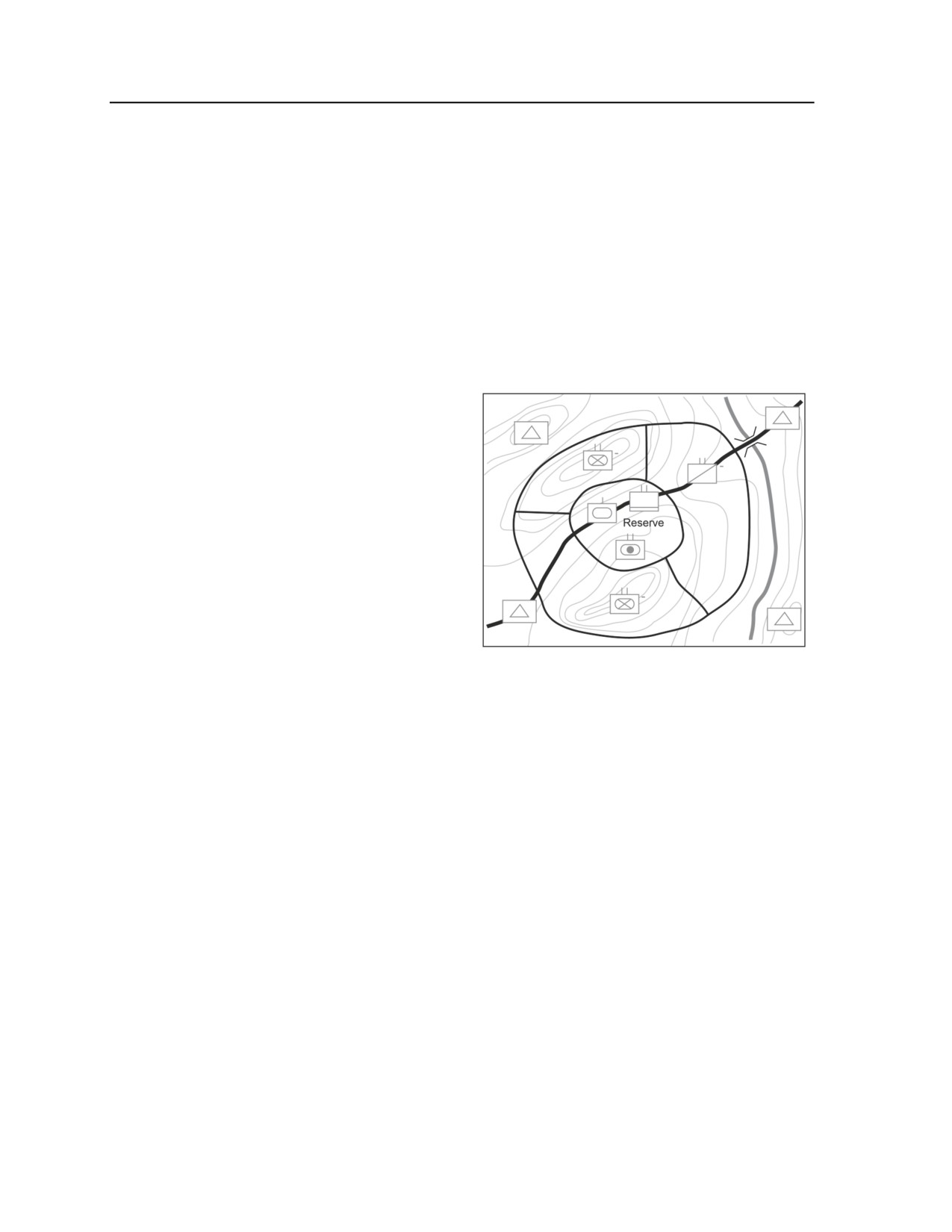
Chapter 6
6-119. Alternatively, in a mobile defense the commander may take advantage of terrain or smoke to hide a
striking force until the enemy’s forward elements pass this force. Until committed, the striking force
maintains a perimeter defense. This technique closely resembles the use of stay-behind forces. Similarly,
the commander may order units inadvertently bypassed by the enemy not to break out immediately, so that
the defenders may capitalize on their position to destroy the enemy.
PERIMETER DEFENSE
6-120. The commander can employ the perimeter defense as an option when conducting an area or mobile
defense. The commander uses it in many other circumstances, such as when subordinate units bypass
enemy forces or in the conduct of base and base cluster defense in the echelon support area.
6-121. A perimeter defense is oriented in all directions. The prerequisites for a successful perimeter
defense are aggressive patrolling and security operations outside the perimeter. The unit within the
perimeter can perform these activities, or another force, such as the territorial defense forces of a host
nation, can perform them. The unit can organize a
perimeter defense to accomplish a specific mission,
such as protecting a fire base, or providing
immediate self-protection, such as during resupply
operations when all-around security is required.
The commander establishes a perimeter when the
unit must hold critical terrain, such as a strong
point, or when it must defend itself in areas where
the defense is not tied in with adjacent units. This
occurs when the unit is operating behind enemy
lines, or when it is securing an isolated objective,
such as a bridge, mountain pass, or airfield. A unit
may also form a perimeter when it has been
bypassed and isolated by the enemy, and it must
defend in place, or it is located in the friendly
echelon support within the confines of a base or
base cluster. (See figure 6-1.) However, divisions
Figure 6-1. Perimeter defense
and corps can also organize a perimeter defense
when necessary.
6-122. A major characteristic of a perimeter defense is a secure inner area with most of the combat power
located on the perimeter. Another characteristic is the ease of access for resupply operations. The
commander coordinates direct and indirect fire plans to prevent accidentally engaging neighboring friendly
units and noncombatants. Normally, the reserve centrally locates to react to a penetration of the perimeter
at any point.
6-123. Perimeters vary in shape depending on the terrain and situation. If the commander determines the
most probable direction of enemy attack, that part of the perimeter covering that approach may be
reinforced with additional resources. The perimeter shape conforms to the terrain features that best use
friendly observation and fields of fire. The commander can increase the effectiveness of the perimeter by
tying it into a natural obstacle, such as a river, which allows the defending unit to concentrate its combat
power in more threatened areas.
Organization of Forces
6-124. The commander may employ all defending forces forward along the perimeter or establish a
defense in depth within the perimeter. The commander employs patrols, raids, ambushes, air attacks, and
supporting fires to harass and destroy enemy forces before they make contact with the perimeter, thus
providing defense in depth with both techniques.
6-22
FM 3-90-1
22 March 2013
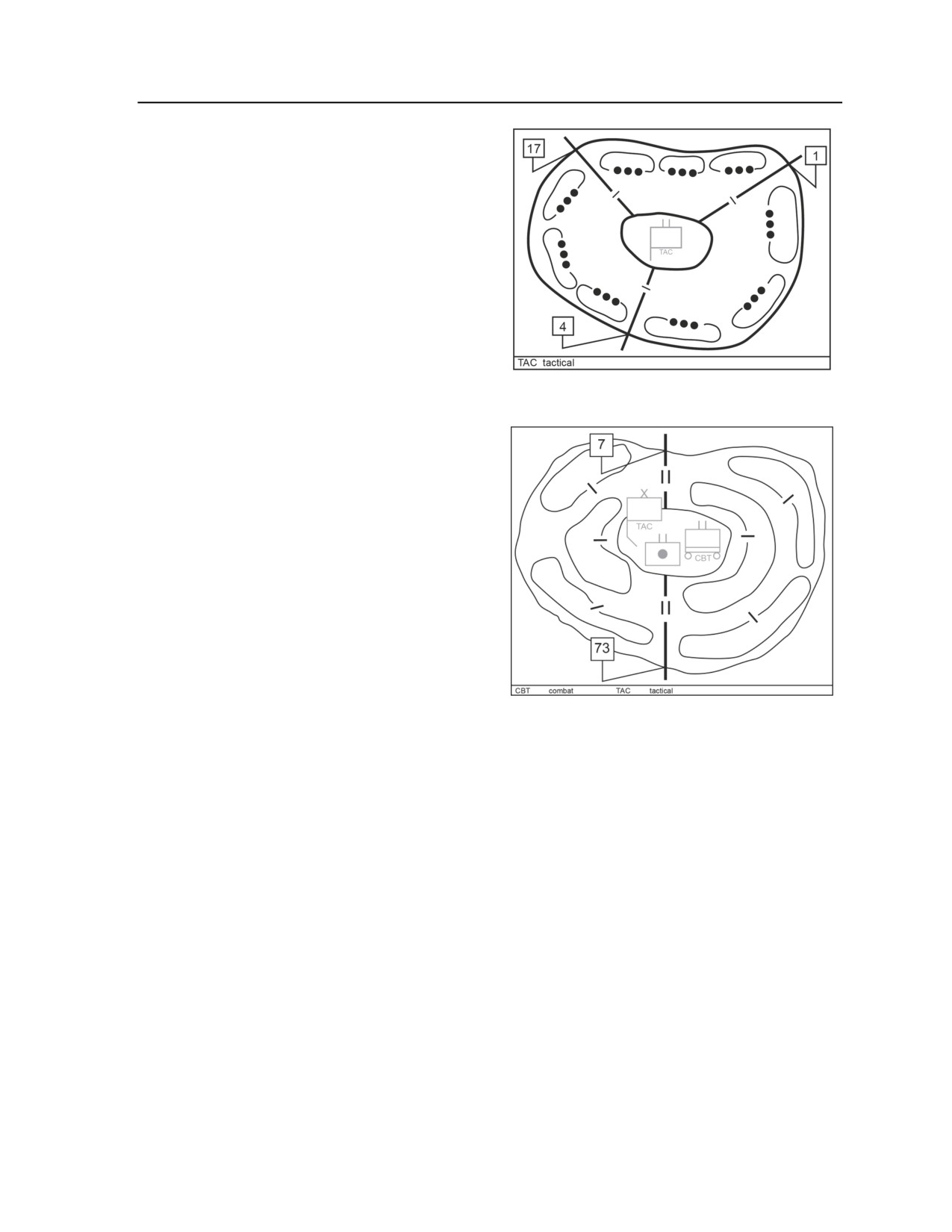
Basics of the Defense
6-125. In the first technique, the commander
places all subordinate units in positions along the
perimeter. The commander divides the perimeter
into subordinate unit AOs with boundaries and
contact points. (See figure 6-2.) This reduces the
possibility of fratricide and friendly fire incidents
within the perimeter and maximizes combat power
on the perimeter.
6-126. Constructing an outer and inner perimeter
creates some depth in the defense in the second
technique. Using an infantry brigade combat team
(IBCT) assembly area as an example, the
commander places two companies in each battalion
along the outer perimeter reinforced with
detachments from the battalion weapons company
Figure 6-2. All company teams on the
and one company in reserve along the inner
perimeter
perimeter.
(See figure
6-3.) This configuration
gives depth to each battalion’s positions and
facilitates control. It also gives one company from
each battalion the mission to support frontline
platoons. It enables the company commander to
locate any indirect fire systems, such as mortars,
near the reserve company, enhancing control and
security. The reconnaissance battalion would have
its resources manning positions outside the
perimeter. Alternatively, the commander could
elect to assign the outer perimeter to the two
maneuver battalions and have the reconnaissance
battalion resource an inner perimeter, retaining a
larger, more tactically mobile central reserve. (See
figure 6-4 on page 6-24.)
6-127. The commander positions forces within the
perimeter to decrease the possibility of an enemy
Figure 6-3. Two battalion task forces on the
perimeter, company teams positioned in
simultaneously suppressing the inner and outer
perimeter forces with the same fires. Friendly
depth.
forces within the perimeter provide mutual support.
In open terrain, the commander covers gaps on
the outer perimeter between units with fires. The
commander does not allow gaps between defensive fighting positions when the unit is in restrictive terrain
with restricted fields of fire and observation. This may mean that a unit defends along a narrower frontage
than on more open terrain. The commander may also have to employ all subordinate units on the line
formed by the perimeter. The commander ensures that outer perimeter positions have rearward protection
from inner perimeter weapons if an inner perimeter is established.
6-128. The commander normally assigns combat vehicles supporting the defense firing positions on the
perimeter to cover the most likely mounted avenues of approach. Vehicle commanders select and prepare
alternate and supplemental firing positions and routes to and from them. If the perimeter has several
mounted avenues of approach leading to it, the commander may elect to hold these combat vehicles in hide
positions until the enemy approaches. Units prepare routes, firing positions, and range cards in advance for
all positions. Small-unit leaders must ensure that vehicles do not destroy communication wires when they
displace from one position to another. Those same leaders make sure that jamming devices protecting their
vehicles from radio controlled command detonated mines and boobytraps during movement are completely
shut off before returning to assembly areas, defensive positions, and forward operating bases to prevent the
jamming of friendly communications systems.
22 March 2013
FM 3-90-1
6-23
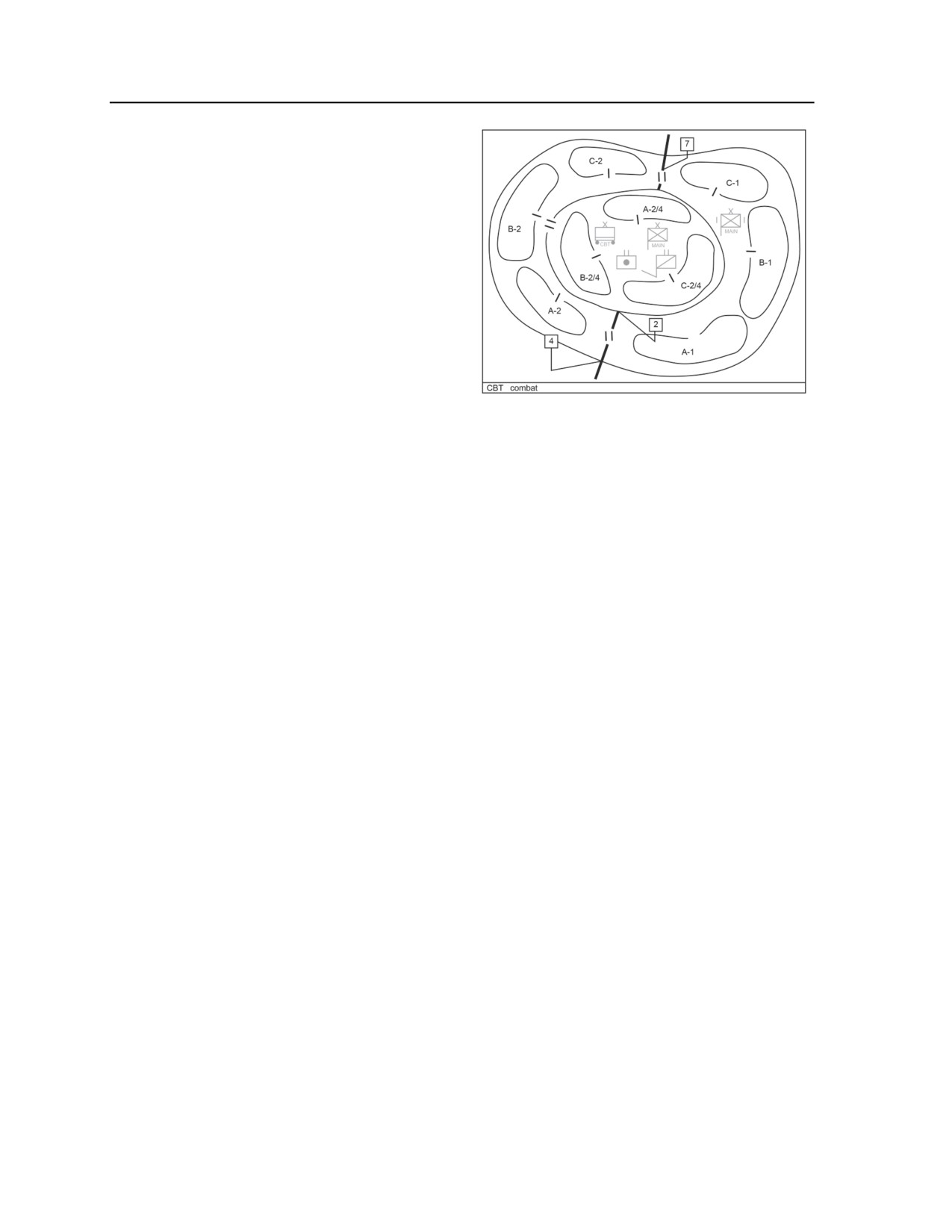
Chapter 6
6-129. The need to hold or protect terrain
features—such as bridges, airfields, or landing
zones—from enemy observation and fires may
restrict the positioning of units within a perimeter.
These factors, as well as the inability to achieve
depth, make a perimeter defense vulnerable to
penetration by heavy enemy forces. The
commander reduces these vulnerabilities by—
z
Developing
reconnaissance
and
surveillance plans that provide early
warning.
z
Positioning anti-armor systems on
restrictive terrain to concentrate fires on
armor approaches.
z
Providing as much depth as the diameter
of the perimeter to allow the proper
Figure 6-4. Two battalion task forces on the
placement of security elements and the
perimeter, one in reserve.
reserve and the designation of secondary
sectors of fire for anti-armor weapons.
z
Constructing obstacles to fix or block the enemy, so friendly units can effectively engage them.
z
Using smoke and military deception.
6-130. If isolation from other friendly units drives the commander to form a perimeter, such as when
conducting echelon support area security, functional and multifunctional support and sustainment elements
from other units may seek to take advantage of that perimeter’s protection. These elements are given
defensive missions within the base formed by the perimeter based on their capabilities. The commander
coordinates and integrates any fire support provided from outside the perimeter into the overall defensive
plan. This extra fire support conserves the ammunition of units within the perimeter.
6-131. The commander normally employs reconnaissance assets, such as a scout platoon, outside the
perimeter to provide early warning. The commander may augment perimeter security with squad-sized or
smaller observation posts forward of the perimeter that are provided and controlled by units on the
perimeter. These security elements are positioned to observe avenues of approach. Patrols cover areas that
cannot be observed by stationary elements. Any security forces operating outside the perimeter must
coordinate their passage of lines into and out of the perimeter with the appropriate perimeter units.
6-132. The reserve may be a designated unit or a provisional force organized from available personnel and
equipment. The reserve forms a second line of defense behind the perimeter forces. Ideally, the reserve is
mobile enough to react to enemy action along any part of the perimeter. The commander positions the
reserve to block the most dangerous avenue of approach and assigns on-order positions on other critical
avenues. The commander may task combat vehicles initially occupying firing positions on the perimeter
with the mission of reinforcing the reserve.
Control Measures
6-133. The commander in a perimeter defense designates the trace of the perimeter, battle positions,
contact points, and lateral and forward boundaries. The commander can use EAs, target reference points,
final protective fires, and principal direction of fire as fire control measures. The commander designates
checkpoints, contact points, passage points, and passage routes for use by local reconnaissance,
surveillance, and security elements operating outside the boundary of the perimeter. (See figure 6-5.)
6-24
FM 3-90-1
22 March 2013
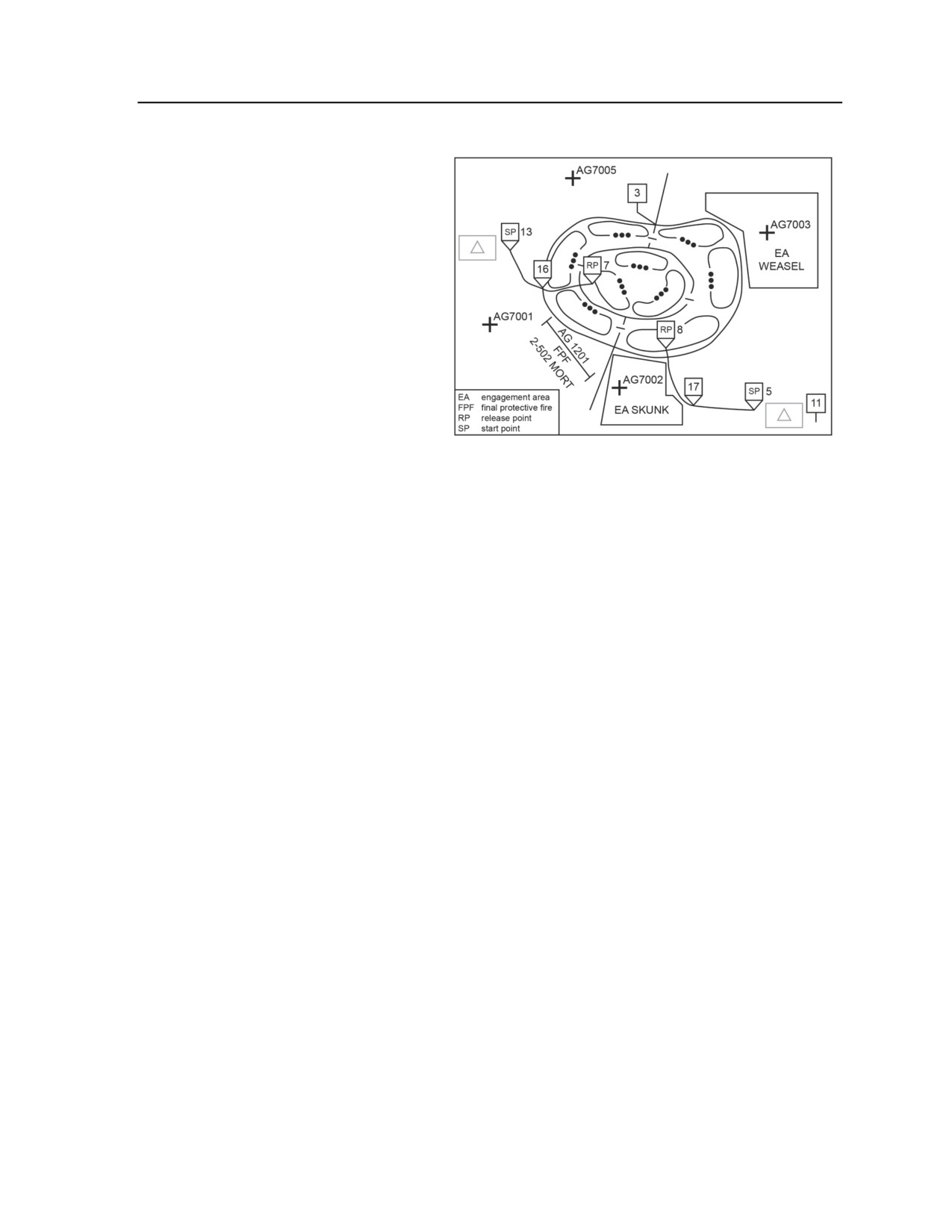
Basics of the Defense
Planning a Perimeter Defense
6-134. The
defending
commander
positions defending forces and plans fire
and movement, so they can respond to the
widest possible range of enemy actions.
The defending commander, assisted by
the staff, prepares plans, including
counterattack plans. The commander
rehearses, evaluates, and revises these
plans as needed. The availability of
landing and drop zones protected from
enemy observation and fire is a major
consideration
when selecting and
organizing the perimeter defense. The
commander must emphasize supply
economy and protect existing supply
stocks, since aerial resupply is vulnerable
to weather and enemy fires. The
commander considers the following
Figure 6-5. Engagement area control measures
fundamentals when planning a perimeter
defense.
Use of Terrain
6-135. Proper evaluation and organization of the area are essential to maximize the effectiveness of a force
conducting perimeter defense. Commanders consider —
z
Natural defensive characteristics of the terrain.
z
Using artificial obstacles to enhance the natural defensive characteristics of the terrain.
z
Existing roads, railways, and waterways used for military LOCs and civilian commerce.
z
Controlling land areas surrounding the perimeter to a range beyond that of enemy mortars and
rockets and also controlling water approaches.
Security
6-136. Early warnings of pending enemy actions ensure the commander time to react to any threat.
Combat outposts, patrols, sensors, target acquisition radars, and aerial surveillance provide early warning.
Civilian informants and the actions of indigenous people near the position are excellent indicators of
pending enemy actions. Security measures vary with the enemy threat, forces available, and the other
mission variables of METT-TC; however, all-round security is essential.
Mutual Support
6-137. The commander positions defending forces to ensure mutual employment of defensive resources,
such as crew-served weapons, observation, and maneuver elements. Mutual support between defensive
elements requires careful planning, positioning, and coordination because of the circular aspects of the
perimeter defense. The commander uses surveillance, obstacles, prearranged indirect fires, and maneuver
elements to exploit or reinforce fires to control any gaps in the perimeter. Defensive plans provide for using
all available support, including field artillery systems firing danger close, attack helicopters conducting
close combat attack, and close air support.
All-Around Defense
6-138. In defensive planning, the commander has to be prepared to defend against an enemy attack from
any direction. The commander employs flexible plans and positions the reserve to react to any threat. The
commander commits maneuver elements and supporting weapons to detect, engage, and destroy the
22 March 2013
FM 3-90-1
6-25
Chapter 6
attacking enemy force. The commander assigns defensive positions to all personnel within the perimeter
and sectors of fire.
Defense in Depth
6-139. Alternate and supplementary positions, combat outposts, and mutually supporting strong points
forward of the perimeter extend the depth of the defense. The commander plans fires throughout the
defensive area up to the maximum range of weapons. The commander may place portable obstacles around
critical locations within the perimeter during periods of reduced visibility to disrupt the enemy’s plan and
add depth to the defense.
Responsiveness
6-140. Attacks against a perimeter may range from long-range sniper, mortar, or artillery and rocket fire to
attacks by demolition teams or major forces. The enemy has the advantage of deciding when, where, and
with what force to attack. The commander prepares plans, to include counterattack plans, and rehearses,
assesses, and revises them as necessary. The defensive plan contains procedures for timely responses by
fire support teams and maneuver forces.
Maximum Use of Offensive Action
6-141. Since the objective of the perimeter defense is to maintain a secure position, the commander uses
offensive actions to engage enemy forces outside the base. On initial occupation of the perimeter, friendly
forces take offensive actions to destroy enemy forces in the immediate area. Once the perimeter area is
clear, a relatively smaller force can defend the perimeter, thereby releasing other forces for their primary
operations. The commander employs patrols, raids, ambushes, aerial attacks, and supporting fires to harass
and destroy enemy forces to prevent their threatening the perimeter. The commander maintains constant
communications and a common operational picture with subordinates within the perimeter. The
commander directs them to conduct appropriate actions to remove threats located within their AOs and
sectors of fire.
Executing a Perimeter Defense
6-142. Attacks against a perimeter may range from long-range sniper, mortar, or rocket fire attacks by
suicide demolition squads, and attacks by major enemy ground and air forces. Mortars, artillery, tanks, and
anti-armor missile systems from within the perimeter engage the enemy at long ranges. As the attack comes
within small arms range, other weapons on the perimeter engage the enemy. If the assault continues, the
force employs its available FPFs. If the enemy penetrates the perimeter, the reserve blocks the penetration
or counterattacks to restore the perimeter. After committing the initial reserve, the commander must
reconstitute another reserve to meet other threats. This force normally comes from an unengaged unit on
another portion of the perimeter. If the commander uses an unengaged force to constitute a new reserve, the
commander must retain sufficient forces to defend the vacated sector, unless the situation forces the
commander to assume that degree of risk.
6-143. Sustainment elements may provide support from within the perimeter or from outside locations,
depending on the mission and the status of the unit providing the defensive perimeter, type of transport
available, weather, and terrain. Units in contested areas without secure ground lines of communications are
often sustained by air.
REVERSE SLOPE DEFENSE
6-144. The commander organizes a reverse slope defense on the portion of a terrain feature or slope with a
topographical crest that masks the main defensive positions from enemy observation and direct fire. All or
part of the defending force may employ this technique. It is generally useful at lower tactical levels, such as
battalion and below.
6-26
FM 3-90-1
22 March 2013
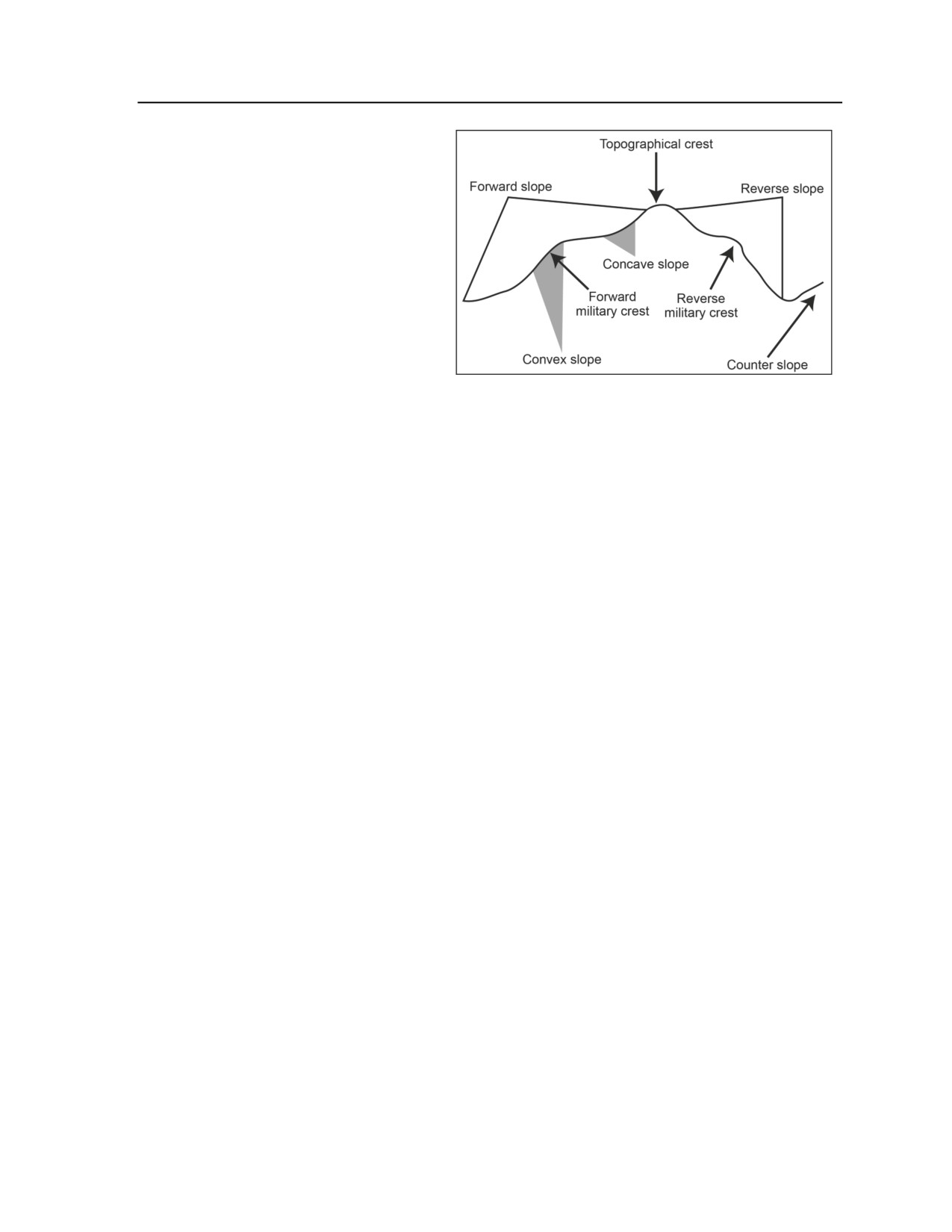
Basics of the Defense
6-145. The
commander bases a
successful reverse slope defense on
denying the enemy the topographical
crest. Although the defender may not
occupy the crest in strength, controlling
the crest by fire is essential for success.
This situation reduces the effects of
indirect fire
(mortar, artillery, and
close-air support) and draws the battle
into small arms range. Commanders use
the reverse slope defense to provide the
defending force an opportunity to gain
surprise. The commander’s goal is to
make the enemy commit forces against
the forward slope of the defense, causing
Figure 6-6. Slope terminology
enemy forces to attack in an
uncoordinated fashion across the exposed topographical crest. Firing from covered and concealed positions
throughout the battle area, the defending force maintains a distinct advantage over the exposed enemy
forces and canalizes them through unfamiliar terrain into kill zones. (Figure 6-6 shows the terminology
associated with the reverse slope defense.)
6-146. The commander chooses to conduct a reverse slope defense when—
z
The crest and forward slope are untenable because the enemy enjoys a quantitative or qualitative
advantage in firepower at that point.
z
His weapons cannot depress enough to engage.
z
The crest and forward slope offer little or no cover and concealment.
z
The forward slope has been lost or has not been seized.
z
Units on the flanks can adequately cover the forward slope.
z
Variance in the force’s tactical pattern is advisable to deceive or surprise the enemy.
z
The commander is forced to assume a hasty defense while in contact with or close to the enemy.
6-147. The reverse slope defense may deceive the enemy regarding the true location and organization of
the main defensive positions. This defense protects the main defensive positions from preparation fires and
causes the enemy to deploy into assault formations prematurely. The forward crest of the main defensive
positions limits the enemy’s observation. It reduces the effectiveness of enemy indirect fires and CAS and
renders the enemy’s direct fire weapons ineffective. The defending force may surprise enemy forces as they
crest the high ground, engaging them with massed fires. Units on the reverse slope have more freedom of
movement until the crest is lost.
6-148. Using the reverse slope defense has several disadvantages:
z
The effective range of direct fire weapons may be limited.
z
Once security elements withdraw, the enemy can advance largely unimpeded until attacking
elements crest the high ground in front of the main defensive positions.
z
The enemy has the advantage of attacking downhill.
z
Maintaining observation of the enemy is difficult.
z
In some cases obstacles can only be covered from positions on the forward slope.
Organization of Forces
6-149. The commander places over-watching elements forward of the topographic crest and on the flanks
of the position in a valley or depression. Another variation available to the commander is to organize a
system of reverse slope defenses firing to the oblique defilade, each covering the other. A commander uses
an oblique defilade to protect defending systems from enemy frontal and flanking fires and from fires
coming from above. For example, in figure 6-7 on page 6-28, the units defending cannot engage half of the
22 March 2013
FM 3-90-1
6-27

Chapter 6
hill to their direct front because of line of
sight restrictions caused by small forests,
but they can cover each other using
oblique defilade.
6-150. The
commander
positions
reconnaissance and security
elements
where they can observe the forward slope,
the terrain forward of it, and other
approaches to the defending position.
Security
elements destroy
enemy
reconnaissance assets, delay the enemy,
Figure 6-7. Oblique defilade
disorganize the enemy’s attack, and
deceive the enemy regarding the exact location of the main defense. The commander should position
reconnaissance and surveillance assets in observation posts
(OPs) located near or forward of the
topographical crest to provide long-range observation of both the enemy’s flanks and front. Forces manning
these OPs, which can be provided by the commander’s reserve, may vary in size from a two-man team to a
rifle squad or a multiple combat vehicle section in each position. The commander should employ sufficient
forces to provide observation and a security screen for the MBA on ground that should be retained. During
darkness and periods of reduced visibility, the commander should increase the numbers and sizes of these
detachments to provide security against infiltration or unexpected attack. Aggressive night combat patrols
and ambushes are an essential part of the security process.
6-151. In order to achieve surprise and limit the enemy’s ability to maneuver, the commander organizes
the main defensive positions to mass fires on the enemy as the attacking enemy force crosses the
topographical crest. In a reverse slope defense, the key position denies enemy penetration and supports
forward elements by fire. The defending force maintains observation and fires over the entire forward slope
as long as possible to destroy enemy forces, thus preventing the enemy from massing for a final assault.
From defensive positions on the reverse slope, the close-in battle builds in intensity. The defending force
does not fire its direct fire weapons, which are located throughout the MBA (on adjacent slope positions,
counterslope positions, or reverse slope positions), until suitable targets appear. At the same time, the force
shifts the effects of its indirect fires to those areas forward of the crest and forward military slope.
6-152. When possible, other units on complementary terrain support units in reverse slope positions. This
is especially desirable when those supporting units can observe and place fires on the crest and forward
slope. In a defense on a counterslope (reverse forward slope), fires must cover the area immediately in front
of the reverse slope positions to the topographical crest. The commander organizes defensive positions to
permit fires on enemy approaches around and over the crest and on the forward slopes of adjacent terrain
features, if applicable. The key factors that affect the organization of these areas are mutually supporting
covered and concealed positions, numerous existing and reinforcing obstacles, the ability to bring
devastating fires from all available weapons onto the crest, and a counterattack force. Depending on the
terrain, the most desirable location for the reserve may be on the counterslope or the reverse military crest
of the counterslope.
Control Measures
6-153. Defensive control measures introduced in previous chapters continue to apply. The commander
places EAs and obstacles on the reverse slope. The topographical crest normally marks the far edge of the
EA. The defender must dominate that crest by fires to prevent the enemy from successfully engaging it.
Executing a Reverse Slope Defense
6-154. When executing a reverse slope defense, the commander places special emphasis on—
z
The proper organization of the forward slope to provide observation across the entire front and
security to the main battle positions.
z
A fire support plan to prevent the enemy’s occupation and use of the topographical crest.
6-28
FM 3-90-1
22 March 2013
Basics of the Defense
z
A counterattack plan that specifies measures necessary to clear the crest or regain it from the
enemy control.
z
Fire support to destroy, disrupt, and attrit enemy forces on the forward slope.
6-155. The commander normally places final protective fires along the topographical crest and employs
them as the enemy reaches the first row of defiladed obstacles. The commander uses the reserve to
counterattack and expel the enemy from the topographical crest, if massed indirect fires do not defeat the
attack. In a reverse slope defense, the commander can employ the designated reserve to conduct echelon
support area security operations, prepare withdrawal routes, provide flank security, and conduct other
actions with the understanding that this increases the time required to reassemble the reserve and prepare it
to support the defense.
6-156. The reverse slope defense pursues offensive opportunities through surprise and deceptive actions. It
is uniquely suited to infantry forces in mountainous terrain. When conducting a reverse slope defense,
surprise results from defending in a manner for which the enemy is unprepared. Once this defense is
employed successfully to halt an enemy attack, it may have limited further value because the effect of
surprise will be difficult to attain. (For additional information on the use of a reverse slope defense, see
small-unit tactics and procedures publications from the Maneuver Center of Excellence.)
TRANSITIONS
6-157. If a defense is successful, the commander anticipates and attempts to transition to the offense. If the
defense is unsuccessful, the commander needs to transition from a defensive posture into retrograde
operations. Transition from one type of operation to another requires mental as well as physical agility on
the part of all those involved as well as accurate situational assessment capabilities.
6-158. The commander deliberately plans for offensive or retrograde operations, assisting the transition
process and allowing the commander to set the conditions necessary for a successful transition. Such
planning addresses the need to control the tempo of operations, maintain contact with both enemy and
friendly forces, and keep the enemy off balance. It establishes the procedures and priorities by which a unit
prepares for the next mission. In accordance with the mission variables of METT-TC, it establishes the
required organization of forces and control measures necessary for success.
6-159. Prior contingency planning decreases the time needed to adjust the tempo of combat operations
when a unit transitions from a focus on the conduct of defensive tasks to offensive tasks. It does this by
allowing subordinate units to simultaneously plan and prepare for subsequent operations. Preparations
typically include resupplying unit basic loads and repositioning or reallocating supporting systems.
(Chapters 1 thru 5 address the planning, preparation, and execution of all offensive tasks.)
6-160. The commander’s contingency planning also reduces the amount of time and confusion when a unit
is unsuccessful in its defensive efforts and must transition to retrograde operations. The commander
designates units to conduct denial operations and to evacuate casualties and inoperative equipment. The
commander uses retrograde operations to preserve the force as a combat-capable formation until the
commander can establish those conditions necessary for a successful defense. (FM 3-90-2 discusses the
task of retrograde.)
TRANSITION TO A FOCUS ON OFFENSIVE TASKS
6-161. A defending commander transitions to a focus on the offensive element of decisive action by
anticipating when and where the enemy force will reach its culminating point or require an operational
pause before it can continue. At those moments, the combat power ratios most favor the defending force.
The enemy force will do everything it can to keep the friendly force from knowing when it is becoming
overextended. Indicators that the enemy is becoming overextended include when—
z
Enemy forces begin to transition to the defense—this defense may be by forces in or out of
contact with friendly forces.
z
Enemy forces suffer heavy losses.
z
Enemy forces start to deploy before encountering friendly forces.
22 March 2013
FM 3-90-1
6-29
Chapter 6
z
Enemy forces are defeated in most engagements.
z
Enemy forces are committed piecemeal in continued enemy attacks.
z
Enemy reserve forces are identified among attacking forces.
z
Examination of captured or killed enemy soldiers and captured or destroyed enemy equipment
and supplies shows that the enemy force is unable to adequately sustain itself.
z
A noticeable reduction in the tempo of enemy operations.
z
Local counterattacks meet with unexpected success.
The commander must be careful not to be successfully targeted by enemy information operations designed
to tempt the commander to abandon the advantages of fighting from prepared defensive positions.
6-162. In a mobile defense, transitioning to the offense generally follows the striking force’s counterattack.
In an area defense, the commander designates a portion of the defending force to conduct the attack. This
force usually includes the echelon’s available reserves.
6-163. As the commander transitions the force from the defense to the offense, the commander—
z
Establishes a line of departure (LD). This may require the conduct of local, small-scale attacks to
seize terrain necessary for the conduct of offensive tasks or destroy enemy forces that could
threaten the larger offensive action.
z
Maintains contact with the enemy, using combinations of available reconnaissance and
surveillance assets to develop the information required to plan future operations and avoid being
deceived by enemy military deception operations.
z
Redeploys the combined arms team based on the probable future employment of each element of
that team. For example, fire support assets tend to move forward so that additional enemy forces
and terrain are encompassed within their range fans.
z
Maintains or regains contact with adjacent units in a contiguous AO and ensures that subordinate
units remain capable of mutual support in a noncontiguous AO.
z
Transitions the focus of engineer efforts from countermobility and survivability to mobility.
z
Provides the commander’s intent for transitioning from the defense to the offense to subordinate
commanders and Soldiers.
z
Submits defended asset lists to influence the positioning of these air and missile defense assets
by the joint force area air defense commander.
6-164. The commander conducts any required reorganization and resupply concurrently with other
transition activities. This requires a transition in the sustainment effort, with a shift in emphasis from
ensuring a capability to defend from a chosen location to an emphasis on ensuring the force’s ability to
advance and maneuver. For example, in the defense, the sustainment effort may have focused on the
forward stockage of Class IV and V items and the rapid evacuation of combat-damaged systems. In the
offense, the sustainment effort may need to focus on providing POL and forward repair of maintenance and
combat losses. A transition is often a time in which deferred equipment maintenance can be performed.
Additional assets may also be available on a temporary basis for casualty evacuation and medical treatment
because of a reduction in the tempo of operations.
6-165. The commander should not wait too long to transition from the defense to the offense as the enemy
force approaches its culminating point. Enemy forces will be dispersed, extended in depth, and weakened.
At that time, any enemy defensive preparations will be hasty and enemy forces will not be adequately
disposed for defense. The commander wants the enemy in this posture when the force transitions to the
offense. The commander does not want to give the enemy force time to prepare for the defense.
Additionally, the psychological shock on enemy soldiers will be greater if they suddenly find themselves
desperately defending on new and often unfavorable terms while the commander’s own Soldiers will enjoy
a psychological boost by going on the offense.
6-166. A commander can use two basic techniques when transitioning to the offense. The first, and
generally preferred, technique is to attack using forces not previously committed to the defense. This is
because defending MBA units may still be decisively engaged. These attacking forces may come from the
6-30
FM 3-90-1
22 March 2013
Basics of the Defense
reserve or consist of reinforcements. Since these forces have not recently been actively involved in combat,
they are more likely to—
z
Be at authorized strength levels.
z
Enjoy a higher combat system operationally ready rate.
z
Have leaders and Soldiers who are more likely to be rested and thus capable of prolonged,
continuous operations.
z
Have a complete basic load of supplies.
z
Have the time and energy to plan and prepare for offensive action.
z
Be able to maneuver out of physical contact with the enemy.
6-167. A drawback to the use of this technique is the requirement to conduct a forward passage of lines.
Additionally, enemy reconnaissance and surveillance assets are likely to detect the arrival of significant
reinforcements.
6-168. Another consideration of using units not in contact occurs when they are operating in
noncontiguous AOs. The commander rapidly masses overwhelming combat power in the decisive
operation. This might require the commander to adopt economy of force measures in some AOs while
temporarily abandoning others in order to concentrate sufficient combat power. (See chapters 1 and 3 for
offensive planning, preparing, and executing considerations.)
6-169. The second technique is to conduct offensive actions using the currently defending forces. This
technique generally has the advantage of being more rapidly executed and thus more likely to catch the
enemy by surprise. Speed of execution in this technique results from not having to conduct an approach or
tactical road march from reserve assembly areas or, in the case of reinforcements, move from other AOs
and reception, staging, organization, and integration locations. Speed also results from not having to
conduct a forward passage of lines and perform the liaison necessary to establish a common operational
picture that includes knowledge of the enemy force’s patterns of operation. The primary disadvantage of
this technique is that the attacking force generally lacks stamina and must be quickly replaced, if friendly
offensive actions are not to culminate quickly.
6-170. If units in contact participate in the attack, the commander must retain sufficient forces in contact to
fix the enemy. The commander concentrates the attack by reinforcing select subordinate units so they can
execute the attack and, if necessary, maintain the existing defense. The commander can also adjust the
defensive boundaries of subordinate units so entire units can withdraw and concentrate for the attack.
TRANSITION TO THE RETROGRADE
6-171. A defending commander transitions from an area or mobile defense to the retrograde for those
reasons outlined in paragraph 9-1. A retrograde usually involves a combination of delay, withdrawal, and
retirement operations. These operations may occur simultaneously or sequentially. As in other operations,
the commander’s concept of operations and intent drive planning for retrograde operations. Each form of
retrograde operation has its unique planning considerations, but considerations common to all retrograde
operations are risk, the need for synchronization, and rear operations. The planning, preparing, and
executing considerations associated with retrograde operations are found in chapter 9, but a number of key
considerations receive special emphasis during the transition from the defense to the retrograde.
6-172. The transition to retrograde operations must be accompanied by efforts designed to—
z Reduce the enemy’s strength and combat power.
z Provide friendly reinforcements.
z Concentrate forces elsewhere for the attack.
z Prepare stronger defenses elsewhere within the AO.
z Lure or force part or all of the enemy force into areas where it can be counterattacked.
6-173. The complexity and fluidity of retrograde operations and the absolute need to synchronize the entire
operation dictates the need for detailed, centralized planning and decentralized execution. Planning for
22 March 2013
FM 3-90-1
6-31
Chapter 6
retrograde operations begins with the preparation of plans for the follow-on mission and is driven by the
commander’s concept of operations and intent.
6-174. The nature of retrograde operations involves an inherent risk of degrading the defending force’s
morale. Therefore, maintaining offensive spirit is essential among subordinate leaders and Soldiers.
Rearward movements may be seen as a defeat, or as an action that could result in isolation of the force. The
commander remains well forward and visible. The commander ensures that subordinate leaders and
Soldiers understand the purpose and intent of the operation and their role in accomplishing the mission.
Thorough planning, effective control, and aggressive leadership will minimize risk during the retrograde or
enhance the probability of success.
6-175. The commander’s intelligence requirements dramatically increase as forces begin their movement
to other locations, and the combat capabilities of units in contact are subsequently reduced. The commander
develops a synchronized and integrated intelligence collection plan to identify and locate enemy attempts to
pursue, outflank, and isolate the defending force as it transitions to the retrograde. As the commander
transitions to the retrograde, the commander makes every effort to conserve combat power. The
commander considers the need to—
z
Balance the risk of conserving combat power while remaining disposed to the intent of the
defensive mission.
z
Disengage and withdraw units with the least tactical mobility and nonessential elements before
the retrograde of the main body.
z
Use mobile forces to cover the retrograde of less mobile forces.
z
Use the minimum essential combat power necessary to provide security for the retrograde of the
main body.
TRANSITION TO A FOCUS ON STABILITY TASKS
6-176. Transition to a focus on the conduct of stability tasks is conditional, but should be planned in
advance. A defending commander may transition to the stability element of decisive action if the defense
retained decisive terrain, denied vital areas to the enemy, and so successfully attrited the attacking enemy
that offensive actions are superfluous. As in other operations, the commander’s concept of operations and
intent drive the design of and planning for stability tasks. Generally, a tactical commander will focus on
meeting the immediate essential service and civil security needs of the civilian inhabitants of the area of
operations in coordination with any existing host nation government and non-governmental organizations
before addressing the other three primary stability tasks. Support requirements may change dramatically.
The commander will probably change the rules of engagement, and the commander must transmit these
rules down to the squad and individual Soldier level.
6-177. When the focus transitions from defensive to stability tasks, the unit will probably begin executing
a sequel to its previous defensive order. The commander will probably reorganize the unit to introduce
those capabilities required by changes in the mission variables of METT-TC. Depending on the specific
operational environment, commanders and staffs should reference the appropriate official departmental
publications dealing with other operations and tasks, such as ADRP 3-07 or FM 3-24, to refresh previous
training and education in those subjects. If commanders and staffs are unfamiliar with the civil
considerations of their AO, they should refer to area histories, cultural and economic studies, and similar
reference materials. The mission command and protection functions remain important to prevent Soldiers
from relaxing discipline and safety standards as the stress of active defensive actions disappears.
6-178. When involved in other operations, such as peace operations, irregular warfare, and military
engagement, unit defensive actions are closely related to the perimeter defense.
(Area security
considerations are addressed in FM 3-90-2.) Defensive tasks conducted during these other missions will
normally employ restrictive rules of engagement throughout the mission, regardless of the primary element
of decisive action prevailing at any specific moment.
6-32
FM 3-90-1
22 March 2013
Chapter 7
The Area Defense
An area defense capitalizes on the strength inherent in a closely integrated defensive
organization on the ground. The conduct of an area defense facilitates the
consolidation and reconstitution of forces in order to transition to a focus on another
element of decisive action, such as stability. The commander may assign subordinate
units the task of conducting an area defense as part of their mission. Subordinate
echelons defend within their assigned areas of operations
(AOs) as part of the
larger-echelon’s operation.
GENERAL CONSIDERATIONS FOR AN AREA DEFENSE
7-1. A commander conducts an area defense when the following conditions occur:
z
When directed to defend or retain specified terrain.
z
When the commander cannot resource a striking force.
z
The forces available have less mobility than the enemy.
z
The terrain affords natural lines of resistance and limits the enemy to a few well-defined avenues
of approach, thereby restricting the enemy’s maneuver.
z
There is enough time to organize the position.
z
Terrain constraints and lack of friendly air superiority limit the striking force’s options in a
mobile defense to a few probable employment options.
z
Conditions require the preservation of forces when transitioning from a focus on the conduct of
offensive tasks to stability tasks and when offensive actions are superfluous to the mission.
7-2. The commander conducting an area defense combines static and mobile actions to accomplish the
mission. Static actions usually consist of fires from prepared positions. Mobile actions include using the
fires provided by units in prepared positions as a base for counterattacks and repositioning units between
defensive positions or forward operating bases when the operation is focused on the conduct of stability
tasks. The commander can use the reserve and uncommitted forces to conduct counterattacks and spoiling
attacks to desynchronize the enemy forces or prevent them from massing.
ORGANIZATION OF FORCES FOR AN AREA DEFENSE
7-3. The commander organizes the defending force to accomplish intelligence, security, main battle area
(MBA), reserve, and sustainment missions. The commander has the option of defending forward or
defending in depth. When the commander defends forward within an AO, the force is organized so that
most of the available combat power is committed early in the defensive effort. To accomplish this, the
commander may deploy forces forward or plan counterattacks well forward in the MBA or even beyond the
MBA. If the commander has the option of conducting a defense in depth, security forces and forward MBA
elements are used to identify, define, and control the depth of the enemy’s main effort while holding off
secondary thrusts. This allows the commander to conserve combat power, strengthen the reserve, and better
resource the counterattack.
RECONNAISSANCE AND SURVEILLANCE
7-4. The commander directs reconnaissance and surveillance assets to determine the locations, strengths,
and probable intentions of the attacking enemy force before and throughout the defense. The commander
places a high priority on early identification of the enemy’s main effort. The commander may need to
22 March 2013
FM 3-90-1
7-1